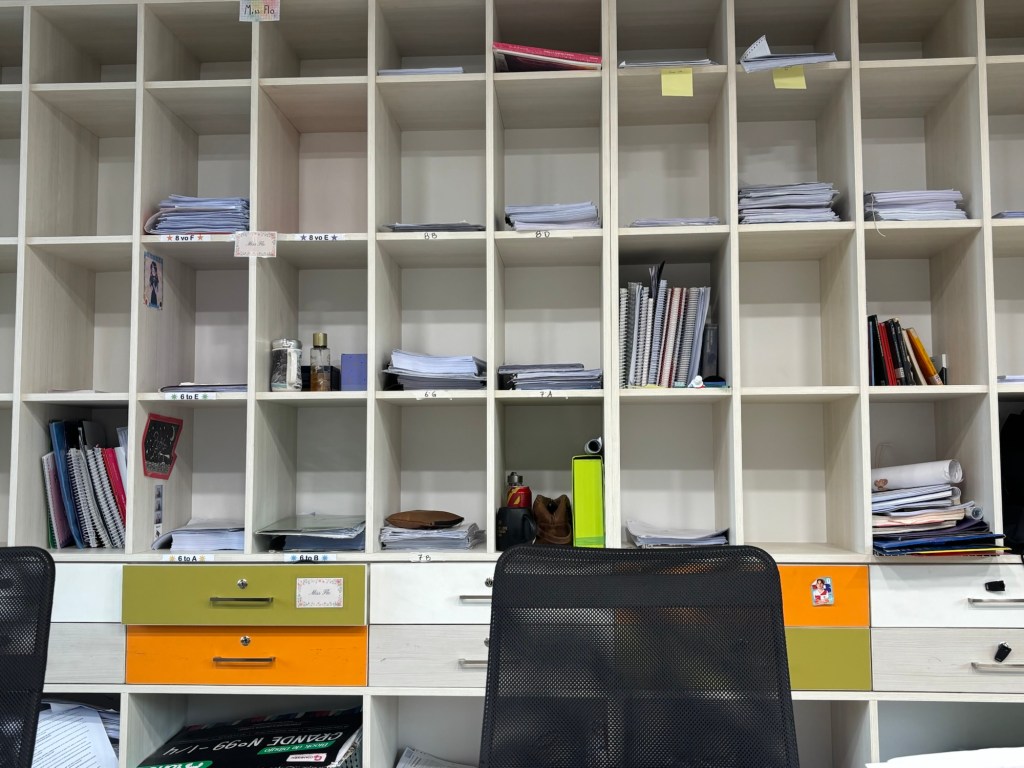
Lo Barnechea, Santiago de Chile. 15.05.
Today’s lesson observations were largely spent with a friendly Spanish teacher called Mario. The Middle Years Programme or MYP – the IB’s equivalent of Years 6 to 9 – follows a really interesting programme at this time of year. Or at least that’s how I see it!
All of the classes in 6° (Year 6) are currently working on a triptych project centred around haikus, so that they can get used to how syllables work in context. The students have free choice as to what to write their haikus about, provided it concerns an aspect of Japanese culture. As for the range of ideas in the classroom…! Sakura trees, Matsumoto Castle, Mount Fuji, the origins of sushi, Tokugawa Ieyasu… The creativity and ambition of these IB-trained children is truly astounding.
In 7° (Year 8), the students are working on their organisational and presentational skills through a marketing project. Not only do they have to create the product, they have to design the marketing poster, complete with a functional slogan and all the trappings of a street-side ad, right down to the contact details and the disclaimers. Once they’ve created their project, they have to explain their product and why they have designed their ad the way they have, commenting on their own use of language and where they got their sources. It strikes me as an incredibly mature way to handle a Year 8 language class. I must find out what ours do – I’d be surprised if it is as high-brow. Or maybe I’m just bowled over by the full body of the IB, having only touched the tail of the beast before.
In 8°, the students have an even more ambitious task ahead of them: an anthology of Chilean poets (sans Neruda), from which they have to select two poems by different poets and compare them, analysing the stylistic features at work in each one. We definitely did this in English when I was growing up, but not in that kind of detail, not at that age. It reminds me of how far ahead Spain’s Lengua castellana course was of my own English syllabus, as it took me two years to reach the material I had covered during my year out in Spain (which is effectively three, as I was held back a year when I moved out in order to help me acclimatise). I can’t vouch for the quality of their work as it’s still being marked, but they seemed about as keen on poetry as your average English kid is – which is to say, not in the slightest.
It’s a shame, how universally unpopular poetry seems to be. I guess it’s because of the difficulty spike when compared to a humdrum comprehension text: all the best poets do love to weave a lot of clever imagery and references that require major unpacking to properly appreciate. I’ve always been of the opinion that the best toolkit for handling poetry is a serious arsenal of general knowledge, but with that too on the wane in the age of instant information, I can’t see poetry becoming anything more than a niche interest among the global student body.
Well. Not unless I have anything to do with it, anyway. BB x