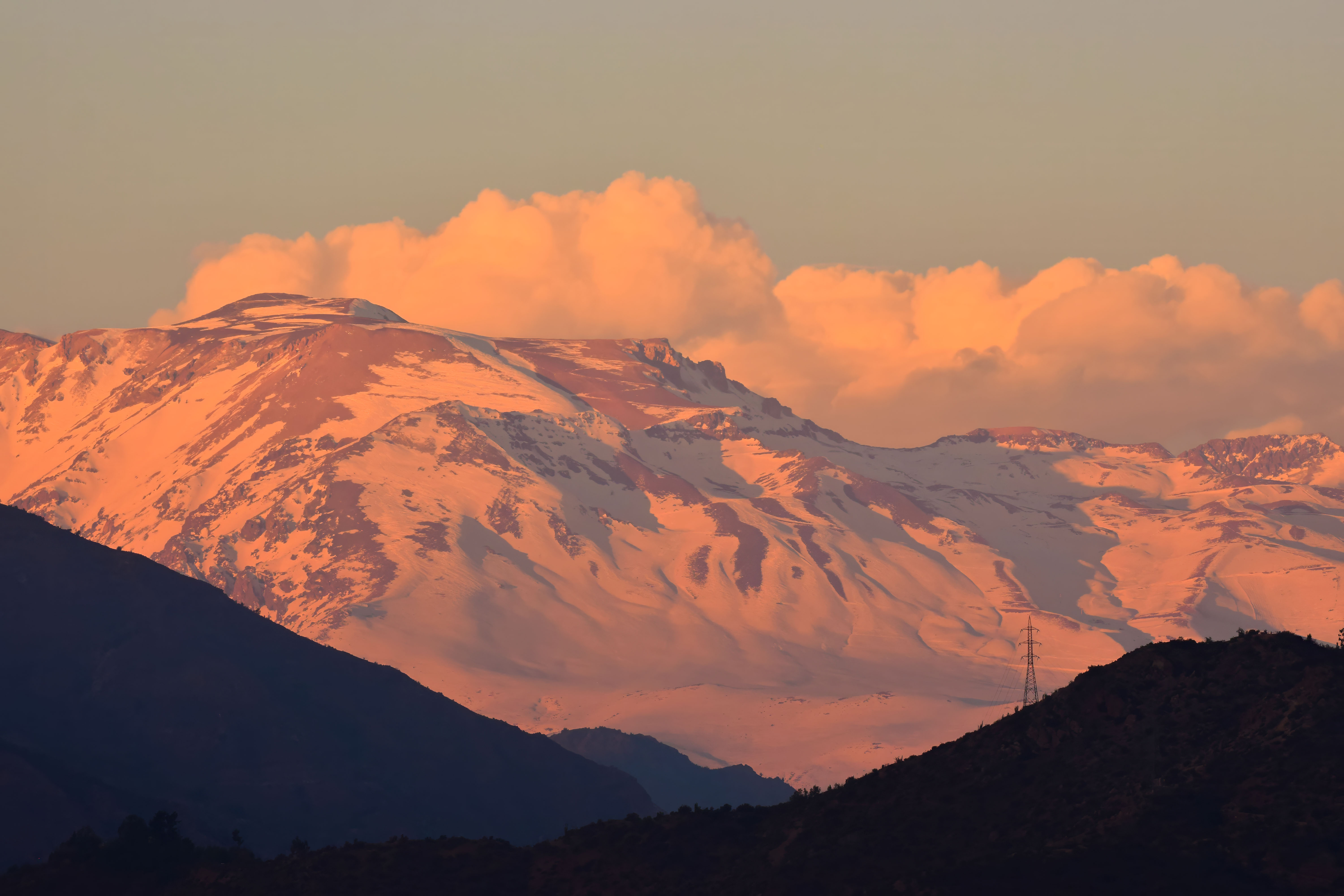
Chilean Memories #9: Snowy Sunset
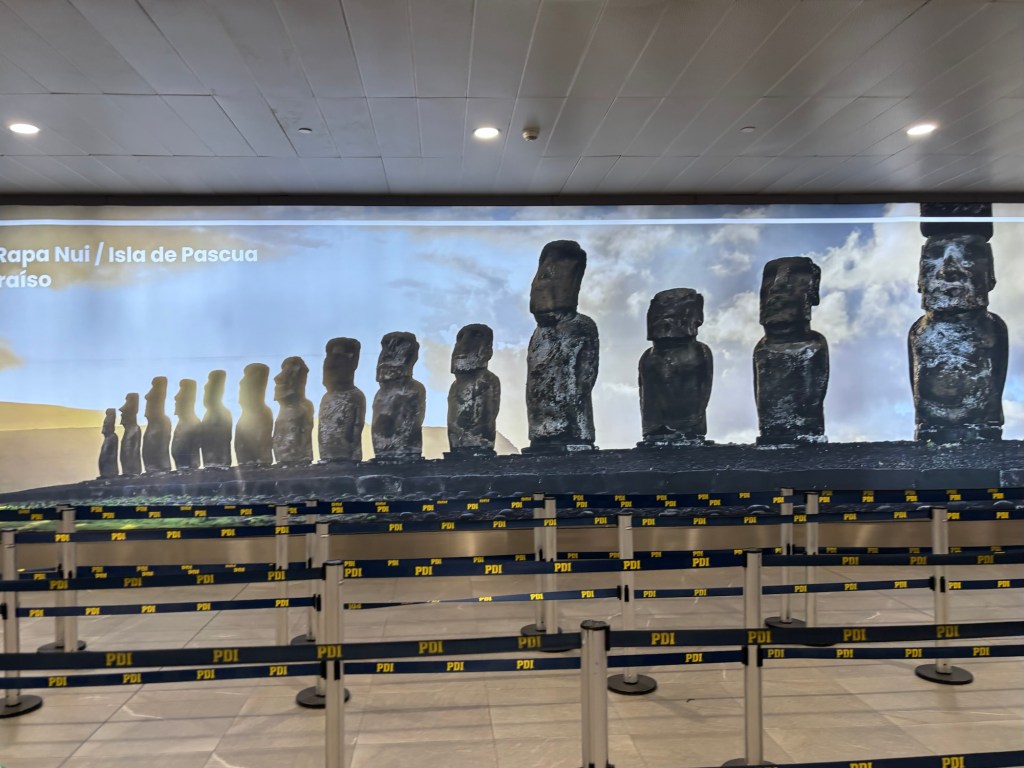
Aeropuerto Internacional Arturo Merino Benítez, Santiago de Chile. 18.40.
Farewells made. Suitcase packed. Rucksack slimmed down to my journal, my camera and a couple of charging devices. Now I’m just waiting in the long line to check in my hold luggage and then – after the inevitable hurdle over my exhaustive middle names – we’re good to go.
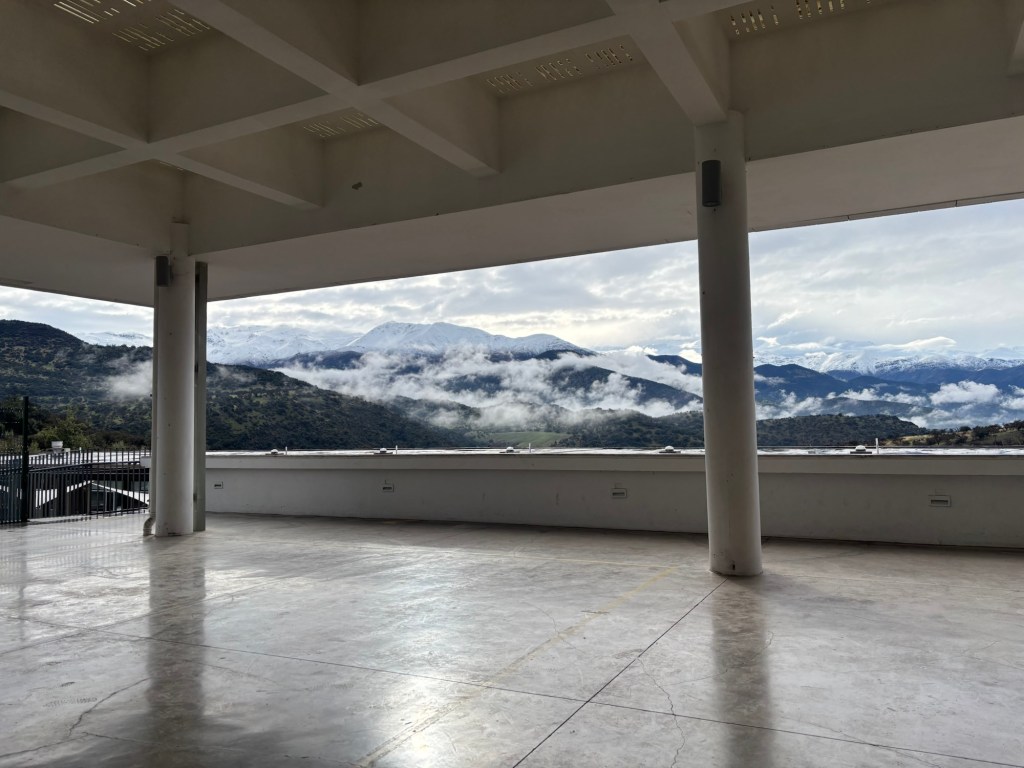
With such a late departure, I had time to say a few last goodbyes, so I accompanied Tomás to school for the last time on this trip and sought out Byron, the man behind this whole Chilean exchange idea. I’d managed to miss him on my last day, and I wasn’t about to leave the country without saying thank you to the man who made it all possible.
With that and a few other farewells taken care of, I was done by eleven, so rather than hanging around all day I decided to walk back to Las Condes. The sun was shining, I had my camera on me (just in case) and I thought I’d try to snap some of the birds I’ve seen every day at work but never managed to get on film. I’m pretty sure I want to come back and see Chile again someday, so it’s not the end of the world if I leave a few unfinished tasks, but I did want to seize the chance while the sun was shining. It’s been a rare sight during my stay!
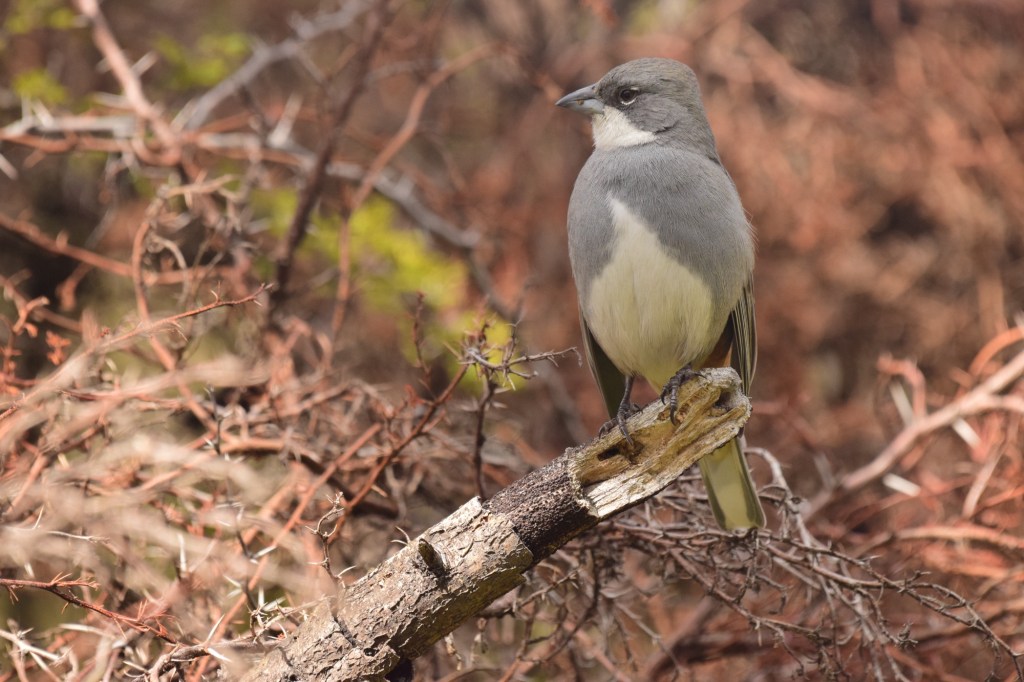
First up: the diuca! This charming slate-grey Chilean chaffinch substitute has been an ever-present companion at work but hard to find beyond the hills around Craighouse, so I’m really happy I managed to find one on the walk down from the school! It’s been bugging me that they’ve been at an arm’s length all the time at school but never when I had my camera on me.
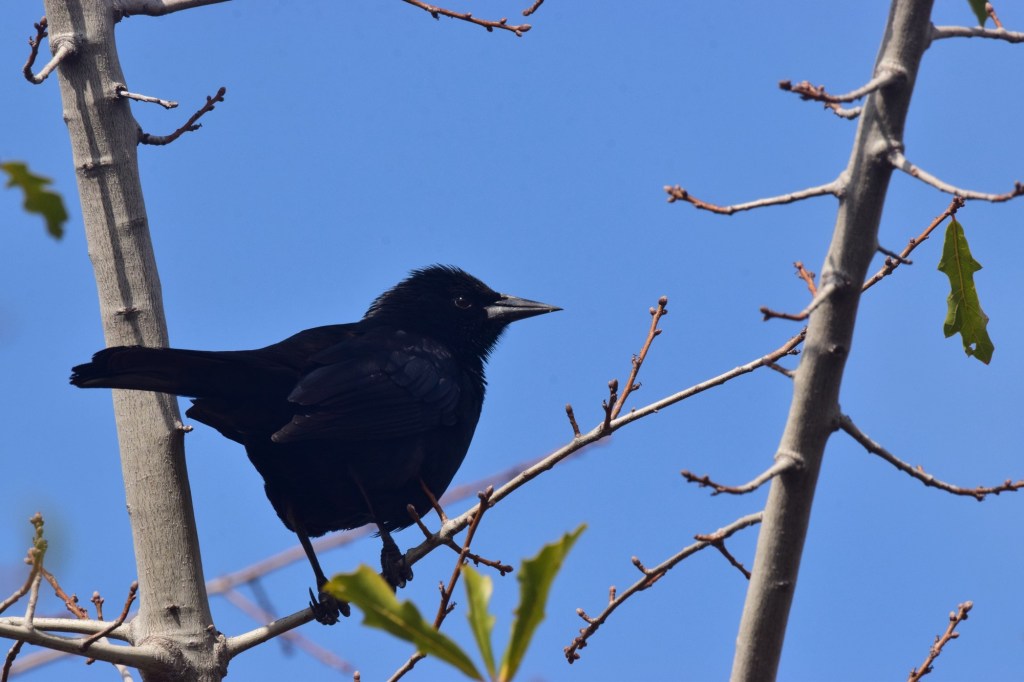
Also: the austral blackbird! No relation to the blackbirds of English parks and gardens, this tremendously noisy South American specialty has been, together with the austral thrush and the meadowlark, part of the soundscape of my morning commute to work.
I saw a few lapwings on the way through the fancier suburbs of Lo Barnechea, but too high up or too far to bother taking the lens out. They still remind me of enormous bats with their bouncy flight, but just like their cousins in England, they’re utterly fearless and will attack anything they perceive as a threat. I’ve even seen them take on buzzard-eagles, which are the second largest creatures of the Andean sky after the condor.
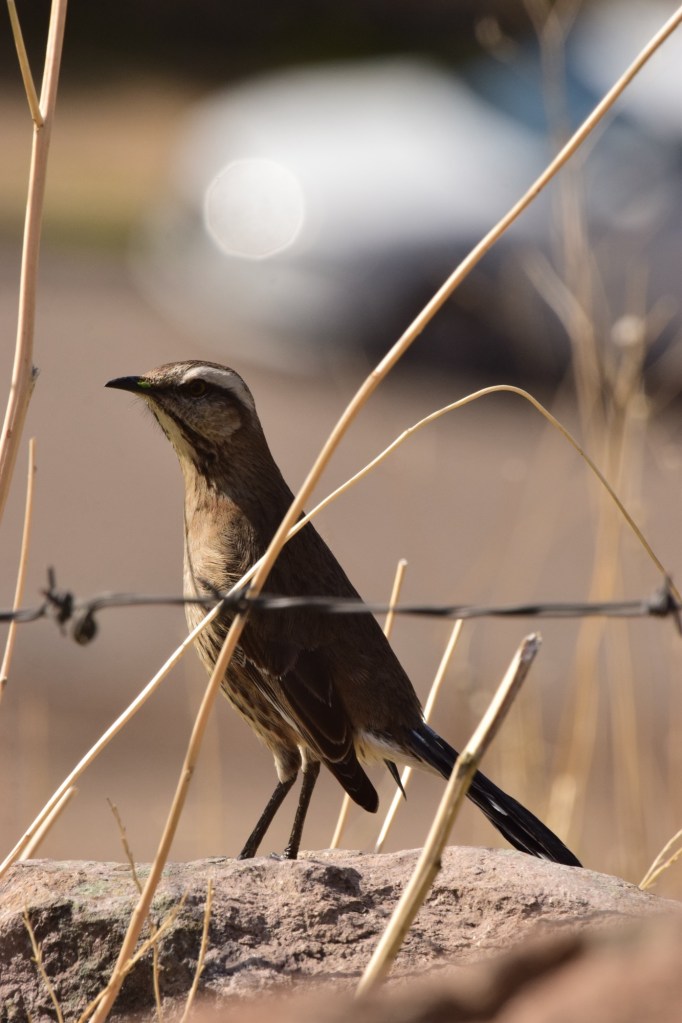
Of course, I couldn’t leave without saying goodbye to the mockingbirds. I’ve become especially fond of these extremely characterful creatures, who have been with me from Patagonia to Santiago and even as far as the Galápagos. If I had a house with a garden here in Santiago, I swear I’d try to tame one – and I don’t think it would take an awful lot of effort, either.
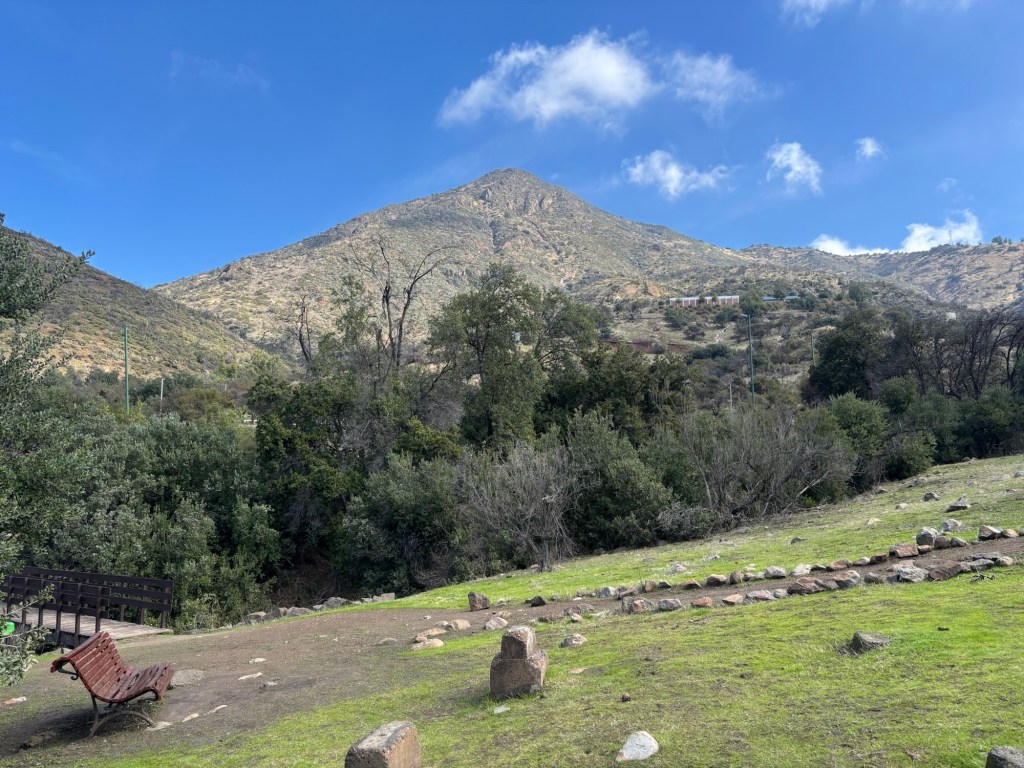
Equally, I wouldn’t dream of leaving Chile without saying goodbye to the Lord of the Andes. Fortunately, I didn’t have to. I took a short walk up the slope of Manquehue to see how far I could go, and as I neared the limit (there’s a fence cutting off the road), three condors came soaring into view over its summit. At times they were so close I could see the royal white flush on the upper parts of their mighty wings.
I didn’t take too many photos. I was just happy to watch them for a while.

I have to admit – and this will come as no surprise to anyone who has been following my adventures – this has been the happiest summer of my life. I can’t remember a time when I’ve felt so alive. That’s especially noteworthy because the seemingly endless summer holiday is usually one of the lowest points of the year for me, made tolerable only by dedicating as much of it as I can afford to walking the Camino de Santiago. For those outside the teaching profession, it might seem incredibly ungrateful to bemoan the concept of a nine-week holiday, but for me, it has always gone on far too long.
This summer has been different. Every day has been full of light and wonder, even when it kicked up a blizzard or sent down a thunderstorm. Many years of hard work and boarding school-induced savings have finally given me the chance to do what I could only dream of as a child: to see so much of South America and its incredible wildlife. Sometimes I think I have been mad to shut myself away in a seven-days-a-week job for almost all of my twenties, but if this is what it was building towards… it was worth every lost weekend. Every single one.
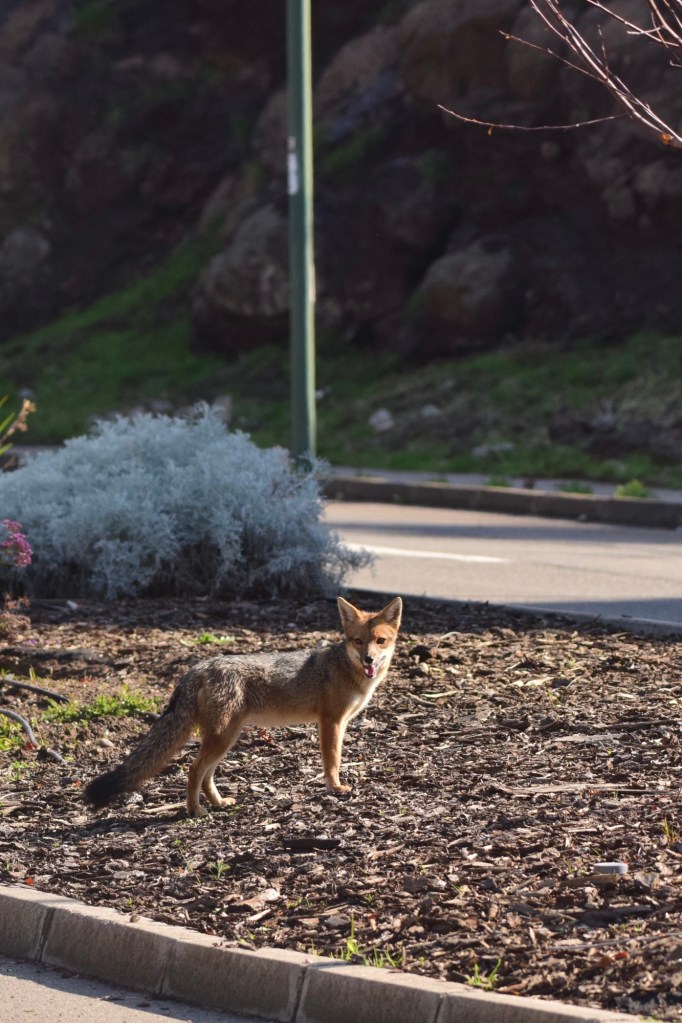
On my way back down from Manquehue I saw something coming up the road towards me that I had not expected to see at all: a culpeo. This South American relative of the coyote is only a little larger than a fox, but has something more of the wolf in its face than the bin-raiding reds of London.
And it was trotting up the pavement right towards me, in broad daylight, in a perfectly twee corner of suburban Santiago, without a care in the world.
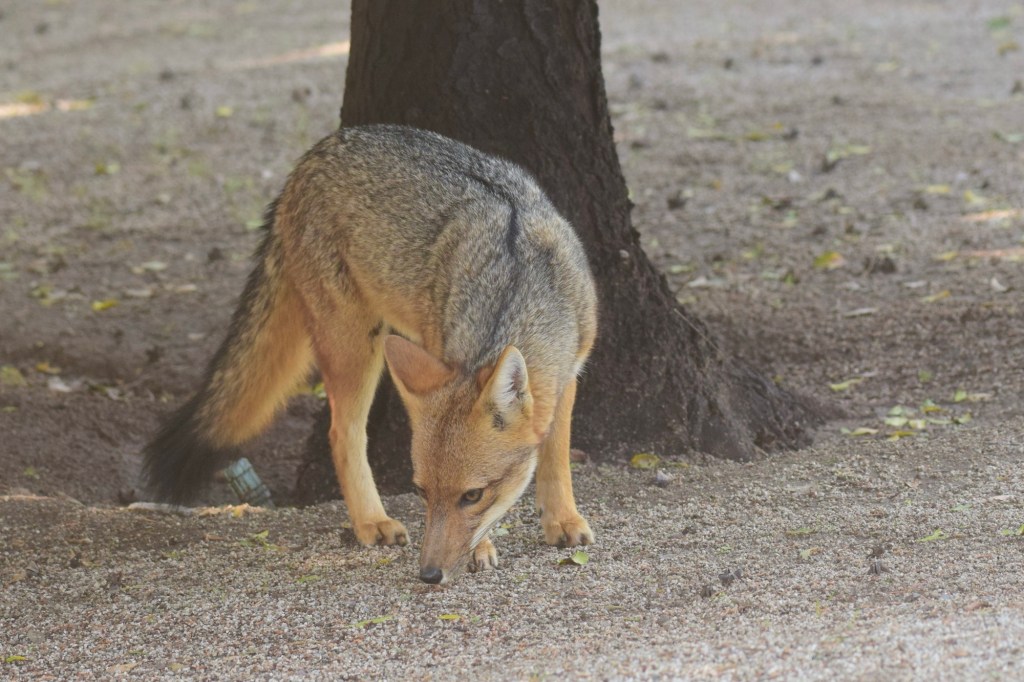
After a whole week in the Galápagos, where mammals larger than rats are nonexistent, I wasn’t expecting my final South American animal encounter to be anything but the feathered kind. I certainly wasn’t expecting a miniature coyote.
I’ve been bewitched by wolves since my adventures in the frozen forest of Białowieza National Park in Poland two years ago. I’ve still got my eye on another wolf-tracking expedition – this time in Italy – but to see one of their relatives so incredibly close is just one more reminder of how spectacular even the everyday encounters with wildlife in this country can be.
Dammit, not just this country. This whole damn continent.
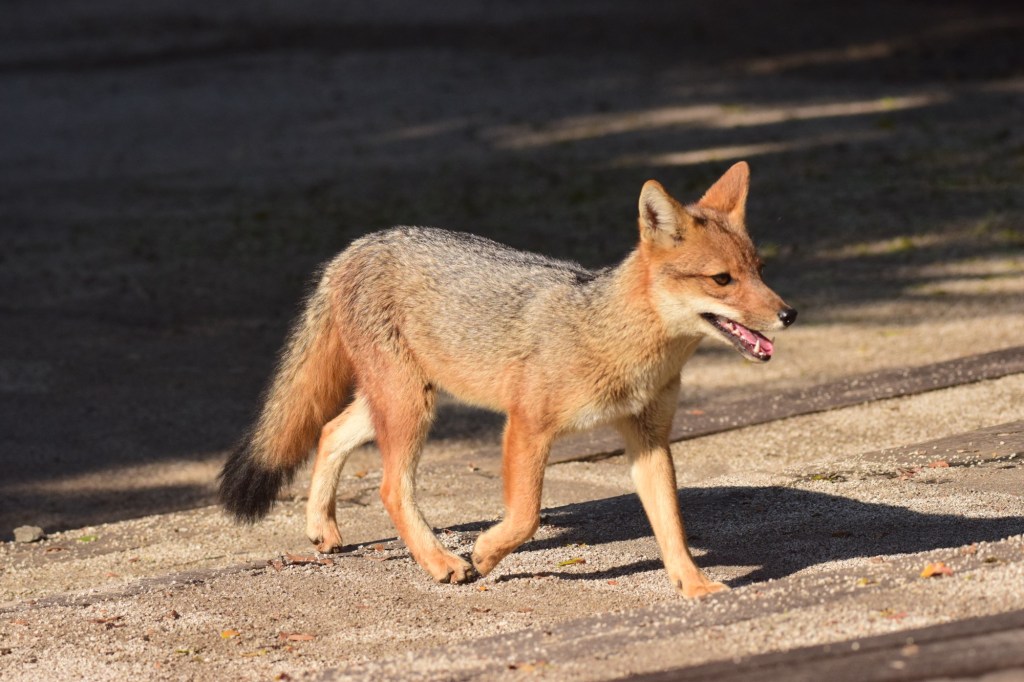
Traditionally, crossing paths with a fox was considered a bad omen in the Andes. But I don’t see it that way. I’m more inclined to agree with the Japanese, who once revered foxes as auspicious spirits and messengers of the fertility god Inari. In short, like a black cat, they can either be portents of good or ill luck, depending on your point of view.
Fur of gold and silver, eyes of honey brown and feet as silent as the night. How could such a spirit possibly be anything but a good omen?
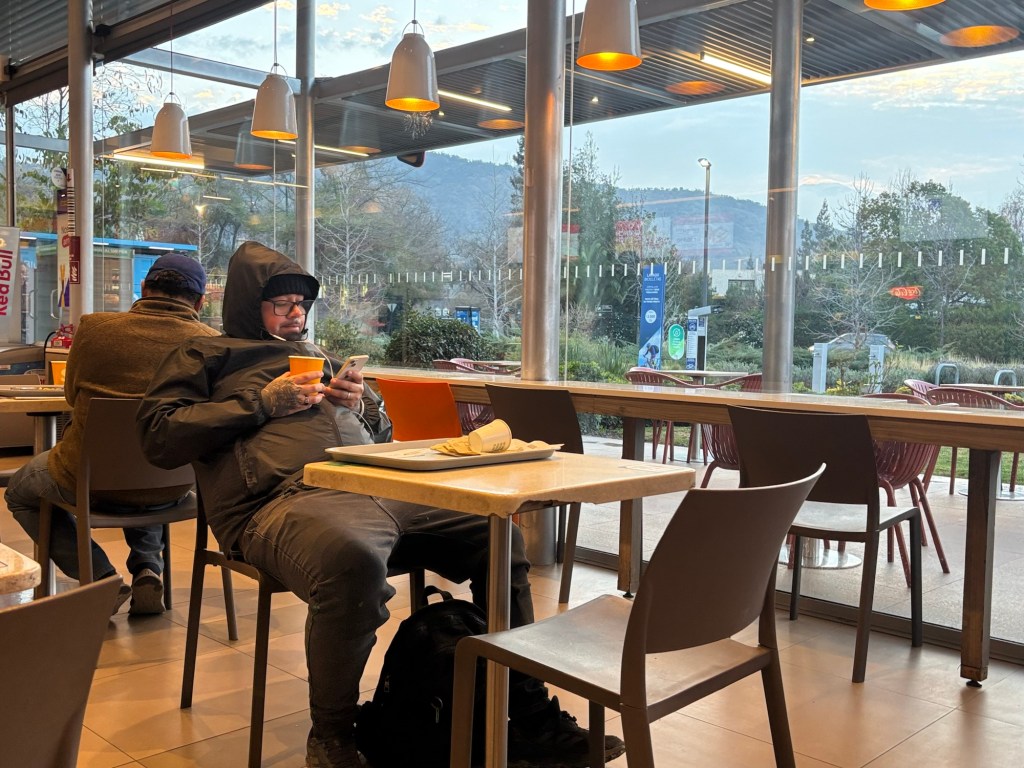
I had 11.000 Chilean pesos in cash left over in my wallet, so I bought myself a fried chicken sandwich and a pain au chocolat to keep the wolf from the door. After all, in all of my minesweeping adventures around Manquehue today, I completely forgot to have lunch.
The way I see it, a man like me could fall in love with a country like this every single day and lose nothing in the repeated magic of that first infatuation.
I am decided. I have got to come back. I don’t know how, I don’t know when, but I will make it happen. I may need to save up again after the fauna fantasia of this summer, but when it comes around, I want to embrace it all over again.
Happiness like I haven’t known in years. More wildlife than I know what to do with. Mountains that make my heart soar. Condors that make my heart race. And speaking Spanish every day, which keeps my heart beating. Chile has done a number on me and I’m all for it. Honestly – can you blame me? BB x
Aeropuerto Arturo Merino Benítez, Santiago de Chile. 23.23.
Three weeks at Craighouse School have come and gone in the blink of an eye. In that time I have seen and done all sorts of career-boosting things. I have observed Maths, English, Spanish and French classes, as well as a number of department meetings: sometimes in English, sometimes in Spanish. I have taught the basics of French conjugation with -ER verbs, folktales from England, the Basque Country and the Middle East for a middle school kamishibai project and Augustinian theology within an exploration of good and evil in Othello. I have moderated an extended essay, taken part in an MUN debate on the two state solution, discovered that what I have only dreamed of doing for years – teaching English Literature – is well within my capabilities… and I have made some friends for life out here.
I think one of the reasons I avoided anything and everything to do with Latin America at university was because I wasn’t ready yet. I should have known that, having lost my heart to an American once already, I would be drawn back across the Atlantic like a moth to a flame. It’s not the light – it’s the warmth. The warmth of the people here. I have barely begun to scratch the surface of this country.
First things first – my Othello lesson was a triumph. After dropping in on a couple of Y12 classes and offering my take on Carol Ann Duffy and the religious context behind Shakespeare’s work, I was told that the senior deputy head and former head of English wanted to see me teach. Teaching a forty-five minute French lesson that I’ve taught for years is one thing. Teaching a ninety minute class on hardcore morality ethics, Protestant ideology and social context within one of Shakespeare’s weightier plays is another matter entirely.
Lucky for me, I had a bloody good teacher back in my schooldays, and a quick refresher last week was enough to remind me that I had forgotten very little of what I was taught, even across a distance of fourteen years. I’ve also been gearing up to teach Othello myself as part of the Spanish Language A course, so I was not unprepared. Still. No pressure.
I’ve got to hand it to the kids. They might have only been a standard level class, but they handled the higher level material extremely well. When I circulated as they were practising a Paper 2-style comparative task, I had some really enlightening conversations. So many great questions, so many bright ideas. I was really proud of them. Ninety minutes seemed like a tall order when I turned in around eleven o’clock last night, but it was over far too soon.
I spent the afternoon wrapping up. Signing out of all my accounts on the school laptop. Handing back the IB Language books I’d borrowed. Switching out my teaching boots for hiking shoes. I dropped in on the middle school Lenguaje department to say goodbye and had it corrected to a see you soon. Hispanics don’t do goodbyes. Much too final.
One final and unexpected resident of the English department hung around to see me off: the mockingbird that has been hanging around the office for the last couple of weeks. Somebody had left the door open so it had popped inside to see if there was anything edible. After a small circuit I managed to guide it back outside. They’re extremely characterful creatures, mockingbirds. I hope to see more of them where I’m going next. It’s a place where they made history. Natural history, that is.
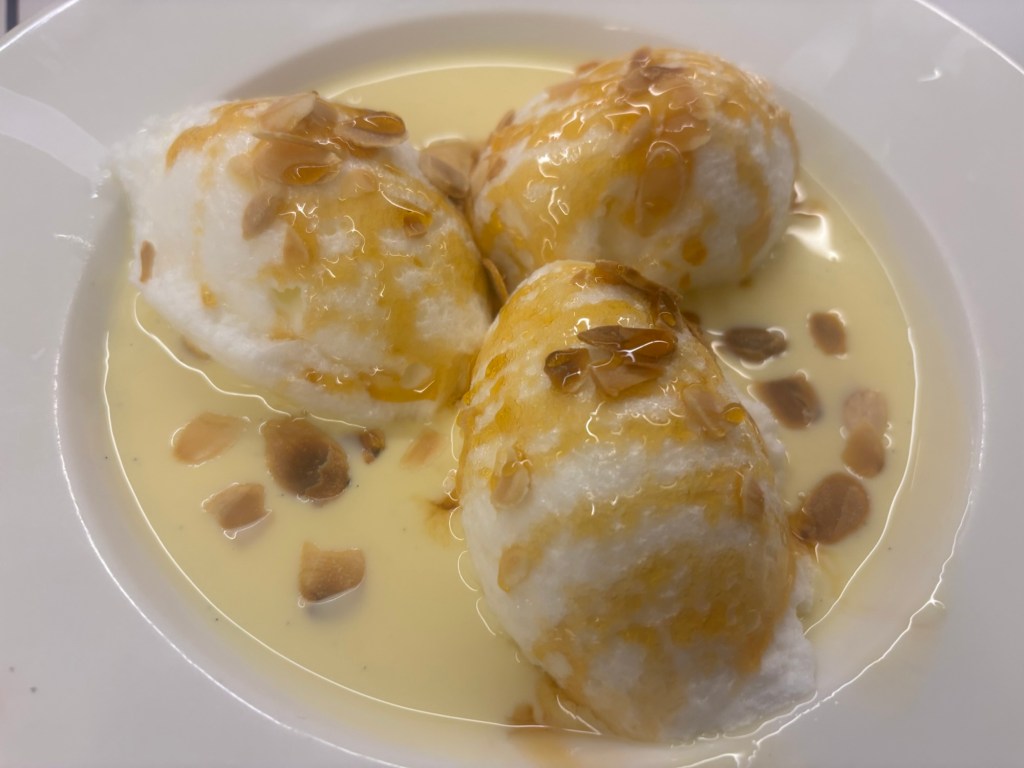
To close out my time here, Alfredo (the head of English) took me and a couple of colleagues out to dinner at Baco, a swish restaurant in upmarket Providencia. It felt like I’d been part of the team for a year, rather than a week. Chileans may have more in common with the Basques than the Andalusians, but they’re an incredibly warm and honest people.
I’d say that’s that, but I’ve got to come back to Santiago to pick up my suitcase and catch my flight home in nine days’ time, so I’m not quite done with Santiago yet. But now I’m sitting in the departures lounge of Santiago’s Arturo Merino Benítez airport, absolutely buzzing about the last great adventure on my South American odyssey. It’s been an amazing month so far, full of unforgettable wildlife encounters and exceptionally warm people. This will just put a seal on the whole thing.
Or maybe even a sea lion… BB x
Las Condes, Santiago de Chile. 17.14.
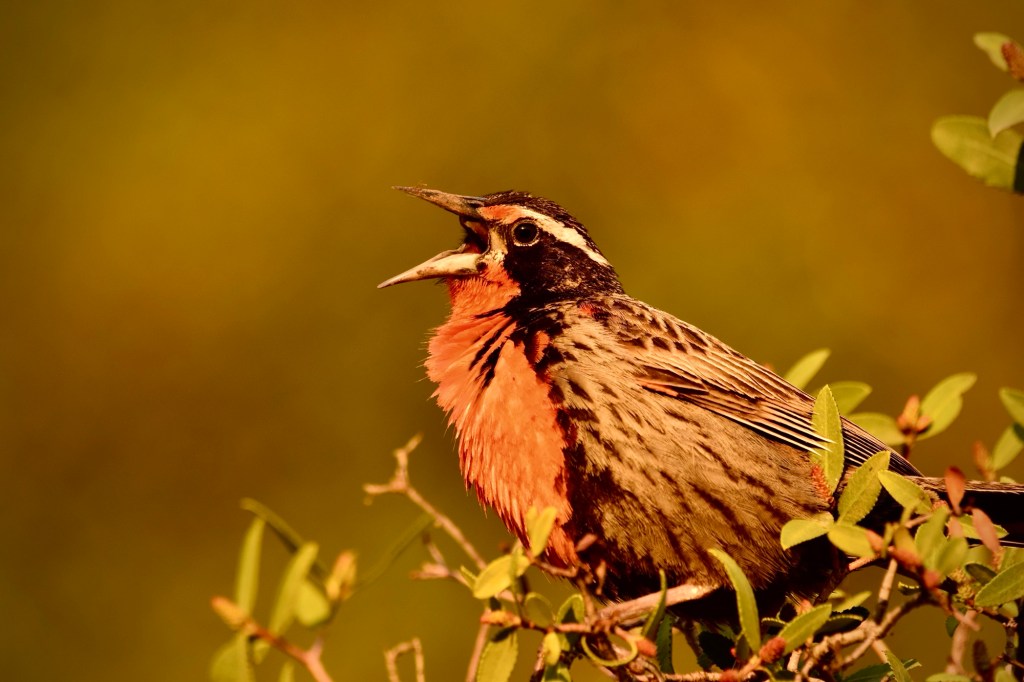
It’s getting to that stage of my time in Chile where I’m starting to take advantage of every moment remaining. Over the last few weeks I’ve gotten quite used to the sight of the Andes, the caracaras that seem to be constantly somewhere on the horizon and the wheezy call and response of the characterful meadowlarks. But soon I’ll have to say goodbye. So, while the weather holds at least, I’ll try to get out after work and soak up as much of that view as I can.
After a productive day spent exploring Carol Ann Duffy’s poetry (specifically Quickdraw, Demeter, Shooting Stars and Delilah) and hanging out with the Senior English team, I popped in to grab my camera and went straight back up the road to Observatory Hill (Cerro Calán). It was smoggy and overcast on my way up, but by the time I reached the summit, the sun had found a breach in the cloud line near the horizon and came shining through – just in time to light up the meadowlarks that were scrambling about the summit.

I went all the way to Patagonia for pumas and took a boat out into the Pacific to see an albatross, but the meadowlarks have been a feature wherever I’ve gone. For me, they’re probably the bird of Chile – after all, national bird or not, I’ve seen condors in Peru, albeit perhaps not as frequently as I have here.
If I had more time – and the weather were kinder – I’d head south again in search of the chucao, a smart little Chilean speciality, and try my luck in search of the Magellanic woodpeckers that reside within the forests of Chiloe. I’d also try to track down the elusive tucúquere, the largest of the owls of Chile, that has thus far eluded me. I suspect I’ll be absolutely knackered when I return from my final adventure next week, but if the sun decides to make a very overdue return, I might make one last jaunt out to Batuco, a wetland reserve to the north of the city, in the hope that I might find the burrowing owls that live around the lake.
Until then, I’m quite content to watch the meadowlarks bousting about.
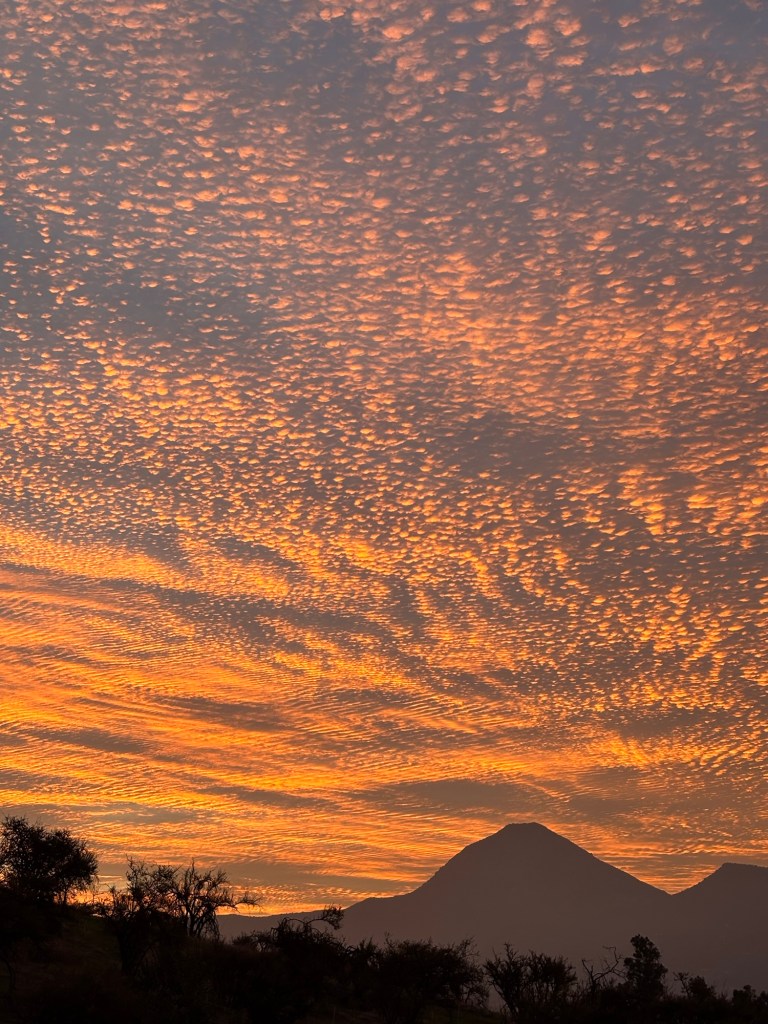
When the sun can be seen, Santiago experiences an incredible second sunset. The dying embers of dusk catches the peaks of the mountains and showers them in golden light, before they fade to an imperial grey against the iron skies beyond. Then, just when you think it’s over, the mountains erupt in an incredible crimson light. I’m not sure what triggers that second burst of light. Maybe it’s the sun hitting the Pacific, or some trick of the clouds. Either way, it’s breathtaking.

As I walked back down the road toward Avenida Charles Hamilton, the clouds became a mirrored beach, like so much stippled sand. To the north, the triangular summit of Cerro Manquehue rose into the ether like a child’s drawing. It’s been the eternal backdrop of my stay here in Santiago, visible from both my home in Las Condes and my office in Craighouse on the other side of the mountain.
Before I came here, Manquehue was just the name of a Chilean Catholic community who I met once in Durham, many years ago. Now it’s one of my favourite waymarkers in the Valle Central.
Tomorrow brings an observation – one of my last – and a planning session with the Deputy Head for a fully-fledged 90-minute lesson of my own on Thursday. If I didn’t know better, I’d say they were testing me. It almost feels like a job interview.
I saw a fox near the car park as I left today – a gold and silver vixen, rooting around the trees just beyond the fence. These culpeos are a lot closer to wolves and jackals than they are to true foxes, but nature clearly likes the design of the fox, because the culpeo and its cousin the chilla have both evolved to fill that niche.
I’ll take that as a good sign. Nothing that beautiful could be anything else. BB x
Las Condes, Santiago de Chile. 17.40.
With strong winds and heavy rain forecast for much of central and southern Chile this weekend, I decided against any madcap travels beyond Santiago. It’s just as well, too: even my whimsical considerations of hopping over the border to tick Argentina off the list with a flying visit to Mendoza would have been impossible, after yesterday’s renewed snowfall blocked the mountain pass, closing the terrifyingly steep Ruta 60 for what is likely to be quite some time.
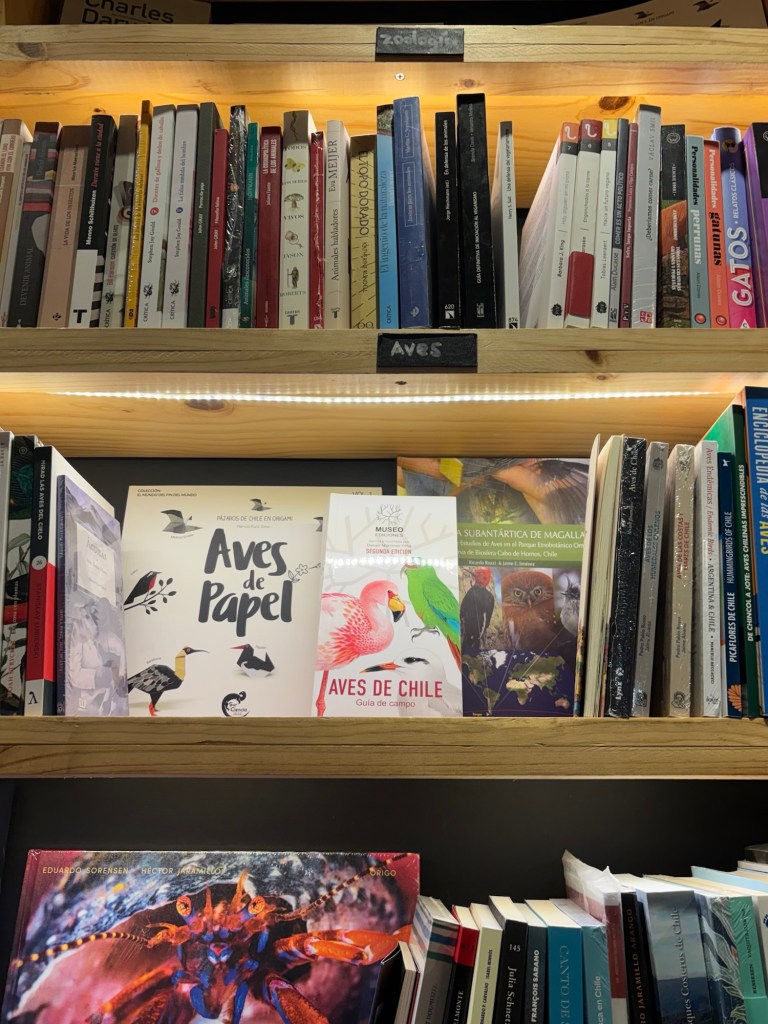
For once, I erred on the side of common sense and spent my Saturday in downtown Santiago, stocking up on a few important supplies for my final adventure in South America, now less than a week away. My main target was the sportswear giant Decathlon, but while I was hunting it down I stumbled upon a fabulous bookshop specialising in natural history in an underground mall at Tobalaba. I’ll simply have to come back here before I go – the selection of books on offer was incredibly tempting.
I still can’t get over how much birdwatching is a thing over here. I’m so used to Hispanics being generally disinterested in birds they can’t shoot out of the sky. It’s so heartwarming that that particular aspect of Hispanic culture is shifting, and that Latin Americans seem to be the driving force behind it.
With my Decathlon business concluded, I popped into Jumbo – Chile’s answer to Spain’s Mercadona – to grab a couple of snacks for the week ahead. Amazingly, the supermarket did me for lunch, too: they were giving out free samples of the seafood stew mix (which was amazing!) as well as free samples of strawberry yoghurt and pistachio ice cream. They weren’t exactly full-size dishes, but Tomás ordered far too much pizza last night, so I was quite happy with a couple of free nibbles for lunch.

The heavy rains of the past couple of weeks have transformed the Mapocho River which runs through the city. When I arrived, it was little more than a steady flow in a largely dry canal. It’s now a roaring torrent that cuts above the din of the traffic when you’re close enough. Chile really is a country of extremes: when it rains here, people have to be prepared for property damage and flood control, even up here in the mountains.
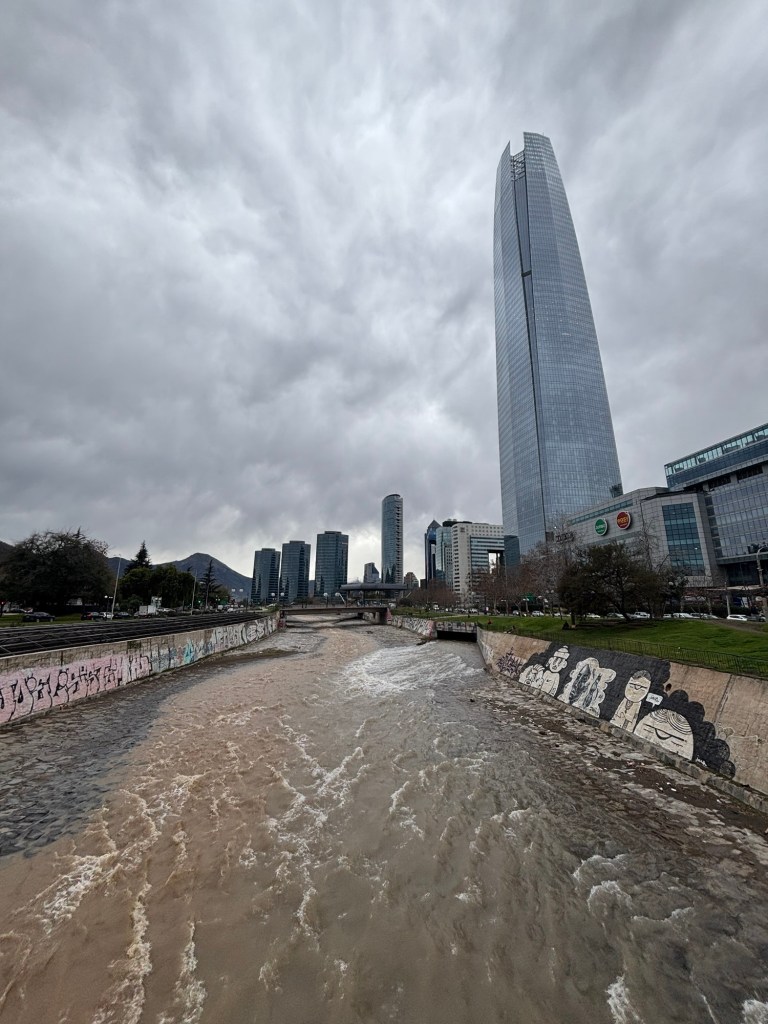
By the time I reached the car park at the foot of Cerro San Cristobal, it was already half past one, and a lot of city folk had come to the same conclusion as me: that is, that it would be nicer to go for a walk today, rather than tomorrow, when the scheduled rains are due to come down hard. Parquemet was full of cyclists and runners, as it was on my last ascent now three weeks ago, but after a flying visit to the Japanese Garden – which was probably the noisiest zen garden in creation, thanks to it being located within a Hispanic capital city – I ducked off the road, following one of the many forest tracks intended for downhill mountain bikers. But for a lone jogger, I had this route to myself, which meant it was alive with wildlife.
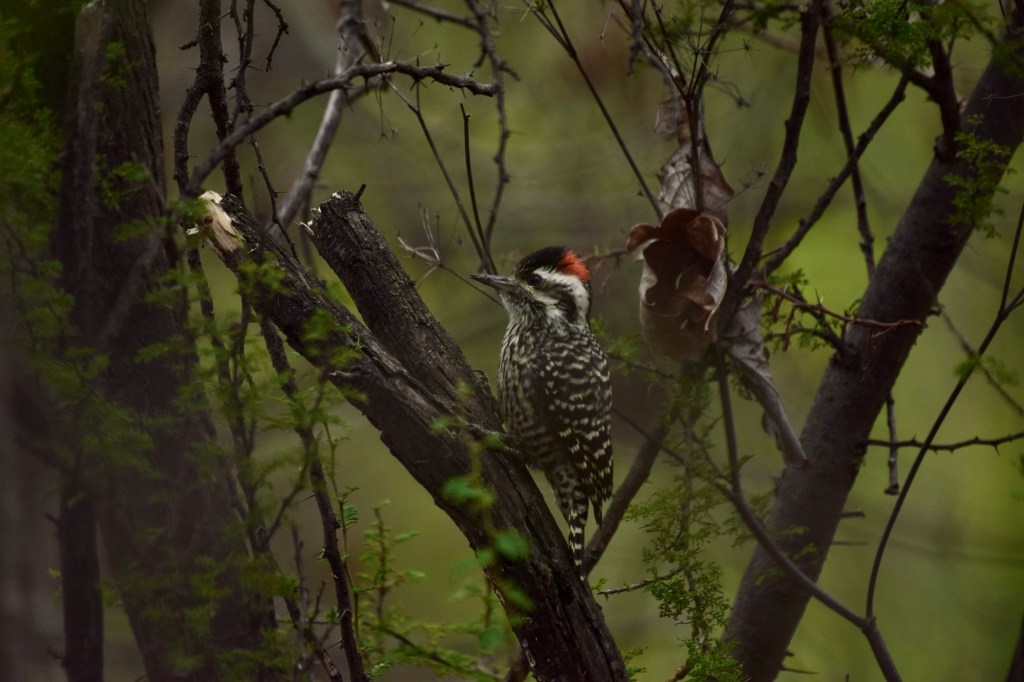
The first critter to show up was a woodpecker. I never did find the famous Magellanic woodpecker during my visit to Patagonia – a very good reason to come back someday – so this striped woodpecker or carpinterito is my first in Chile. Like most woodpeckers, it was a nightmare to capture on film, being in the darkest part of the forest, moving constantly and under a dark, overcast sky, but I just about managed a couple of shots before it disappeared among the trees.
A large flock of finches followed me along the spine of the cerro, feeding among the dead foliage at the side of the path. The siskins here look and sound a lot like the ones back home, but the sierra finches are really rather special. I saw some of these pretty birds in Cusco, but in Santiago they’re essentially garden birds.

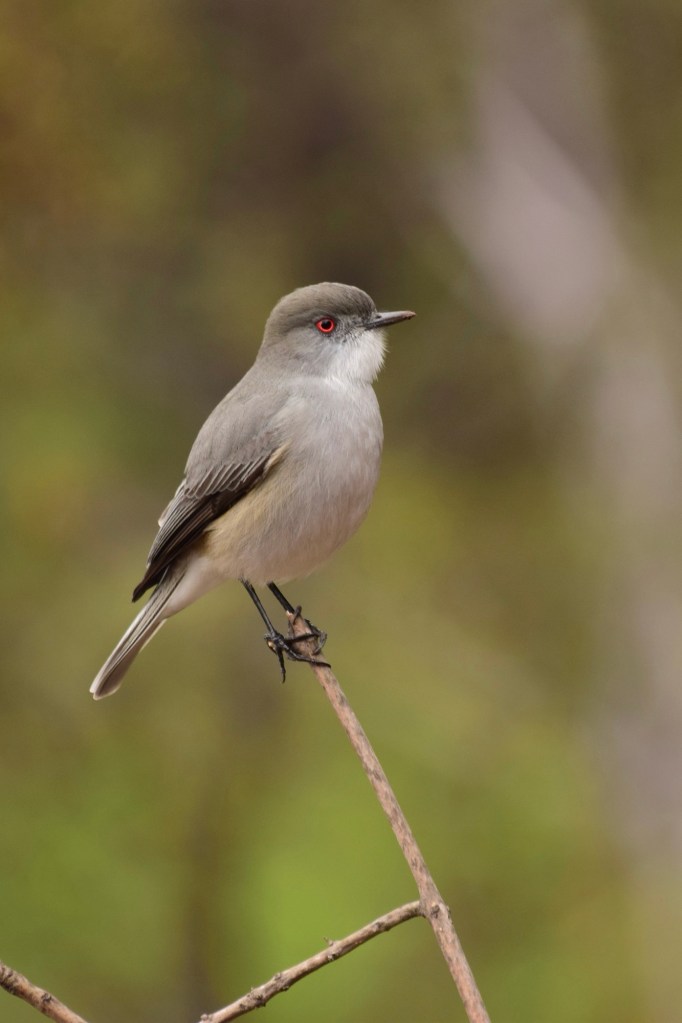
I hoped I might find some of the pretty diuca finches that are so common at school. There weren’t any on the cerro today, but I did keep running into diucons, their fiery red eyes even more obvious in the midday light than they were the other day, when I was shooting into the sun.
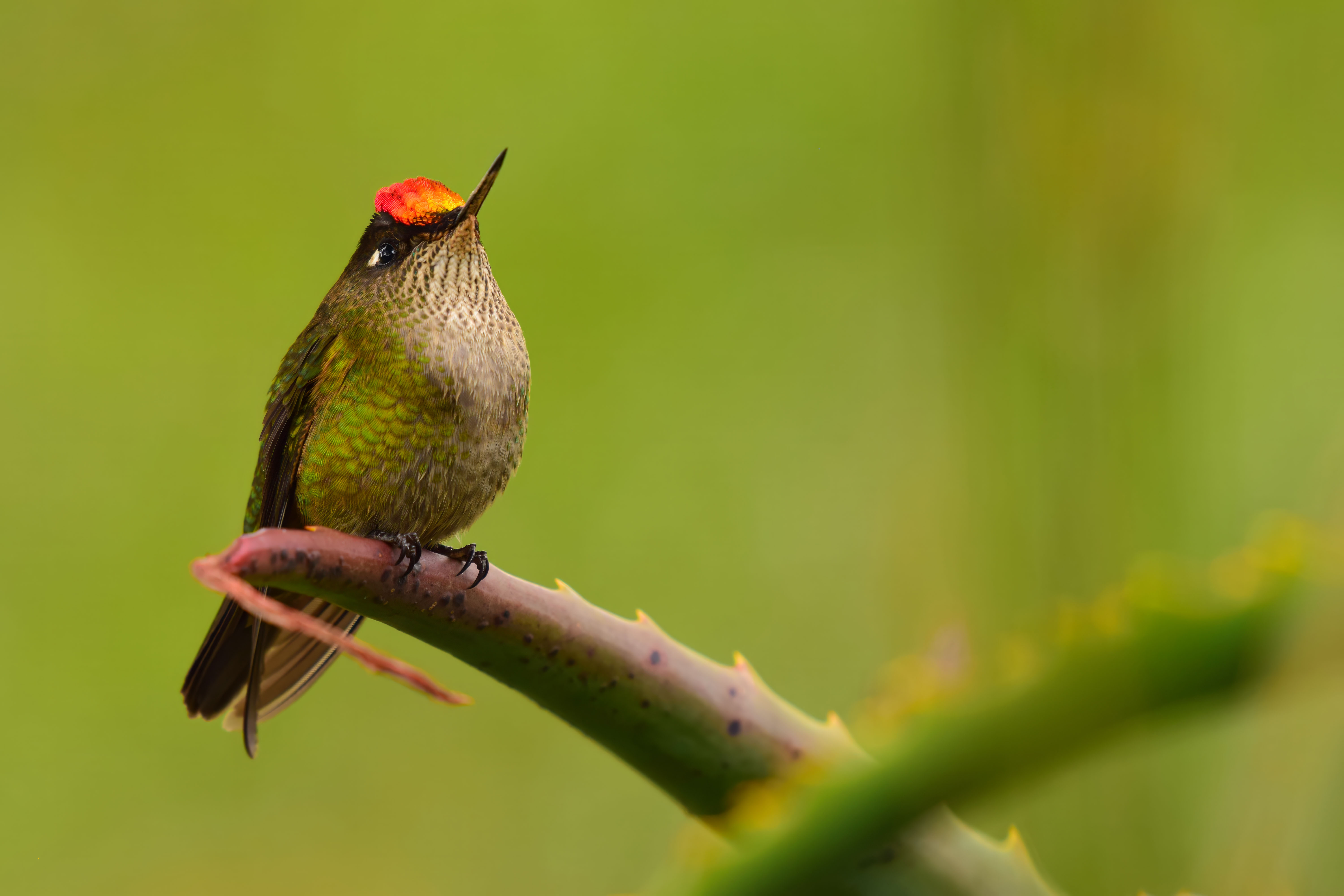
The best find of all, though, was a bird I’ve become very familiar with here in Santiago. I hear them every single day, and see them at least three days out of seven, whenever I should be near a poker plant. The green-backed firecrown is probably Chile’s most well-known hummingbird, since it seems to have a home on even the busiest streets in the city centre.

The last time I had a close encounter with one of these living gemstones, I didn’t have my camera on me. This time, I came prepared. Firecrowns are fearless little creatures, driven by an insatiable hunger that is a side-effect of their rapid metabolism – so, once again, I was able to sit quite close and watch, until the bird landed so close I could see its heartbeat and its tiny tongue tasting the air.
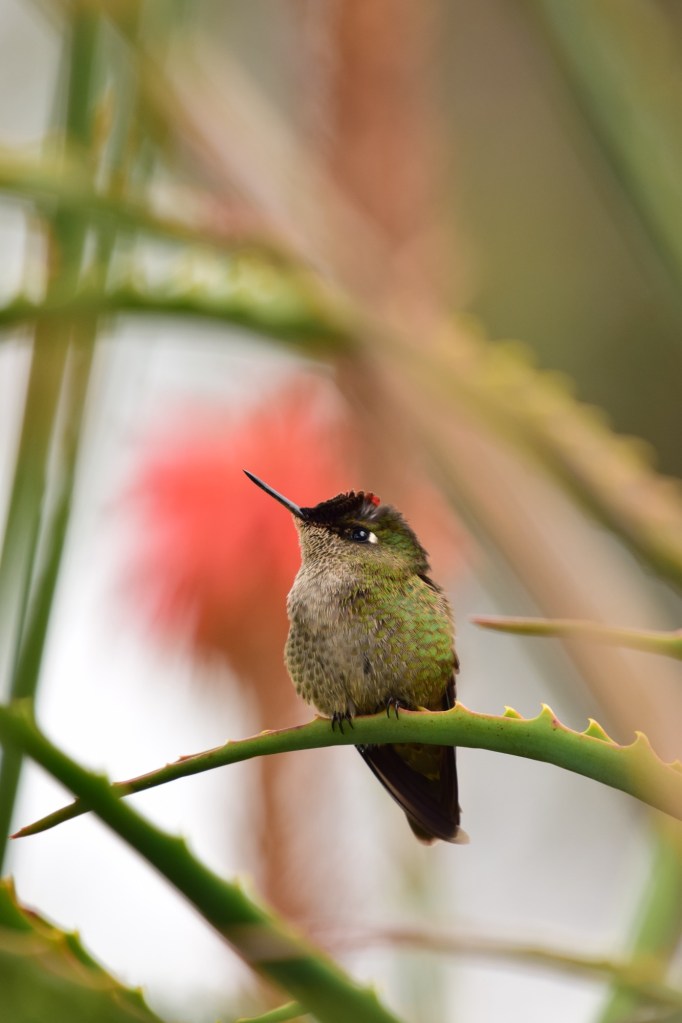
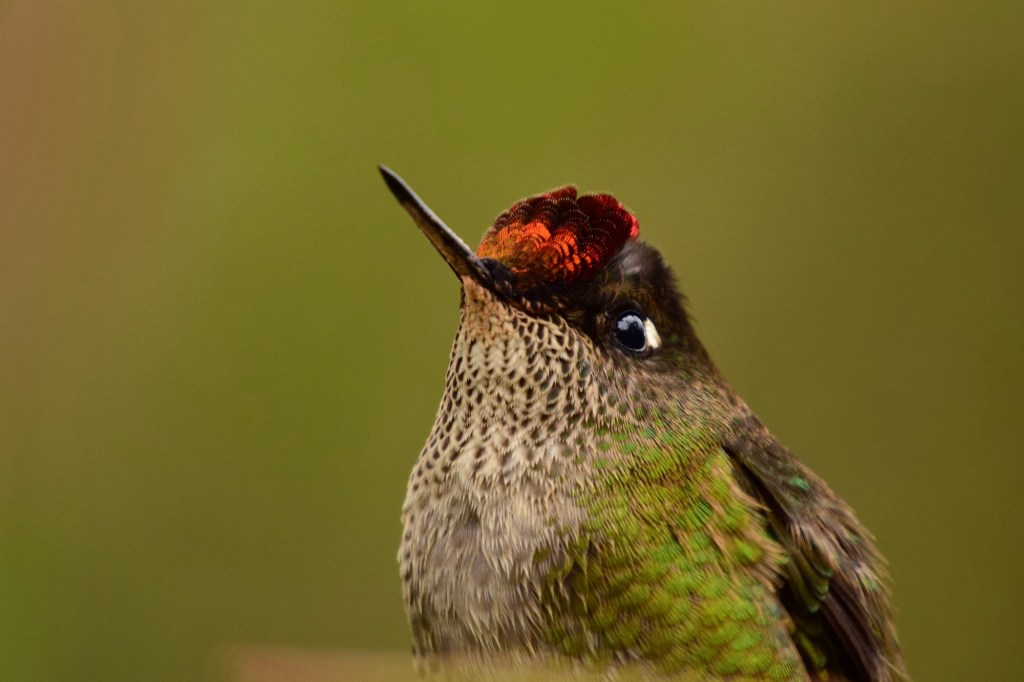
The firecrown gets its name from the male’s plumage, which really is quite something. Even with the naked eye, you can’t miss that sudden flash of scarlet when they alight upon a branch, just like hoopoes do with their crests when they land.
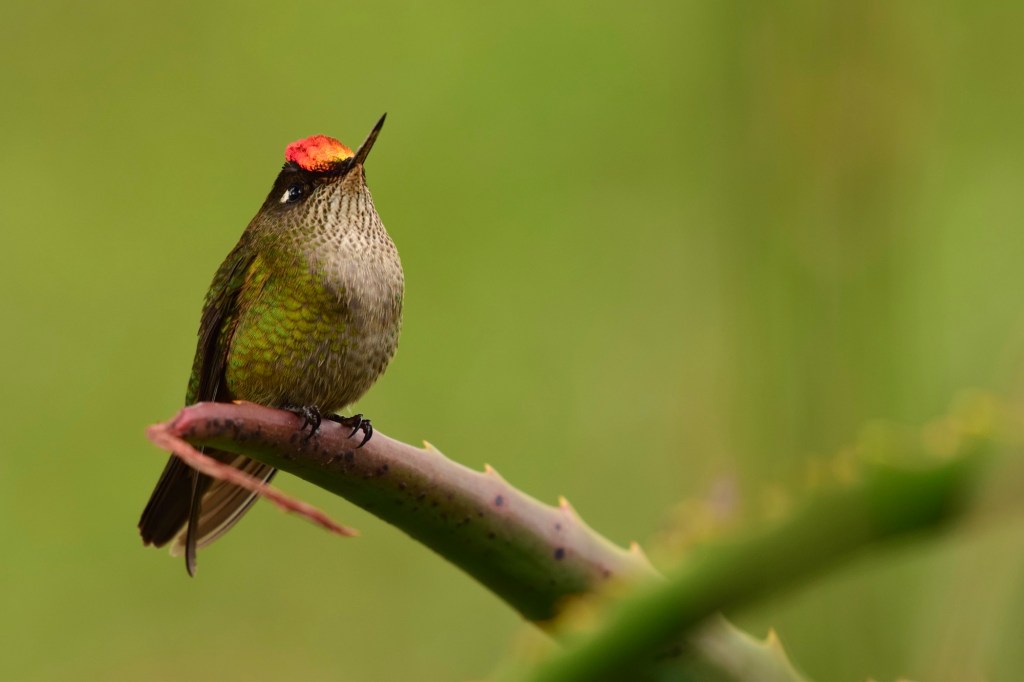
The secret is the iridescent sheen to its feathers, each one bending the light slightly differently depending on its position on the bird’s forehead. They can, of course, flatten and raise their crests at will, so I had to wait a little while before I was able to capture that ripple of red light.
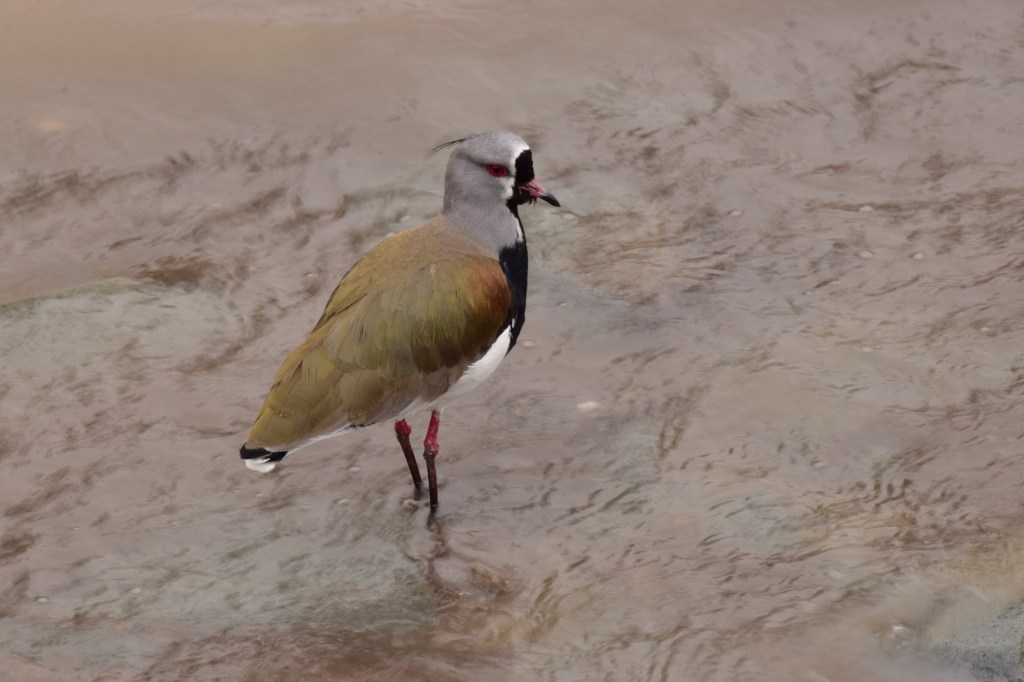
After spending a happy half hour or so with the firecrowns, I wound my way back down the cerro and used what little battery I had left on my phone to catch a bus back to Las Condes. I only stopped one more time, just before stepping on board the 409, to see a couple of Southern Lapwings that had flown in and gone down to the river. I see and hear these birds every day, too, as they’re a lot noisier than the firecrowns, but I haven’t yet had the chance to get a photo. They’re usually patrolling the rugby pitches in pairs, and they have a reputation for being ferocious with passers-by in the spring, when they have eggs or chicks near at hand.
Well, it’s getting dark outside. I didn’t expect to have such a good afternoon’s birdwatching on what was essentially an extended shopping trip, but sometimes, it’s the outings you don’t plan that turn out to be the best.
That said, I’ve done a lot of planning for next week’s mad adventure, so I hope that turns out for the best, too. It really is going to be rather special. BB x
Las Condes, Santiago de Chile. 5.06.
I’m up early after falling asleep far earlier than usual last night (around 8pm – shocking!), so I thought I’d use the time to pencil in my afternoon’s adventures.
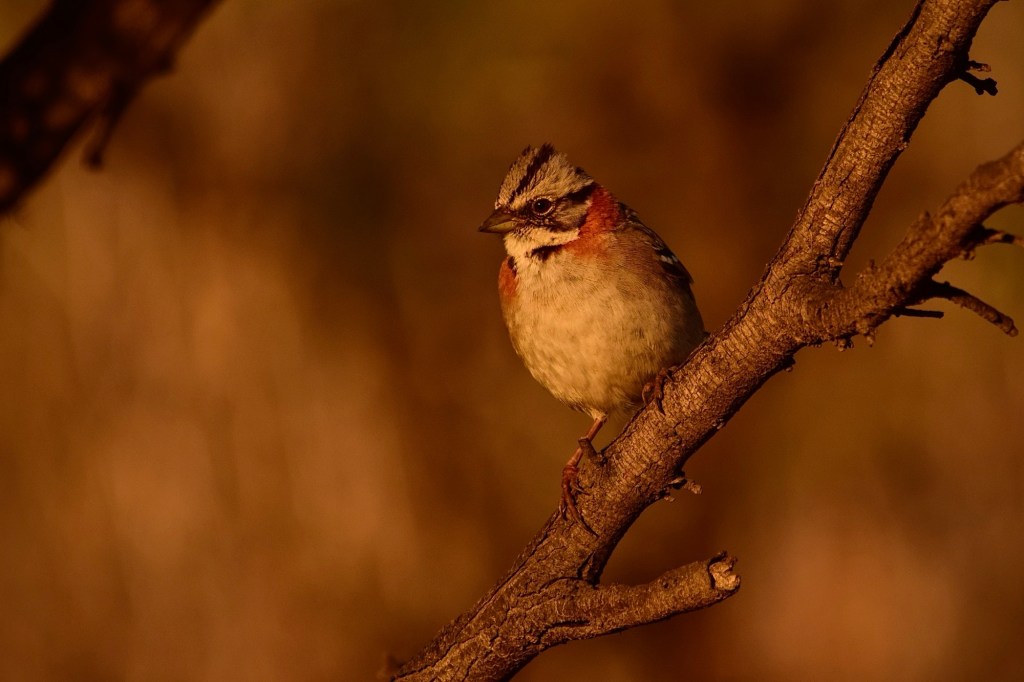
While I’ve been working around the Craighouse campus, I’ve had a lot of time to watch the comings and goings of the birds that make their home around the capital city. Taunton has its fair share of feathered friends, of course, but I’ve had thirty years to get used to herring gulls, crows and woodpigeons. I might be in my third week out here, but I still get a big smile watching the rufous-crowned sparrows hopping about. Naturally, I don’t bring my camera to work, so given that we actually had some sunshine today – and that my colleague Tomás was done an hour before the end of the school day – I thought I’d capitalise on the sunlight and do a bit of suburban birdwatching.
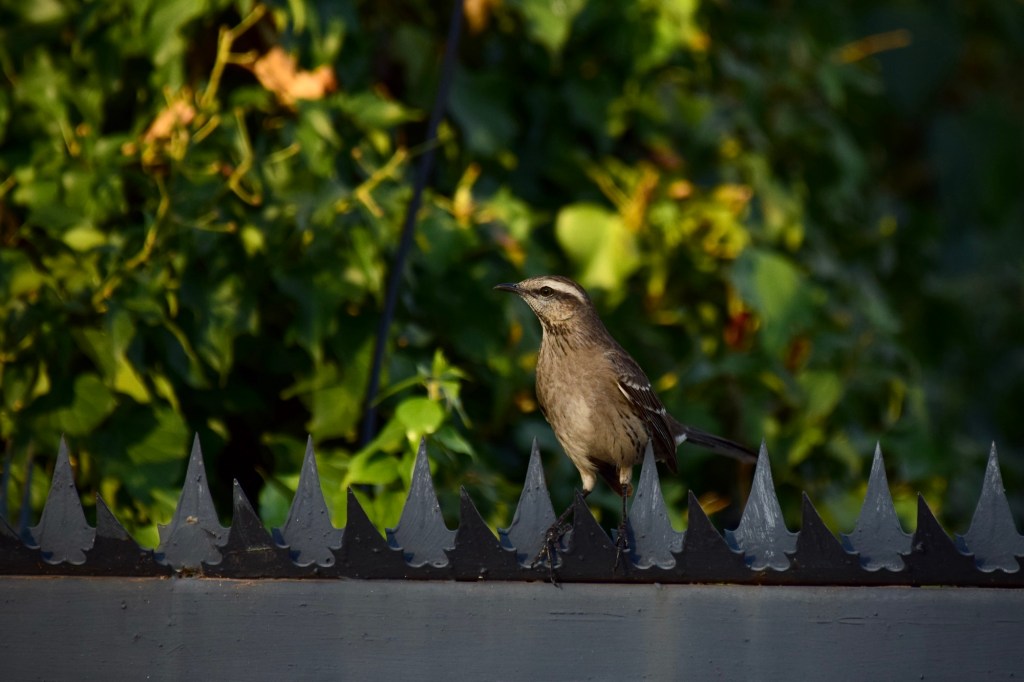
One bird that’s easy to find around Santiago is the mockingbird. I’ve come across these characterful creatures in New Orleans, Lima and the open steppe of Patagonia, but the cheerful Chilean mockingbird is very much a feature of Santiago itself. I imagine they’d be garden birds, if one had the money for a garden in this habitually dry part of the world.
I thought I might try and snap one of the many Chilean swallows circling the heights of Cerro Calán, but they were much too fast and never came down to roost. I did, however, finally have manage to capture a fire-eyed diucon – a little grey bird with striking red eyes, almost like those of a Victorian doll, that moves just like a flycatcher from back home.
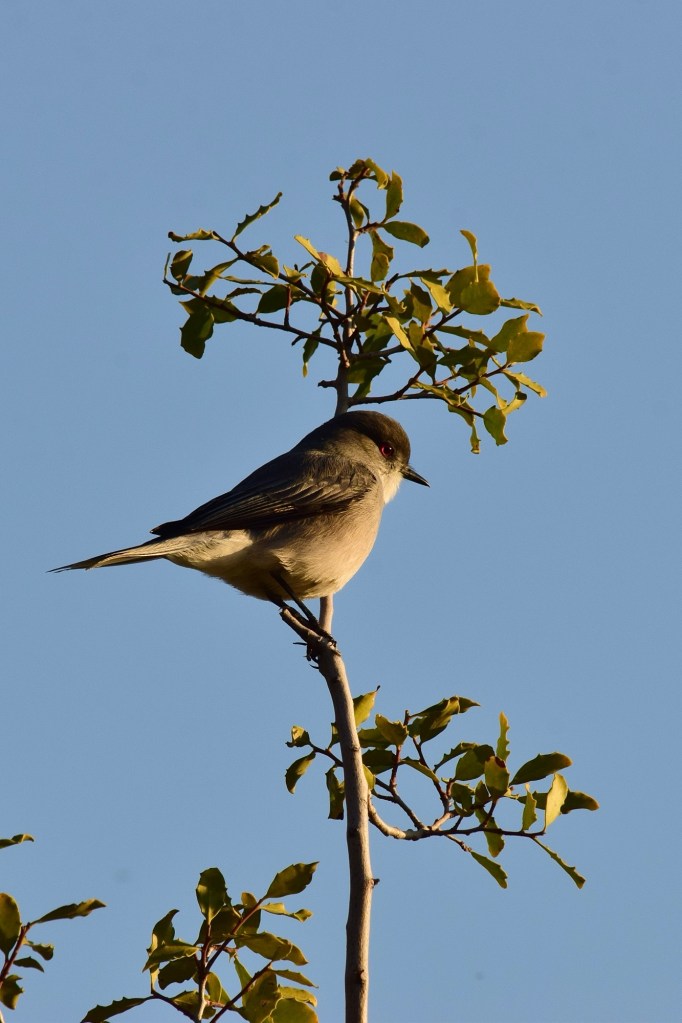
It was really encouraging to see more than a couple of other walkers up on Cerro Galán with binoculars and the BIRDA app on their phones. I can’t help but notice that birdwatching seems to be a lot more popular here than I anticipated. I suppose it helps a lot when your average city birds are really quite spectacular to start with.
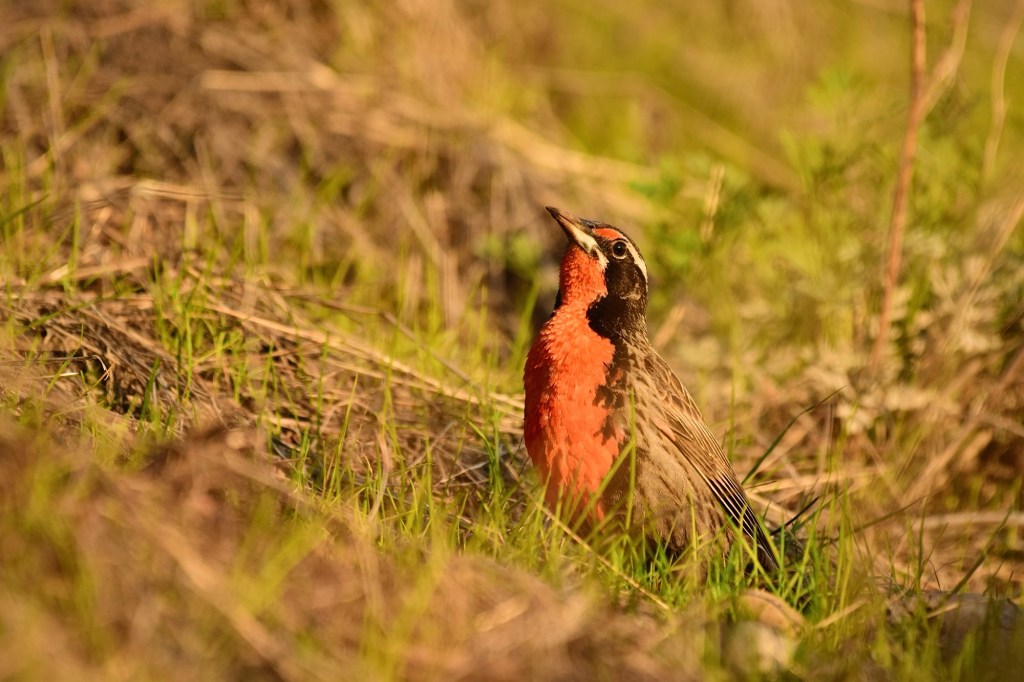
Take the meadowlarks, for example, who make their presence known with a tremendously loud wheezy call that goes off like a Mexican wave as soon as the first one in the flock puffs out its chest and sings. These are the birds that the locals in Santiago seem to love the most, and with such an eye-popping splash of red on the males’ chests, I can’t say I blame them.
Definitely saving a corner of this post for my favourite little sparrows, though. Slightly smaller than our house sparrows, with an endlessly cheerful chip to let you know they’re nearby, they also have a beautiful song when they’re feeling more musical.
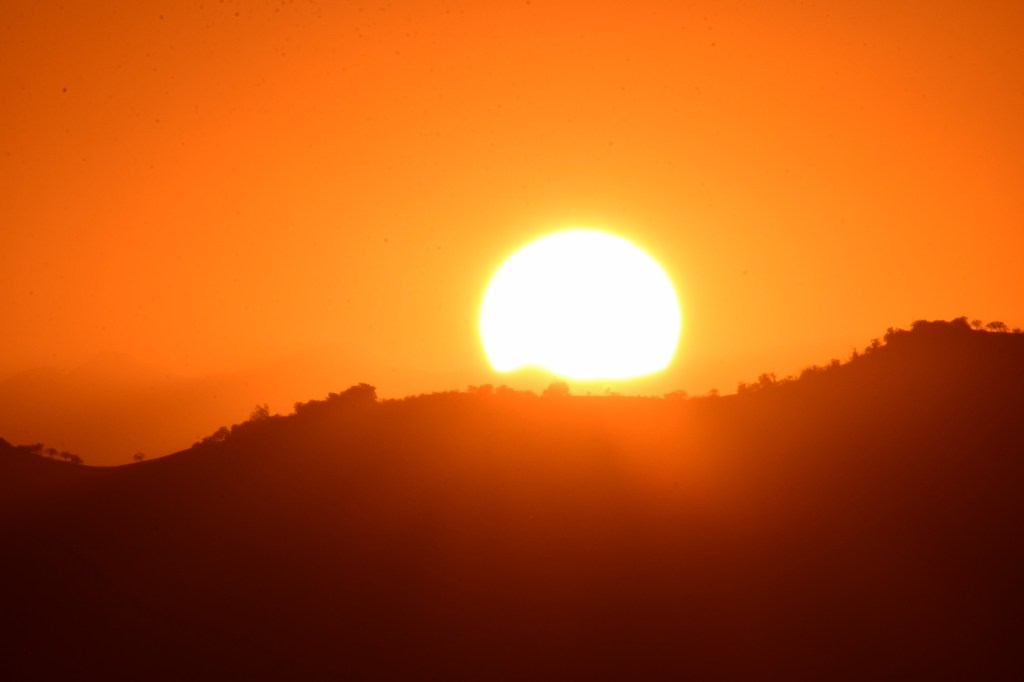
I was up on the cerro long enough to catch the sunset, which was an added bonus. It must have been tremendous from Valparaíso, no doubt, but even here in Santiago, with the forested mountains of La Campana between us and the horizon, it was quite a sight to see.
Today I think I’ll wander over to the Senior English department and try to catch a few more lessons. Be proactive for a change! BB x
Las Condes, Santiago de Chile. 21.28.
Four days into my teacher exchange and I’m still blissfully without a timetable as such. As a matter of fact, that’s actually quite a relief – because I keep running into new opportunities every day, and it’s helpful to be able to say yes to everyone for a change.
Today I spent the entire day in the Senior division of the school, with the equivalent year groups 10-13 (1°-4° Medio by Chilean standards). I also got my eye in on a PAES class, a preparatory class for students preparing to sit the national exams required to enter Chile’s university system, which functions much like the “seventh term” that was once offered by some British schools for Oxbridge hopefuls.
It was a bloody useful class to watch. I even had a go at the paper myself, and got only one question wrong over a 30-minute assault of two reading comprehensions. It’s not that the chosen literary texts were hard – though I’ll admit there were some words I’d never encountered – but the questions were tricky with frustratingly similar choices of answers, and often required really careful reading to decide between two of a possible four.
For the record, the texts were El barco de vapor (which I’m sure I’ve come across somewhere) and El leve Pedro – in case I decide to use them myself as part of my Language A course design. Which I very probably will.
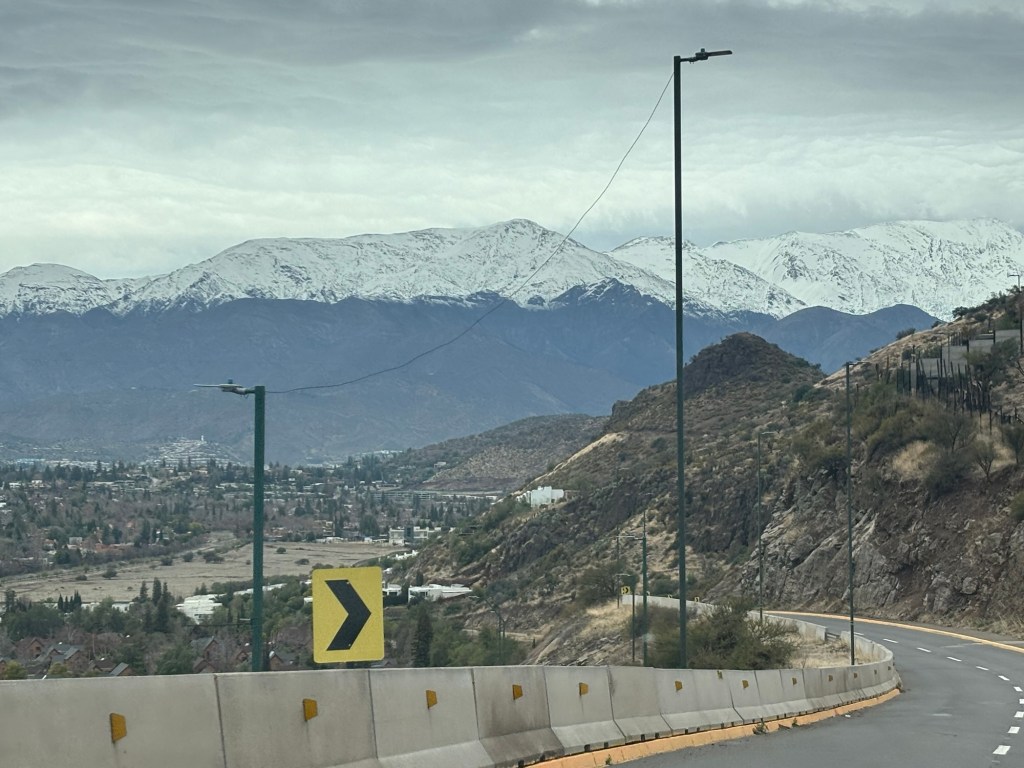
It’s raining again. My trips to South America seem to involve a lot of rain. Since I still have no timetable set in stone – and this is a very ad hoc exchange – I’m hoping to get away early tomorrow and make for the coast, as the weather is likely to be worse next weekend, and I will be off on my travels at the end of the last week – location TBC. For now, at least, the weekend looks like Valparaíso.
Provided the fog that is rolling in off the Pacific doesn’t come sooner than expected, Saturday will see me set out on a small ship into the Pacific Ocean in search of the only bird on the planet with a wingspan larger than a condor: the albatross. I expect the sea will be more than a little choppy, but I’ve always wanted to do a proper pelagic trip, and since the days of working one’s passage on ocean liners is well and truly dead and gone, this is the next best thing.
If the weather puts a stopper in my Pacific plans, there’s plenty to see and do in Valparaíso – including the city’s resident fur seals and its plethora of seafood options. It’ll also be good to get out of the capital for a bit. Host families are lovely and all that, but eight years of living on my own have made me into a very independent sort of creature.
Someday, somebody will shake me out of that. Maybe. For now, this social battery of mine needs the solace of the sea.
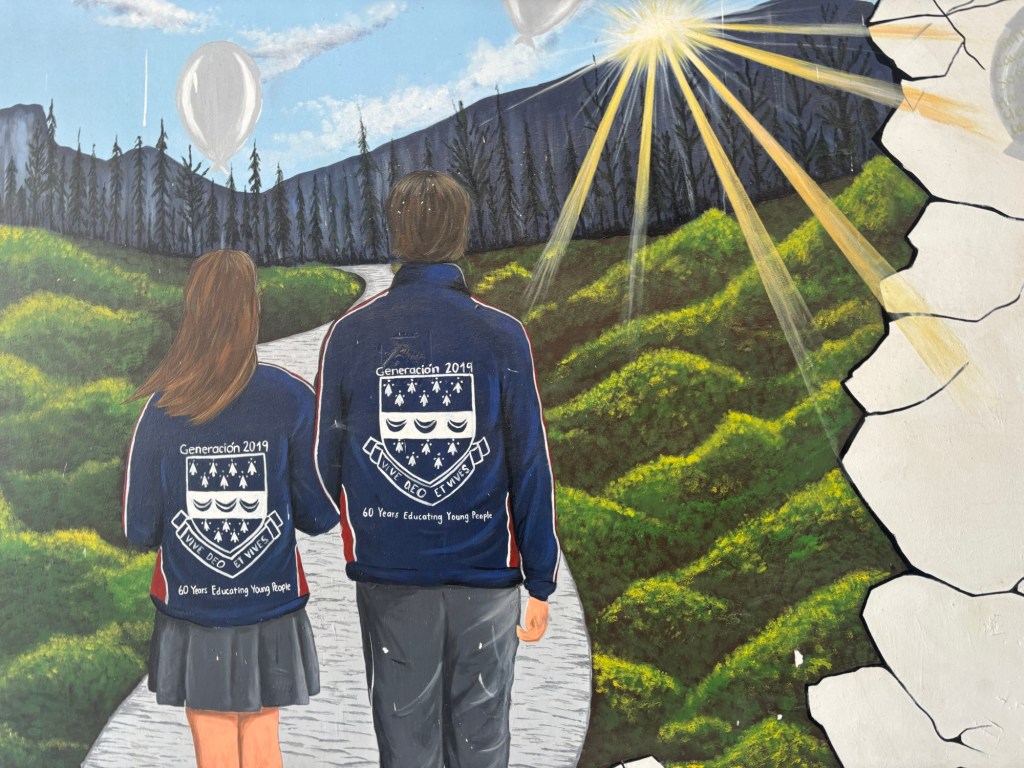
I’ll get back you once I get there. It’s a bit touch and go, but the best adventures always are. BB x
Lo Barnechea, Santiago de Chile. 15.43.
The shrill cry of lapwings precedes the school bell by seconds. There’s obviously more than a couple that will have their nest somewhere in the school grounds when winter is over, as they’re here every day, soaring and bouncing over the school with their odd, bat-like flight.
I’ve become quite used to the rufous-crowned sparrows that live around the school. There are house sparrows here too, the same as we have back home, as well as the handsome slate-grey diuca finches, but the characterful little South American sparrows are a joy to watch and to hear as they hop around the campus. Sometimes they’re joined by a mockingbird – I’ve seen the same individual at least once each day, usually around the goal posts in the patio – and today I had the treat of being reunited with the smart scarlet spectacle of a flock of meadowlarks that came rooting around the school car park around lunchtime. I haven’t seen them since I left the snowy hills of Patagonia last week, so it is lovely to be reminded of that wintry paradise when it is already some two and a half thousand kilometres to the south.
They say that even the mighty condor comes down from the high mountains when the weather is fierce, when it can be seen from the school grounds from time to time. Now that really would be a sight!
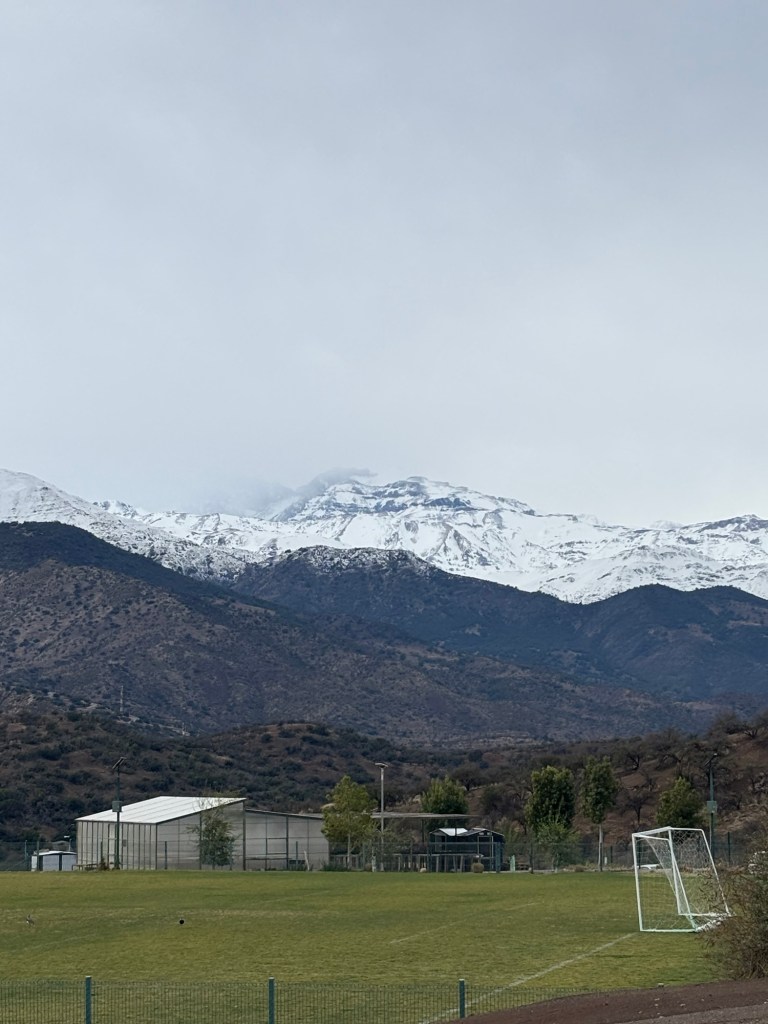
I’ve had a fair bit of thinking time today between observations and meetings, so I’ve had time to soak in the nature of my surroundings a bit more. I saw a couple of project classes again this morning, before organising a meeting with the Head of Senior Literature after lunch.
Senior Literature… Now we’re talking business! I’m painfully aware that my decision to embark upon this mad adventure with Spanish Language A makes us one of the few schools in the UK that offer such a Spanish-heavy course. It’s also not been lost on me how bizarre my exchange set-up is: I’m an British teacher working in the one department at school that operates entirely in Spanish. It tends to throw most of these kids (and teachers!) for a loop.
I feel a great sense of relief for having spoken to a colleague who coordinates the Higher Level Language and Literature programme here at Craighouse. At least a third of the books I have nominally chosen for my own course are on their list of set texts, and the Head of Department both knew of and really rated every one of my choices. My colleagues back home are largely linguists rather than literati: a passing glance and an apologetic wave of their hands was the best response I got to my admittedly annoying enthusiasm about my text choices. Now I feel at the very least as though I have not been operating entirely in the dark.
The conversation ended with a visit to the Inquiry Centre for inspiration’s sake and a jokey offer to consider working here. I’m keen to get out of England and back into the Spanish system – or, better yet, the IB – but I’m not sure Santiago is the place for me. Maybe it hasn’t grown on me yet. I’m also getting to that age where all I really want is to find Her and settle down. Santiago is – it should be said – about as far away from home and everyone I know as I could feasibly go with the skills that I have. All the same, I’ll admit I floated the idea in my head for a little while.
I’ll let it float a while longer. Two and a half weeks remain of this exchange, which may well prove to be a lot more useful than I anticipated. It was absolutely the right decision as far as my fledgling Language A course is concerned, but it may prove to have other uses that I have yet to discover. Time will tell.
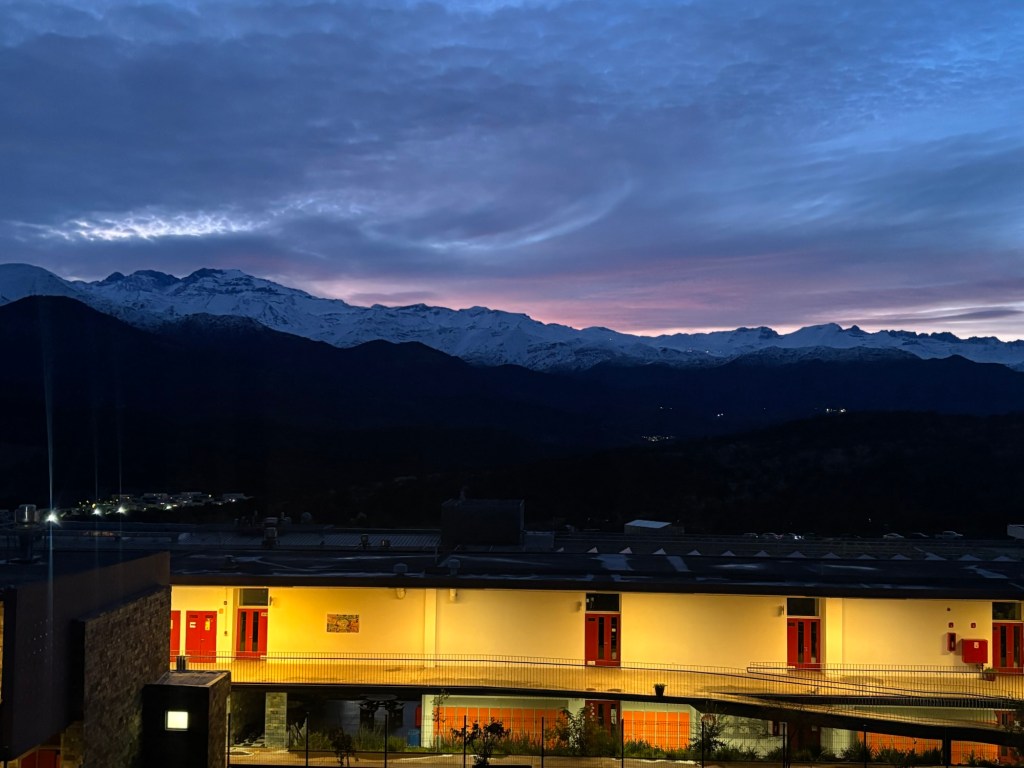
Tomorrow I’m going to pop in on a few senior literature classes and maybe drop in on primary as well. There’s talk of the possibility of seeing how English Literature is taught here, too, which I’d absolutely love to see. I’ll keep you posted. BB x
Lo Barnechea, Santiago de Chile. 15.05.
Today’s lesson observations were largely spent with a friendly Spanish teacher called Mario. The Middle Years Programme or MYP – the IB’s equivalent of Years 6 to 9 – follows a really interesting programme at this time of year. Or at least that’s how I see it!
All of the classes in 6° (Year 6) are currently working on a triptych project centred around haikus, so that they can get used to how syllables work in context. The students have free choice as to what to write their haikus about, provided it concerns an aspect of Japanese culture. As for the range of ideas in the classroom…! Sakura trees, Matsumoto Castle, Mount Fuji, the origins of sushi, Tokugawa Ieyasu… The creativity and ambition of these IB-trained children is truly astounding.
In 7° (Year 8), the students are working on their organisational and presentational skills through a marketing project. Not only do they have to create the product, they have to design the marketing poster, complete with a functional slogan and all the trappings of a street-side ad, right down to the contact details and the disclaimers. Once they’ve created their project, they have to explain their product and why they have designed their ad the way they have, commenting on their own use of language and where they got their sources. It strikes me as an incredibly mature way to handle a Year 8 language class. I must find out what ours do – I’d be surprised if it is as high-brow. Or maybe I’m just bowled over by the full body of the IB, having only touched the tail of the beast before.
In 8°, the students have an even more ambitious task ahead of them: an anthology of Chilean poets (sans Neruda), from which they have to select two poems by different poets and compare them, analysing the stylistic features at work in each one. We definitely did this in English when I was growing up, but not in that kind of detail, not at that age. It reminds me of how far ahead Spain’s Lengua castellana course was of my own English syllabus, as it took me two years to reach the material I had covered during my year out in Spain (which is effectively three, as I was held back a year when I moved out in order to help me acclimatise). I can’t vouch for the quality of their work as it’s still being marked, but they seemed about as keen on poetry as your average English kid is – which is to say, not in the slightest.
It’s a shame, how universally unpopular poetry seems to be. I guess it’s because of the difficulty spike when compared to a humdrum comprehension text: all the best poets do love to weave a lot of clever imagery and references that require major unpacking to properly appreciate. I’ve always been of the opinion that the best toolkit for handling poetry is a serious arsenal of general knowledge, but with that too on the wane in the age of instant information, I can’t see poetry becoming anything more than a niche interest among the global student body.
Well. Not unless I have anything to do with it, anyway. BB x
Notes, field guides and micro-memoirs
A Solo Travel and Literature Blog
All about trees
Barcelona · Spain · Food · Travel
A glimpse of the world through my lens
Synastry & Karmic Astrology
A Journey of Travels, Teachings, and Truths Told Plainly
Musings of a trekking author
Inspiration and Spirituality **Award Free**
Illustrations to make you smile, laugh, and sometimes make you see things from a different perspective 😉
a woman with wings travelling the world solo

