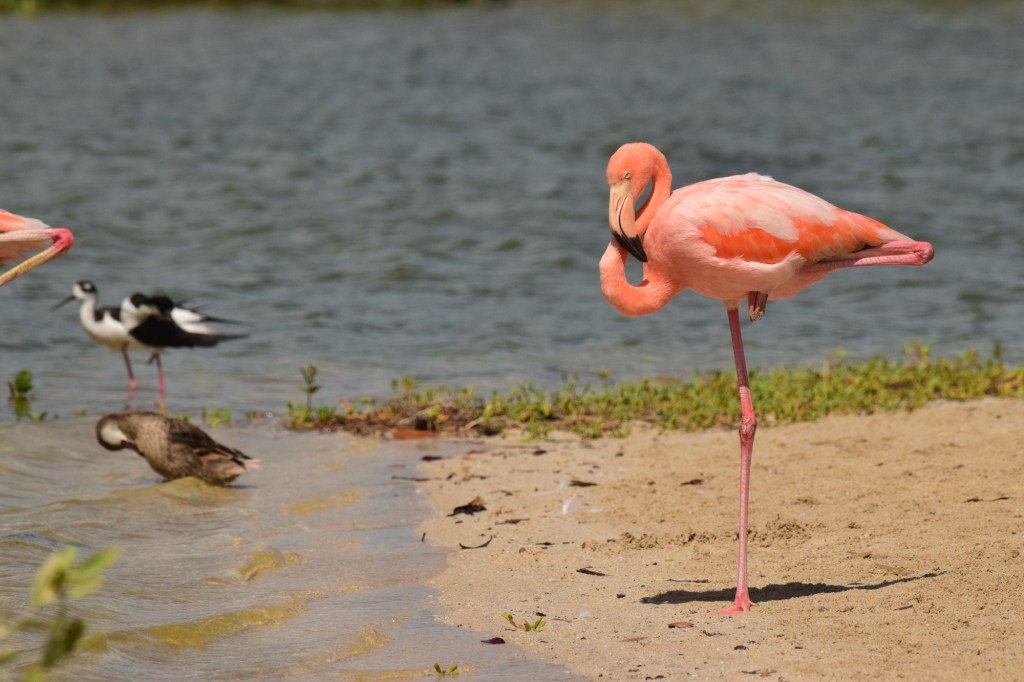
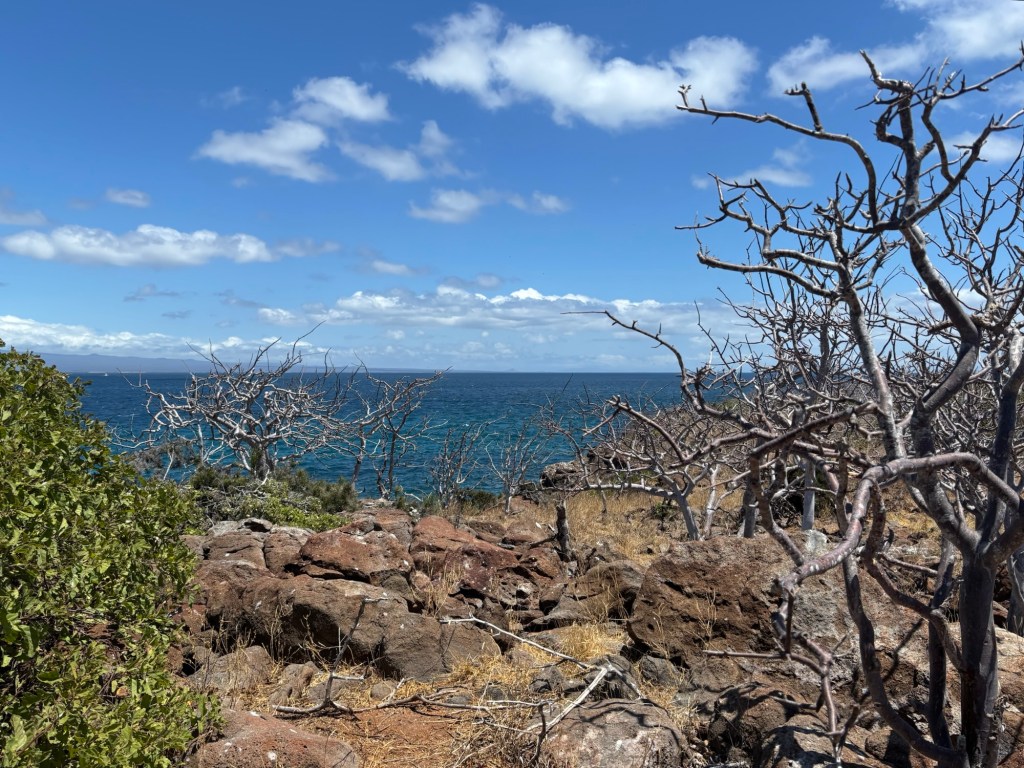
Flow State

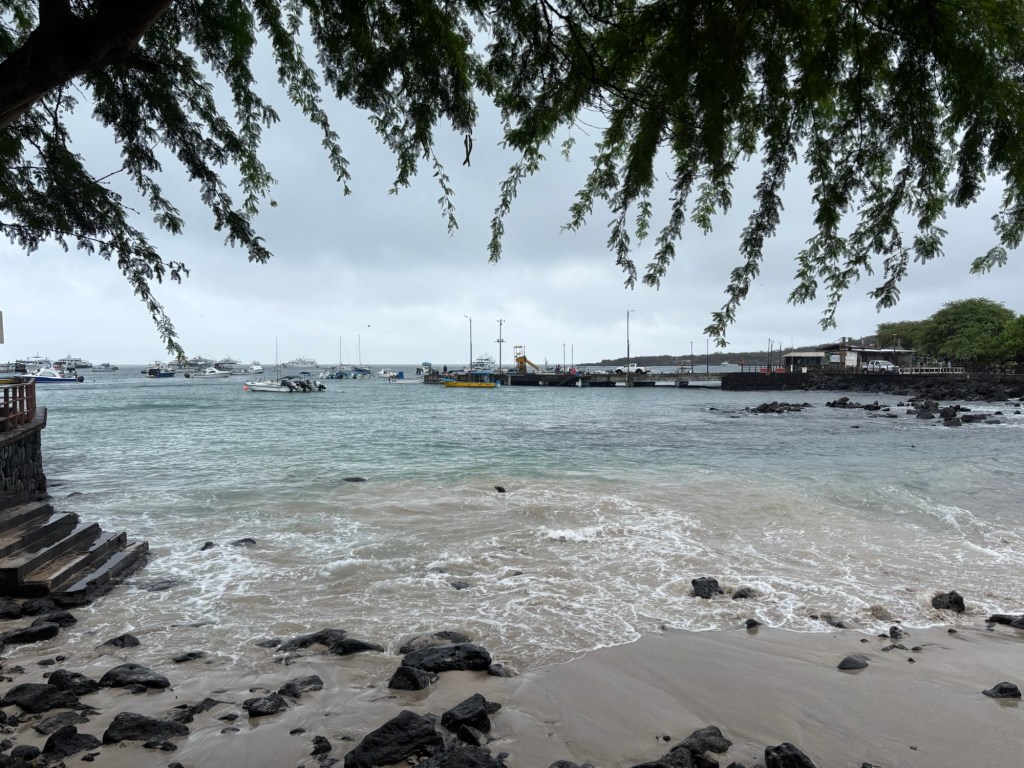
Puerto Baquerizo Moreno, Galápagos Islands. 18.55.

I could have sworn that it crossed my mind when I was packing for Chile that I might want to take my GoPro. It would have very easily fit inside my suitcase. It’s not as though I overpacked, by any stretch of the imagination. If anything, I almost certainly underpacked. Well, it can’t be helped – how was I to know that my last South American adventure of the summer would take me snorkelling, when Chile was (and still is) in the grip of winter?

Long story short, I really, really, really wish I’d had it on me today. But I didn’t. So I’ve done my best to make up for it with the trusty Nikon. I hope you enjoy!


Today’s expedition took me out to León Dormido, more commonly known as Kicker Rock. I’ll be honest, of all the Galápagos day tours available, this one was not on my list. It probably should have been, as it’s one of the most spectacular places in the world to go snorkeling, or so they say. Knowing what I know now – which is that the discount I had from my guide was considerable, compared to the other guests – I’m glad I signed on for a last minute slot.

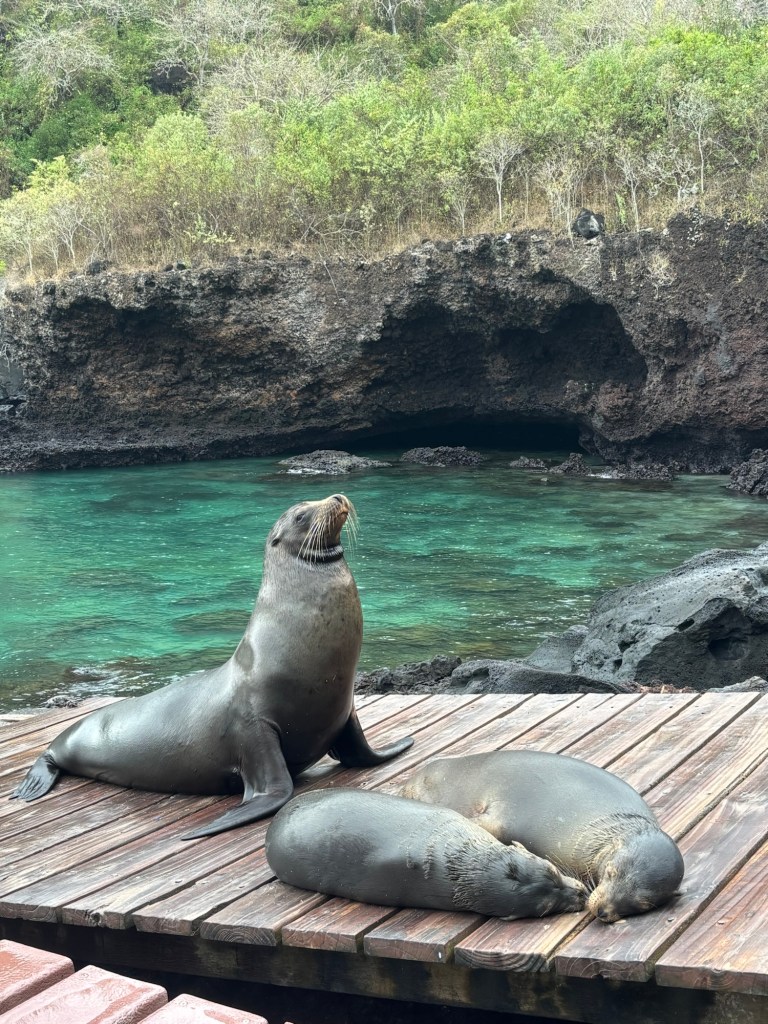
I rocked up early to the marina, as instructed, but sometimes I forget that this is South America. A 7.45am meet turned into a 9.15am departure, so I had plenty of time to photograph the sea lions, which never fail to disappoint, no matter how accustomed one becomes to their presence here.


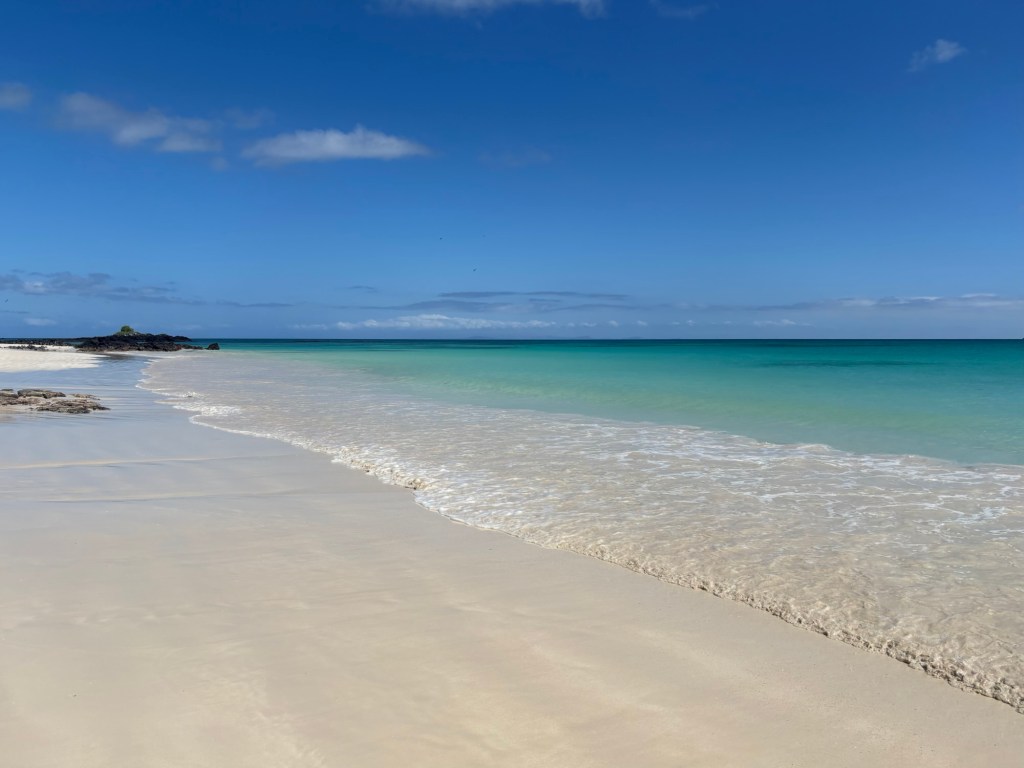
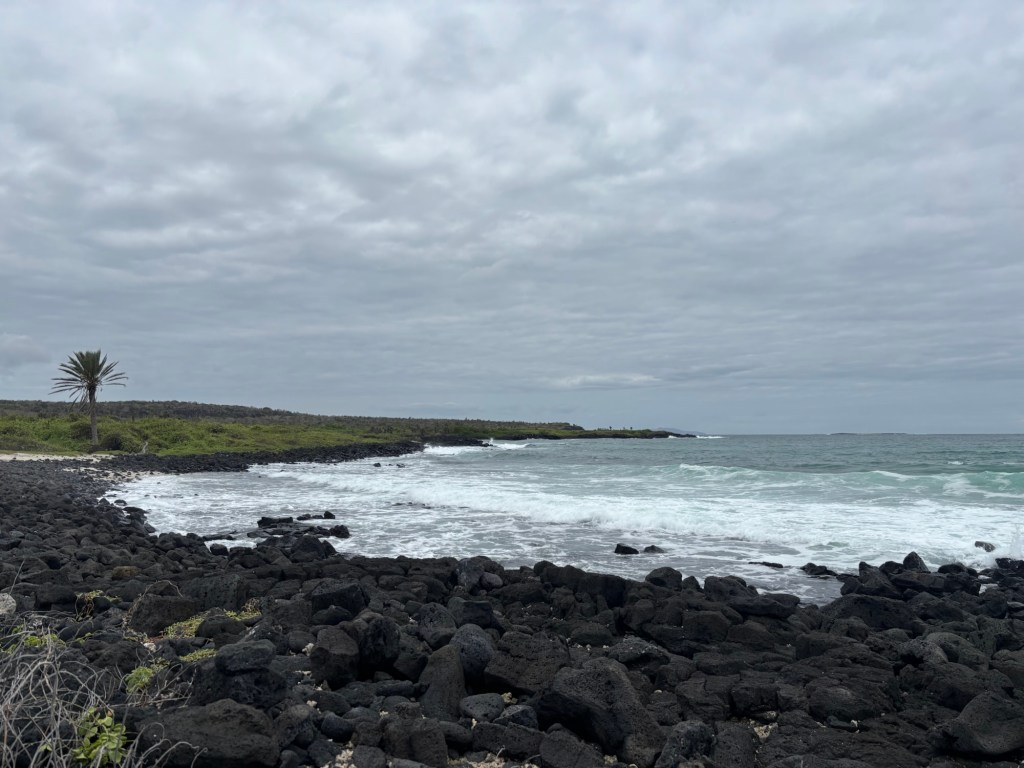
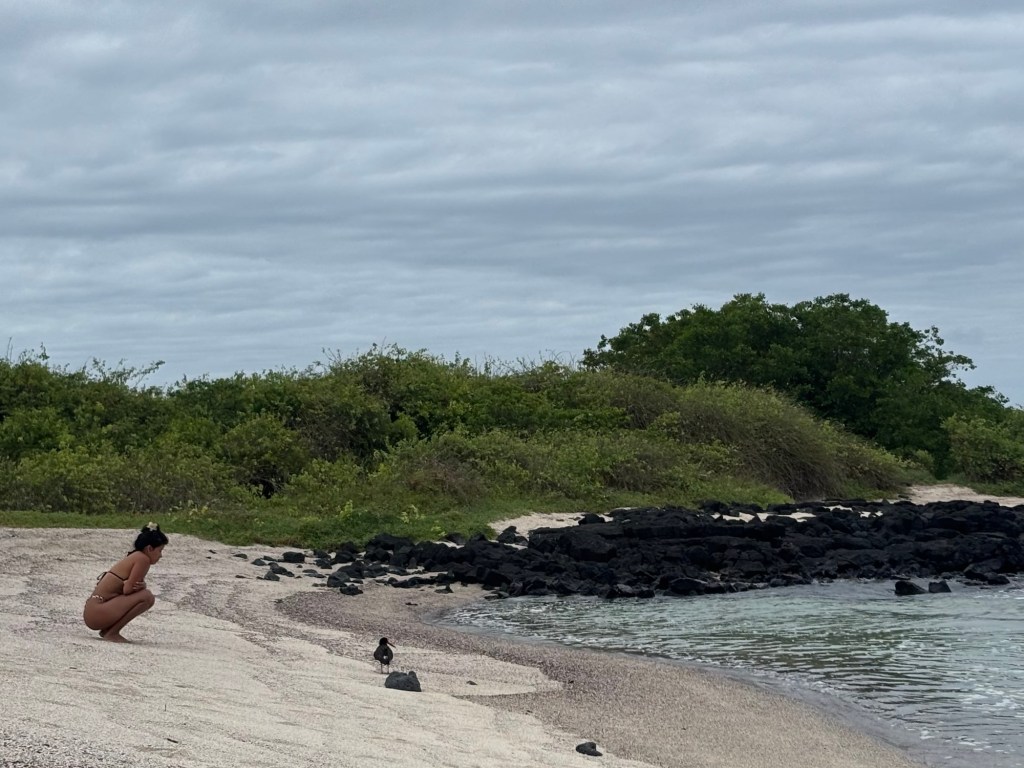
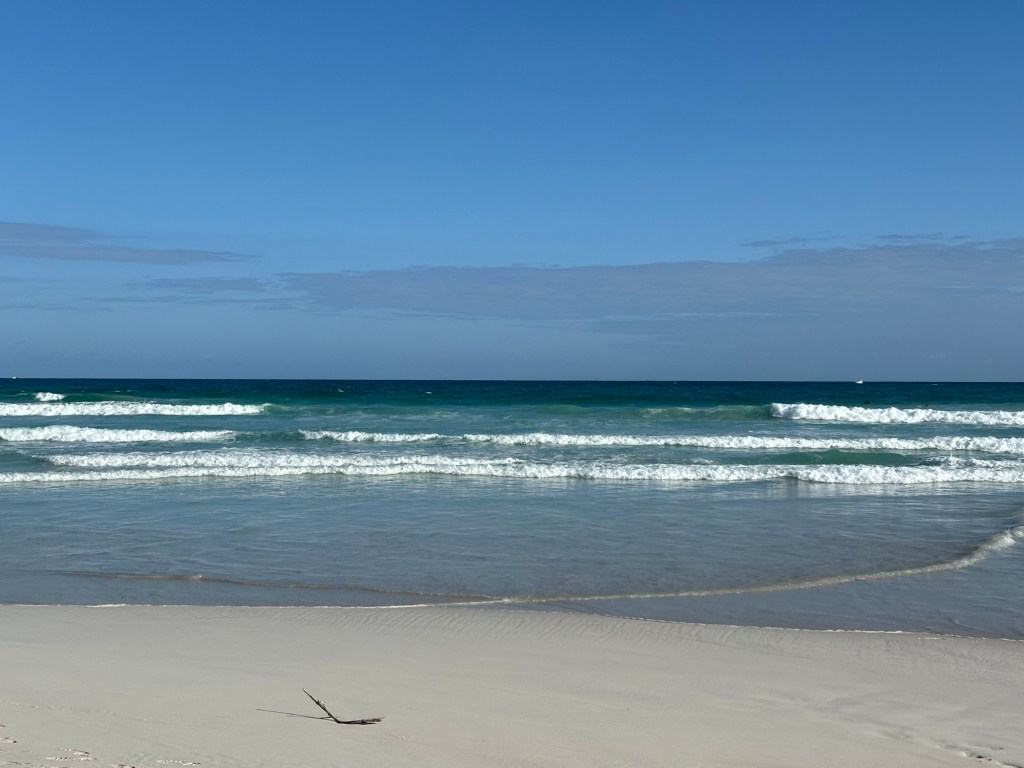
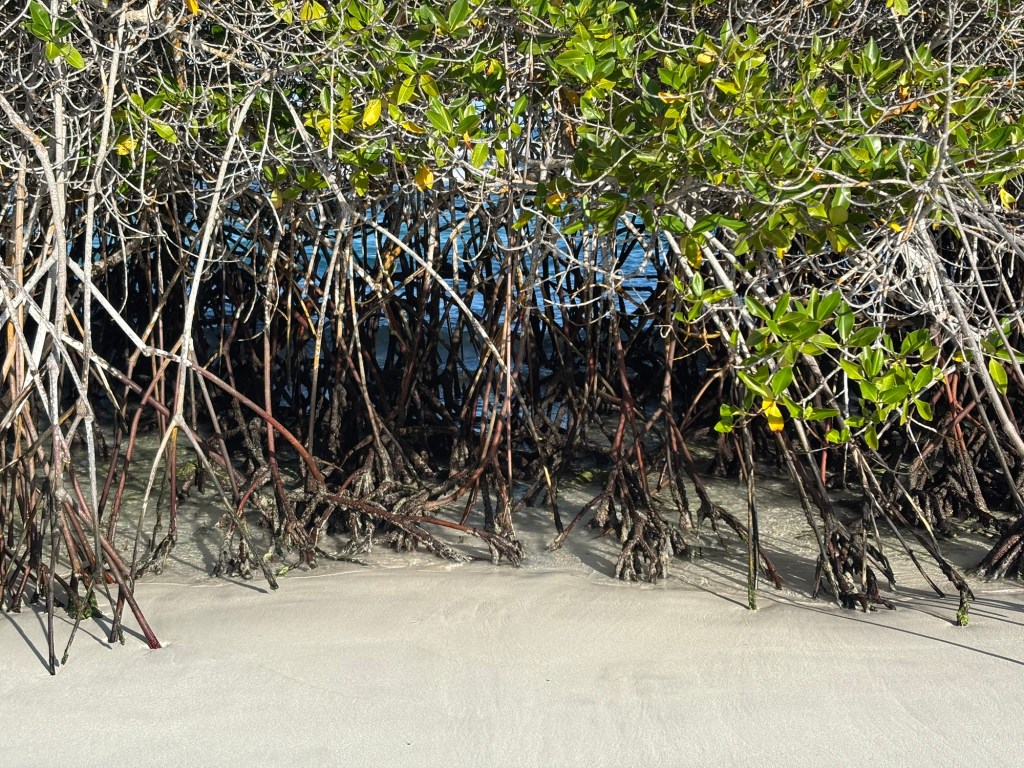
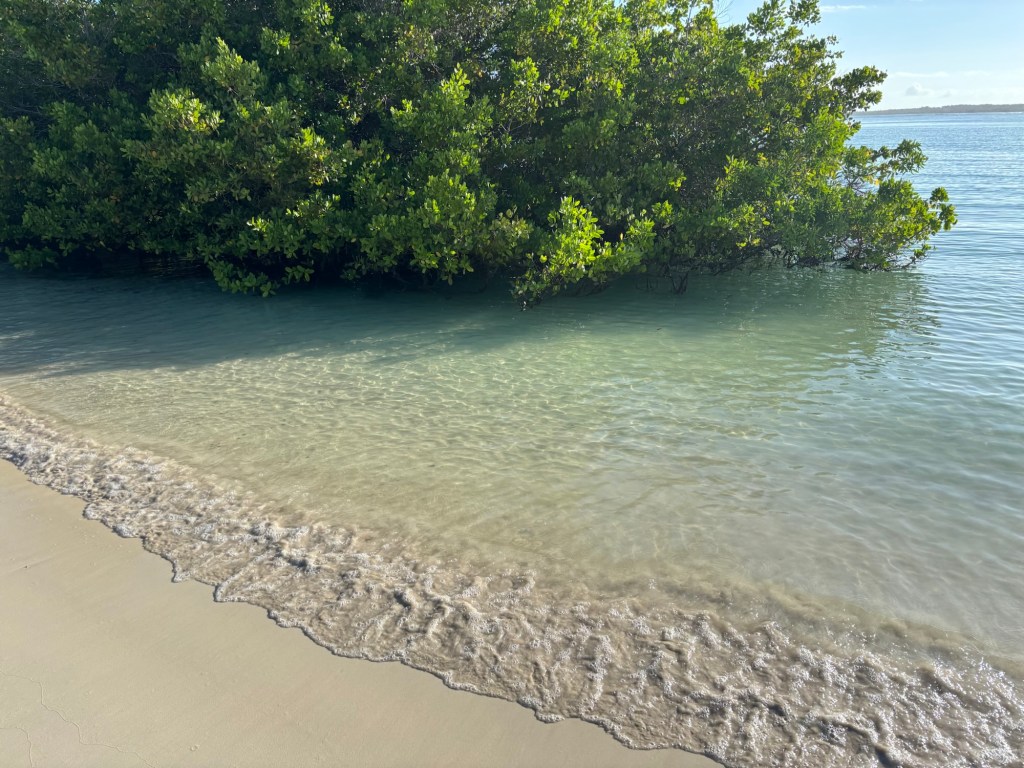
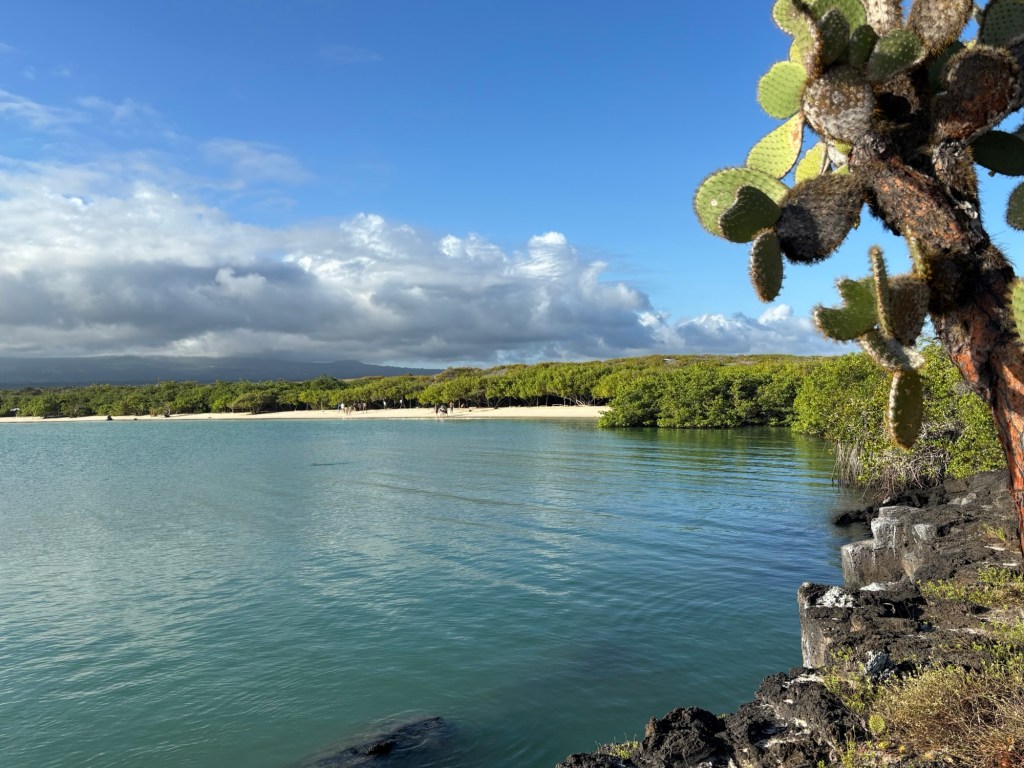
We had an afternoon slot for León Dormido, so Samuel took us to a sanctuary beach within eyesight of the rock known as Playa El Manglecito. When we arrived, there was hardly any wind at all – just the waves lapping upon a white sand beach. The surface of the water was only broken once in the distance by a mobula ray leaping into the air and disappearing into the endless blue. With the possible exception of Finisterre, this is probably the first true white sand beach I’ve ever seen, and boy did it live up to the hype!


I considered snorkelling with the others, but it only took a few seconds in the water to realise that something was wrong. My mask filled with seawater almost immediately, stinging my eyes and forcing me to my feet early. A small tear where the straps met the rubber seal of the mask was the culprit – something I confess I hadn’t spotted when I checked the mask last night. So I shrugged, got back out and went for a walk along the beach.

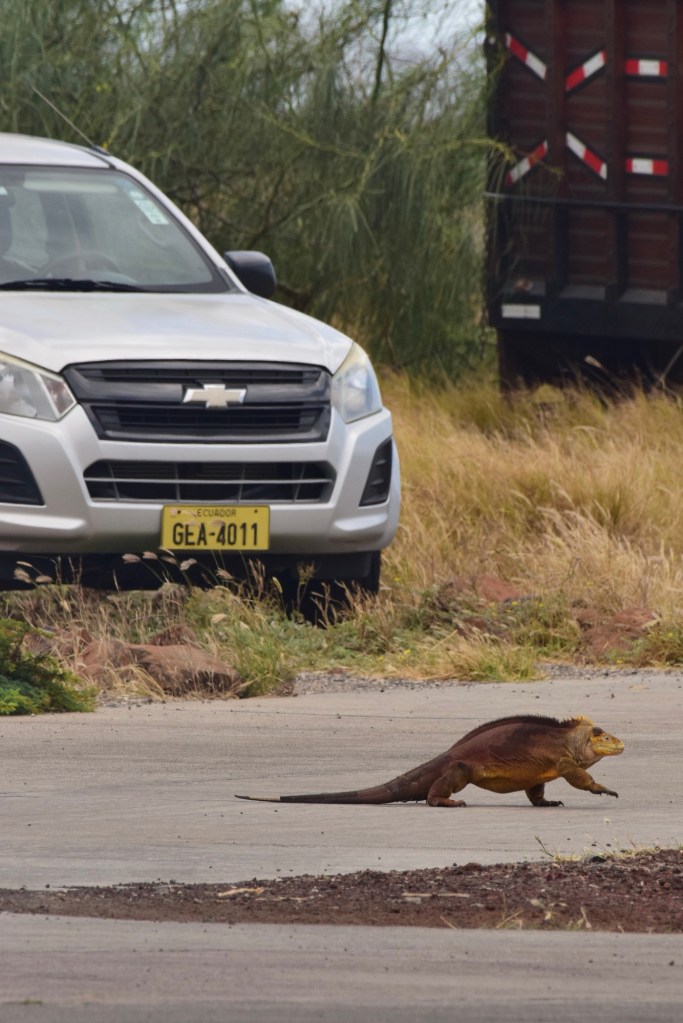
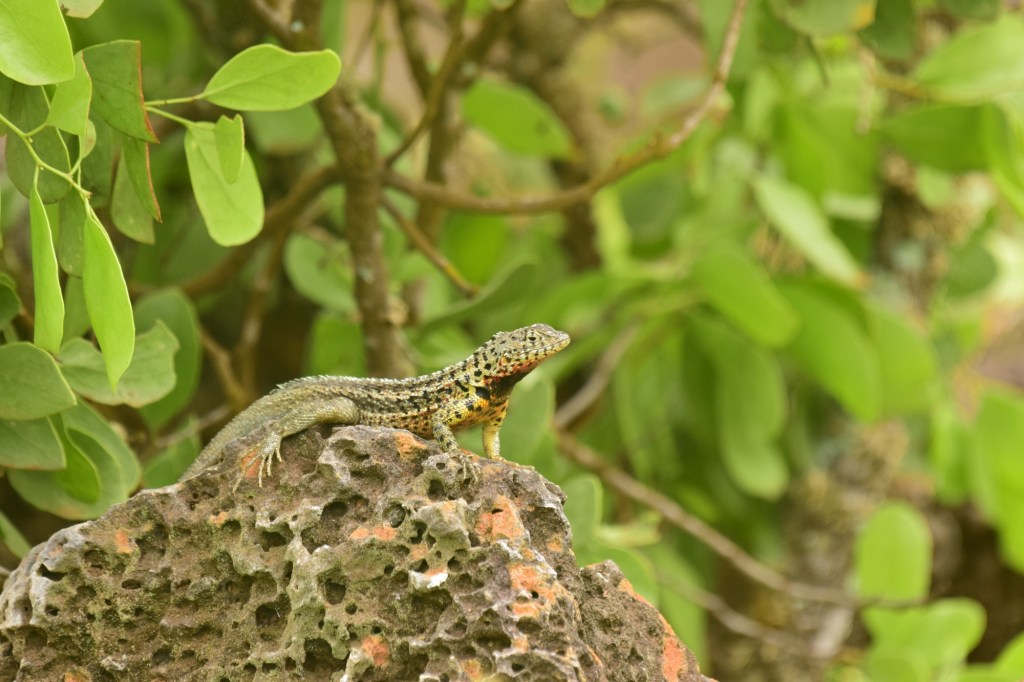
There was plenty to keep me occupied. The molten scrub beyond the shore was alive with little things: finches, warblers and colourful lava lizards. Of course, there’s always a sea lion about too, and since it was so curious about us, I couldn’t help but indulge it as well.


Indigo and her mother, a couple of experienced divers from the UK, told me I had to go back in the water: they had seen as many as fourteen turtles in the bay. I told them about my mask and Indigo lent me hers. I’m past the stage of my life where I’d awkwardly turn such an offer down out of affected politeness – and I really did want to see a turtle.

It took me a little while to find them. I swam across half the bay at first, thinking they might be sheltering on the far side, only to nearly collide with one of the giants as I returned to the shore.

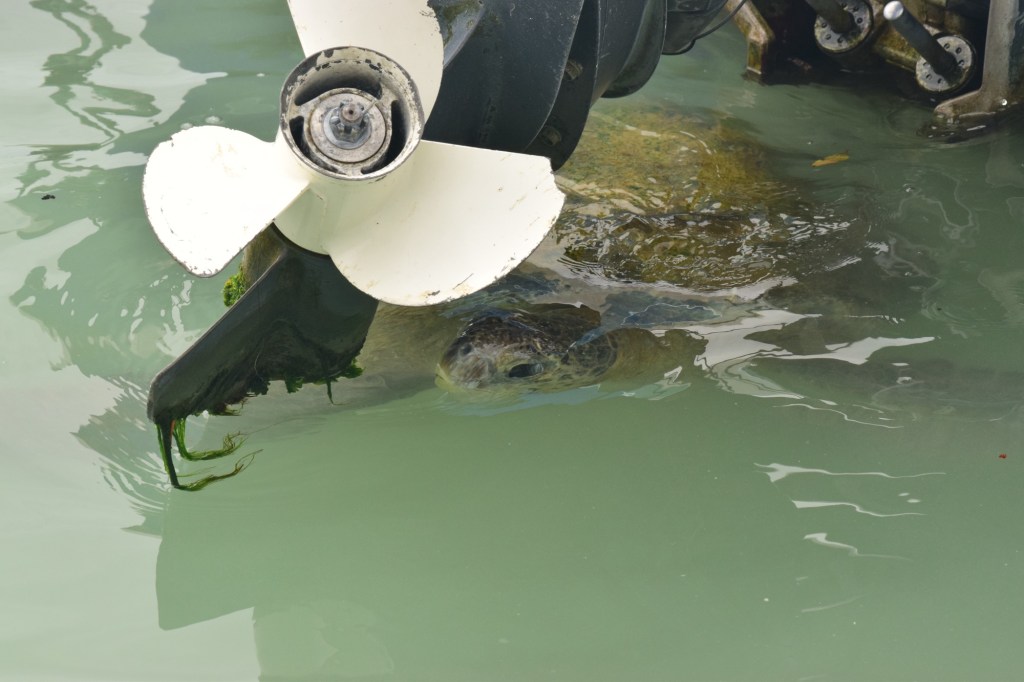
Oh, if only I’d had the GoPro – the things I could have shown you! Green turtles are simply enormous. So much bigger than I expected. I think I assumed all turtles but the giant leatherbacks were around the size of an Olive Ridley, but these green turtles can grow to five feet in length. The largest of the turtles in the bay must have been that size or close to: he was busy gnawing algae from the rocks and paid me no attention whatsoever, though I can only have been a metre or so away when the waves hurled me in his direction.

I didn’t linger as I didn’t want to cause them any undue stress. They didn’t seem at all bothered by my presence, but turtles are endangered enough as it is, so I spent a few minutes in total awe, watching them feed and fly through the water on those evolutionarily perfect flippers, before pushing off back toward the shore.

Our divemaster Jesús called the three divers back to the boat, but the rest of us – me, a Brazilian-American and a mother and son from Austria – had another half hour to enjoy the beach. Naturally, I’d surrendered the working snorkel back to Indigo, but I figured I could at least have a go at capturing the turtles on camera, albeit from above.

The trouble with turtles is that they are perfectly adapted to life underwater, and do not need to come up for air as readily as other animals. When inactive, such as when they need to sleep, they can submerge for an astonishing seven hours without needing to breathe. Even when they’re awake, they can still hold their breath for thirty minutes or more if they need to – and when they do pop up for a breath, it only lasts a couple of seconds until they dive back down again.

All this is to say that photographing a turtle out of the water is a very difficult challenge. But I had half an hour and nothing better to do, so I took a stakeout. It was almost impossible at first, but when a couple of them decided to cross the bay and swim out of the dark reef and over the white sand, the job was suddenly made a lot easier. All I had to do was to track the shadows.


The calm sea that carried us gently into the bay had been whipped up into a fierce swell by the wind, which made the job even harder, but I managed a few half decent photos as the first one made its way across the bay.


Looking at a turtle is beholding one of the greatest survivors on Earth. These incredible reptiles have been around since the time of the earliest dinosaurs in the early Triassic, some 230 million years ago, and two mass extinctions, as well as a host of other destructive factors – including our depraved taste for their meat and shells – have not been able to rid the planet of these mighty success stories. It was a real privilege to see them so close.


I’ll be honest. After that incredible encounter, the snorkelling at León Dormido was… a bit of a letdown. Kicker Rock is a world-famous diving location, where entire schools of hammerhead sharks, eagle rays and even mantas can be seen. Naturally, snorkelling is a bit more restrictive, doubling your time but limiting your exploration to the surface. I was lucky that they had a spare mask, so I could see underwater without any difficulty this time.

We saw parrotfish, triggerfish and rainbow wrasse and a few impressive sea stars clinging to the wall of the rock, but beyond that, the most memorable encounter was the enormous salp swarm we found ourselves in. Every single movement of my hands was surrounded by a swirling cloud of reddish gelatinous organisms that looked like drawings of cells from my old biology textbooks. The sun must have drawn them all up to the surface from deeper, darker waters below, beyond the deep blue beneath my feet where the blades of sunlight fail to penetrate.


I’ve never snorkelled in open water before, so I think I was much more accustomed to being able to stop and breathe normally more often than I feasibly could with the seafloor more than 130 feet below. It took me a while to master breathing through the snorkel, and even once I’d lost my nerves about breathing through a tube, seawater still managed to get into my nose and up and into my oesophagus. After about twenty minutes it felt as though my throat was on fire with all the ingested salt, which probably didn’t help with my state of mind. It was only when I was distracted by the playful antics of the attendant sea lions or a particularly interesting fish that I didn’t think of the discomfort I was in.

The divers said they’d seen it all: reef sharks, hammerheads, eagle rays and barracuda and all the rest. They were all much, much lower down. I didn’t begrudge them for it – that’s what they trained for, after all. It was a good reminder, however, that my gut was right all along: snorkeling isn’t really my cup of tea, compared to, say, a two-hour hike. In that sense, I haven’t changed much since my school years: I know what I’m good at and I do it often enough to consider it mastered. I’m open to new experiences, but given the choice between snorkeling and hiking some other time, I might think again next time.

Unless, of course, I’ve got my GoPro on me. Or I’ve shaved (which may or may not have had an impact on the water getting into my nose).

Fortunately, there was one resident of León Dormido which had eluded me so far, and it was a creature I’d been hoping to see since I got here: a tropicbird. These angelic creatures are shy seabirds, nesting deep within the cliffs in hard-to-reach places, and – at least here – usually fly in pairs. Bloody hell, but they’re hard to catch, moving tremendously fast in wide circles against a bright blue sky, but after much trial and effort I finally caught one.


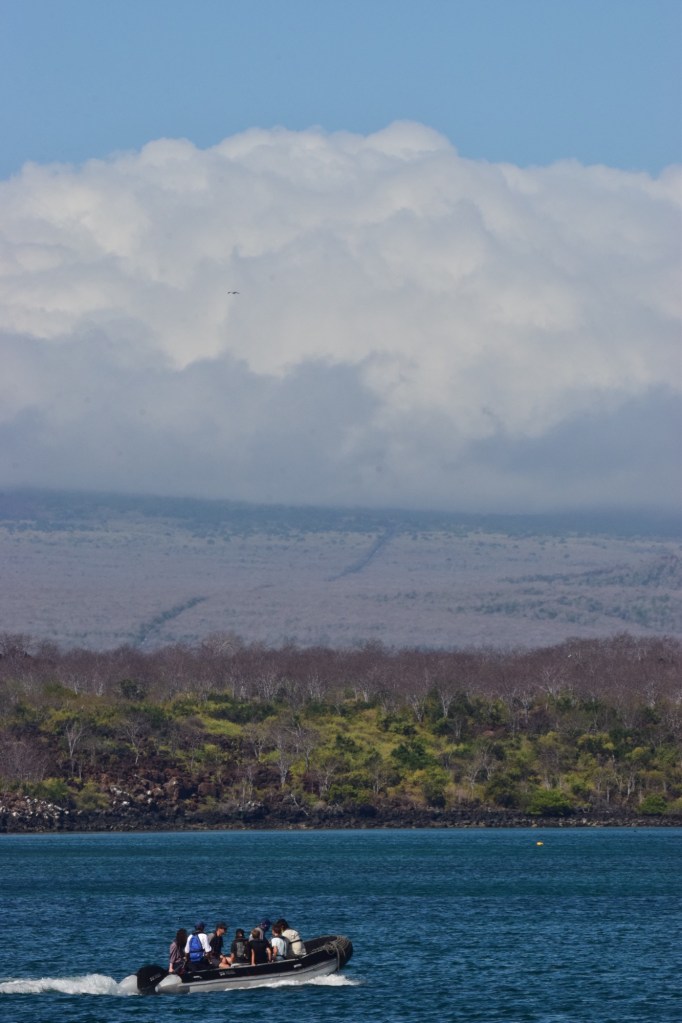
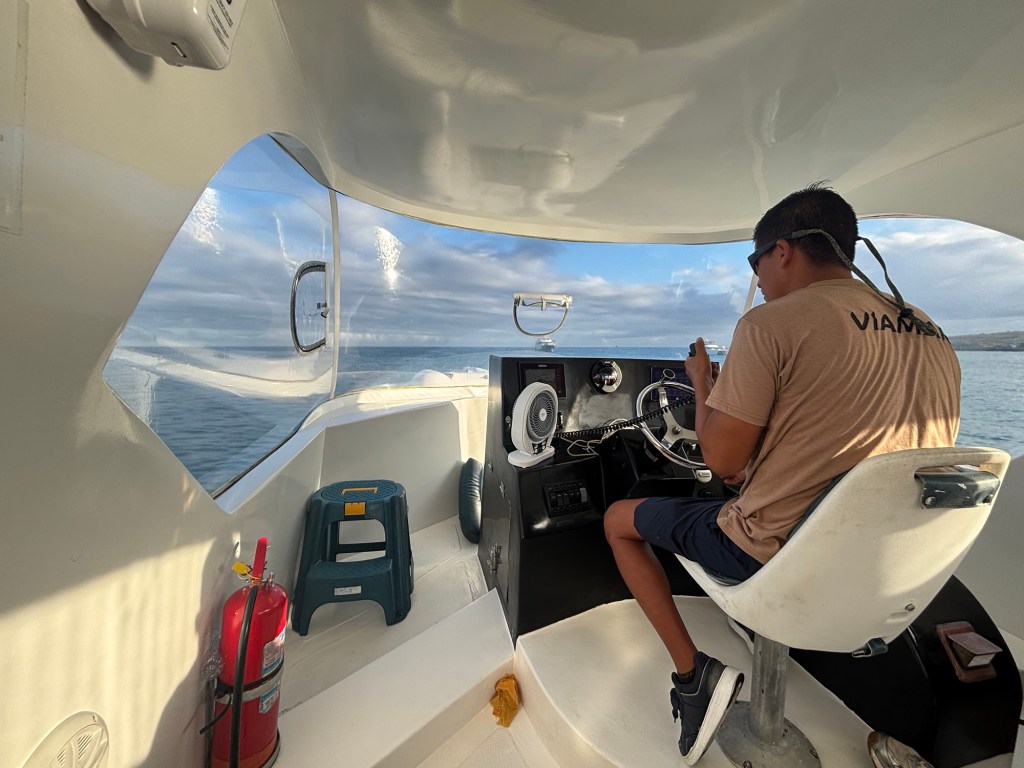
The return journey was a very bumpy ride. We’d been sheltered from the wind and waves on the east side of Kicker Rock, but had to cross a raging sea to get back to port. In spite of myself, I caught myself dozing off, which you’d think would be hard in a boat that keeps landing with a jolt and a hard splash after cresting every wave, but there’s something about afternoon journeys after a long day’s expedition that renders you terribly susceptible to fatigue, whatever the circumstances. I wrapped the strap of my camera as tightly around my arms as it would allow, just in case.


Samuel’s contact did finally offer me a trip to Española, the Impossible Island, but for tomorrow. Sadly, I neither have the budget nor the time: Punta Pitt and Kicker Rock between them cost what Española would have been, and besides, I have an early departure tomorrow for Santa Cruz, the second of the two islands on my Galápagos adventure.

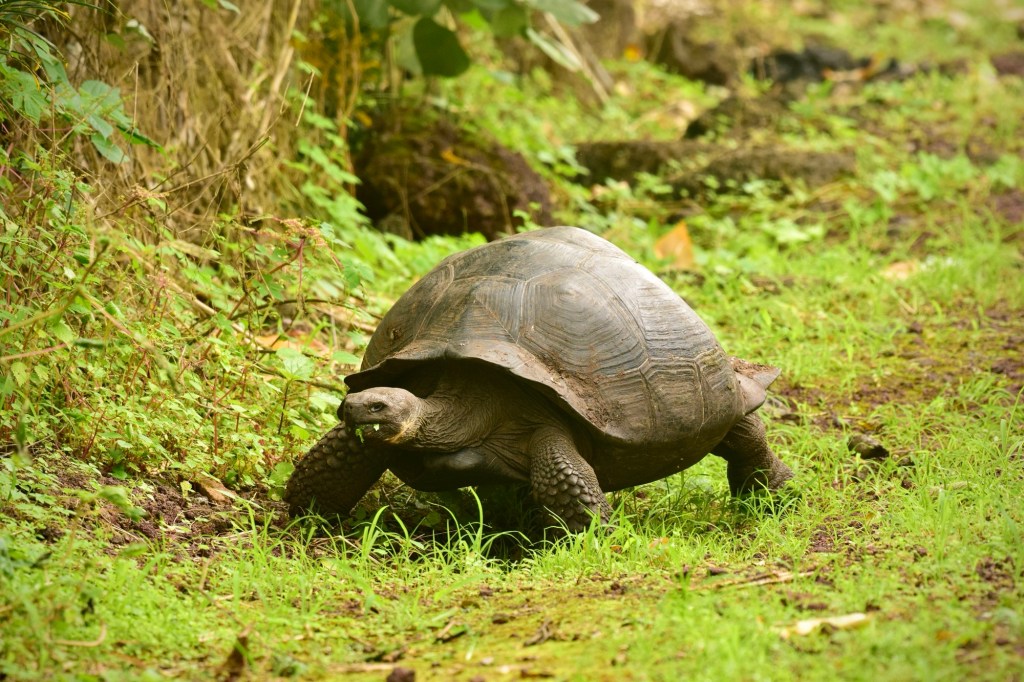
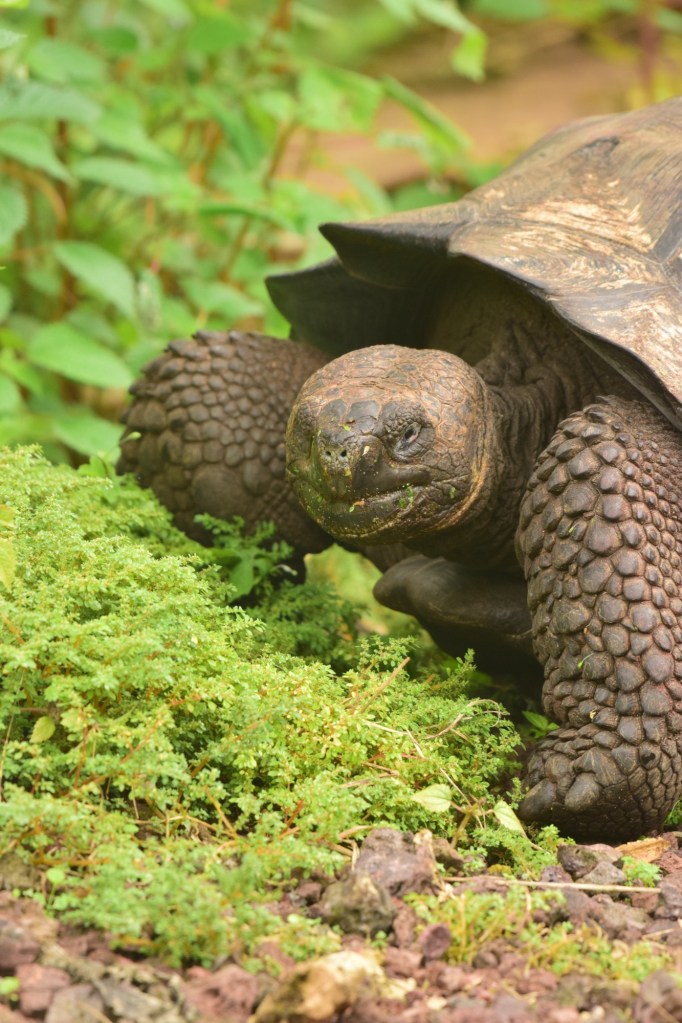
I’ve been on the islands for four days and I still haven’t seen the giant tortoises that they were named for. That will change on Santa Cruz. It’s time to bring this adventure to a close in style – and, hopefully, add a couple more species to the roster in the process. Santa Cruz, here we come! BB x
Flippers, Fins and Feathers

Puerto Baquerizo Moreno, Galápagos Islands. 20.40.

The days here on the islands are falling into a sort of rhythm. Morning brings a slow and dark sunrise through the garúa, followed by spells of gentle rain falling on the roof over my head. The clouds hug the island for most of the morning, until the sun burns through them all shortly after one o’clock, which allows for a spell of humid sunshine until the clouds swallow up the sun once again before sunset.

August is – it should be said – definitely not the sunniest time of the year here in the Galapagos. Come to think of it, nowhere in South America seems to be, whenever I’m passing through. In fact, of the fifty-six days I’ve spent in South America this year, just under half have been washed out with rain. That could just be bad luck – I have been to each destination in its “off season”, which does usually coincide with the rainy season – but it could equally be an anomaly. Chile, for one, does not usually get as much rain as it did this winter.

It’s not so bad here, though. It doesn’t come down in buckets like it did in Chile and the Peruvian Amazon, and it does have the added perk of keeping the beaches and trails free of day-trippers, most of whom hole up in their hotels during the rain.


After a fake-out from the sun this morning (which was only briefly with us before the rain clouds returned) I set out up the Tijeretas trail to the cove I’d seen the other day. It was, predictably, almost deserted: just one other swimmer was there, the same one I saw when I scouted out the trail a few days ago, doing lengths of the bay.

I didn’t have a rental GoPro on me this time. Not that it really matters – some things are best remembered by memory alone. All the advice online had said the water would be much too cold to go in without a wetsuit. I suppose that advice was targeted at Americans, specifically the ones from Florida, where the daily temperature is a lot warmer. As an Englishman who has swum in the shores of the English Channel more than once, I found the water around San Cristóbal to be blissfully warm. I could have been in there for hours.

Here, as everywhere, I was joined in both land and sea by the sea lions. They really are everywhere on these islands, but they properly come into their own underwater, where their powerful flippers help them to fly through the water like birds in the air. At least twice during my swim I was nearly clipped by one that appeared out of nowhere, shimmering like gold in the grey water.


As for the rest of the world beneath the waves… where do I even begin? Butterflyfish and parrotfish, sergeant majors and surgeonfish, hogfish and hawkfish… all as wildly named and widely colourful as a Dr Seuss book. Like so many who come to the Galápagos, no doubt, I was especially captivated by the impressive king angelfish, one of the larger species you can find close to the shore, its dark body lined with an almost iridescent electric blue, complete with a smart shoulder stripe and a tail as yellow as a flame. What must Darwin and his men have thought when they saw these oceans full of living jewels on their voyage here, nearly two hundred years ago?

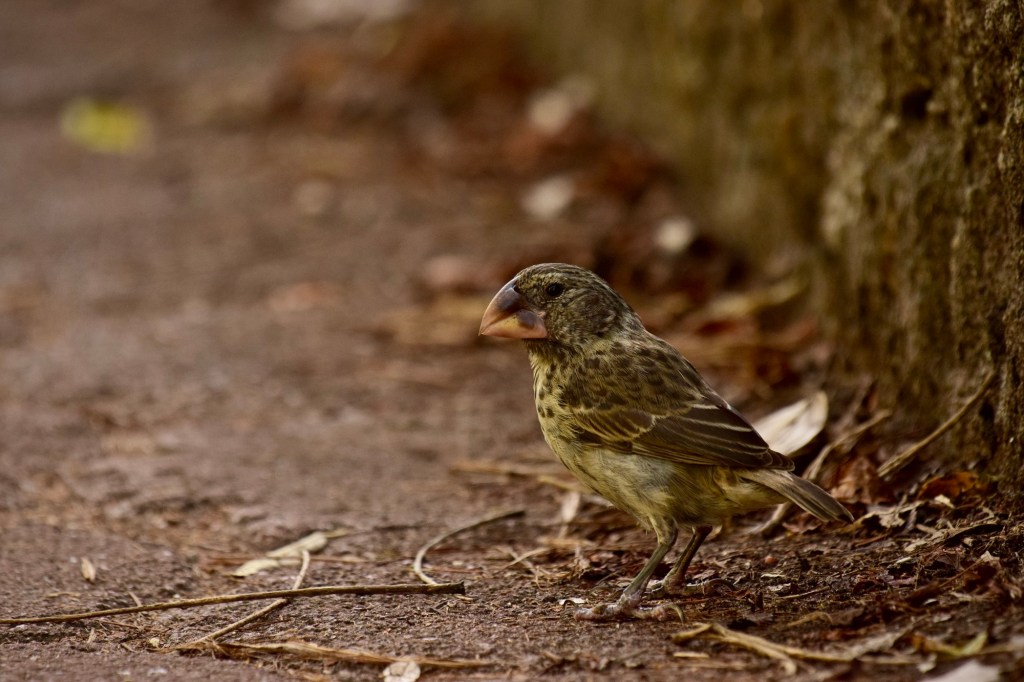
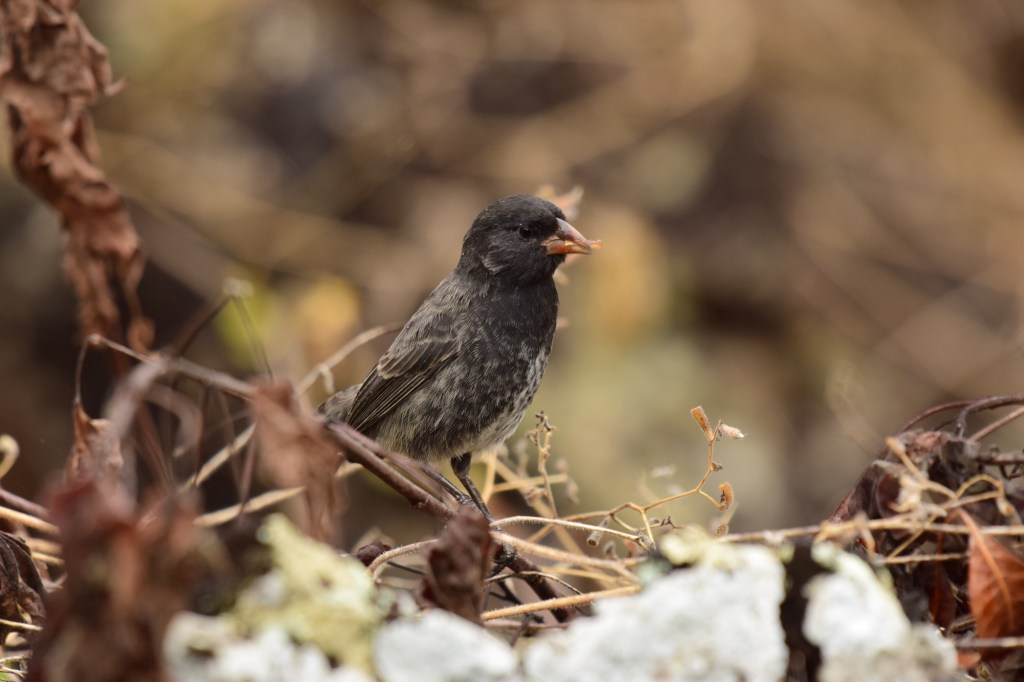
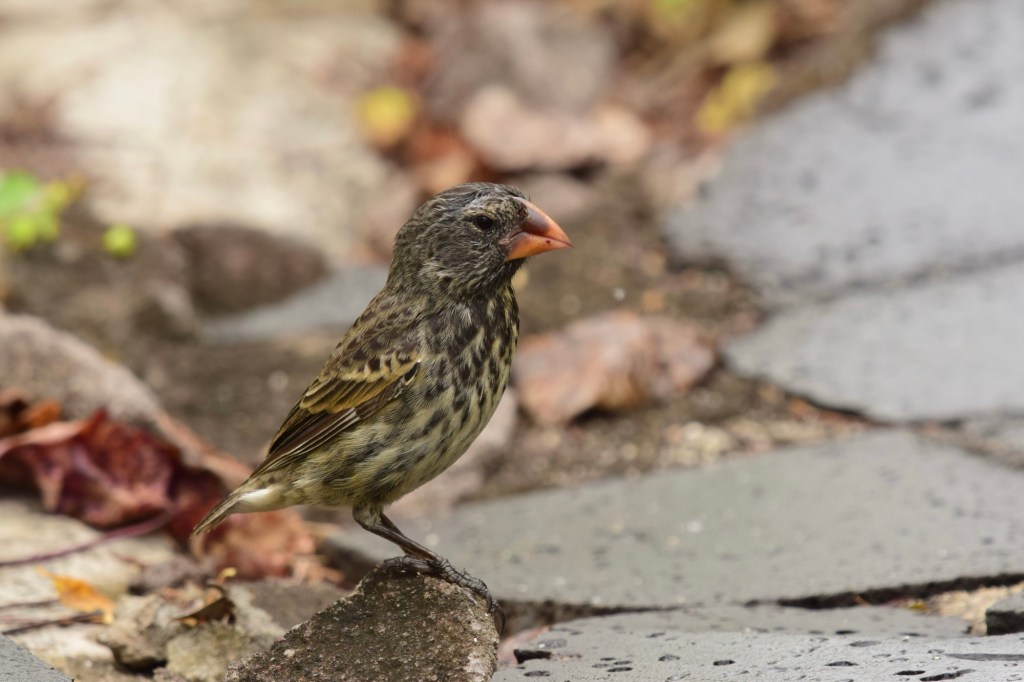
Speaking of Darwin, after I’d done a full length of the bay and dried off, I took my time heading back to my cabin so that I could linger in the forest. Mangrove warblers are just about everywhere, but it’s Darwin’s finches that are the real celebrities. Both species of ground finch are fairly easy to spot: small and medium. About as creatively named as a Starbucks order, they are at least easy to tell apart by the size of their bills.

Small ground finch (male), Cerro Tijeretas.

Medium ground finch (female), Cerro Tijeretas.

I had lunch for $6 at a really lovely local joint in town, el Rincón de Sebas. I hadn’t eaten anything since lunch yesterday, so the bowl of steaming hot shrimp soup and the breaded fish were nothing short of heavenly. I’m not really the dieting type, but there is something to be said for delayed gratification.

I waited out the hottest part of the day in the cabin, wrestling unsuccessfully with the dry weeds that festooned one of my tops which gel from the balcony where it was drying into the rocks below. Whatever plant it was, it’s like no weed I’ve ever encountered before. Short of a professional roller, that burdock-like debris isn’t coming off easily, so I’ve had to admit defeat for the time being. Fortunately, it’s not exactly long-sleeved weather up here.

After negotiating tomorrow’s plan with Samuel, my guide from the other day, I opted for his discounted trip to León Dormido, also known as Kicker Rock. There was still a chance I could hold out for a possible opening on Española’s Punta Suárez, but that particular adventure has become synonymous with frustration on this trip, to the point where I have christened the place “Impossible Island”. Even if it were to appear now, I would be faced with paying double the price of the alternative – which, when you consider it would cost more than a one way flight to Peru from London, massively puts it into perspective.

Thanks, but no thanks. I’ll diversify my options and spend a day with the fish.

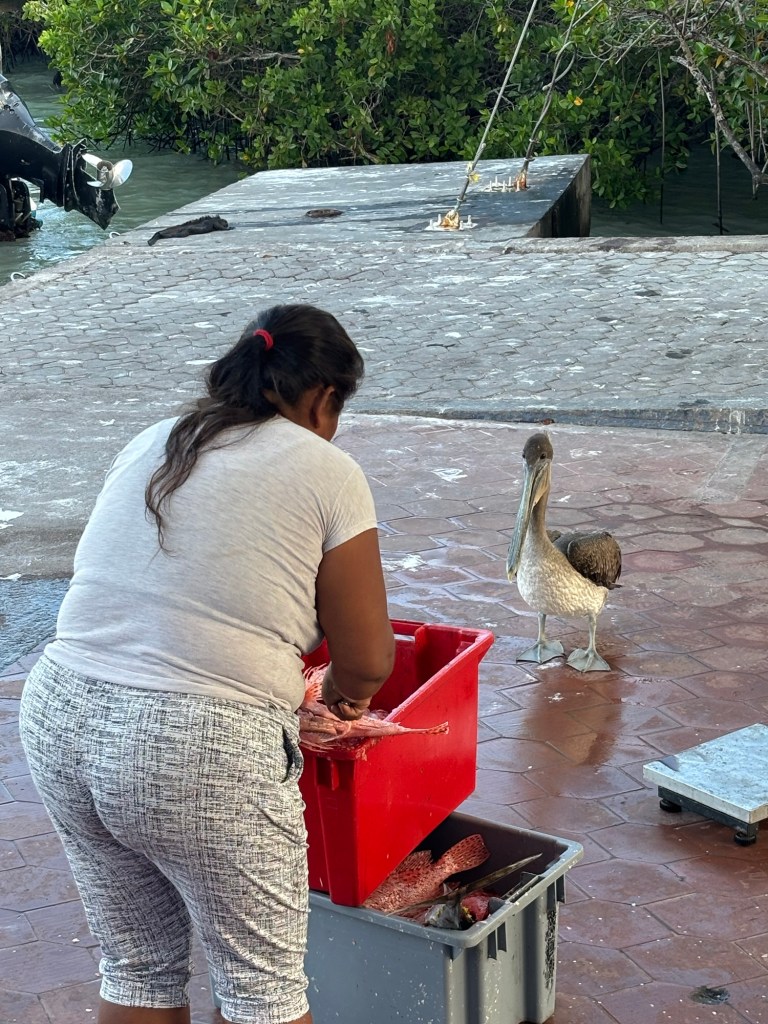
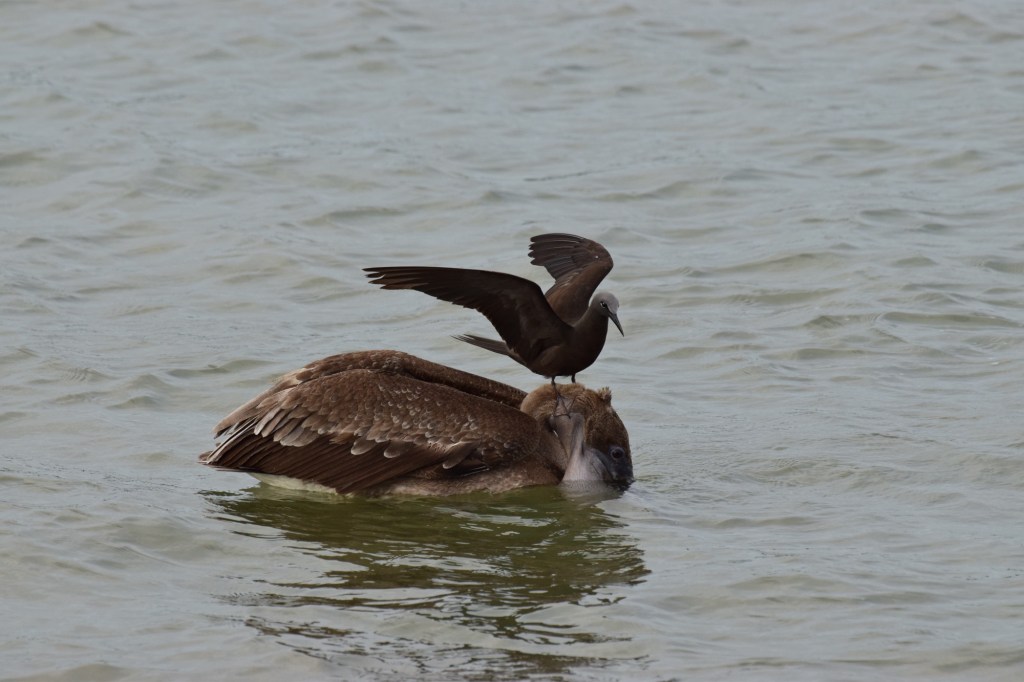
There’s always something to see in Puerto Baquerizo Moreno’s harbour, so I took my camera with me on my way into town to collect my snorkelling gear. Sure enough, the manglar and its connecting channel near the Ecuadorean naval base was a wildlife magnet, so there was much to see here. The local noddies were pestering a young pelican that was fishing in the bay. One of them continually tried to land on its head, doubtless hoping to snatch anything the giant caught before it went straight down the bird’s gullet.


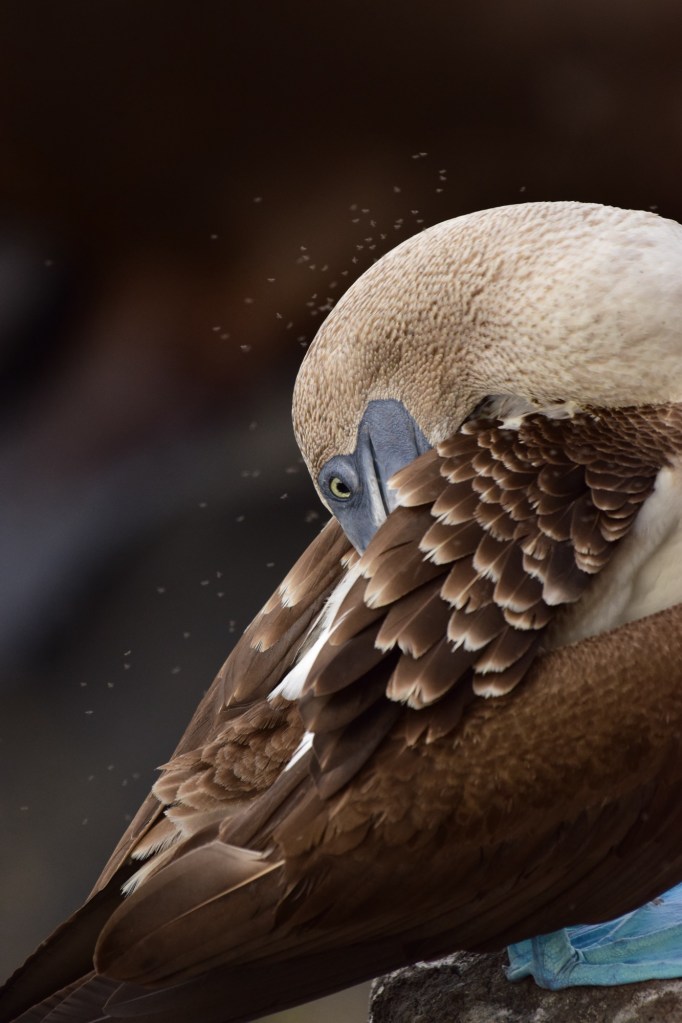
A couple of boobies were drawing a small crowd – not the American family watching them (/their smartphones) but the flies around their heads. I’ve noticed that these gnats seem to pester the iguanas quite a bit, so naturally a larger and more warm-blooded creature such as a booby would make for a better target.


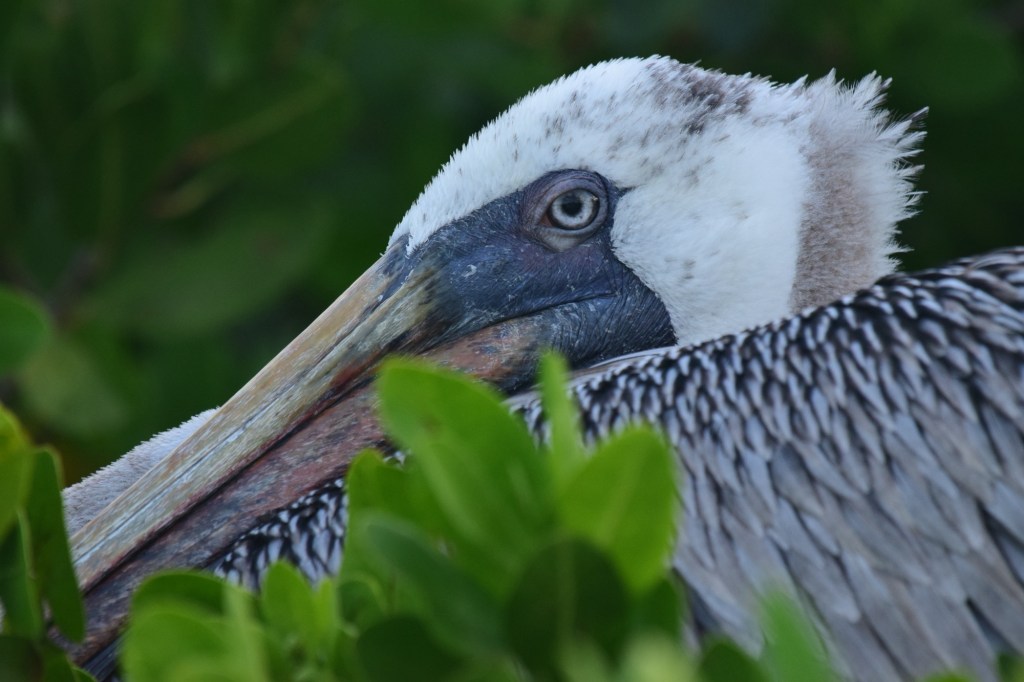
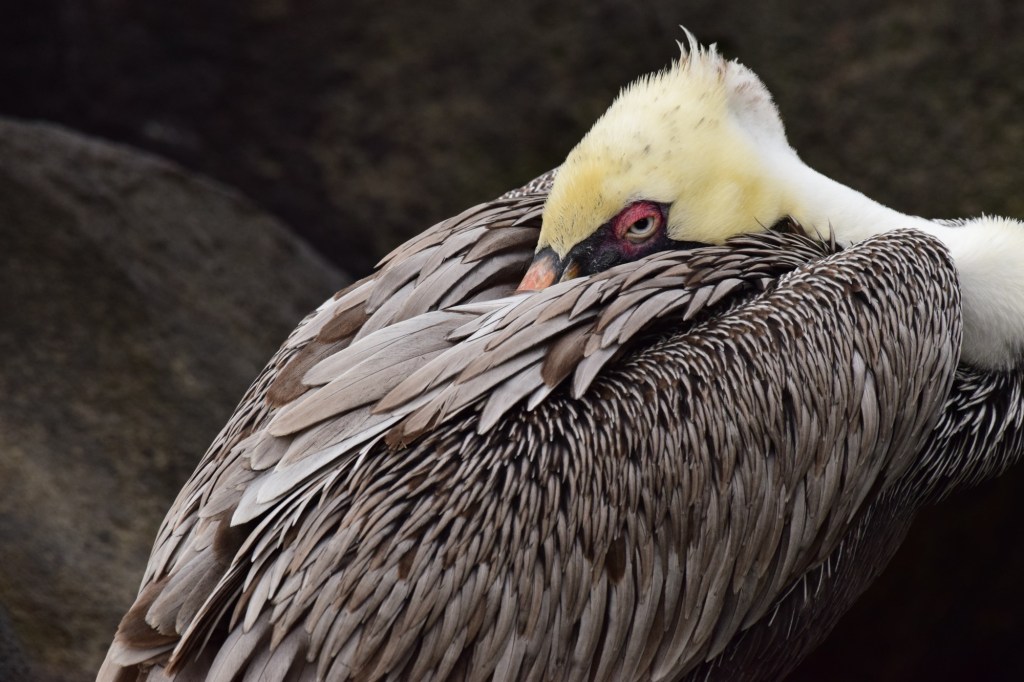
The oldest of the pelicans was avoiding the problem by simply burying its face between its wings. It kept one eye open, languidly watching the world go by. I didn’t get to see this particularly impressive specimen in full breeding plumage, because it took off and left while I was distracted by something else.


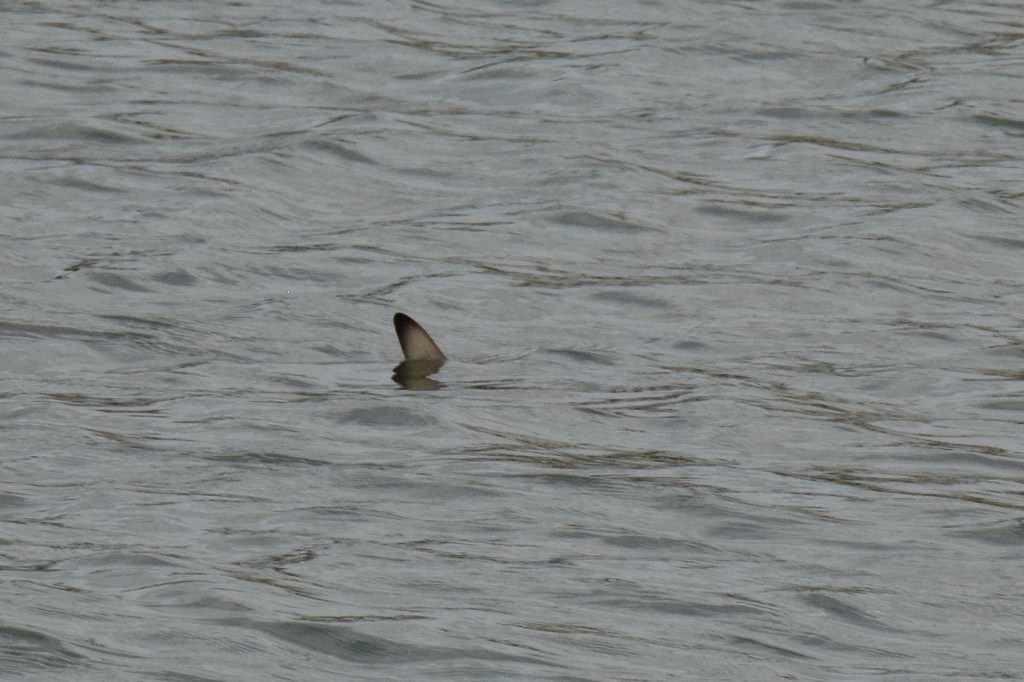
That something else was just a glimpse, but enough to be sure of what I was seeing: the tip of the dorsal fin of a shark. They don’t usually come this far into the shallows, so I was surprised to see the familiar Jaws-esque fin break the surface, putting the local sea lions on edge.


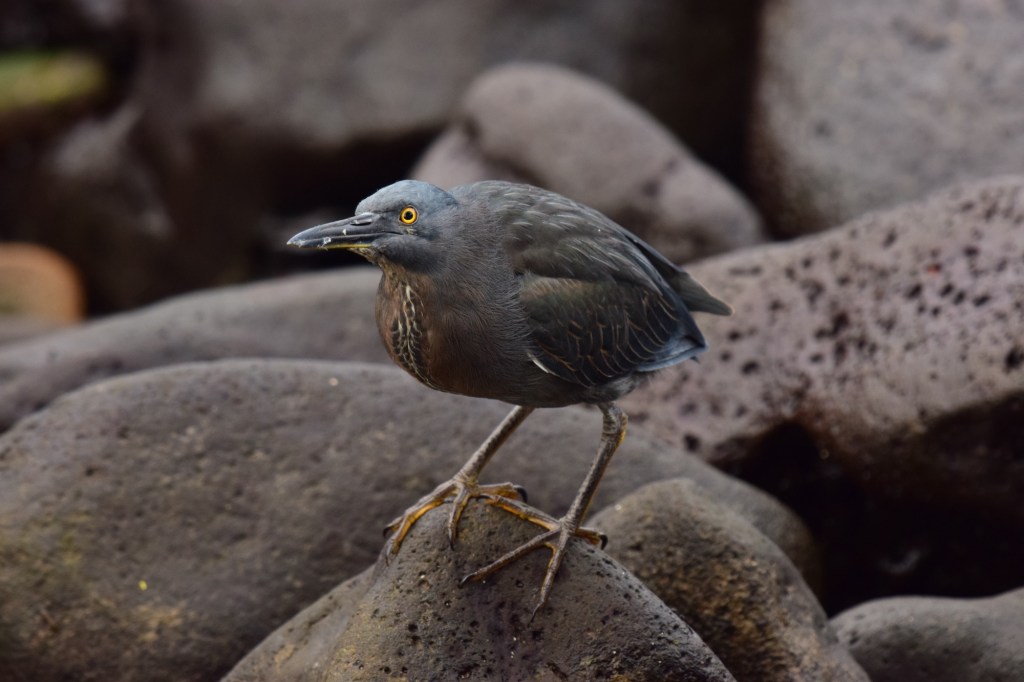
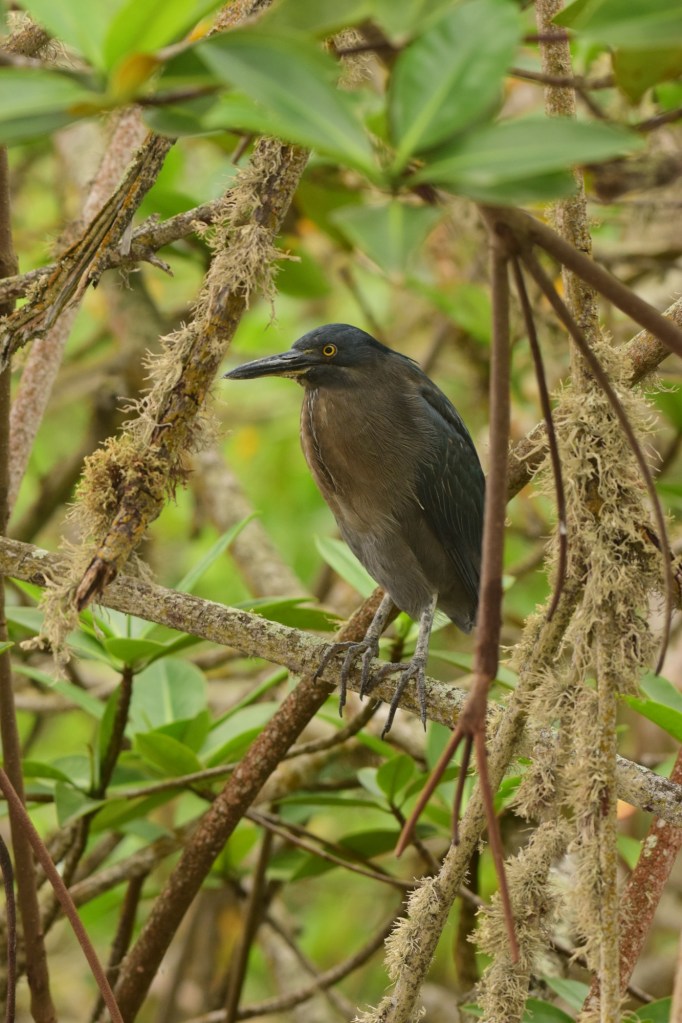
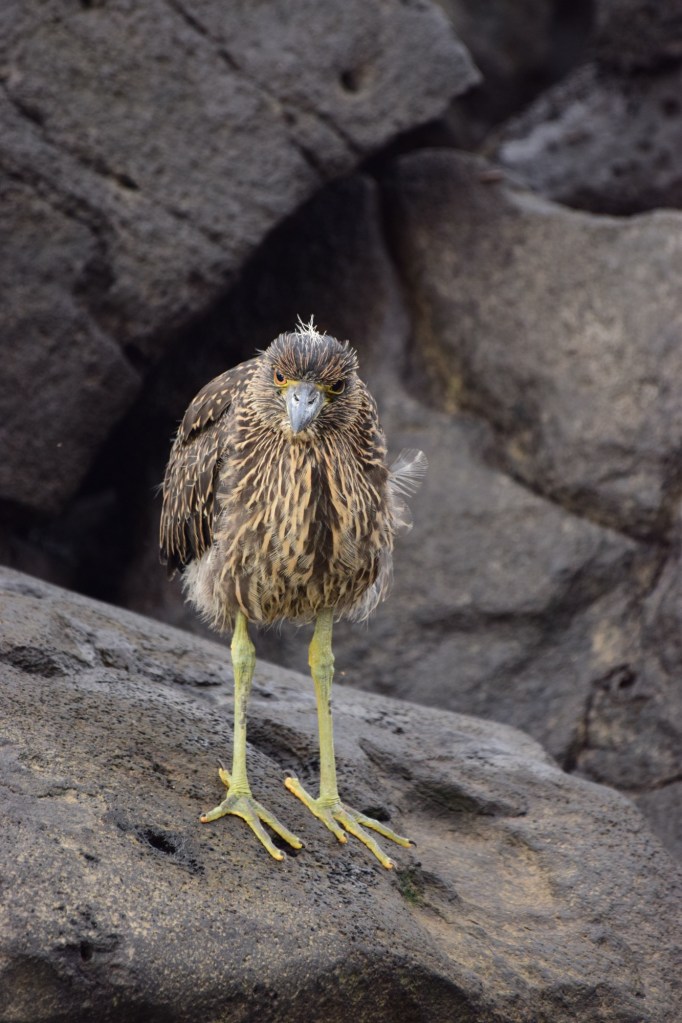
The channel that runs alongside the road is a heron magnet. All three species of San Cristóbal’s small herons can be found here: yellow-crowned night heron, striated heron and lava heron. The sunbathing night heron from the other day was here, but I was more intrigued by the scruffy-looking youngsters hanging around the rocks. Head-on, they are remarkably frog-like in their appearance.


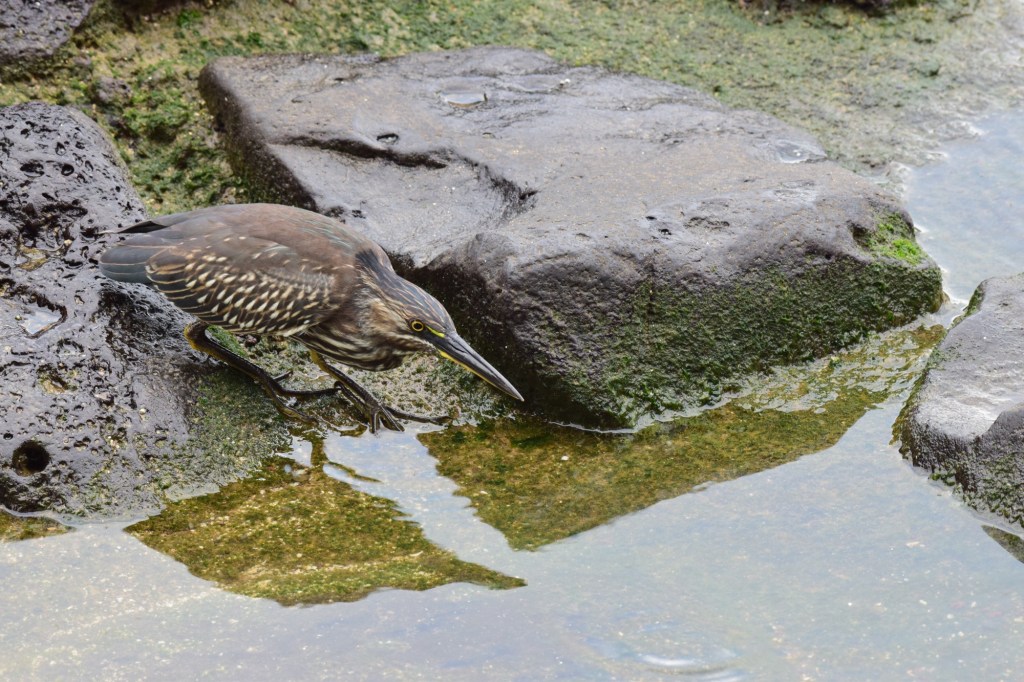
The striated heron – the same one that can be found across the Americas – is a lot like the endemic lava heron, only a lot more patterned. I tested out the camera’s dynamic range options with this one as it hunted in the shallows. I’m still learning as a photographer, but if I can get to the stage where my photos aren’t so blurry anymore, I’ll be a happy man.


One photo I am particularly happy with is this one. The lava herons are really hard to shoot as they are fundamentally dark birds that haunt a dark and rocky background, making conditions difficult. Fortunately, they’re a lot less active than the finches or shearwaters who have been giving me the run-around, so I had time to frame this one nicely.


Tomorrow is a day in the water. I hope the weather is kinder. Who knows what we will find in the legendary depths of Kicker Rock? Another shark would be nice, but I’d settle for a turtle or ray. BB x
Show Me Your Boobies

Puerto Baquerizo Moreno, Galápagos Islands. 18.45.

At the time of writing, I still haven’t heard back from the folks at EcoChallenger about the trip to Española. They did say they’d had engine troubles last week and would provide me with a full refund if they couldn’t go ahead, but also that they would keep me informed. I sent a chaser to see if if they’d fixed their boat, but no luck.

So, rather than feeling glum about it, I found an alternative tour for today out to the other side of the island: Punta Pitt, the easternmost point of the Galápagos. Here, with any luck, I might be able to recreate at least some of what I would have found out on Española.


I picked up my snorkel gear from the Kingfisher GPS agency and walked back to the marina to meet my guide. Traveling with me today were a lesbian couple from California, a couple of American missionaries, their sister and her three children and a shy Australian birder. We were due to have one more on the team, but they never showed up – but at least while we waited I had time to get a better shot of the noddy sitting in the harbour, in the same place I saw it yesterday.


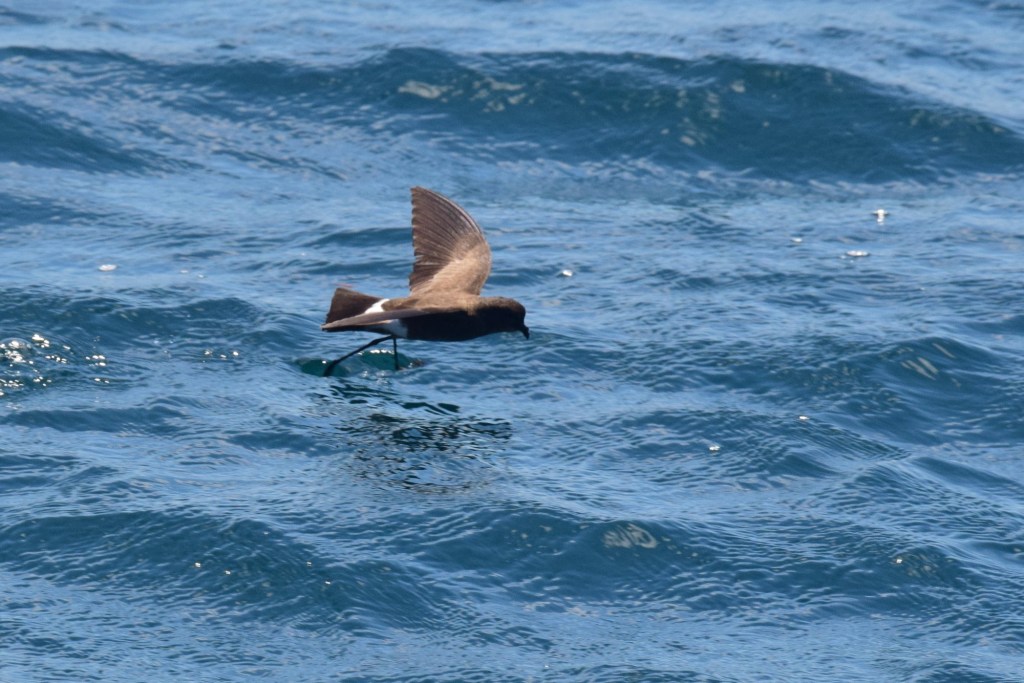
The journey to Punta Pitt from Puerto Baquerizo Moreno takes you all the way along the north coast of the island, and after passing the lighthouse at Punta Carola, it’s nothing but volcanic rock on one side and the open ocean on the other. Kicker Rock looms in the distance – a freestanding volcanic cliff famous for being the haunt of hammerhead sharks in the right season – but that wasn’t part of our itinerary, so we sailed on past. Beyond Kicker Rock, some of the Galapagos’ pelagic birds picked up our trail and followed the boat: Galapagos petrels, Galapagos shearwaters and two kinds of storm-petrel native to these waters.

I don’t believe in reincarnation, but if it did exist, I should love to come back as a shearwater. The speed with which they race across the water, seemingly delighting in the thrill of it… it’s magical to watch, even if they are in a mad hurry to find enough food to raise their chicks, sequestered in some burrow near or far away.

I was so busy keeping an eye out for seabirds that at least once I saw something else with wings leaping from the water: a flying fish, recently arrived in these islands, and just in time for the breeding season.


The weather looked unpredictable but the sea itself was a bit easier to read, so when we reached Islote Pitt, I made the decision not to enter the water. Sure, it was a waste of $30 on the rental GoPro, but I know I made the right call. Even the guide upon his return admitted grimly that the conditions were awful. The water was cold, choppy in the extreme and visibility was limited to about 10cm. Those that did take a dip said they’d managed to see a couple of sergeant majors, but that was about it. The qualified divers had a bit more luck with some eagle rays, but even they confessed that it was a hard and relatively fruitless dive.


I, on the other hand, was having a whale of a time. Islote Pitt is home to a ridiculous quantity of endemic species, including both Elliot’s and wedge-tailed storm-petrels, Galápagos shearwaters and swallow-tailed gulls – the only nocturnal gulls in the world. I’m used to seeing storm-petrels at a distance, zooming across the surface of the open ocean and next to impossible to track with a camera, but I’ve never seen a colony before.


I’ve seen a lot of South American gulls on this trip: kelp gulls, dolphin gulls, grey gulls and lava gulls, to be precise. But swallow-tailed gulls are really rather special. Whether it’s their white wings and silver mantle, or the smart red ring around their eyes, or even their eerily haunting cry, they’re simply unlike any other gull I’ve ever seen.


Punta Pitt’s major claim to fame (as well as the explanation behind the title) is that it is the only place in the Galápagos Islands where all three species of booby can be found together. Each one nests in a different spot: blue-footed boobies on the ground, red-footed boobies in the trees and Nazca boobies on the cliffs.

The Nazca boobies at Punta Pitt itself nest on a cliff some distance from the path at the point itself, so your best views would be at Islote Pitt, which is home to an enormous colony of the handsome seabird, alongside the frigatebirds, swallow-tailed gulls and a legion of storm petrels.


The hike up into the cliffs from the cove at Punta Pitt takes you deep into the volcanic coastline, up a tree-lined gully that becomes a torrent in times of severe rainfall. You’ll encounter the most famous residents of Punta Pitt, the rare red-footed boobies, shortly before climbing the pass over to the other side: they’re hard to miss, as they nest right next to the path.

Boobies get their bright-coloured feet from their choice of diet, which seems to be an evolutionary choice in the race to find a mate. Red-footed boobies primarily hunt squid and flying fish, both rich in carotenoids, which gives them their red colouring; blue-footed boobies are after the same nutrients, but their choice of catch – sardines – gives them a wholly different colouration. The brighter the feet, the more successful the bird is at finding a mate.


In August, the breeding season is already well under way, with some early partners already feeding large fluffy chicks. Others are still taking it in turns to incubate their eggs, with one partner flying in from a morning’s hunting to relieve the other on the nest.

For once, I was with a really respectful group of tourists. Once they worked out that the birds don’t like being approached too closely, they asked if we could keep our distance and move on so as not to disturb the birds further. Music to my ears!


Sometimes you didn’t have much choice but to be close, as their choice of nests catch you by surprise, in a scrape beside the path or tucked away in a tree in the middle of the road.


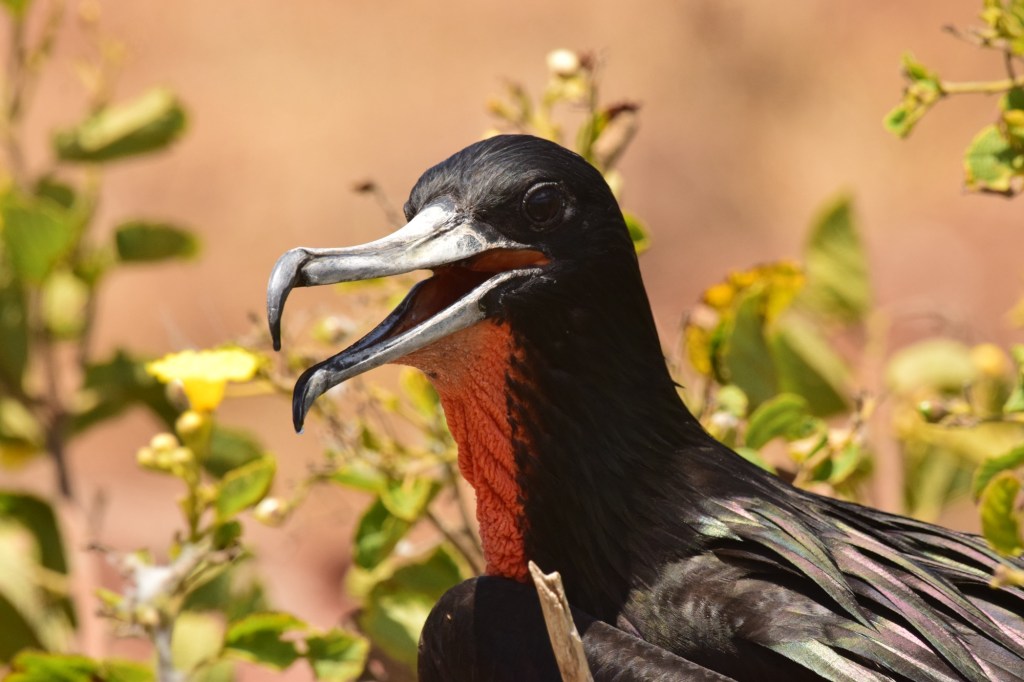
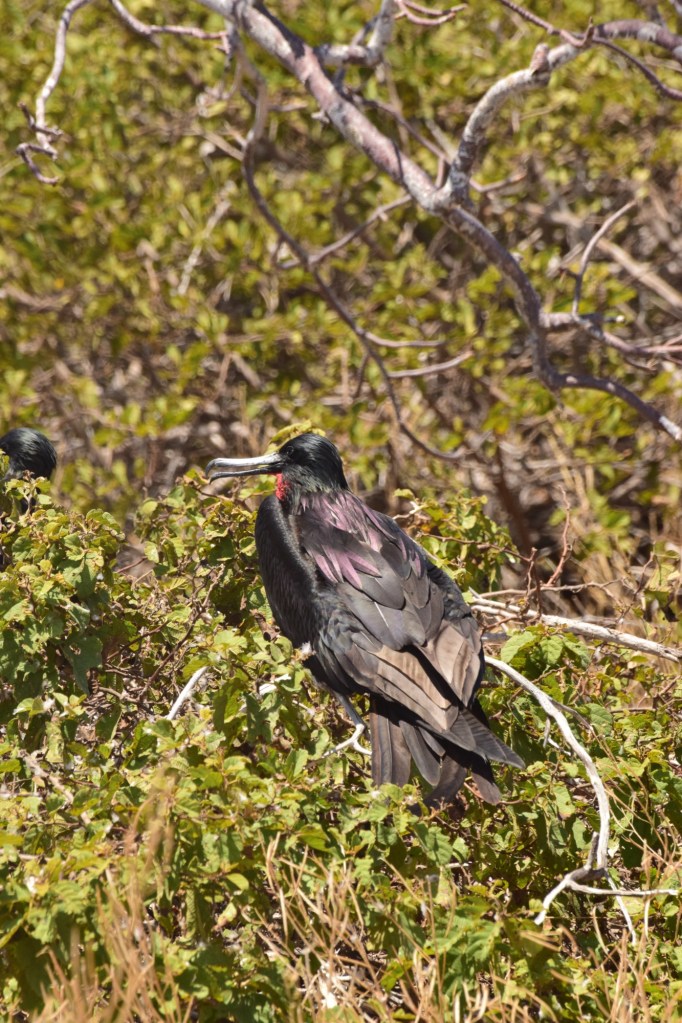
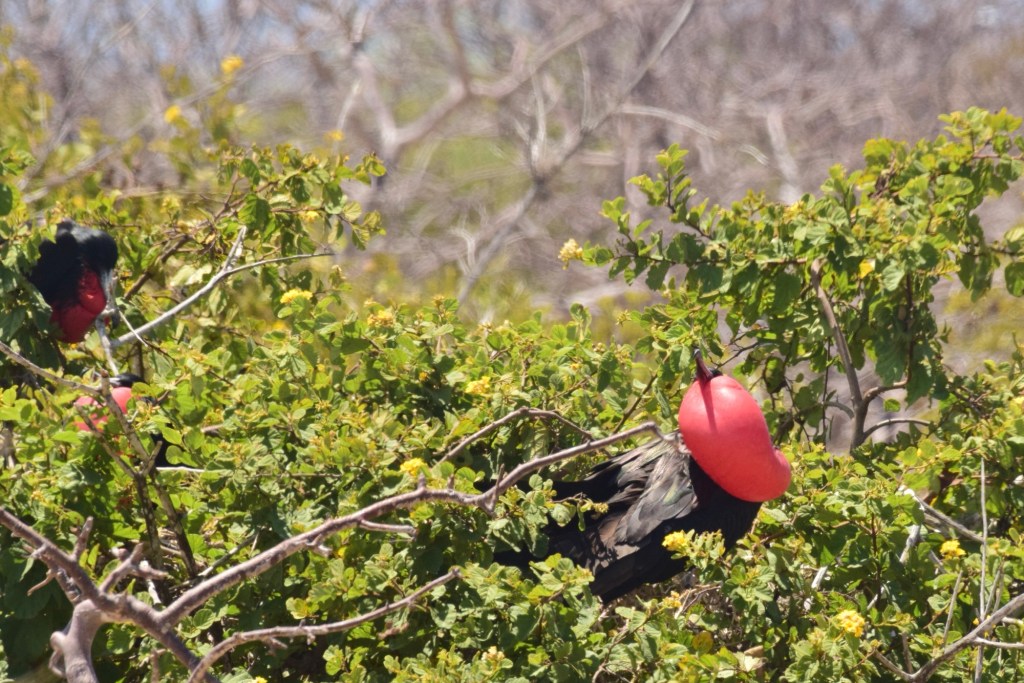
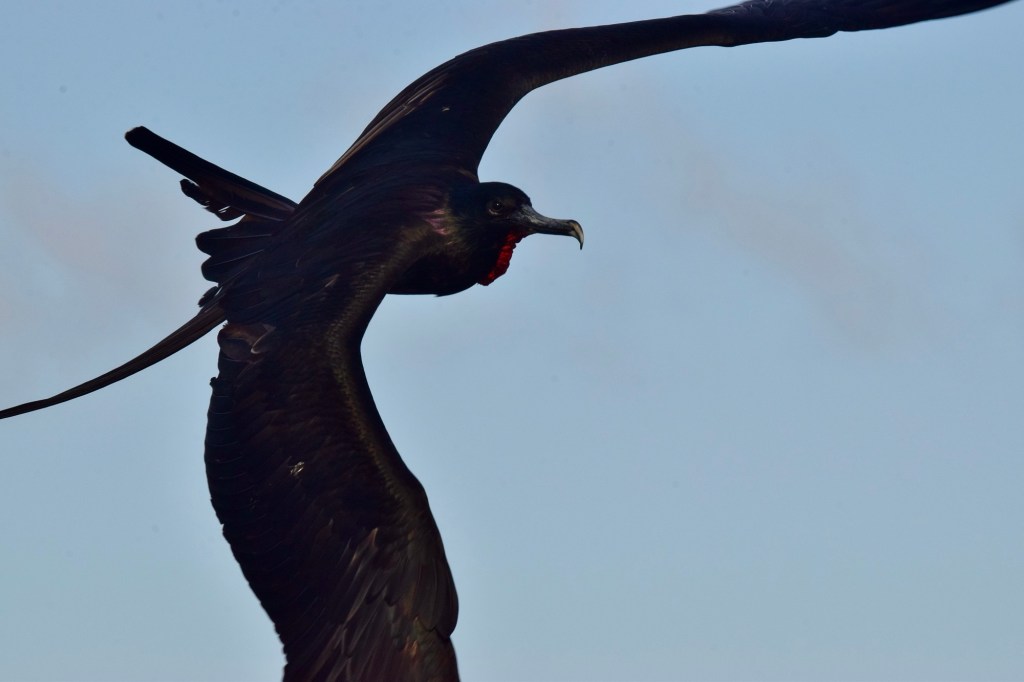
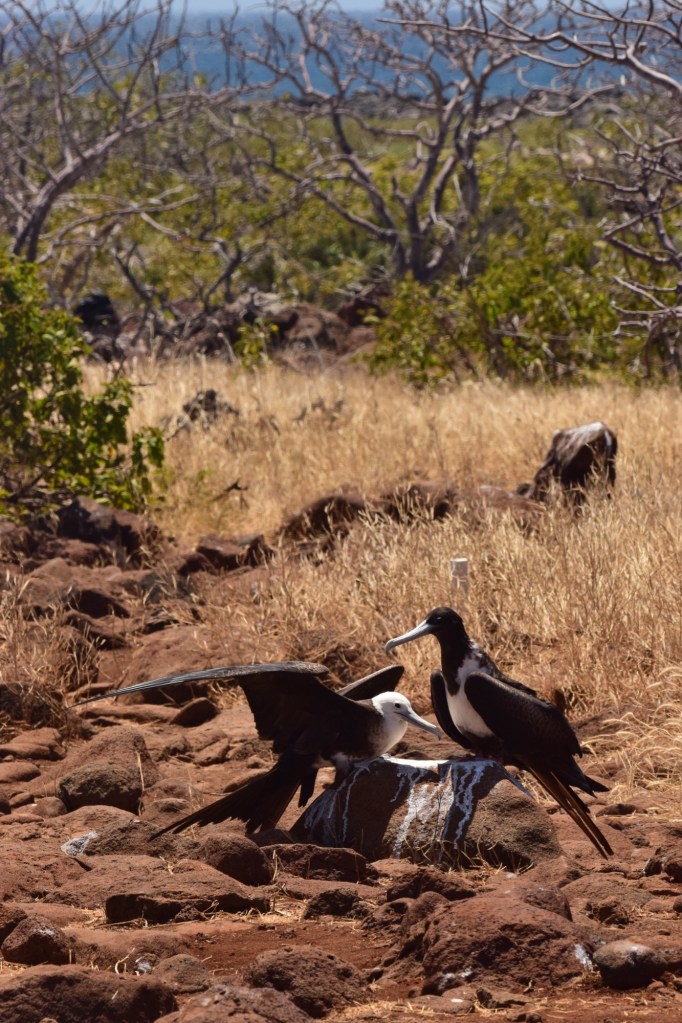
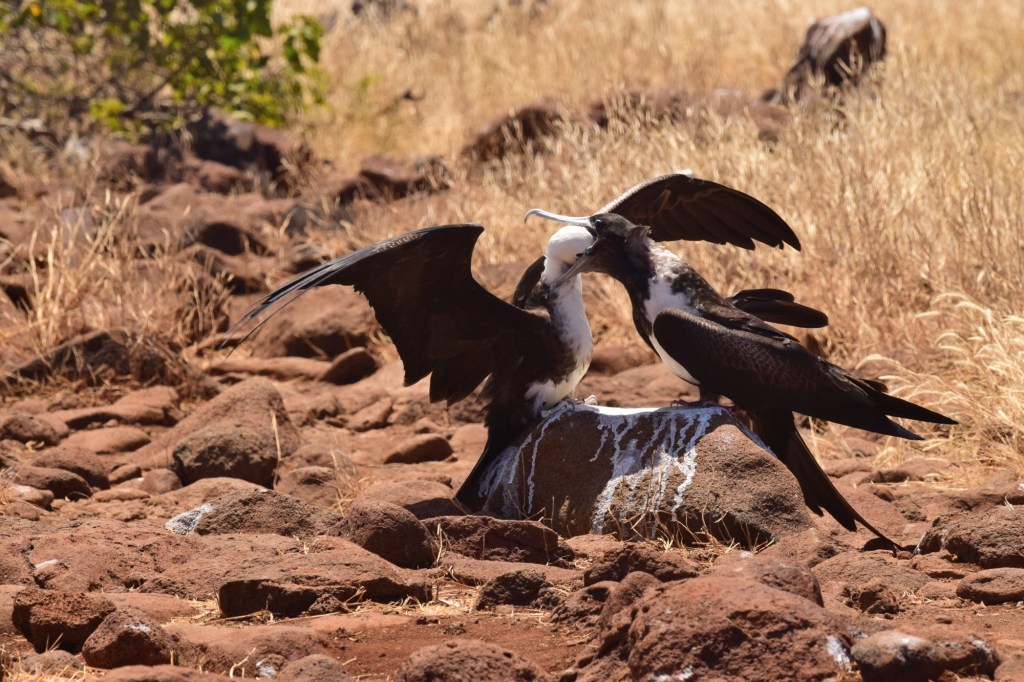
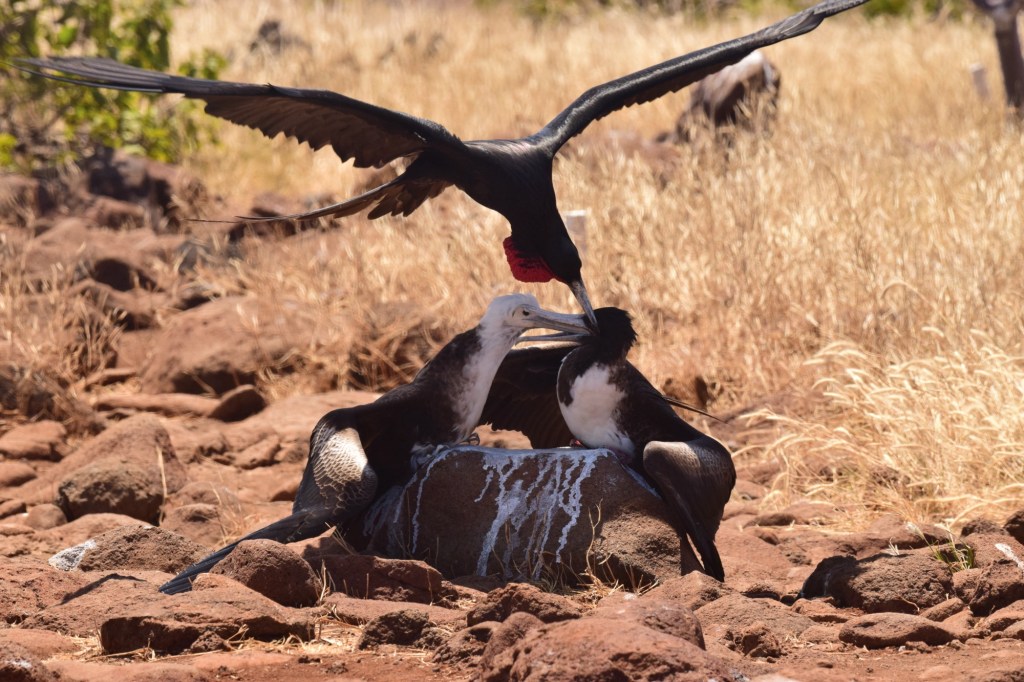
They’re not the only iconic Galápagos residents that breed at Punta Pitt. The enormous frigatebirds can be found here too, looking even more fluffy than the boobies, albeit at least twice the size.


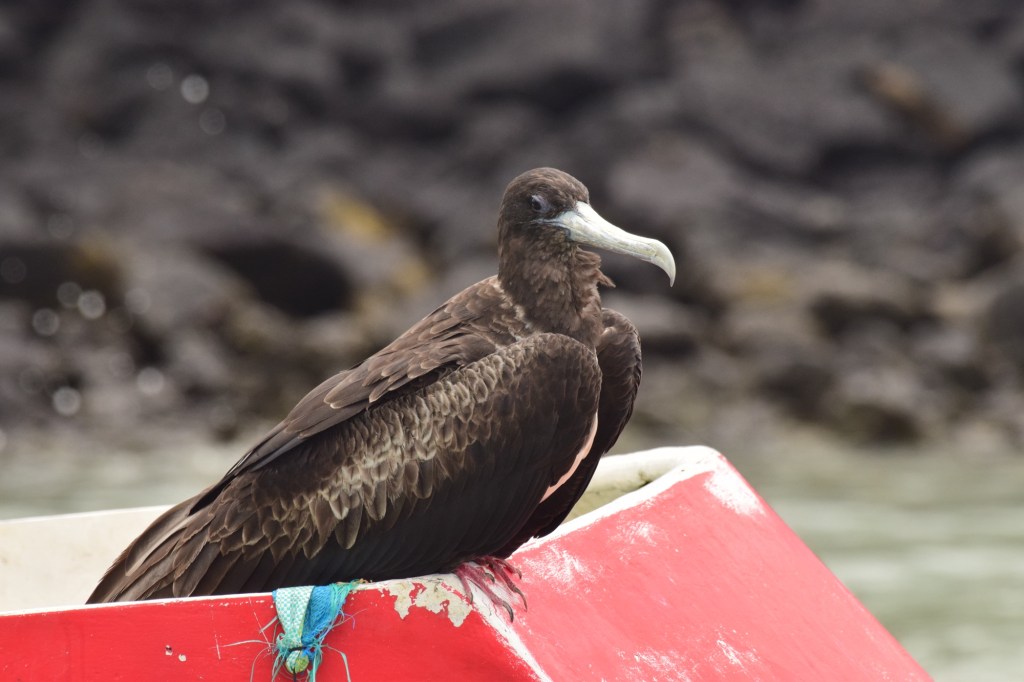
Frigatebirds are absolutely enormous – you won’t truly appreciate just how big they are until you see them for yourself. Using their swallow-like forked tail as a rudder, opening and closing their streamers to steer in the wind, they are masters of the air, perfectly designed for outspeeding the boobies and robbing them of their fish, which I have been lucky enough to witness.

I also saw a beautiful angel of a seabird here: a red-billed tropicbird, all white with long streamers and a bright red bill. They’re small – tern size at best – and nest in crevices in the cliffs that are impossible to reach, so you won’t see them as well as the other denizens of Punta Pitt, but it was quite a sight to see as it set out to sea to go fishing.


The red-footed boobies come in two colours: a white morph – more common in the western Pacific – and a coffee-coloured brown morph which is more easily found here in the Galapagos. The two morphs are totally interchangeable and cross-breed from time to time: for the ladies, it’s not about the colour of their feathers but the brightness of their feet.


After a solid two hour hike up into the cliffs, we left the boobies and their ramshackle nests and climbed back down to the beach where we landed. While the captain’s boy ferried us back to the boat on a small skiff, the local sea lion alpha was busy defending his territory, chasing off a rival male that had just arrived on the beach.

I overheard a family of Americans in Puerto Baquerizo Moreno watching the sea lions lazing around the port and saying how easy life must be for them. For the dominant male, it couldn’t be further from the truth. From the moment he assumed command, he cannot hunt, eat or sleep, patrolling his territory constantly and fighting off suitors as they come. This is, of course, extremely debilitating, leaving them physically weakened after nearly a month without food, but there are cases of individual alpha males returning to reclaim their harem up to three times in a single season. So when you hear the endless barking that is such a part of the soundscape of Puerto Baquerizo Moreno, remember how long it might have been since the males have been able to eat. For sea lions, the urge to mate simply outweighs all other options on the table, including eating and sleeping.


The boat ride back to Puerto Baquerizo takes a lot less time as you ride the fast-moving current back, shaving a whole hour off the journey. In the middle of the day, there’s not as much to see either, so most of my companions fell asleep, aided by those curious neck-braces with built-in fans that I saw some colleagues wearing back home during the June heatwave.

Samuel, our guide, was keen to know how long I’d be here. I told him how last minute this whole operation was, and that I’d more or less given up on Española with no news from the folks at EcoChallenger. He said he’d ask around – after all, it’s not the agencies here that conduct the tours but rather the guides and their attendant boatmen. The agencies merely act as middlemen, sending a certain quota to the actual operators down in the harbour. So who knows? Maybe I’ll get to go to Española after all. either way, I’m glad I opted for Punta Pitt – it was absolutely incredible.


I’ll get an early night and have a quieter day tomorrow. I could do with some time to put the snorkeling mask to good use. I hear the bay where I saw the turtles is an almost guaranteed spot to see them year-round, so I think I’ll go there first if the weather is kind. It’s usually rainy and cloudy in the mornings and then sunny in the afternoons here, which is an easy enough pattern to follow.

See you next time! BB x
In Darwin’s Footsteps

Puerto Baquerizo Moreno, Galápagos Islands. 04.57.

I woke up to the sound of the waves this morning. Well, I suppose morning is a stretch, since the clock on my bedside table said ten past four. I must have passed out around eight last night, beaten down by the lack of sleep on the plane and lulled into a Pacific lullaby by the sea. I can think of worse ways to spend a summer.

The garúa rolled in off the mainland last night, bringing with it relieving cloud and gentle rain. A passing shower came and went a few minutes back, but now it’s just the tap-tap sound of the lingering raindrops falling onto the roof of my cabin from the giant daisy tree.

There’s no point going back to sleep now, so I’ll spend some time writing up yesterday’s account of my first day on San Cristóbal.


The magic begins as soon as you’ve left the airport. Technically before, I suppose, since I could see the sharp-angled silhouettes of the island’s frigatebirds well before we landed. Outside the terminal, it’s a ten minute walk to the centre of Puerto Baquerizo Moreno, the largest settlement on San Cristóbal.

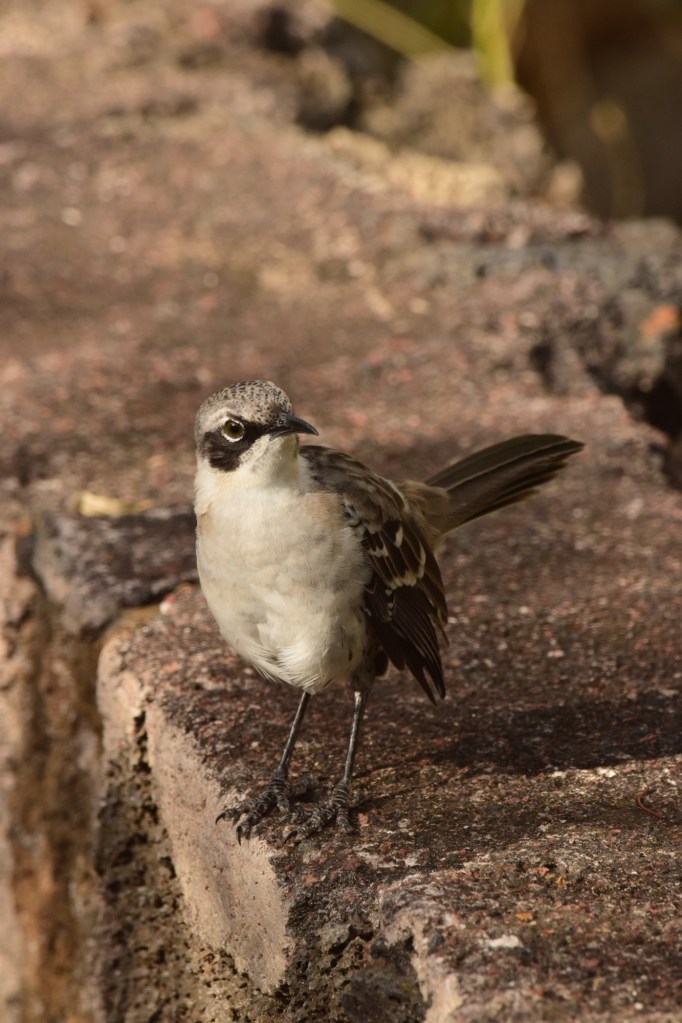
Three of Darwin’s keys can be found right next to the terminal building: small and medium ground finches, of evolutionary fame, and one of the island’s endemic species, the San Cristóbal mockingbird. It’s this last that’s especially important, as Darwin didn’t realise the significance of the finches until after he’d departed from the islands, but he did notice that the mockingbirds on each island were different in some way.

Like so many creatures on these islands, they are completely unfazed by the presence of man. They have a funny way of walking, with their cocked tail wagging from side to side. If I were a scientist, I might have called them metronomebirds for this singularly odd gait.


Most of the other travellers piled into taxis outside the terminal, which seemed a bit ridiculous, given just how close the town is to the airport, but I guess some habits die hard. I was quite happy pottering about with the ground finches. It’s not often you get to spend time with a species that literally changed the way we think about our place in the world.


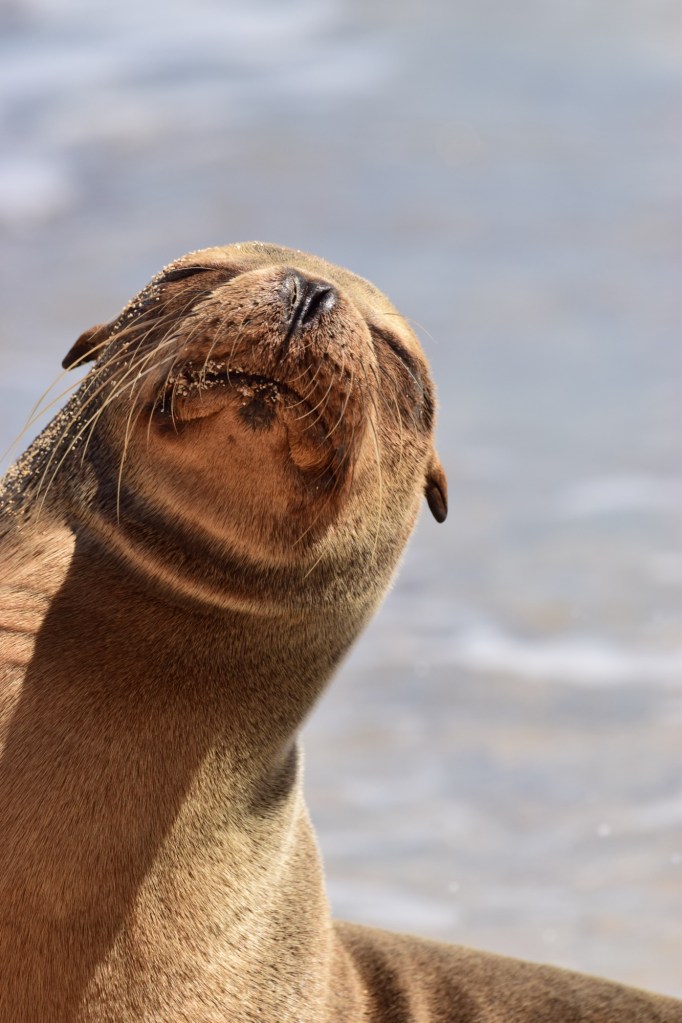
The first thing you notice is the sea lions. They are absolutely everywhere. If you can’t see them, you can certainly hear them: that cartoonist arf arf arf you associate with children’s TV carries for quite some distance.


They don’t stick to the beach, either. A large number of them seek out shadier spots on the seafront parade, dozing quite carelessly on roads, park benches and boardwalks. It’s pupping season, so there’s no shortage of pups in varying stages of development sticking close to their mothers. I’d suggest giving them a wide berth – you never know where the bull might be.


In this case, I did know where the bull was – because he was announcing his presence every minute or so with that barking call, as though to remind everyone in the vicinity that the harem on the beach was his and his alone. Which, I suppose, is close to the truth.


You can tell the bulls apart from their size – nearly a third larger than the females – and the significant boss on their heads. I also hadn’t noticed before the claws in their flippers, but you can get so close to the great sea beasts here on the islands that there’s hardly a detail that will pass you by.


I had to wait a little while before checking in to my cabin on the edge of town, just a stone’s throw from Playa Mann. At a glance, there seem to be a lot of people who come to these islands for the beaches. To a dyed-in-the-wool naturalist like me, that does somewhat feel like going to the Serengeti for a tan, but I’m far too happy to judge. Who could possibly turn away from a chance to see these spectacular islands, given the chance?


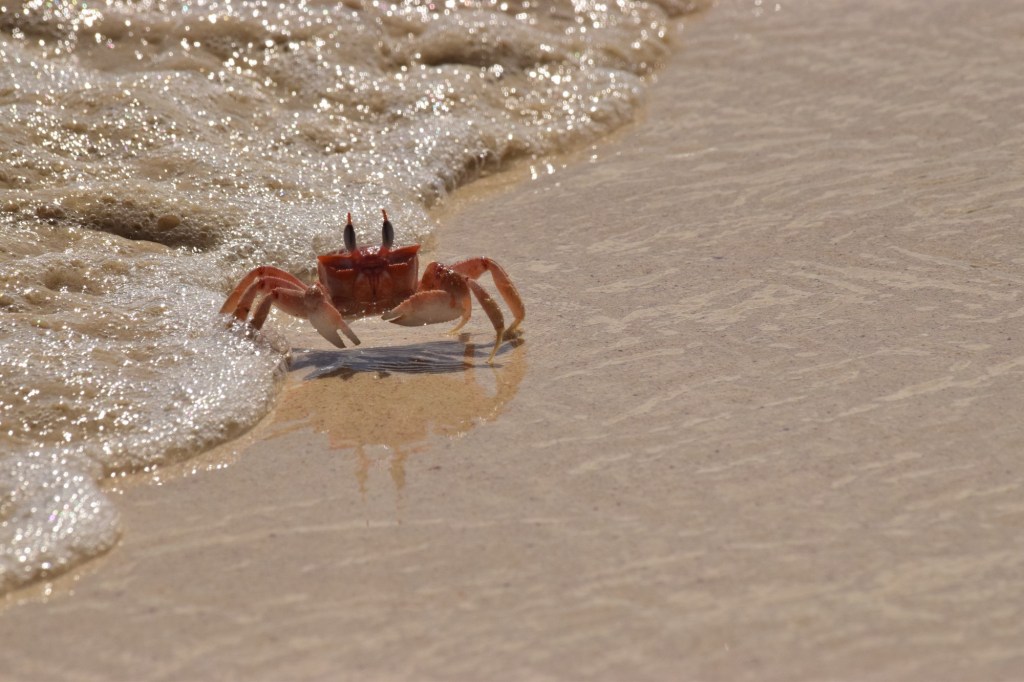
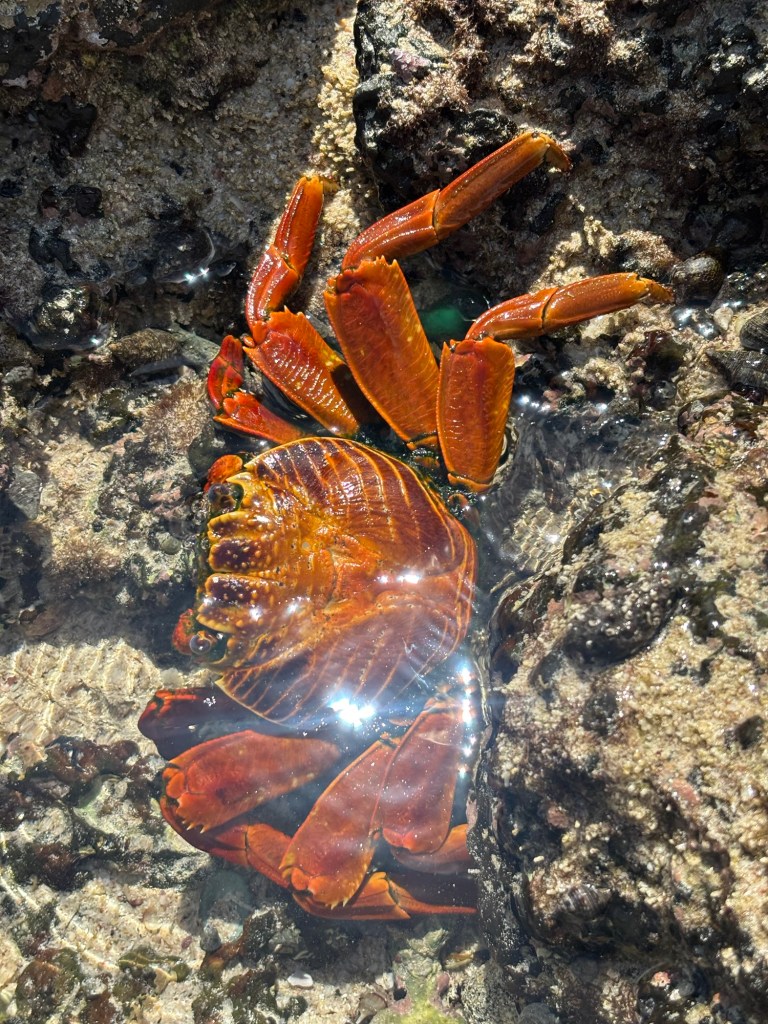
I took myself straight back down to the sea once I’d checked in and found two more Galápagos specialities almost immediately. I’ve been mad about Sally Lightfoot crabs since they turned up in a wildlife spotting book I won as a prize for a sunflower growing competition when I was a kid. We have crabs in the British isles, of course, but none nearly so colourful as the Sally Lightfoot. They’re everywhere here, ranging from dark green to sunset red, hugging the molten rocks along the surf line and leaping between boulders with surprising agility.


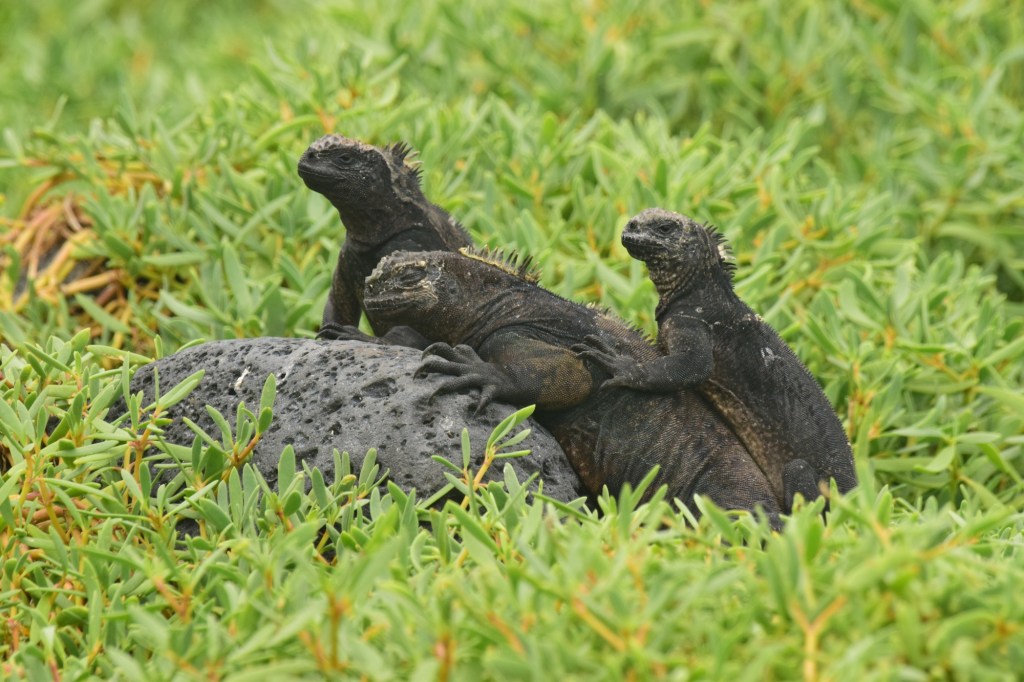
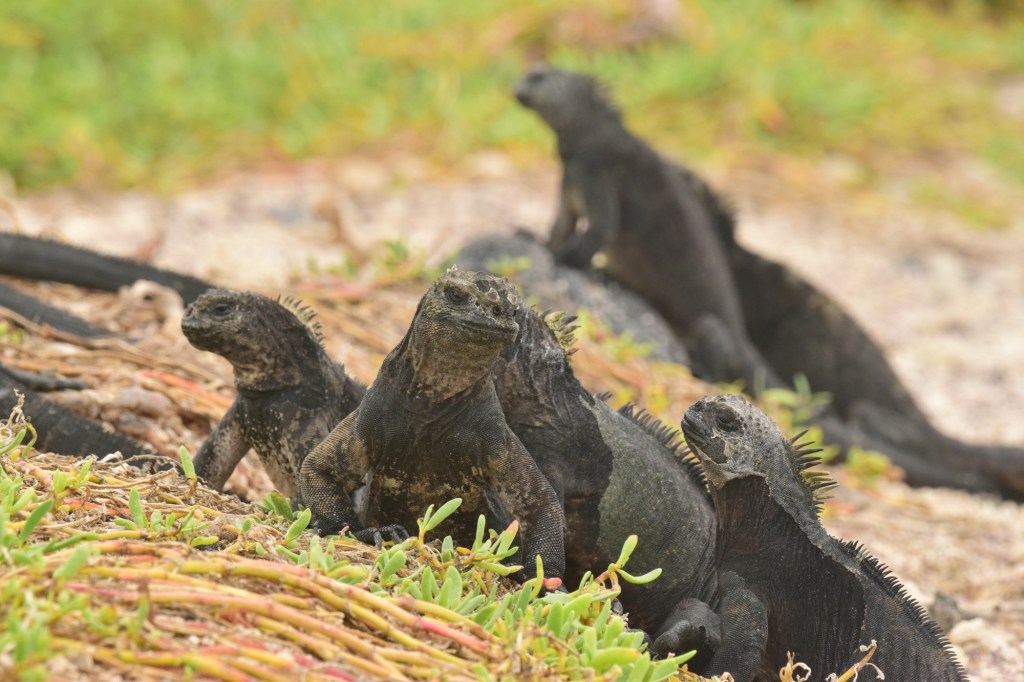
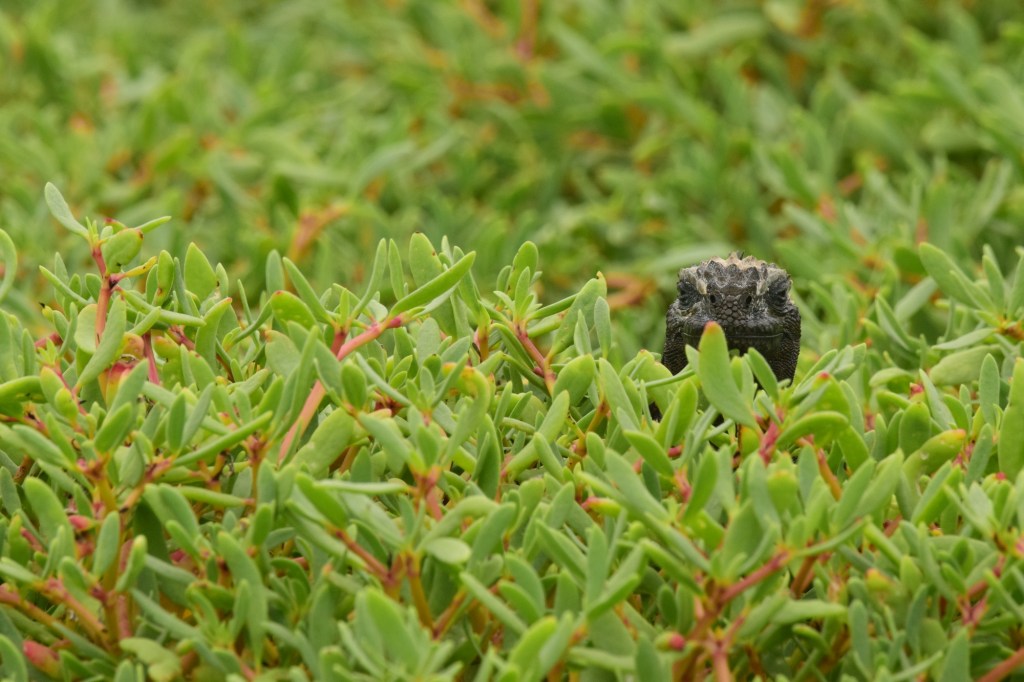
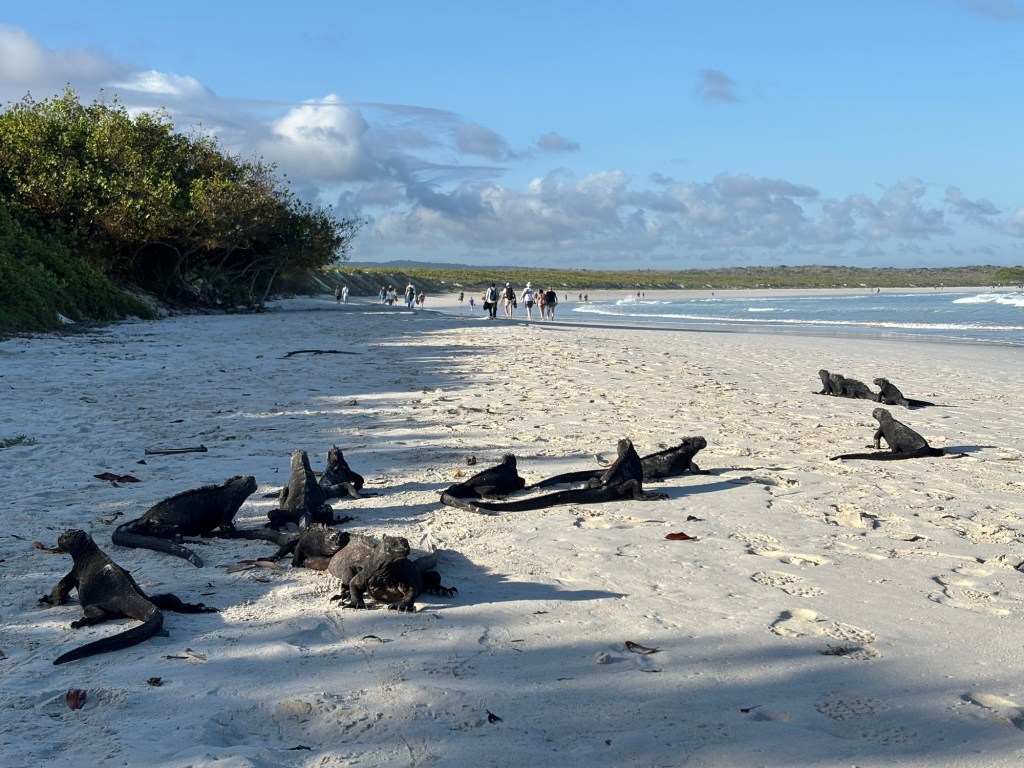
The other specialty is a real treasure of the Galápagos, arguably as iconic as the giant tortoises that gave the islands their name. Marine iguanas, a short-faced ocean-going variant of the green giants found on the mainland, are often described as “ugly”, perhaps on account of Darwin’s first description of the creatures. Certainly, their patchy salt-washed skin and snub faces make them strange-looking beasts, and they’re not nearly as active as the sea lions as they soak up the sun on the beachfront, but they are tremendously interesting creatures.


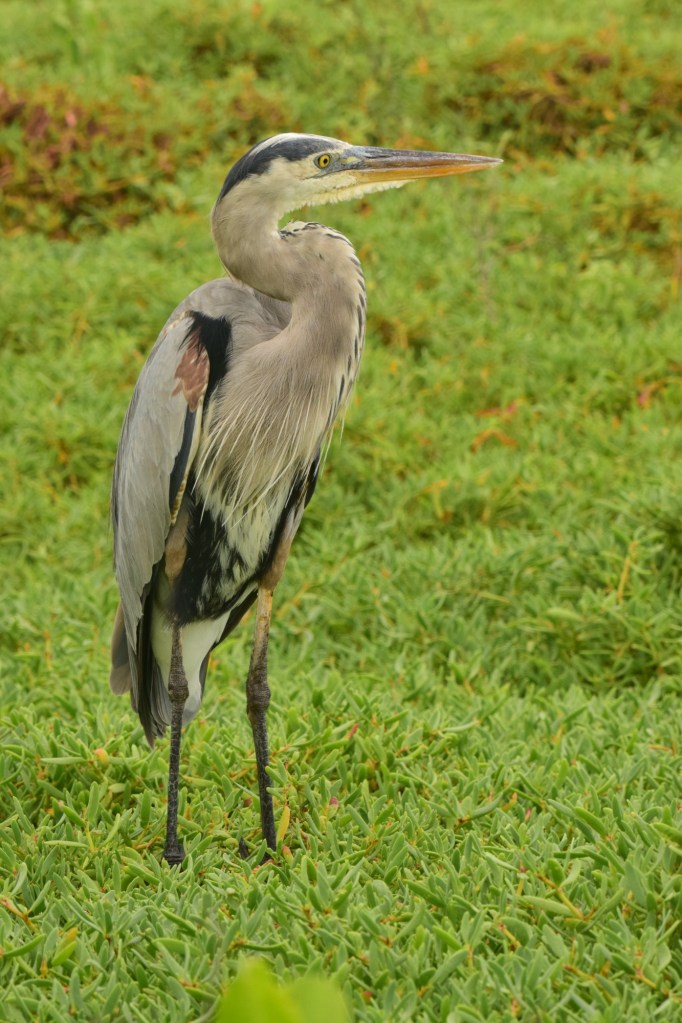
Around midday, it gets rather hot here on San Cristóbal. Not unbearably so, but the humidity doesn’t help. I found a night heron sheltering from the heat in the shadow of the rocks earlier, and when I returned, it was sunning itself in a posture I haven’t seen in herons before.


A smaller heron was lurking among the boulders nearby: a lava heron, an island variant of the striated heron that can be found all the way up and down the coasts of the Americas. It was mesmerised by the dragonflies hawking over the beach, tilting its sharp beak and golden eyes every time one came close. I didn’t stick around long enough to see if it caught one.


After sorting out my snorkel gear for tomorrow’s expedition to Punta Pitt, I made for Cerro Tijeretas, a promontory to the north of town known as Frigatebird Hill. I passed a large Dutch contingent and a couple of Germans looking for a mockingbird, but other than that, I had the trail pretty much to myself. The Galápagos aren’t like Manu – you aren’t going to be tripping over a new species every few steps – but the encounters you do have with the island natives are more than a match in their total lack of fear. I found a Galápagos flycatcher hunting by the boardwalk and spent most of the afternoon followed by warblers.


From the top of the hill, you get a spectacular view out across the island to the east, all the way to the cliffs of Punta Pitt. The bay beneath Cerro Tijeretas seems to be a popular snorkelling spot, and I can see why. One shape drifting in the water seemed to the naked eye to be too compact to be human, but too mobile to be a rock, so I turned my lens on it to confirm my suspicions: a green turtle, one of a number that can be found around these islands. I’ve brought my own snorkelling mask so I’ll have to check this place out sometime, when it’s quieter, maybe.


I didn’t make it as far as Playa Baquerizo, which really is a proper hike from town, across several kilometres of molten rock and daisy trees, so I’ll have to check it out later. Instead, I perched myself on a boulder and watched the sunset in a beach I had to myself. Noddies dancing across the surface of the water. Boobies hunting offshore. Frigatebirds wheeling above the bay on those vast black wings. This really is a paradise like few others. I hope for the islands’ sake it remains that way.


It’s nearly seven o’clock. It’s light now, and the island is covered by a merciful blanket of cloud. There are birds called outside but Merlin is struggling to identify them. That may have something to do with the generator that keeps clicking and whirring noisily outside. I’d better have a quick shower and then head out. I’ve rented a GoPro for today’s snorkelling adventures, but there’s also likely to be a heck of a lot to see at Punta Pitt itself, so watch this space! BB x
To Guayaquil and Beyond

Aeropuerto de San Cristóbal, Puerto Baquerizo Moreno. 10.55.

When I was just a kid, there were a few things I already knew wanted to achieve in life. I wanted to fall in love and have a family, write stories and, one day, go to some of the places I used to see on wildlife documentaries like Blue Planet, Land of the Tiger and Natural World. All of those dreams are still with me, but today, one of them comes true.

One destination in particular was a prize beyond all others, especially considering I was much more into reptiles back then than any other creature. A destination so remote and so wild that the animals that live there have little to no fear of man, despite centuries of visitors and worldwide fame. A volcanic archipelago that inspired a certain British naturalist to design one of the most revolutionary scientific theories of all time. A chain of islands named for their iconic, lumbering residents, some of which patrol the same corner of their highland world since they hatched in the early 1900s.

I’m talking, of course, about the Galápagos Islands. Here I am at last, about to embark on an adventure twenty-four years in the making. Here I am – and here we go!


Now that the secret is out of the bag, I can stop speaking in riddles!

I slept for at least part of the flight from Santiago to Guayaquil. I must have done, at least, because I don’t remember it feeling like a five hour flight at all. I woke up here and there, usually at opportune times such as when the flight crew came down the aisle with water and an in-flight snack of diced fruit and chocolate, but after sleeping little the night before, I think my fatigue got the better of me – and just as well! I don’t think I’ll want to miss even a second of my time on the islands for something as trivial as sleep.


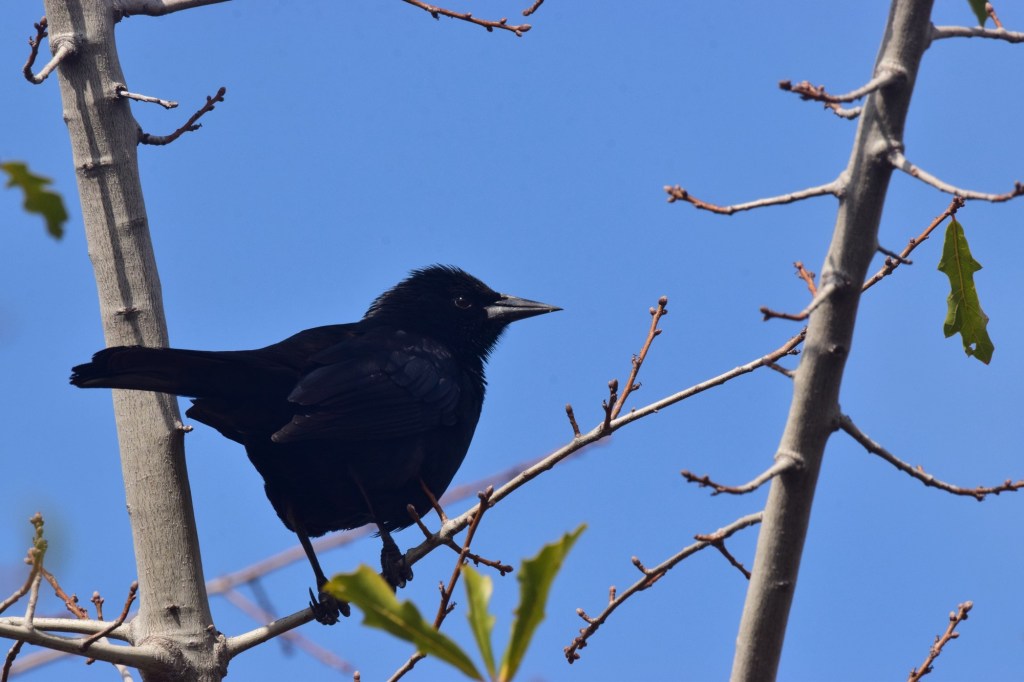
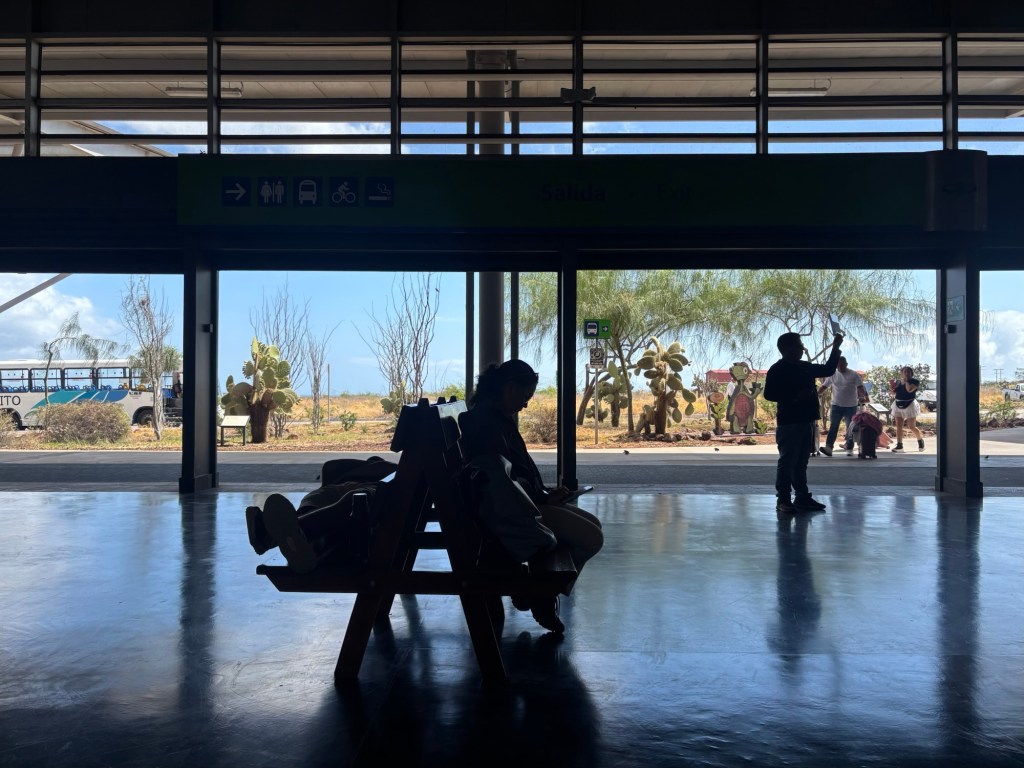
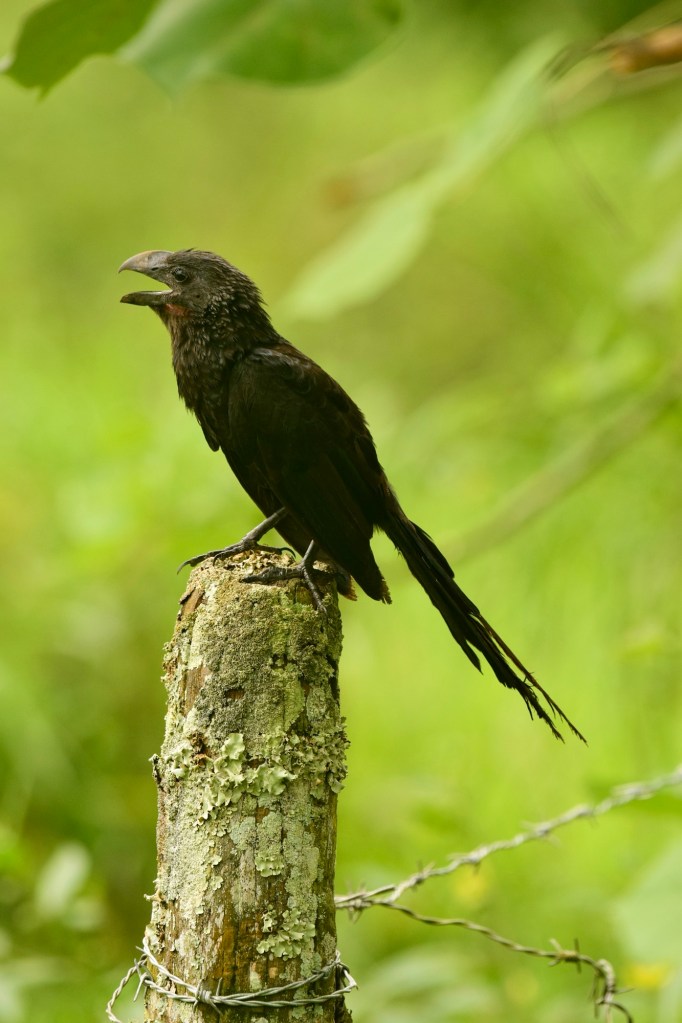
Ecuador is one of the birdwatching capitals of the world, but I’m no lister, so I don’t begrudge my brief pit stop being limited to the interior of Guayaquil Airport. All the same, there’s a lot to be seen from the ceiling-high windows on the south side, near the KFC. I’d seen tanagers, hummingbirds and kingbirds before, but the cuckoo-like anis that live in the palm grove beside the departures lounge are a lot of fun to observe, as are the long-tailed grackles with which they share the scrub.


Now – logistics. Traveling to the Galapagos with a tour company may mean a lot of the admin is done for you, but if you, like me, prefer to strike out alone and do it yourself – which really does keep the costs down – you’re going to want to do a couple of things before leaving Guayaquil.

  1. Make sure you have US dollars in hand – $200 at the very least for the island entry fee for foreign tourists, which must be paid in cash immediately upon arrival at the airport on the islands. If you have large denominations, now is the time to use them, as you’ll need smaller bills for day-to-day expenses around the Galapagos. There are ATMs in the major ports, but they have a reputation for running out, so having a float of ready cash is vital. There’s an ATM in the south corner of the terminal, between the KFC and the Salidas Nacionales door.
  2. Before going through security (via the Salidas Nacionales door on the south side of the airport), make sure you go to the check-in desk that says “Tourists traveling to Galápagos Islands”. You can’t miss it – it’s the one in the middle with the big queues of gringos. You’ll need to queue twice for two different mandatory pre-flight checks.
  3. Make sure you fill out the TCT (Tarjeta de control de tránsito), also known as the Tourist Transit Card, before you go through security. It costs $20, but there is a small surcharge for doing it online. Select “pay at airport”, use some of the dollars you’ve picked up and dodge the online fee.
  4. Once you have your TCT, you also need to fill out a separate form declaring you’re not bringing any illegal goods onto the island. Processed food and plants come under that bracket, so polish off any snacks before you leave. It’s the islands and their wildlife that are at stake if you don’t. When you have the form in hand (or on your phone), join the queue to run your bags through the scanner. Once you’re clear to go, that’s it for the checks.

August is the tail end of high season in the Galapagos, or so I’ve been lead to believe. However, the 9.17am flight to San Cristobal was one of the emptier flights I’ve taken on my travels in South America, so despite skimping on seat reservation and being assigned an aisle seat, there was nobody else on my row at all – or the two in front, come to that – so I landed a window spot after all. Result!


Given the magnitude of what’s coming, I’ll leave it there for today’s post and fall into line one day behind, which should give me the breathing room I need to write each day without racing against the clock. So come back tomorrow to find out about my first day on the island of San Cristóbal, easternmost of the Galápagos Islands! BB x
AI Agencies Ltd.

Lo Barnechea, Santiago de Chile. 15.00.

Today has been a bit more of an admin day. One of my activities for next week fell through, so I spent a fair part of this morning re-arranging my plans with a couple of other agencies to keep my itinerary as close to the original as possible. It hasn’t been easy. I’ve been leaning heavily on AI, not as a lesson planner, but as a travel agent, and I have to be honest, I fear for the travel industry. ChatGPT and Copilot may need gentle nudging and correcting as they work, but they do a phenomenal job at trawling the net for deals, dates and travellers’ tales from TripAdvisor, Reddit and beyond.

I’m not the biggest fan of AI, but as an impartial entity to bounce ideas off, it’s an absolute doozy. It has really helped me to streamline my plans, keeping them within a very reasonable budget – especially important as my choice of location is not exactly famous for being a budget destination. I do often have to correct its mistakes, which is why I would caution any students of mine from meddling with it unless it’s on terms they understand – good advice for just about anything unknown – but as a rule it does a pretty good job at doing the heavy lifting.

I genuinely can’t wait – I’m practically chomping at the bit here – but I promised to keep it a secret, so I will leave just the smallest of clues in this post in case you want to hazard a guess at my intentions.


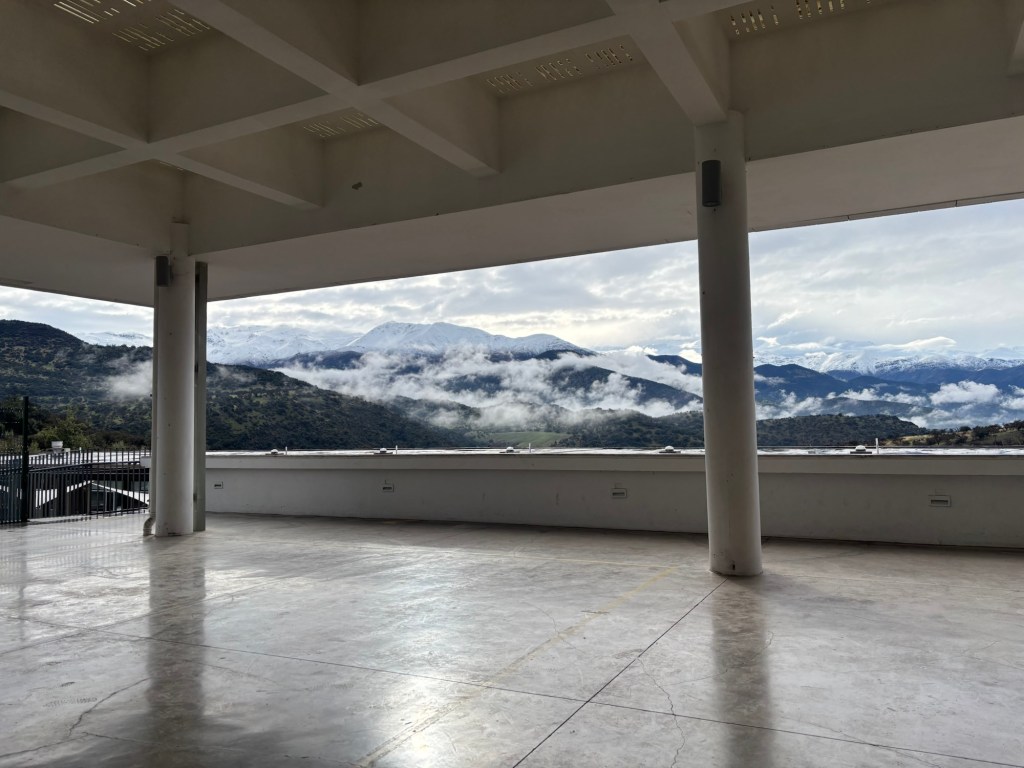
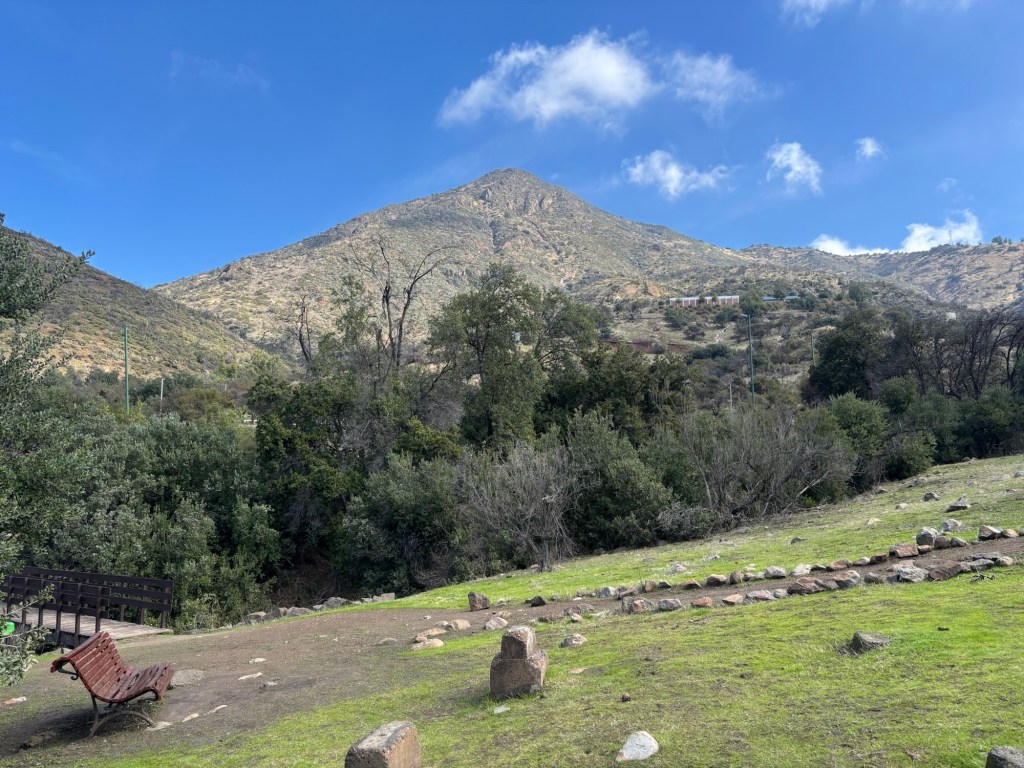
I’m currently sitting in the English office, listening in on the weekly department meeting on debating strategies and what constitutes a suitable number of poems within the Language A anthology. On my left, the windows open out onto the hill country around Manquehue, where I saw no fewer than sixteen condors circling shortly before lunch. That makes three days out of three this week where I’ve seen the titans of the Andean skies from my office. Normally it’s just the diucas and mockingbirds that pop in for a lookaround once the kids have gone back inside for the third hour of the day. On my right, the windows open out onto the enormity of the Andes to the north, still wearing a wintry mantle of snow. Further down the hill – just out of sight beyond the classroom blocks – are the school’s sports pitches. Our kids play rugby against the backdrop of a nineteenth-century clock tower and the Southwestern Railway. These kids have the towering heights of the Andes all around them. These are just the foothills: somewhere beyond stands the fearsome Cerro Plomo, reaching some 17,861 feet into the sky.


Upon reflection, by journey’s end, I will have spent an astonishing two months south of the equator this year. The last time I was this far south I was tracking mountain gorillas in the impenetrable cloud forests of Bwindi on the Congolese border.

I remember being of the opinion that Chile was a destination I was only prepared to visit thanks to some generous financial assistance with the flights, considering it otherwise a prohibitively expensive destination. I see now just how wrong I was. Not about the money – Chile is easily one of the more expensive South American countries – but about how much there is to see and to do.

I’m now genuinely considering coming back someday to pick up the things that I missed: Chiloé, Conguilio, Punta Arenas, San Pedro de Atacama and so much more besides. There’s simply too much to see here, even when you have five weeks to play around with, and for a naturalist like me, the fact that it pales in comparison to its megadiverse neighbour, Peru, means very little when a casual glance out gives you one of the most spectacular birds of prey on the planet.

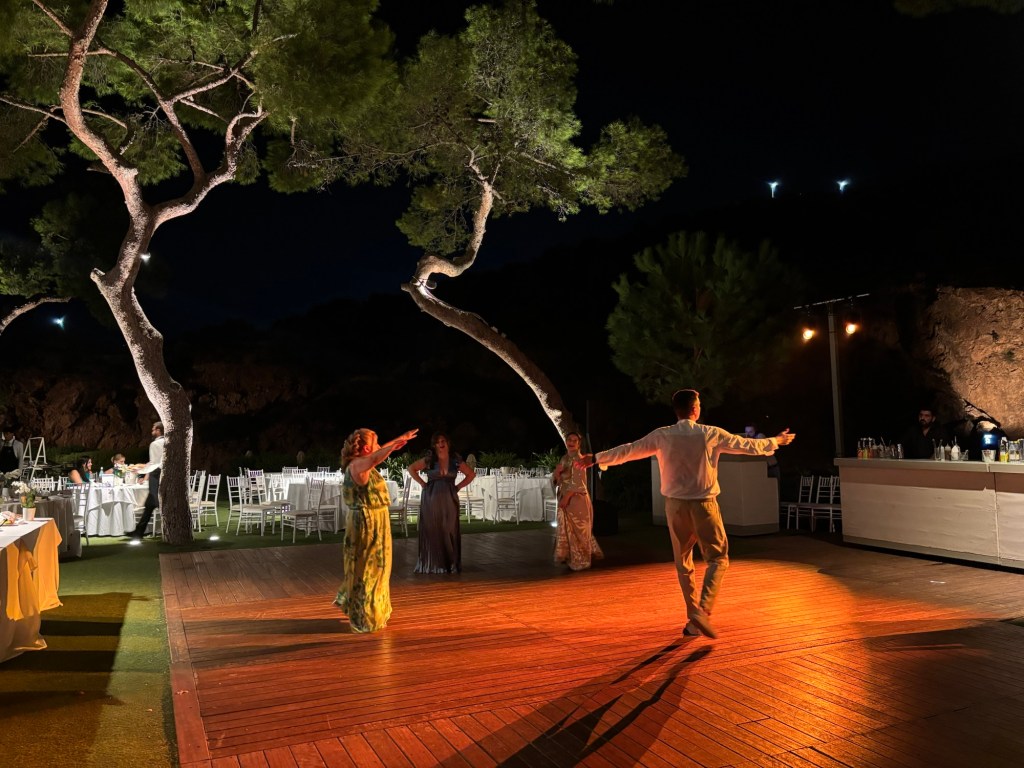
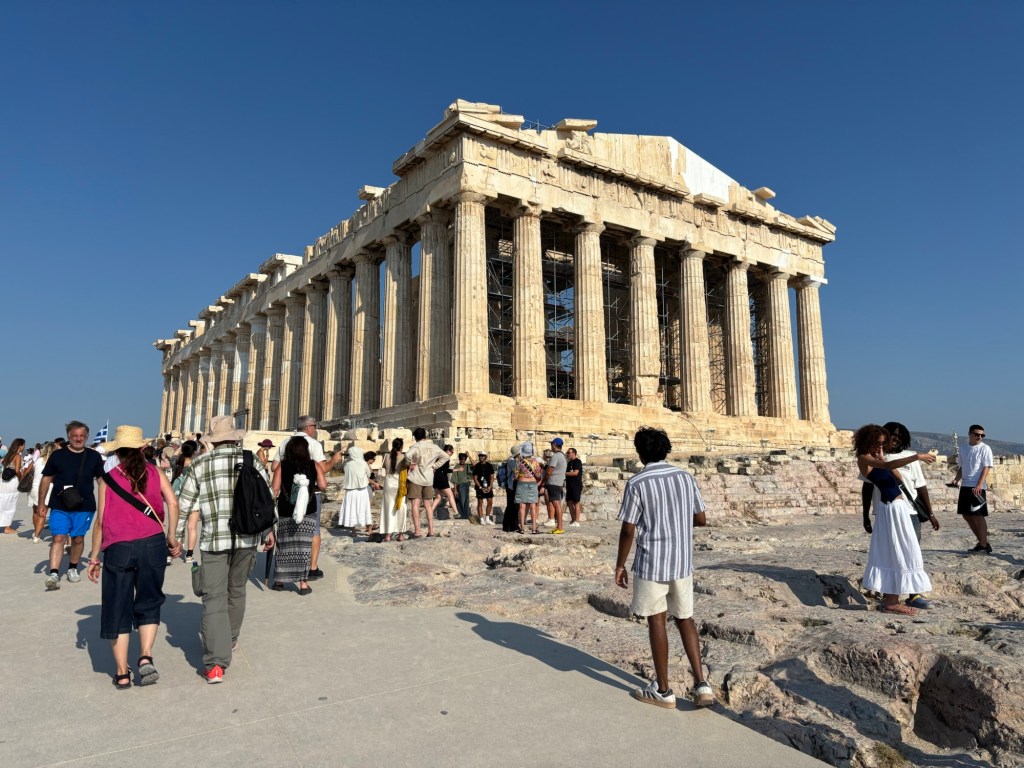
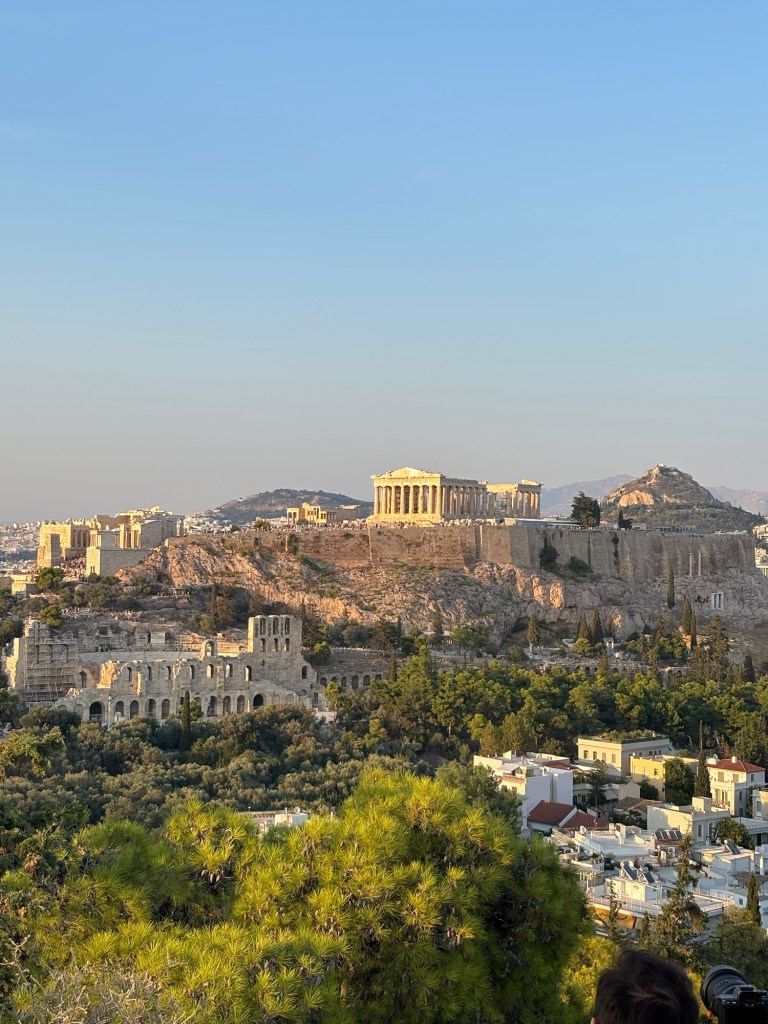
Two weeks from now, I will be back home, a brief pit stop on the island before duty calls me to Athens for one last dance. I had a brief moment of nostalgia for it today when I popped in to help a colleague set up a game of Just a Minute to give her students a boost with their listening skills in debating. I love that game to bits – and the BBC Radio show from which I have poached it.

Two days remain. Let’s do this! BB x
818

Las Condes, Santiago de Chile. 19.50.

Week two started slow today. A couple of meetings and a non-starter quest for a functioning laptop meant that I spent the day working on my books, which was a lovely way to spend the day productively – as well as a reminder to myself that I am technically on holiday – albeit perhaps not as exchange-heavy as it could have been. I have bigger events coming up this week, though, and I suspect it will be the last week of my exchange when it really feels like I have a fully functioning timetable.


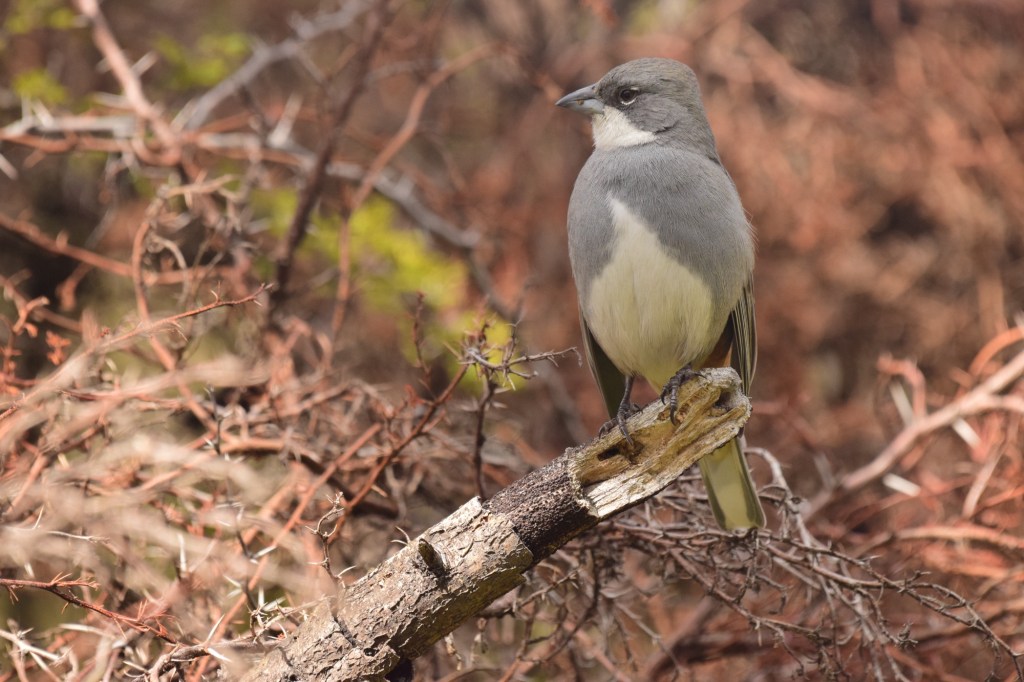
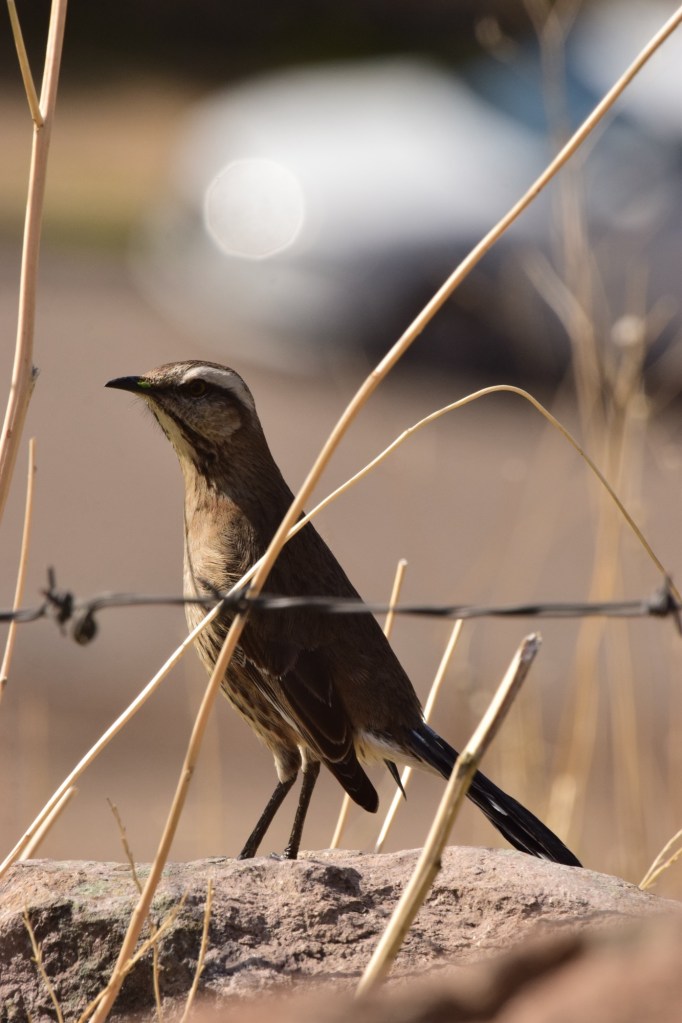
There are always so many birds around campus. The nest boxes the students have put up all over the school site for their CAS project obviously help, but it’s not just the charming little rufous-crowned sparrows that make the place feel so friendly. The mockingbirds are always perched somewhere, every time I look up I see a caracara of some description hanging in the air, and just before break this morning I know I saw the faraway silhouette of a condor circling the heights of Manquehue.

It’s the meadowlarks that are currently lending some extra charm to the place, if I had to choose a standout. I first got to know these characterful creatures in snowy Patagonia, but it turns out they’re just as common up here around Santiago, hopping about in the car park and sitting quite fearlessly on the school fence, singing their hearts out as the Year 7s play some kind of tag game just feet away.


My BIRDA app tells me my total count of species I’ve seen so far is up to 818 after this weekend’s exploits. Even I have to admit that’s getting to be a dizzying figure, and well over three hundred of that total are birds I have seen in the last five months. I’m not a professional lister like many seasoned birdwatchers, chasing a particular total on my life, year or patch list, but it’s fun having an app where you can log it all, and in so doing learn something about the sheer diversity of species you have found – and, consequently, discovering what is still left out there to see.

I probably could have seen more species if I’d paid through the nose for that Abra Málaga trip, but I wasn’t really after that kind of number-obsessive behaviour. One albatross would have been magical enough on yesterday’s boat trip, and I was blessed with four different kinds. It does not pay to go out into the wild with great expectations. Nature provides on its own terms.

Not too much to report for now, but keeping my writer’s block at bay with regular note taking. And it does seem to be working! BB x

The Ancient Mariner

Las Condes, Santiago de Chile. 20.54.

I grew up within sight of the sea. You’re never far from the sea in Kent: the furthest I ever lived from the coast was about ten miles as the crow flies, while the second half of my childhood was spent less than a mile from the white cliffs of Dover. As such, I am very attached to the sea and all its smells and sounds: the salt spray of the winter waves, the hushing rush of pebbles pulled down the beach by the tide and the cry of the herring gull. If I should be so lucky, one day, I should like to live by the sea.

Today I took that lifelong love for the sea and dialled it up a notch by taking a pelagic trip out into the Pacific – into the open ocean.


Rodrigo, my guide for the day, picked me up from outside my hostel in Valparaíso shortly after seven. A punctured tyre delayed him by forty minutes or so, so he was anxious to get going, so as not to hold up the crew of their ship up in Quintero, a seaside fishing town some thirty miles north of Valparaíso.

Shortly before we got there, the sun rose into a fiercely red sky. A certain old English saying came to mind:

Red sky at night, shepherd’s delight

Red sky in the morning, sailor’s warning

It was a beautiful sight, even if it did threaten rain. More spectacular, though, was a clear view of Aconcagua, the tallest mountain in all the Americas and the highest peak outside of Asia. The great white sentinel was so immense that by some trick of the light it seemed to throw the entire south of Chile into darkness. Apparently, only 30-40% attempts to scale Aconcagua are successful. The mountain is evidently as much an apu – a sacred mountain – as its better-known kin to the north of the cordillera, and not to be underestimated.


The local fishermen of Quintero were already hard at work as we arrived, slicing up some frighteningly large squid and cleaning their skiffs after a night out on the ocean. They seemed curious about the small group of day trippers herded onto a boat waiting in their harbour – all of them Chilean, with the exception of one wandering Briton – but paid us no more attention than the pelicans: a sort of intentional acknowledgement, as they went about their work.


I couldn’t help being totally bowled over by the frighteningly large squid laid out in the fishery. Humboldt squid – or jibia as they’re known in Chile – are among the largest squid species in the world, reaching a whopping five feet in length. They’re so numerous along the coast of the Americas that they represent a third of the squid catch worldwide – and despite the fact that nearly two thousand tons of them are hunted in Chile alone every year, their population is still expanding. That’s a testament to just how rich the Humboldt current truly is. It’s also why Chile has always been home to a healthy population of sperm whales, who devour these and even larger prey, including arguably the most famous whale of all time: Mocha Dick, an aggressive and exceptionally cunning albino sperm whale who survived nearly a hundred attempts on his life before being brought down off Mocha Island. His story inspired Herman Melville to write the American classic Moby Dick, but it’s the original tale that is taught here in Chile as part of the national identity-building curriculum. How cool is that?


We left the harbour – with its attendant sea lions and pelicans – and started out on the hour’s journey out into the open ocean. For most of that first hour, we were tailed by kelp gulls – Chile’s ubiquitous answer to the herring gull – and strange shapes in the water, many of which turned out to be discarded bottles or cans floating eternally along the Humboldt. I counted at least four Fanta bottles and two bicycle tyres, the latter floating nearly side by side. I wonder what happened to the bicycle itself?

Some of the shapes moving along the surface of the water were a lot more interesting. A curious sea lion, a huala or great grebe fishing offshore, or a family of penguins, spending the winter at sea. Over the course of the morning we saw both species native to Chile: Humboldt penguins – the kind I saw in the Islas Ballestas in Peru – and Magellanic penguins, a more southerly species that have colonies right down to the Chilean Antarctic.


We didn’t have to go far from the harbour to see our first pelagic species of the morning. The first to make their appearance were the shearwaters, experts of the open ocean, zooming low over the surface of the water, banking this way and that. With the roll of the waves, they seemed to slice through the surface with the tips of their wings in the way that gave them their name, though I swear I never saw them touch the water once.

In the descending gloom, they were hard to catch on camera. A little easier were the diving-petrels, tiny auk-like birds that preferred to paddle away from the boat, popping in and out of sight beneath the waves in the habit for which I suppose they were named.


As the rocky headland of Quintero faded into the mist, we were almost entirely enveloped. This dense sea mist is one of the reasons there haven’t been any pelagic tours since April: if the visibility is this poor, the harbour doesn’t let ships out into the open ocean, lest they become lost, disoriented by the waves – or worse, collide with another ship.

Only the fulmars kept us company in the mist, slicing through the fog on silver wings.


After what must have been an hour, the first sign of relief began to glow in the east: the sun, clear of the mountains and their attendant clouds at last, was trying to fight its way through the fog. Curiously, some trick of the light warped its shape into something that looked like a cross or perhaps even an angel with arms outstretched. It’s so easy to see how legends could form in such a strange and unsettling space as the open ocean, in a time when there was so much less knowledge and so much more wonder in the world.


As the mist began to clear, we reached the feeding grounds of the open ocean. There were plenty of shearwaters around, mostly sooties – a dainty species of southern waters that can sometimes be seen as far north as the British Isles on their wanderings. But this is their home, off the southern coast of the Americas, and there were plenty enough of them to prove it.

A young lad on the crew lifted the lid on one of the chum buckets – fish heads and squid tentacles, mostly – and threw some into the water for the birds that had followed us so patiently. They were watchful, at first, as wild things should be, but once the kelp gulls cottoned on, the shearwaters lost their timidity.


One bird I had not expected to encounter at all was a prion – known around here as a paloma marina or sea dove. These Antarctic birds had been driven north by weather currents in the South Seas, by the looks of things, and it was a real delight to watch them bobbing around beside the boat, dipping their heads beneath the water in a constant, frantic search for food.


The real prize of the open ocean took its time. A cry of “albatross” from the captain (one Chilean bird whose name is seemingly universal) drew our attention to an enormous shape gliding through the mist behind the boat. It was there for a moment and then it was gone.

A few minutes later, one of the crew spotted it again. The giant – a black-browed albatross, and presumably the same individual – must have caught the scent of the chum and was following the boat at an increasingly shorter distance, arcing across the water in the kind of wide waves that children do on bicycles when following something too slow for their liking.

In time, it seemed to lose all suspicion of us whatsoever and flew in incredibly close, so close that you could see the glint of sunlight on the tip of its bill.


One of the Chilean birdwatchers sitting at the back of the boat beside me remarked somewhat ruefully that he had seen far more activity in previous July expeditions. To him, the ocean was unnaturally quiet today.

I couldn’t have cared less. I was hoping to see one albatross, but I didn’t expect it to be so close, and so bloody impressive. They really are magnificent creatures.


The albatross is a perfect gliding machine. The only time they need to beat their enormous wings is upon takeoff, which is a somewhat clumsy affair requiring one heck of a run-up – although, when you consider that said run-up usually takes place on the surface of the water, that feat is all the more impressive. To aid them in this endeavour, their webbed feet are absolutely enormous, giving them serious launching power as they race across the waves. Once airborne, they can glide for hours, riding the wind on wings that have evolved to make them the true masters of the open ocean.


As the scent of chum in the water drew more and more seabirds, other species began to appear. There was much activity on the boat when a Salvin’s albatross came riding in to join the bounty: a larger, greyer species with a smart yellow lining to its bill. Like the black-browed, its eyes sit beneath a dark shadow, giving the peaceable bird a perpetual frown – though it looked stern enough when it came charging in to chase the other gulls away from the discarded fish heads thrown overboard.


As more and more birds were drawn to the bounty, others besides the albatrosses came in to investigate. Petrels of every kind: smart pintado petrels, Westland petrels from New Zealand, tiny storm-petrels – known to Spaniards a golondrinas de mar (sea swallows) – and southern giant petrels, like the ones I saw in Natales. I quite like these dark morph birds, but there’s a pale morph that look truly sinister, with cold grey eyes – much more suitable for the vultures of the southern seas.

If it weren’t for the albatrosses, these giant petrels would have dwarfed everything in sight. As it was, the best they could take home was second-billing (no pun intended).


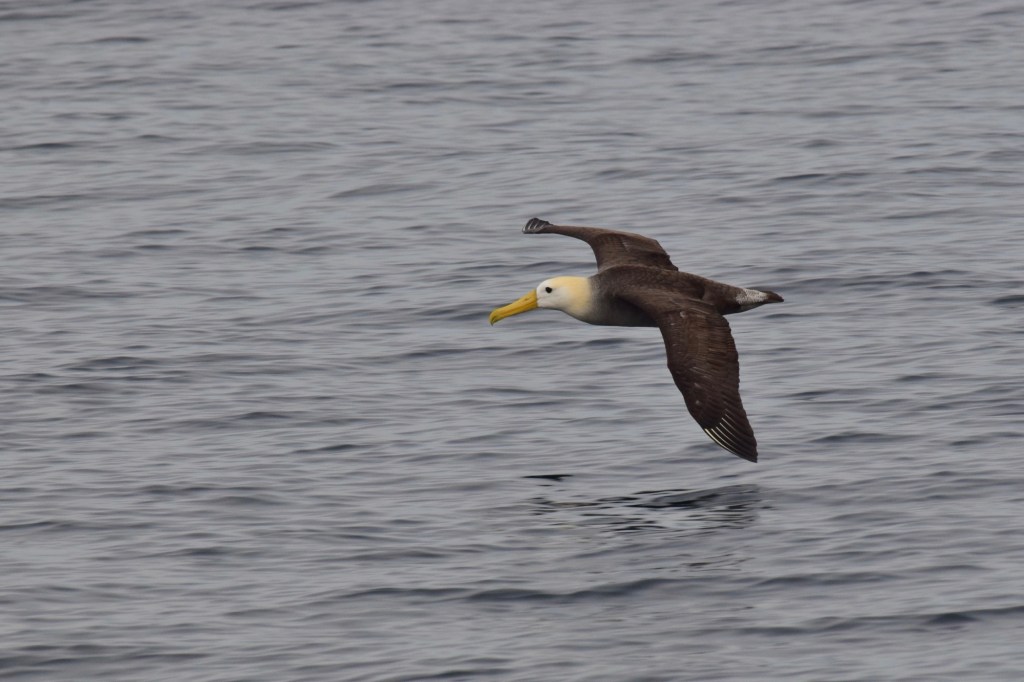
There was a great deal of excitement on board when another albatross appeared: a waved albatross, a stranger to these waters that usually makes its home in the Galápagos Islands to the north. The albatross is a true wanderer, scouring the length and breadth of the ocean in search of food, so they can turn up just about anywhere outside of the breeding season. Even so, the captain remarked that in the last twenty years he had only seen five of them, so it was quite a special sight.


For me, though, the most spectacular bird of all was the last to appear. Towards the very end of the expedition, a truly enormous shape coasted into view from the direction of the open ocean, riding in on the wind on three-metre-long wings. A royal albatross – tied with the wandering albatross for the largest wingspan on the planet.


More wary than its kin – or perhaps more stately – the wanderer kept its distance, gliding in enormous circles around the boat. I’m not sure where they stand in the pecking order, or whether the royal in their name is a flight of fancy on our part in allusion to their size, but the giant was indisputably the largest and most powerful of all those gathered to the feast.


Just once did the wanderer come in close enough to truly appreciate how much larger it was than everything else: even the other albatrosses looked like gulls beside it. Unlike the angry-looking black-browed and Salvin’s, the royal albatross has a kind face with deep black eyes and a clean pink bill.

To see one is to understand how sailors of old were enchanted by this bird, spinning legends about it, including the famous belief that to kill an albatross was to invite disaster – upon ship, captain and crew.

What an incredible encounter! I hoped for one albatross and saw at least fifteen, including the largest of them all. My ears may not have fully recovered yet, but I couldn’t feel more fortunate right now.


Upon returning to Quintero, we all had lunch together at a seafood joint opposite the harbour. Quintero is not on the tourist trail – it isn’t even mentioned in the Rough Guides book I brought with me – so the fare was local, fairly-priced and fresh – and absolutely divine. I mulled over the menu for a bit before opting for a mint and ginger lemonade – my favourite Chilean drink – and the caldo de congrío, a wonderfully warm Chilean seafood soup.

I would have caught the bus back to Santiago, but one of the birdwatchers was tremendously keen to offer me a lift as he was headed back south anyway, and thought he might show me parts of the interior I might otherwise not see. I don’t tend to turn offers like this one down, and I had plenty of time, so I accepted.

Manuel – a Chilean marine researcher of proud Basque extraction – was a proper fount of information. He has been into birds his whole life, studying ornithology at colleges across the United States and working primarily in pelagic research. His job has taken him from the coast of California to the Galapagos and the Pitcairn Islands, as well as both the North and South poles. He remembers when they were proper frontier territories, before modern tourism sank its teeth into the far-flung corners of the world. He remembers also when much of the coast of Valparaíso was a giant lagoon, with bird-rich wetlands that have long since dried up and turned into cattle country after so many years of drought. The recent downpour is an anomaly: the Chilean palm trees that grow in the hills to the east all bear the blackened scars of the fires that rip through the countryside when the summer heat is at its worst, aided by the invasive eucalyptus trees that do so love to self-immolate.

As well as a crash course in Chilean fauna, flora, history and politics, Manuel was something of a prankster, hellbent on stopping in the middle of nowhere to take a photo of me so that I could send it to Rodrigo, our guide, so as to let him believe that I had been dropped off in the middle of nowhere. The average citizen might have left the joke at a passing comment, but Manuel was adamant to see it through, passing over several promisingly desolate spots in the hills before finding one to his liking.

His puckish side satisfied, he made sure to send me on my way with some herbs for my tea and a fresh loaf of local bread, superior to any supermarket pan de molde. I had some this morning. It really was superb.


Manuel dropped me off in Melipilla, a one-storey town to the southwest of Santiago that has definitely seen better days. Several earthquakes – including one that had its epicentre in the heart of the town itself – have laid waste to what was once a very pretty Chilean town, with colonial adobe houses and two impressive churches. What remains is a sad mishmash of old and new, houses patched together with new materials, as though the whole town was rebuilt using six different LEGO sets. The street art of Valparaíso has made its way here, too, though it is perhaps less welcome here than it is in the cascading streets of the seaside city.

I bought a bus ticket for a paltry 2.000 pesos (just over a pound, I think) for the fifty minute ride back to Santiago, and as a bus arrived just as I was buying the ticket, I didn’t need to wait at all. It was half six by the time I made it back to the flat in Las Condes, long before Tomás and his family returned from their Sunday outing to see his grandfather. I meant to sit down and write, but after I had put my clothes in for a much-needed spin in the laundry, I pretty much collapsed into bed. It’s funny what a morning out on the ocean will do.


My second week begins. I will try to see some English lessons this week – and, with any luck, get a bit more involved after a week observing the middle and senior teams.

I have also reached a decision as to what to do with my last week out here. But that, for now, must wait. Let it be a surprise. There is a lot more magic in that. BB x

Neruda’s Ear

Hostal Casa Volante, Valparaíso. 13.37.

Valparaíso is sometimes nicknamed the South American San Francisco. That has nothing to do with the cost of living and everything to do with the way it soars up skyward out of the Atacama Trench, carrying the city’s elite on its back. Some of the roads winding up the side of the cerro seem almost vertical. I get the feeling living here would give you the lungs of an Inca and the thighs of a Georgian wrestler.

It’s up here on the heights that you’ll find the house of Pablo Neruda, Casa Museo La Sebastiana.


Neruda sure knew how to pick a spot. His five-storey house, which sometimes feels more like a tower than a villa, commands one of the clearest views of the Bahía del Valparaíso. On a clear day, you can probably see for miles, but even a shroud of yellowing cloud, you could see as far as the forested hills of La Campana and the snowy heights of the Andes beyond.

Neruda had his writing room built right at the pinnacle of his Valparaíso home, so that he could draw inspiration from the beauty of the world around him, whipped eternally by the Pacific winds.

He also seems to have loved maps, especially the older ones. There’s an genuinely incredible French map of the Americas by one Monsieur le Dauphin which I absolutely must track down, as it predates the discovery of Australia, with strange, half-finished coastlines fading into nothing at the southwestern edge of the map under the title “Terra Australis Incognita”.


People seem to treat this street with profound respect. Even the graffiti is cultured.


As if in answer to my post last night, I was surprised to find the street on which Neruda’s house stands, Calle Ricardo de Ferrari, covered in verses that weren’t taken from the Chilean poet’s vast anthology, but from his Andalusian friend, Lorca. Beautifully painted into tiles from an alfarería in Granada, Lorca’s verse follows you all the way down the road, perhaps as an ode to Neruda’s efforts in saving so many Spaniards during the Civil War and bringing them here to Valparaíso, far from the tyrannous grip of Francisco Franco.

Lorca lost his life under the fascist regime. So did my great-grandfather Mateo and all of his circle of writers and poets. It’s probably no great leap of the imagination that they might even have been in contact with Andalusia’s greatest poet, since they were all writing around the same time… and all snuffed out around the same time, too. Perhaps that’s why I feel a special connection to Lorca – and why finding him here in the Southern Hemisphere is so comforting.


I didn’t buy any of his books – I can’t recall which ones I have at home – but Neruda’s magic was already at work on me. As I climbed up to the fifth floor of his house, my ears suddenly popped. My Eustachian tubes have been blocked for nearly a fortnight since that false landing in Natales, which has been a real annoyance. Flying for fourteen hours across the Atlantic and half of South America shortly before probably didn’t help, but either way, it’s been an ever-present bother since I arrived here.

But suddenly, just like that, the fuzziness in my ear wasn’t so bad anymore.

Ok, so it’s still there, but it is very definitely better than it was. I feel like I can hear properly again.

To prove that point, I stumbled upon a family of firecrowns on the way back down into the city. This time it felt like I could hear their piercing trill out of both ears. One even let me get close enough to make up for not having the lens on me (I left it behind as it weighs quite a bit, and you can’t take bags into Neruda’s pokey house).

I’ll miss the hummingbirds when I go, just like I said when I was in Peru. There aren’t as many varieties of them here as there were in the Inca capital, but the firecrowns are everywhere: particularly, wherever anybody has been kind enough to plant red hot poker flowers, which they adore.


It’s still pretty overcast out there. I think I might grab some Peruvian food for lunch, as there are quite a few places nearby, and I fancy a reminder of the delicious bowls of salty seafood I had in Paracas. If I am going to eat, it had better be sooner rather than later. The bay may look calm, but out on the open ocean it is likely to be less Pacific than it looks.

Fingers crossed for an albatross tomorrow! I’d settle for just the one! BB x

Sea Cats and Sea Lions

Hostal Casa Volante, Valparaíso. 16.37.

Santiago de Chile may be cursed to be a smog-bound citadel for the rest of its days, but in one particular sense, it is exceptionally well-placed: it is about an hour’s drive up into the mountains to the east for skiing during the winter months, while a hour and a half’s drive to the west will take you to the Pacific coast. Santiago’s summer sisters, Valparaíso and Viña del Mar, may only be a hundred kilometres out as the condor flies, but they are a world away from the Chilean capital. In some ways, they are decidedly European: winding streets with towering Parisian buildings, complete with tramlines and traffic lights. In others, they are absolutely Latin American: a fiercely compact cultural melting pot, with Peruvian outposts everywhere.

With my timetable still very much up to me (consisting entirely of lesson observations at the moment), I struck out early for Valparaíso today, very much in the mindset that the part of town where the bus station is – or so the books all tell me – is no place to be after dark. It took me about three hours to get here, all in all, so had I waited until I had got home, it would be around half past nine here – which is definitely pushing it, even by my standards.

So here we are, in Valparaíso, Chile’s second city. With a population of around 300,000, it’s a little larger than the hamlet of 47 in La Mancha for which it was named.


Let’s be real. I’ve come here for two things: sea lions and Pablo Neruda. I’ve been juggling my choice of poet for the Language A course for a while, between Neruda – arguably Latin America’s greatest poet – and Lorca, who I hold in especially high regard. In the end, it is Lorca who has won the day, if only because I have studied him so much over the years (and, no doubt, because I have skin in the game by being part Andalusian myself). All the same, it would be a crime not to include Neruda in the course, so I plan to use his poems to prepare my students for the unseen.

Neruda, for now, must wait. I’ll have time for that tomorrow, after the pelagic expedition. I arrived too soon to check in, so I turned my feet east and followed the coastline as far as the twin piers of Caleta Portales.

I didn’t have to go far to get my sea lion fix. The main pier of Muelle Barón may be out while the city pours time and money into what looks to be a seafront shopping mall in the making, but the real show is a few hundred metres to the east, where the skeletal ruins of an old gas company dock has become one of the favoured haul-out sites for the city’s sea lions.


Alongside the sea lions, the structure is the perch of choice for a surprising number of seabirds, given its safe distance from the shore but proximity to the fisheries. I picked out kelp gulls, Inca terns, a couple of turkey vultures, Peruvian boobies, three species of cormorant and, of course, the Peruvian pelicans that I was hoping to see again.

I thought there might be something loose in my rucksack, as I kept hearing some kind of fabric shuffling sound, but to my astonishment a man in dirty overalls clambered out from among the boulders, seemingly from some crevice beneath the very rocks upon which I had been sitting for the better part of half an hour. He acknowledged me with a gravelly “wenodía”, set down his tatty red baseball cap to mark where he had slept and then picked his way across the rocks, crouching every so often to inspect something between the crevasses of the sea wall.

Valparaíso is a lot poorer than Santiago’s uptown districts like Las Condes. That much is plain.


Moving east, I had my eyes trained on the water, on the off chance that a wandering penguin might show up. I did spot one, a fair distance from the shore, but something else entirely caught my attention – something entirely unexpected.

A marine otter.


Marine otters – known in Chile as chungungos or gatos marinos (sea cats) are not sea otters, like the fluffballs found from Baja California up along the North American coast, but they do live almost exclusively in the sea, rarely venturing into freshwater like other otters. Like sea otters, marine otters were once hunted for their pelts and are thus an endangered species, and quite a rare sight along South America’s Pacific coast. So I really wasn’t expecting to see one here, in the very heart of Valparaíso.

Apparently, marine otters are specialist feeders according to their location, with southern populations preferring fish and northern populations opting for shellfish. This must be one of the northern otters, because in the fifteen minutes or so I spent watching it before it disappeared, it must have caught and eaten at least four small lobsters.


That makes two species of rare otter I have managed to find this year: giant otters in the Amazon and marine otters in the Pacific. And I still haven’t tracked down the otters that live in the Tone, just a stone’s throw from my flat! I’m sure they’ll show up eventually. Maybe I should make that my mission, before the year is out: to see a third and final species of otter, preferably before Christmas!


Not to be outdone, the pelicans put in a good show, sailing in low over the water in that spectacular flight pattern of theirs. I have wanted to see pelicans do this since my mother told me about it after her trip to Peru back in 2015, when I wanted to be just about anywhere but Amman, and I have had the incredibly good fortune to see that sight several times this year.

It’s not the stuff Attenborough documentaries are made of, for sure, and the good people of Valparaíso must see it all the time, but it is something I will never tire of seeing.


Eventually, I reached the busy fishing port of Caleta Portales. I reached it at absolutely the right time of day, too: around noon, the fishermen throw their bycatch back into the sea, loading the scraps into repurposed shopping trolleys and dumping them over the pier into the water below. The local wildlife is well aware of this daily bounty – and, thanks to a quick Google, so was I.


If you needed a clue that the drop was imminent, you only needed to count the pelicans. They had gathered in numbers so great I struggled to put a number to them – and pelicans are not small birds by any measure. They seemed to be perched upon every surface they could find: the sea wall, car roofs, billboards, shipping crates, stalls, bridges, lampposts and on the concrete among the fishermen themselves. After seeing them at a distance in Paracas, they were now far too close for my lens!


One small perk of being here now in midwinter is that some of the adults have started to put on their smarter summer plumage, with a smart yellow tinge to their more defined white faces.


I was already aware of the immense dark shapes in the shadow of the pier, but the appearance of the fisherman with his trolley worked like a magnet, drawing the dark mass along after him, following the overpowering stench of fish – or the sudden vortex of feathers and screeching gulls that followed in his wake.


With the seafood sloshed overboard, the shoreline turned into a frenzy of activity. It didn’t take me long to pick out the bull among the sea lions massing around the shoreline: he completely dwarfed all the others, and that’s saying something.


Forget the roly-poly dumplings that you find off the coast of Britain. Sea lions are an entirely different beast. Adult males can reach a whopping three metres in length and weigh in at around 325kg. They’re also fiercely territorial, as was plain enough from the deep scars on some of the males, including the old bull.


At that size – and at this distance – they were simply too big to get on camera. The 300mm would have been useful here, I think, but it’s sitting on top of my chest of drawers back home in Somerset. As such, I had to make do with portraits of the beasts that had hauled out onto the rocks to wait their turn while the bull ate the sea lion’s share of the bycatch.


At this range, of course, you can make out a lot of detail. The thickness of their whiskers. The sharpness of their teeth. The minuscule ears at the back of their heads, and the scars on their torsos.


One male was so close you could see the whites of his eyes twice over. His eyes seemed to have misted over. He must be very old for a sea lion to have contracted such an infection. I wonder how old? They can live to be around twenty years old in the wild, I think, so this one can’t be far off that mark.


Arguably prettier than the titans hogging the spotlight was a small family of Inca terns, waiting patiently for their chance to swoop in and seize some of the scraps for themselves. This is another species I travelled all the way out to the Islas Ballestas to see, only to find them so close here in Valparaíso that they might have been eating out of my hand.

Here, at least, the lens really did put in the yards.


I hung around the port for well over an hour before deciding it was probably time to head on back to Valparaíso, have a decent lunch and check in to my hostel. The skipper advised against having a large supper ahead of tomorrow’s ocean voyage, so I made a mental note to have a decent lunch instead, and acquire some snacks for the journey home.

It’s not the most scenic route back to Valparaíso from Caleta Portales. In places, the city seems to be collapsing into the sea, and where there isn’t the salty tang of the sea, there is the sweet stench of sweat, marijuana and human faeces. There’s a lot of homelessness here. All the carriages of a derelict train seemed very much lived-in, with signs of recent occupation all over the place: a bouquet of flowers tied to the grille, a washing line strung out in the gloom behind a window, and a dog waiting patiently on the step of the driver’s car. It’s probably more homely than the crevasses among the boulders below the sea wall, though I imagine it’s not much warmer.


The city never seems to catch a break. The Spanish blew the city to pieces in 1866 during the Chincha Islands War. Forty years later, in 1906, Valparaíso was ripped apart by an extremely violent earthquake – a fairly common occurrence in this part of the world, with the city sitting squarely upon the Nazca plate boundary. Apparently, there was a small one just a few days ago off Quintero, where I am headed tomorrow. It’s quite something, seeing the tsunami warning signs all over the place.


The captain has just told me that the boat needs a service tomorrow morning, so we have rescheduled. Weather permitting, we are going ahead on Sunday. That should make my journey home a bit easier. Even so, it is likely to be my most out-of-pocket adventure yet.

Tomorrow, then, is wide open. A whole day to explore Valparaíso! I’ll make sure it starts with a good sleep and a decent breakfast. Those sea lions had a proper feast today – I might as well do the same. BB x