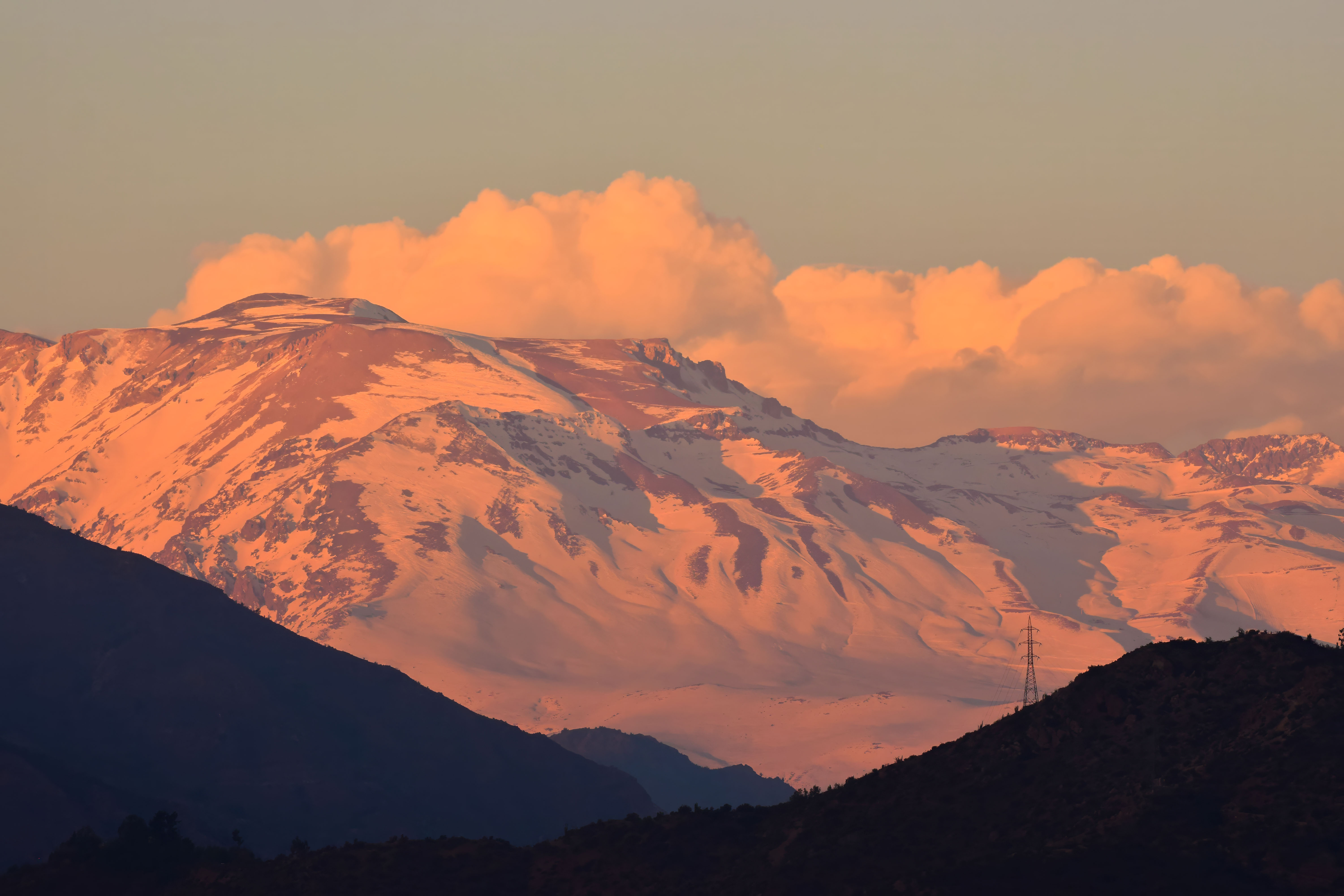
Chilean Memories #9: Snowy Sunset
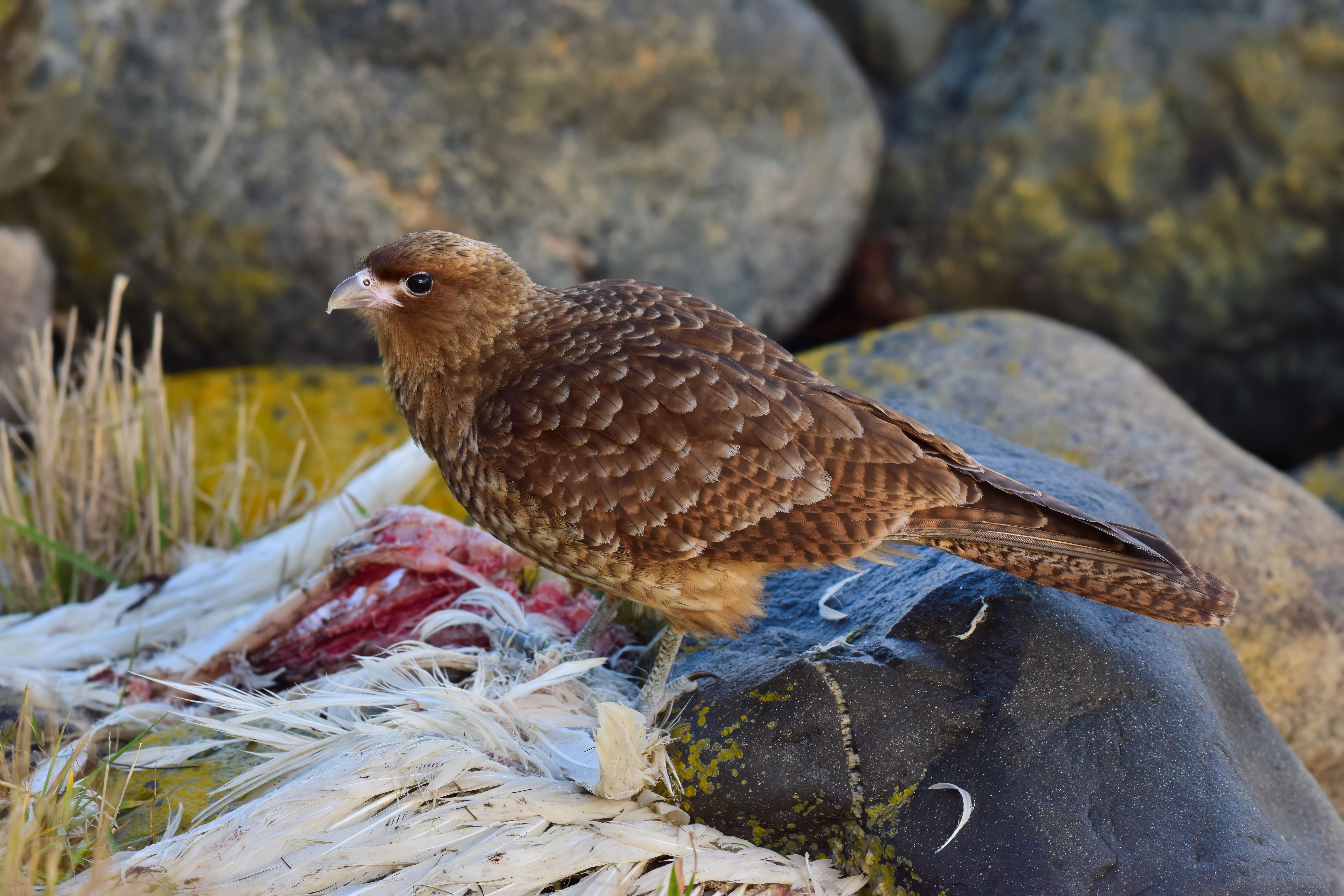
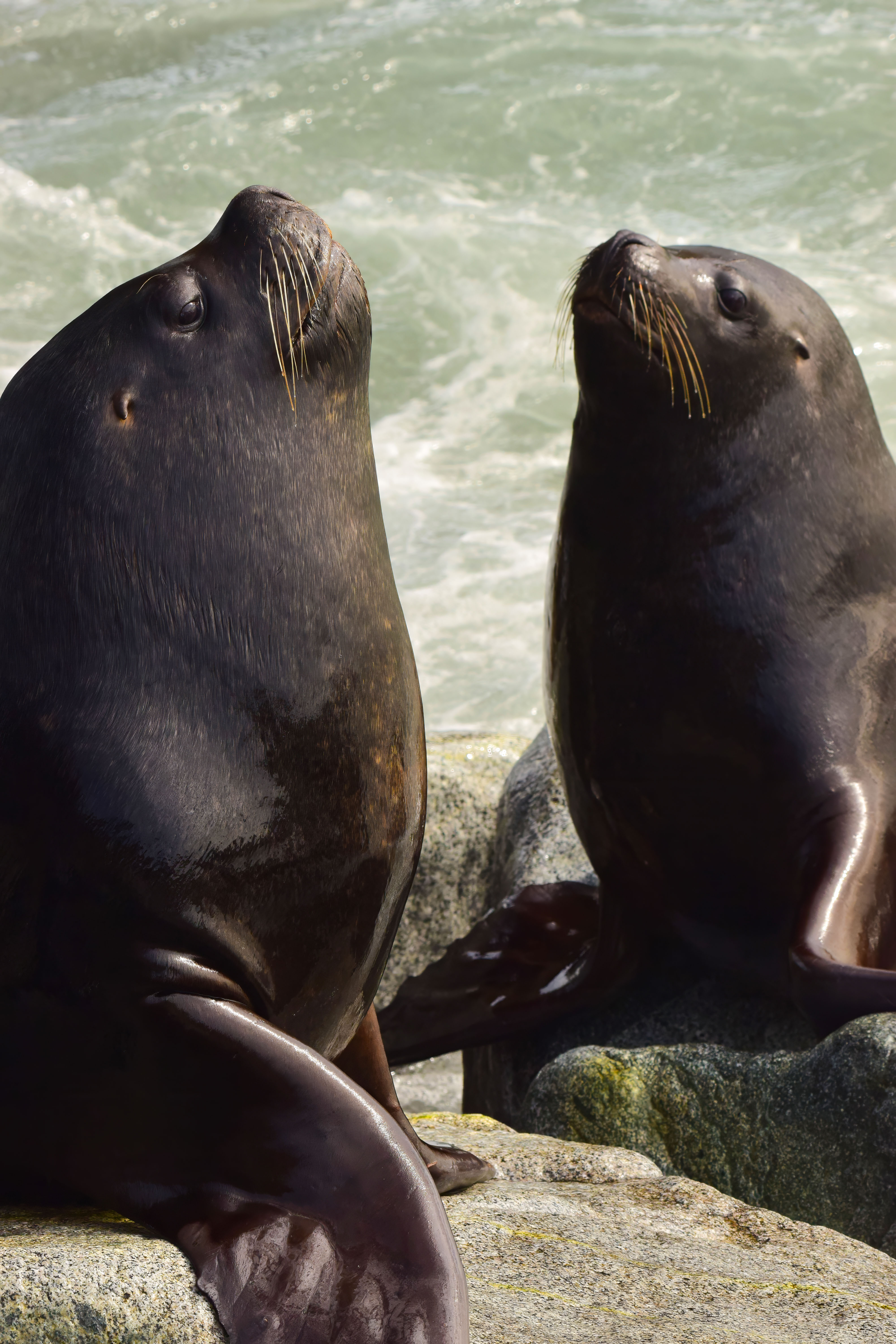
Las Condes, Santiago de Chile. 17.28.
I’m getting better at sleeping on planes. I must have slept for at least half of the flight from Lima to Santiago, because I remember almost none of it – only the first half hour or so and then a period of ten minutes at some point around half past two in the morning when they served out the in-flight snacks. Even so, the Santiago side of things passed by in a zombie-like blur. I navigated customs and an Uber relatively easily, but after letting myself back into the flat around six in the morning and using the last of my reserves for a desperately needed shave, I tumbled into bed and didn’t wake up again until half past twelve.
I’d suggest that that’s the last time I try to tackle multiple flights across three countries, but that’s exactly what tomorrow’s journey home entails, and I know myself too well to accept that I’d eat my words sooner or later.
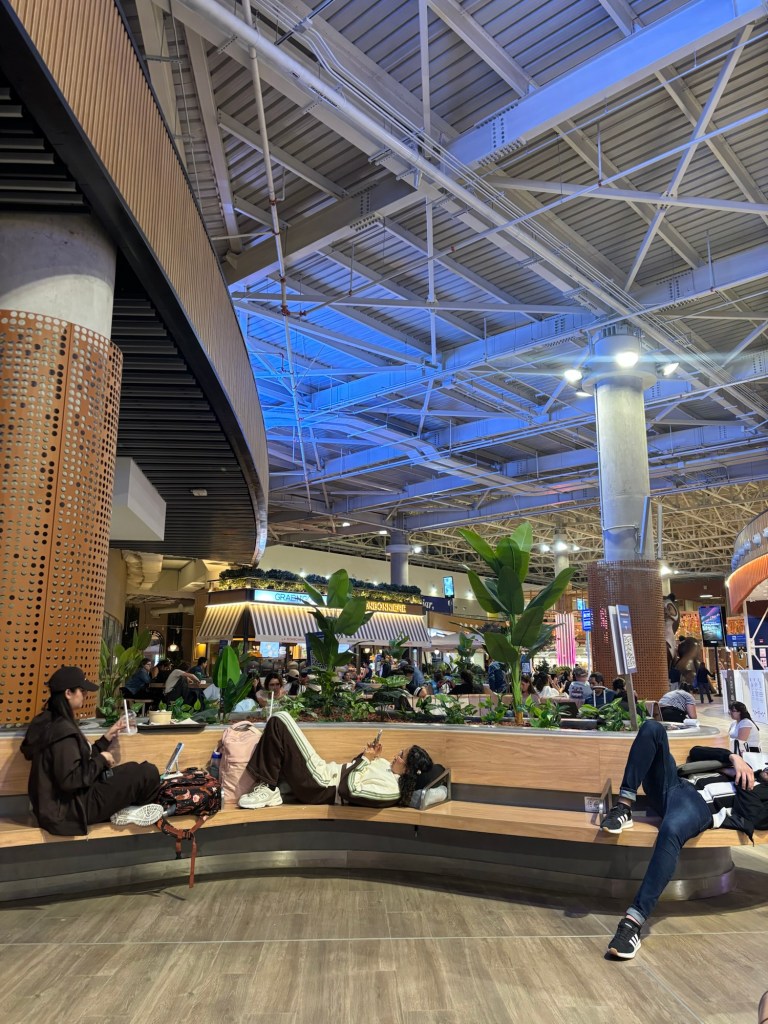
What a difference a year makes! South America has gone from being a location on a map that cropped up from time to time in texts we study in class to home in all but name for the last five weeks. By the time I leave tomorrow night, I’ll have totalled nearly six weeks here. That’s half a school term. In my book, four weeks is the cut-off point, beyond which a location stops feeling like a holiday and starts to take on the trappings of a place one can legitimately claim to have lived. While I haven’t spent all six weeks in the Central Valley, Santiago has definitely become as familiar a base as Amman and Tetouan once were, many years ago.
There are many aspects that are still alien. The distance. The exchange rate. The American-style grid system of South American towns. the national insistence on tacking cachai to the end of every single sentence, whether it needed confirmation or not. But I feel I’m getting the hang of the accent, the majority of the modismos (the extremely widespread Chilean slang) and what it might be like to live here for the locals. Lucky them!
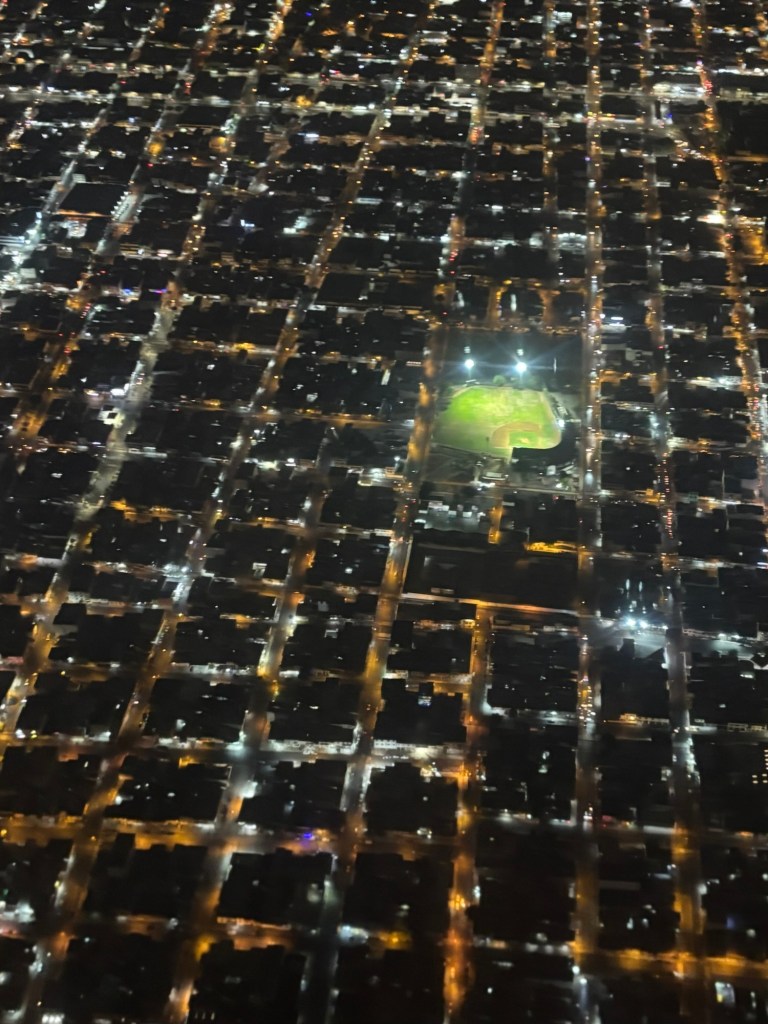
It sure is chilly here, though. I haven’t missed the uncomfortable heat I left behind in England back in that first week of July (which, I believe, is still there, outstaying its welcome by well over two months) but I could do with being somewhere warmer for a while. Bouncing from 7°C in Santiago to 37°C in Athens on Friday will be a proper shock to the system, but I’ll have my hands full with this Greek wedding for the ages, so I suppose I’ll manage.
I want to remember this soundscape though. The pitter-patter of dog feet on the laminate flooring. The distant whine of one of Tomás’ sisters blowdrying their hair. The whirring radiator in my room, doing its best to heat up the place. The alarm call of an austral thrush. The faraway engine of one of the many micros plying Avenida Las Condes. Otherwise, the remarkable quiet of Chile’s capital city. Santiago is a very special place.
Popping back into school one last time tomorrow to say a few farewells I didn’t get the chance to make last Friday and to wrap things up with a neat little bow, insofar as I can. And then – home! I could do with a rest. BB x
Puerto Ayora, Galápagos Islands. 19.52.
My final Galápagos expedition answered a question that’s been bugging me since I landed in Puerto Ayora two days ago: why is it perpetually cloudy here? San Cristobal had its fair share of cloudy days, but – with the exception of a few hours on Wednesday afternoon – Puerto Ayora has been shrouded in a mantle of grey and white from the moment I arrived. Well, I have my answer: rain shadow.
It’s not that the entire island of Santa Cruz gets more cloud than its eastern neighbour. It’s simply that all the cloud cover gets trapped behind the highlands, forcing it to build up over the south side of the island, like Tenerife in reverse. I was worried when we left Puerto Ayora that today would be a washout, but as soon as we cleared the Gemelas sinkholes, we stepped into a shining world of clear skies and tropical sun.
It’s a good thing I brought my sun lotion today.
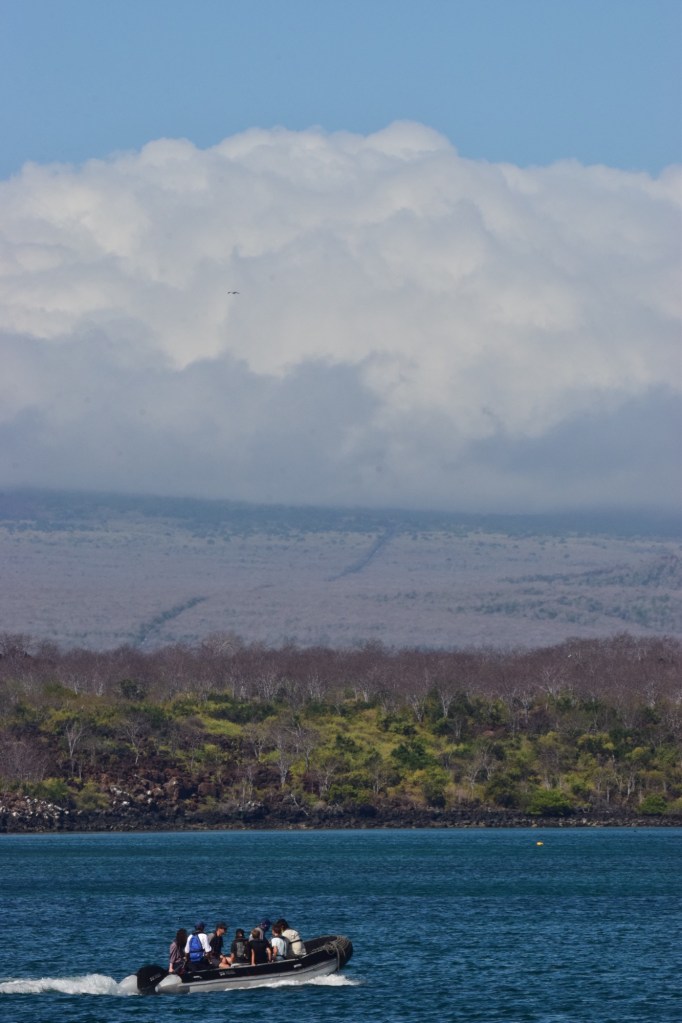
One thing I’ve learned in my time in the Galápagos is that all of the tours are something of a lottery. You can pay whatever you like, but ultimately it’s the park rangers who dictate who has access and when. Sometimes you get lucky and get the best light of the day (before 11am) – and sometimes you don’t. Today was the latter. Beach first, hike last. It’s definitely the inferior of the two options, for at least three good reasons:
In short, I was a bit miffed when we were allocated a visit to Las Bachas first – not least of all because North Seymour is one of the more expensive day trips on offer (at around $260-300 at the cheaper end). In most other parts of the world, when you’re paying that much for a day trip, you usually get some kind of say as to how to work the itinerary.
The Galápagos are different – and I suspect that the tourism explosion of the last ten years or so has had a lot to do with that. The upside is that the system has the animals’ welfare at its heart – or so I’d like to believe anyway. Controlling the daily tourist visits allows the park rangers to set limits on disturbance to the native fauna, which can only be a good thing.
Rant over. Let’s get back to some good old-fashioned awe, wonder and nature writing.
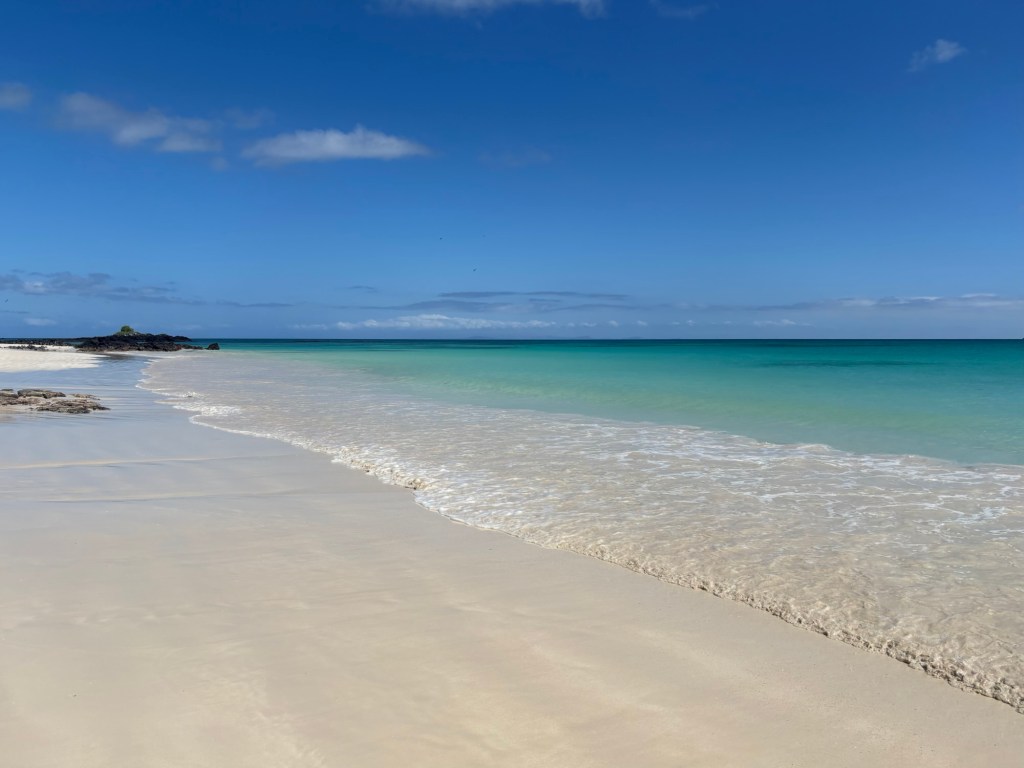
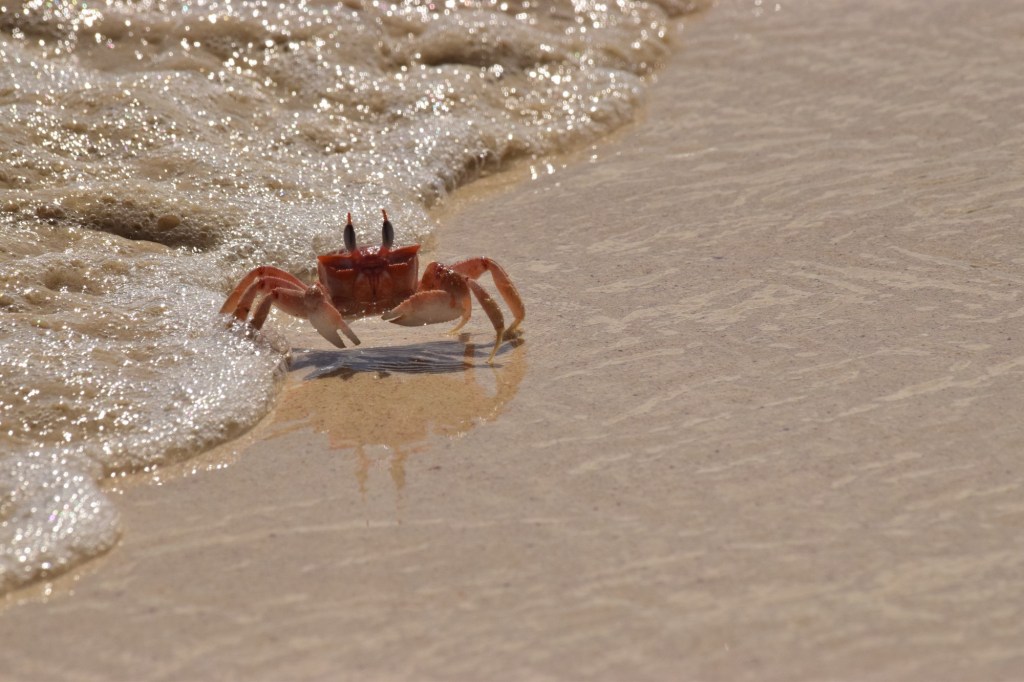
First off, whether you’re visiting in the morning of the afternoon, Playa Las Bachas is a genuine haven. After days of choppy seas, finding a calm white sand beach like El Manglecito was a major treat. Once occupied by US troops to control access to the Panama Canal during WWII, the only patrols you’ll find there now are the ghost crabs that race up and down the beach, forming enormous collections of tiny spitballs as they sift through the sand for microscopic food washed up by the tide.
I’ve only seen Sally Lightfoots since I got here (and one crab that liked a lot more like the ones we have back home), so seeing so many of these beautiful ghost crabs was a major highlight.
One species I was nearly prepared to cough up another $150 to seek out was hanging around a small lagoon behind the sand dunes. The American flamingo is the fourth and final flamingo species in the Americas, meaning the only flamingo in the world that I have yet to see is the lesser flamingo of sub-Saharan Africa and west India. I thought you’d have to go all the way to neighbouring Isabela, the largest of the Galápagos Islands, to be in with a chance of finding one of these colourful creatures, but there’s a small colony here at Las Bachas that regularly puts in an appearance.
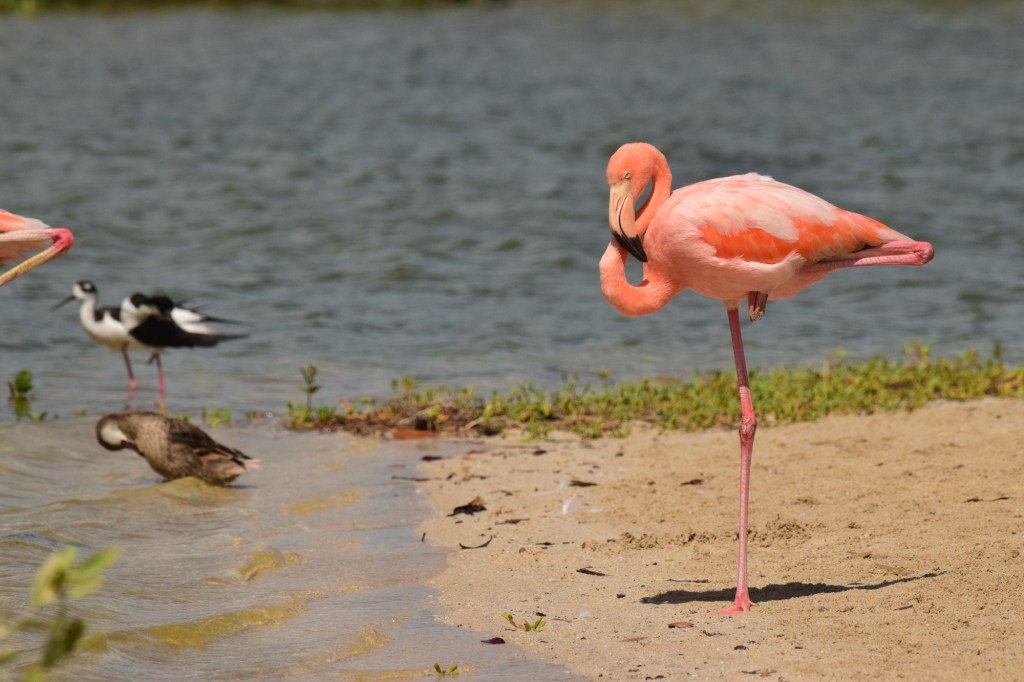
Bypassing Isabella means I leave without seeing two iconic Galápagos species: the penguin and the flightless cormorant. However, to even have a chance at seeing the latter, you need to skip the day trips and take a cruise that explores the westernmost islands, where the elusive flightless cormorant can be found – and that can cost upwards of $4,000 before factoring in the enormous financial handicap that applies to all single travellers.
On that note, seriously, what gives? Since touchdown last Saturday I’ve met just two other solo travelers here. The rest are couples, families or groups of retirees. If you get to talking with them, a great many of them are lawyers, bankers, hedge fund managers and businessmen. I feel very out of place as a teacher here. Whatever it might once have been, the Galápagos does seem to have become a rich man’s playground.
Thank goodness the only riches in this world that matter are the ones that were living and breathing on these islands long before people came here.
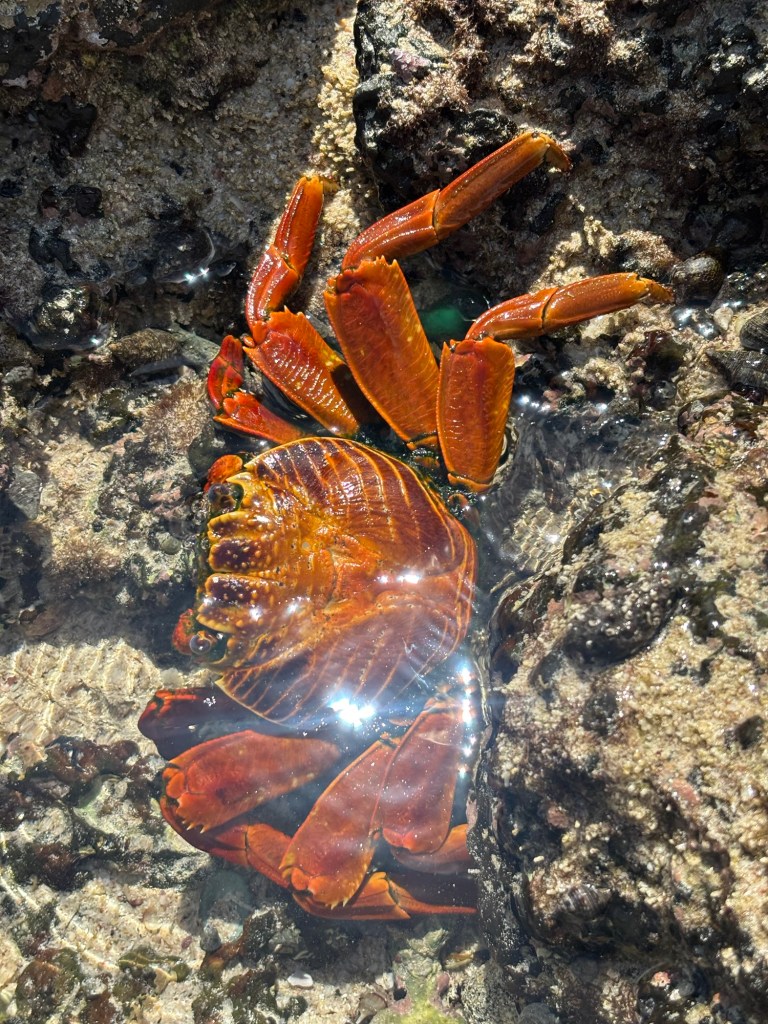
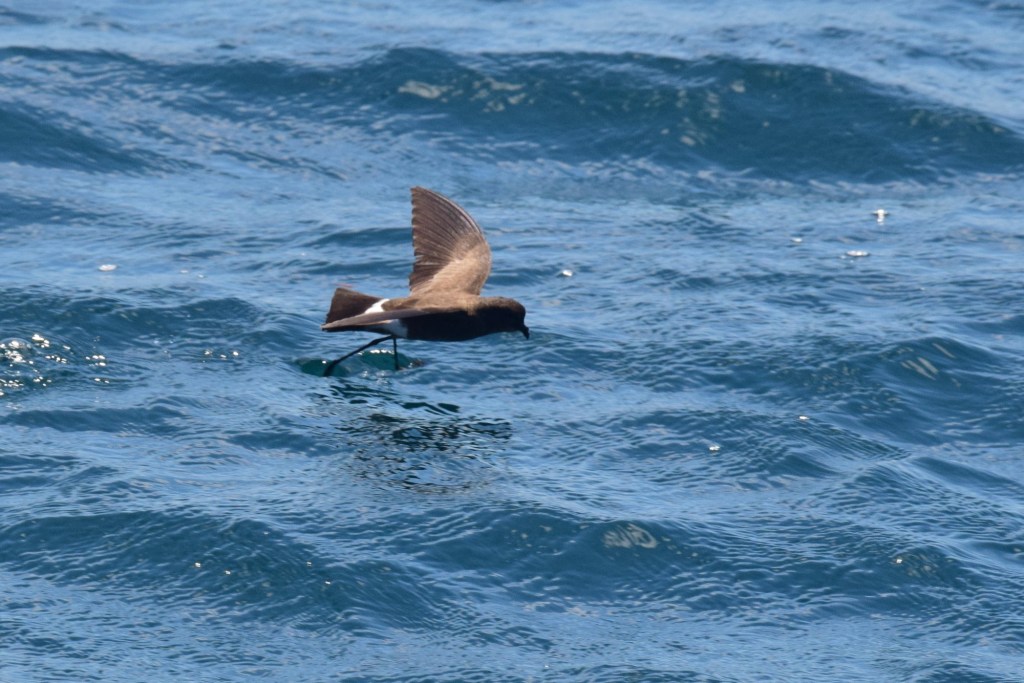
I saw another two turtles at Las Bachas before we got back on the zodiac and returned to our boat, the Galapagos Shark. The crossing to North Seymour is substantially shorter than, say, the journey to Punta Pitt, but you have to go it slow in these waters, as there are so many turtles about. While the other passengers stretched out on the forecastle, I stayed up on deck watching the shearwaters and storm-petrels dancing across the surface of the water behind us.
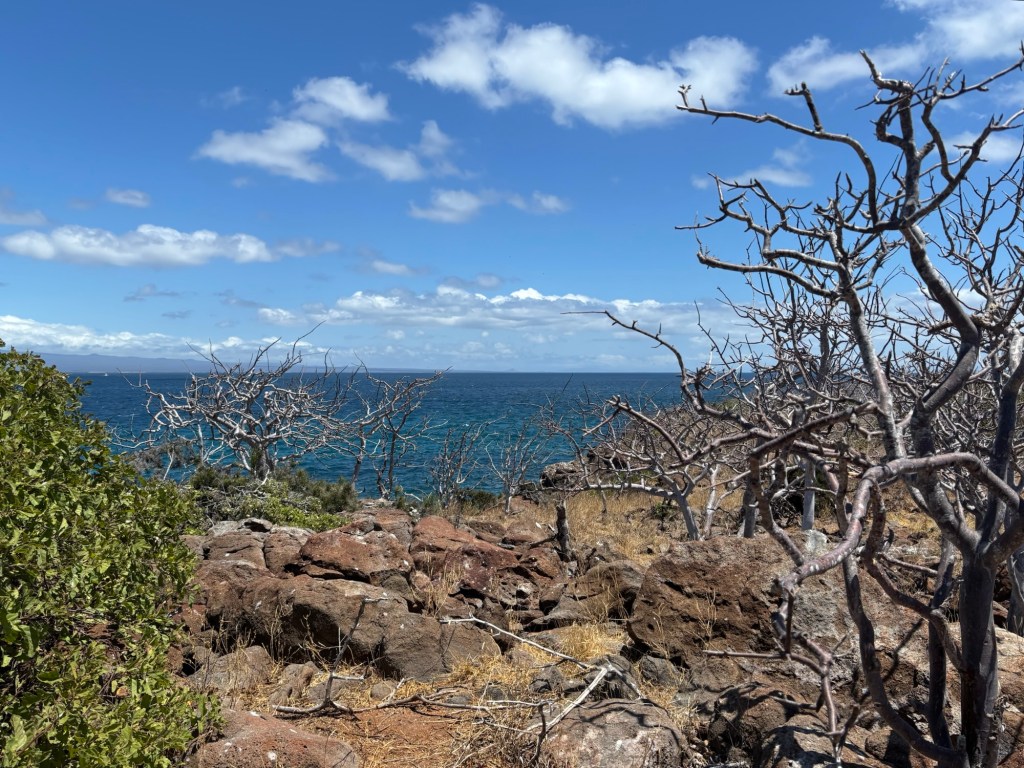
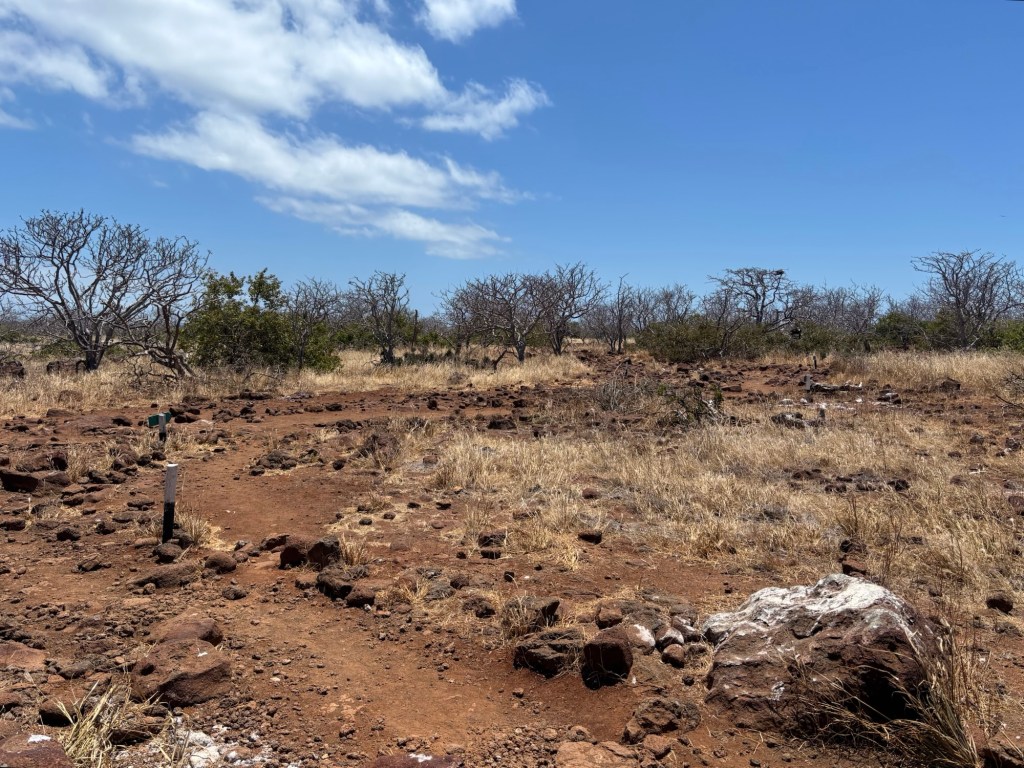
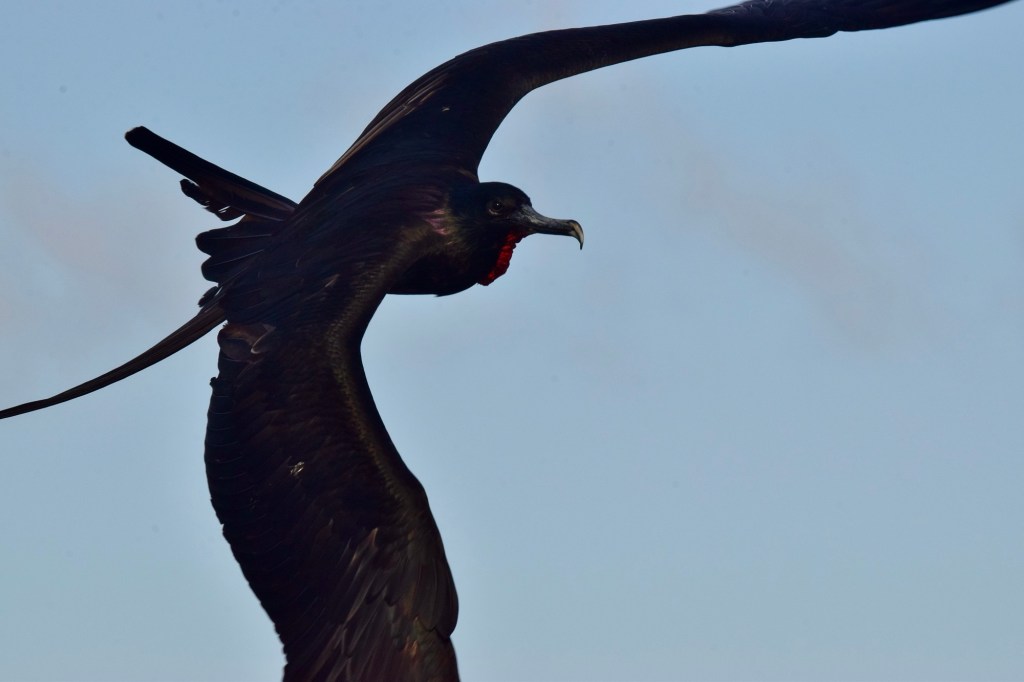
North Seymour Island is a strange place. Under the right conditions, I would go so far as to say that it might even be eerie. A forest of dead-looking trees. Golden grass on a slab of sun-scorched rock, where the boulders come to life before your eyes and take the shape of gigantic land iguanas, lumbering across the path like miniature dinosaurs, while pterodactyl-esque frigatebirds cast enormous shadows as they hang in the wind. It’s worth coming to this place if only because it’s so different to everywhere else.
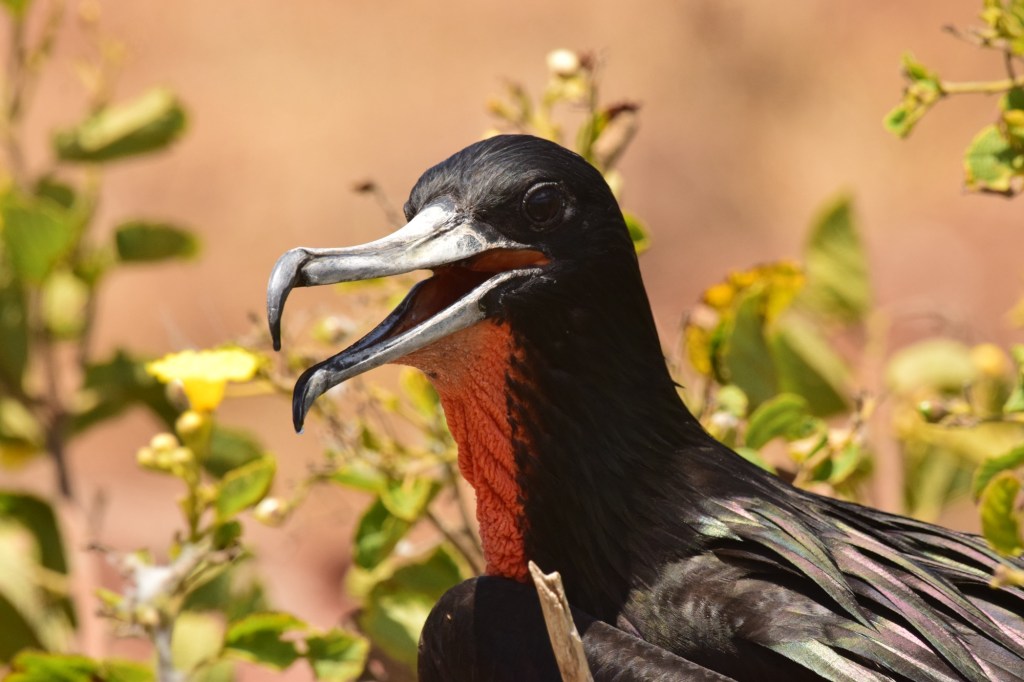
The big draw of North Seymour is its huge colony of frigatebirds. These aerial pirates can be found all over the Galápagos Islands, but they have their primary stronghold here off the coast of Baltra. More than a thousand pairs breed here each year, accompanied by thousands more juveniles, making North Seymour probably the best place in the world to see these magnificent creatures up close.
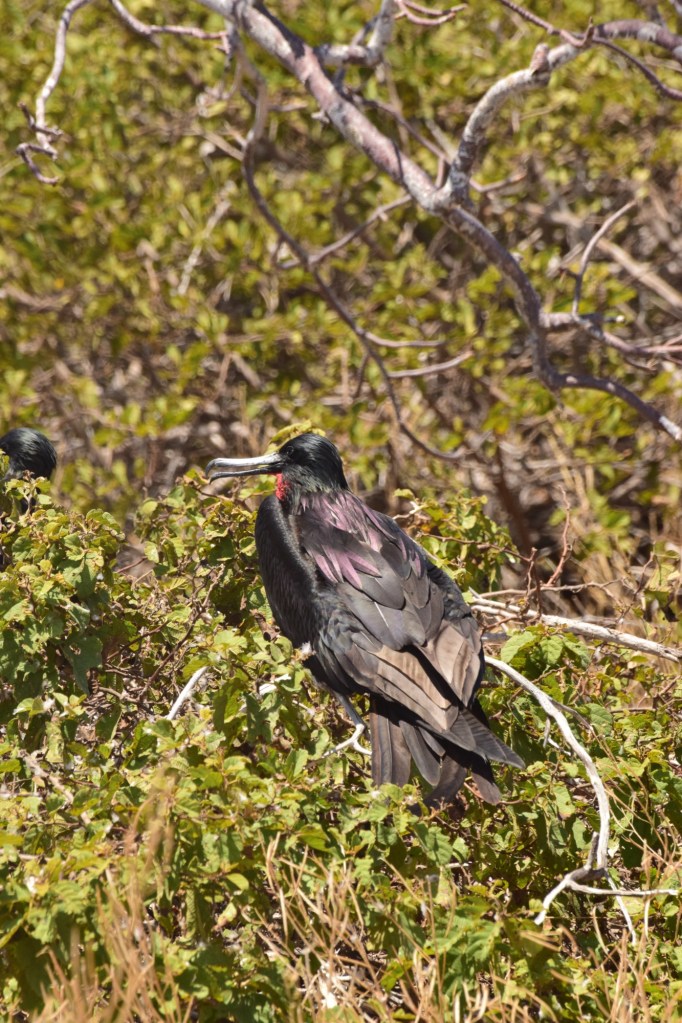
Both great and magnificent frigatebirds can be found here. The difference between the two is only slight, but easily appreciated in the sunlight: male great frigatebirds have a green sheen on their shoulders, whereas magnificent frigatebirds’ shoulder feathers shine a glossy purple.
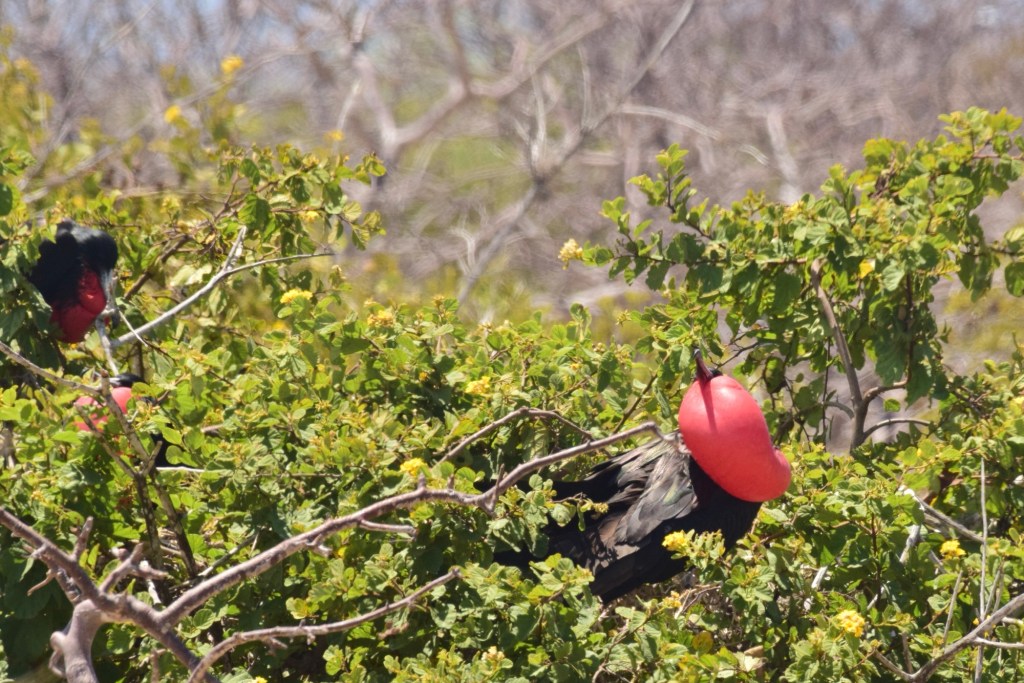
This is also a spectacular place to see the males inflating their famous throat sacs to attract the attention of passing females. We’re quite late into the breeding season, so this wasn’t as common a sight today as it was a month ago, but I did hear and see a few males displaying a fair distance from the path.
Frigatebirds are far and away my favourite birds of the Galápagos. They may be one of the easier creatures to spot – they were the first animals I saw as the plane came in to land and I am quite sure they will be the last I see, too – but that does not detract in the slightest from their magnificence.
I caught myself thinking more than once that if I ever got a tattoo (Ed.: I won’t), I would consider the silhouette of one of these beautiful creatures. I seem to be drawn to the vultures of the animal kingdom, even where there are no vultures. Or perhaps it’s the fact that these aerial pirates are effectively feathered bandits – and I have always had a thing for bandits. I very nearly wrote my undergraduate dissertation on bandits.
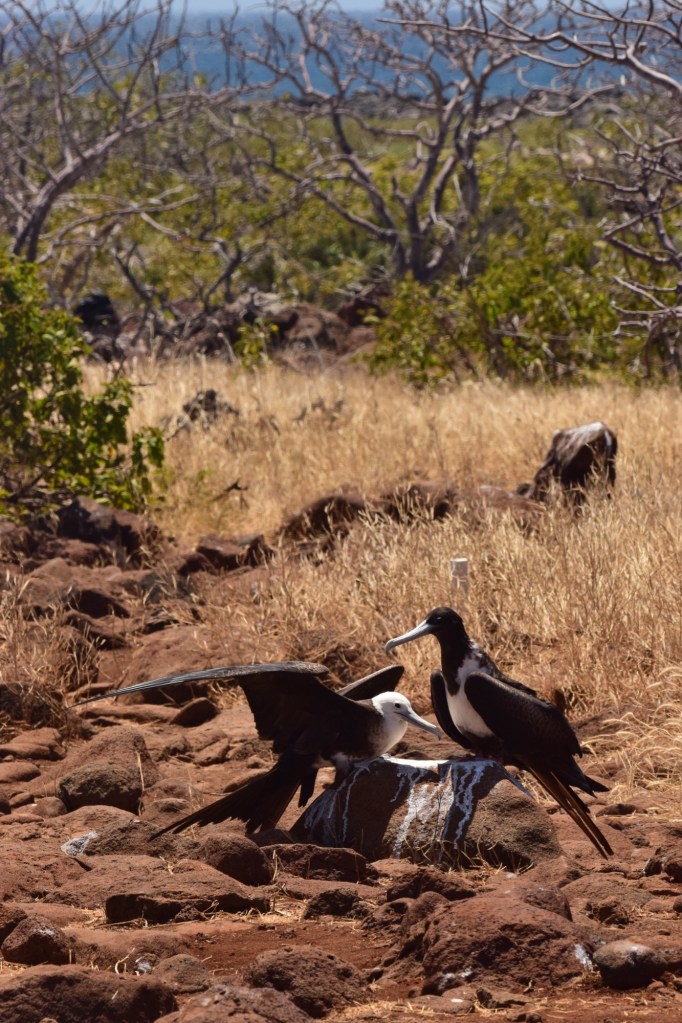
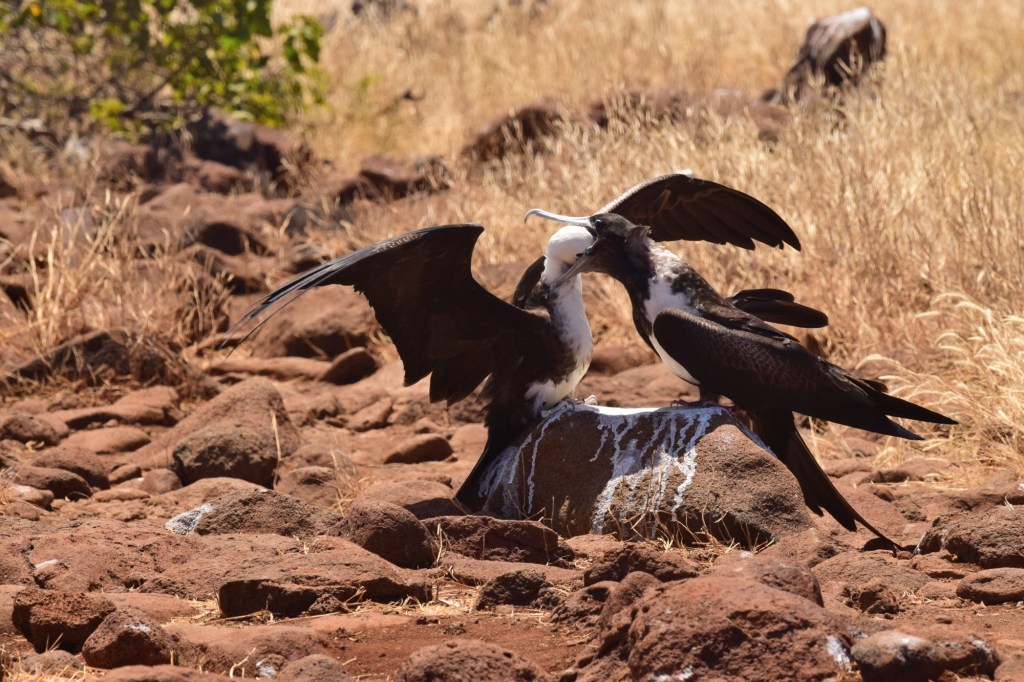
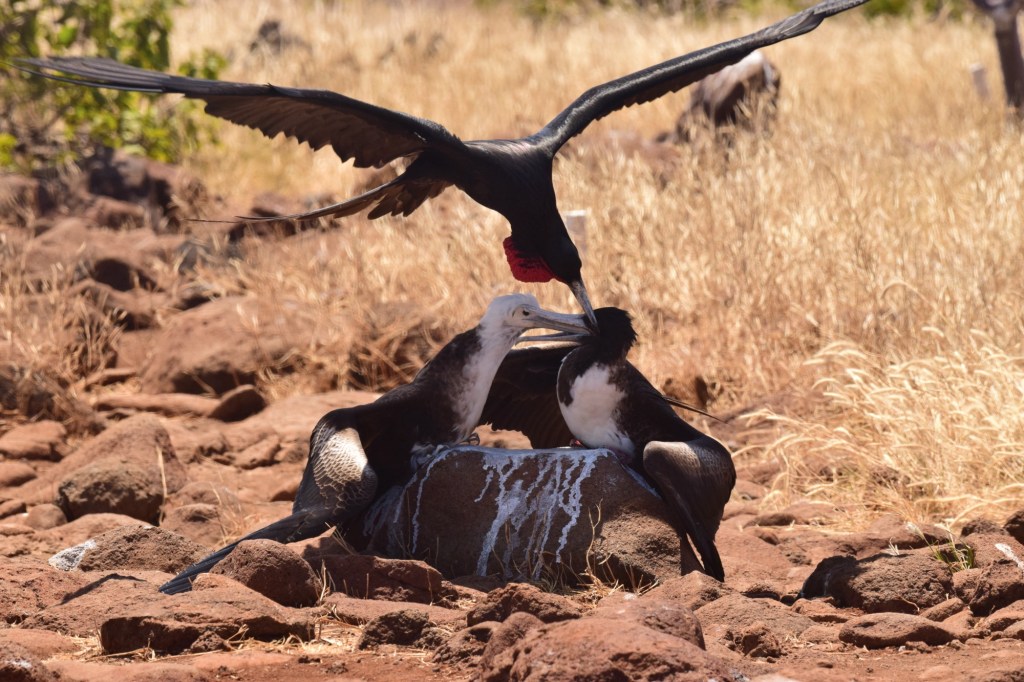
One of the best things about the Galapagos is that the animals’ lack of fear allows you to witness the kind of behaviour that normally goes unnoticed. This youngster called its mother to it and, after much high-pitched pleading, convinced her to disgorge her catch so that it could eat.
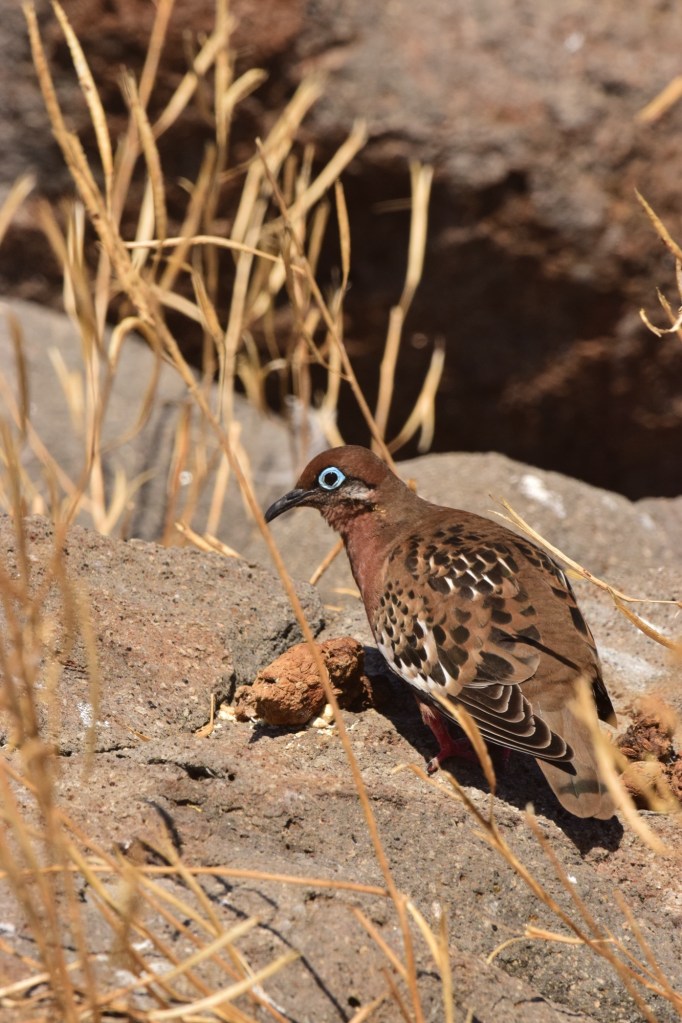
Frigatebirds aside, I finally managed to track down a Galápagos endemic: the Galapagos Dove. These tiny cousins of the Peruvian doves must have been blown onto these islands millions of years ago, adapting into the colourful, rock-patterned creatures you can see today. They avoid towns and cities, so to have a chance of finding them you have to search the more remote corners of the inhabited islands.
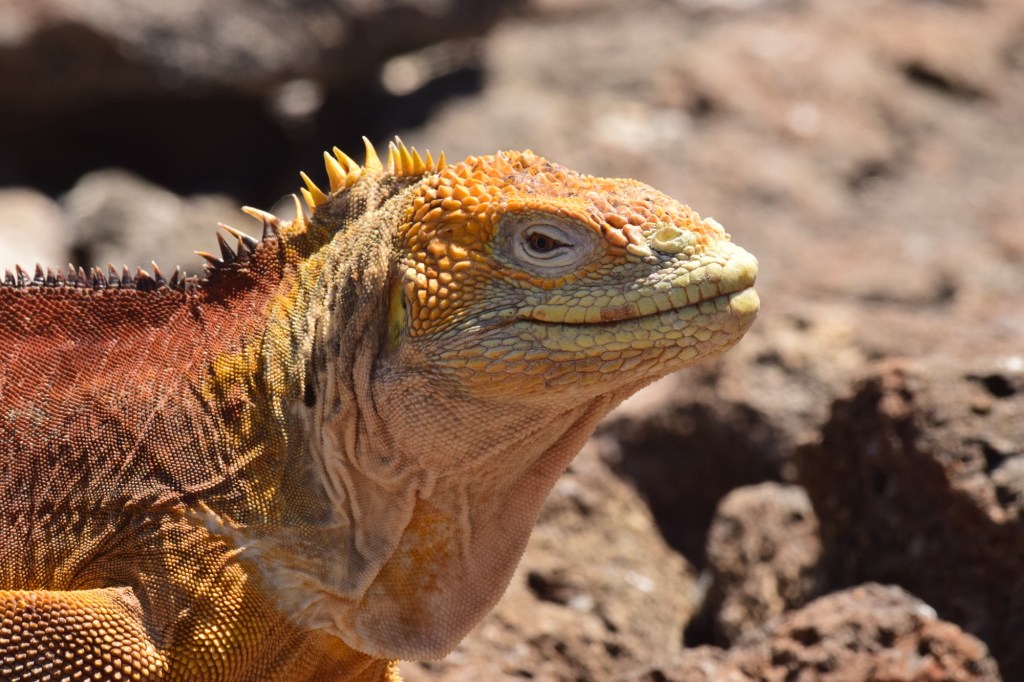
So far I’ve managed to neglect the other star of North Seymour: the land iguanas that have made this island their home since they were extirpated from Baltra. Only the males have the distinctive sandy-orange colouration – the females are a more uniform grey in colour.
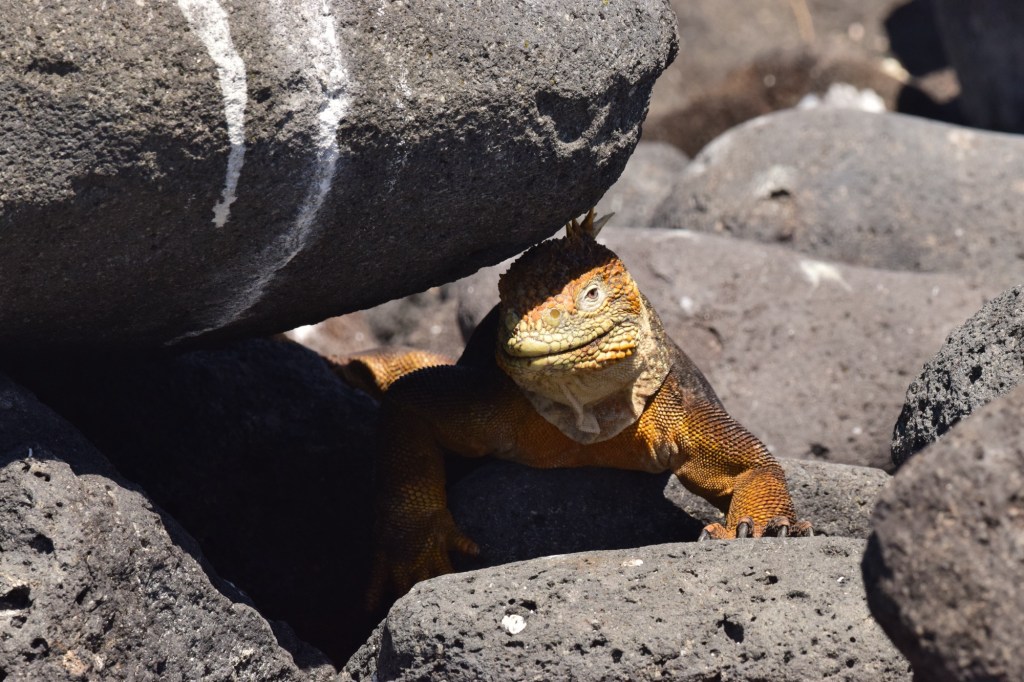
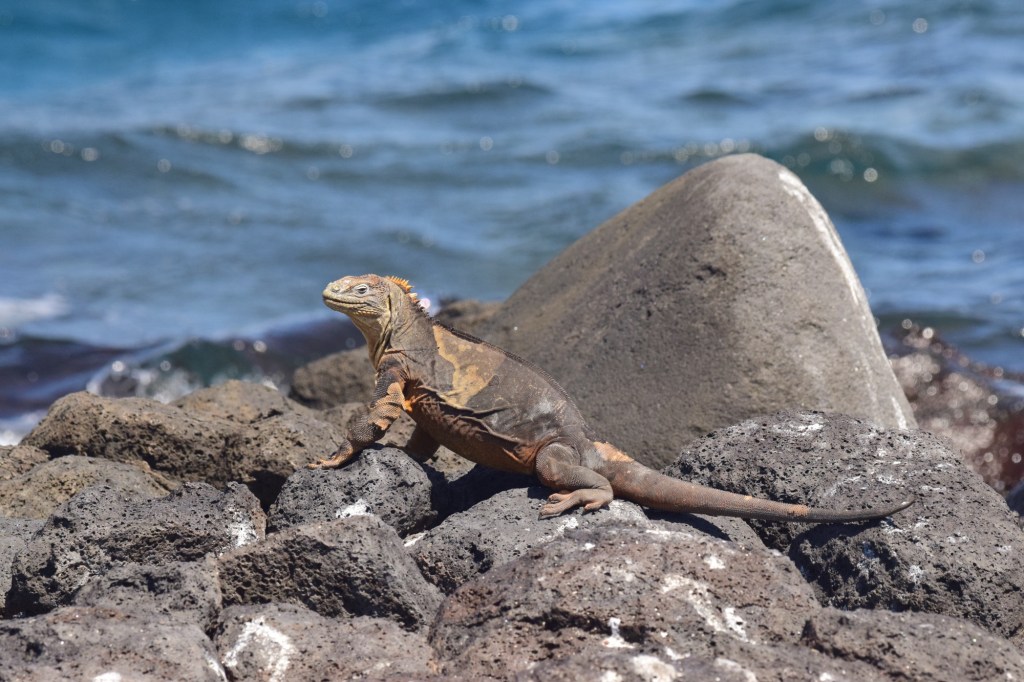
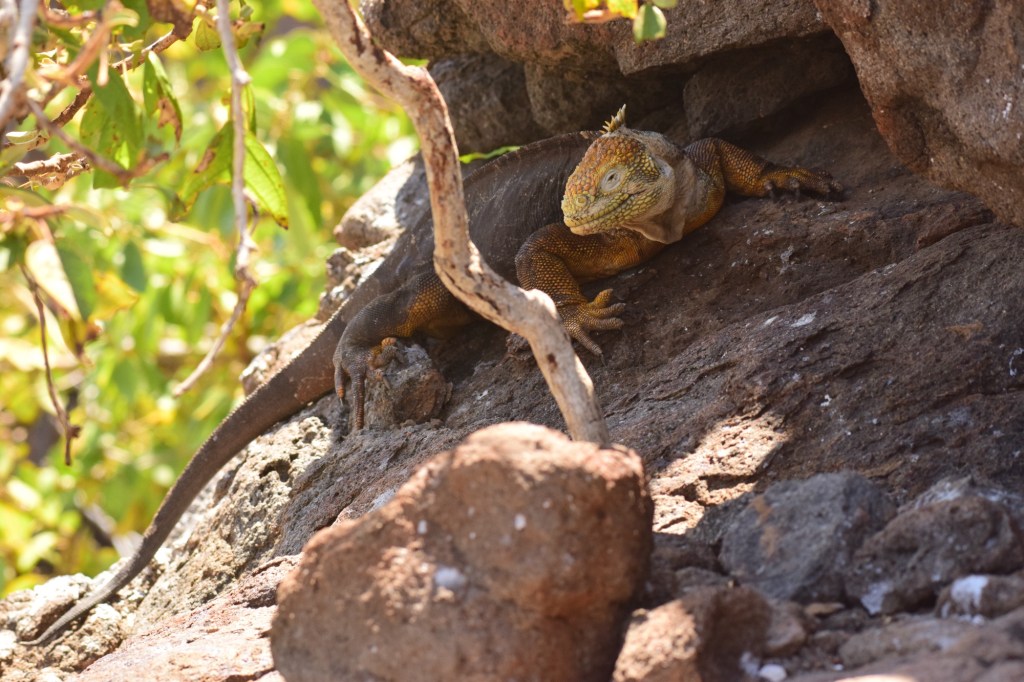
Before we left, a scuffle in the rocks sent one of the females scurrying across the path and into the shadows of the cliff. Her spook, the alpha male, followed her only as far as the path before stopping to cast a languid and uncaring eye in our direction.
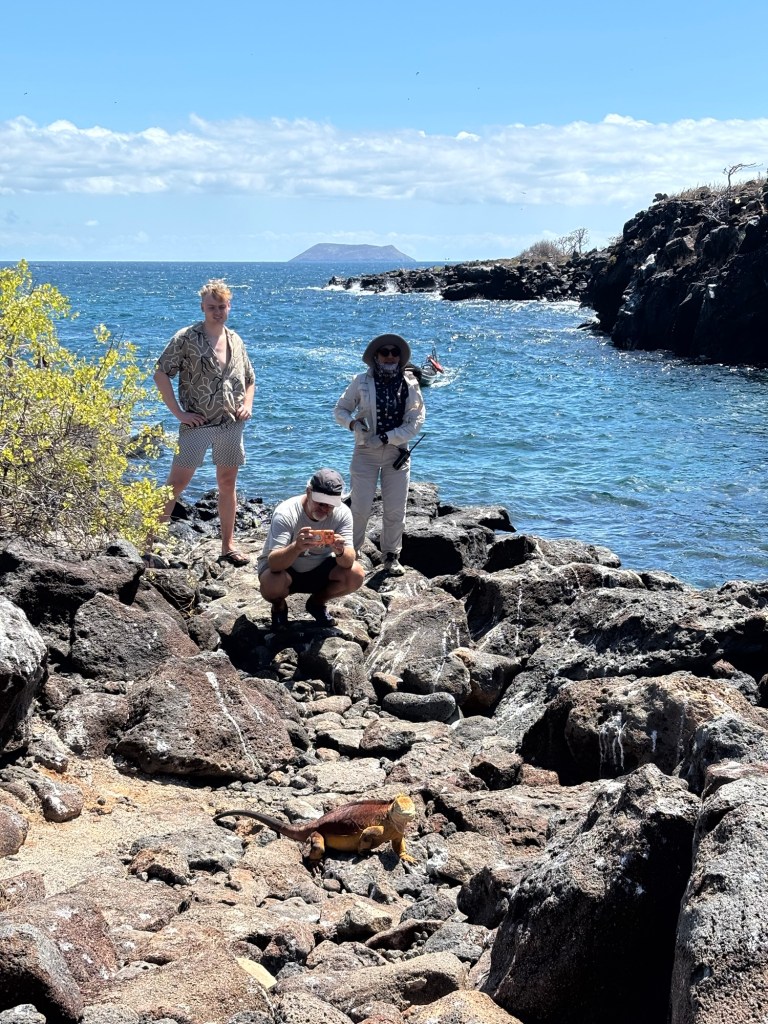
These land iguanas look a lot more like their green cousins back on the mainland than their hyperspecialised marine cousins with whom they share the island. A younger me would have come to the islands purely for the iguanas. I was hugely into reptiles back then. I eventually became more interested in birds, partly because the UK doesn’t exactly have a thriving population of reptiles. So it was nice to embrace my inner child today and binge on some spectacular reptiles.
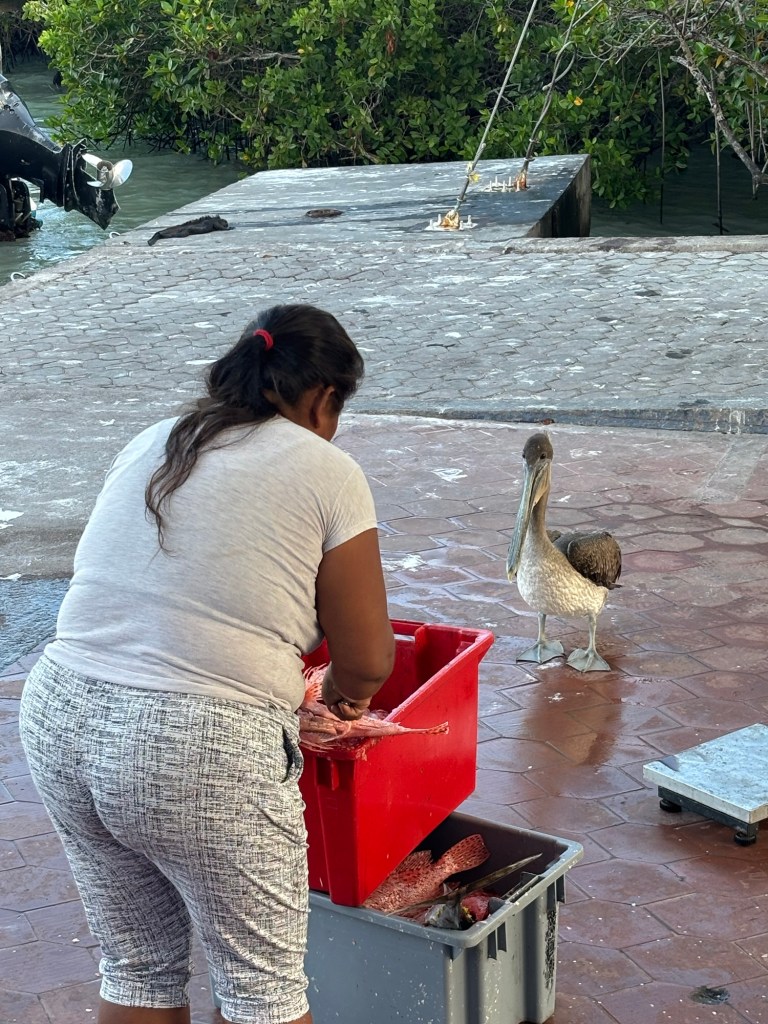
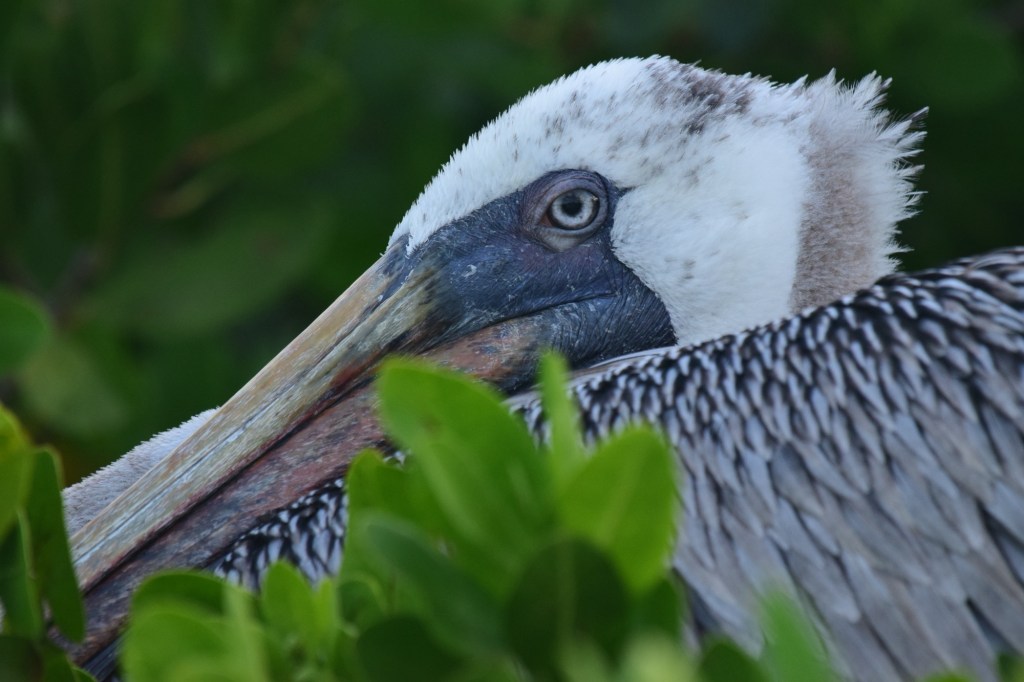
I spent my last afternoon in Santa Cruz down by the mangrove-lined fisherman’s wharf watching the pelicans. There is always bycatch to be had and so both pelican and frigatebird gather at the right time of day to pick up the scraps left out for them by the fishermen.
Like so many gringos, I’m just a visitor to these islands: here to see one of nature’s greatest marvels before returning to my normal life far across the sea. But these galapagueños spend their entire lives surrounded by these beautiful creatures: pelicans, turtles, frigatebirds, mockingbirds, sea lions, marine iguanas, giant tortoises and Sally Lightfoot crabs are as much a part of their everyday as house sparrows and pigeons are for us. That’s absolutely mind-boggling for me, but it’s only a different reality. No wonder the rangers are so defensive of their greatest treasure.
Tomorrow, I have to make my way back up to Baltra to catch my flight back to Guayaquil, then on to Santiago via a layover in Lima. It’s a fairly long-winded flight, but the real question is how to get to the airport as a single traveler. I might end up taking a taxi to the Itabaca channel, as it’s set at $25 and I did just find a secret stash of dollars that I forgot I had (I’m very good at hiding my cash in different places for safety’s sake and then forgetting where I put it).
My adventures are nearly over. It’s been a long summer. It’s going to sound odd, but I could use a holiday. Traveling solo means being switched on all the time, even when you’re laid out on a tropical beach. The Galápagos is neutral territory, but there is no place like home. I’m looking forward to a little peace of mind – but that is still some ten days away. The journey continues! BB x
Puerto Ayora, Galápagos Islands. 21.00.
This morning I said farewell to San Cristóbal. The easternmost island of the Galápagos chain has been a blissful retreat from the world, shrouded in stormclouds and sunshine. Having a cabin all to myself on the edge of town made a change from the usual hostel circuit. After several years of bunk beds of varying stages of comfort, I think I earned it.
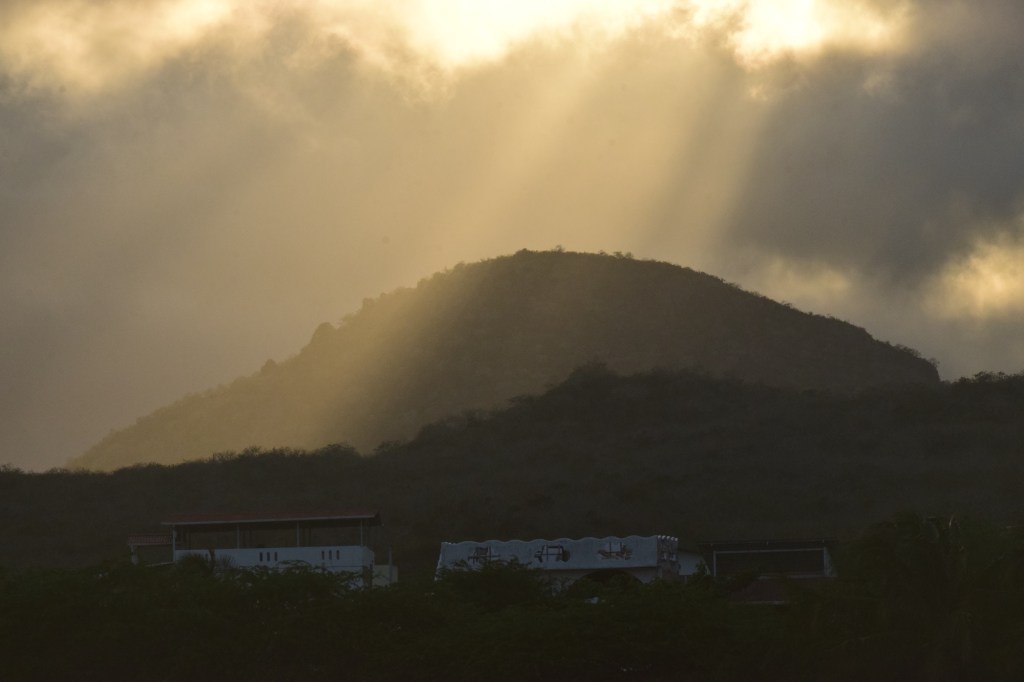
I arrived a full forty-five minutes early at the harbour, as instructed, to be last in the queue. I should have known: the majority of the tourists on these islands at the moment are Dutch, Germans and Americans, who aren’t known for being slack when it comes to appointments. As such, when I finally did get onto the ferry, I was given a seat at the very front of the boat.
The Israeli sitting next to me was incensed. “Shit, man. This fucking sucks. These are the worst seats in the whole boat.” I smiled and shrugged it off – windowless or not, it was only a two hour boat trip across the open ocean – but he was seriously ticked off about what he saw as the rank injustice of the affair.
Fortunately, due to a mix-up involving the unexpected arrival of a family of four, the captain asked if we’d be so kind as to move up on deck so the family could sit together – so I effectively got an upgrade for free. So did the Israeli, whose response was a lot more vainglorious than mine, but I guess it takes all sorts to make a world. Up top, I had the refreshing breeze of the ocean wind, the occasional spray of saltwater and views all around – and, unlike a number of passengers, I wasn’t sick once. For somebody who isn’t exactly a sailor, I have always been surprised at my resistance to seasickness. Surprised – and very grateful!
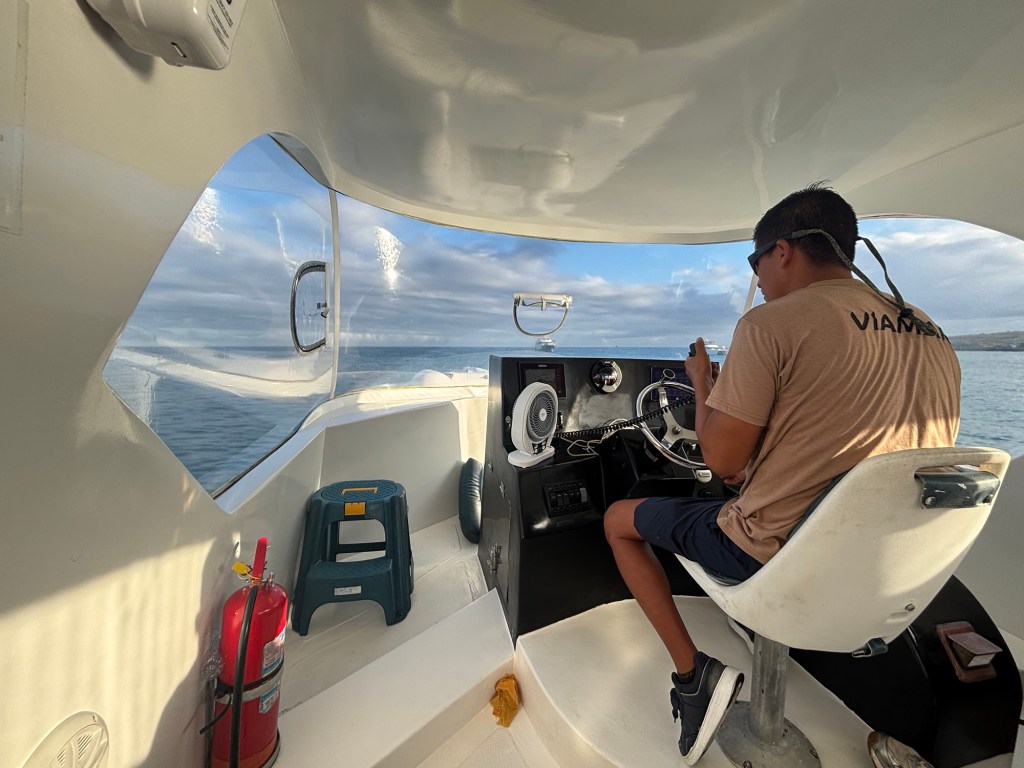
The ferry between San Cristóbal and Santa Cruz takes about two hours, passing the uninhabited island of Santa Fé shortly before docking in Puerto Ayora, the largest town in the Galápagos. It was only shortly after nine, so I had a quick breakfast and then thought I might at least check in my luggage, but the lovely ladies at my hostal, the Flightless Cormorant, let me into my room right away. With my rucksack unpacked, I set out to explore and get my bearings of Puerto Ayora.
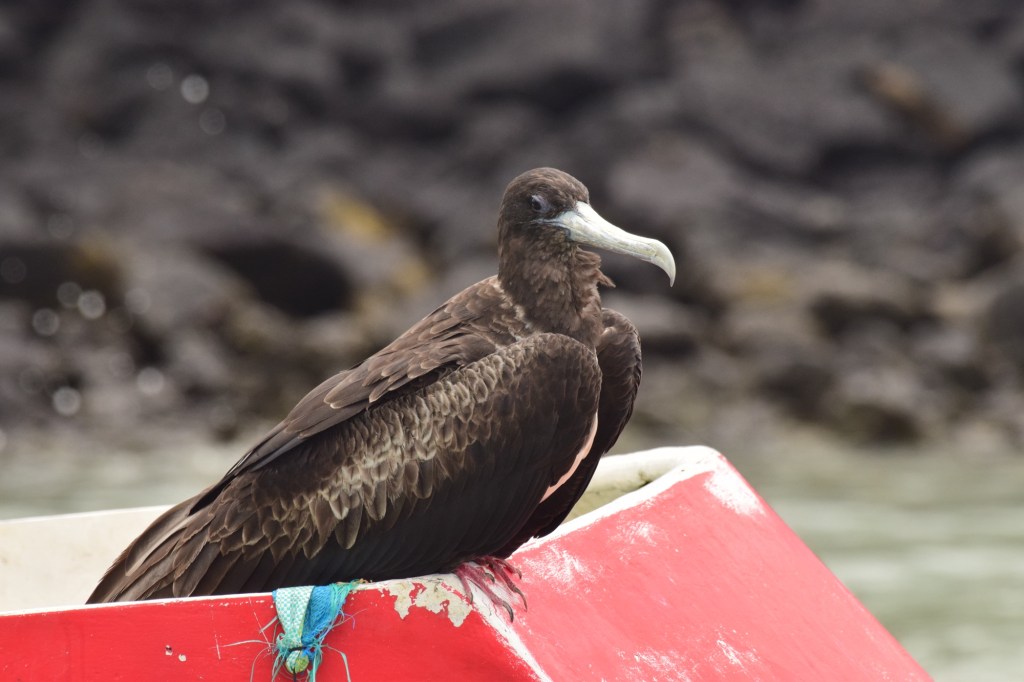
As they always are in the Americas, the fisherman’s wharf is a hive of activity. In Valparaiso, it draws gulls, terns, pelicans and the local sea lion population right up to the harbour. Here in the Galapagos, the frigatebirds add some local colour. They almost never seem to land, and the reason for that became clear when I saw one resting on the roof of a boat: their feet are tiny, almost vestigial in appearance. It seems that this was the sacrifice they made millions of years ago in order to become masters of the air, just like our swifts back home in Europe, only more than five times the size.
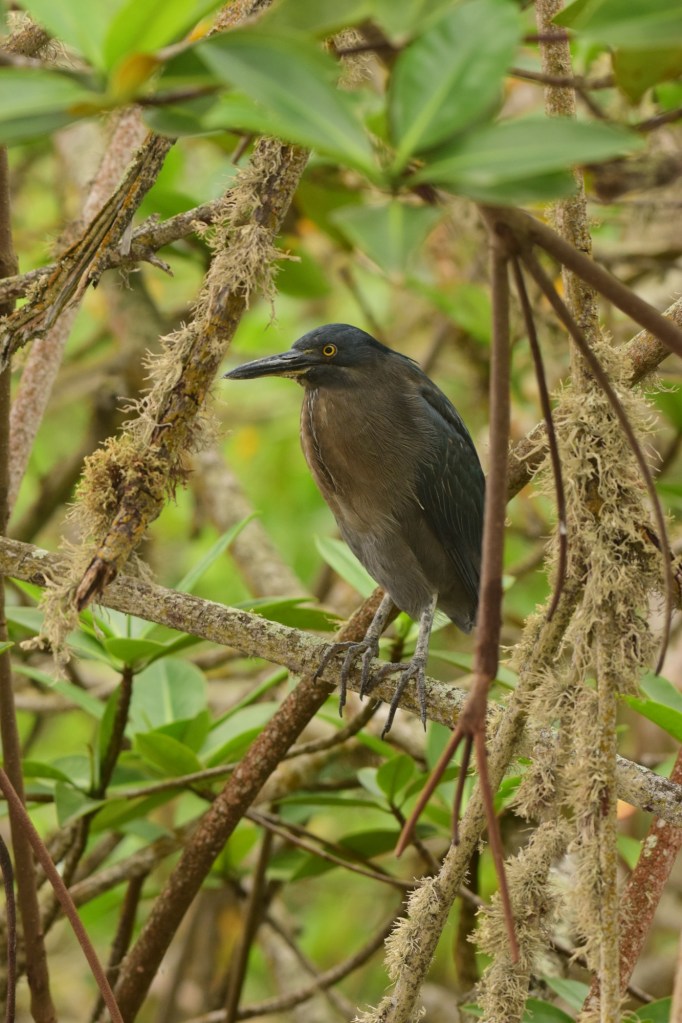
Here, as on San Cristóbal, you can find lava herons, with the added touch that the mangrove trees make for a slightly more interesting backdrop. The mangroves are easily my favourite thing about Santa Cruz – I’ve only ever seen them in books and documentaries, and they are every bit as spectacular as I always thought – even here, where they start right in the heart of Puerto Ayora itself.
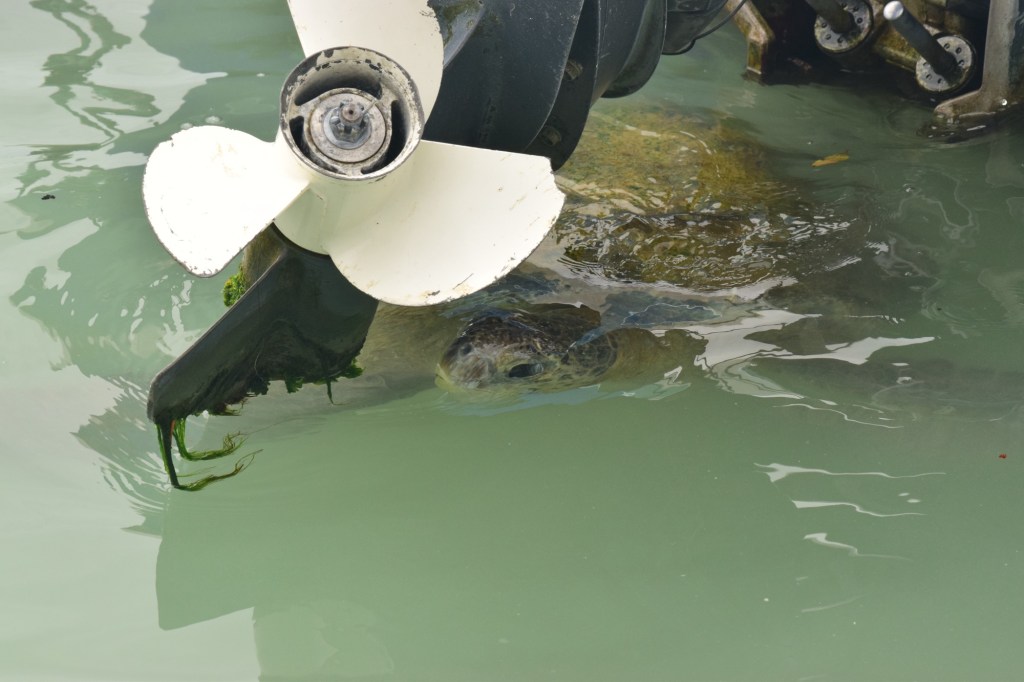
Obviously my turtle encounter yesterday wasn’t enough, because a short burst of breath near the boats alerted my attention to a youngster drifting near the surface, less than a stone’s throw from the harbour. It was feeding on the algae growing on the bottom of the boats, particularly on the propellers raised just inches above the surface. The Galápagos Islands are famous for the close encounters you can have with the local wildlife, but I have to admit, I wasn’t expecting to see both sharks and turtles without even having to leave the larger towns.
One of the big draws in Puerto Ayora is the Charles Darwin Research Centre to the east of the city. Free to visit – except for the Fausto Llerena Giant Tortoise breeding centre, which is perilously easy to stumble into (and be politely removed from) as it has no fencing! – it is worth a look-around even if just for the passport stamp you can acquire here, the only legitimate way to obtain such a stamp (as they do not issue any stamps at the airport).
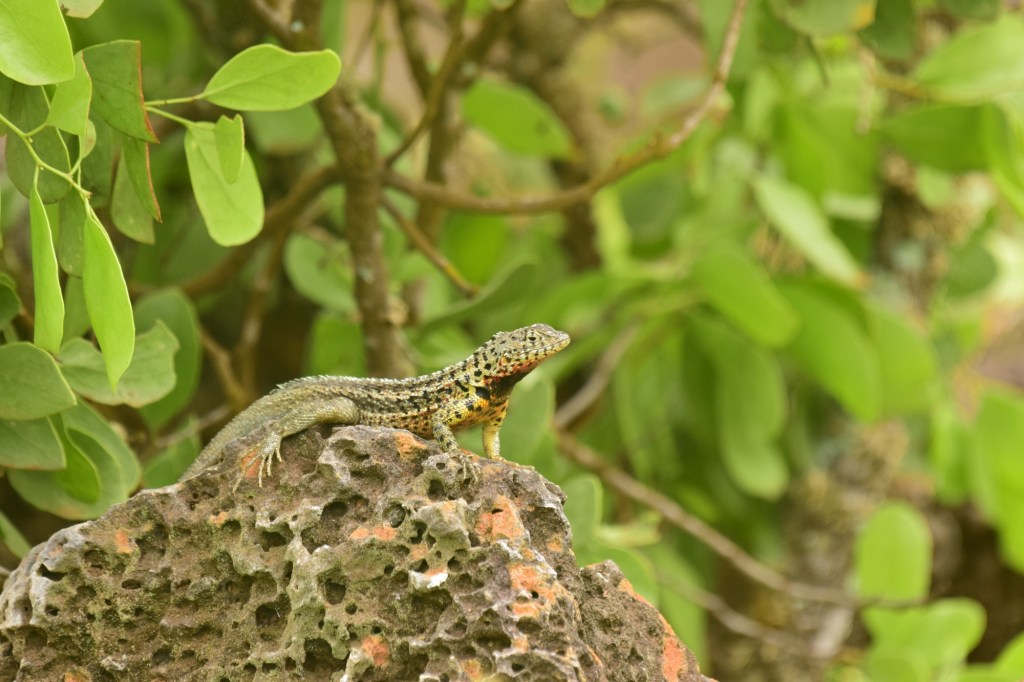
The walk there takes you into the wilder country around Puerto Ayora, and you have to watch your feet: there are reptiles everywhere. I lost count of the lava lizards and marine iguanas, and I’m almost certain I saw the looped body of a Galápagos snake disappear into the bushes as I turned a corner.
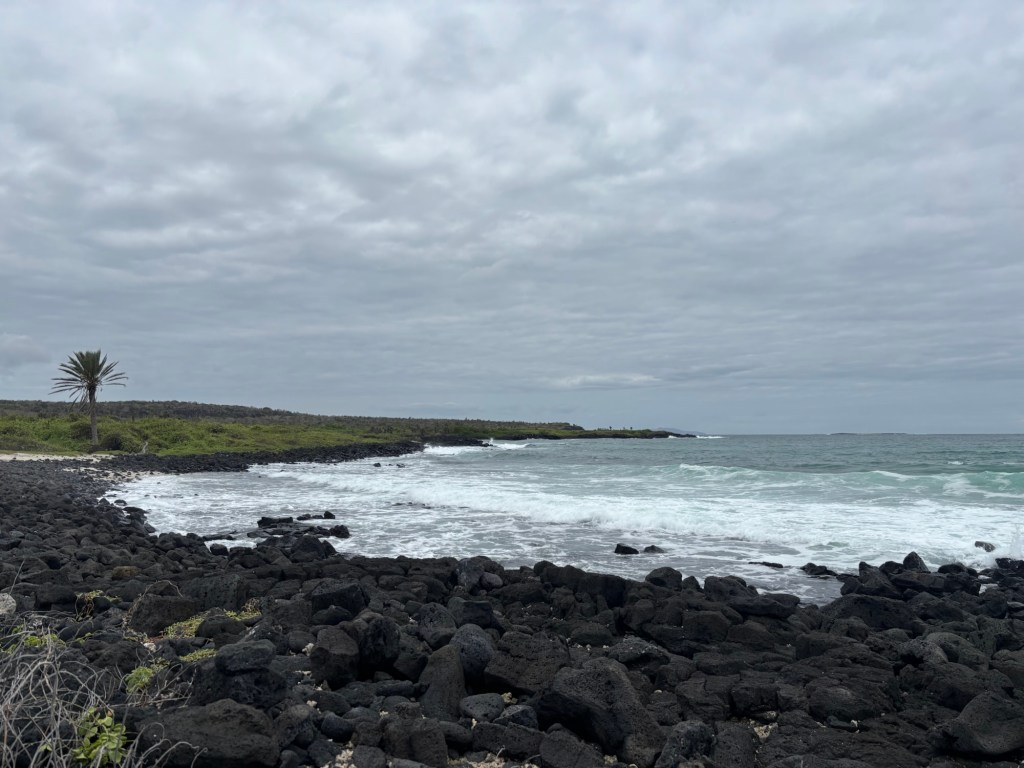
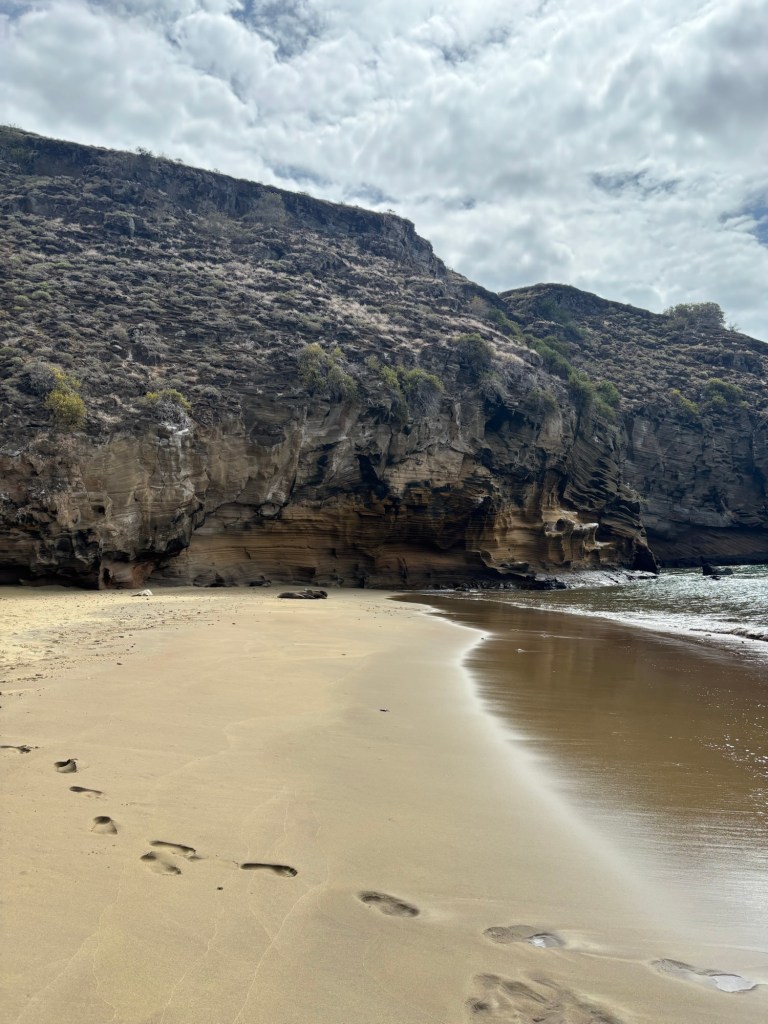
Follow the trail that leads east of the Charles Darwin Research Centre and you’ll reach Playa Ratonera, a wild and wave-battered volcanic shoreline. It has a few sandy stretches, but it’s hardly a pleasure beach, as it gets the full force of the Pacific. It’s mostly mangroves, carpet weed and black volcanic boulders, with the shattered white remnants of millions of years of coral taking the place of pebbles.
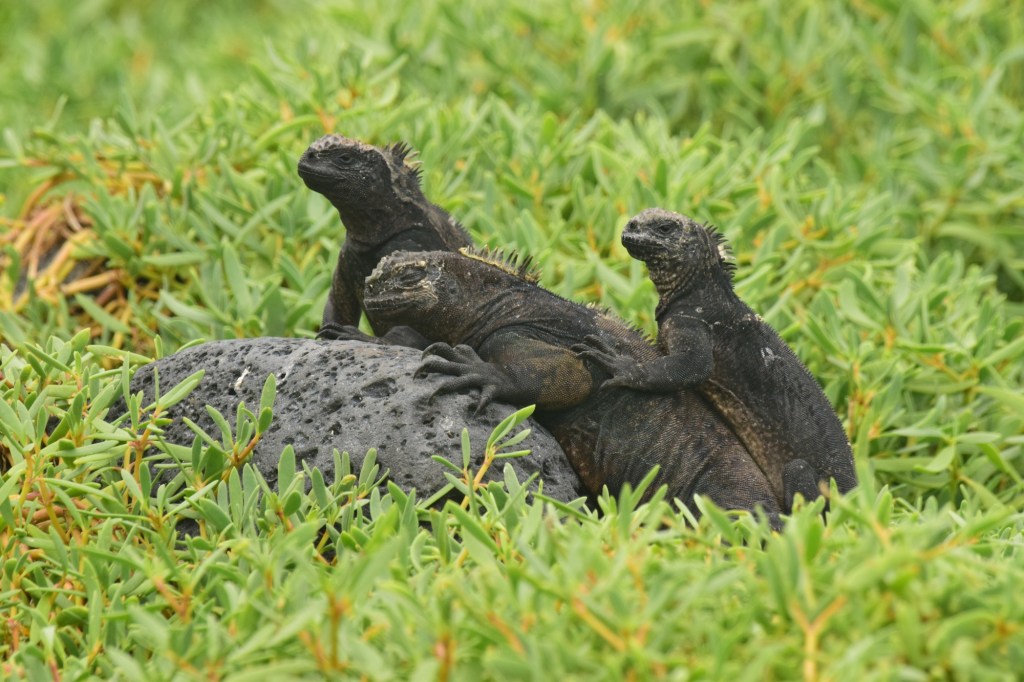
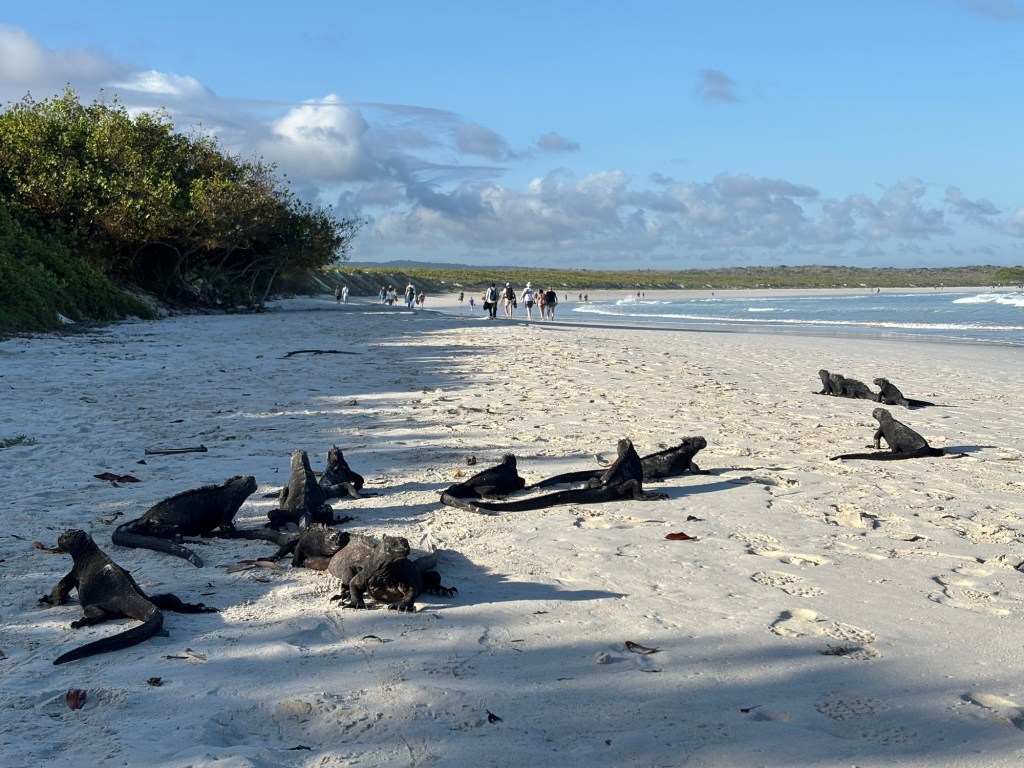
One huge draw is the local population of marine iguanas. There were always a few around the harbour on San Cristóbal, but Santa Cruz has hundreds of them.
The collective noun for marine iguanas is a mess, which is about right. They are absolutely everywhere, sprawling all over each other on the path, off the path, among the weeds and atop the rocks. You really do have to watch where you step, because they’re a lot more sluggish than the lava lizards and don’t tend to move even when they’re only inches away.
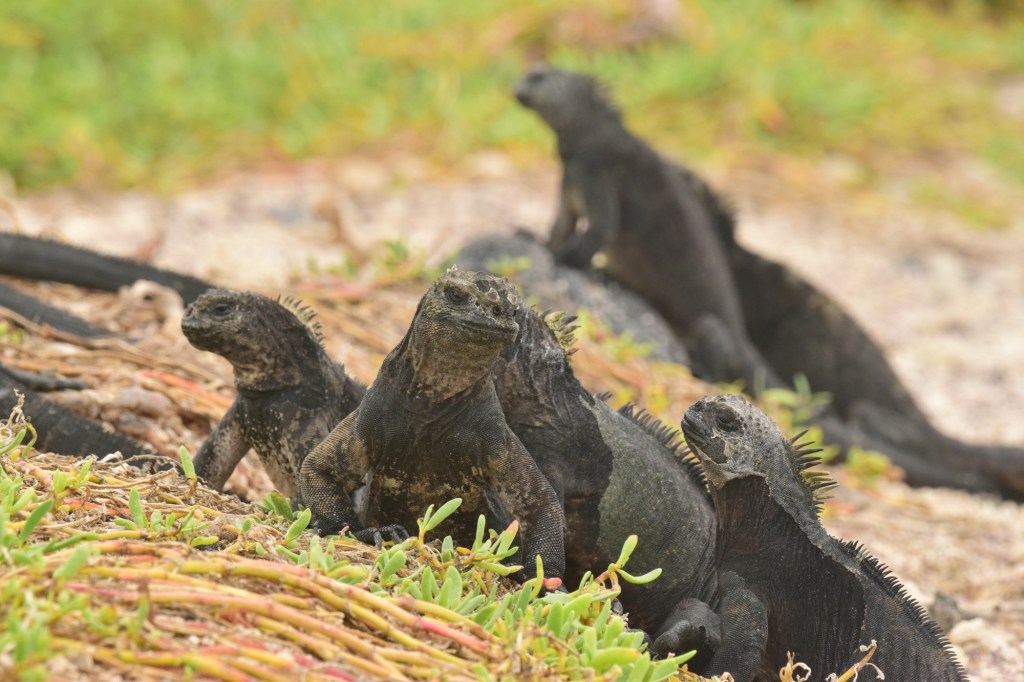
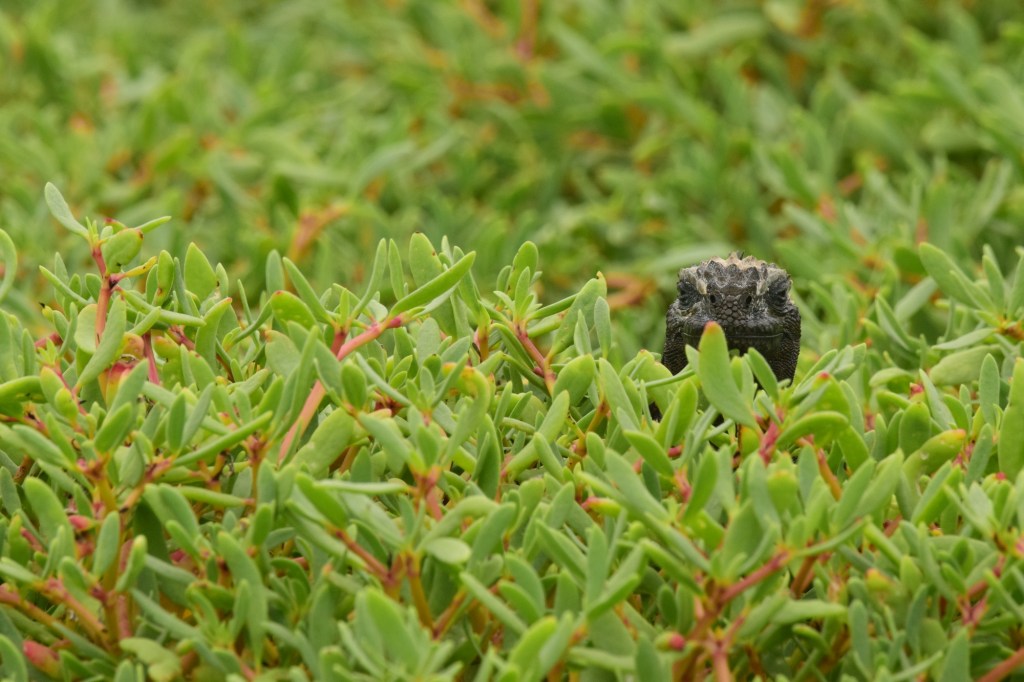
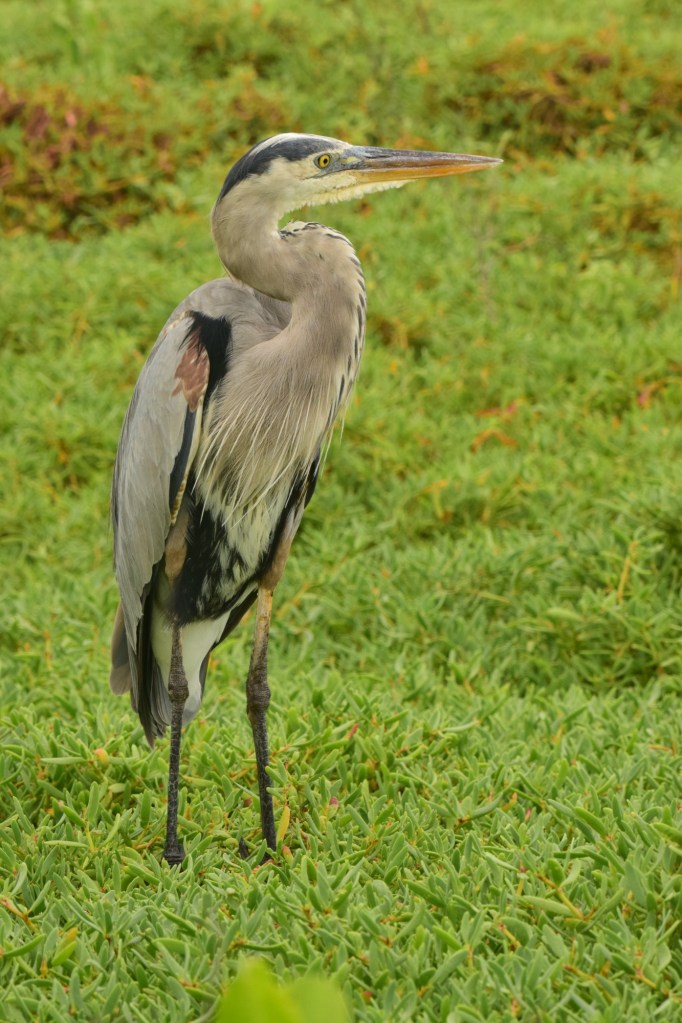
They were attended by a massive great blue heron, the American cousin of our grey herons. Herons of this size have a Catholic diet, so I imagine the smaller iguanas form a part of that, before they become too large for even the most ambitious herons. I’ve seen these birds swallow fish that are far too large for their long necks, but they probably do go down the hatch a lot more easily than a spiky, scaly adult iguana.
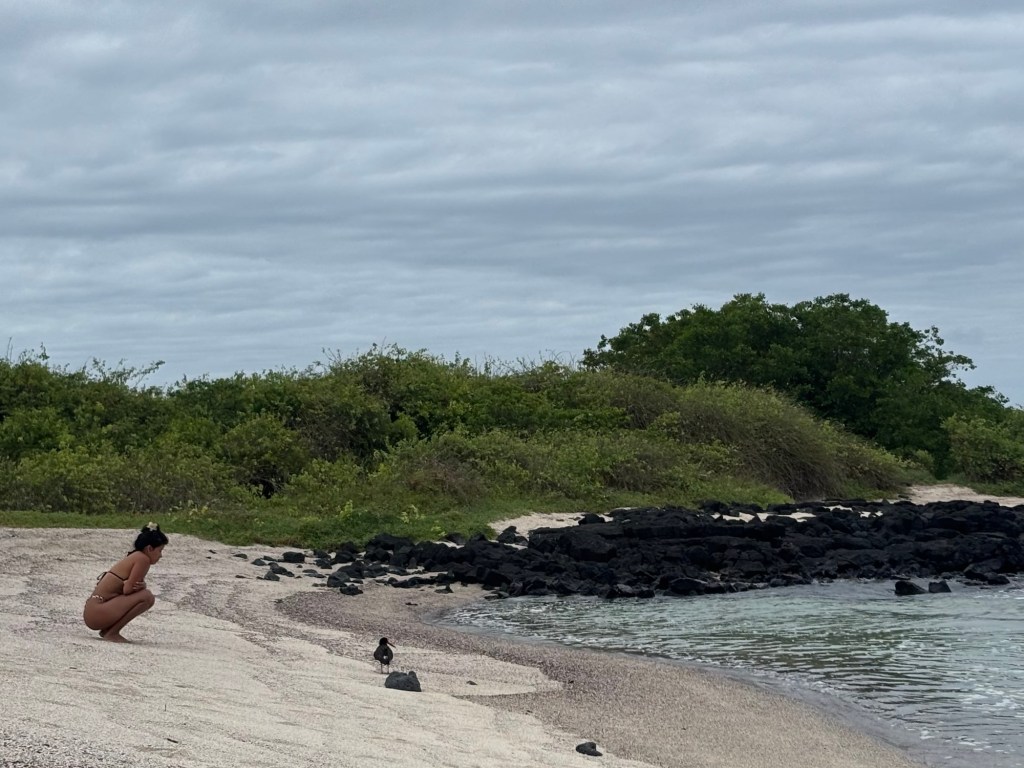
Time and again here I am bowled over by how unafraid the local wildlife is of us. Herons, iguanas, mockingbirds, finches, boobies and oystercatchers… none of them seem to mind one jot that they share their world with us. Only the whimbrels seem to have retained their wariness, though given their status as migrants in these islands, perhaps their behaviour may be excused.
The other beach worth visiting in Puerto Ayora’s immediate area is Playa Tortuga, a stretch of exposed white sand to the southwest. Getting there requires registering with a park ranger and a half hour’s trek through the opuntia cactus forest, but when you see the final destination, you’ll understand why so many people both local and foreign make this trek every day. It’s a paved route, so it’s not exactly arduous, and it does have the benefit of sending you through bird country. I finally saw the largest of the ground finches, with its impressively large nutcracker bill, as well as the local species of mockingbird, noticeably different in voice and appearance to the birds on San Cristóbal.
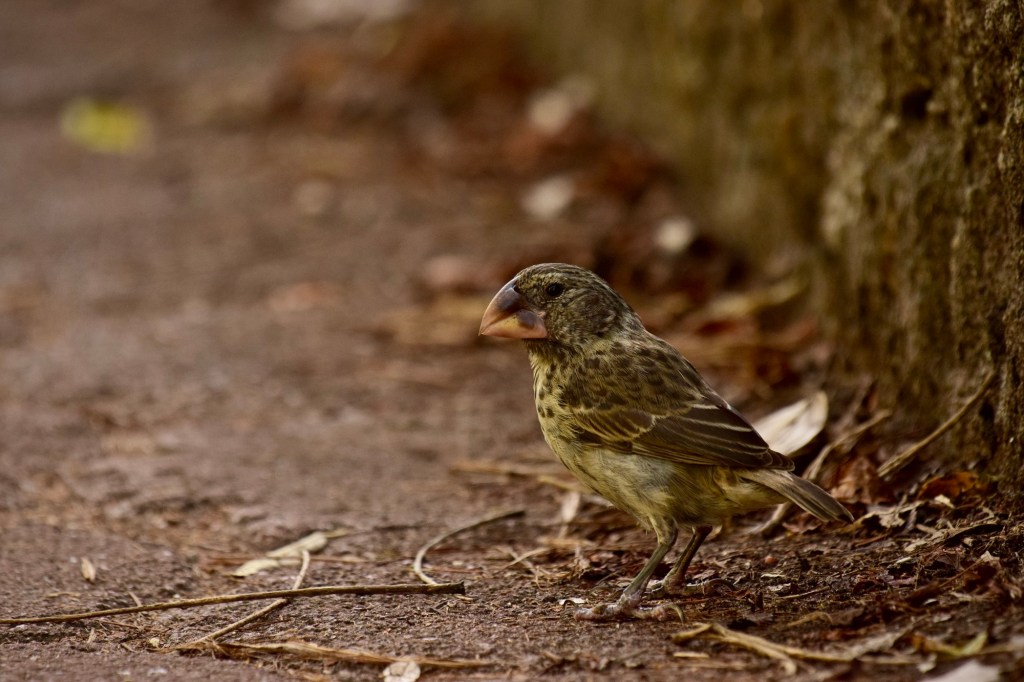
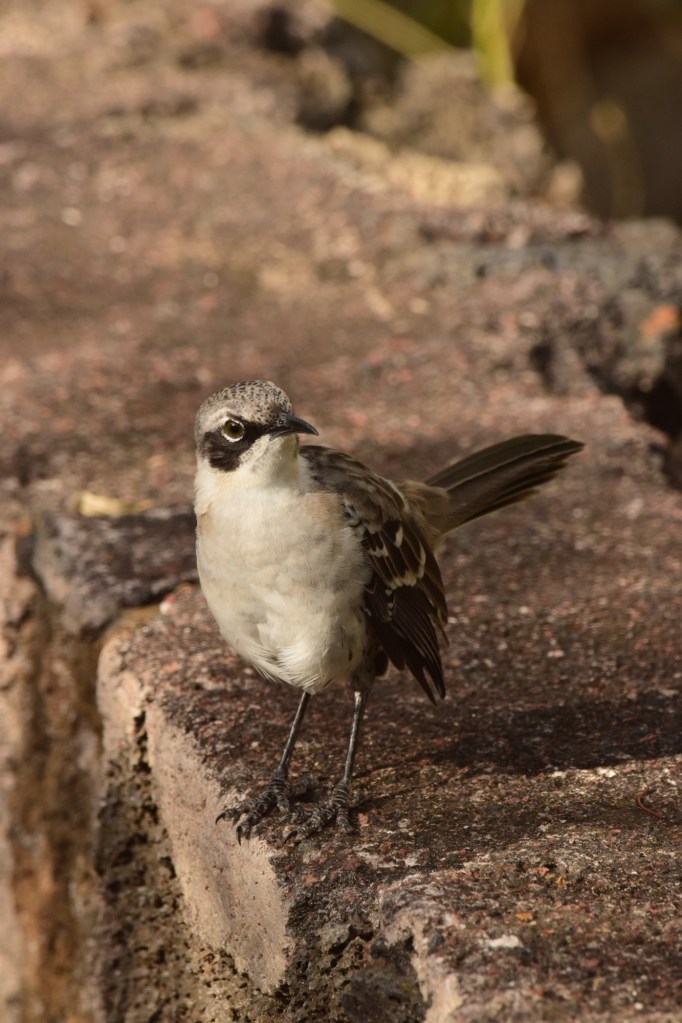
I believe Playa Tortuga is so named because it plays host to a breeding colony of green turtles at the right time of year, but to get there, you first have to cross Playa Brava, beaten savagely by the force of the ocean. When I got there the afternoon’s daytrippers were all heading back to town in a slow and sandy procession. The rangers close the beach at five, so as I arrived at twenty past four, I didn’t have an awful lot of time.
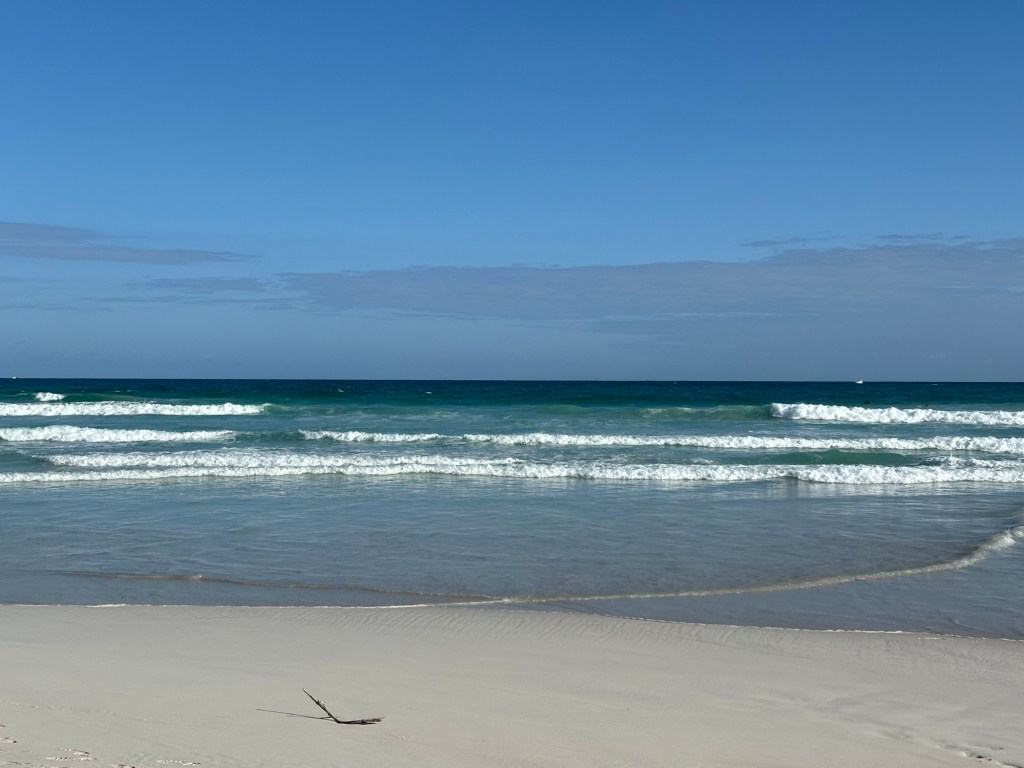
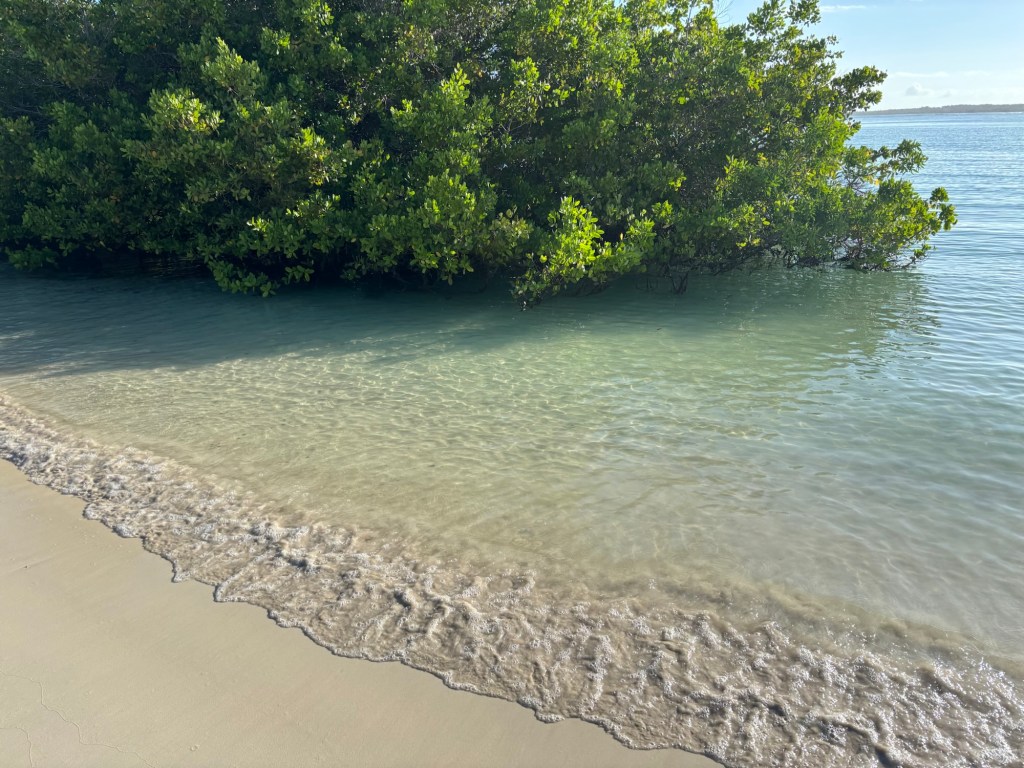
Time enough, though, to appreciate the strange beauty of the mangroves. On the far side of the red flag beach (where the waves are far too strong to allow for bathing) you’ll find the not-so-secret mangrove-lined bay of Playa Tortuga. It’s no hyperbole to say that it is by far the most beautiful beach in the Galapagos that I’ve seen so far: quiet, secluded and with views to die for all around.
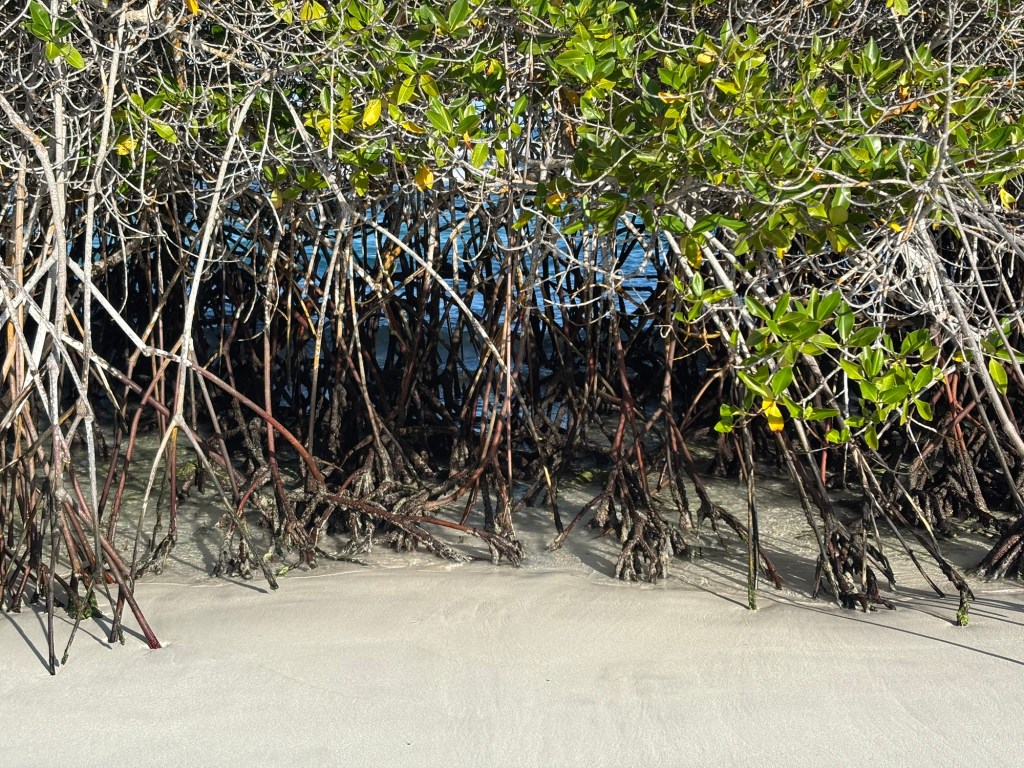
I didn’t bring my swimming gear, and it would have been too late to pop in for a swim even if I had, but it was a hard-fought temptation not to dive right in. I confess I usually have more than a little contempt for those who travel the world just to lounge around on a beach without a care for the local wildlife or culture, but when the beaches are this good, I can begin to understand why somebody might be mad enough to empty their bank account to be in a place like this.
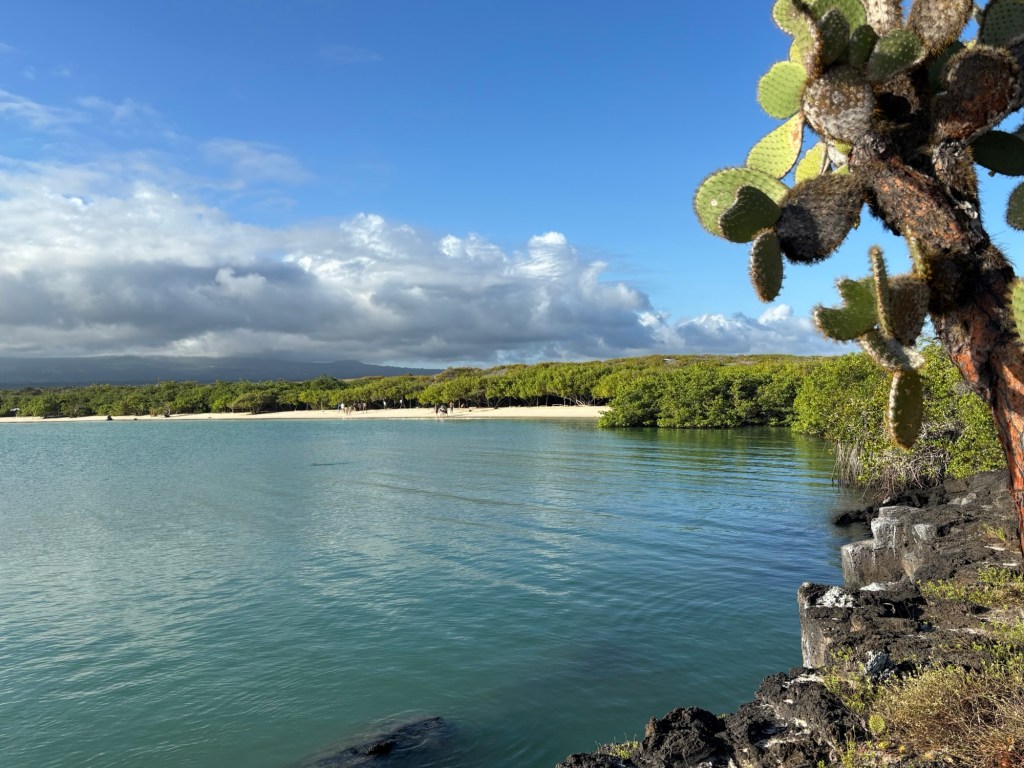
If you walk just a little bit further, you can see the entire bay with the mountains behind from a rocky peninsula, where the opuntia cactus grows. Tomorrow I’ll head up into those highlands in search of giant tortoises, but for now, it’s just me, the sea and the pufferfish swimming among the rocks below me.
I’ll close this post here – I had a lot more to report than I thought today. Maybe tomorrow will be a quieter one! BB x
Puerto Baquerizo Moreno, Galápagos Islands. 18.45.
At the time of writing, I still haven’t heard back from the folks at EcoChallenger about the trip to Española. They did say they’d had engine troubles last week and would provide me with a full refund if they couldn’t go ahead, but also that they would keep me informed. I sent a chaser to see if if they’d fixed their boat, but no luck.
So, rather than feeling glum about it, I found an alternative tour for today out to the other side of the island: Punta Pitt, the easternmost point of the Galápagos. Here, with any luck, I might be able to recreate at least some of what I would have found out on Española.
I picked up my snorkel gear from the Kingfisher GPS agency and walked back to the marina to meet my guide. Traveling with me today were a lesbian couple from California, a couple of American missionaries, their sister and her three children and a shy Australian birder. We were due to have one more on the team, but they never showed up – but at least while we waited I had time to get a better shot of the noddy sitting in the harbour, in the same place I saw it yesterday.
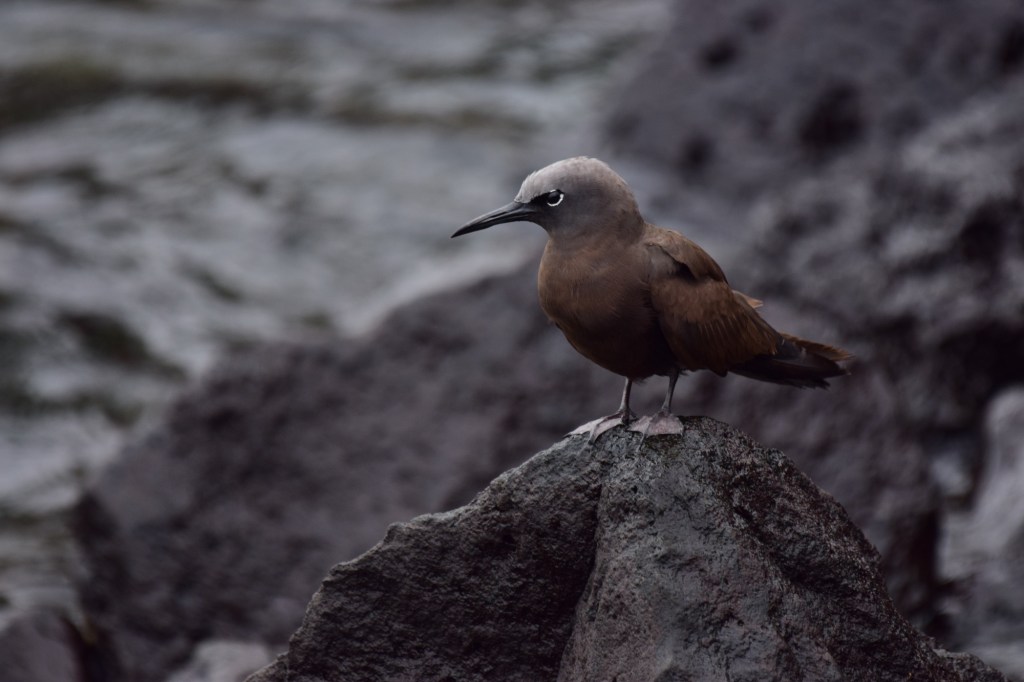
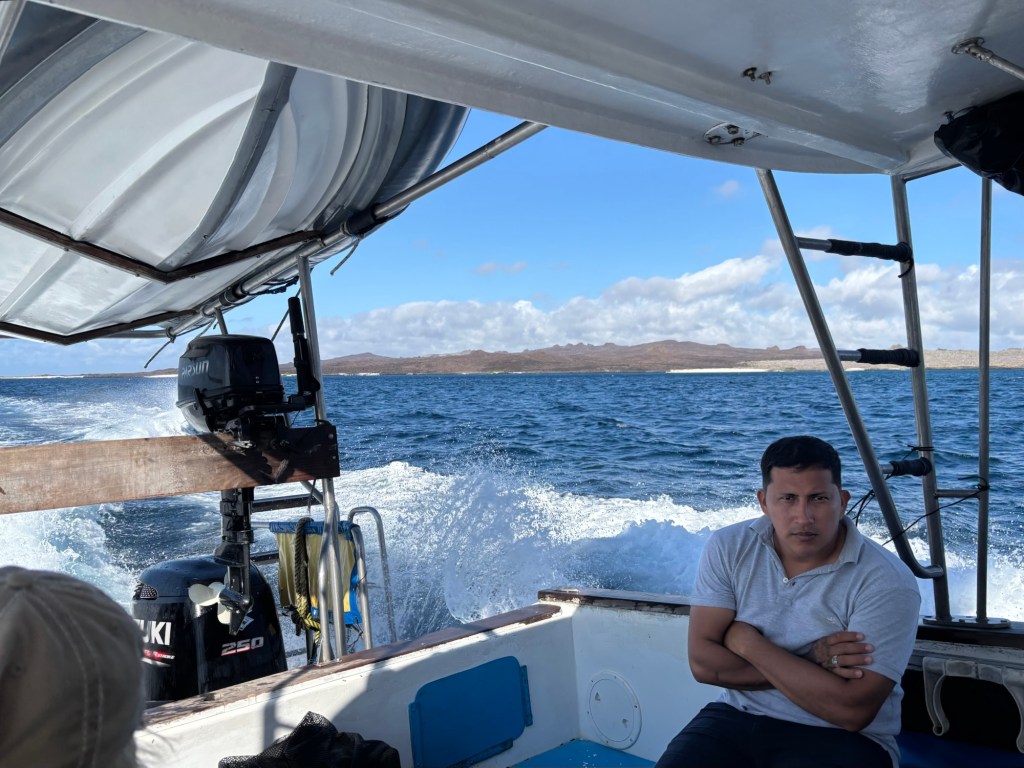
The journey to Punta Pitt from Puerto Baquerizo Moreno takes you all the way along the north coast of the island, and after passing the lighthouse at Punta Carola, it’s nothing but volcanic rock on one side and the open ocean on the other. Kicker Rock looms in the distance – a freestanding volcanic cliff famous for being the haunt of hammerhead sharks in the right season – but that wasn’t part of our itinerary, so we sailed on past. Beyond Kicker Rock, some of the Galapagos’ pelagic birds picked up our trail and followed the boat: Galapagos petrels, Galapagos shearwaters and two kinds of storm-petrel native to these waters.
I don’t believe in reincarnation, but if it did exist, I should love to come back as a shearwater. The speed with which they race across the water, seemingly delighting in the thrill of it… it’s magical to watch, even if they are in a mad hurry to find enough food to raise their chicks, sequestered in some burrow near or far away.
I was so busy keeping an eye out for seabirds that at least once I saw something else with wings leaping from the water: a flying fish, recently arrived in these islands, and just in time for the breeding season.
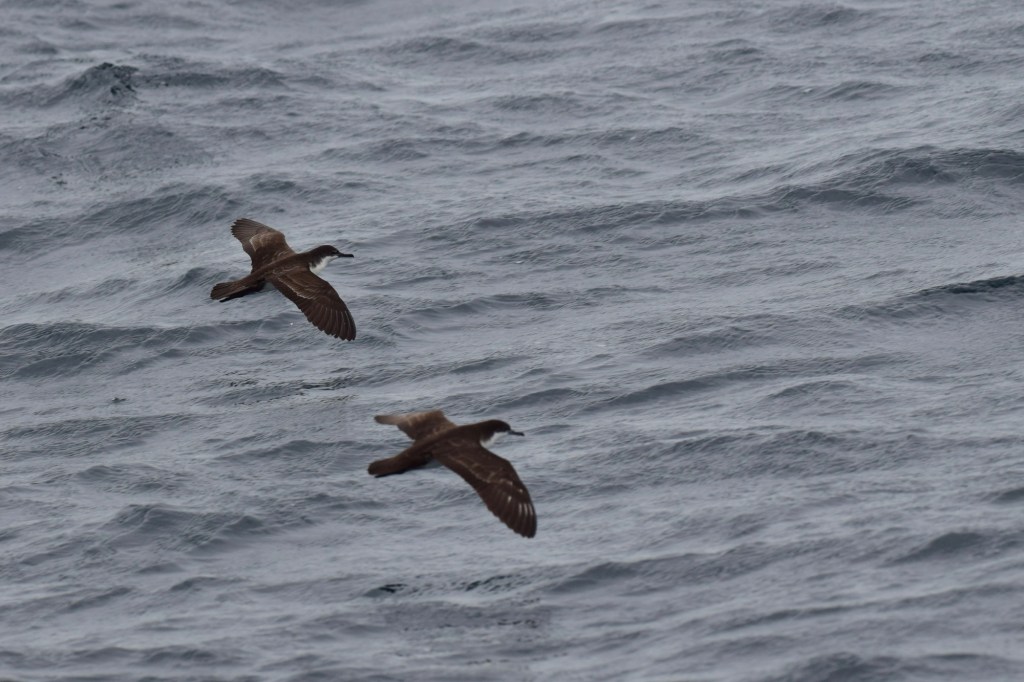
The weather looked unpredictable but the sea itself was a bit easier to read, so when we reached Islote Pitt, I made the decision not to enter the water. Sure, it was a waste of $30 on the rental GoPro, but I know I made the right call. Even the guide upon his return admitted grimly that the conditions were awful. The water was cold, choppy in the extreme and visibility was limited to about 10cm. Those that did take a dip said they’d managed to see a couple of sergeant majors, but that was about it. The qualified divers had a bit more luck with some eagle rays, but even they confessed that it was a hard and relatively fruitless dive.
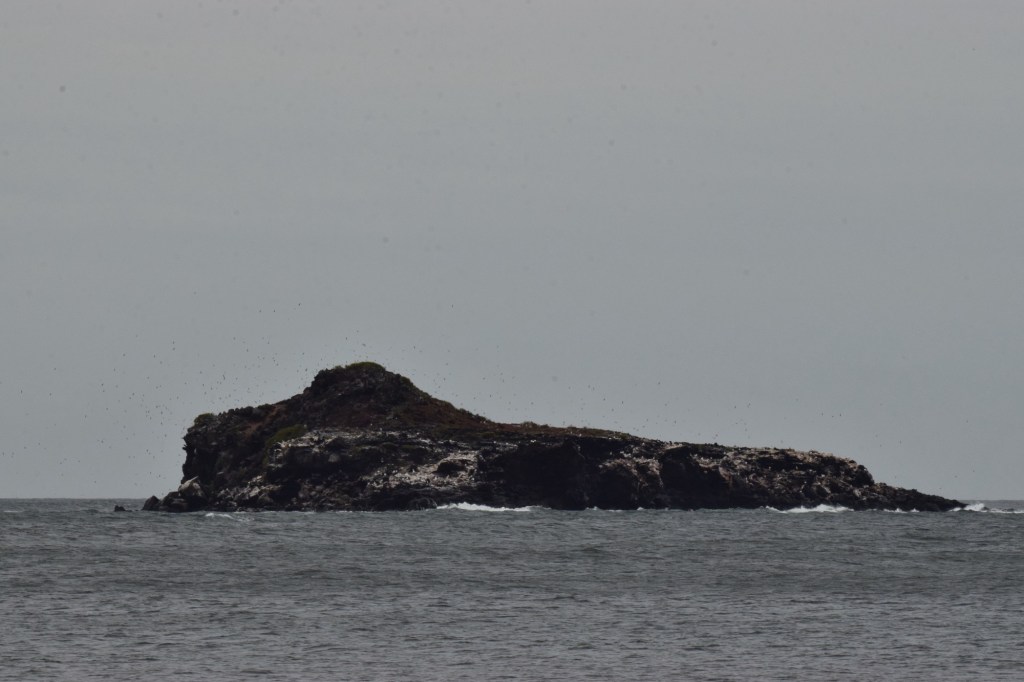
I, on the other hand, was having a whale of a time. Islote Pitt is home to a ridiculous quantity of endemic species, including both Elliot’s and wedge-tailed storm-petrels, Galápagos shearwaters and swallow-tailed gulls – the only nocturnal gulls in the world. I’m used to seeing storm-petrels at a distance, zooming across the surface of the open ocean and next to impossible to track with a camera, but I’ve never seen a colony before.

I’ve seen a lot of South American gulls on this trip: kelp gulls, dolphin gulls, grey gulls and lava gulls, to be precise. But swallow-tailed gulls are really rather special. Whether it’s their white wings and silver mantle, or the smart red ring around their eyes, or even their eerily haunting cry, they’re simply unlike any other gull I’ve ever seen.

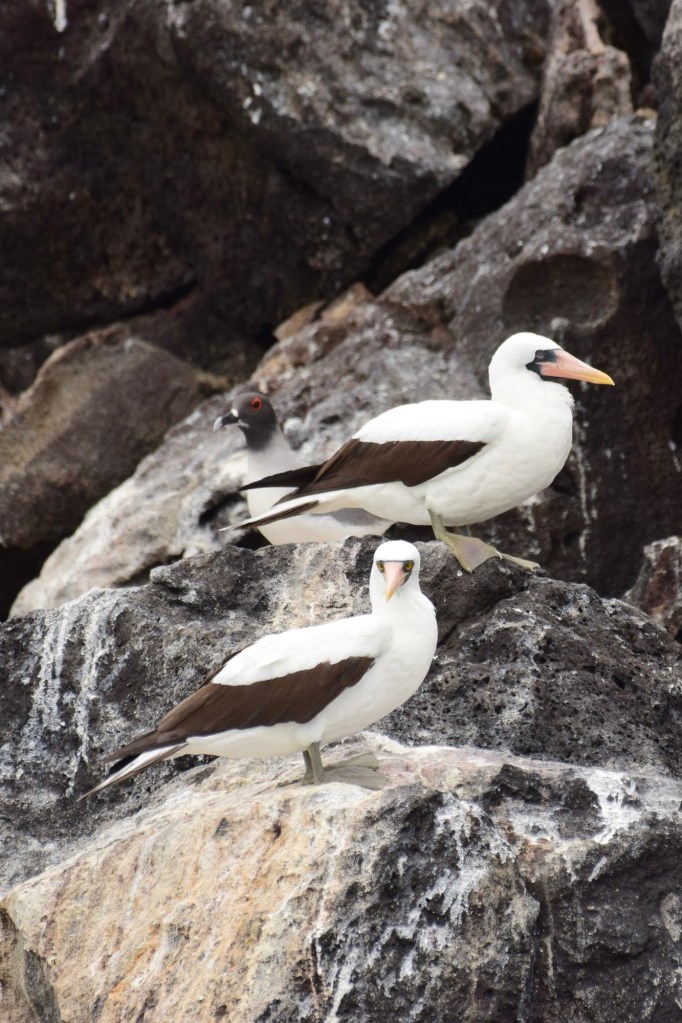
Punta Pitt’s major claim to fame (as well as the explanation behind the title) is that it is the only place in the Galápagos Islands where all three species of booby can be found together. Each one nests in a different spot: blue-footed boobies on the ground, red-footed boobies in the trees and Nazca boobies on the cliffs.
The Nazca boobies at Punta Pitt itself nest on a cliff some distance from the path at the point itself, so your best views would be at Islote Pitt, which is home to an enormous colony of the handsome seabird, alongside the frigatebirds, swallow-tailed gulls and a legion of storm petrels.
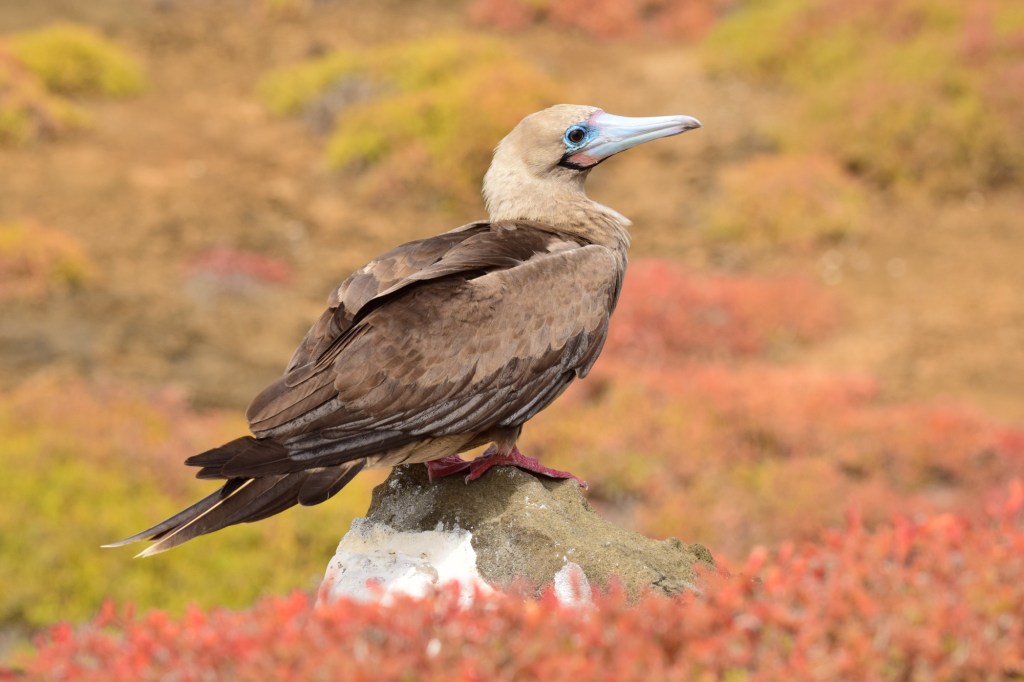
The hike up into the cliffs from the cove at Punta Pitt takes you deep into the volcanic coastline, up a tree-lined gully that becomes a torrent in times of severe rainfall. You’ll encounter the most famous residents of Punta Pitt, the rare red-footed boobies, shortly before climbing the pass over to the other side: they’re hard to miss, as they nest right next to the path.
Boobies get their bright-coloured feet from their choice of diet, which seems to be an evolutionary choice in the race to find a mate. Red-footed boobies primarily hunt squid and flying fish, both rich in carotenoids, which gives them their red colouring; blue-footed boobies are after the same nutrients, but their choice of catch – sardines – gives them a wholly different colouration. The brighter the feet, the more successful the bird is at finding a mate.
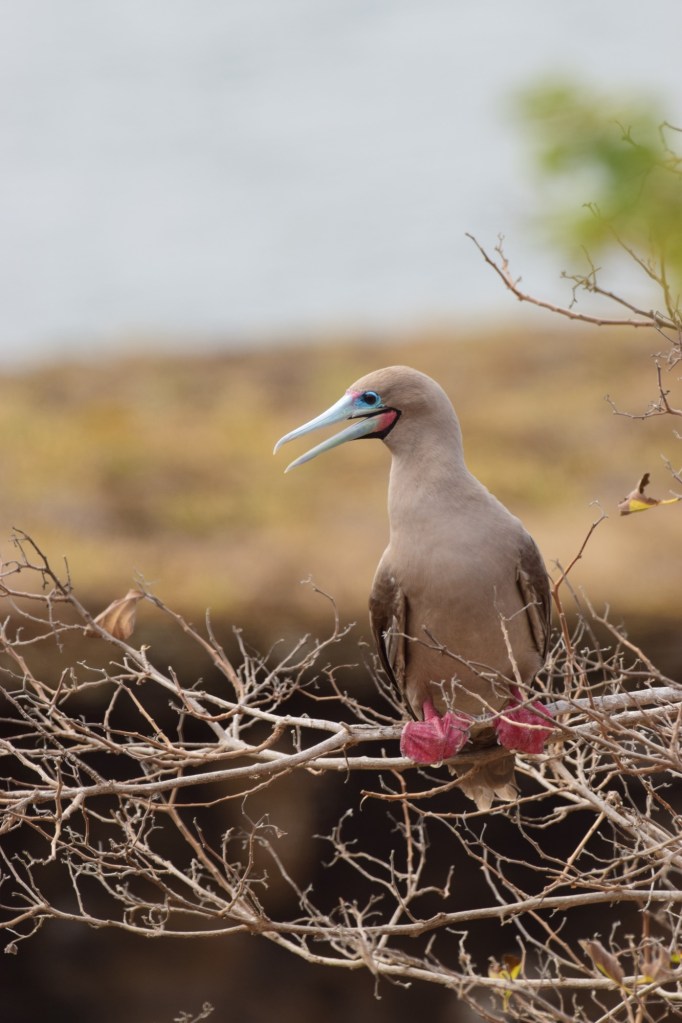
In August, the breeding season is already well under way, with some early partners already feeding large fluffy chicks. Others are still taking it in turns to incubate their eggs, with one partner flying in from a morning’s hunting to relieve the other on the nest.
For once, I was with a really respectful group of tourists. Once they worked out that the birds don’t like being approached too closely, they asked if we could keep our distance and move on so as not to disturb the birds further. Music to my ears!
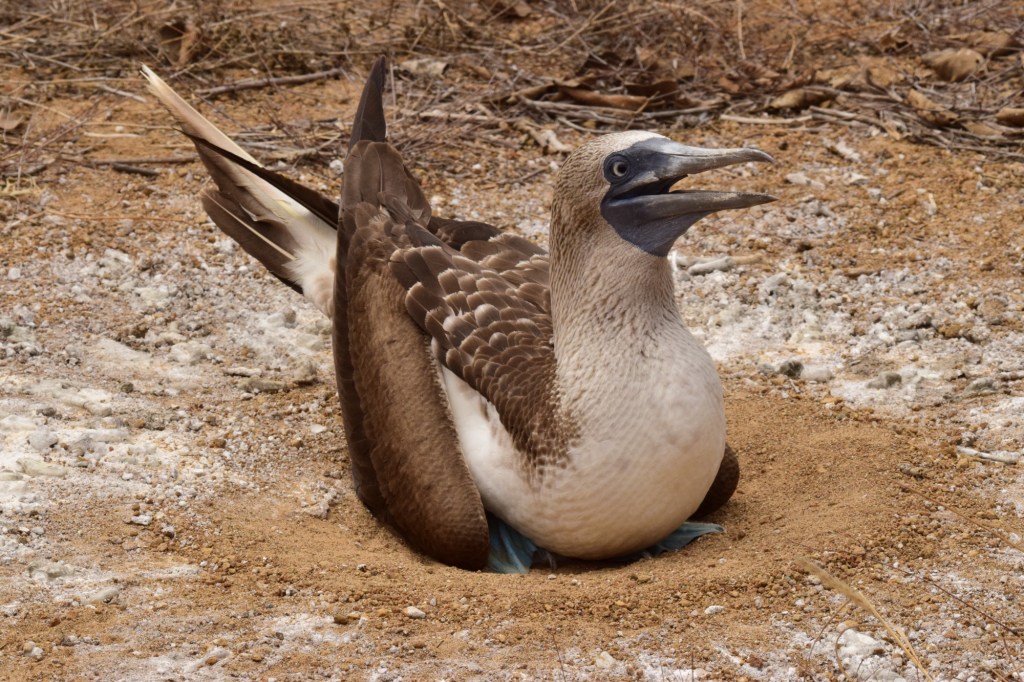
Sometimes you didn’t have much choice but to be close, as their choice of nests catch you by surprise, in a scrape beside the path or tucked away in a tree in the middle of the road.
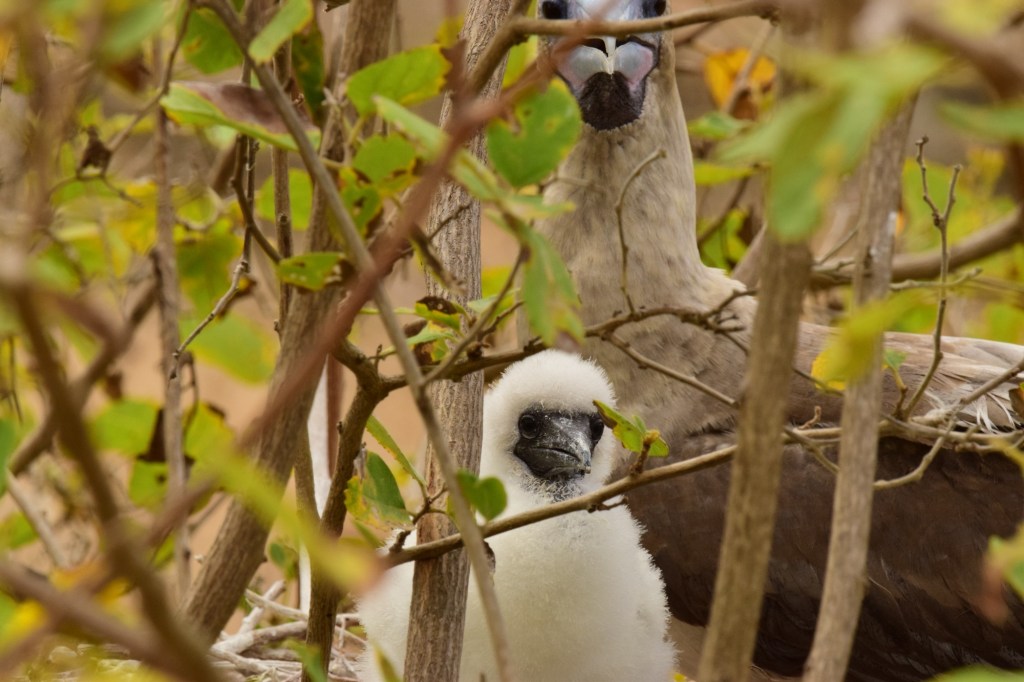
They’re not the only iconic Galápagos residents that breed at Punta Pitt. The enormous frigatebirds can be found here too, looking even more fluffy than the boobies, albeit at least twice the size.

Frigatebirds are absolutely enormous – you won’t truly appreciate just how big they are until you see them for yourself. Using their swallow-like forked tail as a rudder, opening and closing their streamers to steer in the wind, they are masters of the air, perfectly designed for outspeeding the boobies and robbing them of their fish, which I have been lucky enough to witness.
I also saw a beautiful angel of a seabird here: a red-billed tropicbird, all white with long streamers and a bright red bill. They’re small – tern size at best – and nest in crevices in the cliffs that are impossible to reach, so you won’t see them as well as the other denizens of Punta Pitt, but it was quite a sight to see as it set out to sea to go fishing.
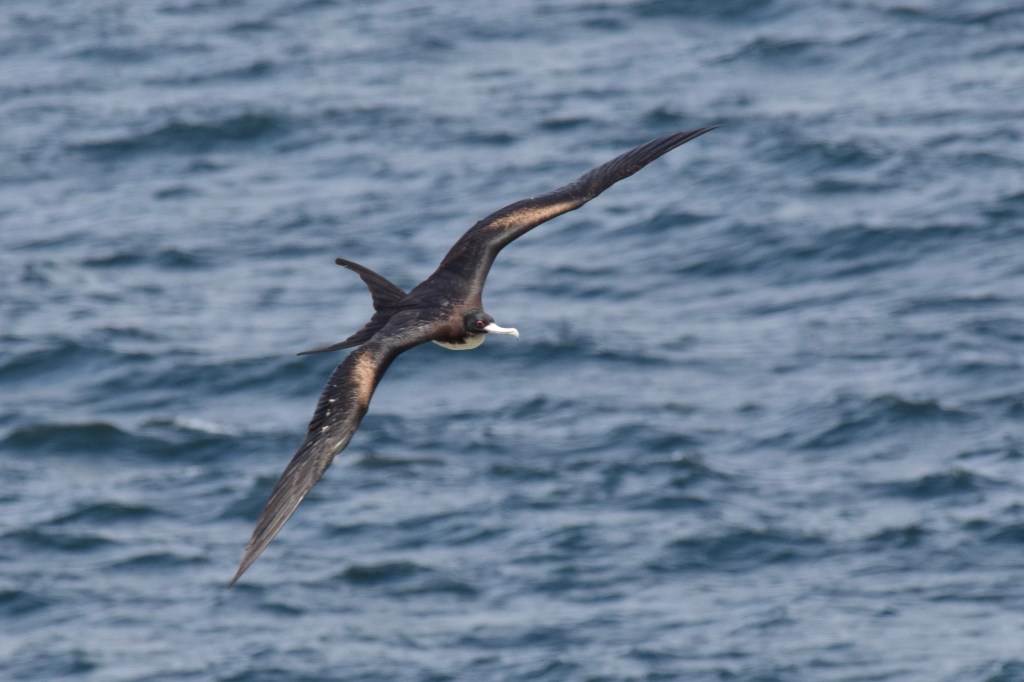
The red-footed boobies come in two colours: a white morph – more common in the western Pacific – and a coffee-coloured brown morph which is more easily found here in the Galapagos. The two morphs are totally interchangeable and cross-breed from time to time: for the ladies, it’s not about the colour of their feathers but the brightness of their feet.

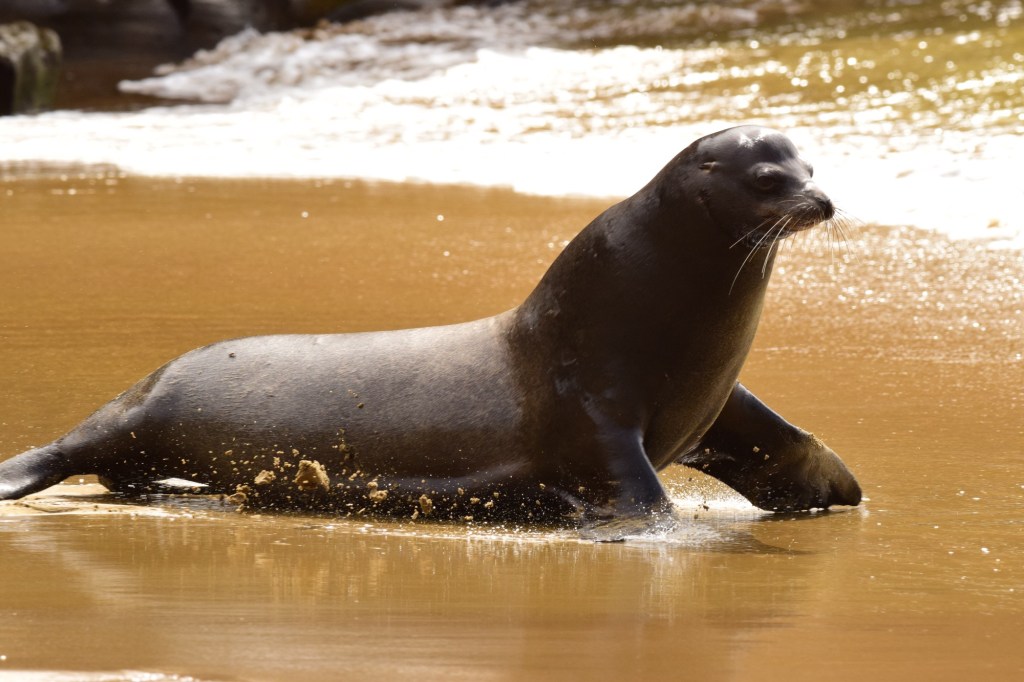
After a solid two hour hike up into the cliffs, we left the boobies and their ramshackle nests and climbed back down to the beach where we landed. While the captain’s boy ferried us back to the boat on a small skiff, the local sea lion alpha was busy defending his territory, chasing off a rival male that had just arrived on the beach.
I overheard a family of Americans in Puerto Baquerizo Moreno watching the sea lions lazing around the port and saying how easy life must be for them. For the dominant male, it couldn’t be further from the truth. From the moment he assumed command, he cannot hunt, eat or sleep, patrolling his territory constantly and fighting off suitors as they come. This is, of course, extremely debilitating, leaving them physically weakened after nearly a month without food, but there are cases of individual alpha males returning to reclaim their harem up to three times in a single season. So when you hear the endless barking that is such a part of the soundscape of Puerto Baquerizo Moreno, remember how long it might have been since the males have been able to eat. For sea lions, the urge to mate simply outweighs all other options on the table, including eating and sleeping.
The boat ride back to Puerto Baquerizo takes a lot less time as you ride the fast-moving current back, shaving a whole hour off the journey. In the middle of the day, there’s not as much to see either, so most of my companions fell asleep, aided by those curious neck-braces with built-in fans that I saw some colleagues wearing back home during the June heatwave.
Samuel, our guide, was keen to know how long I’d be here. I told him how last minute this whole operation was, and that I’d more or less given up on Española with no news from the folks at EcoChallenger. He said he’d ask around – after all, it’s not the agencies here that conduct the tours but rather the guides and their attendant boatmen. The agencies merely act as middlemen, sending a certain quota to the actual operators down in the harbour. So who knows? Maybe I’ll get to go to Española after all. either way, I’m glad I opted for Punta Pitt – it was absolutely incredible.
I’ll get an early night and have a quieter day tomorrow. I could do with some time to put the snorkeling mask to good use. I hear the bay where I saw the turtles is an almost guaranteed spot to see them year-round, so I think I’ll go there first if the weather is kind. It’s usually rainy and cloudy in the mornings and then sunny in the afternoons here, which is an easy enough pattern to follow.
See you next time! BB x
Puerto Baquerizo Moreno, Galápagos Islands. 04.57.
I woke up to the sound of the waves this morning. Well, I suppose morning is a stretch, since the clock on my bedside table said ten past four. I must have passed out around eight last night, beaten down by the lack of sleep on the plane and lulled into a Pacific lullaby by the sea. I can think of worse ways to spend a summer.
The garúa rolled in off the mainland last night, bringing with it relieving cloud and gentle rain. A passing shower came and went a few minutes back, but now it’s just the tap-tap sound of the lingering raindrops falling onto the roof of my cabin from the giant daisy tree.
There’s no point going back to sleep now, so I’ll spend some time writing up yesterday’s account of my first day on San Cristóbal.
The magic begins as soon as you’ve left the airport. Technically before, I suppose, since I could see the sharp-angled silhouettes of the island’s frigatebirds well before we landed. Outside the terminal, it’s a ten minute walk to the centre of Puerto Baquerizo Moreno, the largest settlement on San Cristóbal.
Three of Darwin’s keys can be found right next to the terminal building: small and medium ground finches, of evolutionary fame, and one of the island’s endemic species, the San Cristóbal mockingbird. It’s this last that’s especially important, as Darwin didn’t realise the significance of the finches until after he’d departed from the islands, but he did notice that the mockingbirds on each island were different in some way.
Like so many creatures on these islands, they are completely unfazed by the presence of man. They have a funny way of walking, with their cocked tail wagging from side to side. If I were a scientist, I might have called them metronomebirds for this singularly odd gait.

Most of the other travellers piled into taxis outside the terminal, which seemed a bit ridiculous, given just how close the town is to the airport, but I guess some habits die hard. I was quite happy pottering about with the ground finches. It’s not often you get to spend time with a species that literally changed the way we think about our place in the world.

The first thing you notice is the sea lions. They are absolutely everywhere. If you can’t see them, you can certainly hear them: that cartoonist arf arf arf you associate with children’s TV carries for quite some distance.

They don’t stick to the beach, either. A large number of them seek out shadier spots on the seafront parade, dozing quite carelessly on roads, park benches and boardwalks. It’s pupping season, so there’s no shortage of pups in varying stages of development sticking close to their mothers. I’d suggest giving them a wide berth – you never know where the bull might be.

In this case, I did know where the bull was – because he was announcing his presence every minute or so with that barking call, as though to remind everyone in the vicinity that the harem on the beach was his and his alone. Which, I suppose, is close to the truth.

You can tell the bulls apart from their size – nearly a third larger than the females – and the significant boss on their heads. I also hadn’t noticed before the claws in their flippers, but you can get so close to the great sea beasts here on the islands that there’s hardly a detail that will pass you by.

I had to wait a little while before checking in to my cabin on the edge of town, just a stone’s throw from Playa Mann. At a glance, there seem to be a lot of people who come to these islands for the beaches. To a dyed-in-the-wool naturalist like me, that does somewhat feel like going to the Serengeti for a tan, but I’m far too happy to judge. Who could possibly turn away from a chance to see these spectacular islands, given the chance?

I took myself straight back down to the sea once I’d checked in and found two more Galápagos specialities almost immediately. I’ve been mad about Sally Lightfoot crabs since they turned up in a wildlife spotting book I won as a prize for a sunflower growing competition when I was a kid. We have crabs in the British isles, of course, but none nearly so colourful as the Sally Lightfoot. They’re everywhere here, ranging from dark green to sunset red, hugging the molten rocks along the surf line and leaping between boulders with surprising agility.

The other specialty is a real treasure of the Galápagos, arguably as iconic as the giant tortoises that gave the islands their name. Marine iguanas, a short-faced ocean-going variant of the green giants found on the mainland, are often described as “ugly”, perhaps on account of Darwin’s first description of the creatures. Certainly, their patchy salt-washed skin and snub faces make them strange-looking beasts, and they’re not nearly as active as the sea lions as they soak up the sun on the beachfront, but they are tremendously interesting creatures.

Around midday, it gets rather hot here on San Cristóbal. Not unbearably so, but the humidity doesn’t help. I found a night heron sheltering from the heat in the shadow of the rocks earlier, and when I returned, it was sunning itself in a posture I haven’t seen in herons before.

A smaller heron was lurking among the boulders nearby: a lava heron, an island variant of the striated heron that can be found all the way up and down the coasts of the Americas. It was mesmerised by the dragonflies hawking over the beach, tilting its sharp beak and golden eyes every time one came close. I didn’t stick around long enough to see if it caught one.

After sorting out my snorkel gear for tomorrow’s expedition to Punta Pitt, I made for Cerro Tijeretas, a promontory to the north of town known as Frigatebird Hill. I passed a large Dutch contingent and a couple of Germans looking for a mockingbird, but other than that, I had the trail pretty much to myself. The Galápagos aren’t like Manu – you aren’t going to be tripping over a new species every few steps – but the encounters you do have with the island natives are more than a match in their total lack of fear. I found a Galápagos flycatcher hunting by the boardwalk and spent most of the afternoon followed by warblers.


From the top of the hill, you get a spectacular view out across the island to the east, all the way to the cliffs of Punta Pitt. The bay beneath Cerro Tijeretas seems to be a popular snorkelling spot, and I can see why. One shape drifting in the water seemed to the naked eye to be too compact to be human, but too mobile to be a rock, so I turned my lens on it to confirm my suspicions: a green turtle, one of a number that can be found around these islands. I’ve brought my own snorkelling mask so I’ll have to check this place out sometime, when it’s quieter, maybe.

I didn’t make it as far as Playa Baquerizo, which really is a proper hike from town, across several kilometres of molten rock and daisy trees, so I’ll have to check it out later. Instead, I perched myself on a boulder and watched the sunset in a beach I had to myself. Noddies dancing across the surface of the water. Boobies hunting offshore. Frigatebirds wheeling above the bay on those vast black wings. This really is a paradise like few others. I hope for the islands’ sake it remains that way.

It’s nearly seven o’clock. It’s light now, and the island is covered by a merciful blanket of cloud. There are birds called outside but Merlin is struggling to identify them. That may have something to do with the generator that keeps clicking and whirring noisily outside. I’d better have a quick shower and then head out. I’ve rented a GoPro for today’s snorkelling adventures, but there’s also likely to be a heck of a lot to see at Punta Pitt itself, so watch this space! BB x
Aeropuerto de San Cristóbal, Puerto Baquerizo Moreno. 10.55.
When I was just a kid, there were a few things I already knew wanted to achieve in life. I wanted to fall in love and have a family, write stories and, one day, go to some of the places I used to see on wildlife documentaries like Blue Planet, Land of the Tiger and Natural World. All of those dreams are still with me, but today, one of them comes true.
One destination in particular was a prize beyond all others, especially considering I was much more into reptiles back then than any other creature. A destination so remote and so wild that the animals that live there have little to no fear of man, despite centuries of visitors and worldwide fame. A volcanic archipelago that inspired a certain British naturalist to design one of the most revolutionary scientific theories of all time. A chain of islands named for their iconic, lumbering residents, some of which patrol the same corner of their highland world since they hatched in the early 1900s.
I’m talking, of course, about the Galápagos Islands. Here I am at last, about to embark on an adventure twenty-four years in the making. Here I am – and here we go!

Now that the secret is out of the bag, I can stop speaking in riddles!
I slept for at least part of the flight from Santiago to Guayaquil. I must have done, at least, because I don’t remember it feeling like a five hour flight at all. I woke up here and there, usually at opportune times such as when the flight crew came down the aisle with water and an in-flight snack of diced fruit and chocolate, but after sleeping little the night before, I think my fatigue got the better of me – and just as well! I don’t think I’ll want to miss even a second of my time on the islands for something as trivial as sleep.

Ecuador is one of the birdwatching capitals of the world, but I’m no lister, so I don’t begrudge my brief pit stop being limited to the interior of Guayaquil Airport. All the same, there’s a lot to be seen from the ceiling-high windows on the south side, near the KFC. I’d seen tanagers, hummingbirds and kingbirds before, but the cuckoo-like anis that live in the palm grove beside the departures lounge are a lot of fun to observe, as are the long-tailed grackles with which they share the scrub.

Now – logistics. Traveling to the Galapagos with a tour company may mean a lot of the admin is done for you, but if you, like me, prefer to strike out alone and do it yourself – which really does keep the costs down – you’re going to want to do a couple of things before leaving Guayaquil.
August is the tail end of high season in the Galapagos, or so I’ve been lead to believe. However, the 9.17am flight to San Cristobal was one of the emptier flights I’ve taken on my travels in South America, so despite skimping on seat reservation and being assigned an aisle seat, there was nobody else on my row at all – or the two in front, come to that – so I landed a window spot after all. Result!

Given the magnitude of what’s coming, I’ll leave it there for today’s post and fall into line one day behind, which should give me the breathing room I need to write each day without racing against the clock. So come back tomorrow to find out about my first day on the island of San Cristóbal, easternmost of the Galápagos Islands! BB x
Aeropuerto Arturo Merino Benítez, Santiago de Chile. 23.23.
Three weeks at Craighouse School have come and gone in the blink of an eye. In that time I have seen and done all sorts of career-boosting things. I have observed Maths, English, Spanish and French classes, as well as a number of department meetings: sometimes in English, sometimes in Spanish. I have taught the basics of French conjugation with -ER verbs, folktales from England, the Basque Country and the Middle East for a middle school kamishibai project and Augustinian theology within an exploration of good and evil in Othello. I have moderated an extended essay, taken part in an MUN debate on the two state solution, discovered that what I have only dreamed of doing for years – teaching English Literature – is well within my capabilities… and I have made some friends for life out here.
I think one of the reasons I avoided anything and everything to do with Latin America at university was because I wasn’t ready yet. I should have known that, having lost my heart to an American once already, I would be drawn back across the Atlantic like a moth to a flame. It’s not the light – it’s the warmth. The warmth of the people here. I have barely begun to scratch the surface of this country.
First things first – my Othello lesson was a triumph. After dropping in on a couple of Y12 classes and offering my take on Carol Ann Duffy and the religious context behind Shakespeare’s work, I was told that the senior deputy head and former head of English wanted to see me teach. Teaching a forty-five minute French lesson that I’ve taught for years is one thing. Teaching a ninety minute class on hardcore morality ethics, Protestant ideology and social context within one of Shakespeare’s weightier plays is another matter entirely.
Lucky for me, I had a bloody good teacher back in my schooldays, and a quick refresher last week was enough to remind me that I had forgotten very little of what I was taught, even across a distance of fourteen years. I’ve also been gearing up to teach Othello myself as part of the Spanish Language A course, so I was not unprepared. Still. No pressure.
I’ve got to hand it to the kids. They might have only been a standard level class, but they handled the higher level material extremely well. When I circulated as they were practising a Paper 2-style comparative task, I had some really enlightening conversations. So many great questions, so many bright ideas. I was really proud of them. Ninety minutes seemed like a tall order when I turned in around eleven o’clock last night, but it was over far too soon.
I spent the afternoon wrapping up. Signing out of all my accounts on the school laptop. Handing back the IB Language books I’d borrowed. Switching out my teaching boots for hiking shoes. I dropped in on the middle school Lenguaje department to say goodbye and had it corrected to a see you soon. Hispanics don’t do goodbyes. Much too final.
One final and unexpected resident of the English department hung around to see me off: the mockingbird that has been hanging around the office for the last couple of weeks. Somebody had left the door open so it had popped inside to see if there was anything edible. After a small circuit I managed to guide it back outside. They’re extremely characterful creatures, mockingbirds. I hope to see more of them where I’m going next. It’s a place where they made history. Natural history, that is.
To close out my time here, Alfredo (the head of English) took me and a couple of colleagues out to dinner at Baco, a swish restaurant in upmarket Providencia. It felt like I’d been part of the team for a year, rather than a week. Chileans may have more in common with the Basques than the Andalusians, but they’re an incredibly warm and honest people.
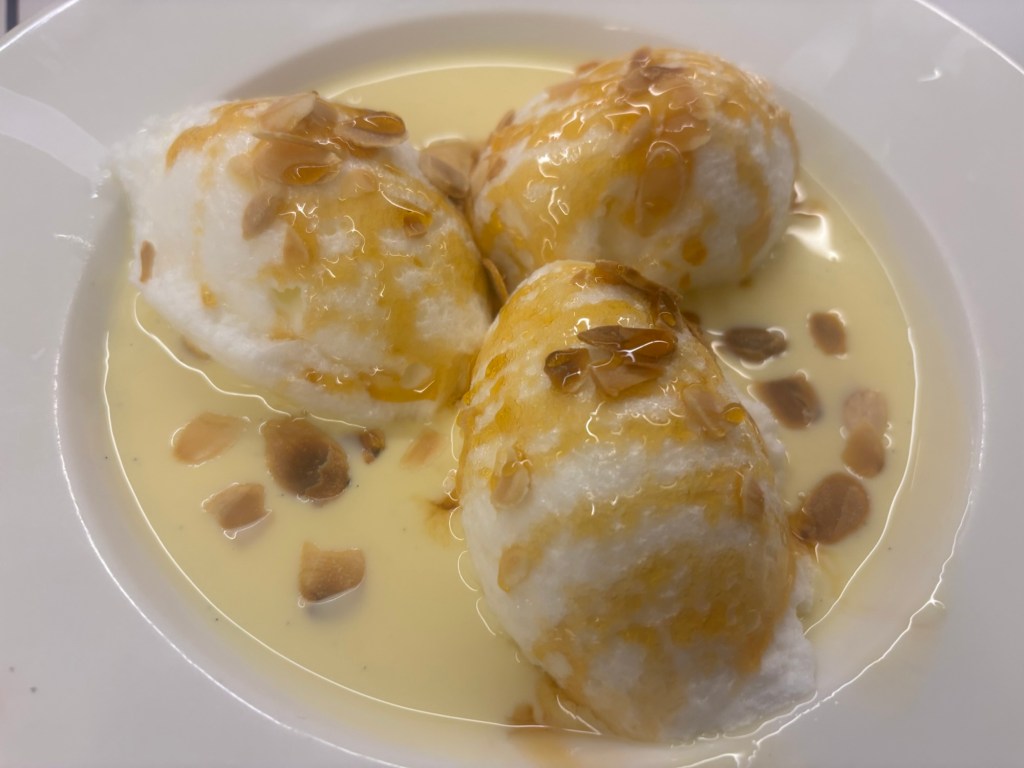
I’d say that’s that, but I’ve got to come back to Santiago to pick up my suitcase and catch my flight home in nine days’ time, so I’m not quite done with Santiago yet. But now I’m sitting in the departures lounge of Santiago’s Arturo Merino Benítez airport, absolutely buzzing about the last great adventure on my South American odyssey. It’s been an amazing month so far, full of unforgettable wildlife encounters and exceptionally warm people. This will just put a seal on the whole thing.
Or maybe even a sea lion… BB x
Notes, field guides and micro-memoirs
A Solo Travel and Literature Blog
All about trees
Travel |Food| Photography
A glimpse of the world through my lens
Synastry & Karmic Astrology
A Journey of Travels, Teachings, and Truths Told Plainly
Musings of a trekking author
Inspiration and Spirituality **Award Free**
Illustrations to make you smile, laugh, and sometimes make you see things from a different perspective 😉
a woman with wings travelling the world solo

