Neruda’s Ear

Hostal Casa Volante, Valparaíso. 13.37.

Valparaíso is sometimes nicknamed the South American San Francisco. That has nothing to do with the cost of living and everything to do with the way it soars up skyward out of the Atacama Trench, carrying the city’s elite on its back. Some of the roads winding up the side of the cerro seem almost vertical. I get the feeling living here would give you the lungs of an Inca and the thighs of a Georgian wrestler.

It’s up here on the heights that you’ll find the house of Pablo Neruda, Casa Museo La Sebastiana.


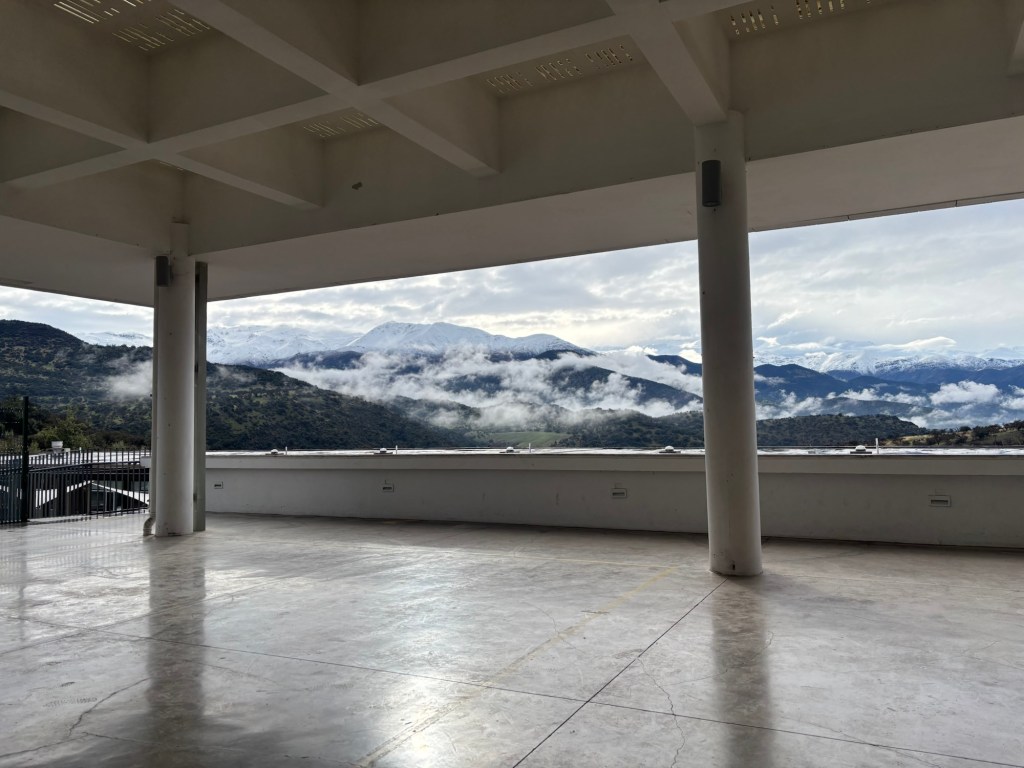
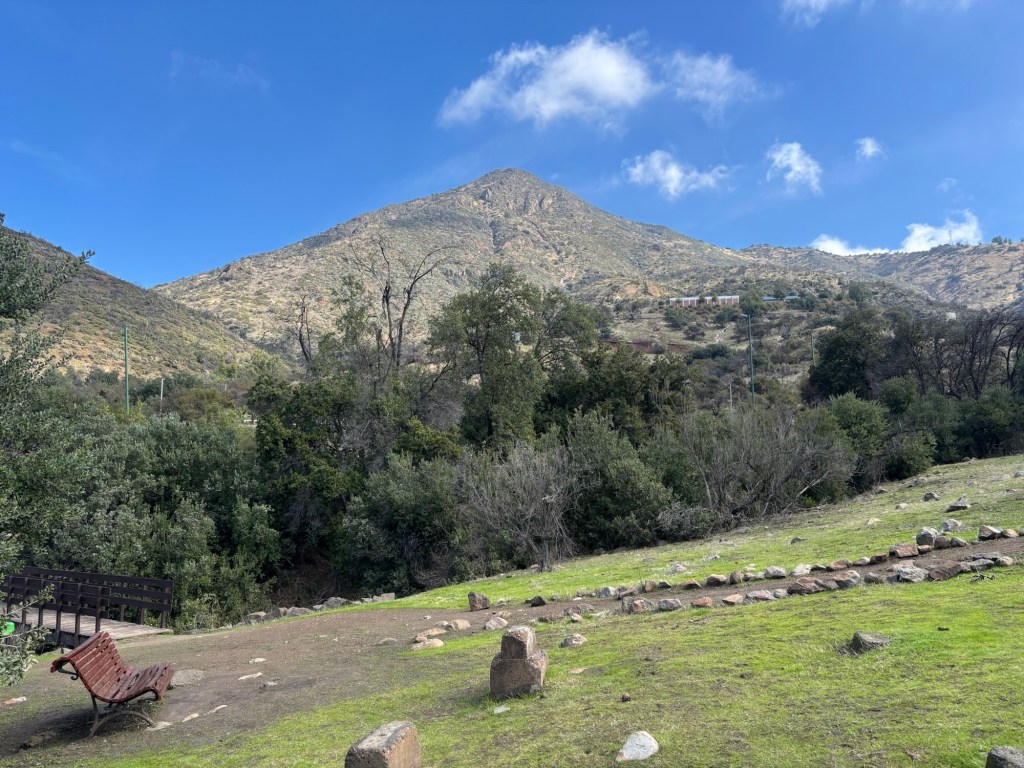
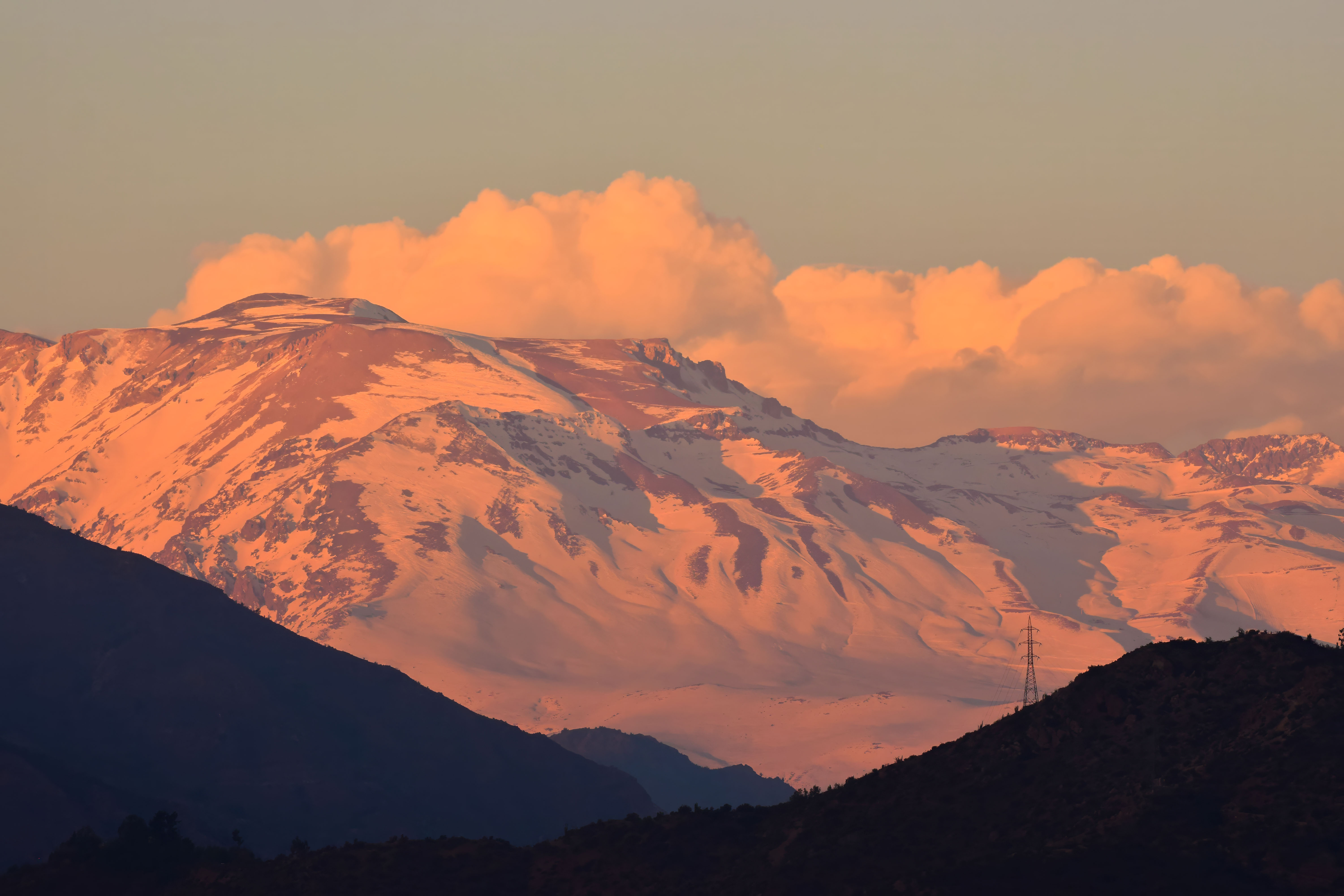
Neruda sure knew how to pick a spot. His five-storey house, which sometimes feels more like a tower than a villa, commands one of the clearest views of the Bahía del Valparaíso. On a clear day, you can probably see for miles, but even a shroud of yellowing cloud, you could see as far as the forested hills of La Campana and the snowy heights of the Andes beyond.

Neruda had his writing room built right at the pinnacle of his Valparaíso home, so that he could draw inspiration from the beauty of the world around him, whipped eternally by the Pacific winds.

He also seems to have loved maps, especially the older ones. There’s an genuinely incredible French map of the Americas by one Monsieur le Dauphin which I absolutely must track down, as it predates the discovery of Australia, with strange, half-finished coastlines fading into nothing at the southwestern edge of the map under the title “Terra Australis Incognita”.


People seem to treat this street with profound respect. Even the graffiti is cultured.


As if in answer to my post last night, I was surprised to find the street on which Neruda’s house stands, Calle Ricardo de Ferrari, covered in verses that weren’t taken from the Chilean poet’s vast anthology, but from his Andalusian friend, Lorca. Beautifully painted into tiles from an alfarería in Granada, Lorca’s verse follows you all the way down the road, perhaps as an ode to Neruda’s efforts in saving so many Spaniards during the Civil War and bringing them here to Valparaíso, far from the tyrannous grip of Francisco Franco.

Lorca lost his life under the fascist regime. So did my great-grandfather Mateo and all of his circle of writers and poets. It’s probably no great leap of the imagination that they might even have been in contact with Andalusia’s greatest poet, since they were all writing around the same time… and all snuffed out around the same time, too. Perhaps that’s why I feel a special connection to Lorca – and why finding him here in the Southern Hemisphere is so comforting.


I didn’t buy any of his books – I can’t recall which ones I have at home – but Neruda’s magic was already at work on me. As I climbed up to the fifth floor of his house, my ears suddenly popped. My Eustachian tubes have been blocked for nearly a fortnight since that false landing in Natales, which has been a real annoyance. Flying for fourteen hours across the Atlantic and half of South America shortly before probably didn’t help, but either way, it’s been an ever-present bother since I arrived here.

But suddenly, just like that, the fuzziness in my ear wasn’t so bad anymore.

Ok, so it’s still there, but it is very definitely better than it was. I feel like I can hear properly again.

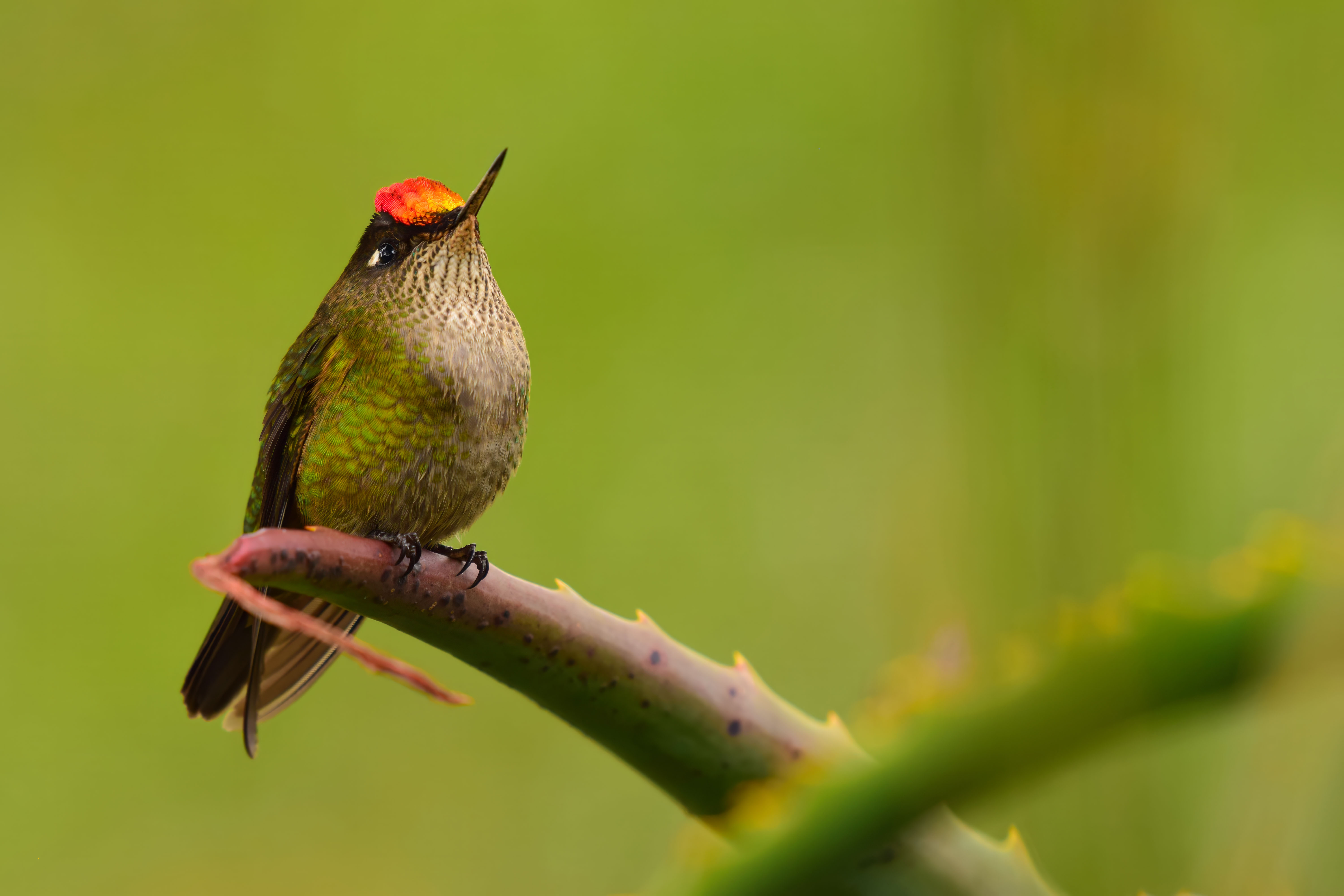
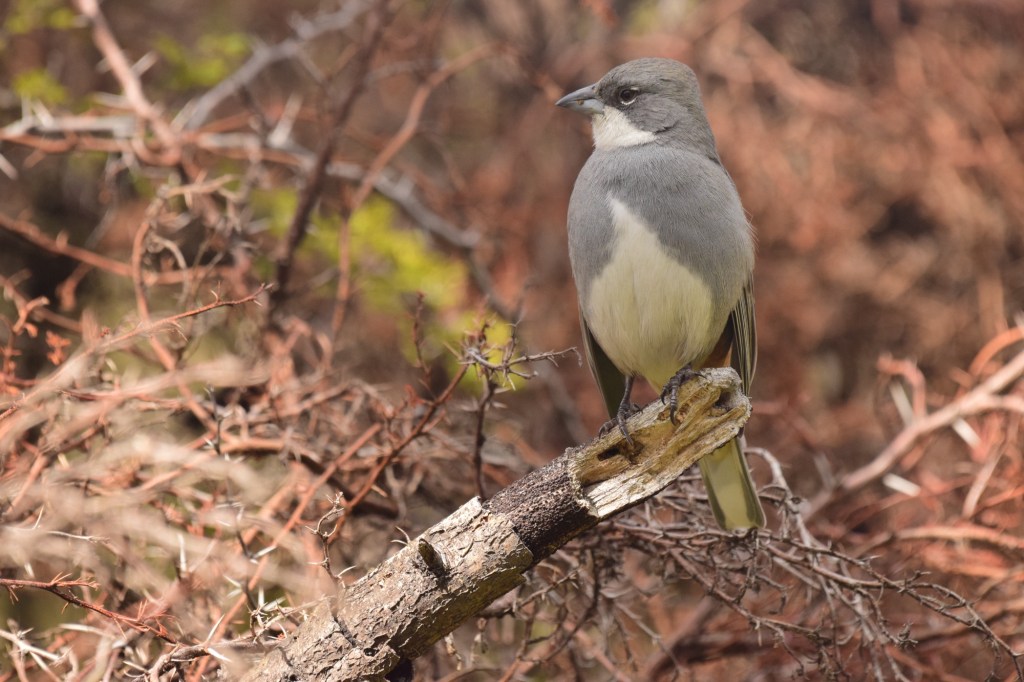
To prove that point, I stumbled upon a family of firecrowns on the way back down into the city. This time it felt like I could hear their piercing trill out of both ears. One even let me get close enough to make up for not having the lens on me (I left it behind as it weighs quite a bit, and you can’t take bags into Neruda’s pokey house).

I’ll miss the hummingbirds when I go, just like I said when I was in Peru. There aren’t as many varieties of them here as there were in the Inca capital, but the firecrowns are everywhere: particularly, wherever anybody has been kind enough to plant red hot poker flowers, which they adore.


It’s still pretty overcast out there. I think I might grab some Peruvian food for lunch, as there are quite a few places nearby, and I fancy a reminder of the delicious bowls of salty seafood I had in Paracas. If I am going to eat, it had better be sooner rather than later. The bay may look calm, but out on the open ocean it is likely to be less Pacific than it looks.

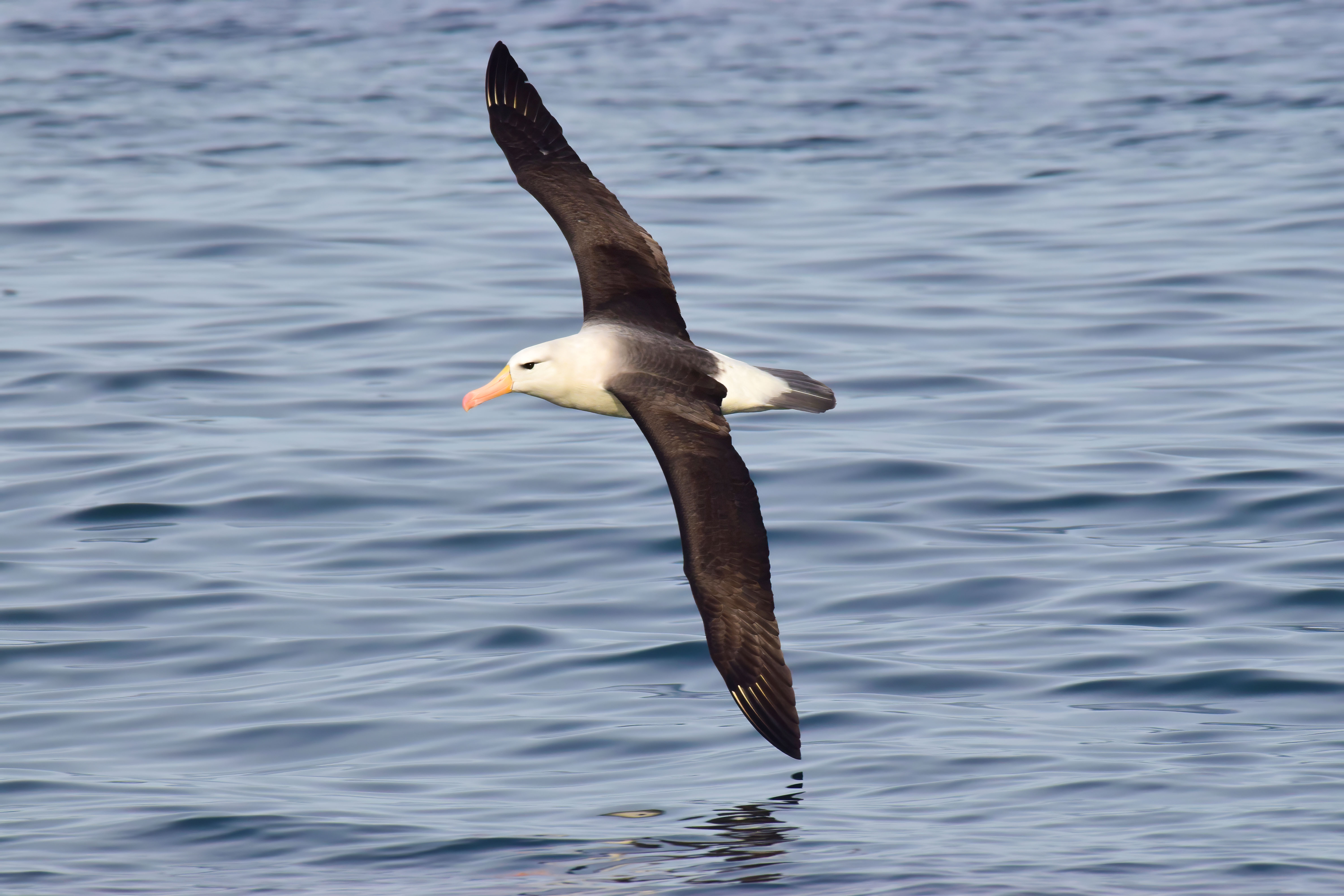
Fingers crossed for an albatross tomorrow! I’d settle for just the one! BB x

Sea Cats and Sea Lions

Hostal Casa Volante, Valparaíso. 16.37.

Santiago de Chile may be cursed to be a smog-bound citadel for the rest of its days, but in one particular sense, it is exceptionally well-placed: it is about an hour’s drive up into the mountains to the east for skiing during the winter months, while a hour and a half’s drive to the west will take you to the Pacific coast. Santiago’s summer sisters, Valparaíso and Viña del Mar, may only be a hundred kilometres out as the condor flies, but they are a world away from the Chilean capital. In some ways, they are decidedly European: winding streets with towering Parisian buildings, complete with tramlines and traffic lights. In others, they are absolutely Latin American: a fiercely compact cultural melting pot, with Peruvian outposts everywhere.

With my timetable still very much up to me (consisting entirely of lesson observations at the moment), I struck out early for Valparaíso today, very much in the mindset that the part of town where the bus station is – or so the books all tell me – is no place to be after dark. It took me about three hours to get here, all in all, so had I waited until I had got home, it would be around half past nine here – which is definitely pushing it, even by my standards.

So here we are, in Valparaíso, Chile’s second city. With a population of around 300,000, it’s a little larger than the hamlet of 47 in La Mancha for which it was named.


Let’s be real. I’ve come here for two things: sea lions and Pablo Neruda. I’ve been juggling my choice of poet for the Language A course for a while, between Neruda – arguably Latin America’s greatest poet – and Lorca, who I hold in especially high regard. In the end, it is Lorca who has won the day, if only because I have studied him so much over the years (and, no doubt, because I have skin in the game by being part Andalusian myself). All the same, it would be a crime not to include Neruda in the course, so I plan to use his poems to prepare my students for the unseen.

Neruda, for now, must wait. I’ll have time for that tomorrow, after the pelagic expedition. I arrived too soon to check in, so I turned my feet east and followed the coastline as far as the twin piers of Caleta Portales.

I didn’t have to go far to get my sea lion fix. The main pier of Muelle Barón may be out while the city pours time and money into what looks to be a seafront shopping mall in the making, but the real show is a few hundred metres to the east, where the skeletal ruins of an old gas company dock has become one of the favoured haul-out sites for the city’s sea lions.


Alongside the sea lions, the structure is the perch of choice for a surprising number of seabirds, given its safe distance from the shore but proximity to the fisheries. I picked out kelp gulls, Inca terns, a couple of turkey vultures, Peruvian boobies, three species of cormorant and, of course, the Peruvian pelicans that I was hoping to see again.

I thought there might be something loose in my rucksack, as I kept hearing some kind of fabric shuffling sound, but to my astonishment a man in dirty overalls clambered out from among the boulders, seemingly from some crevice beneath the very rocks upon which I had been sitting for the better part of half an hour. He acknowledged me with a gravelly “wenodía”, set down his tatty red baseball cap to mark where he had slept and then picked his way across the rocks, crouching every so often to inspect something between the crevasses of the sea wall.

Valparaíso is a lot poorer than Santiago’s uptown districts like Las Condes. That much is plain.


Moving east, I had my eyes trained on the water, on the off chance that a wandering penguin might show up. I did spot one, a fair distance from the shore, but something else entirely caught my attention – something entirely unexpected.

A marine otter.


Marine otters – known in Chile as chungungos or gatos marinos (sea cats) are not sea otters, like the fluffballs found from Baja California up along the North American coast, but they do live almost exclusively in the sea, rarely venturing into freshwater like other otters. Like sea otters, marine otters were once hunted for their pelts and are thus an endangered species, and quite a rare sight along South America’s Pacific coast. So I really wasn’t expecting to see one here, in the very heart of Valparaíso.

Apparently, marine otters are specialist feeders according to their location, with southern populations preferring fish and northern populations opting for shellfish. This must be one of the northern otters, because in the fifteen minutes or so I spent watching it before it disappeared, it must have caught and eaten at least four small lobsters.


That makes two species of rare otter I have managed to find this year: giant otters in the Amazon and marine otters in the Pacific. And I still haven’t tracked down the otters that live in the Tone, just a stone’s throw from my flat! I’m sure they’ll show up eventually. Maybe I should make that my mission, before the year is out: to see a third and final species of otter, preferably before Christmas!


Not to be outdone, the pelicans put in a good show, sailing in low over the water in that spectacular flight pattern of theirs. I have wanted to see pelicans do this since my mother told me about it after her trip to Peru back in 2015, when I wanted to be just about anywhere but Amman, and I have had the incredibly good fortune to see that sight several times this year.

It’s not the stuff Attenborough documentaries are made of, for sure, and the good people of Valparaíso must see it all the time, but it is something I will never tire of seeing.


Eventually, I reached the busy fishing port of Caleta Portales. I reached it at absolutely the right time of day, too: around noon, the fishermen throw their bycatch back into the sea, loading the scraps into repurposed shopping trolleys and dumping them over the pier into the water below. The local wildlife is well aware of this daily bounty – and, thanks to a quick Google, so was I.


If you needed a clue that the drop was imminent, you only needed to count the pelicans. They had gathered in numbers so great I struggled to put a number to them – and pelicans are not small birds by any measure. They seemed to be perched upon every surface they could find: the sea wall, car roofs, billboards, shipping crates, stalls, bridges, lampposts and on the concrete among the fishermen themselves. After seeing them at a distance in Paracas, they were now far too close for my lens!


One small perk of being here now in midwinter is that some of the adults have started to put on their smarter summer plumage, with a smart yellow tinge to their more defined white faces.


I was already aware of the immense dark shapes in the shadow of the pier, but the appearance of the fisherman with his trolley worked like a magnet, drawing the dark mass along after him, following the overpowering stench of fish – or the sudden vortex of feathers and screeching gulls that followed in his wake.


With the seafood sloshed overboard, the shoreline turned into a frenzy of activity. It didn’t take me long to pick out the bull among the sea lions massing around the shoreline: he completely dwarfed all the others, and that’s saying something.


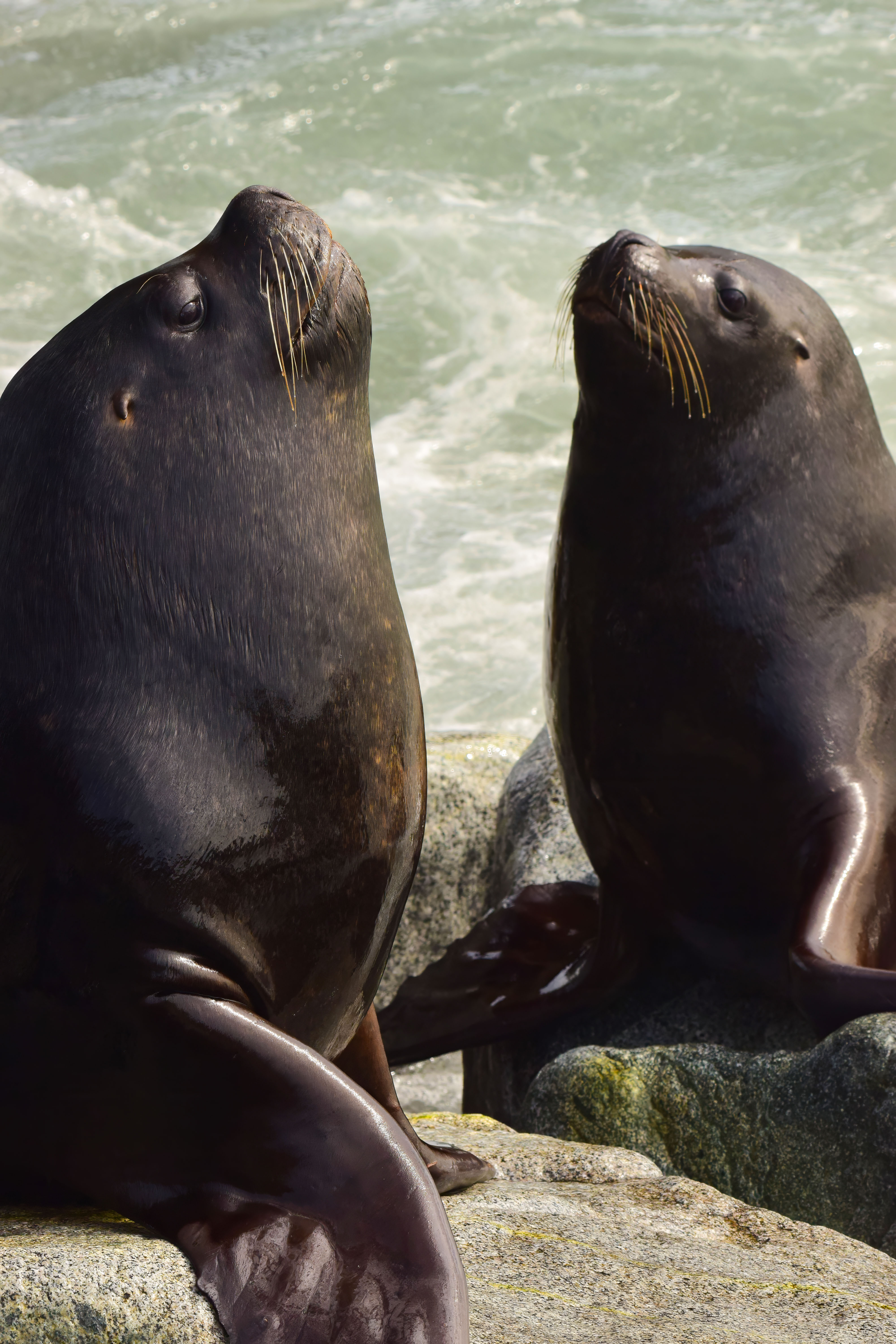
Forget the roly-poly dumplings that you find off the coast of Britain. Sea lions are an entirely different beast. Adult males can reach a whopping three metres in length and weigh in at around 325kg. They’re also fiercely territorial, as was plain enough from the deep scars on some of the males, including the old bull.


At that size – and at this distance – they were simply too big to get on camera. The 300mm would have been useful here, I think, but it’s sitting on top of my chest of drawers back home in Somerset. As such, I had to make do with portraits of the beasts that had hauled out onto the rocks to wait their turn while the bull ate the sea lion’s share of the bycatch.


At this range, of course, you can make out a lot of detail. The thickness of their whiskers. The sharpness of their teeth. The minuscule ears at the back of their heads, and the scars on their torsos.


One male was so close you could see the whites of his eyes twice over. His eyes seemed to have misted over. He must be very old for a sea lion to have contracted such an infection. I wonder how old? They can live to be around twenty years old in the wild, I think, so this one can’t be far off that mark.


Arguably prettier than the titans hogging the spotlight was a small family of Inca terns, waiting patiently for their chance to swoop in and seize some of the scraps for themselves. This is another species I travelled all the way out to the Islas Ballestas to see, only to find them so close here in Valparaíso that they might have been eating out of my hand.

Here, at least, the lens really did put in the yards.


I hung around the port for well over an hour before deciding it was probably time to head on back to Valparaíso, have a decent lunch and check in to my hostel. The skipper advised against having a large supper ahead of tomorrow’s ocean voyage, so I made a mental note to have a decent lunch instead, and acquire some snacks for the journey home.

It’s not the most scenic route back to Valparaíso from Caleta Portales. In places, the city seems to be collapsing into the sea, and where there isn’t the salty tang of the sea, there is the sweet stench of sweat, marijuana and human faeces. There’s a lot of homelessness here. All the carriages of a derelict train seemed very much lived-in, with signs of recent occupation all over the place: a bouquet of flowers tied to the grille, a washing line strung out in the gloom behind a window, and a dog waiting patiently on the step of the driver’s car. It’s probably more homely than the crevasses among the boulders below the sea wall, though I imagine it’s not much warmer.


The city never seems to catch a break. The Spanish blew the city to pieces in 1866 during the Chincha Islands War. Forty years later, in 1906, Valparaíso was ripped apart by an extremely violent earthquake – a fairly common occurrence in this part of the world, with the city sitting squarely upon the Nazca plate boundary. Apparently, there was a small one just a few days ago off Quintero, where I am headed tomorrow. It’s quite something, seeing the tsunami warning signs all over the place.


The captain has just told me that the boat needs a service tomorrow morning, so we have rescheduled. Weather permitting, we are going ahead on Sunday. That should make my journey home a bit easier. Even so, it is likely to be my most out-of-pocket adventure yet.

Tomorrow, then, is wide open. A whole day to explore Valparaíso! I’ll make sure it starts with a good sleep and a decent breakfast. Those sea lions had a proper feast today – I might as well do the same. BB x

Intercambio

Las Condes, Santiago de Chile. 21.28.

Four days into my teacher exchange and I’m still blissfully without a timetable as such. As a matter of fact, that’s actually quite a relief – because I keep running into new opportunities every day, and it’s helpful to be able to say yes to everyone for a change.

Today I spent the entire day in the Senior division of the school, with the equivalent year groups 10-13 (1°-4° Medio by Chilean standards). I also got my eye in on a PAES class, a preparatory class for students preparing to sit the national exams required to enter Chile’s university system, which functions much like the “seventh term” that was once offered by some British schools for Oxbridge hopefuls.

It was a bloody useful class to watch. I even had a go at the paper myself, and got only one question wrong over a 30-minute assault of two reading comprehensions. It’s not that the chosen literary texts were hard – though I’ll admit there were some words I’d never encountered – but the questions were tricky with frustratingly similar choices of answers, and often required really careful reading to decide between two of a possible four.

For the record, the texts were El barco de vapor (which I’m sure I’ve come across somewhere) and El leve Pedro – in case I decide to use them myself as part of my Language A course design. Which I very probably will.


It’s raining again. My trips to South America seem to involve a lot of rain. Since I still have no timetable set in stone – and this is a very ad hoc exchange – I’m hoping to get away early tomorrow and make for the coast, as the weather is likely to be worse next weekend, and I will be off on my travels at the end of the last week – location TBC. For now, at least, the weekend looks like Valparaíso.

Provided the fog that is rolling in off the Pacific doesn’t come sooner than expected, Saturday will see me set out on a small ship into the Pacific Ocean in search of the only bird on the planet with a wingspan larger than a condor: the albatross. I expect the sea will be more than a little choppy, but I’ve always wanted to do a proper pelagic trip, and since the days of working one’s passage on ocean liners is well and truly dead and gone, this is the next best thing.

If the weather puts a stopper in my Pacific plans, there’s plenty to see and do in Valparaíso – including the city’s resident fur seals and its plethora of seafood options. It’ll also be good to get out of the capital for a bit. Host families are lovely and all that, but eight years of living on my own have made me into a very independent sort of creature.

Someday, somebody will shake me out of that. Maybe. For now, this social battery of mine needs the solace of the sea.


I’ll get back you once I get there. It’s a bit touch and go, but the best adventures always are. BB x

Birds and Books

Lo Barnechea, Santiago de Chile. 15.43.

The shrill cry of lapwings precedes the school bell by seconds. There’s obviously more than a couple that will have their nest somewhere in the school grounds when winter is over, as they’re here every day, soaring and bouncing over the school with their odd, bat-like flight.

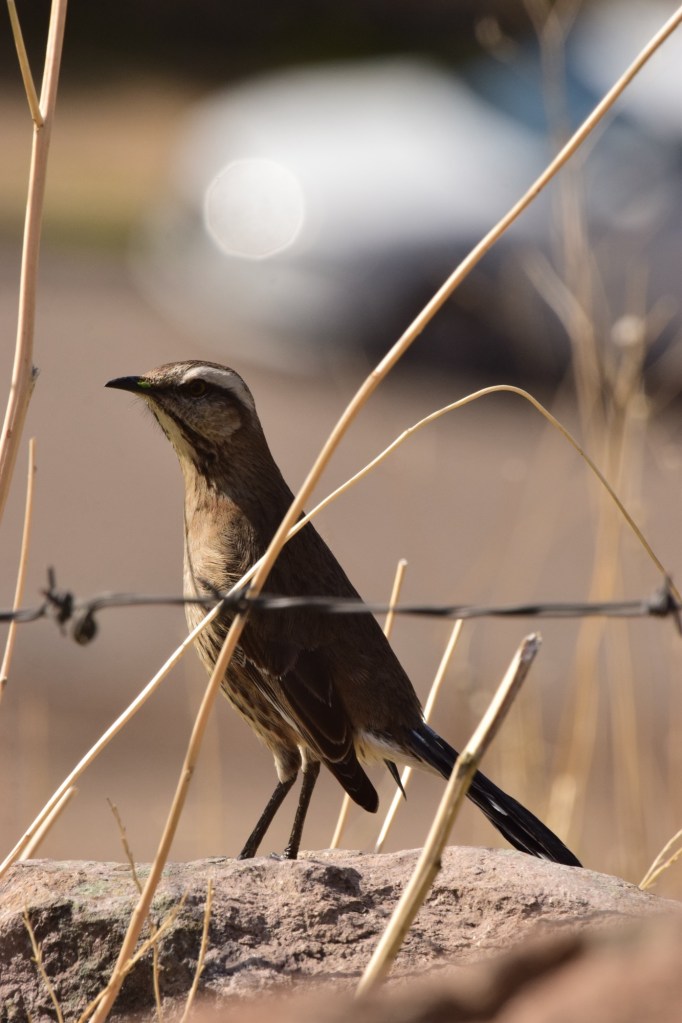
I’ve become quite used to the rufous-crowned sparrows that live around the school. There are house sparrows here too, the same as we have back home, as well as the handsome slate-grey diuca finches, but the characterful little South American sparrows are a joy to watch and to hear as they hop around the campus. Sometimes they’re joined by a mockingbird – I’ve seen the same individual at least once each day, usually around the goal posts in the patio – and today I had the treat of being reunited with the smart scarlet spectacle of a flock of meadowlarks that came rooting around the school car park around lunchtime. I haven’t seen them since I left the snowy hills of Patagonia last week, so it is lovely to be reminded of that wintry paradise when it is already some two and a half thousand kilometres to the south. 

They say that even the mighty condor comes down from the high mountains when the weather is fierce, when it can be seen from the school grounds from time to time. Now that really would be a sight!


I’ve had a fair bit of thinking time today between observations and meetings, so I’ve had time to soak in the nature of my surroundings a bit more. I saw a couple of project classes again this morning, before organising a meeting with the Head of Senior Literature after lunch.

Senior Literature… Now we’re talking business! I’m painfully aware that my decision to embark upon this mad adventure with Spanish Language A makes us one of the few schools in the UK that offer such a Spanish-heavy course. It’s also not been lost on me how bizarre my exchange set-up is: I’m an British teacher working in the one department at school that operates entirely in Spanish. It tends to throw most of these kids (and teachers!) for a loop.

I feel a great sense of relief for having spoken to a colleague who coordinates the Higher Level Language and Literature programme here at Craighouse. At least a third of the books I have nominally chosen for my own course are on their list of set texts, and the Head of Department both knew of and really rated every one of my choices. My colleagues back home are largely linguists rather than literati: a passing glance and an apologetic wave of their hands was the best response I got to my admittedly annoying enthusiasm about my text choices. Now I feel at the very least as though I have not been operating entirely in the dark.

The conversation ended with a visit to the Inquiry Centre for inspiration’s sake and a jokey offer to consider working here. I’m keen to get out of England and back into the Spanish system – or, better yet, the IB – but I’m not sure Santiago is the place for me. Maybe it hasn’t grown on me yet. I’m also getting to that age where all I really want is to find Her and settle down. Santiago is – it should be said – about as far away from home and everyone I know as I could feasibly go with the skills that I have. All the same, I’ll admit I floated the idea in my head for a little while.

I’ll let it float a while longer. Two and a half weeks remain of this exchange, which may well prove to be a lot more useful than I anticipated. It was absolutely the right decision as far as my fledgling Language A course is concerned, but it may prove to have other uses that I have yet to discover. Time will tell. 


Tomorrow I’m going to pop in on a few senior literature classes and maybe drop in on primary as well. There’s talk of the possibility of seeing how English Literature is taught here, too, which I’d absolutely love to see. I’ll keep you posted. BB x

Middle Years

Lo Barnechea, Santiago de Chile. 15.05.

Today’s lesson observations were largely spent with a friendly Spanish teacher called Mario. The Middle Years Programme or MYP – the IB’s equivalent of Years 6 to 9 – follows a really interesting programme at this time of year. Or at least that’s how I see it!

All of the classes in 6° (Year 6) are currently working on a triptych project centred around haikus, so that they can get used to how syllables work in context. The students have free choice as to what to write their haikus about, provided it concerns an aspect of Japanese culture. As for the range of ideas in the classroom…! Sakura trees, Matsumoto Castle, Mount Fuji, the origins of sushi, Tokugawa Ieyasu… The creativity and ambition of these IB-trained children is truly astounding.

In 7° (Year 8), the students are working on their organisational and presentational skills through a marketing project. Not only do they have to create the product, they have to design the marketing poster, complete with a functional slogan and all the trappings of a street-side ad, right down to the contact details and the disclaimers. Once they’ve created their project, they have to explain their product and why they have designed their ad the way they have, commenting on their own use of language and where they got their sources. It strikes me as an incredibly mature way to handle a Year 8 language class. I must find out what ours do – I’d be surprised if it is as high-brow. Or maybe I’m just bowled over by the full body of the IB, having only touched the tail of the beast before.

In 8°, the students have an even more ambitious task ahead of them: an anthology of Chilean poets (sans Neruda), from which they have to select two poems by different poets and compare them, analysing the stylistic features at work in each one. We definitely did this in English when I was growing up, but not in that kind of detail, not at that age. It reminds me of how far ahead Spain’s Lengua castellana course was of my own English syllabus, as it took me two years to reach the material I had covered during my year out in Spain (which is effectively three, as I was held back a year when I moved out in order to help me acclimatise). I can’t vouch for the quality of their work as it’s still being marked, but they seemed about as keen on poetry as your average English kid is – which is to say, not in the slightest.

It’s a shame, how universally unpopular poetry seems to be. I guess it’s because of the difficulty spike when compared to a humdrum comprehension text: all the best poets do love to weave a lot of clever imagery and references that require major unpacking to properly appreciate. I’ve always been of the opinion that the best toolkit for handling poetry is a serious arsenal of general knowledge, but with that too on the wane in the age of instant information, I can’t see poetry becoming anything more than a niche interest among the global student body.

Well. Not unless I have anything to do with it, anyway. BB x

Time Warp

Las Condes, Santiago de Chile. 19.13.

As I expected, when I arrived at school this morning, a plan for whatever it was I was supposed to do out here had yet to materialise. I think part of that is because they didn’t really know what they were working with: whether I was here to observe, to gain teaching experience, or perhaps even to help out in Maths (god forbid!). When they realised that I could not only speak Spanish but had been teaching for eight years already, that changed the game quite a bit… Really, you’d have thought this kind of thing would have been communicated ages ago! But, like I said, it was not altogether unexpected – I knew this exchange was going to be a bit ersatz until I found my feet, given how little information I had to work with before setting out.

Anyway…! What a school. What an incredible institution! I’ve been teaching the IB Diploma for the best part of five years now, but to see a school system where it is not just an additional pathway but the culmination of a five year programme… It almost seems ridiculous to offer the standalone diploma without the run-up of the MYP.

Craighouse sits at the very top of the extremely well-to-do suburb of Lo Barnechea, which is a step-up from the already smart Las Condes. It seems the higher up the mountainside you go, the higher up the societal ladder you climb, too. Mock Tudor houses with half-timbered facades. Americanesque mansions with illuminated porches and Spanish haciendas. The drive up to school from Las Condes felt like orienting one’s way through a bougie estate agent’s catalogue.

The school itself? An absolute dream of an establishment. Making rooms for scientific inquiry… Inquiry centres, which are glorified libraries with all the bells and whistles… Gyms and sports facilities that would make even my sportier students salivate… And when the clouds clear, the snowy peaks of the Andes all around them. How lucky these kids are!


The plan is coming together – slowly. For now, I’m going to be working with the Lenguaje department, helping to deliver Language and Comprehension classes. Ironically, in a school that teaches almost entirely in English, it’s the one department that is taught exclusively in Spanish. Bizarrely, they’ve hired in an English exchange teacher to help deliver the Spanish Language and Literature programme.

It is exactly what I wanted. It will be a challenge, I won’t deny that. But it is precisely what I was angling for. It is all part of the grand plan: teach Spanish, even to the Spaniards, until I am good enough to return to Spain and do the same over there. In Spain – at least in public schools – teachers of English are expected to be able to deliver Lengua Castellana as well. That’s like expecting our French teachers to be able to offer English Literature.

Of course, the British system doesn’t work like that at all – but then, why should it? Our entire curriculum fails to consider the importance of bilingualism, purely because of the cultural dominance of English on the world stage. If not English, which language would you choose? It would have to be one that your average teacher spoke well enough to capably deliver their subject, and that sole requirement kills the idea in one shot. Your average British teacher is simply not good enough at any foreign language to teach their core subject to the same standard as they would in their own, never mind finding one common foreign language at a national level. No – until another language reaches the same level of prestige as English, I don’t think it’s likely we’ll see that kind of programme over here.

But that’s ok. I plan to move abroad anyway. The more I see of this whole school IB approach, I have to admit, the more I like it. If I can only find a school in Spain where I can sink my teeth into a system like this one… Boy. That would be the dream. BB x

Back to Reality

Las Condes, Santiago de Chile. 18.27.

Well, that’s enough mad adventuring for one week. I’m back in Santiago and watching an extremely interesting third place playoff between England and France, which looked at first to be an unexpected humiliation but now it seems it could really swing either way. Vamos, futbolista no soy, but I can appreciate that it’s a very good game that’s being played, even if the news this morning was full of prideful disdain about the very idea of playing for third place.


I checked my work emails for the first time since setting out for Patagonia this morning. I really hate doing so during the holidays – work is all-consuming enough during term-time as it is, without it eating into my holidays – but leaving it unread for more than a week is far, far worse. I’m absolutely the type that needs a clean inbox with no unread messages whatsoever, so it was reassuring that the only messages I’d had in that time were the daily reports about the boarders’ internet usage (which, as you might imagine, is utterly useless for the next eight weeks).

I had a proper rest this morning, relishing the fact that I didn’t need to go rushing off anywhere. One of my ears is still stuffy from the altitude, but with any luck it’ll go away in a few days or so.

In the meantime, Tomás has given me my own key to the house and took me to Jumbo, the largest supermarket in the area, to buy some Chilean snacks for me to try but also to pick up any supplies I might have missed (like razors, for example). After over a week without shaving, it does feel good to be moustache-less once again.


It’s always interesting exploring a supermarket in another country. Target is still up at the top of the most iconic supermarkets I’ve encountered, if only because it was just so effortlessly American – and, of course, I’d heard about it and seen it referred to in so much American media before.

In its supermarkets – much like everything else – Chile feels altogether more European than, say, Peru. Self checkouts, online shopping pickup points… it’s all very familiar. There are some notable differences: namely, the bored guards watching the car park both below and outside from high seats that look more like misplaced lifeguard stations. Chile is often touted as one of the safest destinations in South America, but that might well have something to do with the expected level of security. Where I’m staying in leafy suburban Las Condes, so many of the properties are locked away behind electronic gates and door buzzers. Is it really safer, or are people here just a lot more cautious by nature?


It’s currently 3:4 to England. It really could go either way. Tomorrow’s game is the one that really matters, though, and it looks like nearly all of Chile will come out in support of their former coloniser, since the alternative is their much-hated neighbour. Though, by the looks of things, Saka is keeping France very much on their toes. 3:5! What a hero.


I’ll sign off here – no need to report more until I have more to report. BB x

Stolen Land

Aeropuerto Teniente Julio Gallardo, Puerto Natales. 15.42.

My mad jaunt down to Patagonia is coming to an end. It has been easily one of the most amazing wildlife experiences of my life, thanks in a large part to my excellent guide Fabián, but also to the exceptional quality of the encounters I have had with the local wildlife, much of it within Puerto Natales itself. It has left me with an insatiable hunger for more adventures of this kind and a fierce desire to see more places like this: there is a haunting beauty to the polar regions of the world that I have ignored for far too long.

I am already considering a new adventure for the last week of the Chilean exchange, but that, for now, must wait. I do have a job to do, after all.


Check-out from my cosy B&B was at ten this morning, so I made the most of having a warm bed right up to the last minute before setting out to find something to do to kill some time before my 16.45 flight back to Santiago.

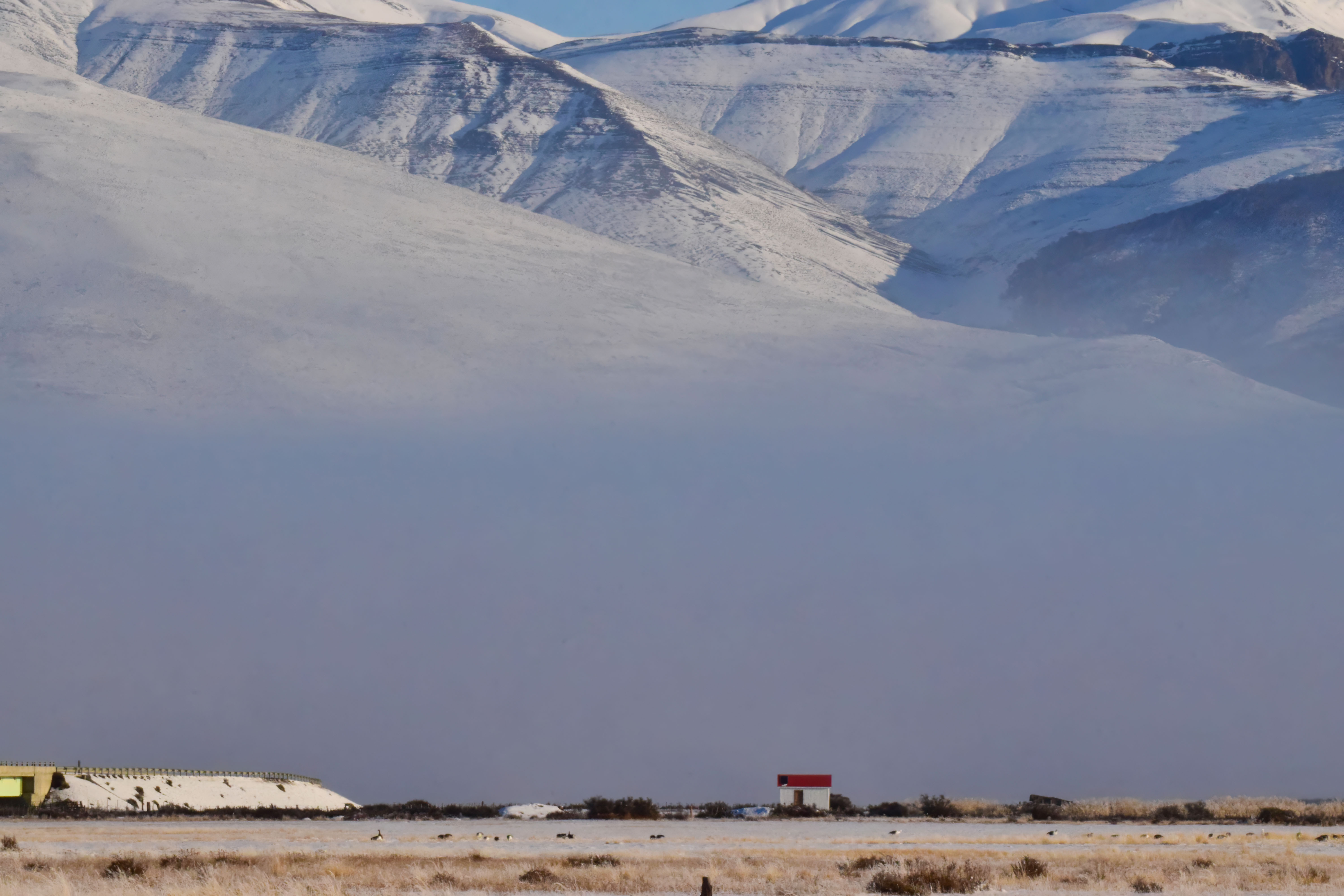
Predictably, I found my feet marching me straight back to the shore. A great carpet of cloud kept most of Puerto Natales in the dark, but away to the south, the sky was a spectacularly wintry salmon pink. A few estancias and the hamlet of Dinibor are the only settlements between here and Antarctica, if you were to head in a straight line to the south – a privilege only the birds know.


The vast network of fjords that criss-cross the mountains between Puerto Natales and the coast were once home to the Kawésqar, a nomadic people naturally stunted by their lifestyle, which saw them travel the fjords in search of food in their boats. Like the other native Patagonians – among them the Aonikenk, the Yagan and the Selk’nam – they suffered terribly at the hands of the European settlers. Many died of exposure when they were forced to trade their water-repellent sealskin clothing for Western dress, which could not protect them from the cold and the damp.


Others were wiped out by foreign diseases or brought low by the new vices of alcohol and tobacco. A great many were systematically wiped out by foreign mercenaries in organised Indian hunts, paid for by the ranchers, in an attempt to stamp out any perceived opposition to their dominion over these territories. Most heinously of all, entire families were kidnapped and shipped off to North America and Europe where they were displayed as evidence of human evolution in human zoos. Setting aside the painful matter of their obvious humiliation and fear, very few ever made it home: there are several cases of gross ignorance on the part of their buyers who, once the tour was complete, shipped the survivors back to a completely different part of Patagonia, where they were seen as outsiders by both the European settlers and the other natives.

It is nothing less than the bleak and bloodthirsty story of humanity, but it loses nothing in the retelling. It would do us a lot of good to remember what we are capable of at our very worst, if only so that we can strive to rise above the darkest heart of our nature.


My fingers were freezing up after a long walk along the seafront, even beneath two layers of gloves, so I stopped for a hot chocolate and a sandwich in a friendly café. The waitress was really cute and the chocolate was superb. I couldn’t help eavesdropping on the pair of Australasian backpackers when one of the waiters engaged them in conversation. They were here for the skiing, by the sound of things, which seems an odd thing to come out here for. The waiter was telling them how expensive it is to import oat-milk way out here in Chilean Patagonia, but how marketable it is to the tourist trade (it was literally the first thing the taller of the two New Zealanders asked upon entering the café).

I wonder what the Kawésqar would make of wanderers like us and our bizarre motives: be it the girls who have traveled across the ocean to race down the mountains on a pair of skis, or the equally odd chap in the felt hat who has flown across three continents to see the puma, the ñandú and the great black seabird that races up and down the fjords. I suppose they would be every bit as baffled by us now as they were then.


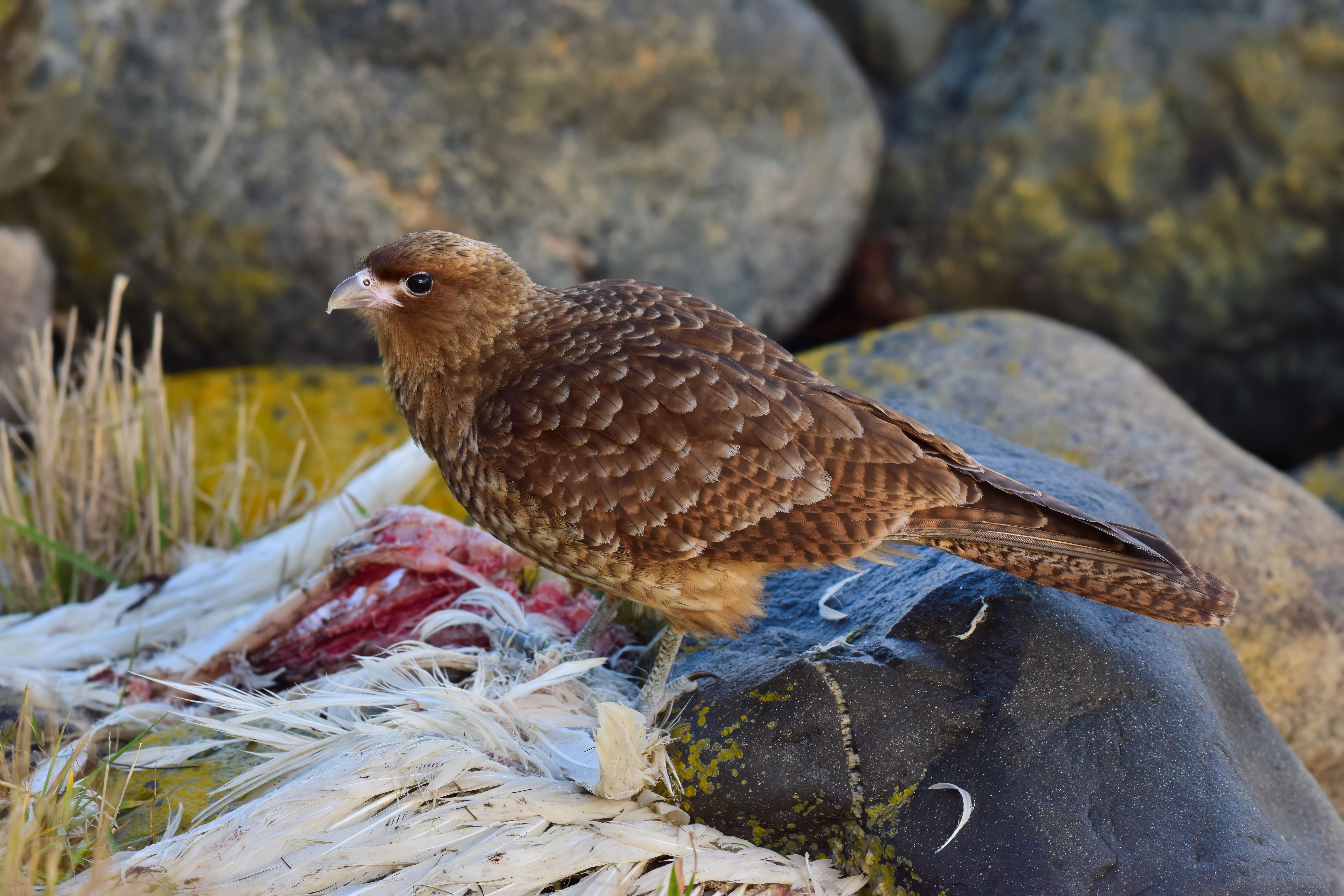
As if to say goodbye, a handsome crested caracara came down to the beach to pick at the coscoroba carcass under the sea wall. These intelligent hawks are favourites at bird of prey centres in the UK, where they perform fly-overs to the oohs and ahhs of parents and children alike. Bird shows are all well and good, but it’s nothing short of wonderful to see them here in the wild, where they belong.


The flamingos were back in the spot they had been on the day I arrived. These Chilean flamingos – easily identifiable by the pink joints on their otherwise grey legs – are the kind I only saw at a great distance during my travels in the Peruvian altiplano, so it’s nice to appreciate their magnificence at such close quarters. They’re very popular with the locals, too, who were always stopping to photograph them or watch them for a while.


It’s hard to single out a special memory from this trip – it has been a series of miracles from start to finish – though I suspect the trophy does go to the pumas by default, as that’s what I came here for, and I did have some absolutely incredible encounters over the course of three days’ tracking. Timing my arrival with the first snow of winter was a master stroke of luck, I won’t deny that. It could just as easily have been a washout, as the rest of Chile has been experiencing torrential rain for most of the last week. You’d never know it here: beyond the intermittent cloud cover, it’s been sun, snow and crystal clear waters down here in Patagonia.


As always, thank you for joining me on another adventure. The Patagonian expedition may be at an end but this particular story is not finished yet, so stay tuned for more Chilean observations and adventures. Valparaiso is very definitely on my weekend list, and the placement itself should be something to write home about. Villafranca always was.

Until the next time, Patagonia – it has been a living dream, every minute of it. BB x

South Sea Safari

Hostal Coastal B&B, Puerto Natales. 18.42.

I had to improvise a bit today, after my original plan of jumping on a full-day tour of the Torres del Paine National Park and the Cueva del Milodón fell through. Fortunately, you don’t even have to leave Puerto Natales to enjoy some spectacular wildlife, even in the heart of winter. I was also lucky with the weather today, which was largely sunny for most of the day, making photography that much easier.


Many of Natales’ resident birds look deceptively like domesticated waterfowl, which could not be further from the truth. There are crested ducks absolutely everywhere, greatly outnumbering the smaller and daintier yellow-billed teals that are one of the few birds that remain wary of humans around here. The black-necked swans that live out in the fjord are probably the most iconic residents of Puerto Natales, but they were joined today by a few pairs of Coscoroba swans, a swan-like goose that can be found from the Antarctic waters of southern Chile all the way up to Brazil.


It’s clear who holds the reins of power, though. Not five minutes after the coscorobas came in to land, a pair of black-necked swans moved in, and one of them charged the coscorobas, putting them to flight. About the only bird I haven’t seen them attack yet are the tiny white-eared grebes – I wonder if that’s because they can’t see them?


Some of the birds here look familiar, even at a head-spinning distance of just over thirteen thousand kilometres from home. A small colony of house sparrows and feral pigeons have made the town their own, as they have in most towns and cities around the planet, and at first glance the oystercatchers look similar – but these are Magellanic oystercatchers, limited to the southern tip of South America. You can tell them apart by the yellow ring around their eyes. If other human species had survived, would we have been able to tell each other apart by similar signs?


There was one creature in particular that I was hoping to see – and I was not disappointed. After a half hour’s careful observation – having been almost certain I’d seen the silhouette I was looking for across the bay when I set out – I was very nearly scalped by an absolute giant that came soaring in from behind my post on the dock: a southern giant petrel, a genuine monster of the South Sea with a two-metre wingspan and a violent disposition.


The giant petrel will eat just about anything and has a reputation for bludgeoning and drowning birds much larger than itself, including penguins, gannets and albatrosses. It will even squabble with its kin over human waste left behind by passing ships. For this reason, it’s known as the vulture of the Southern ocean – which is probably why I was so keen to see one. Besides the simple fact that they really are incredibly impressive birds to behold.


A more friendly resident of Puerto Natales is the chimango caracara. You couldn’t miss these happy little hawks if you had even the least know-how about birds – they’re all over the place, perched on lampposts, drifting over the streets in the centre of town, wandering the dockyards in gangs of five or six and hopping along the beach in search of scraps. One of them had found the remains of a coscoroba and wasn’t about to share it with any one, flapping at any other caracaras that came its way.


The occasional passing clouds across the sun made for a tricky job adjusting the shutter speed on the new camera, but when the sun did come out, I could not have been happier with the results. It helps, of course, that so many of Patagonia’s animals aren’t that shy at all.


The old jetty is one of Puerto Natales’ most famous sights, and it hosts a large colony of Imperial cormorants in the winter months. Many of them had gone by mid-morning, seeking richer waters further down the fjord, but I must have counted nearly a hundred here the other night.


I went out for another walk after lunch, following the same circuit in the hope that the giant petrel would return. After about twenty minutes, it caught me by surprise once again, rushing so low over my head that I could hear the wind whistle in its giant wings. I hoped it might return the way it had come, but when it did not show itself again after about half an hour, I wandered back across town. I would have gone back to the hostal for a bit, but something made me press on to the other side, further south. That was where the petrel went, after all.

I didn’t quite make it as far as the fishing wharf, because there was a lovely view from the Edificio Cultural Costanera. I had only just packed away my camera when I found myself having to rush to get it back out again as a flamingo came in to land, right next to one just off the shore that I had not even noticed.


At such a close range, I could see just how heavily feathered the Chilean flamingo’s face is. It must be an adaptation to the cold, as these particular flamingos make their home here in Antarctic Chile and up in the frigid lakes of the Patagonian mountains. A far cry from the languid heat of Fuente de Piedra and Lake Turkana, for sure.


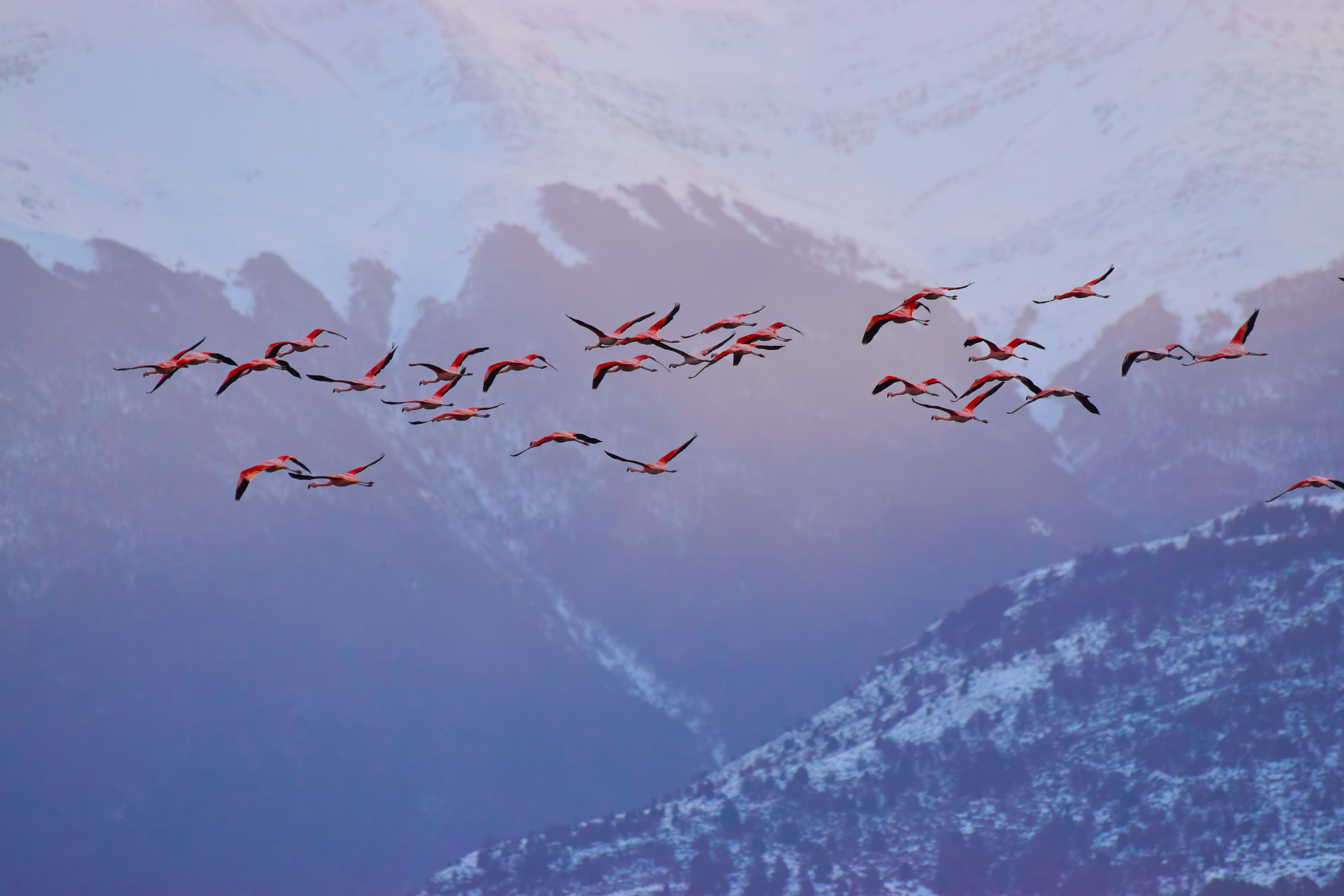
They were just the first. Soon, as the sun was beginning to set, a whole herd of flamingos came in to join them, their feathers glowing a blood-red scarlet in the evening light as they came down into the bay.


They made for quite a sight: a great herd of flamingos set against the backdrop of the snowy peaks of the Kawésqar Mountains. I certainly didn’t expect to see them again, having spotted earlier in the day that they had decamped to the other side of the bay since the day I arrived, and until recently, they had shown no signs of moving.


They were pretty quick to move, however, for one thing: a dark, powerful thing on two-metre wings, speeding towards them just above the surface of the water like a fighter plane. The petrel was back – and the mere sight of it put the fear of God into the flamingos. With much honking and splashing, they took off in a mad hurry, even when it was clear that the petrel was simply passing by.


What a spectacle they made as they flew up the fjord! It was like something out of a dream – and they kept turning this way and that, giving me every chance to snap them against the mighty mountains beyond.


It felt like the perfect ending to the trip, even though I have most of the day tomorrow as well, since my flight doesn’t leave until half four. But I come away with so many incredible memories, some of which I have written about and many of which I can print and put up on my wall. That’s how a good holiday should be, right? BB x

Wild and Free

Café Artimaña, Puerto Natales. 20.30.

The weather is fickle. It’s still pretty cold out, but it’s warmed up enough not to need more than two layers on when leaving the house. The snow has largely melted away in Puerto Natales and the surrounding countryside, revealing for the first time the vast golden fields of Patagonia. It’s always a bit sad when snow melts, like coming to the end of a very special story, but if the forecast is to be believed, it will be back tonight.

I still can’t believe my ridiculous lucky streak in timing this adventure to coincide with the very first snowfall of winter – and all the magic that followed, right up until the last throw of my expedition today. Right up to the wire.


Fabián picked me up just after seven thirty as usual and we set out into the darkness. Beaming his thermal camera to his phone, we spent much of the twilight hour searching for life in the snow. It was eerily quiet this morning. A single caracara was our only find, shivering in the cold at the side of the road.


And not without reason: the temperature had dropped to a biting -10°C, worsened by the all consuming oblivion of a snowborn fog and an icy wind coming up off the lake. Even the lights of oncoming cars didn’t become visible until long after their engines were heard rumbling down the road.

We had quite a scare while looking for Escarcha and her cubs. The thermal camera picked up two glowing dots on the hillside not far from where we’d left them yesterday: one large, one small. One of the trackers went up into the fogbound hills to get a closer look and radioed in to confirm it was Escarcha and one cub. For a painful half hour, there was no sign of the second cub at all – until it came out from behind a rock where it had been hiding, much to everyone’s relief.

Winter may be beautiful, but it is terribly hard on the animals that live here – especially the young. Hopefully, Escarcha’s cubs make it through the winter so they can find territories of their own in this desolate idyll.


Escarcha took her cubs higher up into the gloom, which showed no signs of lifting anytime soon. Fabián suggested an alternative itinerary up at Laguna Azul, on the eastern edge of the national park, so we left the fog and set back out into the brilliant light.

Laguna Azul offers a tremendous view of the world famous spires of Torres del Paine across the surface of its crystal waters, though they were more often shrouded in cloud than not.


The towers themselves are every bit as breathtaking as you have heard. Unlike Petra (which I was arguably less exposed to before I saw it) the Torres del Paine lose nothing in reality, despite the fact you’ve probably seen them a thousand times over on the covers of photography magazines, NatGeo special editions and South American travel guides. Glowing red and white in the morning light, they might be the exposed teeth of some ancient titan, or the thrones of South America’s lord of the skies, the condor.

Fanciful imaginings on my part. Paine is a Tehuelche word meaning “blue”, in honour of the colour of the peaks in the grey morning, or the icy glaciers that lay at its feet.


Fabián’s mission was to find a tucúquere, a Magellanic horned owl, or the more well-known Patagonian speciality, a Magellanic woodpecker. But the forests around Laguna Azul were silent – completely silent. We found another chunchito (pygmy owl) watching us from the top of a dead tree, along with a couple of colourful rayaditos, but the snowy forest showed no other signs of life.


Perhaps they were all hiding from the creature that left these tracks in the woods: an enormous male puma, whose trail we followed for about an hour as it weaved through the woods, occasionally doubling back to investigate the older trails of a couple of younger female pumas.


Out on the lake, I finally tracked down a creature I missed in Peru. We have grebes in Europe, but the huala or great grebe – the largest of its kind in the world – is a truly magnificent bird, reaching the size of a cormorant. Curiously, as I descended to the lake’s shore to get a closer look, it actually came closer to the shoreline rather than diving and emerging much further away, as grebes are inclined to do.


Back in the car, Fabián checked in with his fellow trackers over the radio. Nobody, it seemed, had had any luck with pumas since Escarcha and her cubs went up into the hills. So we stopped for a snack lunch next to the thundering falls of the Cascada del Río Paine, where the meltwaters of the park’s mightiest river came hurtling down a series of cliffs amidst menacing curtains of sheet ice.


We picked a lucky spot. Two handsome condors sat up on the hilltop, sunning themselves in a posture that must have convinced the ancient Inca that the condor truly was a messenger (and worshipper) of the Sun.


The waterfall must be a reference point for the condors in their navigation, because no fewer than sixteen came flying right overhead on their way up the valley, some of them soaring so close you could hear the rush of wind in their enormous wings. They were mostly youngsters, yet to don the full black robes and smart white collars of their elders.

For me, that would have been the perfect ending to a wonderful three days: a close encounter with one of my favourite creatures in the world – again – but Patagonia was not done with us. Not yet.


The radio crackled to life as we were driving back to the south road: ‘La Petaca está en la carretera’. Fabián stepped on the gas, overtaking two trucks in the snow like a rally car and forking right back up the road to Lago Sarmiento.

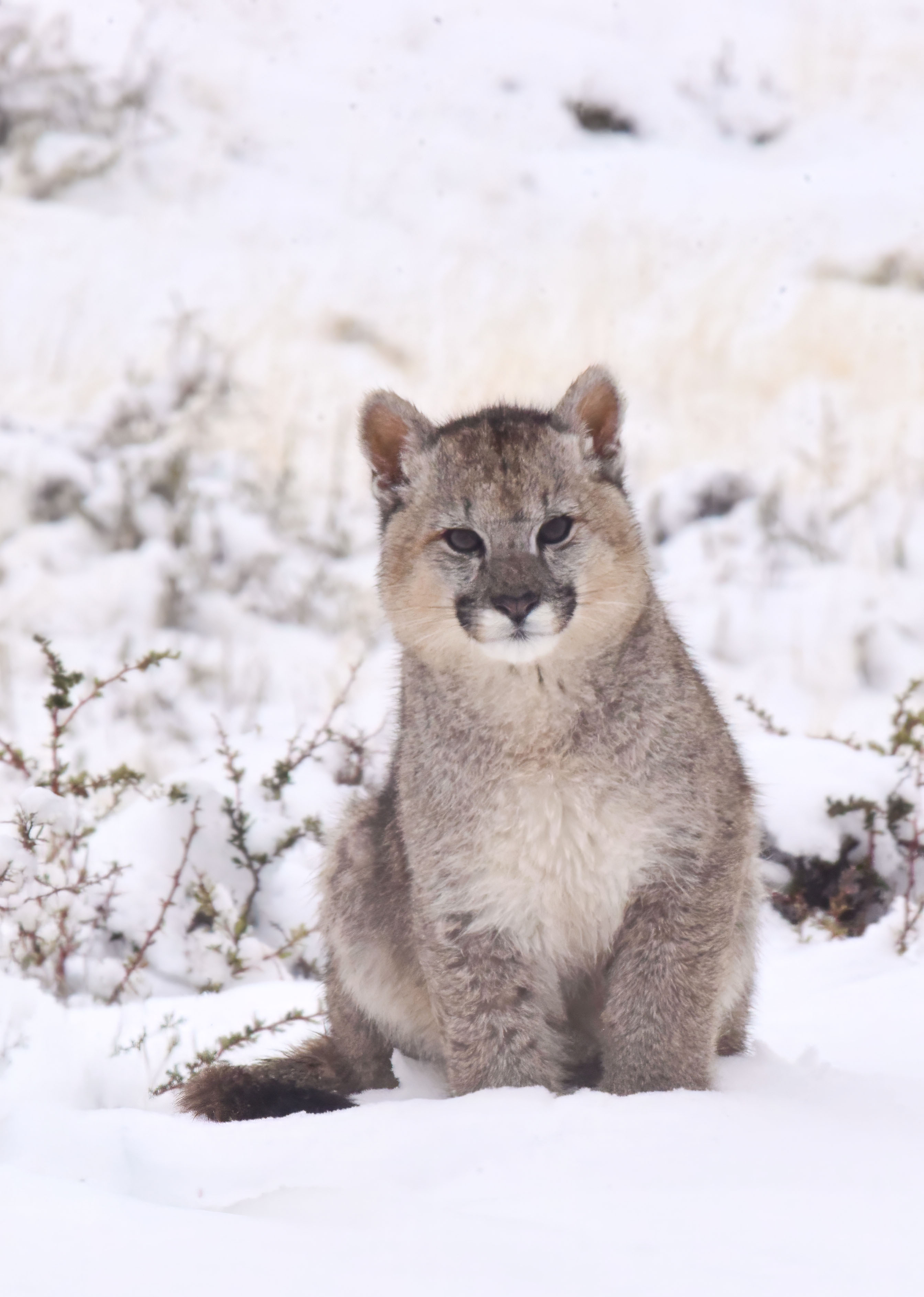
The fog had finally cleared, having hung over the lake almost all day, and one of the trackers had located Petaca, the dominant female and the park’s most famous puma, following the scent trail of Escarcha and her cubs: her progeny. By the time we got there, she had slipped off the road and into the scrub, but we were still able to spot her without too much difficulty.


Not for the first time, I was disappointed with the behaviour of some of the tourists and their tracker, who came down from the road to move in as close to Petaca as possible. If she had wanted to come back up the hill, she was cut off constantly by this group that kept cutting ahead of her to get more and more photos of the big cat approaching head-on. Fabián was just as ticked off as I was (I really do appreciate a guide who puts the animal first, and not the client). Surprise surprise, the tracker was one of the ones we’d sparred with a few days prior, telling us to back off as they were there first. Go figure!


I believe that the key to magical wild encounters is patience, understanding and a healthy dose of luck. If that had been that, I would have been perfectly happy – we had already seen so much of the pumas over the last two days. I was ready to hit the road and maybe find some ñandúes on the way home.

And then Petaca reappeared.


With the shimmering waters of Lago Sarmiento behind her, she hardly cast a glance in our direction as she padded her way along the hillside toward the road, following Escarcha’s trail.


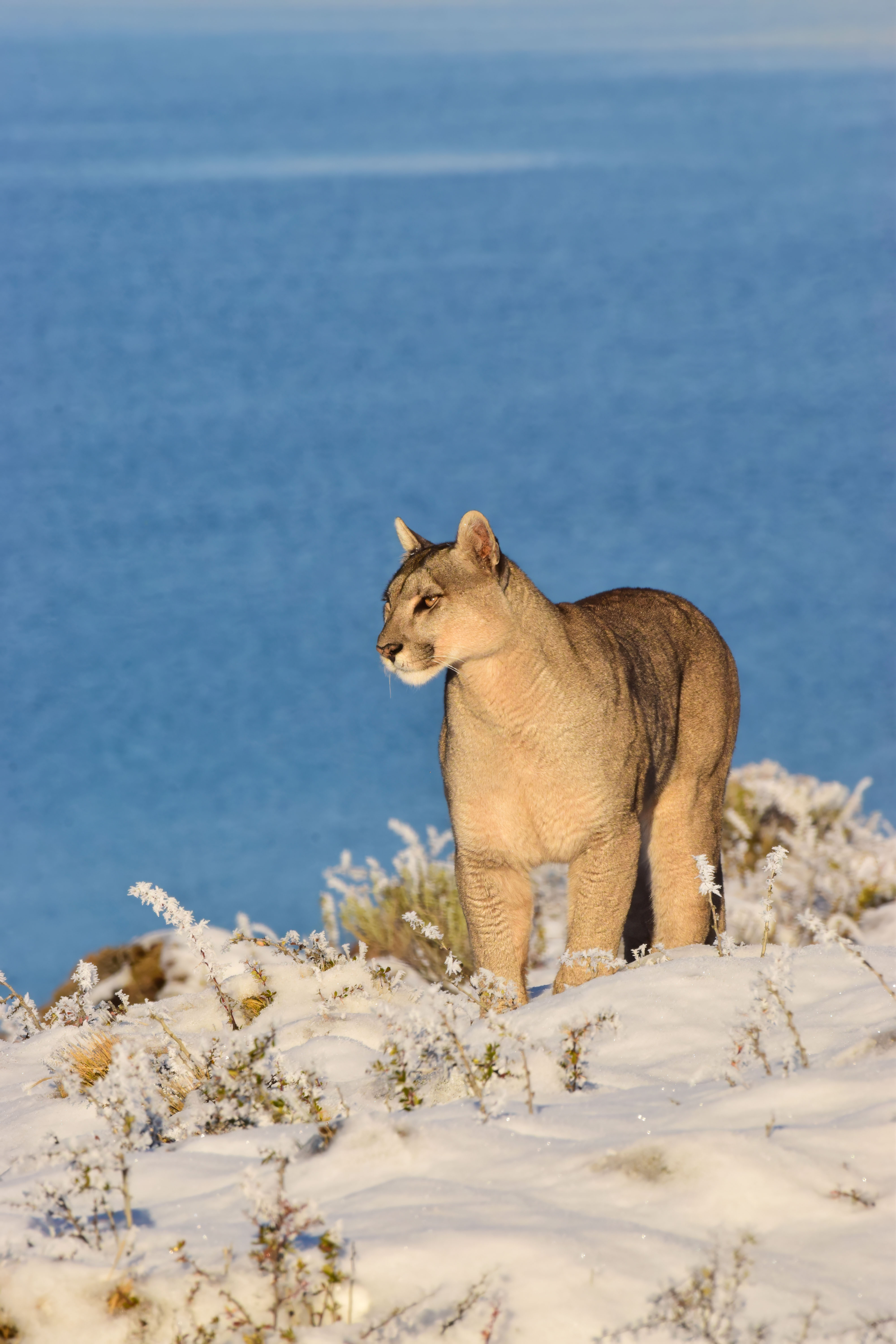
With no further obstructions to her path, she came right up to the road, mere metres away. At such a distance, you could really appreciate the power in those mighty paws. Here is an animal that didn’t struggle once in the snow like the fox and the geese from yesterday: she almost seemed to glide across the surface of the frozen hill.


I thought the fence between the road and the hill might prove a barrier, but not for this apex predator. In a single move she leapt nimbly up onto the wire and then launched herself onto the other side, just a few feet away.


Having cleared the road, Petaca climbed up into the hills toward the setting sun and disappeared among the frozen scrub. What an incredible encounter! And what a way to finish a superb three days’ tracking in Patagonia!

On the way back, we found the unnamed young male in the same spot he had been when we first saw him on Monday. It felt fitting that the last puma of the trip should also be the first. We might very nearly have witnessed a hunt, as a lone guanaco was headed right his way, until a passing truck spooked it into heading in a different direction.


The tour I had booked for tomorrow into the heart of the park itself and the Cueva del Milodón was sadly cancelled due to low numbers by the time I got back, so this will be my last time in Torres del Paine. Magical, then, that it should end with a view of the mountains at their most impressive, with ominous yellow and grey clouds rolling across its summit, turning the blue mountains of the Tehuelche all kinds of magical colours. Who could not lose their heart to such a sight?


I’ll take it easy tomorrow and explore Puerto Natales properly. There’s so much human history here that I could so easily overlook, and it will need more than a morning, I think. BB x