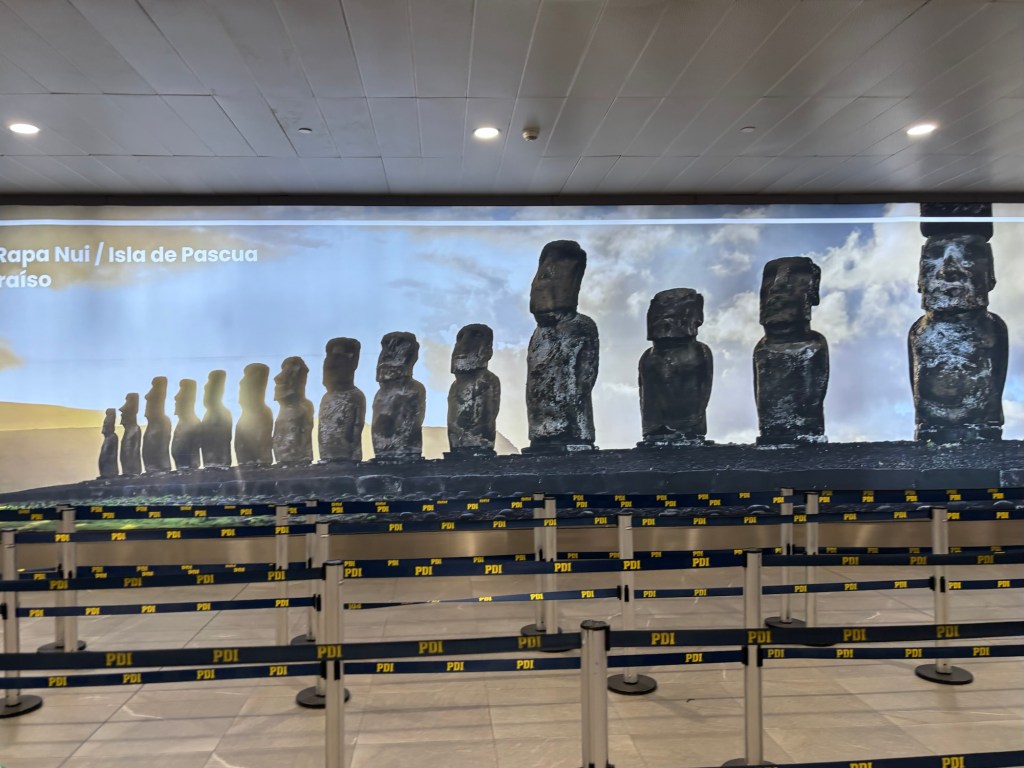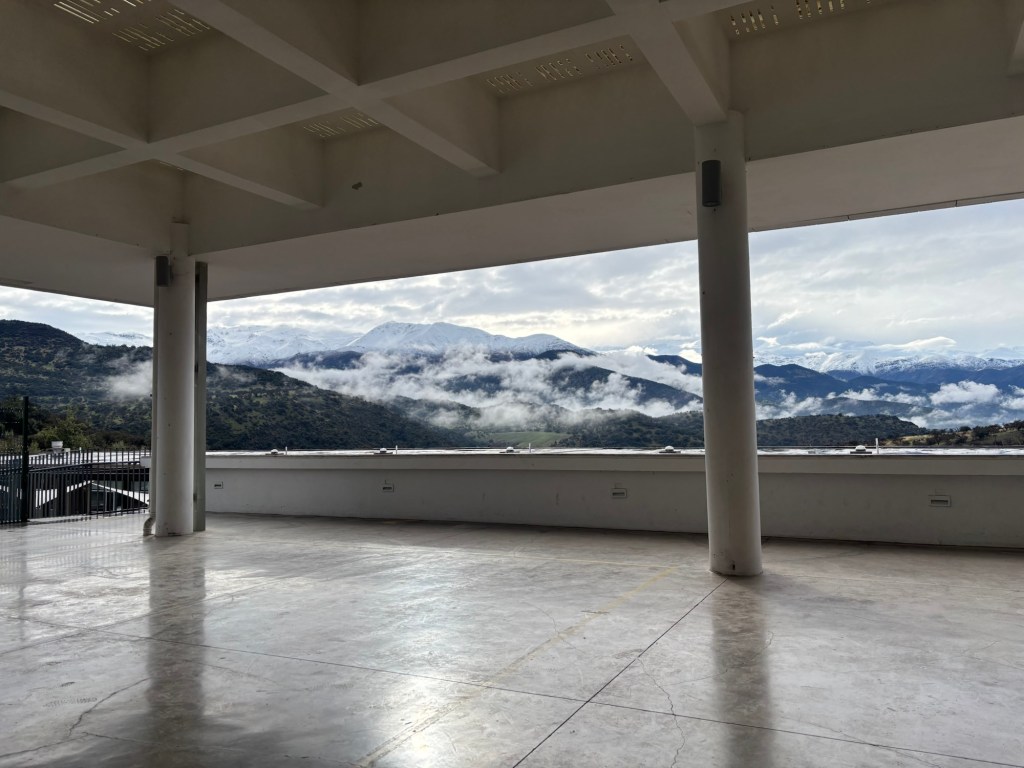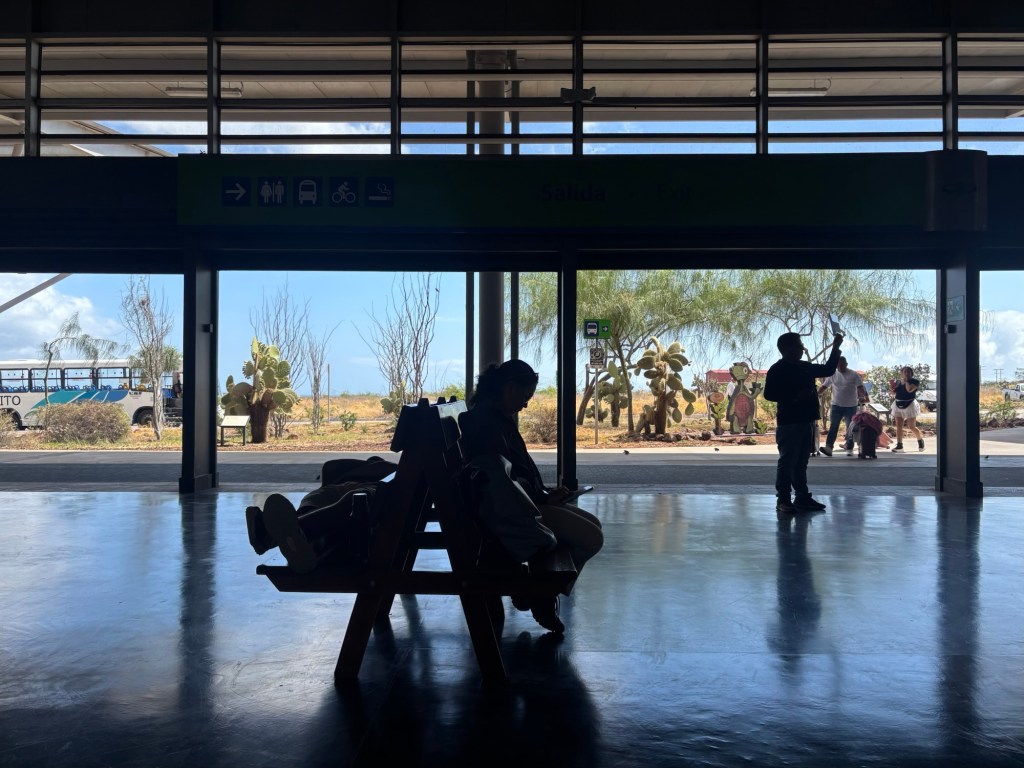
Aeropuerto Teniente Julio Gallardo, Puerto Natales. 15.42.
My mad jaunt down to Patagonia is coming to an end. It has been easily one of the most amazing wildlife experiences of my life, thanks in a large part to my excellent guide Fabián, but also to the exceptional quality of the encounters I have had with the local wildlife, much of it within Puerto Natales itself. It has left me with an insatiable hunger for more adventures of this kind and a fierce desire to see more places like this: there is a haunting beauty to the polar regions of the world that I have ignored for far too long.
I am already considering a new adventure for the last week of the Chilean exchange, but that, for now, must wait. I do have a job to do, after all.
Check-out from my cosy B&B was at ten this morning, so I made the most of having a warm bed right up to the last minute before setting out to find something to do to kill some time before my 16.45 flight back to Santiago.
Predictably, I found my feet marching me straight back to the shore. A great carpet of cloud kept most of Puerto Natales in the dark, but away to the south, the sky was a spectacularly wintry salmon pink. A few estancias and the hamlet of Dinibor are the only settlements between here and Antarctica, if you were to head in a straight line to the south – a privilege only the birds know.
The vast network of fjords that criss-cross the mountains between Puerto Natales and the coast were once home to the Kawésqar, a nomadic people naturally stunted by their lifestyle, which saw them travel the fjords in search of food in their boats. Like the other native Patagonians – among them the Aonikenk, the Yagan and the Selk’nam – they suffered terribly at the hands of the European settlers. Many died of exposure when they were forced to trade their water-repellent sealskin clothing for Western dress, which could not protect them from the cold and the damp.
Others were wiped out by foreign diseases or brought low by the new vices of alcohol and tobacco. A great many were systematically wiped out by foreign mercenaries in organised Indian hunts, paid for by the ranchers, in an attempt to stamp out any perceived opposition to their dominion over these territories. Most heinously of all, entire families were kidnapped and shipped off to North America and Europe where they were displayed as evidence of human evolution in human zoos. Setting aside the painful matter of their obvious humiliation and fear, very few ever made it home: there are several cases of gross ignorance on the part of their buyers who, once the tour was complete, shipped the survivors back to a completely different part of Patagonia, where they were seen as outsiders by both the European settlers and the other natives.
It is nothing less than the bleak and bloodthirsty story of humanity, but it loses nothing in the retelling. It would do us a lot of good to remember what we are capable of at our very worst, if only so that we can strive to rise above the darkest heart of our nature.
My fingers were freezing up after a long walk along the seafront, even beneath two layers of gloves, so I stopped for a hot chocolate and a sandwich in a friendly café. The waitress was really cute and the chocolate was superb. I couldn’t help eavesdropping on the pair of Australasian backpackers when one of the waiters engaged them in conversation. They were here for the skiing, by the sound of things, which seems an odd thing to come out here for. The waiter was telling them how expensive it is to import oat-milk way out here in Chilean Patagonia, but how marketable it is to the tourist trade (it was literally the first thing the taller of the two New Zealanders asked upon entering the café).
I wonder what the Kawésqar would make of wanderers like us and our bizarre motives: be it the girls who have traveled across the ocean to race down the mountains on a pair of skis, or the equally odd chap in the felt hat who has flown across three continents to see the puma, the ñandú and the great black seabird that races up and down the fjords. I suppose they would be every bit as baffled by us now as they were then.
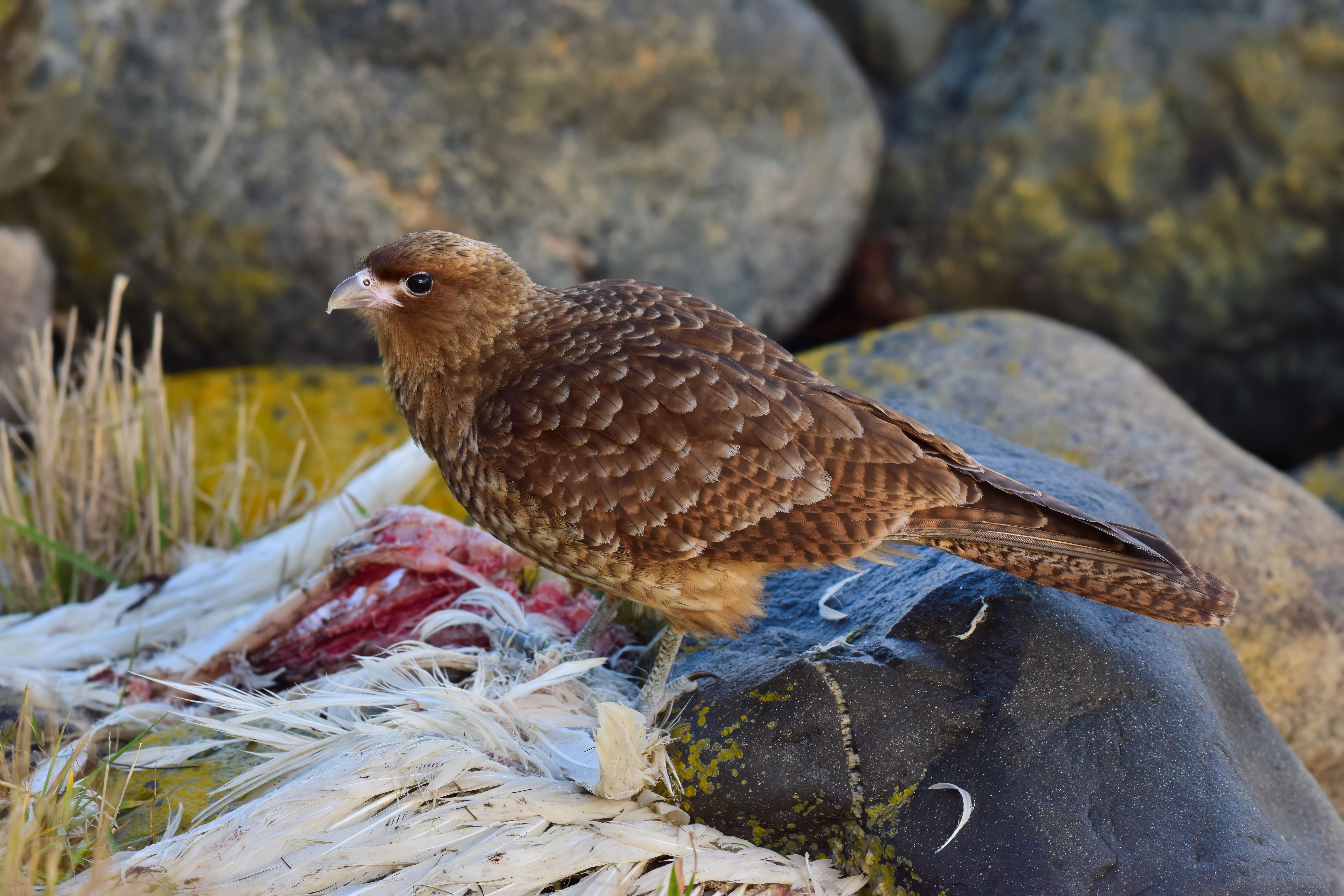
As if to say goodbye, a handsome crested caracara came down to the beach to pick at the coscoroba carcass under the sea wall. These intelligent hawks are favourites at bird of prey centres in the UK, where they perform fly-overs to the oohs and ahhs of parents and children alike. Bird shows are all well and good, but it’s nothing short of wonderful to see them here in the wild, where they belong.
The flamingos were back in the spot they had been on the day I arrived. These Chilean flamingos – easily identifiable by the pink joints on their otherwise grey legs – are the kind I only saw at a great distance during my travels in the Peruvian altiplano, so it’s nice to appreciate their magnificence at such close quarters. They’re very popular with the locals, too, who were always stopping to photograph them or watch them for a while.
It’s hard to single out a special memory from this trip – it has been a series of miracles from start to finish – though I suspect the trophy does go to the pumas by default, as that’s what I came here for, and I did have some absolutely incredible encounters over the course of three days’ tracking. Timing my arrival with the first snow of winter was a master stroke of luck, I won’t deny that. It could just as easily have been a washout, as the rest of Chile has been experiencing torrential rain for most of the last week. You’d never know it here: beyond the intermittent cloud cover, it’s been sun, snow and crystal clear waters down here in Patagonia.
As always, thank you for joining me on another adventure. The Patagonian expedition may be at an end but this particular story is not finished yet, so stay tuned for more Chilean observations and adventures. Valparaiso is very definitely on my weekend list, and the placement itself should be something to write home about. Villafranca always was.
Until the next time, Patagonia – it has been a living dream, every minute of it. BB x
I had to improvise a bit today, after my original plan of jumping on a full-day tour of the Torres del Paine National Park and the Cueva del Milodón fell through. Fortunately, you don’t even have to leave Puerto Natales to enjoy some spectacular wildlife, even in the heart of winter. I was also lucky with the weather today, which was largely sunny for most of the day, making photography that much easier.
Many of Natales’ resident birds look deceptively like domesticated waterfowl, which could not be further from the truth. There are crested ducks absolutely everywhere, greatly outnumbering the smaller and daintier yellow-billed teals that are one of the few birds that remain wary of humans around here. The black-necked swans that live out in the fjord are probably the most iconic residents of Puerto Natales, but they were joined today by a few pairs of Coscoroba swans, a swan-like goose that can be found from the Antarctic waters of southern Chile all the way up to Brazil.
It’s clear who holds the reins of power, though. Not five minutes after the coscorobas came in to land, a pair of black-necked swans moved in, and one of them charged the coscorobas, putting them to flight. About the only bird I haven’t seen them attack yet are the tiny white-eared grebes – I wonder if that’s because they can’t see them?
Some of the birds here look familiar, even at a head-spinning distance of just over thirteen thousand kilometres from home. A small colony of house sparrows and feral pigeons have made the town their own, as they have in most towns and cities around the planet, and at first glance the oystercatchers look similar – but these are Magellanic oystercatchers, limited to the southern tip of South America. You can tell them apart by the yellow ring around their eyes. If other human species had survived, would we have been able to tell each other apart by similar signs?
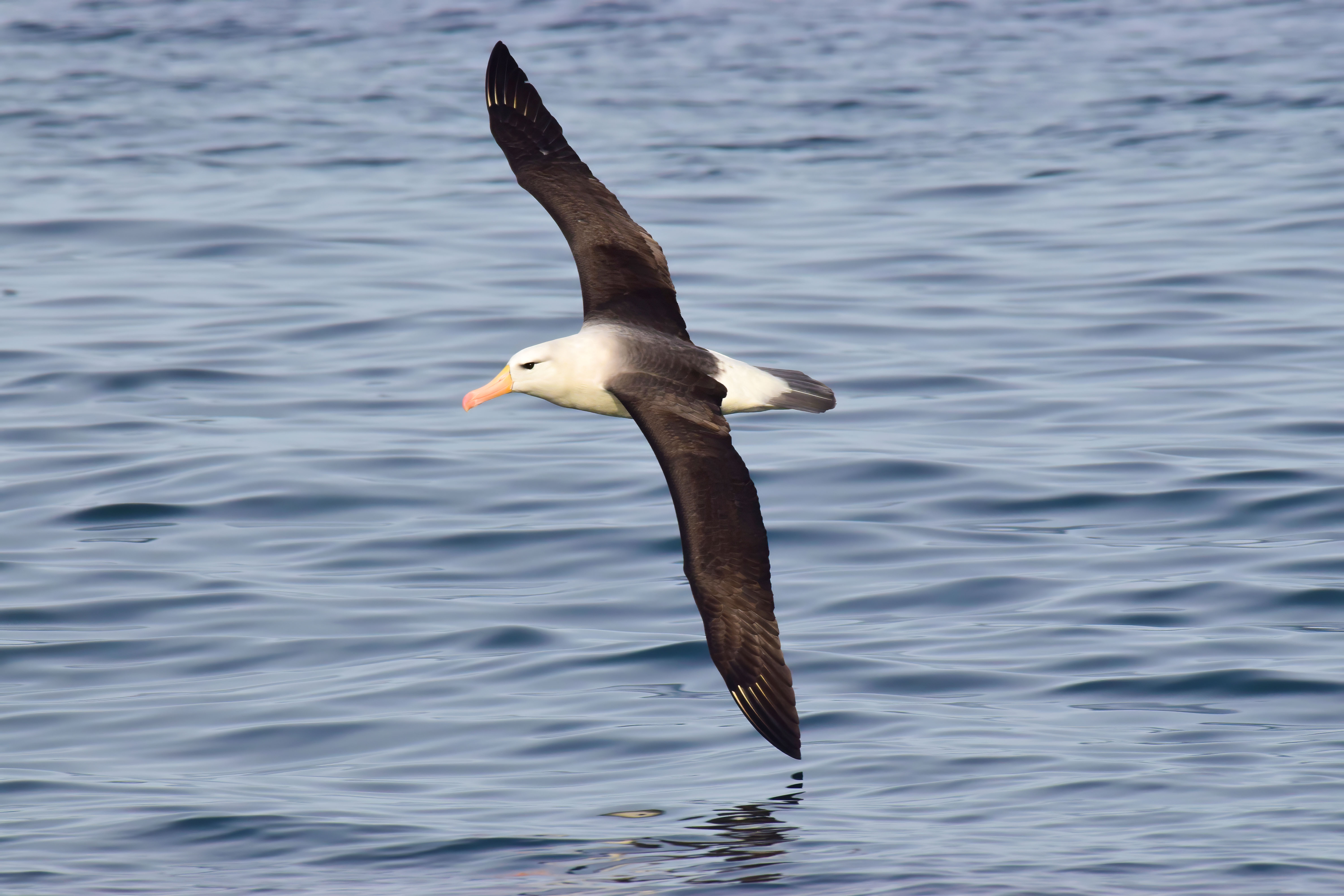
There was one creature in particular that I was hoping to see – and I was not disappointed. After a half hour’s careful observation – having been almost certain I’d seen the silhouette I was looking for across the bay when I set out – I was very nearly scalped by an absolute giant that came soaring in from behind my post on the dock: a southern giant petrel, a genuine monster of the South Sea with a two-metre wingspan and a violent disposition.
The giant petrel will eat just about anything and has a reputation for bludgeoning and drowning birds much larger than itself, including penguins, gannets and albatrosses. It will even squabble with its kin over human waste left behind by passing ships. For this reason, it’s known as the vulture of the Southern ocean – which is probably why I was so keen to see one. Besides the simple fact that they really are incredibly impressive birds to behold.
A more friendly resident of Puerto Natales is the chimango caracara. You couldn’t miss these happy little hawks if you had even the least know-how about birds – they’re all over the place, perched on lampposts, drifting over the streets in the centre of town, wandering the dockyards in gangs of five or six and hopping along the beach in search of scraps. One of them had found the remains of a coscoroba and wasn’t about to share it with any one, flapping at any other caracaras that came its way.
The occasional passing clouds across the sun made for a tricky job adjusting the shutter speed on the new camera, but when the sun did come out, I could not have been happier with the results. It helps, of course, that so many of Patagonia’s animals aren’t that shy at all.
The old jetty is one of Puerto Natales’ most famous sights, and it hosts a large colony of Imperial cormorants in the winter months. Many of them had gone by mid-morning, seeking richer waters further down the fjord, but I must have counted nearly a hundred here the other night.
I went out for another walk after lunch, following the same circuit in the hope that the giant petrel would return. After about twenty minutes, it caught me by surprise once again, rushing so low over my head that I could hear the wind whistle in its giant wings. I hoped it might return the way it had come, but when it did not show itself again after about half an hour, I wandered back across town. I would have gone back to the hostal for a bit, but something made me press on to the other side, further south. That was where the petrel went, after all.
I didn’t quite make it as far as the fishing wharf, because there was a lovely view from the Edificio Cultural Costanera. I had only just packed away my camera when I found myself having to rush to get it back out again as a flamingo came in to land, right next to one just off the shore that I had not even noticed.
At such a close range, I could see just how heavily feathered the Chilean flamingo’s face is. It must be an adaptation to the cold, as these particular flamingos make their home here in Antarctic Chile and up in the frigid lakes of the Patagonian mountains. A far cry from the languid heat of Fuente de Piedra and Lake Turkana, for sure.
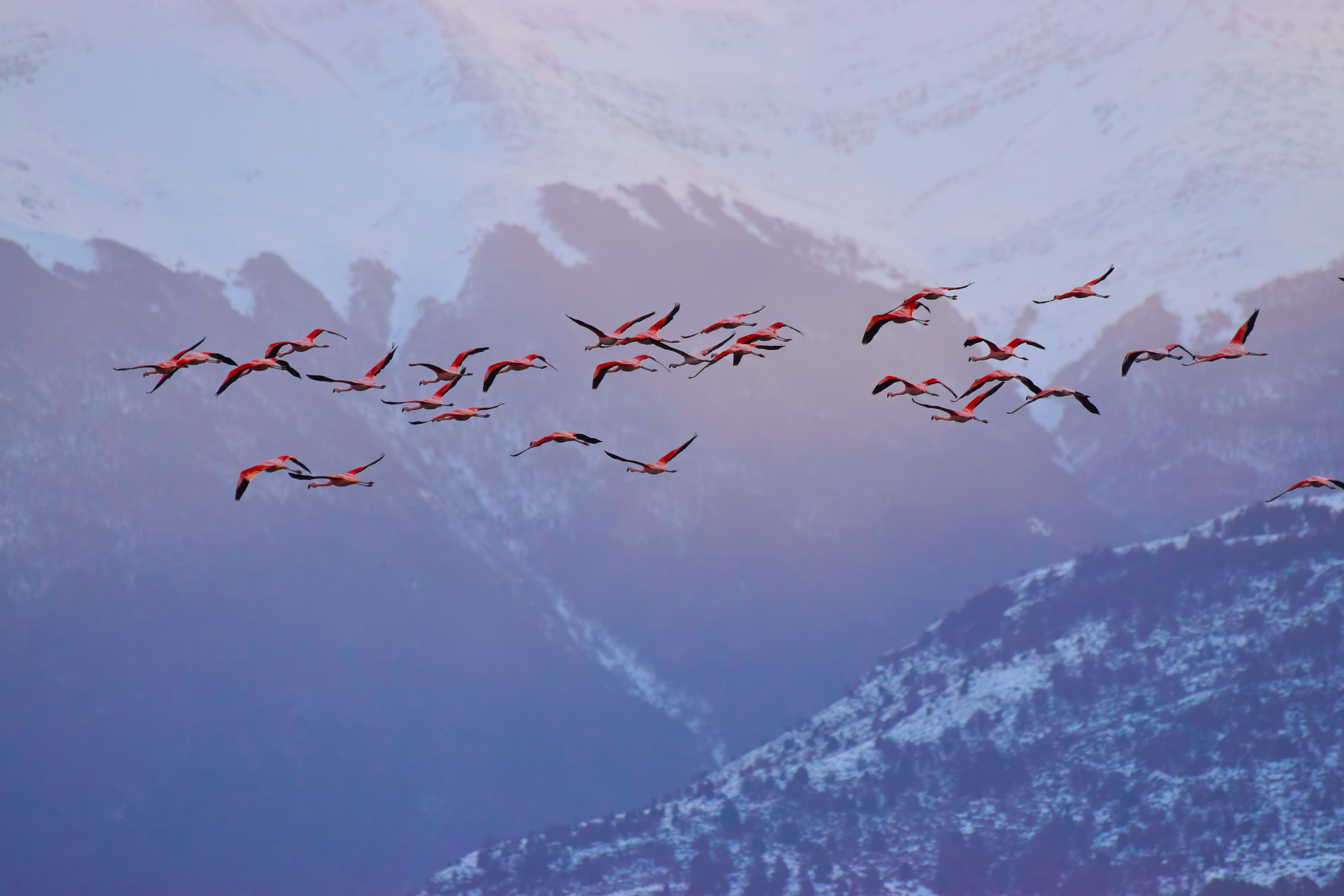
They were just the first. Soon, as the sun was beginning to set, a whole herd of flamingos came in to join them, their feathers glowing a blood-red scarlet in the evening light as they came down into the bay.
They made for quite a sight: a great herd of flamingos set against the backdrop of the snowy peaks of the Kawésqar Mountains. I certainly didn’t expect to see them again, having spotted earlier in the day that they had decamped to the other side of the bay since the day I arrived, and until recently, they had shown no signs of moving.
They were pretty quick to move, however, for one thing: a dark, powerful thing on two-metre wings, speeding towards them just above the surface of the water like a fighter plane. The petrel was back – and the mere sight of it put the fear of God into the flamingos. With much honking and splashing, they took off in a mad hurry, even when it was clear that the petrel was simply passing by.
What a spectacle they made as they flew up the fjord! It was like something out of a dream – and they kept turning this way and that, giving me every chance to snap them against the mighty mountains beyond.
It felt like the perfect ending to the trip, even though I have most of the day tomorrow as well, since my flight doesn’t leave until half four. But I come away with so many incredible memories, some of which I have written about and many of which I can print and put up on my wall. That’s how a good holiday should be, right? BB x
The weather is fickle. It’s still pretty cold out, but it’s warmed up enough not to need more than two layers on when leaving the house. The snow has largely melted away in Puerto Natales and the surrounding countryside, revealing for the first time the vast golden fields of Patagonia. It’s always a bit sad when snow melts, like coming to the end of a very special story, but if the forecast is to be believed, it will be back tonight.
I still can’t believe my ridiculous lucky streak in timing this adventure to coincide with the very first snowfall of winter – and all the magic that followed, right up until the last throw of my expedition today. Right up to the wire.
Fabián picked me up just after seven thirty as usual and we set out into the darkness. Beaming his thermal camera to his phone, we spent much of the twilight hour searching for life in the snow. It was eerily quiet this morning. A single caracara was our only find, shivering in the cold at the side of the road.
And not without reason: the temperature had dropped to a biting -10°C, worsened by the all consuming oblivion of a snowborn fog and an icy wind coming up off the lake. Even the lights of oncoming cars didn’t become visible until long after their engines were heard rumbling down the road.
We had quite a scare while looking for Escarcha and her cubs. The thermal camera picked up two glowing dots on the hillside not far from where we’d left them yesterday: one large, one small. One of the trackers went up into the fogbound hills to get a closer look and radioed in to confirm it was Escarcha and one cub. For a painful half hour, there was no sign of the second cub at all – until it came out from behind a rock where it had been hiding, much to everyone’s relief.
Winter may be beautiful, but it is terribly hard on the animals that live here – especially the young. Hopefully, Escarcha’s cubs make it through the winter so they can find territories of their own in this desolate idyll.
Escarcha took her cubs higher up into the gloom, which showed no signs of lifting anytime soon. Fabián suggested an alternative itinerary up at Laguna Azul, on the eastern edge of the national park, so we left the fog and set back out into the brilliant light.
Laguna Azul offers a tremendous view of the world famous spires of Torres del Paine across the surface of its crystal waters, though they were more often shrouded in cloud than not.
The towers themselves are every bit as breathtaking as you have heard. Unlike Petra (which I was arguably less exposed to before I saw it) the Torres del Paine lose nothing in reality, despite the fact you’ve probably seen them a thousand times over on the covers of photography magazines, NatGeo special editions and South American travel guides. Glowing red and white in the morning light, they might be the exposed teeth of some ancient titan, or the thrones of South America’s lord of the skies, the condor.
Fanciful imaginings on my part. Paine is a Tehuelche word meaning “blue”, in honour of the colour of the peaks in the grey morning, or the icy glaciers that lay at its feet.
Fabián’s mission was to find a tucúquere, a Magellanic horned owl, or the more well-known Patagonian speciality, a Magellanic woodpecker. But the forests around Laguna Azul were silent – completely silent. We found another chunchito (pygmy owl) watching us from the top of a dead tree, along with a couple of colourful rayaditos, but the snowy forest showed no other signs of life.
Perhaps they were all hiding from the creature that left these tracks in the woods: an enormous male puma, whose trail we followed for about an hour as it weaved through the woods, occasionally doubling back to investigate the older trails of a couple of younger female pumas.
Out on the lake, I finally tracked down a creature I missed in Peru. We have grebes in Europe, but the huala or great grebe – the largest of its kind in the world – is a truly magnificent bird, reaching the size of a cormorant. Curiously, as I descended to the lake’s shore to get a closer look, it actually came closer to the shoreline rather than diving and emerging much further away, as grebes are inclined to do.
Back in the car, Fabián checked in with his fellow trackers over the radio. Nobody, it seemed, had had any luck with pumas since Escarcha and her cubs went up into the hills. So we stopped for a snack lunch next to the thundering falls of the Cascada del Río Paine, where the meltwaters of the park’s mightiest river came hurtling down a series of cliffs amidst menacing curtains of sheet ice.
We picked a lucky spot. Two handsome condors sat up on the hilltop, sunning themselves in a posture that must have convinced the ancient Inca that the condor truly was a messenger (and worshipper) of the Sun.
The waterfall must be a reference point for the condors in their navigation, because no fewer than sixteen came flying right overhead on their way up the valley, some of them soaring so close you could hear the rush of wind in their enormous wings. They were mostly youngsters, yet to don the full black robes and smart white collars of their elders.
For me, that would have been the perfect ending to a wonderful three days: a close encounter with one of my favourite creatures in the world – again – but Patagonia was not done with us. Not yet.
The radio crackled to life as we were driving back to the south road: ‘La Petaca está en la carretera’. Fabián stepped on the gas, overtaking two trucks in the snow like a rally car and forking right back up the road to Lago Sarmiento.
The fog had finally cleared, having hung over the lake almost all day, and one of the trackers had located Petaca, the dominant female and the park’s most famous puma, following the scent trail of Escarcha and her cubs: her progeny. By the time we got there, she had slipped off the road and into the scrub, but we were still able to spot her without too much difficulty.
Not for the first time, I was disappointed with the behaviour of some of the tourists and their tracker, who came down from the road to move in as close to Petaca as possible. If she had wanted to come back up the hill, she was cut off constantly by this group that kept cutting ahead of her to get more and more photos of the big cat approaching head-on. Fabián was just as ticked off as I was (I really do appreciate a guide who puts the animal first, and not the client). Surprise surprise, the tracker was one of the ones we’d sparred with a few days prior, telling us to back off as they were there first. Go figure!
I believe that the key to magical wild encounters is patience, understanding and a healthy dose of luck. If that had been that, I would have been perfectly happy – we had already seen so much of the pumas over the last two days. I was ready to hit the road and maybe find some ñandúes on the way home.
And then Petaca reappeared.
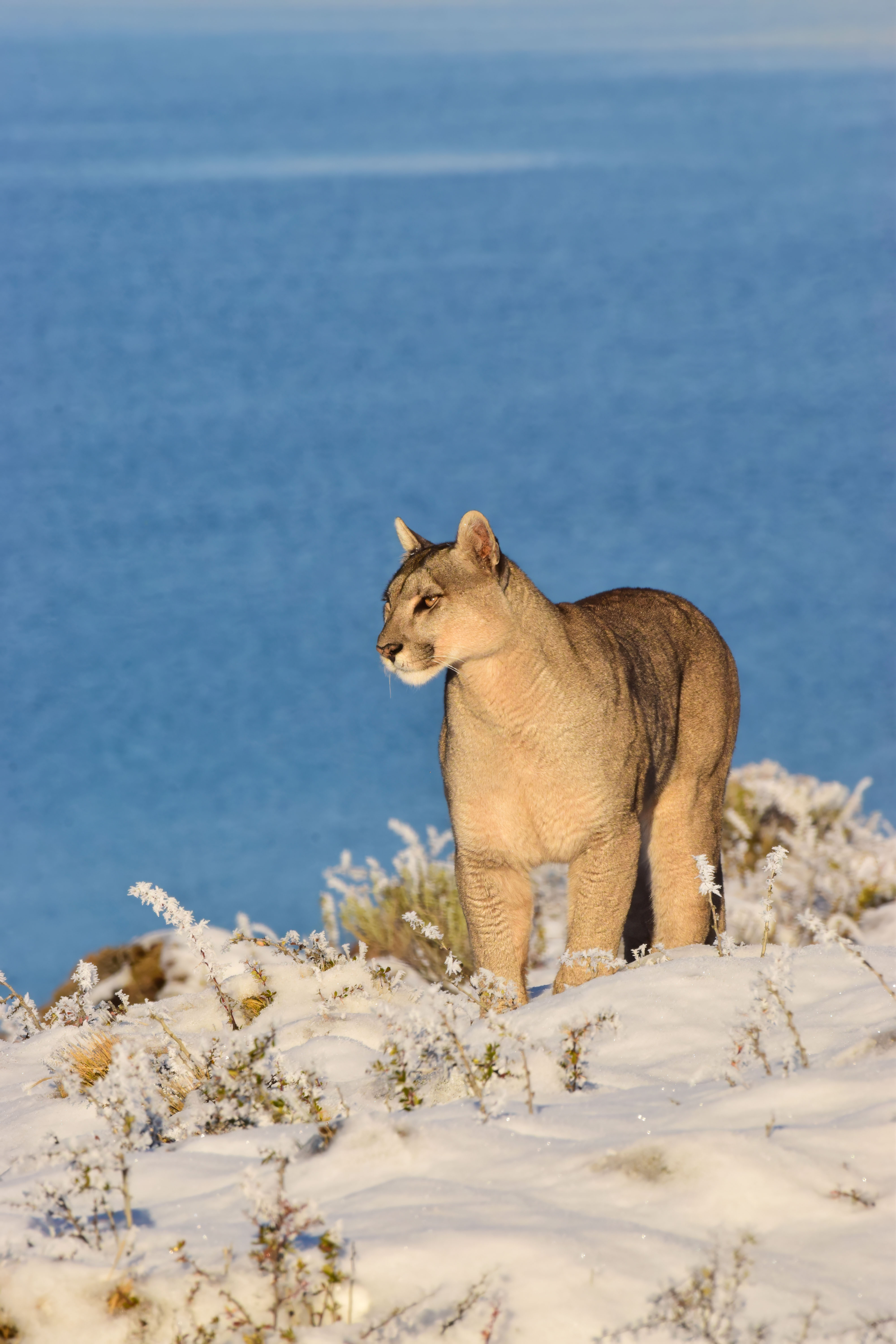
With the shimmering waters of Lago Sarmiento behind her, she hardly cast a glance in our direction as she padded her way along the hillside toward the road, following Escarcha’s trail.
With no further obstructions to her path, she came right up to the road, mere metres away. At such a distance, you could really appreciate the power in those mighty paws. Here is an animal that didn’t struggle once in the snow like the fox and the geese from yesterday: she almost seemed to glide across the surface of the frozen hill.
I thought the fence between the road and the hill might prove a barrier, but not for this apex predator. In a single move she leapt nimbly up onto the wire and then launched herself onto the other side, just a few feet away.
Having cleared the road, Petaca climbed up into the hills toward the setting sun and disappeared among the frozen scrub. What an incredible encounter! And what a way to finish a superb three days’ tracking in Patagonia!
On the way back, we found the unnamed young male in the same spot he had been when we first saw him on Monday. It felt fitting that the last puma of the trip should also be the first. We might very nearly have witnessed a hunt, as a lone guanaco was headed right his way, until a passing truck spooked it into heading in a different direction.
The tour I had booked for tomorrow into the heart of the park itself and the Cueva del Milodón was sadly cancelled due to low numbers by the time I got back, so this will be my last time in Torres del Paine. Magical, then, that it should end with a view of the mountains at their most impressive, with ominous yellow and grey clouds rolling across its summit, turning the blue mountains of the Tehuelche all kinds of magical colours. Who could not lose their heart to such a sight?
I’ll take it easy tomorrow and explore Puerto Natales properly. There’s so much human history here that I could so easily overlook, and it will need more than a morning, I think. BB x
Patagonia is transformed in the sunlight. From the moment I arrived, the whole territory has been shrouded in a dense fog ushered in by the snow, concealing much of the land behind a mysterious grey curtain. Today, at dawn, everything changed. Shadows into silhouettes. Mystery into majesty. I have never been more in love with this place than I was today.
And to think there were people online who advised against coming here in winter… I can only imagine they wanted to keep something this precious to themselves. Because I think I can say without a hint of hyperbole that Patagonia in the heart of winter is one of the most beautiful sights you will ever see.
This morning’s quest began where we left off yesterday, at the frozen field where Escarcha and her cubs had gone to ground. Tracks in the snow indicated that they had moved on during the night, but there was at least one puma still in the area: an adult female, one of the offspring of the legendary Rupestre, the former matriarch of Torres del Paine. It was still dark, but following the lurching silhouette of a sight that was becoming quite familiar still set my heart racing.
She seemed to be following the scent trail left behind on the cliff – either Escarcha and her cubs or another puma entirely – as she kept pausing at each overhang and doing the Flehmen response, a technique which allows cats to analyse the scents they detect in extreme detail, ascertaining information such as the age, health and sex of the scent-bearer. Cats are remarkably intelligent creatures and the puma – arguably the most successful of all the cats of the Americas, with more names than any other species of felid and a range spanning from Alaska to Tierra del Fuego – is no exception to the rule.
The female took her leave and wandered off toward Lago Sarmiento, and we turned back in search of the new arrival from yesterday, NN, just as the sun began to crest the hills to the east, bathing everything in a golden halo. NN was where we left him yesterday, and while he popped out of his hiding place for a gnaw at his hidden kill, he promptly returned to the scrub and disappeared again.
Forging a new path, Fabián took us down a new route, past the frozen lake where we had found Lenga and Ñire yesterday and up into the foothills of Torres del Paine. We saw no pumas en route, but they had clearly been here during the night, with fresh prints along the road and across the fields beyond.
The guanacos, on the other hand, were everywhere. Apparently, in this corner of the world, only 4% of guanacos survive infancy, with the other 96% falling prey to the pumas. That figure alone goes a long way to explaining the concentration of pumas here in Tierra del Fuego – and also, the fecundity of the guanacos, since they still outnumber the pumas by at least ten to one. We didn’t get that classic “guanacos against the backdrop of the Torres” shot that Fabián was angling for, but the winter sunlight made for some breathtaking views of the guanacos on the eastern slopes.
Skittish beneath the mist, the guanacos seemed to lose a lot of their nervousness in the sunlight – perhaps because the increased visibility made them less anxious about being ripped apart by an unseen puma at any given moment. We were able to pass by so close that you could see the frost crystals on their ears.
The park’s meadowlarks were just as abundant today as they were yesterday, only this time they played second-fiddle to a natural phenomenon I have only ever heard about but never seen until now: diamond dust. A true polar experience, it is a kind of sub-zero “precipitation” that only forms under a cloudless sky: effectively, a ground-level cloud of ice crystals that seem to sparkle in the sunlight. I really should have filmed it, in retrospect, but some things never look as good on camera (though you can just about see it in the picture below). This was definitely one of those things. It was magical enough to behold, and something I’d recommend traveling all the way here to see in its own right.
Fabián drove on toward a small frozen forest of lenga trees in search of a chuncho – an Austral Pygmy Owl – that he knew to inhabit the area. I spotted it, but I think it’s safe to say he knew which tree it would be likely to be in, as any guide worth their salt would. After all, it happens to grow in a very iconic spot: right in front of the world-famous peaks of Torres del Paine.
Remarkably, the tiny little owl paid us no mind whatsoever, so I could get in so close I could see the yellow of its eyes without the help of my lens – which, of course, did a phenomenal job at close-range.
Back at Lago Sarmiento, a tip-off over the walkie-talkies alerted us to the return of Escarcha and her cubs, patrolling the edge of the lake. One guide and his group – the pike-square of supertelephoto users from yesterday – had jumped the fence and gone down to the lake and enjoyed ridiculously close views as the family passed them by, but at least Fabián and the other guides had the restraint not to insist we all go down to the shore and crowd the pumas. Instead we waited patiently and watched from a distance as Escarcha left her cubs in a safe spot and set out to go hunting.
That is not to say that we were not also treated to a close encounter. Escarcha’s route up into the hills took her right past us, passing mere feet away. Unfazed, she climbed up the snowy slope and disappeared into the descending clouds.
We waited for a while, suspecting from the approaching guanaco herd and the descending mist that she might have been hunting the herd, but Escarcha eventually appeared as if out of nowhere and went back down to hunt among the scrub by the lakeside, presumably for some smaller prey like hare. Fabián offered the choice to stay and pursue more pumas or to search for the other animal denizens of the park, and after some thought, I opted for the latter. After all, I did really want to see a ñandú. So we bade farewell to the others, who all remained with Escarcha and her cubs, and left the heart of puma country for Cerro Guido.
Like many of the places we have visited, Cerro Guido is a private ranch or estancia, but one of many that has realised that wildlife tourism can be tremendously more profitable than regular ranching. As such, a large part of the Cerro Guido ranch is given over to the local wildlife, giving the prairie-dwelling guanacos and rheas – and the puma that hunt them – a perfect haven of their own.
The ñandúes were very visible, albeit always in the middle distance, but the guanacos continued to make for good subjects against the afternoon light.
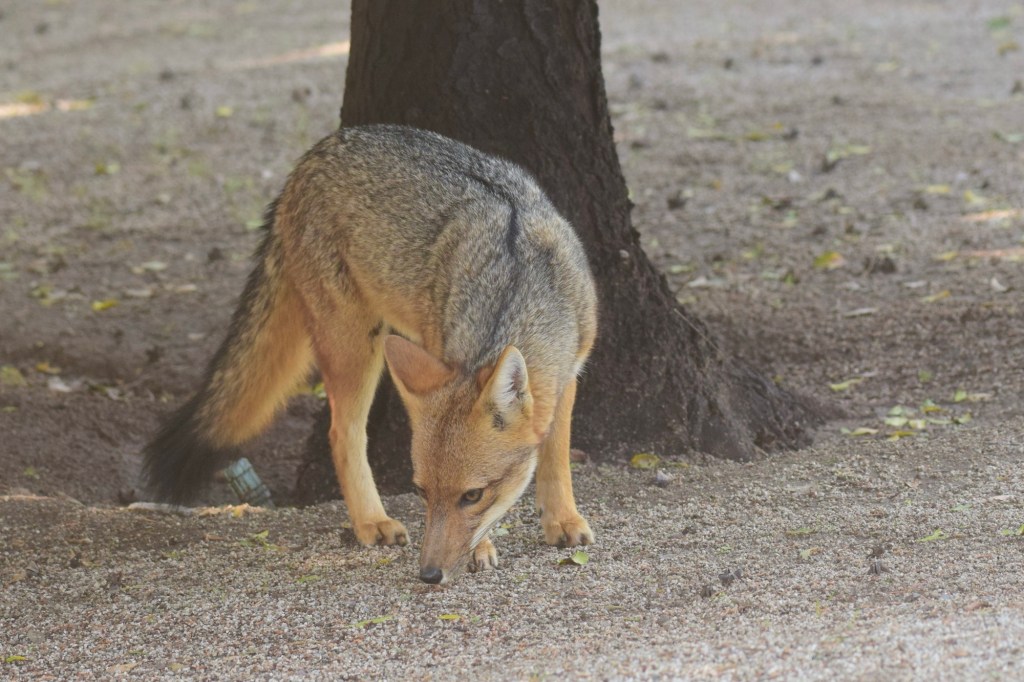
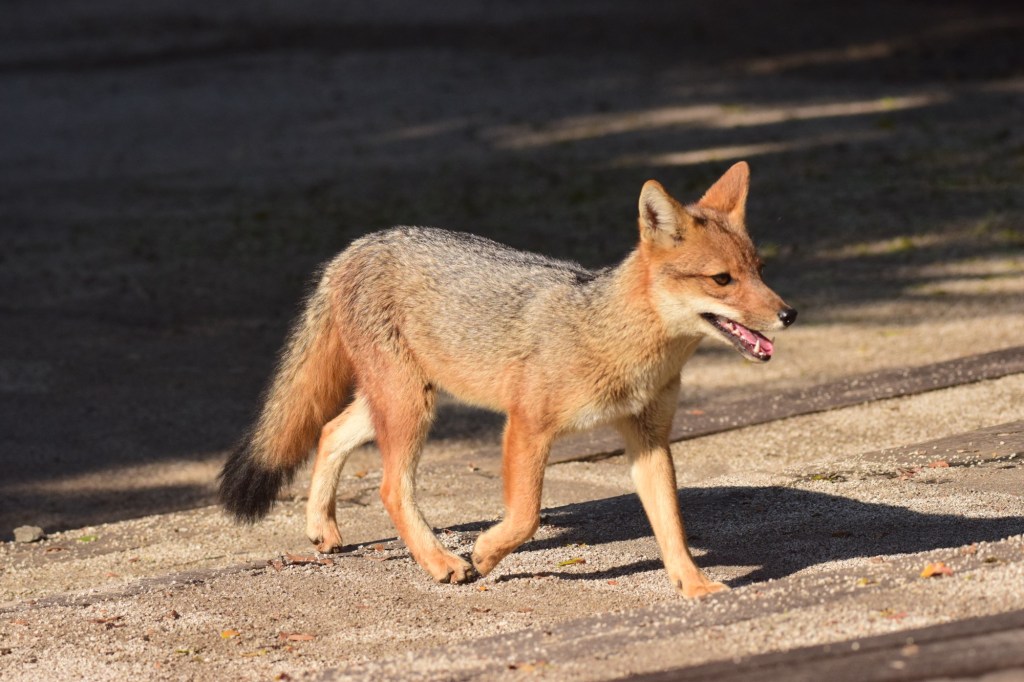
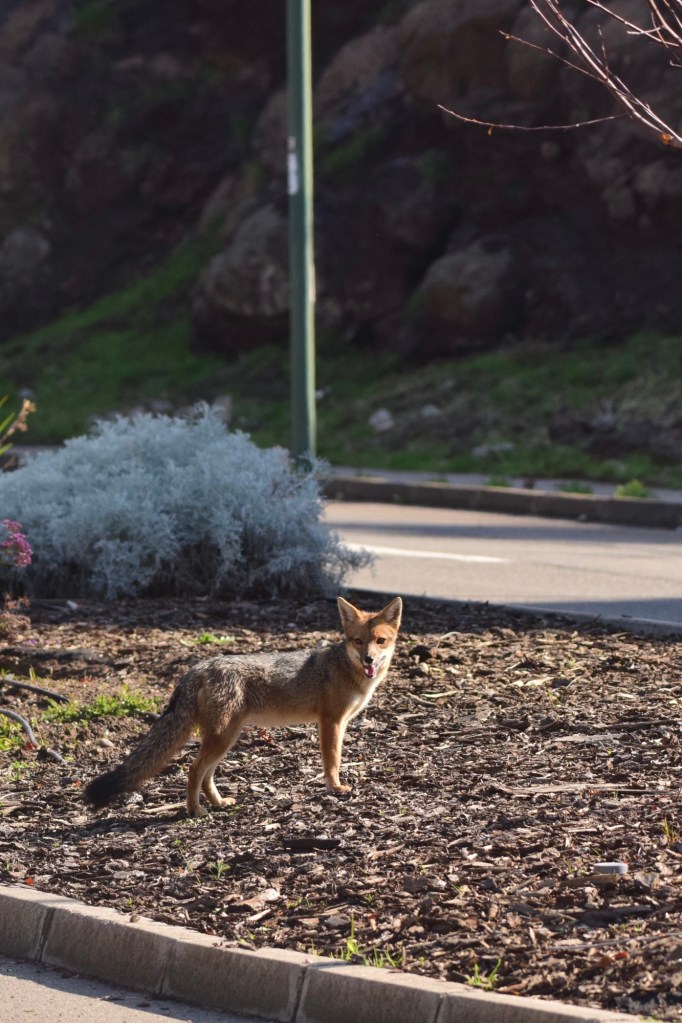
Another Patagonian mainstay was very much in evidence today: the South American Gray or Patagonian fox, a canid that is actually more closely related to coyotes and jackals than it is to the true foxes we know and love from back home. Just like they do in winter back in England, they were out looking for partners ahead of the mating season in spring, so we saw more than a dozen in all, sometimes alone, sometimes scampering about the fields in pairs. This one seemed to be limping, until we realised it was not walking with an odd gait but rather struggling with the depth of the snow, plunging up to its elbow every few steps.
The caiquén or upland goose was by far the most numerous resident of Cerro Guido, outnumbering even the ubiquitous guanacos. Caiquenes pair for life, though their fidelity is curiously one-sided: if the female dies, the heartbroken male will never pair off again, joining a bachelor group for the rest of his days, whereas if the male dies, the female will usually find a new mate within a few weeks. It’s a neat trick to ensure evolutionary stability in the long term, and – if you choose to look at it that way – a funny reflection of how men and women react to breakups.
I joked about the bus station-looking shelters, only to be told that yes, they really are paraderos – and to rub salt in the wound, a bus rounded the corner and passed us merely moments later. It’s hard to imagine now, but in the warmer months, when ranches like this one are more active, many ranch-hands travel to and from their posts this way. I caught myself wondering (and not for the first time since arriving) how amazing it would be to sack everything off and live here, way out here in the Chilean Antarctic wilderness. I’ve had madder dreams, trust me, and a little more careful thought would surely shake me out of my reverie. But I haven’t given it that much thought yet. It’s just a hunch I had – and a bottomless love for the wildest and most magnificent natural wonders of the world (and, coincidentally, places that style themselves as “the End of the World”).
We didn’t find any nearby ñandúes, and the two that had been relatively close but obscured by a bush on the way in had wandered far off by the time we turned about to make our way out. Not to be disappointed, though, Fabián spotted one near the road after we had left Cerro Guido and I jumped out to track it down.
I’ve not seen ostriches in the wild, or emus, or cassowaries, or any ratite for that matter. So I have no yardstick for truly bizarre appearance of this relatively huge flightless creature, which looks almost entirely out of place in the snowy scrubland of Patagonia. But, like the moa of New Zealand, ratites like the rhea are just as capable of adapting to cold conditions as their cousins in Africa are to the searing heat of the Namib and Sahara Deserts.
The ñandú or Lesser Rhea was brought to the attention of the world by the second voyage of the HMS Beagle, though it Charles Darwin and not the French naturalist Alcide d’Orbigny who is more often associated with the bird. I could reel off more facts about rheas, but really I’d just like to see another and another. They’re remarkable creatures, even in a country full of healthy specimens of the incomparably beautiful puma.
But we still weren’t done. The road back to Puerto Natales passes by a great wall of stone, jutting out of the slope like the outer walls of some fortress. In Spain, a cliff face this vertical would be alive with griffons and known as a buitrera. Here in Puerto Natales, they’re known as condoreras. I don’t think I need to tell you what mighty creatures makes its home here.
I am, of course, talking about the largest bird of prey of all: the Andean condor. Unlike Colca Canyon in Peru, Patagonia (especially in winter) offers the chance to see these magnificent vultures at rest, where the whites of their wings can be much more easily appreciated. As the fog began to clear, we counted well over thirty of them. Fortunately, they’re scavengers to a fault, so there was nothing ominous at all about the fact that their numbers seem to grow exponentially every time we tried to count them.
Fabián joked about looking for a condor feather at the base of the cliff, which would almost certainly have turned up at least one. However, condor feathers are almost as sacred now as they were in the time of the Inca, albeit for less divine reasons: taking one out of the country is illegal, punishable by fines of up to an eye-watering $100,000. I adore vultures and have a collection of feathers I have found in my travels at home, but I’m not mad enough to chance that one.
The sun was beginning to set as we neared Puerto Natales, casting a final golden light over the slopes and the descending mist and turning the rest of the world a gentle shade of blue. There is a huge cave known as the Cueva del Milodón near here. I will try to book a trip out there for Thursday, as it is one of a handful of things to do in Puerto Natales that doesn’t require any high-grade trekking and expensive national park permits. I’ll give it some thought.
I had another serious urge to move here as I crossed town on the way back from the bank to my B&B. Forget the fact that it’s on the other side of the planet, in a place literally named the End of the World. There’s just something magical about this place. It’s unlike anything I’ve ever seen: like a frontier from the Old West frozen in time, surrounded by an array of animals so spectacular that you could live several lifetimes here and never get bored.
I wonder if they have a school that needs a languages teacher?
Enough musing. Another marathon read today. Sorry. Things will calm down a bit when I start my work placement in Santiago, I’m sure, but for now, every second is diamond dust and needs recording. I already miss this place and I haven’t even left yet. I’m only just halfway through my trip, for Pete’s sake.
One more day’s tracking awaits. Hopefully the weather (and our singularly good luck) holds out. BB x
When I arrived in Puerto Natales last night, the first snows of winter had already covered the great plains of Patagonia in a thin layer of snow. The snow was still falling as I made my way into town and it was still coming down hard as I turned in for the night (at the ungodly hour of 9pm). So it’s hardly surprising that I woke to a total whiteout this morning. Patagonia looked into her winter wardrobe and put on her most beautiful dress of all.
Such were the conditions as Fabián, my guide for the next few days, picked me up and set off from the lamp-lit streets of Puerto Natales into the endless night.
I shopped around a lot before choosing Fabián of Fauna Silvestrek, largely because puma tracking in this corner of the world is not a budget-friendly experience. Touring with one of the English-language conglomerates can set you back thousands of dollars for just a couple of days. Traveling solo necessarily makes wildlife tourism an expensive operation, since you inevitably have to pay the same rate that a group would cover between three or four, so I was relieved when I found a Spanish-language option which looked much more personal, reliable and affordable. Tracking pumas is easier here than anywhere else in the world, but never guaranteed, so you want to be sure you’re investing in the right guy.
Fabián, it turns out, was exactly the right guy.
It’s a two hour drive from Puerto Natales to puma country, on the edge of PN Torres del Paine. In winter, it’s arguably easier to find pumas – or mountain lions, as they’re known in North America – outside the national park, where the elevation makes for a more unforgiving climate. Along the way you pass all sorts of signs you’ll find nowhere else, warning of collisions with pumas, guanacos, rheas and even armadillos. I’m keeping my eyes peeled for a ñandú – a Patagonian variant of the ostrich, and one of only a handful of words that start with the letter ñ – but we haven’t seen any yet. Maybe they’re keeping a low profile in the outer reaches of the park.
Today and tomorrow (and very probably the day after) are all about pumas. That’s what I came all the way down here for. And today did not disappoint.
We found our first cat hidden beneath the shelter of a bush not too far from the road. Fabián located it amidst the white wilderness with a thermal scope, which is a seriously useful piece of kit – especially when the whole world has frozen over. It was a youngster, unknown to the local guides, that had killed a guanaco recently. Puma kills are known around here as carneos, and are used by the trackers in their operations around the park, as each kill usually guarantees that the puma will stay in the immediate vicinity for the next three to four days, attracting other scavengers in the process.
This one – NN (No tiene Nombre) – stayed hidden in its shelter, being more wary of us than its more habituated kin in the park. So the best I could do was a digiscoped shot with Fabian’s scope. Even so, I was on tip-toes with excitement. One puma already, within minutes of arriving in puma country! Score!
The trackers communicate with each other via walkie-talkies. You can spot their cars a long way off by the antennae affixed to the roof, which allow them to talk to each other across the vast and signal-less distances of Patagonia. As such, when one tracker locates a puma, they will tip off the others.
Following one such tip-off, Fabián led me to a featureless deep (one of thousands) where a tracker and his clients had gathered, searching for a female puma and her cub which were still in the immediate vicinity. Just how immediate became apparent when I saw the back and the kinked tail of an adult mountain lion appear all of a sudden behind the scrub just a stone’s throw from the road. We stuck around for about an hour to try and locate them, but pumas are magical creatures. For a beast that can grow to a whopping 2.6m in length, they have a remarkable ability to disappear, even in a landscape covered in snow.
It wasn’t that cold, in spite of the snow, and a flock of meadowlarks kept us company in the meantime, twittering noisily among the deep footprints left behind by a previous company of trackers. The males are especially spectacular with their crimson chests. The brighter the red, the healthier the individual – so naturally, the more successful the male with the ladies. Ladies and gentleman: the gymbro of the bird world.
Nearby, a small herd of guanacos kept a wary eye on the spot where the pumas had disappeared. If the trackers don’t guide you to a puma, the guanacos just might. Their high-pitched alarm call is usually a good sign that the apex predator of Patagonia is somewhere nearby. Incidentally, guanacos complete the set: having seen alpacas, llamas and vicuñas in Peru, guanacos are the final member of the South American camelids.
These handsome beasts were once to be found across all of Chile, but hunting whittled their numbers to zero not long after the arrival of the first European settlers, and these days their range is restricted to the Cono Sur, with an outlying population in Peru.
We came across another herd further up the road, consisting of an alpha male and his three female attendants, with a fifth on lookout high up on the nearest hill. These vaulted the fence and came right past the car – or rather, the alpha managed just fine, while two of his followers looked on in confusion.
We came back to try our luck with the pumas from earlier, arriving in the very nick of time to see them leave the shelter of the scrub and strike out into the open.
This particular female is called Lenga, after a local kind of tree whose branches are distorted by the fierce Antarctic winds. Lenga’s tail is similarly misshapen, though nobody knows why. She appeared one day, as wandering pumas often do, with her oddly-shaped tail, and her attendant cub, Ñire.
We watched them cross the frozen lake and climb up into the snow-covered mattoral until they were mere shadows among the scrub before the snow clouds concealed them from sight. If that had been it for our encounter with the pumas, I’d have been quite content. But we were only getting started.
Another handsome resident of these windswept wastes is the crested caracara, known locally as the carancho (amazingly, a lot of the local birds and beasts seem to have preserved their precolonial names). Two of them were perched at the side of the road, quite unfazed by the four-wheel drive that ground to a halt right in front of them. Seeing how unafraid so many animals are in foreign corners of the world really makes one reflect on how violently we have treated the countryside in the UK for its creatures to be so innately terrified of us. Food for thought.
Arcing around a snowdrift and following the edge of Lago Sarmiento, the largest of the region’s lakes, we soon came across another group of tourists and their attendant tracker walking up the road, armed to the teeth with enough telephoto lenses to inspire envy in the World Cup press box. The reason for their almost religious procession was padding along a few metres ahead: an adult female puma, known as Escarcha (Frost), one of the park’s habituated mountain lions. We fell into line, marching for about half a kilometre before Fabian told me to press on while he went back for the car.
Cue a rather awkward incident where the tracker of the other group told me – in no uncertain words – to get lost. The implication was clear: I hadn’t paid for his services, so I shouldn’t be walking with his group. When Fabián caught up to me, another tracker working for the Others rounded on him, accosting him for tagging along “without so much as saying hello”. They were so busy chewing that one out that nobody seemed to notice that Escarcha’s calls had summoned two adorable cubs from the snow.
After a short distance, Escarcha and her cubs disappeared into the scrub. Team Territorial struck out onto a nearby hillside to get a better view, and we knew better than to follow them. Sure, from our spot on the road, we couldn’t tell whether they had the best seats in the house, but in the end it was the cubs who levelled the playing field. In their constant scampering about, up the hill and back down again, they made no attempt to stay hidden for long.
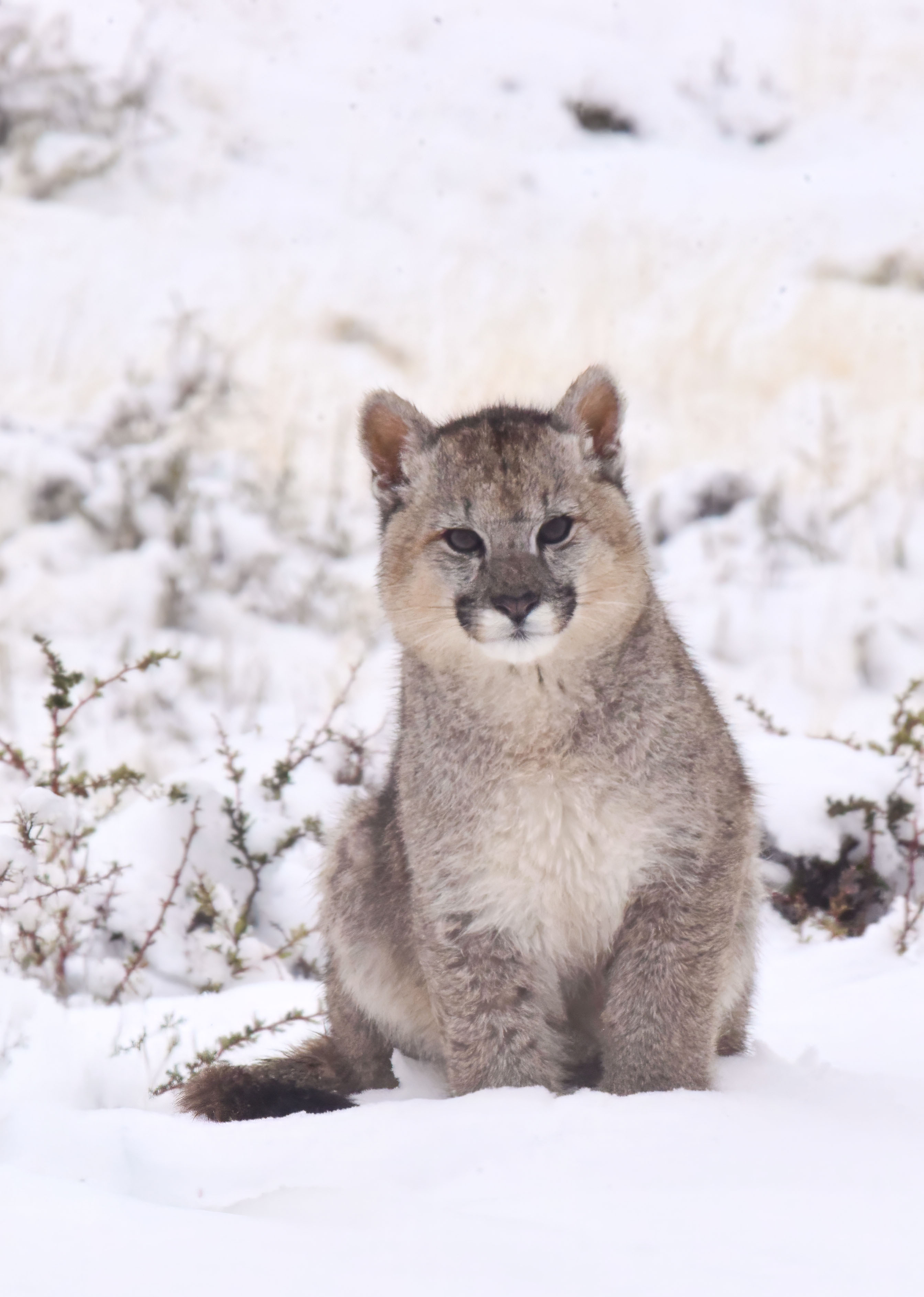
Like many cats, baby pumas are born with bright blue eyes that gradually turn a golden-brown after about six months, which helped to age these youngsters considerably – not yet a year old, but past the blue-eyed stage of infancy. The zoom lens could have told me that, but as it turns out, I hardly needed it: one of the cubs, more curious than its sibling, scampered up onto the road and sat watching us for a while. I don’t know what was going through its head, but it was clearly thinking.
Nearby, Escarcha kept a languid eye on her playful cubs. Habituated does not mean tame by any standards, and anybody with half a brain knows not to get too close to anything with lion in its name – and especially if it is a mother and her cubs. Even so, to see such an awesome predator at such a distance… I had no idea we would be so lucky on day one!
Soon, most of the trackers and their teams had arrived to try to deliver similar views of Escarcha and her cubs. However, being largely creatures of the night, they were to be disappointed: after that last bout of curiosity, Escarcha and her cubs disappeared into the snowy tangle of a mata scrub and never emerged, presumably falling into a deep and wintry sleep as the temperature dropped beyond.
Together with the other trackers, Fabián and I were on stakeout for the rest of the afternoon, but to no avail. The meadowlarks were keen to point out the presence of the pumas by flocking around their chosen scrub and twittering noisily, before a ghostly cinereous harrier drove them all up into the air.
After vultures, harriers are probably some of my favourite creatures in the animal kingdom, The way they seem to float as they silently quarter their territories, traveling in ever-widening circles… together with the silvery grey colour of the males… they’re all kinds of magnificent. Words can’t even.
Shortly before six, with the light beginning to fail, Fabián signalled it was time to head for home. Chances are we may well run into Escarcha again tomorrow. Just as well: I was shaking something awful out there. One accustoms to the cold, of course, but those first few minutes after leaving the warmth of the car are definitely the worst as the body acclimatises. I must have looked like I had the ague – which would have rendered any attempts to take a steady photograph in the fading light almost impossible!
The return journey back to Puerto Natales was a lot more scenic than the journey up this morning, if only because the clouds had begun to break apart, defogging the world below. Where before all had been ghostly white, some mysterious deity had revealed a breathtaking landscape of sheer cliffs, towering mountains and grey lakes. It was already getting dark, so hopefully tomorrow (when the weather is forecast to be clearer) will produce some better landscape results. For now, I want to remember this view: yellow grass in the snow against a hopeful yellowing sky.
I got through today’s expedition on the restorative power of six cocktail-sized chorizo bites and a Starbucks caramel waffle, so I was a little peckish by the time we got back to base. On a tip-off from Fabián, I dropped in on Artimaña, a quirky restaurant in the centre of town. And what a find! Like a lot of the local establishments, it had a condor feather nailed to the wall (this seems to be a local tradition of some sort), but the food was incredible, all of it locally sourced and rustled up on command. Friendliest staff ever, too. I’ll have to come back here again – more than once before I leave, I’d wager. I don’t usually click with a place this quick, but there’s something Artimaña gets right in one hit. It might be the condor feather, of course, but I’d think I’m a bit more subtle than that.
Mammoth post – it’s not often I have so much to record. But today really was a red letter day, and I have to get this all down before I forget.
Tomorrow, Round II: pumas, and – with any luck – the enigmatic ñandú. Topping today’s ridiculous success rate will be hard, but I am as insufferably full of hope as I have ever been, supercharged by a full twenty-four hours in a frozen paradise. Fingers crossed! BB x
I know I’ve found somewhere absolutely desolate when I hear myself throwing the word “beautiful” around like a flail. And that just about sums up Puerto Natales. Desolate. But breathtakingly beautiful in its desolation.
Wind the clock back. I’ve had comfier flights. The journey down to Puerto Natales via an hour’s layover in Puerto Montt was perfectly smooth, but I’ve not yet recovered from the debilitating impact of a fourteen hour flight in an air-conditioned box, so my eyes and nose were streaming all morning. To add insult to injury, my ears clogged up upon landing in Puerto Montt, which was less painful than a nuisance that it was impossible to ignore. It was some relief when the last of the new passengers had found their seats and the plane was up in the firmament once again.
I did, however, get my money’s worth from the window seat. Chile’s Lake District is nothing short of spectacular. Think Cumbria if you will, but on a much, much grander scale, where the lakes are larger than cities and the mountains are merely supporting characters for the real stars of the show: the mighty snowcapped volcanoes, rising up and out of the earth in perfect wintry cones. Some of them were gently smoking from their summits; others forced the clouds to crest their peaks like waves, adding a further sheen to their majesty. This place is very high on my list of options for the last week – if I can only find a way to get down here overland, that is. I think I’ll have done quite enough flying by the time I get back from this cold corner of the world!
After Puerto Montt, the world below disappeared beneath the clouds for all of two hours. It was only upon the final descent, mere minutes from the tiny landing strip, that the snowy wastes of Patagonia finally appeared. If Santiago felt like Spain and the Lake District looked like England or even Canada, this is something else entirely. I have no yardstick for this kind of world. Not even Poland in the grip of midwinter comes close. The indescribable vastness of it all, scored with cross-crossing tracks and frozen ponds, appearing and disappearing at will beyond the snow clouds… it’s almost eerie.
Landing was no small feat either. The captain had to pull up out of the descent just moments from touchdown due to fierce winds, the likes of which I have only read about in books about this place. The ancient explorers called this land Tierra del Fuego after the many fires lit upon the shore by the indigenous Selk’nam, but Tierra del Viento may be a more appropriate moniker – this corner of the world seems to be ruled by the wind.
I wasn’t entirely sure how I was going to get from the dinky little airport into town, but that question was answered quickly by the local transfer shuttle service advertising itself loudly in the arrivals lounge, and at $5 for door-to-door service, they’re practically giving it away.
It would had been a shorter service had the driver heard me correctly and taken me to the Hostal Coastal and not the Hostal Austral, which whacked another twenty minutes onto the trip and gave me a proper scenic tour of the backwaters of Puerto Natales. I suppose it doesn’t help that the two words sound similar, and I can’t blame the driver for defaulting to the one that is actually in Spanish. But this B&B is wonderfully homey, if a wee bit of a trek from the centre (we’re talking the minutes, tops, but it’s enough to make me reconsider going out in the cold and the dark for supper).
Puerto Natales is immediately a very different world to the rest of Chile. Even our layover in Puerto Montt had many of the same birds flying by as can be found in Santiago. But not here.
If check-in hadn’t taken a little while, I could have practically fed the chimango caracaras that were perched on the fence outside. I went searching for them later, but a family of fishermen spooked them off. It was a shame, but it was just as well – none of my photos came out right anyway as it was getting very dark. That’s why I came out to look around, really – to get my bearings and play around with the camera settings so that I’m not caught out if we should be so lucky as to find any pumas over the next few days.
Apart from the caracaras, the wildlife here is much more like what you might find in Antarctica. Imperial shags bobbing on the water in the bay and sinister-looking dolphin gulls with their dark feathers and red beaks. White-eared grebes sharing the shoreline with upland geese, steamer ducks and… what the?
That’s right, the guidebooks aren’t goosing you. Puerto Natales hosts a herd of Chilean flamingos during the winter months. Quite why they come here, to this dark and desolate corner of the world, I can only guess. Perhaps it has something to do with the legendarily rich Humboldt current. Either way, they are a decidedly strange sight: a mass of crimson and salmon pink in an iron-grey Antarctic sea.
I think I’ll call it a day there. My ears were rescued until the captain had to do that emergency manoeuvre and now they’re right back to how they were before. It wouldn’t be the first time I’ve had some kind of Eustachian Tube Dysfunction, only the last time it ended in a burst ear drum and three bizarre and painful months of diplacusis dysharmonica. That’s why I’m not trying to force my Eustachian tubes open by the conventional methods. With any luck, they’ll heal in time.
A good night’s sleep would be nice – I didn’t get much last night because the five Brazilians in my dorm decided to turn on all the lights just before midnight and have a jolly conversation at full volume about their respective cities. They didn’t get the hint until they left for the club, and when they did, the chap from Rio decided to ignore his alarm at four in the morning, so the fellow in the bed above him had to creep out and switch it off. At least, I think that’s what he did.
But now I have a room to myself for five nights. Bliss! I intend to make the most of it. Starting with a good kip. Tomorrow is another day. BB x
Hostal Boutique Merced 88, Santiago de Chile. 16.15.
Now here’s a setup I really didn’t see coming. This time yesterday I was sitting in a living room in a comfy suburb of Santiago de Chile, some twelve thousand miles from home, knocking back a Corona Extra and watching Spain take on Belgium in their quarterfinal game. Twenty-four hours later, I’m in downtown Santiago, resting my feet for a moment after climbing up Cerro San Cristobal to see the Andes once again. If you’d asked me where I’d be and what I’d be doing at this stage of the summer back in December, it wouldn’t have been either of those scenarios, that’s for sure.
I must have been absolutely exhausted yesterday, because the last thing I remember is sitting down on my bunk bed and checking the time, which was about 18.50ish. The next thing I knew, it was dark outside, the numbers on my phone’s home screen had morphed to 03.10 and a man in the bunk above mine was snoring loud enough to rival an Amazonian thunderstorm. Maybe that was what woke me up. Either way, I couldn’t get back to sleep, so I whiled away a couple of hours trying to work out what to do with the last week.
Of course, I didn’t realise that my adaptor was too big for the sockets here until my phone was down to 3%. Fortunately, the giant in the bunk next to mine (seriously, he must have been at least 6’6”) had exactly the same charger as mine, so I sneakily put my phone to charge and waited for about an hour for it to juice up just enough to guide me to a ferreteríain town.
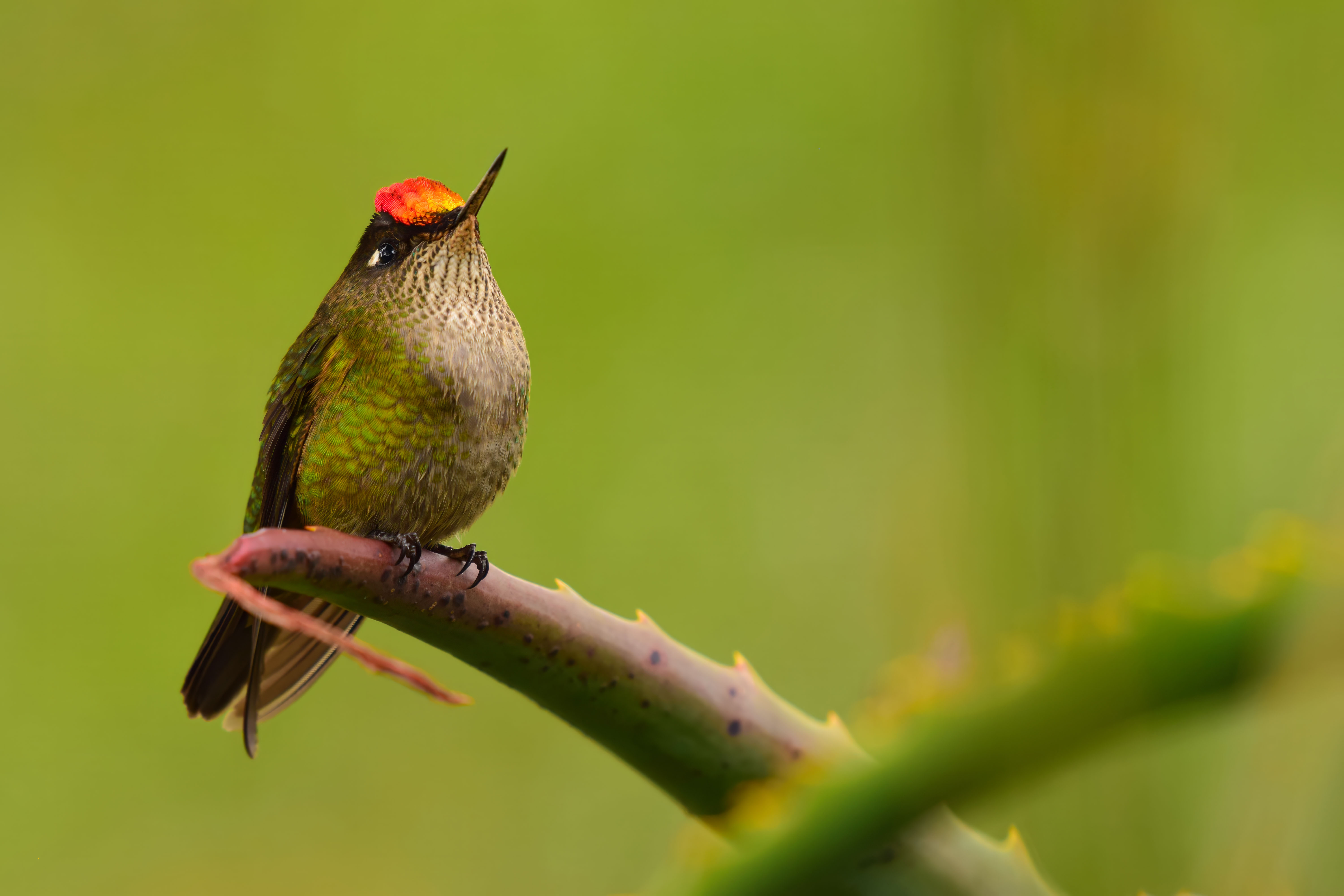
Thus armed (and breakfasted) I detoured back to the hostel via the Parque Forestal to see what I could see (after all, I did bring the lens with me). A couple of Harris hawks kept putting the local pigeons to flight with their noisy circling, and I tried and failed to catch one of the park’s firecrowns as it flitted from flower to flower at blinding speed, but the austral thrushes were absolutely everywhere – and they were much less camera-shy.
They look a lot like the Chiguanco thrushes that were all around Cusco. Come to think of it, they don’t look all that different from the American robins of Central Park, in the right light. They’re clearly a very Santiago kind of bird. I guess I’ll be seeing more of them over the next few weeks.
I hadn’t really planned what to do with my day in downtown Santiago. Honestly, I had expected this week to be spent exploring the Lake District to the south, saving Patagonia for the end of the trip, but the guide I have hired is only working July this year, so I had to change my plans.
Santiago sits in a giant bowl, ringed on almost every side by the snow-capped peaks of the Andes. One finger of those lofty peaks stretches almost as far as Santiago’s heart. Crisscrossed by cycle paths and two very popular cable-car lines, the Cerro San Cristobal was just too great a temptation. As a rule, if there is a mountain nearby, I usually try to climb it. So that sorted out my plans for the day in one go!
It’s quite a climb – about an hour and a half up the eastern slope – but it does offer tremendous views of the capital city and its famous skyscraper, the Gran Torre Costanera, the tallest building in South America.
You can also appreciate the smog, which is really quite something.
I’m still tuning into the soundscape here, but three weeks in Peru have made the job a lot easier. I know a hummingbird now when I hear one, so it was fairly easy to find firecrowns on the way up – though they were nigh-on impossible to photograph, as hummingbirds so often are. One sound I did not recognise, however, was a strange owl-like call coming from the scrub. Merlin came to the rescue: it was a California Quail. I have wanted to see one of these enigmatic little things since I first saw them in Bambi as a kid.
California quail just isn’t the right name, though. They’re clearly quaver quails. Just look at the musical note embedded in the head of this dashing young male. You tell me that this handsome fella doesn’t deserve a musical name for wearing such a showy headpiece!
Speaking of showy headpieces, this tufted tit-tyrant was a nice find near the summit. For most of the morning, I could hear some kind of tyrant species high up in the trees, but this one came right down to eye-level and stuck around for a little while.
Santiago definitely looks better when you’re facing to the east. From the Cerro, the view out west is buried under a thick cloud of smog which seems perpetually fixed just above the horizon. The shape of the valley is part of the problem, trapping the exhaust fumes in a natural bowl, but it is something I’ve never seen the likes of before. I suppose I had better get used to it, as next year is likely to see me accompany some of my top public speakers to the world championships in Shanghai, and China is no stranger to smog.
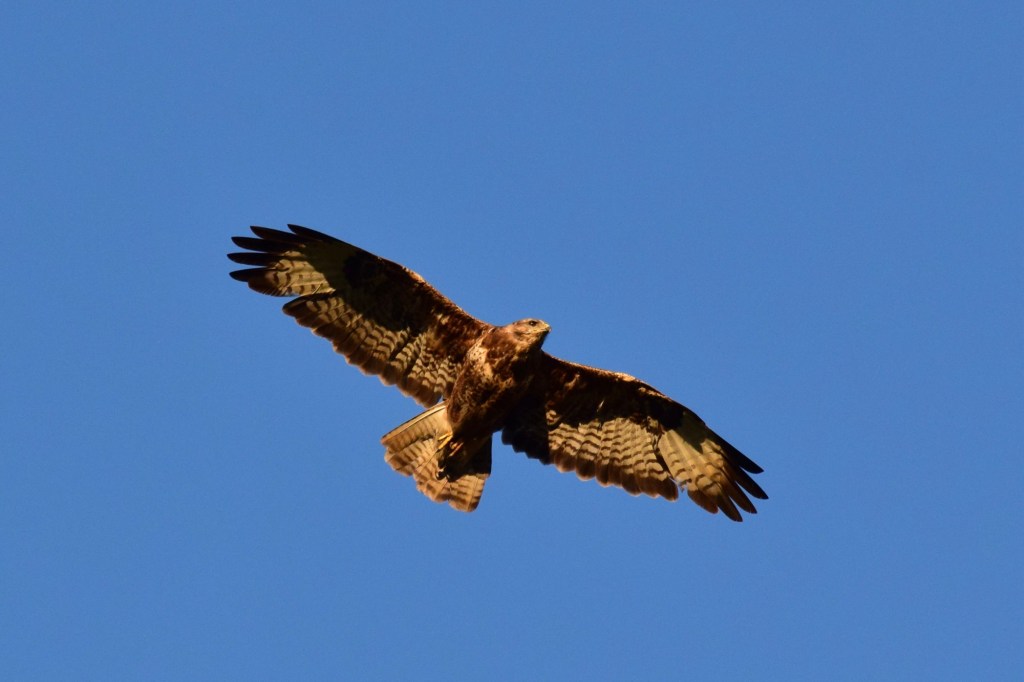
Right at the very top, there is an enormous white statue of La Virgen de la Inmaculada Concepción, and at her feet, a small sanctuary. This seems to be the spot the locals make for in the afternoon, presumably to catch the sunset, as it was getting very busy by the time I reached it. Most of them doubtless made the ascent by cable car, as the lines to get tickets back down were just as big as they had been at the bottom. Foolishly, I still had my camera set to low-light shooting after my run-in with the quails, so when a buzzard-eagle appeared out of nowhere, I was woefully underprepared. I got off a few clean shots, but as it was close enough to see the glint in its eye, it was one of those encounters best left to the naked eye.
It didn’t get the same reaction from the crowd of sightseers that the condors did back in Peru – but then, Andean condors are twice as big and five times as heavy, so they really do command one’s attention.
I’m no less impressed by the Andes than I was when first I laid eyes on them. They really are the most impressive mountains I have ever seen, dwarfing every peak I have had the fortune to behold until now. Imagine growing up in the shadow of these mighty walls of rock and ice… Little wonder the Inca thought themselves divine!
My phone is nearly charged back up. Looking at the time, I think England have just set out against Norway in their quarterfinal game. I can’t watch or even follow the game on the radio thanks to the BBC being regionally locked, so I’ll just have to go for a walk and see if I can find anywhere playing the game en route. Could be a good excuse to take myself out for dinner, though I doubt I’ll do more than grab an empanada from a stall somewhere.
This time tomorrow I’ll be in Puerto Natales. It looks like Patagonia had its first snowfall last night. I can’t wait to see the snow again. It’s been too long! BB x
Still no word from Chile. A voice in my head is trying to tell me that something is amiss, but I’m tempted to chalk that up to institutionalisation. I have to remind myself that I knew next to nothing about Villafranca de los Barros when I set out to live and work there for the best part of a year. I didn’t even have my accommodation thought through until a few days after I had arrived. There is simply a lot less stress in the way the Hispanics go about these things, and I should be on board with that – it’s the system I started out with. I wonder whether it’s just a psychosis of the English (or, perhaps, the Americans) that we need everything planned and sorted right down to the last detail.
I am not a planner. Sure, traveling twelve thousand kilometres without much of a plan might be reckless even by my standards, but it doesn’t trouble me. Not really. After all, if the worst comes to the worst, I can always store my luggage somewhere and go traveling.
England is back in the grip of another heatwave. This one isn’t as fierce as the last one, but it is noticeably hotter than usual. Perhaps I’m noticing that all the more because A) my barber’s has always been busy when I’ve gone by, so my hair is longer than usual; B) the fan in my air purifier has given up the ghost; and C) I’m packing for an austral winter, so I’ve had the odd experience of going through my winter wardrobe in 30 degree heat. The incoming El Niño may alter the weather in Chile while I’m out there in ways I cannot predict – it could be hotter, wetter or even colder than the average winter – so I have to pack for every eventuality. Thank goodness I paid for a suitcase this time around! I really hate traveling with suitcases, but at least it gives me the peace of mind to pack enough supplies to keep me comfortable, whatever the weather.
Just a short couple of posts for now – I don’t have an awful lot to report on. Just wanted to get back in the zone before the next adventure begins. Writing is an exercise, and like any sport, it needs a good warm-up! BB x
England swelters under the glare of an unseasonably ferocious sun. For the second day in a row, the temperature is pushing well into the thirties. It’s all the news can talk about. Trains are running slower due to speed restrictions, three children have “gotten into difficulties” while bathing (a tactful way of avoiding the potentially triggering d-words associated with fatal water incidents) and the whole of the South seems to have jumped into the car and carved out a four-square fiefdom on Bournemouth Beach.
I’ve hopped out east to pay my mother a visit, and in so doing stepped right into the hottest part of the country – bar London, of course, which is usually a couple of degrees warmer than the rest of the island. England is rather pretty in May, though she wears her best dress in the first two weeks of the month, when the flowers are still fresh and the wind is cool. Now, the early summer sun is at that particularly British angle where it’s high enough to burn but low enough to blind, and the heat feels more like the first week of August than the last week of May.
Retreating before the summer’s wrath, I have sought solace and shades along the banks of Hampshire’s rivers.
England is at its most beautiful wherever a river can be found. Crystal waters running over gravel, with shadowy trout and grayling darting from sunlight to shadow. Clumps of weeds and watercress wafting in the water as though in the wind. The trailing arms of a weeping willow gently tracing the water’s surface. Iridescent dragonflies of every shape and size – dragons, damsels and darters – hawking from bank to bank, playing a longer game than the mayflies, whose inert bodies drift downstream, their twenty-four hours spent. Chiffchaffs, wrens and blackcaps singing from the trees, the lazy purr of an overheated wood pigeon and, now and then, the explosive song of a Cetti’s warbler from deep within the darkest heart of a reedbed or thicket.
When I am traveling far from home, this is the image of England that I miss most of all.
Did you see the pike in that first picture? Don’t worry if you missed it – they are master ambush predators. Go back and see if you can spot it.
This corner of the River Alre passing through Alreston is supposed to have otters and kingfishers, but I was over the moon to see a pike. They were always my favourite fish when I was a lad, and it’s not hard to see the appeal for a young boy: fully grown, they’re huge, sinister, almost crocodilian monsters with soulless eyes and fins that move so slowly that their every twitch seems calculated. A perfect killing machine. Hardly surprising for a fish that outlived the dinosaurs, whose ancestors prowling Cretaceous rivers were not all that different from the river monsters that lurk in reedbeds outside Tescos and Sainsbury’s.
I can see why adventurous young lads might get a kick out of fishing up one of these ancient beasts, but I’m just as happy spotting one drifting between the weeds. It makes a change from chasing chiffchaffs through the branches of the tallest trees.
I’m racing home now, clearing the green fields of the Vale of Pewsey under a mercifully cloud-studded sky. I acquired a few books in a second-hand bookshop for a couple of pounds and a new sketchbook for a little more. I’ve been meaning to get my hands on the Horrible Histories books for a while, since they had an enormous impact on my art and my love for history and storytelling. Everyone seems to remember the enormously popular TV show (which, for my sins, I have never seen) but the books appear to have faded into collective oblivion. I dare say Martin Brown had more influence on my pen-and-line drawings than any other artist – besides the legendary Chris Riddell, of course.
Power’s running out. I’d better stop typing and leave enough juice on this thing to get me through the ticket barrier at Taunton station. See you around! BB x
Newark Liberty International Airport, Newark, NJ. 17.27.
Good morning America! The sun is shining, my bag is re-checked and I’m off to see the city, standing on the steps of an absolutely rammed Amtrak train bound for Penn Station. I will never roll my eyes at the train from London to Taunton again. This is a whole other level of packed.
Two years ago, I promised myself I’d never come back to this country. I allowed a broken heart to derail what should have been a grand old adventure around the States and swore off America for good, having come to associate the place with gators, gumbo and the worst heartbreak I had ever known. And yet here I am, in Central Park no less, using the last couple of months left on my ESTA to explore New York City. Fate has a funny way of making us eat our words.
And boy, am I glad I did! What an exciting way to round off the Peruvian adventure!
People come to New York City for all sorts of reasons. Jazz, sports, food from every corner of the globe. World famous locations like the Empire State Building, Broadway, the Statue of Liberty, the Brooklyn Bridge, Trump Tower, Times Square and 110th Street… The list goes on and on. But me? I had only three hours to play with, so I spent almost all of them in Central Park.
Why? Because Central Park is a sanctuary for birds traveling up and down the east coast. Being the size it is, New York City and its adjoining suburbs make up an absolutely enormous area of developed land that has devoured what was once a vast stretch of virgin forest and marshland along the eastern seaboard. Central Park sits right at its heart, a large but contained green lung which many migrating species use as an important stopover on their journey home.
Which is apt, because that’s exactly what I was doing.
I have always wanted to see New York City. I wasn’t so fussed about staying here, though now that I’ve had a bite of the Big Apple I can’t help feeling I’d like to come back someday with a bit more than three hours to play with, which simply isn’t enough time to explore a metropolis like NYC.
Everything here is exactly the way I pictured it: towering brown-brick buildings with iron steps winding up the sides. Yellow cabs and green street signs. And billboards – yes! Billboards! It’s a quirky thing to take a shine to, but they were such a memorable feature of my last visit to the US and I really have missed them!
The glorious weekend sunshine had drawn thousands to Central Park, especially the city’s athletic youth, who were out in force on the largest park run I have ever seen. I don’t know what the Americans put in their food, but there’s something larger than life about the American twenty-something-or-other: they’re huge. We like to joke in the UK that the US has an obesity problem (a problem we often forget is shared) but take a casual stroll through Central Park on a Saturday and you might be forgiven for thinking the average American to be some sort of übermensch. Then again, this is the land that gave us Michael Phelps and breastaurant chains like Hooters, so perhaps that’s not altogether surprising.
Anyway. I didn’t come all this way to gawp like an awkward teenager at all the breasts and rippling pectorals. Not even close. I came here to see some birds that we just don’t get back home – at least, not unless the autumn winds blow them way off course, since many North American species wind up in the Scilly Isles every year.
Most of the birds I went hunting for today are common backyard species that the average American wouldn’t get overly excited about, but I didn’t really get the chance to go exploring the last time I was Stateside, so I was quite happy to marvel at some of the city’s more colourful residents.
First up: the American robin, with his smart orange chest. These things are everywhere and pretty hard to miss. House sparrows and common starlings have invaded the Americas in recent years, and they’re arguably a lot more common, eking out a living even within the unforgiving human hive of New York’s streets, but the flashy American robin stands its ground in the leafy suburbs.
I saw two kinds of woodpecker and heard at least three, though I didn’t quite get as close as I did in Manu. One dashing bird that might have been more at home among the jewels of the Peruvian jungle was that spectacular American favourite, the northern cardinal. Not only are they beautiful birds, all decked out in red and black, but their song is – well, I was going to write sweet or musical, but the word I really want to say is homely. I can see why so many Americans are especially fond of them.
One more bird that I was really keen to see was an easy find throughout Central Park: the blue jay. I never get tired of seeing jays back home in England. Their electric blue feathers were among the most prized trophies for those of us who collected feathers as children, and the blue jay takes that dash of blue in the jay’s wardrobe and goes all in.
I wonder what the first settlers made of these birds? Of course, I’ve grown up seeing their pictures in books, so (unlike Peru) I knew exactly what I was looking for. But imagine those first travelers, confronted with birds that looked familiar and yet utterly, utterly different. Hence American robins – which are actually thrushes – named for their red breasts, and blue jays – which are in the crow family, though not exactly jays in the strictest sense – named for their striped blue feathers.
A lot of New World species have names that seem to have been coined in a hurry, unlike the birds we grew up with whose etymology is often a lot more complex. Sapsippers, seedeaters, sunbeams and puffbacks certainly seem a lot more user-friendly than mergansers, dunlins, ospreys and orioles. Americans seem a lot more prone to call things like they see them rather than spending years conjuring up a more esoteric or poetic name – such as the aubergine, which can be tracked in a perfect, unbroken line of evolution from its point of origin in the East until it crossed the Atlantic and became an eggplant.
On the subject of American approaches to birds, I was pleasantly surprised to find I was not the only one in Central Park who had come for the birds. I encountered at least three different parties out with their binoculars, all of them on the hunt for spring migrants, and all of them discussing their task in that wonderfully amicable way that Americans seem to specialise in.
One party by the reservoir pointed out a Bonaparte’s gull (or, in their terms, a “boney”) roosting among the ring-billed and American herring gulls. Another group were watching the blue jays I had seen earlier. A much larger party had gathered in the North Woods, seemingly following the news of a hooded warbler, a rare and colourful passage migrant in these parts.
I didn’t see it, but I wasn’t that fussed. After all, merely moments before I’d struck gold when a familiar silhouette soaring high above the city turned out to be that all-American icon that I’d already seen woven into a hundred badges of homeland security officers this morning: a bald eagle.
I really wasn’t expecting to see something as spectacular as a bald eagle in New York City itself, but it just goes to show what a magnet Central Park can be at this time of year.
It wasn’t the only inner city eagle I encountered, either. I was just about to cross 110th Street (of Bobby Womack fame) when I saw a long-winged silhouette hawking over the Harlem Meer that I instantly recognised as that of an osprey. These awesome fish-eating eagles are an increasingly common sight in Central Park during the migration season. I had good views of them in the Louisiana bayou two summers ago, but to see one fishing at close range with the backdrop of Harlem behind it was a real treat.
Up close, you can properly appreciate their owl-like eyes, which seem considerably larger than those of other birds of prey, and their rough, scaly talons, specifically evolved to snatch and hold on to large and slippery fish.
Sure, I was in Harlem, I could have used the opportunity to explore New York’s fascinating black history, and maybe even visited the homes of some of my favourite musicians. But I’m a naturalist first and everything else second, remember? So I ended up spending about fifteen or twenty minutes just sitting on the bank of the Harlem Meer watching it hunting, while a madwoman hurled abuse at passers-by in a heavy Bronx drawl and a black man in his forties played with two remote-controlled cars on the opposite bank.
Eventually, I realised that time was catching up on me. I had to make sure I was back at the airport with at least an hour to spare, as I could not count on security at Newark being swift (and I was right – the queue took about forty minutes, with sniffer dogs tasked with inspecting all of us).
As such, I had to ditch my whimsical plan to see Trump Tower. That ludicrous golden folly isn’t going anywhere anytime soon. So in the time I had remaining, I packed up my camera for the last time on this adventure and took the Subway back downtown to Times Square – because I couldn’t come all this way to New York City and skip the human element altogether, right?
I suppose the ludicrous frenzy of New York’s most iconic street might have thrown me had I not just spent three weeks in South America, where crowded cities are par for the course. Compared to Lima, the only major difference was the colour: Times Square really is eye-wateringly garish. I only saw it during the day. I imagine at night it is a spectacle like nothing else on Earth.
Some other time, perhaps.
Well – that’s all, folks. I’ve made it safely onto the last flight of my adventure and I’m headed for home. The sun has already set behind us, but we’re racing forward in time over the Atlantic to meet it on the other side. Below me, Prince Edward Island is fading into the night and the shadowy island of Labrador – home of The Chrysalids and just about visible in the gloom – marks the last stretch of dry land in the Americas before this plane sets out across the lonely blue waters of the Atlantic and puts the New World behind us.
Thank you for coming with me on this latest and greatest adventure. I hope you have enjoyed reading about my travels as much as I have enjoyed writing about them. They’ll certainly keep me going through the next term ahead, which is always a busy one (though mercifully not quite as busy as the last two).
My adventures aren’t over yet. Spring is here and there’s plenty more for me to see and do back home. But it will be a little while until I have another adventure quite as grand as this one. A man’s got to work, after all!