Wishes and Migas

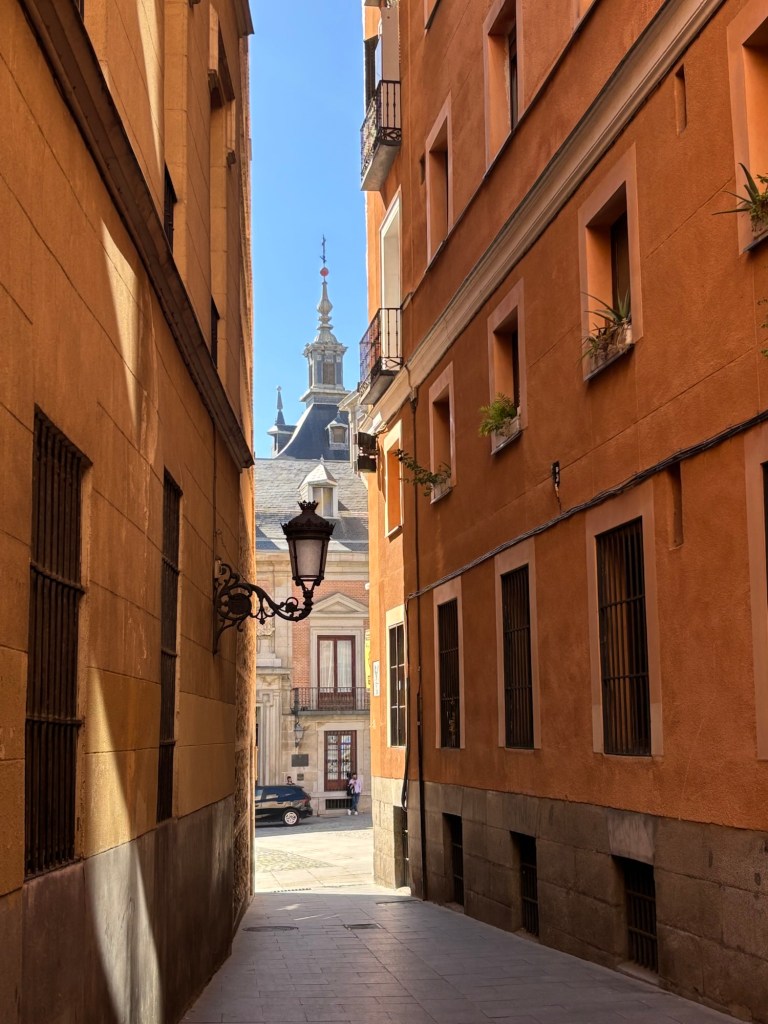
Calle de San Millán, Madrid. 20.09.

The sun is just starting to set beyond the skyline. Down in the street below, Madrid’s colourful denizens are out for an evening paseo, dressed to the nines to the last man (and woman). The rumble of motorbikes is a constant accompaniment to the general hubbub and the occasional police siren soars above it all every now and then. The lodgings I’ve managed to snag come with a balcony that looks out over the crossroads below, so I’m treating myself to the noise of Madrid for a few days before retreating to the quieter shores of Finisterre, at the end of the world.


The capital is much as I remember it from my last visit, several years ago, though it makes a change to see the place under the warm spring sunshine rather than wrapped up in the chestnut smoke of winter. It’s inching toward 20°C outside, but the madrileños are still going about in puffer jackets and (fashionable) greatcoats as though it were 5°C. I haven’t brought any heavy-duty winter wear as I have to carry everything with me from Madrid to Galicia to the Canary Islands and beyond on this latest adventure, but I might pick up a few Spanish clothing supplies while I’m here in the city. I haven’t overpacked, for once.


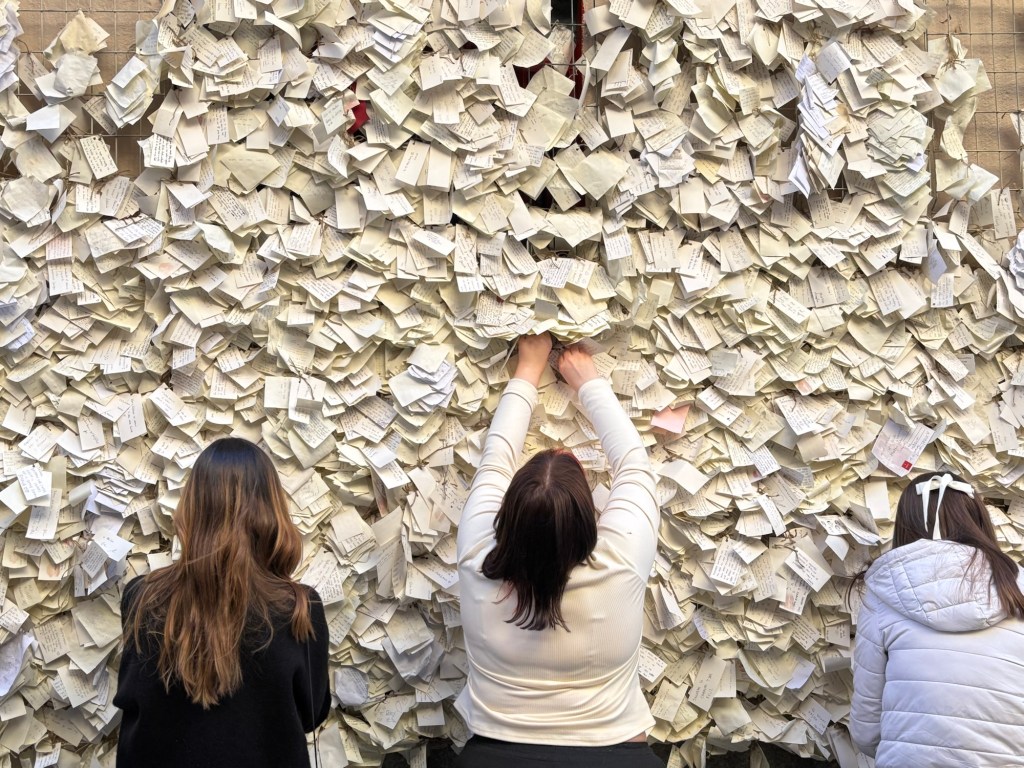
During the course of my wanderings I stumbled (quite by accident) upon the Tienda de Deseos again. I found this strange corner of Madrid last Christmas, its walls covered with the scribbled desires of a hundred passers-by fluttering in the winter wind. Last year there were quite a few lonely hearts on here. This year there seem to be a lot more general “wishing for all the best in life” requests. I made a wish last year to find her – “wherever she may be”. This year I was a bit more specific. Beautiful though it was, I don’t think I’m quite ready for another trans-Atlantic situationship.


Even in the heart of the capital, there are clear signs that spring is here. The cherry trees lining the Calle del Arenal are dressed all in white. The swifts are here early, too – they must have come hurtling in on the wings of the rainclouds, because I’ve never seen the Río Manzanares so full.

There were a few posters on some of the bollards advertising an anti-hate march in defense of the Trans community, which I really ought to have stuck around to watch, as it’s one of the A Level topics for Spanish at the moment. A smaller group of protesters were picketing the Corte Inglés just off Sol, sporting the usual V for Vendetta masks and carrying telescreens displaying the slaughter of fish off the Spanish coast. Nobody seemed to be paying them much attention.


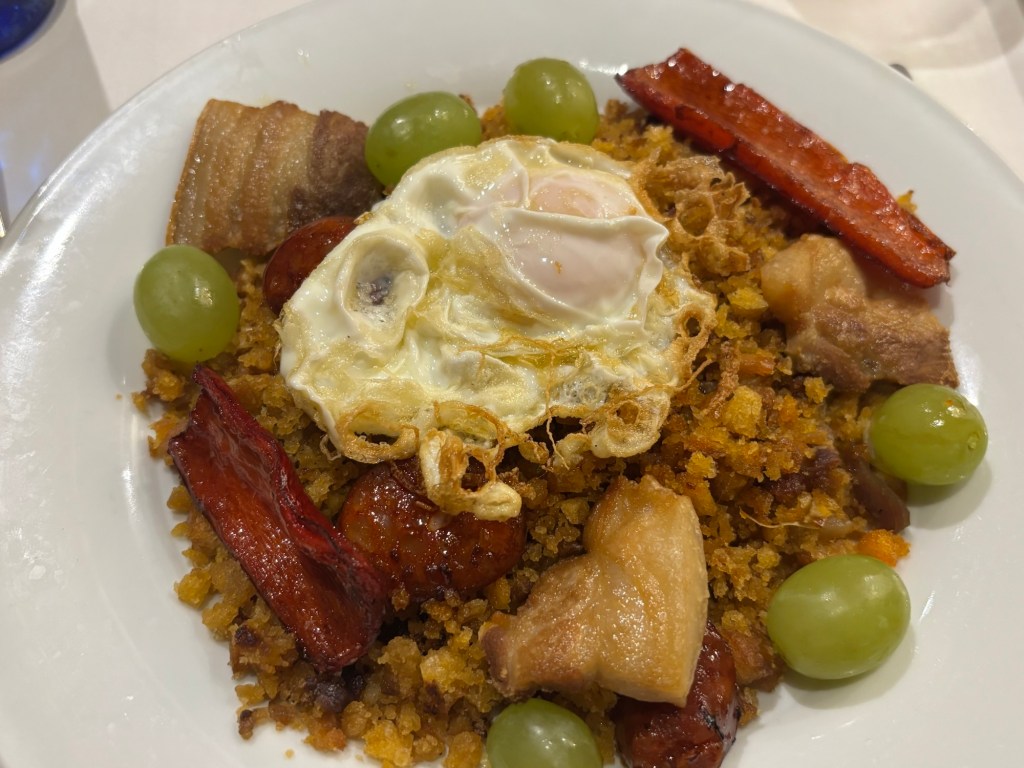
I treated myself at dinner with a rather upmarket restaurant modelled on Arturo Pérez-Reverte’s Capitán Alatriste books – dishes, decor and all. It didn’t disappoint one bit. I had my first migas in seven years and tried cochinillo for the first time. It was incredible, even though my taste buds hadn’t quite recovered from the usual end of term knockout cold.

On my first grand adventure across Spain many years ago, food was a luxury I rather recklessly decided to do without. Now that I have the means, I intend to make good on that dreadful error by exploring the best dishes the country has to offer as I go. I haven’t found any callos yet, but they’re on my list!


Please excuse the rather humdrum post today. I haven’t had any grand escapades yet! The real adventures start tomorrow… BB x

Up and Down

When I’m on the road, I have a real complex about fitting in. It must be a side-effect of being a linguist, but I cannot stand the idea that I might stand out as a foreigner, if I can help it. Usually it’s simply a question of dressing appropriately, but it also makes me think very hard about my accent when I speak. This has had some brilliantly cringeworthy outcomes, such as getting into a blazing row with a taxi driver in a French that has never been as fluent since, and defaulting to a makeshift (albeit stateless) American accent while riding the Amtrak train two weeks ago… The worst has to be that two-hour drive in a Luton van with a dyed-in-the-wool Yorkshireman in my university days, where I was so self-conscious about my southern accent that I feigned a northern accent so as not to come across too posh… My housemate, a Wensley lass herself, took an exceptionally dim view of the whole affair. In her own words, my accent had only made it as far as Sheffield.

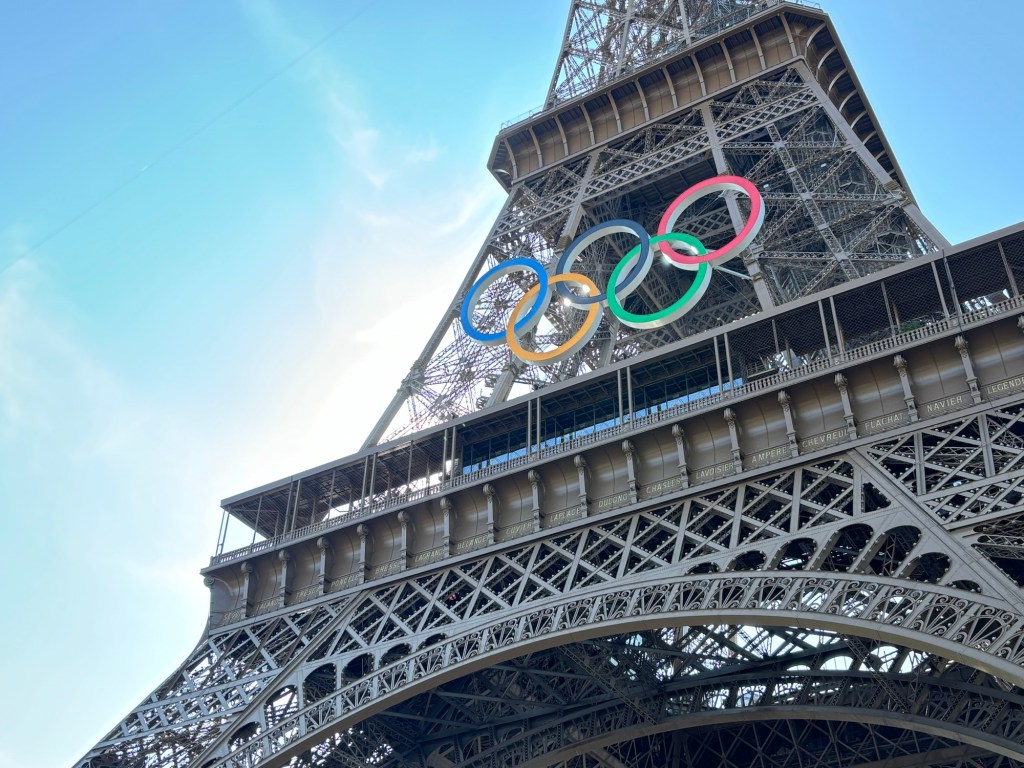
Fortunately, I’m in France, not Sheffield, and with just over a week to go until the Olympic Games begin, the city is so full of tourists that it’s probably easier to blend in as one of them than to ape any Parisian. So I caved and bought myself an Olympic T-shirt, since it’s unlikely to come back here in my lifetime.


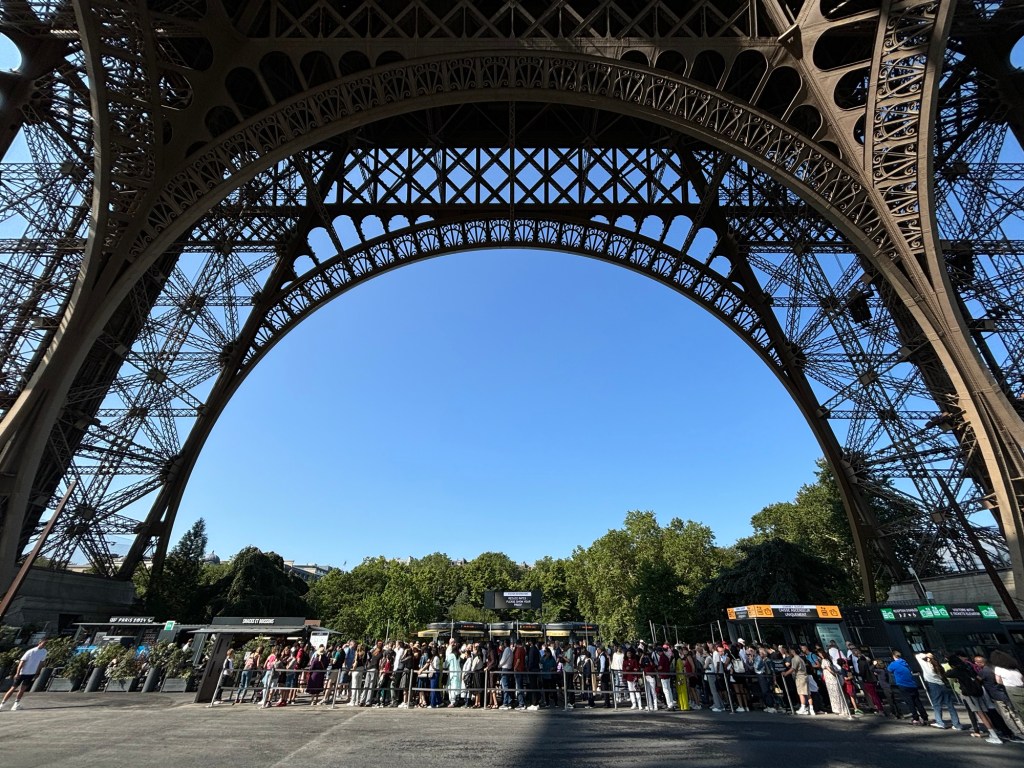
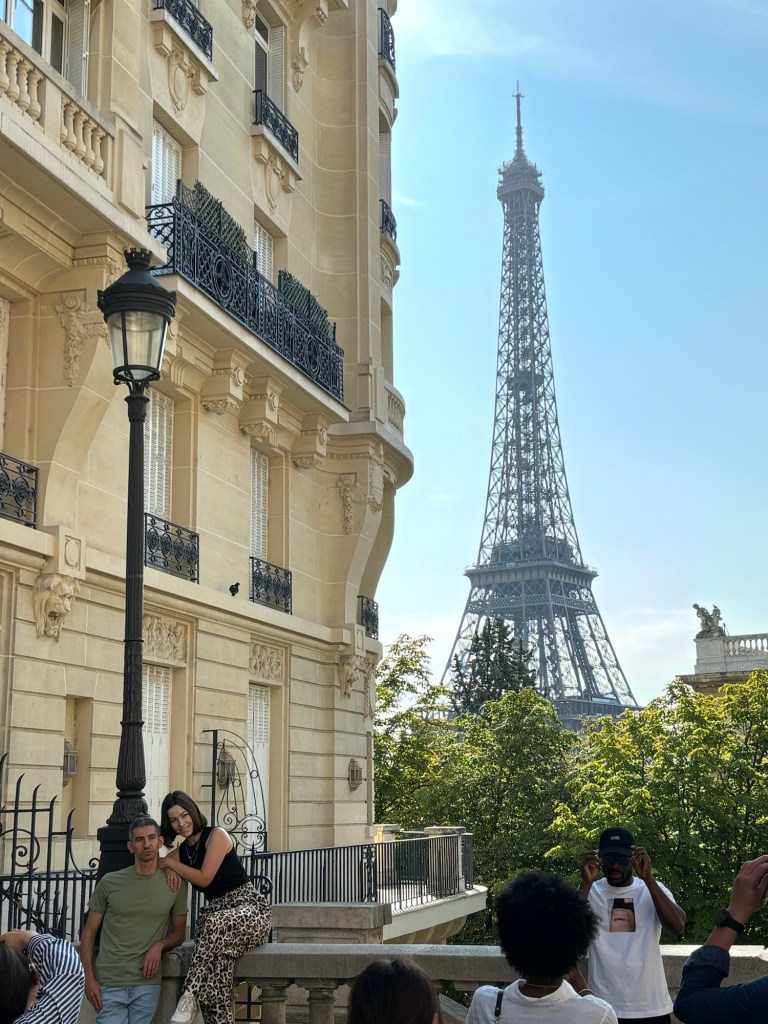
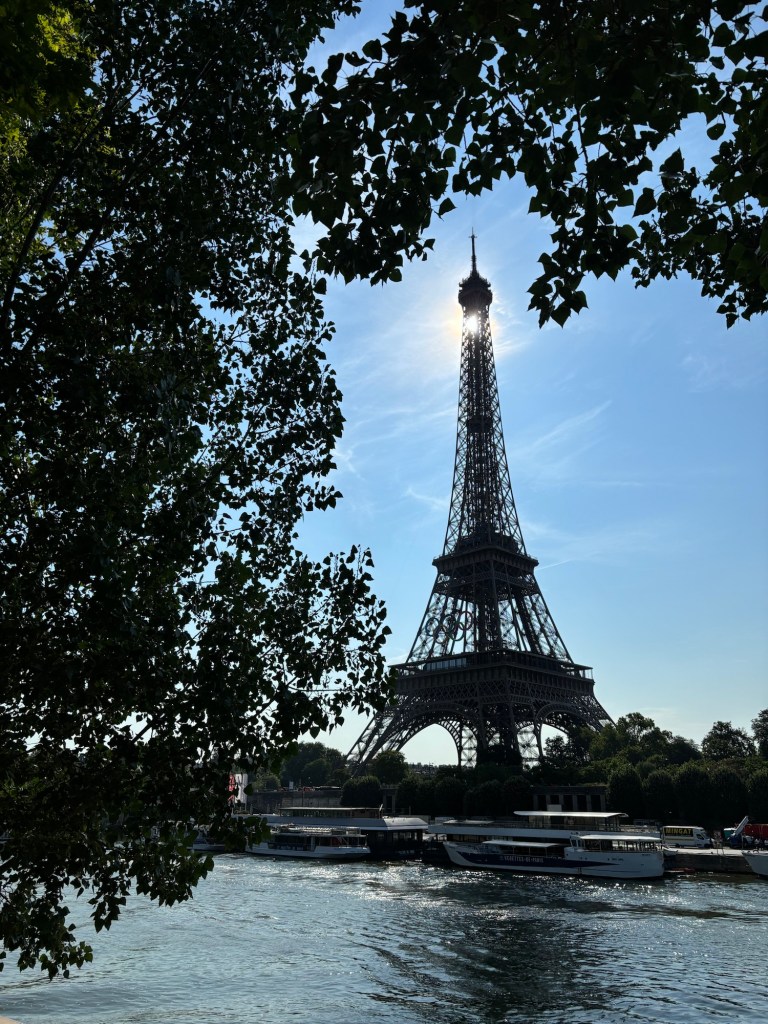
I only have the one full day in Paris, so I decided to make the most of it and go supertouriste for the day. With Nôtre-Dame still under heavy repairs after the fire of 2019, and the Louvre fully-booked up for days, that left the Eiffel Tower, l’Arche de la Triomphe and the Château de Versailles. I didn’t really set out with a specific itinerary in mind this morning – I rarely do when I’m traveling solo – and the decision to join the queue for tickets up the Eiffel Tower was very much a spur-of-the-moment one. After all, the website said that all the summit tickets were sold out, and while the views from the second floor are good, who’d make the climb and not go all the way up?


Turns out the website doesn’t know jack. The queue was about half an hour long, but when I did get there the ticket seller simply raised an eyebrow when I inquired about the availability of summit tickets and said “bien sûr”. So if you’ve considered seeing the tower on your trip to Paris and you haven’t made any reservations, fret not – they always keep some to sell on the day.


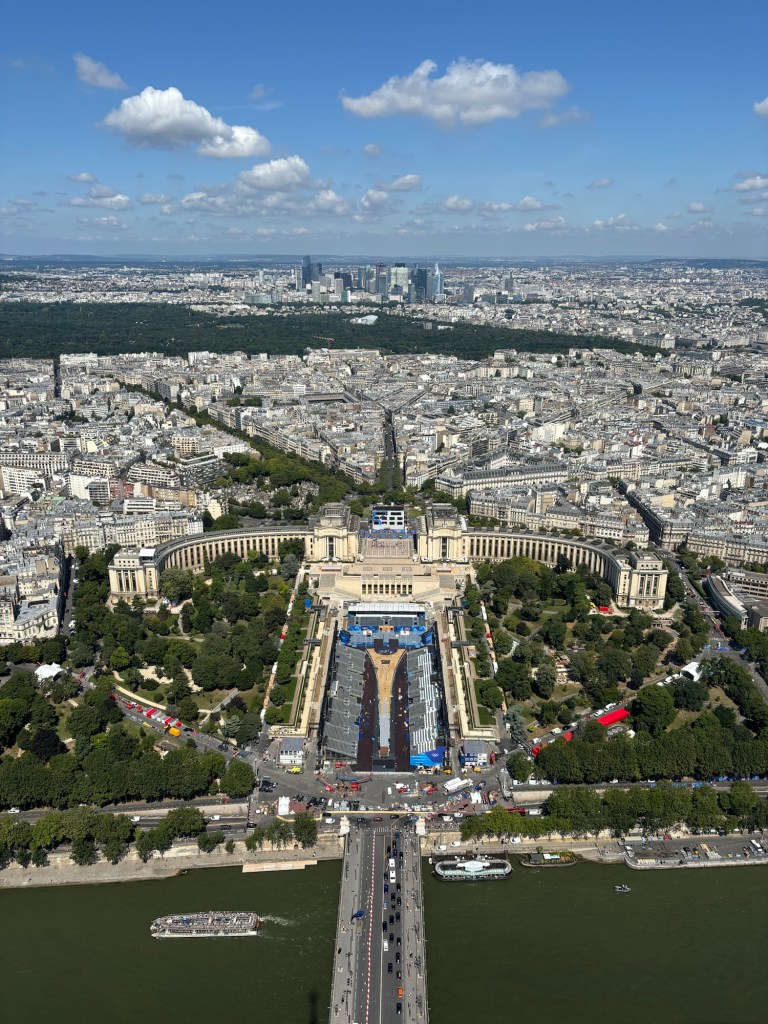
Preparations are well underway for the Olympic Games here in Paris. The Olympic torch has completed its relay of the various départements, including far-flung Outremer, and is now circling the city in an ever-shrinking spiral. All around the city, cyclists are coming and going with pink signs in their panniers, pointing visitors in the direction of this or that event. Stadiums and stands have sprung into being like enormous steel mushrooms, and the avenue that stretches from Trocadero to the École Militaire now hosts a giant show ground, which looks like a building site from the ground but a lot more like a Roman circus from above.

It’s also impressive just how big the Bois de Boulogne is. Hyde Park may be a green lung for the heavy London air, but it pales in comparison to the dark forest that has clung on in Paris’ northern district, as though threatening to break the encirclement and rejoin its sister Meudon in the west, given the opportunity.


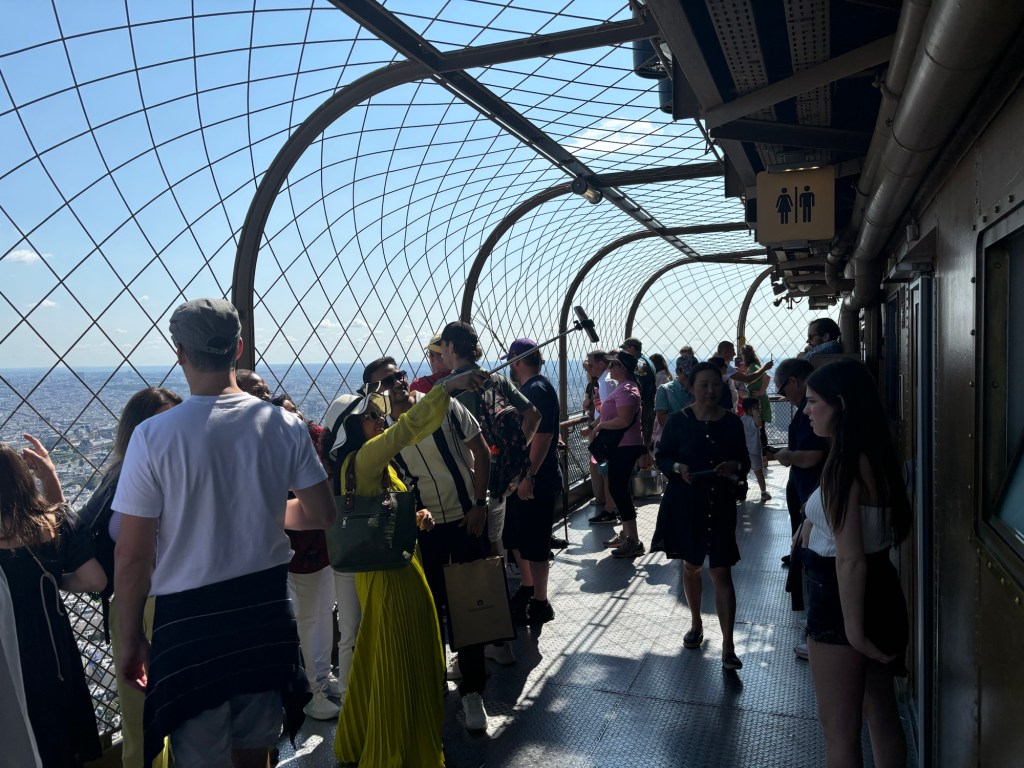
The summit of the Eiffel Tower really is quite something. Photos don’t really do it justice. There’s any number of skyscrapers that have now beaten its giddying record, but none so old, so charming, so immediately recognisable. It’s quite something to perch high above the City of Light, pigeon-like, and join the ranks of historical characters who have stood in the same spot: kings, shahs and statesmen, warmongers, tribal chiefs and Buffalo Bill. You’re more likely to be elbowed out of the way by an errant child angling for a better view or jostle for space with a Brazilian family taking every possible angle of each other than you are to meet any of the former, of course, but who knows? With the Olympics converging on the city, now’s as good a time as any to go stargazing up the Eiffel Tower.


I’ve been a bit reckless with the traveling this summer. I’d like to argue that this latest venture is purely tactical, with French being a very valuable commodity where I’m going, but it’s also methodical: it’s a very good way of keeping busy in the yawning maw of the summer holidays, which can go on and then some if you don’t find some way to keep busy. At the moment, one wedding after another plasters my social media feed as old friends tie the knot. It should make me smile, but on one level it always reminds me just how cut off my career has left me. That’s just one of many reasons I’m moving to a new job and a new part of the country this summer. It’s high time I hit the reset button and started from scratch.

But until then, I have the joys of the open road. Perhaps it’s my way of justifying my existence in these long, empty stretches we call holidays. I might have missed the boat festival in Brest by a matter of days, but I’m really quite excited to explore Britanny. After all – it’s supposedly the location of the indomitable Gaulish village of Astérix and Obélix. Between those two comic rascals and St-Malo’s long history of piracy, I should be in for a treat! BB x

Looking for Love in Paris

I started learning French when I was around five or six years old. A lady used to come to my primary school and ran a French class as an after-school club. I remember it so distinctly because the teacher always brought those strawberry-favoured biscuits that I used to devour. I think they’re called Lulu « barquettes », but ever since one of my school-friends described them as “vagina biscuits”, the unfortunate moniker has kind of stuck.

What I’m trying to say is that I’ve been studying French for twenty-five years of the thirty I’ve been alive. Perhaps that’s why I burned out at university.


I’m on the road again, and this time it’s Paris. I’m very much aware that it’s been years since I had to speak French outside of a classroom setting, so I have come out here to put that right. I also have another quest in hand: I have to kindle the fires of a slow-burning romance with France and the French. Unlike Spanish, which had me at hola, I have never been as besotted by my third language.

There are good reasons for this: I have strong family ties to Spain, the landscape and wildlife were just that much more exotic in my early days as a kid naturalist, and I never had the chance to lose interest due to starting over with the same textbook three times at three different schools like I had to with Encore Tricolore (two more encores than I cared for). It was easy to fall for Spain: she was the new girl on the block and she lit the path to finding my long-lost grandfather once again. But there was a time, and not all that long ago, when I was genuinely considering splitting my year abroad between France and Spain. I know I was at my most intrigued in my sixth form years, thanks primarily to an iron-willed teacher (who scared the living daylights out of us all) and an immensely encouraging language assistant, who never failed to find an angle for me to explore in her lessons. So it’s not like I’m starting from scratch. The attraction has always been there, albeit buried deep.

And that’s what I’m here to do. I had a thing for France once. It might have fizzled out over the years, but I know it’s still there. I just have to find the spark. And where better to start than Paris – the city of light?


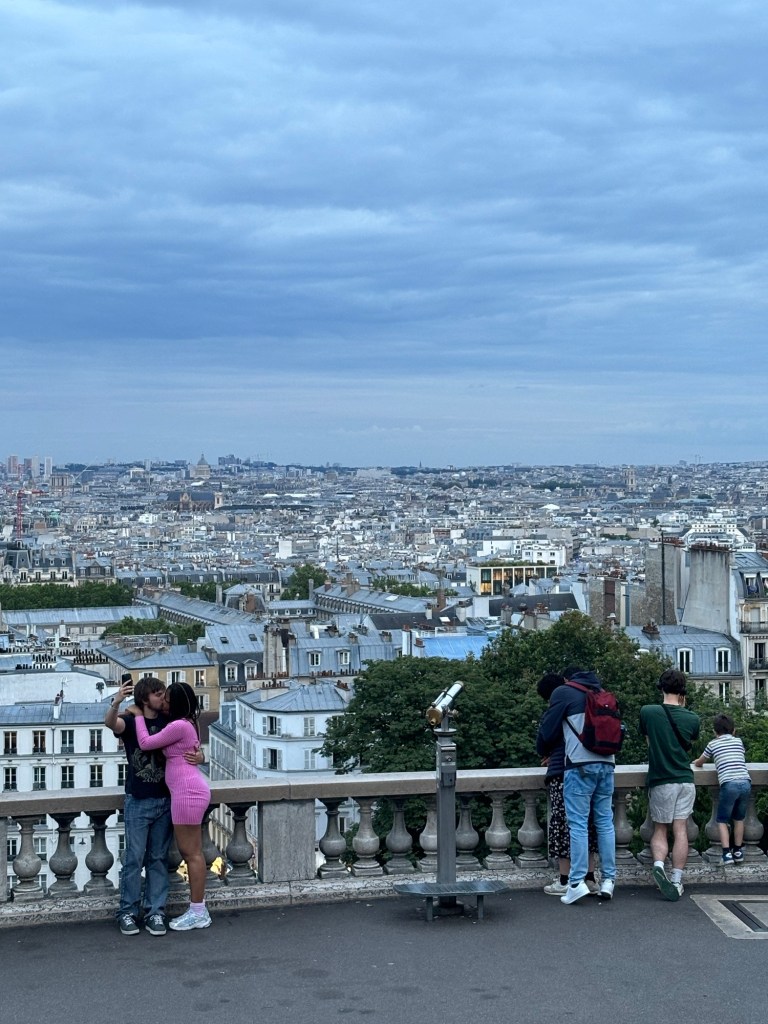
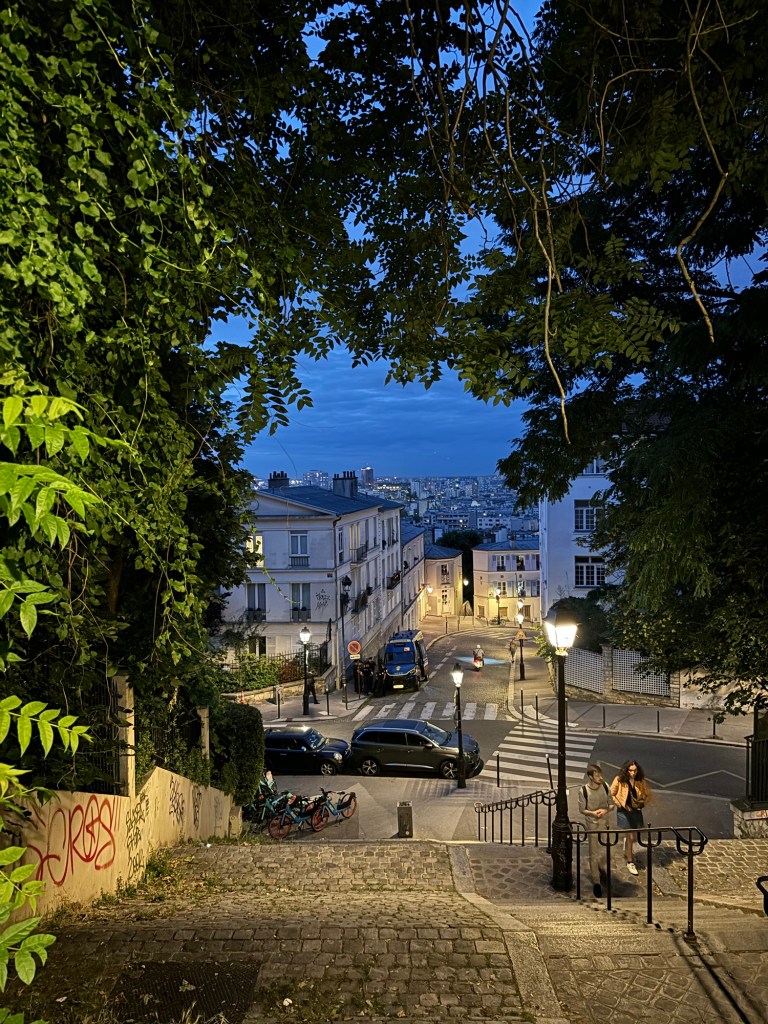
I haven’t been to Paris since I was eleven, and the last time I was here I climbed up the winding steps of Montmartre to the domed towers of Sacré-Cœur, so I figured that would be as good a place as any to start. The gendarmerie were out in force: the Paris Olympics are now only days away, and security in the city seems to be tightening up and fast. That didn’t stop the locals from having a good time, blasting music from the steps of the church, waving off the Indian lovelock vendors and generally having a good time.

Paris really is a beautiful city, even for the solo traveller, though I feel it’s absolutely a destination best enjoyed with a partner. I got much the same impression in Venice a couple years ago. Everywhere you look there’s a couple sharing a kiss, taking a selfie, holding hands at a café. It makes a welcome change from the awkward coolness of the British. We could learn a lot from these masters of the art.


Let’s play this like a dating profile. Let’s get serious. Monogamy is out of the question since I’m not about to be unfaithful to Spanish, so I’m hoping French is willing to share. Distance doesn’t bother me – Paris is only half an hour away by plane – and twenty-five and over would count for every one of those years I have spent grinding French. I am open to a short-term relationship with this language, but a long-term would be preferable (especially as I may well need French as my sledgehammer to get into the Spanish education system someday). Words of affirmation are 100% my love language, so I’m hoping I can find a warm spark within the infamous chilly disposition of the Parisians. And while my music tastes aren’t likely to be all that compatible, I was a major Stromae fan in my university days, and I’ve always had a thing for Afro-French artists, like Baloji. Between that and the unsurpassable bandes dessinées of my childhood (Astérix, Tintin et al.), we might just about have enough in common to have a go at it. So – how about a café date, to mettre la machine en marche?


I should find a café and make it my own while I’m here. That’s a plan for breakfast tomorrow, I think. You can’t really get an eye for Paris unless you spend some time in a café, after all. A bientôt, mes amis. BB x

For Whom the Bell Tolls

My provisional license arrived in the post yesterday. My second, I should say, since after a very thorough summer holiday shakedown of the flat I’m convinced I must have accidentally thrown my first one out with the trash months ago. It’s put a major stopper on the whole learning-to-drive this summer by holding up the theory stage, but now that it’s here I’ve got no excuses. I should get booking.

But first, I’m getting out of here for a few days. I’m done with scrolling, hoping for contact from the outside world and turning off the WiFi for a bit of enforced internet downtime. Summer holidays just drag on and on when you have nothing to do, so I’ve decided to get out there and do something.

So here I am in the ferry terminal in Portsmouth, waiting for the 22.45 to Caen. The overhead telescreens keep alternating between the blue departures board and the vivid blue and yellow banner of Ukraine. The BBC News app remains focused on the heatwave, though the magic number 40 has disappeared from the headlines – “temperature tops 38C and likely to rise”. Five stories down, Tugendhat is eliminated from the running for Tory leader.


It certainly was hot today, but it didn’t feel much like that blisteringly hot summer holiday in Jerez almost twenty years ago. Despite the threat of 40°C heat, the breeze rolling in across the Weald kept the school grounds pleasantly cool. Even so, the signs that this has been an unseasonably hot few days are clear. When I went out to do a little reading in the morning, the summer soundscape was there: the echoing whack of a tennis racket, the ceaseless chatter of the house martins, grasshoppers chirping lazily in the meadow. A few hours later, the whole place was silent. Only a lone crow broke the stillness, and that was just the once.

I thought the train journey would be problematic due to the hysteria in the news, but despite the grovelling apologies over the Southern Rail tannoy, the train was only ten minutes late pulling into Portsmouth – which is remarkable, given how prone to delays they can be outside of a national crisis.

It’s a beautiful train ride, the route from Crawley to Portsmouth – one of those British rail journeys you should tick off the list, like the one from Darlington to Edinburgh. I never get tired of passing Arundel Castle and the fens at its feet. A childhood spent in and out of various salt-marshes around Kent has left me rather fond of their bleak serenity. Herons stalking the water’s edge. Egrets bedecking the bushes like so many plastic bags snagged on the branches.

Suddenly, an intensive greenhouse-farm appears, concealed from the outside by a thick growth of trees. A ravenous human hand clawing the depths of the earth to satisfy a hungry world. And then it’s gone, the train is hurtling forwards and I’m back in the marshes. I could be looking into the past or the future. I remember the fate of El Acebuche, its silent reeds swaying in the wind, and I’m not sure I want to.

The French family in the seats behind me must be headed for the ferry port, too. At least, I guess they are – I’ve caught the word “bateau” often enough. The children swap in and out of French and English without much of an accent overlay in either. The father speaks only on French, until he stops the ticket inspector to ask if she can turn off the air conditioning. “Don’t you think it’s rather nice, as it’s so hot out there?” – “For five minutes is nice, but it’s freezing.” – “If I were you I’d enjoy it.” At the next stop, the father gets out to soak up the sun. His daughter only just coaxes him back on as the doors close. Before he returns to his seat, he steps into the next carriage, remarks that it’s warmer, and moves. Within minutes the rest of his children have followed suit. It seems petty, but they have a point – the air con was turned up so high I had goose-flesh for half the journey.

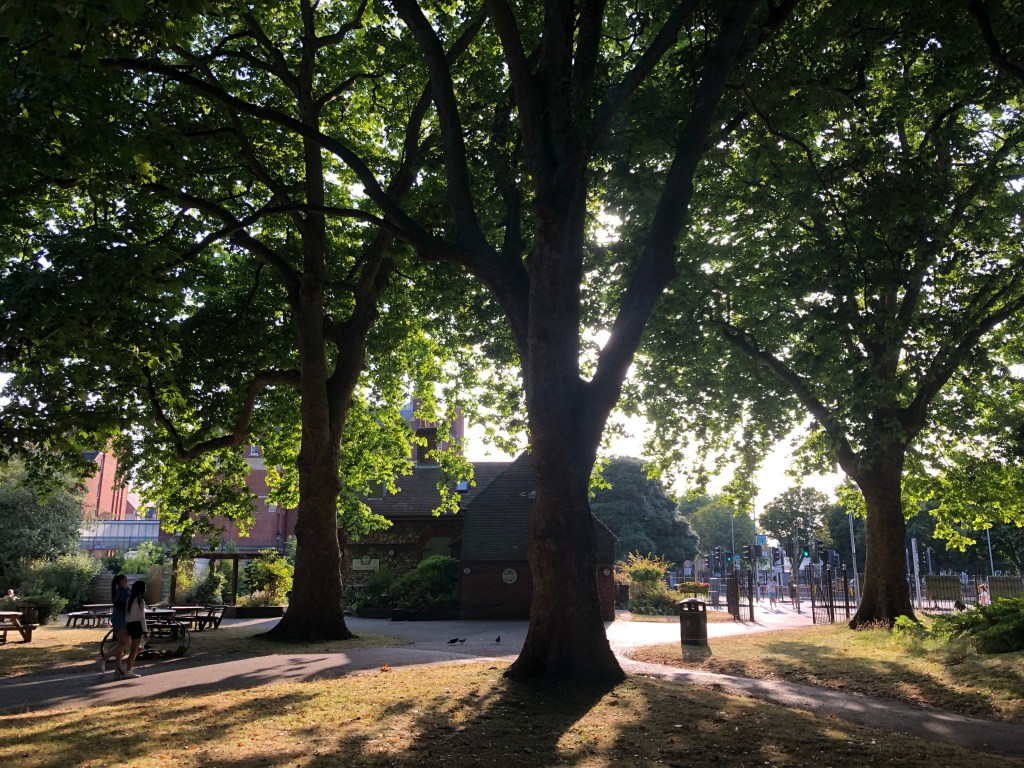
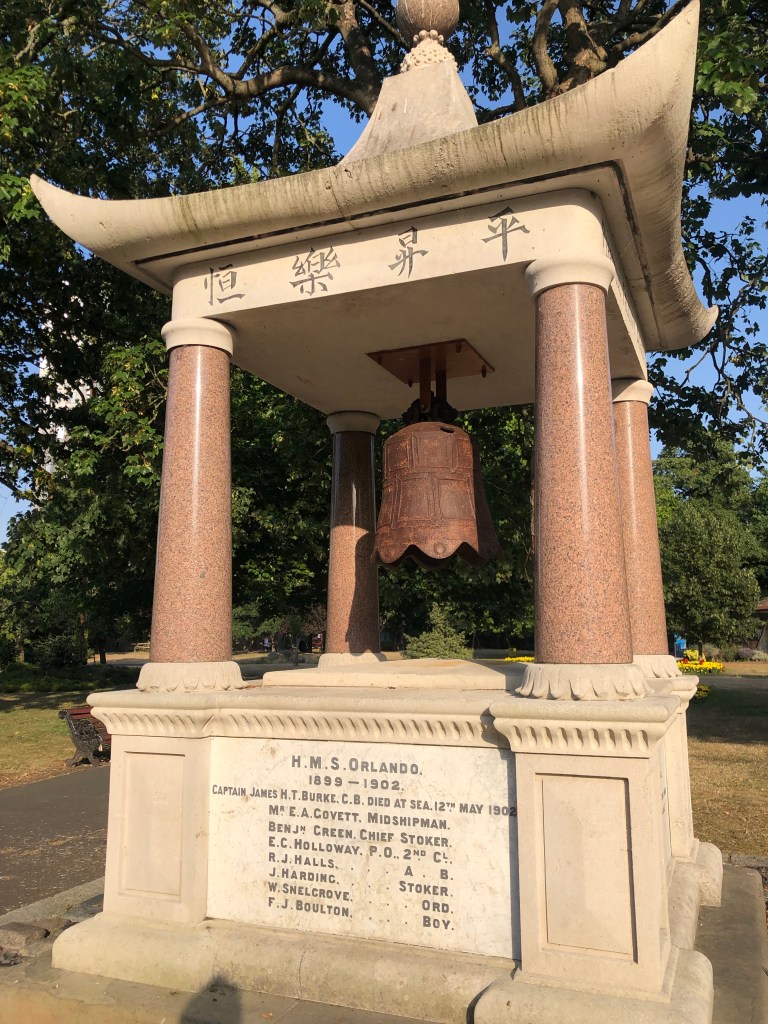
I haven’t been to Portsmouth before. The last time I caught a ferry in this neck of the woods was from Southampton, but that was many years ago and we didn’t stop. I had four hours to kill and not a lot to do, so I picked a spot in Victoria Park and watched the world go by. The bells of St John’s sounded for seven. They sounded strangely mournful, but though I hummed the melody back a couple of times, I couldn’t work out why. Two handsome women wander by, their accent West African and intensely musical. Three kids hurtle past, one on a scooter, two on skateboards. One wears a red-and-black chequered shirt tied around his waist (did everybody own one of those shirts at some point?). A family of cockatiels screeched from an aviary in the centre of the park, stolen away from their home far beyond the sea to entertain the fancy of the British public. An ancient Chinese bell stands nearby and seems to serve a similar function, pilfered – it says so in almost as many words on the plinth – during a campaign in Taku. A cryptically-worded message daubed above reads “Perpetual Felicity Achieved” in austere capitals. A breeze blows and the bell moves a little, but it makes no noise. Some cage birds stop singing after a while, too.

As the sun sets, I head to the port. The heat and the hysteria have driven everyone indoors. The high street is virtually empty. Just a couple of kids with drinks they’re nowhere near old enough to drink and a level of delirium to match, and a weatherbeaten gentleman sleeping in the shadow entrance to an Ann Summers store. A grey mannequin in turquoise lingerie poses suggestively through the window at him, blowing a kiss. He wipes his nose, shakes his head violently and turns the page in the book he’s reading.

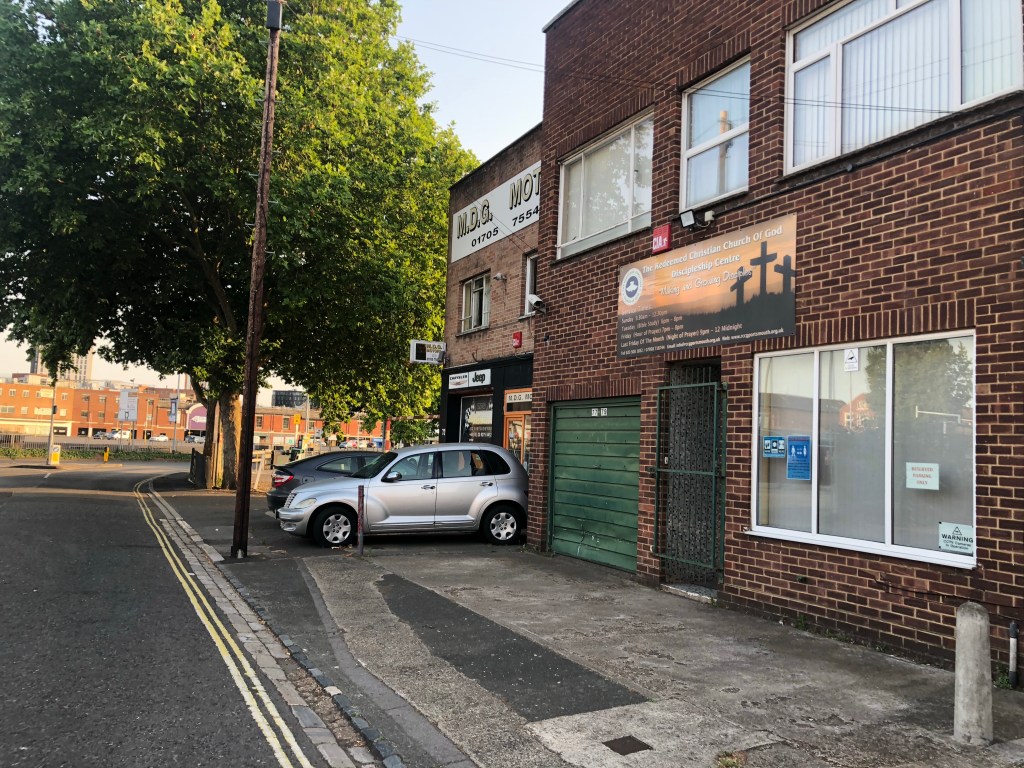
There’s plenty of folk driving here and there, but nobody on foot. For several minutes I feel like the only human in the city. A couple of Deliveroo me go by on their bikes. A bearded man in a red-and-black chequered shirt worn over his t-shirt, bent over almost double. I pass an outpost of the Redeemed Christian Church of God in a backstreet, and later, the house where Charles Dickens was born. Everything is shut. The high rasp of a motorbike going by, the evening heat and the strangeness of a new place… It almost feels like I’m abroad already.


But no. I’m still here in the terminal. Boarding starts in ten minutes, so I suppose I’d better close there. A demain, mes amis. France is calling! BB x

Seehund

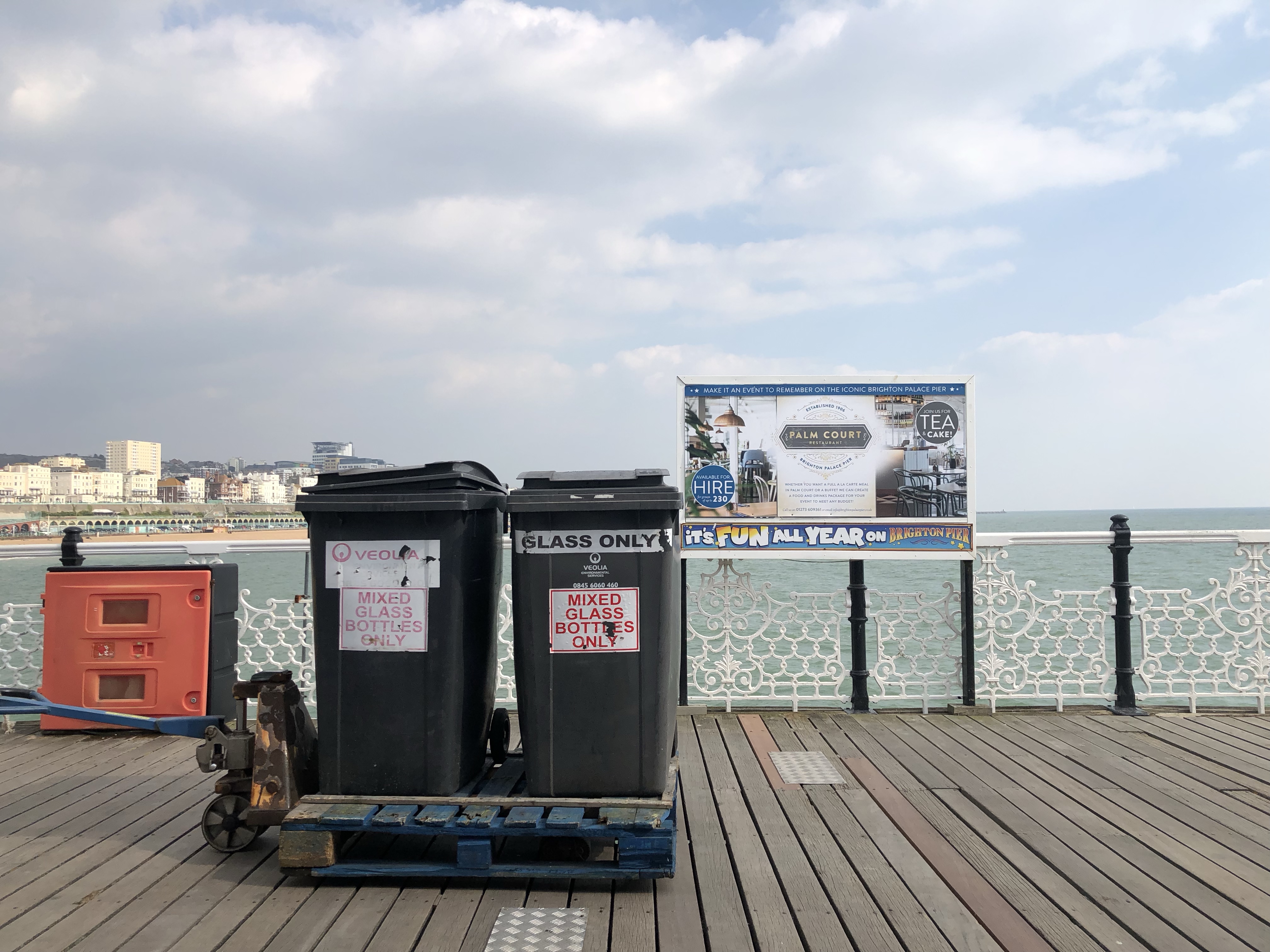
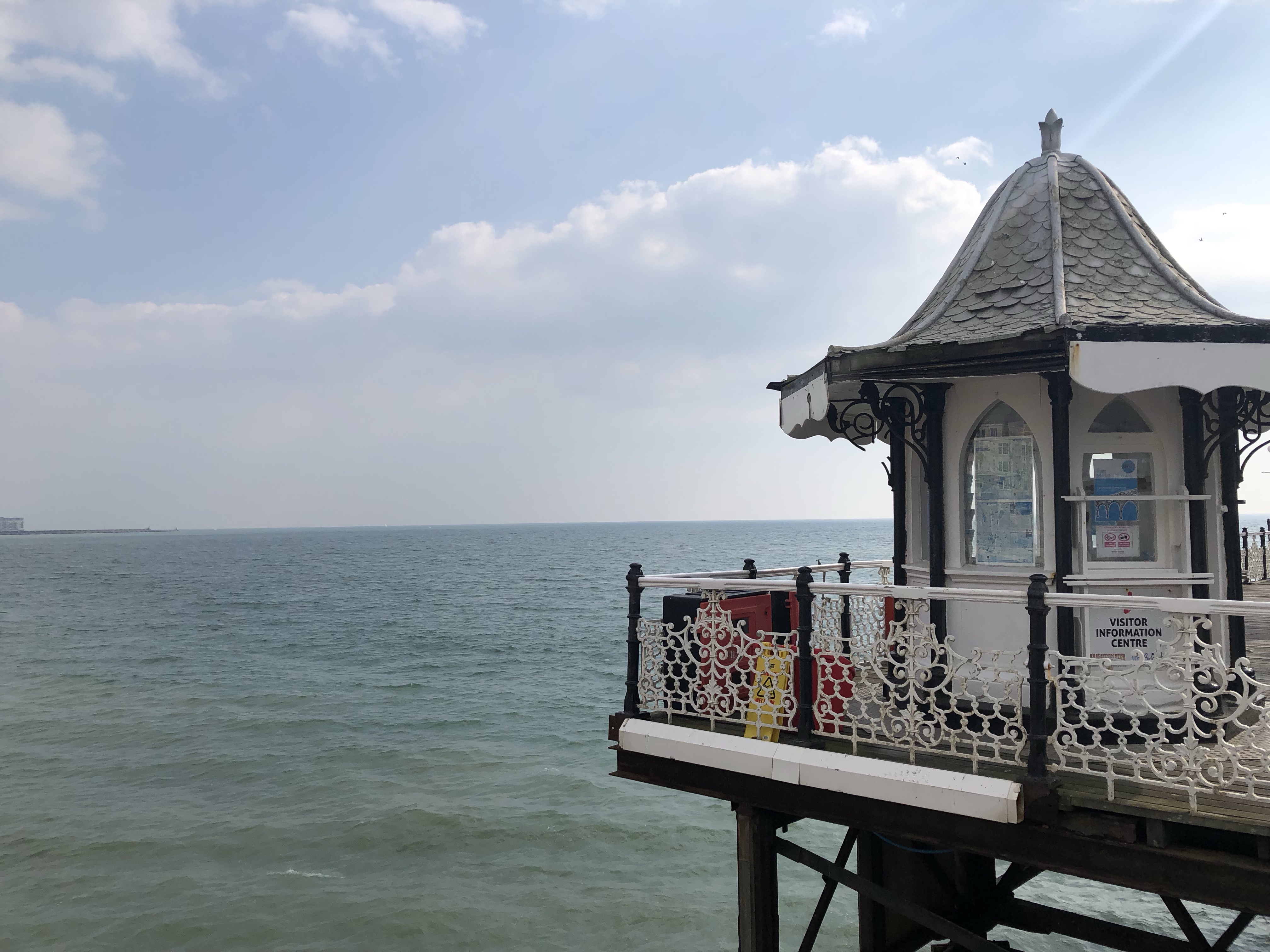
2:45pm, 20th March. I’m sitting on a bench on Brighton’s Palace Pier, sheltering for a moment from the wind. A sign in front of me reads “It’s fun all year on Brighton Pier”. Somewhere down the coast to the east, there’s a few mad folk towelling off after a swim. The sea doesn’t exactly look inviting today. I look down through the slats. The bottle green waters of the Channel heave and swell about the centipede legs of the pier below. I wonder what creatures of the deep might be looking back up at me, besides the silent starfish in the silt.

Two men wander over to the parapet, gazing down at the beachgoers below. One of them watches in silence, nodding occasionally. His companion holds a recording device of some kind in his hand and is whistling a crude but not inaccurate imitation of the gulls. Is he trying to lure them in, perhaps? To what end? I can’t quite make out his game. He keeps it up the whole time, occasionally saying something in Arabic to his companion and chuckling, and then whistling his gull-call again. After a while, they move on, whistling. His friend must have the patience of a saint. You get all sorts in Brighton.

A few seconds later, a herring gull lands on the parapet. It’s not there for long, as a gang of girls in tracksuits race up the aisle towards the gloom of the arcade, screaming and swearing, sending the panicked bird into the air in their wake. Two scavengers in a truck trundle by in the opposite direction, trailing two heavy GLASS ONLY bins behind them. The planks tremble beneath my feet. I imagine, for a moment, the structure collapsing beneath its weight. In slow motion I see the bins rolling over backwards and a cascade of bottles plummeting into the sea below, some of them shattering on the struts of the pier before they hit the water. I have a pretty active imagination.

I move on up the pier, past the booming darkness of the arcade, which still seems to draw in a faithful clientele, despite the mobile lure of pocket entertainment. In fact, I’m actually pleasantly surprised by the absence of phones on the pier – for once, I’ve got mine out more than most as I take notes. Beyond the arcade, I reach a collection of outdoor game stands. Tin Can Alley with a bored-looking brunette in a red shirt waiting for custom. Dolphin Derby with an enthusiastic announcer who wouldn’t look out of place in a pinstripe waistcoat and boater a hundred years back. An Indian family points out across the water talking in a language that isn’t English. A couple walk past, hand in hand, one of them gamine with a grey-tinged ponytail over shaved sides and a nose ring, and her partner robust, black, ripped jeans and winged eyeliner, a rainbow lapel badge pinned to her sleeve. The air is thick with the pungent smells of Brighton: fish batter, candy floss and the distinctive damp tang of weed. The breeze coming in off the sea cancels out one of the three at a time, but not for long.

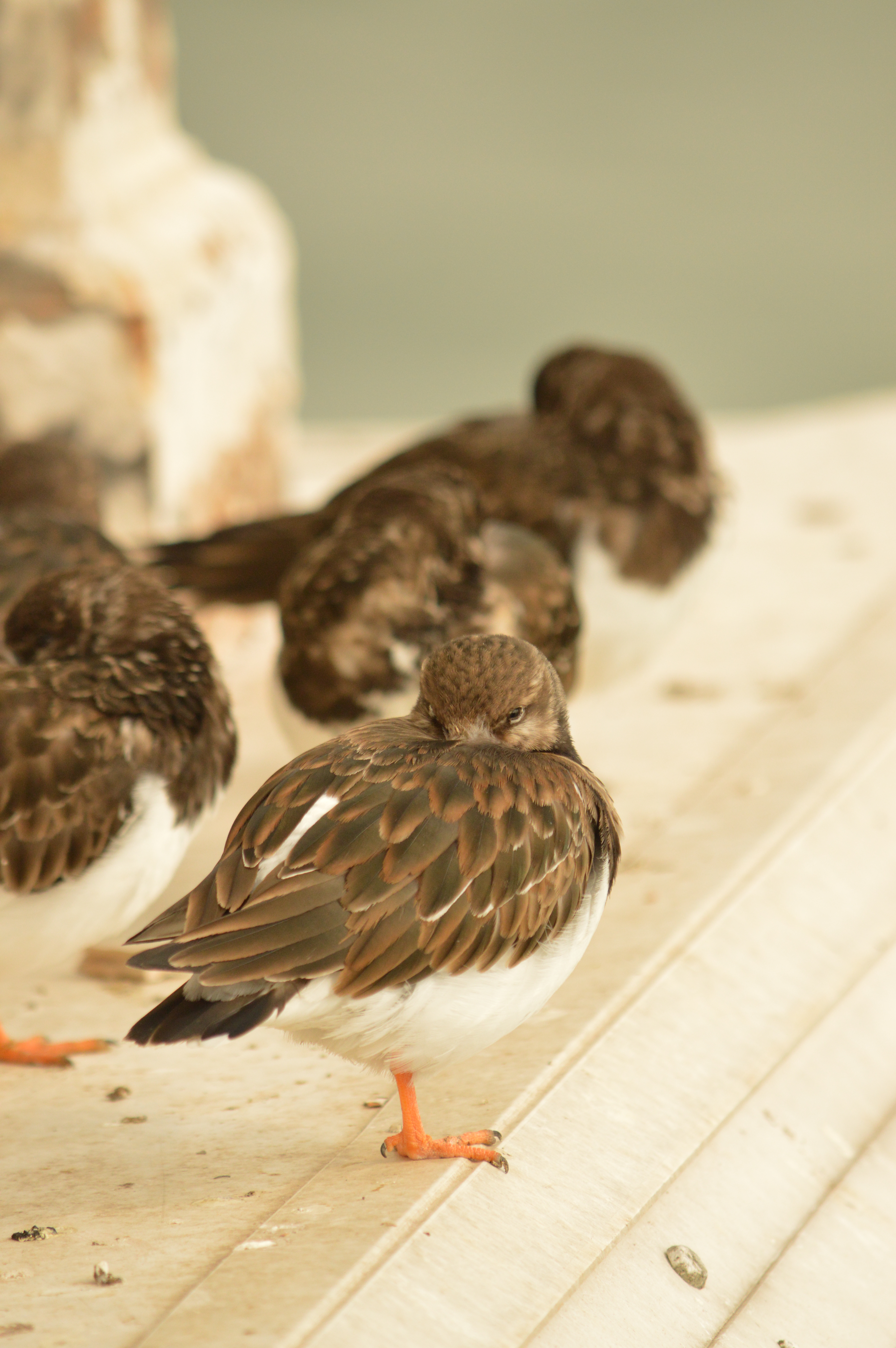
Behind the Tin Can Alley shack, a huddle of turnstones get some shut-eye. These often hyperactive creatures look out of place when static, and one wonders how they manage to get any rest at all with the thumping bass from the fairground rides at the end of the pier. It almost looks as though there’s a physical pecking order to the clan, and the ones at the bottom aren’t having much luck, hopping from strut to strut with remarkable dexterity. A passer-by sees what I’m looking at and stops to take a few photographs on her phone. The turnstones don’t seem to be fazed by me, or her, or any of this. After all, it’s fun all year on Brighton Pier. They’re probably used to it.

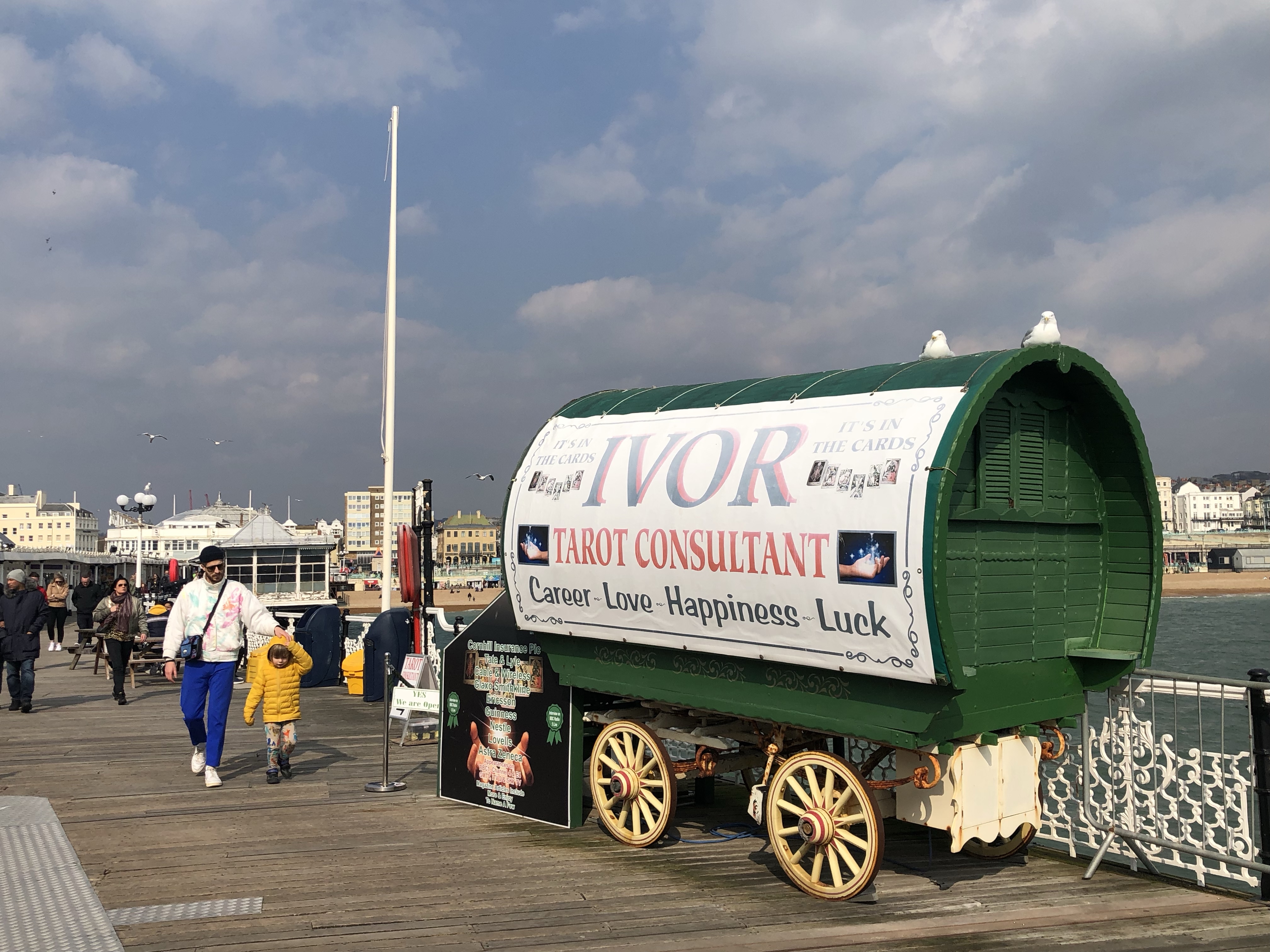
Nearer the fairground, an old gypsy-cart sits awkwardly beside the parapet, offering Tarot readings for a modest sum. Career, love, happiness and luck mingle strangely with Nestle, Astra Zeneca and Cornhill Insurance plc. I remember finding an abandoned gypsy-cart in the woods once when I was a child, its richly-painted woodwork fighting a losing battle with the forest’s silent army of moss, lichen and brambles. The gitanos in Tierra de Barros had no such fancies, eking out a living from beat-up cars and shabby tents. There is an old song of theirs I have consigned in part to memory, telling of their love for the Guadiana River, that came to mind:

The region of Chal was our dear native soil,
Where in fullness of pleasure we lived without toil,
Til dispersed through all lands ’twas our fortune to be,
Our steeds, Guadiana, must now drink of thee.

Gypsy ballad, translated by George Borrow (The Zincali, 1841)

I doubt the gitanos camped outside Villafranca de los Barros would know the song. It comes from an older world, much like the incongruous cart parked at the end of Palace Pier.

The fairground plies a busy trade for a chill-if-sunny Sunday in March. I feel like I’m walking through a childhood I haven’t known in twenty years, not since the distant summers in Dymchurch. Tea cups, log flumes and merry-go-rounds. A helter-skelter – see the Isle of Wight on a clear day! – painted up like a stick of Brighton Rock (or maybe the sticks are painted after the fashion of the fair). The static gilded horses on the merry-go-round look no less terrifying than they did when I was a boy. The ghost train reels in customers one at a time, lethargic, a chameleon in the cold. A father explains the “this high to ride” sign to his son, who is just a little too short for any of the attractions. I get the impression I’m snooping a little too much and wander away from the noise.

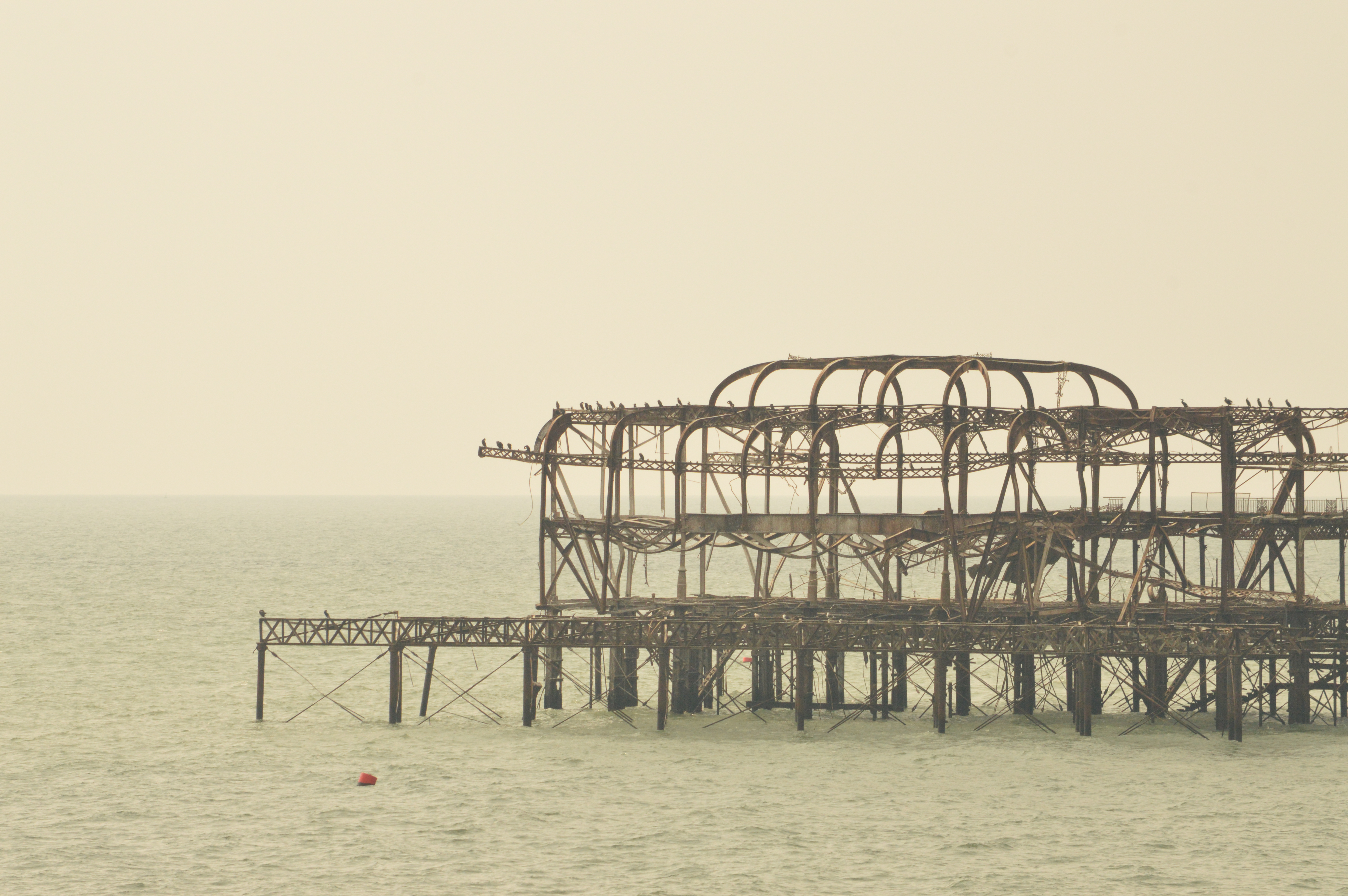
There’s a quiet spot behind one of the rides, looking out towards the mouldering wreck of the old pier. Seen from its sister with the city behind it, the Western Pier looks small and unimpressive. From the shore it looks a little more mysterious, where its mangled skeleton claws at the horizon like the blackened bones of a giant, mechanical whale, picked clean by the cormorants that sit on its ancient struts. In their oil-black funeral garb, they might as well be an extension of the wreckage. Brighton’s gargoyles.

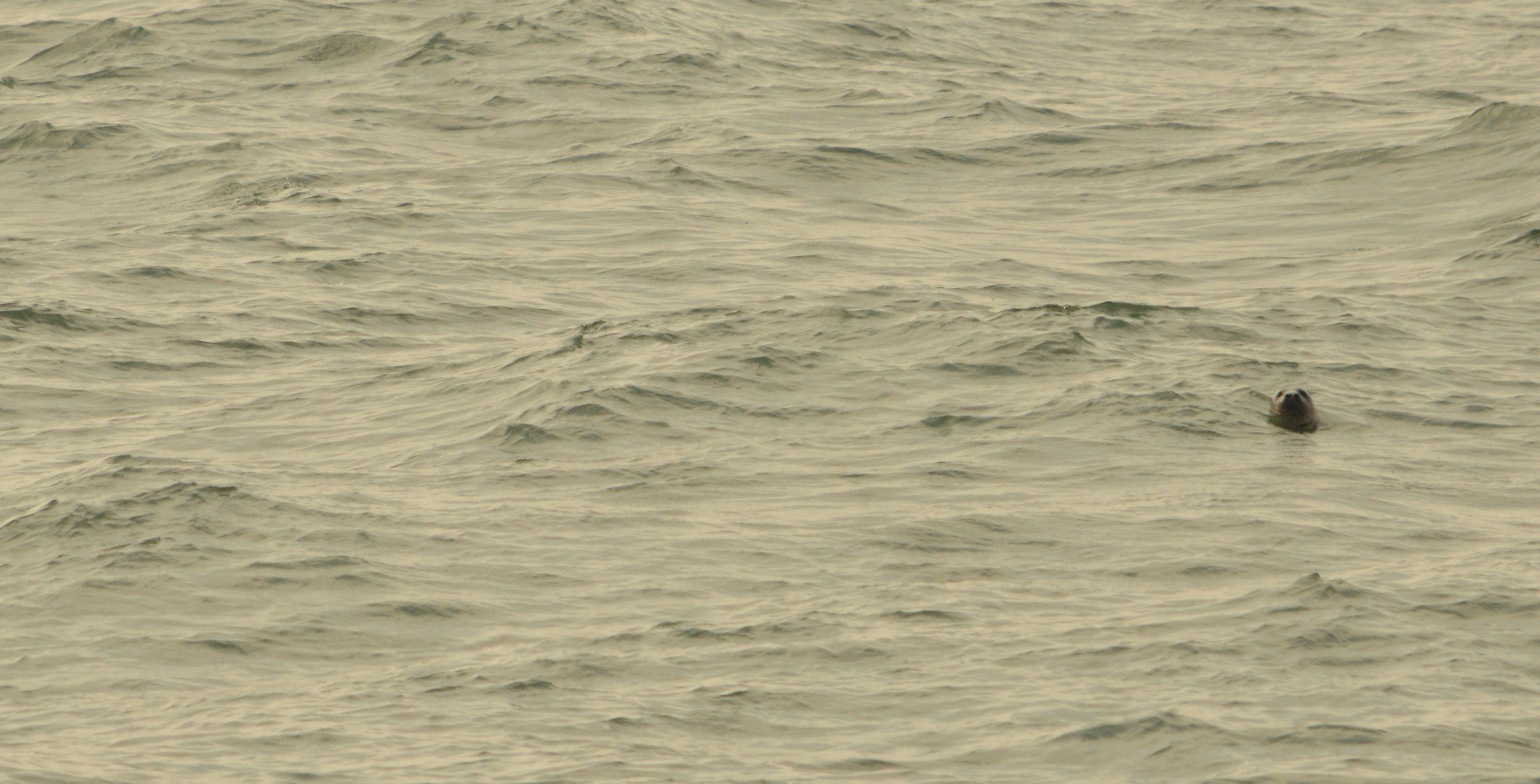
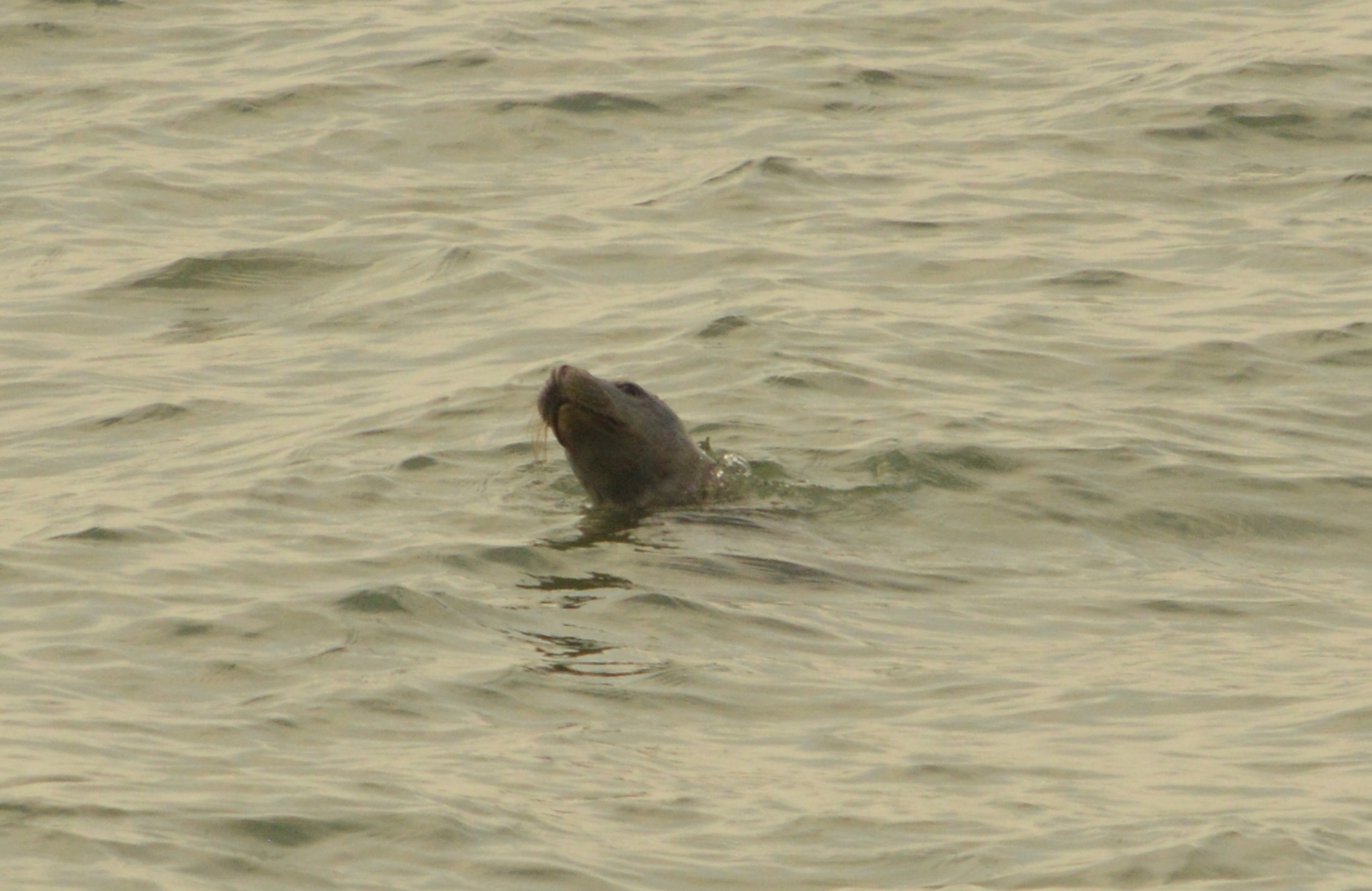
Something bobs in the water closer to the Palace Pier, and without looking through any lens it looks too misshapen to be a buoy. It turns for a moment revealing long whiskers and those baleful black eyes, before sinking beneath the waves. I’ve been scanning the water all morning for that sight, and now I’ve found one, I can’t let the moment pass me by. I count the seconds. One, two, three…

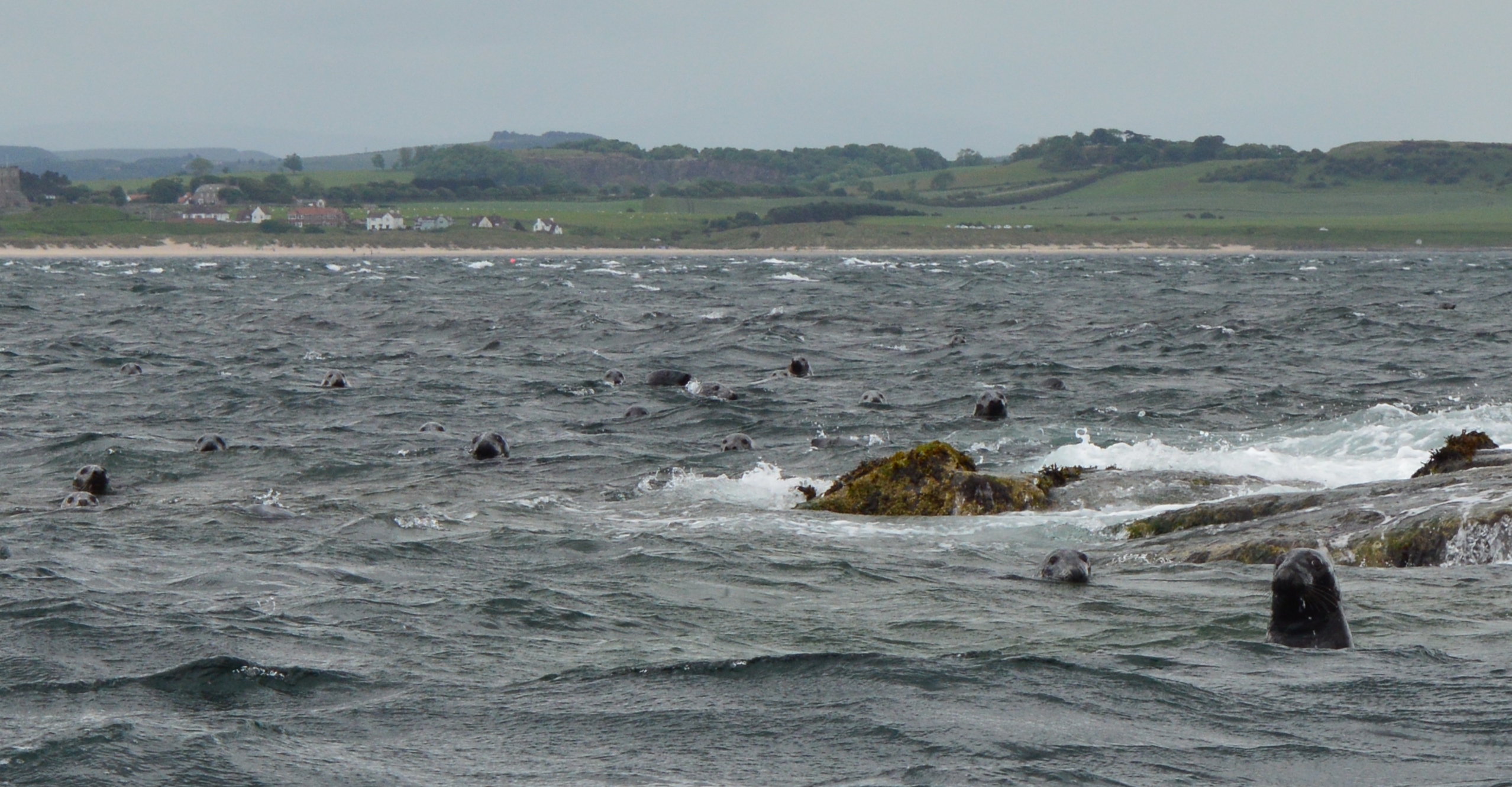
Seals are such mesmerising creatures to watch. It could be their friendly faces, the way they seem genuinely curious about the world above the waves. For me, it’s all about their eyes. There are few creatures out there with eyes like a seal’s: enormous, black orbs that seem to see forever. You only see the whites of a seal’s eye when they’re really close, otherwise you might as well be looking into the dull glaze of a shard of volcanic glass. I used to watch them bobbing about in the waves from the white cliffs when I was a teenager, and once or twice I was lucky enough to see them closer still, lounging about on the mudflats of the Stour Estuary and snorting their indignation at the noisy ferry-boat off the Farne Islands.

Those were greys: hulking, dog-like beasts of considerable size, especially the bulls who came charging after the boat. It’s not hard to see why so many languages label the creatures sea-dogs, or sea-calfs, or even sea-cats. But unless you’re in the water with them, all you see is the inquisitive face, bobbing above the surface. The seal comes into its own beneath the waves. I should love to see one in its murky underwater kingdom one day.

Some creatures command the eye. The ghostly silence of the male hen harrier, or the aerial mastery of the kite. The sunken eyes of the fox and the stern gaze of the stag. I once sat in my bedroom poring over bird guides of Spain and the Mediterranean, bemoaning how drab our world was by comparison. With age comes understanding, I suppose. If the seal hadn’t drifted further and further out to sea, I could have watched for hours.

I spent most of my teenage years growing up on the pebbled shores of this same stretch of ocean. The salt breeze and yellow-grey skies of the Channel are written into my skin like age-lines. I should make a point of coming down to the coast more often in future, if not to blast the cobwebs of work aside with a healthy salt spray, then to find the writing material I’m always searching for. If I can find my way to a quieter spot than Brighton, I might even be able to sidestep the bookshops that always draw me in. Fortunately, I’ve been such a loyal customer to Waterstones over the last couple of months that I was able to walk away from today’s haul for a steal of a price. Just don’t ask how many books I bought – or how big the discount was. It’s all for a good cause. I’ll keep telling myself that. BB x

Streets of London

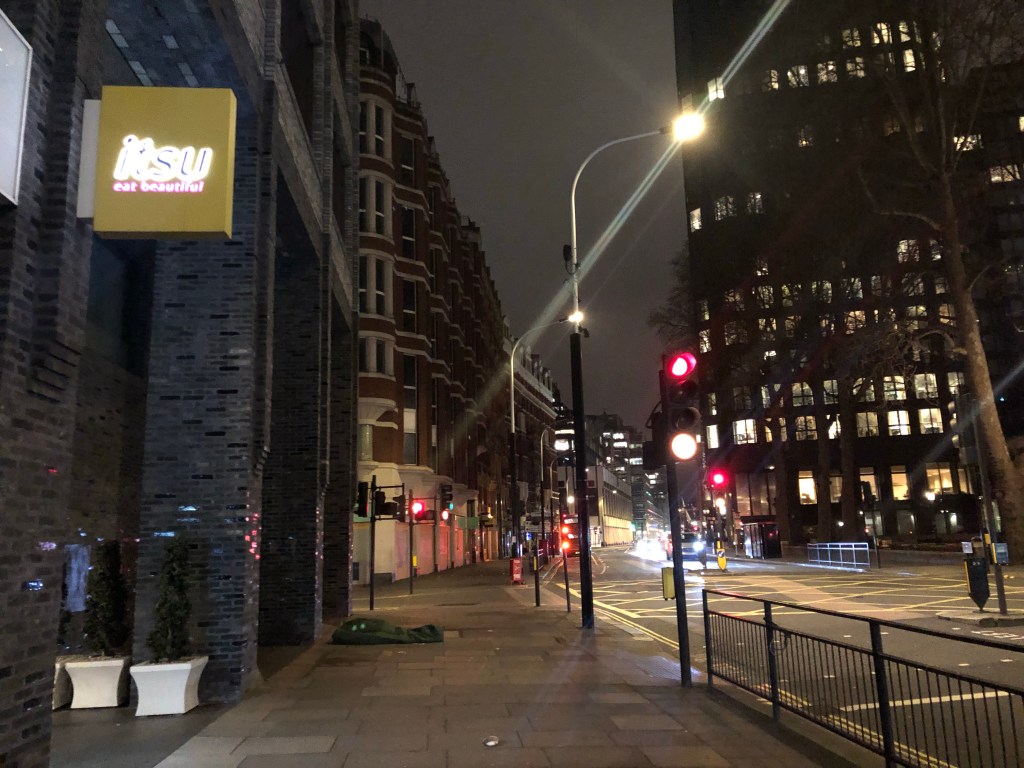
2.20am. I’m riding home on the 2.08 from London Victoria. I didn’t even know trains still ran at that ungodly hour of the morning. Apparently they do: one every hour at eight minutes past the hour. They lock the station until ten minutes or so before the train leaves, and there’s quite a crowd loitering outside the gates just before they open them. Three Bridges is clearly the place to be at two in the morning. Who’d have thought it?

I did some much needed “getting out” today. With a couple of exceptions I’ve more or less turtled for four years or more. I guess that’s the nature of life in a boarding school: whereas most other folks can play their weekends and snatch evenings here and there, in teaching you block out your free time by your holidays…

The chap two seats ahead is fast asleep in his seat. His phone alarm is going off for the third time. The lads on the row of seats opposite looked annoyed at first, but one of them has struck up a conversation with the sleeper and asked if he’s going to get home OK.

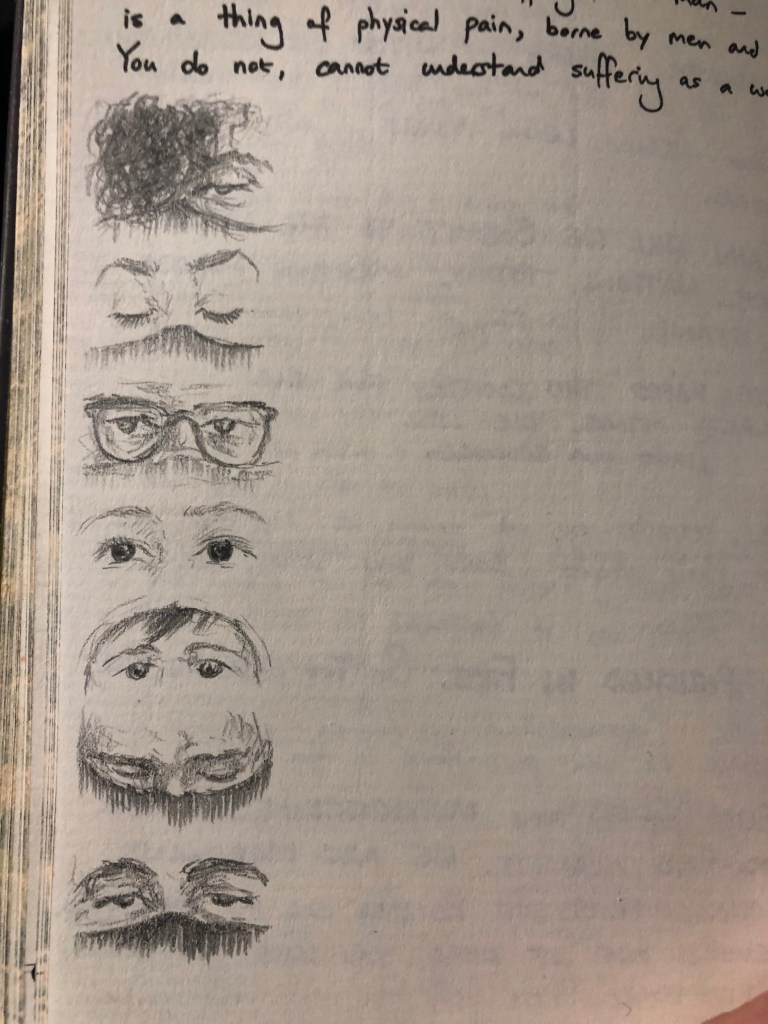
I killed some time with my sketchbook on the Underground this afternoon, and again waiting in the street in Holborn before the party. A homeless man wandered over, cap in hand, to ask for help. Normally I have to admit I’d probably turn a callous blind eye, but something about London draws me in, makes me think differently. I asked for his name and we got talking. He said his name was James, and that he was trying to find a place that would take both him and his dog for the night. I gave him something to start his hunt – for once I happened to have a loose note on me. We shook hands and he set off at a run.

I didn’t have to make the trek home quite so soon. A friend offered me the key to his place for the night, if I could find my way there. I turned it down, partly out of habit, partly out of pride, and partly because of James. Having such an easy solution in London when so many are out on the streets… for some reason it didn’t sit right. You think in a different key in the small hours.

I remember sleeping rough in the wastelands beyond Almeria years ago. Gaunt from a month of under budgeting and undereating and feeling hollow. I remember the fear of that first night, the isolation. It could never compare to the real thing, of course, but I was young, foolhardy, and I wanted to have an idea of how it felt. One night I was curled up in the dunes when a couple of cars rolled up onto the beach around two in the morning. Men with flashlights climbed out and scanned the beach. I got the jitters and decided to move – they were probably night-fishing, but your brain plays all kinds of tricks at night. I don’t think I’ll ever forget the genuine pit-of-my-stomach terror when, barely a few yards down the beach, I saw two of the torch beams slowly sweep the beach and lock onto me. I ran. My God, did I run. I don’t think I’ve ever run so fast in my life. I must have gone at least a kilometre or more before I collapsed in the dunes.

Almeria seems a long way away. London is surprisingly busy in the small hours. Not the city that never sleeps, per se, but one that keeps at least one eye open all night. Offices lit up, calendars and Macs on desks. Lads coming home from the lash. A girl tottering home on heels, makeup streaming, eyes weeping. And many, many sleeping bags in doorways.

It felt good to go out again. I haven’t danced in years – not since university, I shouldn’t wonder. And as it’s London, the music was both a) quality and b) perfect for dancing shoes. I should do this again sometime. Not that I’d make a habit out of catching the 2.08, though.

Gatwick Airport ahead. Only another five minutes or so to go, and then it’s the long walk back through the forest. I’ll probably be in bed by 4, with or without the moonlight to guide me – I’ve made that journey so often I could probably do it blind.

I’ll sign off now so my phone has enough juice for another chapter or so of Michelle Paver’s Ghost Hunter on Audible. That will take me at least as far as the forest – there, at least, I will feel safe again. BB x

Marmite Man (A London Story)

Marmite Man

Marmite Man arrives in his chariot. He walks into a library, hiding from the autumn sun. He climbs up to the second floor, carrying a weatherworn traveling rucksack on his back, and finds a table hidden away on the west side. It’s eleven o’clock on a Tuesday morning, there are only a few other people in the building: a couple of students, a woman in her mid-twenties looking for jobs on one of the desktop computers, a middle-aged gentleman or two. Anybody who can afford not to be working at eleven a.m. on a Tuesday.

Marmite Man takes off his windbreaker, lays it over his chair and slouches into the seat. His face is red and pockmarked, his beard more of a tired, uniform grey than cultivated salt-and-pepper. He looks about. Once. Twice. Pauses. Then he empties the contents of his rucksack noisily onto the desk.

First, a multipack bag of McCoys ridge-cut crisps. Then two bottles of water and a plastic Pret a Manger cup. A can of spray-on deodorant – no, two cans. A pack of Johnson’s baby wipes. A hairbrush and a bath scrubber. And, finally, four pots of Marmite.

He inspects three of the Marmite pots in turn, looks around, and after some rumination, opens the multipack bag and breaks into a bag of crisps. In the silence of the library, his feasting sounds like the construction work beyond the Bunhill Cemetery: an unhappy ruckus in a place of quiet. He munches and crunches his way through a second bag, then a third, and another, and another. It’s as though he is issuing a deliberate challenge to the librarian downstairs: come up and stop me, if you dare. But the librarian does not hear, or perhaps he does not choose to hear, and still Marmite Man goes on munching, crunching, sniffing, snuffling, belching and clearing his throat. He wipes his fingers, stuffing the empty packets into a plastic Tescos bag, and smacks his lips, looking around. There it is again: the challenge, who’s going to stop me? There are signs everywhere that say that eating is forbidden, and yet here he is, Marmite Man, rattling the sabre with his portable orchestra of sound: percussive plastic bags, guttural brass belches, woodwind grunts and groans. The anteroom stinks of synthetic flavour, a fabrication of burnt and powdered meat. He rubs his hands, his breathing loud and laboured, and applies a baby wipe tissue to his fingers and thighs. He rolls up his trousers and scrubs vigorously at his shins, scraping off a night’s worth of grime – or perhaps more. He stops – smarts – curses under his breath as he hits a sore.

Who are you, Marmite Man? Where have you come from? What brought you into the library today? The world has been unkind to you, I think. You swore at the man who left the anteroom a while ago, repulsed by the stench and the noise. “You got something to say? Fucking pig.” That’s what you said, through a mouth full of crisps. But maybe it was he who threw the first stone, the stone of silent judgment, as he turned his head, lifted his bag over his shoulder and promptly left the room. Perhaps what hurts the most is the silence, the everyday judgment of those who do not wish to see you. A vagabond is a part of the world gone wrong; a cog out of place, a dust blur on a family photograph; a purple brushstroke across the Mona Lisa’s coquettish face. We can choose not to see it if we so desire. But that doesn’t mean it’s not there.

I notice you have not picked up a book since you arrived. To you, perhaps, escapism is dangerous – or maybe you have enough unhappiness in your life without imagining it through the eyes of somebody else. What is fiction, if not an experience of somebody’s else’s misfortunes? It is armchair entertainment for the comfortable, who sympathise enough with the poor to read about them, and would happily become them for a quiet hour or two in the afternoon, with a cup of tea on hand and the day’s work put behind them, only to return to reality as Mr Smith of Fulham, associate, papers due by close of play tomorrow. True misery is intangible to Mr Smith: it is merely something to be considered from behind a glass, and frosted glass if at all possible; the bubbling mire at the bottom of the ladder.

Marmite Man knows the mire. He has been cleaning it from his shins for the last twenty minutes.

Marmite Man counts his coins onto the desk. He is frustrated. He does not have enough. He pockets them again and sighs heavily. He plugs a charger into the socket under the table and wires in his phone, and sits. Looks about. Once. Twice. Then gets up and shuffles off in search of the toilets.

I am no longer hemmed in to my corner of the anteroom. I take my leave, packing my things away quickly and quietly. As I leave, I see Marmite Man again. He is standing in the history aisle, leafing through a book on the First World War. He does not see me go.


The Ladybird Tree

Regent’s Park is wide-open and cold. I have never been here before, except perhaps once when I was a little boy, and London Zoo was the destination. I hear they are closing down the aquarium today. I overheard a man in the London Review of Books talking about it, about how he’d taken his time coming to work because he wanted to see it, before it disappeared. What will they do with the fish, asked his associate. Feeding time for the penguins, he joked. It’ll be another ten years before the new aquarium comes along, so frankly I wouldn’t be surprised.

The benches are taken. It’s early afternoon, but we’re into the half-term holiday and the park is alive with kids on the swings, the climbing frame, running up and down the knolls, whilst mum and dad – but invariably mum – sits beyond the fence. And why not – the weather is gorgeous. The ground isn’t wet, and there are no ants about – none that I can see, anyway – so I sit down beneath a tree to eat my lunch.

I can see a ladybird on the bark. It’s not the kind you grew up with in kids’ picture books, post-box red with big black spots. It’s beetle-black with two red eyes, giving its wing-cases the impression of a cartoonish snake’s head viewed from above.
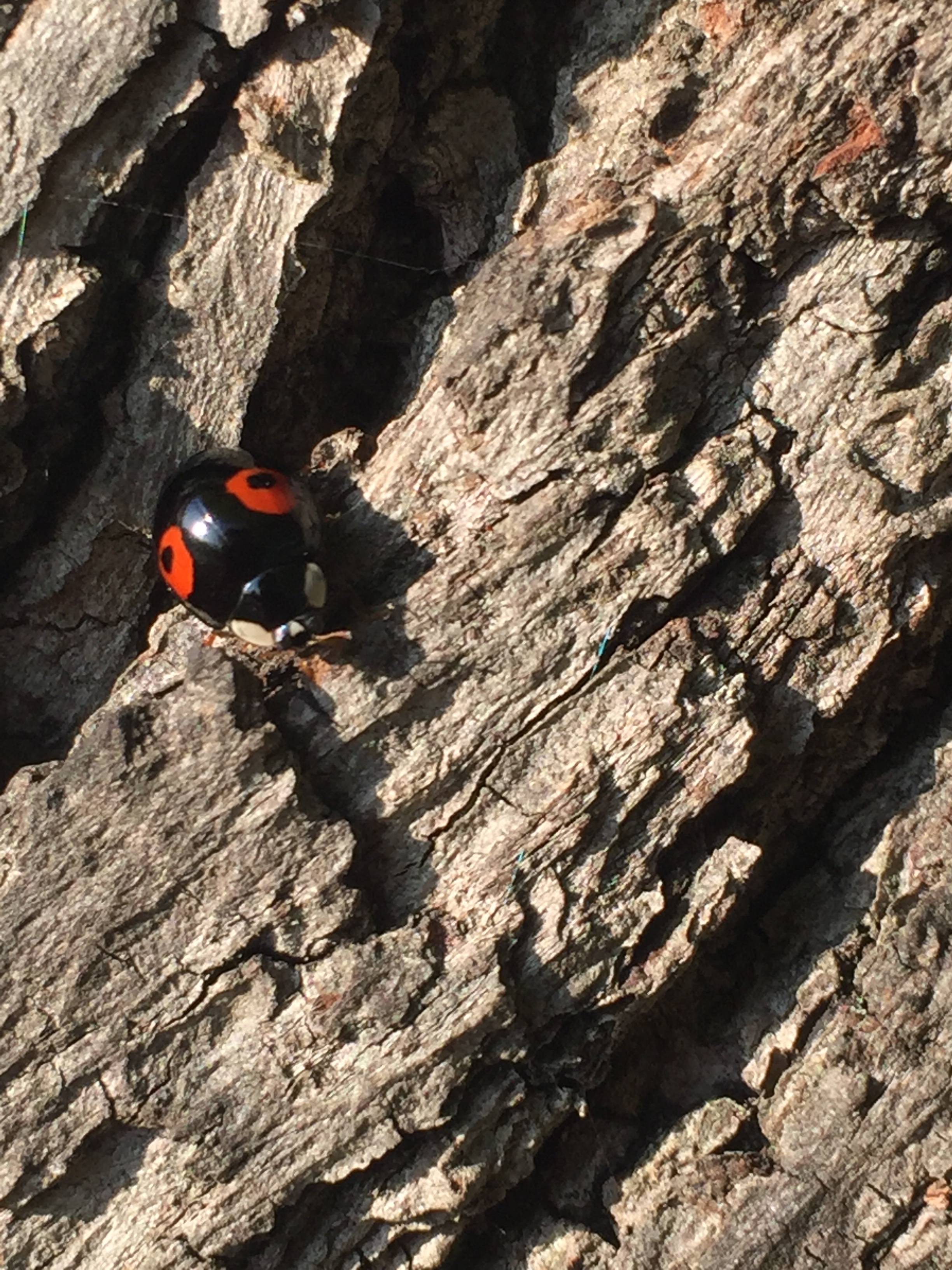
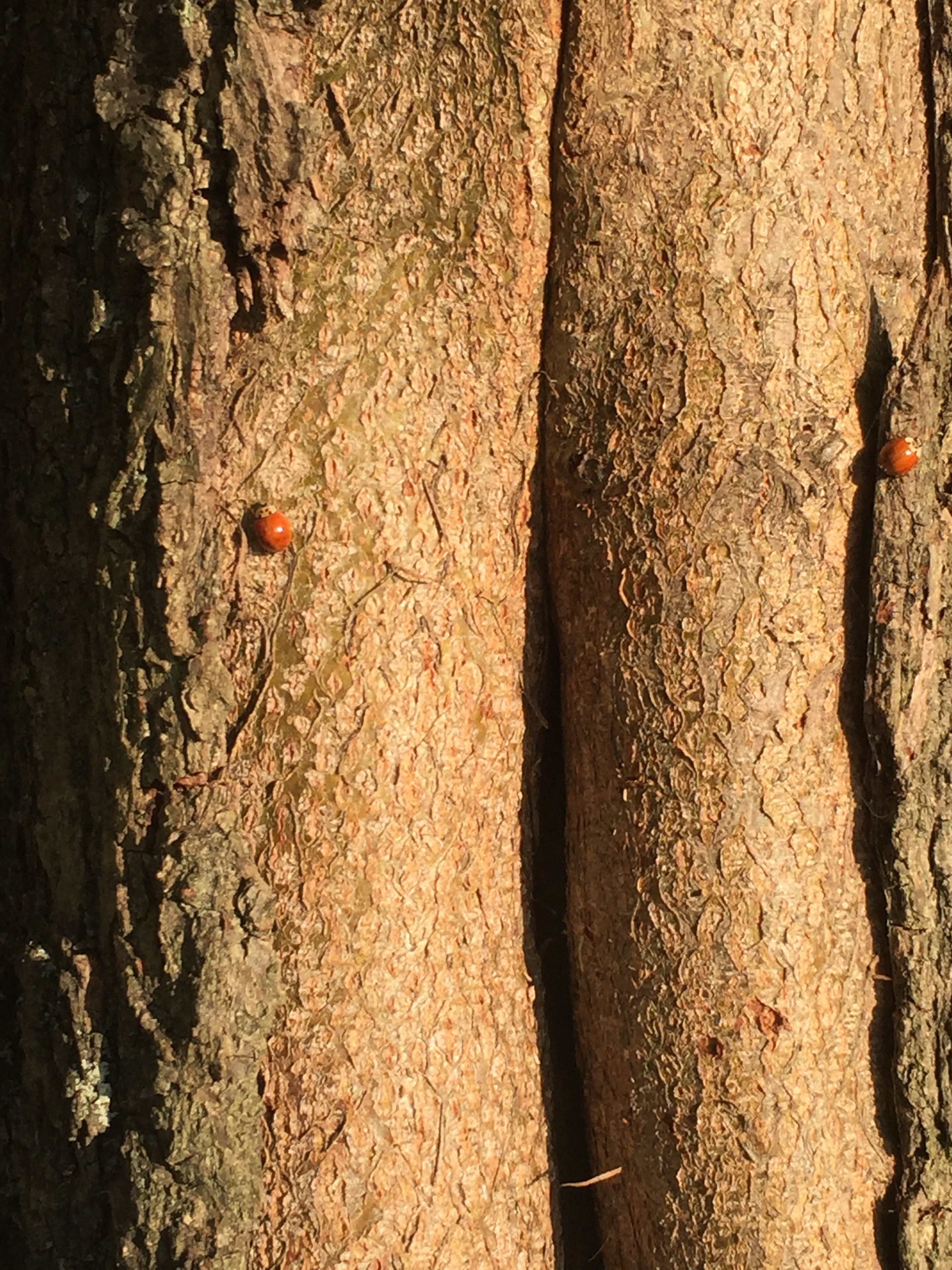
I don’t think I’ve ever seen a ladybird like that before. Point of fact, I don’t think I’ve seen any of the ladybirds on this tree before either. There are yellow ladybirds with twenty spots or more. Red or orange ladybirds with no spots at all. I believe these might be the so-called harlequins, invading ladybirds from distant Asia. Up and down the trunk they go, in that apparently directionless march that beetles seem to adopt, racing in and out of the grooves in the bark. One stops. Its wings click open in a single motion, like the safety-catch on a gun, and then it takes off from the tree into the sunlight. As it goes, another arrives, jet black with those two red eyes like the first one.

There are no deer in Regent’s Park. I rather hoped there might be, but that just goes to show how little I know London. I think that’s Richmond Park – anyway, there are deer enough in my neck of the woods. I walked right past one the other day; a roe buck, fearless, much like the muntjac I’ve become rather used to encountering there. I did not move so much as a muscle as I walked past, which is doubly impressive as I believe I was singing George Michael’s Freedom ’90 at the top of my voice at the time. It just watched as I walked past, eyes unmoving but always facing me, like that illusion of Mickey Mouse’s ears. Teaching bottom set classes is both physically and mentally draining, but I do get the payoff of working in the countryside, and that’s a major payoff by any standards – but especially by mine.

The ladybirds seem to be increasing in number. I just had to brush one off my shirt. I think it’s time I took my leave. I’m not getting any reading done. It’s hard to read when it’s cold outside, no matter how bright the sun is shining. I remember reading somewhere that you’re supposed to kill harlequin ladybirds, as they’re an invasive species. The trouble is, how can you be sure you’re not killing the native ones? Spain had the same problem with red-eared terrapins, if I remember correctly. I found one as a kid in the national park. It’s not so easy to stomp on a baby terrapin, just because it shouldn’t be there. Easier with ladybirds, I guess. Perhaps size does count. Though that is, was, and always has been a rather unpalatable idea.
 

Afterglow

Walking home from work this evening I found myself unnaturally aware of the night sky. Normally in the corner of West Sussex where I live, the skies at night are impressive, and you can see all the constellations of the season with a clarity you wouldn’t expect to find so close to London. Last summer I even saw a comet shining a brilliant blue as it shot across the sky overhead. But tonight the clouds were low, and a strange, eerie light hovered along the horizon on either side of me: a greenish-yellow to the north, hanging over the distant lights of London, and a more unholy bluish-green patch of cloud to the south, indicating a floodlit pitch somewhere below. Elsewhere along the skyline, similar patches of tarnished gold and green light made the night a rather sinister shade of grey. Somewhere in among the phosphorescence, the glow of an almost-full moon went unnoticed.

When I lived in Spain as a child, I remember a night when several towns in the area decided to take part in a five-minute power-cut. I believe it was in protest about climate change, or energy wastage, or something along those lines. Our town sat atop a lonely hill in the middle of a great valley ringed by mountains. Villages were few and far between, and the nights were dark enough even with the interference of the thousands of twinkling yellow streetlamps. But one night, for five minutes, it was even darker still. My mother took me up to the square at the top of the hill to look out upon a world blanketed in a darkness it had not known for decades, perhaps even centuries. I was only twelve years old, but it made a deep impression on me. I have never forgotten the quality of the darkness, the stars that shone so brightly that in memory they seemed almost like suns – which is perhaps not so very far from the truth.

We spend a lot of time discussing the irreversible damage we have done to our oceans, how we have choked the earth and its rivers with our plastics and detritus, but it is far deeper and more sinister than that. Man’s quest to vanquish his fear of the dark is well on the way to robbing us of our natural light. In some parts of the world, it already has.

It is not so much our desire to ape that concerns me – our fierce instinct to twist the natural into the artificial – because I know that story. It is the fable of the Emperor and the nightingale. Tragically, as is often the case with stories meant for children, it seems the moral was lost on us a long time ago – a modern-day version would no doubt have the Emperor plug simply his iNightingale in to recharge. No, it is our desire to outdo. The go one step beyond. To beat nature at her own game, like a petulant child insisting they are old enough to look after themselves. I am reminded of another children’s story concerning a devil’s mirror, that sought to make a mockery of all that it looked upon…

When you spend weeks going over the pollution topic of the iGCSE and IB exams with your foreign language students, it’s easy to forget the creeping damage of light pollution, if only because we choose not to see it. Light is good. It shows us the way, it helps us see where to go. It makes us comfortable and it keeps us safe. So perhaps it is a loss we must bear. What is, is what must be. But I do wish, on nights like these, when the clouds are low and heavy and stained with the unholy afterglow of the city, that I could go back to the night of the power-cut, when the night was clearer and more beautiful than any light show I have ever seen. BB x

YearAbroad (430)

Stargazing in La Siberia, May 2016


Commuter Vignettes

A collection of observations from London and Madrid.


14.38The Lonely One

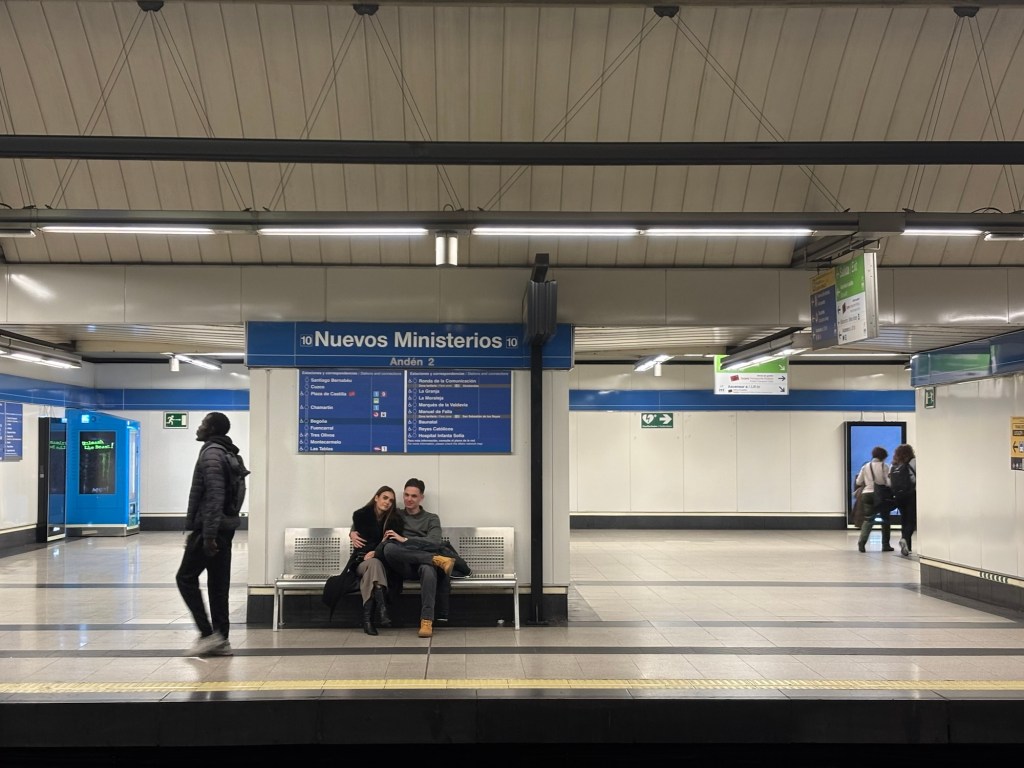
A girl gets on the Metro before me. She has that listless look of a twenty-first century child, of a face torn away from the blue glare of her mobile phone. The phone is there, of course – it always is – sitting dormant in her hand but very much alive. Maybe she’s sad because nobody’s messaging her right this instant. There’s something Latin about her look: behind the white Adidas shirt and the pale blue jeans, there’s an arch to her nose that wouldn’t have looked out of place on Montezuma, and she wears bold red lipstick on her thick-lipped pout. It looks a little out of place on her frown. She looks about eighteen, but with that tricksy Latin blood in her veins, she could be anywhere between that and thirty.

The tannoy goes off for Nuevos Ministerios and she leaves.


10.40The Spider

A London micro-manager discusses his six-month leave and coffee with Tom this morning, at a volume just loud enough for the carriage to hear. If the asking price rises into the millions, he suggests waiting for the results to deteriorate, like a bald and very well-dressed spider. Business is the meal of the day. His latest victim, a Gucci exec, writhes in his binds down the line, whilst the shadow on the receiver worries about growth. All of this is, yep, yeh, very good, cheers. The flies will just have to resign themselves to another day of good business.

The tannoy goes off for East Croydon and he leaves.


10.46The Ghost

Could the onboard supervisor contact the driver please.

‘Perhaps he’s not onboard,’ says an old timer. He gets a lot of laughs.
‘Gone AWOL,’ says a glamorous matriarch. She gets a few more.
‘Gone home,’ says a jumper-round-the-neck. The laughing streak dies out. ‘I mean, I haven’t noticed anybody check our tickets, so perhaps there isn’t one.’

Three minutes later, the train pulls out anyway. It doesn’t sound as though the onboard supervisor made contact.
‘Gonna be late now,’ says the matriarch, looking at her phone. ‘Ten minutes delayed.’

The tannoy goes off for Clapham Junction and she leaves.


11.23The Sardine Run

The 10.09 Southern Services train to Redhill is delayed. Apparently this is still newsworthy. Downstairs, the Underground splits at the seams. Giants with sports shorts and mop-tops jostle for standing room with Catalan sightseers, Russian students and a Rastafarian flyerman, dozing silently over his stack of pamphlets. The driver on the tannoy is profusely apologetic about the frozen train, citing an earlier faulty train as the reason for the blown lines ahead. The three-minute delay becomes a five-minute delay, which in turn becomes a ten-minute delay. Five was enough to oust the man in the navy pinstripe suit and the other big fish. I’m only going one stop so I really could have walked, but people-watching isn’t so easy on the move.

The tannoy goes off for Green Park and I leave.


22.52The Platoon

Small talk sweeps Cabin Six. Three late-twenties girls types discuss renting flats, grown-up men and which was the most distressing Harry Potter death, Dobby or Hedwig. One of the three isn’t contributing so much. Another keeps the flow going. Their ringleader dominates the conversation with perfectly formed silences and sentences. Corporal, Captain and Commander. They each tell a tale: the tale of the bright orange Maine Coon and a cactus, the tale of the old lady who fell asleep watching the BBC news and the tale of the silent nurse. The underlying moral of this urban saga? If you live in a flat, you can hear someone go to the toilet. A twenty-first century aphorism if ever there was one.

The tannoy goes off for Redhill, the Corporal gets off, but the Commander’s tales go on.


10.43The Herd

Three stag parties board the plane. Two of them are your standard bunch of square-jawed gym jocks, joking loudly about how muntered Gavin is going to get, how he’ll be flat on his face, gatted, smashed, trolleyed. The other herd follows their oddly-dressed leader down the aisle like a pagan procession, their Chosen One wrapped up in a pink and purple sari with all the bells and whistles – except, of course, the kameez that usually covers a Hindu bride’s modesty. Nip slips are clearly less of an issue for six-foot tall white men. When your average Joe has umpteen problems getting through airport security, it’s frankly ridiculous that he walked through untouched. He’s obviously done his homework if he’s going as an untouchable, though somehow I don’t think that’s the idea his cronies had in mind. The Arabic music crawling out of the speaker in his back pocket would seem to suggest that. At least in Madrid he won’t look out of place. In Gatwick Airport on a Friday morning he just looks like a prat.


15.16The Slaves

Jenny Seville might have painted the scene in front of me. A perfect tableau. Three commuters stand over me with their hands on the rail, facing out across my head, with their eyes glued to their mobile phones. A smart, short-haired man in a blue suit with his earphones in, a disgruntled middle-aged lady in a pink blouse and a professional women with a sharp nose and dark eyes. They stand before me like some grotesque Swiftian pantheon, their smallest features blown up and illuminated in the backlight. To their left and right, lesser gods scroll soundlessly in the blue glare. I feel tiny, sat pressed into the chair at their feet. All along the train, heads are down, faces are blue and conversation is fleeting. There are islands of humanity in the slave ship: a huddle of Latino men talking jovially with no electronic assistance, and a couple of old women discussing train delays in central Madrid. Every time I look around me, I catch the eye of the Green Woman, the only other person in the slave ship who isn’t glued to her phone. She looks like a slightly larger and slightly less airbrushed Anne Hathaway.

The tannoy goes off for Atocha and she pulls her phone from her pocket. I have no binds, so why do I feel so shackled? BB x

Four Days without Reggaeton

‘You want taxi, my friend? No? What, you no want talk to me? Why you travel if you no want talk to people? You all the same, you think you are better than us, but you are wrong. We are better than you.’

Welcome back to Morocco, I suppose.

DSC_0267

Goodbye Tarifa!

There’s something endlessly enchanting about waking up in a new country. It breaks up the monotony of the everyday. It sends gears spinning that had until recently been lying dormant. It also comes with a change in breakfast too, which is never a bad thing.

DSC_0291

Bang in the centre of the medina and all you can eat for 10 euros a night…

On one of those fantastically last-minute whim decisions which I have been known to make , I decided to take up the offer of two of my English department colleagues to spend the puente de Mayo in Morocco. Four days isn’t nearly enough to enjoy Morocco – each town deserves a full day and night’s exploration to even begin to get a taste of the area – but when it’s so close that you can see the cars from the other side of the sea, it’s impossible not to feel the tug of the south. I’m not very good at saying no to anything, but when it comes to adventure, I find it exceedingly difficult to say no. So here I am, on the 12 o’clock bus to Chefchouen, saying yes – and loving every second of it.

DSC_0295

Getting Bourne Ultimatum vibes…

The last time I was in an Arab country was Jordan. Let’s not go over that again. Jordan’s going to be a bug-bear of mine for a very long time. It’s a name which carries greater fear for me than Syria, Korea and the Democratic Republic of Congo ever could. It wasn’t so much the country as it was the fact that I simply didn’t want to be there. Backed into a corner as I was with my commitments to the British Council, I wasn’t given a choice. And in that frame of mind, as always, I was defeated before ever I got on the plane. It wasn’t in my interest… And as my parents will know only too well, if something is not in my interest, the chance of me doing well is next to zero.

DSC_0346

The Rif: b-e-a-utiful

Not so Morocco. Maybe it’s the green hills and the icy rivers flowing down from the mountains and into the sea. Maybe it’s the jaw-dropping kasbahs of the desert south or the quiet, homely feel of the melting-pot medinas of the north. Maybe it’s even the simple fact that this is Africa. But I think that the real reason I have so much love for this country is because I want to be here. It’s a minor difference, but it changes everything.
Waking up with the dawn chorus in the middle of a city sounds ridiculous, especially when there’s a complimentary alarm service courtesy of the mosques at four in the morning, but in Tangier it’s easily done, and the soundscape is just as fantastic a mix as the city itself. There’s the warbling calls of flocks of roving bulbuls, that ever-present feature of Arab towns; on top of that you’ve got a chorus of roosters crowing at the dawn, interspersed with the occasional bubbling note of a laughing dove, two quintessentially African sounds; and then there’s the aggressive cackle of the gulls, which smacks more of Europe than anywhere else. Even the repetitive wi-tu wii-twii-tu wii-twii-tu of the house buntings echoes the sales pitch of the taxi driver, yelling the name of his destination over and over as though it were an object to be bought or sold.

DSC_0301

Spot the six species of bird in this picture (better still, imagine them)

And that’s just the naturalist in me. The linguist side of me is in his element: this is a place where I could be using all four of my languages – English, French, Spanish and Arabic – at any given moment. Across Morocco, but especially in Tangier. It’s like something out of a dream, and we haven’t even got to Chefchaouen yet.

DSC_0332

Tangier’s Kasbah is actually a lot more impressive than it is made out to be

But for a less-than-welcoming start thanks to a jilted taxi tout lying in wait at the dock entrance, it’s been so good to be back. And as I’m the only Arabist in tow, this time it’s up to me alone to do the talking – and that’s a huge plus right off the bat. I hope there may soon come a time when it’s safe enough to study Arabic anywhere, from Western Sahara to the Sudan, from Yemen to Iraq; to excel, I need to be on my own. And that’s what this year has been all about. I’ve learned from my mistakes in Jordan. Moroccan Arabic won’t be any easier than Jordanian, if not harder, but I’m going to tackle it head-on and alone – and better still, in a willing state of mind. I can’t wait. BB x