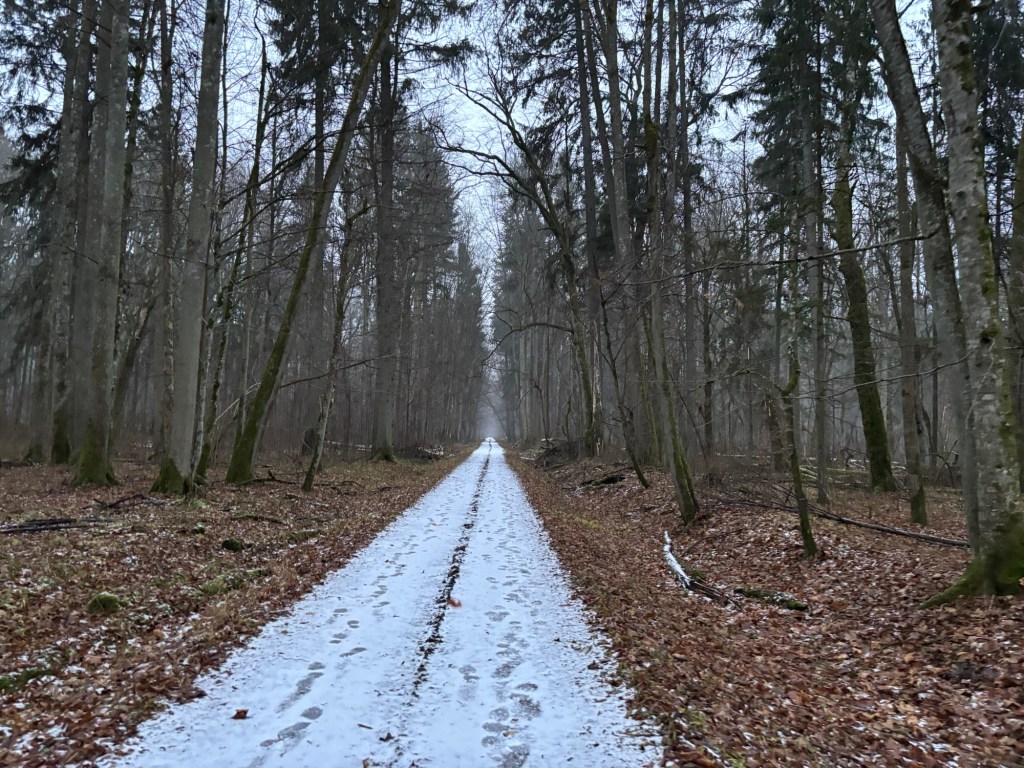
I’m kneeling in the snow, staring down an arrow-straight road carved through the forest by the Russians more than a century ago. Our guide makes a signal and tells us to wait. We could be here for up to an hour. The fever that has followed me since stepping out of the plane in Warsaw has not broken yet: I’m still nursing a headache and a bad cough, my back hurts, and I’m starting to freeze from the feet up. But I’d suffer it all again to see what I just saw: a genuine forest spirit, a shadow of the ancient world, loping out of the trees and onto the road. A wild wolf.
When I woke up this morning, it was to a frozen world. The snow hadn’t started falling when I turned in around midnight, but there must have been quite a lot of it during the night, because there wasn’t a single track to be seen in the village. That may have more to do with the fact that we were up and gone by six thirty, a full hour before sunrise, and on a Sunday morning to boot.

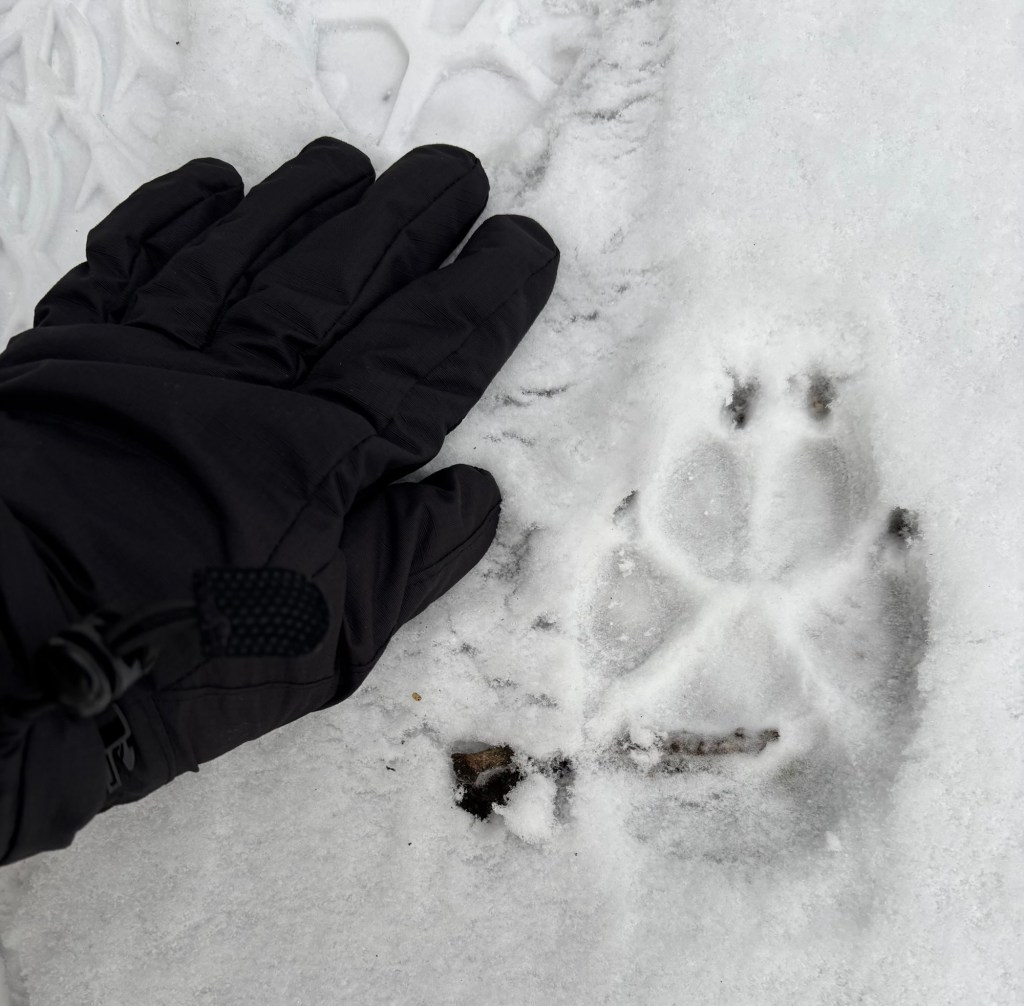
After a short drive through the frozen forest, Łukasz brought the car to a sudden stop and jumped out to show us what he had seen: a single set of footprints in the snow, larger than those of any dog I’d ever seen. Following a tip-off from a friend of his, we set off into the forest to try our luck with one of the wolf packs that inhabit Białowieża Forest.
We didn’t have to go for before we found another set of prints. And another. And another. In all, we counted around eleven sets of prints in the snow. They had to be recent: the snow had only started in the early hours of the morning, and it was still very early. We pushed on to the crossroads, hoping to catch a glimpse of our quarry crossing the road in one of four possible directions.
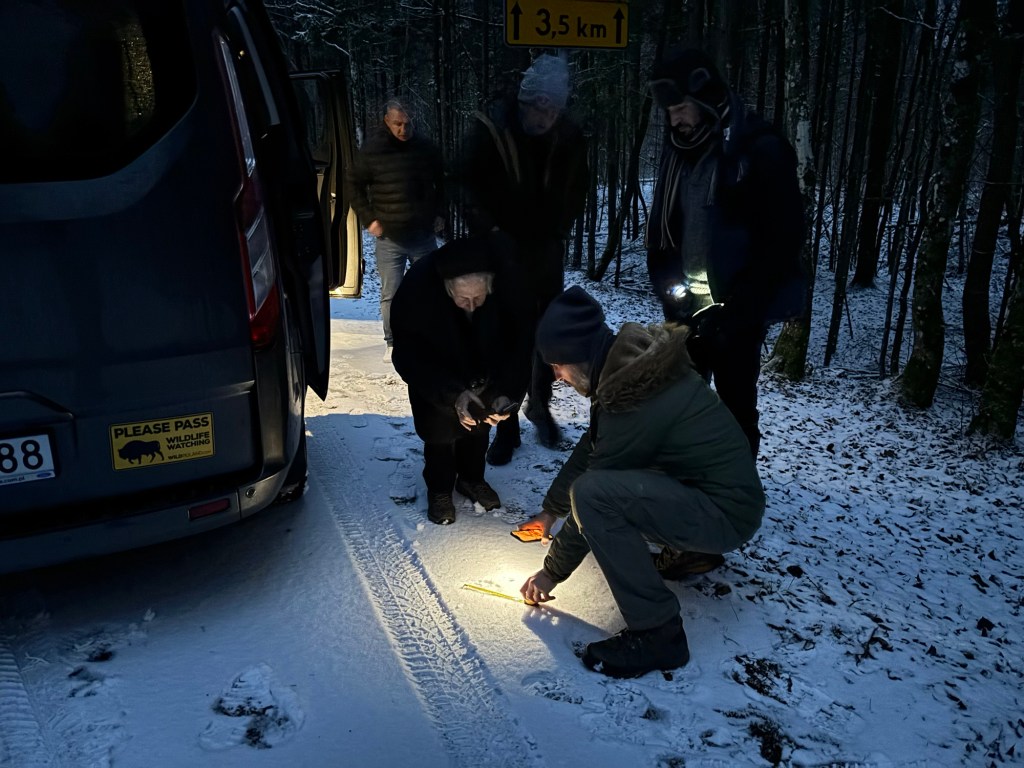
We waited. A couple of red deer broke the cover of the trees, but they didn’t look particularly perturbed – not a good sign when you’re tracking a creature that puts the fear of God into nearly everything that moves in the forest. Łukasz tried calling out to them – and a bloody convincing mimic he is, too – but the forest was silent. Wherever the wolves were, they were doing what they done since we first crossed paths as a species hundreds of thousands of years ago: giving us a very wide berth.
We moved on, taking a chance on the left road. A couple of minutes into the walk, we came to a sudden halt at the sign of a dark shadow in the road at the top of the rise. On closer inspection through the binoculars, it was another tracker and his party staring right back at us through a pair of binoculars of his own.
We met halfway. Łukasz and the other guide swapped information. They’d come from the other side of the quadrant and had found tracks on the road leading into the woods, but nothing on the forest trail, meaning the pack of eleven had to be in there still. They might well have been watching us all the while, invisible between the thousand arms of the trees within.
Well, some of them, anyway. One of the women from the other party suddenly pointed back down the road and said something. My head turned so quick it might have snapped – and then I saw it. A lone wolf standing in the road, staring straight at us. Łukasz gave a signal and we all dropped to the ground, some on their bellies, since wolves are more likely to be spooked by a standing human silhouette than a prone one.
It didn’t hang around. Before my companions could get their cameras ready, it had loped off into the cover of the trees on the other side and was gone.
We waited there for quite some time. Where there was one, the other ten were sure to be nearby. Just as we were getting restless, three red deer came hurtling through the trees to our right, from the part of the forest where the wolves were hiding. Had they been spooked by the pack? The others were momentarily distracted and in that moment I had my eyes on the road, and that’s when I saw it: a second wolf, emerging right where the first had come and gone. Unlike the first, this one didn’t cross the road in one go, but instead came trotting towards us. I motioned to the others and tried a few photos, but my poor camera was struggling in the low light, so I contented myself with the binoculars instead.
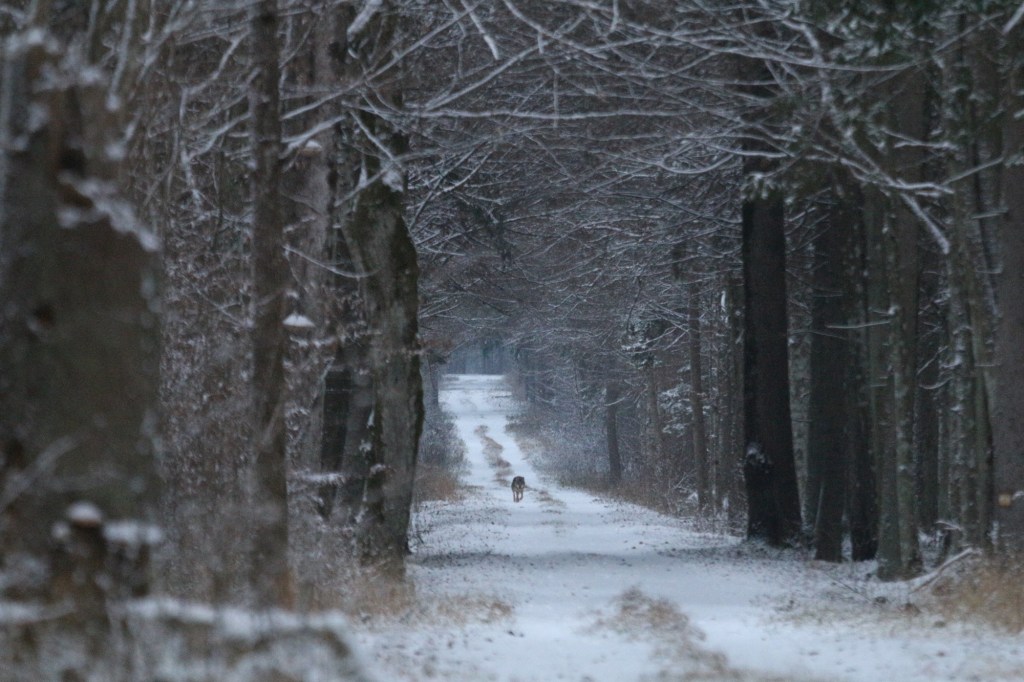
Nothing quite prepares you for the size of the wolf. You expect a dog, or something like it, but it is so much more. Bigger. Stronger. A restless hunger in its yellow eyes. An untamed purpose in its gait. Even its footprints tell you you’re in the presence of something magnificent: there’s no graceless wrinkles or adapted opposable thumbs in its pug, just a perfect symmetry of power.
We never did see the other nine members of the pack. It’s possible they made a kill during the night and decided to remain close to their prey, sending the two we saw ahead as scouts. Who knows? Eventually, we elected to abandon the vigil and leave them be, since by now the pack must have worked out where we were and how to avoid us. We left the forest by the same road we came, but not before a lone bull bison emerged from the trees just a hundred metres or so down the road. Poland, you sure know how to pull out all the stops!
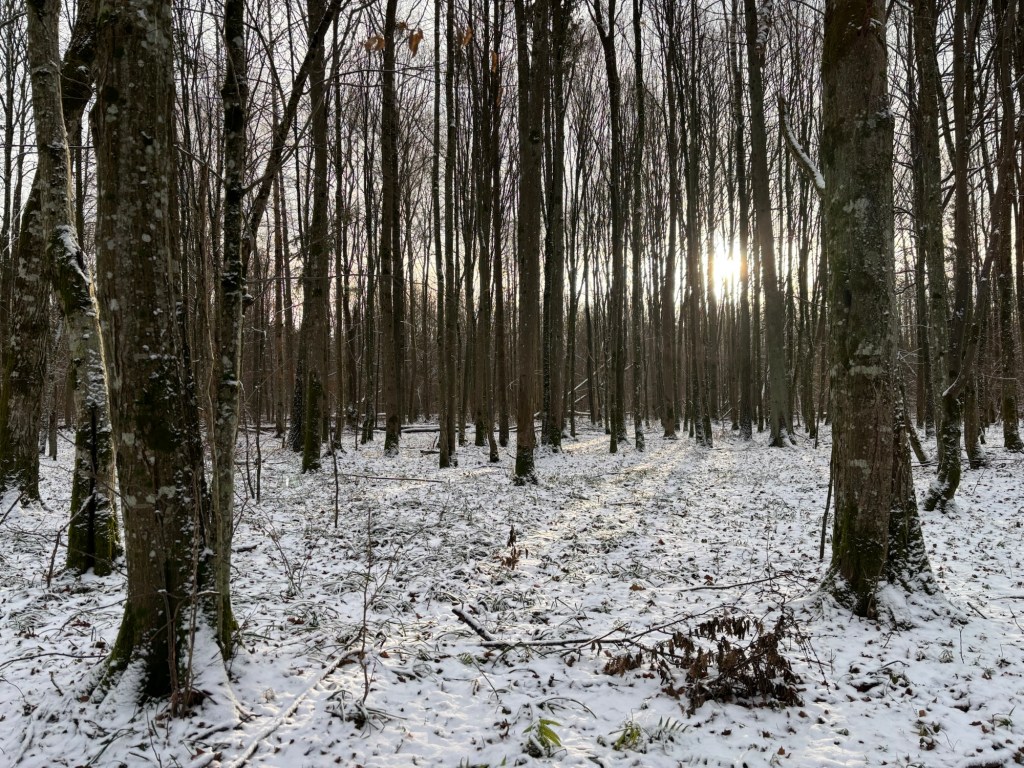
We ventured into the strictly protected area of Białowieża Forest after breakfast, hoping to try our luck with some of the park’s rare bird species, but a combination of high wind and sleet cast a spell on the woods. A single mistle thrush cackling at the gates was the only sound we ever heard: neither the croak of a raven, the wittering tattoo of a nuthatch, nor the hoot of an owl, the mew of a buzzard or the drumbeat of one of the nine species of woodpecker that call the forest home. Nothing. Even the wind died away as we wandered deeper into the woods, where some of the trees are hundreds of years old, and others older still.
Białowieża Forest is famous for being one of Europe’s last remaining primeval forests, but what is even more fascinating – if a little disturbing – is that an astonishing 30% of its trees are dead (some figures indicate it may even be nearly 50%). It is, in a way, a forest of the dead, albeit one so full of life in the spring and summer that you could be forgiven for missing that small detail.
Not so in the bleak midwinter, however. The towering spruce trees look more like the charred pillars of a gutted cathedral, while those that have crashed to the ground seem like the carcasses of enormous serpents, their curving branches like shattered ribs on the forest floor. Everywhere is the sweet smell of decay and black fungus grows on the stumps of the fallen giants. The presence of several stones and crosses marking the mass execution site of hundreds of Polish Jews by the Nazis only adds to the creeping dread.
We spent around three hours in the woods, learning about the ancient trees and the various species of fungi that call the forest home, but the eerie silence of the birds was sorely noted.
We did not leave disappointed, however. Something far more beautiful and far more chilling took its place.
Just a hundred metres or so from the main gate, an unmistakeable howl broke the silence, echoed a few seconds later by another. It’s amazing how a sound that you must have imagined and read about in books for years can still make the blood run cold on instinct.
I would have settled for hearing a wolf over seeing one on this trip, and I got both. I may not have been the luckiest in love this year, but I’ve taken all the chips home with the wolves on this trip. Maybe it’s a sign that I’m doing something right at last – reconnecting with the younger version of me who was far more interested in the natural world than anything else.
If I have any budding resolutions for the New Year, it’s to do something like this again. I am, and always will be, a naturalist first and foremost, and everything else I claim to be second. I should reclaim that part of me. It is, it must be said, a genuinely happy and fulfilled part of me, and the greatest gift I could give to any children I should be lucky enough to have someday. BB x
 The Book of Barnabas