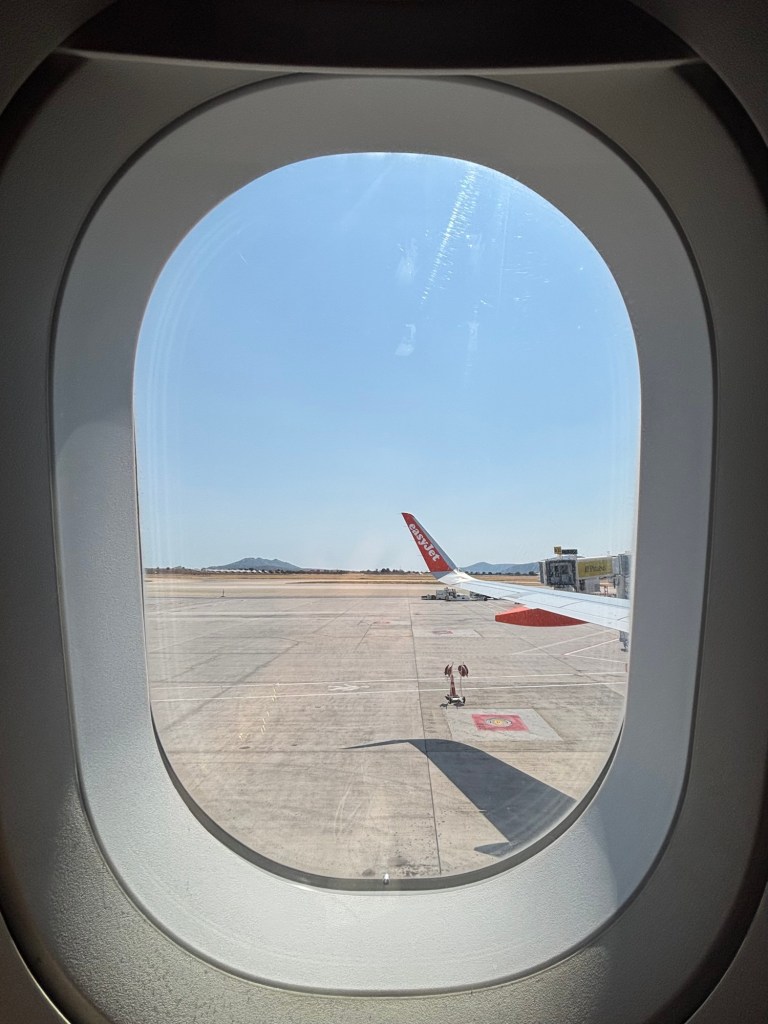
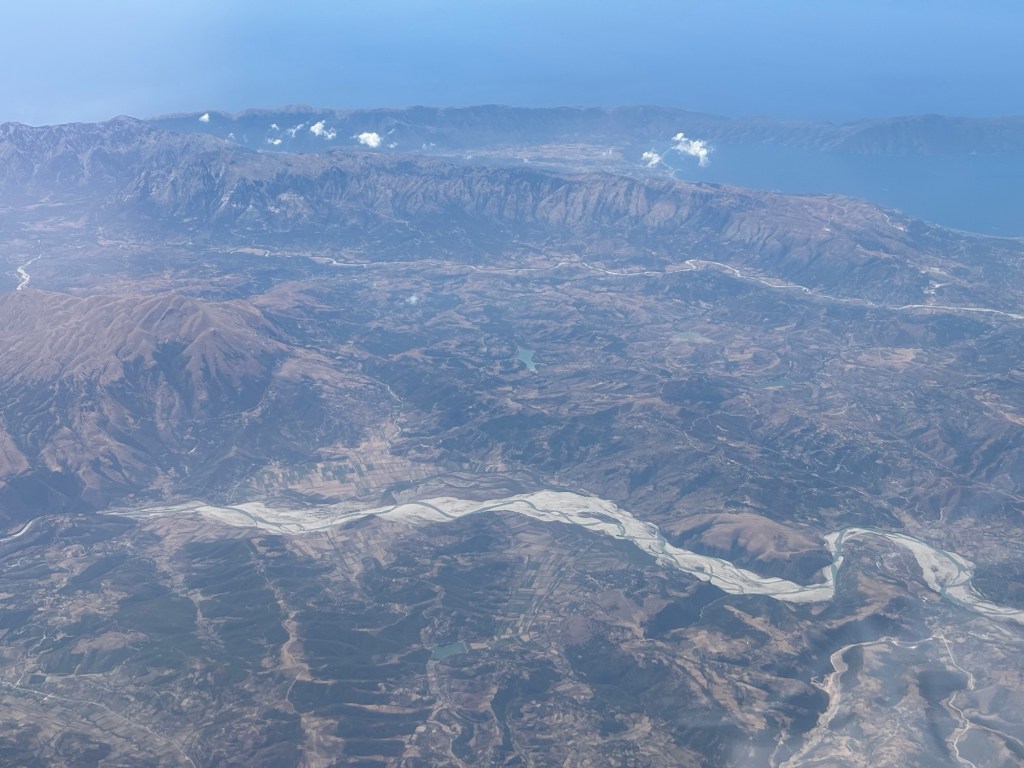
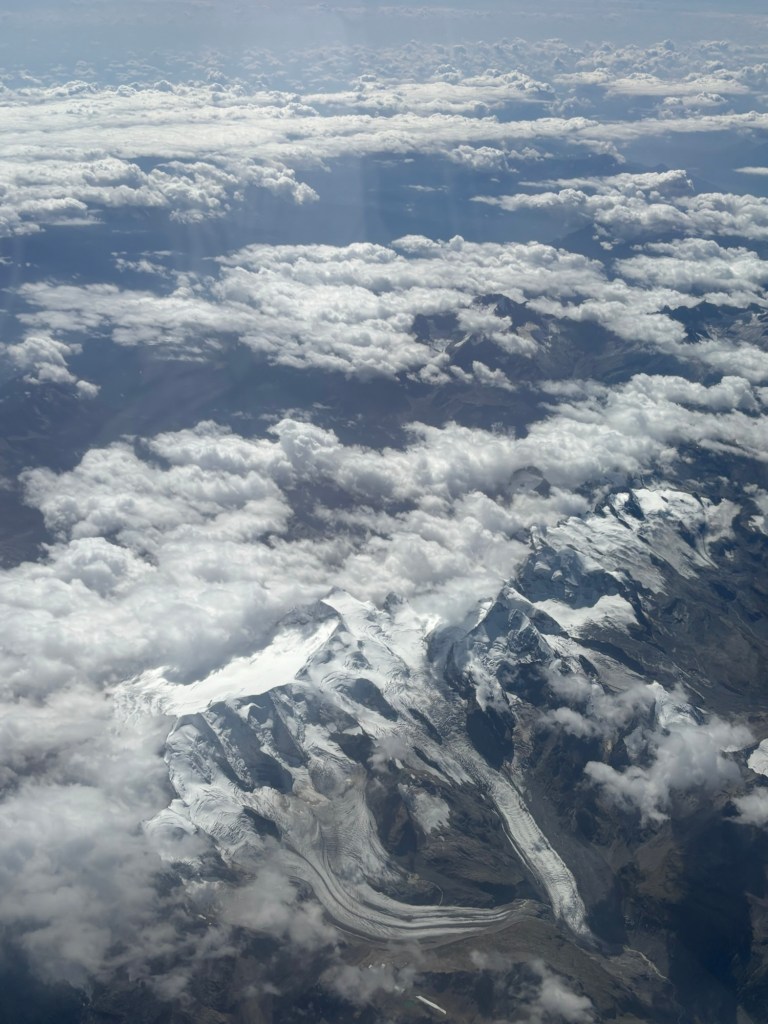
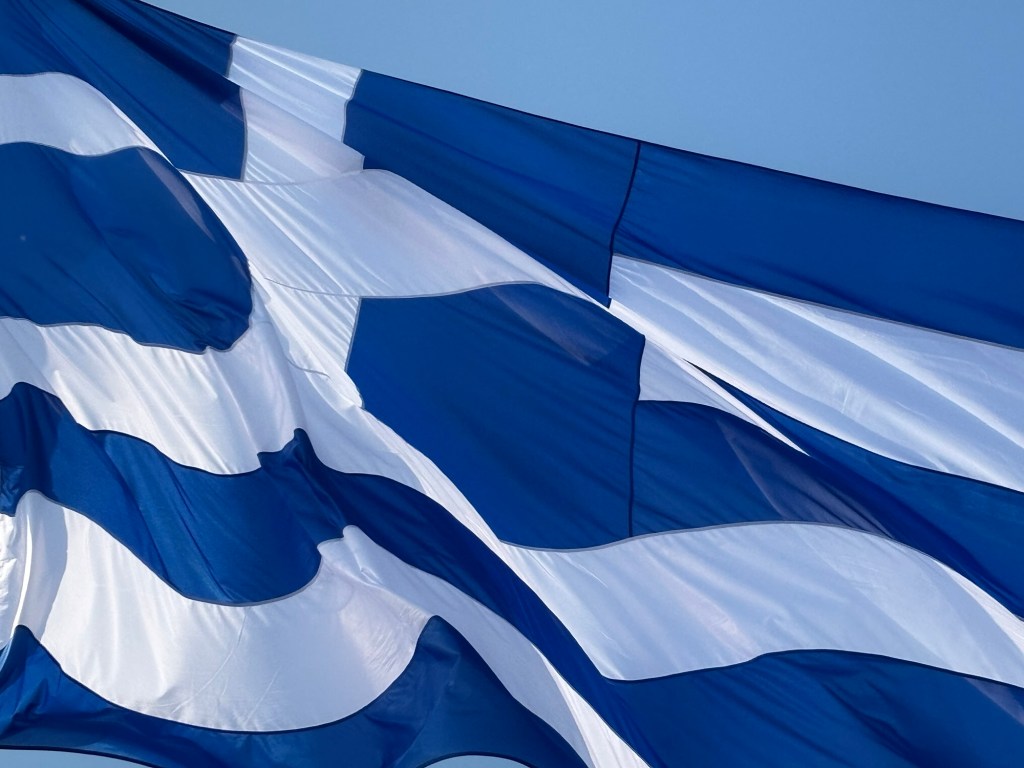
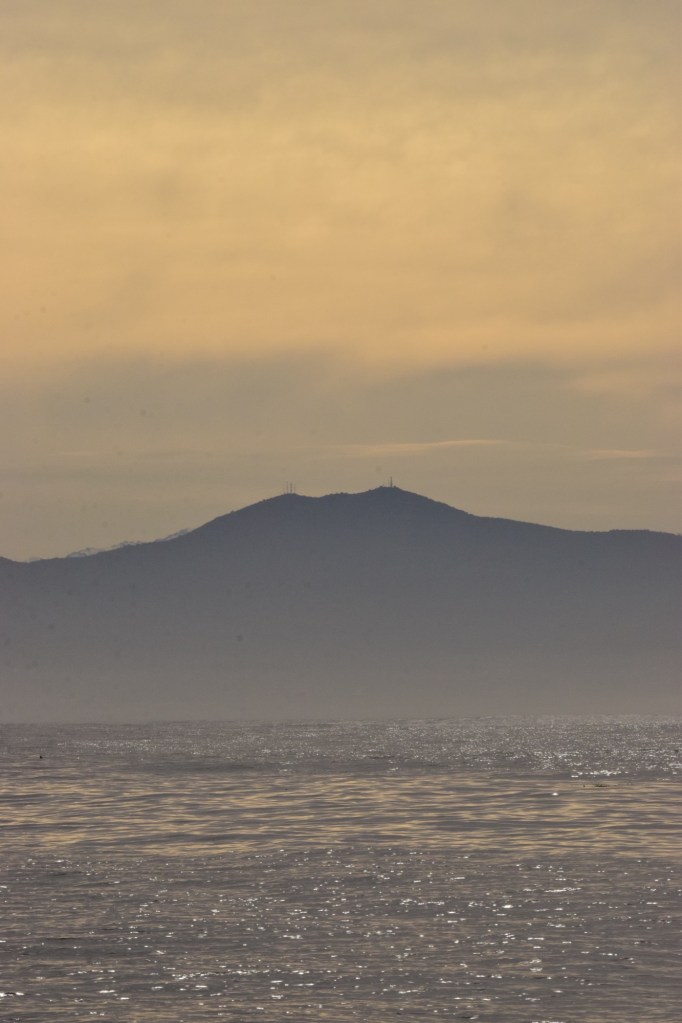
Flight EZY2804 to Bristol, Somewhere over Greece. 13.08.
Inch by inch, mile by mile, the wild ride of the summer of ’26 is drawing to a close. Outside it’s approaching the high 30s again, but the fierce heatwave that has held the British Isles in its grip all summer is being swept away by the first cool winds of autumn. Over the last two months I’ve seen it all: scorching heat, howling blizzards, thunder, rain and snow; mist, fog and diamond dust. It seems only right that as my life settles back into some kind of order, the weather should follow suit.
It took just shy of two hours to get from the apartment to Eleftherios Airport, but I did add to the commute by walking to Syntagma Station via the National Garden. I didn’t want my last memory of Athens to be the air-conditioned carriage of the underground, and I needed a wake-up. A steady drip on the plastic roof over the patio beside the bedroom kept me up late last night, until I used a bit of science and drowned it out with a rain track, after which I fell asleep in seconds. Fun fact: the constant change from sound to silence in a steady leak triggers the body’s defence mechanisms, anticipating a threat for as long as the sounds continue to change. White noise, on the other hand, is far less threatening, no matter the volume. The signal wasn’t superb, so thank goodness somebody thought to upload several hours’ worth of rain recordings to Spotify – I wouldn’t have cared much for a YouTube ad waking me up every five minutes.
August is nearly over. Just over a week of summer remains – but it’s certainly been a summer to remember. I’m not sure I deserve even half of the miracles I’ve had the good fortune to witness since I stepped out of the door back in July with a backpack, a suitcase full of winter clothes and a smart new wedding suit – but I’m grateful for every single one of them.
It’s very easy to hit thirty-two and look around at your world with a rising sense of anxiety as everyone marries off and starts to lay down roots. Find them while you’re young, they say – and yet here you are, single and rootless. When will it be my turn, you catch yourself asking. But I think I’ve cracked it. The question you should be asking yourself is very different. Would the child I was look at me now and take heart?
I think he would. I haven’t found Her, but I have found my way back to the thing that made me happiest: the wild. If the eight-year-old me knew that in my thirties I’d be traveling the world in search of pumas, albatrosses and giant tortoises, I think he’d be ecstatic. Nobody could ever dream of replacing Sir David Attenborough or Valmik Thapir (or any of the great wildlife presenters of my childhood) but the fact that I get to live in the world they showed me when I was just a boy is the greatest gift of all.
What was the highlight of the summer? It’s such a difficult question. Dancing with Alex and Elena at their wedding? Teaching my first ever English Literature class? Celebrating Spain’s victory over Argentina in the World Cup Final? Swimming with turtles, sailing with albatrosses or watching a fully-grown mountain lion tread through the snow just feet away? Every one of them has been written upon my heart, which is now so very full. I thought my happiness was conditional upon finding my other half, wherever She may be, but this year I’ve learned to find it in myself by allowing me to be me, the way I always wanted to be.
September is always a bumpy landing. September brings Inset, the annual safeguarding talk that makes me question whether I believe in this job, and the return of a fresh-faced generation of students that remind me that I’m in the best line of work in the world. September will be familiar – I know what to expect – but this time, something feels different. I don’t think I’ve ever gone into the start of a new school year quite so positive. I just have a feeling that, finally, things are going my way.
Oh, for sure. There will be trials ahead. There always are. But I know I can face them head-on as a man, supercharged by a summer of light and life and animal encounters.
In many ways, I haven’t changed since I was eight. I’m still writing the same book about a a brave hero and a red-haired princess. I’m still listening to Juan Martín and Michael Jackson. I’m still singing in school choirs, dancing with every fibre of my being when the beat comes on and playing a passable passage on the violin when the occasion demands. I’ve added a few languages to my roster since then, changed my look a few times, and loved and lost and learned to live again – but fundamentally I still hold true to the same values I built up as a kid. Teaching has allowed me to hold onto these things, and for that much I am truly grateful.
England welcomed me home with golden fields and petty public transport pencil-pushers. The bus driver from Bristol wouldn’t let a girl on the bus because she didn’t have the right ticket and wasn’t helpful at all when she looked distressed, there being few other buses around on a Sunday afternoon. Three of us got up to help her out but the man in front got there first and bought her a single ticket. On top of that, I arrived just in time to catch an earlier train, but the man at the ticket barrier at Bristol Temple Meads wouldn’t let me through on account of the fact that my ticket was for an hour’s time – “you don’t need to be on the platform yet”. With two thirds of the southbound services cancelled, he was probably trying to stop me from using my Advance Single ticket on board an earlier train where there would almost certainly be no ticket checks… but really. I’m out of the country for nearly two months and the most trouble I have with public transport is back to back on the day I get home…? If there’s one thing I can’t stand it’s jobs-worthiness, and we English are especially bad at it. When I manage to escape this country, that kind of behaviour will be top of the list of the reasons that drove me away.
Anyway. I’m home, in the familiar comfort of my flat, and July Me had the common sense to stock up so I’d have something to eat when I returned in case the supermarkets were closed – which, being a Sunday afternoon, they inevitably are. Just occasionally I surprise myself by planning ahead.
Here ends the Great Adventure of 2026. It’s been a blast. To those of you who have been reading my adventures, known and unknown, thank you for coming along for the ride! It’s nice to know I’m not always speaking into the void. I’ll write a little less when term kicks off, but do stick around for the next adventure – whenever that may be! BB x
I was half-tempted to go to bed without eating this evening, but after walking past a sign in a shop window saying LOOK AFTER YOURSELF in big white print and then seeing a team of chefs preparing sea bass in the next window along, my instincts got the better of me. Chances are this will be my last meal out of the summer, so I might as well make it a memorable one.
I got to bed shortly after six fifteen, after Thomas and Maria dropped me off at the apartment. The wedding festivities went on until well into the early hours of the morning, with the last of the dances wrapping up around half three. Alex, Peter and company enjoyed a few Cuban cigars, blowing liquid smoke rings into the night sky, while the venue staff slowly started to pack up. There was talk of a swim to cool off – had I brought my swimsuit? No, I hadn’t! But that didn’t seem to be a problem. A short pit-stop at Elena’s parents’ house sourced me a pair of trunks and then we found a parking space down by the beach.
Naturally, at half past four in the morning, it was nearly deserted. Just a couple of Greeks listening to trap music over a boombox and a lonely soul sitting on the breakwater and watching the stars.
I’ve never done a night swim before – at least, not in the Mediterranean. I might have gone for a dip after dark with Lucy and Emily many years ago in the summer I left school, but those memories are hazy now – and the cold waters of Whitstable are incomparable to the Aegean. It felt like stepping into a bath. The water was so clean and so clear that I could see all the details of my toes and the ripples in the sand below by the distant lights of the beachfront alone.
My mother used to tell me stories of starlight swimming in the Mediterranean in Barcelona back in the 80s. I’ve clearly been missingout. These beaches are absolutely rammed during the day, but by night you pretty much have the place to yourself, and the water is only slightly less warm. To the Greeks, perhaps, it might have been tepid, but after the chill of the North Sea and the cool waters of the Humboldt Current, it felt incredible. I didn’t feel in the least bit tired, either, though that may have more to do with the fact that I’m almost certainly still on South American time rather than the restorative properties of the Mediterranean Sea.
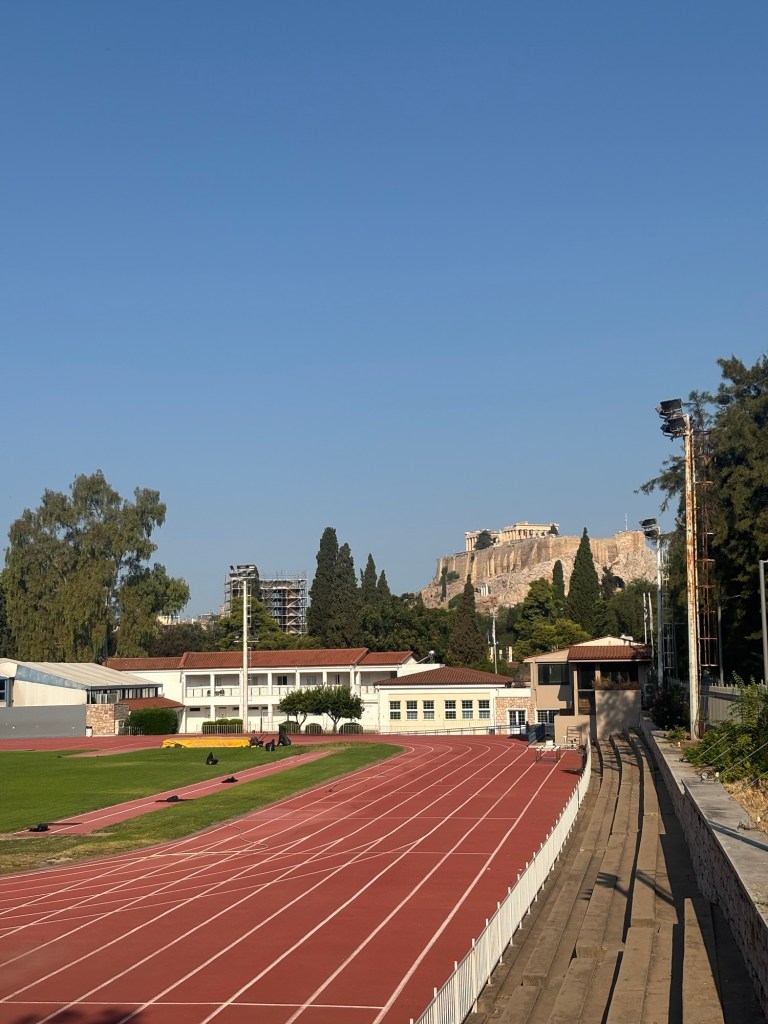
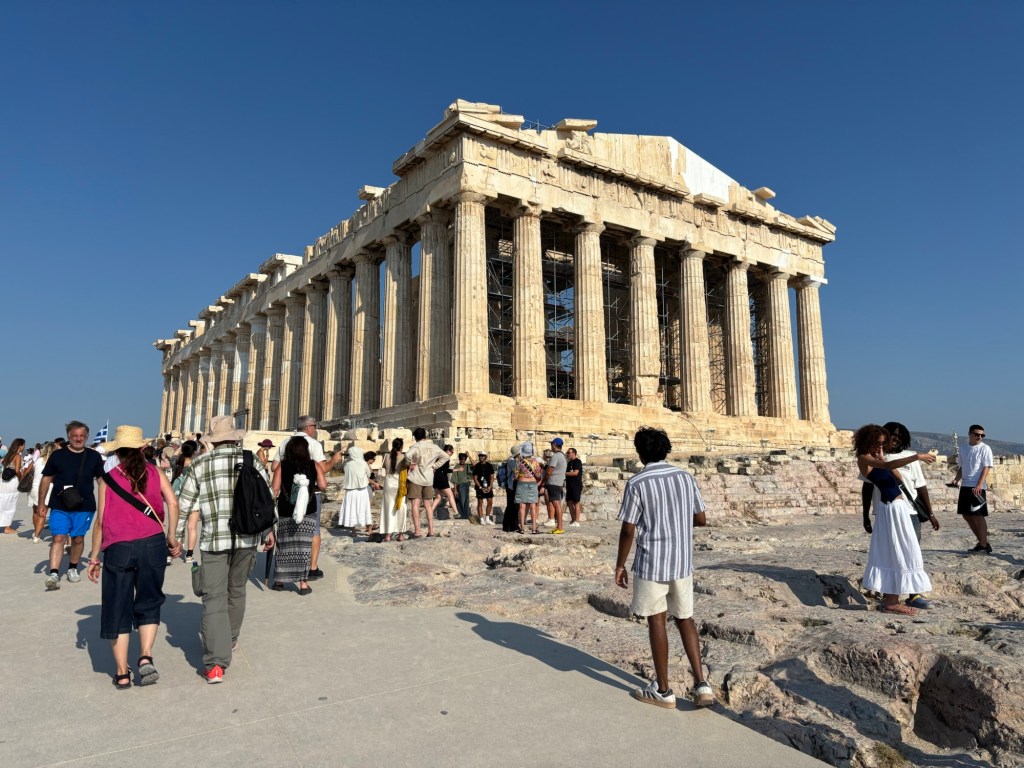
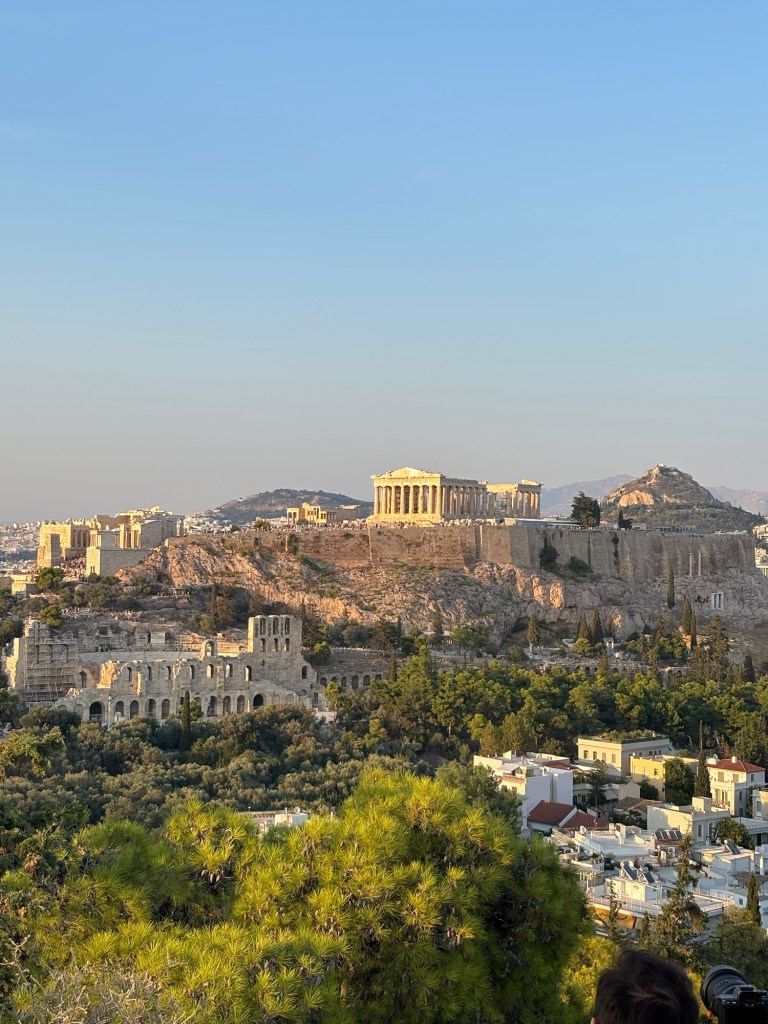
I slept until noon and waited out the heat of the midday sun in the cool of the apartment. I ummed and ahhed about going up to the Acropolis and ultimately decided I’d be mad to be in Athens and not see its most iconic feature up close. Missing Machu Picchu was… a choice, I’ll admit. But Machu Picchu costs hundreds to see, whereas the Acropolis is a flat 30€. So I packed a bottle of water and set out into the afternoon.
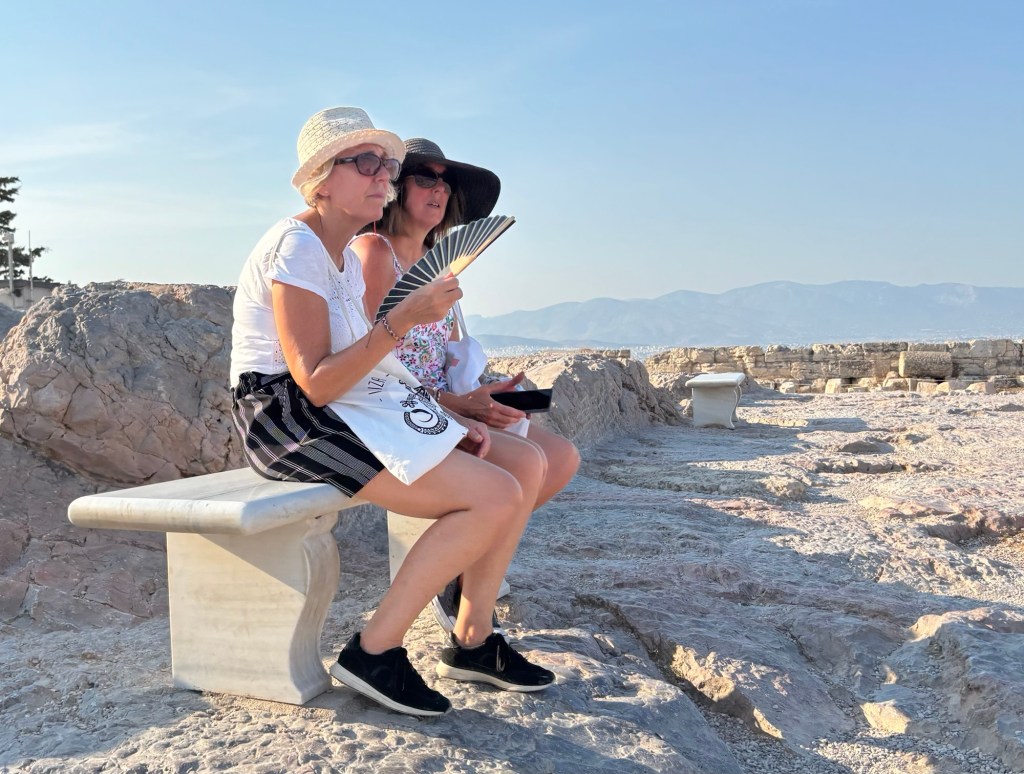
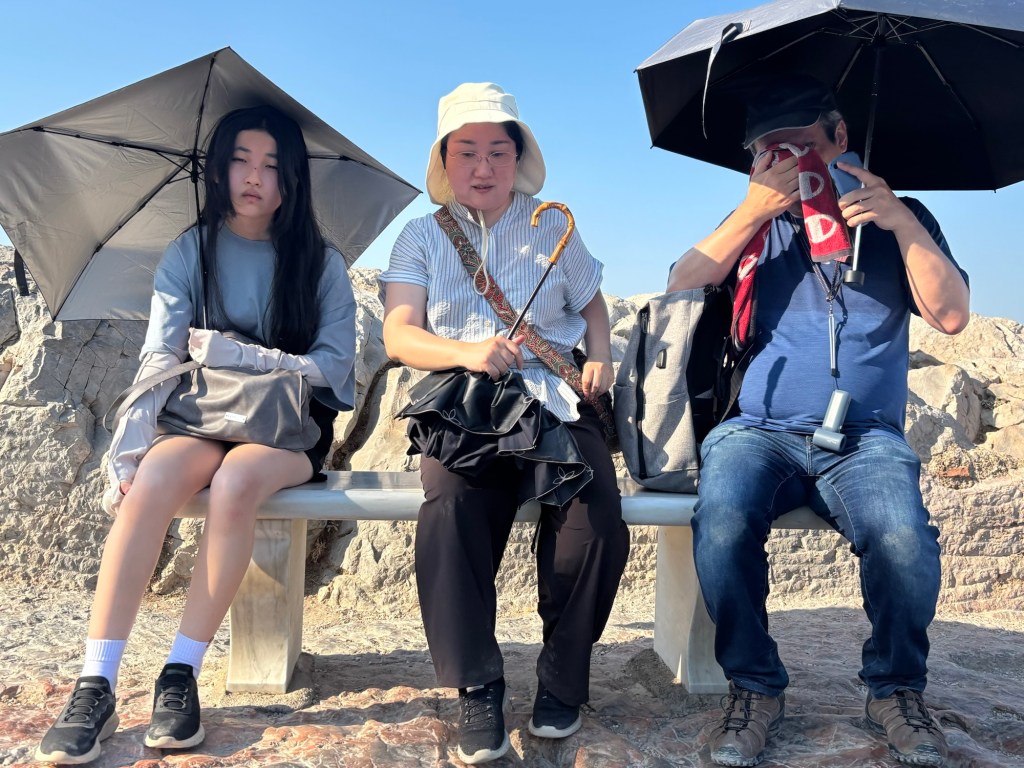
Athens is very quiet around four in the afternoon in August. Most of the city folk are sensibly avoiding the lingering heat. It’s only when you reach Makrigianni Street and the Acropolis Museum that the city suddenly springs to life – with tourists, that is. Germans with peaked caps. Koreans with parasols. Spaniards with GoPros and Americans with sweat-stained XXL tee-shirts and portable fans. All of them defying the 37°C heat to see one of the most famous architectural treasures in the world.
You have to meet your timeslot with these Acropolis tickets, but once you’re in, you can spend as long as you like in the area. The city seems to descend en masse shortly before sunset around 7pm – the lines were immense as I left – so I wouldn’t recommend leaving your visit to the last minute.
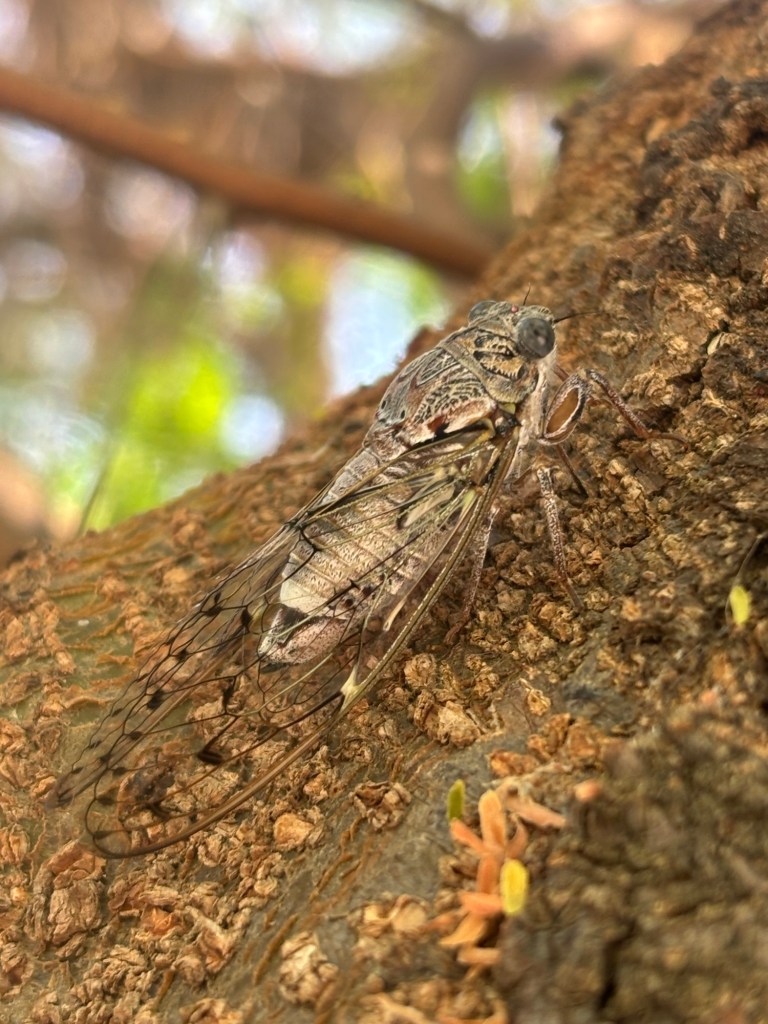
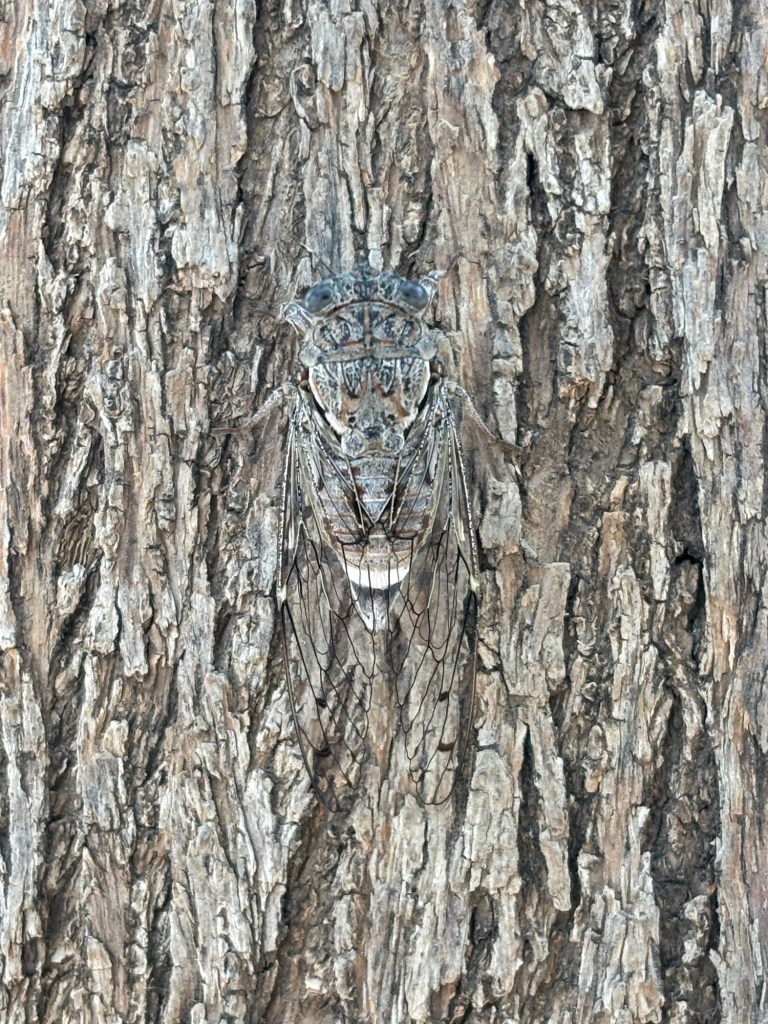
With time on my hands, I hunted for cicadas in the olive trees along the path. It wasn’t hard. Once you get your eye in, they’re very easy to spot, despite their cryptic camouflage. You just need to listen closely and look for the little white stripe at the bottom of their abdomen.
Check the trunks from different angles at first as your eyes adjust, because they really can disappear against the surface of the bark. Once you recognise the white stripe, you’ll see them everywhere. I found four on a single trunk by the Sanctuary of Dionysus.
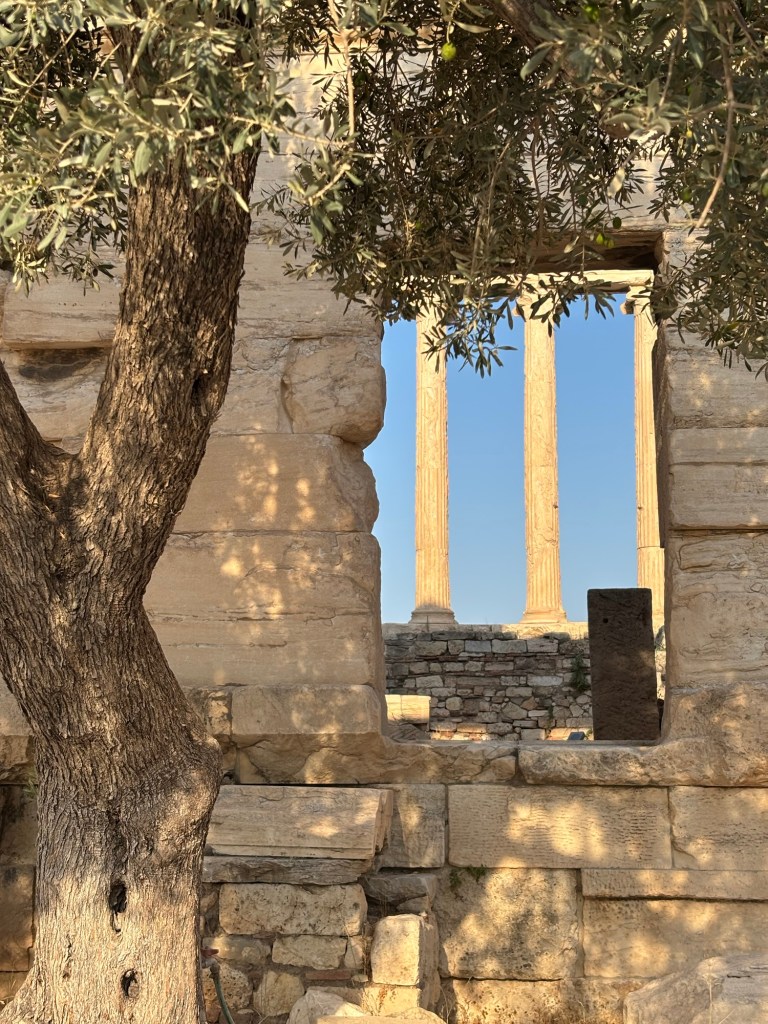
It can be hard to find peace and quiet within the Acropolis complex, as its swarms with tourists at almost all hours of the day. But there are quieter spots. Curiously, the Erechtheion doesn’t get as crowded, despite being directly opposite the Parthenon itself. I suspect many tourists only go up to the great temple itself and then come straight back down.
An olive tree grows in its ruins, in the same spot where the sacred tree that was the symbol of Athena’s gift to her namesake city once stood. A couple of Americans called it a cicada (sick-aider) tree when asked. Two others said they were glad they’d got ChatGPT to give them the lowdown so they didn’t have to hire a guide. I even heard one family – specifically the adults – opine that the only way they could have got a crane inside the Parthenon was by airlifting it into the centre by jet.
Sometimes – just sometimes – I’m extremely grateful that my American adventure ended in heartbreak. Some of the most intelligent people I’ve had the fortune to encounter are from the States, it’s true, but also, some of the dumbest things I’ve ever heard have been said in that American drawl.
I’m always terribly conscious that I’m just another tourist with a smartphone in places like this, so I sat in the shadow of one of the Parthenon’s colossal columns and sketched the temple ruins in my journal. I’d like to think somebody might have sat here doing just that a hundred years ago, and perhaps a hundred years before that, in the time of the Grand Tour, before Apple put a camera into every hand on the planet.
That being said, it is a fantastic place for people watching. So many different people from so many different parts of the world… You could come up here with a sketchbook and spend hours drawing, if you had the time.
The internet seemed to think that wild tortoises might be found around the boulder-strewn path up to the Eptathrono, just opposite the Acropolis. I looked everywhere, but I didn’t find any. I guess I lucked out with the giant tortoises last week, which are – admittedly – a heck of a lot easier to spot. Still – you should always leave something to come back for, right? The view from the top was worth the climb, too.
I’ve made it back to the apartment and have managed to put my feet up at last. I’m quite happy with this afternoon’s adventure. This time tomorrow – for the first time in nearly two months – I’ll be back home in Somerset. All good things come to an end eventually, right? But not before their time – and it really has been a truly wonderful time. The very best of times.
I might post once more tomorrow to hit a 50-day streak. It’s been fun writing every day all summer, but it does help when you have something to write about.
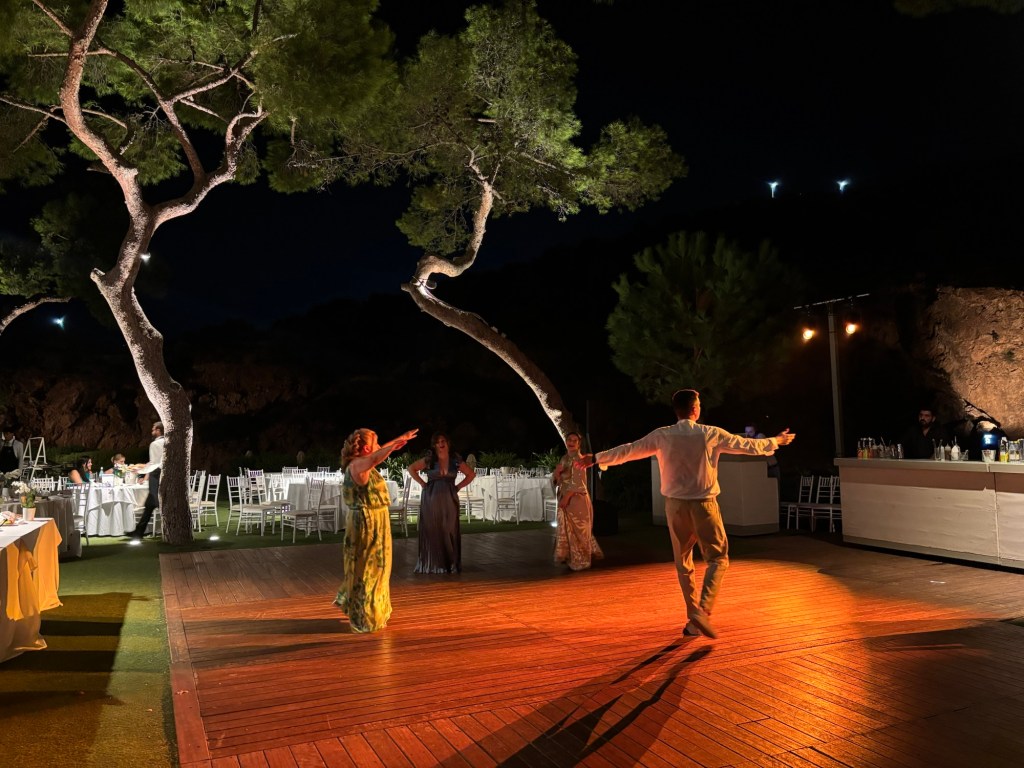
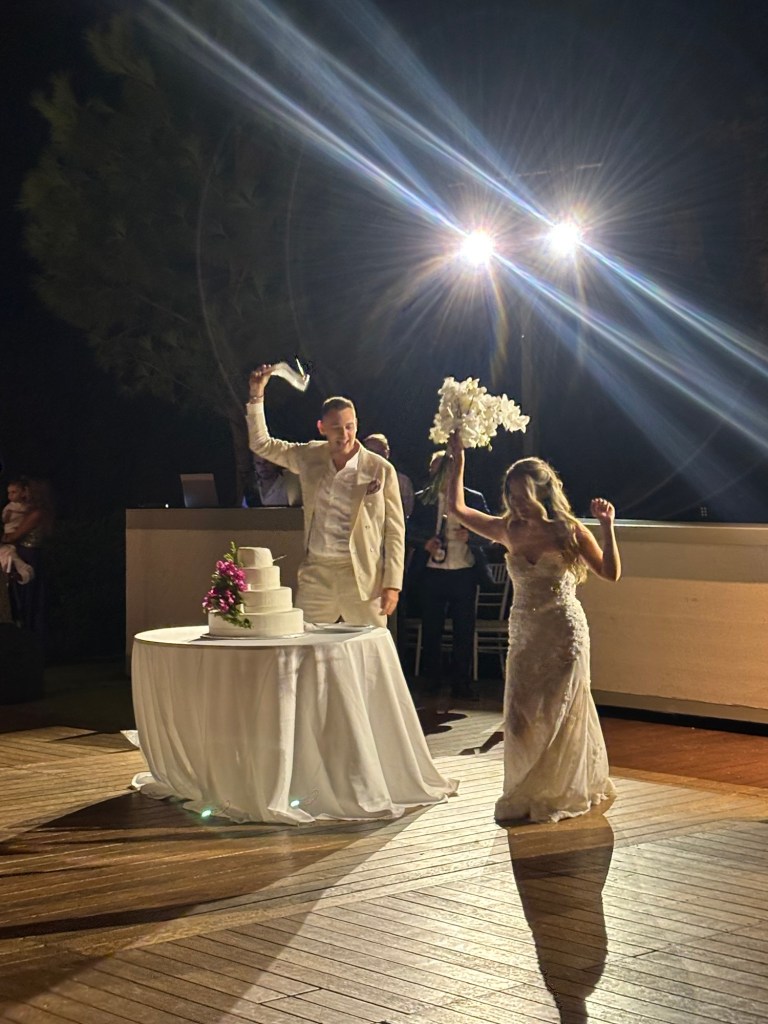
I’ve been to a couple of weddings in my thirty-two years – one intimate, one magnificent – but I’ve never been to one quite like this. The backdrop is totally different. No Ed Sheeran, no Pharrell Williams, no Walk the Moon. Instead, the haunting double-reeded hum of a zurna floating over the hypnotic beat of a daouli drum. Cicadas screeching in an almost perfect polyrhythm. Every now and then, an enormous praying mantis – known to the Greeks as the Virgin Mary’s little horse – flutters past the blue lights, casting a fleeting shadow over the dancefloor.
I did always love a ceilidh, but this is something very different. It feels… older, somehow.
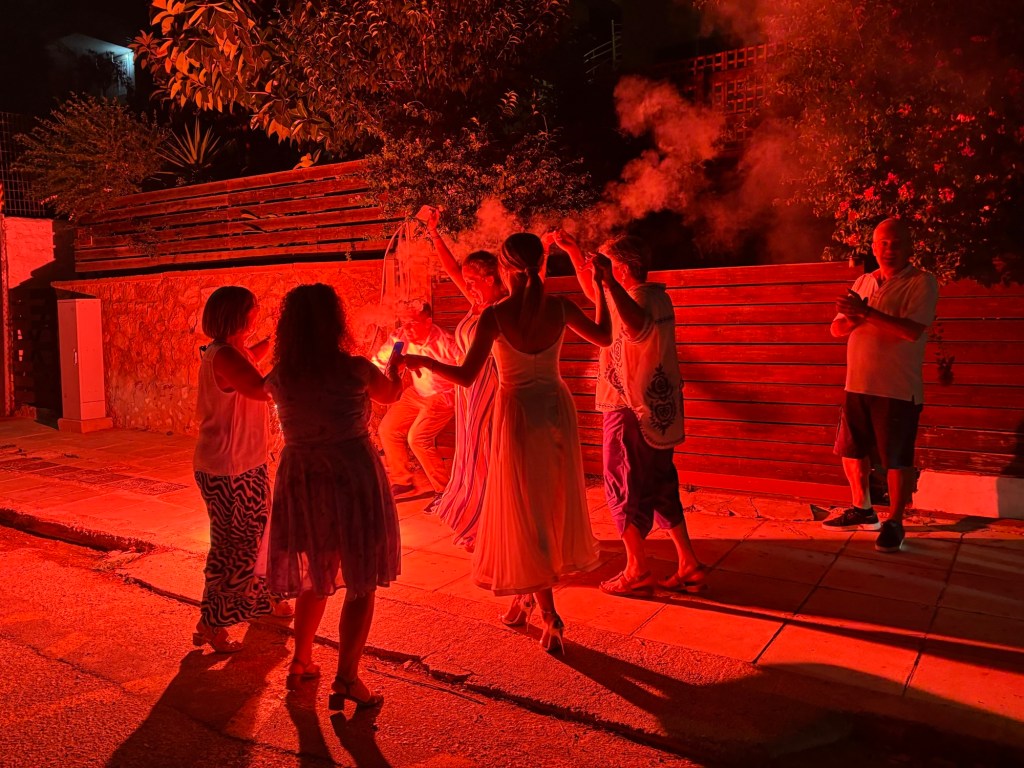
The festivities started last night, with a motorcade ride to the bride’s house to dance by the light of a scarlet flare. Summoned by the revving of no less than six motorbike engines, the bride and her family came down into the street to dance with the groom, his brother and Peter, a colourful character from Naxos. It was only a flying visit – some lingering tradition of not spending too much time with the bride the night before the wedding, perhaps – and after the dances were over and the flares were used up we rode back home.
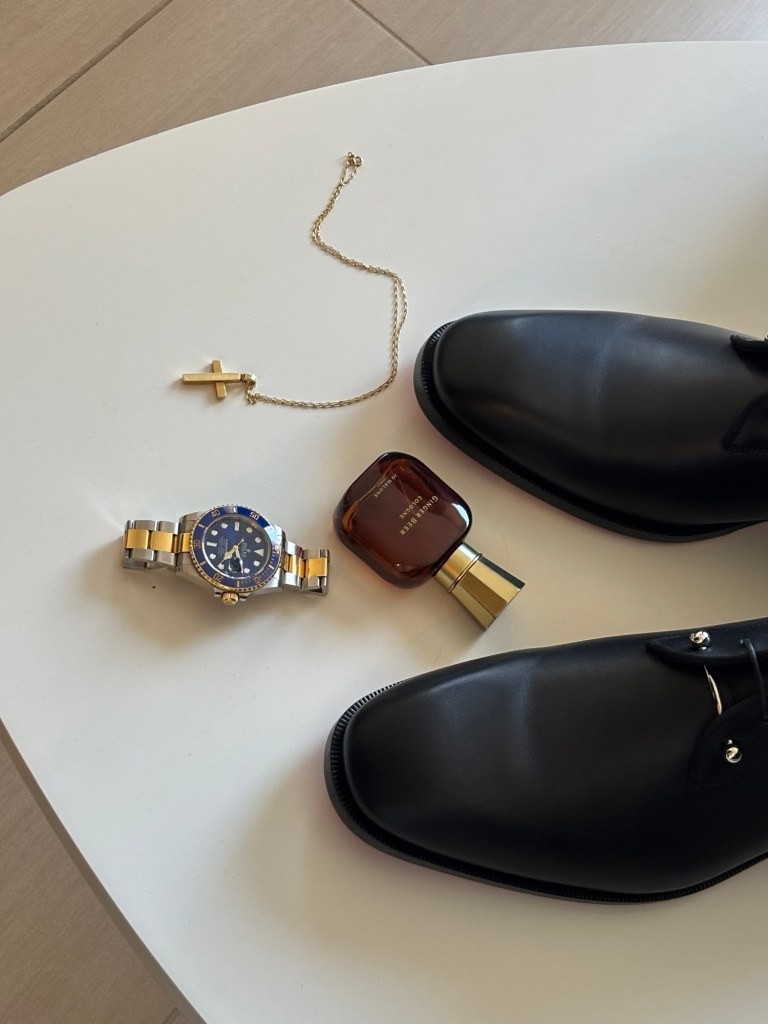
I spent the morning recovering lost sleep (I’m still adjusting to European time) and made it over to Alex’s flat just after three o’clock in the afternoon – in perfect time to catch the ritual shaving of the groom. There seem to be all sorts of traditions to a Greek wedding. As one of the guests of honour, I had to offer him one of his wedding shoes, while his parents set his suit upon his shoulders.
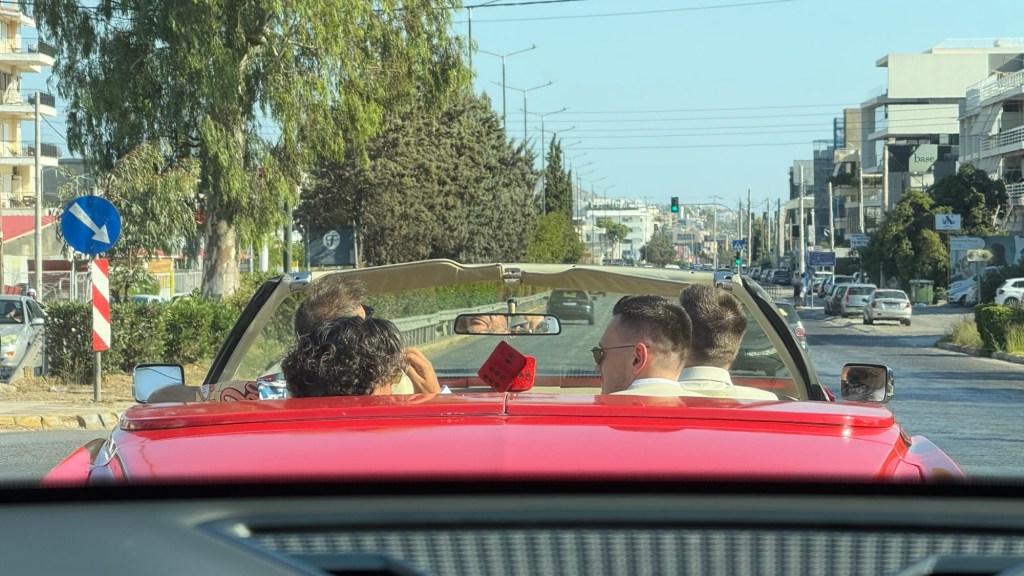
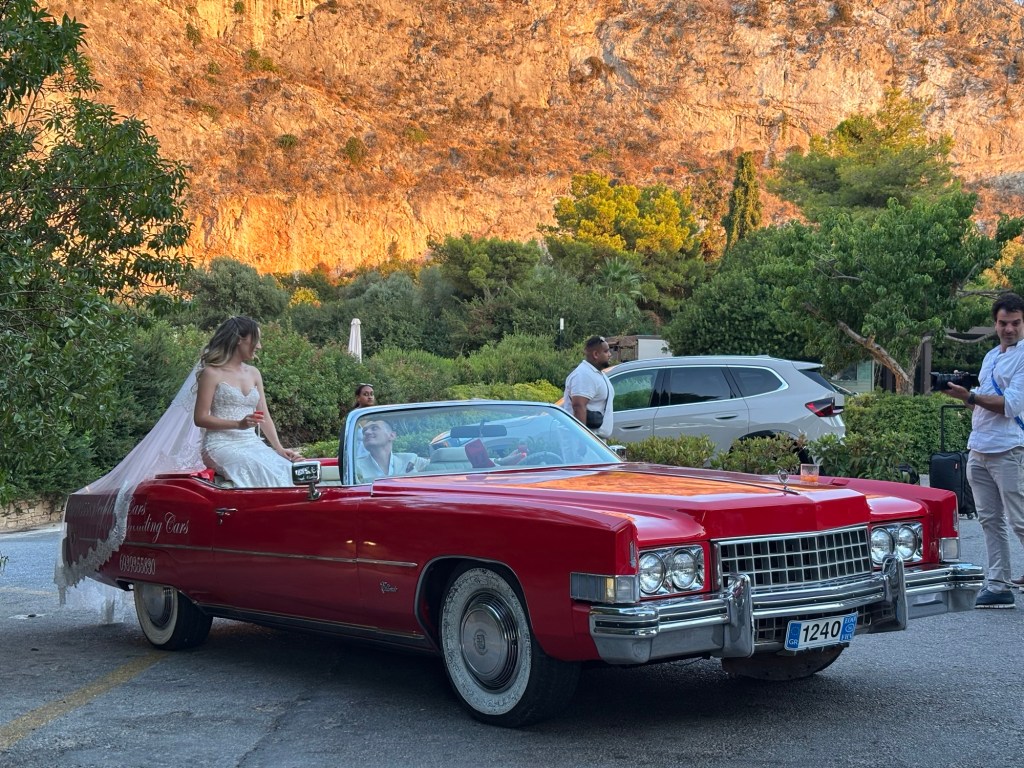
Alex is something of a motorhead, so a motorcade was waiting once again as we set out for the wedding. Each motorcycle had a white ribbon trailing from the handlebars, but the jewel in the crown was a shining scarlet Cadillac hired out for the occasion. Alex insisted I sit in the front, so I had front row seats – quite literally – to the wedding procession as it sped down the highway through central Athens and beyond to the coast.
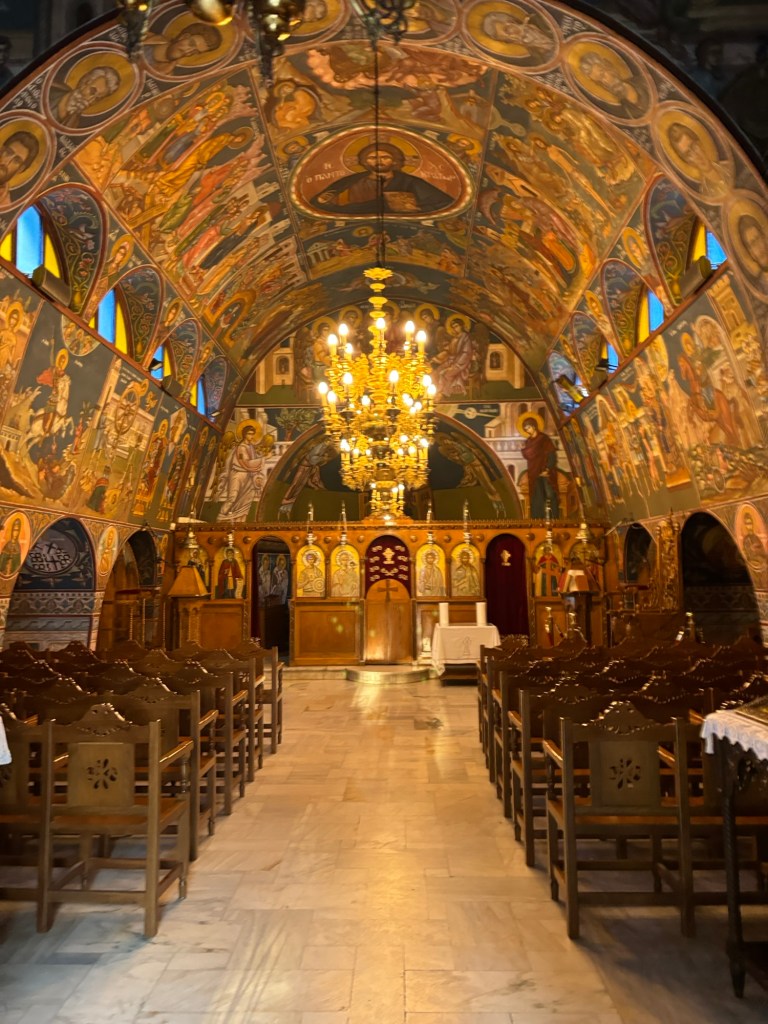
Alex and Elena chose a beautiful little chapel on a forested hill at the southernmost point of Glyfada. The priest – a young man, but the perfect caricature of an Eastern Orthodox saint – arrived dressed all in blue and smoking a cigarette, but for the ceremony he reappeared in black and gold.
The Greeks seem far more interested in the ritual over the written word: there don’t appear to be many speeches at all in these proceedings, beyond the magic of the Orthodox ceremony itself – which is sung almost in its entirety. No hymns, no readings from the family and friends, no sermon. Just the magic of tradition.
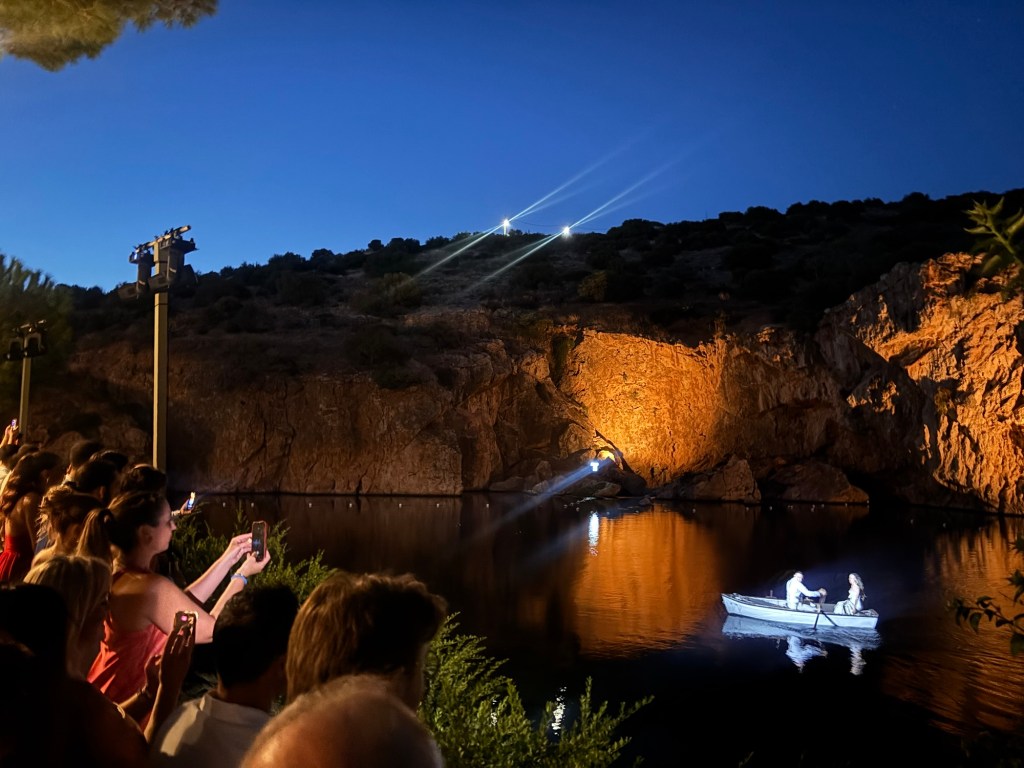
The celebration is taking place just a few minutes away by the shore of Lake Vouliagmeni, under the illuminated walls of a great limestone cliff. The music is predominantly Greek – only every so often does an English or Spanish song slip through the cracks. It feels like being back in the Middle East – a reminder that, in spite of the apparent universality of English, our dominion extends only so far as our influence. Here, as in Jordan, Morocco and Spain, there is a fierce devotion to the ways things were.
In our rush to become a cosmopolitan country, I sometimes feel we lost some of this magic back home in England.
I have no idea what my wedding would look like, because – frankly – I have no idea where I will be. I have dated an Afrikaner, a Pole, a Brazilian, an English girl, an Iraqi and an American – each a different nationality, with radically different perspectives on the future. I suppose I’d like something traditional – being an incorrigible romantic at heart – but until she appears, I remain open to seeing where the winds of fate carry me.
The only thing I know for certain is that, if and when my time comes, it will not be in England. Somehow I’ve always known.
If it could be even half of what I’ve been a part of today, it would be the wedding of my dreams.
Friendship in the old mould. The kind you read about in books. In the decade we’ve known each other, Alex and I have seen each other four times. Once, when we worked together for a couple of weeks at a summer school many years ago. Twice, when he was in London for a show last year. Three times, when he flew out to London with Elena to invite me to the wedding, and here we are at number four. Friendships that survive time, distance and the silence of working life are the most precious of all.
I have already had the most incredible summer of my life, but this just puts a seal on the whole thing. There’s not a day of the last seven weeks that I wouldn’t relive. And you know what? After eight years shut away in a boarding school, I think I’ve earned it.
Here’s to the summer of 2026. A red letter year in every possible way. May it be the first of many more to come. BB x
Flight IB0114, somewhere off the west coast of Morocco. 14.01.
For a twelve hour flight, my return journey from Santiago was a lot better than my flight out nearly six weeks ago. My attempt to walk back to Las Condes (ultimately foiled at the unassailable Cruce del Autopista Costanera Norte) had one important side-effect, besides giving me one last Chilean wildlife adventure: it left me absolutely shattered by the time I got into my Uber for the airport. I nearly fell asleep several times in the cab, so when I finally boarded the plane at around half past ten, it wasn’t hard to get some shut-eye, despite having an assigned aisle seat one row from the back of the plane.
Well – I suppose that’s not strictly true. I fought hard to stay awake for the first hour for the sake of supper, but that turned out to be a wasted vigil. Shortly after crossing the Andes, we hit the most terrifying turbulence I have ever experienced on a flight somewhere over Argentina. For all of forty minutes, the plane bucked and rocked like a horse in a rodeo, sending terrifying shockwaves down the aisle and dismantling the dinner service in quite a startling fashion before it had even got going.
I suppose they cancelled supper because by the time we’d got clear of the winds, most of the meals had gone cold. Either way, beyond the very Hispanic juice club forming at the back of the plane, there was no catering for almost the eternity of the flight.
Fortunately, I wasn’t conscious for almost the entirety of the flight, either. I must have slept for at least seven hours, which has got to be a personal record. It helps that I managed to freeze my telescreen by accident only two hours into the flight, preventing me from watching any more movies. The map service on these Iberia flights looks extremely high hi-tech… too much for my poor telescreen. The best I got out of it was an old favourite: Sinbad: Legend of the Seven Seas.
If you think that’s a childish thing to watch, the businessman on my right spent the latter half of the flight playing Angry Birds.
Before that, he watched all three of the Star Wars sequel films back to back, which I caught snatches of as I drifted in and out of sleep. I only saw the first of them in the cinema when it was released and promptly gave up on them after seeing the hackneyed cash grab that was The Force Awakens. By the looks of things, I didn’t miss out on the last two. What I saw of The Rise of Skywalker was genuinely the most contrived and confusing plot I think I have ever seen. The original Star Wars films didn’t exactly have the most intriguing dialogue, but it did have heart, a clear plot and – most importantly – originality.
Whatever happened to the movie industry? When did profit, special effects and live-action remakes become more important than a good story? I hope we can break free of this creative wasteland we’ve been in for the last decade and more.
That looks like breakfast making its way down the aisle. I hope it finds its way back to row 52 before we land in an hour’s time – I’m famished! BB x
This morning I said farewell to San Cristóbal. The easternmost island of the Galápagos chain has been a blissful retreat from the world, shrouded in stormclouds and sunshine. Having a cabin all to myself on the edge of town made a change from the usual hostel circuit. After several years of bunk beds of varying stages of comfort, I think I earned it.
I arrived a full forty-five minutes early at the harbour, as instructed, to be last in the queue. I should have known: the majority of the tourists on these islands at the moment are Dutch, Germans and Americans, who aren’t known for being slack when it comes to appointments. As such, when I finally did get onto the ferry, I was given a seat at the very front of the boat.
The Israeli sitting next to me was incensed. “Shit, man. This fucking sucks. These are the worst seats in the whole boat.” I smiled and shrugged it off – windowless or not, it was only a two hour boat trip across the open ocean – but he was seriously ticked off about what he saw as the rank injustice of the affair.
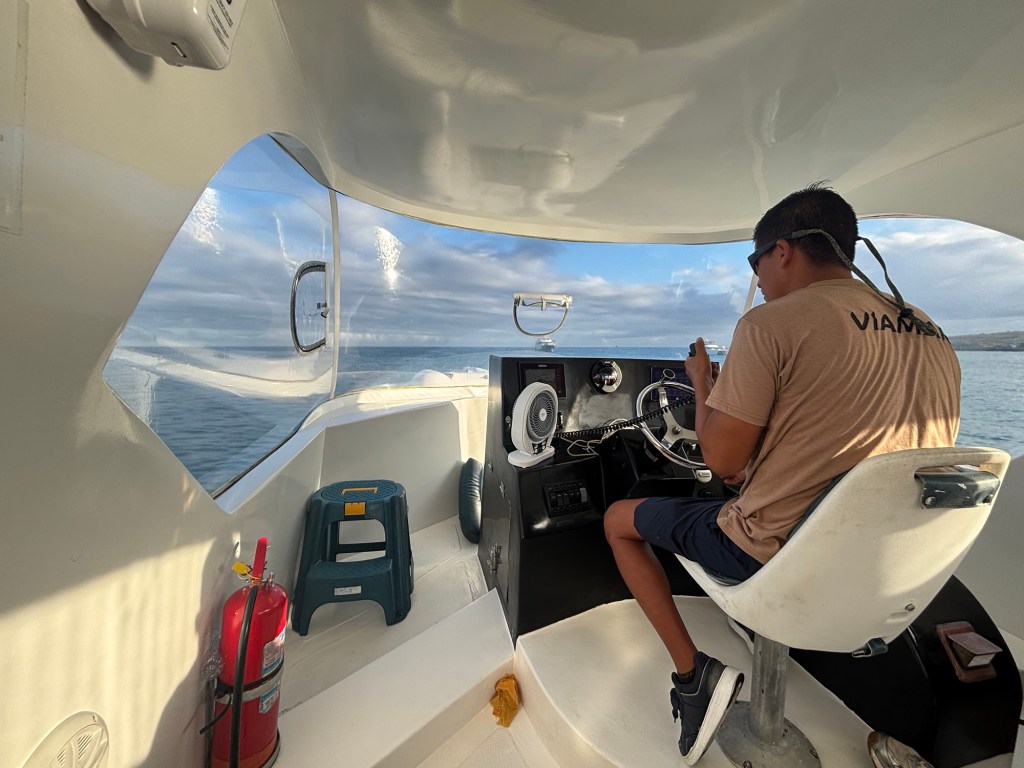
Fortunately, due to a mix-up involving the unexpected arrival of a family of four, the captain asked if we’d be so kind as to move up on deck so the family could sit together – so I effectively got an upgrade for free. So did the Israeli, whose response was a lot more vainglorious than mine, but I guess it takes all sorts to make a world. Up top, I had the refreshing breeze of the ocean wind, the occasional spray of saltwater and views all around – and, unlike a number of passengers, I wasn’t sick once. For somebody who isn’t exactly a sailor, I have always been surprised at my resistance to seasickness. Surprised – and very grateful!
The ferry between San Cristóbal and Santa Cruz takes about two hours, passing the uninhabited island of Santa Fé shortly before docking in Puerto Ayora, the largest town in the Galápagos. It was only shortly after nine, so I had a quick breakfast and then thought I might at least check in my luggage, but the lovely ladies at my hostal, the Flightless Cormorant, let me into my room right away. With my rucksack unpacked, I set out to explore and get my bearings of Puerto Ayora.
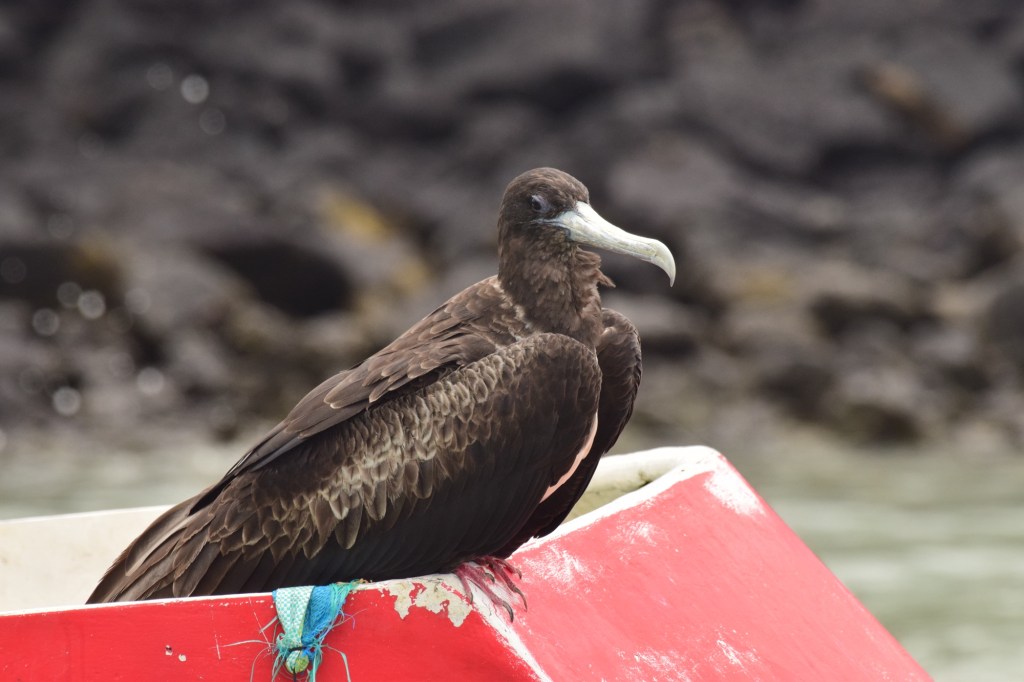
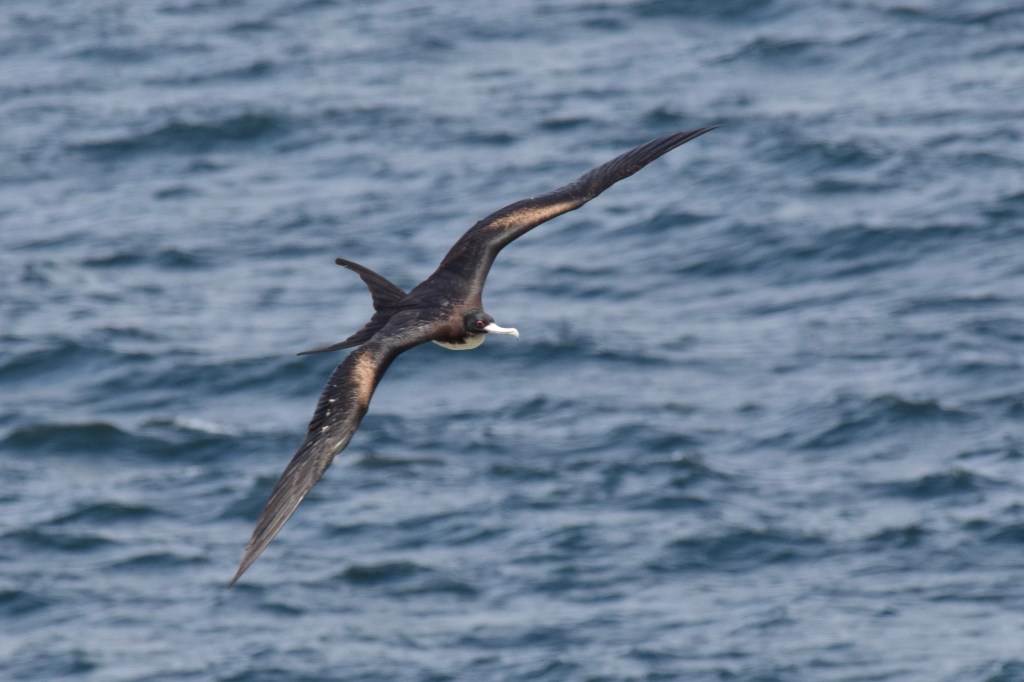
As they always are in the Americas, the fisherman’s wharf is a hive of activity. In Valparaiso, it draws gulls, terns, pelicans and the local sea lion population right up to the harbour. Here in the Galapagos, the frigatebirds add some local colour. They almost never seem to land, and the reason for that became clear when I saw one resting on the roof of a boat: their feet are tiny, almost vestigial in appearance. It seems that this was the sacrifice they made millions of years ago in order to become masters of the air, just like our swifts back home in Europe, only more than five times the size.
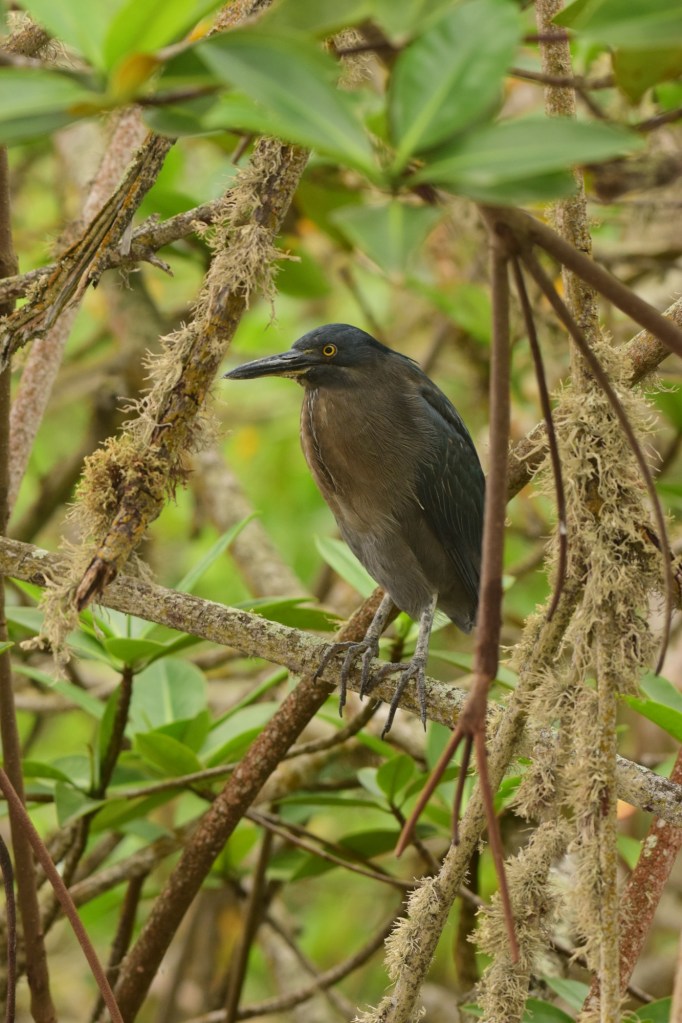
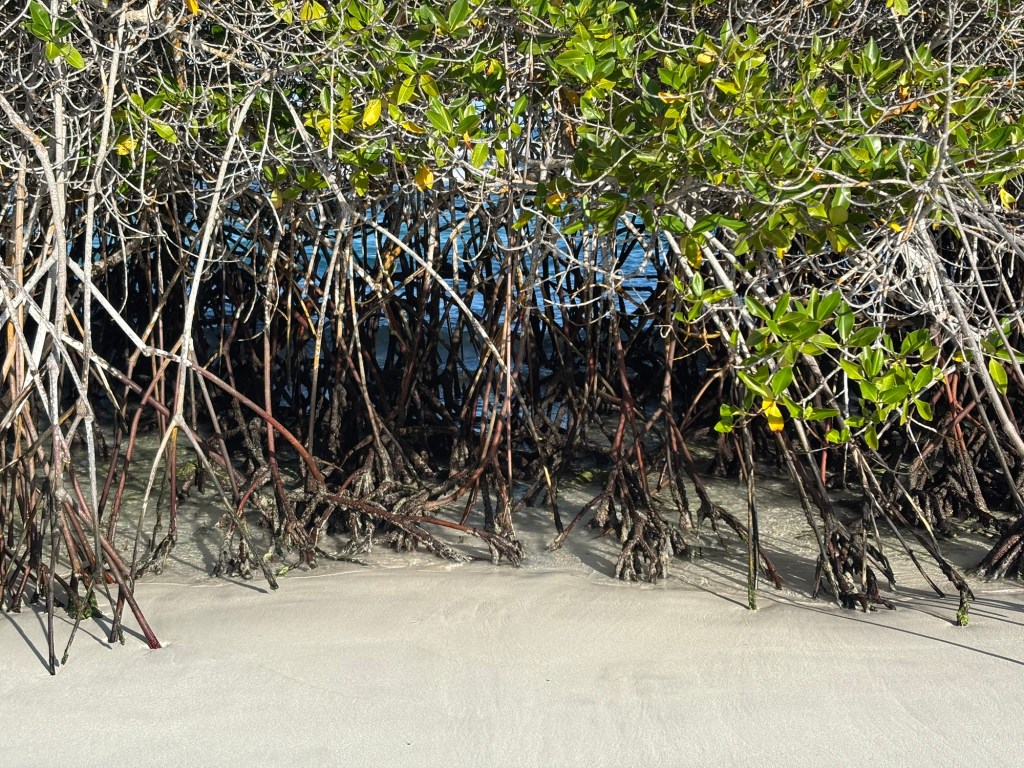
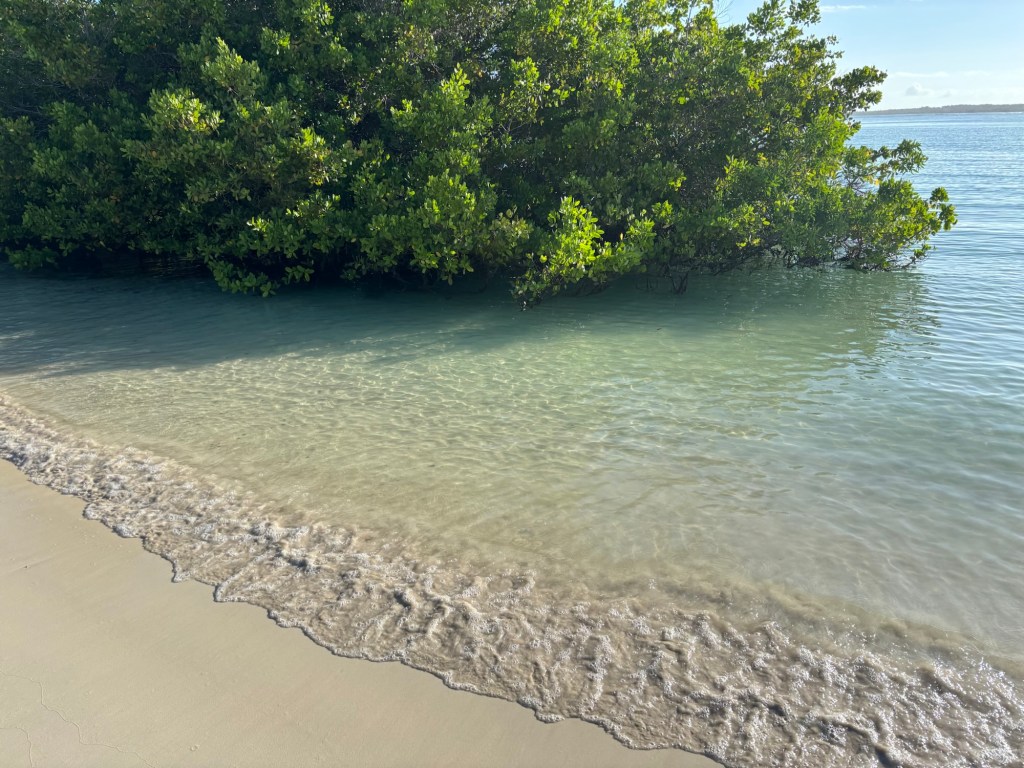
Here, as on San Cristóbal, you can find lava herons, with the added touch that the mangrove trees make for a slightly more interesting backdrop. The mangroves are easily my favourite thing about Santa Cruz – I’ve only ever seen them in books and documentaries, and they are every bit as spectacular as I always thought – even here, where they start right in the heart of Puerto Ayora itself.
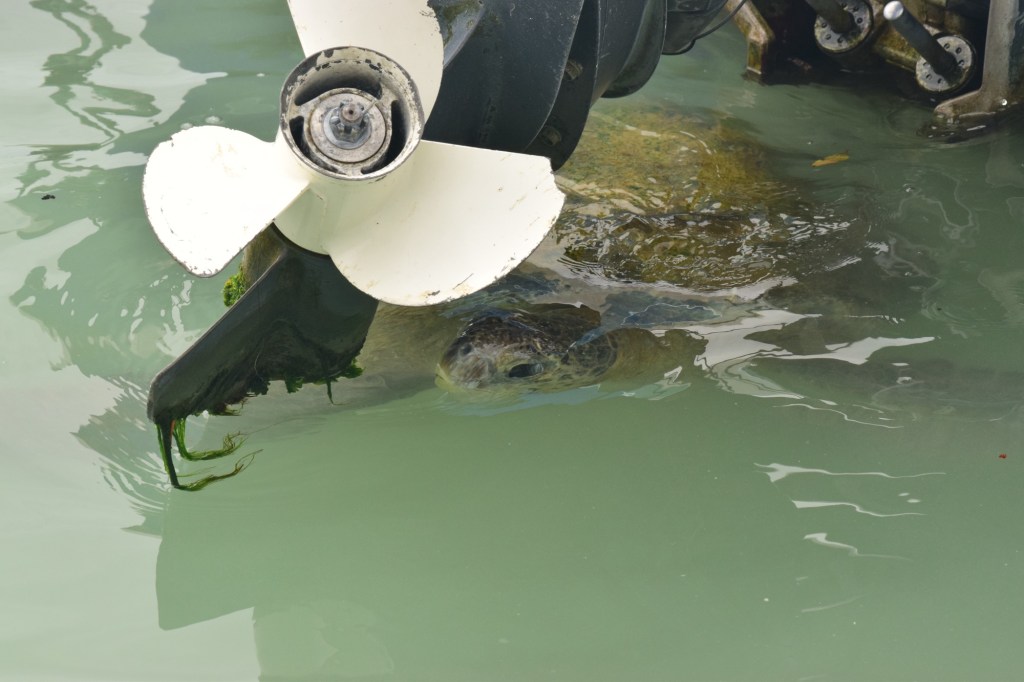
Obviously my turtle encounter yesterday wasn’t enough, because a short burst of breath near the boats alerted my attention to a youngster drifting near the surface, less than a stone’s throw from the harbour. It was feeding on the algae growing on the bottom of the boats, particularly on the propellers raised just inches above the surface. The Galápagos Islands are famous for the close encounters you can have with the local wildlife, but I have to admit, I wasn’t expecting to see both sharks and turtles without even having to leave the larger towns.
One of the big draws in Puerto Ayora is the Charles Darwin Research Centre to the east of the city. Free to visit – except for the Fausto Llerena Giant Tortoise breeding centre, which is perilously easy to stumble into (and be politely removed from) as it has no fencing! – it is worth a look-around even if just for the passport stamp you can acquire here, the only legitimate way to obtain such a stamp (as they do not issue any stamps at the airport).
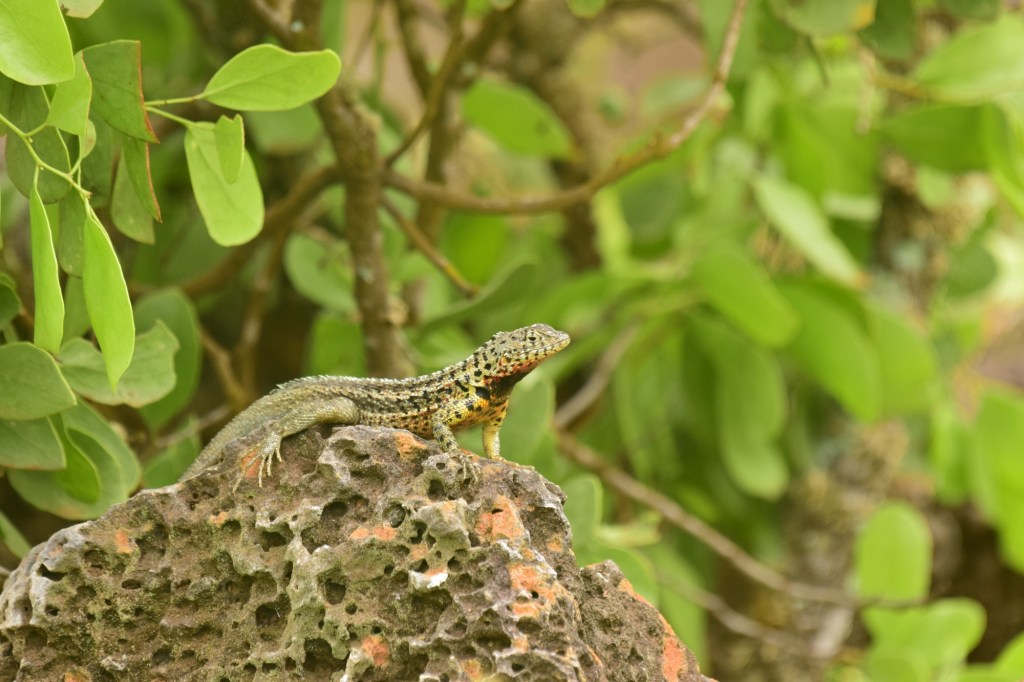
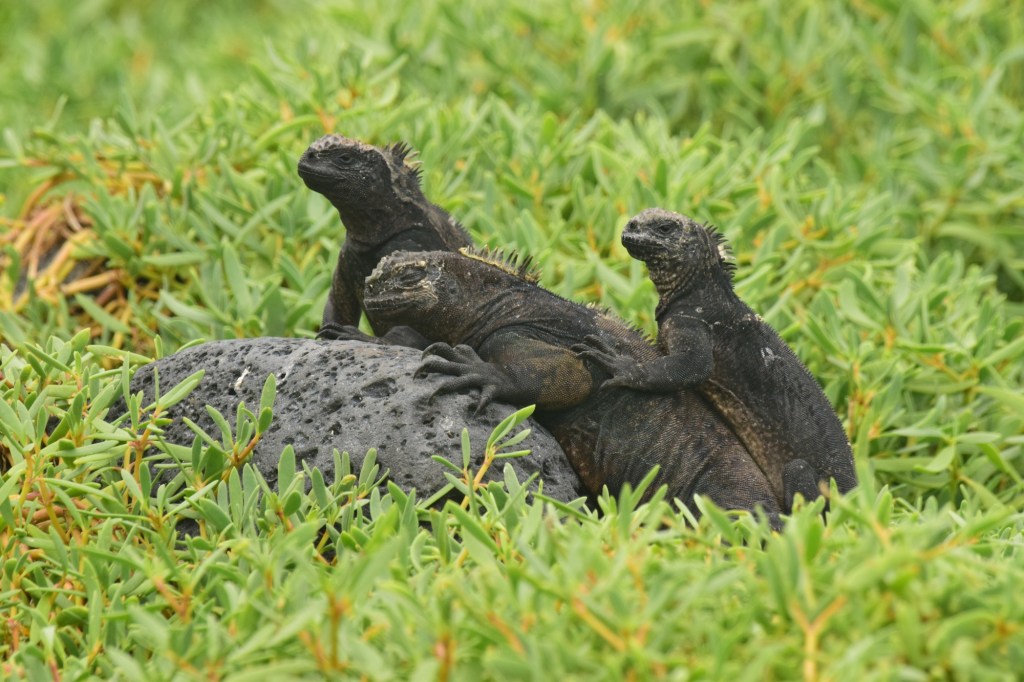
The walk there takes you into the wilder country around Puerto Ayora, and you have to watch your feet: there are reptiles everywhere. I lost count of the lava lizards and marine iguanas, and I’m almost certain I saw the looped body of a Galápagos snake disappear into the bushes as I turned a corner.
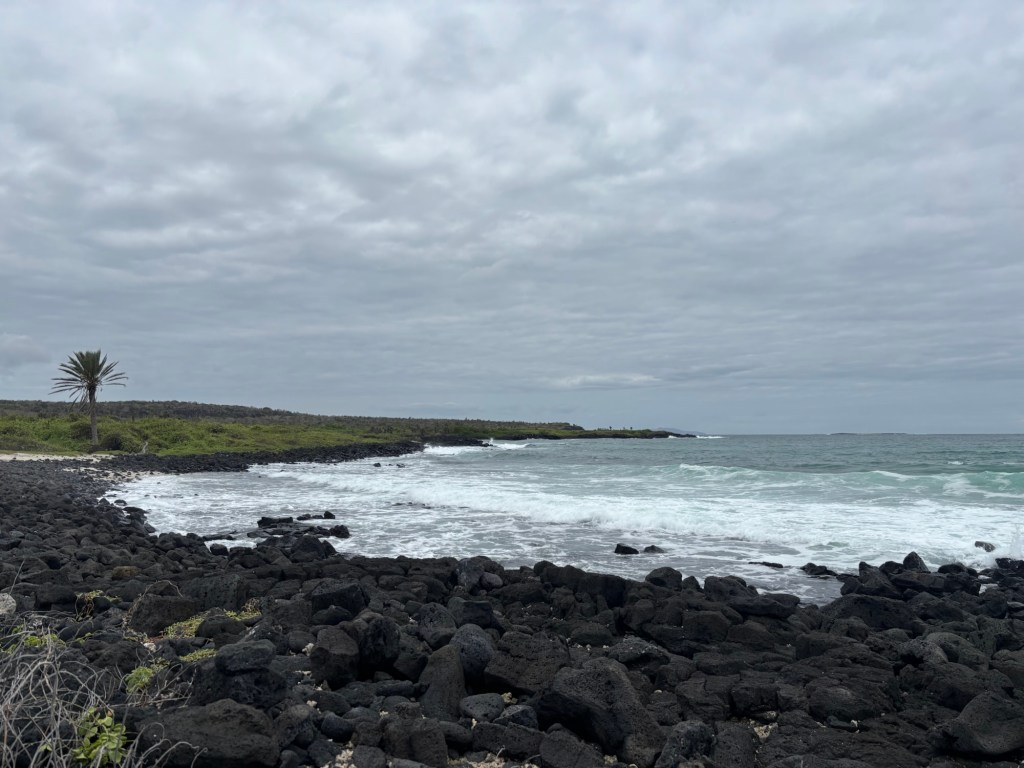
Follow the trail that leads east of the Charles Darwin Research Centre and you’ll reach Playa Ratonera, a wild and wave-battered volcanic shoreline. It has a few sandy stretches, but it’s hardly a pleasure beach, as it gets the full force of the Pacific. It’s mostly mangroves, carpet weed and black volcanic boulders, with the shattered white remnants of millions of years of coral taking the place of pebbles.
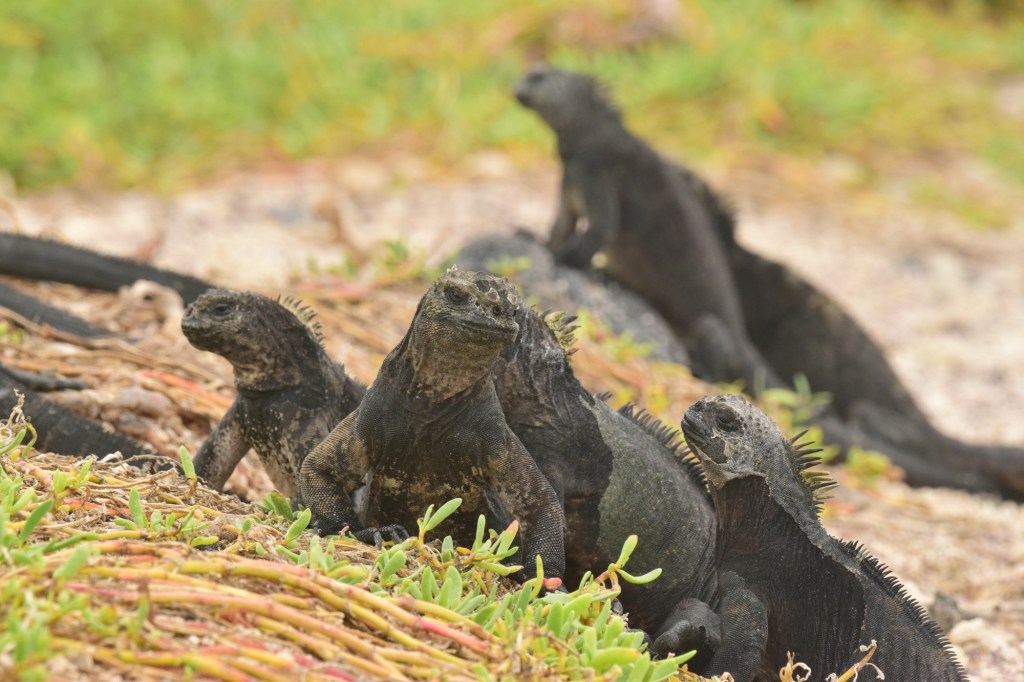
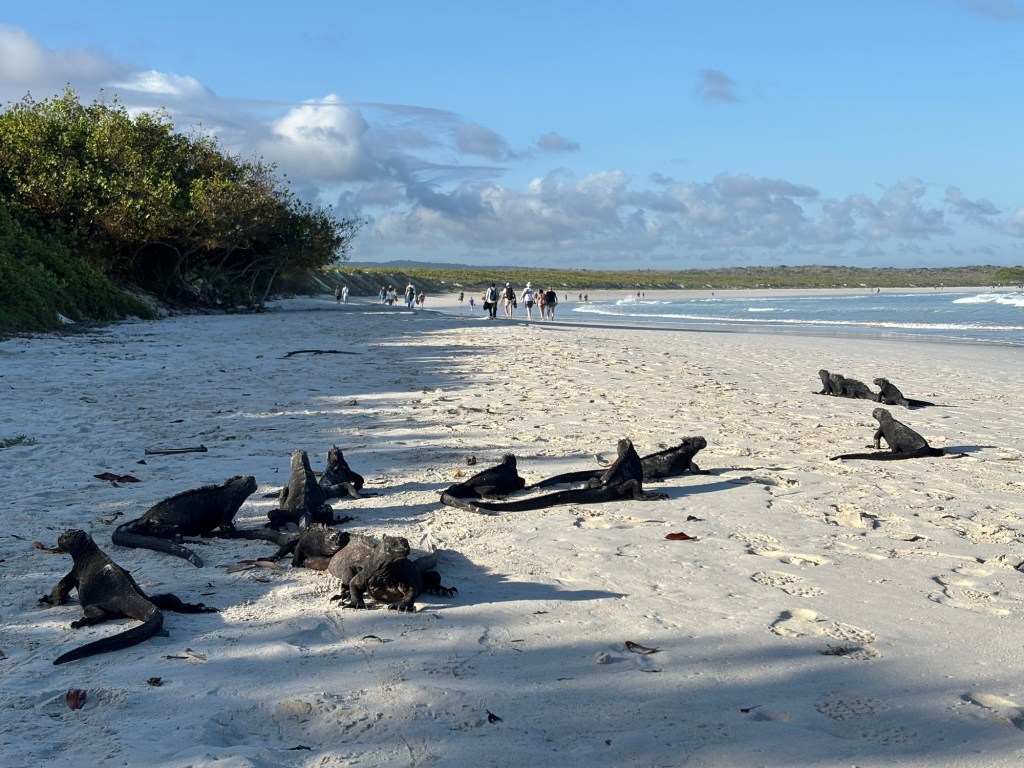
One huge draw is the local population of marine iguanas. There were always a few around the harbour on San Cristóbal, but Santa Cruz has hundreds of them.
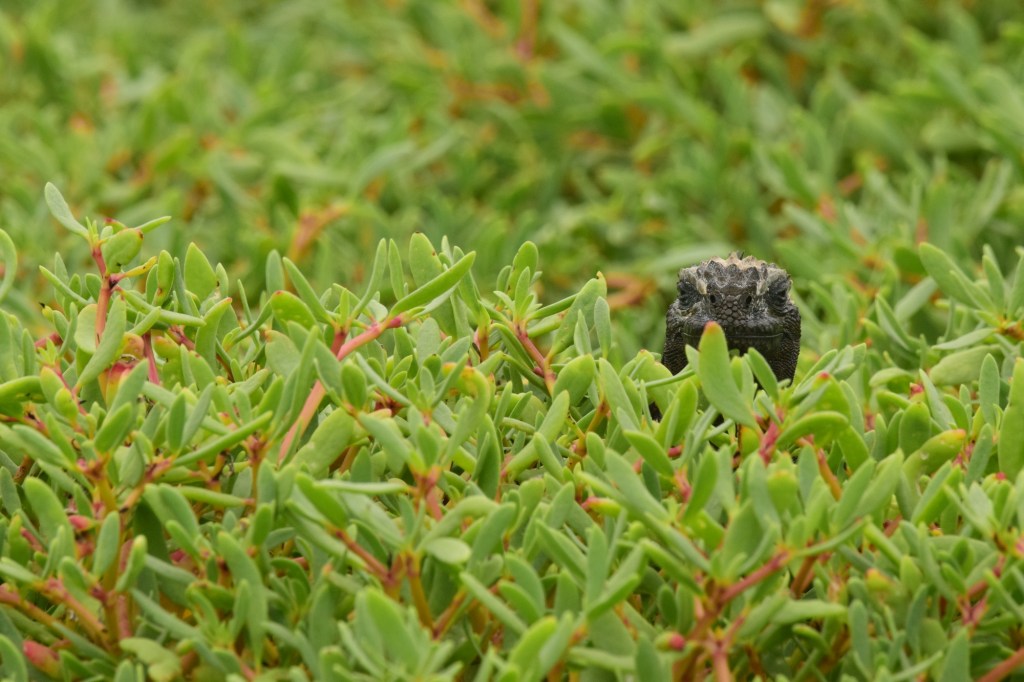
The collective noun for marine iguanas is a mess, which is about right. They are absolutely everywhere, sprawling all over each other on the path, off the path, among the weeds and atop the rocks. You really do have to watch where you step, because they’re a lot more sluggish than the lava lizards and don’t tend to move even when they’re only inches away.
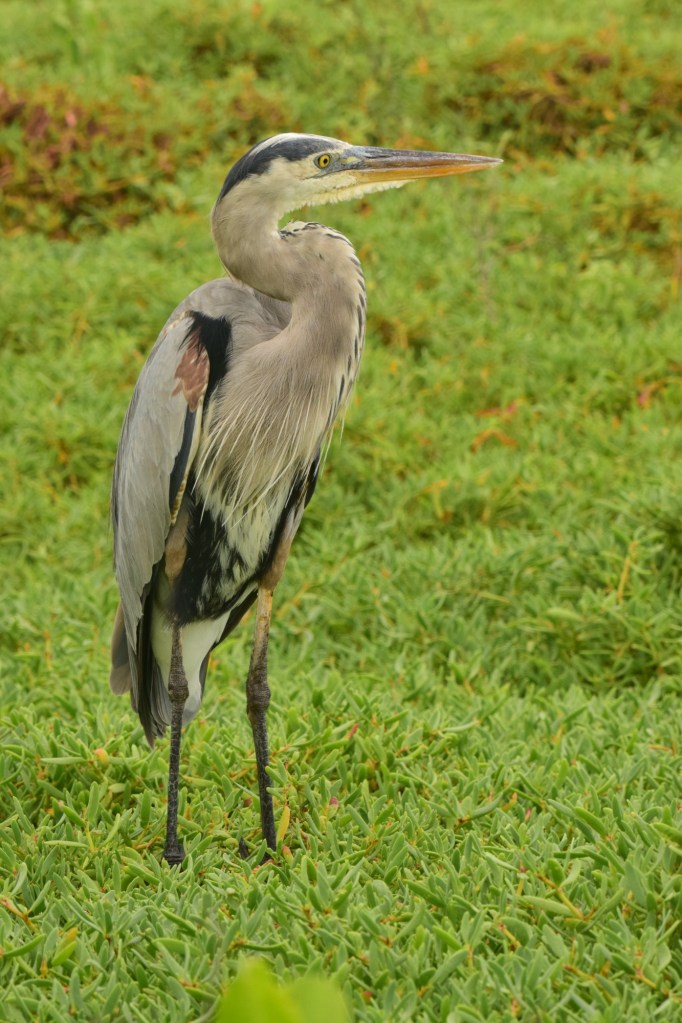
They were attended by a massive great blue heron, the American cousin of our grey herons. Herons of this size have a Catholic diet, so I imagine the smaller iguanas form a part of that, before they become too large for even the most ambitious herons. I’ve seen these birds swallow fish that are far too large for their long necks, but they probably do go down the hatch a lot more easily than a spiky, scaly adult iguana.
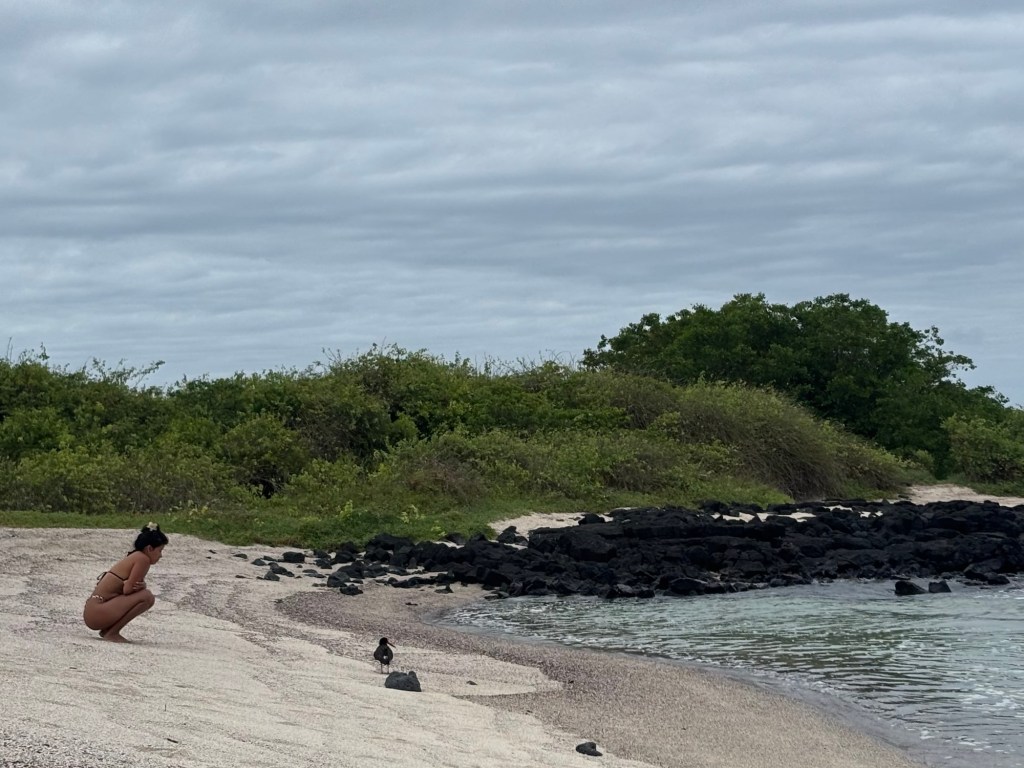
Time and again here I am bowled over by how unafraid the local wildlife is of us. Herons, iguanas, mockingbirds, finches, boobies and oystercatchers… none of them seem to mind one jot that they share their world with us. Only the whimbrels seem to have retained their wariness, though given their status as migrants in these islands, perhaps their behaviour may be excused.
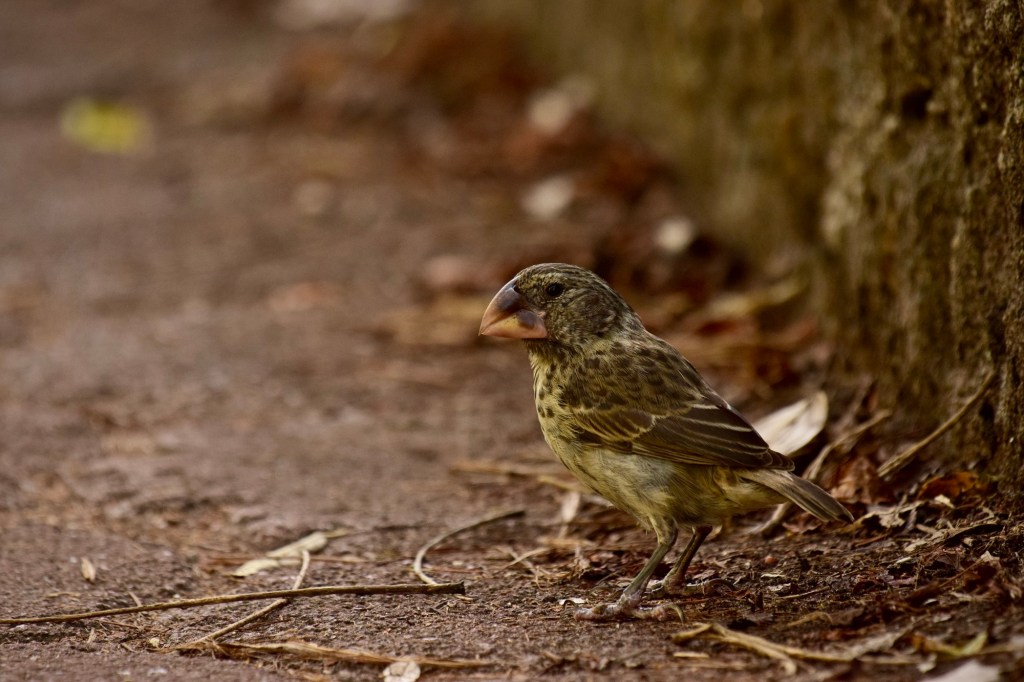
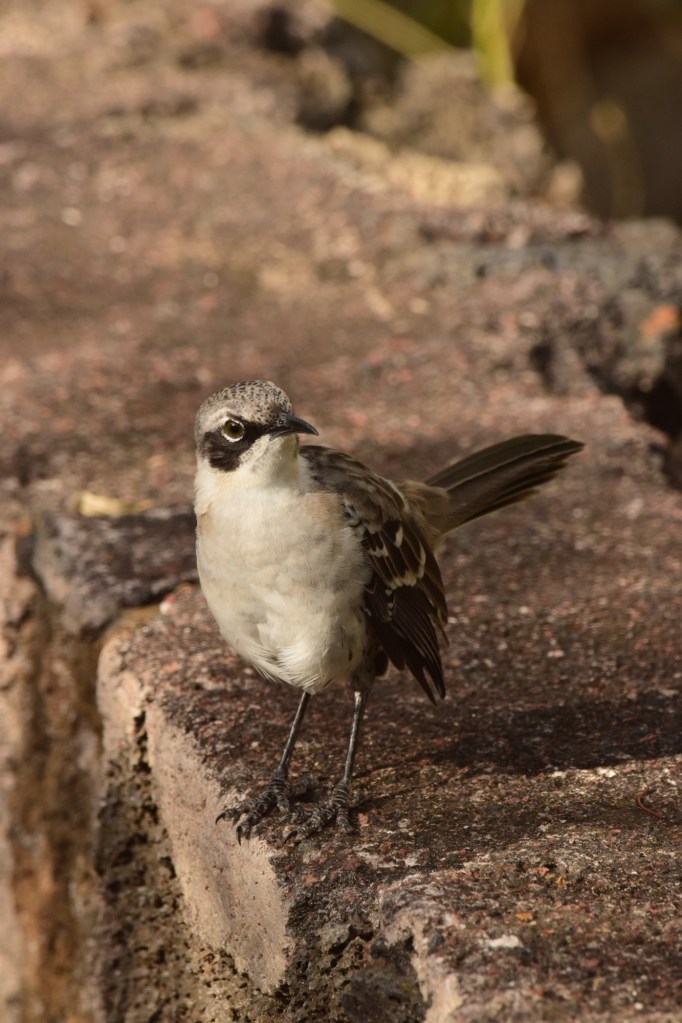
The other beach worth visiting in Puerto Ayora’s immediate area is Playa Tortuga, a stretch of exposed white sand to the southwest. Getting there requires registering with a park ranger and a half hour’s trek through the opuntia cactus forest, but when you see the final destination, you’ll understand why so many people both local and foreign make this trek every day. It’s a paved route, so it’s not exactly arduous, and it does have the benefit of sending you through bird country. I finally saw the largest of the ground finches, with its impressively large nutcracker bill, as well as the local species of mockingbird, noticeably different in voice and appearance to the birds on San Cristóbal.
I believe Playa Tortuga is so named because it plays host to a breeding colony of green turtles at the right time of year, but to get there, you first have to cross Playa Brava, beaten savagely by the force of the ocean. When I got there the afternoon’s daytrippers were all heading back to town in a slow and sandy procession. The rangers close the beach at five, so as I arrived at twenty past four, I didn’t have an awful lot of time.
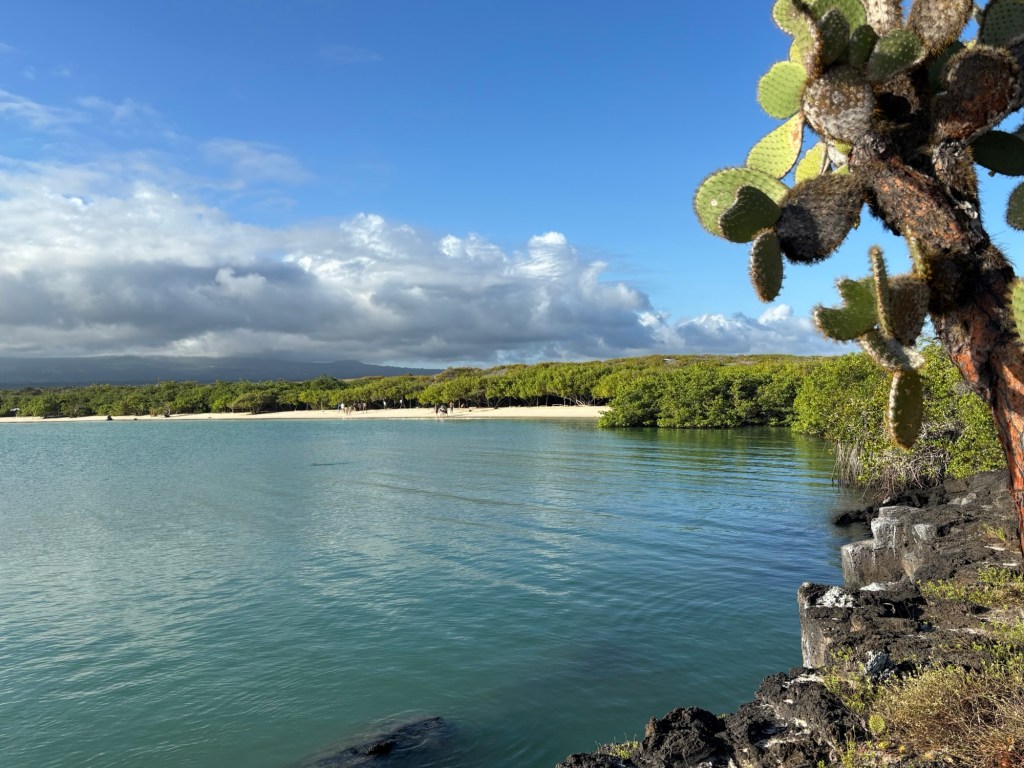
Time enough, though, to appreciate the strange beauty of the mangroves. On the far side of the red flag beach (where the waves are far too strong to allow for bathing) you’ll find the not-so-secret mangrove-lined bay of Playa Tortuga. It’s no hyperbole to say that it is by far the most beautiful beach in the Galapagos that I’ve seen so far: quiet, secluded and with views to die for all around.
I didn’t bring my swimming gear, and it would have been too late to pop in for a swim even if I had, but it was a hard-fought temptation not to dive right in. I confess I usually have more than a little contempt for those who travel the world just to lounge around on a beach without a care for the local wildlife or culture, but when the beaches are this good, I can begin to understand why somebody might be mad enough to empty their bank account to be in a place like this.
If you walk just a little bit further, you can see the entire bay with the mountains behind from a rocky peninsula, where the opuntia cactus grows. Tomorrow I’ll head up into those highlands in search of giant tortoises, but for now, it’s just me, the sea and the pufferfish swimming among the rocks below me.
I’ll close this post here – I had a lot more to report than I thought today. Maybe tomorrow will be a quieter one! BB x
Puerto Baquerizo Moreno, Galápagos Islands. 18.55.
I could have sworn that it crossed my mind when I was packing for Chile that I might want to take my GoPro. It would have very easily fit inside my suitcase. It’s not as though I overpacked, by any stretch of the imagination. If anything, I almost certainly underpacked. Well, it can’t be helped – how was I to know that my last South American adventure of the summer would take me snorkelling, when Chile was (and still is) in the grip of winter?
Long story short, I really, really, really wish I’d had it on me today. But I didn’t. So I’ve done my best to make up for it with the trusty Nikon. I hope you enjoy!
Today’s expedition took me out to León Dormido, more commonly known as Kicker Rock. I’ll be honest, of all the Galápagos day tours available, this one was not on my list. It probably should have been, as it’s one of the most spectacular places in the world to go snorkeling, or so they say. Knowing what I know now – which is that the discount I had from my guide was considerable, compared to the other guests – I’m glad I signed on for a last minute slot.
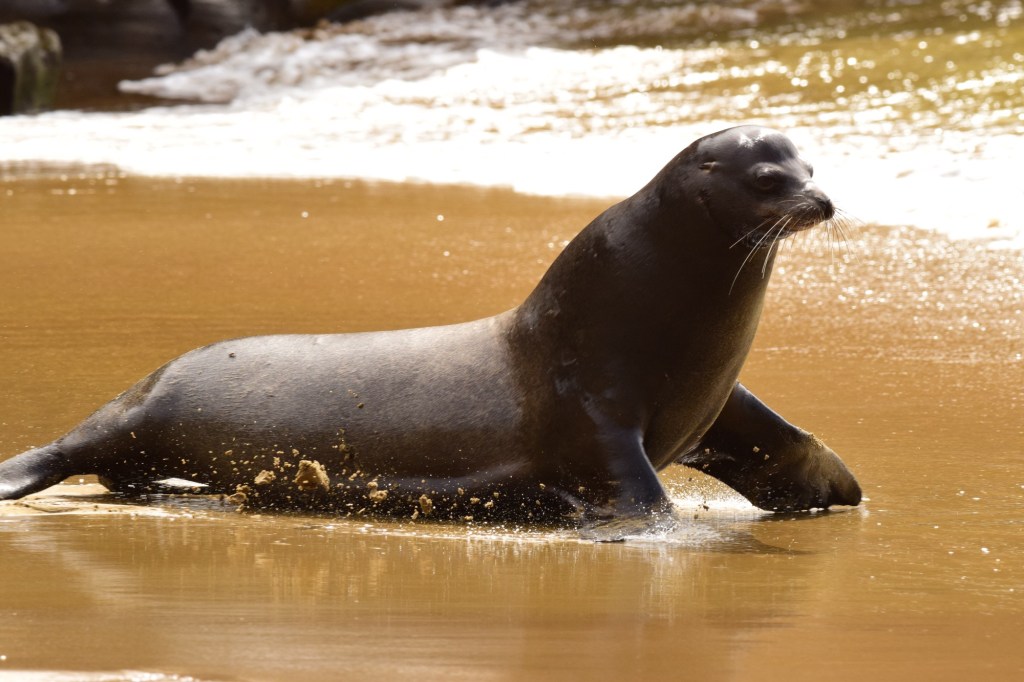
I rocked up early to the marina, as instructed, but sometimes I forget that this is South America. A 7.45am meet turned into a 9.15am departure, so I had plenty of time to photograph the sea lions, which never fail to disappoint, no matter how accustomed one becomes to their presence here.
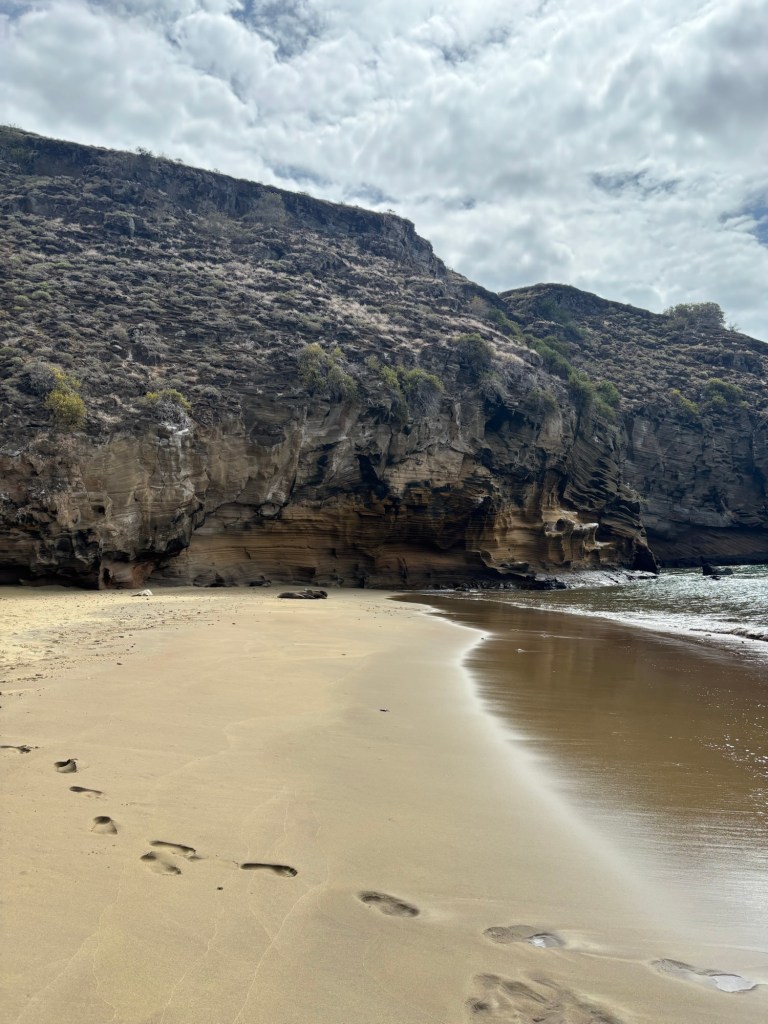
We had an afternoon slot for León Dormido, so Samuel took us to a sanctuary beach within eyesight of the rock known as Playa El Manglecito. When we arrived, there was hardly any wind at all – just the waves lapping upon a white sand beach. The surface of the water was only broken once in the distance by a mobula ray leaping into the air and disappearing into the endless blue. With the possible exception of Finisterre, this is probably the first true white sand beach I’ve ever seen, and boy did it live up to the hype!
I considered snorkelling with the others, but it only took a few seconds in the water to realise that something was wrong. My mask filled with seawater almost immediately, stinging my eyes and forcing me to my feet early. A small tear where the straps met the rubber seal of the mask was the culprit – something I confess I hadn’t spotted when I checked the mask last night. So I shrugged, got back out and went for a walk along the beach.
There was plenty to keep me occupied. The molten scrub beyond the shore was alive with little things: finches, warblers and colourful lava lizards. Of course, there’s always a sea lion about too, and since it was so curious about us, I couldn’t help but indulge it as well.
Indigo and her mother, a couple of experienced divers from the UK, told me I had to go back in the water: they had seen as many as fourteen turtles in the bay. I told them about my mask and Indigo lent me hers. I’m past the stage of my life where I’d awkwardly turn such an offer down out of affected politeness – and I really did want to see a turtle.
It took me a little while to find them. I swam across half the bay at first, thinking they might be sheltering on the far side, only to nearly collide with one of the giants as I returned to the shore.
Oh, if only I’d had the GoPro – the things I could have shown you! Green turtles are simply enormous. So much bigger than I expected. I think I assumed all turtles but the giant leatherbacks were around the size of an Olive Ridley, but these green turtles can grow to five feet in length. The largest of the turtles in the bay must have been that size or close to: he was busy gnawing algae from the rocks and paid me no attention whatsoever, though I can only have been a metre or so away when the waves hurled me in his direction.
I didn’t linger as I didn’t want to cause them any undue stress. They didn’t seem at all bothered by my presence, but turtles are endangered enough as it is, so I spent a few minutes in total awe, watching them feed and fly through the water on those evolutionarily perfect flippers, before pushing off back toward the shore.
Our divemaster Jesús called the three divers back to the boat, but the rest of us – me, a Brazilian-American and a mother and son from Austria – had another half hour to enjoy the beach. Naturally, I’d surrendered the working snorkel back to Indigo, but I figured I could at least have a go at capturing the turtles on camera, albeit from above.
The trouble with turtles is that they are perfectly adapted to life underwater, and do not need to come up for air as readily as other animals. When inactive, such as when they need to sleep, they can submerge for an astonishing seven hours without needing to breathe. Even when they’re awake, they can still hold their breath for thirty minutes or more if they need to – and when they do pop up for a breath, it only lasts a couple of seconds until they dive back down again.
All this is to say that photographing a turtle out of the water is a very difficult challenge. But I had half an hour and nothing better to do, so I took a stakeout. It was almost impossible at first, but when a couple of them decided to cross the bay and swim out of the dark reef and over the white sand, the job was suddenly made a lot easier. All I had to do was to track the shadows.
The calm sea that carried us gently into the bay had been whipped up into a fierce swell by the wind, which made the job even harder, but I managed a few half decent photos as the first one made its way across the bay.
Looking at a turtle is beholding one of the greatest survivors on Earth. These incredible reptiles have been around since the time of the earliest dinosaurs in the early Triassic, some 230 million years ago, and two mass extinctions, as well as a host of other destructive factors – including our depraved taste for their meat and shells – have not been able to rid the planet of these mighty success stories. It was a real privilege to see them so close.
I’ll be honest. After that incredible encounter, the snorkelling at León Dormido was… a bit of a letdown. Kicker Rock is a world-famous diving location, where entire schools of hammerhead sharks, eagle rays and even mantas can be seen. Naturally, snorkelling is a bit more restrictive, doubling your time but limiting your exploration to the surface. I was lucky that they had a spare mask, so I could see underwater without any difficulty this time.
We saw parrotfish, triggerfish and rainbow wrasse and a few impressive sea stars clinging to the wall of the rock, but beyond that, the most memorable encounter was the enormous salp swarm we found ourselves in. Every single movement of my hands was surrounded by a swirling cloud of reddish gelatinous organisms that looked like drawings of cells from my old biology textbooks. The sun must have drawn them all up to the surface from deeper, darker waters below, beyond the deep blue beneath my feet where the blades of sunlight fail to penetrate.
I’ve never snorkelled in open water before, so I think I was much more accustomed to being able to stop and breathe normally more often than I feasibly could with the seafloor more than 130 feet below. It took me a while to master breathing through the snorkel, and even once I’d lost my nerves about breathing through a tube, seawater still managed to get into my nose and up and into my oesophagus. After about twenty minutes it felt as though my throat was on fire with all the ingested salt, which probably didn’t help with my state of mind. It was only when I was distracted by the playful antics of the attendant sea lions or a particularly interesting fish that I didn’t think of the discomfort I was in.
The divers said they’d seen it all: reef sharks, hammerheads, eagle rays and barracuda and all the rest. They were all much, much lower down. I didn’t begrudge them for it – that’s what they trained for, after all. It was a good reminder, however, that my gut was right all along: snorkeling isn’t really my cup of tea, compared to, say, a two-hour hike. In that sense, I haven’t changed much since my school years: I know what I’m good at and I do it often enough to consider it mastered. I’m open to new experiences, but given the choice between snorkeling and hiking some other time, I might think again next time.
Unless, of course, I’ve got my GoPro on me. Or I’ve shaved (which may or may not have had an impact on the water getting into my nose).
Fortunately, there was one resident of León Dormido which had eluded me so far, and it was a creature I’d been hoping to see since I got here: a tropicbird. These angelic creatures are shy seabirds, nesting deep within the cliffs in hard-to-reach places, and – at least here – usually fly in pairs. Bloody hell, but they’re hard to catch, moving tremendously fast in wide circles against a bright blue sky, but after much trial and effort I finally caught one.
The return journey was a very bumpy ride. We’d been sheltered from the wind and waves on the east side of Kicker Rock, but had to cross a raging sea to get back to port. In spite of myself, I caught myself dozing off, which you’d think would be hard in a boat that keeps landing with a jolt and a hard splash after cresting every wave, but there’s something about afternoon journeys after a long day’s expedition that renders you terribly susceptible to fatigue, whatever the circumstances. I wrapped the strap of my camera as tightly around my arms as it would allow, just in case.
Samuel’s contact did finally offer me a trip to Española, the Impossible Island, but for tomorrow. Sadly, I neither have the budget nor the time: Punta Pitt and Kicker Rock between them cost what Española would have been, and besides, I have an early departure tomorrow for Santa Cruz, the second of the two islands on my Galápagos adventure.
I’ve been on the islands for four days and I still haven’t seen the giant tortoises that they were named for. That will change on Santa Cruz. It’s time to bring this adventure to a close in style – and, hopefully, add a couple more species to the roster in the process. Santa Cruz, here we come! BB x
Puerto Baquerizo Moreno, Galápagos Islands. 18.45.
At the time of writing, I still haven’t heard back from the folks at EcoChallenger about the trip to Española. They did say they’d had engine troubles last week and would provide me with a full refund if they couldn’t go ahead, but also that they would keep me informed. I sent a chaser to see if if they’d fixed their boat, but no luck.
So, rather than feeling glum about it, I found an alternative tour for today out to the other side of the island: Punta Pitt, the easternmost point of the Galápagos. Here, with any luck, I might be able to recreate at least some of what I would have found out on Española.
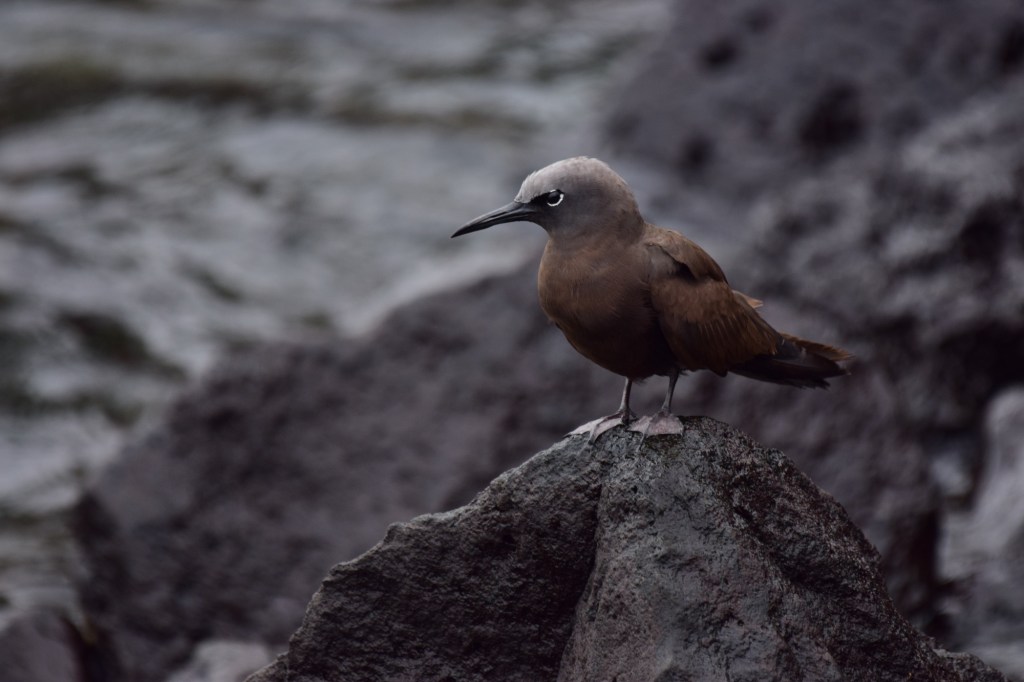
I picked up my snorkel gear from the Kingfisher GPS agency and walked back to the marina to meet my guide. Traveling with me today were a lesbian couple from California, a couple of American missionaries, their sister and her three children and a shy Australian birder. We were due to have one more on the team, but they never showed up – but at least while we waited I had time to get a better shot of the noddy sitting in the harbour, in the same place I saw it yesterday.
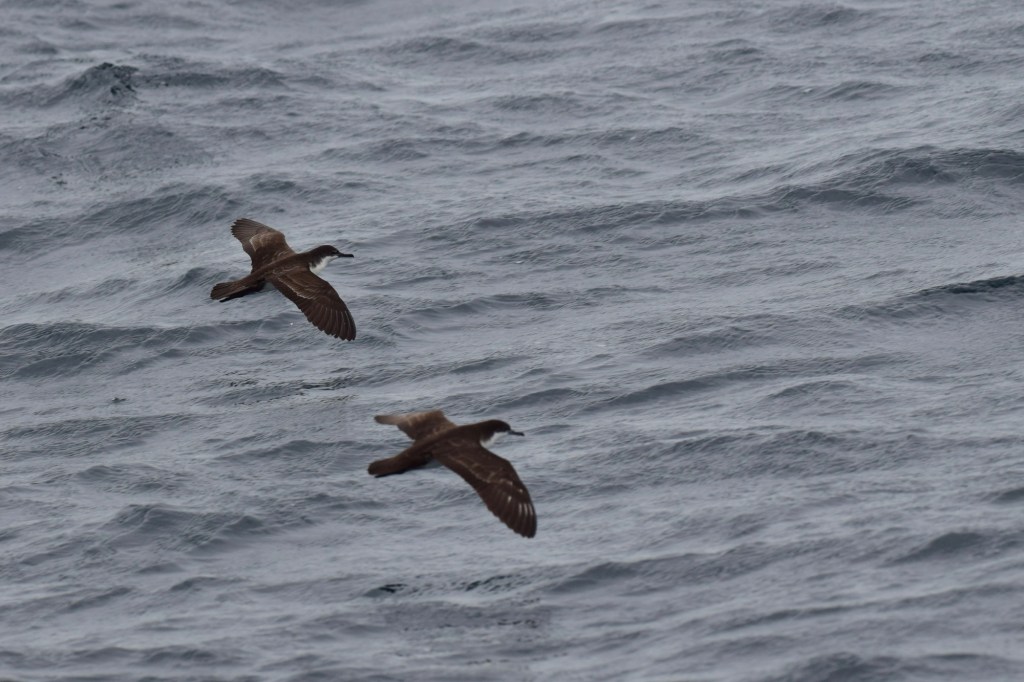
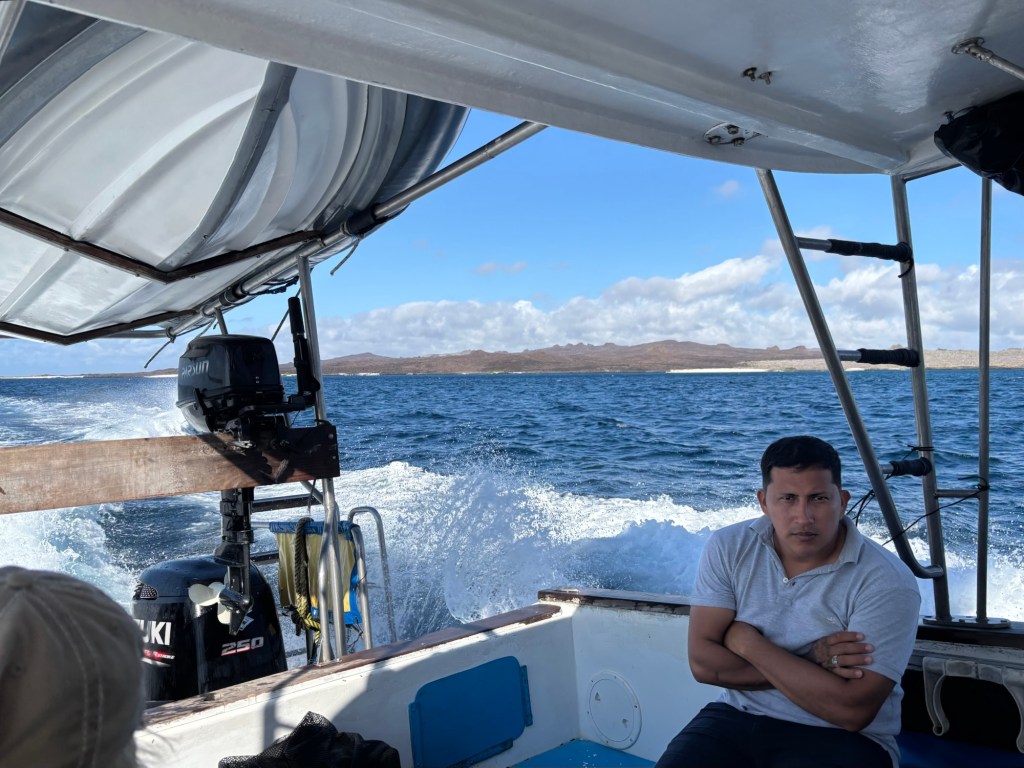
The journey to Punta Pitt from Puerto Baquerizo Moreno takes you all the way along the north coast of the island, and after passing the lighthouse at Punta Carola, it’s nothing but volcanic rock on one side and the open ocean on the other. Kicker Rock looms in the distance – a freestanding volcanic cliff famous for being the haunt of hammerhead sharks in the right season – but that wasn’t part of our itinerary, so we sailed on past. Beyond Kicker Rock, some of the Galapagos’ pelagic birds picked up our trail and followed the boat: Galapagos petrels, Galapagos shearwaters and two kinds of storm-petrel native to these waters.
I don’t believe in reincarnation, but if it did exist, I should love to come back as a shearwater. The speed with which they race across the water, seemingly delighting in the thrill of it… it’s magical to watch, even if they are in a mad hurry to find enough food to raise their chicks, sequestered in some burrow near or far away.
I was so busy keeping an eye out for seabirds that at least once I saw something else with wings leaping from the water: a flying fish, recently arrived in these islands, and just in time for the breeding season.
The weather looked unpredictable but the sea itself was a bit easier to read, so when we reached Islote Pitt, I made the decision not to enter the water. Sure, it was a waste of $30 on the rental GoPro, but I know I made the right call. Even the guide upon his return admitted grimly that the conditions were awful. The water was cold, choppy in the extreme and visibility was limited to about 10cm. Those that did take a dip said they’d managed to see a couple of sergeant majors, but that was about it. The qualified divers had a bit more luck with some eagle rays, but even they confessed that it was a hard and relatively fruitless dive.
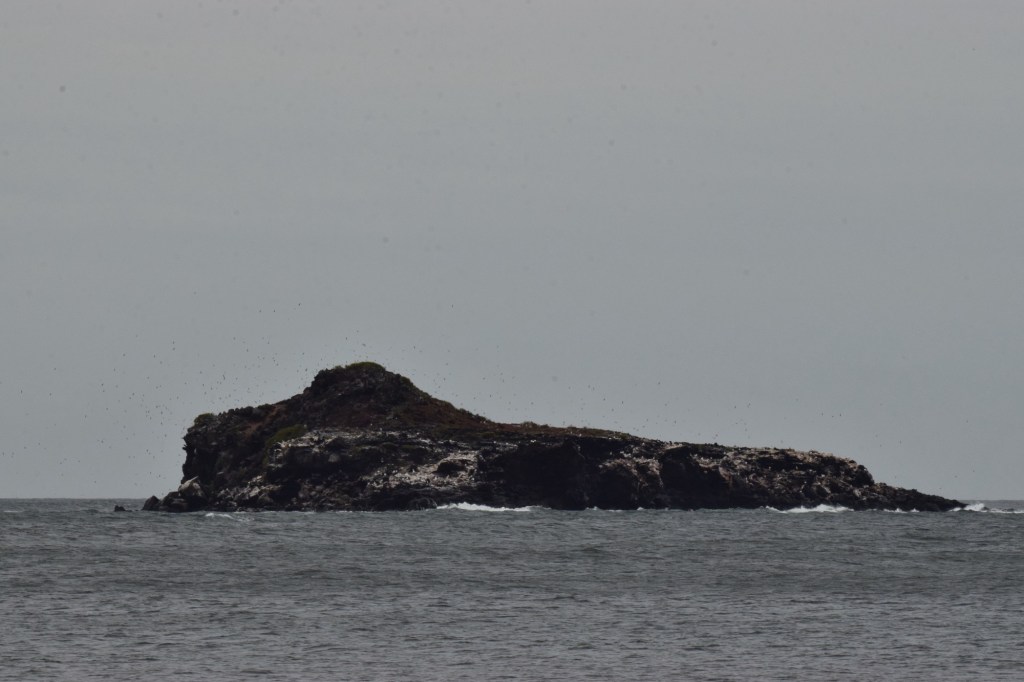
I, on the other hand, was having a whale of a time. Islote Pitt is home to a ridiculous quantity of endemic species, including both Elliot’s and wedge-tailed storm-petrels, Galápagos shearwaters and swallow-tailed gulls – the only nocturnal gulls in the world. I’m used to seeing storm-petrels at a distance, zooming across the surface of the open ocean and next to impossible to track with a camera, but I’ve never seen a colony before.
I’ve seen a lot of South American gulls on this trip: kelp gulls, dolphin gulls, grey gulls and lava gulls, to be precise. But swallow-tailed gulls are really rather special. Whether it’s their white wings and silver mantle, or the smart red ring around their eyes, or even their eerily haunting cry, they’re simply unlike any other gull I’ve ever seen.
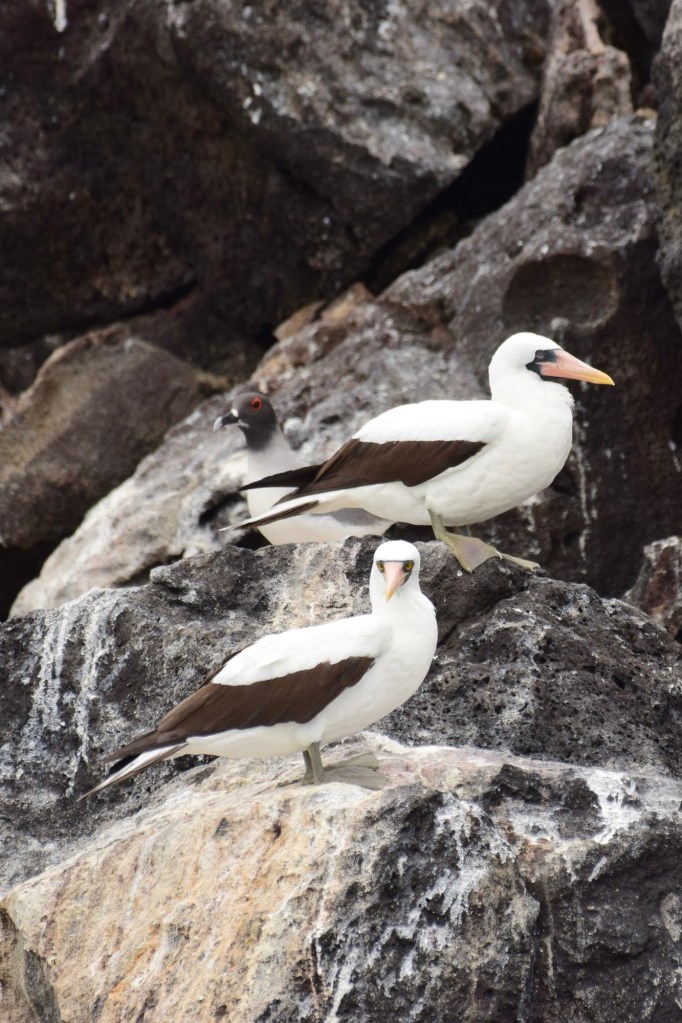
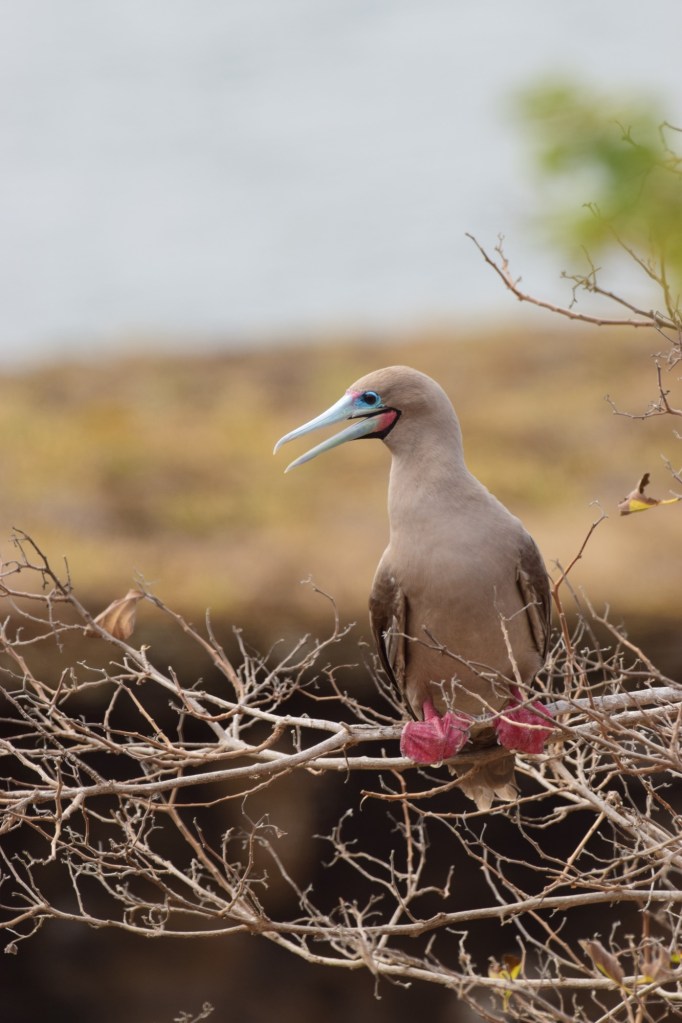
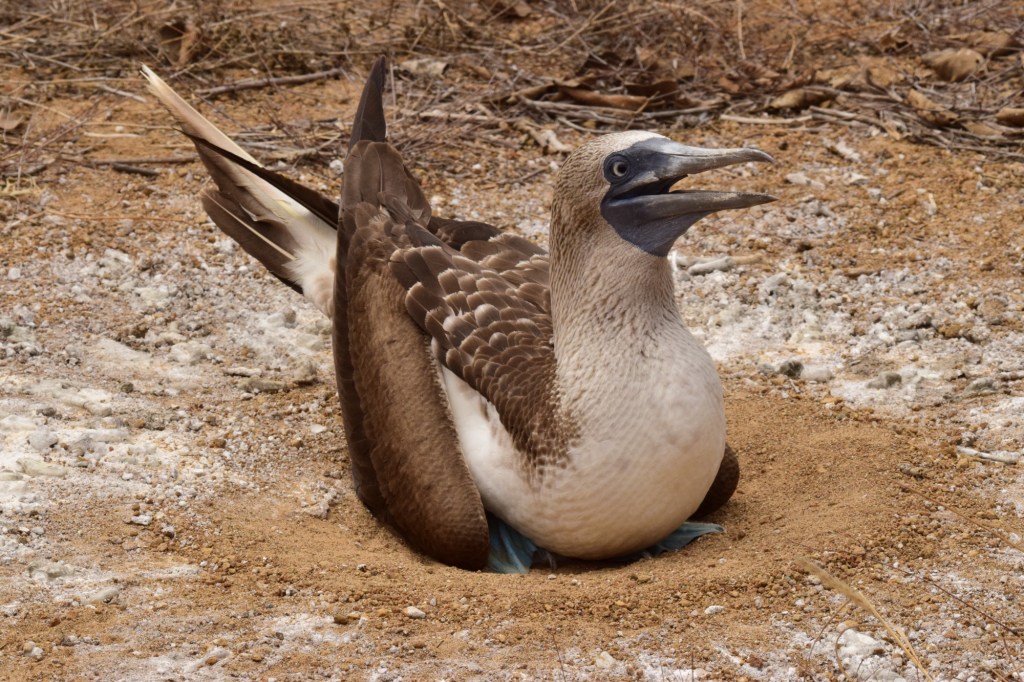
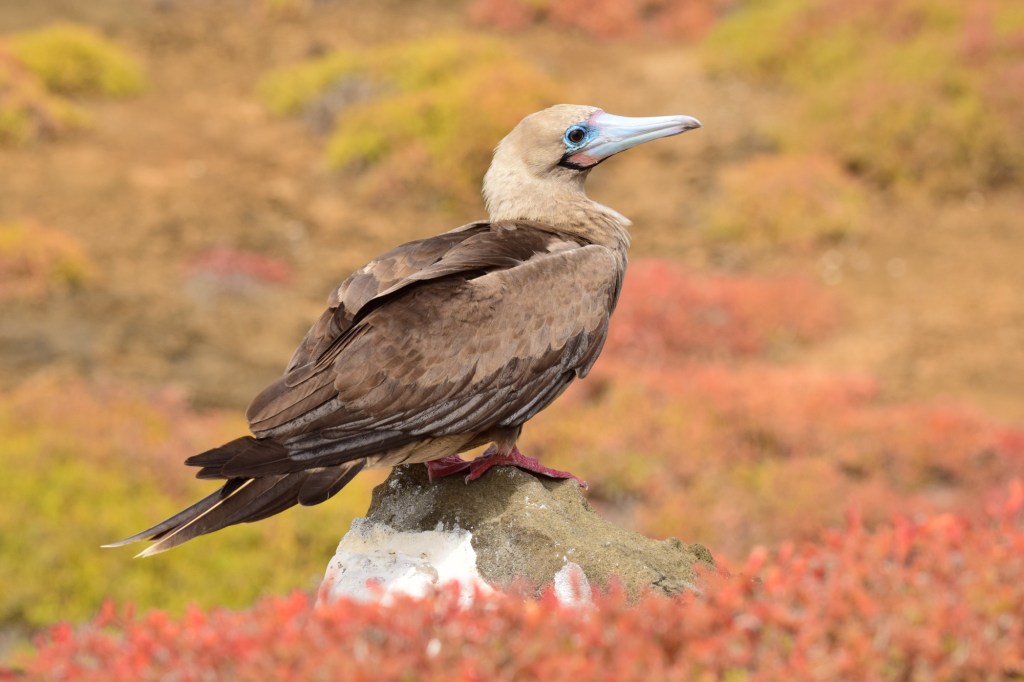
Punta Pitt’s major claim to fame (as well as the explanation behind the title) is that it is the only place in the Galápagos Islands where all three species of booby can be found together. Each one nests in a different spot: blue-footed boobies on the ground, red-footed boobies in the trees and Nazca boobies on the cliffs.
The Nazca boobies at Punta Pitt itself nest on a cliff some distance from the path at the point itself, so your best views would be at Islote Pitt, which is home to an enormous colony of the handsome seabird, alongside the frigatebirds, swallow-tailed gulls and a legion of storm petrels.
The hike up into the cliffs from the cove at Punta Pitt takes you deep into the volcanic coastline, up a tree-lined gully that becomes a torrent in times of severe rainfall. You’ll encounter the most famous residents of Punta Pitt, the rare red-footed boobies, shortly before climbing the pass over to the other side: they’re hard to miss, as they nest right next to the path.
Boobies get their bright-coloured feet from their choice of diet, which seems to be an evolutionary choice in the race to find a mate. Red-footed boobies primarily hunt squid and flying fish, both rich in carotenoids, which gives them their red colouring; blue-footed boobies are after the same nutrients, but their choice of catch – sardines – gives them a wholly different colouration. The brighter the feet, the more successful the bird is at finding a mate.
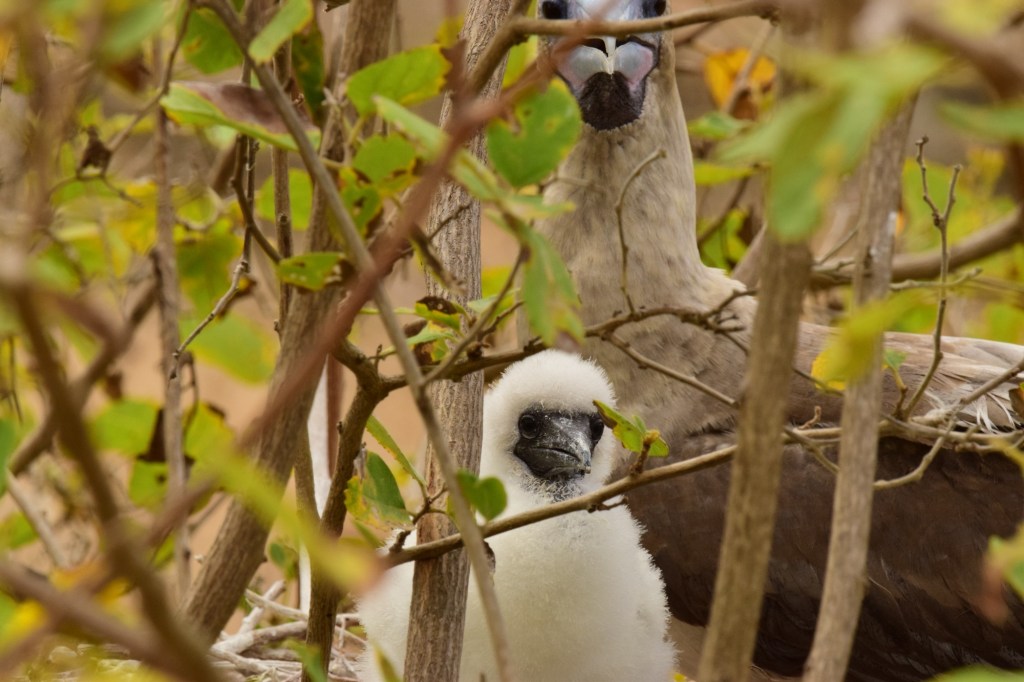
In August, the breeding season is already well under way, with some early partners already feeding large fluffy chicks. Others are still taking it in turns to incubate their eggs, with one partner flying in from a morning’s hunting to relieve the other on the nest.
For once, I was with a really respectful group of tourists. Once they worked out that the birds don’t like being approached too closely, they asked if we could keep our distance and move on so as not to disturb the birds further. Music to my ears!
Sometimes you didn’t have much choice but to be close, as their choice of nests catch you by surprise, in a scrape beside the path or tucked away in a tree in the middle of the road.
They’re not the only iconic Galápagos residents that breed at Punta Pitt. The enormous frigatebirds can be found here too, looking even more fluffy than the boobies, albeit at least twice the size.
Frigatebirds are absolutely enormous – you won’t truly appreciate just how big they are until you see them for yourself. Using their swallow-like forked tail as a rudder, opening and closing their streamers to steer in the wind, they are masters of the air, perfectly designed for outspeeding the boobies and robbing them of their fish, which I have been lucky enough to witness.
I also saw a beautiful angel of a seabird here: a red-billed tropicbird, all white with long streamers and a bright red bill. They’re small – tern size at best – and nest in crevices in the cliffs that are impossible to reach, so you won’t see them as well as the other denizens of Punta Pitt, but it was quite a sight to see as it set out to sea to go fishing.
The red-footed boobies come in two colours: a white morph – more common in the western Pacific – and a coffee-coloured brown morph which is more easily found here in the Galapagos. The two morphs are totally interchangeable and cross-breed from time to time: for the ladies, it’s not about the colour of their feathers but the brightness of their feet.
After a solid two hour hike up into the cliffs, we left the boobies and their ramshackle nests and climbed back down to the beach where we landed. While the captain’s boy ferried us back to the boat on a small skiff, the local sea lion alpha was busy defending his territory, chasing off a rival male that had just arrived on the beach.
I overheard a family of Americans in Puerto Baquerizo Moreno watching the sea lions lazing around the port and saying how easy life must be for them. For the dominant male, it couldn’t be further from the truth. From the moment he assumed command, he cannot hunt, eat or sleep, patrolling his territory constantly and fighting off suitors as they come. This is, of course, extremely debilitating, leaving them physically weakened after nearly a month without food, but there are cases of individual alpha males returning to reclaim their harem up to three times in a single season. So when you hear the endless barking that is such a part of the soundscape of Puerto Baquerizo Moreno, remember how long it might have been since the males have been able to eat. For sea lions, the urge to mate simply outweighs all other options on the table, including eating and sleeping.
The boat ride back to Puerto Baquerizo takes a lot less time as you ride the fast-moving current back, shaving a whole hour off the journey. In the middle of the day, there’s not as much to see either, so most of my companions fell asleep, aided by those curious neck-braces with built-in fans that I saw some colleagues wearing back home during the June heatwave.
Samuel, our guide, was keen to know how long I’d be here. I told him how last minute this whole operation was, and that I’d more or less given up on Española with no news from the folks at EcoChallenger. He said he’d ask around – after all, it’s not the agencies here that conduct the tours but rather the guides and their attendant boatmen. The agencies merely act as middlemen, sending a certain quota to the actual operators down in the harbour. So who knows? Maybe I’ll get to go to Española after all. either way, I’m glad I opted for Punta Pitt – it was absolutely incredible.
I’ll get an early night and have a quieter day tomorrow. I could do with some time to put the snorkeling mask to good use. I hear the bay where I saw the turtles is an almost guaranteed spot to see them year-round, so I think I’ll go there first if the weather is kind. It’s usually rainy and cloudy in the mornings and then sunny in the afternoons here, which is an easy enough pattern to follow.
Puerto Baquerizo Moreno, Galápagos Islands. 04.57.
I woke up to the sound of the waves this morning. Well, I suppose morning is a stretch, since the clock on my bedside table said ten past four. I must have passed out around eight last night, beaten down by the lack of sleep on the plane and lulled into a Pacific lullaby by the sea. I can think of worse ways to spend a summer.
The garúa rolled in off the mainland last night, bringing with it relieving cloud and gentle rain. A passing shower came and went a few minutes back, but now it’s just the tap-tap sound of the lingering raindrops falling onto the roof of my cabin from the giant daisy tree.
There’s no point going back to sleep now, so I’ll spend some time writing up yesterday’s account of my first day on San Cristóbal.
The magic begins as soon as you’ve left the airport. Technically before, I suppose, since I could see the sharp-angled silhouettes of the island’s frigatebirds well before we landed. Outside the terminal, it’s a ten minute walk to the centre of Puerto Baquerizo Moreno, the largest settlement on San Cristóbal.
Three of Darwin’s keys can be found right next to the terminal building: small and medium ground finches, of evolutionary fame, and one of the island’s endemic species, the San Cristóbal mockingbird. It’s this last that’s especially important, as Darwin didn’t realise the significance of the finches until after he’d departed from the islands, but he did notice that the mockingbirds on each island were different in some way.
Like so many creatures on these islands, they are completely unfazed by the presence of man. They have a funny way of walking, with their cocked tail wagging from side to side. If I were a scientist, I might have called them metronomebirds for this singularly odd gait.
Most of the other travellers piled into taxis outside the terminal, which seemed a bit ridiculous, given just how close the town is to the airport, but I guess some habits die hard. I was quite happy pottering about with the ground finches. It’s not often you get to spend time with a species that literally changed the way we think about our place in the world.
The first thing you notice is the sea lions. They are absolutely everywhere. If you can’t see them, you can certainly hear them: that cartoonist arf arf arf you associate with children’s TV carries for quite some distance.
They don’t stick to the beach, either. A large number of them seek out shadier spots on the seafront parade, dozing quite carelessly on roads, park benches and boardwalks. It’s pupping season, so there’s no shortage of pups in varying stages of development sticking close to their mothers. I’d suggest giving them a wide berth – you never know where the bull might be.
In this case, I did know where the bull was – because he was announcing his presence every minute or so with that barking call, as though to remind everyone in the vicinity that the harem on the beach was his and his alone. Which, I suppose, is close to the truth.
You can tell the bulls apart from their size – nearly a third larger than the females – and the significant boss on their heads. I also hadn’t noticed before the claws in their flippers, but you can get so close to the great sea beasts here on the islands that there’s hardly a detail that will pass you by.
I had to wait a little while before checking in to my cabin on the edge of town, just a stone’s throw from Playa Mann. At a glance, there seem to be a lot of people who come to these islands for the beaches. To a dyed-in-the-wool naturalist like me, that does somewhat feel like going to the Serengeti for a tan, but I’m far too happy to judge. Who could possibly turn away from a chance to see these spectacular islands, given the chance?
I took myself straight back down to the sea once I’d checked in and found two more Galápagos specialities almost immediately. I’ve been mad about Sally Lightfoot crabs since they turned up in a wildlife spotting book I won as a prize for a sunflower growing competition when I was a kid. We have crabs in the British isles, of course, but none nearly so colourful as the Sally Lightfoot. They’re everywhere here, ranging from dark green to sunset red, hugging the molten rocks along the surf line and leaping between boulders with surprising agility.
The other specialty is a real treasure of the Galápagos, arguably as iconic as the giant tortoises that gave the islands their name. Marine iguanas, a short-faced ocean-going variant of the green giants found on the mainland, are often described as “ugly”, perhaps on account of Darwin’s first description of the creatures. Certainly, their patchy salt-washed skin and snub faces make them strange-looking beasts, and they’re not nearly as active as the sea lions as they soak up the sun on the beachfront, but they are tremendously interesting creatures.
Around midday, it gets rather hot here on San Cristóbal. Not unbearably so, but the humidity doesn’t help. I found a night heron sheltering from the heat in the shadow of the rocks earlier, and when I returned, it was sunning itself in a posture I haven’t seen in herons before.
A smaller heron was lurking among the boulders nearby: a lava heron, an island variant of the striated heron that can be found all the way up and down the coasts of the Americas. It was mesmerised by the dragonflies hawking over the beach, tilting its sharp beak and golden eyes every time one came close. I didn’t stick around long enough to see if it caught one.
After sorting out my snorkel gear for tomorrow’s expedition to Punta Pitt, I made for Cerro Tijeretas, a promontory to the north of town known as Frigatebird Hill. I passed a large Dutch contingent and a couple of Germans looking for a mockingbird, but other than that, I had the trail pretty much to myself. The Galápagos aren’t like Manu – you aren’t going to be tripping over a new species every few steps – but the encounters you do have with the island natives are more than a match in their total lack of fear. I found a Galápagos flycatcher hunting by the boardwalk and spent most of the afternoon followed by warblers.
From the top of the hill, you get a spectacular view out across the island to the east, all the way to the cliffs of Punta Pitt. The bay beneath Cerro Tijeretas seems to be a popular snorkelling spot, and I can see why. One shape drifting in the water seemed to the naked eye to be too compact to be human, but too mobile to be a rock, so I turned my lens on it to confirm my suspicions: a green turtle, one of a number that can be found around these islands. I’ve brought my own snorkelling mask so I’ll have to check this place out sometime, when it’s quieter, maybe.
I didn’t make it as far as Playa Baquerizo, which really is a proper hike from town, across several kilometres of molten rock and daisy trees, so I’ll have to check it out later. Instead, I perched myself on a boulder and watched the sunset in a beach I had to myself. Noddies dancing across the surface of the water. Boobies hunting offshore. Frigatebirds wheeling above the bay on those vast black wings. This really is a paradise like few others. I hope for the islands’ sake it remains that way.
It’s nearly seven o’clock. It’s light now, and the island is covered by a merciful blanket of cloud. There are birds called outside but Merlin is struggling to identify them. That may have something to do with the generator that keeps clicking and whirring noisily outside. I’d better have a quick shower and then head out. I’ve rented a GoPro for today’s snorkelling adventures, but there’s also likely to be a heck of a lot to see at Punta Pitt itself, so watch this space! BB x
Aeropuerto de San Cristóbal, Puerto Baquerizo Moreno. 10.55.
When I was just a kid, there were a few things I already knew wanted to achieve in life. I wanted to fall in love and have a family, write stories and, one day, go to some of the places I used to see on wildlife documentaries like Blue Planet, Land of the Tiger and Natural World. All of those dreams are still with me, but today, one of them comes true.
One destination in particular was a prize beyond all others, especially considering I was much more into reptiles back then than any other creature. A destination so remote and so wild that the animals that live there have little to no fear of man, despite centuries of visitors and worldwide fame. A volcanic archipelago that inspired a certain British naturalist to design one of the most revolutionary scientific theories of all time. A chain of islands named for their iconic, lumbering residents, some of which patrol the same corner of their highland world since they hatched in the early 1900s.
I’m talking, of course, about the Galápagos Islands. Here I am at last, about to embark on an adventure twenty-four years in the making. Here I am – and here we go!
Now that the secret is out of the bag, I can stop speaking in riddles!
I slept for at least part of the flight from Santiago to Guayaquil. I must have done, at least, because I don’t remember it feeling like a five hour flight at all. I woke up here and there, usually at opportune times such as when the flight crew came down the aisle with water and an in-flight snack of diced fruit and chocolate, but after sleeping little the night before, I think my fatigue got the better of me – and just as well! I don’t think I’ll want to miss even a second of my time on the islands for something as trivial as sleep.
Ecuador is one of the birdwatching capitals of the world, but I’m no lister, so I don’t begrudge my brief pit stop being limited to the interior of Guayaquil Airport. All the same, there’s a lot to be seen from the ceiling-high windows on the south side, near the KFC. I’d seen tanagers, hummingbirds and kingbirds before, but the cuckoo-like anis that live in the palm grove beside the departures lounge are a lot of fun to observe, as are the long-tailed grackles with which they share the scrub.
Now – logistics. Traveling to the Galapagos with a tour company may mean a lot of the admin is done for you, but if you, like me, prefer to strike out alone and do it yourself – which really does keep the costs down – you’re going to want to do a couple of things before leaving Guayaquil.
Make sure you have US dollars in hand – $200 at the very least for the island entry fee for foreign tourists, which must be paid in cash immediately upon arrival at the airport on the islands. If you have large denominations, now is the time to use them, as you’ll need smaller bills for day-to-day expenses around the Galapagos. There are ATMs in the major ports, but they have a reputation for running out, so having a float of ready cash is vital. There’s an ATM in the south corner of the terminal, between the KFC and the Salidas Nacionales door.
Before going through security (via the Salidas Nacionales door on the south side of the airport), make sure you go to the check-in desk that says “Tourists traveling to Galápagos Islands”. You can’t miss it – it’s the one in the middle with the big queues of gringos. You’ll need to queue twice for two different mandatory pre-flight checks.
Make sure you fill out the TCT (Tarjeta de control de tránsito), also known as the Tourist Transit Card, before you go through security. It costs $20, but there is a small surcharge for doing it online. Select “pay at airport”, use some of the dollars you’ve picked up and dodge the online fee.
Once you have your TCT, you also need to fill out a separate form declaring you’re not bringing any illegal goods onto the island. Processed food and plants come under that bracket, so polish off any snacks before you leave. It’s the islands and their wildlife that are at stake if you don’t. When you have the form in hand (or on your phone), join the queue to run your bags through the scanner. Once you’re clear to go, that’s it for the checks.
August is the tail end of high season in the Galapagos, or so I’ve been lead to believe. However, the 9.17am flight to San Cristobal was one of the emptier flights I’ve taken on my travels in South America, so despite skimping on seat reservation and being assigned an aisle seat, there was nobody else on my row at all – or the two in front, come to that – so I landed a window spot after all. Result!
Given the magnitude of what’s coming, I’ll leave it there for today’s post and fall into line one day behind, which should give me the breathing room I need to write each day without racing against the clock. So come back tomorrow to find out about my first day on the island of San Cristóbal, easternmost of the Galápagos Islands! BB x
I grew up within sight of the sea. You’re never far from the sea in Kent: the furthest I ever lived from the coast was about ten miles as the crow flies, while the second half of my childhood was spent less than a mile from the white cliffs of Dover. As such, I am very attached to the sea and all its smells and sounds: the salt spray of the winter waves, the hushing rush of pebbles pulled down the beach by the tide and the cry of the herring gull. If I should be so lucky, one day, I should like to live by the sea.
Today I took that lifelong love for the sea and dialled it up a notch by taking a pelagic trip out into the Pacific – into the open ocean.
Rodrigo, my guide for the day, picked me up from outside my hostel in Valparaíso shortly after seven. A punctured tyre delayed him by forty minutes or so, so he was anxious to get going, so as not to hold up the crew of their ship up in Quintero, a seaside fishing town some thirty miles north of Valparaíso.
Shortly before we got there, the sun rose into a fiercely red sky. A certain old English saying came to mind:
Red sky at night, shepherd’s delight
Red sky in the morning, sailor’s warning
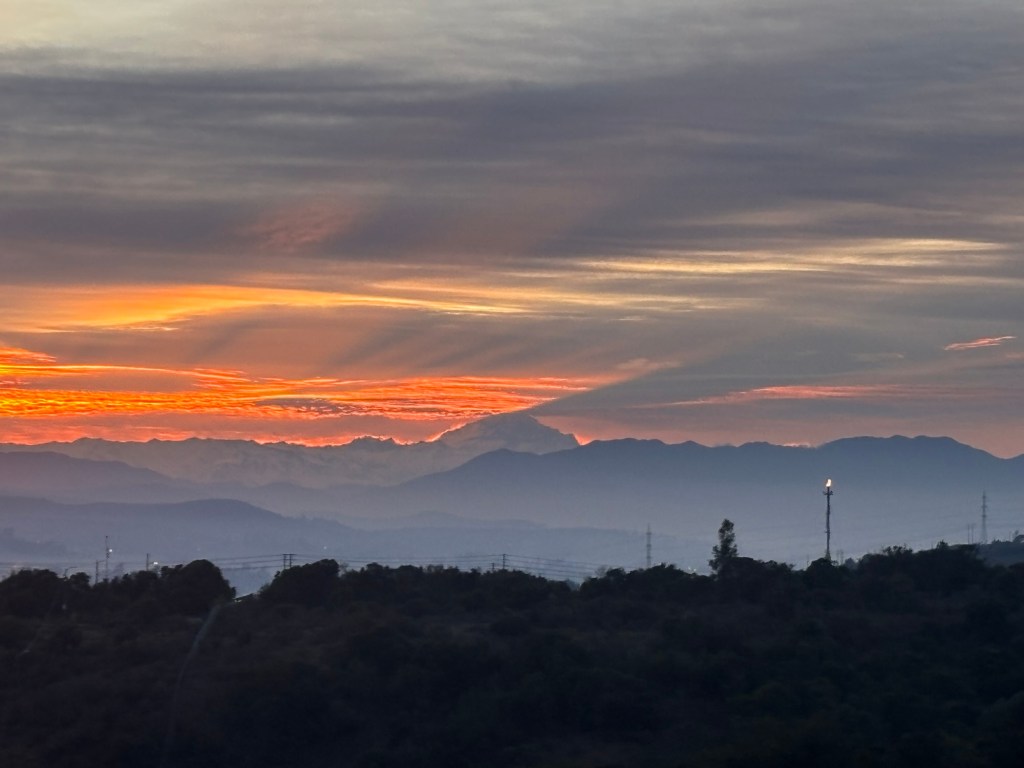
It was a beautiful sight, even if it did threaten rain. More spectacular, though, was a clear view of Aconcagua, the tallest mountain in all the Americas and the highest peak outside of Asia. The great white sentinel was so immense that by some trick of the light it seemed to throw the entire south of Chile into darkness. Apparently, only 30-40% attempts to scale Aconcagua are successful. The mountain is evidently as much an apu – a sacred mountain – as its better-known kin to the north of the cordillera, and not to be underestimated.
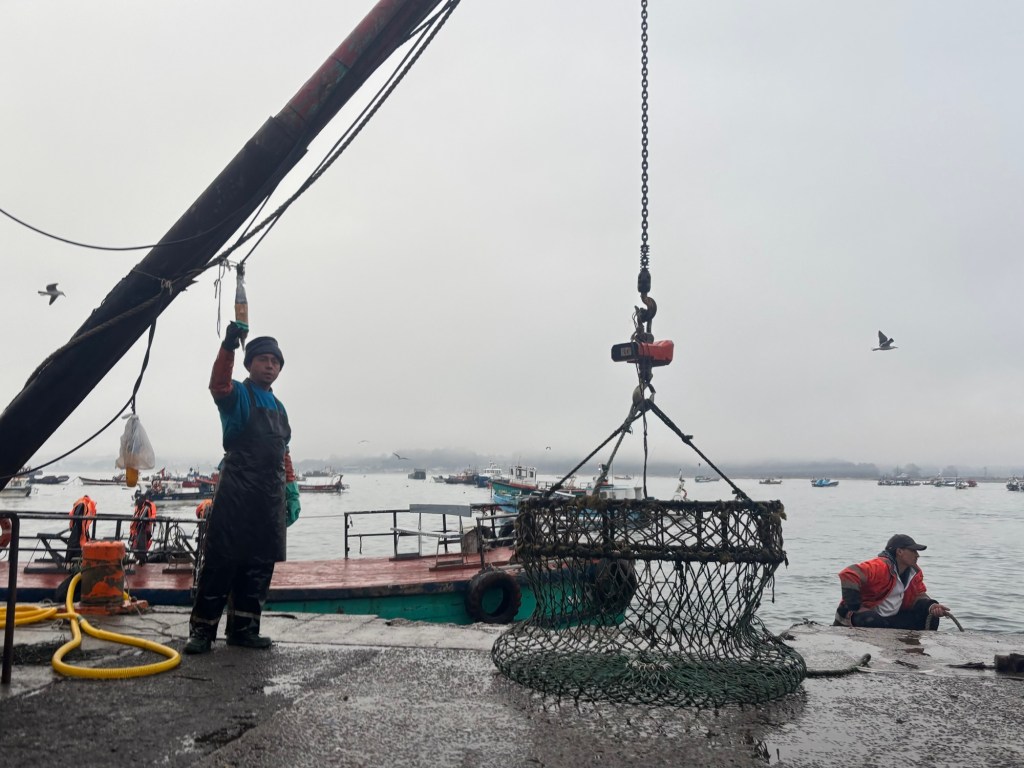
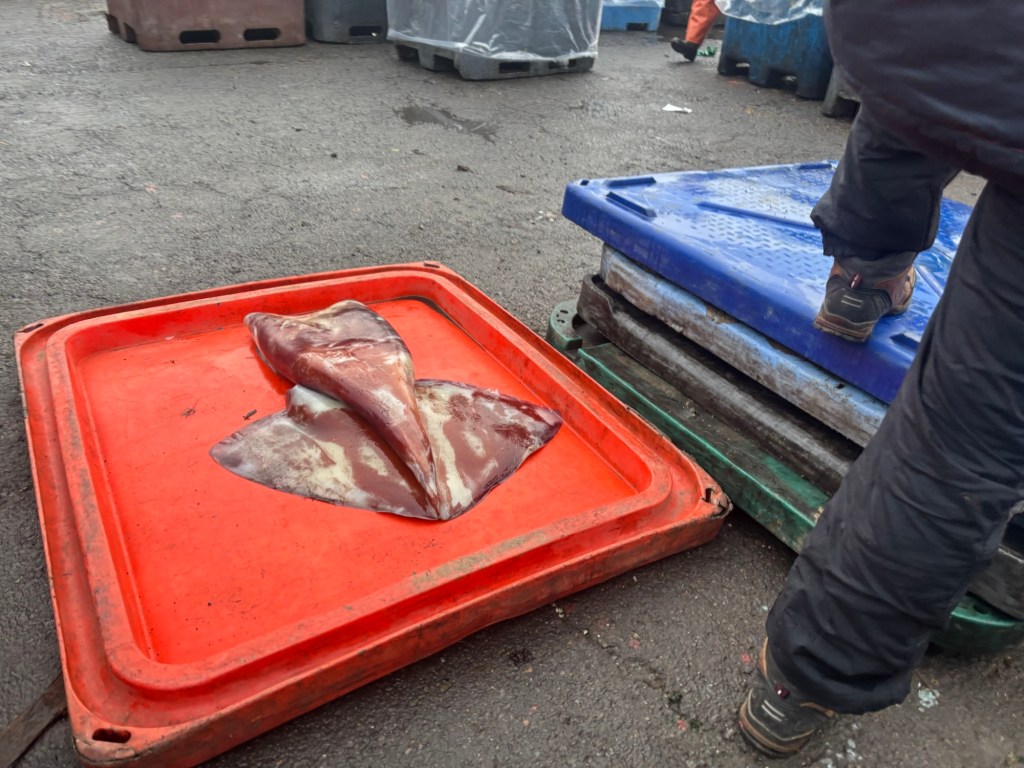
The local fishermen of Quintero were already hard at work as we arrived, slicing up some frighteningly large squid and cleaning their skiffs after a night out on the ocean. They seemed curious about the small group of day trippers herded onto a boat waiting in their harbour – all of them Chilean, with the exception of one wandering Briton – but paid us no more attention than the pelicans: a sort of intentional acknowledgement, as they went about their work.
I couldn’t help being totally bowled over by the frighteningly large squid laid out in the fishery. Humboldt squid – or jibia as they’re known in Chile – are among the largest squid species in the world, reaching a whopping five feet in length. They’re so numerous along the coast of the Americas that they represent a third of the squid catch worldwide – and despite the fact that nearly two thousand tons of them are hunted in Chile alone every year, their population is still expanding. That’s a testament to just how rich the Humboldt current truly is. It’s also why Chile has always been home to a healthy population of sperm whales, who devour these and even larger prey, including arguably the most famous whale of all time: Mocha Dick, an aggressive and exceptionally cunning albino sperm whale who survived nearly a hundred attempts on his life before being brought down off Mocha Island. His story inspired Herman Melville to write the American classic Moby Dick, but it’s the original tale that is taught here in Chile as part of the national identity-building curriculum. How cool is that?
We left the harbour – with its attendant sea lions and pelicans – and started out on the hour’s journey out into the open ocean. For most of that first hour, we were tailed by kelp gulls – Chile’s ubiquitous answer to the herring gull – and strange shapes in the water, many of which turned out to be discarded bottles or cans floating eternally along the Humboldt. I counted at least four Fanta bottles and two bicycle tyres, the latter floating nearly side by side. I wonder what happened to the bicycle itself?
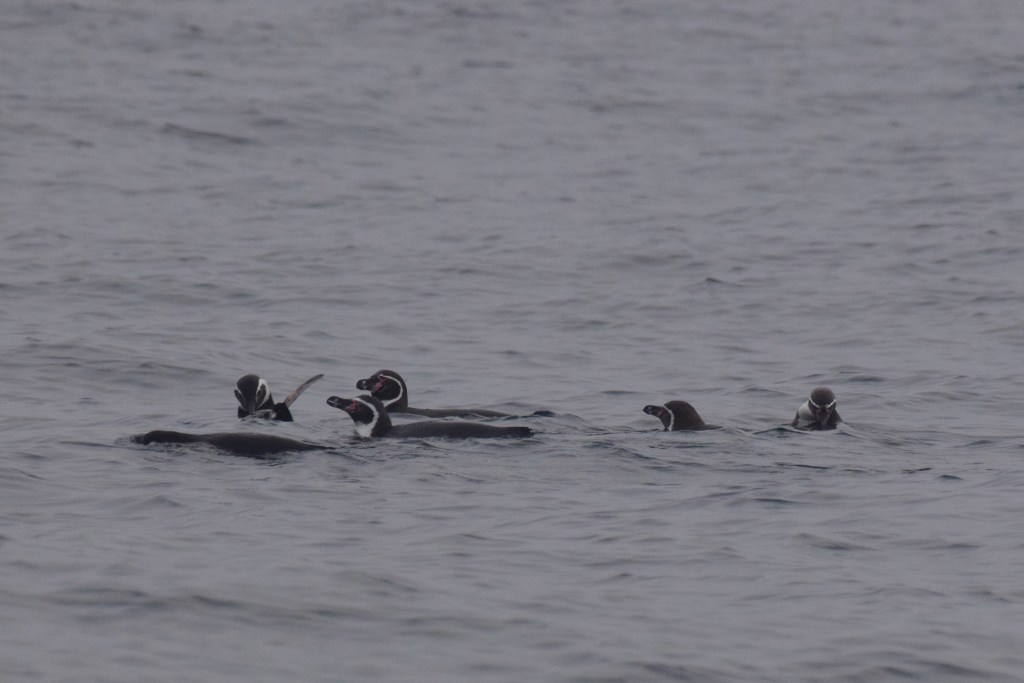
Some of the shapes moving along the surface of the water were a lot more interesting. A curious sea lion, a huala or great grebe fishing offshore, or a family of penguins, spending the winter at sea. Over the course of the morning we saw both species native to Chile: Humboldt penguins – the kind I saw in the Islas Ballestas in Peru – and Magellanic penguins, a more southerly species that have colonies right down to the Chilean Antarctic.
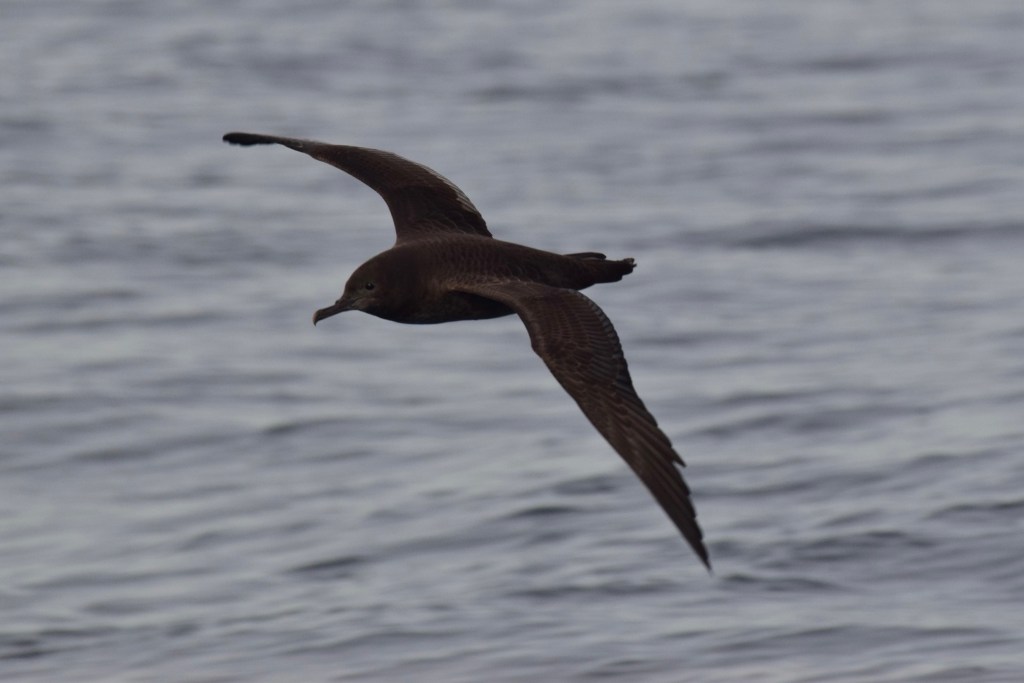
We didn’t have to go far from the harbour to see our first pelagic species of the morning. The first to make their appearance were the shearwaters, experts of the open ocean, zooming low over the surface of the water, banking this way and that. With the roll of the waves, they seemed to slice through the surface with the tips of their wings in the way that gave them their name, though I swear I never saw them touch the water once.
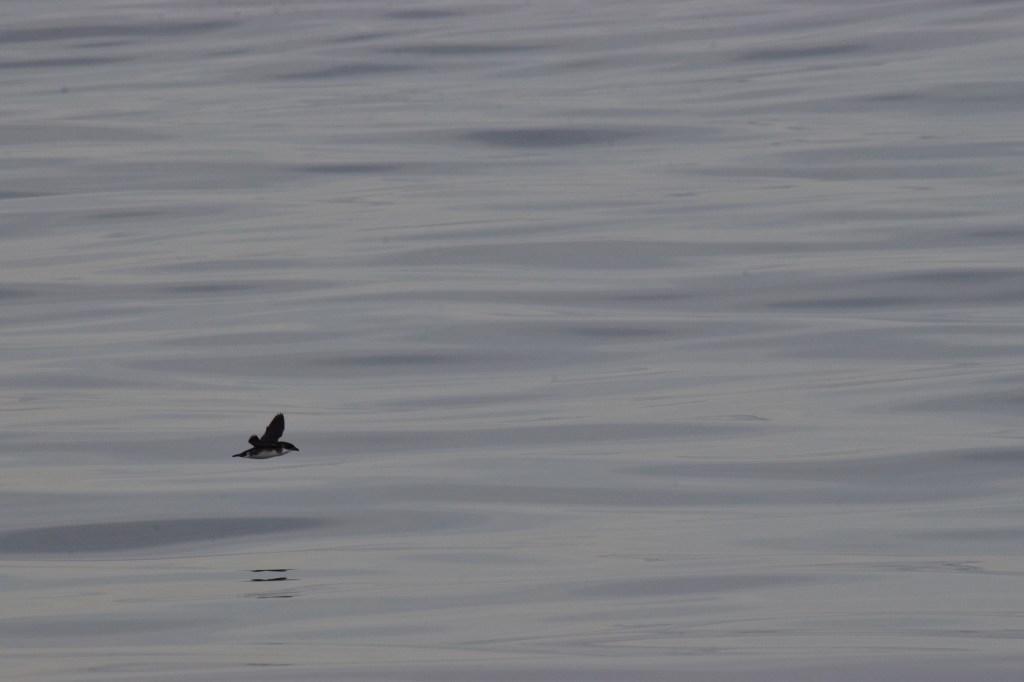
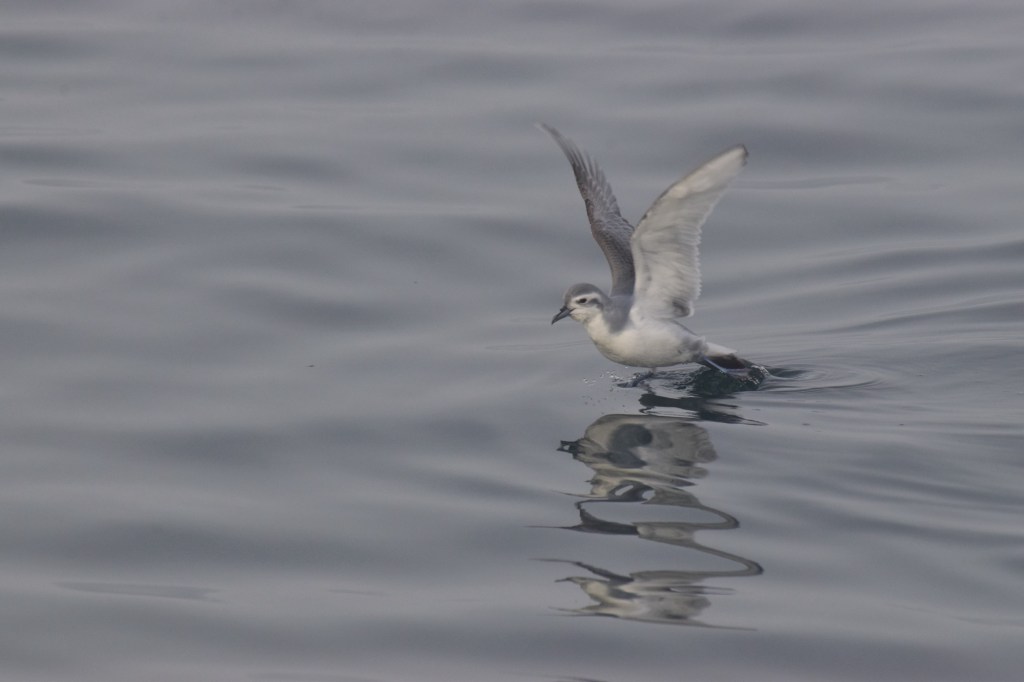
In the descending gloom, they were hard to catch on camera. A little easier were the diving-petrels, tiny auk-like birds that preferred to paddle away from the boat, popping in and out of sight beneath the waves in the habit for which I suppose they were named.
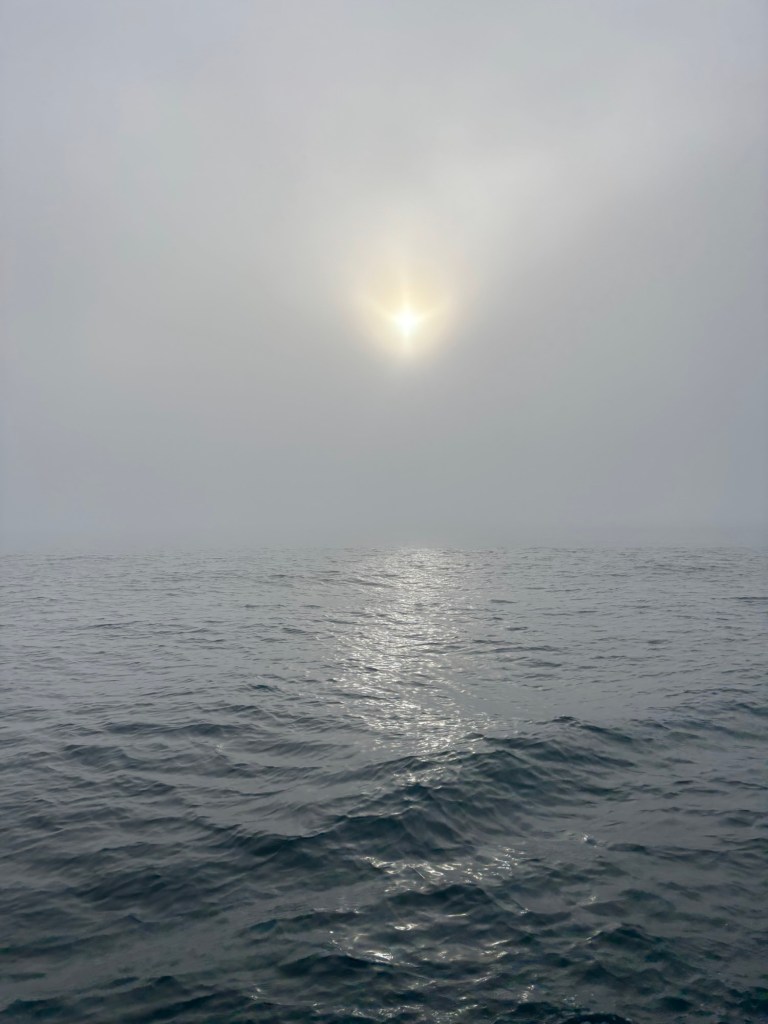
As the rocky headland of Quintero faded into the mist, we were almost entirely enveloped. This dense sea mist is one of the reasons there haven’t been any pelagic tours since April: if the visibility is this poor, the harbour doesn’t let ships out into the open ocean, lest they become lost, disoriented by the waves – or worse, collide with another ship.
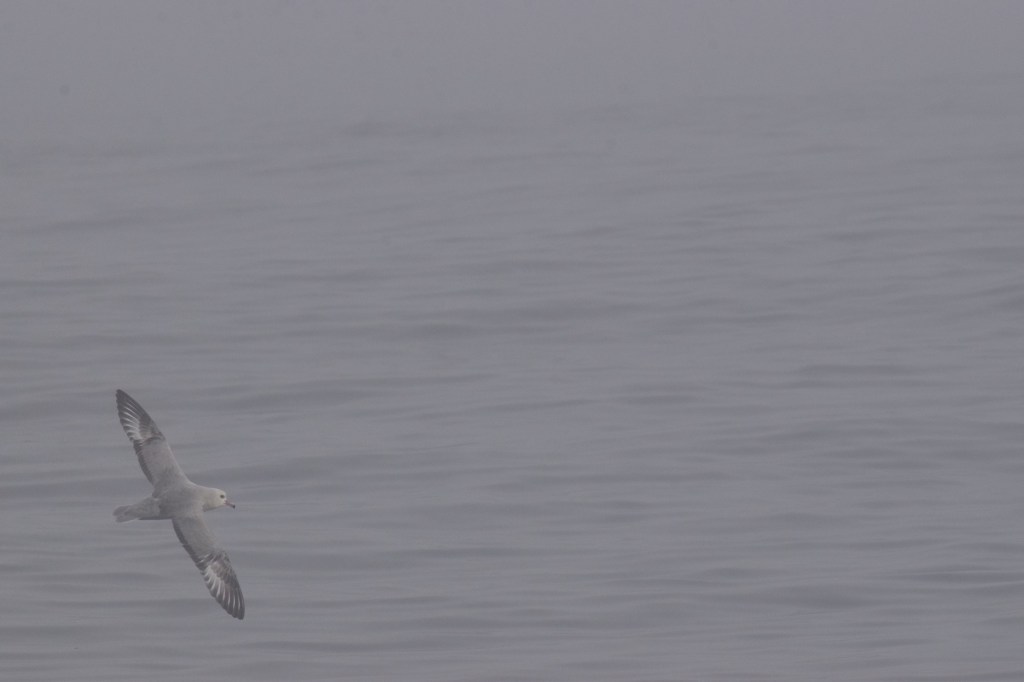
Only the fulmars kept us company in the mist, slicing through the fog on silver wings.
After what must have been an hour, the first sign of relief began to glow in the east: the sun, clear of the mountains and their attendant clouds at last, was trying to fight its way through the fog. Curiously, some trick of the light warped its shape into something that looked like a cross or perhaps even an angel with arms outstretched. It’s so easy to see how legends could form in such a strange and unsettling space as the open ocean, in a time when there was so much less knowledge and so much more wonder in the world.
As the mist began to clear, we reached the feeding grounds of the open ocean. There were plenty of shearwaters around, mostly sooties – a dainty species of southern waters that can sometimes be seen as far north as the British Isles on their wanderings. But this is their home, off the southern coast of the Americas, and there were plenty enough of them to prove it.
A young lad on the crew lifted the lid on one of the chum buckets – fish heads and squid tentacles, mostly – and threw some into the water for the birds that had followed us so patiently. They were watchful, at first, as wild things should be, but once the kelp gulls cottoned on, the shearwaters lost their timidity.
One bird I had not expected to encounter at all was a prion – known around here as a paloma marina or sea dove. These Antarctic birds had been driven north by weather currents in the South Seas, by the looks of things, and it was a real delight to watch them bobbing around beside the boat, dipping their heads beneath the water in a constant, frantic search for food.
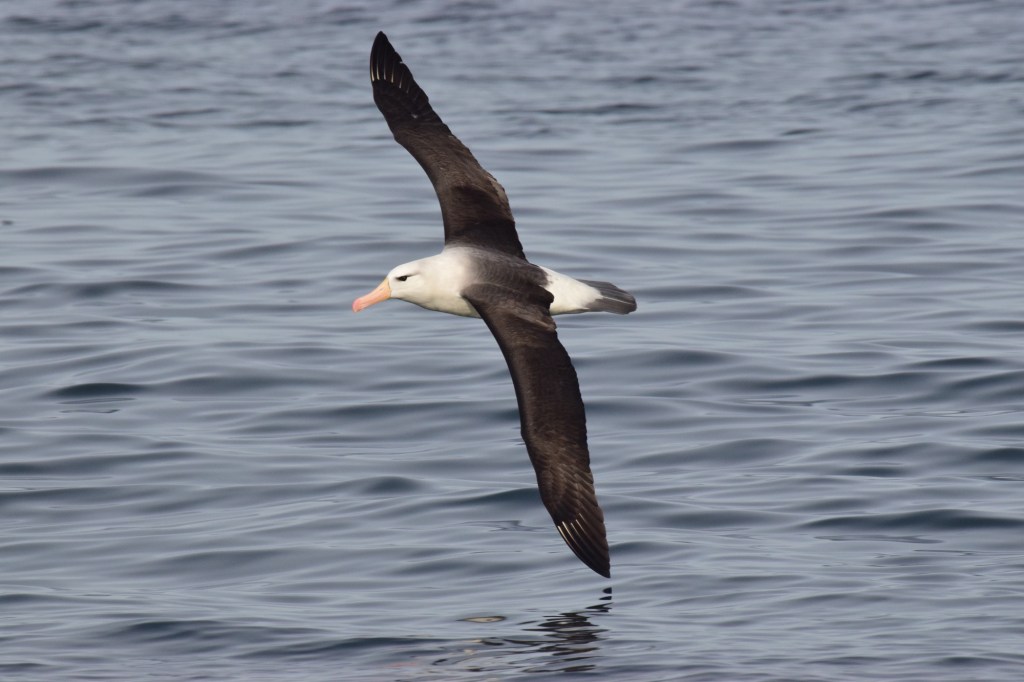
The real prize of the open ocean took its time. A cry of “albatross” from the captain (one Chilean bird whose name is seemingly universal) drew our attention to an enormous shape gliding through the mist behind the boat. It was there for a moment and then it was gone.
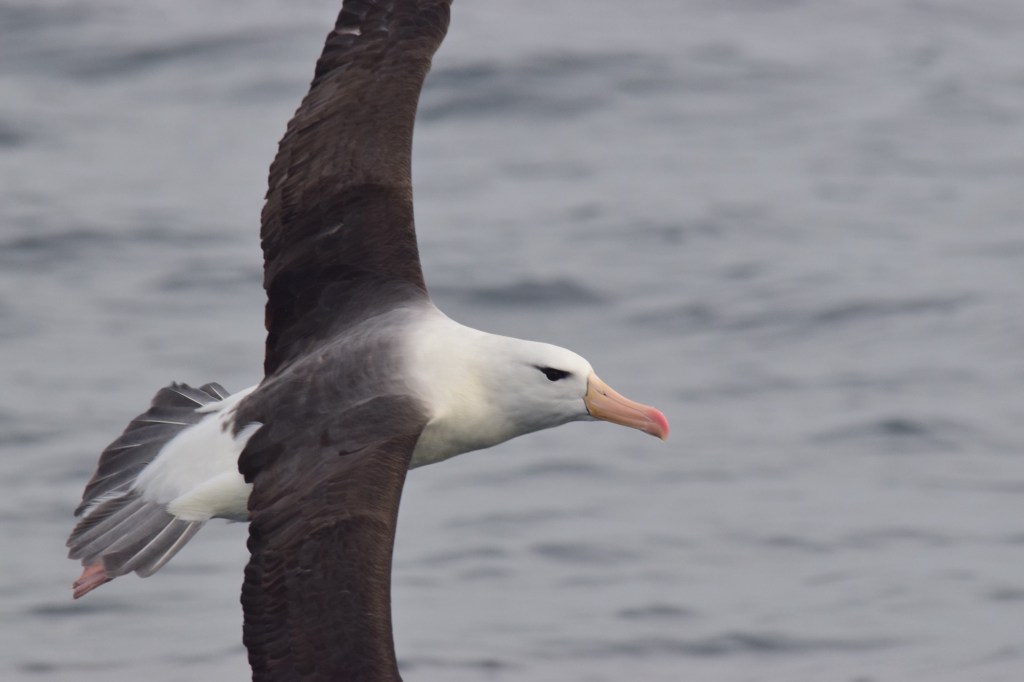
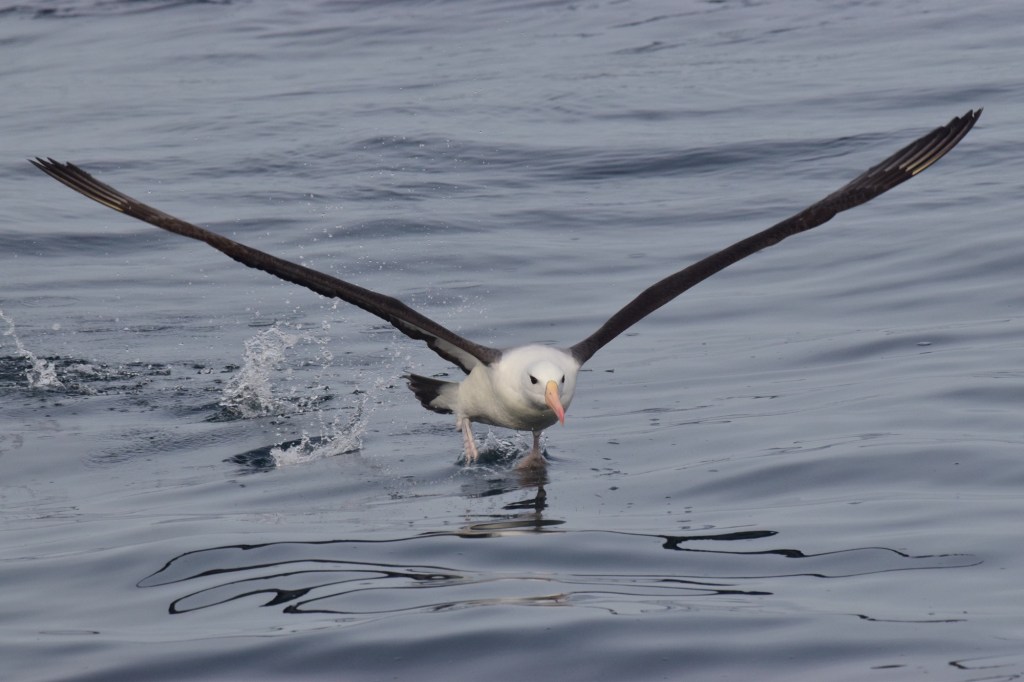
A few minutes later, one of the crew spotted it again. The giant – a black-browed albatross, and presumably the same individual – must have caught the scent of the chum and was following the boat at an increasingly shorter distance, arcing across the water in the kind of wide waves that children do on bicycles when following something too slow for their liking.
In time, it seemed to lose all suspicion of us whatsoever and flew in incredibly close, so close that you could see the glint of sunlight on the tip of its bill.
One of the Chilean birdwatchers sitting at the back of the boat beside me remarked somewhat ruefully that he had seen far more activity in previous July expeditions. To him, the ocean was unnaturally quiet today.
I couldn’t have cared less. I was hoping to see one albatross, but I didn’t expect it to be so close, and so bloody impressive. They really are magnificent creatures.
The albatross is a perfect gliding machine. The only time they need to beat their enormous wings is upon takeoff, which is a somewhat clumsy affair requiring one heck of a run-up – although, when you consider that said run-up usually takes place on the surface of the water, that feat is all the more impressive. To aid them in this endeavour, their webbed feet are absolutely enormous, giving them serious launching power as they race across the waves. Once airborne, they can glide for hours, riding the wind on wings that have evolved to make them the true masters of the open ocean.
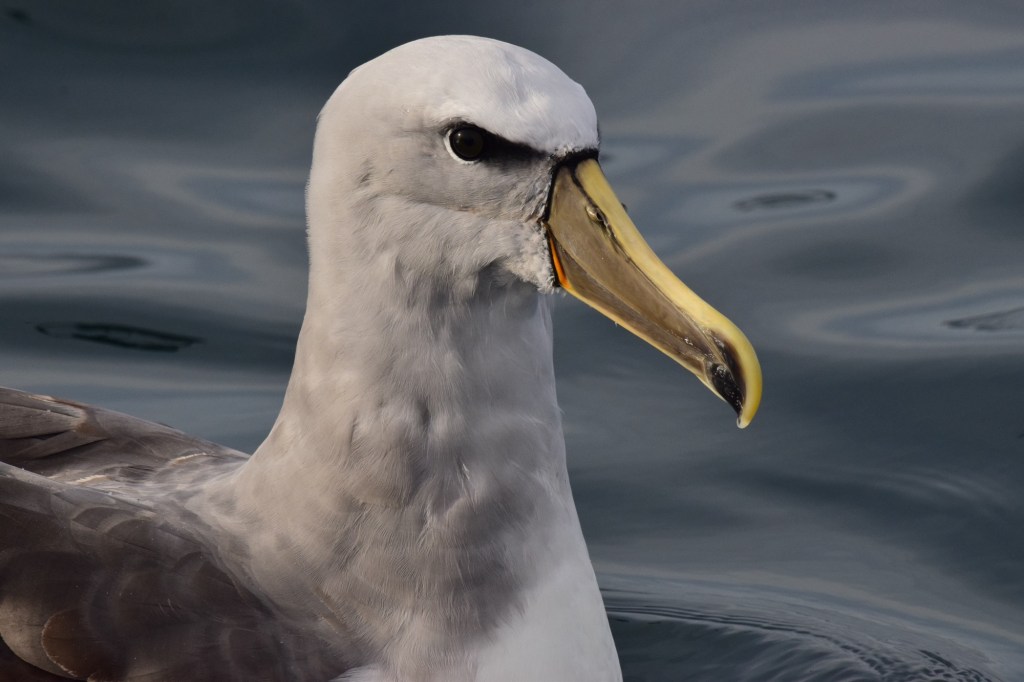
As the scent of chum in the water drew more and more seabirds, other species began to appear. There was much activity on the boat when a Salvin’s albatross came riding in to join the bounty: a larger, greyer species with a smart yellow lining to its bill. Like the black-browed, its eyes sit beneath a dark shadow, giving the peaceable bird a perpetual frown – though it looked stern enough when it came charging in to chase the other gulls away from the discarded fish heads thrown overboard.
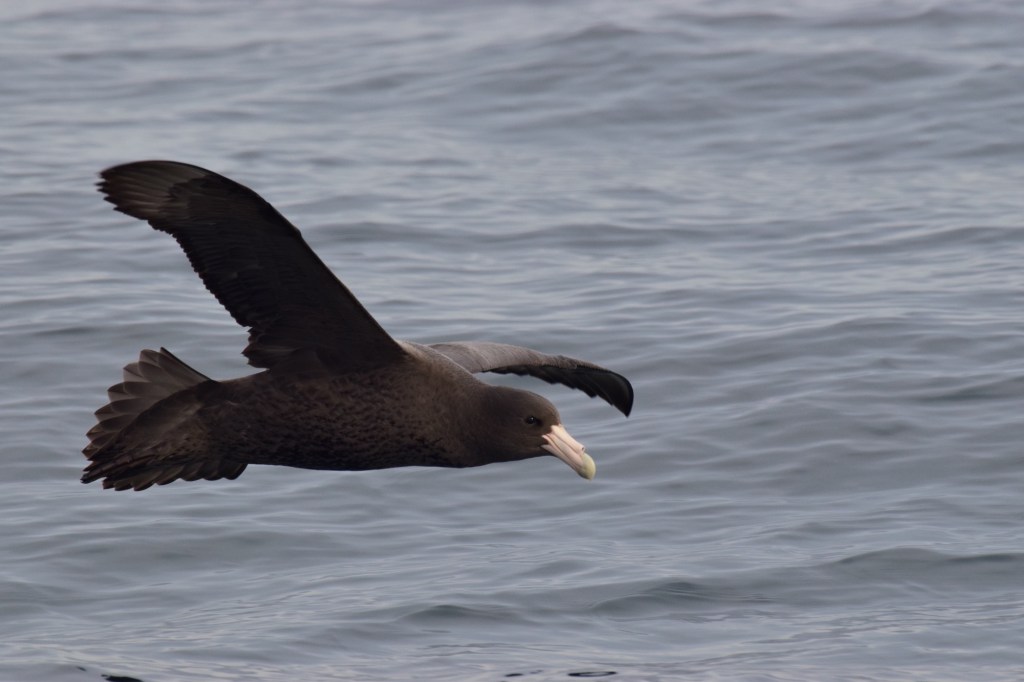
As more and more birds were drawn to the bounty, others besides the albatrosses came in to investigate. Petrels of every kind: smart pintado petrels, Westland petrels from New Zealand, tiny storm-petrels – known to Spaniards a golondrinas de mar (sea swallows) – and southern giant petrels, like the ones I saw in Natales. I quite like these dark morph birds, but there’s a pale morph that look truly sinister, with cold grey eyes – much more suitable for the vultures of the southern seas.
If it weren’t for the albatrosses, these giant petrels would have dwarfed everything in sight. As it was, the best they could take home was second-billing (no pun intended).
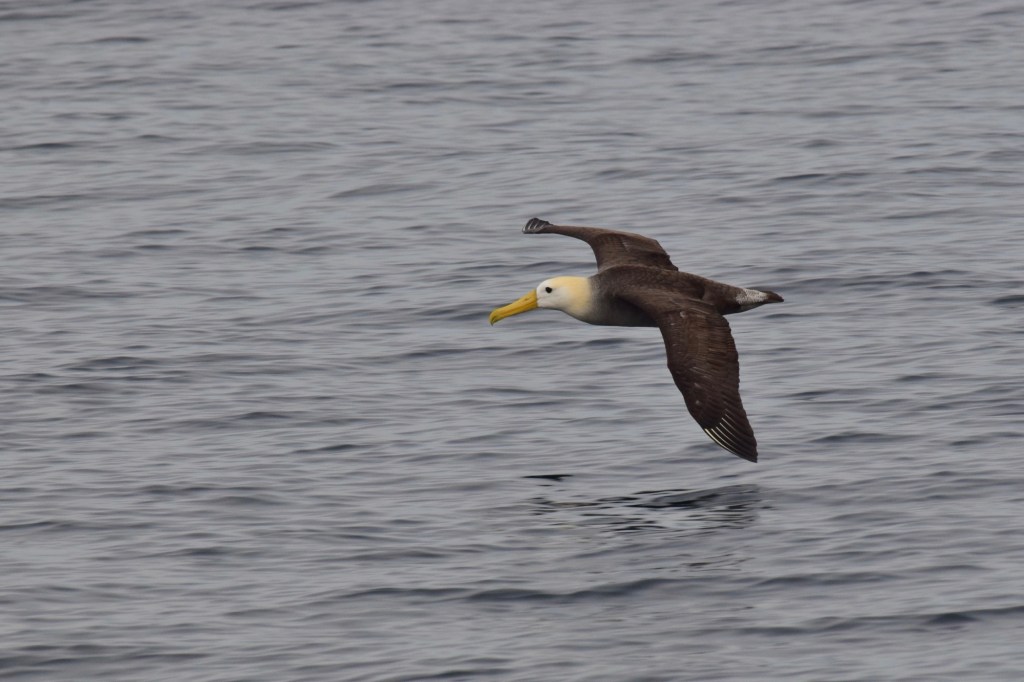
There was a great deal of excitement on board when another albatross appeared: a waved albatross, a stranger to these waters that usually makes its home in the Galápagos Islands to the north. The albatross is a true wanderer, scouring the length and breadth of the ocean in search of food, so they can turn up just about anywhere outside of the breeding season. Even so, the captain remarked that in the last twenty years he had only seen five of them, so it was quite a special sight.
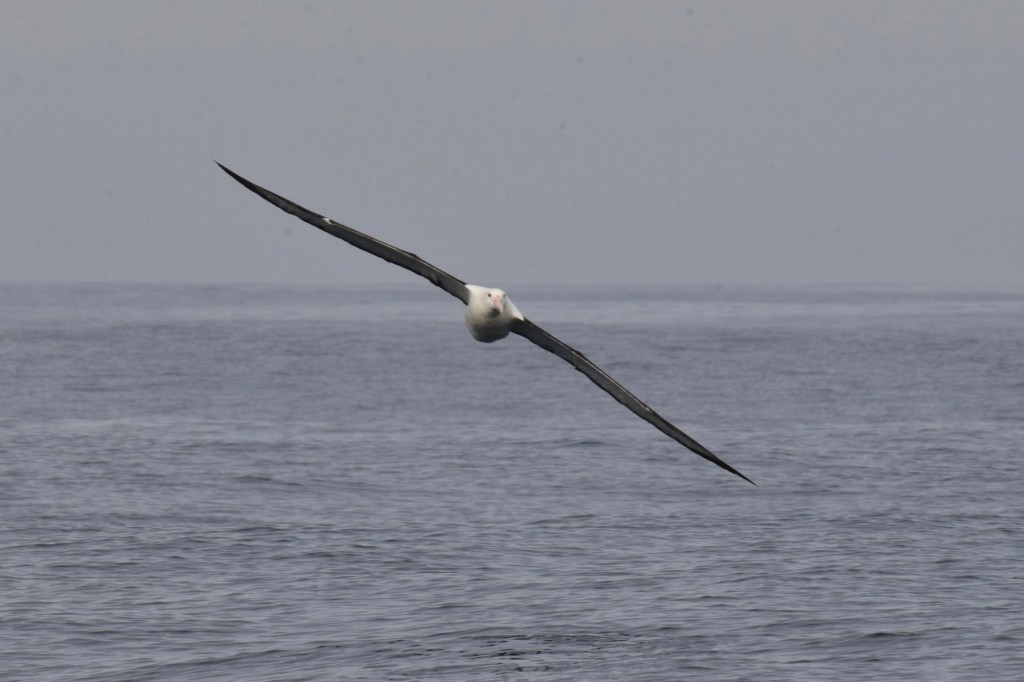
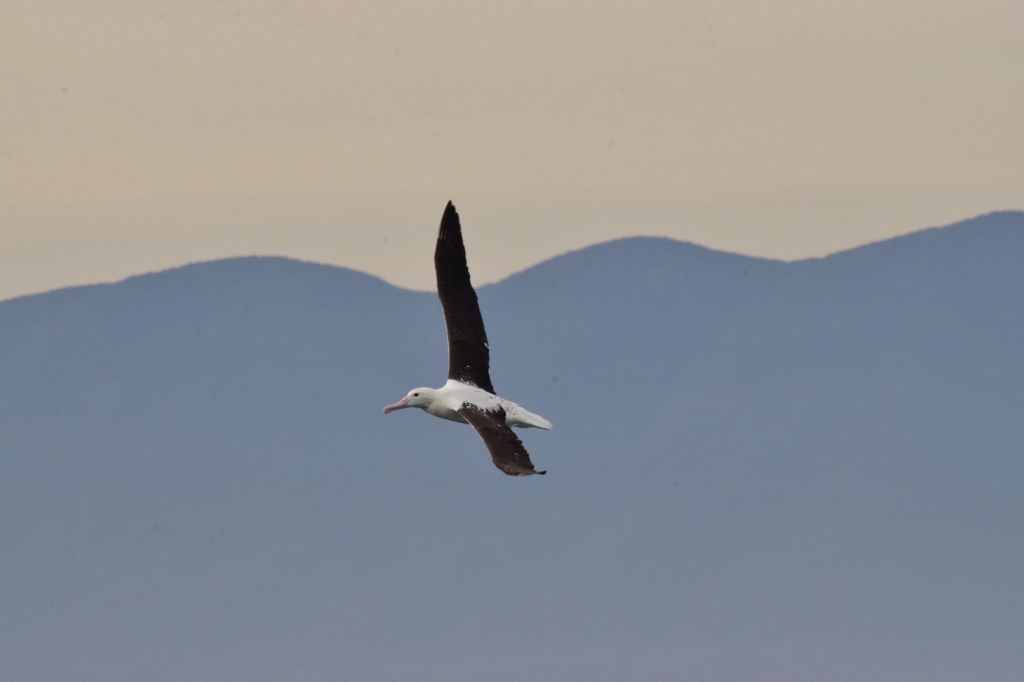
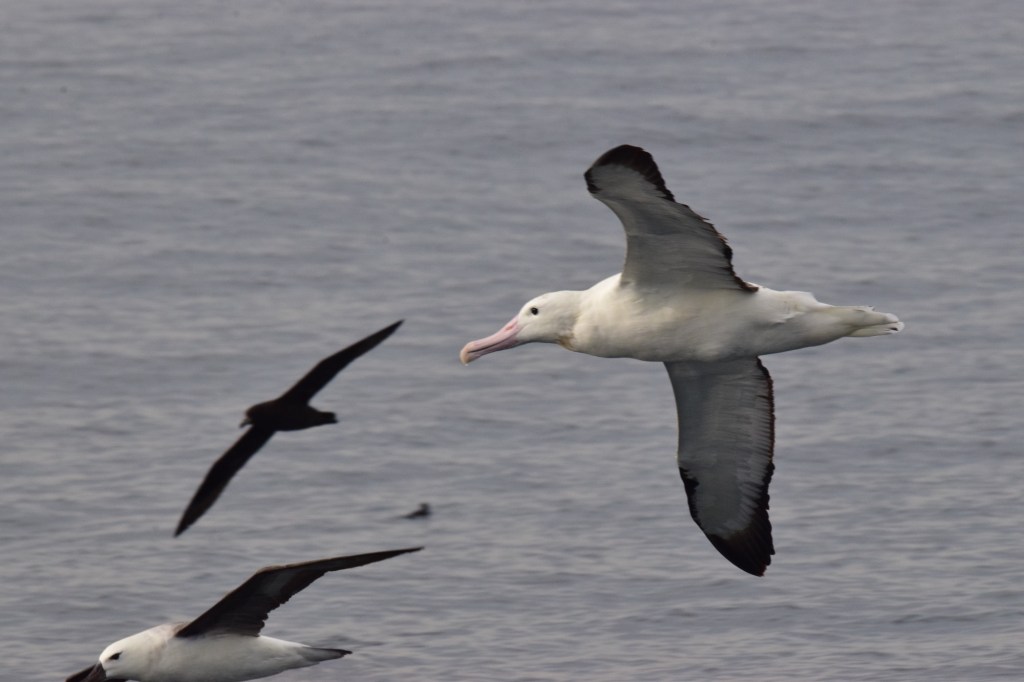
For me, though, the most spectacular bird of all was the last to appear. Towards the very end of the expedition, a truly enormous shape coasted into view from the direction of the open ocean, riding in on the wind on three-metre-long wings. A royal albatross – tied with the wandering albatross for the largest wingspan on the planet.
More wary than its kin – or perhaps more stately – the wanderer kept its distance, gliding in enormous circles around the boat. I’m not sure where they stand in the pecking order, or whether the royal in their name is a flight of fancy on our part in allusion to their size, but the giant was indisputably the largest and most powerful of all those gathered to the feast.
Just once did the wanderer come in close enough to truly appreciate how much larger it was than everything else: even the other albatrosses looked like gulls beside it. Unlike the angry-looking black-browed and Salvin’s, the royal albatross has a kind face with deep black eyes and a clean pink bill.
To see one is to understand how sailors of old were enchanted by this bird, spinning legends about it, including the famous belief that to kill an albatross was to invite disaster – upon ship, captain and crew.
What an incredible encounter! I hoped for one albatross and saw at least fifteen, including the largest of them all. My ears may not have fully recovered yet, but I couldn’t feel more fortunate right now.
Upon returning to Quintero, we all had lunch together at a seafood joint opposite the harbour. Quintero is not on the tourist trail – it isn’t even mentioned in the Rough Guides book I brought with me – so the fare was local, fairly-priced and fresh – and absolutely divine. I mulled over the menu for a bit before opting for a mint and ginger lemonade – my favourite Chilean drink – and the caldo de congrío, a wonderfully warm Chilean seafood soup.
I would have caught the bus back to Santiago, but one of the birdwatchers was tremendously keen to offer me a lift as he was headed back south anyway, and thought he might show me parts of the interior I might otherwise not see. I don’t tend to turn offers like this one down, and I had plenty of time, so I accepted.
Manuel – a Chilean marine researcher of proud Basque extraction – was a proper fount of information. He has been into birds his whole life, studying ornithology at colleges across the United States and working primarily in pelagic research. His job has taken him from the coast of California to the Galapagos and the Pitcairn Islands, as well as both the North and South poles. He remembers when they were proper frontier territories, before modern tourism sank its teeth into the far-flung corners of the world. He remembers also when much of the coast of Valparaíso was a giant lagoon, with bird-rich wetlands that have long since dried up and turned into cattle country after so many years of drought. The recent downpour is an anomaly: the Chilean palm trees that grow in the hills to the east all bear the blackened scars of the fires that rip through the countryside when the summer heat is at its worst, aided by the invasive eucalyptus trees that do so love to self-immolate.
As well as a crash course in Chilean fauna, flora, history and politics, Manuel was something of a prankster, hellbent on stopping in the middle of nowhere to take a photo of me so that I could send it to Rodrigo, our guide, so as to let him believe that I had been dropped off in the middle of nowhere. The average citizen might have left the joke at a passing comment, but Manuel was adamant to see it through, passing over several promisingly desolate spots in the hills before finding one to his liking.
His puckish side satisfied, he made sure to send me on my way with some herbs for my tea and a fresh loaf of local bread, superior to any supermarket pan de molde. I had some this morning. It really was superb.
Manuel dropped me off in Melipilla, a one-storey town to the southwest of Santiago that has definitely seen better days. Several earthquakes – including one that had its epicentre in the heart of the town itself – have laid waste to what was once a very pretty Chilean town, with colonial adobe houses and two impressive churches. What remains is a sad mishmash of old and new, houses patched together with new materials, as though the whole town was rebuilt using six different LEGO sets. The street art of Valparaíso has made its way here, too, though it is perhaps less welcome here than it is in the cascading streets of the seaside city.
I bought a bus ticket for a paltry 2.000 pesos (just over a pound, I think) for the fifty minute ride back to Santiago, and as a bus arrived just as I was buying the ticket, I didn’t need to wait at all. It was half six by the time I made it back to the flat in Las Condes, long before Tomás and his family returned from their Sunday outing to see his grandfather. I meant to sit down and write, but after I had put my clothes in for a much-needed spin in the laundry, I pretty much collapsed into bed. It’s funny what a morning out on the ocean will do.
My second week begins. I will try to see some English lessons this week – and, with any luck, get a bit more involved after a week observing the middle and senior teams.
I have also reached a decision as to what to do with my last week out here. But that, for now, must wait. Let it be a surprise. There is a lot more magic in that. BB x