Trying to justify this slower pace is hard, man. After two weeks of five a.m. starts, it’s a real culture shock to convince yourself that leaving the albergue after seven is an acceptable thing to do. However, if I’m to arrive in Santiago for the fireworks, as planned, I have to go at a much slower pace. The easy solution, I guess, would be stopping for breakfast for often and people watching. I suppose that’s not so unappealing an idea.
Rather than try to dogleg and catch up on yesterday’s account ahead of today’s, I’ll merge the two into one.
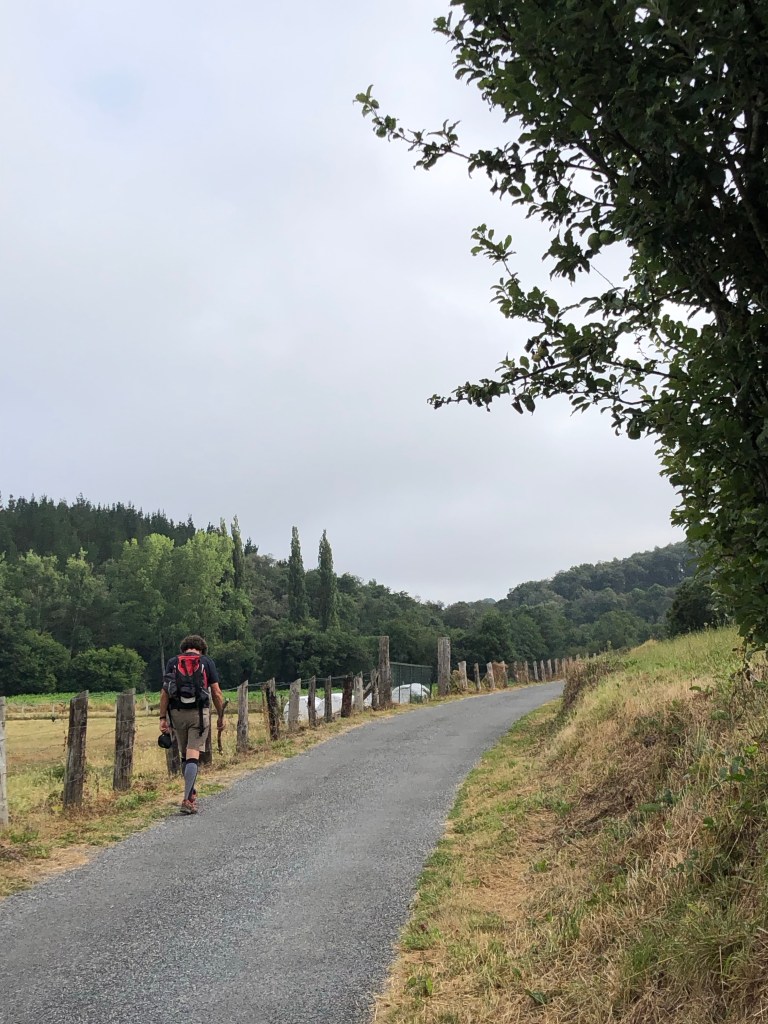
We’re into Galicia proper now. The mornings are bright but overcast and the endless horizons of Castilla y León are a distant memory in this green, wooded country. After saying farewell to Samos, the Camino led a meandering route back north to Aguiada along the Río Sarria, through forests alive with the songs of cirl buntings, wood warblers and golden orioles. I even found a stag beetle on the path at one point, but while I kept a trained eye on the river, still no otters. I guess you have to go more remote than the Camino to find them!
I made slow progress, feeling genuinely tired for the first time on the Camino, probably on account of the five hours of sleep I managed thanks to dealing with Mamasita and his drinking problem the night before. As a result I kept catching up to and being overtaken by the bell-ringing pilgrim from yesterday, whose jingling presence was practically unavoidable. An hour of it was almost maddening, so rather than keeping pace with my companions, I got back into my usual pace – and, what do you know, suddenly I wasn’t so tired anymore. Paolo was right: you really do have to go at your own speed on the Camino and nobody else’s. It’s amazing how moving slower tires you out faster.
Just before Sarria, I found a single buzzard feather caught on a hedge near a farmstead. Naturally, it’s now fastened to my bastón. To quote Sweeney Todd, my arm is complete again!
Sarria itself was a much less daunting town than it has been made out to be, though that may be because the pilgrim horde had long since moved out. I picked up a few stamps and some friendly advice from the Amigos del Camino and cut right through to the countryside again.
Now, at last, I began to see the tail end of what is probably the great rush to Santiago. The dominant language of the pilgrims on the road is, finally, the same of the country itself, as Spaniards young and old (but mostly under twenty) attempt the final 100km of the Camino, easily identifiable by their fluorescent sports wear, portable speakers and undersized Quechua backpacks. I’ve had a lot of fun screwing with their expectations by responding to their cheery ‘hello, buen camino’ with a decidedly un-British ‘igualmente, chavales, ánimo’.

I had my second unpleasant encounter of the Camino in my original destination for the day, Barbadelo, where an overzealous salesmen lurking spider-like outside his store tried to convince me to buy all the pilgrim tat he thought I was lacking. After pointing out that my ‘missing’ shell was packed away as it kept rattling against my bottle (truth), and that I had already obtained two handmade rosaries from the monks at Samos (also truth), he insisted I needed a pulserita, as mine was not of the same quality as his mass-produced ‘El Camino es la meta’ bands (what does Gandhi have to do with the Camino anyway?). Since the one on my left arm was a locally crafted item from that phenomenal café in El Ganso, and the one on my right was a gift from my aunt featuring Nuestra Señora de Cortes, one of La Mancha’s most venerated icons, I begged to differ. When he tried to forcefully pin a Union Jack pin badge on my rucksack strap, he crossed a line (I *will not* be identified so stridently as a Brit, thank you) and I told him politely where to take his business and left.
The price was a ten kilometre hike to Ferreiros, but it was worth it. I had the wonderfully tidy Xunta albergue pretty much to myself, and though the sixty-strong Scout group I passed on the road chose to camp in the woods opposite, they were from Jérez de la Frontera, which made for a nostalgic soundtrack to the evening. Dinner came with a show, too, when a local cowherd led his cattle right through the heart of their encampment, which provided some amusement!

I moved on shortly after sunrise the following morning, making the sunken village of Portomarín shortly before nine o’clock. Today I finally got a real sense of the Sarria stampede, as there was rarely a stretch of the Camino without a good number of pilgrims on the road. I shared the road with Dean, a Californian who matched my pace perfectly, at least as far as Gonzar, where I stopped to catch up with a Belgian pilgrim I’d met the day before and have a drink. The Guardia made an appearance on horseback this morning, trading their usual two-hundred horsepower Alfa Romeos for… well, one horsepower horses. But they did look a damn sight more impressive.

The Camino treks right through the ancient Iron Age hill fort of Castromaior, which is meant to be one of the most popular sights on the Camino, but the memo must have been lost on today’s pilgrims, who trekked right past it as though it wasn’t even there. Sure, it’s not as impressive as Stonehenge, but the earthworks are quite something, and as it only requires a thirty metre detour from the path, it’s definitely worth a look.

Well now, I’ve come to a stop in the hamlet of Areixe. It doesn’t have much more than a church, a restaurant and a Xunta albergue, but it’s blissfully quiet. With Palas de Rei just another hour down the road, the Sarria stampede have marched right on by, meaning I have the entire albergue to myself tonight. For company tonight, I have a small but vocal flock of chickens, a handful of locals and a toddler zooming around on a motor-operated mini tractor, surely in preparation for a life driving the real thing up and down these country roads.
The various Camino guidebooks really do dictate the fortunes of the towns you pass through on the way, pouring thousands of pilgrim pennies into the hands of those fortunate enough to live in the ‘chosen’ start and endpoints. How the villages that thread the line between them survive is anyone’s guess – especially those nearest the nuclei – so it feels good to know I’m doing my bit by staying in the quieter spots. The Sarria to Santiago stage is often touted as the busiest stretch, and while that’s certainly true when you’re on the road, if you’re brave enough to avoid the cities and stay in the villages, you’ll find the peace and quiet of the earlier stages of the Camino isn’t really as elusive as it’s claimed to be.
Though the rival roosters on either side of this albergue are a factor that cannot be easily ignored! BB x
 The Book of Barnabas