I spoke too soon last night. Around five o’clock, not too long before Lourdes, the hostalera, set off for home for the night, a bearded Frenchman arrived de la nada and set down his kit for the night. Antoine, from the town of Évian-les-Bains (of bottled fame), had walked a hell of a way to get to San Bol: not only had he walked a whopping 45km from Atapuerca that morning (bypassing the city of Burgos entirely), but he had started his Camino from his front door, making this his eighth week on the road. I’ve only ever met one other pilgrim on such a trek, a real rag-and-bones German who had gone for a walk with his dog and kept on going. Antoine, however, looked as though he had only set out yesterday. It was as good an excuse as any to practise my French, which isn’t nearly as rusty as I thought (though I did have to think how to say the number seventy-five), and it was good to hear a fresh perspective on what’s going on in France right now from a Frenchman.
I watched the sunset over the meseta from the porch and ended up having a very engaging chat with a local man from Iglesias with the most original name of Porfirio Celestino. He had come up on his bike to see if the new trees had grown in this spot, but also to check on his beehive, which he had been told to rejig by an expert. We had a laugh about our shared experiences as teachers and tried to outdo each other’s collection of oldy-worldy names like Araceli, Guadalupe and Diosgracias (the latter being my great-great grandfather’s Christian name). I think I won with the latter, he laughed so heartily. Wouldn’t you, if your parents named you Thanks-Be-To-God?
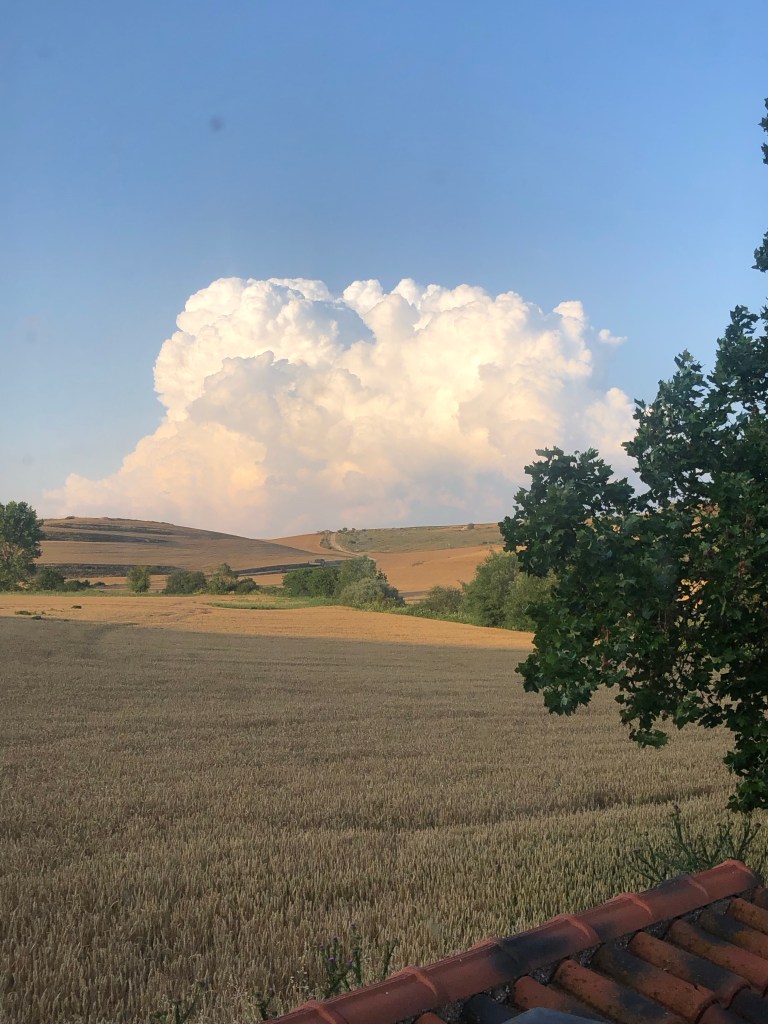
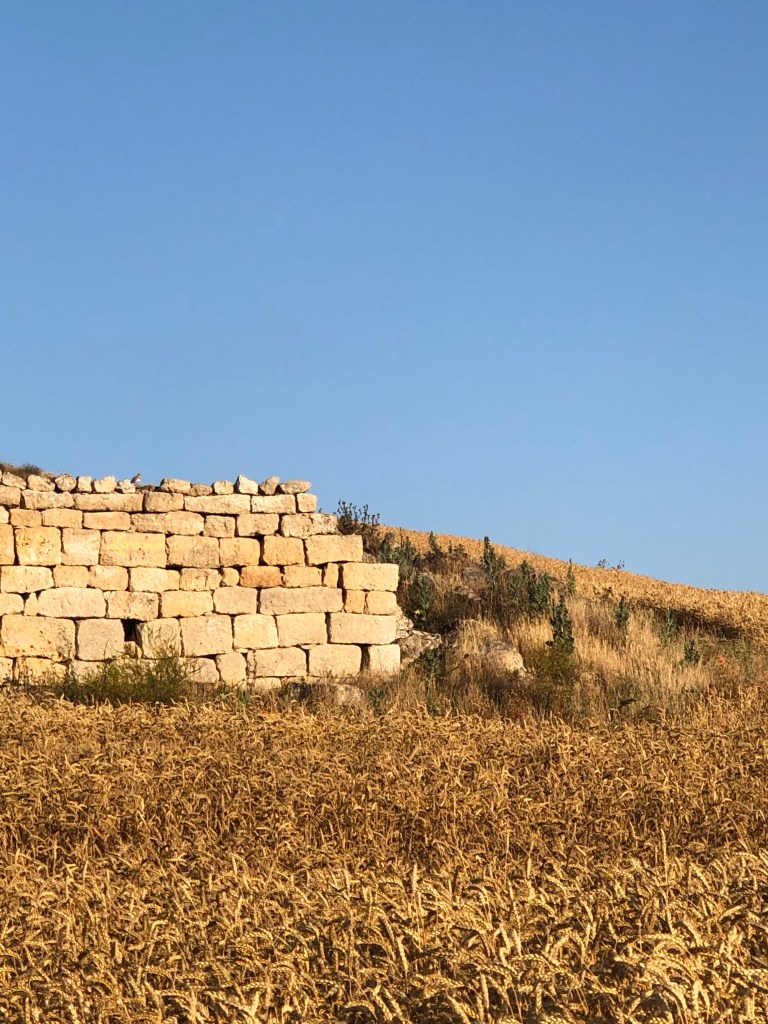
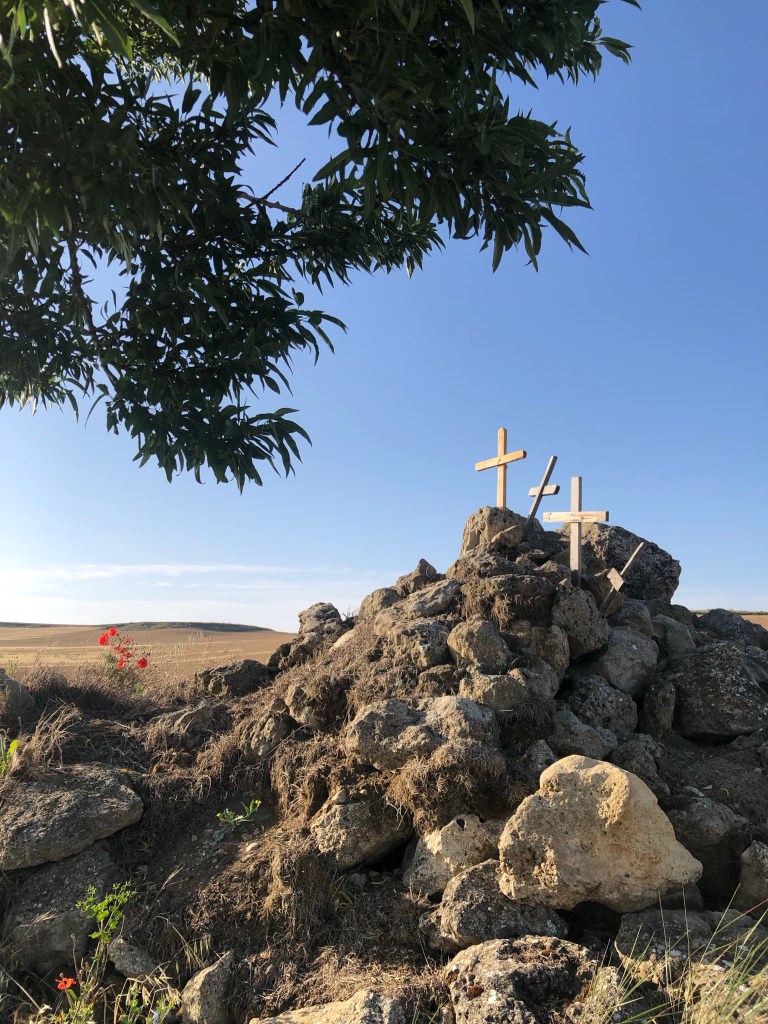
I allowed myself a later start this morning. Later being 7.45am, which is a perfectly respectable time to set out. The sunrise was nothing short of magical, and it was all I could do not to linger longer. I can’t recommend the Albergue de San Bol more highly. It was a perfect introduction to the Meseta and blissfully immersive. A partridge climbed up onto one of the many piles of rocks to serenade the valley as I set out, the twin flags of Spain and Iglesias fluttering in the cool morning breeze. There are lots of piles of rocks like that around. I guess they’re removed periodically from the fields to make plowing considerably easier.
Hontanas was deceptively distant. I would have found it quite a slog under the midday sun had I attempted it yesterday, but in the morning light it was a very pleasant walk. Wild flowers line the luminous Camino right the way across the Meseta, adding dashes of crimson, cornflower blue and violet to the shimmering seas of gold.
At one point, high on the plateau above Hontanas, I seemed to be absolutely surrounded by quails. I couldn’t see a single one – they’re tiny, incredibly well-camouflaged and very rarely flush when cornered – but I could hear them all around. Their three-stop whistle can carry for as far as a mile, but if you can hear their childlike ‘—aauWAH’ it’s a good sign that they’re nearby. Quails and turtle doves are fast becoming the soundtrack to the meseta, and that puts a serious spring in my step.
I’ve passed a couple of roadside graves today (not pictured for obvious reasons). They were quite a common sight on the first couple of days of the Camino, where the mountain pass can be dangerous under the wrong conditions, and tended to be Asian or Latin American in origin. Out here in the middle of the Camino, however, the meseta proves a challenge that isn’t always insurmountable, claiming Spaniards and even the hardy Dutch. I try to say a small prayer at each one I pass. By the looks of the painted stones at their feet, I’m not the only one.
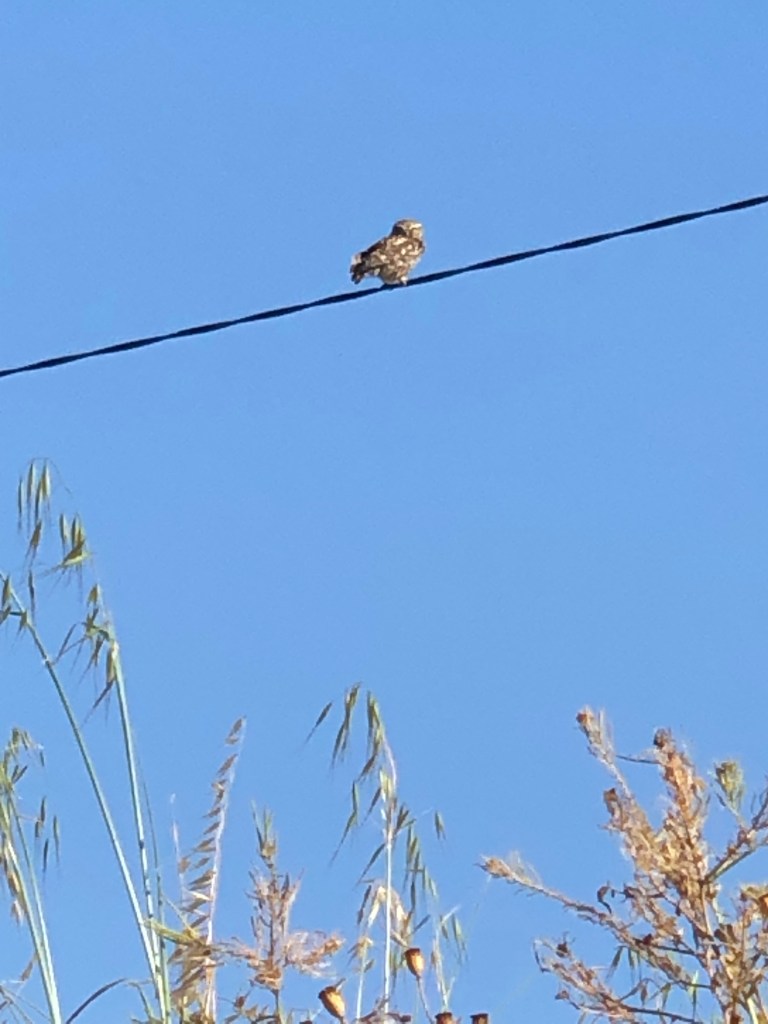
Hontanas seems to be a magnet for pilgrims. A sizeable number had stopped for breakfast at the first café, leaving the road ahead clear. I had only a few cents left in my wallet, but I still spent a good ten minutes there, though that was because I caught sight of a little owl perched on the wire opposite the café. I deliberately didn’t bring my camera as it would have been one belonging too many on the road, but I regretted that decision more than once today – my phone camera simply doesn’t do justice to the beautiful little thing!
After Hontanas the Camino crosses and then follows a wooded stream for a couple of miles. Here, once again, I came across one of my favourite sights of the route: the silver, scythe-like wings of a harrier. It caught me completely by surprise as I came up a low hill, and I could see the yellow rings of its eyes before it jinked and soared away down the valley.
I thought I’d lost him, loitering for a few minutes to see if I could spot where he went, but not five minutes later I saw him up ahead, quartering the valley floor. Kites are graceful, but harriers – especially the silver-grey males – are in a whole other league, drifting over the fields like black-fingered phantoms. He disappeared behind the trees as I drew near, and then re-appeared clutching a fair length of straw in his talons, to take back to his nest in the wheat-fields, no doubt.
Some things, I guess, are worth going solo for. Seriously, I could get used to encounters such as these.
At the end of the valley, the road cuts right through the imposing ruins of the Monasterio de San Antón. So cleanly, in fact, that the main road runs beneath two of its great stone arches. There’s a tiny albergue here and a chance for a bonus stamp (at last!), but I was quite content to just explore for a bit, not being in any particular hurry.
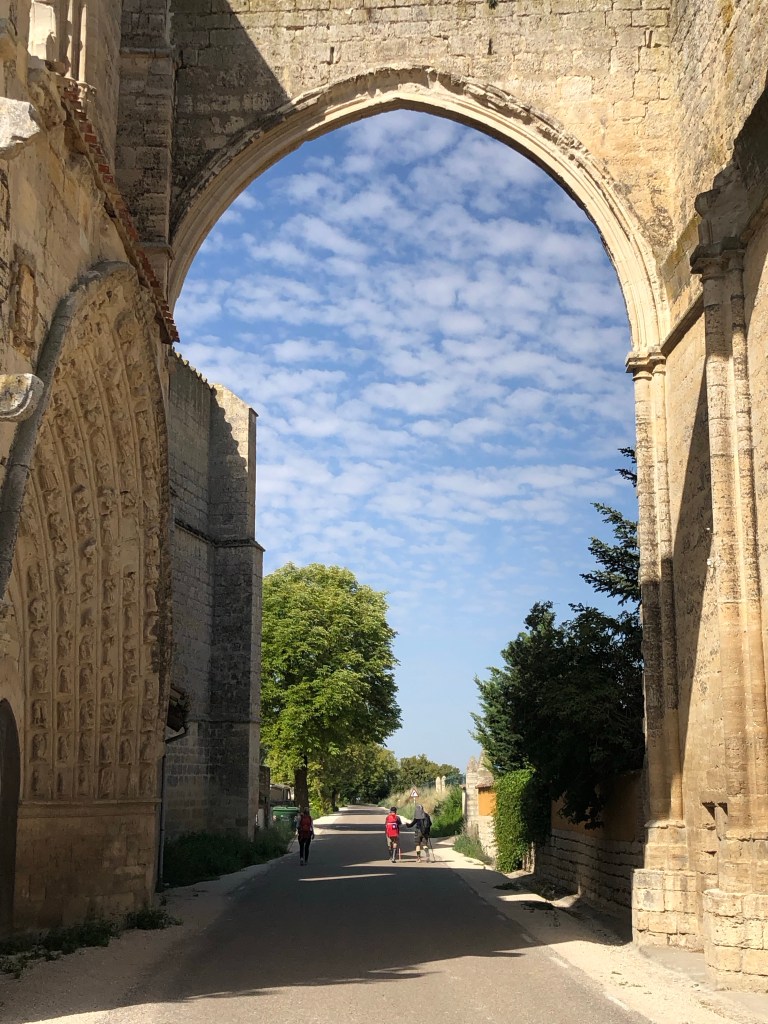
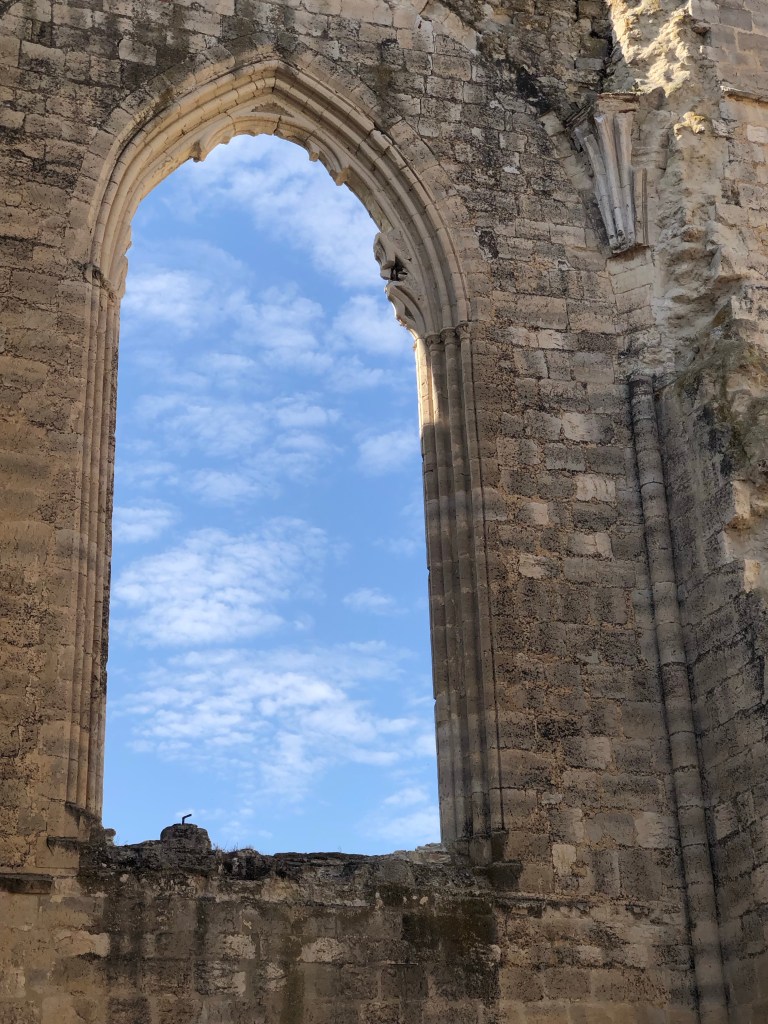
There are plenty of old churches along the Camino, but this ruined monastery is rather special – not least of all because of the way its hollow windows open out onto the endless blue of the Castilian skies beyond. I’m going to run out of adjectives for the sky long before I’m clear of the meseta, because it’s my constant traveling companion, but I’ll do my best to keep it original!
Best of all, they had a box outside the albergue for unwanted objects to take away. I’ll have a few of my own to offer before long, but my eyes lit upon a beautiful Aragonese walking stick from Ordesa National Park. I’ve blown the dust off it and put it to good use. With any luck – if it isn’t pinched along the way – it will take me to Santiago, and perhaps beyond.
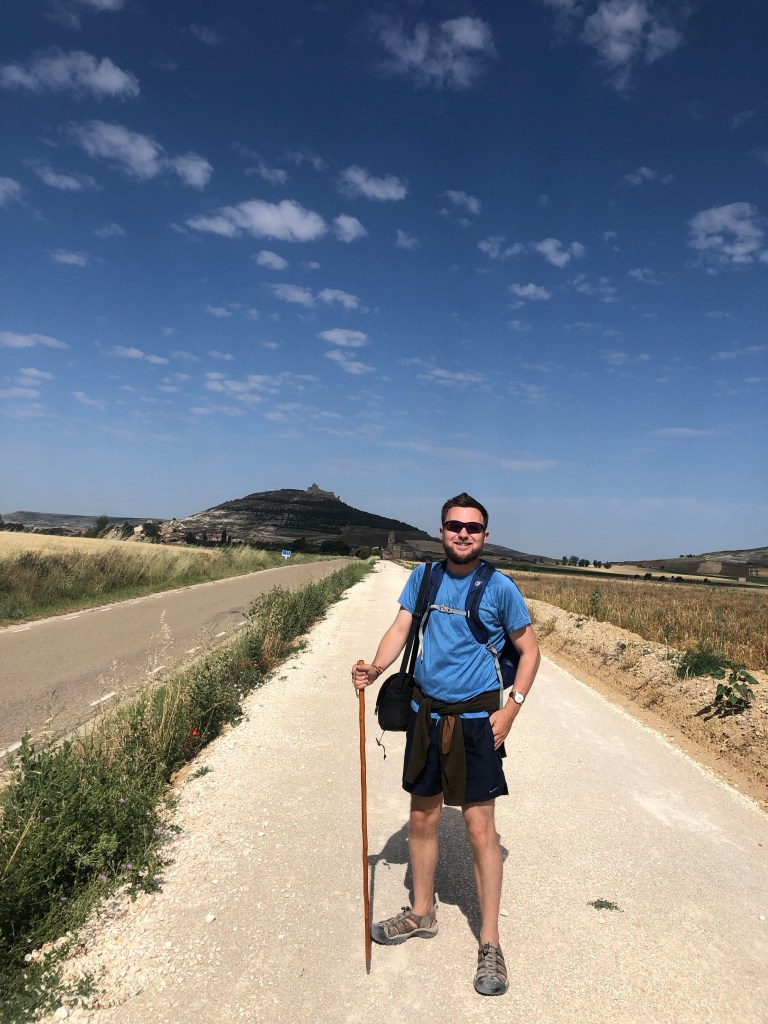
From the monastery, the hilltop castle of Castrojeríz comes immediately into view. It’s still a good hour’s walk until you reach the town proper, but it has to be one of the most scenic approaches of the Camino so far. I offered to take a photo for three Japanese pilgrims and they repaid the favour, meaning I will have at least one photo to show I walked the Camino this summer!
Well now, I’m here in Castrojeríz, and the kindly hospitalera has just returned from the hospital in Burgos. Her husband, with whom she runs the albergue, is currently walking the Camino himself. After a very light dinner last night I treated myself to a menu del día at a local mesón-restaurante. The barman must have clocked my La Mancha shirt because he brought out a lovely red wine from Tomelloso, just down the road from my family’s home. They didn’t have any sopa castellana – apparently it’s too hot for that – but the salmorejo he recommended was fantastic. So don’t worry, Mum, I’m eating very well out here!
I’ve showered, made the bed and claimed another stamp, so now that I’ve finished writing I’ll have a short siesta before buying supplies and exploring the hilltop castle this evening. What a perfect routine! BB x

