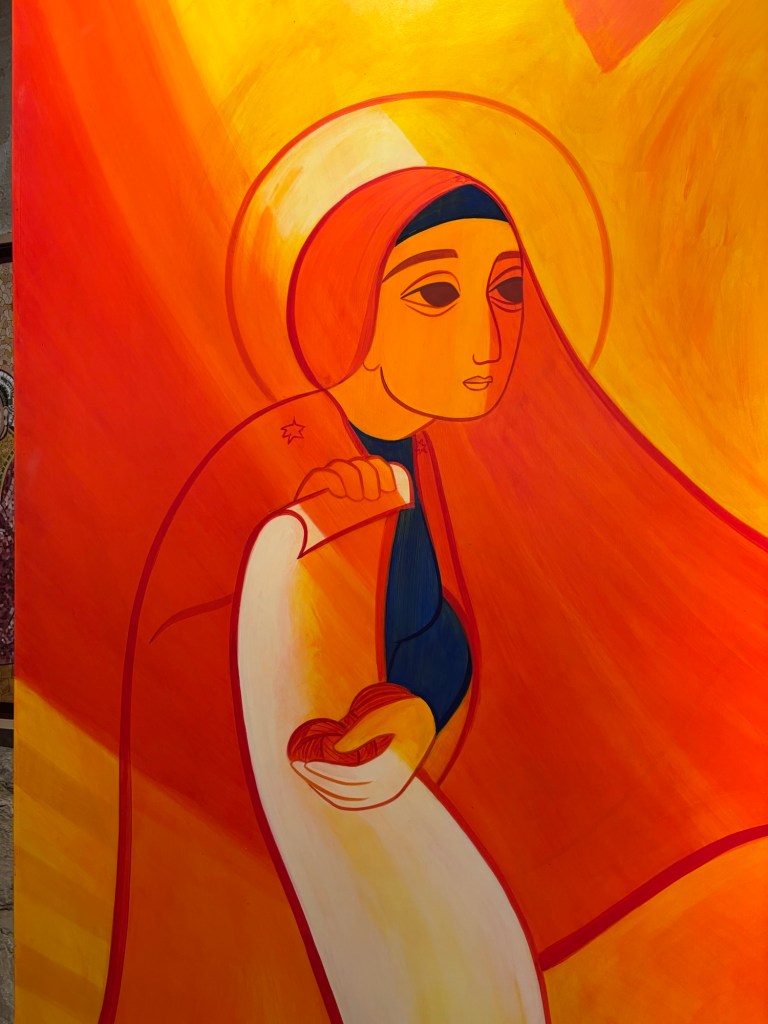
Camino XXIX: Asturias

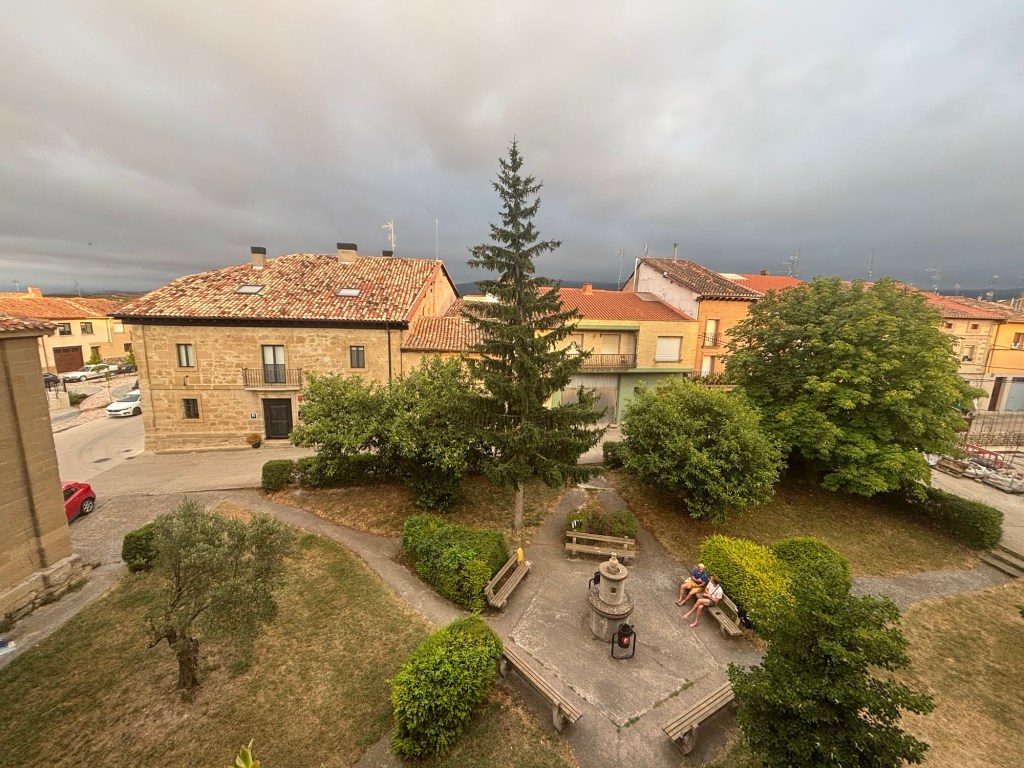
Albergue de Peregrinos, Grado. 21.40.

Confession. I was genuinely considering skipping Grado to gain a day this morning. I think I still hadn’t shaken the idea that, if I could only walk a little faster, I might catch up to my companions on the Camino Francés before they left for home. But the Camino, like an old god, is fickle. I’m not sure whose idea it was – Santiago, the Lady of El Rocío or the capricious spirit of the Camino itself – but I was waylaid at the albergue this morning by a retired Swedish woman who wanted company on the road out of town. The Camino leads straight to the train station, and I might have made it in time… but the Swedish woman pointed left and I followed without thinking.

I lost her about half an hour later when I picked up speed at the city’s outer limits, but I see now that it was a signal: no tricks this time. This Camino must be walked from beginning to end. There is something along this road that I am meant to do or see. The fatalist in me takes over on the Camino, and right now he is utterly convinced of that fact. So here we are.
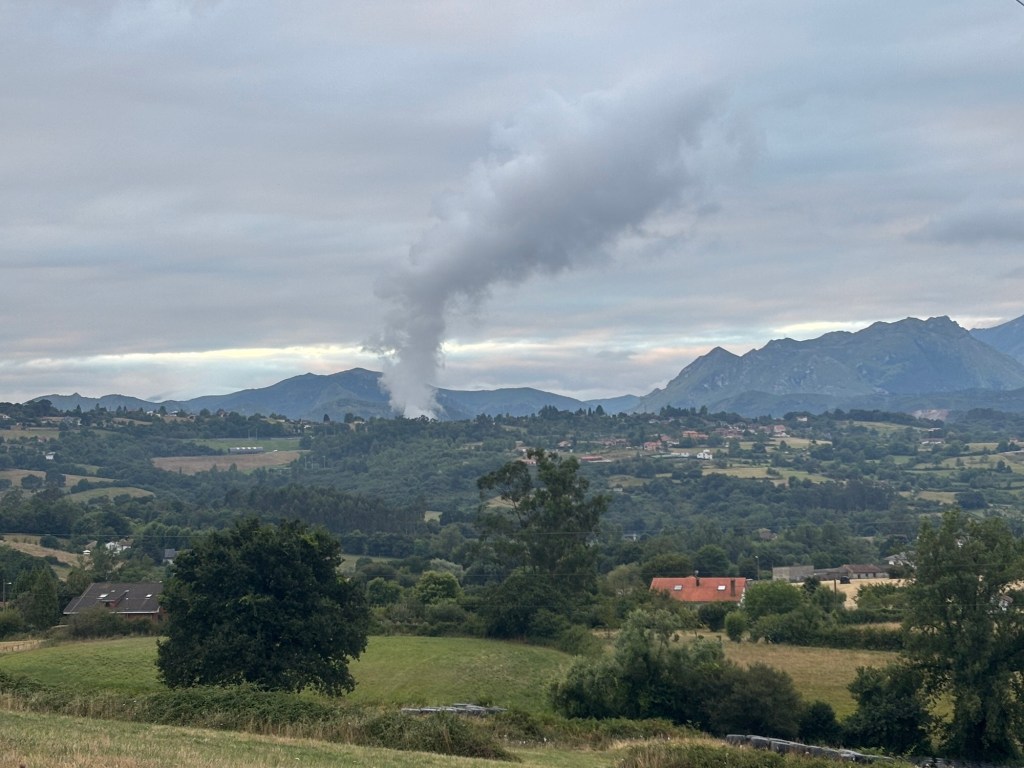

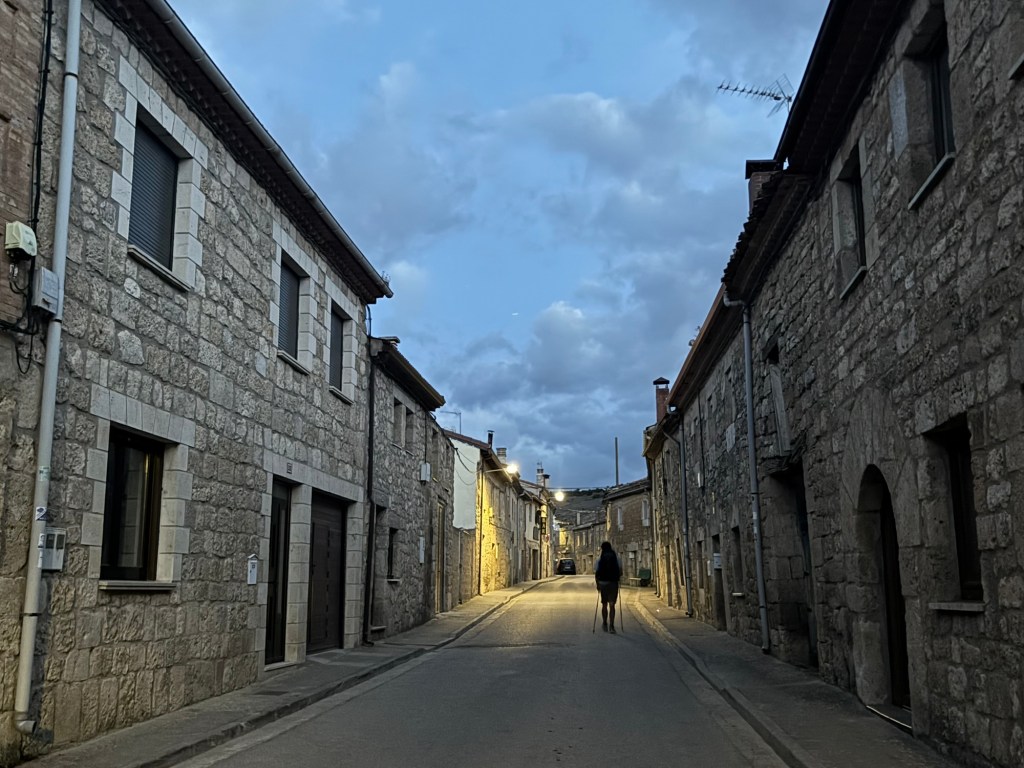
Welcome to the Camino Primitivo. If you were expecting something similar to the Camino Francés, think again. It’s almost like stepping out of a bus and onto a boat: the same feeling of companionship, but an altogether different vehicle in an altogether different environment.

Asturias is, in a way, the grandfather of Spain. This green and clouded region, together with Cantabria and the Basque Country, was the final holdout of Iberia’s Christians during the Moorish invasion of 711, and it was from here – so the legends tell – that Don Pelayo established the Asturian monarchy, the earliest forerunner of the Spanish crown, and began the Christian reconquest of Spain – the Reconquista – which would take nearly eight hundred years to complete.

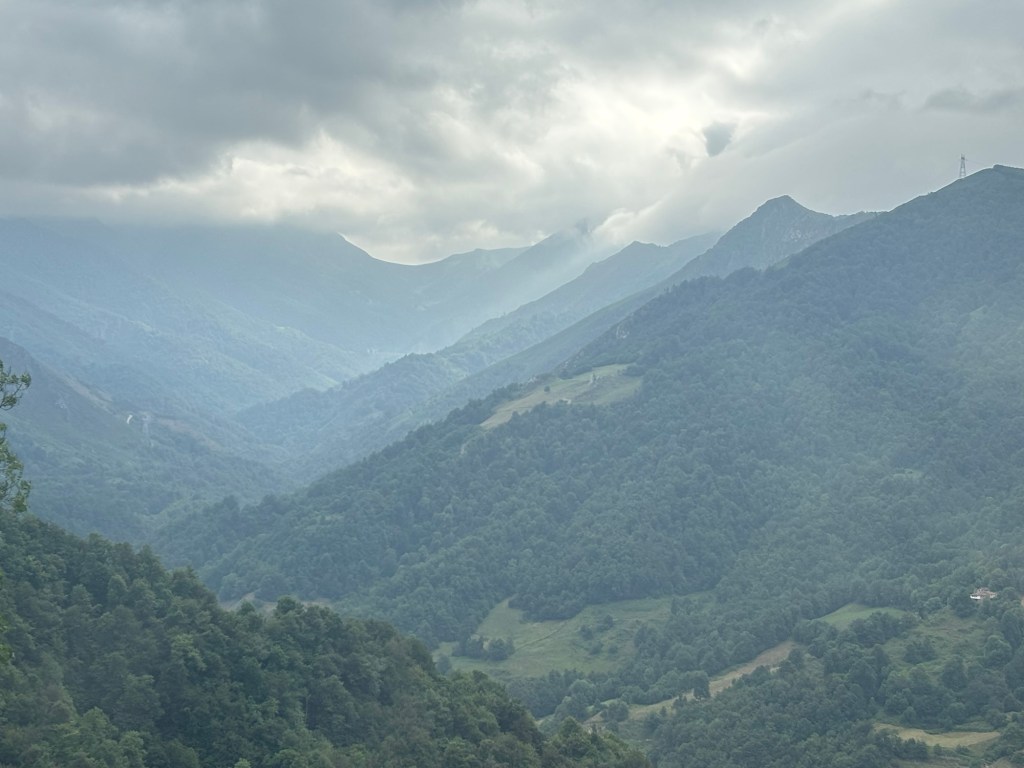
You might think such a place would be as Spanish as it gets. You would be mistaken. This is not a land of paella, flamenco and bull-fighting, or dark-skinned maidens flanked by guitar-wielding lotharios (a stereotype far more common among Italian pilgrims this year). This is a green and hilly country where the clouds descend as far as the tree-tops and sometimes beyond; where the rain rolls in off the sea in visible eddies and falls like mist on your face. Where the men are short but powerfully built, and the women breathtakingly pale. Where great clouds of smoke rise from the quarries and factories, and the air is thick with the constant ringing of cowbells. This is Asturias. It could hardly be more different to neighbouring León. It is a reminder – as though one were needed – that Spain is, in reality, a multinational state, where even the kingdom that started it all has its own distinct language and identity.

For the greater part of the morning, my road was cushioned by the clouds. Sometimes they moved with me, sometimes they moved against me. It rained for a half-hour or so, but it was not so much rain as a rain cloud that was so low to the ground that one could walk right through it. The Camino from Oviedo ducks and weaves through the hill country, sometimes following the asphalt roads, sometimes leading down dark trails into the tangled forests of oak and eucalyptus.

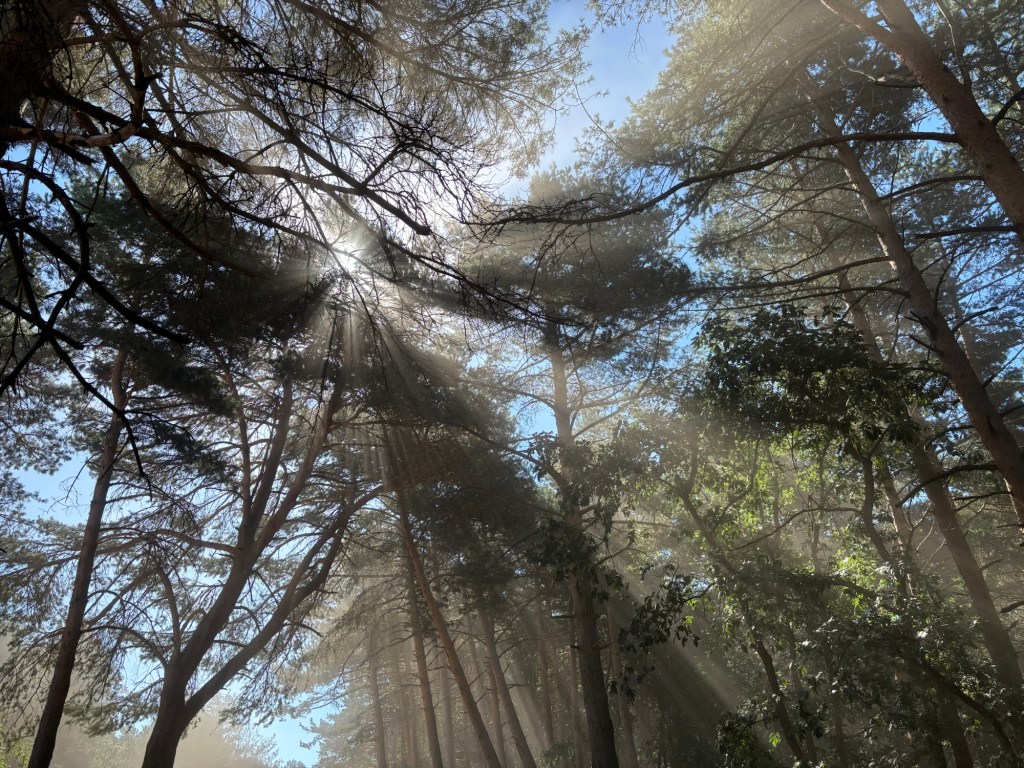
It’s very easy to see how this corner of Spain – behind the frontier of the Cordillera Cantábrica – shelters most of Spain’s lingering mythology. The forests are dark and watchful and the mist rolling through them plays tricks with your eyes. I heard something large kick up the leaves and dart into the deep at one point, but I never did see what it was. A deer, perhaps. There are plenty of them about.

In one of the forested stretches, the Camino crosses a small clearing scarred with limestone teeth, like the bones of some ancient monster. A splash of colour on one of the rocks nearest to the road caught my eye and, on closer inspection, it was the head of one of the spirits the Lady of El Rocío sent to guide me yesterday: an Egyptian vulture.
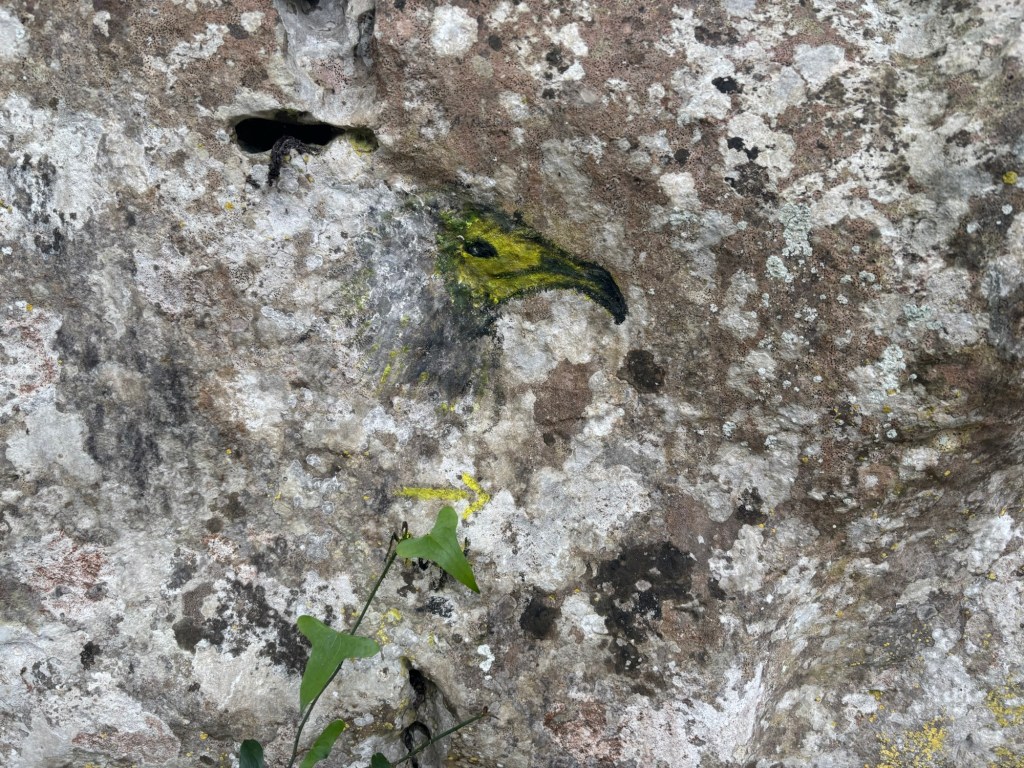

Egyptian vultures are one of the oldest species of vulture still in existence. They are also the last of their kind, with their nearest relatives believed to have died out during the Miocene. They are incredibly intelligent creatures, being one of the few species to use not just one but two tools: using stones as hammers to break into eggs, and sticks as spools to gather wool or other nest-building materials.

They’re also amazing to look at, with their glam-rocker hairstyles and their black and white wings. I found myself wondering whether this bird was one of the inspirations for the Chozo, an ancient race of superintelligent avianoid aliens from the Metroid series. Their faces certainly match up to the earlier designs.

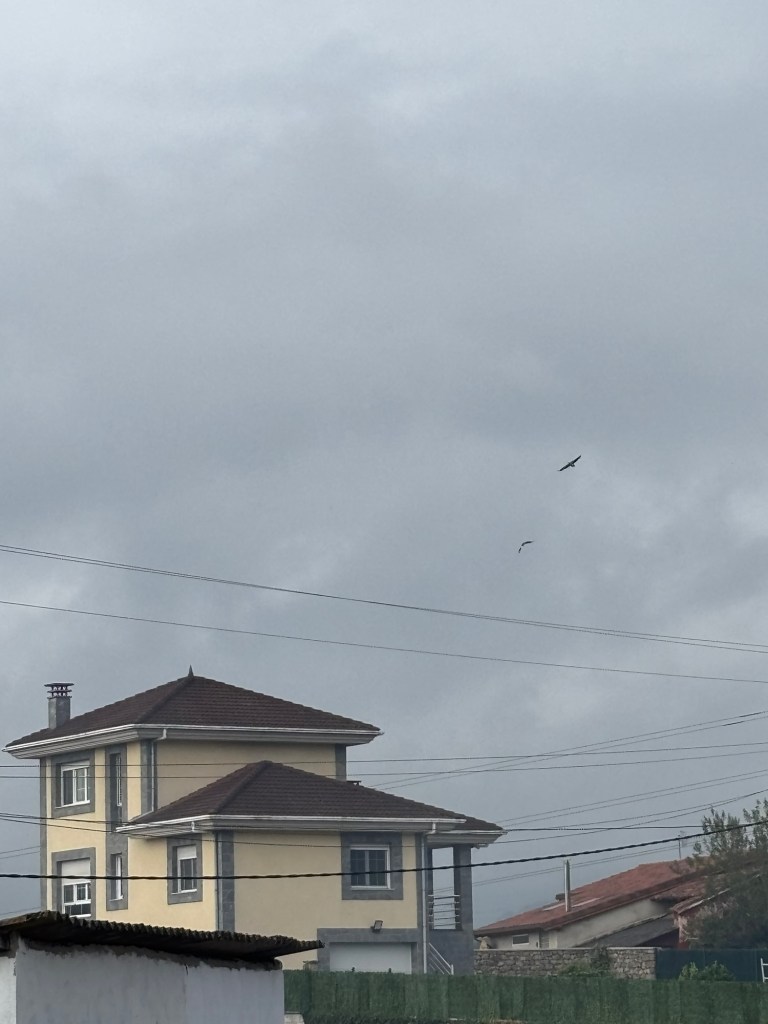
Well, while I had them on the brain, suddenly, there they were: a pair of them, circling low over a hamlet on the outskirts of Premoño. A local and his son were heaping refuse onto a small bonfire, which may be what drew them in, but before long they were riding the thermals high into the sky. It was enough to make me skip one breakfast stop just to chase after them and watch them ride higher and higher until I could no longer make out the diamond shape of their tailfeathers.

I tried to make amends on a breakfast stop in Valduno, but one of the waiters made frantic signs to be quiet as I opened the door: half the bar space had been given over to microphones and speakers, and they were in the middle of recording a podcast. I could get some water, they said, or wait in a corner. I felt I was intruding on something. I moved on.

I found a better spot in Paladín, where I had a nice long chat with the barman. He had some sort of alarm setup which sounded awfully close to Colours of the Wind from Disney’s Pocahontas, which went off whenever somebody walked through the gate – I guess that’s how he knew to appear the moment I arrived. He was keen to know how many pilgrims I had seen on the road. I told him only a handful, as I had been one of the first to leave Oviedo – which was true – but that there had been plenty at the albergue. He was quick to point out that not all of them would come this way, as the Camino Norte also runs through Oviedo, but seemed very appreciative to have a conversation with a peregrino. Spanish tourists bring money during the summer, he said, but they don’t bring much more than that: a place to eat and sleep and then they’re gone. He missed conversations with pilgrims and swapping tales from the road.

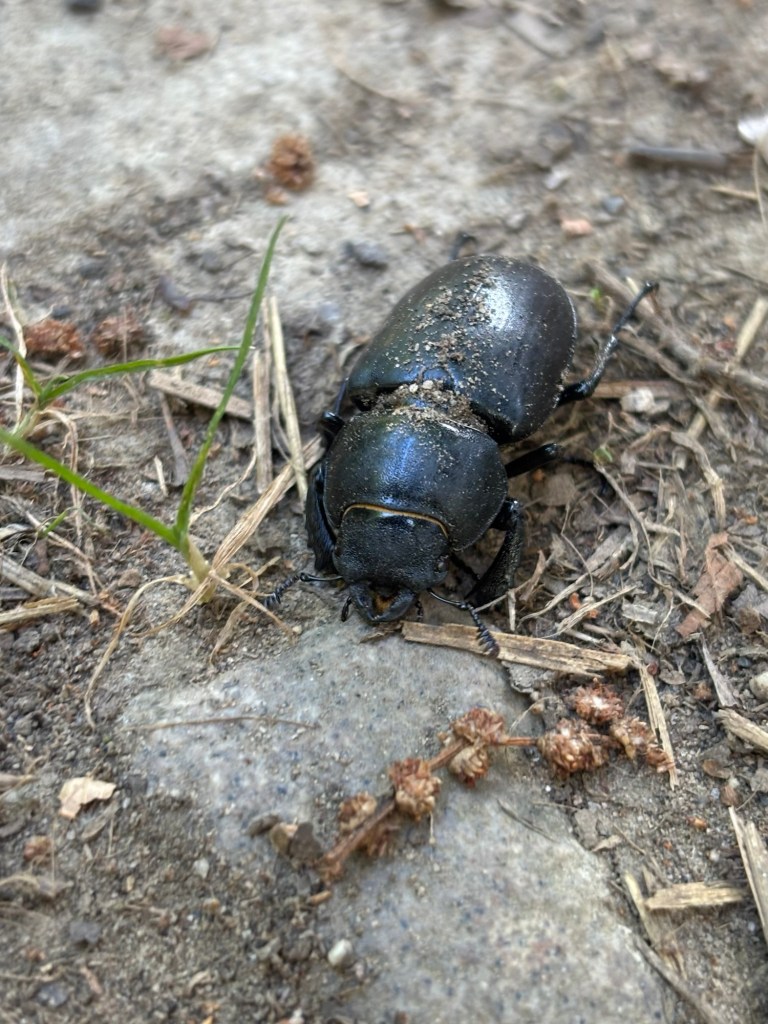
After Paladín, the Camino returns to the banks of the Nalón for a little while. I was so fixated on the beauty of the river that I almost stepped on a stag beetle. I have yet to see one of the impressive males, but the females seem to get about quite a bit during the day, as this is the sixth or seventh one I’ve seen along the Camino.

Like its sister, the Tajo, and a great number of other Spanish rivers and creeks, the Nalón cuts right through the craggy cliffs and sierras on its winding journey to the sea. The train from Oviedo seems to follow it, which must make for a spectacular journey. There’s a small bar at the foot of the Peñón de Peñaflor where you can stop for a drink, but I was much too busy drinking in the view. The old masters painted paradise as a garden with many mirrored lakes and fruit trees, but I think mine would be scarred with karstic crags just like these.


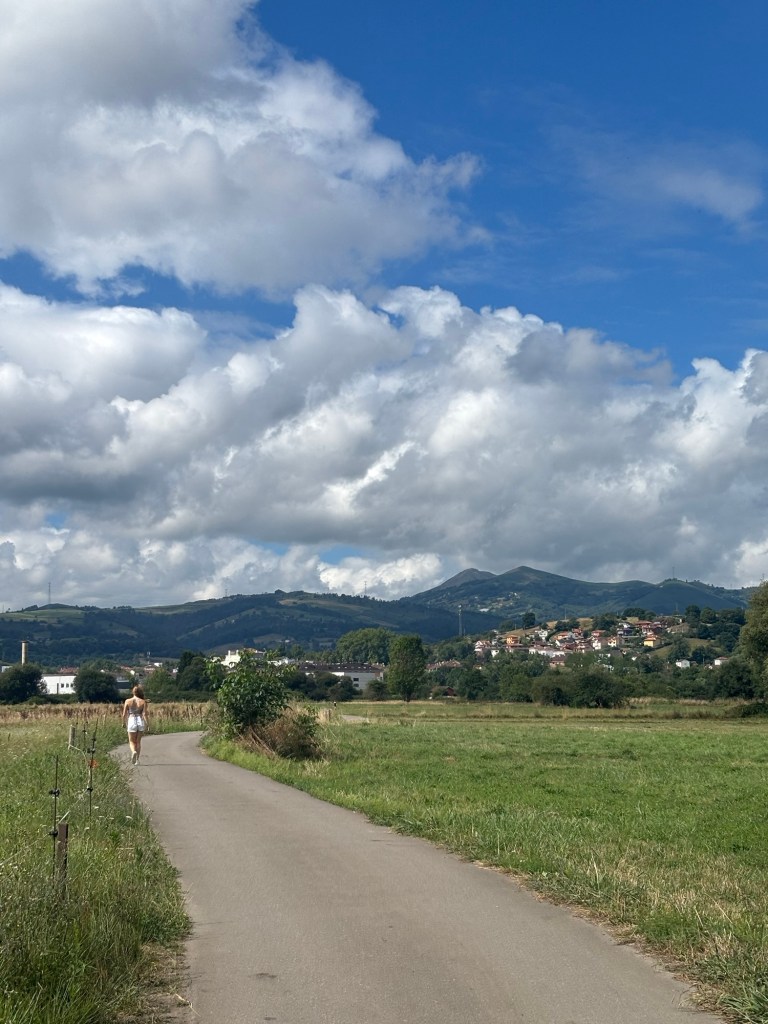
After crossing the river and the tiny settlement of Peñaflor – a small cluster of houses that seem to exist purely to justify the train station – the Camino cuts across the countryside toward the hill town of Grado. A local girl in white cut-off jeans stepped out into the road as I left town and sauntered on ahead with a jaunty, confident stride, toying with her hair over one shoulder and then the other, and then held up in one hand, as though she couldn’t quite make up her mind how she wanted it. It was about half an hour’s walk to Grado, where she finally disappeared into one of the apartment buildings. Spaniards aren’t known for being natural long-distance walkers, so I wonder what she was doing out here?

I reached the albergue a full two hours ahead of opening time, so I took off my sandals and zoned out for a bit. I’ve found a comfortable method in wearing my liner socks underneath the woolen socks (which may well be their original purpose). It’s not too hot and it meant no discomfort whatsoever from my blisters. Let’s see if it lasts.

Andrés, the cheery hospitalero from Badajoz (I’d recognise that accent anywhere) arrived just before 2pm and handled check-in, after which I had a good nap for two hours (that’s how I can justify still writing at this late hour, when all the other pilgrims have long since turned in). I considered going out to eat, but instead sorted out my flight home and popped out to a supermarket to get some supplies – namely, sun-tan lotion, as I’m all out and there are some long days ahead.

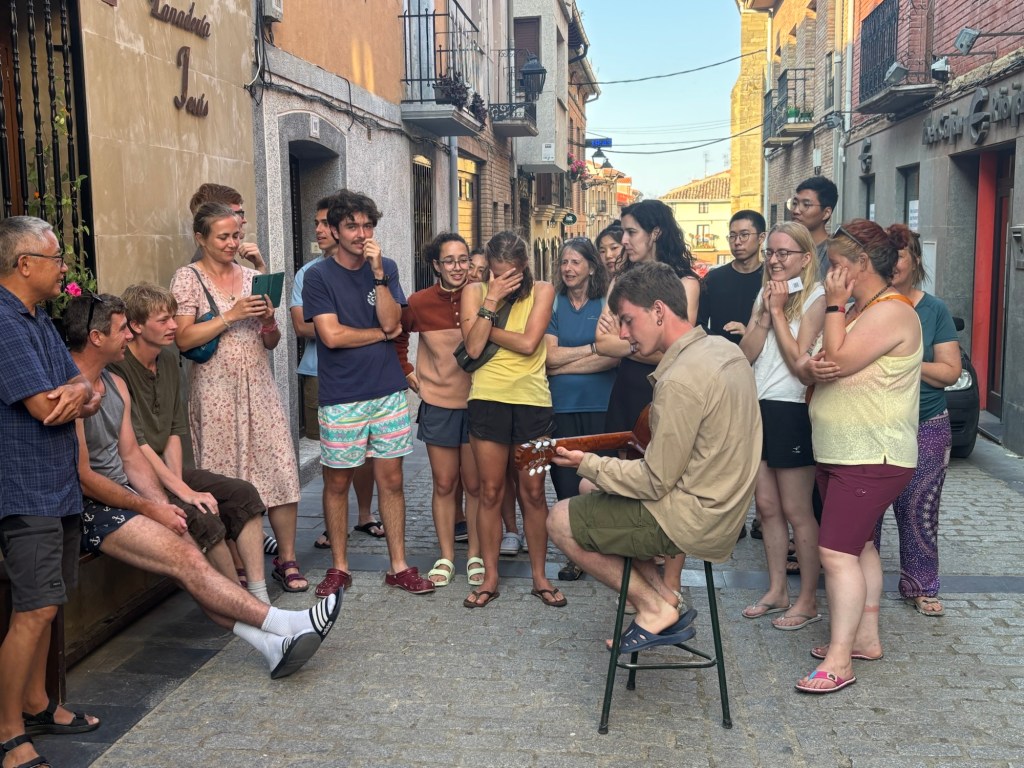
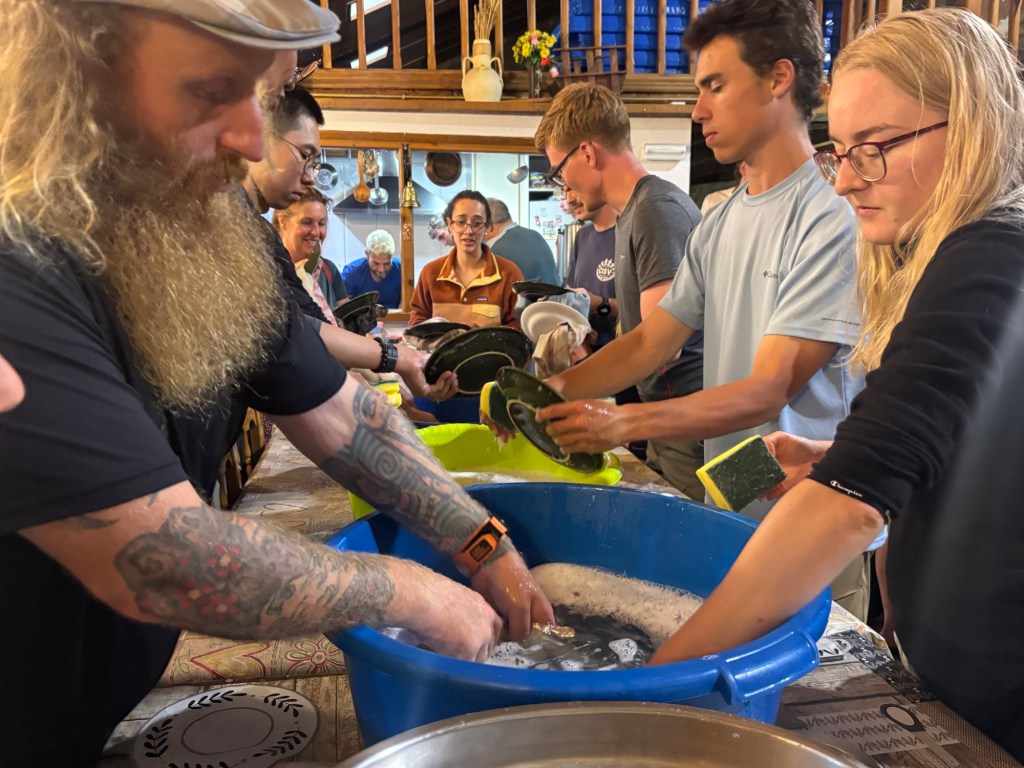
Back at the albergue, Andrés suggested making some wax stamps. This slowly brought all the pilgrims downstairs and got conversations flowing all around the room. Hospitaleros only typically work for around 15 days before moving on, but here was a master at work: friendly, accommodating, knowledgeable and unimposing. Just present.

He also had the spirit to call out a fellow Spaniard for a slightly tactless remark about how “easily” Moroccan migrants get Spanish citizenship. As a former civil servant, Andrés certainly knew his stuff – enough to put the man in his place with some hard facts about the reality of immigration policy in Spain.

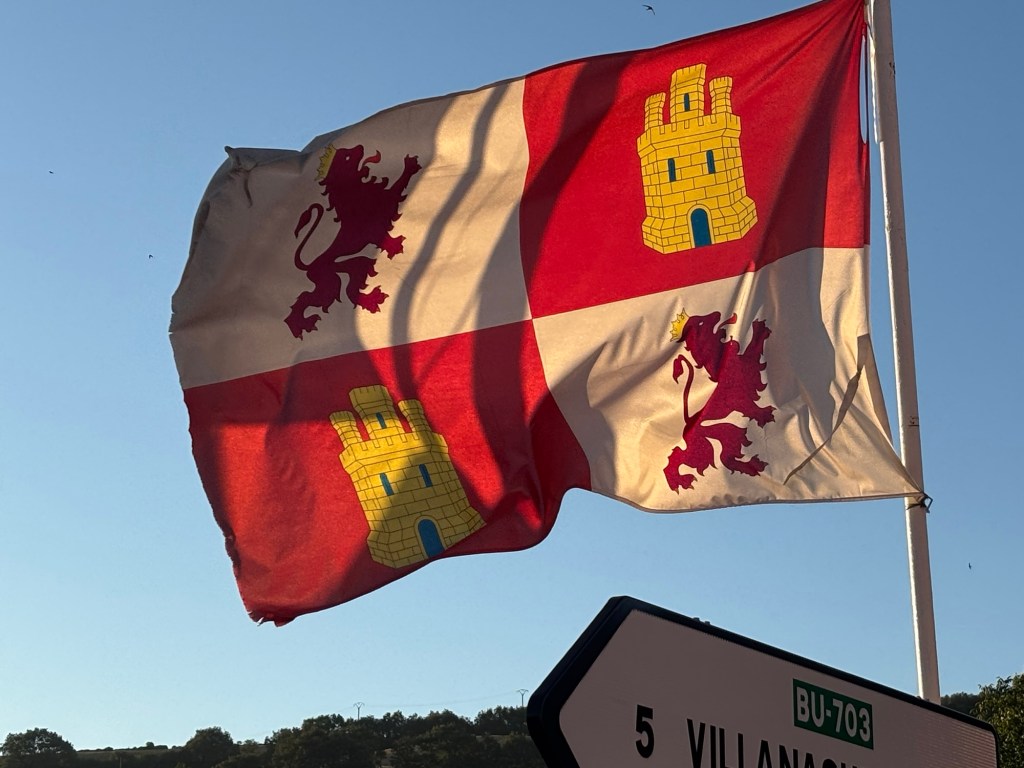
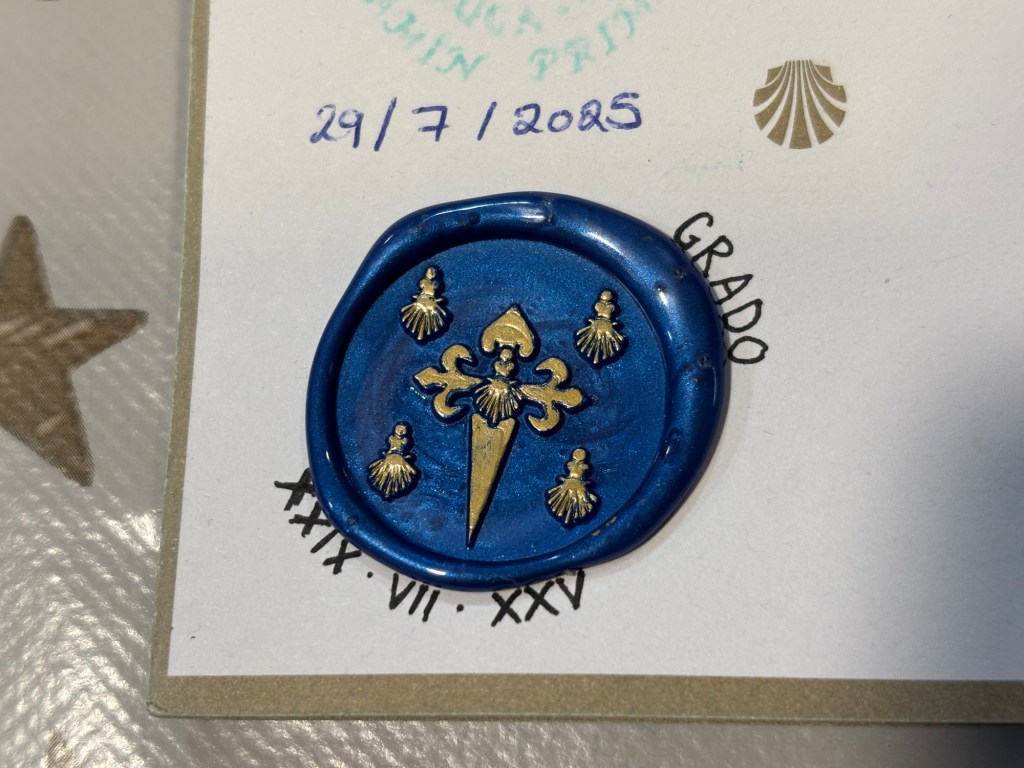
I feel I learned a lot today. I also got a shiny new wax stamp for the passport, which I painted gold in a nod to the Asturian flag. Now when I look at it, I’ll remember this place.


I don’t know if I’ll find a “Camino family” again like I did on the Francés – that road does facilitate the group dynamic like no other. But this feels right. I’m learning so much and seeing so much more.

Somebody stopped me from catching that train, and they had the right of it. Here’s to another week and a half of wonder. BB x
Camino XVIII: Down and Out

Albergue de Peregrinos El Salvador, Oviedo. 19.27.

Ignore what I said yesterday. I’ve reached Oviedo a day ahead of schedule. There are a few reasons for this:

  1. The Albergue in Pola de Lena was due to open at 15.30, some three hours after I arrived. The website was pretty vague about the need to book ahead.
  2. The next town, Mieres del Camino, was about three hours’ walk on, but had no albergue – pilgrims are housed in the Residencia Universitaria for the princely sum of 25€.
  3. The flights home from Santiago go up by about 50€ after the 10th August, giving me an incentive to pick up the pace, but…
  4. …my feet could use a break after all that climbing, and speeding up is the last thing that I need.
  5. Oh, and I’ve had three days without WiFi, so my data has been cascading faster than my Camino buddy Alonso could finish a watermelon.

Hopefully you’ll forgive me for catching a train for the last 30km or so from Pola de Lena. I have been walking about 25-30km a day every day for four weeks, and I used one cheeky bus ride on my last Camino to circumvent the tedious industrial estate west of León. This time it’s my own health I’m looking out for!


It’s a good thing I jumped the gun and climbed up and over Puerto de Pajares yesterday, as when I awoke this morning, it was to a fogbound world. The rain that was forecast never came, but in its place a thick blanket of mist had descended upon the mountains, obscuring everything from sight. It didn’t clear until around half past ten, by which point I would have long since reached the Asturian border if I’d stuck to my original plan.


Two of the sportygrinos left around five minutes before I did, but I never saw so much as a whisper of them on the trail, and I was making pretty good speed. I’d get to wondering whether some of these lean Spanish pilgrims take the Camino at a run, but there was no such trace in the mud, so perhaps they took a shortcut. Or went by bike.


The initial descent into the valley below was positively murderous underfoot, so Pinta and Niña came to the rescue once again. It wasn’t helped much by the knowledge that once I’d got to the bottom of the valley, I’d only have to go back up again on the other side.

The Lady of El Rocío sent me a gift to speed me on my way. A pine marten came scampering out onto the path as I started to climb, stared at me for a few seconds, and then went bounding off into the trees. I raced after it on stealthy feet, but it had vanished.

About an hour or so later on, as the Camino threatened monotony on a 5km asphalt stretch, she sent another gift in the form of a white raptor: an Egyptian vulture, the first I’ve seen in years, smaller than its griffon cousins but by no means less impressive. Between these two gifts and the cries of buzzards that followed me all the way to Pola de Lena, I was in good company all morning.

Something that caught my eye along today’s route was the quiet fury at the Asturian AVE line. The AVE (Alta Velocidad Española, Spain’s high-speed rail line) arrived late in Asturias, with works completed in November 2023. The project took nearly twenty years to complete, owing to the difficulty of the terrain – namely, the formidable barrier of the Cordillera Cantábrica. The first attempt to dig a tunnel through the mountains hit an enormous aquifer that drained many of León’s rivers and reservoirs, requiring rapid repairs and a considerable sum of money to re-route the tunnel.

All in all, the final cost of the AVE line from Madrid-Gijón was around 4€ billion. For context, the Madrid-Barcelona line cost around 9.5€ billion to lay down, which is just under twice the length, but there is considerably more traffic between the two megacities, and the Catalans have always benefited from their access to the profitable Mediterranean Sea. The Asturians, on the other hand, are proud of the natural beauty of their mountain principality and the decision to mine straight through the mountains does not seem to have been universally welcomed here.


I reached Pola de Lena at around 12.15 and killed some time over lunch (alubias con orejas, chuletón and natillas – and all for less than £10!). I had the same rigmarole with the train ticket as I had in France: the ticket barrier wouldn’t recognise the QR code on my phone, so as there was nobody at the desk, I just bought a 2€ ticket to the next stop. And just like France, the QR code worked perfectly at the other end. No idea what that’s all about.

Oviedo is a very different city to the ones you encounter on the Camino Francés. It feels distinctly more European than Spanish: large green parks, blocky, modern buildings and no plane trees in sight. I had to cross one such park to reach the albergue and practically stumbled upon a statuette of Mafalda, the beloved creation of Argentine artist Quino. She’s a big hit in her home country (and in Spain), but Oviedo has a special place for Mafalda due to the presence of her statue in the park. That’s why you’ll find Mafalda-themed tee-shirts and toys in shops all across the city.


I got to the albergue in time for 16.00, when the hospitalero hobbled in, but it was gone 17.00 by the time I got to check in – despite being only seventh in line. The poor guy seemed to have learned the monologue like a script which he rattled off at high speed, too fast for even the Spaniards amongst us to understand. The only point he was crystal clear on was that we had to be in by 22.00h, at which point he would close the doors. I suppose that must be a recurring problem in the cities.

I can tell you one thing I’ve noticed immediately about the Camino Primitivo. It’s a lot more European. I haven’t met a single American (or Brit, for that matter). Lots of Spanish, lots of French and a scattering of German, Austrian, Italian and Portuguese. But no Americans. I wonder if that’s a thing? Do they only come across the Atlantic for the “big ones” – the Francés and the Norte? The Primitivo is just under a fortnight (I will be doing it in around 10-11 days) so perhaps it’s not worth the investment. It will mean a serious shot in the arm for my languages – and isn’t that precisely why I love the Camino so much?


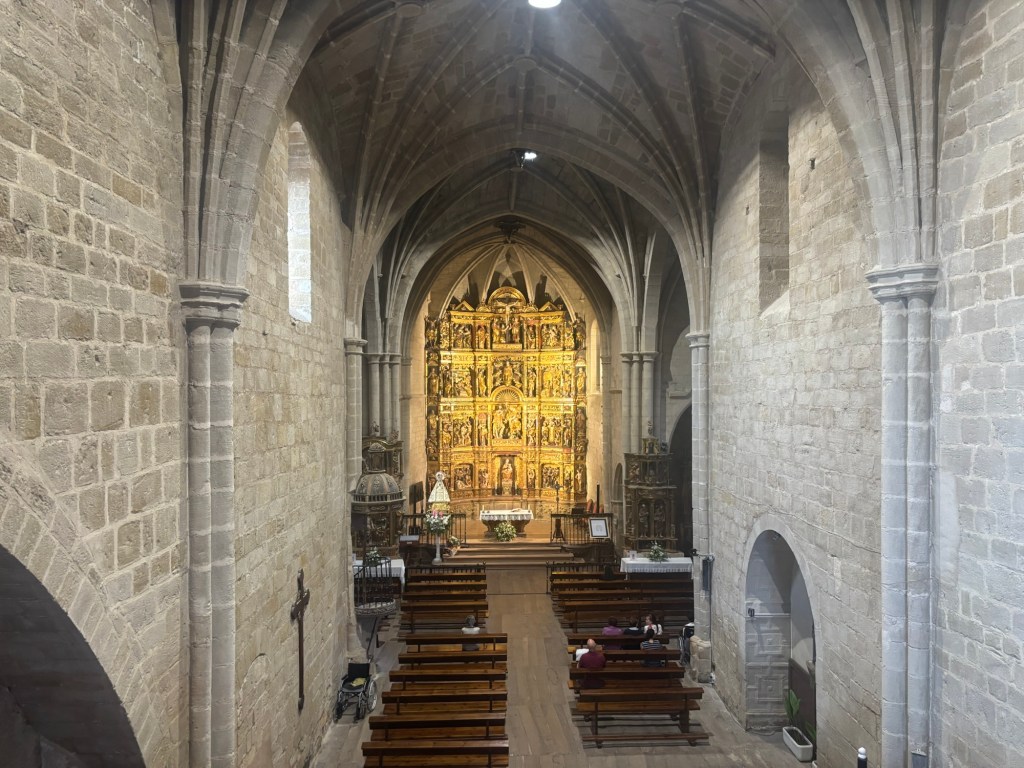
It would be remiss of me to come all this way and not visit the Catedral de San Salvador, so I slipped in for a flying visit just before closing time. True to form, the scaffolding curse struck again: the cathedral was untouched, but the image of San Salvador was behind a heavy hemp screen, being carefully restored by a couple of painters. There’s plenty more to see, though, and I had a wander around the sacred relics and the pilgrim tombs in the cathedral’s antechambers.

Just before leaving, my eye was caught by a small but incredibly ornate chapel by the exit to Santa Eulalia de Mérida, a teenage saint from Extremadura who is venerated in Asturias. She’s a long way from home, up here in the cold mountains of Asturias; but then, so was the Lady of El Rocío in that shrine by the lake west of Logroño.

I’m only just beginning to take an interest in the cult of saints in Spain – and I feel all the more foolish now for dodging an entire module on the subject at university. Given my especial devotion to the Lady of El Rocío, it seems a subject I really should explore some more. Maybe there’s a space for Eulalia in there. She would be a bridge to the land that stole my heart.


French to my right. Portuguese to my left. Spanish out in front. It’s shaping up to be a good Camino choice for languages. And if my plan holds out, I might even get to say one last goodbye to at least one of the pilgrims with whom I shared the road from Puente La Reina. New friends and old. That would be a nice way to end this adventure. BB x
Camino XXVII: Columbus Rides Again

Albergue de Peregrinos de Payares, Pajares. 19.30.

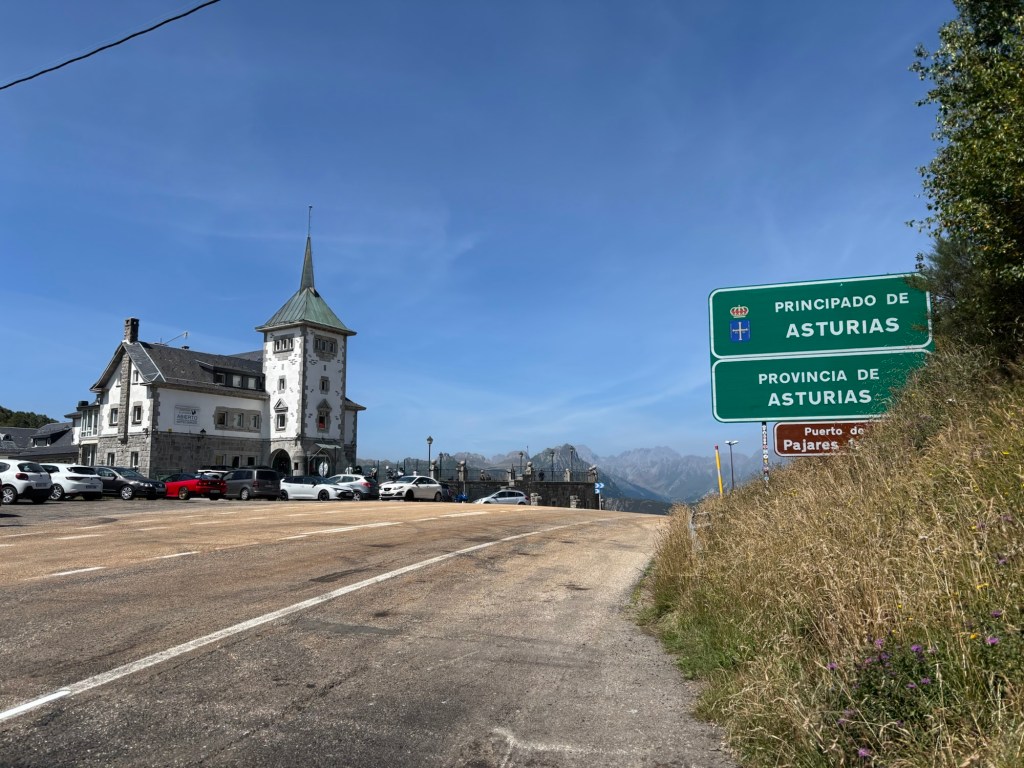
Shortly after one o’clock this afternoon, I crossed over into Asturias and crossed off the penultimate Spanish region on my list. After a flying visit to Tenerife earlier this year and a long march across Aragón at the start of the Camino, now only Murcia remains. Which is tremendously ironic, as my family are technically Murcian, since the borders of Spain’s autonomous communities were only redrawn in their present form in 1983, with both Albacete and Villarrobledo falling within the formerly extensive region of Murcia. But alas! It remains on my list as the very last region for me to visit. At least I won’t be short on options.


The other pilgrims were all up at 5am this morning, but I still managed to beat them out of the door and was on the road by 5.20. I still had the crazy idea of combining two days into one – crazy, not on account of the distance (38km is child’s play at this point) but the elevation, which was considerable. It was pretty chilly, so I kept my fleece on for the first couple of hours while I finished I, Claudius.

The young folks of Pola de Gordón were starting to head for home after a Saturday night out on the town (read: village) as I walked in around 7am, though there was still music playing in the town bar, Los Gatos Negros. The Dane overtook me as I was fixing the straps on my bag, but I passed him later on (I have a vicious pace when I get going) and did not see him again.

I have managed to acquire two more books: Spanish translations of the Hungarian author Laszlo Passuth’s Tlaloc Weeps over Mexico, bound in red leather. They were fading away in a book bank at the side of the road and, as I have been looking for this book for a while, I rescued them. I have now acquired six books since starting the Camino and jettisoned the one I came out with. They don’t add too much weight to my backpack, but they’re not as easy to fold away like my clothes… still. This leopard’s spots don’t change so easily, I suppose.

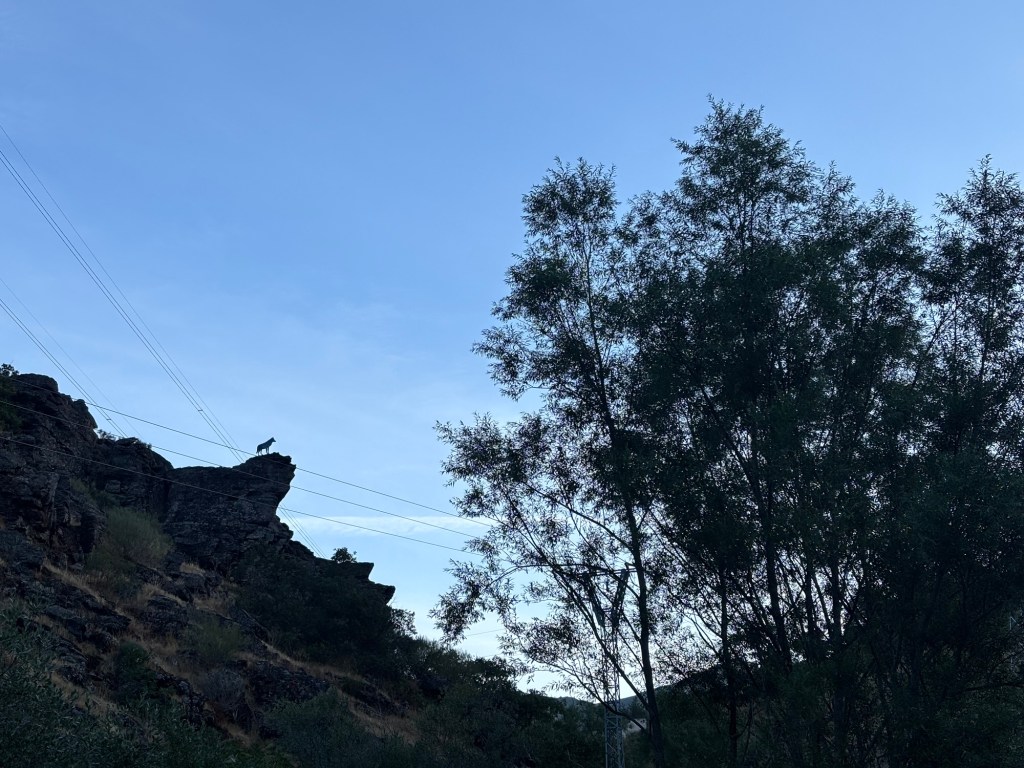
Before reaching Buiza, there’s a spooky silhouette on one of the rocky spurs that juts out of the mountains. We are very definitely in wolf country, and the Lobo de Buiza – a metal sculpture that watched the road into the mountains – would be very easy to mistake for the real thing if you didn’t know to look for it. It’s certainly big enough: my lasting memory of the wild wolves I saw in Poland this Christmas was their size, which little can prepare you for when you see one in the flesh (a true wolf can be taller at the shoulder than a mastiff).

Sadly, I didn’t see any wolves today, though I think I saw one of their tracks. Wolf and dog prints are very similar, but their gait is totally different: a dog walks with its front and hind legs splayed out in two lines, while a wolf trots in single file, like a fox. I did see a fox in the half-dark of the forest, shortly before daybreak.


Wolves aren’t the only large predators that dwell in this rugged corner of the peninsula. Somiedo Natural Park lies 50km to the west, beyond the formidable peaks of the Babia and Luna Mountains, and it is famous for being the final refuge of the Cantabrian Brown Bear. They were once widespread in Spain but can now only be found in the Cordillera Cantábrica, though recent sightings beyond Somiedo seem to suggest that they are starting to creep back into the fringes of their former range – and Pajares in right on their doorstep.

Thirty years ago, this Iberian offshoot of the European Brown Bear was on the verge of extinction, hunted without mercy by the Spanish (and the Romans before them). I remember visiting my friend Kate in Cabezón de la Sal and having dinner in a bar full of dead bears: mounted heads on the walls and black-and-white photographs of groups of hunters standing proudly about the carcass of a slain bear, as though the murder of such a beautiful creature were something to celebrate.

With both bears and wolves about, I was on full alert and so I nearly jumped out of my skin halfway up the mountain when something very large suddenly appeared on my left, crashing through the undergrowth. It was, of course, a cow, but it still gave me a fright. It’s a good thing its English was about as good as the local Asturians, so the torrent of expletives went right over its head.


The climb from Buiza was formidable, but it was only Round One. By day’s end, I think I had climbed and descended no fewer than nine separate ridges, tackling most of the San Salvador’s cumulative 3000m elevation in one day. Little wonder my feet were complaining by the end of the walk! I’d have been done for if not for the valiant effort of Pinta and Niña, my two trusty walking sticks. How the pilgrims of old attempted this path in a time before clean water and blister plasters is beyond me. Faith truly is a powerful thing.

If only it were powerful enough to open the doors of the churches along the way, which have all been locked up since I left León!


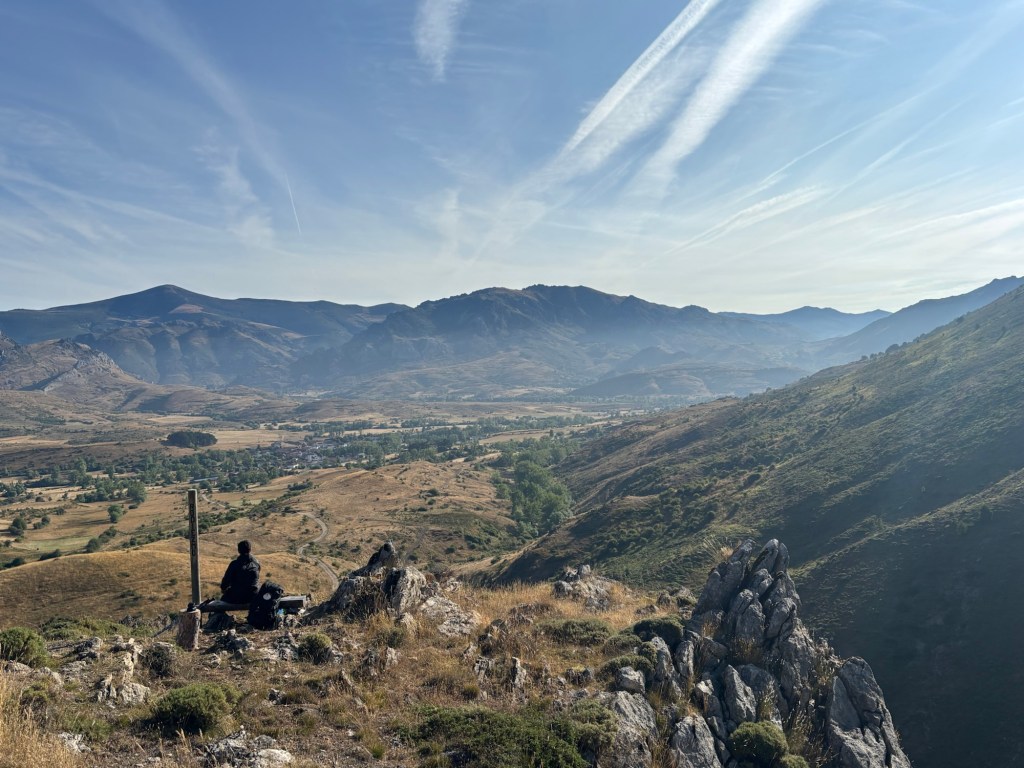
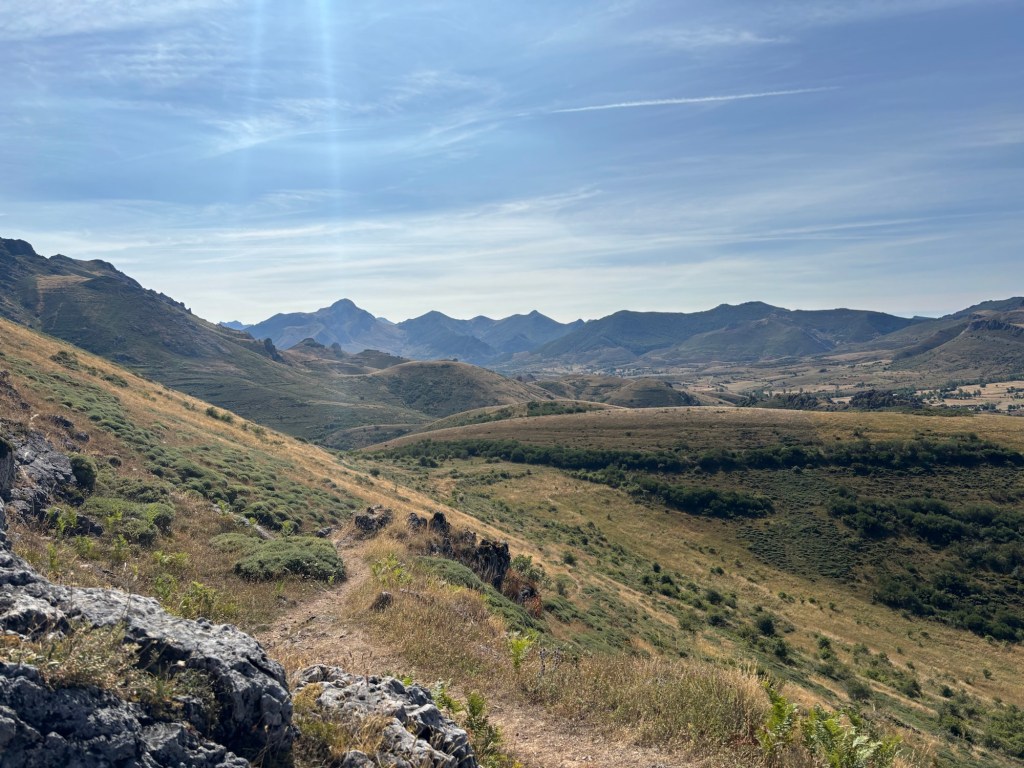
The scenery here is a world away from the meditative plains of the Meseta. It feels like I’ve stepped into a completely different country, and yet the Meseta is only a day’s walk to the south. The mighty cliffs of the Cordillera Cantábrica were always visible in the distance from the Camino Francés, but now I’m cutting a path straight through them, I can really appreciate their majesty. My soul will always belong to the stone pines and salt flats of Doñana, but my heart soars whenever I am in the mountains. It is an elixir like few others.


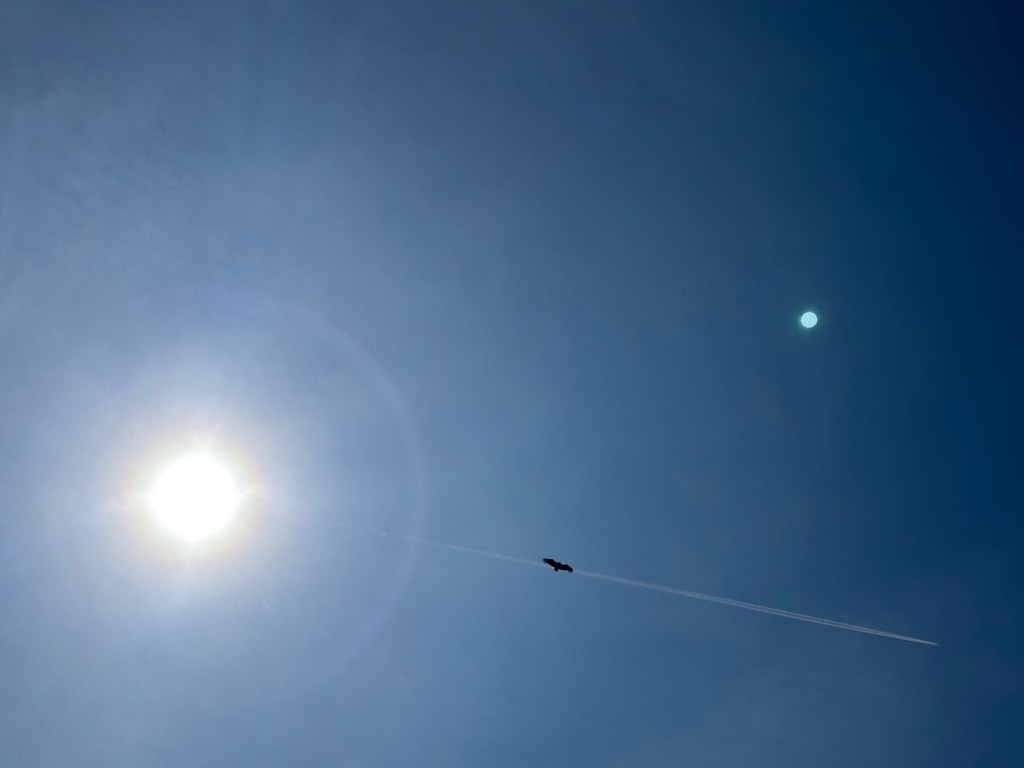
I had some fun counting contrails and trying to guess where the planes where going. Sometimes I’d look up and see a raptor in the blue: usually a kestrel, which are abundant up here, and sometimes a griffon, soaring silently through the ether; and just once, it was a hen harrier, wheeling about and beating its long wings like a child’s kite come to life.


After a rough descent into cow country and its attendant muddy tracks (I had more than my fair share of that in France), the Camino hits the road and climbs up to Puerto de Pajares – climbs being the perfect word, as the farmers have put up a fence across the road, so I had to vault it where the barbed wire was at its least intrusive. The former parador which perches upon the ridge is little more than an empty shell, and its stripped foyer is rather eerie, but the cafeteria is still in action, no doubt kept alive by the fact that its terrace commands a spectacular view of the mountains of Asturias beyond. Access to the terrace is strictly limited to paying customers, which is a master stroke as without it I should be surprised if the café would survive at all.

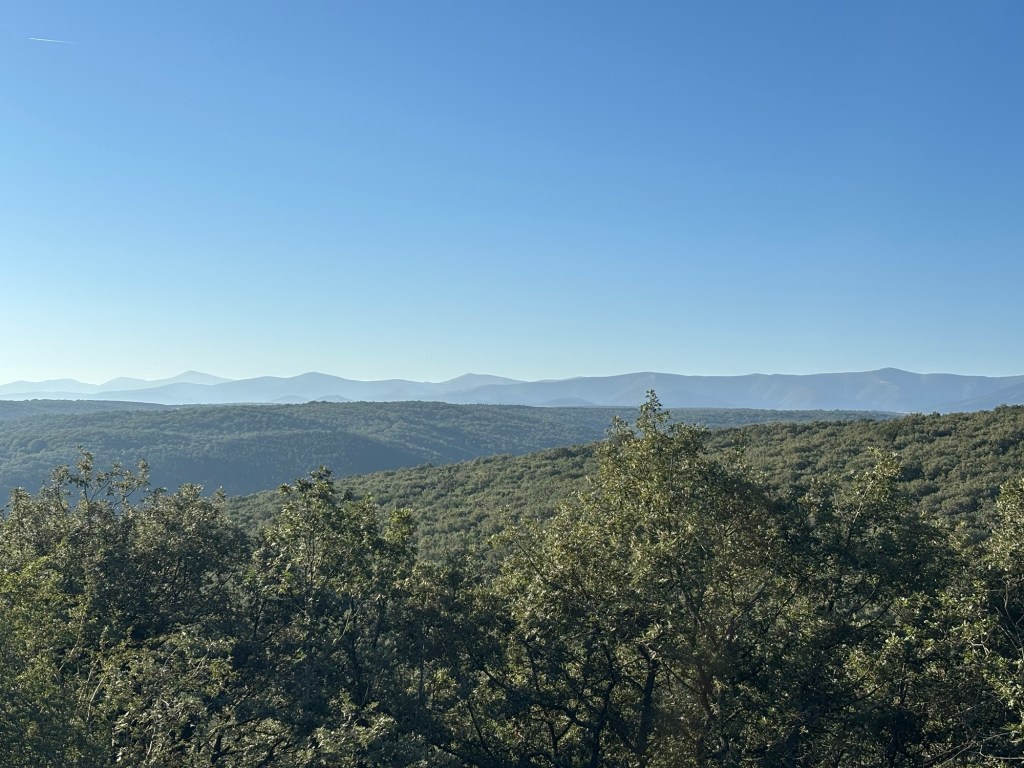
The photos don’t quite do the view justice. This must be one of the best views of all of the Camino routes, including sunset from Finisterre and sunrise from O Cebreiro. My presence at the café drew no small amount of interest: as popular as the route seems to be right now, I don’t imagine they get many foreign pilgrims passing through, especially as young as me.


The descent from Puerto de Pajares was the toughest yet, compounded by the fact that it was now gone half past one and I had been climbing mountains for nearly seven hours. The sun was also fierce and I have now officially run out of sun lotion, so my right arm got burned on the way down. I’m currently rocking the classic “Camino tan” that consists of very brown calves and right arm, due to the constant north and westward trajectory of the Camino.

I reached Pajares at around 2.45pm, without being eaten by any bears (as one of my students thought might happen to me), and practically fell into bed – after climbing into the only top bunk remaining. The room I’m in is full of Catalans in their late 40s, most of whom have an odd habit of talking to themselves. Not whispering, talking. I was woken up twice from my nap by their charlitas. The hush and stealth of the Camino Francés seems a long way away.


I won’t be doing another two days in one tomorrow, as I’m already technically doing so by bypassing Mieres the day after, so hopefully it will be an easier day. A belt of clouds have rolled in this evening, so I should probably prepare for rain – rain, and an earlier arrival time, just in case. Pola de Lena looks a bit more “happening” than Pajares, and it does have a supermarket, so I should be able to resupply before the final push to Oviedo. Here’s hoping! BB x
Camino XXV: R&R

Albergue Parroquial de las Carbajales, León. 21.33.

I’m not entirely sure I needed a rest day. I could just as easily have pushed on to La Robla today and been well on my way to Oviedo, but I wouldn’t have got to say goodbye to my friends, and that was important. We had one final breakfast together at a bar opposite the Parque del Cid, and then I walked with them as far as the bridge of San Marcos. They set off with hearts full of light and I turned back to the city, alone.


Leaving the Camino for any reason is always a hard thing to do. Choosing to remain behind, however – that’s probably the hardest thing of all. Knowing that the companions who have been your world for the last two weeks are somewhere out there, still going strong, as you open the door to the place where you stayed to find the place dark and empty.

Chip, the friendly gentleman from Utah and the father figure of our little group, had gone by the time I returned. So it was just me. I’m perfectly happy with my own company, but that sudden void of emptiness still hit hard.

I didn’t have too long to wait. I sat in the square by the cathedral and watched people come and go for a little while. When twelve o’clock came around, I checked into the Albergue Carbajales (where I stayed two years ago), bought myself the Salvadorana credencial and struck out into the city for a little culture – something to take my mind off my sudden isolation.

I’ve been to the Centro de Interpretación in the Palacio del Conde Luna before, but museums are always worth a second look. León is the rival faction in the alternative history saga that I’m writing, not Castilla, so I’m always looking for details in places such as this to help me build my world.

I especially love medieval art – particularly the Byzantine style with almost-shaped, almost cartoonish eyes. They are far more descriptive in their storytelling than any early modern masterpiece and very easy to replicate in my journal. I was lucky to arrive just in time for a free guided tour with a local historian, too, which was pretty special.


Today was mostly, however, about people watching. I saw a handful of familiar faces in town – the digital nomad couple from Texas, the retired American couple I met in Hornillos, the Effing Dutchman and two Texans from the other young group who took a rest day in León – but on the whole they were mainly stragglers, as the rest of the weekend wave all moved on today.

No – today was for watching the people of León.


León is a part of Spain I have got to know rather well thanks to the Camino. Andalucía and Extremadura will always have my heart, but there is a proud and noble beauty in this ancient corner of Iberia. Leonese Spanish is crystal clear, which is notable in that their regional dialect, llionés, is closer to being a language in its own right than a simple change in accent. If the Castilians hadn’t proved the greater of the two powers, the Spanish we speak today might have sounded very different indeed.

As it is, a combination of geographical, political and economic factors left the Leonese stranded, looking inwards, while the mobile Castilians raced to grab the former Muslim territories across the border and, in so doing, sow the seeds of one of the most successful languages of all time.


There‘s still some lingering resentment about León’s status as an autonomous community within Spain. If it wasn’t obvious from the Camino signs (where Castilla or León are scratched out on either side of the border), it’s even more so in León itself, where Leonese flags are sold on the cheap and some stores carry placards or banners in their windows promoting self-rule.

We focus a lot on Catalunya’s constant struggle for independence, but it’s worth remembering that Spain was once a republic comprised of individual states, many of which were once kingdoms in their own right. The Catalans are certainly vocal, but they’re not the only ones with a claim on self-rule: the Basques, the Galicians, the Leonese and even the Andalusians could all claim that their regions are distinct enough to warrant independence.

The Americans I have been walking with are young and carry that profound dislike for nationalism and state boundaries that is so common at that age. I remember it well. But for me, though I remain a fierce advocate of liberty and freedom of though, speech and expression, I am also a believer in the good that comes from having a sense of national identity. After all, in my case, finding out about my heritage in Spain has given me immense peace of mind. I’m not just play-acting at speaking Spanish anymore. It’s literally in my blood.


Tomorrow, we begin again. I’ve heard there may even be wolves up in the mountains. I’ll keep my eyes peeled. BB x

Camino XXIII: Sacrifice

Albergue El Jardín del Camino, Mansilla de las Mulas. 22.20.

I’ve developed my first blisters of the Camino, but typically for unconventional me, they’re not on my feet at all. They’re on my lower back, where the frame of my rucksack has been rubbing, despite my best efforts to adjust the straps. If I adjust them any further, I won’t be able to fit my arms through the straps, or take them out for that matter. I’ve put some Compeed over them and that has helped a little, but it’s a bummer to have to slum it with the rest of the world after such a glorious blister-free run of it.


We left Sahagún early, lingering for half an hour later than yesterday to take advantage of the breakfast left out by the Benedictine sisters and their volunteers. It was still dark when we set out – not as pitch-black as yesterday, but still dark enough to warrant the use of torchlight to find the signs here and there.


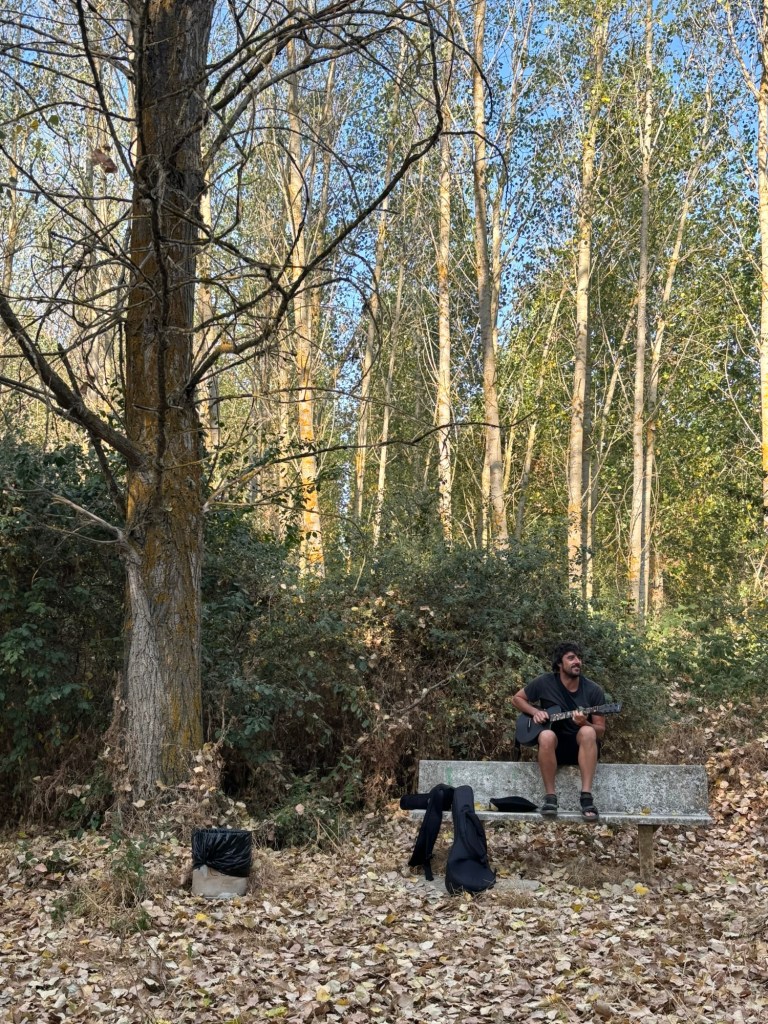
We passed Bercianos early and most things were shut, after which I started to get itchy feet and took off ahead. Along the way I heard the strumming of a guitar in a slim stretch of forest – a brief oasis in the golden fields of the meseta – and there I found Steven, a Chilean-South African who we haven’t seen for about a week. He’d found a solitary spot beneath the trees where the orioles sing to play his heart out. That’s something I’ll admit I’ve been missing a bit in this fun but busy Camino.


I stopped a couple of times during today’s walk to appreciate the silence of the meseta. There’s not much like it. I imagine the Dakotas might have the same sound – or rather, the same total absence of it. I suspect it’s that all-encompassing stillness that leads some pilgrims to abandon the Meseta altogether, fleeing the self-imposed stillness that surrounds you from the moment you leave the city of Burgos and step up into the golden highlands. I am not even out of it yet and I know I shall miss it when it has gone.


Today, as I have done on my solo strike-outs, I allowed myself a moment to listen to some music. Mostly from my favourite musicals so I could sing along (Jesus Christ Superstar, West Side Story, The Prince of Egypt and Fiddler on the Roof), but also my recordings from my various musical endeavours with my students over the years.

Rutherford House’s Rolling in the Deep and their house band’s covers of Stayin’ Alive/Without Me and Thrillie Jean. My short-lived Gospel Choir’s Ain’t No Rock. My new funk band’s one-day run at Lauryn Hill’s Doo-Wop. I forget more than half of the lessons that I teach, but every rehearsal and every performance stands out in my memory like an island in a wide, wide sea. The voices of the children I have taught surround me like a vortex in the Meseta and I am lifted up by the smiles on their faces as they experience the same giddy thrill that the music gave to me when I was their age. It makes the whole thing worthwhile – the long hours, the nerve-shattering email and Teams threads, the windowless flats and the social life that I have sacrificed upon the altar of my calling for the last nine years of my life.

Without the music, it would all be for nothing. It would all be a mistake.

There’s all sorts on the Camino. Sane and insane. Students and soldiers. Culture vultures and racists. Free spirits, free lovers, free thinkers and freeloaders. People who seem to think it’s ok to slap stickers advertising their YouTube channels on every flat surface and people walking so fast they don’t have time to read. And yes, while many pilgrims blanch at the idea of singing together (barring the Italians, these are frustratingly common), there are plenty of us who leap at the chance to connect with others through the medium of music, the truly universal language.

I’m a little disappointed that the most popular Camino-related song one encounters along the Camino (besides Ultreia, Suseia) is a mawkish folk song in English called The Way that is currently being aggressively marketed in sticker form wherever you go. By comparison, even the Taizé songs that have now sunk their claws into the Camino are a breath of fresh air – at least they respect the multilingual world of the Camino de Santiago (which I refuse on principle to translate as “the Way”).

I’m having a much more spiritual time on the Camino this year. I’ve managed to attend Mass most days, despite traveling with a group of non-Catholics, and all the pilgrim blessings have been very special. Yes, I’m still a little annoyed by the rampant secularisation of the Camino and the way it gets treated as a big and sociable walk across Spain, as though that’s all there is to it… But every day is an exercise in tolerance and I’m doing my best to listen and learn.

I miss Spanish food. I’ve sacrificed my usual diet to facilitate the dietary requirements of my fellow vegetarian and gluten free pilgrims and it’s meant a lot of bland and global meals for the last fortnight. But that’s just one more lesson the Camino has to offer: life is all about sacrifice, especially if you live to serve, as I believe we do. Sometimes we have to give up the things we want the most – a job, a lover or even just a plato combinado – to make sure that those around us can be the very best versions of themselves. It isn’t an easy path, but I know that it is the right one.

Faith in its most literal manifestation may not be as ubiquitous on the Camino de Santiago as it once was, but it can always be found in the small actions and interactions of others. That gives me hope. My back might be hurting from the friction of the weight I’m carrying, but my heart is light. BB x
Camino XXII: Starlight

Albergue de la Santa Cruz, Sahagún. 21.17.

Today was a lot more like the Camino Francés that I remember: long, unforgiving, sociable and under the stars for the first half of the morning. I’ve been taking it easy with all these post-sunrise starts with the other pilgrims, so with my fork from León now very much on the horizon, it’s good to get back into the routine.


We agreed the night before to strike out for Sahagún, partly because Audrey wanted to go further and potentially save a day to add to the end of her trip, and partly because I wanted to get to Sahagún after having had the place recommended at least twice. There was also the very real possibility that we could both shake the freeloading Englishman and catch up to the endlessly entertaining double act of Juha and Mad Max, who have been at least a day ahead of since Grañón, where the floor beds didn’t agree with Max’s back.

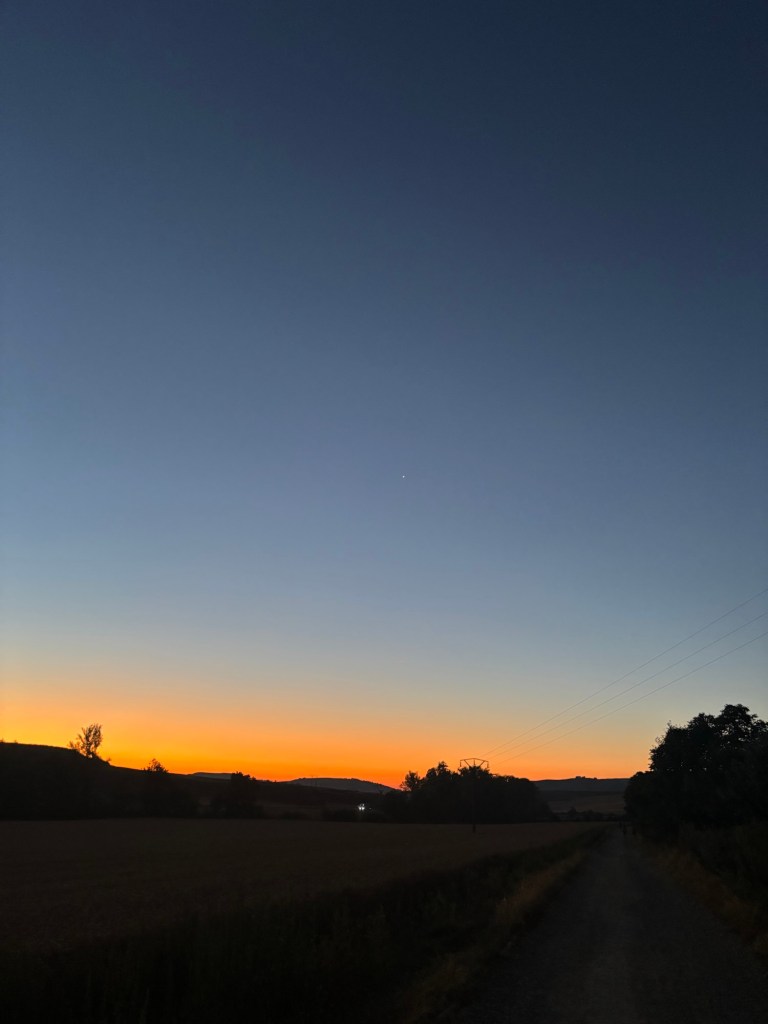
So, at five on the dot, the five of us set out from Carrión and into the night. We lost Edoardo sometime before sunrise – I’m not sure he could keep up, as he does appear to be carrying the biggest stick on the Camino (which probably might be better described as a branch or log). I also got lost: in my stubborn refusal to use artificial light, I completely missed the turn-off to the pilgrim road after Carrión and lost twenty minutes backtracking once I’d realised my mistake. On the plus side, it did mean total silence and an unrestricted view of the night sky, which was spectacular this morning.


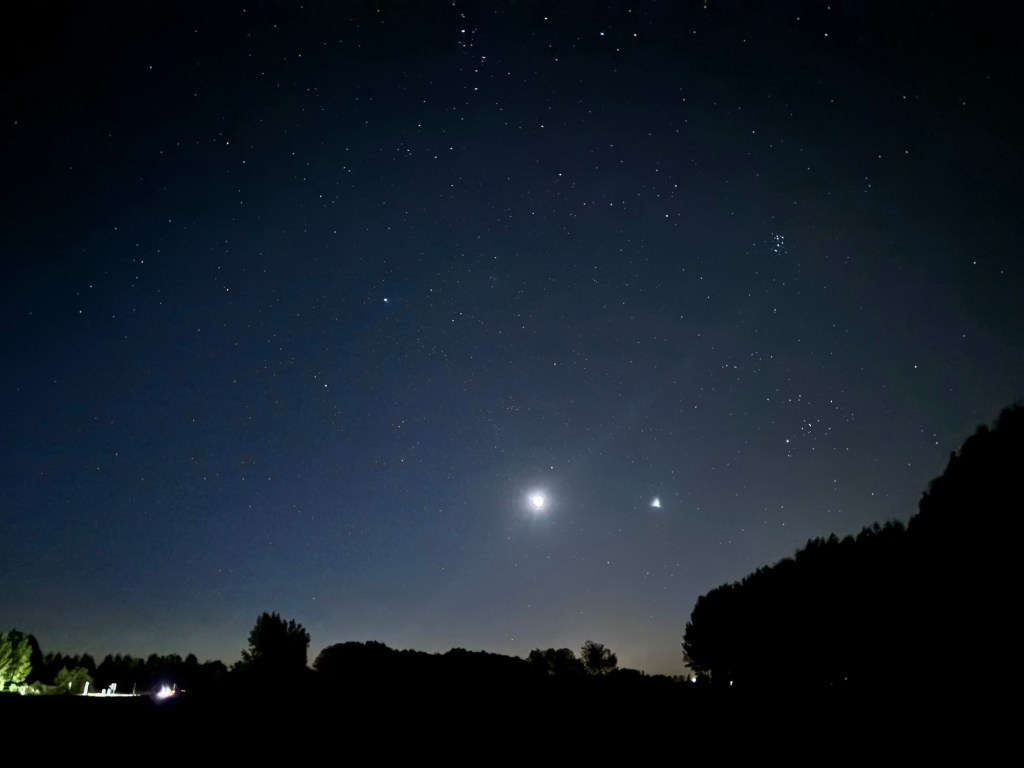
There’s no lighting along the nineteen kilometre road between Carrión and Calzadilla, and all the towns are distant, so the stargazing was almost as good as it was on Tenerife. Even the Milky Way was visible, stretching westwards toward Santiago like the songs describe.

I spent a great deal of the morning racing ahead, mostly because of an obnoxious pilgrim who was lighting the entire path with a brilliant LED head torch, even though visibility by star and moonlight was perfectly good enough once your eyes had adapted. With him in the dust, I allowed myself some time to listen to a couple of chapters of an audiobook (some short stories about the Sargasso Sea from Strange Tales from the Deep and I, Claudius).


Not too long after sunrise, I saw flashes of white in a field by the road and trained my eyes on the spot: I counted ten great bustards, closer than I’ve ever seen them. Of course, they were far too distant for my iPhone (which makes for a superb camera, but is utterly useless as a telephoto lens), but you can just about make them out in the photo below (to the right).


After a brief pitstop for breakfast in Calzadilla, I raced on ahead once again. This time, I took advantage of the empty pilgrim road to do some singing practice, mostly from Jesus Christ Superstar, which I pretty much sang off-copy for all parts. I don’t have an eidetic memory, but I do have an uncanny ability to retain enormous amounts of information about things I’m interested in. Musical scripts fall under that category.


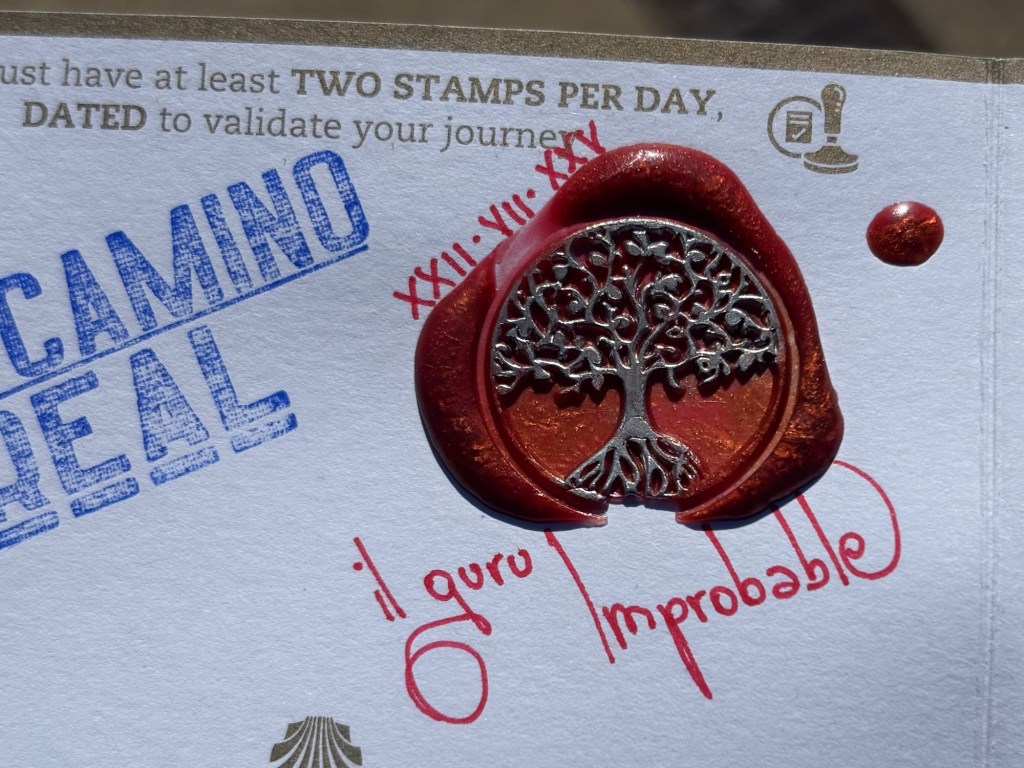
I stopped in Moratinos to pick up a beautiful wax stamp from Il Guru Improbable. I’ve missed this one before, as it’s much too soon after the usual staging post of Terradillos de los Templarios to obtain in the early hours of the morning, so I’m glad I pushed on today.


At Moratinos, I took up with a new group of pilgrims: Tom, a retired education superintendent from Michigan; a Finnish woman on her fourth Camino; and Tina, a Swiss-Guatemalan girl inspired to walk the Camino by a German comedian who hates walking. It made for a healthy change, and it was fun to tell my grandfather’s tale in full once again, which I haven’t done anywhere near as often on this Camino – last time, it usually preceded me by the time I met a new face!

Audrey caught up to me as we approached Sahagún and we entered the town together, seeking a pharmacy (for her feet) and an ice cream (for my appetite). At 13.10, it was the latest we’ve arrived at a destination yet, but it did mean no waiting for the albergue to open, which was a huge plus.


The bells are ringing for 22.00, and the white storks nesting on the bell tower are doing a lot of beak-clicking. That’s a sound I will always associate with Spain, no matter where else I may hear it.

Tomorrow we’re going to do another long slog, striking out for Mansilla de las Mulas if we can – which should, in theory, catch us up to the others who we lost on the road over a week ago.

Catch you later! BB x
Camino XIX: White Magic

Albergue Rosalía, Castrojeriz. 16.44.

I’m back in Castrojeriz, a Castilian hill-fort town some twenty-one kilometres down the road from last night’s stop in Hornillos. I probably could have gone a little further today, but there’s a local festival in town and I wanted to check it out. It’s much too easy to lose track of things on the Camino over a good conversation, and in so doing miss something special.

I mean – it is a garlic festival. So it’s nothing extraordinary. But I happen to love garlic (sopa de ajo is my favourite dish in the whole world) so I feel duty-bound to check this one out.


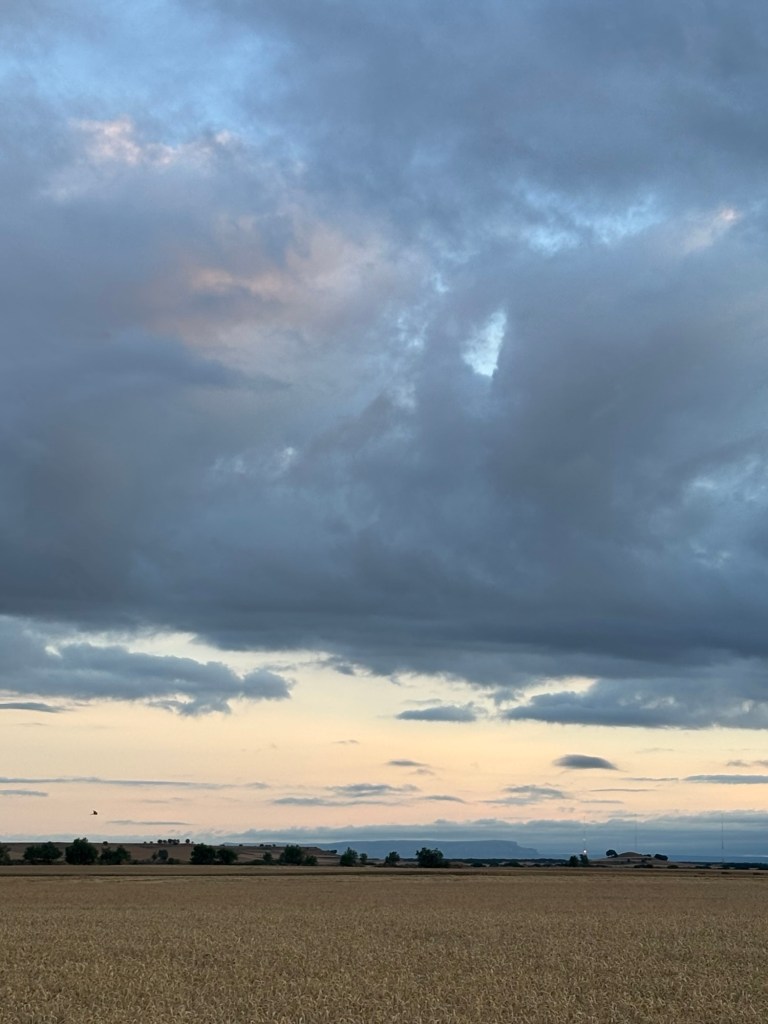
The hospitaleros at Hornillos left out a proper spread for breakfast, so we ate well today. Even so, we were up and gone by 6.20am, shortly before sunrise – which is getting noticeably later each week. The turbines on the surrounding hills continued to spin in the twilight, their red warning lights blinking like eyes along the blue horizon.


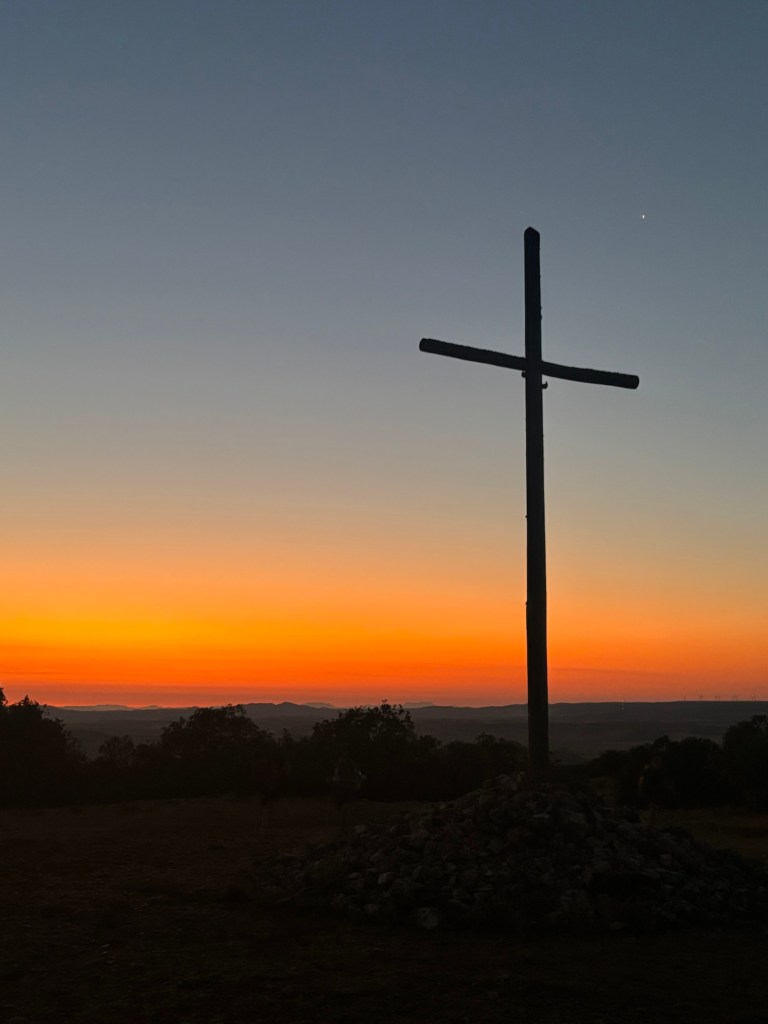
A gentle blanket of cloud shrouded our ascent up to the high meseta west of Hornillos. Apart from a few simple crosses erected along the road, the terrain was featureless, and all the shadows harrier-shaped: I counted at least seven Montagu’s harriers quartering the fields between Hornillos and Hontanas, from the agile ring-tailed youngsters to the ghostly silver shapes of the adult males. Vultures always take the top spot in my animal pantheon, but Montagu’s harriers are absolutely in my top five.

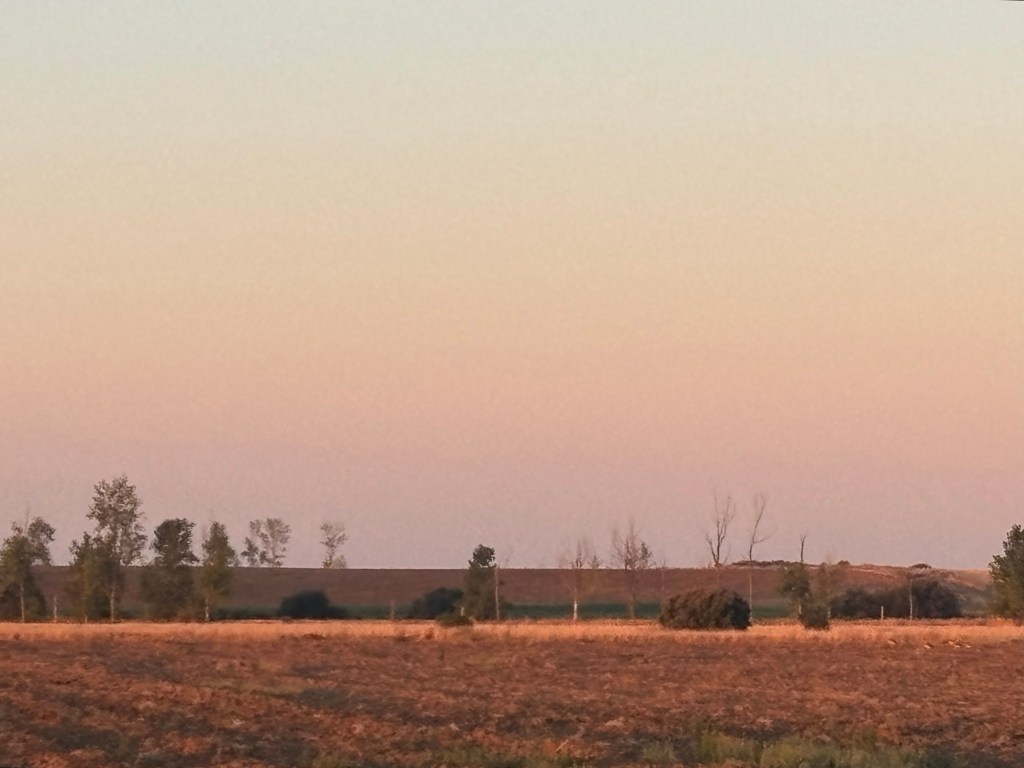
There’s not much a mobile phone can do with these elusive spirits, but you can just about make out the long-tailed shape of one in the photo below.


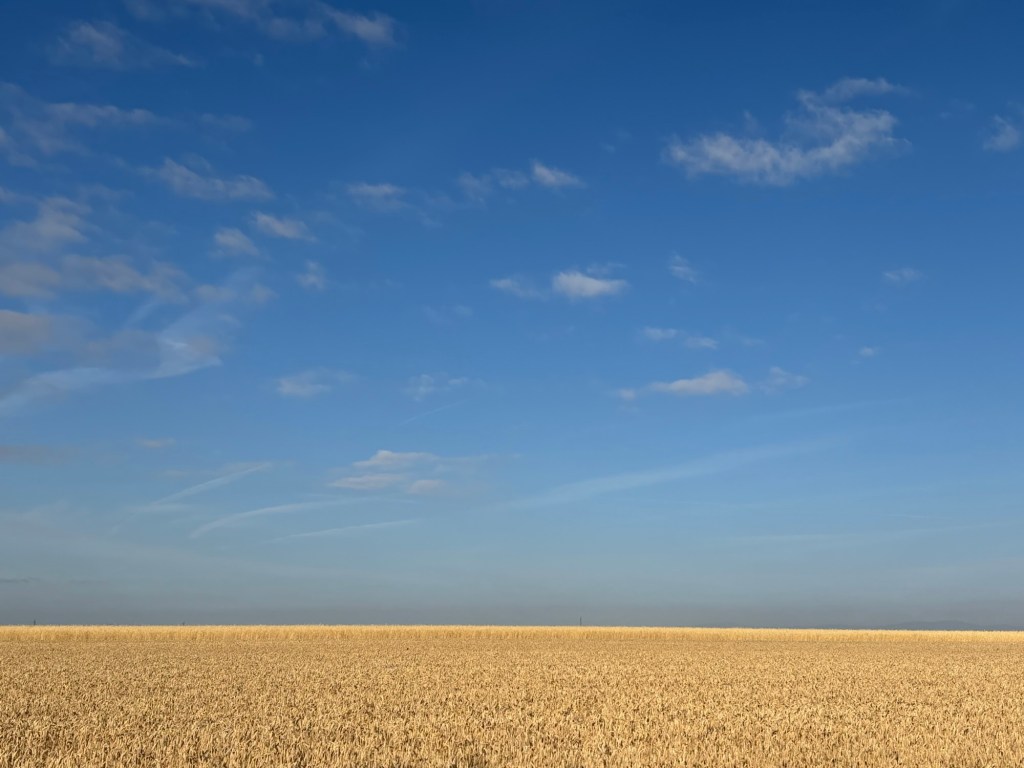
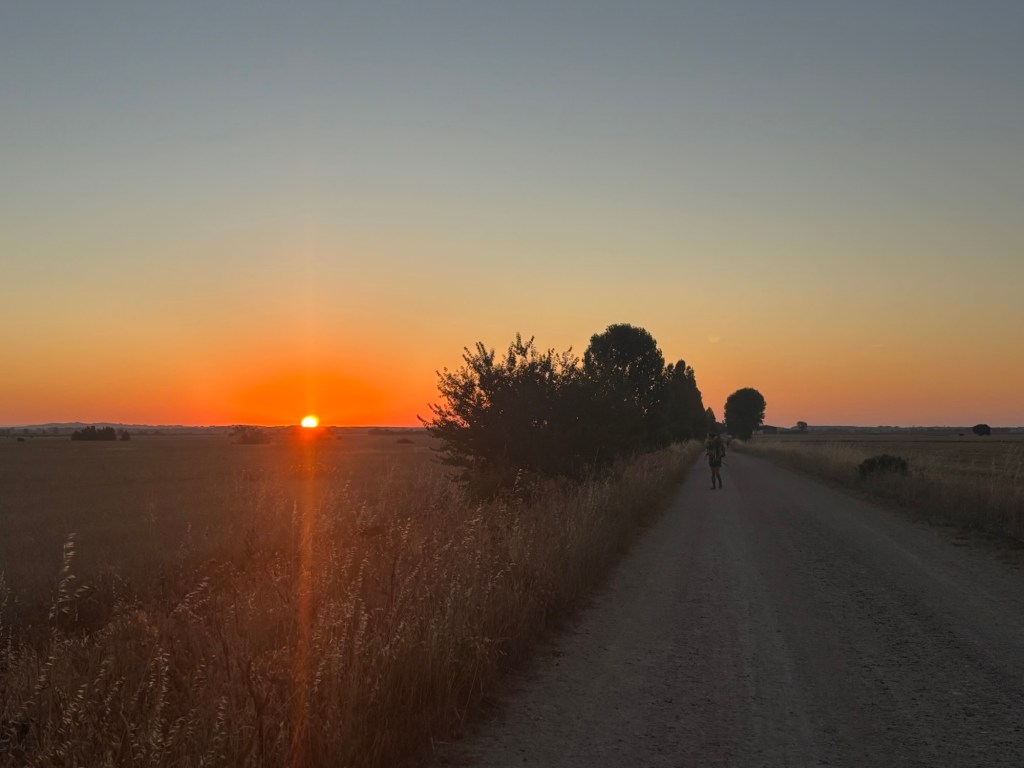
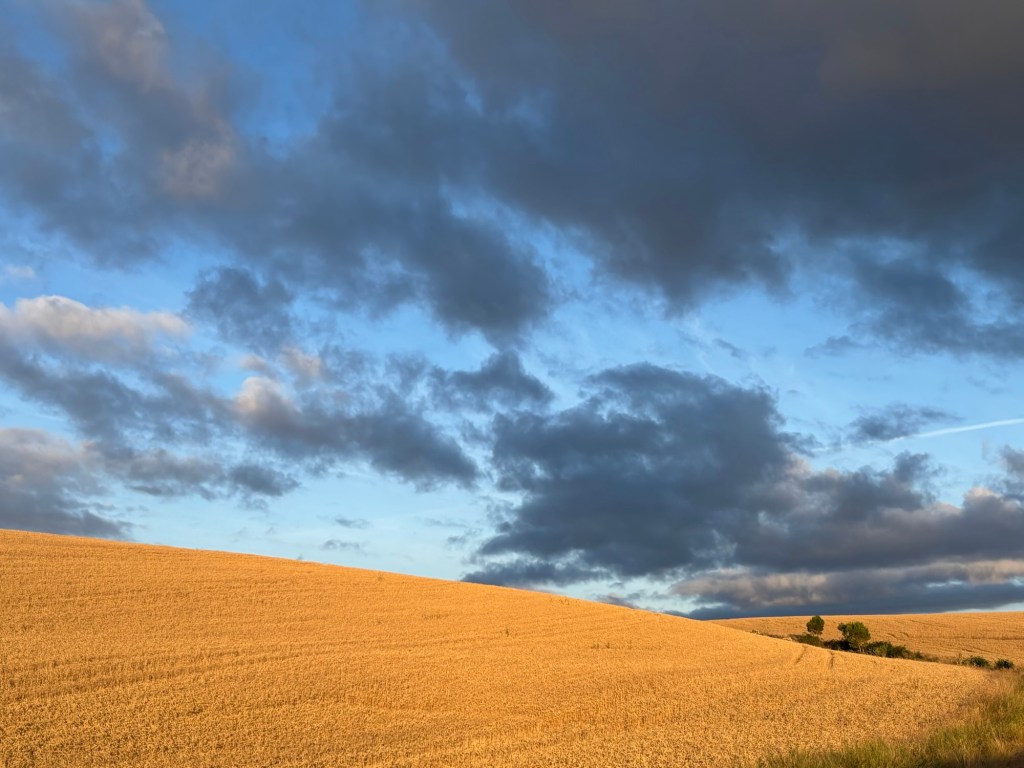
The sunrises over the meseta are peerless. It’s amazing just how many colours come out of the fields of gold, which pairs better with the sky than the grapes of La Rioja with the local jamón. I can’t imagine walking this route in winter, when the fields are stripped and bare. It must be spiritual then, too, but I would miss the warm hues of the wheat.


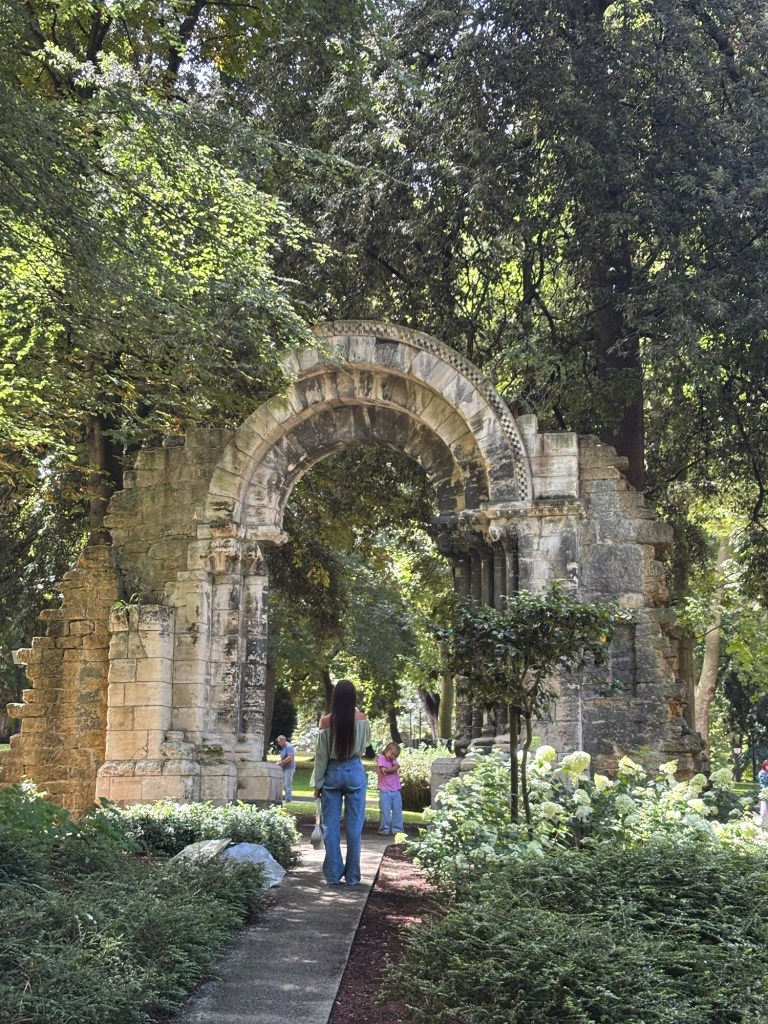
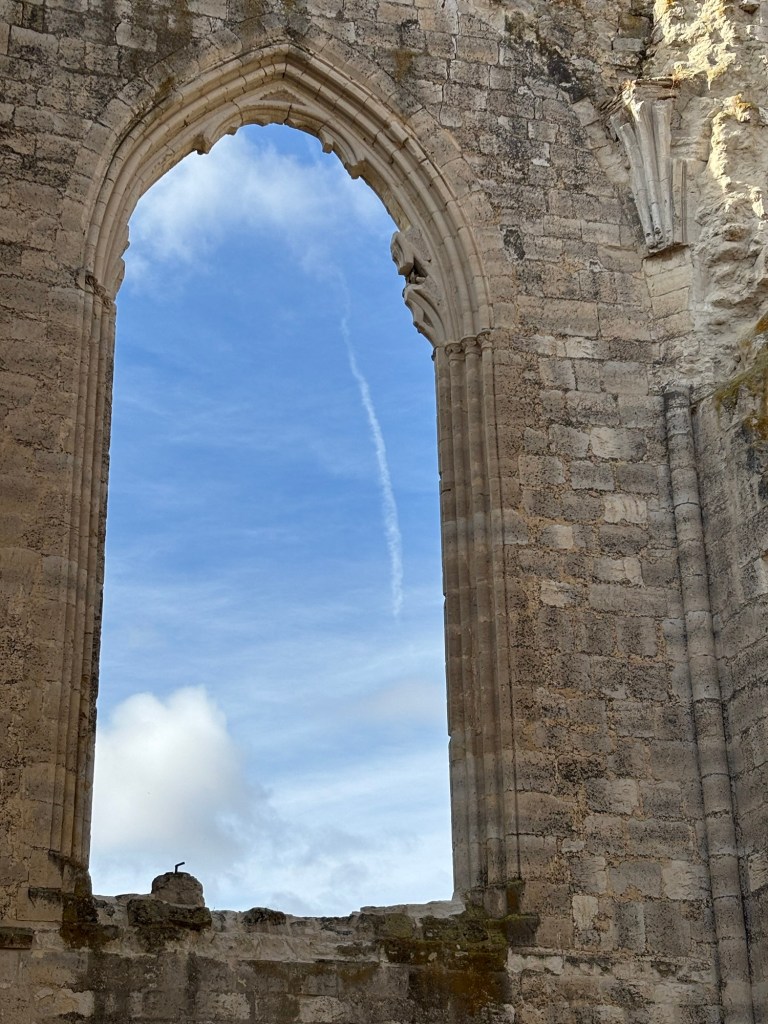
To reach Castrojeriz, you have to pass through the ruins of the Monasterio de San Antón. According to my route planner, I had intended to stay here, but it was only ten o’clock, and the day was still very young, so I pressed on – but not before snapping some photos of what is easily one of the most breathtaking buildings along the Camino Francés, with its ruined arches spanning the road to Castrojeriz.

The monks quartered here used to treat those afflicted with Saint Anthony’s Fire, a sickness we now know as ergotism. Advances in agriculture have more or less eliminated the disease, but the source is all around us in the wheat and rye that once carried the sickness. Before the causes were understood, the spasms and hallucinations that sufferers endured were believed to be a form of divine punishment or demonic possession. It’s hard to say whether the monks’ sanctified treatments truly worked, or whether the cutting-out of rye from their diet was what made the Order so effective. Either way, the monks resorted to a Christian form of white magic to keep the locals safe back in the day.

I like to imagine their ministrations might have saved the lives of at least a few pilgrims bound for Santiago over the centuries.


Gust was waylaid by a photographer for about half an hour on the road to Castrojeriz, and I was only spared the same fate by his silent warning to stay away and the timely arrival of two British university students, one of them a Durham undergrad. They stopped a little way along with their group so I couldn’t walk with them for that long, but I hope I can catch up to them again at some point before León.

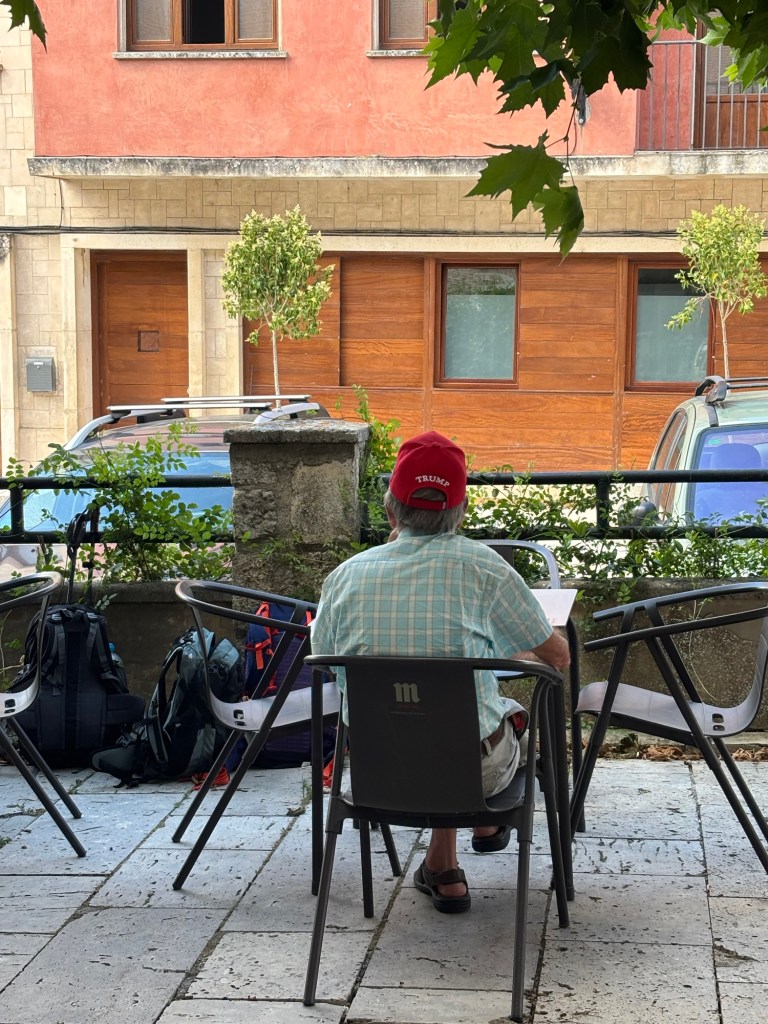
I rejoined the Americans at Castrojeriz and we grabbed a drink before lunch, partly out of curiosity to see whether Gust could extricate himself from the photographer’s grip. We were more than a little surprised to see a MAGA hat, but nobody dared to engage the man in conversation. If he was a pilgrim, he was traveling very light indeed.


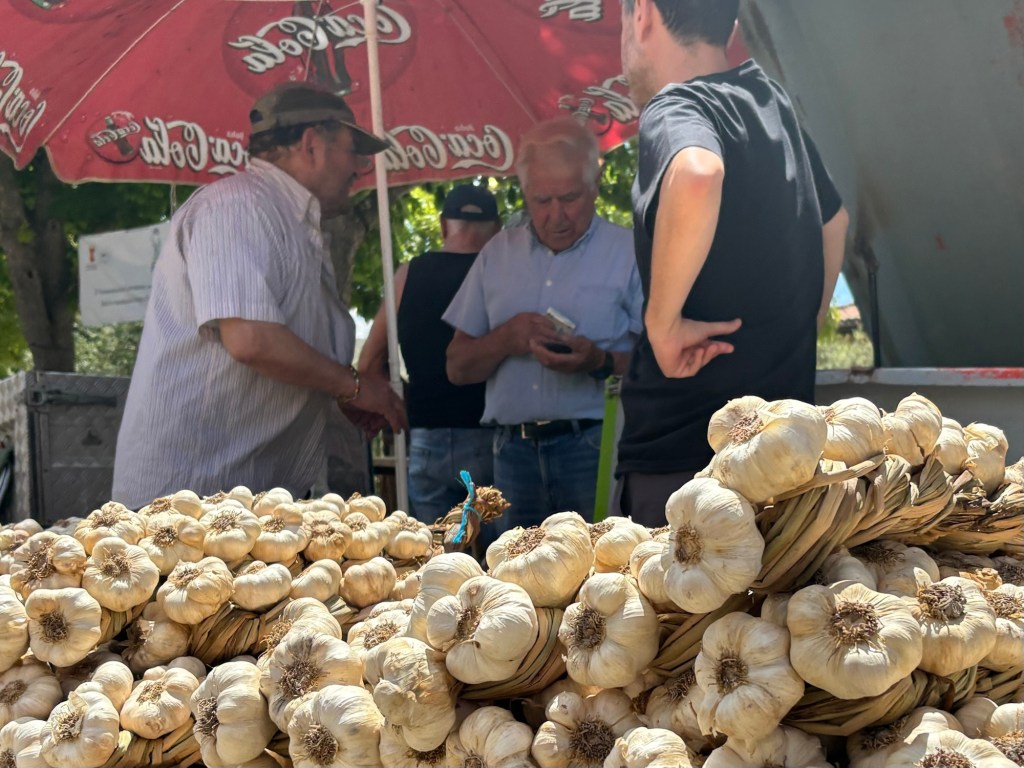
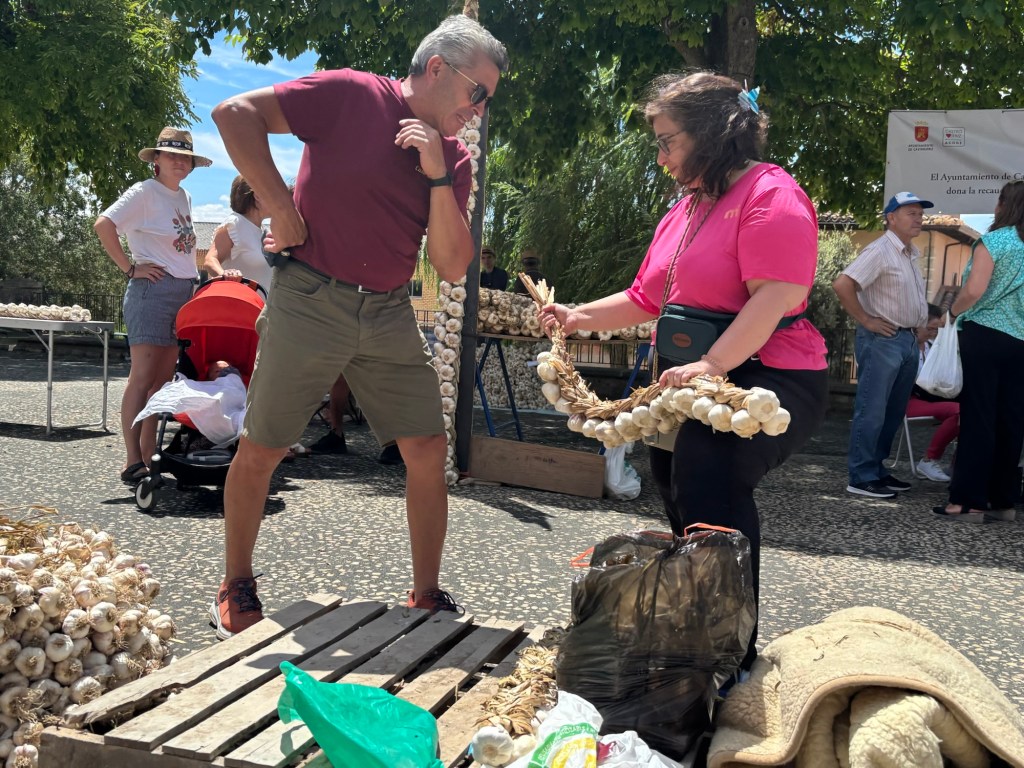
Downtown, the garlic festival was in full flow. A charanga band was marching around town, playing their oompah-like music wherever they went (just like back in Nájera), while old folks huddled around their collection of cloves and groups of kids in matching tee-shirts ran rings around the market stalls.


I suspect the Feria del Ajo is a relatively recent innovation (I’ve seen the number 46° floating around), but I shouldn’t wonder that this kind of harvest festival has been happening here for far longer. There’s a food-tasting event we’re going to check out later, and even a concert by the New York Youth Orchestra at 8pm tomorrow – though we’ll be long gone by then.


Garlic is famous in folklore for its protective characteristics, especially against malevolent spirits like vampires and demons. It’s also mightily medicinal, and has been fighting off disease and bacteria in humans for far longer than it has been used to ward off the undead. Given its life-giving properties, it’s easy to see how the latter superstition came about, in an age when Galen’s law of humours was widely accepted as gospel and any and all imbalances, including light and dark, required correction.

Frankly, I can’t think of any imbalances that couldn’t be corrected by a nice, hot bowl of garlic soup. It really is the very best of restoratives.


Audrey has popped out to explore the town. Alonso is watching a movie and Talia has fallen asleep. I might head out for a wander in a moment too, now that things are starting to open again after the afternoon siesta. Here’s to a little more white magic this evening! BB x
Camino XVII: The Bones of Burgos

Albergue Casa del Cubo, Burgos. 22.55.

There’s a grumpy old Spanish guy in the bunk below mine. He made a point of asking me earlier if I snored in that direct, you had better not way that Spaniards do (‘No roncas, eh?’). He put the same question to my two companions just before bed. Well, after a couple of rounds of solitaire in his phone, he’s snoring away down there, along with the Koreans in the bunks next door. Like it matters…! You’d have thought a pilgrim might have learned a little patience by Burgos.


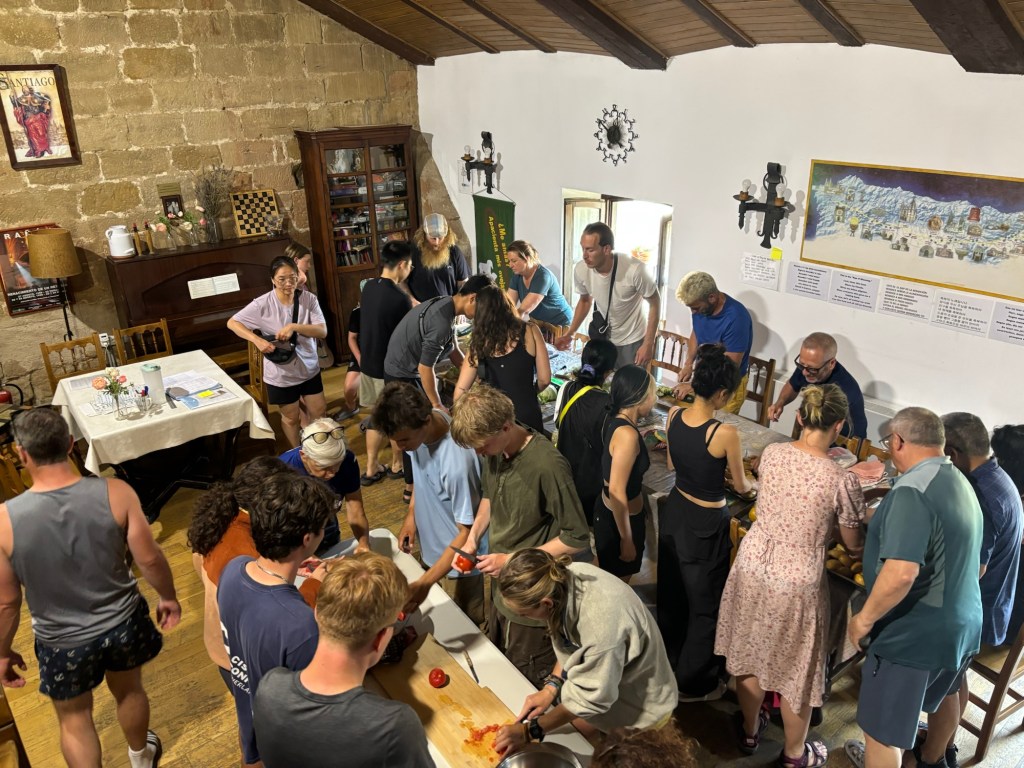
We got lucky yesterday. The Albergue in Atapuerca had a room of six beds so we had a room to ourselves, complete with an en suite bathroom. Along the way we’d picked up Gust, a seventeen-year-old Belgian student who was struggling with his blisters, so we took him under our wing for the rest of the day. There weren’t many restaurants in town, so I bought some supplies from the only shop in town (where the Central American shopkeeper was having a great time rapping to a backing track while I browsed the vegetable aisle) and rustled up a rice and vegetable pisto for the six of us. It felt good to cook for company again. It’s been a while.

We set out shortly before sunrise, finding our way up the Sierra de Atapuerca by moonlight. The sun was not yet over the horizon when we crested the hill, and the soundscape was still very much that of the Spanish night: a couple of scops owls called their piping call from the trees, the high-pitched twittering of a bat occasionally caught my ears and, from somewhere far off, the unmistakeable churr of a nightjar.


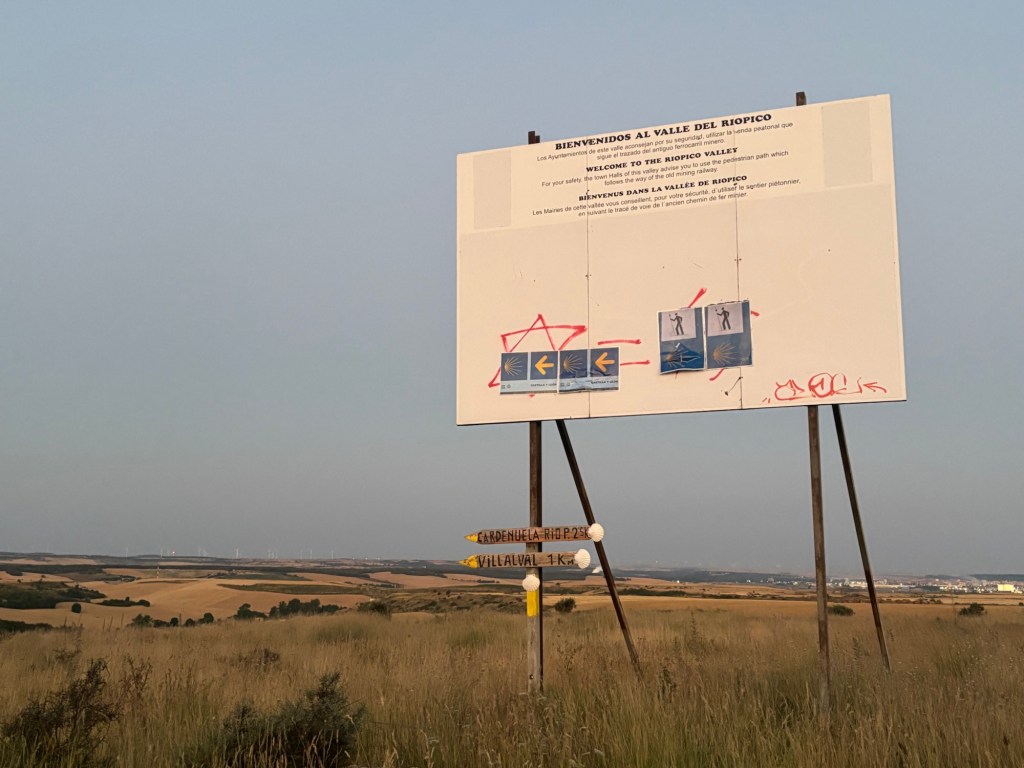
We stopped for breakfast in Cardeñuela Riopico at the same place I came with Mikkel, Sofia and Lachlan two years ago. It was just as good as it was then, only this time, I allowed myself to stay and eat rather than tearing off harum-scarum for Burgos on my own.

The signs are still defaced all over the place with images of the Star of David equaling a swastika. They’ve tried to cover them up with pilgrim pointers here and there, but the pilgrim preference for the Palestinian cause is obvious.


We reached Burgos early, despite missing the turnoff for the Río Arlanzón alternative (which I maintain is bloody well hidden, as I’ve now missed that turning twice). The result was at least half an hour of trudging through Burgos’ deeply unattractive industrial estate on the eastern side of the city, so we amused ourselves with a protracted game of Just a Minute, at which Talia proved to be a past master.

It was just before eleven when we reached the albergue, which meant we still had an hour to kill, so we took it in turns to do an ice cream run / sightseeing. Gust parted with us to meet up with his brother. We might run into him on the road, or we might not. I hope he looks after his feet – they were in a bad way.


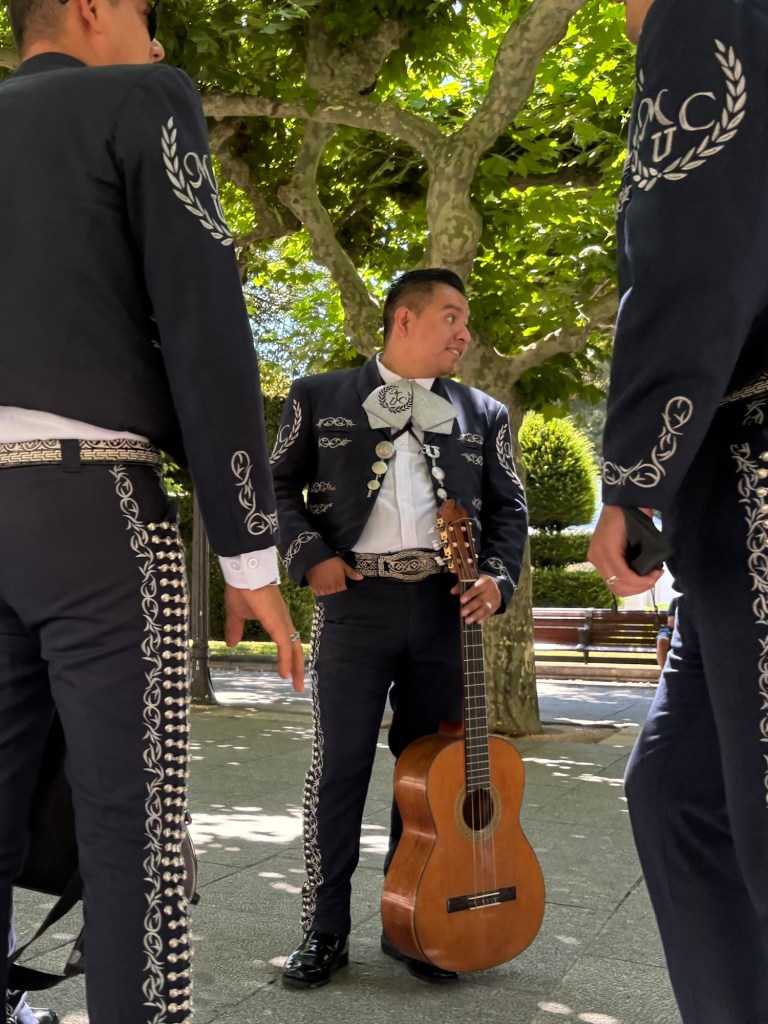
There was a Mexican wedding or quinceañera or some kind of celebration in town, dressed in the decorated black, white and red that could belong to just about any traditional European country – though the loitering mariachis rather gave the game away.


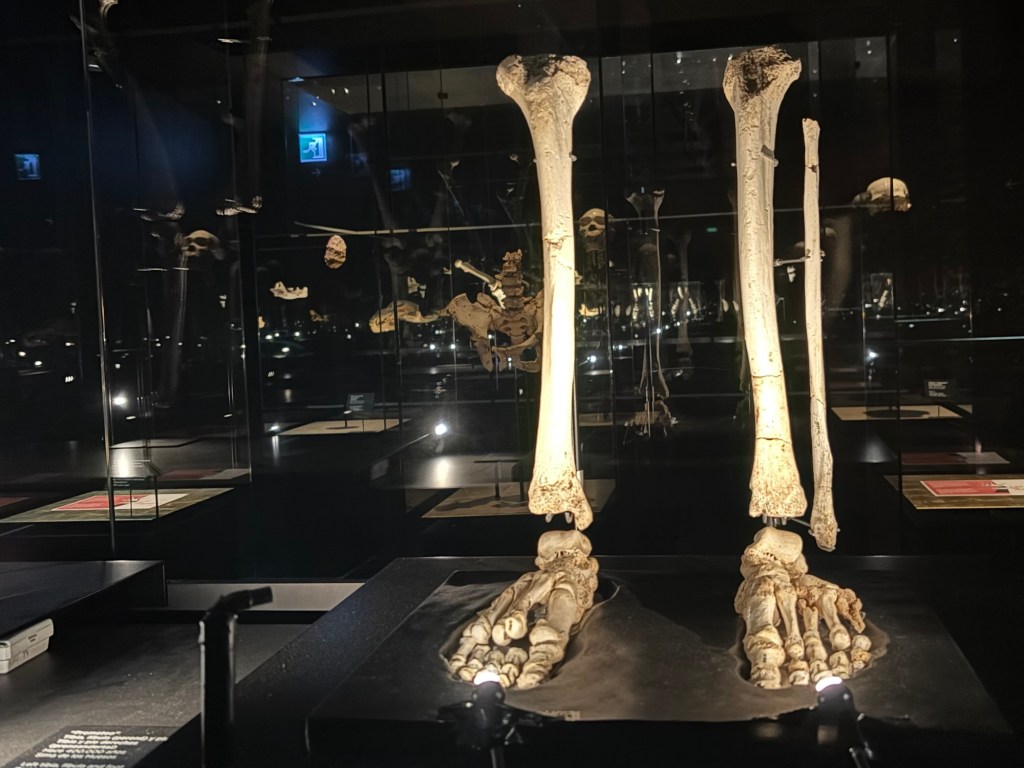
After an afternoon nap (complete with one snoring Spanish hypocrite), I set out to investigate the Museo de la Evolución Humana, one of the world’s best human evolution museums. I managed to convince the team to check it out, but set out ahead of them to take out some money for the meseta stage (where, if memory serves, ATMs are hard to come by).

I’ll be honest with you. Human evolution is one of those things that absolutely fascinates me. In another life I’d have studied anthropology and primatology. Maybe seeing chimpanzees and mountain gorillas in the wild drove it home all those years ago, or maybe it’s an offshoot of a childhood obsession with all things palaeontological, but it’s genuinely one of my major passions in life, albeit one I don’t talk about so much.

I had a similar experience with the Museo de Tenerife in the spring, but the MEH in Burgos is even more jaw-dropping. The knowledge that I was looking at the real bones of some of our earliest ancestors was genuinely spine-tingling.


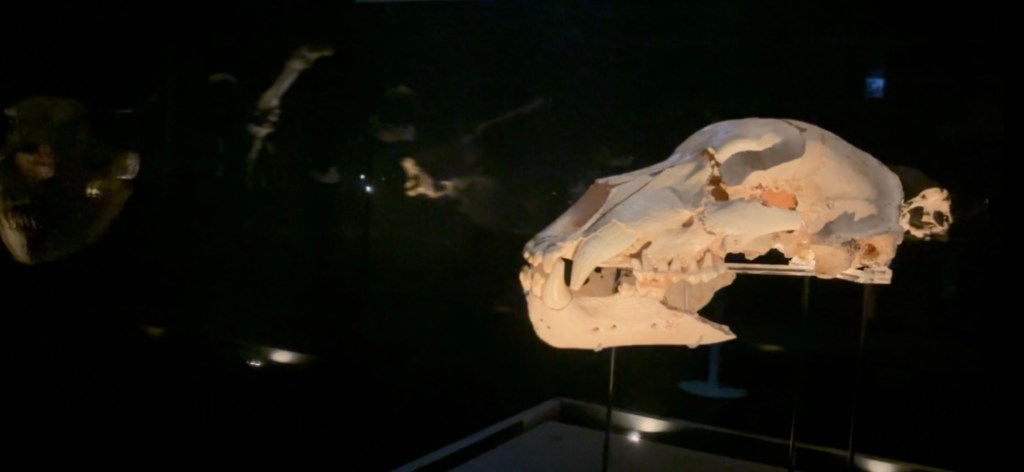
The caves of Atapuerca are one of the most valuable dig sites for the bones of ancient humans in the world, with over twenty-eight specimens found to date, alongside a host of other Pleistocene and earlier animals that no longer grace these hills, such as hyenas, jaguars, Irish Elk and the mighty cave bear.


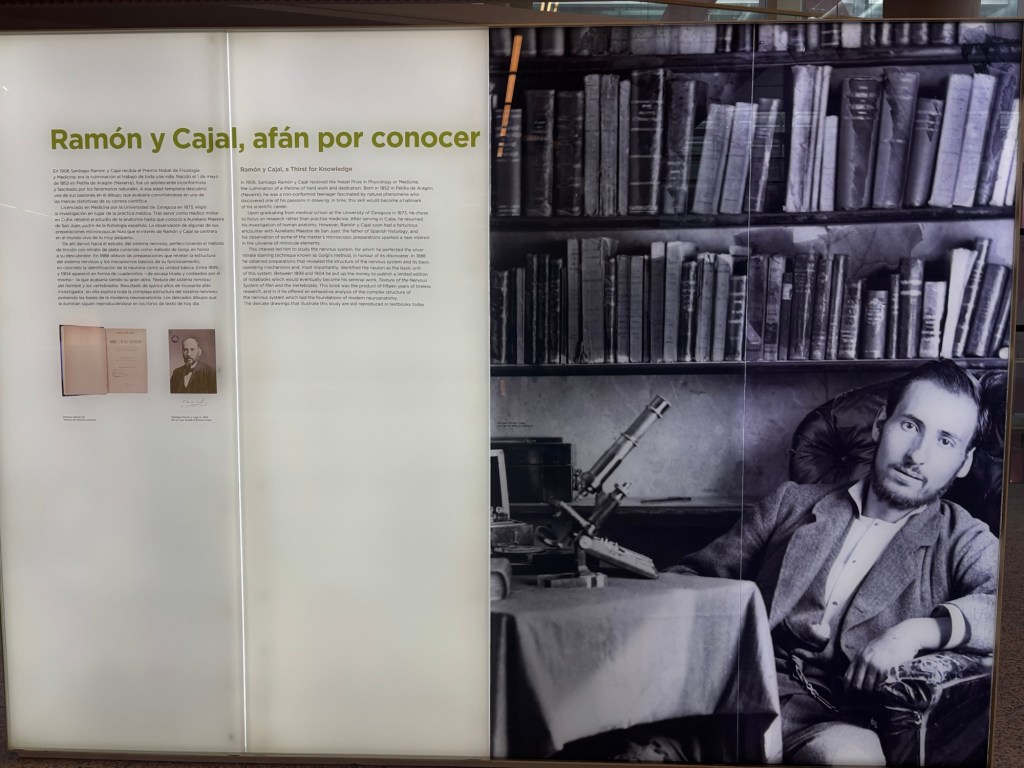
I gleaned everything I could about our ancestors the last time came here in 2013, but there was plenty more to clue up on that if missed before: this time I learned a lot about Ramón y Cajal, Spain’s most eminent scientist and the man who discovered the neuron and its function. Maybe that’s why so many of the main streets and squares in Spanish towns and cities carry his name, connecting people and places like synapses firing daily.

In this morning’s walk-and-talk, one of my companions said she was intrigued by my quest for knowledge. That’s probably the biggest ego massage I’ve had in a while, but I’ll take it. I’m glad to have learned something very new, and it is very much an integral part of my personality to be always on the hunt for a new story, a new tale to tell.


I’ll pick this last one to finish, because it’s getting late, I’m behind on my blogging and the Koreans next door are on the verge of creating an unconscious four-part harmony with their cacophonous snoring.

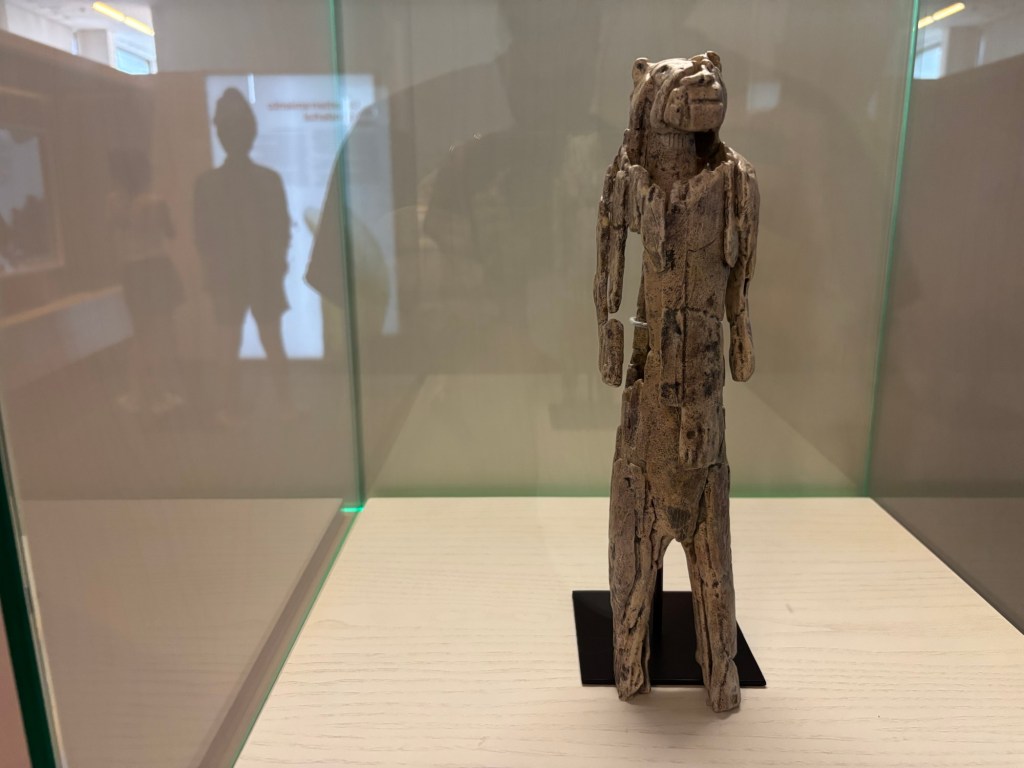
There’s a small replica on the third floor of the MEH that is, as the plaque reads, quite possibly one of the precious of all the treasures in the collection. It is a mammoth task carved into the shape of a human – but with one strange detail. The head isn’t human at all. Rather, it’s quite clearly the head of a cave lion: stocky, bull-nosed but intensely leonine. It’s known as the Löwenmensch figurine – or the Lion-man of Hohlenstein-Stadel, and its concrete evidence of our ancestors’ ability to imagine around 40,000 years ago. Quite possibly, it’s the earliest evidence for mythology out there: man-beast hybrids remain a fairly common feature of world mythology to this day. Just look at Hinduism.


I’ll have to look into this incredible artefact some more when I get hole. But for now – sleep. I’ll be up again in five and a half hours… unless the Koreans wouldst wake Heaven with their snoring. BB x

Camino XVI: Silent Hill

Hostal la Plazuela Verde, Atapuerca. 15.50.

After yesterday’s paltry fifteen kilometre walk, today’s 30km+ hike across the Montes de Oca felt like much more of a feat. We’ve landed, at last, in Atapuerca, the last post before Burgos and the end of the line for several peregrinos.


I’ve enjoyed a few later starts over the last few days, so it felt good to get back to another 5am departure under the stars. It was a little chilly this morning, though not as cold as it was the last time I made this trek, when (if my memory serves) I required the use of gloves to stop my hands from shaking in the spring of 2023. The sun rose late, so for at least the first hour of today’s march I was under the aegis of the morning star, Venus, sitting alone in the firmament to the east.


The signs for Santiago are getting shorter. The kilometre count is nearly down to 500, so I’ll be passing the halfway point of the Camino at some stage between Burgos and León. I’m looking forward to the flats of the Meseta, but the mystery of the Camino de San Salvador and the Camino Primitivo are becoming more and more appealing by the day as I hear stories of these less-traveled roads from some of the pilgrims that I meet. It will certainly be a very different Camino to the one I’ve had for the last week or so.


Shortly after leaving Grañón yesterday, we entered the immensity of Castilla y León, Spain’s largest territory. The rivalry between the twin kingdoms remains in the signage, with most of the Camino markers defaced in some way so that the word “León” is crossed or blacked out. The reverse is true once you enter the old Leonese territories around Sahagún, where the graffiti becomes even more markedly separatist in nature. It’s a not so subtle reminder that Spain had always been a conglomerate of different peoples rather than one singular nation, from the Castilians and the Catalans to the Leonese, the Basques, the Galicians, the Andalusians and the Asturians.

How do you even begin to govern such a diverse nation, with such ancient and deeply-rooted territorial disputes?


After a much-needed breakfast stop at Villafranca Montes de Oca, where the bar (El Pájaro) opened just minutes after we arrived, we set off up into the forested hills. The Montes de Oca are the very north-westernmost reach of the larger Sierra de la Demanda. The name comes from an old dispute over land use in the hill country rather than the difficulty of its terrain, but after the relatively flat and easy days from Puente La Reina to Logroño and beyond, it is a demanding task before the endless expanse of the Meseta Central.


The Montes de Oca are a mystical place. Toward the top of the hill, the birdsong seems to die back into silence. Not even the vultures circle here. I’ve encountered this eerie silence before in Sachsenhausen, an olive grove near Víznar (Granada) and a remote village in northern Uganda, where the Lord’s Resistance Army marched in and executed the entire village. It is the silence of the dead.

A small concrete block marks the spot where around three hundred men and women were executed during the Civil War: Republicans, political dissidents, liberal thinkers and just about anyone who disagreed with the vision of the Nationalist state that was to come. They were dragged from their homes during the night to this lonely stretch of forest, summarily shot and thrown into one of a number of mass graves that can be found less than a hundred metres from the Camino itself.

This is the fate that might have befallen my great-grandfather Mateo, had he been any more outspoken in his beliefs than he already was. Instead, he was dismissed from his post and sent away to a village where he would not cause trouble, and only when he went to hospital for a minor operation did they find a way to deal with him quietly, leaving him on the hospital bed to die.

I suspect this, however, is what happened to the rest of his friends: the circle of poets, free-thinkers and philosophers to which he and his wife Mercedes belonged, before Franco and his nationalist forces turned their world upside down.


Many of the trees here are new: plantations of pine trees that were planted after the ancient oaks burned down in a fire some fifty years ago. Somewhere beneath them all are the remains of other victims of the war, concealed by Spain’s painful attempt to forget. The official Pacto del Olvido – the Pact of Forgetting – passed in 1975 after Franco’s death was an attempt to move on from the divisive horrors of the past and forge a new country, but for many, the memory of the silenced dead is still very raw. Even the birds of the forest seem to abide by it, nearly a century later.


A jolly chappie called Ángel had set up shop in the spot where there was a food truck a few years ago, selling fruit juice and watermelon slices, and at 2€ a throw for the latter, it was simply too good to pass up.

We stopped for a snack lunch at San Juan de Ortega (if tostada con tomate can be considered lunch) before pressing on to Atapuerca. Today and tomorrow are going to be the hottest days for a while with an average high of 35°C, so we were keen to reach our destination before the sun got too high in the sky.

I brought the team to a halt at Agés, the village where I stayed the last time I came this way, to drink and re-supply before the final two kilometre push across the shadeless fields of Atapuerca. Being an average of nine years older than the others in my group (ranging from seventeen to twenty-five), I have somewhat fallen into the position of leader, which seems to happen rather easily these days. I guess it’s the teacher in me. I don’t resent it at all. It’s quite nice to be able to look out for them and to serve as their guide, especially since one of them is still at school and doing the Camino as part of an IB project.


There aren’t that many options for eating out in Atapuerca, so we might cook together tonight. That would be nice, as tomorrow will invariably involve a farewell meal out in Burgos, so a communal dinner of own creation would make a welcome change.

My pilgrim passport is looking a lot healthier. One whole side is nearly complete. It’s getting easier to pick up three or more stamps per day (which was near impossible in the first week or so). I may not need my third credencial after all, though I suspect I will still need my second! BB x

Camino XV: Grañón

Albergue Cuatro Cantones, Belorado. 20.57.

The grand majority of Camino guidebooks operate in such a fashion that some towns become natural starting and finishing points. At 21km from Nájera, Santo Domingo de la Calzada is a perfect example (with your average pilgrim walking around 20km a day). On the one hand, this is a very good thing, as it means any deviation from the recommended staging posts may give you a feel of the Camino as it used to be. On the other, it means that some towns soak up all the trade and leave the others dry. So how do you fight the industry?

Grañón has the answer: by being the most memorable and unique albergue on the entire Camino de Santiago.


After leaving Santo Domingo just before midday, I used the last of the cloud cover to beetle across the plains for a further 6km to Grañón, feeling slightly guilty that I was abandoning my Camino family again but confident that I was making the right decision – I’d missed Grañón before out of ignorance, and I wasn’t going to do so again in full knowledge.

Upon arrival I was greeted by the hospitaleros Kevin and Juan Manuel, a Chinese-Australian and a sevillano. For the first hour and a half it was just me and three Koreans, and it looked to be a rather cosy night ahead, but then Alex showed up, followed by Audrey, Alonso and Talia, and then Johan and Max. For whatever reason (possibly the clouds) they’d all decided to push on to Grañón after me. I must have sold it pretty convincingly without meaning to. My heart was lifted and I was tremendously grateful.

I fell into conversation with Juanma in the garden who asked after my Camino story, I told him about my grandfather and the grim fate that had befallen my great-grandparents, both victims of Franco’s regime – one murdered, the other dismissed and sent into a sort of internal exile. I’ve told this story so many times that it’s become second nature, but that’s the first time it’s drawn tears in a listener. Juanma explained that it had touched him deeply: his family, and so many others in Andalusia, had suffered a similar fate after the Civil War, which left thousands of families across the country broken, scattered and changed forever.

I’ll make a beeline for any Spanish accent, wherever I can find one, but I will always have a soft spot for an Andalusian. He was the only person thus far to recognise my Virgen del Rocío wristband for what it was, which was a tremendously good start for me: it’s not often one encounters a fellow devotee of the Mother of the Marshes on the Camino (or even another Catholic, but that’s another matter).


After preparing dinner – where for some reason I was assigned the role of sous chef and tasked with handing out jobs and ordering the entire operation – the hospitaleros requested some music. Johnny, an Irishman, was one of two who could play the guitar, but his repertoire and mine were worlds apart. The other guitarist, a young Danish kid fresh out of school, had only been learning a few months. So (not for the first time in my life) I ended up singing a cappella the only song I could think of that works: Pata Negra’s Yo me quedo en Sevilla.

It’s a gypsy love song to the city of Sevilla itself, and one that I’ve known since I first heard it on my mother’s Rough Guide to the Music of the Gypsies aged seven or eight. Back then, of course, my language skills weren’t really up to scratch, and I knew the song as “Single Feather”; my little brother and I used to run around the house holding a pheasant feather or something like that when it was playing in the old CD player. Ironically, it’s been a mainstay of my repertoire ever since, and one I usually wheel out if I’m called upon to sing in moments like this.

It’s amusing enough to be mistaken for a Spaniard because of the way that I speak, but delivering a gypsy ballad with all the frantic passion and duende that I can muster is both an ego trip and an out-of-body experience. I don’t think I have any gypsy blood at all, but the music speaks to me on a deeper level, touching my heartstrings in its dance through the blossom-scented squares of Sevilla.

God knows what the other pilgrims made of it but the Spaniards were impressed.


Later, after Mass, we had to go to the village bakery to collect our potatoes, as the albergue has no oven. There followed a strange ritual where we had to sing for our supper, divided up into nationalities. The Italians did two numbers (one I didn’t catch and Bella Ciao) and the Spanish committee (to which I defected) was psyched up for a tongue-in-cheek rendition of La Macarena, but since we were almost entirely hospitaleros (yours truly temporarily excluded), we were let off the hook. The English-speaking team (about 75% of the pilgrims, including my family and all the Koreans, Germans, Slovenes and Japanese) came up with… uh.,, Twinkle Twinkle Little Star.

Turns out they could easily have done Bohemian Rhapsody, but they didn’t organise in time. Never mind! One way or another, we got the potatoes.


After dinner, we went back into the church for a candlelit reflection in the choir. Prayers in multiple languages followed by the passing of the flame (the “pilgrim candle”) where we had a chance to say something: a reflection, a prayer, a wish for the Camino. Most of them just said “Buen camino” and passed it on. I held on for a good couple of minutes, I think.

I prayed out loud – something I don’t do all that often. It felt like the right thing to do. I prayed for my grandfather, José, and my great-grandparents, Mateo and Mercedes. I prayed for David, the father of one of my closest friends, for whom I have chosen to walk the Camino this year. I prayed for all of us, for a safe and spiritual road to Santiago. I prayed my thanks to God and to La Virgen del Rocío for all she has done for me this year: through heartbreak and healing and natural wonders, she has always been there to guide me.

Maybe it was a bit much. That would be very me. But it was (and may easily be) one of the only chances to worship together on the Camino and I took it with both hands.


I’d just brushed my teeth for bed when Juanma asked for a favour: he was taking over the albergue as hospitalero the day after and wanted help with translating his script into English. I worked it out with him from a notebook in a bar in town over a caña while he ordered his “usual” (a Maxibon ice cream).

We discussed a lot of things. Why there aren’t many Spaniards on the Camino (they’re all on bicycles, competing against each other to complete it in the fastest possible time). Why there are so many Koreans (it’s nationally regarded as a major CV booster, as well as a temporary solution to widespread youth unemployment). And where the Germans, who used to be everywhere, have gone (the Via de la Plata and the Via Mozárabe, to avoid the crowds on the Francés).


I’ll have more to say later about our next stop, I suspect. But I wanted to get this all down now while it’s fresh in my mind. It’s taken at least an hour, but it has killed the time and allowed me to stay and wait for the others to wake up, and that’s no bad thing. BB x