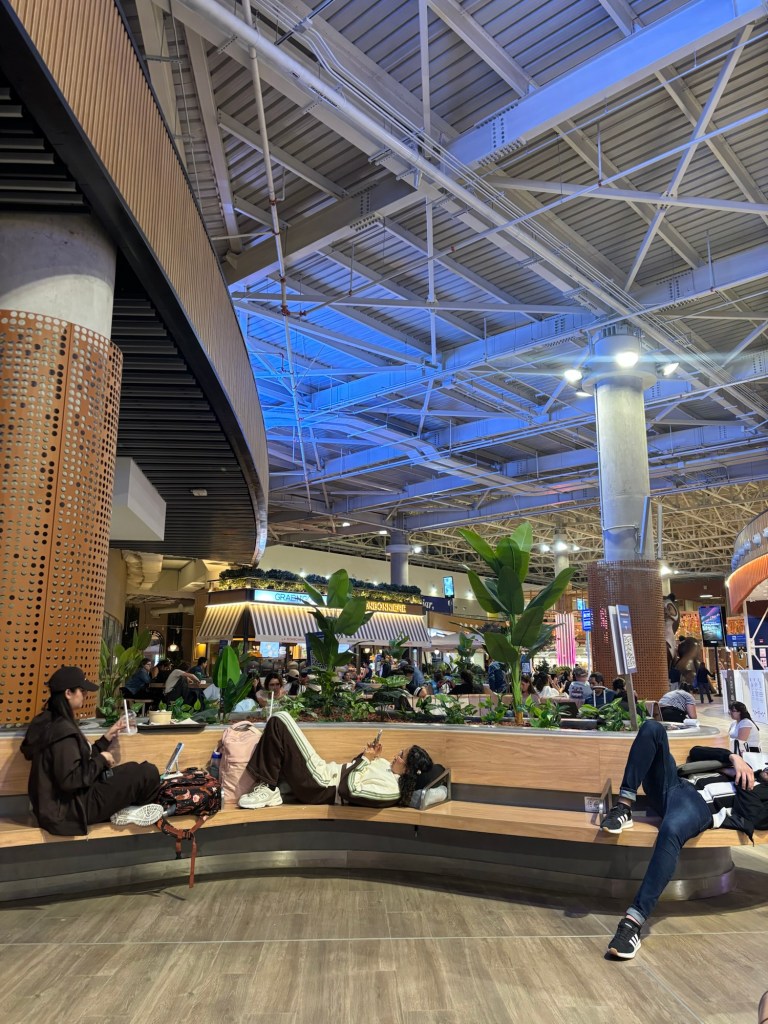
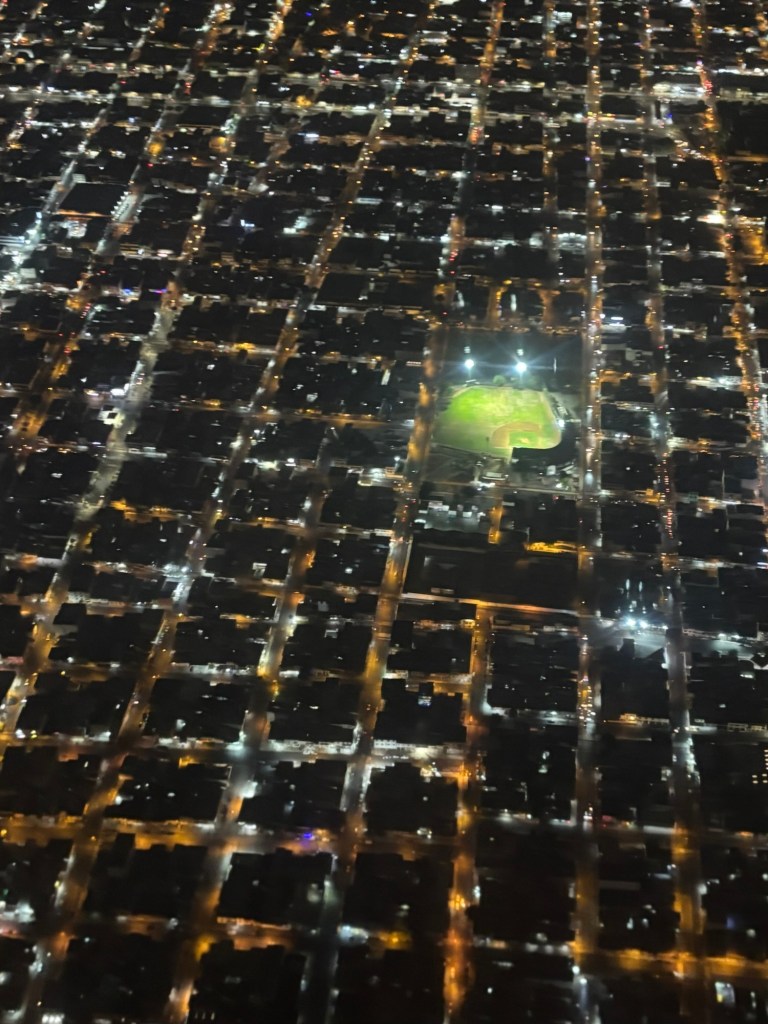
I’m getting better at sleeping on planes. I must have slept for at least half of the flight from Lima to Santiago, because I remember almost none of it – only the first half hour or so and then a period of ten minutes at some point around half past two in the morning when they served out the in-flight snacks. Even so, the Santiago side of things passed by in a zombie-like blur. I navigated customs and an Uber relatively easily, but after letting myself back into the flat around six in the morning and using the last of my reserves for a desperately needed shave, I tumbled into bed and didn’t wake up again until half past twelve.
I’d suggest that that’s the last time I try to tackle multiple flights across three countries, but that’s exactly what tomorrow’s journey home entails, and I know myself too well to accept that I’d eat my words sooner or later.
What a difference a year makes! South America has gone from being a location on a map that cropped up from time to time in texts we study in class to home in all but name for the last five weeks. By the time I leave tomorrow night, I’ll have totalled nearly six weeks here. That’s half a school term. In my book, four weeks is the cut-off point, beyond which a location stops feeling like a holiday and starts to take on the trappings of a place one can legitimately claim to have lived. While I haven’t spent all six weeks in the Central Valley, Santiago has definitely become as familiar a base as Amman and Tetouan once were, many years ago.
There are many aspects that are still alien. The distance. The exchange rate. The American-style grid system of South American towns. the national insistence on tacking cachai to the end of every single sentence, whether it needed confirmation or not. But I feel I’m getting the hang of the accent, the majority of the modismos (the extremely widespread Chilean slang) and what it might be like to live here for the locals. Lucky them!
It sure is chilly here, though. I haven’t missed the uncomfortable heat I left behind in England back in that first week of July (which, I believe, is still there, outstaying its welcome by well over two months) but I could do with being somewhere warmer for a while. Bouncing from 7°C in Santiago to 37°C in Athens on Friday will be a proper shock to the system, but I’ll have my hands full with this Greek wedding for the ages, so I suppose I’ll manage.
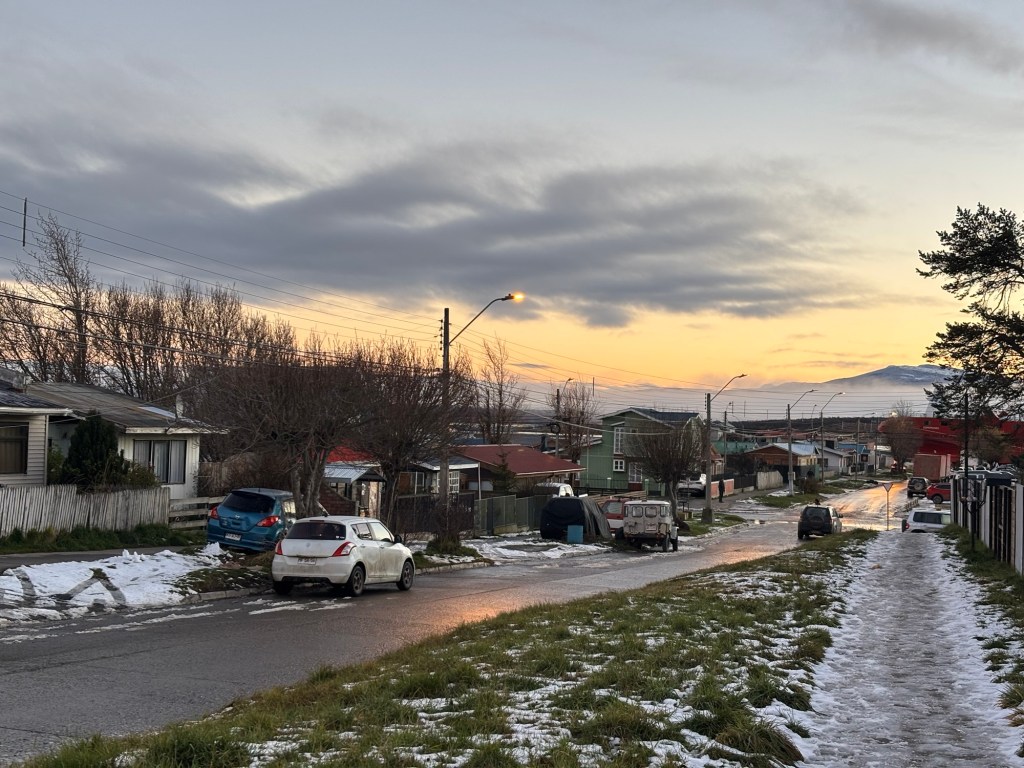
I want to remember this soundscape though. The pitter-patter of dog feet on the laminate flooring. The distant whine of one of Tomás’ sisters blowdrying their hair. The whirring radiator in my room, doing its best to heat up the place. The alarm call of an austral thrush. The faraway engine of one of the many micros plying Avenida Las Condes. Otherwise, the remarkable quiet of Chile’s capital city. Santiago is a very special place.
Popping back into school one last time tomorrow to say a few farewells I didn’t get the chance to make last Friday and to wrap things up with a neat little bow, insofar as I can. And then – home! I could do with a rest. BB x
My time in Santiago is drawing to a close. Five days remain before I pack my rucksack with a few warmer weather supplies and set out for one more grand adventure – before responsibilities call me back to drought-afflicted Europe. It’s been so long since we had a day of truly clear skies – not since the day I arrived, to be honest – that it’s hard to imagine what most of Europe is going through right now. I’ve almost forgotten what’s it’s like to be hot outside.
I took it easy today. The weather was supposed to be miserable, but while the forecast rain did eventually come down, it was only for about five minutes. I thought about exploring the rocky mountainside reserves around Santiago’s east side in search of a few Chilean specialities that I have missed thus far, like turcas, tapaculos and the one and only tucúquere or horned owl… but in the end, it looked far too complicated to get there and back again under unpredictable weather conditions in time for a social outing at 2pm, so I gave it a pass. That’s where I draw the line between birder and twitcher – I’m not going to miss out on a chance to meet people and practise my Spanish just because I’m leaving the country in a week and haven’t seen all the Chilean endemics. There are limits even to my obsessions.
It was a lovely gathering at one of Tomás’ cousins’ apartment, in true South American style – that is, thirteen people and two dogs squeezed into a living room, with a lovely array of snacks and conversation.
Most of their attention was demanded by the new puppy Tomás’ sister has acquired over the weekend and his cousin’s dog, who went absolutely ballistic at the presence of so many strange-smelling new faces and a puppy to boot. I hadn’t really given it much thought, to be honest, but I think it’s safe to say I am not a dog person. They really are far too much.
Growing up with cats has had more of an impact on me than I realised. Tolkien once that “sheep get like shepherds and shepherds get like sheep”, and I’m pretty sure that’s what’s happened to me. Cats are loving and affectionate in their own way, but they’re also highly independent and will only tolerate so much attention before they need to slink off somewhere on their own. Maybe that’s why I’ve also ways been drawn to the quieter, more noble dog breeds that don’t bound about so much, begging for your attention, like mastiffs.
I feel very welcome here. Sure, there have been times when it has not been lost on me that my assigned department aren’t entirely sure what to do with me, since I did seemingly fall from the sky, but most introductions lead to some sort of inquisition, born from a natural curiosity as to what I, an Englishman, am doing out here in Santiago.
I wonder how my colleagues will treat Tomás during his stay. I know they will be welcoming, but I doubt he’ll be the centre of attention as often as I have been out here. I don’t think it’s even a generalisation to say that the British simply aren’t as curious. It’s not in our nature. An Englishman’s life is his own affair, and to ask too many questions is to intrude. I had that much beaten into me by a previous girlfriend who found my inquisitiveness and love of deep questions nothing short of invasive. She might have been an isolated case, but I will always remember a dinner with her colleagues where not a single one of them asked me a question or even acknowledged my existence for the entire three hour sitting. She is the only Briton I have ever dated, and it was enough to convince me that it is a mindset I must avoid at all costs.
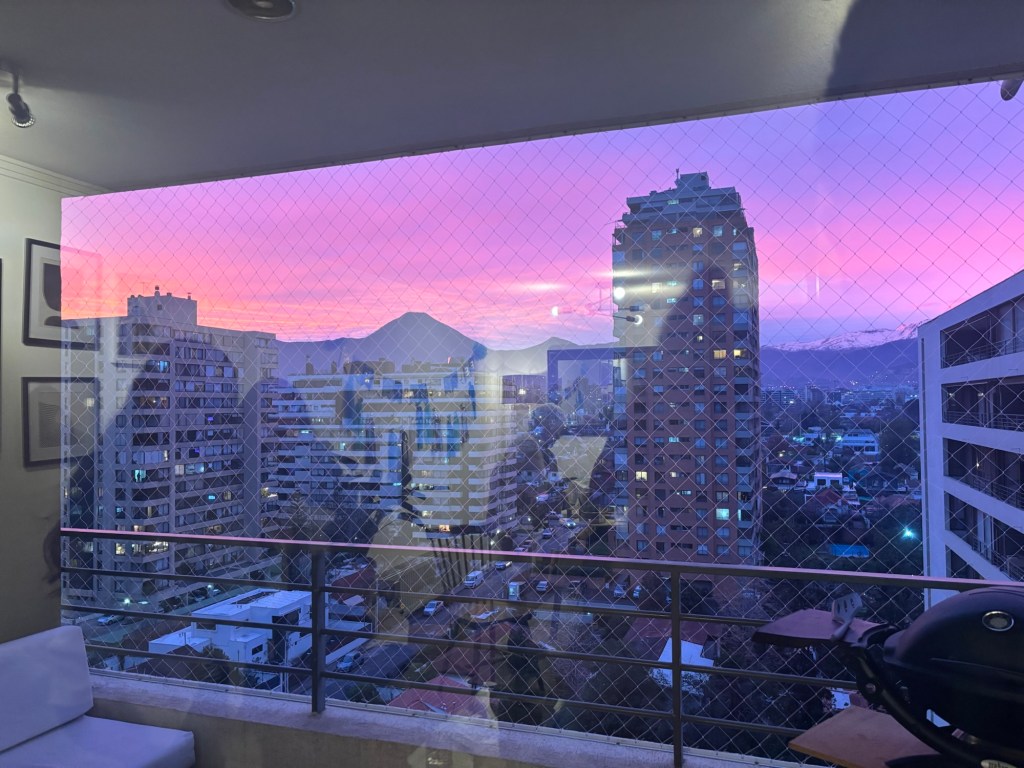
The sunset from the cousins’ eleventh floor flat was quite spectacular. I’ve been away for quite a while now, so I am starting to look forward to the familiar trappings of home, but I will miss the mountains. You’d have to go as far as the Himalayas to get mountains as impressive as these… and don’t think I haven’t considered that – once I’ve saved up some more, of course, after what really has been a very splurge-y summer!
Tomorrow should – I hope – bring me the structure I have been craving. Two hours of Othello followed by another couple of hours of French. It will make a nice change from working on my novel in the Middle School Lenguaje department! BB x
I’m up early after falling asleep far earlier than usual last night (around 8pm – shocking!), so I thought I’d use the time to pencil in my afternoon’s adventures.
While I’ve been working around the Craighouse campus, I’ve had a lot of time to watch the comings and goings of the birds that make their home around the capital city. Taunton has its fair share of feathered friends, of course, but I’ve had thirty years to get used to herring gulls, crows and woodpigeons. I might be in my third week out here, but I still get a big smile watching the rufous-crowned sparrows hopping about. Naturally, I don’t bring my camera to work, so given that we actually had some sunshine today – and that my colleague Tomás was done an hour before the end of the school day – I thought I’d capitalise on the sunlight and do a bit of suburban birdwatching.
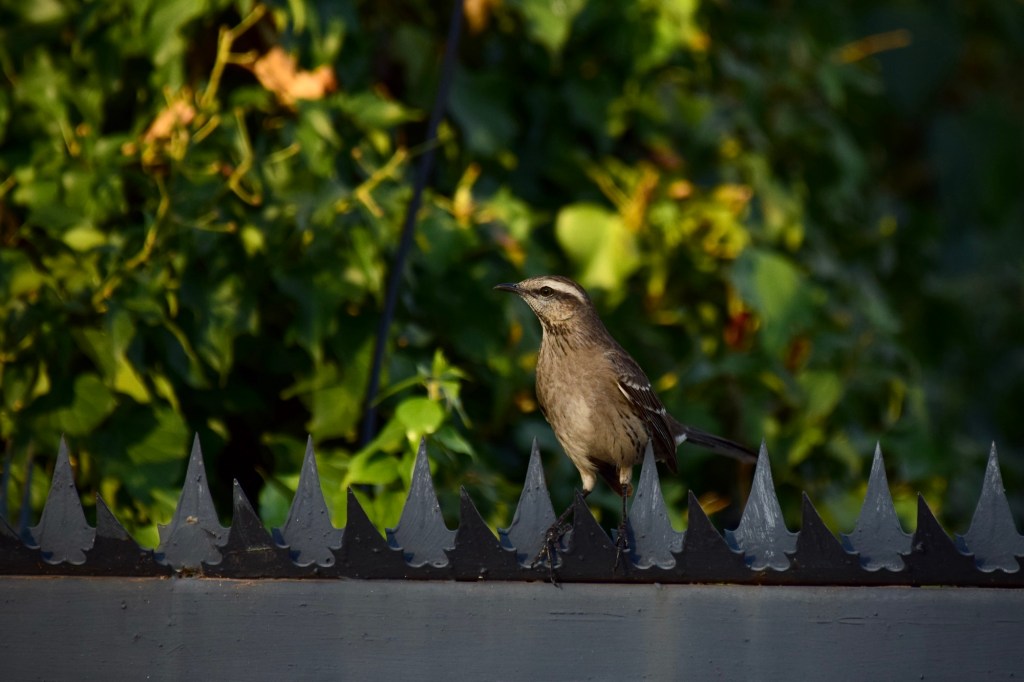
One bird that’s easy to find around Santiago is the mockingbird. I’ve come across these characterful creatures in New Orleans, Lima and the open steppe of Patagonia, but the cheerful Chilean mockingbird is very much a feature of Santiago itself. I imagine they’d be garden birds, if one had the money for a garden in this habitually dry part of the world.
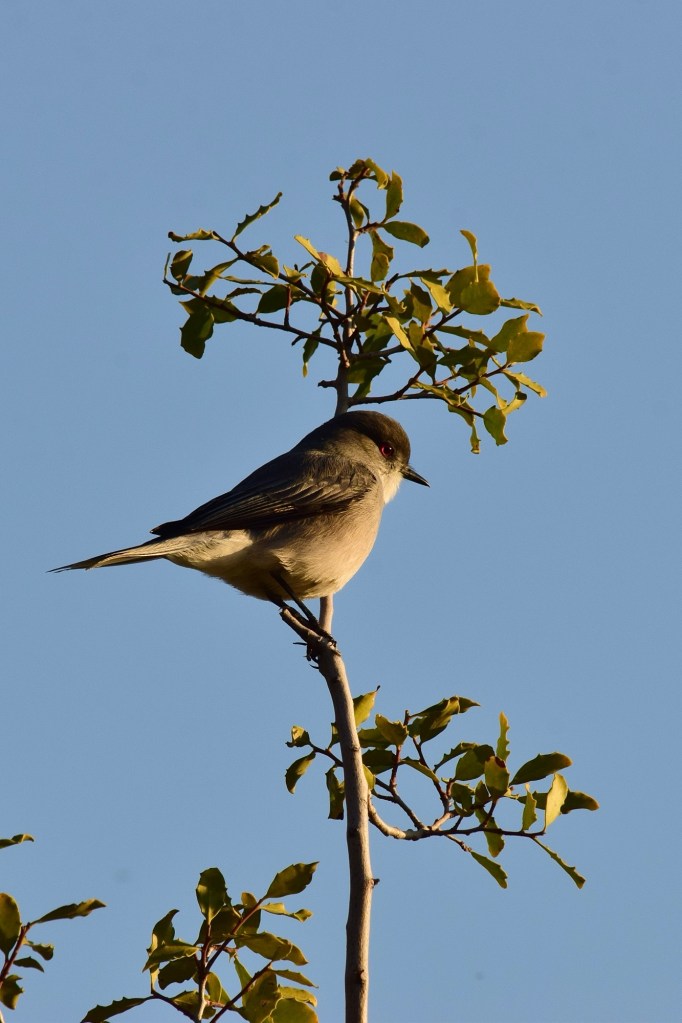
I thought I might try and snap one of the many Chilean swallows circling the heights of Cerro Calán, but they were much too fast and never came down to roost. I did, however, finally have manage to capture a fire-eyed diucon – a little grey bird with striking red eyes, almost like those of a Victorian doll, that moves just like a flycatcher from back home.
It was really encouraging to see more than a couple of other walkers up on Cerro Galán with binoculars and the BIRDA app on their phones. I can’t help but notice that birdwatching seems to be a lot more popular here than I anticipated. I suppose it helps a lot when your average city birds are really quite spectacular to start with.
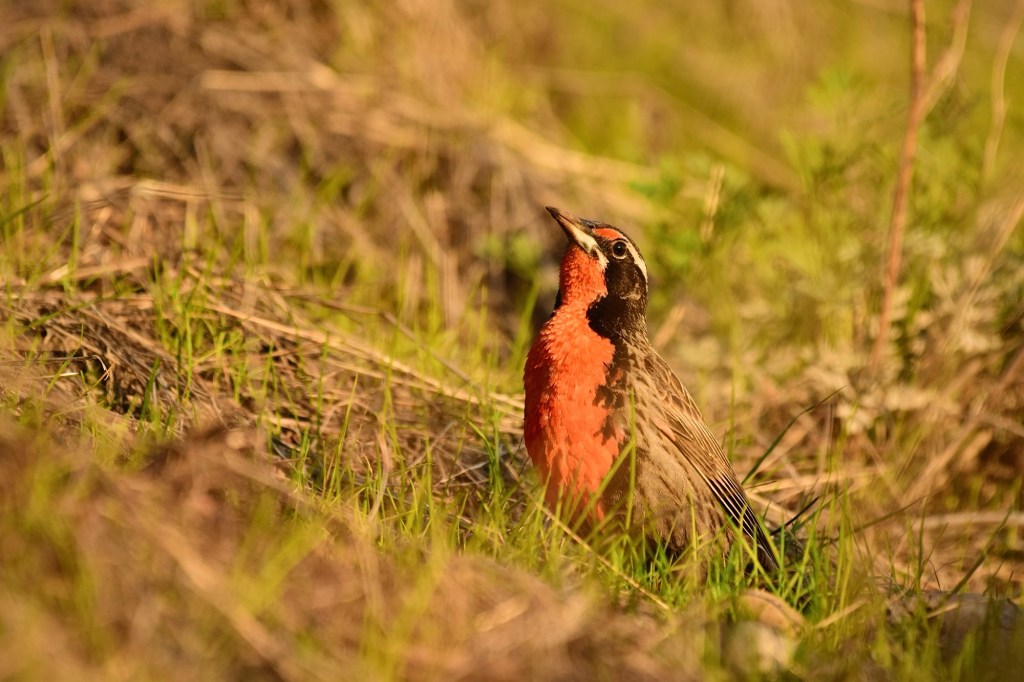
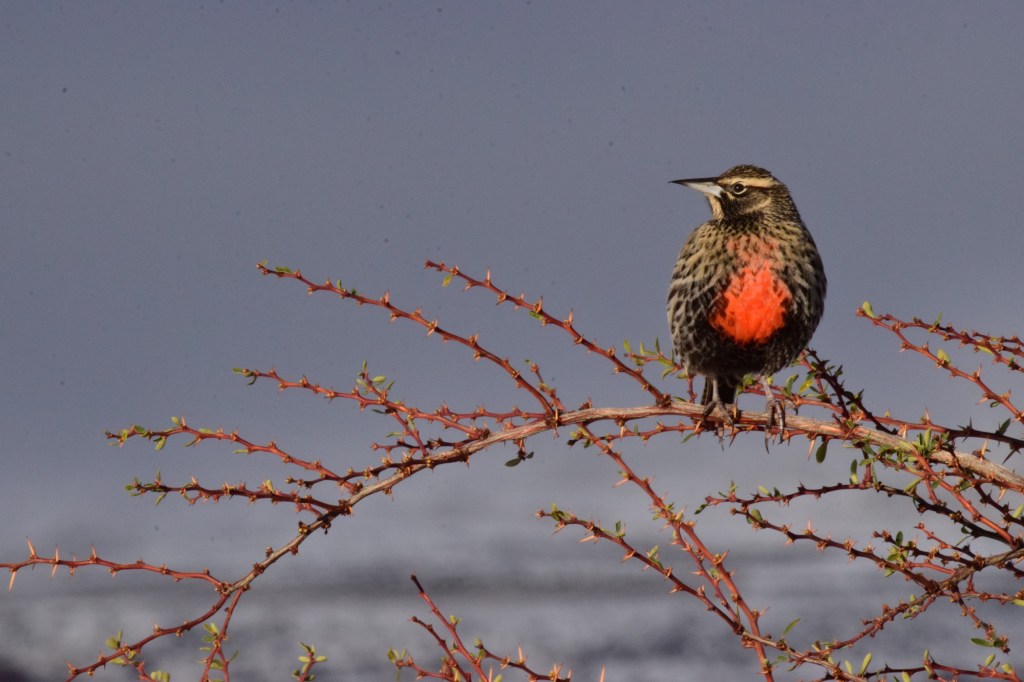
Take the meadowlarks, for example, who make their presence known with a tremendously loud wheezy call that goes off like a Mexican wave as soon as the first one in the flock puffs out its chest and sings. These are the birds that the locals in Santiago seem to love the most, and with such an eye-popping splash of red on the males’ chests, I can’t say I blame them.
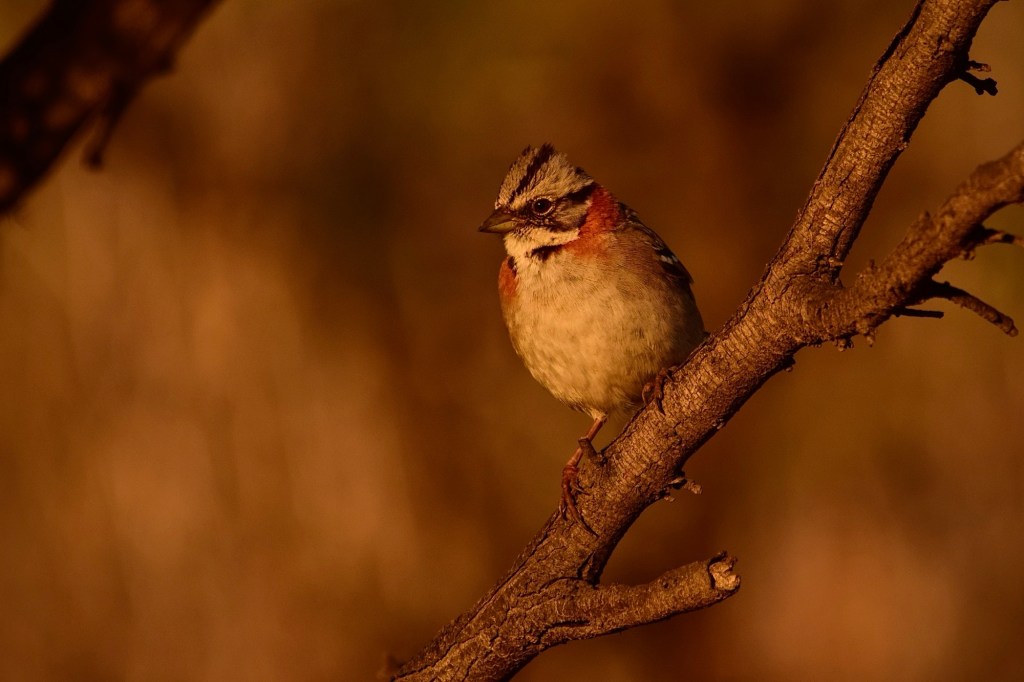
Definitely saving a corner of this post for my favourite little sparrows, though. Slightly smaller than our house sparrows, with an endlessly cheerful chip to let you know they’re nearby, they also have a beautiful song when they’re feeling more musical.
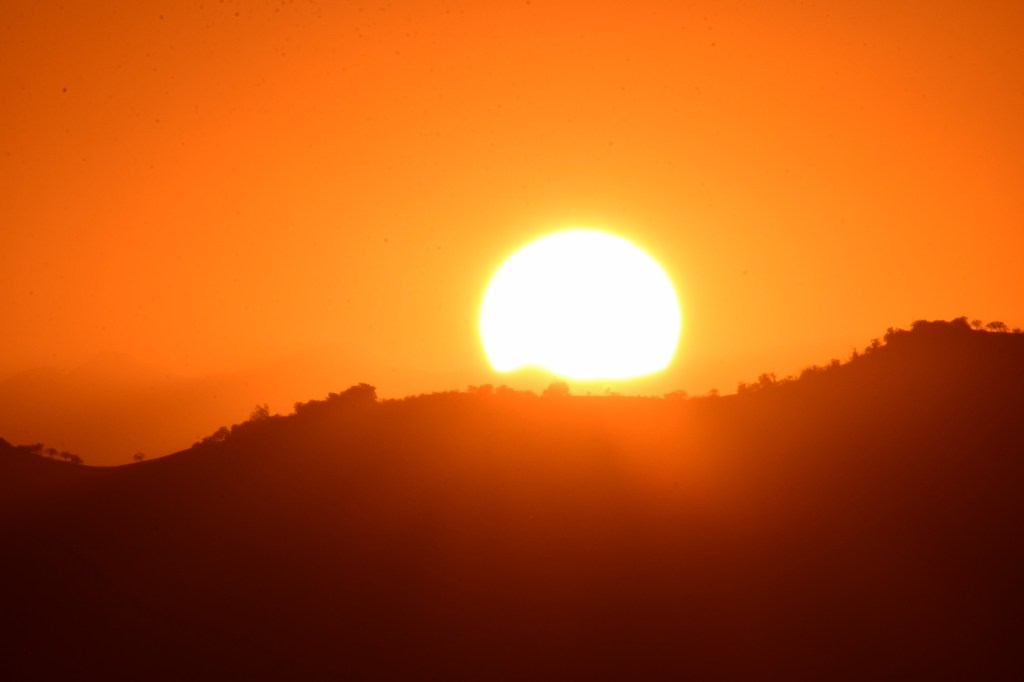
I was up on the cerro long enough to catch the sunset, which was an added bonus. It must have been tremendous from Valparaíso, no doubt, but even here in Santiago, with the forested mountains of La Campana between us and the horizon, it was quite a sight to see.
Today I think I’ll wander over to the Senior English department and try to catch a few more lessons. Be proactive for a change! BB x
Today marks the halfway stage, both of my three-week exchange post and of my five-week extended summer break in South America. Life goes on for the students at Craighouse, and I have to remind myself that while it’s cold and coat weather here, and everyone is hard at work, my summer holidays are ticking by. Not that I haven’t made the most of them, of course – I can scarcely remember a more action-packed summer than this one – but it is something I have to tell myself when it feels like I might spend another day observing lessons.
Today I finished my myths and legends compilation for the Middle Lenguaje department and popped over to the Senior English department to get to know the team. Turns out that’s where French is based too, so I guess I’ll be up there a fair bit for the rest of my placement. They seem like a really friendly bunch. Hell, everyone here is really friendly. It’s been a really neat choice, coming out here for the summer. I’ve also had a lot of time to speak Spanish and work on my novels, so that’s been pretty useful, too.
Bit by bit, my last week is steadily falling into place. It’s going to be something to look forward to, to really set a seal on what has been a phenomenal second outing to Latin America. I hope it’s the first of many. BB x
Week two started slow today. A couple of meetings and a non-starter quest for a functioning laptop meant that I spent the day working on my books, which was a lovely way to spend the day productively – as well as a reminder to myself that I am technically on holiday – albeit perhaps not as exchange-heavy as it could have been. I have bigger events coming up this week, though, and I suspect it will be the last week of my exchange when it really feels like I have a fully functioning timetable.
There are always so many birds around campus. The nest boxes the students have put up all over the school site for their CAS project obviously help, but it’s not just the charming little rufous-crowned sparrows that make the place feel so friendly. The mockingbirds are always perched somewhere, every time I look up I see a caracara of some description hanging in the air, and just before break this morning I know I saw the faraway silhouette of a condor circling the heights of Manquehue.
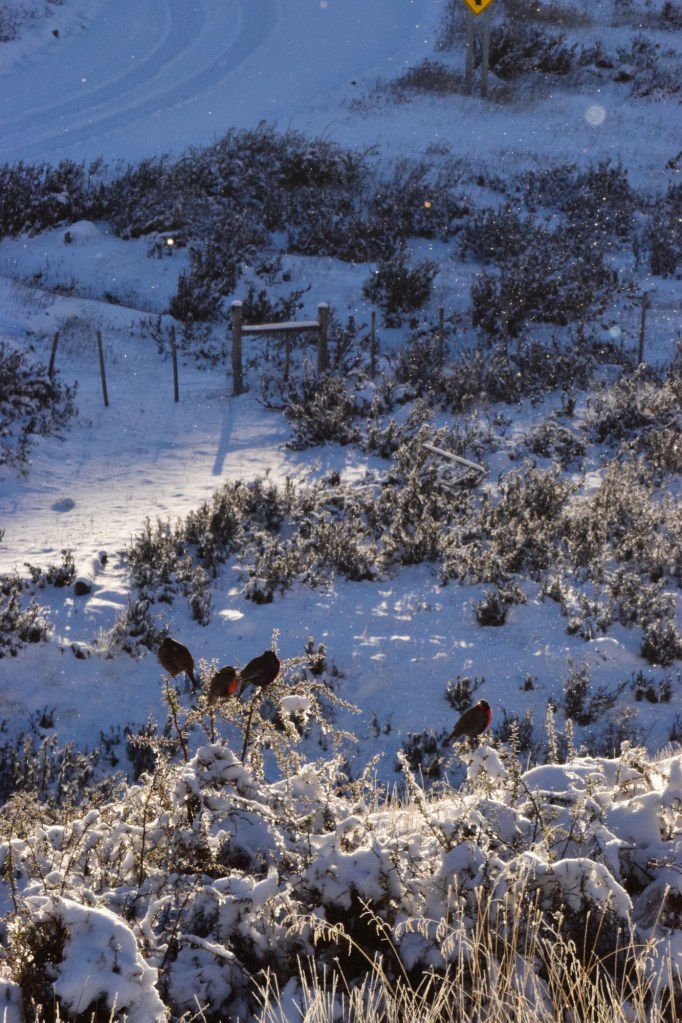
It’s the meadowlarks that are currently lending some extra charm to the place, if I had to choose a standout. I first got to know these characterful creatures in snowy Patagonia, but it turns out they’re just as common up here around Santiago, hopping about in the car park and sitting quite fearlessly on the school fence, singing their hearts out as the Year 7s play some kind of tag game just feet away.
My BIRDA app tells me my total count of species I’ve seen so far is up to 818 after this weekend’s exploits. Even I have to admit that’s getting to be a dizzying figure, and well over three hundred of that total are birds I have seen in the last five months. I’m not a professional lister like many seasoned birdwatchers, chasing a particular total on my life, year or patch list, but it’s fun having an app where you can log it all, and in so doing learn something about the sheer diversity of species you have found – and, consequently, discovering what is still left out there to see.
I probably could have seen more species if I’d paid through the nose for that Abra Málaga trip, but I wasn’t really after that kind of number-obsessive behaviour. One albatross would have been magical enough on yesterday’s boat trip, and I was blessed with four different kinds. It does not pay to go out into the wild with great expectations. Nature provides on its own terms.
Not too much to report for now, but keeping my writer’s block at bay with regular note taking. And it does seem to be working! BB x
As I expected, when I arrived at school this morning, a plan for whatever it was I was supposed to do out here had yet to materialise. I think part of that is because they didn’t really know what they were working with: whether I was here to observe, to gain teaching experience, or perhaps even to help out in Maths (god forbid!). When they realised that I could not only speak Spanish but had been teaching for eight years already, that changed the game quite a bit… Really, you’d have thought this kind of thing would have been communicated ages ago! But, like I said, it was not altogether unexpected – I knew this exchange was going to be a bit ersatz until I found my feet, given how little information I had to work with before setting out.
Anyway…! What a school. What an incredible institution! I’ve been teaching the IB Diploma for the best part of five years now, but to see a school system where it is not just an additional pathway but the culmination of a five year programme… It almost seems ridiculous to offer the standalone diploma without the run-up of the MYP.
Craighouse sits at the very top of the extremely well-to-do suburb of Lo Barnechea, which is a step-up from the already smart Las Condes. It seems the higher up the mountainside you go, the higher up the societal ladder you climb, too. Mock Tudor houses with half-timbered facades. Americanesque mansions with illuminated porches and Spanish haciendas. The drive up to school from Las Condes felt like orienting one’s way through a bougie estate agent’s catalogue.
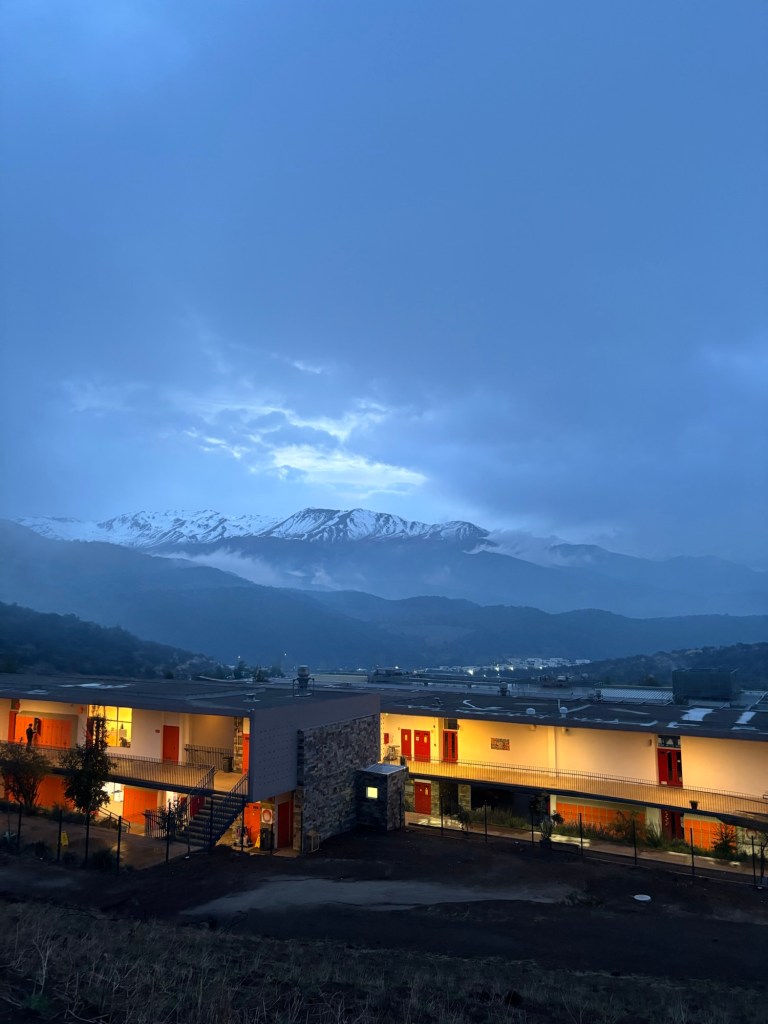
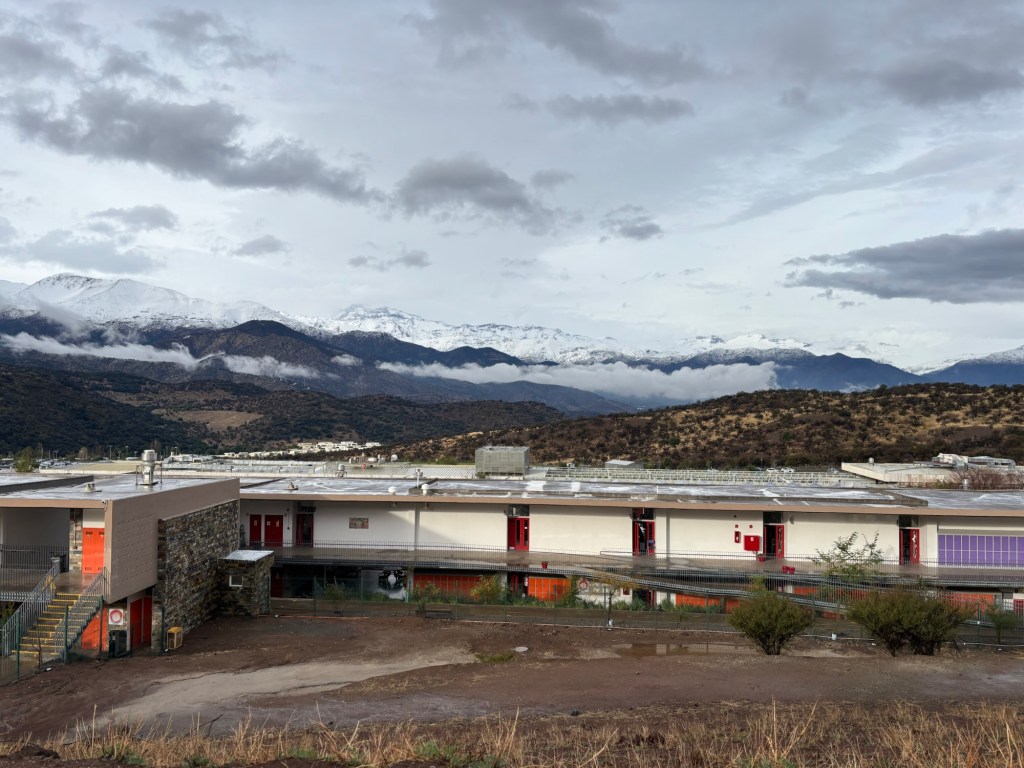
The school itself? An absolute dream of an establishment. Making rooms for scientific inquiry… Inquiry centres, which are glorified libraries with all the bells and whistles… Gyms and sports facilities that would make even my sportier students salivate… And when the clouds clear, the snowy peaks of the Andes all around them. How lucky these kids are!
The plan is coming together – slowly. For now, I’m going to be working with the Lenguaje department, helping to deliver Language and Comprehension classes. Ironically, in a school that teaches almost entirely in English, it’s the one department that is taught exclusively in Spanish. Bizarrely, they’ve hired in an English exchange teacher to help deliver the Spanish Language and Literature programme.
It is exactly what I wanted. It will be a challenge, I won’t deny that. But it is precisely what I was angling for. It is all part of the grand plan: teach Spanish, even to the Spaniards, until I am good enough to return to Spain and do the same over there. In Spain – at least in public schools – teachers of English are expected to be able to deliver Lengua Castellana as well. That’s like expecting our French teachers to be able to offer English Literature.
Of course, the British system doesn’t work like that at all – but then, why should it? Our entire curriculum fails to consider the importance of bilingualism, purely because of the cultural dominance of English on the world stage. If not English, which language would you choose? It would have to be one that your average teacher spoke well enough to capably deliver their subject, and that sole requirement kills the idea in one shot. Your average British teacher is simply not good enough at any foreign language to teach their core subject to the same standard as they would in their own, never mind finding one common foreign language at a national level. No – until another language reaches the same level of prestige as English, I don’t think it’s likely we’ll see that kind of programme over here.
But that’s ok. I plan to move abroad anyway. The more I see of this whole school IB approach, I have to admit, the more I like it. If I can only find a school in Spain where I can sink my teeth into a system like this one… Boy. That would be the dream. BB x
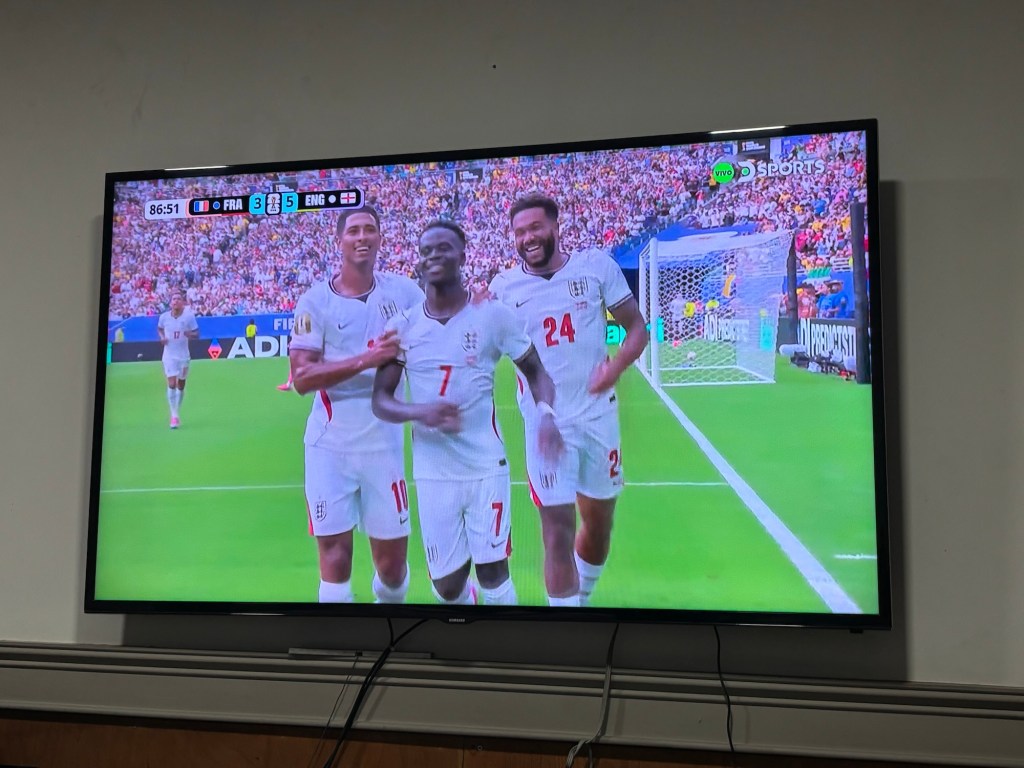
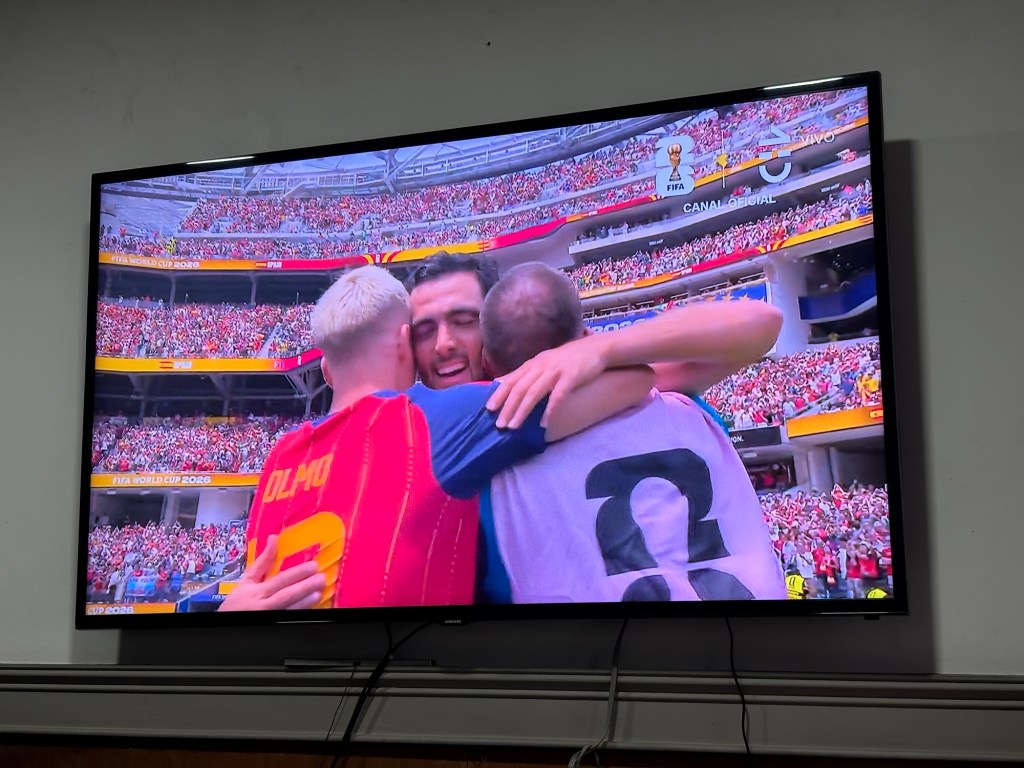
Well, that’s enough mad adventuring for one week. I’m back in Santiago and watching an extremely interesting third place playoff between England and France, which looked at first to be an unexpected humiliation but now it seems it could really swing either way. Vamos, futbolista no soy, but I can appreciate that it’s a very good game that’s being played, even if the news this morning was full of prideful disdain about the very idea of playing for third place.
I checked my work emails for the first time since setting out for Patagonia this morning. I really hate doing so during the holidays – work is all-consuming enough during term-time as it is, without it eating into my holidays – but leaving it unread for more than a week is far, far worse. I’m absolutely the type that needs a clean inbox with no unread messages whatsoever, so it was reassuring that the only messages I’d had in that time were the daily reports about the boarders’ internet usage (which, as you might imagine, is utterly useless for the next eight weeks).
I had a proper rest this morning, relishing the fact that I didn’t need to go rushing off anywhere. One of my ears is still stuffy from the altitude, but with any luck it’ll go away in a few days or so.
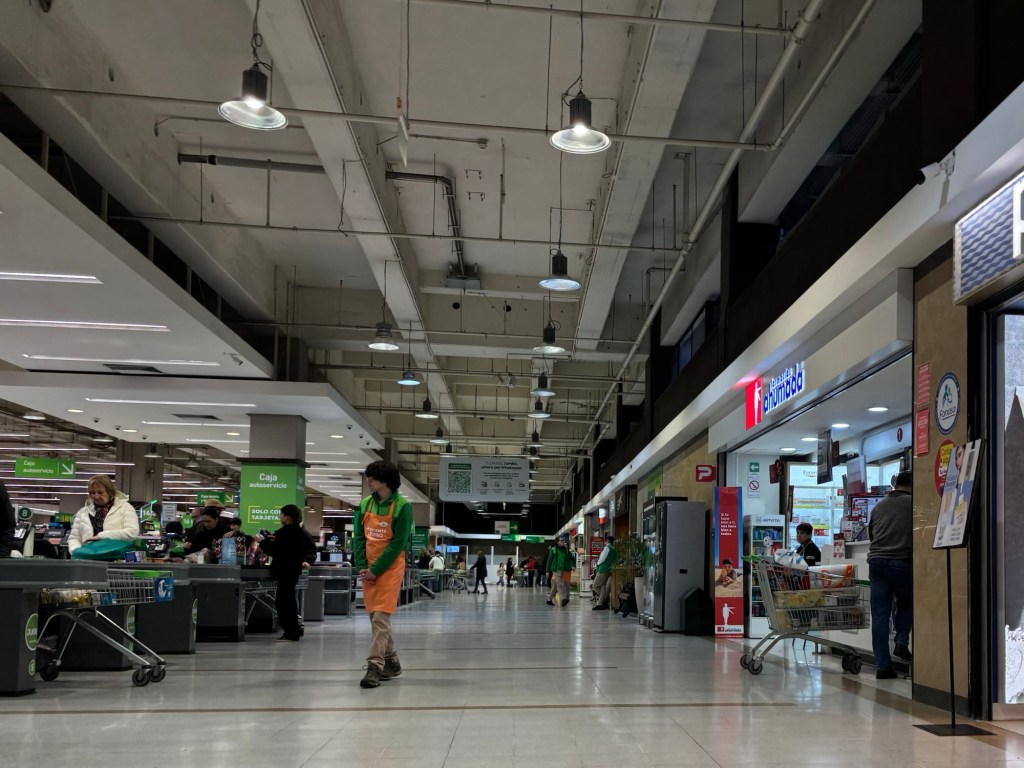
In the meantime, Tomás has given me my own key to the house and took me to Jumbo, the largest supermarket in the area, to buy some Chilean snacks for me to try but also to pick up any supplies I might have missed (like razors, for example). After over a week without shaving, it does feel good to be moustache-less once again.
It’s always interesting exploring a supermarket in another country. Target is still up at the top of the most iconic supermarkets I’ve encountered, if only because it was just so effortlessly American – and, of course, I’d heard about it and seen it referred to in so much American media before.
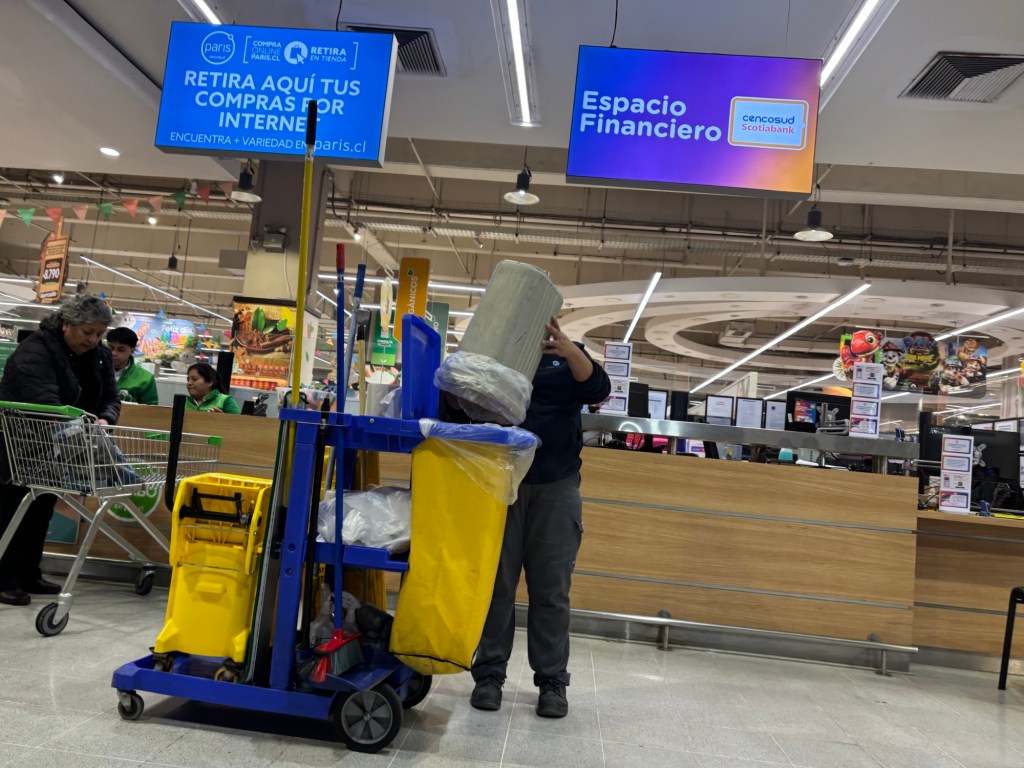
In its supermarkets – much like everything else – Chile feels altogether more European than, say, Peru. Self checkouts, online shopping pickup points… it’s all very familiar. There are some notable differences: namely, the bored guards watching the car park both below and outside from high seats that look more like misplaced lifeguard stations. Chile is often touted as one of the safest destinations in South America, but that might well have something to do with the expected level of security. Where I’m staying in leafy suburban Las Condes, so many of the properties are locked away behind electronic gates and door buzzers. Is it really safer, or are people here just a lot more cautious by nature?
It’s currently 3:4 to England. It really could go either way. Tomorrow’s game is the one that really matters, though, and it looks like nearly all of Chile will come out in support of their former coloniser, since the alternative is their much-hated neighbour. Though, by the looks of things, Saka is keeping France very much on their toes. 3:5! What a hero.
I’ll sign off here – no need to report more until I have more to report. BB x
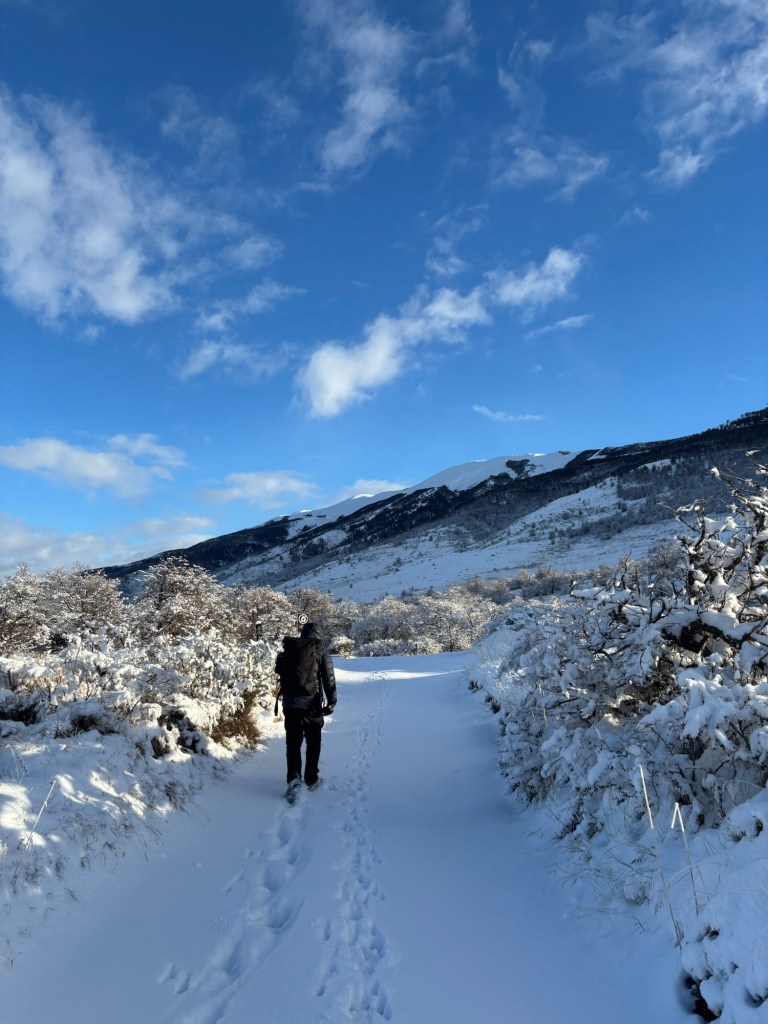
The weather is fickle. It’s still pretty cold out, but it’s warmed up enough not to need more than two layers on when leaving the house. The snow has largely melted away in Puerto Natales and the surrounding countryside, revealing for the first time the vast golden fields of Patagonia. It’s always a bit sad when snow melts, like coming to the end of a very special story, but if the forecast is to be believed, it will be back tonight.
I still can’t believe my ridiculous lucky streak in timing this adventure to coincide with the very first snowfall of winter – and all the magic that followed, right up until the last throw of my expedition today. Right up to the wire.
Fabián picked me up just after seven thirty as usual and we set out into the darkness. Beaming his thermal camera to his phone, we spent much of the twilight hour searching for life in the snow. It was eerily quiet this morning. A single caracara was our only find, shivering in the cold at the side of the road.
And not without reason: the temperature had dropped to a biting -10°C, worsened by the all consuming oblivion of a snowborn fog and an icy wind coming up off the lake. Even the lights of oncoming cars didn’t become visible until long after their engines were heard rumbling down the road.
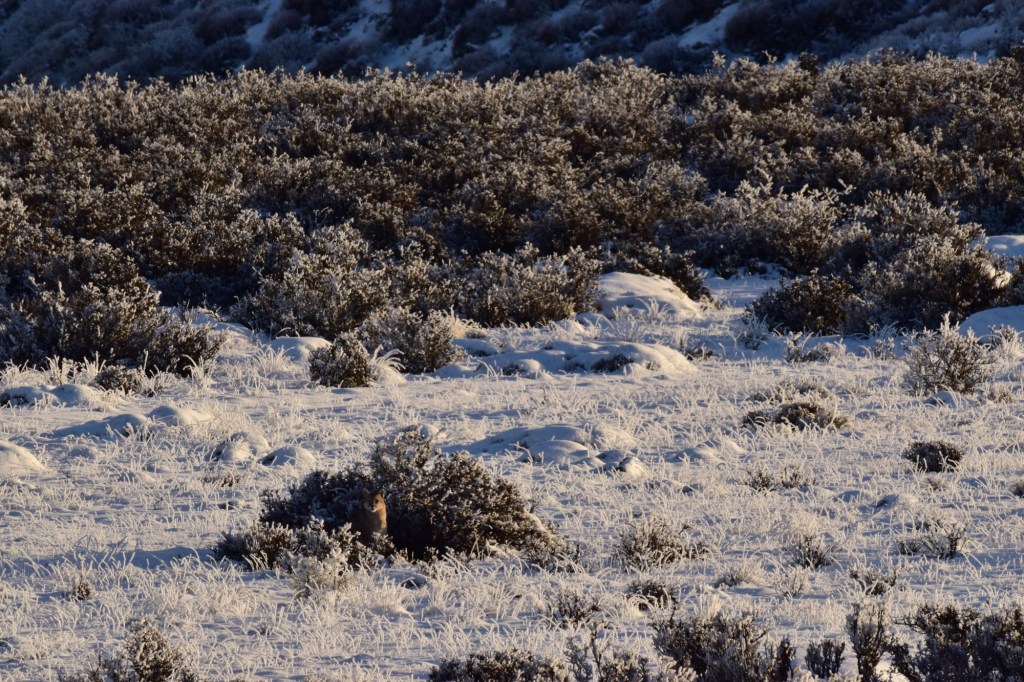
We had quite a scare while looking for Escarcha and her cubs. The thermal camera picked up two glowing dots on the hillside not far from where we’d left them yesterday: one large, one small. One of the trackers went up into the fogbound hills to get a closer look and radioed in to confirm it was Escarcha and one cub. For a painful half hour, there was no sign of the second cub at all – until it came out from behind a rock where it had been hiding, much to everyone’s relief.
Winter may be beautiful, but it is terribly hard on the animals that live here – especially the young. Hopefully, Escarcha’s cubs make it through the winter so they can find territories of their own in this desolate idyll.
Escarcha took her cubs higher up into the gloom, which showed no signs of lifting anytime soon. Fabián suggested an alternative itinerary up at Laguna Azul, on the eastern edge of the national park, so we left the fog and set back out into the brilliant light.
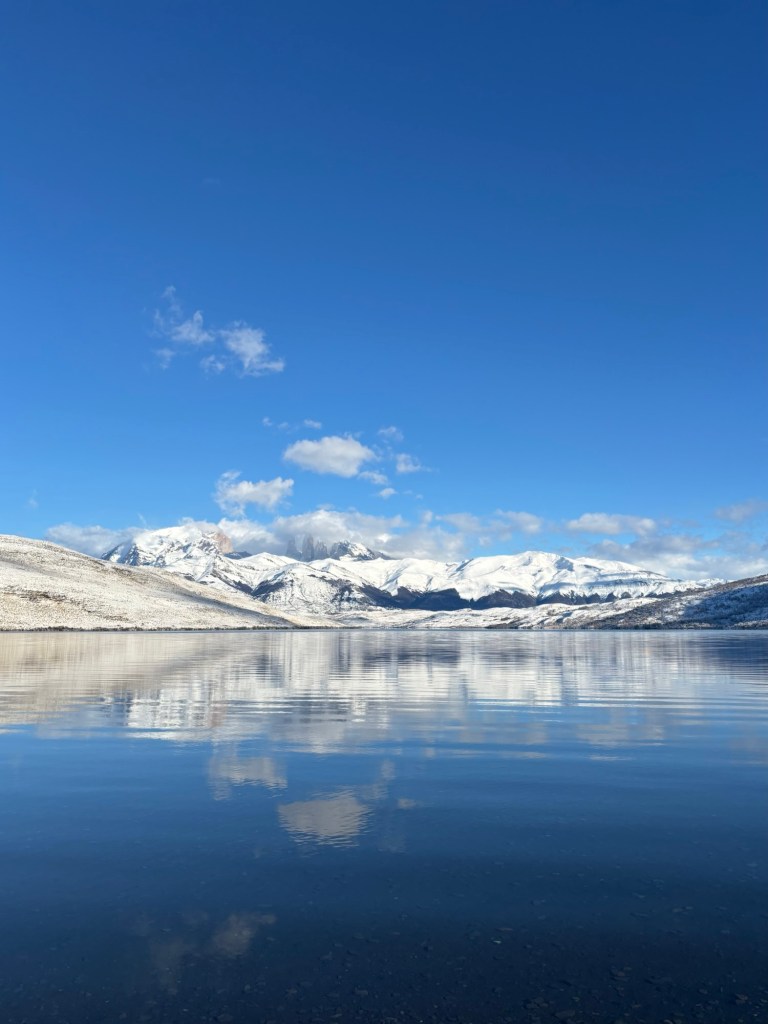
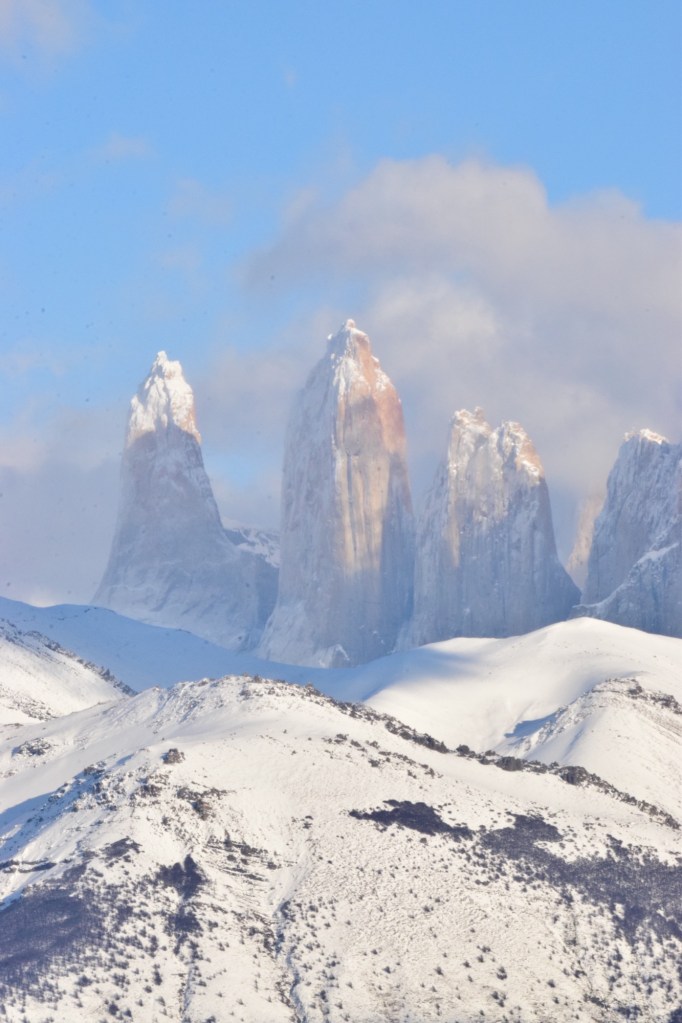
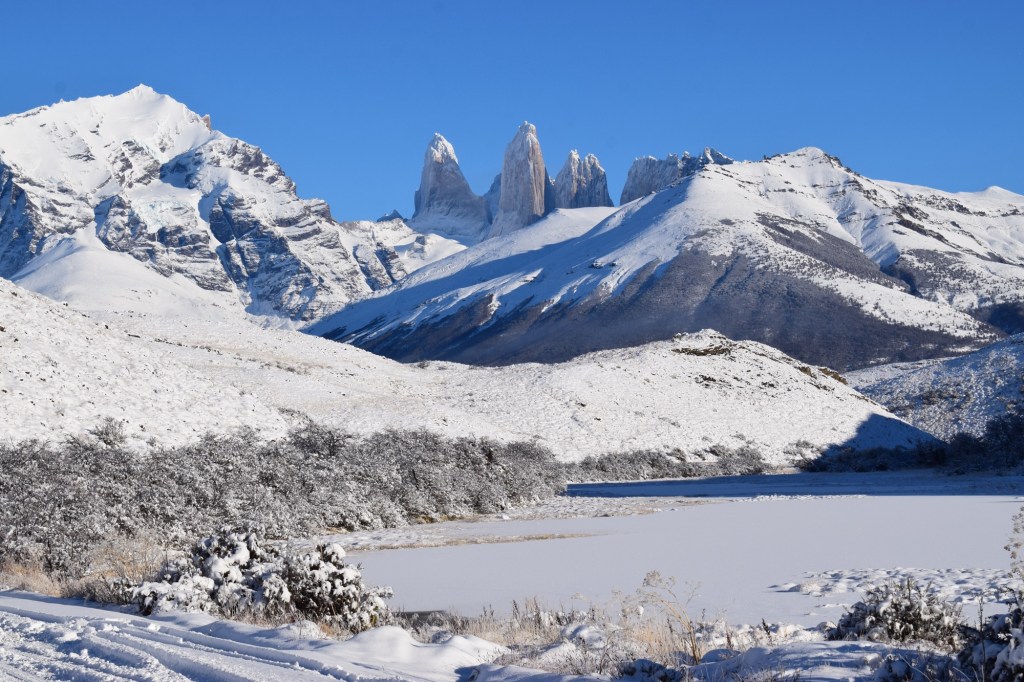
Laguna Azul offers a tremendous view of the world famous spires of Torres del Paine across the surface of its crystal waters, though they were more often shrouded in cloud than not.
The towers themselves are every bit as breathtaking as you have heard. Unlike Petra (which I was arguably less exposed to before I saw it) the Torres del Paine lose nothing in reality, despite the fact you’ve probably seen them a thousand times over on the covers of photography magazines, NatGeo special editions and South American travel guides. Glowing red and white in the morning light, they might be the exposed teeth of some ancient titan, or the thrones of South America’s lord of the skies, the condor.
Fanciful imaginings on my part. Paine is a Tehuelche word meaning “blue”, in honour of the colour of the peaks in the grey morning, or the icy glaciers that lay at its feet.
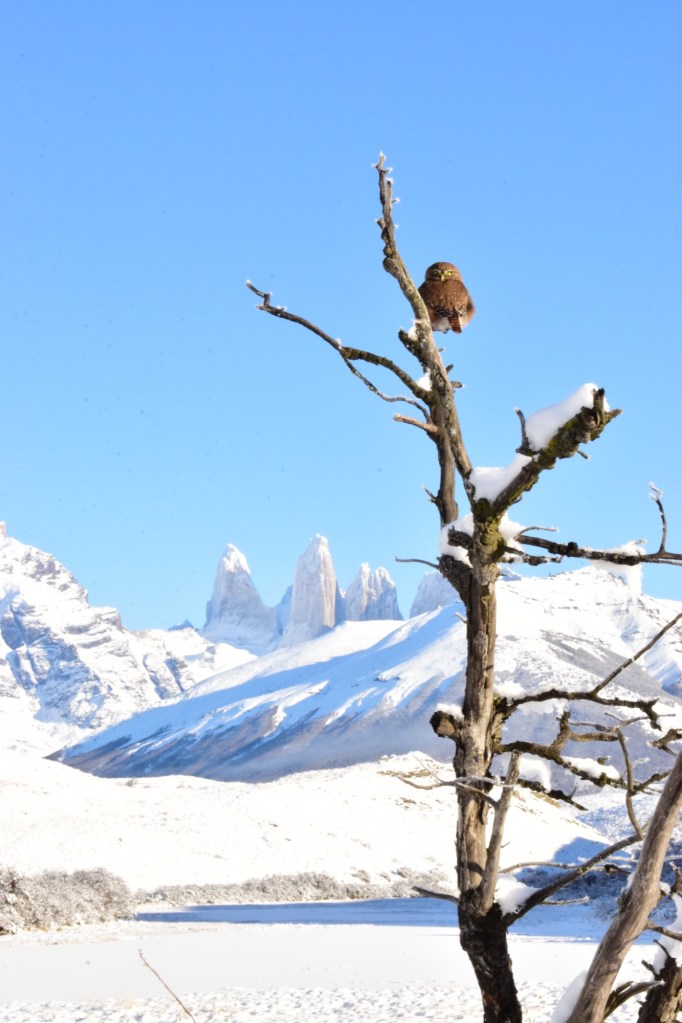
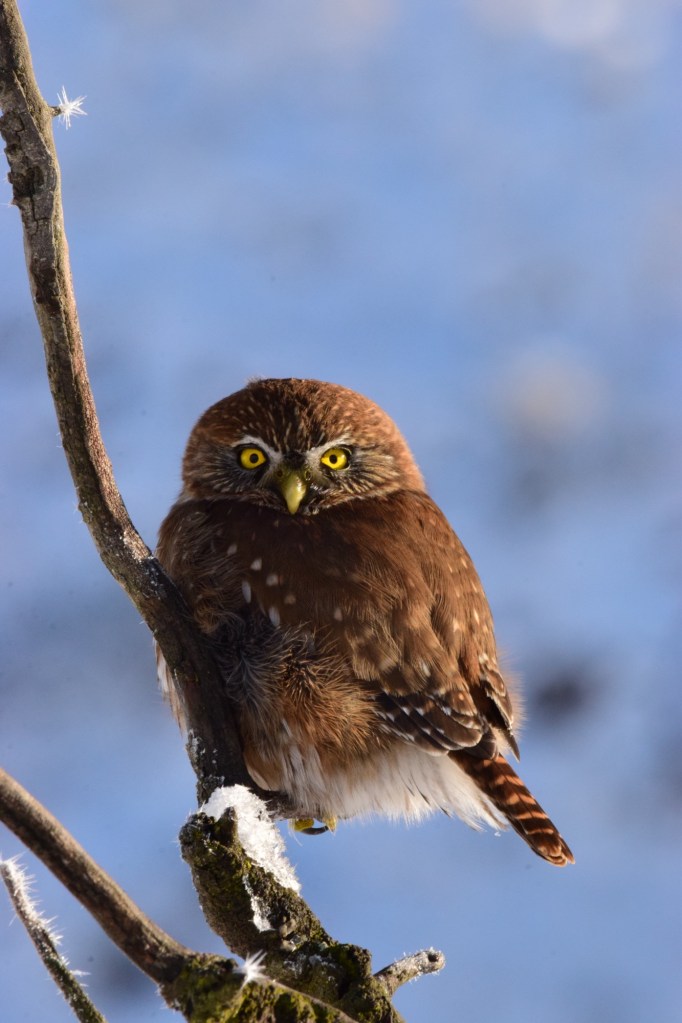
Fabián’s mission was to find a tucúquere, a Magellanic horned owl, or the more well-known Patagonian speciality, a Magellanic woodpecker. But the forests around Laguna Azul were silent – completely silent. We found another chunchito (pygmy owl) watching us from the top of a dead tree, along with a couple of colourful rayaditos, but the snowy forest showed no other signs of life.
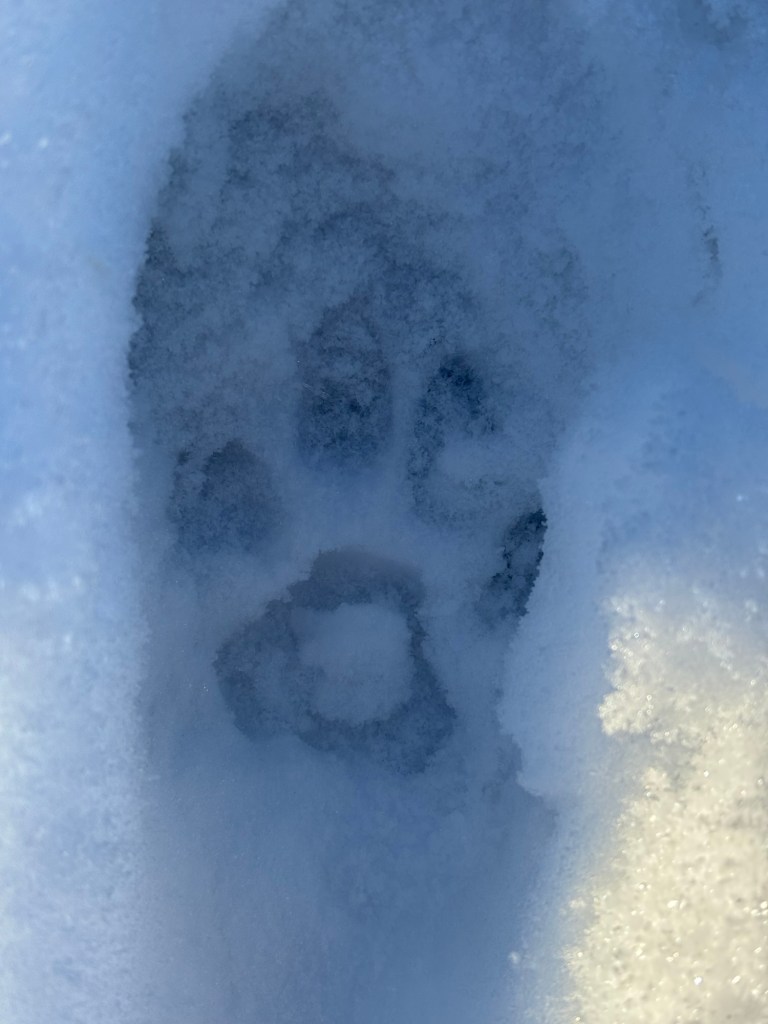
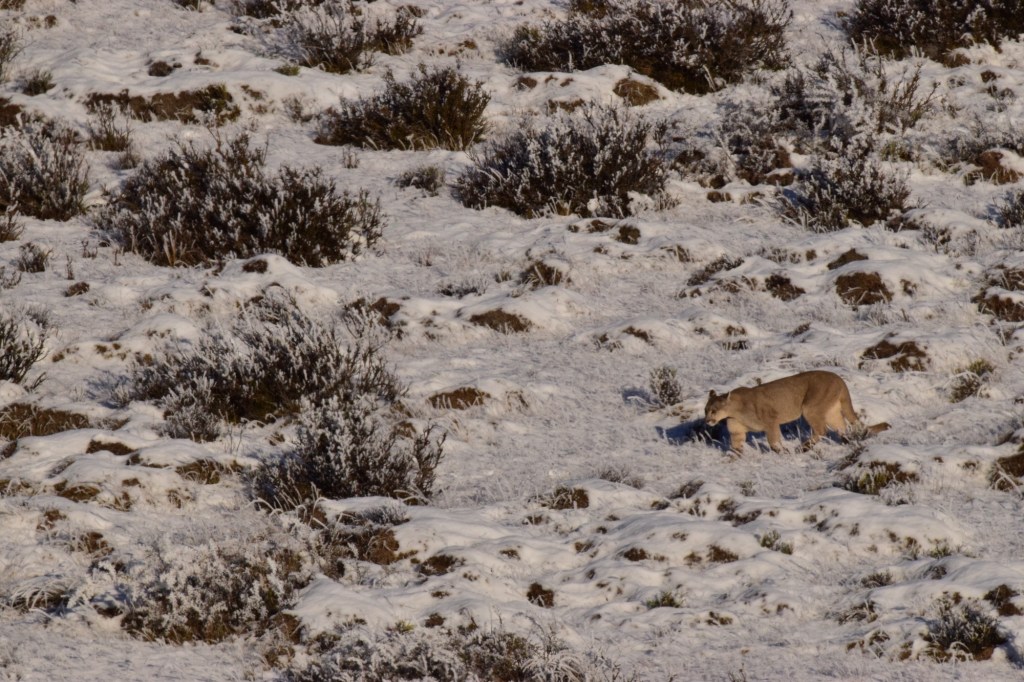
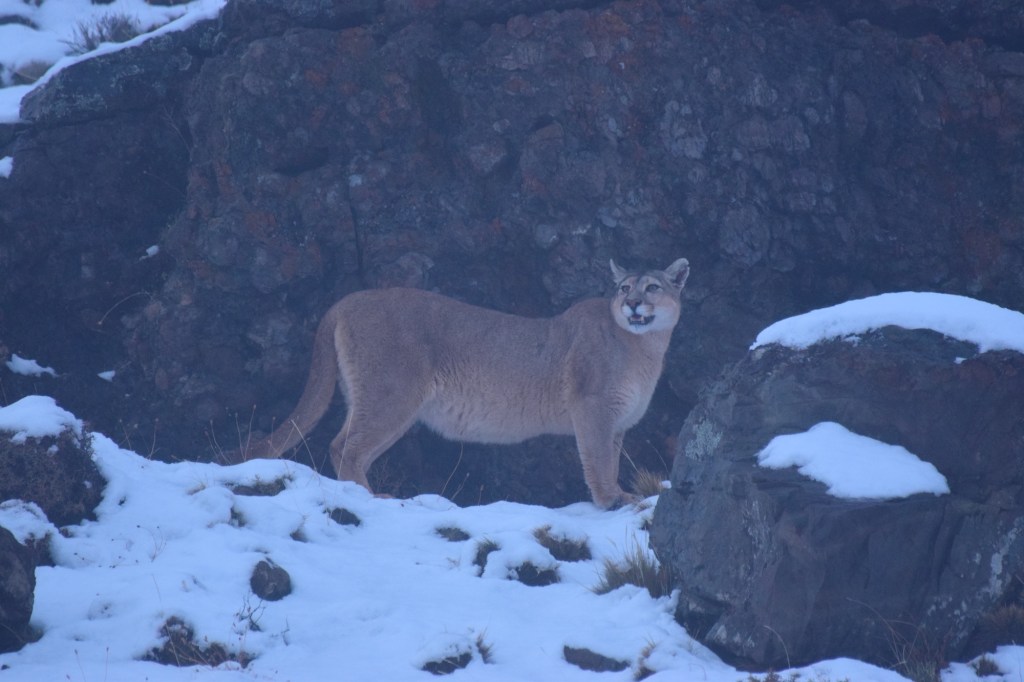
Perhaps they were all hiding from the creature that left these tracks in the woods: an enormous male puma, whose trail we followed for about an hour as it weaved through the woods, occasionally doubling back to investigate the older trails of a couple of younger female pumas.
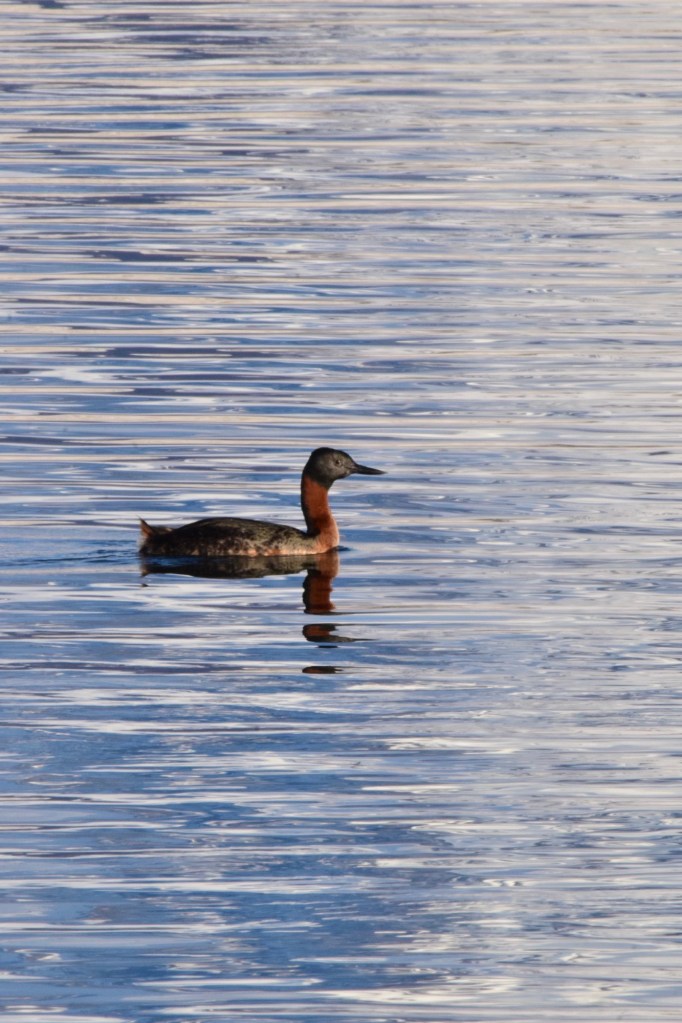
Out on the lake, I finally tracked down a creature I missed in Peru. We have grebes in Europe, but the huala or great grebe – the largest of its kind in the world – is a truly magnificent bird, reaching the size of a cormorant. Curiously, as I descended to the lake’s shore to get a closer look, it actually came closer to the shoreline rather than diving and emerging much further away, as grebes are inclined to do.
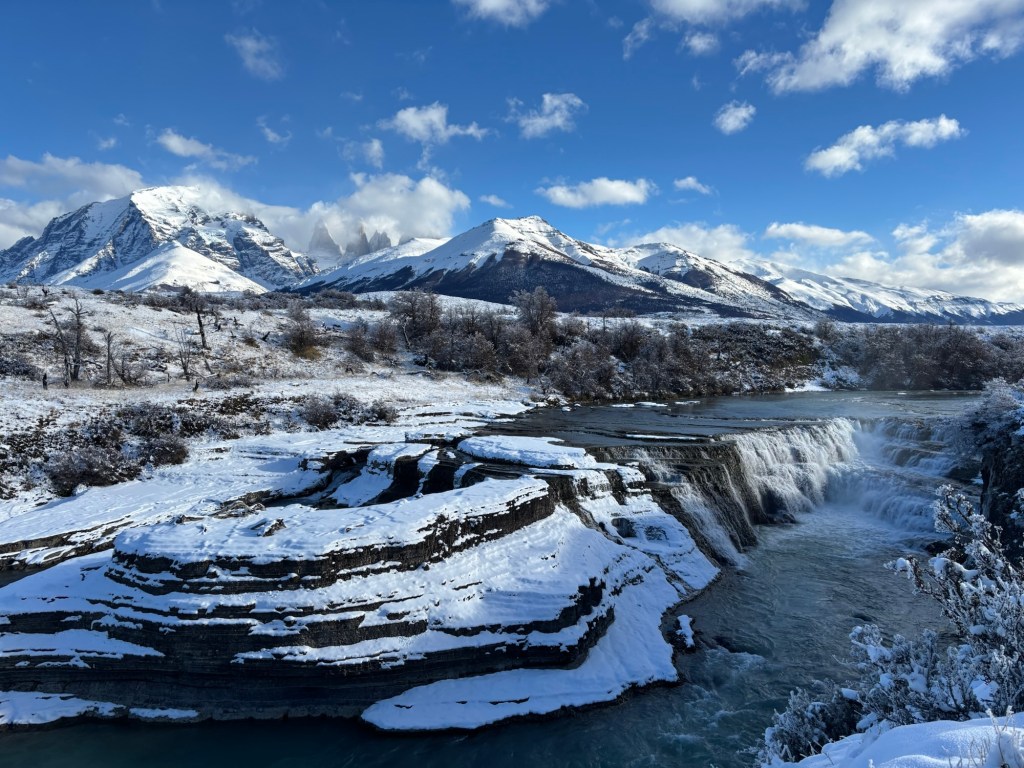
Back in the car, Fabián checked in with his fellow trackers over the radio. Nobody, it seemed, had had any luck with pumas since Escarcha and her cubs went up into the hills. So we stopped for a snack lunch next to the thundering falls of the Cascada del Río Paine, where the meltwaters of the park’s mightiest river came hurtling down a series of cliffs amidst menacing curtains of sheet ice.
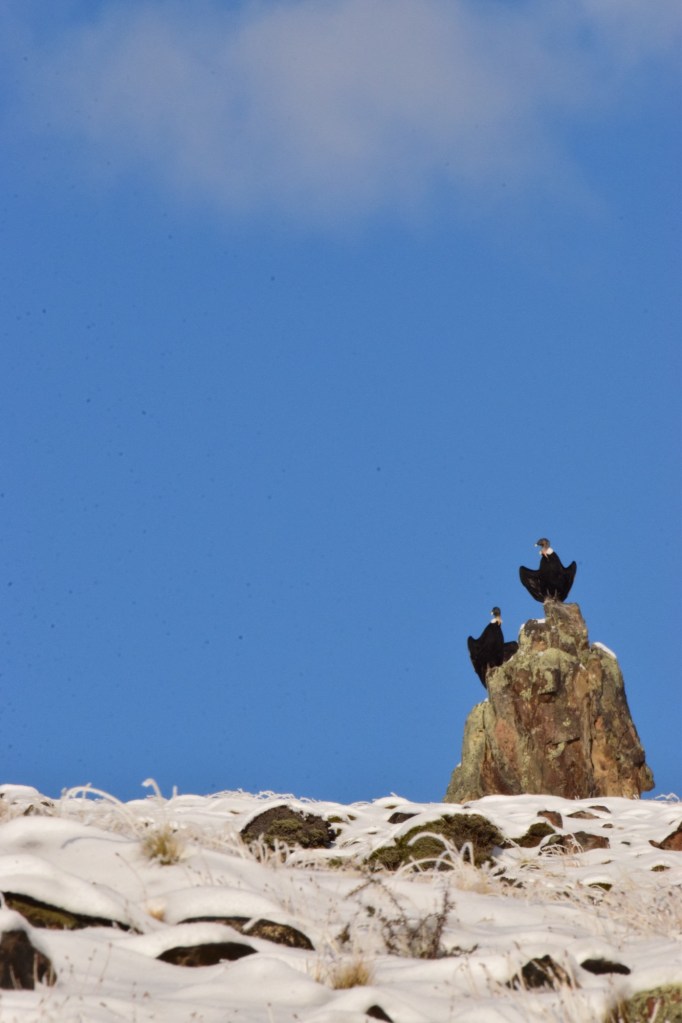
We picked a lucky spot. Two handsome condors sat up on the hilltop, sunning themselves in a posture that must have convinced the ancient Inca that the condor truly was a messenger (and worshipper) of the Sun.
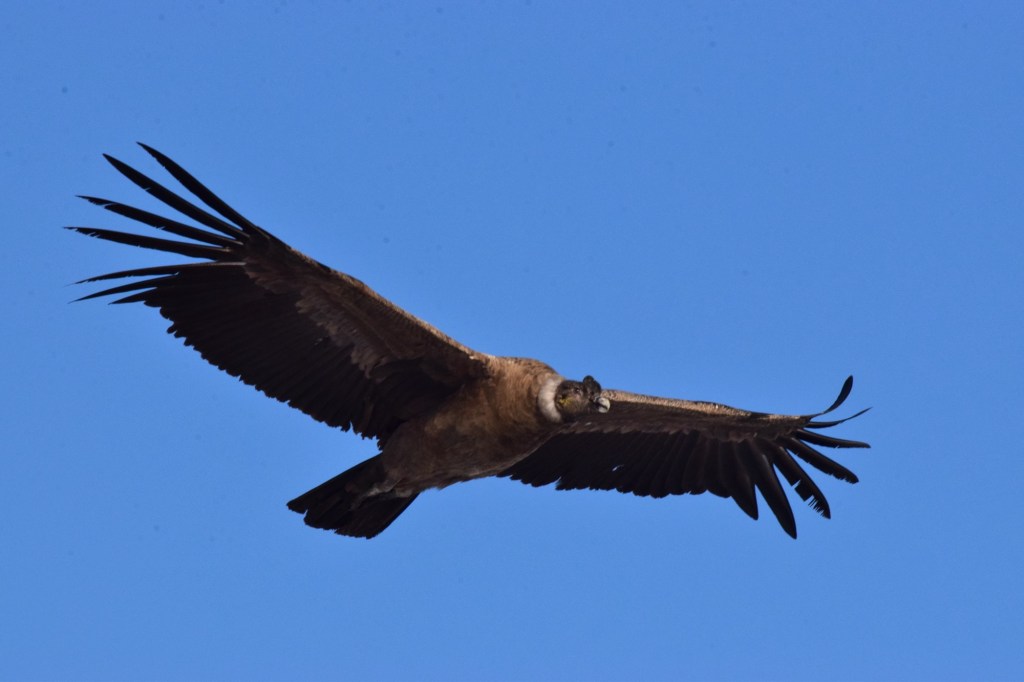
The waterfall must be a reference point for the condors in their navigation, because no fewer than sixteen came flying right overhead on their way up the valley, some of them soaring so close you could hear the rush of wind in their enormous wings. They were mostly youngsters, yet to don the full black robes and smart white collars of their elders.
For me, that would have been the perfect ending to a wonderful three days: a close encounter with one of my favourite creatures in the world – again – but Patagonia was not done with us. Not yet.
The radio crackled to life as we were driving back to the south road: ‘La Petaca está en la carretera’. Fabián stepped on the gas, overtaking two trucks in the snow like a rally car and forking right back up the road to Lago Sarmiento.
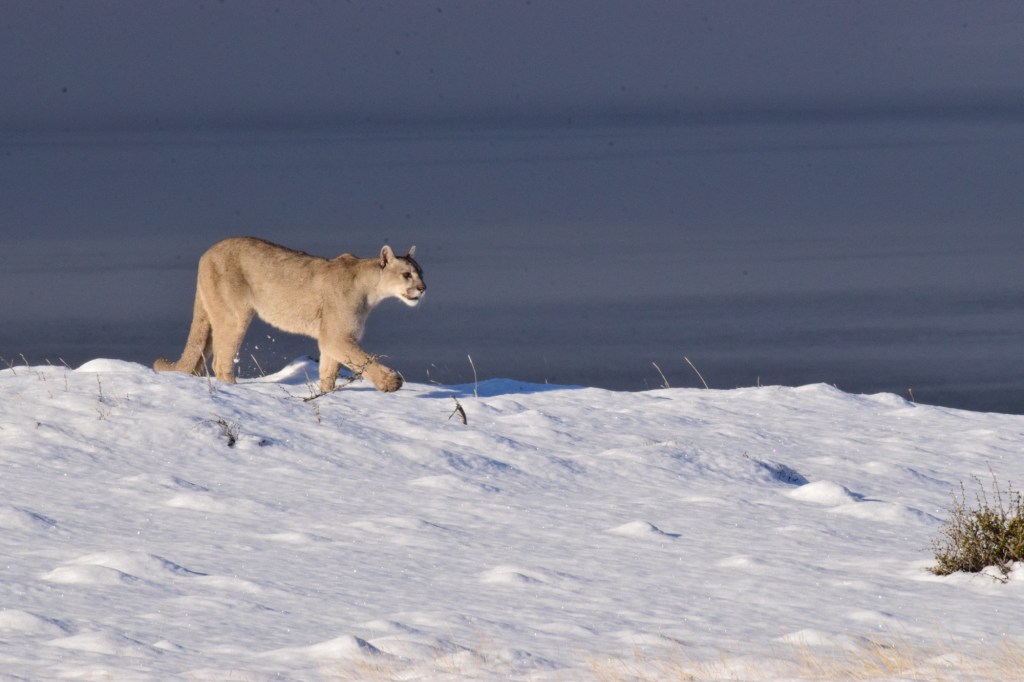
The fog had finally cleared, having hung over the lake almost all day, and one of the trackers had located Petaca, the dominant female and the park’s most famous puma, following the scent trail of Escarcha and her cubs: her progeny. By the time we got there, she had slipped off the road and into the scrub, but we were still able to spot her without too much difficulty.
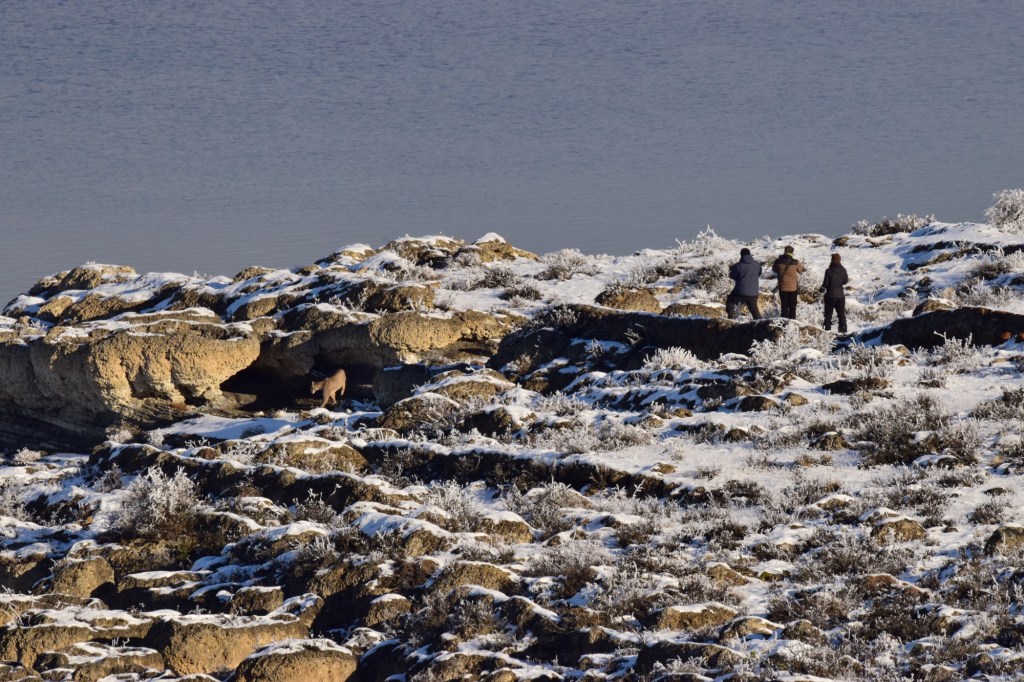
Not for the first time, I was disappointed with the behaviour of some of the tourists and their tracker, who came down from the road to move in as close to Petaca as possible. If she had wanted to come back up the hill, she was cut off constantly by this group that kept cutting ahead of her to get more and more photos of the big cat approaching head-on. Fabián was just as ticked off as I was (I really do appreciate a guide who puts the animal first, and not the client). Surprise surprise, the tracker was one of the ones we’d sparred with a few days prior, telling us to back off as they were there first. Go figure!
I believe that the key to magical wild encounters is patience, understanding and a healthy dose of luck. If that had been that, I would have been perfectly happy – we had already seen so much of the pumas over the last two days. I was ready to hit the road and maybe find some ñandúes on the way home.
And then Petaca reappeared.
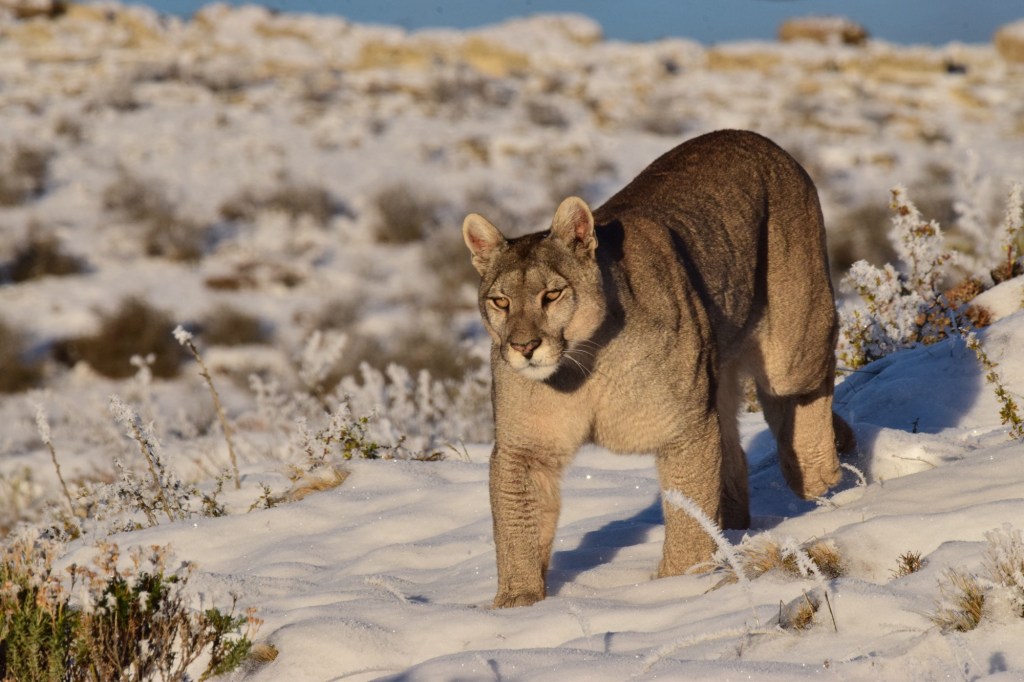
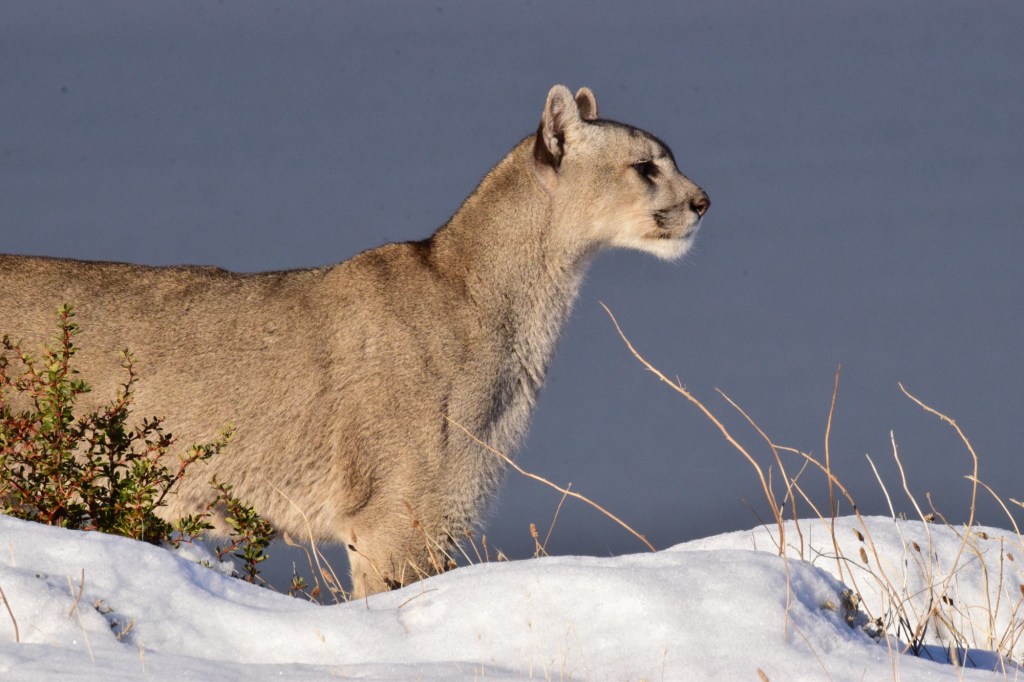
With the shimmering waters of Lago Sarmiento behind her, she hardly cast a glance in our direction as she padded her way along the hillside toward the road, following Escarcha’s trail.
With no further obstructions to her path, she came right up to the road, mere metres away. At such a distance, you could really appreciate the power in those mighty paws. Here is an animal that didn’t struggle once in the snow like the fox and the geese from yesterday: she almost seemed to glide across the surface of the frozen hill.
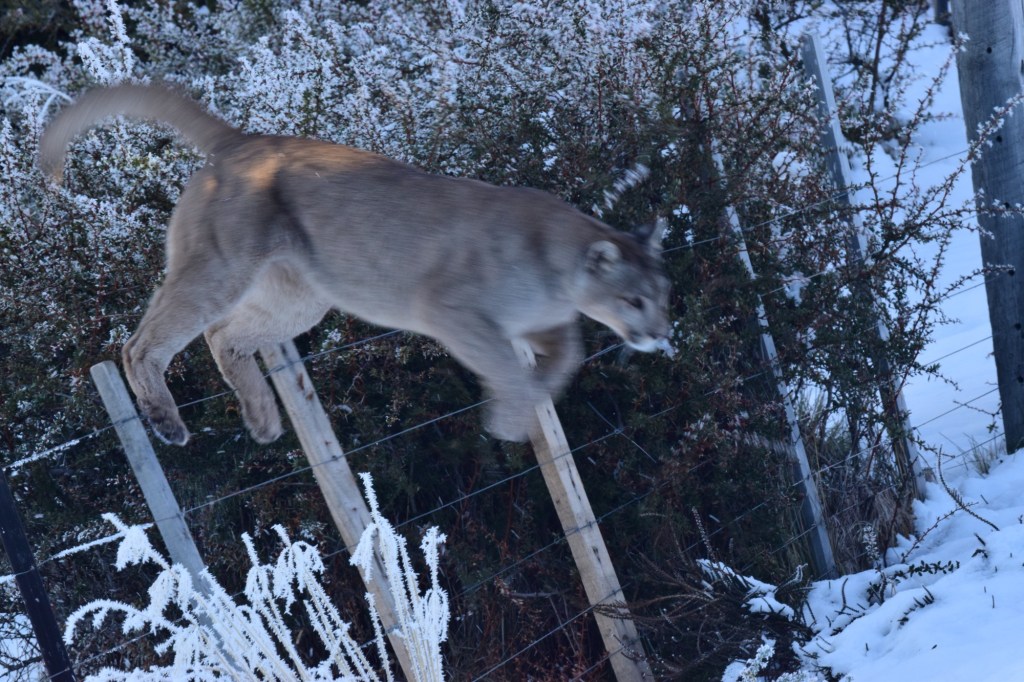
I thought the fence between the road and the hill might prove a barrier, but not for this apex predator. In a single move she leapt nimbly up onto the wire and then launched herself onto the other side, just a few feet away.
Having cleared the road, Petaca climbed up into the hills toward the setting sun and disappeared among the frozen scrub. What an incredible encounter! And what a way to finish a superb three days’ tracking in Patagonia!
On the way back, we found the unnamed young male in the same spot he had been when we first saw him on Monday. It felt fitting that the last puma of the trip should also be the first. We might very nearly have witnessed a hunt, as a lone guanaco was headed right his way, until a passing truck spooked it into heading in a different direction.
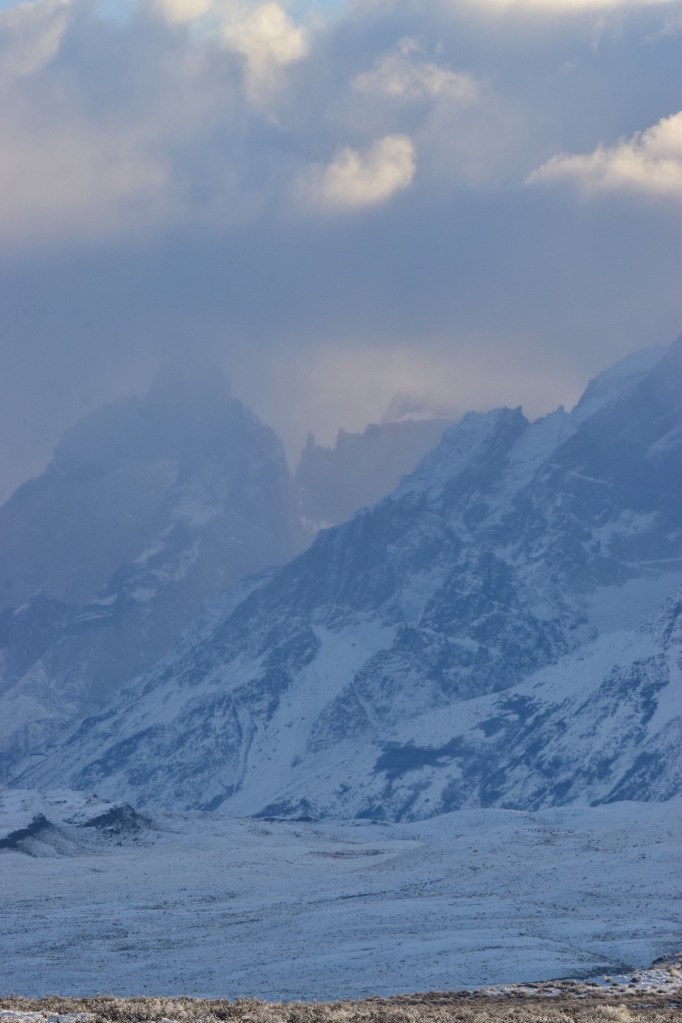
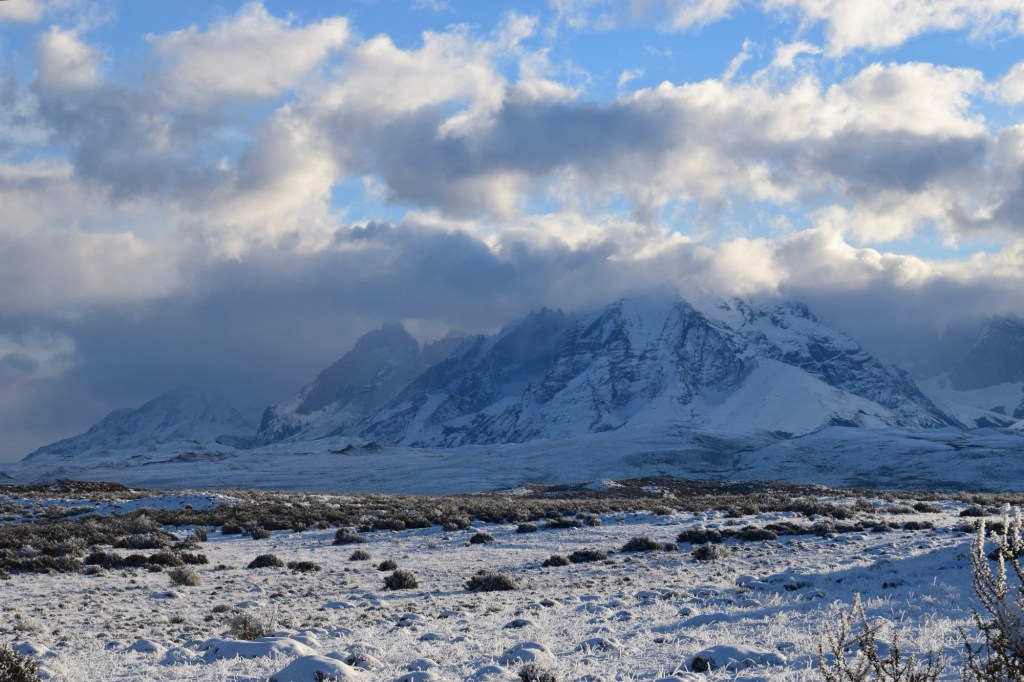
The tour I had booked for tomorrow into the heart of the park itself and the Cueva del Milodón was sadly cancelled due to low numbers by the time I got back, so this will be my last time in Torres del Paine. Magical, then, that it should end with a view of the mountains at their most impressive, with ominous yellow and grey clouds rolling across its summit, turning the blue mountains of the Tehuelche all kinds of magical colours. Who could not lose their heart to such a sight?
I’ll take it easy tomorrow and explore Puerto Natales properly. There’s so much human history here that I could so easily overlook, and it will need more than a morning, I think. BB x
Patagonia is transformed in the sunlight. From the moment I arrived, the whole territory has been shrouded in a dense fog ushered in by the snow, concealing much of the land behind a mysterious grey curtain. Today, at dawn, everything changed. Shadows into silhouettes. Mystery into majesty. I have never been more in love with this place than I was today.
And to think there were people online who advised against coming here in winter… I can only imagine they wanted to keep something this precious to themselves. Because I think I can say without a hint of hyperbole that Patagonia in the heart of winter is one of the most beautiful sights you will ever see.
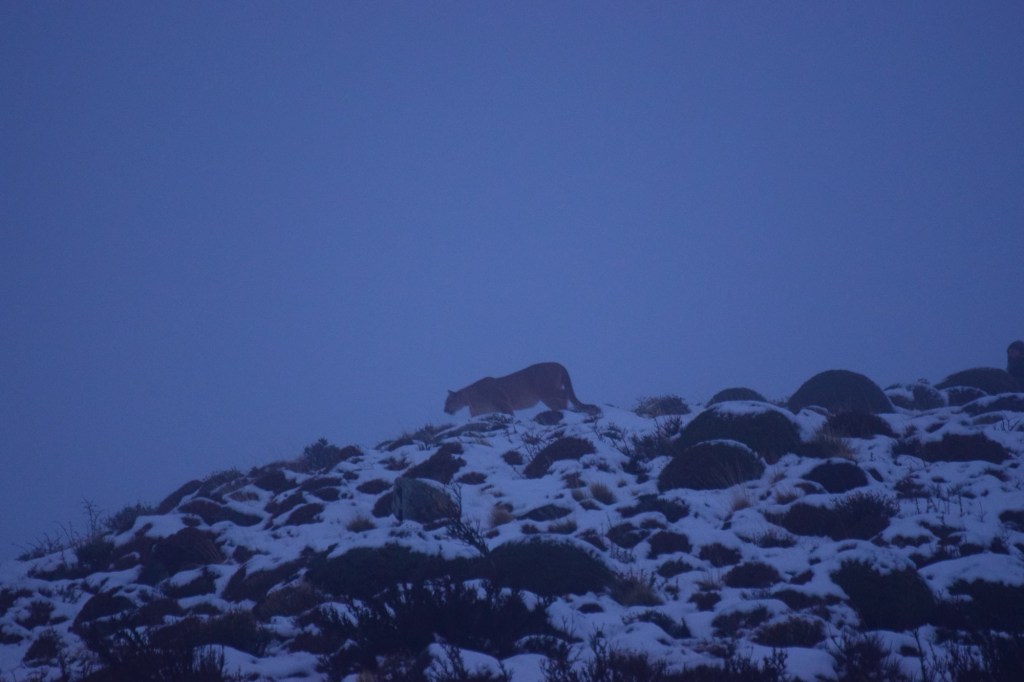
This morning’s quest began where we left off yesterday, at the frozen field where Escarcha and her cubs had gone to ground. Tracks in the snow indicated that they had moved on during the night, but there was at least one puma still in the area: an adult female, one of the offspring of the legendary Rupestre, the former matriarch of Torres del Paine. It was still dark, but following the lurching silhouette of a sight that was becoming quite familiar still set my heart racing.
She seemed to be following the scent trail left behind on the cliff – either Escarcha and her cubs or another puma entirely – as she kept pausing at each overhang and doing the Flehmen response, a technique which allows cats to analyse the scents they detect in extreme detail, ascertaining information such as the age, health and sex of the scent-bearer. Cats are remarkably intelligent creatures and the puma – arguably the most successful of all the cats of the Americas, with more names than any other species of felid and a range spanning from Alaska to Tierra del Fuego – is no exception to the rule.
The female took her leave and wandered off toward Lago Sarmiento, and we turned back in search of the new arrival from yesterday, NN, just as the sun began to crest the hills to the east, bathing everything in a golden halo. NN was where we left him yesterday, and while he popped out of his hiding place for a gnaw at his hidden kill, he promptly returned to the scrub and disappeared again.
Forging a new path, Fabián took us down a new route, past the frozen lake where we had found Lenga and Ñire yesterday and up into the foothills of Torres del Paine. We saw no pumas en route, but they had clearly been here during the night, with fresh prints along the road and across the fields beyond.
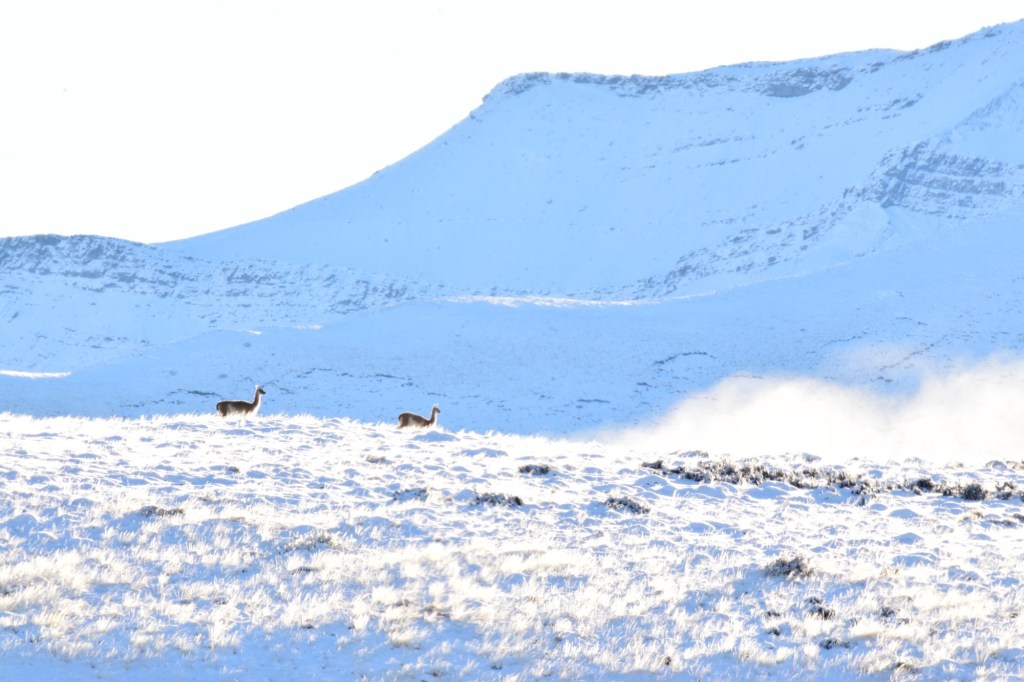
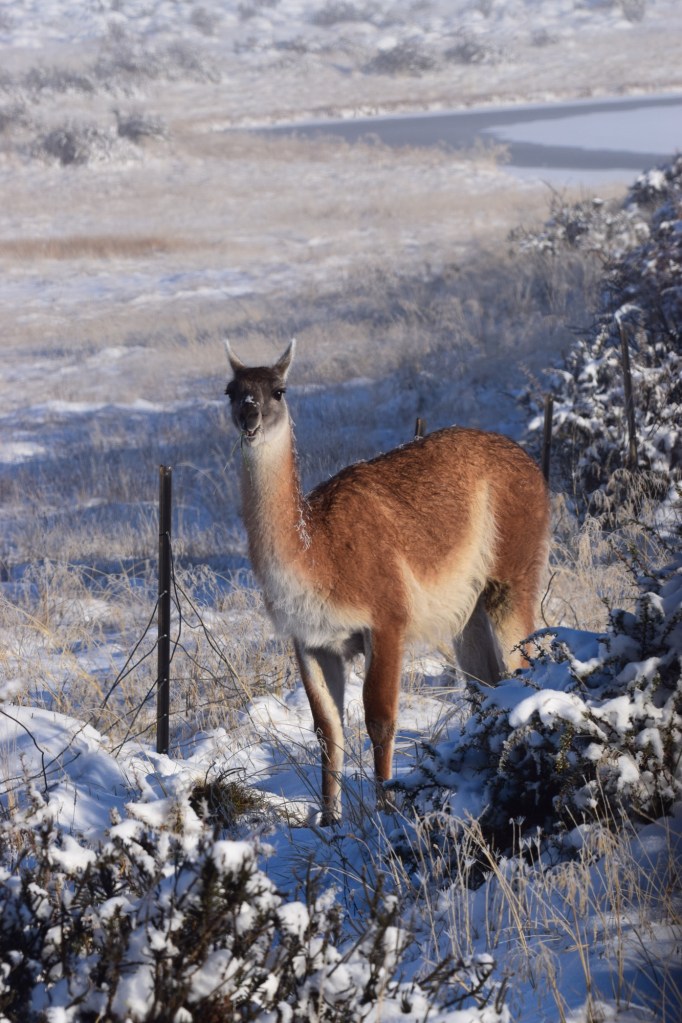
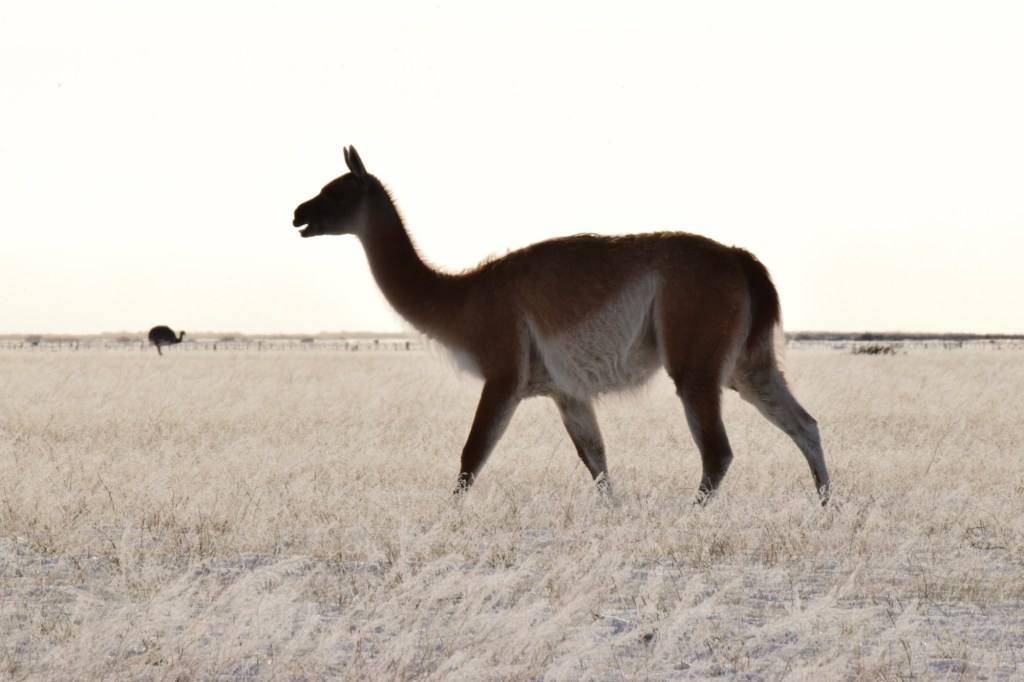
The guanacos, on the other hand, were everywhere. Apparently, in this corner of the world, only 4% of guanacos survive infancy, with the other 96% falling prey to the pumas. That figure alone goes a long way to explaining the concentration of pumas here in Tierra del Fuego – and also, the fecundity of the guanacos, since they still outnumber the pumas by at least ten to one. We didn’t get that classic “guanacos against the backdrop of the Torres” shot that Fabián was angling for, but the winter sunlight made for some breathtaking views of the guanacos on the eastern slopes.
Skittish beneath the mist, the guanacos seemed to lose a lot of their nervousness in the sunlight – perhaps because the increased visibility made them less anxious about being ripped apart by an unseen puma at any given moment. We were able to pass by so close that you could see the frost crystals on their ears.
The park’s meadowlarks were just as abundant today as they were yesterday, only this time they played second-fiddle to a natural phenomenon I have only ever heard about but never seen until now: diamond dust. A true polar experience, it is a kind of sub-zero “precipitation” that only forms under a cloudless sky: effectively, a ground-level cloud of ice crystals that seem to sparkle in the sunlight. I really should have filmed it, in retrospect, but some things never look as good on camera (though you can just about see it in the picture below). This was definitely one of those things. It was magical enough to behold, and something I’d recommend traveling all the way here to see in its own right.
Fabián drove on toward a small frozen forest of lenga trees in search of a chuncho – an Austral Pygmy Owl – that he knew to inhabit the area. I spotted it, but I think it’s safe to say he knew which tree it would be likely to be in, as any guide worth their salt would. After all, it happens to grow in a very iconic spot: right in front of the world-famous peaks of Torres del Paine.
Remarkably, the tiny little owl paid us no mind whatsoever, so I could get in so close I could see the yellow of its eyes without the help of my lens – which, of course, did a phenomenal job at close-range.
Back at Lago Sarmiento, a tip-off over the walkie-talkies alerted us to the return of Escarcha and her cubs, patrolling the edge of the lake. One guide and his group – the pike-square of supertelephoto users from yesterday – had jumped the fence and gone down to the lake and enjoyed ridiculously close views as the family passed them by, but at least Fabián and the other guides had the restraint not to insist we all go down to the shore and crowd the pumas. Instead we waited patiently and watched from a distance as Escarcha left her cubs in a safe spot and set out to go hunting.
That is not to say that we were not also treated to a close encounter. Escarcha’s route up into the hills took her right past us, passing mere feet away. Unfazed, she climbed up the snowy slope and disappeared into the descending clouds.
We waited for a while, suspecting from the approaching guanaco herd and the descending mist that she might have been hunting the herd, but Escarcha eventually appeared as if out of nowhere and went back down to hunt among the scrub by the lakeside, presumably for some smaller prey like hare. Fabián offered the choice to stay and pursue more pumas or to search for the other animal denizens of the park, and after some thought, I opted for the latter. After all, I did really want to see a ñandú. So we bade farewell to the others, who all remained with Escarcha and her cubs, and left the heart of puma country for Cerro Guido.
Like many of the places we have visited, Cerro Guido is a private ranch or estancia, but one of many that has realised that wildlife tourism can be tremendously more profitable than regular ranching. As such, a large part of the Cerro Guido ranch is given over to the local wildlife, giving the prairie-dwelling guanacos and rheas – and the puma that hunt them – a perfect haven of their own.
The ñandúes were very visible, albeit always in the middle distance, but the guanacos continued to make for good subjects against the afternoon light.
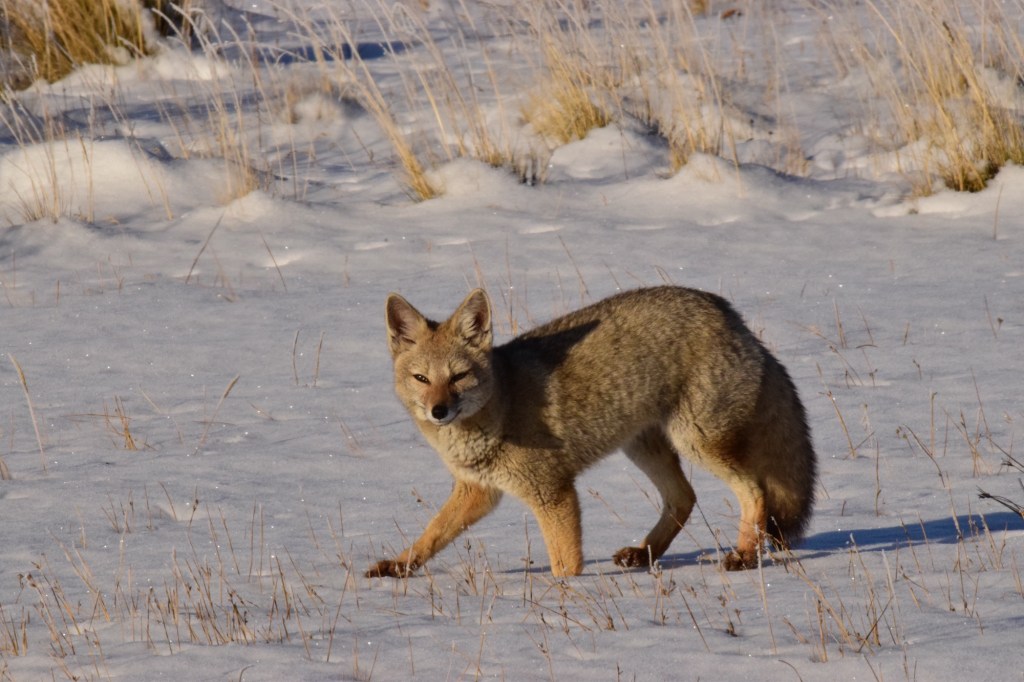
Another Patagonian mainstay was very much in evidence today: the South American Gray or Patagonian fox, a canid that is actually more closely related to coyotes and jackals than it is to the true foxes we know and love from back home. Just like they do in winter back in England, they were out looking for partners ahead of the mating season in spring, so we saw more than a dozen in all, sometimes alone, sometimes scampering about the fields in pairs. This one seemed to be limping, until we realised it was not walking with an odd gait but rather struggling with the depth of the snow, plunging up to its elbow every few steps.
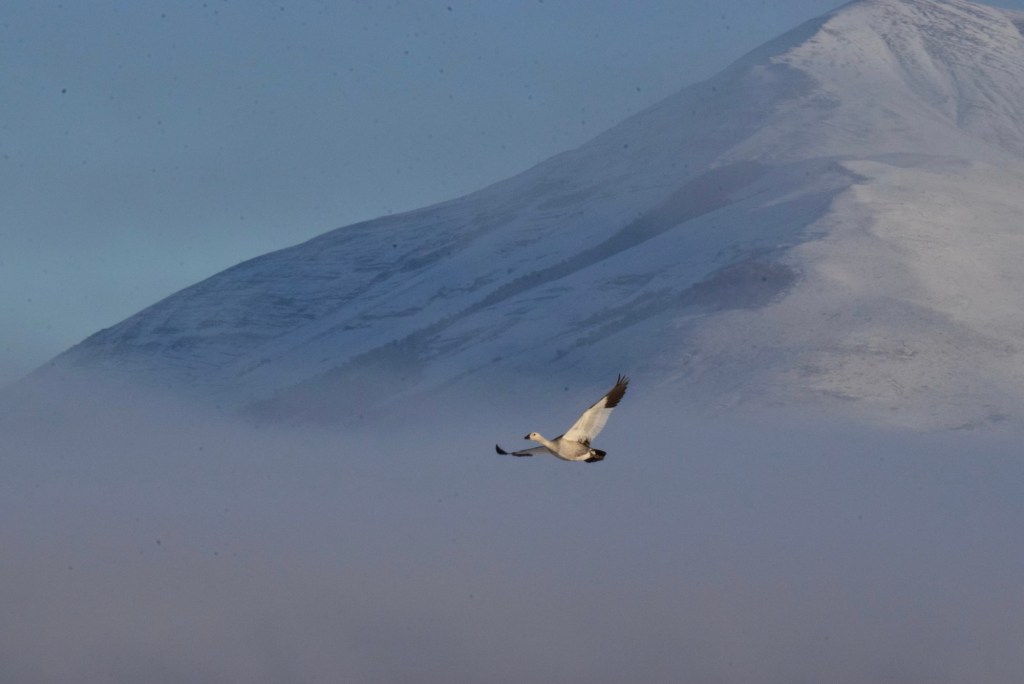
The caiquén or upland goose was by far the most numerous resident of Cerro Guido, outnumbering even the ubiquitous guanacos. Caiquenes pair for life, though their fidelity is curiously one-sided: if the female dies, the heartbroken male will never pair off again, joining a bachelor group for the rest of his days, whereas if the male dies, the female will usually find a new mate within a few weeks. It’s a neat trick to ensure evolutionary stability in the long term, and – if you choose to look at it that way – a funny reflection of how men and women react to breakups.
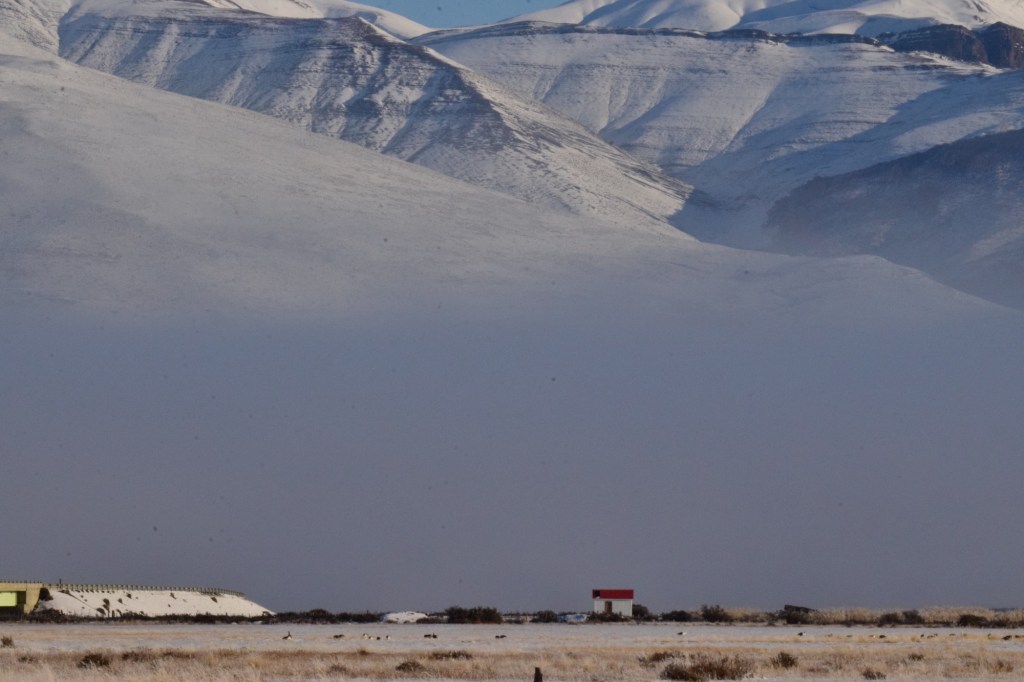
I joked about the bus station-looking shelters, only to be told that yes, they really are paraderos – and to rub salt in the wound, a bus rounded the corner and passed us merely moments later. It’s hard to imagine now, but in the warmer months, when ranches like this one are more active, many ranch-hands travel to and from their posts this way. I caught myself wondering (and not for the first time since arriving) how amazing it would be to sack everything off and live here, way out here in the Chilean Antarctic wilderness. I’ve had madder dreams, trust me, and a little more careful thought would surely shake me out of my reverie. But I haven’t given it that much thought yet. It’s just a hunch I had – and a bottomless love for the wildest and most magnificent natural wonders of the world (and, coincidentally, places that style themselves as “the End of the World”).
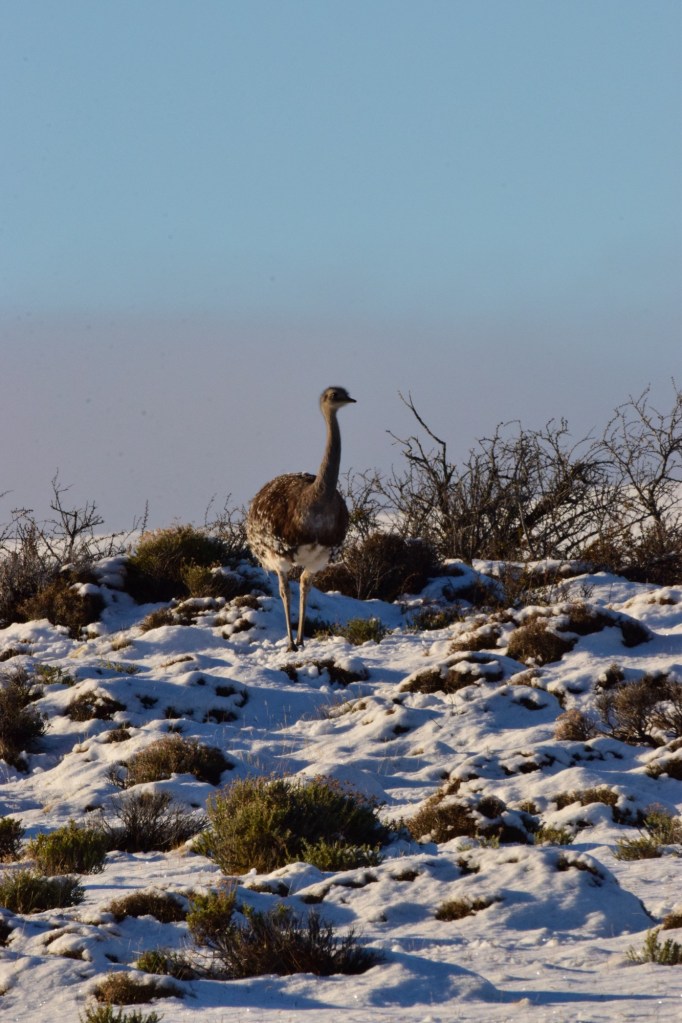
We didn’t find any nearby ñandúes, and the two that had been relatively close but obscured by a bush on the way in had wandered far off by the time we turned about to make our way out. Not to be disappointed, though, Fabián spotted one near the road after we had left Cerro Guido and I jumped out to track it down.
I’ve not seen ostriches in the wild, or emus, or cassowaries, or any ratite for that matter. So I have no yardstick for truly bizarre appearance of this relatively huge flightless creature, which looks almost entirely out of place in the snowy scrubland of Patagonia. But, like the moa of New Zealand, ratites like the rhea are just as capable of adapting to cold conditions as their cousins in Africa are to the searing heat of the Namib and Sahara Deserts.
The ñandú or Lesser Rhea was brought to the attention of the world by the second voyage of the HMS Beagle, though it Charles Darwin and not the French naturalist Alcide d’Orbigny who is more often associated with the bird. I could reel off more facts about rheas, but really I’d just like to see another and another. They’re remarkable creatures, even in a country full of healthy specimens of the incomparably beautiful puma.
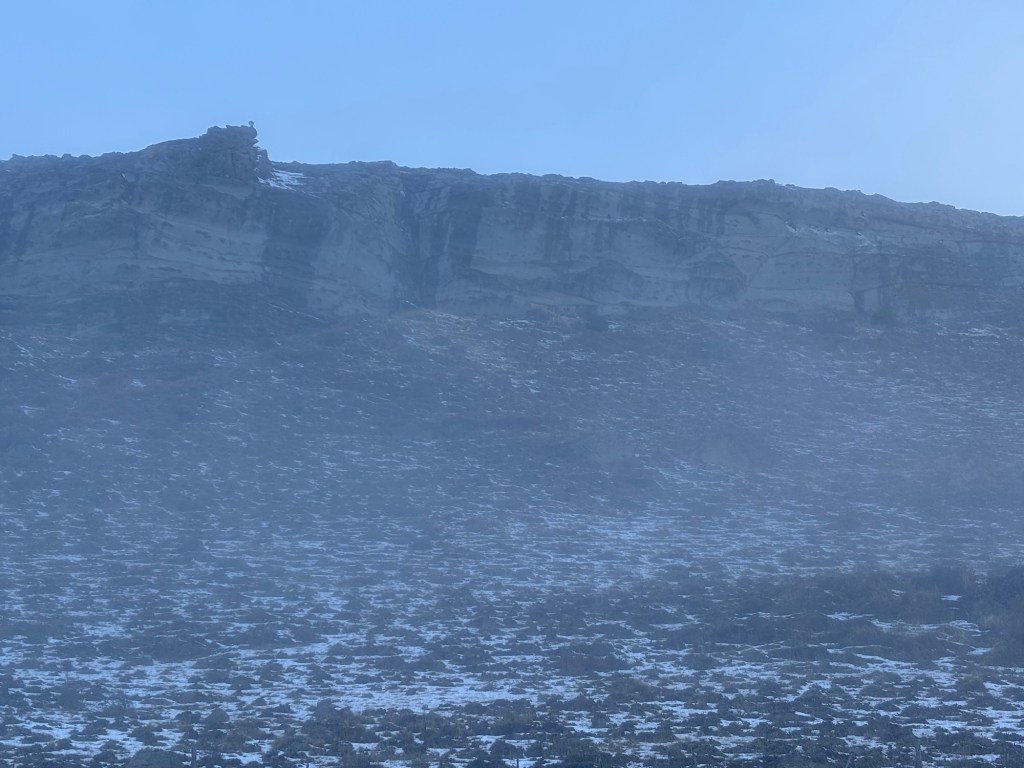
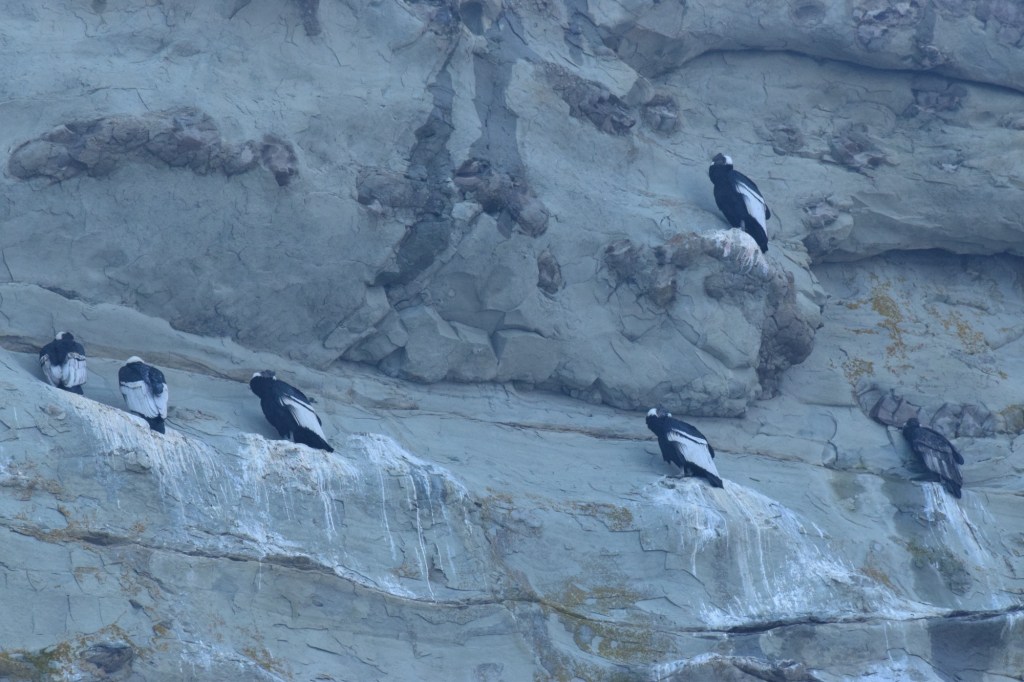
But we still weren’t done. The road back to Puerto Natales passes by a great wall of stone, jutting out of the slope like the outer walls of some fortress. In Spain, a cliff face this vertical would be alive with griffons and known as a buitrera. Here in Puerto Natales, they’re known as condoreras. I don’t think I need to tell you what mighty creatures makes its home here.
I am, of course, talking about the largest bird of prey of all: the Andean condor. Unlike Colca Canyon in Peru, Patagonia (especially in winter) offers the chance to see these magnificent vultures at rest, where the whites of their wings can be much more easily appreciated. As the fog began to clear, we counted well over thirty of them. Fortunately, they’re scavengers to a fault, so there was nothing ominous at all about the fact that their numbers seem to grow exponentially every time we tried to count them.
Fabián joked about looking for a condor feather at the base of the cliff, which would almost certainly have turned up at least one. However, condor feathers are almost as sacred now as they were in the time of the Inca, albeit for less divine reasons: taking one out of the country is illegal, punishable by fines of up to an eye-watering $100,000. I adore vultures and have a collection of feathers I have found in my travels at home, but I’m not mad enough to chance that one.
The sun was beginning to set as we neared Puerto Natales, casting a final golden light over the slopes and the descending mist and turning the rest of the world a gentle shade of blue. There is a huge cave known as the Cueva del Milodón near here. I will try to book a trip out there for Thursday, as it is one of a handful of things to do in Puerto Natales that doesn’t require any high-grade trekking and expensive national park permits. I’ll give it some thought.
I had another serious urge to move here as I crossed town on the way back from the bank to my B&B. Forget the fact that it’s on the other side of the planet, in a place literally named the End of the World. There’s just something magical about this place. It’s unlike anything I’ve ever seen: like a frontier from the Old West frozen in time, surrounded by an array of animals so spectacular that you could live several lifetimes here and never get bored.
I wonder if they have a school that needs a languages teacher?
Enough musing. Another marathon read today. Sorry. Things will calm down a bit when I start my work placement in Santiago, I’m sure, but for now, every second is diamond dust and needs recording. I already miss this place and I haven’t even left yet. I’m only just halfway through my trip, for Pete’s sake.
One more day’s tracking awaits. Hopefully the weather (and our singularly good luck) holds out. BB x
Hostal Boutique Merced 88, Santiago de Chile. 16.15.
Now here’s a setup I really didn’t see coming. This time yesterday I was sitting in a living room in a comfy suburb of Santiago de Chile, some twelve thousand miles from home, knocking back a Corona Extra and watching Spain take on Belgium in their quarterfinal game. Twenty-four hours later, I’m in downtown Santiago, resting my feet for a moment after climbing up Cerro San Cristobal to see the Andes once again. If you’d asked me where I’d be and what I’d be doing at this stage of the summer back in December, it wouldn’t have been either of those scenarios, that’s for sure.
I must have been absolutely exhausted yesterday, because the last thing I remember is sitting down on my bunk bed and checking the time, which was about 18.50ish. The next thing I knew, it was dark outside, the numbers on my phone’s home screen had morphed to 03.10 and a man in the bunk above mine was snoring loud enough to rival an Amazonian thunderstorm. Maybe that was what woke me up. Either way, I couldn’t get back to sleep, so I whiled away a couple of hours trying to work out what to do with the last week.
Of course, I didn’t realise that my adaptor was too big for the sockets here until my phone was down to 3%. Fortunately, the giant in the bunk next to mine (seriously, he must have been at least 6’6”) had exactly the same charger as mine, so I sneakily put my phone to charge and waited for about an hour for it to juice up just enough to guide me to a ferreteríain town.
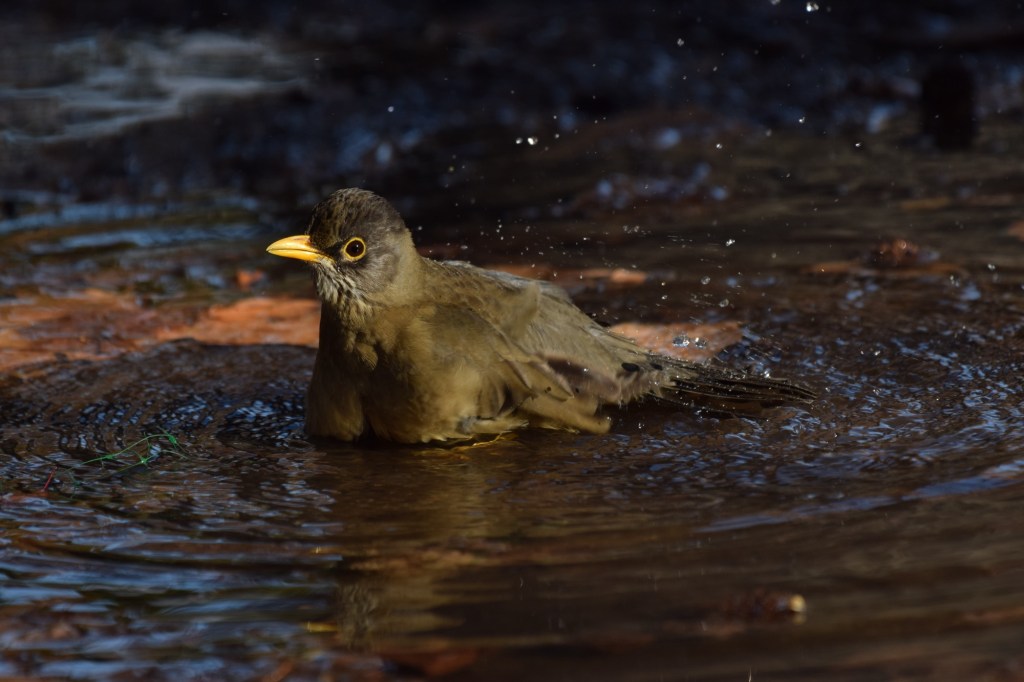
Thus armed (and breakfasted) I detoured back to the hostel via the Parque Forestal to see what I could see (after all, I did bring the lens with me). A couple of Harris hawks kept putting the local pigeons to flight with their noisy circling, and I tried and failed to catch one of the park’s firecrowns as it flitted from flower to flower at blinding speed, but the austral thrushes were absolutely everywhere – and they were much less camera-shy.
They look a lot like the Chiguanco thrushes that were all around Cusco. Come to think of it, they don’t look all that different from the American robins of Central Park, in the right light. They’re clearly a very Santiago kind of bird. I guess I’ll be seeing more of them over the next few weeks.
I hadn’t really planned what to do with my day in downtown Santiago. Honestly, I had expected this week to be spent exploring the Lake District to the south, saving Patagonia for the end of the trip, but the guide I have hired is only working July this year, so I had to change my plans.
Santiago sits in a giant bowl, ringed on almost every side by the snow-capped peaks of the Andes. One finger of those lofty peaks stretches almost as far as Santiago’s heart. Crisscrossed by cycle paths and two very popular cable-car lines, the Cerro San Cristobal was just too great a temptation. As a rule, if there is a mountain nearby, I usually try to climb it. So that sorted out my plans for the day in one go!
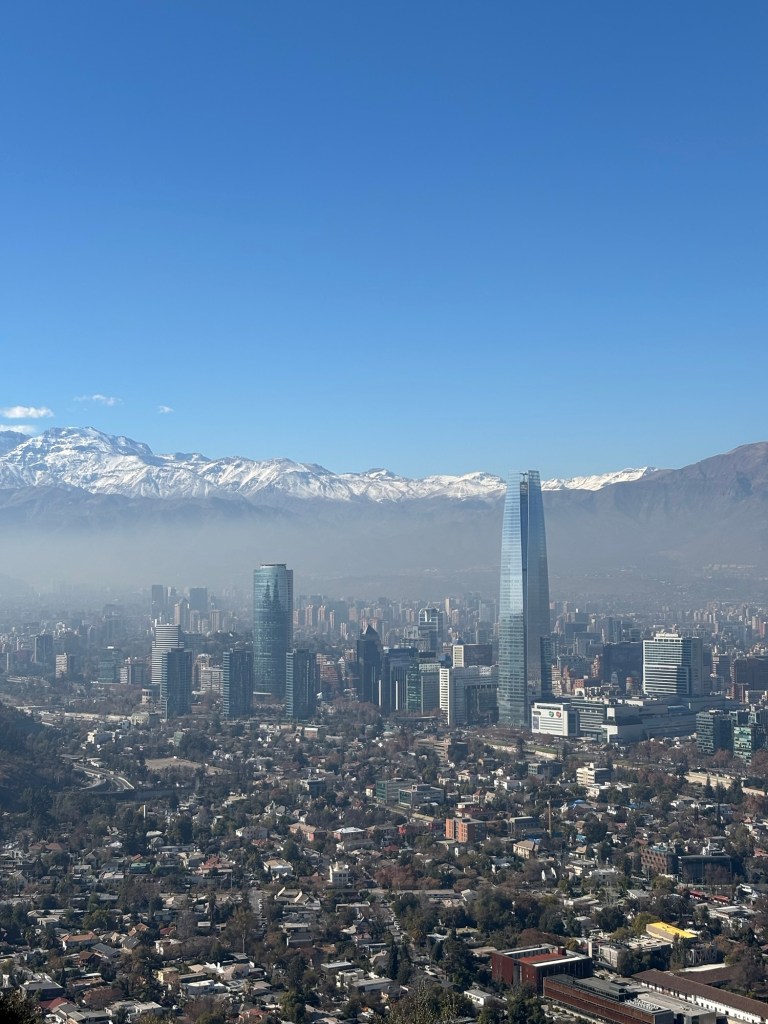
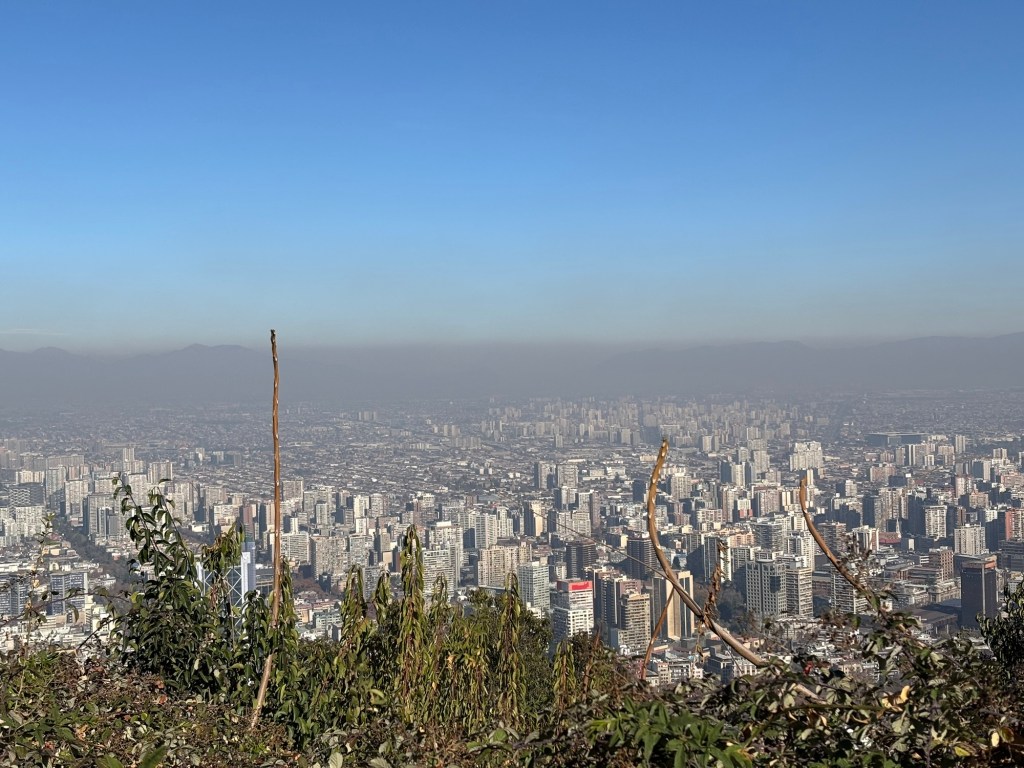
It’s quite a climb – about an hour and a half up the eastern slope – but it does offer tremendous views of the capital city and its famous skyscraper, the Gran Torre Costanera, the tallest building in South America.
You can also appreciate the smog, which is really quite something.
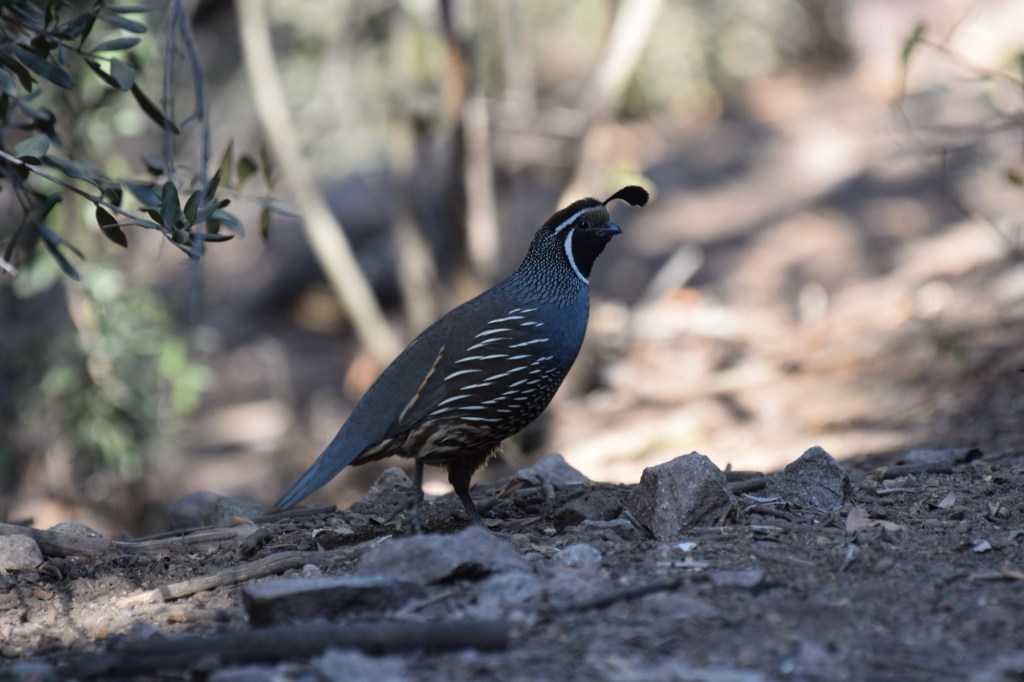
I’m still tuning into the soundscape here, but three weeks in Peru have made the job a lot easier. I know a hummingbird now when I hear one, so it was fairly easy to find firecrowns on the way up – though they were nigh-on impossible to photograph, as hummingbirds so often are. One sound I did not recognise, however, was a strange owl-like call coming from the scrub. Merlin came to the rescue: it was a California Quail. I have wanted to see one of these enigmatic little things since I first saw them in Bambi as a kid.
California quail just isn’t the right name, though. They’re clearly quaver quails. Just look at the musical note embedded in the head of this dashing young male. You tell me that this handsome fella doesn’t deserve a musical name for wearing such a showy headpiece!
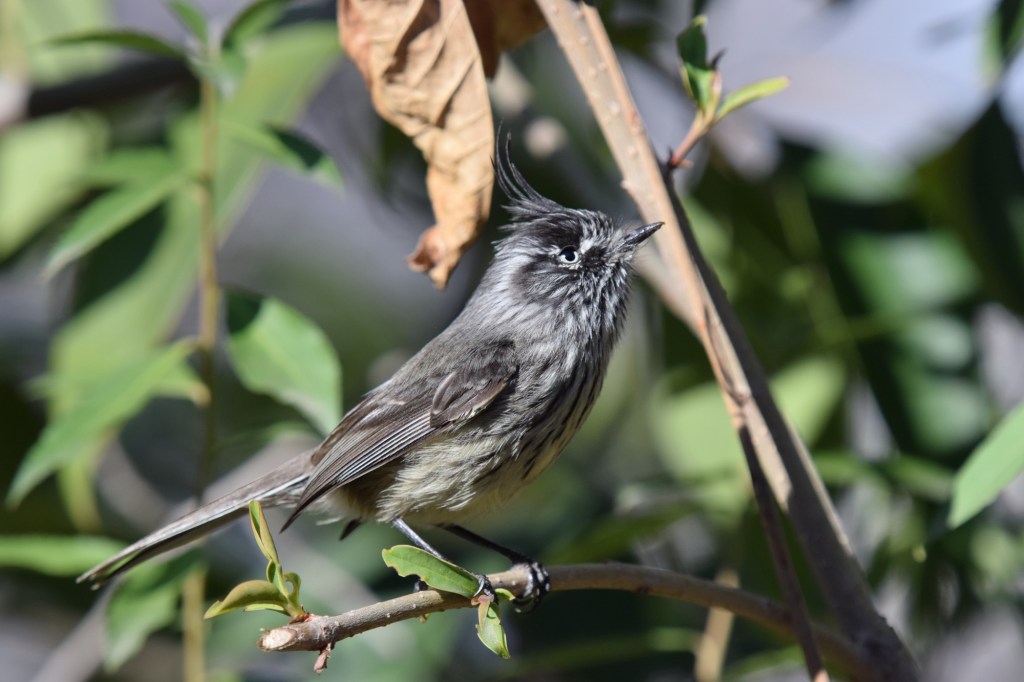
Speaking of showy headpieces, this tufted tit-tyrant was a nice find near the summit. For most of the morning, I could hear some kind of tyrant species high up in the trees, but this one came right down to eye-level and stuck around for a little while.
Santiago definitely looks better when you’re facing to the east. From the Cerro, the view out west is buried under a thick cloud of smog which seems perpetually fixed just above the horizon. The shape of the valley is part of the problem, trapping the exhaust fumes in a natural bowl, but it is something I’ve never seen the likes of before. I suppose I had better get used to it, as next year is likely to see me accompany some of my top public speakers to the world championships in Shanghai, and China is no stranger to smog.
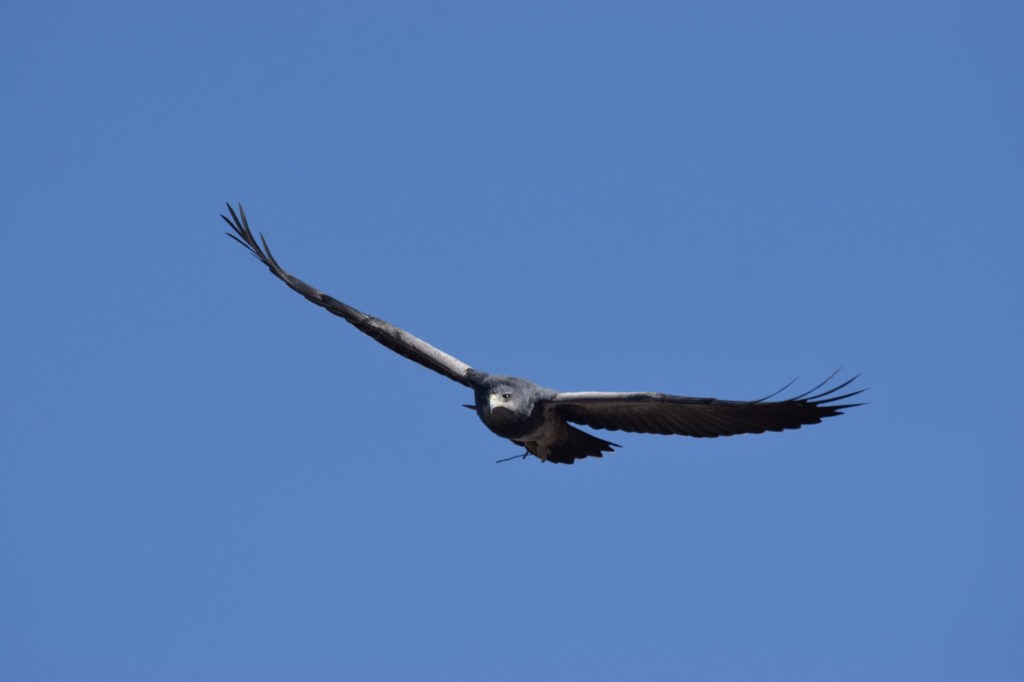
Right at the very top, there is an enormous white statue of La Virgen de la Inmaculada Concepción, and at her feet, a small sanctuary. This seems to be the spot the locals make for in the afternoon, presumably to catch the sunset, as it was getting very busy by the time I reached it. Most of them doubtless made the ascent by cable car, as the lines to get tickets back down were just as big as they had been at the bottom. Foolishly, I still had my camera set to low-light shooting after my run-in with the quails, so when a buzzard-eagle appeared out of nowhere, I was woefully underprepared. I got off a few clean shots, but as it was close enough to see the glint in its eye, it was one of those encounters best left to the naked eye.
It didn’t get the same reaction from the crowd of sightseers that the condors did back in Peru – but then, Andean condors are twice as big and five times as heavy, so they really do command one’s attention.
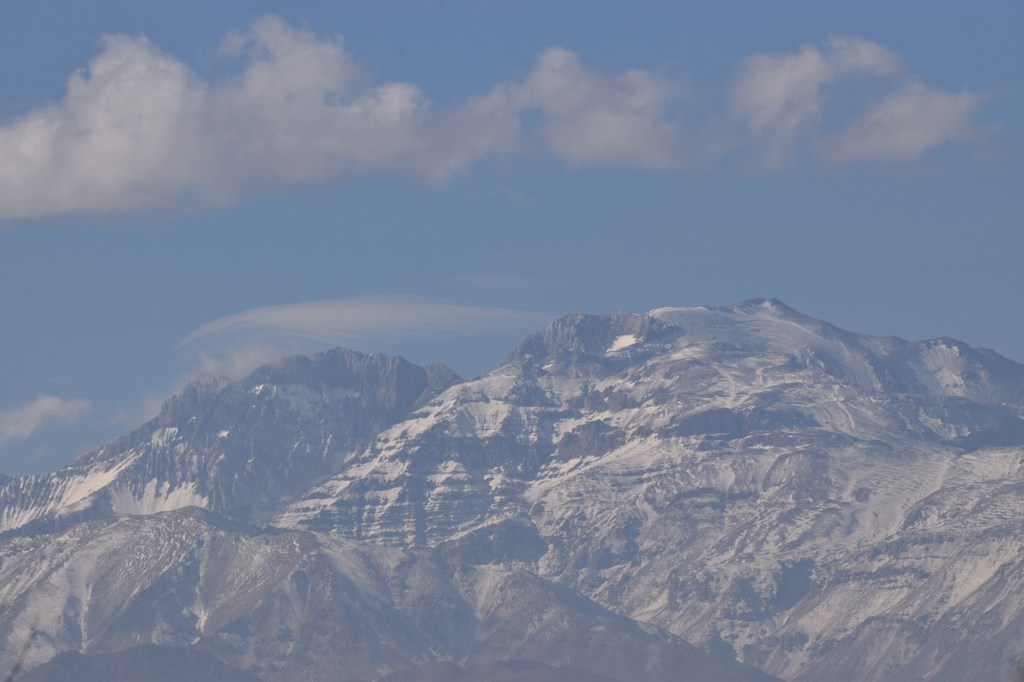
I’m no less impressed by the Andes than I was when first I laid eyes on them. They really are the most impressive mountains I have ever seen, dwarfing every peak I have had the fortune to behold until now. Imagine growing up in the shadow of these mighty walls of rock and ice… Little wonder the Inca thought themselves divine!
My phone is nearly charged back up. Looking at the time, I think England have just set out against Norway in their quarterfinal game. I can’t watch or even follow the game on the radio thanks to the BBC being regionally locked, so I’ll just have to go for a walk and see if I can find anywhere playing the game en route. Could be a good excuse to take myself out for dinner, though I doubt I’ll do more than grab an empanada from a stall somewhere.
This time tomorrow I’ll be in Puerto Natales. It looks like Patagonia had its first snowfall last night. I can’t wait to see the snow again. It’s been too long! BB x