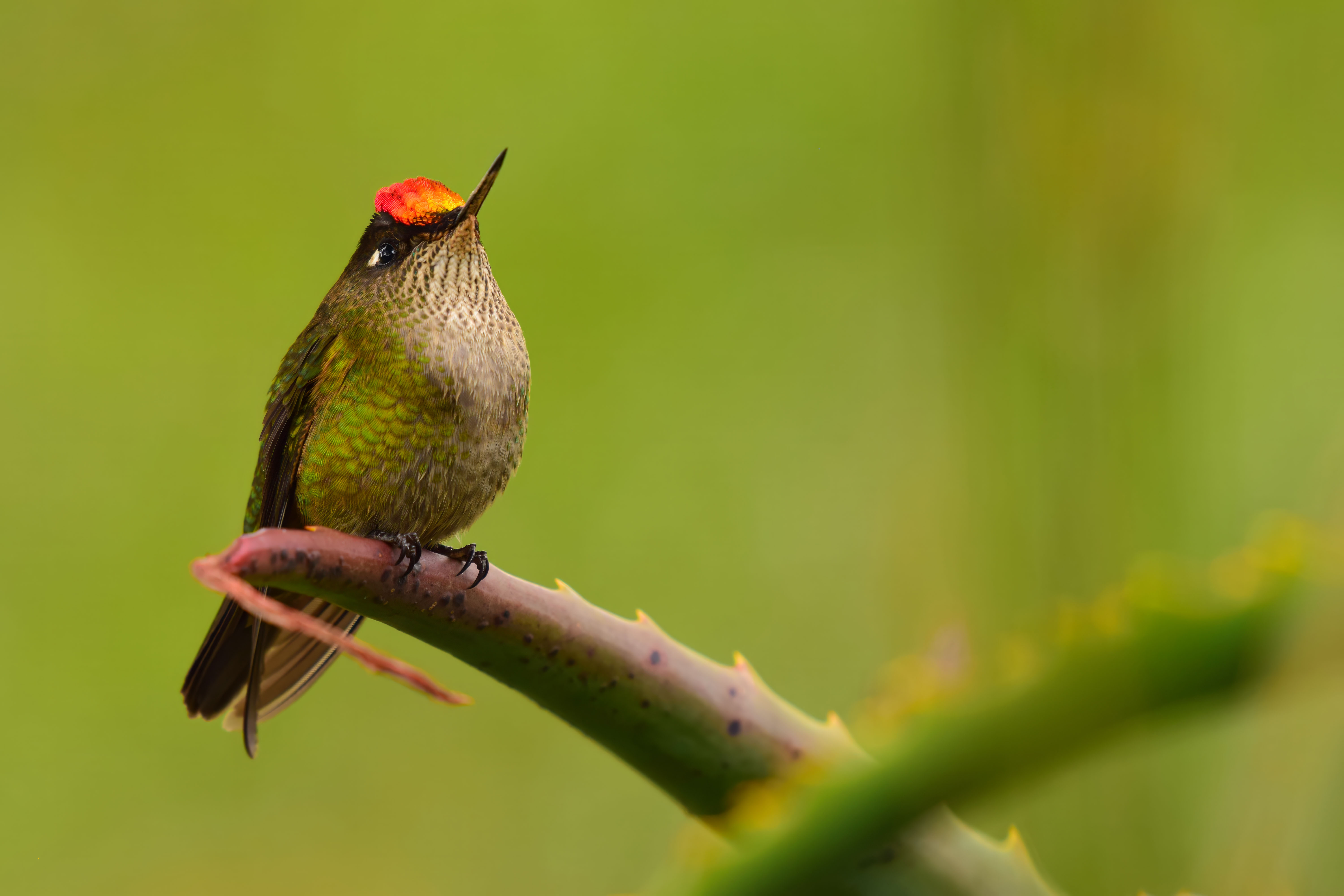
Chilean Memories #2: Firecrown
Las Condes, Santiago de Chile. 17.40.
With strong winds and heavy rain forecast for much of central and southern Chile this weekend, I decided against any madcap travels beyond Santiago. It’s just as well, too: even my whimsical considerations of hopping over the border to tick Argentina off the list with a flying visit to Mendoza would have been impossible, after yesterday’s renewed snowfall blocked the mountain pass, closing the terrifyingly steep Ruta 60 for what is likely to be quite some time.
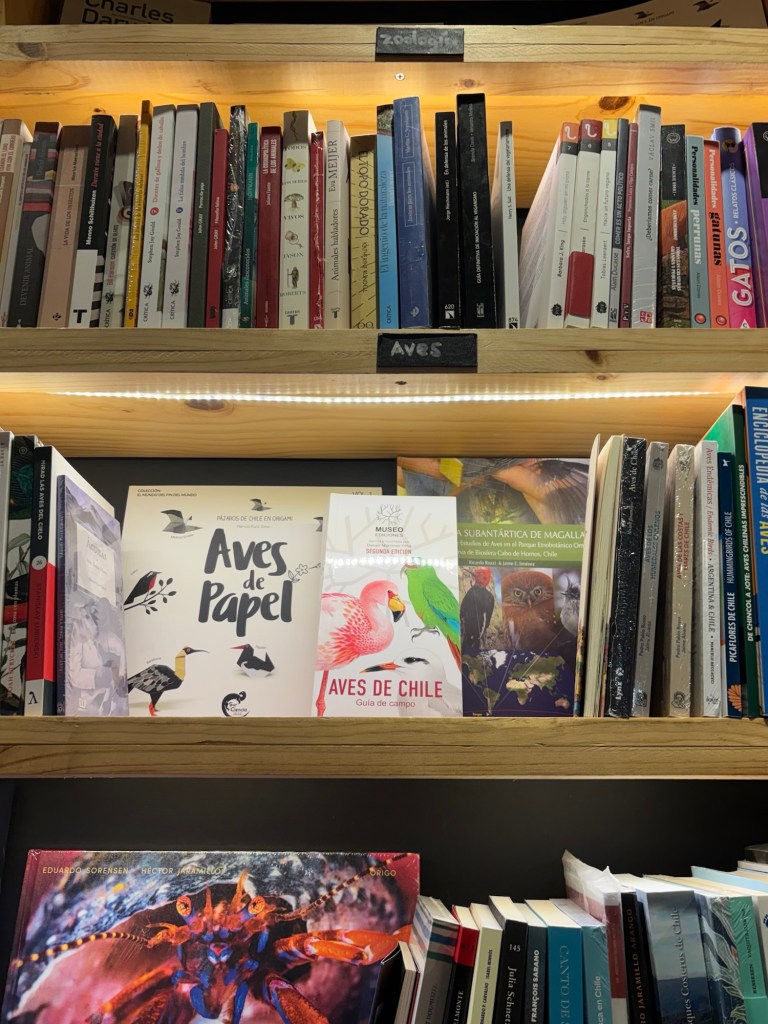
For once, I erred on the side of common sense and spent my Saturday in downtown Santiago, stocking up on a few important supplies for my final adventure in South America, now less than a week away. My main target was the sportswear giant Decathlon, but while I was hunting it down I stumbled upon a fabulous bookshop specialising in natural history in an underground mall at Tobalaba. I’ll simply have to come back here before I go – the selection of books on offer was incredibly tempting.
I still can’t get over how much birdwatching is a thing over here. I’m so used to Hispanics being generally disinterested in birds they can’t shoot out of the sky. It’s so heartwarming that that particular aspect of Hispanic culture is shifting, and that Latin Americans seem to be the driving force behind it.
With my Decathlon business concluded, I popped into Jumbo – Chile’s answer to Spain’s Mercadona – to grab a couple of snacks for the week ahead. Amazingly, the supermarket did me for lunch, too: they were giving out free samples of the seafood stew mix (which was amazing!) as well as free samples of strawberry yoghurt and pistachio ice cream. They weren’t exactly full-size dishes, but Tomás ordered far too much pizza last night, so I was quite happy with a couple of free nibbles for lunch.

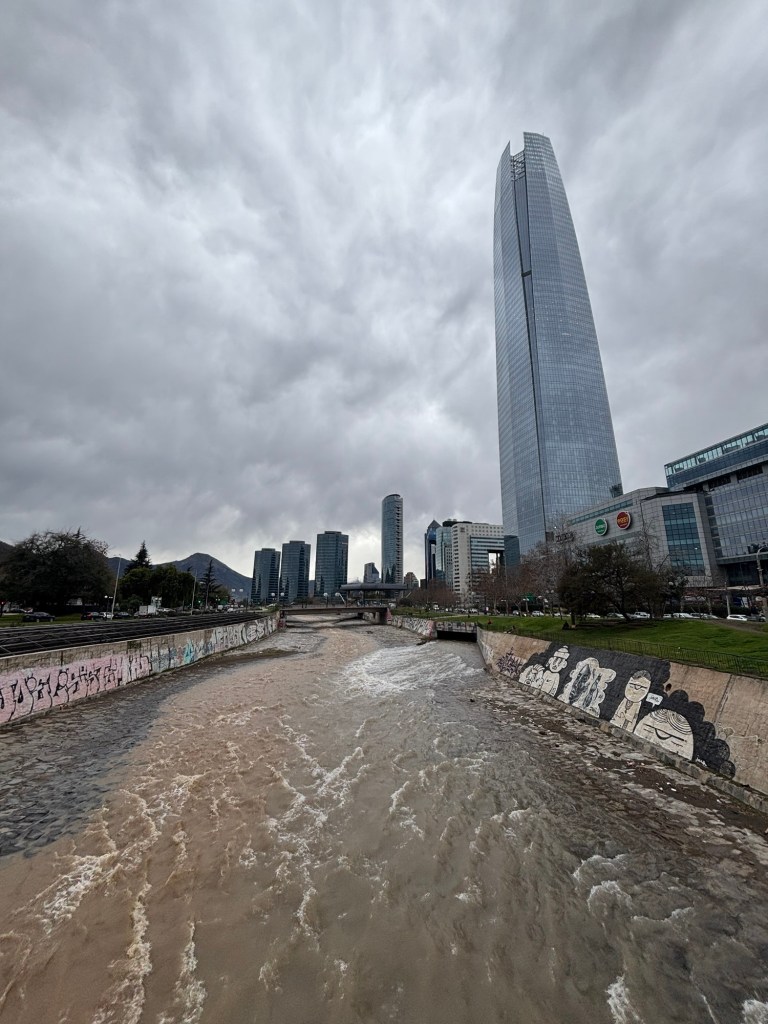
The heavy rains of the past couple of weeks have transformed the Mapocho River which runs through the city. When I arrived, it was little more than a steady flow in a largely dry canal. It’s now a roaring torrent that cuts above the din of the traffic when you’re close enough. Chile really is a country of extremes: when it rains here, people have to be prepared for property damage and flood control, even up here in the mountains.
By the time I reached the car park at the foot of Cerro San Cristobal, it was already half past one, and a lot of city folk had come to the same conclusion as me: that is, that it would be nicer to go for a walk today, rather than tomorrow, when the scheduled rains are due to come down hard. Parquemet was full of cyclists and runners, as it was on my last ascent now three weeks ago, but after a flying visit to the Japanese Garden – which was probably the noisiest zen garden in creation, thanks to it being located within a Hispanic capital city – I ducked off the road, following one of the many forest tracks intended for downhill mountain bikers. But for a lone jogger, I had this route to myself, which meant it was alive with wildlife.
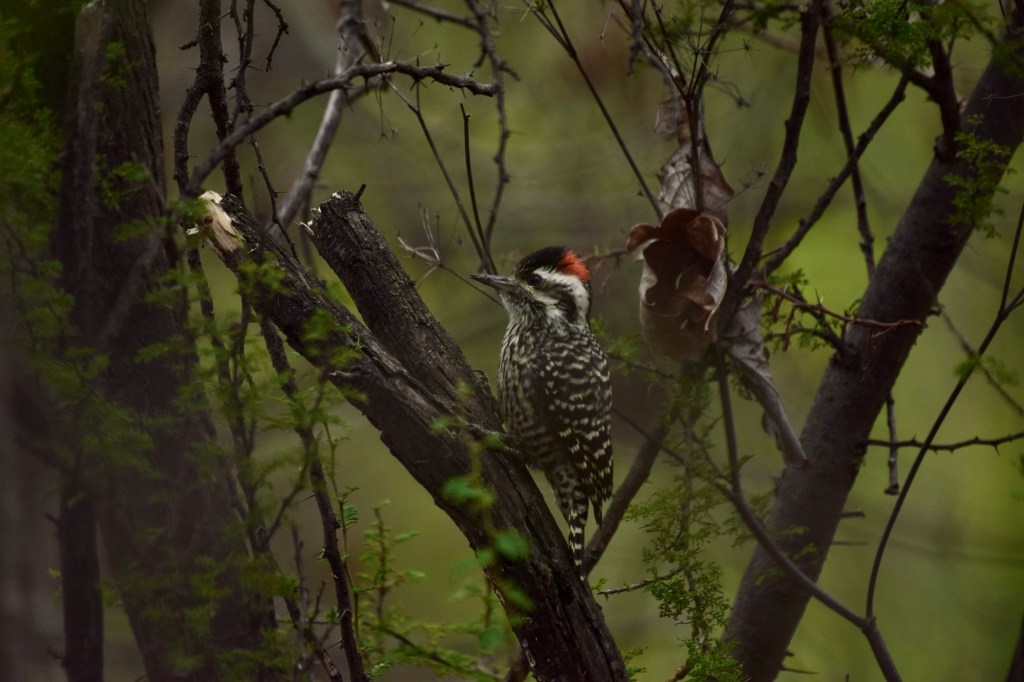
The first critter to show up was a woodpecker. I never did find the famous Magellanic woodpecker during my visit to Patagonia – a very good reason to come back someday – so this striped woodpecker or carpinterito is my first in Chile. Like most woodpeckers, it was a nightmare to capture on film, being in the darkest part of the forest, moving constantly and under a dark, overcast sky, but I just about managed a couple of shots before it disappeared among the trees.
A large flock of finches followed me along the spine of the cerro, feeding among the dead foliage at the side of the path. The siskins here look and sound a lot like the ones back home, but the sierra finches are really rather special. I saw some of these pretty birds in Cusco, but in Santiago they’re essentially garden birds.

I hoped I might find some of the pretty diuca finches that are so common at school. There weren’t any on the cerro today, but I did keep running into diucons, their fiery red eyes even more obvious in the midday light than they were the other day, when I was shooting into the sun.
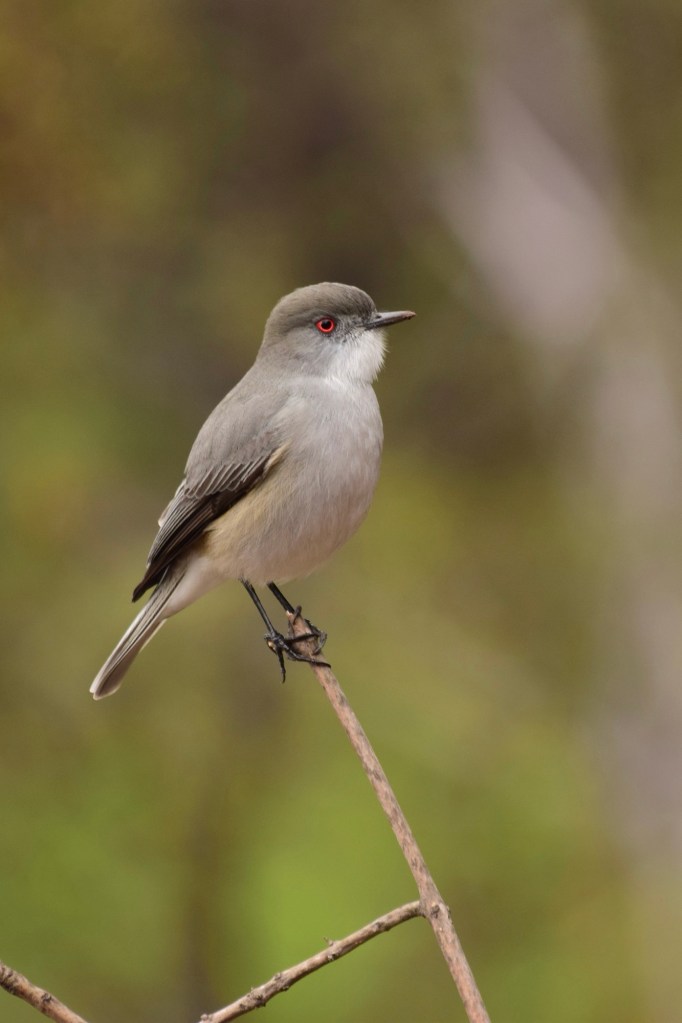
The best find of all, though, was a bird I’ve become very familiar with here in Santiago. I hear them every single day, and see them at least three days out of seven, whenever I should be near a poker plant. The green-backed firecrown is probably Chile’s most well-known hummingbird, since it seems to have a home on even the busiest streets in the city centre.

The last time I had a close encounter with one of these living gemstones, I didn’t have my camera on me. This time, I came prepared. Firecrowns are fearless little creatures, driven by an insatiable hunger that is a side-effect of their rapid metabolism – so, once again, I was able to sit quite close and watch, until the bird landed so close I could see its heartbeat and its tiny tongue tasting the air.
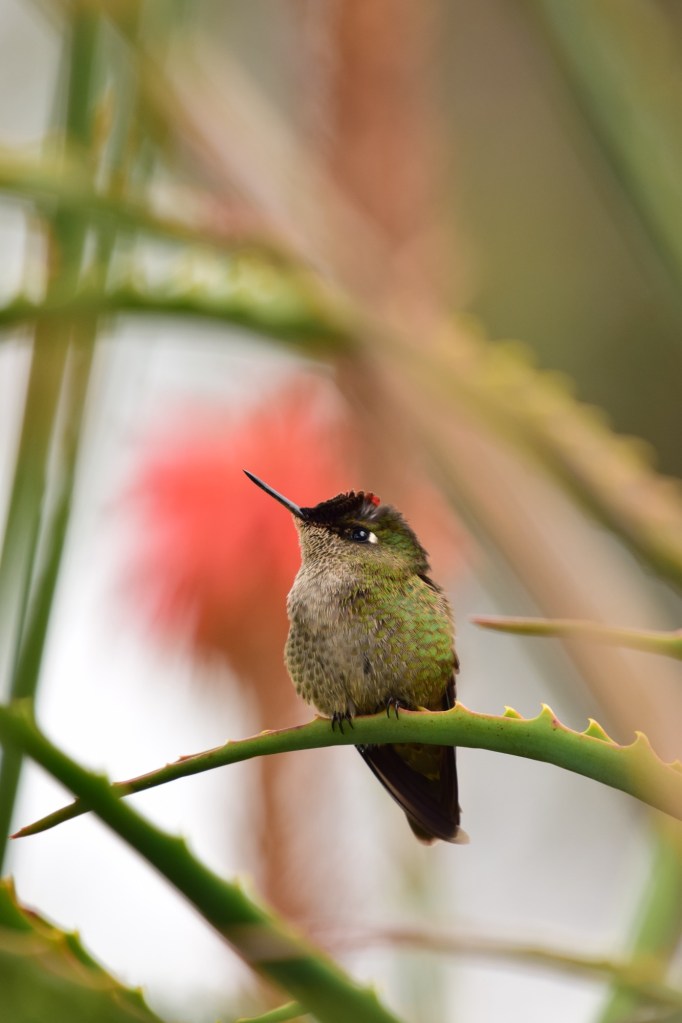
The firecrown gets its name from the male’s plumage, which really is quite something. Even with the naked eye, you can’t miss that sudden flash of scarlet when they alight upon a branch, just like hoopoes do with their crests when they land.
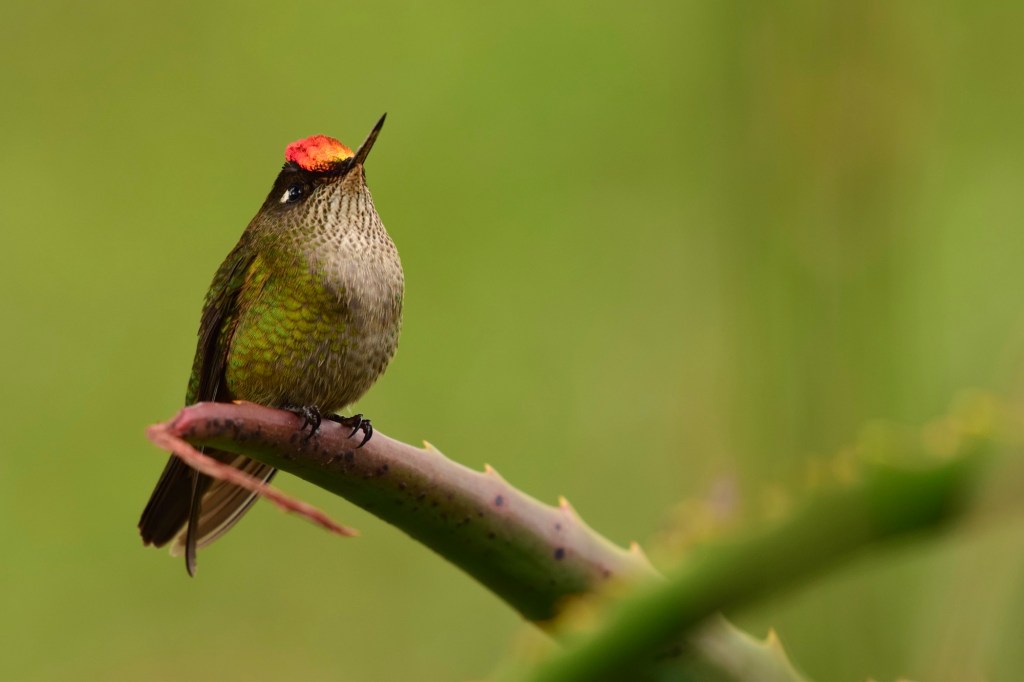
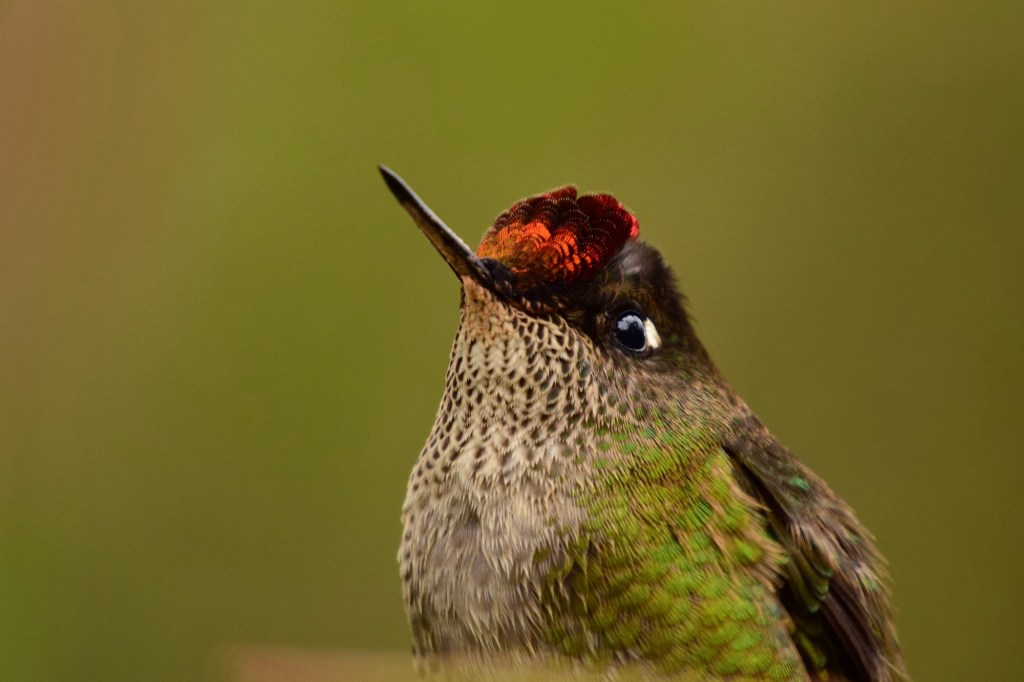
The secret is the iridescent sheen to its feathers, each one bending the light slightly differently depending on its position on the bird’s forehead. They can, of course, flatten and raise their crests at will, so I had to wait a little while before I was able to capture that ripple of red light.
After spending a happy half hour or so with the firecrowns, I wound my way back down the cerro and used what little battery I had left on my phone to catch a bus back to Las Condes. I only stopped one more time, just before stepping on board the 409, to see a couple of Southern Lapwings that had flown in and gone down to the river. I see and hear these birds every day, too, as they’re a lot noisier than the firecrowns, but I haven’t yet had the chance to get a photo. They’re usually patrolling the rugby pitches in pairs, and they have a reputation for being ferocious with passers-by in the spring, when they have eggs or chicks near at hand.
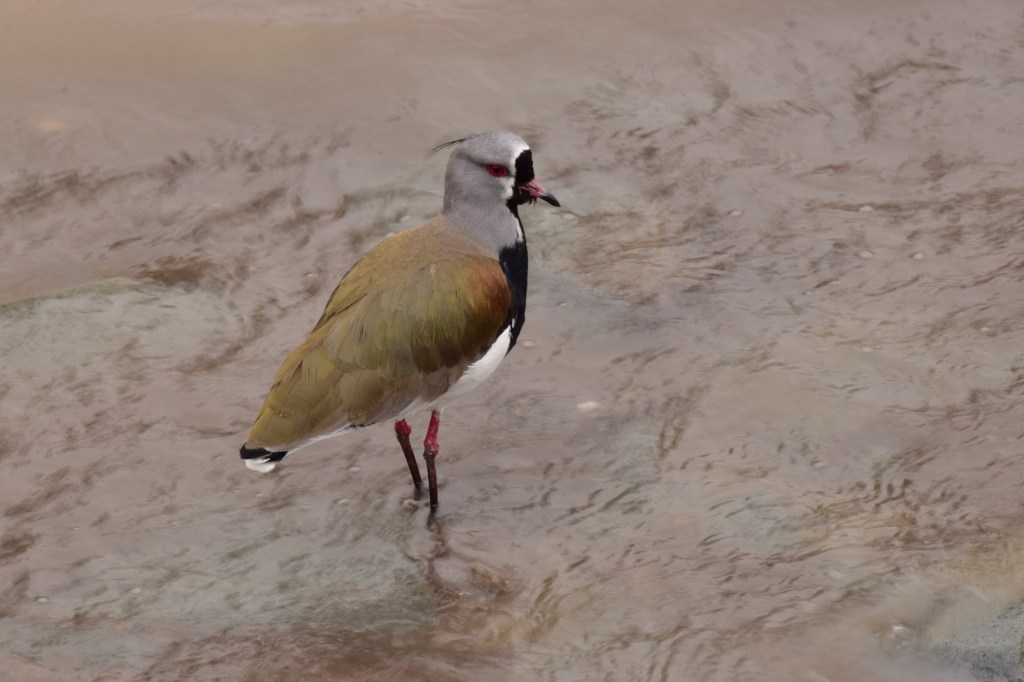
Well, it’s getting dark outside. I didn’t expect to have such a good afternoon’s birdwatching on what was essentially an extended shopping trip, but sometimes, it’s the outings you don’t plan that turn out to be the best.
That said, I’ve done a lot of planning for next week’s mad adventure, so I hope that turns out for the best, too. It really is going to be rather special. BB x
Hostal Casa Volante, Valparaíso. 13.37.
Valparaíso is sometimes nicknamed the South American San Francisco. That has nothing to do with the cost of living and everything to do with the way it soars up skyward out of the Atacama Trench, carrying the city’s elite on its back. Some of the roads winding up the side of the cerro seem almost vertical. I get the feeling living here would give you the lungs of an Inca and the thighs of a Georgian wrestler.
It’s up here on the heights that you’ll find the house of Pablo Neruda, Casa Museo La Sebastiana.
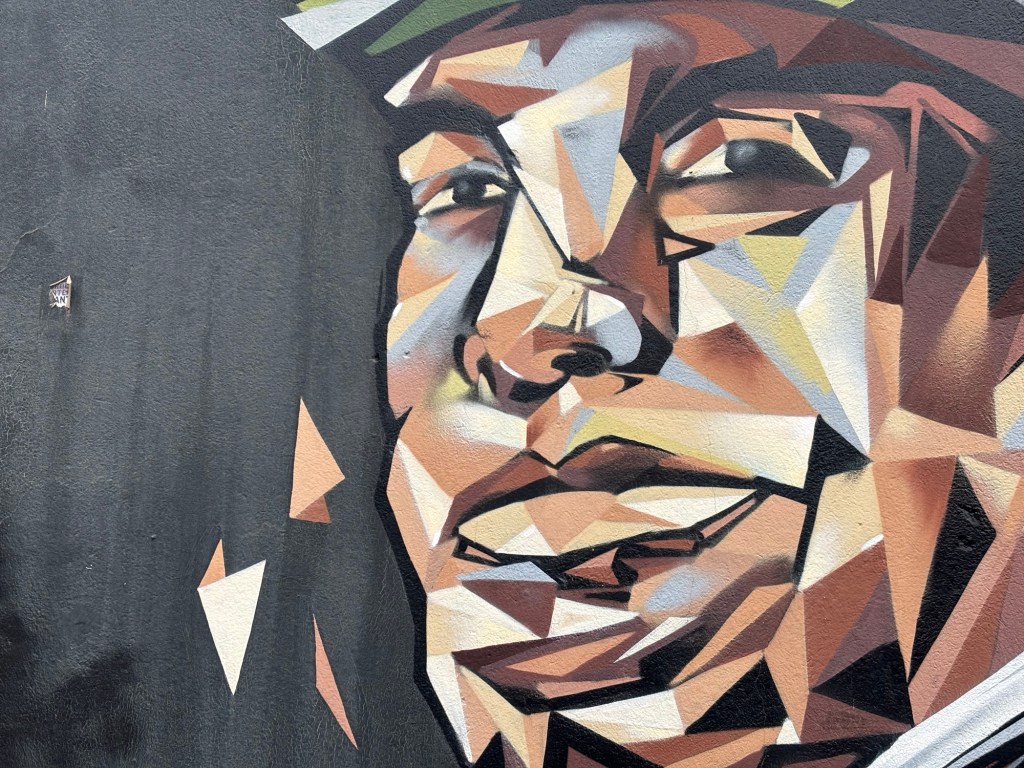
Neruda sure knew how to pick a spot. His five-storey house, which sometimes feels more like a tower than a villa, commands one of the clearest views of the Bahía del Valparaíso. On a clear day, you can probably see for miles, but even a shroud of yellowing cloud, you could see as far as the forested hills of La Campana and the snowy heights of the Andes beyond.
Neruda had his writing room built right at the pinnacle of his Valparaíso home, so that he could draw inspiration from the beauty of the world around him, whipped eternally by the Pacific winds.
He also seems to have loved maps, especially the older ones. There’s an genuinely incredible French map of the Americas by one Monsieur le Dauphin which I absolutely must track down, as it predates the discovery of Australia, with strange, half-finished coastlines fading into nothing at the southwestern edge of the map under the title “Terra Australis Incognita”.
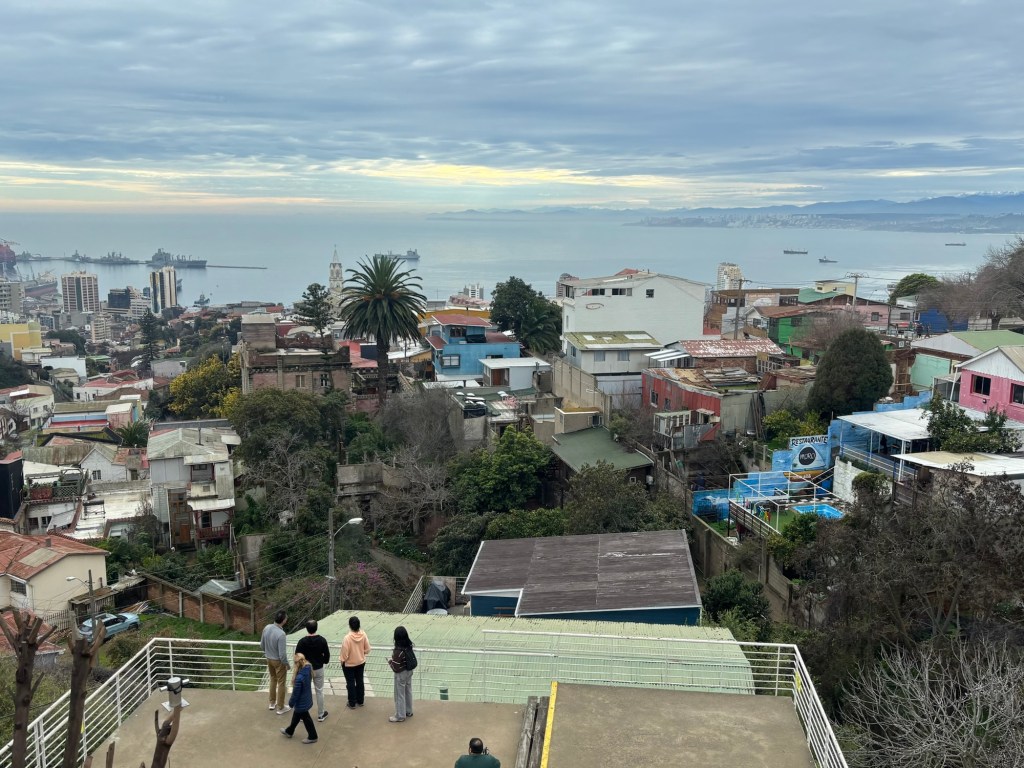
People seem to treat this street with profound respect. Even the graffiti is cultured.
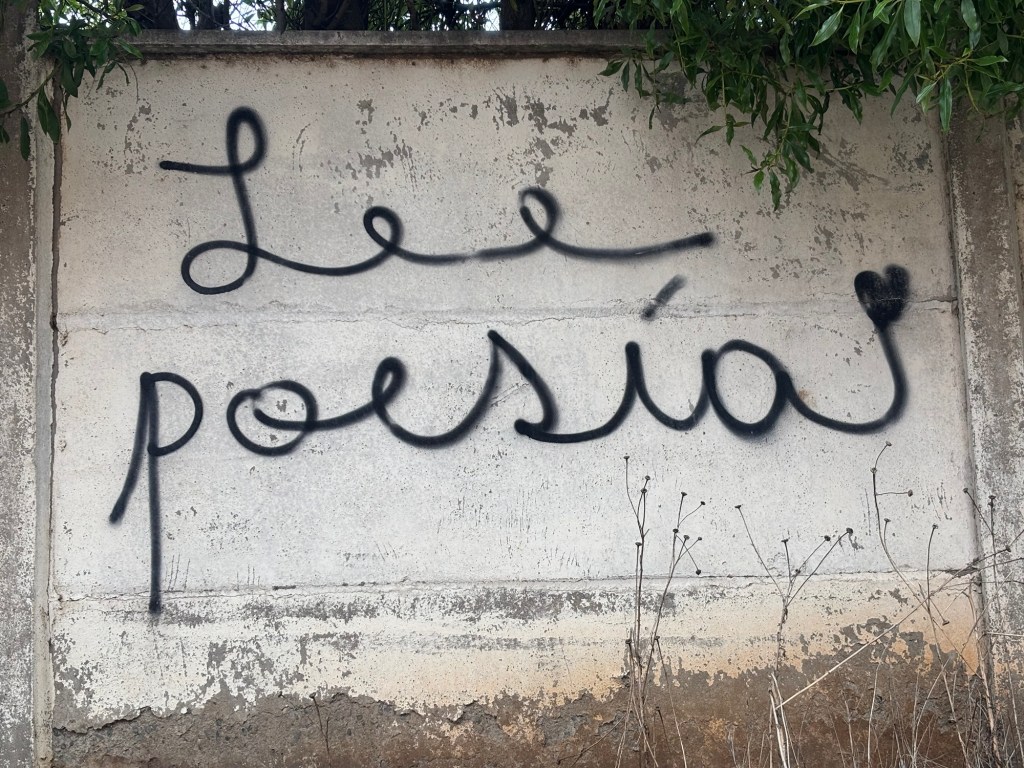
As if in answer to my post last night, I was surprised to find the street on which Neruda’s house stands, Calle Ricardo de Ferrari, covered in verses that weren’t taken from the Chilean poet’s vast anthology, but from his Andalusian friend, Lorca. Beautifully painted into tiles from an alfarería in Granada, Lorca’s verse follows you all the way down the road, perhaps as an ode to Neruda’s efforts in saving so many Spaniards during the Civil War and bringing them here to Valparaíso, far from the tyrannous grip of Francisco Franco.
Lorca lost his life under the fascist regime. So did my great-grandfather Mateo and all of his circle of writers and poets. It’s probably no great leap of the imagination that they might even have been in contact with Andalusia’s greatest poet, since they were all writing around the same time… and all snuffed out around the same time, too. Perhaps that’s why I feel a special connection to Lorca – and why finding him here in the Southern Hemisphere is so comforting.
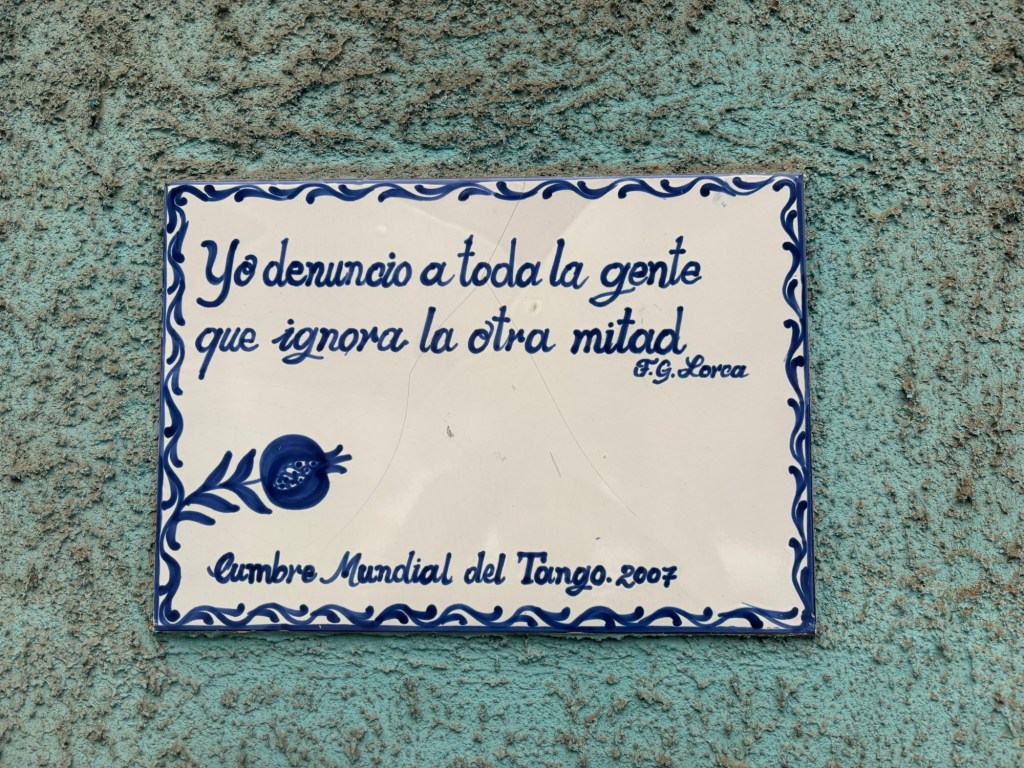
I didn’t buy any of his books – I can’t recall which ones I have at home – but Neruda’s magic was already at work on me. As I climbed up to the fifth floor of his house, my ears suddenly popped. My Eustachian tubes have been blocked for nearly a fortnight since that false landing in Natales, which has been a real annoyance. Flying for fourteen hours across the Atlantic and half of South America shortly before probably didn’t help, but either way, it’s been an ever-present bother since I arrived here.
But suddenly, just like that, the fuzziness in my ear wasn’t so bad anymore.
Ok, so it’s still there, but it is very definitely better than it was. I feel like I can hear properly again.
To prove that point, I stumbled upon a family of firecrowns on the way back down into the city. This time it felt like I could hear their piercing trill out of both ears. One even let me get close enough to make up for not having the lens on me (I left it behind as it weighs quite a bit, and you can’t take bags into Neruda’s pokey house).
I’ll miss the hummingbirds when I go, just like I said when I was in Peru. There aren’t as many varieties of them here as there were in the Inca capital, but the firecrowns are everywhere: particularly, wherever anybody has been kind enough to plant red hot poker flowers, which they adore.
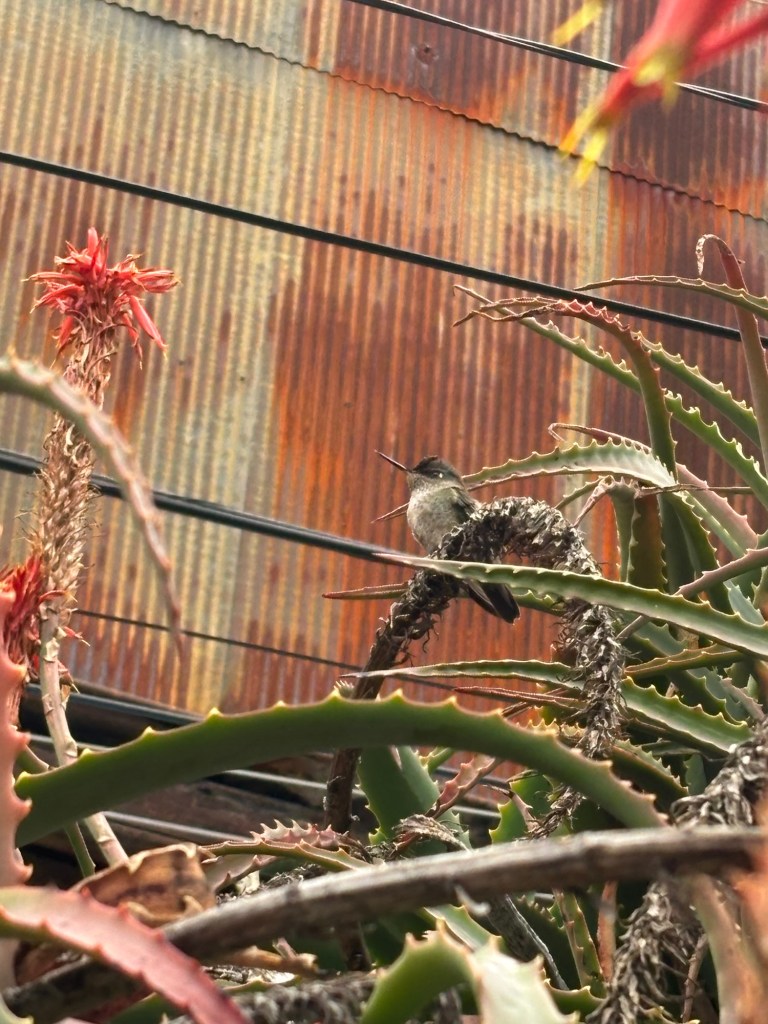
It’s still pretty overcast out there. I think I might grab some Peruvian food for lunch, as there are quite a few places nearby, and I fancy a reminder of the delicious bowls of salty seafood I had in Paracas. If I am going to eat, it had better be sooner rather than later. The bay may look calm, but out on the open ocean it is likely to be less Pacific than it looks.
Fingers crossed for an albatross tomorrow! I’d settle for just the one! BB x
Notes, field guides and micro-memoirs
A Solo Travel and Literature Blog
All about trees
Barcelona · Spain · Food · Travel
A glimpse of the world through my lens
Synastry & Karmic Astrology
A Journey of Travels, Teachings, and Truths Told Plainly
Musings of a trekking author
Inspiration and Spirituality **Award Free**
Illustrations to make you smile, laugh, and sometimes make you see things from a different perspective 😉
a woman with wings travelling the world solo

