The time has come to leave Lima and the Pacific behind and make for the interior. I have enough sense not to go from 79m above sea level to 3.400m in one go, so I’m bound for Arequipa, the White City, which sits at a decent halfway house of 2.335m. That’s still a good thousand metres higher than Andorra la Vella, which is probably the closest I’ve ever come to sleeping at altitude, but it’ll have to do.
After spending ages writing up yesterday’s report, I sat back in the upstairs lounge area of Pariwana, finished off my (now rather crushed) Doritos and called an Uber. Whisked away by another speedy and efficient limeño, I said hasta la próxima to the city and its mighty Pacific shore – since I’ll be back, albeit briefly, at the end of my adventure.
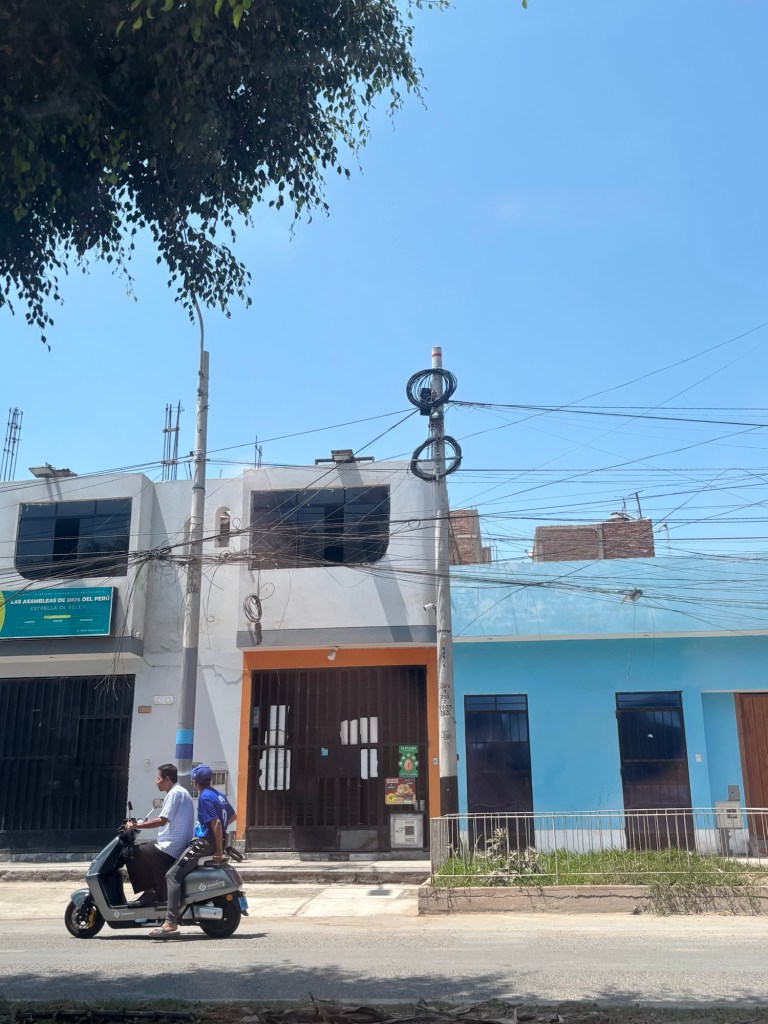
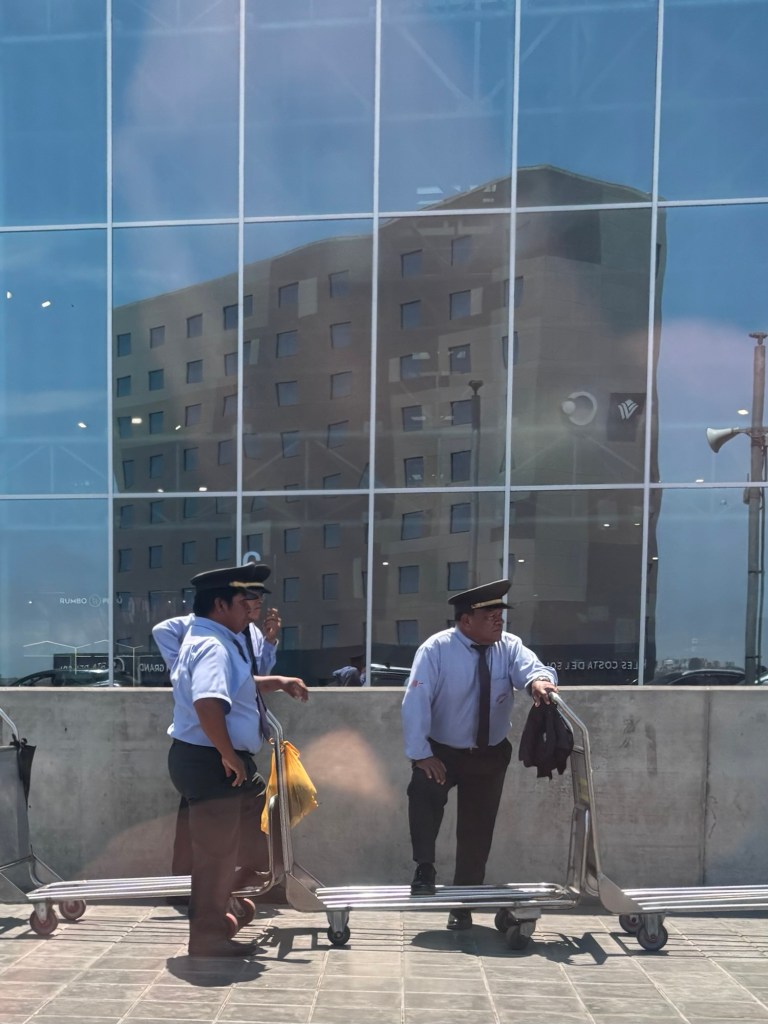
Lima’s Jorge Chávez airport is a model of efficiency. Fine, so the USB charging ports don’t all work (I never did find one that was fully operational), but the security is slick and efficient and it has a lot of good places to eat offering real food, not just fast food junk (England, please learn from this). I’ve also been to shadier airports. Despite being in the heart of the run-down district of Callao – which is known for having a higher violent crime rate than the rest of the capital – I found it was perfectly safe to come and go.
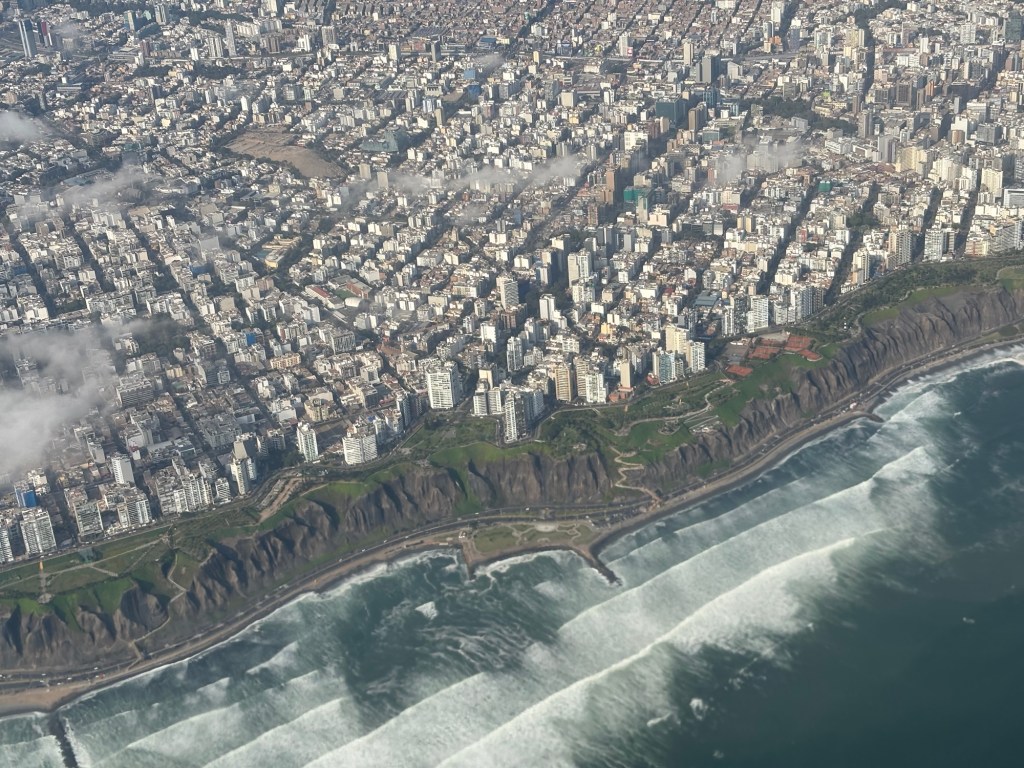
From the air, Lima looks a lot better than it does from the street. You can really appreciate the might of the Atlantic swell as its parallel waves break upon the winding coastal cliffs that separate the city from the sea.
Herman Melville described the city as “Tearless Lima – the strangest, saddest city thou can’st see”. I suspect he was referring either to the lack of rain or, more likely, to the garúa, the dense costal fog that usually clouds Peru’s capital in a white veil. I saw the garúa on the night I arrived, and it lingered into my first morning, but the city has been basking under the South American sun for most of my stay, so tearless is not a word I will be using to describe Lima anymore.
I can’t remember whether I paid extra for a window seat on this flight, but I had one, and that was pretty special. Looking back, it would have been foolish to pay the ridiculous 90$ for the privilege of a window from Madrid to Bogotá, as almost all of the Caribbean and South American leg was under a dense cover of cloud. You win some, you lose some. All I lost was the possibility of a good sleep.
I was on the wrong side of the plane for the Nazca lines, though I think we would have been a bit too high up to see them anyway. What I got instead was an unrestricted view of the mountains below as they climbed and climbed and climbed, up into the clouds and even up and above them.
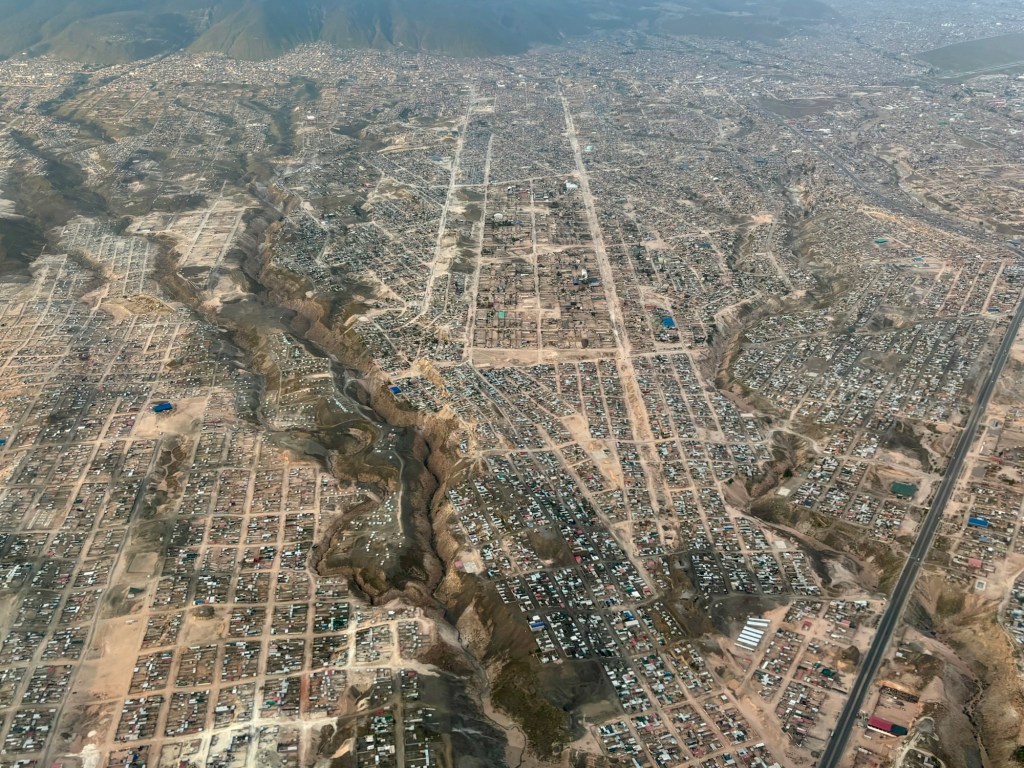
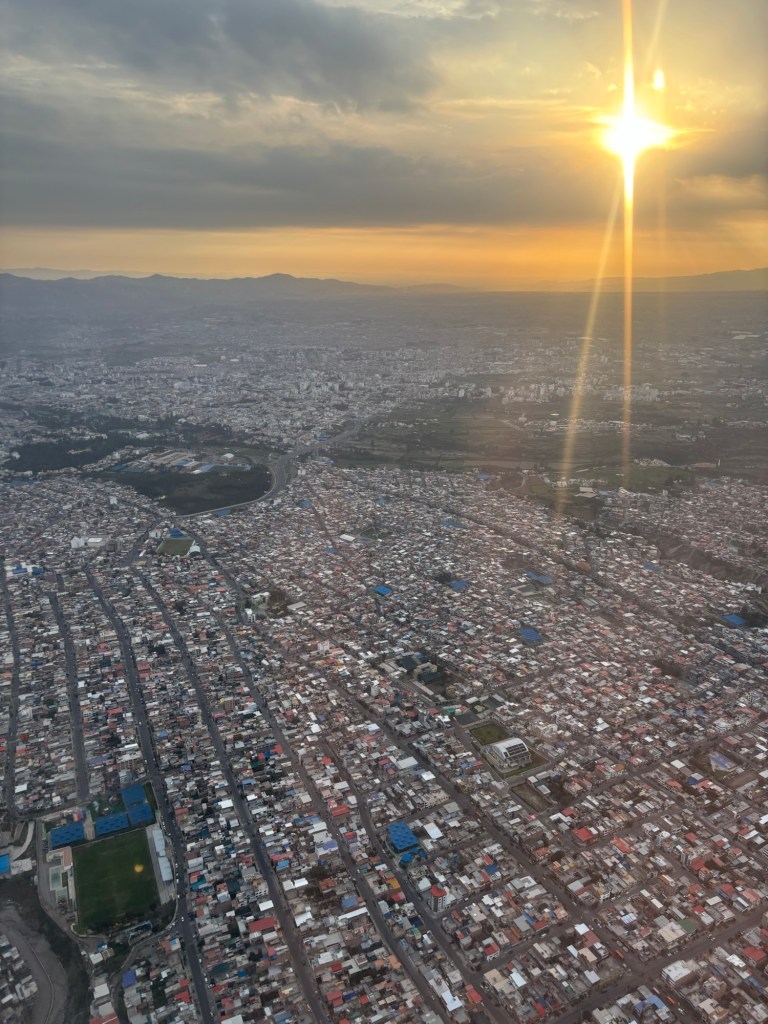
I could post some pictures of the mountains, but with my itinerary for the next week or so being largely mountain-oriented, I think I’ll spare you the overload. What is much easier to appreciate from the sky, however, is the incredible human geography of South America.
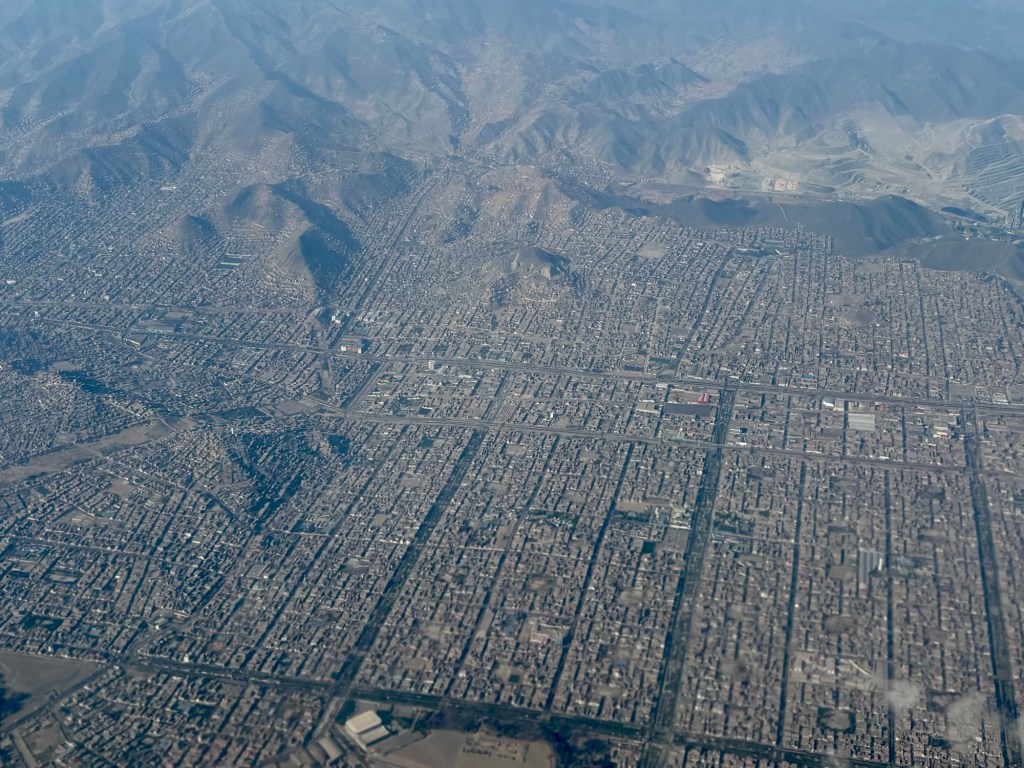
I’m no fan of cities – you know this – but that doesn’t mean I can’t appreciate their shape, their size and their strangeness – especially when they seem to blend into the very earth itself (something we don’t do nearly well enough in Northern Europe).
New World cities favour the grid system that, in Europe, is most famously found in Barcelona. It’s still alien to me and I find it quite fascinating to behold from the sky.
Arequipa, the second largest city in Peru after Lima, is also faithful to the grid system – even though the city is scored and cut through by canyons and rivers. Old Word architects would have worked around the landscape, twisting streets and warping estates to fit into the space, but here in the Americas, they just stuck to the plan, regardless of the complications.
Well – here we are in Arequipa, stage two of the Peruvian adventure. I think tonight’s Semana Santa celebration is a subdued one, so I will try to get some rest. It’s a 2.30am start tomorrow, so if I don’t get an early night, I’ll be more like the walking dead for Colca Canyon tomorrow.
Which probably isn’t the best advice when you’re looking for the largest carrion-eater on the planet. BB x
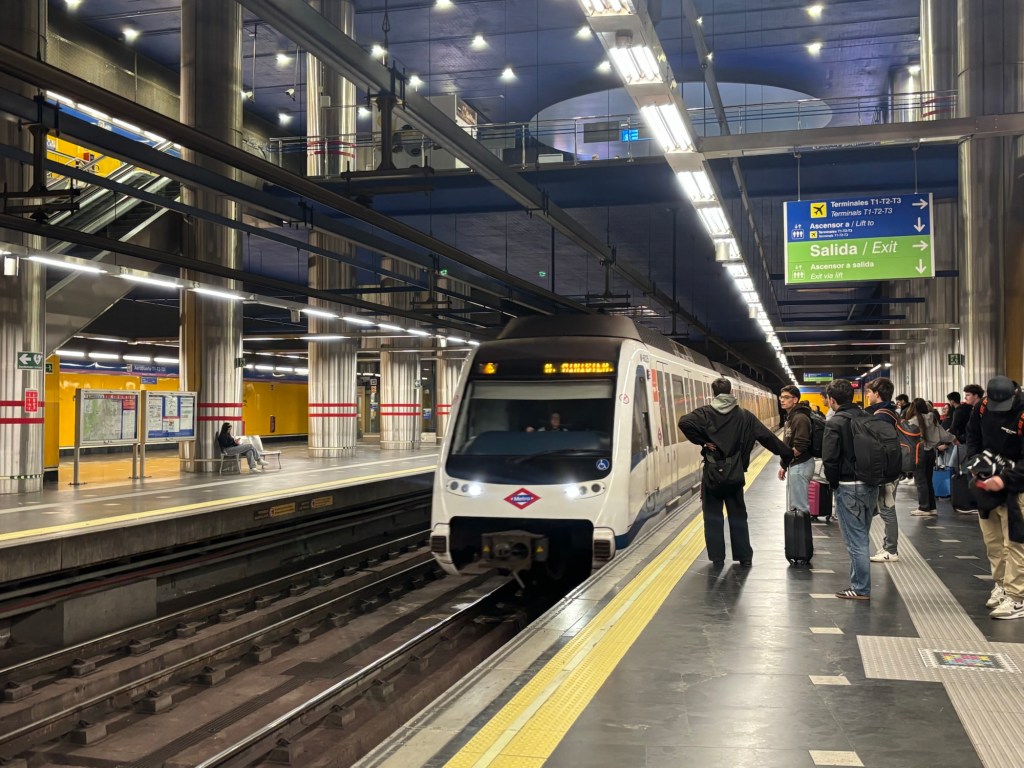
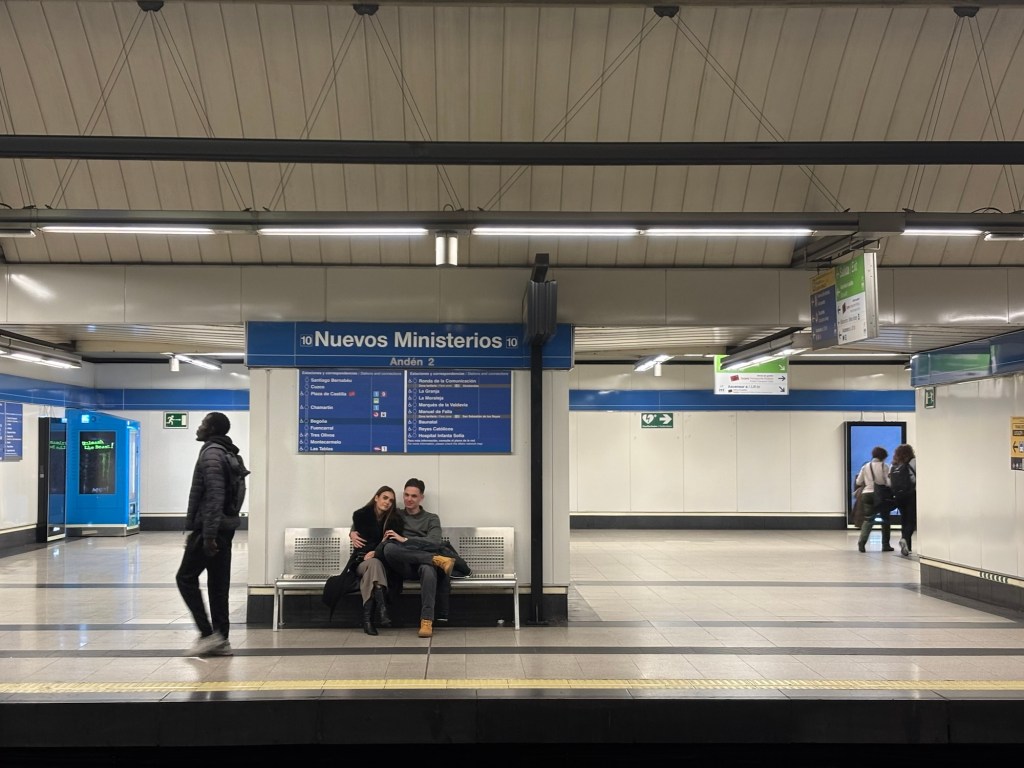
Metro 9, Dirección Nuevos Ministerios, Madrid. 20.47
Landfall. After a speedy and somewhat sleepless flight on Ryanair’s ridiculously good value £20 flight from Bristol, I’m back in Madrid. I fired off a couple of job applications to schools here after my last visit in December, but I’ve heard nothing. I suppose that would be disheartening if I weren’t perfectly comfortable at my current school. Besides, I could harbour no ill feeling toward Madrid. As capital cities go, she is both homely and stately.
The new European security protocols have started to take effect at Barajas. Separated from the Europeans – God’s chosen – by a luminous pink arrow and two security guards, I was shepherded into a large room with an array of digital fingerprint kiosks, where the COVID passes were checked years ago. Many of the machines were already out of order. I saw two cease to function after the same passenger tried to use them. Not for the first time, I found myself contemplating a new circle of Hell for the cabal that convinced an entire nation that being European wasn’t in our best interests.
As though on cue, perhaps, I was sent a visual reminder of one thing we Brits do generally take more seriously than our European counterparts. There weren’t many seats on the train, but one that was free was next to a couple of Frenchwomen. One of them was holding on tight to the leash of a muzzled dog, which was clearly in distress: it was evidently struggling to breathe with a heavy black face mask secured across its mouth, and it kept pawing frantically at it with its head to the ground in a desperate attempt to dislodge the thing every time its owner relaxed her grip on the leash.
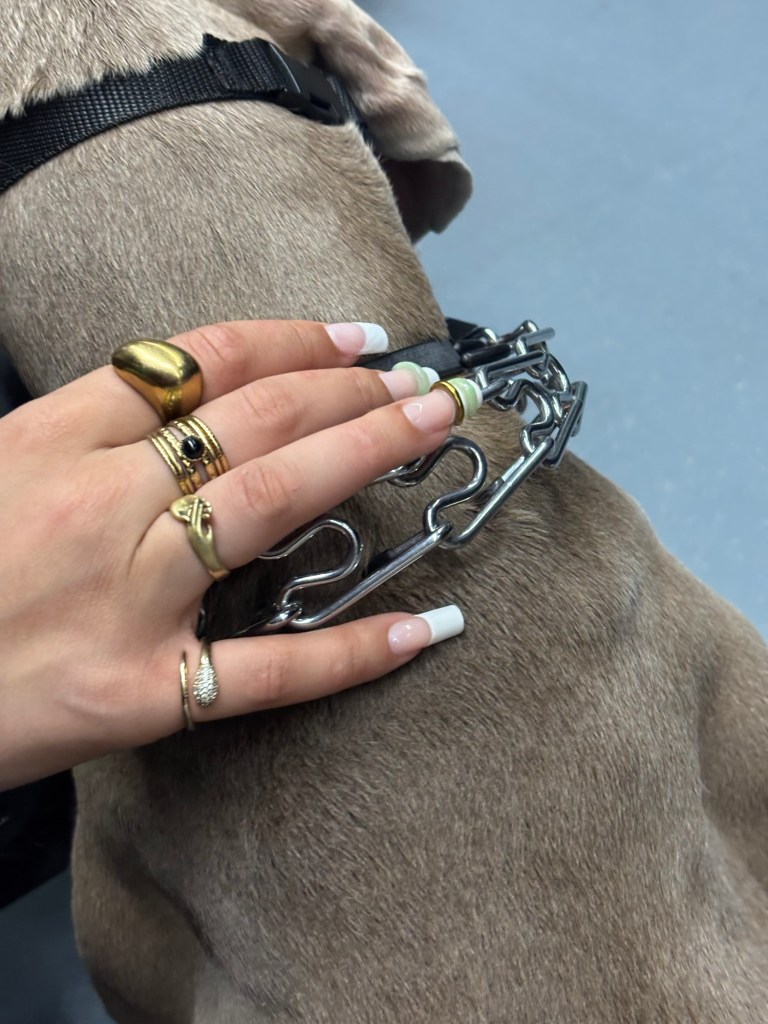
She didn’t seem to have noticed. She seemed more engrossed in her conversation. She had a ring on every finger on both hands and they clicked when she gesticulated or tightened her grip on the leash. Even some of her nails had rings. Hell, I like a girl who isn’t afraid to go all out with the jewellery, but even that was a bit much.
The dog’s collar wasn’t much better: a proddy, pokey, cage-like device that was causing the poor thing almost as much discomfort as its muzzle, by the way the creature kept trying to scratch at it with its hind leg.
It was painful to watch. I changed carriages on the connecting train to get away from it.
In England, some busybody would have taken her to task. But this is Spain – we’re getting a lot better, but we’re still a long way off the land of the RSPCA.
The trains are – predictably – packed for Toledo tomorrow, so I’ve booked a bus instead. It means an early start, but that’s no bad thing. I’ve quite a few of them coming my way in Peru, so I’d better get used to them. BB x
Hostal La Banda, Calle Dos de Mayo. Sevilla. 15.20.
The Americans have taken over. They’re sitting at a table behind me discussing the local culture of Sevilla that interests them so, like baseball, 7-Eleven and Jello shots. One of them asks the receptionist for a board game and they set to a game of Cards Against Humanity.
Outside, the rain comes down. When it comes to the weather, Luck has not necessarily been on my side during this holiday. Fortunately, I’ve been to all of these places before and seen the main sights before, so my heart isn’t bleeding over a few rain clouds. It’s actually quite relaxing, not having to dash off to this or that bit of sightseeing. It feels like living out here again. That was, I believe, the general idea.
Sevilla and I go way back. I’m not 100% certain, but I think came here for the first time in the summer of 2005, shortly after my parents bought the house in Olvera (that we still haven’t managed to sell off, twenty years on). I don’t remember much from that first visit beyond a flying visit to the Alcázar under a blazing sun, the noise and smell of the horses in the Plaza del Triunfo and a little blue notebook with a plastic cover where I kept a record of the animals I saw in my new country: black kites, bee-eaters, lesser kestrels and the city’s ubiquitous monk parakeets (which have only increased in number).
Since then, it has been the backdrop to a number of different episodes of my life.
Through my secondary school years, I made the odd pilgrimage to Doñana National Park with my mother. That was when Sevilla really started to become a fixture in my life. After Gatwick, it’s probably the airport I’ve used the most. Mum and I always had the same ritual upon arrival: before anything else could be achieved, we had to grab a zumo natural or café solo from one of the airport cafés. We never stayed in the city, but it was our regular conduit to and from the sanctuary town of El Rocío.
It was also where we learned of the eruption of Eyjafjallajökull in 2010, as we had no WiFi at our campsite in El Rocío, and this was before the advent of mobile data. You’d have thought there might have been something on TV, but all we saw on the night of the eruption which grounded all flights across Europe was a brief noticiero questioning whether Spaniards actually pay attention to STOP signs, given that they’re written in English – a question I still ask myself today, as I wander around Sevilla.
When I moved to Spain for my first British Council placement in 2015 – when this blog began – it was Sevilla to which I came, suitcase in hand, to sit beneath the shade of a fig tree on the east bank of the Guadalquivir and think about the future.
I came back to Sevilla again and again when I got back in touch with my former classmates from Olvera, particularly a childhood sweetheart (who led me up the garden path for several months before throwing up a wall during a memorably awkward visit to Madrid). Every visit to the pueblo required just under an hour’s commute across the city centre between Plaza de Armas and Prado de San Sebastián. By the third or fourth visit, I’d got the route down to twenty-five minutes, though I did once make the trip in under ten when I was in danger of missing the last bus home.
It was around then, during those frenzied trips between Sevilla’s bus stations, that I really fell in love with the Plazuela de Doña Elvira, sitting as it does in the labyrinthine heart of the old city. I’ve made a point of stopping by ever since.
Halfway through that year, I took a friend to the city to show her the majesty of Semana Santa. My experience of Spain’s Easter celebrations had previously been confined to Olvera, which was a highly unfair place to start – on everywhere else. Olvera’s penitentes, demonstrating a strength bordering on the Herculean, have to navigate the monstrously steep gradients of the town’s roads, constantly ducking and rising to avoid the low-hanging wires – all while carrying several tonnes of sacred wood and several hundred tapering candles within a precarious silk canopy. Caídas (falls) are not unheard of in Semana Santa, but I never saw the olvereños break so much as a sweat for their endeavour.
After that, I might be forgiven for having exceptionally high standards for Semana Santa. Sevilla met them. We were walled in by three simultaneous processions, but a friendly Guardia unintentionally gave us front row seats to the greatest show in town when he shoved us unceremoniously with his baton out of the road and in front of the lines that had been growing along the side of the street all morning. Málaga and La Mena may have raised my expectations even higher, but I’d like to go back and see Sevilla in its Easter glory again sometime.
By my mid-twenties, I could be pretty confident in saying that I knew few cities in the world better than Sevilla – including almost every city in my home country (with the possible exception of Canterbury). I do believe that I really could navigate this city blindfolded, if I had to. That was why I decided to take my second girlfriend there, less than a month after we started dating. I hoped that sharing the city with her would be like sharing my heart – since it had found its way in there a long time ago.
I took her to all my favourite places. Bar El Postiguillo. La Plazuela de Doña Elvira. La Plaza del Cabildo. El Real Alcázar and El Herbolario. She smiled sweetly and played the part of my muse around the city, but I don’t know if she felt the same way about the place as I did.
Later, when things started to fall apart, she told me I’d “missed the boat” for teaching her Spanish. It was the confirmation I’d long suspected that I was never going to be able to share my undying love for this country with her, and the chief reason why I broke things off with her in the end. A heart divided cannot love.
I have no desire to return to America after the intensity of last summer’s heartbreak. Sevilla, however, is immune. My heart could break a thousand times within its scented streets and still I would return.
In the last few years, I’ve led a couple of school trips here, too, playing the part of historian, quartermaster and tour guide. In this last capacity, Sevilla has sealed its place in my head as much as my heart, as I had to swot up on so much local history that I might as well have put on a red jacket and joined the city’s legion of guías turísticos.
And here I am again, as 2025 draws to a close. It’s been about twenty years since I first came here, and that’s around two thirds of my life. I don’t doubt I’ll be back again soon, drawn by some invisible magnetism to her cobbled streets, her orange-scented courtyards and the irresistible joy of her people and their merry accent.
The local hostalero gave me the highest possible praise last night. My accent, while occasionally inflected with English, is unmistakably andaluz. Coming from an Andalusian, that is praise indeed – I usually get told I sound sureño by northerners, but no de aquí by the southerners themselves, pointing to the east when I am in Cádiz and west when I am in Almería. That’s twice this year I’ve managed to blend in.
It’s about time I moved here. The stars are aligning. I only need the opportunity. BB x
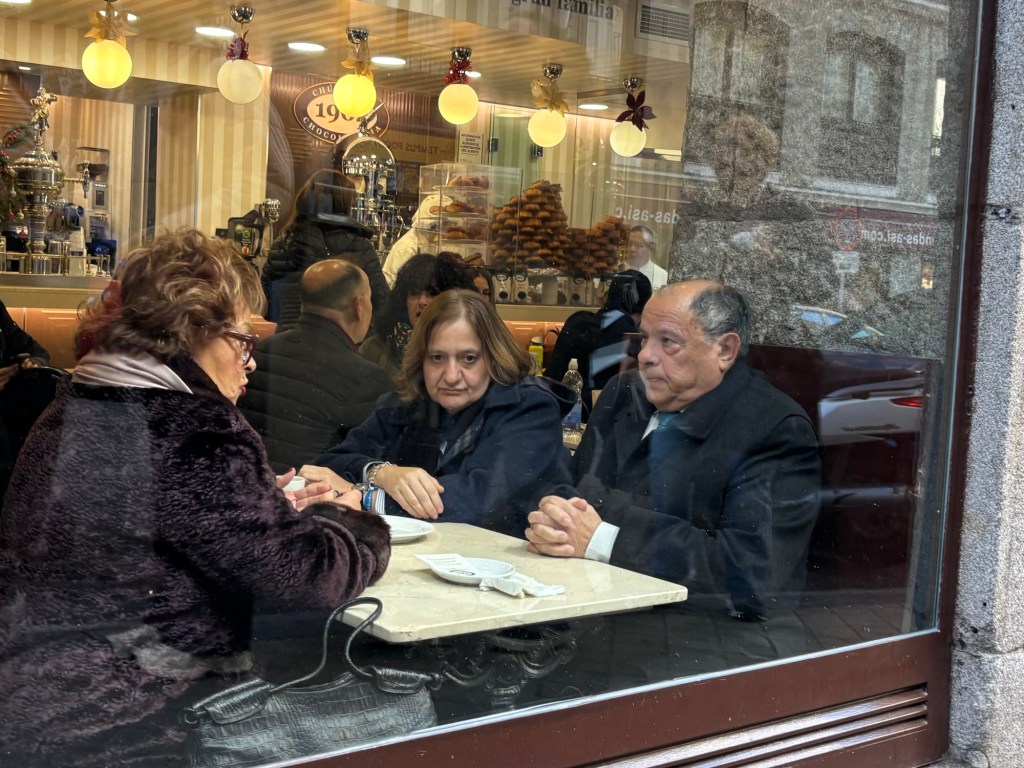
Chocolatería 1902, Calle de San Martín. Centro. 10.22.
I’m waiting in line to grab some churros con chocolate for breakfast at 1902, the same chocolatería I drop in on every time I’m in Madrid. It’s not yet half past ten on a Sunday, so the interior is still pretty busy with the usual morning traffic. The handsome lady manning the takeaway stall bustles in and out of the booth to resupply for the family of three in front of me. My attention is drawn to three punters sitting by the window. Locals, surely – only a Spaniard would keep their winter coat and furs on inside when there’s even the slightest chance of a draft slipping in. After all, it is a bitingly cold 16°C out there.
They look to be in their seventies, there or thereabouts. That means that the man on the right served his country for at least a year in the mili, before Aznar did away with national service in 2001 in a bid to win votes. It also means they probably remember very well what Madrid used to be like under Franco, before La Transición and La Móvida swept the city into the twentieth century like the rest of the European capitals.
Do they miss the way things were, perhaps? It must have been an altogether different place, back when the city’s demographics were primarily madrileños de raíces, before scores of regional migrants were drawn to the capital for work, followed by a larger tally of visitors from further corners of the world. Before Ale-Hops and Starbucks replaced the boarded-up shopfronts of local businesses. Before every sign and tannoy needed an English translation tacked on, to cater to a growing tourist class who were not expected to learn the language for their visit – another reminder of Spain’s falling status on the world stage.
I do not regret the end of Franco’s Spain – after all, it’s because of him that my Spanish family was torn apart. But I do understand why some might look back fondly on a time when the world seemed a whole lot more familiar.
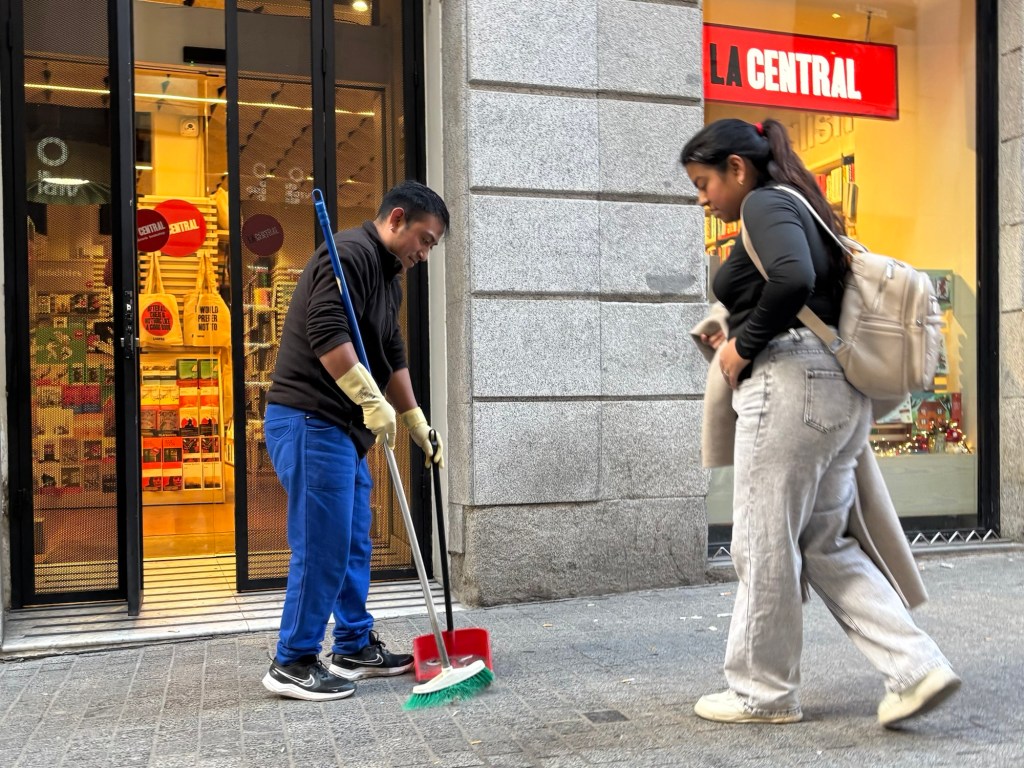
Librería La Central, Calle del Postigo de San Martín. Callao. 10.36.
Further up the street toward Gran Vía, I pass La Central. It’s not yet open, and an Amerindian in marigolds and workers’ blue pantalones laborales is sweeping the street in front of the door, which is open only just enough for a person of slender build to squeeze in untouched. It’s mostly confetti and spent chasquibumes that he’s clearing away – there aren’t nearly as many cigarette butts as there used to be.
A girl stands nearby, picking up some of the easier wrappers by hand. She’s dressed like a passer-by, but there’s a familiarity to their easy interaction: she could be a relative, a friend, or a lover. Neither of them are wearing the white worm-like earbuds that seem to have encrusted the faces of so many of the city’s inhabitants, and that makes them stand out.
I bought four books in the nearby Casa del Libro (after nearly two hours’ decision) and it cost me around 70€. Spain is often ranked as one of the least literate countries in Europe, with fewer than 9% of the country reading books on the regular. Statistically, that’s not all that far behind the UK, but there’s no escaping the fact that reading is a luxury activity in Spain. FBP (Fixed Book Price) might be a worthy attempt to level the playing field and prevent the market being swamped in Taylor Swift trash and cheap chick lit, but it does drive up the prices of everything as a result.
My great-grandfather dreamed of having his own library, and I’m doing pretty well at bringing that dream to fruition. But it’s not a cheap enterprise in this country. I wonder how much traffic the man in marigolds sees.
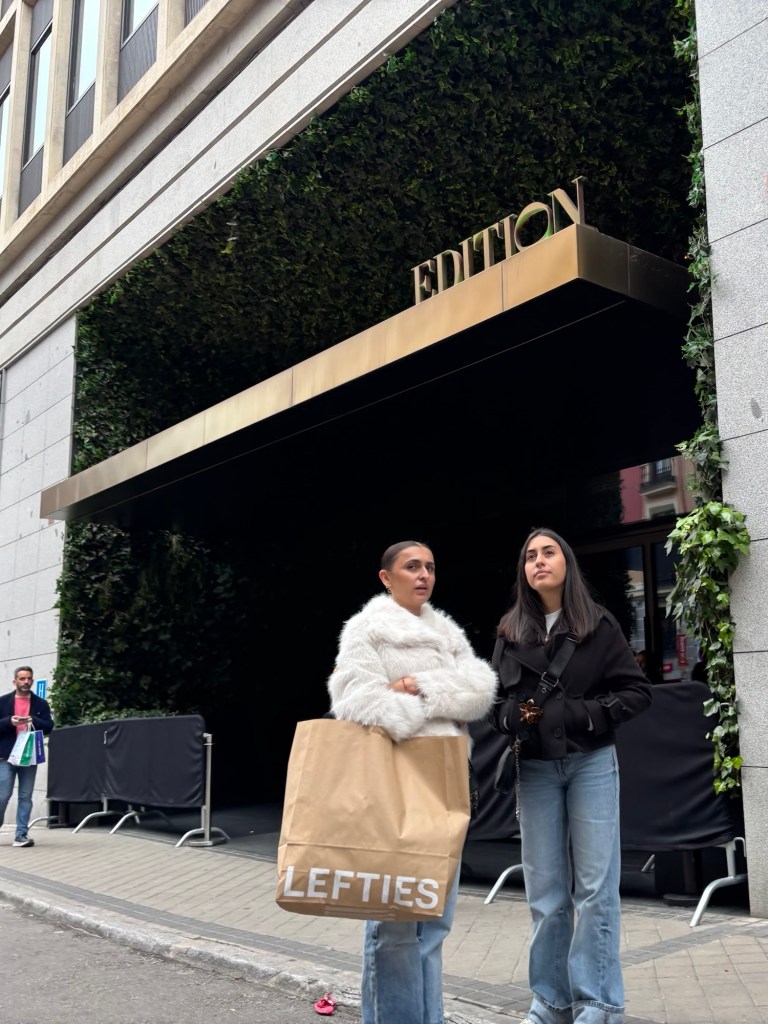
Outside The Madrid Edition, Calle del Maestro Victoria. Centro. 12.55.
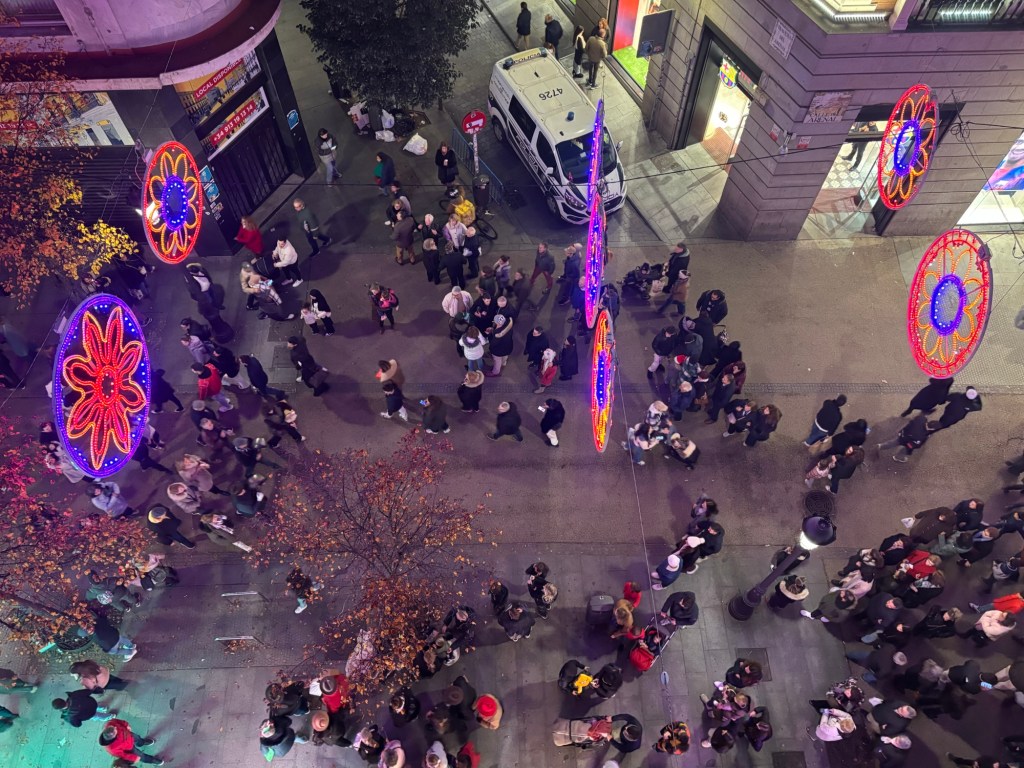
The queue forDoña Manolita’s legendary lottery shop stretches all the way along Calle de Mesonero Romanos and away up Calle de la Abada and onto Gran Vía. The throng of hopefuls is a real mix: young and old, local and out-of-town, Spanish and French and American. El Gordo – Spain’s Christmas lottery – is much more of an event in Spain than it is elsewhere in the world.
At the end of one crowd, another begins: a great mass of children and their parents waiting for the giant animatronic train and its attendant polar bears on the Cortylandia shopfront to come to life and sing, as it does every hour, on the hour (until 10pm, it seems – it’s within earshot of my hostel room).
Two glamorous citizens standing apart from the hubbub seem to be above it all, watching the crowds come and go with unmoving eyes. One leads the conversation, the other listens, eyes skyward. Sometimes it’s hard to see how the haughty, angular beauty of a youthful Spaniard finds its way into the compact, shrunken shape of its senior citizens, but every once in a while there’s a flash of that future in the expressions of its youngsters: that look of casual ennui would be right at home on the face of a woman three times her age, still dressed in expensive furs and commenting on the world going by.
Outside Heladería Galia, Calle del Arenal. Puerta del Sol. 12.57.
A West African mantero plies his wares alone on the Arenal. They usually operate in groups – there being safety in numbers, I suppose – but this one seems to be his own agent. He has also upgraded his drawstring blanket to a couple of glassware boxes. While other mountebanks dressed as a gorilla, Eevee and Mickey Mouse try to fleece passing tourists of their loose change, he hawks a number of luminous splat toys, which he promotes by blowing into a bird whistle and hurling his devices onto the flat surface of the box, where they slowly revert to their original shape.
It’s hardly worthy of a moment’s notice to most of the adults passing by, but it’s the children he’s after. One girl is absolutely entranced and convinces her mother to buy one – no, two, as they will have to get one for her brother.
It can’t be an easy job, hawking cheap goods on the street, but from my casual observations, these manteros do seem to have a fairly good hit-rate when it comes to a quick sale.
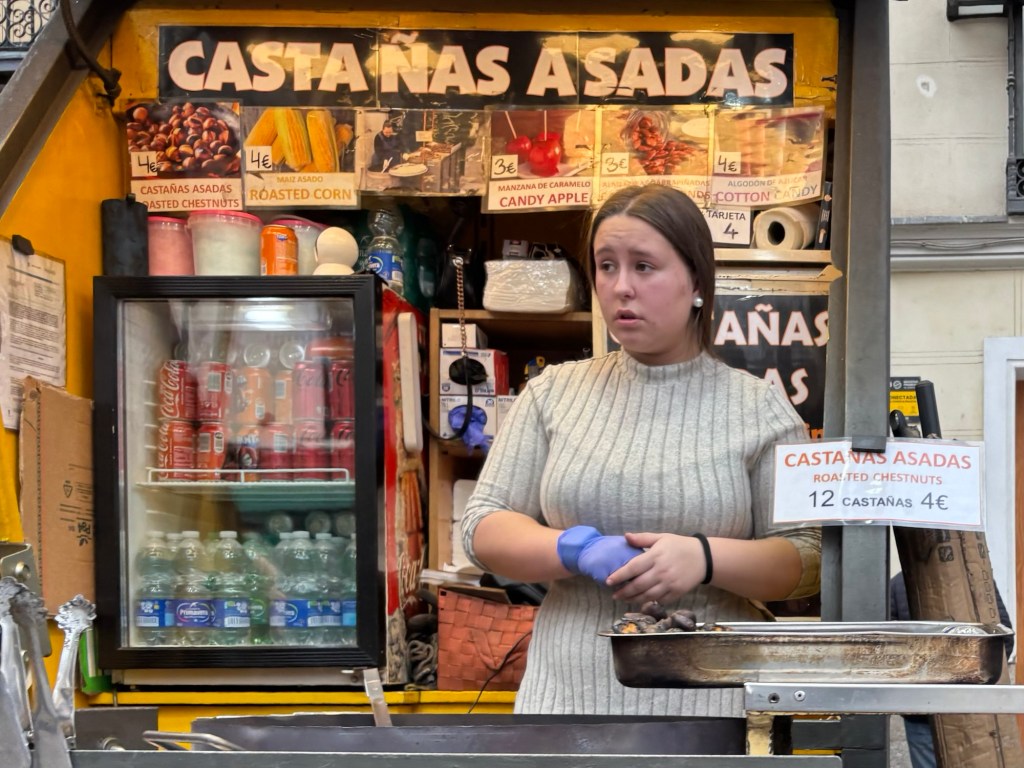
Plaza de Isabel II, Puerta del Sol. 12.59.
Before it became synonymous with one of C.J. Sansom’s greatest works, winter in Madrid always meant roast chestnuts. These warm, smoking stalls are as much in evidence now as they ever where, though they now often come with the modern niceties of a wireless card machine and an Aquarius-bearing fridge. Here, like everywhere else, the signs are written twice: once in Spanish and once again in inglis. The point I try to make in the classroom about the usefulness of this or that topic for traveling is increasingly redundant in the face of the relentless march of the English language.
The girl with the pearl earring isn’t as heavily dressed for the chill as the other madrileños in the street – but then, she is standing in front of a roasting dish all morning. She looks bored. The telltale rounded edges of a smartwatch bulges beneath the tight elastic of a sanitary glove on her right hand, and a swish handbag – presumably hers – sits nestled in an alcove behind her, so the chestnut business must be doing a reasonably good trade. I haven’t seen as many people tucking into the delicacy as I have in previous years, but then, it really isn’t quite that cold. Not yet. Not until the peaks of the Sierra de Guadarrama are covered in snow and the north wind blows chill across the plain and into the capital.
She’s cute – in a genuine, homely sort of way. There’s a natural beauty to people here. Not as many piercings, lip fillers, unconventional hairdos or fake tans. I don’t know why we go in for that so much in England. I already miss this place, and I’ve only just arrived.
Jardines de Lepanto, Plaza de Oriente. 13.26.
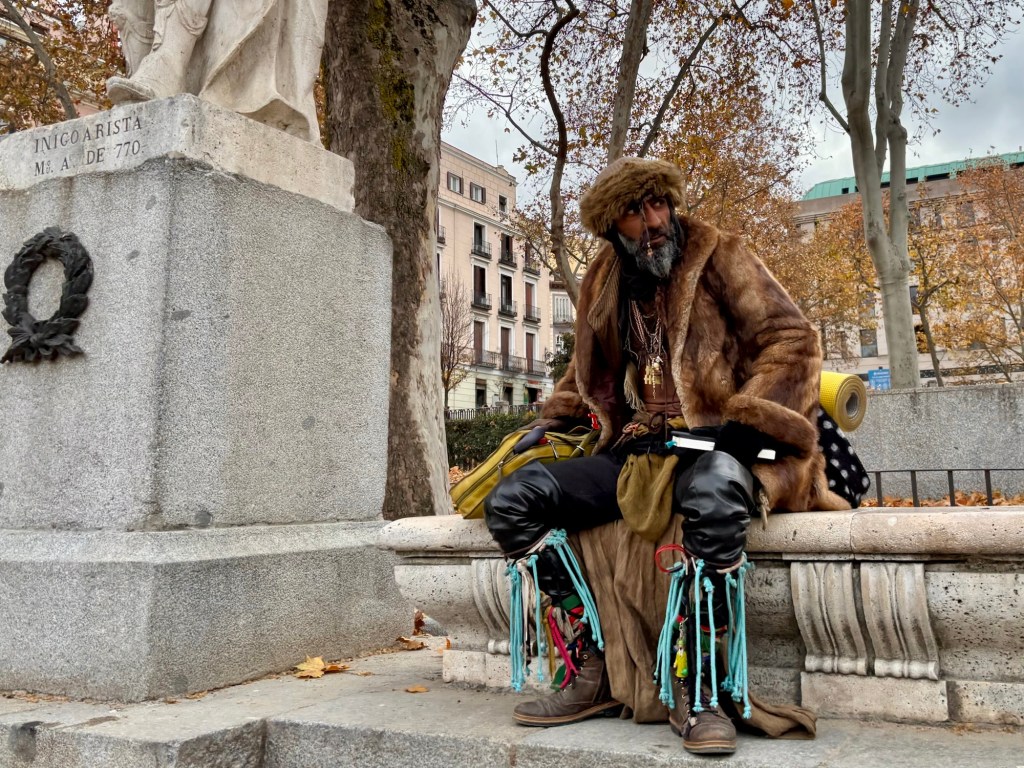
Sitting between the marble statues of the Asturian kings Iñigo Arista and Alfonso I is an exceedingly odd fellow. Like many of the city’s inhabitants, he is dressed in furs for the cold, but the similarities stop there. If the tassels on his black leather buckskins weren’t a metallic shade of blue, he might be a fur trapper from the Old West lost in time.
No – wrong continent. His regal nose, his dark, hooded eyes and the salt-and-pepper beard emerging in a neat diamond from his black headwarmer gives him the look of an Arab trader. A wise man, perhaps. It’s that time of year.
A curious assortment of symbols hang by threads across his naked torso: the Tau cross, an ivory pawn, a set of small keys and a card cut-out of the words “Ho-Ho” in gold letters that looks like it came out of a Christmas cracker. A fold-up umbrella pokes out of the smart yellow satchel at his side and there is a roll mat strapped to his waist. If he is a tramp, as his demeanour implies, he is a wealthy one.
Today the city of full of people in fancy dress. Ecuadoreans in tasselled hats and masks. Mountebanks in oversized costumes. Zambomberos in black and white and red. But he belongs to none of these clans.
When I return from watching the first of the zambomberos parade past, he has disappeared. I do not see him again.
Palacio Real, Plaza de Oriente. 14.36.
The fiesta zambombera is over. The crowded musicians begin to disperse, and with them, so too the clouds, bathing the Jardines Reales in warm winter sunlight. A modern dance troupe takes up where the traditionalists left off, showing that movement is as much a part of this country’s soul as its music. Still dressed in their folklore finery, the folcloristas return to their groups and prepare to depart. One huddle near the dance troupe stops to take a selfie. The red banner of Castilla flutters in the wind and the little cymbals in the tambourine shudder for a moment.
I must be a fool to have traded my life out here for England. So help me God, I will find my way back out here. I have to. It’s the only way I’ll ever assuage this restless heart of mine. BB x
It is categorically impossible to be down at heart in Madrid. Whatever my thoughts and feelings were, they were altogether altered the moment my feet were back on Spanish soil as I left the plane at Barajas last night. It’s not as though I need reminding that Spain is always the answer to my lonely heart, but it is good to know that its medicine is none the weaker for every visit – especially as this is my *fourth* visit this year (though if you count my sorties to and from the Canaries and Gibraltar, it would be my sixth). Anyone would have thought I had an itch that needed scratching…
Ah, Madrid. Like the girl next door in every American romcom, I have come to regret dismissing you so lightly when first we met, now that you have captured my heart. There is something undeniably homely about La Capital, which neither London nor Paris nor Berlin can match. Even now, bustling as it always is in the run-up to Christmas, it still feels more like a large town than a capital city.
From my vantage point in the hostel, overlooking the glittering Calle del Arenal, the hubbub below is a merry melange of conversation, villancicos, far-off snatches of song and the intermittent underground rumble of the metro. The near-constant snapping of chasquibumes (bang snaps) makes the city sound like a crackling fire.
I don’t say this often, but here is a city I wouldn’t mind living in.
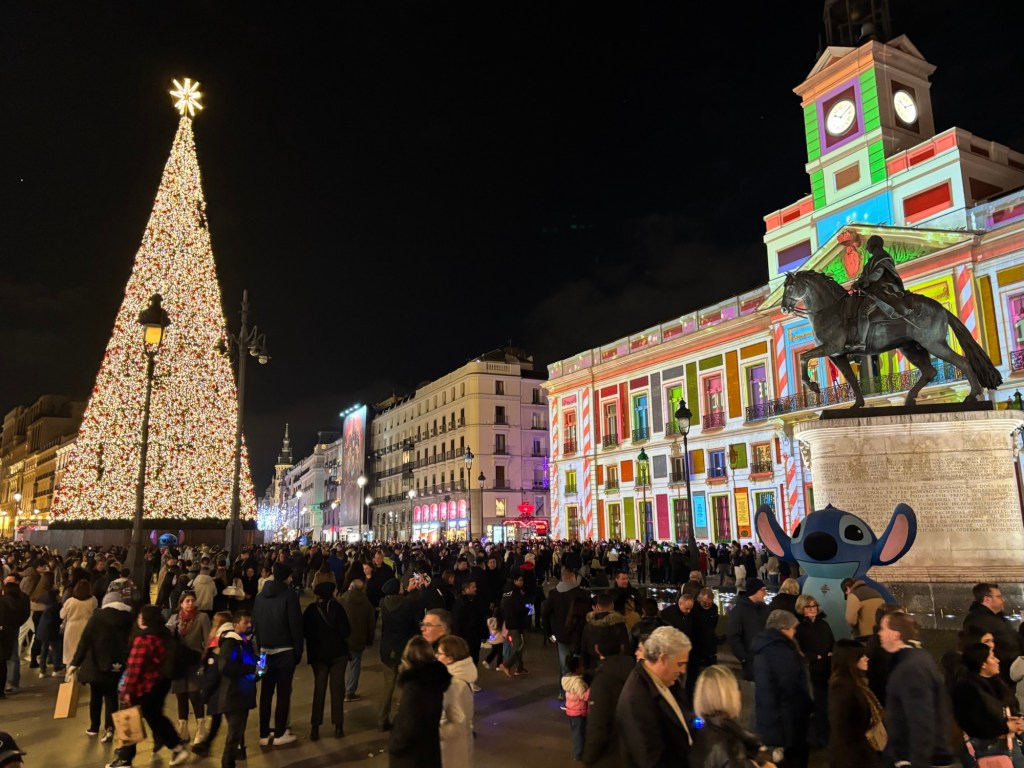
Merry-go-rounds, ice rinks and various Christmas-themed stalls have been set up in the various squares and open spaces throughout the city. Traditionally, it’s the Reyes Magos (the Three Wise Men) who bring children presents in Spain – which has always struck me as a much more logical excuse to celebrate the giving of gifts – but that doesn’t seem to have stopped the Spaniards from starting the festivities several weeks prior. And why not? Any excuse for a celebration will do.
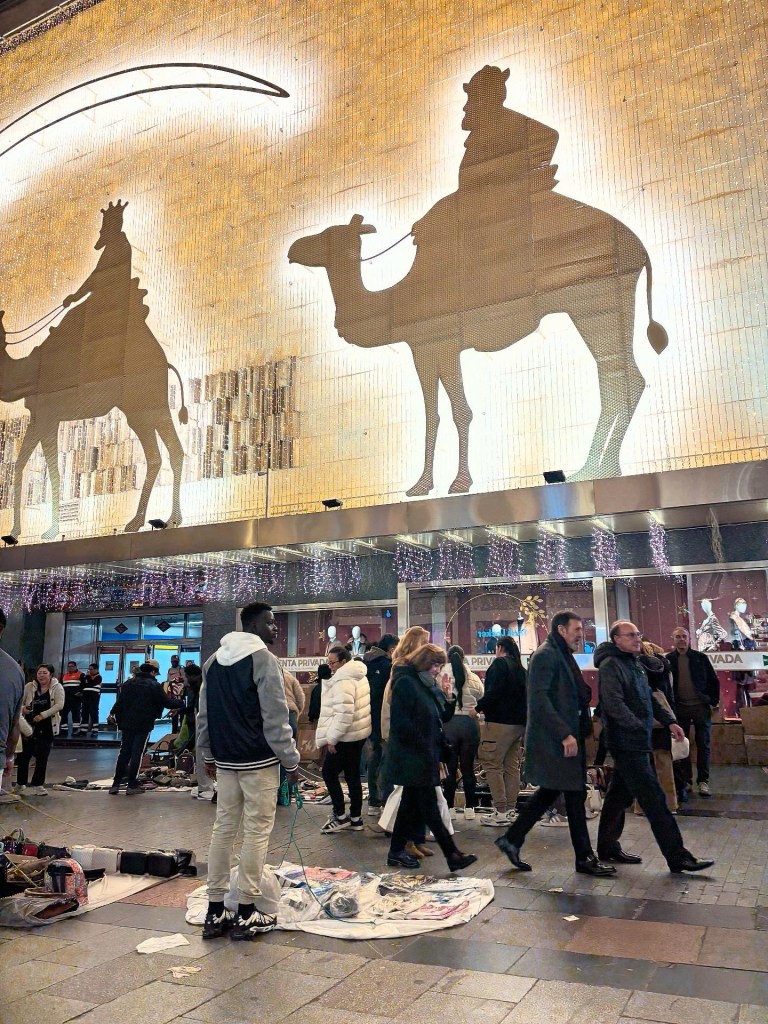
By far the brightest lights can be found on the walls of Callao’s Corte Inglés, which draws a constant stream of shoppers into the night (it was still heaving at half past nine when I passed by en route to the hostel last night). Wherever there’s a crowd, there’s usually a ragtag bunch of pedlars clinging remora-like to its underbelly. Sure enough, I found three manteros hawking the usual array of glasses, handbags and Yamine Lamal shirts outside the main entrance, the strings of their cloth blankets twitching in their nervous hands at every distant blast of a police car. Their location of choice – beneath the three wise men – seemed almost poetic.
I don’t suppose the Baby Jesus would have had any more call for a Barcelona tee-shirt than he did for frankincense. Neither, it seems, did the madrileños. But who’s to say that these three wise men didn’t follow a star of sorts to Europe?
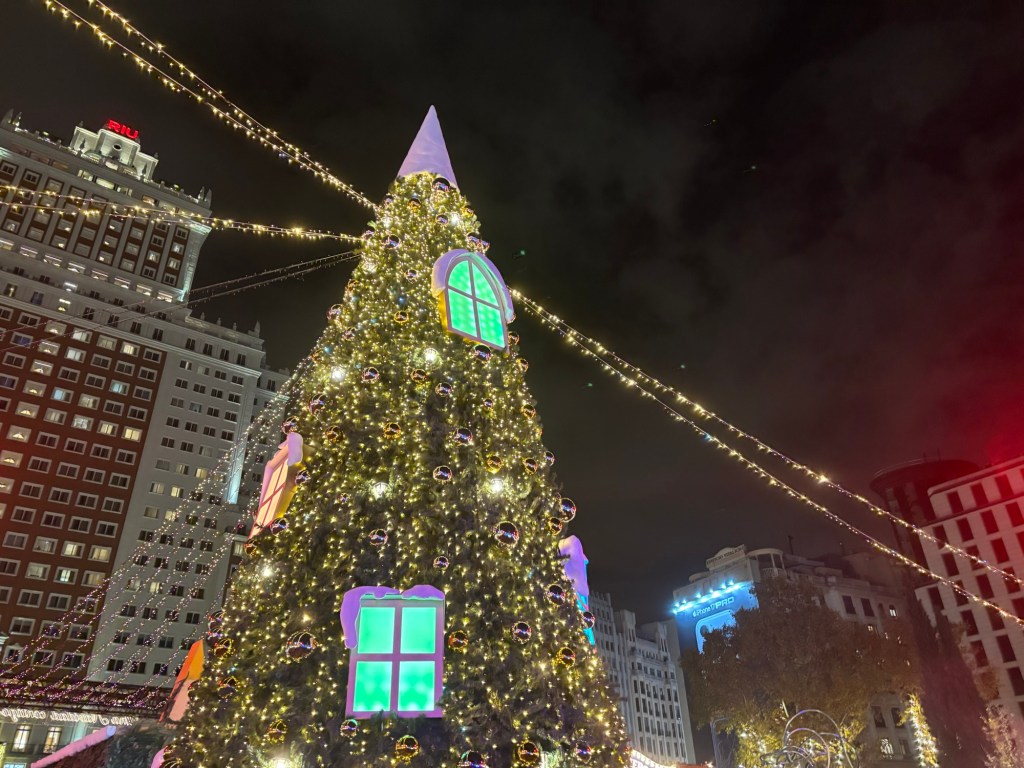
Down the street in the Puerta del Sol, the Real Casa de Correos is lit up like an advent calendar – though in its technicolour array it looks more like a dollhouse – and the usual conical tree of lights stands between Carlos III’s smug smile and the oso y madroño statue on the other side of the square.
Could you call La Puerta del Sol a square? It functions like one, more so than the nearby Plaza Mayor (which really is a square) but it’s really more of a semicircle – a giant protractor radiating in multiple directions from Kilómetro Cero at the feet of the Casa de Correos. At least, it would be, if the centre of the semicircle were just a few yards to the left.
I’m only here for a couple of nights. Extremadura is calling. It has been too long since I last laid eyes on the corner of Spain that well and truly stole my heart all those years ago, and since then, it’s been nothing more than a beautiful word on my lips. I’ve already had my fair share of nostalgia trips this year to Finisterre, Gibraltar and El Rocío, but one more won’t hurt. Holidays are for healing, and that’s exactly what I intend to do. BB x
The sun is just starting to set beyond the skyline. Down in the street below, Madrid’s colourful denizens are out for an evening paseo, dressed to the nines to the last man (and woman). The rumble of motorbikes is a constant accompaniment to the general hubbub and the occasional police siren soars above it all every now and then. The lodgings I’ve managed to snag come with a balcony that looks out over the crossroads below, so I’m treating myself to the noise of Madrid for a few days before retreating to the quieter shores of Finisterre, at the end of the world.
The capital is much as I remember it from my last visit, several years ago, though it makes a change to see the place under the warm spring sunshine rather than wrapped up in the chestnut smoke of winter. It’s inching toward 20°C outside, but the madrileños are still going about in puffer jackets and (fashionable) greatcoats as though it were 5°C. I haven’t brought any heavy-duty winter wear as I have to carry everything with me from Madrid to Galicia to the Canary Islands and beyond on this latest adventure, but I might pick up a few Spanish clothing supplies while I’m here in the city. I haven’t overpacked, for once.
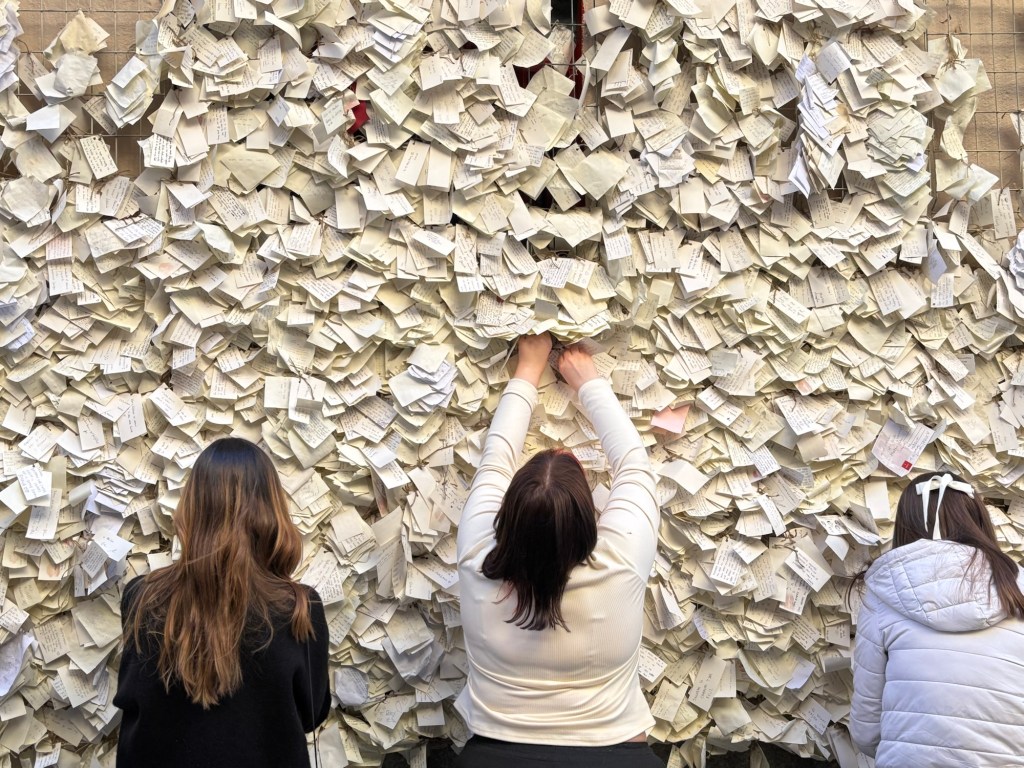
During the course of my wanderings I stumbled (quite by accident) upon the Tienda de Deseos again. I found this strange corner of Madrid last Christmas, its walls covered with the scribbled desires of a hundred passers-by fluttering in the winter wind. Last year there were quite a few lonely hearts on here. This year there seem to be a lot more general “wishing for all the best in life” requests. I made a wish last year to find her – “wherever she may be”. This year I was a bit more specific. Beautiful though it was, I don’t think I’m quite ready for another trans-Atlantic situationship.
Even in the heart of the capital, there are clear signs that spring is here. The cherry trees lining the Calle del Arenal are dressed all in white. The swifts are here early, too – they must have come hurtling in on the wings of the rainclouds, because I’ve never seen the Río Manzanares so full.
There were a few posters on some of the bollards advertising an anti-hate march in defense of the Trans community, which I really ought to have stuck around to watch, as it’s one of the A Level topics for Spanish at the moment. A smaller group of protesters were picketing the Corte Inglés just off Sol, sporting the usual V for Vendetta masks and carrying telescreens displaying the slaughter of fish off the Spanish coast. Nobody seemed to be paying them much attention.
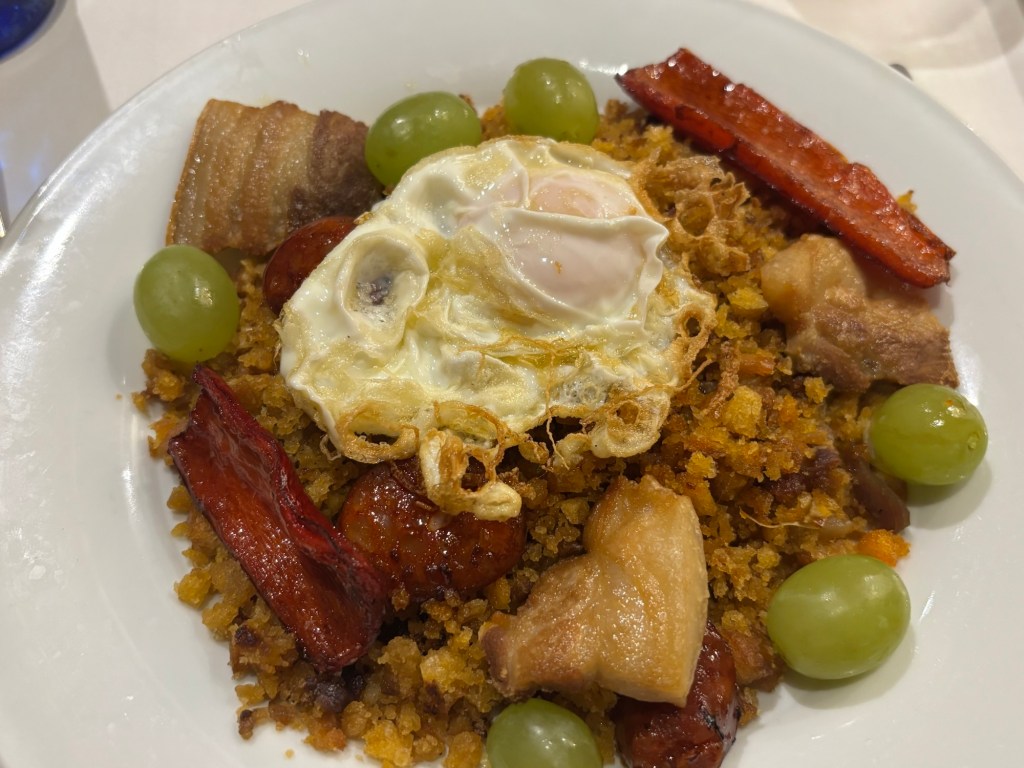
I treated myself at dinner with a rather upmarket restaurant modelled on Arturo Pérez-Reverte’s Capitán Alatriste books – dishes, decor and all. It didn’t disappoint one bit. I had my first migas in seven years and tried cochinillo for the first time. It was incredible, even though my taste buds hadn’t quite recovered from the usual end of term knockout cold.
On my first grand adventure across Spain many years ago, food was a luxury I rather recklessly decided to do without. Now that I have the means, I intend to make good on that dreadful error by exploring the best dishes the country has to offer as I go. I haven’t found any callos yet, but they’re on my list!
Please excuse the rather humdrum post today. I haven’t had any grand escapades yet! The real adventures start tomorrow… BB x
When I’m on the road, I have a real complex about fitting in. It must be a side-effect of being a linguist, but I cannot stand the idea that I might stand out as a foreigner, if I can help it. Usually it’s simply a question of dressing appropriately, but it also makes me think very hard about my accent when I speak. This has had some brilliantly cringeworthy outcomes, such as getting into a blazing row with a taxi driver in a French that has never been as fluent since, and defaulting to a makeshift (albeit stateless) American accent while riding the Amtrak train two weeks ago… The worst has to be that two-hour drive in a Luton van with a dyed-in-the-wool Yorkshireman in my university days, where I was so self-conscious about my southern accent that I feigned a northern accent so as not to come across too posh… My housemate, a Wensley lass herself, took an exceptionally dim view of the whole affair. In her own words, my accent had only made it as far as Sheffield.
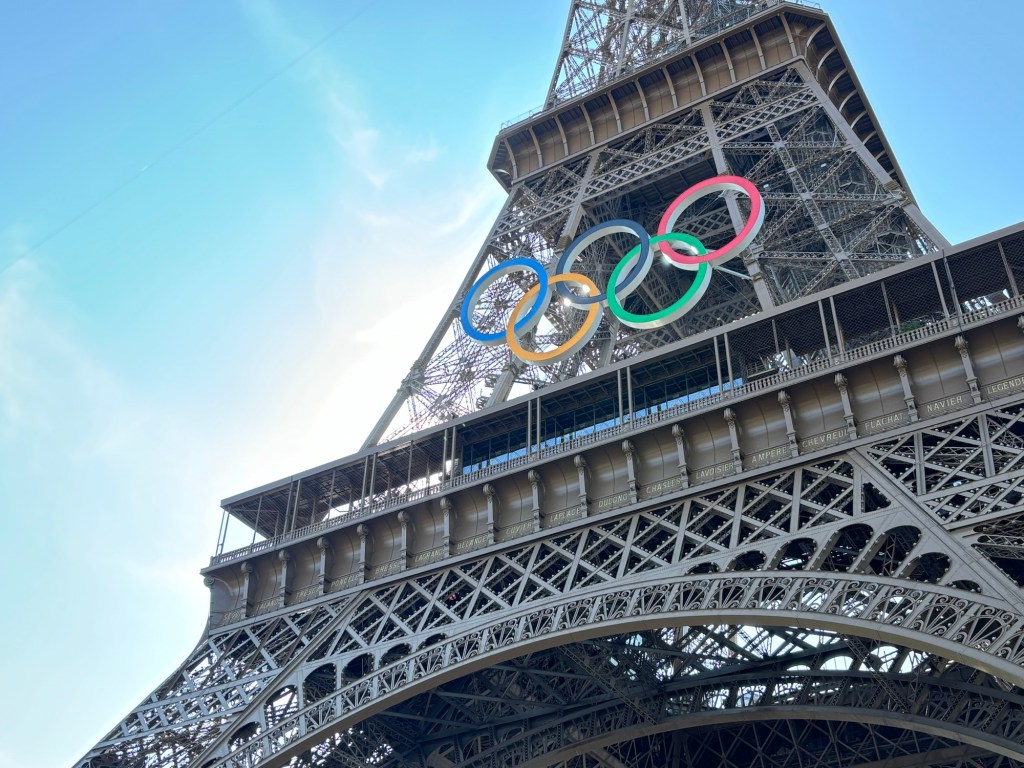
Fortunately, I’m in France, not Sheffield, and with just over a week to go until the Olympic Games begin, the city is so full of tourists that it’s probably easier to blend in as one of them than to ape any Parisian. So I caved and bought myself an Olympic T-shirt, since it’s unlikely to come back here in my lifetime.
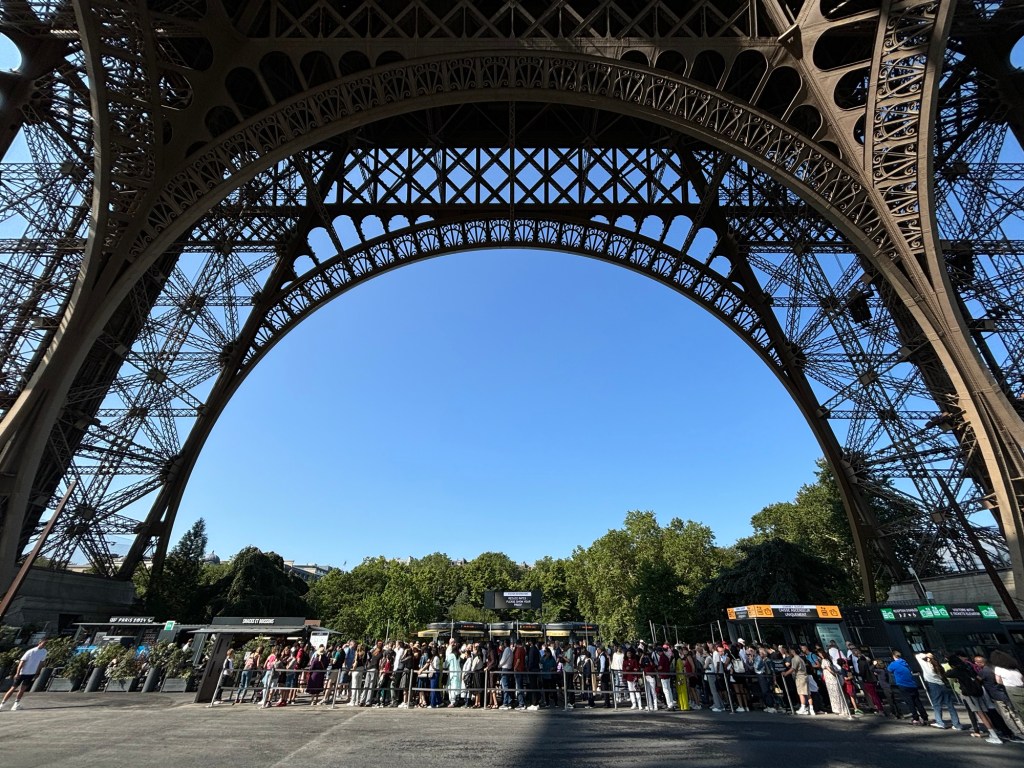
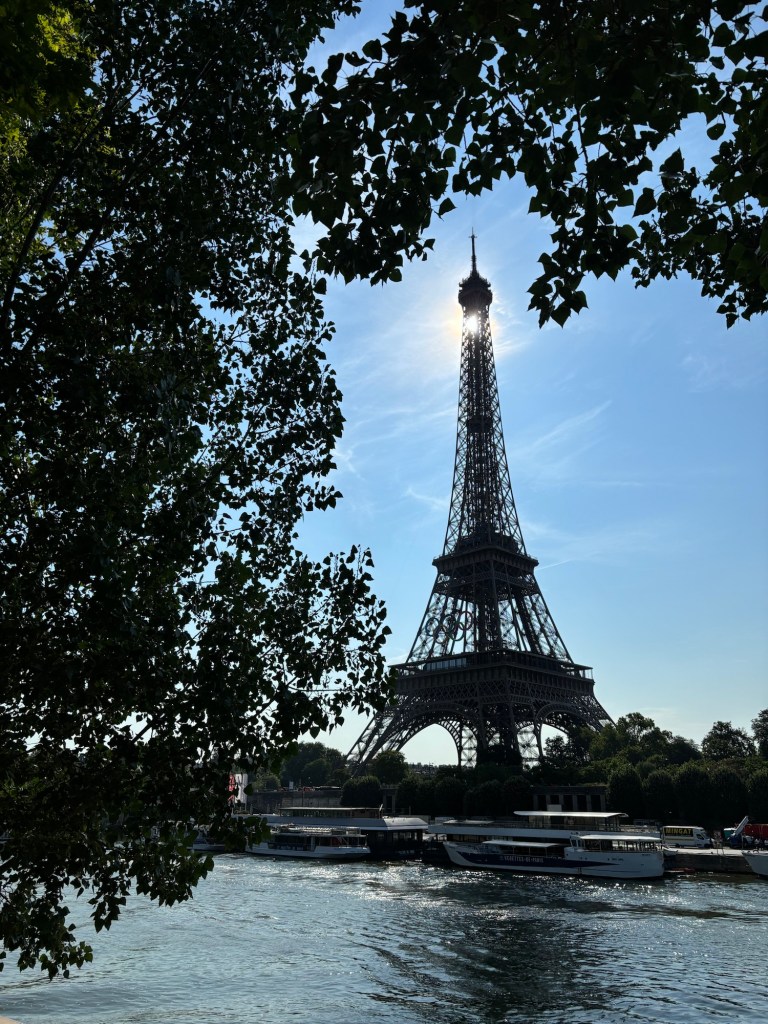
I only have the one full day in Paris, so I decided to make the most of it and go supertouriste for the day. With Nôtre-Dame still under heavy repairs after the fire of 2019, and the Louvre fully-booked up for days, that left the Eiffel Tower, l’Arche de la Triomphe and the Château de Versailles. I didn’t really set out with a specific itinerary in mind this morning – I rarely do when I’m traveling solo – and the decision to join the queue for tickets up the Eiffel Tower was very much a spur-of-the-moment one. After all, the website said that all the summit tickets were sold out, and while the views from the second floor are good, who’d make the climb and not go all the way up?
Turns out the website doesn’t know jack. The queue was about half an hour long, but when I did get there the ticket seller simply raised an eyebrow when I inquired about the availability of summit tickets and said “bien sûr”. So if you’ve considered seeing the tower on your trip to Paris and you haven’t made any reservations, fret not – they always keep some to sell on the day.
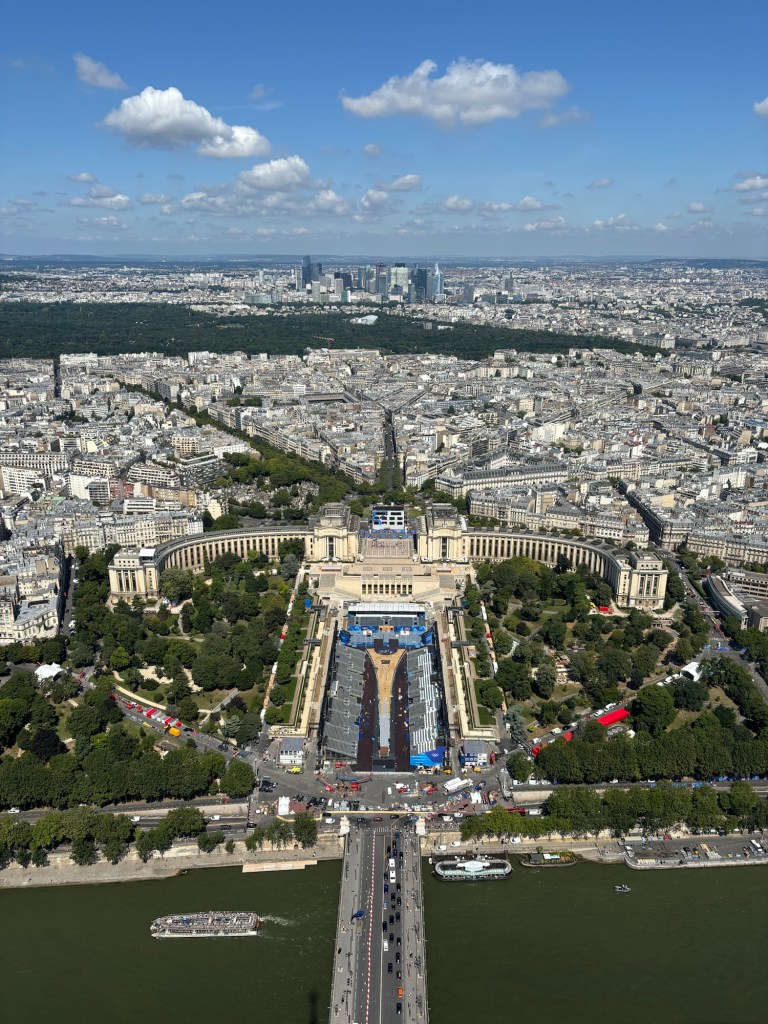
Preparations are well underway for the Olympic Games here in Paris. The Olympic torch has completed its relay of the various départements, including far-flung Outremer, and is now circling the city in an ever-shrinking spiral. All around the city, cyclists are coming and going with pink signs in their panniers, pointing visitors in the direction of this or that event. Stadiums and stands have sprung into being like enormous steel mushrooms, and the avenue that stretches from Trocadero to the École Militaire now hosts a giant show ground, which looks like a building site from the ground but a lot more like a Roman circus from above.
It’s also impressive just how big the Bois de Boulogne is. Hyde Park may be a green lung for the heavy London air, but it pales in comparison to the dark forest that has clung on in Paris’ northern district, as though threatening to break the encirclement and rejoin its sister Meudon in the west, given the opportunity.
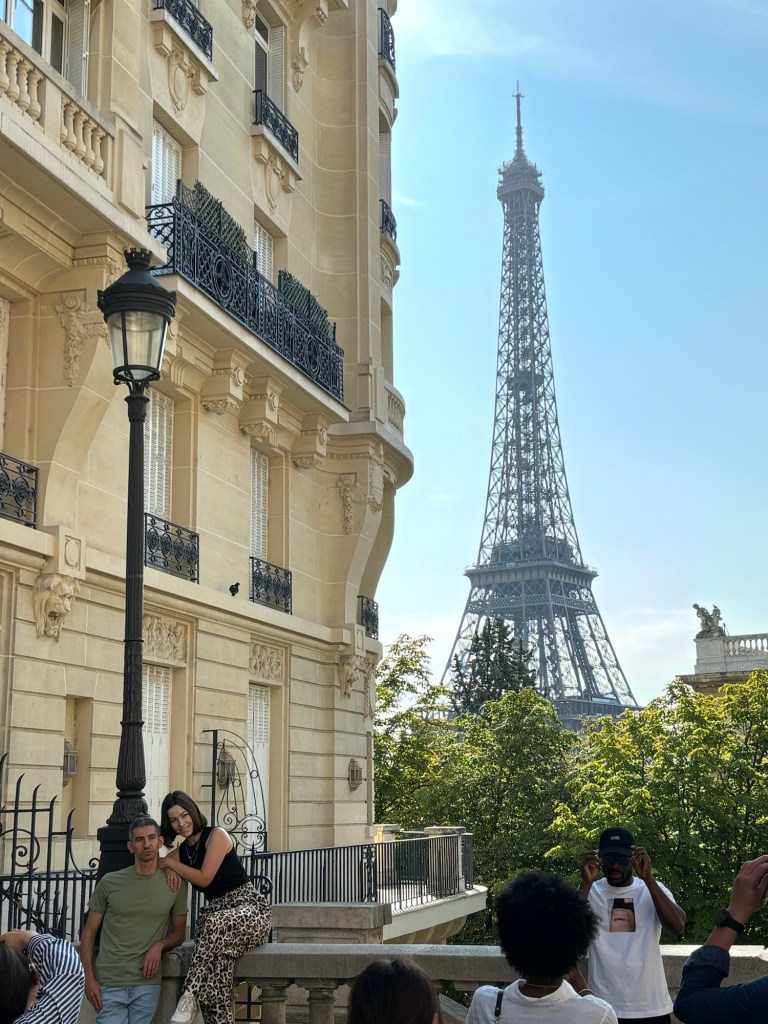
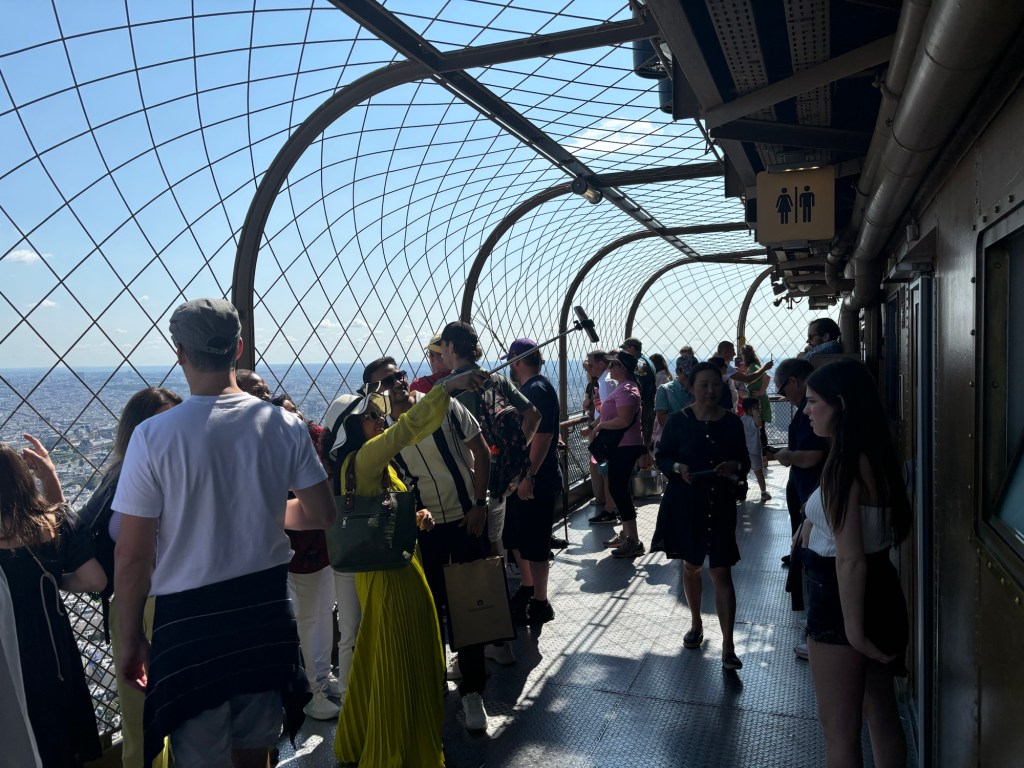
The summit of the Eiffel Tower really is quite something. Photos don’t really do it justice. There’s any number of skyscrapers that have now beaten its giddying record, but none so old, so charming, so immediately recognisable. It’s quite something to perch high above the City of Light, pigeon-like, and join the ranks of historical characters who have stood in the same spot: kings, shahs and statesmen, warmongers, tribal chiefs and Buffalo Bill. You’re more likely to be elbowed out of the way by an errant child angling for a better view or jostle for space with a Brazilian family taking every possible angle of each other than you are to meet any of the former, of course, but who knows? With the Olympics converging on the city, now’s as good a time as any to go stargazing up the Eiffel Tower.
I’ve been a bit reckless with the traveling this summer. I’d like to argue that this latest venture is purely tactical, with French being a very valuable commodity where I’m going, but it’s also methodical: it’s a very good way of keeping busy in the yawning maw of the summer holidays, which can go on and then some if you don’t find some way to keep busy. At the moment, one wedding after another plasters my social media feed as old friends tie the knot. It should make me smile, but on one level it always reminds me just how cut off my career has left me. That’s just one of many reasons I’m moving to a new job and a new part of the country this summer. It’s high time I hit the reset button and started from scratch.
But until then, I have the joys of the open road. Perhaps it’s my way of justifying my existence in these long, empty stretches we call holidays. I might have missed the boat festival in Brest by a matter of days, but I’m really quite excited to explore Britanny. After all – it’s supposedly the location of the indomitable Gaulish village of Astérix and Obélix. Between those two comic rascals and St-Malo’s long history of piracy, I should be in for a treat! BB x
I started learning French when I was around five or six years old. A lady used to come to my primary school and ran a French class as an after-school club. I remember it so distinctly because the teacher always brought those strawberry-favoured biscuits that I used to devour. I think they’re called Lulu « barquettes », but ever since one of my school-friends described them as “vagina biscuits”, the unfortunate moniker has kind of stuck.
What I’m trying to say is that I’ve been studying French for twenty-five years of the thirty I’ve been alive. Perhaps that’s why I burned out at university.
I’m on the road again, and this time it’s Paris. I’m very much aware that it’s been years since I had to speak French outside of a classroom setting, so I have come out here to put that right. I also have another quest in hand: I have to kindle the fires of a slow-burning romance with France and the French. Unlike Spanish, which had me at hola, I have never been as besotted by my third language.
There are good reasons for this: I have strong family ties to Spain, the landscape and wildlife were just that much more exotic in my early days as a kid naturalist, and I never had the chance to lose interest due to starting over with the same textbook three times at three different schools like I had to with Encore Tricolore (two more encores than I cared for). It was easy to fall for Spain: she was the new girl on the block and she lit the path to finding my long-lost grandfather once again. But there was a time, and not all that long ago, when I was genuinely considering splitting my year abroad between France and Spain. I know I was at my most intrigued in my sixth form years, thanks primarily to an iron-willed teacher (who scared the living daylights out of us all) and an immensely encouraging language assistant, who never failed to find an angle for me to explore in her lessons. So it’s not like I’m starting from scratch. The attraction has always been there, albeit buried deep.
And that’s what I’m here to do. I had a thing for France once. It might have fizzled out over the years, but I know it’s still there. I just have to find the spark. And where better to start than Paris – the city of light?
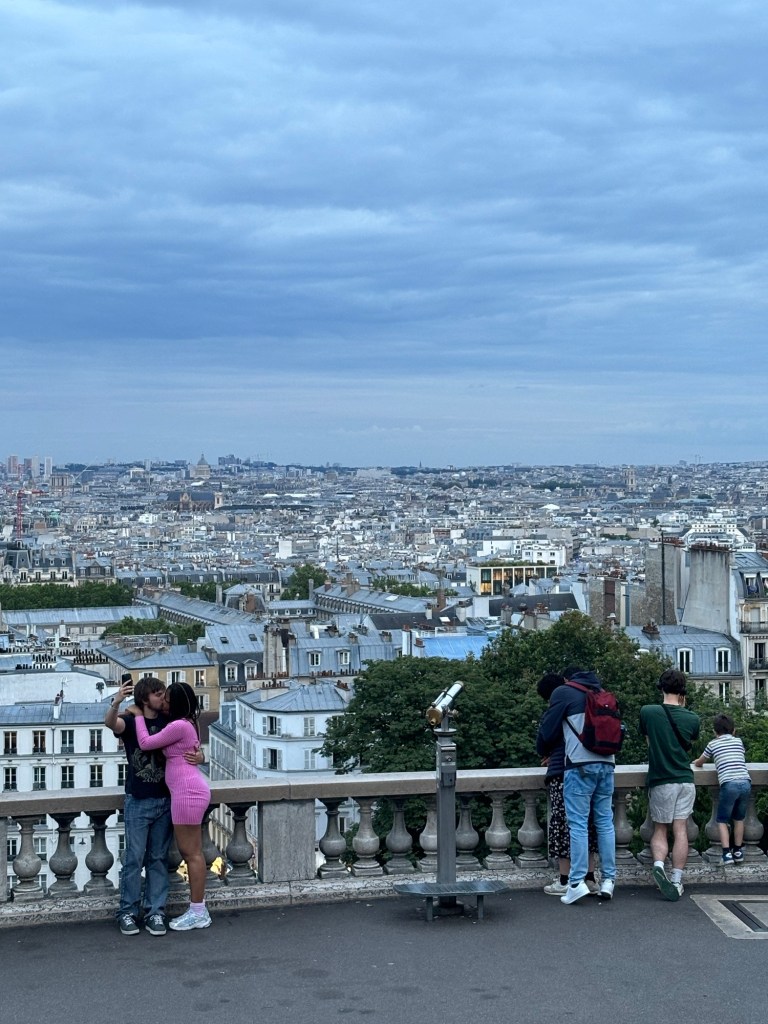
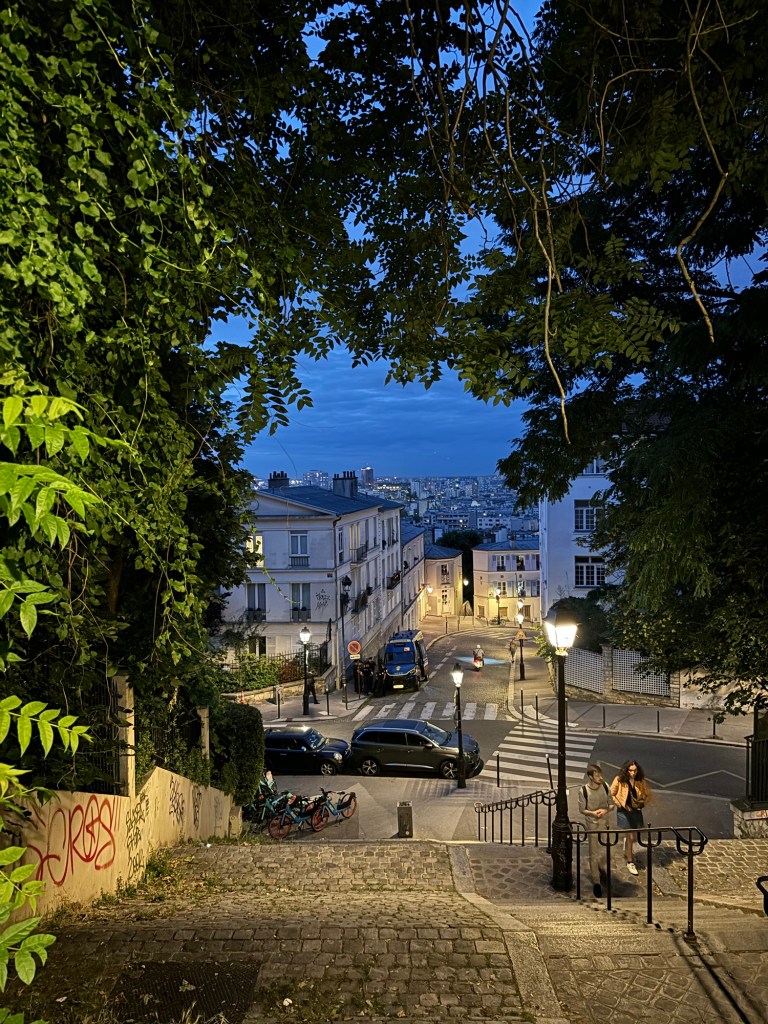
I haven’t been to Paris since I was eleven, and the last time I was here I climbed up the winding steps of Montmartre to the domed towers of Sacré-Cœur, so I figured that would be as good a place as any to start. The gendarmerie were out in force: the Paris Olympics are now only days away, and security in the city seems to be tightening up and fast. That didn’t stop the locals from having a good time, blasting music from the steps of the church, waving off the Indian lovelock vendors and generally having a good time.
Paris really is a beautiful city, even for the solo traveller, though I feel it’s absolutely a destination best enjoyed with a partner. I got much the same impression in Venice a couple years ago. Everywhere you look there’s a couple sharing a kiss, taking a selfie, holding hands at a café. It makes a welcome change from the awkward coolness of the British. We could learn a lot from these masters of the art.
Let’s play this like a dating profile. Let’s get serious. Monogamy is out of the question since I’m not about to be unfaithful to Spanish, so I’m hoping French is willing to share. Distance doesn’t bother me – Paris is only half an hour away by plane – and twenty-five and over would count for every one of those years I have spent grinding French. I am open to a short-term relationship with this language, but a long-term would be preferable (especially as I may well need French as my sledgehammer to get into the Spanish education system someday). Words of affirmation are 100% my love language, so I’m hoping I can find a warm spark within the infamous chilly disposition of the Parisians. And while my music tastes aren’t likely to be all that compatible, I was a major Stromae fan in my university days, and I’ve always had a thing for Afro-French artists, like Baloji. Between that and the unsurpassable bandes dessinées of my childhood (Astérix, Tintin et al.), we might just about have enough in common to have a go at it. So – how about a café date, to mettre la machine en marche?
I should find a café and make it my own while I’m here. That’s a plan for breakfast tomorrow, I think. You can’t really get an eye for Paris unless you spend some time in a café, after all. A bientôt, mes amis. BB x
My provisional license arrived in the post yesterday. My second, I should say, since after a very thorough summer holiday shakedown of the flat I’m convinced I must have accidentally thrown my first one out with the trash months ago. It’s put a major stopper on the whole learning-to-drive this summer by holding up the theory stage, but now that it’s here I’ve got no excuses. I should get booking.
But first, I’m getting out of here for a few days. I’m done with scrolling, hoping for contact from the outside world and turning off the WiFi for a bit of enforced internet downtime. Summer holidays just drag on and on when you have nothing to do, so I’ve decided to get out there and do something.
So here I am in the ferry terminal in Portsmouth, waiting for the 22.45 to Caen. The overhead telescreens keep alternating between the blue departures board and the vivid blue and yellow banner of Ukraine. The BBC News app remains focused on the heatwave, though the magic number 40 has disappeared from the headlines – “temperature tops 38C and likely to rise”. Five stories down, Tugendhat is eliminated from the running for Tory leader.
It certainly was hot today, but it didn’t feel much like that blisteringly hot summer holiday in Jerez almost twenty years ago. Despite the threat of 40°C heat, the breeze rolling in across the Weald kept the school grounds pleasantly cool. Even so, the signs that this has been an unseasonably hot few days are clear. When I went out to do a little reading in the morning, the summer soundscape was there: the echoing whack of a tennis racket, the ceaseless chatter of the house martins, grasshoppers chirping lazily in the meadow. A few hours later, the whole place was silent. Only a lone crow broke the stillness, and that was just the once.
I thought the train journey would be problematic due to the hysteria in the news, but despite the grovelling apologies over the Southern Rail tannoy, the train was only ten minutes late pulling into Portsmouth – which is remarkable, given how prone to delays they can be outside of a national crisis.
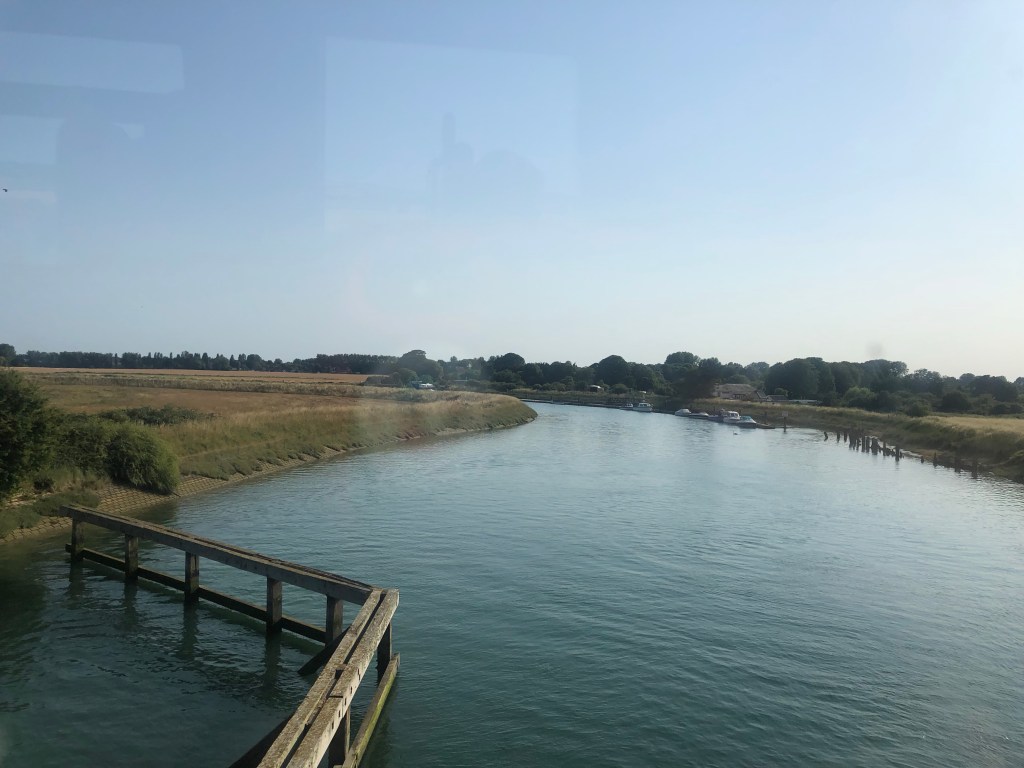
It’s a beautiful train ride, the route from Crawley to Portsmouth – one of those British rail journeys you should tick off the list, like the one from Darlington to Edinburgh. I never get tired of passing Arundel Castle and the fens at its feet. A childhood spent in and out of various salt-marshes around Kent has left me rather fond of their bleak serenity. Herons stalking the water’s edge. Egrets bedecking the bushes like so many plastic bags snagged on the branches.
Suddenly, an intensive greenhouse-farm appears, concealed from the outside by a thick growth of trees. A ravenous human hand clawing the depths of the earth to satisfy a hungry world. And then it’s gone, the train is hurtling forwards and I’m back in the marshes. I could be looking into the past or the future. I remember the fate of El Acebuche, its silent reeds swaying in the wind, and I’m not sure I want to.
The French family in the seats behind me must be headed for the ferry port, too. At least, I guess they are – I’ve caught the word “bateau” often enough. The children swap in and out of French and English without much of an accent overlay in either. The father speaks only on French, until he stops the ticket inspector to ask if she can turn off the air conditioning. “Don’t you think it’s rather nice, as it’s so hot out there?” – “For five minutes is nice, but it’s freezing.” – “If I were you I’d enjoy it.” At the next stop, the father gets out to soak up the sun. His daughter only just coaxes him back on as the doors close. Before he returns to his seat, he steps into the next carriage, remarks that it’s warmer, and moves. Within minutes the rest of his children have followed suit. It seems petty, but they have a point – the air con was turned up so high I had goose-flesh for half the journey.
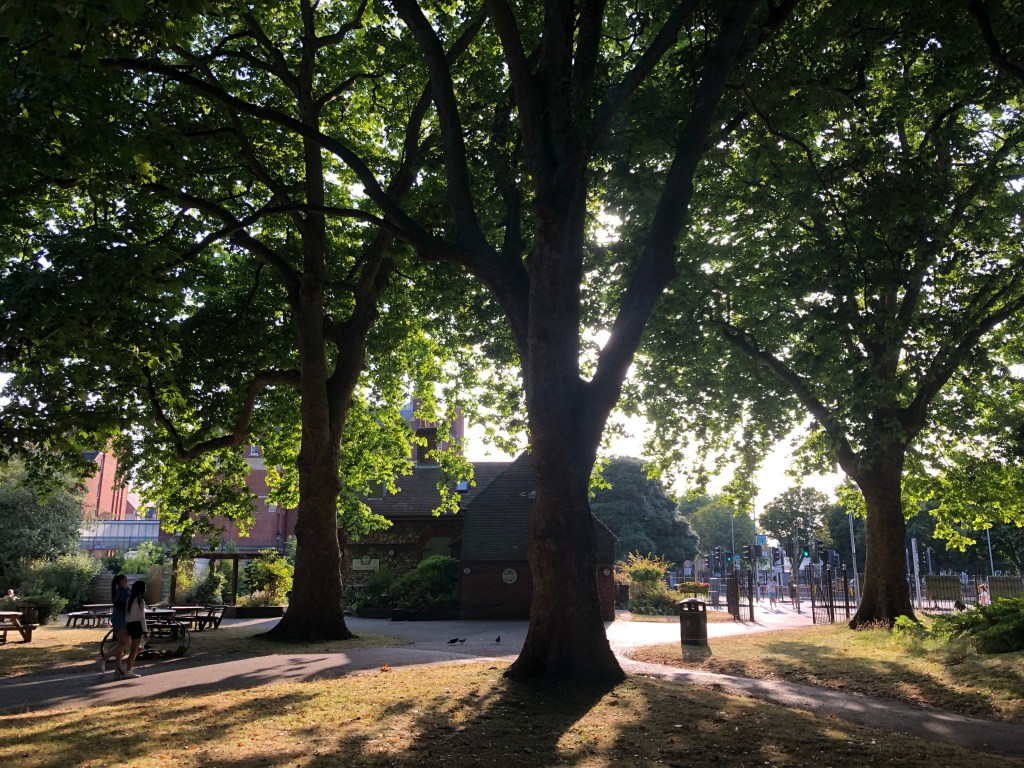
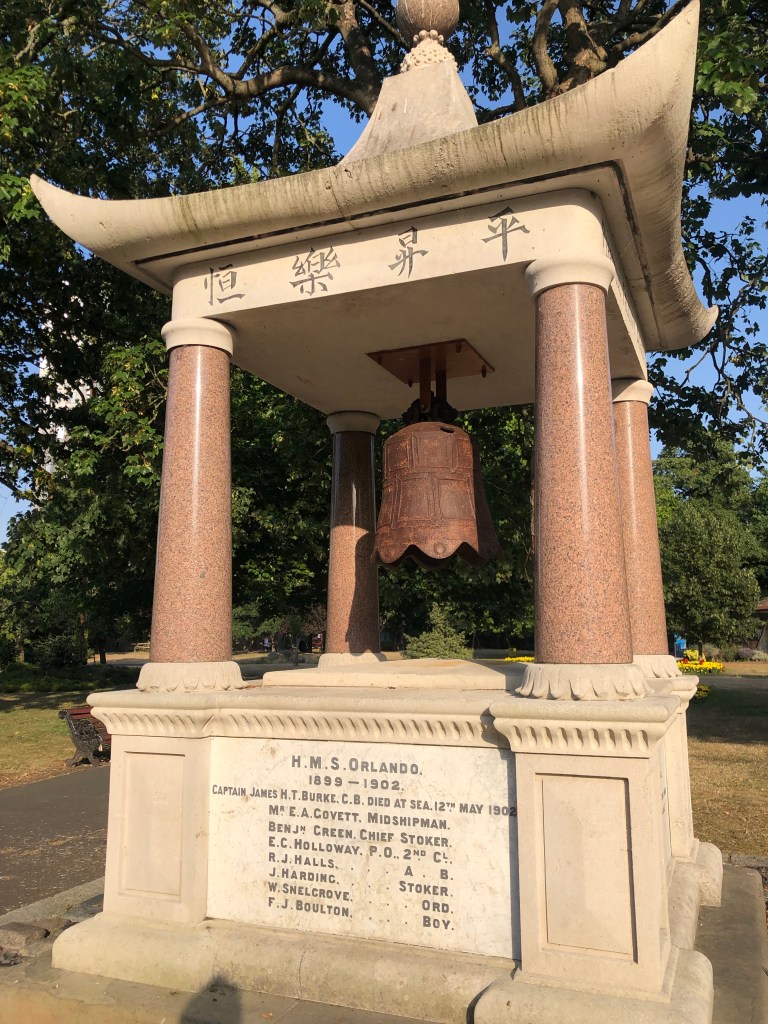
I haven’t been to Portsmouth before. The last time I caught a ferry in this neck of the woods was from Southampton, but that was many years ago and we didn’t stop. I had four hours to kill and not a lot to do, so I picked a spot in Victoria Park and watched the world go by. The bells of St John’s sounded for seven. They sounded strangely mournful, but though I hummed the melody back a couple of times, I couldn’t work out why. Two handsome women wander by, their accent West African and intensely musical. Three kids hurtle past, one on a scooter, two on skateboards. One wears a red-and-black chequered shirt tied around his waist (did everybody own one of those shirts at some point?). A family of cockatiels screeched from an aviary in the centre of the park, stolen away from their home far beyond the sea to entertain the fancy of the British public. An ancient Chinese bell stands nearby and seems to serve a similar function, pilfered – it says so in almost as many words on the plinth – during a campaign in Taku. A cryptically-worded message daubed above reads “Perpetual Felicity Achieved” in austere capitals. A breeze blows and the bell moves a little, but it makes no noise. Some cage birds stop singing after a while, too.
As the sun sets, I head to the port. The heat and the hysteria have driven everyone indoors. The high street is virtually empty. Just a couple of kids with drinks they’re nowhere near old enough to drink and a level of delirium to match, and a weatherbeaten gentleman sleeping in the shadow entrance to an Ann Summers store. A grey mannequin in turquoise lingerie poses suggestively through the window at him, blowing a kiss. He wipes his nose, shakes his head violently and turns the page in the book he’s reading.
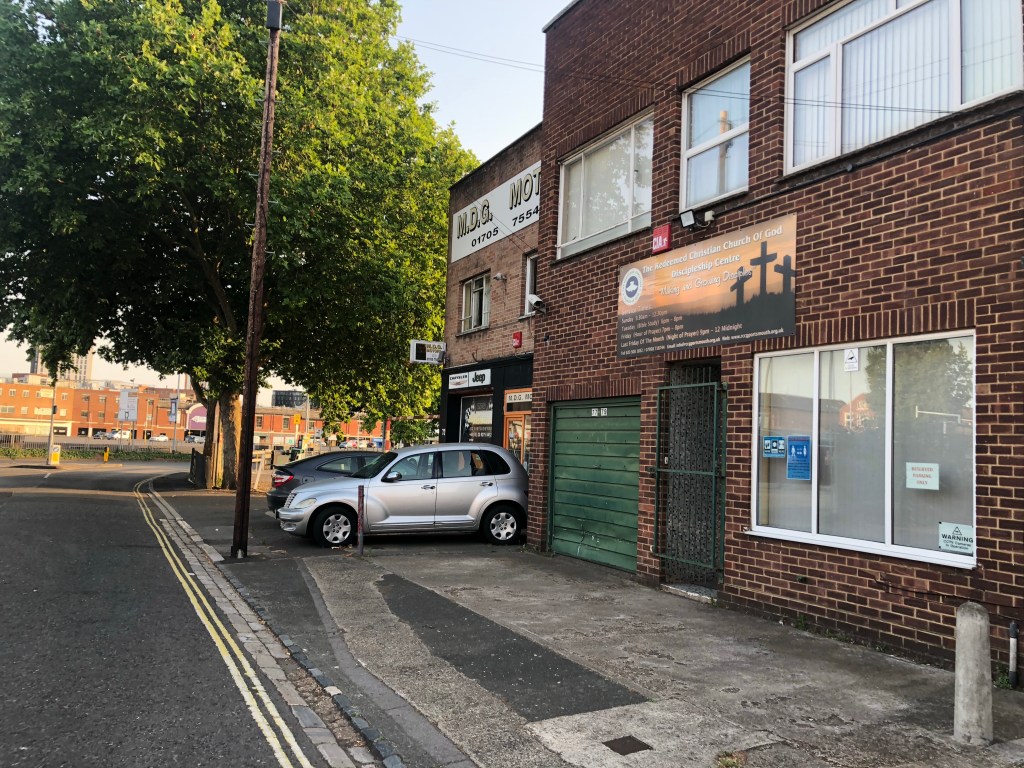
There’s plenty of folk driving here and there, but nobody on foot. For several minutes I feel like the only human in the city. A couple of Deliveroo me go by on their bikes. A bearded man in a red-and-black chequered shirt worn over his t-shirt, bent over almost double. I pass an outpost of the Redeemed Christian Church of God in a backstreet, and later, the house where Charles Dickens was born. Everything is shut. The high rasp of a motorbike going by, the evening heat and the strangeness of a new place… It almost feels like I’m abroad already.
But no. I’m still here in the terminal. Boarding starts in ten minutes, so I suppose I’d better close there. A demain, mes amis. France is calling! BB x
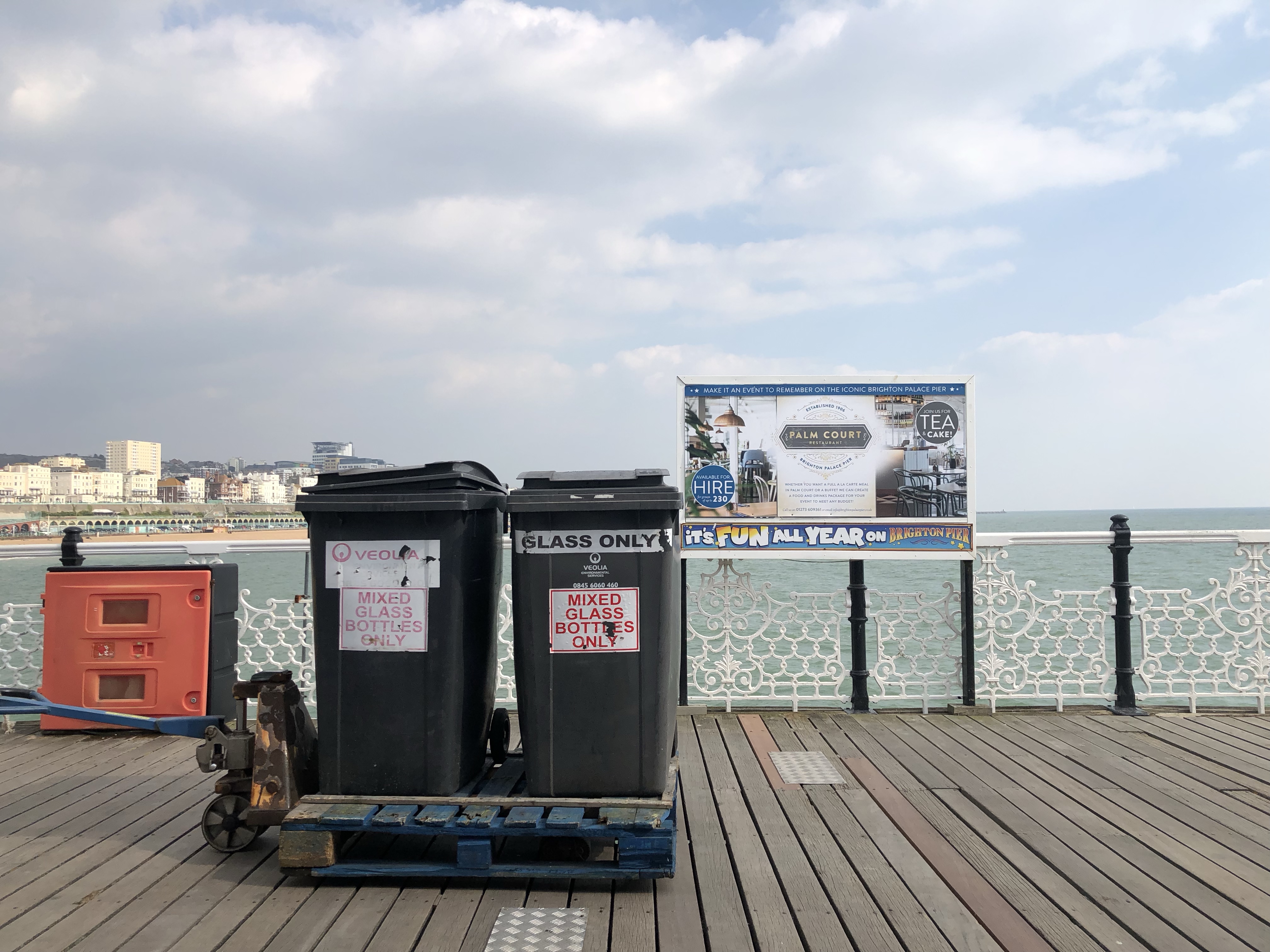
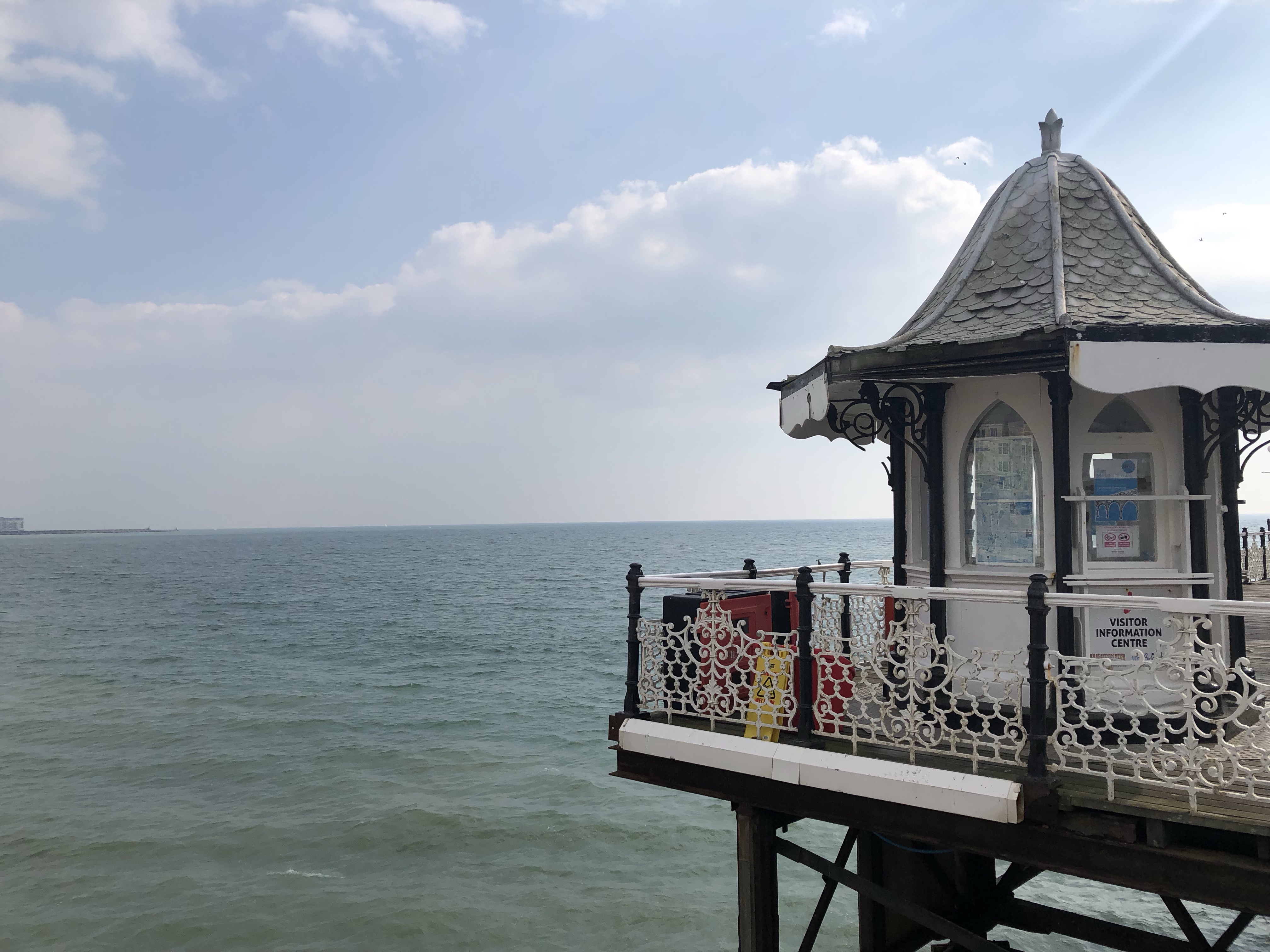
2:45pm, 20th March. I’m sitting on a bench on Brighton’s Palace Pier, sheltering for a moment from the wind. A sign in front of me reads “It’s fun all year on Brighton Pier”. Somewhere down the coast to the east, there’s a few mad folk towelling off after a swim. The sea doesn’t exactly look inviting today. I look down through the slats. The bottle green waters of the Channel heave and swell about the centipede legs of the pier below. I wonder what creatures of the deep might be looking back up at me, besides the silent starfish in the silt.
Two men wander over to the parapet, gazing down at the beachgoers below. One of them watches in silence, nodding occasionally. His companion holds a recording device of some kind in his hand and is whistling a crude but not inaccurate imitation of the gulls. Is he trying to lure them in, perhaps? To what end? I can’t quite make out his game. He keeps it up the whole time, occasionally saying something in Arabic to his companion and chuckling, and then whistling his gull-call again. After a while, they move on, whistling. His friend must have the patience of a saint. You get all sorts in Brighton.
A few seconds later, a herring gull lands on the parapet. It’s not there for long, as a gang of girls in tracksuits race up the aisle towards the gloom of the arcade, screaming and swearing, sending the panicked bird into the air in their wake. Two scavengers in a truck trundle by in the opposite direction, trailing two heavy GLASS ONLY bins behind them. The planks tremble beneath my feet. I imagine, for a moment, the structure collapsing beneath its weight. In slow motion I see the bins rolling over backwards and a cascade of bottles plummeting into the sea below, some of them shattering on the struts of the pier before they hit the water. I have a pretty active imagination.
I move on up the pier, past the booming darkness of the arcade, which still seems to draw in a faithful clientele, despite the mobile lure of pocket entertainment. In fact, I’m actually pleasantly surprised by the absence of phones on the pier – for once, I’ve got mine out more than most as I take notes. Beyond the arcade, I reach a collection of outdoor game stands. Tin Can Alley with a bored-looking brunette in a red shirt waiting for custom. Dolphin Derby with an enthusiastic announcer who wouldn’t look out of place in a pinstripe waistcoat and boater a hundred years back. An Indian family points out across the water talking in a language that isn’t English. A couple walk past, hand in hand, one of them gamine with a grey-tinged ponytail over shaved sides and a nose ring, and her partner robust, black, ripped jeans and winged eyeliner, a rainbow lapel badge pinned to her sleeve. The air is thick with the pungent smells of Brighton: fish batter, candy floss and the distinctive damp tang of weed. The breeze coming in off the sea cancels out one of the three at a time, but not for long.
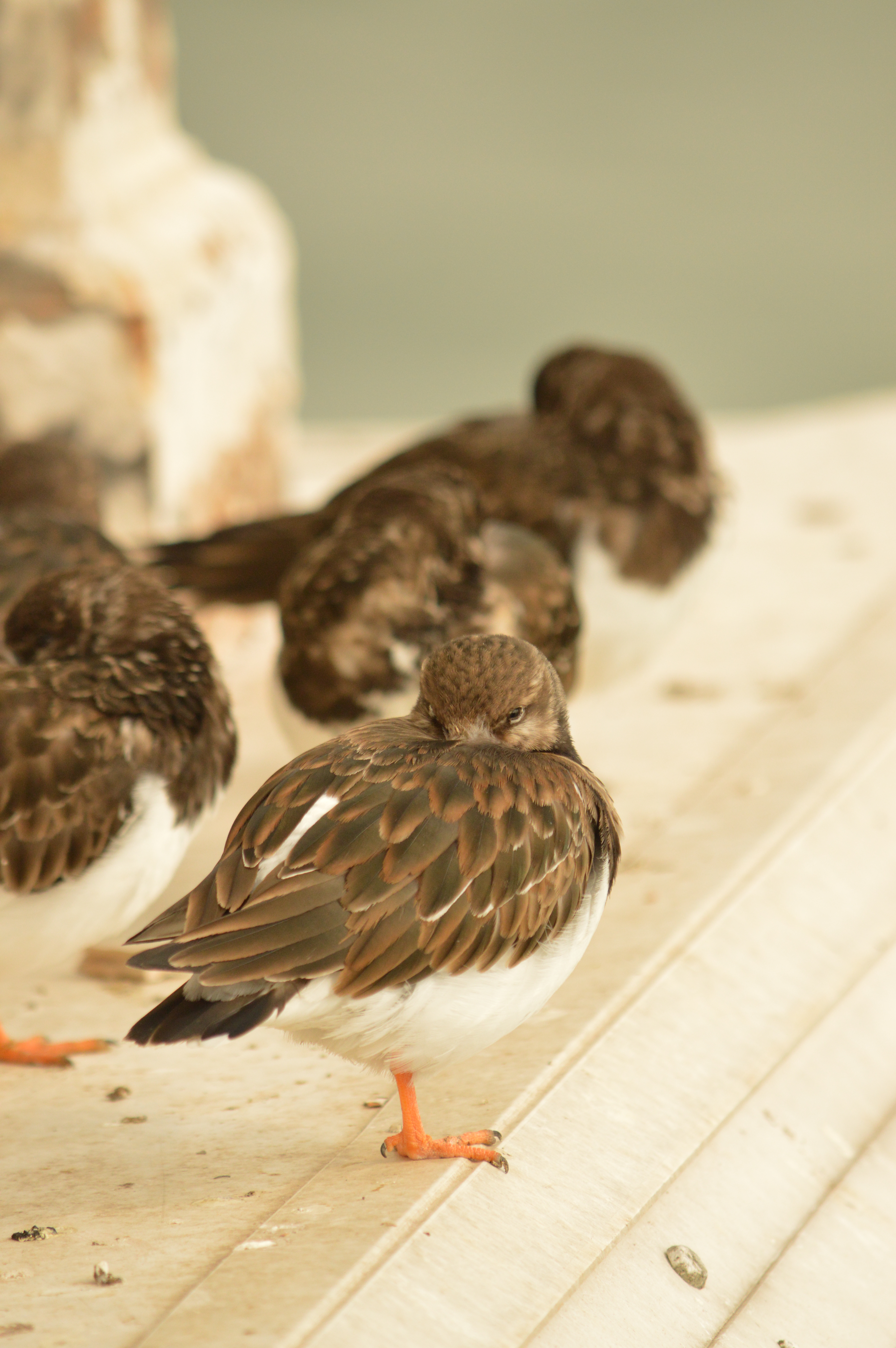
Behind the Tin Can Alley shack, a huddle of turnstones get some shut-eye. These often hyperactive creatures look out of place when static, and one wonders how they manage to get any rest at all with the thumping bass from the fairground rides at the end of the pier. It almost looks as though there’s a physical pecking order to the clan, and the ones at the bottom aren’t having much luck, hopping from strut to strut with remarkable dexterity. A passer-by sees what I’m looking at and stops to take a few photographs on her phone. The turnstones don’t seem to be fazed by me, or her, or any of this. After all, it’s fun all year on Brighton Pier. They’re probably used to it.
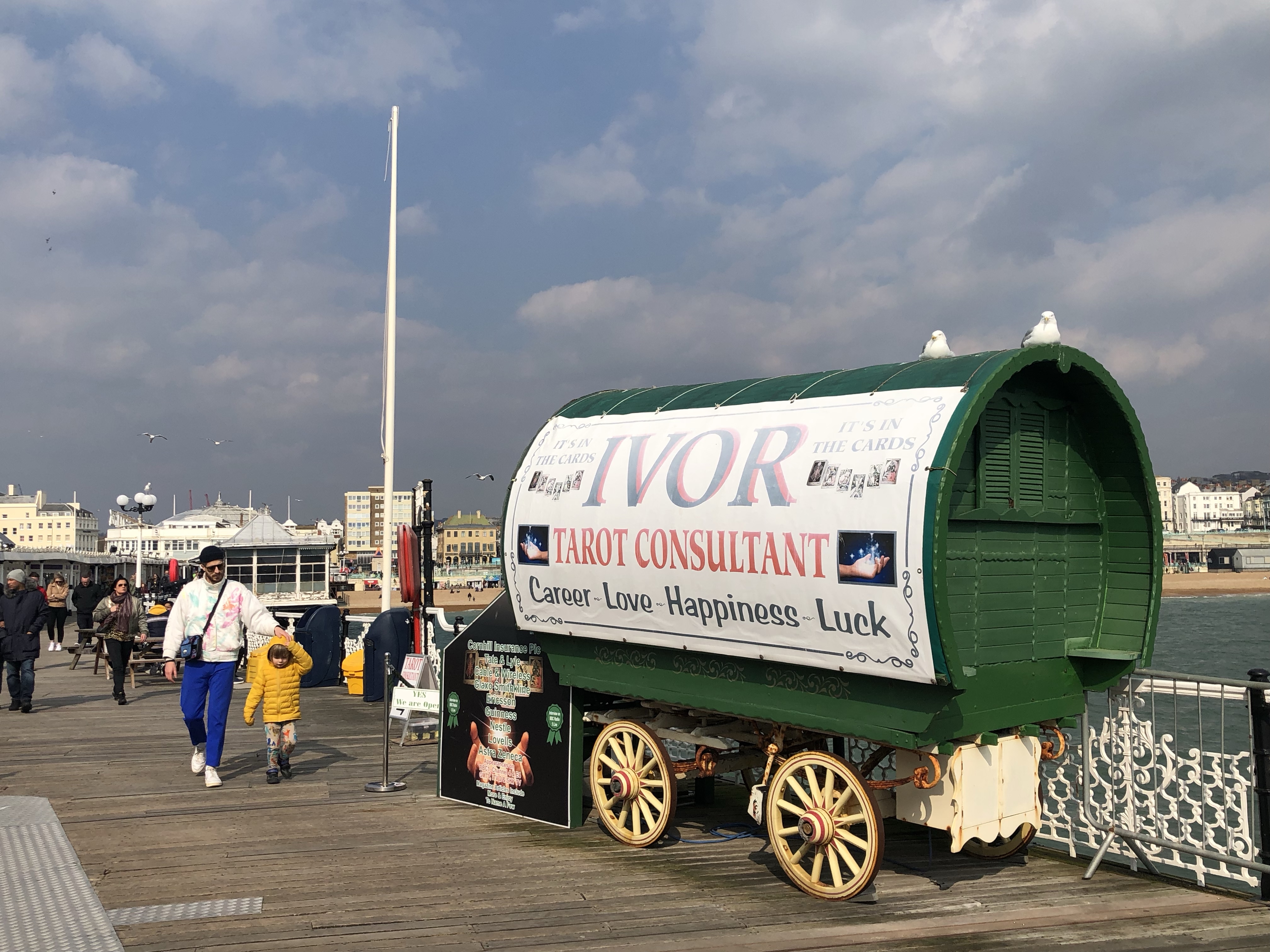
Nearer the fairground, an old gypsy-cart sits awkwardly beside the parapet, offering Tarot readings for a modest sum. Career, love, happiness and luck mingle strangely with Nestle, Astra Zeneca and Cornhill Insurance plc. I remember finding an abandoned gypsy-cart in the woods once when I was a child, its richly-painted woodwork fighting a losing battle with the forest’s silent army of moss, lichen and brambles. The gitanos in Tierra de Barros had no such fancies, eking out a living from beat-up cars and shabby tents. There is an old song of theirs I have consigned in part to memory, telling of their love for the Guadiana River, that came to mind:
The region of Chal was our dear native soil, Where in fullness of pleasure we lived without toil, Til dispersed through all lands ’twas our fortune to be, Our steeds, Guadiana, must now drink of thee.
Gypsy ballad, translated by George Borrow (The Zincali, 1841)
I doubt the gitanos camped outside Villafranca de los Barros would know the song. It comes from an older world, much like the incongruous cart parked at the end of Palace Pier.
The fairground plies a busy trade for a chill-if-sunny Sunday in March. I feel like I’m walking through a childhood I haven’t known in twenty years, not since the distant summers in Dymchurch. Tea cups, log flumes and merry-go-rounds. A helter-skelter – see the Isle of Wight on a clear day! – painted up like a stick of Brighton Rock (or maybe the sticks are painted after the fashion of the fair). The static gilded horses on the merry-go-round look no less terrifying than they did when I was a boy. The ghost train reels in customers one at a time, lethargic, a chameleon in the cold. A father explains the “this high to ride” sign to his son, who is just a little too short for any of the attractions. I get the impression I’m snooping a little too much and wander away from the noise.
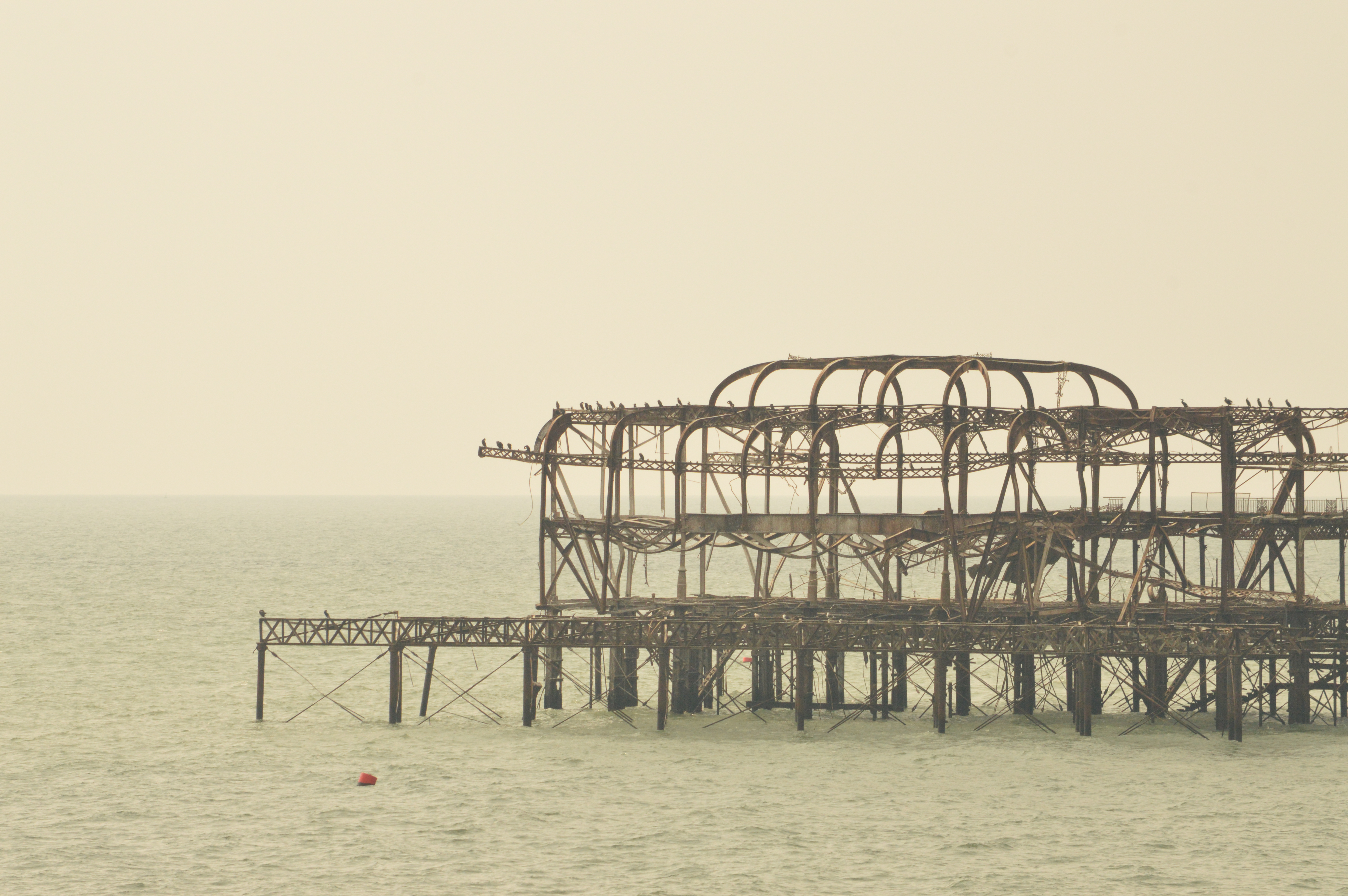
There’s a quiet spot behind one of the rides, looking out towards the mouldering wreck of the old pier. Seen from its sister with the city behind it, the Western Pier looks small and unimpressive. From the shore it looks a little more mysterious, where its mangled skeleton claws at the horizon like the blackened bones of a giant, mechanical whale, picked clean by the cormorants that sit on its ancient struts. In their oil-black funeral garb, they might as well be an extension of the wreckage. Brighton’s gargoyles.
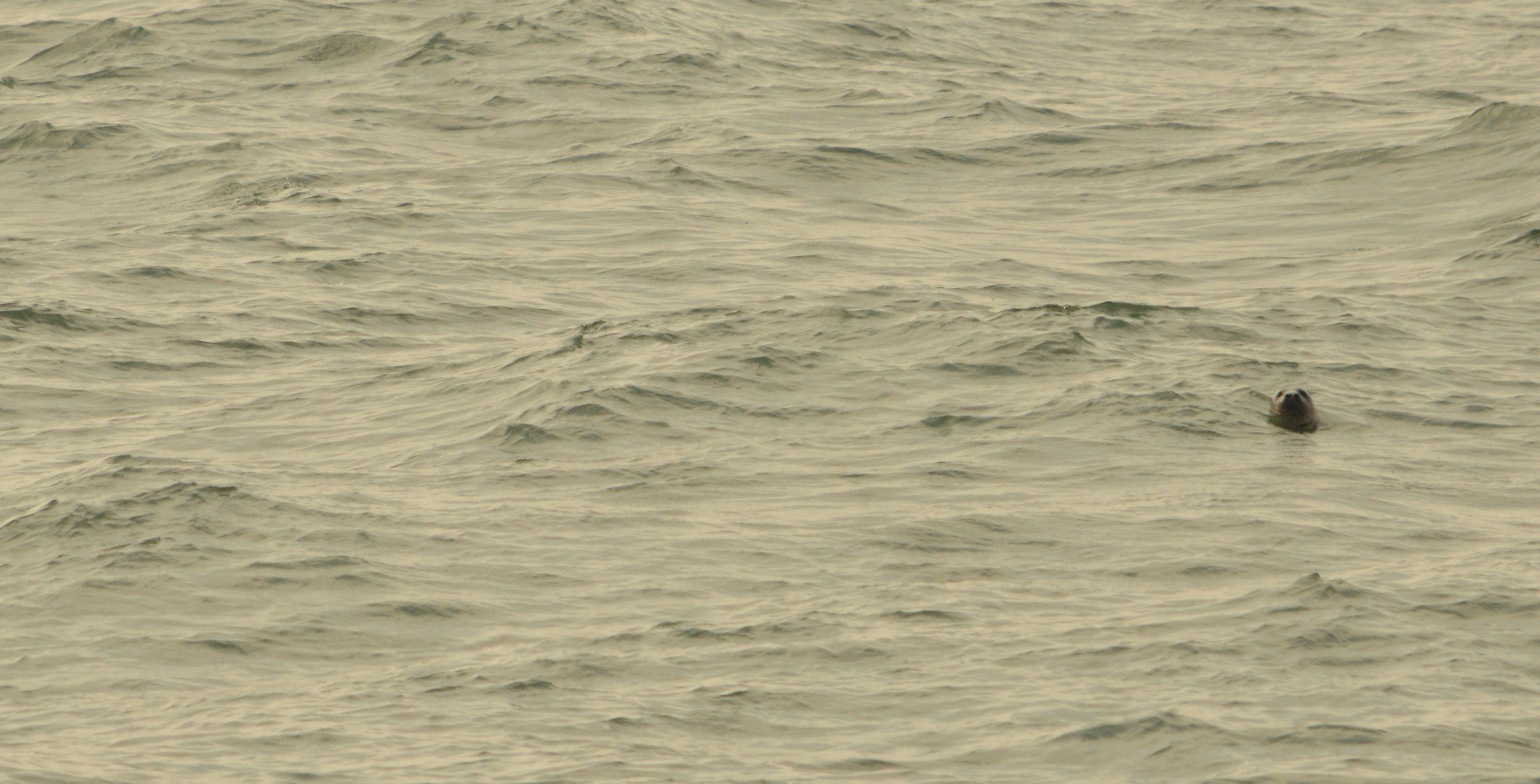
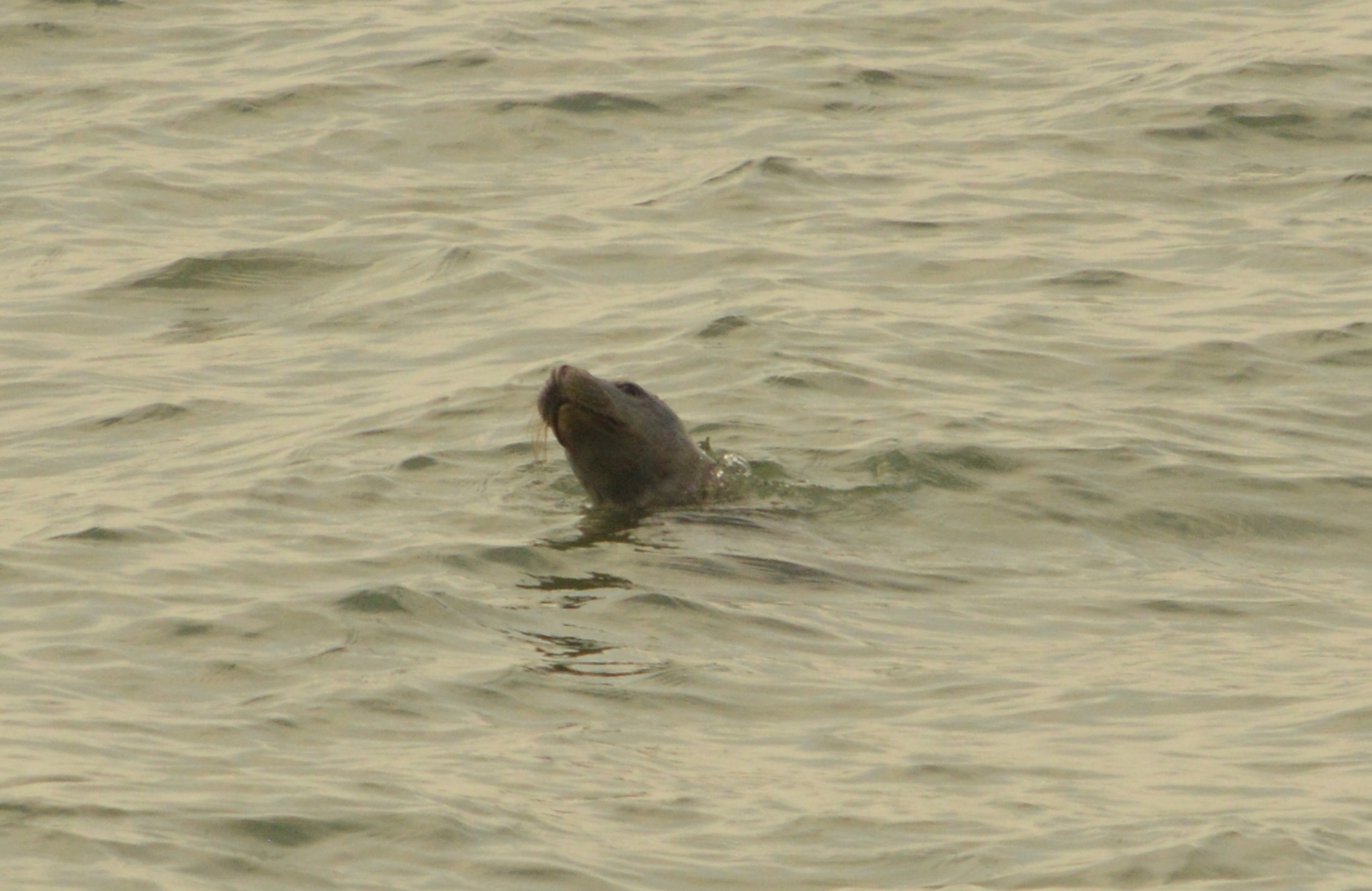
Something bobs in the water closer to the Palace Pier, and without looking through any lens it looks too misshapen to be a buoy. It turns for a moment revealing long whiskers and those baleful black eyes, before sinking beneath the waves. I’ve been scanning the water all morning for that sight, and now I’ve found one, I can’t let the moment pass me by. I count the seconds. One, two, three…
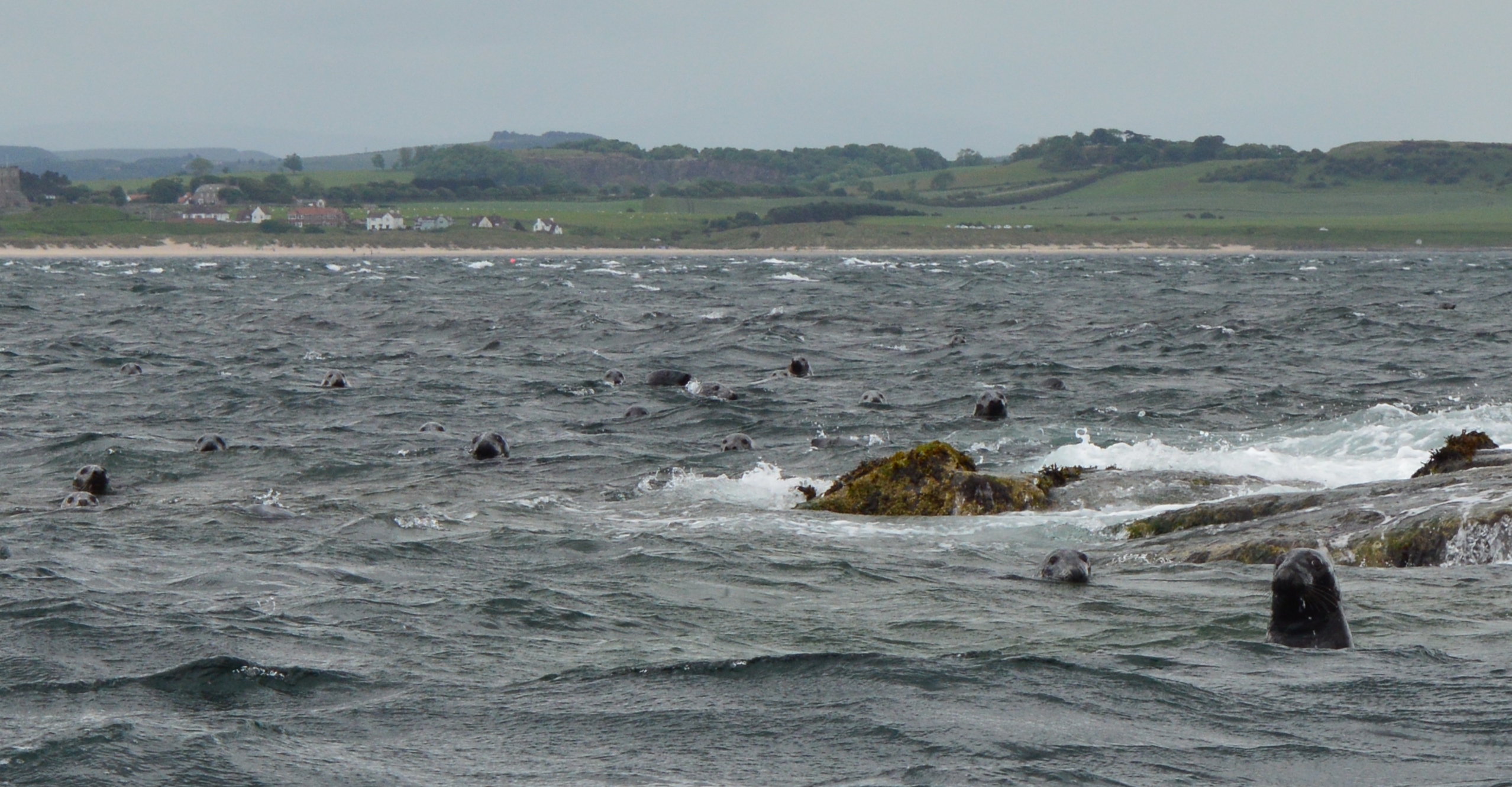
Seals are such mesmerising creatures to watch. It could be their friendly faces, the way they seem genuinely curious about the world above the waves. For me, it’s all about their eyes. There are few creatures out there with eyes like a seal’s: enormous, black orbs that seem to see forever. You only see the whites of a seal’s eye when they’re really close, otherwise you might as well be looking into the dull glaze of a shard of volcanic glass. I used to watch them bobbing about in the waves from the white cliffs when I was a teenager, and once or twice I was lucky enough to see them closer still, lounging about on the mudflats of the Stour Estuary and snorting their indignation at the noisy ferry-boat off the Farne Islands.
Those were greys: hulking, dog-like beasts of considerable size, especially the bulls who came charging after the boat. It’s not hard to see why so many languages label the creatures sea-dogs, or sea-calfs, or even sea-cats. But unless you’re in the water with them, all you see is the inquisitive face, bobbing above the surface. The seal comes into its own beneath the waves. I should love to see one in its murky underwater kingdom one day.
Some creatures command the eye. The ghostly silence of the male hen harrier, or the aerial mastery of the kite. The sunken eyes of the fox and the stern gaze of the stag. I once sat in my bedroom poring over bird guides of Spain and the Mediterranean, bemoaning how drab our world was by comparison. With age comes understanding, I suppose. If the seal hadn’t drifted further and further out to sea, I could have watched for hours.
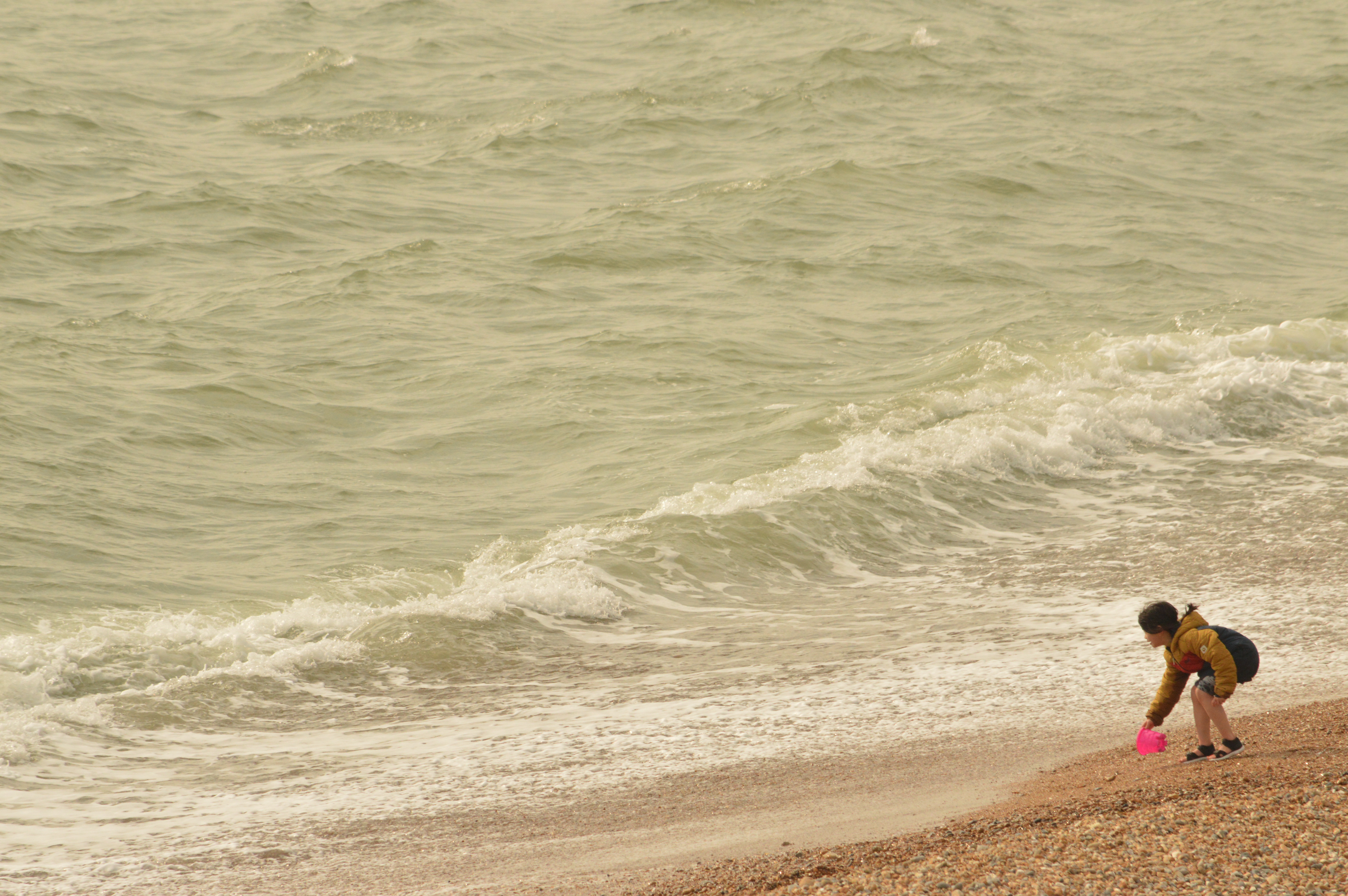
I spent most of my teenage years growing up on the pebbled shores of this same stretch of ocean. The salt breeze and yellow-grey skies of the Channel are written into my skin like age-lines. I should make a point of coming down to the coast more often in future, if not to blast the cobwebs of work aside with a healthy salt spray, then to find the writing material I’m always searching for. If I can find my way to a quieter spot than Brighton, I might even be able to sidestep the bookshops that always draw me in. Fortunately, I’ve been such a loyal customer to Waterstones over the last couple of months that I was able to walk away from today’s haul for a steal of a price. Just don’t ask how many books I bought – or how big the discount was. It’s all for a good cause. I’ll keep telling myself that. BB x









 The Book of Barnabas