Camino XX: Soup and Bustards

Albergue Municipal de Peregrinos, Frómista. 19.59.

Well, you’ve got to hand it to the good people of Castrojeriz. They may not sleep much, but they sure know how to party.

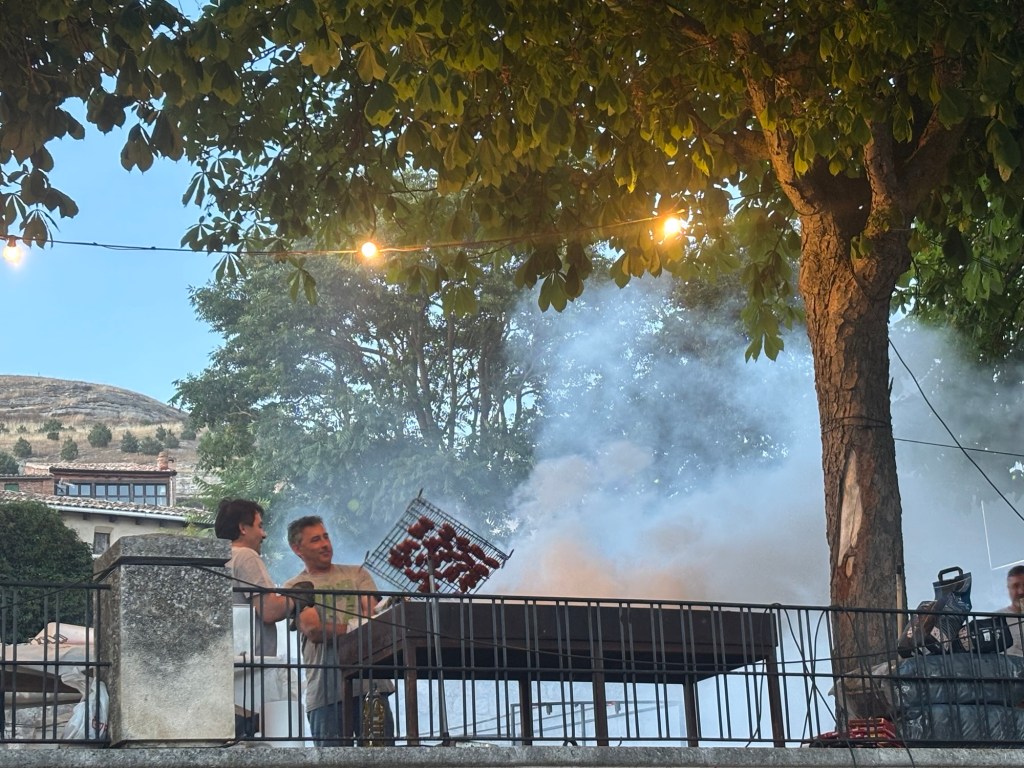
The Garlic Festival kicked off at around 7pm. While the others ordered pizza, I went without supper (with the free sopa de ajo in mind), which turned out to be a mistake. They finally started serving at 9.40pm, and queuing for half an hour, I reached the serving station only to find that you had to bring your own bowl. Turns out the identical brown bowls the townsfolk were all carrying can be found in every home in Castrojeriz and beyond. It would have been nice to know before getting in line – you know, like a sign or something – but then, Spain has never been overly fond of letting non-locals in on its secrets. So I was dismissed with an apologetic ‘ay, pobre’ by one of the volunteers and went to bed on an empty stomach.


I had about an hour’s sleep until the Orquesta Dakar started playing just after midnight. They didn’t stop until ten past two in the morning, after which they were followed by a DJ until half past four. I’d be lying if I said I didn’t enjoy the music, as it was absolutely my taste – Suavemente, Las manos pa’ arriba, Bailando, Madre Tierra, Mentirosa, El Tiburón and, randomly, You’re the One that I Want, to name just a few – but it did mean sleep was impossible. Then there was the family of locals who stopped beneath our window and, for whatever reason, decided to start howling and barking like dogs for a couple of minutes sometime between two and four (clearly all that garlic had no effect on the local werewolf population). I must have passed out somewhere around four, and was up again by five.

Thank goodness today was a shorter day!


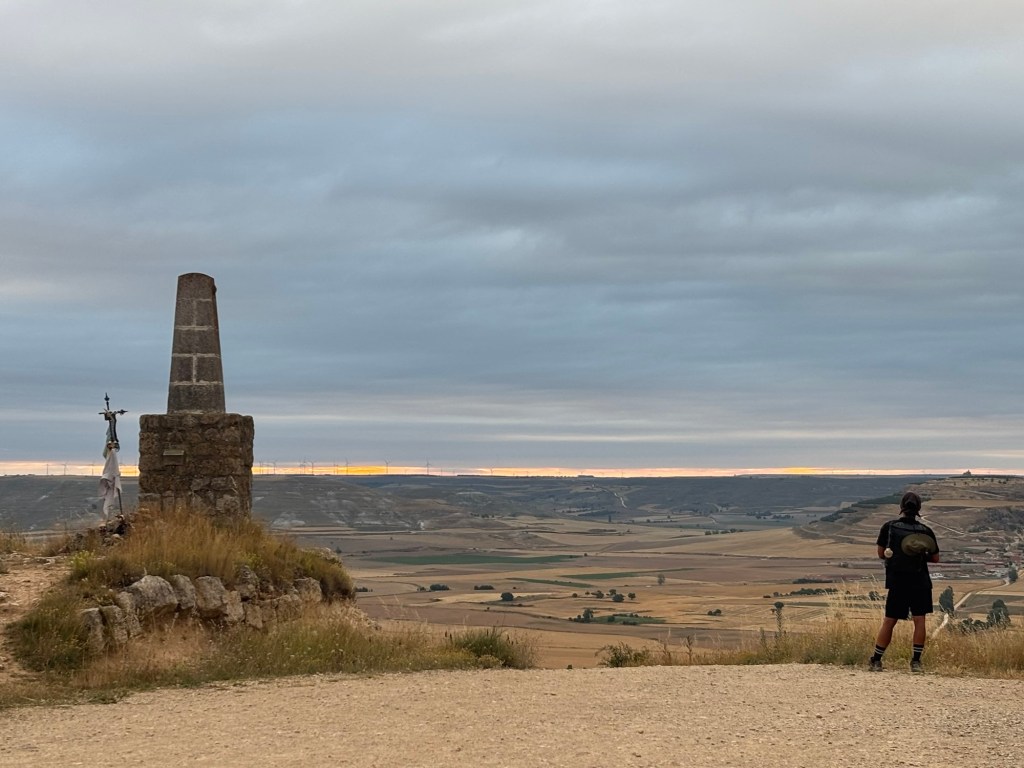
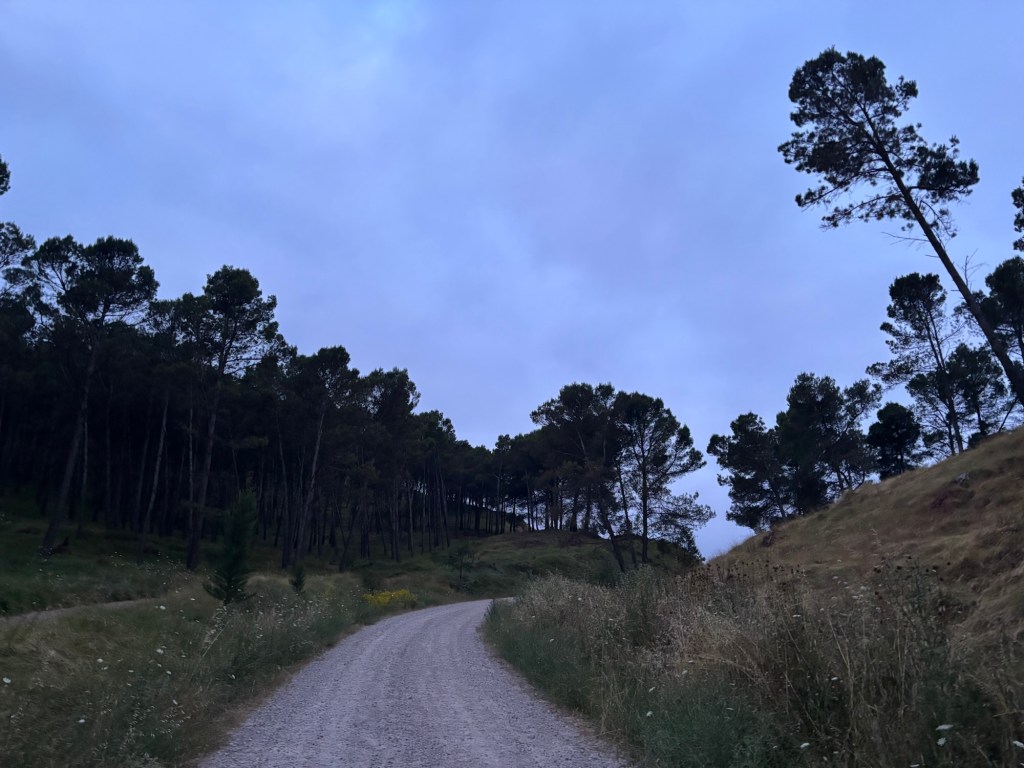
There wasn’t much call for shooting off early on some monstrously long hike on no sleep (which I’ve been known to do when sleep-deprived), so I stuck around and had the fried breakfast buffet I’d paid for. We tackled the Alto de Mostelares and were up and over by half past seven. It was an easier climb of it than it would have been under the midday sun, but I couldn’t shake the feeling that I should have pressed on yesterday and made for the Ermita de San Nicolas for a more spiritual (and restful) stop.


Descending from the hill, I found a manic speed in my feet and took off at a vicious pace. I didn’t need to, really, considering I had left far too late in the morning for another mad rush to Carrión, but for some reason I wanted to go it alone this morning.

It did mean for a bit more wildlife observation than I’ve managed for a while. There were a few silhouetted harriers up on the high Sierra de Mostelares, and a couple of rabbits and red deer grazing in the fields beyond. I was accompanied all the way by small families of stonechats and huge flocks of serins, twittering merrily from the stands of trees by the road.

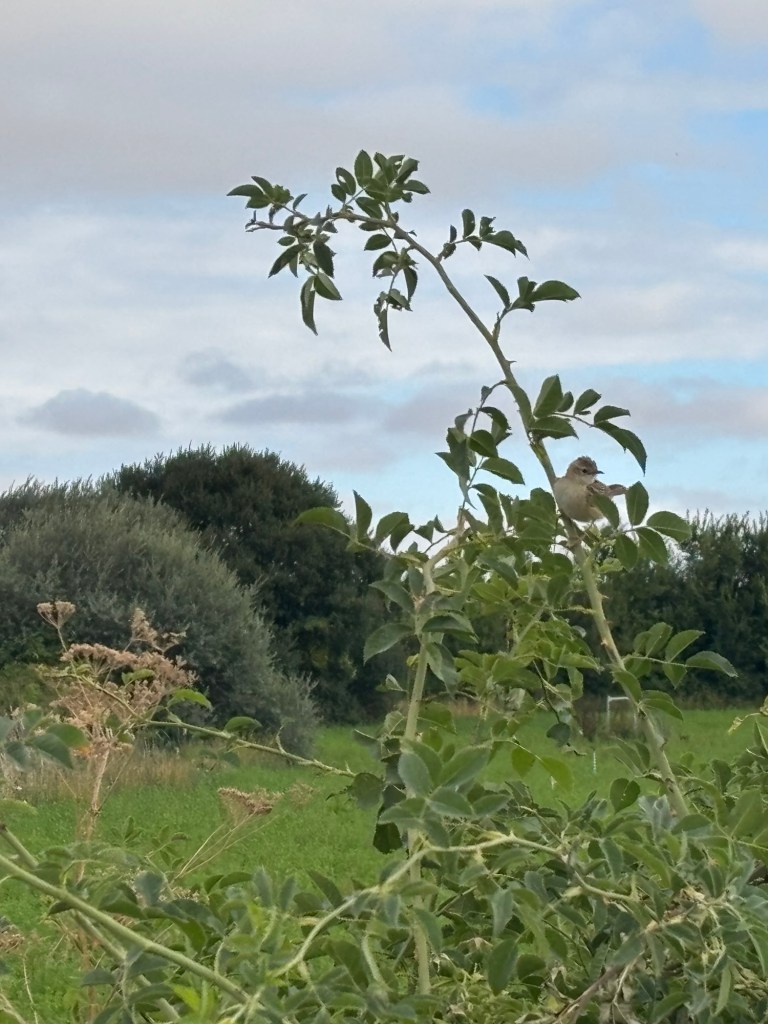
This morning I had a close encounter with a zitting cisticola, a characterful little bird with a name that pretty much tells you all you need to know to identify it. They’re usually heard and not seen, measuring around 10cm from beak to tail and zitting high in the air and out of sight, but this one was quite happy to watch me go by, and didn’t flinch when I stopped to take a photo.


I considered staying in Boadilla del Camino, but just like two years ago, I arrived around 10, about three hours before the albergue was due to open. So I waited for the others, had a drink and carried on.

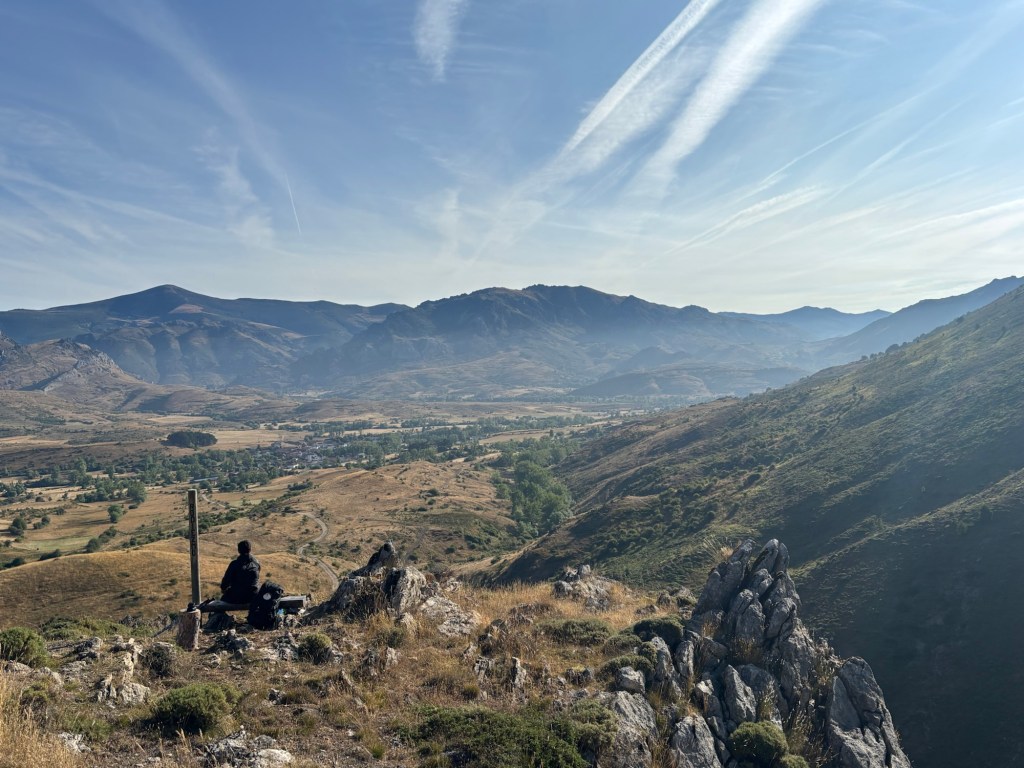
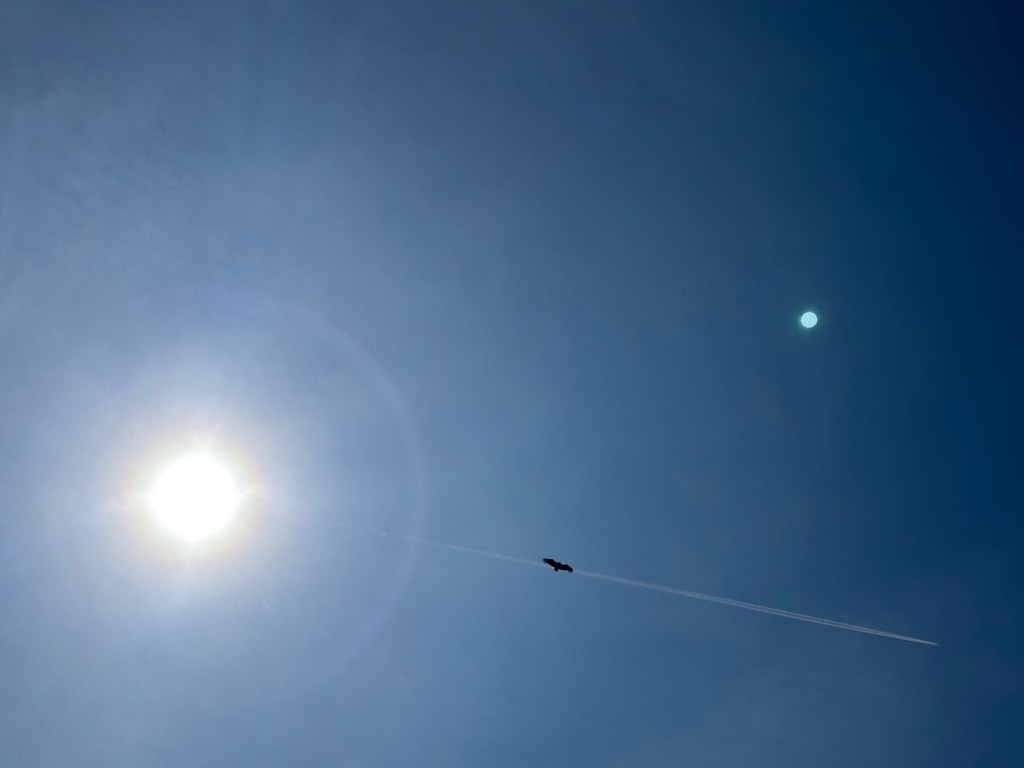
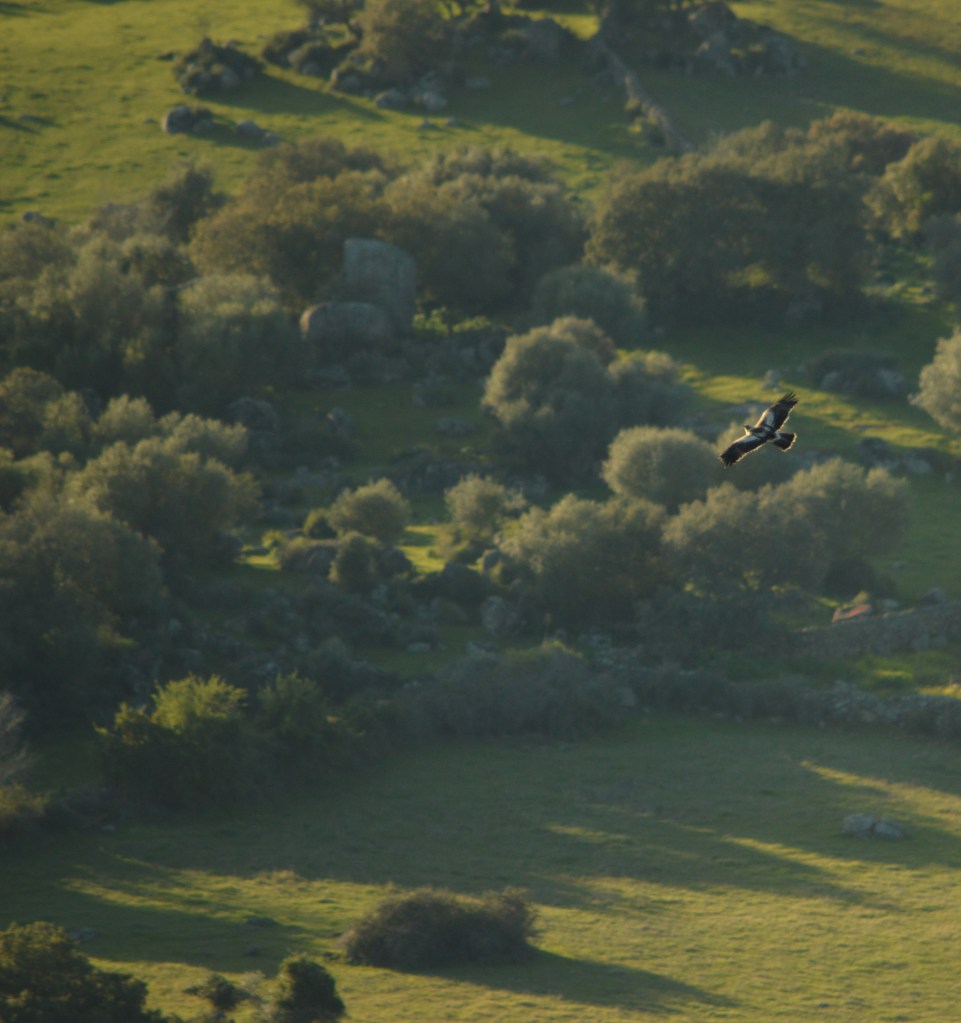
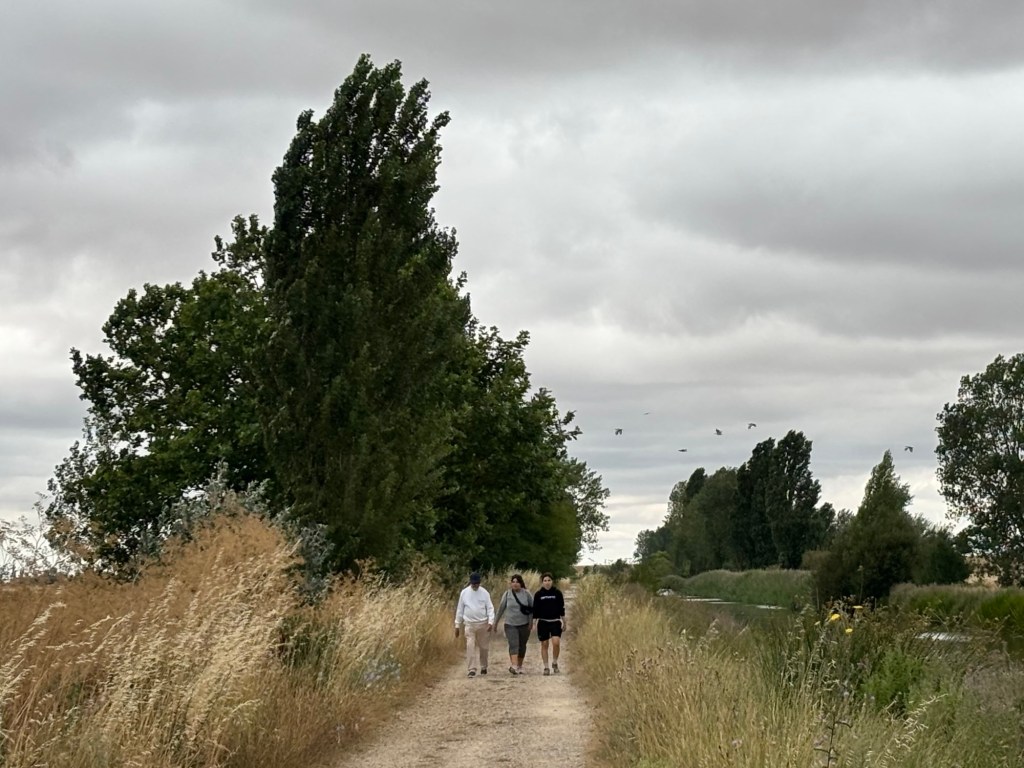
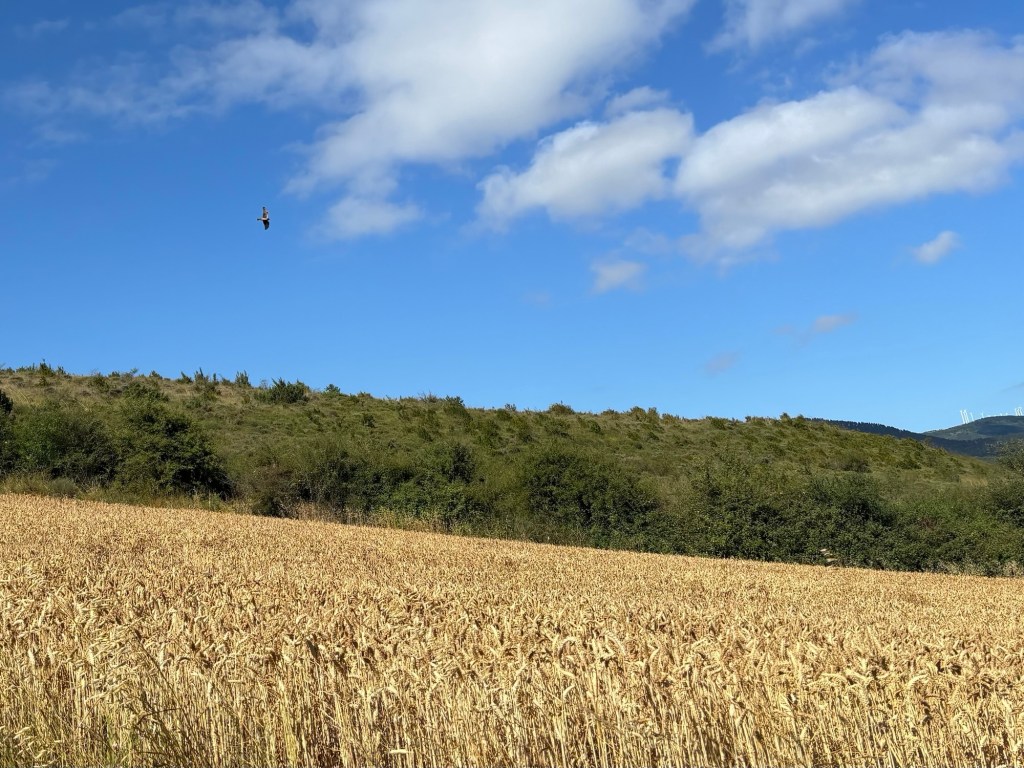
From Boadilla, the Camino follows the Canal de Castilla, a strange 18th century project that irrigates the northern reaches of Castilla y León. I saw just the one family coming the other way and no pilgrims, but I did have a brief encounter with a magical creature of the steppe: a flock of great bustards, one of Europe’s largest, rarest and most impressive birds. I’ve only ever seen them in the distance from trains or buses, but they’re always unmistakeable in flight: enormous, swan-like things with mottled feathers and pure white wings. It made my heart soar a little in this strange and man-made part of the Camino.


Well, I’m here in Frómista, which I bypassed last time. You know what? It’s not so bad. The albergue municipal is decent and the company is highly entertaining. I guess I gave it the cold shoulder last time in my hurry to press on and meet the crowd. I’m glad I stayed over. BB x

Camino XIV: Black Eyes

Cafetería La Concha, Grañón. 16.15.

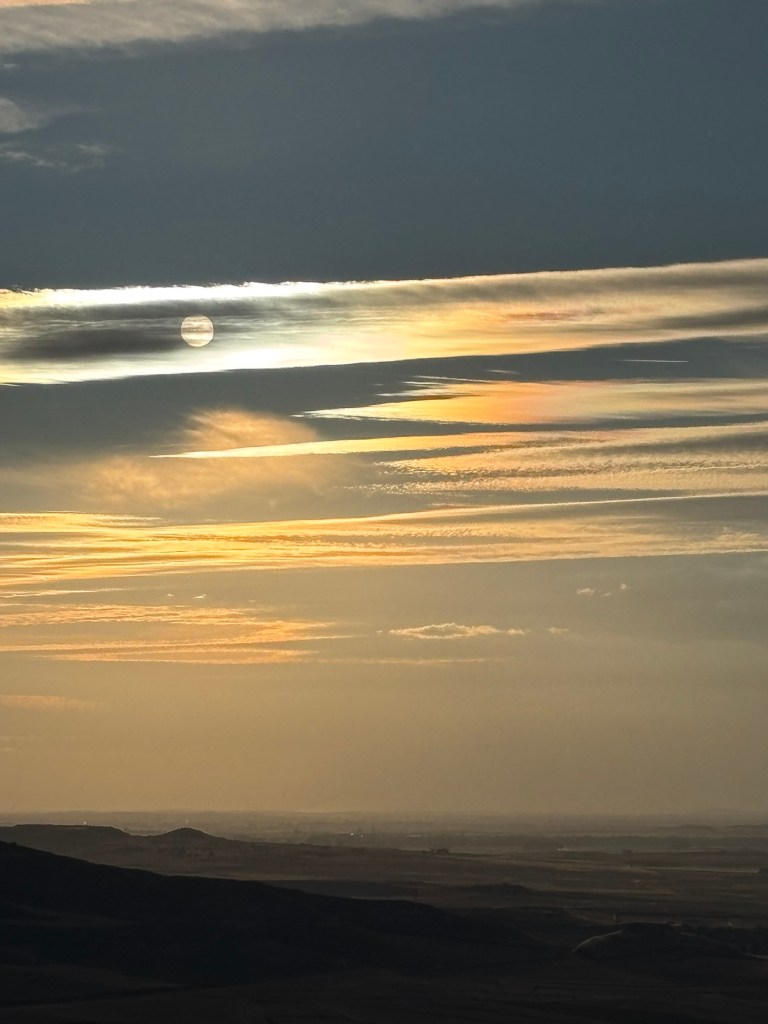
A red sky in the morning is usually a herald of rain. I saw the rising sun for just a fraction of a minute as I left Nájera: a huge blood-red disk, perfectly circular, disappearing almost as soon as it appeared behind a low curtain of cloud that stretched at least as far as Aragón, and perhaps beyond. It’s certainly true that it was a cooler and cloudier morning than most, but whatever promise of rain the sun made it the early hours was forgotten once it was out of sight, like a fickle lover. The clouds have almost entirely disappeared, leaving behind the immense blue heavens for which Spain is so famous.

I’m here in Grañón – ice cream in hand – and it couldn’t have worked out for the better.


I was woken in the night by a pillow to the face. In the half-light I saw the pilgrim on the bunk below standing there. He said something, but it was in German and I was half-asleep, so I neither understood nor recall what he said. I guess I might have been snoring, though that’s not usually a problem these days – but I was on the top bunk, which had no railings, so my sleeping posture probably wasn’t the best last night.

The others – my Camino family, as it were – were all still fast asleep, and their intention was to reach Santo Domingo de la Calzada (the guidebooks do have a strong hand in where pilgrims end up), so I set out alone. I have somewhat mastered the “Irish Exit” strategy, and the Camino lends itself very well to such a move.

The reward for striking out alone was a nightjar – and not just the sound of one, but the sight of one as well. They’re bizarre creatures, nightjars: shaped like a cuckoo, or maybe a small hawk, with an owl-like face, a whispered beak and enormous black eyes. They’re often heard in the places they frequent, but rarely seen due to their nocturnal habits, so it’s remarkable that they should have left such an impression as to have such an intensely evocative name in each language.

In German they’re nachtschwalben – night swallows. In Spanish, chotacabras – goat-suckers (the Italian succiacapre is much the same). The French use the term engoulevent – literally, wind-eater, on account of their hunting habit of flying through the twilight air with their beaks wide open. In English, I can only assume the name is phonic: because the nightjar’s call can only be described as a long, rasping jar or churr, which it can go on producing for hours with seemingly no need to rest.

I only saw it a few times as it moved beneath the forest canopy, with the jerky motion of a child’s toy glider, its wings held high as it manoeuvred dextrously through the trees. But it was enough. I consider that a very good start to the day.


I came this way during the spring a few years ago and I remember needing gloves, it was so cold. There was even frost on the ground. Not so today: the endless green fields of shimmering wheat have since turned to gold, as though by the hand of Midas. With the merciful cover of the clouds, they were not blinding to the eye, so the loss of my sunglasses in Sansol the other day was no concern, though I did buy a new pair in Santo Domingo; it would be nothing short of madness to attempt the ceaseless flat of the Meseta without them (where it sometimes feels like you’re walking on the sky).


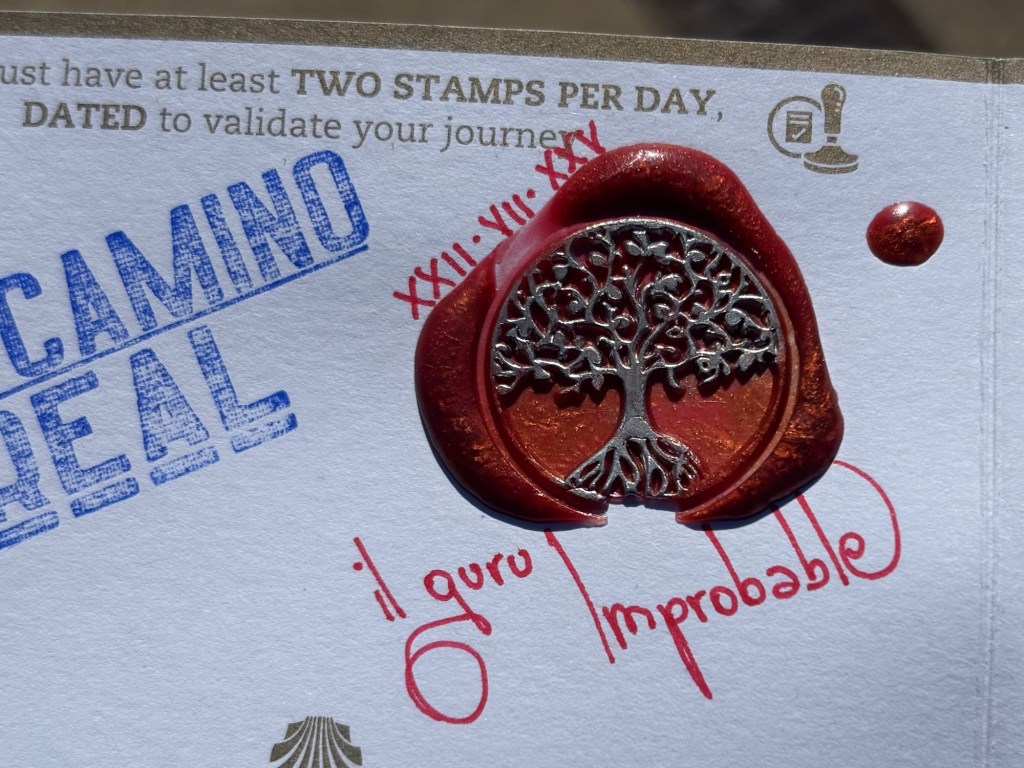
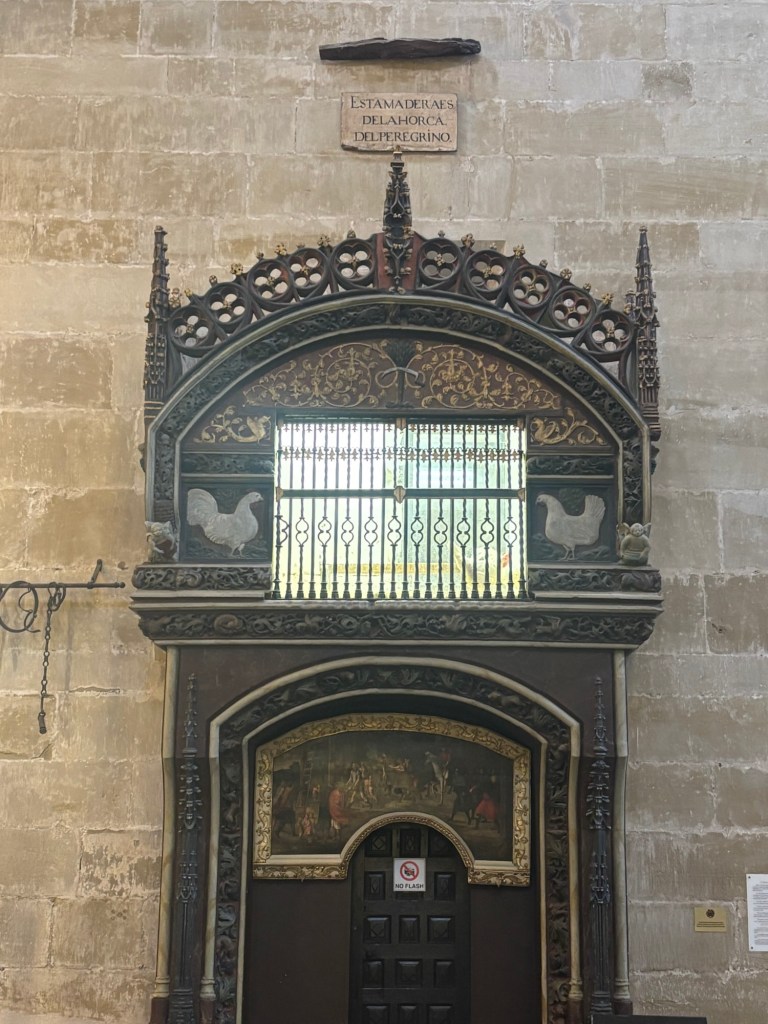
I stopped in Santo Domingo to have the rest of the pâté and bread I bought yesterday as a light lunch. The last time I came here, I was with Mikkel, Lachlan and Sophia and so I never got around to visiting the cathedral, so I made good on that today. Apart from netting me another couple of stamps for the credencial, it also housed a number of treasures that I wanted to investigate – not least of all the famous “resurrected chickens” that feature so prominently in the town’s history.


Santo Domingo de la Calzada, like so many towns along the Camino, was born on the pilgrim road, founded by the same Domingo García who gave the town its name. Its most famous legend tells of the execution of a young German pilgrim who, passing through the town, attracted the attention of the mesonera (innkeeper). After rejecting her amorous advances, the spiteful mesonera concealed a silver cup in the pilgrim’s bag before he left, for which he was accused of theft, sentenced to death and hanged on the spot. When his parents came to identify the body, they found him alive, claiming Santo Domingo had saved him. The sceptical mayor, who was fairly sure that the boy they had hanged the day before had been executed properly, claimed he was as alive as the chicken on his plate – which promptly stood up and crowed, testifying to the truth of the pilgrim’s fate.

Ever since, a pair of the descendants of the resurrected chickens (don’t ask me how they check) have been kept in the cathedral, together with a piece of the scaffold where they hanged – or tried to hang – the innocent pilgrim, all those centuries ago. Go figure.


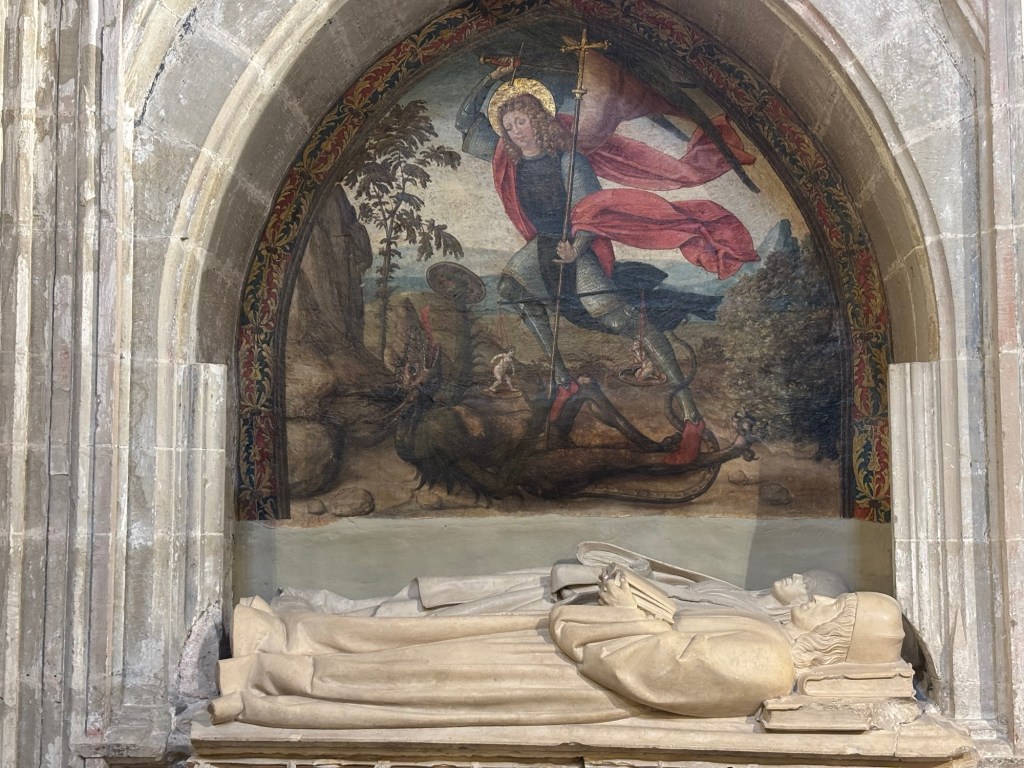
Santo Domingo’s cathedral, like many in Spain, is full of hidden treasures. I was particularly taken – as always – by the mythical creatures that pop up in the stonemasonry. Harpies, dragons, demons, griffins… for a faith that spent so much time and money driving all traces of paganism from the land, it sure is amusing to see that Spain’s churches are full to the rafters – quite literally – with frozen memories of that dark world.


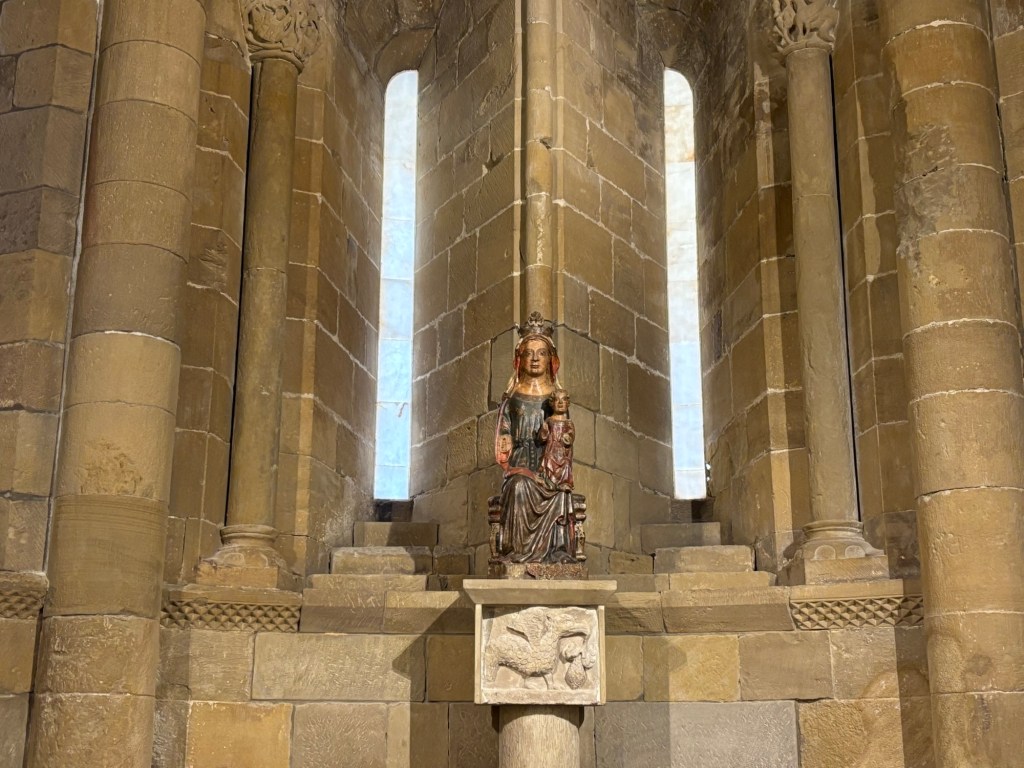
One really stands out, especially after some recent reading. In one alcove, an icon of the Virgin Mary and child stands above the carved image of a griffin – in fact, there’s quite a few griffins watching over the chapel from the surrounding pillars. There’s a deeper poignancy at work here: griffins have been symbols of maternity since their invention over a thousand years ago.


Unlike the other mythological beasts of the ancient world, like centaurs, unicorns and minotaurs – which have a solid grounding in Greek mythology – the griffin seems to spring into existence out of nowhere, but already fully-formed.

Adrienne Mayor has a very convincing theory that the griffin is an unmistakeable reimagining of the protoceratops, a Cretaceous era dinosaur often found protecting its young in the lands where griffins were believed to reside (Central Asia). As stories of such “griffins” reached Europe, they entered our heraldic system, and are often to be found around the Virgin Mary, the single most important symbol of maternity in the Christian faith. A seemingly bizarre pairing – but a perfectly logical one. Two ancient beliefs meeting in the middle.


Under the cathedral, where Santo Domingo is buried, a relatively recent mosaic stares out at you from a thousand shining tiles. The design is modern, but the style is almost Byzantine: teardrop-shaped faces line the wall with huge, almond eyes the colour of midnight.


This is the kind of religious art that I have always found especially compelling. There’s an otherworldliness to it that borders on the mystical, a connection to the faith of those first believers long ago. That’s what I sometimes think the modern church is missing, why so many lose interest: the more it tries to modernise, to catch up to the new generations “on their level”, the more it loses the mystery that made the early church so compelling. I know that for me, at least, it’s that connection to the ancient ways, to tradition, that speaks to me. And I get a piece of that when I see this kind of art, even in imitation. A mirror to the ancient world, when faith was new and hot like a flame.


It’s nearly half past five. I’d better head back to the albergue – I’m on dinner duty. That’s the price for arriving early! BB x

Camino XIII: Milady

Albergue de Peregrinos de Nájera. 12.59.

I was supposed to take the day off today, but as it’s a Sunday, nothing is open. No shops, no museums, zilch. So, since my intention to use my rest day to restock was somewhat redundant, I set out at the relatively tardy hour of half past six for Nájera.

Logroño must have been partying late into the night, like Jaca last week. There were more than a few amorous couples locked in each other’s arms in front of doorways on the streets running off the Gran Vía. The average age a Spaniard is able to leave home is now in the mid-thirties, which must make dating considerably more complicated here: the sexual revolution has happened, society has caught up, but the financial reality has got Spain’s youth in a stranglehold.


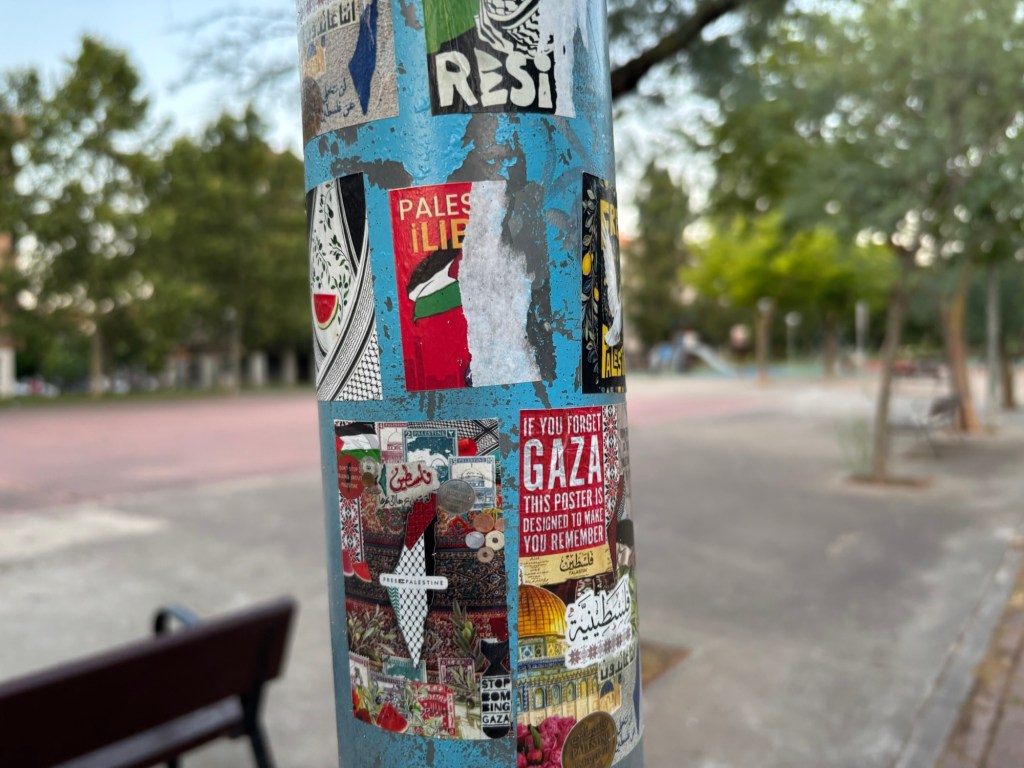
There are still Palestinian flags everywhere you go. It probably chimes with the mindset of the average liberal peregrino, but there’s another reason they’re so ubiquitous in this stretch of the Camino: we’re still in the Basque territories. And if any people are more likely to sympathise with an oppressed nation under the heel of a supposed colonising force, it’s the Basques, whose own freedom-fighting/terrorist organisation, ETA, only stopped its violent methods in the 1990s. I’ve seen one prayer in Hebrew for one of the captives still held by Hamas along the Camino, so it’s not entirely one-sided, but the Palestinian flag is far and away the most common flag along the entire Camino so far.


I reached the Parque de la Grajera about an hour after leaving the city. I was early enough to catch the night herons that seem to hang around the place. They have a somewhat patchy distribution across Europe, but they were here when I last did the Camino from Logroño to Burgos in the spring of 2023, so I was glad to see them again.

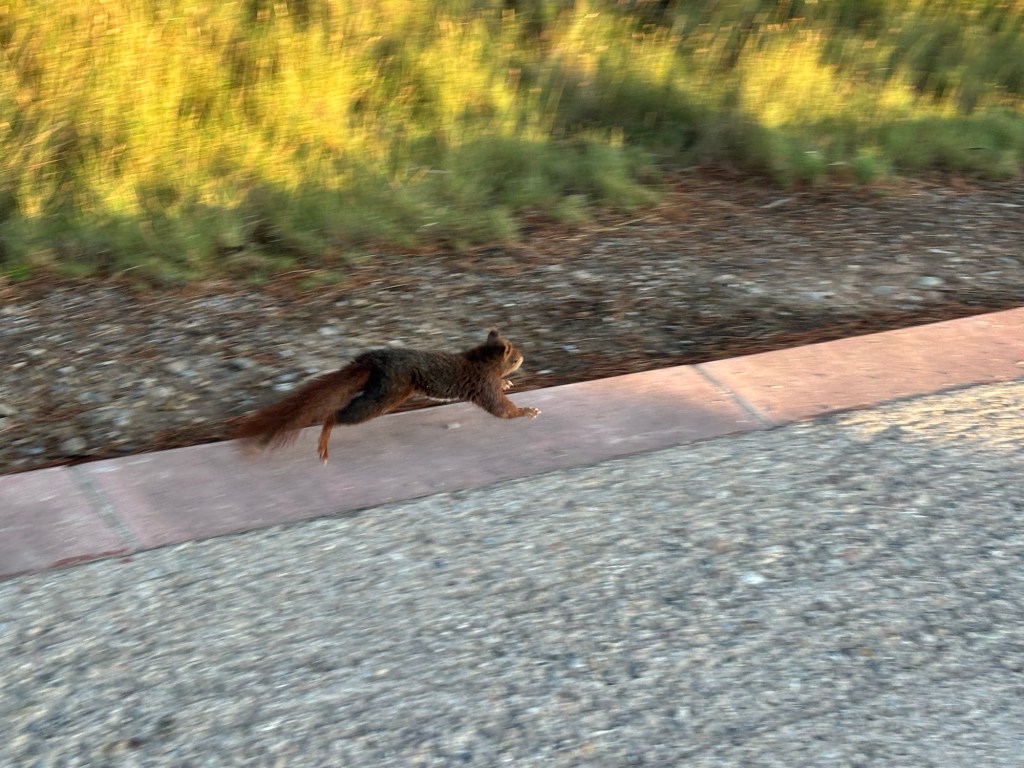
They were much too far off for a photograph, but the park’s red squirrels were a lot more obliging. Without the invading greys to worry about, they seem a lot more confident around people here, and so I was able to get quite close – or rather, it came quite close to me on its jaunty sortie across the bridge.


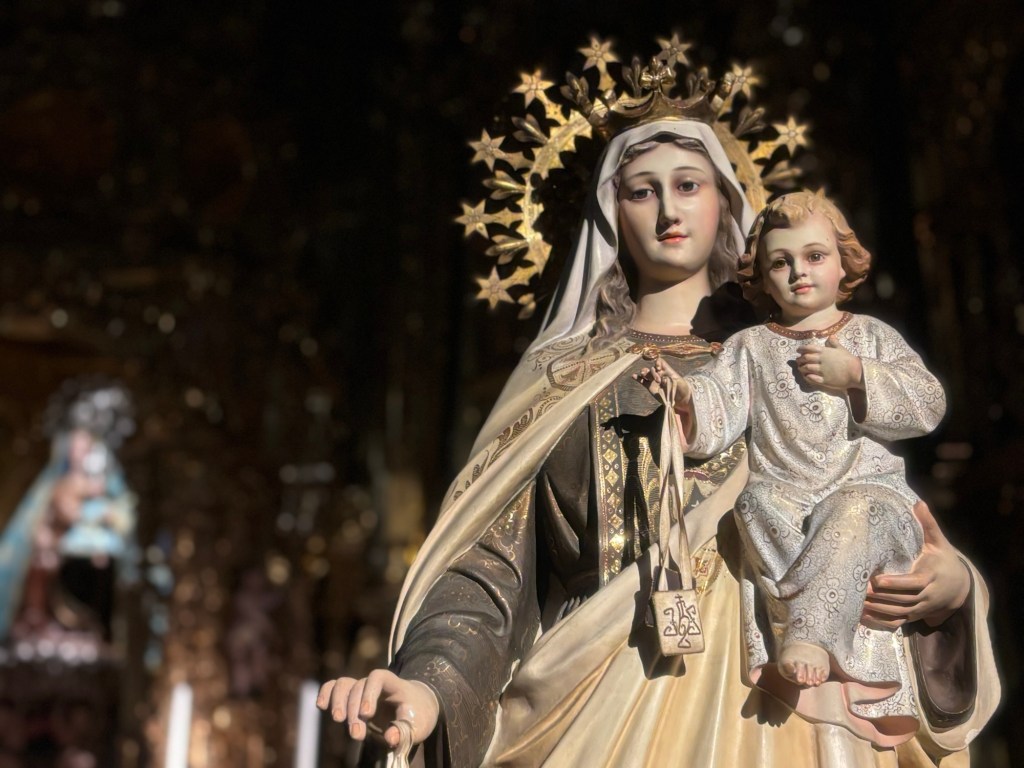
Today’s route featured a small pilgrimage of its own, to the shrine of La Virgen del Rocío. She is, in the humble opinion of this devotee, one of Spain’s most beautiful incarnations of the Virgin Mary. She certainly knows how to pick out a home, with her sanctuary within the Elysian marshes of Doñana National Park far to the south… and here she is, watching over a lagoon in La Rioja.

I remain convinced that it was partly her intercession – and that of the natural paradise where she resides – that healed me at last from last summer’s heartbreak, and it is partly because of that intercession that I am walking the Camino this summer… to say thanks. I owe her that much.


There were more squirrels to keep me company around the edge of the lagoon, including a boisterous couple that were quite unfazed by my presence, chasing each other up and down the trees on the edge of the lake. You have to travel quite some way in the UK to see these endangered creatures, since the American greys drove them out, but here they’re much more common.


La Virgen del Rocío is, among her other titles, a water spirit of sorts. Maybe that’s why she speaks to me more than the other incarnations across Spain that I’ve encountered: El Pilar, Remedios, Guadalupe… I’ve always felt some sort of connection to marshes and wetlands. It may seem odd that Mary, a woman from the hill country of Southern Galilee, should have such a devoted following in the wetlands of southwest Andalusia, but there it is.

El Rocío is the Spanish word for dew, and the Marian association with the Morning Star – Venus – as the herald of the rising sun is almost as old as her worship as the Mother of God.

I’ve often wondered whether the various Marian cults across the Mediterranean aren’t simply evolutions of the Roman tradition of the lares – guardian deities assigned to individual places – or perhaps even the Celtic peoples before that. In that light, it’s easy to see why other Christians find certain aspects of Catholicism hard to understand. But I think we’re all reaching for the same thing. Many Protestants would say they’re reaching for a more personal relationship with Jesus.

Well, what could be more personal than feeling an intense connection to God through a place that is so close to your heart?


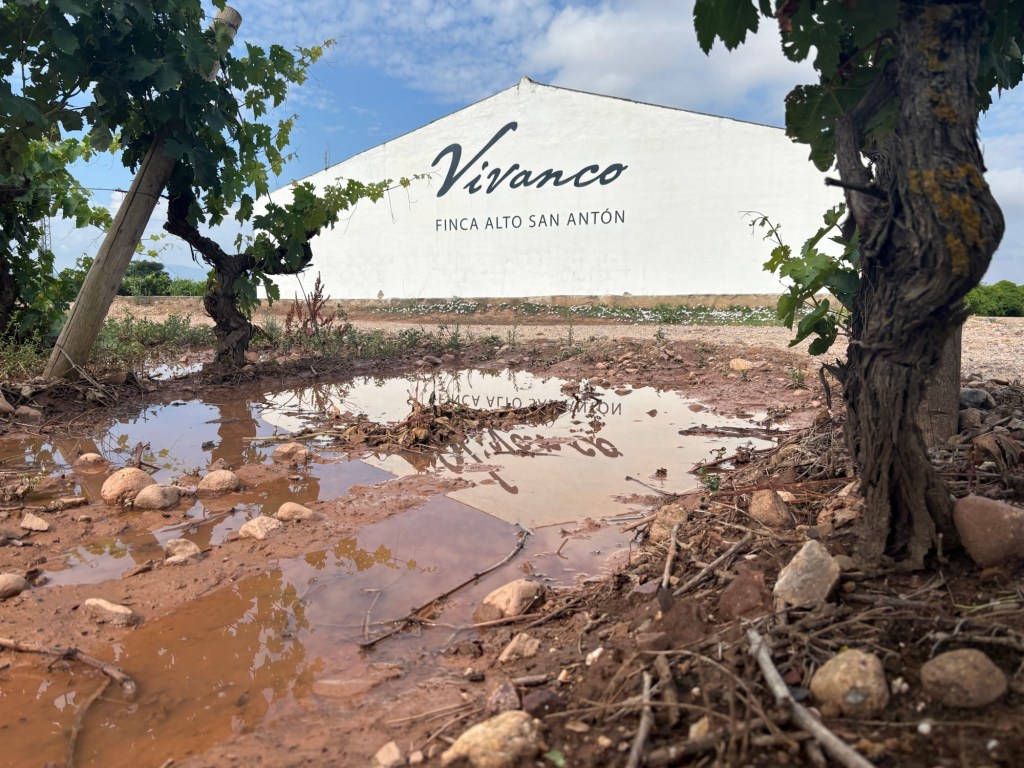
West of Navarrete, the Camino meanders through a vast network of vineyards: a reminder that the tiny autonomous community of La Rioja punches above its weight in wine production (even if it can’t meet the demand on its own). It’s a 29km walk from Logroño to Nájera, but an easy one, and I was in town shortly after 12pm from a 6.30am start. I call that good going.


Reunited with the young folks tonight after an Irish exit and a hiatus of two days. Time for a sociable pizza night! I think I’ve earned it. BB x

Camino VIII: A Hundred Eyes

Albergue de Peregrinos, Monreal. 15.10.

One of the best things about the Camino – at least, for somebody who does not particularly enjoy sticking to a strict plan – is its absolute freedom. You can aim for a particular destination at the end of the morning, but if you overshoot, or find a place you like along the way, you can always change your plan. And – it goes without saying – there is no “true” Camino. There never has been. There is simply your route to Santiago, wherever that may lead you.

Today, I decided to take a major detour through the Foz de Lumbier, deviating from the “official” Camino by some six kilometres, in search of one of the most striking landscapes to be seen on all of the routes to Santiago de Compostela.


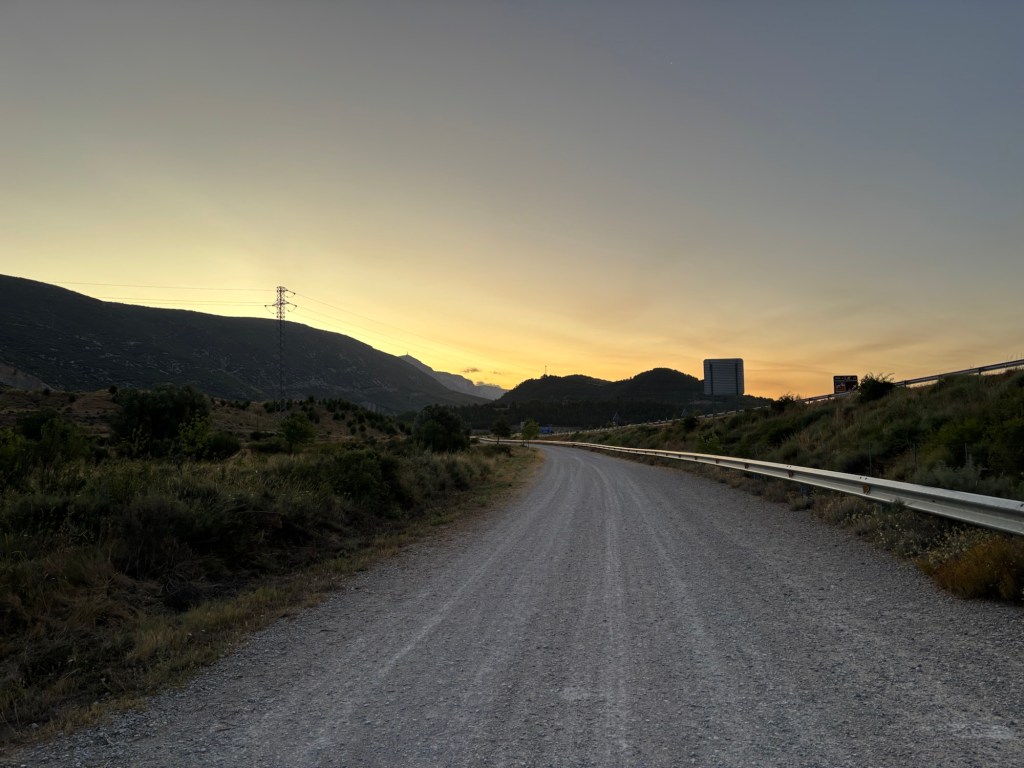
Google Maps suggested the detour would take around eight hours, so I set out early, leaving Sangüesa’s albergue at around 5.15am (5.20, technically, as I left my sticks behind and had to double-back to get them). The Camino turns off about half a kilometre north of Sangüesa, just before the Smurfit industrial complex, but I pushed on along the road towards Liédana. There was quite a bit of traffic at first, but it was mostly workers going to the factory: after leaving the complex behind, I hardly saw anyone on the road.


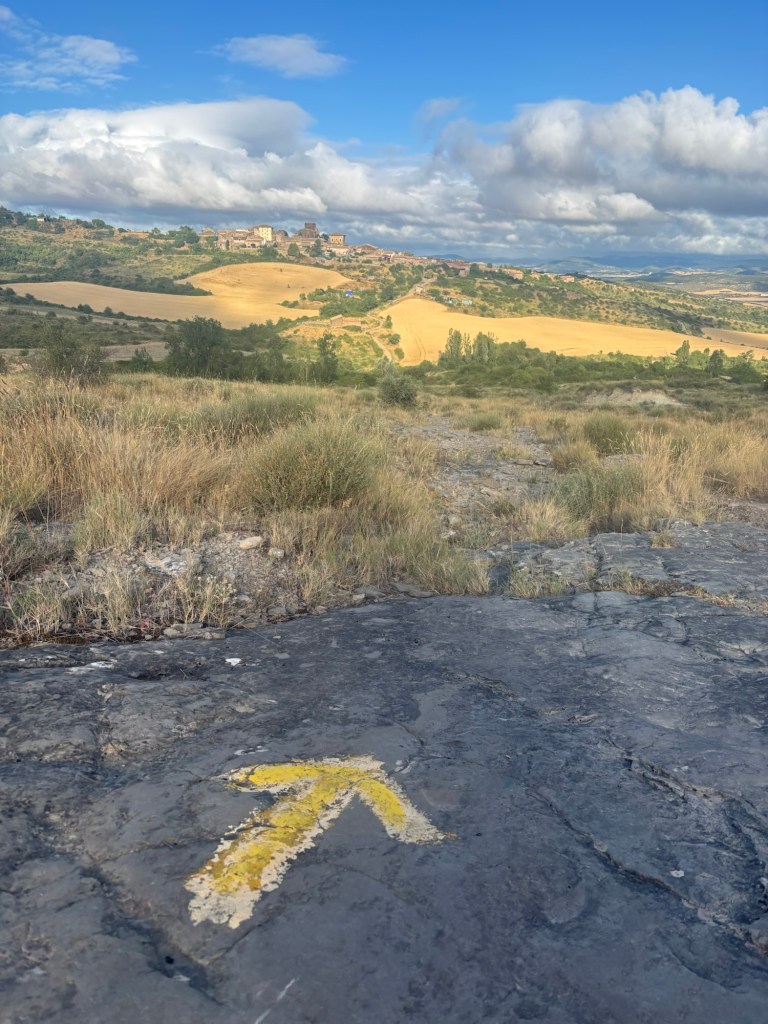
There were a few scattered yellow arrows west of Liédana, indicating that this must once have been one of the many Camino routes, if not perhaps one of the more commonly known alternatives. I had timed my arrival at La Foz for sunrise, knowing that any earlier would have been far too cold and dark and any later would risk a merciless march along the roads later on. Plus, in the first hour after dawn, it’s always possible you’ll find something unexpected, as the animals of the night make their final rounds before retreating into the dark places where they hide during the day.

I had not counted on the wind. A fierce north wind was blowing this morning, almost strong enough to knock the sunglasses off the top of my head, and easily powerful enough to make it impossible to listen to the audiobook I had on (Robert Harris’ Conclave – a little late to the party, I know).


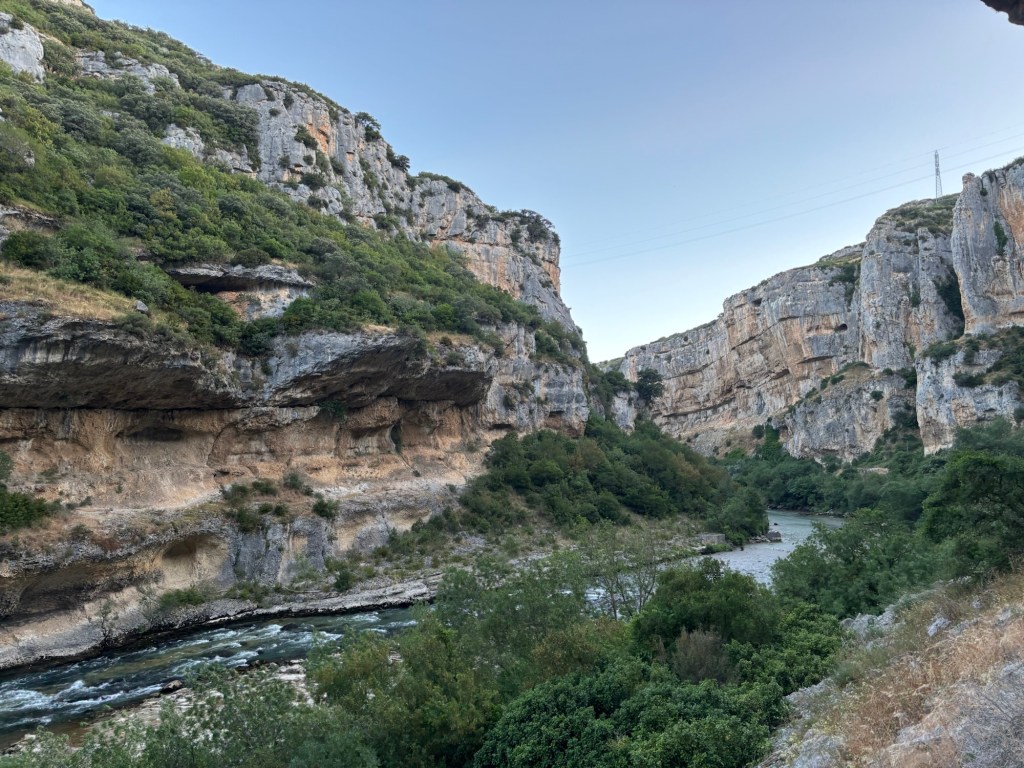
La Foz de Lumbier is one of two major canyons that can be found in the Sierra de Leyre, formed by the southwest passage of two rivers, the Irati and the Salazar. The other, La Foz de Arbaiun, is even grander still, but stands some twelve kilometres to the east of Lumbier, putting it well out of reach of even this overambitious pilgrim for today.

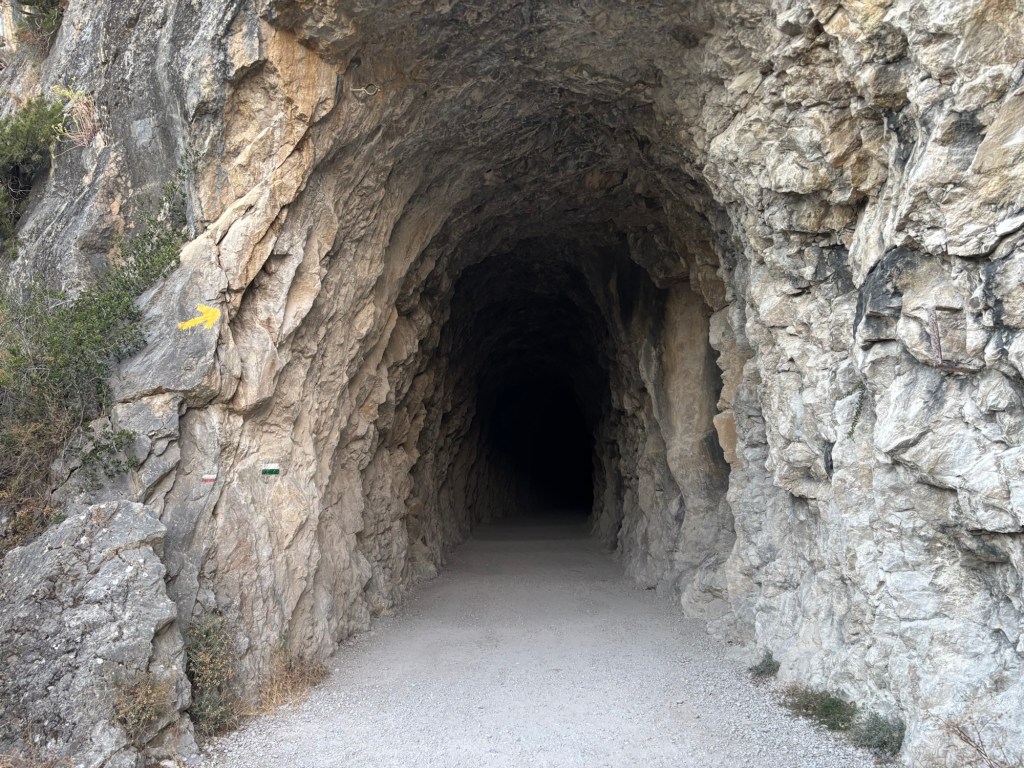
The north wind was still howling down the canyon when I arrived, which made the tunnel access all the spookier: the only way in and out of the canyon is via two long tunnels cut into the cliffs, neither of which are lit. The southern tunnel curves around to the right, pitching you into total darkness for half a minute or so.


Once inside, a gravel track known as a Via Verde (a converted railway line) leads you along the gorge. Had I arrived later in the day, perhaps, I might have seen some of the canyon’s famous Egyptian Vultures: bizarre, chicken-faced creatures with white plumage and diamond-shaped tales that migrate to Spain from their winter quarters in Africa each year. However, they were nowhere to be seen this morning, presumably sitting on their nests deep in the many caves within the cliffs.

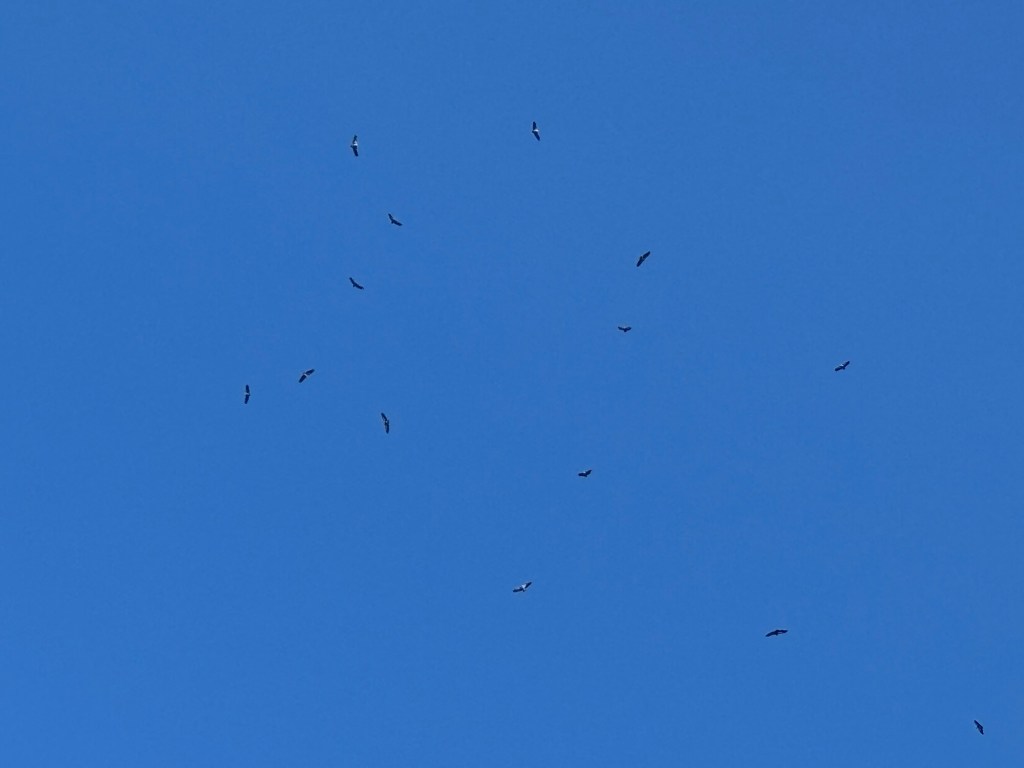
The gorge’s other resident vultures, however, were everywhere.


I couldn’t shake the feeling that my passage through the canyon was being very closely watched, as though hundreds of eyes were following me along the river. My guess wasn’t far off the mark: once my eyes adapted to the twilight of the canyon, I realised that many of the bushes atop the canyon walls were in fact a great host of griffons, staring down at me with bobbing movements of their snakelike necks.

Every so often one or two of them would spread their monstrously huge wings and take off into the morning, before returning, feet dangling, to land on some other outcrop downriver, before turning their hulking shapes to see how much progress I had made.

I make no secret of my love for vultures. They are far and away my favourite animals on this planet, and especially griffons. I have never recovered from seeing one for the first time during that first trip to Spain: never accustomed to anything larger than a herring full, I was spellbound by the sheer size of the beasts, with their hulking shape, their silent circling flight and the long, trailing fingers on the end of each wing. That obsession only intensified when I came face to face with them during a solitary climb up the misty mountain of El Gastor, where I spent an incredible hour watching the giants appear suddenly out of the mist at eye level, merely feet away from my perch at the edge of the mountain.

So perhaps you’ll understand why I was so quick to slap an extra six kilometres onto today’s 27km hike, if only to spend some time in the presence of these magnificent creatures. They truly take my breath away.


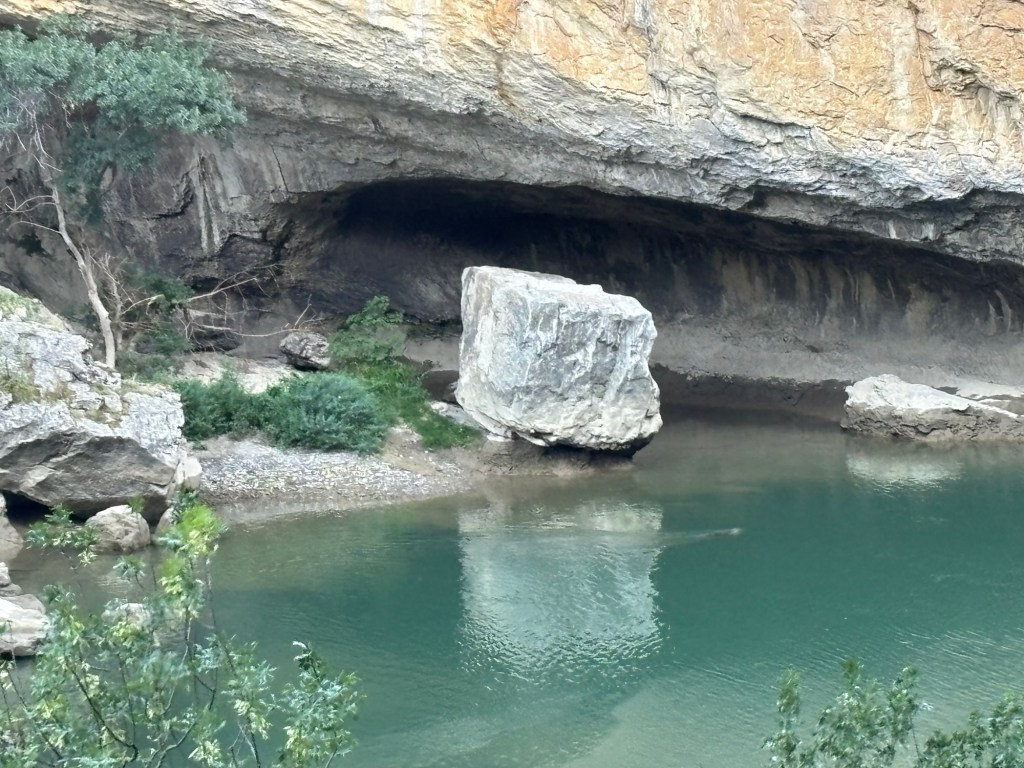
But Lumbier had more than just vultures to sling at me. Just before leaving the gorge, I noticed something moving in the water below. It might have been the wind, which had been making shapes across the surface of the river all morning, but this was moving slowly against the current. Something long, snake-like, with a white-whiskered face: an otter. Talk about a stroke of luck! Just like the lynx I encountered in Doñana earlier this year, this was a first: I have never seen an otter in the wild before, or at least, one that I could call with any degree of certainty. iPhone cameras are good, but they can’t zoom and they’re not brilliant at moving objects in low light, but if you look closely you can just about tell what you’re looking at!


Really, I ought to have hung around at the other side of the tunnel to see if it reappeared, but I wasn’t entirely sure how long it would take me to get back to the Camino, so I played it safe and left the otter to his morning swim. I certainly couldn’t have done an awful lot better with my phone camera even if it did return. I’ll just have to come back someday with the rest of my kit.

Instead, I skirted the town of Lumbier and made my way back to the Camino. This was easier said than done: the “official” route meanders through the turbine-topped hills on the other side of the roaring A-21. Getting back to it was no easy feat, so I followed the old concrete road to Jaca for about 8km.

Normally, road stretches along the Camino can be quite hairy, with grim or even challenging looks from drivers. A spate of pilgrim deaths on the “original” Camino, now overlaid with concrete highways, led to the move toward the current network of tracks and footpaths. However, thanks to the A-21, which runs parallel, there was hardly anyone on the road at all, which made for a very peaceful (if monotonous) walk.

The sun was well on its way to its throne in the Castilian sky by now, and with it, the vultures of La Foz de Lumbier came drifting out on the thermals, as though to see me off.


I had a veritable fleet of raptors to keep me company today. As well as the vultures, a few kestrels, buzzards and booted eagles were circling the hills around Izco, along with the usual red and black kites. Today added two new encounters to the mix: a pair of short-toed eagles – exceptional snake-hunters – and a young hen harrier, my first (and hopefully not last) of the Camino. I have an especial fondness for harriers, especially the ghostly grey males, whose long, tapering wings and bouncy flight always conjure up images of the endless meseta in my head.


The cattle-crowded foothills of the French Pyrenees seem like an age ago. We are now very much in crop country. It hasn’t had much of an impact on the flies, which are everywhere this summer (I suspect the two months of rain Spain had this spring has caused their numbers to explode this year), but it does make for considerably easier terrain.


Contrary to what the guidebooks say, Monreal does have a working bar/restaurante. The hospitalera should know – it’s her husband who runs it! So I will grab a pizza there tonight, before the last long march of the Camino Aragonés tomorrow toward Puente La Reina and the start of the next stage of my journey: the busier Camino Francés. At least, I hope it will be busier! There’s no guarantee in July, but it should at least have more than one pilgrim in the albergue from night to night! BB x
Camino VII: Out of the Woods

Albergue de Peregrinos, Sangüesa. 16.06.

I overslept today – by Camino standards, anyway. I’m pretty sure I set both alarms last night, but I have a habit of turning them off and falling straight back to sleep. Either way, it was gone six o’clock when I woke up today. Mari Carmen, the seventy-eight year old Valencian who is the only other pilgrim on the road, had already packed and gone. I dressed quickly and had breakfast, which had been left out for me in the dining room. I wouldn’t exactly call two slabs of bread with butter and jam and tea-making facilities a bargain – that cost me 6€ yesterday – but Ruesta is so cut-off from everything and everywhere else that there were no other options, and beggars can’t be choosers.

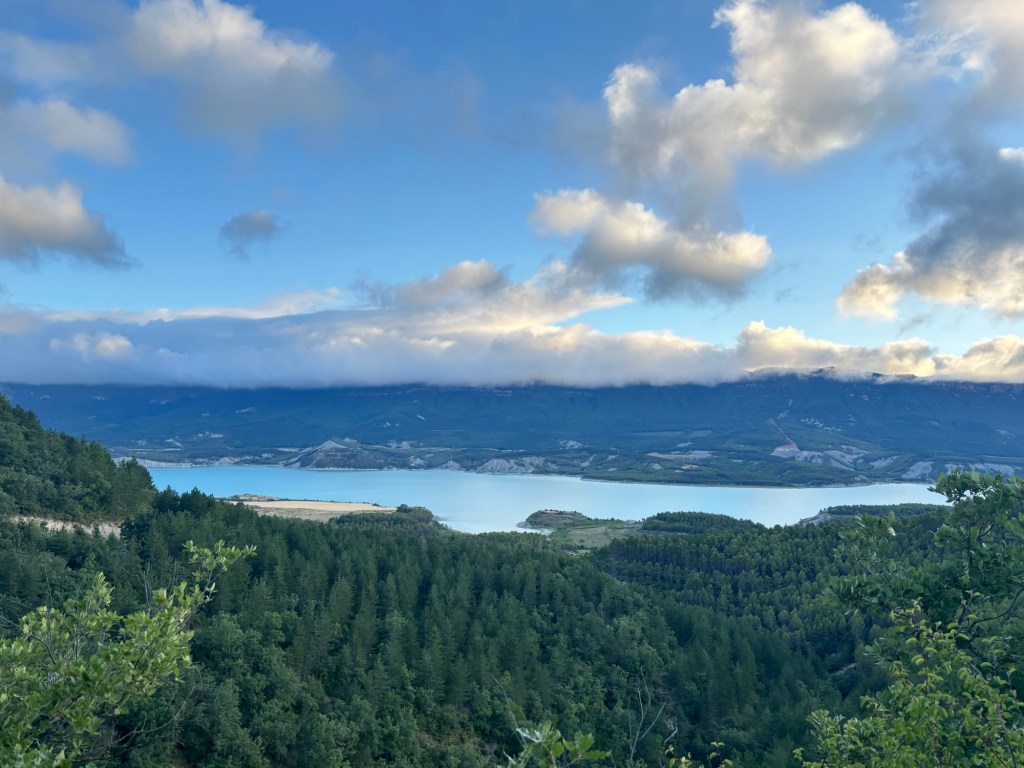
Gronze (the Camino website I’ve been using to map out the Voie d’Arles and the Camino Aragonés) describes today’s stage as “melancholic”. I thought that was probably a bit melodramatic, but it’s actually a pretty accurate adjective for the first hour and half. Leaving the abandoned village of Ruesta behind (I was genuinely the only person in the entire village when I left), the Camino snakes downhill to ford a narrow stretch of the Embalse de Yesa before climbing slowly back up the other side over the space of an hour. I usually like the forested stretches, as they can be more mysterious and refreshing than the unforgiving plains, and yet… something was off about this forest. It was far too quiet. There’s usually some birdsong in the early hours before the sun crests the hills, but over the space of an hour, I only heard one sound, and that was the screech of a jay far off.

I’ve often experienced this feeling in the presence of Spain’s false lakes. The Embalse de Yesa and its surrounding pine forests are entirely artificial. I saw a doe racing through the trees near the summit, and a red squirrel high up in the branches of a tree, but the lack of birdsong was chilling. It’s as though they keep a mournful silence for the drowned valley below, unwilling to disturb the rest of the watery dead.


I sometimes wonder if nature is laughing at us when we try to shape the world like her, or if she is just quietly disappointed.

As for me, I was quietly relived when the trees cleared and I was in the sunlit fields once again. The quails had returned, along with a host of finches and larks, and with my spirits restored, I set off toward Undués de Lerda.


Undués looks like many Aragonese hillside towns: built of the same stone upon which it stands, it has a habit of vanishing from sight under the cover of cloud, becoming obvious to the eye only when the sun reveals the shadows of its doors and windows. I arrived shortly before nine, but the town was still fast asleep, and everything from the bar to the church was shut up tight. So I moved on.

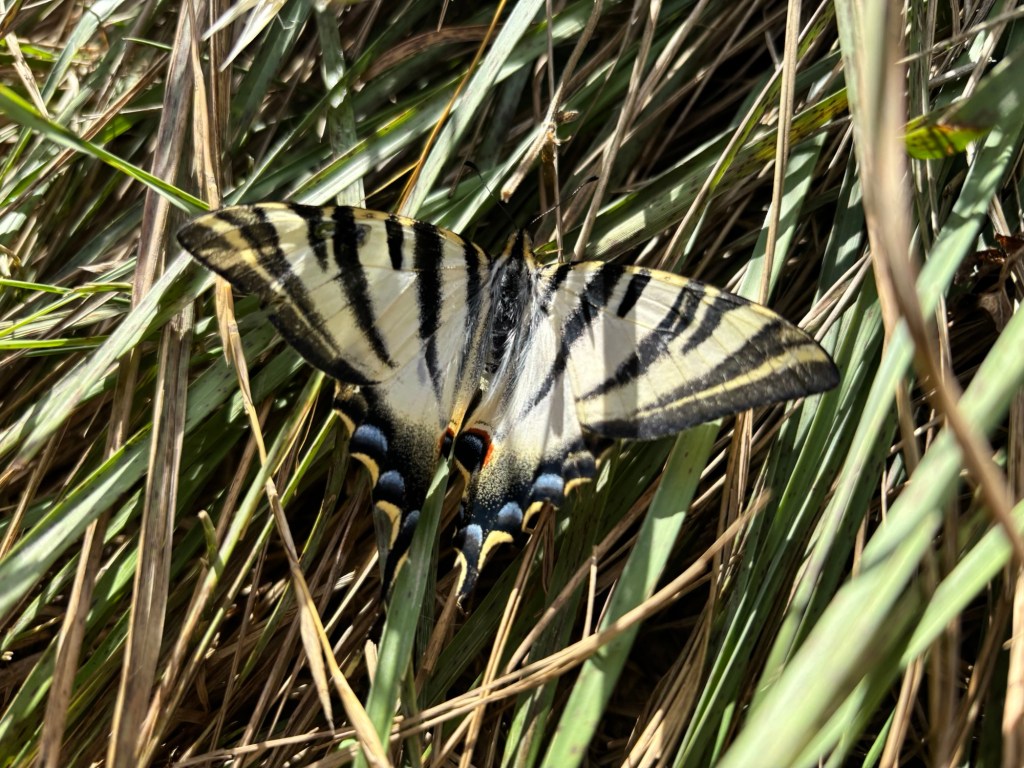
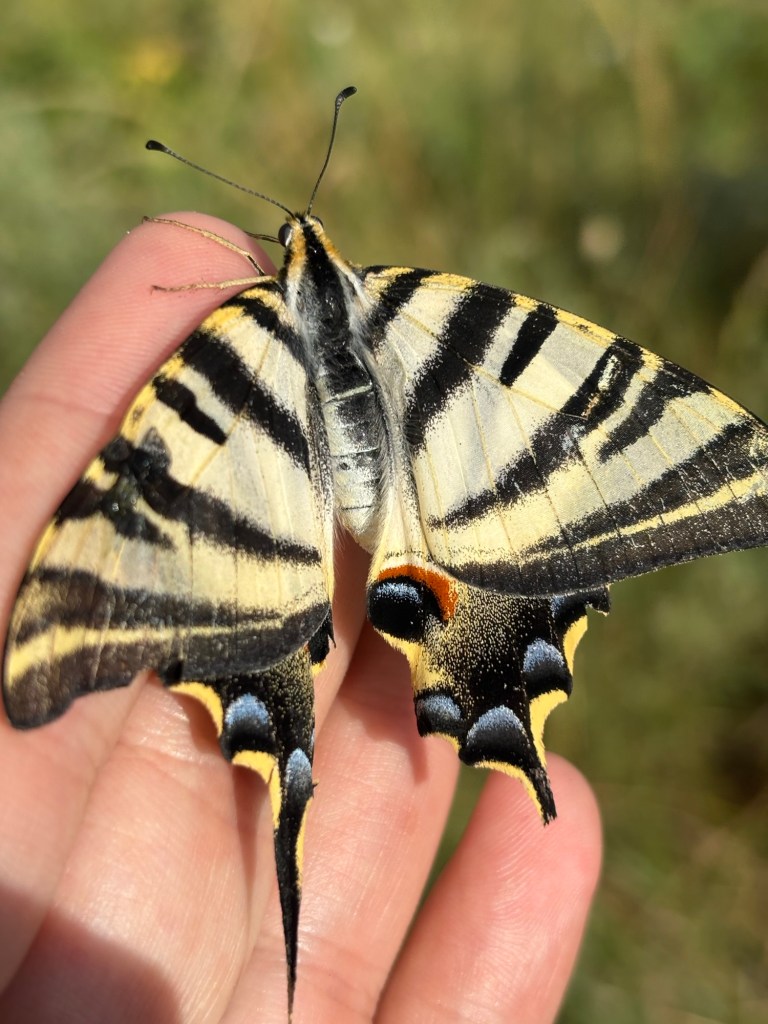
Near the Aragonese frontier, I saw something in the grass at my feet that made me pause. It was a swallowtail, and it wasn’t leaping into the air as they are wont to do when people draw near. On closer inspection, I think it must have had a run-in with a predator, because one of its swallowtails was missing and part of the same wing was damaged.


Known in English as the scarce swallowtail (on account of its rarity as a migrant in the British Isles), this species is actually fairly common in Spain. It’s not often you get to see one so close outside of a butterfly sanctuary, however, and the markings on its wings are really remarkable. They’re actually made up of thousands of scales, each one containing pigments like melanin or papiliochromes, that create a vivid array of colours used for sending messages, either to potential predators or partners. I saw a sign in a butterfly sanctuary on Tenerife where somebody had managed to make an entire alphabet just from close-ups from butterfly wing patterns. With nearly 20,000 specified of butterfly in the world, perhaps that’s not surprising.

This little fella was in a dangerous spot, right in the middle of the road, so I gently coaxed it onto my hand and then found a more sheltered spot in the verge where it might be out of harm’s way. Unless it recovers the ability to fly, it will probably end up as a snack for an enterprising bee-eater – a bird both large and nimble enough to deal with a swallowtail – so I hope it finds its strength.


A small stone marker in Basque lettering indicated that I had left Aragón and was now in the former kingdom of Navarra. The landscape has changed: the high mountains of Aragón, ever at my side for the last few days, have been replaced by a series of endlessly rolling hills, a patchwork of gold and olive green. This will be the scenery for the next week and half, until I reach Burgos and the meseta begins in earnest.

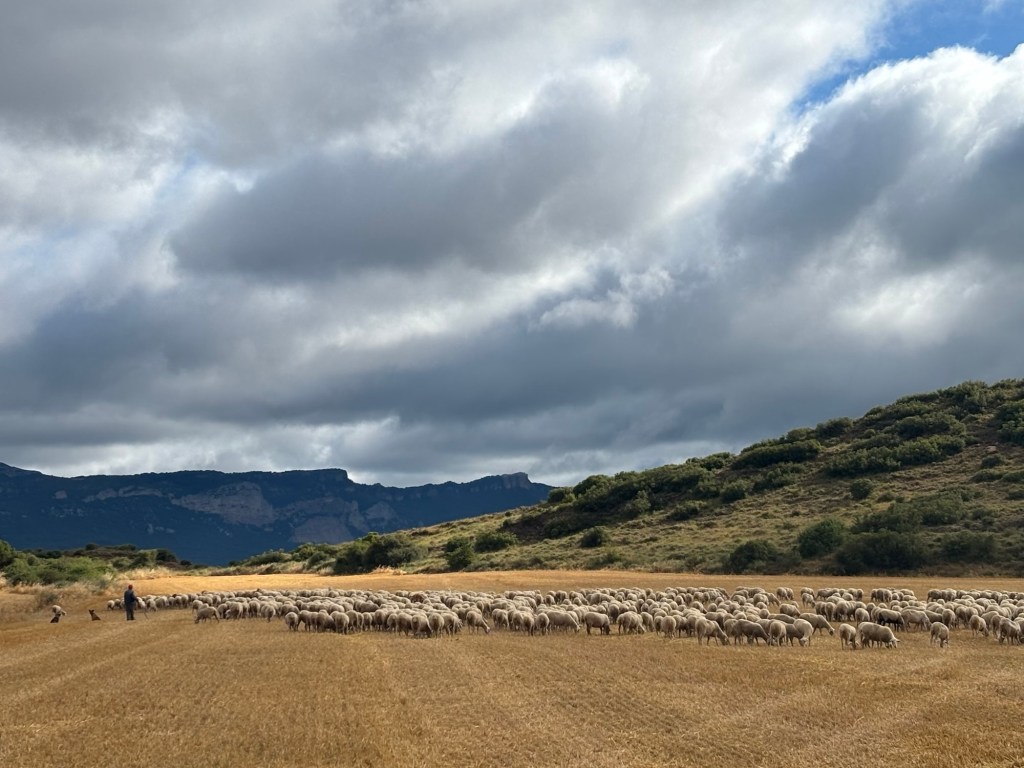
I was lucky to see one of Spain’s oldest traditions in action shortly after crossing the border. One of the cañadas reales crosses the Camino here, specifically the Cañada Real de los Roncaleses. These are the old migration routes across the country, where shepherds have led their flocks from north to south in search of fresh pastures since the medieval period. A source of milk, cheese and the precious merino wool, Spain’s sheep were a highly valuable commodity and the cañadas received royal protection and their own guild, El Honrado Concejo de la Mesta, which had tremendous privileges.

Nowadays, of course, merino wool can be found all around the world – you can thank Napoleon’s invasion of Spain for breaking that monopoly – but the shepherds still use these ancient pathways, as their ancestors have done for over a thousand years.


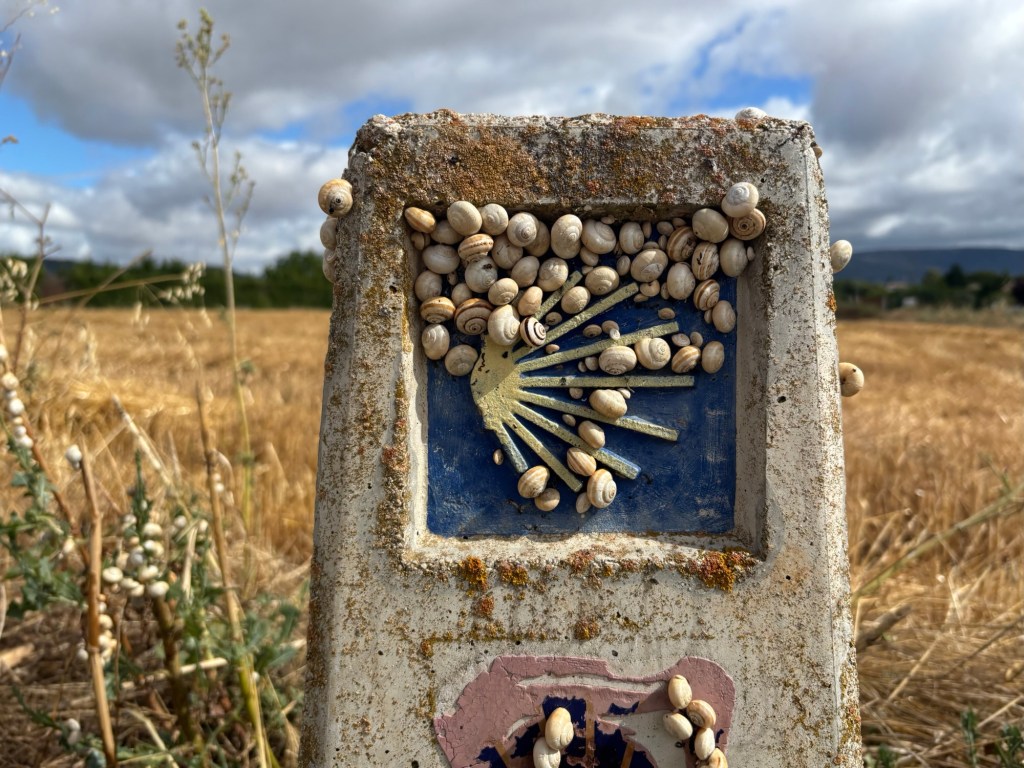
It’s been a pretty mild walk today, so it was surprising to see a mass of estivating snails on the way in to Sangüesa. They must have done this during the heatwave, when temperatures in some parts of Spain soared into the forties. They’re not dead, as such, but in a state of dormancy, waiting out the worst of the summer until they can return to life when the temperatures cool down.


Well, Sangüesa is the busiest town I’ve seen so far. The albergue is nearly full, though not with your usual pilgrims: these are almost entirely Spanish bicigrinos, a term used to describe pilgrims who travel by bicycle. It’s a portmanteau, but one can’t help the feeling that it’s almost always just a little pejorative, with many pilgrims feeling that their lycra-clad one-night companions are not true pilgrims in the strictest sense. The decibel count in the albergue has certainly gone up since they arrived, just in time to replace the building site next to the albergue and the slamming windows.

Still – it’s a good ease-in to the popularity of the Camino Francés, the most popular of all the roads to Santiago. I’ve enjoyed my own company for the last week, and though I’m looking forward to meeting all sorts of interesting people on the road, I will miss these long stretches of quiet. BB x
Camino VI: The Ventriloquist

Albergue de Ruesta. 16.20.

Picture this, if you can. Call upon all of your senses.

First, sound. Wind, cool and dry, blowing in the branches of the pine trees above, their branches coated in trailing clumps of lichen. A blackcap singing an enchanting solo in the forest, and an endless percussion of cicadas, assailing the ear with their rasping ostinato from every side. You can’t see them. But they’re there. Hundreds of them.

Next, smell. The fresh scent of pine bark, mingling with the dusty trace of crumbling masonry. The occasional coolness of water blowing in off the lake. Mingling with taste, a hint of fried fish from the bar, which closed up shop half an hour ago.

Touch, then. The feel of carved wood, nearly two centuries old. The trace of numbers in stone, chiselled in many hundreds of years before even that. The uneven cobbles of a road long since neglected, and the powdery feel of the houses that line it, within which a thousand plants have weaved a citadel of their own.

Finally, sight. Picture an entire village abandoned a hundred years ago. See the stone balconies, carved with Roman triumph, presiding over an empty world. A church, with fragments of brilliant blue still visible in the decaying fresco above the spot where the slate once stood, stripped bare and opened to the heavens. A lonely watchtower, manned now by thirsty crows, their beaks agape in the heat of the afternoon.

This is my stop for tonight: the abandoned village of Ruesta, one of the last stops before leaving Aragón.


I left on time this morning, shortly before six, sent on my way by Lulu and Nicole with a packed sandwich, an orange and a boiled egg. It felt like being sent off to school. Some hospitaleros really do push the boat out to make you feel at home during your brief stay!

I missed the sign in the darkness and so headed north for a kilometre before joining the road and returning to my westward trajectory. It added about fifteen minutes to my time, but it did give me an unrestricted view of the morning.


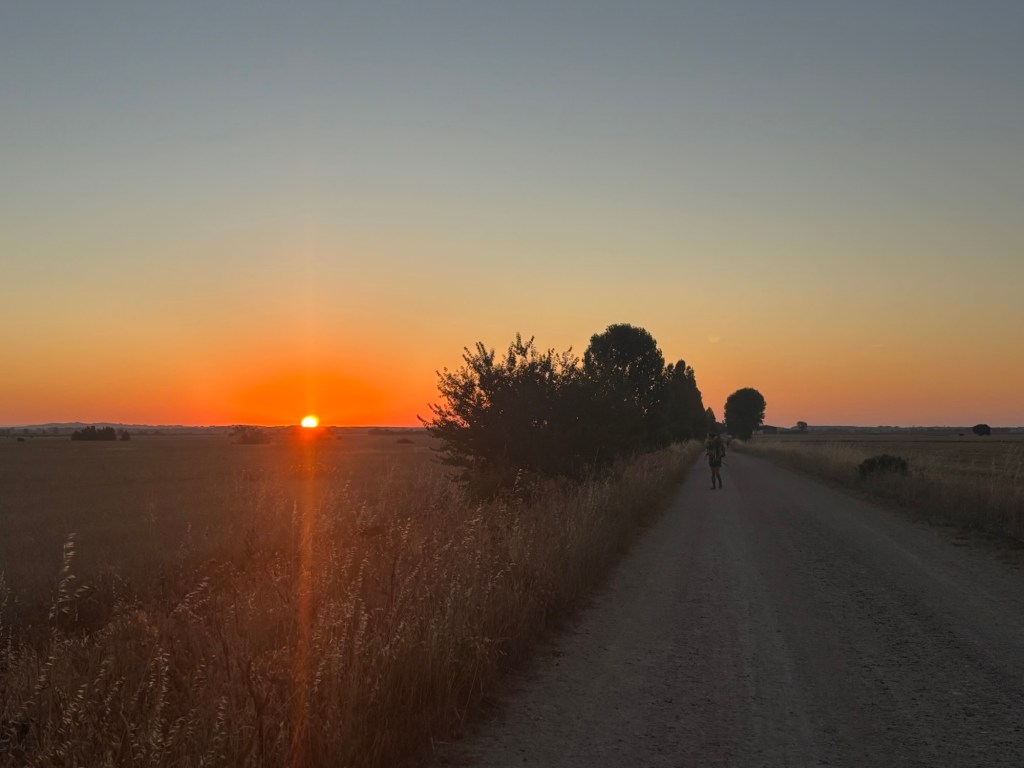
Camino sunrises are something of a tradition on the way to Santiago, but I am going to miss these Aragonese mornings. There’s something about the mountains that makes them that much more mystical. Maybe it’s the way the light turns each row of hills a different shade of blue, always fading toward the base.


I spent a considerable part of the morning chasing quails. They’re almost impossible to see with the naked eye, standing at around 16cm tall (that’s just over half a ruler) and seldom taking flight when alarmed, preferring to sit tight and rely on their cryptic camouflage to avoid detection. They were all over the place, though – I must have counted at least forty individuals calling from different spots along the Camino in the hour or two after sunrise. They can throw their voices around 150 metres, which can make them very hard to locate, especially when there are four or five in the same field calling at once. I flushed one completely by accident at the side of the road and it took off into one of the vast wheat fields on sharp, whirring wings.

England must have sounded like this, a long time ago. There are places you can go in the UK and hear quails, which do migrate that far (some make it all the way to Scotland), but not on the same scale as you can here in Spain.

Along with the quails, I saw a grey partridge – a rarity in Spain, confined to the north – and goodness knows how many corn buntings, but I think it’s the foxes that stood out the most. There must be plenty in the area, as I saw three within a rather short space of time, including one sprinting across a field near Martés.


A major feature of today’s walk were the badlands de yeso: strange, wrinkled mounds of gypsum, a distinctive feature of Aragón, Navarra and Almería. This is the kind of terrain that contains fossils like the shell I found yesterday: a prehistoric stockpile of marine life, buried deep beneath the soft grey hills. They’re really quite striking, and since there are no Caminos that pass through the Bardenas Reales to the southwest (one of the strangest lunar landscapes you can find in Europe), the Camino Aragonés does at least provide an introduction.


I stopped for water shortly after a brief exploration of Artieda and its gypsum hills (to the great confusion of a local who thought I’d lost the Camino). Here, at my feet of all places, I found one of the ventriloquists: not a quail, but a cicada. They usually conceal themselves high up in the trees, where their voices carry and their mottled bodies blend perfectly into the bark. This one was clearly an amateur, however, as the motion of its churring was trembling the blade of grass in its legs, making it stand out like a sore thumb.


Not to be outdone, my final hour was a butterfly parade, with a scarce swallowtail taking centre stage. I have fond memories of this little creature as it’s one of the ten animals I recorded on my first trip to Spain as an eleven-year-old. Contrary to the famous adage popularised by Muhammad Ali, most butterflies don’t “float”, having a rather manic and jerky flight. Swallowtails, however, are on the larger side, and they do float, or at least seem to, fanning their wings out midflight to glide on the air. They’re skittish, like most butterflies, so it’s hard to get close, but their size, acrobatics and striking colours make them a delight to watch.


Which brings me to Ruesta. There’s really all sorts on the Camino, and Ruesta is very much one of the sorts. Abandoned in 1959 after a lengthy decline – largely because of the construction of the nearby Yesa reservoir, which flooded most of the agricultural land the village depended on – the village has largely fallen into a slow state of disrepair.

Ruesta’s church had some spectacular frescos, which were carefully transferred to Jaca’s Diocesan museum to prevent them from being lost forever. I imagine the place might once have looked not too dissimilar to Artieda, a hilltop town not too far from here. From some angles, you can still just about imagine life as usual: children running down the street to school, the bakery in full swing, old locals gathered at a street corner to gossip…


Ruesta has two functioning buildings: a casa de cultura (of all things) and an albergue, complete with a lively bar/restaurante. The secret to Ruesta’s survival is its acquisition by the CGT, the Confederación General del Trabajo, one of Spain’s larger trade unions. There are plenty of clues for those who don’t recognise the red-and-black flag: the raised fist, the quotes and dates graffitied across the walls and the plethora of signage in Catalan, Galician and Basque (the CGT, being anarcho-syndicalist in its outlook, has strong ties to the local separatist movements).

To their credit, they’ve done a wonderful job. The regional government won’t step in to rebuild Ruesta, as it’s just one of over two hundred abandoned towns in Aragón, so the syndicate has stepped in. They’ve carved out a fully-functioning community in the heart of the old village and are carefully coexisting with the place, without feeling the need to develop or bulldoze what doesn’t serve. The result is a very unique staging post of the Camino de Santiago. There’s not many places along the profitable pilgrim road that have been allowed to fall apart, and yet at the same time been so carefully curated.


I wonder how the future will see us? The creatures of the past left their traces in the rocks by chance. We’ve been deliberately stamping our seal on the earth for thousands of years. Will they marvel at tyre tracks in the mud and put them in museums? Will they weave fantastical stories around the objects they find, like discarded vapes and perfume bottles? What will we make of it all, a thousand years from now?


The Camino gives you a lot of time to think. Six hour walks through the countryside, every day for six weeks… It’s a test of resilience, if not of your sanity. Thank goodness I’m perfectly happy with my own company! BB x

Camino II: Wings and Stings

Hôpital de Saint-Jacques, Borce. 14.42.

Today’s march was only a little under two kilometres more than yesterday, but boy, did it feel every step of them!

I set out from Sarrance just before 7am, conscious once again that I didn’t want to book it to Borce. I had at the back of my mind that it might be sensible to push on to Urdos, if only to save me some mileage during the long climb up to Somport tomorrow, but I’m very aware that I have to keep these legs of mine in decent shape for six weeks, so no unnecessary bursts of speed or marathon days for me, thank you.


Much of the Camino today followed precarious paths along the river or the road. Arguably, the road stretches were considerably safer: rockfalls and erosion have conspired to make the cross-country sections of the road rather dangerous. Some thoughtful soul had fixed sturdy metal cords to the cliff wall for balance, but it’s plain enough that this section of the Camino sees considerably less traffic than the others.


This is most obvious in the jungle of thorns and nettles that grow about the path. For most of the morning I had to tread a jaunty path through the stinging undergrowth (overgrowth might be a better term), moving with the precision of a mountain goat to avoid the worst of them – especially when the alternative was a steep plunge into the rocky riverbed far below. I didn’t get particularly lucky, as the scars and the great red welts on my shins and neck will testify.

Between them and the mozzies, it’s been a pretty rough start to the Camino as far as bites and stings are concerned!


I crossed the threshold of the morning sun as I reached the outskirts of Bedous, disturbing a whole pack of caged hunting dogs as I did so. Their mournful barking must have been audible across the entire valley. It reminded me of a hunt I heard once when traveling through France, with the curious blast of the horn rising over the excited barks of the hunting dogs. This lot weren’t going anywhere fast, but I had a sense of the primal fear they must invoke in their quarry.


A far more pleasant sound became more and more strident as I entered Bedous: the plaintive whistles of kites. There were quite a few of them gathering in the trees around the Stade de Pierre Leyrat, the town’s rugby pitch (definitive proof that we are still in France). I didn’t give it too much thought as to why until I was flagged down by a local man out for a stroll, who pointed the kites out to me and asked me if I wanted to see a ‘spectacle’. I’m not much in the habit of saying no, so I stuck around to see what he was getting at. He was beaming and kept saying ‘ils sont impatients, ces milans… ils savent qu’il est en retard’.


Just who it was that was running late became apparent a few minutes later, when a man dressed in a red hoodie and one red glove appeared, carrying a bucket in his hand. Within seconds the kites seemed to double in number. There must have been at least forty of them, or even fifty. I haven’t seen so many in one place since the day of the winged ants in Uganda.


A small huddle of locals had gathered to watch, so I just got incredibly lucky arriving just as the kites were gathering. The man in red only apologised that the vultures were missing: ‘c’est formidable, mais ils manquent les vautours’.


They weren’t entirely missing, though. I could see at least two of them riding the thermals up above the peaks of the mountains. And they’d left a trace of their presence behind on the pitch, because when I went to collect the feathers I’d spotted from the stands, I found one which was far too big to belong to a kite. A feather from quite possibly my favourite animal in all creation: I couldn’t have asked for a greater totem to carry with me on the Camino this summer.


In case that wasn’t enough, a shepherd came down out of the hills with his dog and his flock of sheep. They seemed rather non-plussed by the small crowd gathered to watch the kites, and needed quite a bit of chivvying on from the shepherd and his dog before breaking into a run to catch up to him. Is it really a mountain adventure if you don’t see something like this?


Leaving Bedous and its kites behind, I followed the Camino about forty minutes later out of town and into the mountains. The road cut straight through a formidable gorge before winding a twisting path through via an EDF hydroelectric power station, fed by a pair of huge pipes running right up to the top of the mountains. The place seemed to be in full flow, but the only soul I could see was a woman smoking a cigarette outside the gates.


The following hour or so can only be described as an ordeal. After a brief stop in the woods, the Camino all but disappeared, and I had to improvise a path through several cattle fields. The cattle were nowhere to be seen, so their attendants – the murderous horseflies – turned their attention on me instead. And damn, they were persistent. For the best part of forty minutes or so I had to swing my baseball cap left and right like a medieval flail to keep the buggers off, and still they followed me, swarming about my head and legs through field and forest, determined to get a stab at me.

I think one of them got through, but it was hard work, flailing my arms around for so long. I guess they got as much of a workout as my legs today.

They only left me alone once I reached the cattle, at which point they must have decided that there were far easier targets than the fool with the baseball cap who had wandered carelessly into their lair.


It was quite a relief to see the road again. There wasn’t much traffic because of the repairs they’re making to the road surface, which was focused on the exact spot where the Camino rejoins the road. With any luck, that will mean they’re finished with the section between Borce and Urdos, which pilgrims have been catching the bus to avoid over the last few weeks.

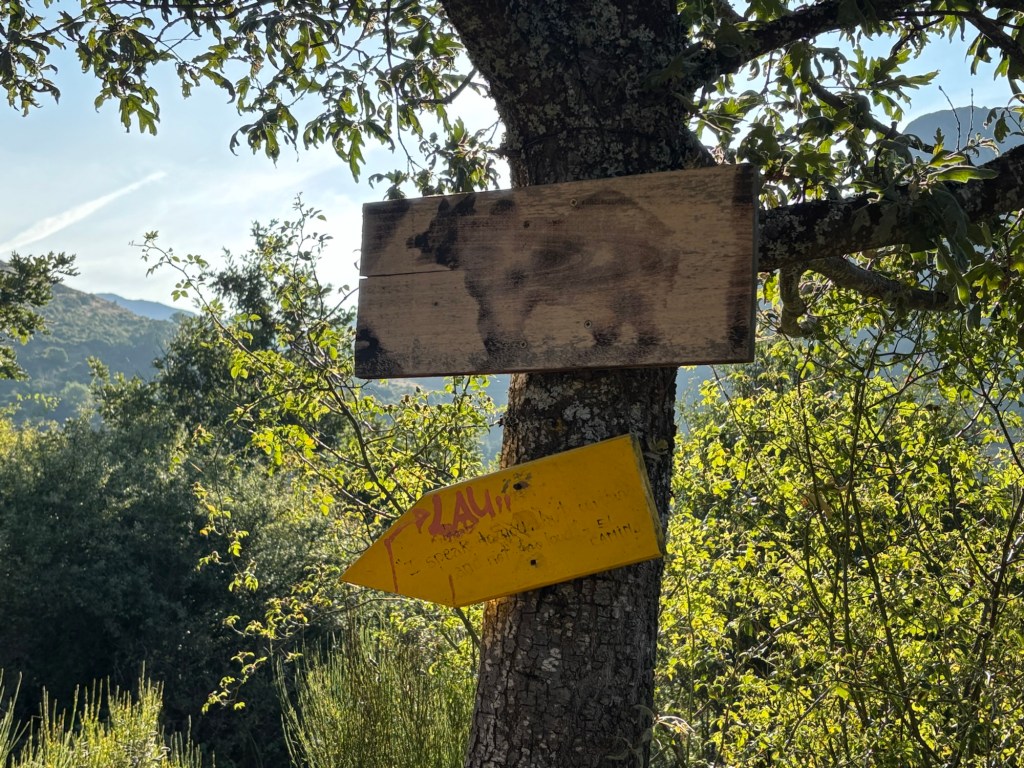
The signs for Borce told a story of their own. It’s believed to come from an Occitan word, bòrça, which means farm or hamlet, but its phonic similarity to the French word for bear – ours – seems to have left a mark in its identity. Bears feature prominently in town, from local artwork and murals to the official signage on the road. And it’s this last that is the most interesting, because on both signs announcing the turnoff for Borce, you can quite clearly see the impact of a shotgun blast.


It could have been an accident, but the fact that it appears on the second sign – and only on the image of the bear – confirms that this is a local act of protest against the reintroduction of bears to the Pyrenees, after the last native bear was shot in 2004. The bears are back, thanks to conservation efforts involving the considerable population of bears in Slovenia, and they’re actually growing in number, but that’s not something that’s been welcomed by everyone.


When I was a boy, my parents took me on holiday to Les Cabannes, a mountain town on the eastern side of the French Pyrenees. There, they’d daubed the words ‘Non aux ours’ – no bears – in huge yellow letters on many of the roads (or rather, as I remember it, ours aux non, as they’d painted it in such a way that you’d read the words as you drove forward).

That was around fifteen years ago. The fury is still raw, with a local 81-year-old hunter jailed for four months for killing a bear that attacked him while he was out hunting in the mountains.

Spain has a similar problem with wolves, with one Cantabrian town leaving the severed heads of a local wolfpack on the steps of the town hall as a warning to those who would try to bring the wolf back from the edge of extinction. It’s been hundreds of years since we drove the wolf and the bear out of their homes in Europe, but the ancient fear we harbour towards these beautiful animals is still painfully present, so long as we try to share their world.


But I’m doing Borce a disservice. The village is tremendously charming, and full of running water – the most important amenity after such an arduous trek. Christian met me by one of the fountains, having lately returned from Canfranc; he and Miguel had caught the bus to the Spanish border this morning to see the impressive station, and Miguel had decided to press on from there, while Christian returned to Borce as his last stop before his journey home tomorrow. The two fellows have been a jolly presence for the first three days of the Camino, and I shall miss their company. Fortunately, it looks as though I won’t be alone for long, as there were quite a few pilgrims in Borce. It must be its status as the first (and last) stop after the train terminus in Bedous before Somport, the starting point of the Camino Aragonés.

So this time tomorrow – with any luck – I shall be in Spain. To celebrate, I had a Borçoise crêpe at the Auberge de l’Ours, following a tip-off Christian had received from the bus driver. It really was quite spectacular, and I couldn’t have left France without having one of these delicious French specialities.


Well, that’s quite enough for one day. There’s no WiFi here, so I’m relying on data to get this through to you. It’ll cost me, I’m sure, but that’s what all the hard work over the last year is for, right? That’s what I keep telling myself, anyway. À demain! BB x

The Pillars of Hercules

La Línea de la Concepción. 15.37.

Eighteen years ago, some family friends came out to visit us and spend a walking holiday in the sierras of southern Andalucía. That’s when I first saw the Rock.

Since then, it has loomed large over so much of my work. It was a talking point in my Year 13 Extended Project Qualification on the Islamic Legacy in Spain. It served as an illustration on the front of my final dissertation on Pedro de Corral and the Spanish founding myth at Durham University. It’s been a subject for discussion in goodness knows how many A Level, IB and GCSE classes I’ve taught over the years, and it’s going to feature once again in the talk I’m delivering next week to the local Hispanic society on Spain’s Islamic History.


The Rock. Calpe. Tariq’s Mountain. One of the two pillars of Hercules. The key to the Mediterranean. Gibraltar has gone by many names over the centuries, indicating its enormous cultural footprint. So it’s easy to see why the Spanish get so cut up about the fact that this relatively small peninsula belongs, not to either of the countries that can see it – Spain and Morocco – but to the United Kingdom, an opportunistic seafaring nation that snapped up the city in 1704 during the War of the Spanish Succession. It was Spain – or rather the Spanish crown – that officially ceded the peninsula to Great Britain. It has been a decision they have regretted ever since.


Modern-day Gibraltar is a very strange place. You cross a staggeringly short airstrip and enter a completely different world – like a jigsaw piece from a different puzzle that fits, but looks totally out of place. It’s as though somebody has taken a slice of an English county town and dropped it incongruously on the Spanish coast. Not even the tourist-infested Costa del Sol matches its otherworldly vibe.

Red postboxes. English traffic signage. Curry, gin and Cadbury’s. Pubs bearing the faces of Lord Nelson and Queen Victoria. Even the layout of the high street is unmistakably English. If Spain truly wants Gibraltar back, it will have some serious landscaping to do.


As I recall, we were short of time on my last visit here. The bus from Málaga made the trip down the coast in record time, so I had all of six hours to explore – almost all of which I spent walking. My phone seems to think I’d clocked twenty-one kilometres by the end of it… which, given my roundabout route through town, to Europa Point and up and down the Rock, is probably not too far from the truth.

Hidden away at Europa Point is a symbol of the British subversion of the terms of the Treaty of Utrecht: the Jews’ Gate Cemetery, where many of its former rabbis are buried, and the Ibrahim al-Ibrahim Mosque, one of the largest in a non-Muslim country. Tucked away here on the south side of the rock, they’re not immediately obvious from the Spanish side, and while the mosque may be a recent addition (built in 1997), it’s thought that the cemetery was put there to conceal the presence of Gibraltar’s Jewish population from prying Spanish eyes. The Treaty of Utrecht was quite clear on the matter:

Her Britannic Majesty, at the request of the Catholic King, does consent and agree, that no leave shall be given under any pretence whatsoever, either to Jews or Moors, to reside or have their dwellings in the said town of Gibraltar.

Great Britain, unsurprisingly, largely ignored this clause of the Treaty, and Gibraltar has been a haven for a small enclave of Jews ever since. Lately, it seems a Muslim population has also returned to the Rock – large enough to warrant a sizeable mosque funded by the Saudis – fuelling some dissent from the Spanish side.


As you start to climb the rock at Jews’ Gate, the view across the Strait to the South becomes even more spectacular. What makes it all the more special to me is that I know those mountains very well, albeit from the other side, having climbed a few of them myself when I lived in Tetouan. I could just about see Ghorghez in the far distance, as well as the peninsula of Ceuta, but Jebel Musa is the most recognisable, being the most likely candidate for the southernmost of the Pillars of Hercules, the twin mountains that stand like sentinels at the mouth of the Mediterranean.

There’s an awful lot of lore here. The legend has it that the Greek hero Heracles split the original mountain in two in order to clear a passage to his tenth labour, the capture of the cattle of Geryon. While he was here, at the edge of the known world, he supposedly founded a city that would later become Seville. That’s why the Greek hero features so prominently in Spanish folklore – and on the Andalusian flag, for that matter. The legendary pillars themselves are on the Spanish cost of arms, emblazoned with the mantra ‘plus ultra’ or “further beyond” – the defiant Spanish response to an older inscription left on the rocks by the civilisations of old, non plus ultra, warning of the emptiness beyond: an emptiness that Christopher Columbus famously disproved in 1492.

Nowadays, both of the pillars bear the names of the two Muslim commanders who led the invasion of Spain: Musa bin Nusayr, the governor of Ceuta, and his subordinate, Tariq bin Ziyad. Though Tariq was executed on Musa’s orders for his hasty invasion (it’s not every day a raid turns into a regicide), it’s his name that has gone in history as Jebel Tariq – gradually mangled into Gibraltar.


Being so close to Africa, Gibraltar is a natural (and phenomenal) place to observe the annual migration of birds traveling to and from their breeding grounds in spring and autumn. It’s especially good in spring, as the birds ride the thermals on the Moroccan coast and soar across the Strait with hardly a wingbeat, gradually descending and sometimes arriving on the European side at eye level.

My camera was a dead weight as it had run out of power shortly after arriving in Gibraltar, and I’d plum forgotten to bring the charger (which I could have used here, since Gibraltar uses English sockets). All the same, I could observe some of the migrating birds with the naked eye. I clocked around thirty black kites as I climbed the Rock, along with a number of honey buzzards and black storks. I thought I heard some bee-eaters, but they turned out to be an audio recording hidden in the bushes at the park’s entrance. How odd!


Let’s be honest, though – I came here to see the monkeys!


The Barbary macaque is the only species of monkey that you can find in the wild in Europe. The fossil record shows that they were once found across Europe during the Ice Age, but they can now only be found in the Rif Mountains of Morocco – and here in Gibraltar. It’s almost certain that these aren’t the last survivors of the European population, but rather a group brought over by the Moors (and later restocked on the orders of Winston Churchill himself). Nevertheless, they’re as much at home here as they are in the cedar forests of the Atlas Mountains across the Strait. Perhaps more so, since there are so many hapless tourists just asking to have their lunch stolen.


There’s plenty of food left out for the macaques every day, but there’s a further incentive for keeping your snacks under a close watch: it’s illegal to feed the monkeys, punishable by a fine of up to £4,000. That won’t stop them from trying to snatch what you’ve got, edible or otherwise, but it’s best to avoid any cases of mistaken identity by keeping your food and drink out of sight.

This one by the Skywalk was scoffing something that definitely wasn’t official monkey food. I wonder what they make of M&Ms? Do you suppose they taste any better to a monkey’s palate?


It’s a bizarre experience, walking around the Rock and seeing wild monkeys wandering about the place, like some African safari. The long lines of white tourist taxis crawling along the Queen’s Road and stopping for their passengers to take photos only add to the experience. Not that the macaques seem to mind overmuch – the youngsters are quite happy to play undisturbed.


Alonso del Portillo, the first Spaniard to include Gibraltar in his chronicles, referred to the macaques as the “true owners” of the Rock, occupying its eastern face since “time immemorial”. Even so, I wonder if their not so inhuman brains ever stretch as far as thoughts of that land on the other side of the sea, where the rest of their kin can be found? They certainly seem to spend a lot of time looking out that way.


I’ve always been a keen naturalist, but my especial love for primates goes back to my time in Uganda, where I had the privilege of seeing mountain gorillas up close. That seems a more logical place to start, since it probably doesn’t stretch back as far as my last visit to Gibraltar, when one of the macaques welcomed me to the Rock by shitting down the back of my hoodie as I left the cable car.

No cable car this time – and no shit either. Cause and effect! (And also a financial dodge, as the cable car costs an extortionate 19€…)


The only downside to not taking the cable car was the climb back down the Rock. I took the steps down the Charles V wall, a 16th century fortification against the Barbary pirates who once plagued these waters. They’re bloody steep, they can only be walked down (or up) in single file, and there’s the added hazard that the macaques use them as well – and they don’t like to be cornered.

Fortunately, by the time I came down, it was well past noon and most of the macaques were dozing off the midday sun. These two barely batted an eyelid as I carefully stepped over them. I hope the tourists I passed at the bottom coming down were as considerate.


A local legend has it that Gibraltar will only fall when the monkeys go – much like the English legend about the ravens and the Tower of London. And just like the ravens, the government has stepped in to prevent that superstition from coming to pass in times of crisis. Winston Churchill had their numbers bolstered during the Second World War when their numbers dwindled to just seven individuals – no doubt relying on his friendly relations with the infamous Thami El Glaoui, the self-styled Lord of the Atlas Mountains.

El Glaoui was a wily tribal chieftain and the son of a slave who, through a number of deft political manoeuvrings, came to rule much of modern Morocco. He is said to have counted Winston Churchill as one of his close friends. I wonder what he really thought of the eccentric British bulldog? Or of his decision to resupply the apes to keep a British legend alive? In Morocco, these beautiful creatures are often caught and forced to perform in market squares for the amusement of tourists. At least here in Gibraltar they don’t have to wear humiliating dresses or chains and can claim the Rock as their home.


Unsurprisingly, it’s getting late. That took a long time to write. I should get some sleep, but the Guardia Civil are processing tonight and I’d love to see that before the Legion arrives tomorrow. And that really should be a special way to end my adventures. What a journey it’s been! BB x

Rain On Your Parade

Plaza de la Merced, Málaga. 21.13.

Everything always looks better in the light of a new day. It also always feels better after a decent night’s sleep, which – bar a brief episode where the street sweeper went by at 4am this morning and woke everyone up – I most definitely had. With my inner city blues no longer making me want to holler quite like they did the day before, I set out into Málaga in search of somewhere green and quiet.

The street sweepers were still at work as I wandered across the old town, scouring the slabs outside the cathedral. There’s two reasons for this: one, to remove the wax from the dripping candles of the processions, and two, to remove the gum spat out by the thousands of spectators (especially the younger ones – almost every other guy and girl was chewing something last night).

I see a fair amount of gum-chewing as a teacher, but nowhere near as much as I do here. Spanish kids seem to be hooked on the stuff.


Gibralfaro is the antidote to the crowded streets of Málaga. An island of green in the busy seafront city, it allows for a rapid escape from the noise. Stick to the nature trails and you’ll leave even the rest of the foreigners behind. It might seem hard to believe, but there are corners of Gibralfaro where you can sit and imagine what this place was like a hundred years ago, before the coast was swallowed up by the leviathan of modern day tourism.


I came here looking for chameleons, primarily. They’re one of a number of strange African animals that can be found in Spain, alongside the genet, the mongoose, the Barbary macaque and the crested coot – all but the last of them introduced by the Moors, in all likelihood, though there is fossil evidence to indicate that some inhabited the Iberian peninsula in ancient times.

Looking for chameleons was something of a personal quest when I was a boy. They’re notoriously hard to spot, being both small in size and famously good at camouflaging themselves to blend into their surroundings, but that only made it more exciting. My parents took me on at least two abortive attempts along the coast of Cádiz, once to Barbate and once again to some other location whose name escapes me. Even with the knowledge that they have a preference for white broom bushes (perhaps on account of the insects they attract), they always managed to elude me.

It wasn’t until my last few days left in Spain, when my brief but life-changing year in Andalucía came to an end, that I finally struck gold. Hiding within the branches of a broom bush near the cliffs of Barbate, and not much longer than the span of my hand, was a chameleon. I had done it – I could leave Spain in peace.


It was, looking back, the first of the ‘great quests’ that I have set for myself. Finding a chameleon was the fulfilment of a boy’s dream just as finding my Spanish family was the accomplishment of an older, wiser wish.

Most of my ‘great quests’ have centred on Spain. I suspect that they will continue to do so as long as my heart beats in time with the magnetic pulse of this beautiful country.


Well, I didn’t find any chameleons this time. They’re quite numerous in the Axarquía, the verdant sierras that stretch east along the coast from Málaga, but while there are supposedly a few to be found on Gibralfaro, I didn’t see any. Still, it was a fun way to kill some time and step back into the shoes of a younger version of me whose passion for Spain was only just beginning to burn.

I did have a couple of encounters with the mountain’s red squirrels, though. Like most of the mammals that inhabit the Iberian peninsula, their fur is streaked with darker colours to better match the terrain around them. The only obvious shades of red can be seen in their fingers and toes.

The invasive American grey squirrels that have driven our native reds almost to extinction in the United Kingdom are not to be found here in Spain, so the reds are a lot less fearful than they are back home. They do, however, seem to possess the same fiery temperament that is often associated with humans of their colouring, and are quick to sound the alarm when they sense a threat.


One species that has invaded Spain in the last century – almost as obviously as the tourists – is the monk parakeet. This South American species fulfils the same niche as the Asian ring-necked parakeet in the south of England, albeit with a much wider range: monk parakeets can be found in larger cities from Barcelona and Valencia all the way along the Mediterranean coast to Málaga and Cádiz, and even as far inland as Madrid.

They’re impossible to miss by even the briefest visitor to Spain’s cities, not least of all on account of the racket they make as they fly around the parks and gardens in search of fallen fruit, dried or otherwise. They made such an impact on the Spanish cityscape that the Japanese developers of the most recent Pokémon games, Scarlet and Violet, modelled an aggressive parrot-like Pokémon on them: Squawkabilly, whose appearance (and Pokédex description, for that matter) matches them exactly.


It was supposed to rain today, but it didn’t come down until late. Rain isn’t unheard of in Semana Santa. In fact it’s quite common, common enough for every hermandad to have a backup plan. And several backup plans were required this afternoon, as the heavens opened to a brief but torrential downpour.

I stayed inside for the worst of it, following the rescue attempts live on TV, and then set out to find a space in the brief respite provided by the rains – and, morbidly, perhaps, to see what damage had been done.


There’s usually the odd outpouring of grief from the spectators during the processions, sometimes in the form of a beautiful and spontaneous saeta (the traditional songs sung to the pasos, which requires the procession to come to an immediate halt), but there were a lot more tear-stained faces than usual. For some Catholics in Spain, this is the high point of the Christian calendar: publicly demonstrating their faith summa cum laude with their friends and family in the hermandad. When the conditions are just too poor, some pasos will be rained off entirely.

I counted at least five nazarenas in floods of tears being consoled by their families after dressing their best, only to be soaked to the skin and unable to continue their procession.

I’ve often wondered if the reason the Andalusians take Semana Santa to heart so much more than the other regions of Spain is that they once had far more to prove: being the region of Spain held longest by the Muslims, theirs was the shakiest of Christian bloodlines, and thus it must have behoved them to make twice as much of a show of being good Christians than their co-religionists in the north. It would go some way to explaining the unrestrained force of duende in the hearts of many an Andaluz costalero.

It’s just a theory, but I think it might have some grounding in truth.


Despite the threat in the clouds, the rain never returned. Jesus and Mary were taken out of the protective plastic coverings that had been hastily applied, the ornate candle-holders were emptied of all the water they had accumulated and those processions that had already made a start have now jumped the gun to make good for lost time. They will go on late into the morning, with the latest finishing around half past four. The crowds will be with them all throughout the night, but I need some sleep. Tomorrow brings another grand adventure – the last of this grand tour. I hope my legs are in good shape! BB x

The Mother of the Marshes

Casa Los Tres Aires, El Rocío. 14.01.

The long-promised rains have arrived. Buckets of it. It began with a sudden gust of wind in the palm trees and a ripple over the lagoon, turning the mirrored surface of the water into a sea of silvery sand dunes. Some of the locals wandering in the square turned to the west and pulled their jackets about them. The savvier ones pointed and moved toward the shelter of the church. Then the darkening sky turned a pale grey, and the trees beyond the road disappeared behind an advancing sheet of rain. Just as the church bell chimed for half past, an almighty drumroll of thunder sounded in response and the heavens opened, and down it came: sheet rain, a wall of water, turning the sandy streets of El Rocío into rivers in a matter of minutes. By the time I made it back to my casa rural I was soaked to the skin – and more alive than I’ve ever been.


Some devotees of La Blanca Paloma – the White Dove, the nickname of the Virgen del Rocío – believe that her sudden appearance in the branches of an olive tree in the marshes of Almonte was a manifestation of the divine. More sceptical minds might be persuaded that the image was simply one of many hidden away from the conquering Moors and scattered across the countryside, forgotten until their chance discovery by bewildered countryfolk. Whatever you choose to believe, the Virgen del Rocío exerts a powerful influence over the town and its surroundings, bringing more than a million pilgrims to her shrine every year.

One legend has it that the townsfolk prayed for her intercession during the Napoleonic invasion, hearing that a raiding force of French soldiers was heading for the town. For whatever reason, they never made it as far as El Rocío, turning back at Pilas, just shy of thirty kilometres away. Maybe it was the unforgiving terrain of the marshes – or maybe it was the watchful power of the Virgen. Who knows? The fact remains that the village of El Rocío was untouched by both the Napoleonic War and the Civil War in the following century, a conflict which tore almost every town in Spain apart. It’s easy to see how many have come to believe that some great force watches over these marshes, shielding them from harm.


It hasn’t been able to protect them from everything. While it’s incredible to see Doñana restored to life, it’s important to bear in mind how it got into the state it was in: this time last year, the news were all full of woe, decrying the death of one of Europe’s last great wetlands as its life was slowly sucked out of it. Why, you ask? Climate change may be part of it, but the blame lies almost entirely at the feet of the monstrous theft of the land’s water by the agropiratas.

These mercenary industries have set up shop in the outskirts of Doñana and, over the last two decades, they’ve been draining its aquifers to grow strawberries on an industrial scale. Strawberries are a very water-hungry fruit, and the results have been catastrophic, causing the water supply to cascade, lakes to dry up and the local extinction of a number of species that can be found almost nowhere else, including the white-headed and marbled ducks, the salinete (a fish found only in Doñana) and the eel – formerly abundant and now almost completely eradicated from these marshes.

I could do a lot more for charity’s sake, but there are two causes I will not budge from. I will never visit Malta, on account of their refusal to abide by European laws concerning the protection of migrating birds (they still practise the vile tradition of bird-liming), and I will never buy strawberries from Spain, knowing what damage they are causing here. If only we could go back to a time before globalisation, when people were more patient, and prepared to wait for strawberries to be in season, for a short time each year…


It’s still raining out there. It cleared up for a few hours, and then the storm clouds came back with a vengeance. March 2025 has been one of the wettest months in Spain since records began, putting an end to four years of minimal rainfall. It hasn’t been unprecedented: the flash floods that swept through Valencia in October and claimed 232 lives are still a very recent memory. Even so, taken as a whole, the average rainfall over the last five years is still well below the average. Spain will need more consistent rain if places like Doñana are to survive in the long run.

That, and decisive action from the government on the villainous agropiratas and their strawberry farms.


I wanted to make the most of the park’s rebirth, so I went for a long walk in the pine woods of La Rocina to the south of El Rocío. A boardwalk trails stretches for five kilometres along the side of the river that feeds into the Madre de las Marismas, the lagoon that sits under the eye of the Virgen del Rocío. Like the Raya Real, this place is very dear to me: I used to come here as a boy and look for bee-eaters, hoopoes and scarab beetles in the scrubland at the trail’s northern edge.


My sense of smell – mercifully restored after a debilitating cold had me in its grip at the start of my travels – was assailed on all sides by Spanish lavender and curry plant, and every bush seemed to harbour a nightingale. I even saw one, singing high in the branches of one of the pines – a fairly impressive feat, since these master ventriloquists have the uncanny ability to seek out the most acoustic spots in the forest, whilst also remaining invisible to the naked eye as they perform their vast repertoire. I’ve included a recording I took below – have a listen and you’ll see what I mean.


I spent my last evening in El Rocío enjoying boquerones fritos and an incredible torrija – a Semana Santa speciality – in Restaurante La Canaliega, watching the sun set over the Madre de las Marismas. The town’s drains were working overtime to deal with the rivers that had formed in the streets, but there was still enough water in the main square to form a second lagoon, reflecting the Ermita’s unique shell-shaped doorway.


I would have traveled a thousand miles to see just this view, but the Virgen del Rocío saw fit to show me her rarest treasure of all on the day I arrived. I have come away with a new rosary of hers, so that I can offer my thanks wherever I am, and so that there will be some piece of her influence wherever I go.

I used to get the stuffing knocked proverbially out of me at school for defending my stance on faith, in spite of being a “rational thinker”. I stand by my beliefs to this day: I do think the world is a better place with a little more love and little more mystery. On the one hand, I adore the pursuit of knowledge for its own sake: the ability to look up at the stars and know their names.

But I also think it’s important to value the wisdom of the ancients. I may not be able to see the shape of a lion up there, but somebody must have done once to call a constellation Leo. And though it took me a long time to find Lynx, it’s taken me a lot longer to find the animal in the flesh. This year, Doñana – and whatever mystical force presides over these marshes – saw fit to show me a glimpse. You can call me credulous if you like, but that’s enough to make a man like me believe.


Not for nothing is the lake named the Madre de las Marismas: the Mother of Marshes. Doñana is feminine in every way, from its name to its essence: a provider, a life-giver, faithful, fickle and generous in turn. I have always said that Spain is my greatest love – but it’s probably fair to say that Doñana is that love crystallised into one place.

I have been gone too long. I must return someday. The fight to save these precious marshes goes on. BB x