Fasting for Convenience

I never saw it coming, but the biggest challenge of living in Morocco is not the language at all. Above and beyond case-marking and getting your head around an Arabic variant that freely borrows French and Spanish words, rendering it almost four languages at once, is the challenge of eating. And whilst I consider myself reasonably proficient at keeping myself well-fed, these first few days in Morocco have rocked me to my core.

The problem, of course, is tied up with living with a family.

Before I set out on my ridiculous trans-Iberian adventure three years ago, I had the appetite of a wolverine. Always eating, ever snacking, stuffing myself with huge quantities of food that I was somehow able to finish in one sitting. Luckily for me, I remained as thin as a beanpole. Something to do with age, a penchant for going on long walks and a good metabolism. I was lucky. 

2013 changed that. The whole Santander to Almería adventure was in a constant state of flux – I don’t think the exact route was entirely clear until it was over – and in the mayhem of sleeping rough in the mountains and navigating by compass and a map dated from 1978, I forgot to eat. That Spanish adventure killed my appetite for good.

Ever since, it doesn’t take much to fill me up. Which is a positive boon, when you think about it, but a major snag when it comes to lodging with an Arab family. I expect it’d be the same just about anywhere in the world, but Arab hospitality is deservedly famous. In amongst all of the Arabic that went over my head, I’ve heard my hosts say more than once that they think I’m not eating well. Not for want of trying – Moroccan food is amazing – but I’ve yet to finish a meal. The quantities are enormous, and the whole eating-with-your-hands thing is frustratingly technical. It slows me down to the point where I’m only halfway through a meal by the time the others have finished eating. Naturally, I’m much too stubborn to accept the cutlery they offered – it’s shameful, like resorting to English abroad – but I can’t help but wonder whether by trying to adapt in one way I’ve only set myself another challenge.

And I need to learn. Eating with one’s hands is the done thing in so many parts of the world, not least of all my beloved Africa. I’ve given myself a week to learn to do it properly; after that, I may resort to a knife and fork, if only to be eating well. It’s Ramadan, after all. It would make no sense at all to be fasting and eating less than usual at the same time. That’s idiocy on another level.

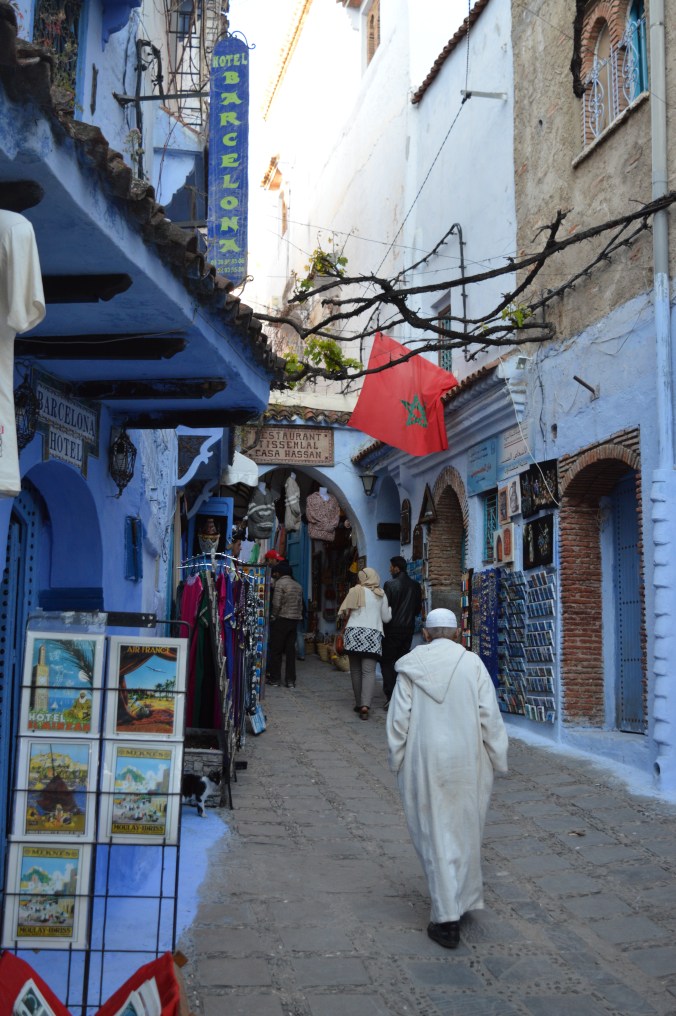
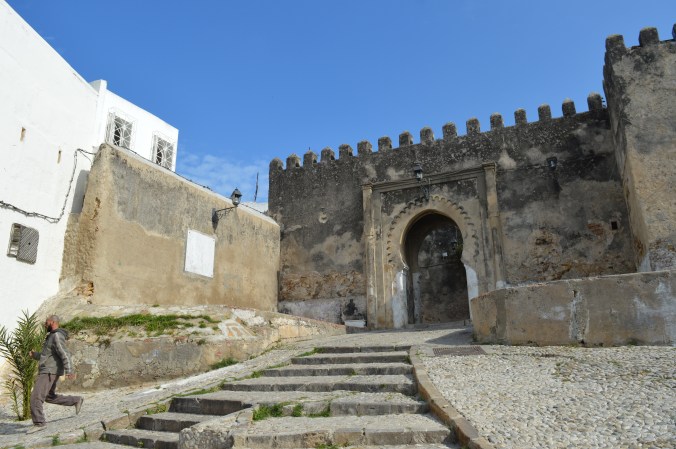
The fasting thing is good, though. It felt right, somehow, getting up at two with the family to eat suhūr together. It adds a new sense of structure to the day. They were all fast asleep when I left the house this morning, which you might expect from a total of five hours’ sleep, but I had class to go to. Fortunately, it’s only a forty minute walk, and that takes you through the medina and last the Royal Palace. It’s a really lovely walk, and it feels better off the back of having fasted with the Tetouanis.

All of this is very easy to say now, on the noon of the first day. Left to my own devices, I doubt I’d make much headway. But with the family watching I’m willing to try. Ramadan helwa, as they used to say in Jordan. And anything that’s got something to do with helwa can’t be that bad. BB x

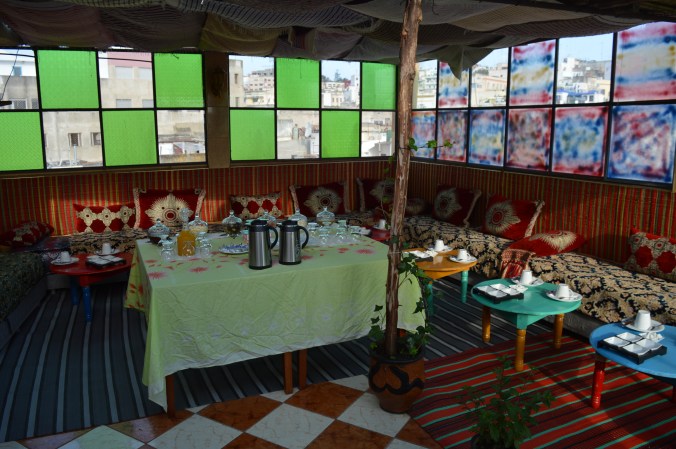
The view from Class N°5, Dar Loughat
Headcase

…………………..<draws a blank>

Buffering, buffering…

Please wait whilst the page loads….

Taking longer than usual to connect….

Predictably, my first session in Dar Loughat was a bit of a shock to the system. Perhaps even more so than my attempts at conversation with my hosts. That would be because striking up a conversation doesn’t tend to require case-marking every single letter.

As lessons go, it was superbly taught. The whole asking-you-for-the-word-in-your-own-language thing is new and a serious improvement; it put a stop to me nodding my way into ignorant oblivion from the get-go. I’m not sure why other teachers haven’t tried that in the past, I needed it bad. I guess it’s the sign of a truly capable linguist, if he’s able to field three languages at once on top of his own.

Nevertheless, I can’t help but feel I was trailing. The placement test landed me with a Parisian postgraduate who had taught herself Arabic alongside Farsi, Urdu and Russian. As if that wasn’t enough, she case-marked everything she said or read almost perfectly, tanwiin fatHas and mansūb endings all over the shop. Like an Archie 2.0. I pretty much gave up on cases in Year Two… and boy, does it show. Some find hardworking people like that inspiring. I just feel cowed. I spent most of that class with a weak smile on my face, like some kind of vestigial ape expression of fear. I brought this on myself, I suppose. I wanted to meet new people, to have a non-Durham class. I got what I asked for.

At the end, the teacher asked us how the lesson went. My classmate said it was very basic. I personally felt like I’d just finished the first assault course in boot camp. He laughed and said that Arabic is a bit like sports.

Great. Exactly what I wanted to hear.

I never said it was going to be easy. To make matters worse, we’re starting from Al-Kitaab 3 again. Not that that’s a bad thing – it’s pretty clear now that I’ve forgotten almost everything I learned out there, except possibly all the bird names I taught myself (escapism – because it was in my interest) – but the first topic is politics. Anybody who knows me knows how pigheaded and closed-minded I am about politics… That is to say, I hate it. I don’t like talking about things I don’t know and I know grand zilch about politics. Again, my classmate proved the yin to my yang: she loves it, takes a passionate interest in the subject and wants to pursue it through journalism.

So just as conversations at home tend to err towards the one-sided field, so too may classes here. All I have to offer is that I study books… A firm background of literature, art and music doesn’t make for an easy playing field when the subject is politics; specifically, the political ramifications of the Iranian Revolution in Islamic nations around the world. Give me the sleazy wine poetry of Abu Nuwās any day.

There’s an orientation at half three. Lessons last from nine to twelve and it sounds as though students spend the afternoon involved in projects. Which projects exactly I’m hoping I’ll find out today. That might be the key to staying alive. There’s little use in heading back to the flat… I have everything I need here, and it’s a tad too far to walk (dammit). So just for today I’ll stick around and take advantage of the speedy WiFi.

The first class was always going to be tough. Nevertheless I’m determined not to give up, not this time. If Arabic were only vocabulary, it’d be a dream… But we must be realistic. Besides, I guess it’s like maths – another thing that floors me. It’s simply a matter of knuckling down and mastering the technique. I gave up on maths too early. As a result, I can’t do division. I never could. I won’t make the same mistake with Arabic. BB x

The First Hurdles

I knew it. My Arabic is every bit as rusty as I thought it was. Over the last twenty four hours I’ve jumbled kalimāt with ma3kulāt, completely ignored the feminine –īn ending, let sentences slide into the oblivion for lack of vocabulary and resorted to a mixture of French, Spanish and English to fill in the gaps. How people manage to stay on top of six or seven languages at once baffles me; four is troublesome enough.

And so begins the third and final stage of the Year Abroad. The afternoon call to prayer is sounding as I write, cutting over the Camarón playing defiantly from my earphones; two months in Tetouan, a small city on the northern coast of Morocco. Arabic is back with a bang in my life. It’s an early start for me tomorrow at Dar Loughat, my new school, though not so much so now that the clocks have gone back for Ramadan. Registration, a placement test and, like as not, the first class.

I’ve been here for a little over a day now, and though Tetouan is only a stones throw from Tarifa, it’s a very different world from the land across the Strait. And it’s not just the Arabic. Even mealtimes are a challenge, and Ramadan hasn’t even started yet. I’m all up for eating with my hands, but it’s a good deal more technical than I thought it was. Naturally, I made a bit of a mess of it last night. Somewhere in the recesses of my memory, I recall a similarly awkward attempt in Uganda, where the ‘natural fork’ – using your thumb and three fingers – is the done thing, but that got forgotten somewhere between the purple lightning and the mountain gorillas. Priorities.

Letting in the morning light through my bedroom window is also ‘not good’, something I hadn’t anticipated. Morocco is a long way from the Middle East, but some of the old Arab customs cling on here. 

Determined not to lapse into last year’s old habits, namely falling back on English whenever possible, I’ve taken a dive and lodged with a Tetouani family. For someone who really values his own freedom, that was a difficult decision to make. But when the other Arabists come back in October with an average of six months apiece in an Arabic-speaking country, I’ll be left floating, so as I said before, it’s my prerogative to push myself. And what better way than to live with a Moroccan family?

It’s not easy. I reckon I understand less than half of what they say to me, even though it’s in fusHa (when they speak Dārija to each other, I don’t understand a word). I tend to latch onto the first word I recognise and wrestle with that until I have some idea of what’s going on. More often than I should, I find myself using a French word coupled with a pathetic expression to make up for the words I’m missing. When it comes to conversation, which is – for now – rather one-sided, my contributions consist of a series of nods and noises of understanding. And I’m still very much at the stage where I’m constantly getting caught out by questions.

All of this is a bit disheartening after that triumphant C2 in the CEFR Spanish exam. It’s like I’ve been reset to zero, sent back to the starting line just before the end of the 1500m. No, it’s worse than that: it’s like that painful childhood moment when you’ve been playing Pokémon for five hours and then you turn the game off without saving, and after all the cussing and swearing you know you’ve no choice but to retrace your steps or give up and walk away.

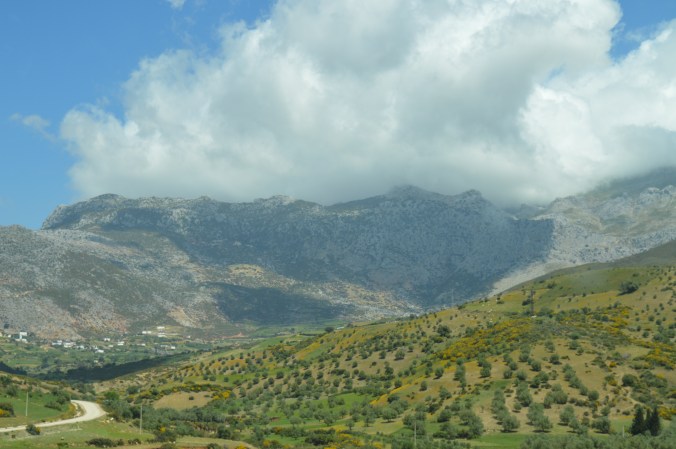
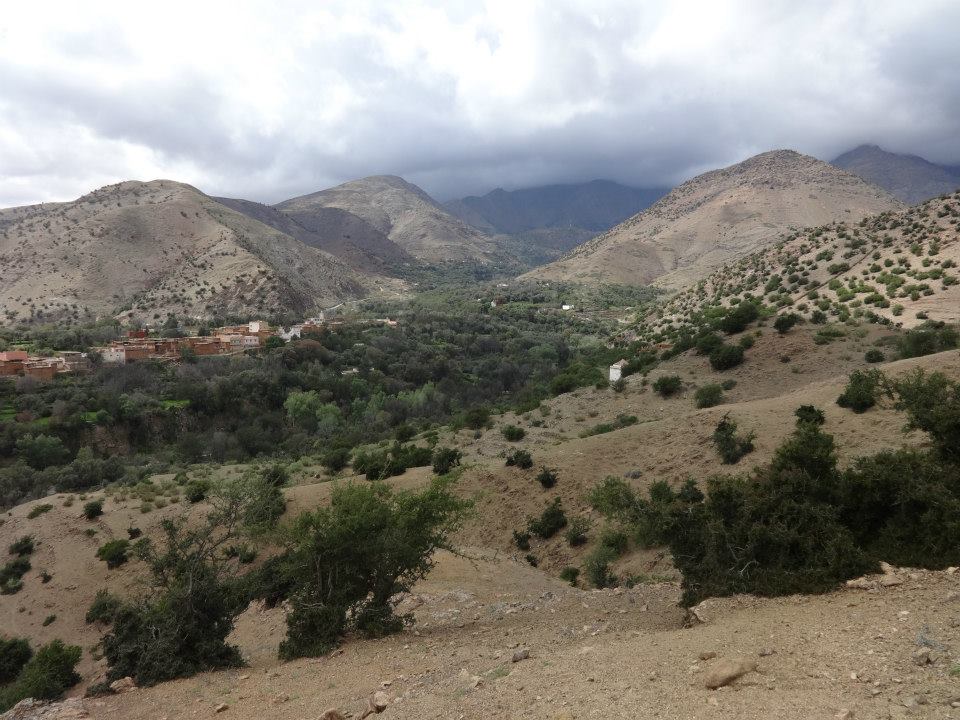
I was an odd kid. Nevertheless, the spark that flared in me in my first year at university is blinking in the dark. There’s a reason I came out here alone, early, immediately. I’m not about to give up on Arabic. Far from it. I’m determined to make this work, to be reinspired. Dear Kate found inspiration in Jordan where I found only creeping despair. But this is round two, and I’m coming back fighting. I fought hard to come here and now I have to earn it. I have to show the downcast Ben from last year who’s boss. That’s easy to say now, before the course has even begun, but that’s what it’s all about: a positive attitude. And having the awe-inspiring cliffs of the Rif Mountains does help. A lot.

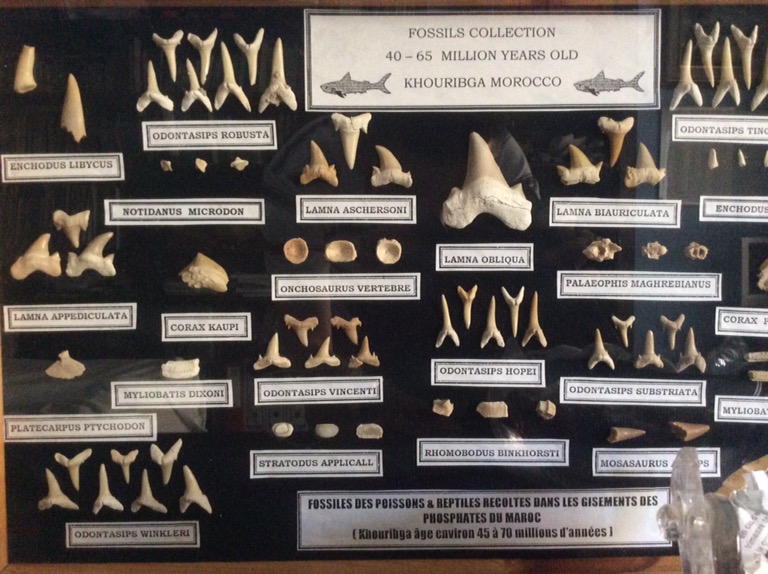
All this and more has been said before, so I won’t sweat it. I haven’t yet got out to explore Tetouan beyond this morning’s trip to the market, so I’ll tell you a bit about my room. It doubles as a library. There are books in at least four languages spread out across a bookshelf that stretches along the length of one wall; Ibn Khaldun’s Muqaddima and Ibn Battūta’s Rihla, Pablo Neruda’s Confieso que he vivido and a French history of the alliance between Moulay Ismail and Louis XIV. There are also fossils everywhere. Trilobites, ammonites, corals and seashells, sharkteeth and even a gigantic bone of some description. My hosts – or one of them, at least – are avid naturalists. You could say I’ve landed on my feet. It’s also got a desk, a luxury I was denied both in Spain and in Jordan and – heaven above – it’s got WiFi. Weak WiFi, but at least it’s there.

No bones about it: this is definitely a step-up from last year’s overpriced two-room flat with the haunted washing machine and the worksite next door. BB x

Volver

‘What is he saying?’
‘It’s closed.’
‘Wakha. Fermé. No ferry.’
‘Closed? Why?’
‘I think he said there’s a strike… Huelga? Uh… grève? Est-ce qu’ils ne travaillent pas aujourd-hui?’
‘Ah! No lanchan ferry! Wakha, sadiqii, wakha!’
‘Pero, en serio Ben, tu te has enterado?’
‘A mí me gustaría mucho enterarme…’

You know what I was saying a couple of posts back about loving the multilingual melange that is Tangier? Well, I guess I got my comeuppance this afternoon. After a long shopping trip in the medina, loaded down with suitcases and food for the return journey, we hailed down a grand taxi for the harbour. But for the photography hiccup in Chaouen (and Booking.com refusing to refund me for a bungled payment), our four-day trip to Morocco had gone without a hitch.

So it’s only natural that the taxi driver would leave it until we got to the harbour to tell us that, due to exceptionally strong winds, the port was closed. This was swiftly backed up by both the police and the FRS office, as if we weren’t already doing a bad job of playing the trust card. If we wanted to get home, there was only really one viable option: we’d have to catch the big FRS ferry from Tanger Med near Ksar Es-Seghir, some forty kilometres up the coast.

DSC_0610

We should have seen this coming just looking out from the hotel, really…

That’s how I found myself still in the same taxi some twenty minutes later, rounding the bends of the twisting coast road for the port and trying to make one intelligible sentence out of the five-language jumble of our taxi driver. His Classical Arabic, French, Spanish and English were all perfectly reasonable, but his mixing-up of all four of them mid-sentence with his native Dārija made it nigh-on impossible to understand a word of what he was saying. Speaking four languages is one thing, but trying to make sense of them all at once is a step too far for me.

DSC_0608

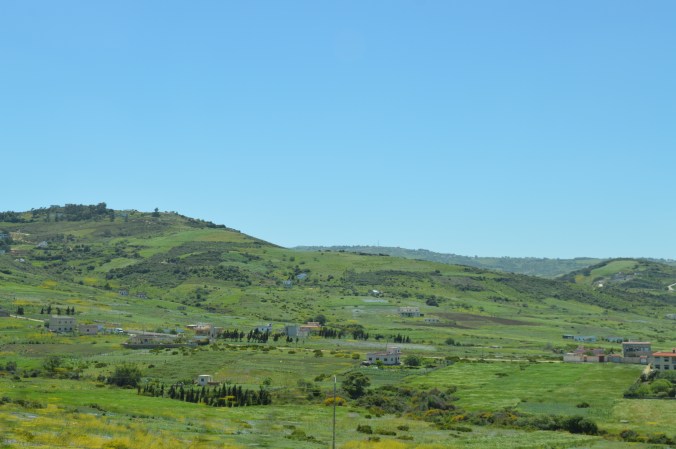
So green – but how much longer will it last?

By some streak of luck we made it to the docks in time, and for a fair price, too; 180MAD for the car from Tangier, for the record, and not quite the 2500MAD that was his first offer (trumping even the villainous Oulad Berhil cabbie in greed). Predictably enough, we weren’t the only ones caught with our pants down by the closure of the Tangier port: at least two other boatloads turned up for the 14.00h, which was necessarily shunted back to 15.00h, and then 16.00h. Passport control was, for the once, the least of our concerns; a succession of connecting buses came and went, none of them bound for the FRS service. I don’t suppose I minded too much. I spent the last hour playing Peep-O and making silly faces at a little girl who seemed only too pleased at the diversion. By the time the FRS shuttle pulled in it was coming on to five minutes to four and tempers were running short. Mufasa would have been all too familiar with the stampede that followed.

a

God, I’m so evil

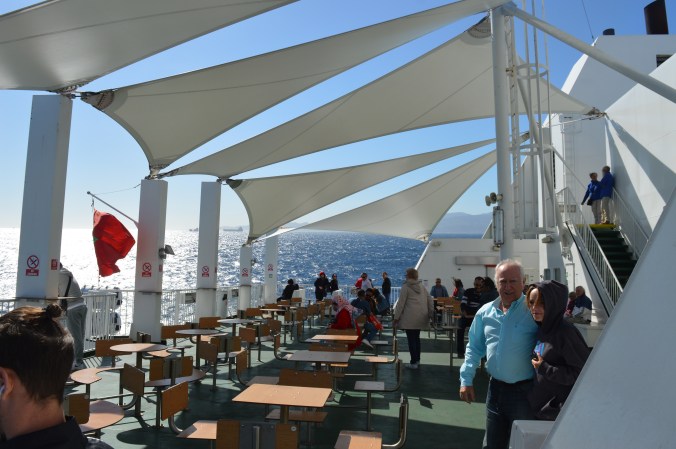
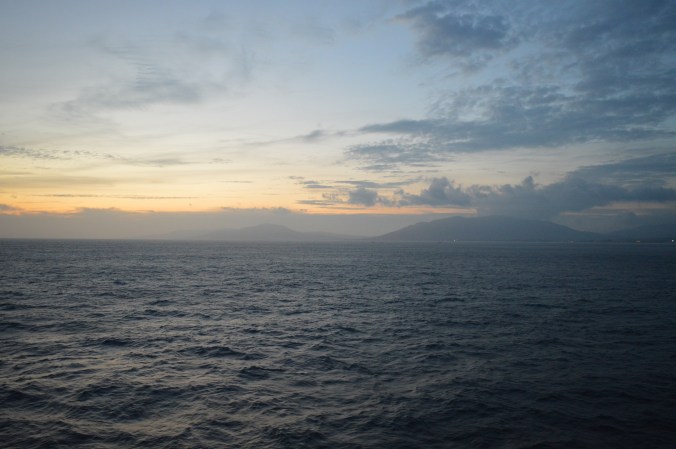
Despite repeated warnings from the bridge, I spent almost the entire journey out on deck in the hopes of seeing a shearwater (I’d seen a few dusky shapes in the gloom on the way out, but I needed to be sure). The Strait is also a very good place to look for whales and dolphins, so I had an eye out for them, too… whenever it wasn’t shut tight in a wince in the game-force winds, that is. The sea was choppier than I’ve ever seen it, making whale-watching a no-go and rendering photography difficult. At its worst, the ferry was tilting at a twenty-five degree angle from side to side, giving spectacular views down the deck into the ocean or the open sky at any given moment.

DSC_0683

Not the healthiest angle for a ferry

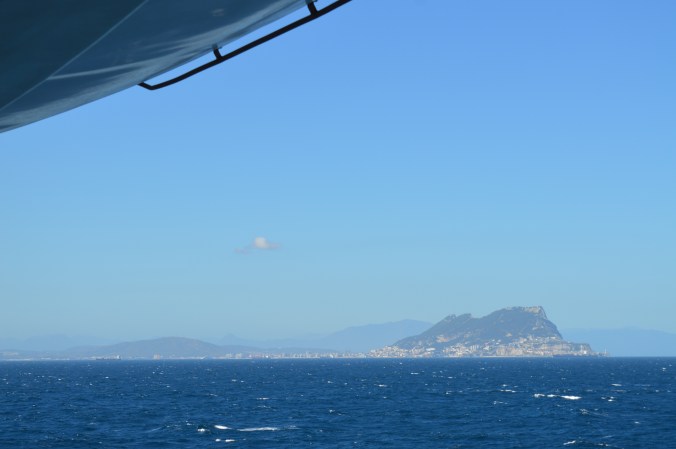
A sensible mind would have given up the ghost and retreated. But I’m not all that sensible, and I was rewarded for my obstinacy just short of the bay of Gibraltar by a single, chocolate-coloured seabird gliding effortlessly between the waves and a far-off but recognisable vertical jet of steam. Stubbornness has its rewards.

DSC_0689

The Bay of Gibraltar (plus very distant shearwaters)

Let’s just take a step back for a moment. This is now the third extracurricular adventure I’ve had with my colleagues, following Andorra and the Romanian exchange. Before Meléndez Valdés I’d never imagined life as a teacher to be anything like this. I’m completely and utterly sold on this way of life. This is my life, opening up before me: traveling Extremadura as a qualified English teacher until I have enough experience under my belt to settle for good. The oposiciones sound tough, but my colleagues here are encouraging me to come back and go for it, which makes it all the more worthwhile. Spain, you just keep winning me over. How I love you with all of my heart and more…

It’s coming up to ten o’clock, Spanish time. The sun set an hour or so ago. Eight o’clock start tomorrow morning. Ive had worse. On the whole it’s been a very good weekend, and my appetite for the summer is more than whetted. Only next time, I think I’ll catch the plane. BB x

Chaouen and the Petra Effect

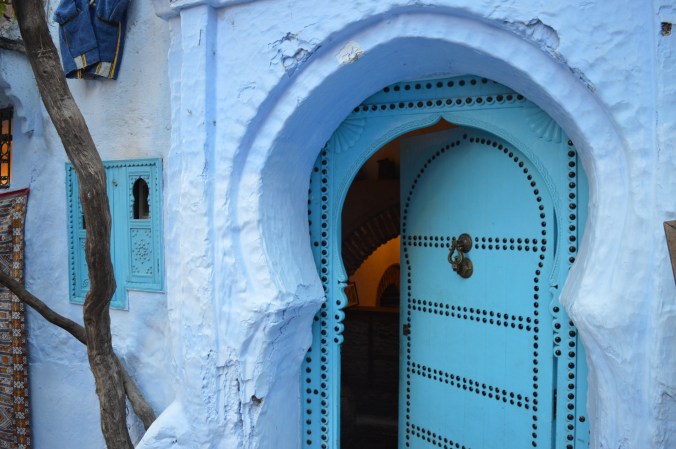
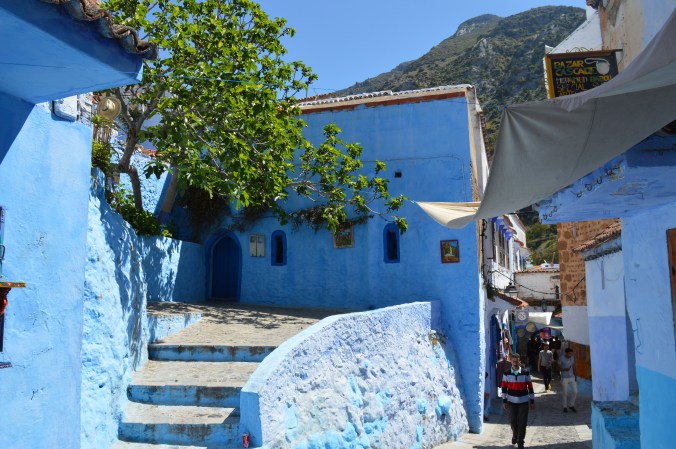
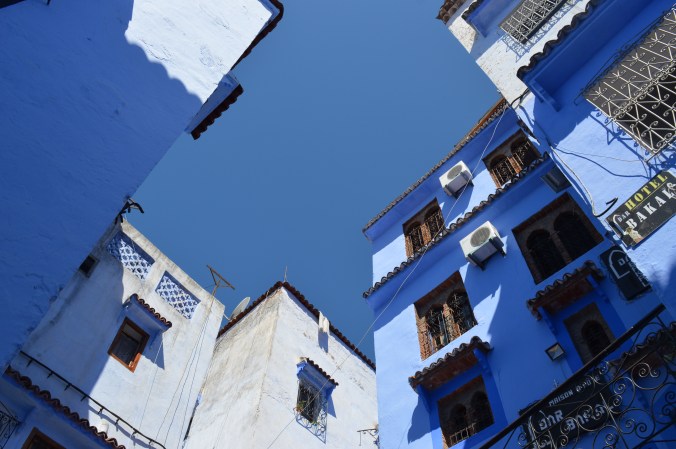
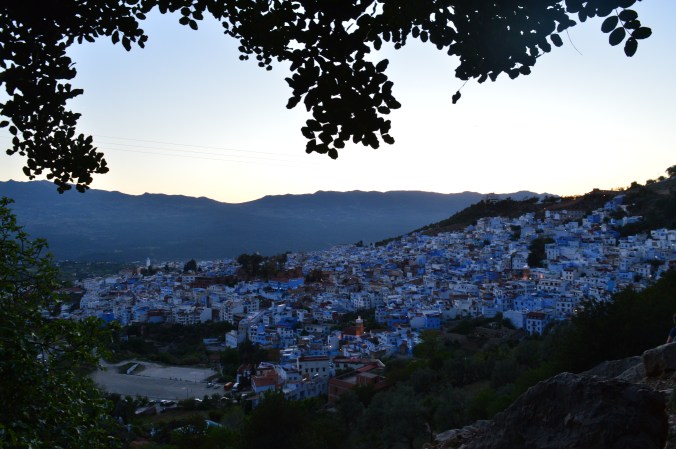
There are some places that you come across that feature on almost everybody’s wish list. The pyramids of Giza, the lost city of Machu Picchu and the Great Wall of China, the name a few of the standout examples. Ask for more and you might encounter a few more classics, like New York’s Central Park and the bustling canals of Venice. Extend the list a little further and you’ll probably find a small Moroccan town nestled deep in the Rif mountains of some forty thousand inhabitants. Why? Because a large part of the old town is painted powder blue. Introducing Chefchaouen, the blue pearl of Morocco.

DSC_0443

I should point out, it’s currently under scaffolding in anticipation of its upcoming designation as a UNESCO World Heritage site. Just like the Fes tanneries last year, that’s another visit hamstrung by the UNESCO beetles. Fortunately, I’ll be a mere hour away all summer, so I’ll be back when they’re done. It promises to be spectacular.

DSC_0560

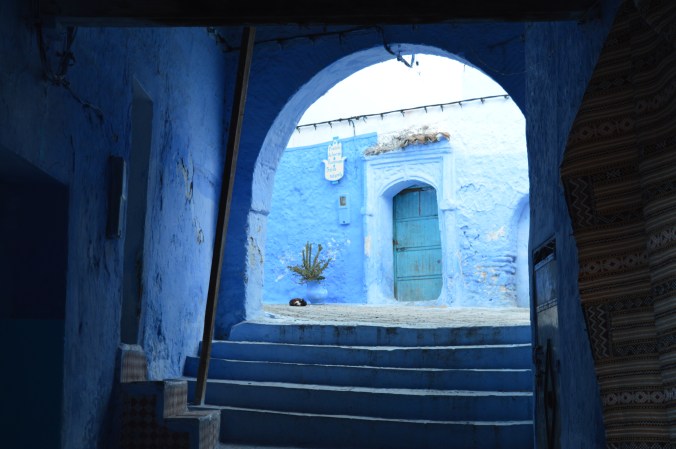
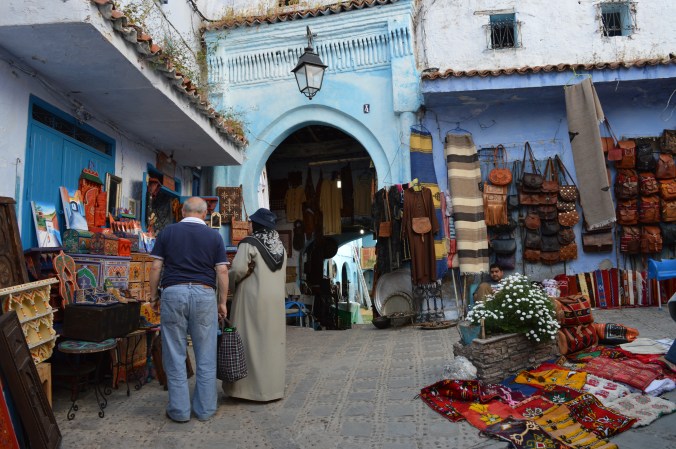
It’s a strange experience, wandering along an entirely blue street. The whole medina looks like something out of a picture book. You can almost hear the suspicious mutterings of the locals when the first travelers stumbled upon the town a century or so ago; a four hundred-year old refuge from the zealous rage of Castile. There are some doorways and passages that are instantly recognizable from the travel guides and Instagram accounts, and with good reason: they practically scream out for a photo.

And that’s where the trouble begins.

DSC_0454

Chefchaouen is, at the same time, a photographer’s dream and nightmare. Not only have you got some of the most beautiful colours to play around with that architecture can provide, but the villagers themselves are extremely photogenic and set off any street scene like saffron – if you feel like risking it.

DSC_0460

Chaouen has been in the mainstream tourist trade for some five years now and it’s inhabitants have had plenty of time to develop their own opinions about being posted all over the global social media on a daily basis. Being the cautious type, I’d rather avoid trouble and settle for those unoriginal empty street shots, taking proper dioramas only when all backs are turned. But even that, it seems, is sometimes a little too much to ask.

DSC_0369

‘No photos! No photos!’ cries an old woman, rounding a corner just as I press down the shutter on what was mere seconds previously an empty street. I hastily stow away my camera as she grumbles to herself in Arabic about the likelihood of it cropping up on Facebook tomorrow morning. True to self, I’m left feeling so guilty for taking that snap one second too late that I end up doing the rest of Chaouen sans apareil. Thanks for that, jaddatii.

A common joke bandied about by Moroccans – aimed almost exclusively at people like me, I shouldn’t doubt – is the ‘no paranoia’ jibe, reserved for all those travelers who assume indifference when hailed in the street. I had this two or three times after my run-in with the camera-shy abuela, when I bemused a few stallholders by passing by a gorgeous Chaoueni door without reaching for my camera.

DSC_0564

I tried my luck again the following morning, having recovered from that little stumble, only to run into exactly the same problem when I was quite innocently photographing a lantern. ‘No! No!’ says a villager, climbing the stairs towards me. ‘No photos!’. Jesus, Chaouen, what am I allowed to photograph?

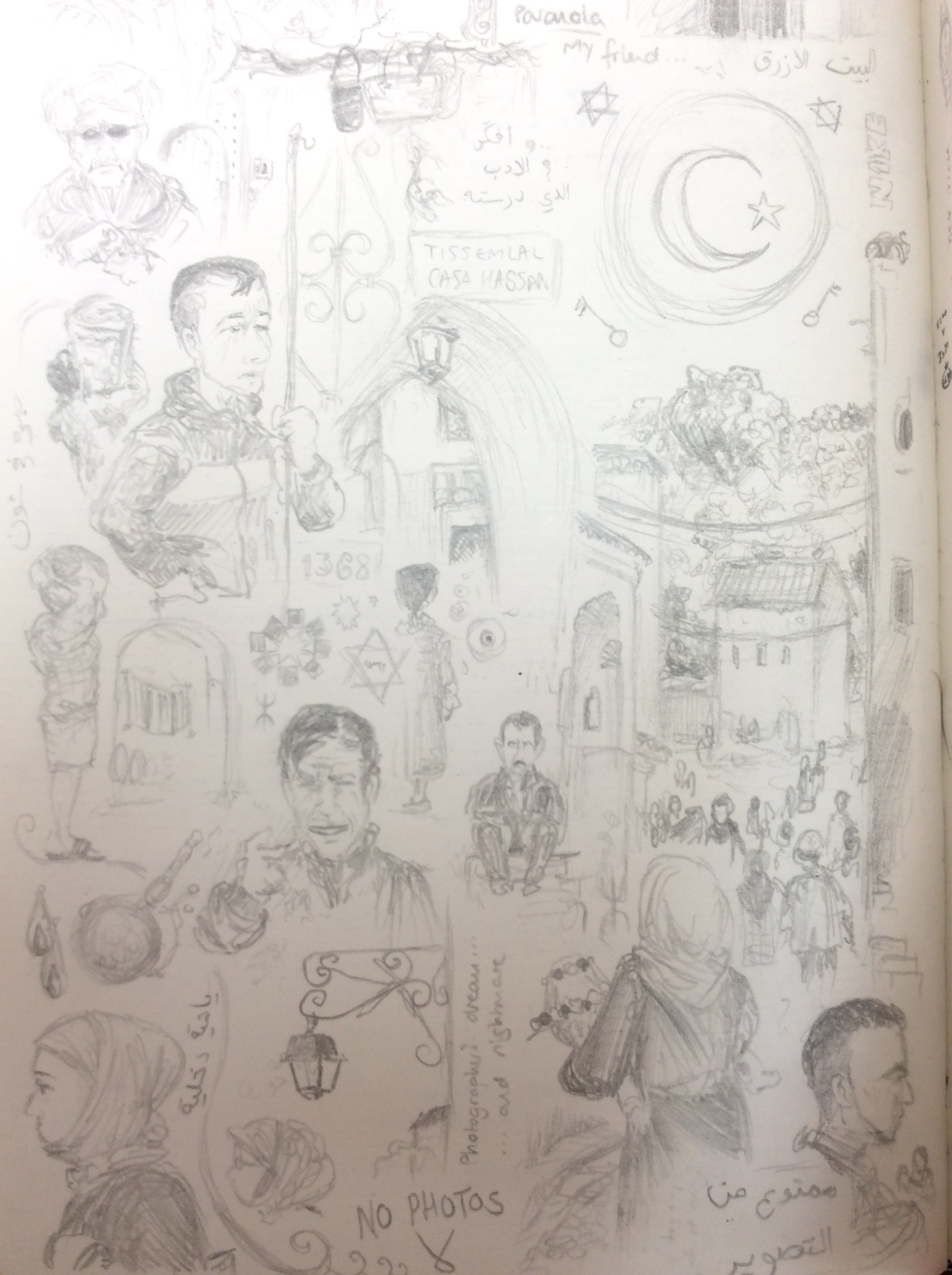
The result? I spent the entire day sketching instead.

Sketching appears to be harmless. I’m not entirely sure what the difference is between a sketch and a photograph – a true craftsman puts just as much work into both – but people don’t seem to mind you standing on a street corner and scribbling away for twenty minutes or so. You’d think after a couple of minutes that it’s fairly obvious that you’re the subject of a doodle when the artist in question keeps stealing a casual glance over your shoulder to the mountains behind, and that that might bother some folks… but apparently not. It even has curious passers-by stop and talk to you.

Perhaps that easily-offended old Chaoueni did me a good turn after all. It’s all too easy to become lost behind a camera.

DSC_0559

I have mixed feelings about Chaouen. On the one hand I do admit that it is rather gorgeous, as Moroccan towns go. For me it’s not a scratch on the more authentic Taroudant or Imoulas, but that has more to do with the thriving tourist traffic than the town itself. My main problem with it, it must be said, is what I term the Petra effect: when something receives so much hype that the reality can’t help but disappoint. It’s unfair to say that you shouldn’t rave about an especially beautiful place, but sometimes I’d rather make my own discovery than find the path trodden down before me by the world entire and the locals already soured by thousands of camera-toting holiday-makers. One almost misses the hippies.

DSC_0486

Like Petra before it, I’d heard so very many enticing anecdotes and seen so many beautiful photos of Chaouen that I wasn’t as bowled over as I probably should have been. I will, however, be back. There’s more to the town than I had time to see… and I have all summer. BB x

Four Days without Reggaeton

‘You want taxi, my friend? No? What, you no want talk to me? Why you travel if you no want talk to people? You all the same, you think you are better than us, but you are wrong. We are better than you.’

Welcome back to Morocco, I suppose.

DSC_0267

Goodbye Tarifa!

There’s something endlessly enchanting about waking up in a new country. It breaks up the monotony of the everyday. It sends gears spinning that had until recently been lying dormant. It also comes with a change in breakfast too, which is never a bad thing.

DSC_0291

Bang in the centre of the medina and all you can eat for 10 euros a night…

On one of those fantastically last-minute whim decisions which I have been known to make , I decided to take up the offer of two of my English department colleagues to spend the puente de Mayo in Morocco. Four days isn’t nearly enough to enjoy Morocco – each town deserves a full day and night’s exploration to even begin to get a taste of the area – but when it’s so close that you can see the cars from the other side of the sea, it’s impossible not to feel the tug of the south. I’m not very good at saying no to anything, but when it comes to adventure, I find it exceedingly difficult to say no. So here I am, on the 12 o’clock bus to Chefchouen, saying yes – and loving every second of it.

DSC_0295

Getting Bourne Ultimatum vibes…

The last time I was in an Arab country was Jordan. Let’s not go over that again. Jordan’s going to be a bug-bear of mine for a very long time. It’s a name which carries greater fear for me than Syria, Korea and the Democratic Republic of Congo ever could. It wasn’t so much the country as it was the fact that I simply didn’t want to be there. Backed into a corner as I was with my commitments to the British Council, I wasn’t given a choice. And in that frame of mind, as always, I was defeated before ever I got on the plane. It wasn’t in my interest… And as my parents will know only too well, if something is not in my interest, the chance of me doing well is next to zero.

DSC_0346

The Rif: b-e-a-utiful

Not so Morocco. Maybe it’s the green hills and the icy rivers flowing down from the mountains and into the sea. Maybe it’s the jaw-dropping kasbahs of the desert south or the quiet, homely feel of the melting-pot medinas of the north. Maybe it’s even the simple fact that this is Africa. But I think that the real reason I have so much love for this country is because I want to be here. It’s a minor difference, but it changes everything.

Waking up with the dawn chorus in the middle of a city sounds ridiculous, especially when there’s a complimentary alarm service courtesy of the mosques at four in the morning, but in Tangier it’s easily done, and the soundscape is just as fantastic a mix as the city itself. There’s the warbling calls of flocks of roving bulbuls, that ever-present feature of Arab towns; on top of that you’ve got a chorus of roosters crowing at the dawn, interspersed with the occasional bubbling note of a laughing dove, two quintessentially African sounds; and then there’s the aggressive cackle of the gulls, which smacks more of Europe than anywhere else. Even the repetitive wi-tu wii-twii-tu wii-twii-tu of the house buntings echoes the sales pitch of the taxi driver, yelling the name of his destination over and over as though it were an object to be bought or sold.

DSC_0301

Spot the six species of bird in this picture (better still, imagine them)

And that’s just the naturalist in me. The linguist side of me is in his element: this is a place where I could be using all four of my languages – English, French, Spanish and Arabic – at any given moment. Across Morocco, but especially in Tangier. It’s like something out of a dream, and we haven’t even got to Chefchaouen yet.

DSC_0332

Tangier’s Kasbah is actually a lot more impressive than it is made out to be

But for a less-than-welcoming start thanks to a jilted taxi tout lying in wait at the dock entrance, it’s been so good to be back. And as I’m the only Arabist in tow, this time it’s up to me alone to do the talking – and that’s a huge plus right off the bat. I hope there may soon come a time when it’s safe enough to study Arabic anywhere, from Western Sahara to the Sudan, from Yemen to Iraq; to excel, I need to be on my own. And that’s what this year has been all about. I’ve learned from my mistakes in Jordan. Moroccan Arabic won’t be any easier than Jordanian, if not harder, but I’m going to tackle it head-on and alone – and better still, in a willing state of mind. I can’t wait. BB x