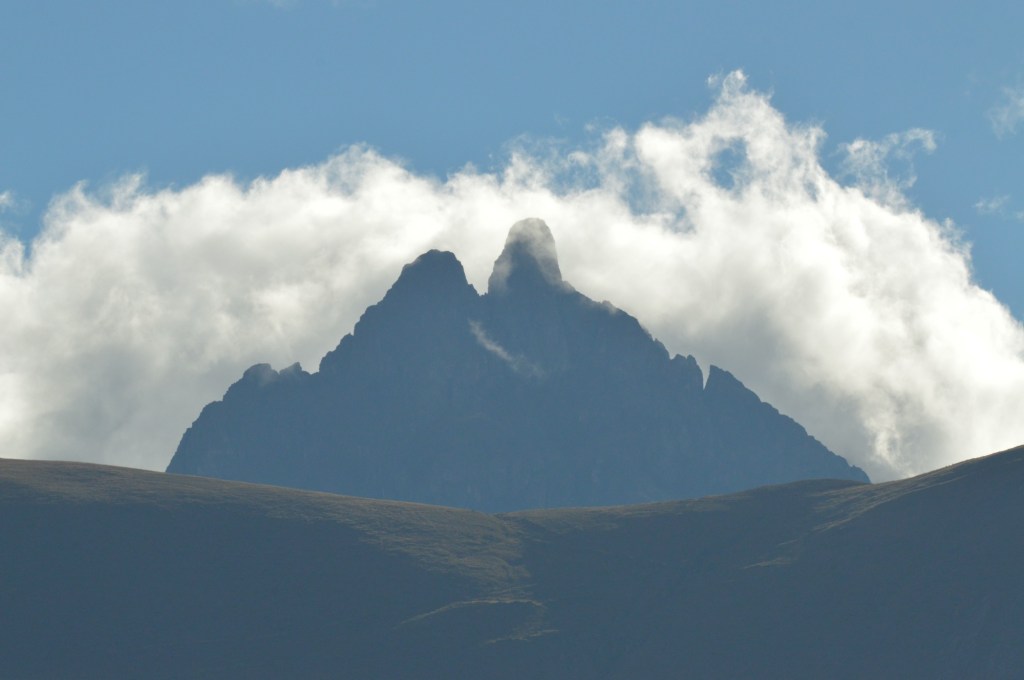
Casa de Ollanta, Ollantaytambo. 6.04.
My time in Peru is drawing to its end. In two days’ time, I will leave this beautiful country with its cloud forests, its condors and its coca tea and return to a land of Teams, terms and checking my emails on an hourly basis. I’m not vapid enough to lust after a life spent on the road – I strongly believe that at some point you have to be a responsible citizen and work for your community – but I always dread the returning shackles of my communication-based existence, with or without an adventure to sweeten the deal. I wish, if wishing were not in vain, that Teams and emails had never come to blight this world, to become a scourge for people like me – but the world is thus. Thus have we made the world.
I left Cusco at the slovenly hour of 6.40am yesterday with all of my belongings on my last organised tour of the trip: a guided tour of the Inca and pre-Inca sites of Chinchero, Moray, Maras and the unfinished citadel of Ollantaytambo, the last stop on my journey. It worked out cheaper than hiring a ride to Ollantaytambo direct from Cusco, and after six days in the Amazon I didn’t feel up to navigating the very affordable local bus service (which I’m sure is very reliable, but works entirely on know-how, which I am definitely lacking on this first visit to Peru).
Chinchero, the first stop on the tour, involved a visit to a local cooperative, where we were shown how cochineal dye was made. It was obviously geared toward the tourist trade, but it allowed me to lay my hands on a decent souvenir: a snug alpaca wool jumper (which I definitely appreciate here in Ollanta, which is a lot colder than the other places I have been).
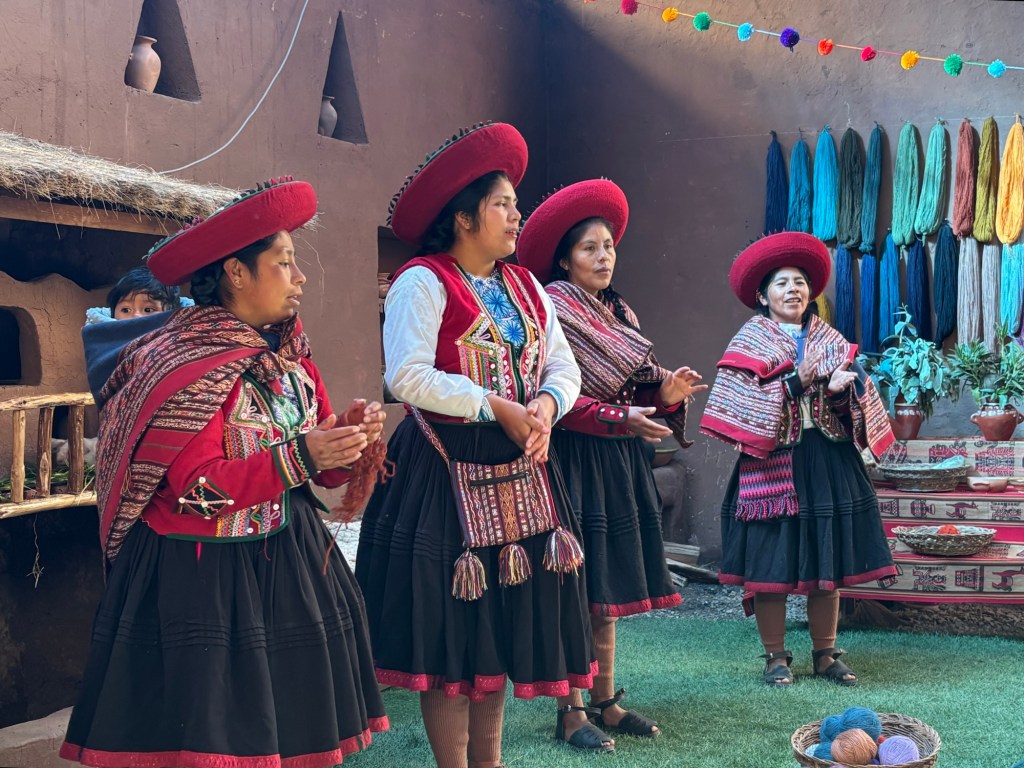
Chinchero is what Cusco used to be: a quiet Andean town where a lot of the population speak Quechua and learn Spanish. But change is coming. To relieve the strain on Cusco’s Alejandro Velasco Astete airport – and improve tourist traffic to nearby Machu Picchu – the Peruvian government is building a brand new international airport just outside the city. When it is complete – most likely in 2028 – it will be both Peru’s second international airport (after Lima) and the second-highest airport in South America (after Bolivia’s La Paz). Construction is about 40% complete, but has ground to a halt in the last few months as the country’s politics have shifted to the presidential election – which, at the time of writing, is still to be decided, some three days after the election took place (though it looks likely that Keiko Fujimori will win the day).
It would mean that any future intentions of visiting Manu will be a lot more straightforward, but I do worry for Machu Picchu. Can it handle the tide that is coming? Will the proximity of an international airport help this region to prosper, or will it only usher in more and more day-trippers who have come here just to gawp at the view and take the perfect selfie – only to plaster it on their dating app profiles to look well-travelled, the way my generation once did with the Tiger Temple and Elephant Jungle Sanctuary in Thailand?
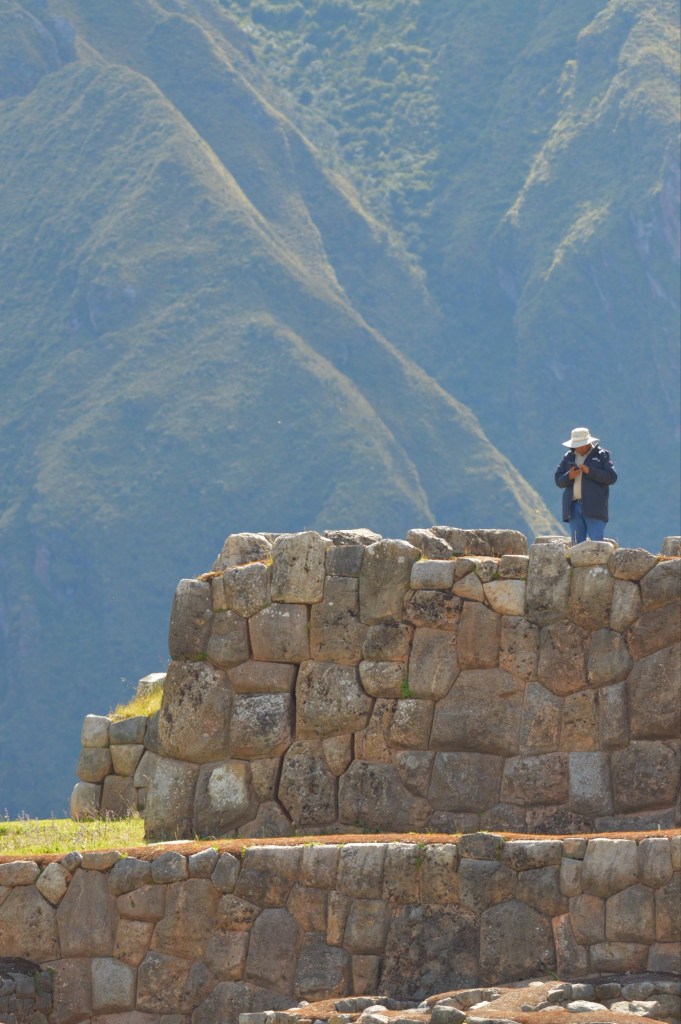
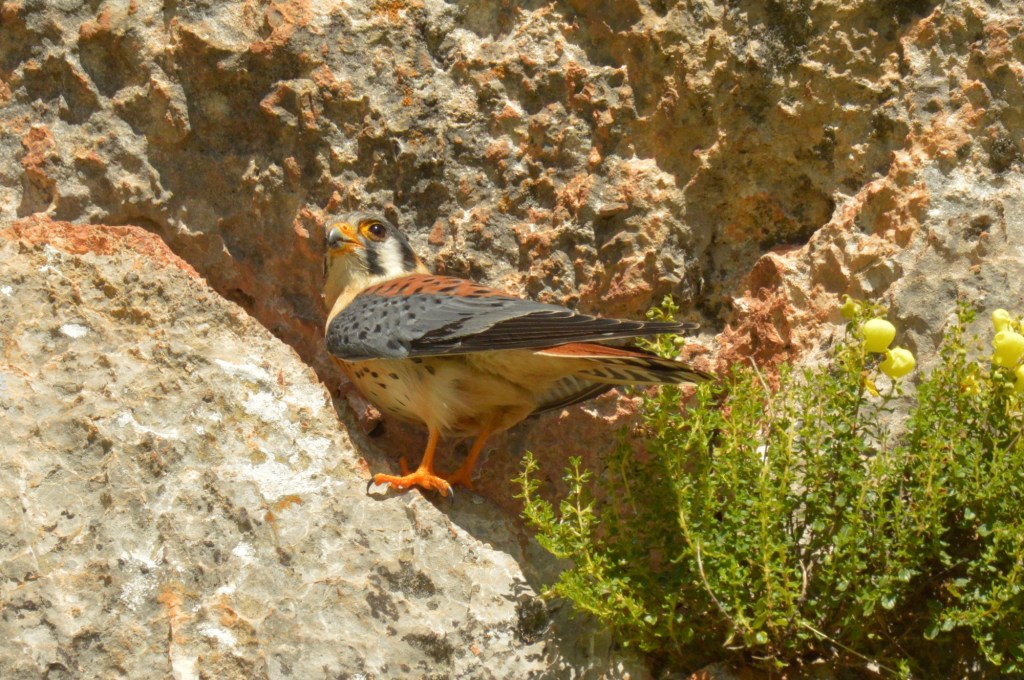
Our guide had the most mellifluous voice, whether he was speaking in Spanish or in American-accented English. It was almost hypnotic. He also really knew his stuff: I learned a lot about all of the places we visited during the day, even if I did wander off on occasion. A pair of American kestrels were nesting within the Chinchero ruins, and I had to observe these beautiful falcons for a little while. I had brought the zoom, after all – best it had some use on this fundamentally landscape-oriented adventure.
After Chinchero, we made for the bizarre terraces of Moray. These curious laddered circles carved into the earth are part of a potentially enormous complex that has yet to be fully uncovered. They were, I believe, a kind of pre-Columbian hothouse, an intricate agricultural system where each layer had a separate microclimate to the one immediately above, and could therefore be used to grow a large variety of crops. You can tell the difference for yourself just moving up and down the hillside, where the temperature rises and falls quite noticeably.
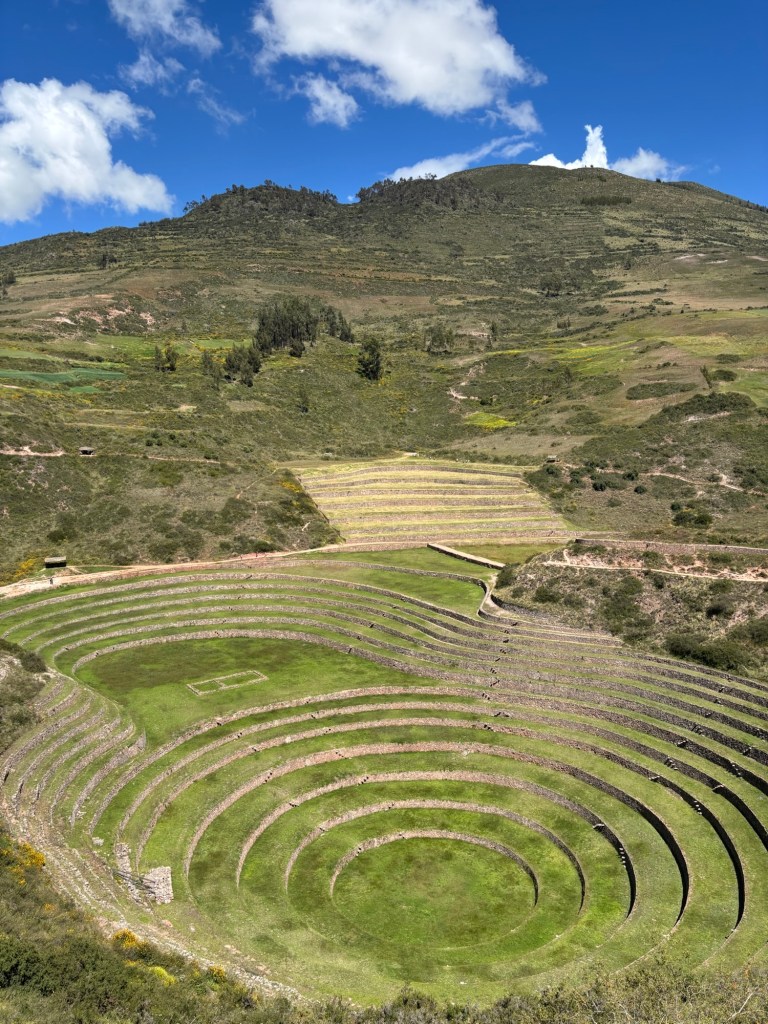
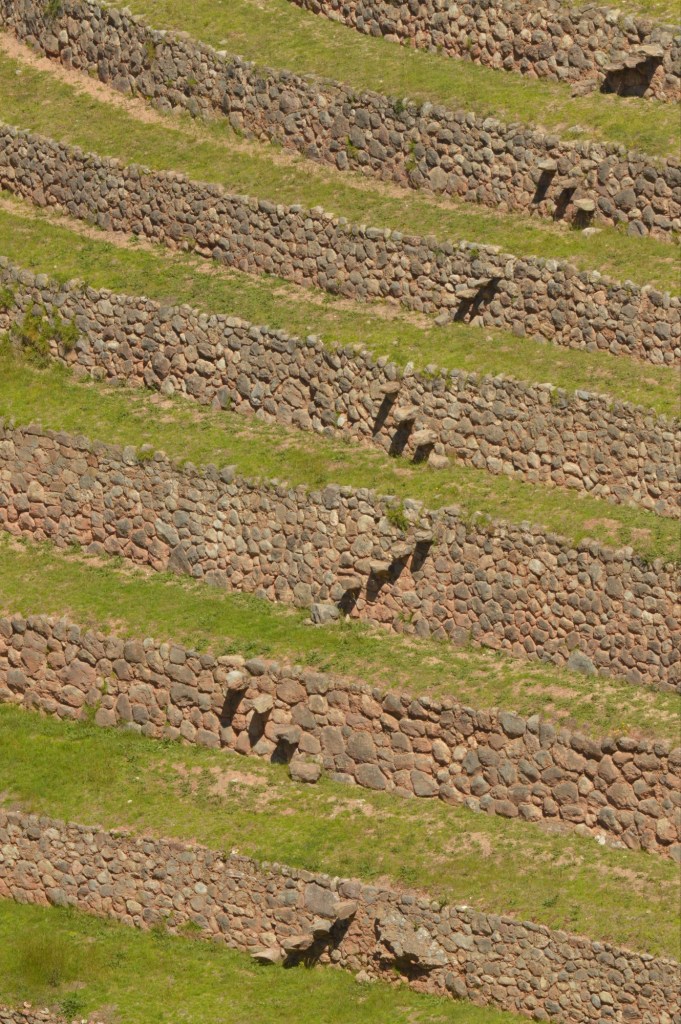
I’d seen the terraces of Moray countless times on GetYourGuide and various colourful billboards around Cusco city, but something I hadn’t appreciated were the tiny steps built into the walls, allowing passage from the lowest level right the way up to the top. I had always assumed people just climbed up and down – but then, the average Peruvian is very short, with men reaching a general maximum of 5’6”. I’d feel like a giant for the first time in my life if it weren’t for all these gangling Americans and German tourists spoiling my fun.
Tragically, perhaps that’s why my dating apps have really exploded out here. Maybe there really is something to be said for being 5’7” in a country where that isn’t considered short. Shallow, humbling, but potentially enlightening.
From Moray, we made a short hop through the town of Maras to the nearby salt mines upon which Maras’ fortunes were built. About 3,500 square basins of crystallised salt protrude from the mountainside, supplied by a saltwater stream that bubbles up from the rocks higher up. There were once five thousand of these salt wells, but erosion and regular earthquakes have destroyed many of them over the years, and the locals are (understandably) very protective of further exploration of what has been their primary source of income for potentially hundreds of years.
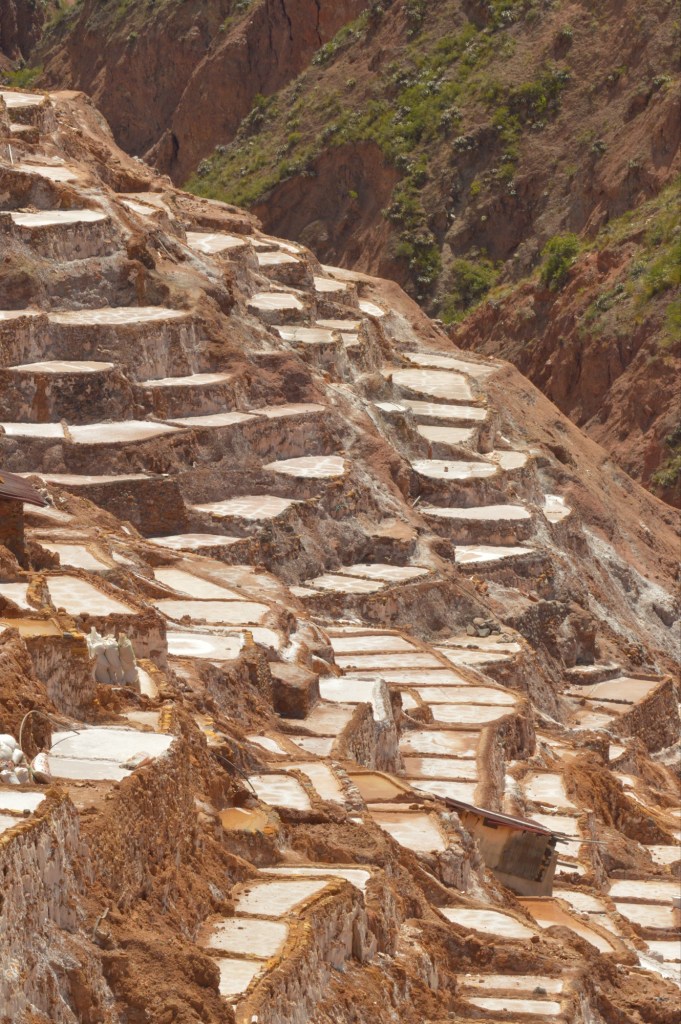
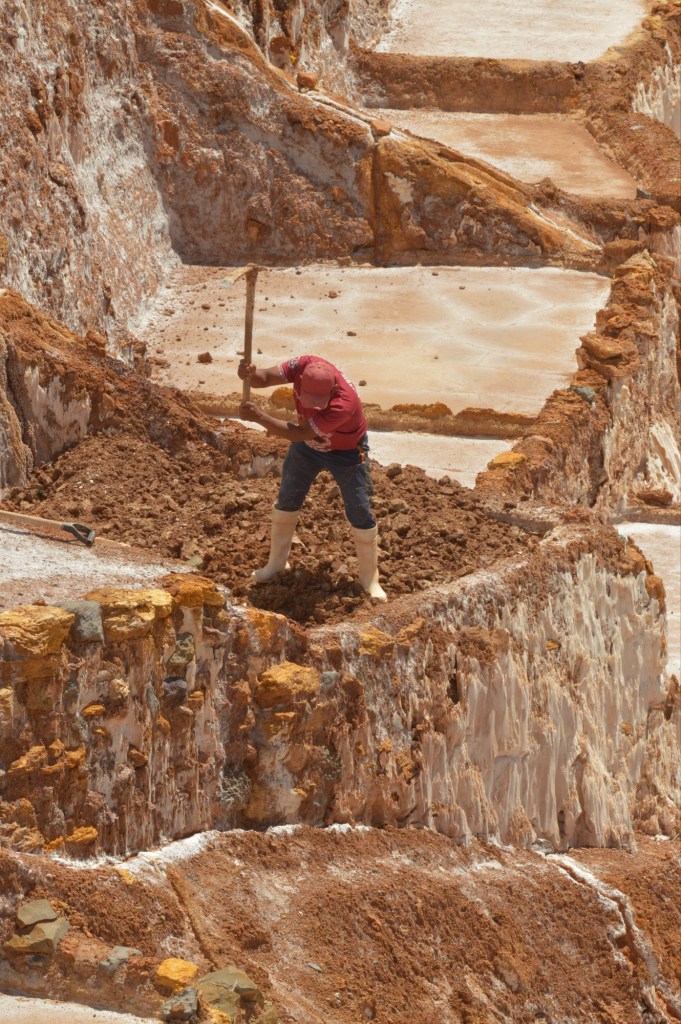
We’re still not quite out of the rainy season, so the mines aren’t in full working order just yet – that comes in July – but there were still a few local men toiling under the sun, shifting great sacks full of salt and restoring some of the dried-up salt wells.
After a buffet lunch in Urubamba, the driver took us to our last stop of the tour: Ollantaytambo, the usual staging post for travelers making for the Inca trail to Machu Picchu (or taking the easier route by train). Ollantaytambo sits between two formidable cliffs, into which have been built a number of watchtowers, fortresses and storehouses, with the aim of protecting this vital Inca town in the heart of the Sacred Valley.
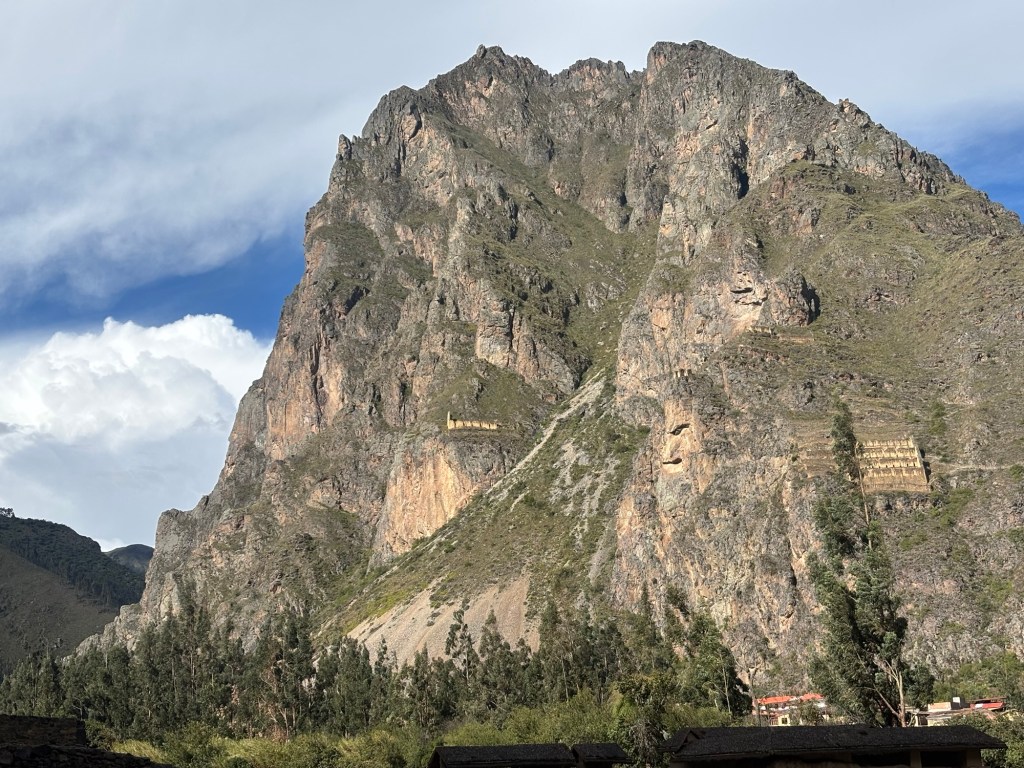
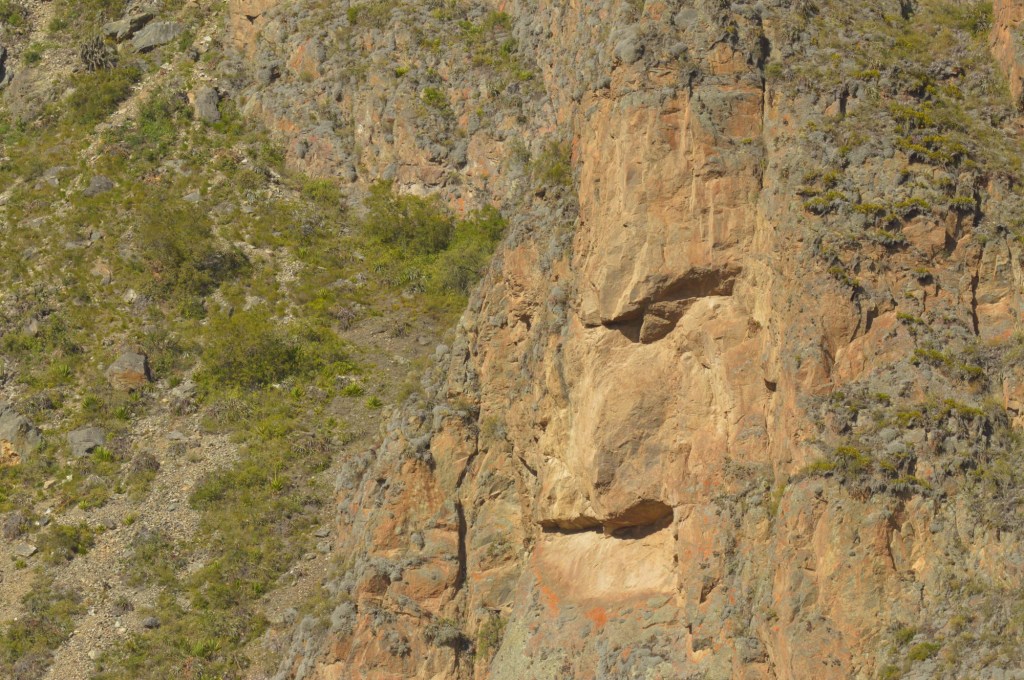
That’s not the only thing they carved into the mountainside either. Under the right light, it’s possibly to make out the unmistakable profile of a face between the two military buildings on the mountain’s western face. It’s possible that the design is a mistake of nature, but from the way the rock is worn around the base of what would be its nose – and it is an extremely Peruvian nose – it’s a lot more likely it was carved out of the rock by the ancient settlers of the Sacred Valley, in imitation of an apu, an Andean spirit or mountain god.
Quite how they achieved this Rushmore-esque feat hundreds of years ago on a gradient that would make Philippe Petit blanch is beyond my ability to understand – but I can’t help but admire those ancient Andean stonemasons. It almost makes the nearby Skylodge suites hanging from the mountainside seem like a joke – almost.
Well, it’s 9am and I’ve had breakfast. I guess I should go out and do some exploring. I’m taking it easy today before trekking up to the Inti Punku (the Sun Gate) tomorrow in what will be my final adventure here in Peru, as was always the plan.
It helps that it’s cloudy. On a sunnier day, I might feel I was wasting the opportunity for some serious mountain-gazing. But after more than two weeks of constant activity (I really have been doing something adventurous every single day), I think I can justify a relaxed itinerary just this once. BB x