Highway 1S near Tambo de Mora. 9.09.
The sun is climbing toward its pinnacle in the enormous Peruvian sky. The UV warnings on the weather apps are off the charts, so I’m going to have to layer up properly with the sun cream before I leave the bus, or I’ll be fried out there. My destination today is Paracas, a coastal resort town some 256km to the south of Lima – more specifically, the Islas Ballestas and their seabird colonies.
First, however – a few observations about Peru. For one thing, my dating apps have exploded. Without even lifting a finger, I’ve got more hits in twenty four hours than I’ve had in four years, and that’s no exaggeration. I wonder what that says – about me and about this country. Is it because the odds of somebody finding me attractive have been boosted by the overwhelming numerical force of some ten million people? Am I simply more interesting to a Latin mindset than a European? Or – dare I say it – is it something more sinister?
Is it because I’m white?
Hear me out. Malinchismo is a concept we study at IB and A Level Spanish – that is, it’s a concept I always try to include in any syllabus I’m teaching that involves Latin America. In short, it’s a form of cultural “cringe”, an embarrassment of one’s own native culture in the presence of an outsider, which often manifests in the invisibilisation or even eradication of the affected community. The term itself is Mexican and comes from the problematic folk anti-heroine La Malinche, a teenage girl who served Hernán Cortés and his conquistadors as translator and thus played a major role in the toppling of the Aztec Empire.
It may be Latin American in concept, but it is a global phenomenon. It explains the demand for skin-whitening creams in Africa and Asia and the dominance of English as a trade language, even in corners of the world that don’t see many Brits. It has even sunk its claws into our own island, with RP and its bratty sibling Estuary English swallowing up most of the old accents and dialects.
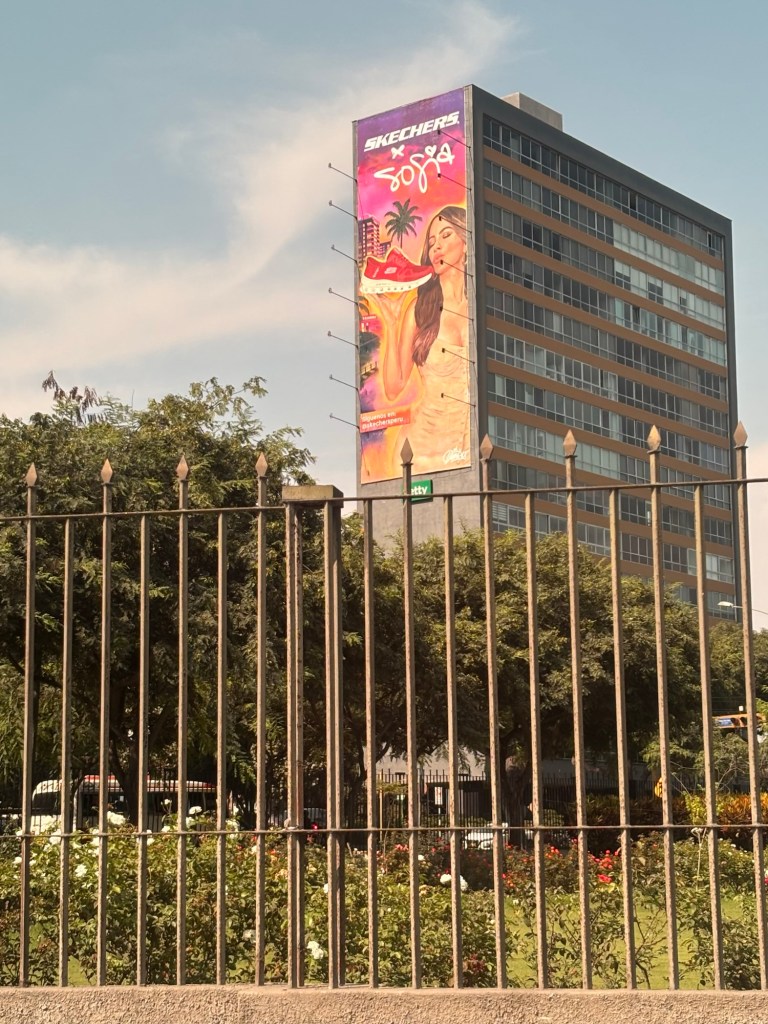
Peru, like the US, is a billboard country. Commercial is king. And the face of those enormous commercials is very rarely Peruvian. Giant posters for everything from sportswear and energy drinks to doctors and dental practices all feature the same cast: lithe, beaming individuals, all handsome, all sporty, all white.
I’ll use the dating apps as a counterpoint. There are so many beautiful native faces and body types out there, and that’s just from a glance. But I’ve yet to see any of them represented on the billboards. It’s as though they’re all advertising some supernatural deity, removed from this world, above and beyond the reach of the average Peruvian.
Which, I suppose, isn’t all that far from the truth.
What do we do about it? By the looks of things, not that much. The hostel I’m staying in has a crowd of white tourists (including me), many of them on the next leg of a grand tour of South America. Very few of them speak any Spanish whatsoever.
In the hostel, they talk. Largely about things travelers always talk about – that is, home – and swap stories of nightmare experiences along the road. They talk of ayahuasca: two guys who can’t have meat or salt or sugar or sex for a month because a shaman put a plant spirit inside of them which – or so they were told – would react most fiercely if they broke their diet pact. Others talk blithely of Iguaçu Falls (“beyond the waterfall there’s not that much else to see”), Rio (“the party scene is decent”) and Patagonia (“it’s actually really expensive and full of couples”).
Most of the travelers I was with this morning have gone. It’s only a handful of stragglers who opted for the Paracas Reserve tour and the Hacienda San José slave tunnels. Everyone else has gone on to Huacachina, an oasis town famous for its sand dunes – which we venerate by driving all over them in petrol-belching dune buggies.
Say what you like, but it’s a strange way to appreciate another country. Imagine if the White Cliffs of Dover were turned into an enormous quad-bike park, charging wealthy Arab and Chinese holidaymakers a handsome sum to tear up one of our most beautiful landscapes. It’s not exactly an awkward comparison.
What saddens more more, I think, is the lack of genuine wonder. Maybe it’s a Western thing to avoid poetic adoration – at least out loud. Maybe we’re just too sanguine. It might come across as “gushing” or insincere. Either way, you hear a lot more about their “trips” than their trips. The whole of South America seems to pass them by in a psychedelic haze.
The whole thing smacks of colonialism. Not the naked, gun-point kind that subjugated the Americas long ago, but a more insidious march of cultural domination. When we holiday abroad and talk about home, and not about the places we see, we build up a temple to the West and its ways that is, quite frankly, underserved. By demanding adrenaline sport holidays and beach or ski resorts, we are only tightening the chokehold that Western culture has over the world. It doesn’t matter that it’s no longer fashionable to abuse the people when we’re quite happy to continue to tear up the land itself. That is colonialism – it just walks, talks and dresses like the very Western liberals who claim to despise it.
Tourism makes up for about 8% of Peru’s GDP. Many Peruvians rely on the tourist industry and the money it brings to make a living. The least we can do is to come here with an open heart and an open mind and tread softly.
This is not our world. We should be gentle in how we handle it. BB x
 The Book of Barnabas