Chocolatería 1902, Calle de San Martín. Centro. 10.22.
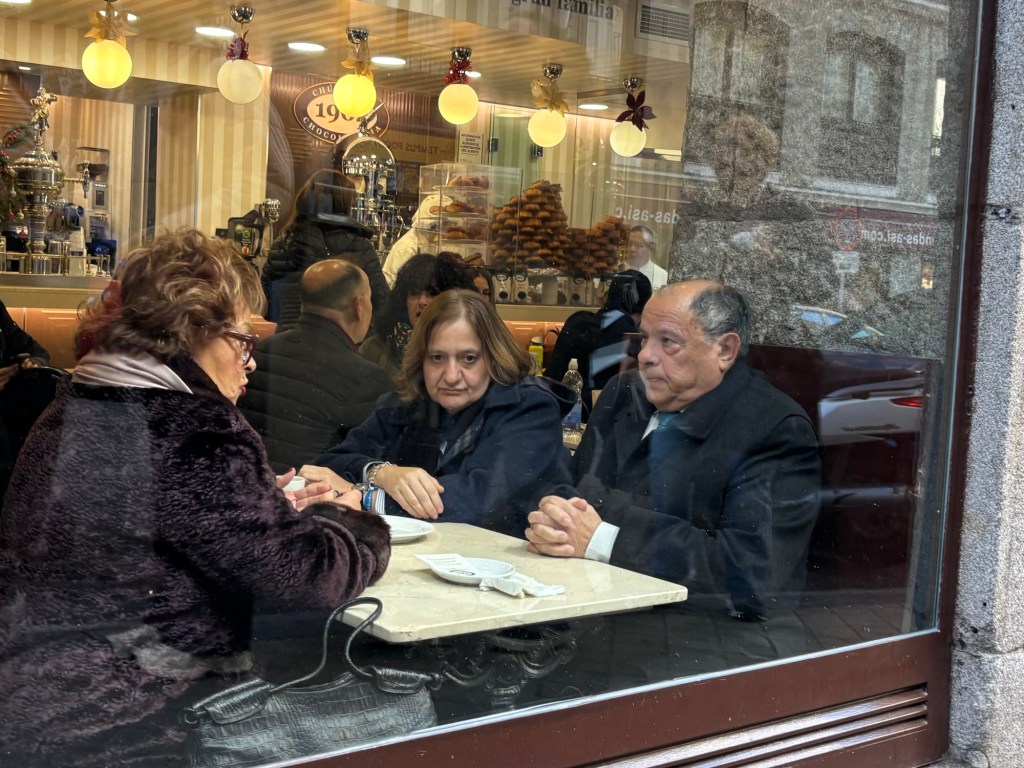
I’m waiting in line to grab some churros con chocolate for breakfast at 1902, the same chocolatería I drop in on every time I’m in Madrid. It’s not yet half past ten on a Sunday, so the interior is still pretty busy with the usual morning traffic. The handsome lady manning the takeaway stall bustles in and out of the booth to resupply for the family of three in front of me. My attention is drawn to three punters sitting by the window. Locals, surely – only a Spaniard would keep their winter coat and furs on inside when there’s even the slightest chance of a draft slipping in. After all, it is a bitingly cold 16°C out there.
They look to be in their seventies, there or thereabouts. That means that the man on the right served his country for at least a year in the mili, before Aznar did away with national service in 2001 in a bid to win votes. It also means they probably remember very well what Madrid used to be like under Franco, before La Transición and La Móvida swept the city into the twentieth century like the rest of the European capitals.
Do they miss the way things were, perhaps? It must have been an altogether different place, back when the city’s demographics were primarily madrileños de raíces, before scores of regional migrants were drawn to the capital for work, followed by a larger tally of visitors from further corners of the world. Before Ale-Hops and Starbucks replaced the boarded-up shopfronts of local businesses. Before every sign and tannoy needed an English translation tacked on, to cater to a growing tourist class who were not expected to learn the language for their visit – another reminder of Spain’s falling status on the world stage.
I do not regret the end of Franco’s Spain – after all, it’s because of him that my Spanish family was torn apart. But I do understand why some might look back fondly on a time when the world seemed a whole lot more familiar.
Librería La Central, Calle del Postigo de San Martín. Callao. 10.36.
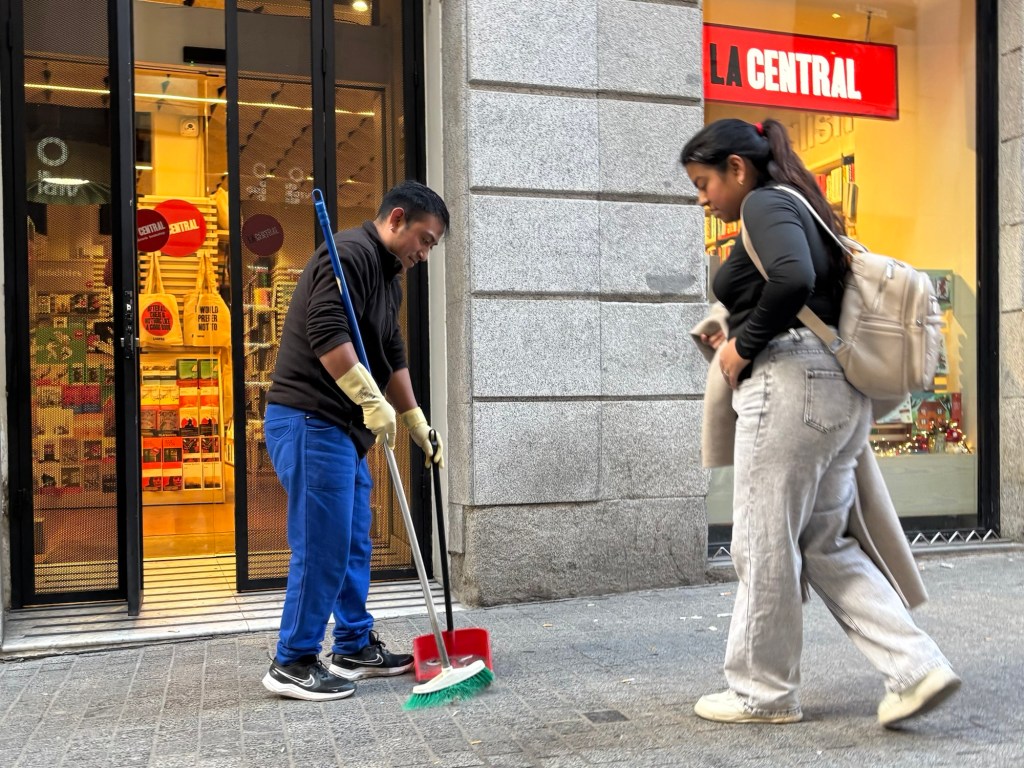
Further up the street toward Gran Vía, I pass La Central. It’s not yet open, and an Amerindian in marigolds and workers’ blue pantalones laborales is sweeping the street in front of the door, which is open only just enough for a person of slender build to squeeze in untouched. It’s mostly confetti and spent chasquibumes that he’s clearing away – there aren’t nearly as many cigarette butts as there used to be.
A girl stands nearby, picking up some of the easier wrappers by hand. She’s dressed like a passer-by, but there’s a familiarity to their easy interaction: she could be a relative, a friend, or a lover. Neither of them are wearing the white worm-like earbuds that seem to have encrusted the faces of so many of the city’s inhabitants, and that makes them stand out.
I bought four books in the nearby Casa del Libro (after nearly two hours’ decision) and it cost me around 70€. Spain is often ranked as one of the least literate countries in Europe, with fewer than 9% of the country reading books on the regular. Statistically, that’s not all that far behind the UK, but there’s no escaping the fact that reading is a luxury activity in Spain. FBP (Fixed Book Price) might be a worthy attempt to level the playing field and prevent the market being swamped in Taylor Swift trash and cheap chick lit, but it does drive up the prices of everything as a result.
My great-grandfather dreamed of having his own library, and I’m doing pretty well at bringing that dream to fruition. But it’s not a cheap enterprise in this country. I wonder how much traffic the man in marigolds sees.
Outside The Madrid Edition, Calle del Maestro Victoria. Centro. 12.55.
The queue for Doña Manolita’s legendary lottery shop stretches all the way along Calle de Mesonero Romanos and away up Calle de la Abada and onto Gran Vía. The throng of hopefuls is a real mix: young and old, local and out-of-town, Spanish and French and American. El Gordo – Spain’s Christmas lottery – is much more of an event in Spain than it is elsewhere in the world.
At the end of one crowd, another begins: a great mass of children and their parents waiting for the giant animatronic train and its attendant polar bears on the Cortylandia shopfront to come to life and sing, as it does every hour, on the hour (until 10pm, it seems – it’s within earshot of my hostel room).
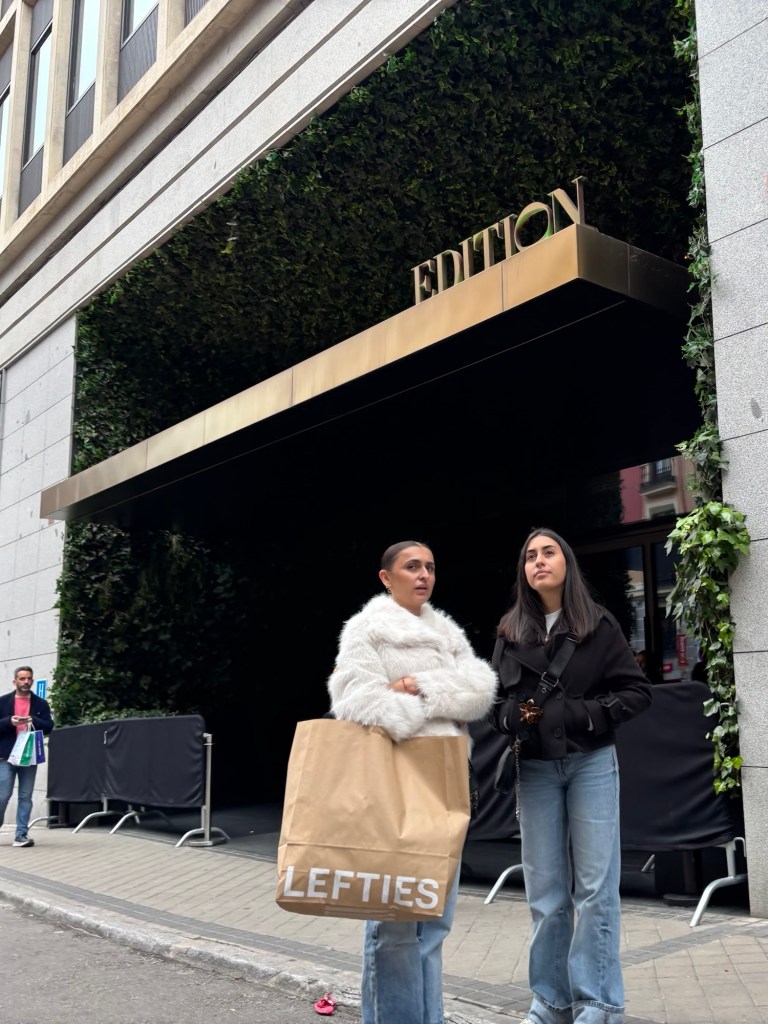
Two glamorous citizens standing apart from the hubbub seem to be above it all, watching the crowds come and go with unmoving eyes. One leads the conversation, the other listens, eyes skyward. Sometimes it’s hard to see how the haughty, angular beauty of a youthful Spaniard finds its way into the compact, shrunken shape of its senior citizens, but every once in a while there’s a flash of that future in the expressions of its youngsters: that look of casual ennui would be right at home on the face of a woman three times her age, still dressed in expensive furs and commenting on the world going by.
Outside Heladería Galia, Calle del Arenal. Puerta del Sol. 12.57.
A West African mantero plies his wares alone on the Arenal. They usually operate in groups – there being safety in numbers, I suppose – but this one seems to be his own agent. He has also upgraded his drawstring blanket to a couple of glassware boxes. While other mountebanks dressed as a gorilla, Eevee and Mickey Mouse try to fleece passing tourists of their loose change, he hawks a number of luminous splat toys, which he promotes by blowing into a bird whistle and hurling his devices onto the flat surface of the box, where they slowly revert to their original shape.
It’s hardly worthy of a moment’s notice to most of the adults passing by, but it’s the children he’s after. One girl is absolutely entranced and convinces her mother to buy one – no, two, as they will have to get one for her brother.
It can’t be an easy job, hawking cheap goods on the street, but from my casual observations, these manteros do seem to have a fairly good hit-rate when it comes to a quick sale.

Plaza de Isabel II, Puerta del Sol. 12.59.
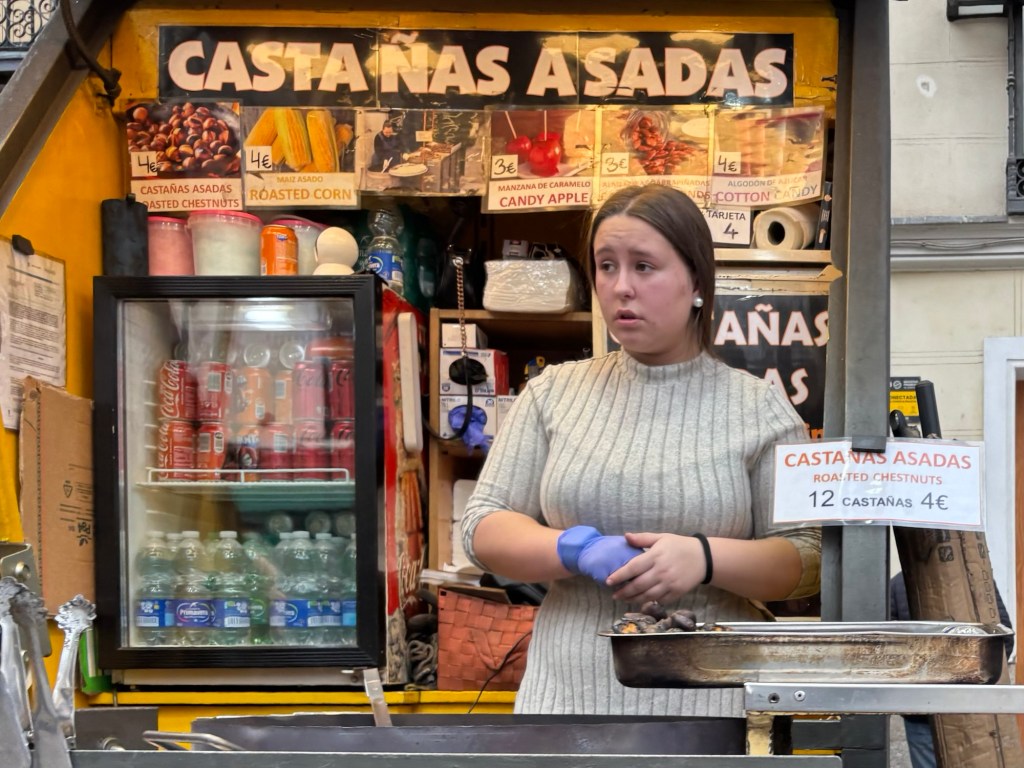
Before it became synonymous with one of C.J. Sansom’s greatest works, winter in Madrid always meant roast chestnuts. These warm, smoking stalls are as much in evidence now as they ever where, though they now often come with the modern niceties of a wireless card machine and an Aquarius-bearing fridge. Here, like everywhere else, the signs are written twice: once in Spanish and once again in inglis. The point I try to make in the classroom about the usefulness of this or that topic for traveling is increasingly redundant in the face of the relentless march of the English language.
The girl with the pearl earring isn’t as heavily dressed for the chill as the other madrileños in the street – but then, she is standing in front of a roasting dish all morning. She looks bored. The telltale rounded edges of a smartwatch bulges beneath the tight elastic of a sanitary glove on her right hand, and a swish handbag – presumably hers – sits nestled in an alcove behind her, so the chestnut business must be doing a reasonably good trade. I haven’t seen as many people tucking into the delicacy as I have in previous years, but then, it really isn’t quite that cold. Not yet. Not until the peaks of the Sierra de Guadarrama are covered in snow and the north wind blows chill across the plain and into the capital.
She’s cute – in a genuine, homely sort of way. There’s a natural beauty to people here. Not as many piercings, lip fillers, unconventional hairdos or fake tans. I don’t know why we go in for that so much in England. I already miss this place, and I’ve only just arrived.
Jardines de Lepanto, Plaza de Oriente. 13.26.
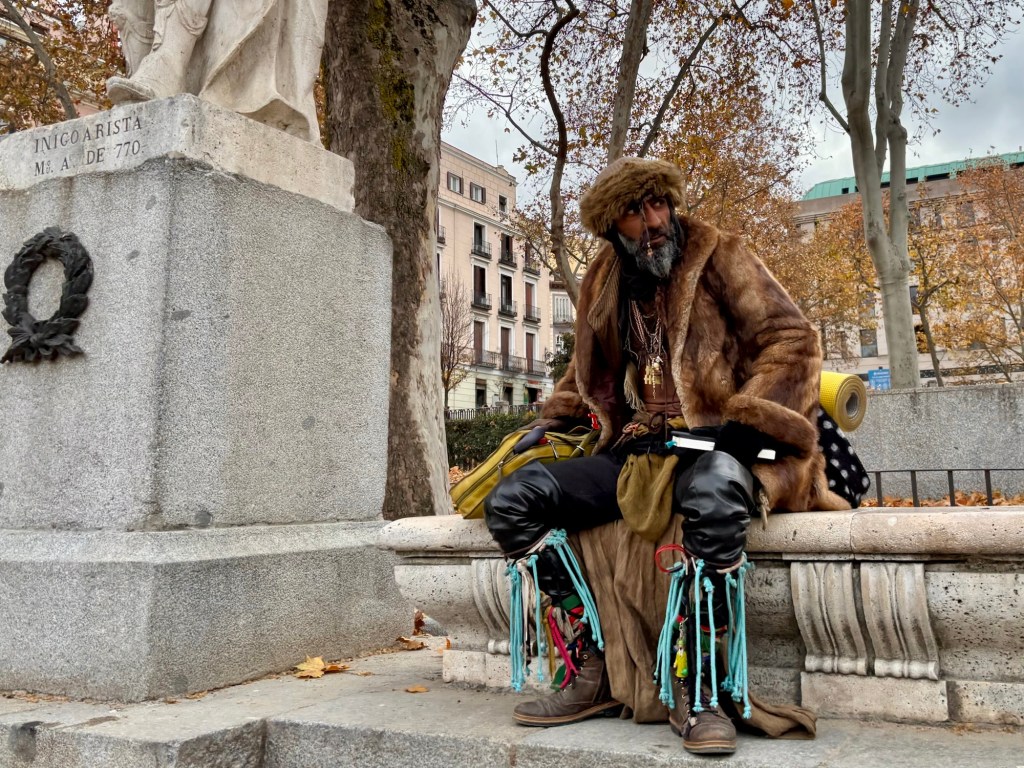
Sitting between the marble statues of the Asturian kings Iñigo Arista and Alfonso I is an exceedingly odd fellow. Like many of the city’s inhabitants, he is dressed in furs for the cold, but the similarities stop there. If the tassels on his black leather buckskins weren’t a metallic shade of blue, he might be a fur trapper from the Old West lost in time.
No – wrong continent. His regal nose, his dark, hooded eyes and the salt-and-pepper beard emerging in a neat diamond from his black headwarmer gives him the look of an Arab trader. A wise man, perhaps. It’s that time of year.
A curious assortment of symbols hang by threads across his naked torso: the Tau cross, an ivory pawn, a set of small keys and a card cut-out of the words “Ho-Ho” in gold letters that looks like it came out of a Christmas cracker. A fold-up umbrella pokes out of the smart yellow satchel at his side and there is a roll mat strapped to his waist. If he is a tramp, as his demeanour implies, he is a wealthy one.
Today the city of full of people in fancy dress. Ecuadoreans in tasselled hats and masks. Mountebanks in oversized costumes. Zambomberos in black and white and red. But he belongs to none of these clans.
When I return from watching the first of the zambomberos parade past, he has disappeared. I do not see him again.
Palacio Real, Plaza de Oriente. 14.36.
The fiesta zambombera is over. The crowded musicians begin to disperse, and with them, so too the clouds, bathing the Jardines Reales in warm winter sunlight. A modern dance troupe takes up where the traditionalists left off, showing that movement is as much a part of this country’s soul as its music. Still dressed in their folklore finery, the folcloristas return to their groups and prepare to depart. One huddle near the dance troupe stops to take a selfie. The red banner of Castilla flutters in the wind and the little cymbals in the tambourine shudder for a moment.
I must be a fool to have traded my life out here for England. So help me God, I will find my way back out here. I have to. It’s the only way I’ll ever assuage this restless heart of mine. BB x

 The Book of Barnabas