Albergue de Peregrinos, As Seixas. 19.00.
Melide and the busy pilgrim road are less than fifteen kilometres away, but you’d never know. I’ve found an oasis of quiet here in As Seixas, which doesn’t appear to be an especially popular stop, despite being the obvious final stage before the roads converge at Melide. There must be around thirty beds in this municipal albergue, but only six of them are occupied: five in the small room and me on my own in the big room. It’s funny how that worked out. Outside, it’s just the chirping of sparrows and the sound of the wind. I had better bottle it up before the explosion of noise that is the last stage of the Camino Francés.
I walked in silence for the first two hours today. I don’t rush for my music or an audiobook when I start walking. That usually comes much later. The first hours are sacred, even when they involve nothing more than a concrete walk through the city outskirts. Those crucial first six or seven kilometres or so are a golden time to clear your head. At least, that’s one of my Camino principles.
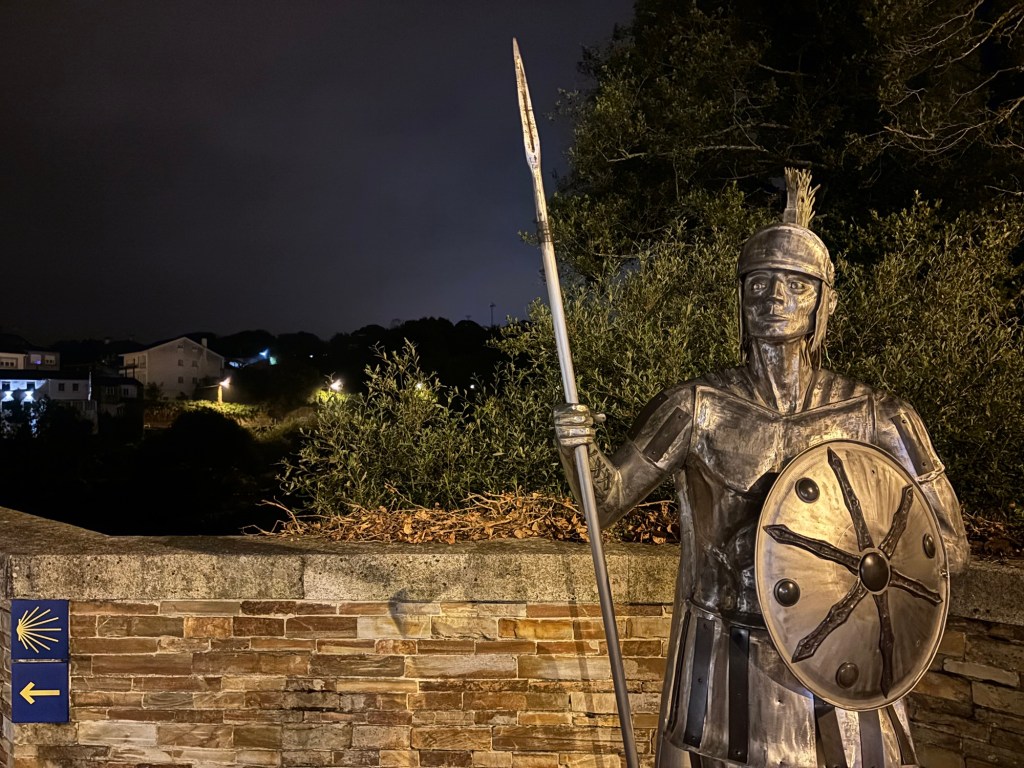
Only once the sun was well on its way beyond the white clouds of the morning did I pop my earphones in and crack on with Matthew Harffy’s Dark Frontier (a Western – a formulaic genre but one which I never get tired of). I passed quite a few pilgrims on the road, including a German gentleman (now a surprisingly rare breed on the more popular Caminos) who had started at 4.30am, but eventually their numbers thinned out and I had the road to myself again.
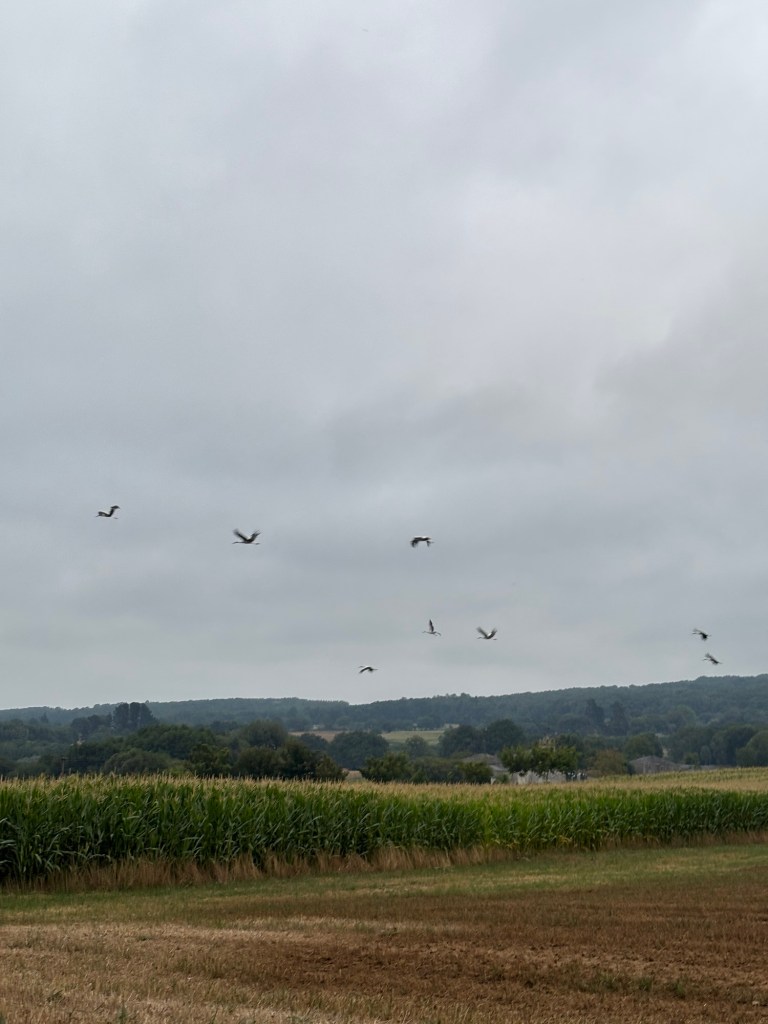
I passed a few fields with storks striding across them. I haven’t seen as many of these majestic creatures since leaving the dry plains and high towers of Castilla y León, and I shall miss them when they’re gone. They really are some of the most beautiful birds to be found in Europe, with their serene stride and their smart crimson legs.
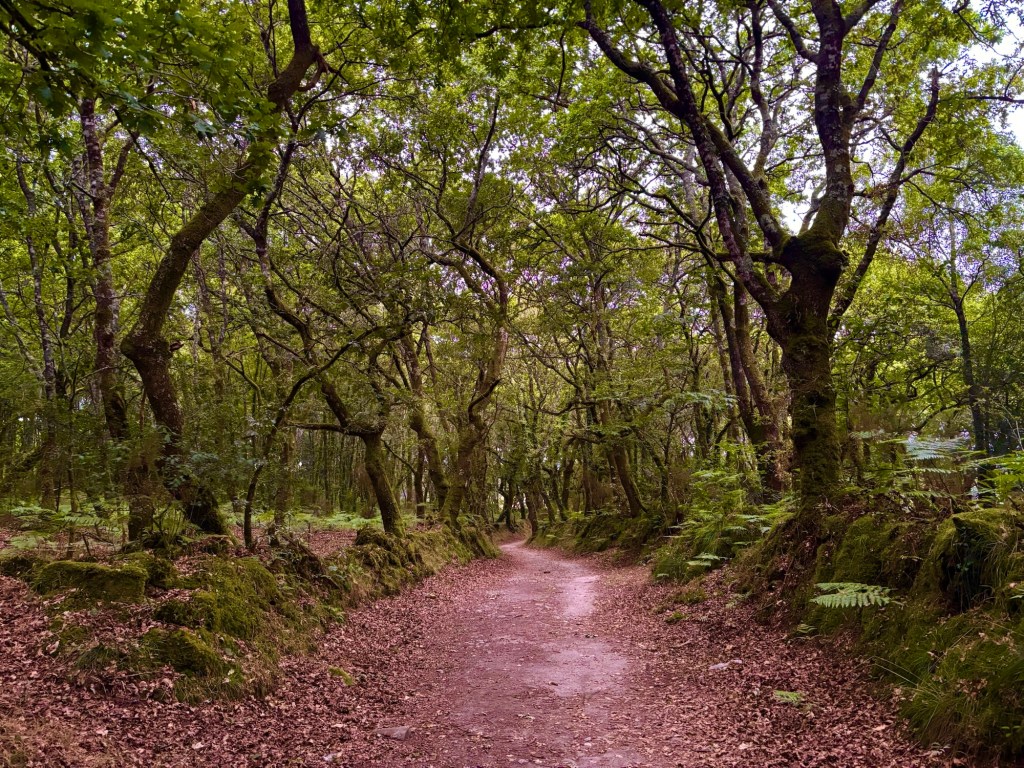
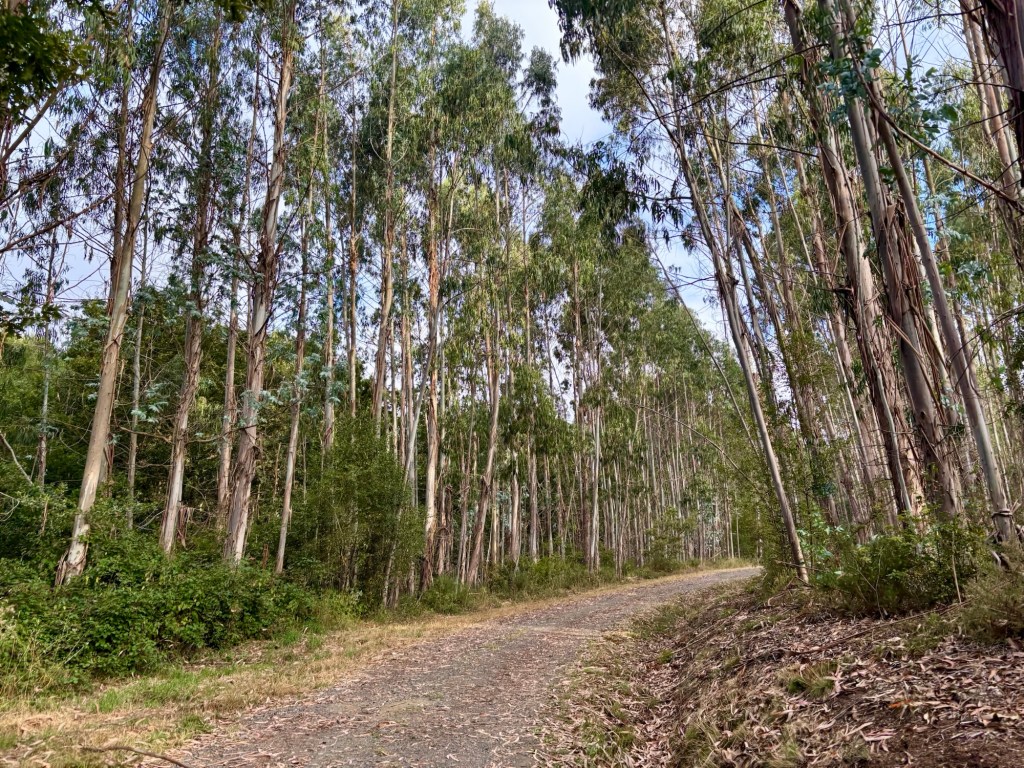
The Camino Primitivo does wind through a lot more woodland than the Camino Francés. This comes in two distinct forms in Galicia: the native ancient oak, dark and twisted, with lichen hanging from its sprawling branches; and the introduced eucalyptus, a pet project of Francisco Franco, tall, bright and peeling like a hapless tourist under the Spanish sun, its sickle-shaped leaves carpeting the road like so many paper blades.
The eucalyptus stands are eerie in their silence: where the ancient oak woods are full of the comings and goings of a thousand living things, from dunnocks and dormice to woodpeckers and woodlice, the foreign woods stand awkwardly about the path, listening but saying nothing, like a line of immigrants waiting for their papers, unsure of what to say and who to talk to. In their native Australia they have an entire ecosystem within which they are the master tree, but here in Spain they’re still a “ghetto crop” of sorts – an inescapable part of the landscape, but not yet assimilated into the world.
A lot of Spaniards aren’t happy about the eucalyptus tree – and with good reason. It’s not just because it’s an invasive species. It’s also an organic tinderbox.
Eucalyptus trees contain a large amount of volatile oils, which they use quite cannily in their homeland to outcompete other plants and trees in the vicinity – for the tree is both highly flammable and remarkably resistant to the ravaging effect of fire. The bark that peels off their trunks in strips and the sheer volume of shed leaves at their feet create natural kindling, and as the tree burns, it releases gases that fan the fire into an inferno. Many eucalyptus trees will survive these blazes, but the native trees will not. Like Australia, Spain is prone to forest fires in dry summers (we’re having a lot of them right now as I write), but unlike Australia, Spain’s forested Atlantic coast is rather crowded, putting thousands of communities right in the line of fire.
Bizkaia in the Basque Country has banned the planting of the tree, and Galicia – where the plantations are most heavily concentrated – has even set up its own de-eucalyptus brigades to attempt to mow down the fire-starter forests, especially after the infernos of 2017 that affected the port city of Vigo.
I’ve never been to Australia, so the eucalyptus has always been – strangely – a Spanish tree in my mind, like the holm oak and the stone pine, only… stranger. Always growing where it shouldn’t. Like me, perhaps, living in a country which might not have been mine, had life turned out differently.
I’ll set out a little later tomorrow, but hopefully no later than six. My intention is to aim for Ribadiso with its idyllic river and Roman bridge, rather than bustling Arzúa and its throngs of turigrinos, though let’s wait and see. My feet (or stomach) may allow me to press on. Or they may not. Either way, Ribadiso is the target, otherwise the final march will be more than a forty kilometre slog: a worthy final challenge, but again, I’d like to have the use of my feet to explore the city without too much pain the day after. Here’s hoping. BB x
 The Book of Barnabas