Albergue de Peregrinos de Pola de Allande. 20.04.
Yesterday, as it turns out, was only a test drive in fully-booked albergues. Today’s leg saw me walking a further fifteen kilometres in search of a bed after all the other options en route were exhausted, one by one. I’m not even at the logjam that is the Sarria-Santiago stretch, but the early warning signs are already here.
But I’m getting ahead of myself.
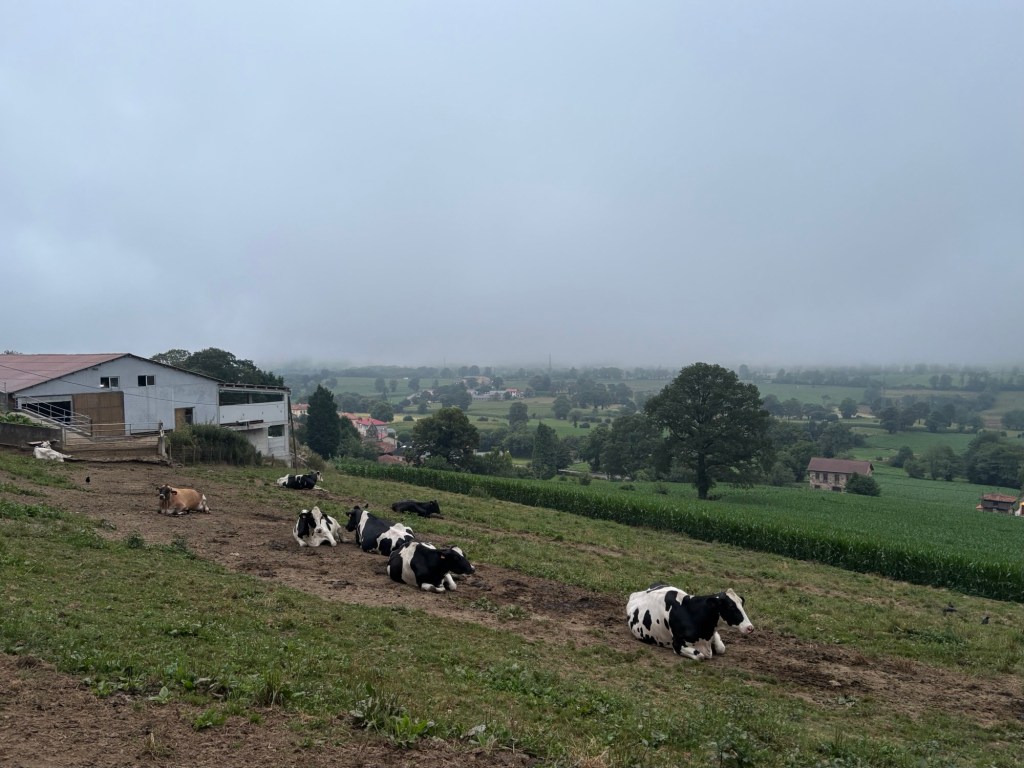
After a blissful night’s sleep in an albergue that was really a converted house (and quite possibly the best shower on this year’s Camino) I left at the relatively slack time of 6.45am, as the sun failed to materialise behind a heavy belt of cloud. The next major town, Tineo, was about two hours’ walk from La Espina, through a vast network of hillside cattle fields. My Spanish students in Extremadura used to joke about Asturias having only tractors and cows. It sounded like a gross stereotype at the time, but let’s put it this way: this part of the country would make for a very repetitive game of I Spy.
At Tineo, as I stopped for a drink at one of the fountains, I was almost jumped by a young pine marten which leapt out of the bushes above the statuette of Santiago. I should have known something was about because the blackbirds were kicking up a fuss in the trees, but I was thirsty so my senses weren’t as acute as usual. It didn’t hang around long enough for a photograph, though it did pop its head out of the bushes a few minutes later from the safety of a shed roof halfway down the hill. That’s the second one I’ve seen. They must be fairly plentiful in this part of the country.
At the edge of the woods above Tineo stands a little house that commands a spectacular view of Tineo and the surrounding hills. Until recently this was the home of Arcadio Rey López, the self-styled “Último de las Filipinas”, a former miner, local celebrity and dyed-in-the-wool Republican who once welcomed pilgrims on the Camino Primitivo. Arcadio died in 2018 and, since then, his former home has lost much of the poetry which once adorned the chalkboards around his house.
Curiously, the expression “ser el último de las Filipinas” means to be the last one to arrive, which was something of a theme of today’s adventure.

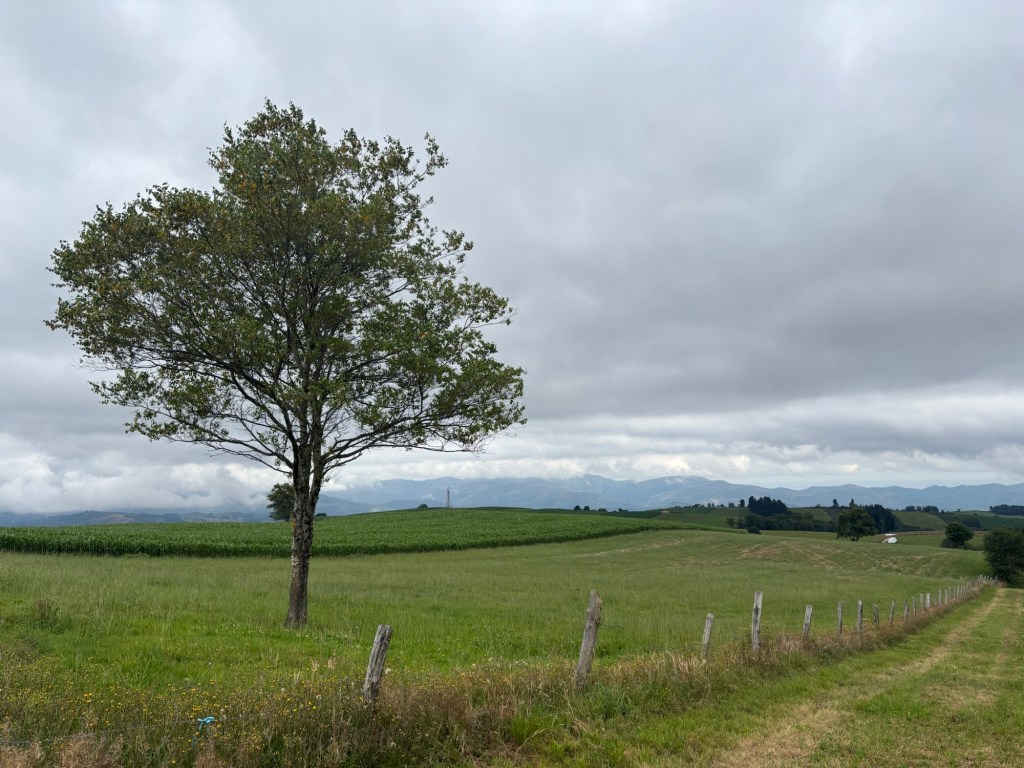
Up on the heights above Tineo, I could see all the way to the Bay of Biscay – my first (and potentially last) sighting of the sea along the entire Camino. I heard a quail for the first time in a while, but was followed all the way by the two most common spirits of the Camino: black redstarts and stonechats. These last are ubiquitous in Spain, no matter which Camino you choose to follow, and make for entertaining companions as they race ahead in pairs along the fences ahead of you.
The Camino forks at this stage, offering a slow descent to Obona, but the path itself was roped off, so I took the regular route. When I was deep in the forest beyond, however, I came across a most confusing bit of signposting, which didn’t make it abundantly clear where to go, with the Camino arrow pointing right and the Obona arrow pointing back the way I had come, and a third path going straight ahead with no indication at all. It’s not often that the Camino signage isn’t easy to read, but this was a bit of a puzzle.
So, as Google Maps wasn’t being particularly helpful either, I turned to PolarTrek, an app I’ve been using to track my mileage each day. For whatever reason, PolarTrek is much better at seeing footpaths, which I used to double-back and visit the abandoned monastery of Obona, once a mandatory stop on the Camino.
Obona’s ruined monastery is… haunting, to say the least. It’s hard to tell when it was abandoned, though it must have been sometime in the 19th century after Mendizábal’s confiscation in 1835 of the “manos muertos”, the Church’s inalienable properties in Spain. People have obviously come and gone since then: graffiti both harmless and profane had been scrawled across one stretch of surviving plasterwork; somebody has lit a fire in one corner of the old refectory and written the name “Diego” into the fire-blackened wall; an empty packet of budget Bluetooth headphones lay between the naked beams that must once have supported a tiled floor at one end of the cloister; and a couple of empty bottles and a crushed can of Aquarius had been thrown into one of the antechambers alongside four stacked chairs and the top half of a choir lectern, which was in remarkably good nick if it was a genuine 19th century design.
The cloister itself, unfinished and overgrown, smelled tremendously strongly of mint, which was growing all over the place. I couldn’t resist chewing on a few of the leaves – fresh mint tea is a delicacy I don’t make for myself as often as I should.

Back in the forest, I tired of the lacklustre American reading voice of From the Depths and returned to an old favourite: the 1981 BBC Radio adaptation of J.R.R. Tolkien’s The Lord of the Rings. I was lucky enough to grow up with Peter Jackson’s films (which I adore) but before the films I had the radio series and it is still, in many ways, the superior adaptation in my head. How can you possibly go wrong with a voice cast of Ian Holm, Michael Hordern, Bill Nighy and John Le Meisurer? Not to mention Stephen Oliver’s beautiful orchestration of Tolkien’s verse to music…
Like Triffids, which I often take with me on any solo adventure, I like to listen to The Lord of the Rings whenever I’m on a walking holiday. So much of the saga is about a long journey, and the series’ denouement – which handles the slow sense of loss as each of the heroes part ways until Frodo is left alone – is easily its strongest point, and one which is all too familiar on the Camino. I cannot recommend it enough.

Thus armed, I was relatively sanguine about the subsequent disaster which was my attempt to find a bed for the night. After buying two sandwiches in Campiello – one for today’s lunch and the other for tomorrow – I tried the donativo in El Espín, hoping its relative obscurity would make it an early win. It was not to be. I was greeted with the now frustratingly familiar blue “HOY COMPLETO” sign.
I tried Borres, which I reached after a little tricky negotiation of some churned-up cow slurry. The municipal was noisy and looked half full. Three Spaniards in Lycra told me to check in at the bar in town, about ten minutes’ walk away. I ought to have done just that, but I didn’t fancy the place, and in my hubris I decided to push on to the spot that the Dutchman from El Texu had recommended in Colinas de Arriba.
When I got there, about an hour later, I found a large party of fifteen or sixteen Spaniards having lunch in the foyer. Two others sat at laptops in the bar. The landlady turned a rather apologetic look at me and shook her head – unless I wanted to rent the apartment, which wasn’t cheap, there was nothing they could offer me. I shrugged and said I was sure I’d find something. I should have asked if I could at least fill up my bottle – which I had almost emptied as I neared Colinas – but I forgot.
It took another hour and a half to reach Pola de Allande, now well off the track up to the highlands, arguably one of the Camino Primitivo’s most scenic spots. Finally, just as Frodo volunteered to take the ring to Mordor at the Council of Elrond, I reached Pola’s albergue to find it almost as empty as the Monastery of Obona: just two pilgrims had staked out beds in a room that could have housed at least eighteen. Relieved, I took off my sandals and bag – always one of the highlights of each day – and crashed out on the blue rubber mattress of the nearest bed.
I wasn’t feeling like a meal out, but I did buy myself a tin of fabada asturiana and a couple of arroz con leche puddings, which restored my energy reserves a fair amount. By the looks of things, today was actually one of the longest stretches yet on the Camino, and that’s before factoring in the elevation, which was considerable. So perhaps I did have something to celebrate after all.

I’m loving the scenery of the Camino Primitivo but I’m not enjoying this daily rigmarole of disappointment when faced with pre-booked albergues. The Camino Francés is popular too, but it has a lot more infrastructure to deal with the increasing numbers of pilgrims. The Primitivo’s charm is in its solitude, which isn’t as easy to find in August as it must be at other times of year.
But I remain optimistic. Tomorrow is another day. Tolkien’s walking song has ever been my companion on the road, and I often sing it to myself when I am alone and the road stretches out before me. If there is a more fitting song for the Camino, I haven’t heard it. BB x
The road goes ever on and on
Down from the door where it began.
Now far ahead my road has gone
And I must follow if I can.
Pursuing it with eager feet
Until it joins some larger way
Where many paths and errands meet
And whither then? I cannot say.
J.R.R. Tolkien
 The Book of Barnabas