It’s 6.18am on Wednesday morning. I didn’t get any time to write last night, as it was nearly midnight by the time I was in bed, for reasons which I shall endeavour to explain.
Before leaving O Cebreiro this morning, I decided to climb Cebreiro’s peak, where a lonely lichen-covered cross looks out over the layered hills and valleys to the east. It was scored up its sides with a thousand little grooves, into which a thousand small coins had been slotted. Time and the elements had worn down their edges, and some grooves were empty – perhaps the work of quick-fingered pilgrims over the years. From the summit, you can see all the way to Foncebadón, offering one final glimpse of the faraway meseta before the descent into the rolling hills of eastern Galicia.

I walked and talked a fair amount this morning, sharing the road first with Simas, then with a Catholic mother and daughter from Ohio, then with three more Ohio boys, then finally Simas again until Triacastela. Along the way we hit another Galician roadblock (read: cows), met the first of what will presumably be many school trips (this one a sixty-strong outing from Mengíbar, Jaén), and talked about American history, which is always really eye-opening when it comes from Americans themselves.
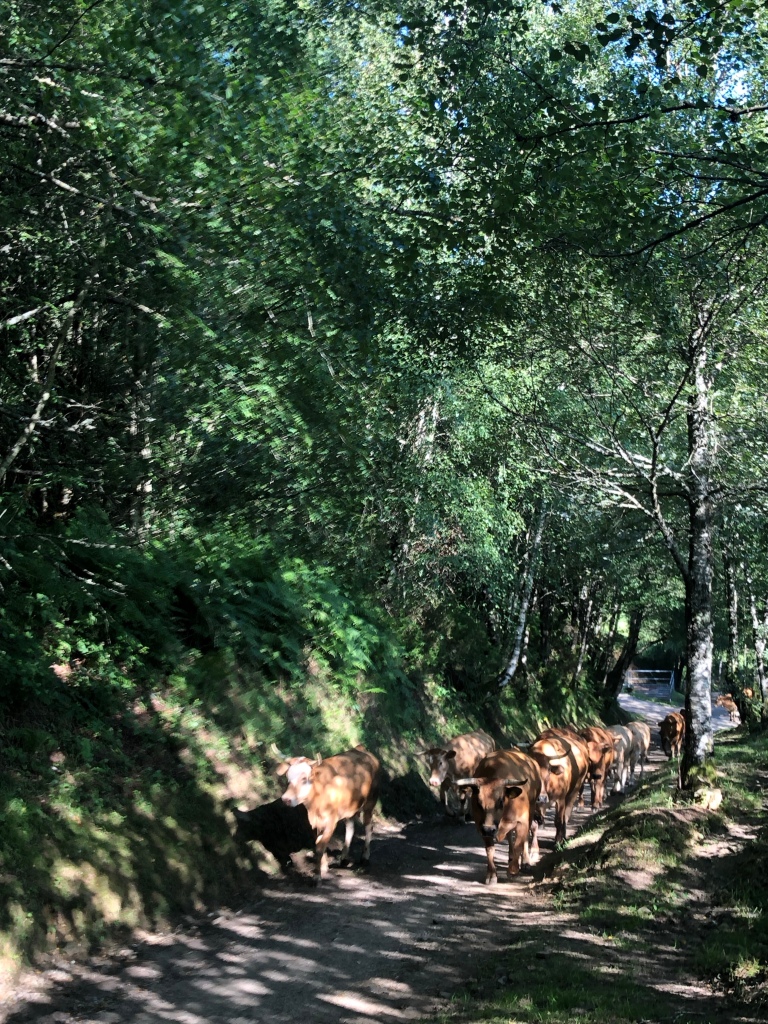
At Triacastela, after a hearty breakfast of empanada, zumo and Cola Cao, the road forked north and south. Simas and I parted ways here: he headed north and west over San Xil to the hamlet of Calvor, and I took the south road to Samos, on the recommendation of Bridgette, the Australian pilgrim I met just over a week ago.
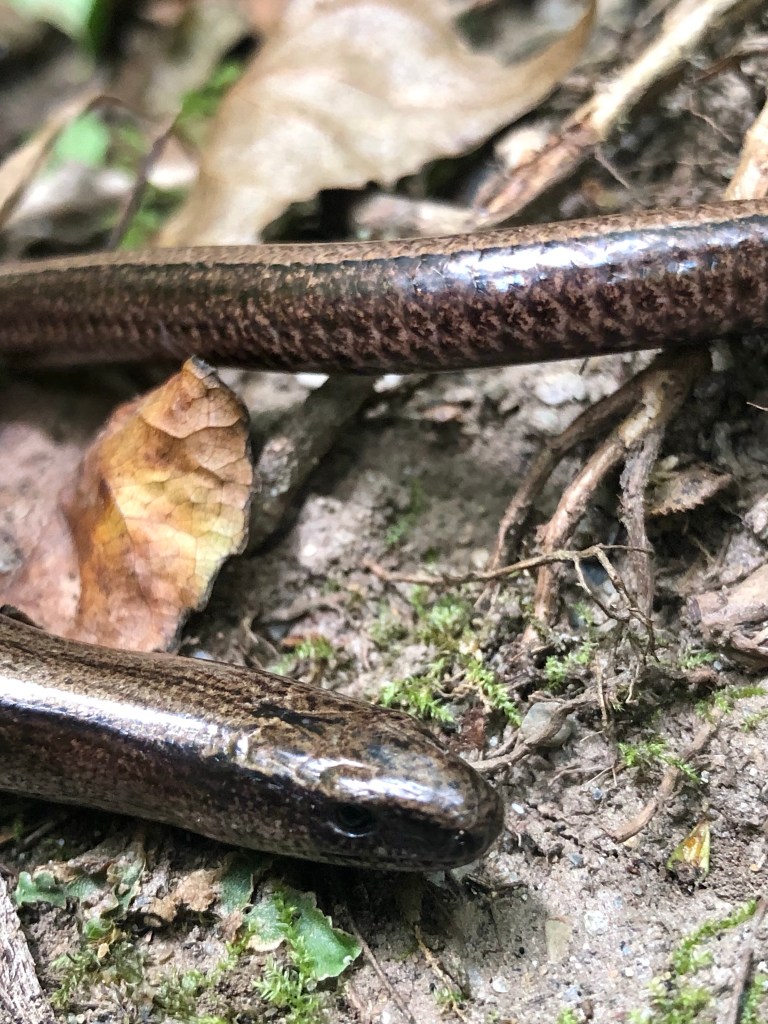
The road to Samos is beautifully remote. The Americans from lunch yesterday zoomed by on rental bikes – some calling out with a cheery buen camino, some not – but other than that I walked the road alone. Seeing as I had plenty of time, with the Samos albergue opening late, I dawdled a lot, leaving the Camino at one point to explore the woods that sloped down to the river Oribio. I had to be careful where I set down my backpack, after almost stepping on a slow worm that lay perfectly still near the riverbank. I have fond memories of finding this false-lizard on the grass-heap at home as a child, so it was nostalgic to find one here, deep in the Galician valleys.
Galicia has avoided most of the ferocious heat that is ravaging the rest of the peninsula – unlucky pilgrims at the Pamplona stage would have endured 46°C heat after midday – but the UV rays must have been just as fierce, because I definitely caught the sun before reaching Samos. However, all the prickling in my arms could not detract from the beauty of the countryside I was passing through: the tiny hamlets like San Cristovo do Real with their dragon-spine slate roofs and empty streets were like something out of a picture book of a Spain that has long since disappeared.
With the last hill before Samos in sight, the tinkling of a bell broke the silence. I overtook a Spanish pilgrim a minute or so later, carrying a stick to which a small bell was fastened, releasing a merry jingle with every step. If he’s walked all the way from St. Jean with that, he must have the patience of a saint. Or perhaps it’s a deliberate act of penance on his part.
The Monastery of Samos, my destination (and digs for the night), is a stunning jewel of the Camino and seriously worth the detour if you reach Triacastela too soon. The hospitalero, a talkative chappie from Madrid in a black triskel tee, was very friendly, apologising in his own way for the lack of traffic. ‘In July I should be turning people away,’ he explained, ‘but this year there are almost no Spaniards on the Camino, only foreign tourists. Nobody has the money anymore to spend four or perhaps even two weeks on the road.’
There’s a general election on the 23rd – you can hardly miss the posters along the Camino, as though pilgrims were a vital demographic – and I expect a change of government. In which direction, though, I cannot say. It’s an exciting time to be in Spain.
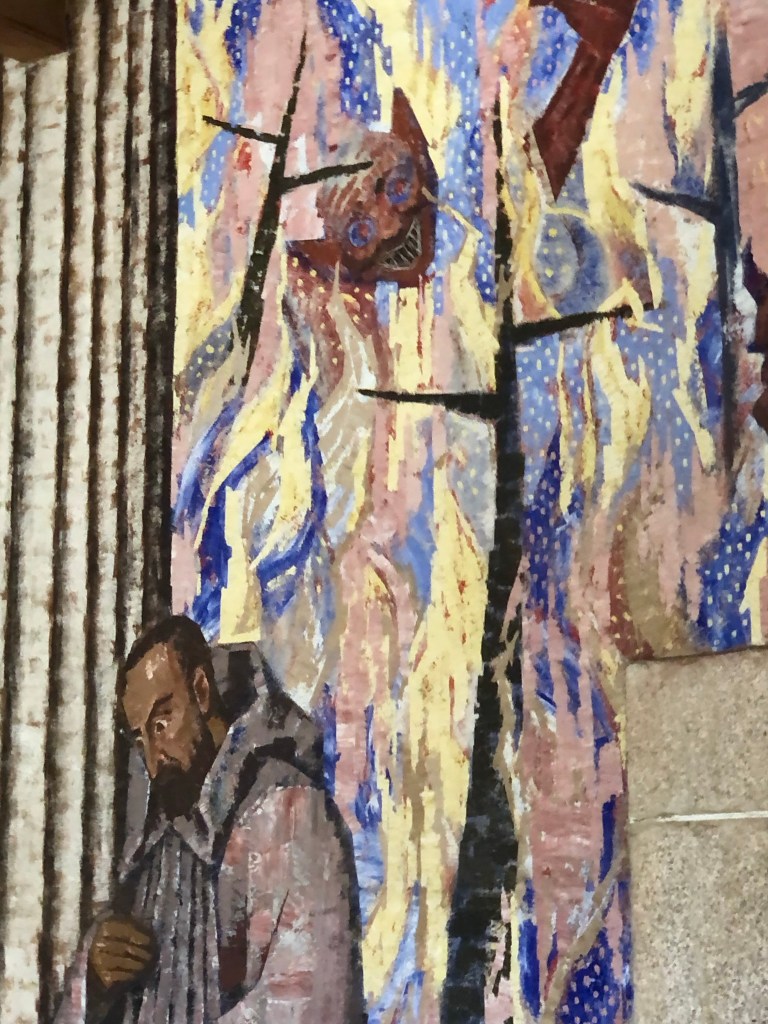
After a short siesta, I tagged along with two jolly pilgrims from Albacete and a couple of stragglers from O Cebreiro to a guided tour of the monastery, while the Chinese pilgrim and her curiously dressed German companion who arrived after me went looking for somewhere to drink. Our guide was very knowledgable and the complex was mind-blowingly beautiful in places, despite having been gutted by a fire in the early years of the last century. Like the walls of the albergue, giant paintings stretched along the corridors, depicting scenes from the life of Saint Benedict. As is often the way, the artist used the faces of contemporaries as his models. Some were local figures, some notable monks of the order, and some were members of Franco’s cabinet. Surprisingly, silver screen stars Charlton Heston and Sophia Loren even made a cameo appearance at one point!

But by far the most intriguing paintings were of the occult: devils, demons and dark spirits grinning and leering amidst the serene countenances of over a thousand years of Benedictine worshippers. There’s nothing like it in the Abbey back home, but even if there were, I’d have been just as transfixed. Isn’t there something deeply intriguing about the fascination with the dark held by those who cling to the light?
I bought a few souvenirs in the gift shop, staffed by two of the eleven monks who reside at Samos. They were pleased to hear I worked at a Benedictine school in England and we had a lovely little exchange while I obtained some homemade biscuits for the road ahead, and a new rosary for the road beyond.
Dinner at the Hotel A Veiga was sensational, and far and away the best menu peregrino I’ve had on the whole Camino, including the previous two stints this spring and back in 2018. The arroz con leche was heavenly and the churrasco (and all the sauces they brought with it) was divine. I ate better than I have in days – which is just as well, because I would need all the energy in the world an hour or so later.
When I got back to the albergue, it was already five to ten, so I packed for tomorrow and got my things ready for bed. I thought I’d pop outside and use the erratic signal (nonexistent inside the albergue) to book my flight home next week and write up my blog, and catch up with the two pilgrims from Albacete I met earlier on, but fate had other ideas.
Not five minutes after the hostalero grabbed his bag and left without a goodbye, the waiter from the bar across the road came and asked for our help: the German pilgrim was causing a scene and trying to pick a fight with the other punters. Miguel, the larger of the two Manchegos, followed her back to the bar and was back in five minutes, half aiding, half dragging the German across the road to the albergue. He was in a dreadful state, reeling and tottering in every direction, and evidently suffering the adverse affects of too much drink and too many drugs. It was all we could do to get him to sit down without falling over backwards, and he turned hostile every time he heard Spanish, making childish imitations of what he heard and bookending every line with a violently delivered ‘motherf*ckers’ or, more charmingly still, spitting at whoever spoke last. The only practical solution seemed to be to talk to him slowly in English, which he seemed to command well enough to tell us all the things he wanted to do to the waitress in the bar.
The waitress returned shortly and asked for her phone, which she had lent to the pilgrim so he could call home. He got aggressive and insisted it was his, so Miguel had to wrestle it off him. He then fell back and cursed the night sky and the three of us for about half an hour, stoping only to say the word ‘mamasita’ every minute or so, chanting it in a suddenly calm and lobotomised voice as though in a trance.
Eventually, Miguel and I decided the safest place for him was his bed. I prepared a bed for him at the other end of the room, right next to the bathrooms, while Miguel and Diego hauled him to his feet and carried him inside. Between the three of us we got him to the bathroom and stood by for ten minutes to make sure he didn’t hurt himself, and then managed to get him into bed, from which – mercifully – he did not get back up.
Ten minutes later, the unexpected arrival of two locals from the petrol station that is curiously twinned with the monastery almost undid our hard work, when they tried to fix the adjoining door to the garage by slamming it to several times, unaware or uncaring for the sleeping pilgrims just a few feet away. The German swore loudly after every bump in the night, until sleep finally found him – and turned him into a human onboard motor, snoring loud enough to wake the whole monastery, if not just the room in which he lay.

But now I must put down my phone and set out. It’s going to be busy from Sarria onwards, and the sun is already high in the sky. Until next time! BB x
 The Book of Barnabas