It’s easy to ask yourself why you’re bunkered down in a hostel when you’re at the point on your life where you can afford a little comfort here and there. But I stand by my decision: hostels are a fantastic way to meet people from all walks of life. And that’s what travel is all about, right?
I got talking to Gavin from Utah last night – the first American from a state that isn’t Cali or Texas that I’ve met in a long time (those two states pump out travelers like there’s no tomorrow). To have an American perspective here in Normandy was more than I could have asked for, and Ana from Austria provided a Germanic point of view – so I really scored a hat trick here!
Over dinner last night the three of us decided to check out the landing beaches today. Gavin had already booked himself onto an organised tour, but I’m nothing if not stubborn when it comes to planning my own affairs, so Ana and I improvised our own plan of attack, starting at Pointe du Hoc.
Most of Omaha Beach – one of the main landing zones for US troops during the D-Day landings – has reverted to its pre-war status as a pleasure beach, so it’s important to visit a site like Pointe du Hoc to really get a feel for how things were. The promontory is strewn with craters caused by Allied shells, some so deep you can stand in the centre of them and still be more than a head below ground. It’s hard to take it all in at once: the scarred, lunar landscape overgrown with tall grass and summer flowers, with pipits and wagtails and warblers singing their hearts out. In a cavity in one of the old gun mounts, a blackbird stood washing itself, and away to the east the mournful cries of a large colony of kittiwakes. I wonder how much of this vanished when the clouds of earth came down here, all those years ago.
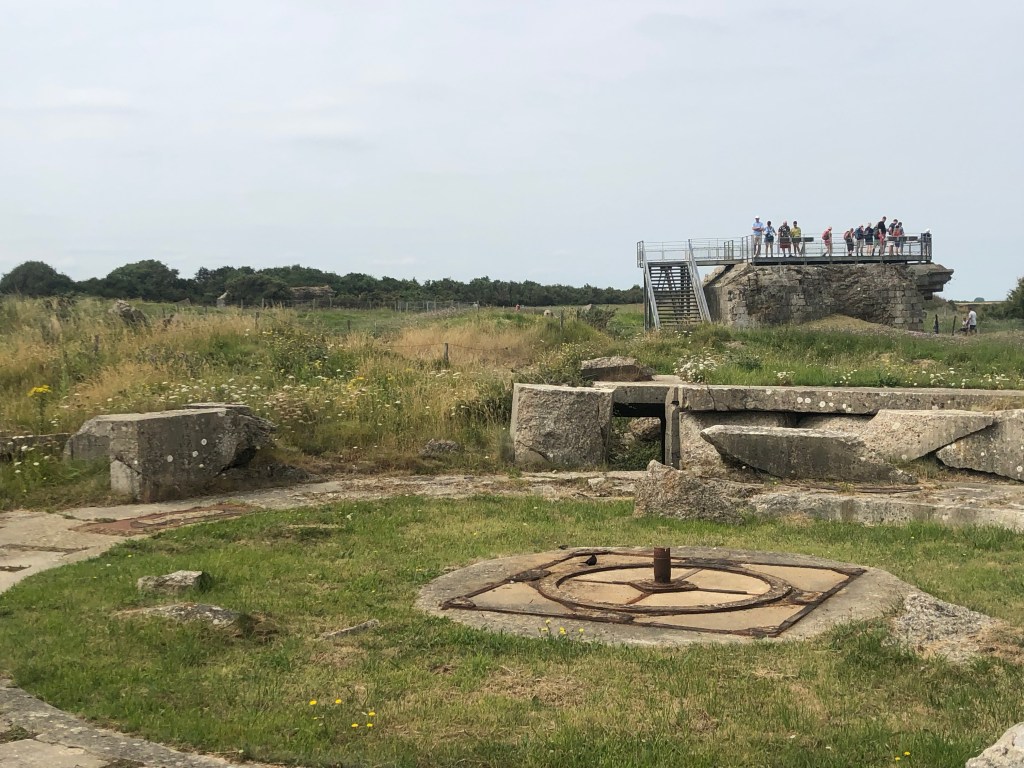
The bunkers are eerie. No other word for it. They’re cavernous on the inside, with a lot more rooms than you think at first. Some of them have marks in the rear wall that can only be from stray bullets fired directly through the opening. You try not to imagine how they got there. And then there’s the coils of barbed wire that ring the cliff edge, rusted from years of exposure to the salted wind. You can’t help but take your hat off to the US Rangers for not only coming ashore under heavy fire but scaling a vertical cliff-face before launching their assault.
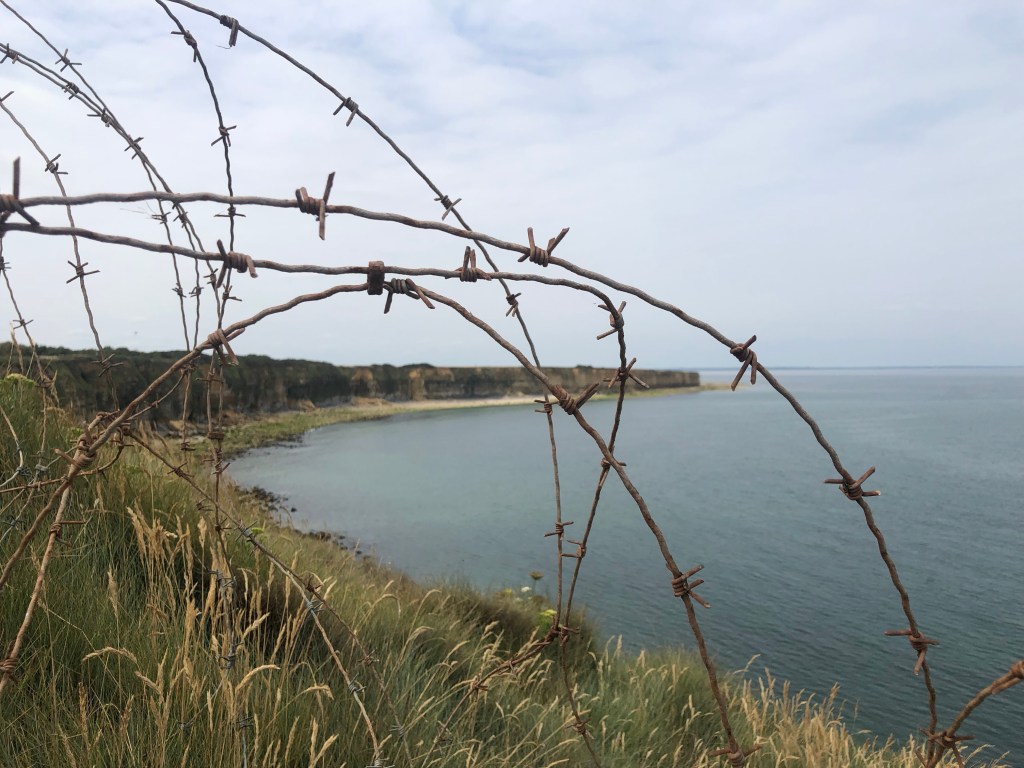
From Pointe du Hoc we found a track along the cliffs to take us back to Omaha Beach. It’s completely invisible on Google Maps, but reason told me there would surely be such a path, and as luck would have it, there is: a relatively new cycle track that starts at the Pointe du Hoc car park and follows the coast all the way to the beach at Vierville-sur-Mer.
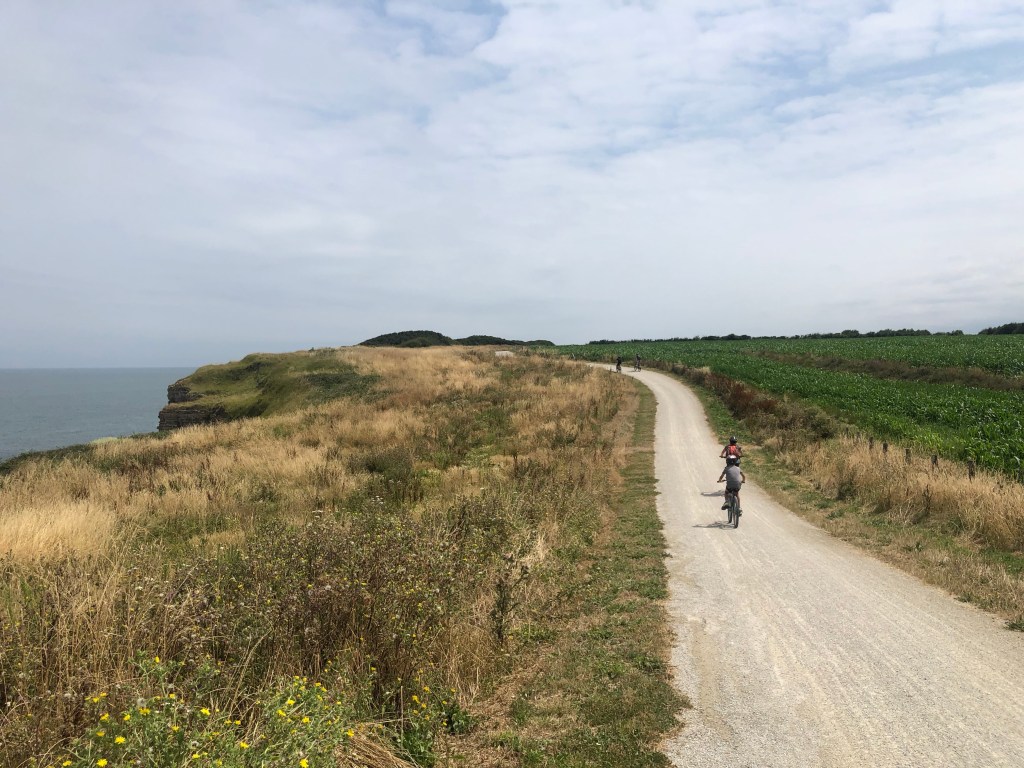
It’s clearly a popular route with the locals, and there were plenty of cyclists out and about, from hobbyist Dutchmen clad in Lycra to families of sporty-looking Germans – and, of course, your classic stately monsieur paying no heed to aerodynamics in his beige jacket and jeans. We passed him at least twice (did he lap us? I think he lapped us…).

Omaha Beach was pretty busy when we got there some two hours after leaving Pointe du Hoc. Paddle boarders, bathers and dogs plied the shallows between the beach and the sandbar. Children built sandcastles and dug bunkers of their own, while parents leafed through this or that summer book. If you squinted down the coast you could almost imagine the many thousands of troops who landed on this beach nearly eighty years ago, but I get the feeling that memory is fading further and further into the distance. The tour guides bussing up and down the coast road in WW2-era jeeps look more whimsical than reverential, like taking a ride in a sedan chair. Gavin said he thought it a shame that it hadn’t been preserved more like the battlefield that it was. I’m not so sure. I think the regeneration of a battlefield is part of the healing process. This is, also, France, and having borne the brunt of the fighting in not one but two world wars in the last century – not to mention their occupation by the Nazi regime – they may well want to move on.
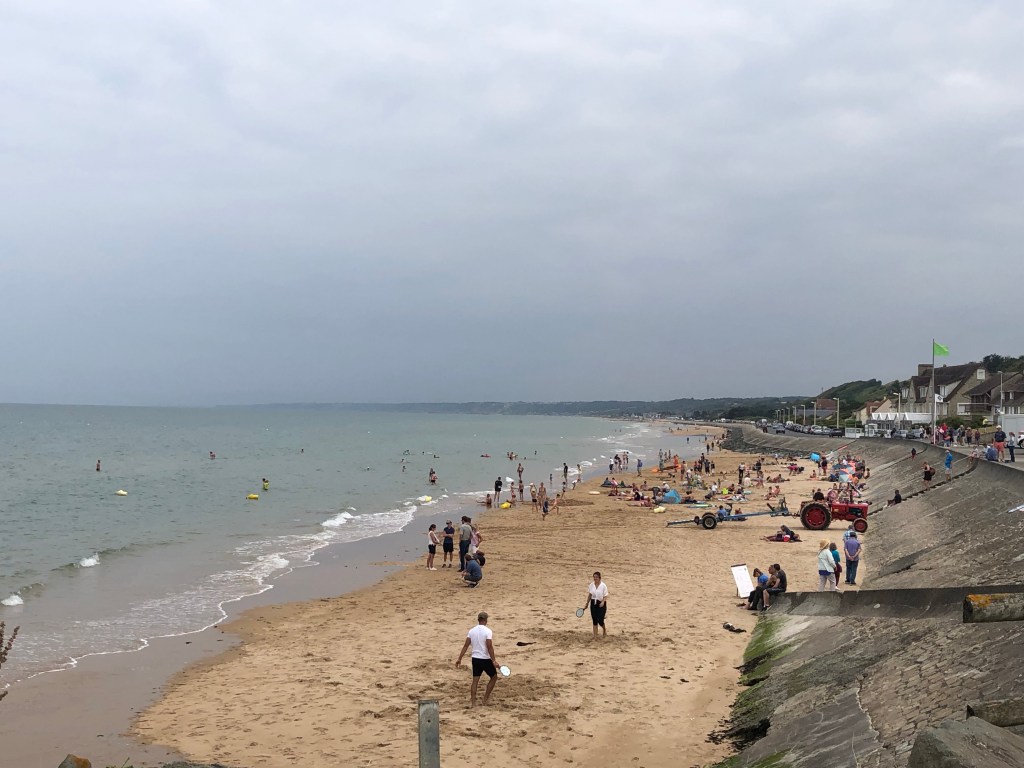
In any event, I wasn’t averse to a swim in the bloody waters of Omaha, if only to say I’d done it. After a two-hour hike in the sun along the cliffs, it was definitely the right thing to do. The heatwave might be over, but it’s still hot enough to dry off in a matter of minutes, so I had no concerns about swimming out to the sandbar and beyond for a bit. I’m not the best swimmer, but God, I’ve missed being in the water. It’s a pain living so near the coast and yet so far.
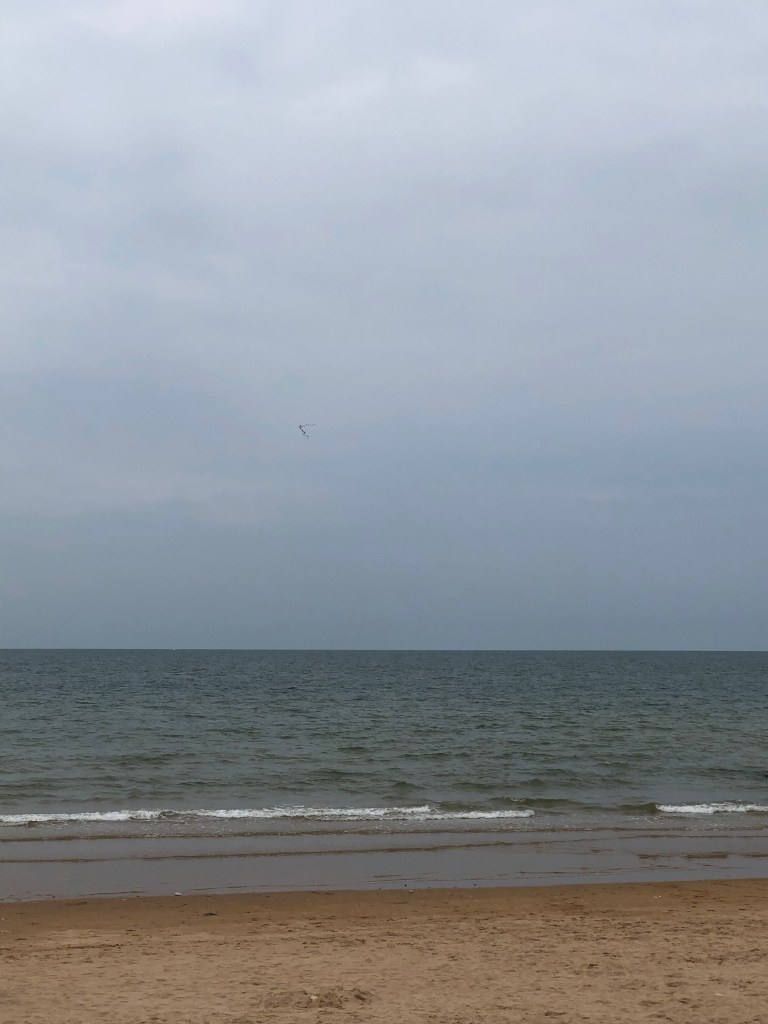
I didn’t think about the history as I stepped into the water. The infamous opening scenes of Saving Private Ryan didn’t flash across my eyes. I just waded in up to my waist and kicked off into the murk. As the poppies that grow on the fields of the Somme have become a symbol of remembrance, I think it’s only fair that the spirits of Omaha are also allowed to depart in peace. Their heroic struggle will never be forgotten, but the land beneath our feet is not ours to sculpt, no matter how hard we try. It was here before us and will be here long after we’re gone. To see Omaha and to stand where they stood is enough, I think. And that’s my two cents on the matter. BB x
 The Book of Barnabas