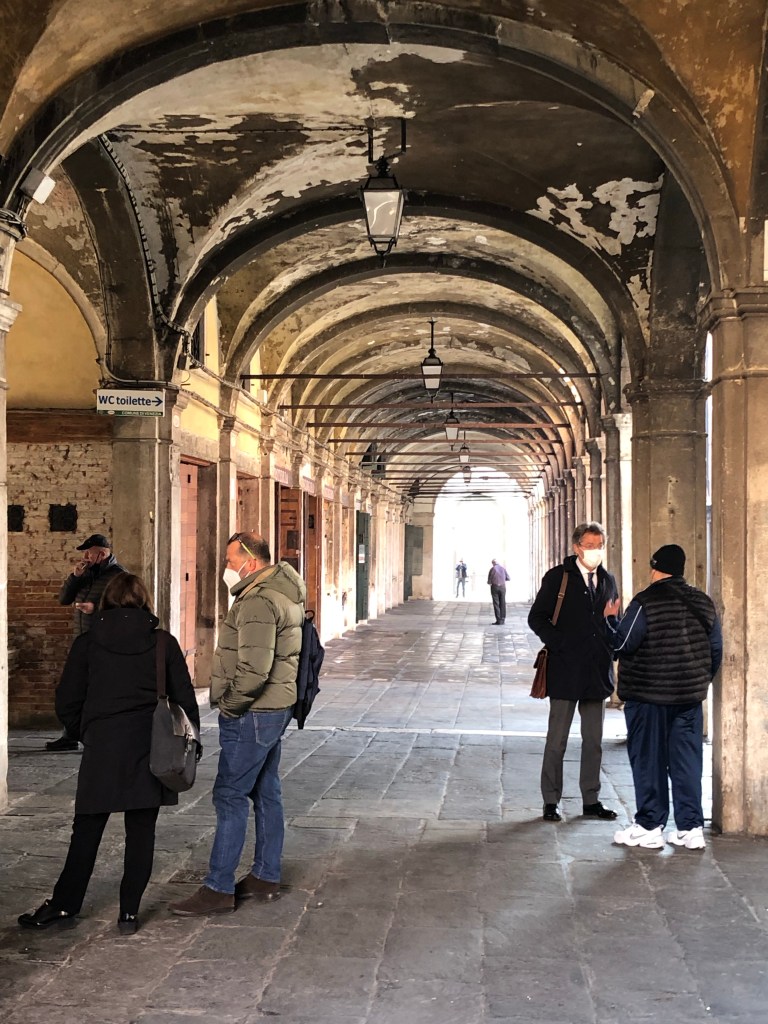
Streets of London

2.20am. I’m riding home on the 2.08 from London Victoria. I didn’t even know trains still ran at that ungodly hour of the morning. Apparently they do: one every hour at eight minutes past the hour. They lock the station until ten minutes or so before the train leaves, and there’s quite a crowd loitering outside the gates just before they open them. Three Bridges is clearly the place to be at two in the morning. Who’d have thought it?

I did some much needed “getting out” today. With a couple of exceptions I’ve more or less turtled for four years or more. I guess that’s the nature of life in a boarding school: whereas most other folks can play their weekends and snatch evenings here and there, in teaching you block out your free time by your holidays…

The chap two seats ahead is fast asleep in his seat. His phone alarm is going off for the third time. The lads on the row of seats opposite looked annoyed at first, but one of them has struck up a conversation with the sleeper and asked if he’s going to get home OK.

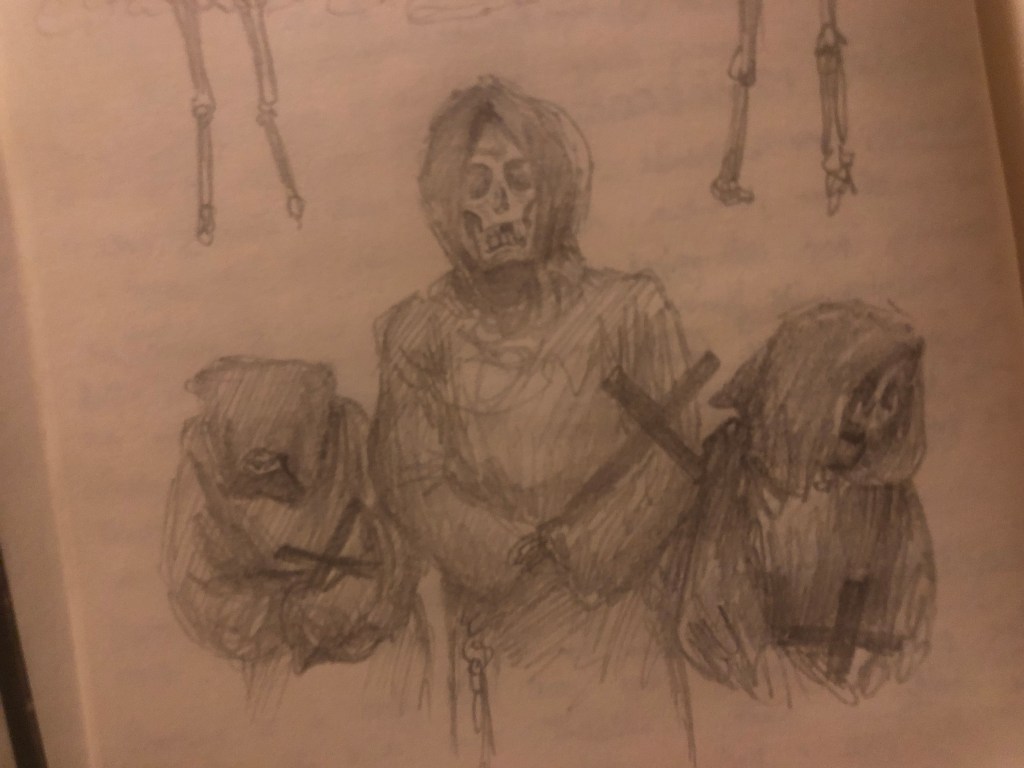
I killed some time with my sketchbook on the Underground this afternoon, and again waiting in the street in Holborn before the party. A homeless man wandered over, cap in hand, to ask for help. Normally I have to admit I’d probably turn a callous blind eye, but something about London draws me in, makes me think differently. I asked for his name and we got talking. He said his name was James, and that he was trying to find a place that would take both him and his dog for the night. I gave him something to start his hunt – for once I happened to have a loose note on me. We shook hands and he set off at a run.

I didn’t have to make the trek home quite so soon. A friend offered me the key to his place for the night, if I could find my way there. I turned it down, partly out of habit, partly out of pride, and partly because of James. Having such an easy solution in London when so many are out on the streets… for some reason it didn’t sit right. You think in a different key in the small hours.

I remember sleeping rough in the wastelands beyond Almeria years ago. Gaunt from a month of under budgeting and undereating and feeling hollow. I remember the fear of that first night, the isolation. It could never compare to the real thing, of course, but I was young, foolhardy, and I wanted to have an idea of how it felt. One night I was curled up in the dunes when a couple of cars rolled up onto the beach around two in the morning. Men with flashlights climbed out and scanned the beach. I got the jitters and decided to move – they were probably night-fishing, but your brain plays all kinds of tricks at night. I don’t think I’ll ever forget the genuine pit-of-my-stomach terror when, barely a few yards down the beach, I saw two of the torch beams slowly sweep the beach and lock onto me. I ran. My God, did I run. I don’t think I’ve ever run so fast in my life. I must have gone at least a kilometre or more before I collapsed in the dunes.

Almeria seems a long way away. London is surprisingly busy in the small hours. Not the city that never sleeps, per se, but one that keeps at least one eye open all night. Offices lit up, calendars and Macs on desks. Lads coming home from the lash. A girl tottering home on heels, makeup streaming, eyes weeping. And many, many sleeping bags in doorways.

It felt good to go out again. I haven’t danced in years – not since university, I shouldn’t wonder. And as it’s London, the music was both a) quality and b) perfect for dancing shoes. I should do this again sometime. Not that I’d make a habit out of catching the 2.08, though.

Gatwick Airport ahead. Only another five minutes or so to go, and then it’s the long walk back through the forest. I’ll probably be in bed by 4, with or without the moonlight to guide me – I’ve made that journey so often I could probably do it blind.

I’ll sign off now so my phone has enough juice for another chapter or so of Michelle Paver’s Ghost Hunter on Audible. That will take me at least as far as the forest – there, at least, I will feel safe again. BB x
Tzompantli: An Ode to Extremadura

On Monday, I kick off my new role as the middle school gifted and talented programme coordinator with a lecture on the Aztecs. It wasn’t the obvious choice, as Mexico is a country I have neither visited nor researched nearly as extensively as my grandfather’s country. As a matter of fact I made a conscious effort to steer well clear of Latin American affairs at university, cleaving to the Iberian modules even when it meant the pickings would be slim. If Durham’s only Cervantes specialist hadn’t been on maternity leave in my final year, I could have stayed quite happily in my fairy-tale world of knights and princesses and Moorish warlords and binged on ballads, and I wouldn’t have had to go anywhere near strap-on wielding Catalans and metaphysical Madrilenians. Oh Quijote, en mala hora me abandonaste!

Ordinarily, for such a school project I would have stuck to my guns and wheeled out some Moorish magic with a talk about Islamic Spain, something that is close to my heart; or El Cid, a man whose legend (and whose 1961 movie) is embedded, thorn-like, a couple of inches deeper. I even briefly considered whipping up something about pirates, but I haven’t read nearly enough to do that one justice. Not yet.

I landed upon the Aztecs for a couple of reasons. One, because the book I have chosen to read with my IB students is Laura Esquivel’s Malinche. Two, because my school – or rather, the people whose money built the house in which I now live and work – has a long history with Mexico, a connection that is plainly carved into the stone in several places.

But I think the main reason I wanted to explore the Mexica was because it ties me back, through the ruthless conquistadors, to a place that is still very dear to me: Extremadura.

My first contact with Spain was with Andalusia, with her jagged crags and whitewashed mountain villages. If I wasn’t spellbound there and then, my mum and dad must have been, because they made the crazy decision to up sticks and move us there in 2006… right on the eve of the financial crisis that was already driving many of Spain’s expats out. It might not have been the wisest move for three out of the four of us, but after a year of weekend hikes in the surrounding sierras, gecko-hunts in the streets by night, Holy Week spectaculars and vulture-chasing in the misty heights of El Gastor, I was absolutely hooked. Andalusia was my polestar for many years to follow, and her light shone brightest on the paradise of the tierras rocieras of Doñana National Park.

(The author, blinded by the light since ’05)

Over the years I braved her jealousy and flirted with her sisters: a school trip took me from Barcelona and the magical Mediterranean town of Tossa de Mar up and into the clouded dales of Cantabria and the foothills of austere Asturias. Legends of the Cid led me to Burgos and the empty plains of Old Castile, the guiding light of my ancestry led me home to la Mancha, and in recent years I’ve swum in the crystal waters of Mallorca and Menorca. Throw in flying visits to Aragon, Alicante, La Rioja and the Basque Country and it’s getting to the stage where there’s hardly a corner of the country I haven’t explored.

But I don’t think I could ever have anticipated the rawness of my obsession with Extremadura. From the moment I set foot on her soil I was lost. It honestly felt like falling in love for the first time. Not the high school crush kind of falling in love, but that kind of mature depth of feeling, that gut-wrenching, iron-tasting jolt in your upper body that tells you something’s starting functioning inside that was only dormant before.

Oh, cut the poetry already, BB. If you’ve been reading this blog as long as I’ve been writing it, you’ll know I didn’t actually talk like that when I arrived in Villafranca de los Barros on that hot September afternoon seven years ago. But hindsight is a wonderful thing, and any corner of the Earth that could convince me to jettison my plans for taking my teaching game over to South America for a second (and very almost a third) time must have an awesome power.

When Hernan Cortes and his men entered Tenochtitlan, one of the greatest cities of the world at the time, one of the things that shocked them most of all were the dreadful tzompantli, wooden scaffolds nearly two metres in height that carried between them the many thousands of impaled skulls of the sacrificial victims of the Aztecs. They came back to Spain telling wild tales of eagle warriors and war priests with matted hair and bleeding knives, and when one reads of the savagery wielded in the name of Castile upon the Mexica, it isn’t hard to understand why it’s been so popular until recently to discount the stories of tzompantli as a myth invented by the conquistadors to justify their actions. Until 2015, the year I moved to their homeland, when the bases of the huey tzompantli were uncovered in Mexico City, complete with row upon row of human skulls, laid out like so many candy calaveras on Dia de los Muertos. The conquistadors, for all their sins, must have had stories worth telling, if only people would listen.

Extremadura is one of those places I will probably write about again and again for the rest of my life. If Andalusia was my first crush, Extremadura was the lady who captured my heart for good. Not even the knowledge I have now that ties my bloodline more closely to Valencia than la Mancha can put a stain (no pun intended) on my devotion to her. Hers is a story I would tell and tell and tell until my tongue split in two.

Tzompantli: an image which struck no small amount of awe and fear. The presence of a God or Gods unknown (and a word that first threatened to split my tongue in two, but is now so satisfying to say that I have rather awkwardly made it the title of this post).

That is my Extremadura. Unknown. Disconnected. Hard to say. Trainless. Abandoned. The conquistadors couldn’t get out fast enough. Malaria festered in her hidden valleys long after it had been extirpated everywhere else, and the Mesta virtually enslaved her very earth to their will, subjecting her people to centuries of poverty. But it is precisely because of these fascinating tales – coupled with her unparalleled natural beauty – that I do believe Extremadura to be the jewel in Spain’s crown.

And oh, look – I started writing about Mexico and here we are, back in Spain. I’m nothing if not predictable. Some of us spend our lives traveling in search of that “something” that is just beyond our reach. I count myself amongst the lucky ones who found what I was looking for and need look no further – at least, no further than the light that shines on Spain’s shores. I can only hope Doña Extremadura forgives my curiosity.

Did Rodrigo, last of the Visigoth kings, truly disappear in her mountains after the fall of Merida? Did an army of ants reduce one of her villages to rubble? Were there really hordes of dwarves in Las Hurdes who descended into the valleys by night to terrify the locals? And what made Carlos, supreme ruler of the Spains, the Americas and all the Hapsburg Empire decide to spend the last years of his life in her wooded hills?

You will only find out if you go. Don’t hold on too tightly to your heart. BB x
P.S. Thinking about sharing some more stories from this part of the world… watch this space.

Under the Shadow of the Stone Pines

On a balmy September afternoon back in 2012, three friends and I were sitting on our suitcases in the bustling complex that is Heathrow Airport. We’d already played the find-the-most-expensive-item-in-duty-free game and were killing time for the gate to flare up on the departures board. We were bound for Uganda, to our partner school in the north, on what could so very easily be construed as your generic gap yah adventure. We were under no illusions as to that. Teddy made a joke about one of us ‘finding ourselves’ out there. Maddie was quick to reply that she’d already found herself right here in the terminal. That made me chuckle – probably because, with good reason, that joke about ‘finding yourself’ was squarely directed at me.

I’ll admit it. I have a habit of falling head over heels for things. Especially places. It goes with the terrain of being a self-confessed Romantic. Naturally, this obsession with location carries over into my reading. Setting is one of the first things that I look for when I read a book. Bother dialogue. Bother clever plot twists. If the cast doesn’t travel any further than their cul-de-sac then I’m out. Any author that can make the setting just as enthralling as the plot has me round their finger. That’s why I’ve always adored M.M. Kaye’s The Far Pavilions. India comes to life through her words, so vividly that at times I could almost hear it, smell it, feel it through the pages. Michelle Paver weaves a similar magic in her writing, and I earnestly try to conjure the same enchantments in my own efforts, though Spain is a fickle mistress and so very hard to please.

The funny thing about travel and this idea of ‘finding yourself’ is that no two people ever feel the same way about a place. I remember all the raised eyebrows when I used to tell colleagues that my favourite place in all of Spain was a town in the western marshes of Andalusia by the name of El Rocío. Outside of romería season, it’s ostensibly little more than a cluster of whitewashed houses overlooking a seasonal lagoon in arguably the flattest corner of the peninsula, where you can stare across the horizon and see nothing but mile upon mile of shimmering heat. And yet, there is something about that corner of Huelva that calls to me, some spell that weaved its secret magic on me a long time ago.

I’ve had the good fortune to travel across Spain a great deal over the last few years, and there are a number of contenders now for that ever-congested corner of my heart. The gorge at Ronda and the green hills of La Vera. The limestone maw of Zaframagon and the devil’s leap of Monfrague. The vast steppe of Caceres and fair Trujillo, a throne set upon Extremadura’s golden fields. The lonely silhouette of Olvera, and Hornachos, jewel in the Moriscos’ crown and once proud watchtower over the Sierra Grande. Putting my extremely biased affection for Andalusia and Extremadura into a basket, you can add the mysterious heights of Montserrat, the windmill-crowned slopes of La Mancha and the awesome majesty of the Picos de Europa that once guided the weary conquistadors home. All this, and I know I’ve only really scratched the surface.

All the same, though my heart is spread across Spain with a rigour that would reduce a piece of toast to crumbs, there is still one spot that reigns supreme over them all. If you’ve been reading this blog since the beginning, you’ll have seen it over and over again in the header up there. But in case you missed it, here it is again.

To the east of the sanctuary town of El Rocío lies the Raya Real, a sandy track that cuts through the heart of the Parque Nacional de Doñana. Once a year, it serves as the primary conduit for almost a million pilgrims who descend upon the town in colourful, bolshy gaiety (as only Spaniards can) to pay homage to the Blanca Paloma herself, the guardian patroness of the marshes. Like most pilgrimages, it’s as much about the journey as the destination, and listen to any one of the many sevillanas sung by the pilgrims and you’ll get a flavour for just how in tune they are with the world around them. What an excuse to journey through some of the most incredible scenery on God’s Earth, all while dressed to the nines!

This is all romantically hypothetical, of course. I’ve never seen the Romería in full swing. All the same, there’s this one patch of the Raya Real that I can see in my mind’s eye right now, if I close my eyes for a moment. As for you, dear reader, you need only direct your eyes back up at the top of this post. It’s that tree on the left.

There’s a cluster of stone-pine trees (acebuches) that grow in an island of grass where the Raya Real forks temporarily, before the two tracks converge at the Puente del Ajolí, the last stop on the pilgrimage. A dead tree stands at its westernmost edge, which more often than not hides a gecko or two – I even spooked a Montpelier’s snake mid-hunt here once. A stand of ashes flank the edge of the great pinar, where cuckoos sometimes sing, and in the skies above the Raya Real, bee-eaters go wheeling and soaring in the spring, with bellies like sapphires, backs like rubies and voices like springwater.

Here, under the shadow of the stone pines, I used to sit when I was a boy and listen. After a few seconds you tune in to the silence and hear it all. The wind over the shimmering plains, the rustle of the ash trees. The whistling kites overhead and the mechanical clang of a butcher-bird in one of the branches nearby. From somewhere far off, a panzorrino (native) calling to his horses, or the bark of a dog. Open your eyes for a moment and stare into the blue, and you might see a tiny speck or two up high in the heavens; a griffon and his mate, perhaps, riding the thermals above the coto below. Just once I saw a Spanish Imperial Eagle here, soaring high above the kites below. Maybe that was the first wave of the wand for me – I was a highly impressionable novice birdwatcher at the time. And though it’s kites and booted eagles that have plied the skies on every return visit, the magic in those splayed wings is always there.

In my eighteenth year, I remember sitting beneath my tree, leafing through a copy of Lorca’s Yerma that I’d picked up in town, when a couple of horses rode down the track nearby, one mounted, one riderless. A local girl had fallen from her horse some way back and tried unsuccessfully to get back into the saddle for a few hundred metres. She asked if I could lend a hand, and so I did, giving her my hands to step up and back into the saddle. I watched them go, I heard them laugh and look back, and I went back to my tree, to Yerma and the kites. A golden opportunity to get to know the town of my dreams through its people slipped through my fingers like the sand on which it stands. I’d make some quip about the Virgen del Rocío being a jealous woman, but I really think I had my head in the clouds then and there.

Fool.

Is there a place you return to in spirit, even if you can’t be there in person? This is mine, beneath the shade of the stone pines on the Raya Real. Millions pass by that tree every year without knowing the connection I have to that singular tree, to the kites that nested in its branches once, to the snakes and geckos and their game of cat-and-mouse about its roots. And why should they, when their goal is in sight? They don’t need to do any soul-searching: la Blanca Paloma waits with open arms.

I’ll leave you with a couple of lines from one of my favourite sevillanas that conjures up some of the magic where my words fail. If you like, you can listen to it here – sevillanas should never be read when they can be sung – performed by that band which takes its very name from the road of my dreams: Raya Real.

Las llanuras ardientes de la marisma
El ganado retinto con paso lento
Se acerca hasta el arroyo que esta sediento
Seco está el monte bajo, seco está el rio
Los pastos del invierno ya se han perdido

El Rocío es un milagro, una mañana lo vi
Cuando Triana cruzaba el Puente del Ajolí

Until next time. BB x
Living out of a Book: Adventures with a Journal

The Red Book (my first “Renaissance” journal) at the feet of Washington Irving, Granada (March 2016)

Let me tell you something for free: full-time employment is a writer’s bane. You knew that already, so neither of us lost anything in that transaction. Except me, and the ever-increasing gaps between the dates in my journal.

I spent so much of this weekend powering through marking after a week of KS3 assessments that it only occurred to me as I filed my Year 9 papers away that last weekend was the first time I’d given my novel some serious thought in a year and a half. Since you can chalk that “blip” up to the first lockdown, it’s probably safe to say the last time I made any real headway with my book was before I took up a post in a boarding school back here in the UK. That is to say, back when I was living in Extremadura, now almost four years ago. If it weren’t for the fact that I still carry a journal around with me, I’d have made no progress in that time whatsoever.

But since I’m more of a glass-half-full kind of guy, I’m going to focus less on the killing instinct of working life and more on the magic of keeping a journal. Because, as always, there’s a story behind it – and in my case, it’s a lot more personal than I ever knew.

I’ve written reasonably extensively about my journalling habit before, but in case you missed it, click here for an earlier piece on one of my favourite journals, the Red Book.

Sketching the windy peaks of Montserrat (April 2019)

I don’t think I’ve ever been without a sketchbook of sorts. Going back to my parents’ place for Christmas turned up quite a few of my oldest surviving books, dog-eared, half-filled and almost all of them featuring the same cast of characters that share a space in my head and my heart to this day. Studying Art for GCSE and A Level naturally fed the habit, though I seem to remember having separate sketchbooks for school and for myself right the way through. I suppose I should reach out to a couple of early inspirations here: to Mr Howe, for his no-holds-barred approach to sketchbook work (“unfinished pieces are often more interesting than finished pieces” has stuck with me); to my old friend Freddie, whose handwriting I secretly admired and have long since adapted into my own; and, of course, to my own mother, who must have kept several journals of her own when she was younger.

These first attempts were more art than word, though. It wasn’t until my eighteenth year that I took the craft of journalling more seriously, riding off the back of having successfully kept a diary for a little over a whole year – to date, the longest successful writing streak in my life. With many long months to go until the first day of my degree, I picked up a small flip-journal from Waterstones and penned some thoughts. At first, it was just lists: locations in my novel, possible pen names, key elements for fantasy fiction. On the second page I branched out and jotted down some facts that I found interesting, for a change of pace (my brother was quick to point out this was a considerably less interesting way to use a journal). I guess not everybody needs to know that the underside of a waterfall is called an undercutting; that Mullah Omar donned the mystical Cloak of the Prophet to drum up support in 1996; and that Dr William Bryden was the sole survivor of the Khyber Pass massacre of 1842.

Three pages in and the novel is the back in the limelight – and so it continues. Every so often, I find something in a book or on the news that I deem worthy of recording, but as a rule, the bulk of my pen-and-pencilwork concerns the fate of my cast of characters and the world in which they live, ever-growing, ever-crystallising. Sketches in pencil duck and weave through the gaps like weasels, giving over onto full page illustrations when I really found my mojo. It’s a formula I have deviated from very little for nine years now.

Gypsy Legends and Grenadine Gifts (2020)

When I was younger, and I still had these crazy notions (as the young and reckless always do) of embarking upon death-defying expeditions to Afghanistan and beyond, I remember thinking that, if something should happen to me, the world in my head that I had spent all but the first seven years of my life creating would disappear completely. That is, unless I left enough material behind for somebody to pick up the pieces. I suppose that morbid justification stuck, because there is now enough information spread across my various journals for somebody to put together the various stories I have always wanted to tell.

The rain in Spain on the plane (August 2019)

And perhaps there’s a logical explanation for that mindset.

My great-grandmother Mercedes was a woman ahead of her time. In a Spain teetering on the brink of Civil War, she found love with a poet and musician called Mateo. They corresponded in verse, quoting Oscar Wilde and Keats and Plato and Engels. Their handwritten letters to each other – safeguarded by my family for over fifty years – tell of a truly devoted husband and wife on an equal intellectual footing, flying in the face of the dictadura and the expectations of women outlined in the Guia de la buena esposa. Mercedes was well-known about town for her journal, which was as much a part of her character as her glass of brandy and cigars. Though her locally legendary journals themselves are lost to time, it is chiefly through her precious letters to her Mateo that I can see through a window in that past. It is a past which comes clearer into focus the more I get to know my family out there. The fatalist in me cannot help but wonder at the sequence of events that led to me arriving at my family’s door with little more than my journal in hand, unconsciously carrying the one item that would prove my connection to a great-grandmother I never had the chance to meet. Mercedes left this world the very same year I came into it.

I spent the greater part of my search for my family focused on the grandfather I never knew, but it is my bisabuela Mercedes who guides my hand these days. I’m a strong believer in upholding family traditions, and it doesn’t half lend a sense of purpose to the scribblings in my journals, even if they never lead anywhere. My ancestors left me a literal paper trail and I must follow.

Barcelona vignettes (March 2019)

Have you ever kept a journal? I’d highly recommend it. It’s less onerous than a diary and a beautiful thing to look back on. Through mine, I can read the world around me through the strokes of my pen: the euphoria of success in the a cappella semifinals; my bewilderment at Brexit; the shockwaves of the fire of Notre-Dame; and my bottomless love for the country of my ancestors. It’s all there, and since boarding school life makes it nigh-on impossible to knock out a couple of chapters a week like I used to, my journals do a thumping good job at telling the story.

And maybe, one day, that’s exactly what they’ll do, when they fall into the hands of my grandchildren. I’d like that. I think Mercedes would have liked that, too.

BB x

Stormchasing

It only rained for three minutes this evening – four, at a push – but it was enough. The muggy, sweat-laundering heat that swallowed me body and soul from the moment I stepped out of the plane this morning is over, and with a night breeze blowing and the temperature pleasantly cool, the last three hours of the day are for writing. I’ve not had the time or mental energy to put pen to paper for several months, and I doubt I will at all next year. So tonight, and maybe for the next few nights, the sun is shining and a haymaker am I.

Sweet Caroline is playing on a loudspeaker in the hotel bar down the road. The only other sounds, besides the ever more distant rumblings of thunder, are the chirring of crickets, the metallic ring of a flagpole in the wind and snatches of conversation from the holidaymakers in the surrounding block. I thought tonight might be a night for geckos, but I can’t see or hear any tonight. Not on my balcony, anyway. The rain might have driven them off.

Beach holidays have been late in coming to me. As with so much in my life, I suppose I have been contrary: what appealed to everybody else must therefore be uninspired and dull. I’d love to say I’m still game to throw myself gung-ho into another madcap adventure, but after a year in a boarding school, I’m quite spent, and for once the idea of spending more than a couple of days on the beach isn’t quite as dreary as it once sounded.

Ok, scratch that. The storm that rolled in over the cliffs today lit a fire in my soul and I was up and out the door in a heartbeat.

Standing alone atop the wind-scarred wastes of the Cap des Redoble, I looked out to the west and watched the thunderstorm come rolling in. I have seen displays of grater majesty and covered my ears before more deafening drumrolls, but it felt truly sensational to stand alone, high atop a cliff, as thunderbolts great and small rained down all around me.

Some forked across the sky, skirting beneath the clouds like bubbles under ice, whilst others weaved in and out of the haze as though there were a holes in the clouds. Others still hurtled straight into the sea offshore, some thin and wispy, others monstrous and so bright they lit up the sea in their wake and pulsed in stasis upon the grey canvas of the sky behind before disappearing into the ether – invariably just before I’d pressed down the shutter on my camera.

I love a good thunderstorm. Who doesn’t? It is truly one of nature’s most awesome performances, and who can blame the ancients for believing gods great and wicked were behind such electric devilry. Only weeks ago I wandered out into the grounds at night to watch a silent storm from the hilltop, and stood in equally silent awe for almost half an hour as lightning danced across the sky in flashes of silver and violet, twelve strikes to a minute. And six years before that, in the garden of the bishop’s residence in Boroboro, I watched a similar storm paint the sky shades of purple I had never seen before.
I had planned this first post to be about swimming with tetras and breams and mullets and wrasse, but the thunderstorm that followed somewhat stole its… well. You get the idea.

Nature has always been my elixir. A reliable restorative that works every time, if only I allow myself the time to go out in search of it. That’s part of the draw of working in a rural boarding school, I guess – that at any given moment, if I have an hour or two to spare, I can strap on my walking shoes and be in the heart of an English forest within minutes. My fears are gone, the world is put to rights and my soul is singing. Amman simply couldn’t offer that and I suffered.

In The Power of One, one of Bryce Courtenay’s best and one of my favourite books of all time, the wise and humble Doc tells Peekay that, whatever the question, ‘the answer you shall find in nature‘. Wise words and I swear by ’em. I just wish I were wise enough to act on them more often. Next year is likely to be my greatest hurdle yet, and I will need every trick in my arsenal to pull through.

Four more days in Menorca are just what the doctor ordered. And when Menorca is but a distant memory, a thunderstorm or two like the one I saw today wouldn’t be so bad. BB x

The Difference a Smile Makes

Riding the train across the southeast corner of England can be a rather impersonal experience. Over the course of the three different trains I have to board to reach my destination, I rarely have to say a word. A flash of one’s phone or ticket is enough for the ticket collector and human interaction tends to be limited to the odd pleasantry, such as confirming that this is indeed the train to Redhill, or some such assistance. Besides that, you can travel for three hours or so and hardly have to say a word to anyone. In any other country I suppose it would seem dreadfully out of touch, but it seems to suit the English very well. To each their own; an Englishman’s house is his castle; don’t go looking for trouble and no trouble will come to you, and other such expressions. The English love their personal space so much, it’s easy to assume that the loss of low-level human interactions in the face of the endless march of technology was welcomed here with open arms.

I might as well talk for myself. Sometimes I feel as English as the soil itself. Here I am, alone, barricaded into my window seat by my luggage and hoping the four tracksuit-wearing twenty-somethings don’t occupy the seats opposite. A damp narcotic stench, reminiscent of straw at the back of a big cat enclosure at the zoo, drifts up the carriage as they enter and I wince. I wince at the smell, and at the swiftness of my judgement; for the smell pervades long after the lads have moved on, lingering about the hawk-eyed man in the suit sitting opposite. I hadn’t even noticed him take his seat.

When the times comes to change trains, I do so quickly and willingly. I cross the platform and board the waiting train, finding a mirror-image window seat, onward-facing, back to the doors. Same seat. Same service. Same train design. It’s as though somebody just pressed the reset button on the passengers. And it’s silent again.

There are flashes of hope, though. The ticket conductor on this service greeted everybody when he got on, a cheery, wiry-haired gent, with a smile so warm you could put your feet up in front of it. He looks like a regular. At least, he knows the other regulars anyway, commenting on a girl’s new blue-dyed hair and how he’d not be brave enough to do it himself; inquiring after a young man’s onward travel; and confirming for a second time that this is indeed the service to Redhill to a doubtful older woman. The smile does not break even once.

One of the most intelligent men I ever met was a ticket inspector. I wish I’d taken more detailed notes of his reasoning, but it was something like this: “It pays the bills, it keeps me on the road and allows me to think when the day is done”. He spoke Finnish fluently “because Finnish culture is fascinating”, had an intrinsic understanding of musical harmony and was a profligate Europhile. In another life, I should like to give ticket inspecting a go.

The sun is setting behind the white spring haze. Albion, the White Island, continues to live up to its name (insert topical Jon Snow reference here). I hope the last leg of the journey is as personable as this one has been. BB x

God in the High Places

“You can’t help but wonder what compelled anybody to build a monastery way up there on the mountain.”

For just a moment in their hour-long conversation about real estate, American sitcoms and friends who had near scrapes with cancer, a Californian woman on the train remarks to her companion on the mystery of the world heritage site they have been visiting, as it speedily slides out of sight as the train turns a corner. It lasts but a moment; within seconds they’re discussing Ellen DeGeneres’ Instagram and Oprah’s twitter feed.

I’ve always been amazed by karst ever since my first visit to El Torcal when I was a kid. It affected me so much that it became the setting for one of the main episodes in my book, and I have spent much of my adult life dreaming of finding similar geological wonders around the world. But if El Torcal was beautiful, the jagged mountains of Montserrat were impressive on a whole other level. The name itself – serrated mountain – tells of its stark, toothlike appearance, standing high above the lowlands around Barcelona. That on a clear day you can see them from the city itself only adds to their majesty.

Small wonder, then, that the monks of eleventh century Catalonia saw fit to build a monastery there, ad maiorem Dei gloriam.

There was a rush for the first train at 8.35am, but on arrival in Monistrol, the town at the foot of the mountain, they all herded straight onto the cable car and rack railway services without a second’s thought. Alone, carrying my lunch under one arm and my sketchbook under the other, I began the two hour climb up the mountainside.

It was quiet on the way up. The kind of quiet I haven’t heard since the last time I climbed a mountain, now almost two years ago. Cirl buntings and greenfinches chattered in the bushes, treecreepers and blue tits sang from the woods, and every so often the croak of a raven came in on the wind. Only the intermittent rattle of the train in the valley below broke the spell. It was an old place, and it felt that way for much of the climb.

The mid morning bells were ringing as I rounded the last bend in the track and began the final ascent towards the monastery. It was, of course, like most scenic places of worship, completely crawling with tourists. Three coach-loads of French schoolkids arrived just as I did, and a huge Chinese group of over a hundred-strong with their pike square of selfie sticks made getting up the narrow walkway to the monastery grounds a slow and uneasy business. Never mind the obnoxiously loud Americans, the even louder Italians, and the ridiculously dressed young Briton, almost as red-faced as his bright red shorts as he wandered around with his sketchbook. That is, of course, me.

Not for the first time I found myself wishing I could step back in time, to a time before mass tourism, when you could stay in the monastery for around the cost of a single euro (or equivalent). When, looking out across the hills of Barcelona towards the sea, you wouldn’t see motorways and industrial sites, but green hills and church towers lining the Llobregat river. In my very British way, I pined for the pastoral glory of days long gone.

I could not find God in the monastery itself, so I gathered my things and set off up into the mountains instead. Only twenty minutes out, with the monastery still in sight, it was calm again, and I was back in the silence. Which, I suppose, is precisely why the Benedictine monks of Montserrat chose to build such a wonder so far removed from society. To retreat is to escape from the world. Perhaps that’s why it struck me as so strange that a place of reflective retreat had become such a magnet for mass tourism. But mankind is all alike, in some respects; what occurs to one wandering mind must also occur to a dozen others. And who is to say any one person has more of a right to go?

Nowadays there’s this widespread notion that God is everywhere. He loves you, so naturally he is everywhere. He resides in every man and woman, every street corner, every kiosk, every artificial tree. Is it because he’s become so much a part of the everyday that so many people have forgotten him? When was the last time you really took stock of a kiosk?

The ancients believed that God could be found in the holy places: a high mountain, a desert oasis or a tree said to be older than time itself. I wonder whether if we stopped imagining that he is everywhere for a moment and instead went to seek him in the wilderness, as the ancients did, we might at least find that small measure of peace that resides in the high places of the world. For if he is the God of love, so too is he the God of peace. The Monastery of Montserrat might have sold its peace in part to the tourism industry, but wander a little higher up into the mountains beyond and you might begin to get a sense for why it is that God of old chose the wilderness. BB x

Broken Glass

I took a gamble, booking a flight to Barcelona on the day after Brexit was due to happen. Some people said I was mad, that I’d have lost my money, and that I might end up grounded. Some people said there was nothing to worry about. I chose to believe in the latter and did nothing, trusting that Project Fear would only cause a few minor disruptions at best.

And I got lucky. In over ten years of flying to and from Gatwick Airport, I swear I’ve never seen it so empty. Security took all of three minutes, queues, baggage check and the whole taking off and refastening one’s belt charade. In short, no queues at all. Well, none besides the giant queue for the cancelled Cathay Pacific flight to Hong Kong. I suppose you can’t blame Project Fear for that.

I managed to lose one of my lenses sometime between boarding and takeoff. Fortunately it wasn’t one of my camera lenses, but one of the eyeglasses from my shades. So now I have to spend the holidays looking like a low budget Terminator. Alternatively I could buy some new ones, but that would spoil the magic a little. Stories aren’t so interesting when everything gets mended all the time.

Well, here I am in Barcelona. This hostel doesn’t appear to hand out padlocks for its lockers like some of the ones I’ve stayed in over in western Spain, but no matter. I’m going on a nighttime stroll to take in the city a bit. Catch you later. BB x

Commuter Vignettes

A collection of observations from London and Madrid.


14.38The Lonely One

A girl gets on the Metro before me. She has that listless look of a twenty-first century child, of a face torn away from the blue glare of her mobile phone. The phone is there, of course – it always is – sitting dormant in her hand but very much alive. Maybe she’s sad because nobody’s messaging her right this instant. There’s something Latin about her look: behind the white Adidas shirt and the pale blue jeans, there’s an arch to her nose that wouldn’t have looked out of place on Montezuma, and she wears bold red lipstick on her thick-lipped pout. It looks a little out of place on her frown. She looks about eighteen, but with that tricksy Latin blood in her veins, she could be anywhere between that and thirty.

The tannoy goes off for Nuevos Ministerios and she leaves.


10.40The Spider

A London micro-manager discusses his six-month leave and coffee with Tom this morning, at a volume just loud enough for the carriage to hear. If the asking price rises into the millions, he suggests waiting for the results to deteriorate, like a bald and very well-dressed spider. Business is the meal of the day. His latest victim, a Gucci exec, writhes in his binds down the line, whilst the shadow on the receiver worries about growth. All of this is, yep, yeh, very good, cheers. The flies will just have to resign themselves to another day of good business.

The tannoy goes off for East Croydon and he leaves.


10.46The Ghost

Could the onboard supervisor contact the driver please.

‘Perhaps he’s not onboard,’ says an old timer. He gets a lot of laughs.
‘Gone AWOL,’ says a glamorous matriarch. She gets a few more.
‘Gone home,’ says a jumper-round-the-neck. The laughing streak dies out. ‘I mean, I haven’t noticed anybody check our tickets, so perhaps there isn’t one.’

Three minutes later, the train pulls out anyway. It doesn’t sound as though the onboard supervisor made contact.
‘Gonna be late now,’ says the matriarch, looking at her phone. ‘Ten minutes delayed.’

The tannoy goes off for Clapham Junction and she leaves.


11.23The Sardine Run

The 10.09 Southern Services train to Redhill is delayed. Apparently this is still newsworthy. Downstairs, the Underground splits at the seams. Giants with sports shorts and mop-tops jostle for standing room with Catalan sightseers, Russian students and a Rastafarian flyerman, dozing silently over his stack of pamphlets. The driver on the tannoy is profusely apologetic about the frozen train, citing an earlier faulty train as the reason for the blown lines ahead. The three-minute delay becomes a five-minute delay, which in turn becomes a ten-minute delay. Five was enough to oust the man in the navy pinstripe suit and the other big fish. I’m only going one stop so I really could have walked, but people-watching isn’t so easy on the move.

The tannoy goes off for Green Park and I leave.


22.52The Platoon

Small talk sweeps Cabin Six. Three late-twenties girls types discuss renting flats, grown-up men and which was the most distressing Harry Potter death, Dobby or Hedwig. One of the three isn’t contributing so much. Another keeps the flow going. Their ringleader dominates the conversation with perfectly formed silences and sentences. Corporal, Captain and Commander. They each tell a tale: the tale of the bright orange Maine Coon and a cactus, the tale of the old lady who fell asleep watching the BBC news and the tale of the silent nurse. The underlying moral of this urban saga? If you live in a flat, you can hear someone go to the toilet. A twenty-first century aphorism if ever there was one.

The tannoy goes off for Redhill, the Corporal gets off, but the Commander’s tales go on.


10.43The Herd

Three stag parties board the plane. Two of them are your standard bunch of square-jawed gym jocks, joking loudly about how muntered Gavin is going to get, how he’ll be flat on his face, gatted, smashed, trolleyed. The other herd follows their oddly-dressed leader down the aisle like a pagan procession, their Chosen One wrapped up in a pink and purple sari with all the bells and whistles – except, of course, the kameez that usually covers a Hindu bride’s modesty. Nip slips are clearly less of an issue for six-foot tall white men. When your average Joe has umpteen problems getting through airport security, it’s frankly ridiculous that he walked through untouched. He’s obviously done his homework if he’s going as an untouchable, though somehow I don’t think that’s the idea his cronies had in mind. The Arabic music crawling out of the speaker in his back pocket would seem to suggest that. At least in Madrid he won’t look out of place. In Gatwick Airport on a Friday morning he just looks like a prat.


15.16The Slaves

Jenny Seville might have painted the scene in front of me. A perfect tableau. Three commuters stand over me with their hands on the rail, facing out across my head, with their eyes glued to their mobile phones. A smart, short-haired man in a blue suit with his earphones in, a disgruntled middle-aged lady in a pink blouse and a professional women with a sharp nose and dark eyes. They stand before me like some grotesque Swiftian pantheon, their smallest features blown up and illuminated in the backlight. To their left and right, lesser gods scroll soundlessly in the blue glare. I feel tiny, sat pressed into the chair at their feet. All along the train, heads are down, faces are blue and conversation is fleeting. There are islands of humanity in the slave ship: a huddle of Latino men talking jovially with no electronic assistance, and a couple of old women discussing train delays in central Madrid. Every time I look around me, I catch the eye of the Green Woman, the only other person in the slave ship who isn’t glued to her phone. She looks like a slightly larger and slightly less airbrushed Anne Hathaway.

The tannoy goes off for Atocha and she pulls her phone from her pocket. I have no binds, so why do I feel so shackled? BB x

Family Reunion: Part One

10:52

It begins in Salamanca. It’s not exactly where I thought it was going to begin, but it’s a more auspicious starting point than Villafranca, I guess. The other passengers around me are reshuffling their seats on the bus. The lady on the seat next to me scrolls blindly through her Instagram feed. Flighty pigeons patrol the bus station roof and a few fluffy clouds pepper the sky. Suitcases roll in, buses roll out and people chat about what they’ll be having for lunch. It’s just another day in Salamanca – but not for me. Today’s the day I find my family.

It’s hard to say exactly how I’m feeling right now. Three days ago, when Rafael called, I was nervous. So nervous I waited until the call went through to my answerphone so I could deal with the matter calmly and indirectly. I’d already gone through the business of psyching myself up a couple of weeks ago, when I first made plans to visit. Spurred on by Coco, and some of Bella’s heartbreaking family stories, I decided I could wait no longer. Then Rafael’s sudden hospitalisation put our reunion on hold and I had to wait.

Now I’m racing across the sunny fields of old Castile with the cathedral of Salamanca shrinking into the distance, and my new quest – perhaps the greatest quest of my life so far – has begun.

12:58

The snows on the highest peaks of the Guadarrama seem as smooth as flour. San Rafael, the quiet town that harboured me once when I came down tired and hungry from a sixty kilometre trek across the mountains, looked warm and unfamiliar in the sunlight. I only remember it in the dark of the night. I have left the granite boulders and high sierras of old Castile behind me. Madrid stretches out across the plain with queer mountains of tower blocks and skyscrapers. The Buddenbrooks film they have playing on the monitor is drawing to its sad and depressing finale, a world away from the hopeful sunshine outside. Nineteenth-century Germany and sunlit Madrid could hardly be further apart.

I see a magpie. I count to ten. A second appears. I breathe again.

14:43

Every quest has a dragon to be slain, and today’s is Atocha Station. On the bus I briefly entertained the idea of a small paseo in the Retiro, should I find my way through the station easily. It’s as well that I didn’t. It took me several bewildered attempts to navigate the terminus. Atocha makes London King’s Cross seem like the Dunkeld and Birnam railway station. Stairs criss-crossing each other in all directions. Media distancia here, larga distancia there, high-speed AVE lines elsewhere. The icing on the cake: the platform is not revealed until minutes before the train arrives, or, in this case, withheld until the thing is just pulling in. I was a bag of nerves back there and I’m not proud of it. I love travel, but I don’t like cities. I never have. And it’ll only be harder on the way back when I have half the time to get from Atocha to Estación Sur. But the dragon is slain, and I’m headed south into New Castile and the immense emptiness of La Mancha.

15:08

Where do I begin? What questions do I ask the only man on Earth who knew my grandfather when he was still alive? It’s hard to know where to start. Rafael may be my first cousin twice removed, and his descendants more distant still, but they’re all that’s left of my family and I have to find them. I have to know. It’s what’s been driving this whole Spanish adventure from the very beginning. My grandfather José… When was he born? What was he like? Is there anything left of him in his hometown, or has he passed, like the Moorish kings, into memory? I can only hope for some small detail, a shred of the faintest of proofs. In truth I do not really know what awaits me in Villarrobledo, but I can wait no longer.

15:40

Some etymologists believe the Roman word “Hispania”, from which we derive the modern name of Spain, came via an old Punic-Hebrew cognate “i-shfania”, meaning “Island of Rabbits”. The rabbits are dying out by degrees – I haven’t seen one in months – so perhaps “Island of Magpies” might be a better term today. The kites and the swallows come and go, but I see magpies wherever I go in this country. I used to associate them with the oak tree that grew on the verge by my house when I was growing up. Nowadays I think of Spain when I see them. I’m not sure where we get the word “magpie” from, but the Spanish urraca is supposedly onomatopoeic, like the Arabic ‘āqāq. There was even a Spanish queen called Urraca once. I wonder why they called her that?

The earth is red. We’re rolling into Alcázar de San Juan. Three stops remain. Just to spite me, a pair of rabbits watched our train pass by from the sleepers on the opposite line. Hispania lives on.

17:29

The first words I heard on entering Villarrobledo were not in Spanish at all, but in American English. I’m not sure whether that marred my first experience or not. Villarrobledo looks like a lot like Villafranca, picked up and dropped in the middle of La Mancha. And I thought Extremadura was flat… I’ve never seen such horizons.

The hotel Rafael arranged for me has everything I need, except the little zing of extra courage I could do with right now. To be fair, there’s probably plenty of courage in the couple of Dueros I brought as presents for my family, but if I can soldier through twenty-two years of teetotal trials, I can manage this one sober. I’ve had a shower, freshened up and put today’s date in my journal. There’s nothing left to do but to step out of the hotel room and finish my quest. Some food wouldn’t go amiss, but as it’s Jueves Santo, I doubt anywhere will be open. Besides, needs must: there’s a greater cause at stake. Grandfather, this is for you. It always has been.

Ps. I’ve forward-dated this post, so by the time you read this, I’ll have met my family already. I’ll keep you posted.