The sun is climbing toward its pinnacle in the enormous Peruvian sky. The UV warnings on the weather apps are off the charts, so I’m going to have to layer up properly with the sun cream before I leave the bus, or I’ll be fried out there. My destination today is Paracas, a coastal resort town some 256km to the south of Lima – more specifically, the Islas Ballestas and their seabird colonies.
First, however – a few observations about Peru. For one thing, my dating apps have exploded. Without even lifting a finger, I’ve got more hits in twenty four hours than I’ve had in four years, and that’s no exaggeration. I wonder what that says – about me and about this country. Is it because the odds of somebody finding me attractive have been boosted by the overwhelming numerical force of some ten million people? Am I simply more interesting to a Latin mindset than a European? Or – dare I say it – is it something more sinister?
Is it because I’m white?
Hear me out. Malinchismo is a concept we study at IB and A Level Spanish – that is, it’s a concept I always try to include in any syllabus I’m teaching that involves Latin America. In short, it’s a form of cultural “cringe”, an embarrassment of one’s own native culture in the presence of an outsider, which often manifests in the invisibilisation or even eradication of the affected community. The term itself is Mexican and comes from the problematic folk anti-heroine La Malinche, a teenage girl who served Hernán Cortés and his conquistadors as translator and thus played a major role in the toppling of the Aztec Empire.
It may be Latin American in concept, but it is a global phenomenon. It explains the demand for skin-whitening creams in Africa and Asia and the dominance of English as a trade language, even in corners of the world that don’t see many Brits. It has even sunk its claws into our own island, with RP and its bratty sibling Estuary English swallowing up most of the old accents and dialects.
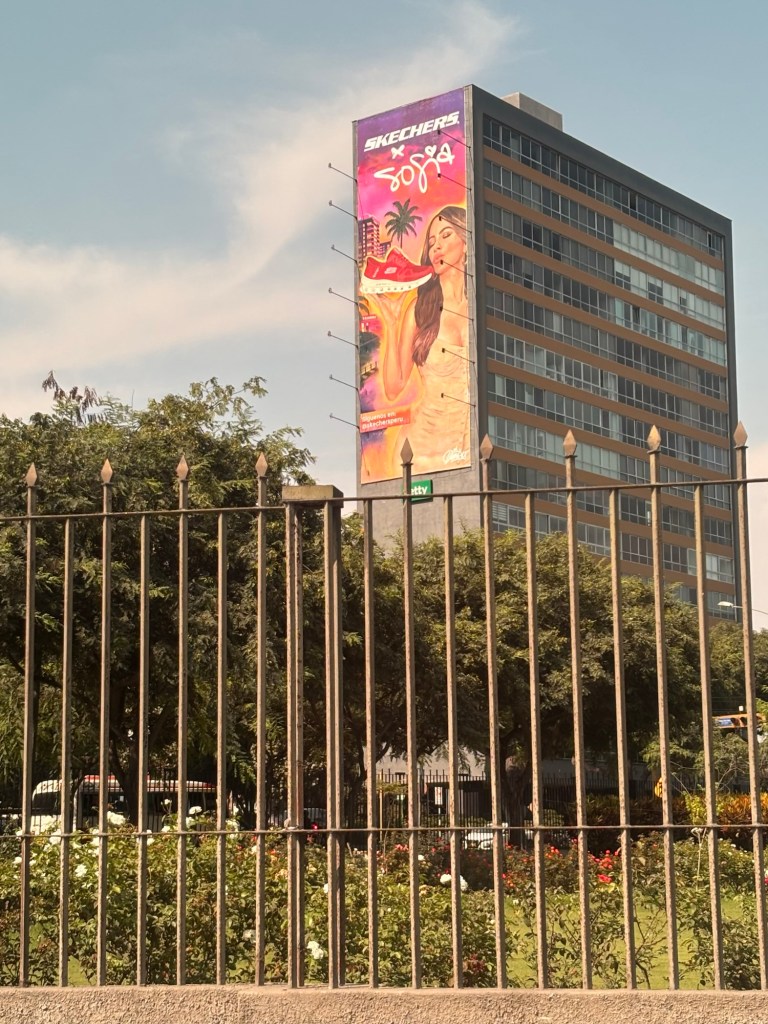
Peru, like the US, is a billboard country. Commercial is king. And the face of those enormous commercials is very rarely Peruvian. Giant posters for everything from sportswear and energy drinks to doctors and dental practices all feature the same cast: lithe, beaming individuals, all handsome, all sporty, all white.
I’ll use the dating apps as a counterpoint. There are so many beautiful native faces and body types out there, and that’s just from a glance. But I’ve yet to see any of them represented on the billboards. It’s as though they’re all advertising some supernatural deity, removed from this world, above and beyond the reach of the average Peruvian.
Which, I suppose, isn’t all that far from the truth.
What do we do about it? By the looks of things, not that much. The hostel I’m staying in has a crowd of white tourists (including me), many of them on the next leg of a grand tour of South America. Very few of them speak any Spanish whatsoever.
In the hostel, they talk. Largely about things travelers always talk about – that is, home – and swap stories of nightmare experiences along the road. They talk of the continents they’ve ticked off. They talk of ayahuasca: two guys who can’t have meat or salt or sugar or sex for a month because a shaman put a plant spirit inside of them which – or so they were told – would react most fiercely if they broke their diet pact. Others talk blithely of Iguaçu Falls (“beyond the waterfall there’s not that much else to see”), Rio (“the party scene is decent”) and Patagonia (“it’s actually really expensive and full of couples”).
Most of the travelers I was with this morning have gone. It’s only a handful of stragglers who opted for the Paracas Reserve tour and the Hacienda San José slave tunnels. Everyone else has gone on to Huacachina, an oasis town famous for its sand dunes – which we venerate by driving all over them in petrol-belching dune buggies.
Say what you like, but it’s a strange way to appreciate another country. Imagine if the White Cliffs of Dover were turned into an enormous quad-bike park, charging wealthy Arab and Chinese holidaymakers a handsome sum to tear up one of our most beautiful landscapes. It’s not exactly an awkward comparison.
What saddens me more, I think, is the lack of genuine wonder. Maybe it’s a Western thing to avoid poetic adoration – at least out loud. Maybe we’re just too sanguine. It might come across as “gushing” or insincere. Either way, you hear a lot more about their “trips” than their trips. The whole of South America seems to pass them by in a psychedelic haze.
The whole thing smacks of colonialism. Not the naked, gun-point kind that subjugated the Americas long ago, but a more insidious march of cultural domination. When we holiday abroad and talk about home, and not about the places we see, we build up a temple to the West and its ways that is, quite frankly, underserved. By demanding adrenaline sport holidays and beach or ski resorts, we are only tightening the chokehold that Western culture has over the world. It doesn’t matter that it’s no longer fashionable to abuse the people when we’re quite happy to continue to tear up the land itself. That is colonialism – it just walks, talks and dresses like the very Western liberals who claim to despise it.
Tourism makes up for about 8% of Peru’s GDP. Many Peruvians rely on the tourist industry and the money it brings to make a living. The least we can do is to come here with an open heart and an open mind and tread softly.
This is not our world. We should be gentle in how we handle it. BB x
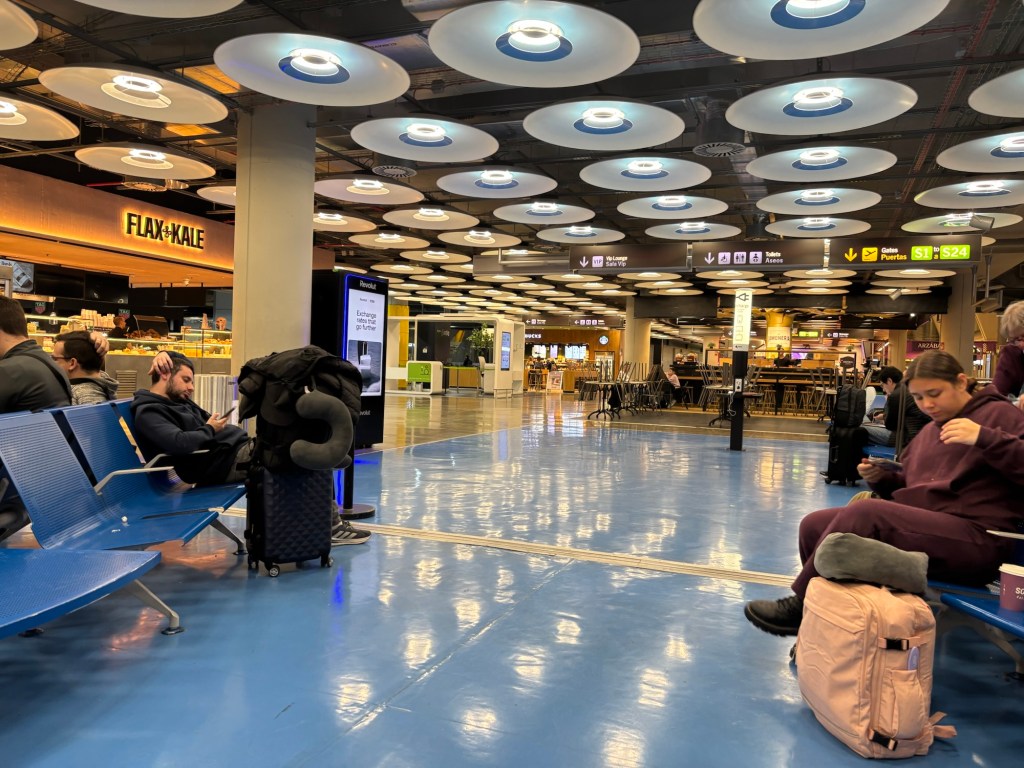
“Nobody speaks English in this fucking airport,” says the miserable Brit sitting behind me over the phone. “You’d think in one of the busiest airports in the word they might have someone who can speak English.”
With that kind of attitude, it’s hardly surprising that flights to the UK are sequestered away in Madrid’s cut-off Terminal 4S, together with all the other non-European destinations: Bogotá, San Juan, Dallas and Chicago…
I know I can be a bit of a snob when it comes to Spanish, but it always gives me a knot in my stomach when I hear one of my countrymen speaking like that, as though the rest of the world should simply kowtow to the supremacy of the English and their language. That mindset should have perished with the Empire, long ago, but sadly it’s all too common – and probably on the rise, with the number of students studying languages continuing to plummet in the UK.
For the record, English is absolutely everywhere in Barajas. Most of the signage is in English first and Spanish second. You’d have to try pretty hard to be genuinely cut off from the English language out here these days. Sometimes I think the Spaniards just enjoy playing the “no hablo inglés” card when they encounter a grumpy fellow like the man behind me. It keeps us on our toes – and it’s one way to get back at us for the slap in the face that was Brexit.
12.192 feet above the Atlantic, Southwest of Corvo & Flores. 11.55.
They dimmed the lights in the cabin about two hours ago, shortly after serving breakfast. Most of the passengers are wrapped up in their blankets and fast asleep. I don’t know how much I have slept in that time, but I’d wager it’s not much – more like wakeful dozing. I don’t usually go to bed before one or two in the morning, so despite the five AM start I’m probably operating on a good deal more sleep than usual. I moved my trip to Paracas to Wednesday, which should give me time to get a good night’s sleep and acclimatise once I reach Lima.
There’s a nice father and daughter from La Rioja sitting next to me, off to visit a relative in Guatemala. Since we’ve established friendly relations, hopefully they’ll let me take a photo out of the window when we pass over the Caribbean in a few hours’ time. I’ve got the aisle seat, which is fine for legroom, but bad luck for both sleep and views.
I haven’t got my head around the boarding procedure for Avianca. I was in Group F out of A-G, so I assumed I’d be one of the last on, but they let F-G on before D-E. Unremarkable, maybe, but I’m in Group D on the next flight, so I hope that doesn’t mean I’m right at the back of the line. I guess it depends on how the Colombians order their alphabet.
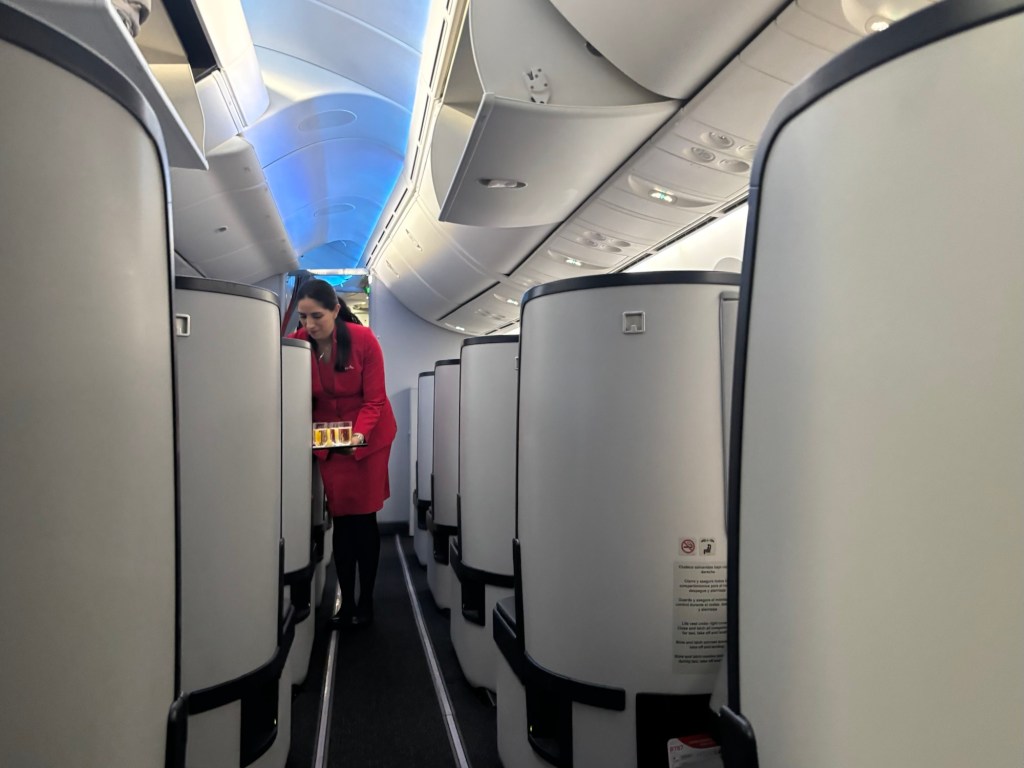
The folks up in business class are all tucked away in their cabins. I could never justify paying that much to fly – and probably fail to sleep anyway – but it must be pretty snug.
43.000 feet above the Caribbean Sea. 16.10.
The lights have come back. I wonder if that means they’re serving lunch? They’ve got Superman on the film listing, but my earphones are of the lightning port variety, so I can’t get them to work. I’ve spent a couple of hours catching clips from those watching films around me. By the way they’re all watching with the subtitles on, I can’t help but wonder if they’re all in the same boat.
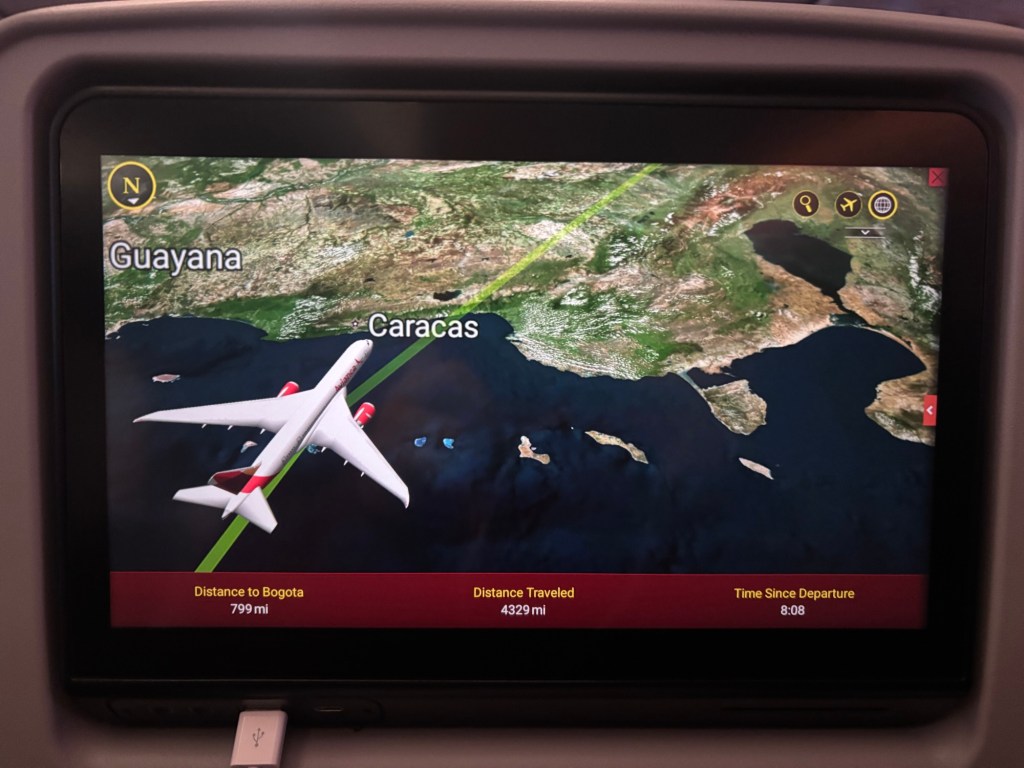
We flew over the Caribbean about an hour ago. I saw one island among the clouds through the tinted windows of the cabin while waiting for the bathroom to become available, but I’m not sure which one. Nassau, perhaps? The route map on the tele screen only gives its capital as St. Maarten, but my knowledge of Caribbean geography isn’t exactly watertight. It’s a first taste of how unfamiliar the world around me is about to be.
The wind is starting to pick up. The reefs and atolls of Aruba have appeared on the horizon, the vanguard of a mighty continent. Beyond that lies Venezuela. The enormity of South America is about to open up beneath me.
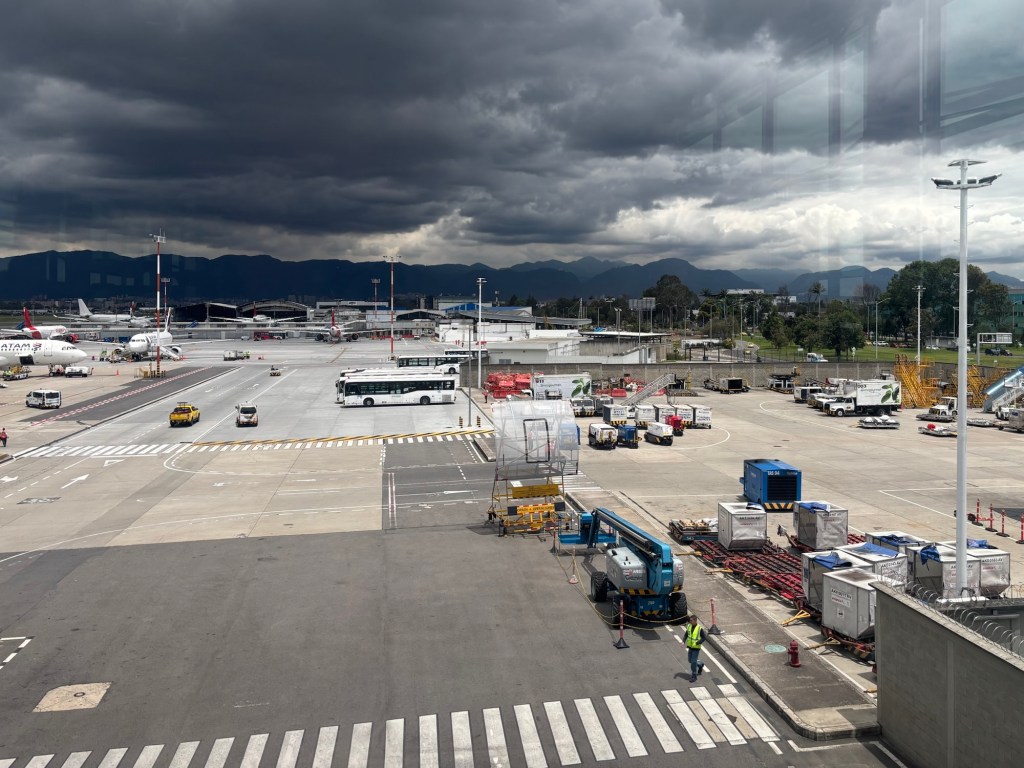
Aeropuerto Internacional El Dorado, Bogotá, Colombia. 12.28 (19.28 GMT+1).
¡Bienvenidos a Colombia! The weather forecast says thundery showers with a gentle breeze but the sun is shining brightly out there. I’m hoping that’s a sign of things to come.
El Dorado reminds me a lot of Dallas International, in that almost everybody here seems to be going somewhere else. The queue for passport control to leave the airport was barely in the double figures while the line for connecting flights stretched on down half the hallway. I was sorely tempted to strike out and explore Bogotá, but for once in my life I’ve erred on the side of caution. For one thing, I’m tired, and I’d definitely need my wits about me out there. For another, I haven’t planned this leg of the journey at all, so I really would be going it blind. Most importantly, my next flight boards at 4pm, so while I have around four hours to wait, that’s not really enough to risk a potentially unsafe pitstop on Colombian soil.
Some other time, Colombia. Let’s not derail this South American adventure before it’s even started.
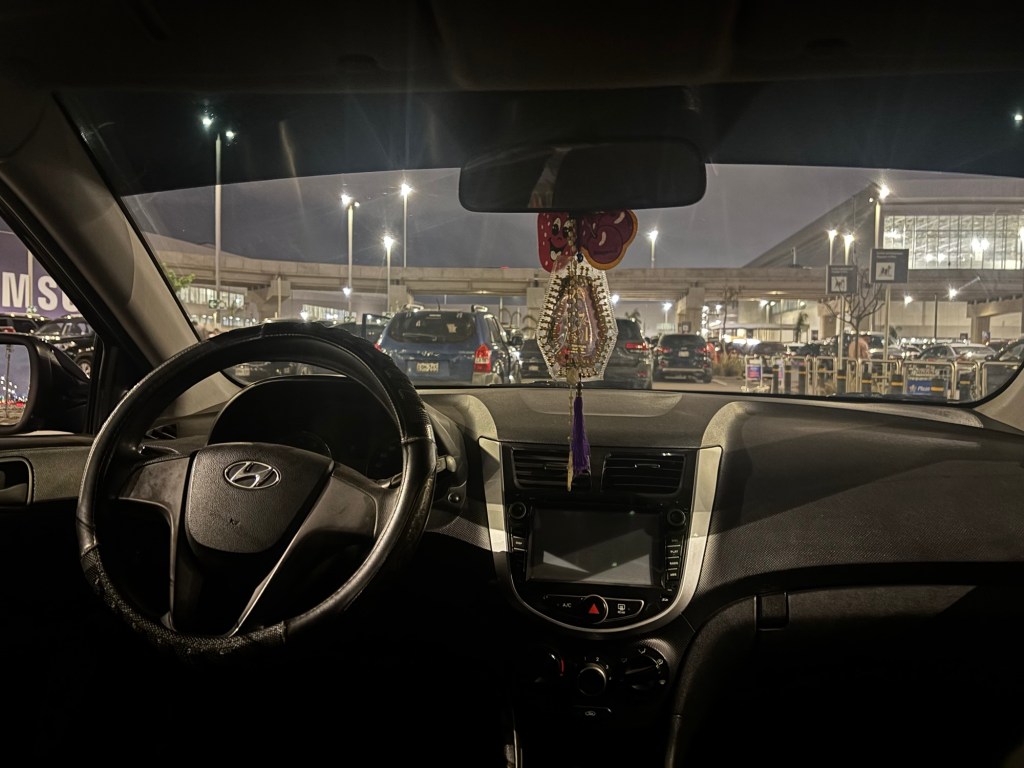
The airport WiFi in Bogotá leaves much to be desired. It’s not free like Madrid, and after only a couple of prompts my phone won’t even take me to the airport website anymore, so I’ve resorted to data – I needed to get online to finalise my pick-up from Lima tonight. The hostel are sending a car for me. I’m normally averse to that sort of thing, but I’d rather play it safe in a place I don’t know.
At least to start with.
Puerta A6, Aeropuerto Internacional El Dorado, Bogotá, Colombia. 14.20.
Still a couple of hours to go until my connecting flight departs for Lima. When I’m done writing I’ll decamp to a charging station to give my phone some extra juice – I’ll need it to contact my driver once I land.
I’ll do some reading to while away the time. I’ve brought a book with me but it’s a bit florid. I find myself skipping entire pages just to advance the plot. I bought it years ago because the setup sounded exactly like my cup of tea (19th century intercultural romance set in a distant corner of the British Empire) but it’s a bit of a slow burn. It’s been a while since a book really grabbed me. I ought to make that my mission out here. I’ve downloaded the audiobook of Michelle Paver’s latest, Rainforest, if not for the valid thematic link to this adventure then because her books always strike gold.
Some observations of Colombia, you ask? Hm. It seems to be a land of strange trees and clouded mountains; of sleepy travellers and softly-spoken staff; of real coffee, fake boobs and handsome aquiline noses. A place where people haven’t forgotten the joy of having children. Where Dallas was a concrete desert, Bogotá at least has the decency to keep their largest transit hub a tree-lined haven. I bought some travel-sized toothpaste and a couple of snacks and the bill came back in Colombian pesos, though the till used the dollar symbol. Thank heavens my bank statement gave the true cost in pounds, or I might have just paid 45.000$ for a 22ml tube of ColgateTriple Action…
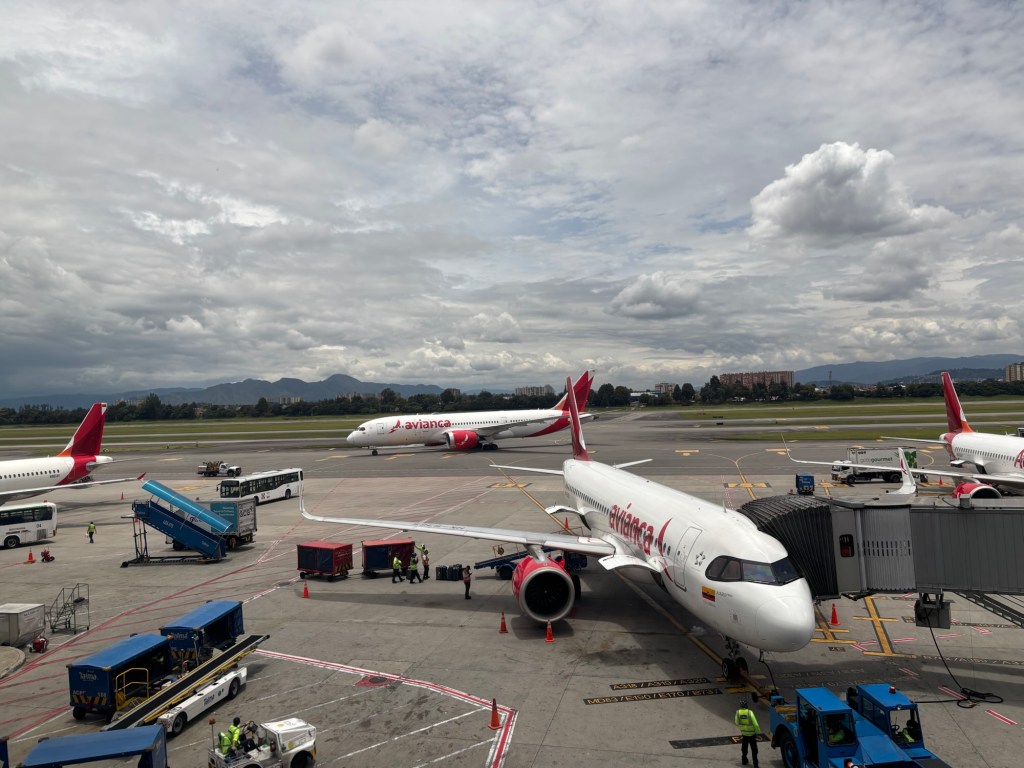
There’s not that much to see on the wildlife front from the departures lounge. I clocked a couple of foreign-looking swallows flitting about outside and I’m almost certain I saw the silhouettes of three black vultures wheeling about over the residential district to the east, but other than that, the only obvious denizens of the runway are the cattle egrets that seem to follow the groundskeepers about like stray dogs. I’ll just have to wait a little longer for the party to really begin.
Somewhere over the Cordillera de Sumapaz, Colombia. 18.27.
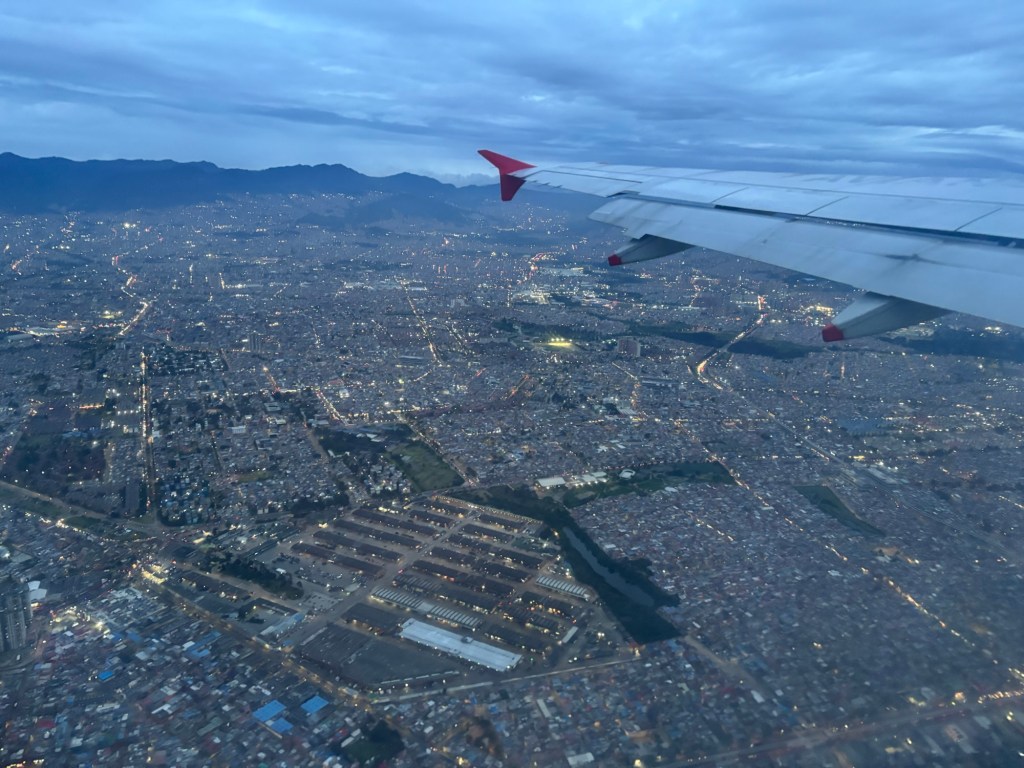
A lonely light twinkles in the darkening world below: a single, blinking star in a forest as dark as the night. It is the only sign of civilisation for miles around. And then the light, the forest and all the earth beneath it are swallowed up by the clouds. The sprawl of Bogotá is a distant memory.
I paid 20$ for less than ten minutes’ worth of a view from the window, but I consider it money well spent. Like that first waterfall I saw in Ethiopia as we came down out of the clouds all those years ago, it is a sight I will not forget. The last homely house in Colombia. The Rivendell of the Rainforest.
A few stragglers from Madrid have made it onto the plane. The stately Peruvian gentleman with the cane who was the first onto the plane at both Madrid and Bogotá. A barmy looking gentleman in a puffer jacket and a wide-brimmed hat festooned with badges and his wife with the wine-red hair. No sign of the white man with the dreadlocks down to his waist – I suspect he has gone into Bogotá in search of an ayahuasca shaman. I suppose we all have our reasons for traveling this far. On reflection, are mine any less barmy?
A family of three were late and so the plane was held up by about twenty minutes. In that time I managed to finish Romesh Gunesekera’s Prisoners of Paradise (I don’t like leaving a job half done). It picked up in the second half, but I found myself skipping pages again toward the end. I wasn’t sure whether it was trying to be a Malabar Pride and Prejudice or a gritty historical account of colonial prejudice. Either way, I found the heroine jarring.
Time and again, one finds the narrative of the enemies to lovers trope in romance fiction.
Yuck.
I don’t think I’ve ever understood why romance that evolves out of people being fickle and mean to each other is so highly prized. Maybe it’s a condition peculiar to Western women. Give me the sincere and generous passion of the Latin any day.
I suspect that’s why I put The Far Pavilions on such a pedestal – it manages to stage a believable passionate romance that is neither coy nor mawkish. It’s certainly proved a very tough act to follow.
Hostal Pariwana, Miraflores, Lima, Peru. 21.36.
Te estamos vigilando.
Lima. The scenery has shifted dramatically. Between Jorge Chávez International Airport and downtown Lima sits Callao, a sprawling conurbation which must be crossed to enter the city, If you needed reminding that Peru isn’t all high-end tourist offerings after weeks of preparation and booking in advance, Callao provides an immediate antidote.
Enormous posters line the edge of the runway, advertising Ayacucho, Amazonas and Machu Picchu in brash, gaudy colours; across the street, row upon row of squat houses in varying states of completion, and all of them very much lived in. Wide dusty streets with pitfalls and potholes. Fried chicken shops every minute or so. Election posters promising a safer Callao, plastered in duplicate over every flat surface. Police tape – peligro, no pasar. Dollar stores everywhere – a mere talon of the claw of the American overlord. Graffiti on the walls: el mundo apesta (the world stinks).
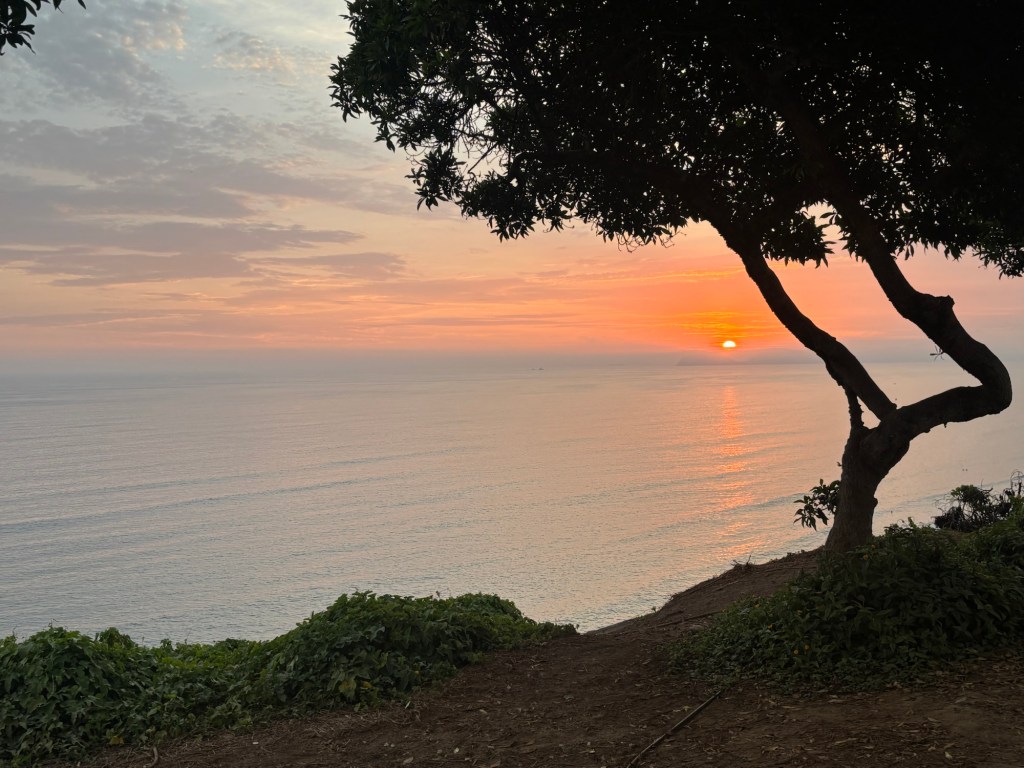
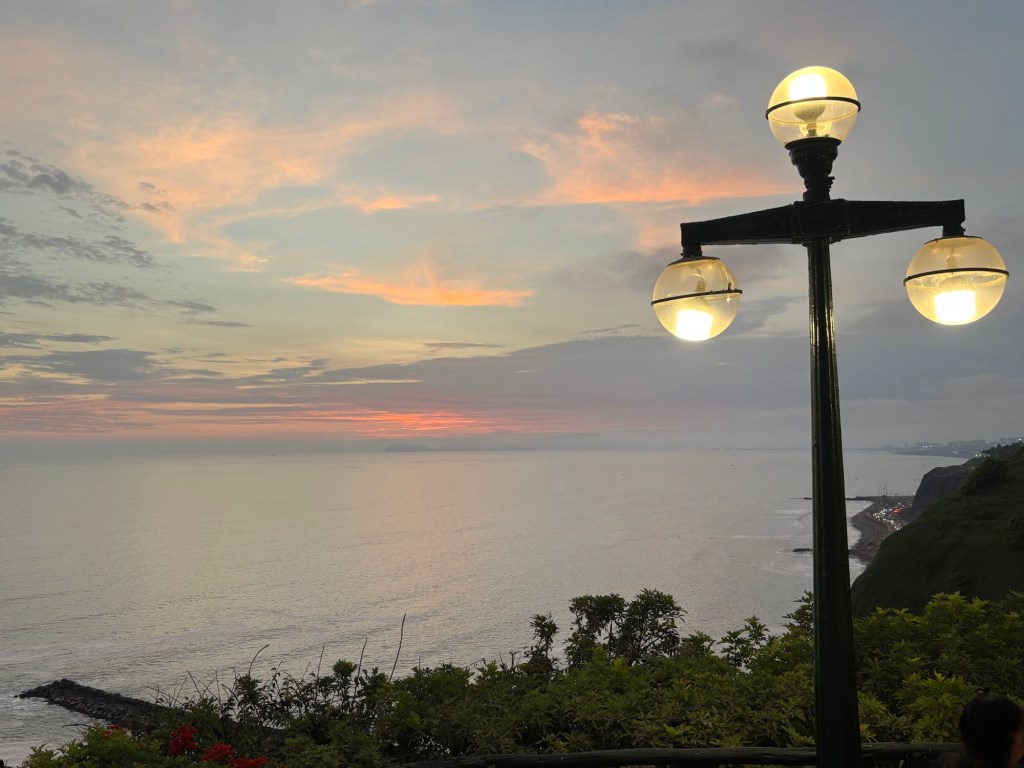
And then, suddenly, Callao falls away and there it is. The Ocean. The mighty Pacific. I saw it from the plane, but this is something else. It’s too dark to appreciate it in all of its majesty, but I had a hint of its bounty by the sheer number of fishing ships out in the bay. They looked more like an armada readying for war.
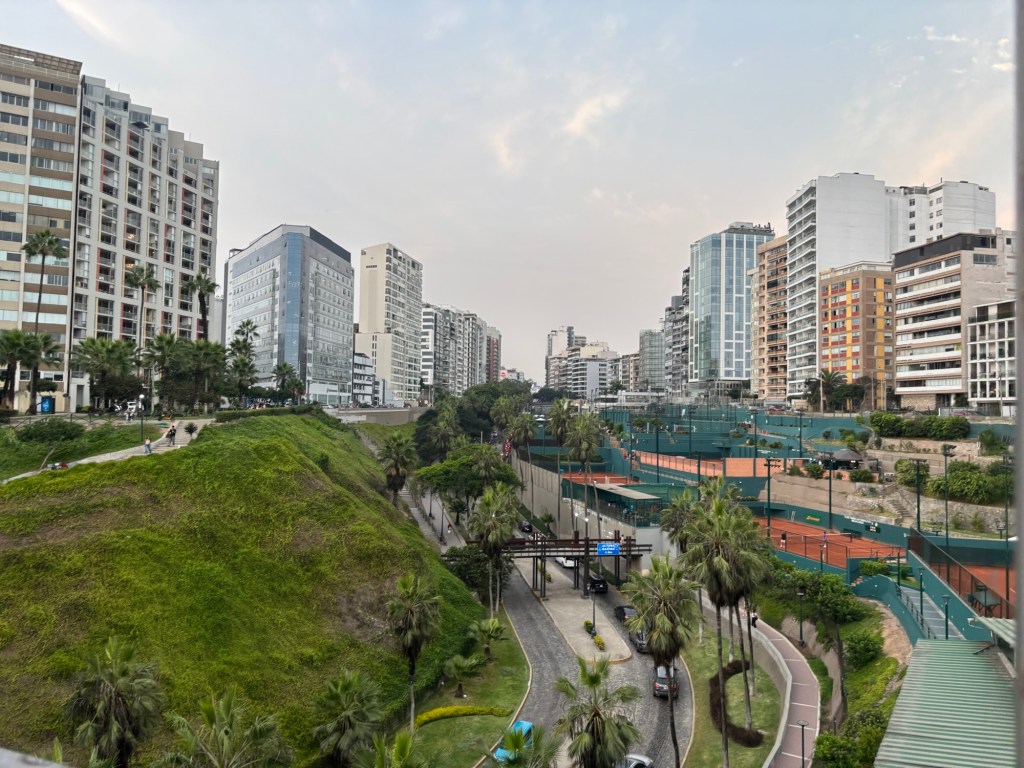
Miraflores feels like a completely different city. Callao felt like the South America I’ve been reading about in history books. Miraflores is more like the one you find in Nat Geo Traveller or a copy of Lonely Planet. American twenty-somethings discussing the TSA, pipe dreams of owning their own airplanes and the relationships that other travellers have struck up along the way.
It’s ten past eleven here in Lima, but it’s ten past six in Madrid. Give or take a couple of hours’ sleep on the plane from Bogotá, I have been awake for almost twenty five hours. I had better turn in or tomorrow really will be a washout! BB x
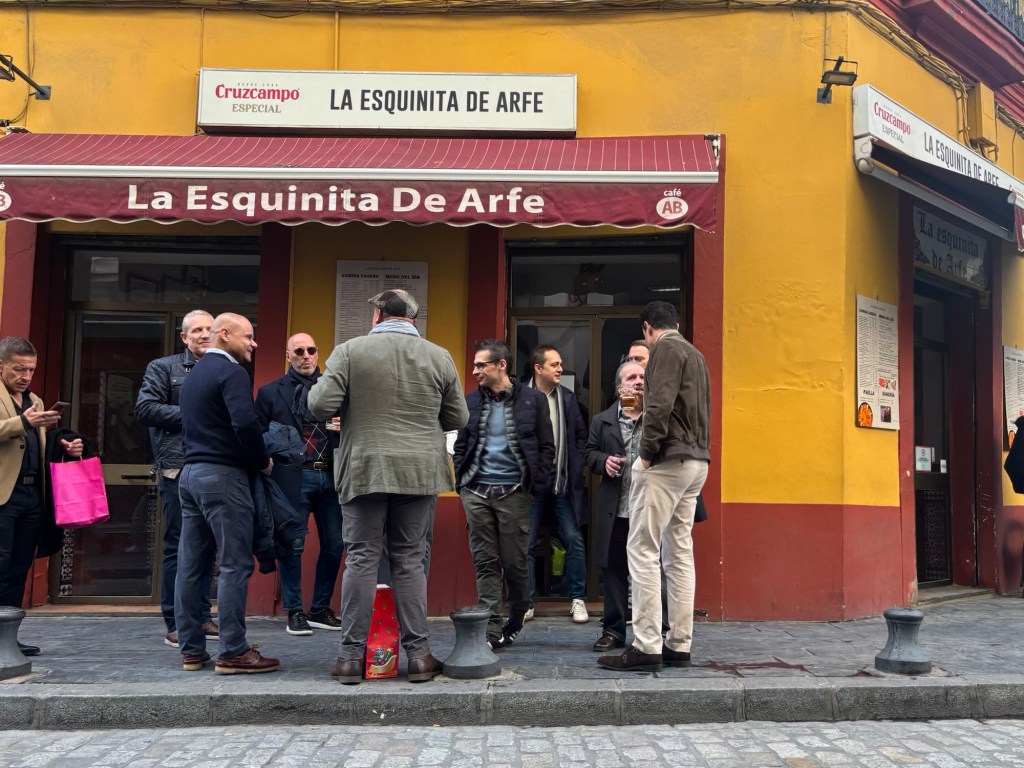
Hostal La Banda, Calle Dos de Mayo. Sevilla. 15.20.
The Americans have taken over. They’re sitting at a table behind me discussing the local culture of Sevilla that interests them so, like baseball, 7-Eleven and Jello shots. One of them asks the receptionist for a board game and they set to a game of Cards Against Humanity.
Outside, the rain comes down. When it comes to the weather, Luck has not necessarily been on my side during this holiday. Fortunately, I’ve been to all of these places before and seen the main sights before, so my heart isn’t bleeding over a few rain clouds. It’s actually quite relaxing, not having to dash off to this or that bit of sightseeing. It feels like living out here again. That was, I believe, the general idea.
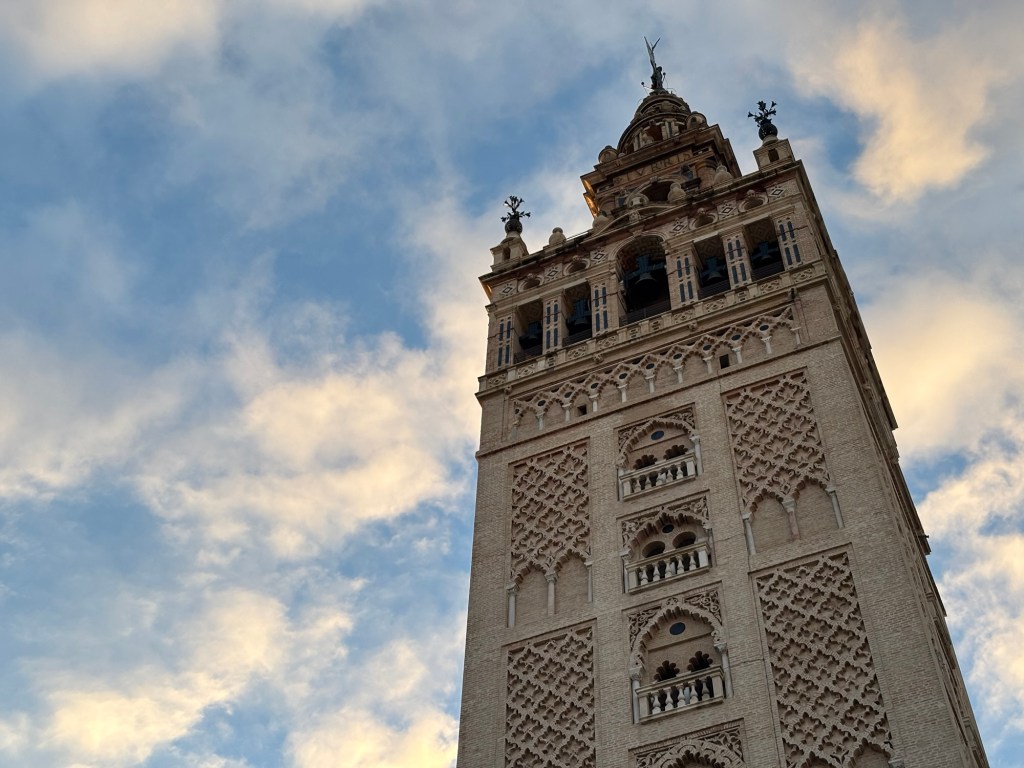
Sevilla and I go way back. I’m not 100% certain, but I think came here for the first time in the summer of 2005, shortly after my parents bought the house in Olvera (that we still haven’t managed to sell off, twenty years on). I don’t remember much from that first visit beyond a flying visit to the Alcázar under a blazing sun, the noise and smell of the horses in the Plaza del Triunfo and a little blue notebook with a plastic cover where I kept a record of the animals I saw in my new country: black kites, bee-eaters, lesser kestrels and the city’s ubiquitous monk parakeets (which have only increased in number).
Since then, it has been the backdrop to a number of different episodes of my life.
Through my secondary school years, I made the odd pilgrimage to Doñana National Park with my mother. That was when Sevilla really started to become a fixture in my life. After Gatwick, it’s probably the airport I’ve used the most. Mum and I always had the same ritual upon arrival: before anything else could be achieved, we had to grab a zumo natural or café solo from one of the airport cafés. We never stayed in the city, but it was our regular conduit to and from the sanctuary town of El Rocío.
It was also where we learned of the eruption of Eyjafjallajökull in 2010, as we had no WiFi at our campsite in El Rocío, and this was before the advent of mobile data. You’d have thought there might have been something on TV, but all we saw on the night of the eruption which grounded all flights across Europe was a brief noticiero questioning whether Spaniards actually pay attention to STOP signs, given that they’re written in English – a question I still ask myself today, as I wander around Sevilla.
When I moved to Spain for my first British Council placement in 2015 – when this blog began – it was Sevilla to which I came, suitcase in hand, to sit beneath the shade of a fig tree on the east bank of the Guadalquivir and think about the future.
I came back to Sevilla again and again when I got back in touch with my former classmates from Olvera, particularly a childhood sweetheart (who led me up the garden path for several months before throwing up a wall during a memorably awkward visit to Madrid). Every visit to the pueblo required just under an hour’s commute across the city centre between Plaza de Armas and Prado de San Sebastián. By the third or fourth visit, I’d got the route down to twenty-five minutes, though I did once make the trip in under ten when I was in danger of missing the last bus home.
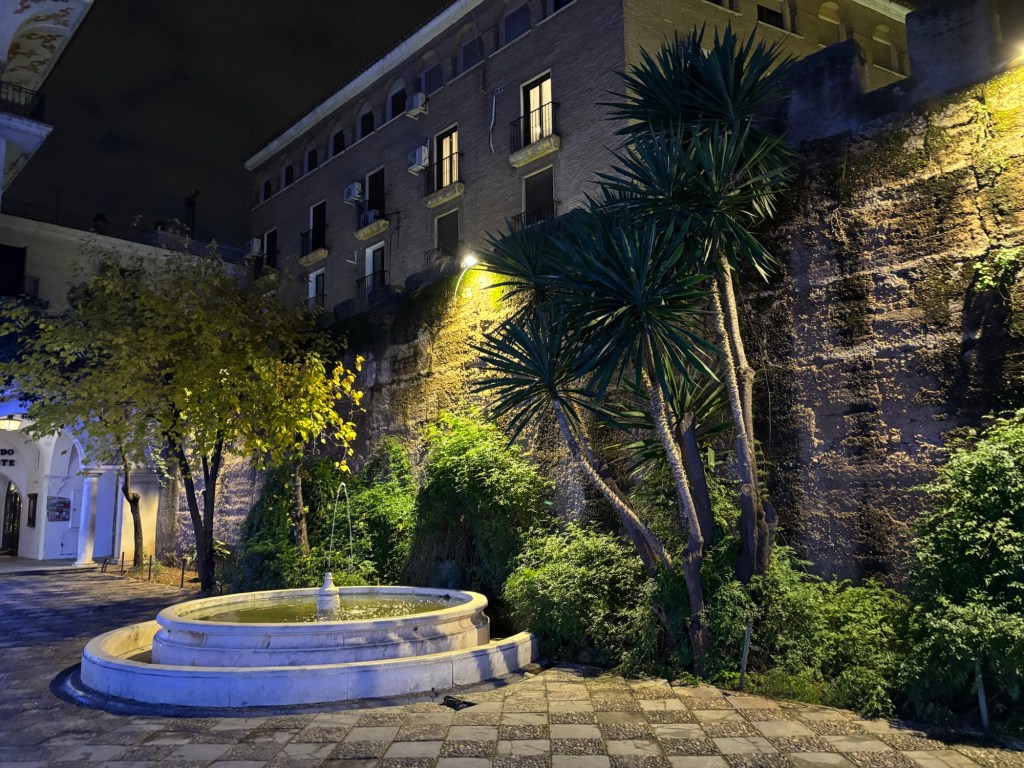
It was around then, during those frenzied trips between Sevilla’s bus stations, that I really fell in love with the Plazuela de Doña Elvira, sitting as it does in the labyrinthine heart of the old city. I’ve made a point of stopping by ever since.
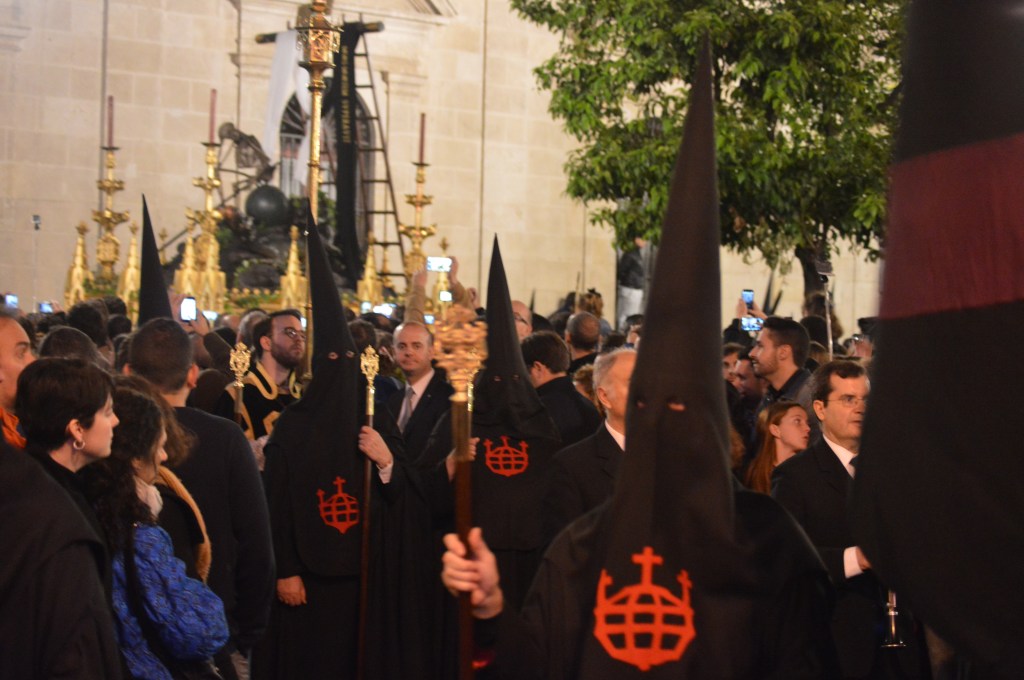
Halfway through that year, I took a friend to the city to show her the majesty of Semana Santa. My experience of Spain’s Easter celebrations had previously been confined to Olvera, which was a highly unfair place to start – on everywhere else. Olvera’s penitentes, demonstrating a strength bordering on the Herculean, have to navigate the monstrously steep gradients of the town’s roads, constantly ducking and rising to avoid the low-hanging wires – all while carrying several tonnes of sacred wood and several hundred tapering candles within a precarious silk canopy. Caídas (falls) are not unheard of in Semana Santa, but I never saw the olvereños break so much as a sweat for their endeavour.
After that, I might be forgiven for having exceptionally high standards for Semana Santa. Sevilla met them. We were walled in by three simultaneous processions, but a friendly Guardia unintentionally gave us front row seats to the greatest show in town when he shoved us unceremoniously with his baton out of the road and in front of the lines that had been growing along the side of the street all morning. Málaga and La Mena may have raised my expectations even higher, but I’d like to go back and see Sevilla in its Easter glory again sometime.
By my mid-twenties, I could be pretty confident in saying that I knew few cities in the world better than Sevilla – including almost every city in my home country (with the possible exception of Canterbury). I do believe that I really could navigate this city blindfolded, if I had to. That was why I decided to take my second girlfriend there, less than a month after we started dating. I hoped that sharing the city with her would be like sharing my heart – since it had found its way in there a long time ago.
I took her to all my favourite places. Bar El Postiguillo. La Plazuela de Doña Elvira. La Plaza del Cabildo. El Real Alcázar and El Herbolario. She smiled sweetly and played the part of my muse around the city, but I don’t know if she felt the same way about the place as I did.
Later, when things started to fall apart, she told me I’d “missed the boat” for teaching her Spanish. It was the confirmation I’d long suspected that I was never going to be able to share my undying love for this country with her, and the chief reason why I broke things off with her in the end. A heart divided cannot love.
I have no desire to return to America after the intensity of last summer’s heartbreak. Sevilla, however, is immune. My heart could break a thousand times within its scented streets and still I would return.
In the last few years, I’ve led a couple of school trips here, too, playing the part of historian, quartermaster and tour guide. In this last capacity, Sevilla has sealed its place in my head as much as my heart, as I had to swot up on so much local history that I might as well have put on a red jacket and joined the city’s legion of guías turísticos.
And here I am again, as 2025 draws to a close. It’s been about twenty years since I first came here, and that’s around two thirds of my life. I don’t doubt I’ll be back again soon, drawn by some invisible magnetism to her cobbled streets, her orange-scented courtyards and the irresistible joy of her people and their merry accent.
The local hostalero gave me the highest possible praise last night. My accent, while occasionally inflected with English, is unmistakably andaluz. Coming from an Andalusian, that is praise indeed – I usually get told I sound sureño by northerners, but no de aquí by the southerners themselves, pointing to the east when I am in Cádiz and west when I am in Almería. That’s twice this year I’ve managed to blend in.
It’s about time I moved here. The stars are aligning. I only need the opportunity. BB x
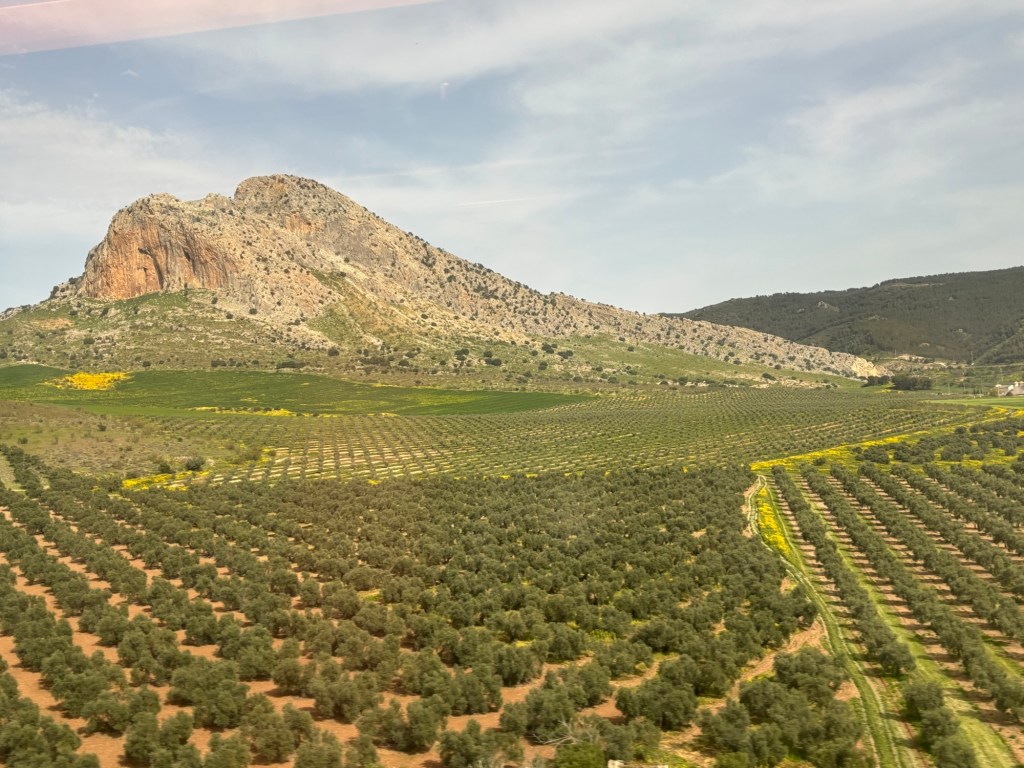
Andalucía hurtles by a in a blur of olive green and marbled brown. I’ve never seen it so green: all that rain Spain must have had last month has completely transformed the place, turning the golden fields of my memory into a paradise on earth. I could hardly ask for a better welcome home to the land of my childhood.
Landmarks sail past the windows like ships with friendly colours. There’s the jagged spires of El Torcal, high above Antequera, the first place that genuinely inspired me to write a book set in Spain. There’s the Peña de los Enamorados, a lonely bluff rising out of the fields where, legends tell, a Christian knight and a Moorish princess hurled themselves to their deaths rather than live divided by their warring faiths. There’s the limestone massif of Loja, crowned with wind turbines, their blades motionless in the afternoon air. And there’s the reason why they’re stood so still, standing in awe: the Sierra Nevada, dwarfing all the other sierras for miles around, covered in a vast blanket of snow. If the sunset is good, I will try to snag a spot at the Mirador de San Nicolas at just the right moment tonight, when the setting set sets the snowy peaks of the Sierra ablaze behind one of the most beautiful buildings in the world: the Alhambra de Granada.
Mirador de San Nicolás, Granada. 21.01.
How should I describe it – coming home? I never lived in Granada itself, but between coming here at least three times before and a year living over the sierras to the west, this place feels… so familiar, compared to the other places I’ve been on this trip, anyway. The accent, the noise, the simple fact that the music playing over car radios as they pass is flamenco and not reggaeton… This is the Spain that captured my heart many years ago, when I was just a boy.
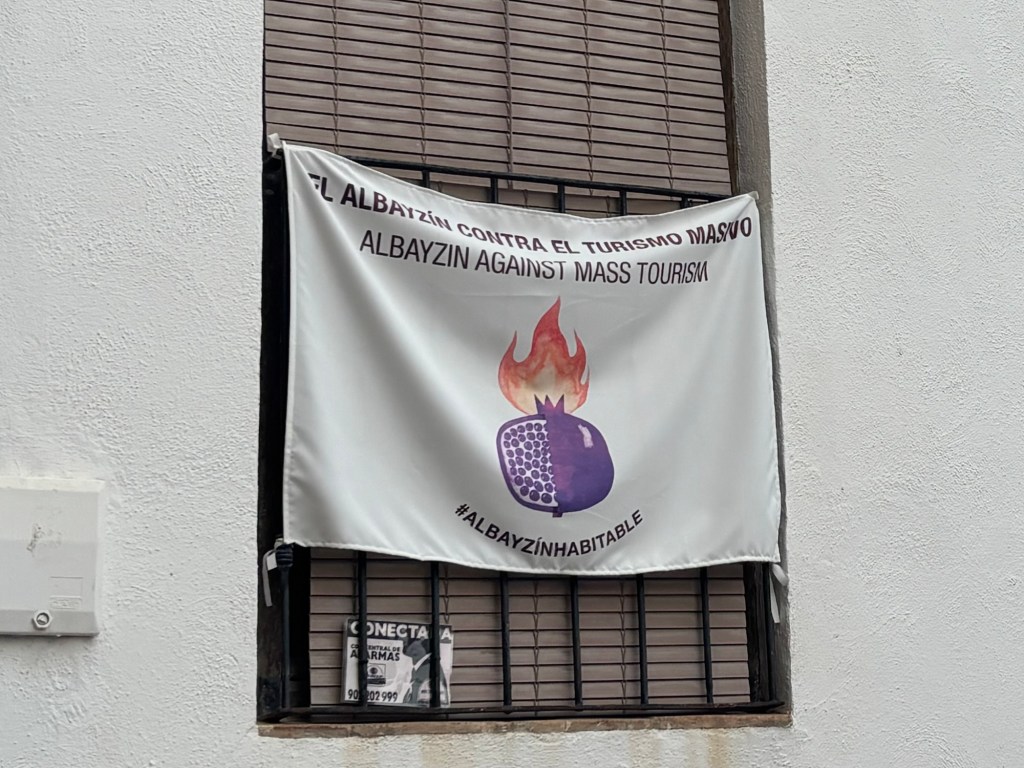
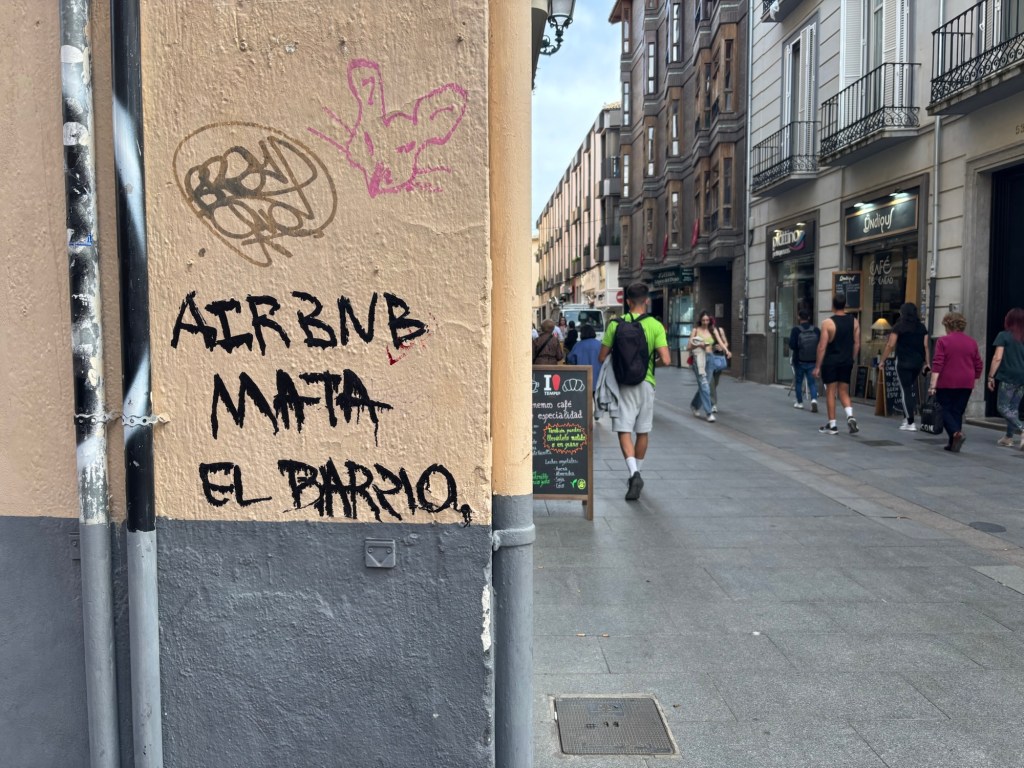
Things have changed since then, but not by much. There’s a lot of anti-tourist graffiti around, but then, perhaps I’m actively looking for it now. Here, in one of the most popular tourist destinations in Spain, that anger is directed at the American corporate AirBnB, an alternative accommodation method for the experience-minded traveler, which is currently being relentlessly advertised on TV with the tagline “don’t end up surrounded by a hotel”.
That’s all well and good, but much of Spain relies on the tourist industry to survive. In 2023, tourism accounted for an astonishing 12.3% of the country’s GDP, making it one of the most tourism-oriented countries in the world – and the numbers have only increased since then. Much of Granada, including Sacromonte – the formerly rundown gypsy neighbourhood beyond the city walls – has been given a makeover in the last twenty years to draw in as many tourist dollars as possible, and in its wake, a lot of the former pensiones – Spain’s traditional accommodation option, consisting of spare rooms rented out to travelers – have been replaced by glitzy “experience-oriented” AirBnBs. It’s an economy for the young and enterprising – or the international – and much of Spain simply can’t keep up. Adapt or die. And when the old ways are sacrificed on the altar of progress, some of the identity that made that place so special is lost. Eventually, even the tourists will realise this and stop coming, leaving these areas high and dry.
That’s why the phrase “AirBnB mata el barrio” (AirBnB kills the neighbourhood) is scrawled all over the place.
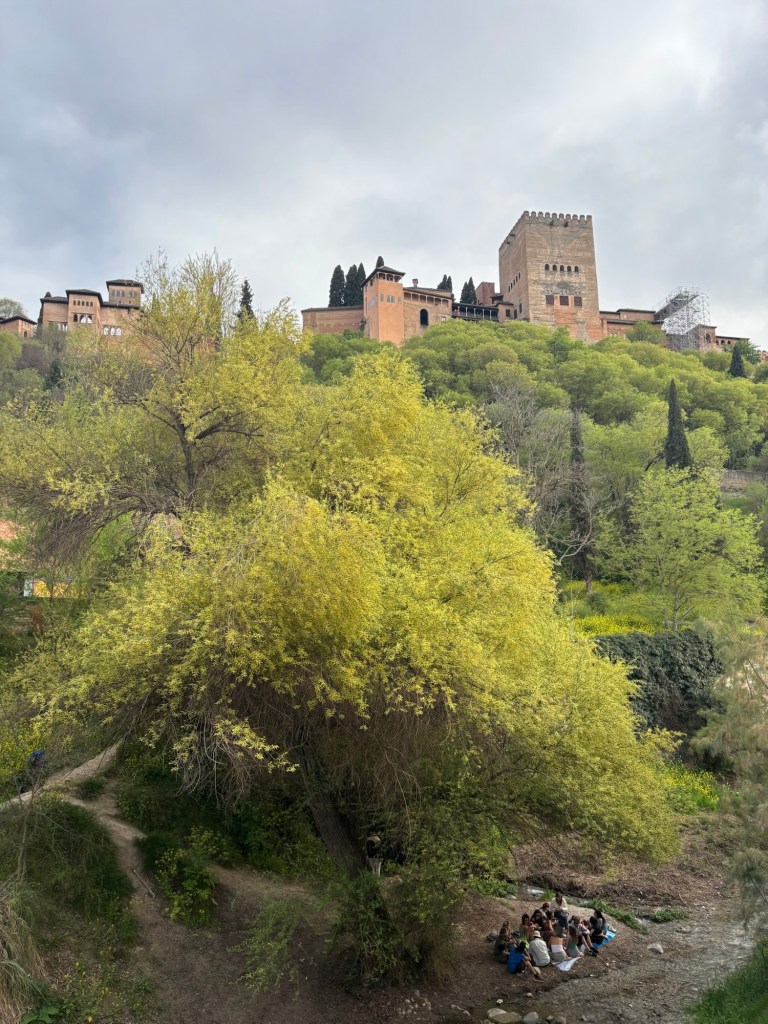
Fortunately, the magic of Granada continues to shine through the crisis. There might be a lot more of the American drawl on the street than there used to be, but it’s shouted down by the happy hubbub of the locals. Wandering along the Darro toward Sacromonte, I came upon a noisy group of youths on its banks, enjoying a picnic in the shadow of the Alhambra as their kind has done for centuries.
They weren’t too happy about a tourist family flying a drone nearby and threw a couple of colourful insults of the verbal and non-verbal kind at the buzzing menace as it passed overhead.
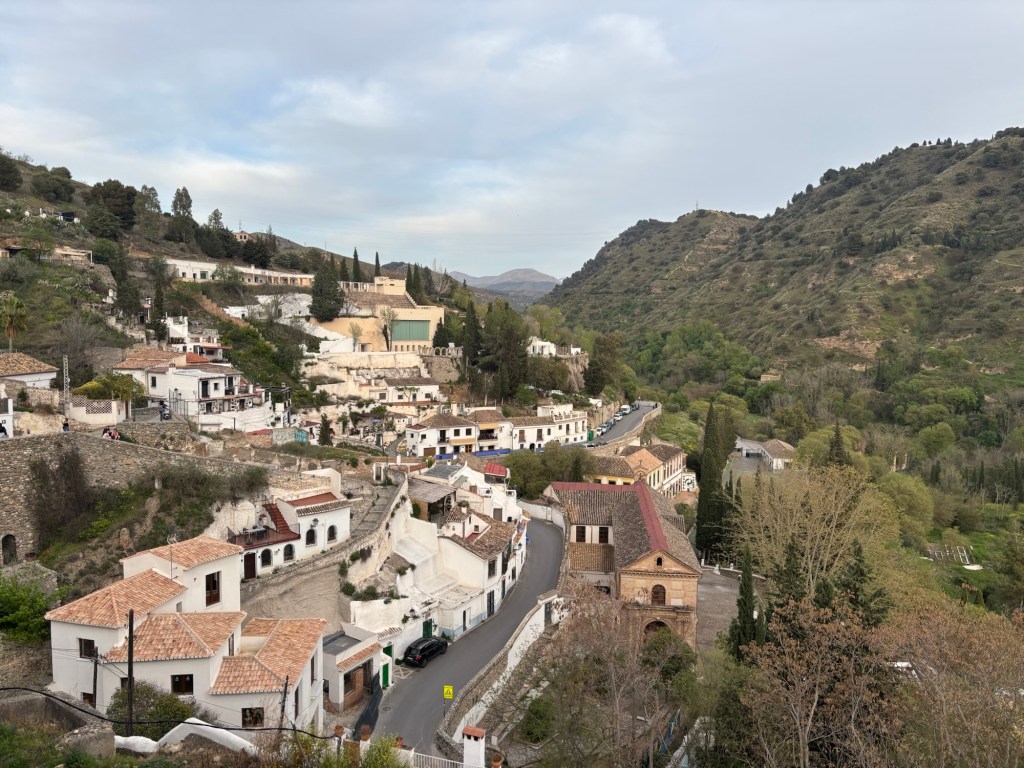
Sacromonte has hurled itself at the tourist trade as never before. Every other house seems to have decked itself out as a “tablao flamenco” where you can catch a live Flamenco show. Marketed as the “home of flamenco” – a title more appropriately applied to Sevilla’s Triana district, though the zambra certainly comes from here – Sacromonte was Granada’s former gypsy quarter, whose inhabitants lived in cave dwellings beyond the city walls since they were not permitted to live inside the city.
The heat of the summer is one reason they retreated into the rocks, and the zealousness of the Spanish is the other: this “pariah district” served to accommodate the unwanted, the unclean and the un-Christian – which amounted to the same thing for much of Spanish history. It even housed some of the city’s Jewish and Muslim population following the fall of Granada in 1492, as they were gradually driven out of the city by the conquering Christian warlords.
When my mother came here in the 1980s, this was not really a district you’d want to find yourself in after dark. Nowadays, that’s precisely the time the locals want you around, as that’s when the flamenco shows take place. I’m still considering whether to check one out. I’m hoping for something authentic, but I feel that star may have descended a long time ago.
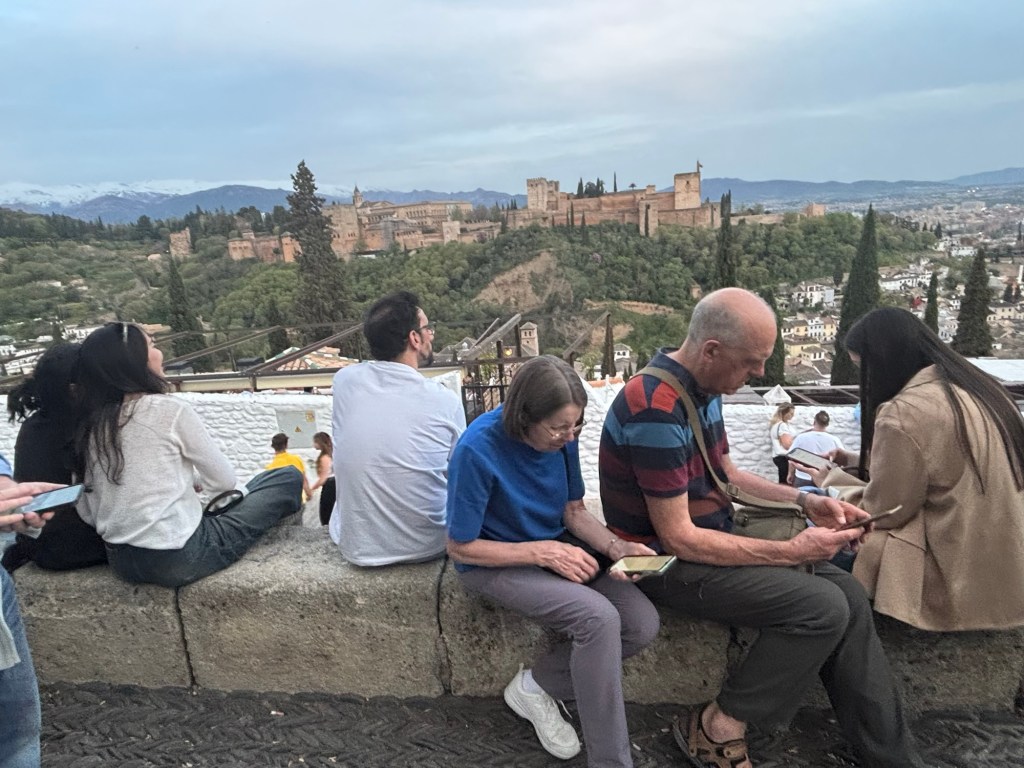
Up above, the Mirador de San Nicolás remains as busy as ever at sunset, with throngs of in-the-know tourists and locals waiting to see the spectacle of the Alhambra and the Sierra Nevada beyond bathed in red light. It was cloudy tonight, so a few of them ambled away disappointed. That at least meant I snagged a spot on the wall to sit and draw the mountains for a while. I didn’t take the camera. No need. I got the “famous” sunset photos years ago, and besides – there’s a fair bit of ugly scaffolding on the Alhambra now that wasn’t there before.
The Mirador de San Nicolás is a funny place. I imagine it’s raved about in all the guidebooks as the secret is most definitely out. There’s still a bunch of musicians here plying their trade as there were ten years ago, asking for “collaborations with the music” on the back of the guitar after every song. They’re not quite as tuneful as I remember. The men had a fair amount of duende but the girls singing along were absolutely tone deaf, which took away from the magic a little.
But not as much as the large number of folks on the wall with their backs to the Alhambra, staring gormlessly at their phones.
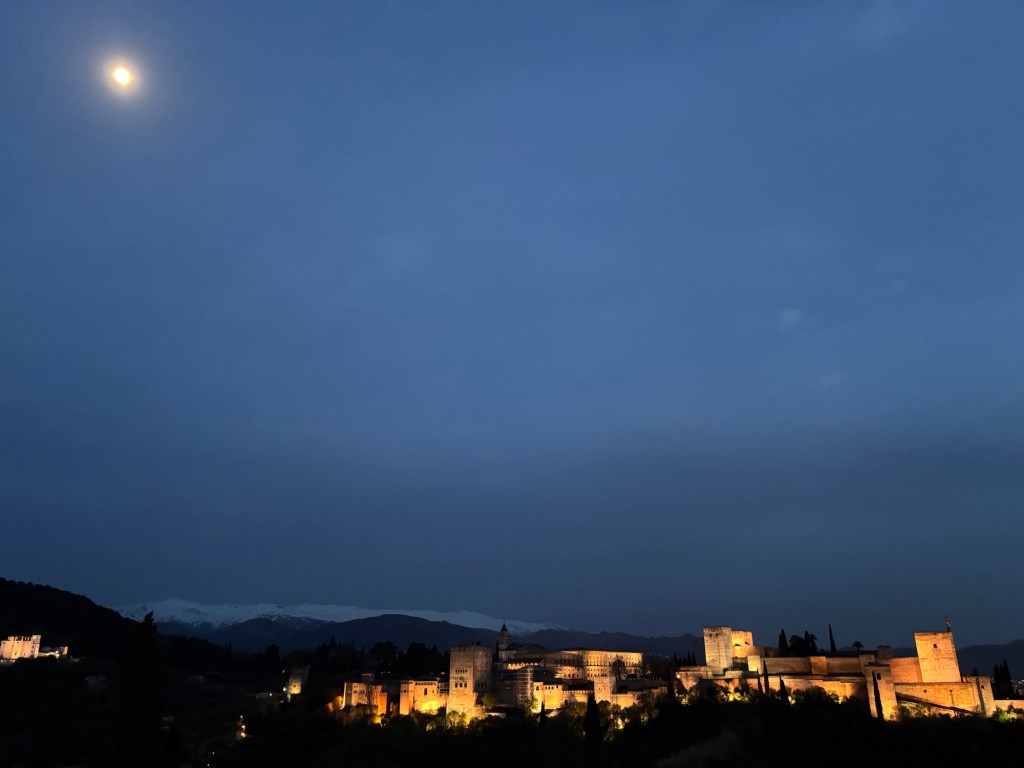
I must have been there for at least half an hour, because when I was finished sketching the moon was up, the Alhambra illuminated and the city lights twinkling away in the gloom of the vega below like velvet. I relinquished my spot on the wall and set off for my pensión.
On my way back, I was stopped by the piping call of a scops owl. I haven’t heard one in years, nor seen one even once, for that matter, so I set out to track it down. They’re master ventriloquists, especially in a city of infamously winding streets where their voices seem to come from all directions at once, but I did manage to follow its call to the Placeta Cristo Azucenas, where I spotted the diminutive creature as it took flight as a noisy van hurtled past. Hopefully I’ll see it again before my time here is up.
Well, it’s now 8.23am of the morning after. I’d better head into town, find a laundromat and get some breakfast. I’ve got a lot of things to see and do today – not least of all, the Alhambra herself. BB x
The last post went off on a tangent about guaguas – so much so that I didn’t even get on to talking about the purpose of my voyage: to hike in the caldera of Spain’s tallest mountain and the symbol of Tenerife itself: Teide National Park.
Ignore the ads plastered across bus stations and billboards: Teide, not the widely advertised Loro Parque, is the true ‘must’ of Tenerife. There is so much about Teide that is worthy of a story. It is an active volcano, erupting most recently in 1909. It was sacred to the Guanche people (the native peoples of the Canaries before the Spanish conquest), who saw it as both a holy mountain and the jail of the fire demon Guayota, interred within the mountain by their supreme deity, Achamán.
What did Guayota do to deserve such a fate? He kidnapped Magec, the Guanche sun god, and trapped them inside the mountain, plunging the world into darkness. Despairing for their future, the islanders prayed to Achamán, who fought a fierce battle with Guayota and imprisoned him within the mountain forever.
Teide itself is a mighty thing indeed. Even from the caldera – which, it must be said, is not the mountain’s most beautiful side – it towers above everything else, dwarfing not just the high cliffs and mountains around Tenerife’s rim but the surrounding islands as well. One can only imagine the terror the islanders must have felt when it caused the earth to roar and spewed fire and fury out of its peak.
It was said that Teide’s eruptions were a sign of Guayota’s fury at his imprisonment, and that his children, in the form of demonic dogs known as tibicenas, haunted the mountainside by night.
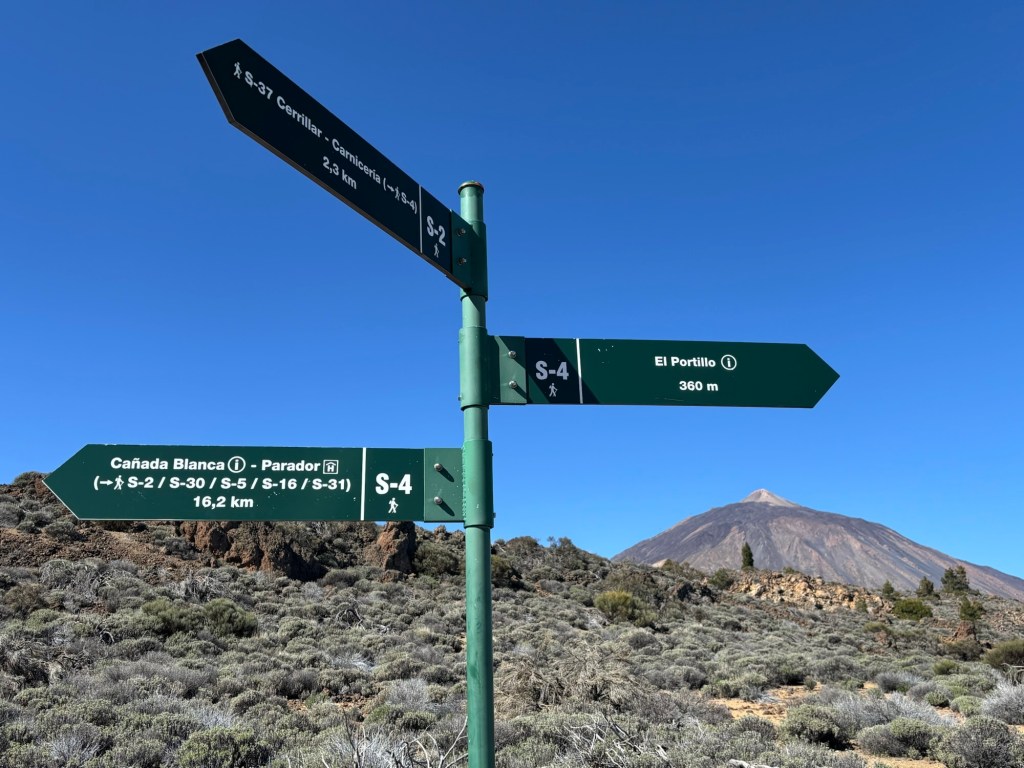
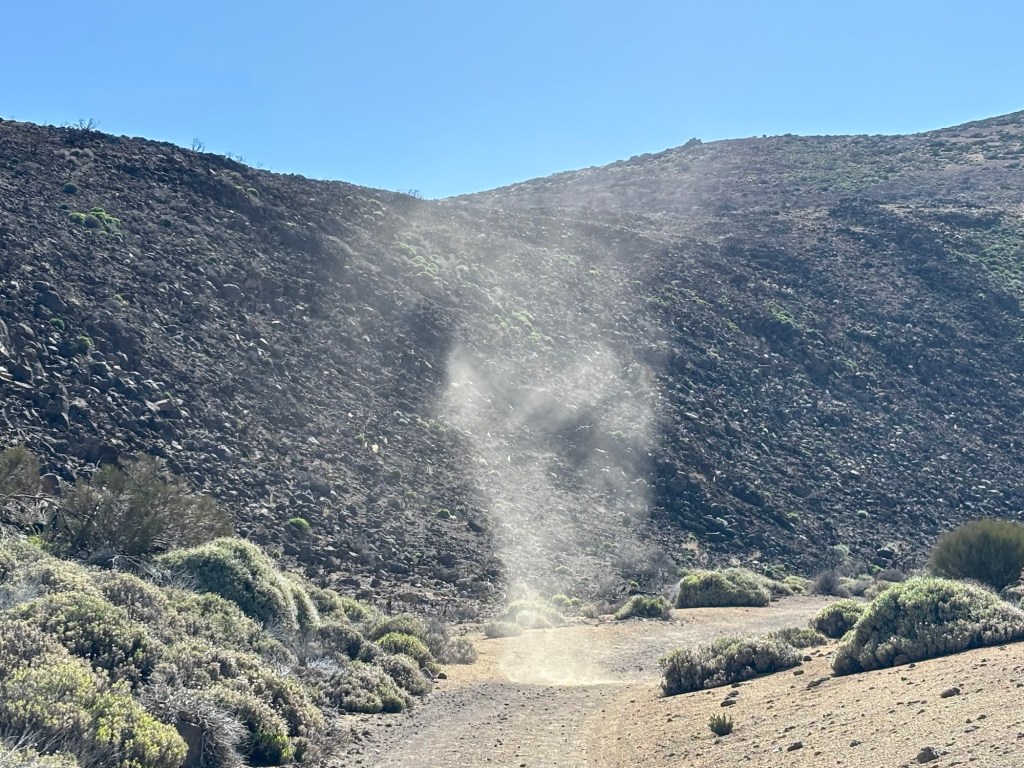
I didn’t see any hellhounds on my lap of the park, but I did see a dust devil as I set out from El Portillo. I used to see these quite frequently when I lived in Jordan, but outside of desert environments they are quite rare.
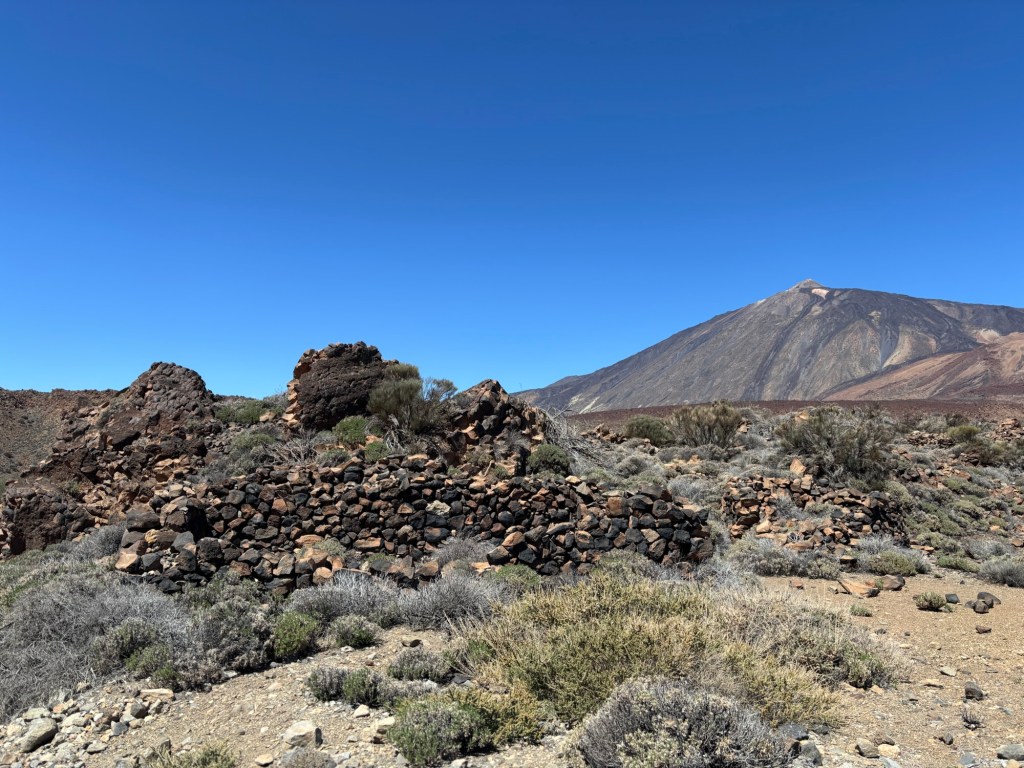
Scattered around the caldera floor are a number of unfinished or ruined dwellings built out of the scattered basalt rocks. These present a mystery to the casual hiker: what were they? The ancient dwellings of the Guanches? An initiative by the park authorities? Hunting refuges? In truth, they are none of these things: the caldera was far too hostile an environment for settlement by the Guanches, construction within the national park is tightly restricted, and hunting – naturally outlawed – would net a poor return, as the largest birds within the park are kestrels and the odd buzzard, and the only native mammals are bats.
No – they are actually the remains of a German attempt to build a sanatorium within the caldera in the early 20th century. A lack of funding, the eventual creation of the National park and, of course, two world wars put a bullet in the head of the project and now all that remains are the foundations of these houses, which now provide shelter for the enigmatic blue-bellied lizards that can only be found here on Tenerife.
These creatures are everywhere in the caldera, darting across the path and into the numerous crevices in the boulder-strewn ash field as you pass. There are two other species endemic reptiles within the park – the Tenerife skink and the Tenerife gecko – but the casual observer is much more likely to cross paths with the Tenerife lizard, especially around the Parador car park where they have become quite fearless.
The Canary Islands – curiously, named not for the species of finch that calls the islands home, but for the large population of monk seals (or sea dogs) that once lived here – are home to a large number of endemic reptiles, some of them textbook cases of island gigantism: that is, where a species has fewer natural predators and can thus grow to a size far greater than its mainland relatives. The largest of these, the El Hierro giant lizard, is a relic of precolonial times, when giant lizards were much more common in these islands, as well as much larger: fossils indicate that some could exceed a metre in length, right up until the arrival of the Spanish in the 1490s.
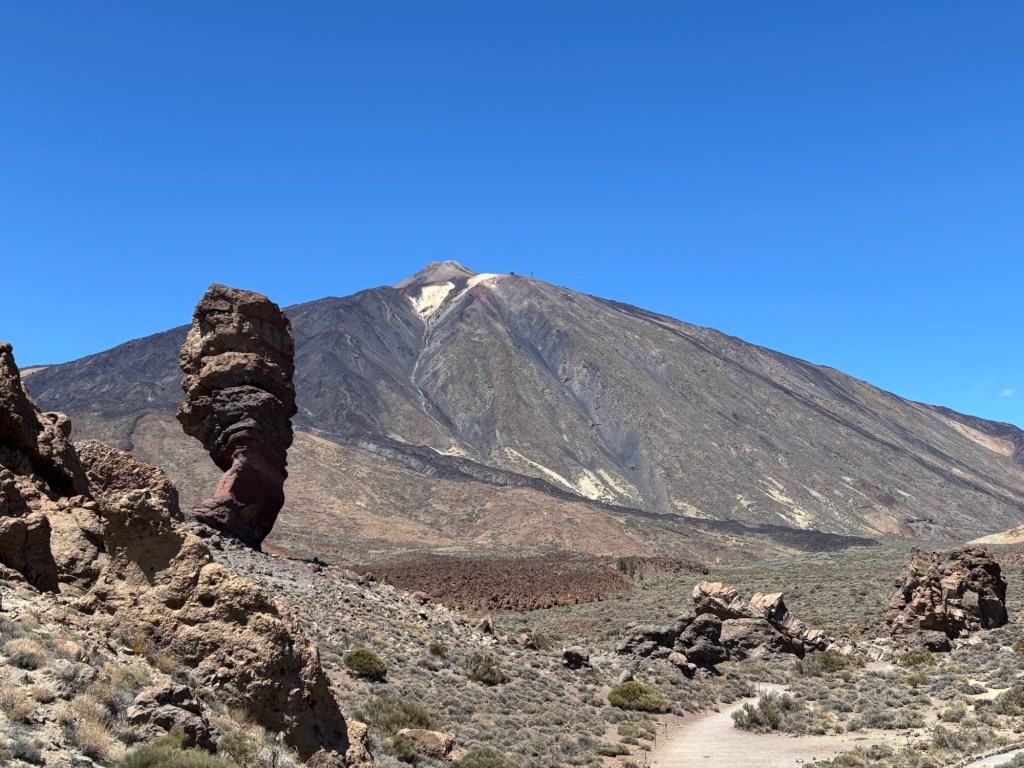
No visit to Teide would be complete without taking in the Roques de García, the roots of an ancient mountain even older than Teide itself. The most well-known of these has to be the Roque Cinchado, also known as ‘el árbol de piedra’ – the stone tree. Standing on the footpath a few paces from the car park provides you with one of the most famous views in all of Spain: the Roque Cinchado with Teide as its backdrop. The old man of the mountain and its son. I had to wait for a family testing out their drone to get a clear shot, but it was worth it.
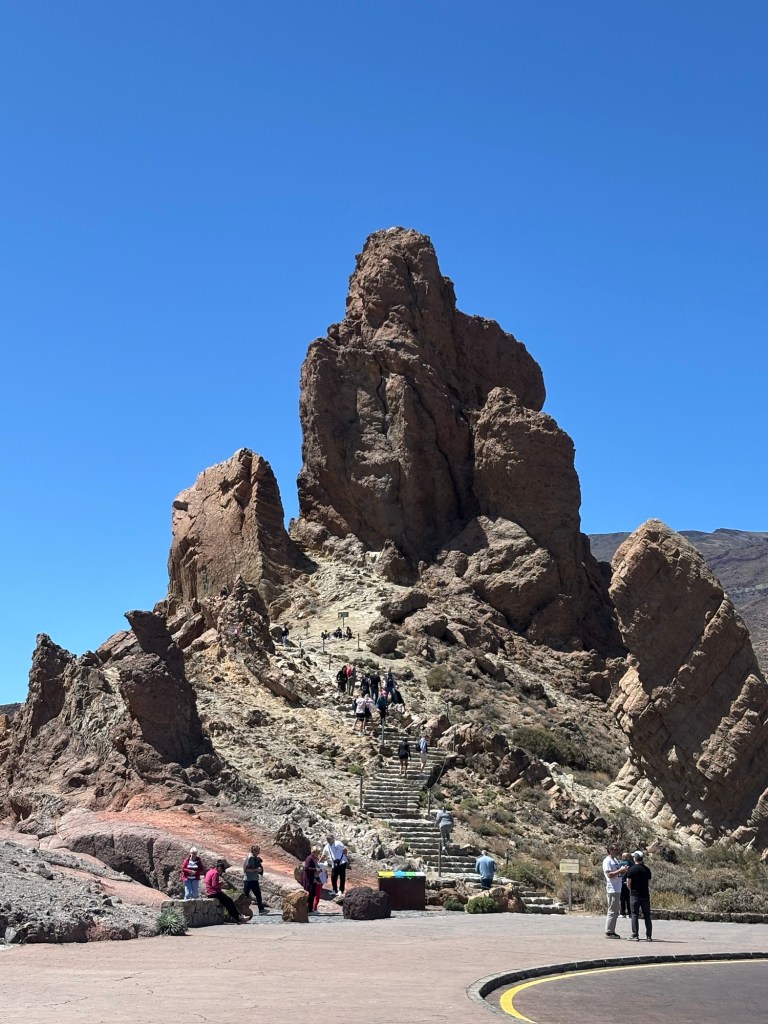
It’s not the only impressive rock formation in the caldera: there’s a mighty organ-like basalt structure down in the valley floor, and the largest of the Roques de García seems to have become – of all things – a beauty spot. Three Italian men sat at the top of the steps, sporting designer sunglasses and expensive shoes. A Ukrainian girl dressed in pink with her hair tied back in a high ponytail occupied one of the lower peaks for the best part of twenty minutes, turning her head this way and that while her friend took photographs. As a matter of fact, I was the odd one out for not wearing my best: it seems whole busloads of well-dressed teens and students come up here for the ultimate profile picture.
I wonder if they spared a thought for the ancient fire demon trapped with the mountain behind them – or whether they thought to learn about the Guanches, the true Canarians, whose fire was extinguished many hundreds of years ago. They were crushed as a mere prelude to the conquest of the Americas, and I don’t remember their story featuring much in my history classes in Spain. If there are any left, their bloodline had long since mingled with the Spanish to the point where it has all but faded away. Perhaps it is fate that they too, like the fire demon Guayota, now lie buried deep within the mountain.
Tomorrow I strike out west for the peace and quiet of Chinyero. It’s been a long time coming. BB x
For a city that’s only a few hundred miles from the Spanish border, Lisbon and its environs could hardly be less Spanish. I guess I naively went in expecting Portugal to be no more different from Spain than, say, Germany is to Austria, or England to Ireland. Once again, yours truly demonstrates his supreme capacity for some Langton-style bullshitting.
This is a very last-minute holiday, even by my standards. Bus tickets bought, hostels booked and maps drawn less than twenty four hours before departure. And this time I don’t even speak the language. Either I’m getting more confident or more careless. So far, so good, so I’ll assume the former.
Lisbon is really quite something. As capital cities go, it’s a treasure. It’s not too big or crowded so as to set a country bumpkin like me off, and it’s not too small so as to be lacking in life or things to do either. On the contrary, for its size, it’s positively crammed with interesting sights to see. And with the Lisbon Card on hand – a natty little device that gives you free access to all forms of public transport for one, two or three days – getting around the place couldn’t be easier. Heck, it’s even entertaining to ride the Metro just for the sake of it, with that kind of freedom.
It’s also a tantalizingly great location for one of my favourite hobbies: people-watching. Capital cities tend to have a wider racial mix than country backwaters, so this is something that never fails to amaze me, but Lisbon’s got a damned beautiful pot-pourris of ethnicities going on. West African immigrants, in all their multicoloured splendour, rub shoulders with Berbers from the Rif and the Portuguese themselves, who are surprisingly different from their Hispanic neighbours. Beetle-black eyes, lemon-gold skin and blonde hair are a lot more common here than the dusky Moorish beauty of the Spanish south. As in Extremadura, I find myself trying to imagine these people dressed in seventeenth century clothes, wandering the streets of a pre-earthquake Lisbon or setting foot on the shores of the New World and beyond in the Age of Discoveries.
Forgive me that splurge into racial obsession. I’ve always been hooked on the beauty of the various peoples of our world. For every shade except my own, in fact. A reverse racism in the truest sense of the word. Fortunately, I’ve since learned to love my own nation for all its flaws, recognizing my angst for what it was: angst, some dim leftover from when my ego was torn to shreds in the wake of my first relationship. The healing process sure has been long enough in the completion.
Lisbon, Benjamin. You’re supposed to be talking about Lisbon.
I took a train out of town to the former royal retreat of Sintra, up in the mountains above the city. Once again you’ll find yourself in a world away from picture-book Iberia: with all the pine forest-covered granite slopes and the pink and yellow spires of the Neuschwanstein-esque follies poking out of the trees like decorated Turkish delights, you might as well be in Austria. That, and Portuguese sounds decidedly Eastern European with all those zh and sh sounds. The gigantic überfolly that is the Palacio de Pena, the last word in Romantic architectural orgasm, looked just too ridiculous to be true on arrival, so I settled instead for the Castelo dos Mouros, the old Moorish lookout sat astride the Boulder-strewn hill opposite. Sometimes it’s simply easier to stick to what you know.
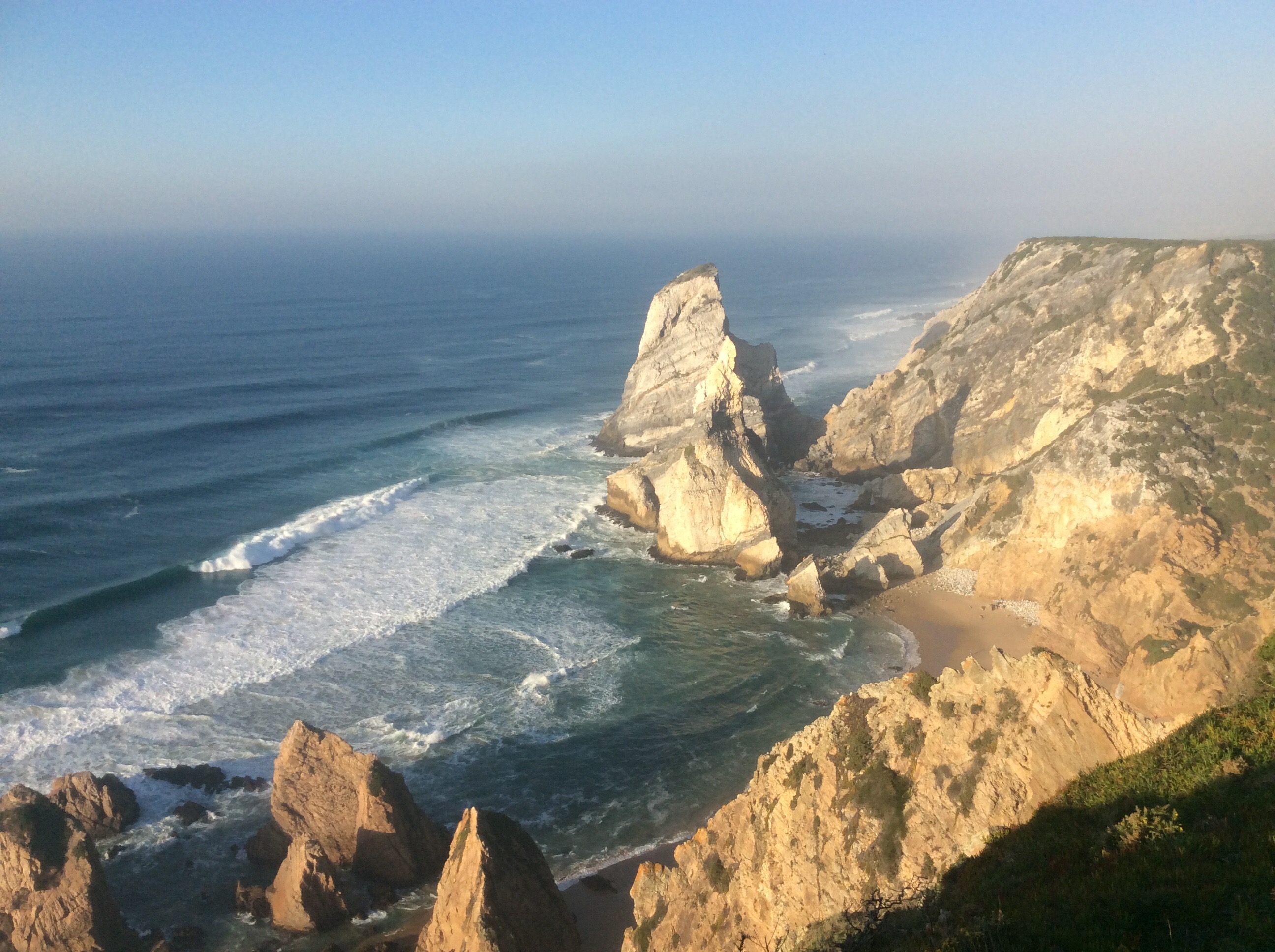
Best moment of the day goes to my main reason for coming this far west: not for Lisbon per se, but the windswept cliffs of the Cabo da Roca, Europe’s most westerly point. The headland itself was crowded – it being a gloriously sunny Saturday afternoon – so I wandered off in search of one of the cliff top trails. But for a couple of abandoned motorbikes, a young couple braving the steep, winding track down to the beach and a man piloting his camera-drone over the cape, I had the coast more or less to myself. It’s funny how most people rarely stray beyond the main sights, especially when the outskirts are almost always far more rewarding. See below if you don’t believe me.
Stunning. The sunset itself, salmon-pink and ablaze, was twice as beautiful again. The trouble is, it’s one thing to look on such beauty alone and quite another to have somebody to share it with. Here at the Cabo da Roca, as in Sintra, and on the train, and the Metro, and the banks of the Tagus, and every row but mine on the bus from Spain, I find myself looking out on a world of couples from my island. A decent half-hour’s meditation on the clifftop helped to doctor my heart a little, but it’s an unavoidable fact that humans are sociable creatures. We’re not supposed to be alone. Traveling is my primary means of fighting back against a world that rejects or friend-zones me at every turn, but it’s not supposed to be that way. So there, high on the cliffs, I contented myself with writing an imaginary letter from my princess to her lover. One day, if I should be so lucky, I’ll find the One who’ll hit the road with me. One day
Lisbon, Benjamin!
Shaking off the loneliness birds, I decided to investigate the famed brilliance of Lisbon nightlife. It’s definitely worth sampling, if you’re ever in the area. I suppose it’s no different than what you might find in London or Paris, but it blew me away. And let me tell you, after two and a half months of Reggaeton, it was a dream come true to have some Justin Timberlake, Uptown Funk and Notorious B.I.G blasting through the speakers. I ended up in a dance-off with a group of Guineans and it was insane. You know you’ve made it in dance when a black guy commends you on your moves. Box ticked.
Oh! But here’s a funny story for you. This ought to lighten the mood. You see, in a town the size of the one I live and work in, everybody knows everyone else, and the general atmosphere is overall more familial than friendly. And since I’m a rookie to city-hopping, I’m guilty of several major faux-pas, like putting my shoes on the bed and ignoring traffic lights. But tonight’s really takes the biscuit. I decided to take a side-alley detour back to my hostel and, in doing so, wound up in a rather seedy part of town; the outskirts of the clubbing district, in retrospect. I found myself alone in the street and thought it odd enough until two women came about the street corner (yes, you can kind of see where this is going. I, funnily enough, couldn’t). They looked a little lost, and when one of them waved me over, I took my earphones out and asked what I could do to help. The answer I got was a husky ‘babe, you’re so beautiful’.
I don’t think I’ve ever run faster in my life.
The bus is pulling into Coimbra. Aveiro can’t be too far away now; another hour and a half, tops. I’ll close this report for now so that I have something to say in my next post. Até logo, morangos. BB x
One minute I’m standing on a high rock, staring into a lunar desert whilst desperately trying to even up my tan lines; two hours later I’m staring down at a school of damselfish drifting over a coral reef. I’m still struggling to get my head around it.
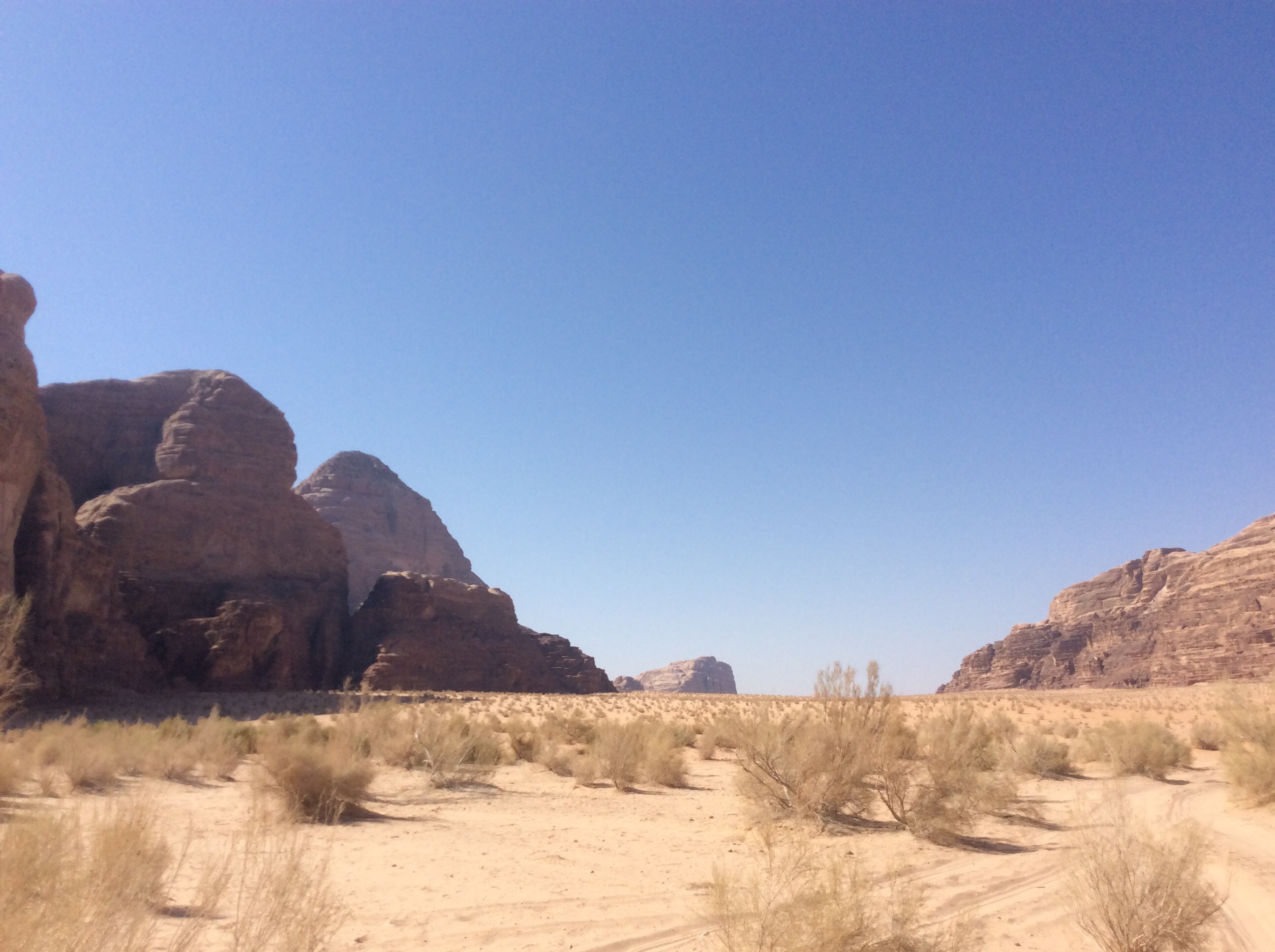
Sunrise feels far longer ago than this morning. After putting the finishing touches to last night’s report, I left the others sleeping in the campground and set off alone into the desert once again, this time to see the sunrise. I made it to the other side of the valley in time to catch the first rays of sunlight bursting over the cliffs. The sand was full of tracks: the footprints of beetles, snakes, camels and four-wheel drives crisscrossed the valley floor. There was even a lone skink trail halfway across, both satisfying and amusing on a more personal level (for the record, it’s an old family joke about lesser-spotted three-toed eagle-eyed skinks that gets wheeled out whenever yours truly gets boorishly specific about animals). The others were mostly up and about by the time I returned, and in perfect time for half an hour’s meditation before breakfast. The hefty futur Ahmad and his brother Khaled prepared for us was a kingly feast: fresh bread, helwa, jam, hummus, falafel and hard-boiled eggs (there’s no escaping them!), and that’s without mentioning four glasses of that lovely sage and cinnamon-infused Bedouin tea. Dee-lish. God help my teeth over the coming year, because Spain and the Arab world most certainly won’t.
The jeep tour of Wadi Rum was a pretty standard exploration of the main sights, as you might expect: the early Nabatean rock art, Lawrence’s house and the rock arches. I needn’t elaborate much; such sights, stunning though they may be, are better detailed in guidebooks. Besides, Langelsby’s got it covered. I highly recommend you go for a tour if you’re in the area, though. On a more personal note, I found it profoundly ironic that I finally found a haven for wildlife, in what must be outwardly one of the most inhospitable landscapes on the planet. Desert larks, white-crowned wheatears, rock martins and rosefinches followed us from rock to rock whilst the ever present grackles, the tricksters of Wadi Mujib, whistled noisily overhead. No sign of the nocturnal denizens of the desert, but a welcome change from scabby cats and pigeons. The naturalist in me will never be suppressed. So says the lesser-spotted three-toed skink, at any rate.
On the knowledge that wrangling a bus from Wadi Musa to Amman might be beyond us, we arranged with Ahmad, our kohl-eyed Bedouin guide, to take us as far as Aqaba instead, where buses to Amman would be easier to achieve. Aqaba may be your run-of-the-mill beach resort these days, but it has a notch on everything I’ve seen before: the Red Sea. Sapphire would be a better name by far. I’d heard stories and seen pictures, but I’d never really believed quite how deep a blue the Red Sea was. Quite by accident, and with no small meddling from my heart, I found myself physically incapable of passing up the chance to go snorkeling.
Water sports and I don’t have an easy history, let’s say. Ask the population of Whitstable, who watched me capsize a kayak twice and have to be towed ashore (yeah, that still smarts). Swimming’s just about my favorite sport, being both an important skill and the only sport I’ve ever enjoyed, but I have breathing issues – something to do with my nose – which makes most other water sports more problematic than entertaining. Snorkeling has always been a dream of mine, though. Not as technical as scuba and easily doable for somebody with breathing issues. I say that, at least. It’s easy in retrospect.
The first forty minutes were tortuous – not because very salty water kept leaking into my mask, or because I was panicking over the oddity of breathing through a tube, but because the scenes opening up below me were nothing short of some of the most breathtaking sights I’ve ever seen (ouch, that was a bad pun). Stacks of frilled and fringed coral giving way to deep, sandy gardens shimmering in the crystal sunlight. Black sea urchins stretching their tapering spines out of crevices. Angelfish, surgeonfish, triggerfish, even clownfish, frolicking just inches in front of me. It was like living a wildlife documentary in the flesh. By the time I’d finally worked out how to breathe properly – ironically, the key to it was simply calming down and having faith in the tube – we only had five minutes left in the water. But those last five minutes were magical, even more so than the stars over Wadi Rum. Who could possibly feel lonely, or even give loneliness a second’s thought, with scores of brightly colored fish teeming about so close to? Those were my brightest moments.
Christ, but I feel like a tourist right now. I’ve just tackled three of Jordan’s biggest attractions in two days flat: Petra, Wadi Rum and the Red Sea. I didn’t really give Petra much clearance, did I? Mm, I’ll leave that one to the girls over at Langlesby Travels (https://langlesbytravels.wordpress.com/).
It’s been a busy weekend and a half. It feels unreal, somehow. But I don’t regret it for a second – and for once, l don’t even feel ashamed. I am a tourist. Jordan thrives on tourism. I guess I’m finally beginning to accept that. And about time too! Travel is no more and no less than the best thing you can do with your life, and it’s such a shame to have it spoiled by something you could never change, even if you wanted to. BB x





 The Book of Barnabas