The Weatherman Cometh

It starts with an ominous grey sky to the west. The patchwork of fluffy summer clouds that have been insulating the leftover heat from three scorching days suddenly drops into a void the colour of slate, matching the roof of Bayeux’s cathedral almost exactly. A man in a beret watches the skies; a French family whose children seem to tan faster down the years savour their two-scoop ice creams; a boy and his mother walk their five beagles.
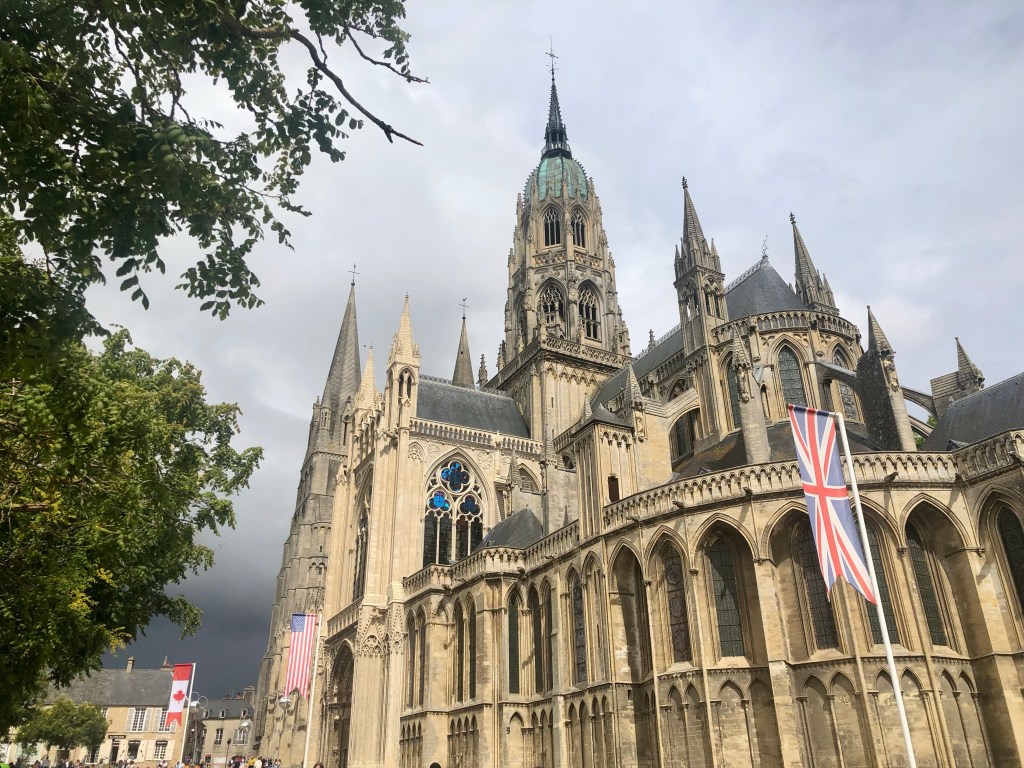
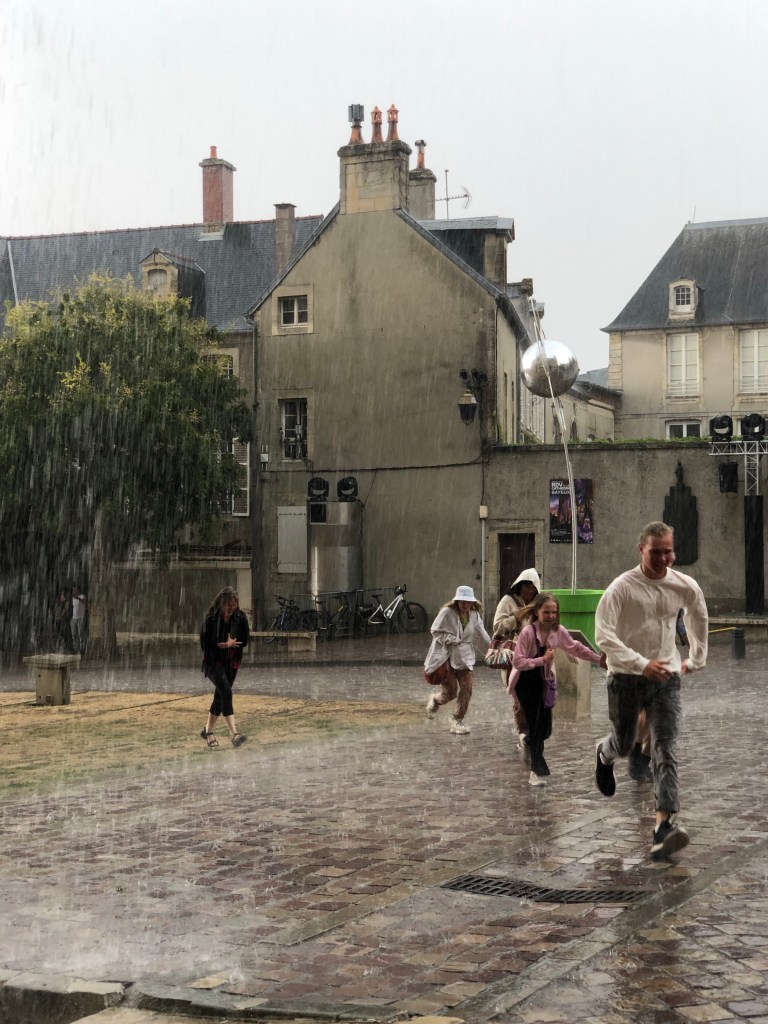
The first raindrop falls on the back of my neck like a kiss. Cool, swift, sweet. I’m sitting on a bollard, sketching. I wait for another. It lands on my arm. Almost instantly a third lands on my sketchbook, narrowly missing the moustachioed gentleman I’ve been sketching. I snap the book shut and watch the tourists scattering as the rain comes down: the French dignified beneath their umbrellas, the Dutch unflinching behind their cameras, the Americans in a mad dash. I think about taking a slow walk back to the hostel to savour the blessed rain after so many days of sun. I’m no further than a few feet around the corner of the cathedral when the heavens open.
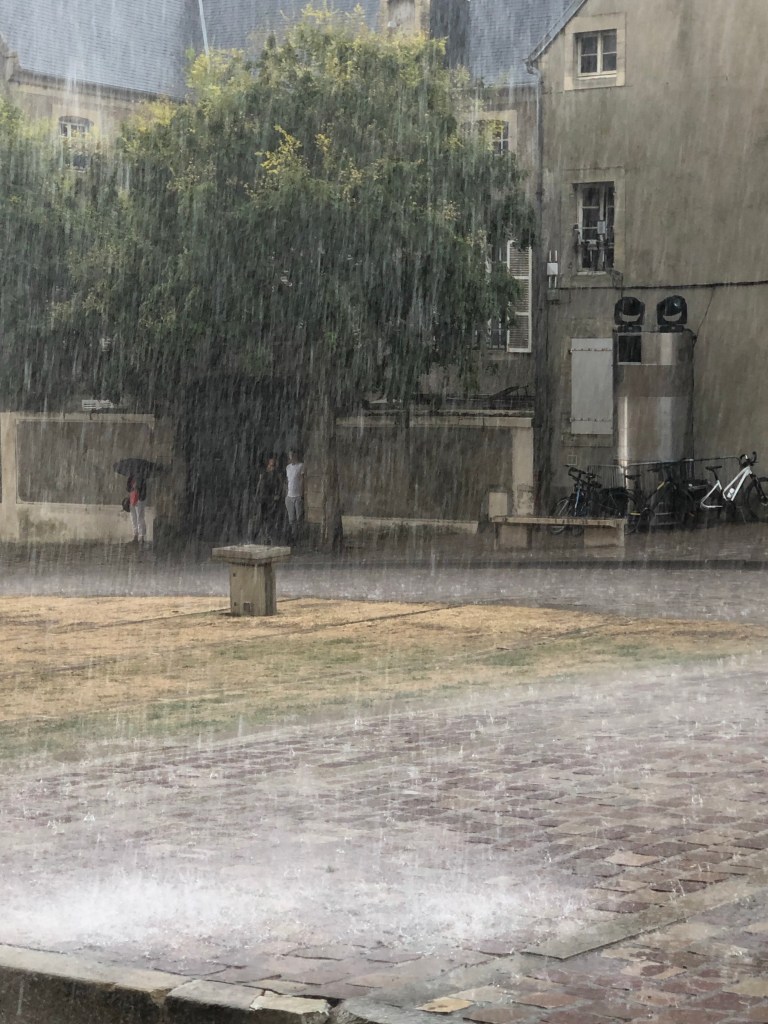
I concede defeat to the tempest and join a small but growing crowd seeking shelter in the ancient stone doorway of Odo’s cathedral. The beagle-fanciers are here, along with a cross-section of Bayeux’s tourists. The rain comes down in sheets, hammering the cobblestones like a snare drum, and then a sudden flash and a rolling crash from the bass drum up in the sky. “On est bien dessous, hein?” remarks a Frenchwoman with short-cropped hair and round glasses. A boy with long eyelashes runs in and out of the rain in his yellow anorak, singing the chorus of the Wellerman shanty over and over.
A solitary American standing nearby stares at his phone in disbelief and growls. It sounds like he’s frustrated at a video game, but as he starts to verbalise his frustration it’s obvious he’s checking a weather app. “You’re kidding me, I’ve got to wait half an hour? God, you’ve got to be kidding me. Come on!”. He growls again. And again, louder this time. Some of the other tourists back away. “Hrrrrrnnnn!” The grunts and growls sound uncannily like a bull, giving fair warning before a charge. “END! NOW!!!” A couple of startled jumps from the crowd. By the looks on their faces, they’re weighing up whether to tell him it’s futile to attempt to command the skies, or whether it’s more futile still to reason with a man so blatantly trying to do just that. As a result, nobody intervenes, and Yankee Canute continues to defy the elements, bellowing at the clouds with increasing fury. “Hmmmmmhnnn, CAHM AAAAHN. When’s it gonna EHYAAND? GAAHD, I don’t have TAAM for this SHIIYET”.

The growling and grumbling is briefly cancelled out by another clash of thunder. “Hurry up, END, NOW! Cahm aaahhn, pleeez, end now! Why does it have to do this during the day, it should do this at night!” – (a fair point here, it was unbearably hot last night) – “Gahd, I don’t have time for this shit!”.

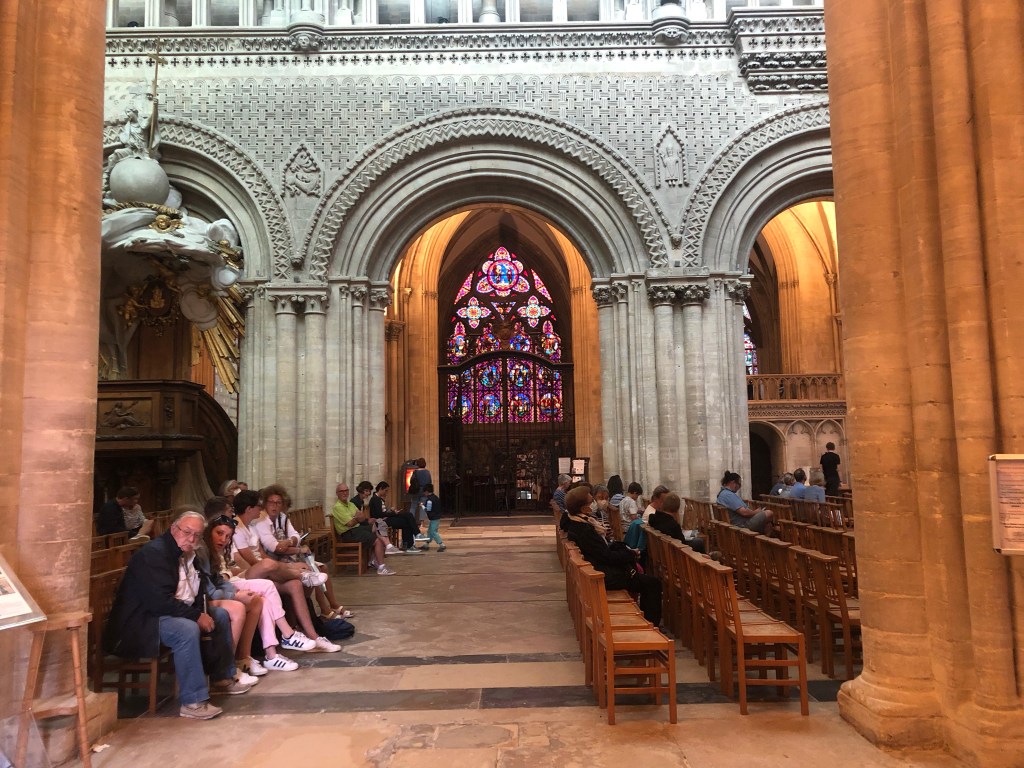
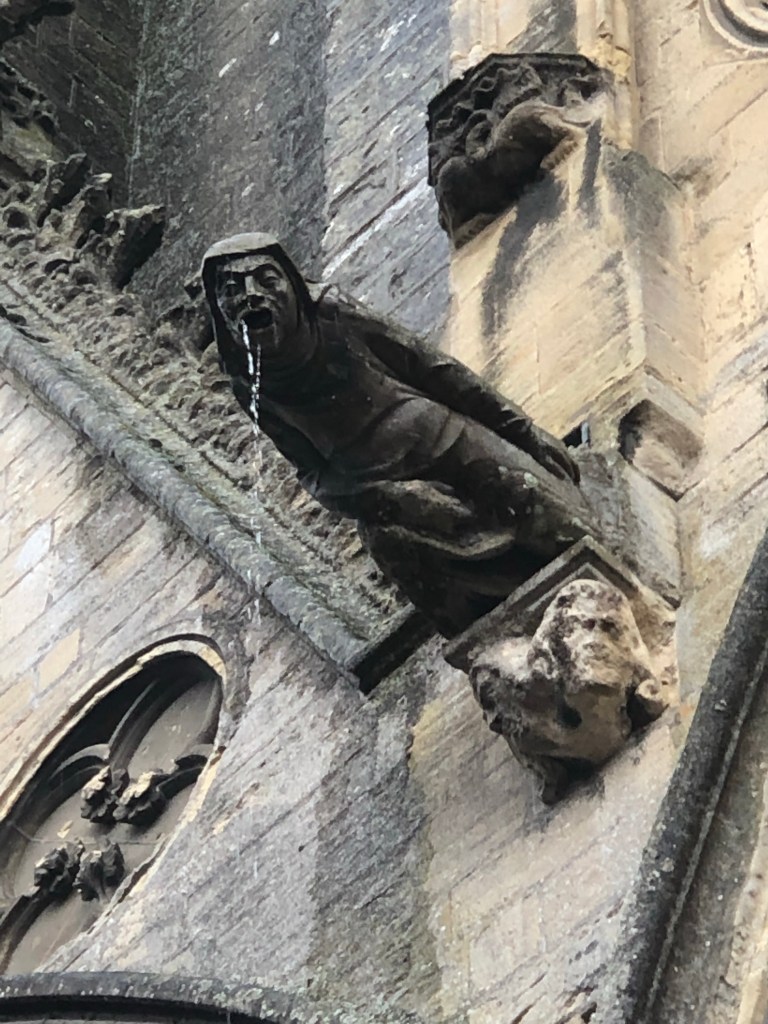
I slip inside the cathedral to escape the verbal artillery for just a moment. Bayeux’s cathedral survived intact the last time it came under fire from an American battery, so I figure it’s a safe bet. The muted thunder beyond the stone walls sounds strangely beautiful, and the grey skies filter through the stained glass in hopeful technicolour. The aisles are packed with a colourful array of tourists waiting out the storm; a phoney faithful glued to their phones, waiting to proceed on their pilgrimage to the crêperies outside – a combination of American flags and English spoken here signs were drawing in the crowds earlier. Staring down at the sightseers, a gargoyle pulls his mouth into a sneer, tongue out, deriding a thousand years of peasants, pilgrims and pensioners.
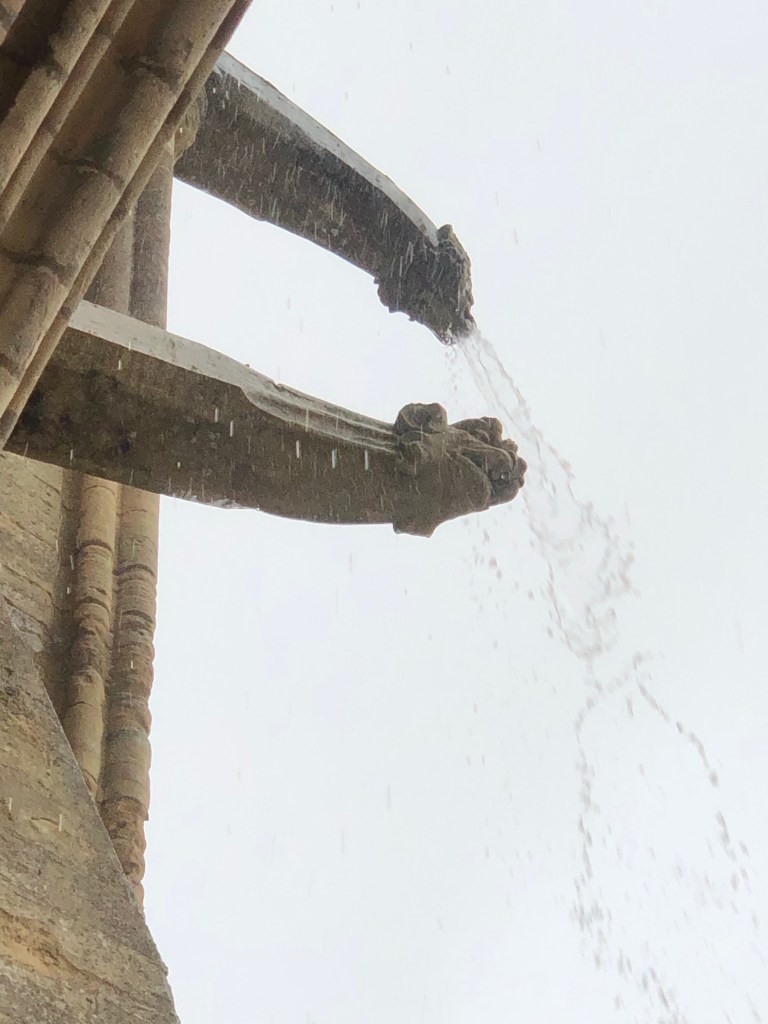
Outside, the rest of the gargoyles are doing their job, spewing rainwater from their mouths onto the streets below. For the first time they look complete, as though the gaping mouths were merely voids waiting to be turned into channels. A father points them out to his daughter, one hand gesturing, the other on her ear as our frustrated Yankee Canute swears blue murder at the sky.
The streets of Bayeux shine under the whitening sky. Umbrellas and ponchos have been magicked out of the air (and some straight out of souvenir shops). The Wednesday market is being dismantled. The fishmonger reclaims the last two skate wings and a Norman bookseller voices a quiet complaint to the heavens as he stacks his pulped collection of second-hand books: “aujourd’hui, précisement?”.
The storm has passed and the sun has returned with a milder temperament, his midsummer fury sated at last. I think I’ll take the rest of the day off. Find a park, do some reading, and clue up on the bus times for tomorrow’s expedition to the coast. A bientot! BB x
Abide with Me

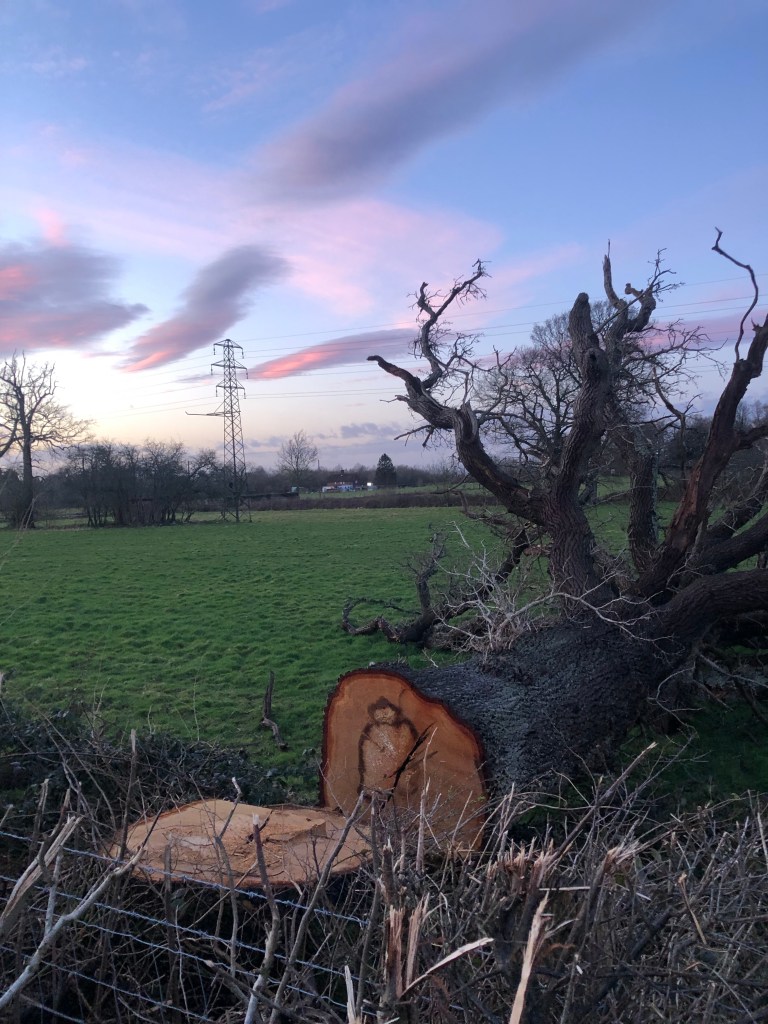
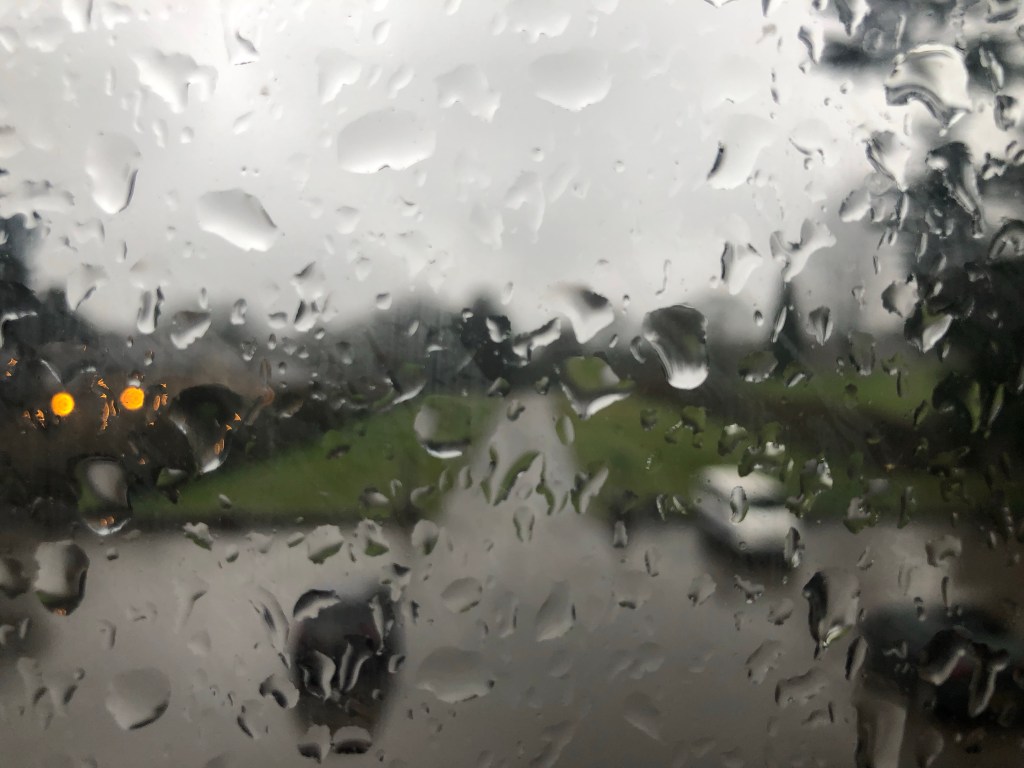
Today’s the last day of the February half term. Storm Eunice is on her way out, but she’s dragging her talons behind her. I’m cooped up with a blanket and a mug of Ovaltine in my study, looking out at the grey world beyond. Cars parked at angles. Wet tarmac mirroring the featureless sky. Winds of over fifty miles per hour howl across the grounds. One of the windows in my flat is permanently ajar due to some fault with its ancient locking mechanism, and the banshee wails moaning through the corridor sound like the Ice Cavern from Ocarina of Time (nostalgia trip here). Between the raging wind and the rattling tattoo of the flagpole two floors up, I might as well be at sea.

I came home from visiting my parents last night to find the whole site in darkness. From what I’ve seen and heard, Eunice had been busy while I was away, tearing her way along the coast like a hurricane and leaving great swathes of the south without power. It took me at least a minute or two scrolling through the UK Power Network website to find my postcode amidst the many hundreds reporting a power outage. After the fair number of power cuts we had last year, you would have thought I would have been prepared, but for the life of me I couldn’t find any of the candles I’d stockpiled over the years. I think my previous housemate used them all up for beer bottle decoration. Fortunately, some foresight – or hindsight – on my part led me to a hidden cache of hand-torches in a chest of drawers. The bulb had gone in the smaller one, but the other, though flickering as a match-flame, gave just about enough light to read by.

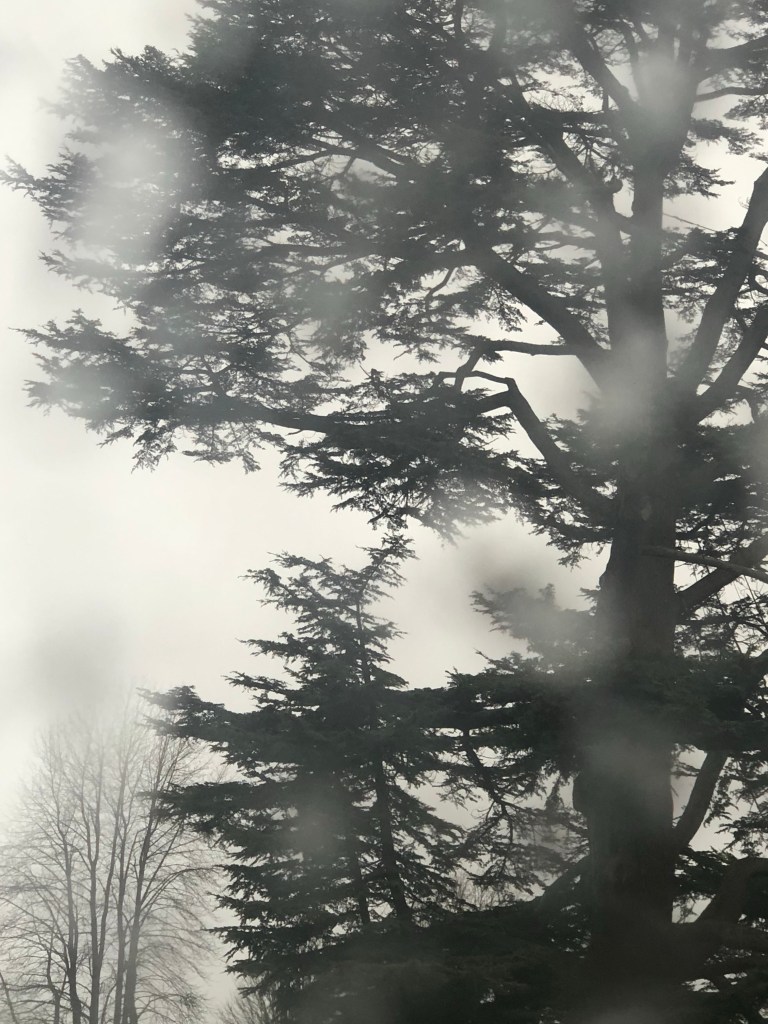
I half expected to come home to find the silhouette of the great Atlas cedar missing from the skyline, its mighty body bent and broken upon the drive like a fallen giant. Fortunately its roots go deep, like the mountains upon which its kin grow far away to the south, and there is strength in the old man still.

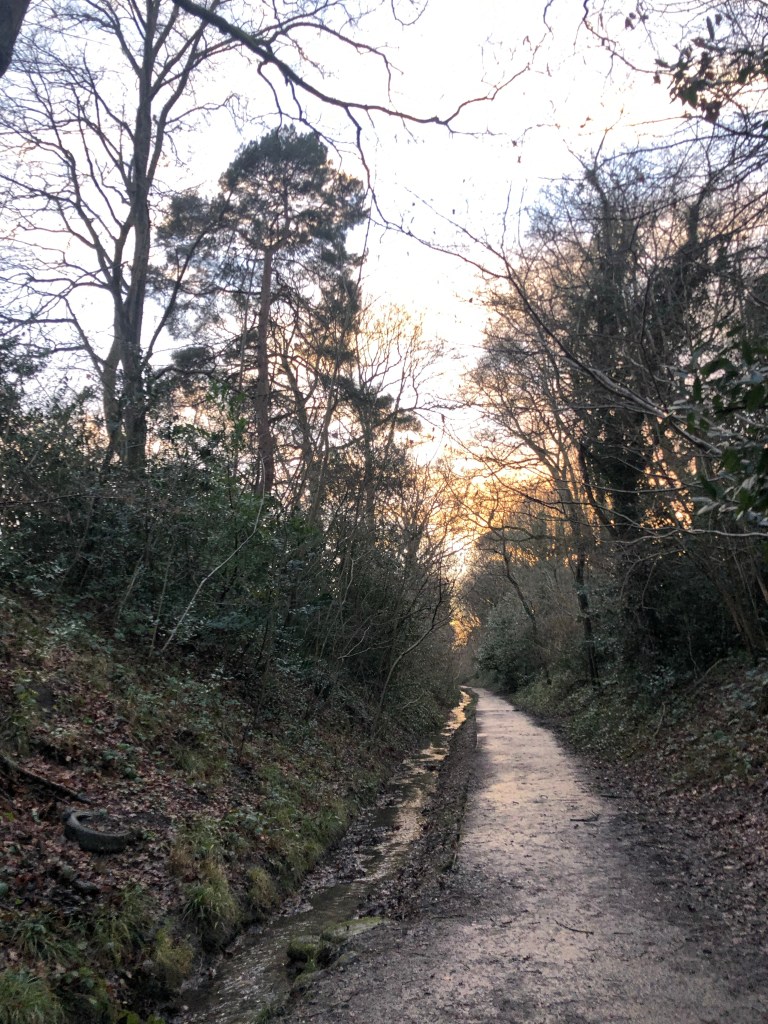
The same cannot be said of many of the free-standing trees that line the road into town. I promised myself I’d get a taxi home for the sake of my new trainers, but as usual, I went back on that promise, only this time it was not out of stinginess but a genuine curiosity to see the wreckage of the storm that I had only glimpsed from the train. Crawley wasn’t given a lashing quite like Brighton and Hove, but it had its fair share of casualties, scattered and trimmed across roads and gardens. The damage was less obvious deeper into the woods beyond. There is safety in numbers, it seems, even for trees: much of the forest was untouched by the storm. It was seriously muddy underfoot, though, and I spent a good ten minutes cleaning my trainers by torchlight once I’d made it home.

It seems unoriginal – not to mention extremely British – to go on so about the weather, but I feel as a writer there is nothing more important than taking the time to talk about the world around you every so often. It’s our duty to tell stories of the world as we see it, so that others who come after us can learn from us somehow. One of the books I actually read cover-to-cover last year, Nature’s Mutiny, pieces together the world of the Little Ice Age through diaries, sermons, letters, hymns and poems penned by those who saw it with their own eyes. Back then there was still a great fear of God tangled up in the awesome power of the weather, and a hundred years of savage winters had led a lot of Europeans to the natural conclusion that sin was to blame. Some resorted to witchcraft; some resorted to witch-burning. Others, of a more temperate nature, put their thoughts into verse:

In constant rancour we abide / and war is ruling far and wide

Envy and hatred everywhere / in all estates discord and fear

That too, is why the elements / reach out against us with their hands

Fear coming from the depth and sea / fear from the very air on high

In morning is the source of joy / the sun no longer sends bright rays

The clouds are raining like a fount / the tears too plentiful to count.

Paul Gerhard
Translated by Philipp Blom
(Nature’s Mutiny, 2019)

I wonder how many modern lyricists sing about the weather? Back in 2007, when the UK was plunged into its wettest summer since records began, Rihanna’s perfectly-timed Umbrella became a best-seller. There were even joking accusations on the internet that the singer was responsible for the unseasonal weather across the pond…

Now that it’s raining more than ever

Know that we’ll still have each other

You can stand under my umbrella

You can stand under my umbrella, ella, ella, eh, eh, eh

Rihanna (“Umbrella“)

Of course, Rihanna wasn’t thinking about the British summer yet to come when she wrote those lines, but four hundred years ago they might have burned her for a witch for such impeccably bad timing. Come to think of it, though, I do distinctly remember her name being on the list handed to me by the Prefect Witchfinder General at a school I worked at in Uganda, some five years later. Apparently the school’s witch-hunting guild had found a website listing known witches in the Western world? If they’d stumbled upon one of the various forums discussing the timing of Umbrella, perhaps it’s not an unprecedented conclusion. If I remember correctly, Wayne Rooney’s name was also on that list. The internet is a strange place.

Speaking of the internet, I decided to bite the bullet and give the online dating scene a whirl. Living and working in a boarding school doesn’t exactly facilitate an open line of communication with the outside world, so rather than sitting on the fence I thought I’d chase some stories for a change. After a brief browse it looks as though Bumble is the kindest of the Golden Triangle (with Hinge and Tinder), not least of all because it’s the most self-aware of the damage the online dating scene can do to the mental health of its users. It’s good to see that in an undeniably superficial meat market, some of the folks up top are aware of the dangers and offer support.

It’s almost certainly a silly idea, living as far from the city as I do, but, who’s to know? Shy bairns get nowt once again. If I had a penny for every variation of that phrase I’ve heard throughout my life, I might just have a pound. BB x