Shakespeare and a Pigeon with a Death Wish

Summer has arrived in Spain. It’s been pleasantly cool up until now, but yesterday somebody upstairs decided to crank up the thermostat. Two months ago it was finally warm enough to ditch the thermals by night, and now it’s shirt season. Which, for anyone who knows me, suits me just fine.

I haven’t done a random regular update in a while. I guess that with all of the to-and-froing after Semana Santa I’ve hardly had the time: in less than a month I’ve been to El Rocio, Sevilla, Cordoba, Barcelona, Andorra, Calatayud, Monfrague and Jerez de los Caballeros, not to mention taken part in a Romanian art school exchange and worked a weekend at an English immersion event. It’s been pretty non-stop since the 23rd of March. But life goes on, and as I try to make clear on this blog, life is not one massive series of amazing year abroad adventures – unless you count the everyday as an adventure in itself, and I wouldn’t blame you if you did. It’s full of trials and tribulations of its own.

Well, what’s to say? Here I am in the staffroom at my afternoon private school, waiting for my Upper Sixth class to arrive for a catch-up class (I’m still making up for those hours I lost by being in Barcelona, one month later – take note, future me!). It’s hard work but rewarding, teaching Upper Sixth… They don’t all take part as they should, but those that do do so with a spectacularly high level of English. The others are just as good, if only they’d speak more (an eternal problem with teenagers). I look back to the honeymoon period when I’d first arrived and it was a barrage of questions from all sides… but even if they aren’t as proactive with familiarity, at least being settled pays off. And at least I know their names. It hardly needs saying, but that’s crucial to good relations.

Teaching at the public school this morning was uncharacteristically problematic. For the first time this year I forgot to set my alarm, with the result that I only woke up at the sound of my flatmate leaving, some fifteen minutes before my first class. In my haste to leave I startled a recently fledged pigeon that had been sitting on the doorstep of the block of flats which, as Fate would have it, flew straight under the wheels of a car. In that dark mood I went on to teach two Lower Sixth classes about the End of the World, painfully aware that the biggest challenge – trying to teach Shakespeare – was still around the corner. Even so, I’d prepared a nifty presentation for the job, which would do the trick.

Provided the computers were working. Which they weren’t.

For the second week in a row my premier class had to suffer an off-the-cuff lesson where all the visual prompts and gags had to be done manually. I’ve got to say it; if my mother hadn’t gotten me into drawing, I don’t know what I’d do in such situations. Drawing skills are a genuine lifesaver in teaching. No PowerPoint? Whip out the chalk. Trouble explaining a word? Draw it. Need to motivate the kids? Get scribbling. It’s a defibrillator that never runs out of juice. I owe my parents, my friends and my art teachers so very much for encouraging me on that front. I don’t know where I’d be without a pencil in my hand and an image in my head.

It’s 15.30. My Upper Sixth class should be here in a couple of minutes, but if they play their usual ‘I went home for lunch’ card, I’ve got at least another twenty minutes until they turn up. In the meantime, I’ll get prepping their mock exam. Let it never be said that a language assistant is a cushy job. You land a job as good as this, you’d better earn it. BB x

Spoilt Rotten

Today offered up the perfect example of why you should save a weekly summing-up-style post for the end of the week. Because most of what I was talking about in yesterday’s mammoth entry happened again today, if only in miniature. But because it’s probably ranking amongst the best days I’ve had here yet, I’ll throw it in – if just to find an outlet for the photos I took today.

I should warn you; if you read yesterday’s post, today’s might smack more than a little of déjà vu.

So I went into class this morning and tried to do another round of ‘My Secondary School’ presentation. I must have jinxed the system last night, because it froze no less than six times, requiring six reboots and twenty minutes lost. Still, I managed to get most of the presentation done despite everything. Once you’ve been doing the same lesson for four or five hours a week, you hardly need to look at your notes to know what comes next. You find yourself saying the exact same turns of phrase, making the same gestures and cracking the same jokes, whether they worked or not. It’s a little strange, that. I only notice it when I look back.

My second class of the day was spent half on the workbook, and half on John Lennon’s Imagine. Considering the near-total absence of a choral tradition in this country, they did a damn good job for a class of twenty-nine twelve year-olds. They also reminded me that they haven’t forgotten that I promised to bring them some peanut butter. If mine hadn’t been confiscated at the airport, I’d have obliged them earlier, but as it is they’re getting restless… At least it’s on its way! The things I do for these children, honestly…

My third class of the day was (technically) my last class with one of my favourite groups, a lower sixth bachillerato class and one of the very best. I had a Uganda presentation planned for them, but if I expected them to sit and listen in silence, I had another thing coming. Halfway through OMI’s Cheerleader started playing and the ringleader of the group revealed three bags full of crisps, cups and Coke. After apologising for not paying much attention during my presentation, he explained to me that when they heard me announce that today was my last lesson with them, they arranged on the spot to throw a party. That explains why there was a general hum during the presentation (these kids are usually silent) and why Candi left ‘to take an important phone call’. A lot of hugs, a lot of puñados and a lot of love.

DSC_0587

Yeah, I really need an autofocusing lens. Nobody really understands manual focus

I never even got to finish my presentation; we’d only got as far as Kyambura. But I don’t care. I’m touched. And if I can find a way to claw back an hour with them, even if it’s out of my own free time, I will.

DSC_0605

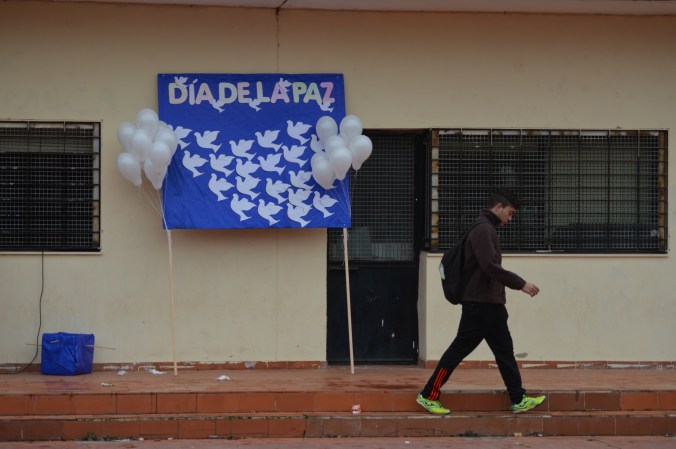
On to today’s main event. Today is Día de la Paz. It’s something I haven’t celebrated since I was last in a Spanish school myself, which was way back in 2007. I’m not entirely sure why, but English schools (or at least, the ones I went to) don’t deem it celebration-worthy. Must be something to do with the general negative attitude towards anything that might detract from that sacrosanct curriculum of ours.

DSC_0620

Now 2007 was a long time ago – almost a decade – and I can’t really remember what it was we did in C.E.I.P. Miguel de Cervantes to celebrate Día de la Paz. Something similar to today’s events – minus the John Lennon, of course. Melendez Valdés’ plan was heavy on the balloons, anyway. Handy, since I’ve been trying to explain the concept of a balloon race all week.

DSC_0631

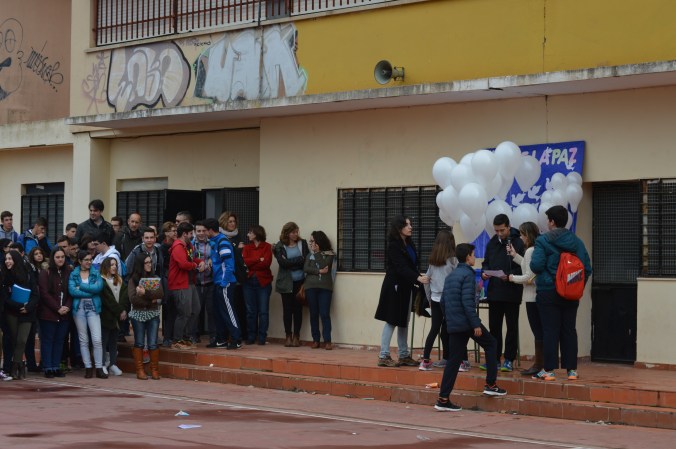
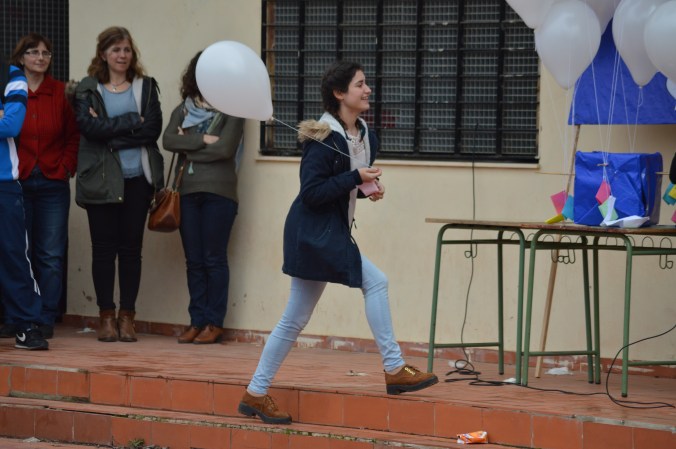
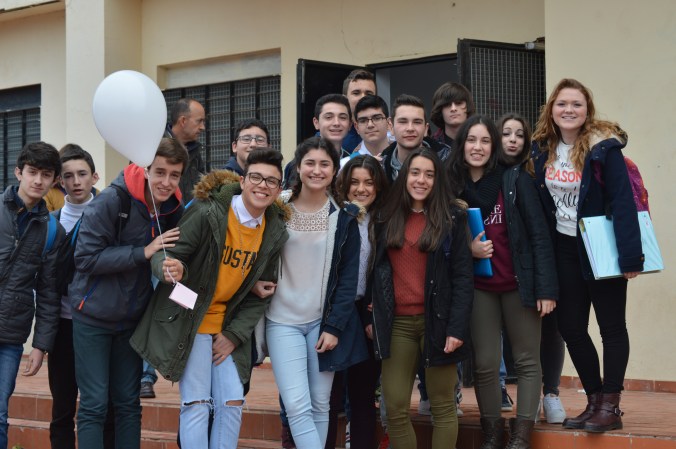
We all gathered in a square the patio in the final hour of school, and two representatives from each class came up to the front to read a quote about peace, which was written on a small dove-shaped card and attached to one of many white balloons brought forward by the students.

DSC_0625

I’d brought my camera on the off-chance that Día de la Paz would be a good chance to finally grab some photos of the instituto; for my drawing, if not for the sake of it. Madrid with Ali should have been a reminder, but I’d plain forgotten just how willing kids are to have their photographs taken. That’s reassuring – because they make the very best of subjects. Always.

DSC_0595

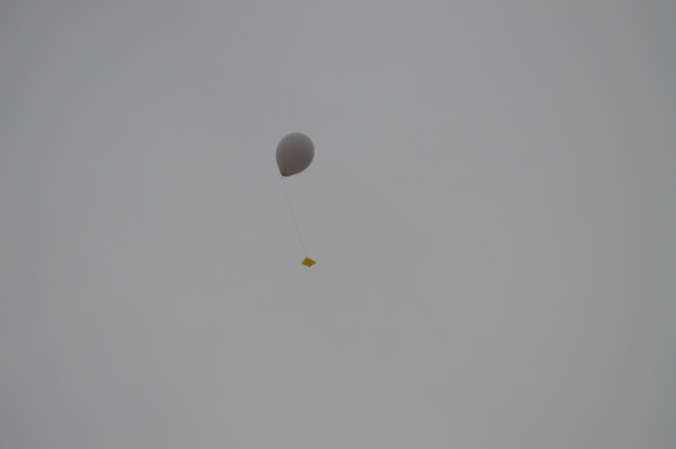
When everybody had said their piece (no pun intended), I was called out of the square to lead the recorder orchestra (oh, now that takes me back) and the rest of the lower school in singing Imagine. I guess I should have seen it coming, but that basically resulted in the recorders playing a completely different version of the song to the one everybody else had learned – and, consequently, me singing on my own. Well, I can’t say I didn’t see that coming. Because I did. And in the background, the teachers began to release the balloons and their messages of peace, one by one.

DSC_0600

It’s not been particularly windy for a while, so wonder just how far those balloons will go…

DSC_0601

Here’s to hoping that wherever they end up, the messages of peace they’re carrying with them put a smile on somebody’s face – in irony or in truth, it really doesn’t matter. Just as long as they’re smiling. (Exit Sop, stage left) BB x

Creativity in the Classroom: A Step Too Far?

I´m falling into something of a routine out here, now. Three hours with the state school, two hours with the Catholic school, one hour´s private English lesson, one hour´s Spanish conversation with my flatmate, a couple of hour´s reading and then bed. That´s good. I like a routine. It lets me know what I´m doing. I tend to go a bit spare without exact orders.

As I guessed all along, the term ´language assistant´ is a very loose one, interpreted by different schools in different ways. Some of my companions are working as ´classic´ language assistants, taking individuals or small groups for short periods for conversation. Others attend class with an English teacher as a human dictionary, there to lend a hand whenever a native speaker´s touch is needed. In Spanish, the term ´language assistant´ gets shortened down to just one word – auxiliar – which leaves even more room for interpretation. And just as happened in the last two ´language assistant´ jobs I´ve had, I seem to be working a real teacher rota.

Granted, I had prior warning this time. The first time I was promoted, so to speak, I had no idea that I was supposed to be taking full classes on my own until I was told that the diminutive head of the French department had decided to benefit from my presence by taking a month´s holiday at short notice. This time I was given a couple of lessons´ observation to get the feel of it, and even though they mostly left me leading the events – a harbinger, I guess – it was good to know what I was getting myself in for in advance.

So I´m a sub-teacher. That´s not a problem. In fact, it´s exactly what I wanted. It´s just… well, it´s reassuring to know that it doesn´t matter where you go in the world, ´language assistant´ is always a very flexible term.

In one school I take entire classes on my own, from bawling primary level to studious upper sixth. In the other I also prepare an hour´s class for whichever groups of the twelve I have that day – equally widely-spread, but fortunately without the weekly terrors of the primaria – and these are almost always under the supervision and occasional assistance of one of the English staff. The irony there is that they´re probably doing what comes under my job description. The system in place is the one used by bilingual schools nationwide: one class where the language of conversation can only be English, to compliment the others which are spent on writing and grammar. Nobody likes grammar. So that means it´s my class that everyone looks forward to by default, which is something to smile about.

Taking a full class obviously means you need an hour´s worth of material, and with teenagers thrown into the mix, you need to be prepared for all eventualities. I´m learning what to do when they´re tired, and how to calm them down when they´re exciteable, without letting them know there´s a system to it all. I´m learning what ideas students wants to discuss and which ones turn them off, and which games work well, and which ones don´t. And though I should have seen it coming a mile off, I tried this week once again with what is and always has been the greatest stumbling block of all: tapping into the students´ creativity.

Now this is something I feel very strongly about, and I´ve already written one behemoth of a text this week, so I´ll tackle it as lightly as I can. The simple fact of the matter is that there isn´t enough emphasis placed on creativity in schools these days. To tell the truth, I´m not entirely sure there ever has been. One of my English teachers once announced at a parents´ evening that she was ´paid to teach, not to inspire´. I disagree entirely. Inspiration should be right at the front of teaching, if we´re not all to become mindless robots.

Ah, but this is beginning to smack of yesterday´s post. It´s vaguely related, primarily because the game I´ve been ending my technology lessons with – a simplified variation on the British radio show I´m Sorry I Haven´t A Clue´s “Good News, Bad News” – has, time and again, come up dead in the water. The reason? Because nobody´s able to tap into their own creativity. I don´t know whether it got stamped out of the education system in favour of textual comprehension or the study of presentational devices – the kind of stuff that actually comes up in an exam – but the art of coming up with stories seems to disappear once you hit secondary school level.

For a budding author, I find this nothing short of horrifying. I spent most of my school career writing stories, and yes, it probably did affect my grades, but I left with an impressive English mark, and it´s my English that has always saved my neck. I´d have been flat-out rejected from grammar school if it hadn´t been for my English, since my mathematical capability is comparable to that of a wet flannel. The only excuse I can think of is that I´ve never stopped writing: from short stories to novels, diaries to blogs, love letters to newspaper articles. It keeps me alive. More importantly, it keeps my brain alive.

The higher up the education system you go, the less you´re encouraged to think for yourself. At some point you have to start quoting other writers. Then you have to start referencing other texts you´ve read and basing your arguments on the standpoints of extinct luminaries. The result, of course, is that by the time you get to university and you´re suddenly encouraged to come up with your own argument, a lot of people are quite understandably left high and dry, because they haven´t been taught how to think that way.

Here´s the difficulty. Creativity cannot be taught. It can be encouraged, it can be inspired, but it cannot be taught. For starters, how do you mark creativity? This is a regular feature of the arts world, of course, but outside the tripartite kingdom of Art, Music and Drama, creativity doesn´t get all that much of a look-in. In a world where everybody is mark-centric, from pupils to parents to headmasters and the governors to whom they bow, that kind of question gets thrown out early on, and the baby with the bathwater. So me going headlong into a class of fifteen year-olds and expecting them to come up with a story in fifteen minutes of “Good News, Bad News” was the very height of foolishness, especially for somebody with two jobs´ worth of teaching experience under his belt. A different English teacher – one who certainly did know how to inspire – once told us that the truth of the matter is that there are those who can, and those who can´t. I´m still not entirely sure where I stand on that, since I´m none too keen to cut anybody off, but I acknowledge that there´s more than a kernel of truth in that statement.

Creativity, I believe, is something that we´re all born with. We all loved to listen to stories when we were children, and most of us will have tried our hand at making one or two, intentionally or no. Heck, it´s fuelled language growth, all the arts and technology for all human existence. The trouble is that so much of it disappears when we grow up, when we´re told we have to put fiction behind us and focus on the real world. Unless you´re a stubborn little bastard like me, and you decide early on to defy that and to hold on to your creativity and remain a child forever. Like a twenty-first century Peter Pan.

In short, it´s perhaps too much to expect every student to be able to create stories of their own, especially at secondary level. There are a few rogue elements – it´s not difficult to recognise your own characteristics in others – but on the whole it strays much too far into the awkward silence minefield. Well, I´ve learned my lesson (no pun intended). But I´m not about to concede defeat. Never. I doubt I´ll make story-tellers out of the lot of them, but if I can sow the seeds of a budding Cervantes or Lope amongst the drowsy horde, I´ll consider my job accomplished. At the end of the day, we´re all story-tellers in one way or another. All it takes is the courage to leave behind what is real and to dabble with what is not. I said right at the start that I like exact orders. True. But there´s enough of an anarchist in me to want to break free sometimes. I hope there´s a little anarchy in everybody. BB x