With the summer exams afoot, we’re entering “gained time”. Assessments replace lesson plans, trips take kids out of circulation more frequently, and savvier colleagues do a stock check on their red/green biros (delete as appropriate) for a lucrative summer of script-marking. Since my job description covers not just every year group but also all the conversation classes for the exam years as well, my timetable takes an even larger hit than most at this time of year. As of today, I’ve lost an enviable eighteen hours a fortnight. A man could go mad with that much idleness – so, as I do every year, I set myself a project to fill the time.
This one’s pretty straightforward: read a chapter a day of any book – just one chapter, no more, no less – and reflect on it in less than a thousand words. That way, I’m hoping I’ll develop a better reading habit, as well as keep my writing arm flexed well into the summer. It doesn’t pay £3 per throw like the exam scripts do, but it’s good practice. And who knows? One of these days, when I finally manage to convince somebody to let me try teaching English again, all of this reading might pay off. But until then, I have time to kill and a library to devour.

Guy Shrubsole, The Lost Rainforests of Britain
Here’s a book I’ve had my eye on for a while now. Shrubsole knew what he was doing when he hired the illustrator Alan Lee, of Tolkien fame, to design the cover of his paean to the vanishing temperate rainforests of Britain. The gnarled, mossy arms of Wistman’s Wood might as well be an early sketch for Fangorn Forest. Even the choice of a jay for the single flash of colour is inspired – for what bird could be more evocative of the deepwoods of the British Isles than the oak-sower, a creature almost singly responsible for the very existence of our oak forests?
There’s a medicine within the woods that has few equals. If I close my eyes and let my mind wander, I can picture the trees I sought out when my heart was in a bad place. Brabourne, Canterbury, Durham – and even as far as Plasencia. Now I think about it, those “healing trees” were invariably oaks, every one of them. I’m no spirit of the New Age – I live just a little too far north of Brighton for that – but I can’t help but draw something from that coincidence. Is it because they’re the largest trees in the forest? The oldest, and thus the wisest? Is it because their thick branches reach closer to the ground than other trees, like outstretched arms? While the regimented conifers bristle from trunk to treetop with their arms held high in a stiff salute, the oak tree is a serene creature. Motherly, almost.
Shrubsole’s passionately written text takes the reader by the hand into the soaking air of the last remaining rainforests in Britain. I confess I never really thought of rainforests as a British entity, though I would be the first to admit that, when living abroad, my fondest memories of England were of grey skies and the sound of autumn rain over an English wood. I’m incredibly fortunate to come from a line of amateur botanists: my mother was brought up knowing all the different plants and flowers and their uses (as well as which fungi were best avoided), and though I was stubbornly fixated on my animals, she did her best to pass on what she had learned to me. Consequently, I don’t need an app to tell my beeches from my birches. However, I know I’m on an island in more ways than one in that regard.
Since the last Ice Age, Shrubsole writes, we have cut down a third of all the forests in the world, and half of that in the last century alone. In that time, while we awakened to the plight of the shrinking rainforests in the tropics, our own green treasures have been quietly slipping over the edge and into oblivion. The ancient Britons revered the forests that once covered this island. Most of us, however, are a lot less likely to meet a druid than we are that one person who says something along the lines of “such a nice view, shame about the tree” – as though this land were ours to sculpt.
“Plant blindness” is a reality we must accept. Put simply – in the words of Tolkien’s Treebeard – “nobody cares for the woods anymore”. It’s easy to get excited about conservation when it’s got two shining eyes that straddle the line between beauty and vulnerability, but it’s that much harder to extend that zeal to the silent world of plants. Lack of knowledge leads to lack of empathy. As both a naturalist and a teacher, one of my cardinal rules is that once you can put a name to something, it means so much more to you. Perhaps the reverse is true: if you know nothing, your heart won’t bleed when you tread on a bluebell.
Recent studies showed that only 14% of A Level biology students could name more than three British plant species, while an even more alarming survey indicated that 83% of British children were unable to identify an oak leaf on sight. I suspect if I brought in a few leaves tomorrow and asked my Year 9 students to identify them, I’d fare little better. And yet, they’re very aware of the deforestation in Indonesia and the deleterious impact of the palm oil industry. The grass is always greener – or at least, it would be, if we could tell it was grass to begin with.
I’m learning to drive this summer, and I’m not ashamed to admit that one of the only things that genuinely excites me about having a car of my own is the freedom it will give me to explore even more of this country on foot. I appreciate the irony. But with avian flu decimating our seabird populations last year – an article in The Guardian put the death toll at 50,000 – and more and more common land disappearing under the pressure for affordable housing, I’ve never been more conscious of the need to see our green and pleasant land – before it’s gone. Before the baseline shifts, and we learn to accept what was once unacceptable.
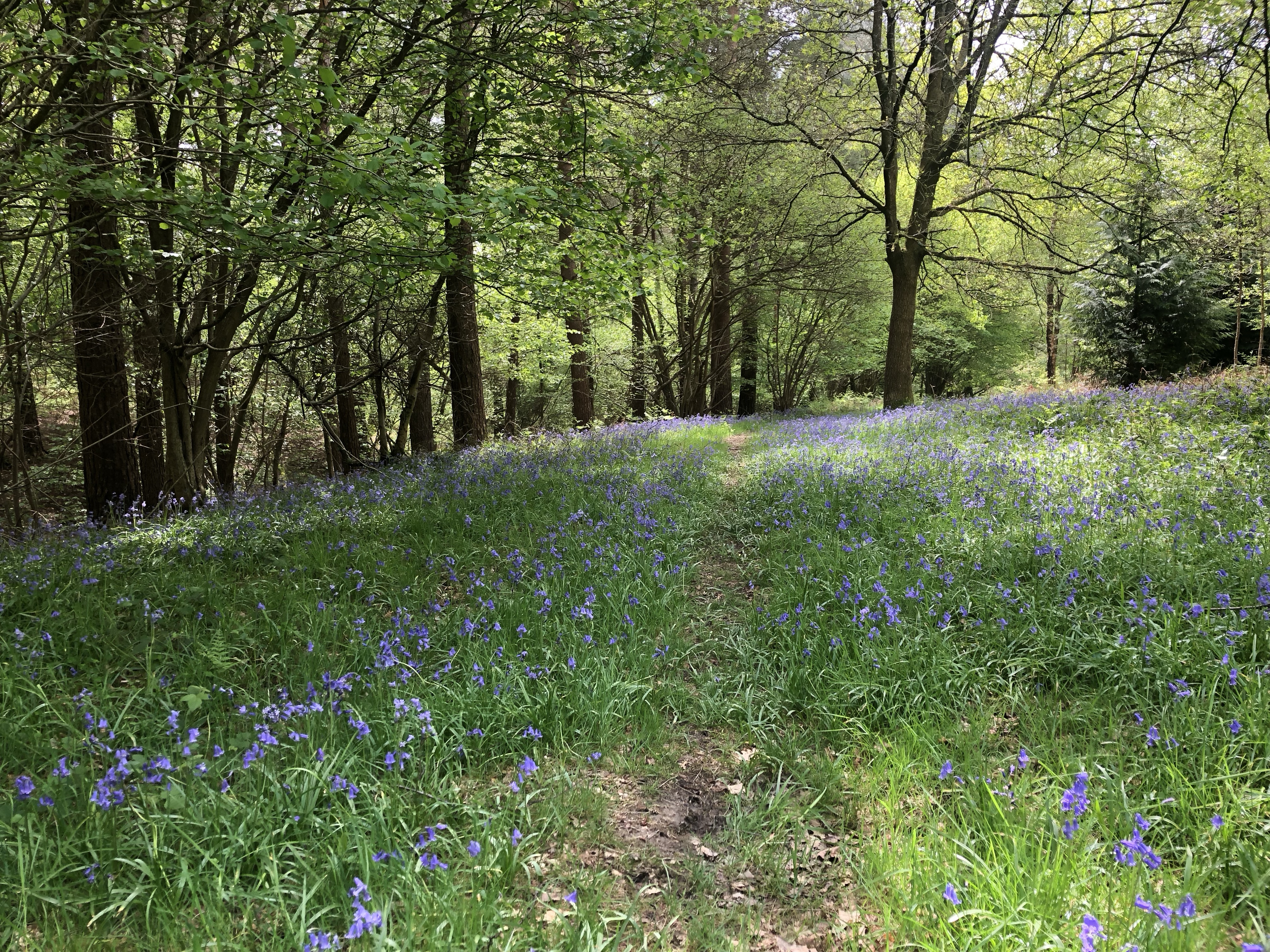
I had a couple of hours between lessons this afternoon, so I took myself for a wander through the estate. I found a toad beneath the remnants of a tarpaulin from the old forest school I used to run three years ago, and a merry carpet of bluebells in their dying days followed me to the deepwoods where a chalk stream gurgles southward on its journey to the sea. A silent pool of rainwater sparked into life as the sun came down, drawing three tadpoles into its warm gaze. Chiffchaffs sang at various intervals, and somewhere overhead, unseen, a buzzard mewed. I didn’t hear our ravens today, but I often do.
The druids were onto something. There really is a medicine in the woods. If only the whole world could see it! BB x
Further Reading:
What is plant blindness? (Kew Royal Botanic Gardens)
Do you suffer from plant blindess? Jon Moses, 5th April 2023




 The Book of Barnabas