Smoke Signals

Aeropuerto De Santiago – Rosalía De Castro. 14.40.

I’m back at Santiago’s very small, very civilised airport. It’s another five hours until my flight, but Galician weather is highly unpredictable and I didn’t fancy making the three-hour hike to the airport under a belt of rain clouds, so I forked out a euro and caught the bus instead. On the plus side, it gives me plenty of time to read and rest – tomorrow will involve no small amount of walking, so it’s best I don’t wear out my feet just yet.

There’s a WHSmith in the departures lounge. I wonder how much longer that outpost is for this world, and others scattered in airports across the world, now that the dependable newsagents is going under, just like Woolworths before it.


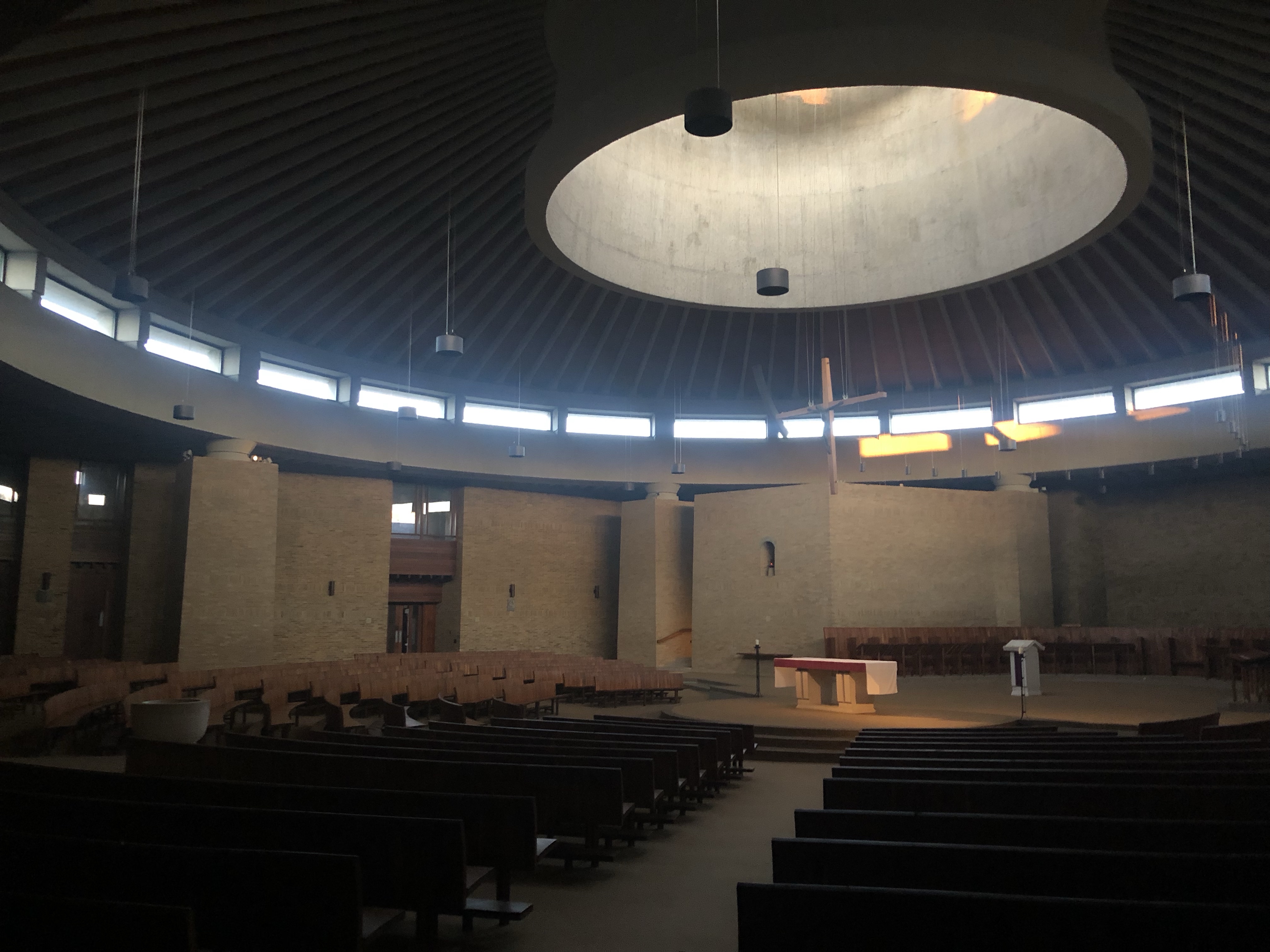
I only just made it to the 19.30 pilgrim Mass in the cathedral of Santiago last night – it took me a little longer than I anticipated to track down the books I was looking for. There was a queue outside the door, and when I was a few metres from the great doors, an attendant in a high-vis orange jacket announced that visits were now over for the day – unless, of course, we were queuing for the Mass. That thinned some of the line, but even so, it was standing room only this time… not the front row seats I enjoyed at the end of the Camino in 2023.

The reason for the crush became apparent in the last few minutes of the Mass, when a group of eight priests in burgundy cassocks approached the enormous knotted rope securing the botafumeiro, Santiago’s famously huge incense burner and, with one collective tug, began to hoist the thing into the air.


Weighing in at 80kg and measuring an impressive 1.93m in height, the botafumeiro of Santiago is one of the largest in the world, outsized only by the Christendom College censer in Virginia (because of course the Americans, not satisfied with an imitation, had to have a bigger one). Unlike its American cousin, however, the botafumeiro is more than just a showpiece. The reason for its size was to purify the air within the cathedral and thus cover up the smell of the pilgrims, who must have stunk to high heaven in the centuries before Jacotrans, Booking.com and Compede blister plasters.

The botafumeiro you see today has been in use since 1851. The original, a 15th century thurible of solid silver, was stolen by French troops in the Spanish War of Independence and supposedly melted down for coinage. This and other acts of vandalism marked the French occupation, which saw many monasteries and Roman bridges destroyed in the name of military strategy. A local legend holds that the Alhambra was nearly blown to pieces on Napoleon’s orders as the French lost their grip on Spain, spared only by the efforts of a single French soldier who had a change of heart and stayed behind to defuse the charges, saving the last remaining medieval Islamic palace in the world from being lost forever.
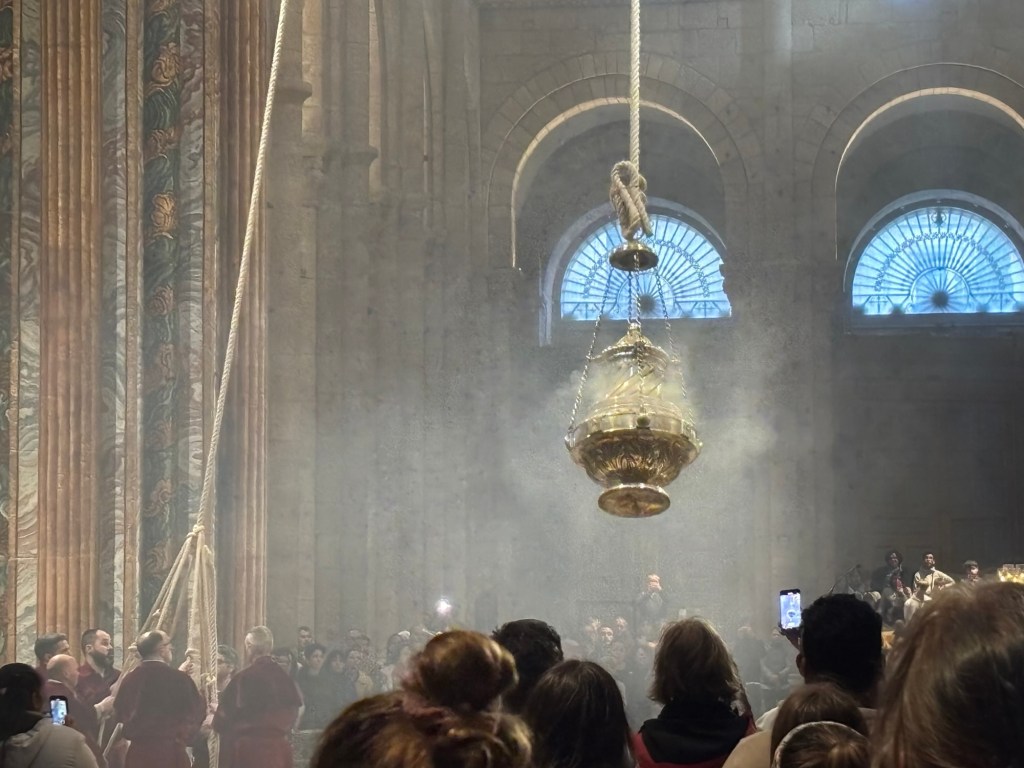

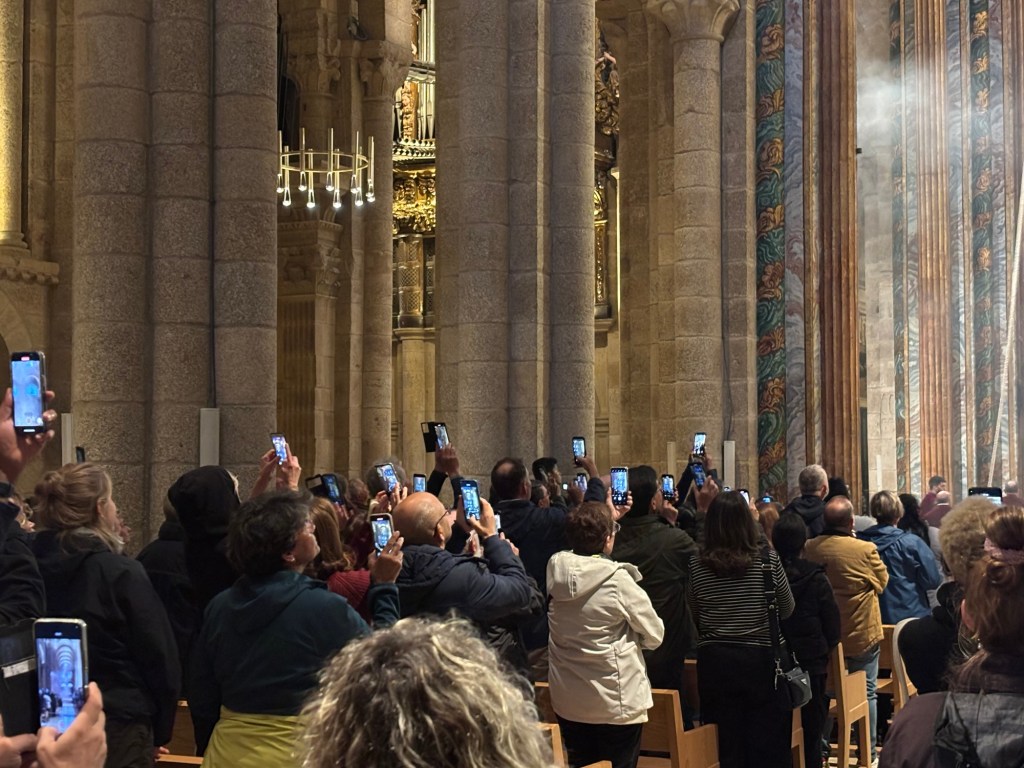
The botafumeiro swings alarmingly low over the heads of the faithful, reaching a top speed of 68km per hour, though never low enough to catch the heads of even the tallest German pilgrims. It’s quite a special sight, because its presence isn’t guaranteed: it’s usually only brought out on holy days, such as Easter Sunday or the Feast of Santiago on the 25th July. I missed it last time as I set out for the coast on the 25th, hoping to beat the crowds that would follow.

There is a small chance, however, that your visit may coincide with the whim of this or that religious order (or wealthy pilgrim), who can pay a certain amount of money to have the censer brought out especially for their arrival. This time I got lucky: a confraternity had traveled all the way from Goa to celebrate Mass in Santiago, so the botafumeiro was brought out. Lucky me!

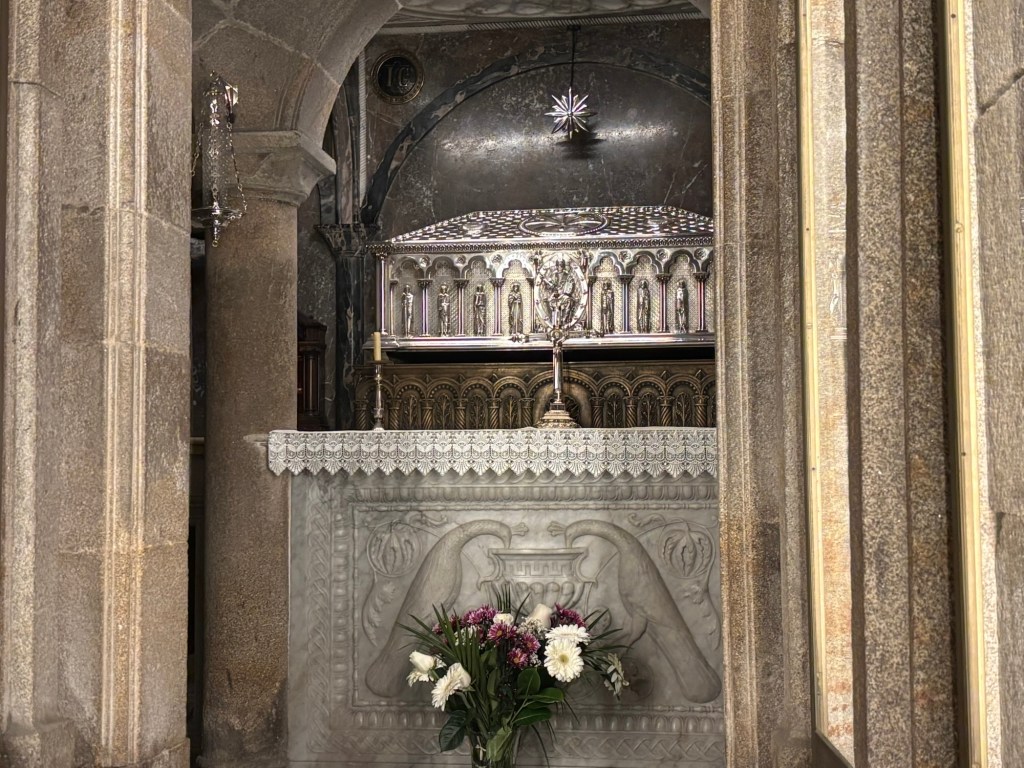
After three visits to the cathedral without paying my respects to the true purpose of the Camino, I decided to make one last trip to see the tomb of Santiago himself. The first of Christ’s apostles to be martyred for his faith, Santiago el Mayor (or Saint James the Greater, if you prefer) was beheaded on the orders of Herod Agrippa. His head was buried near the spot where he was killed (now beneath the Armenian Cathedral of Saint James in Jerusalem) but his body is believed to have been transported to the Galician coast, where his remains were discovered – as they so often are – by a hermit in the woods, who saw a great light shining upon a forgotten Roman tomb.

The veracity of the legend is irrelevant: word got around and soon the final resting place of Santiago had become the most important pilgrimage site in all of Christendom. That it just so happened to coincide with a time when the Christian kingdoms in the north were desperately seeking a rallying flag to counter the Muslim forces who had taken the Iberian peninsula by storm (and the angels believe to aid them in battle) is curious, to say the least.

Santiago’s tomb is a small silver coffin, located in a crypt beneath the central altar. The eighty-strong Portuguese school trip group that I had fallen behind weren’t all that interested in the bones of Jesus’ most faithful apostle, busying themselves repeating lines from Portuguese trap songs and stealing kisses from their girlfriends in the shadows, so I had plenty of time to stop and admire the coffin undisturbed.

I was lucky to get in when I did: by the time I left via the north door, the queue to get in stretched for nearly two hundred metres around the side of the cathedral. Pro tip: get in early, or just after Mass, when the queues are at their thinnest!


I had a quick bocadillo lunch in the old town and packed my things, thinking to spend a few sunny hours in the Parque de Alameda, but I was distracted en route by the sound of shouts and firecrackers. Doubling back, I found an advance guard of local police cordoning off the Avenida de Xoán Carlos I, and behind them, an enormous crowd of youths dressed mostly in black, carrying flags, placards and loudhalers.

I could have guessed what they were going to be protesting about, and my guess would have been on the money – after all, it’s a sore tooth Spain has been nursing for several years now: the housing crisis.


The short explanation? Spain’s housing market is a shambles. By some estimates, the cost of renting a property has gone up by 78% in the last decade, driven by rampant speculation and unrestricted vulture funds. Put simply, the average Spaniard now finds it very difficult (if not impossible) to find an affordable place to live, especially in the areas most popular with tourists. This is a country where flat-sharing websites like Idealista and Easypiso hold sway: AirBnB and its kin have made Spain a tough place to buy.

This has been most keenly felt in Barcelona and the Balearics, where many properties are vacant for large parts of the year, occupied only during the summer months by foreign investors. It’s one of a number of factors forcing Spaniards to live at home with their parents well into their twenties (or even thirties), and driving others to seek their fortune elsewhere. It’s also why I’m making a point of staying in pensiones wherever I go – a far older and more sustainable method of supporting the local economy as I travel.


There’s an even more sinister side-effect of the housing crisis in cities like Barcelona. I’m referring to the okupas, or the occupation of properties by gangs and other drug-related agencies who turn vacant holiday homes into drug dens, known here as narcopisos. The shady legal status of squatters in Spain, which makes it very hard to evict without the proper authority, doesn’t help matters at all.

Yes, A Place in the Sun and your kind – this is partly your fault. By encouraging the buying and selling (and re-selling) of property along the coast, you are driving the locals out of town faster than the local wildlife was displaced before them.
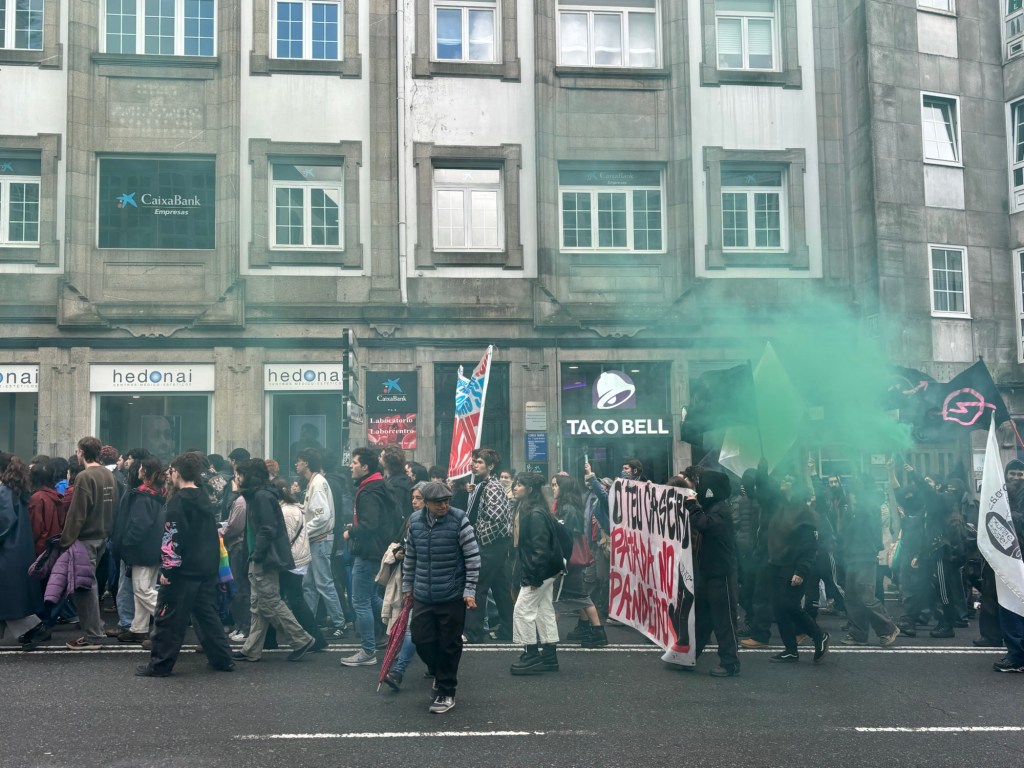

Naturally, it’s Spain’s youth who are taking the brunt of this crisis – and so, quite naturally, they’re the ones taking to the streets in large numbers to complain about it. Pedro Sánchez, Spain’s Prime Minister, has attempted to address the problem by proposing a ban or even a supertax on foreign buyers, but in the regions that depend the most on tourist dollars like Andalucía and the Costa Brava, that will be a very bitter pill to swallow. So, for now, Spain will have to muddle through these murky waters until a more universal solution can be found.


The protesters marched on up the avenue, followed closely by the police and their van, carrying their riot helmets at their hips. Some of the protesters threw petards into the road as they passed. Others lit flares. I watched them go and returned to the park.

Similar protests are taking place all across Spain today. I wonder if it will come to a head? It’s hard to say, but it is fascinating to be here on the ground while it’s all going down. It isn’t often that you get to live through history in the making, especially when it’s something you teach (manifestaciones is one of the tried-and-true A Level Spanish topics).

This. This is why I travel.
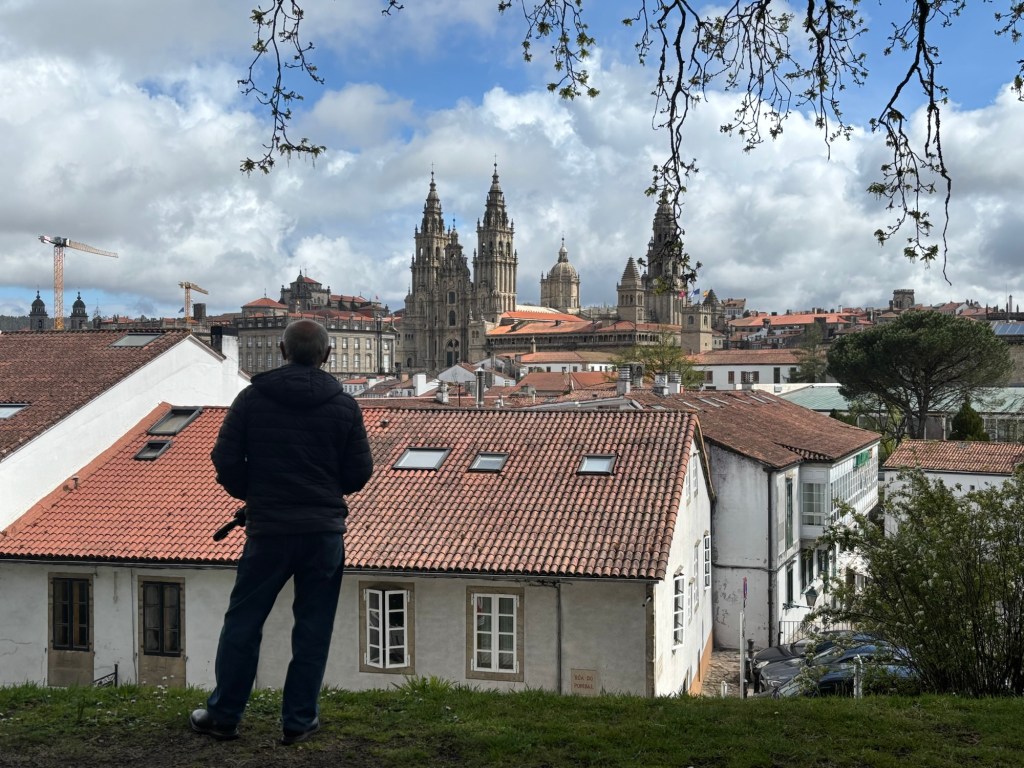

The smoking incense of Santiago’s botafumeiro was meant to cover up the stink of something rotten. Seeing the smoking flares of the protesters as the police escort them through the city, I can’t help but note the connection.

I’ll keep you posted if I hear or see anything else. I trust this isn’t the last we’ll hear of it. BB x
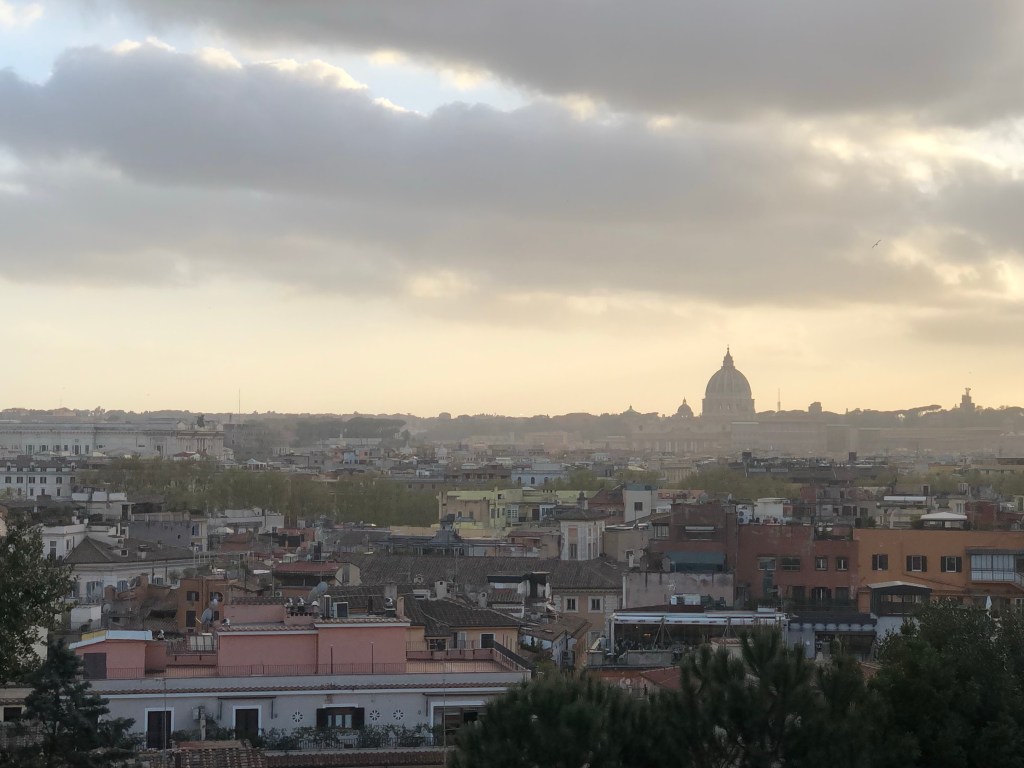
Rome IV: Popes & Palms

Bloody hell, but that was unnecessarily early start. The trip to Fiumicino Airport (8€ on the shuttle bus from Via Crescenzio 2) was on time and completely hassle-free, so I arrived with four hours to go until my flight – a new record in caution. Still, better early than late! It gives me time to relax and put yesterday morning into words.


All I can say to start with is believe in your own luck for a change. Because Sunday morning’s adventure wouldn’t have happened at all if I hadn’t taken a chance.

One of the main reasons I came to Rome and stayed until this morning was because of the very real chance of seeing the Pope deliver his Palm Sunday Mass in St Peter’s Square. That’s not the kind of opportunity you pass up on if you can help it. Unfortunately, the information on the internet is vague, conflicting and genuinely quite hard to track down. Most of it implies you need to apply for a ticket directly to the Vatican via fax (!!), sometimes as early as three months in advance, to be in with a chance of securing a “coveted” ticket. At least, that’s what all the tour companies say. By Saturday night, I’d more or less given up on the whole affair and planned to go for a morning walk down the Via Appia instead.

Turns out the internet is wrong. So here’s me setting the record straight.

Contrary to what you may find online, you do not need a ticket to attend the Palm Sunday service in the Vatican City. It’s free and there’s no need to book!!!

I rocked up in my casual clothes with my picnic packed for the Via Appia and thought I’d check to see what was going on in VC and before I knew what I was doing I’d followed a whim and chanced the security barriers. They scanned my bag, found only a punnet of olives, a punnet of strawberries, breadsticks and some other snacks… and let me pass.

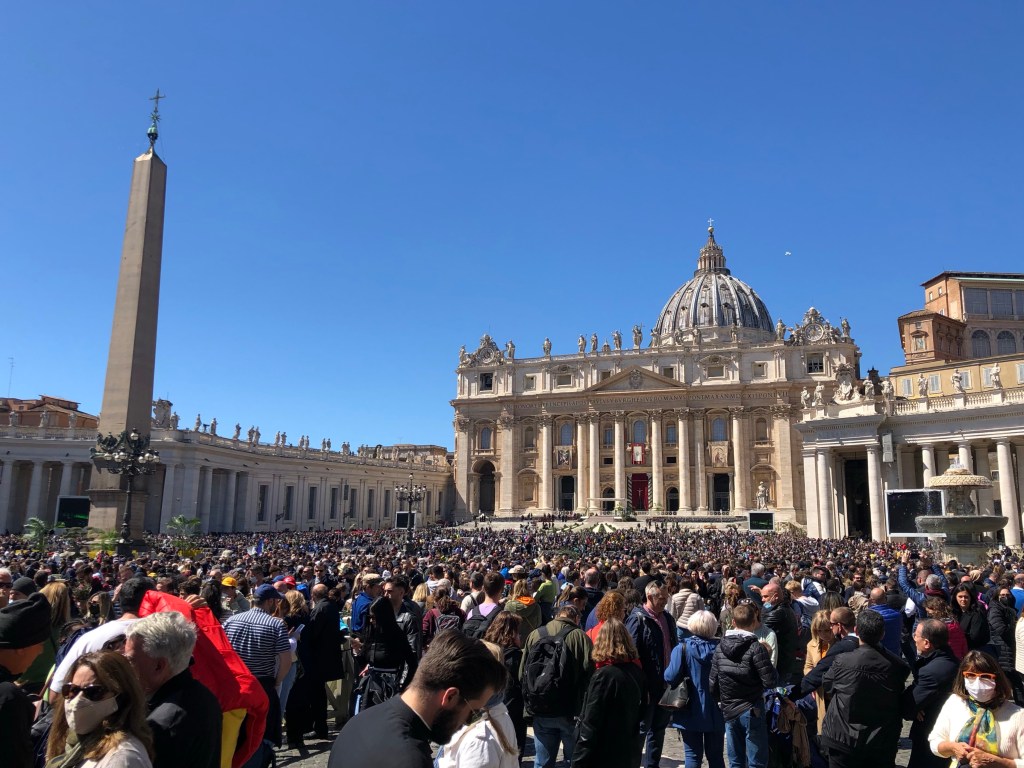
As it was still only 8.20am, St. Peter’s Square was still relatively empty. Thousands of chairs had been set up overnight, along with the temporary barriers raised around the central obelisk and the wind rose, but other than a small crowd settling into the first block of seats the pickings were good. I found a seat near the front of the second block, just two rows back from the barrier and strategically positioned behind two families who’d put their children in the seats directly in front, giving me a perfect view over their heads to the Papal seat. If I’d planned to come I could have arrived sooner and snagged the best seats in the house, but for a spur-of-the-moment decision I really lucked out.

By the time the warm-up Ave Marias were being chanted (in Italian, the real lingua franca of the Vatican), the seats on either side of me had been taken: by a diminutive group of Indian nuns on my right and a large Eurasian woman and her daughter on my left. I would have been squashed throughout the service had the nuns not seen on one of the telescreens that there were still five empty seats in the front block and gone charging off for a better seat, and my other neighbour left during the Communion after realising she was holding up the entire row by being the only one not going up for communion. By the end of the service, I had more room than I knew what to do with!

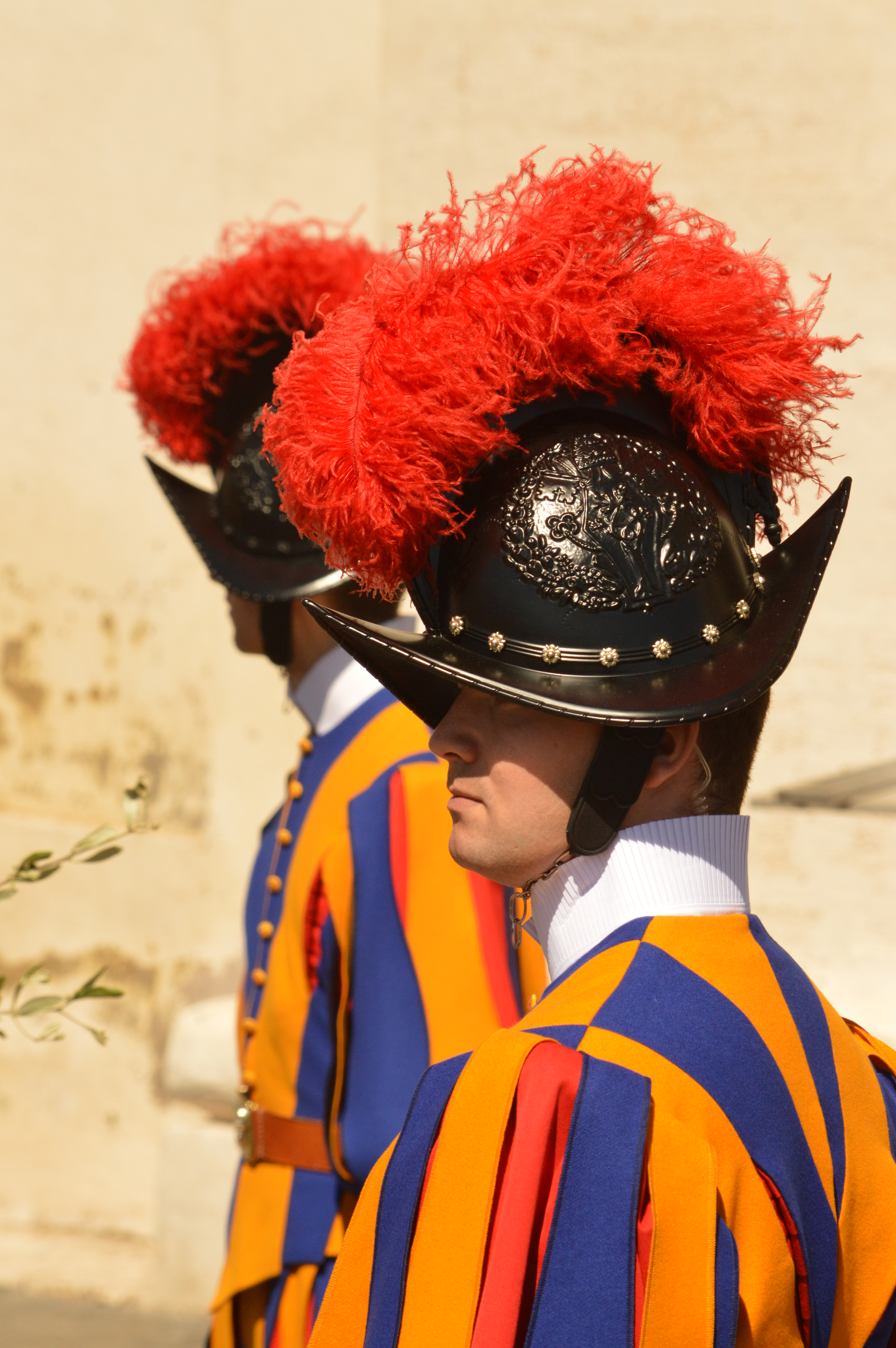
The Swiss Guard were quite a sight to see in their full regalia: plumed morion helmets, black capes worn about their landsknecht-esque striped uniforms and, at least in the hands of those guarding the cardinals’ seating area, impressive halberds, their tips flashing in the sun. I’m not sure if they’re more visible if you take a walk through St Peter’s basilica or the Musei Vaticani, but I certainly hadn’t seen them until now, so it was worth coming even if only for that!

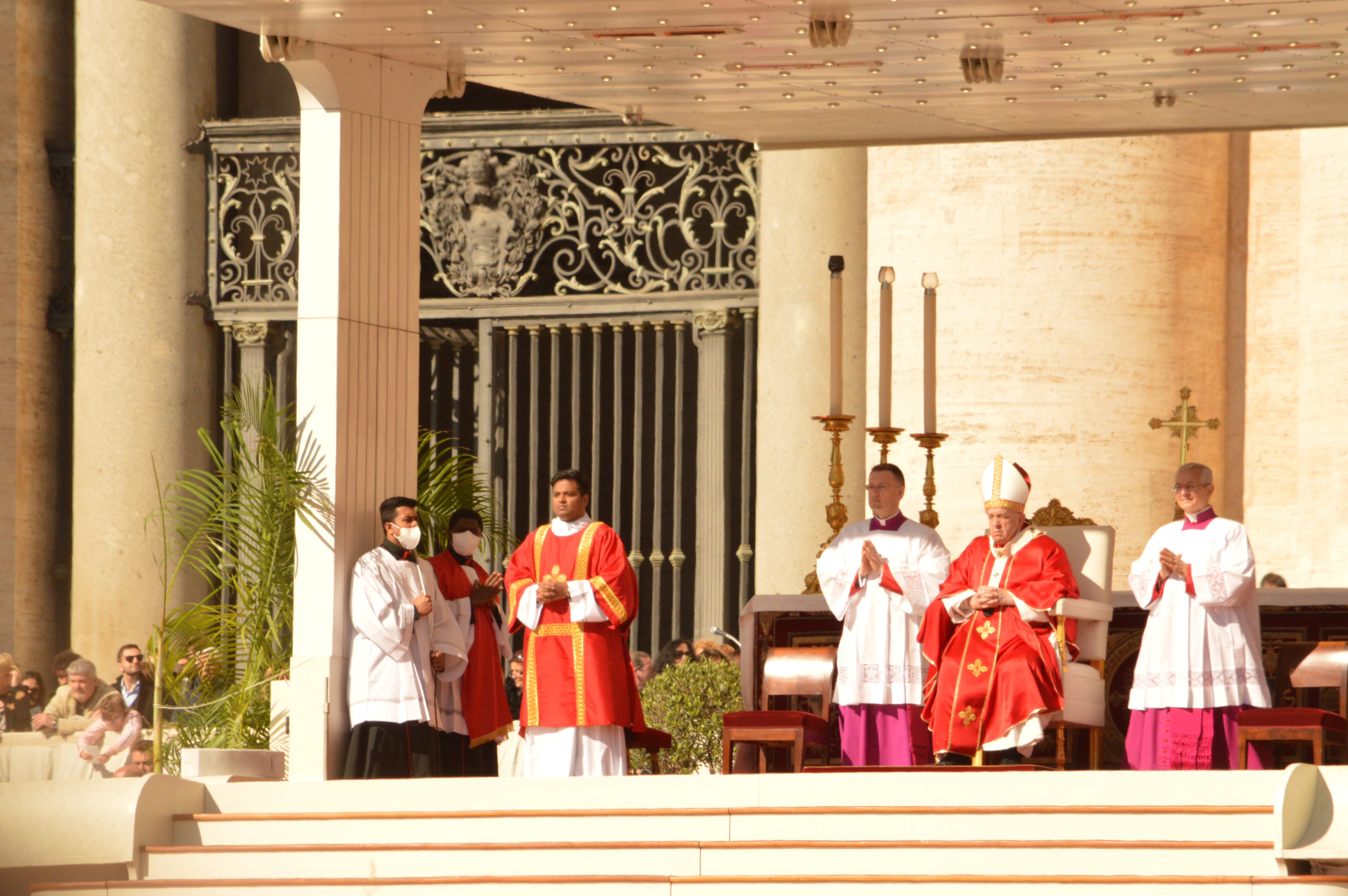
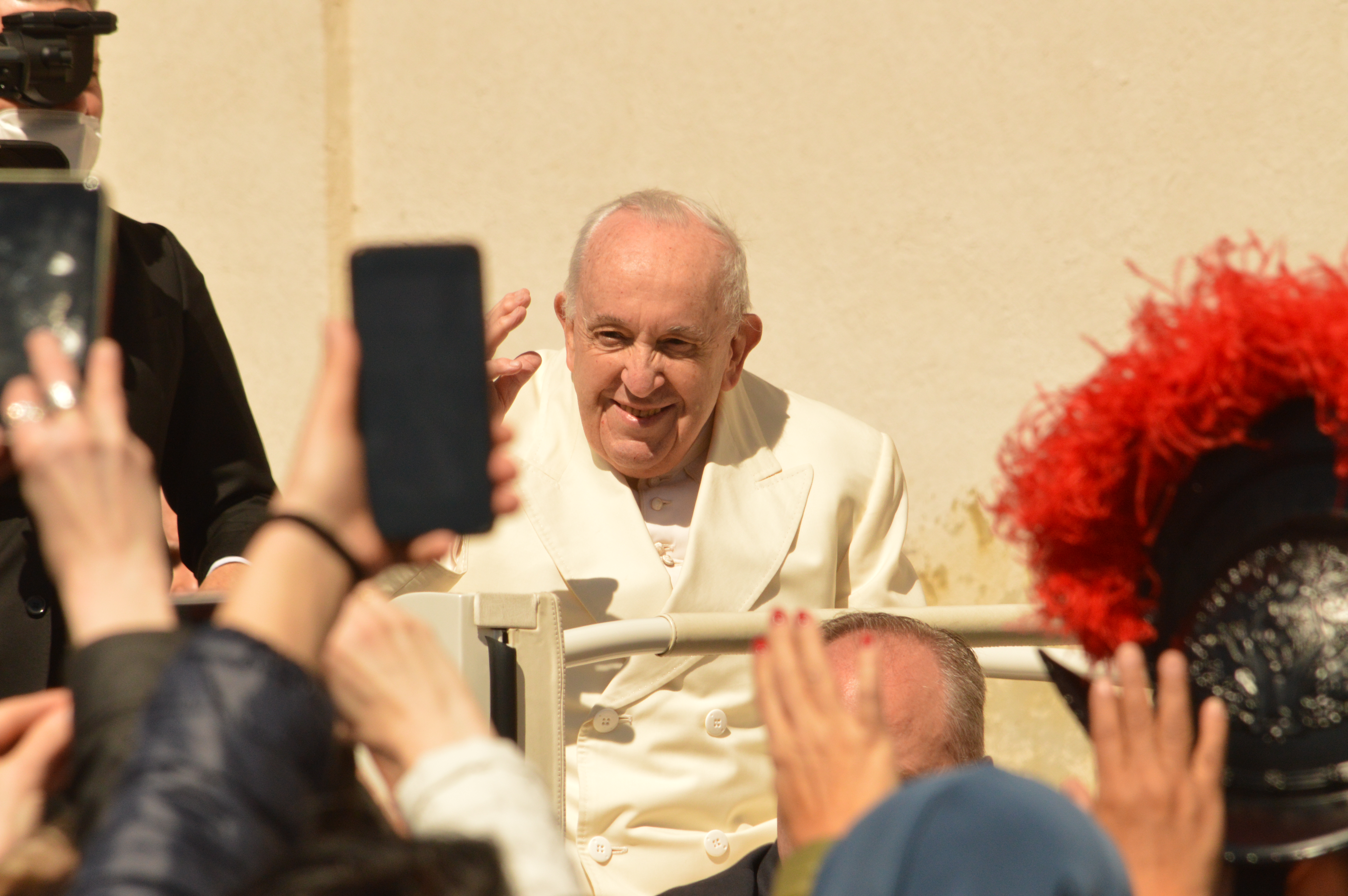
And of course, Pope Francis himself, dressed in regal red until the end of the service. Since my wanderings tend to take me off the beaten track, the list of famous people I’ve encountered is downright pitiful, but this has got to rank right up at the top – like Pope Francis did in 2013’s Time Magazine. Seeing the warm smile of the humble head of the Catholic Church at such close quarters was a once-in-a-lifetime event, truly… I couldn’t help taking up the cry of ‘¡Viva el Papa!’ raised by the Colombian family in front of me. His humility is what makes him so inspirational to me – that a man in so important a position should have no qualms making apologies for centuries-old abuses of power by his institution, or reject the majesty of status outright while still holding true to the core values of the church. I might not have gone to such lengths for a different Pope, but for Francis, my feelings were genuine. What an inspiration!

I’ve also never seen a Palm Sunday service quite like it. Multilingual (there were readings in Spanish, English, French, Portuguese, Mandarin and Malayan, as well as Italian) and multifaceted: the song of Jesus’ arrest by Pilate and his Passion was performed by various cantors with the full choir as the voice of the crowd. Faith through storytelling through song… now that’s more like it! It was like watching a passion play of old – and in a very real sense, I suppose that’s exactly what it was. They’ve been doing the same thing here in this square for well over a thousand years.

The Pope ended the service with a reminder to care for the poor – ever at the heart of his urbi et orbi message. When I left, I saw that in the merry exodus from the square, some misguided pilgrims had smashed right through a street vendors’ wares, knocking them in all directions. As I approached, several strangers gathered round to help the man set his little stall back to rights. Just as there are those who profess to do good and look no further than their own backyards, so too are there people out there prepared to help their fellow man, whoever that may be. That gives me hope. To quote a famous film set in and around the Vatican City:

Religion is flawed, but only because man is flawed.

Dan Brown, Angels and Demons

I’ve made it to the pueblo and a much-needed week with my cousins. It’s been fun wrangling with Italian, but these lips were meant for speaking castellano, hombre. Until next time! BB x

Keep the Faith

Last night, in a return to pre-COVID tradition, we celebrated Tenebrae in the Abbey Church. With the latest wave of infections sweeping the staff and students, I’ll admit I had my doubts I’d be able to go up and sing as I used to with a house to run, but my housemaster very kindly stepped in, allowing me to bolster the tenor line. It’s hard to overstate the importance of making music in my faith: singing is an act of worship. Perhaps that’s why I didn’t go to Mass when the churches opened last year, while the ban on singing was still in place – how could I practice my faith without lips to speak? I remember saying as much to one of the school’s youth chaplains once, who remarked that I ought to rethink my approach to faith. Was he right? I don’t think so. I think everyone’s path to God is individual. Mine just happens to be through music, which, all things considered, is hardly surprising.

I spent a great deal of my childhood in and out of churches. My mother played the organ for the village church when I was very young, and I remember sitting (probably not so quietly) next to the pedals, listening to the growling hum of the organ long after the last notes faded into the stone walls. Later, during my short spell at a prep school, I spent two nights a week up in the organ loft of Canterbury Cathedral while my father sang for the cathedral choir. What was undoubtedly an incredible privilege became routine – that is, until a Victorian-minded parishioner who happened to look up one week decided that children were better “seen and not heard” and my brother and I were unceremoniously ousted, forced to sit in the quire thereafter.

Perhaps that was God’s will, because twenty years later, I still jump at the chance to stand in just such a stall and tangle with some sacred music. There’s really nothing quite like it.

I have a somewhat unorthodox relationship with God. If it were a Facebook status, I might just go for “It’s complicated”. Somewhere deep within, my spiritual compass spins toward Israel. Maybe it’s the stories my mother brought me up with or the belief we both share that our ancestors were among the many thousands of Spain’s Jews who converted to hide from the Inquisition, many hundreds of years ago. It would go some way towards explaining the ferocious proclivity for the arts borne across the generations by my ancestors, at a time when intellectualism was unwise and even dangerous. Millán-Astray’s battle cry of “muera la inteligencia” in 1936 – around about the time my grandfather was born – hardly seems out of place for a country where, for hundreds of years, it was better to hacer mala letra than open your mouth and betray your wits. Our own Michael Gove gave us an uncomfortable reminder of this dark past when he claimed the British had “had enough of experts” in the lead-up to Brexit.

I can hold my head up high every day as a teacher knowing that I am the next in a long line of teachers, all of whom dabbled in music and poetry and art. Were they really Jews, though? I’d like to think so – I really would – but I have no proof of that. I have barely enough solid proof of my connection to my grandfather, never mind a connection to a Hebrew ancestry that may or may not have ever existed. The silver Star of David I sometimes wear beneath my suit is no heirloom, but rather a keepsake from a Jewish silversmith in Cordoba; a reminder of the terrible fate suffered by the Chosen People in a land far from home that was once their paradise. Will I ever know for sure? I doubt it. But some things you see with your eyes, others with your heart. This is one of those things the heart sees. Something you have always known or believed with little to no provocation. I believe because I cannot be sure. It’s the weakest of arguments, the merest of threads. But about such threads, Faiths are often weaved into being.

So why am I a Catholic? With such silent conviction, how can I stand there in the darkness, singing Christian verses and watching the candles going out to mark the extinguishing of Jesus’ light and life from the world, a little under two thousand years ago?

I am a Catholic because I would make the same journey as my family. Whether or not my ancestors found their way to the Christian God through awe or terror, I would take that road that they took. And there is something fundamentally grounding about faith. Standing as one with my students and singing songs that have been sung for hundreds of years… you feel a power, there, echoing down the generations. It’s all the more powerful when you see the date at the top of the copy reaching back to the middle ages. One imagines one’s voice reaching up to the heavens and mingling with the voices of those who came before you on its journey across the stars. Perhaps that’s what the choir of Heaven is: the echo of thousands of years of collective prayer through song. I’d like that.

I might also point out that the Catholic church represents an important bastion against the foe, since modern Christian music is, to my ears, quite possibly the wettest, most uninspiring drivel ever produced. It clearly works wonders for some, but it does nothing for me. Give me plainchant any day. A colleague once joked that one of his greatest fears was that he should reach the pearly gates only to find that Mozart and his kin are nowhere to be found, and Hillsong reigns triumphant. It’s a joke (and a nightmare) I share. But that’s a story for another time.

I am also a Catholic because Faith is a journey of forgiveness. Noli mortem peccatoris. Those were the words of power that spoke to me last night, as the last of the candles were snuffed out. I do not want the death of the wicked. I bear no ill will against those shadows who persecuted my people, because there is too much hate in the world already. I wept on the shores of the Dead Sea years ago at the sight of the sun going down over the Holy Land, knowing I was not yet ready to see it with my own eyes. Jerusalem evades me still: the last time I tried to make that journey, a little hiccup called Covid-19 came thundering in.

Finally, I am a Catholic because of what it stands for. Katholikos. Universal. It chimes with me in much the same way that the Arabic expression ahl al-Kitaab – people of the book – called out to me in my Arabic studies, many years ago. The world is immense and no two people are the same, and I think it’s as foolish to expect everyone to share the same faith as it is to expect to find two identical grains of sand on a beach: the closer you look, the more you’ll find yourself doubting. But I have built my faith upon doubt rather than surety, because that, to me, is what faith is all about. Believing in the light when all the world is darkness because your heart tells you to do so. Fate may be the master builder of the temples of our lives, but hope is the cement that holds the stones together. I believe in that light and in that hope. And in my heart I know I would go on hoping, though every light in the world were extinguished as they were last night, one by one.

In three days’ time I set out for Italy on my first solo adventure in a long time. Venice will inspire, no doubt, but it’s Rome I’m especially excited to see. I hope I can catch some music there during my stay. I could use some of that ancient magic after what has been quite a long term. BB x

Quote Unquote: ORIGIN by Dan Brown

Image result for origin dan brown

This week’s attempt at escapism was even lazier than usual, since it required no actual reading on my part but rather dipping in and out of the Audible app on my phone during the emptier moments of the day. You might call it “tactical” escapism, though I suspect it’s still just another tired synonym for procrastination. This week I decided to go for a writer I have somehow managed not to read thus far, that being Dan Brown, author of the best-selling Da Vinci Code. What can I say? The film came out before I got around to reading the book, and Dan Brown doesn’t exactly cut to the chase. Origin, one of his more recent works, does not yet have a film adaptation in the works, so it was one that had to be read. The fact that it takes place in Spain had nothing to do with it.

And on that humongous white lie, let’s dive in. Oh, and before you read on, I might add ***SPOILER ALERT***  (because it’s not an easy book to pick apart without giving away some pretty critical spoilers).


If you’ve read/seen The Da Vinci Code or Angels and Demons, you’ll already be familiar with Brown’s clever plots. Expect the same in Origin. In fact, expect a lot of what you’ve seen before: a highly suspicious bishop, a strong, silent-type hit-man with an agenda, a glamorous female sidekick, a mind-blowing secret that you have to wait until the end to discover, and Doctor Who levels of sci-fi explanation. Edmond Kirsch, a billionaire futurist and Elon Musk by another name (Musk even gets a nod at one point), announces to the world that he is going to change what it means to be human (another moment Doctor Who fans might be familiar with), but is shot by a hidden assassin before he can make his ground-breaking reveal. It’s up to Robert Langdon, Kirsch’s one-time mentor, and the director of the Guggenheim Museum and future queen of Spain, Ambra Vidal, to finish the job, racing against the clock to deliver Kirsch’s discovery to the world. Perhaps the most interesting feature of the novel is Kirsch’s supercomputer, a sentient AI known as Winston, who guides the protagonists towards their goal with godlike success.

I’ll admit, I expected a little more from Origin than I got. I wasn’t actually all that bothered by the familiarity of the storyline, but for a book dealing with religion on Spanish soil, I couldn’t help feeling a little disappointed when the Muslim and Jewish characters were killed off early on and nothing was made of this. Fair enough, Spain is a primarily Catholic country, but Angels and Demons made such an exciting use of the spectre of the Illuminati that I went into Origin expecting some dark vestige of Spain’s bloody history to raise its head. Instead we got the Palmarian Church – an innovative introduction to most of us, but given its role in the story, hardly the most threatening or thought-provoking of obstacles. All the same, I enjoyed Brown’s modern, pop-culture-imbued writing style, as it is so far-removed from my usual material, which I am increasingly coming to see as verbose and out of touch (though the travel writings and adventure novels of the late 1800s and early 1900s will always hold a position of glory in my heart for the lexical skill of their writers).

I haven’t mentioned the role played by the Royal Family of Spain, largely because it is so insignificant to the main plot that it might as well have been a soap opera flickering away on a TV in the background. The ghost of Franco was conjured up – but for just a moment. Barcelona loomed into view – but nothing was made of the Catalans. The Spanish Inquisition was mentioned several times, and a terrorist attack on Spanish soil was explicitly detailed – but there was only ever one religion truly under fire all along. Brown has always been good at misdirection in his plots, and he was subverting expectations in Origin like Rian Johnson did with the new Star Wars movies.

The big reveal? Not as mind-blowing as I anticipated, I guess – but then, Kirsch set the stakes very high. When the truth came out at the end, I was surprised it unsettled the Parliament of the World’s Religions so much that they considered prematurely sabotaging his discovery before it could go public. I’m not all that firm a believer myself, but I didn’t find myself questioning my faith once: Kirsch’s expositions on the seventh kingdom and the origins of mankind were insightful, but not exactly earth-shattering. By this point in our history, a future where we share the world with, or perhaps even cede it to the silent sentience of artificial intelligence is more or less inevitable. What started out as a plot device for a 1970s sci-fi nightmare is now almost a matter of fact. My question is, why should that kind of knowledge shake the foundations of the faithful?

My journey with Catholicism is still in its infancy. That comes from growing up in a country which threw off the “shackles of the papacy” a long, long time ago. Though I live and work in a Catholic enclave, it is precisely that, an enclave. It’s easy to forget that, beyond the bubble, most of my countrymen don’t go to Mass on a Sunday, meatless Fridays aren’t the norm, and many of the rules and expectations that seem so normal seem out of date if not alien. Everybody has their own take on their own religion. For me, it’s a family affair. It’s my way of reaching out to my grandfather, a man I never knew, and to my cousins, uncles and aunts in Spain. It’s a way of sharing in that rich and beautiful legacy of ages. Futurists and scientists like Brown’s Edmond Kirsch take great delight in tearing down the temples of the ancients, but what are they doing if not building glass temples of their own in their stead, just as humans have delighted in doing for all time? Religion isn’t about rules and false truths. It’s about love.

My experiences as a student at a Kent grammar school, where daggers-drawn atheism was almost a state religion, actually gave me more of an appetite for a faith of my own. Ironically, my highly opinionated contemporaries pushed me towards God more readily than any beaming, hot-chocolate touting, guitar-strumming Christian Union friends ever did. I suppose what I objected to more than blind faith and the endless four-chord songs about some heavily distorted Western Jesus was the hostile rejection of hope, which has ever been my most treasured of core values (there’s a modern buzzword if ever there were one). And yes, in case it isn’t clear already, modern Christianity and I aren’t exactly a match made in heaven. Somebody once put it to me that Christian music adapted to suit a modern audience. Call me old-fashioned, but I’d take a hymnbook over guitar worship any day. I appreciate the staggering irony in that statement as a devotee of Gospel music, and I’m afraid I’ll have to hold up my hand as an all-too-human hypocrite on that count. For me, Gospel music has never been about a white Jesus who loves everybody, rather about bridging the gap between worlds and reveling in the rage, the sadness and the hope together with the joy of faith. Because that’s what faith is: perseverance in the face of insurmountable adversity. Kirsch, like many characters from my own past, went head to head with the world’s believers with a smug smile, believing he could sweep away the dark religions so that sweet science could reign. In doing so, he betrays his humanity: there are many for whom the most bitter of blows fall like rain upon their faith. Faith is not founded on facts. It comes from a deeper well.

I am one of those for whom the great questions – where do we come from? Where are we going? – have never held all that much interest. For most of our history, mankind has sought to make itself master of all things, seeking the logic and the reason behind everything in an attempt to bend it to his will, to subjugate it, for knowledge is power. And while I love to learn new things, I am no Kirsch. For me, the real beauty of faith is in the great mystery. There are some things that will forever be beyond my understanding. And I’m ok with that. It’s not so much “Jesus, take the wheel”. It’s more of a “I’m mysterious, folks. Deal with it.” Sometimes – as Rowan Atkinson’s character says in the 2005 film Keeping Mum – all we need is a little grace.


Favourite scene:

The chase scene in the Sagrada Familia was pretty spectacular. Brown knows how to pick a good setting, that’s for sure. There’s always something terrifying about the idea of fleeing from a searchlight – some “flight” instinct, buried deep, from a time before flashlights when we ran, ducked and weaved to get out of eyesight of predators who were after our blood, perhaps. Those were always the levels in video-games that scared me the most (Zelda: Wind WakerMetroid Fusion, Harry Potter etc). I digress. Brown’s assassin had a gun and had just killed a man with his bare hands, but that torch in his hands was his most frightening weapon by far. To survive, Langdon and Vidal had to keep in the shadows. Add that to their escape taking place within a cathedral as bizarre and unorthodox as the Sagrada Familia and it makes for a truly terrifying pursuit.


Favourite character:

Winston is far and away the standout success in Origin. Think HAL voiced by Stephen Fry. Educated, intelligent and eerily human, Winston is immediately likable from his first appearance. In fact, I found him such an interesting character that I felt a real sense of loss when Langdon and Vidal lost contact with him at a certain point in the narrative. I had my suspicions about the whole monte@iglesia affair, but the twist that he was the mastermind behind it all hit me like a sucker punch. I didn’t stop liking him for it. In fact, I found him an even more interesting character by far. And that recurring trait of his awkward laugh was a stroke of genius: endearing in its first appearance, terrifying in its last. Origin could be criticised for being a recycling of Brown’s old plots, but his Oxford-educated HAL makes it worth every page.


Favourite Quotes:

“The devout can always benefit from listening to non-believers. It is in hearing the voice of the Devil that we can better appreciate the voice of God.”

Zeus, more than any other god, resisted his own extinction, mounting a violent battle against the dying of his own light, precisely as had the earlier gods Zeus had replaced.

“I’ve been taking confessions for fifty years. I know a lie when I hear one.”

img_4392

Holy Gridlock, Batman!

I remember saying a couple of days ago that I was going to take it easy and travel less this year, beginning with Semana Santa. Predictably, that failed almost as soon as the words left my mouth. I’m now sitting at ease on the balcony of a cute little hostel in Córdoba, having spent the last four days traveling in a large triangle around Andalucía, from Matalascañas to the Great Mosque. It’s the Easter equivalent of last term’s ‘square puente’ to Lisbon, Aveiro and Salamanca. Only this time, I’m not alone, and it’s been a barrel of laughs from start to finish.

I’ve told you about El Rocío. Let’s start with Seville. Seville is one of those cities that I’ve always thought rather overrated. It’s the Spanish equivalent of Frozen; people come back from it raving about what they’ve seen to such an extent that by the time you get around to going to see it yourself, it’s difficult not to be disappointed. Unlike Frozen, however, it’s worth digging in and opening your eyes a little.

DSC_0983

No, I’m not the biggest fan of Frozen. Something to do with Elsa’s dumbstruck ‘of course, love!’ remark, as though love were entirely alien to a Disney film and its target audience… and let’s not forget that ubiquitous Let it Go.

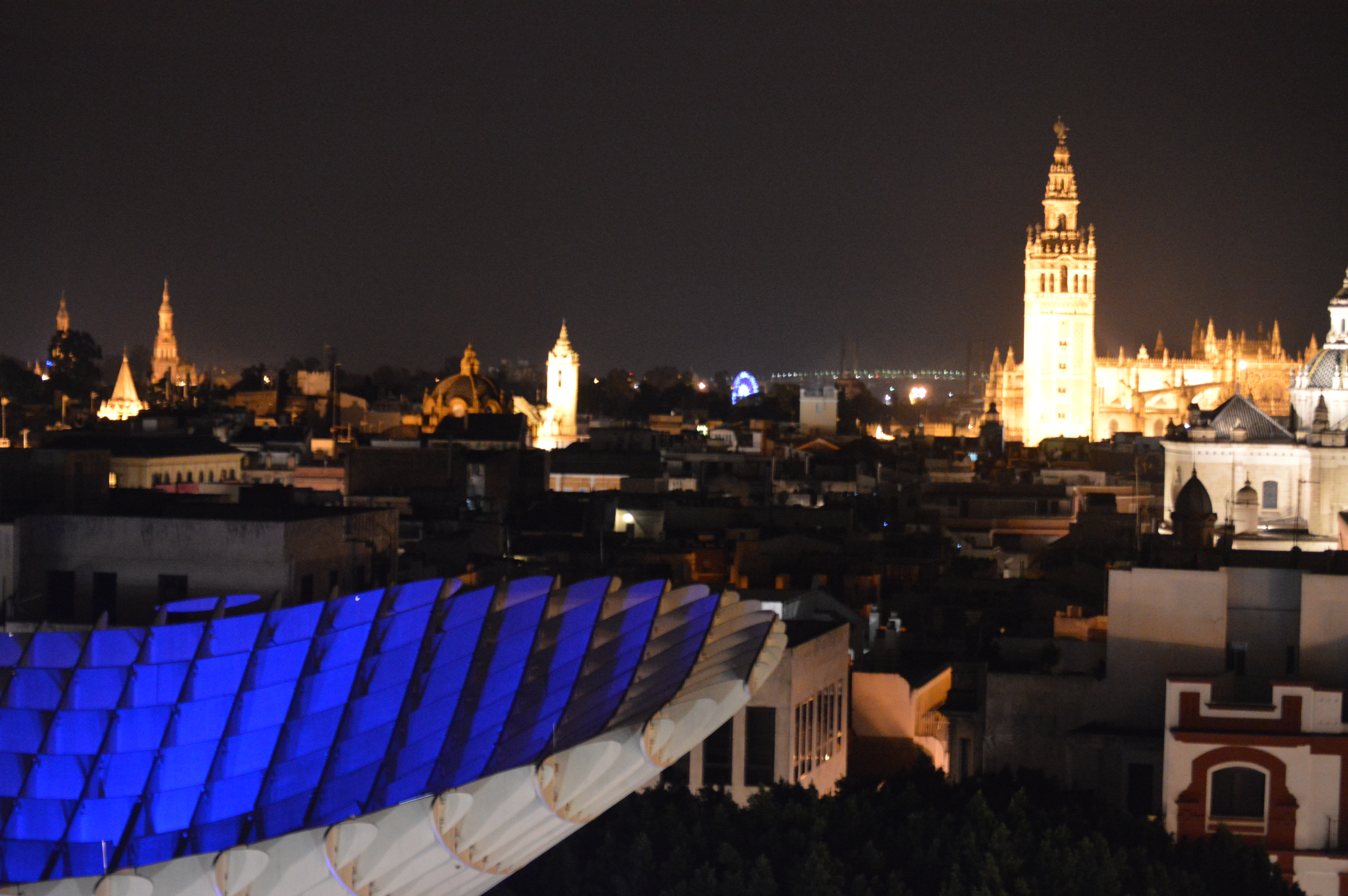
I’m sidetracking. As usual. I’ve been very blasé about Seville all year, using it largely as a transit between Villafranca and other southern destinations – mainly Olvera – and never visiting the city for its own sake. Mistake. If you can find a place to stay for the night in Seville, do. Especially in Semana Santa. Having the freedom to see the city by night as well as by day is a treat not to be overlooked.

DSC_1053

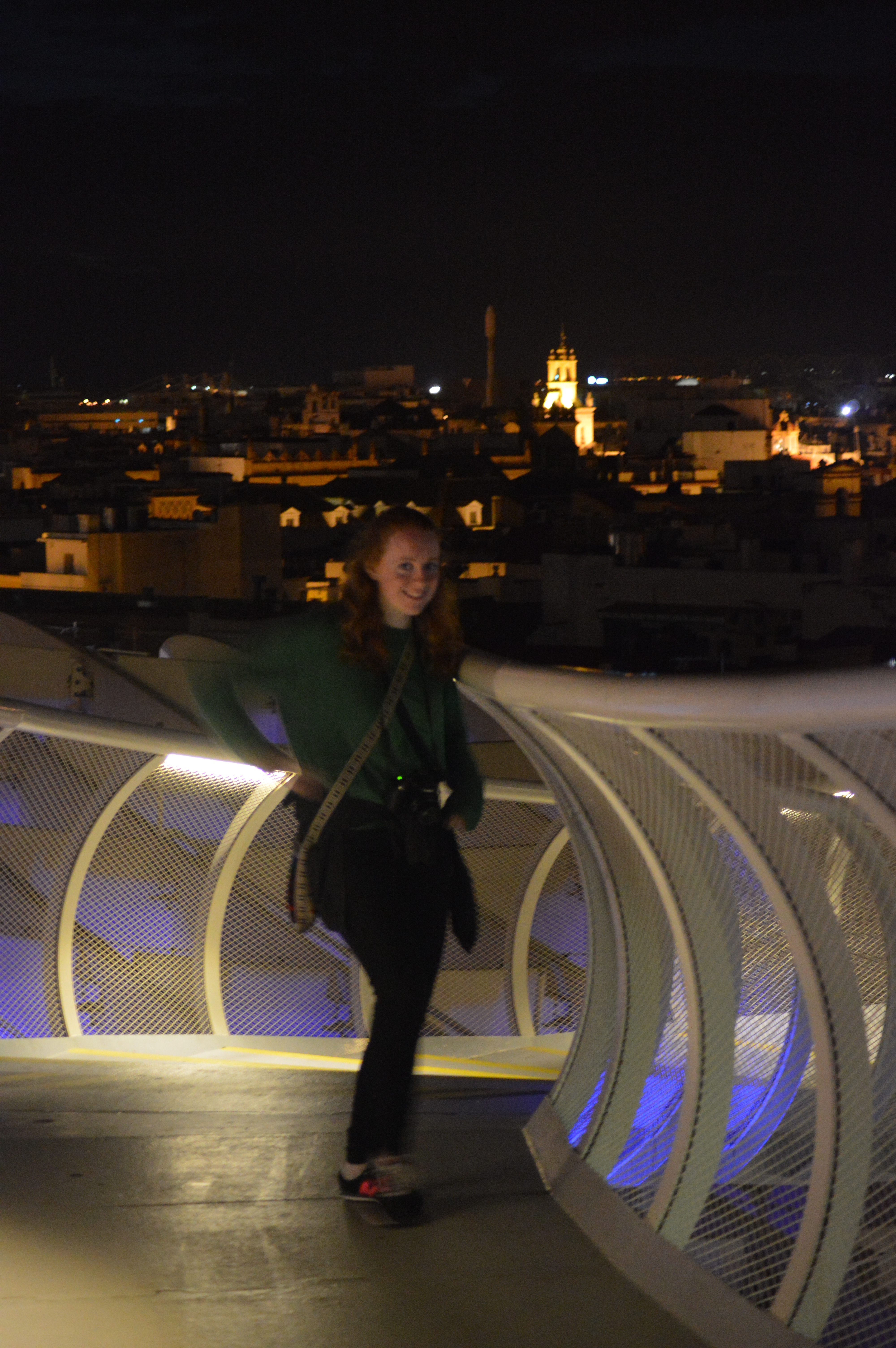
In my current adventures I’m joined once again by fellow traveler/blogger Brocklesby, spending half of her Easter holidays down south. Traveling with a companion can be infinitely more entertaining than going solo, especially when you’re both new to the place, but it’s been super-helpful acting as a kind of lemming-guide. I’m something of an old hand with Sevilla and Córdoba, having spent about a month apiece in each of them when you add up the days, so – with the fifty-fifty assistance of the Arch Deceiver aka HERE Maps – I’ve been acting as a guide. It’s a lot of fun to introduce somebody to all of your favourite spots, as well as the main sights, but best of all you get to try things out that you never quite found the gumption to do alone, like this museum or that ice cream parlour. It’s a blast and I should travel in twos or threes more often.

DSC_1036

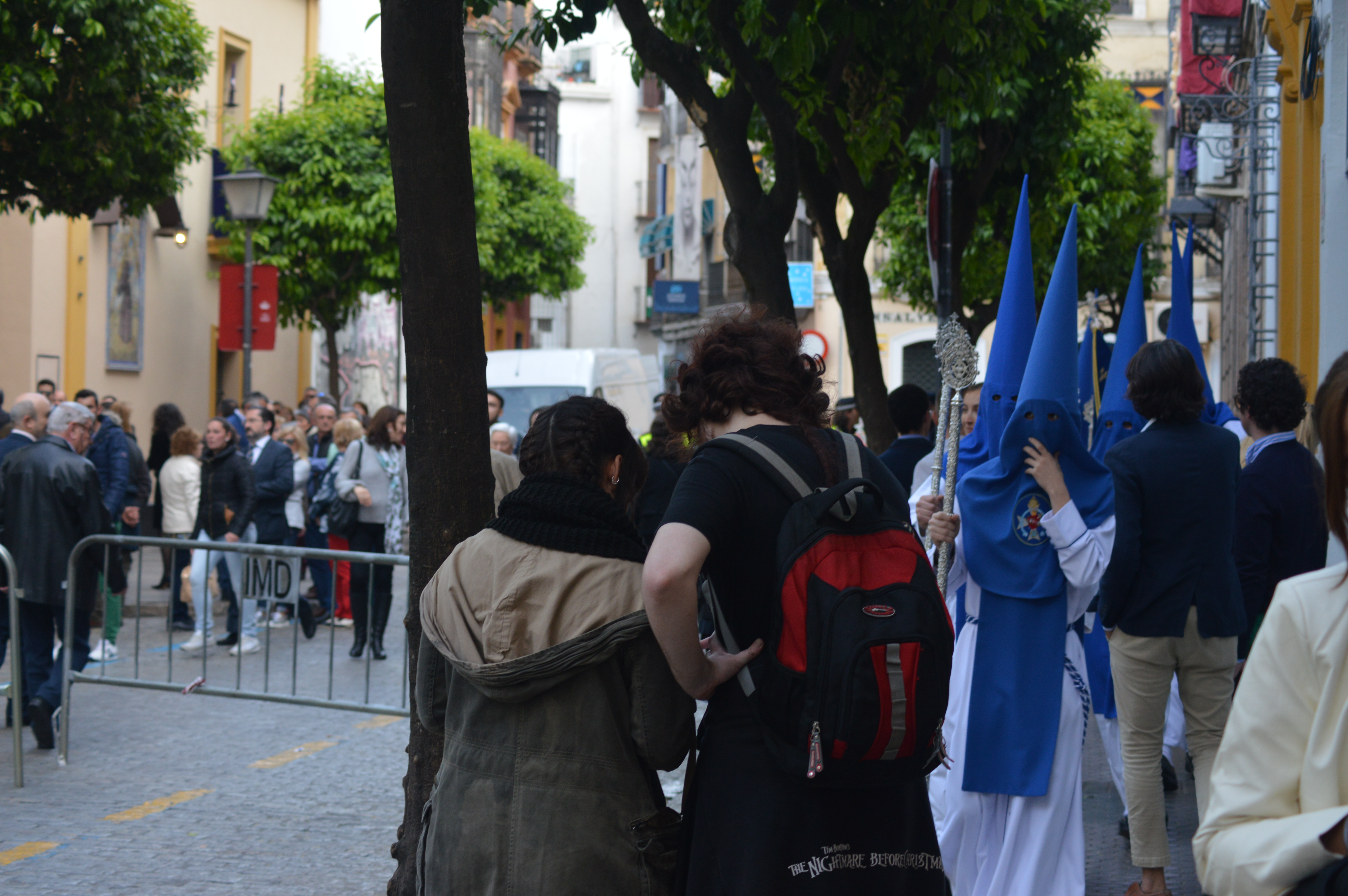
Travelers to Seville in Semana Santa should be warned: bring a compass, a map and/or plenty of patience. Navigation is made almost impossible by the processions. In most of the smaller towns, these are usually nocturnal affairs of some eighty metres in length that take five or six minutes to pass, and good seats can be had by simply racing ahead by several streets and waiting by the side of the street.

DSC_0988

Not in Seville. Not only is everyone in town in on the secret, so is the tourist population, both of which are immense. On top that, the processions themselves are enormous, trailing as many as three streets at a time and taking all of an hour and more to pass – and there can be as many as six happening simultaneously across town.

Understandably, this turns something as simple as crossing a street into a labour of Heracles. It’s a circumstance where shortcuts really do make long delays, and itinerant penitants and busy streets make the heart sink. I distinctly remember saying that ‘if you see Jesus, you’re screwed’; blasphemous, perhaps, but in accurate reference to the fact that the float bearing Jesus is almost always followed by the Virgin Mary some thirty minutes later, meaning that Jesus marks the very epicentre of the gridlock. Thanks Jesus.

DSC_1073

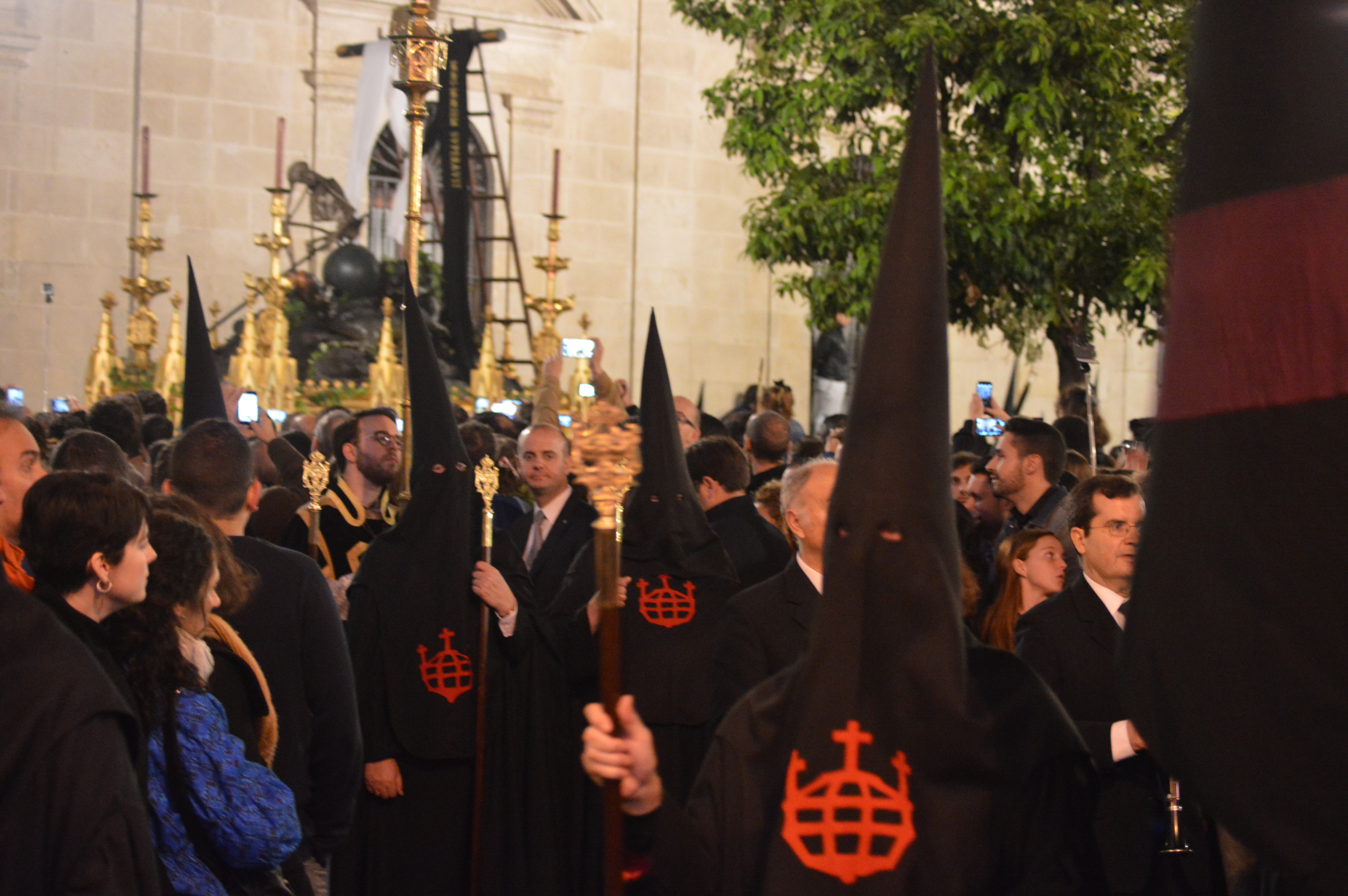
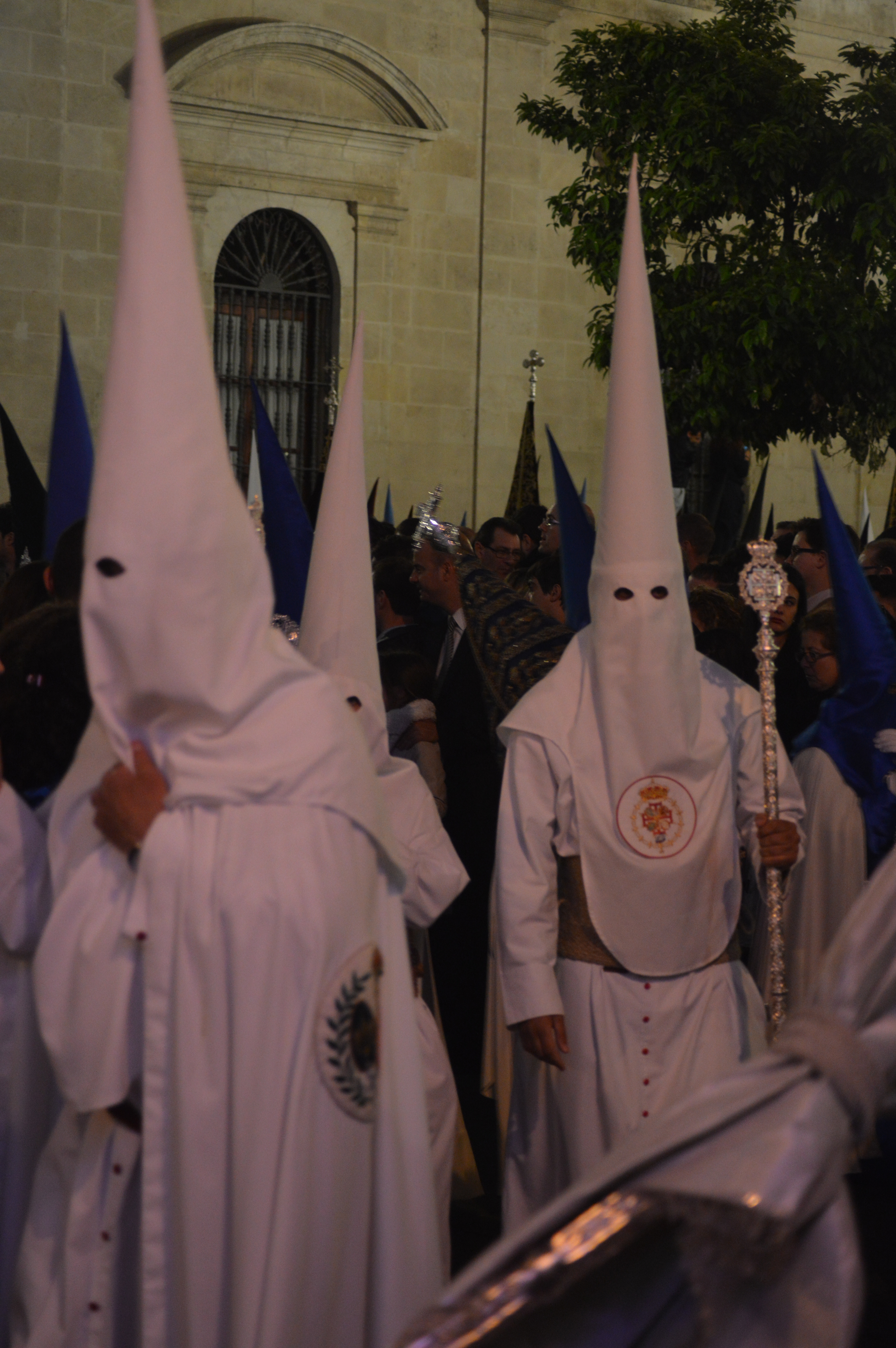
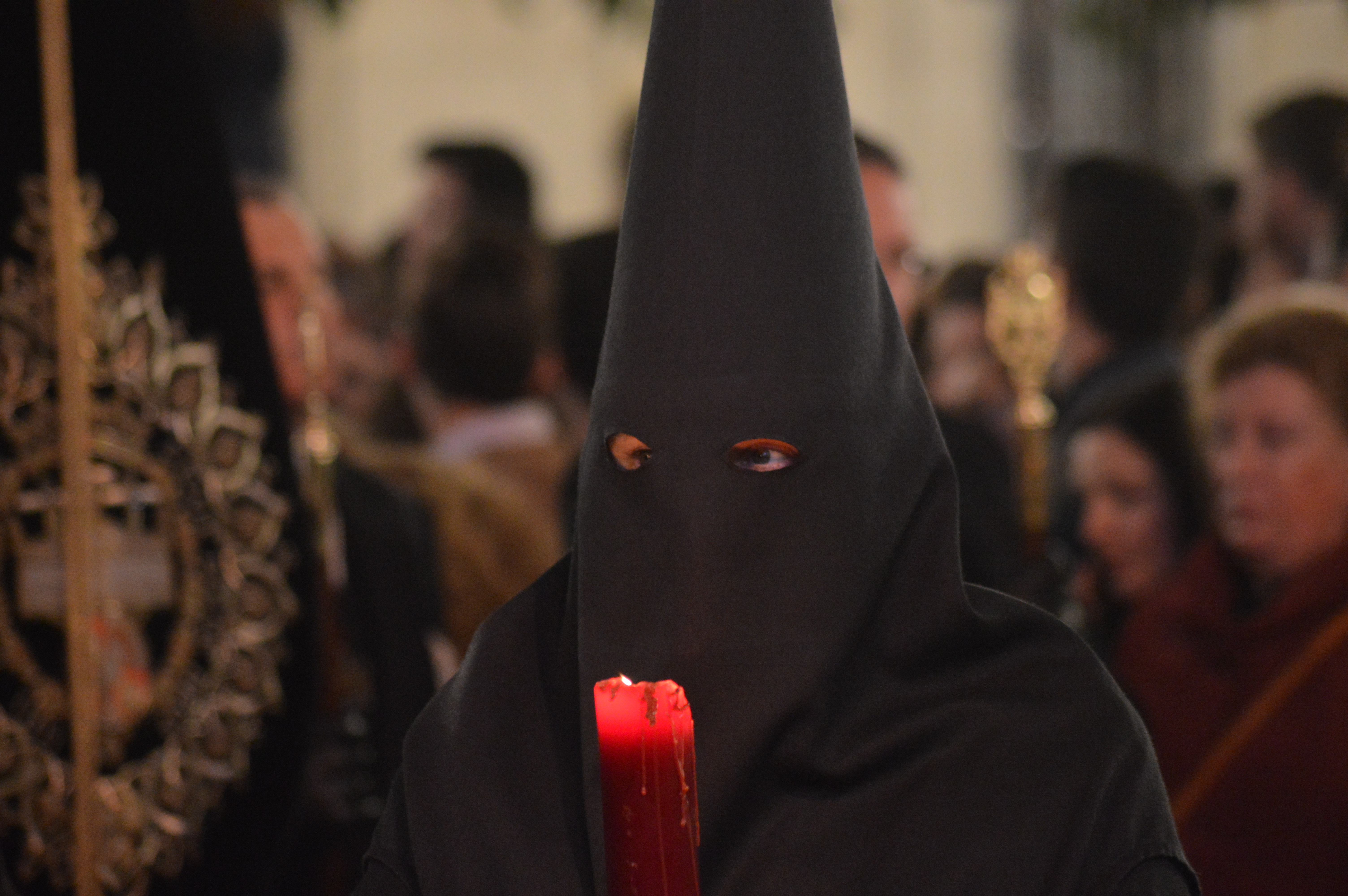
That being said, it’s something you have to watch at least once. And whilst it may not be all that much fun to watch the tips of the penitents’ colored hoods sailing by over the heads of a pushy multitude, if you can get yourself to the front, it’s surely one of the human wonders of the world to behold.

DSC_1107

I’m not a pushy person. I think I’m too English. So it would take a miracle to get me to the front of the queue. But God, or Fate – or an unusually benevolent Murphy – had other plans tonight. Having said that it would be ironic if we ended up walking down a street and coming face to face with a procession headed in our direction, that is exactly what happened, and with the grand finale, no less. We tried to duck out of the way through a gap in the multitude, but the Guardia closed it off and shoved us unceremoniously back into the crowd – which put us, quite by accident, right at the front. It suited us just fine, but it must have bothered those who’d been there long before us something awful.

DSC_1173

It might not have been as soul-stirring as the Olvera madrugada procession – which goes on all through the night and involves no small amount of mountain-climbing – but it was a genuine privilege to behold from such a premier position.

I’ll be back next year. Most certainly. A lot of Spaniards claim to be rather impassive on the subject of Semana Santa, but their dogged adherence to an age-old tradition far more authentic than any search for chocolate eggs says otherwise. I, like Hemingway and Irving before me, am yet another foreigner hopelessly entranced by the magic of it all; only, I’ve at least a quarter of Spanish blood in me, so I’m not a total stranger. I’d like to think that counts for something. BB x

The World’s Most Beautiful Women

Why am I doing this?

No, seriously. Why am I doing this? This isn’t Amman. This isn’t even vaguely Arabic. We’re halfway to Kiev on a bus that isn’t the Skybus that Google and Tripadvisor recommended. Come to think of it, I didn’t even ask the driver where we’re going. It might not even be Kiev. I’m going by the size of the city and the great big river we crossed earlier and assuming it is. Other than that, I really don’t know. I can’t read the alphabet. Any and all Russian I learned in those four after-school sessions has jumped clean out of my mind, except that the letter P becomes R and K, T and A stay the same. Ten points for effort for this worn-out linguist! I mean, there’s no escaping it this time: this is sheer lunacy, even by my standards.

‘We could be going anywhere right now,’ says Andrew. ‘We could literally be going anywhere.’

Well, this really isn't Arabia anymore...

Well, this really isn’t Arabia anymore…

We really could. It all looks bleak and Soviet; pine forests, grey skies and grim skyscrapers with peeling walls. Even the hooded crows look seedy. But I do have £33 worth of Ukrainian hryvna in my wallet (or at least, I think I do) and I plan for us to be back at the airport for six o’clock at the latest. So there is some semblance of a plan beneath the anarchy. Blimey, but what I wouldn’t do to have fellow linguists and Russian speakers Shahnaz and Rosie here with me now, if just to have a vague idea of what’s going on.

Nope, I don't understand any of this

Nope, I don’t understand any of this

If that whim decision to go for the twelve-hour layover bothered me slightly at four o’clock this morning, it was practically crucifying me by nine, when we’d touched down in Borispol Airport and navigated customs. Andrew managed a good couple of hours’ sleep on the journey from Amman; I did not, and it’s really beginning to kick in now, as I’m no longer constantly on the move. But fatigue is the smallest of barriers to the determined adventurer!

…once again I find myself picking up the mantle some two hours later. Two sentences later I woke up with the iPad slipping off my legs onto the floor of the bus. So I take that back. Apparently fatigue has other ideas.

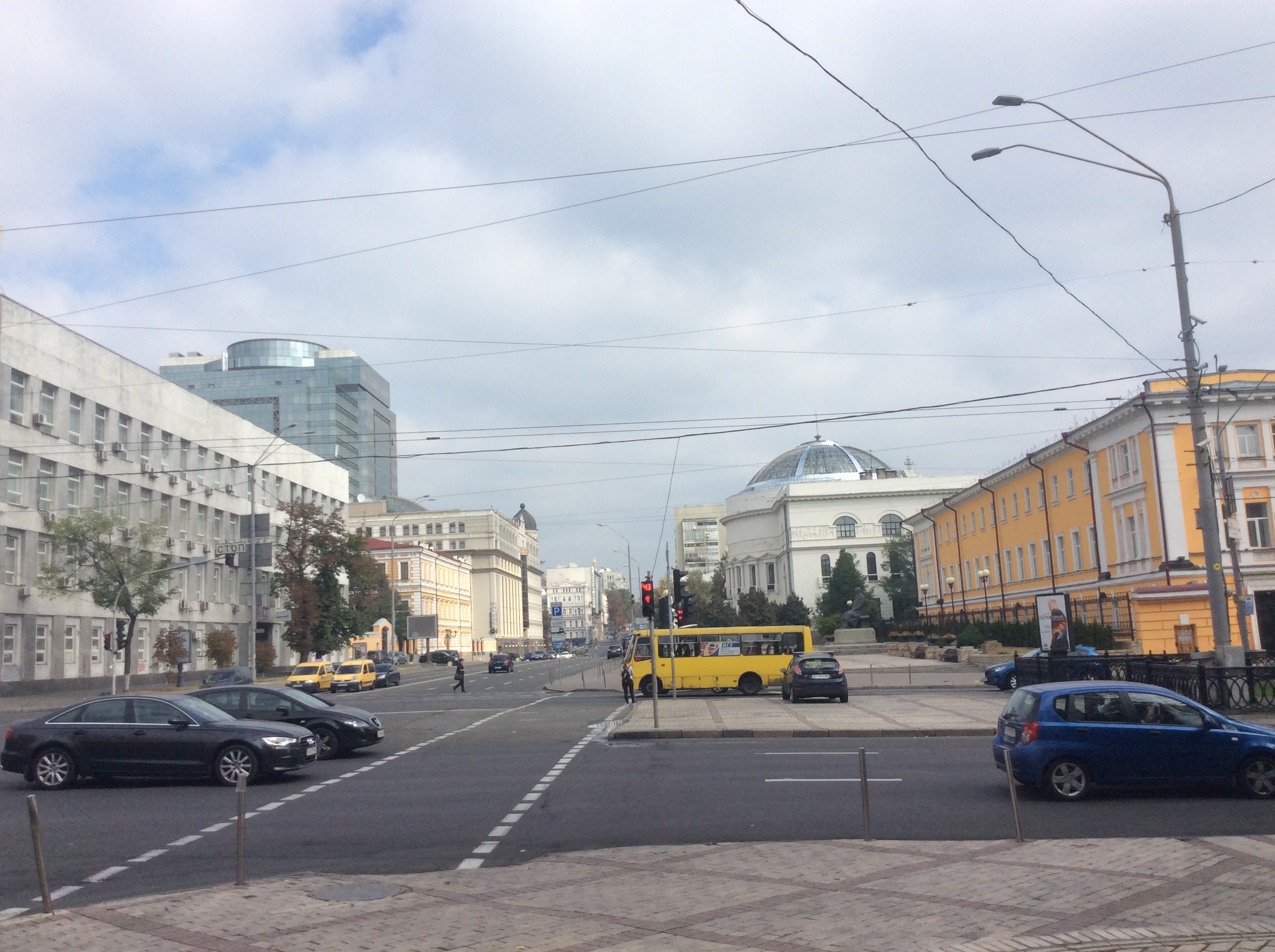
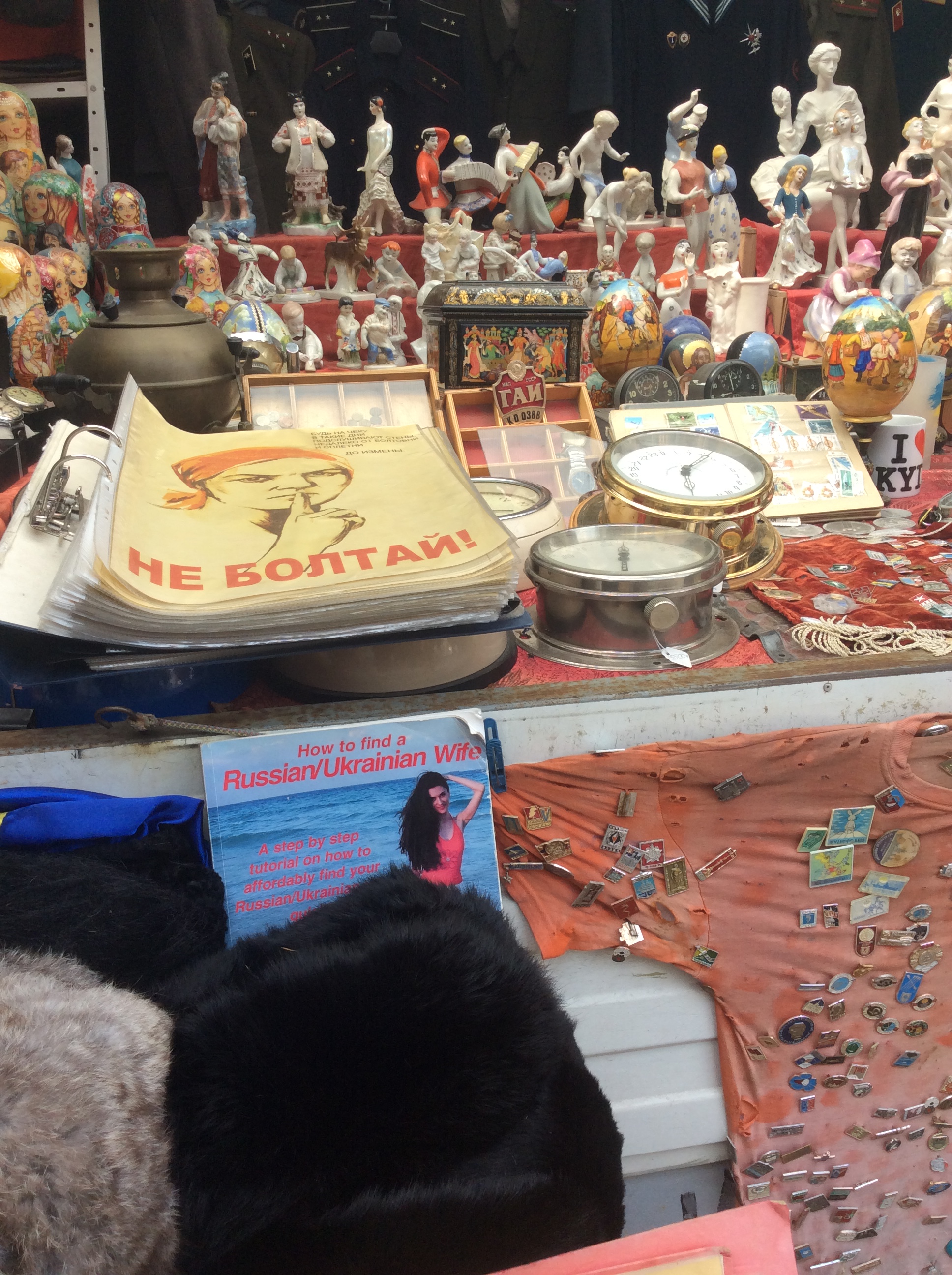
I digress. After a minor financial confusion over the exchange rate of the Ukranian hryvna, Andrew and I made it to Kiev (it really was Kiev in the end) with six hours to kill. Cue at least half an hour of ‘wow’, ‘I can’t believe we’re doing this’ and ‘this is absolutely bonkers’ as Andrew patiently bears my childish enthusiasm. We took a wander into the old part in search of the Bessarabsky Market to grab a bite to eat. Every single stall inside, without exception, was manned by what can only be described as the stereotypical babuschka. And no, try as they might, Andrew and I didn’t understand a word of what they were saying. But an idea struck me at one of the aisles and I procured a tin of caviar from one of the stallholders who was anxious for us to try a spoonful of all of her wares, from sweet to tongue-zappingly salty, from lumpfish to Beluga sturgeon. And if you think I’m exaggerating, I point you towards the sequin-scaled monstrosity lying headless on a mound of ice near the market door, barbels removed. It hardly needs saying, but this is a world away from Amman. Period.

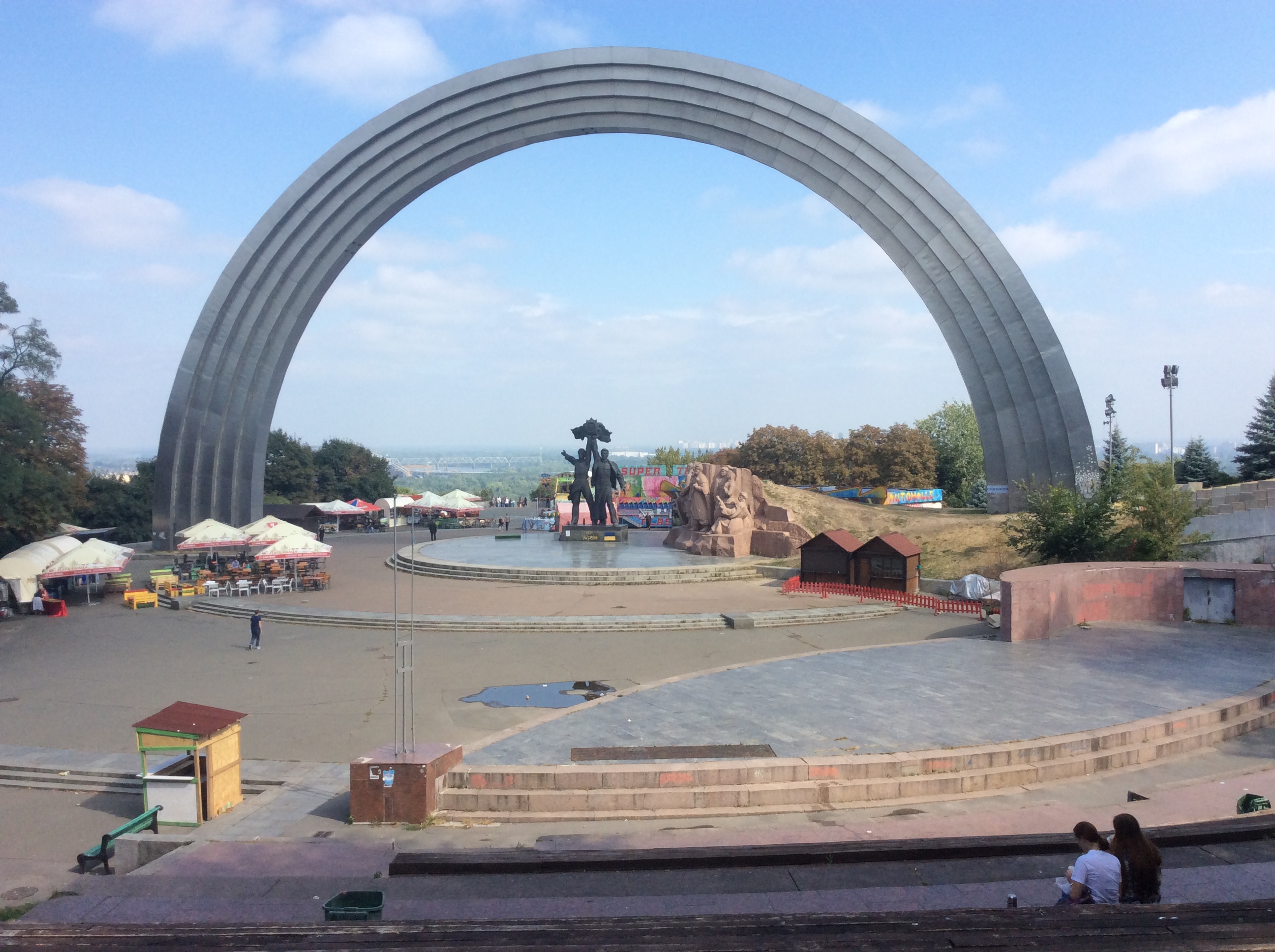
Concrete block for make unification of great Russian Power and Ukraine

Concrete block for make unification of great Russian Power and Ukraine

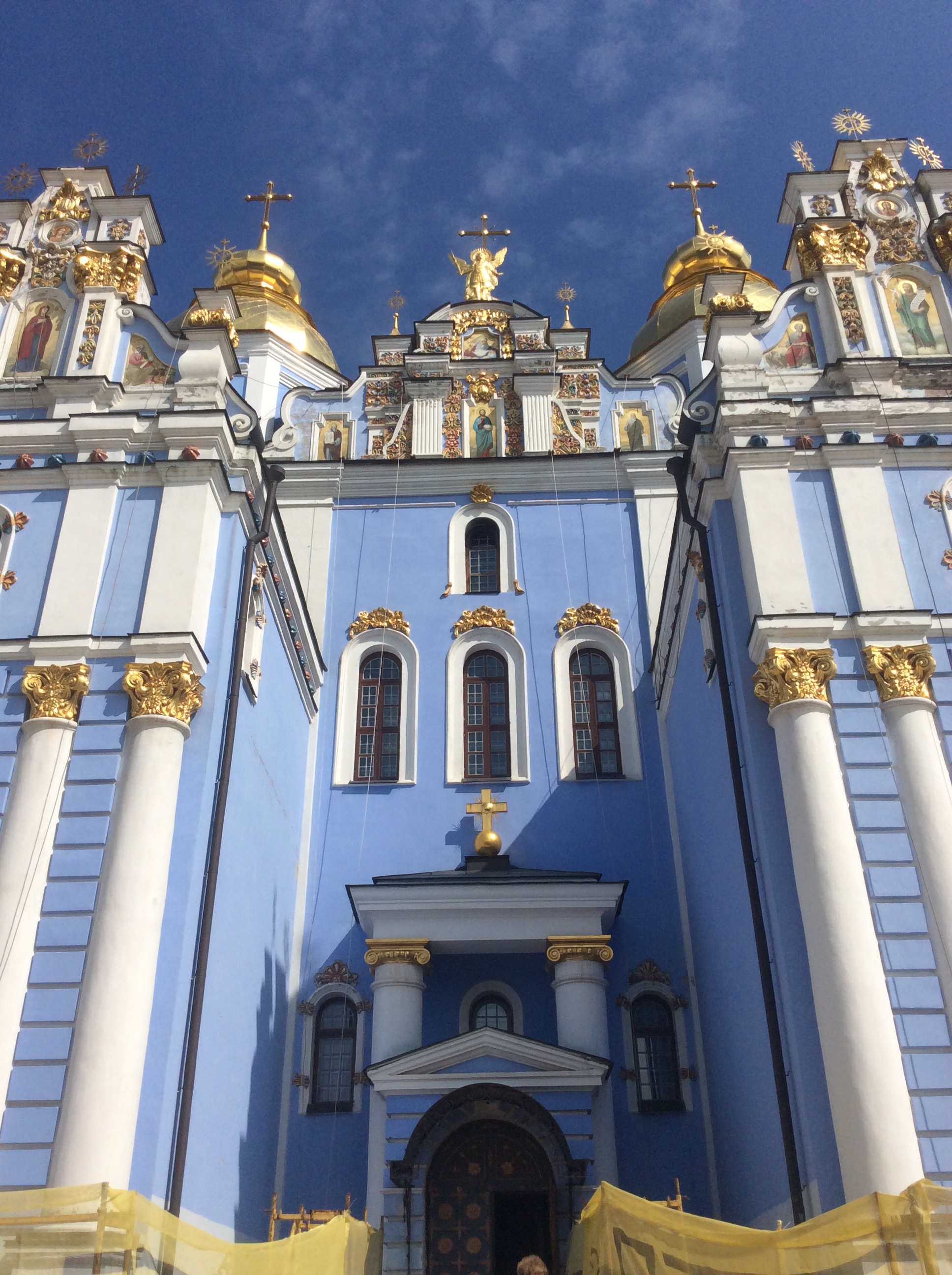
The miracle of Kiev is that there is so much to see in so small an area. Like I said, a world away from Amman. In just under four hours we had covered almost everything there is to see. Beginning with St. Volodymyr’s Cathedral, an elaborate Orthodox affair in gold leaf and black-robed majesty, we set off an a tour of the old city. There’s something really special about Orthodox churches. At first glance it all looks a bit showy: giant crosses, bold block colours, gold used just about wherever there’s breathing space, not to mention all the icons. But it’s a great deal more complicated than that. It was Andrew who pointed it out to me. The congregation, outnumbering the sightseers by about nine to one, were mostly women, in varying states of dress, but the one thing they all had in common was the wearing of a headscarf. A kind of step-down for us from Jordan, perhaps.

‘Surely it doesn’t work like that,’ says Andrew, as a scarfed young woman in high heels leaves the cathedral after making the sign of the cross twice across her chest and bowing out, a lurid pink thong showing above the cut of her miniskirt. Apparently, it does. You know what they say about book covers…

Overloading on the blue, much...

Overloading on the blue, much…

One of the subjects that came up in conversation with Fahed and Massoud yesterday was the subject of Ukrainian women, whom Fahed believed, as ‘proved by science’, to be the most beautiful women in the world. I set out to test that theory today, both to conduct some kind of fair test in light of such a sweeping statement (especially when any suggestions of Spain and Colombia had been overruled just minutes before), and more so to justify this ridiculous little side-quest into Kiev at the end of our labours.

Or you could just cut out the middle man...

Or you could just cut out the middle man…

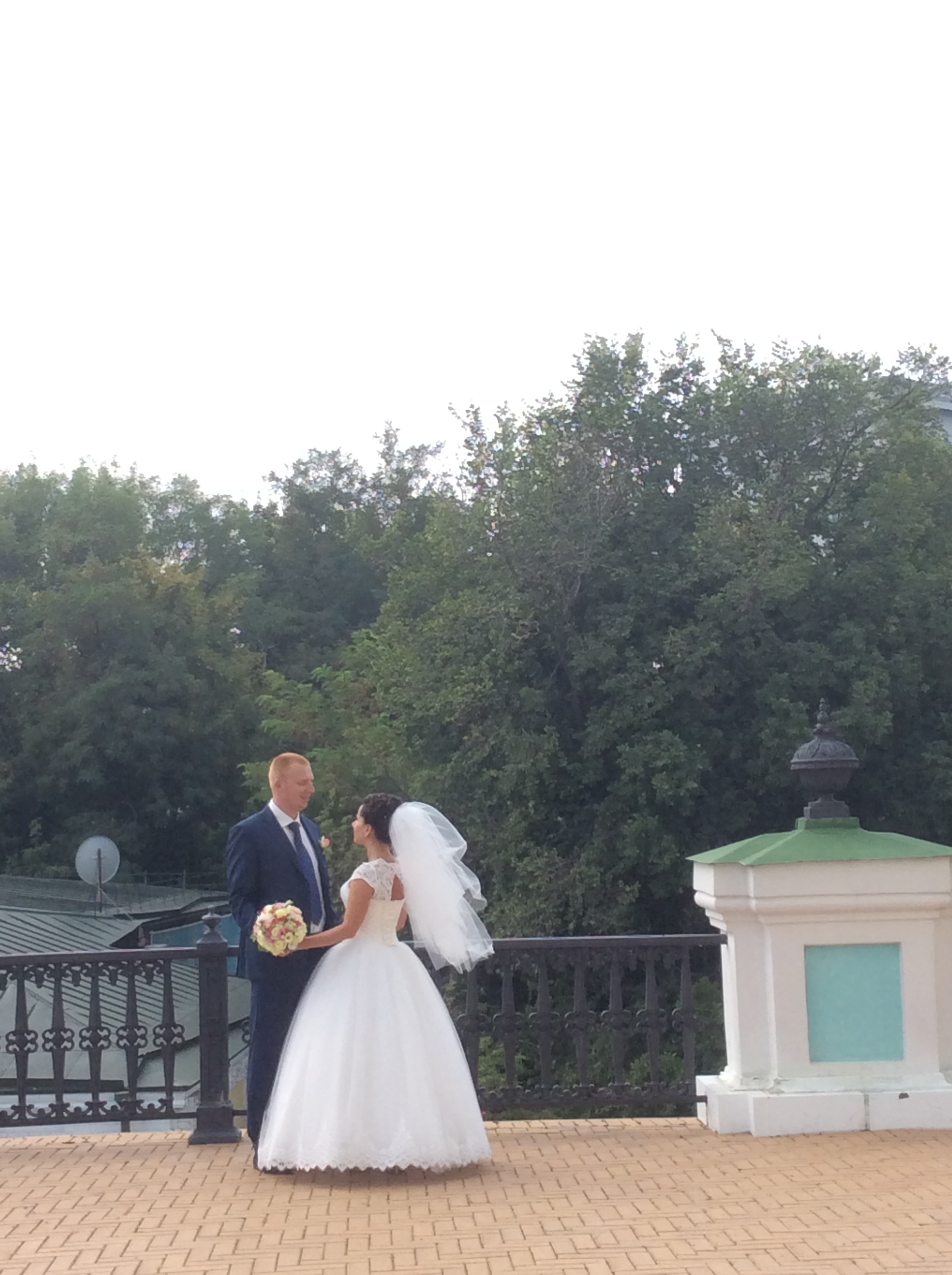
I’m going to surprise myself, but Fahed’s got a point. Ukrainian women are pretty stunning. They must be, or we wouldn’t have run into not one, not two, but a total of seven weddings in the course of our wanderings. There’s also a heck of a lot of them; more than the men, anyway, at least from my observations. A bit like Elvet Riverside, come to think of it. But seriously, those weddings we walked in on (there was hardly any avoiding them, they were all over the place…) Flowing white dresses everywhere on a backdrop of marble steps, spiralling turrets and Orthodox spires. My heart was on a serious flutter. Perhaps it’s the healthy skin tones, the raven hair, or the eyes that shelter a mixture of light and dark? Or even the fabulous dress sense? No, surely it’s the curled smiles most of them are wearing… (I wish Nizzar Qabbani could help me out here, I’m teetering on the edge of the villainy of objectivity)

Somebody stop me before I make a rash move!

Somebody stop me before I make a rash move!

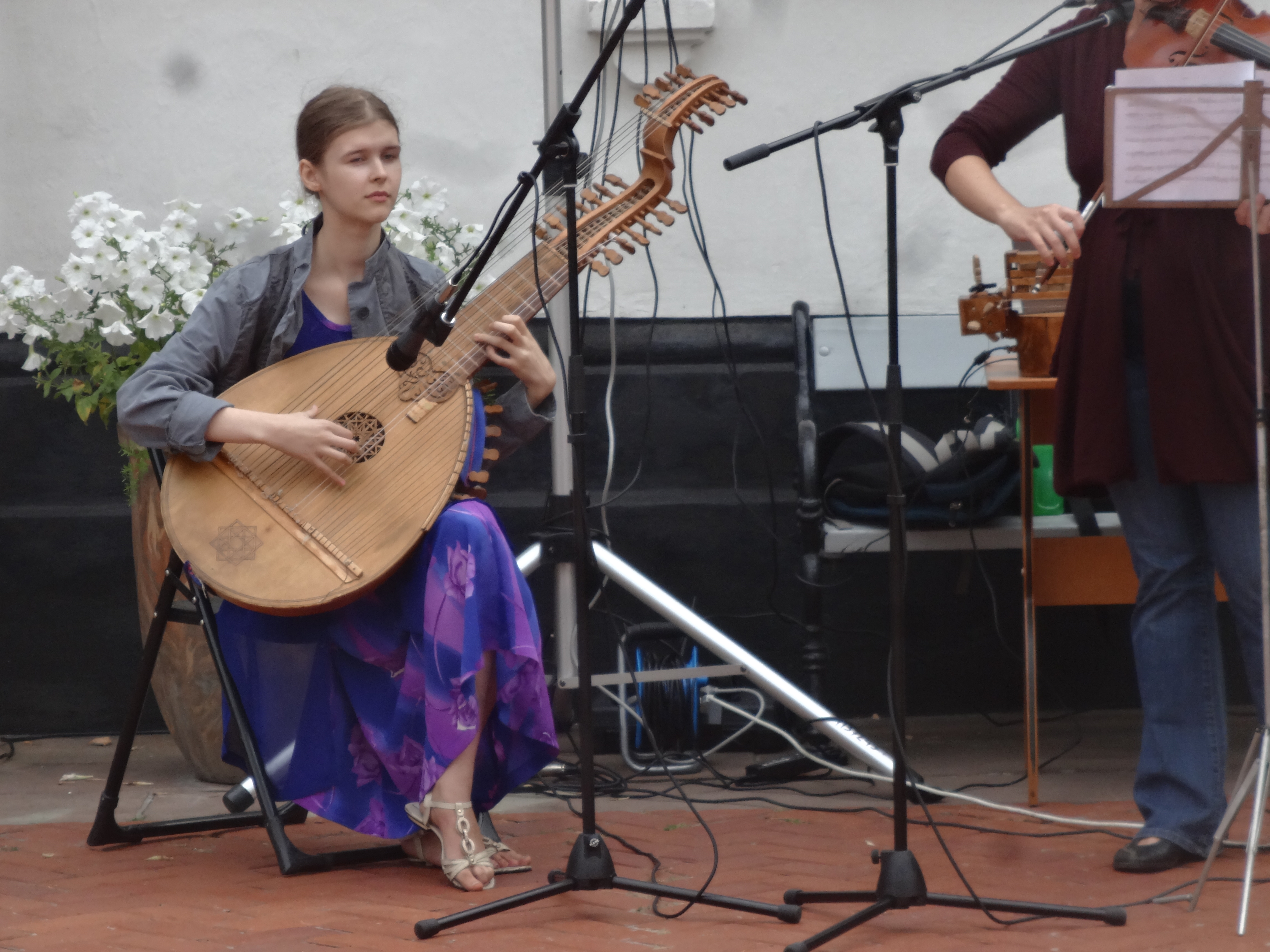
Before I go too far, I’ll throw you the anecdote that tipped me over the scale of utter disbelief of Fahed’s claim to conceding a little ground to the guy. In the grounds of the St. Sophia Cathedral, Kiev’s jaw-droppingly beautiful UNESCO cathedral complex, Andrew and I stumbled upon an outdoor recital by a young Ukrainian student playing quite possibly the largest lute I have ever seen. I believe, if memory serves, that it is called a bandura? We still had a good three hours to kill so we stopped to listen, and am I glad we did! No sooner had she put her fingers to the strings than the girl began to sing, and in all my years as the son of two music teachers I have rarely heard a voice so magical. Like a siren, but sadder and more graceful. I was totally drawn in – so much so that it took me some time to realise that the bandurist and I had been staring at each other unflinchingly for almost a minute before I snapped awake, and she’d been singing all the way through.

‘You should have got her number or something,’ said Andrew, as we moved on to the Great Gates of Kiev twenty minutes later. ‘You haven’t got forever. Get them before they’re all gone, that’s what my godmother told me.’

DSC04510

I’m not running out of time yet – at least, I hope I’m not. Maybe I should have done or said something. As ever, I was lost in the music, I guess. Too lost to appreciate that we kept looking back at each other after her set was over. My obliviousness reigns supreme. At the very least I have a good three minutes of her set on video, so I can listen to that siren song again if ever the mood requires. And by that I mean, of course, sleep. Andrew fell asleep during her recital. If I hadn’t been so entranced, I guess I might have done so too.

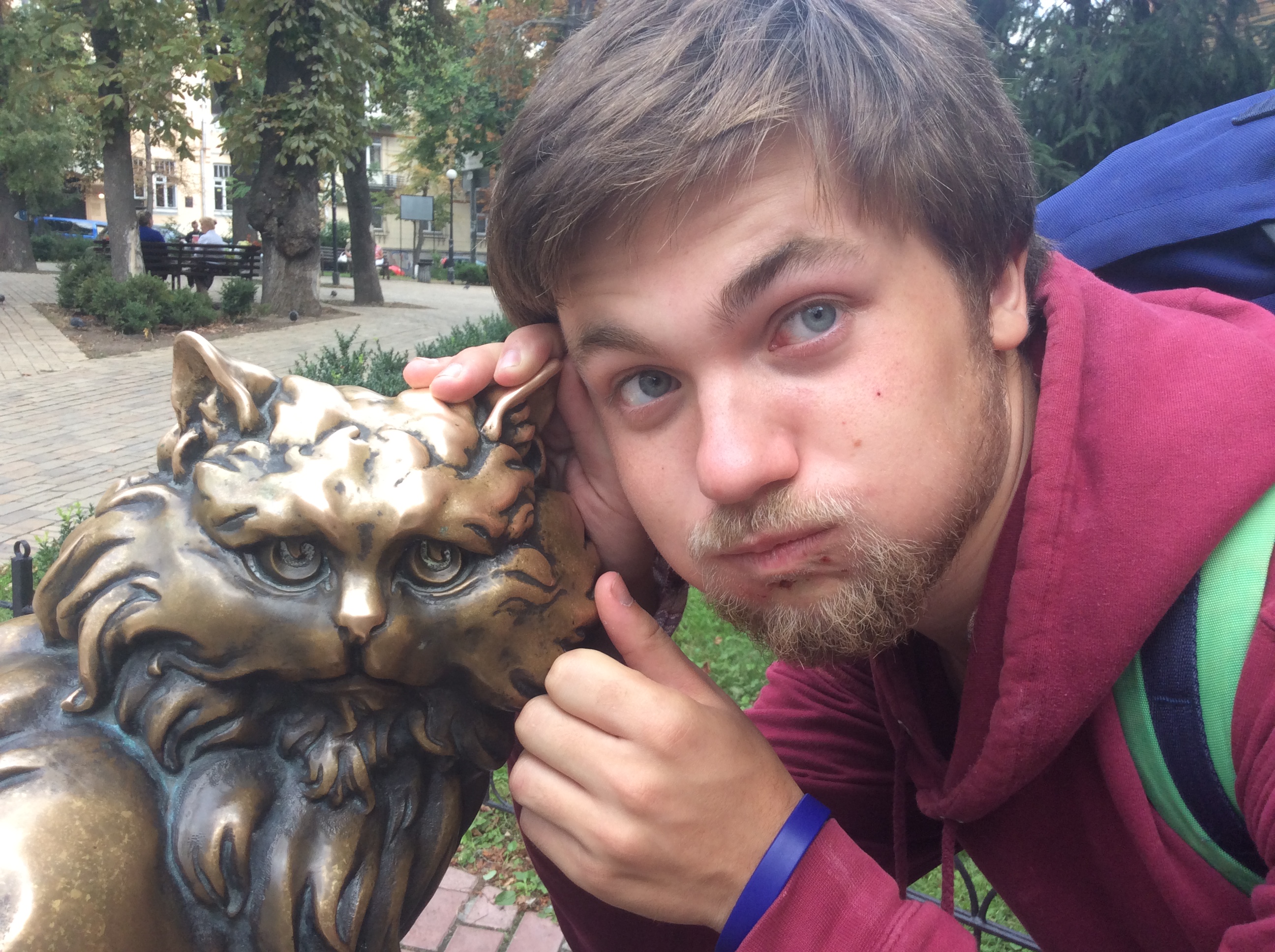
It's ok, as long as I have cats I'll be just fine

It’s ok, as long as I have cats I’ll be just fine

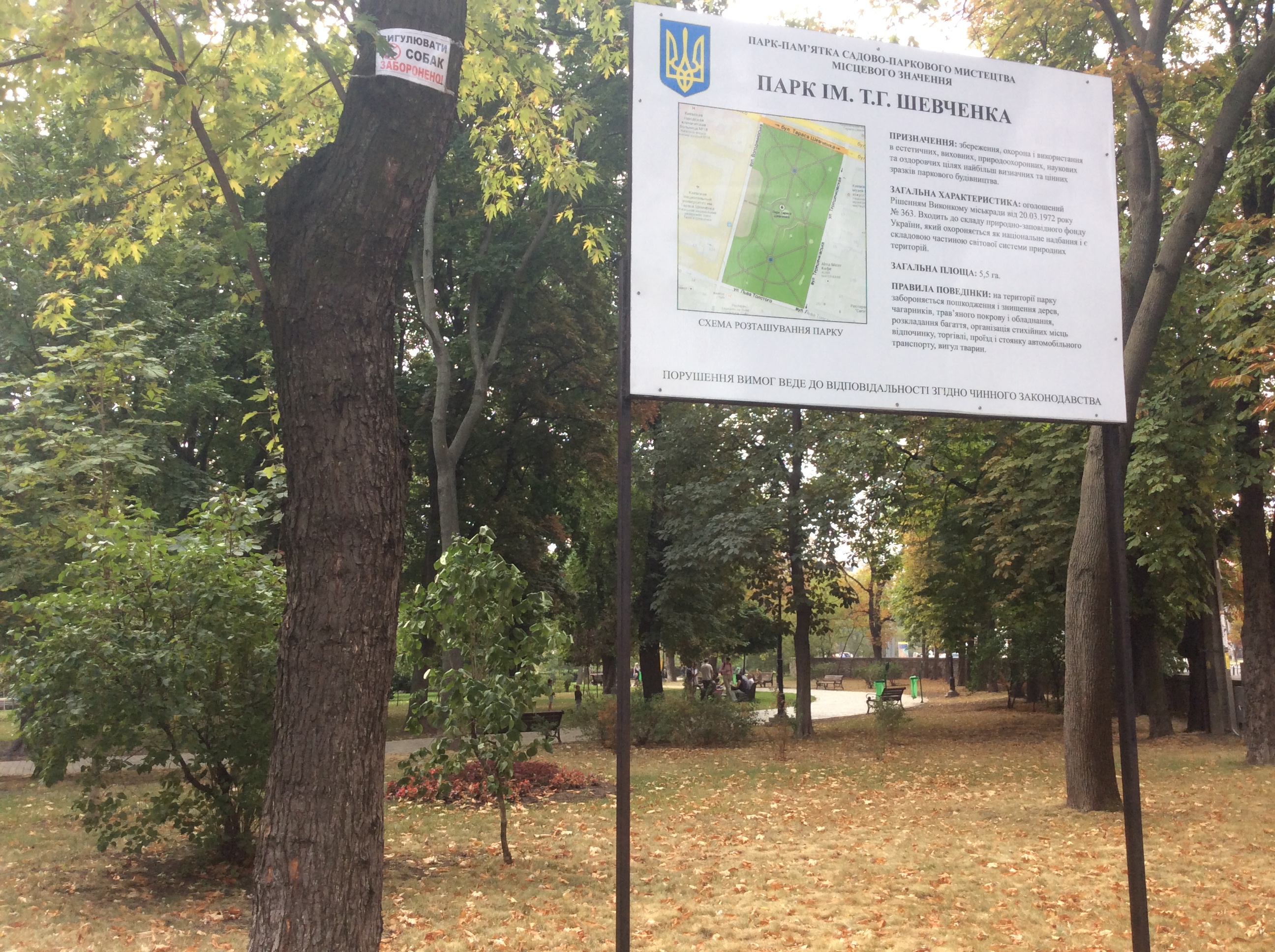
Water under the bridge, hey? But what an adventure, and what a way to end my time in Jordan! It’s been a pleasure to live and work alongside you, Andrew, and I wish you all the best in France (knowing that you’ll be back in the comfort of your own home by the time you read this, and that Babette won’t have to check on how you’re getting on in this long-winded fashion anymore!) As for the rest of you, dear readers, I shall probably take a few days’ hiatus to catch up on sleep, as I’m dangerously behind, and to clear my head. Just a few minutes in one of Kiev’s parks was enough to recharge my batteries right the way up – green, green, GREEN, oh my God, the trees, the leaves, the grass and all of the GREEN – but I intend to set up stores for the winter, as it were. Villafranca’s not lacking in countryside, but I’ve learnt my lesson, and I’m not setting off into the open world without a well-supplied heart next time.

There’s still another hour to go until boarding begins for the flight back to London. Farewell, До свидания and I’ll catch you all later. Yours truly needs a well-deserved break from all this madness. Until the next time! BB x

Searching for God

I’m not a Christian. At least, not in the truest sense of the word. Insofar as my upbringing is concerned, I guess I don’t fall under any category other than Church of England, but when the occasional questionnaire gets handed my way, I tick the box marked ‘agnostic’ without a second’s thought. Only if that’s not an option, and it usually is, Christianity gets my vote over the ‘no religion’ box. Why does this matter? Because today I found myself, once again, in a position where it made more sense to come down on one side of the fence. ‘Christian’ simply makes a lot more sense than ‘no religion’. Strong words for a not-so strong belief, don’t you think?

Let me explain (you’d better get comfortable). I was baptised as a Christian. Church of England. Standard fare. I had a fairly regular English upbringing. I attended a Church of England primary school. I went to church every Christmas and Easter, like almost everyone else. The only minor difference was that my parents both had various musical roles in their respective churches, which meant that I probably spent more time in church than most kids my age. It just so happened that one of them was Canterbury Cathedral, where my dad was a lay-clerk. I guess you get a little blasé about that kind of thing when evensong is a biweekly venture. Not to mention all the school carol services held there. It certainly made the local church back home seem a little small by comparison, though I have warmer memories of that. When I was little I went to church every other Sunday, or at least when Mum played the organ. The memories get a little fuzzy sometimes; this is reaching quite a way back into my childhood. I remember only that I used to sit behind the choir near the organ pipes, and you could hear the organ humming long after everyone had filed out of church and Mum took her hands off the keys. Between that and the old gas heater glowing a dim red in the corner, I have this musty image of your run-of-the-mill Church of England parish tucked away in my head. That’s my strongest memory of the early days, at least. Nothing particularly special. I wasn’t even old enough to sit in the choir then, but I knew most of the hymns well enough, especially the ones they used to roll out on the projector at school. Morning has Broken, for one.

Fast-forward on a few years and it gets a little more interesting. Moving back to England from a year abroad in Spain finds me singing in the church choir in my new home town. It’s nothing more than something to do, I suppose, as I have little else to do at the weekends but go birdwatching down at Stodmarsh or Sandwich Bay – I’m still too young to be thinking about girls or going out – but it pays my first wages, and it feels ‘sort of right’. Right enough to take that next C of E step and decide to get ‘confirmed’. It’s not as big a deal as it is over in Spain, with the sailor suits and all the bells and whistles that go with it, but like I said, it seemed like ‘the right thing to do’. And the other kids in the choir were a lovely bunch, too.

Then along comes my early teenage years, a girlfriend and the beginning of a new approach: evangelicalism. She got me into it, I suppose, but it was something I took to with relish. Prayer and worship, spiritual healing, speaking in tongues… It was a brand new world and I loved every second of it. Ever heard of Soul Survivor? That kind of thing. It was a far cry from ‘open your hymn-books to Hymn no. 348‘ or what-have-you, at the very least. I might even go so far as to say that, for a little while, I even believed it. But it was the people that really made it for me, not the spiritual side of it. Just like playing the violin, the practising of which I had come to loathe, it was more the sense of community that went with it that I craved: the orchestra over the recital, and the worship group over the prayers. I guess you could say I built my house on the sand. Little wonder, then, that it all came crashing down with the end of that relationship. Coincidentally, it was raining that night, too.

I wandered for a while. I asked a lot of questions. I even stopped saying prayers at night, realising that most of them had been selfish anyway – especially the later ones. If not selfish, then love-blind at the very least. Eventually I returned, somewhat shame-faced, to my local church youth group, whom I’d abandoned for almost a year and a half. That was where I met Seth and Jenny Cooper, the Walmer Parish, and Katherine, that everlasting beacon, who showed me that there was more to life than a constant search for answers. For a little while longer, I continued to carry the flag, stronger than before. I was happy. But it was not to last. A series of unfortunate events came as the second hammer blow to my faith. I started to read about the Empire, and all the horrors that had been wrought in the name of God. My brother was assaulted on the way home from school. And Katherine, ever the kindling flame, went out of my life. A few weeks later, I gave up altogether.

As a true Christian, that was my final chapter. I had another fling with the Church in Uganda – ain’t no party like an African Baptist Prayer and Worship Party – but that was little more than a dalliance. Back in England, on the gap year that seemed like it would never end, faith eluded me. Mum, on the other hand, found her way to the Catholic Church and embarked upon what she has described as the ‘road her whole life had been leading towards’. I coveted that, I suppose. It wasn’t her new-found happiness of hers that I wanted, but that contented state of mind. Structured. Ordered. At peace. At one. Something that I’ve struggled with in all the hypocrisies of my life for the last seven years. Her faith gave her life a new meaning. I’d been looking for that meaning for a while with no such luck. People say that ‘finding yourself’ is the first step on the road to that level of understanding. If I could have ‘found myself in Africa’ as so many jokingly think I did, I’d probably have more of an idea as to where exactly I am right now. Unfortunately – or perhaps fortunately, as God knows how lost I’d have been – I didn’t, and the search continues. Right up until last night, when I found myself sitting in an Iraqi church, listening to a Californian preacher explaining the meaning of John 3:16 whilst a translator conveyed it to the congregation in Arabic. Talk about a new way of looking at things!

Now we come to the heart of the matter. I’m not a Christian, like I said at the start. I might have been once, but for a token gesture or two of late, I’m not labelling material at the moment. I can go through the motions like a mynah bird, of course, but that’s got more to do with habit and observation than anything else. That, and a burning desire to believe, whenever that day comes. Until it does, everything seems false. To pray to a God you don’t believe in with all of your heart, with all of your soul – does that not seem a bit ingenuous? That’s not to say I’m not religious, though. Given the choice I’d rather be spiritual than to disbelieve entirely. I’ll put it this way: there’s a hole in my heart that’s waiting for faith. I just haven’t found it yet.

I’ve had this discussion/argument with Andrew recently. I put it to him that I’d be happier not knowing all the answers; that sometimes it’s better to stop asking questions and to have a little faith in what you can’t see; that some things, like as not, are necessarily beyond our understanding. It goes against a great deal of my character, and I think he took umbrage at that, but it’s a principle I try to stick to, and as far as I’m concerned it’s connected to the most fundamental principle of all: hope. I swear by it. There is no greater sin in my book than despair. I might not have the staying power that others prize – indeed, if something is beyond my capability (or, more often, interest) I’m more likely than not to throw up my arms and walk away – but I never truly give up on the inside. And as long as that’s the case, I’d like to believe I still have a chance.

Faith lies somewhere along the road, of that much I’m sure. Wherever it may be is, for the time being, beyond my understanding. And that’s not a bad thing. I tried to find it out here, but for all the strength of the community and the goodwill of the people, it continues to elude me. Maybe I’m being picky. Maybe I’m looking too hard. I don’t know. I’ve just got to keep trying.

I leave you (and this gargantuan post, which is approaching essay length as the clock strikes twenty minutes to midnight) with the only Bible verse I’ve consigned to heart, as it speaks to me on much the same level as it ever did five years ago, when first I found it:

The light shines in the darkness, and the darkness has not overcome it.
John 1:5

I wonder whatever happened to Katherine? I hope her light is still shining brightly for the rest of the world, wherever she is. BB x

Not All Those Who Wander Are Flossed

It’s just taken me about an hour and a half to wade through the latest Arabic text for tomorrow’s class. With a night of karaoke at the Marriott Hotel on the cards for this evening, I don’t exactly have the ‘I’ll do it later’ gambit at my disposal.

First off I want to apologise for a very rocky week or two of bipolar posting (some of you noticed, I gather…). The mid-term fury is over and things have settled back to the way they were before, helped along the way by much meditation, H.R. Haggard and Karl Jenkins. Ouch, that’s a painfully middle-class sentence. Life in Amman rumbles slowly onwards, the daily Arabic homework’s still coming in thick and fast and the Versailles branch of the British Council still haven’t told Andrew where he’s going. Business as usual. I took an entire weekend out to deal with my restless psyche and it seems to have paid off. It meant missing out on a couple of parties, but for the sake of my bleeding heart, it was worth it. So if you were feeling the strain of my sine-wave posts over the last week or so, fret not; the dust has settled. It should be a little easier on the eye from here on out.

It’s been a fairly productive couple of days, which means we haven’t had that many adventures; but that’s no bad thing. I saw our first clouds in a month or so the other day, and what a sight for sore eyes that was. You’d be surprised how uplifting it was to see a speck of grey on the horizon for once. Blue skies are lovely and all that, but when you’ve had temperatures balancing out over the high thirties for almost three weeks without cease, a cool breeze is a welcome miracle. There was supposed to be a thunderstorm, which we all got super excited about, but it never came. Instead, the sky went a very queer shade of brown and a mild sandstorm swept through the streets. No rain. One of the strangest weather phenomenons I’ve ever seen. We got the full force of the stifling storm heat, though; the temperature soared up into the mid forties. My insides felt like they were being cooked every time I stepped outside and there was a weird charge in the air. Mostly we found ourselves retreating to our various homes to sit like idol-worshippers before the air-con until the sun decided to call it a day. Even then it often carried on long into the night, that stuffy, all-pervading heat. The blankets had to go. How they’ve lasted this long is anyone’s guess. BBC Weather’s been getting an unnatural number of hits from our flat, at any rate. They say there’s a 51% chance of precipitation tomorrow. Good news takes the strangest forms…

I finally got around to sending off an email to the school I’ll be teaching at in Extremadura. I’ve had it written for the best part of a week and a half, but for some reason I never hit the send button. I guess I wanted to be dead-certain on the grammar, but in the end I just had to be happy with what I’d written, bite the bullet and hit SEND. With any luck, I’ll get a reply at some point before I arrive in September. So that’s pretty cool. In the meantime I’m keeping my teacher senses trained with this project of ours at the Iraqi church Andreas got me in on last week. The last session must have gone down well enough, because we had double the numbers this time. We’ll have to call in reinforcements at this rate. Parts of the body this week, following on from the previous lesson on going to the hospital. Getting the groups to use the vocab to compliment each other was a great idea, and also highly amusing. Apparently eyebrows are a valuable commodity. Or maybe they were just trying to get their heads around the pronunciation. I’d like to believe the former. Having to explain the difference between diarrhea and constipation in the politest possible way is definitely going down as one of the most entertaining moments of my teaching career. Something along the lines of ‘let’s say you eat a bad falafel, and it goes right through you… and for the other one, well, it doesn’t quite go right through you…’. British humour. It never gets old.

This church is just about the best thing that’s happened to me out here, though. It’s the one thing I’d return to Jordan for, given the chance. Maybe this is the beginning of a spiritual journey, maybe not. I hope so, at any rate. I’ve been waiting for my chance for so very long now, ever since I left that world behind almost six years ago… I’ll be dropping by three times a week from now on, twice for class and once for the service, so things should start to look up. And that’s a real slice of good news.

Bummer, I’m out of toothpaste. Looks like I really will have to resort to this weird Arab brand I picked up in the corner shop last week. At least it smells nice. After Morocco I’m none too keen to follow up on any of these traditional Arabian dental practices. BB x

The moment we thought Andrew’s placement might have come through…

A Sex-Tape is a Step Too Far

I think the title needs a little explanation.

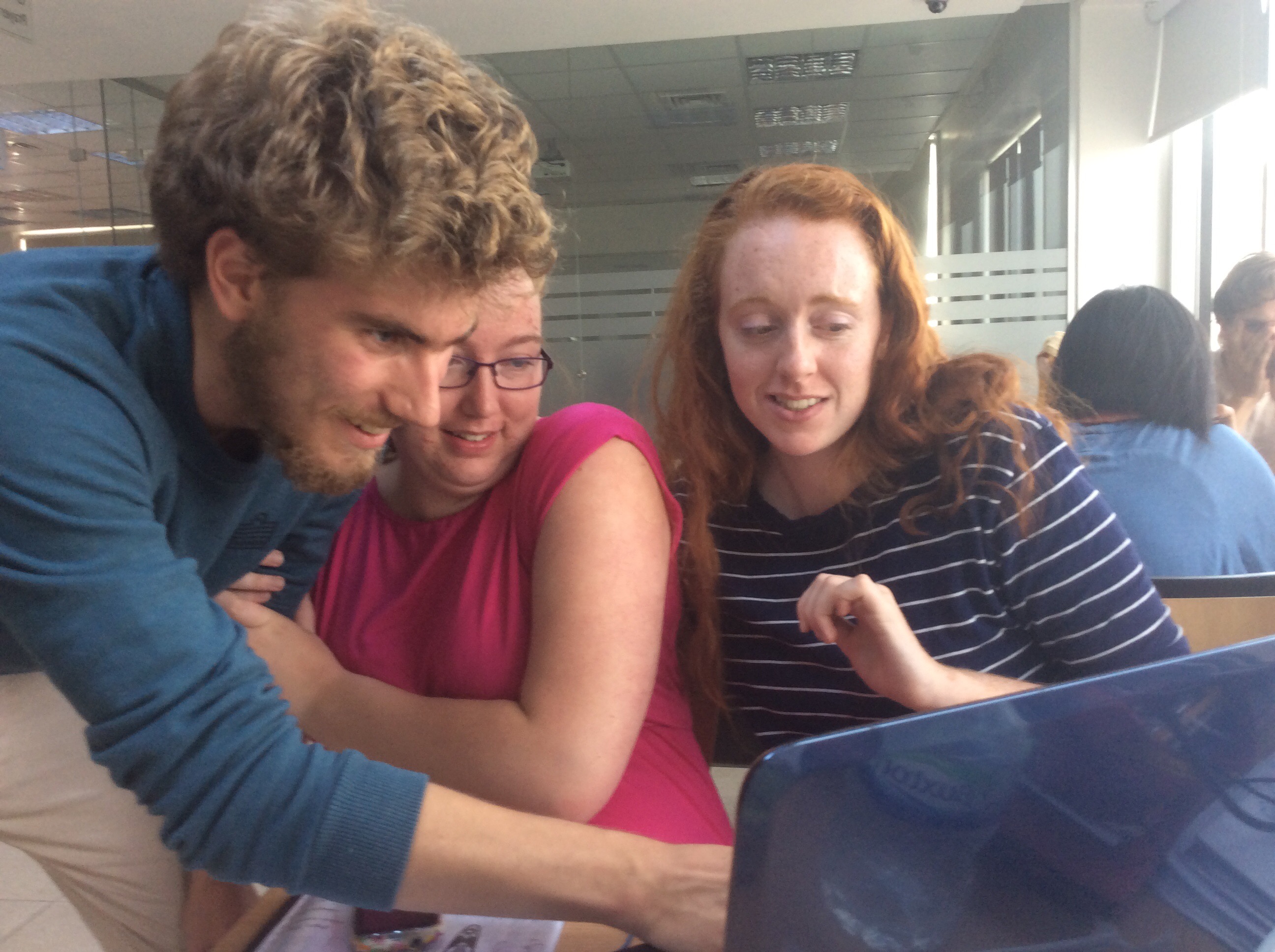
In addition to the mid-term exam, our Arabic teacher set us the task of coming up with a five to seven minute presentation on a topic of our choosing. It took me until the morning to come up with something I could realistically rattle on about for that amount of time (no, seriously), but after stumbling over my words as usual, I ended up putting Andrew up to a bet whereby he had to talk about Kanye West. Naturally, Andrew tried to make his presentation somewhat relevant to what we’d studied so that he could activate the vocabulary, or whatever buzzword you want to use. The result was an exploration of the modern wedding through the Kimye phenomenon, complete with all the gory details, ego, sex tape and all. Highly entertaining, of course, but our teacher took umbrage at the subject, claiming that it was ‘hardly suitable’ for class, and debarred us from asking any questions so as to bring the topic to a decided halt. Still, the man did a good job, and he held his ground in spite of all the criticism, so I held up my end of the bargain and rustled up a pretty neat lentil and vegetable stew for him and Andreas, as promised.

To kill some time in the post-class hours, Andreas took us to an underground church in West Amman to help him to teach English to a group of Iraqi refugees. Just a couple of hours in a church not too dissimilar in style from a Worth Abbey chapel, which made me smile almost as soon as I set foot in the place. John 3:16 was up on the wall behind the lectern in golden lettering; it was pretty clear from the first four words, even in Arabic. Beautiful stuff. The Iraqis themselves, Christians from Basra, were just about the nicest bunch of people I’ve met here in Jordan yet. Andreas and his teaching partner Jason assigned Andrew and I four to teach, and we discussed hospital related vocab to get the ball rolling. Whilst we worked, the children of our students scampered about the church at full pitch. I haven’t seen such unfettered happiness in a while. One of our group was a lot quicker on the draw than the others when it came to learning all the new words and expressions, but Raja’, the oldest of the group at seventy-one years old, was an utter delight to teach, especially when she came out with a flawless sentence at the end of the session, primarily because she was so shy. It kind of reminded me of how I must have been earlier down the line. Boy, but it was good to be teaching again, though. Getting back into practice for my assistantship in two months’ time. Better still, Iraqi Arabic is the closest to fusHa out there and a joy to listen to. Basra sounds like a beautiful place, as if Iraq needs anything more to make it more appealing. Land of the Abbasids! Home of Abu Nuwas! Man, why can’t I spend my Year Abroad in Iraq?

Wait, on second thoughts, don’t answer that one.

There’s a lot to be said for this religion malarkey. With any luck, one day the moment will come and I will believe. Warm fuzzy aside, I’ve got to say that those two hours were a godsend, no pun intended. All of my frustration and anger from the past week simply disappeared. I have Faras and his friends to thank for that, for being so friendly and eager to learn; and of course Andreas, for giving me the chance to get in on the project. All is well with my heart once again. I’m still going to fight for the chance to go back to Morocco next year, but I know now that I can and will survive another month out here. I can do this.

Hold the phone, according the beeb there’s a storm coming. Rain. You have no idea how happy this makes me. That it’s going to be 41 degrees at the peak of the storm is beside the point. Bring on the rain, I say. Bring it. BB x