SAUDADE – (n.) a deep nostalgic longing for someone or something absent, infused with a melancholic awareness that it may never return.
I looked up last night and saw a plane coming in to land at Heathrow. One of the big ones that comes in from across the Atlantic, like the one I flew home on nearly five weeks ago. It made me think of that Monday morning, seeing the sunrise over London, knowing in my head – even if I didn’t want to admit it in my heart – that I had come to the end of a cheery chapter in my life.
A plane like that one brought her here to this cloud-covered island many months ago. I wonder what my summer would have looked like if it hadn’t?
The Portuguese have this wonderful untranslatable expression called ‘saudade’. It’s often taken to mean the feeling of missing someone or somewhere, or more precisely a sense of longing for that thing, but many Portuguese and Brazilians will tell you that it’s a lot more subtle than that. There’s a sense of finality to it, also: an understanding that what you once had may never come back at all, an acceptance of that, but a wistful longing for it all the same. Not the raw kind that breaks you in the days and weeks that follow, but a tempered and reflective sense of nostalgia for what once was and what could have been.
It’s not unique to the Portuguese, but it is especially common in their culture – and perhaps even more so among the Brazilians. It is said that the expression may have evolved during the Age of Discoveries, when the wives of the great explorers of the day bade farewell to their husbands and lovers as they set out for the Americas (how ironic) knowing full well that they may never see them again, and that if they did, they would return as changed men.
Among the Brazilians, it has taken on the sense of a nostalgia for a lost future: a golden country that never was. The American dream isn’t just limited to the States – a shard of it can be found embedded like a splinter in the subconscious of all the descendants of the colonists, I believe. Why else should they have made such a journey if not in hope of a better tomorrow?
I feel that way about Spain, sometimes. Perhaps that’s the generational shockwave of my grandfather’s death in his mid-twenties, rippling across the years to the present, an echo of a lost world that could have been. Spain calls to us. It has been calling for sixty years. Come back. Come home. Sometimes you spend hours, days and even weeks waiting for somebody to reply (looking at you, folks on Hinge) without realising that something greater has been waiting for you all the time, if only you knew how to answer.
I have been the architect of my own saudade by choosing to devote my life to gazing upon that dream from afar: teaching Spanish to the English, sharing my love for a country I can only touch a few times a year. It is a test of endurance, to look upon a thing of beauty and not to touch. Spain has always been that thing. It fills me with awe, excitement, a deep-seated admiration and an infectious appreciation for life itself, but a sense of longing all the same, knowing that it is in my heart, but beyond my reach. Like there’s something blocking the way that I can’t see. Perhaps it’s akin to sleeping beside a former lover, after the love has gone.
I wandered through the woods as the sun came down. I think the nightjars have already gone back to Africa – there must be plenty of them around for a local bar to bear the name The Nightjar – but I was followed across the heath by a pair of stonechats. In that year I spent growing up in the Andalusian sierras, that was a sound that accompanied me every weekend on my forays down to the abandoned railway at the foot of the mountain where we lived: a whistle followed by a song like the clash of two small stones.
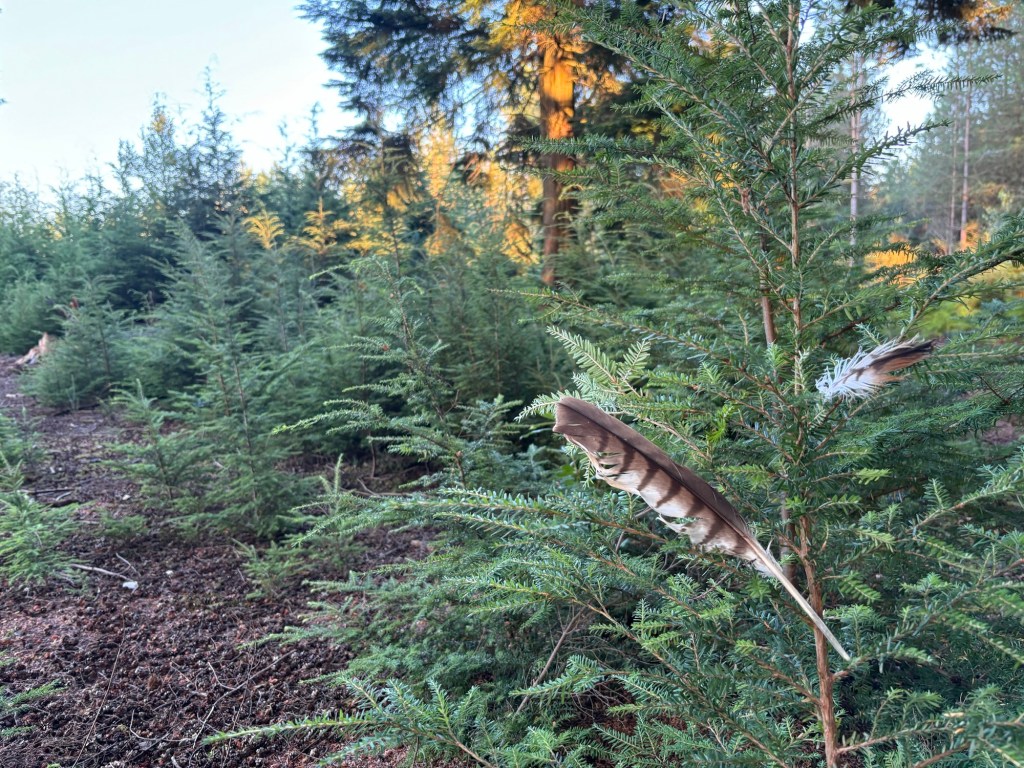
Further in, I found a couple of kite feathers. There are so many in these woods. When I was a child, you would have been lucky to see a buzzard – poison and poor public perception very nearly wiped them out – but now they’re everywhere once again. The red kites that once quartered the streets of London before their extirpation in the 19th century have also come back with a bang, and their feathers turn up in the forest quite regularly. I left some in a small tree for another person to find – some bright-eyed kid like me, perhaps, who might take them home as a treasure. Something they can look back on in years to come, and remember the day, remember the smell of the forest, remember the one who took them there by the hand – the feel of their hand, the sunlight in their laugh. I’d like to think that. BB x
 The Book of Barnabas