Aeropuerto De Santiago – Rosalía De Castro. 14.40.
I’m back at Santiago’s very small, very civilised airport. It’s another five hours until my flight, but Galician weather is highly unpredictable and I didn’t fancy making the three-hour hike to the airport under a belt of rain clouds, so I forked out a euro and caught the bus instead. On the plus side, it gives me plenty of time to read and rest – tomorrow will involve no small amount of walking, so it’s best I don’t wear out my feet just yet.
There’s a WHSmith in the departures lounge. I wonder how much longer that outpost is for this world, and others scattered in airports across the world, now that the dependable newsagents is going under, just like Woolworths before it.
I only just made it to the 19.30 pilgrim Mass in the cathedral of Santiago last night – it took me a little longer than I anticipated to track down the books I was looking for. There was a queue outside the door, and when I was a few metres from the great doors, an attendant in a high-vis orange jacket announced that visits were now over for the day – unless, of course, we were queuing for the Mass. That thinned some of the line, but even so, it was standing room only this time… not the front row seats I enjoyed at the end of the Camino in 2023.
The reason for the crush became apparent in the last few minutes of the Mass, when a group of eight priests in burgundy cassocks approached the enormous knotted rope securing the botafumeiro, Santiago’s famously huge incense burner and, with one collective tug, began to hoist the thing into the air.

Weighing in at 80kg and measuring an impressive 1.93m in height, the botafumeiro of Santiago is one of the largest in the world, outsized only by the Christendom College censer in Virginia (because of course the Americans, not satisfied with an imitation, had to have a bigger one). Unlike its American cousin, however, the botafumeiro is more than just a showpiece. The reason for its size was to purify the air within the cathedral and thus cover up the smell of the pilgrims, who must have stunk to high heaven in the centuries before Jacotrans, Booking.com and Compede blister plasters.
The botafumeiro you see today has been in use since 1851. The original, a 15th century thurible of solid silver, was stolen by French troops in the Spanish War of Independence and supposedly melted down for coinage. This and other acts of vandalism marked the French occupation, which saw many monasteries and Roman bridges destroyed in the name of military strategy. A local legend holds that the Alhambra was nearly blown to pieces on Napoleon’s orders as the French lost their grip on Spain, spared only by the efforts of a single French soldier who had a change of heart and stayed behind to defuse the charges, saving the last remaining medieval Islamic palace in the world from being lost forever.
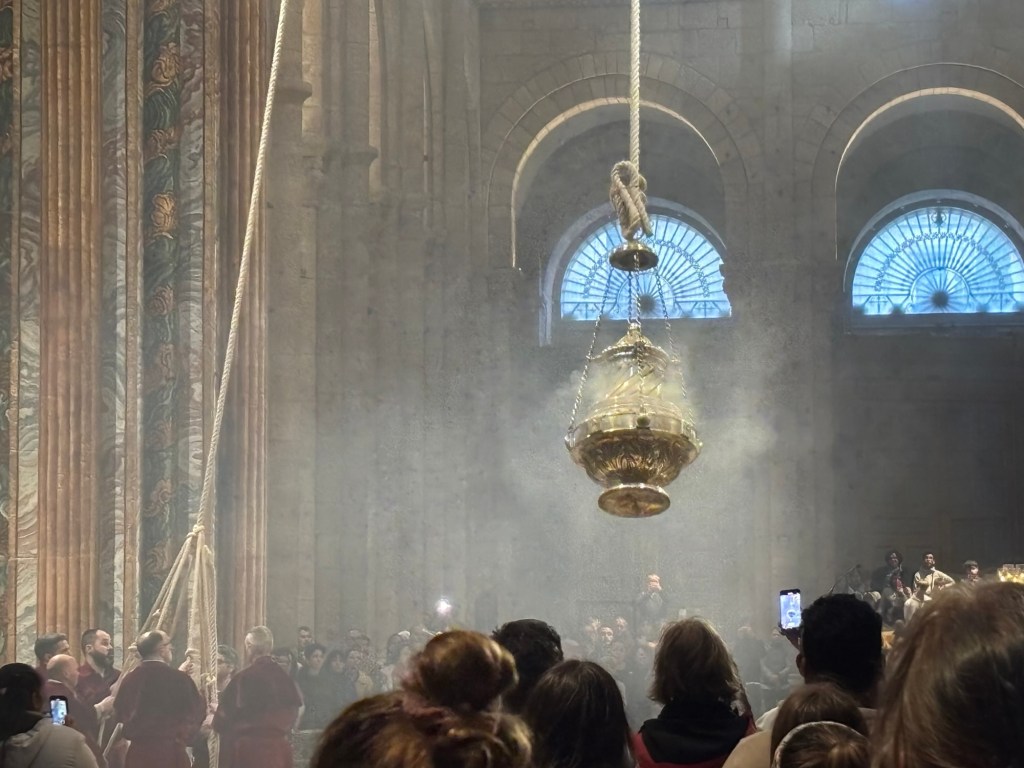
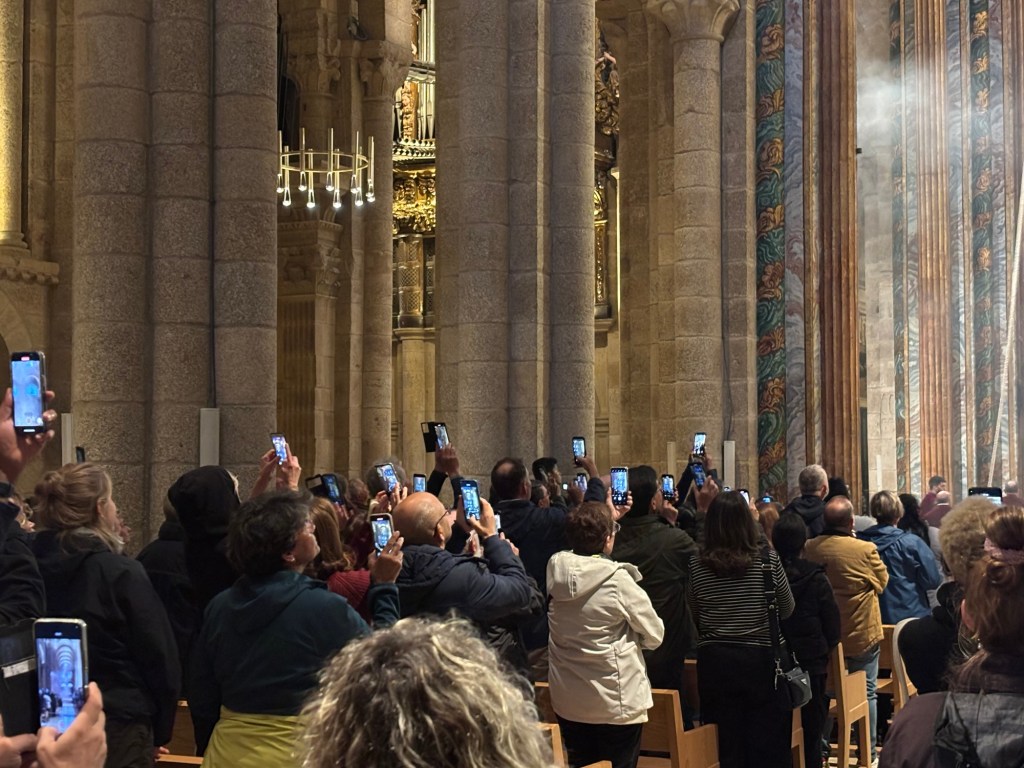
The botafumeiro swings alarmingly low over the heads of the faithful, reaching a top speed of 68km per hour, though never low enough to catch the heads of even the tallest German pilgrims. It’s quite a special sight, because its presence isn’t guaranteed: it’s usually only brought out on holy days, such as Easter Sunday or the Feast of Santiago on the 25th July. I missed it last time as I set out for the coast on the 25th, hoping to beat the crowds that would follow.
There is a small chance, however, that your visit may coincide with the whim of this or that religious order (or wealthy pilgrim), who can pay a certain amount of money to have the censer brought out especially for their arrival. This time I got lucky: a confraternity had traveled all the way from Goa to celebrate Mass in Santiago, so the botafumeiro was brought out. Lucky me!
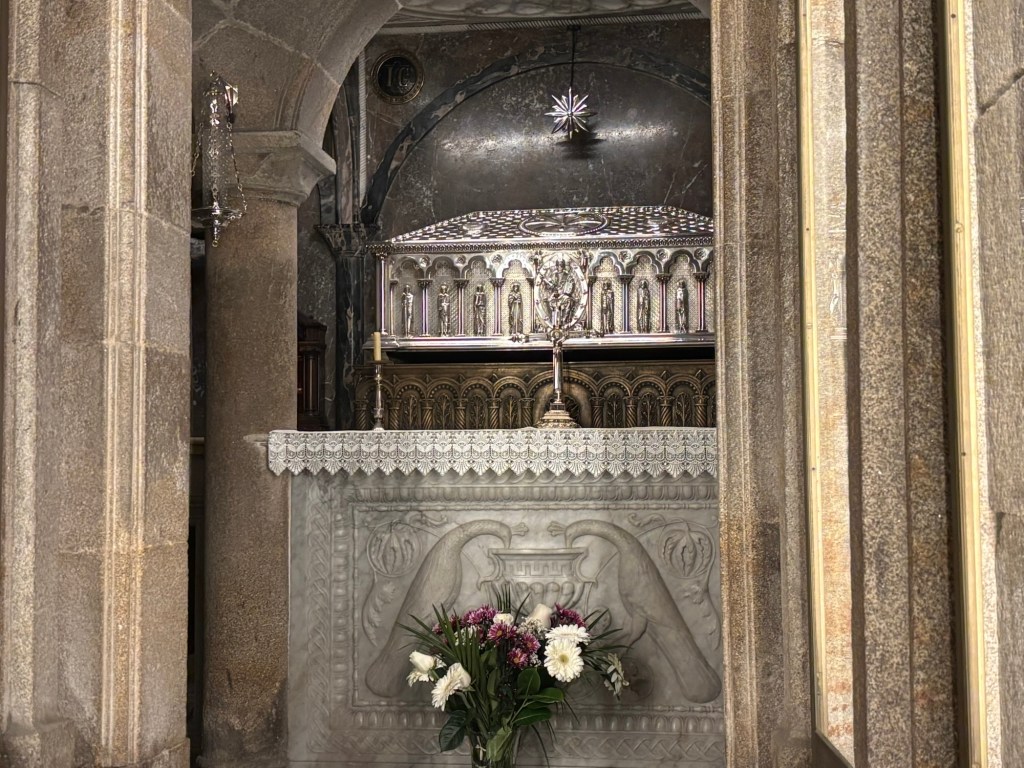
After three visits to the cathedral without paying my respects to the true purpose of the Camino, I decided to make one last trip to see the tomb of Santiago himself. The first of Christ’s apostles to be martyred for his faith, Santiago el Mayor (or Saint James the Greater, if you prefer) was beheaded on the orders of Herod Agrippa. His head was buried near the spot where he was killed (now beneath the Armenian Cathedral of Saint James in Jerusalem) but his body is believed to have been transported to the Galician coast, where his remains were discovered – as they so often are – by a hermit in the woods, who saw a great light shining upon a forgotten Roman tomb.
The veracity of the legend is irrelevant: word got around and soon the final resting place of Santiago had become the most important pilgrimage site in all of Christendom. That it just so happened to coincide with a time when the Christian kingdoms in the north were desperately seeking a rallying flag to counter the Muslim forces who had taken the Iberian peninsula by storm (and the angels believe to aid them in battle) is curious, to say the least.
Santiago’s tomb is a small silver coffin, located in a crypt beneath the central altar. The eighty-strong Portuguese school trip group that I had fallen behind weren’t all that interested in the bones of Jesus’ most faithful apostle, busying themselves repeating lines from Portuguese trap songs and stealing kisses from their girlfriends in the shadows, so I had plenty of time to stop and admire the coffin undisturbed.
I was lucky to get in when I did: by the time I left via the north door, the queue to get in stretched for nearly two hundred metres around the side of the cathedral. Pro tip: get in early, or just after Mass, when the queues are at their thinnest!
I had a quick bocadillo lunch in the old town and packed my things, thinking to spend a few sunny hours in the Parque de Alameda, but I was distracted en route by the sound of shouts and firecrackers. Doubling back, I found an advance guard of local police cordoning off the Avenida de Xoán Carlos I, and behind them, an enormous crowd of youths dressed mostly in black, carrying flags, placards and loudhalers.
I could have guessed what they were going to be protesting about, and my guess would have been on the money – after all, it’s a sore tooth Spain has been nursing for several years now: the housing crisis.

The short explanation? Spain’s housing market is a shambles. By some estimates, the cost of renting a property has gone up by 78% in the last decade, driven by rampant speculation and unrestricted vulture funds. Put simply, the average Spaniard now finds it very difficult (if not impossible) to find an affordable place to live, especially in the areas most popular with tourists. This is a country where flat-sharing websites like Idealista and Easypiso hold sway: AirBnB and its kin have made Spain a tough place to buy.
This has been most keenly felt in Barcelona and the Balearics, where many properties are vacant for large parts of the year, occupied only during the summer months by foreign investors. It’s one of a number of factors forcing Spaniards to live at home with their parents well into their twenties (or even thirties), and driving others to seek their fortune elsewhere. It’s also why I’m making a point of staying in pensiones wherever I go – a far older and more sustainable method of supporting the local economy as I travel.

There’s an even more sinister side-effect of the housing crisis in cities like Barcelona. I’m referring to the okupas, or the occupation of properties by gangs and other drug-related agencies who turn vacant holiday homes into drug dens, known here as narcopisos. The shady legal status of squatters in Spain, which makes it very hard to evict without the proper authority, doesn’t help matters at all.
Yes, A Place in the Sun and your kind – this is partly your fault. By encouraging the buying and selling (and re-selling) of property along the coast, you are driving the locals out of town faster than the local wildlife was displaced before them.
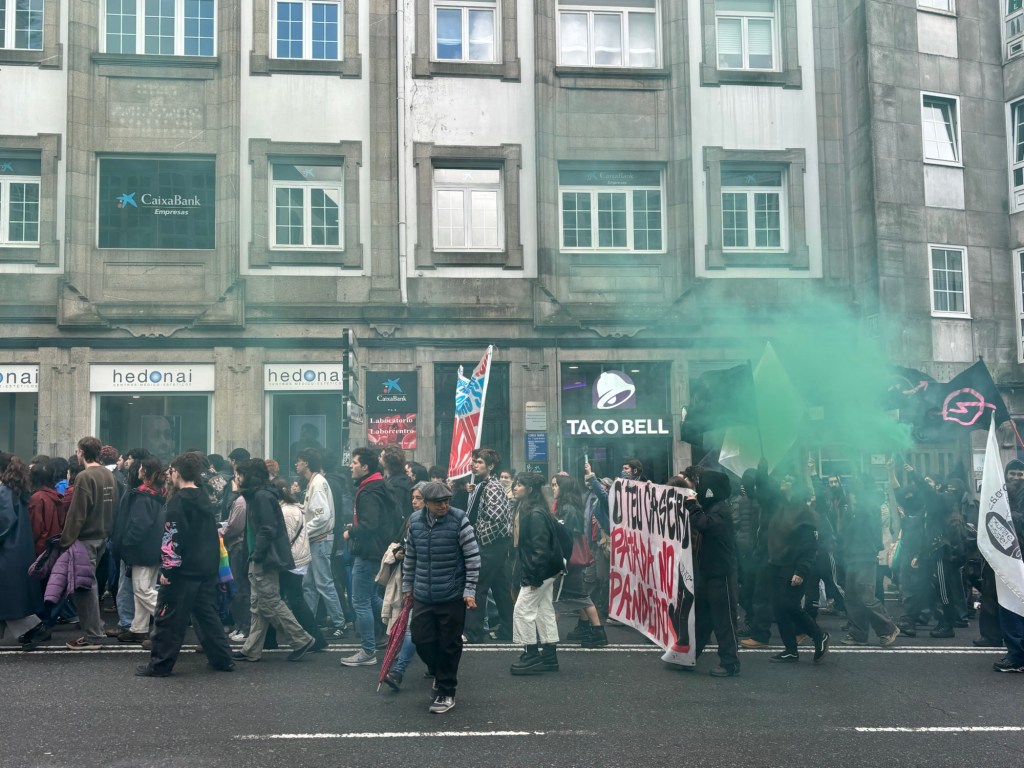
Naturally, it’s Spain’s youth who are taking the brunt of this crisis – and so, quite naturally, they’re the ones taking to the streets in large numbers to complain about it. Pedro Sánchez, Spain’s Prime Minister, has attempted to address the problem by proposing a ban or even a supertax on foreign buyers, but in the regions that depend the most on tourist dollars like Andalucía and the Costa Brava, that will be a very bitter pill to swallow. So, for now, Spain will have to muddle through these murky waters until a more universal solution can be found.

The protesters marched on up the avenue, followed closely by the police and their van, carrying their riot helmets at their hips. Some of the protesters threw petards into the road as they passed. Others lit flares. I watched them go and returned to the park.
Similar protests are taking place all across Spain today. I wonder if it will come to a head? It’s hard to say, but it is fascinating to be here on the ground while it’s all going down. It isn’t often that you get to live through history in the making, especially when it’s something you teach (manifestaciones is one of the tried-and-true A Level Spanish topics).
This. This is why I travel.
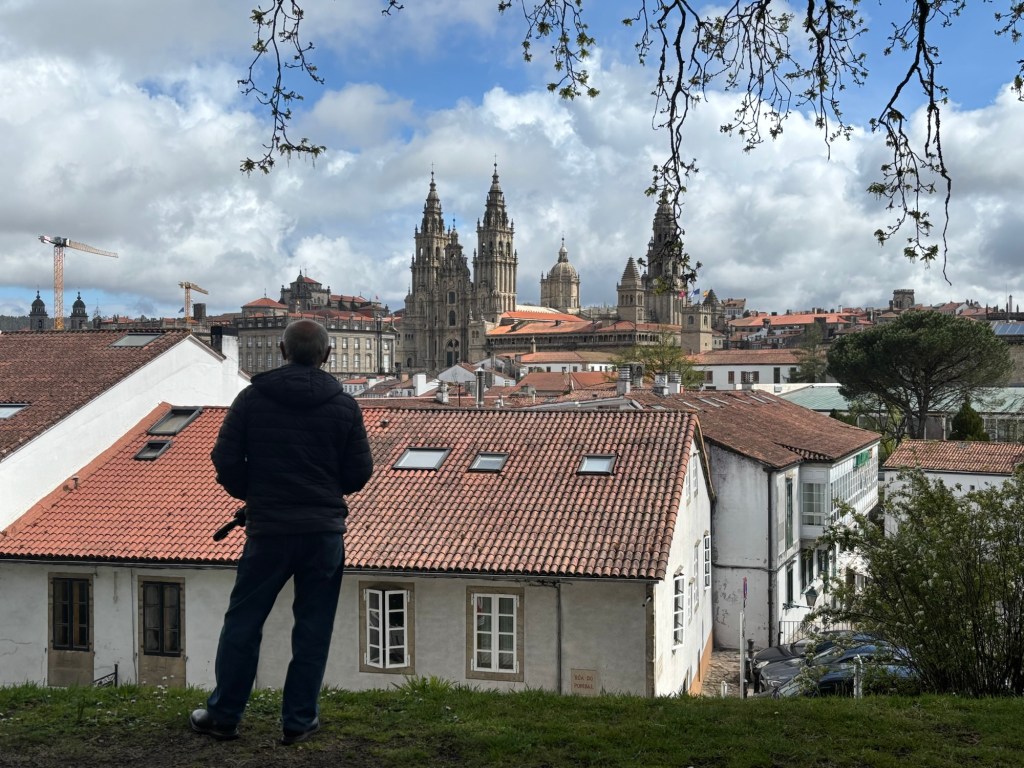
The smoking incense of Santiago’s botafumeiro was meant to cover up the stink of something rotten. Seeing the smoking flares of the protesters as the police escort them through the city, I can’t help but note the connection.
I’ll keep you posted if I hear or see anything else. I trust this isn’t the last we’ll hear of it. BB x



 The Book of Barnabas