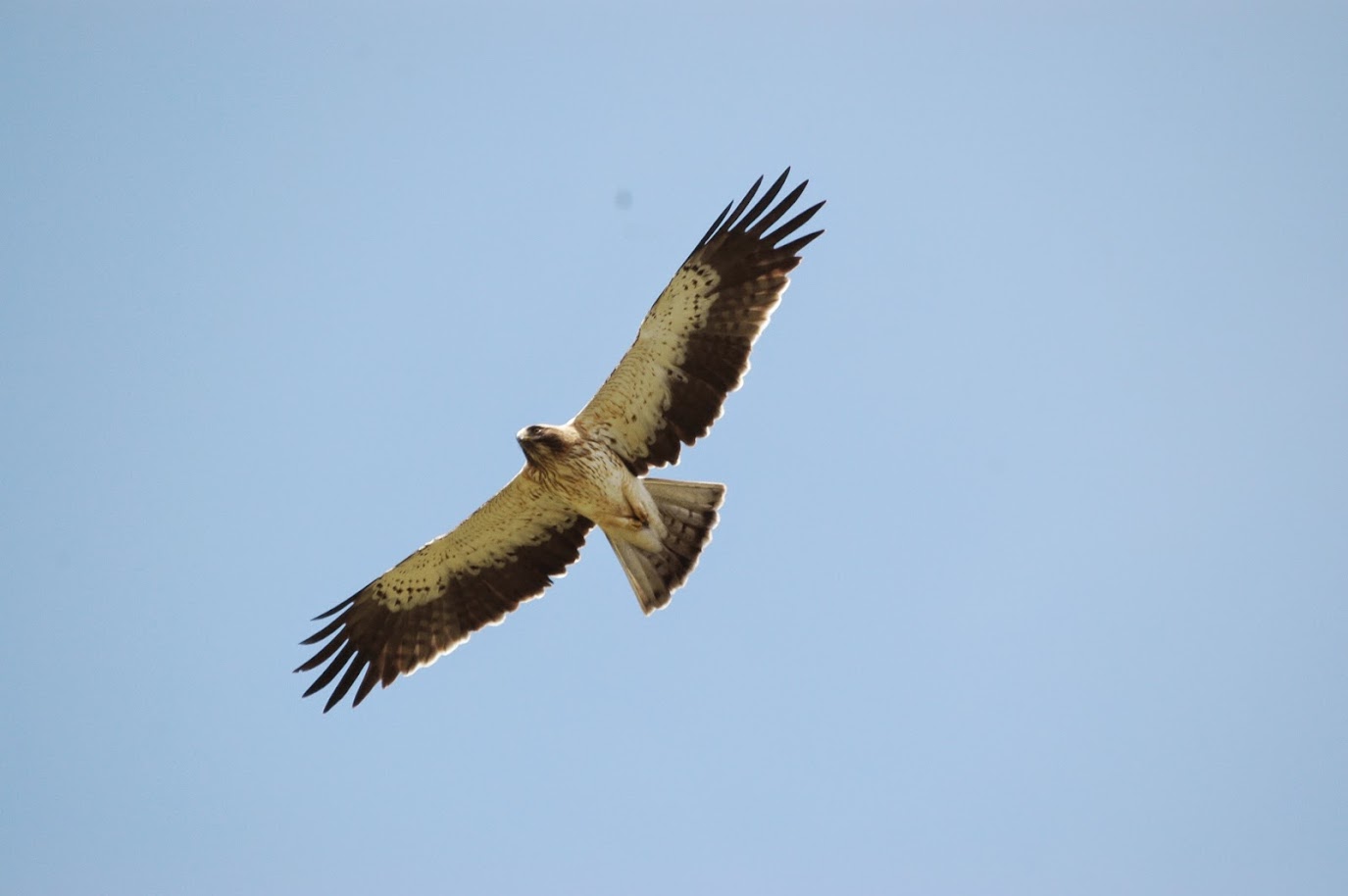
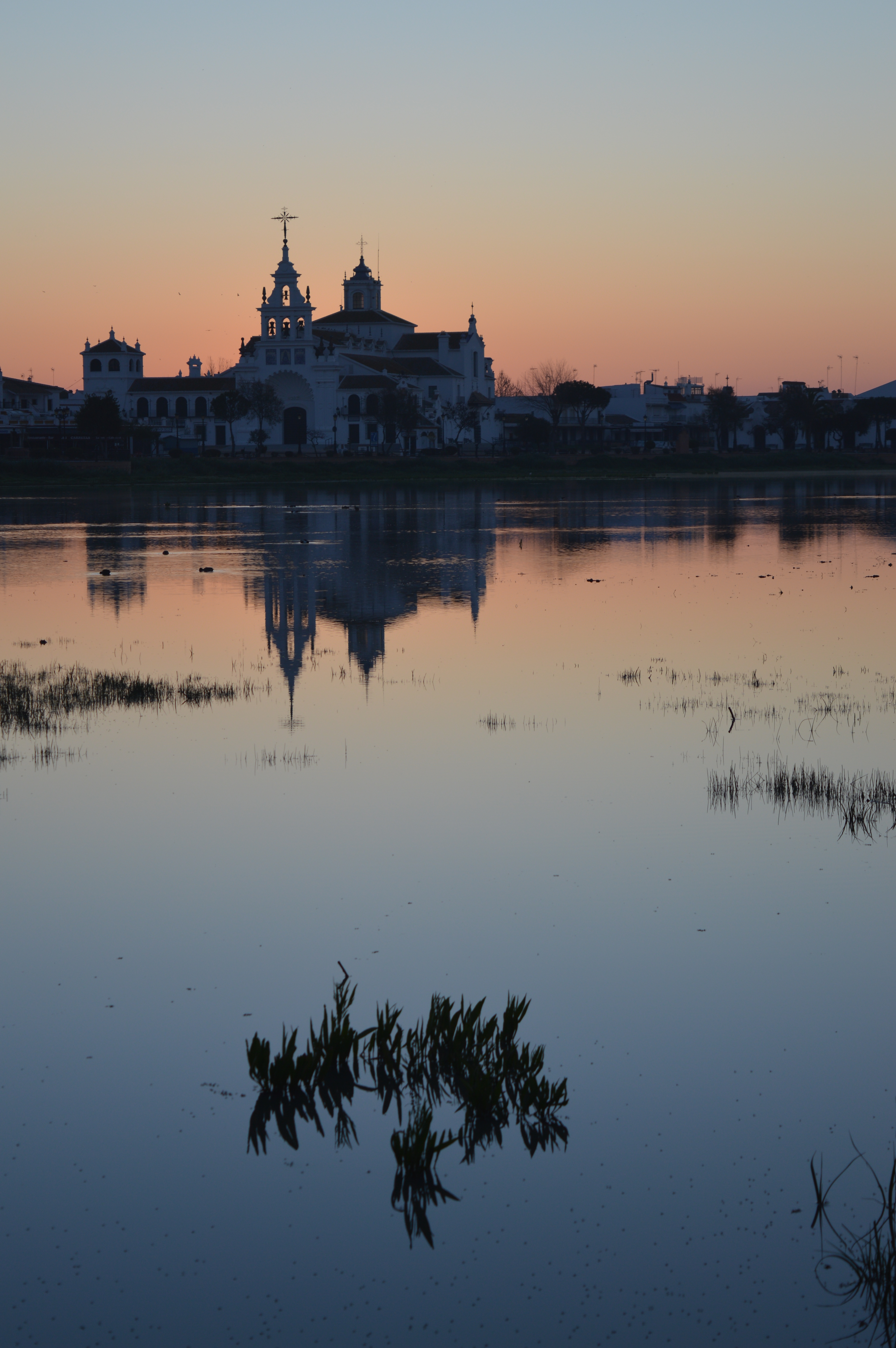
Camino XL: Last Man Standing

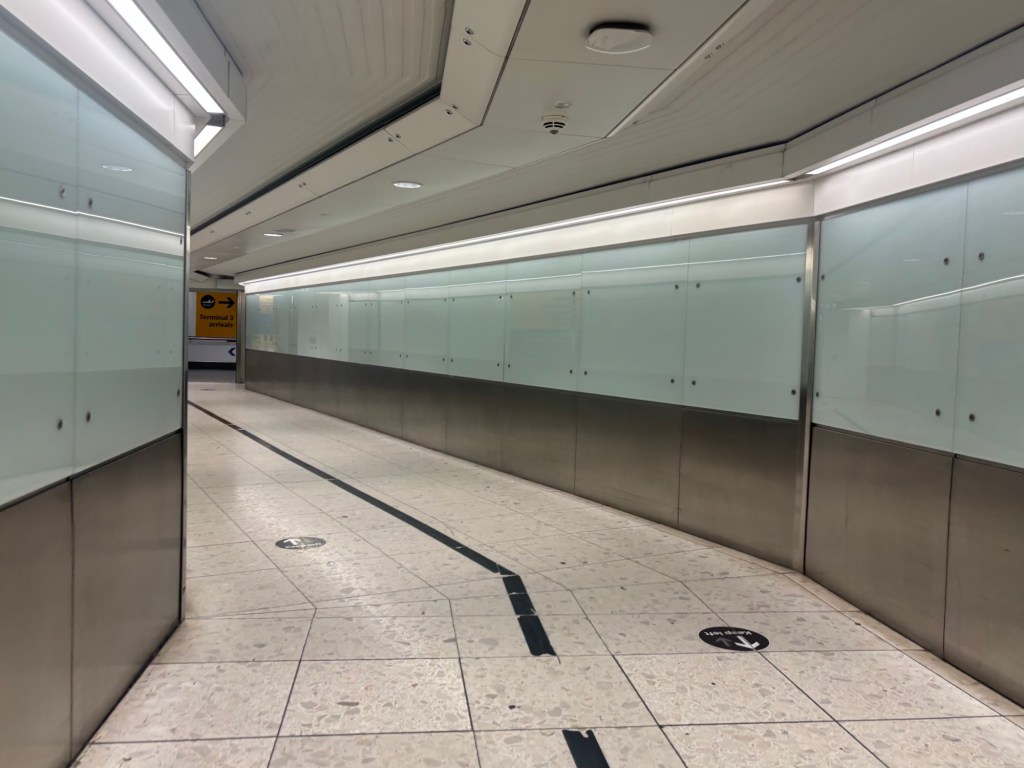
London Heathrow Airport, Terminal 5. 19.45.

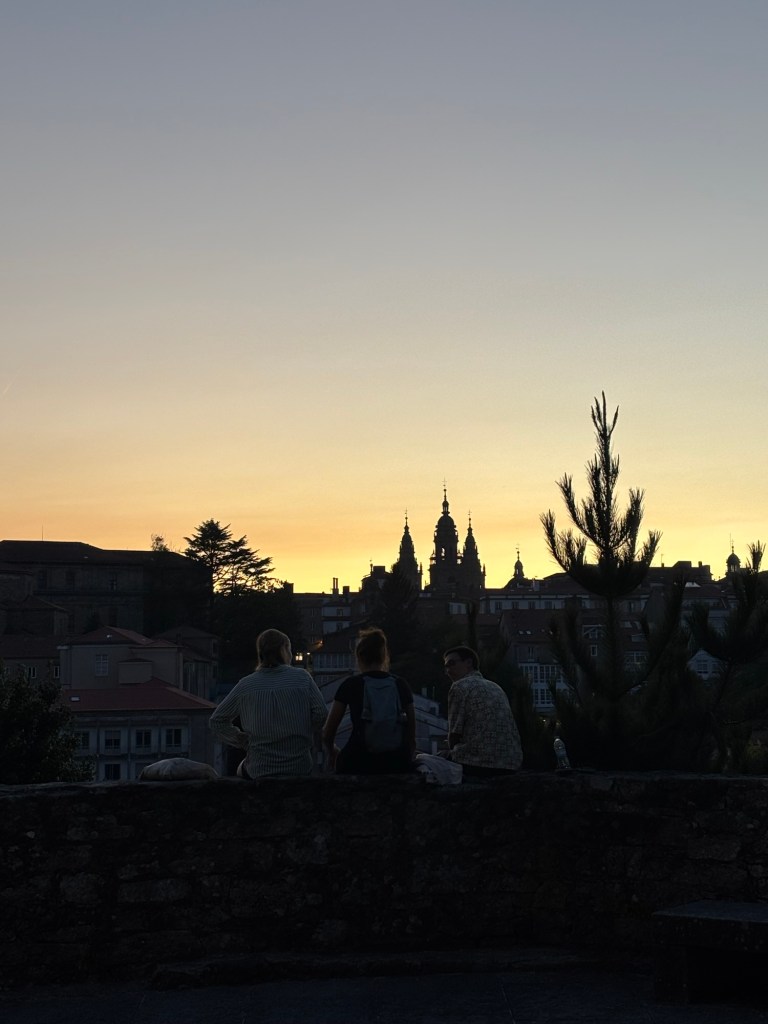
The Camino isn’t truly over until you’ve made it home, so here I am on the 19.50 from Heathrow’s Terminal 5. It wasn’t the best welcome back to England. Somebody pinched the flip-flops from my bag. They weren’t exactly in the best condition and frankly I could care less, but it’s the principle of it. Six weeks of relatively careless travel across two countries and the first item stolen from me is within minutes of landing back in the UK. Add to that the grey hellscape that is Heathrow, the cost of just about everything, and the facelessness of London…

No. I don’t want to think about that. Not right now. My nerves are shredded enough as it is. I want to think about where I’ve been. Who I’ve met. What I’ve learned.

Nearly six weeks ago, I locked myself out of my flat, caught a late flight to Bordeaux and set out for the Spanish border with little but a few spare clothes and my journal. I did not know quite what to expect from such a last-minute decision: it had been a toss-up between the miserable money-sink of more driving lessons or a second Camino, and after a stressful year in a new school, the decision was just too easy.

My reasons for setting out upon the Camino this year were varied. I had an uncommonly wonderful holiday in Spain at Easter and wanted to say thank you. A dear friend lost her father and I promised to pray for him at every church I found. I needed some healing after last summer’s heartbreak, which was mostly healed in El Rocío, though this wound has proved difficult to recover from fully.

I also needed to get away for a while. Social media has been leering at me with a stream of weddings of old friends, and with each one, I am reminded of how much I have been forgotten – or rather, how much I have allowed myself to be forgotten by going radio silent and burying myself in my work for the last eight years. I am still coming to terms with what I am now fairly certain is my undiagnosed ADHD, which came to a head somewhat this year, and would go some way to explaining much of my behavioural quirks and communication issues. I ended the year on a major high with the triumph of my new funk band – something I’ve wanted back in my life for thirteen years – but I still needed a change.

I come into my own on the Camino. There’s no pressure to communicate, but so much reward for doing so. Fleeting but powerful friendships based on shared adventures and the sharing of stories. A chance to swap languages constantly, and to learn new things about myself and the world each day. A chance to be back in my grandfather’s country, and to feel his spirit at my side. To walk in the light of the Blanca Paloma and to see the wonders of her world. To patch up the wounds in my lonely heart with an alchemy of golden fields, griffons and the churring of nightjars. To sing, to write, to read, to tell stories, to laugh, to walk, to climb, to run, to swim and to be surrounded by the one thing in this world that has never let me down: nature.

In short: to walk the Camino is to be myself.

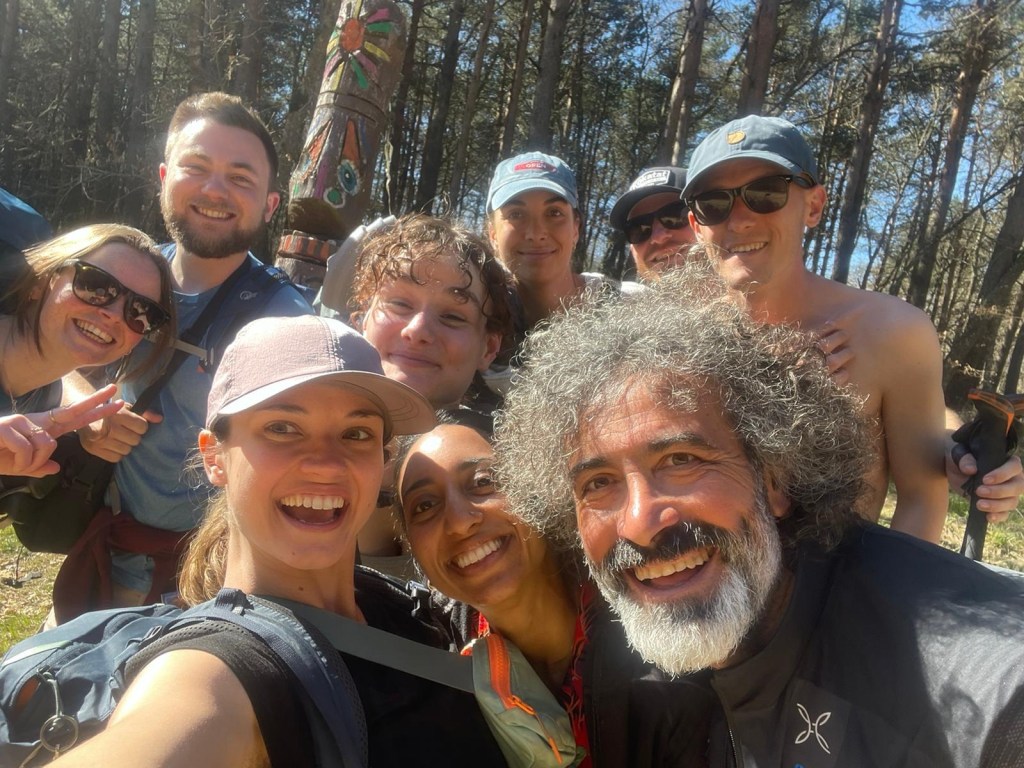
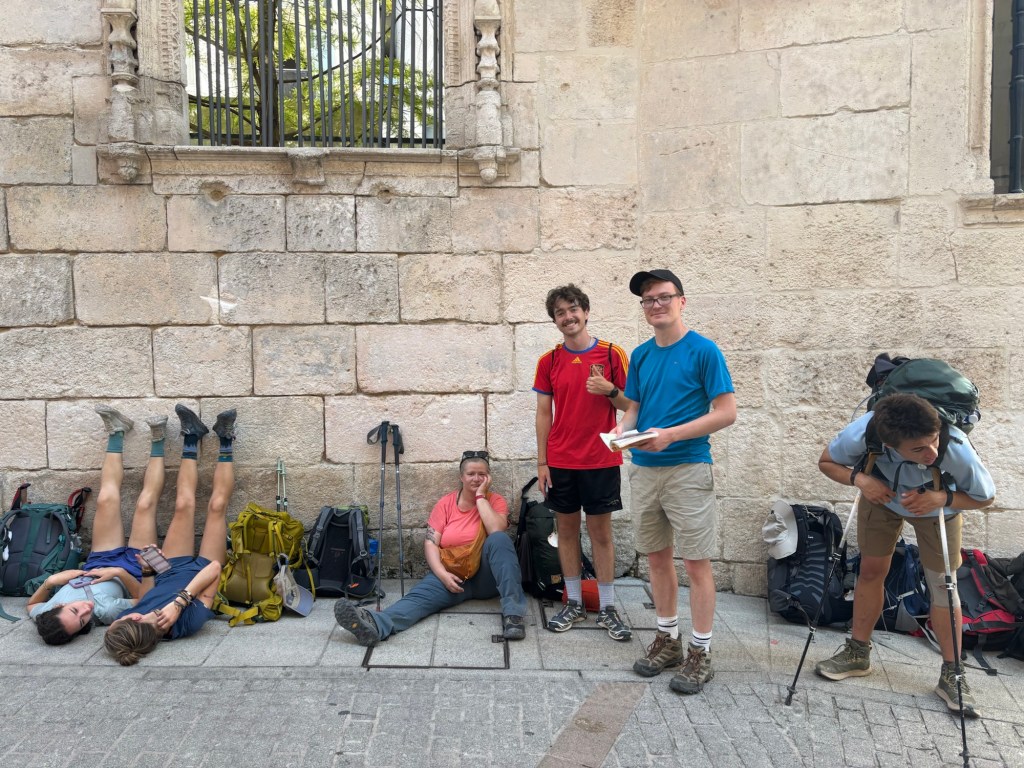
When Gust left this morning, I was the last of us left in Santiago. I have been incredibly fortunate this year with my companions, who have been the most wonderful company – even for this lonely wanderer who so often set off on his own to walk the road alone, for days or even weeks at a time.

Alex. The lawyer. My fellow countryman. Lost to us far too soon in Burgos. In many ways, the one who brought us all together. You set the pace – sometimes too fast for even me to catch up. You came to my defence against the Dutchman and his beer-fuelled football rant. I would have walked with you to the end.

Audrey. The marine biologist. The trooper. A seeker of solace and of silence, with a kind word for everyone and a pure heart. This was your Camino, I feel. The rest of us just fell into orbit. And who could resist the gravity of such a warm disposition? I hope you found the peace you were looking for in the shining Aegean Sea.

Talia. The neuroscientist. The brains of the operation and the questioner. Sage and sober and endlessly perceptive. You awoke in me an awareness of paths untraveled that I had long ignored, shining more light upon the road than any headtorch-wielding peregrino – which I, in my preference for the starlit dark, sorely needed.

Alonso. The diplomat. The wanderer with a thousand-yard smile. Powered by kudos and watermelon. Chasing the Sun across the horizon “for the bit”. Your wits were almost as fast as your Strava-fuelled sprints down hill and mountain, and you brought humour to every town and village we found. 100%. For you, the journey goes on.

Chip. The agent. The sunniest Salt Laker this side of the Atlantic. Friend to the saint, the sinner and the sandhill crane. Fountain of wisdom and wit and the only thing holding me back from being the eldest of the family (for which I was very grateful!). We never did get to say goodbye, so perhaps I will have the chance to say hello there again someday.

Gust. The drummer. The free-spirited Waldorf wayfarer. Blighted by blood blisters, broken sandals and Italian blessings and still one of the bravest of us all at seventeen years of age (or eighteen, if your credencial was to be believed). A chip off the old block who slept in a bus shelter to secure an earned Atlantic sunrise. You give me hope.

I’m already thinking ahead to my next Camino. I love the sociable side to the Camino Francés, but now that I have done it twice, I feel it may be time for a sea change. The Camino Mozárabe is calling to me, looping through the marbled hills of Andalusia and winding across the green fields of Extremadura. I don’t think I’d be likely to meet such an excellent and eclectic cast as the one with which I have shared the road for the last six weeks, but it would be another genuine adventure – as the Camino Aragonés, the Primitivo and the San Salvador were this summer.

Of course, for the same budget, I could probably have a week’s holiday somewhere really exciting: a tiger safari in India, chimp-tracking in Tanzania or an adventure around the deserts of northern Mexico. But would it make me as happy as another five or six weeks in Spain? Probably not. I know what makes me happy. Happiness has a name and her name is Spain.


Well, I’m back in England now. But the story isn’t over. Not yet. I’ll be back tomorrow to muse a little more. I just wanted to put some thoughts down while the memories are fresh in my mind. BB x
Camino XXXVIII: Santiago

Albergue Seminario Menor, Santiago de Compostela. 18.11.

Two years ago, when I walked into Santiago’s Praza do Obradoiro under a cool white cloud, I could not shake the feeling that I had not quite earned the triumph that the end of the Camino usually entails. I had walked in alone, in the early hours of the morning, after setting out from Burgos some twenty-one days prior. My credencial showed that I had walked all the way, but not all at once: my circuitous route had taken me four years, starting in the summer of 2019 and continuing in the spring and summer of 2023, after COVID and a number of other factors prevented me from walking further.

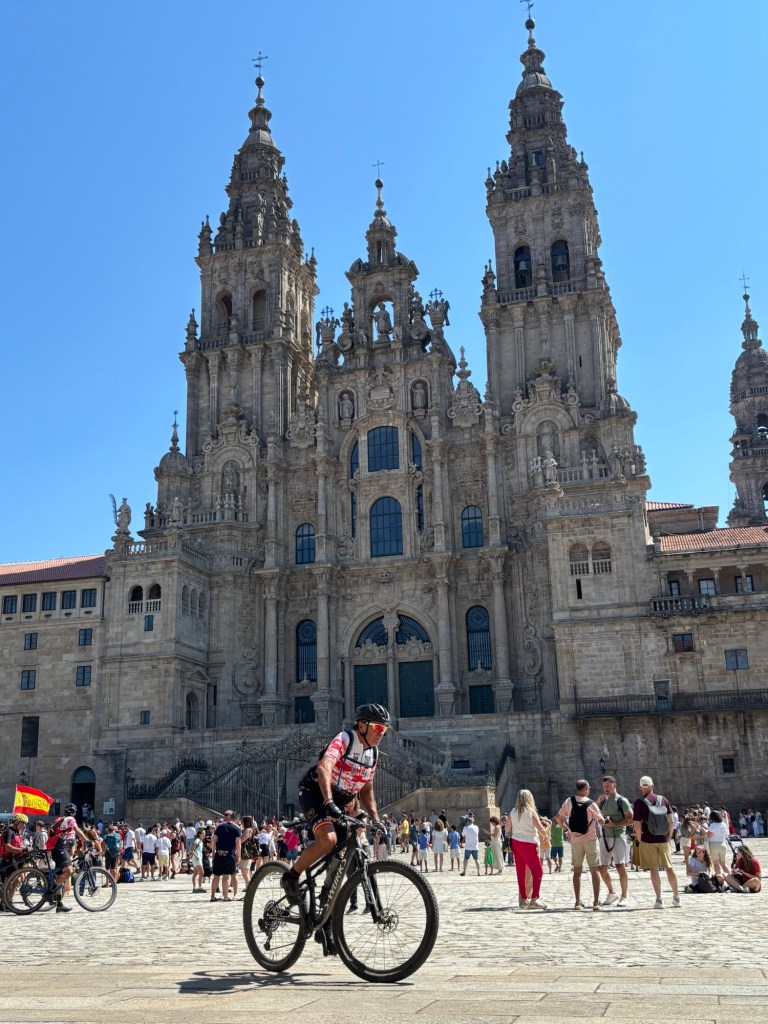
Not this time. Today felt like the finish you read about in books and in the films. Today, after walking over a thousand kilometres across France and Spain, to be welcomed like a hero by old friends in front of a crowd of thousands before a cathedral bathed in light… I was on the verge of tears this time.


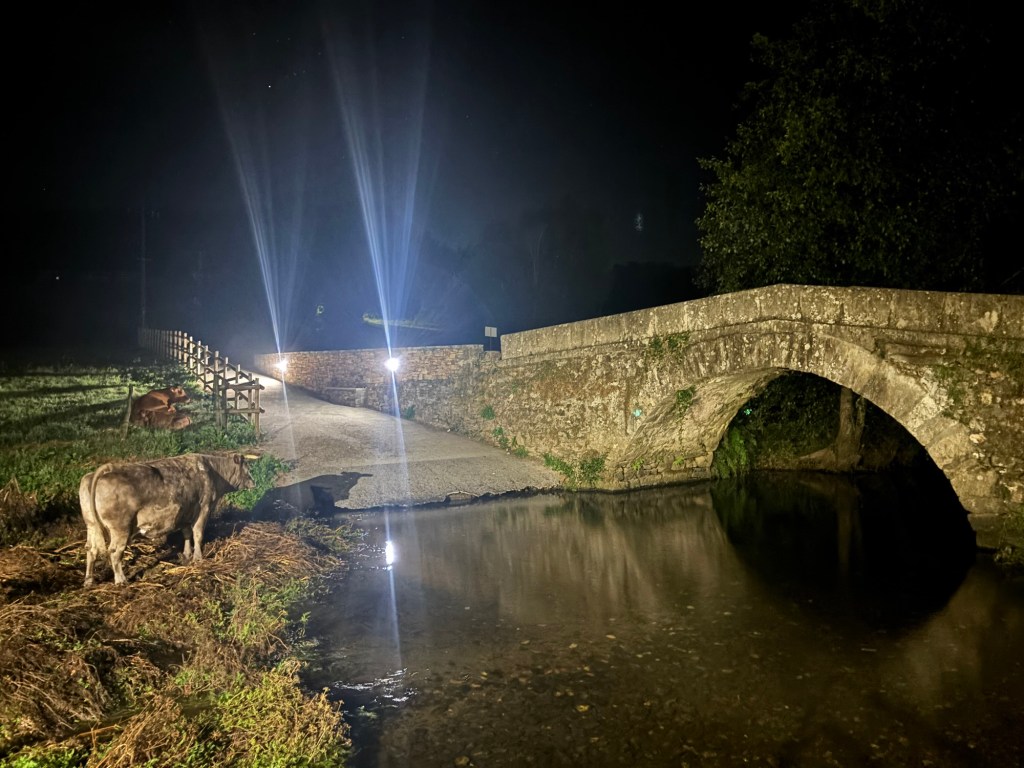
Ribadiso was silent when I left at around a quarter to five this morning – the earliest I have set out along the entire trek. A few cows had wandered down to the river for a drink by the reflected light of a few lamps along the bridge, but I could hardly make out more than their silhouettes in the gloom. My phone did a much better job than my eyes could do.


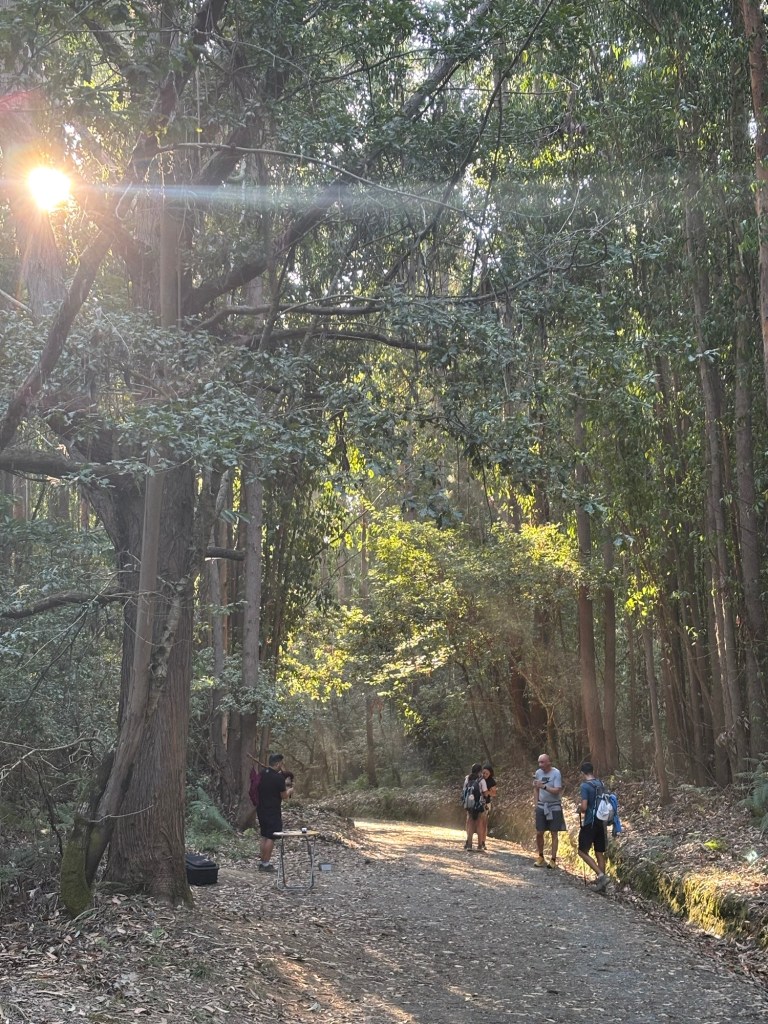
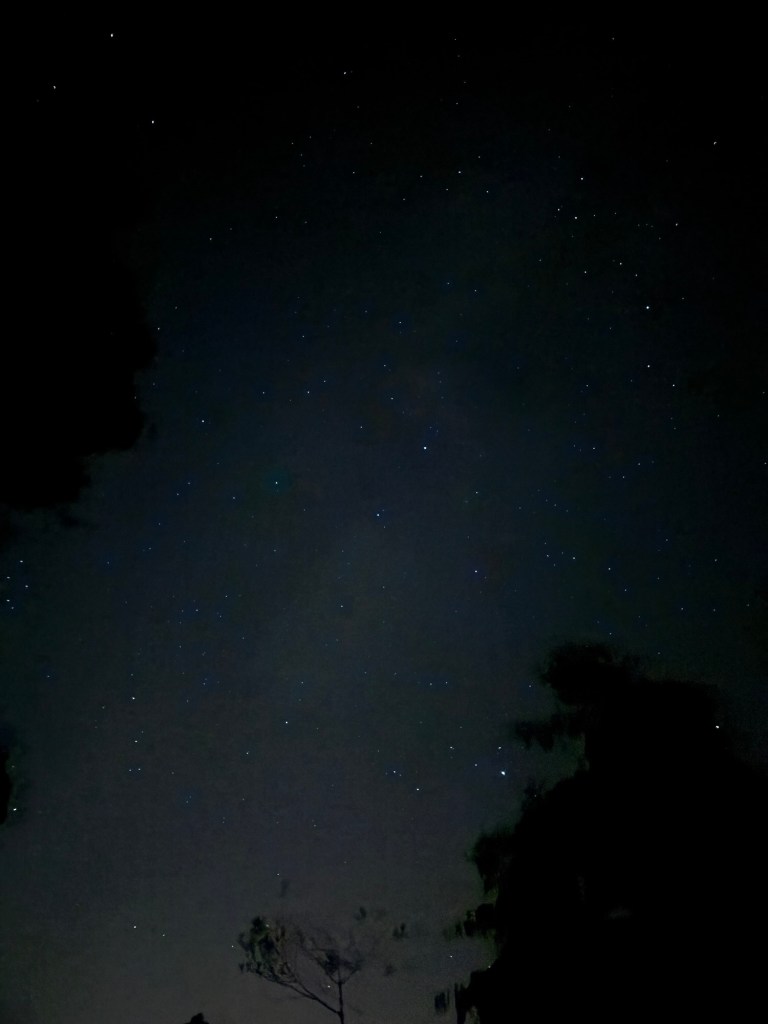
Darkness shrouded my steps until well after seven o’clock, so the first two and a half hours of my walk were made in the long shadows of night. As usual, I avoided using my phone’s torch as much as possible, navigating by starlight and the shadows of the trees against the sky, turning it on only to check I was not in any danger of leaving the trail. I passed a few pilgrims on the road who turned their glaring flashlights on me as I motored past, no doubt perplexed as to why I had decided not to light up the way in front of me.

I picked up considerable speed whenever I saw the dim moving light of a headtorch on the road ahead. I have not been a huge fan of headlamps and torches since two were trained on me like searchlights at two o’clock in the morning on a beach in Almería, during my mad trek across Spain at the age of eighteen. The fright that experience gave me has never really gone away, which may go some way to explaining my general disdain for the invasive, almost threatening white light of a handtorch. But there’s also my natural stubbornness, which I suspect has much more to do with it. You don’t really need a torch to navigate by night… not when your eyes grow accustomed to the gloom. So why bother?


I considered stopping for breakfast at a number of cafés once they started to open their doors after 7am, but every time I neared one, it looked packed to the gills, so I moved on. If I’d known that this would be the case all the way to Santiago and that I would not stop again until I reached the holy city, I might have shrugged off my pride and popped in for a tostada. But I didn’t, and when I accidentally took the forest route bypassing O Pedrouzo altogether – the usual staging post before the final push to Santiago – I decided to push on to the end on the power of a Bolycao and the last of my Nakd blueberry bars. It wasn’t much of a breakfast for a forty-three kilometre hike, I’ll admit, but it did the job.


The road got quieter before O Pedrouzo after I had overtaken all of those pilgrims who had set out from Arzúa, only to ramp up again as I hit the back of the O Pedrouzo brigade. I met a few new characters as well as the first of a few old faces from the Camino Francés: Don Decibel, a raucous Spanish soldier whose phone call to his friends ten kilometres back hardly required the use of a phone at all (though I’m not sure I’d count the repeated phrases “oyé maricones” and “viva España putamadres” as a conversation); the Shadow, a French pilgrim who seemed to catch up to me constantly despite my attempts to race on ahead; Tim & Jackie, an Australian couple who fell behind us at Carrión de los Conded when Tim’s legs started to cause him trouble; and Edoardo, the charismatic Don Juan, who had slowed down to walk with a large group of Italian pilgrims.

And then there were the school and university groups. Hundreds of them. Well over a thousand, if I’d bothered to count them all. The ticker in the Pilgrim Office in Santiago showed that 847 had already made it to the city before I arrived at around twelve o’clock, so that number is not as much of a hyperbole as you might think.

The post-Sarria rush is real. It wasn’t quite as obvious two years ago as it is now, in the middle of August, when the crush is at its highest. I’d wager that I’d have seen even more if I’d left even a little later. They were all in very high spirits and many of them were draped in the colourful flags of their home regions: Andalucía, Valencia and Asturias were the most obvious. I looked for the black bars of the Extremaduran flag, but I didn’t see one.

I wondered, if I’d carried a flag, which one I would have the right to bear. Not Andalucía, surely, as I only lived there for a little under a year as a child (though it has forever marked my accent and identity), and not Extremadura either, since I have no familial connection to that earthly paradise whatsoever. La Mancha, perhaps, as that is where my cousins reside – but when my great-grandmother was born, that part of La Mancha was part of Murcia. My grandfather and his father, on the other hand, were from the Valencian province of Alicante.

In short, I have no claim to any of the regional flags. So I would have settled for the rojigualda instead.


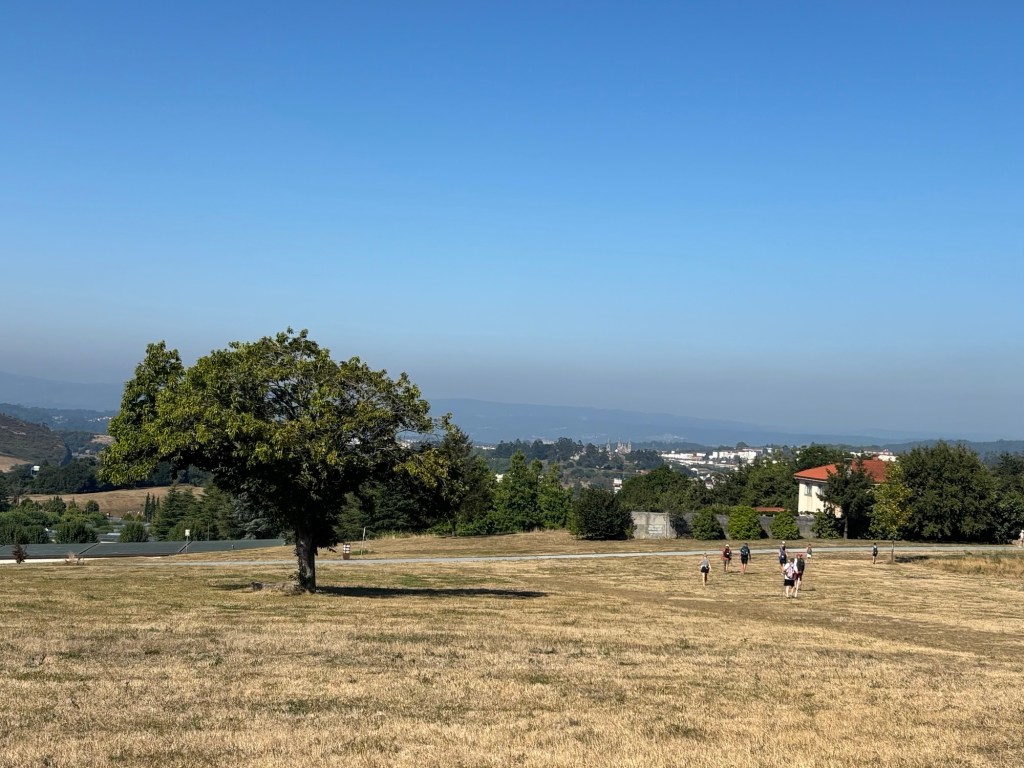
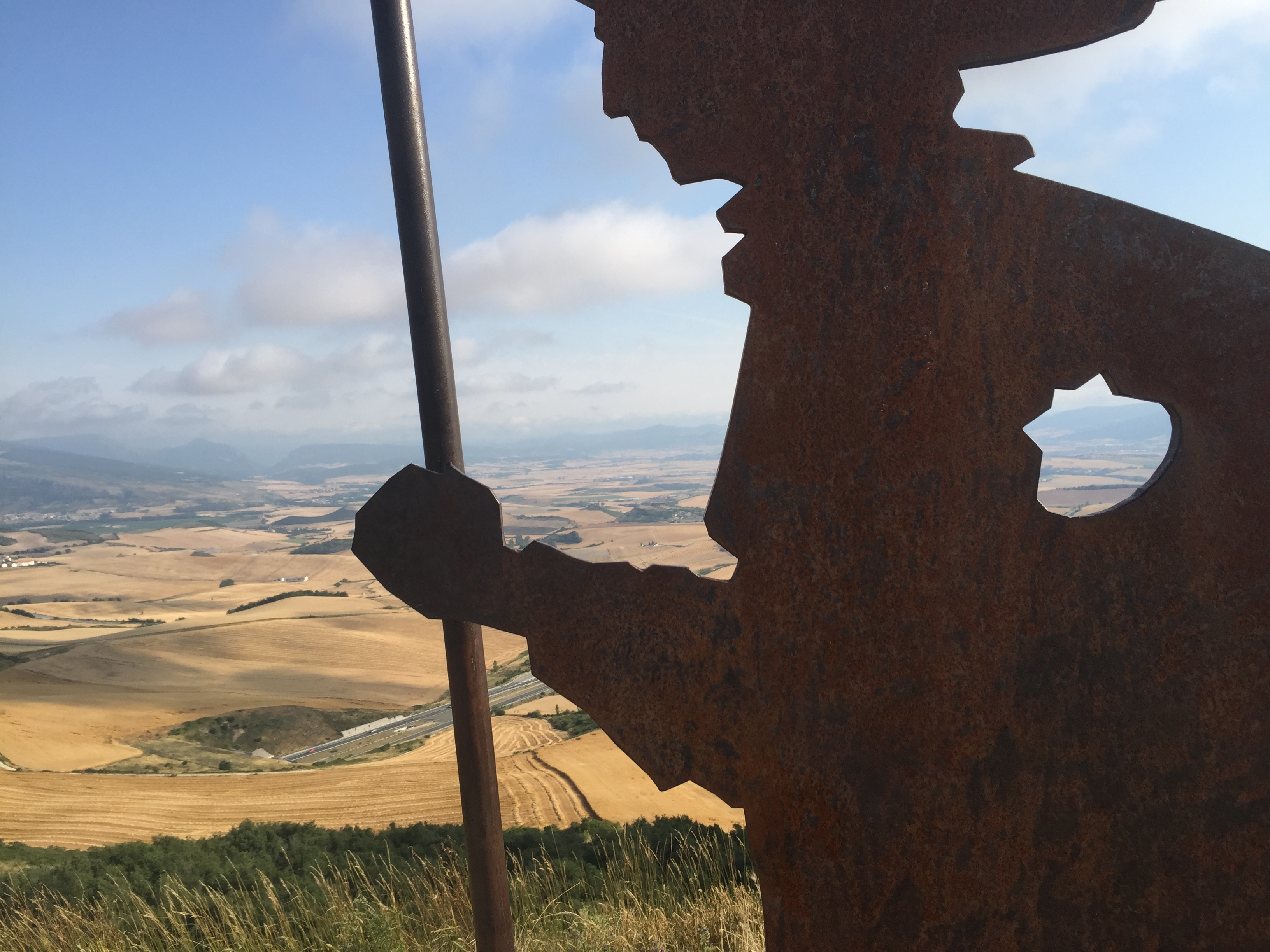
I couldn’t find the famous pilgrim statues on Monte do Gozo – I wonder if they’ve been moved to a different location? Their pedestal was where Google Maps said it would be, but I could not find them. I did, however, see my destination for the first time, and that was motivation enough to proceed: the twin turrets of Santiago’s cathedral, between the gleaming white houses and the towering eucalyptus trees.


When I left Ribadiso this morning, Google Maps thought it would take me around nine hours to reach Santiago. It took me seven. I had some powerfully uptempo music to get me through the last ten kilometres, up to and including:

  1. Rhythm is Gonna Get You – Gloria Estefan
  2. Higher Ground – Stevie Wonder
  3. Voodoo Child – Rogue Traders
  4. El Cid March – Miklos Rozsa
  5. It’s a Big Daddy Thing – Big Daddy Kane
  6. Qué Pasa Contigo – Alex Gaudino
  7. Walk Right Now – The Jacksons
  8. Deliver Us – The Prince of Egypt

The last one was the killer. I get emotional listening to that track at the best of times, but the timing was absolutely perfect, reaching the triumphant crescendo finale just as I reached the back of the square and turned to face the cathedral. There really were tears in my eyes this time.

Let’s face the facts. I walked a bloody long way.


I had hardly arrived in the main square when I was jumped by three old friends: Juha the Finn, Max the Austrian and David the American. To be honest, I was not expecting to run into any of the old guard at all: my side quest over the San Salvador and along the Primitivo put me almost a week out of sync with the crew I had walked with, and even three double days wouldn’t have been enough to catch up to them all.

However, with the exception of Chip (who left for home several days ago) and Audrey and Talia (who I missed by a matter of hours), everyone else was here, including Alonso and Gust, the last remaining members of our little band of seven. I could not have hoped for a better welcome wagon.


Alonso, Gust and I are all at the Seminario – along with a good number of familiar faces – and we had a decent lunch (if a bit pricey for what it was) and a phenomenal Gujarati supper at Camino Curry, a brave new enterprise by a family from Birmingham that was both the most delicious and the friendliest meal I have had on the entire Camino. Given that the fellows had been advertising on my Facebook posts, I’d say they earned my custom.

We said farewell to Max and Juha for the last time on this Camino and returned to the albergue for a couple of rounds of Go Fish (instead of watching the 10pm screening of the Superman movie at the local cinema and risking the nine minute dash back to the seminario before lock-up). I’m normally averse to card games but I had a great time. It reminded me of those dark internet-free nights in Uganda long ago, with Teddy and Maddy and Mina. That feels like a lifetime ago.


Well… tomorrow is another day. No more 5am starts. That’s something to look forward to! BB x

Camino XXX: Journey in Hope

Albergue El Texu, La Espina. 17.09.

One of the things I love the most about the Camino is that the planning required, relative to any other holiday, is minimal at best. In most instances, you can pick up your bag, start walking and stop in this town or the next when you’re tired. It helps to know which locations are truly special or worth seeking out, but you can always follow the Camino at your pace. For a teacher like me, for whom planning is a daily and often insurmountable chore, the last thing I want on a holiday is to have to plan all of my movements. The total freedom the Camino provides is one of its greatest blessings.

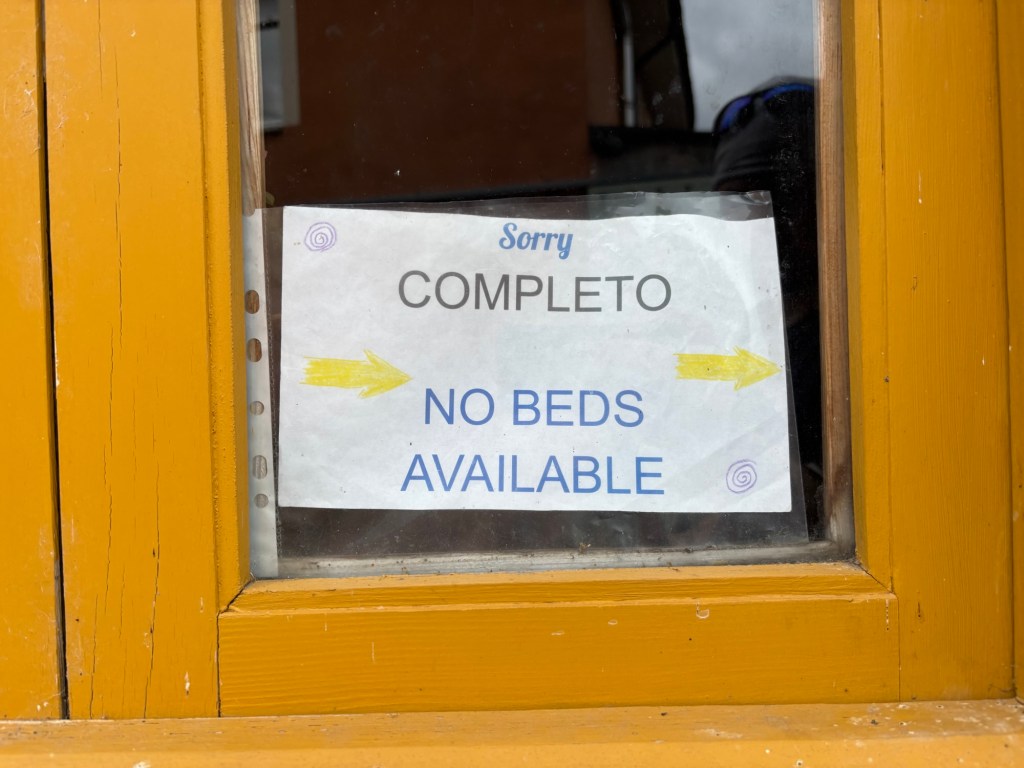
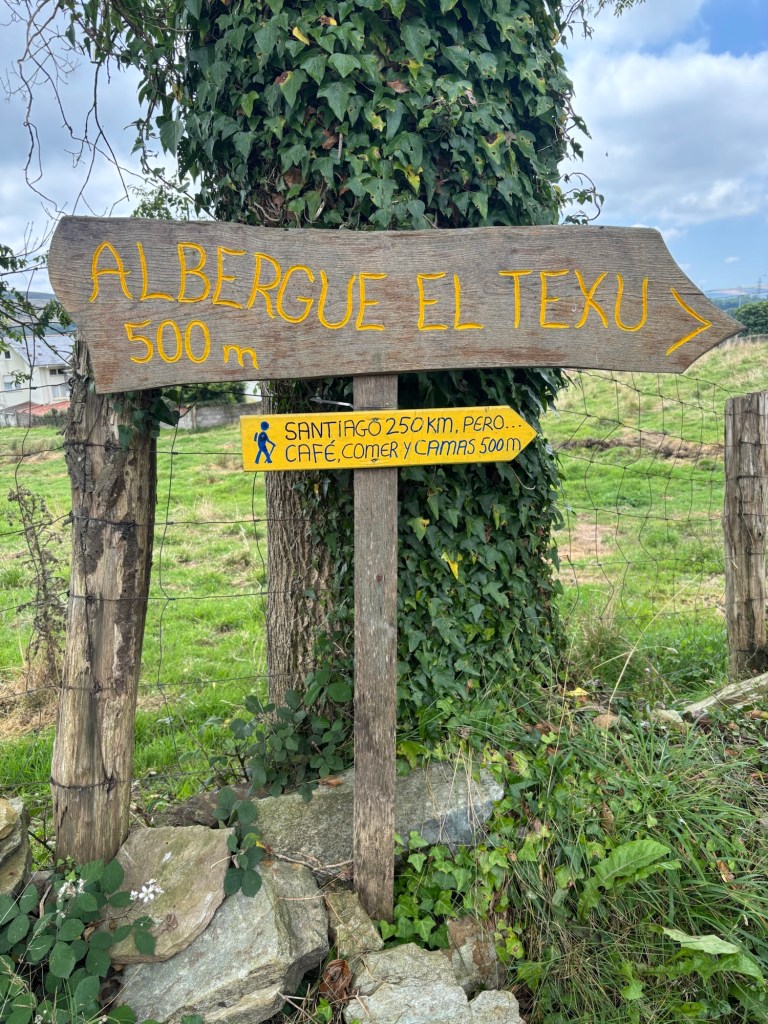
Except when you see signs like this.


I had read a lot about the quality of Bodenaya’s albergue, so I was a little disheartened to see this sign in the window when I got there at around half past one after an arduous climb up from Salas, only to find it was all full – already, and whole hour and a half before it was due to open. Bodenaya, like many albergues along the Primitivo, is small and personal, counting on just ten beds. However, this is not normally a problem if you’re quick on your feet and get there in plenty of time.

Sadly, popularity breeds on itself, and some pilgrims (sometimes with legitimate reasons) feel the need to book all of their accommodation ahead of time so that they can enjoy the walk in peace without worrying about having a bed for the night.

Which is great for them. But not for those of us who have to deal with the disappointment of doing everything right and being beaten to a bed by the eager beavers who would prefer peace of mind over the freedom of the Camino.

Everyone walks the Camino in their own way. That’s a fact. I just don’t agree with the idea of booking accommodation in advance along a route that is one of the few places in the world where you genuinely don’t need to. There are all sorts of other holidays where that kind of mindset is the norm. If I wanted to know where I’d be and what I’d be doing a week or a month in advance, I’d consult my teacher’s planner (or somebody else’s, as I hate writing in mine). Work is planned. The Camino is freedom.

There. I’ve said my piece. Let’s move on.


The hospitaleros at Grado put out a large breakfast spread, so I ate well this morning. I saw a few familiar faces along the road, many of whom had stayed at San Juan the night before after finding Grado’s municipal full (there’s a reason the municipales are often occupied by the younger and fitter pilgrims).

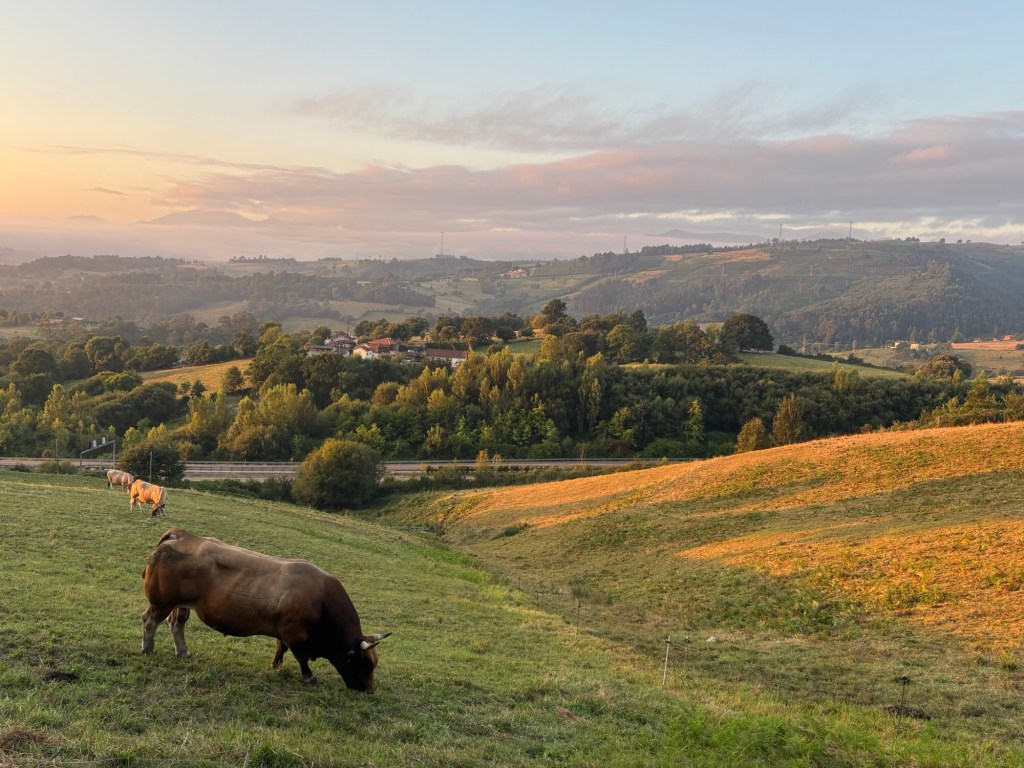
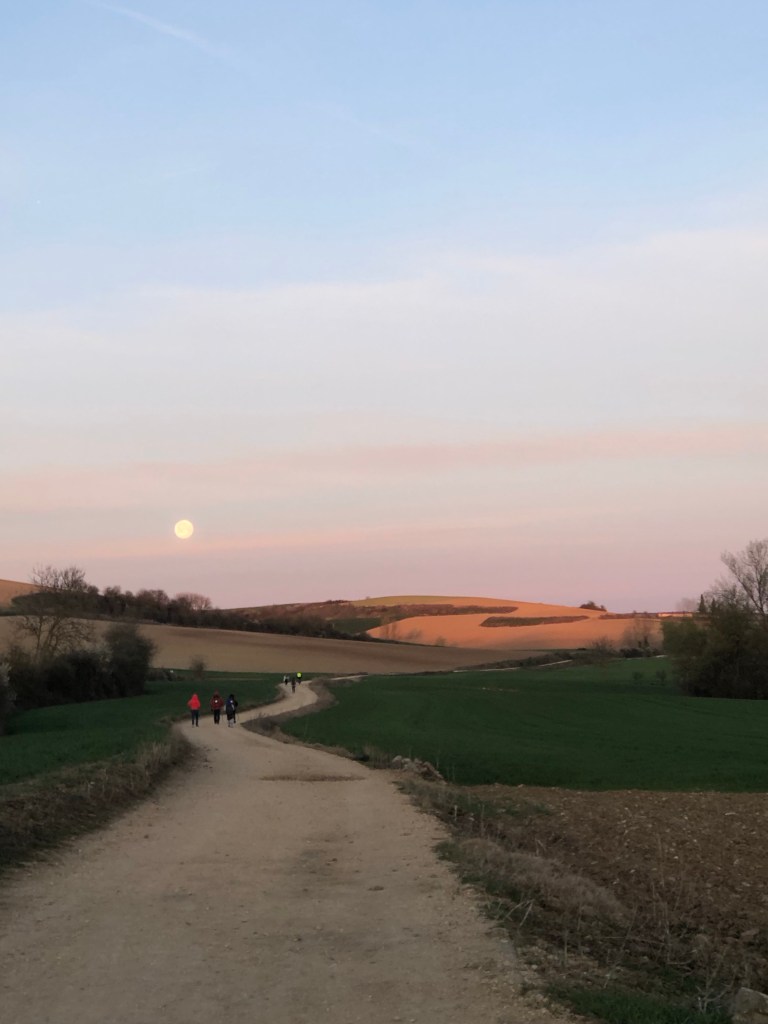
There were a few clouds on the horizon, but the sun rose in a warm, pastel pink, promising a warmer and drier day’s walk ahead. I was quite glad of the rain yesterday, but now that I am armed with more sun lotion, I am not as concerned about another day under the sun’s anvil as I was on the San Salvador trek.


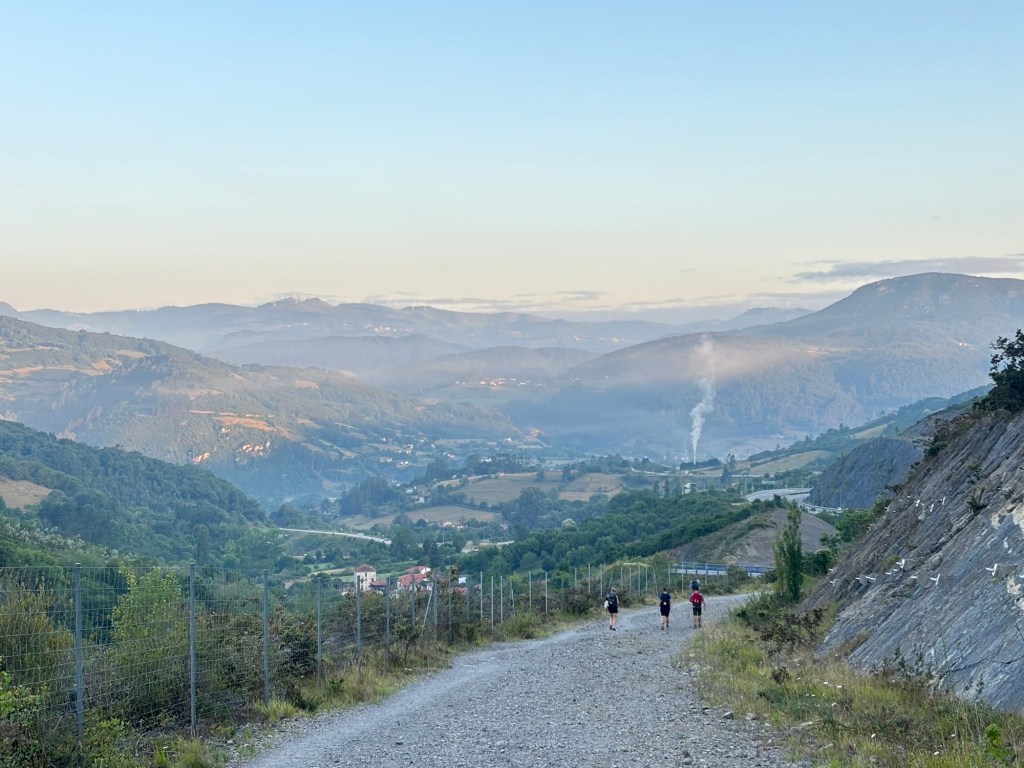
The climb up from Grado is not half as impressive as the descent on the other side, which provides a sweeping panorama of the valleys ahead, all the way to the turbine-topped hills of Pumar that lead to the Bay of Biscay. No Asturian landscape seems to be complete without a small pillar of smoke from some factory or quarry: in this instance, the chalk mines at La Doriga.


Spain’s north has always been its industrial heartland. This is largely due to its abundance of natural resources like iron, copper and coal, which gave the region all the tools it required to build what would become one of the world’s first global empires. There were even gold mines here once, when the Romans scoured their own empire in search of that most precious of metals.

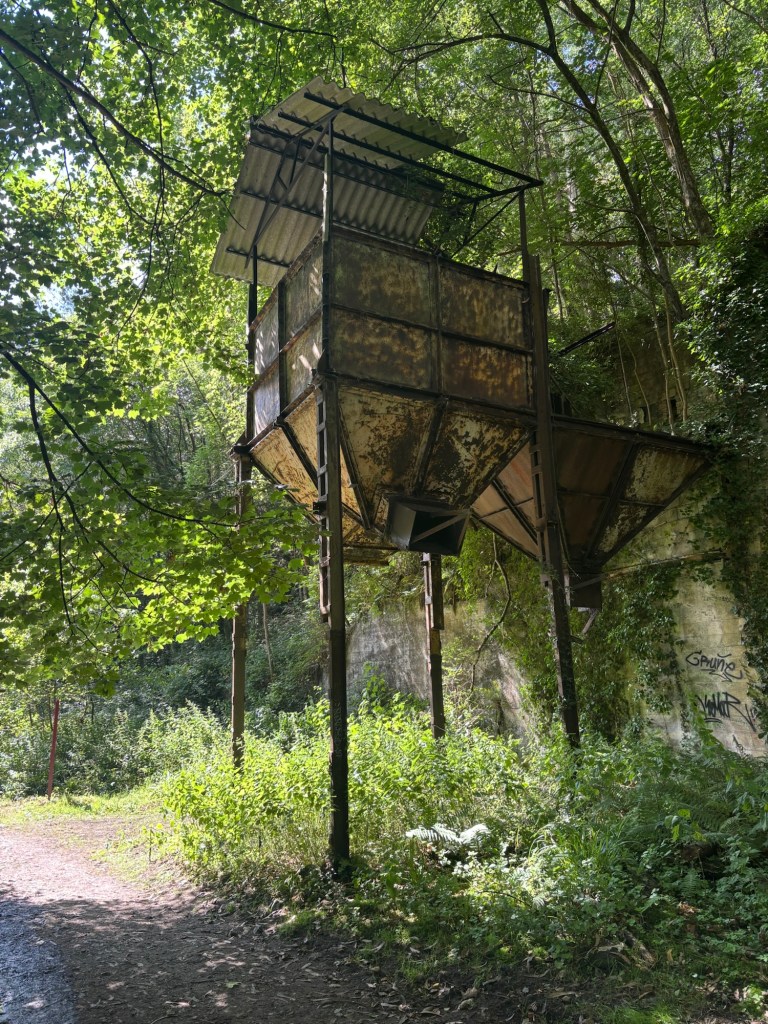
Many of the quarries are still in use, but some have fallen into disrepair, slowly disappearing within the dark forests of Asturias. This one caught me by surprise in the hills behind Salas. The vents through which the chalk must have been shuttled once had long since rusted shut, and vines and thick carpets of ivy had all but concealed the adjacent storehouses, but the tower remains standing. I’ve always been fascinated by abandoned quarries and factory buildings, and Asturias has plenty to explore, even along the Camino.


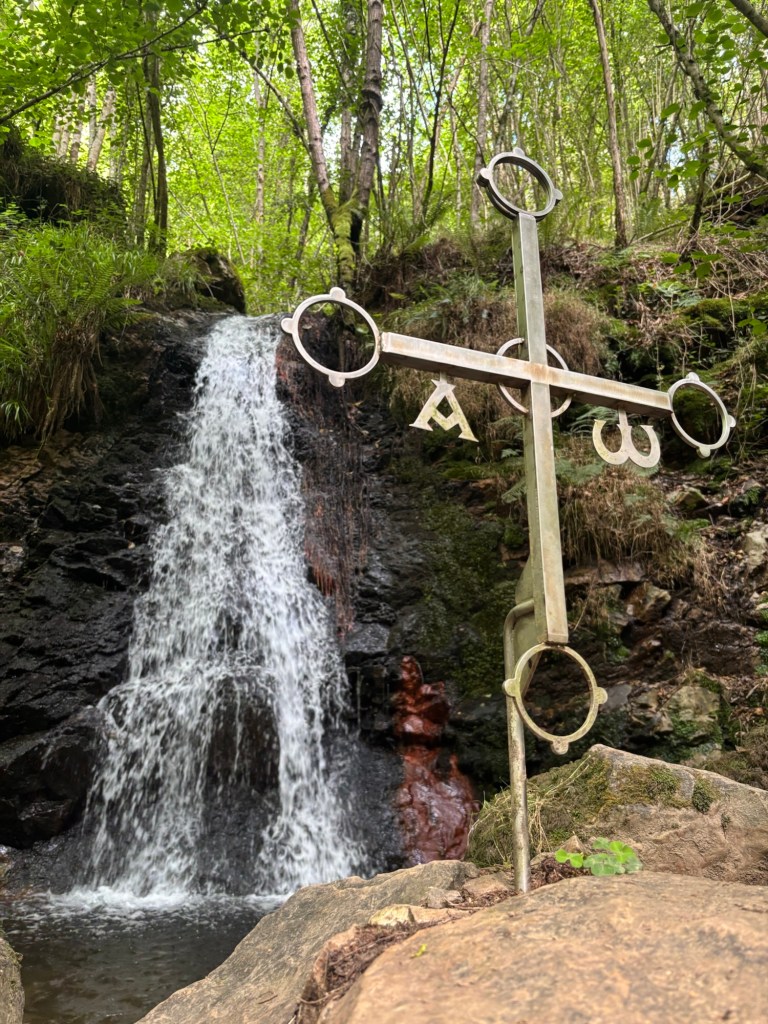
A short distance from the Camino (at the cost of a 200m descent) is the Cascada de Nonaya, a concealed waterfall hidden away deep in the forest. It’s easily missed from the pilgrim road, but Google Maps is a wonderful thing, so I knew what to look out for. Somebody has erected a metal simulacrum of the Victory Cross of Asturias at its base, so in the absence of a church, I made this one of my stops for a prayer today. It was a very special place: peaceful, dark, ancient.


After the waterfall, the Camino makes a very steep climb up the mountainside before levelling out along the main road towards Tineo. My destination, Bodenaya, turned out not to be – as I had the slightest inkling might be the case – so I shrugged and moved on. La Espina seemed promising, but the municipal albergue didn’t seem to be what it had been cranked up to be online. Then I saw yet another sign for a well-advertised albergue that wasn’t in any of the websites, and the fatalist took over. I know better than to deny fate when it’s trying to tell me something.


El Texu is a beautifully peaceful setup, run by a Dutch family and their volunteers. It wins the award for best shower on the Camino, as far as I’m concerned, and I haven’t even had the Thai green curry that Nani is making for supper! I’m normally a purist for Spanish fare on the Camino, but right now, a Thai curry sounds incredible. I can’t wait! BB x

Camino I: The Wall

Monastère de Sarrance, Sarrance. 15.07.

I’m sitting in the garden of Sarrance’s Premonstratensian monastery after a good morning’s walk. I didn’t have too far to go today: just over 20km, all in all, which is a good distance for the first couple of days as my feet get used to walking long distances again.

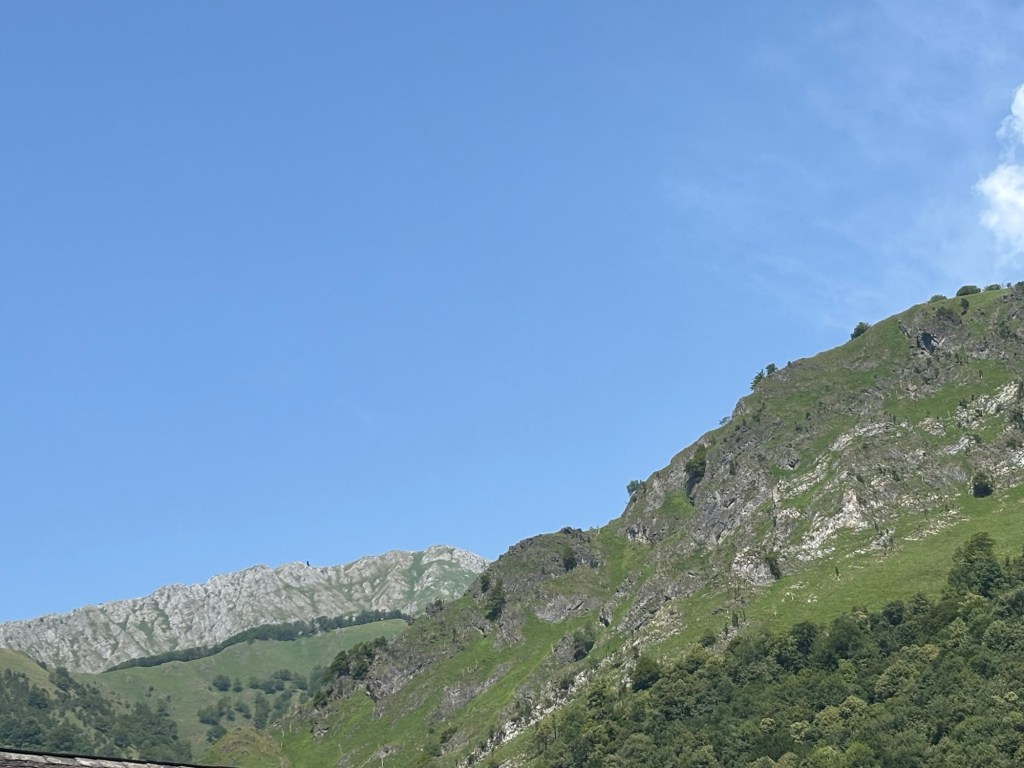
Sarrance is a quiet little village, perched on the west bank of the Aspe river which snakes its way north out of the mountains. Every now and then I see great shadows on the mountainside, cast by the hulking shape of a griffon vulture. There must be about eight or nine of them up there, circling above the craggy ridge of Escot. It feels good to be back in griffon country. It feels like home.


I left Oloron at seven on the dot this morning. Late, by summer Camino standards, but as I wasn’t aiming to travel far, there seemed no point in rushing a decent breakfast only to have to wait at the other end. There aren’t many pilgrims on this Camino, but I had a lovely communal dinner with Christian and Miguel, a Frenchman from Toulouse and a Belgian (rather, a Spaniard from Málaga who has lived in Belgium for almost his entire life and is now, to all intents and purposes, as Belgian as Leffe beer).

I set out on my own, as is my Camino tradition (and also because I know my pace tends to outstrip most pilgrims). Mercifully, somebody sent down from on high a great belt of clouds, so for the first half of the morning I was sheltered from the heatwave that is raging across Europe right now.

Which is just as well, as I was absolutely mauled by mosquitoes last night (it was far too hot to slip under even the flimsy sheet provided, never mind my sleeping bag liner), so the last thing I needed was a full morning’s sunburn to worry about on top!


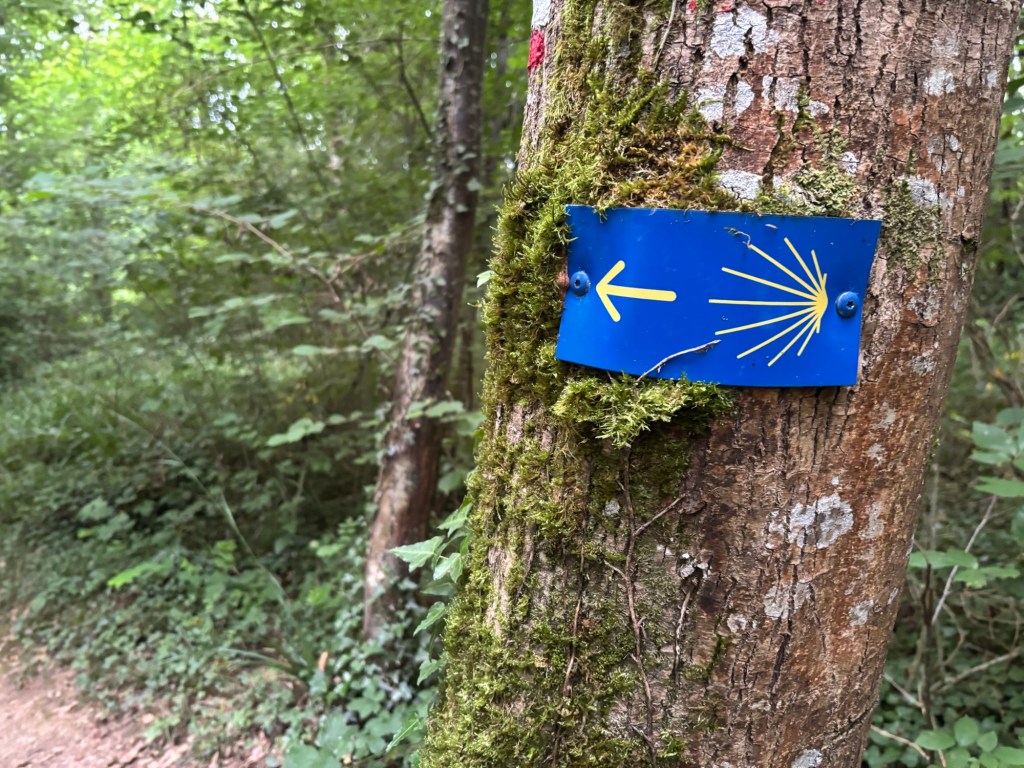
Today’s stretch involved quite a bit of off-roading through the dark Pyrenean forests that cover the valley floor. There isn’t as much signposting here as there is on the Camino francés, but the reliable GR symbol (the red and white stripes) and the occasional seashell serve as decent waymarkers. I didn’t get lost once today, and that’s the important thing, because in this heat, every detour and reroute becomes a proper trial.


By nine o’clock the sun was back with a vengeance, clearing all the cloud cover in a minutes. I was sweating buckets at this point, so thank goodness for breathable fabric, or putting my backpack on after every stop would have been very unpleasant!

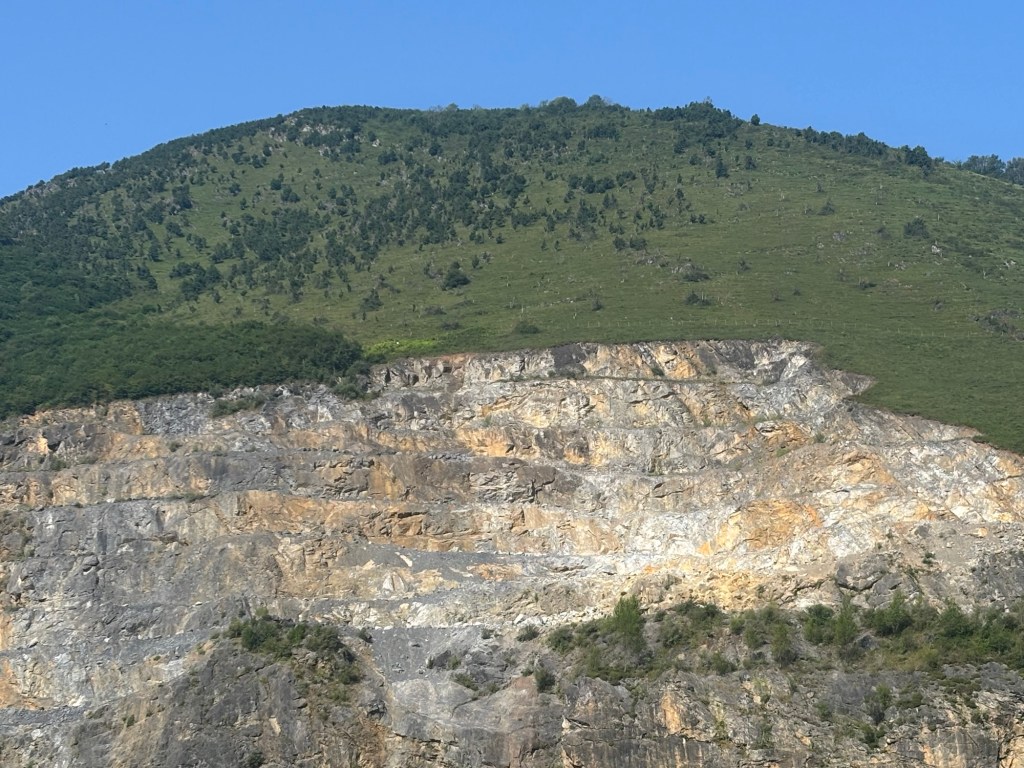
There’s a huge quarry carved into the mountainside just south of Lurbe-Saint-Christau. I don’t think I’d have given it much thought beyond ‘Jesus, who’d be working in this heat’ and ‘what kind of demon thinks it’s a good idea to take a huge bite out of a mountain’ until a deafening explosion caught my attention not longer after I’d passed it by. I couldn’t quite tell, but from the column of smoke and the enormous boulder tumbling down the slope it looked like the workers had dynamited a piece of the mountain.

I wonder if quarry workers ever feel a sense of remorse for what they do. It takes millions of years to build a mountain, and seconds to punch a hole in it. Or maybe I’m just being sentimental.


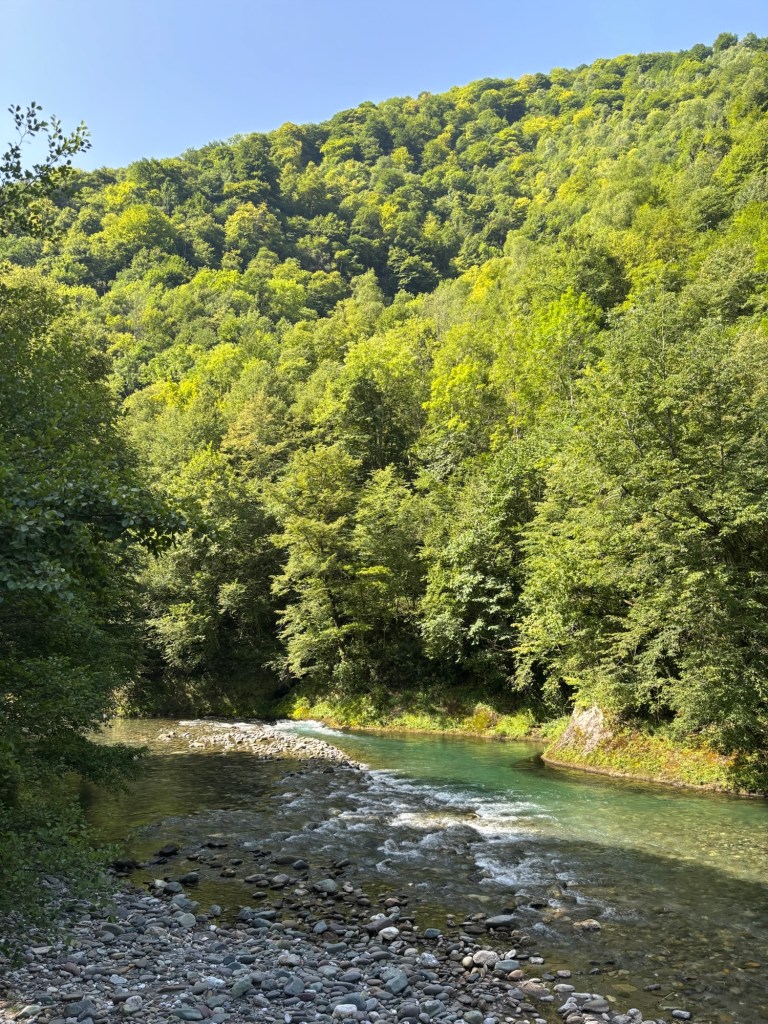
After the hamlet of Escot, the Camino winds its way through the forest along the banks of the Aspe River. There’s really nothing quite so pure and beautiful as a mountain stream, and I was drinking in the sight and sound of it for all of an hour and a half. It was all I could do not to strip down to my shorts and dive into the water (though I bet it would have been teeth-chatteringly chilly). I kept an eye out for otters, kingfishers, and even the Pyrenean desman, but no luck. Plenty of other critters kept me company along the road, like black redstarts, woodlarks, robins and a couple of red-backed shrikes, here near the westernmost limit of their range.


I got to Sarrance at around 11.30, making it a four-hour trek (with a half hour’s rest stop halfway). I thought I’d be far too early to check in, but one of the volunteers spotted me in the shade after the midday Mass and let me into the monastery to shower and wash my clothes, which was nothing short of bliss. Christian and Miguel showed up a couple of hours later, and we had a Leffe beer each at Miguel’s insistence while I counted raptors in the sky above. Within the space of half an hour I had clocked buzzards, honey buzzards, red and black kites, a booted eagle, kestrels and griffon vultures, all in the same airspace. No lammergeiers yet, but I’m keeping my eyes wide open for a sign of that diamond-shaped tail.


I spent most of the afternoon in the gardens, watching the vultures circling over the mountains. For about an hour there was a nearly constant drumroll of thunder to the south, but such is the natural wonder of the Pyrenees: the high mountains form one of Europe’s most imposing natural barriers, a great wall of stone that, throughout history, has cut the Iberian Peninsula off from the rest of Europe, dividing everything but the Basques and their language. A great belt of storm clouds had built itself up like mountains above the mountains, but it never did reach us here in Sarrance, breaking on the Spanish side like a besieging army. All we got was the wind, which was just what I needed after a long and hot walk.

The Premonstratensian fathers invited us to Vespers in their chapel before dinner, which was a warm and sociable affair. Christian and Miguel will take different route tomorrow, both by bus, so it may be that I find myself alone in Borce – I haven’t seen any other pilgrims on the road.

A quick leaf through the guestbook showed that the English are by far the least represented of all the nationalities on the Camino. I wonder why that is? Time was when we had one of the most famous pilgrim routes in Europe, the road to Saint Thomas A’Beckett’s tomb in Canterbury. What happened?

Naturally, we’re not a Catholic country, but I wonder if it’s deeper than that: after all, there are plenty of Europeans (and Americans) who do the Camino with no faith-oriented motivation whatsoever. Have we simply lost the culture of pilgrimage? The long and arduous journey on foot? Are we so wrapped up in our small island concerns and independence that the idea of schlepping across a landmass like Europe seems downright insane? I could name plenty of friends who consider themselves experienced walkers, but none of them has ever done the Camino. It’s not unheard of. It’s just not on our radar.

Anyway, that’s the first day of the Camino done! Only another forty-five or so to go! Here’s to them being mozzie-free, or I might just go mad. BB x
Southbound

Gare SNCF de Dax. 10.04.

If you’d asked me what accent would be the first I’d hear on arrival in Bordeaux, gaditano would not have been my first guess. As it was, there was a family of gitanos from Cádiz waiting at the metro stop outside the airport, and they didn’t have to mention their hometown in conversation before I clocked that iconic intonation (and volume) that can only come from the southwest coast of Spain. It’s the accent that I grew up with, so I’d recognise that accent anywhere.

I had a good night’s sleep in my hostel in Bordeaux, and a proper breakfast, too, so it’s been a gentle start to this year’s Camino. It was a half-hour walk to the station from the city centre, so I had some time to appreciate the city before taking my leave.

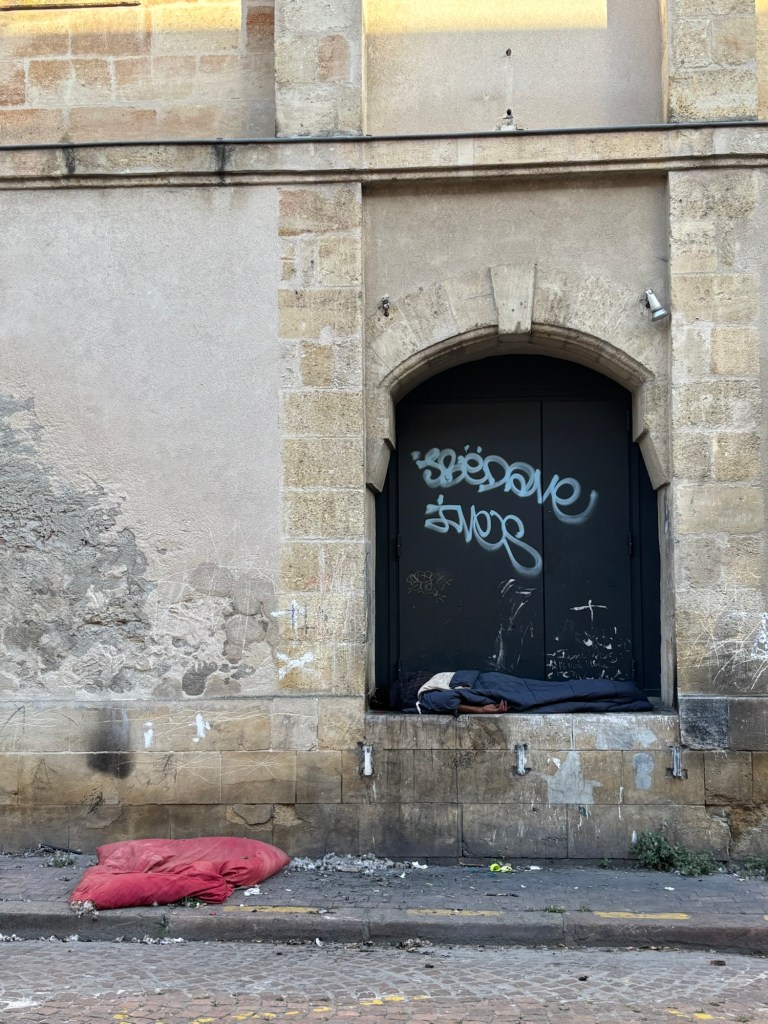
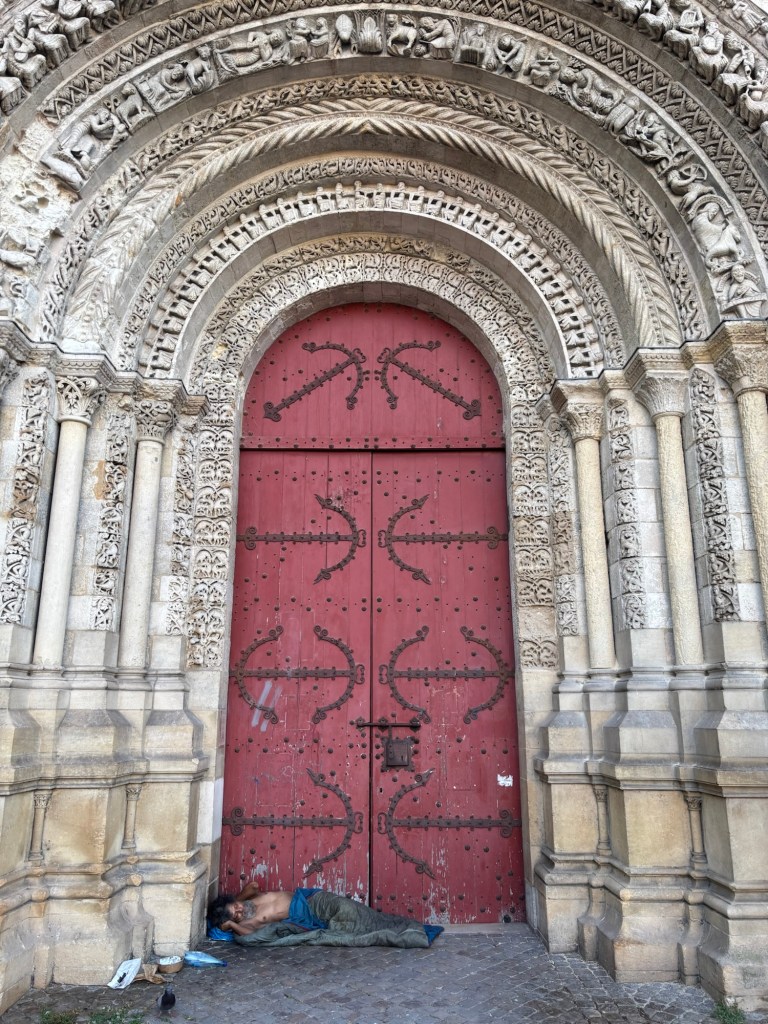
I don’t envy the homeless in this heat. They seem to be a lot more numerous here than in similarly-sized cities in England – or maybe they’re just more visible. Sometimes I wasn’t sure whether I was looking at a sandbag or an occupied sleeping bag. Now that I’m teaching A Level French as well as Spanish, I’m trying to keep both eyes open to these things.


I was so enthralled by the stonemasonry on the portal of one of Bordeaux’s churches that I almost didn’t notice the man sleeping in the doorway. He looked like a dead ringer for a down-on-his-luck Alexandre Dumas. The way he was stretched out in sleep, he might have been a fallen detail from the paradise arches, come to life.

Granada’s Alhambra must have looked like this, once upon a time: the crumbling ruins of a peerlessly beautiful palace, its walls carved with ancient stories, become the roost of the city’s poor and dispossessed.


There was quite a surge for the southbound train at Bordeaux’s Saint-Jean station. I noticed at least one or two travellers who might have been pilgrims. I can’t think of anyone else foolish enough to have a heavy backpack on in the middle of summer, with the temperatures set to soar as high as 40°C today. In a rare turn-up for the books, there’s a beautiful French woman in a cherry-red dress in the seat next to me, but she’s fast asleep. I’ve been chatty enough already with the staff at airport security and the hostel, so I’ll save any more chitchat for the road.

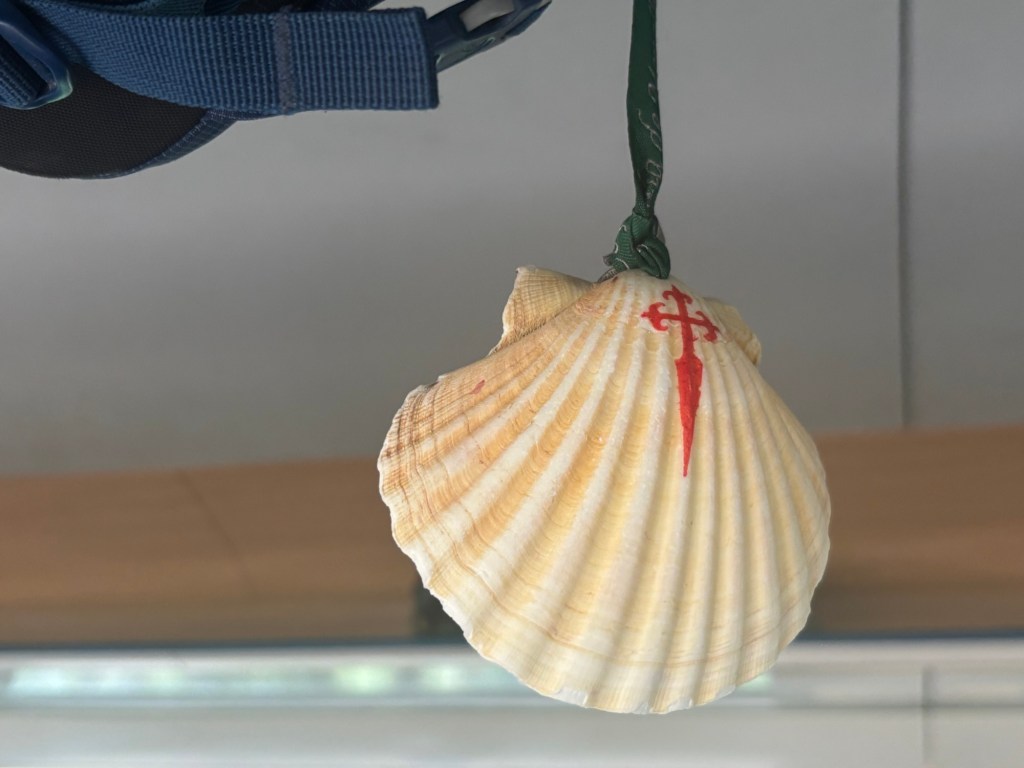
As the train rattles through the sandy forests of the southern reaches of Nouvelle Aquitaine, let me show you the shell I’m taking with me.


The first time I did the Camino, I picked up a shell from a shop in Saint-Jean-Pied-de-Port. It felt a little undeserved, buying the shell from a shop, but it is something of a Camino tradition. In the early days of the Camino, the shells were not just a pilgrim’s badge of office but also an essential part of their kit, primarily serving as vessels for drinking water from the fountains along the pilgrim road. These days, of course, they’re completely ornamental – keepsakes for the wall or mantelpiece, next to your compostela.

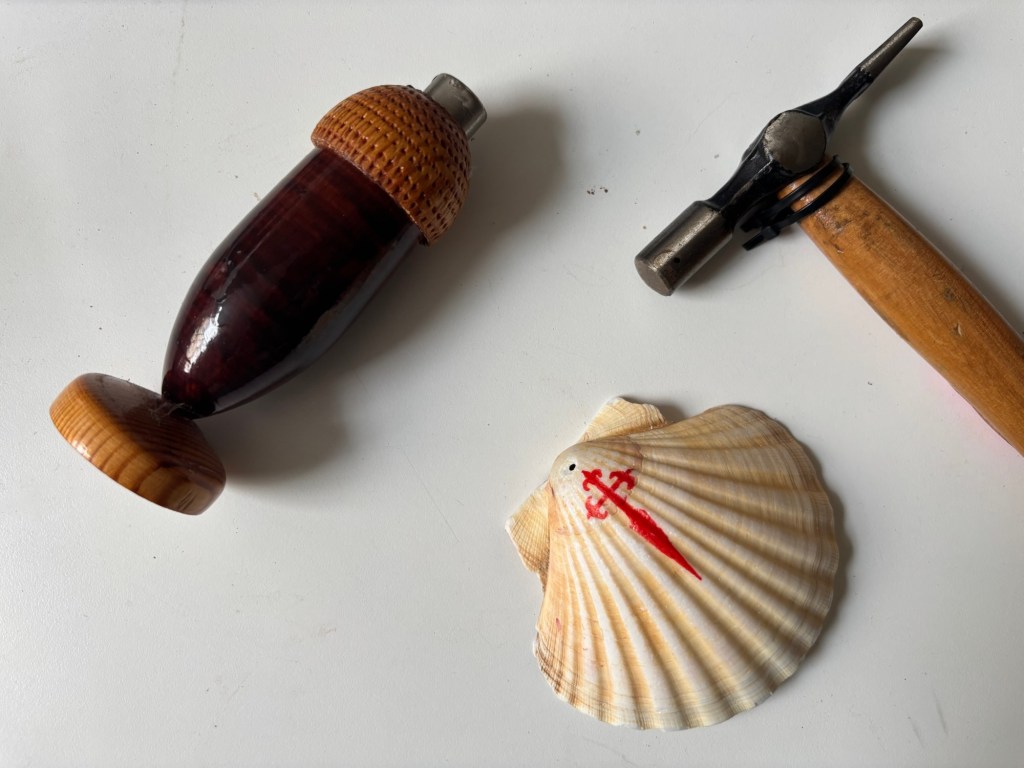
My original shell lasted all of five days, before shattering when I had to remove my rucksack in a hurry after a wasp went up my sleeve and got trapped (the five or six stings it gave me on its way out were with me for weeks!). I took it with me on my last Camino, but I had to have it tucked into one of the outer pockets in its smashed-up state. I didn’t want to buy a shell this time, so instead, I’ve made one of my one using a scallop shell I brought home from Saint-Malo last summer.

It’s really quite easy to do. Seashells are rather brittle, but if you heat one up over a flame, it softens the shell a little, making it a lot easier to perforate the surface without cracking the structure. I did this in my kitchen with a lighter, a hammer and a small nail.

For the cross of Santiago, I used a red Sharpie. I didn’t have any string lying around, so I made an improvised knot with the wristband from the Cofradía de Mengíbar that I picked up three years ago. That brings the total of Saints guiding me to Santiago de Compostela to four: La Virgen de la Cabeza (the Mengíbar wristband), La Virgen de la Caridad (my aunt’s rosary), La Virgen del Rocío (la más santa de mi devoción), and Santiago himself. Well, technically I suppose that’s only two, since three of them are the same person, but Spain (and the Catholic faith) would be a poorer place with only one incarnation of the Virgin Mary!

I wouldn’t say I’m necessarily that religious. Spiritual, maybe. But it is nice to know you’re not alone on the road, and because of my faith I am never alone.


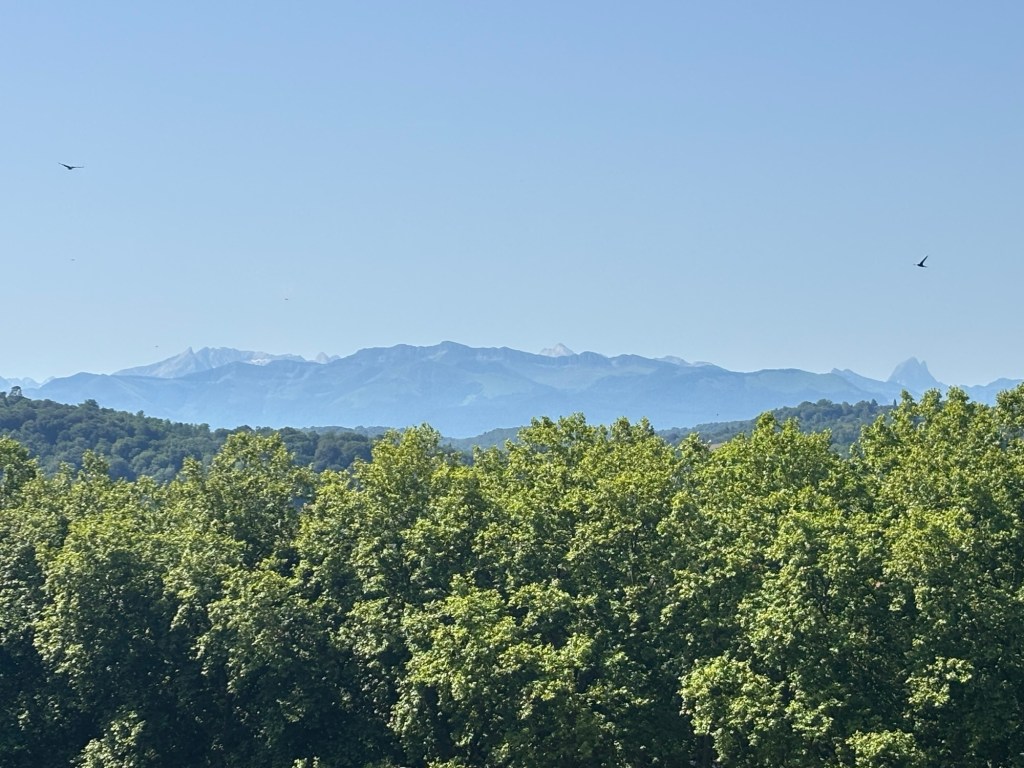
And there they are. The jagged peaks of the Pyrenees. They were only ever a faraway vision in the east before, but now they’re towering above me, a colossal natural barrier between me and my grandfather’s country. It was easy to say I wanted a proper challenge from the comfort of my sofa back home, but now that I’m here, they look quite daunting. Somport – from summus portus, the high gate – looks like it will live up to its name. I hope I have the stamina.


Église Saint Martin, Pau. 11.39am.

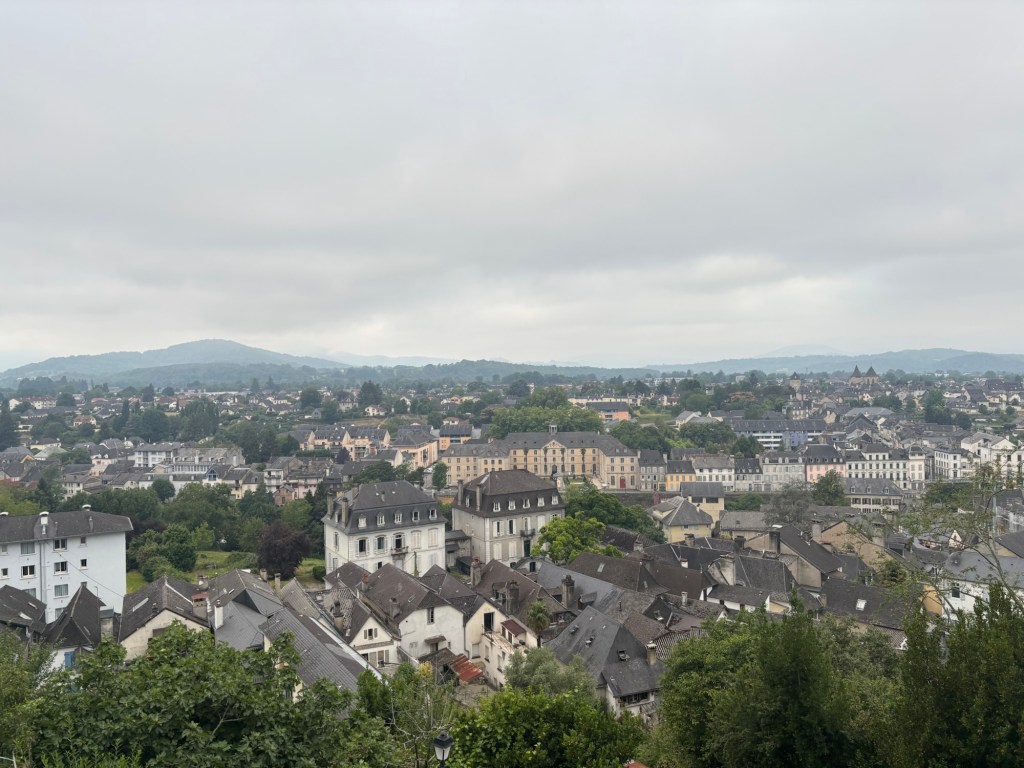
The streets of Pau are almost empty – hardly surprising, with the temperatures soaring. I found a shop selling sturdy-looking walking sticks, but they had childish carvings of lions and eagles on the top, so I passed on. New journey, new stick… but not that stick. I can wait for the right one.

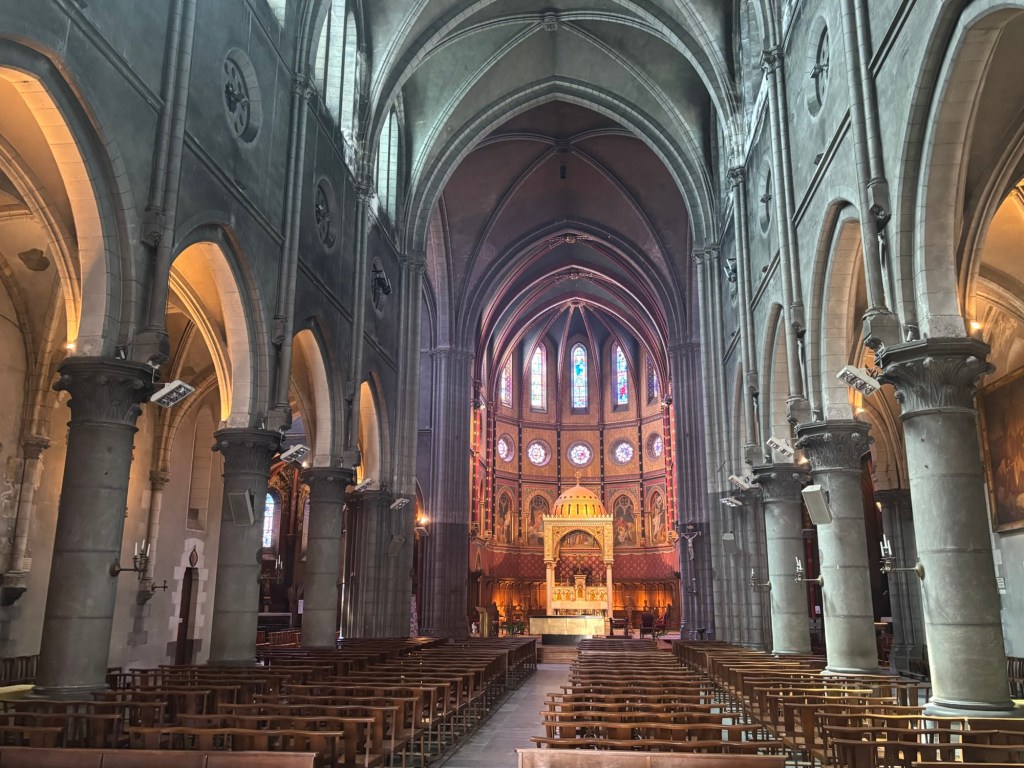
I’ve retreated into the shade of the Église Saint Martin. There were two tourists wandering around, but no pilgrims – I’m not yet on the Camino. That said, I saw at least three Japanese pilgrims in the station. They didn’t seem to speak any French. If they’re still there when I get back, I’ll see if they need a hand. Lord knows I’ve fallen foul of the French train system before!

I lit the first of many candles, said my prayers in the Lady chapel and took my leave. No stamps here, but it would be disingenuous to collect any before I get to Oloron, the real starting point of this year’s Camino. All the same, I can feel my credencial burning a hole in my pocket. The stamp fever is real!


Oloron-Sainte-Marie. 14.03.

If this isn’t a heatwave, then I’ve never experienced one. The merciless sun has driven just about everyone indoors. There’s a gentle breeze coming down from the mountains, and the twin rivers of the Ossau and Aspe sure do make the place sound less hot than Pau, where the screams of swifts seemed to increase the temperature by several degrees, but there’s no escaping the fact that it is hot out here. The Relais du Bastet, Oloron’s pilgrim hospital, doesn’t open until 3pm, so I’ve grabbed a cold bottle of water from a nearby magasin and have set up shop in the public gardens, where the sound of the fountain provides a temporary relief.

I’ll have to play it carefully over the next few days if this goes on. Early starts, absolutely, but it’s how you play the waiting game when you reach your destination, as almost all albergues shut for midday – by which point you should have stopped walking, if you value your skin – that’s the real question.

No stamps yet. I guess I’ll have to wait until I check in for stamp number one.


Well – here we are. I’ve checked into the Relais du Bastet and had a shower. The daily rhythm of the Camino will be a welcome return after the madness of the summer term. Once I’ve had a rest, I’ll go in search of some more stamps. Christian, one of the two French-speaking pilgrims on the Voie d’Arles who is sharing a room with me, has offered to cook for us this evening, so that’s dinner taken care of. I’ve missed this.

À bientôt x

Camino V: A Man Out of Time

After the Carabiniere’s tip-off about the limited options in San Juan de Ortega, we made the collective decision to strike out early for Agés, the next town along. So, after a day’s hiatus, I had my sunrise again – at the cost of my fingers, which were numb with cold for the first half hour at least. Mikel the Dane caught up to my ferocious pace to lend me his fleece-lined gloves. The way everyone looks out for each other on the Camino… there’s really nothing quite like it.


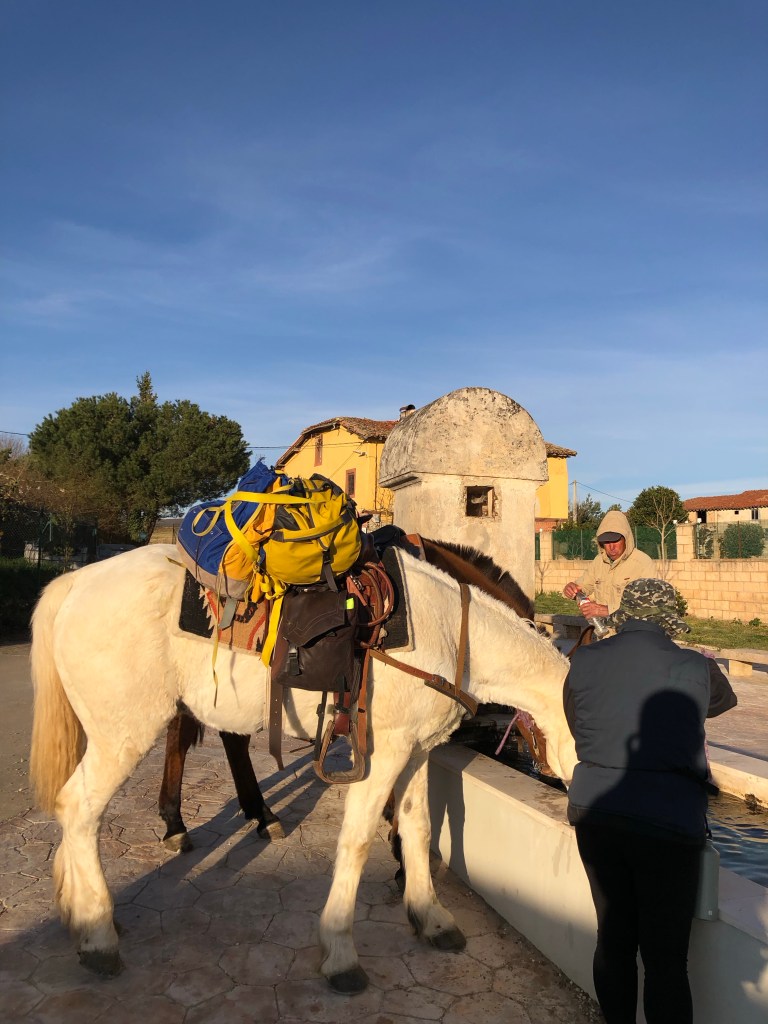
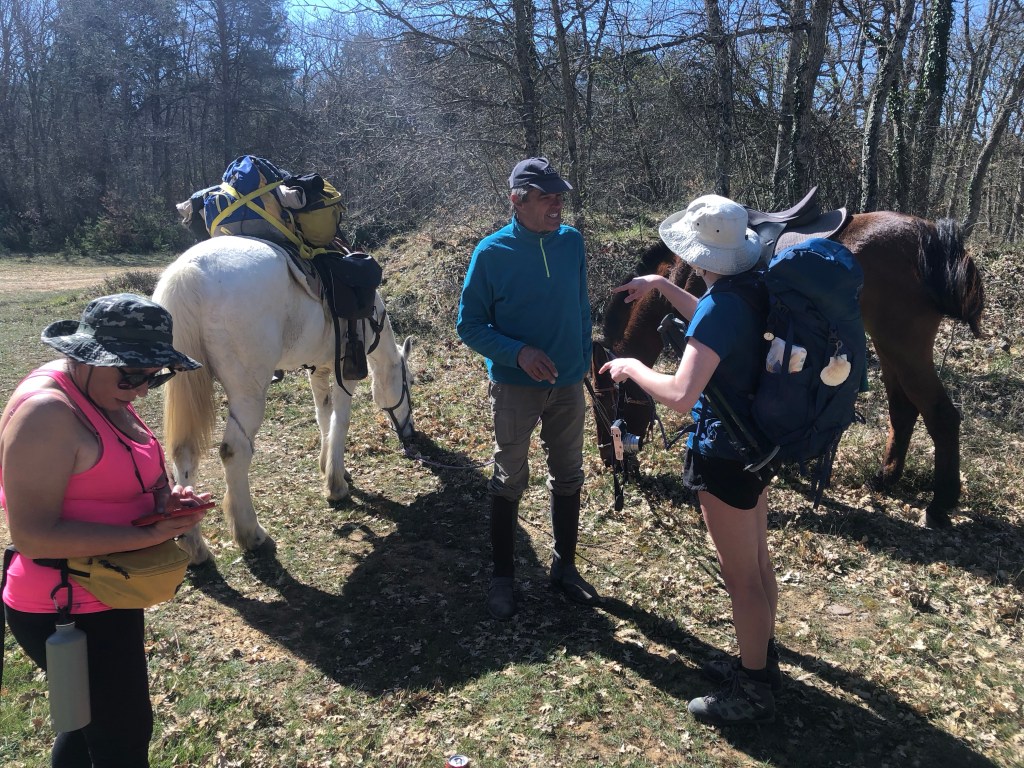
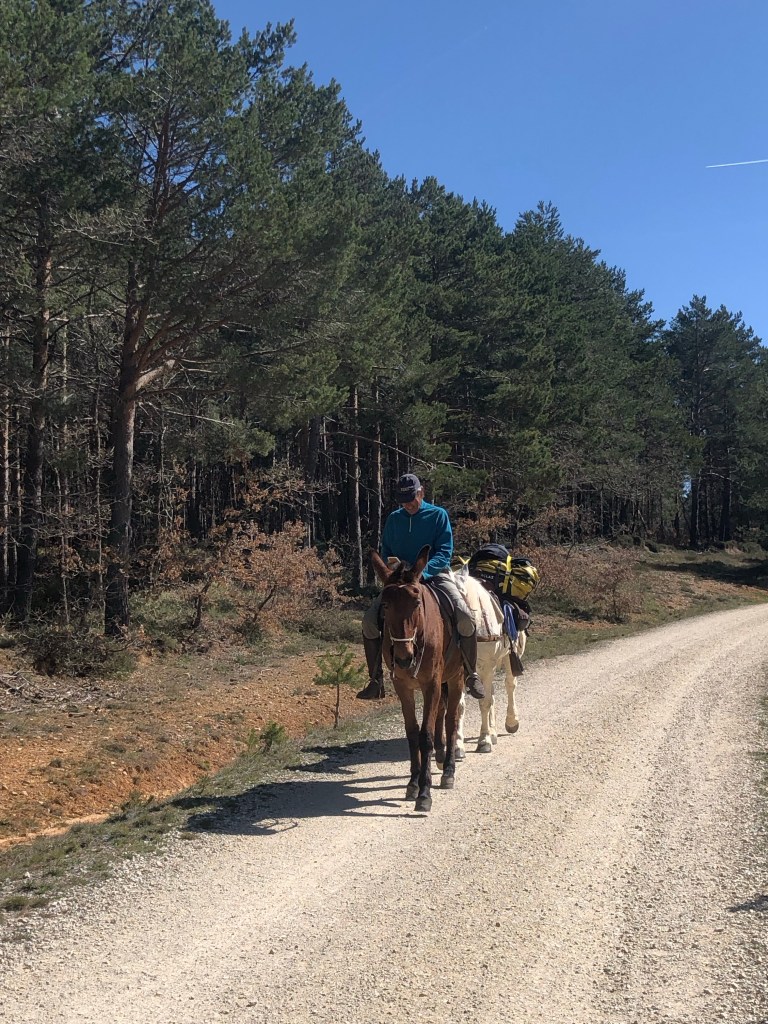
Shortly before reaching Tosantos I picked up the trail of Enrique the Arriero and his mule, Jena, and as soon as he came into sight I picked up the pace to catch up to him. It was a merciless effort on my already beleaguered heels but worth it – with so few in his trade left in the world, you don’t pass up a chance to learn something of that vanishing world. One of our number had lost his card to a hungry ATM so I couldn’t stop to chat long, but I told myself I’d try to catch him further down the road if I could. I had already penned “Entrevista con un arriero” in my journal and that would just be a waste of paper if I couldn’t fill it in.


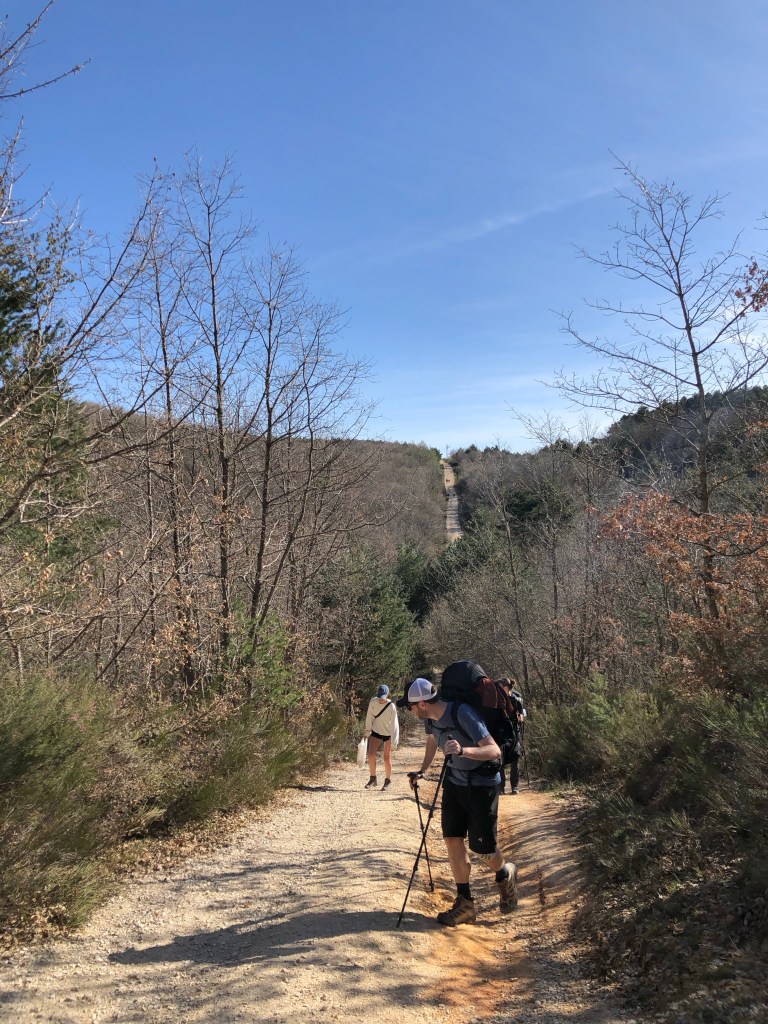
After grabbing an early lunch/late breakfast at Villafranca Montes de Oca (20€ fed all seven of us with a sizeable tortilla & jamón bocata and drinks) the Camino wound steeply uphill into the Sierra de La Demanda. I won’t be the first pilgrim to say it was demanding and I won’t be the last, but it was a welcome change to be under the shade of the trees after the roadside meandering of the last few days.


There’s a monument about halfway through the Sierra to the fallen of the Civil War – that is, the opponents of the Nationlists in Burgos who were dragged out of their beds and summarily executed up here in the woods in the early days of the war. Most Spanish families can relate to this grisly tale: most of the circle of friends of my great-grandfather Mateo similarly disappeared, being known for harbouring or having harboured socialist sympathies even after the war was over. I said a prayer and moved on.

After another steep climb we finally made it to an open stretch of the Camino where the Carabiniere led us to a shaded spot where a food van had been parked on his last run of the Camino a year prior. The proprietor was still here, and while the ‘stamp girl’ was on her way (she’d gone to get fresh ink) he was happy to provide us with fresh strawberries free of charge while we waited.


Here, at last, I caught up again with Enrique, and was able to ask him all the questions I’d had on my mind about being an arriero.


Enrique – or Kike, as written across his hat – has been a muleteer ever since he was a child. He picked up the trade back home in Argentina, where the vast distances and tricky terrain have allowed the profession to long outlive its run in Europe. He likened the trade to studying to become a surgeon: long, hard work and dependant on the collected wisdom of many teachers and masters of the art. Experience, said he, was the best teacher of all, and – now in his sixties – he has had almost six decades worth of it. He grew up a poor man, living on the streets and carving a life for himself in the countryside, not that you’d know now from his noble bearing, bright white smile and polished riding boots (an bold choice of footwear for the Camino). Since his move to Spain twenty-five years ago, he’s got by working with horses and mules wherever and however he can, teaching, buying and selling, running activities for children… whatever he can turn his hands to. I remember as a child seeing the odd arriero in the country around Olvera, so it was more than just an honour to meet a man whose profession is that of the title character in my books. It was a warm dash of nostalgia.


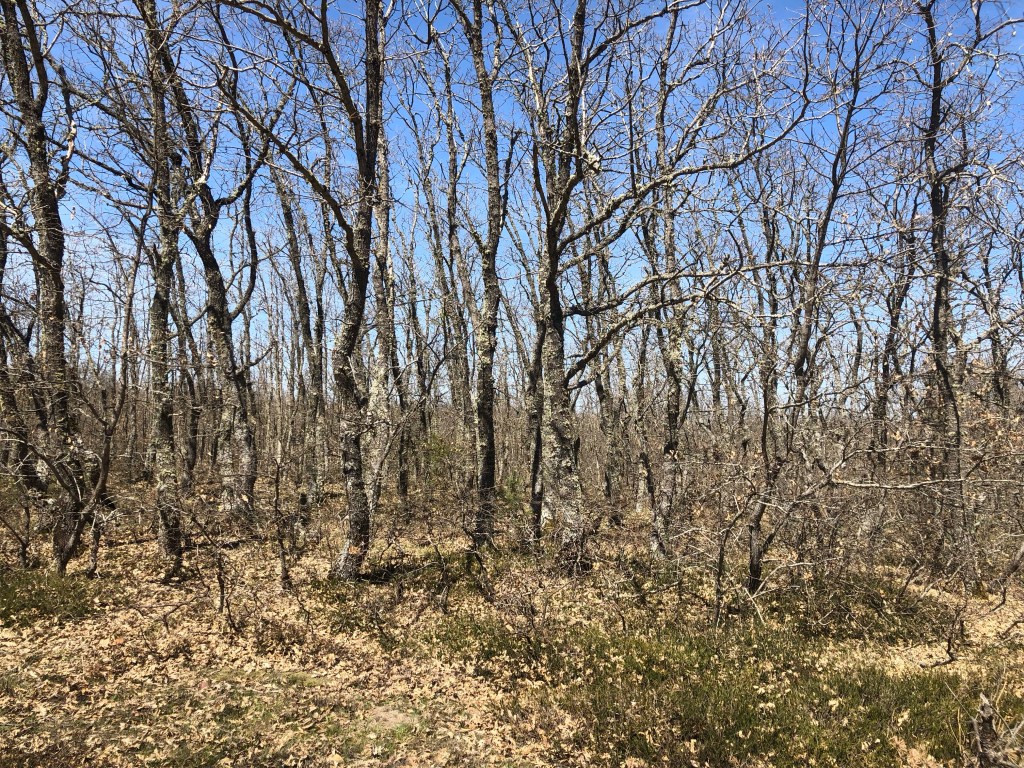
The dark pine forests of the Sierra de La Demanda soon gave way to a skylit swathe of leafless oaks, covered so thickly in lichen that they looked half-dead, like greying, flayed cadavers beneath the sun. However, the forest could not have been more alive. A cuckoo called in the trees and followed us like a shadow along the Camino for some time, while chaffinches, blue tits and the piping song of a wryneck played a merry tune to carry us along. It helped to take my mind off the blisters forming on my beleaguered feet and then some.


Then, before we knew it, the trees were at an end and there, stretching out before us, was the meseta. The prehistoric treasure trove of Atapuerca lay between us and Burgos, but far away in the blue beyond rose the mighty snow-capped peaks of the Cordillera Cantábrica, as impressive now as they ever have been. We came down into Agés shortly after half past two – well into the afternoon – and within another half hour we had all decided to take a siesta.

The other pilgrims have gone out for a beer. I needed a little longer to recover this time, and besides, I wanted to strike while the iron is hot with the blog rather than wait until later. With the last twenty-three kilometres of this stage of the Camino still to go tomorrow ending in Burgos, I don’t think I’ll see Enrique again. So I wanted to record my interview here before I forget.


You never know who you’ll meet on the Camino. Teachers, scholars and sailors, bereaved parents and happy families, policemen and anarchists, priests and atheists. Now, finally, I can add an arriero to that number. BB x
Peregrino Soy

Last night, according to the Beeb, there was a planetary parade. After yesterday’s exceptional conditions – the first day of spring in every sense – it would have been easy to spot from home. That the news decided to report the phenomenon exclusively in the past tense was a kick in the teeth. At the very least it would have been something to write about before the holidays. A warm-up exercise, so to speak, since that’s usually when I have the time to write. I bent the usual dry spell of the summer holidays to my will last year, but this year’s summer break is looking to be all about wheels with little to no time for anything else. Knowing I have to spend a great deal of the summer learning to drive is a pain in the neck, albeit a necessary one, and it’s naturally got me thinking about all the things I’d rather be doing. Fortunately, at this point in my life I can limit all those things to one thing and one thing only, and that’s the job I didn’t finish two years ago: the Camino de Santiago.

So, in my typical stubborn fashion, I’ve thrown caution to the wind and booked a return flight to Bilbao to pick up where I left off over the Easter break. Peregrino soy, volando voy.

Last time I made the trek I got as far as Logroño before having to fly home for both a house move and my pre-PGCE literacy and numeracy test. That’s somewhere between a quarter and a fifth of the total distance (780km). And though I’m not a fan of re-starting things if I can help it, it does feel like one of those treks that ought to be made in one, if you can.

Realistically, it takes about a month to walk the whole Camino, from Saint-Jean-Pied-de-Port to Santiago de Compostela. A month of 5am starts and 12pm finishes, racking up around 20km a day before noon with afternoons spent resting, exploring and talking to fellow pilgrims. It’s an experience like none other. Everyone is on the same road, but no two people started in the same spot or with the same motivations. You fall into a healthy routine after a couple of days, and yet every day is different.

People come from all over the world to walk the Camino. For the first couple of days, I tagged along with three Italians and an Argentinian. We parted ways at Estella when I stayed behind, enchanted by the Basque town. You could easily walk the Camino in a month, but there’s so much to see and do that it’s worth stopping every so often to see all the towns along the pilgrim route have to offer – and your feet will appreciate a day off after five or six days’ walking. Since I’m traveling within the parameters of a two-week holiday I don’t have all the time in the world, so I’ll try to follow the same pattern this time around: five or six days of solid walking, broken up by a decent night’s sleep in somewhere that isn’t an albergue at either end. That tends to be a good idea.

My credencial, or pilgrim’s passport, is already sitting on the coffee table, open at the last stamp. My sleeping bag is rolled up and ready to go and I’ve ordered a good quality rucksack as the one I used last time is at my parents’ place – and it was falling apart after more than a decade of use. For a sense of continuity, I’ll aim to stay at the same place where I came to a stop last time. My Spanish colleagues at work expressed some dismay at the idea of doing the Camino at this time of year – “pero oye, esto se hace en verano” – but I’m going to trust my instinct on this one.

I’m well aware that I’m heading out in none other than Semana Santa, the holiest week in the Spanish calendar. As well as adding to the colour of the Camino nights, with all the reckless passion of the pasos, it may well make for a busier (and more Spanish) Camino than usual. But after a couple of safe and highly-organised school trips, I’m more than game for a proper adventure. And few things provide quite like the Camino.

Bring it on! BB x

Under the Shadow of the Stone Pines

On a balmy September afternoon back in 2012, three friends and I were sitting on our suitcases in the bustling complex that is Heathrow Airport. We’d already played the find-the-most-expensive-item-in-duty-free game and were killing time for the gate to flare up on the departures board. We were bound for Uganda, to our partner school in the north, on what could so very easily be construed as your generic gap yah adventure. We were under no illusions as to that. Teddy made a joke about one of us ‘finding ourselves’ out there. Maddie was quick to reply that she’d already found herself right here in the terminal. That made me chuckle – probably because, with good reason, that joke about ‘finding yourself’ was squarely directed at me.
I’ll admit it. I have a habit of falling head over heels for things. Especially places. It goes with the terrain of being a self-confessed Romantic. Naturally, this obsession with location carries over into my reading. Setting is one of the first things that I look for when I read a book. Bother dialogue. Bother clever plot twists. If the cast doesn’t travel any further than their cul-de-sac then I’m out. Any author that can make the setting just as enthralling as the plot has me round their finger. That’s why I’ve always adored M.M. Kaye’s The Far Pavilions. India comes to life through her words, so vividly that at times I could almost hear it, smell it, feel it through the pages. Michelle Paver weaves a similar magic in her writing, and I earnestly try to conjure the same enchantments in my own efforts, though Spain is a fickle mistress and so very hard to please.

The funny thing about travel and this idea of ‘finding yourself’ is that no two people ever feel the same way about a place. I remember all the raised eyebrows when I used to tell colleagues that my favourite place in all of Spain was a town in the western marshes of Andalusia by the name of El Rocío. Outside of romería season, it’s ostensibly little more than a cluster of whitewashed houses overlooking a seasonal lagoon in arguably the flattest corner of the peninsula, where you can stare across the horizon and see nothing but mile upon mile of shimmering heat. And yet, there is something about that corner of Huelva that calls to me, some spell that weaved its secret magic on me a long time ago.

I’ve had the good fortune to travel across Spain a great deal over the last few years, and there are a number of contenders now for that ever-congested corner of my heart. The gorge at Ronda and the green hills of La Vera. The limestone maw of Zaframagon and the devil’s leap of Monfrague. The vast steppe of Caceres and fair Trujillo, a throne set upon Extremadura’s golden fields. The lonely silhouette of Olvera, and Hornachos, jewel in the Moriscos’ crown and once proud watchtower over the Sierra Grande. Putting my extremely biased affection for Andalusia and Extremadura into a basket, you can add the mysterious heights of Montserrat, the windmill-crowned slopes of La Mancha and the awesome majesty of the Picos de Europa that once guided the weary conquistadors home. All this, and I know I’ve only really scratched the surface.

All the same, though my heart is spread across Spain with a rigour that would reduce a piece of toast to crumbs, there is still one spot that reigns supreme over them all. If you’ve been reading this blog since the beginning, you’ll have seen it over and over again in the header up there. But in case you missed it, here it is again.

To the east of the sanctuary town of El Rocío lies the Raya Real, a sandy track that cuts through the heart of the Parque Nacional de Doñana. Once a year, it serves as the primary conduit for almost a million pilgrims who descend upon the town in colourful, bolshy gaiety (as only Spaniards can) to pay homage to the Blanca Paloma herself, the guardian patroness of the marshes. Like most pilgrimages, it’s as much about the journey as the destination, and listen to any one of the many sevillanas sung by the pilgrims and you’ll get a flavour for just how in tune they are with the world around them. What an excuse to journey through some of the most incredible scenery on God’s Earth, all while dressed to the nines!

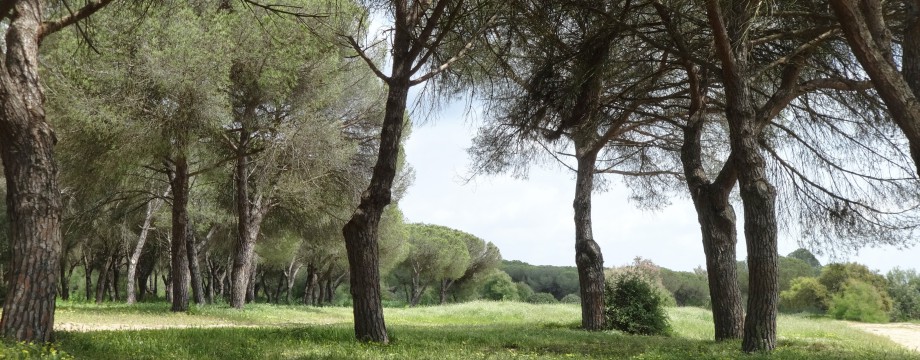
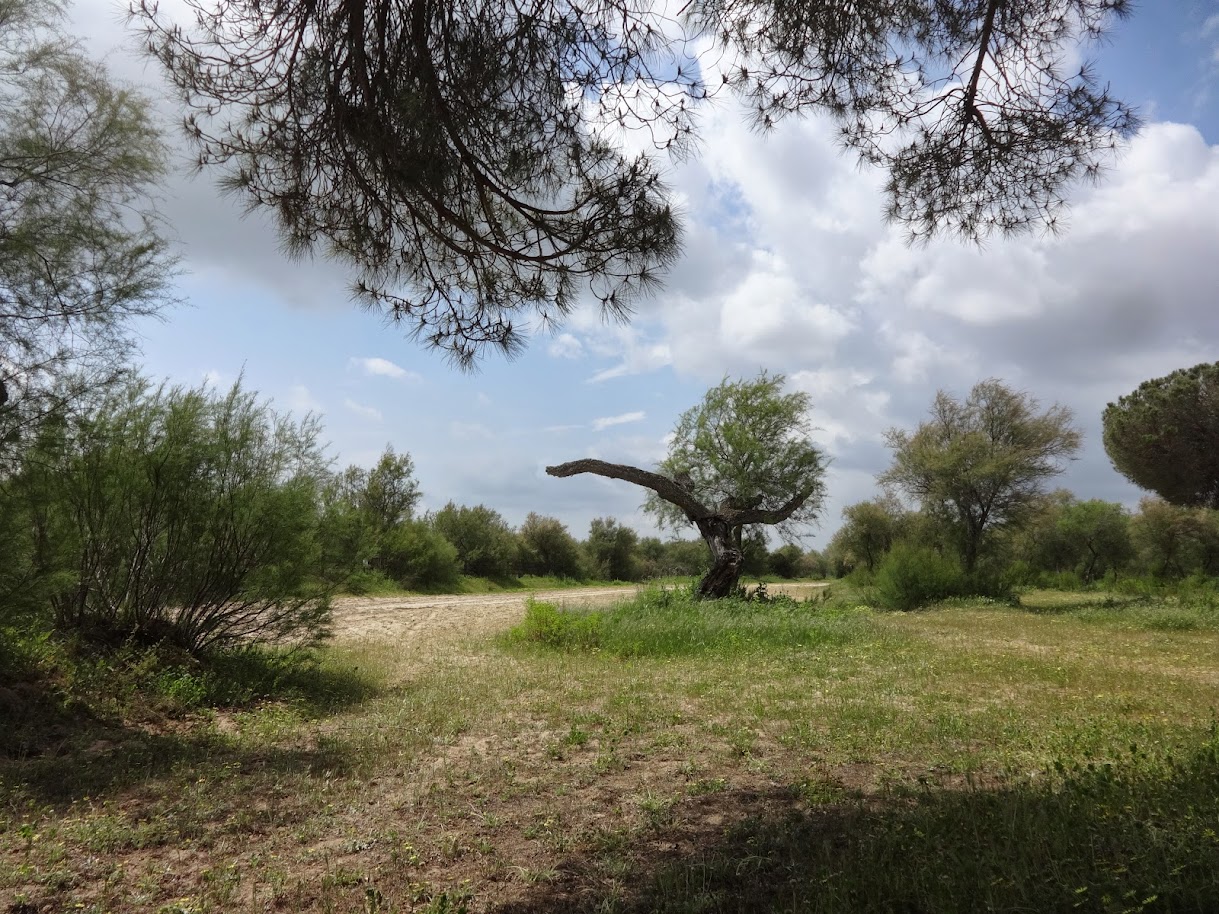
This is all romantically hypothetical, of course. I’ve never seen the Romería in full swing. All the same, there’s this one patch of the Raya Real that I can see in my mind’s eye right now, if I close my eyes for a moment. As for you, dear reader, you need only direct your eyes back up at the top of this post. It’s that tree on the left.

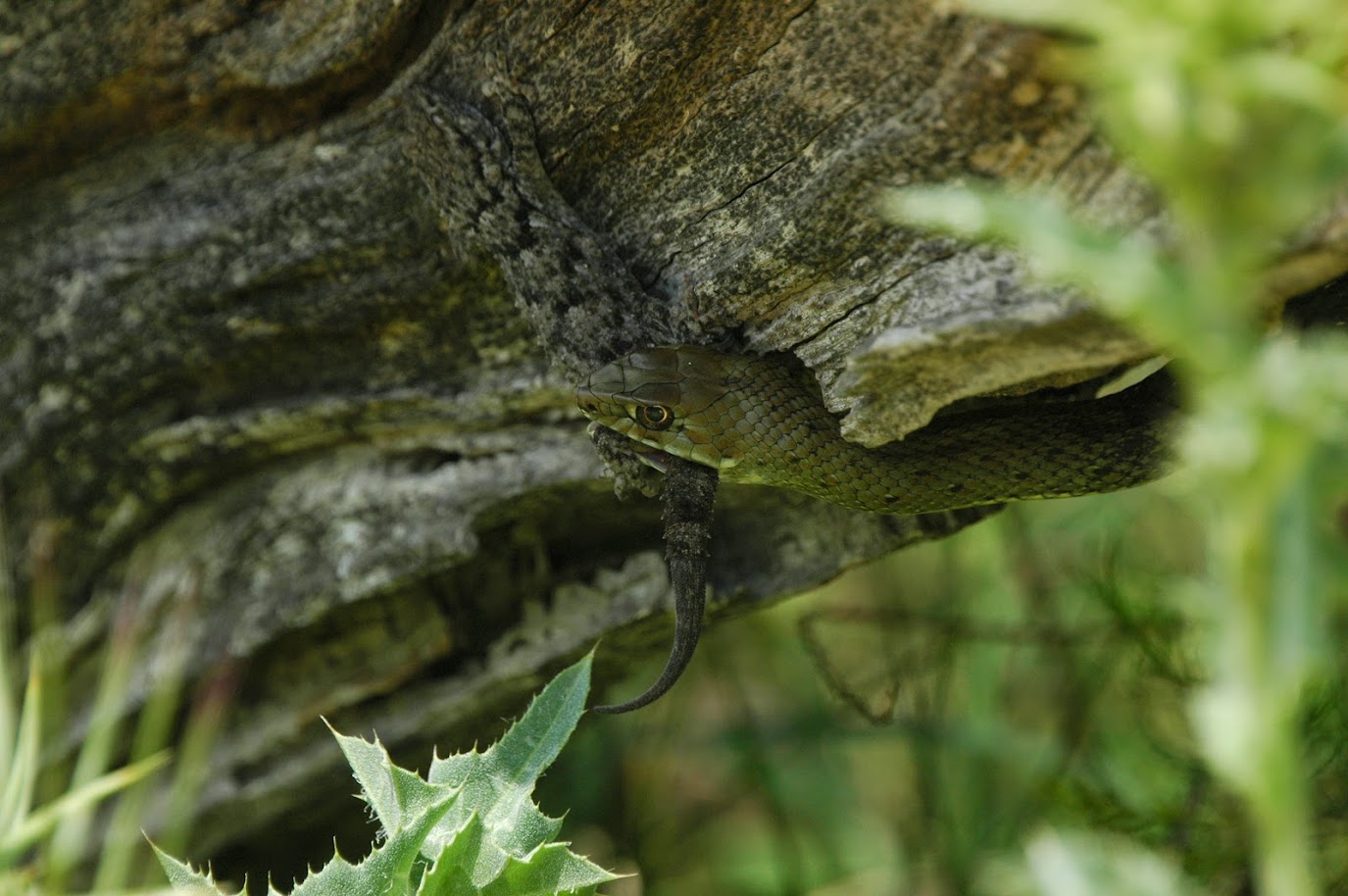
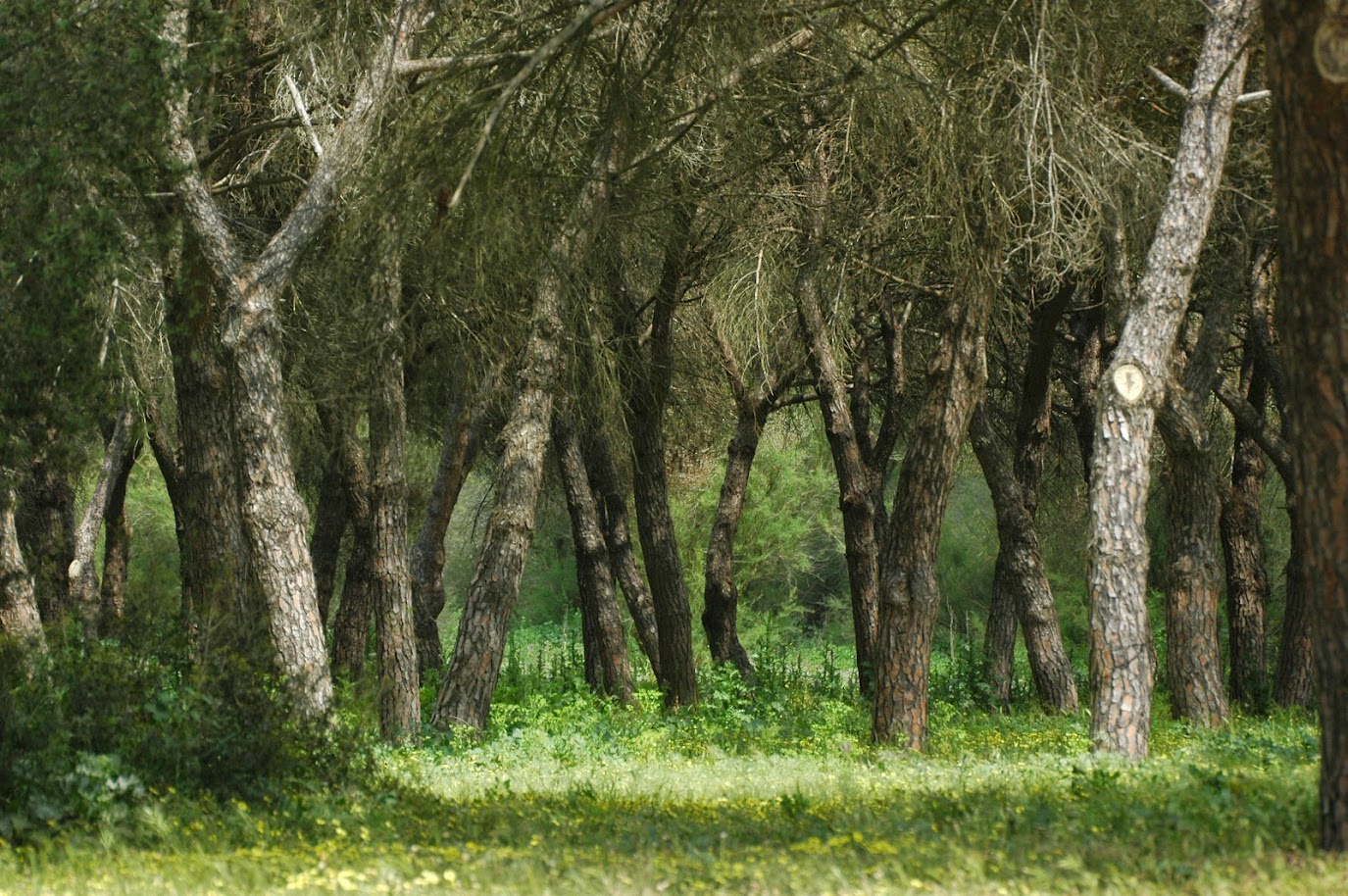
There’s a cluster of stone-pine trees (acebuches) that grow in an island of grass where the Raya Real forks temporarily, before the two tracks converge at the Puente del Ajolí, the last stop on the pilgrimage. A dead tree stands at its westernmost edge, which more often than not hides a gecko or two – I even spooked a Montpelier’s snake mid-hunt here once. A stand of ashes flank the edge of the great pinar, where cuckoos sometimes sing, and in the skies above the Raya Real, bee-eaters go wheeling and soaring in the spring, with bellies like sapphires, backs like rubies and voices like springwater.

Here, under the shadow of the stone pines, I used to sit when I was a boy and listen. After a few seconds you tune in to the silence and hear it all. The wind over the shimmering plains, the rustle of the ash trees. The whistling kites overhead and the mechanical clang of a butcher-bird in one of the branches nearby. From somewhere far off, a panzorrino (native) calling to his horses, or the bark of a dog. Open your eyes for a moment and stare into the blue, and you might see a tiny speck or two up high in the heavens; a griffon and his mate, perhaps, riding the thermals above the coto below. Just once I saw a Spanish Imperial Eagle here, soaring high above the kites below. Maybe that was the first wave of the wand for me – I was a highly impressionable novice birdwatcher at the time. And though it’s kites and booted eagles that have plied the skies on every return visit, the magic in those splayed wings is always there.

In my eighteenth year, I remember sitting beneath my tree, leafing through a copy of Lorca’s Yerma that I’d picked up in town, when a couple of horses rode down the track nearby, one mounted, one riderless. A local girl had fallen from her horse some way back and tried unsuccessfully to get back into the saddle for a few hundred metres. She asked if I could lend a hand, and so I did, giving her my hands to step up and back into the saddle. I watched them go, I heard them laugh and look back, and I went back to my tree, to Yerma and the kites. A golden opportunity to get to know the town of my dreams through its people slipped through my fingers like the sand on which it stands. I’d make some quip about the Virgen del Rocío being a jealous woman, but I really think I had my head in the clouds then and there.

Fool.

Is there a place you return to in spirit, even if you can’t be there in person? This is mine, beneath the shade of the stone pines on the Raya Real. Millions pass by that tree every year without knowing the connection I have to that singular tree, to the kites that nested in its branches once, to the snakes and geckos and their game of cat-and-mouse about its roots. And why should they, when their goal is in sight? They don’t need to do any soul-searching: la Blanca Paloma waits with open arms.

I’ll leave you with a couple of lines from one of my favourite sevillanas that conjures up some of the magic where my words fail. If you like, you can listen to it here – sevillanas should never be read when they can be sung – performed by that band which takes its very name from the road of my dreams: Raya Real.

Las llanuras ardientes de la marisma
El ganado retinto con paso lento
Se acerca hasta el arroyo que esta sediento
Seco está el monte bajo, seco está el rio
Los pastos del invierno ya se han perdido

El Rocío es un milagro, una mañana lo vi
Cuando Triana cruzaba el Puente del Ajolí

Until next time. BB x