Camino IV: To Be a Pilgrim

After three to four days on the Camino de Santiago, you really do start to become well-acquainted with the faces of your particular clan – that is, those who are walking the same stages as you and, by extension, staying in most of the same albergues, too.

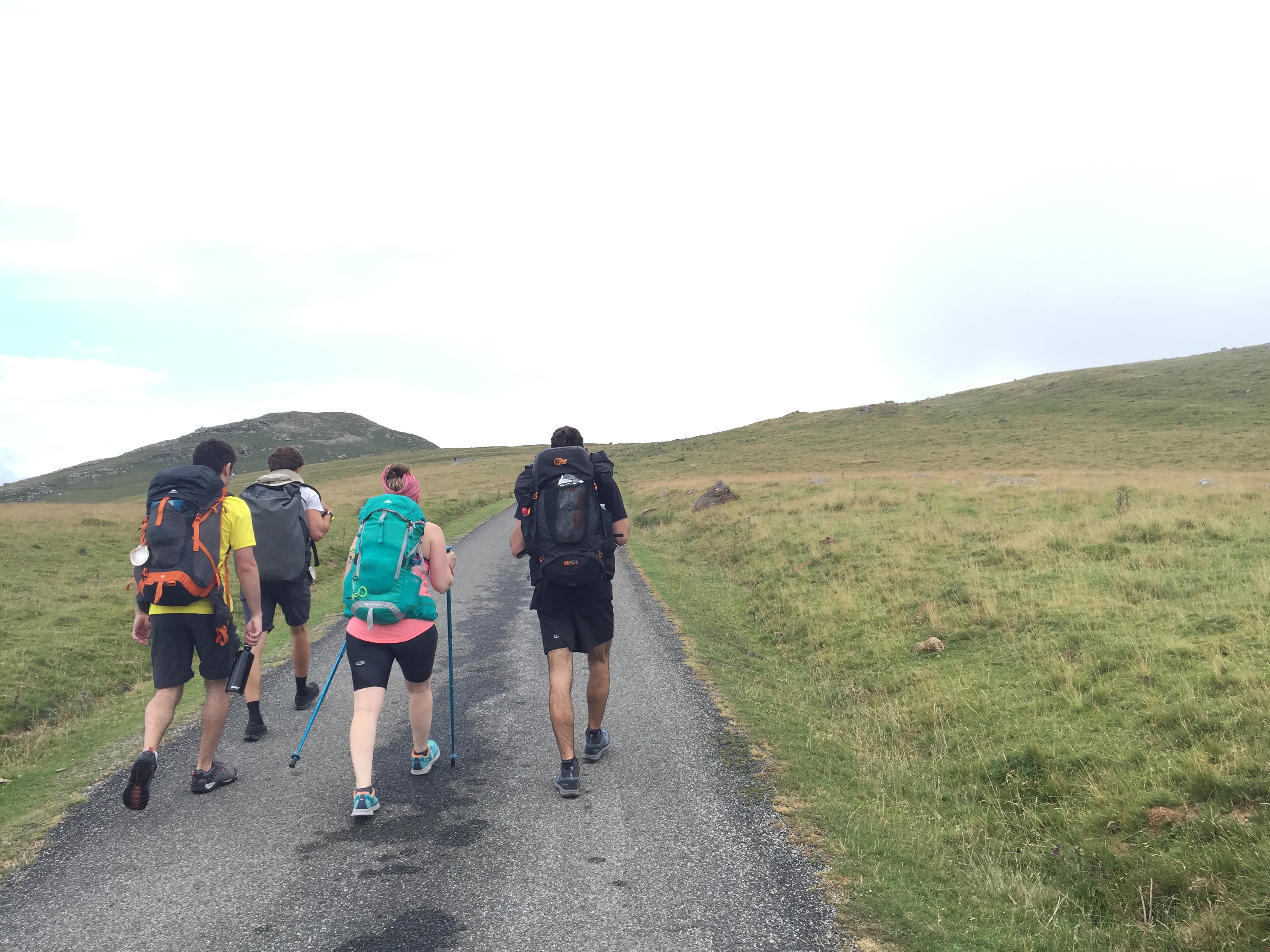
I’ve fallen in with a group of younger pilgrims ranging from eighteen to thirty-four, and rather than being an unsociable bastard and cannonballing my way toward my next stop, I decided to hang back and take the road with them today. The result? A more leisurely, more talkative Camino – and ultimately, more fulfilling. In some senses, quite literally!


While I didn’t manage to track down Enrique the muleteer today (though there were clear signs on the road that his horse and mule had gone on ahead but recently), I did track down the Professor (the Californian I met on day one), the Sailor (a Spanish/Australian globetrotter and his wife) and the Carabiniere, an outrageous but loveable Italian former policeman for whom the saying “the man, the myth, the legend” might well have been coined. And because I had company on the road, I was much more inclined to stop for food, which made today’s long, sun-scorched hike across the plains of Castile a lot more enjoyable.

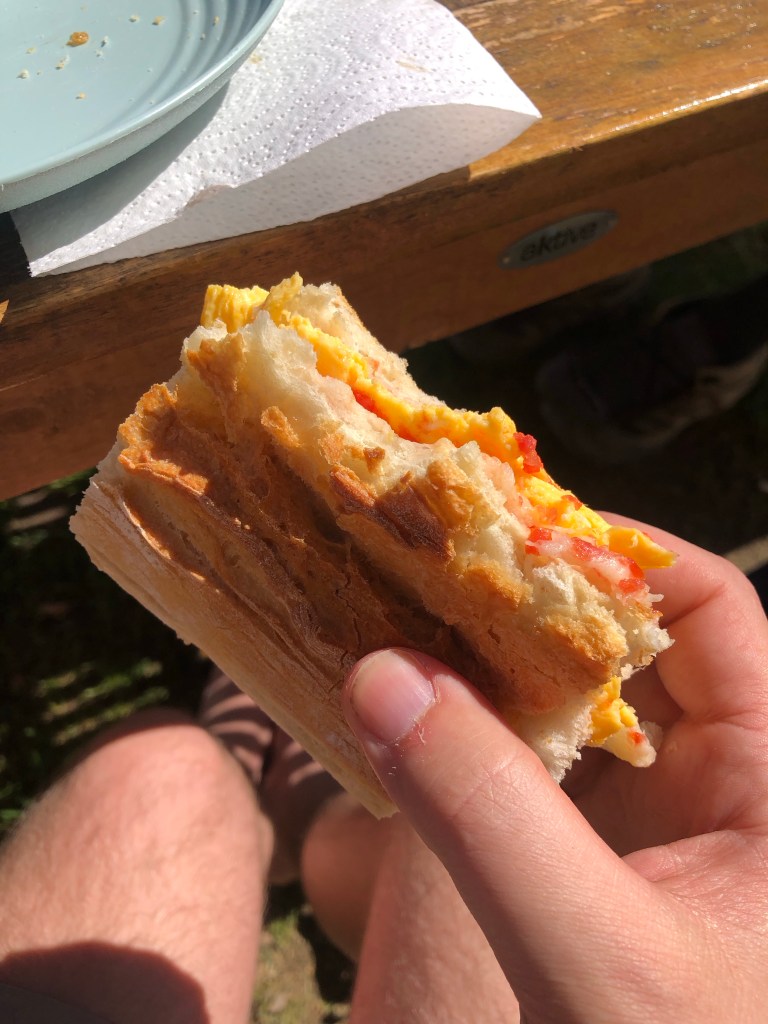
Top tip for pilgrims on this stage: just as you reach the village of Viloria de Rioja, the Parada de Viloria on your right as you hit the town is one of the friendliest places on the whole journey. They don’t have a menu peregrino, but rather the husband and wife who run the albergue cook up a simple lunch with a donations box on the side – you give what you can. The eggs, the bread and the tomatoes are all fresh and presumably their own produce, if not sourced from the farmers a few houses down the road. I had what was probably the best tortilla sandwich I’ve ever eaten in my life today. Hell, I’d do that stretch again for another bite.

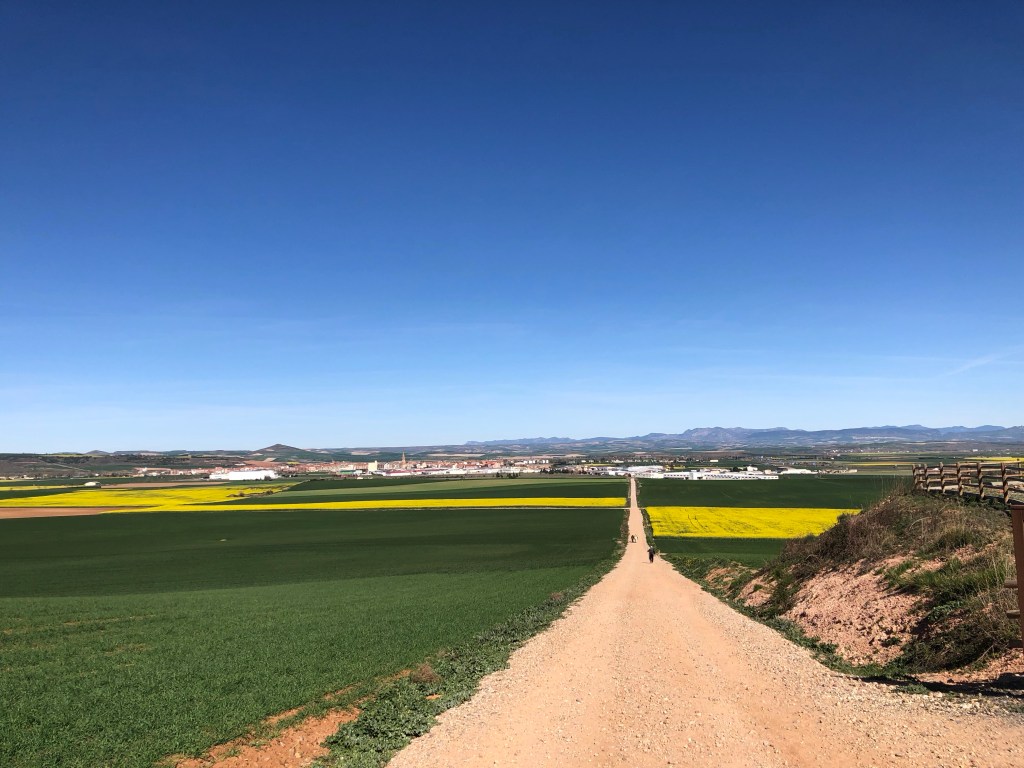
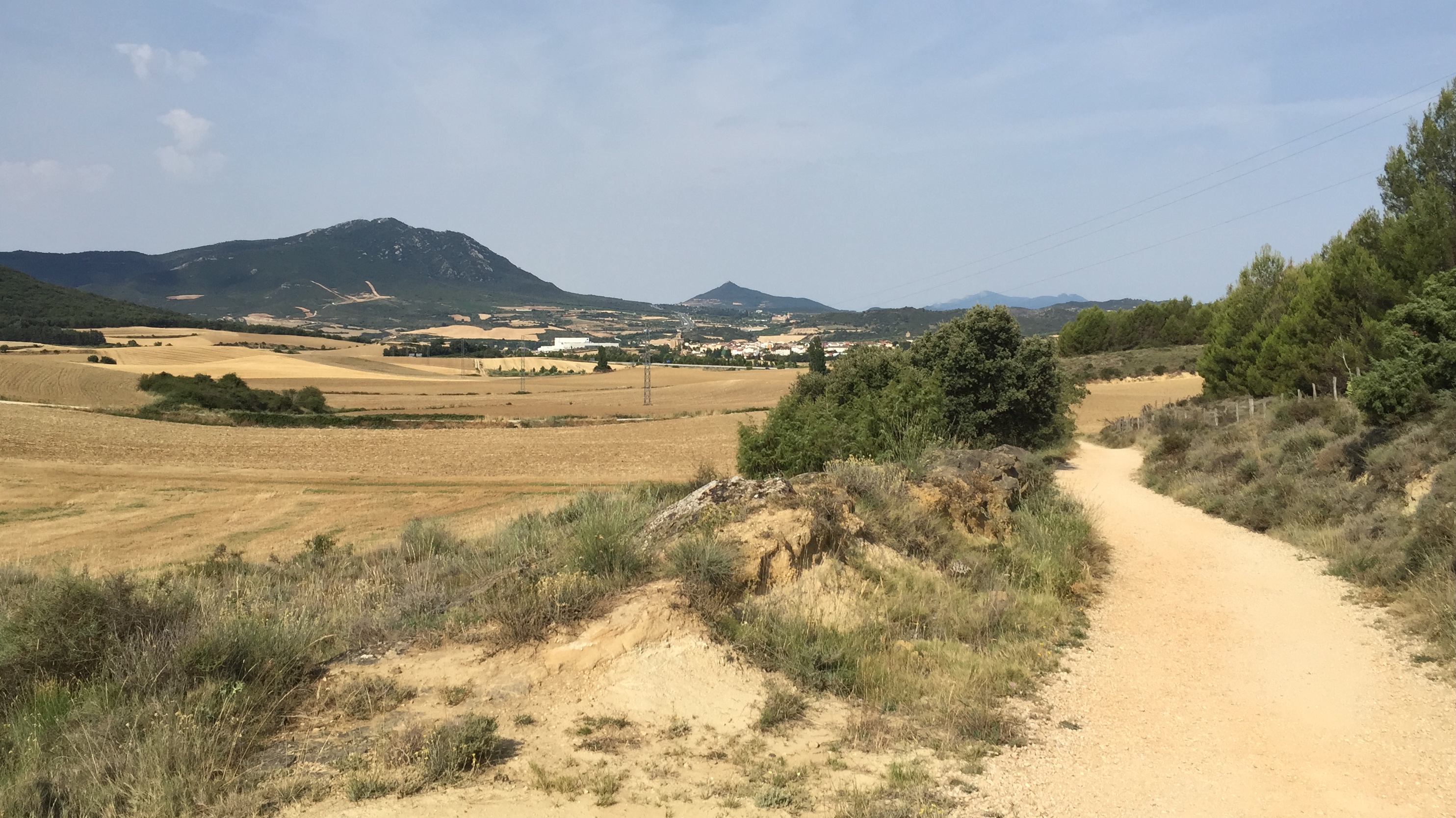
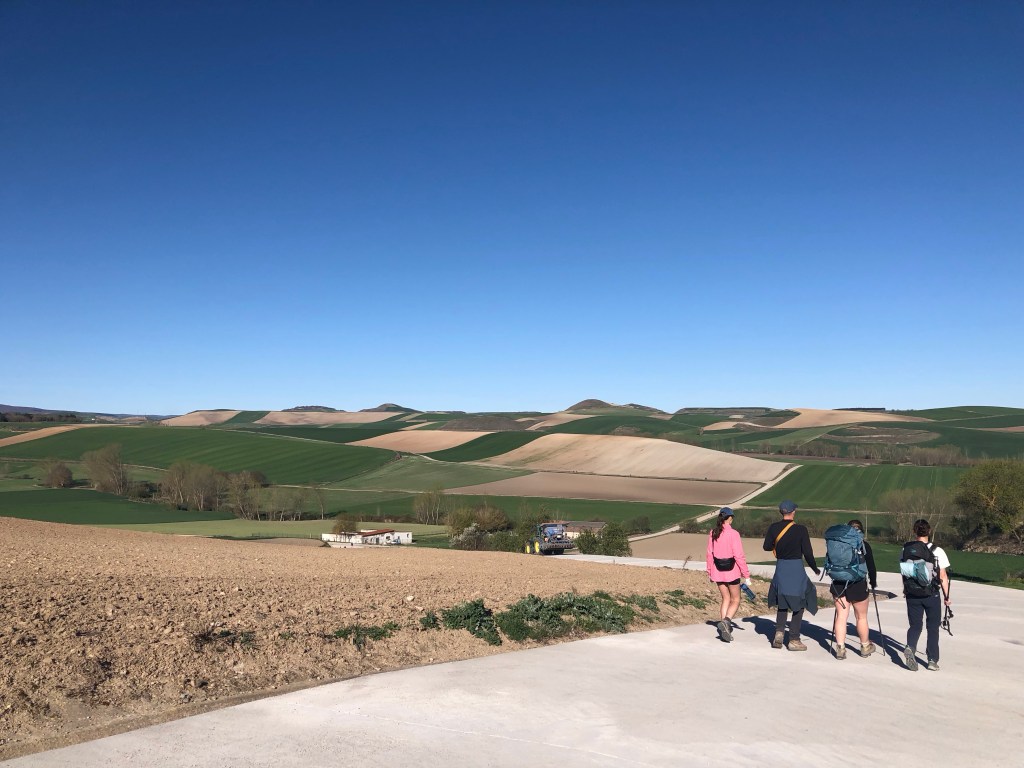
We left La Rioja behind today and started out upon what will become the Meseta Central. In a very real sense it already felt like we’d reached the middle stretch between Burgos and León – sun high overhead, the Camino cleaving close to the road, dust clouds and rolling wheat fields replacing former river valleys and distant mountain ranges. It’s stunning, but in a different way – a very Castilian kind of beautiful, austere and proud in its starkness.

Fortunately I had company to chew the fat with rather than lapse into the same clichés that other (and considerably better-versed) British travellers have used before me.
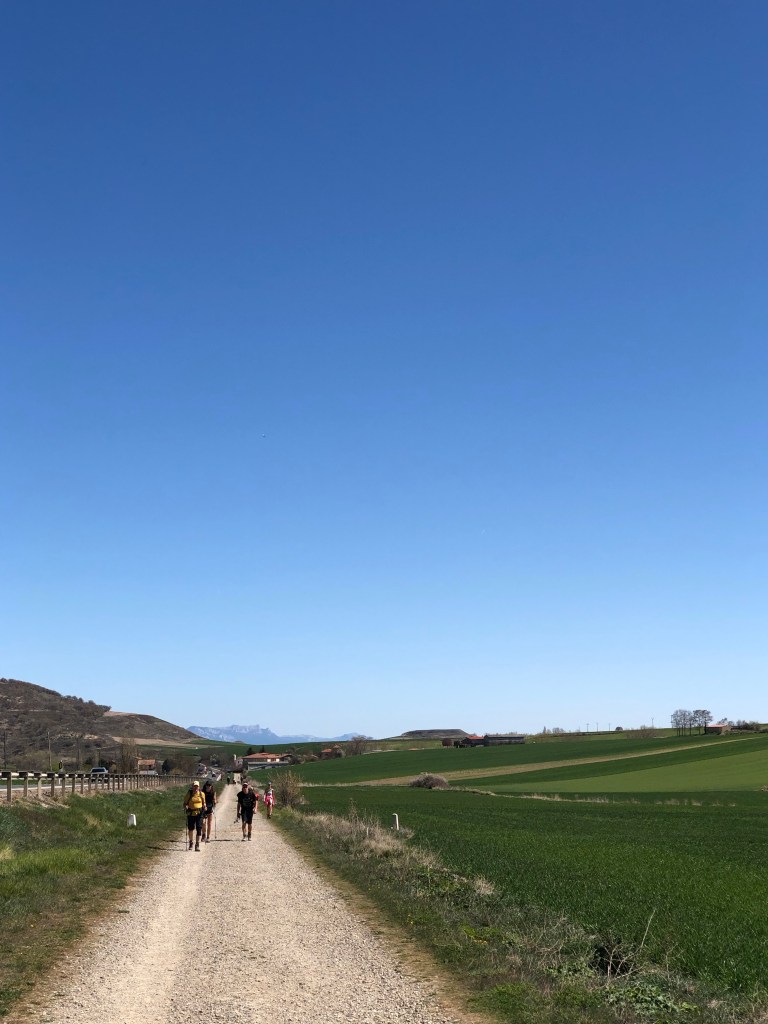

We arrived in Belorado shortly after two o’clock to find the town heaving with both pilgrims and locals – the festivities for Jueves Santo had just begun, and between that and the concentration of pilgrims in this small town, the albergue municipal was already fully booked. Luckily there were other options, and the place I ended up – Cuatro Cantones – could hardly have been a friendlier establishment. It even had a covered pool, which was a godsend after a twenty-three kilometre hike across the dusty plains.
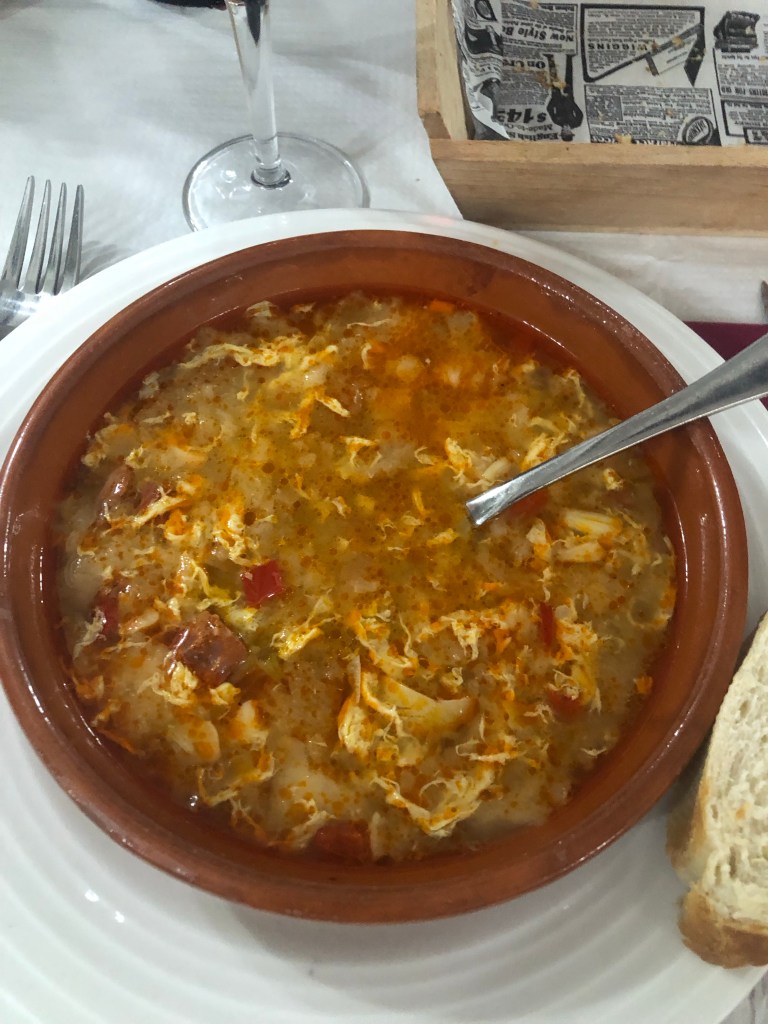
Sopa de Ajo – a personal favorite!

I’m now over halfway through the walking stage of this attempt at the Camino. In two nights it will be over: I will have reached Burgos, at which point I will take my leave of my companions as some move on and others return home while I stay and rest in the city of the Cid. I will be immensely appreciative of the break, but no more so than my feet, which are not used to this much walking – even from somebody who doesn’t drive!

Tomorrow, we either roll the dice on San Juan’s one pilgrim hostel or push on in search of pastures new. Luck be an albergue tonight, I guess. BB x

Camino III: Green Fields Forever

If this is a later blog post than usual, it’s because I’ve bought into the spirit of the Camino a bit more today and allowed myself to socialise with some of the other pilgrims – which often takes some doing for an introvert like me. Tonight’s digs are fantastic, though, and I’m writing from the genuine comfort of my dorm bed in Santo Domingo de La Calzada’s cofradía, one of the longest-serving albergues on the whole Camino.


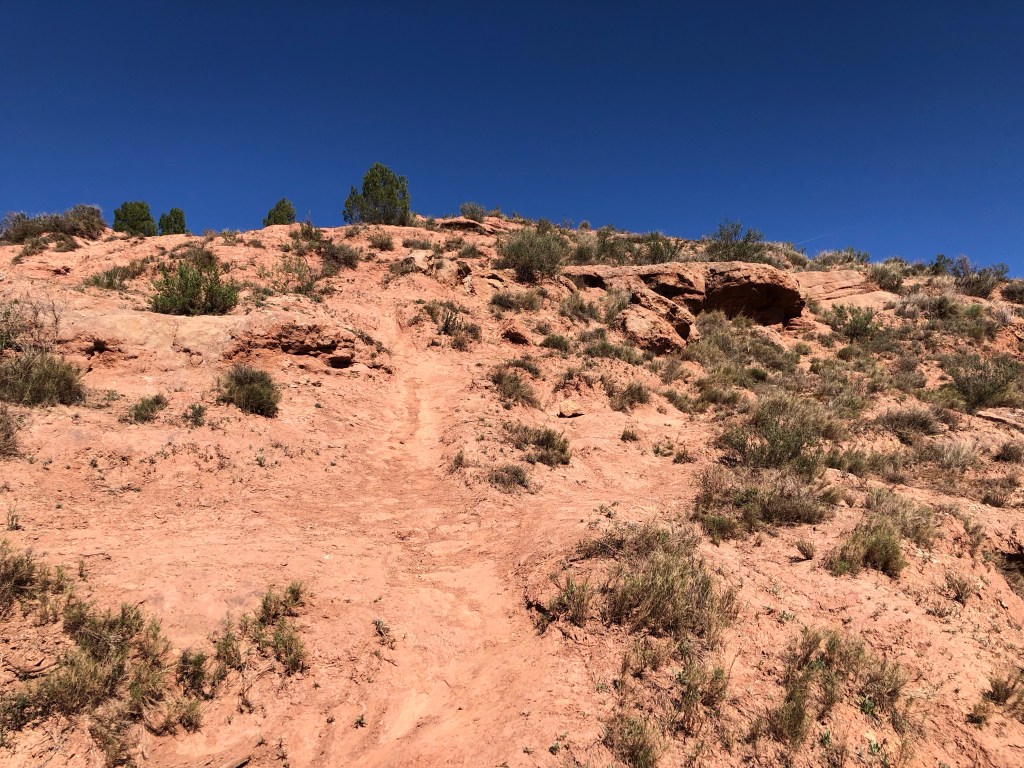
So first, a confession. After arriving in Nájera yesterday, I got itchy feet. The cliffs above the town were calling to me, and the voice telling me I’d already walked 30km that morning was drowned out by the other saying go on, do it, you’ll regret it if you don’t. The summit – a lonely bluff called Malpica – even had a cross at the top, which is essentially putting a hat on a hat. I had to climb it.


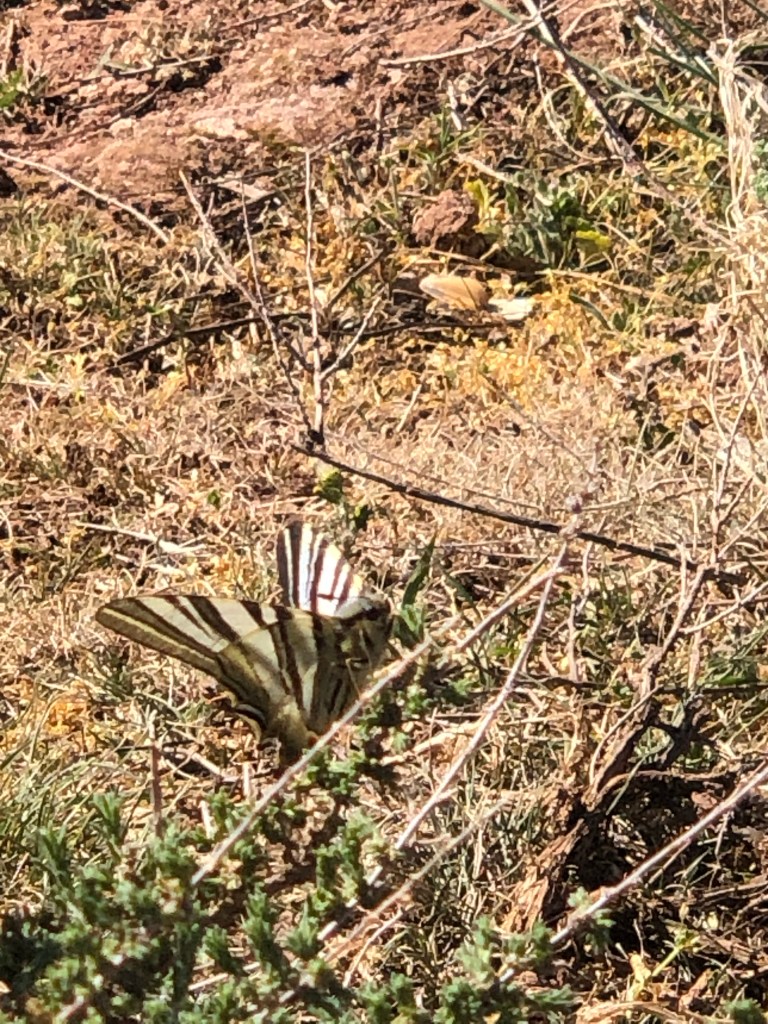
Oddly enough, nobody else was up there at half past four in the afternoon with temperatures pushing into the twenties. Which is just as well, because it turned out to be a hands-and-feet climb to the summit. Fortunately I’ve been doing that kind of thing since I was a kid, so I’m pretty handy with my feet. The view from the top of Malpica was breathtaking – moreso because I didn’t have an awful lot of breath left to take – but the real reward was the butterfly show. For whatever reason, a swarm had descended upon the clifftop, among them some of the most beautiful butterflies you can find in Europe: swallowtails. One or two of them – zebra swallowtails – were so large you could hear their wingbeats. The ‘blood dripping from their fangs’ kind, as my mother would put it. I was just happy to sit up at the top and watch them frolic for a while. It delayed the inevitable descent – again on hands and feet – for at least a short while.


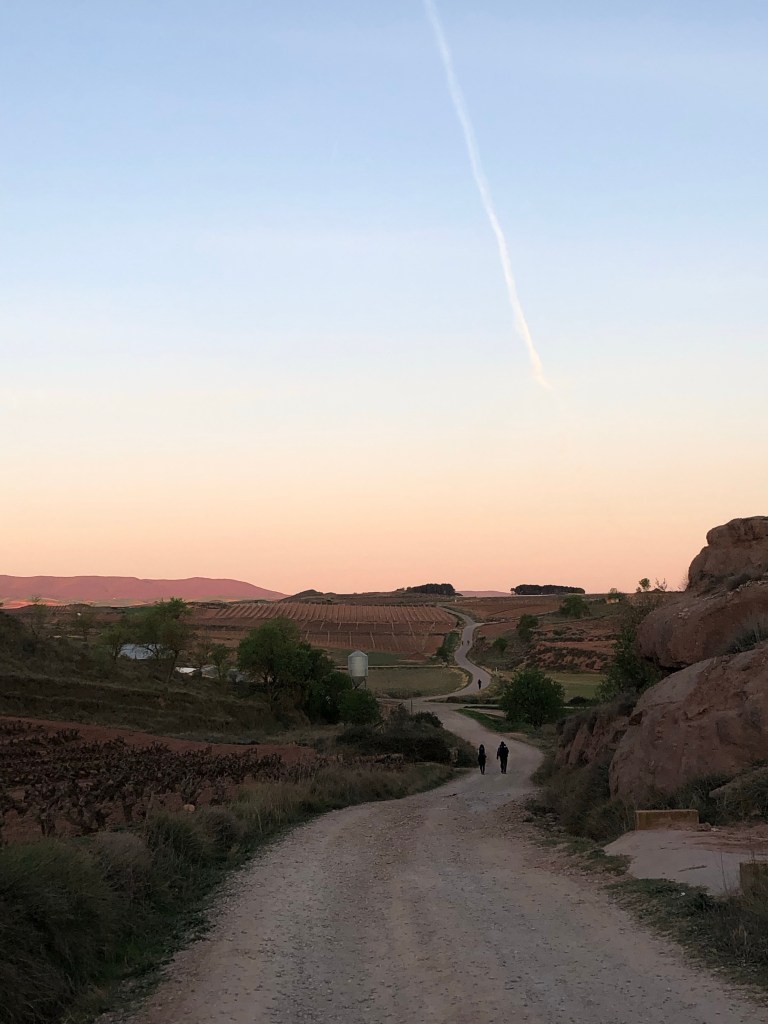
I fully intended to wait for some of the other peregrinos this morning, but when 7 o’clock had come and gone, I came and went with it. I’m rather fussy about catching the sunrise on the Camino, and will happily sacrifice a sit-down breakfast for it. This morning, I’ll admit, I really should have dawdled, as it was biting cold out. It had been well below zero during the night and, with the sun still below the horizon, it was still -1°C when I set out. You notice these things quickly when you’ve only packed with heat in mind.


That being said, the Camino was busy. The Koreans had all set out well before sunrise. They’re turning out to be most of if not the only real pilgrims (in the religious sense) on the Camino, with the possible exception of the odd Brazilian. I’d hoped to explore some of the churches along the way, but they were all closed – a possible drawback to setting out so early – so I powered through the first fifteen kilometres alone, soaking up the silence of the green fields of La Rioja.

And what a silence! At the start of the day the birdsong was explosive, and I got quite used to listening out for certain motifs in certain places: the rasping call of a black redstart on tiled roofs, the drawn out wheeze of corn buntings on fence posts and the singsong warble of woodlarks in the vineyards. But at one point it suddenly all went quiet. No birdsong, no cars, not even the sound of distant chatter from other pilgrims on the road. I had to stop walking to listen, taking out the monotonous beat of my own two feet that’d I’d long since tuned out. It wasn’t eternal, but it was powerful while it lasted. I’d even say it will be a treasured Camino memory.


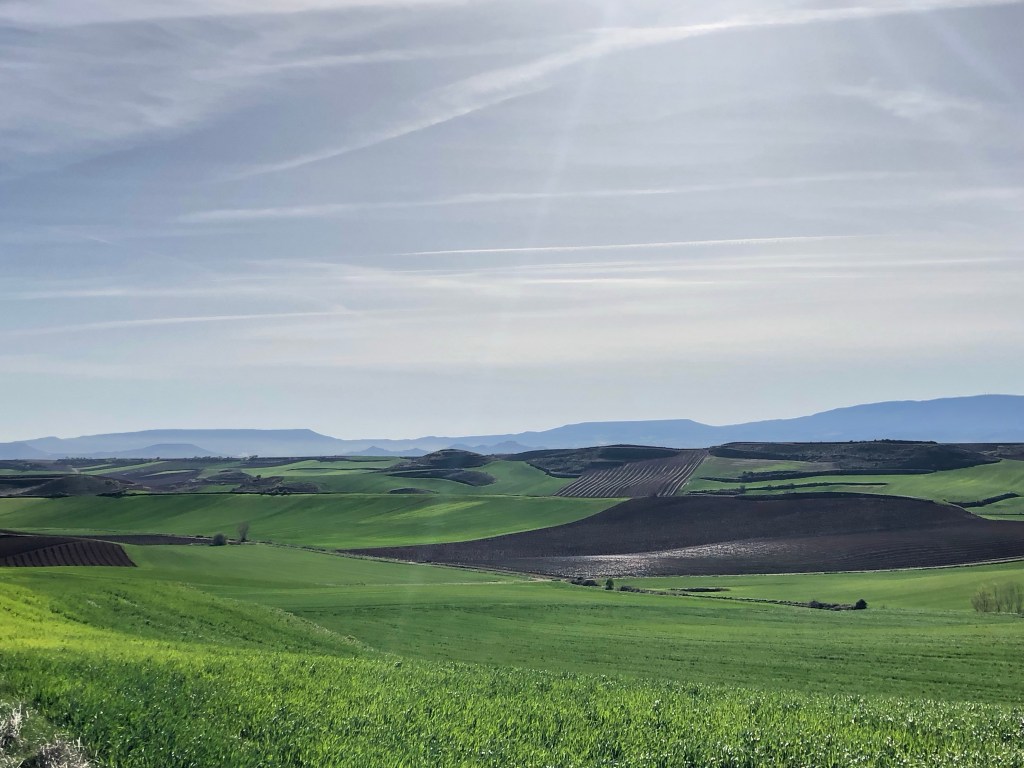
Just before Cirueña I fell into step alongside the only other English peregrino I’ve met thus far. It was good to share the road at last, and we swapped stories to the backdrop of the patchwork fields of La Rioja passing by.


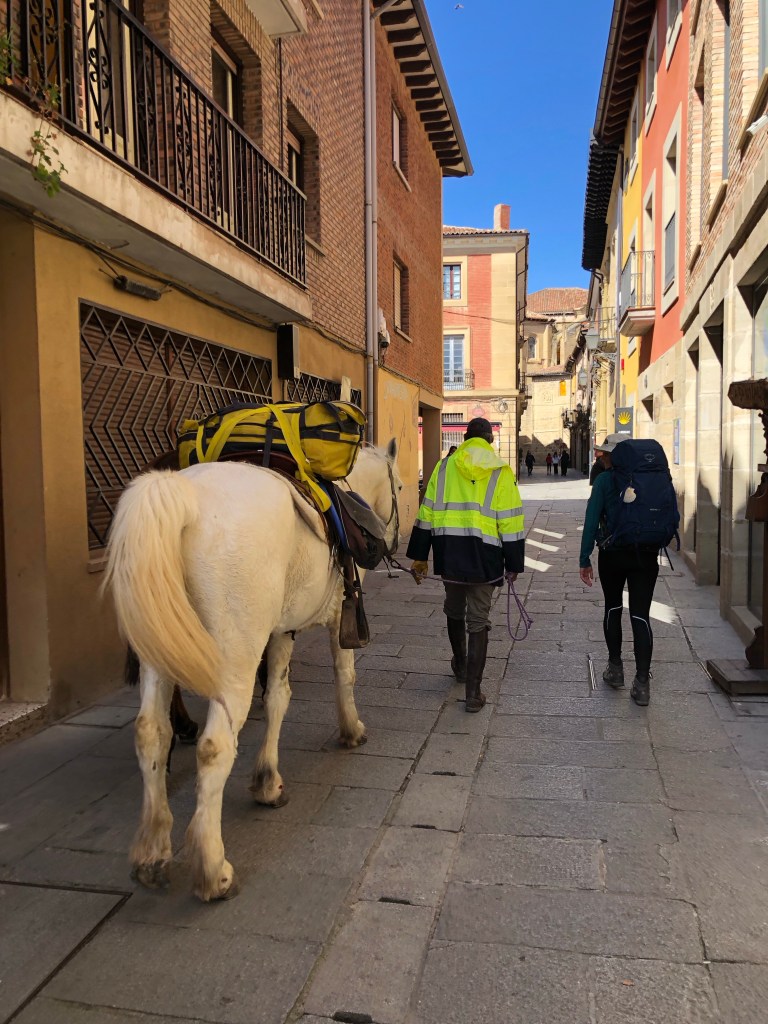
Just shy of Santo Domingo itself, we caught up with a genuine arriero, making the Camino in riding boots and a high vis jacket, taking his mule Jena and a Connemara horse along with him. It was a fleeting encounter, cut off all too soon by our imminent arrival in Santa Domingo, and I hope I can catch up to him again – I must have a hundred questions or more from years of research on arrieros that only a real muleteer could answer. Wait for me, Enrique! BB x

Peregrino Soy

Last night, according to the Beeb, there was a planetary parade. After yesterday’s exceptional conditions – the first day of spring in every sense – it would have been easy to spot from home. That the news decided to report the phenomenon exclusively in the past tense was a kick in the teeth. At the very least it would have been something to write about before the holidays. A warm-up exercise, so to speak, since that’s usually when I have the time to write. I bent the usual dry spell of the summer holidays to my will last year, but this year’s summer break is looking to be all about wheels with little to no time for anything else. Knowing I have to spend a great deal of the summer learning to drive is a pain in the neck, albeit a necessary one, and it’s naturally got me thinking about all the things I’d rather be doing. Fortunately, at this point in my life I can limit all those things to one thing and one thing only, and that’s the job I didn’t finish two years ago: the Camino de Santiago.

So, in my typical stubborn fashion, I’ve thrown caution to the wind and booked a return flight to Bilbao to pick up where I left off over the Easter break. Peregrino soy, volando voy.

Last time I made the trek I got as far as Logroño before having to fly home for both a house move and my pre-PGCE literacy and numeracy test. That’s somewhere between a quarter and a fifth of the total distance (780km). And though I’m not a fan of re-starting things if I can help it, it does feel like one of those treks that ought to be made in one, if you can.

Realistically, it takes about a month to walk the whole Camino, from Saint-Jean-Pied-de-Port to Santiago de Compostela. A month of 5am starts and 12pm finishes, racking up around 20km a day before noon with afternoons spent resting, exploring and talking to fellow pilgrims. It’s an experience like none other. Everyone is on the same road, but no two people started in the same spot or with the same motivations. You fall into a healthy routine after a couple of days, and yet every day is different.

People come from all over the world to walk the Camino. For the first couple of days, I tagged along with three Italians and an Argentinian. We parted ways at Estella when I stayed behind, enchanted by the Basque town. You could easily walk the Camino in a month, but there’s so much to see and do that it’s worth stopping every so often to see all the towns along the pilgrim route have to offer – and your feet will appreciate a day off after five or six days’ walking. Since I’m traveling within the parameters of a two-week holiday I don’t have all the time in the world, so I’ll try to follow the same pattern this time around: five or six days of solid walking, broken up by a decent night’s sleep in somewhere that isn’t an albergue at either end. That tends to be a good idea.

My credencial, or pilgrim’s passport, is already sitting on the coffee table, open at the last stamp. My sleeping bag is rolled up and ready to go and I’ve ordered a good quality rucksack as the one I used last time is at my parents’ place – and it was falling apart after more than a decade of use. For a sense of continuity, I’ll aim to stay at the same place where I came to a stop last time. My Spanish colleagues at work expressed some dismay at the idea of doing the Camino at this time of year – “pero oye, esto se hace en verano” – but I’m going to trust my instinct on this one.

I’m well aware that I’m heading out in none other than Semana Santa, the holiest week in the Spanish calendar. As well as adding to the colour of the Camino nights, with all the reckless passion of the pasos, it may well make for a busier (and more Spanish) Camino than usual. But after a couple of safe and highly-organised school trips, I’m more than game for a proper adventure. And few things provide quite like the Camino.

Bring it on! BB x