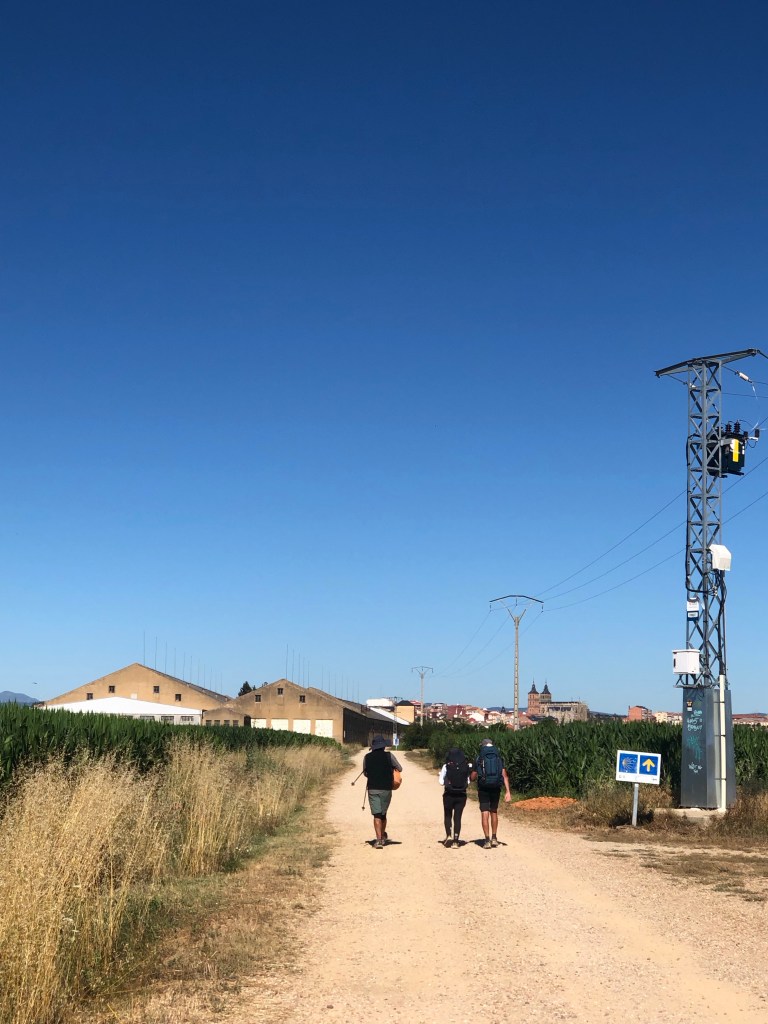
After yesterday’s long walk from León, today’s itinerary was mercifully short. Astorga is only 15km from Hospital de Órbigo, but it’s such a friendly city and so well set up for pilgrims that it’s worth a stay – if for no other reason than to rest up for the next couple of days of hiking as the Camino climbs into the Montes de León.
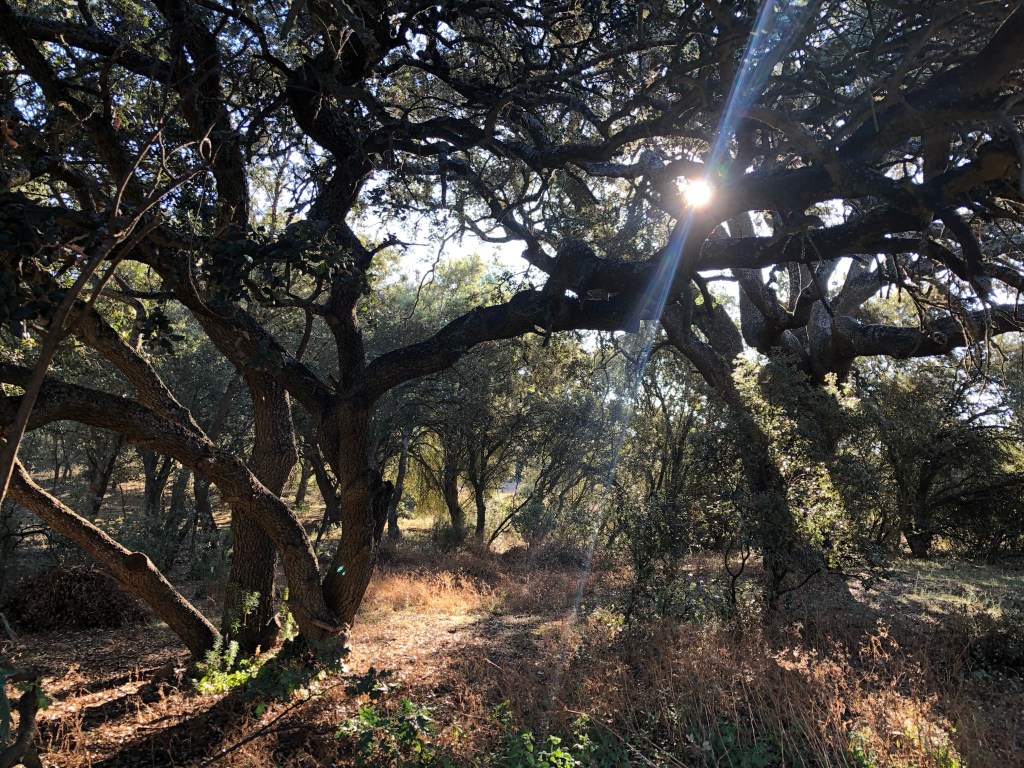
I set out later than usual this morning, since Google and the guidebook were suggesting only 3-3.5 hours’ walk to Astorga. To kill the time, however, I took a detour in search of an ancient oak tree said to grow deep in the old forest north of Valdeiglesias.
Joined on my random quest by Anna-Marie, a Danish ceramist from Aarhus, it took half an hour to track down the location (with a little help from Google Maps). A local out walking his dog was justifiably baffled by my madcap mission but it was a good excuse to have a chat in my favourite language.
We found the spot where the tree was supposed to be, but whether we found the tree or not is anybody’s guess. The trailing lichen from every branch certainly made the forest look considerably older than the others I’ve passed thus far, but that probably has more to do with the health of the forest and its relative altitude above the last kilometre of the meseta.
The jury’s out on the tree. Still, it was an adventure!
Anna-Marie took a break and I pressed on, making a mental note that our detour left us over an hour behind the other pilgrims. Once again, I had the Camino to myself, which meant that I was much less inclined to pause at the couple of rest stops I encountered. Which meant I gave the Casa de los Dioses a miss, though it looked like more of a hippie love-in than even this crazy shaman could handle!
I must have gone like the clappers (or they must have breakfasted long), because I wasn’t all that far out of San Justo de La Vega before I caught up to a familiar bunch: Tadeo, Christophe and Estrella. It was good to have company for the final stretch, so I slowed down my pace and fell into step.
We made it to Astorga on the back of Tadeo’s wonderful singing voice and Estrella’s remarkable knowledge of Spanish ballads (apparently they pop up here and there in Korean dramas – who knew?).
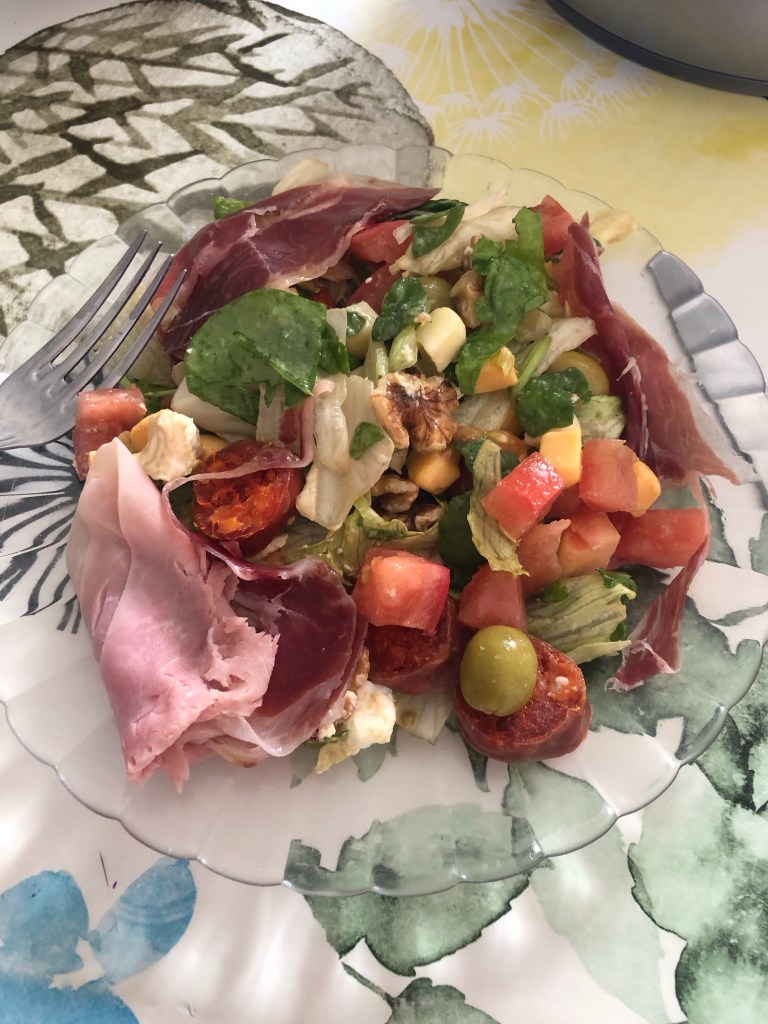
In lieu of a menu peregrino – which can get a bit samey – we bought supplies at a local supermarket for a communal salad. And what a salad! I haven’t even so much since starting the Camino. Good food, good company, good language practice and great exercise. There’s really very little to fault the Camino.
Unless you don’t like Italian. Because there’s a lot of Italians on the Camino! They must be the biggest demographic out there by a country mile… BB x
León is already a distant memory. I’m sitting in the shade of an awning in the garden of the albergue parroquial, having just spent a blissful twenty minutes with my feet in the foot-bath. The meseta stage is almost over and the foothills of the Montes de León are but a day’s walk away. Change is coming!
I slept very well last night, though perhaps because I wasn’t one of the Italians who tried to have dinner at the hostel ten minutes after lights out, incurring the wrath of the hostalera. All the nearby sockets were in use, so I had to leave my phone to charge down the hallway, which deprived me of an alarm for the morning… but, if the last few days are anything to go by, you hardly need an alarm on the Camino. You might just as well use the fifteen others that go off around the same time.
I was out the door by 6am and racing back to Plaza Santo Domingo – and with good reason. After yesterday’s mindless urban trudge into the city, I found a way to circumvent León’s even more extensive westward sprawl: the A1 city bus to La Virgen del Camino, on the very edge of the city outskirts. Thirty years ago I might not have bothered, but I couldn’t quite face an hour and a half’s march through characterless modern development, so I was more than happy to stump up the 1.60€ fare and rub shoulders with the orange-tee brigade of SOLTRA workers headed for their 7am shift in La Virgen. Two other pilgrims were in on the secret, but I lost them a short distance out of town when they stopped to check their bags. From then on out, I barely saw another pilgrim for the rest of the trek.
After yesterday’s easy 19km wander, I opted for the alternative scenic route via Villar de Mazarife. The original Camino follows the N-120 in an unbroken line for 32km, while the Mazarife road winds its way through the countryside to the south for 36km. I was up for a challenge, and I didn’t fancy another roadside walk, and for once, I know I made the right call.
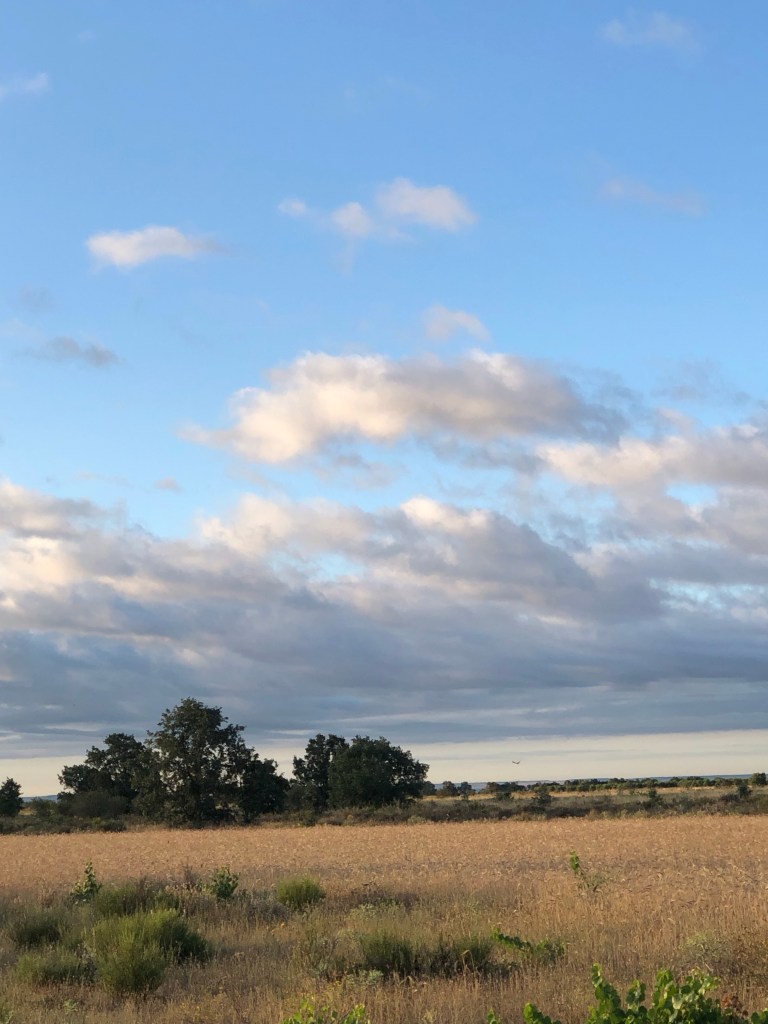
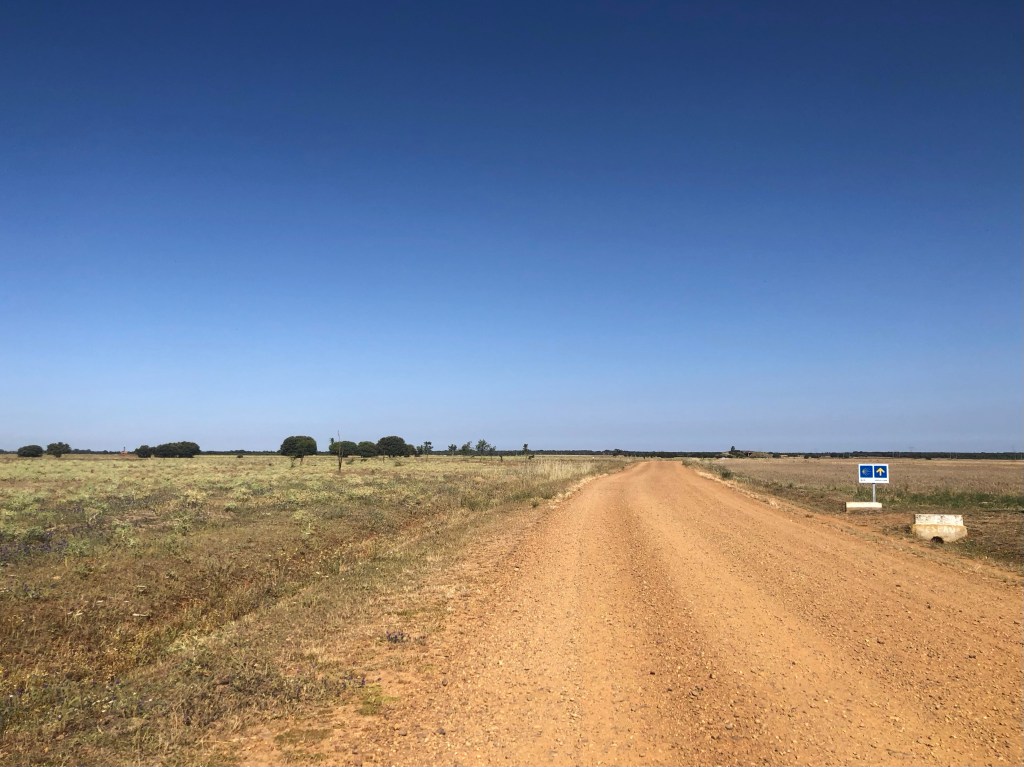
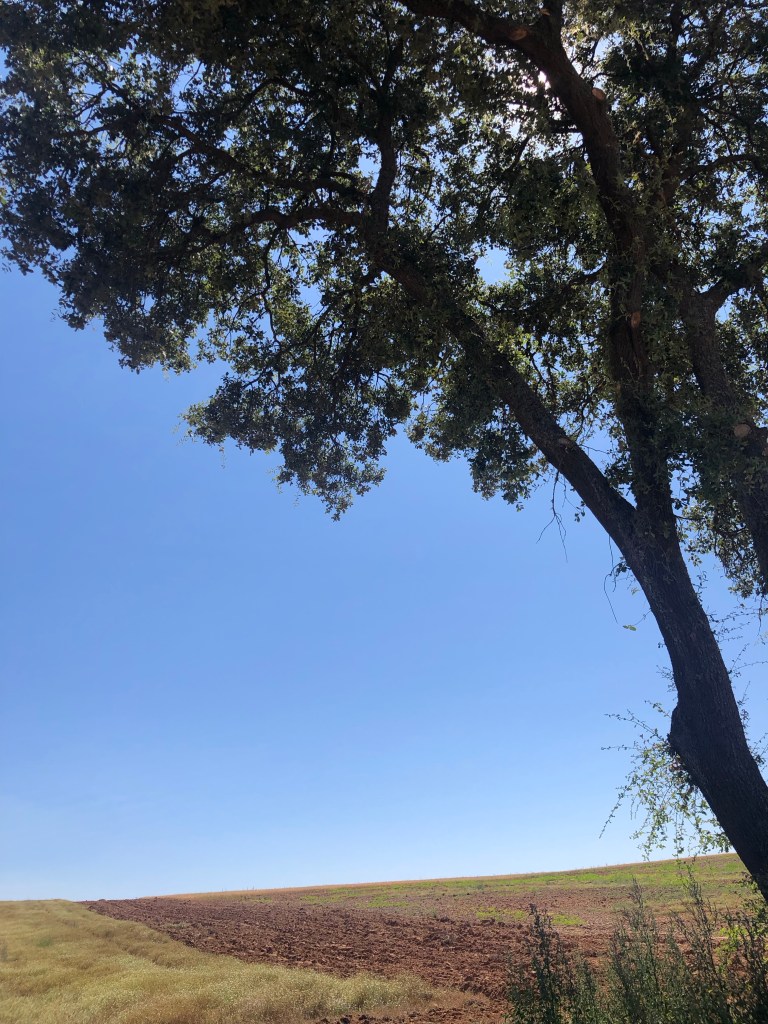
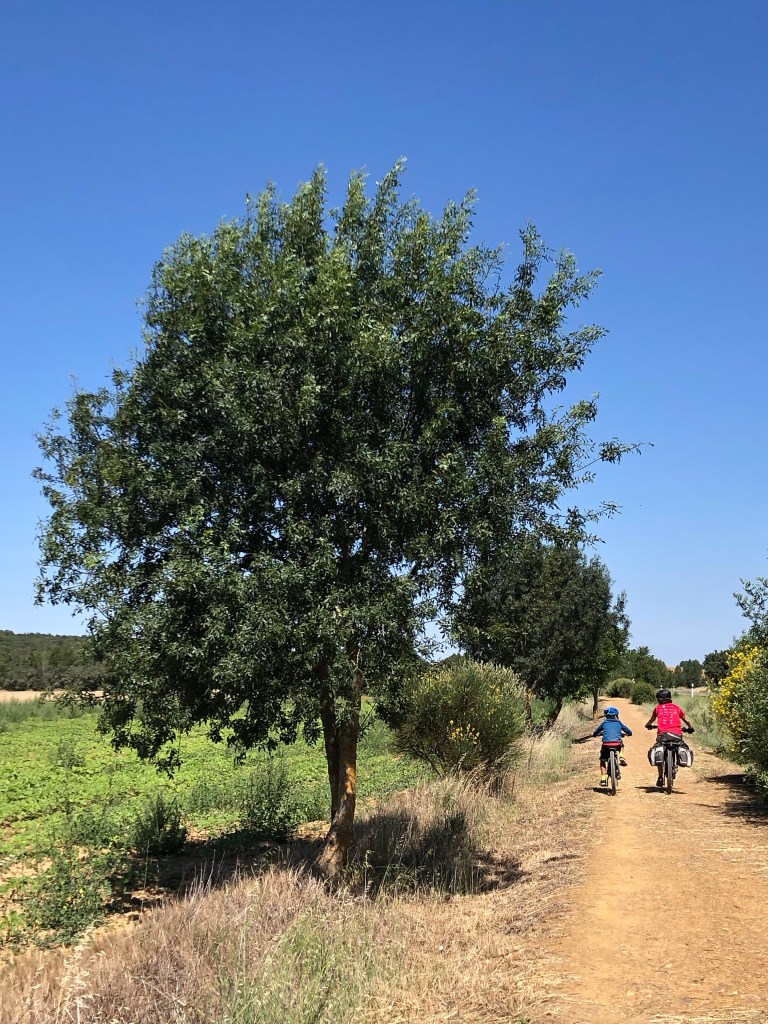
Southwest of León, the Camino carves a path through the scrubbier hinterlands of the Meseta. Fields of wheat and sunflowers give way to open dehesas, with sparse yellow grassland interspersed with stands of ancient oak trees. In a way, it felt like being back in Extremadura.
Better yet, the first hour after sunrise yielded some of the best birdwatching yet on the Camino. The usual backdrop of quail, turtle dove and stonechat provided some musical continuity to the meseta movement, with a colourful inclusion of golden oriole, blackcap and nightingale. There were quite a few kites about, whistling in that very plaintive way they do, and the calls of bee-eaters will never fail to make me smile. While I can also add great grey shrike, honey buzzard and whitethroat to my list this morning, I think it was the fleeting encounter with a greater spotted cuckoo that was the standout from today’s walk, tearing ahead through the scrub in front of me as I neared the first town on the trail, Chozas del Camino. As usual, a phone camera is next to useless for this kind of thing, but I did manage a snap before it was gone (look to the right of the second tree from the left).
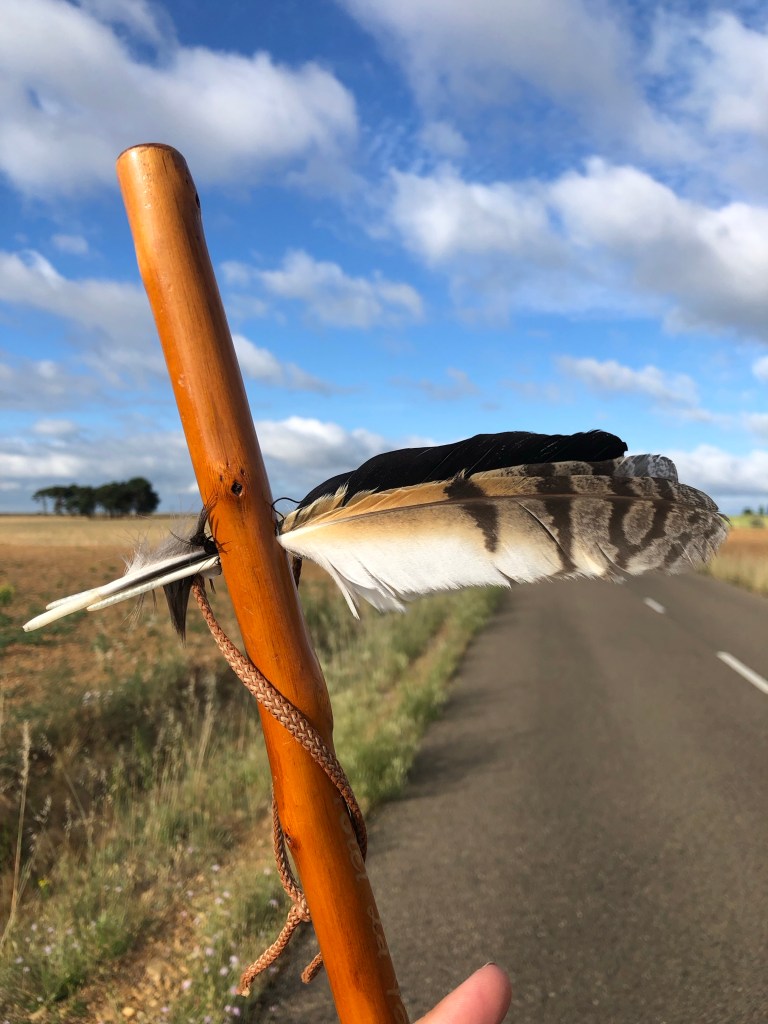
After narrowly avoiding a major desvío at Chozas, I followed the road to Mazarife for the next hour or so. Along the way, sensing rather than smelling death, I guess, I came upon a mass of feathers at the side of the road. On closer inspection, it was a long-eared owl, and a relatively young one at that. Given its condition, it must have been hit by a car less than a day ago, or else it would have been devoured long since. Acting on an intuition beyond simple curiosity, I picked up two of its wing feathers and fastened them alongside the raven feather to my staff. Besides the fact that owl feathers are one of nature’s most intriguing artefacts – they are engineered to move silently through the air – I think my desire was to give the unfortunate creature (a migratory species in most parts of Europe) one last journey, as it were. I will carry them to Santiago and Finisterre… and beyond, if I can.
With a feathered staff and a satchel full of pens, pencils and sharpenings, I’m rather conscious that I’m starting to take on the appearance of a tin-pot shaman. My silent reasoning that ravens represent life, light and hope (they brought the knowledge of fire to man in Scandinavian mythology) and owls death, darkness and wisdom (via the Greek tradition) probably doesn’t help, either. I’m still searching for a stork feather, though despite their abundance, these are proving hard to find.
All I can say is I had this coming. In my first teaching post in Uganda, I was given the moniker ‘Ojok’, meaning ‘healer’ or ‘witch doctor’. It wasn’t anything more than an attempt at humour by my hosts, but hey, I guess such titles should be earned, right?
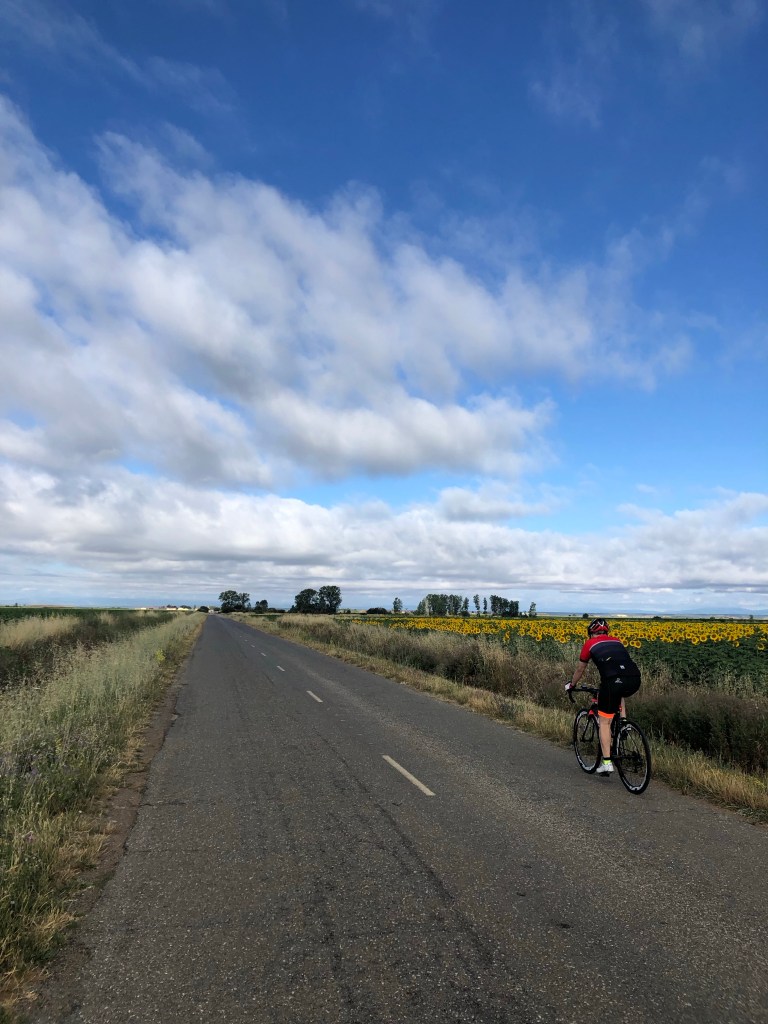
From Villar de Mazarife, one of the straightest roads of the entire Camino leads for some ten kilometres to the hamlet of Villavante. With the exception of the occasional buen camino from a field worker clad in orange hi-vis overalls, and the need to duck and weave to avoid the mechanical water jets every now and then, it was a fairly uneventful walk, but a beautifully quiet one at that.
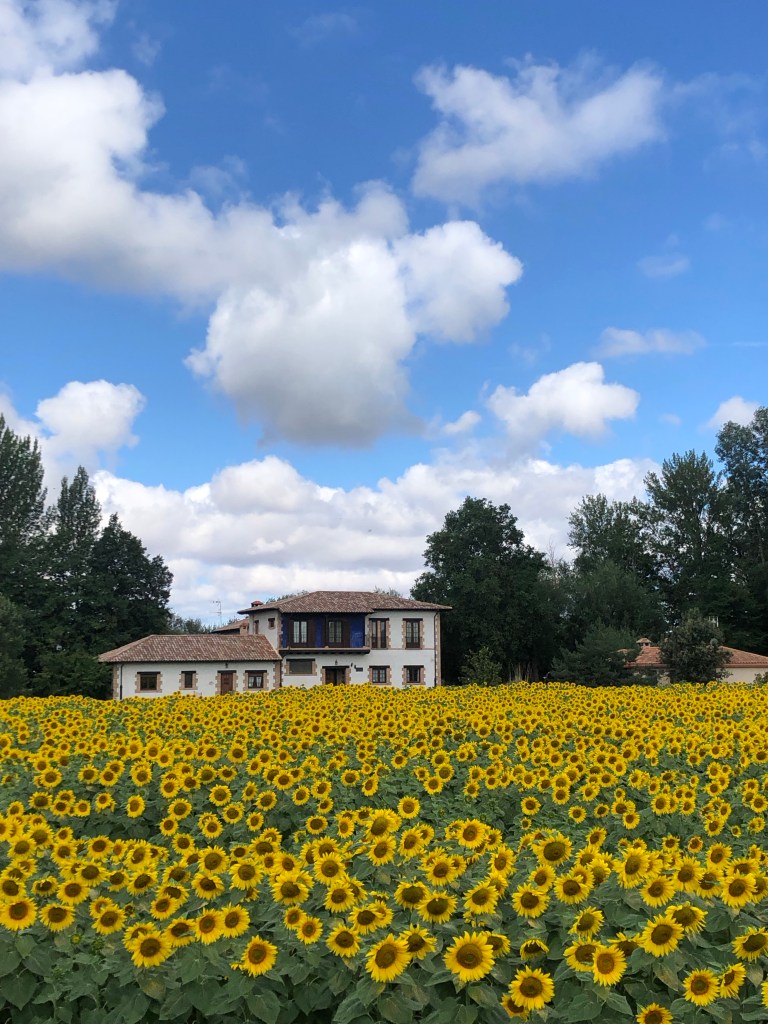
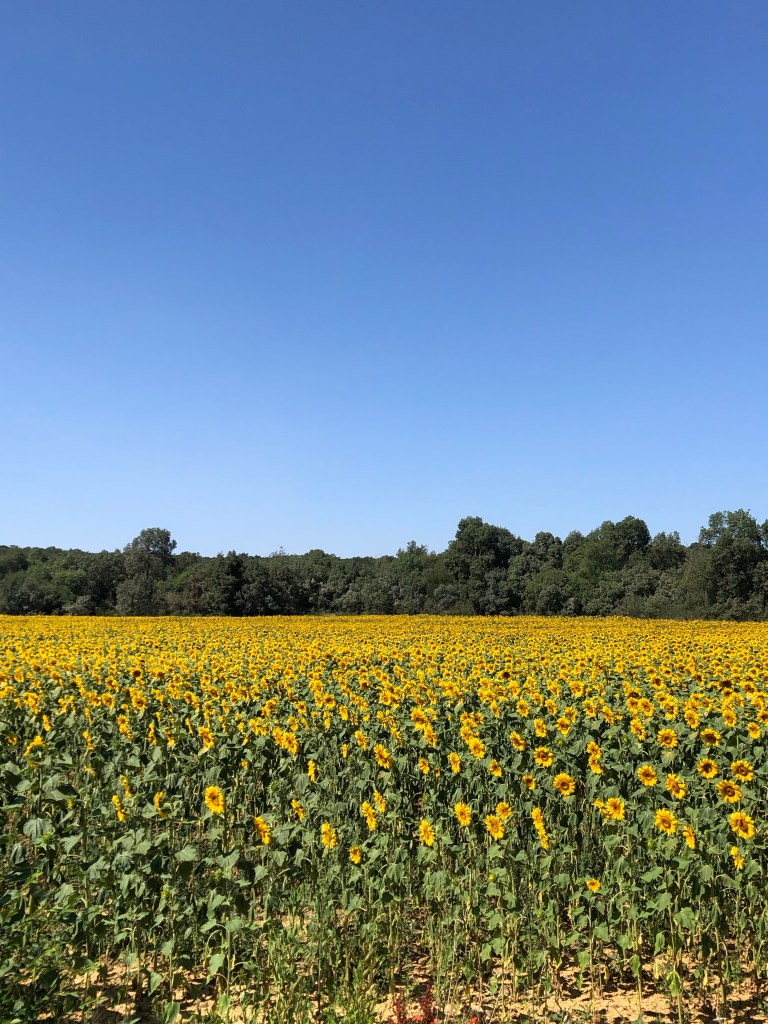
At Villavante, the Camino forks to the north to cross the León-Astorga railway line. It’s practically worth the trek for the view of the Casa Rural Los Molinos, nestled behind what appears to be a private tree-lined sunflower grove.
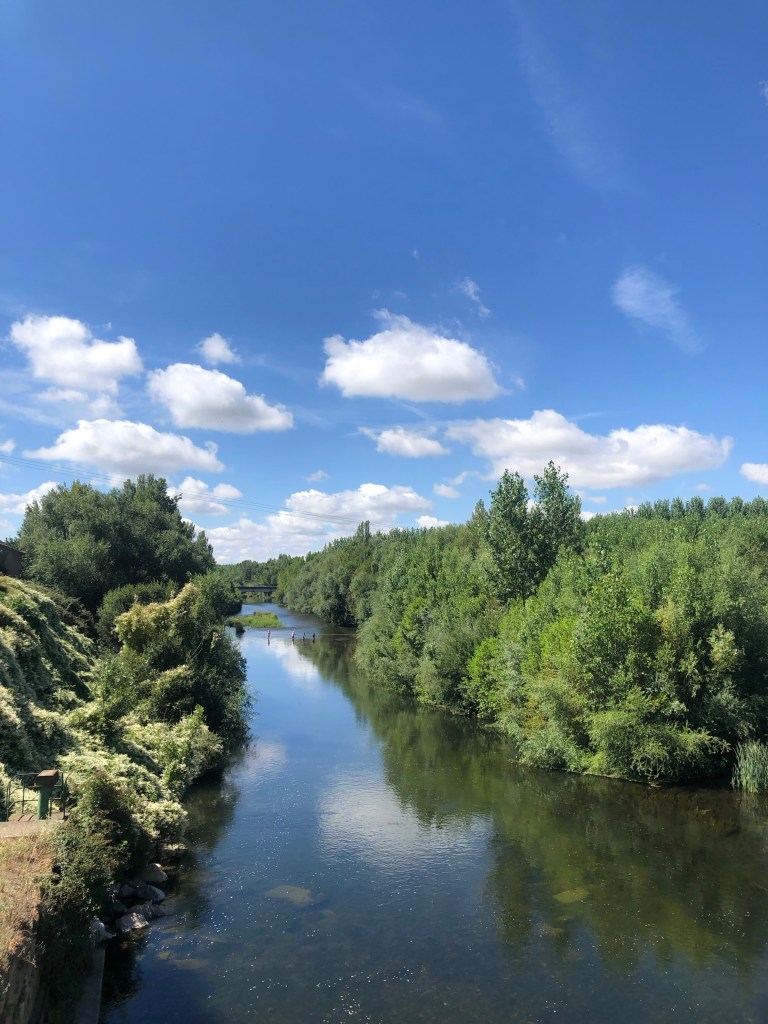
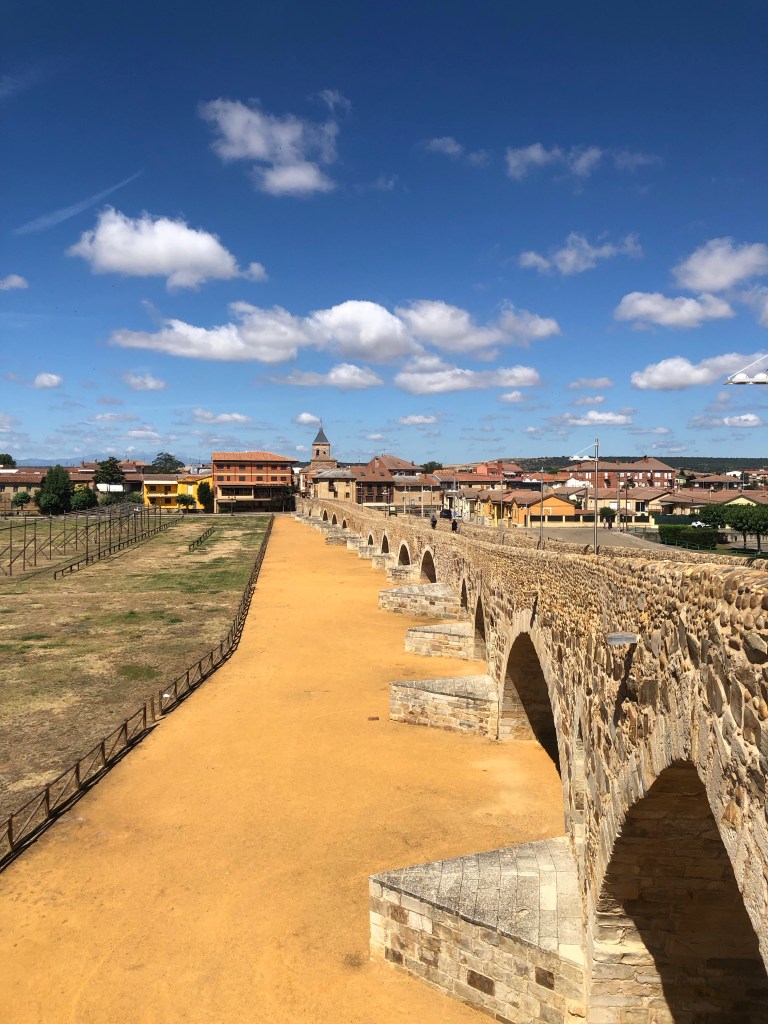
After that, it’s only a short distance to Hospital de Órbigo. It’s a good-sized town and, at 12pm on the dot and after nearly five hours’ walking (with a sum total of fifteen minutes’ break), I was more than ready to throw down my pack for the day. The entrance to the town over the medieval Puente Honroso (which I’m 90% sure featured in my dissertation) simply sealed the deal. This place is incredibly beautiful.
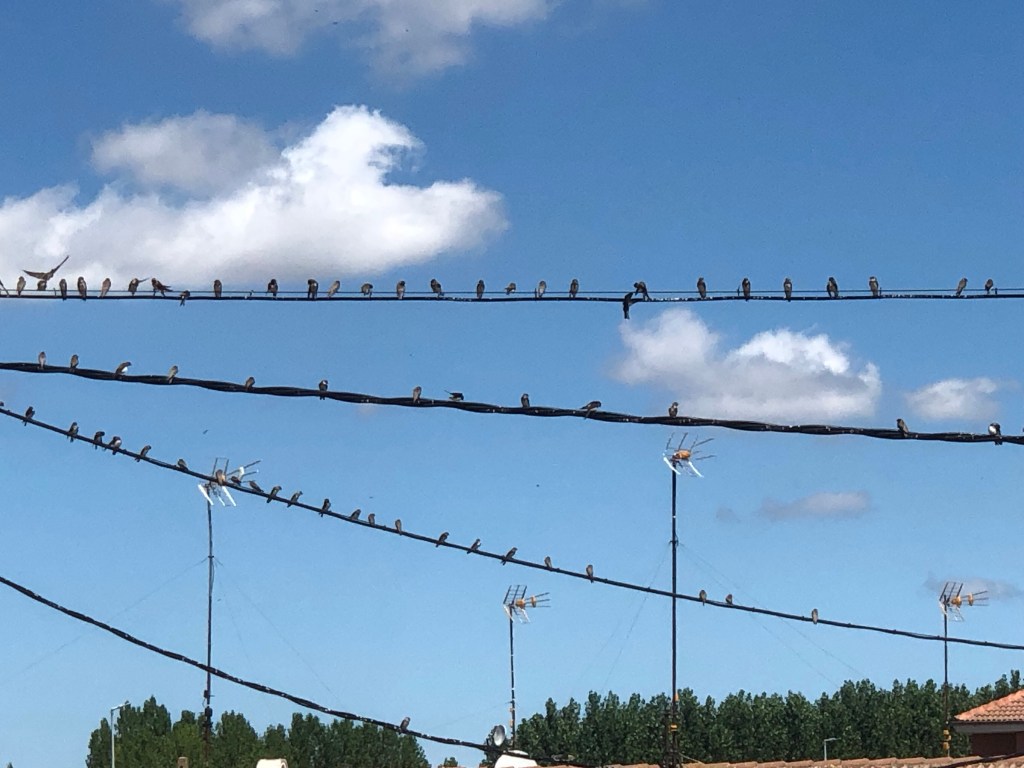
It’s said that a certain Don Suero, a local knight, challenged all comers to the bridge to win the heart of a lady, breaking 300 spears in as many jousts before an ever-growing crowd. The lords, the ladies and the medieval gaiety may be long gone, but the endlessly chattering sand martins lined up along the wires by the bridge make a good substitute.
Well, there goes my siesta. Tomorrow is a much shorter walk – three and a half hours at most – but I hear there’s a thousand-year-old oak tree near Santibáñez de Valdeiglesias, so I will extend my walk to take a look. Now I have the trappings of a new age shaman, I might as well play the part. BB x
I at least made an effort to wait for my fellow pilgrims this morning, but impatience got the best of me. When half an hour passed and all but a trickle of the pilgrims from my albergue had come and gone, I gave up and set out for León. I wasn’t in any particular hurry, but a conversation over dinner with an Italian veteran of the Camino (this would be his tenth rodeo) had me reflecting on his words: you can never do the Camino at any pace other than your own. Well, there I was, trying to match the speed of another pilgrim or two. In the end I have to be true to myself. So off I went.
It’s not far from Mansilla de las Mulas to León – four hours, tops, though I could probably have done it in a little over three. But for the Museo de los Pueblos Leoneses, which I really did want to visit, I might have pushed on yesterday and done two days’ work in one. But I am being kind to my feet, seeing so many pilgrims in varying states of deterioration, and so I made my way leisurely this morning.
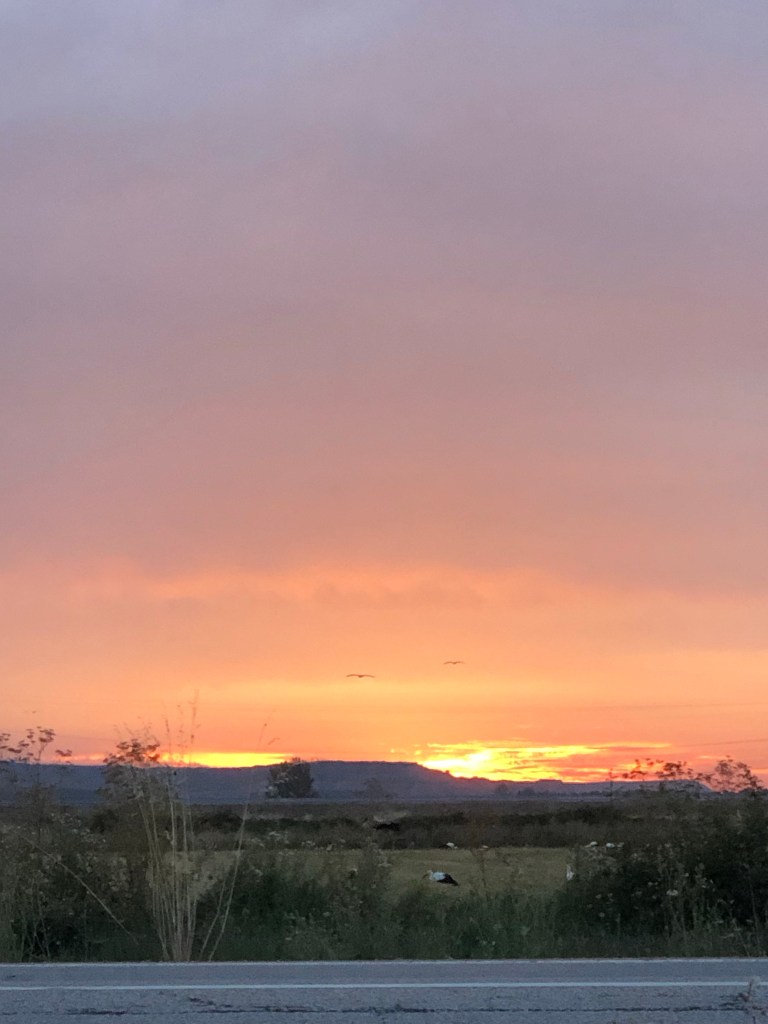
The approach to León is not the most scenic of the Camino by any standards – most of it passes through an extensive suburban industrial estate – but there was still some magic in the sunrise when it came over a roadside field where a large number of storks were flying in to feed from all directions.
I dawdled for a bite to eat in Arcahueja, still in the hope that a few of my pilgrim companions would show up. They must have been tardy this morning, because I never did see them. Instead my French got a serious polishing over a conversation with Jean-Paul from Carcassonne and Adine from Versailles. It might be lacking the instant spark of my last Camino, but if I remember this leg for one thing, it will be the constant linguistic gymnastics – I don’t think I’ve had to bounce between languages so often ever before. It’s bloody good fun!
I reached the outskirts of León at around 10 but it was almost 11 by the time I reached the Benedictine albergue, my digs for the night. Of the old guard, only Sean the Irishman and Alan from Rennes elected to stay here – I haven’t seen anybody else I know. It’s equally possible others will join here. It’s an established fact that the road gets seriously busy from Sarria, so that’s something to look forward to.
For future reference, July is – surprisingly – low season. The Camino is at its busiest in May, June and then August and September. For whatever reason, July is a quiet month on the Camino. Well – now I know!
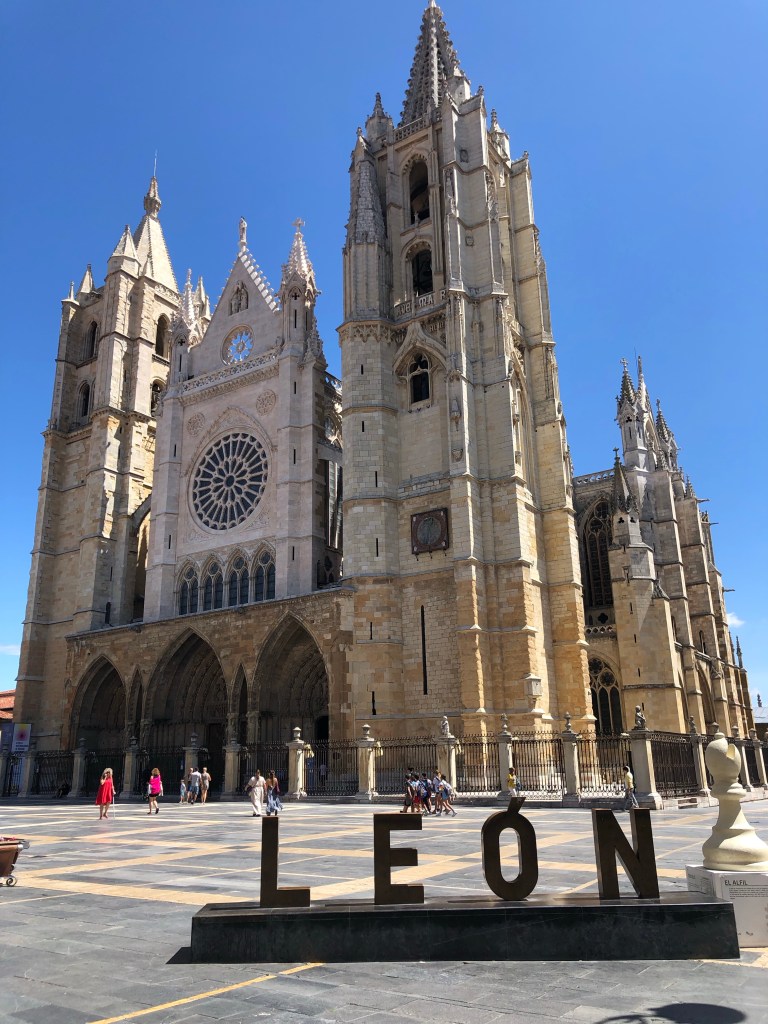
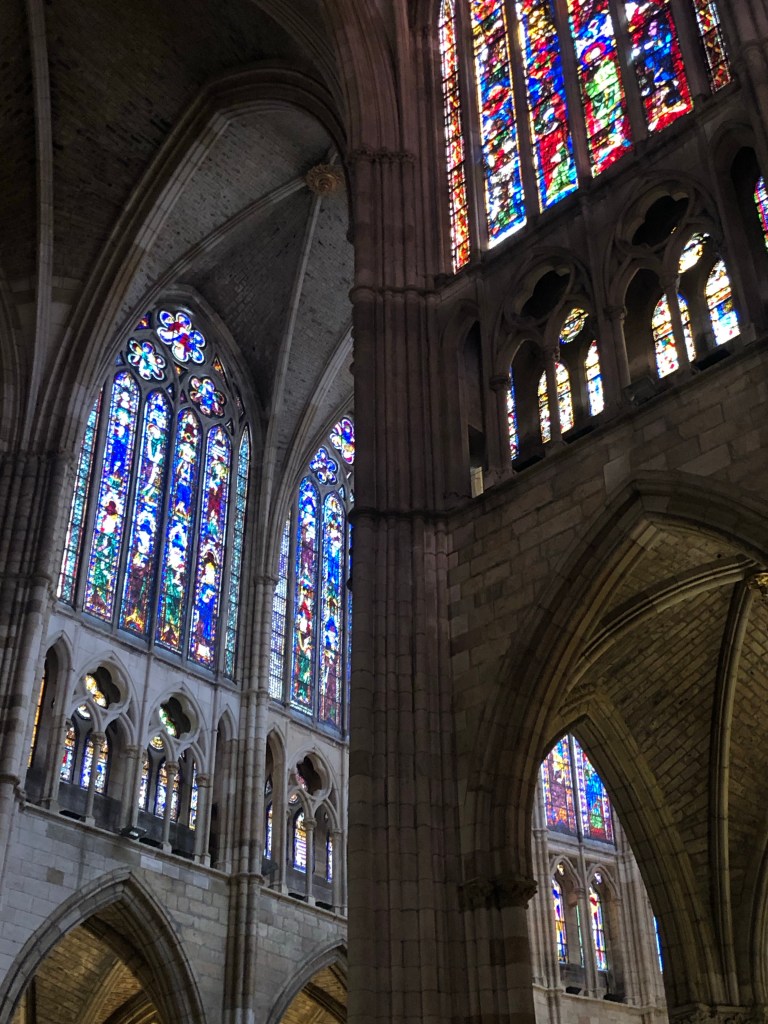
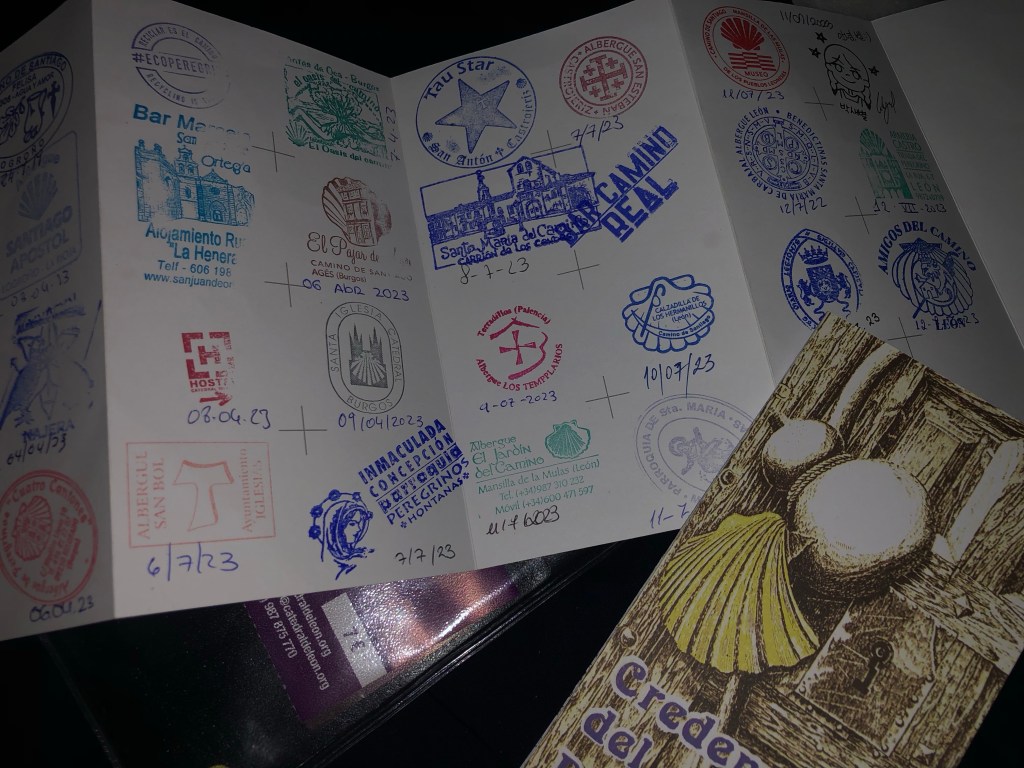
León’s enormous cathedral was under heavy scaffolding the last time I visited so I thought I’d pop inside. It’s pretty magnificent as cathedrals go, but I still think that spending so many hours of my childhood in Canterbury Cathedral has left me somewhat jaded when it comes to cathedrals. More importantly, it produced another stamp for the pilgrim passport, which is now dangerously close to completion…
I had a snack lunch in the kitchen with a very cheap spread from a nearby Coviran and had a short siesta to while away the hours before everything reopened at 6pm. Conscious that the Galician stage requires a minimum of two stamps per day (or something like that), I went to the Asociación de Amigos del Camino de Santiago to seek a new credencial. It wasn’t immediately obvious, but rather, tucked away in an office on the fifth floor of an unassuming tower block above a bank near the Plaza Santo Domingo. The socios inside, however, were wonderfully friendly and I had a good long natter after their initial confusion over my names (Spaniards always seem to have issues gettin their heads around the British custom of middle names). Armed with a new credencial (and with my mood improved by a humorous argument about whether or not to stick the two credenciales together, which was a bone of contention between two of the socios), I am now prepared for the final two stages of the Camino. Bring on the stamps! BB x
I’ll say this much for Calzadilla de los Hermanillos: it’s a beautifully reflective way to end the meseta experience, before you say farewell to the plains and reach the Órbigo floodplains at Mansilla de las Mulas. Sure, I ditched the other pilgrims to strike out upon that road, but it was totally worth it.
The hostalera in the donativo laid out a real spread for breakfast, so I helped myself to a better start than I’ve had in days: boiled eggs, yoghurt, pastries, flat peaches, cherries and a sandwich and a half for the road. Fuelled on such a feast, I was more than ready to tackle the Roman Camino.
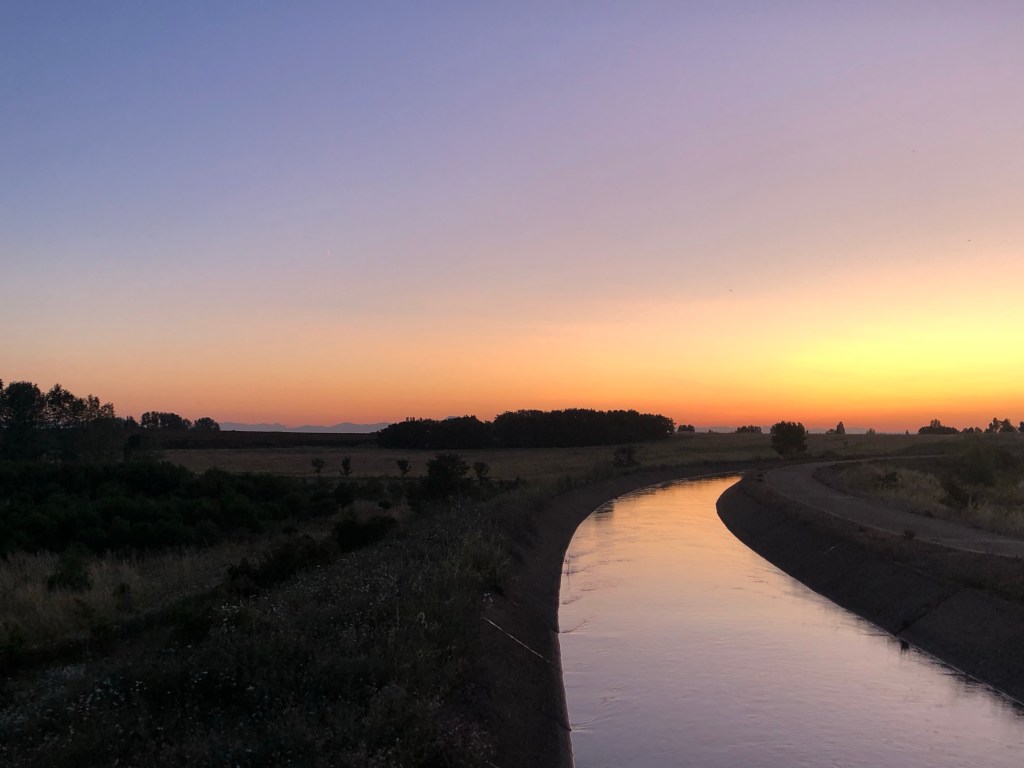
After outstripping the other pilgrims, I had the rest of the Calzada Romana – the ancient Roman raid to the mines – all to myself. And what a morning for it! From the rise, you can see all the way to the distant peaks of the Picos de Europa, ringed with fire by the rising sun. The intermittent canals that cut across the causeway worked like mirrors, carving mercurial strips out of the earth, so that each one seemed to be a continuation of the sky above, and the fields around it a floating world. One of the best sunrises I’ve had on the Camino yet, and I’ve had a good one every day.
You get a good sense of the infinite on the Camino, walking in the footsteps of a thousand years of pilgrims who came before you (the earliest recorded pilgrimage to Santiago was in 930 A.D.), but walking on an old Roman road added another level of grandeur to the experience. The rough stone path made a change from a week of dirt tracks and concrete, and while it may well be wishful thinking in my part, it’s possible, however unlikely, that my feet touched the same stone that some long-forgotten legionary trod two thousand years ago. Nuts!
Sadly I didn’t bump into any ghostly centurions in the early hours of the morning, but the irrigation system provided a jump scare of it’s own: one of the mechanisms was so close to the path that I only had a five second window to clear the distance if I didn’t want to get soaked! That sure woke me up.
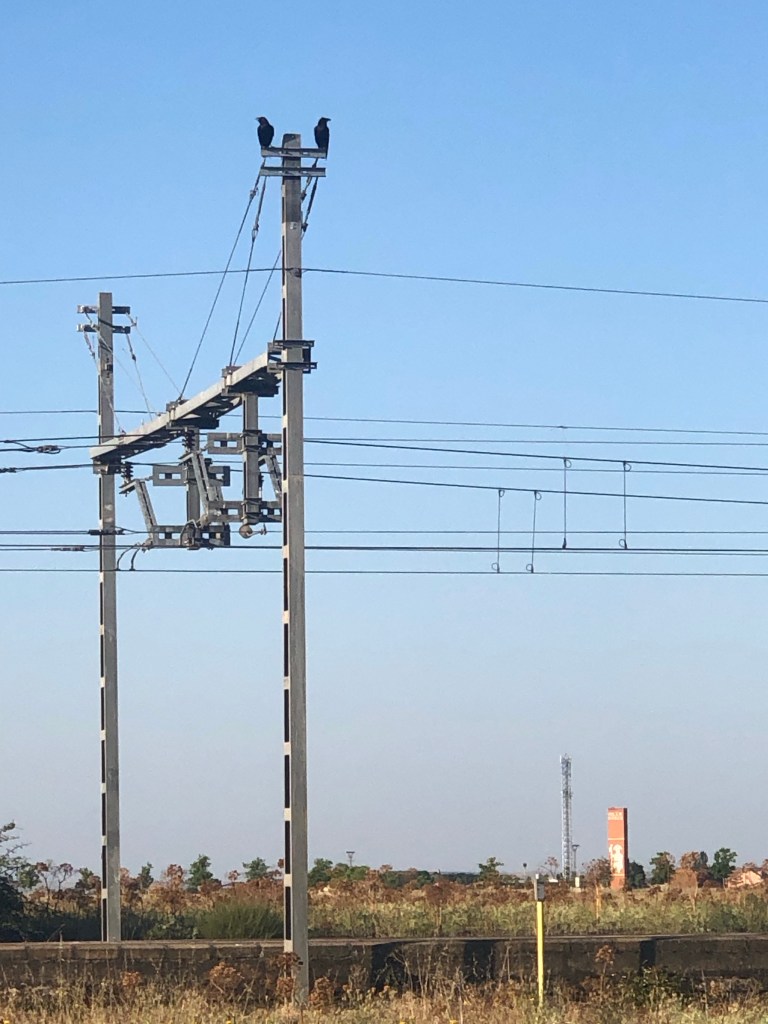
One huge plus of not taking the Bercianos route was the wildness of the calzada romana. I had my usual encounters with stonechats and wheatears (both northern and Iberian), but this unfrequented section of the Camino was a real gem for wildlife-watching. I saw my first quail whirring across the fields on tiny wings, and a couple of partridges, rabbits and a lone red deer rounded out this morning’s game. Every arroyo was alive with singing frogs – which is possibly how the nearby village of Burgo Ranero got its name – but a lonely nightingale had them beat toward the end of the road. A couple of ravens loitering around the ruined Villamarcos station chased off a buzzard that perched too close, then eyed me suspiciously as I walked on by. I found one of their feathers a little way on. It’s currently fastened to my walking pole for luck.
After several encounters with the grey males over the last few days, I finally saw a female Montagu’s harrier in the distance, and I must have clocked about nine or ten hoopoes by journey’s end. But best of all was a cuckoo that came out of nowhere during the morning’s only river crossing. Normally you hear these birds rather than see them, but this one was sitting in the middle of the road when a hoopoe gave it a merry chase for several minutes while I removed the grit from my sandals.
I got to Mansilla de las Mulas well ahead of schedule. I knew staying in Calzadilla would shorten today’s walk, but I still got to the albergue for 10.30am, meaning I had a good two and a half hours to kill before anything was open for business. All the same, this time it was as well that I did so: of the three albergues in Mansilla, one was fully booked and another, the municipal, was closed for renovations (and has been since April, at least), leaving me with no options but the pricier Jardín del Camino. I can’t complain after a very affordable night in a donativo, but when you’re used to paying 10€ as a standard, 16€ for a bed and a further 16€ for a menu peregrino is a bit steep… still! It’s all relative. Just think what that would cost back home….!
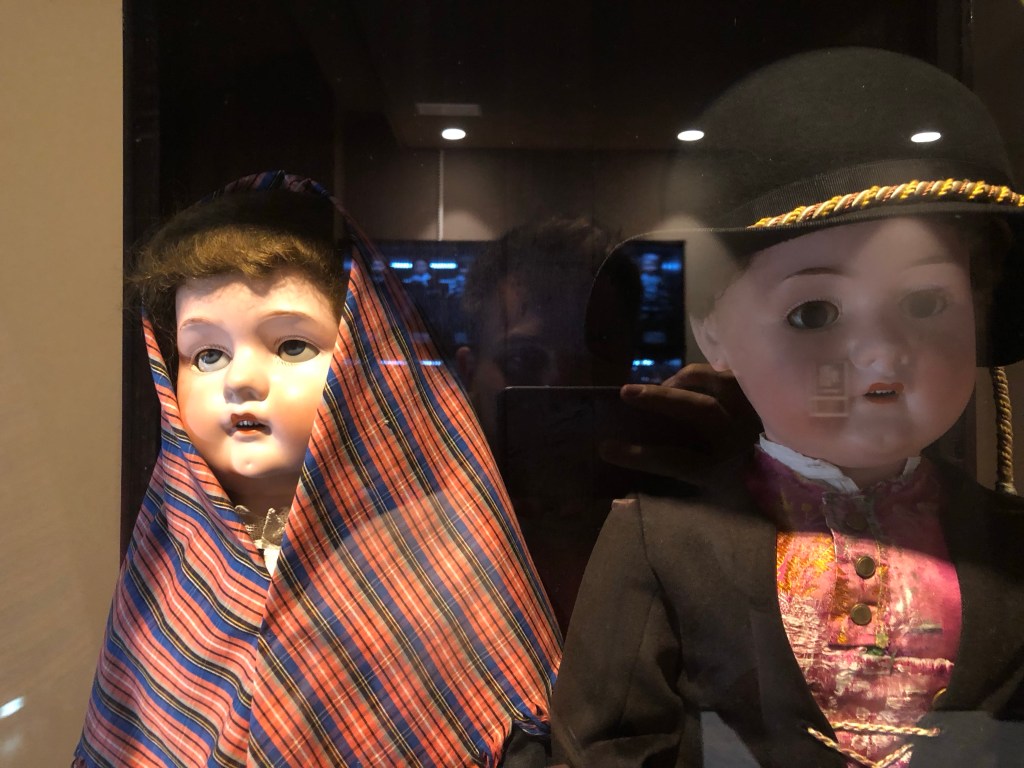
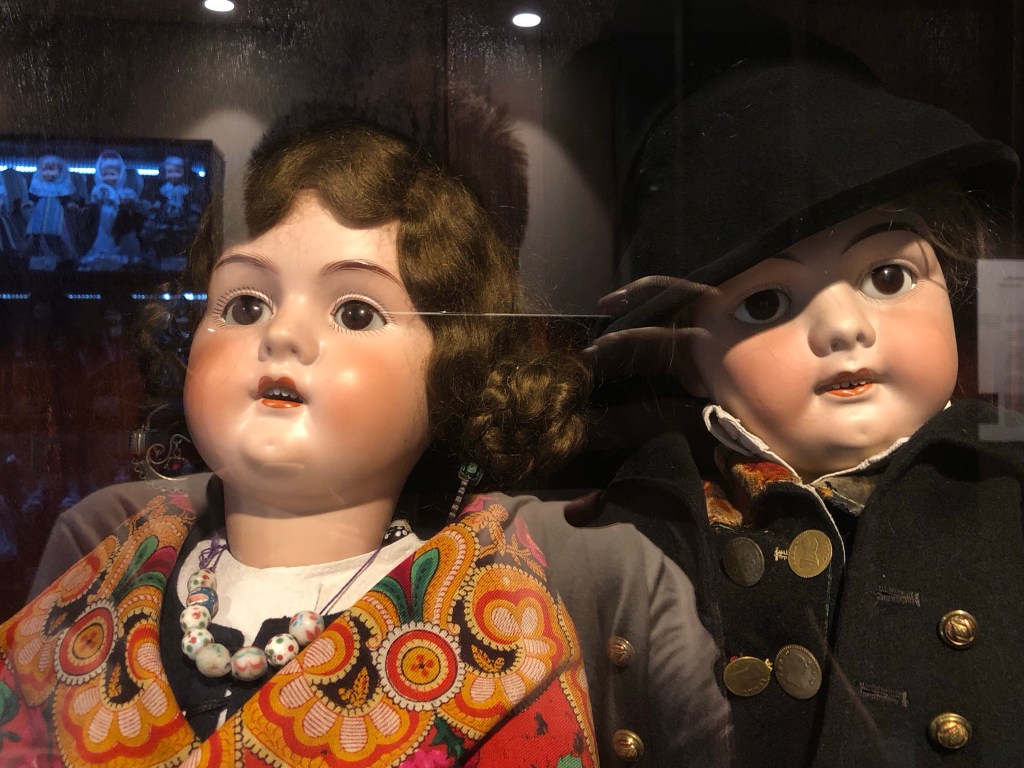
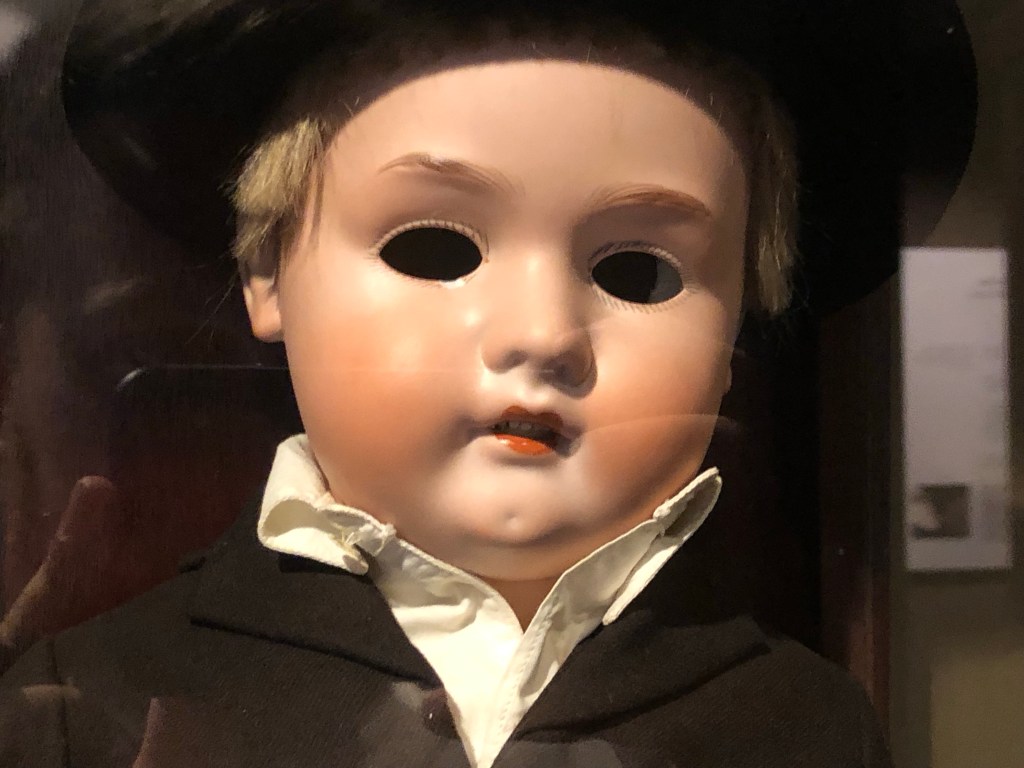
After a mid-afternoon snooze, I made a beeline for the Museo de los Pueblos Leoneses. Do check it out if you pass through – it’s a veritable gold mine of knowledge about the region and immaculately presented across three floors. I was especially interested in the local festivals and Maragatos, but the collection of dolls was equally memorable… though perhaps for all the wrong reasons!
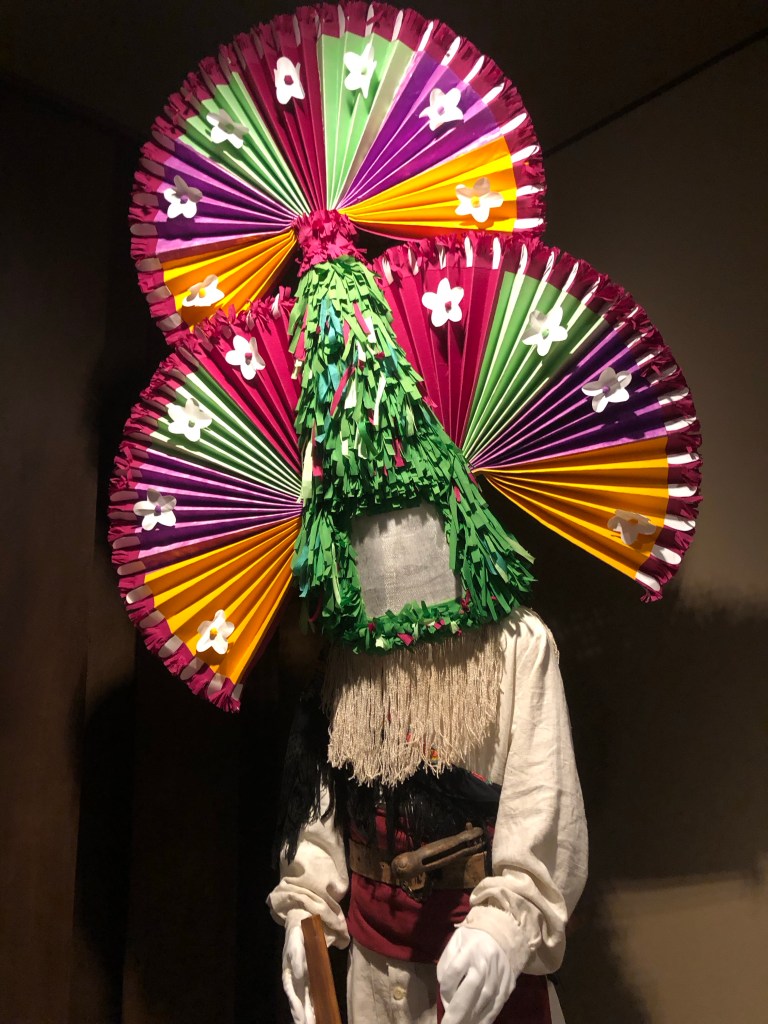
I quizzed the lady at the desk about the signs and she laughed before I’d even finished the sentence. Apparently everybody asks the same question! Yes, she said, it’s not a random act of vandalism but rather the action of a movement which has deep roots in the region, thanks to the fiercely strong regional identity of the Leonese people. Given the chance, many would rather not be conflated with their neighbours. That much is clear from their local customs, costumes and festivals, which differ considerably from the Castilians. I’ve seen vaguely similar outfits in northern Extremadura (which was part of the kingdom of León at the zenith of its power) but the colourful guirrio is almost Latin American in its manic display. I was reminded of an Apache festival I saw in a book once. It’s funny how some people come up with the same concept despite a distance of many thousands of miles.
Tomorrow, I shoot for León. It’s not an overly long walk, or a particularly interesting one as it reaches the outlying industrial suburbs of the great city of the north, so I’ll tarry a little tomorrow and find some company on the road. I should probably also think about booking ahead for Santiago, since at the rate I’m going I really will be there in time for the festivities, and I hear they’re a spectacle that really oughtn’t to be missed if you can help it.
But until then, goodnight – everybody else has been in bed for a half hour already. Time to hit the hay! BB x
The pilgrims at the albergue talked a lot of game about getting on the road for 5.30am this morning, but when I was out the door today I was the first to leave by some twenty minutes at least. No matter how Spanish I feel sometimes, the Englishman in me is a stickler for a prompt schedule. On the plus side, I did pretty much have a room to myself last night, so I had a very good night’s sleep for once.
It was a cold start, and the sunrise when it came was a full fifteen minutes later than it was last Thursday – a sign that the year is already beginning to turn. Wandering alone gave me plenty of time to stop and enjoy the stillness, though, with the result that this morning was possibly one of the most magical I’ve had on the Camino so far.
I waited for dawn at the top of a small rise just beyond a tree-lined arroyo, where a flock of noisy bee-eaters were calling unseen somewhere downriver. The sunflowers in the fields were already facing east, and I let a number of pilgrims pass me by as I stood and waited. I counted four or five buzzards and kites heading out on a morning hunt and listened out for the distant sound of a quail, a less frequent accompaniment to the Camino as I leave the central plains of the meseta behind.
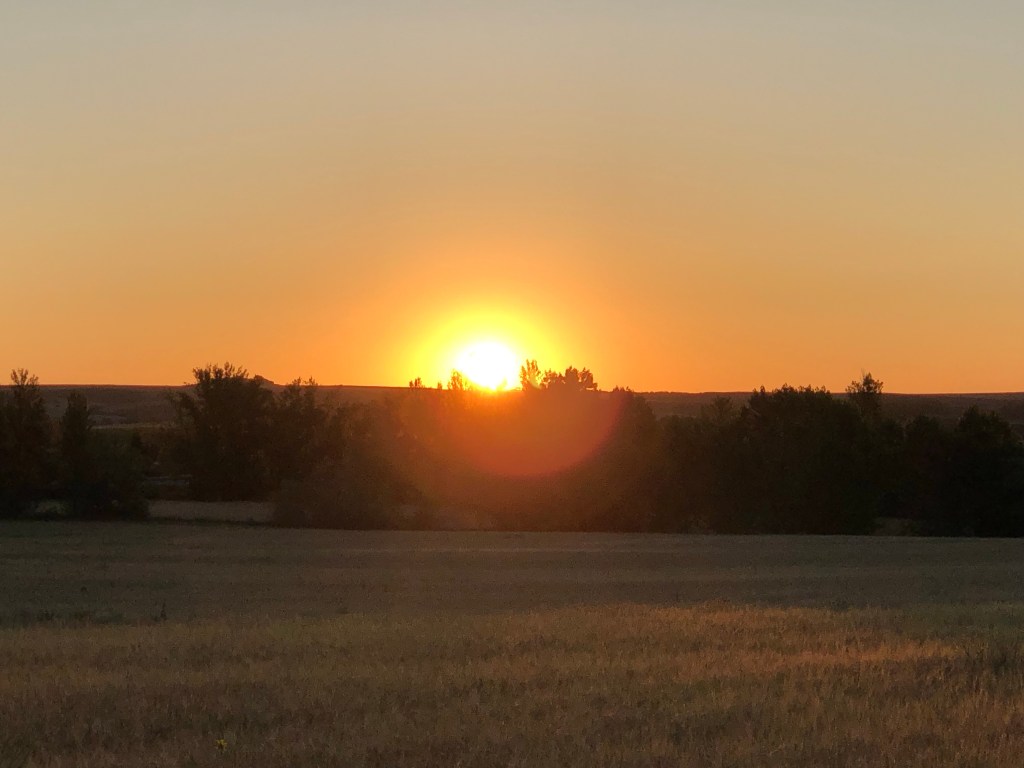
Finally, the warm glow beyond the horizon erupted into sunlight, saturating the sunflowers behind me with reddish light. I’ve got more photos of sunflowers now than I know what to do with, but it was totally worth it. Sometimes you have to stop on the Camino and wait for moments like these. You can tune out the two-tone crunch of gravel under your feet pretty easily, but you mustn’t tune out the rest of the world you walk through. It’s a soul-seeking pilgrimage, not a hike!
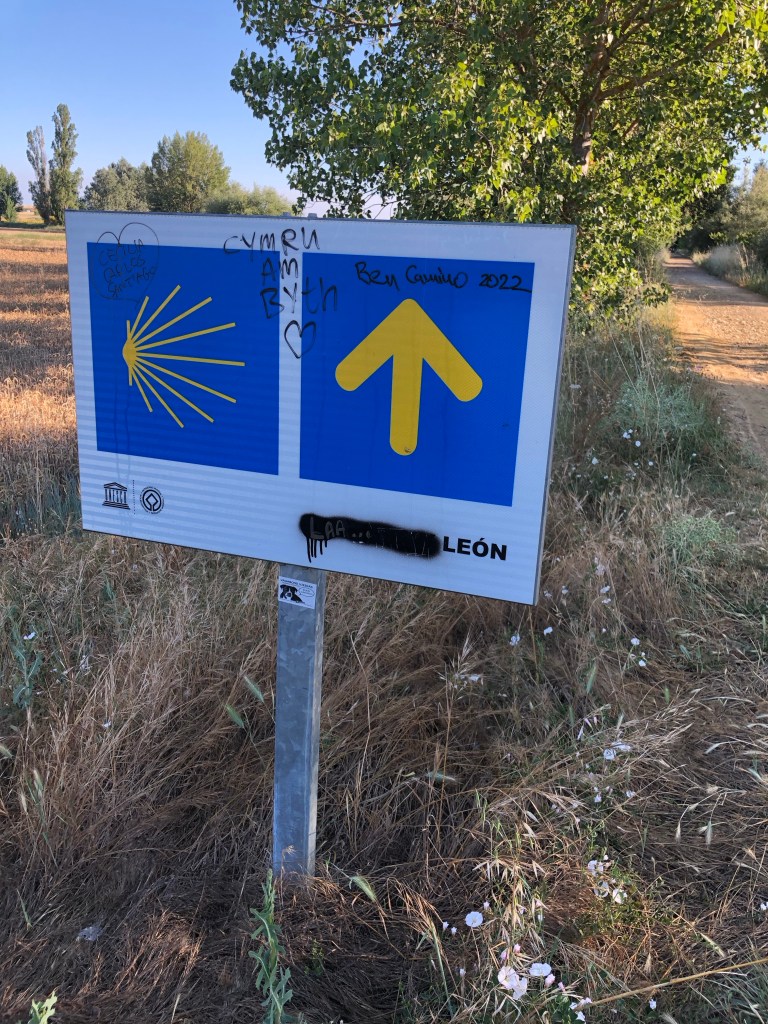
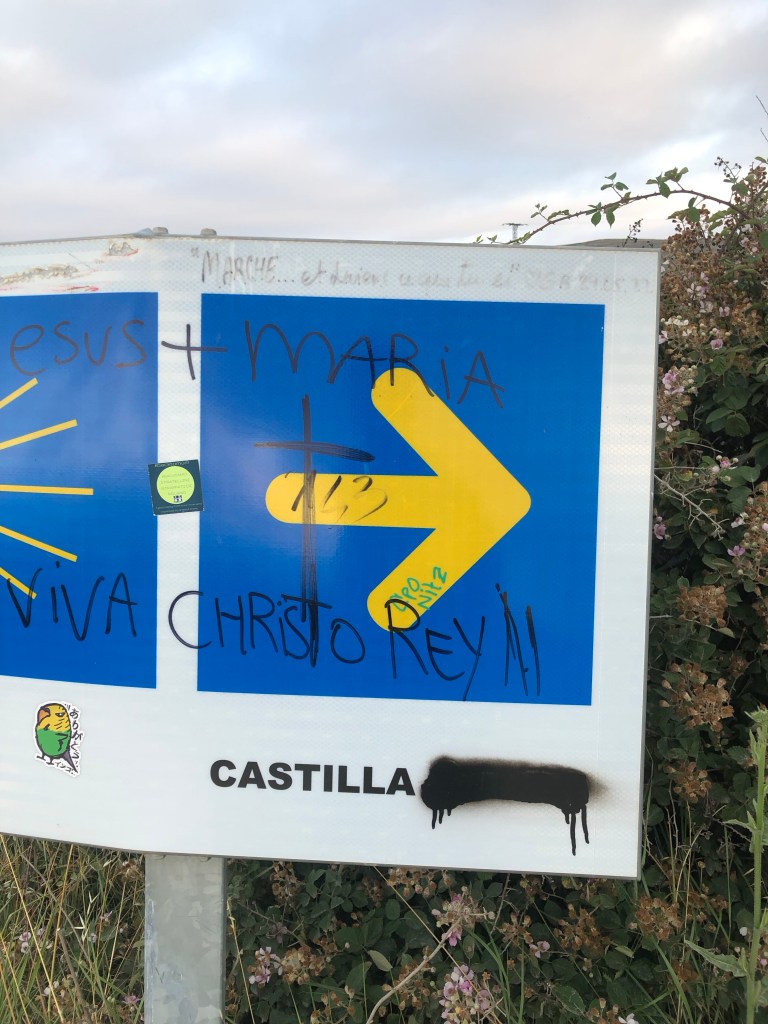
Passing through the mud-brick houses and hobbit holes of Moratinos, you leave the plains of Castilla behind and enter país leonés. And I say país (country) because of the fierce nationalism of the Leonese, whose old and bitter rivalry with their Castilian neighbours is more than obvious if you look below the self-help scrawls and incessant Welsh nationalism on the Camino waymarkers (we get it already!):
It was a similar story across the border in Burgos…
Castilla y León were merged in 1983, with the three Leonese provinces of Salamanca, Zamora and León joining the six territories of Castilla La Vieja (Old Castile) – excluding Santander and Logroño which elected to become autonomous regions of their own (Cantabria and La Rioja respectively). The Leonese have a strong regional identity and there are many who still believe the merge was a mistake, and that the Leonese territories should constitute their own autonomous community. An article in El País from earlier this year claims there are political differences at the heart of it, too. I’ve yet to pose that question to a local, but now that I’m in Leonese country – and they certainly have stronger feelings on the subject than the Castilians – I’ll see if I can’t do a little digging.
It’s little things like that which make for great inspiration. A lion sprayed in purple on a wall in Salamanca with the slogan ‘país leonés’ back in 2015 was what gave me the idea to make León, not Castile, the dominant power in my Spanish saga. If I don’t find a similar icon graffitied somewhere else over the next week or so, I’ll be surprised.
After a brief tortilla y zumo stop in Sahagún, the first Leonese town across the border with fellow pilgrim Bridgette, I made the decision to take the alternative route to the north via the Via Traiana, the old Roman road to the gold mines in Astorga. It meant a later arrival at my destination – and a considerable shade deficit – but I’m never one to turn down a challenge, and after a very sociable day on the Camino yesterday, paradoxically, I wanted a quiet one to myself. The heart wants what it wants, I guess!
The rest of the trek to Calzadilla de los Hermanillos has to be made beneath a blazing midday sun. I had plenty of suncream for the journey, but I left my sunglasses in Carrión a few days back and for once I found myself in need of them (they mostly sat unused on my head for the greater part of last week). I met only one other traveller on the road, a timid Irishman shielded from the glare by long sleeves and a sun hat who asked for the distance to Calzadilla in broken Spanish. Fighting through the last eight kilometres of scrubland, I kept my spirits up with a number of African walking songs my old drumming master taught me in my university days: Siyahamba, Uchikala, ba Tata. I might not be able to share them with the kids at school anymore, but there’s nothing to stop me enjoying them out on a march here in the open country.
It was uplifting singing my heart out in the woods, and I hardly noticed the blazing sun or the distance shrinking away at my feet. The kites and stonechats that accompanied me from forest’s edge must have thought me quite the unusual pilgrim – Spanish afternoons are decidedly not a time for jubilation. Perhaps that’s an old superstition about Pan, the Greek god of the wilderness, who legend has it would be angered by noise at midday. Or perhaps it’s just common sense!
Anyway, I’m here in Calzadilla de los Hermanillos. It’s a tiny frontier town, reminiscent of a Wild West set-up, with most of the townhouses clustered along both sides of the old Roman road. I’ve had a shower, washed my clothes, stocked up on supplies for tomorrow and packed accordingly. Now that the other French pilgrims staying here have quietened down, I’ll put my phone to charge and do a little reading before bed. Tomorrow is another day, and it would be good to meet up with the other pilgrims again. I’m somewhat doing my own thing this time, but a balance would be no bad thing. BB x
It’s taken four days, but I’ve finally caught up with a “scene” – fellow pilgrims I can vibe with, that is. One of the strange constants of the Camino is the difference a single day can make. For three days I’ve stayed in hostels that were almost empty. After doing two days’ walking in one, for the last two nights I’ve been all but rubbing shoulders. I guess that mad 45km trek to Carrión yesterday paid off. Falling in and out of sync on the Camino can completely alter your experience.
Yesterday was a long day. After starting at 5.50am and reaching Carrión by 3.30pm, I had barely finished my blog for the day when I was swept along to Vespers, then a musical meet-and-greet, then Mass, before tracking down dinner in a nearby hostal. I was bloody efficient, even if my feet were killing me!
In summary, Carrión de los Condes is a must, and the Albergue Parroquial de Santa María totally lived up to its expectations as a highlight of the Camino. The nuns who serve at the albergue were not just the friendliest community I’ve met so far, they also got the guitars out and led all the pilgrims and the visiting Christian youth mission group, Jatari, in a singalong welcome event. A really unique Camino night and definitely one you should try not to miss!
If yesterday morning’s early start was a shock to the system after a few sluggish days, this morning was a full gear up. I was up at five when people started moving around, but within five minutes they’d all packed up and gone, stripping the beds and everything. I was still thinking of taking a rest day in Carrión at this point, but seeing the conviction of the other pilgrims gave me a boost and so I strapped on my sandals, pre-applied some blister plasters (prevention is better than cure) and set out.
Only this time, for once, not alone! My first companion on the road today was Carlos, a translator from Baja California, who walked with me until at least as far as the legendary food van (which I completely overlooked – one for next time). I defaulted to Spanish and we talked about the importance of sign language for a bit.
Along the way we fell into step with an American mother and daughter from Virginia, Elaine and Catherine, one powering on ahead, one following at a distance behind. I was asked why I’m on the Camino, which requires the full ten minute story about my grandfather José, but I’m getting pretty good at telling that story by now. At my merciless pace I ended up in step with Elaine and we came to a stop a couple of hours in to allow Catherine to catch up.
While waiting I met Alan, a Dreamer from Britanny, who had received enlightenment on the Camino in the form of a dream to set up his own donativo (donation-based hostel) back home in France. We swapped in and out of French and English where necessary, until bumping into another American, Chris from Wisconsin, and switching back to full English just before Calzadilla, where I was able to use a little Portuguese to order my first tortilla breakfast of the Camino from the Brazilian owners of the Camino Real bar.
Seriously, a humongous thank you to all the language teachers I’ve had over the years. Days like today make me remember how much I owe the lot of you!
The late breakfast stop was a real culture shift from the last three days of bombing it without stopping to the next albergue. I must have spent an hour shooting the breeze with some of my companions from the morning’s walk!
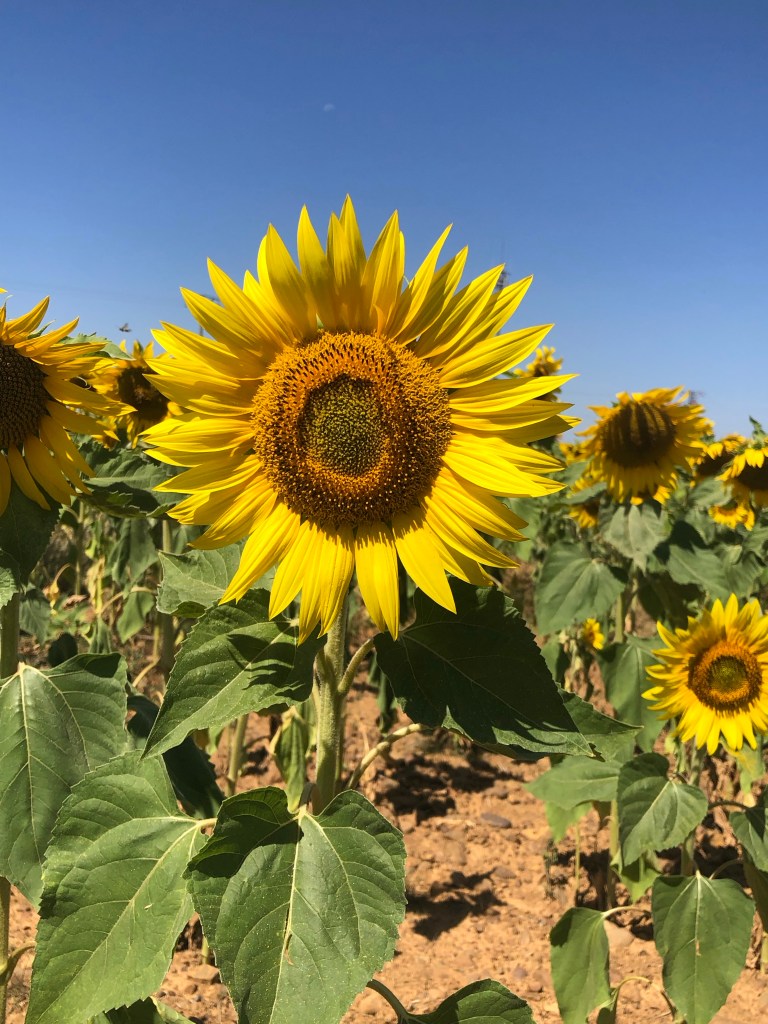
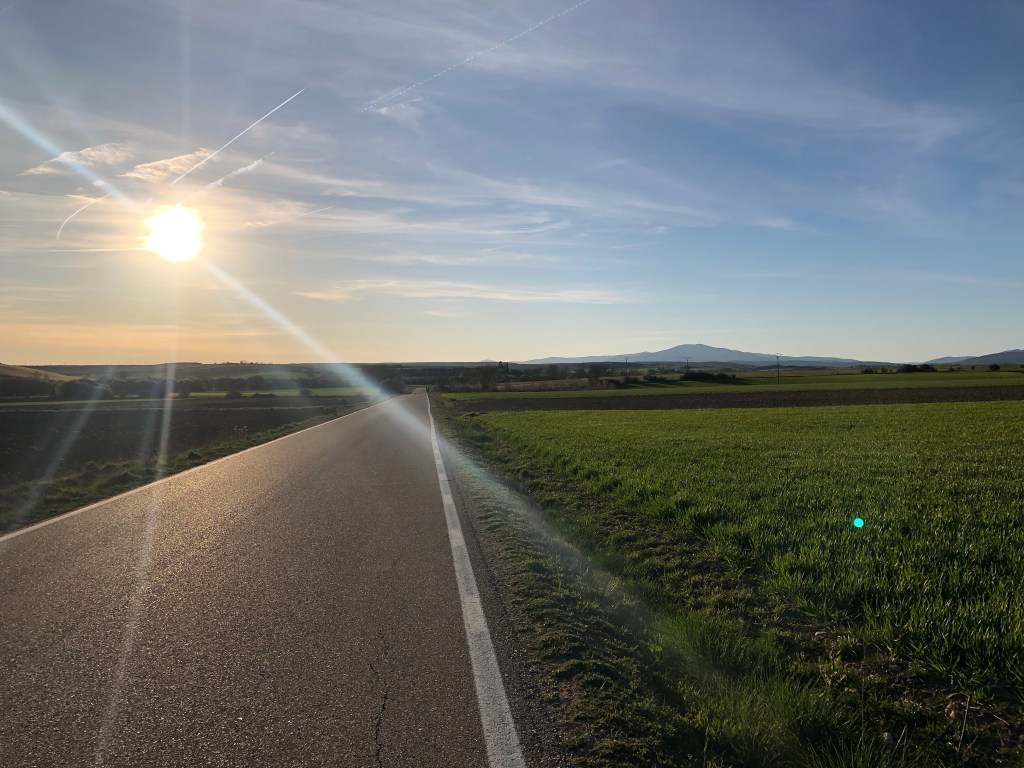
From Calzadilla, the remaining nine kilometres of the road marches past more sunflowers than I’ve ever seen in my life. With the sun at my back, as it almost always is on the Camino (if you’re walking in the morning, which is when you should get most of it done), the sunflowers were practically beaming at us the whole way, like fans cheering on a racer. None of them reached the height of my mother’s steroid sunflower (fed on a bizarre animal feed), but there was enough variety to resemble a crowd.
Basic high-school metaphors aside, they were a welcome sight after three days of wheat fields. 53% of the photos I took today are of sunflowers, which definitely makes sense.
One of the pilgrims today said walking the Camino was like following the seasons, which each stage a different time of year. I guess the meseta is the height of summer. One thing is certain: as the Camino pushes always westwards, you do always have the sun at your back. If you should get lost, it’s a safe bet that as long you position yourself with the sun behind you, you’ll find your way back to the road eventually. Perhaps that puts all of in a sort of sunflower state, looking for the sun every morning and keeping it at our backs. It would certainly be pretty merciless to do the reverse and walk into it for six hours a day!
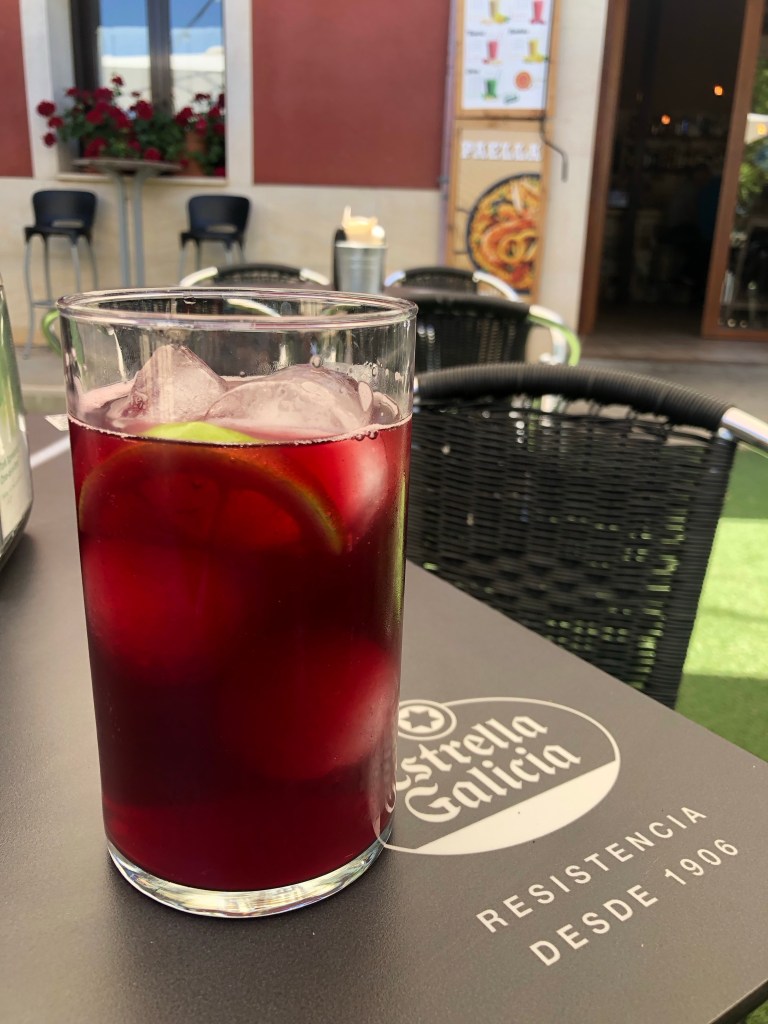
Shortly before Lédigos I caught up with my final companion for the day, Bridgette from Brisbane. By this point it was nearly twelve and the sun was beginning to work on us like an anvil, so when she suggested stopping for a drink before the last three kilometres I was more than game. A quick pit stop turned into a three hour rest over iced tinto de verano, and I was in no hurry to move, even when the clock threatened half past three and Bridgette considered a fifth glass of wine. But eventually we got a move on and cleared the last three kilometres to Terradillos in less than twenty minutes, to find the albergue less than half full, meaning we could snag an empty room. It just goes to show that arriving early isn’t always necessary! Though I expect it will become more of a thing as we get closer to Galicia…
It’s good to have company at last. It will make for less reflective and more anecdotal blogging, but that’s probably good for me and for you too, dear readers! After all, there’s only so many times I can spin a yarn about Montagu’s harriers and vast skies… BB x
I’m here in Carrión de los Condes, a full day ahead of schedule. So much for not rushing this time. It was definitely not my intention to walk nearly fifty kilometres today, but here we are. At the very least, I think it’s safe to say I have put one of the more tedious stretches of the meseta behind me. My feet might be killing me, but silver linings and all that.
I got my comeuppance for being an early riser in Burgos this morning. By five o’clock half the dorm was already up and about, so at 5.15am I gave up trying to doze away the hour and got my things together. I’d had the foresight to buy breakfast the day prior, before a wander up to Castrojeríz’s ruined castle (as if I hadn’t walked enough already), so I chowed down on a Bolycao (childhood classic) and set off into the darkness.
One definite plus to setting out before dawn was the climb up the side of Mostelares, a steep banked plateau guarding the road to Itero. In the late morning sun I’m sure it would have been a sweaty, unforgiving affair, but with the sun still below the horizon (and the help of my trusty stick) it was relatively easy. I overtook the only other pilgrims on the road, bade farewell to the army of wind turbines blinking like distant artillery fire in the distance, and put Castrojeríz behind me.
A large riverside grove before Itero de la Vega broke the monotony of the wheat-fields for a bit (Theresa May could get seriously naughty in this part of the world), and I caught a glimpse of a deer between the Lorien-esque rows of birch trees. A talkative group of five Spanish women were on my tail by this point, so I let them overtake and take the clickity-clack of their guiri sticks with them. I’m not sure what their real name is in English, but my kids in Extremadura used to call them palos guiri and the name has stuck.
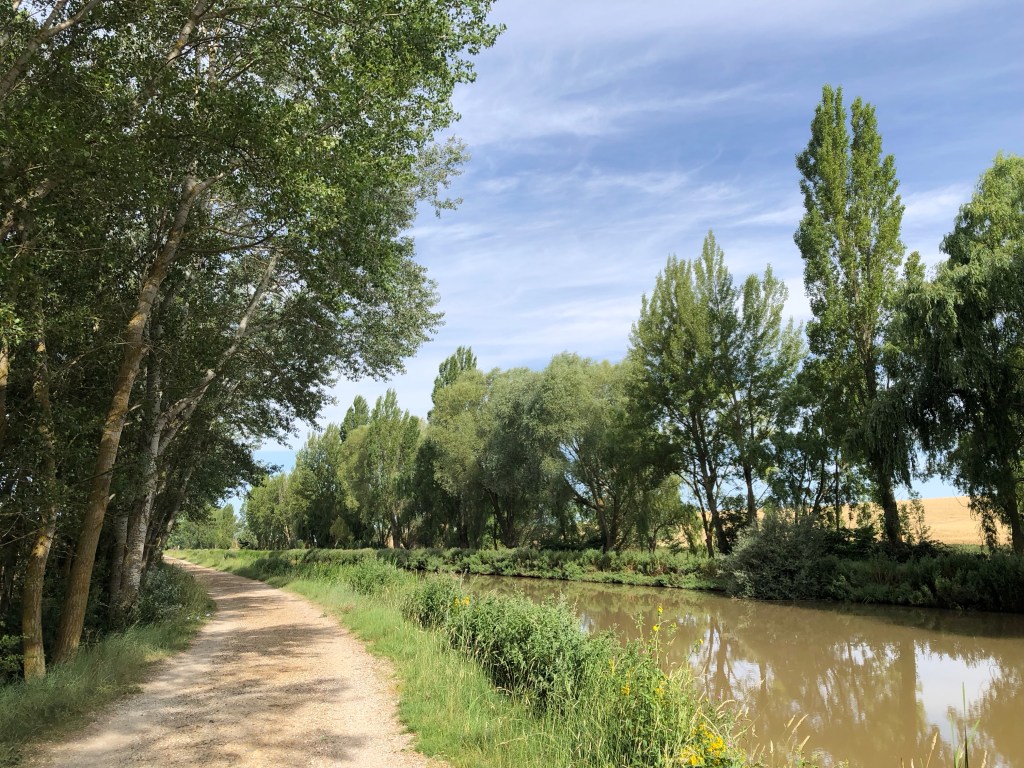
After Itero, the usual stop is Boadilla del Camino, but it was not even 10am so I decided to press on (this is becoming a running theme). The Camino follows the Canal de Castilla until Frómista, which was a welcome change of scenery, if a little bizarre in the middle of the meseta. I’m not sure the local wildlife knows quite what to make of it: I heard the odd reed warbler and saw a flock of lapwings land in a nearby field, but other than that it was an eerily quiet waterway, as man-made imitations of natural things often are. God is not mocked.
Frómista was… a strange place. It felt decidedly more like an urbanización than a town per se. I arrived around 11.15, two hours too early for most of the albergues which habitually re-open around 13.00-14.00 after a lightning quick clean. A couple of merry storks did their beak-clicking ceremony as I reached the town centre, but I got a strange vibe from the place and decided not to linger. Perhaps it was the fact that all the albergues would be shut for another two hours, or maybe it was the fact that the one recommended by all the guidebooks had so many vitriolic one-star reviews on Google complaining about the rudeness of the hostalero.
Whatever it was, a madness took me, and I decided to try my luck in the next town along.
Big mistake. Población de Campos is only a few kilometres on from Frómista, but by now it was noon and the midday sun was up. After an uninspiring slog along the side of a main road – the first of many – I dropped in on the first option, Albergue La Finca.
Well, there wasn’t any dust on the tables, and there were some papers on the front desk that looked recent, but that was about it. The garden looked as though it had seen better days, the gate was slightly ajar and there were no cars in the drive – or peregrinos, for that matter. I rang the doorbell a few times, waited, and then moved on to try my luck with the albergue municipal.
I didn’t fare much better there. The sign was missing, and after a brief search I found it stashed behind a bush. I decided to ask at the nearby hotel, where the kindly dueña informed me that, sadly, both albergues were closed for renovations. I could try at Villamentero, another 5km up the road. Her own Hotel would have set me back 40€, which isn’t ludicrously steep, but on the Camino that sum equates to five nights in an albergue, so I had to pass it up politely.
At this point, I got it into my head to push on all the way to Carrión. A stupid idea, but with prospects along the road ahead looking bleak, and zero desire on my part to backtrack to Frómista, the idea slowly began to seem more and more logical. and, I’ll admit, the whimsical desire to say I’d carried on to Carrión ultimately tipped the scales.
Cue the most tedious stretch of the Camino so far. Fifteen kilometres and three hours of featureless roadside walking. I guess this is what everyone was referring to when they said the meseta could drive a man mad. I clocked a couple of occelated lizards somewhere near Villalcázar – the enormous green buggers are unmistakeable – and claimed a bustard feather, but beyond that, and the chafing pain of my seriously overworked feet, I was genuinely counting the mileage signs all the way to Carrión.
When it finally appeared on the horizon, with the mountains of León in the background, I could have done a somersault out of relief – only, I don’t think I’ve ever been athletic enough for such a feat, and it would have been the death of my feet anyway. So I contented myself with a hallelujah and used the last of my reserves to power on past the silos and into the promised land.
Somebody up there was looking out for me today. A merciful blanket of cloud covered me all the way from Población de Campos, and when I reached Carrión, the Albergue Santa María still had beds going spare. The shower that followed was never more welcome, nor felt so good.
It seems very busy all of a sudden up here. I guess I was one day behind the crowd. Perhaps I’ll meet some of the younger peregrinos tonight. It would make a change from three days of walking the Camino alone. But let’s just see how things pan out! BB x
I spoke too soon last night. Around five o’clock, not too long before Lourdes, the hostalera, set off for home for the night, a bearded Frenchman arrived de la nada and set down his kit for the night. Antoine, from the town of Évian-les-Bains (of bottled fame), had walked a hell of a way to get to San Bol: not only had he walked a whopping 45km from Atapuerca that morning (bypassing the city of Burgos entirely), but he had started his Camino from his front door, making this his eighth week on the road. I’ve only ever met one other pilgrim on such a trek, a real rag-and-bones German who had gone for a walk with his dog and kept on going. Antoine, however, looked as though he had only set out yesterday. It was as good an excuse as any to practise my French, which isn’t nearly as rusty as I thought (though I did have to think how to say the number seventy-five), and it was good to hear a fresh perspective on what’s going on in France right now from a Frenchman.
I watched the sunset over the meseta from the porch and ended up having a very engaging chat with a local man from Iglesias with the most original name of Porfirio Celestino. He had come up on his bike to see if the new trees had grown in this spot, but also to check on his beehive, which he had been told to rejig by an expert. We had a laugh about our shared experiences as teachers and tried to outdo each other’s collection of oldy-worldy names like Araceli, Guadalupe and Diosgracias (the latter being my great-great grandfather’s Christian name). I think I won with the latter, he laughed so heartily. Wouldn’t you, if your parents named you Thanks-Be-To-God?
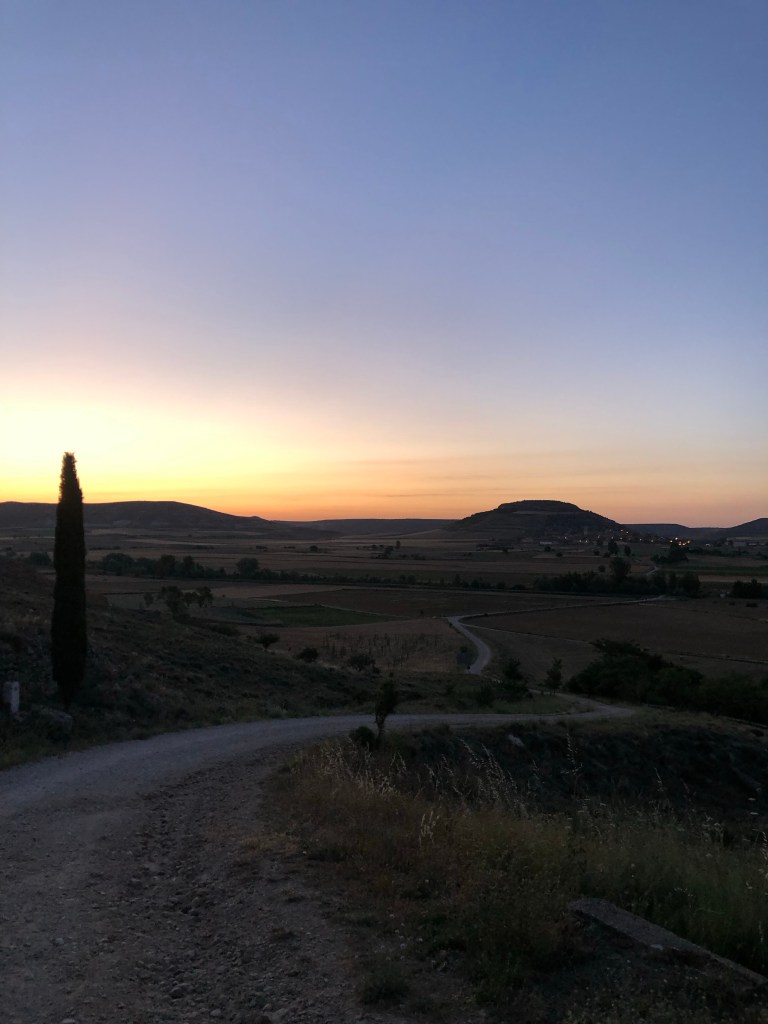
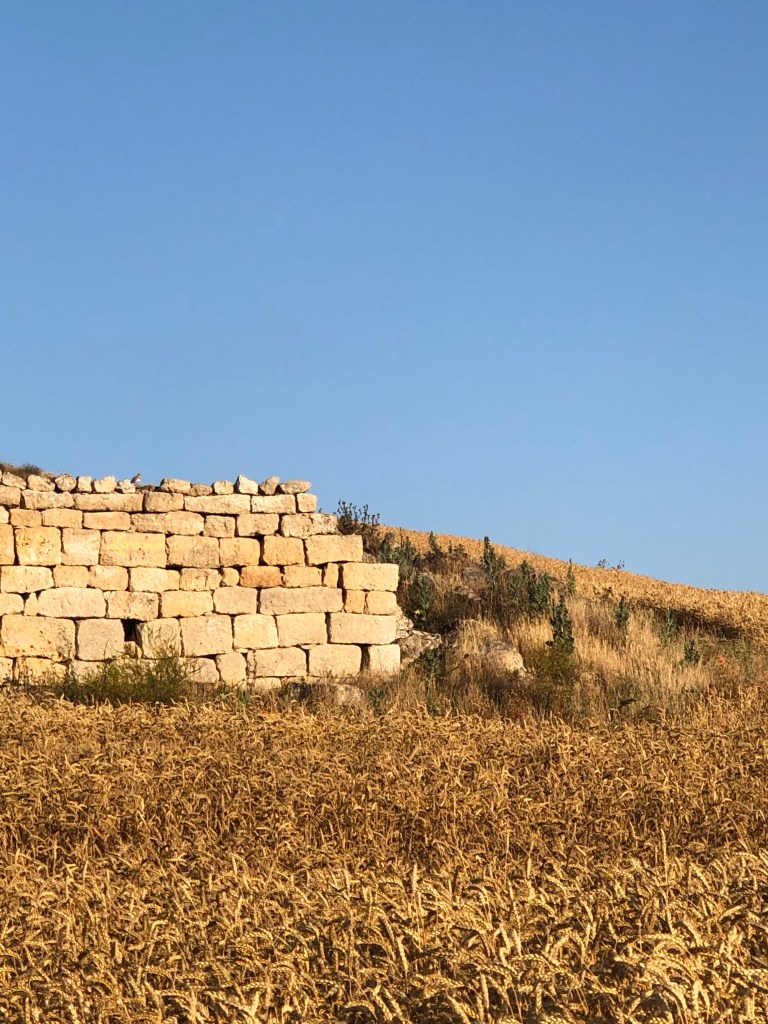
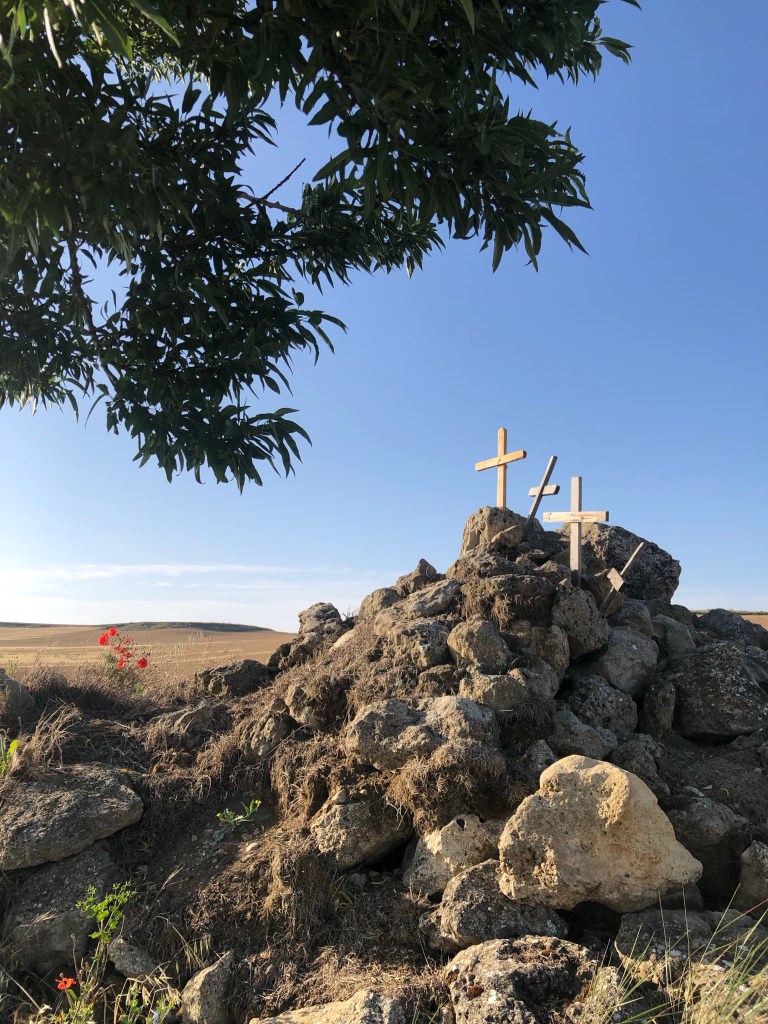
I allowed myself a later start this morning. Later being 7.45am, which is a perfectly respectable time to set out. The sunrise was nothing short of magical, and it was all I could do not to linger longer. I can’t recommend the Albergue de San Bol more highly. It was a perfect introduction to the Meseta and blissfully immersive. A partridge climbed up onto one of the many piles of rocks to serenade the valley as I set out, the twin flags of Spain and Iglesias fluttering in the cool morning breeze. There are lots of piles of rocks like that around. I guess they’re removed periodically from the fields to make plowing considerably easier.
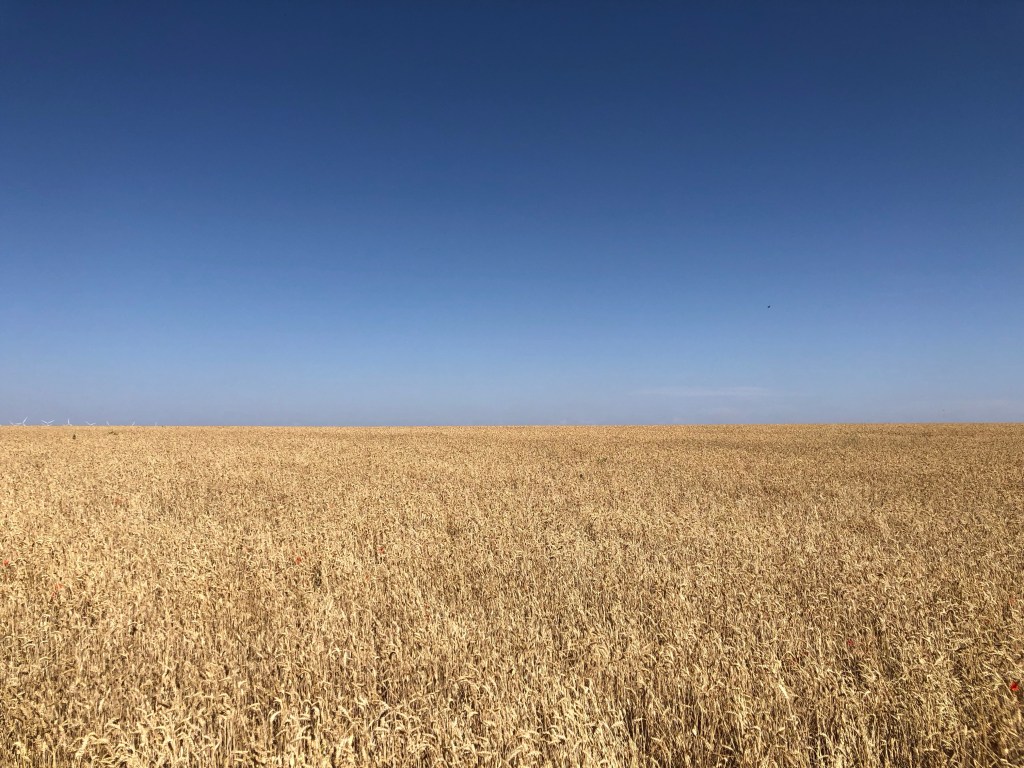
Hontanas was deceptively distant. I would have found it quite a slog under the midday sun had I attempted it yesterday, but in the morning light it was a very pleasant walk. Wild flowers line the luminous Camino right the way across the Meseta, adding dashes of crimson, cornflower blue and violet to the shimmering seas of gold.
At one point, high on the plateau above Hontanas, I seemed to be absolutely surrounded by quails. I couldn’t see a single one – they’re tiny, incredibly well-camouflaged and very rarely flush when cornered – but I could hear them all around. Their three-stop whistle can carry for as far as a mile, but if you can hear their childlike ‘—aauWAH’ it’s a good sign that they’re nearby. Quails and turtle doves are fast becoming the soundtrack to the meseta, and that puts a serious spring in my step.
I’ve passed a couple of roadside graves today (not pictured for obvious reasons). They were quite a common sight on the first couple of days of the Camino, where the mountain pass can be dangerous under the wrong conditions, and tended to be Asian or Latin American in origin. Out here in the middle of the Camino, however, the meseta proves a challenge that isn’t always insurmountable, claiming Spaniards and even the hardy Dutch. I try to say a small prayer at each one I pass. By the looks of the painted stones at their feet, I’m not the only one.
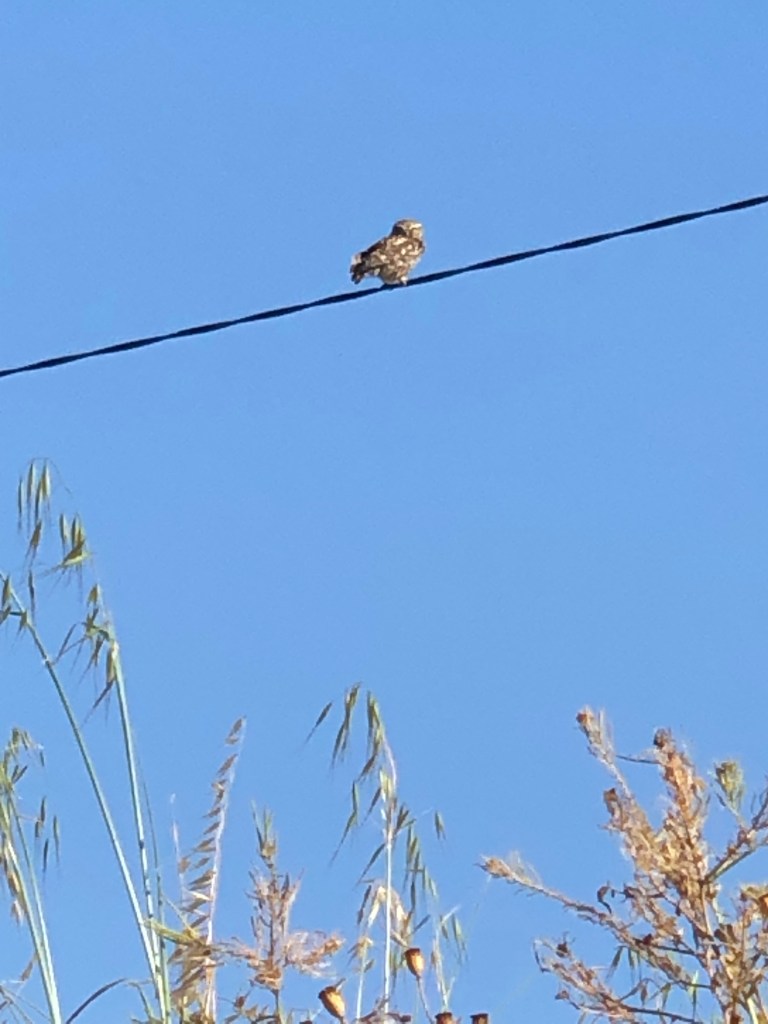
Hontanas seems to be a magnet for pilgrims. A sizeable number had stopped for breakfast at the first café, leaving the road ahead clear. I had only a few cents left in my wallet, but I still spent a good ten minutes there, though that was because I caught sight of a little owl perched on the wire opposite the café. I deliberately didn’t bring my camera as it would have been one belonging too many on the road, but I regretted that decision more than once today – my phone camera simply doesn’t do justice to the beautiful little thing!
After Hontanas the Camino crosses and then follows a wooded stream for a couple of miles. Here, once again, I came across one of my favourite sights of the route: the silver, scythe-like wings of a harrier. It caught me completely by surprise as I came up a low hill, and I could see the yellow rings of its eyes before it jinked and soared away down the valley.
I thought I’d lost him, loitering for a few minutes to see if I could spot where he went, but not five minutes later I saw him up ahead, quartering the valley floor. Kites are graceful, but harriers – especially the silver-grey males – are in a whole other league, drifting over the fields like black-fingered phantoms. He disappeared behind the trees as I drew near, and then re-appeared clutching a fair length of straw in his talons, to take back to his nest in the wheat-fields, no doubt.
Some things, I guess, are worth going solo for. Seriously, I could get used to encounters such as these.
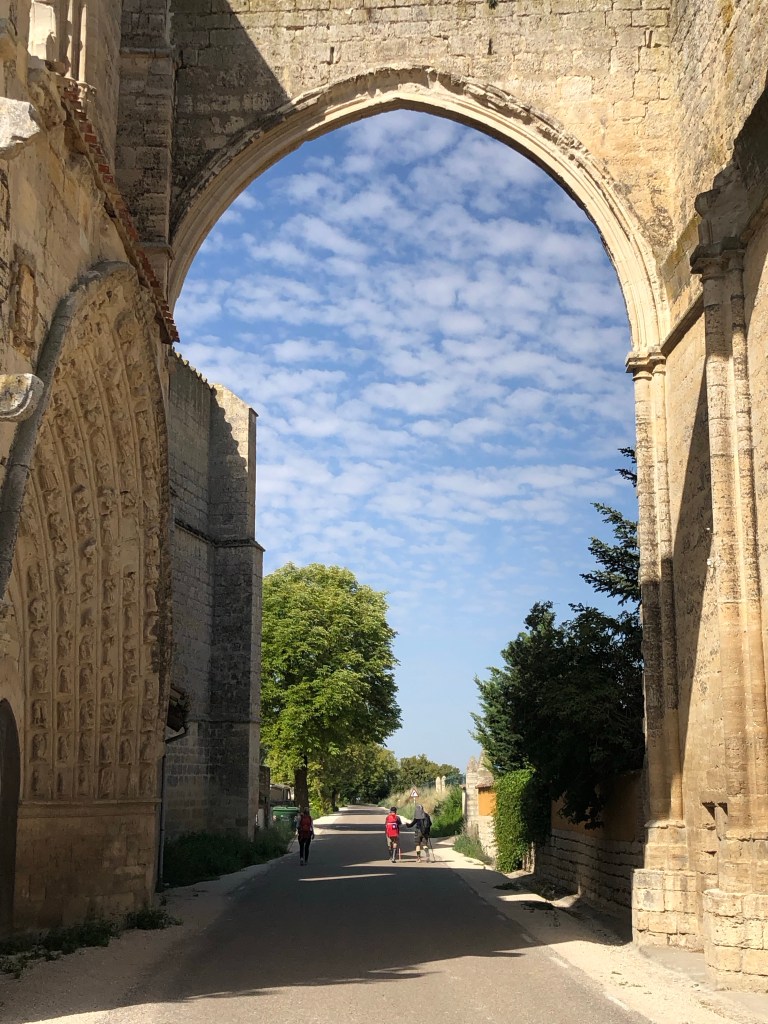
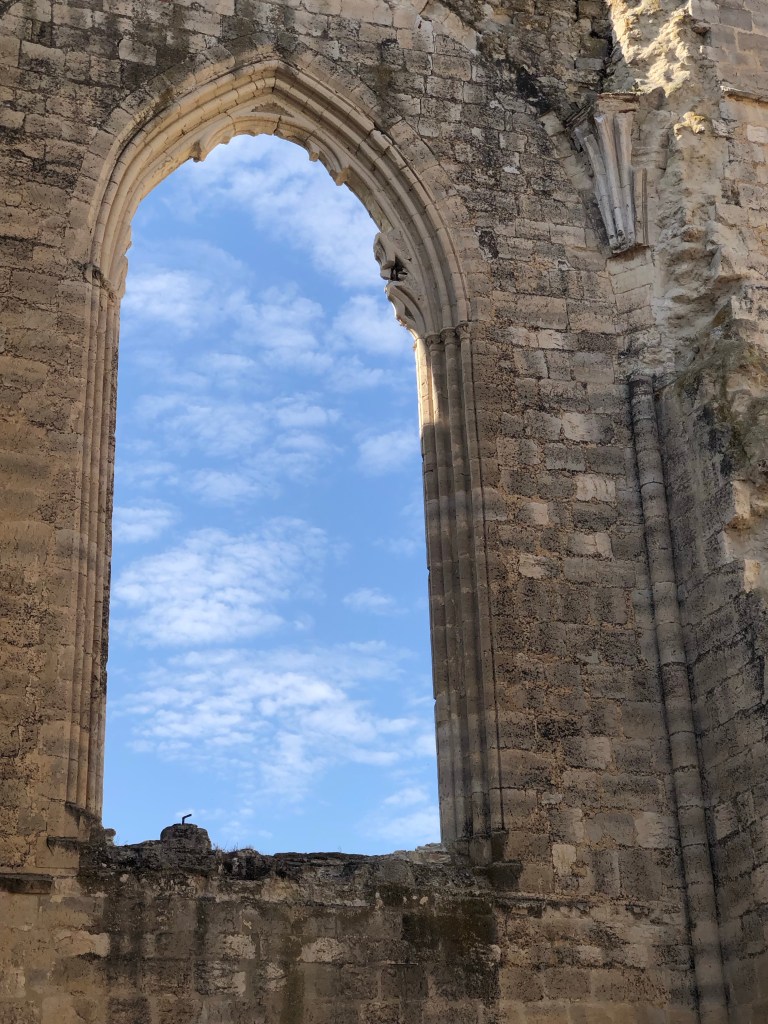
At the end of the valley, the road cuts right through the imposing ruins of the Monasterio de San Antón. So cleanly, in fact, that the main road runs beneath two of its great stone arches. There’s a tiny albergue here and a chance for a bonus stamp (at last!), but I was quite content to just explore for a bit, not being in any particular hurry.
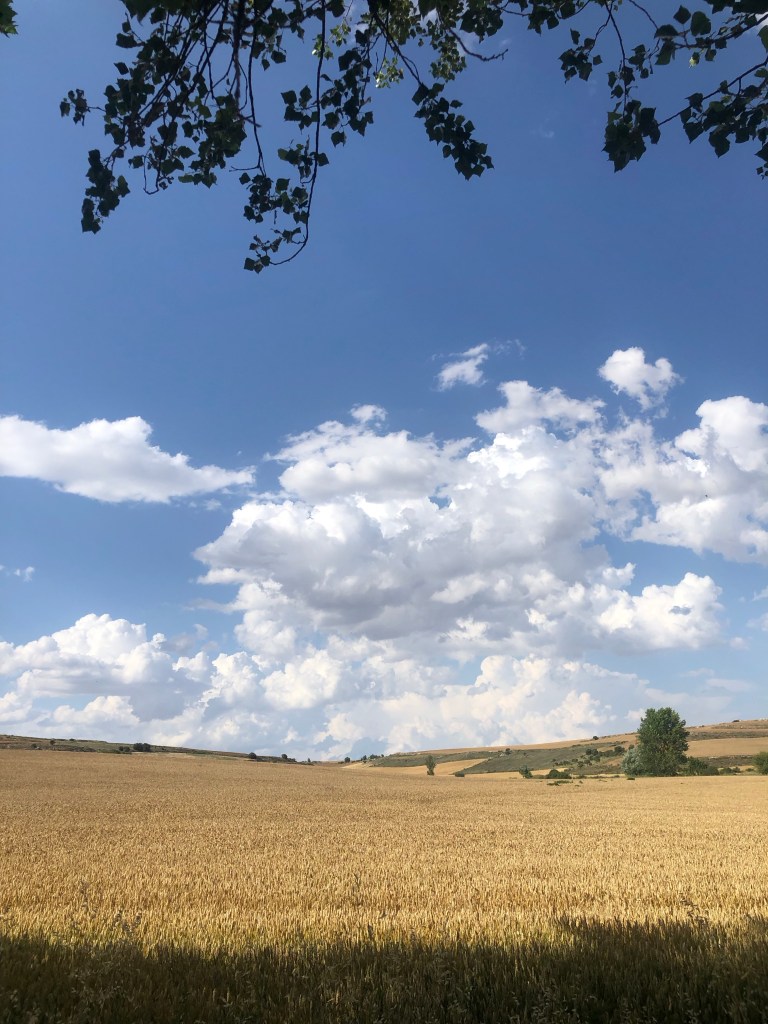
There are plenty of old churches along the Camino, but this ruined monastery is rather special – not least of all because of the way its hollow windows open out onto the endless blue of the Castilian skies beyond. I’m going to run out of adjectives for the sky long before I’m clear of the meseta, because it’s my constant traveling companion, but I’ll do my best to keep it original!
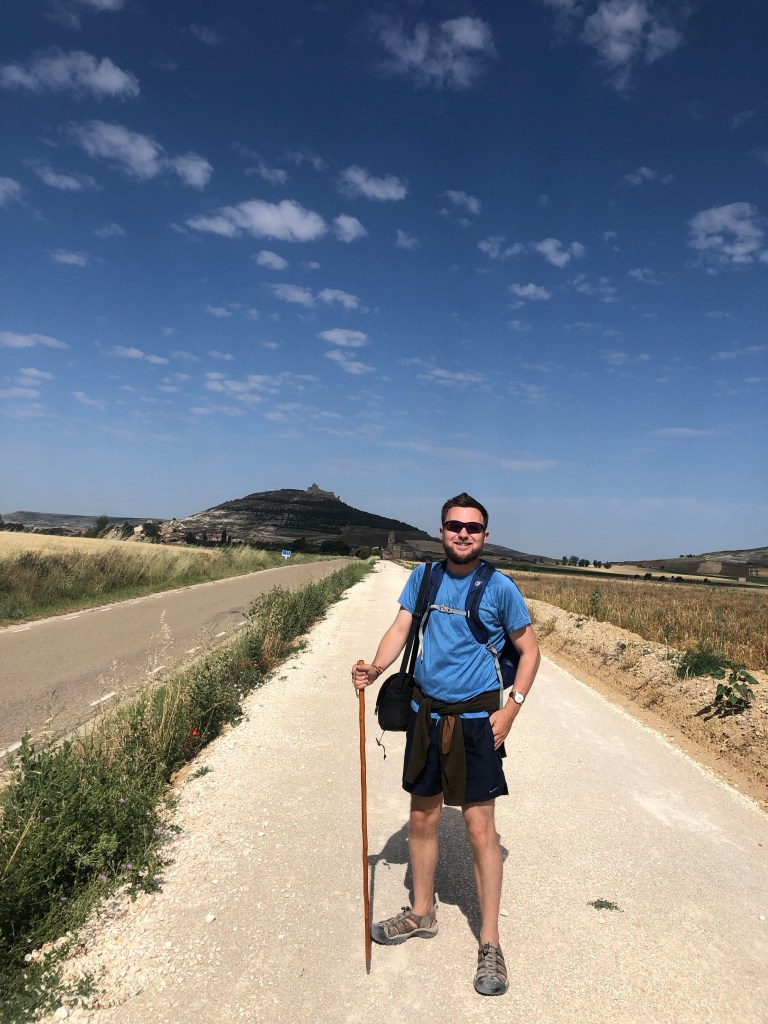
Best of all, they had a box outside the albergue for unwanted objects to take away. I’ll have a few of my own to offer before long, but my eyes lit upon a beautiful Aragonese walking stick from Ordesa National Park. I’ve blown the dust off it and put it to good use. With any luck – if it isn’t pinched along the way – it will take me to Santiago, and perhaps beyond.
From the monastery, the hilltop castle of Castrojeríz comes immediately into view. It’s still a good hour’s walk until you reach the town proper, but it has to be one of the most scenic approaches of the Camino so far. I offered to take a photo for three Japanese pilgrims and they repaid the favour, meaning I will have at least one photo to show I walked the Camino this summer!
Well now, I’m here in Castrojeríz, and the kindly hospitalera has just returned from the hospital in Burgos. Her husband, with whom she runs the albergue, is currently walking the Camino himself. After a very light dinner last night I treated myself to a menu del día at a local mesón-restaurante. The barman must have clocked my La Mancha shirt because he brought out a lovely red wine from Tomelloso, just down the road from my family’s home. They didn’t have any sopa castellana – apparently it’s too hot for that – but the salmorejo he recommended was fantastic. So don’t worry, Mum, I’m eating very well out here!
I’ve showered, made the bed and claimed another stamp, so now that I’ve finished writing I’ll have a short siesta before buying supplies and exploring the hilltop castle this evening. What a perfect routine! BB x
I’ve heard various accounts of the pilgrim road across the Meseta. It is so often described as the most arduous stretch of the Camino, skipped by those pilgrims who find its endless expanses of featureless wheat fields uninspiring and/or dull. A dear friend and former companion on the road wrote to me yesterday, calling it “demotivating and mentally draining”. So I haven’t come out here under any illusions.
I’m only one day in, so I haven’t yet got the full flavour of the Meseta. But I’ll tell you what it has in abundance: silence. Spain isn’t a country that is known for peace and quiet – quite the opposite, in fact, being a regular contender for Europe’s loudest country – but if there is a corner of the kingdom where silence is as golden as the fields over which it presides, this is
It should be said, setting off a full hour before daybreak probably didn’t help (yes, I am definitely that pilgrim). The others in the hostel in Burgos must have found my coming-and-going at a quarter past five in the morning frustrating, though I did what I could to soften my steps. I would have thought I had learned my lesson last time, but for whatever reason I’m still working on the assumption that most places fill up quickly around midday.
Burgos was softly lit by a clouded moon as I took my leave of the Cid’s city. Beside the storks, those speechless sentinels of Spanish skies, I only saw two other living things on my way out: a street-sweeper hosing down the steps above the cathedral, and a solitary Japanese peregrino who took a wrong turn. Everyone else with half a brain – the city’s entire population and the rest of the pilgrims on the trail, for that matter – was still in bed, enjoying a few hours’ more sleep.
The sun was up by the time I reached the outskirts of Villalba de Burgos, the first stop on the road. Still no pilgrims, but the Guardian Civil made a couple of appearances as they patrolled the road in their car. Here I took my leave of the Arlanzón river, stopping only to refill my water bottle at a park fountain and to listen to the flute-song of a golden oriole concealed somewhere within the poplar trees.
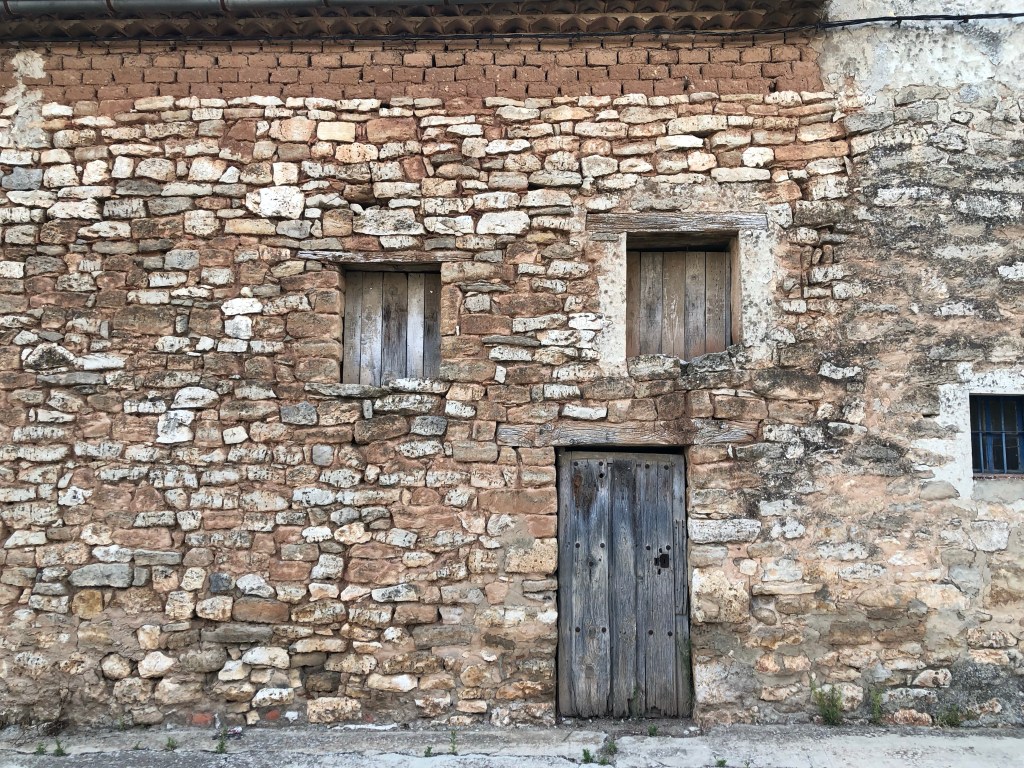
The Meseta begins to unravel in earnest after the sleepy town of Tardajos, which I imagine presents a good introduction of what is to come. Half the town seems deserted, and this time that has little to nothing to do with the time of day. Squat, single-storey townhouses rub shoulders with taller, more modern homes, though in some cases it is just as much the latter that have their windows boarded up as the former.
I stopped at Rabé de las Calzadas to see if the local church were open. No luck. It looks as though the parish priest serves multiple towns, celebrating Mass first at one church and then another. You can sometimes get stamps in these spots, but it’s really candles I’m looking for – when I can, I like to say a prayer for my grandfather and great-grandparents, for whom I walk this road. They say the reason is that pilgrims would probably try to sleep in them for free and might not be as respectful of their lodging if they did. Which is understandable. So far this year, I’ve only found one I could enter. I’ll keep looking, though.
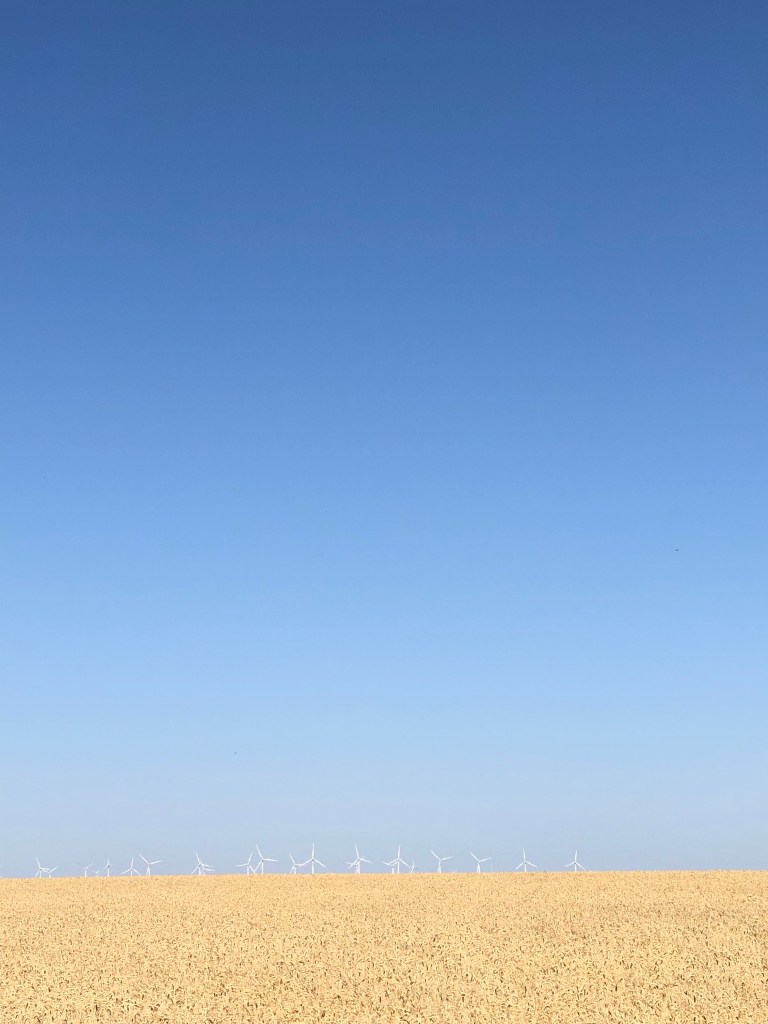
It’s a steep climb after Rabé up into the Meseta proper. The last green hills of Burgos give way to a sea of gold, unbroken at eye level but towered over by a host of wind turbines that make the place a dry parody of the North Sea: similarly featureless, though a great deal warmer.
I’m getting the feeling this is all coming across as rather maudlin. For a nature lover like me, however, this is bliss. If you can put a name to the sights and sounds around you, you’re never truly alone.
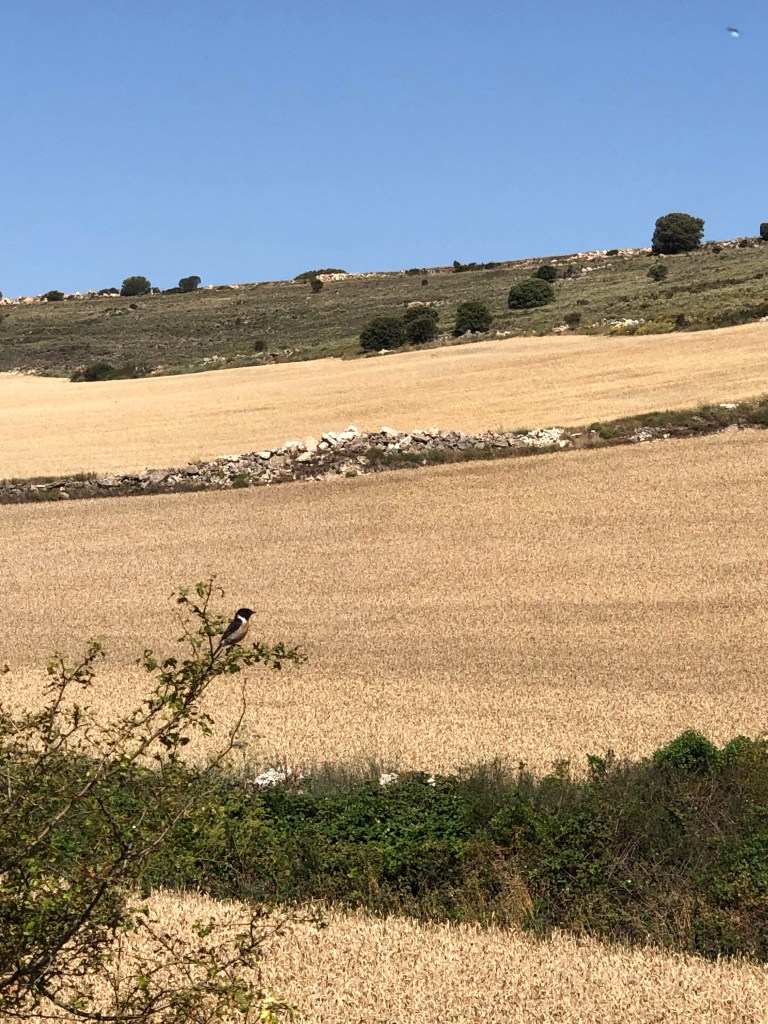
Since leaving Burgos, I’ve been accompanied most of the way by the friendly two-tone song of the stonechat. Families of three – a parent and two fledgelings – seem to pop up everywhere, unbothered by my passing in their tireless search for food. Warblers of every kind – willow, Sardinian, fan-tailed and Cetti’s – sing from the hedgerows, signalling the presence of a river long before it comes into view. Corn buntings, wagtails and jolly wheatears pop in and out of sight between the wheatsheafs. Swifts, swallows and martins fill the empty villages with sound, and hoopoes add a flash of brilliant black-and-white when disturbed in the parks and gardens along the way. In the vast Castilian skies, storks, kites, ravens and solitary griffons are a constant presence, and in the fields below, quail and turtle dove sing unseen, their purrs and whistles keeping the silence at bay. And butterflies of every colour and size are so abundant there’s a very real danger of stepping on them.
On the plateau above Hornillos, I even caught a glimpse of one of my favourite creatures of all: the slender, ghostly shape of a male Montagu’s harrier, quartering the fields like a runaway birdscarer. I haven’t seen one of those since my time in Extremadura, where they find the vast emptiness much to their liking.
I’ve come to a halt in arguably the strangest stop of the Camino so far. Falling prey to my own hubris, as I am often wont to do, I left Hornillos behind and pressed on to what several guidebooks call a “Camino favourite”, the remote Albergue de San Bol. Tucked away in a river valley just five kilometres shy of Hontanas, it is easily missed, and with so many pilgrims keen to race through the Meseta, that’s understandable. I got here at half twelve and found the place deserted, with a sign on the door saying it would be opened at two. I stuck around, taking the opportunity to wash my feet and sandals in the small pool and do some reading while I waited.
Five or six curious pilgrims came by to investigate. None of them have stayed. The first one, a German by the sound of him, asked about a place to fill up his bottle, shrugged and moved on. Another two came by, but went on their way not five minutes afterwards. A Dutchman made noises about staying on but disappeared without a trace while I was washing my clothes. Two Italians rocked up an hour later, who could easily have been my age… only, they were fresh out of school and keen to press on to Hontanas. By this point I’d already made the decision to stay, so I bid them addió and nailed my colours to the mast when at last the local hostalera showed up.
From her I learned the truth – the Camino has been quiet for a few days, but April and May were absolutely heaving this year. That’s probably due to the backlog of pilgrims like myself who haven’t been able to take the road for two years due to COVID. At this time of year, few pilgrims stop at this stage, unless they’re traveling in a group. Would I be alright if I were the only guest tonight, she asked?
Well, so much for my first “communal feel” albergue. On the plus side, it allows me one more day to really be my own boss. It isn’t often on the Camino that you get an entire dormitory to yourself, or the chance to watch the sunset in a place so idyllic as this. I’ve already paid for my bed for the night with the last of the coins I had on me (I really should have taken cash out in Burgos, as banks and ATMs are few and far between out here) so I’m going to kick back and really enjoy having this slice of paradise to myself for once.
There will be plenty of time to socialise on the Camino. But I’m in no hurry – if anything I’d like to avoid the crush in Santiago on Saint James’ day three weeks from now – so I will take my time and allow myself a few later starts from now on. And who knows? If I tarry a while, I might just find more stories in these slumbering villages than I would in the pilgrims tearing through this lonely stage.
Peace out. I’m getting some serious peace in tonight. BB x
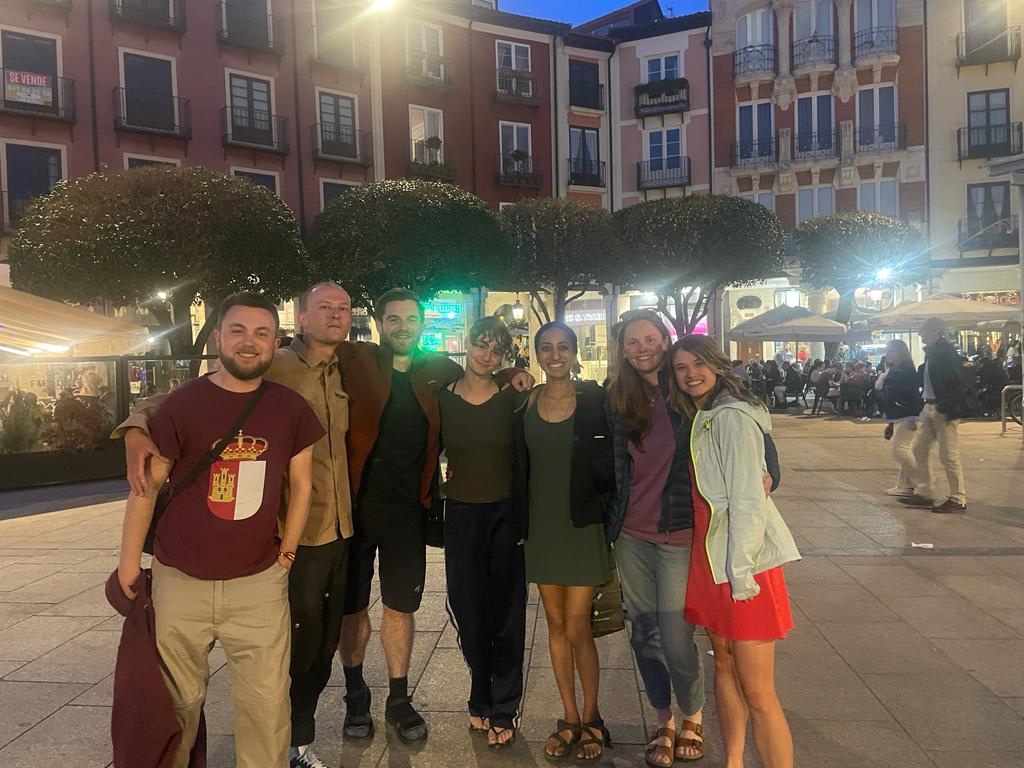
In Burgos, the journey comes to an end. One leaves for home, two pack for their flight tomorrow and one more digs in to stay, leaving four of the gang to push on toward Santiago tomorrow. Perhaps mine is the hardest, watching the others move on or away, knowing that if it weren’t for my flight (and my beleaguered feet) I’d have long since decided to chuck in my plans and make for Leon with them. But life is full of farewells, and I could never have gone with them all the way to Santiago in the week of holiday that remains. So here I am, at the end of this run at the Camino, putting my thoughts into words.
Today’s leg was a special one. Impatient after a crush in Bar El Alquimista over breakfast – I’m still not especially good at dealing with loud and crowded spaces – I set out ahead of the others this morning, nursing a doctored but still painful blister and conscious it would likely slow me down. It didn’t feel great leaving the group behind, but the crush in the bar threw me off a bit and I needed some time on my own on the road as a remedy.
Leaving behind the slumbering town of Agés, I followed the road westward toward Atapuerca. This is possibly one of the most mystical waypoints of the Camino de Santiago, but blink and you’ll miss it – because Atapuerca is the resting place of the oldest known hominids in Europe. Not far from where the Camino crosses the Sierra lies the Sima de los Huesos, a pit that contains the bones of ancient humans who have lain there for nearly a million years. Walk this stage of the Camino and you really do get the sense you’re following in the footsteps, not just of a thousand years of Christian pilgrims, but almost a million years of human wayfarers. One of my fellow pilgrims pointed out that there are far older pilgrim routes in India, but if you think of the first humans pushing toward the end of the known world (where Finisterre stands today) as the first Camino pilgrims, I’d like to think the Camino de Santiago is a fair contender for the top spot.
I made the climb alone, taking with me a sprig of mistletoe, a fallen olive branch and a strip of blackthorn blossom: something wicked, something old and something new. It seemed like the right thing to do. Meanwhile the birdsong up the mountain was spellbinding: hoopoes, cuckoos and woodlarks on all sides, and these last especially, becoming for me the quintessential sound of this stretch of the Camino. I’ve recorded a video so I can share some of that magic with you.
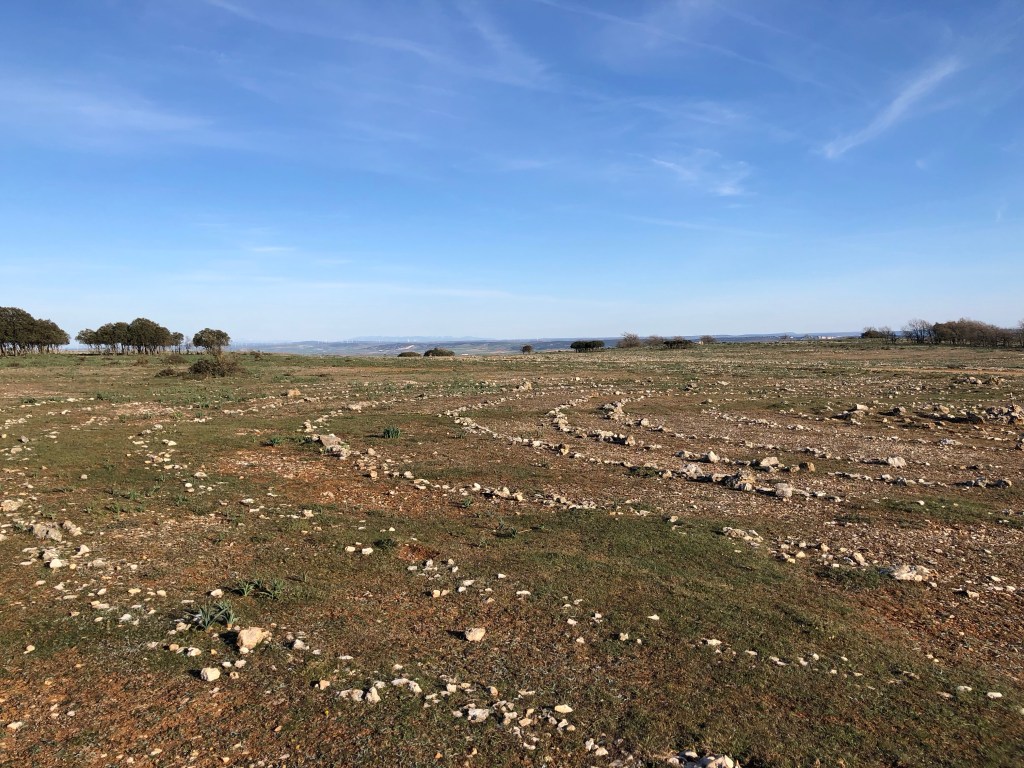
From the mystical heights of ancient Atapuerca with its lonely wooden cross and stone circle, you look down from the last high place upon the city of Burgos and the seemingly endless reach of the Meseta beyond, with the daunting white cliffs of the Picos de Europa clearly visible over 130km away.
Having waited for my companions at the cross, I joined them for the descent into Burgos, but when their stop for a mid-morning snack threatened to stretch over an hour, my itchy feet swept me back onto the road again. It would be the last time I spoke English on the Camino this year, because from there on out the only people I encountered were Spaniards on the road (they took long enough to find!).
For the final twelve kilometres into Burgos I was joined on the road by Fran, a programmer from Soria in his twenties who was an enlightening companion. From him I learned that the Spaniards, as I suspected, had indeed done the Camino for Semana Santa, but they had started at the beginning of the national holiday and were thus a few days ahead. I also learned about his home town of Soria and how the Mesta have monetised their trade, turning what was once an affordable experience following the shepherds’ route into a glamorous eco-tourism experience to the tune of 200-300€. He also gave his thoughts on the Catalan question, likening it to a dog barking furiously at a door which, when it is finally opened, suddenly goes quiet – it is easier to hate when you cannot see what it is that troubles you. Or something like that. I was just happy to be speaking Spanish – and flattered to be told that if I hadn’t revealed I was English in the first five minutes I’d have had him stumped, as he was genuinely ‘confundido’ by my Spanish.
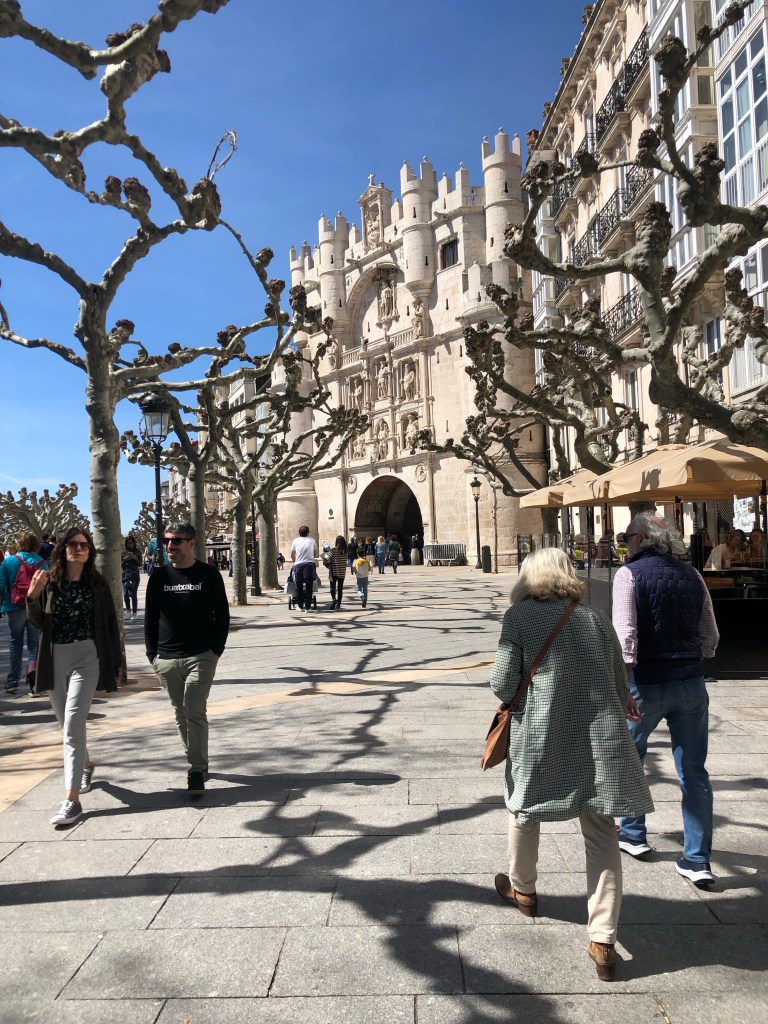
I took my leave of Fran outside Burgos’ enormous cathedral, after a brief conversation with a local (‘De dónde sois?’ : ‘Yo de Soria,’ / ‘Y yo de Inglaterra, pero con familia en La Mancha.’ / ‘Soria e Inglaterra? Menuda familia los dos.’). Fran took off to catch his BlaBlaCar home and I set out in search of my hostel.
I didn’t get much of a siesta, because the next guest to arrive was another Francisco, this time from Puebla, México. After a brief exchange over the subtle numbering of the hostel beds we ended up talking for close on two hours about a number of topics, with him asking after my thoughts on Italy, Spain and the British Empire and me asking for his wisdom on La Malinche and nahuatl. He is on a quest much like I was years ago: on his tour of Europe he has come to far-flung Burgos to seek out the village of Grijalba, from which he believes his father’s ancestors may have hailed (through the legendary explorer Juan de Grijalva).
It is always heartwarming to meet another traveler on the road, but especially so when they are on a quest – you don’t meet many of that kind these days. Perhaps it is fate that the day started in Bar El Alquimista, named for Paolo Coelho’s famous novella.
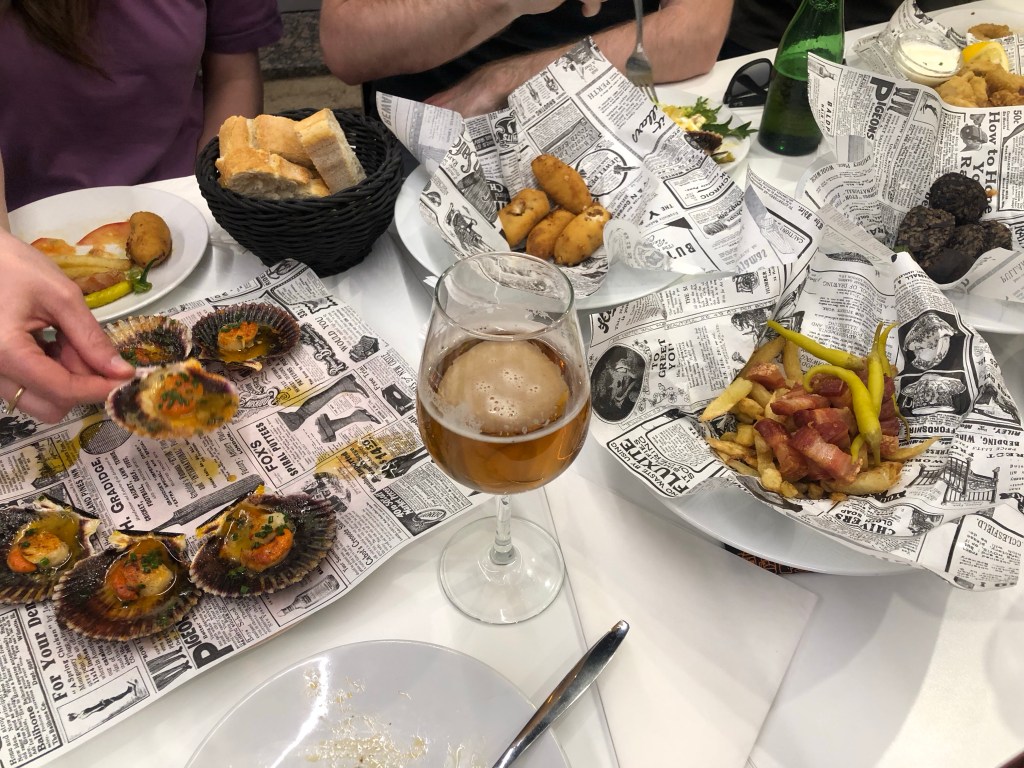
After one more conversation in Spanish which left me feeling more confident than ever before, I led the pilgrims of our group that remained down a side street in search of dinner. It couldn’t have been a better choice: six raciones and a salad split between us made a feast such as we hadn’t had yet. Morcilla, croquetas, calamares and sepia a la plancha, torreznos and zamburiñas (what more fitting food for pilgrims than scallops?)… it was far and away the best I’ve eaten on the trail.
And I didn’t have to pay a cent, since the generous Dane in our number footed the bill before we twigged what he was up to. I’d done something similar a few days prior, so I guess he was paying me back, but that kind of generosity is what makes the Camino so special. For our last meal as a group, I could not have asked for more.
I’ve never bonded with other peregrinos quite so quickly, and I wish I could take the road with them to the end. But every road leads to a parting, and we part as friends.
It is not the end of the road for me, but rather a parenthesis. One day I will come back here, to the ancient city of Burgos, and pick up the Camino where I left it. Hopefully I’ll meet other pilgrims like them who will make the road an adventure with friends once again. Sophia’s charm and maturity. Mikkel’s wit and his generosity. Katie’s wisdom and Lachlan’s humour, courage and peace of mind.
Domenico the Carabiniere. Enrique the Arriero. Phil the Professor. I have met so many characters on the Camino this time. That has been the real blessing of the road this Easter. I’m glad I came. Truly. (And especially since it was a whim decision just over a couple of weeks ago).
It’s now half past eight in the morning. By now they will have left Burgos and will be somewhere on the road to their next destination. All I can do now is wish the four of them all the best on their road to Santiago. And someday, sooner or later, I will take up my shell once more and follow them. BB x





 The Book of Barnabas