Equestrian

Wandering the streets of Paris, it’s easy to understand why the city was surrendered to the Germans without a fight in the summer of 1940. I have been lucky enough to see a number of beautiful cities all around the world, but there is something truly exceptional about the French capital – calm, curated, unspoiled. As the official line went in that dreadful summer, as Britain stood alone on the edge of a darkening Europe, “no valuable strategic result justified the sacrifice of Paris”. The West is full of cities scarred by the ravages of war, and while it may have earned them an unfair reputation for cowardice in popular culture, you really have to admire the gall of the French for putting their beloved city above their freedom, the first and foremost of their three sacred values. It gleams to this day.


A personal mission took me to Versailles, on the outskirts of Paris. My Metro pass was only for Zones 1-3, which was one stop shy of the Château itself, but I was very grateful for the break. The half-hour walk to the famous 18th century palace takes you through the tranquil suburbs of verdant Viroflay, and with the mottled darkness of the Meudon Forest rising up and over the hill behind you, Paris seems a lot more than half an hour away.

I came here in search of a shot glass, of all things, but I found something far more arresting: an exhibition of equestrian paintings of immeasurable beauty. So I’ll take you on a little tour of the inside of my head as I stood there in awe.

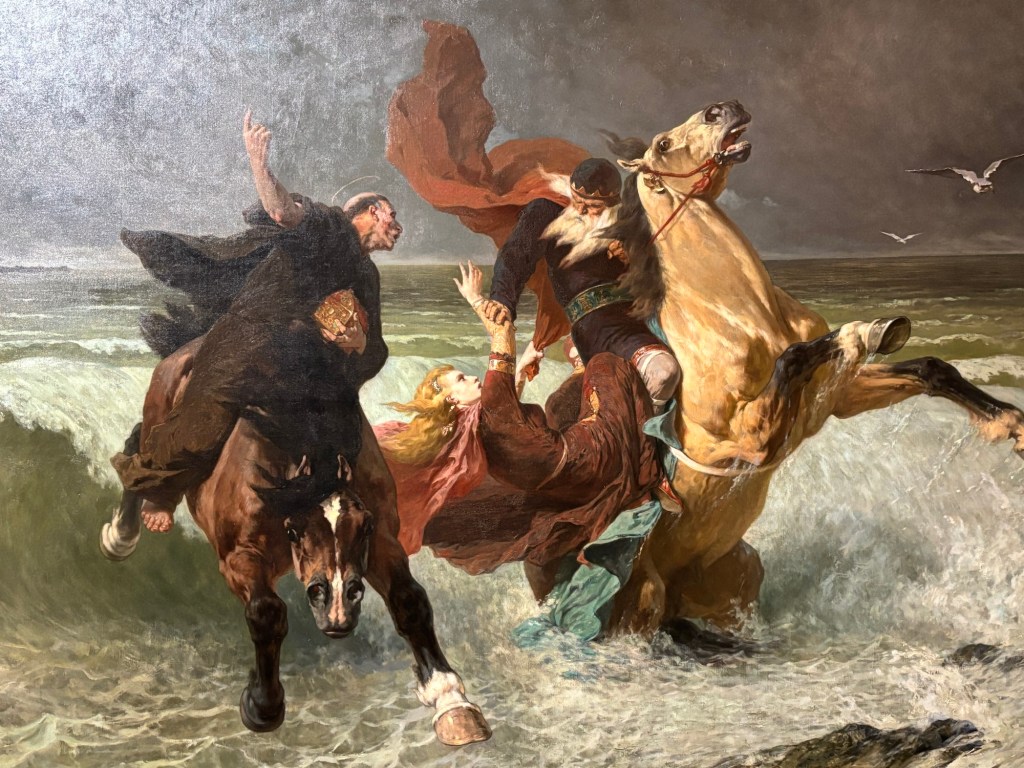
The first one to catch my eye was an enormous tableau by the 19th century artist Evariste-Vital Luminais, known as the painter of the Gauls. Titled La fuite de Gradlon, it tells the story of the escape of King Gradlon from the legendary city of Ys, the Breton counterpart to Atlantis. The tale tells that Ys was destroyed when the king’s wayward daughter, Dahut, opened the dikes that protected the city from the sea, ostensibly to allow her lover in to see her. Fleeing the destruction across the sinking floodplain, Gradlon’s friend and advisor, Saint Gwénnolé, implored him to cast off the demon he brought out of Ys, or risk losing his own life in the endeavour. Dahut was thrown into the merciless sea, and Gradlon and Gwénnolé escaped with their lives. I guess that makes it the oldest account of the “begone thot” meme.

I have always been captivated by stories of Atlantis. Dig deep enough and you’ll find stories of sunken cities all over Europe: Tartessos, Akra, Saeftinghe and Rungholt. Tolkien’s Numenor might even be considered a fanciful addition to that list. I should give this Ys legend a closer look.

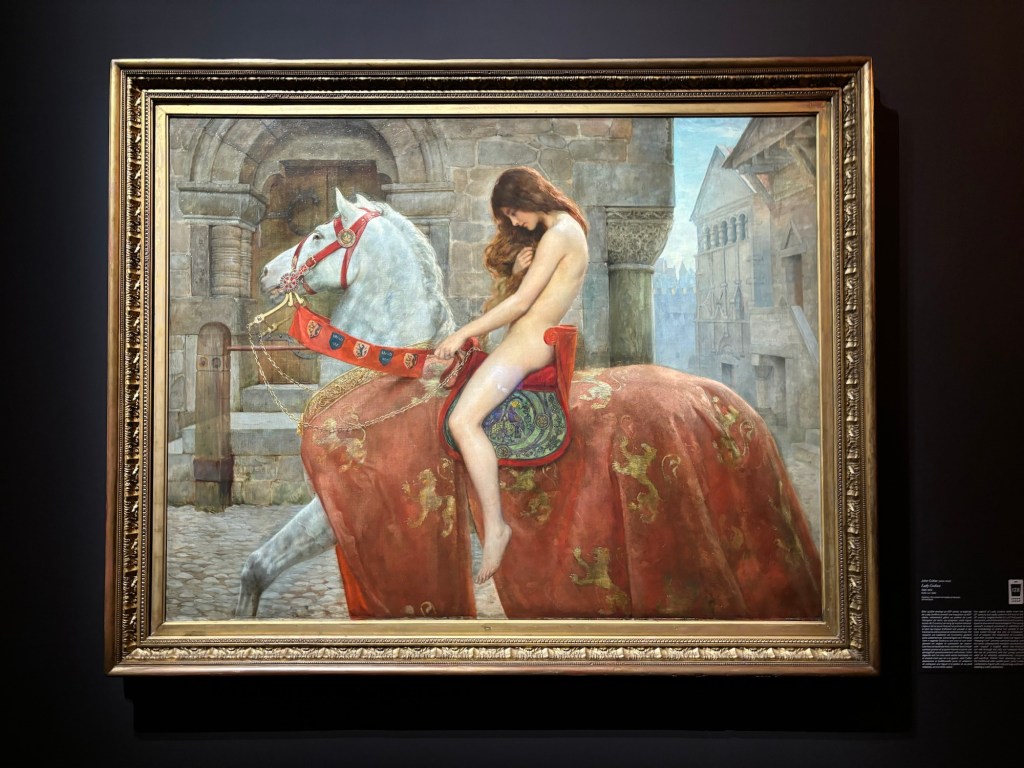
No prizes for guessing the subject of this one: it’s the naked ride of Lady Godiva by the English pre-Raphaelite painter John Collier. Most depictions of this legend have her riding side-saddle, an enduring medieval custom that preserved a woman’s modesty by keeping her knees together while reducing the risk of an accidental tear of the hymen (the age-old proof of virginity). Collier has her riding astride, all the stronger for her position, focusing on her dauntless courage in the face of her husband’s oppression.

It isn’t easy to remember one’s sexual awakening, or when and where it began. I’ve seen various authors ascribe theirs to a range of sources, from the older siblings of friends and schoolteachers to National Geographic magazines and Uma Thurman’s role in Pulp Fiction. I didn’t exactly gobble up popular culture in the Nineties and Noughties with the same fervour as my classmates, so I think mine started with an illustration of Lady Godiva in a children’s book of folktales and legends – if not with the Little Mermaid (setting in motion a lifelong fascination with red hair that has proved impossible to shake).

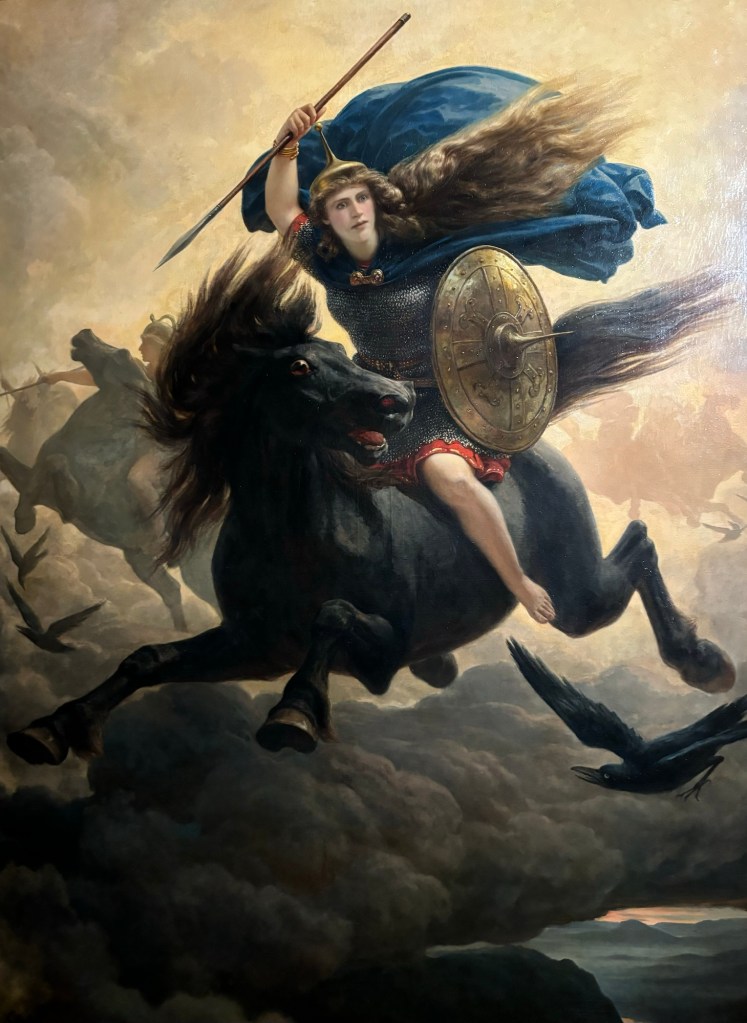
You couldn’t have an equestrian exhibition without at least one painting of the famous Valkyries of Norse legend, shield-maidens and psychopomps that herd the souls of the slain to Valhalla, the Hall of the Dead. It’s a dark and moody piece, but I would have given a great deal to see Peter Arbo’s more famous painting, Åsgårdsreien, which depicts Odin’s “Wild Hunt”, a spectral apparition said to appear on stormy nights as a herald of woe and disaster for the beholder. I’ve had a thing for that folktale since I found its equivalent in Cataluña, centred on the doomed Compte Arnau who rides again at night with skin afire, pursued by his hungry hounds. There’s even a country song by Stan Jones about the famous “Ghost Riders in the Sky” that Johnny Cash went on to cover, which has the Valkyries of old trade in their helmets for stetsons.

I do love it when a myth goes global.

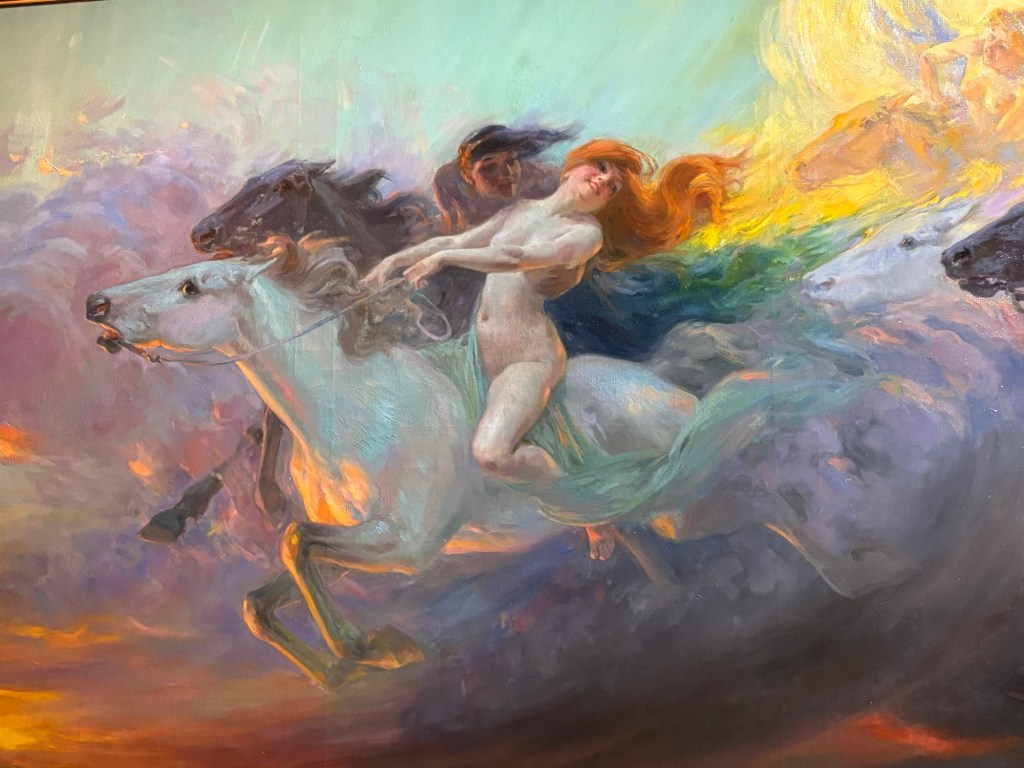
One painting in particular caught my eye (and not just because the leading lady has red hair!): Crepúsculo by the Spanish painter Ulpiano Checa y Sanz. Even without the aid of the title, you know straight away what you’re looking at by the colours alone: the halcyon flash of twilight, as the last rays of the setting sun scatter across the darkening world in a brilliant array of colours. Am I glad that the painting that really took my breath away was crafted by a Spaniard? You bet. The landscape below reminds of the opening crawl of the Charlton Heston El Cid film, and in its strange and featureless way, it is so very Spanish. Foreign painters of Spanish scenes often play up to the Romantic stereotype of dusky maidens with hooded eyes lounging on street corners with flowers in their hair, so it’s nice to see a native sharing my weakness for a change.

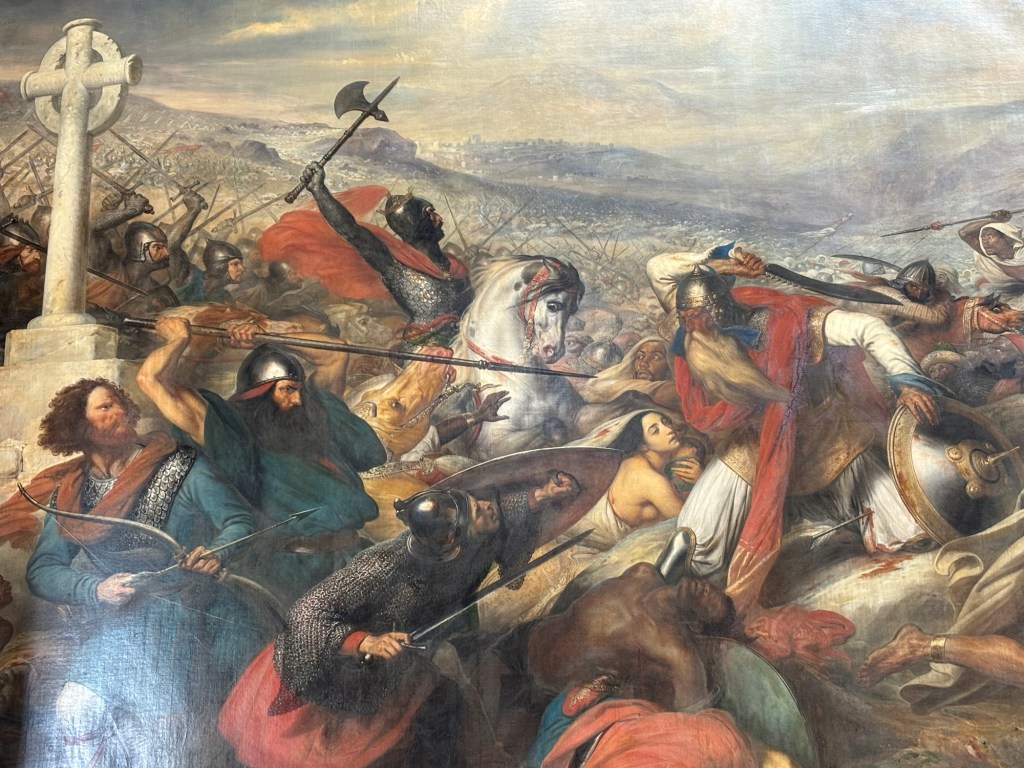
Finally, a painting I really didn’t expect to see, but one that must have been at Versailles for some time, as it was not in the equestrian exhibition but in the palace’s Galérie des Batailles. As patriotic paintings go, it’s got to be up there with La Liberté guidant le peuple by Delacroix (though perhaps not as widely known). This is Charles de Steuben’s Bataille de Poitiers en octobre 732, and it tells the story of the decisive battle between the Frankish forces under Charles Martel, “the Hammer”, and the invading Umayyad army Abd al-Rahman al-Ghafiqi. I must have seen this painting a thousand times for it is tied up with the history of Spain, and of Europe itself: had the Umayyads not been stopped so decisively, they might well have gone on to conquer the rest of Europe. It’s one of those real watershed moments that comes around but rarely in history, and I was amazed to see the real thing – which is, like the armies it portrays, vast.

Not a good time to be a horse, or a European for that matter, but what a find!

Well, that’s quite enough painting perambulations for one post. I’ve just arrived in the pirate city of Saint-Malo where the sun is shining and the water is crystal clear. I think I’ll go for a dip while the weather holds! BB x
Up and Down

When I’m on the road, I have a real complex about fitting in. It must be a side-effect of being a linguist, but I cannot stand the idea that I might stand out as a foreigner, if I can help it. Usually it’s simply a question of dressing appropriately, but it also makes me think very hard about my accent when I speak. This has had some brilliantly cringeworthy outcomes, such as getting into a blazing row with a taxi driver in a French that has never been as fluent since, and defaulting to a makeshift (albeit stateless) American accent while riding the Amtrak train two weeks ago… The worst has to be that two-hour drive in a Luton van with a dyed-in-the-wool Yorkshireman in my university days, where I was so self-conscious about my southern accent that I feigned a northern accent so as not to come across too posh… My housemate, a Wensley lass herself, took an exceptionally dim view of the whole affair. In her own words, my accent had only made it as far as Sheffield.

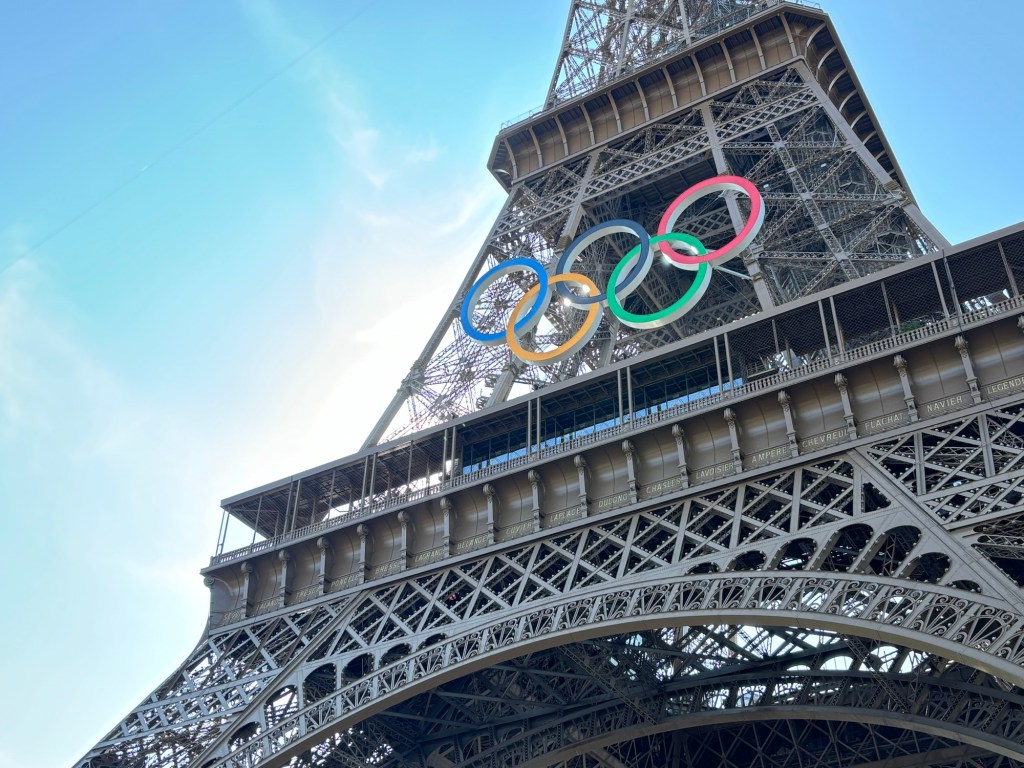
Fortunately, I’m in France, not Sheffield, and with just over a week to go until the Olympic Games begin, the city is so full of tourists that it’s probably easier to blend in as one of them than to ape any Parisian. So I caved and bought myself an Olympic T-shirt, since it’s unlikely to come back here in my lifetime.


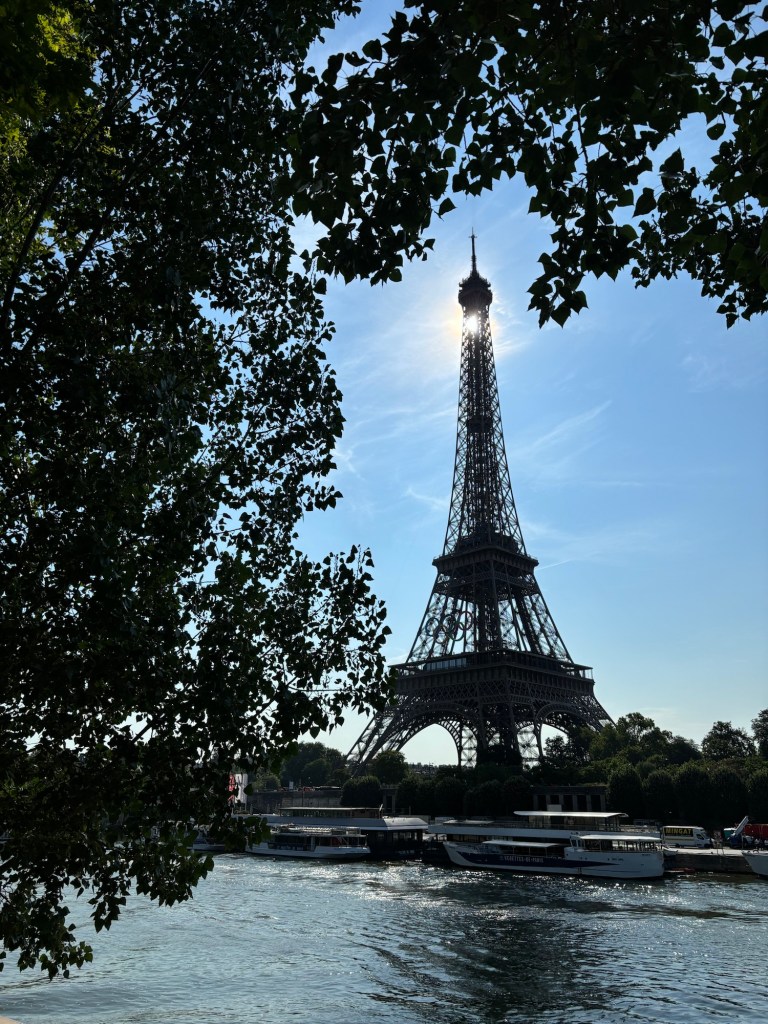
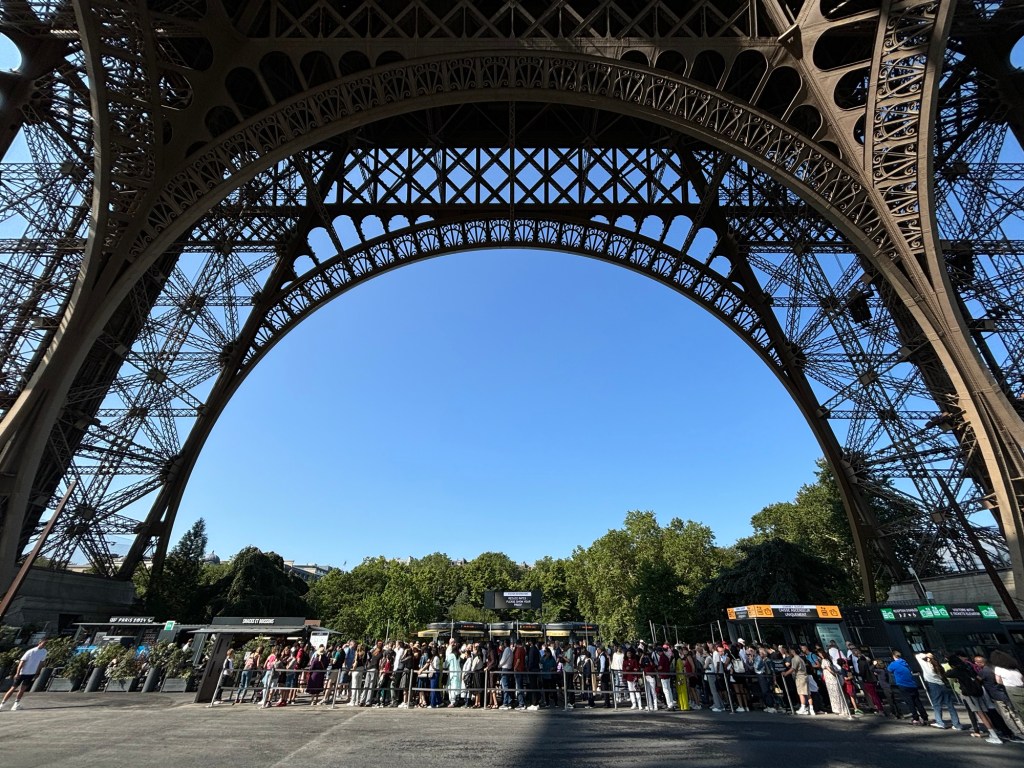
I only have the one full day in Paris, so I decided to make the most of it and go supertouriste for the day. With Nôtre-Dame still under heavy repairs after the fire of 2019, and the Louvre fully-booked up for days, that left the Eiffel Tower, l’Arche de la Triomphe and the Château de Versailles. I didn’t really set out with a specific itinerary in mind this morning – I rarely do when I’m traveling solo – and the decision to join the queue for tickets up the Eiffel Tower was very much a spur-of-the-moment one. After all, the website said that all the summit tickets were sold out, and while the views from the second floor are good, who’d make the climb and not go all the way up?


Turns out the website doesn’t know jack. The queue was about half an hour long, but when I did get there the ticket seller simply raised an eyebrow when I inquired about the availability of summit tickets and said “bien sûr”. So if you’ve considered seeing the tower on your trip to Paris and you haven’t made any reservations, fret not – they always keep some to sell on the day.


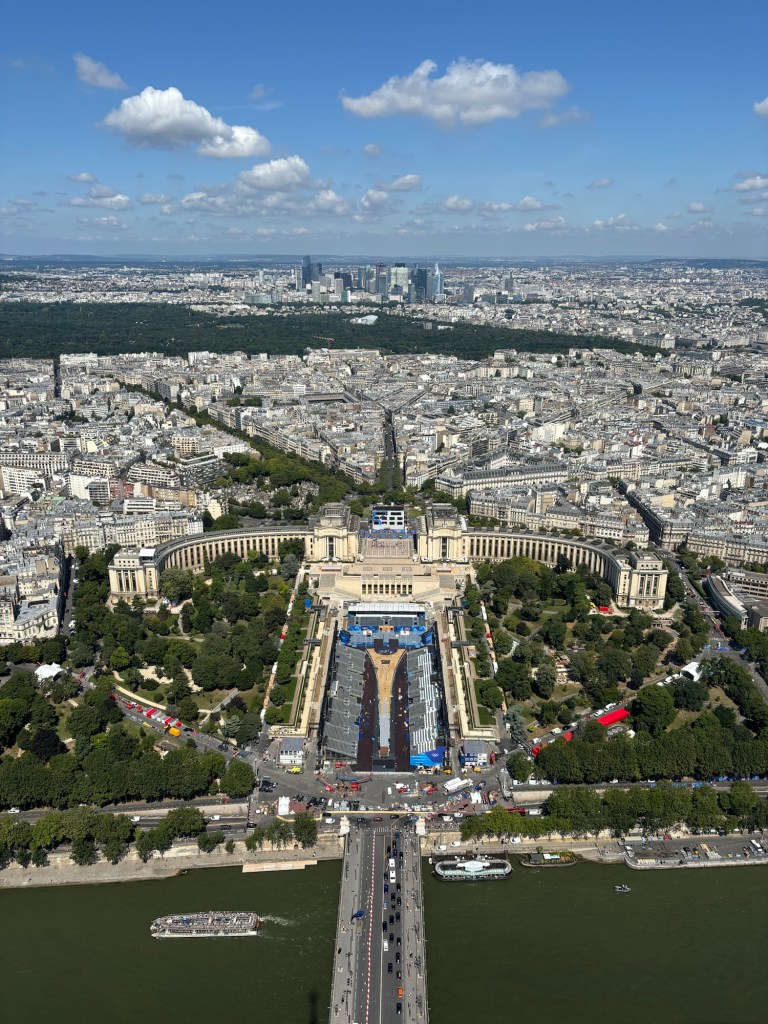
Preparations are well underway for the Olympic Games here in Paris. The Olympic torch has completed its relay of the various départements, including far-flung Outremer, and is now circling the city in an ever-shrinking spiral. All around the city, cyclists are coming and going with pink signs in their panniers, pointing visitors in the direction of this or that event. Stadiums and stands have sprung into being like enormous steel mushrooms, and the avenue that stretches from Trocadero to the École Militaire now hosts a giant show ground, which looks like a building site from the ground but a lot more like a Roman circus from above.

It’s also impressive just how big the Bois de Boulogne is. Hyde Park may be a green lung for the heavy London air, but it pales in comparison to the dark forest that has clung on in Paris’ northern district, as though threatening to break the encirclement and rejoin its sister Meudon in the west, given the opportunity.


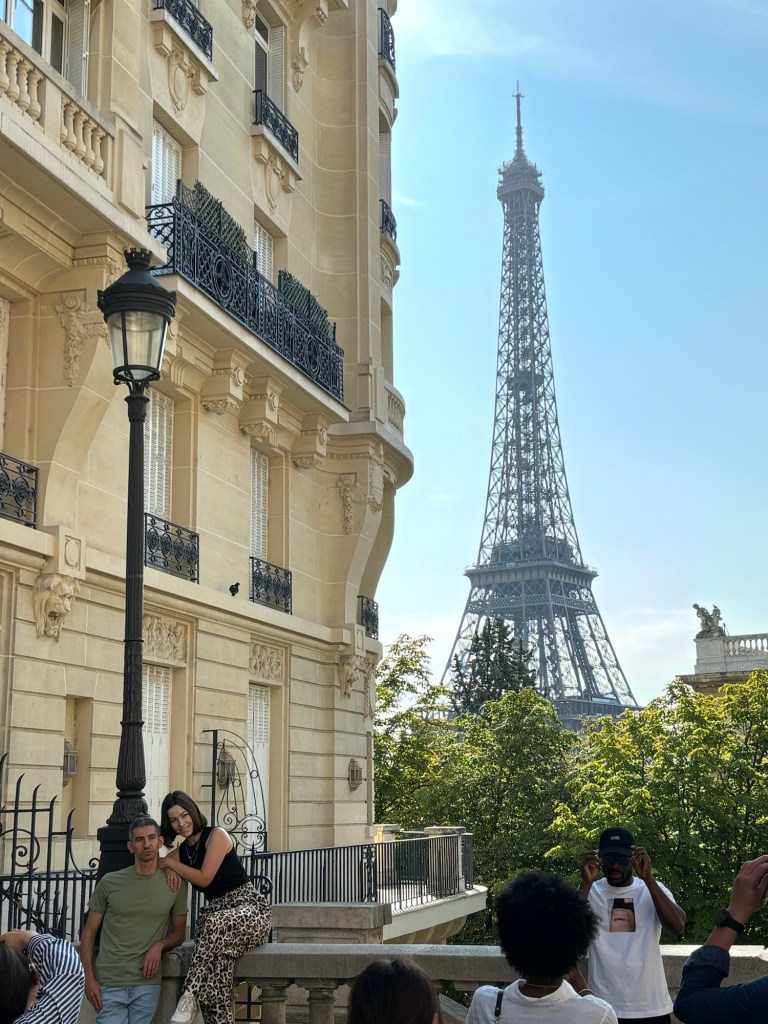
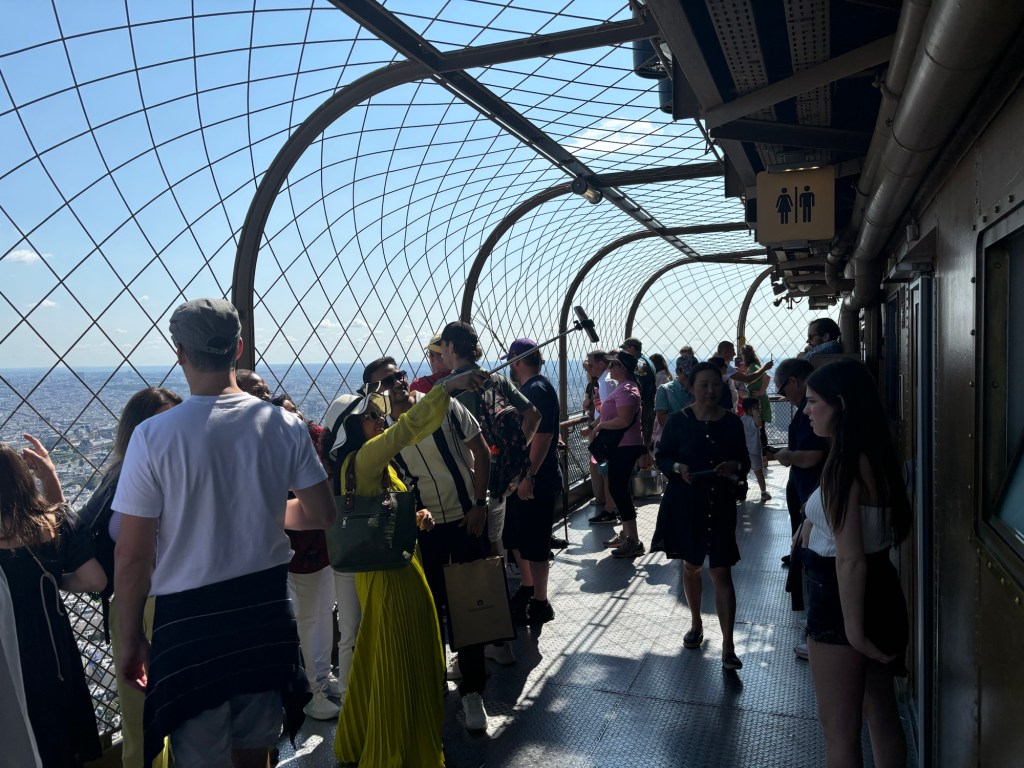
The summit of the Eiffel Tower really is quite something. Photos don’t really do it justice. There’s any number of skyscrapers that have now beaten its giddying record, but none so old, so charming, so immediately recognisable. It’s quite something to perch high above the City of Light, pigeon-like, and join the ranks of historical characters who have stood in the same spot: kings, shahs and statesmen, warmongers, tribal chiefs and Buffalo Bill. You’re more likely to be elbowed out of the way by an errant child angling for a better view or jostle for space with a Brazilian family taking every possible angle of each other than you are to meet any of the former, of course, but who knows? With the Olympics converging on the city, now’s as good a time as any to go stargazing up the Eiffel Tower.


I’ve been a bit reckless with the traveling this summer. I’d like to argue that this latest venture is purely tactical, with French being a very valuable commodity where I’m going, but it’s also methodical: it’s a very good way of keeping busy in the yawning maw of the summer holidays, which can go on and then some if you don’t find some way to keep busy. At the moment, one wedding after another plasters my social media feed as old friends tie the knot. It should make me smile, but on one level it always reminds me just how cut off my career has left me. That’s just one of many reasons I’m moving to a new job and a new part of the country this summer. It’s high time I hit the reset button and started from scratch.

But until then, I have the joys of the open road. Perhaps it’s my way of justifying my existence in these long, empty stretches we call holidays. I might have missed the boat festival in Brest by a matter of days, but I’m really quite excited to explore Britanny. After all – it’s supposedly the location of the indomitable Gaulish village of Astérix and Obélix. Between those two comic rascals and St-Malo’s long history of piracy, I should be in for a treat! BB x

Looking for Love in Paris

I started learning French when I was around five or six years old. A lady used to come to my primary school and ran a French class as an after-school club. I remember it so distinctly because the teacher always brought those strawberry-favoured biscuits that I used to devour. I think they’re called Lulu « barquettes », but ever since one of my school-friends described them as “vagina biscuits”, the unfortunate moniker has kind of stuck.

What I’m trying to say is that I’ve been studying French for twenty-five years of the thirty I’ve been alive. Perhaps that’s why I burned out at university.


I’m on the road again, and this time it’s Paris. I’m very much aware that it’s been years since I had to speak French outside of a classroom setting, so I have come out here to put that right. I also have another quest in hand: I have to kindle the fires of a slow-burning romance with France and the French. Unlike Spanish, which had me at hola, I have never been as besotted by my third language.

There are good reasons for this: I have strong family ties to Spain, the landscape and wildlife were just that much more exotic in my early days as a kid naturalist, and I never had the chance to lose interest due to starting over with the same textbook three times at three different schools like I had to with Encore Tricolore (two more encores than I cared for). It was easy to fall for Spain: she was the new girl on the block and she lit the path to finding my long-lost grandfather once again. But there was a time, and not all that long ago, when I was genuinely considering splitting my year abroad between France and Spain. I know I was at my most intrigued in my sixth form years, thanks primarily to an iron-willed teacher (who scared the living daylights out of us all) and an immensely encouraging language assistant, who never failed to find an angle for me to explore in her lessons. So it’s not like I’m starting from scratch. The attraction has always been there, albeit buried deep.

And that’s what I’m here to do. I had a thing for France once. It might have fizzled out over the years, but I know it’s still there. I just have to find the spark. And where better to start than Paris – the city of light?


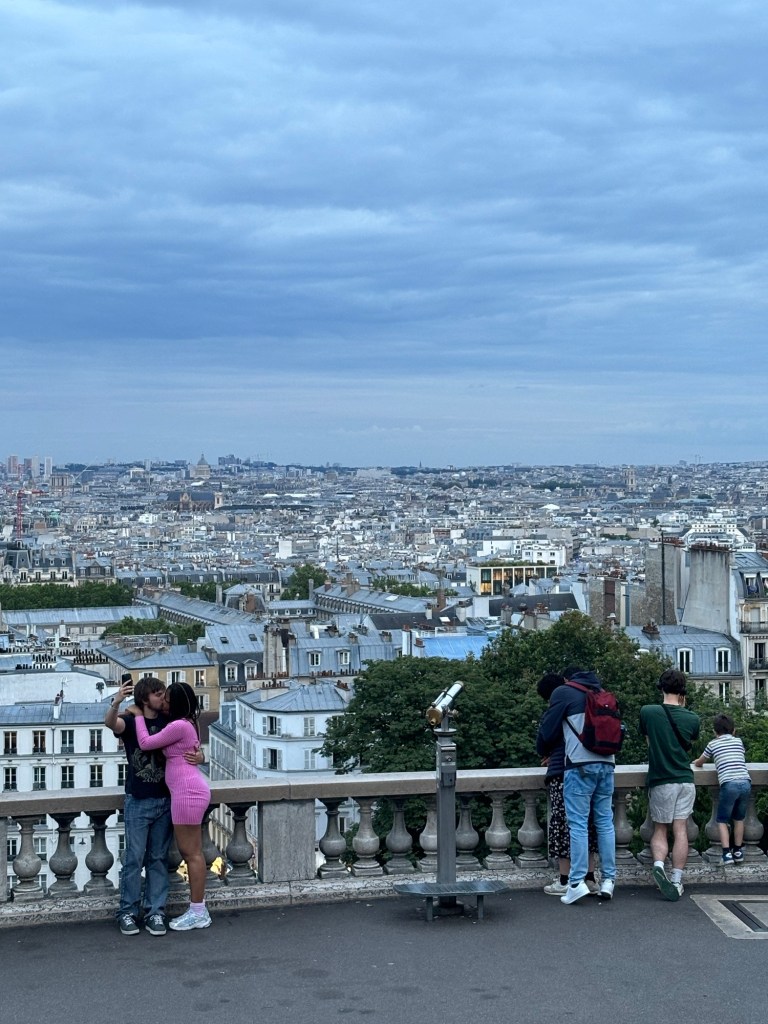
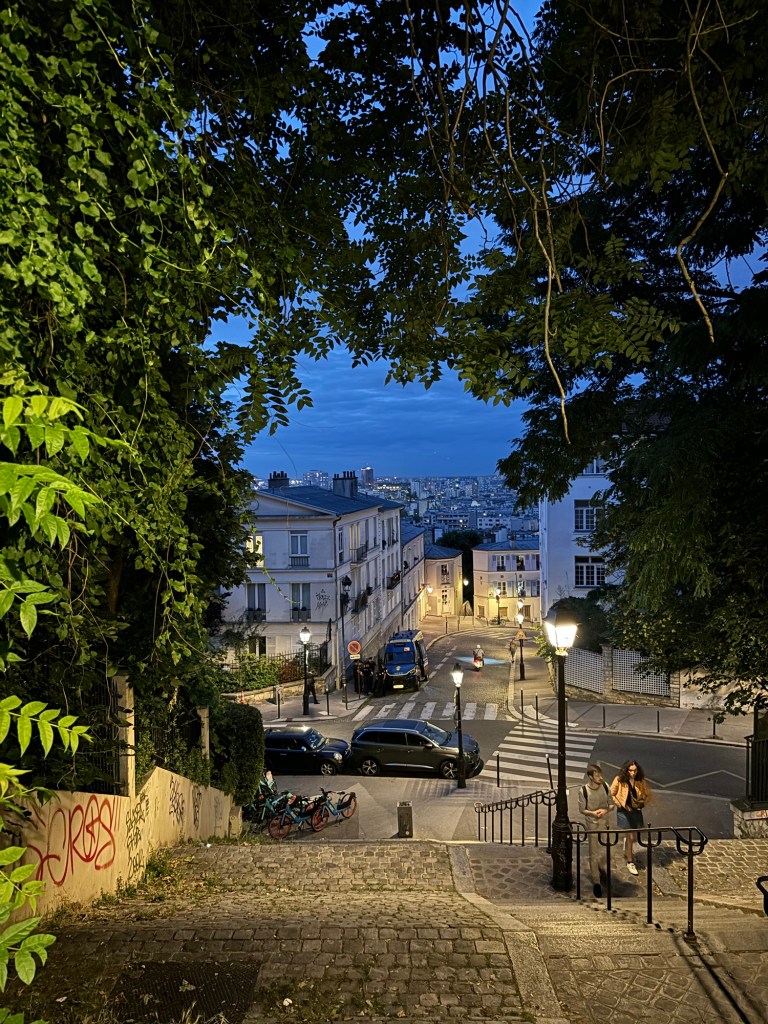
I haven’t been to Paris since I was eleven, and the last time I was here I climbed up the winding steps of Montmartre to the domed towers of Sacré-Cœur, so I figured that would be as good a place as any to start. The gendarmerie were out in force: the Paris Olympics are now only days away, and security in the city seems to be tightening up and fast. That didn’t stop the locals from having a good time, blasting music from the steps of the church, waving off the Indian lovelock vendors and generally having a good time.

Paris really is a beautiful city, even for the solo traveller, though I feel it’s absolutely a destination best enjoyed with a partner. I got much the same impression in Venice a couple years ago. Everywhere you look there’s a couple sharing a kiss, taking a selfie, holding hands at a café. It makes a welcome change from the awkward coolness of the British. We could learn a lot from these masters of the art.


Let’s play this like a dating profile. Let’s get serious. Monogamy is out of the question since I’m not about to be unfaithful to Spanish, so I’m hoping French is willing to share. Distance doesn’t bother me – Paris is only half an hour away by plane – and twenty-five and over would count for every one of those years I have spent grinding French. I am open to a short-term relationship with this language, but a long-term would be preferable (especially as I may well need French as my sledgehammer to get into the Spanish education system someday). Words of affirmation are 100% my love language, so I’m hoping I can find a warm spark within the infamous chilly disposition of the Parisians. And while my music tastes aren’t likely to be all that compatible, I was a major Stromae fan in my university days, and I’ve always had a thing for Afro-French artists, like Baloji. Between that and the unsurpassable bandes dessinées of my childhood (Astérix, Tintin et al.), we might just about have enough in common to have a go at it. So – how about a café date, to mettre la machine en marche?


I should find a café and make it my own while I’m here. That’s a plan for breakfast tomorrow, I think. You can’t really get an eye for Paris unless you spend some time in a café, after all. A bientôt, mes amis. BB x

Explosions in the Night

When Eyjafjallajökull erupted and grounded flights across Europe, I was one of the last to hear of it. Indeed, my mother and I knew nothing of it until we got to the airport, only to be told there’d be no flights for several days because of the Icelandic volcano – didn’t you see the news? It wasn’t even for want of connectivity to the outside world, though I was spending a couple of days in the marshy outpost of El Rocío at the time, but because Spanish news the night before decided to prioritize a report on whether Spaniards actually react to STOP signs, as they’re written in English, over the eruption. Of all the nights…

Last night, once again, the world was rocked by explosions of a very different, more sinister nature, and I slept through them unawares – until I saw the news this morning. And if I’m being totally truthful, I heard plenty of explosions last night here in Extremadura, but they were all of them of my own making. IS declared its actions to be an act of war this morning, and another great and terrible power made a similar declaration the night before – in my head.

I’m here in Cáceres for the Fiesta de las Tres Culturas, ostensibly to do a bit of sightseeing but primarily in search of inspiration for my novel. Cáceres is a stunningly beautiful medieval city, especially so when the town is kitted out with a giant medieval market and the townsfolk are all dressed up. There are crepe-peddlers from Lisbon, camel farmers from Valladolid and a musical troupe from Tetouan, to name just a few. And of course there’s at least one Englishman wandering about the old city with a sketchbook, snatching the occasional character out of the street with his pencils. All in the name of the novel. As I’m now set on nothing else for a career, I’ve started to take this writing malarkey very seriously.

Last night I was scripting the grand denouement of my saga, involving a terrible siege and the destruction of several beautiful buildings, as is necessary for the eventual outcome. As the bombs went off in Paris and gunfire turned the streets into a second Beirut, I had musket and cannon salvos in my head. That the idea came to me at around the same time as the attacks began is probably pure coincidence. The realization this morning of said coincidence made me feel quite sick. Everybody in the hostel cafe was silent with their eyes fixed on the TV as the ticker tape spelled out Spain’s reportage of the dreadful events of the previous night. The whole of Paris in a state of emergency? Citizens told not to leave their homes and the army deployed onto the streets? It’s like something out of a story in itself. And once again, we’re told the perpetrators were operating under the shadowy veil of IS. A war of a very different nature to the ones going on in my mind. There, in the simplified romanticism of my imagination, there are always two clear sides, figures of questionable authority in leading roles on both fronts, and a battleground on which to resolve any dispute by military force.

Not so in the real world. Twenty-first century warfare is a far more sinister affair. It’s international. A war of proxy, of shady political dealings and old worlds dragged unwillingly into democracy and the present day. Of drone strikes and mobile phones. Skirmishes fought in the East are avenged by agents operating upon the civilian population in the West. A state of total war where nobody is safe, from the soldier out on manoeuvres in Damascus to the man back home who used to deliver him the mail. At least, that’s as much as I remember of the term from my wrangling with A-Level History (before it got tedious and became the study of historians and social policy, not kings).

In short, I don’t have the foggiest as to how to react. I’m just a wannabe author voicing my feelings as they come to me. Ask a history or international relations student for their views if you want a kernel of experience: my foray with Charlie Hebdo showcased my inadequacy for dealing with such weighty matters in a succinct, un-detached manner. That’s only natural; growing up as a writer, I’ve fought hard to hold on to my imagination, and with it the childish way of seeing things as fair and unfair, good and evil, where everything can be tied back to the condition of the human heart. Mine, at the very least, is a gentle one, and it doesn’t take much to make it bleed. Hence the moniker. But it would do us all well to remember that at the heart of this long and terrible nightmare are human beings like you and me.

Personally, I ask for no swift vengeance on IS and its agents. A beast pushed into a corner is capable of unpredictable ferocity, and we’ve been pushing for long enough. The wave of violence will only spiral out of control, and many innocents will be caught up in the whirlwind before it’s over. That being said, I sincerely hope that the surviving perpetrators feel the weight of every casualty in their hearts. Some villains are unshakeable in their resolve – I turn you to fiction once again: Iago, Moriarty, the Joker and all the martyrs and psychopaths of that nature – but under the cloak of a righteous cause, there’s as human a heart, imbalanced and afraid, as everyone else.
At least, that’s my way of looking at it. I’ve probably got the wrong end of the stick as usual, but writing is my trade, and if I must write, it will be from the heart, and mine currently hurts from all I’ve seen and heard. My thoughts and prayers go not just to the people of Paris, but to the beleaguered Syrians themselves, for whom this dark threat is ever at hand, and who, fleeing said terror, have found so many European powers that bow not to the strength of their humanity but to whatever quota they deem acceptable; to a land that, for all its sympathy, continues to look to its own, until its own become the targets. To them, and to all the victims of terror around the world, in whatever form it may take, Eastern or Western.
I never did believe in Utopia, and I never will, but the sooner we can put an end to this shadowy decades-long war of terror, the better. BB x