Sins of the Fathers: Lessons in Perspective from an Israeli

My biggest failing when traveling is overestimating my staying power. I’ll always give myself just a few hours, days or, on occasion, weeks more than I really need. Call it arrogance or a mistaken belief in my own capabilities – or perhaps, sheer idiocy – but it’s the one mistake I never fail to repeat, beating underpacking, undereating and underbudgeting to the top spot. I’ve been at this traveling game for a while now, honing my skills in Spain this year, and in all honesty, it’s a mistake I don’t intend to amend anytime soon.

Why? Because every second counts. Especially the last.

I remember backing out of my last week whilst crossing Spain in the trek of ’13, partly out of fatigue (I’d slept rough in the hills for several nights and lost a shaming amount of weight) and partly out of a harrowing loneliness, the kind of loneliness that really begins to gnaw at you after three weeks alone on the road with only yourself for company (you can only run through the script of your favourite musical with you playing every character twice, apparently…)

I was younger then; quieter, inexperienced, even more shy than I am now. I saw a shot at an early exit and I took it. But those last two days, trying though they might have been, served up some of the most memorable moments: swimming in the crystal waters of the Mediterranean with an entire cove to myself, being chased along the beach at night by men with torches, falling asleep to the sound of the sea and the eerie silence of the lighthouse doing its rounds on the cliffs. Pure Almería. Pure Spain. Pure living.

The same thing happened in Uganda. The last week felt like an eternity when all we really wanted was to be home in time for Christmas, but when the last night rolled around I realized what a fool I’d been to ever want to leave. And my own mother had phoned just days before telling me to make the most of the time I had left. I’ve been kicking myself ever since.

Even in Jordan – dear Jordan – I met my match in our last week. The veil was lifted a little; Amman was no longer the inhuman monster it had first appeared. It was friendly, warm and oh-so-very human. But just as it was starting to bloom, we were on the plane and out of there. Oh, I look back and laugh now; it’s so very easy to do. And trying though it was, I don’t half appreciate it all the more. We all need challenging experiences like that in our lives. And since I don’t go in for drink, drugs, sex or sports, where else am I to find experience but in the open road?

Jordan’s twilight was like a sunset over a battlefield – if you’ll forgive the expression. Suddenly, just for a moment, what was once so terrifying became beautiful. It made sense. The final hours can make all the difference.

Today it was just a couple of hours’ difference: a choice between the 11:25 or the 14:20. As usual I decided on the later bus, assuming I’d find something to do that would fill the hours. That something was looking very much like the first season of Doctor Who at eight o’clock this morning, when my limbs were still recovering from being scratched, scraped and strained in yesterday’s gorse-navigating adventure. A tempting offer.

That is, until I met Roy.

Roy was the only other guest in the hostel this morning. He was bound for Monfragüe for no particular reason beyond that it was a recommended spot, so I told him what he might expect to find and pointed him in the right direction. We’d got talking indirectly – as is so often the case when I’m involved – through a two-way conversation with the friendly hostelier about the impossibility of Spanish accents (a subject on which I consider myself reasonably well-versed). Roy, a native Israeli, had taught himself Spanish through the genius of Michel Tomas during his military service and, after reading Coelho’s The Alchemist, had decided to visit Spain, eschewing the post-military course for India, Australia and the Americas.

Naturally, Israel came up in conversation. I don’t remember how exactly. I think it was because I mentioned that I’d been nearby last year, when I saw the Golan Heights from the Jordanian side. He told me a little about his home, and let me tell you, it was refreshing to hear a little of the other side of the argument for once – or at least, an Israeli approach, as Roy’s was hardly the mainline view. Despite living in the Western World, the last three years have shown me nothing but anti-Israel sentiment. For obvious reasons, Jordan isn’t the best place in the world to go looking for a balanced view on the Israel question, but neither is my own Arabic class. Perhaps the study of Arabic makes us more sympathetic to the plight of Palestine?

I’m not entirely sure what it is, but I was brought up to idolize hooked noses and Jewish perseverance by a mother who spent a very long time searching for her own faith, so I’m not naturally predisposed to see Israel as the enemy it’s often made out to be. Nation and religion should never be mixed, and Israel is the example, but there is something more to a country that still values its faith. I could have visited last year… if I’d been ready. But I wasn’t. For me, Israel is more than just a nation. It’s more than an idea. It’s more than an Instagram on the West Bank. It’s a dream, and when I saw the sun setting over those mountains and went weak at the knees I knew I wasn’t ready. Israel could very easily destroy me… because I fell in love with it. And my track record for destructive love affairs would back me up.

Roy, however, gave me exactly the answer I was looking for. One of hope, understanding, of looking forward rather than back. That, he claimed, was the problem in Israel: there is too much emphasis on the past. The old Holocaust clause; bring it up and you’ve lost the argument. Does Israel deserve the entire landmass? You might ask, does Mexico belong to the Aztecs, or does Britain deserve its former empire? Hardly. Israel has as much right to the West Bank as the Asturian knights did to Granada. These things are gone. History is to be studied and learned from, not brandished as a weapon in court. And speaking of courts, there’s a good deal of finger-pointing going on all over the world, but what good does it ever serve – especially when the culprits are two generations dead and buried and it’s their descendants taking the flak? What is done is done. What is important is to dream and to push on towards a better future… or whatever idealistic tripe should fill this gap. 

My apologies. An earthworm could have phrased that better. Personally, I’ve never believed in Utopia, nor would I ever want it. I only believe in hope and the good that it can do. As for the present, I take the Doctor’s approach; the world is perfect the way it is: that is, imperfect. The balance of good and evil, right and wrong. It’s that imperfection that makes us struggle to create a better world, and it’s that struggle that makes us so very human. I see that as perfection. Things could be so much worse than they are now.

Roy’s was a balanced opinion. Here was a man who’d gone through the Israeli military service telling me not of his blind hatred for the Arabs – as a couple of Palestinian cabbies would have had me believe – but of his desire to see the country where The Alchemist began. What is that if not human? There is no “us” and “them”. There never was. There never will be. There is only the future. And it is by looking ahead that we move ahead. Ever tried running backwards?

This is why I travel. This is why I give myself those few extra hours: for conversations like these. For Roy, for Simone and all the other brief and wonderful encounters on the road. It restores my faith in humanity. Trump, you should really give backpacking a try someday. It might just change your world.

I hate to end on a quote, as it seems so abominably unoriginal, but I’ll break my golden rule just this once because a certain Allan Quatermain spiel is simply crying out for this post. BB x

“It is the change, the danger, the hope always of finding something great and new, that attracted and still attracts me.”

Henry Rider Haggard, Child of Storm
Amman: Observations of a Country Boy

It occurred to me a couple of days ago that most of my posts – discounting the rambling ones – are anecdotal more than informative. That’s only natural; you can’t spin a good story out of a constant streak of facts. And I tend to let my heart bleed all over my writing, so to speak, for good or ill. So I thought I might give you something factual for a change. It’s a little run-of-the-mill as topics go, but I can’t help but feel a few detailed observations on what life is like in Amman might not be such a bad idea. It’s the kind of thing I was trawling the internet for in the weeks leading up to my arrival here, now over a month and a half go. Obviously, we’re talking about a city, and a capital city at that; such places are very much what you make of them. If you’re prepared to go out and make a good time for yourself, you’ll probably find it. That’s as may be. At any rate, that takes a stronger will than mine.

Technically this kind of thing is best left until the end of one’s stay, but I’ll probably be out of internet range in my last week and having plenty of tale-worthy adventures whilst I’m at it. Besides, I think I’ve seen enough of this place over the last month and a half to have a fair idea of how it all works – at least, from my point of view. So without further ado, here’s my fifteen observations about Amman.

1. Amman is immense

I don’t have the figures, but you don’t exactly need them to know this. That you can stand at just about any point in the city and be completely unable to see an end to the seemingly infinite sweep of beige tower blocks has more to do with the fact that Amman is spread over several hills, making a full panorama nigh-on impossible unless you manage to climb one of the larger skyscrapers. Getting just about anywhere requires time, patience and, more often than not, a taxi. Some of the distances may look walkable, but in the heat of the midday sun, it’s just not worth it. Besides, a taxi ride means more Arabic. That’s good, right?

2. Grass does not exist

Looking for a shady green park to sit and study in? Think again. Amman has many things to offer, but grass is not one of them. The great belt of trees in the grounds of the Jordaninan University overshadows a bed of dust and pine needles, along with more plastic bags and bottles than the aftermath of a botellón. If you’re really after a green space, I’d suggest not coming here in summer for one, or else take a weekend sortie up to Ajloun in the north or Dana in the south.

3. Dust gets everywhere

This is one of the very first things you will notice. Wherever you go, there’s no escaping the dust. You can’t see it – at least, not unless you stand on a vantage point and look out over the city, where the brown haze over the skyline speaks for itself – but if you leave anything in the open air for a minute or more, you’ll find yourself brushing the dust from every available surface. Look on the bright side: when the occasional sandstorm sweeps its way up from the desert to the southeast, the wall of buildings act like a filter, so when it reaches Amman itself, it just looks like mist. Only, brown mist. Pretty novel when you first see it, I have to say.

4. Most of your Arabic practise will be in taxis

In a city that thrives on the back of its taxi service, it’s hardly surprising that the place you’re most likely to find yourself practising Arabic on a daily basis is in the front seat of a taxi. That’s not a bad thing per se, so long as you can put up with asking the same bloody questions day in, day out; how long have you been a taxi driver, are you from Jordan or Palestine, why is it so busy today etc etc. You won’t get lucky every time; there are a few singularly impossible cabbies who have wildly skewed ideas as to how much a ride downtown should cost, but for the most part they’re a chatty bunch. Life story, please!

5. Almost all taxi drivers are Palestinian

In seven weeks of living in Amman, I’ve met no more than three Jordanian cabbies. All the others have been Palestinian. And that’s assuming an average of six taxi rides a week. Most of them have plied various trades before becoming taxi drivers, up to and including military officers, teachers and engineers (all of which, thankfully, al-Kitaab One taught me). You can get a pretty good idea as to the nature of the Arab-Israeli conflict after just a couple of taxi rides, in this way. Not a subject to bring up yourself, naturally, but if they have an opinion to share, it’s always interesting to hear. Did you know, for example, that Hollywood rarely, if ever, shows Palestinians in a good light? Food for thought.

6. Every bus has a different siren

Remember those BopIt! toys everybody had once upon a time? Try to picture triggering each of the annoying noises one after the other twice over and you have a fairly accurate idea of what a street in Amman sounds like. I’m not joshing you. From vuvuzelas to ambulance wails and car alarms to foghorns, no two sirens are the same. Fortunately, the majority of Amman’s drivers are constantly on hand to remind you what a regular car horn sounds like, every second of every minute of every hour of every day. These people will honk at everything that moves.

7. Stray cats are a thing; dogs really aren’t

This isn’t just a Jordanian thing either. I seem to remember Fes being similar, though I didn’t stay there long enough to see for myself. But there are no dogs in Amman. Cats, on the other hand, are everywhere, prowling the dustbins, skulking along the sidewalk or fighting beneath the window in the early hours of the morning. If you’re an animal lover like me, you’d better learn to accept the fact that the sleek and healthy cats of home are not to be found here. Amman is a fast-growing, modern city where you’ll need all of your wits to get about, and the cats that prowl the dusty roads reflect that, scabs, scruffy hair and all.

8. Cafés and restaurants give you water

This one caught me by surprise. Apparently it’s a Jordanian custom to give water to guests, water having always been something of a scarce commodity in this part of the world. That’s all well and good, but when you notice for the first time that it’s included in the bill, it’s a bit galling. And there’s no escaping it, either; it’s just something you have to accept. Take my advice and find one of the smaller establishments, where you might just get off the hook. Doors might look inviting, but behind all the bells and whistles, it’s essentially the Starbucks of Amman. If you’re looking for a local, look elsewhere.

9. Bins are optional

Rubbish bins aren’t as rare as they might seem at first. Most streets will have one or two skips where the locals deposit their trash, and these are emptied at least once a week, much to the cats’ chagrin. But the way the people of Amman drop litter, you’d think they’d never heard of a bin. Bottles, cups and crisp packets, once used, are simply thrown over the shoulder, discarded underfoot or lobbed at the nearest wall. Little wonder, then, that stinking, wind-borne piles of trash tend to gather in street corners.

10. Rainbow Street is where all the ExPats go

If you miss an old-fashioned British tea or coffee, you’d better get yourself down to Rainbow Street. It’s a creature-comfort lover’s paradise, with milkshakes, bookshops and ice cream parlours galore. But if you’re after an authentic Jordanian experience, you’d be better off looking elsewhere. Not only is Rainbow Street quite pricey by Jordan standards, it’s also crawling with Americans, Brits and other foreign students, with the result that many shopkeepers will address you in English and not in Arabic. It’s popular with Amman’s younger generation, too, so it’s not all rainclouds, but try exploring downtown and its offshoots first. Hashems and al-Quds, though popular, are more of an Arabic experience than Books@Café.

11. Falafels are the way to go

Jordan may be expensive to get to, but once you’re here, eating out can be as cheap as chips. And if you decide to forgo potatoes for falafels, it’s even cheaper. A falafel wrap, stuffed with salad, harira and hummus, shouldn’t set you back any more than forty piastres. That’s about 38p. It’s a great snack, and it makes for a good lunch or dinner, too. Hashems is supposed to have the monopoly on all the falafel joints in town, being a favourite of the King of Jordan himself, but most places will do a good line in the falafel wraps. It’s not the most varied of diets, but it’s cheap, and it beats McDonalds any day.

12. Piracy is the norm

Don’t let the DVD stores spook you: just because there’s not a legitimate DVD case in sight, it doesn’t mean you’re breaking the law. If you’ve travelled to Asia or Africa before, you’ll already know the drill. Shops where you can buy as many as fifteen suspiciously homemade films for seven pounds’ worth are the norm. They’re also the lifeblood of the Jordanian student: especially if you’re up in out-of-the-way Tla’ al-Ali near the Ali Baba International Centre, you’ll be relying on these establishments to liven up the evenings when you’re out of pocket – or energy – to go to downtown and back.

13. Habibah is a dangerous place

Baklava. Kunafeh. Mille-feuille. Pistachio-coated trifles. Honey-glazed cakes. Triple-scoop ice creams. All of this in giant air-conditioned building so vast that it might well be the Arabian equivalent of Willy Wonka’s chocolate factory. It’s a good thing that this heavenly establishment is as out of the way as it is, or we’d all be doomed.

14. Vegetables are cheaper downtown

This is a given wherever you go in the world, but it’s worth repeating all the same: for fruit and veg, never go anywhere other than the main market next to the mosque in the city centre. For reasons beyond my understanding, the price seems to double outside the market walls, but especially up in Tla’ al-Ali, the environs of the Ali Baba school. Sure, it’s cheap by UK standards, but if you’re paying UK prices when the locals are getting their produce for half the price, you’re being ripped off. Downtown, ten dinars can give you enough greens to last you a fortnight, if you’re careful, and that’s including a taxi ride into downtown, provided you split it with a friend. It’s barmy logic, but it works.

15. Crossing roads is like playing Frogger

Feeling lucky, punk? Then give the mean streets of Amman a try, if you dare. Traffic lights are like the last egg in an Easter Egg hunt; you’ll do a little fist-pump for joy when you see one. In most places, you just have to brave it and step out into the fury. The rule of the road is one of might is right, but most cars will stop for pedestrians. The only thing to remember is not to hesitate under any circumstances. As the guidebooks will tell you, the drivers will base their actions on what they expect you to do. If you make the first move, carry it through. You’ll pick it up eventually. And it’ll be just as much of a thrill to the last.

That’s it for the time being. It’s probably important to note that this is very much my own opinion, and one coming from somebody used to living in a town of no more than a few hundred people, so Amman hit me harder than it probably should have done. As I’ve said before, once you get outside Amman it’s a very different story and I’ve met some of the most wonderful people on my travels around Jordan. It’s just that Amman itself and I were never made for each other. Insha’allah, Fes will show me the light.

I’ll be away in the south of Jordan for a couple of days to catch the Perseid meteor shower in Wadi Rum, via Petra, so expect some more adventure stories when I get back on Saturday night! Until the next time. BB x

In the Shadow of the Golan Heights

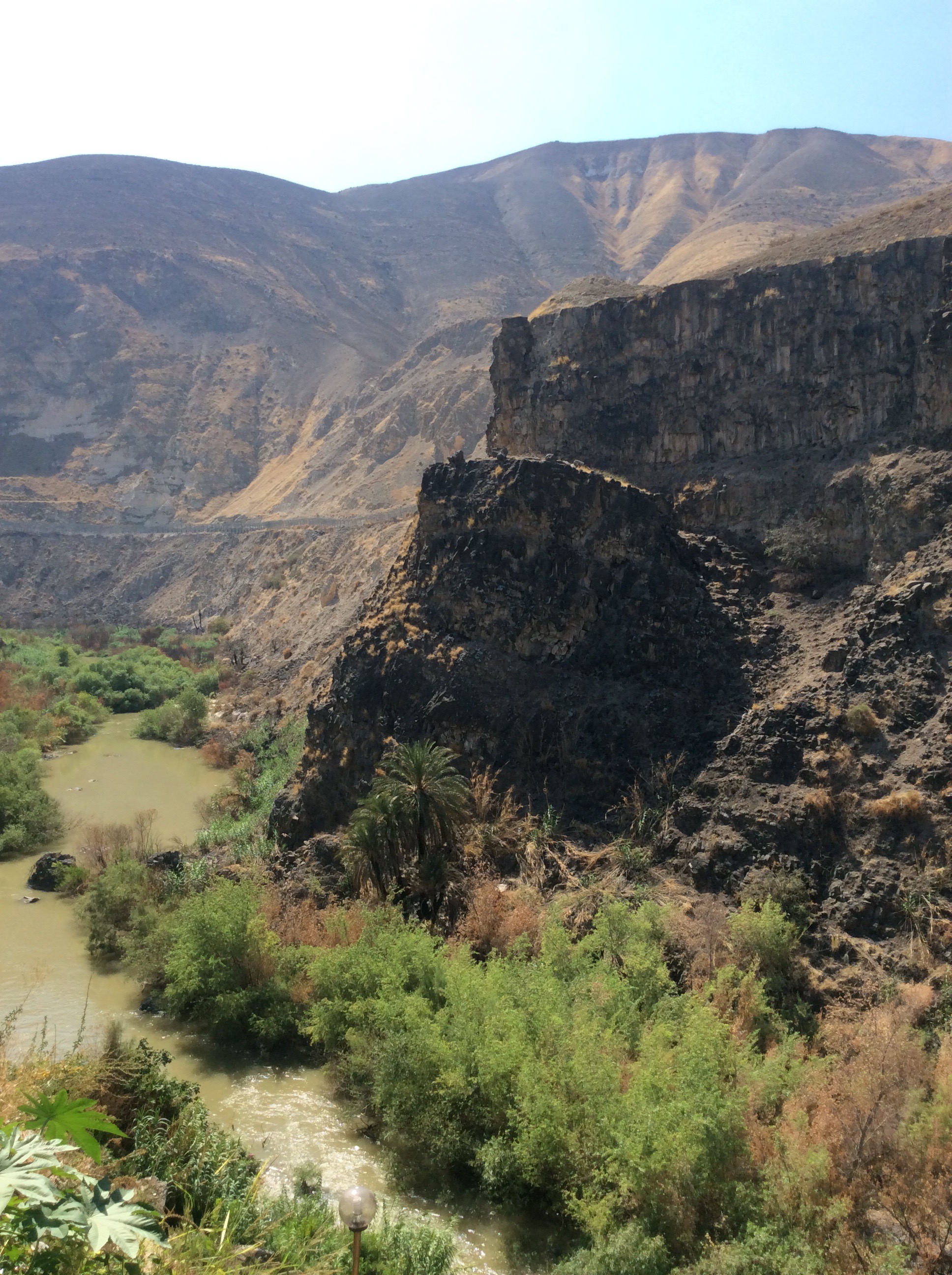
There’s a Palestine sunbird flitting about amongst the branches below, a dusky little thing with an emerald sheen on each shoulder. What difference does it make to her that there’s a tall iron fence all the way along the length of the cliff on the opposite bank? One little flutter of her tiny wings and she’s over. It seems a little ridiculous that a bird no bigger than my thumb can do things a human can’t.

I’ve found a shaded spot for myself in a makeshift bathhouse on the south side of the River Jordan, just a few miles to the north of Umm Qays, and closer still to Israel itself. The Golan Heights tower high above me, shining a brilliant gold in the midday sun. Down below is an offshoot of the Jordan, rushing westwards to its mother before the Sea of Galilee. A night heron flapped lazily past a little while back, and there’s a couple of geese paddling about downstream. The bulbuls aren’t exactly making themselves inconspicuous and all the while the hardy little sunbird is keeping herself busy hurrying to and from a crevice in the cliff. I guess she has a nest in there somewhere.

The others are frolicking about in one of the swimming pools under the lazy eye of the locals. I just had to get away. It’s so quiet here. Who’d have thought that I’m looking at a former war zone, just a few decades back? Legend tells that this is supposedly the place where Jesus drove the Gadarene swine into the river, but the landscape looks decidedly more Ethiopian than one of those colour drawings of Israel from an illustrated Bible. There’s even a laughing dove calling from a fig tree down in the valley. Ho-woo-hoo-hoo. A little slice of Africa in the Middle East. This is my idea of money well spent. If only there were places this idyllic nearer Amman.

And I’m now even more hungry for Israel; I’ve spent two days looking at its green hills and cool lakes from the dry Jordanian side. It’s enough to drive a man mad. Now more than ever I begin to understand why this place has seen so much conflict. Who would not fight to hold on to a home in a land like this, Arab or Hebrew? If there is a heaven-born hand guiding us all, let it lead me to Israel, just once, VIATOR or no VIATOR. I feel a strange pull to the place like never before, as though I have wanted nothing more my whole life. This, surely, is the stuff that wars are born from. Wars and jaded dreams.

The wind’s picking up a little. I expect we’ll be leaving for Jerash soon. Another sunset in an idyllic setting, and still holding true to a promise I made three years ago. I’ll paint this valley onto the backs of my eyes to keep me going over the next five days.

A flash of brilliant purple and the sunbird’s back. It’s the male this time. He clings to a vine hanging over the roof and looks my way before flitting off in the direction of the nest. If there are moments like this to wait for at the end of every week, I have strength enough to last out here. BB x