Gare SNCF de Dax. 10.04.
If you’d asked me what accent would be the first I’d hear on arrival in Bordeaux, gaditano would not have been my first guess. As it was, there was a family of gitanos from Cádiz waiting at the metro stop outside the airport, and they didn’t have to mention their hometown in conversation before I clocked that iconic intonation (and volume) that can only come from the southwest coast of Spain. It’s the accent that I grew up with, so I’d recognise that accent anywhere.
I had a good night’s sleep in my hostel in Bordeaux, and a proper breakfast, too, so it’s been a gentle start to this year’s Camino. It was a half-hour walk to the station from the city centre, so I had some time to appreciate the city before taking my leave.
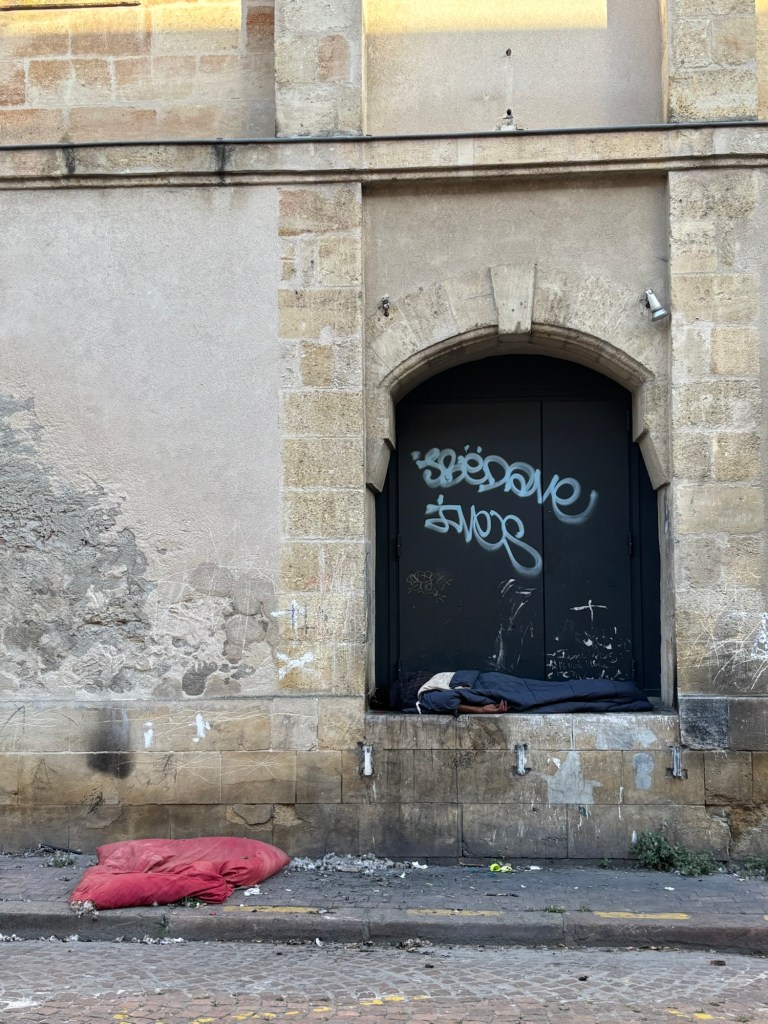
I don’t envy the homeless in this heat. They seem to be a lot more numerous here than in similarly-sized cities in England – or maybe they’re just more visible. Sometimes I wasn’t sure whether I was looking at a sandbag or an occupied sleeping bag. Now that I’m teaching A Level French as well as Spanish, I’m trying to keep both eyes open to these things.
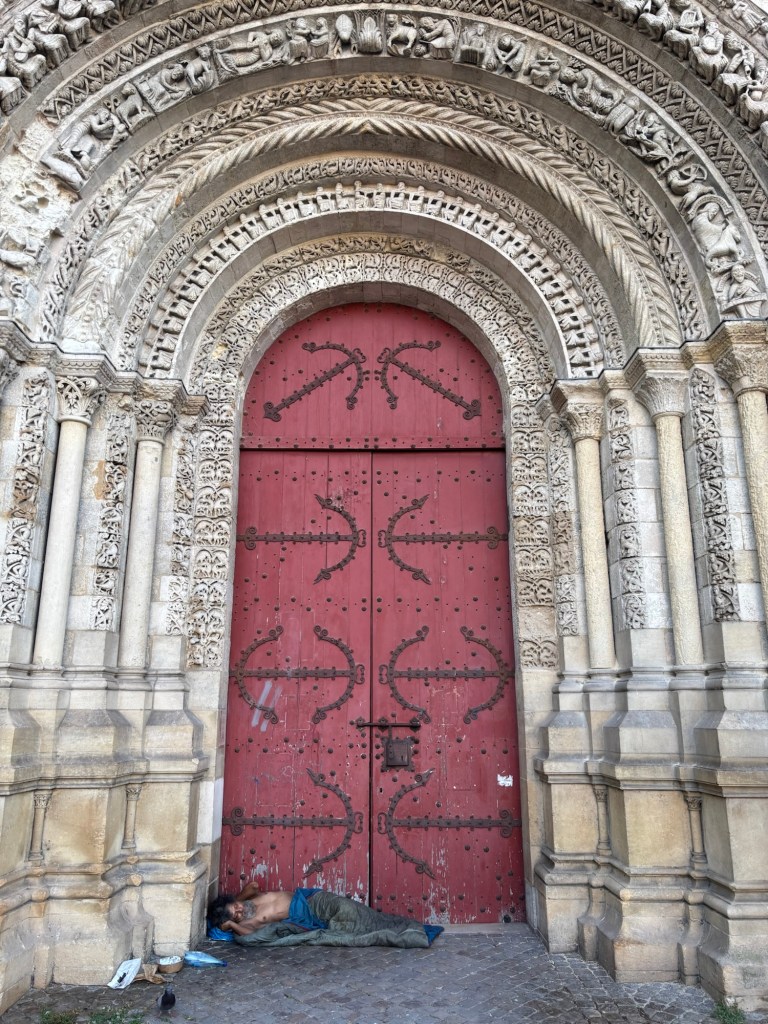
I was so enthralled by the stonemasonry on the portal of one of Bordeaux’s churches that I almost didn’t notice the man sleeping in the doorway. He looked like a dead ringer for a down-on-his-luck Alexandre Dumas. The way he was stretched out in sleep, he might have been a fallen detail from the paradise arches, come to life.
Granada’s Alhambra must have looked like this, once upon a time: the crumbling ruins of a peerlessly beautiful palace, its walls carved with ancient stories, become the roost of the city’s poor and dispossessed.
There was quite a surge for the southbound train at Bordeaux’s Saint-Jean station. I noticed at least one or two travellers who might have been pilgrims. I can’t think of anyone else foolish enough to have a heavy backpack on in the middle of summer, with the temperatures set to soar as high as 40°C today. In a rare turn-up for the books, there’s a beautiful French woman in a cherry-red dress in the seat next to me, but she’s fast asleep. I’ve been chatty enough already with the staff at airport security and the hostel, so I’ll save any more chitchat for the road.
As the train rattles through the sandy forests of the southern reaches of Nouvelle Aquitaine, let me show you the shell I’m taking with me.
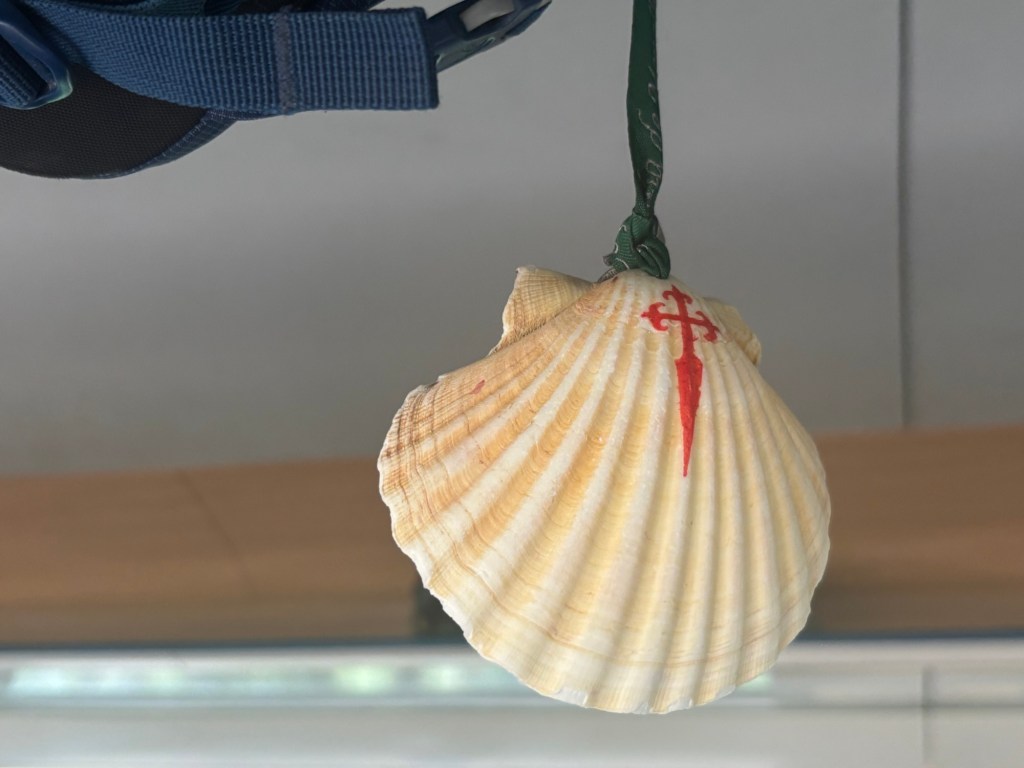
The first time I did the Camino, I picked up a shell from a shop in Saint-Jean-Pied-de-Port. It felt a little undeserved, buying the shell from a shop, but it is something of a Camino tradition. In the early days of the Camino, the shells were not just a pilgrim’s badge of office but also an essential part of their kit, primarily serving as vessels for drinking water from the fountains along the pilgrim road. These days, of course, they’re completely ornamental – keepsakes for the wall or mantelpiece, next to your compostela.
My original shell lasted all of five days, before shattering when I had to remove my rucksack in a hurry after a wasp went up my sleeve and got trapped (the five or six stings it gave me on its way out were with me for weeks!). I took it with me on my last Camino, but I had to have it tucked into one of the outer pockets in its smashed-up state. I didn’t want to buy a shell this time, so instead, I’ve made one of my one using a scallop shell I brought home from Saint-Malo last summer.
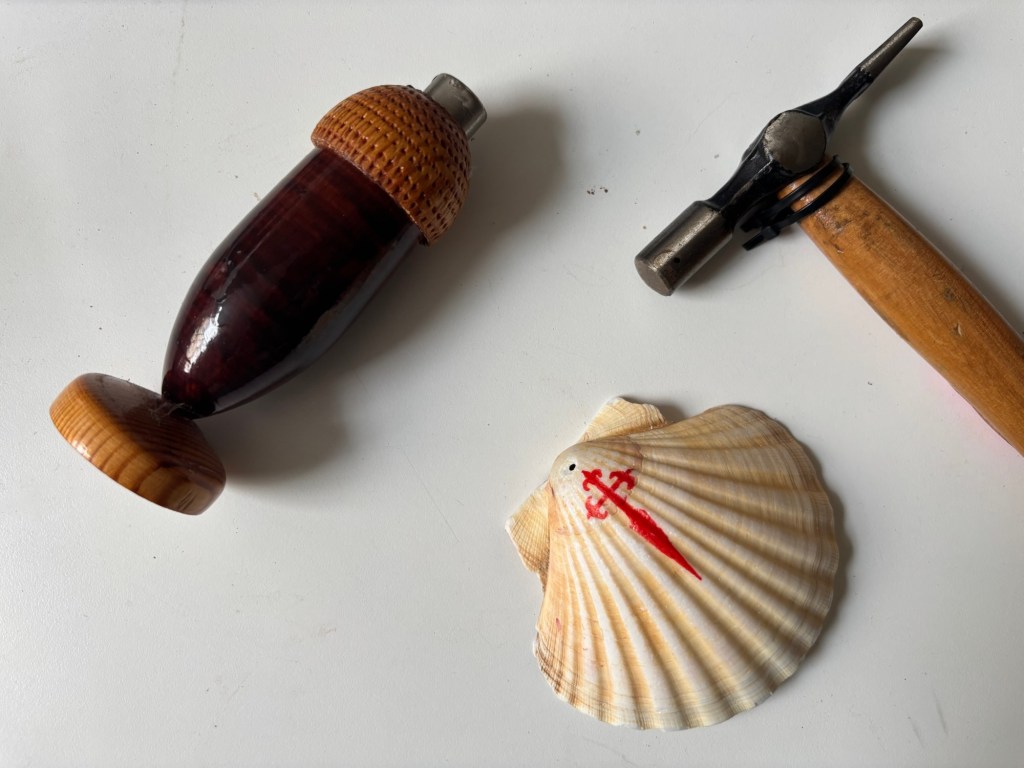
It’s really quite easy to do. Seashells are rather brittle, but if you heat one up over a flame, it softens the shell a little, making it a lot easier to perforate the surface without cracking the structure. I did this in my kitchen with a lighter, a hammer and a small nail.
For the cross of Santiago, I used a red Sharpie. I didn’t have any string lying around, so I made an improvised knot with the wristband from the Cofradía de Mengíbar that I picked up three years ago. That brings the total of Saints guiding me to Santiago de Compostela to four: La Virgen de la Cabeza (the Mengíbar wristband), La Virgen de la Caridad (my aunt’s rosary), La Virgen del Rocío (la más santa de mi devoción), and Santiago himself. Well, technically I suppose that’s only two, since three of them are the same person, but Spain (and the Catholic faith) would be a poorer place with only one incarnation of the Virgin Mary!
I wouldn’t say I’m necessarily that religious. Spiritual, maybe. But it is nice to know you’re not alone on the road, and because of my faith I am never alone.
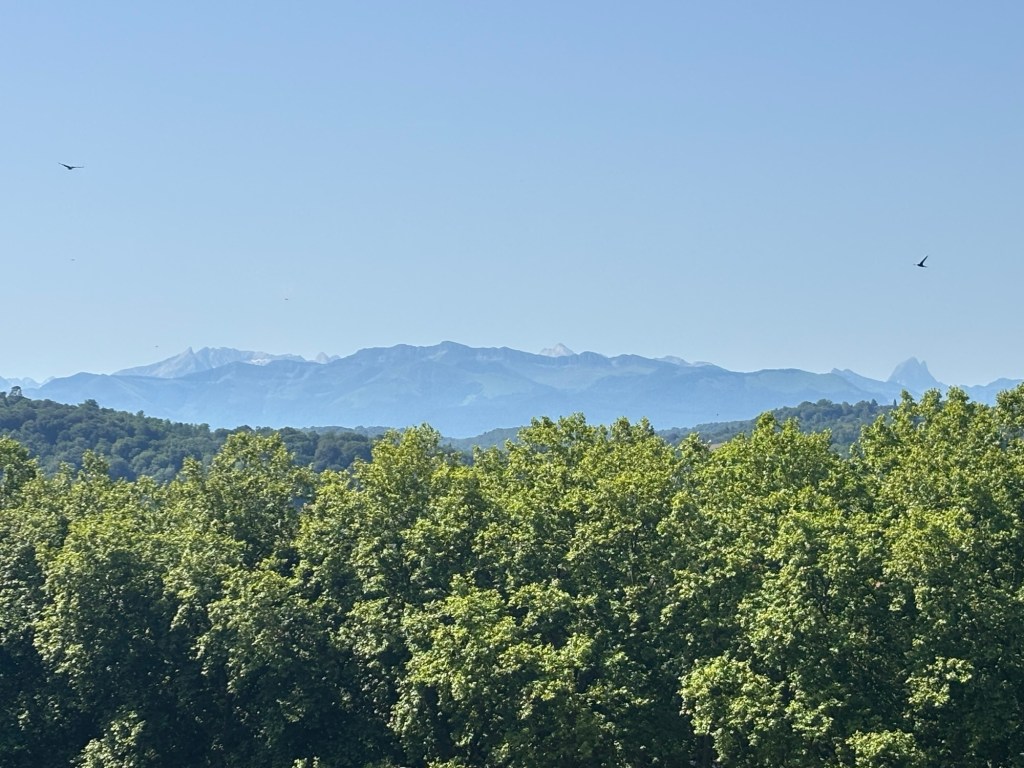
And there they are. The jagged peaks of the Pyrenees. They were only ever a faraway vision in the east before, but now they’re towering above me, a colossal natural barrier between me and my grandfather’s country. It was easy to say I wanted a proper challenge from the comfort of my sofa back home, but now that I’m here, they look quite daunting. Somport – from summus portus, the high gate – looks like it will live up to its name. I hope I have the stamina.
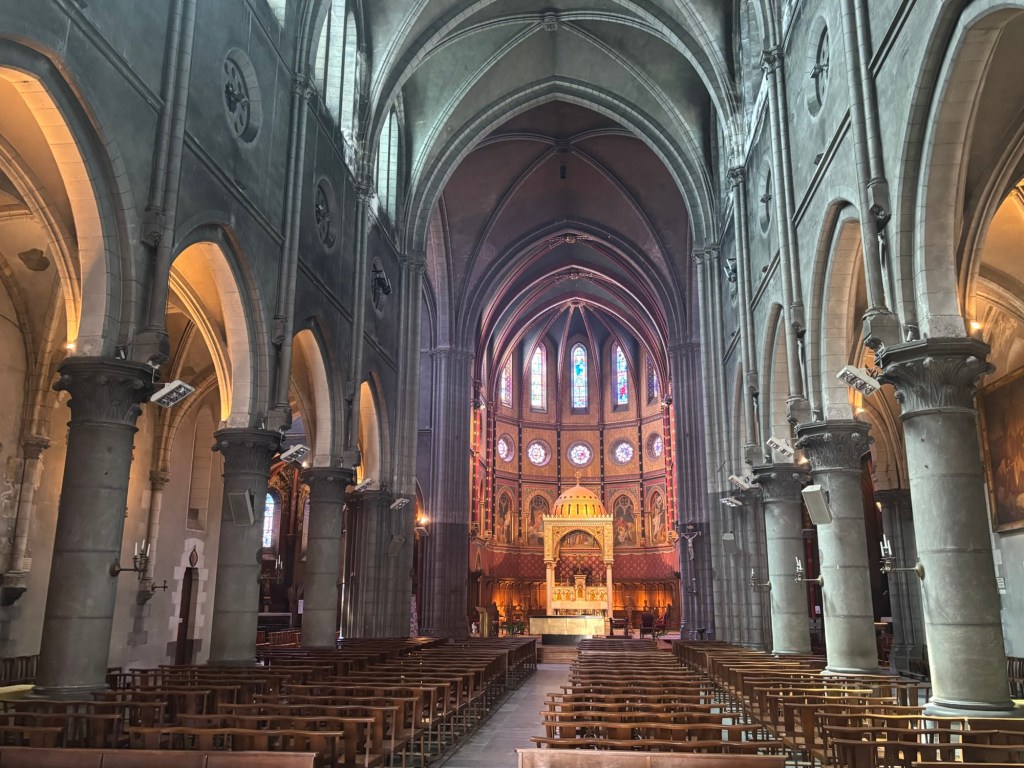
Église Saint Martin, Pau. 11.39am.
The streets of Pau are almost empty – hardly surprising, with the temperatures soaring. I found a shop selling sturdy-looking walking sticks, but they had childish carvings of lions and eagles on the top, so I passed on. New journey, new stick… but not that stick. I can wait for the right one.
I’ve retreated into the shade of the Église Saint Martin. There were two tourists wandering around, but no pilgrims – I’m not yet on the Camino. That said, I saw at least three Japanese pilgrims in the station. They didn’t seem to speak any French. If they’re still there when I get back, I’ll see if they need a hand. Lord knows I’ve fallen foul of the French train system before!
I lit the first of many candles, said my prayers in the Lady chapel and took my leave. No stamps here, but it would be disingenuous to collect any before I get to Oloron, the real starting point of this year’s Camino. All the same, I can feel my credencial burning a hole in my pocket. The stamp fever is real!
Oloron-Sainte-Marie. 14.03.
If this isn’t a heatwave, then I’ve never experienced one. The merciless sun has driven just about everyone indoors. There’s a gentle breeze coming down from the mountains, and the twin rivers of the Ossau and Aspe sure do make the place sound less hot than Pau, where the screams of swifts seemed to increase the temperature by several degrees, but there’s no escaping the fact that it is hot out here. The Relais du Bastet, Oloron’s pilgrim hospital, doesn’t open until 3pm, so I’ve grabbed a cold bottle of water from a nearby magasin and have set up shop in the public gardens, where the sound of the fountain provides a temporary relief.
I’ll have to play it carefully over the next few days if this goes on. Early starts, absolutely, but it’s how you play the waiting game when you reach your destination, as almost all albergues shut for midday – by which point you should have stopped walking, if you value your skin – that’s the real question.
No stamps yet. I guess I’ll have to wait until I check in for stamp number one.

Well – here we are. I’ve checked into the Relais du Bastet and had a shower. The daily rhythm of the Camino will be a welcome return after the madness of the summer term. Once I’ve had a rest, I’ll go in search of some more stamps. Christian, one of the two French-speaking pilgrims on the Voie d’Arles who is sharing a room with me, has offered to cook for us this evening, so that’s dinner taken care of. I’ve missed this.
À bientôt x
 The Book of Barnabas