Camino XXI: Peace and Quiet

Trying to justify this slower pace is hard, man. After two weeks of five a.m. starts, it’s a real culture shock to convince yourself that leaving the albergue after seven is an acceptable thing to do. However, if I’m to arrive in Santiago for the fireworks, as planned, I have to go at a much slower pace. The easy solution, I guess, would be stopping for breakfast for often and people watching. I suppose that’s not so unappealing an idea.

Rather than try to dogleg and catch up on yesterday’s account ahead of today’s, I’ll merge the two into one.


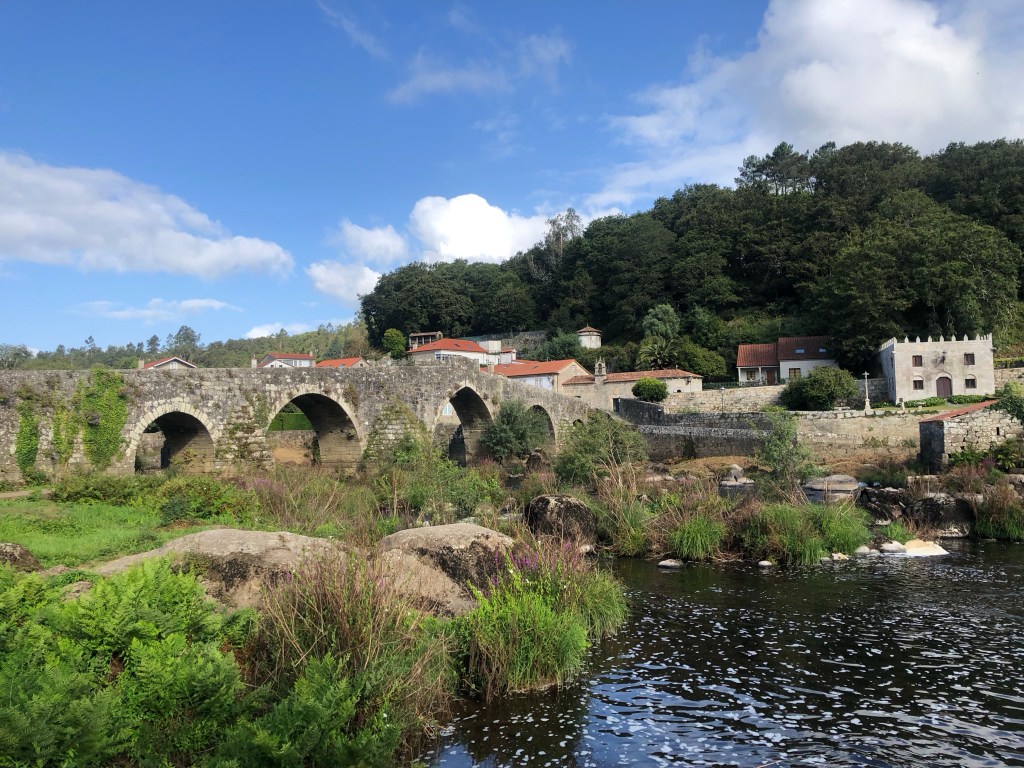
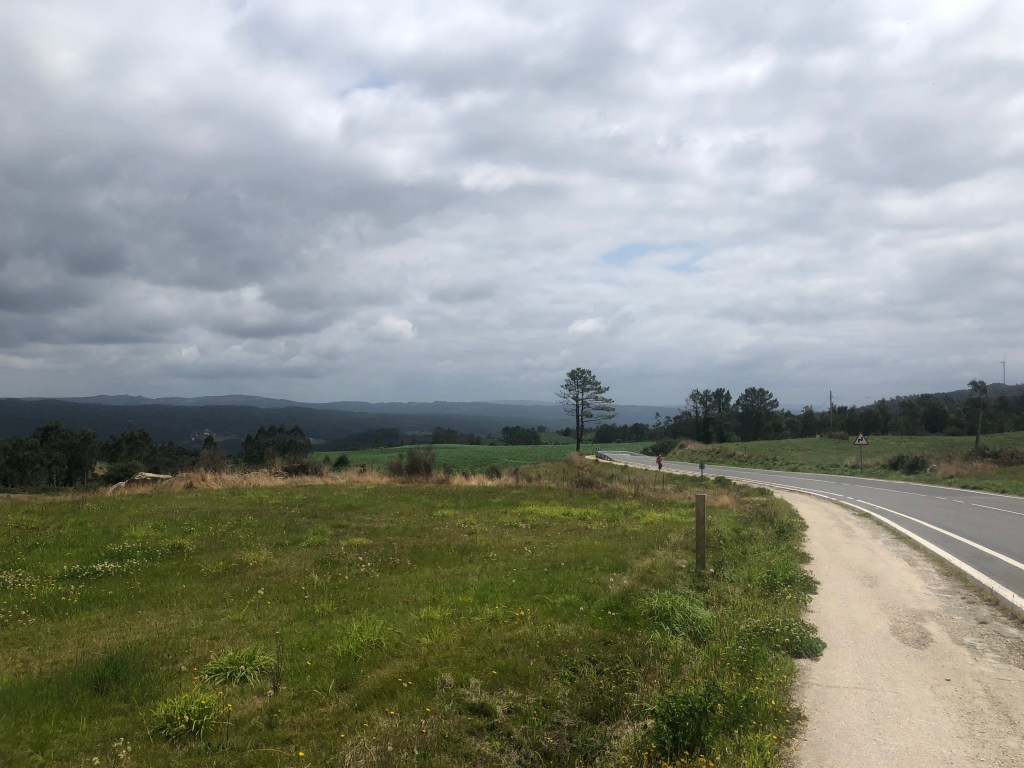
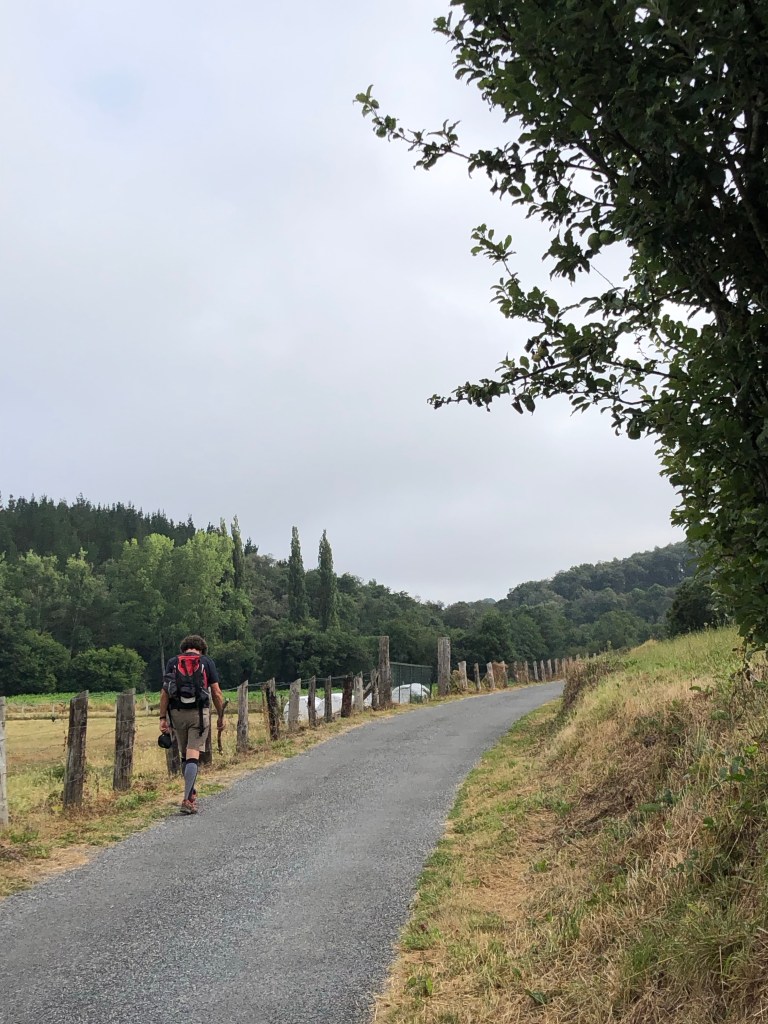
We’re into Galicia proper now. The mornings are bright but overcast and the endless horizons of Castilla y León are a distant memory in this green, wooded country. After saying farewell to Samos, the Camino led a meandering route back north to Aguiada along the Río Sarria, through forests alive with the songs of cirl buntings, wood warblers and golden orioles. I even found a stag beetle on the path at one point, but while I kept a trained eye on the river, still no otters. I guess you have to go more remote than the Camino to find them!

I made slow progress, feeling genuinely tired for the first time on the Camino, probably on account of the five hours of sleep I managed thanks to dealing with Mamasita and his drinking problem the night before. As a result I kept catching up to and being overtaken by the bell-ringing pilgrim from yesterday, whose jingling presence was practically unavoidable. An hour of it was almost maddening, so rather than keeping pace with my companions, I got back into my usual pace – and, what do you know, suddenly I wasn’t so tired anymore. Paolo was right: you really do have to go at your own speed on the Camino and nobody else’s. It’s amazing how moving slower tires you out faster.


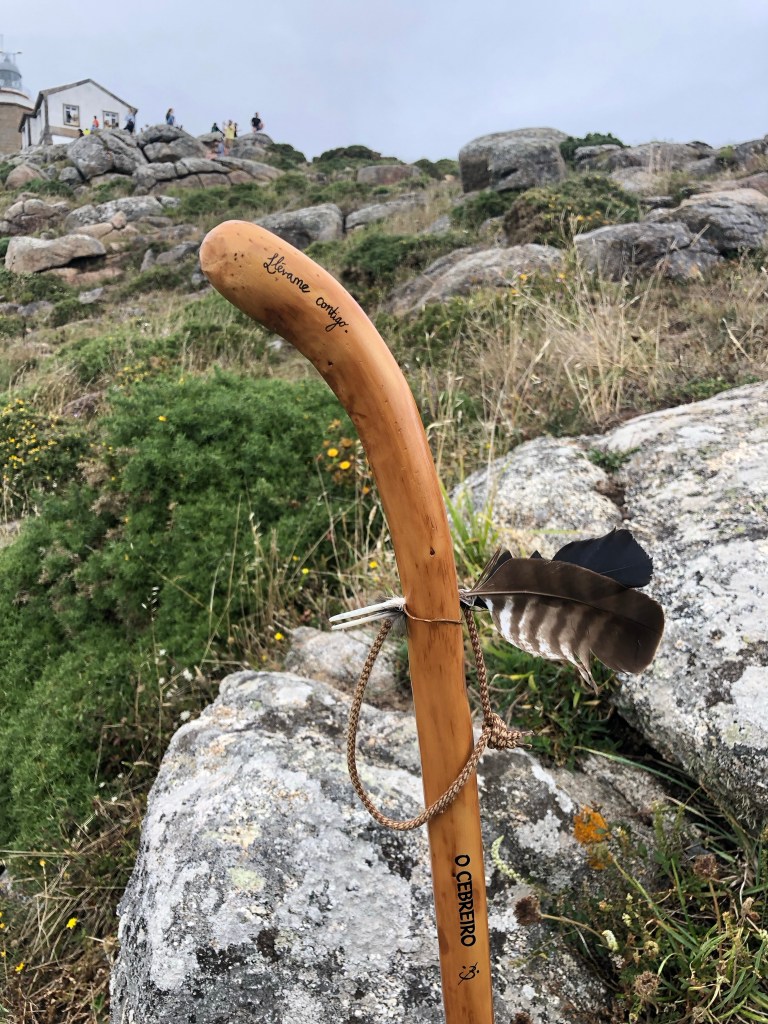
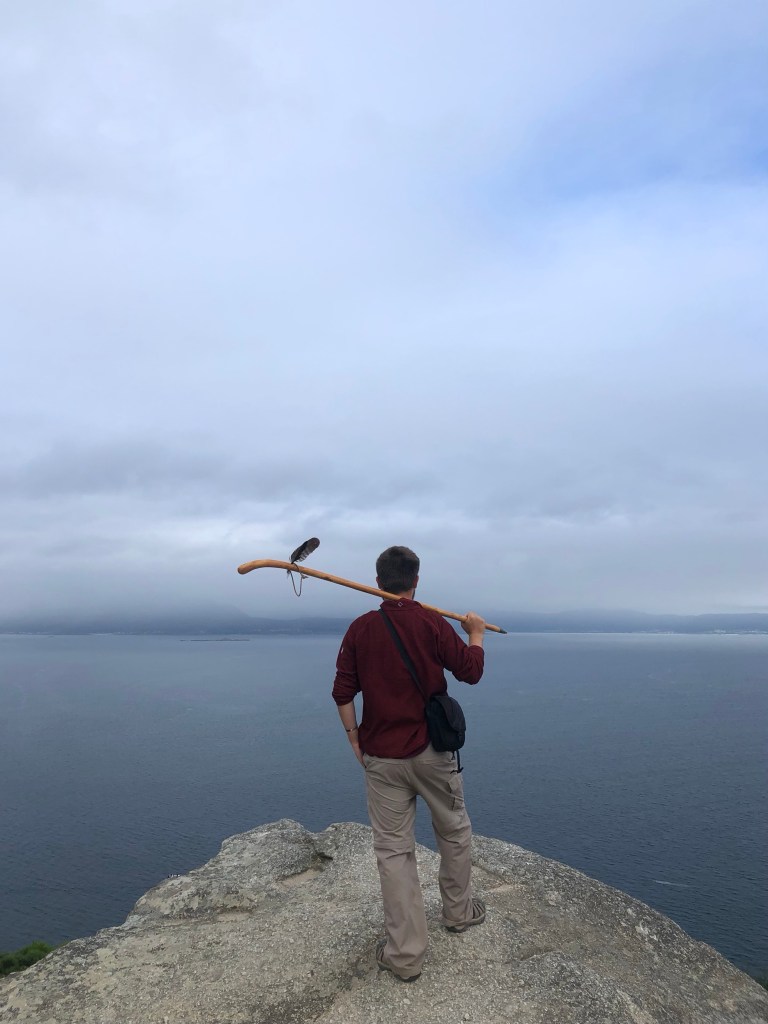
Just before Sarria, I found a single buzzard feather caught on a hedge near a farmstead. Naturally, it’s now fastened to my bastón. To quote Sweeney Todd, my arm is complete again!

Sarria itself was a much less daunting town than it has been made out to be, though that may be because the pilgrim horde had long since moved out. I picked up a few stamps and some friendly advice from the Amigos del Camino and cut right through to the countryside again.

Now, at last, I began to see the tail end of what is probably the great rush to Santiago. The dominant language of the pilgrims on the road is, finally, the same of the country itself, as Spaniards young and old (but mostly under twenty) attempt the final 100km of the Camino, easily identifiable by their fluorescent sports wear, portable speakers and undersized Quechua backpacks. I’ve had a lot of fun screwing with their expectations by responding to their cheery ‘hello, buen camino’ with a decidedly un-British ‘igualmente, chavales, ánimo’.


I had my second unpleasant encounter of the Camino in my original destination for the day, Barbadelo, where an overzealous salesmen lurking spider-like outside his store tried to convince me to buy all the pilgrim tat he thought I was lacking. After pointing out that my ‘missing’ shell was packed away as it kept rattling against my bottle (truth), and that I had already obtained two handmade rosaries from the monks at Samos (also truth), he insisted I needed a pulserita, as mine was not of the same quality as his mass-produced ‘El Camino es la meta’ bands (what does Gandhi have to do with the Camino anyway?). Since the one on my left arm was a locally crafted item from that phenomenal café in El Ganso, and the one on my right was a gift from my aunt featuring Nuestra Señora de Cortes, one of La Mancha’s most venerated icons, I begged to differ. When he tried to forcefully pin a Union Jack pin badge on my rucksack strap, he crossed a line (I *will not* be identified so stridently as a Brit, thank you) and I told him politely where to take his business and left.

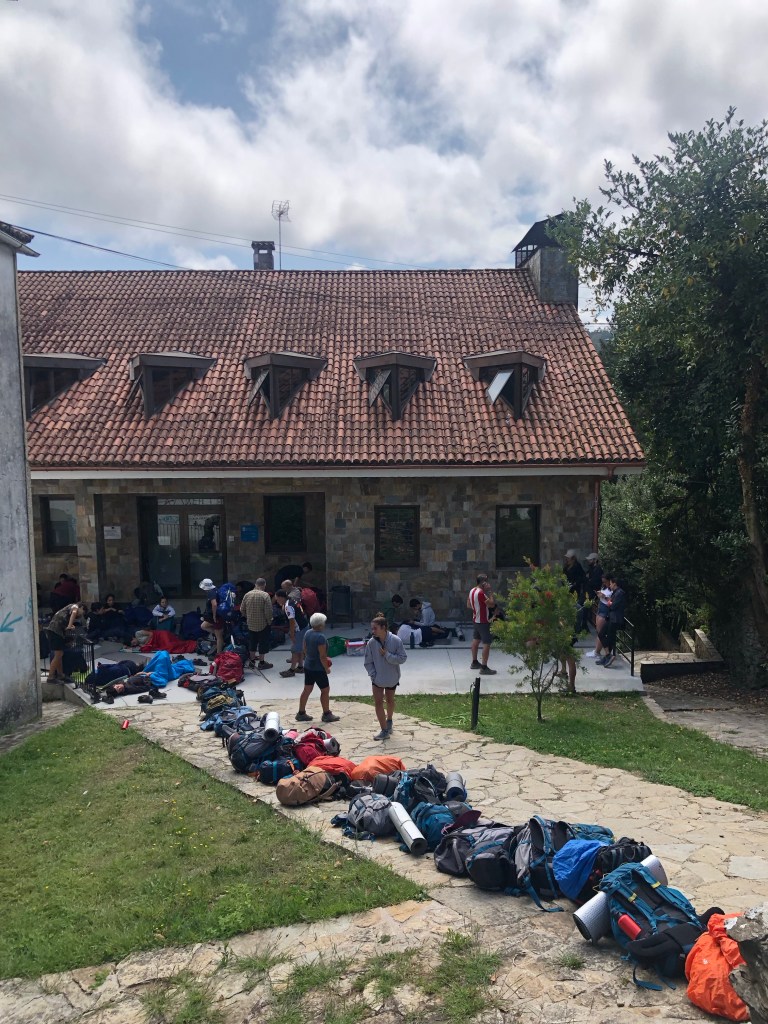
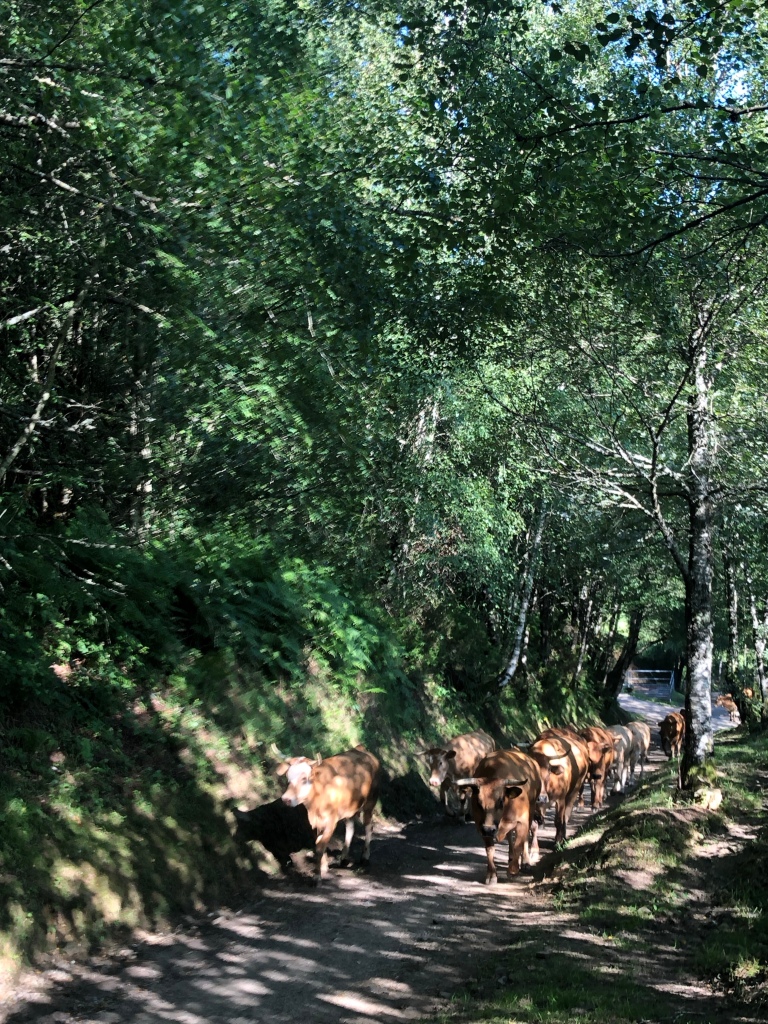
The price was a ten kilometre hike to Ferreiros, but it was worth it. I had the wonderfully tidy Xunta albergue pretty much to myself, and though the sixty-strong Scout group I passed on the road chose to camp in the woods opposite, they were from Jérez de la Frontera, which made for a nostalgic soundtrack to the evening. Dinner came with a show, too, when a local cowherd led his cattle right through the heart of their encampment, which provided some amusement!


I moved on shortly after sunrise the following morning, making the sunken village of Portomarín shortly before nine o’clock. Today I finally got a real sense of the Sarria stampede, as there was rarely a stretch of the Camino without a good number of pilgrims on the road. I shared the road with Dean, a Californian who matched my pace perfectly, at least as far as Gonzar, where I stopped to catch up with a Belgian pilgrim I’d met the day before and have a drink. The Guardia made an appearance on horseback this morning, trading their usual two-hundred horsepower Alfa Romeos for… well, one horsepower horses. But they did look a damn sight more impressive.


The Camino treks right through the ancient Iron Age hill fort of Castromaior, which is meant to be one of the most popular sights on the Camino, but the memo must have been lost on today’s pilgrims, who trekked right past it as though it wasn’t even there. Sure, it’s not as impressive as Stonehenge, but the earthworks are quite something, and as it only requires a thirty metre detour from the path, it’s definitely worth a look.


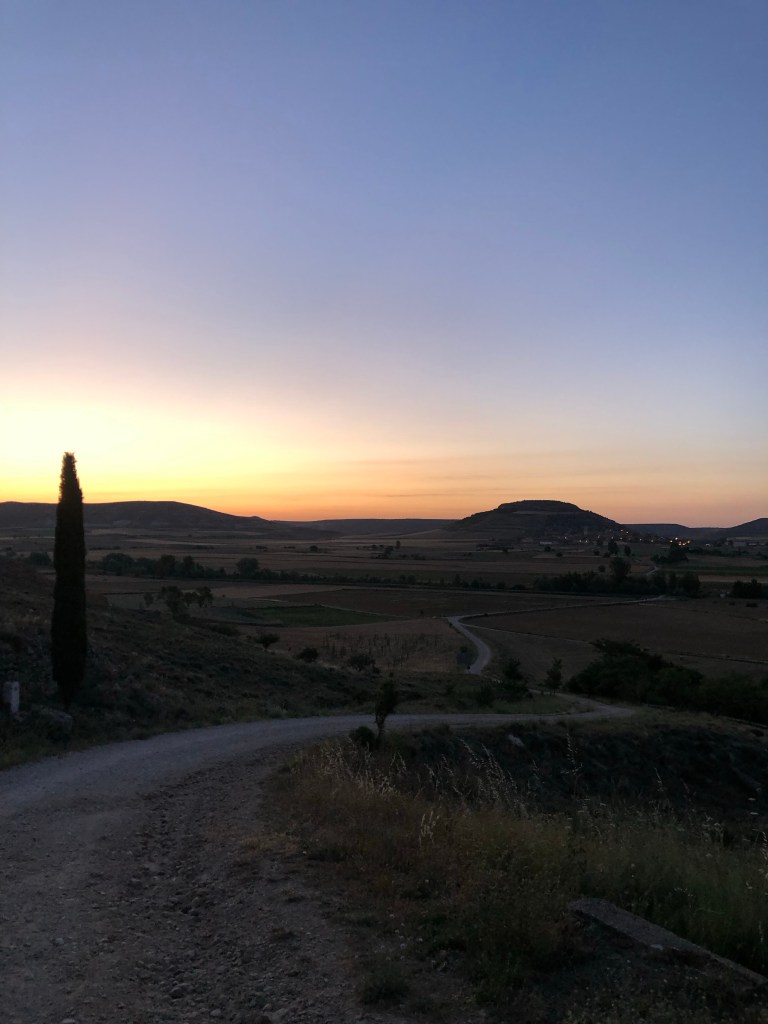
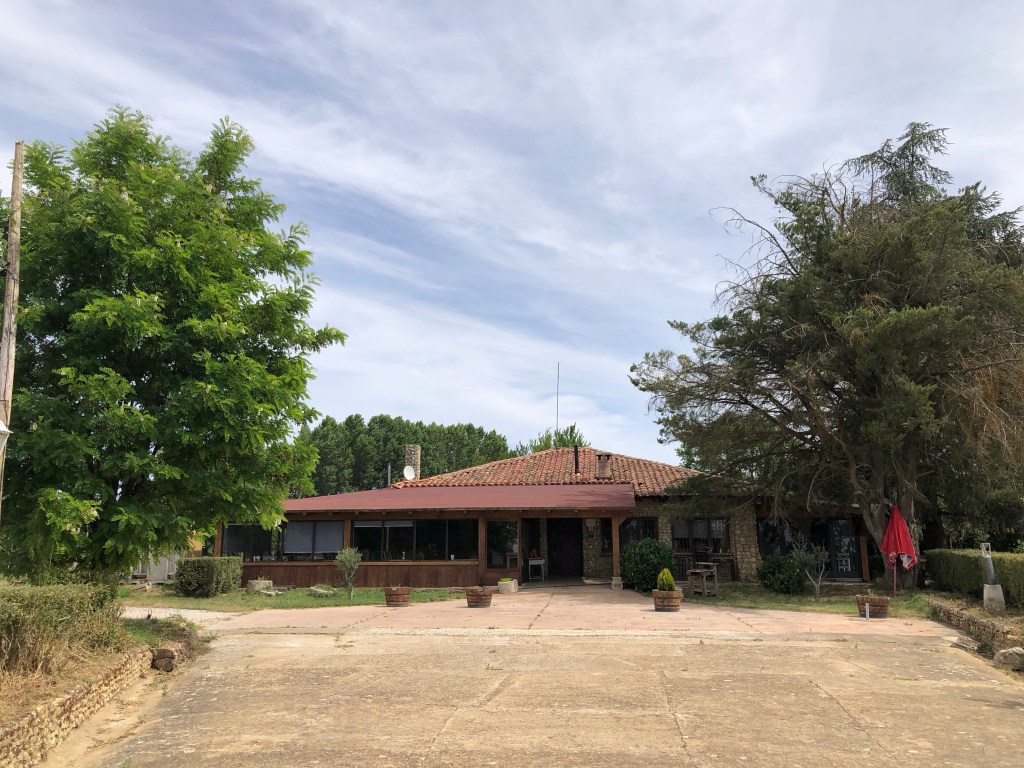
Well now, I’ve come to a stop in the hamlet of Areixe. It doesn’t have much more than a church, a restaurant and a Xunta albergue, but it’s blissfully quiet. With Palas de Rei just another hour down the road, the Sarria stampede have marched right on by, meaning I have the entire albergue to myself tonight. For company tonight, I have a small but vocal flock of chickens, a handful of locals and a toddler zooming around on a motor-operated mini tractor, surely in preparation for a life driving the real thing up and down these country roads.

The various Camino guidebooks really do dictate the fortunes of the towns you pass through on the way, pouring thousands of pilgrim pennies into the hands of those fortunate enough to live in the ‘chosen’ start and endpoints. How the villages that thread the line between them survive is anyone’s guess – especially those nearest the nuclei – so it feels good to know I’m doing my bit by staying in the quieter spots. The Sarria to Santiago stage is often touted as the busiest stretch, and while that’s certainly true when you’re on the road, if you’re brave enough to avoid the cities and stay in the villages, you’ll find the peace and quiet of the earlier stages of the Camino isn’t really as elusive as it’s claimed to be.

Though the rival roosters on either side of this albergue are a factor that cannot be easily ignored! BB x


Camino XX: Angels and Demons

It’s 6.18am on Wednesday morning. I didn’t get any time to write last night, as it was nearly midnight by the time I was in bed, for reasons which I shall endeavour to explain.


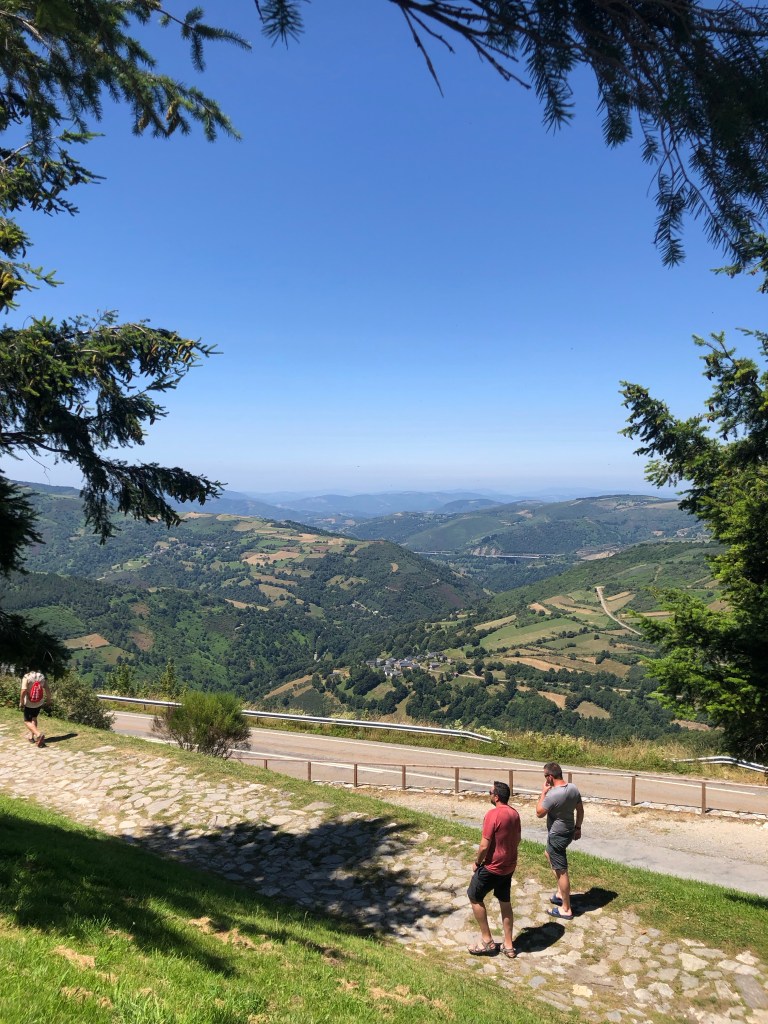
Before leaving O Cebreiro this morning, I decided to climb Cebreiro’s peak, where a lonely lichen-covered cross looks out over the layered hills and valleys to the east. It was scored up its sides with a thousand little grooves, into which a thousand small coins had been slotted. Time and the elements had worn down their edges, and some grooves were empty – perhaps the work of quick-fingered pilgrims over the years. From the summit, you can see all the way to Foncebadón, offering one final glimpse of the faraway meseta before the descent into the rolling hills of eastern Galicia.


I walked and talked a fair amount this morning, sharing the road first with Simas, then with a Catholic mother and daughter from Ohio, then with three more Ohio boys, then finally Simas again until Triacastela. Along the way we hit another Galician roadblock (read: cows), met the first of what will presumably be many school trips (this one a sixty-strong outing from Mengíbar, Jaén), and talked about American history, which is always really eye-opening when it comes from Americans themselves.


At Triacastela, after a hearty breakfast of empanada, zumo and Cola Cao, the road forked north and south. Simas and I parted ways here: he headed north and west over San Xil to the hamlet of Calvor, and I took the south road to Samos, on the recommendation of Bridgette, the Australian pilgrim I met just over a week ago.

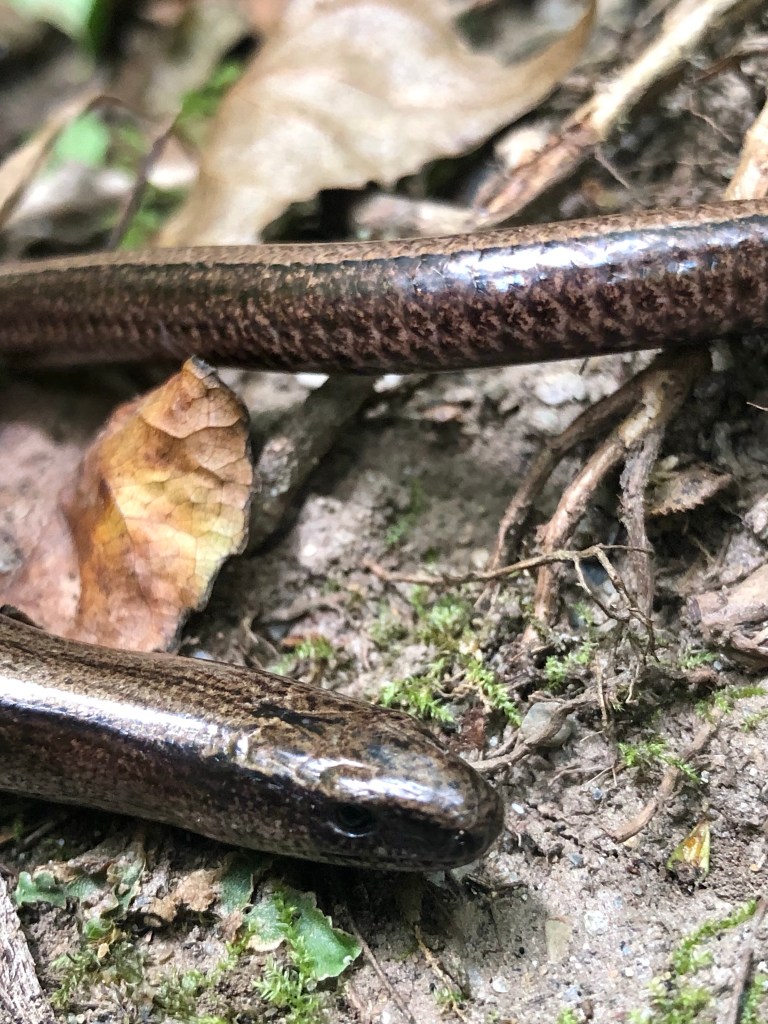
The road to Samos is beautifully remote. The Americans from lunch yesterday zoomed by on rental bikes – some calling out with a cheery buen camino, some not – but other than that I walked the road alone. Seeing as I had plenty of time, with the Samos albergue opening late, I dawdled a lot, leaving the Camino at one point to explore the woods that sloped down to the river Oribio. I had to be careful where I set down my backpack, after almost stepping on a slow worm that lay perfectly still near the riverbank. I have fond memories of finding this false-lizard on the grass-heap at home as a child, so it was nostalgic to find one here, deep in the Galician valleys.


Galicia has avoided most of the ferocious heat that is ravaging the rest of the peninsula – unlucky pilgrims at the Pamplona stage would have endured 46°C heat after midday – but the UV rays must have been just as fierce, because I definitely caught the sun before reaching Samos. However, all the prickling in my arms could not detract from the beauty of the countryside I was passing through: the tiny hamlets like San Cristovo do Real with their dragon-spine slate roofs and empty streets were like something out of a picture book of a Spain that has long since disappeared.

With the last hill before Samos in sight, the tinkling of a bell broke the silence. I overtook a Spanish pilgrim a minute or so later, carrying a stick to which a small bell was fastened, releasing a merry jingle with every step. If he’s walked all the way from St. Jean with that, he must have the patience of a saint. Or perhaps it’s a deliberate act of penance on his part.

The Monastery of Samos, my destination (and digs for the night), is a stunning jewel of the Camino and seriously worth the detour if you reach Triacastela too soon. The hospitalero, a talkative chappie from Madrid in a black triskel tee, was very friendly, apologising in his own way for the lack of traffic. ‘In July I should be turning people away,’ he explained, ‘but this year there are almost no Spaniards on the Camino, only foreign tourists. Nobody has the money anymore to spend four or perhaps even two weeks on the road.’

There’s a general election on the 23rd – you can hardly miss the posters along the Camino, as though pilgrims were a vital demographic – and I expect a change of government. In which direction, though, I cannot say. It’s an exciting time to be in Spain.

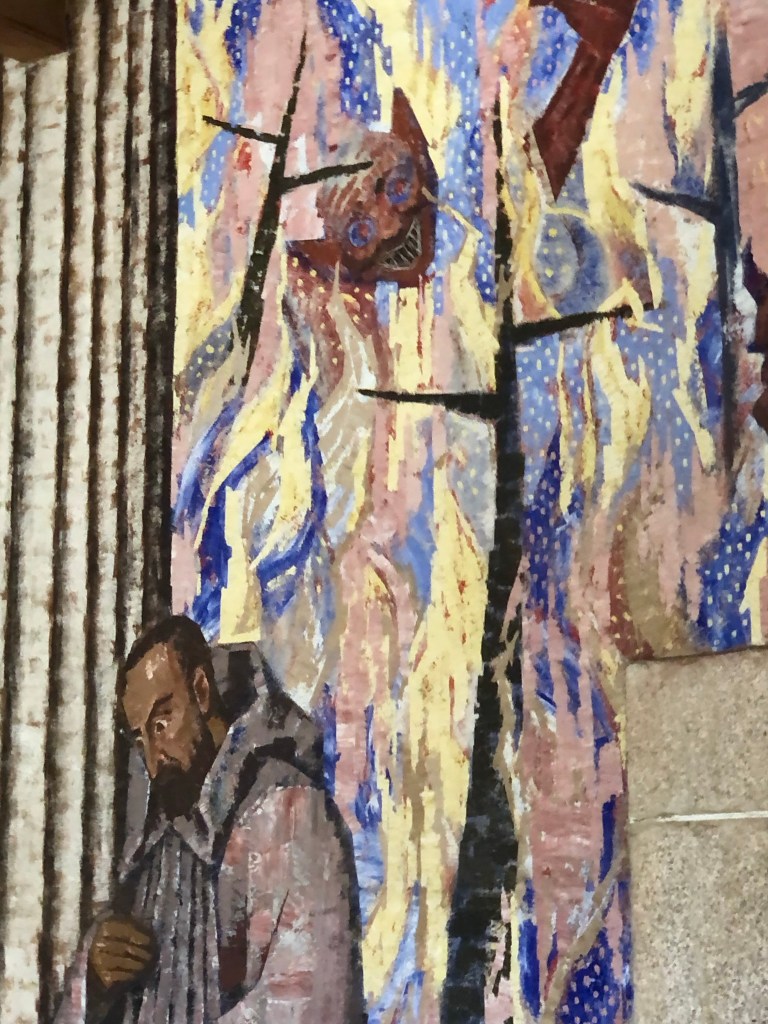
After a short siesta, I tagged along with two jolly pilgrims from Albacete and a couple of stragglers from O Cebreiro to a guided tour of the monastery, while the Chinese pilgrim and her curiously dressed German companion who arrived after me went looking for somewhere to drink. Our guide was very knowledgable and the complex was mind-blowingly beautiful in places, despite having been gutted by a fire in the early years of the last century. Like the walls of the albergue, giant paintings stretched along the corridors, depicting scenes from the life of Saint Benedict. As is often the way, the artist used the faces of contemporaries as his models. Some were local figures, some notable monks of the order, and some were members of Franco’s cabinet. Surprisingly, silver screen stars Charlton Heston and Sophia Loren even made a cameo appearance at one point!


But by far the most intriguing paintings were of the occult: devils, demons and dark spirits grinning and leering amidst the serene countenances of over a thousand years of Benedictine worshippers. There’s nothing like it in the Abbey back home, but even if there were, I’d have been just as transfixed. Isn’t there something deeply intriguing about the fascination with the dark held by those who cling to the light?


I bought a few souvenirs in the gift shop, staffed by two of the eleven monks who reside at Samos. They were pleased to hear I worked at a Benedictine school in England and we had a lovely little exchange while I obtained some homemade biscuits for the road ahead, and a new rosary for the road beyond.

Dinner at the Hotel A Veiga was sensational, and far and away the best menu peregrino I’ve had on the whole Camino, including the previous two stints this spring and back in 2018. The arroz con leche was heavenly and the churrasco (and all the sauces they brought with it) was divine. I ate better than I have in days – which is just as well, because I would need all the energy in the world an hour or so later.


When I got back to the albergue, it was already five to ten, so I packed for tomorrow and got my things ready for bed. I thought I’d pop outside and use the erratic signal (nonexistent inside the albergue) to book my flight home next week and write up my blog, and catch up with the two pilgrims from Albacete I met earlier on, but fate had other ideas.

Not five minutes after the hostalero grabbed his bag and left without a goodbye, the waiter from the bar across the road came and asked for our help: the German pilgrim was causing a scene and trying to pick a fight with the other punters. Miguel, the larger of the two Manchegos, followed her back to the bar and was back in five minutes, half aiding, half dragging the German across the road to the albergue. He was in a dreadful state, reeling and tottering in every direction, and evidently suffering the adverse affects of too much drink and too many drugs. It was all we could do to get him to sit down without falling over backwards, and he turned hostile every time he heard Spanish, making childish imitations of what he heard and bookending every line with a violently delivered ‘motherf*ckers’ or, more charmingly still, spitting at whoever spoke last. The only practical solution seemed to be to talk to him slowly in English, which he seemed to command well enough to tell us all the things he wanted to do to the waitress in the bar.

The waitress returned shortly and asked for her phone, which she had lent to the pilgrim so he could call home. He got aggressive and insisted it was his, so Miguel had to wrestle it off him. He then fell back and cursed the night sky and the three of us for about half an hour, stoping only to say the word ‘mamasita’ every minute or so, chanting it in a suddenly calm and lobotomised voice as though in a trance.

Eventually, Miguel and I decided the safest place for him was his bed. I prepared a bed for him at the other end of the room, right next to the bathrooms, while Miguel and Diego hauled him to his feet and carried him inside. Between the three of us we got him to the bathroom and stood by for ten minutes to make sure he didn’t hurt himself, and then managed to get him into bed, from which – mercifully – he did not get back up.

Ten minutes later, the unexpected arrival of two locals from the petrol station that is curiously twinned with the monastery almost undid our hard work, when they tried to fix the adjoining door to the garage by slamming it to several times, unaware or uncaring for the sleeping pilgrims just a few feet away. The German swore loudly after every bump in the night, until sleep finally found him – and turned him into a human onboard motor, snoring loud enough to wake the whole monastery, if not just the room in which he lay.


But now I must put down my phone and set out. It’s going to be busy from Sarria onwards, and the sun is already high in the sky. Until next time! BB x

Camino XIX: Over the Border

Well, here I am in Galicia, just about the only part of Spain that isn’t suffering the ferocious heatwave that is sweeping across Europe right now. With temperatures soaring into the 40s in a red wave from Madrid to the south, I’m more grateful than ever for the merciful Atlantic winds that keep Galicia fresh and green. Santiago certainly picked his spot with Spanish summers in mind…


I didn’t sleep much last night, though I must have dreamed a fair amount. I’m pretty good at waking myself up on command, because I knew I needed to be up in time to charge my phone (the sockets were all in use when I got back last night) and lo and behold I was up without provocation at two in the morning.

I’m already used to functioning on less sleep than is healthy from my work in a boarding school, so when five thirty came around I was already on the road. The vending machine gobbled up my euro and gave me a self-satisfied LISTO! when all it gave me was a plastic cup and a deceptive whirr that most definitely did not produce any hot chocolate… but, serves me right for using a vending machine.

I was sorely tempted to join the less than 1% of pilgrims who take the Dragonte route up through the mountains this morning, but as yesterday was a Sunday, I hadn’t been able to buy supplies, so I chose caution over valour and took the basic route. If I’d had my faithful stick I might have chanced it, but… it is what it is.

I did, at least, have the sense to stop for breakfast at a bar in Trabadelo, where the tortilla was decent, the napolitana was delicious and the Cola Cao was divine.


I’ll say this much, it might be the basic option, but it’s a lot better a route than it looks. On a map it seems to follow a road almost all day, which it does, but with the construction of the A-6 Noreste motorway, pretty much all the traffic took the high road, leaving the Camino almost devoid of cars. And since even the sight of a car at the moment makes me think of the intensive course that may or may not be coming my way when I get back (it’s proving hard to find an instructor who’s free), that was some relief!


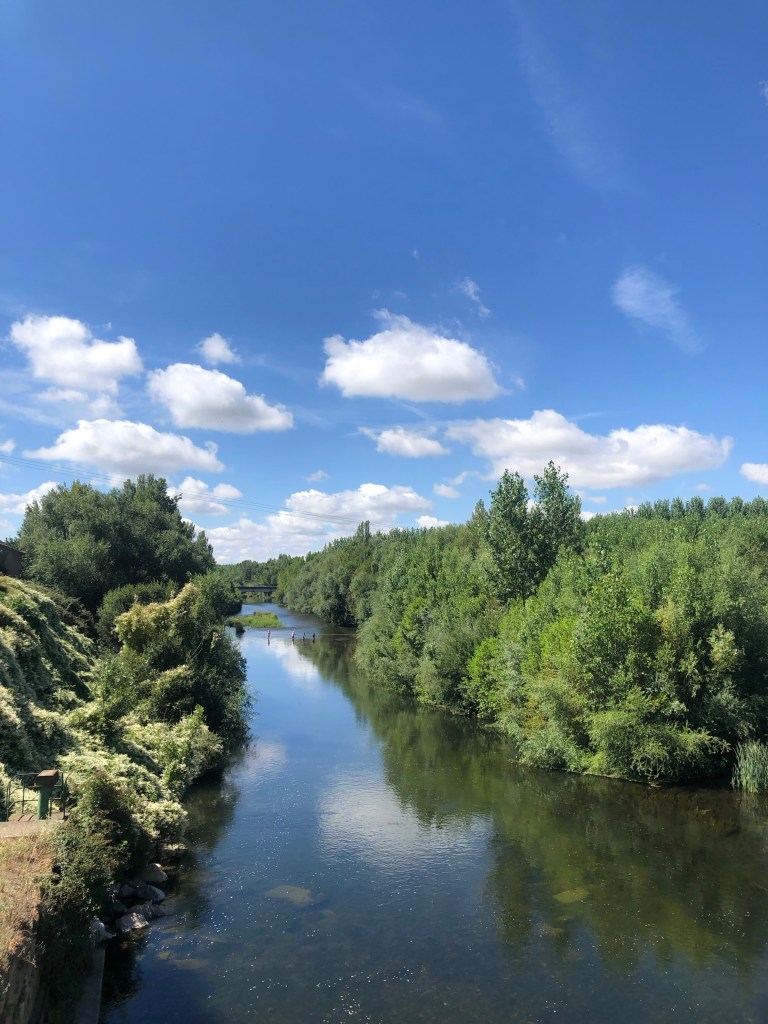
The Valcarce river flows alongside the Camino for most of the route, providing a gurgling backdrop to the walk. I kept my eyes open for otters, which are sometimes seen in the river, but I didn’t see any. I did see the other thing I was looking for though: a dipper, just as I left the road at Las Herrerías. The characterful little things are a feature of most highland rivers in Spain, if you keep an eye out for them.

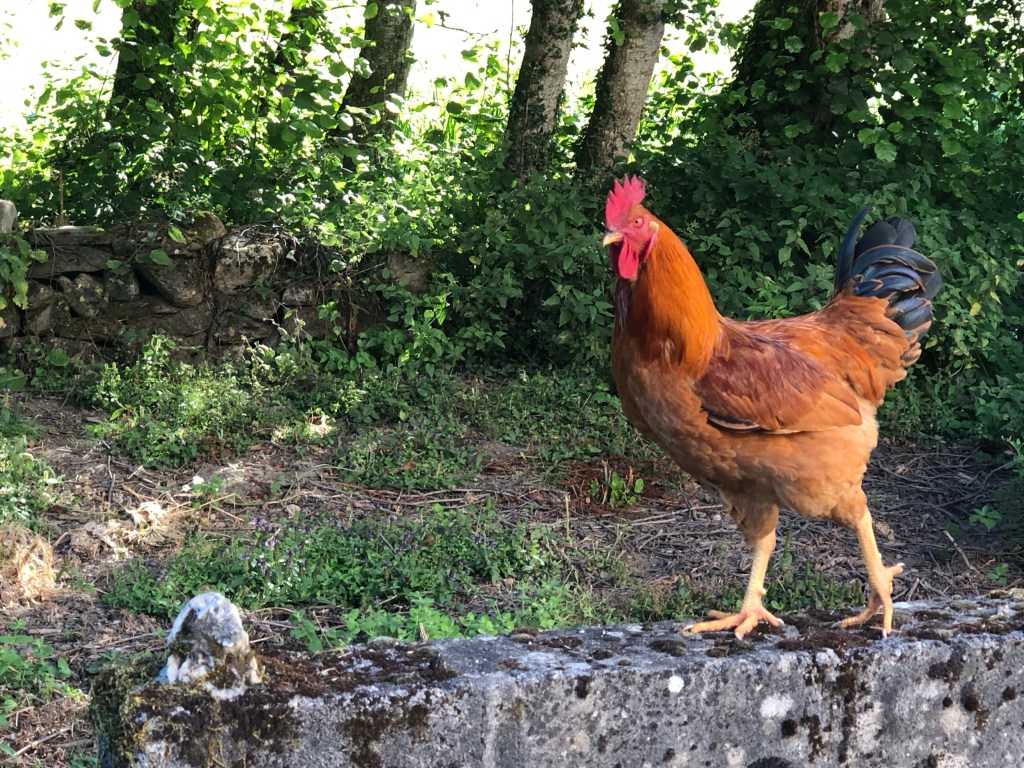
It wasn’t easy to catch on camera, but I found considerably more willing subjects in a gang of long-legged Spanish chickens further up the road. The way they were going, they looked as though they might have been making the pilgrimage themselves! Though I was briskly disillusioned when the rooster started sizing himself up to me, squaring off like a boxer in a title fight. Feeling a hard pass on letting him test his spurs on me was a good move, I left them be.


After the picturesque village of Las Herrerías, the real challenge begins. A 600m climb and then some stands between you and O Cebreiro, the first town beyond the border, and boy are the first few hundred metres a challenge. Thank God I played it safe this morning and took the easy route! It’s a beautifully forested climb, but a climb all the same…


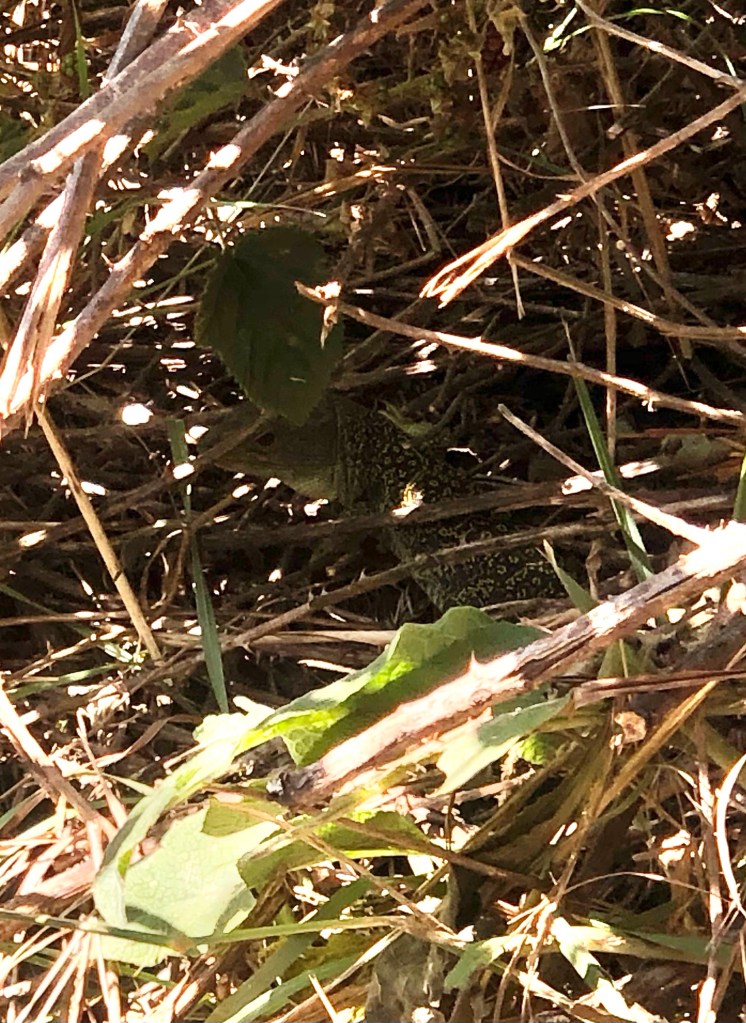
After La Faba (where the fountain water is so deliciously cold that my bottled water needed jettisoning immediately) the Camino climbs ever higher through one last stretch of forest and then up into the sunlit highlands of Castilla y León’s final outpost. I must have gone on ahead of the others, because I only passed a few intrepid pilgrims up here. It might not have been heatwave material, but the sun was high up by this point and the lizards were out, including the giant green occelated kind that used to fascinate me as a kid. Most of them were well under cover before I saw them go, but one lingered long enough for me to see where it was hiding. Can you see it?


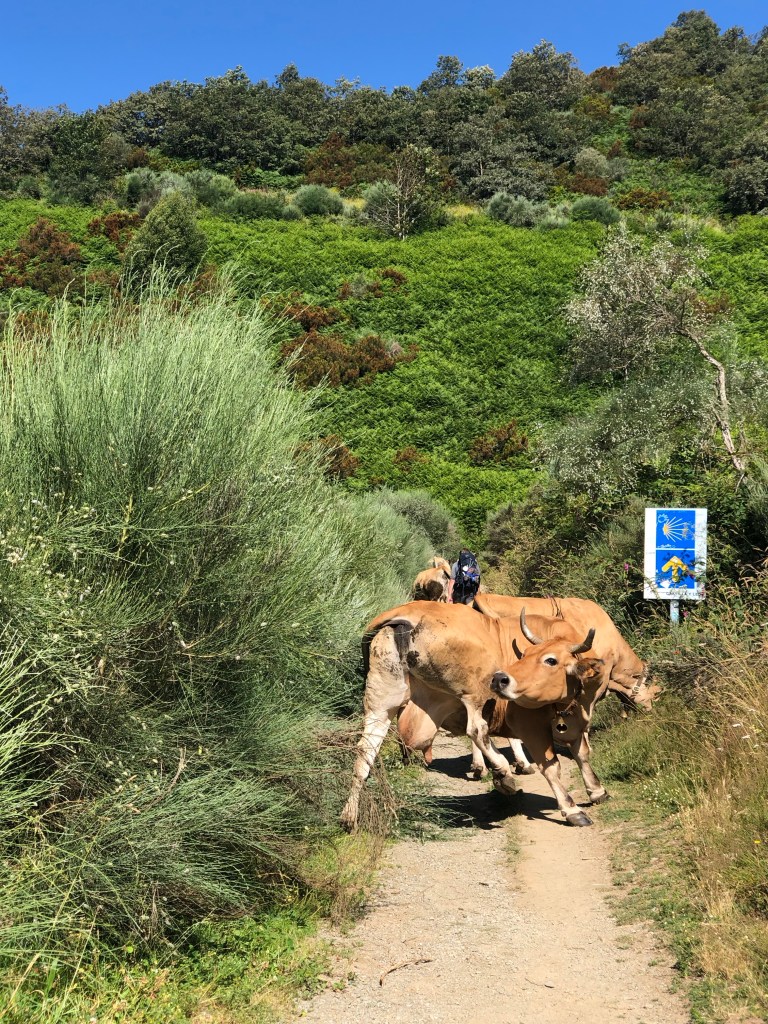
La Laguna was little more than a cluster of farm buildings, and after that it’s only a few more hundred metres up to the border. I did have one unexpected roadblock in the form of a wayward herd of cows, whose youthful cowherd was desperately trying to coax away from the path. The cows had other ideas, and it took a few minutes to get by.


A colourful stone statue marks the border. Now I’ve set foot here in Galicia, there are only two comunidades autónomas left in Spain which I haven’t explored: Murcia and the Canary Islands (assuming one doesn’t count the Moroccan enclaves of Ceuta and Melilla). I almost stepped on a stoat that shot out of the verge on the final climb up to O Cebreiro, and while it was much too fast for a photo, the views from the top of the mountain absolutely screamed for one – or several.


I managed to beat Google’s initial suggestion by forty-five minutes, but since the albergue didn’t open until one, I had a sitting nap and waited – my feet were just dead.

I had lunch with a random assortment of new pilgrims, mostly Americans, in a hotel-restaurant-giftshop affair. How to put it politely… I’ve had more tolerant company for lunch. Most of the Americans I’ve met abroad have been the most refreshingly open-minded and charismatic characters I can recall. This bunch were memorable only for their moans. Two of them were off on one for the full hour about how rude the Spanish are, slating the food, the service and the hostaleras, all while unironically claiming their status as Americans entitled them to fair treatment.

I excused myself to go to the bathroom. I paid my fare and apologised to the chef. I did not go back.

Fortunately, my faith in America was restored by the welcome return of a meseta pilgrim, Simas. A chat over a half pint with another open-minded pilgrim was just what the doctor ordered. Bumping into two more Catholic Americans while paying the bill was an added bonus.

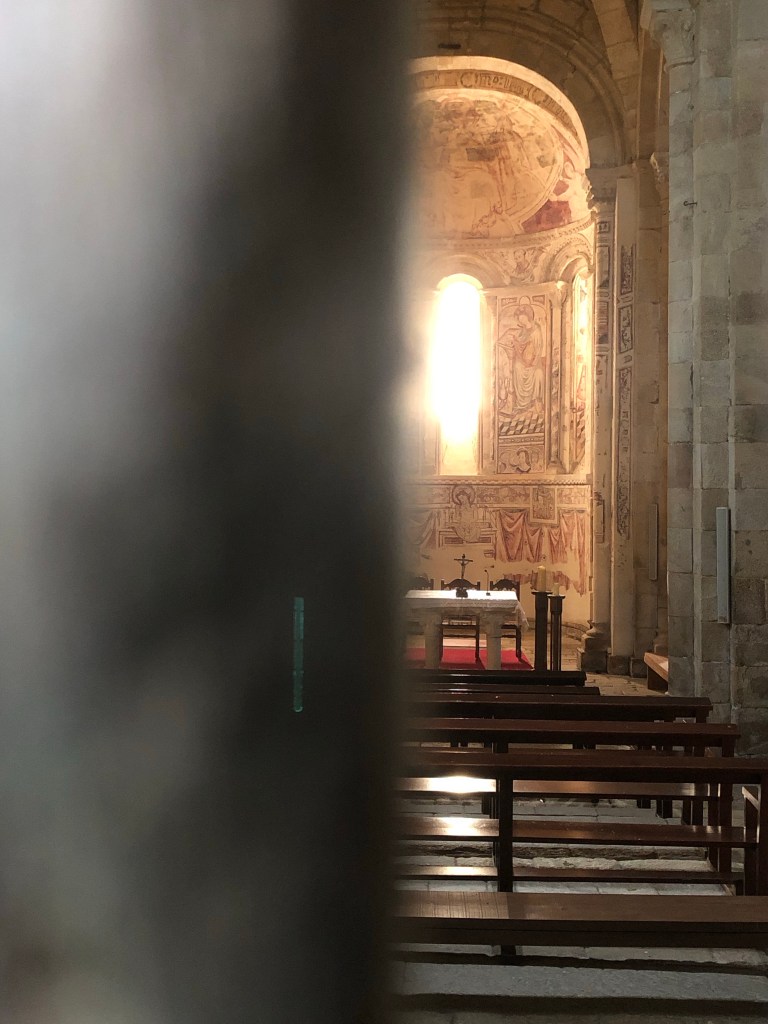
Mass in O Cebreiro’s 6th century church was really special. The priest spoke from the heart, juggling several languages throughout, and blessed us all with holy water and words of power. At the pilgrim’s benediction at the end, I volunteered to read the closing prayer when an English speaker was required. Perhaps I just wanted to read a prayer for my fellow pilgrims, or perhaps it was a subconscious dig at the fact that, Americans aside, there was only one inglés in the room. (If that was it, God, please forgive me that little victory!)

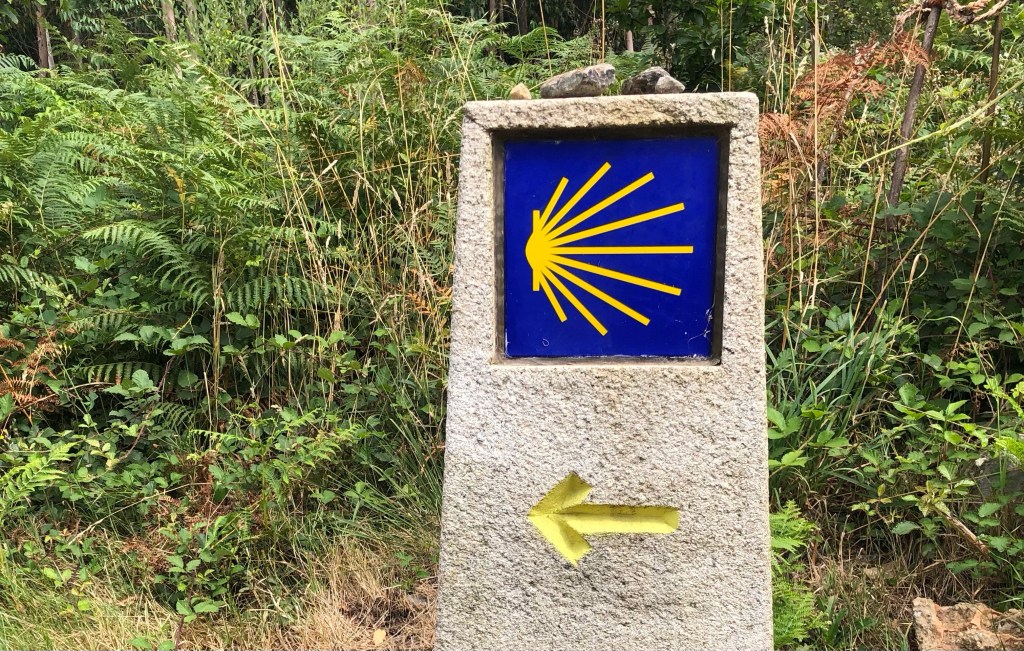
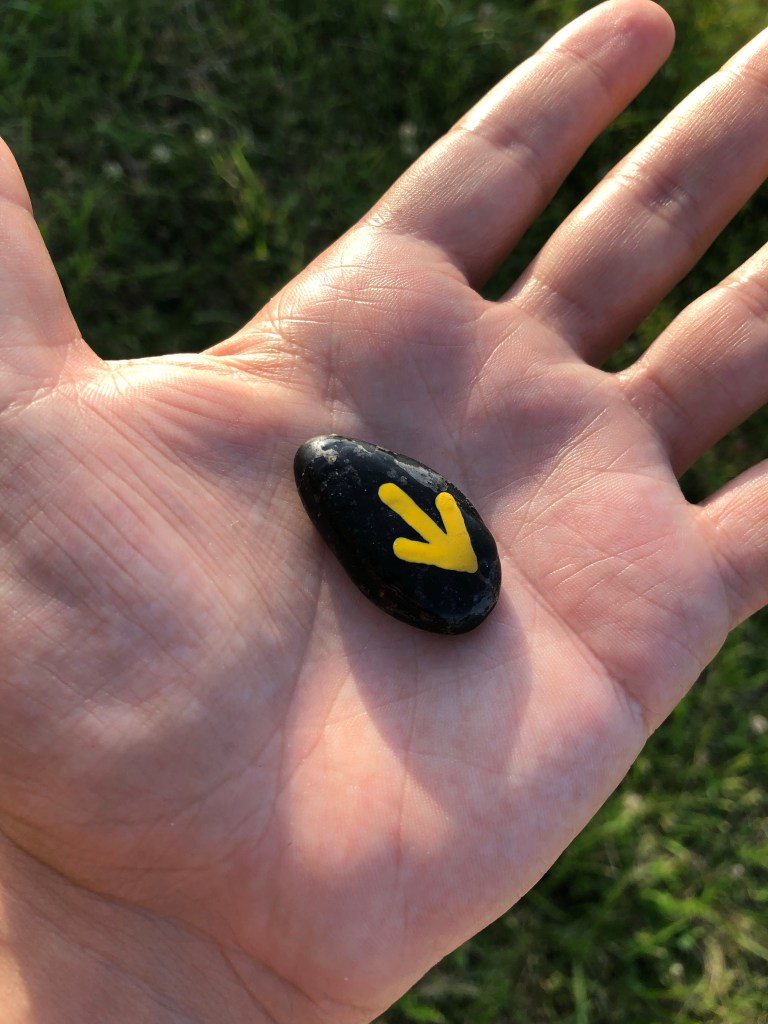
As a parting gift, the priest gave us each a little stone with the yellow arrow of the Camino. I’m holding mine now, its tiny yellow arrowhead forking through my fingers to the northwest.


Now I’m watching the sun set over the rolling hills of Galicia. It’s been a long day, but a good day. Simas and I will make for Triacastela tomorrow, while others shoot for Sarria in a mad rush to Santiago. Here’s to eveybody’s journey – may they find what they’re looking for! BB x


P.S. I have a new stick!!! (It was only 10€ and after today I’m not chancing the last 140km without one!)

Camino XV: Shaman

León is already a distant memory. I’m sitting in the shade of an awning in the garden of the albergue parroquial, having just spent a blissful twenty minutes with my feet in the foot-bath. The meseta stage is almost over and the foothills of the Montes de León are but a day’s walk away. Change is coming!


I slept very well last night, though perhaps because I wasn’t one of the Italians who tried to have dinner at the hostel ten minutes after lights out, incurring the wrath of the hostalera. All the nearby sockets were in use, so I had to leave my phone to charge down the hallway, which deprived me of an alarm for the morning… but, if the last few days are anything to go by, you hardly need an alarm on the Camino. You might just as well use the fifteen others that go off around the same time.

I was out the door by 6am and racing back to Plaza Santo Domingo – and with good reason. After yesterday’s mindless urban trudge into the city, I found a way to circumvent León’s even more extensive westward sprawl: the A1 city bus to La Virgen del Camino, on the very edge of the city outskirts. Thirty years ago I might not have bothered, but I couldn’t quite face an hour and a half’s march through characterless modern development, so I was more than happy to stump up the 1.60€ fare and rub shoulders with the orange-tee brigade of SOLTRA workers headed for their 7am shift in La Virgen. Two other pilgrims were in on the secret, but I lost them a short distance out of town when they stopped to check their bags. From then on out, I barely saw another pilgrim for the rest of the trek.


After yesterday’s easy 19km wander, I opted for the alternative scenic route via Villar de Mazarife. The original Camino follows the N-120 in an unbroken line for 32km, while the Mazarife road winds its way through the countryside to the south for 36km. I was up for a challenge, and I didn’t fancy another roadside walk, and for once, I know I made the right call.

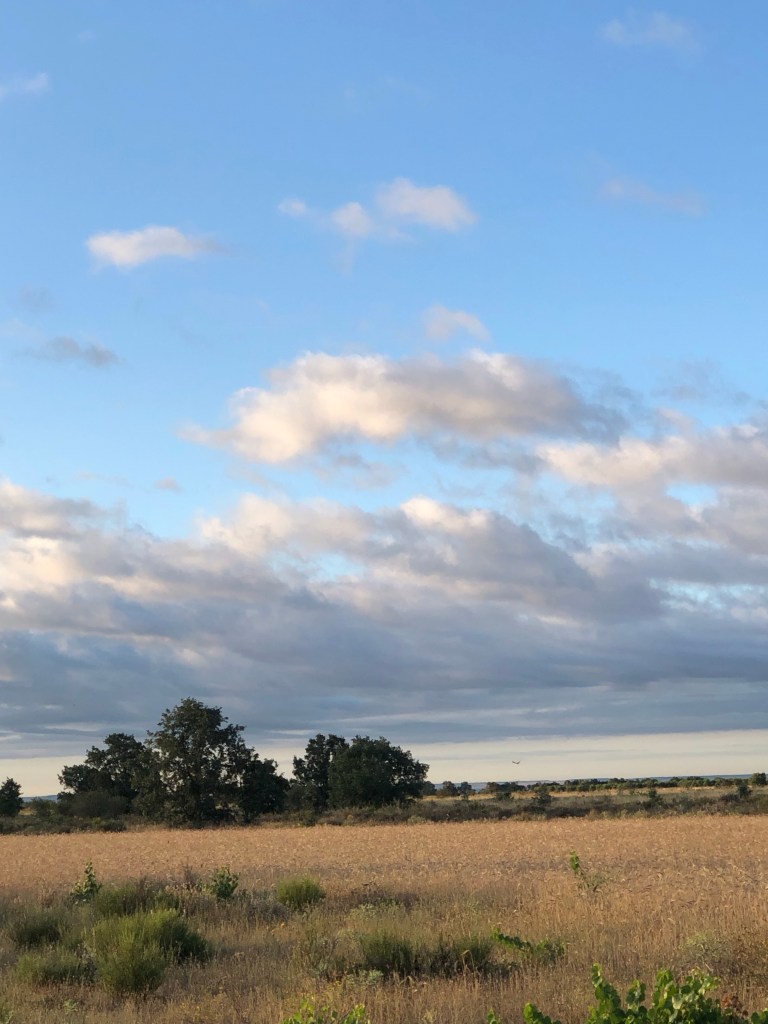
Southwest of León, the Camino carves a path through the scrubbier hinterlands of the Meseta. Fields of wheat and sunflowers give way to open dehesas, with sparse yellow grassland interspersed with stands of ancient oak trees. In a way, it felt like being back in Extremadura.

Better yet, the first hour after sunrise yielded some of the best birdwatching yet on the Camino. The usual backdrop of quail, turtle dove and stonechat provided some musical continuity to the meseta movement, with a colourful inclusion of golden oriole, blackcap and nightingale. There were quite a few kites about, whistling in that very plaintive way they do, and the calls of bee-eaters will never fail to make me smile. While I can also add great grey shrike, honey buzzard and whitethroat to my list this morning, I think it was the fleeting encounter with a greater spotted cuckoo that was the standout from today’s walk, tearing ahead through the scrub in front of me as I neared the first town on the trail, Chozas del Camino. As usual, a phone camera is next to useless for this kind of thing, but I did manage a snap before it was gone (look to the right of the second tree from the left).


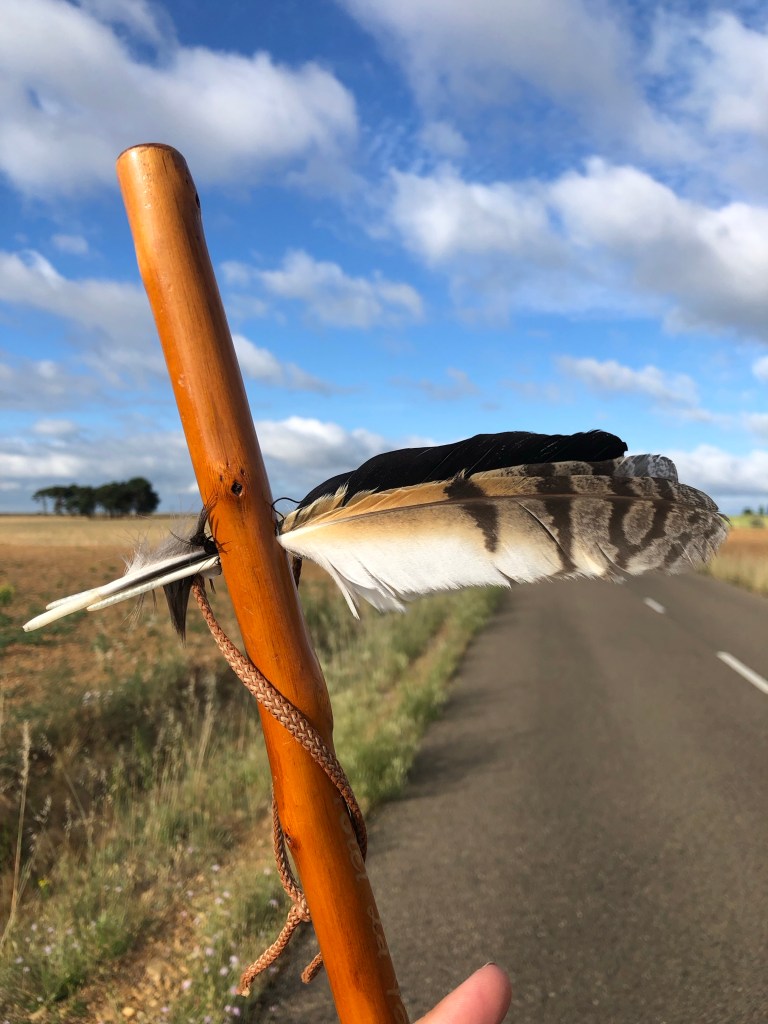
After narrowly avoiding a major desvío at Chozas, I followed the road to Mazarife for the next hour or so. Along the way, sensing rather than smelling death, I guess, I came upon a mass of feathers at the side of the road. On closer inspection, it was a long-eared owl, and a relatively young one at that. Given its condition, it must have been hit by a car less than a day ago, or else it would have been devoured long since. Acting on an intuition beyond simple curiosity, I picked up two of its wing feathers and fastened them alongside the raven feather to my staff. Besides the fact that owl feathers are one of nature’s most intriguing artefacts – they are engineered to move silently through the air – I think my desire was to give the unfortunate creature (a migratory species in most parts of Europe) one last journey, as it were. I will carry them to Santiago and Finisterre… and beyond, if I can.

With a feathered staff and a satchel full of pens, pencils and sharpenings, I’m rather conscious that I’m starting to take on the appearance of a tin-pot shaman. My silent reasoning that ravens represent life, light and hope (they brought the knowledge of fire to man in Scandinavian mythology) and owls death, darkness and wisdom (via the Greek tradition) probably doesn’t help, either. I’m still searching for a stork feather, though despite their abundance, these are proving hard to find.

All I can say is I had this coming. In my first teaching post in Uganda, I was given the moniker ‘Ojok’, meaning ‘healer’ or ‘witch doctor’. It wasn’t anything more than an attempt at humour by my hosts, but hey, I guess such titles should be earned, right?


From Villar de Mazarife, one of the straightest roads of the entire Camino leads for some ten kilometres to the hamlet of Villavante. With the exception of the occasional buen camino from a field worker clad in orange hi-vis overalls, and the need to duck and weave to avoid the mechanical water jets every now and then, it was a fairly uneventful walk, but a beautifully quiet one at that.


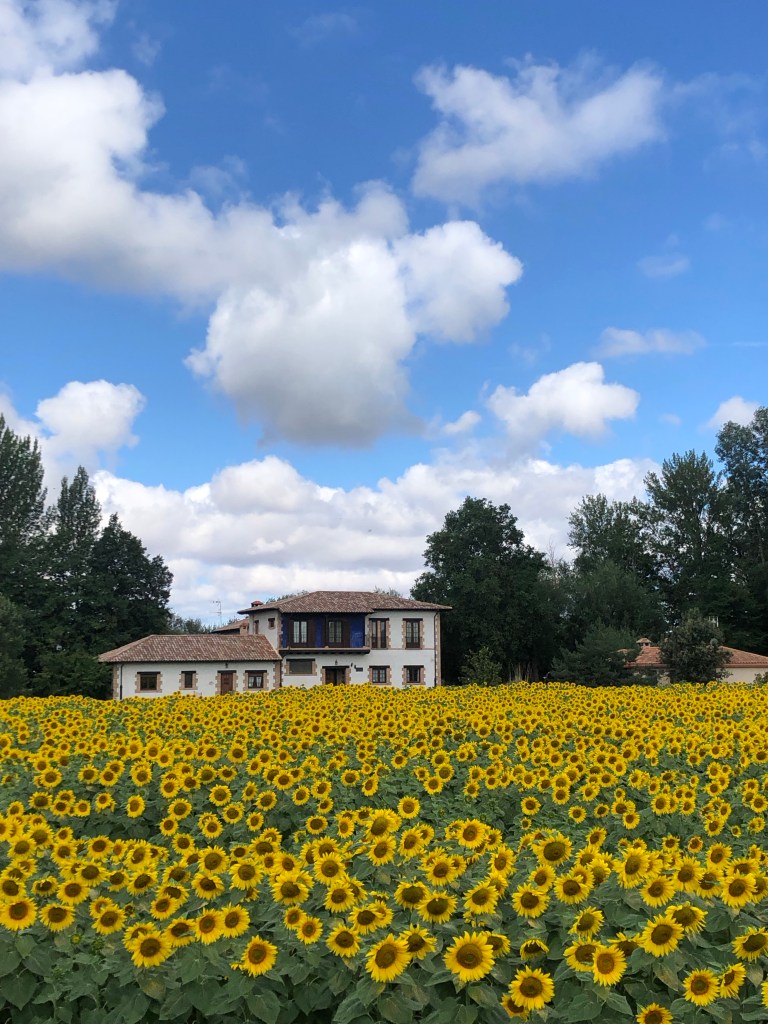
At Villavante, the Camino forks to the north to cross the León-Astorga railway line. It’s practically worth the trek for the view of the Casa Rural Los Molinos, nestled behind what appears to be a private tree-lined sunflower grove.


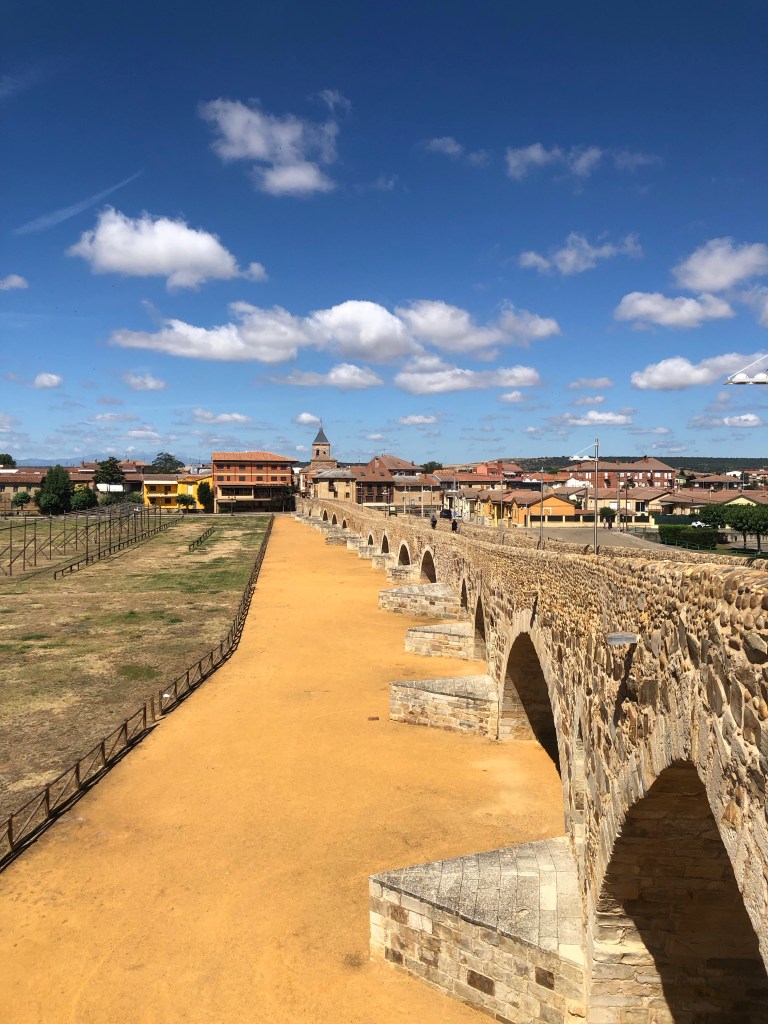
After that, it’s only a short distance to Hospital de Órbigo. It’s a good-sized town and, at 12pm on the dot and after nearly five hours’ walking (with a sum total of fifteen minutes’ break), I was more than ready to throw down my pack for the day. The entrance to the town over the medieval Puente Honroso (which I’m 90% sure featured in my dissertation) simply sealed the deal. This place is incredibly beautiful.


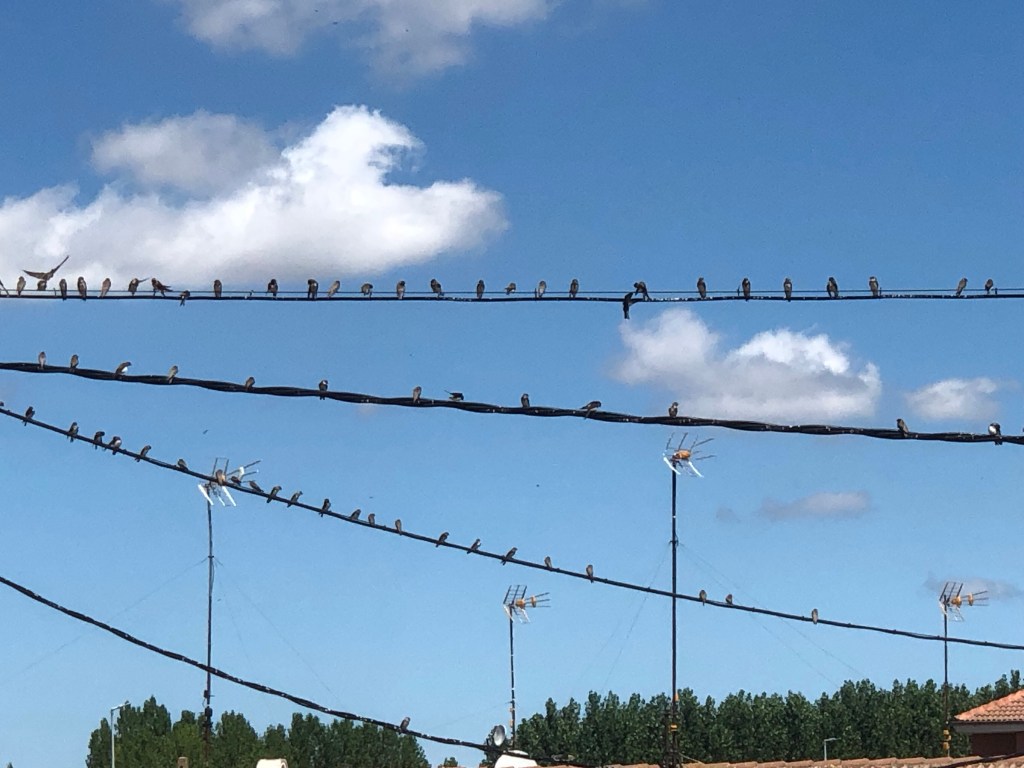
It’s said that a certain Don Suero, a local knight, challenged all comers to the bridge to win the heart of a lady, breaking 300 spears in as many jousts before an ever-growing crowd. The lords, the ladies and the medieval gaiety may be long gone, but the endlessly chattering sand martins lined up along the wires by the bridge make a good substitute.


Well, there goes my siesta. Tomorrow is a much shorter walk – three and a half hours at most – but I hear there’s a thousand-year-old oak tree near Santibáñez de Valdeiglesias, so I will extend my walk to take a look. Now I have the trappings of a new age shaman, I might as well play the part. BB x
Camino XIII: Birds of a Feather

I’ll say this much for Calzadilla de los Hermanillos: it’s a beautifully reflective way to end the meseta experience, before you say farewell to the plains and reach the Órbigo floodplains at Mansilla de las Mulas. Sure, I ditched the other pilgrims to strike out upon that road, but it was totally worth it.


The hostalera in the donativo laid out a real spread for breakfast, so I helped myself to a better start than I’ve had in days: boiled eggs, yoghurt, pastries, flat peaches, cherries and a sandwich and a half for the road. Fuelled on such a feast, I was more than ready to tackle the Roman Camino.

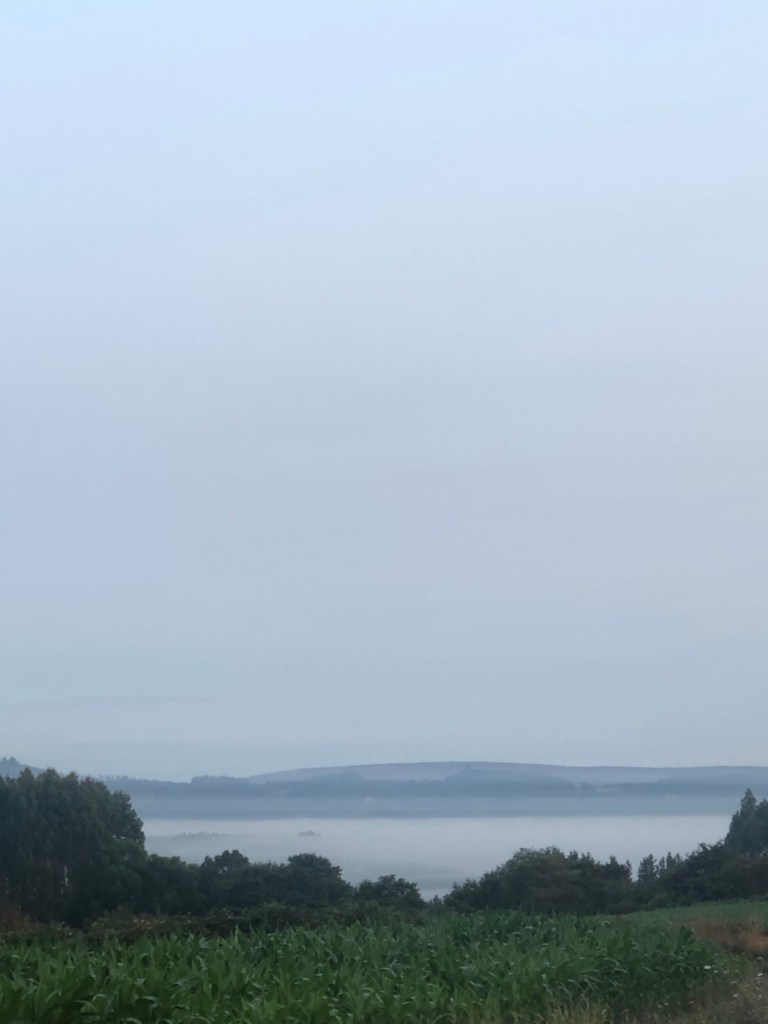
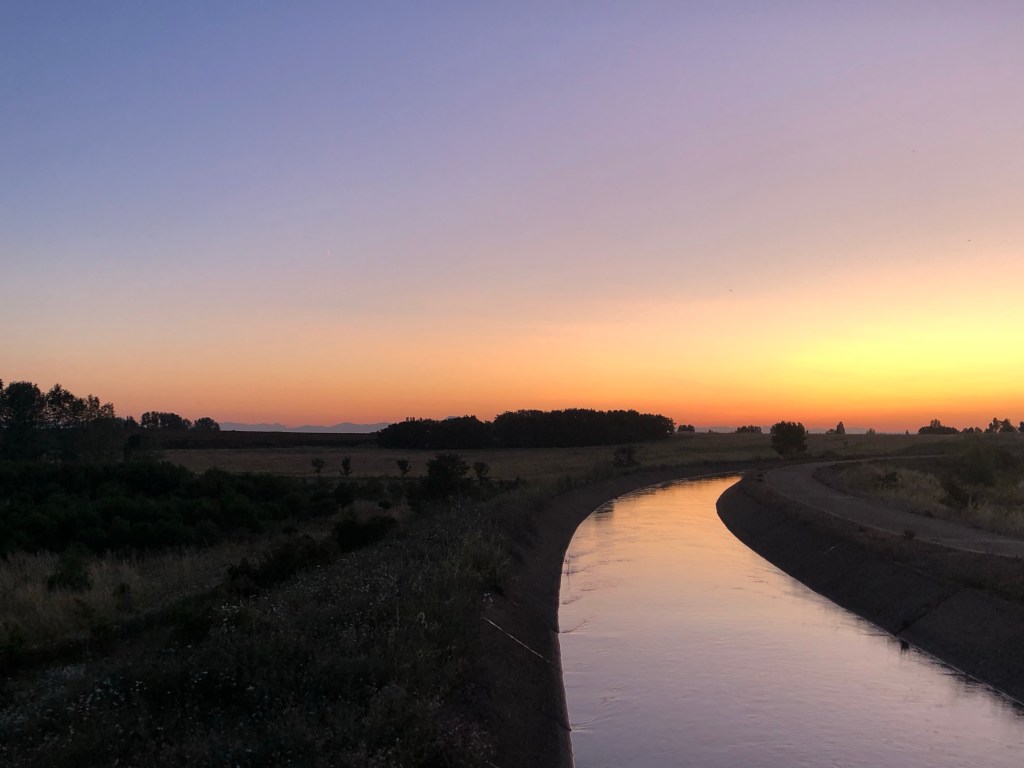
After outstripping the other pilgrims, I had the rest of the Calzada Romana – the ancient Roman raid to the mines – all to myself. And what a morning for it! From the rise, you can see all the way to the distant peaks of the Picos de Europa, ringed with fire by the rising sun. The intermittent canals that cut across the causeway worked like mirrors, carving mercurial strips out of the earth, so that each one seemed to be a continuation of the sky above, and the fields around it a floating world. One of the best sunrises I’ve had on the Camino yet, and I’ve had a good one every day.


You get a good sense of the infinite on the Camino, walking in the footsteps of a thousand years of pilgrims who came before you (the earliest recorded pilgrimage to Santiago was in 930 A.D.), but walking on an old Roman road added another level of grandeur to the experience. The rough stone path made a change from a week of dirt tracks and concrete, and while it may well be wishful thinking in my part, it’s possible, however unlikely, that my feet touched the same stone that some long-forgotten legionary trod two thousand years ago. Nuts!

Sadly I didn’t bump into any ghostly centurions in the early hours of the morning, but the irrigation system provided a jump scare of it’s own: one of the mechanisms was so close to the path that I only had a five second window to clear the distance if I didn’t want to get soaked! That sure woke me up.


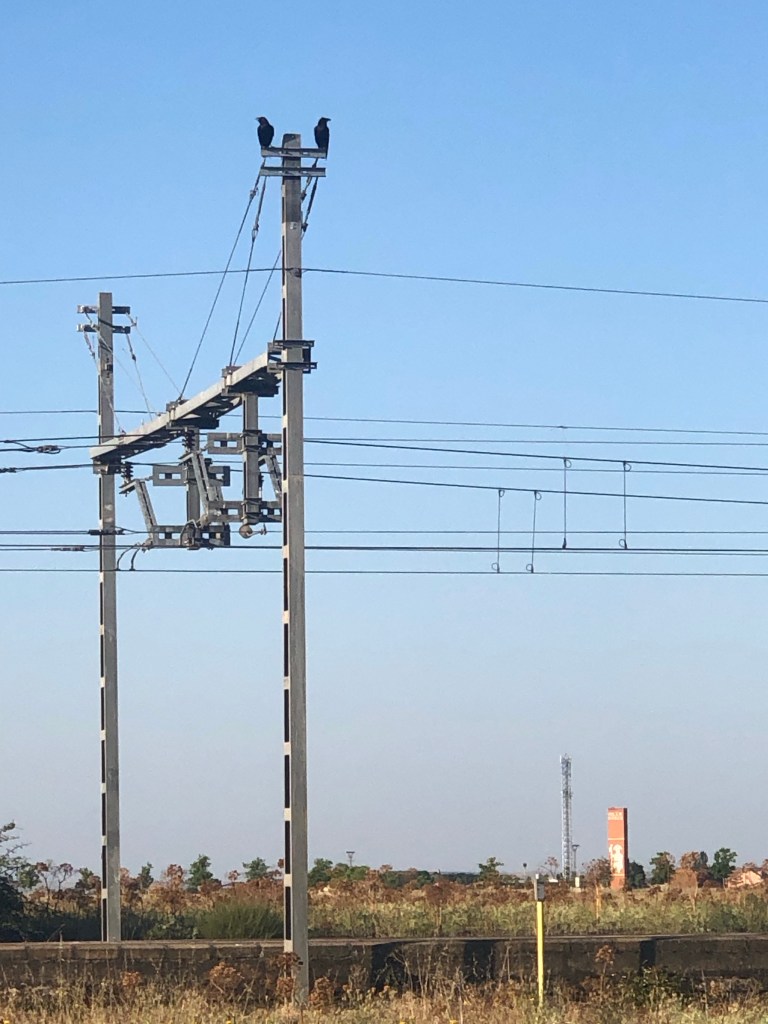
One huge plus of not taking the Bercianos route was the wildness of the calzada romana. I had my usual encounters with stonechats and wheatears (both northern and Iberian), but this unfrequented section of the Camino was a real gem for wildlife-watching. I saw my first quail whirring across the fields on tiny wings, and a couple of partridges, rabbits and a lone red deer rounded out this morning’s game. Every arroyo was alive with singing frogs – which is possibly how the nearby village of Burgo Ranero got its name – but a lonely nightingale had them beat toward the end of the road. A couple of ravens loitering around the ruined Villamarcos station chased off a buzzard that perched too close, then eyed me suspiciously as I walked on by. I found one of their feathers a little way on. It’s currently fastened to my walking pole for luck.

After several encounters with the grey males over the last few days, I finally saw a female Montagu’s harrier in the distance, and I must have clocked about nine or ten hoopoes by journey’s end. But best of all was a cuckoo that came out of nowhere during the morning’s only river crossing. Normally you hear these birds rather than see them, but this one was sitting in the middle of the road when a hoopoe gave it a merry chase for several minutes while I removed the grit from my sandals.


I got to Mansilla de las Mulas well ahead of schedule. I knew staying in Calzadilla would shorten today’s walk, but I still got to the albergue for 10.30am, meaning I had a good two and a half hours to kill before anything was open for business. All the same, this time it was as well that I did so: of the three albergues in Mansilla, one was fully booked and another, the municipal, was closed for renovations (and has been since April, at least), leaving me with no options but the pricier Jardín del Camino. I can’t complain after a very affordable night in a donativo, but when you’re used to paying 10€ as a standard, 16€ for a bed and a further 16€ for a menu peregrino is a bit steep… still! It’s all relative. Just think what that would cost back home….!

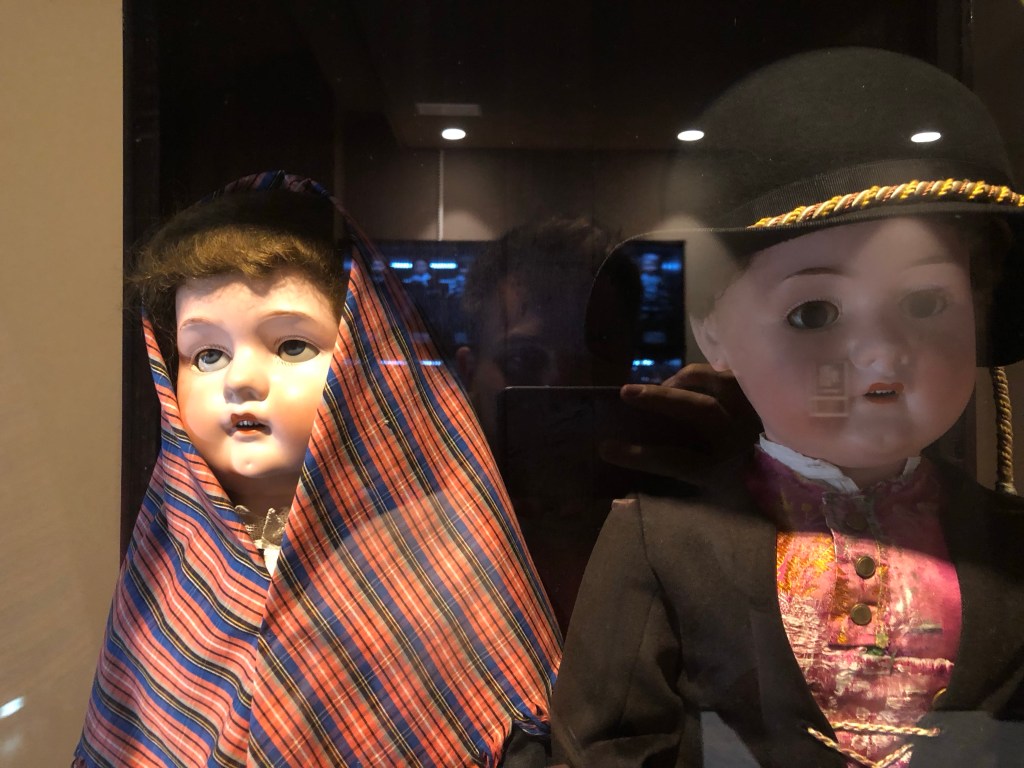
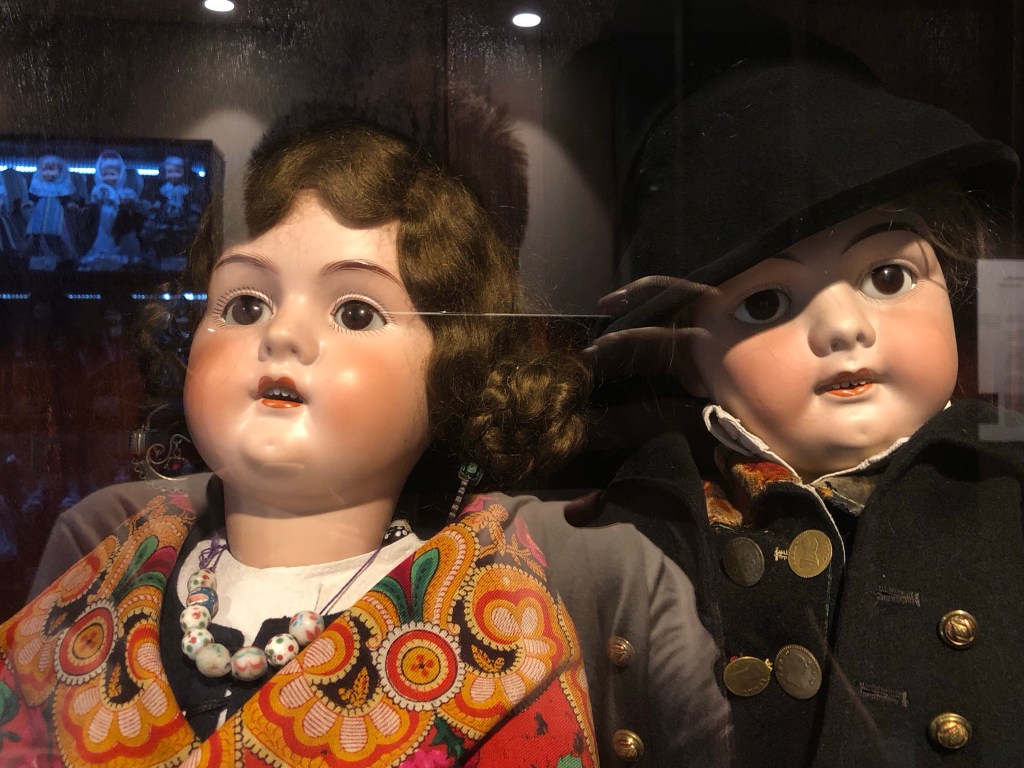
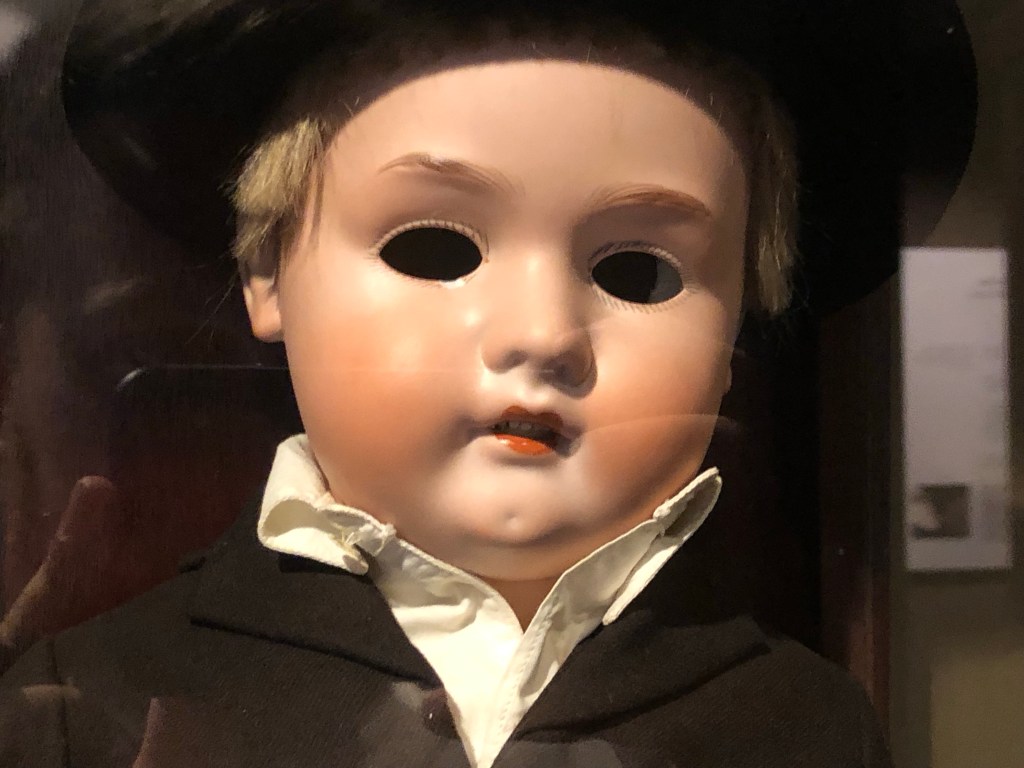
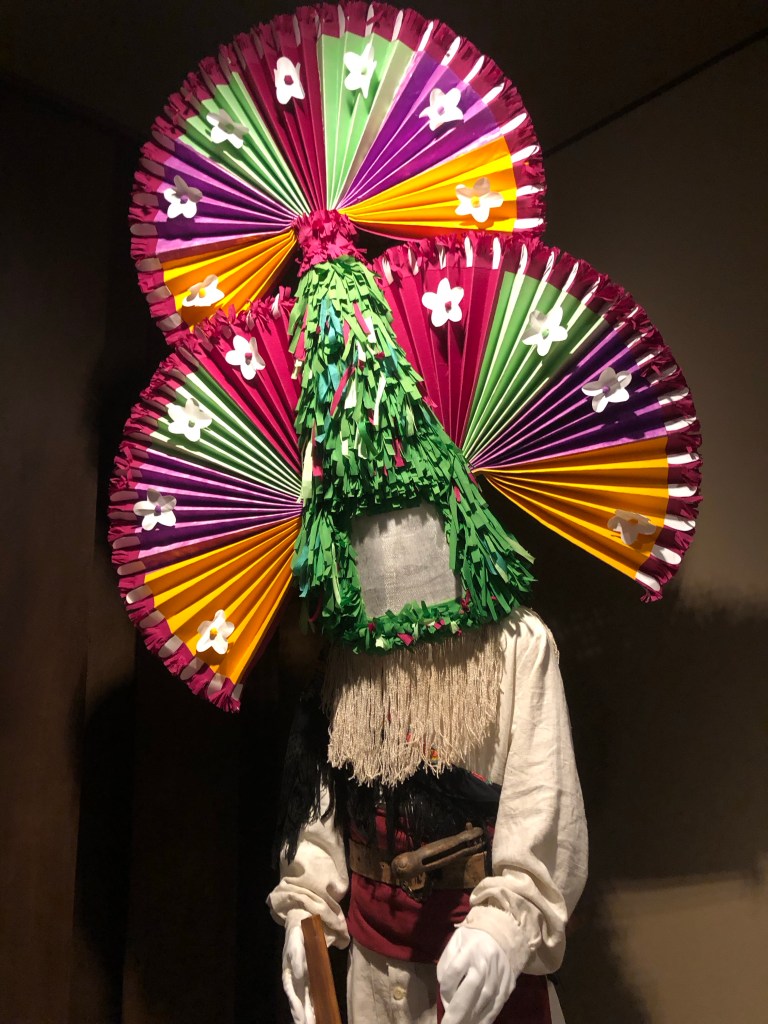
After a mid-afternoon snooze, I made a beeline for the Museo de los Pueblos Leoneses. Do check it out if you pass through – it’s a veritable gold mine of knowledge about the region and immaculately presented across three floors. I was especially interested in the local festivals and Maragatos, but the collection of dolls was equally memorable… though perhaps for all the wrong reasons!


I quizzed the lady at the desk about the signs and she laughed before I’d even finished the sentence. Apparently everybody asks the same question! Yes, she said, it’s not a random act of vandalism but rather the action of a movement which has deep roots in the region, thanks to the fiercely strong regional identity of the Leonese people. Given the chance, many would rather not be conflated with their neighbours. That much is clear from their local customs, costumes and festivals, which differ considerably from the Castilians. I’ve seen vaguely similar outfits in northern Extremadura (which was part of the kingdom of León at the zenith of its power) but the colourful guirrio is almost Latin American in its manic display. I was reminded of an Apache festival I saw in a book once. It’s funny how some people come up with the same concept despite a distance of many thousands of miles.


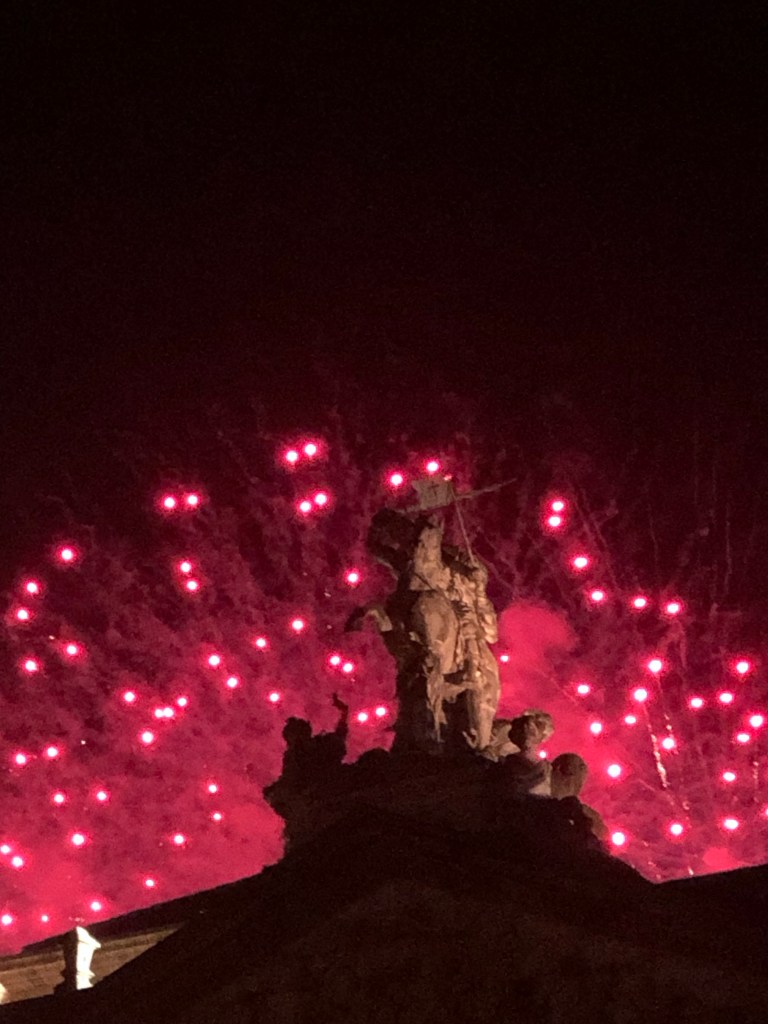
Tomorrow, I shoot for León. It’s not an overly long walk, or a particularly interesting one as it reaches the outlying industrial suburbs of the great city of the north, so I’ll tarry a little tomorrow and find some company on the road. I should probably also think about booking ahead for Santiago, since at the rate I’m going I really will be there in time for the festivities, and I hear they’re a spectacle that really oughtn’t to be missed if you can help it.

But until then, goodnight – everybody else has been in bed for a half hour already. Time to hit the hay! BB x

Camino X: Carry On, Carrión

I’m here in Carrión de los Condes, a full day ahead of schedule. So much for not rushing this time. It was definitely not my intention to walk nearly fifty kilometres today, but here we are. At the very least, I think it’s safe to say I have put one of the more tedious stretches of the meseta behind me. My feet might be killing me, but silver linings and all that.


I got my comeuppance for being an early riser in Burgos this morning. By five o’clock half the dorm was already up and about, so at 5.15am I gave up trying to doze away the hour and got my things together. I’d had the foresight to buy breakfast the day prior, before a wander up to Castrojeríz’s ruined castle (as if I hadn’t walked enough already), so I chowed down on a Bolycao (childhood classic) and set off into the darkness.

One definite plus to setting out before dawn was the climb up the side of Mostelares, a steep banked plateau guarding the road to Itero. In the late morning sun I’m sure it would have been a sweaty, unforgiving affair, but with the sun still below the horizon (and the help of my trusty stick) it was relatively easy. I overtook the only other pilgrims on the road, bade farewell to the army of wind turbines blinking like distant artillery fire in the distance, and put Castrojeríz behind me.


A large riverside grove before Itero de la Vega broke the monotony of the wheat-fields for a bit (Theresa May could get seriously naughty in this part of the world), and I caught a glimpse of a deer between the Lorien-esque rows of birch trees. A talkative group of five Spanish women were on my tail by this point, so I let them overtake and take the clickity-clack of their guiri sticks with them. I’m not sure what their real name is in English, but my kids in Extremadura used to call them palos guiri and the name has stuck.


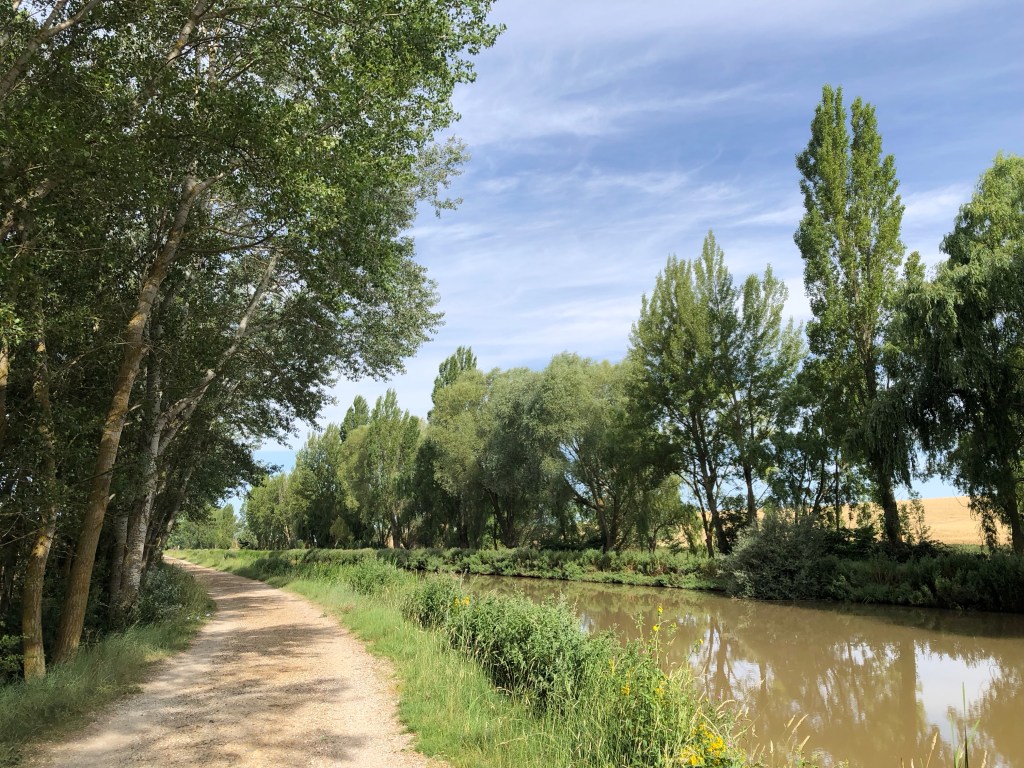
After Itero, the usual stop is Boadilla del Camino, but it was not even 10am so I decided to press on (this is becoming a running theme). The Camino follows the Canal de Castilla until Frómista, which was a welcome change of scenery, if a little bizarre in the middle of the meseta. I’m not sure the local wildlife knows quite what to make of it: I heard the odd reed warbler and saw a flock of lapwings land in a nearby field, but other than that it was an eerily quiet waterway, as man-made imitations of natural things often are. God is not mocked.


Frómista was… a strange place. It felt decidedly more like an urbanización than a town per se. I arrived around 11.15, two hours too early for most of the albergues which habitually re-open around 13.00-14.00 after a lightning quick clean. A couple of merry storks did their beak-clicking ceremony as I reached the town centre, but I got a strange vibe from the place and decided not to linger. Perhaps it was the fact that all the albergues would be shut for another two hours, or maybe it was the fact that the one recommended by all the guidebooks had so many vitriolic one-star reviews on Google complaining about the rudeness of the hostalero.

Whatever it was, a madness took me, and I decided to try my luck in the next town along.

Big mistake. Población de Campos is only a few kilometres on from Frómista, but by now it was noon and the midday sun was up. After an uninspiring slog along the side of a main road – the first of many – I dropped in on the first option, Albergue La Finca.


Well, there wasn’t any dust on the tables, and there were some papers on the front desk that looked recent, but that was about it. The garden looked as though it had seen better days, the gate was slightly ajar and there were no cars in the drive – or peregrinos, for that matter. I rang the doorbell a few times, waited, and then moved on to try my luck with the albergue municipal.

I didn’t fare much better there. The sign was missing, and after a brief search I found it stashed behind a bush. I decided to ask at the nearby hotel, where the kindly dueña informed me that, sadly, both albergues were closed for renovations. I could try at Villamentero, another 5km up the road. Her own Hotel would have set me back 40€, which isn’t ludicrously steep, but on the Camino that sum equates to five nights in an albergue, so I had to pass it up politely.

At this point, I got it into my head to push on all the way to Carrión. A stupid idea, but with prospects along the road ahead looking bleak, and zero desire on my part to backtrack to Frómista, the idea slowly began to seem more and more logical. and, I’ll admit, the whimsical desire to say I’d carried on to Carrión ultimately tipped the scales.


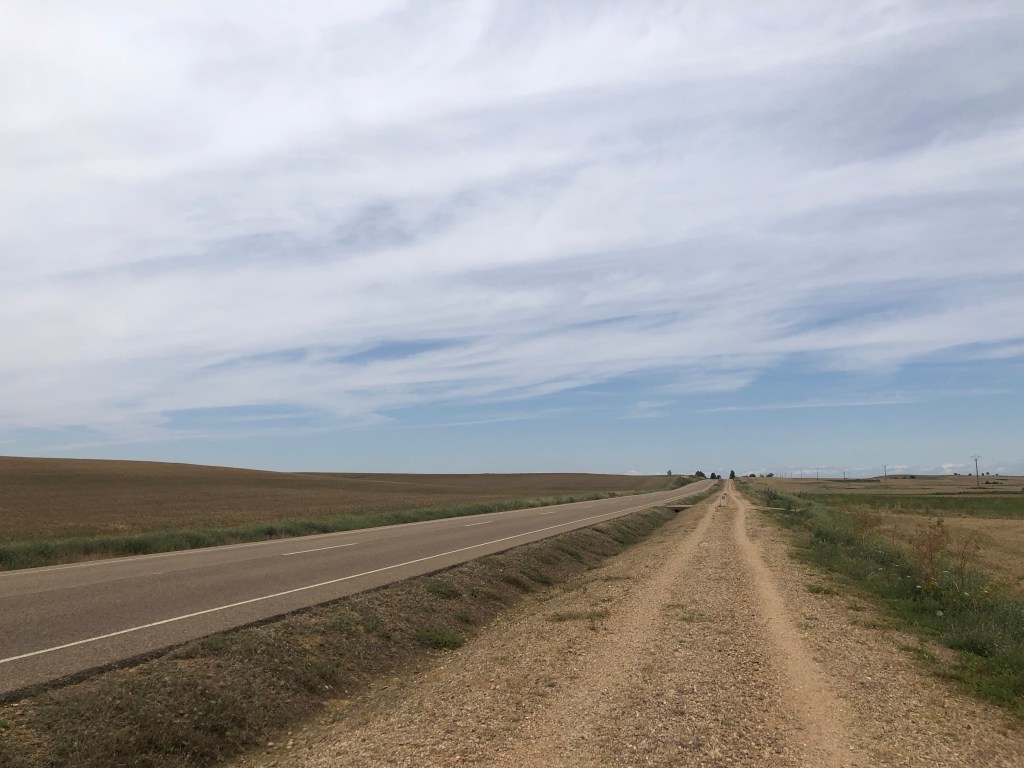
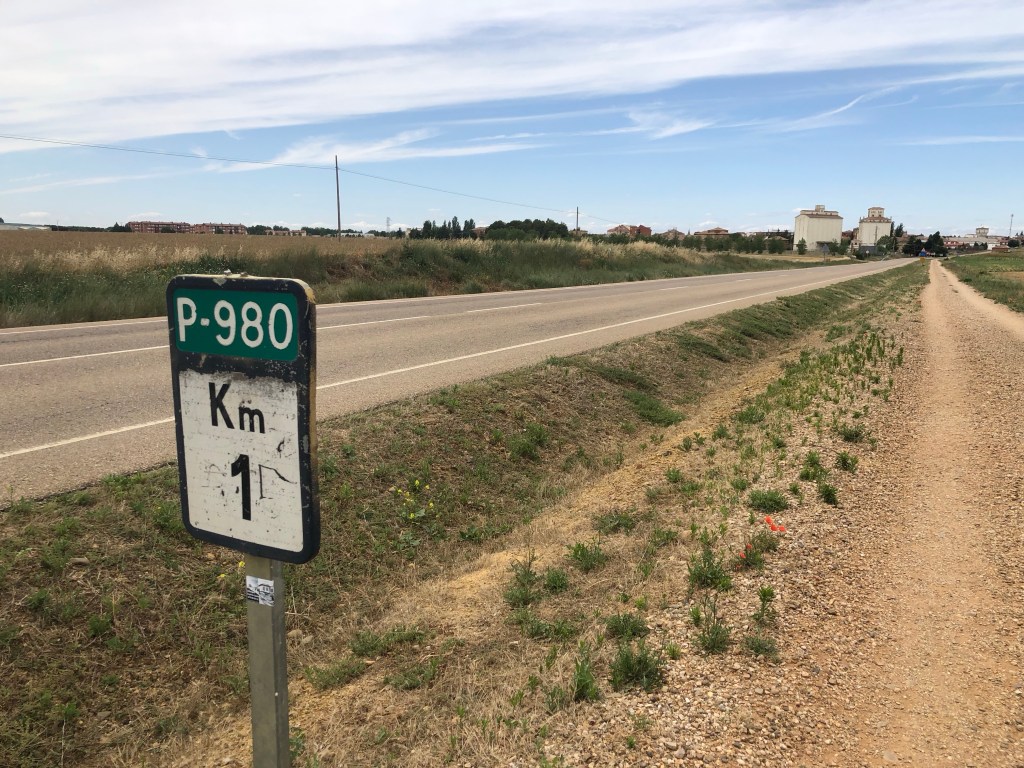
Cue the most tedious stretch of the Camino so far. Fifteen kilometres and three hours of featureless roadside walking. I guess this is what everyone was referring to when they said the meseta could drive a man mad. I clocked a couple of occelated lizards somewhere near Villalcázar – the enormous green buggers are unmistakeable – and claimed a bustard feather, but beyond that, and the chafing pain of my seriously overworked feet, I was genuinely counting the mileage signs all the way to Carrión.


When it finally appeared on the horizon, with the mountains of León in the background, I could have done a somersault out of relief – only, I don’t think I’ve ever been athletic enough for such a feat, and it would have been the death of my feet anyway. So I contented myself with a hallelujah and used the last of my reserves to power on past the silos and into the promised land.

Somebody up there was looking out for me today. A merciful blanket of cloud covered me all the way from Población de Campos, and when I reached Carrión, the Albergue Santa María still had beds going spare. The shower that followed was never more welcome, nor felt so good.

It seems very busy all of a sudden up here. I guess I was one day behind the crowd. Perhaps I’ll meet some of the younger peregrinos tonight. It would make a change from three days of walking the Camino alone. But let’s just see how things pan out! BB x
Camino IX: Sticks and Stones

I spoke too soon last night. Around five o’clock, not too long before Lourdes, the hostalera, set off for home for the night, a bearded Frenchman arrived de la nada and set down his kit for the night. Antoine, from the town of Évian-les-Bains (of bottled fame), had walked a hell of a way to get to San Bol: not only had he walked a whopping 45km from Atapuerca that morning (bypassing the city of Burgos entirely), but he had started his Camino from his front door, making this his eighth week on the road. I’ve only ever met one other pilgrim on such a trek, a real rag-and-bones German who had gone for a walk with his dog and kept on going. Antoine, however, looked as though he had only set out yesterday. It was as good an excuse as any to practise my French, which isn’t nearly as rusty as I thought (though I did have to think how to say the number seventy-five), and it was good to hear a fresh perspective on what’s going on in France right now from a Frenchman.

I watched the sunset over the meseta from the porch and ended up having a very engaging chat with a local man from Iglesias with the most original name of Porfirio Celestino. He had come up on his bike to see if the new trees had grown in this spot, but also to check on his beehive, which he had been told to rejig by an expert. We had a laugh about our shared experiences as teachers and tried to outdo each other’s collection of oldy-worldy names like Araceli, Guadalupe and Diosgracias (the latter being my great-great grandfather’s Christian name). I think I won with the latter, he laughed so heartily. Wouldn’t you, if your parents named you Thanks-Be-To-God?


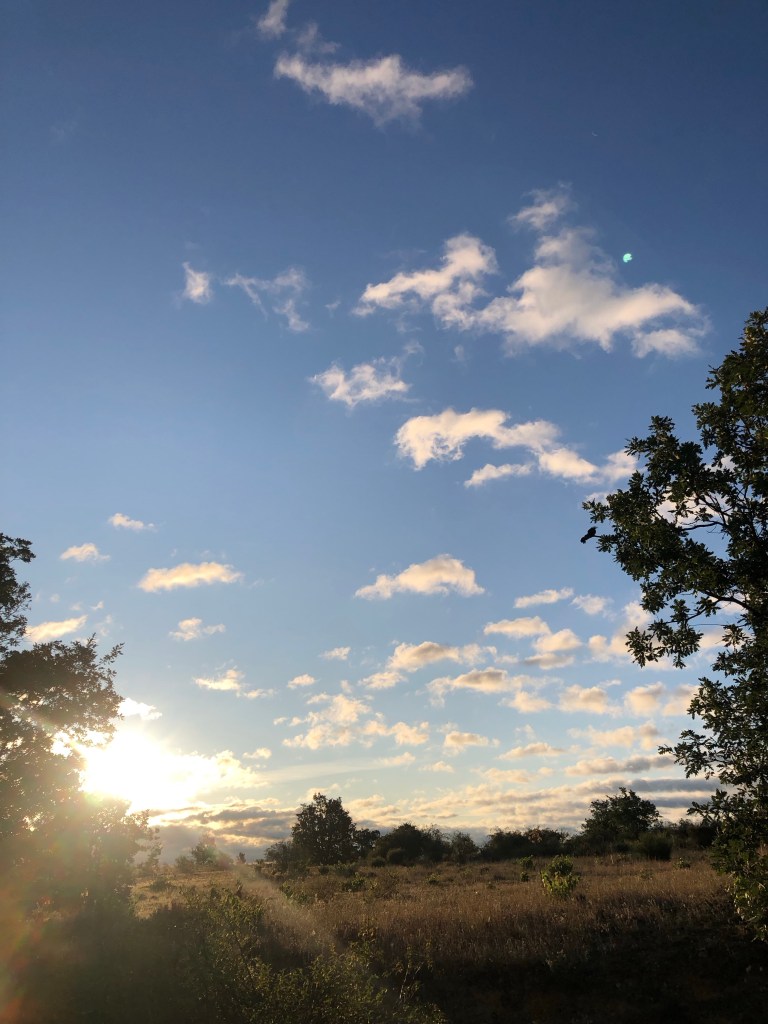
I allowed myself a later start this morning. Later being 7.45am, which is a perfectly respectable time to set out. The sunrise was nothing short of magical, and it was all I could do not to linger longer. I can’t recommend the Albergue de San Bol more highly. It was a perfect introduction to the Meseta and blissfully immersive. A partridge climbed up onto one of the many piles of rocks to serenade the valley as I set out, the twin flags of Spain and Iglesias fluttering in the cool morning breeze. There are lots of piles of rocks like that around. I guess they’re removed periodically from the fields to make plowing considerably easier.


Hontanas was deceptively distant. I would have found it quite a slog under the midday sun had I attempted it yesterday, but in the morning light it was a very pleasant walk. Wild flowers line the luminous Camino right the way across the Meseta, adding dashes of crimson, cornflower blue and violet to the shimmering seas of gold.

At one point, high on the plateau above Hontanas, I seemed to be absolutely surrounded by quails. I couldn’t see a single one – they’re tiny, incredibly well-camouflaged and very rarely flush when cornered – but I could hear them all around. Their three-stop whistle can carry for as far as a mile, but if you can hear their childlike ‘—aauWAH’ it’s a good sign that they’re nearby. Quails and turtle doves are fast becoming the soundtrack to the meseta, and that puts a serious spring in my step.

I’ve passed a couple of roadside graves today (not pictured for obvious reasons). They were quite a common sight on the first couple of days of the Camino, where the mountain pass can be dangerous under the wrong conditions, and tended to be Asian or Latin American in origin. Out here in the middle of the Camino, however, the meseta proves a challenge that isn’t always insurmountable, claiming Spaniards and even the hardy Dutch. I try to say a small prayer at each one I pass. By the looks of the painted stones at their feet, I’m not the only one.


Hontanas seems to be a magnet for pilgrims. A sizeable number had stopped for breakfast at the first café, leaving the road ahead clear. I had only a few cents left in my wallet, but I still spent a good ten minutes there, though that was because I caught sight of a little owl perched on the wire opposite the café. I deliberately didn’t bring my camera as it would have been one belonging too many on the road, but I regretted that decision more than once today – my phone camera simply doesn’t do justice to the beautiful little thing!


After Hontanas the Camino crosses and then follows a wooded stream for a couple of miles. Here, once again, I came across one of my favourite sights of the route: the silver, scythe-like wings of a harrier. It caught me completely by surprise as I came up a low hill, and I could see the yellow rings of its eyes before it jinked and soared away down the valley.

I thought I’d lost him, loitering for a few minutes to see if I could spot where he went, but not five minutes later I saw him up ahead, quartering the valley floor. Kites are graceful, but harriers – especially the silver-grey males – are in a whole other league, drifting over the fields like black-fingered phantoms. He disappeared behind the trees as I drew near, and then re-appeared clutching a fair length of straw in his talons, to take back to his nest in the wheat-fields, no doubt.

Some things, I guess, are worth going solo for. Seriously, I could get used to encounters such as these.


At the end of the valley, the road cuts right through the imposing ruins of the Monasterio de San Antón. So cleanly, in fact, that the main road runs beneath two of its great stone arches. There’s a tiny albergue here and a chance for a bonus stamp (at last!), but I was quite content to just explore for a bit, not being in any particular hurry.


There are plenty of old churches along the Camino, but this ruined monastery is rather special – not least of all because of the way its hollow windows open out onto the endless blue of the Castilian skies beyond. I’m going to run out of adjectives for the sky long before I’m clear of the meseta, because it’s my constant traveling companion, but I’ll do my best to keep it original!

Best of all, they had a box outside the albergue for unwanted objects to take away. I’ll have a few of my own to offer before long, but my eyes lit upon a beautiful Aragonese walking stick from Ordesa National Park. I’ve blown the dust off it and put it to good use. With any luck – if it isn’t pinched along the way – it will take me to Santiago, and perhaps beyond.


From the monastery, the hilltop castle of Castrojeríz comes immediately into view. It’s still a good hour’s walk until you reach the town proper, but it has to be one of the most scenic approaches of the Camino so far. I offered to take a photo for three Japanese pilgrims and they repaid the favour, meaning I will have at least one photo to show I walked the Camino this summer!


Well now, I’m here in Castrojeríz, and the kindly hospitalera has just returned from the hospital in Burgos. Her husband, with whom she runs the albergue, is currently walking the Camino himself. After a very light dinner last night I treated myself to a menu del día at a local mesón-restaurante. The barman must have clocked my La Mancha shirt because he brought out a lovely red wine from Tomelloso, just down the road from my family’s home. They didn’t have any sopa castellana – apparently it’s too hot for that – but the salmorejo he recommended was fantastic. So don’t worry, Mum, I’m eating very well out here!

I’ve showered, made the bed and claimed another stamp, so now that I’ve finished writing I’ll have a short siesta before buying supplies and exploring the hilltop castle this evening. What a perfect routine! BB x
Wildwood

With the summer exams afoot, we’re entering “gained time”. Assessments replace lesson plans, trips take kids out of circulation more frequently, and savvier colleagues do a stock check on their red/green biros (delete as appropriate) for a lucrative summer of script-marking. Since my job description covers not just every year group but also all the conversation classes for the exam years as well, my timetable takes an even larger hit than most at this time of year. As of today, I’ve lost an enviable eighteen hours a fortnight. A man could go mad with that much idleness – so, as I do every year, I set myself a project to fill the time.

This one’s pretty straightforward: read a chapter a day of any book – just one chapter, no more, no less – and reflect on it in less than a thousand words. That way, I’m hoping I’ll develop a better reading habit, as well as keep my writing arm flexed well into the summer. It doesn’t pay £3 per throw like the exam scripts do, but it’s good practice. And who knows? One of these days, when I finally manage to convince somebody to let me try teaching English again, all of this reading might pay off. But until then, I have time to kill and a library to devour.


Guy Shrubsole, The Lost Rainforests of Britain

Here’s a book I’ve had my eye on for a while now. Shrubsole knew what he was doing when he hired the illustrator Alan Lee, of Tolkien fame, to design the cover of his paean to the vanishing temperate rainforests of Britain. The gnarled, mossy arms of Wistman’s Wood might as well be an early sketch for Fangorn Forest. Even the choice of a jay for the single flash of colour is inspired – for what bird could be more evocative of the deepwoods of the British Isles than the oak-sower, a creature almost singly responsible for the very existence of our oak forests?

There’s a medicine within the woods that has few equals. If I close my eyes and let my mind wander, I can picture the trees I sought out when my heart was in a bad place. Brabourne, Canterbury, Durham – and even as far as Plasencia. Now I think about it, those “healing trees” were invariably oaks, every one of them. I’m no spirit of the New Age – I live just a little too far north of Brighton for that – but I can’t help but draw something from that coincidence. Is it because they’re the largest trees in the forest? The oldest, and thus the wisest? Is it because their thick branches reach closer to the ground than other trees, like outstretched arms? While the regimented conifers bristle from trunk to treetop with their arms held high in a stiff salute, the oak tree is a serene creature. Motherly, almost.

Shrubsole’s passionately written text takes the reader by the hand into the soaking air of the last remaining rainforests in Britain. I confess I never really thought of rainforests as a British entity, though I would be the first to admit that, when living abroad, my fondest memories of England were of grey skies and the sound of autumn rain over an English wood. I’m incredibly fortunate to come from a line of amateur botanists: my mother was brought up knowing all the different plants and flowers and their uses (as well as which fungi were best avoided), and though I was stubbornly fixated on my animals, she did her best to pass on what she had learned to me. Consequently, I don’t need an app to tell my beeches from my birches. However, I know I’m on an island in more ways than one in that regard.

Since the last Ice Age, Shrubsole writes, we have cut down a third of all the forests in the world, and half of that in the last century alone. In that time, while we awakened to the plight of the shrinking rainforests in the tropics, our own green treasures have been quietly slipping over the edge and into oblivion. The ancient Britons revered the forests that once covered this island. Most of us, however, are a lot less likely to meet a druid than we are that one person who says something along the lines of “such a nice view, shame about the tree” – as though this land were ours to sculpt.

“Plant blindness” is a reality we must accept. Put simply – in the words of Tolkien’s Treebeard – “nobody cares for the woods anymore”. It’s easy to get excited about conservation when it’s got two shining eyes that straddle the line between beauty and vulnerability, but it’s that much harder to extend that zeal to the silent world of plants. Lack of knowledge leads to lack of empathy. As both a naturalist and a teacher, one of my cardinal rules is that once you can put a name to something, it means so much more to you. Perhaps the reverse is true: if you know nothing, your heart won’t bleed when you tread on a bluebell.

Recent studies showed that only 14% of A Level biology students could name more than three British plant species, while an even more alarming survey indicated that 83% of British children were unable to identify an oak leaf on sight. I suspect if I brought in a few leaves tomorrow and asked my Year 9 students to identify them, I’d fare little better. And yet, they’re very aware of the deforestation in Indonesia and the deleterious impact of the palm oil industry. The grass is always greener – or at least, it would be, if we could tell it was grass to begin with.

I’m learning to drive this summer, and I’m not ashamed to admit that one of the only things that genuinely excites me about having a car of my own is the freedom it will give me to explore even more of this country on foot. I appreciate the irony. But with avian flu decimating our seabird populations last year – an article in The Guardian put the death toll at 50,000 – and more and more common land disappearing under the pressure for affordable housing, I’ve never been more conscious of the need to see our green and pleasant land – before it’s gone. Before the baseline shifts, and we learn to accept what was once unacceptable.

I had a couple of hours between lessons this afternoon, so I took myself for a wander through the estate. I found a toad beneath the remnants of a tarpaulin from the old forest school I used to run three years ago, and a merry carpet of bluebells in their dying days followed me to the deepwoods where a chalk stream gurgles southward on its journey to the sea. A silent pool of rainwater sparked into life as the sun came down, drawing three tadpoles into its warm gaze. Chiffchaffs sang at various intervals, and somewhere overhead, unseen, a buzzard mewed. I didn’t hear our ravens today, but I often do.

The druids were onto something. There really is a medicine in the woods. If only the whole world could see it! BB x


Further Reading:

What is plant blindness? (Kew Royal Botanic Gardens)

Do you suffer from plant blindess? Jon Moses, 5th April 2023

Who owns England? (Guy Shrubsole’s Blog)

Camino VI: Parenthesis

In Burgos, the journey comes to an end. One leaves for home, two pack for their flight tomorrow and one more digs in to stay, leaving four of the gang to push on toward Santiago tomorrow. Perhaps mine is the hardest, watching the others move on or away, knowing that if it weren’t for my flight (and my beleaguered feet) I’d have long since decided to chuck in my plans and make for Leon with them. But life is full of farewells, and I could never have gone with them all the way to Santiago in the week of holiday that remains. So here I am, at the end of this run at the Camino, putting my thoughts into words.


Today’s leg was a special one. Impatient after a crush in Bar El Alquimista over breakfast – I’m still not especially good at dealing with loud and crowded spaces – I set out ahead of the others this morning, nursing a doctored but still painful blister and conscious it would likely slow me down. It didn’t feel great leaving the group behind, but the crush in the bar threw me off a bit and I needed some time on my own on the road as a remedy.


Leaving behind the slumbering town of Agés, I followed the road westward toward Atapuerca. This is possibly one of the most mystical waypoints of the Camino de Santiago, but blink and you’ll miss it – because Atapuerca is the resting place of the oldest known hominids in Europe. Not far from where the Camino crosses the Sierra lies the Sima de los Huesos, a pit that contains the bones of ancient humans who have lain there for nearly a million years. Walk this stage of the Camino and you really do get the sense you’re following in the footsteps, not just of a thousand years of Christian pilgrims, but almost a million years of human wayfarers. One of my fellow pilgrims pointed out that there are far older pilgrim routes in India, but if you think of the first humans pushing toward the end of the known world (where Finisterre stands today) as the first Camino pilgrims, I’d like to think the Camino de Santiago is a fair contender for the top spot.


I made the climb alone, taking with me a sprig of mistletoe, a fallen olive branch and a strip of blackthorn blossom: something wicked, something old and something new. It seemed like the right thing to do. Meanwhile the birdsong up the mountain was spellbinding: hoopoes, cuckoos and woodlarks on all sides, and these last especially, becoming for me the quintessential sound of this stretch of the Camino. I’ve recorded a video so I can share some of that magic with you.


From the mystical heights of ancient Atapuerca with its lonely wooden cross and stone circle, you look down from the last high place upon the city of Burgos and the seemingly endless reach of the Meseta beyond, with the daunting white cliffs of the Picos de Europa clearly visible over 130km away.


Having waited for my companions at the cross, I joined them for the descent into Burgos, but when their stop for a mid-morning snack threatened to stretch over an hour, my itchy feet swept me back onto the road again. It would be the last time I spoke English on the Camino this year, because from there on out the only people I encountered were Spaniards on the road (they took long enough to find!).

For the final twelve kilometres into Burgos I was joined on the road by Fran, a programmer from Soria in his twenties who was an enlightening companion. From him I learned that the Spaniards, as I suspected, had indeed done the Camino for Semana Santa, but they had started at the beginning of the national holiday and were thus a few days ahead. I also learned about his home town of Soria and how the Mesta have monetised their trade, turning what was once an affordable experience following the shepherds’ route into a glamorous eco-tourism experience to the tune of 200-300€. He also gave his thoughts on the Catalan question, likening it to a dog barking furiously at a door which, when it is finally opened, suddenly goes quiet – it is easier to hate when you cannot see what it is that troubles you. Or something like that. I was just happy to be speaking Spanish – and flattered to be told that if I hadn’t revealed I was English in the first five minutes I’d have had him stumped, as he was genuinely ‘confundido’ by my Spanish.


I took my leave of Fran outside Burgos’ enormous cathedral, after a brief conversation with a local (‘De dónde sois?’ : ‘Yo de Soria,’ / ‘Y yo de Inglaterra, pero con familia en La Mancha.’ / ‘Soria e Inglaterra? Menuda familia los dos.’). Fran took off to catch his BlaBlaCar home and I set out in search of my hostel.

I didn’t get much of a siesta, because the next guest to arrive was another Francisco, this time from Puebla, México. After a brief exchange over the subtle numbering of the hostel beds we ended up talking for close on two hours about a number of topics, with him asking after my thoughts on Italy, Spain and the British Empire and me asking for his wisdom on La Malinche and nahuatl. He is on a quest much like I was years ago: on his tour of Europe he has come to far-flung Burgos to seek out the village of Grijalba, from which he believes his father’s ancestors may have hailed (through the legendary explorer Juan de Grijalva).

It is always heartwarming to meet another traveler on the road, but especially so when they are on a quest – you don’t meet many of that kind these days. Perhaps it is fate that the day started in Bar El Alquimista, named for Paolo Coelho’s famous novella.

After one more conversation in Spanish which left me feeling more confident than ever before, I led the pilgrims of our group that remained down a side street in search of dinner. It couldn’t have been a better choice: six raciones and a salad split between us made a feast such as we hadn’t had yet. Morcilla, croquetas, calamares and sepia a la plancha, torreznos and zamburiñas (what more fitting food for pilgrims than scallops?)… it was far and away the best I’ve eaten on the trail.

And I didn’t have to pay a cent, since the generous Dane in our number footed the bill before we twigged what he was up to. I’d done something similar a few days prior, so I guess he was paying me back, but that kind of generosity is what makes the Camino so special. For our last meal as a group, I could not have asked for more.

I’ve never bonded with other peregrinos quite so quickly, and I wish I could take the road with them to the end. But every road leads to a parting, and we part as friends.

It is not the end of the road for me, but rather a parenthesis. One day I will come back here, to the ancient city of Burgos, and pick up the Camino where I left it. Hopefully I’ll meet other pilgrims like them who will make the road an adventure with friends once again. Sophia’s charm and maturity. Mikkel’s wit and his generosity. Katie’s wisdom and Lachlan’s humour, courage and peace of mind.

Domenico the Carabiniere. Enrique the Arriero. Phil the Professor. I have met so many characters on the Camino this time. That has been the real blessing of the road this Easter. I’m glad I came. Truly. (And especially since it was a whim decision just over a couple of weeks ago).


It’s now half past eight in the morning. By now they will have left Burgos and will be somewhere on the road to their next destination. All I can do now is wish the four of them all the best on their road to Santiago. And someday, sooner or later, I will take up my shell once more and follow them. BB x

Camino V: A Man Out of Time

After the Carabiniere’s tip-off about the limited options in San Juan de Ortega, we made the collective decision to strike out early for Agés, the next town along. So, after a day’s hiatus, I had my sunrise again – at the cost of my fingers, which were numb with cold for the first half hour at least. Mikel the Dane caught up to my ferocious pace to lend me his fleece-lined gloves. The way everyone looks out for each other on the Camino… there’s really nothing quite like it.


Shortly before reaching Tosantos I picked up the trail of Enrique the Arriero and his mule, Jena, and as soon as he came into sight I picked up the pace to catch up to him. It was a merciless effort on my already beleaguered heels but worth it – with so few in his trade left in the world, you don’t pass up a chance to learn something of that vanishing world. One of our number had lost his card to a hungry ATM so I couldn’t stop to chat long, but I told myself I’d try to catch him further down the road if I could. I had already penned “Entrevista con un arriero” in my journal and that would just be a waste of paper if I couldn’t fill it in.


After grabbing an early lunch/late breakfast at Villafranca Montes de Oca (20€ fed all seven of us with a sizeable tortilla & jamón bocata and drinks) the Camino wound steeply uphill into the Sierra de La Demanda. I won’t be the first pilgrim to say it was demanding and I won’t be the last, but it was a welcome change to be under the shade of the trees after the roadside meandering of the last few days.


There’s a monument about halfway through the Sierra to the fallen of the Civil War – that is, the opponents of the Nationlists in Burgos who were dragged out of their beds and summarily executed up here in the woods in the early days of the war. Most Spanish families can relate to this grisly tale: most of the circle of friends of my great-grandfather Mateo similarly disappeared, being known for harbouring or having harboured socialist sympathies even after the war was over. I said a prayer and moved on.

After another steep climb we finally made it to an open stretch of the Camino where the Carabiniere led us to a shaded spot where a food van had been parked on his last run of the Camino a year prior. The proprietor was still here, and while the ‘stamp girl’ was on her way (she’d gone to get fresh ink) he was happy to provide us with fresh strawberries free of charge while we waited.


Here, at last, I caught up again with Enrique, and was able to ask him all the questions I’d had on my mind about being an arriero.


Enrique – or Kike, as written across his hat – has been a muleteer ever since he was a child. He picked up the trade back home in Argentina, where the vast distances and tricky terrain have allowed the profession to long outlive its run in Europe. He likened the trade to studying to become a surgeon: long, hard work and dependant on the collected wisdom of many teachers and masters of the art. Experience, said he, was the best teacher of all, and – now in his sixties – he has had almost six decades worth of it. He grew up a poor man, living on the streets and carving a life for himself in the countryside, not that you’d know now from his noble bearing, bright white smile and polished riding boots (an bold choice of footwear for the Camino). Since his move to Spain twenty-five years ago, he’s got by working with horses and mules wherever and however he can, teaching, buying and selling, running activities for children… whatever he can turn his hands to. I remember as a child seeing the odd arriero in the country around Olvera, so it was more than just an honour to meet a man whose profession is that of the title character in my books. It was a warm dash of nostalgia.


The dark pine forests of the Sierra de La Demanda soon gave way to a skylit swathe of leafless oaks, covered so thickly in lichen that they looked half-dead, like greying, flayed cadavers beneath the sun. However, the forest could not have been more alive. A cuckoo called in the trees and followed us like a shadow along the Camino for some time, while chaffinches, blue tits and the piping song of a wryneck played a merry tune to carry us along. It helped to take my mind off the blisters forming on my beleaguered feet and then some.


Then, before we knew it, the trees were at an end and there, stretching out before us, was the meseta. The prehistoric treasure trove of Atapuerca lay between us and Burgos, but far away in the blue beyond rose the mighty snow-capped peaks of the Cordillera Cantábrica, as impressive now as they ever have been. We came down into Agés shortly after half past two – well into the afternoon – and within another half hour we had all decided to take a siesta.

The other pilgrims have gone out for a beer. I needed a little longer to recover this time, and besides, I wanted to strike while the iron is hot with the blog rather than wait until later. With the last twenty-three kilometres of this stage of the Camino still to go tomorrow ending in Burgos, I don’t think I’ll see Enrique again. So I wanted to record my interview here before I forget.


You never know who you’ll meet on the Camino. Teachers, scholars and sailors, bereaved parents and happy families, policemen and anarchists, priests and atheists. Now, finally, I can add an arriero to that number. BB x