Let Go

Today is a day for farewells. I caught the early train to London Paddington to take lunch with the family of a former student and two of my colleagues. These are not just acquaintances, no mere ships in the night: these are people who I have shared my work and (quite literally) my world with for the last six years. When the time comes to say goodbye, I usually make a habit of leaving a parting shot in the form of a lengthy card or letter, but I wasn’t in the right headspace today. I’d have probably stayed longer if She wasn’t in town.

It’s been a very long and painful summer. I can’t remember one quite like it. It’s nearly over – thank God – and work, the Great Healer, will soon put me right. But heartbreak is a hard thing to manage when you live alone, far from everyone and everything you know. How do you move on when your heart is still broken, nearly two months on, and your world is at a standstill?

I’ve been reading a lot. I’m working through John Vaillant’s The Tiger at the moment, which deals with a much starker isolation in the Russian Far East than the one I’ve known this summer, albeit much less melodramatic. One quote from this morning’s reading has stuck:

The most important test for a human being is to be in absolute isolation. Alone and with no witnesses, he starts to learn about himself – who is he really? Because nobody’s watching, you can easily become an animal… […] You can run in fear and nobody will know. You have to have something, some force, which allows and helps you to survive without witnesses.

John Vaillant, The Tiger

After thirty summers I know who I am, and I know my weakness for acting on heart over head. So instead of buying an off-peak return – which would have given me the time to say the goodbyes I wanted – I booked myself onto the 5.30 train home, with no room for manoeuvre. I suppose I wanted to stop myself from doing something rash.

In another universe, I would have watched the sunset from London’s famous Sky Garden with her tonight – my idea of a final goodbye to the city where we met – but in this reality, I must be the gentleman and let her go without another word. So this is me, the dichotomy: the gentleman and the animal, doing the right thing and running away.

My head, for once, is talking to my heart.

My only regret is leaving before I could say a proper farewell to my dear colleagues. I will make it up to them with a handwritten letter this evening. I’ve always been a lot better at conveying my feelings in words written rather than spoken, anyway.

My force – the thing that keeps me going without witnesses – is Hope. Hope that, someday, my heart will heal and things will get better. Hope that these things are sent not just to try us, but to bring a moment of light and happiness into our lives, even if, like a match on a winter’s night – or even a shooting star – that light is followed by a temporary darkness. Hope that somewhere out there is a future where somebody falls for me just as hard as I do for them. Where “sorry” and “thank you” are not our watchwords.

I have not given up on old fashioned romance, and I never will. It is out there, shining, somewhere beyond the stars.


Heartbreak is good for you. It brings you to your knees, but that only makes it easier to look up. It forces you to look inwards and to love yourself again. It reminds you that you were not afraid to love with your whole heart, even if you had no idea that was your intention.

Ride north, Macumazahn, for there you will find great happiness – yes, and great sorrow. But no man should run from happiness because of the sorrow.

Henry Rider Haggard, Allan’s Wife

Feeling with your whole heart makes you vulnerable, especially in affairs of the heart, but I wouldn’t change it for the world. Because, hand-in-hand with the gut-wrenching lows come soaring highs, an ecstasy of joy and excitement that is impossible to convey.

I cannot escape it; it runs in the family. My great-grandparents found each other in the middle of a bloody civil war that threatened to tear their country apart, and they held onto each other even as the regime started to eliminate their loved ones for their beliefs. And still they believed.

My grandfather put his whole world on the line for an English girl who captured his heart one summer, risking everything to hold on to the happiness he had found. Would their love have stood the test of time? I will never know – he lost his life in his early twenties in a hit-and-run incident that tore his future apart – but I am convinced that it is that whole-hearted Hispanic passion for life that runs in my veins.

Today is a day for farewells, and I have made mine. The next chapter is about to begin. BB x

Saudade

SAUDADE – (n.) a deep nostalgic longing for someone or something absent, infused with a melancholic awareness that it may never return.

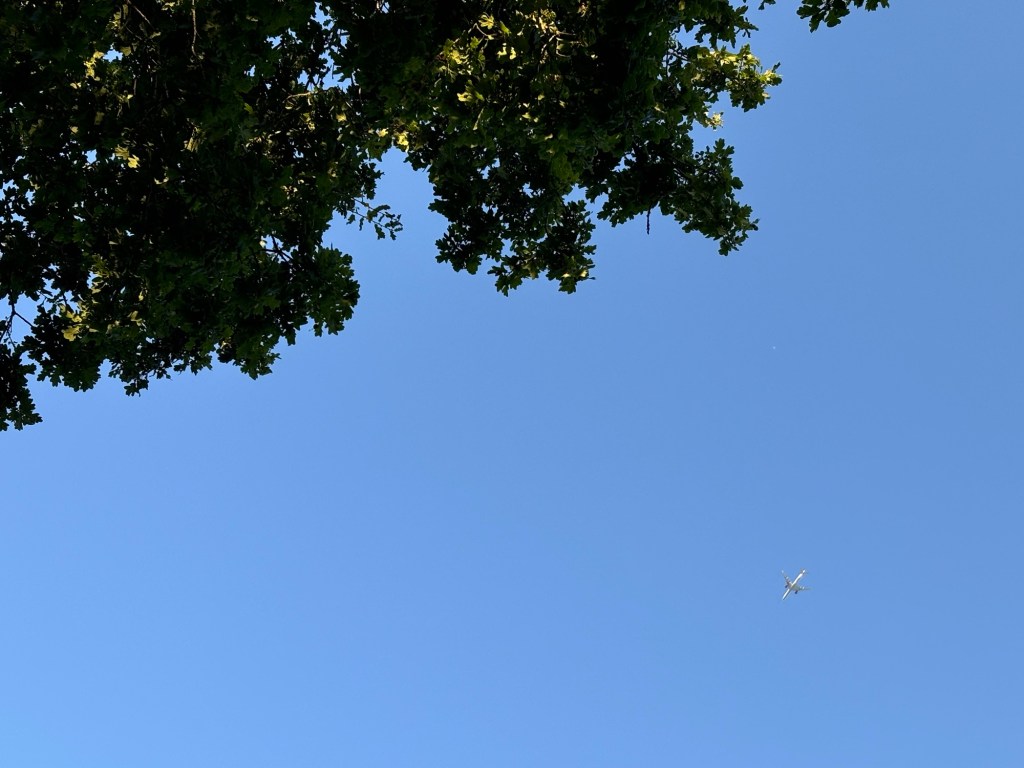
I looked up last night and saw a plane coming in to land at Heathrow. One of the big ones that comes in from across the Atlantic, like the one I flew home on nearly five weeks ago. It made me think of that Monday morning, seeing the sunrise over London, knowing in my head – even if I didn’t want to admit it in my heart – that I had come to the end of a cheery chapter in my life.

A plane like that one brought her here to this cloud-covered island many months ago. I wonder what my summer would have looked like if it hadn’t?


The Portuguese have this wonderful untranslatable expression called ‘saudade’. It’s often taken to mean the feeling of missing someone or somewhere, or more precisely a sense of longing for that thing, but many Portuguese and Brazilians will tell you that it’s a lot more subtle than that. There’s a sense of finality to it, also: an understanding that what you once had may never come back at all, an acceptance of that, but a wistful longing for it all the same. Not the raw kind that breaks you in the days and weeks that follow, but a tempered and reflective sense of nostalgia for what once was and what could have been.

It’s not unique to the Portuguese, but it is especially common in their culture – and perhaps even more so among the Brazilians. It is said that the expression may have evolved during the Age of Discoveries, when the wives of the great explorers of the day bade farewell to their husbands and lovers as they set out for the Americas (how ironic) knowing full well that they may never see them again, and that if they did, they would return as changed men.

Among the Brazilians, it has taken on the sense of a nostalgia for a lost future: a golden country that never was. The American dream isn’t just limited to the States – a shard of it can be found embedded like a splinter in the subconscious of all the descendants of the colonists, I believe. Why else should they have made such a journey if not in hope of a better tomorrow?

I feel that way about Spain, sometimes. Perhaps that’s the generational shockwave of my grandfather’s death in his mid-twenties, rippling across the years to the present, an echo of a lost world that could have been. Spain calls to us. It has been calling for sixty years. Come back. Come home. Sometimes you spend hours, days and even weeks waiting for somebody to reply (looking at you, folks on Hinge) without realising that something greater has been waiting for you all the time, if only you knew how to answer.

I have been the architect of my own saudade by choosing to devote my life to gazing upon that dream from afar: teaching Spanish to the English, sharing my love for a country I can only touch a few times a year. It is a test of endurance, to look upon a thing of beauty and not to touch. Spain has always been that thing. It fills me with awe, excitement, a deep-seated admiration and an infectious appreciation for life itself, but a sense of longing all the same, knowing that it is in my heart, but beyond my reach. Like there’s something blocking the way that I can’t see. Perhaps it’s akin to sleeping beside a former lover, after the love has gone.


I wandered through the woods as the sun came down. I think the nightjars have already gone back to Africa – there must be plenty of them around for a local bar to bear the name The Nightjar – but I was followed across the heath by a pair of stonechats. In that year I spent growing up in the Andalusian sierras, that was a sound that accompanied me every weekend on my forays down to the abandoned railway at the foot of the mountain where we lived: a whistle followed by a song like the clash of two small stones.

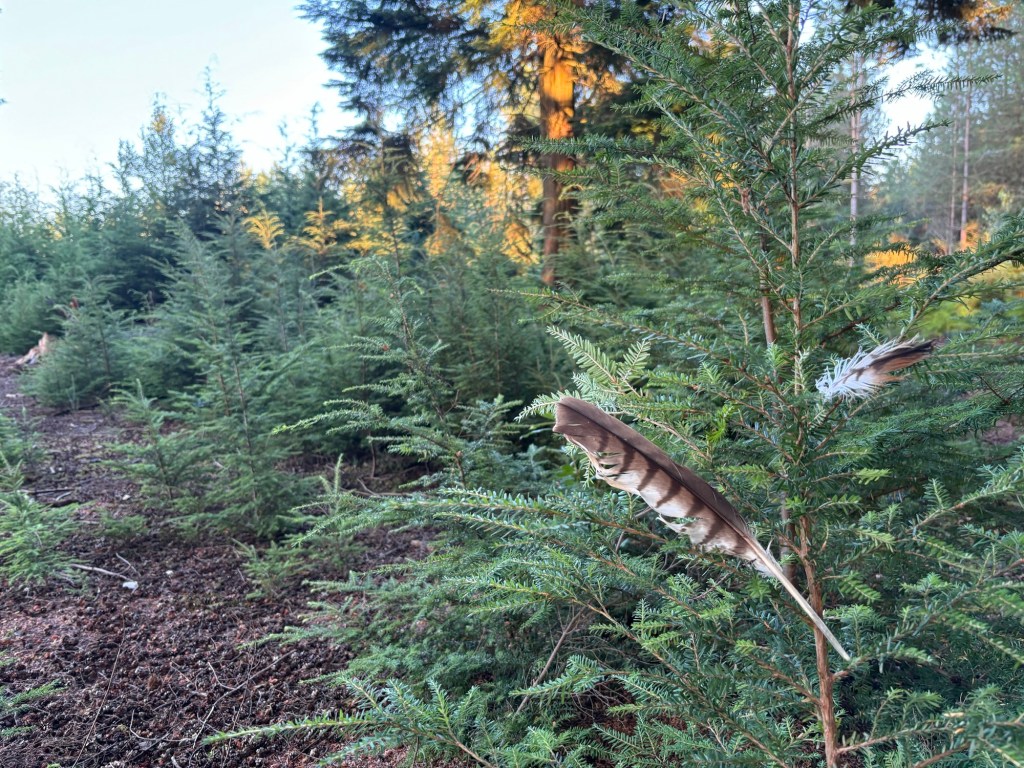
Further in, I found a couple of kite feathers. There are so many in these woods. When I was a child, you would have been lucky to see a buzzard – poison and poor public perception very nearly wiped them out – but now they’re everywhere once again. The red kites that once quartered the streets of London before their extirpation in the 19th century have also come back with a bang, and their feathers turn up in the forest quite regularly. I left some in a small tree for another person to find – some bright-eyed kid like me, perhaps, who might take them home as a treasure. Something they can look back on in years to come, and remember the day, remember the smell of the forest, remember the one who took them there by the hand – the feel of their hand, the sunlight in their laugh. I’d like to think that. BB x


Winds, Waves and Words

It’s 18.00 over here in Saint-Malo and the heavens have opened. An Atlantic wind is battering against the windows and the heavyset black-backed gull that chased off Hector has given up on attacking the ashtray on the windowsill and taken his leave. I might head into town for dinner later, but for now, I’m quite content curled up on the sofa of my AirBnB with a book, a hot chocolate and the time to write. So I thought I’d start today’s post with a little history.


Saint-Malo has a long and complicated past. Originally a 6th century refuge for Welsh monks, including the venerable Maclou of Aleth who gave the town its name, the rocky outpost became a haven for Bretons fleeing the advancing “North-men” or Normans some two hundred years later. In the 17th century, its strategic location made it a natural hub for state-licensed piracy or “privateering”, which elevated its fortunes considerably and paved the way for a generation of wealthy explorers: Jacques Cartier, a native malouin, is credited with giving Canada its name (via the Iroquois kanata) and Louis-Antoine de Bougainville, another son of Saint-Malo, established the first European settlement in the Falkland Islands, which – at least in Spanish – still bear their original Breton name: las Islas Malvinas, from the French Îles Malouines.


The city fell to the Germans during the Second World War as part of their Atlantikwall stratagem, and the skeletons of their fortifications still dot the Breton coastline: in Saint-Malo, the levelled ruins of German pillboxes rub shoulders with 17th century Vauban forts. Surprisingly, much of what you see today was carefully reconstructed, as around 80% of the city was destroyed by the Allies in their dogged attempt to drive the Germans from the old pirate stronghold.

Allied bombers over Saint-Malo in August 1944. The fortified isle of Grand-Bé is at the centre of the blast

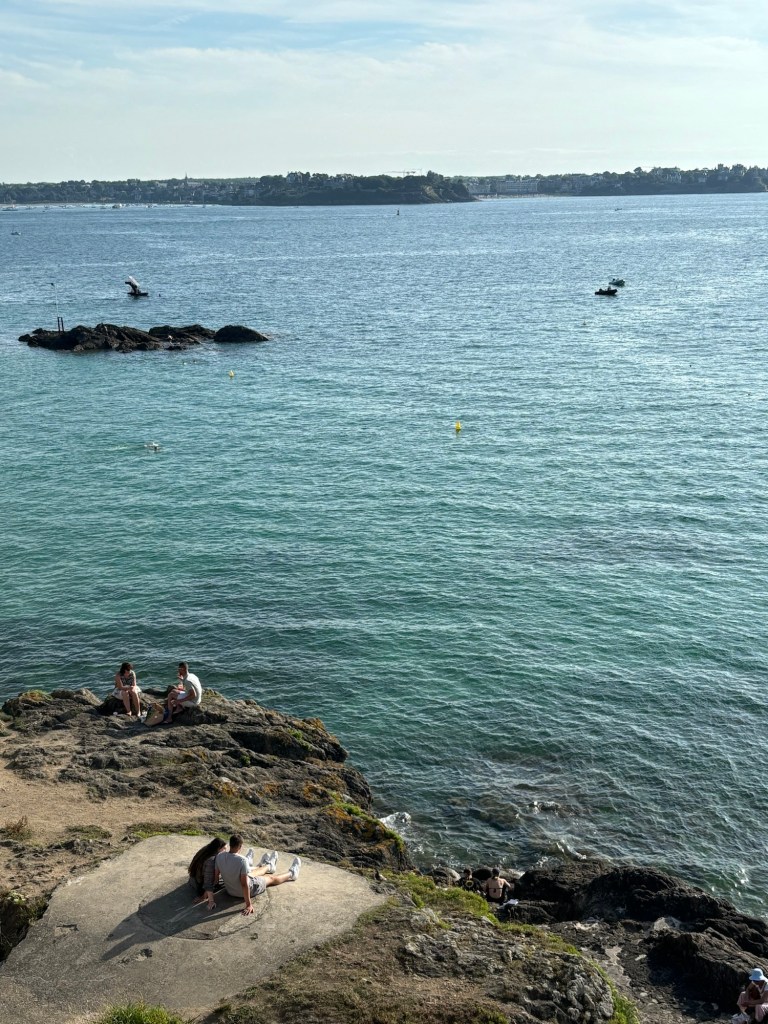
Most of the German fortifications have long since been torn down, but you can still see the concrete bases of many structures on the cliffs beneath the city wall and on the surrounding islets of Grand-Bé. They make very comfortable places to sit and watch the sunset.


In case it wasn’t obvious, the town’s rich history is one of the biggest reasons I’m here. But the other is its wildness: there are plenty of sandy beaches in the south, but I don’t get any real kick out of sea-swimming unless there are rocky areas to explore. The southeast coast of England with its famous white cliffs is quite a sight to behold, but it doesn’t quite have the jagged beauty that the west has in abundance, and Brittany has it to spare.

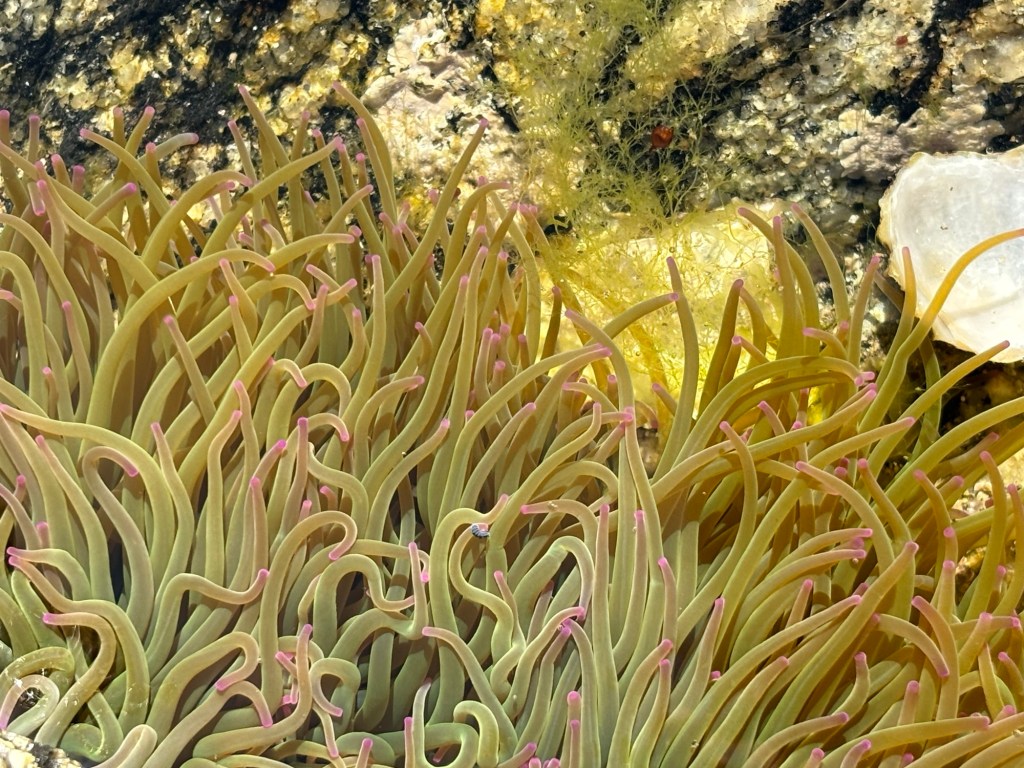
I spent many of the happiest days of my childhood scouring the rock pools of Folkestone for tiny critters: gobies, blennies, butterfish, velvet swimming crabs and even, just the once, a pipefish. Brittany is only the other side of the Channel, so much of the shoreline is familiar. I can’t help keeping an eye out for anemones when I’m out on the rocks, especially the snakelocks variety – I always thought they were especially interesting.


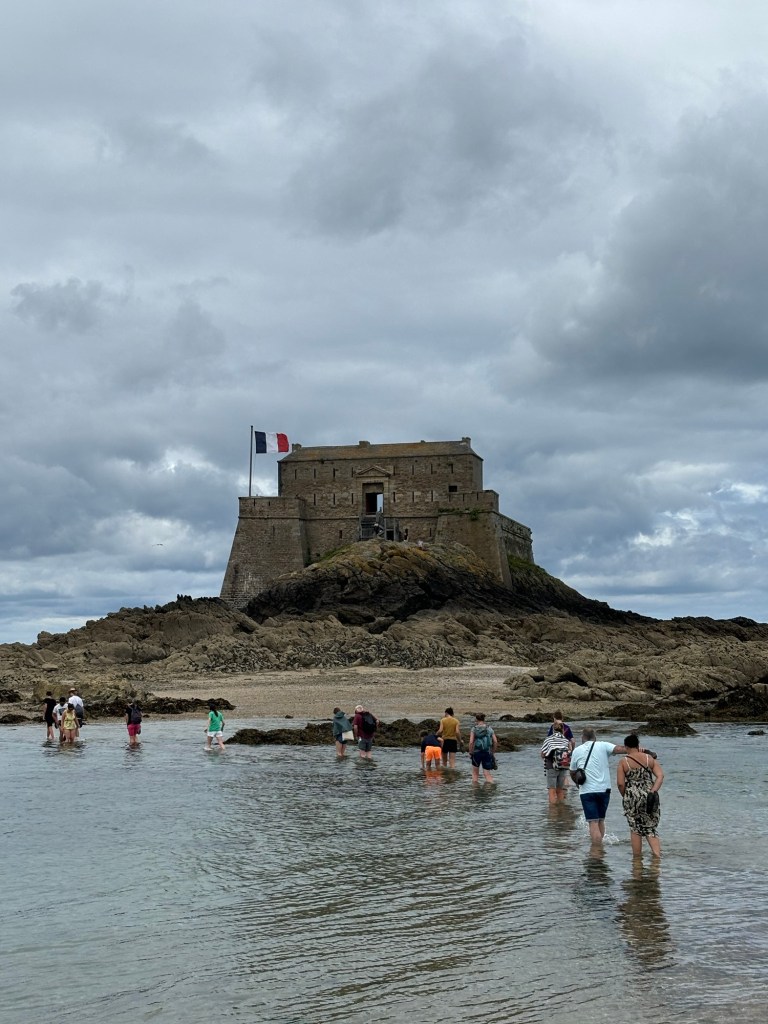
Across the bay from Saint-Malo stands the islet of Grand-Bé, which can be reached on foot at low tide via a barnacle-encrusted causeway. A similar road stretches on to the Vauban fort on Petit-Bé, though a small section of that road remains under a foot of water even at low tide and must be forded with shoes in hand.

Grand-Bé offers a glimpse of what Saint-Malo must once have been: a windswept escarpment just off the mainland, inhabited only by lizards, gulls, a small colony of shags and a company of oystercatchers that can be heard all across the bay. Two of these noisy seabirds were standing in attendance upon Chateaubriand’s tomb, as though to keep him company. From this spot, on a clear day, you can hear the twittering of goldfinches, the cries of gulls, the occasional grunt from one of the shags and the endless piping of oystercatchers on the rocks below or in the sky above – and, of course, the ringing of the bells of Saint Vincent’s cathedral across the bay.

I wonder if the old Romantic was as bewitched by the wild birds of his native Brittany as his writing implies? He certainly had a real flair when it came to writing about nature. Perhaps that’s why he chose this spot.


I spent some time last night watching the sunset over Grand-Bé. I had left my Camino bracelet in the apartment, but I had brought a few other tokens with me. I often take a number of “lucky” objects on my travels: little souvenirs and keepsakes to remind me of home when I’m on the road.

Well, not home exactly. With no fewer than ten moves under my belt at the age of thirty (and just under half of them international) I’m still not entirely sure where home is. But they remind me of friendships and memories that mean a lot to me, and that helps with the loneliness that is a natural side-effect of traveling alone.

In my satchel, ever at my side, I carry my journal, my fifth and longest-serving since I took up the art twelve years ago. It’s coming apart at the seams and bound inexpertly by sellotape – hardly surprising for a little book that has come with me to work every day for the last five years, as well as on every adventure I’ve been on in that time. Concealed within is my lucky dollar, a ticket to the Prado in Madrid, a tawny owl feather, the plectrum that one of my Rutherford boys used to win House Music two years in a row and a perfumed letter.

There is one more keepsake that has been sharing the road with me this summer. It even came with me to America, traversing the Bayou, the Mississippi and the bright lights of Nashville. It’s a card from one of my students, one of many I received in my last week at Worth. The lengths this particular student went to so as to ensure I got the card, as well as the maturity of its message from one so young, are just two of the reasons this one in particular has come with me. I am many things, and a great many less, but I would be a writer – and so that is why I have always believed that the greatest gift I can ever receive is in the form of words. No physical object can ever surpass the depth of feeling that comes from such expression.

I have a bad habit of making people cry when I write them farewell letters (an equally bad habit I’ve adopted for leaving students), but I very nearly met my match with this one. The student in question signed off with a favourite quote of theirs from Lin-Manuel Miranda: “sometimes words fail me”. There’s any number of reasons they could have chosen that one for me – I might well have said the line verbatim in reaction to the behaviour of that class at least once – but it’s a powerful message for a would-be writer.

Words do fail me, and often. There have been moments this year where I have been genuinely speechless, from shock or awe or wonder. It is comforting to know that such a consummate wordsmith shares that affliction.


Tomorrow, I have decided upon a rather spontaneous adventure. I have already bought my ticket. All I can do now is hope that the weather holds. Then – we shall see what we shall see. BB x

Slow Travel: The Highs and Lows of Amtrak

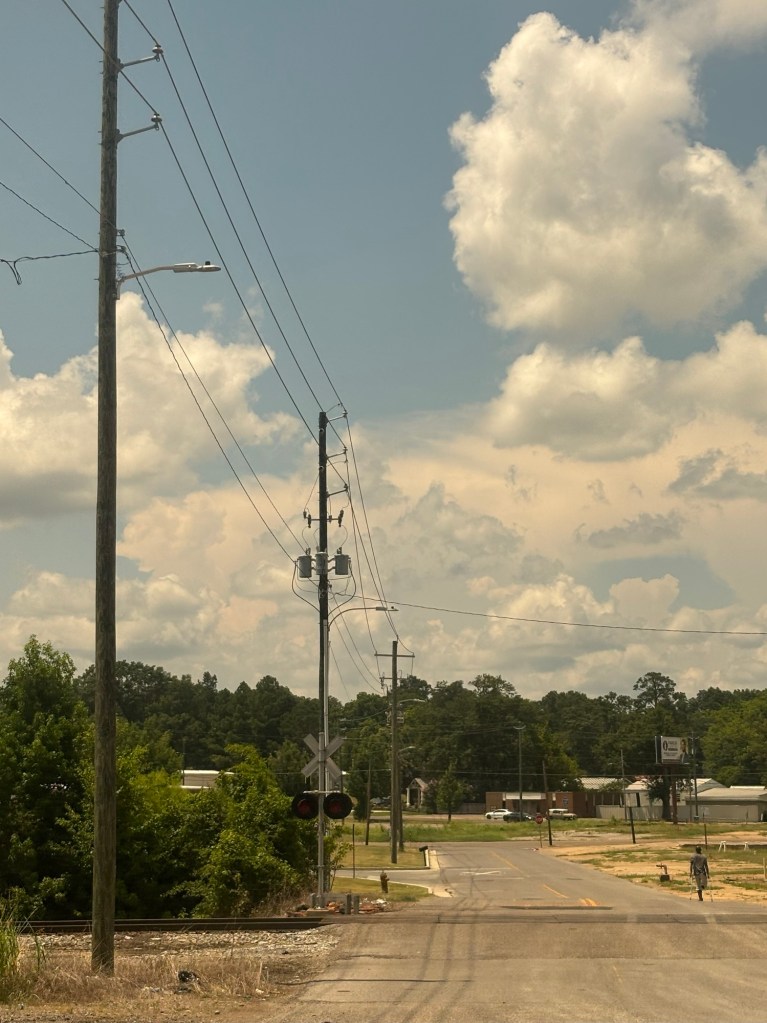
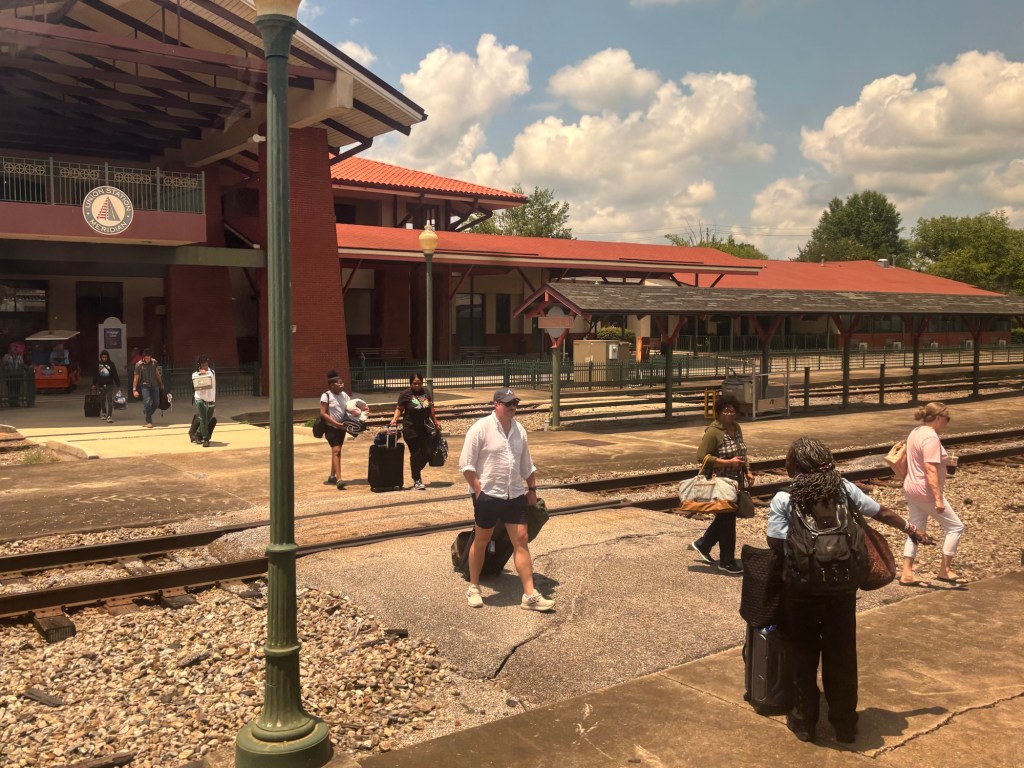
It’s 17.09, it’s been over nine hours since I last ate something and I’m somewhere in the Alabama woods between Tuscaloosa and Birmingham. If we were running to schedule, I’d be arriving in Birmingham in the next few minutes. But, as every American has gone to great pains to explain, the trains in the US never run on schedule. If you’re not in any particular hurry, it’s a phenomenal way to see the States, provided you’re happy to gawp at trees for most of the journey. Lucky for me, I’m easily pleased, and it’s been all I can do to peel my eyes from the window for the last eight hours or so.


The American South reminds me in many ways of Uganda. There’s something familiar about the immensity of the sky, the redness of the earth, the rusting abandoned vehicles and – especially – the enormous homemade painted advertising on homes, cafés and storefronts. The most American thing I’ve seen so far – beside the lone bald eagle standing on the banks of Lake Pontchartrain – are the countless colourful billboards advertising private law firms, demanding your attention with Colgate smiles in nauseatingly familiar language: Bart’s always got your back, Call ya girl Desi, IYKYK, that sort of thing.


Let’s forget any time pressure for a moment. Riding an Amtrak train is actually a really comfortable experience, and I’m surprised it isn’t more popular. There are charging stations for every seat, curtains for the windows, sturdy WiFi and a cheery Southern burr over the tannoy to replace the cold, automated replay of British trains. I’ve even got enough leg room to stretch my legs, and that’s taking into account the fact that the guy in the seat in front has put his chair back into full recline. I haven’t seen as much wildlife as I’d have liked over the course of my vigil, but I’ve still managed to clock a few deer, a whole lot of egrets and a few birds of prey, including the symbol of America itself. That’s not too shabby for a bit of on-board birdwatching.

To be honest, the only thing I’d change is the seat numbering, which is baffling – and very obviously a new concept, as even the ticket inspectors seemed to get muddled up by the numbers (which don’t really correspond to any of the seats at all). Folk don’t seem to mind, though. I think most of the passengers here have simply found an empty seat and made themselves comfortable, and all of them are quite happy to shuffle as and when a couple or family comes aboard. That’s one major difference to European trains. I was traveling in Germany once and still remember an officious German lady who made the entire coach get up and scramble because there was somebody in her seat and she absolutely had to sit in the seat she had been assigned. The human soul: the price of efficiency.


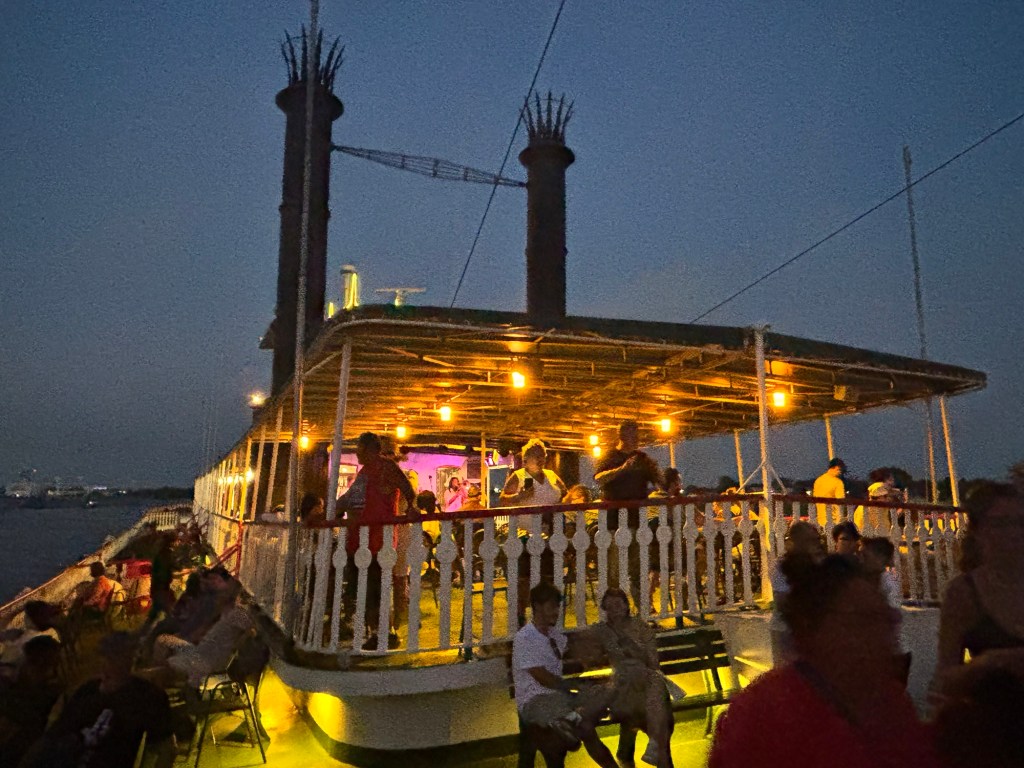
I ended my stay in New Orleans with a jazz fest, seeing a local band in Preservation Hall and then taking the Natchez steamboat cruise down the Mississippi with its attendant Dixieland band providing a jaunty backdrop. If it’s done one good thing for me, New Orleans has reminded me that there is hope for those of us who still believe in music bringing the world together. The Preservation Hall jazz band ticked more diversity-and-inclusion boxes than a school website: the trombonist was black, the saxophonist Latino, the pianist Scandinavian, the double bassist Japanese and the lead trumpeter Creole. I hate to admit it, but I’m still bleeding a little over the way my Gospel Choir was torn apart years ago. Maybe I always will be. That’s partly why I’m here in the States, in this limbo between jobs, between worlds: to try to put a seal on that episode of my life, and to remind myself that there are plenty of people out there who don’t see things that way. And where better than America, the great Melting Pot itself?


I’d better stop writing – it looks like we’ll be arriving soon. In the end, we’re only 50 minutes behind schedule. It’s funny how little that seems to matter! In the UK, there’d be apologies over the tannoy and prompts to get a refund via the website…

Alright America. I’ll admit it. Just this once, you have us beat on heart. BB x

Skylink

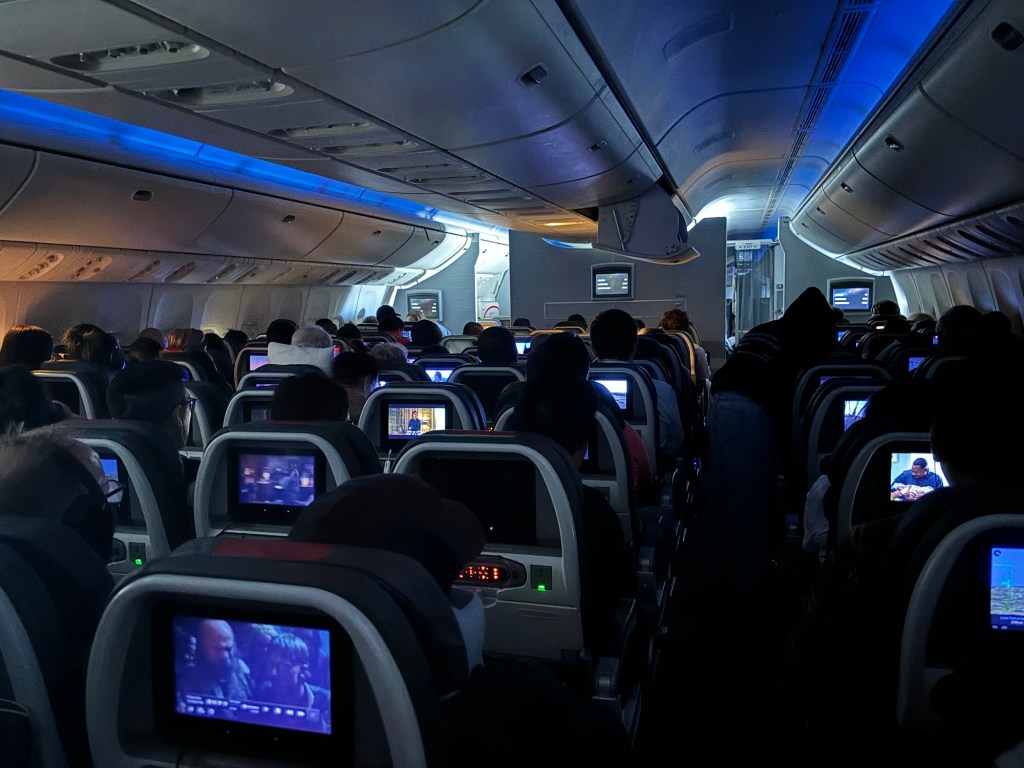
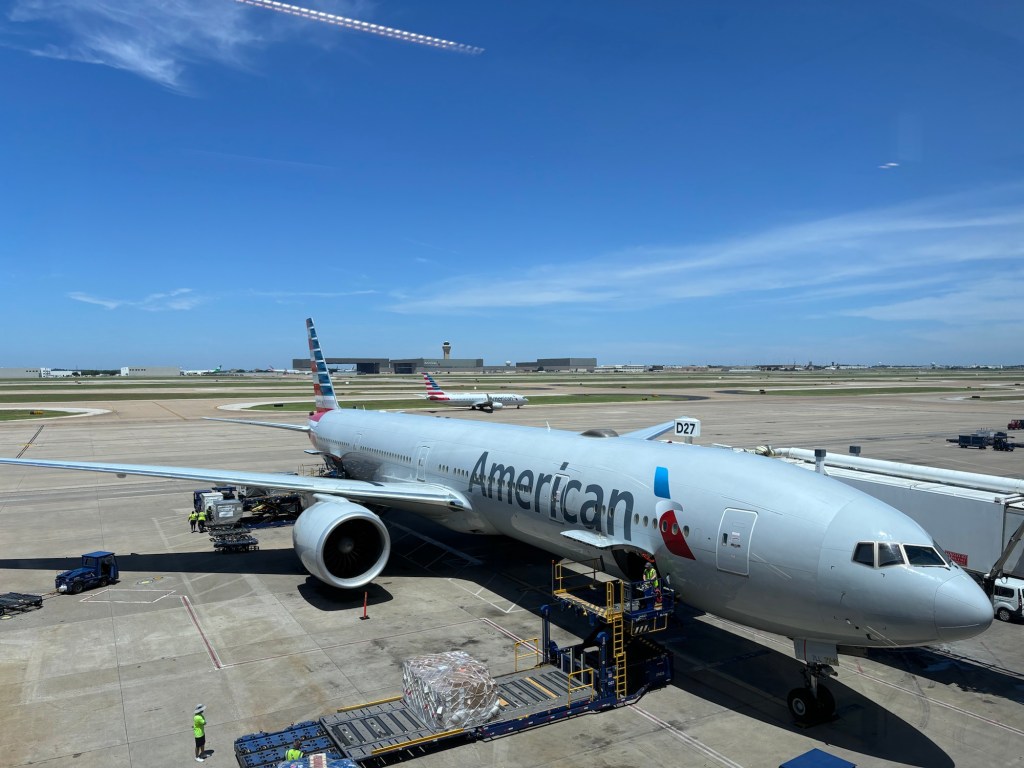
Four days ago I was standing in the ruins of a Roman theatre in the Andalusian port of Cádiz, a contender for the oldest continually occupied city in Europe at over three thousand years old. Four days, one Leavers’ Ball and a ten hour flight later and I’m sitting in Terminal B for Bravo in Dallas/Fort Worth International Airport, built in the year 1974. The fact that Cádiz’s Roman theatre itself is relatively young – built around 70 B.C. – only adds to the stark comparison. The culture shock is real.

First impressions:

  • The Mississippi is huge. Enormous. It looked like a colossal brown snake winding across the plains into the distance
  • Cowboy hats seem to be worn unironically here – and with a frequency that would surprise you!
  • The selection of in-flight movies on offer is considerably superior to all the streaming services at the moment (heck, they even had both Dune movies)
  • Airport taxes – what the hell is that about?
  • Security was thorough but not nearly as austere as I expected

In case you haven’t noticed, this is my first time in the United States. I honestly have no idea what to expect, since until recently I wasn’t particularly interested in crossing the Atlantic for an adventure – well, not this far north of the Caribbean, at any rate.

But I did promise myself that I’d reward myself with a proper adventure if I landed a new job this year, and a promise is a promise. I just didn’t expect it to take me to the land of Sitting Bull and Civil Rights, that’s all!


I don’t have too much to report on just yet, beyond a general wide-eyed wonder at all of it. After all, I haven’t legally set foot in the States yet – that will happen when I touch down in New Orleans in a few hours’ time.

Sounds like they’re boarding in five minutes’ time. Not sure what a Deadheader is outside of a gardening context, but I’d better get my stuff together all the same. Starting to feel the jet-lag kicking in, but I hope I can shake it with an early night this evening! BB x


Backwards and Forwards

Another year, another Christmas come and gone. I’m back at the flat after a week up north with the parents. Billy Ocean is playing on the Bluetooth speaker as I write – Stay the Night – and the torrential rain that followed me south stopped about an hour or two ago. Everything is more or less as I left it, with the exception of fresh sheets on the bed.

It’s been nearly six years since I took up my post here, moving back to England from Spain. I sometimes wonder what direction my life might have taken had I stayed on and taken up the teaching post I had on the cards in Galicia, but I know I made the right decision for my career. Over the course of those six years, I’ve earned my stripes (and, more importantly, qualifications) as a fully-fledged teacher within the British educational system, enrolled in a number of courses and taken on more responsibilities than I expected, up to and including being an Oxford-style debating judge. There hasn’t been a day in those six years when I’ve woken up dreading the day ahead or resenting my job – not even in my PGCE year, which was shot right through the heart by the COVID pandemic. I love teaching, I love my subject, and the knowledge that I am keeping up a family tradition that goes back generations gives me an eternal flame that cannot be extinguished.

But that’s not to say living and working in a boarding school has been without its doubts. I’ve definitely had some bad days – who hasn’t? – and I’m very aware that my choice of career (coupled with my lingering anxiety about responding to messages) has had a good hand in shrinking my social circle with every passing year. A senior member of staff at the school once described living and working in a boarding school as “submarining”; that is, disappearing from the rest of the world at the start of term and resurfacing only once the last child has left the building, some three months later. It’s an apposite analogy, and one that’s hard to sell to anybody outside the system.

I suspect that after six years in the same school – nearly long enough to see a generation of students through their whole educational journey – it’s natural to start to feel the need for a change. As for where that change will take me, I’m not yet sure. I only know that change is coming, and it would do me a world of good to seek my destiny somewhere beyond the horizon. Perhaps the idea came to me on the Camino and has been incubating ever since, or perhaps it crystallized after a conversation with a colleague about how it’s very easy to count the things you do for others in this line of work, but on reflection, it can be a lot harder to say what you’ve done for yourself. I’ve been lucky enough to have a partner to guide and support me through the greater part of those five-and-a-half years, but December finds me on my own once again, and as the months start to fall away before the big three-zero, I’m conscious that the career path I desire is out of reach until Lady Luck sees fit to give me another chance. And since the online dating scene has been about as generous as a paddling pool is to a fisherman of late, it’s probably time I upped sticks.

With that thought in mind, I’m starting to look at the world around me with fresh eyes. The flat that’s been my home for two years now seems more detailed than before. The cat-print mug on my desk that probably belongs to my housemaster, containing a shamrock-green bauble, a gift from a Colombian parent. The collage of photos in an IKEA frame of friends from my university days, all but two of whom I haven’t seen in years. Curios on my dresser: a boomerang, a vinyl cover of Fidder on the Roof and three chips from a Las Vegas casino. Photos on my bookshelf: my class of 4° ESO from Villafranca (my first real job), my cousins, the windmills of La Mancha and my mother’s first car, an orange Volkswagen beetle. The mirror that never made it onto the wall, and the blocky but practical Skorva bed that has put in a good year’s shift after the last one finally collapsed after a marathon service (it was a veteran when it came into my possession over a decade ago). Some of these things haven’t moved an inch in two years.

I’m not usually one for resolutions, but I am going to take more of a handle on my own future in 2024. I’ve already thrown the first stone by committing to weekly driving lessons, and while it may be some time yet before I have wheels of my own, that crucial piece is finally on the board. Fortune has given me a later return to work than usual, so I have seized the chance to ring in the New Year with my cousins in Spain, something I have wanted to do ever since we first reconnected back in 2018. It may be that my next post doesn’t have an international airport within walking distance, so I might as well make the most of it while I still can.

I’ll also try to write some more. I’ve been channeling my creative endeavours into the creation of a Spanish culture podcast, but it wouldn’t hurt to flex my writing arm some more on here every once in a while. Even if I’m the only one who comes back and re-reads these posts, it makes for an interesting insight into my mindset at various points of my career.

I’ll check in again tomorrow. Until then – tschuss! BB x

2023: A Year in Pictures

January

2023 begin much like it is today: wet and windy. In keeping with the last seven years, the year began somewhere new: this time, in an AirBnB in Wilpshire, some two hundred and thirty-five miles from home. It had been a wonderful New Year’s Eve, but a fleeting one: cracks were starting to form in my relationship. I decided to ignore them and looked inwards instead. A few weeks later I saw a pheasant on a stroll around Wakehurst and had no idea that the very same bird would seek me out when things began to unravel several months later. Hindsight is a curious thing.


February

The villagers of South Willingham lost their bid to save the local forest from being turned into a bike park. I know it will bring much-needed money to the area, but a part of my heart always breaks a little when somebody carves up another patch of the earth for human entertainment. I wandered among the trees and soaked in the winter light. No footpath leads through the woods, so I might be the last person to do so. I also passed my driving theory test, but didn’t tell anybody about that for a while.


March

The man who doesn’t take a day off unless he’s dead or dying was very nearly brought down by a fever this term, reaching its peak the day of the House Music final. My very conscientious partner drove all the way up to my place to drop off a get-well-soon care package and gave me clear instructions to rest, but I dragged myself to the school theatre to support my boys in their bid for victory – and was not disappointed. Rutherford took home the House Music shield for the first time in over a decade. I didn’t fully recover until the following Monday, but I rode the high of their success for months afterward.


April

Seeking answers, I sought out the Camino – and the Camino provided. Within days I had found an incredible cast of characters, and had the Easter holidays been longer, I would have gone with them all the way to the end. I walked a hundred and thirty kilometres in just under a week with a Brit, a Dane, a Canadian, a Spaniard, a Dutch girl, a couple of Californians and the most charismatic Italian I have ever encountered – and I have encountered more than a few. I told myself I would be back to finish the job, but I didn’t think at the time that I would throw myself back at the Camino a few months later.


May

Matters of the heart came to a head. I drifted back to Wakehurst and sat on a grassy bank near the American plantation to clear my head. The pheasant appeared and sat beside me, keeping me company for the best part of half an hour. Say what you like, but animals seem to have a sixth sense for when humans are in distress. My mother’s cat made a beeline for my brother when he was in the doldrums in much the same way. It did not heal my heart but it did a lot to patch it back together. In the meantime, I went at my living room and restructured the place, hoping to find a new sense of direction by altering my perspective and my surroundings. It’s a lot easier to move a bookcase around when you don’t possess several hundred books, though.


June

I broke things off with her and felt awful about it – but seventy-eight reports, a bout of vomiting sickness in the boarding house and preparations for the school trip to Seville helped me stay on track. The Leavers’ Ball was more of an event than a formality this year, seeing as it meant saying farewell to a cohort of students who had joined the school at the same time I had. An immensely nostalgic music tour to Salzburg rounded out the month and found me playing the violin at the same bandstand I had played back in 2006, some seventeen years ago. In a very up-and-down year, June was a particularly erratic rollercoaster of a month.


July

I’m quite convinced that the answer to most questions can be found on the Camino, and I had unfinished business from the Easter holidays, so a mere two days after returning from Austria I was back on a plane and bound for Bilbao once again. You’ve probably followed me on that particular journey already, but if you haven’t, you can always start again right here. Three weeks and nearly five hundred kilometres later, I arrived at the end of the world and stared across the Atlantic to America. Someday soon, I’ll take my adventures across that ocean. But not yet.


August

August was a quiet month. August always is. I popped up to London a couple of times and saw some old friends, which was much needed – I have distanced myself from a lot of old acquaintances after the way they upbraided me over the Gospel Choir fiasco, and it took quite a bit of courage to resurface, even though it’s been some two years since. The social current flows fast in the capital city. London remains a charming place to visit, but I’m sure glad I don’t live up there. I’m a lot better at dealing with cities than I used to be, but I’m definitely a country boy at heart.


September

Term started late this year, meaning August was already over by the time the students returned. It wasn’t a scorcher like last summer, but the warm weather stayed with us for quite some time. A new wave of weekend activities and a house camera kept me busy at weekends, and I finally managed to host a party in the flat over the first Exeat of the year, using the old projector to beam karaoke onto one of my walls. I also got back into drawing, completing a giant poster for one of the walls.


October

Storms Agnes and Babet tore across the British Isles and put an abrupt end to the long summer days. Sussex remained relatively stable while the roads of the Lincolnshire Wolds turned into rivers. I spent the October half term with my parents and even made it to Manchester to see my brother’s first ever publicly exhibited artwork on the first floor of a fancy riverside hotel. I also wrote a pantomime for my school, but internal politics made it impossible to get off the ground. At least I have the backbone of a script that I can carry over to whichever school I head to next.


November

We lost the first round of House Music, but only by a single point – so there’s hope for my boys yet. More importantly, I bit the bullet and started learning to drive. Finding the time to schedule in two hours of driving during a working week is ridiculous – and probably the biggest reason I’ve put it off for so many years – but, steadily, I’m starting to get the hang of it. Or rather, I was, until a combination of sickness and cover lessons made it impossible to schedule in the last two lessons of term. Here’s hoping I can pick up where I left off in the new year.


December

December hurtled around at the speed it always does, though this year the last stretch did seem longer than usual. I managed to strong-arm Riu Riu Chiu back into the Carol Service at last, which the kids seemed to love, and helped to draw up the motion for the Students vs. Alumni debate, though I was not especially fond of the heavy economical slant in which it dragged the proceedings. My brother spent Christmas with his partner, so it was just my mother and father and I this year. Midnight Mass was bizarre – half an hour of forced carols before the Mass itself began at midnight (rather than the usual 11.45pm start) – but, traditions must be maintained. I blew the dust off Duolingo and got back into learning Italian after more than a year’s hiatus, though I daresay I’ve picked up a little in that time from my students.


This time tomorrow I’ll be in Madrid. Since leaving university I’ve made a point of seeing in the New Year somewhere new, but this year, for the first time since we met, I can finally celebrate it with my Spanish family, so I’m headed for the pueblo to see in 2024. I haven’t seen some of my cousins since my youngest counsin’s first communion back in 2019, so it’s a reunion that’s been a long time coming. Here’s to a good one, folks. BB x

Leveret

The heavens opened last night. The water butts, which were pretty much exhausted yesterday, were filled right up to the brim and overflowing as the rain continued long into the morning. Then the winds blew in hot from the southwest, then the skies clouded over and a chill set in. Looks like we’re back to formula with a regular English summer once again.

I read a couple of articles in The Critic today. Oxford University in a bind over a Benedictine college. Simmering anger against the rising tide of wokery. In the news, US Congresswoman Nancy Pelosi landed in Taiwan against the wishes of the Chinese government, Beyonce changed the lyrics to her latest hit single after outcry against an offensive word and Big Brother announced its return. I could have added that the latter information was revealed at the end of this year’s season of Love Island, but the ambiguity is very much intentional on my part.

I quit the house for a bit, grabbing a worn Barbour coat and a pair of binoculars. Figures if I’m on the wrong side of history, I might as well look the part. Watching the swallows yesterday made me nostalgic for the long, quiet days of my childhood when I would set out into the countryside with my camera in search of nature. It was a bit warm for the Barbour, despite the clouds, but it’s a damn sight better for blending into the khaki hues of the English countryside than anything else in my wardrobe.

Lincolnshire seems to have quite a sizeable population of hares. You don’t see so many of these impressive creatures in the south-east. Being larger and more skittish than the rabbit, they don’t cope so well with how crowded it is down there. Neither the rabbit nor the hare are native to these islands. Both were brought over here by the Romans – for sport and for eating, if not for some early scientific whim. Our only native species is the mountain hare, and you’ll have to travel to the wildest parts of Great Britain and Ireland in order to find them. Ultimately, that’s neither here nor there: two thousand years have come and gone since the Romans were here, and the hares that race across the fields are by now as English as the oaks that have grown in our soil since time immemorial.

The hares I saw in the fields behind the house were only youngsters – leverets. They hadn’t developed the long and powerful back legs and enormous eyes that make adult hares so striking. They also weren’t as fleet-footed as adults, who will usually disappear in a black-and-tan dash into the middle distance long before you can get close. They let me approach further than I expected before deciding the Goldilocks line had been breached, and off they went. I followed, slowly, at a distance, and caught up with them by the sand martin colony. One hung back to watch me for a few moments before slipping through the fence and bounding after its sibling. After that, I climbed the fern-bound rise and scanned the forest for a while, listening to the wind in the trees and the buzzards calling. It feels good to be back in nature again.

When I get back home, I really must get back in the habit of spending more time in nature again. I’ve neglected this side of me for too long. At the end of the day, I love to try my hand at various things, but under all those layers is a naturalist. Life is a mosaic – you never lose who you were, or the people you’ve been at various stages of your life. You will always carry them with you in one shape or another. The largest shard in my mosaic is an earthy brown, like the soil; greenish-grey, like oak leaves; and bluish-white, like the sky. I need to go back to nature. I need to go back to being me again. BB x

Home Again

I’m back home in England. It’s a lot noisier than it was in Bayeux, but then, the summer school kids are still here. It’s a Friday night, which means an end-of-week party, curated by the team leaders. That’s what we always used to do. You can tell because the music pumping out of the hall is almost entirely hits from the 2010’s. Twenty-somethings revelling in university nostalgia at a party ostensibly for children. Every once in a while a track comes on that they all seem to know: Freed from Desire, Mme Pavoshko, the Macarena. I’m almost nostalgic for Sur ma route, ever the anthem of my summer school days. Almost.

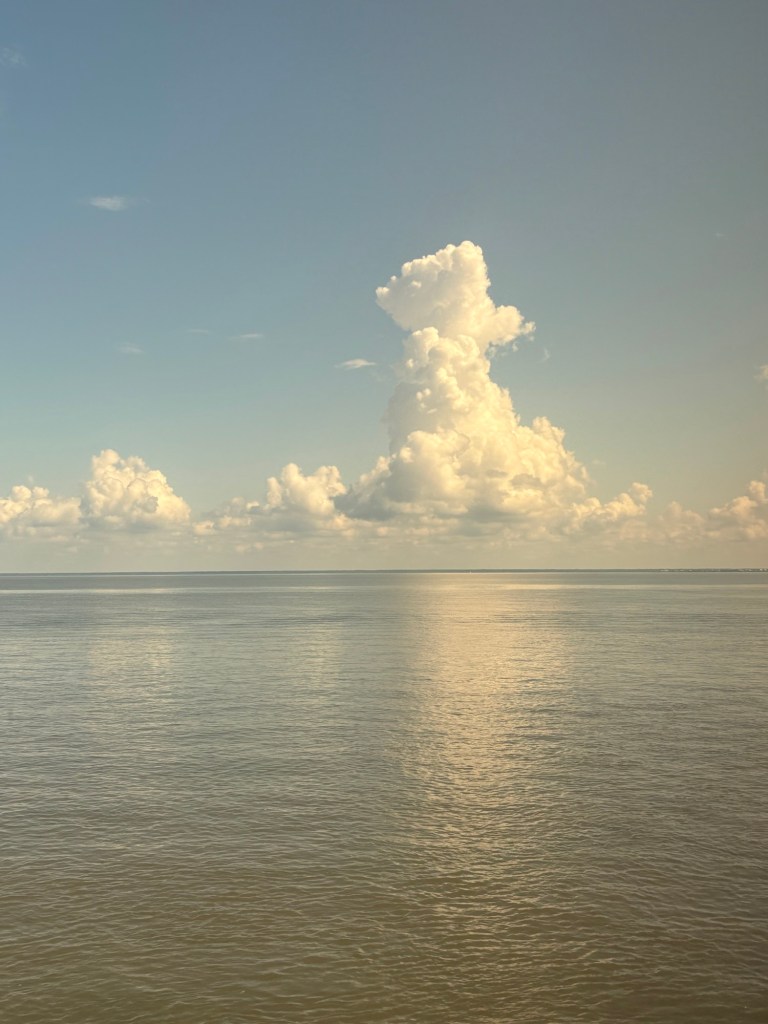
Blimey, but it’s a long ferry ride from Caen, though. As I caught the overnight ferry on my way out on Monday, I slept through most of the journey, but this time I watched the whole thing from the seats. At first you’re riding parallel to the sloping French coast to the east, and the seabirds follow you out: pairs of scoters, heavyset black-backed gulls, solitary gannets and the odd fulmar. Then it’s nothing but sea in all directions. England, on the horizon, hides behind a wall of cloud and mist, and the sea seems to fade into the sky. There’s always at least one or two shopping containers in the distance, the lettering on their hulls so vast you can read it from miles away. In a trick of the light, an Evergreen tanker seems to float in the void between the sea and the sky.

More than once, I tried to imagine what it must have been like for the soldiers crossing the Channel. The Allies riding into the jaws of death on the beaches of Normandy; and the Normans themselves, some nine hundred years prior, setting out to rewrite the history of a nation. The Conquered liberating the land of the Conqueror. There’s a poetic symmetry to that. Perhaps that’s why Normandy felt so special. It really is a history fanatic’s paradise and I couldn’t recommend the place more highly.

I really enjoyed being back in France. Toulouse was OK and Bordeaux pleasant enough, but there’s a magic in the north I’d never noticed before. It was also a pleasant reminder that I can handle myself just as capably in French as I can in Spanish, and I needed that. I should get to know that beautiful country some more over the years. Normandy was especially beautiful and I may well be back someday.

But for now, my legs could use a rest. And I could do with the sun making a return, since my feet, having been in sandals for four days, look like something you might find in a Bernard Matthew’s packet in the frozen food aisle in Tesco’s. BB x

The Weatherman Cometh

It starts with an ominous grey sky to the west. The patchwork of fluffy summer clouds that have been insulating the leftover heat from three scorching days suddenly drops into a void the colour of slate, matching the roof of Bayeux’s cathedral almost exactly. A man in a beret watches the skies; a French family whose children seem to tan faster down the years savour their two-scoop ice creams; a boy and his mother walk their five beagles.

The first raindrop falls on the back of my neck like a kiss. Cool, swift, sweet. I’m sitting on a bollard, sketching. I wait for another. It lands on my arm. Almost instantly a third lands on my sketchbook, narrowly missing the moustachioed gentleman I’ve been sketching. I snap the book shut and watch the tourists scattering as the rain comes down: the French dignified beneath their umbrellas, the Dutch unflinching behind their cameras, the Americans in a mad dash. I think about taking a slow walk back to the hostel to savour the blessed rain after so many days of sun. I’m no further than a few feet around the corner of the cathedral when the heavens open.

I concede defeat to the tempest and join a small but growing crowd seeking shelter in the ancient stone doorway of Odo’s cathedral. The beagle-fanciers are here, along with a cross-section of Bayeux’s tourists. The rain comes down in sheets, hammering the cobblestones like a snare drum, and then a sudden flash and a rolling crash from the bass drum up in the sky. “On est bien dessous, hein?” remarks a Frenchwoman with short-cropped hair and round glasses. A boy with long eyelashes runs in and out of the rain in his yellow anorak, singing the chorus of the Wellerman shanty over and over.

A solitary American standing nearby stares at his phone in disbelief and growls. It sounds like he’s frustrated at a video game, but as he starts to verbalise his frustration it’s obvious he’s checking a weather app. “You’re kidding me, I’ve got to wait half an hour? God, you’ve got to be kidding me. Come on!”. He growls again. And again, louder this time. Some of the other tourists back away. “Hrrrrrnnnn!” The grunts and growls sound uncannily like a bull, giving fair warning before a charge. “END! NOW!!!” A couple of startled jumps from the crowd. By the looks on their faces, they’re weighing up whether to tell him it’s futile to attempt to command the skies, or whether it’s more futile still to reason with a man so blatantly trying to do just that. As a result, nobody intervenes, and Yankee Canute continues to defy the elements, bellowing at the clouds with increasing fury. “Hmmmmmhnnn, CAHM AAAAHN. When’s it gonna EHYAAND? GAAHD, I don’t have TAAM for this SHIIYET”.

The growling and grumbling is briefly cancelled out by another clash of thunder. “Hurry up, END, NOW! Cahm aaahhn, pleeez, end now! Why does it have to do this during the day, it should do this at night!” – (a fair point here, it was unbearably hot last night) – “Gahd, I don’t have time for this shit!”.

I slip inside the cathedral to escape the verbal artillery for just a moment. Bayeux’s cathedral survived intact the last time it came under fire from an American battery, so I figure it’s a safe bet. The muted thunder beyond the stone walls sounds strangely beautiful, and the grey skies filter through the stained glass in hopeful technicolour. The aisles are packed with a colourful array of tourists waiting out the storm; a phoney faithful glued to their phones, waiting to proceed on their pilgrimage to the crêperies outside – a combination of American flags and English spoken here signs were drawing in the crowds earlier. Staring down at the sightseers, a gargoyle pulls his mouth into a sneer, tongue out, deriding a thousand years of peasants, pilgrims and pensioners.

Outside, the rest of the gargoyles are doing their job, spewing rainwater from their mouths onto the streets below. For the first time they look complete, as though the gaping mouths were merely voids waiting to be turned into channels. A father points them out to his daughter, one hand gesturing, the other on her ear as our frustrated Yankee Canute swears blue murder at the sky.

The streets of Bayeux shine under the whitening sky. Umbrellas and ponchos have been magicked out of the air (and some straight out of souvenir shops). The Wednesday market is being dismantled. The fishmonger reclaims the last two skate wings and a Norman bookseller voices a quiet complaint to the heavens as he stacks his pulped collection of second-hand books: “aujourd’hui, précisement?”.

The storm has passed and the sun has returned with a milder temperament, his midsummer fury sated at last. I think I’ll take the rest of the day off. Find a park, do some reading, and clue up on the bus times for tomorrow’s expedition to the coast. A bientot! BB x