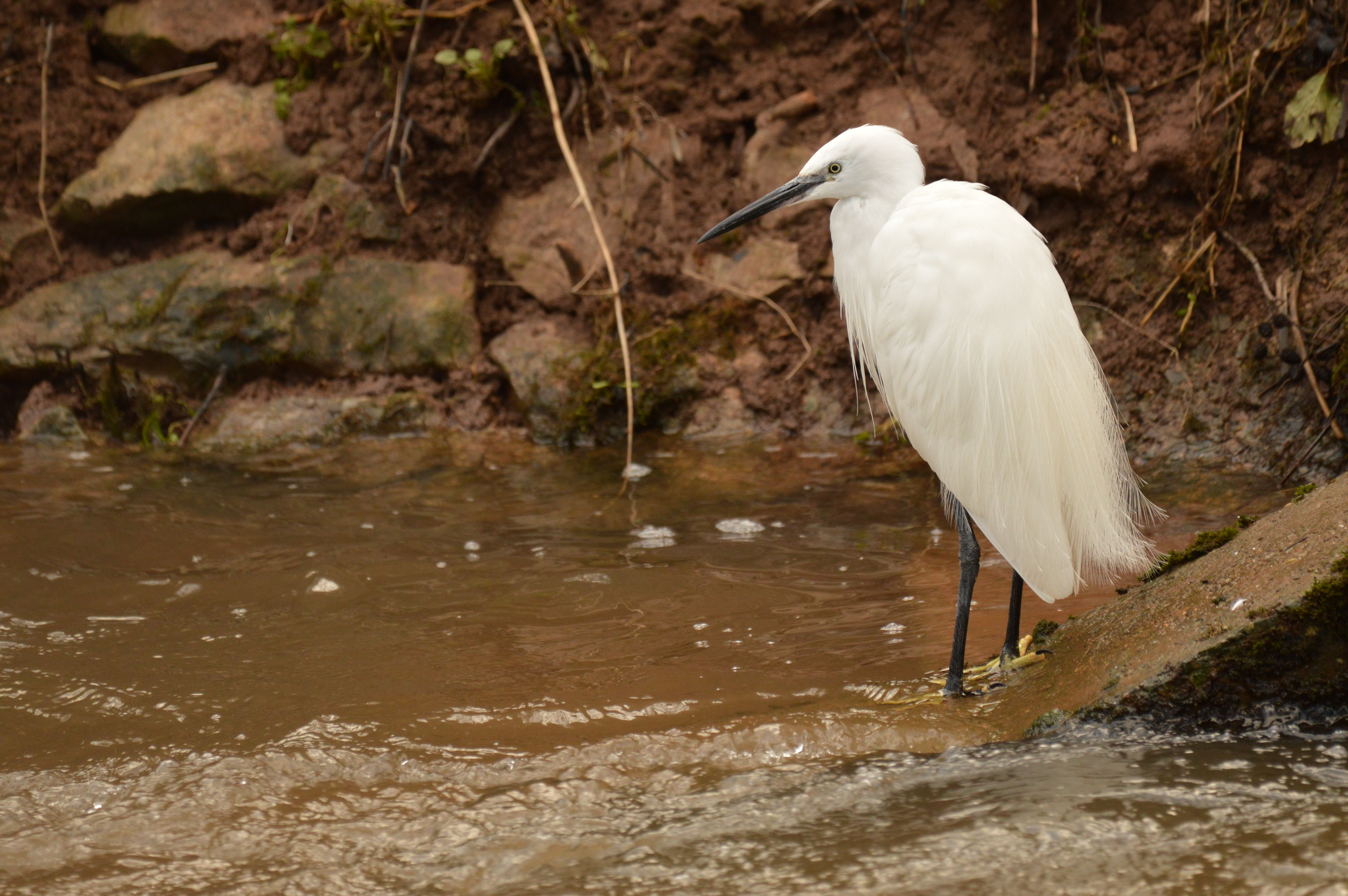
Little Egret (Egretta garzetta) – River Tone. 22/2/26
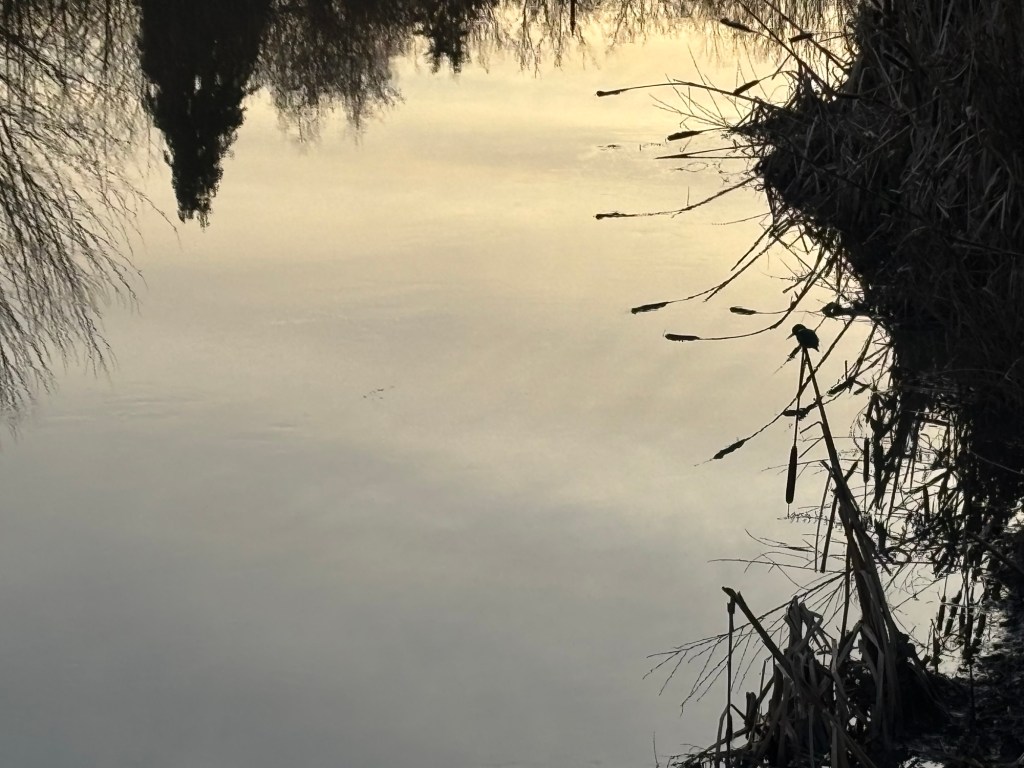
On my afternoon wander along the Tone yesterday I came across an egret fishing on the concrete steps of a flow measuring station. I’m so used to the snowy white shapes of these beautiful birds in and around the rivers and fields of the English countryside that it’s sometimes hard to remember a time when these were a very rare sight indeed.
When I was not yet ten, the presence of an egret in the area was something my family or friends found newsworthy. That’s not exactly surprising. Compared to our native (and undeniably stately) grey herons, they do have an exotic look about them. Maybe it’s the silky plumes (or aigrettes) of their breeding plumage, or maybe it’s the smart yellow galoshes they seem to wear on their feet. The speed of their colonisation of the British Isles gave the Roman Empire a run for its money: by the time I was fifteen, they were already such a feature of the Kentish wetlands and saltmarshes that they had somewhat lost their star appeal, if not their lustre. They no longer triggered a rare bird alert on twitchers’ pagers up and down the country, and their names no longer appeared in bold capital letters on the “Recent Sightings” blackboards at nature reserves.
But first, some myth-busting. It’s not as though the egret is an exotic immigrant to our shores. Far from it. Various species of egrets could be found in the British Isles throughout history, before a combination of over-hunting and the insatiable demand for egret feathers wiped them out. Such was the obsession for aigrettes – which once bedecked the headwear of noble lords and ladies alike – that the little egret and its cousin, the great white egret, were driven out of much of Western Europe as well, seeking sanctuary along the sheltered shores of the Mediterranean. It wasn’t until a pioneering group of Englishwomen came together in 1889 to form the Society for the Protection of Birds (the forerunner to the cherished RSPB) that the egret’s fortunes began to change, first by petitioning powerful high-society types to eschew feathers from their wardrobe, then lobbying the government to ban them outright. It clearly caught on, because the Americans set up a similar initiative of their own over in Oregon, where the native great and snowy egrets were suffering a similar fate. Gradually, with aigrette feathers off the market, the birds began to reappear in the fields and fenlands they had once called home. It would be another hundred years before they attempted to recolonise the British Isles, but once they did, they came back in droves.
I bought a magazine once in the late 2000s that predicted the arrival of the rest of Europe’s heron and egret species in the UK as global warming made these cold islands more favourable to birds more at home in southern Europe. It wasn’t wrong. Since then, both the cattle and great white egret have secured a foothold in Britain, with all three species present in the Avalon Marshes over in the Somerset Levels. If it weren’t for the fact that I work six days out of seven – and Sunday trains and buses are awful in this part of the world – I’d be over there like a shot. Somehow, I fear the open wilds of the Avalon Marshes will have to wait until I have wheels, because after a few sums, it would actually work out cheaper for me to fly to Europe and back than to spend a night or two in Glastonbury in order to visit the Levels. Mad how that works.
Not that I’d say not to being back in Europe, of course – though I am still waiting for my temporary ban to lift, as I hit the ninety day limit last year and would very much like to go back to my grandfather’s country without having to pay a fine. I always try to keep an open mind, but sometimes, Brexit, I really do wish you hadn’t screwed up my life quite so much.
Anyway. These papers won’t mark themselves. Just thought I’d muse a little on something uplifting before getting back to the grind. BB x
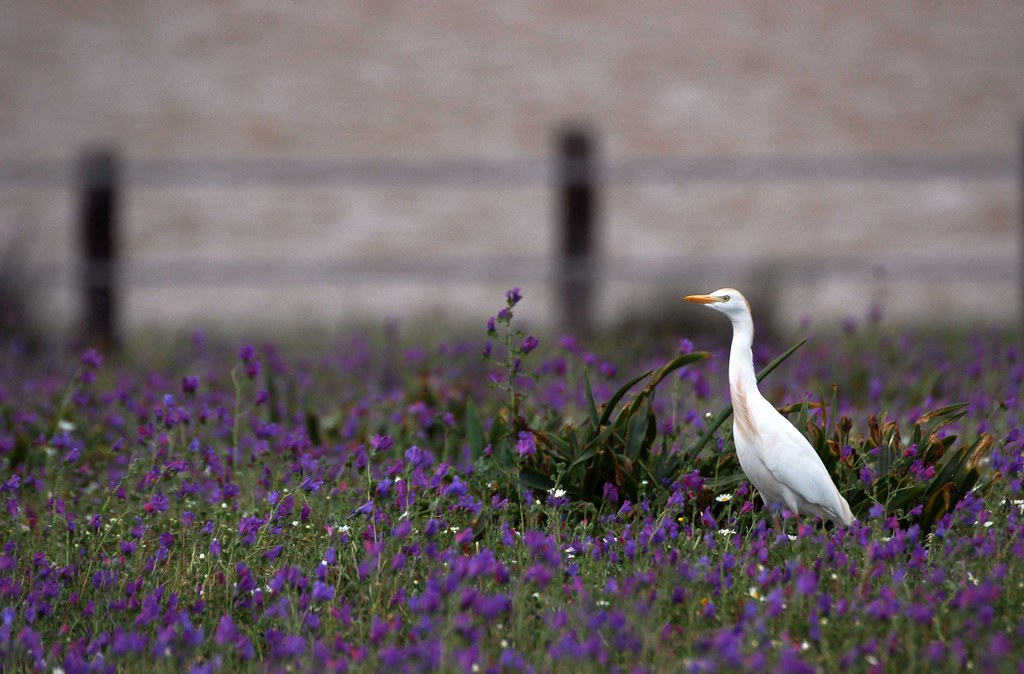
Cattle Egret (Ardea ibis) – Dehesa de Abajo, Spain. 26/4/10
I suppose I ought to comment on Bad Bunny’s Superbowl performance earlier this week. I confess I haven’t seen it in its entirety just yet – give me a few more days and then we’ll be on half term, and I’ll give it the attention it justly deserves. Instead, I thought I’d explore something else I saw on my newsfeed today.
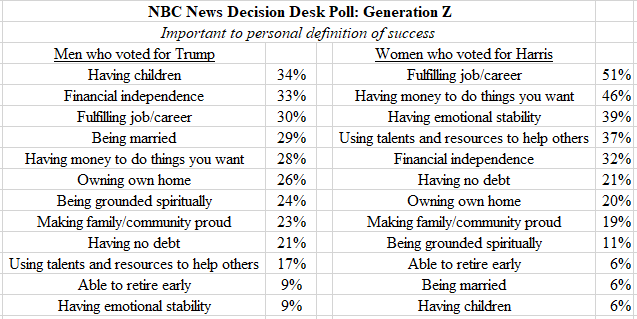
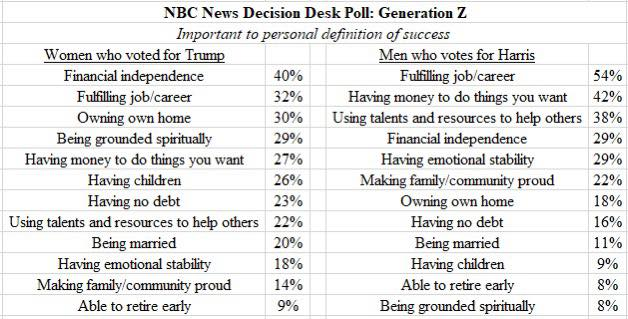
Let’s talk about success and what it looks like. According to a survey conducted a few months ago by NBC’s News Decision Desk Poll on Gen Z – a generation from which I am removed by only a few years – the parameters for what constitutes success vary wildly between men and women on opposite ends of the political spectrum. I tend to do a bit of digging when I see stories like this, since you can’t take any news items at face value these days, but the results are certainly very believable.
The fact that neither children nor marital status were a priority for any demographic other than Trump-voting men is not really a surprise. When I asked my debating team to rank the success factors this afternoon, all three groups had children as their least important, and they are the demographic in the survey.
It’s equally unsurprising to see money concerns so high up the list for both male and female responses in both the Trump and Harris camps. There’s no dodging the fact that we’re living through a cost of living crisis in the West right now, and that Gen Z – and, it should be said, the tail end of the millennial generation, like myself – have been screwed over in a number of wicked ways: the rise of the smartphone, the surge in housing prices and university tuition and the creeping dread of AI, not to mention the anxiety crisis that has taken root in the fertile soil left behind by an almost total absence of conflict in the Western world and the genuine terror that has inspired for much of human history. When I was a kid and had yet to give the matter all that much thought, I remember wondering whether what the world needed was another damned good scrap just to let off some steam. Now that I’m older and potentially wiser, I’m not sure if I have entirely shaken that belief, though my reasoning may have changed somewhat.
If I have read the rubric correctly, those surveyed were asked to select the three factors that most aligned with their personal definition of success. Out of curiosity to see how I square with the generation below, I thought I’d rank them myself.
Having a job or a career you find fulfilling
Having children
Being married
Using your talents and resources to help others
Having enough money to do the things you want to do
Making your family or community proud
Achieving financial independence
Being spiritually grounded
Having emotional stability
Owning your own home
Having no debt
Fame and Influence
Being able to retire early
Now, it’s not an entirely fair test, as I am neither a true Gen Z-er, nor am I American, nor did I vote in the US election. But it does throw up a number of concerns – namely, that my responses to the survey align more closely with the average male Trump voter. My students have often described me as one of the most liberal-minded teachers in the school – so do these responses say more about their world view or my ability to mask my true beliefs?
I’m not sure. To me, success is not something that can be quantified in wealth or status. It is inextricably tied up with the pursuit of destiny. Life is nothing but a cycle without a quest, and quests are all about success. If at first you don’t succeed, you simply pick yourself up and try again.
In two of my three success factors, I confess I am failing miserably. Despite my (apparently) outwardly liberal persona, I am deeply traditional at heart, and it should come as no surprise to any in my circle that I want nothing more from life than a wife and children someday. That would be the ultimate success. Love, companionship and parenthood – these are surely the greatest quests of all. Everything else is a gift.
My generation seems to have always been at odds with the idea of raising a family, continually bumping it down the to-do list until it has fallen into the dark gap behind the sofa, somewhere beneath going on holiday more than once a year and running the London Marathon. Perhaps that explains why the birth rate here in the UK is at its lowest point since records began, averaging around 1.4 children to each woman. In an increasingly faithless world, we have put personal success (with the emphasis on the silent letter “I” in personal) on a pedestal and worshipped it to excess, and now we are paying the price for it. Being thecontrarianthat I am, it is all I can do to fight a current that is doing its very best to drown me.
So while I have the rare privilege of finding my job endlessly fulfilling (I only considered leaving it once, and that was at the height of COVID’s online learning period), I must admit that, by my own definitions of success, I am – for the present – relatively unsuccessful.
But there are plenty of reasons to be happy in my success.
I love my job. It allows me to spend almost all of my waking hours using my knowledge and resources to help others.
By carrying the torch as a teacher for the fifth generation, I know that I am making my family proud, and that gives me an enormous sense of fulfilment.
For all the churches and services I have attended throughout my life, I may not have found a spiritual community that speaks to me just yet – not even along the Camino – but then, my faith has always been a very personal thing, and I do feel grounded under the aegis of la Virgen del Rocio, whose mark I have borne on my wrist for the best part of a year.
I don’t own my own home – I can’t think of many in my generation who do, besides a few of the privately-educated folks I was at university with – but again, I’m not an American, and I suspect that level of privacy and property has a lot more currency across the pond.
Debt is simply a fact of life for my generation, so I’m not even sure why that’s on the list, and while I have little time for fame or influence, I care even less for the idea of retiring early when the job I have to do is so important, so I’m quite happy for it to languish at the bottom of the list. Maybe my thoughts on that will change when I am older. I hope not.
Half term is around the corner. I’m going to try to get some more writing in ahead of Peru. Do stay tuned for updates on the itinerary! BB x
Iโve done it again. Iโve signed myself up for another mad adventure. As whim decisions go, this one is definitely up there with swapping jobs for a change of scene and flying to the States for a third date.
There wasnโt even much of a build-up to it. I had a relatively quiet weekend not on duty. On Saturday morning I taught a couple of sixth form lessons, marked some speaking exams and wound down with a little Arkham City. By Sunday night I had a one-way ticket to Lima for the absurdly low price of ยฃ250. I still need to think about the return journey, but thatโs a tomorrow problem.
Why now? Simply put Iโve been hankering for a proper adventure for a while now. Social media will do that to you, I suppose, though Iโd be more inclined to believe that my full-on, six-days-a-week job played a larger role.
And why Peru? Well, thereโs any number of reasons. The fact that itโs a Spanish-speaking country is the main one, and the crazy bargain price I snagged is another (seriously, Iโve never found flights that cheap and Iโve been looking on and off for years) – and then, of course, thereโs the wildlife, probably the most understated incentive behind any of my adventures.
Iโve been considering India, Japan and South Africa for the best part of ten years, but each has its own complications. India requires all of the jabs, Japan is expensive both to get to and to get around (never mind the language barrier), and South Africa – or at least the parts I want to see – is downright dangerous.
Thereโs also the fact that I always feel I have to justify my holidays. As a Spanish teacher, exploring South America can only add to the sum of what I can pass on to the students under my aegis.
At least, thatโs how I intend to justify gallivanting off to the land of the Incas for three weeks.
I read an article today about the fitness frenzy afflicting my generation (the millennials). Apparently we spend more on the gym, supplements and sportswear than we do on other social activities. Iโm definitely not in that demographic, but I can believe that claim.
Iโve seen the shift before my very eyes in the time Iโve worked in boarding. I donโt remember the gym being much of a feature when I was at school, or protein powder, or supplements, or any of that nonsense. Omega 3 fish oil, maybe, but none of this โcutโ and โbulkโ insanity. These days itโs everywhere. The Underground train was full of garish posters selling the stuff two weeks ago, alongside a rosy ad for a fertility clinic. From PTs to PBs, designer shorts to designer bottles and all the weird chemistry-set-sounding stuff people ingest – and none of it cheap – fitness seems to have become the new luxury product on the market.
Perhaps thatโs an inevitable outcome of a world where our work and most of our lives is so very (and depressingly) sedentary. I do worry about them, though. About how self-centred the world is becoming. About the mental health behind the physical wall.
Iโm in no position to judge, of course. If I harbour any cynicism for this trend, itโs largely because Iโm well aware Iโm on the outside looking in. Fitness is clearly a social activity, and here I am writing my thoughts on the matter from the quiet of my living room, surrounded by the thousand or so books Iโve managed to accrue while most of my contemporaries have been out making friends and finding lovers – or pumping iron. Instead, Iโve been building a library. Itโs what my great-grandfather Mateo always wanted. Would he have wanted it for me though, I wonder?
Honestly, I think Iโve been into a gym three times in my life, but since two of them were duty supervision shifts for work, Iโm not sure they count. All I know about the gym is that a very dear friend of mine went into one years ago and never came back. It might be a poor excuse, but itโs a pretty major reason for my lifelong wariness of those places.
No. As usual, Iโm fighting the current. Contrary to the rest of my generation, Iโm prioritising my time, when and while I still have it, on the equally self-centred task of traveling solo, to learn as much about the world as I can. One day, if I should be so lucky, there may a family in my life, and while I would trade away all the things that I do for even one day of that traditional idyll, I am conscious that I would miss my freedom.
So Iโm taking a punt and getting out of the country for a bit – and this time, to somewhere other than Spain (though admittedly I am spending the weekend prior in Madrid, as it brought the flight costs down by a couple of hundred).
Iโm not really a planner, but this will definitely require a fair amount of it. Peru may be Spanish-speaking, but it definitely isnโt Spain – itโs a little over two and a half times the size. I donโt intend to do Machu Picchu – like Petra, I fear the wonder of that vista from the Puerta del Sol has long been scourged by a horde of milenio photographers – so I will be seeking out some of the countryโs other gems. Itโs a work in progress, but for now, Iโm thinking of:
The Nazca lines (from the air)
The Mummies of Chauchilla
Hummingbirds (wherever they may be!)
Semana Santa in Cusco
The Palomino islands (penguins, pelicans and sea lions)
Apurรญmac Canyon (to find an Andean condor or two)
Parque Nacional del Manu (for monkeys, mainly, but also to see the Amazon Rainforest on the other side of the Andes)
Taquile and the floating islands of the boatmen of Uros, Lake Titicaca (partly because itโs come up in the same IB Language B past paper for seven years, but also because I read about them when I was seven and they fascinated me)
Sacsayhuaman (Inca ruins that arenโt always in the cover of Wanderlust magazine – and one of the best place names in the Americas, period)
If time allows, possibly a mad jaunt over the border to La Paz and the Salar de Uyuni, the vast salt flats on the edge of the Atacama Desert that comprise the worldโs largest natural sky-mirror
โฆand all of that within three weeks. I donโt much care for package tours, so Iโm going to map out my own itinerary over the next month or so.
Catch me later when Iโve done a bit more reading. Iโll be less preachy and more teachy then, I hope. BB x
Andรฉn 13, Estaciรณn de Autobuses de Cรกceres. 13.29.
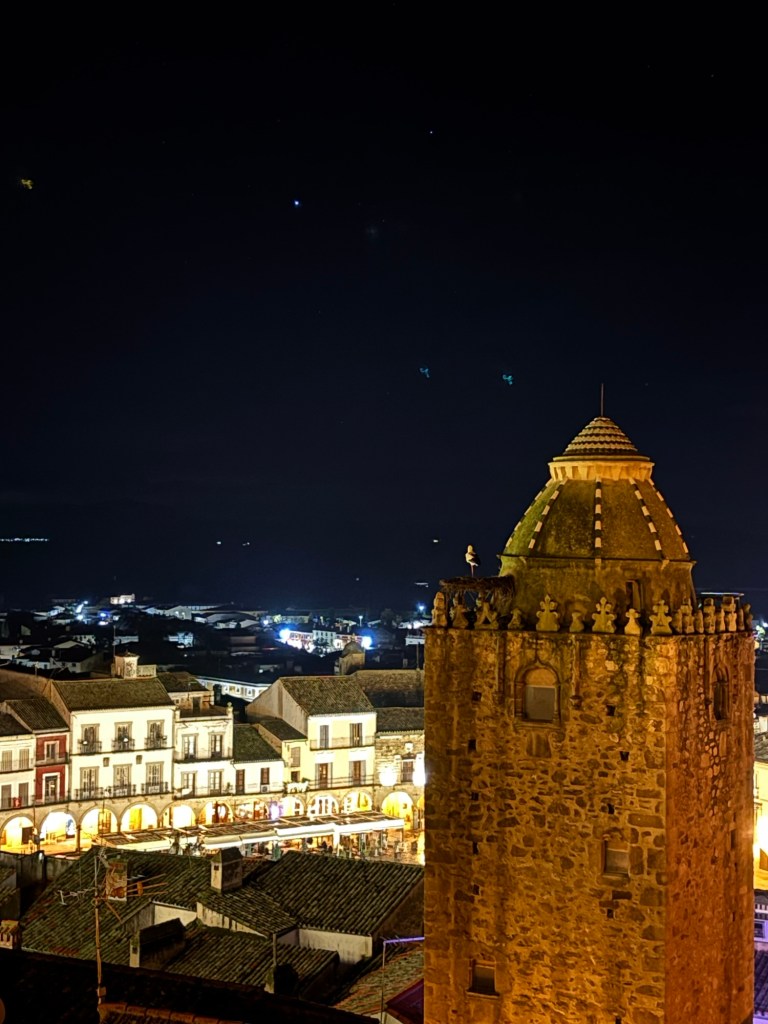
That last post was a bit lacklustre. I canโt be at the top of my game all the time, but Iโll admit it is hard to write convincingly about my favourite topic – nature – when the rain kept me indoors for most of the day. I got out for a bit during the evening to have dinner at Mesรณn Troya, one of the restaurants in the square (usually a place to avoid in larger towns, but not so here), but beyond my short sortie beyond the castle walls, I didnโt get very far yesterday. Instead, I contented myself with watching the stars from the hilltop and counting the towns and villages twinkling in the darkness of the great plains beyond: Monroy, Santa Marta de Magasca, Madroรฑera, and the brilliant glow of faraway Cรกceres.
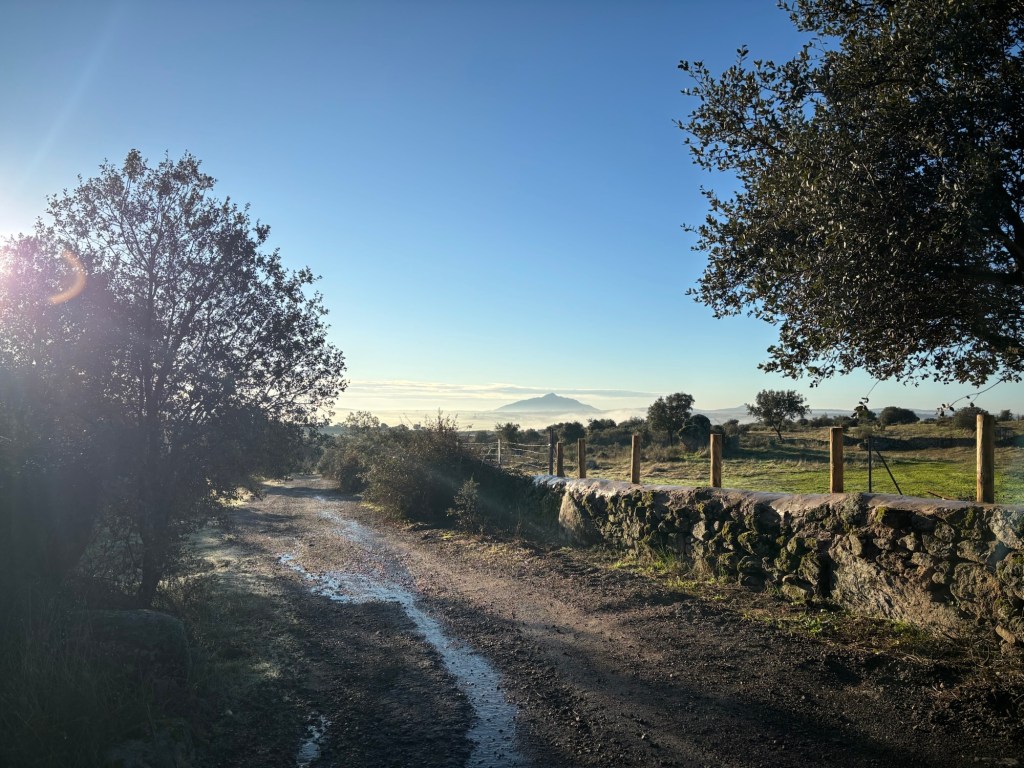
Morning summoned a slow sunrise into a cloudless sky. If I had brought walking clothes, I would have set out across the llanos on foot – but Chelsea boots, a smart winter coat and bootcut Leviโs jeans donโt exactly make for the most comfortable long-distance fare, so I erred on the side of caution and took a stroll into the berrocal – the rocky hill country south of Trujillo.
Idly, I set my sights on a restored 17th century bridge some five kilometres or so from town, but I was quite happy to wander aimlessly if the path presented any interesting forks.
My working life is so full of tasks that require forethought and planning that itโs nothing short of liberation itself to have that kind of absolute freedom that I crave: the freedom to do or not do, to turn back or to push on, to take this road or that, without any thought as to the consequences (beyond the need to get back in time for the bus). A freedom that becomes maddening when itโs taken away from me, like it was in Jordan, all those years ago. Itโs a hardwired philosophy that Iโve become increasingly aware of as Iโve grown older, bleeding into my views on speech, movement and identity – and massively at odds with most of my generation.
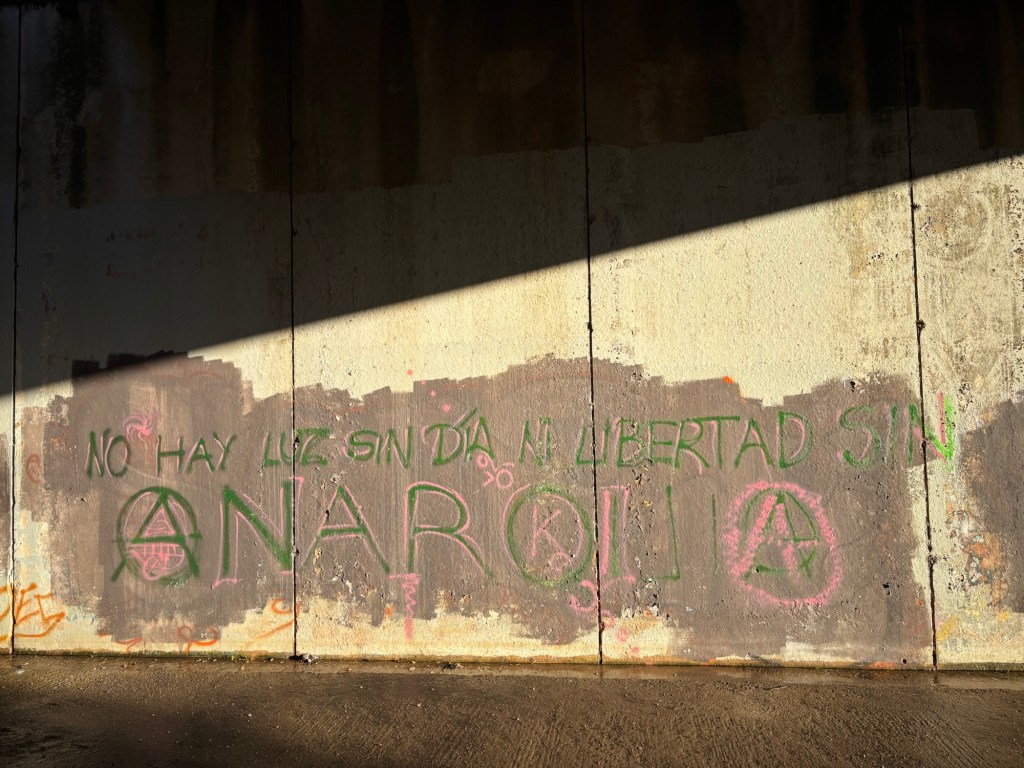
Perhaps itโs an inherited desire for freedom from my Spanish side: I do have family ties to Andalucรญa, a region that once made a surprisingly successful bid for anarchy, and my great-grandparents quite literally put their lives on the line to make a stand for freedom of thought under Francoโs fascist regime.
Or perhaps thatโs just wishful thinking. Either way, itโs hard to deny just how important that sense of total freedom is to me. Maybe Iโm more like the Americans than I thought.
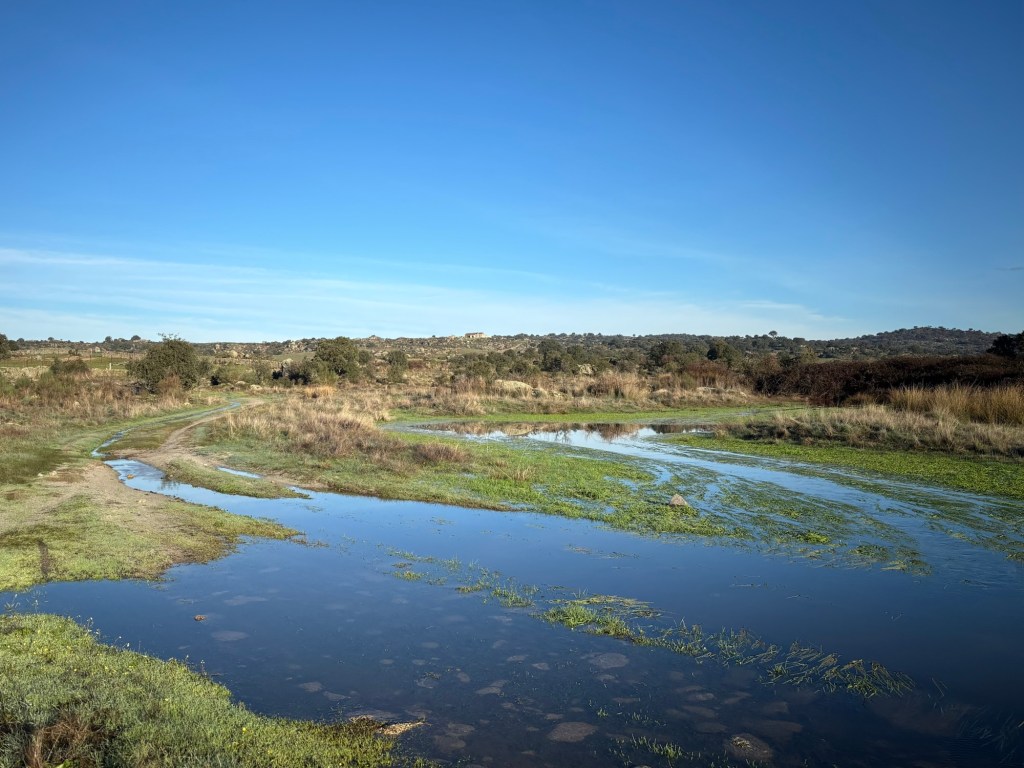
I didnโt make it as far as the bridge. The full day of rain from the day before had done more than dampen the sandy soil and form puddles and pools in the road. It had also swollen the Arroyo Bajohondo to the size of a small river. It didnโt look particularly bajo or hondo, but I didnโt trust the stability of the soil underfoot and didnโt fancy making way to Mรฉrida with soaking jeans up to my knees for the sake of a tiny bridge, so I turned about and returned the way I had come.
Without a car at my disposal, I couldnโt make it out onto the plains, home to Trujilloโs more emblematic species (bustards, sandgrouse and stone curlews), but the berrocal was teeming with wonders of its own. Hoopoes, shrikes and stonechats watched my coming and going from the rungs of rusting farming stations, while woodlarks and skylarks ran this way and that along the stone walls that marked the boundaries of cattle stalls along the way. A flock of Iberian magpies kept me company on the way back, their jaunty black caps almost shining in the sunlight, and I nearly missed a lonely lapwing sitting in one of the fields – a curiously English sight in far-flung Extremadura – before it took off on powerful, bouncing wingbeats.
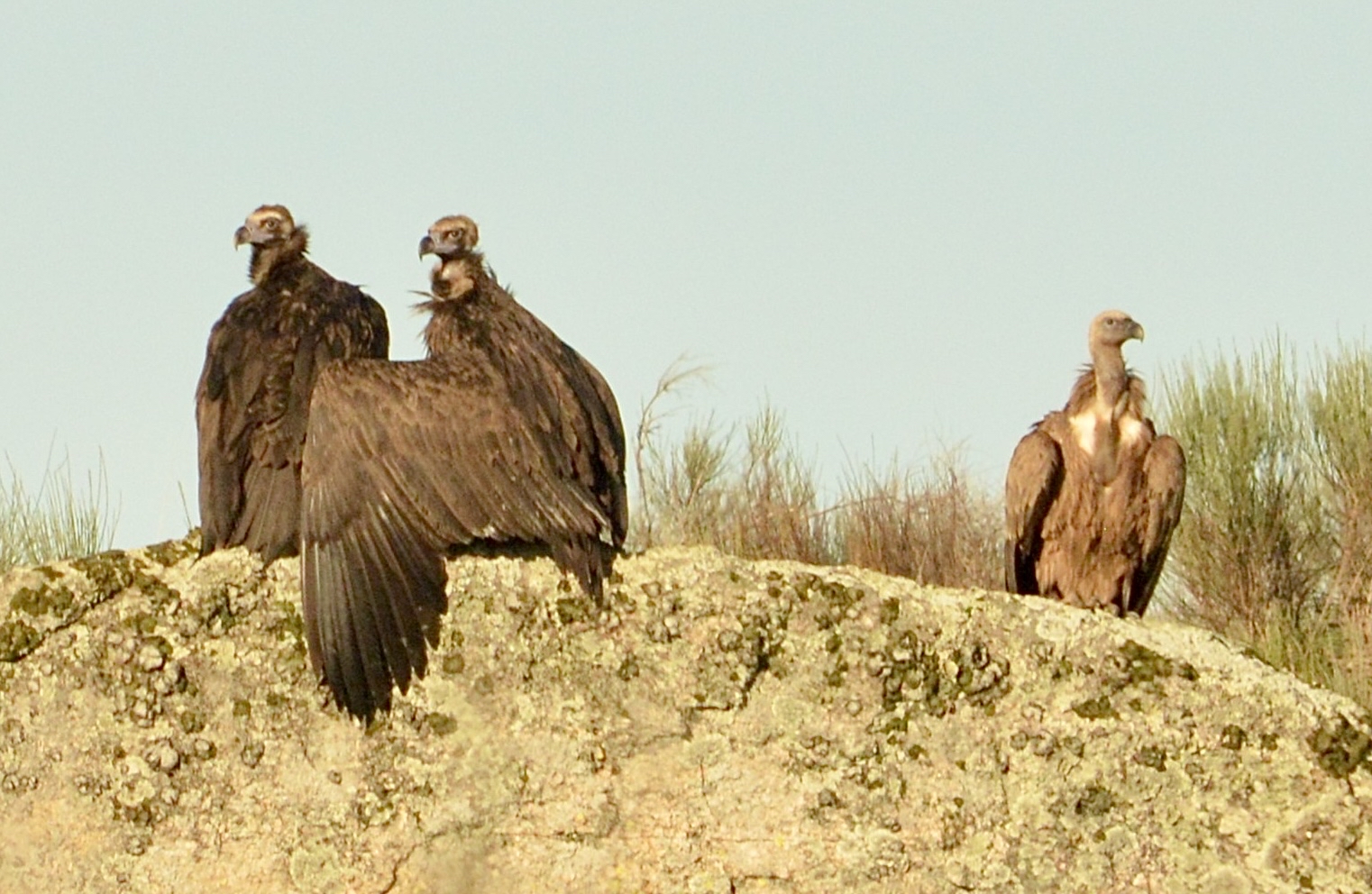
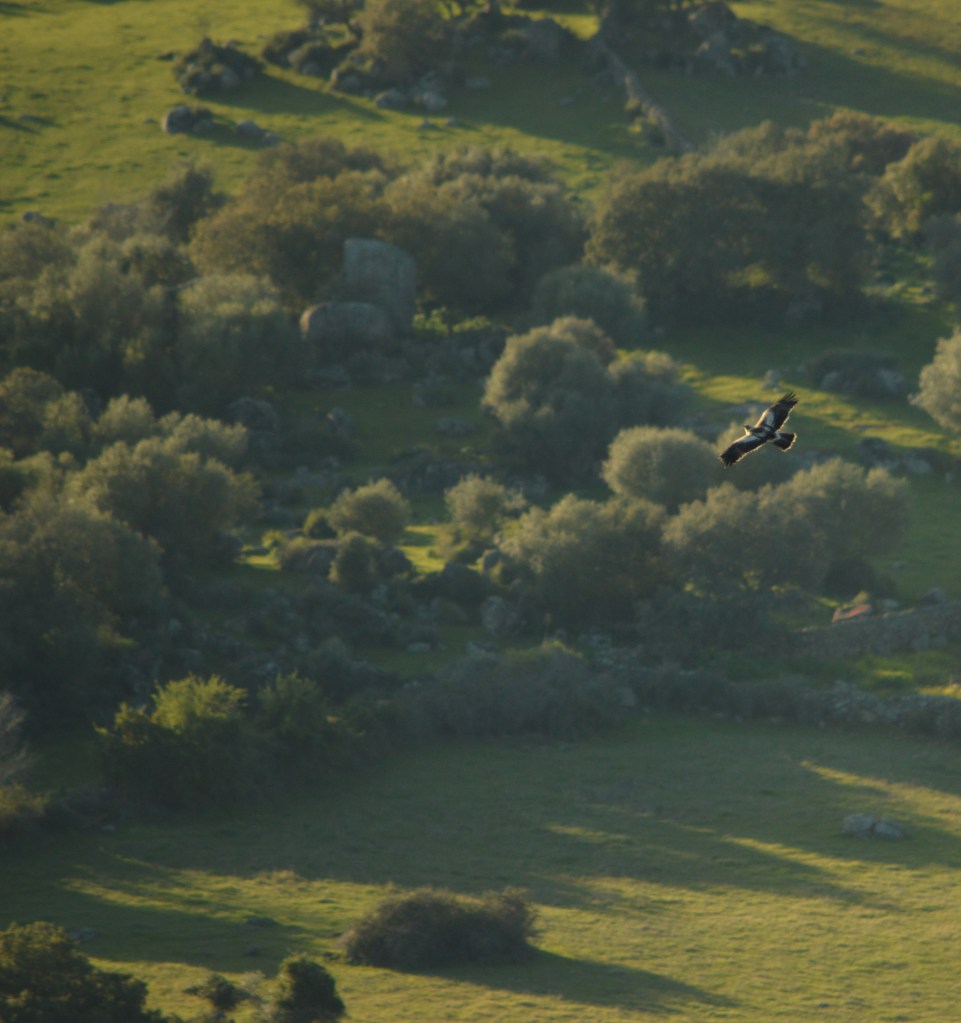
Speaking of powerful wingbeats, I was practically clipped on my way down to the arroyo by three hulking shapes that flew overhead. I clocked one as a griffon – there are few silhouettes I know better – but I had a feeling the other two might have been black vultures – something about their colossal size and the heaviness of their beaks. They seemed to have disappeared by the time I turned the corner in pursuit, which is hard to imagine for creatures with a wingspan of around 270cm.
A change in perspective always helps, however. I found all three on my way back, sunning themselves on a granite boulder not too far from where Iโd first seen them. I suppose Iโd have had my back to them on the way down. And what an impressive sight they are! Hulking great things, even if they were some way off.
Even with the full day of rain, Iโve scarcely had a moment out here where Iโve felt lost or alone. Spain works an incredibly potent magic upon me, whether it comes in the form of the music of its native language, pan con aceite y tomate, the immense blue skies of Castilla or the spectacular sight of its vultures, forever and always my favourite sight in the whole world.
I conveyed this jokingly to an old lady from Villafranca on the bus. She gripped my arm with a talon that the vultures might have envied and told me in no uncertain terms to โbรบscate un trabajo aquรญโ. It does feel like the universe is trying to help me to set things right and come back. But I have to get it right. I need this to work this time. So – fingers crossed.
If I could spend the rest of my life in the passing shadow of the vultures, Iโd die a happy man. BB x
The Camino isnโt truly over until youโve made it home, so here I am on the 19.50 from Heathrowโs Terminal 5. It wasnโt the best welcome back to England. Somebody pinched the flip-flops from my bag. They werenโt exactly in the best condition and frankly I could care less, but itโs the principle of it. Six weeks of relatively careless travel across two countries and the first item stolen from me is within minutes of landing back in the UK. Add to that the grey hellscape that is Heathrow, the cost of just about everything, and the facelessness of Londonโฆ
No. I donโt want to think about that. Not right now. My nerves are shredded enough as it is. I want to think about where Iโve been. Who Iโve met. What Iโve learned.
Nearly six weeks ago, I locked myself out of my flat, caught a late flight to Bordeaux and set out for the Spanish border with little but a few spare clothes and my journal. I did not know quite what to expect from such a last-minute decision: it had been a toss-up between the miserable money-sink of more driving lessons or a second Camino, and after a stressful year in a new school, the decision was just too easy.
My reasons for setting out upon the Camino this year were varied. I had an uncommonly wonderful holiday in Spain at Easter and wanted to say thank you. A dear friend lost her father and I promised to pray for him at every church I found. I needed some healing after last summerโs heartbreak, which was mostly healed in El Rocรญo, though this wound has proved difficult to recover from fully.
I also needed to get away for a while. Social media has been leering at me with a stream of weddings of old friends, and with each one, I am reminded of how much I have been forgotten – or rather, how much I have allowed myself to be forgotten by going radio silent and burying myself in my work for the last eight years. I am still coming to terms with what I am now fairly certain is my undiagnosed ADHD, which came to a head somewhat this year, and would go some way to explaining much of my behavioural quirks and communication issues. I ended the year on a major high with the triumph of my new funk band – something Iโve wanted back in my life for thirteen years – but I still needed a change.
I come into my own on the Camino. Thereโs no pressure to communicate, but so much reward for doing so. Fleeting but powerful friendships based on shared adventures and the sharing of stories. A chance to swap languages constantly, and to learn new things about myself and the world each day. A chance to be back in my grandfatherโs country, and to feel his spirit at my side. To walk in the light of the Blanca Paloma and to see the wonders of her world. To patch up the wounds in my lonely heart with an alchemy of golden fields, griffons and the churring of nightjars. To sing, to write, to read, to tell stories, to laugh, to walk, to climb, to run, to swim and to be surrounded by the one thing in this world that has never let me down: nature.
In short: to walk the Camino is to be myself.
When Gust left this morning, I was the last of us left in Santiago. I have been incredibly fortunate this year with my companions, who have been the most wonderful company – even for this lonely wanderer who so often set off on his own to walk the road alone, for days or even weeks at a time.
Alex. The lawyer. My fellow countryman. Lost to us far too soon in Burgos. In many ways, the one who brought us all together. You set the pace – sometimes too fast for even me to catch up. You came to my defence against the Dutchman and his beer-fuelled football rant. I would have walked with you to the end.
Audrey. The marine biologist. The trooper. A seeker of solace and of silence, with a kind word for everyone and a pure heart. This was your Camino, I feel. The rest of us just fell into orbit. And who could resist the gravity of such a warm disposition? I hope you found the peace you were looking for in the shining Aegean Sea.
Talia. The neuroscientist. The brains of the operation and the questioner. Sage and sober and endlessly perceptive. You awoke in me an awareness of paths untraveled that I had long ignored, shining more light upon the road than any headtorch-wielding peregrino – which I, in my preference for the starlit dark, sorely needed.
Alonso. The diplomat. The wanderer with a thousand-yard smile. Powered by kudos and watermelon. Chasing the Sun across the horizon โfor the bitโ. Your wits were almost as fast as your Strava-fuelled sprints down hill and mountain, and you brought humour to every town and village we found. 100%. For you, the journey goes on.
Chip. The agent. The sunniest Salt Laker this side of the Atlantic. Friend to the saint, the sinner and the sandhill crane. Fountain of wisdom and wit and the only thing holding me back from being the eldest of the family (for which I was very grateful!). We never did get to say goodbye, so perhaps I will have the chance to say hello there again someday.
Gust. The drummer. The free-spirited Waldorf wayfarer. Blighted by blood blisters, broken sandals and Italian blessings and still one of the bravest of us all at seventeen years of age (or eighteen, if your credencial was to be believed). A chip off the old block who slept in a bus shelter to secure an earned Atlantic sunrise. You give me hope.
Iโm already thinking ahead to my next Camino. I love the sociable side to the Camino Francรฉs, but now that I have done it twice, I feel it may be time for a sea change. The Camino Mozรกrabe is calling to me, looping through the marbled hills of Andalusia and winding across the green fields of Extremadura. I donโt think Iโd be likely to meet such an excellent and eclectic cast as the one with which I have shared the road for the last six weeks, but it would be another genuine adventure – as the Camino Aragonรฉs, the Primitivo and the San Salvador were this summer.
Of course, for the same budget, I could probably have a weekโs holiday somewhere really exciting: a tiger safari in India, chimp-tracking in Tanzania or an adventure around the deserts of northern Mexico. But would it make me as happy as another five or six weeks in Spain? Probably not. I know what makes me happy. Happiness has a name and her name is Spain.
Well, Iโm back in England now. But the story isnโt over. Not yet. Iโll be back tomorrow to muse a little more. I just wanted to put some thoughts down while the memories are fresh in my mind. BB x
Tomorrow marks the end of one Camino and the beginning of another. And not a moment too soon. I fear my social battery is at maximum capacity. I got the jitters after showing up late to the dinner the others had arranged at the Royal Tandoori, to find a crowd of fourteen.
Maybe it was the sudden shift from the intimate setting of my haircut the hour before to a busy table of English and Americans holding court over an Indian meal; or maybe it was the location of my Siege Perilous as the final invitee, squashed into the corner; or the fact that theyโd started without me.
Whatever it was, I know now that my decision to leave the Camino Francรฉs is a wise one. Itโs a little shameful to admit, but I could use a break. Iโm not proud of the fact that these social settings continue to throw me every so often, but I am getting better at hitting the escape button before it escalates.
On the walk into Leรณn this morning, Talia asked me a question that has genuinely had me thinking all day. I think it was something like this:
When did you decide not to pursue a career in biology?
At first it seemed a pretty straightforward question. My grades in Biology were never all that great, the competition at my school was just too much and it never occurred to me even once to study Biology (or Natural Sciences) at university.
But with a little context, I can see why she asked me that out of the blue – and Iโm frankly amazed how much Iโve suppressed what is nothing less than a core memory that might once have changed the course of my life.
Audrey was using an app to identify some of the birds weโd seen since leaving Mansilla de las Mulas – I think it was Seek. I pointed out a few things I could hear: serins in the branches of a nearby tree, a booted eagle circling in a field, the bee-eaters weโd heard the day before.
I guess it was that quickfire succession of names that prompted Taliaโs question. My answer was fairly improvised, but I think it checks out.
When did I decide not to pursue a career in biology? When I realised that it was never going to be about zoology – not under the British education system, anyway. That, and my mathematical ability was (and is), quite frankly, dismal.
I have various interests. Iโm a musician. A linguist. A writer, an occasional poet and a Hispanist. A mimic. A Catholic. But before all of these things, I am a naturalist. Before I found my fluency in Spanish and French, I could already understand the calls of every bird in the British Isles and could tell you what most of them meant: warning, alarm, hunger and mating calls. It was, I suppose, the first language I ever learned.
I was just as obsessive with my childhood interest in dinosaurs: I had to know them all. Where they were found, why they were called what they were called. It wasnโt enough to know the famous ones, like the T-Rex and velociraptors – I had to dig deeper. One such precocious example that comes to mind was my decision to bring along a Eustreptospondylus drawing to Show and Tell at primary school. Doubtless an elephant would have sufficed, but why would I ever have settled for something as basic as that?
I still have discarded exercise books that my parents gave me where I logged all the species mentioned in wildlife documentaries. I always put down the title and locations covered, and I sometimes wrote the date, too. Others I used as scrapbooks, taping in feathers and sketching footprints and writing about when and where I found them.
Youโd have thought that these might have been the early indicators of a scientist. Certainly, I wanted nothing more than to be a palaeontologist when I was a kid (which can be gently excused by the fact that the BBCโs peerless Walking with Dinosaurs documentary series came out just in time to capitalise on my five-year-old dinosaur obsession.
When I was a little older, I genuinely considered a career in conservation. I entertained the idea of a degree in Ornithology, or something similar, to allow me to put my fiendishly good memory for birds and their calls to use.
And then, suddenly, that dream died.
It was probably the maths that killed it. All the natural science degrees I explored required a basic level of mathematical competence and at the time I was struggling to scrape even a passing grade at GCSE. Chemistry, too – a lot of Zoology degrees suggested chemistry as an A Level, and chemistry was far too mathematical for me. Without maths, my conservation aspirations were dead in the water. That was that.
But there was another factor that pushed an old dream out of the nest: the slow decay of a childโs interest as the subject closest to his heart never even materialised in the subject that should have concerned it most intimately.
My memories of Biology center on two things: plant cells and sourdough bread. I was so excited when food chains and food webs came up, until I realised that, within the British curriculum, that was the one and only time that animals would be mentioned. Everything else was so cold, so clinical. Palisade walls and mytochondria. Genomes and inheritance, though usually in plants. The fact that I knew the names of every animal and bird in the British Isles (and most of Europe, for that matter) gave me no advantage whatsoever.
My school was a specialist science school. Our Biology department was doing really exciting things with MS research, and it was one of my Biology teachers who was instrumental in sending me out to Uganda on my first ever teaching post. But somewhere along the way, my aspirations as a conservationist were slowly choked by the strangling vines of the British science curriculum. Zoology, palaeontology, anthropology, ornithology and even primatology were all areas I was desperate to explore, but as the years went by and Biology concerned itself less and less with the natural world and more and more with the minutiae of bacteria and cell structure, the less I cared for it.
It must have been around then that I first entertained the idea of becoming a teacher – once I realised I would never be good enough at two of my weakest subjects to survive to the point when Biology became Zoology. Fifteen years old and already carrying the shards of a shattered dream.
One way or another, I think I realised early on that there was little that a Zoology degree could teach me that I truly desired. I didnโt need to pursue a career in science to justify my greatest love. Knowing the names of every animal and bird gave me a sort of spiritual connection with each and every one of them – no scientific research could work a greater magic than that. Still, itโs interesting to think where my life could have gone if Iโd really committed to that path.
Instead, here I am, gone thirty, walking the Camino with a head that twists so quickly when I see the silhouette of a kite or vulture that itโs a miracle I havenโt twisted my neck yet.
Itโs hard to say what my experience would be like if I walked all the way to the end of the road with these wonderful people. I will never know, because I have made my choice. And I know it is the right choice. It will take me up into the mountains and back into the natural world, where I am and have always been at my happiest.
Hereโs to that – to good health and happiness, and a significantly harder road ahead! BB x
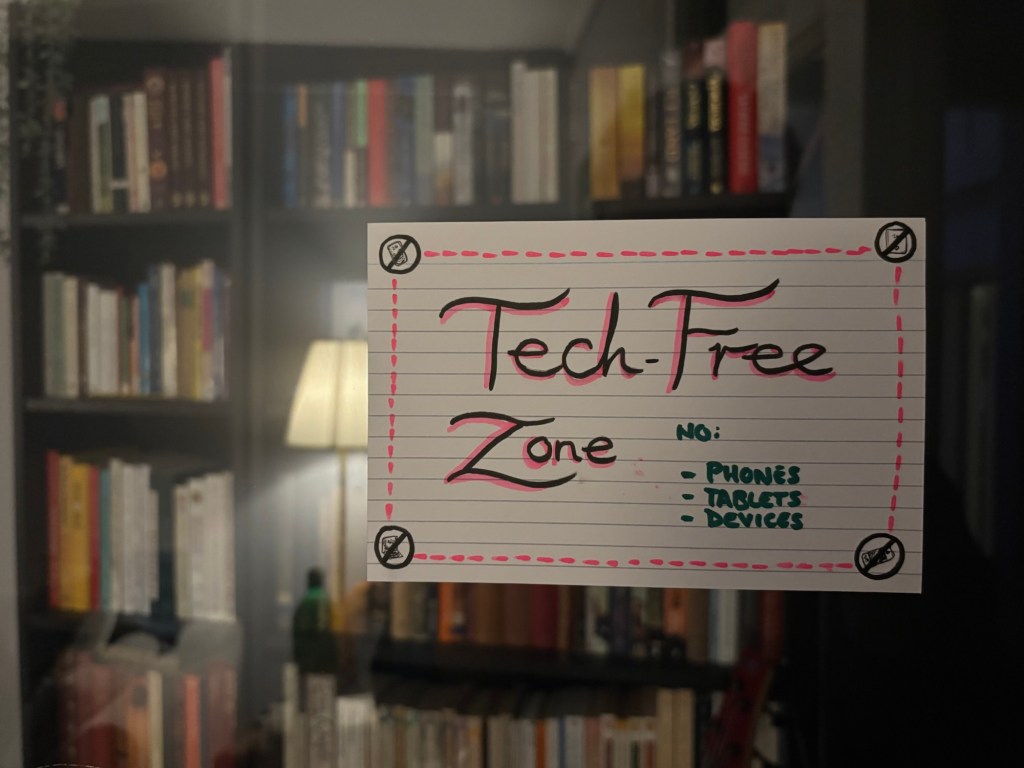
Starting tonight, this is the last blog post I will write from my library. That was the last scroll through Instagram in here and the last YouTube video. Starting tonight, Iโm making one room in my flat a phone-free zone.
Iโve already put a sign up on the door. The threshold has been established. Now I just have to stick to it.
Iโve gone cold turkey on tech in the past with variable success. The odd social media blackout that a few of us have trialled once or twice, you know? Perhaps for a day, perhaps for a month. Inevitably, we all came back. Tragically, in the world we live in today, itโs simply not possible to ditch the phone like it once might have been. Everything we do involves our phones in some way, from providing music and facilitating everyday communication to keeping time, providing torchlight and paying for goods and services. Even writing this blog post. And Microsoft Teams isnโt helping at all.
Luddite as I am, I held out against joining the rest of the world in the acquisition of mobile data, before begrudgingly bending the knee in the summer of 2016 at the tail end of my year abroad. The world has never looked back since.
Why is this on my mind tonight? There could be a number of reasons. Seeing one more wedding montage featuring old friends might have been the spark, though. It should go over my head, really, but it served as a reminder of just how cut off I have become, technology or no technology. Granted, I have allowed that drift to happen – through a combination of distance, time and a five-year-old wound – but I must admit that I can no longer hide behind the truth: my need to keep these portals open on the off-chance that my friends of old may or may not reach out has long since expired. They stayed in the city, and they stayed together. I moved away – several times – and took a job that required me to devote all my time and energy to the children in my care. I believe in what I do – it is surely one of the most sacred professions in existence – but it comes at a cost.
Like a soldier gone to war, I must accept that my job requires me to be itinerant. Rootless. And that means accepting that the close friendships I see others holding onto is, at least for now, necessarily beyond me. Perhaps itโs a factor behind the last few relationships that I have reckless thrown myself at, hoping to patch up the gaps.
But Iโm done waiting. Instead, Iโm going to start to take back control, and the revolution starts in my library. Iโm hoping that one immediate benefit will be that I get back to devouring my books again, as Iโve been acquiring them at a significantly faster rate than Iโve been reading them. The most I ever read was in that first year abroad in Spain when I had no Wi-Fi. I must have motored through forty or fifty books that year. If I could somehow replicate that, even in just one room of my flat, it would be enough, I think.
My early thirties are upon me. My social circle has shrivelled, so I must build up the temple of my life with the stones provided to me. Theyโre mostly paperback, but the knowledge contained within them is strength enough. Theyโll do.
Speaking of stones, did you ever consider that all the giants and monsters of myth and legend were just our ancestorsโ attempts to explain the fossilised remains of the great beasts of the past? I suppose that should take some of the magic out of it, but itโs had quite the opposite effect on me. Iโm now more intrigued than ever by the folklore and fairy tales of the world, and of the real life stories that inspired them.
Maybe I really should pursue that Masters. But first – letโs hit the books. My phone can do one. BB x
Itโs been nearly a year since I left my post at Worth School and moved to the West Country. Iโm supposed to be making a start on my Year 9 reports tonight, but itโs my birthday, for pityโs sake – I could use a break. Between house duties, calendar committee meetings, end of year speaking exams, invigilation, improv workshops and regular teaching, Iโve barely had time to sit down today.
The summer holidays are drawing near. My original plan was to spend them learning to drive, but Iโve kicked that can down the road for another year. This year has been hard work, and the last thing I need is to give myself something to dread once a week for every week of the summer holidays. Iโve never been good at doing things I donโt enjoy, and I really donโt enjoy driving. My last instructor was a vocal and humourless Brexiteer, who reminded me a lot of the father of an ex-girlfriend, and just a few lessons with him pretty much put me off driving since.
Itโs a hurdle I definitely need to overcome, but not this summer. I need something uplifting after the manic year Iโve had, and I firmly believe thereโs no cure like the Camino. So tonight Iโm booking my flight to Bordeaux so I can do what Iโve never really done before: a full run at the Camino Francรฉs.
Well – I suppose thatโs not strictly true. Iโm planning to start in Somport this time and begin with the Camino Aragonรฉs, joining the Camino Francรฉs proper a week later. Iโve also pencilled into my plans to travel north from Leรณn via the Salvadorana to Oviedo and then walk the last stretch along the toughest and oldest of all the Caminos, the Camino Primitivo. It will take me around six weeks, in all likelihood. Six weeks that will be tough on the feet but good on the heart. Six tiring but purposeful (and very affordable) weeks in the most beautiful country on earth, meeting people from all around the world and telling stories. Whatโs not to like?
I will, of course, be back to journaling as I go, so expect a flurry of activity on here towards the end of this month. You can follow me on my journey if youโd like. Thereโll be stages that Iโve done before, but itโll be a very different cast of characters this summer, and itโs so often the people that make the stories.
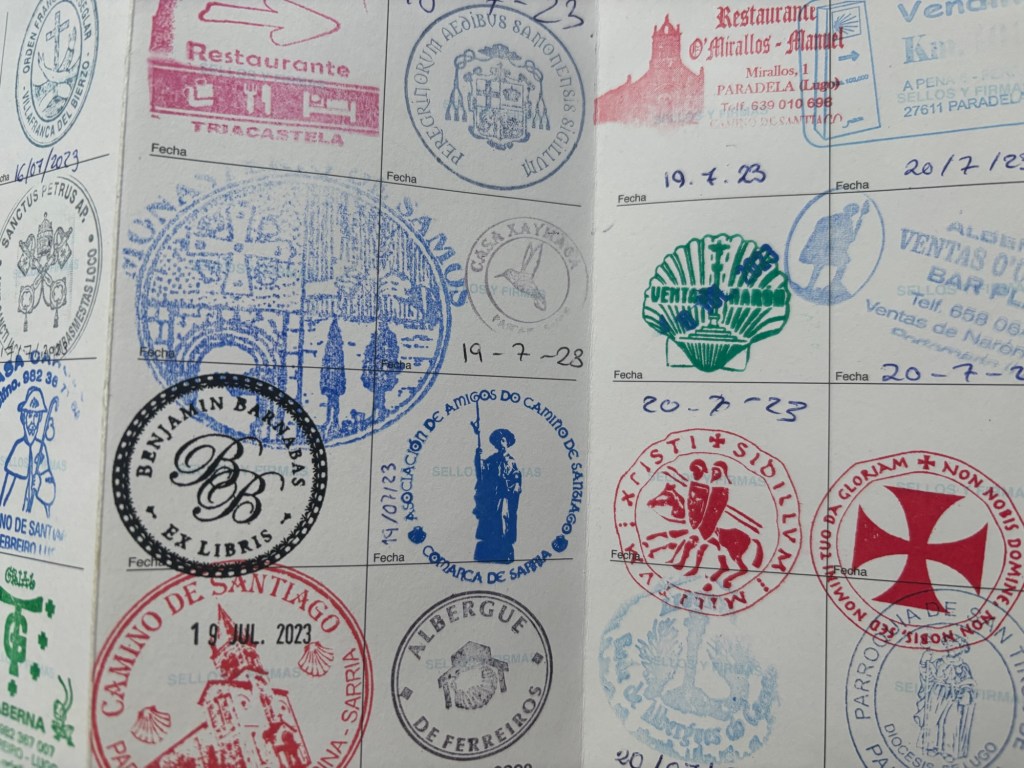
Itโs also now mandatory to collect two stamps a day, so Iโve already ordered my credencial. Iโve ordered three, on the logic that the two I had last time only just got me to Fisterra, and that was with careful rationing toward the end – and over a fragmented span of five weeks. Over six, I can afford to go stamp-hunting with a little more reckless abandon. And who doesnโt love the stamp-collecting element of the Camino?
Escapism? Absolutely. But for once, perfectly justifiable. I donโt say it often, but I could use a holiday. BB x
The May half term is drawing to a close. Iโve stayed put for a change, using the time to mentally decompress after another very busy term. Four weeks remain of the school year, and while thereโs not as much teaching going on, itโs still going to be an intense gauntlet of exams, reports, events and rehearsals. Iโve done a lot of much-needed spring cleaning, idle Camino planning, bouncing ideas off ChatGPT and now, a little stir crazy, I fancy a day out. So Iโve grabbed some Y8 marking and a few books (Adrienne Mayorโs The First Fossil Hunters is my current obsession) and I am now on the train bound for Oxford.
Why Oxford? Partly because I havenโt really been to Oxford before. I was there two months ago for the Oxford Schools Finals Day, but as I was leading a school trip I didnโt really have any time to appreciate the city for itself. Itโs also partly for the Museum of Natural History, which is supposed to be exceptional (I never did grow out of the dinosaur phase). But itโs also because over the last few days I have started to flirt with the idea of a possible career change: setting my teaching and boarding duties aside to pursue a Masterโs degree in Medieval Studies.
Thereโs a couple of travelers next to me on the train having a very interesting conversation. They are a curiously paired ensemble: one, with a patchy beard, AirPods in and his shirt unbuttoned to the sternum, talks in a streetwise drawl about how he stole a few cans of Red Bull from Tescos once, and how the worst thing in the world is that parents donโt discipline their kids right anymore – if heโd disrespected his dad, heโd have โhad a black eyeโ. He drops his Tโs in the words right and football and drops F bombs in the gaps. The man next to him, a young Asian in a smart shirt with his sleeves rolled up nearly to his elbows, calmly (and without a hint of profanity) explains the difference between Asiaโs bullet trains and the UKโs privatised public transport system (which he calls the public torture system), the importance of location when investing in property and celebrates a model aircraft he recently won at an auction. That seems to be their connection – theyโre model plane collectors. I was beginning to wonder what could possibly tie these two together.
Why a Masterโs degree? Why Medieval Studies? And why has the idea only come to me now, eight years after graduating with a BA in Modern Languages and Cultures? To be honest, Iโm not entirely sure. A number of reasons come to mind. Citing my Y9 class seems churlish, but itโs probably part of the bigger picture of just how much of a gear change this year has been. Challenging and engaging, but occasionally uncomfortable. I suppose thatโs only natural when you up sticks completely and change schools. Perhaps thatโs why some teachers never leave.
Itโs a little deeper than that. I do miss academia. I have always loved the pursuit of knowledge for its own sake, and just occasionally, I find that hard to square with a job where success is so often scored against a mark scheme that shifts according to the national skill level.
Iโve just started to sink my teeth into A Level teaching, but Iโm both disappointed and mildly alarmed by the lack of general knowledge of my students. Only one of mine could tell me what Scylla and Charybdis were, and that was a child in Year 10. Iโve had sixth formers before to whom Iโve had to spell out the story of Adam and Eve – weโre talking Catholic Europeans here, too – and mine was the only hand to go up in chapel two weeks ago when we were asked if we knew the parable of the man who built his house on the rock.
You could chalk that last one up to nobody wanting to look foolish putting their hand up in church on a Tuesday morning, but classical (and even general) knowledge of even the most basic sort seems to have fallen away by the time our kids reach sexual maturity. They all seem to know who Mr Beast is, though.
Something I wasnโt expecting in Oxford was the Pottermania. I deliberately havenโt waded in with an opinion on J.K. on here because, as with a number of topics, my thoughts are not in line with those of the rest of my generation. But one thing that is really quite depressing is that I ran into no fewer than five Harry Potter themed tours, pointing out turrets, windows and other locations used during the filming of the saga back in the early 2000s. It seems a little trite that tourists flock to a city that harbours one of the oldest universities in the world just to snap a selfie in the style of a still from a movieโฆ I took a cohort of summer school kids on one of those trips once and they were deeply disappointed (I think they were expecting Harry Potter studios, not a Chinese woman with a ring bound pad of stills).
Itโs times like this that I need a good kick in the shins – somebody (besides myself) to call me out for being so judgmental. Maybe thatโs something I miss about university, too.
Before checking out the museum, I explored Blackwells, Oxfordโs famous bookstore. The shop is particularly well-known for its Norrington Room, a literary Aladdinโs cave beneath the city that seems to have everything. I made a beeline for the Mythology and Folklore section and looked for anything Iberian.
Nothing. Tome upon tome on Norse mythology, endless volumes of British folktales, a beautiful gold-bound compilation of the tales of Anansi the Trickster and no fewer than five collections of Queer Fairytales – whatever those are – but nothing on Spain or Portugal. Nothing at all. Even Google didnโt seem to have anything.
Spain isnโt lacking in colourful folklore of its own. From my reading, itโs apparent that the combined efforts of the Almoravids, the Almohads, the Spanish Inquisition and Francoโs regime werenโt able to snuff it all out. But the literature simply doesnโt appear to exist.
I think somebody should write about it. And Iโm starting to think that somebody should be me. Oxford University has a Masters course on Medieval Studies that occasionally covers Iberian founding mythology – the subject I chose for my undergraduate dissertation – and that just might be the way inโฆ if I can get in.
Iโm not really Oxbridge material. I got as far as an interview at Cambridge, but my meekness was torn to pieces in the French interview – and I really havenโt read enough of the classics. But I have read a lot of books.
I grew up on a privileged diet of literature. We had more books than anything else at home, largely on account of the fact that my mother rips through books in a single night and was thus always on the hunt for a replacement. The bookshelves in my bedroom were (and still are) crammed full of colourful dinosaurica, but sandwiched in among them was a mountain of mythology and a feast of fantasy. My mother may not have been an outspoken supporter of โfantasy shiteโ but she did encourage my voracious reading habits. And I know my Dad used to read to me a lot – he even read the Harry Potter books to me when they first came out.
Neil Philipโs Illustrated Book of Myths played an especially large role in all of this. Atticus the Storyteller had a similar hand (and, to a lesser extent, the Age of Mythology games), but the colourful illustrations in the Dorking Kindersley compilation made it especially impactful. I must have spent literal days poring over the pictures in that book, cramming my childish head with stories of Athena and Anansi, Izanagi and Izanami, Glooscap and Gilgamesh. All tremendously important things to know – and none of it serving any practical purpose beyond the pages of the book where they were written. I havenโt even been able to use much of it in the odd pub quiz, which seem to rely on a more grounded understanding of Emmerdale and the last FA cup final than the exploits of Gilgamesh and Enkidu.
If Iโm lucky enough to have children of my own someday, I will read to them from that book – even though I know most of the stories by heart. The pictures are so beautifully illustrated that I can see most of them still when I close my eyes, though it may be over twenty years since I last saw them.
Stories are how I make sense of the world. Iโve been writing stories for as long as I could write my own name. Thereโs not an awful lot of call for storytelling at work, but I do my best to share them with my students when the curriculum allows.
And itโs taken me a long time to realise that, after Spanish interest and natural history, the third largest collection of books in my library is all folklore and mythology – the oldest stories in the world.
Maybe – just maybe – Iโm scratching the surface of the real me. I did always want to be a writer. I just didnโt ever think I could do it.
Iโm still unsure. So much of my identity has been built upon the rock of being a teacher, and casting off those robes to dive into the world of myths and legends seemsโฆ well, childish at best, selfish and reckless at worst. And thereโs the question of stability, job security, money and the fact that all I really want to do is find the One, raise a family and tell stories. But the void in all those bookshops is tremendously loud. Stories that arenโt told will eventually disappear, taking their worlds and their characters with them. It would be a terrible shame if the generations of the future looked back on our time and accused us of letting the ancient wisdom of the past slip through our fingers while we were so violently hypnotised by the bewitching glare of this or that Pied Piper of Instagram.
Who will remember Mr Beast five hundred years from now? What stories will they tell of him? Will his legend amaze and inspire, or will it push more and more children toward the worship of Mammon? I worry about that. I worry about that quite a lot.
Iโll give it some more thought. These are not decisions made lightly. The Camino will provide. It always does. BB x
Iโm sitting in the rest area at Bristol Parkway Station, watching the blinking lights of cars cruise around below me in circles like so many coloured beetles in the darkness. If Iโd made my original train, Iโd be at my mumโs place by now. But there was an incident on the 20.35 from Bristol that the authorities had to deal with, so a twenty minute delay has turned into an hourโs setback as I missed my changeover. Iโd chalk it up to some Friday night jollities from some of my ruddy-faced countrymen in the next carriage. The only highlight was the very comical collective groan from the other passengers when the announcement came through. Can I still use the term passengers? Itโs been recently outlawed by National Rail, who apparently fear it sounds โtoo formalโ – what has the world come to?
So, Iโm stuck here for another half hour. Iโve wolfed down a meal deal and am now watching the world go by with my Spotify on shuffle. The holidays are here at last, so I guess itโs time to blow the dust off the blog and flex my rusty writing arm with a little exercise. Iโll use the first five songs on shuffle as a jump-off point and see where we go from there.
Stronger – Kanye West
Ah, the latter days of 2007. After largely eschewing popular music, my brother and I were simultaneously introduced to modernity with Now Thatโs What I Call Music! 65 around Christmas 2006, our first away from home during our short-lived attempt to up sticks and move to Spain. Maybe it was because it was a link back to the world weโd left behind, but I leapt upon the novelty, and itโs fairly safe to say that my awakening as an explorer started with that CD. I used to get almost all of my music from those Now! compilations. Thank goodness Spotify came along and broadened my horizons!
It was a good time for music, anyway. Rihanna was still pumping out hit after hit (Donโt Stop the Music had just hit the scene), Ed Sheeran was unheard of, and Kanye was famous for his beats and his bars, and not his antisemitism or his (now ex) wifeโs rather large bottom. Those were happier times.
Bailando – Enrique Iglesias
Wind the clock forward around ten years. Durhamโs Music Society released the theme for the summer concert (Around the World) and the Northern Lights – then in the early days of our ascendancy – hit the books to find a suitable number to fit the bill. I wasnโt anywhere near as talented as some of my peers (at least four of whom have gone on to moonlight as professional musicians since) so this was my one chance to take the reins with a song where I might be able to do something the others couldnโt – that is, singing in another language.
By that point, aged 22 and fresh from the year abroad, I was spoilt for choice. But letโs face it, it would have been a tall order to get an English a cappella group to sing the Arabic smash hit M3allem, and all the sevillanas I had committed to memory were much too demanding, even for those who could speak a little Spanish. Luckily, Enrique Iglesias was famous enough to provide a bridge between the two languages, and after some negotiation with my musical director, I managed to get Bailando onto the set. I put my heart and soul into my Grapevine arrangement, but I honestly had a lot more fun performing Bailando with the gang, not least of all on account of the choreography.
Mammati – Willie Mohlala
Somewhere at my dadโs place is a little red memory stick containing a number of MP3 files: mostly obscure Ugandan pop and folk music, with a few Dolly Parton numbers sprinkled in for a little variety. That playlist was the soundtrack to the various marathon road trips of my time in Uganda, since the full playlist was never enough to span the enormous distances we used to travel. Shazam still struggles to identify the greater part of that playlist, and since Willie Mohlala was one of the only artists labelled on the tracklist, he was one of the few to travel with me out of Africa. Him and Dolly, of course, though quite how she wound up in central Africa beats me.
AM to PM – Christina Milian
Given my guilty pleasure for early noughties R&B, Iโm surprised it took me until the summer of 2024 to discover this banger. I have vivid memories of boogying to this one in a club in town with a girl Iโd met on Hinge, the first of several attempts to move on from my American heartbreak. It didnโt come to anything. None of my dates have since. But I did pick up this little number, so I did manage to take something away from the experience. Iโve been using the same excuse to justify traveling more than four thousand miles to discover AC/DCโs Thunderstruck, but since that electric anthem has catapulted itself into my top ten, Iโll allow the hyperbole.
Get Me Home – Foxy Brown ft. Blackstreet
I did a Spotify audit the other day and found Iโd amassed about 97 playlists. More than half of them (52, to be precise) are ones I made myself. One of them is definitely a โmoodโ collection, staffed by Missy Elliott, Blue Six and the legendary Foxy Brown. Itโs not one that gets an awful lot of airtime, but it is seriously groovy.
I Go to the Rock – Whitney Houston (with the Georgia Mass Choir)
The London Community Gospel Choir did a school visit to the girlsโ school over the road when I was around fifteen. This was back before they were a big deal – and back when there was such a thing as the subject specialist initiative in schools that provided money for that sort of thing. I Go to the Rock was the song they taught us that day.
Like so many of the greats in the music industry of old, gospel was where I truly learned to love singing. It was a true release from years of staid hymnals – which I look back on fondly, but not with the same awesome power that gospel provided. It felt like singing from the deepest reaches of my soul. Itโs probably no great leap to say that I wouldnโt have launched myself at the funk band if I hadnโt had that crucial awakening through gospel.
Itโs a shame that global politics prevented me from sharing that pivotal joy for so many years. I will always carry that scar, I suppose. At least these days I am in a more tolerant establishment that understands the importance of offering diversity through music. I dread to think where the other road leads. I donโt doubt the talents of Taylor Swift and Ed Sheeran, but if thatโs what people like me will be limited to in years to come, my music tastes will be so much the poorer for it.
For the Love of Money – The OโJays
Well, would you look at that. When I started writing this post, I was shivering in the upstairs waiting area at Bristol Parkway. Iโm now inching closer to the rammed check-in desk at Gatwick Airport. Turns out most everyone on this flight has the same problem: directed to the check-in desk to collect their boarding pass, due to the sheer number of people on board. I could have dodged this by buying priority, maybe. But with prices up everywhere (the Alhambra visit is costing me nearly ยฃ100!) I decided to dodge the ยฃ8 priority add-on this time. Thatโs on me!
Money is the root of all evil – do funny things to some people. Spain is in the throes of an anti-tourist rebellion, centred on Barcelona, Mallorca and the Canary Islands. And not without reason: the tourist trade has been allowed to run rampant in some parts of the country, to the point where it has utterly destabilised life for the locals, forcing a dependence upon tourist money that only comes but a few times a year. Unlike Santa Claus, however, it doesnโt seem to be spreading much joy. Some protesters vented their frustration last year by hosing down tourists at cafรฉs along Las Ramblas with water pistols.
Iโm hoping to investigate this blight a little during my adventures over the next three weeks. I appreciate the irony of doing so as a tourist, but Iโd like to think that by avoiding resorts and foreign hotels, Iโm doing my part to contribute to the local economy in parts of the country that arenโt necessarily overrun. Speaking Spanish helps.
Well, ten minutes until take-off. My arm feels exercised. See you on the other side! BB x