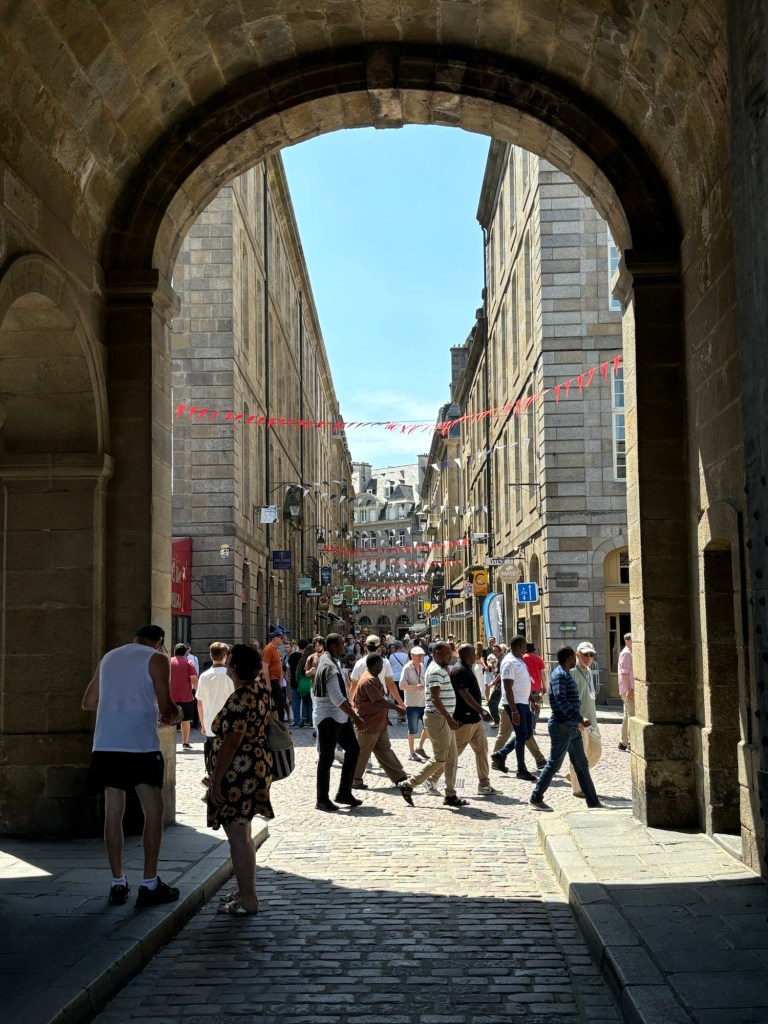
The sun is going down on my second night in Saint-Malo, an enchanting walled port city on the north coast of Brittany. Hector, the herring gull that seems to come with the AirBnB where I am staying, has gone up to the roof to roost. Swifts are still screaming outside and the moon, two days away from its full phase, is already creeping up behind the district of Saint-Servan across the harbour to the southeast.
I’m not entirely sure why I settled on Saint-Malo. My first intention was to make for Saint-Jean-de-Luz on the Basque coast, following a tip-off from a French student at Worth. One way or another, I ended up being drawn to the northwest, and Saint-Malo seemed the natural choice as a base of operations: easily accessible by train, ferry links to Portsmouth, a good combination of sandy and rocky beaches and a former pirate town to boot. It’s also not far from Normandy, and I did so love Normandy the last time I was here. After all, that’s what this whole trip is about, isn’t it? Finding something about France that will spark my interest?
I think I first heard of Saint-Malo in the famous French sea shanty Santiano by Hugues Aufray. My dear friend Andrew slipped that track my way a few years ago, so I owe him for this discovery. It really is a very special place.
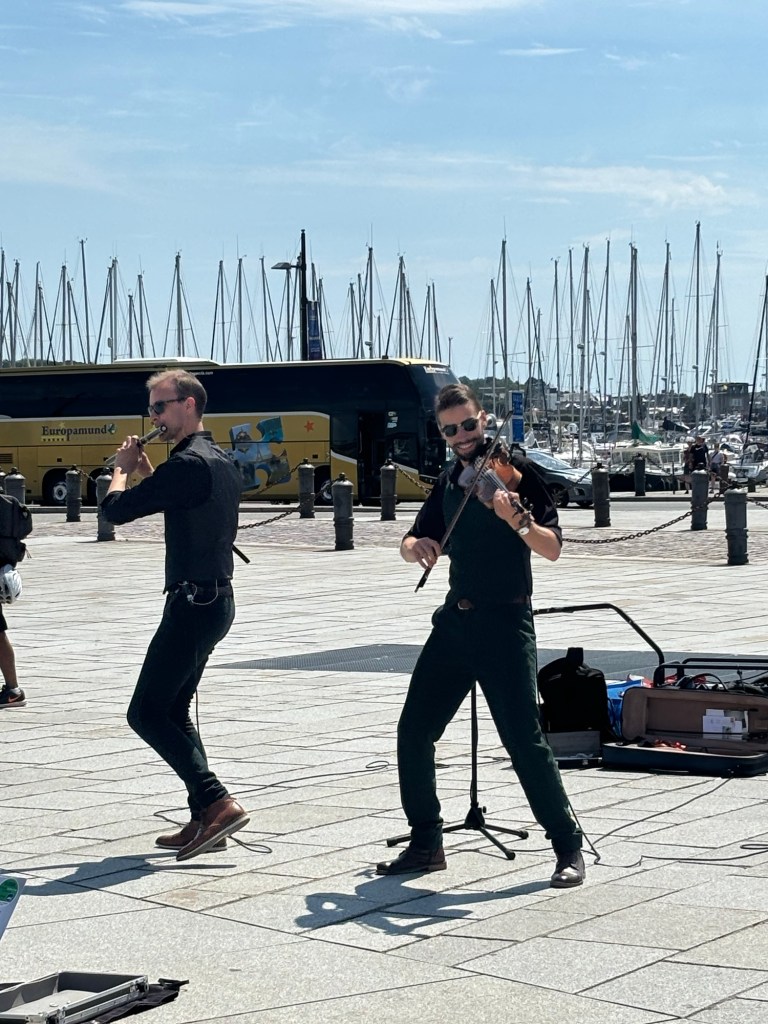
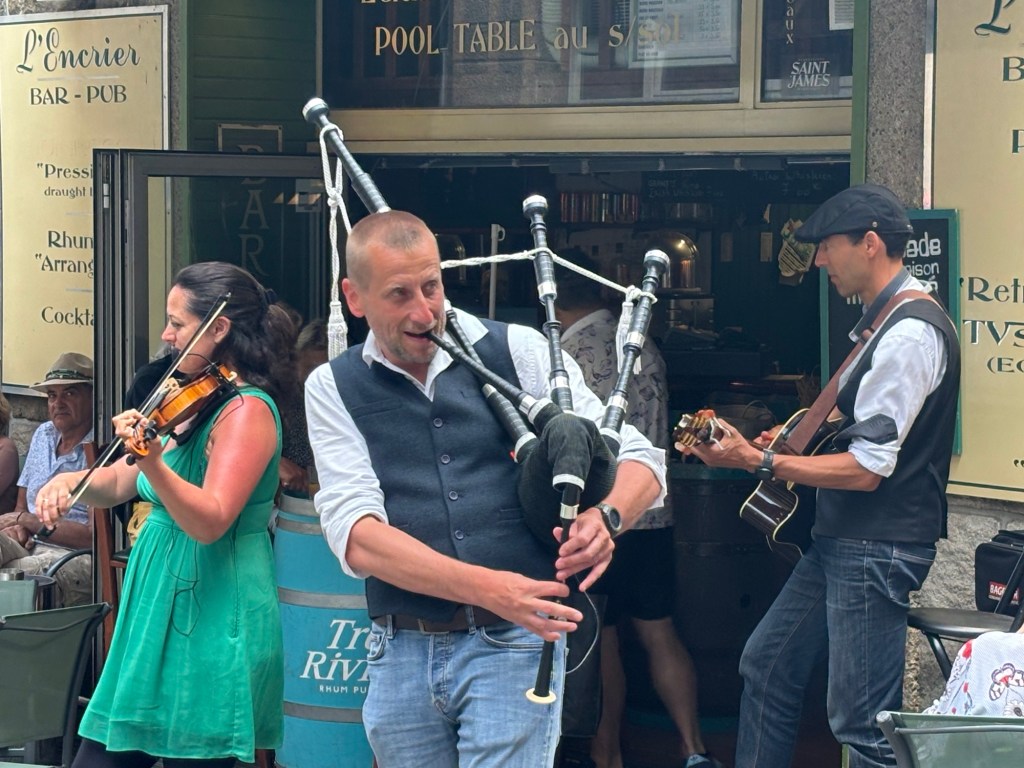
When I arrived yesterday, a local folk band, the Green Lads, were playing a merry medley of familiar folk songs. A few hours later I ran into another trio of buskers, Celtic Whirl, entertaining tourists with a run of similarly Celtic songs, including the theme to Last of the Mohicans. One of the players even whipped out a set of Breton bagpipes, known here as binioù braz (a 19th century Scottish redesign of the local Breton variety). I stuck around for about half an hour in both spots and couldn’t help tipping generously and tapping my feet. It’s strange that neither of the two groups have a French name – they’re both clearly French – but maybe it appeals more readily to the tourist trade (who – he adds with poorly concealed contempt – don’t seem to make much of an effort to speak any French).
Galicia. Brittany. Cornwall. There’s obviously something that draws me to these Celtic corners of the world. Maybe it’s the fact that my instrument is the violin (despite all the noise I make about playing the bass guitar), and that I found a sanctuary in jigs, reels and hornpipes when all the studies, scales and exam pieces got too stultifying for my teenage mind. Perhaps there’s more to it than that, though what it is, I really cannot guess. But I do believe that if I had not taken up the post at Worth seven years ago and instead gone on to a teaching post in Galicia, as was the plan, I might well have stayed there. I think it was the discovery of Galician folk band Luar na Lubre which forced my hand. Galicia is notorious in the British Council auxiliar programme for its charm: few apply for the place, but those who end up there have nothing but gushing praise for the quality of life when they get there.
It just strikes me as odd that, for all my obsessive investigations into the Jewish and Islamic influences on Western Europe, it’s the Celtic corners that I keep coming back to. I wonder why that is? My mother was always very keen to point me in the direction of my Spanish heritage, but I think I’ve been doomed since the moment I heard the first five notes of The Corrs’ Erin Shore.
Yes. That must be it. I blame the Corrs. They’re definitely responsible. I used to listen to Forgiven not Forgotten obsessively on the way to and from school when I was younger, and the fact that they got a shout-out from my favourite childhood author, Michael Morpurgo, probably didn’t help. They have weathered every new wave, every genre, and the aforementioned album remains stubbornly in the top spot of my all-time favourites. I still have the cassette and its case. I think I always will.
I enjoyed a delicious dinner of moules marinières before watching the sunset over Grand-Bé, the larger of the two islets. The French Romantic Chateaubriand is buried there, and when the tide is out tomorrow I will go in search of him, and see why he chose that spot for his forever resting place. As a fellow Romantic, I can’t say I blame him for choosing this town. Saint-Malo is as shining as the shimmering stardust on its shores, when the tide pulls it back out to sea. BB x
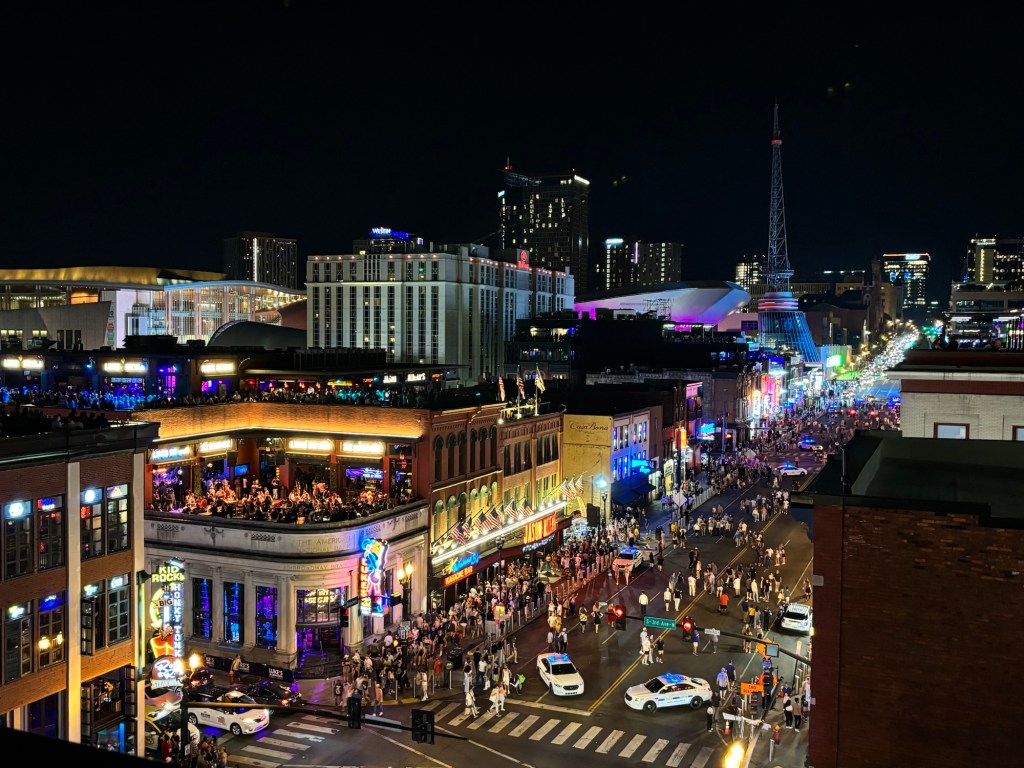
Imagine a city where every third man and woman is dressed in roper boots and ten-gallon hats. Bars with gaudy neon signs line the Main Street, bearing the names of stars of the Country music scene. Live music sails out of the windows of every floor. Every. Floor. A city where, despite its infamous popularity with bachelor and bachelorette parties, the folks still turn a welcoming smile on you and ask how you’re doin’. A city where, as the sun goes down, the streets seem to glitter with the reflected light off the rhinestone-studded outfits worn by revellers in the street.
This is Nashville. And it’s quite unexpectedly captured my heart.
Perhaps it’s only fitting that a self-described country boy with a habit of eschewing cities should find himself very much at home in the Music City where Country music is king. I am so glad I came here. And to think I didn’t even know much about the place beyond the occasional mention in the odd James Brown and Tina Turner number…! Thank you, Mackenzie, for opening my eyes to this wonder.
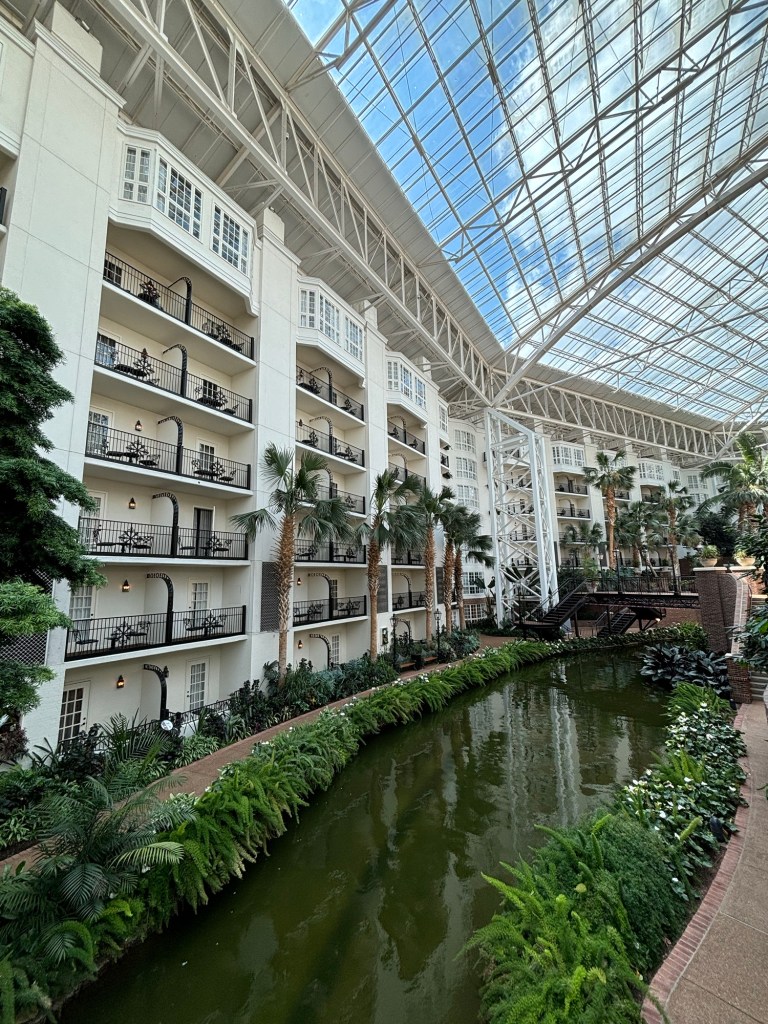
But hold on, I’m getting ahead of myself. There’s more to Nashville than just the frenetic delights of Broadway. First, let me take you on a detour to the strangest hotel I’ve ever seen: the Opryland Resort.
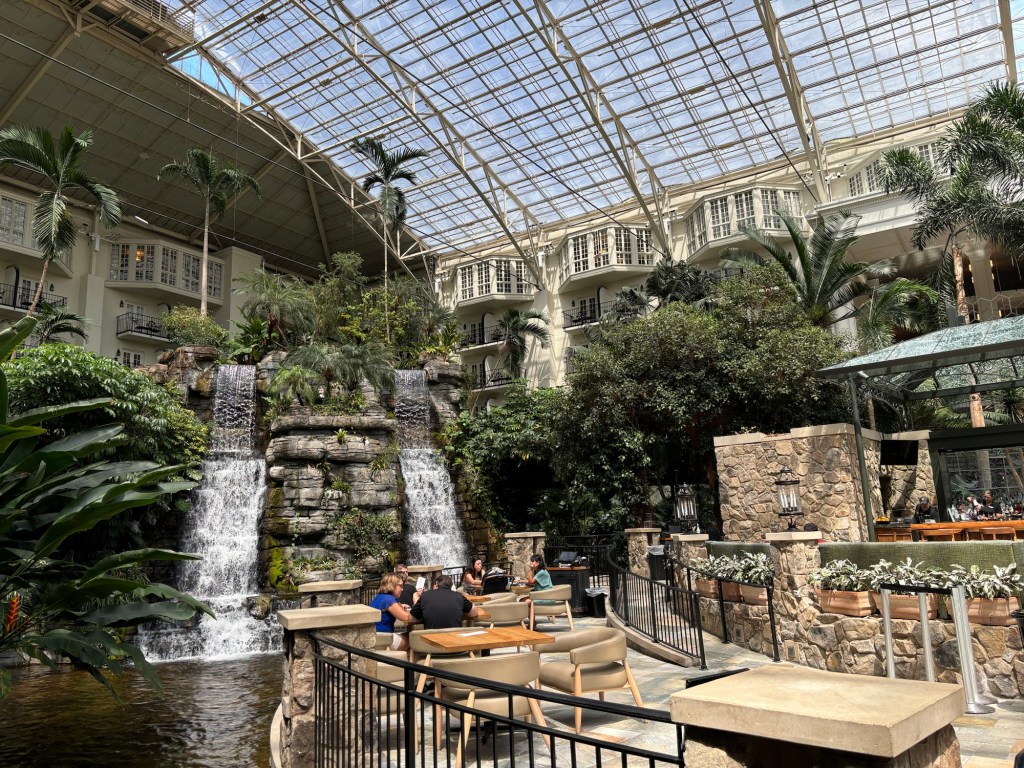
It might look like an enormous walk-in aviary, but it’s actually a vast hotel and spa complex. It’s free to explore, even if you’re not staying, but what a place…! It’s hard to know what is the most bizarre thing of all: the waterfall, the boat tours along the artificial river, the nods to American architecture (up to and including a distinctive New Orleans home) or the fact that all of this can be found within a gigantic glass-roofed building that looks like a recycled film set for Jurassic Park III.
Well, I did want to see the America that most casual tourists don’t get to see, and I’m not disappointed! Maybe I’ll be mad enough to spend the night here someday.
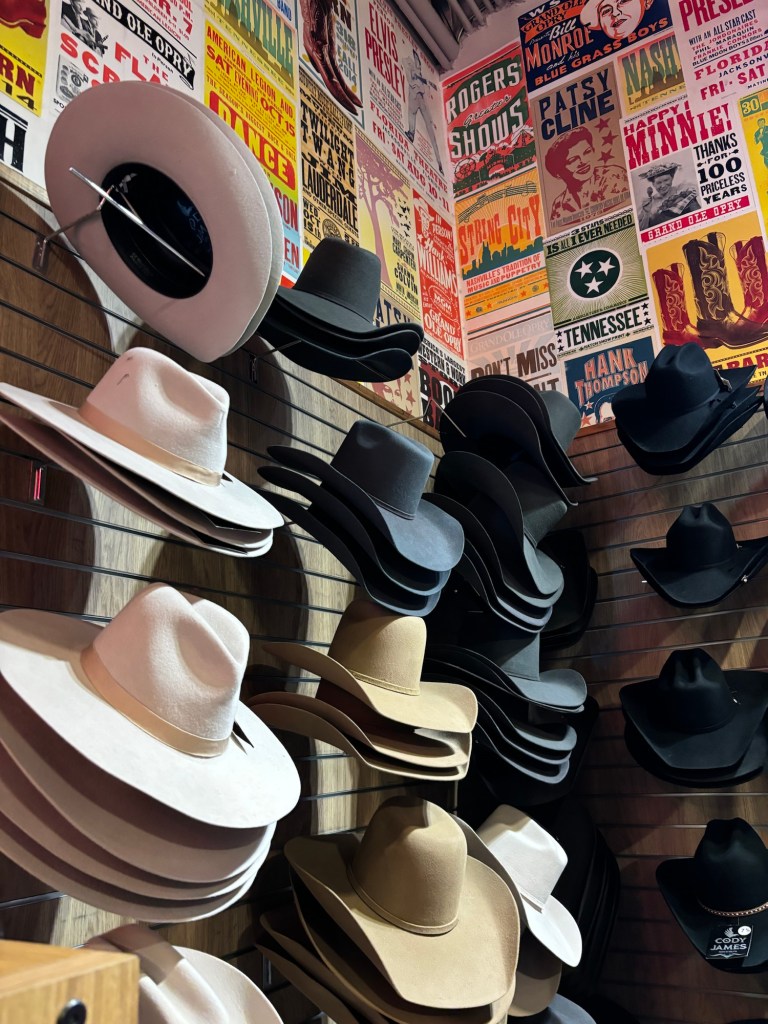
With our things stashed away in a much less outlandish (but nonetheless phenomenal) establishment, Mackenzie took me out onto Broadway for a bit of shopping ahead of a night bar-hopping and soaking in as much live music as a single night can offer. I’ll admit I was almost tempted to shell out on a pair of boots and/or a hat, but in the end I settled for a Country-style shirt. After all, it’s likely to get a little more mileage than the hat!
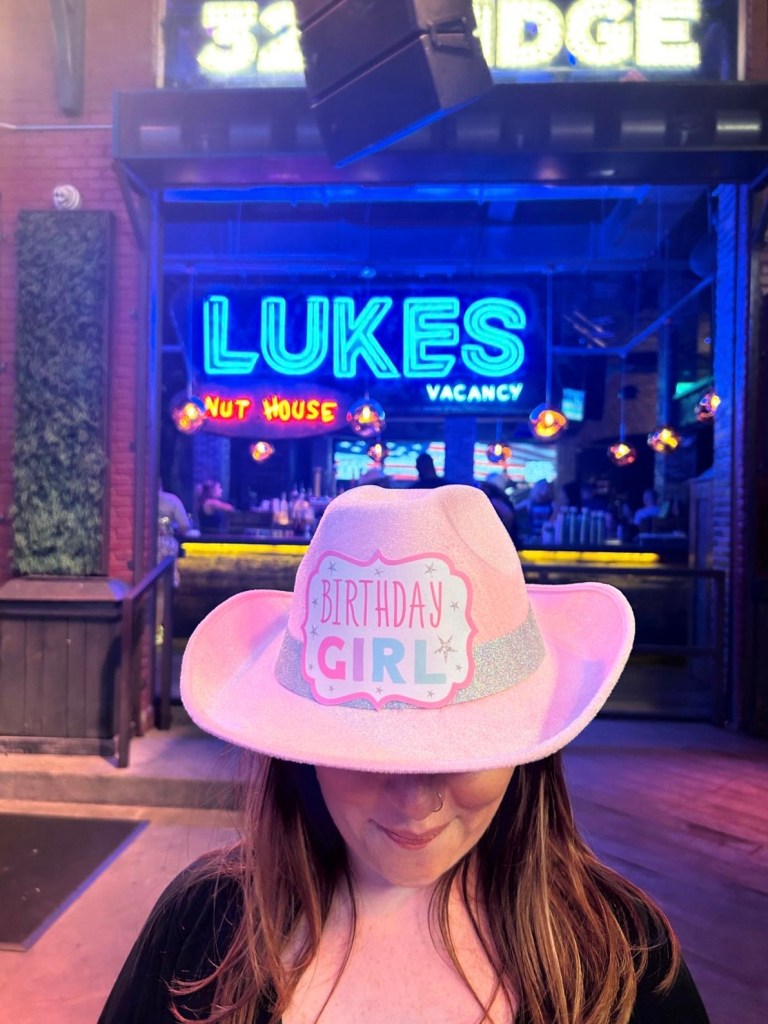
Kitted out in my new Nashville wear, we grabbed a couple of drinks at Luke’s 32 Bridge, where we met up with the rest of Mackenzie’s friends. One of the local bands was kicking up a storm on the roof with a couple songs I recognised. I’ve done my homework with this genre, which I confess is relatively new to me!
I caught myself singing along to Country Girl (Shake It For Me), Chicken Fried and Save a Horse (Ride a Cowboy), all of which seem to be crowd favourites (and all of which have now found their way into my golden jukebox playlist on Spotify). More impressively still, they wound up their set for the evening with an almighty medley that included the one and only Play That Funky Music, the song I used to close gigs with back in my schooldays. And what a mashup…! Yes, I was taking notes! I might be on holiday, but I’d be a fool not to jot some ideas down for house music when it comes around.
We didn’t get any free drinks for the birthday hat, though birthday wishes were flying in from all directions from well-wishers on the street, which was sweet. The drinks we did get, though, were fantastic. It would be madness to come to Tennessee and leave without sampling the famous Jack Daniel’s Tennessee whisky, which I had in the form of a Fireball. Yum!
To quote Luke Bryan: I don’t want this night to end. But it did, like all good things do, and in the best possible way: with a little bit of chicken fried to share. I haven’t tried nearly enough of this Southern speciality, so I guess I’ll have to come back and remedy that someday.
Nashville is something else. If you’re even partially interested in good music, grab your boots and make a pilgrimage here as soon as you can. It’s got to be the most fun I’ve ever had in the city and that’s a fact.
Say, that tower looks like the Eiffel Tower. I wonder if that’s intentional. If that’s not a reminder from the universe that I need to spend some time in France this summer before teaching A Level French for the first time (God help me) then I don’t know what is!
See you again sometime, Nashville. I think I left a bit of my heart with you. BB x
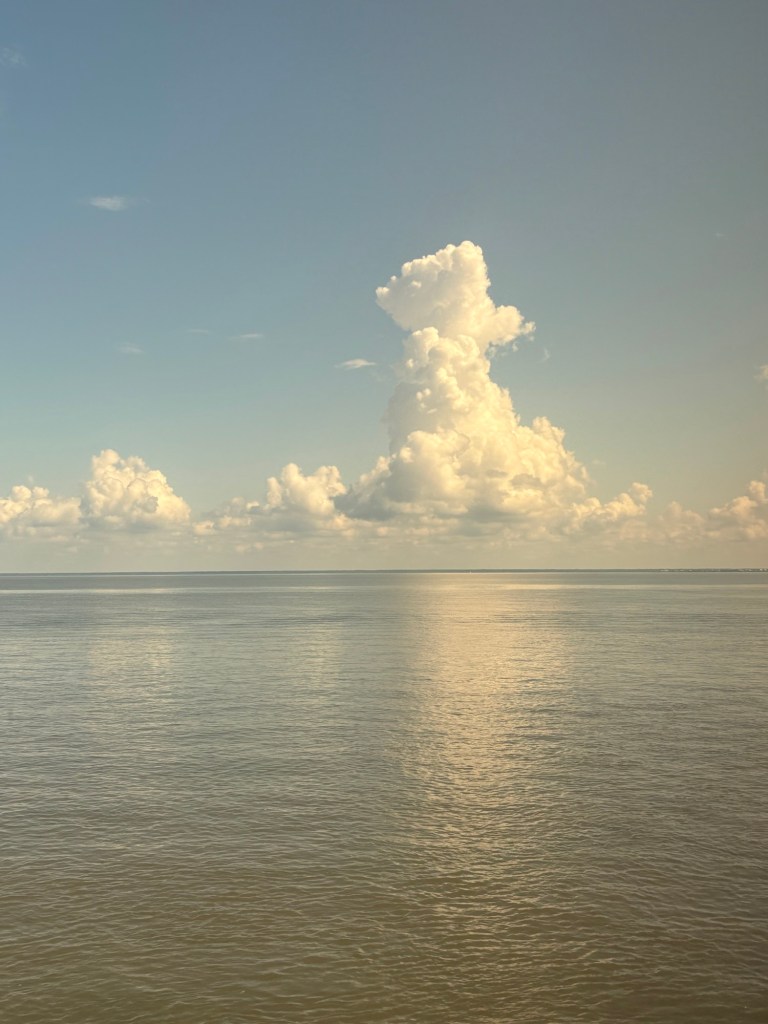
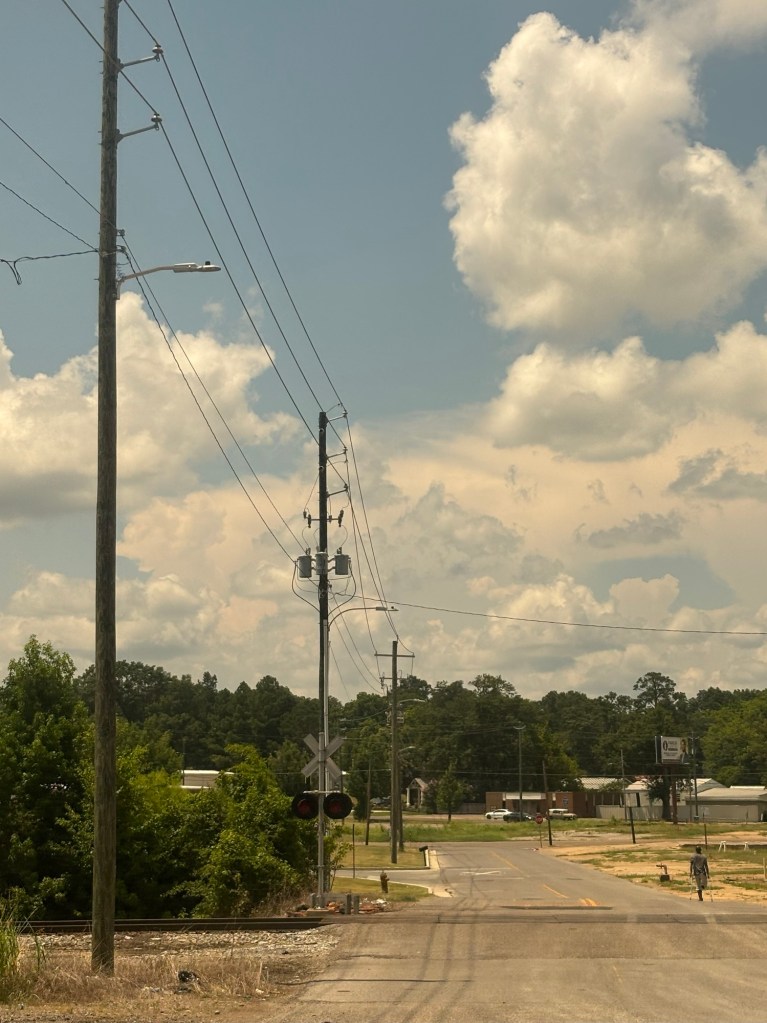
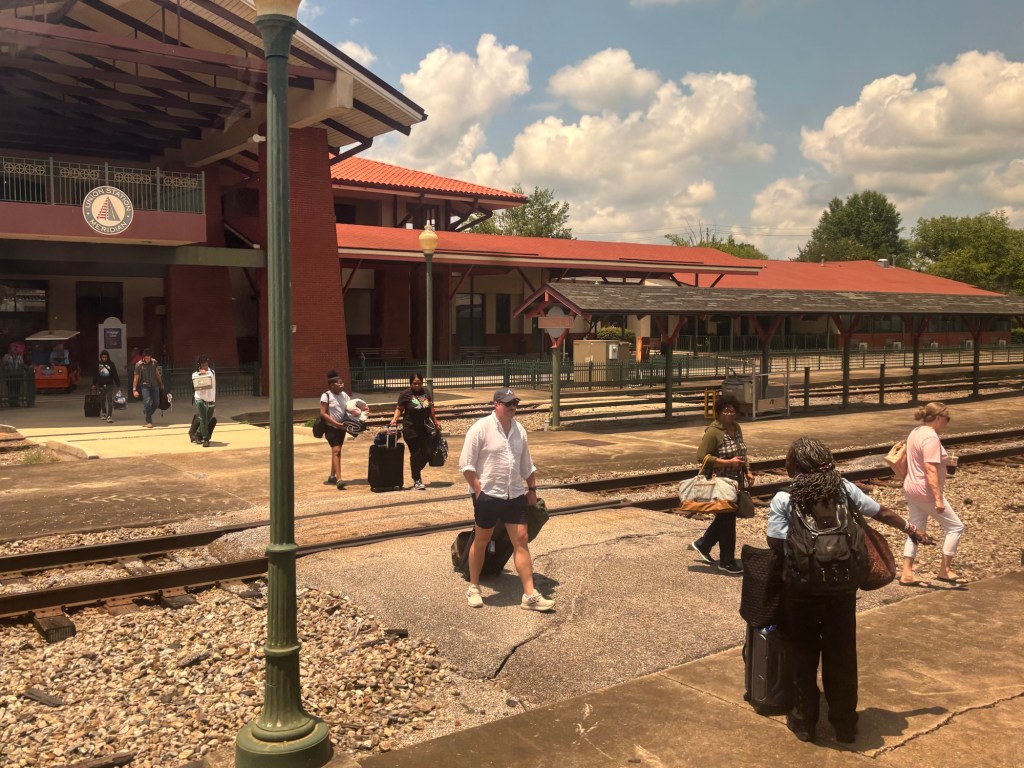
It’s 17.09, it’s been over nine hours since I last ate something and I’m somewhere in the Alabama woods between Tuscaloosa and Birmingham. If we were running to schedule, I’d be arriving in Birmingham in the next few minutes. But, as every American has gone to great pains to explain, the trains in the US never run on schedule. If you’re not in any particular hurry, it’s a phenomenal way to see the States, provided you’re happy to gawp at trees for most of the journey. Lucky for me, I’m easily pleased, and it’s been all I can do to peel my eyes from the window for the last eight hours or so.
The American South reminds me in many ways of Uganda. There’s something familiar about the immensity of the sky, the redness of the earth, the rusting abandoned vehicles and – especially – the enormous homemade painted advertising on homes, cafés and storefronts. The most American thing I’ve seen so far – beside the lone bald eagle standing on the banks of Lake Pontchartrain – are the countless colourful billboards advertising private law firms, demanding your attention with Colgate smiles in nauseatingly familiar language: Bart’s always got your back, Call ya girl Desi, IYKYK, that sort of thing.
Let’s forget any time pressure for a moment. Riding an Amtrak train is actually a really comfortable experience, and I’m surprised it isn’t more popular. There are charging stations for every seat, curtains for the windows, sturdy WiFi and a cheery Southern burr over the tannoy to replace the cold, automated replay of British trains. I’ve even got enough leg room to stretch my legs, and that’s taking into account the fact that the guy in the seat in front has put his chair back into full recline. I haven’t seen as much wildlife as I’d have liked over the course of my vigil, but I’ve still managed to clock a few deer, a whole lot of egrets and a few birds of prey, including the symbol of America itself. That’s not too shabby for a bit of on-board birdwatching.
To be honest, the only thing I’d change is the seat numbering, which is baffling – and very obviously a new concept, as even the ticket inspectors seemed to get muddled up by the numbers (which don’t really correspond to any of the seats at all). Folk don’t seem to mind, though. I think most of the passengers here have simply found an empty seat and made themselves comfortable, and all of them are quite happy to shuffle as and when a couple or family comes aboard. That’s one major difference to European trains. I was traveling in Germany once and still remember an officious German lady who made the entire coach get up and scramble because there was somebody in her seat and she absolutely had to sit in the seat she had been assigned. The human soul: the price of efficiency.
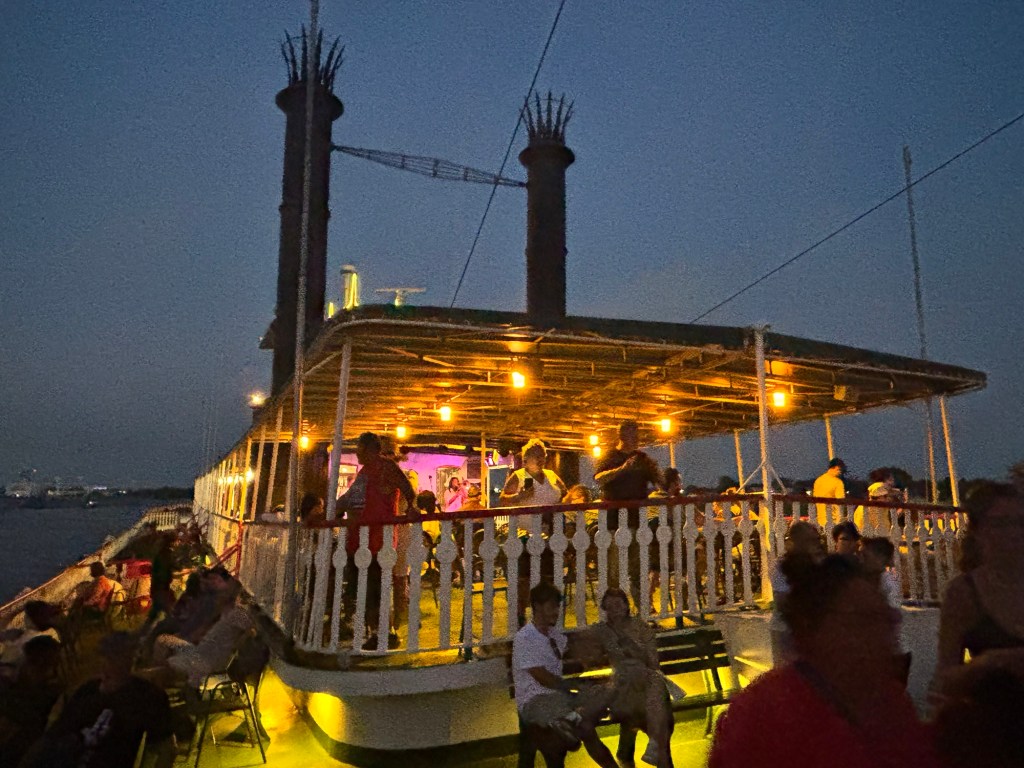
I ended my stay in New Orleans with a jazz fest, seeing a local band in Preservation Hall and then taking the Natchez steamboat cruise down the Mississippi with its attendant Dixieland band providing a jaunty backdrop. If it’s done one good thing for me, New Orleans has reminded me that there is hope for those of us who still believe in music bringing the world together. The Preservation Hall jazz band ticked more diversity-and-inclusion boxes than a school website: the trombonist was black, the saxophonist Latino, the pianist Scandinavian, the double bassist Japanese and the lead trumpeter Creole. I hate to admit it, but I’m still bleeding a little over the way my Gospel Choir was torn apart years ago. Maybe I always will be. That’s partly why I’m here in the States, in this limbo between jobs, between worlds: to try to put a seal on that episode of my life, and to remind myself that there are plenty of people out there who don’t see things that way. And where better than America, the great Melting Pot itself?
I’d better stop writing – it looks like we’ll be arriving soon. In the end, we’re only 50 minutes behind schedule. It’s funny how little that seems to matter! In the UK, there’d be apologies over the tannoy and prompts to get a refund via the website…
Alright America. I’ll admit it. Just this once, you have us beat on heart. BB x
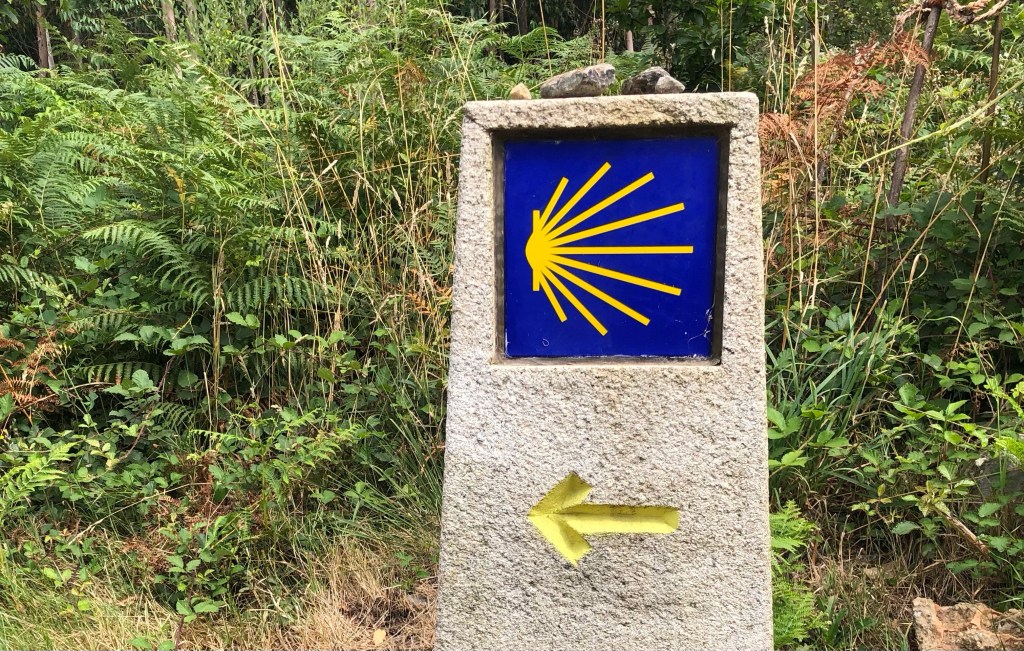
After over two weeks on the road, I’m finally within striking distance of Santiago. The kilometre countdown on the much-abused concrete markers has dropped to below twenty, which is less than a morning’s work (I managed more than thirty kilometres before midday today). The end is in sight!
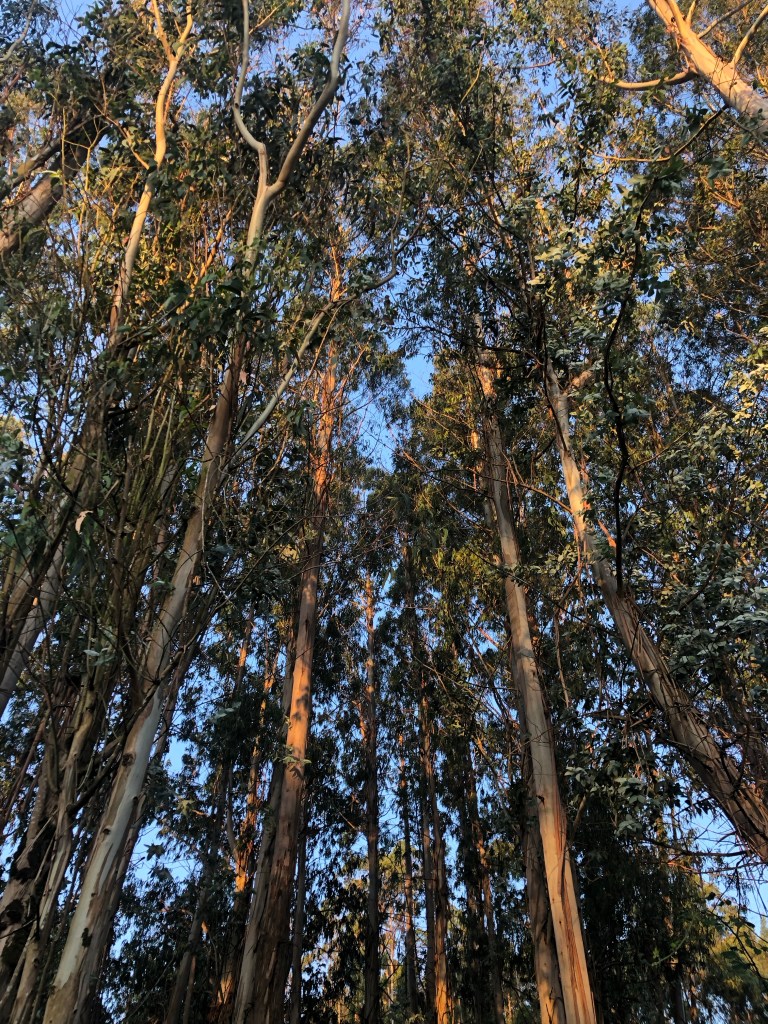
The final two days from Arzúa to Santiago are, quite possibly, the least appealing of the Camino. And that includes the much-maligned Meseta, which I actually really treasured! Whether it’s the busier pilgrim road, the lack of connection between the hundreds of last-minute pilgrims or the endless stands of alien eucalyptus, the magic slips away through your fingers a little as the finish line draws near.
Fortunately, I had my fill of magic moments to power me through the morning.
I was up at 5am as usual with the first of the pilgrims. The turigrino girls were up and about surprisingly early, though it turned out the reason behind their haste was their pre-Camino makeup routine. Thinking I could get the jump on them by striking out early, I set out as soon as I was ready, some fifteen minutes or so before six.
I’m not one for torches, preferring to accustom myself to the darkness, so my own headtorch remained stubbornly in my rucksack throughout the first hour of darkness, even as the Camino wound its way through the dense Galician forests and I lost all the aid of starlight on the road. What I gained, however, was a full immersion in the dawn that is lost when you charge ahead with a bright light. In an ancient forest west of O Carballal, after crossing a stepping stone bridge, I was suddenly surrounded by the otherworldly churr of nightjars. I recorded the sound and played it right back, and was rewarded with a sight of two hawk-like shadows performing their wing-clap display flight against a dawn sky through the trees. They must have clocked my ruse because when I heard them again they were deeper in the forest, but the martian churring followed me right to the edge of the trees, unlike finally the light of daybreak brought it to a sudden halt.
My replacement stick had finally assumed its full inheritance, adorned as it is now with a buzzard feather, two magpie feathers and a sprig of brilliant mountain heather. Somewhere out there, near or far, my old stick may well be traveling the same road. But its successor has done a fine job and I am grateful for its aid in carrying me this far. Lacking a traveling companion, I find a decent stick to be as good a friend as a warm fire in the darkness. And I’m getting a lot better at not leaving it propped up against things when I’m readjusting my clothes!
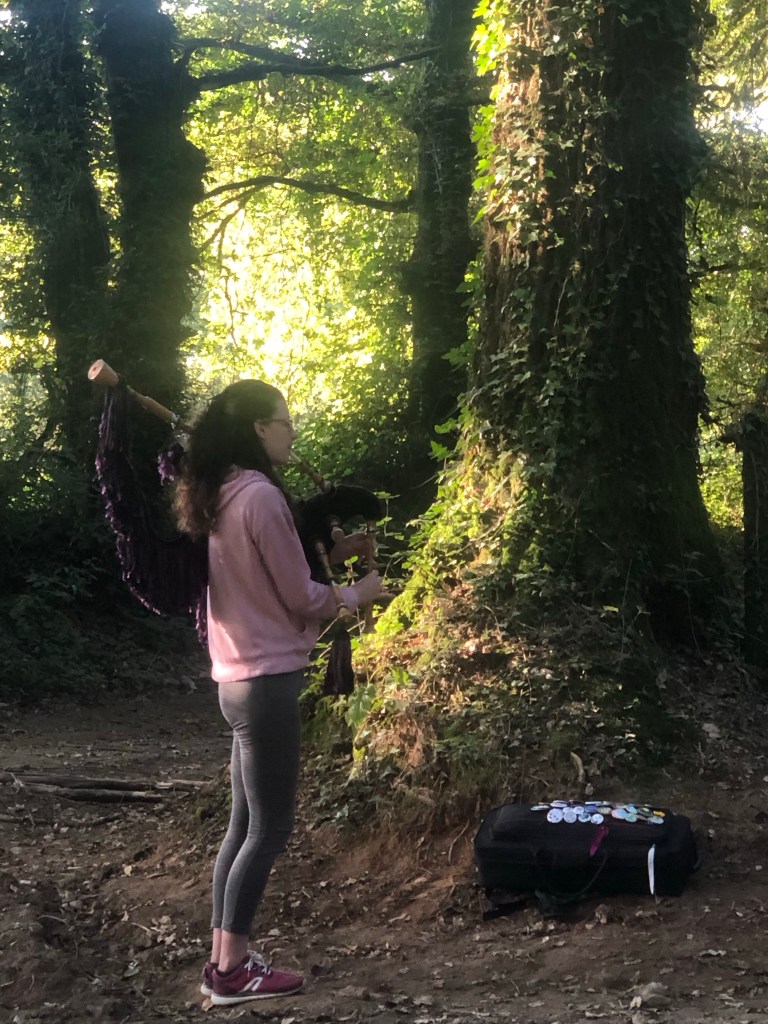
In the woods after Arzúa, I heard the distinctive reedy sound of a gaitá. Thinking it might be somebody practicing ahead of the regional (and national) festival on the 25th, I filmed a sound bite and moved on – only to almost walk headlong into the source further along the trail. A couple of youngsters, the elder probably no older than twenty, had chosen a spot beside one of the Camino markers, set a hand upside-down and were busking for passing pilgrims: one playing the gaitá (Galician bagpipes) and the other a drum. It more than made my morning, so I tipped them handsomely and stayed to listen for a while.
I stopped for brunch rather than breakfast at a witchcraft-themed café in Boavista (no tortilla, they ran out as soon as I got to the bar) and then slogged right on. The original target, Santa Irene, would have been fine, but it was still ten past twelve and the additional forty minutes on to O Pedrouzo – shaving forty minutes off tomorrow’s final push – were just too tempting to pass up.
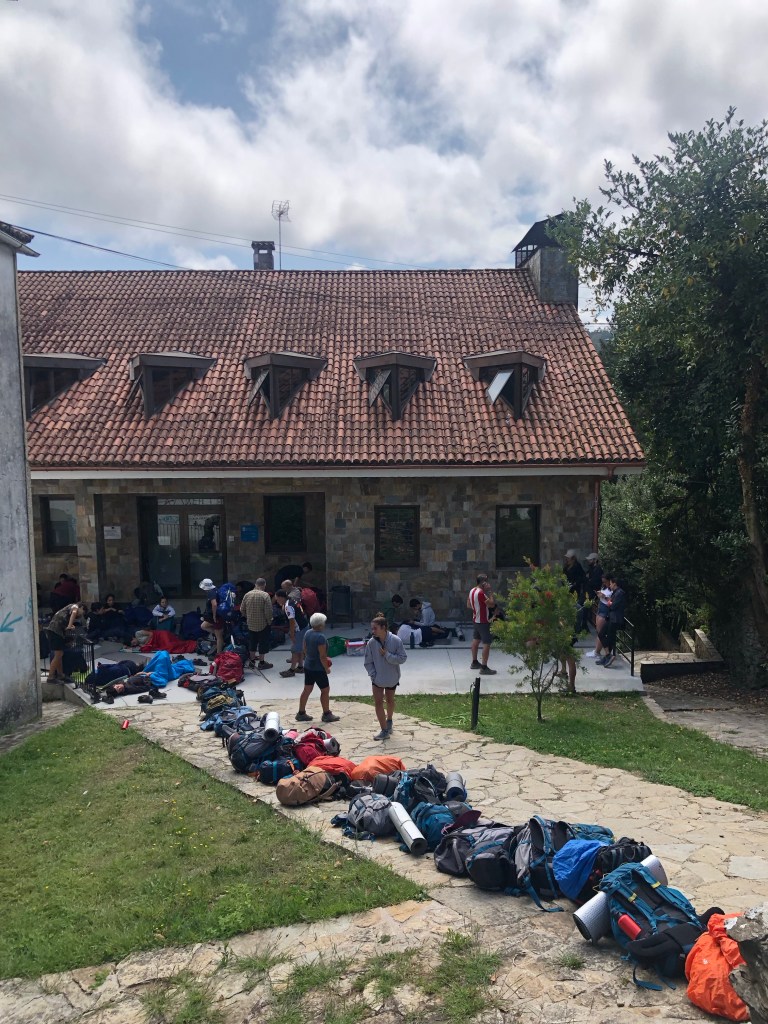
Obviously, I wasn’t the only one with that in mind. A sixty-strong group of turigrinos beat us all to the Xunta albergue, evidently by quite some time: they’d lined their rucksacks in a queue leading from the door right up to the road, and some of them had even rolled out their roll-mats and got into their sleeping bags to wait…! Why they thought they might need roll mats on the Camino (as I didn’t see a single tent or any other camping gear on them at all) is beyond me, but perhaps this is their method: arrive early, camp out en masse and seize the first few beds.
On the plus side, while waiting in line with the handful not attached to the group, I was mistaken for an Andalusian by one of the Spaniards. Sure, she was swiftly corrected by a real Andalusian, but the intonation that clings on since the Olvera days still seems to be enough to create a temporary disguise. At the very least, it’s a good way to delay the inevitable ‘soy guiri’.
Well, I’ve done a final run for supplies at the local Día market. I’ve had an empanada for dinner and I have what I need for breakfast, so I can cut and run tomorrow morning. If I’m quick – and the last couple of weeks are good evidence that I am – I’ll be in Santiago for 9am, so I’ll try to get my Compostela before I check in. That would be ideal! But, as I keep telling myself, there’s no rush. I have sorted my lodgings for the next couple of nights, and it’s a room of my own, so for the first time in weeks, I will be able to really kick back and rest… before the real final stretch to Finisterre and home. ¡Hasta la próxima!
P.S. It occurred to me in Día that Spaniards don’t go in for personal catering like the English do. Grab bags, meal deals, milkshake bottles and salty snacks… they’re all designed to be shared. Is that more of a reflection on our culture or theirs? Are we so isolated a nation that our own supermarkets know we would prefer to eat quickly and alone, or are the Spanish so gregarious that a vendor wouldn’t even think of stocking something that would vanish in seconds if passed around? Just one to think about.
I’ve just finished re-assembling my entire music collection on Spotify. It’s taken me the best part of three days, since I amassed a pretty sizeable library in the years before Spotify had pretty much everything. Time was when iTunes was where one kept all one’s digital music, ready for transport onto this or that hand-me-down iPod Shuffle, bought from a friend for £20 or so. Those early models could only store so much music, and you had to decide which 240 songs would make it. Those were trying times.
My parents grew up with mixtapes and CDs, but I belong to the generation where music went digital. If a song came out that you liked, you bought the CD, burned it onto iTunes or some other software and uploaded it directly to your device (alternatively, you could take the cheaper route and just find any one of the YouTube to MP3 converters that were occasionally dodging the censors). My first walkman – a bizarre pen-drive device that might just as easily be taken for a vape pod today – had a small collection of music, mostly hand-me-downs from my parents: Michael Jackson’s Greatest Hits, Spiceworld, Stravinsky’s Rite of Spring. This was back in 2008, and Spotify was still a few years away from hitting the big time, so most of us turned to YouTube for our music. YouTube, ever-growing, seemed to have almost everything, and I’m not afraid to admit it was a major conduit for musical discovery in those early years (and still is!).
Carving up my library into playlists has made one thing glaringly obvious: my taste in music has changed little over the years. The range of artists has certainly exploded, but the genres are almost exactly as they were in the first playlists I drew up in iTunes years ago – that is, a motley collection of Folk, Klezmer and Gypsy music, with a similar number of Classical musicians (my parents were both music teachers); a broad range of World music and edited highlights from the major Pop hits (largely selected for nostalgia purposes); and in the top spots, a virtual eternity of Soundtracks, and – constituting the greatest majority by far – Soul, Funk & Disco. The last ten years have seen Afrobeat, Hip-Hop and Flamenco occupy an increasingly large section of the library, while Rock remains miserably underrepresented (it’s quite simply a genre I’ve never really been that drawn to). What Spotify doesn’t have is the absolute mine of videogame soundtracks that I’ve also collated over the years, but perhaps that’s for the best…!
Yes, I’m a heathen because amongst the thousands of songs in my collection I haven’t got a single song by The Beatles, or the Rolling Stones, or even Bob Dylan (I feel I ought to apologise to somebody for this). But I do have every single track James Brown ever laid down (even the bad ones), a fair grasp of obscure Balkan folksongs and a burgeoning playlist of sevillanas that I am trying to learn off by heart. And thanks to Spotify’s constant suggestions, which get smarter as the playlists grow and grow, the fact that almost all of my favourite artists died a long time ago is no barrier to discovery: every week I find something new.
The music we listen to has a profound impact on who we are. Equally, I’m sure who we choose to be has an impact on the music we choose to listen to, but I’m more inclined to believe in the transformative power of music. With very few exceptions, my taste in music veers towards the upbeat. Fast-paced, feel-good numbers dominate. I wasn’t counting, but if I were to go back and have a look, I probably couldn’t find more than one or two dozen slow or sad songs amongst the thousands. Those that are there are there for a reason: Marvin Gaye’s What’s Going On holds the line as one of my favourite albums of all time, and Whispering Winds from Don Bluth’s The Land before Time is just there to make me cry on occasion. The reason for the lack of slow music is quite simple: I’ve always turned to music as a cure to my doldrums. I’m not one for wallowing in my sadness. If you want to conquer misery, loneliness or fear, there’s no use getting stuck in a rut. You have to face your demons head-on. I’d much rather shake off my blues with something that puts a smile on my face immediately. That’s why my most-used playlist is called Smile! (feel free to vomit)
Personal music curation is an unending process in the digital age, but Spotify is one of the few technological advancements to which I’m not afraid to be a committed disciple. A virtual library where you can find almost all the music ever produced, anytime, anywhere? Yes please! BB x
P.S. I’m a fervent believer that music should always be shared, so if your tastes align with mine, or you’re simply curious to explore, please feel free to browse the following playlists I’ve put together:
“It was a good year for the vultures. The sun, unfettered by even the promise of cloud, laid waste to the land with biblical fury. Men cowered in the shadows of their houses, praying to a younger god for salvation, while their sheep and cattle died by the thousand. Crops perished, forests blazed in the night and rivers that had once thundered through the mountains ran dry. Only the Tagus, the mightiest of these, stayed its course through the parched land, though it too had suffered, to which the broad halo of white mud that lined its banks from east to west stood as a grim testament. The vast plains south of the great river, once several shades of green, lay barren and brown under the white sky, scarred with huge marble wounds that ran like veins across the earth. In the heat of the afternoon even the mountains seemed to melt, shimmering somewhere beyond the cloudless ether; and it was from these mountains that they came, in ones, twos and hundreds, scouring the world below for the dead and dying.”
I wrote that old opening paragraph to my novel a few years ago during the sweltering Covid summer, when temperatures soared before the school term was quite finished. Half the trouble with writing a book set in Spain is that it was an awful lot easier to write convincingly about the place when I was living out there – since moving back to this rock, my wellspring has dried up somewhat. In truth, I’ve only ever experienced a Spanish summer twice – despite spending almost three years living out there, I’ve always managed to avoid the tres meses de infierno – but the current flick of the claw from Thumberg’s nemesis is giving me a pretty good idea of what it might feel like.
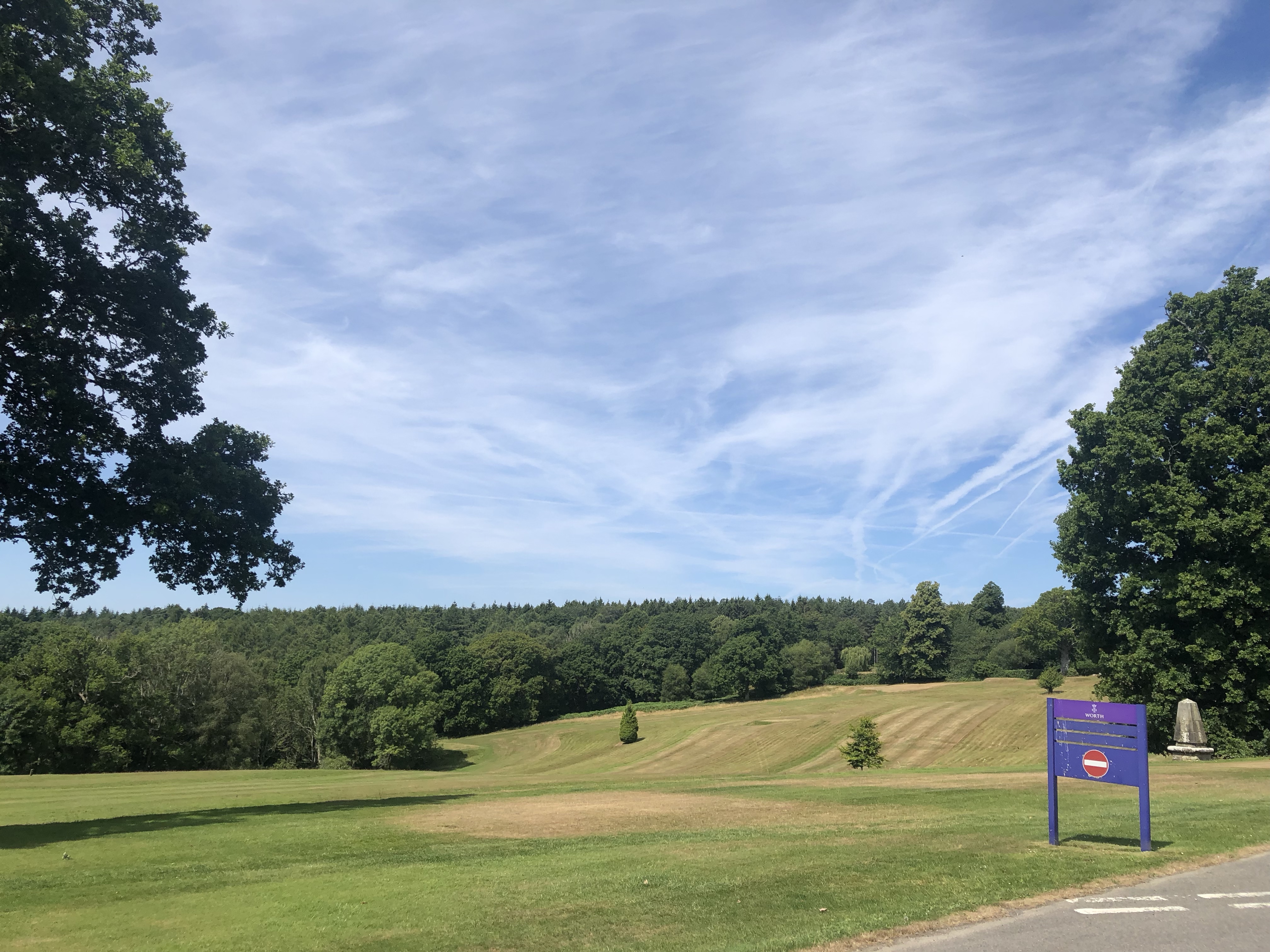
The UK is on red alert. Heck, the radio even said this morning that there was to be a Cobra meeting about the high temperature crisis (things really have reached that kind of an extreme, it seems). It’s a balmy 26 degrees out there right now as I write, and the happy-clappy Christian camp have long since retreated indoors, taking their frisbees and their babies with them. All the forecasters are pointing to a record-breaking 40 degree high on Monday. The current record was set two years ago, with a garden in Cambridge registering 38.7 degrees. That seems absurd, but that’s where we are. The last time I was caught in temperatures that high I was living in Jordan, on the edge of the Syrian Desert, where one expects that kind of celestial fury in the summer months. Not here. Not in West Sussex.
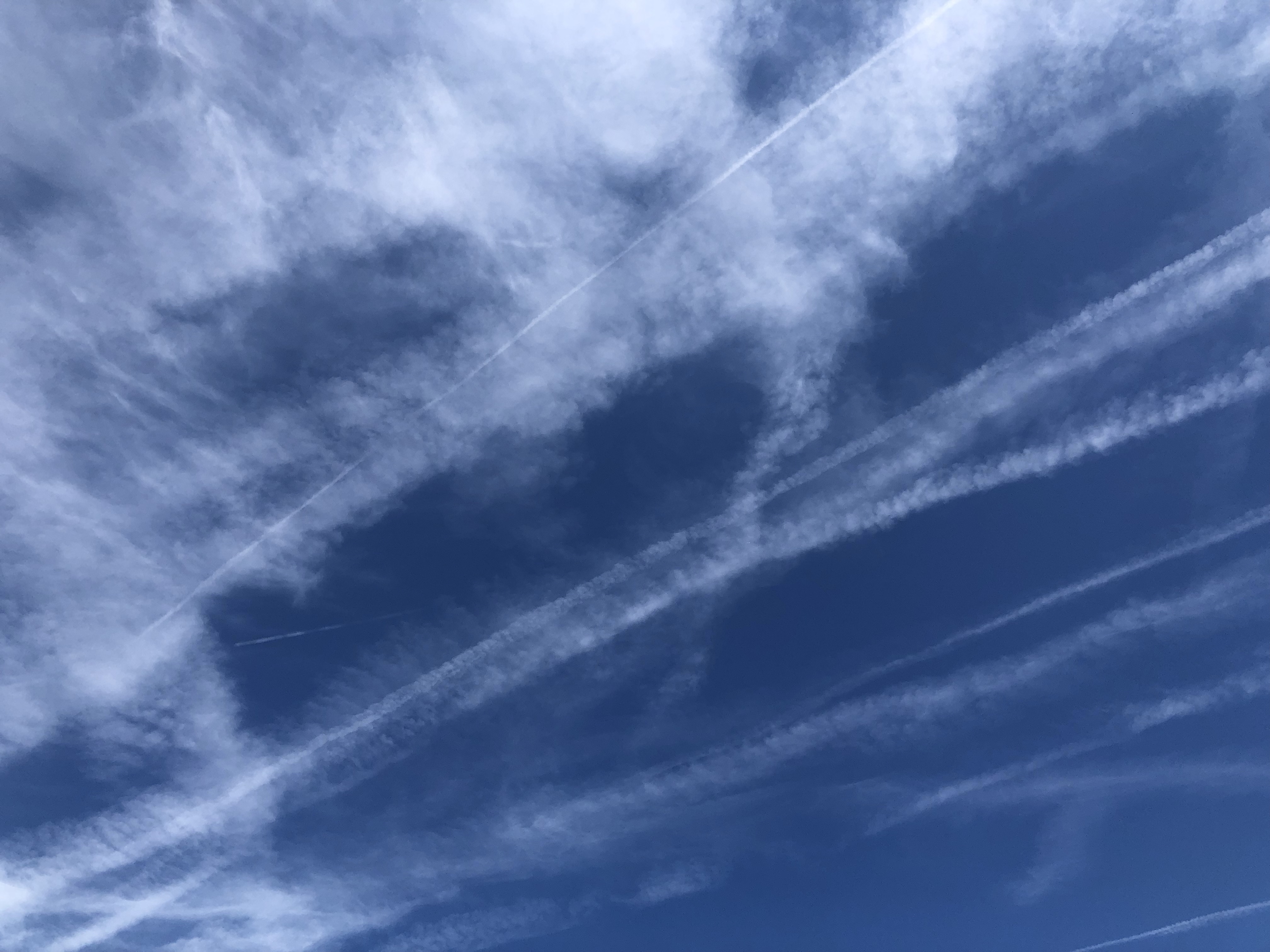
Scorching afternoons aside, I’m enjoying my current routine. I’m up on my feet almost as soon as I’m awake, which is usually around six thirty (yes, even in the holidays – I’m a creature of habit). I’m up earlier (and faster) if I find myself on the sofa. That thing is a death trap – I don’t know what enchantment was cast upon it by its previous owners, but it lulls whoever sits on it to sleep in a matter of minutes. If I don’t have to make the shopping trek (an hour into town and another one back on foot), I get an hour and a half in the sun with a book on the ha-ha. I’m currently working through Hernan Diaz’ In the Distance. When I return, I’ll make myself some lunch and kill the hottest part of the day with a round of Age of Empires II (if I’m feeling uncaringly unproductive), which usually knocks out a couple of hours – especially if I do a little follow-up historical reading afterwards, as I often do. By four o’clock the sun is no longer dead overhead so I pick a different spot on the ha-ha facing the South Downs and get another hour of reading in. I usually get distracted in that spot and end up watching the world. The presence of a summer school right behind me doesn’t bother me overmuch. It’s very easy to forget they’re there when you’re engrossed in a good book, or a panorama as beautiful as the one I have on my doorstep. Sometimes there’s a red kite or two riding the thermals over the Weald and I lose myself in the moment. Sometimes I close my eyes and imagine I’m somewhere else, like the shade of that special oak tree beyond the Puente del Ajoli on the Raya Real. And sometimes I just count the contrails. It’s a peaceful life. I’m grateful, really.
At the end of the day, after dinner, I retreat to the living room, put on some Soul, Funk or R’n’B and jam, with or without my liquid red bass guitar. I spent a good hour with my bass yesterday, to which the bandage on my thumb and the blister underneath will testify. I’m not much good at the bass, but I find it next to impossible not to get involved when I hear music I love, and I’m slowly starting to get the hang of my favourite bass riffs by ear. Always by ear. It’s the only way I know.
Last night I managed to get to grips with two of my all-time favourite basslines: I Need Your Lovin’ by Teena Marie and Till You Surrender by Rainbow Brown. I improvised around The Cardigans’ My Favourite Game and had an honest go at Billy Ocean’s Stay the Night. One day, hopefully, I’ll be good enough to nail the incredible slap bass in Ain’t We Funkin’ Now by The Brothers Johnson.
I can’t share my love for all things Soul and Funk with my students anymore on account of the colour of my skin. They say it’s not my place. But it remains my favourite music genre by far, and they can’t stop me listening to the music I love. It’s just a shame I have to be so selfish with something that really should be shared, not least of all on account of the power within.
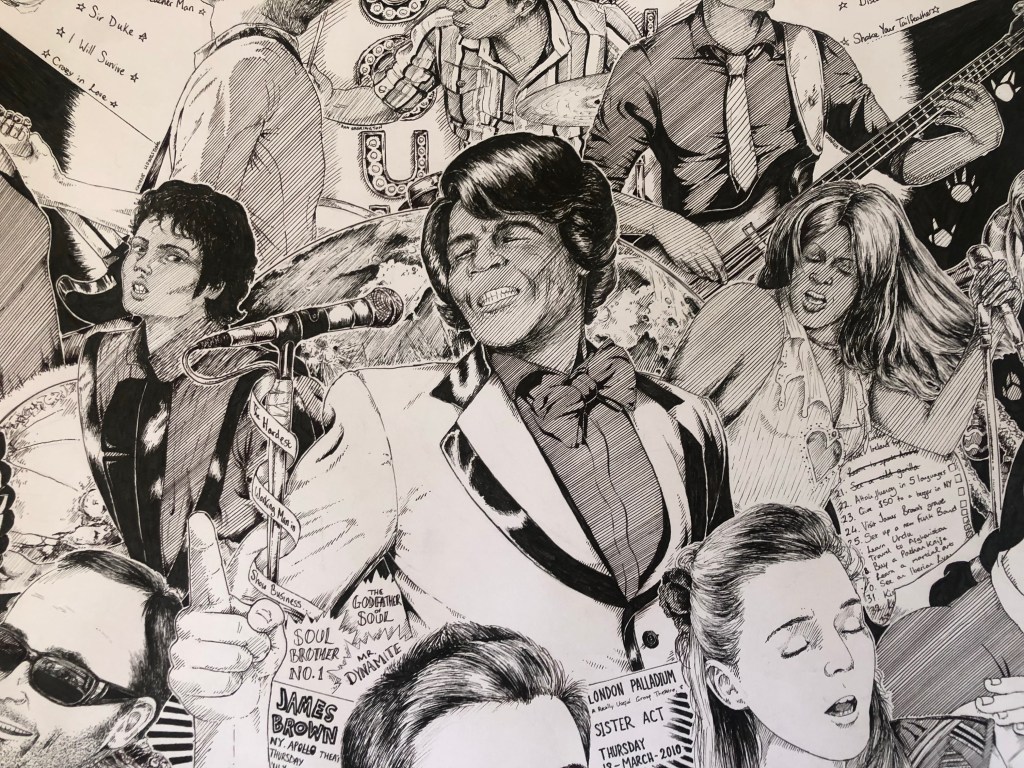
Marvin. Tina. Stevie. Lou and Luther, Sam and Dave, and Aretha, Minnie and Michael. They’re in my ears most nights. But nothing and nobody can lift me out of a dark spot like the hardest working man in showbusiness, the Godfather of Soul, soul brother number one, Mister James Brown. If only I could have seen him live…! James was a living legend, and one of the few artists I know whose recorded work pales in comparison to his live shows. Any try-hard can stand in front of a microphone with a guitar and croon. James could move like lightning and his band hung on his every movement for their cues. I reminded myself of his mastery the other day by watching his performance at the T.A.M.I. Show back in ’63, when, in a fit of pique over being snubbed as the closing act in favour of the Rolling Stones, he and his Famous Flames blew the opposition out of the water with an up-tempo run of Out of Sight. That and his legendary mike-drop in Montreux almost twenty years later (check it out at the 4 minute mark).
The Trinity in the Mega Drawing (2017)
Forgive the fanboying. There are few things I love more in this world. I’d like to think that the sheer amount of time and love I’ve invested in my passion for Soul and Funk and its history over the years renders my taste in music sincerely reverential rather than appropriative. The way I see it, it’s steered me through the darkest waters in my life and always brought me back to the light, and I owe it to my old bandmaster Mr D who introduced me to that world. If I can share that light with somebody, even just one other person, I’ll have passed on the torch. Nothing so powerful and so precious should be preserved for enjoyment in private. That’s definitely not what James would have wanted.
Well, it looks like the sun is slowly starting to sink at last. Time to pick up where I left Håkan on the trail. Though the world is already blazing hot out there, keep the funk alive, y’all. BB x
I needed to get out. While it was ultimately my decision to come back south to my flat and cut myself off once again – and I stand by that decision – it’s all too easy to go stir crazy in here on my own. I was angling on getting out and seeing friends for a couple of days, but as my plans fell apart, I’ve had to take the reins myself. So I decided to strike out for the coast. Brighton always makes for good writing, that perfectly bizarre city.
It’s clearly a school trip day today. The train south from Three Bridges was absolutely rammed with saaf Landan kids in high-vis jackets, their beleaguered teachers sitting close at hand, identifiable for the throbbing veins in their temples if not by their lanyards. Standing room only. It’s kind of noisy in the gangway, so I pop my headphones on. The Spinners’ Rubberband Man cancels out some of the angrier verses the kids are throwing around from their phones. I don’t understand the unbridled rage in that kind of music, much less its magnetic appeal to kids. Give me the laidback fun of the seventies any day.
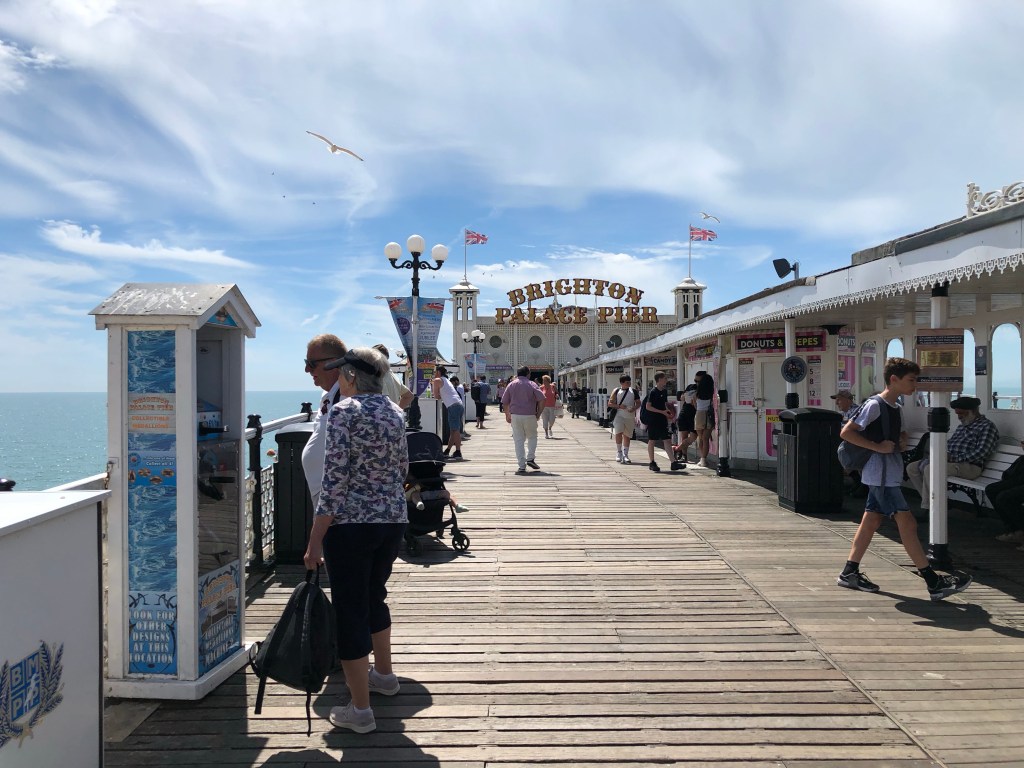
12.40pm Brighton Palace Pier
Somehow it took me all of an hour to get from the station to the pier. Time slips through my fingers in a bookshop. It’s as though Waterstones operates in its own dimension. That could well be because I’ve become a lot more tactical when it comes to book-buying, taking the time to really get a flavour for a book before deciding to add it to my collection. As a general rule, any and all books on Spain (pre-20th century) go straight into the basket, but I’ve genuinely reached the stage now where if I don’t have it, it’s not worth having. There’s still a wealth of material out there in Spain in Spanish, but with Spain’s ludicrous stance on FBP, shopping for books over there is simply not economically viable. At the moment I’m trying to pick up my European reading challenge where I left off a few years ago, so I sought out a Ukrainian book to add to the collection today. I thought I was onto a winner with Sholem Aleichem’s Tevye the Dairyman – the forefather of Fiddler on the Roof – only it turns out, predictably, my mother already bought the book years ago. Still, no matter. That’s one more book I can feel better about giving away someday.
1.27pm Brighton SeaLife Centre
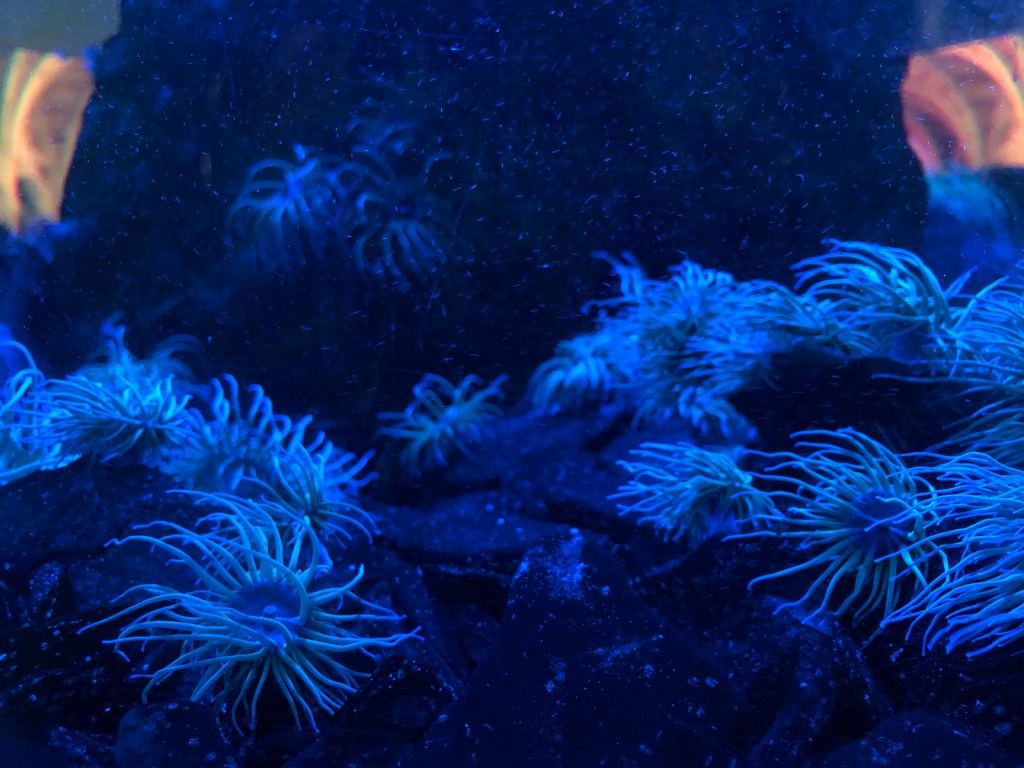
Yes, I visited the aquarium. Don’t judge! When I was a kid I used to love going to aquariums – or the more ecologically-sound sealife centres, as they are so often called these days. Nausicaa across the Channel in Boulogne was a personal favourite, but Hastings’ SeaLife Centre came a very close second.
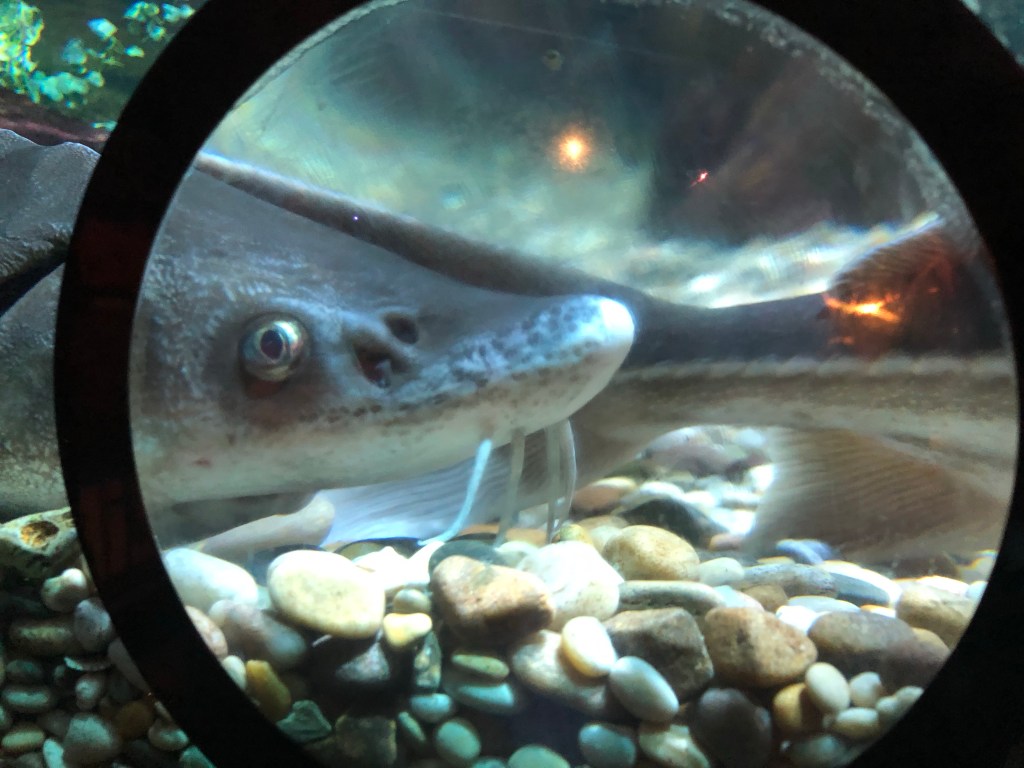
It was pretty much deserted. A large primary school group came in after me, but they never made it any further than the cafe housed in the original Victorian aquarium. I felt like a kid again and challenged myself to name the fish whose names I’d furiously memorised more than twenty years ago. For some crazy reason it’s all still there. From loach, tench and trout (easy mode), to snakelocks anemones, garden eels and corkwing, rainbow and cuckoo wrasse (standard) and on to pacu, Bloody Henrys and discus fish (hard mode). It’s a safe bet that the reason I had such a hard time learning anything in science class was because that part of my brain was stuffed full of animal trivia. If only biology had been about animals and not plant cell structure…! Who knows, I might have gone on to study it. As it is, I was bored stiff and let it go as soon as I could.
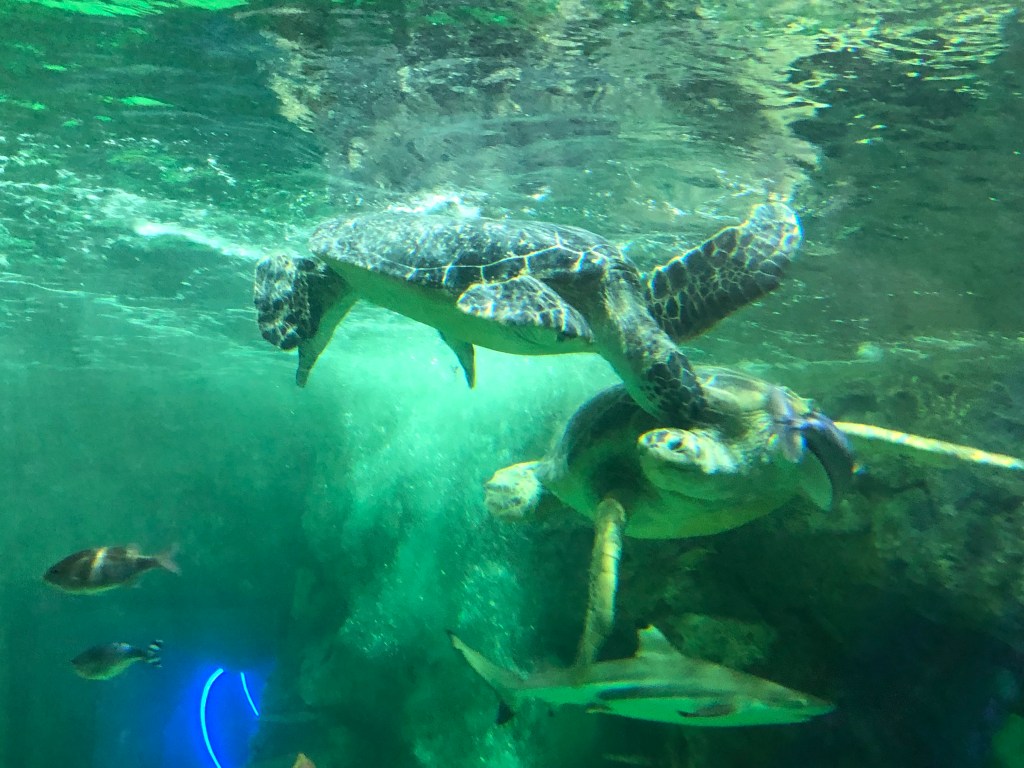
I stood and watched the turtles for quite a while. I don’t think I’ve ever seen a live sea turtle before. My god, they’re huge. Nature found a perfect recipe over 100 million years ago and decided ‘yep, that doesn’t need any more work’. Like sharks, turtles have been around for millions of years. Watch a turtle fly through the water and you’re reminded of how pathetically short our time on this planet has been by comparison. Only, these turtles looked a little stereotypic. One bit the other on one pass. Creatures can develop odd behaviours when they’re cooped up in small quarters. Maybe that’s a window into what’s happened to me in my flat this summer!
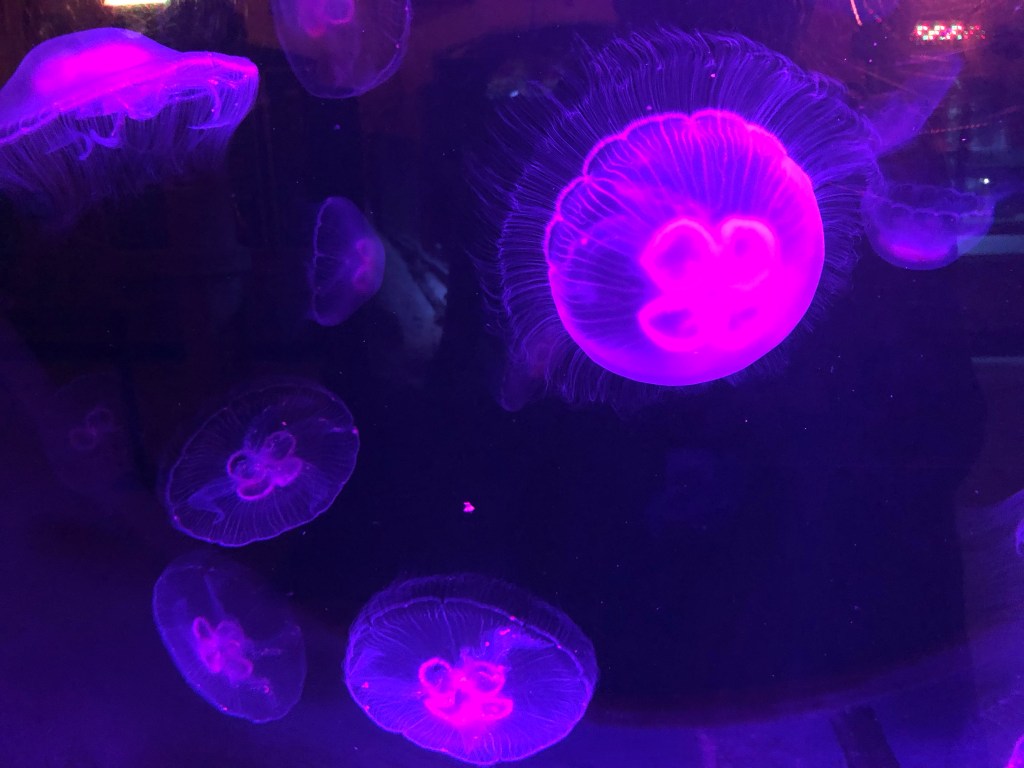
On to the jellies. I could have come here for the jellyfish alone. They’re absolutely mesmerising to watch in flight, pulsing slowly through the water, their hair-like tentacles trailing behind them. Another perfect life form that has seen millions of years of evolution come and go. Almost all sci-fi flicks imagine aliens from other planets as bipedal if not all-but human in appearance (Doctor Who and Star Wars are the prime examples), but if I were a betting man, I’d stake a fair amount on extra-terrestrials looking more like jellyfish than man. Isn’t it rather selfish of us to assume that ours is the perfect life form when turtles, sharks and jellyfish – hell, even cockroaches – have outlived us by millions of years? And on that note, I’d better clear out of here before I sell out mankind to the invading jellies faster than Kent Brockman.
2.58pm Artists’ Beach
After nearly betraying humanity over a jellyfish and admiring the beautiful world beneath the waves for an hour, I promptly went outside, climbed the steps up to the palace pier and ate a battered fish with chips and vinegar. The irony was fortunately lost on the hoarse chippie vendor, who barely got the order numbers out in a grating voice. A group of girls next to me got their orders in after me, but somehow got their orders out first. £8.20 for fishcakes and chips seemed a bit steep compared to the £5.40 deal just 200 metres from the pier, but it was good quality, and since I barely managed to finish it, I didn’t have to wash it down with a tot of buyer’s remorse.
Brighton was packed with graduands this afternoon, red-faced and sweating in their full academic dress for the 28°C degree heat. If they opted for modesty, the other beach goers didn’t get the memo. British flesh on florid display, ranging from lobster-red to milk-white. A few lucky sightseers with bronze skin seemed to walk a little taller, but they were definitely in the minority. Lifeguards, street vendors and tramps made up the rest. Folk who have little choice but to soak up the sun.
Freeze frame. I pop the chip-box in the bin and look around – and really look. Yuppies in “gap-yah” pants and strappy tops. A lady in a wheelchair, and two women at the traffic lights who get to discussing behind their hands how she might have ended up there (the kind of curiosity my generation loves to hound out as aggression). Goth-types with nose rings, vape-sticks protruding from their fingers. On that note, cryptic vape ads everywhere (what on earth is the appeal?). A squadron of Korean cyclists suiting up on the sidewalk. A cormorant flying east along the coast. The indefatigable enthusiasm of the man selling rides on the motionless merry-go-round. A boy with what looks like rickets going by. The blonde girl in her thirties singing her heart out to a crowd of beachgoers enjoying a late lunch. Nobody is looking up at her.
3.35pm Preston ParkStation
The train home is much emptier, but I still walk the length of the train to find a carriage to myself. I pop the headphones back on as the train begins to pull away and Manu Dibango comes on. Sax City, Africadelic and Soul Makossa. Dibango was one of the victims of COVID two years ago. Like Marvin, James and Luther, that’s one more of my favourite artists who I’ll never get the chance to see live (or alive, for that matter).
During the Gospel Choir debacle, I spoke to a colleague and asked for their thoughts. They said they had thought a lot about the issue of music in a post-BLM world, and questioned even having been to a soul music gig as a white person. That messed with my head for months. It’s not that I don’t rate musicians who look like me, but give me a choice between Ed Sheeran and Fela and it’s Fela every time. Pop is catchy, but disco is eternal – it just keeps on giving, fifty years later. Folk is clever but Soul finds notes that folk just can’t. And highlife is surely a candidate for the most feel-good music genre on the planet. How can you deny yourself the chance to listen to such wonders on account of a feeling of awkwardness?
I’m all for better representation in the music industry. It needs it. I just hope we don’t end up carving ourselves up into islands where we can only listen to people who look like us, think like us, talk like us. And I mean that literally as well as musically. Social media is doing that already. It’s a dangerous path we’re treading, and I hope we can weather the storm that’s coming.
Would you look at that. I’m back to sermonising. I think I was doing better with committing acts of high treason for the conquering jellyfish. Time to go. Blppp blppp blpppp. BB x
We’ve made it. Blimey, but I thought that year would never end. School years come and go in cycles, and I consider myself an extremely patient man, but this one has been particularly trying. I’m not ashamed to admit that I’ve come close to questioning my career on more than one occasion, and every time I’ve been pulled back up to the light by the trinity: the kids, the music and the torchlight of my ancestors. I’ve never been overly fond of the yawning hole in the year that is the summer holidays – I have a desperate need to be busy that two months puts a serious strain upon – but I did breathe an almighty sigh of relief when the clock struck twelve on Friday night. It’s just been one of those years.
When I look back, I can’t help but label my third year as a teacher as the year when everything went wrong. The year when all my endeavours came to ruin. Consequently, it’s also the year when hope has been even more important than ever – and hope, shapeless and mysterious, has ever been my polestar.
This year my Gospel Choir was disbanded, cancelled on the grounds that I, as a white man, was not the appropriate choice to run such a group. I conceded without a fight. It hurt, it hurt right down to the core of my soul to be told so openly that my efforts – and even my taste in music – were so wholly inappropriate. It wasn’t an attack on me by any standards, but my word, did I take the issue home! My head was spinning for weeks and I took some time out in Spain with my cousins to heal. What had happened flew in the face of everything I’d been taught by my various Gospel mentors over the years, and everybody I spoke to seemed baffled. For my career’s sake I briefly considered abandoning my attempts to dabble in music absolutely, and would have gone ahead were it not for the discovery that my great-grandparents were both musicians. I cannot let them down. It wouldn’t be right. I also owe it to the kids under my aegis to find a way, so that the last three years of hard work will not be in vain.
Rising from the ashes, my new a cappella group has been fun, and I hope the kids have enjoyed it, even if we’ve never been concert ready when the time came. The simple truth is that Gospel music, as well as being eye-opening and soul-enriching, is easy to learn. It’s meant to be, because it was never written with trained musicians in mind. By contrast, a cappella arrangements are impressive when done right, but hard to pull off, even when you have a group of semi-professionals. It pains me that my efforts to instil a genuine love of performing have yet to bear fruit with my current cohort, but the kids rock up each week with big smiles and they enjoy the music, and I guess that’s good enough for now.
December hit me with a one-two punch that nearly knocked me out cold. I wandered out of a five-year relationship and within twenty-four hours I had a head-cold that left me half-deaf – and later, more excruciatingly, under the maddening influence of diplacusis dysharmonica. The timing could hardly have been worse: first the Gospel fiasco left me questioning almost all my choices in music, and then the mother of all earaches made it physically impossible to listen to any kind of music whatsoever for all of two months. It felt like the world was conspiring to bring me down.
I wasn’t especially keen to admit it, but I’ve been in orbit ever since. I tried a couple of times to kindle the sparks of a relationship with somebody new, but my attempts sputtered and died like the fireworks in the rain, and I confess I’ve probably been too proud to bend the knee in full to the world of online dating purely on principle. So I’ve been a family man to my kids more than ever this year, giving them as much of my time as I can muster of an evening and finding opportunities to praise and guide wherever I can. They give me hope and I try to do the same for them. I’m convinced teaching is the best job in the world.
I’ve tried to be more supportive of my brother this year. He hasn’t chosen the easiest path, and there are few people in the world I look up to more. I’ve also kept up with my youngest cousin through our English classes every week, or at least the weeks where he doesn’t have an exam to revise for. Family means a lot to me, squaring well with my dreams of being the best dad ever someday, which is partly why being out of a relationship has been so disorienting. At least if there’s been one success this year, it’s been a closer connection to my kin. Maybe rediscovering the Chronicles of Ancient Darkness earlier in the year helped.
Finally, I know I can be a better teacher. I’ve done well by my kids this year, but I can improve. I know I can. I think all the knocks I took this year left me on one knee, still standing though not as strong as before. I reckon it’s about time I got up on two feet again.
So it’s time to plan ahead and set things in order. Two months of summer stretch ahead, and I’ve got plenty of things to do, starting today.
I’m going to get fit. Fitness has never really interested me, but a healthier body can only prop up a healthier state of mind.
I’m going to cook for myself again. I’ve taken advantage of being fed at school for too long. I used to love cooking when I lived for myself. It’s time to rediscover that joy.
I’m going to learn to drive. Finally. It’s a milestone that I can’t ignore anymore, and I’m finally at the stage in my life where absolute freedom of mobility is starting to interest me. Even if I don’t pass my test this year, I need to make a start. Starting is always the hardest part.
I’m going to read more. And I mean read, not just say it and buy more books. I’ve set myself a target of a chapter a day, whatever the book, in addition to at least one article.
I’m going to plan ahead. I want my teaching to get better and better, so I’m going to dedicate some serious time to planning some fantastic teaching methods this summer.
I’m going to write again. Not just on here, but the book. My journals have been with me to almost every lesson and on every school outing, but I’ve made little progress on the novel since the real teaching life began. And that’s criminal.
Last but not least, I’m going to get out and see the world. Not traveling – I can’t justify having more than one holiday per year anymore, and I had my holiday at Easter. But I need to widen my circle of trust. I need to allow myself to meet others, and if I’m guarded about making that connection online, the only way to do it is to get out and about.
I’m no fan of coming up with action plans at work, but my future is counting on me to make this choice now. Melodrama aside, I could do with some change in my life. And that change starts today! BB x
For my last two days in Italy, I decided to embark on a rather esoteric quest: to see all the pines of Rome featured in the orchestral piece of the same name by Italian composer Ottorino Respighi. If you grew up with Disney’s Fantasia 2000 – like I did – you may remember it as the number with the flying humpback whales. The symphonic poem in question is divided into four movements, and though I didn’t manage to hit the correct time of day for each one, it was an enjoyable musical challenge to round out my time in Italy!
It’s also a fitting challenge since music provided me (and my mum) with our first Italian connection, and I’ve been scraping by out here on a combination of guesswork from Spanish, DuoLingo and twenty years of orchestral jargon…
So, play the music below and read along as the Chicago Symphony Orchestra takes you through the movements!
I. The Pines of the Villa Borghese (I pini di Villa Borghese, allegretto vivace)
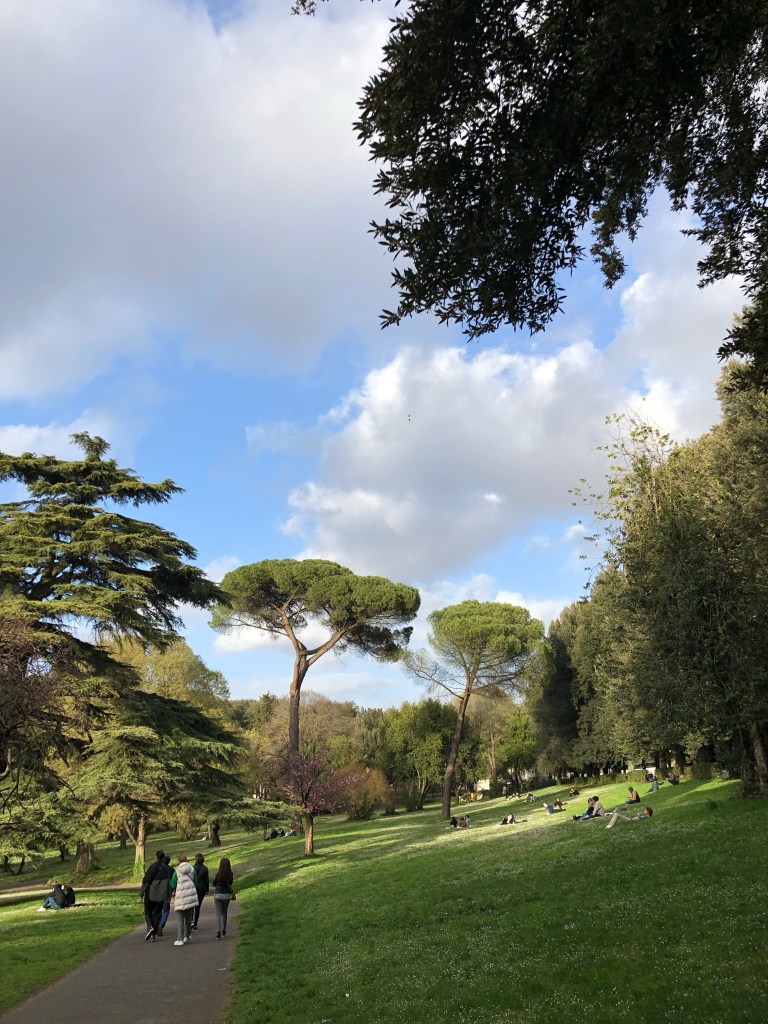
I clocked these pines last night on an evening wander towards the Spanish Steps. Respighi wasn’t wrong to write this movement as the jolliest, most playful of the four: when I was there, the Giardini della Villa Borghese were full of children playing in the evening light. A couple of fairground rides replaced the Roman ring a ring o’roses game in the original, but in all other respects it still fits perfectly. The man knew his source material!
The Borghese gardens also appear to be a favourite spot for Roman romance. As the sun starts to sink behind the trees, the long shadows cast by the stone pines stretch like rivers between the patches of sunlight, where in one corner of the gardens couples clustered like mayflies in the light. A girl in her twenties was picking daisies to fashion into a chain, four Spaniards laughed their heads off as they wheeled up and down the paths on rental bikes, while in the middle of the gardens a priest gave a homily to a small crowd in front of one of the chapels.
If I should find the One someday, I’ll take her for a walk here, too.
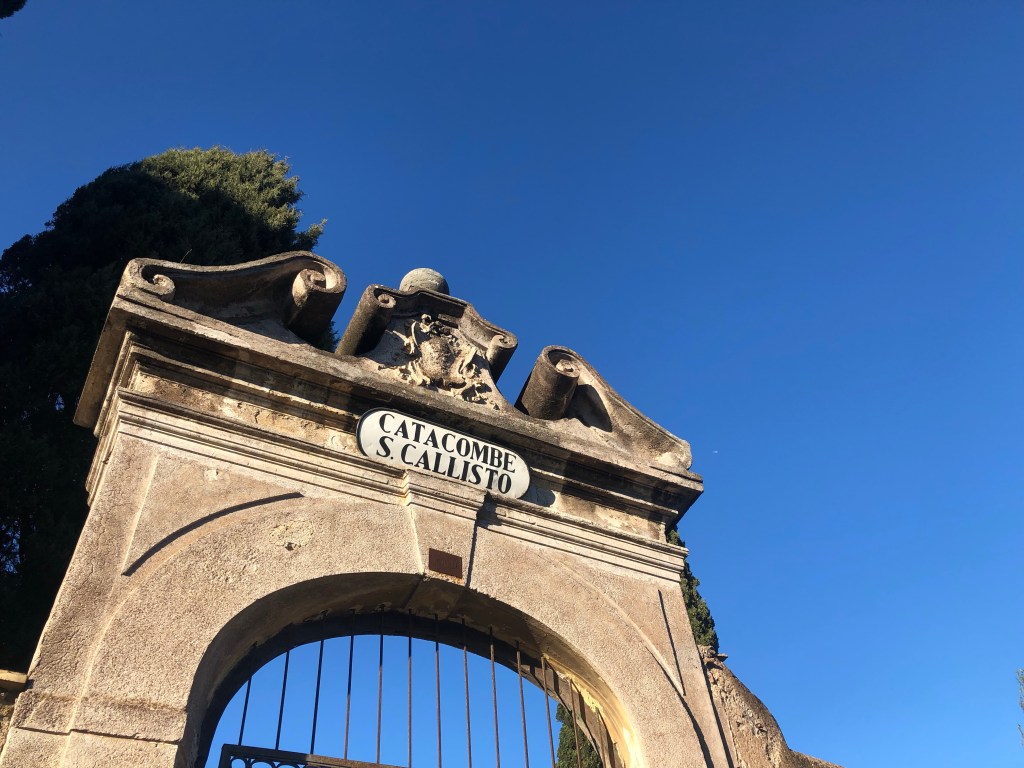
II. The Pines near a Catacomb (I pini presso una catacomba, lento)
By the time I reached the catacombs, they were all shut up for the week… but that’s what you get for prioritising the Pope over a blog post. Compared to the rest of the Appian Way, the area around the catacombs was quiet and shaded… though that may have more to do with the lateness of the hour by the time I reached them. Here in Rome, as in Spain, cypress trees mark the resting places of the dead, lining the roads to the catacombs. They’ve been symbols of death since ancient times, since they cannot regenerate when cut back, and so they stand as sentinels outside tombs, cemeteries and graveyards all across the Mediterranean. The Romans’ beloved stone pines tower above them, but I think its the sad and stately rows of cypress trees that Respighi is alluding to in this movement.
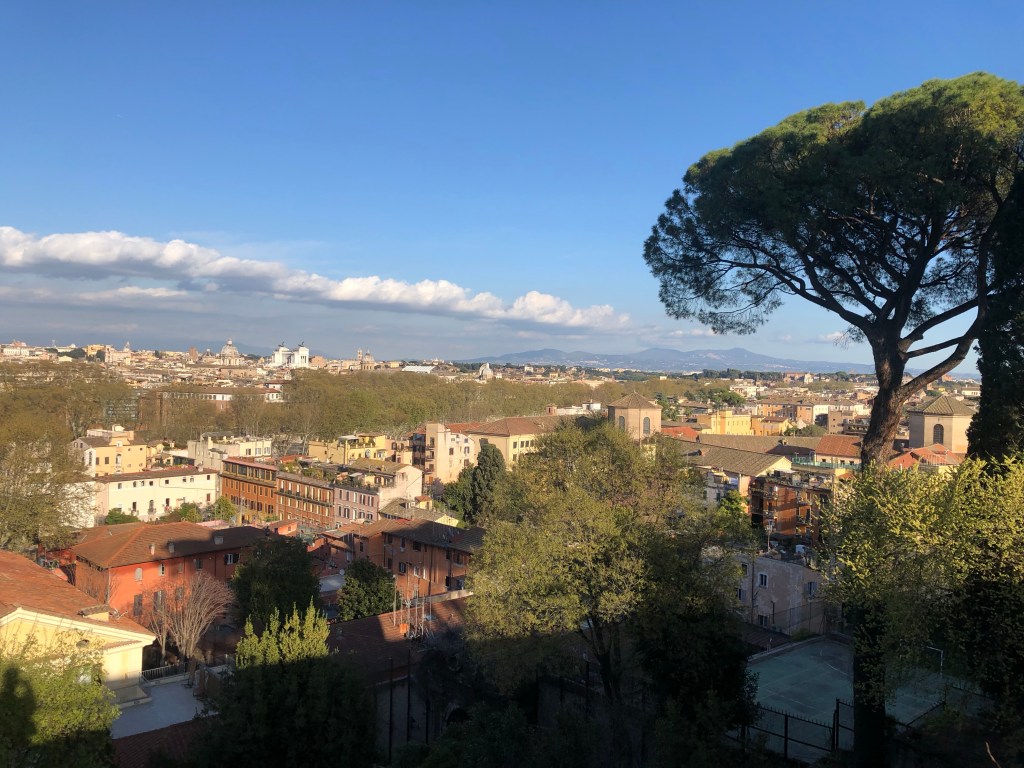
III. The Pines of the Janiculum (I pini del Gianicolo, lento)
My first night in Rome was spent watching the sun set over the Eternal City. A girl I once put on pedestal told me to make the most of every sunrise and sunset. I left behind both girl and pedestal years ago, but it’s still a rule I live by when I’m on the road. Snacking on a focaccia from the hilltop, I had a sweeping view of the city, from the Vatican to the distant towns of Tivoli and Palestrina. The pines that grow here are the stone pines of Doñana, the trees of my childhood. The Romans had a special love for this tree and planted it wherever they went, especially along roads like the Via Appia.
Down in the dark branches below the viewpoint, some of the city’s monk parakeets screeched this way and that (oddly enough this South American species began to colonise Rome around the same time the Argentinian Pope Francis was elected), but my eyes were drawn to a tiny black-and-white shape moving up the trunk of the tallest stone line overlooking the city: a lesser spotted woodpecker, the first I’ve seen in many years. The rising and falling flute in Respighi’s movement pairs well with all the birds I saw here: the parakeets racing by, the pigeons wheeling over the roofs below, the tiny woodpecker climbing up and up. But I didn’t hear the nightingale that Respighi insisted on featuring at the end of this movement. Perhaps it’s too early in the year – though I suspect it’s more because it’s much too crowded here for such a self-conscious minstrel.
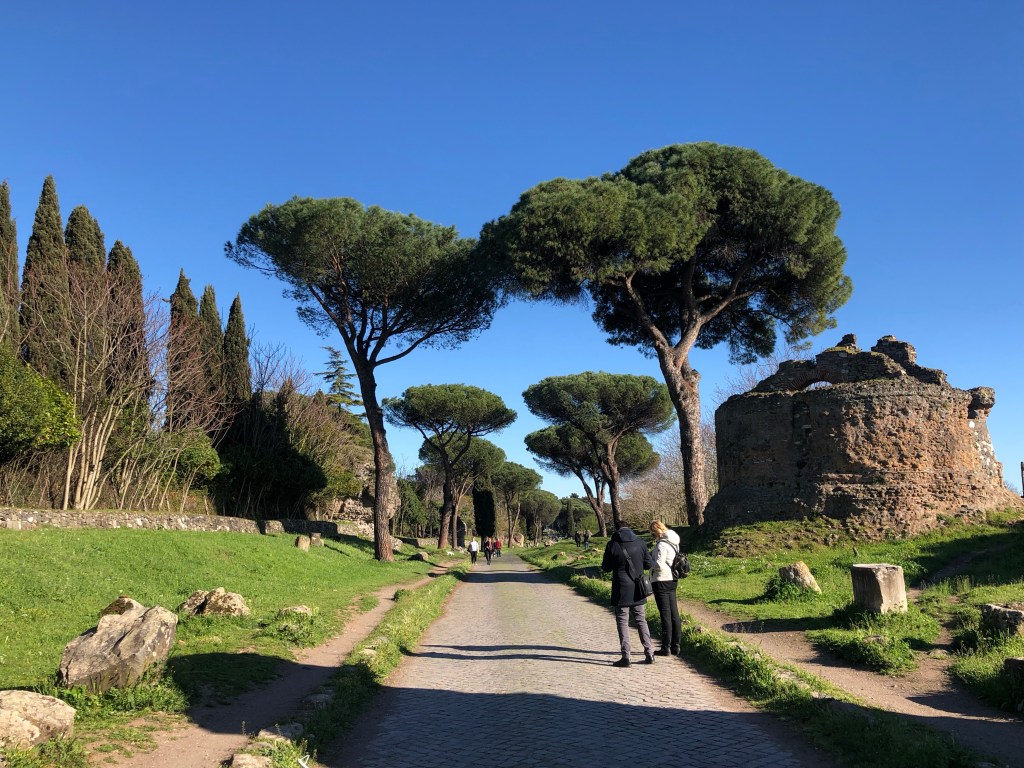
IV. The Pines of the Appian Way (I pini della Via Appia, tempo di marcia)
This was always my favourite movement – and what a sight! No visitor to Rome should pass up the chance to take a walk on the Via Appia, especially on a Sunday when the road is closed to traffic and the Romans descend upon the ancient highway in their droves for an afternoon passegiata. Walking the forum is one thing, but this is something else. The Via Appia is probably the oldest road still in use in the western world, and you really do get the feeling you’re walking in the footsteps of the ancient Romans as you walk this road. The things this road has seen…! This is where soldiers marched to the port and on to Egypt, where nobles lived in luxury beyond the confines of the city, and where the great orator Cicero was assassinated. I fell into the Romantic trap of many travelers before me as I passed one old Roman sitting on a marble colonnade, with skin of burnished bronze, black, sunken eyes and an aquiline nose that would have looked supreme on any Caesar; and I wondered whether he was the descendant, through many fathers, of Romans who had lived on this road two thousand years ago.
I also heard a nightingale here – he must have missed his cue in the Third Movement.
If Cannaregio was my favourite spot in Venice, the Via Appia takes the top spot in Rome. It’s breathtakingly beautiful, flanked with ancient Roman treasures along its entire length, and absolutely mustn’t be missed. And Respighi nails it with his final movement: it’s heroic, majestic and the perfect finale to both my long walk and my time in Italy.
I’ll tell you the tale of my incredible Palm Sunday experience as soon as I get my hands on a computer, as my phone photos simply don’t do it justice, but until then, arrivederci Italia!Sei bellisima e tornerò presto! And that’s a promise. BB x
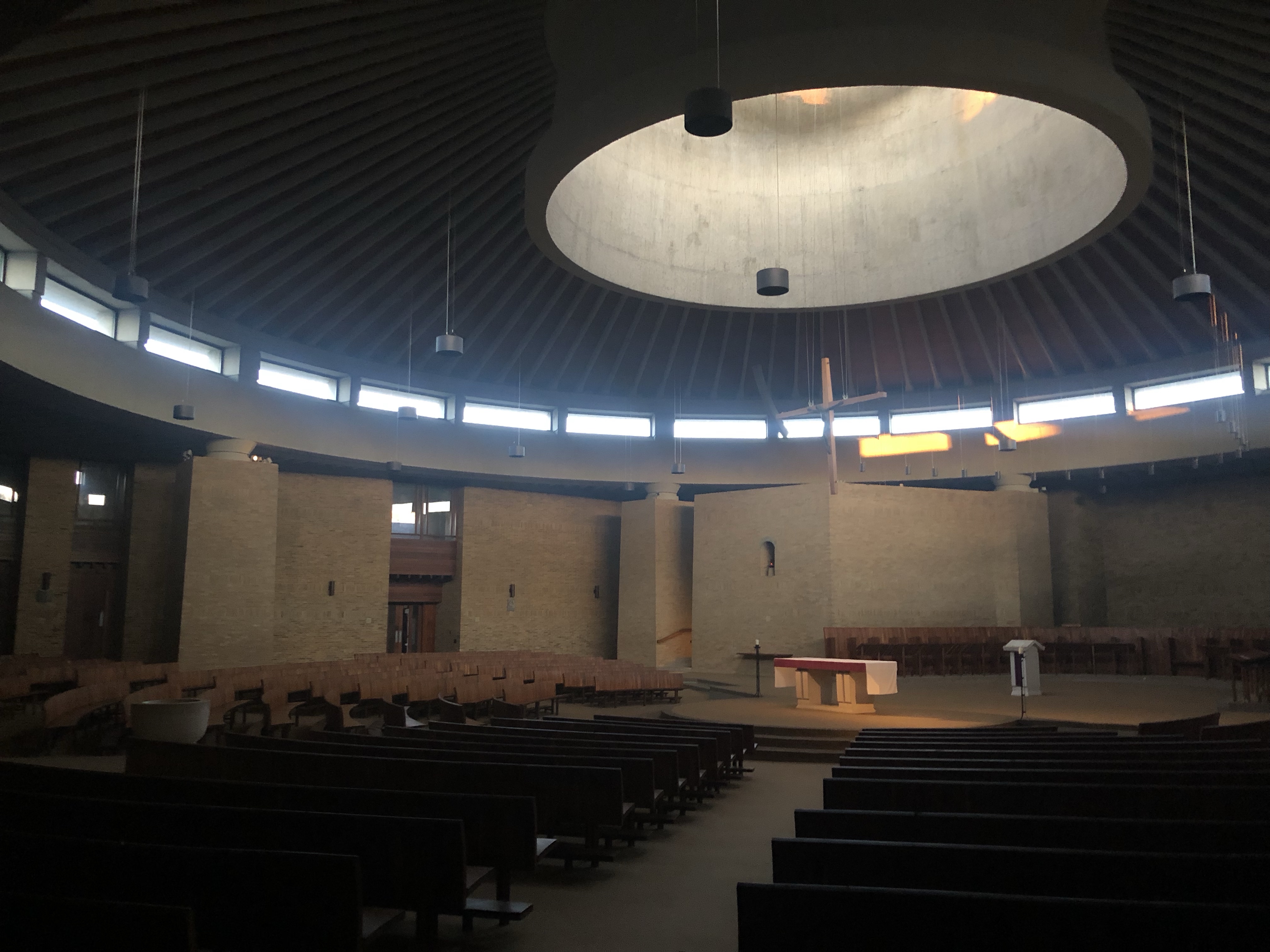
Last night, in a return to pre-COVID tradition, we celebrated Tenebrae in the Abbey Church. With the latest wave of infections sweeping the staff and students, I’ll admit I had my doubts I’d be able to go up and sing as I used to with a house to run, but my housemaster very kindly stepped in, allowing me to bolster the tenor line. It’s hard to overstate the importance of making music in my faith: singing is an act of worship. Perhaps that’s why I didn’t go to Mass when the churches opened last year, while the ban on singing was still in place – how could I practice my faith without lips to speak? I remember saying as much to one of the school’s youth chaplains once, who remarked that I ought to rethink my approach to faith. Was he right? I don’t think so. I think everyone’s path to God is individual. Mine just happens to be through music, which, all things considered, is hardly surprising.
I spent a great deal of my childhood in and out of churches. My mother played the organ for the village church when I was very young, and I remember sitting (probably not so quietly) next to the pedals, listening to the growling hum of the organ long after the last notes faded into the stone walls. Later, during my short spell at a prep school, I spent two nights a week up in the organ loft of Canterbury Cathedral while my father sang for the cathedral choir. What was undoubtedly an incredible privilege became routine – that is, until a Victorian-minded parishioner who happened to look up one week decided that children were better “seen and not heard” and my brother and I were unceremoniously ousted, forced to sit in the quire thereafter.
Perhaps that was God’s will, because twenty years later, I still jump at the chance to stand in just such a stall and tangle with some sacred music. There’s really nothing quite like it.
I have a somewhat unorthodox relationship with God. If it were a Facebook status, I might just go for “It’s complicated”. Somewhere deep within, my spiritual compass spins toward Israel. Maybe it’s the stories my mother brought me up with or the belief we both share that our ancestors were among the many thousands of Spain’s Jews who converted to hide from the Inquisition, many hundreds of years ago. It would go some way towards explaining the ferocious proclivity for the arts borne across the generations by my ancestors, at a time when intellectualism was unwise and even dangerous. Millán-Astray’s battle cry of “muera la inteligencia” in 1936 – around about the time my grandfather was born – hardly seems out of place for a country where, for hundreds of years, it was better to hacer mala letra than open your mouth and betray your wits. Our own Michael Gove gave us an uncomfortable reminder of this dark past when he claimed the British had “had enough of experts” in the lead-up to Brexit.
I can hold my head up high every day as a teacher knowing that I am the next in a long line of teachers, all of whom dabbled in music and poetry and art. Were they really Jews, though? I’d like to think so – I really would – but I have no proof of that. I have barely enough solid proof of my connection to my grandfather, never mind a connection to a Hebrew ancestry that may or may not have ever existed. The silver Star of David I sometimes wear beneath my suit is no heirloom, but rather a keepsake from a Jewish silversmith in Cordoba; a reminder of the terrible fate suffered by the Chosen People in a land far from home that was once their paradise. Will I ever know for sure? I doubt it. But some things you see with your eyes, others with your heart. This is one of those things the heart sees. Something you have always known or believed with little to no provocation. I believe because I cannot be sure. It’s the weakest of arguments, the merest of threads. But about such threads, Faiths are often weaved into being.
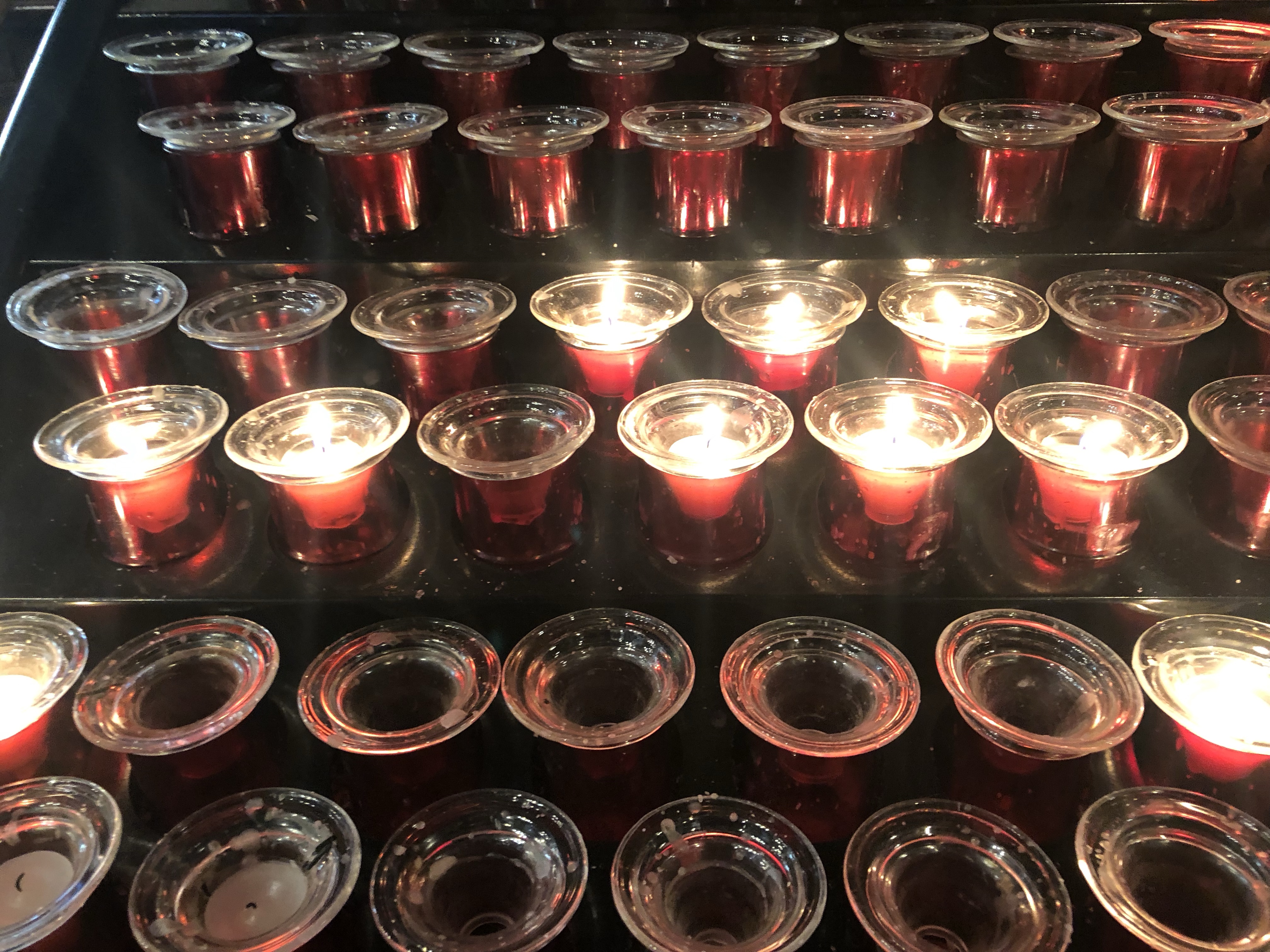
So why am I a Catholic? With such silent conviction, how can I stand there in the darkness, singing Christian verses and watching the candles going out to mark the extinguishing of Jesus’ light and life from the world, a little under two thousand years ago?
I am a Catholic because I would make the same journey as my family. Whether or not my ancestors found their way to the Christian God through awe or terror, I would take that road that they took. And there is something fundamentally grounding about faith. Standing as one with my students and singing songs that have been sung for hundreds of years… you feel a power, there, echoing down the generations. It’s all the more powerful when you see the date at the top of the copy reaching back to the middle ages. One imagines one’s voice reaching up to the heavens and mingling with the voices of those who came before you on its journey across the stars. Perhaps that’s what the choir of Heaven is: the echo of thousands of years of collective prayer through song. I’d like that.
I might also point out that the Catholic church represents an important bastion against the foe, since modern Christian music is, to my ears, quite possibly the wettest, most uninspiring drivel ever produced. It clearly works wonders for some, but it does nothing for me. Give me plainchant any day. A colleague once joked that one of his greatest fears was that he should reach the pearly gates only to find that Mozart and his kin are nowhere to be found, and Hillsong reigns triumphant. It’s a joke (and a nightmare) I share. But that’s a story for another time.
I am also a Catholic because Faith is a journey of forgiveness. Noli mortem peccatoris. Those were the words of power that spoke to me last night, as the last of the candles were snuffed out. I do not want the death of the wicked. I bear no ill will against those shadows who persecuted my people, because there is too much hate in the world already. I wept on the shores of the Dead Sea years ago at the sight of the sun going down over the Holy Land, knowing I was not yet ready to see it with my own eyes. Jerusalem evades me still: the last time I tried to make that journey, a little hiccup called Covid-19 came thundering in.
Finally, I am a Catholic because of what it stands for. Katholikos. Universal. It chimes with me in much the same way that the Arabic expression ahl al-Kitaab – people of the book – called out to me in my Arabic studies, many years ago. The world is immense and no two people are the same, and I think it’s as foolish to expect everyone to share the same faith as it is to expect to find two identical grains of sand on a beach: the closer you look, the more you’ll find yourself doubting. But I have built my faith upon doubt rather than surety, because that, to me, is what faith is all about. Believing in the light when all the world is darkness because your heart tells you to do so. Fate may be the master builder of the temples of our lives, but hope is the cement that holds the stones together. I believe in that light and in that hope. And in my heart I know I would go on hoping, though every light in the world were extinguished as they were last night, one by one.
In three days’ time I set out for Italy on my first solo adventure in a long time. Venice will inspire, no doubt, but it’s Rome I’m especially excited to see. I hope I can catch some music there during my stay. I could use some of that ancient magic after what has been quite a long term. BB x






 The Book of Barnabas