It is categorically impossible to be down at heart in Madrid. Whatever my thoughts and feelings were, they were altogether altered the moment my feet were back on Spanish soil as I left the plane at Barajas last night. It’s not as though I need reminding that Spain is always the answer to my lonely heart, but it is good to know that its medicine is none the weaker for every visit – especially as this is my *fourth* visit this year (though if you count my sorties to and from the Canaries and Gibraltar, it would be my sixth). Anyone would have thought I had an itch that needed scratching…
Ah, Madrid. Like the girl next door in every American romcom, I have come to regret dismissing you so lightly when first we met, now that you have captured my heart. There is something undeniably homely about La Capital, which neither London nor Paris nor Berlin can match. Even now, bustling as it always is in the run-up to Christmas, it still feels more like a large town than a capital city.
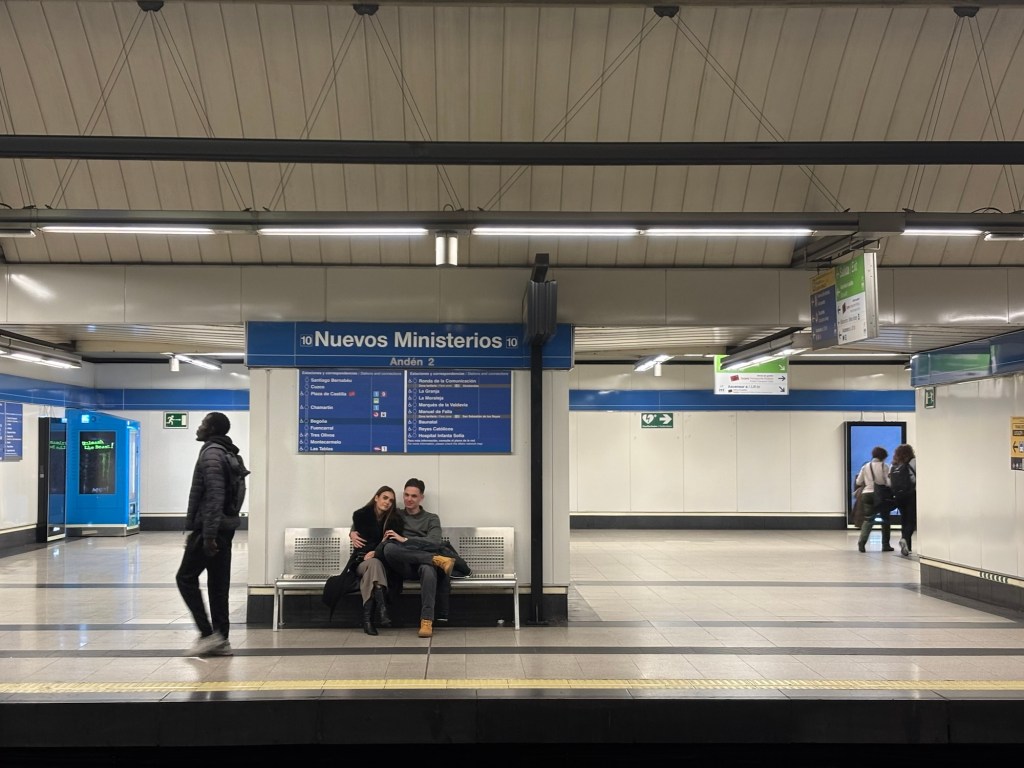
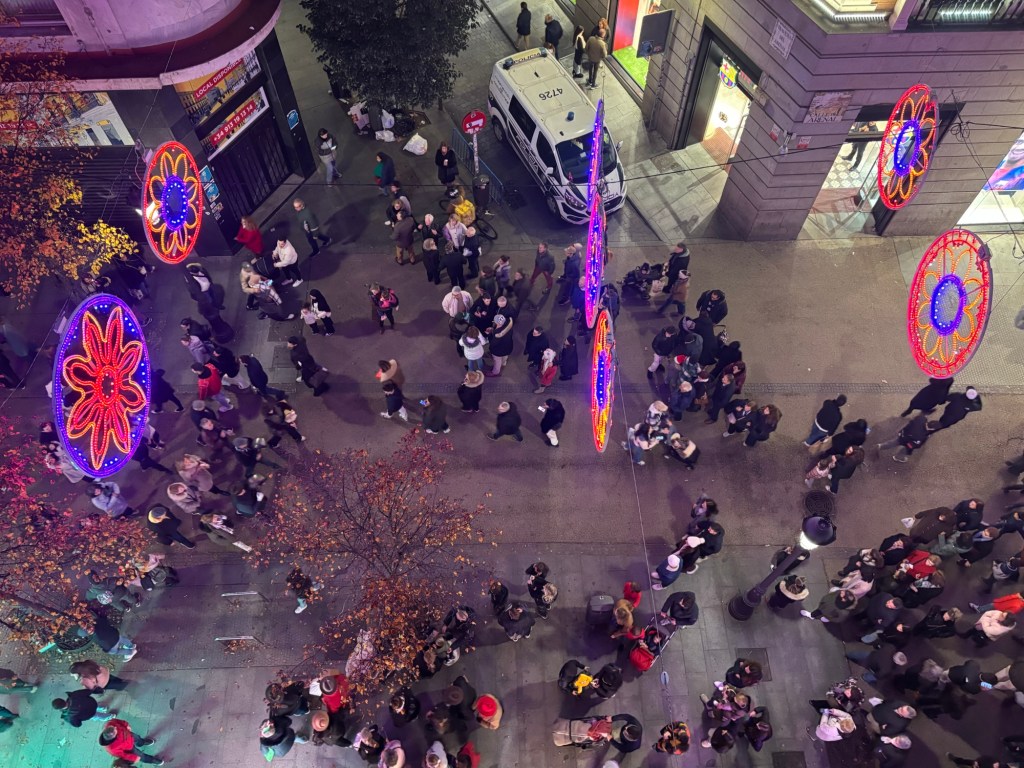
From my vantage point in the hostel, overlooking the glittering Calle del Arenal, the hubbub below is a merry melange of conversation, villancicos, far-off snatches of song and the intermittent underground rumble of the metro. The near-constant snapping of chasquibumes (bang snaps) makes the city sound like a crackling fire.
I don’t say this often, but here is a city I wouldn’t mind living in.
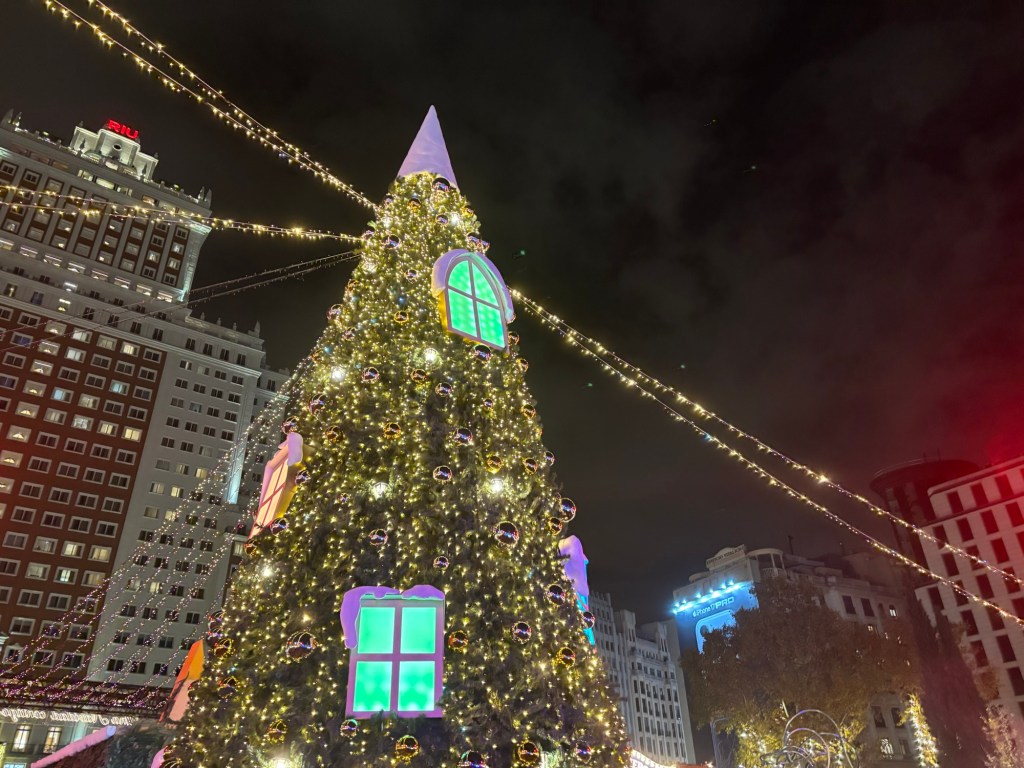
Merry-go-rounds, ice rinks and various Christmas-themed stalls have been set up in the various squares and open spaces throughout the city. Traditionally, it’s the Reyes Magos (the Three Wise Men) who bring children presents in Spain – which has always struck me as a much more logical excuse to celebrate the giving of gifts – but that doesn’t seem to have stopped the Spaniards from starting the festivities several weeks prior. And why not? Any excuse for a celebration will do.
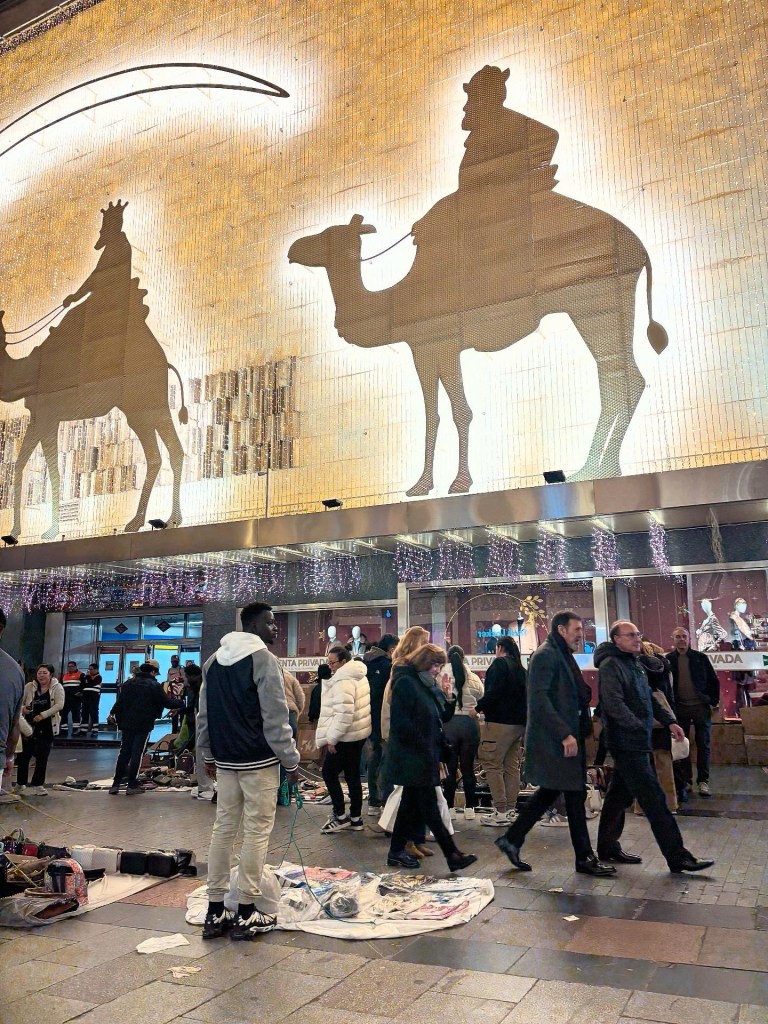
By far the brightest lights can be found on the walls of Callao’s Corte Inglés, which draws a constant stream of shoppers into the night (it was still heaving at half past nine when I passed by en route to the hostel last night). Wherever there’s a crowd, there’s usually a ragtag bunch of pedlars clinging remora-like to its underbelly. Sure enough, I found three manteros hawking the usual array of glasses, handbags and Yamine Lamal shirts outside the main entrance, the strings of their cloth blankets twitching in their nervous hands at every distant blast of a police car. Their location of choice – beneath the three wise men – seemed almost poetic.
I don’t suppose the Baby Jesus would have had any more call for a Barcelona tee-shirt than he did for frankincense. Neither, it seems, did the madrileños. But who’s to say that these three wise men didn’t follow a star of sorts to Europe?
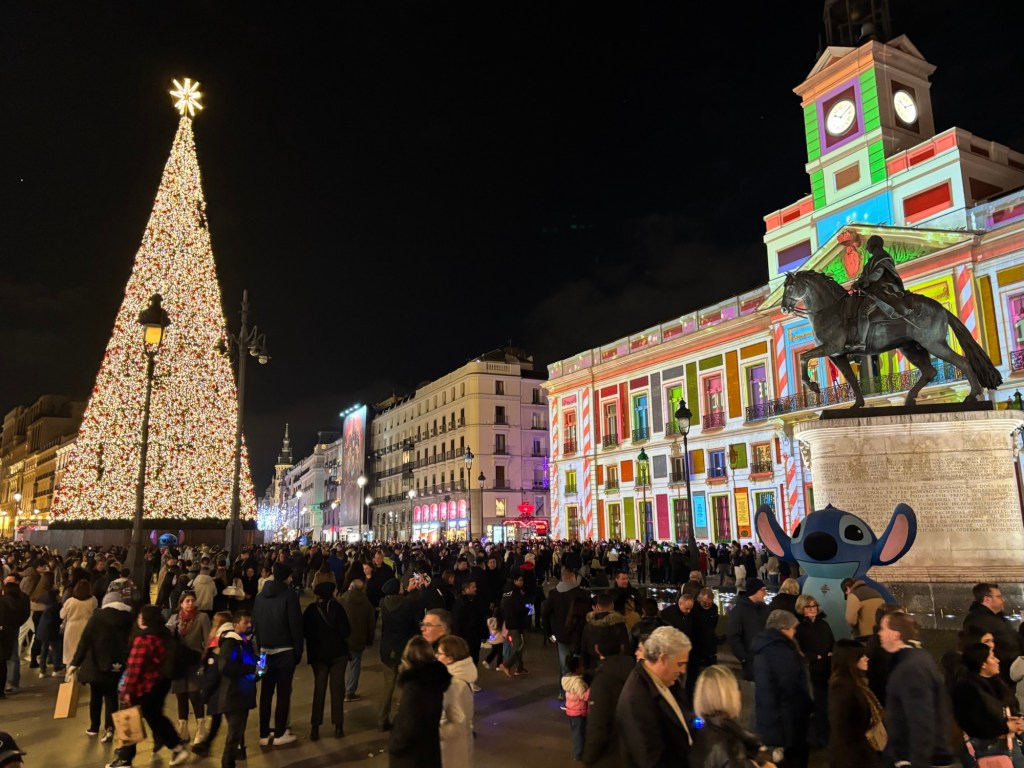
Down the street in the Puerta del Sol, the Real Casa de Correos is lit up like an advent calendar – though in its technicolour array it looks more like a dollhouse – and the usual conical tree of lights stands between Carlos III’s smug smile and the oso y madroño statue on the other side of the square.
Could you call La Puerta del Sol a square? It functions like one, more so than the nearby Plaza Mayor (which really is a square) but it’s really more of a semicircle – a giant protractor radiating in multiple directions from Kilómetro Cero at the feet of the Casa de Correos. At least, it would be, if the centre of the semicircle were just a few yards to the left.
I’m only here for a couple of nights. Extremadura is calling. It has been too long since I last laid eyes on the corner of Spain that well and truly stole my heart all those years ago, and since then, it’s been nothing more than a beautiful word on my lips. I’ve already had my fair share of nostalgia trips this year to Finisterre, Gibraltar and El Rocío, but one more won’t hurt. Holidays are for healing, and that’s exactly what I intend to do. BB x
Albergue El Jardín del Camino, Mansilla de las Mulas. 22.20.
I’ve developed my first blisters of the Camino, but typically for unconventional me, they’re not on my feet at all. They’re on my lower back, where the frame of my rucksack has been rubbing, despite my best efforts to adjust the straps. If I adjust them any further, I won’t be able to fit my arms through the straps, or take them out for that matter. I’ve put some Compeed over them and that has helped a little, but it’s a bummer to have to slum it with the rest of the world after such a glorious blister-free run of it.
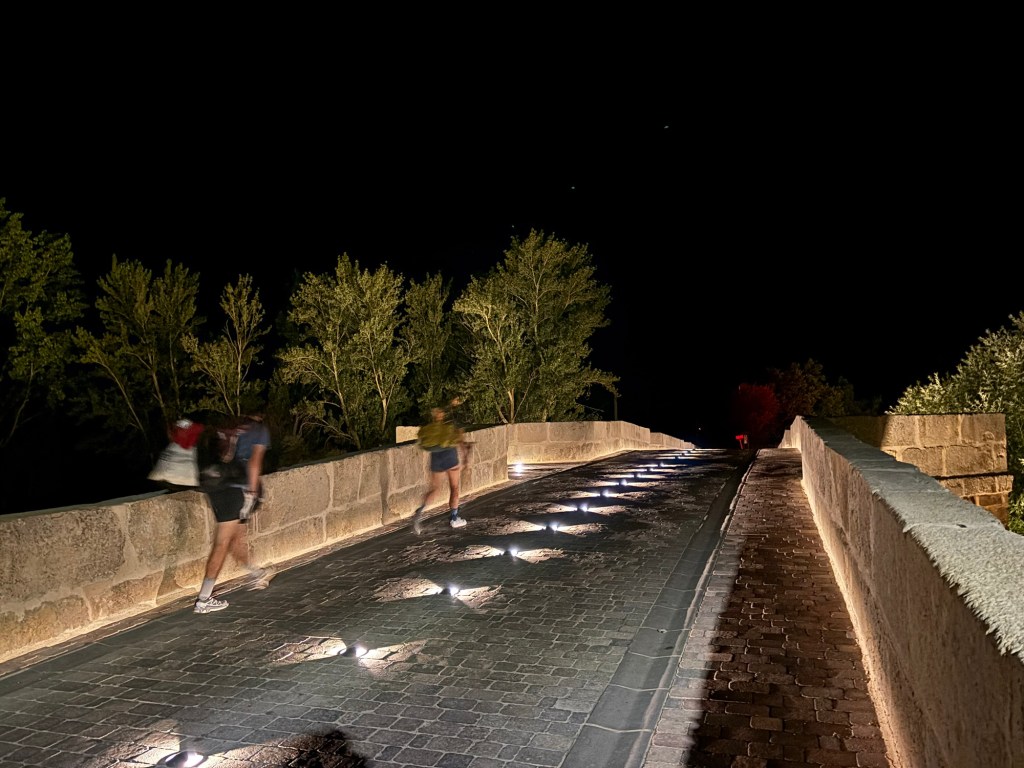
We left Sahagún early, lingering for half an hour later than yesterday to take advantage of the breakfast left out by the Benedictine sisters and their volunteers. It was still dark when we set out – not as pitch-black as yesterday, but still dark enough to warrant the use of torchlight to find the signs here and there.
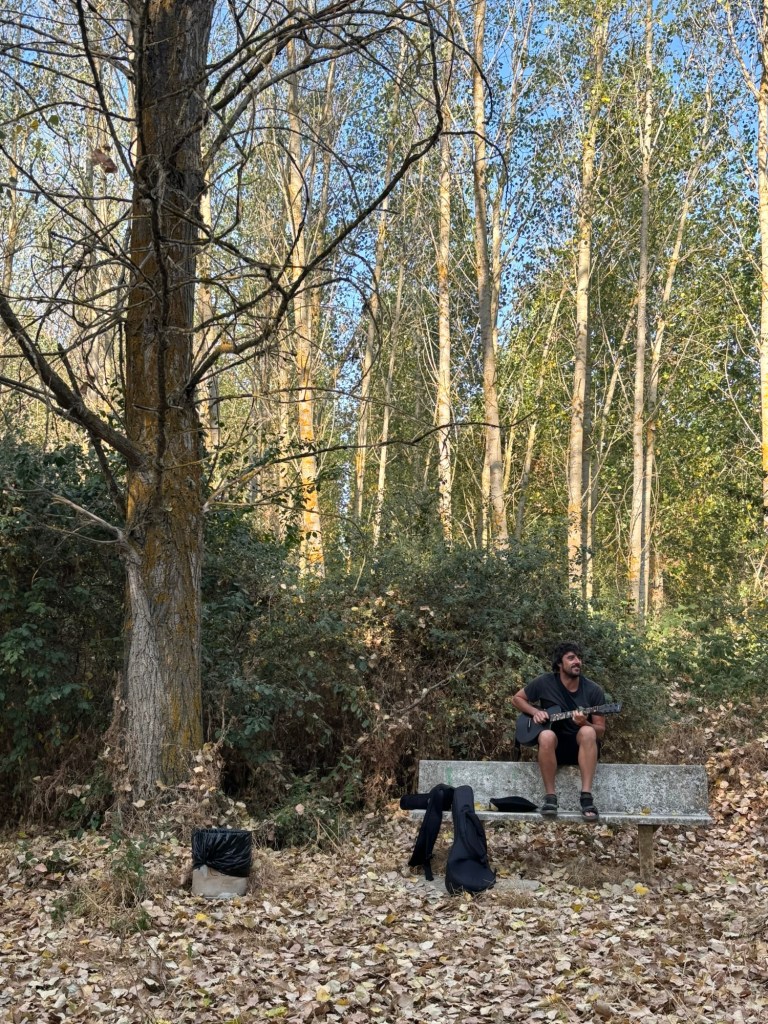
We passed Bercianos early and most things were shut, after which I started to get itchy feet and took off ahead. Along the way I heard the strumming of a guitar in a slim stretch of forest – a brief oasis in the golden fields of the meseta – and there I found Steven, a Chilean-South African who we haven’t seen for about a week. He’d found a solitary spot beneath the trees where the orioles sing to play his heart out. That’s something I’ll admit I’ve been missing a bit in this fun but busy Camino.
I stopped a couple of times during today’s walk to appreciate the silence of the meseta. There’s not much like it. I imagine the Dakotas might have the same sound – or rather, the same total absence of it. I suspect it’s that all-encompassing stillness that leads some pilgrims to abandon the Meseta altogether, fleeing the self-imposed stillness that surrounds you from the moment you leave the city of Burgos and step up into the golden highlands. I am not even out of it yet and I know I shall miss it when it has gone.
Today, as I have done on my solo strike-outs, I allowed myself a moment to listen to some music. Mostly from my favourite musicals so I could sing along (Jesus Christ Superstar, West Side Story, The Prince of Egypt and Fiddler on the Roof), but also my recordings from my various musical endeavours with my students over the years.
Rutherford House’s Rolling in the Deep and their house band’s covers of Stayin’ Alive/Without Me and Thrillie Jean. My short-lived Gospel Choir’s Ain’t No Rock. My new funk band’s one-day run atLauryn Hill’s Doo-Wop. I forget more than half of the lessons that I teach, but every rehearsal and every performance stands out in my memory like an island in a wide, wide sea. The voices of the children I have taught surround me like a vortex in the Meseta and I am lifted up by the smiles on their faces as they experience the same giddy thrill that the music gave to me when I was their age. It makes the whole thing worthwhile – the long hours, the nerve-shattering email and Teams threads, the windowless flats and the social life that I have sacrificed upon the altar of my calling for the last nine years of my life.
Without the music, it would all be for nothing. It would all be a mistake.
There’s all sorts on the Camino. Sane and insane. Students and soldiers. Culture vultures and racists. Free spirits, free lovers, free thinkers and freeloaders. People who seem to think it’s ok to slap stickers advertising their YouTube channels on every flat surface and people walking so fast they don’t have time to read. And yes, while many pilgrims blanch at the idea of singing together (barring the Italians, these are frustratingly common), there are plenty of us who leap at the chance to connect with others through the medium of music, the truly universal language.
I’m a little disappointed that the most popular Camino-related song one encounters along the Camino (besides Ultreia, Suseia) is a mawkish folk song in English called The Way that is currently being aggressively marketed in sticker form wherever you go. By comparison, even the Taizé songs that have now sunk their claws into the Camino are a breath of fresh air – at least they respect the multilingual world of the Camino de Santiago (which I refuse on principle to translate as “the Way”).
I’m having a much more spiritual time on the Camino this year. I’ve managed to attend Mass most days, despite traveling with a group of non-Catholics, and all the pilgrim blessings have been very special. Yes, I’m still a little annoyed by the rampant secularisation of the Camino and the way it gets treated as a big and sociable walk across Spain, as though that’s all there is to it… But every day is an exercise in tolerance and I’m doing my best to listen and learn.
I miss Spanish food. I’ve sacrificed my usual diet to facilitate the dietary requirements of my fellow vegetarian and gluten free pilgrims and it’s meant a lot of bland and global meals for the last fortnight. But that’s just one more lesson the Camino has to offer: life is all about sacrifice, especially if you live to serve, as I believe we do. Sometimes we have to give up the things we want the most – a job, a lover or even just a plato combinado – to make sure that those around us can be the very best versions of themselves. It isn’t an easy path, but I know that it is the right one.
Faith in its most literal manifestation may not be as ubiquitous on the Camino de Santiago as it once was, but it can always be found in the small actions and interactions of others. That gives me hope. My back might be hurting from the friction of the weight I’m carrying, but my heart is light. BB x
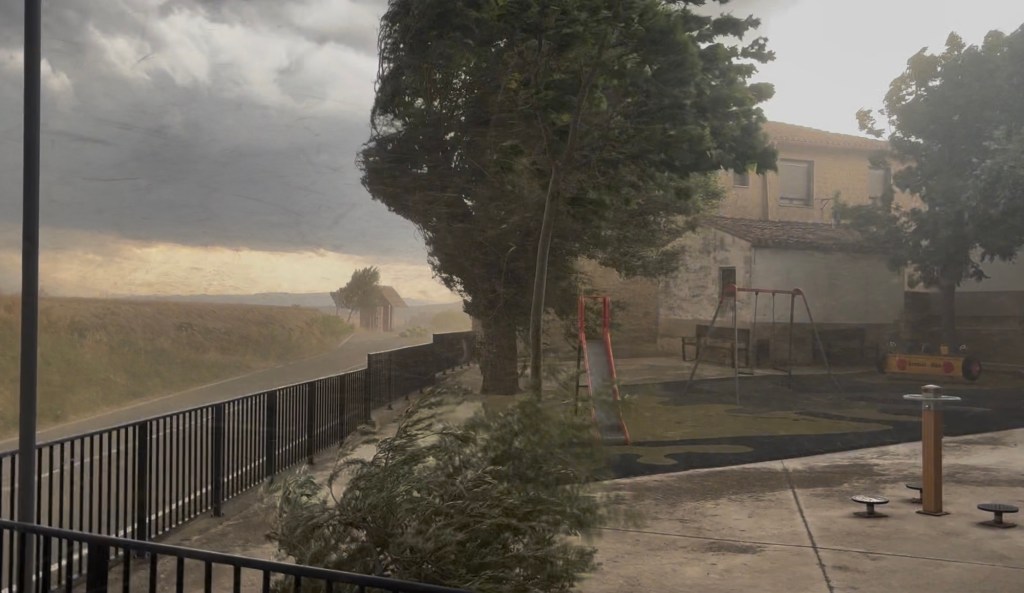
Last night, quite out of nowhere, a summer storm swept across the north. No rain, no hail; nothing but the unfettered might of the wind. One moment the sun was shining, the next the wind had reached gale force and the shutters were slamming against the windows as a dirty vortex of dust, leaves and debris slammed into Sansol like a hurricane.
It didn’t last long – five minutes, tops – but it darkened the sky, and lightning bolts fell in silent flashes all through the night.
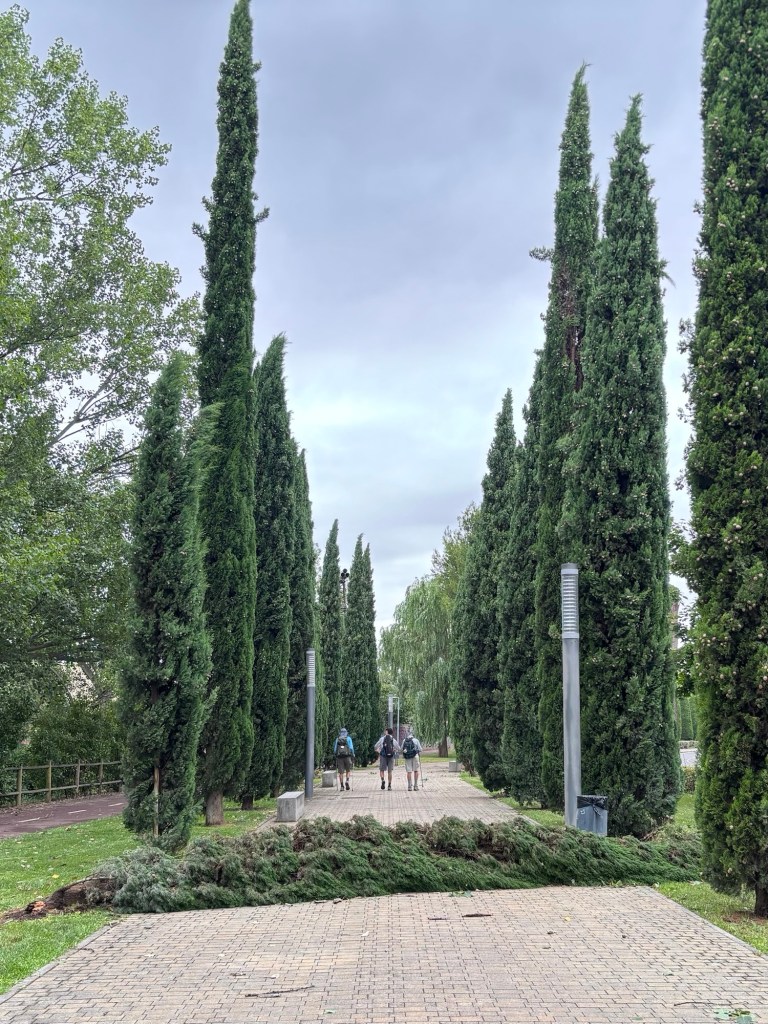
When I left Sansol the following morning, after a long night of waking dreams, it was to a battered world. A pool full of leaves. Branches uprooted and cast across the path. Trees felled. A solitary stone curlew cried its mournful call in the darkness amid the devastation. Perhaps it’s the same bird I heard six years ago. As I tiptoed through the debris, I nearly stepped on a baby toad, almost invisible amid the scattered stones.
It’s a fair hike from Sansol to the next town, Viana, but it is the last stop before Logroño, which you can see from the hills long before you get there. This is also where we say goodbye to Navarra and the last glimpse of far-off Aragón, before they disappear behind the hills for good.
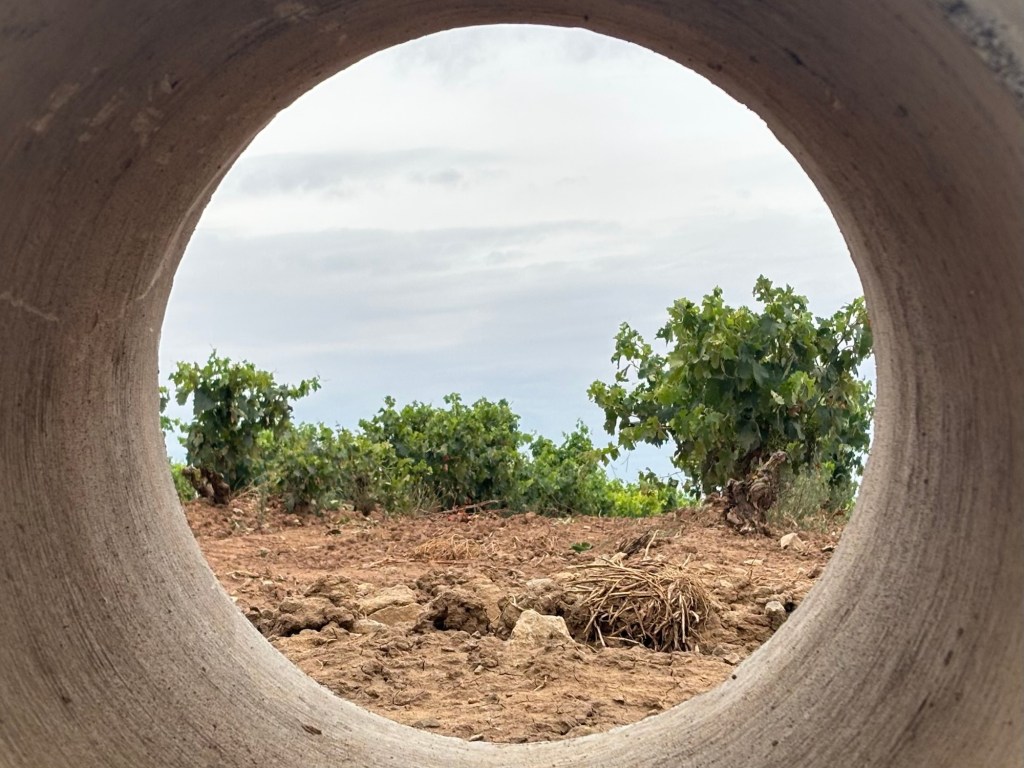
We’re now in the wine country of La Rioja – the rolling fields of wheat are still with us, but they’re interlaced with green vineyards now. Rioja wine is famous the world over, so it should come as no surprise that one of Spain’s smaller regions can’t handle the demand all on its own. In fact, most of the grapes that make a good Rioja actually come from neighbouring Castilla La Mancha, one of Spain’s largest regions, before being processed here. La Mancha produces its own incredible wine (which, realistically, should be up to the same standard), but it isn’t quite as famous as the world-renowned Rioja. One day, perhaps.
The wind picked up again as I reached Logroño. I didn’t much like the look of the clouds, and it looked like the storm had done even more damage here than in Sansol. Several of the trees lining the Ebro river had been ripped up by the roots and lay where they had fallen across the pavement. A quick glance at the Spanish news implied that it had looked even worse this morning, so perhaps they just hadn’t got around to fixing the park yet.
A flash of electric blue caught my eye as I crossed the bridge – a kingfisher. Who could ever lose that sense of wonder at such a sight? It didn’t hang around for long, but long enough for me to see it dive into the river in a halcyon blur before speeding away downriver.
It was still a good three hours until the Albergue Parroquial opened its doors, so I stashed my luggage in a locker which I hired for 6.50€ and set out to explore, unencumbered. It costs about the same to have the Jacotrans couriers deliver your rucksack to the next town for the day, but I felt a lot less guilty about this minor transaction. It’s difficult to justify lugging a whopping great backpack around a museum, after all.
The rain came down while I was in the Museo de La Rioja, so I managed to dodge the worst of it. It wasn’t as impressive as the collection in Jaca or Santa Cruz de Tenerife, but I was rather taken with one of the paintings, which featured a blonde Virgin Mary. I don’t think I’ve ever seen her painted with blonde hair before. Jesus seems to have more colourings than a Pantene catalogue, but Mary is pretty consistently dark-haired, so this one stood out for… well, looking so odd. Beautiful, but… odd. Like an understudy. Was she the artist’s unrequited love, I wonder?
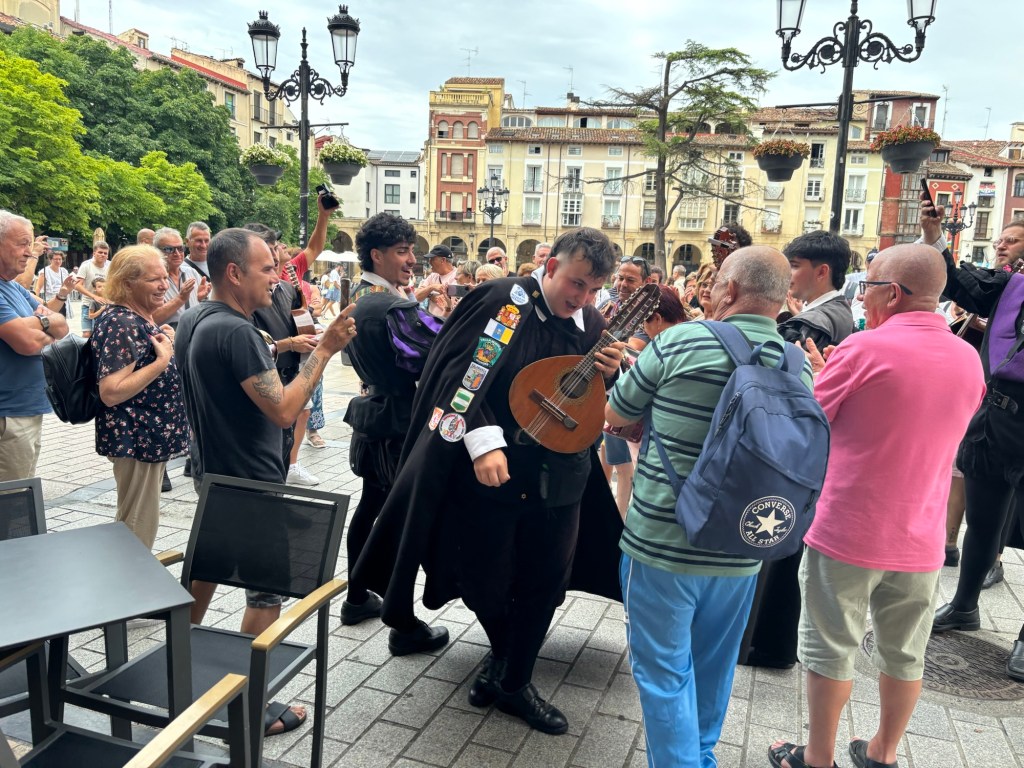
Once the rain had cleared, I grabbed my bag and checked in, before nipping back out for another wander. A tuna band was in town, dressed in their usual medieval splendour and serenading ladies left and right.
I’ve always loved tuna bands. If I’d done an Erasmus year or studied abroad, which was my original intention, I’m pretty sure I’d have launched myself at one. My uncle Rafael was in a tuna in his university days, and I suspect my grandfather and great-grandfather were also involved to some degree. It’s a tradition that goes back to the 13th century, so it’s a little bit grander than the a cappella groups that have taken the university music scene by storm. However, it is limited to Spain, and it is fundamentally a social and busking enterprise, so it’s not likely to break into a world championship anytime soon. After all – surely the real prize is a smile from the serenaded lady in question, be she twenty-one or seventy-three!
Logroño’s tapas street was absolutely packed, and with good reason: it’s famous for its gastronomy (not just the wine), with around fifty bars serving tapas and pintxos all within the city centre. There were at least six stag/hen do’s in town, all with matching t-shirts (together with one fairy godmother and one Jafar) so I was quite relieved to have a communal dinner with the other pilgrims at the Albergue Parroquial.
Dinner was a lovely affair, and a linguistic hurdle for me, constantly switching between English, French, Italian and Spanish. Sometimes I get bugged by the language barrier (I’m not fluent in Italian), but it does me a lot of good to listen and learn as I walk.
Tomorrow is still up in the air. I have in mind a rest day of sorts, going only as far as Navarrete. I’m not a huge fan of rest days, but I figure I might need it if I’m going to stay fit and healthy on my feet for the next four weeks. It might also be nice to shuffle the pilgrim pack a little. I haven’t really found my scene yet.
It’s gone twenty past ten. The Slovak flirt in the next bunk has finally stopped yapping away with the American girls and gone to bed. I should head, too. I might change my mind and make for Nájera tomorrow, or I might not. I’m still undecided. And that’s the best thing about the Camino. It allows me to be free. Every day. If only every day could be like this. BB x
The theme of the Commemoration Service and Prize-giving Ceremony today was Come and see. To that end, the school Chaplain chose John 1:35-51 – the one where Jesus calls together his first disciples. I think the message was intended to convey the importance of getting involved, because that’s something that our kids here really do more than anywhere else I’ve ever worked. But for me, it had a second layer. My disciples, as it were, had assembled for the first time, and delivered one of the best performances I’ve seen in thirteen years.
I have a funk band again. And I couldn’t be prouder of them.
There’s a very real danger of this entry sounding selfish. I admit it freely – it would be foolish of me to claim that my efforts with the school funk band have been entirely selfless. After all, I have wanted a funk band for thirteen years.
Ever since I left my funk band behind at the end of my schooldays, I have had a band-shaped void in my heart. Durham’s Northern Lights, African Singing and Drumming Society and the Gospel Choir were decent placeholders, as were the various choirs and house music ensembles that I’ve cobbled together over the years, but they’ve only ever been pale imitations of what I once had. The fear of cultural appropriation that came in the wake of the BLM movement put all my attempts on ice after 2020, and with the way the workload was piling up as I took on more responsibilities at work, I’d pretty much given up hope of ever giving back the magic… until a year ago, when I sent off a few job applications in a bid for some interview experience.
As soon as I heard that one of the schools I’d applied to had a functioning funk band, the die was cast. I had found what I was looking for. I would consider nowhere else.
I have always loved music. Perhaps the Spanish blood in my heart beats with its own tempo, or maybe it’s because I had two music teachers for parents. Either way, I’ve been making music since the moment I could bash a keyboard with my infant fists. School was a gauntlet of choirs, orchestras and musicals, but it wasn’t until I got involved with the Soul and Funk Band at the school over the road that I ever truly loved performing. My bandleader, a living legend by the name of Mr D, was in a very similar fix to the one I’m in now: he’d been in a band himself, found himself in teaching, and channeled his love for the music right at us, giving us one of the best experiences of my entire school career – and my life, come to think of it. If I have become a carbon copy of that man, it is not at all unintentional. When I was wrangling with teenage relationship troubles and other trivial affairs, he directed me to the microphone and gave me something to take my mind off all of the noise. I got my chance when one of the girls didn’t show up for her solo, and I took over one of the James Brown numbers. James was right: it felt good – so good. It turned me from a shy and reclusive wallflower into a confident vocalist, and eventually, the band’s frontman.
My first teaching post in Uganda set me on the path to being a teacher, heading up Public Speaking and Debating here has turned me into an orator, and Spain made me whole like nothing else could, but it was Mr D and the Soul & Funk Band that really made me the man I am today.
So yes – I have recklessly pursued my lost band for thirteen years, and now that I’ve found one, I have done everything I can to turn an already gifted bunch of musicians into a powerhouse – like we were, when we were young, but even better. But it is not just a selfish nostalgic streak on my part. It is my way of giving back what I was given, all those years ago. And maybe, just maybe, along the way, I can do for some of these kids what Mr D did for me, and set them on the path to the happiest days of their lives. BB x
Departures Lounge C, Malaga-Costa del Sol Airport. 9.18am.
My adventure is drawing to a close. In a matter of hours I will be back in the familiar settings of my flat. Sometimes, at the end of a holiday, I’d be feeling glum at this point. There’s a bit of that right now – I’m never overly happy to leave this country behind. But it’s been such an incredible three weeks that I have no regrets whatsoever, so I’m going back home with a full heart and a nauseatingly broad smile. Not even the British weather waiting for me when I get home could take that away from me.
I was up early this morning to check in to my last pensión of the trip. Nowhere is open for check-in at 8 o’clock in the morning, but I was suspicious about the link I’d been sent asking for confirmation payment up-front, and wanted to dot the I’s and cross the T’s in person. I was right to be cautious: their Booking.com account had been hacked, asking customers for a down payment that “might not be the same as on the website” – in my case, a fare ten times the amount agreed. Thank God I went in person to sort things out. God helps those who help themselves, or so the saying goes, but I’d like to think that La Virgen del Rocío is still watching out for me.
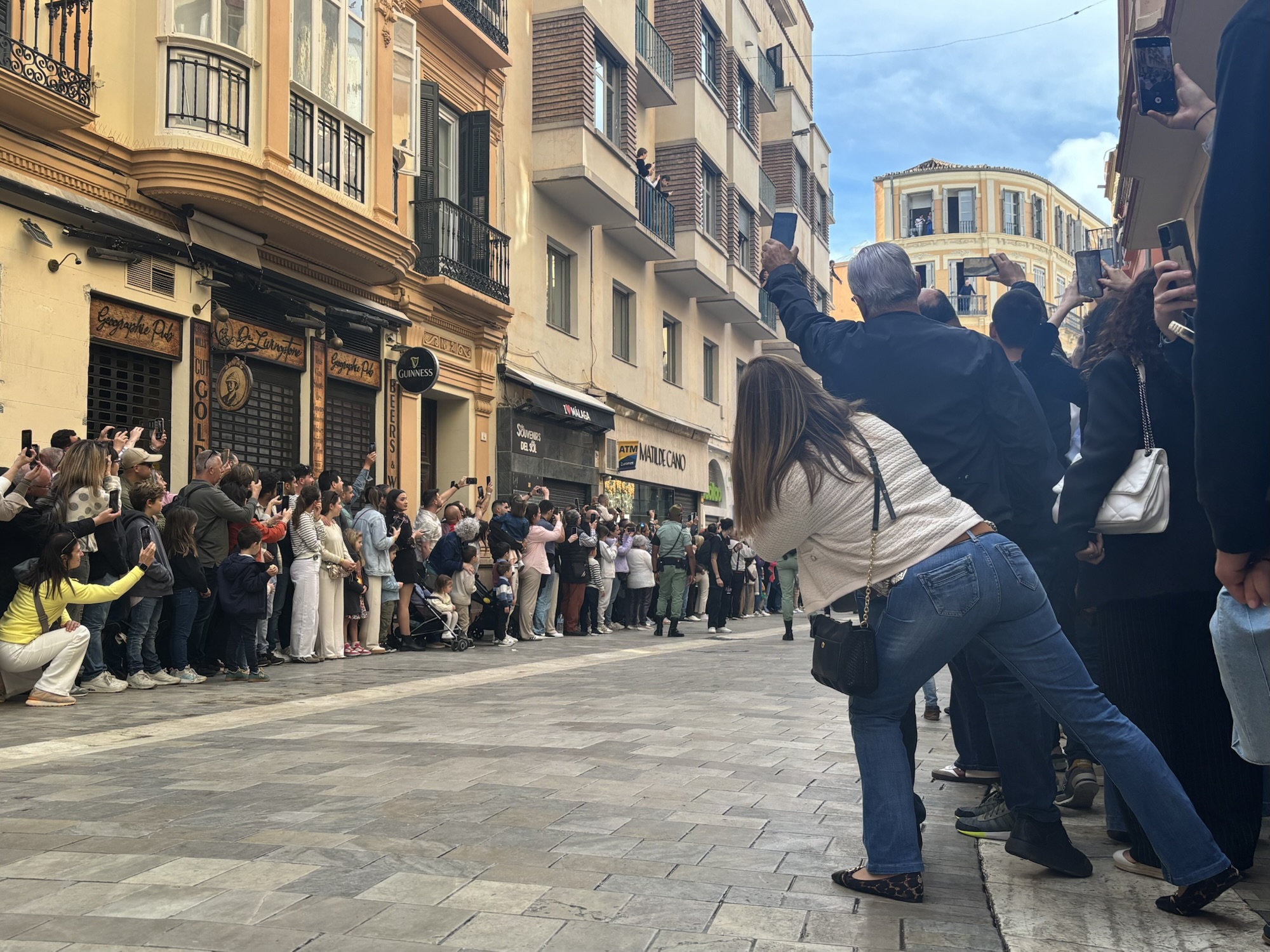
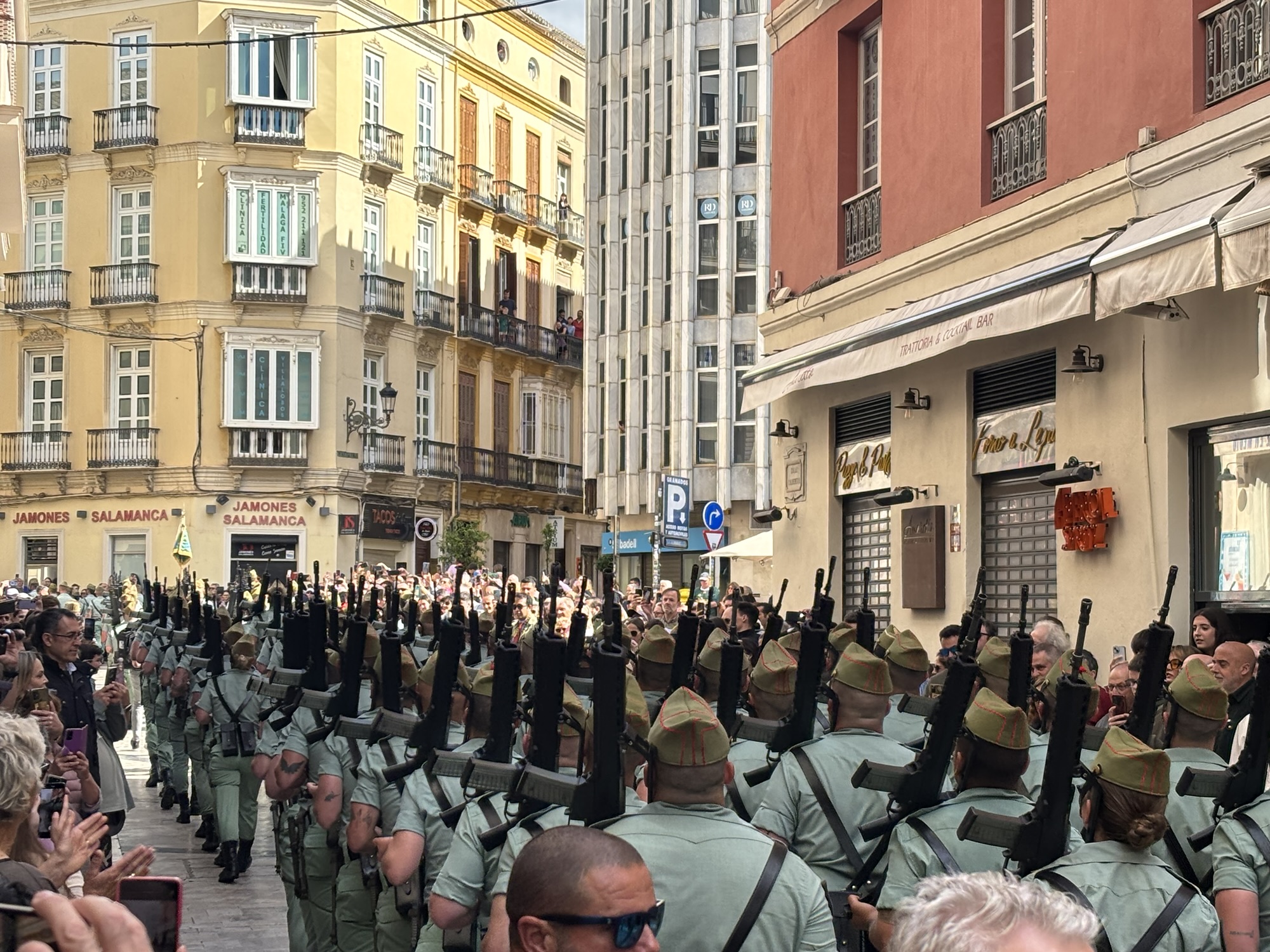
With my mind at ease, I had my last chocolate con churros of the trip and then set out to see the Legion, who had just disembarked and were on their way to their casa de hermandad west of the river. Once again, I was lucky to find a space to stand, since by the looks of things the entire city had turned out to welcome the troops.
La Legión, also known as the Tercio, is one of the most famous wings of Spain’s military. Though modelled on the French Foreign Legion, a similarly fearsome fighting force, la Legión is not as foreign as its name might imply: Spaniards comprise the vast majority of its troops, with Latin American and citizens of other Spanish-speaking countries making up the rest. This was the unit that Francisco Franco commanded, a mighty and highly professional unit used with devastating effect against the Republican forces during the Civil War. My allegiance should be straightforward – my great-grandparents were Republicans, and my great-grandfather Mateo was a victim of the regime that La Legión helped to put into power – but even I have to admit that I thought them impressive as they paraded through the city, belting their battle hymn, El novio de la muerte, at the top of their lungs.
The past is the past. Hate has to find the hands that it knows, and I’m not one for grudges. I’m also a Catholic who bloody loves a good spectacle, and the Legión certainly provides.
In one last stroke of luck, when I came back to the pensión to check in, the receptionist asked if I would rather “dormir o ver la procesión”: somebody had cancelled just minutes before I arrived, and a balcony room had suddenly become available. As a good friend once said, “you can sleep when you’re dead” – so I snapped up the balcony room. My pensión of choice looked out over Calle Especería, which just so happened to be the primary conduit for all but one of the eight pasos making their way through the city. Not only would I be able to watch the processions from the comfort of my room, I would be able to do so without having to deal with the inevitable crowds, now at their greatest in number as Semana Santa reached its summit. I really couldn’t have been dealt a better card.
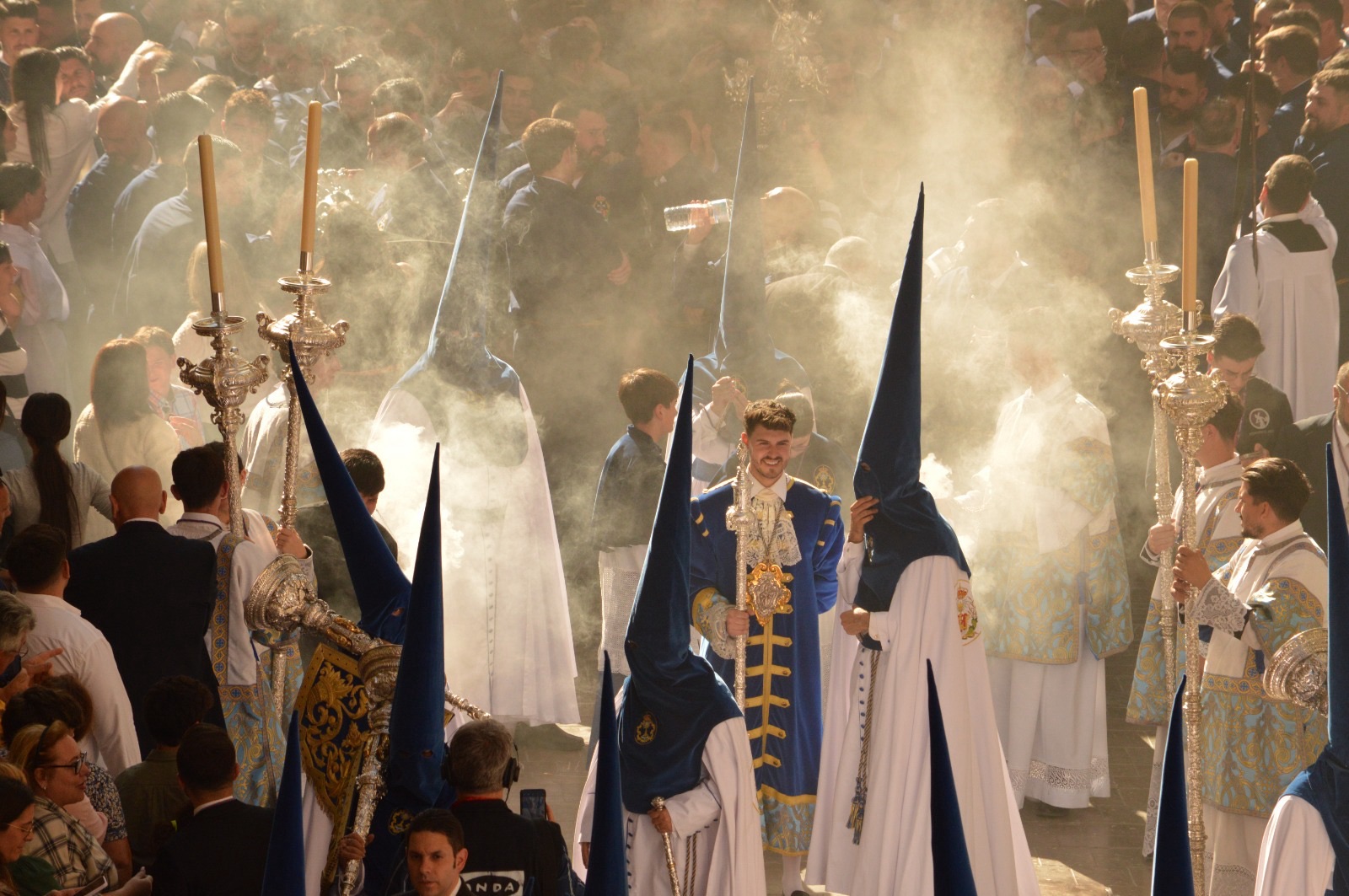
The first paso arrived shortly after half past five, at which point the street below became impassable. It’s just as well I had supplies, because one procession followed another – it would be past one o’clock in the morning before the last procession had come and gone, and the spectators walling the street with it.
From my vantage point on the second floor, I could see a lot of things I hadn’t noticed before. Like the old-fashioned jugs each paso carried with it, appearing suddenly from beneath the tronos every time the procession came to a halt to provide relief to the weary costaleros. As the night went on, the train on the dresses of the Virgin Mary got longer and longer, and many of the costaleros were entirely reliant on the sound of the llamador (the bell at the front of the trono) and the voice of the capataz (the man in charge of guiding the costaleros) to know when to stop and when to go.
The Legión arrived a great deal sooner than I expected. I’d just popped back inside for a drink when I heard the first verse of El novio de la muerte (literally, The Groom of Death) and had to double back. I must have only seen one of the four tercios (divisions) of the Legión this morning, because they seemed to have quadrupled in number. Led by their officers, the nazarenos of their brotherhood and a number of standard-bearers carrying golden flagpoles, it had all the trappings of a Roman triumph. I guess that’s part of the look they were going for. Either way, it was quite something to watch from on high – especially the way their marching steps fanned out in a perfectly synchronised wave from the left.
I experienced my first genuine saeta shortly before midnight. There is little that can compare to a proper saeta: it is, in essence, a religiously inspired solo piece, sung by a spectator who feels so moved by the emotion of the procession that they put their feelings into song. The origins of the saeta are unclear, but they’re thought to have derived from a fusion of Islamic calls to prayer and Jewish psalmodies with old Franciscan processional hymns. In Andalusia, the region most commonly associated with the practice, they have a strong connection to flamenco, which becomes immediately obvious when you hear the wailing style of the singer and their wild gesturing toward the paso, which must by tradition come to an immediate halt when a saeta begins.
I’ve seen saetas before, albeit slightly less impressive – the kind where somebody stands in front of the church and reads from a score. Not this one. This came from the heart and soul of a man in his sixties, who was leaning half off his balcony and crying out to both El Cristo and La Virgen with every ounce of duende that his spirit could muster. It was really something to behold, and it had the whole street in silent rapture – which, with hundreds of people lining both sides of the street below, only made it all the more impressive.
There’s something about the music of Semana Santa that is fundamentally powerful. It could be the wailing solos played on the keyed trumpets with that quality of vibrato that is so ineffably Hispanic, often associated with bullfights and Mexican standoffs. It could be the way that the drumbeats make your very heart tremble within you as they reverberate off the walls of the narrow streets, or the way that one of the drumrolls is alwaysdelayed, producing an effect that is almost hypnotic. But I think a lot of it comes down to the fact that the music is modal – that is, a music form phased out by the Protestant Church as it was felt to be “too ornate” for worship.
You can say what you like about the quality of modern Christian worship music, but as far as I’m concerned, the moment that this kind of music was deemed “too distracting” was the moment that the decay set in. In the opinion of this author, there’s nothing that Hillsong and its ilk could ever do to even come close. Semana Santa is an endless replay of the last week of Jesus’ life, with all of the grief and pain and none of the vapid Jesus-we-love-you-ness that marks a lot of modern Christian music. That’s one of the reasons I have a thing for Gospel music, too: while it also indulges in giddying joy, it draws on the shared pain of its creators to delve into the dark heart of suffering in ways that Hillsong just can’t. There are three hundred and sixty days in the year to celebrate the joy of Jesus’ resurrection, but Semana Santa focuses the lens on the five days where he suffered most terribly. It’s a memento mori, a reminder of the relatable human mantle that Jesus took to suffer and die for the sins of mankind, and of the grief of a mother over the death of her son. Christ the Lord is Risen Today seems almost farcical by comparison (especially if you’ve seen the infamous John Daker video, which I have far too many times). By making worship music more accessible by simplifying its structure, they ripped out its soul.
Spain is a country that has experienced a tremendous amount of religious rage and repression, arguably more than any other in Europe if you factor in the tumultuous conquest and reconquest by Christian and Muslim overlords and the religious persecution that followed over a period of seven hundred years. So the suffering evoked by their saetas and processional marches is very, very real. In some parts of the country, the music isn’t enough: there’s a town in Extremadura where the penitentes bind themselves to crosses in a simulation of the crucifixion and do some of the procession on their knees, while the most devout Spaniards will even follow the processions with crowns of thorns of their own, or whip themselves as they march down the street. The suffering becomes as much a performance as the music itself. Church attendance may be on the wane here just as much as it is everywhere else, but in Semana Santa, you’d be forgiven for thinking that the official statistics were wrong.
La Virgen de la Esperanza and her bearers returned home shortly after seven o’clock in the morning, almost an hour before sunrise and just before I walked past on my way to the train for the airport, after a nine hour march through the city. In a few days it will all be over, and the city will return to normality until the whole process starts all over again in a year’s time. But I have bottled as much of the magic as I can and am returning to England with my head and my heart ringing with the rattle of snare drums and the wail of trumpets. I have been reminded in no uncertain terms that it is here in Andalusia that it all began, when my parents made that mad decision to move out here for a year, and my future was lashed forever to this wild and passionate corner of a wild and passionate country.
Like most days where I crammed far too much into one day, this one is going to be difficult to write about. I’ve had writer’s block for the last few hours just trying to get started. So I’ll try to go over the highlights.
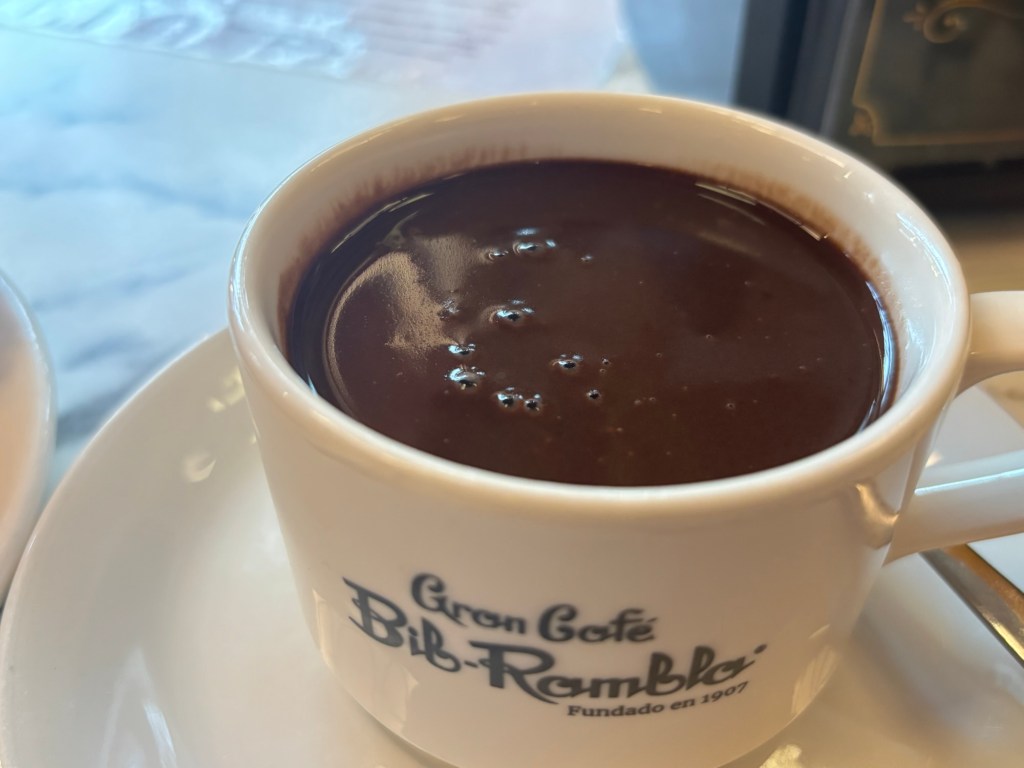
This morning began with a side of churros con chocolate at Café Bar Bib Rambla, an old haunt of my mother’s when she was on her travels around Spain back in 1988. It was just as good as she described it. Churros are definitely a once-a-year treat – I can’t quite justify any more than that – but Spain’s fondness for warm liquid chocolate is definitely something I share. I needed to kill some time (and break down some paper money into loose change) between the wash and dry cycles in the laundromat, so it was good to kick back and relax in a café that has stood the test of time.
After wrestling with the laundromat and coming away with a clean load of washing (yay!), I went back into the city in search of my Alhambra ticket. Along the way, I dropped in on the Cathedral, hoping to see Fernando and Isabel – and completely forgetting that they’re not interred within Granada’s cathedral at all, but in the Capilla Real next door. There’s a separate entry fee of 7€ for each, coming to 14€ if you want to do both. Of course, if you have the Alhambra card (which I also completely forgot I had bought) then both are covered. So I felt a little bit gulled.
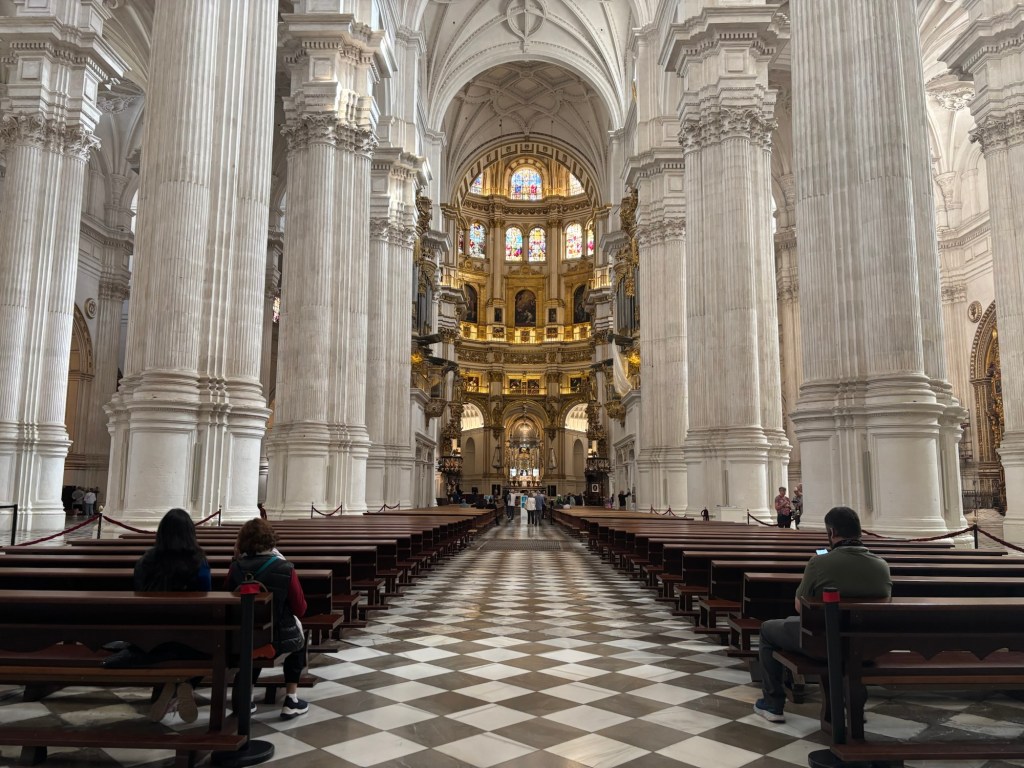
Granada’s cathedral is… well, I’ve heard it said that it’s one of Spain’s most beautiful, but I’m not convinced. So many of them look the same, and while it may have its merits, it suffers from the same problem as the Cathedral of Córdoba: it’s sitting in the shadow of something truly unique and far superior in style. Santiago de Compostela boasts a spectacular cathedral, as do Salamanca, Barcelona and León, but Granada… I won’t get on my high horse about it, as my feelings are rather strong.
I popped into the Palacio de los Olvidados, mainly to check out an exhibition on the Inquisition (a long-term interest of mine) but also to investigate their collection of colourful art prints of Federico García Lorca, Spain’s greatest poet. I don’t know his works nearly as well as I should, so I’ve bought a couple for my classroom to inspire me – and the kids, of course. There’s a good possibility that he and my great-grandfather knew each other, as both belonged to poetic circles in the same part of the country and espoused left-wing ideals at the beginning of the 20th century – before the regime got to them both.
That alone should give me cause to dig a little deeper, but it’s the revelation that he was a musician – this has come far too late for a self-professed Hispanophile like me – that has really stuck with me. I must read his Poeta en Nueva York when I get home.
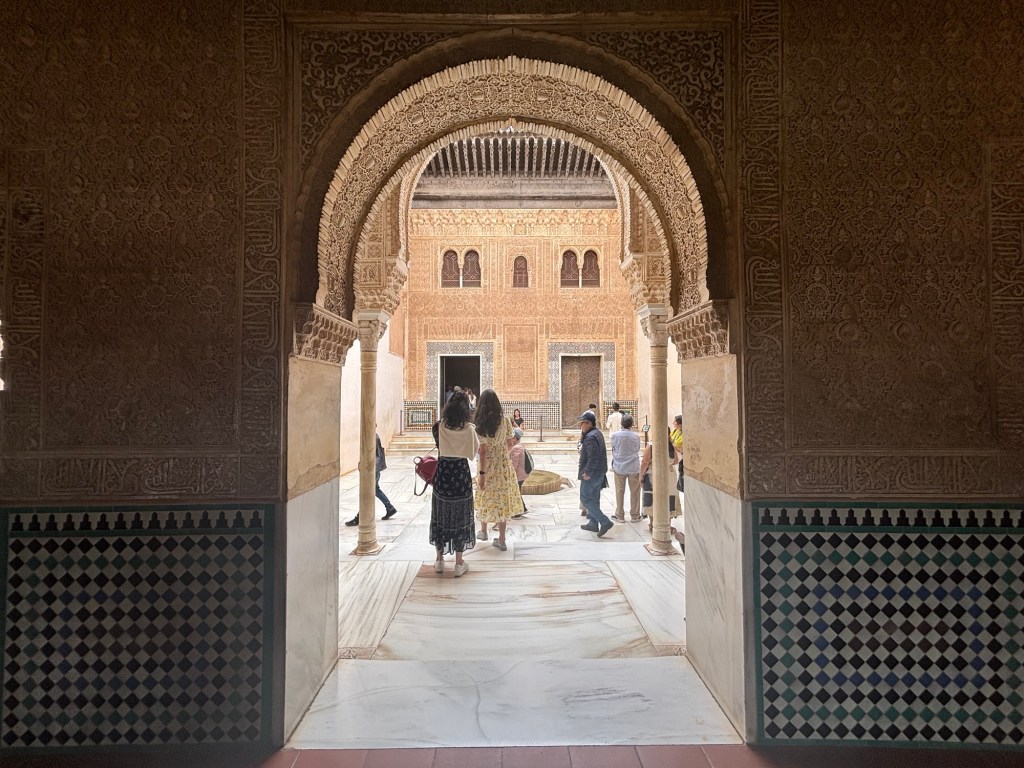
By the time I got up to the Alhambra, the brilliant blue skies of the morning had been concealed behind a glaring white haze. Thank goodness I got my winning Alhambra photos years ago, or I’d have been really quite miffed. No, this time, I relied upon my sketchbook. I spent almost half an hour in the Mexuar, the modern entryway to the Nasrid palace complex, sketching the stucco archway overhead.
A neat trick to carrying a sketchbook is that you can listen in on guided tours without looking like you’re obviously listening in. Another neat trick I have up my sleeve is that language is no barrier: in the half-hour that I spent in that spot (and another half-hour by the reflecting pool) I got the drop on an Italian tour, two Spanish tours, a French school group and their guide and a couple of English tours. I didn’t catch a word of the Polish tour, but six out of seven isn’t bad.
Did you know that the Alhambra receives – on average – around eight thousand visitors per day? That makes it not just one of Spain’s most popular tourist attractions, but an incredibly difficult job for the palace’s restoration team. Given proper care, floor tiles can last up to a hundred years until they need replacing. But let’s face it, your average tiled kitchen floor isn’t being manned by eight thousand new cooks every single day of the year.
In times gone by, men like Washington Irving had to step in to stop tourists from chipping tiles and plasterwork off the walls to take home. These days, it’s all the security guards can do to stop the school groups and Korean selfie seekers from leaning against the pillars and posing against the walls, rubbing away pieces of the past with every vanity shot.
Seriously – the number of peace-sign poses that some of the tourists were throwing… You’d think they were wandering around a Comic Con event rather than a medieval Islamic treasure.
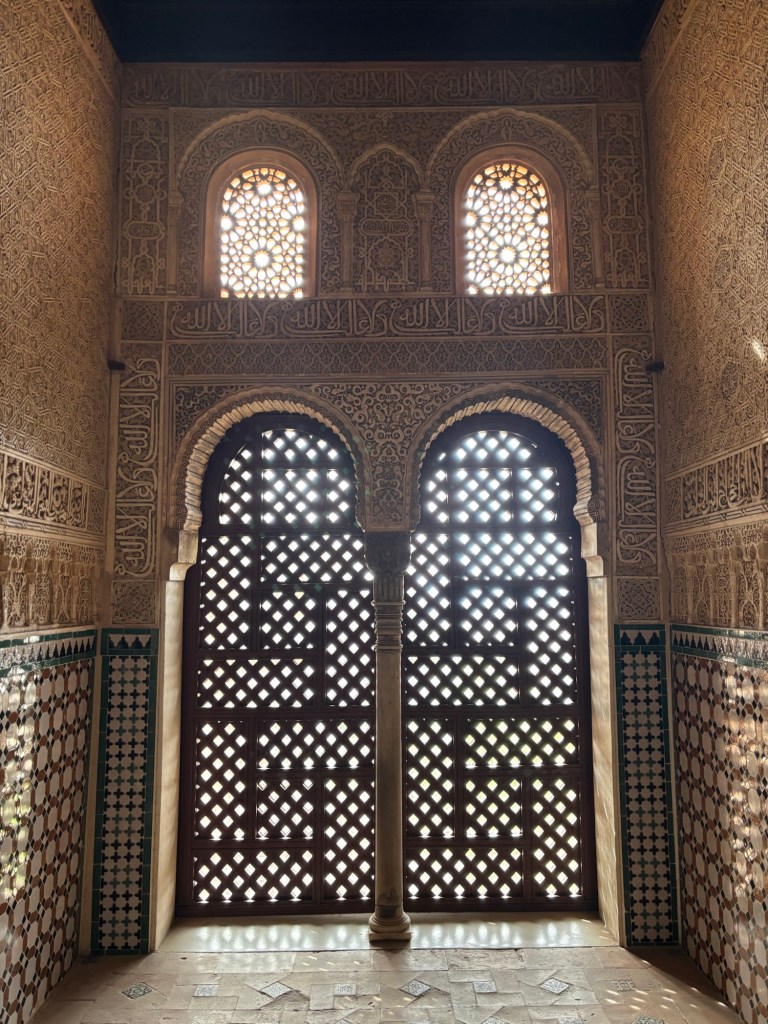
Once, this place was even brighter. The faded beige stucco on the walls would have been covered in a rainbow array of colours, some of which can still be seen in the cracks in you look close enough. The lavish gold leaf and furnishings are, of course, long since gone, stolen by treasure hunters from the time of the Sultanate right up until the late 1800s. There were once carpets and drapes all over the place, too, but these were removed by the conquering Spanish as a fire hazard in an early concern for health and safety. I remember reading somewhere that they also had the floor lowered as the windows were too close to ground level, but don’t quote me on that. The Alhambra has been restored and modified so many times since its construction that it’s probably a far cry from what it originally looked like: a ship of Theseus or Washington’s axe, depending on which take on that metaphor you prefer.
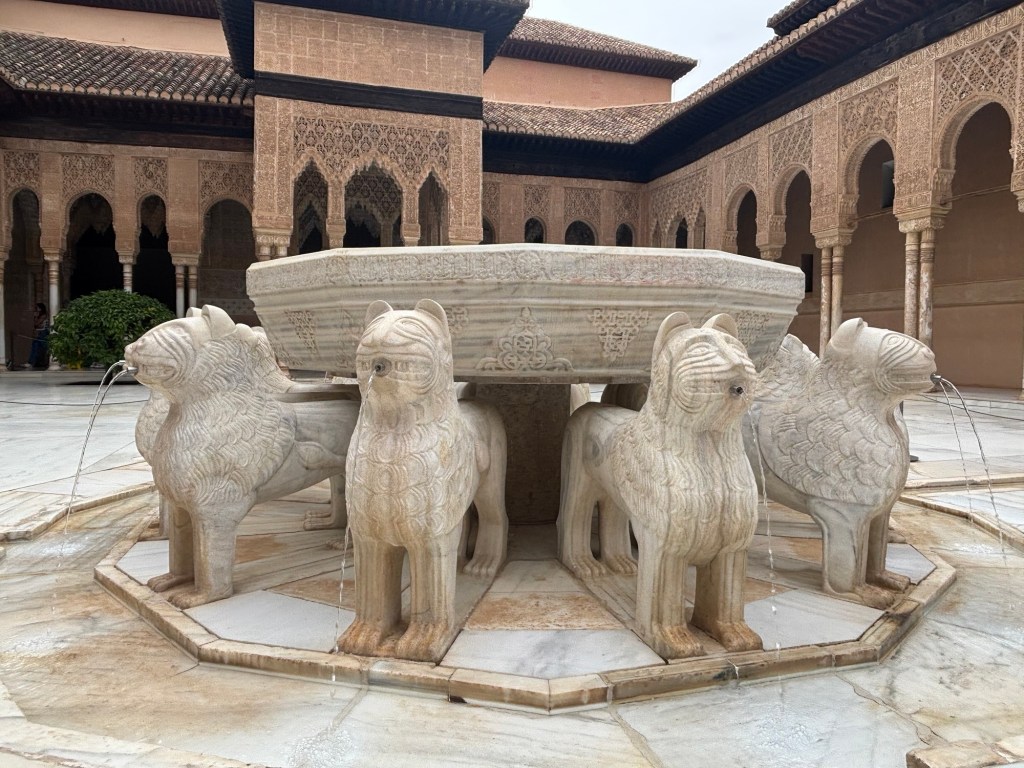
I’ll tell you what was jolly nice, and that was seeing the Court of Lions. It was under heavy scaffolding when I last came here in 2011, so it was the only first-time experience I had on the tour. This enigmatic feature of the Alhambra really stands out, especially as depicting the physical form is usually proscribed in Islam. The fountain and its accompanying lions have long been a symbol of the Alhambra, though they were a late addition to the complex. It’s thought that they weren’t Islamic in origin at all but rather Jewish, as the fountain is believed to have come from the house of the Jewish poet Yusuf ibn Nagrela. The logic checks out: there are twelve lions in all, one for each of the tribes of Israel, and two bear the triangular insignia of the tribes of Judah and Levi on their heads.
It is, at least, an interesting theory.
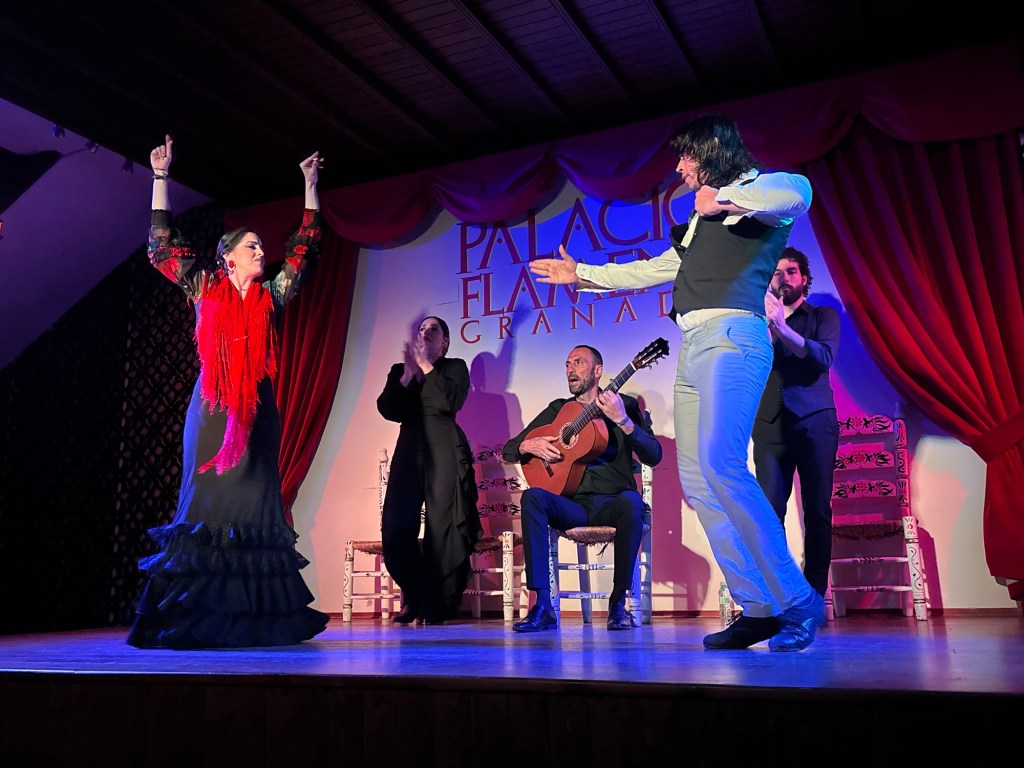
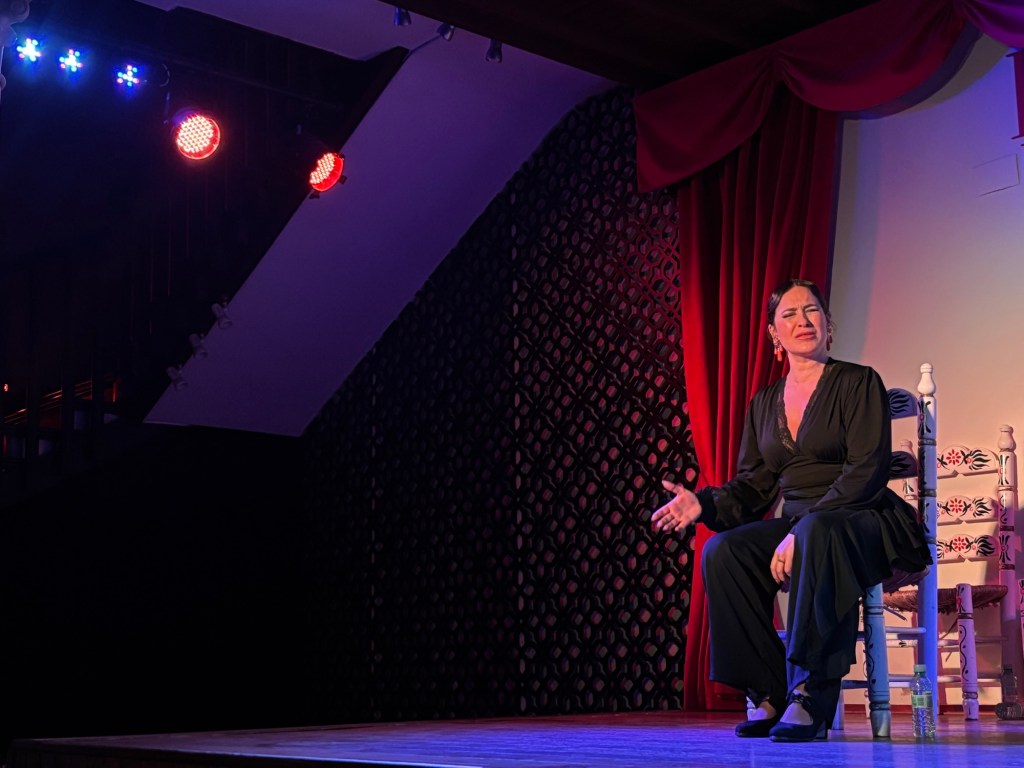
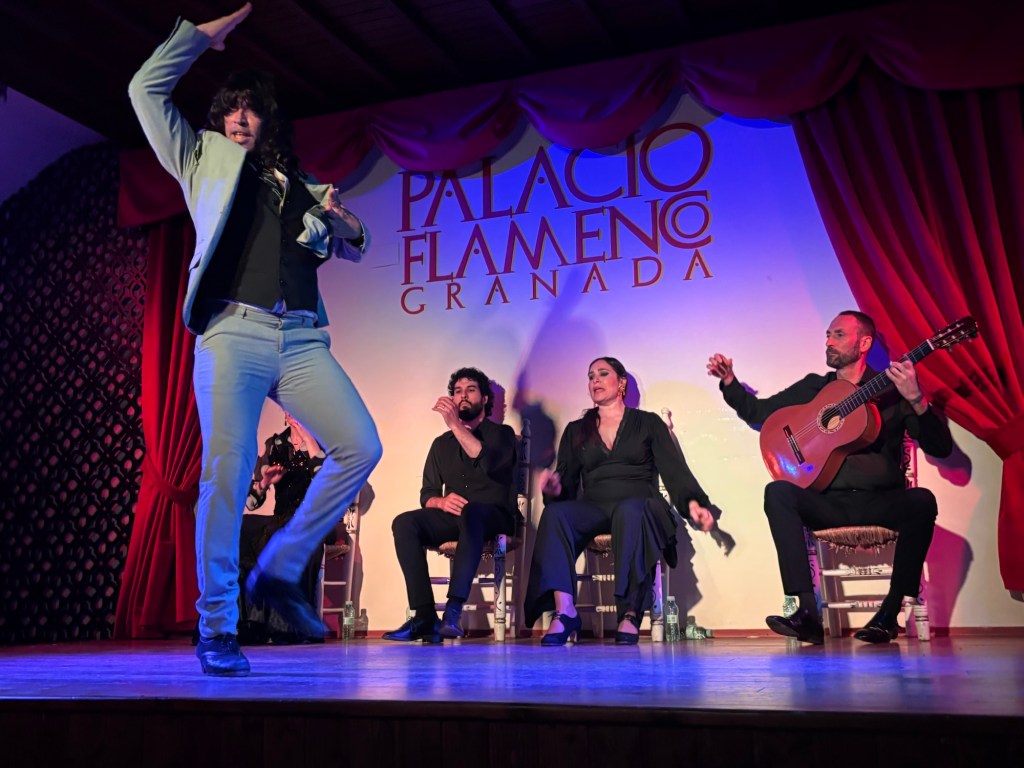
My visit was cut short by the fact that I’d booked myself in for a tablao flamenco at the Palacio de Olvidados – yes, I caved in. And I am so very glad I did. I was worried that I’d find a lot of half-baked flamenco in town, but this was nothing short of spectacular.
There’s a depth to flamenco that just isn’t there in a lot of other folk music forms from around Europe: a heart-rending, wailing passion that can only be truly understood by the descendants of a people cast out and rejected everywhere they went. This is the soul of the gypsy on full display: naked, passionate and rebellious.
You could argue that the same case means white people can’t sing gospel music. I’d listen. Goodness knows I’ve had to table that argument before. But just because you don’t belong to a culture that produces a certain kind of music, that doesn’t mean it can’t move you.
I’ve no gypsy blood at all – as far as I know !but Flamenco moves me. It had always moved me. For whatever reason, Flamenco shoots straight to my heart and draws tears from my eyes. There’s a rawness to it, a gutsy, authenticity to its passion that is hard to find elsewhere. The voices of the singers tremble and fragment like a scream or a wail, and sometimes that’s exactly the point.
Don’t forget: the gypsies weren’t just ostracised, they were actively hunted as subhumans for years. Spain’s gitanos were the subject of hatred, scorn and outright violence since they arrived in the peninsula shortly before the fall of Granada. Being beyond the law, as it were, they were frequently targeted for enslavement, either in the mines or as galley slaves, which was essentially a death sentence in all but name.
In 1749, King Fernando VI organised the Gran Redada – the Great Gypsy Round-Up – with the express purpose of wiping out the country’s gypsies once and for all. Though not a genocide in the strictly modern sense, as the plan was to imprison rather than execute, the Redada’s stated aims of separating the male and female Roma and thus preventing them from “bringing about another generation” amount to the same thing.
And that’s just Spain. Holland and some German territories held heidenjachten (literally “human hunts”) until at least the 18th century, showing just how far the dehumanisation of the European gypsy could stretch.
Small wonder, then, that there is so much pain and anguish in the voice of the gitano. There’s centuries of agony to draw on.
Not to be dismissed is their footwork. Flamenco is as much a dance as it is a music form, and perhaps more so. There is no stately rhythm to follow, no pattern to predict: flamenco flows like water, where every drop runs its own course to the finish. Here, the dancers seem to lead the musicians. The eyes of the singers and the guitarist were on the dancers’ feet at all times, anticipating their every move.
I was enthralled. I adore flamenco. I love its maddening rhythms, its utter freedom, its unpredictability. Perhaps that’s the naturalist in me: it’s nature in musical form. I wouldn’t be the first to compare flamenco to a wild bird or beast and I won’t be the last.
Right – that’s quite enough for one day. Time to go and explore some book shops before they close. BB x
I’m sitting in the rest area at Bristol Parkway Station, watching the blinking lights of cars cruise around below me in circles like so many coloured beetles in the darkness. If I’d made my original train, I’d be at my mum’s place by now. But there was an incident on the 20.35 from Bristol that the authorities had to deal with, so a twenty minute delay has turned into an hour’s setback as I missed my changeover. I’d chalk it up to some Friday night jollities from some of my ruddy-faced countrymen in the next carriage. The only highlight was the very comical collective groan from the other passengers when the announcement came through. Can I still use the term passengers? It’s been recently outlawed by National Rail, who apparently fear it sounds “too formal” – what has the world come to?
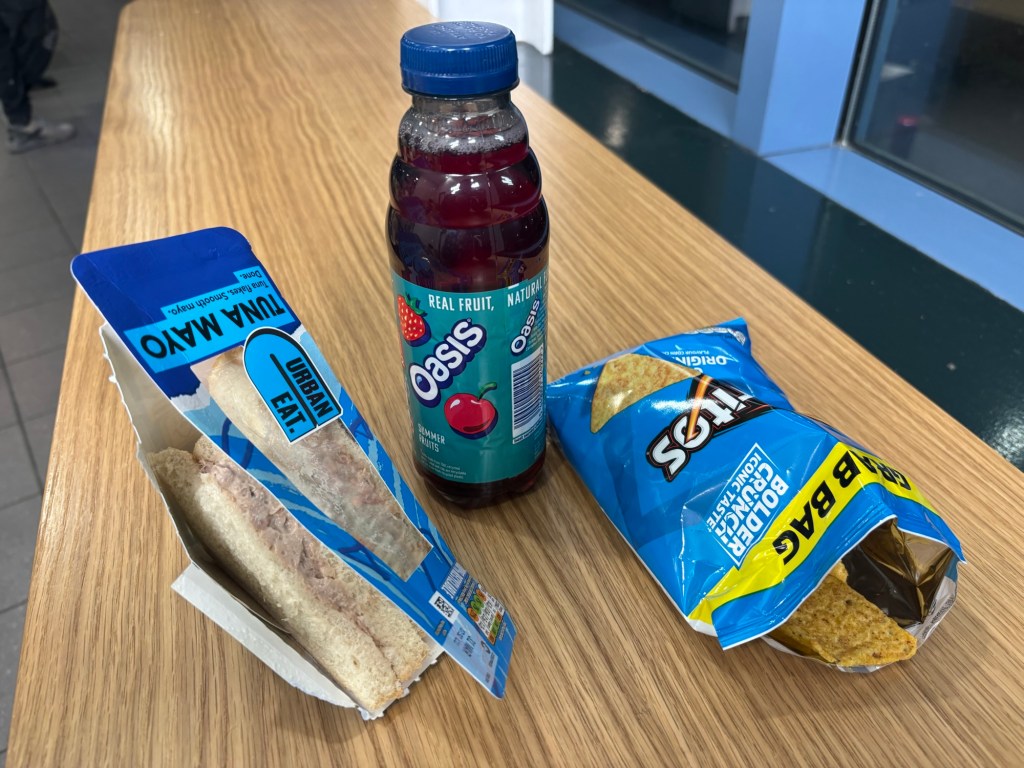
So, I’m stuck here for another half hour. I’ve wolfed down a meal deal and am now watching the world go by with my Spotify on shuffle. The holidays are here at last, so I guess it’s time to blow the dust off the blog and flex my rusty writing arm with a little exercise. I’ll use the first five songs on shuffle as a jump-off point and see where we go from there.
Stronger – Kanye West
Ah, the latter days of 2007. After largely eschewing popular music, my brother and I were simultaneously introduced to modernity with Now That’s What I Call Music! 65 around Christmas 2006, our first away from home during our short-lived attempt to up sticks and move to Spain. Maybe it was because it was a link back to the world we’d left behind, but I leapt upon the novelty, and it’s fairly safe to say that my awakening as an explorer started with that CD. I used to get almost all of my music from those Now! compilations. Thank goodness Spotify came along and broadened my horizons!
It was a good time for music, anyway. Rihanna was still pumping out hit after hit (Don’t Stop the Music had just hit the scene), Ed Sheeran was unheard of, and Kanye was famous for his beats and his bars, and not his antisemitism or his (now ex) wife’s rather large bottom. Those were happier times.
Bailando – Enrique Iglesias
Wind the clock forward around ten years. Durham’s Music Society released the theme for the summer concert (Around the World) and the Northern Lights – then in the early days of our ascendancy – hit the books to find a suitable number to fit the bill. I wasn’t anywhere near as talented as some of my peers (at least four of whom have gone on to moonlight as professional musicians since) so this was my one chance to take the reins with a song where I might be able to do something the others couldn’t – that is, singing in another language.
By that point, aged 22 and fresh from the year abroad, I was spoilt for choice. But let’s face it, it would have been a tall order to get an English a cappella group to sing the Arabic smash hit M3allem, and all the sevillanas I had committed to memory were much too demanding, even for those who could speak a little Spanish. Luckily, Enrique Iglesias was famous enough to provide a bridge between the two languages, and after some negotiation with my musical director, I managed to get Bailando onto the set. I put my heart and soul into my Grapevine arrangement, but I honestly had a lot more fun performing Bailando with the gang, not least of all on account of the choreography.
Mammati – Willie Mohlala
Somewhere at my dad’s place is a little red memory stick containing a number of MP3 files: mostly obscure Ugandan pop and folk music, with a few Dolly Parton numbers sprinkled in for a little variety. That playlist was the soundtrack to the various marathon road trips of my time in Uganda, since the full playlist was never enough to span the enormous distances we used to travel. Shazam still struggles to identify the greater part of that playlist, and since Willie Mohlala was one of the only artists labelled on the tracklist, he was one of the few to travel with me out of Africa. Him and Dolly, of course, though quite how she wound up in central Africa beats me.
AM to PM – Christina Milian
Given my guilty pleasure for early noughties R&B, I’m surprised it took me until the summer of 2024 to discover this banger. I have vivid memories of boogying to this one in a club in town with a girl I’d met on Hinge, the first of several attempts to move on from my American heartbreak. It didn’t come to anything. None of my dates have since. But I did pick up this little number, so I did manage to take something away from the experience. I’ve been using the same excuse to justify traveling more than four thousand miles to discover AC/DC’s Thunderstruck, but since that electric anthem has catapulted itself into my top ten, I’ll allow the hyperbole.
Get Me Home – Foxy Brown ft. Blackstreet
I did a Spotify audit the other day and found I’d amassed about 97 playlists. More than half of them (52, to be precise) are ones I made myself. One of them is definitely a ‘mood’ collection, staffed by Missy Elliott, Blue Six and the legendary Foxy Brown. It’s not one that gets an awful lot of airtime, but it is seriously groovy.
I Go to the Rock – Whitney Houston (with the Georgia Mass Choir)
The London Community Gospel Choir did a school visit to the girls’ school over the road when I was around fifteen. This was back before they were a big deal – and back when there was such a thing as the subject specialist initiative in schools that provided money for that sort of thing. I Go to the Rock was the song they taught us that day.
Like so many of the greats in the music industry of old, gospel was where I truly learned to love singing. It was a true release from years of staid hymnals – which I look back on fondly, but not with the same awesome power that gospel provided. It felt like singing from the deepest reaches of my soul. It’s probably no great leap to say that I wouldn’t have launched myself at the funk band if I hadn’t had that crucial awakening through gospel.
It’s a shame that global politics prevented me from sharing that pivotal joy for so many years. I will always carry that scar, I suppose. At least these days I am in a more tolerant establishment that understands the importance of offering diversity through music. I dread to think where the other road leads. I don’t doubt the talents of Taylor Swift and Ed Sheeran, but if that’s what people like me will be limited to in years to come, my music tastes will be so much the poorer for it.
For the Love of Money – The O’Jays
Well, would you look at that. When I started writing this post, I was shivering in the upstairs waiting area at Bristol Parkway. I’m now inching closer to the rammed check-in desk at Gatwick Airport. Turns out most everyone on this flight has the same problem: directed to the check-in desk to collect their boarding pass, due to the sheer number of people on board. I could have dodged this by buying priority, maybe. But with prices up everywhere (the Alhambra visit is costing me nearly £100!) I decided to dodge the £8 priority add-on this time. That’s on me!
Money is the root of all evil – do funny things to some people. Spain is in the throes of an anti-tourist rebellion, centred on Barcelona, Mallorca and the Canary Islands. And not without reason: the tourist trade has been allowed to run rampant in some parts of the country, to the point where it has utterly destabilised life for the locals, forcing a dependence upon tourist money that only comes but a few times a year. Unlike Santa Claus, however, it doesn’t seem to be spreading much joy. Some protesters vented their frustration last year by hosing down tourists at cafés along Las Ramblas with water pistols.
I’m hoping to investigate this blight a little during my adventures over the next three weeks. I appreciate the irony of doing so as a tourist, but I’d like to think that by avoiding resorts and foreign hotels, I’m doing my part to contribute to the local economy in parts of the country that aren’t necessarily overrun. Speaking Spanish helps.
Well, ten minutes until take-off. My arm feels exercised. See you on the other side! BB x
I had my probation meeting today. No, don’t worry, it’s nothing to worry about – just the first part of the “settling in” process of the new job. It’s always good to get constructive feedback on your teaching, and even better to get positive feedback from kids, colleagues and parents alike. Emails remain the bane of my existence, my beast to be slain, and I dare to say that, had I gone into the teaching profession a hundred years ago, before the days of instant communication, I might even have been an exemplary teacher.
Most of all, however, I can’t help but find it delightfully ironic that my main piece of constructive criticism was that I still have a tendency to “say yes to everything”. Saying yes was something of a New Year’s resolution, and it’s been a bloody good one, to be honest. So far “saying yes” has given me: a new job, a short-lived but precious romance with an American beauty, a string of adventures from Paris and Prague to Poland, the chance to teach French again after several years’ oblivion, the title of Head of Debating & Public Speaking and, finally, a well-intentioned caution.
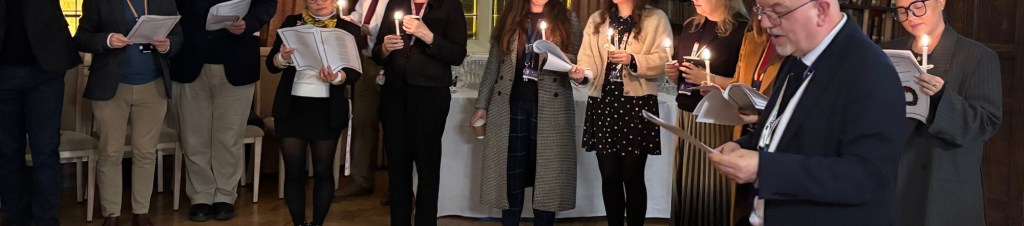
In fact, probably the only thing I’ve said no to this term was tonight’s post-carols drinks with the staff, and that was only because I’d have missed my train if I’d delayed even a minute longer.
I guess that’s just as well. I don’t think I’ve ever felt more exhausted after a Christmas term. It’s been pretty full-on, even by my standards.
I’m off to Poland tomorrow. Polish is absolutely not one of the languages I claim as part of my arsenal, so communication is going to be a bit ropey – but, hey, that’s nothing new to me. It has nothing in common at all with any of the languages I speak, so learning has been slow… on top of everything else I’ve had on this term. Sometimes I have to take a step back and think about all the plates I’m spinning at work:
Teaching French and Spanish to Years 7-13 (spanning two different exam boards for GCSE as well as A Level and the IB)
Heading up the Debating & Public Speaking events and competitions
Living on-site as a boarding house deputy and working two overnight shifts a week
Volunteering with a local school
Tenoring in the Chapel Choir and staffing any and all music trips
Attending as many home fixtures as I can to support the boys
No small wonder I’ve had no time for a relationship or driving lessons this term…! The stress of the latter might just have broken me, if I’d managed to fit my lessons in anywhere at all into my crammed schedule – which is highly unlikely. I think the only reason I managed last year was because I was six years into the job and had taught most of the kids for years, so I could walk straight from my driving lesson into teaching Year 10 GCSE Spanish without batting an eyelid.
Most rational teachers would be practically collapsing into bed tonight after a term like this one. Instead, I’m lugging two rucksacks across the country to catch an early morning flight to Warsaw, so that I can spend the first four days of the Christmas holidays in some bleak corner of Eastern Europe searching for wolves (or traces of wolves). I blame all that time spent reading The Tiger this summer. I’d be tracking Siberian tigers if I could, but I’ve traveled across the world once already this year in search of a dream, so I’m settling for an adventure a little closer to home this time.
At least it’s meant I have something to say in return when my students tell me about their Christmas plans in India, Florida and/or the Maldives. “Wolf tracking” seems to fall under the banner of decidedly unusual responses to the question “any plans for the holidays?”.
Thunderstruck is playing in the one functioning ear of my earphones. The train is fifteen minutes late but racing to make up for lost time. I’ve fired off the usual end-of-term fusillade of messages to friends and family, bursting upon the surface of my WhatsApp in two-minute intervals like an underwater volcanic vent. Old habits die hard. Thunderstruck was the great gift of my American adventure, and it’s been a real mood-lifter ever since. Unsurprisingly, it’s my most played song on Spotify this year.
I think I’ll listen to it a couple times more as the train nears its destination. I could use a boost. BB x
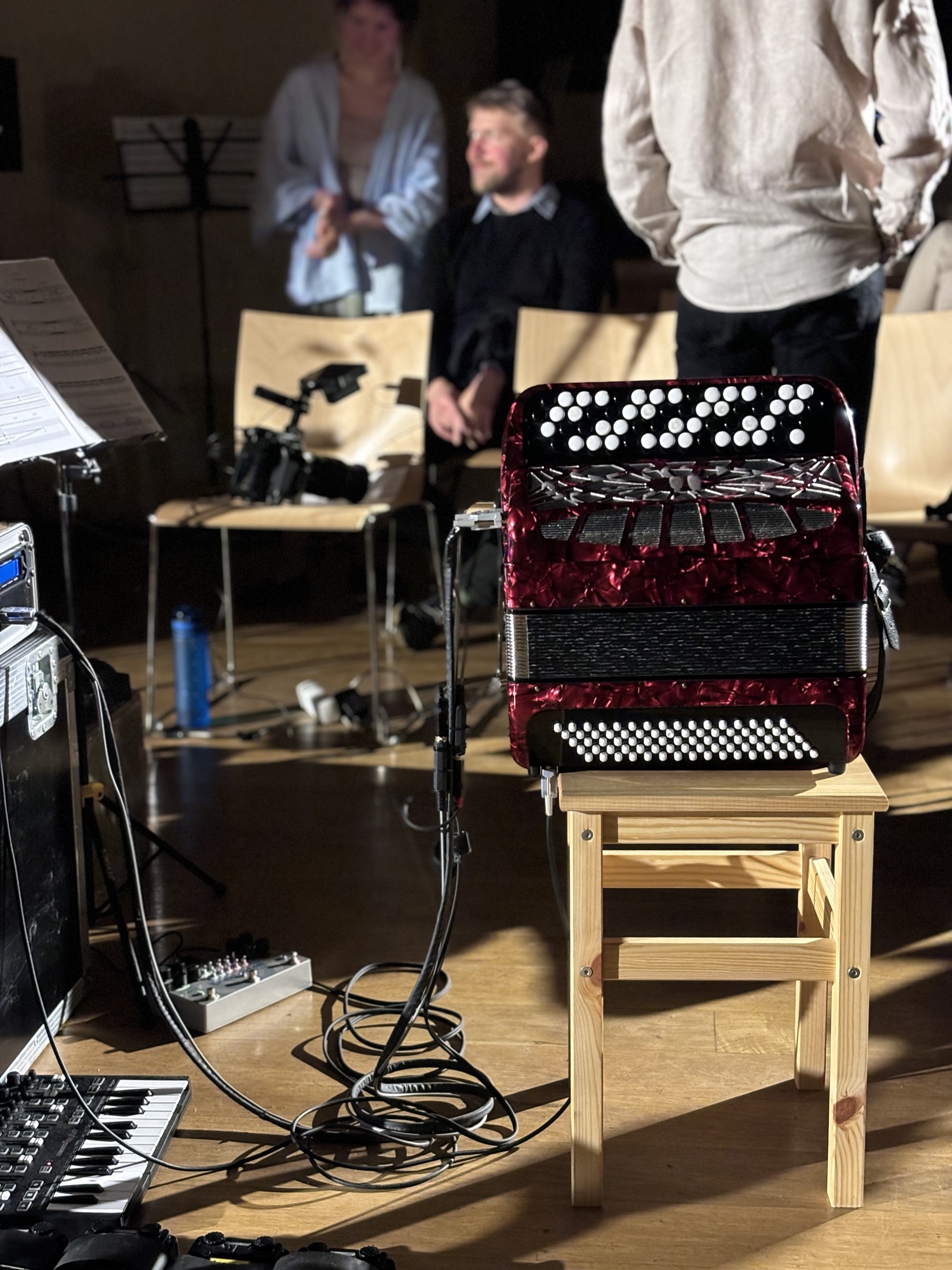
Back in April, I made a flying trip to Prague to spend a few days with my dear friends Andrew and Babette. I’d never been to the Czech Republic before, so I used the opportunity to see the sights: the statue of Jan Hus, the Jewish cemetery and the tomb of Rabbi Loew, creator of the legendary Golem of Prague. But I was in for an unexpected treat when Andrew took me to see an evening show of Moje Sibiř, a spatial composition centred around the spirit of Siberia. Over the space of 45 minutes and seven movements, Roman Zabelov and his troupe dimmed the lights and carried the audience away into the endless forests of the Siberian taiga by the power of music alone.
Roman led the suite with his voice and his accordion, conducting much of the composition with eyes closed tight in the manner of a shaman weaving some kind of ancient magic. Speaking of spellbinding, I have never seen an accordion played so creatively: it is obvious that Roman is a something of a frontiersman, combining unorthodox techniques with a quasi-mystical, body-and-soul engagement with his craft, like a Belarusian Pan of the Far East. Zabelov’s ensemble, stationed in various locations around the performance space, worked together to turn the hall into something far more intense than a simple performance space. Through a clever combination of ethereal singing, haunting vocals and long, whooshing breaths, it felt as though they were summoning the arctic wind itself into the room. I had to close my eyes for one of the movements and let it carry me away.
The setting might have been showstopping in its own right, with seating arranged beneath the myriad paintings of the Baroque Refectory of the Dominican Cathedral of St. Giles, but a combination of technical wizardry and clever vocal choreography transformed the gallery into an illusory space: shadows seemed to leap from the paintings and follow the echoes around the room, while the heavens above rippled beneath the rusty iron waters of a tundra pool. I might as well have been holding the heart of the taiga in my hands.
Whether or not it was Roman’s intention, I have been spellbound by the idea of Siberia ever since. I suppose it’s the instigator behind my current fascination with the Amur region and its tigers. If it weren’t for the fact that any and all possibilities of traveling out there are off the table because of the current tension between Russia and the West, I might well have been looking into making my own way out there. It’s amazing what a little musical hypnotic suggestion can do. BB x
There are places that whisper and shout. There are places we return to and that we look for all our lives. These places are both real and imaginary, but that doesn’t detract from their reality. Such is My Siberia. Roman Zabelov
Three weeks of the summer holidays remain, which I must now try to fill somehow. Yesterday I went up to Bristol – for better shopping, primarily, but also because I’d never been, and there’s at least a couple of things in this city that I wanted to achieve: a new suit for work, and a close encounter with arguably one of the most famous statues in the country.
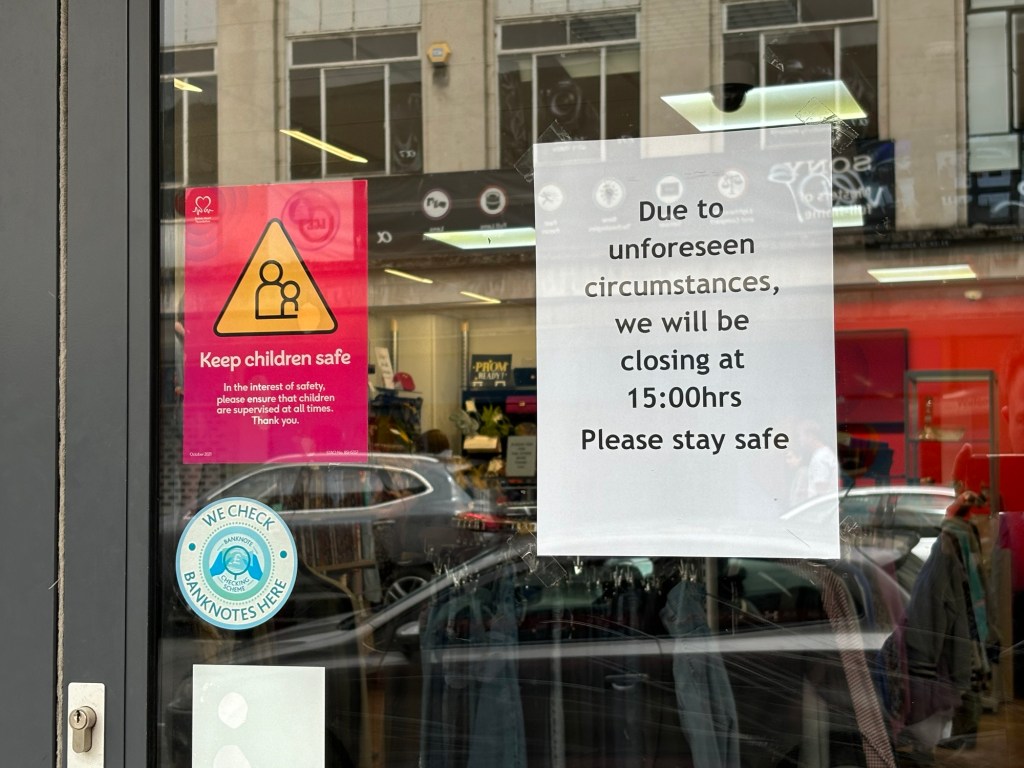
Bristol was not as busy as I expected, but then, with all this talk of protest in the air, perhaps that’s not surprising. Despite the official line from the police to the contrary, at least two shopkeepers warned me to get out of town before 6pm. They said that a mob was being gathered online to march on an immigration legal aid firm in the Old Market district, not more than five minutes or so from Bristol Temple Meads Station. I passed several shops with signs in the windows indicating an early closure, and I saw at least one being boarded up, just in case things got out of hand.
Part of me considered sticking around to see what went down, but for once, the rational part of my brain (which usually plays second-fiddle to the romantic up there) took charge and sent me home. Still, it was quite something to see a city preparing for potentially violent civil unrest, like a quiet siege. It was rather eerie. I’ve never seen anything like it before.
As it happens, there was a protest march that evening – but not the one that was expected. Nearly two thousand anti-racists staged a peaceful counter-protest in Bristol’s Old Market, where the anti-immigration rally was due to take place. My faith in this country has been restored, even if only by a little.
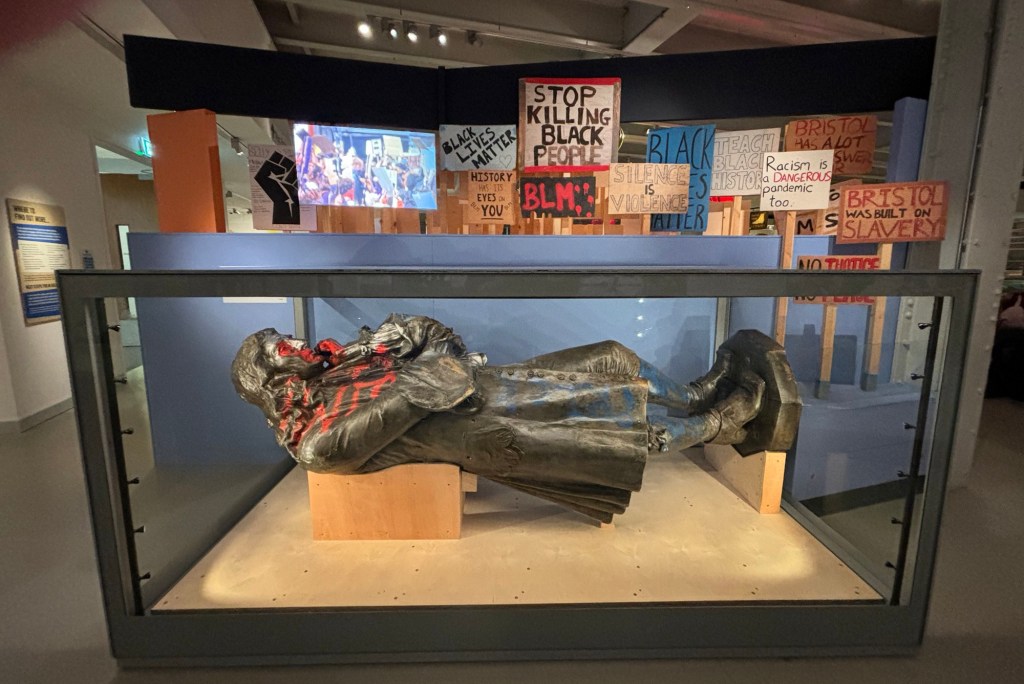
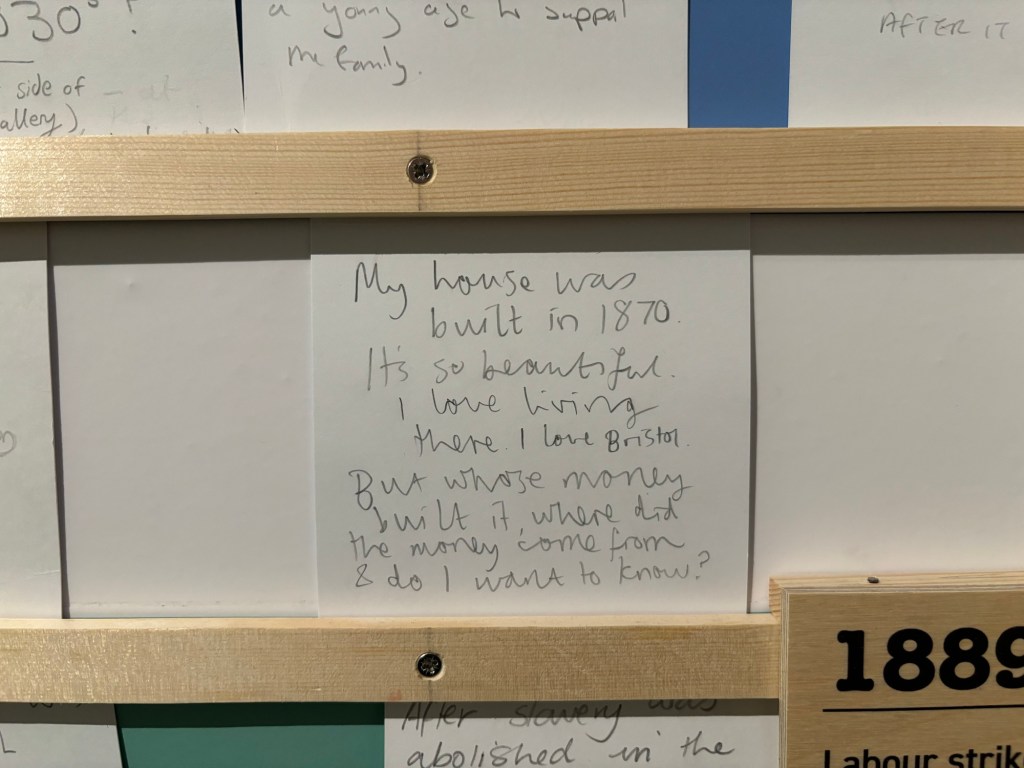
I visited the M Shed Museum in the Bristol dockyards, where the statue of Edward Colston can now be seen after it was recovered from the bottom of the harbour. Social media played a decisive role in mobilising the mob back then, too, albeit under very different circumstances.
Colston rests in a glass sarcophagus surrounded by a collection of placards borne by those who tore him from his plinth back in 2020. It looks almost like one of the stone effigies you might find in a cathedral, with homemade banners replacing the coats of arms.
Colston used much of the wealth that he accrued from his involvement with the Atlantic slave trade to philanthropic ends in Bristol and beyond, establishing almshouses and sponsoring schools. For more than two hundred years, he was even something of a local hero. But times have changed since the events of 2020, and a much-needed revision of the history books has shed a new darkness on men like Colston who, for all their good deeds, were active participants in a system which brought unimaginable misery, pain and slaughter to millions. Colston had many hats, but “slave trader” is usually the first title next to his name in most accounts.
I wonder if history will see modern “heroes” like Steve Jobs in the same light someday for their involvement in the rape of the Congo and its people for the coltan that powers our phones. We may be reliant on the damned things for just about everything these days, but that’s a poor excuse, when you think about it. After all, we used a similar excuse to justify the entire slave trade once upon a time.
I did a little window-shopping before popping into a second-hand vinyl store in search of a couple of albums for my wall. I’m in the process of making my house a really happy space, and I figured I’d take a leaf out of the book of my old bandleader (and great inspiration), Mr D, and frame a few LP sleeves. I was tempted by a couple of colourful Fela Kuti numbers, but in the end I came away with just the one LP: Marvin Gaye’s What’s Going On, one of “the Big Three” albums that changed my life, alongside MJ’s Thriller and The Corrs’ Forgiven Not Forgotten. I’ll hunt the other two down on eBay.








 The Book of Barnabas