Camino VI: Parenthesis

In Burgos, the journey comes to an end. One leaves for home, two pack for their flight tomorrow and one more digs in to stay, leaving four of the gang to push on toward Santiago tomorrow. Perhaps mine is the hardest, watching the others move on or away, knowing that if it weren’t for my flight (and my beleaguered feet) I’d have long since decided to chuck in my plans and make for Leon with them. But life is full of farewells, and I could never have gone with them all the way to Santiago in the week of holiday that remains. So here I am, at the end of this run at the Camino, putting my thoughts into words.


Today’s leg was a special one. Impatient after a crush in Bar El Alquimista over breakfast – I’m still not especially good at dealing with loud and crowded spaces – I set out ahead of the others this morning, nursing a doctored but still painful blister and conscious it would likely slow me down. It didn’t feel great leaving the group behind, but the crush in the bar threw me off a bit and I needed some time on my own on the road as a remedy.
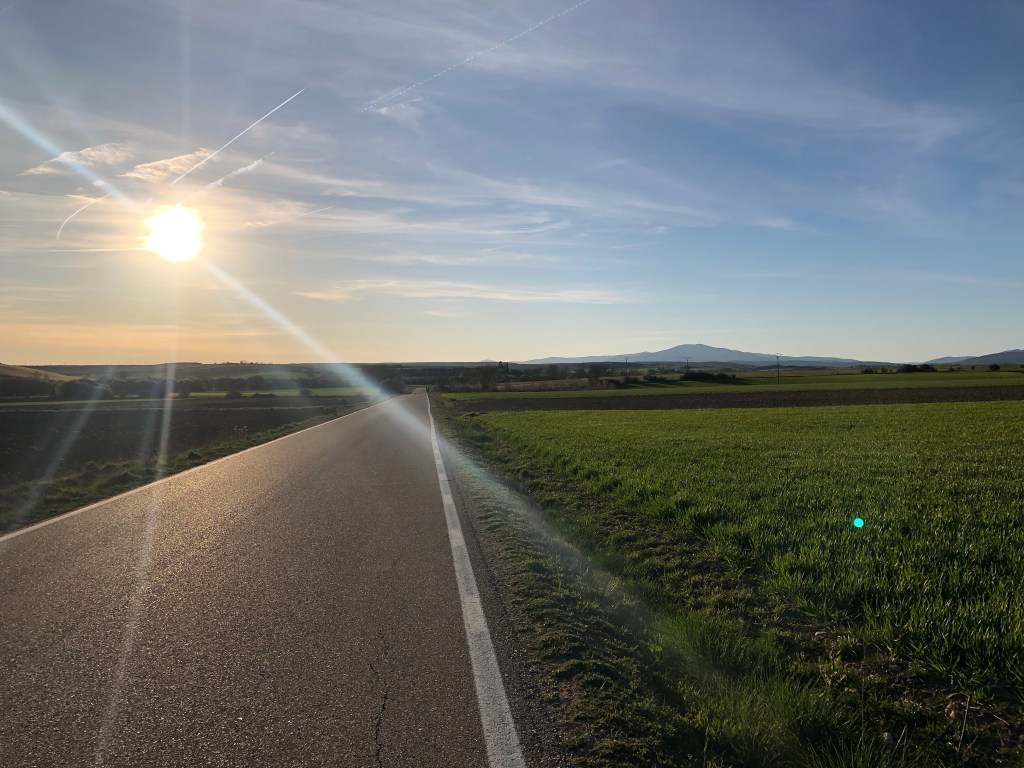

Leaving behind the slumbering town of Agés, I followed the road westward toward Atapuerca. This is possibly one of the most mystical waypoints of the Camino de Santiago, but blink and you’ll miss it – because Atapuerca is the resting place of the oldest known hominids in Europe. Not far from where the Camino crosses the Sierra lies the Sima de los Huesos, a pit that contains the bones of ancient humans who have lain there for nearly a million years. Walk this stage of the Camino and you really do get the sense you’re following in the footsteps, not just of a thousand years of Christian pilgrims, but almost a million years of human wayfarers. One of my fellow pilgrims pointed out that there are far older pilgrim routes in India, but if you think of the first humans pushing toward the end of the known world (where Finisterre stands today) as the first Camino pilgrims, I’d like to think the Camino de Santiago is a fair contender for the top spot.
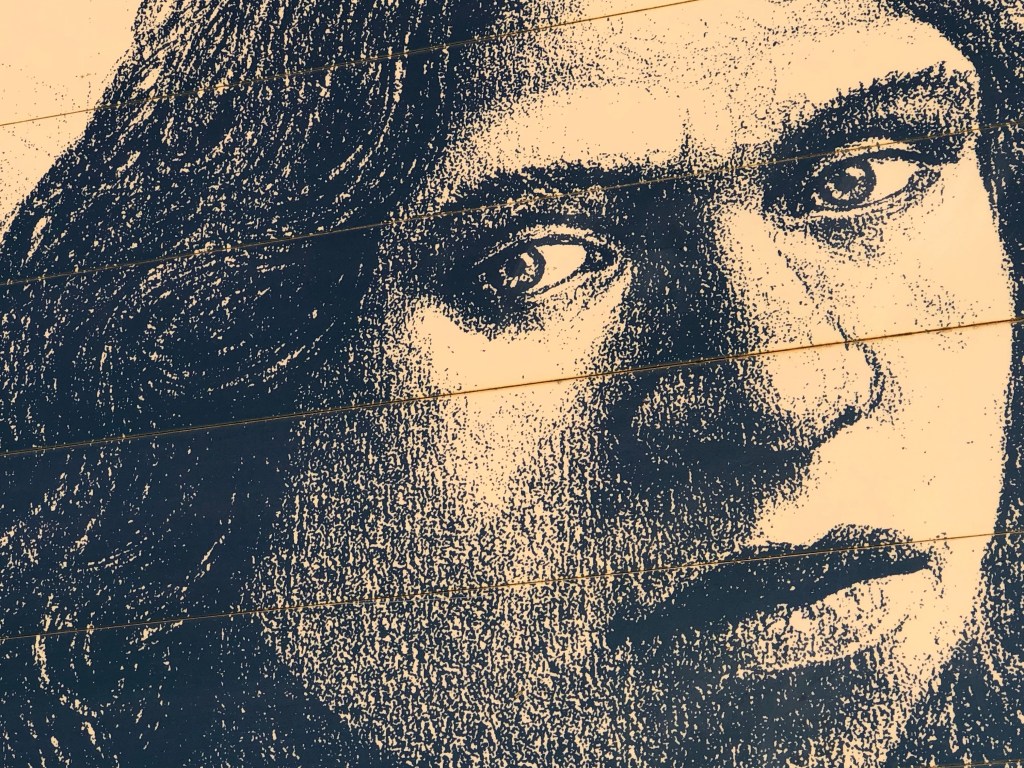

I made the climb alone, taking with me a sprig of mistletoe, a fallen olive branch and a strip of blackthorn blossom: something wicked, something old and something new. It seemed like the right thing to do. Meanwhile the birdsong up the mountain was spellbinding: hoopoes, cuckoos and woodlarks on all sides, and these last especially, becoming for me the quintessential sound of this stretch of the Camino. I’ve recorded a video so I can share some of that magic with you.


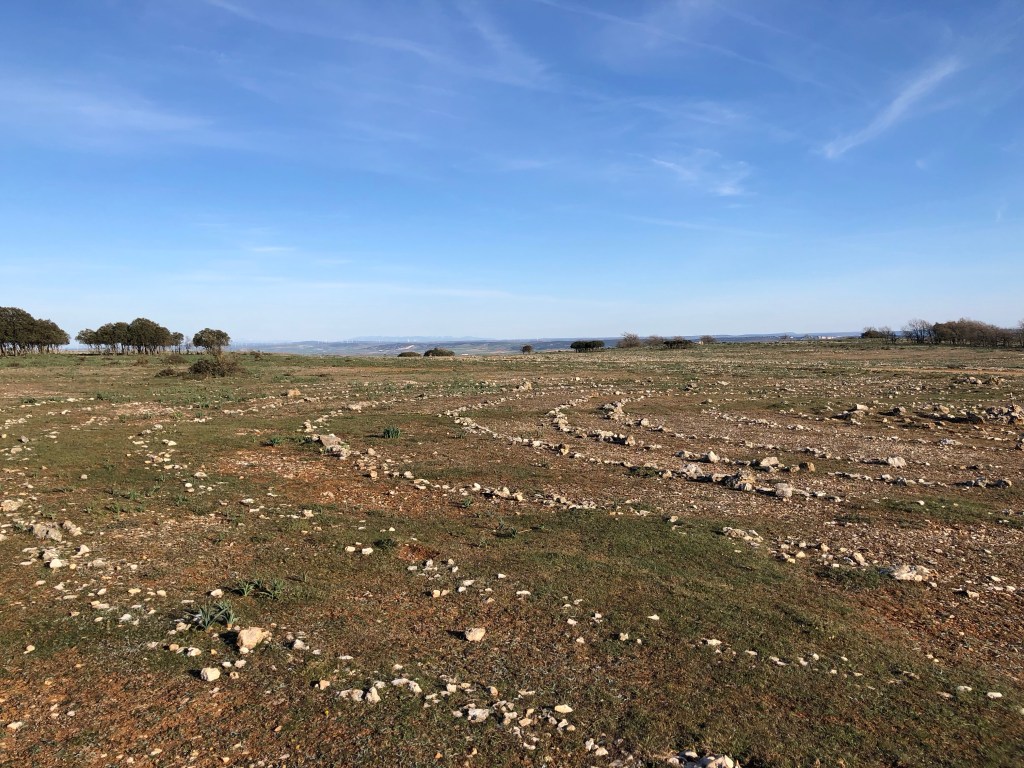
From the mystical heights of ancient Atapuerca with its lonely wooden cross and stone circle, you look down from the last high place upon the city of Burgos and the seemingly endless reach of the Meseta beyond, with the daunting white cliffs of the Picos de Europa clearly visible over 130km away.

Having waited for my companions at the cross, I joined them for the descent into Burgos, but when their stop for a mid-morning snack threatened to stretch over an hour, my itchy feet swept me back onto the road again. It would be the last time I spoke English on the Camino this year, because from there on out the only people I encountered were Spaniards on the road (they took long enough to find!).

For the final twelve kilometres into Burgos I was joined on the road by Fran, a programmer from Soria in his twenties who was an enlightening companion. From him I learned that the Spaniards, as I suspected, had indeed done the Camino for Semana Santa, but they had started at the beginning of the national holiday and were thus a few days ahead. I also learned about his home town of Soria and how the Mesta have monetised their trade, turning what was once an affordable experience following the shepherds’ route into a glamorous eco-tourism experience to the tune of 200-300€. He also gave his thoughts on the Catalan question, likening it to a dog barking furiously at a door which, when it is finally opened, suddenly goes quiet – it is easier to hate when you cannot see what it is that troubles you. Or something like that. I was just happy to be speaking Spanish – and flattered to be told that if I hadn’t revealed I was English in the first five minutes I’d have had him stumped, as he was genuinely ‘confundido’ by my Spanish.
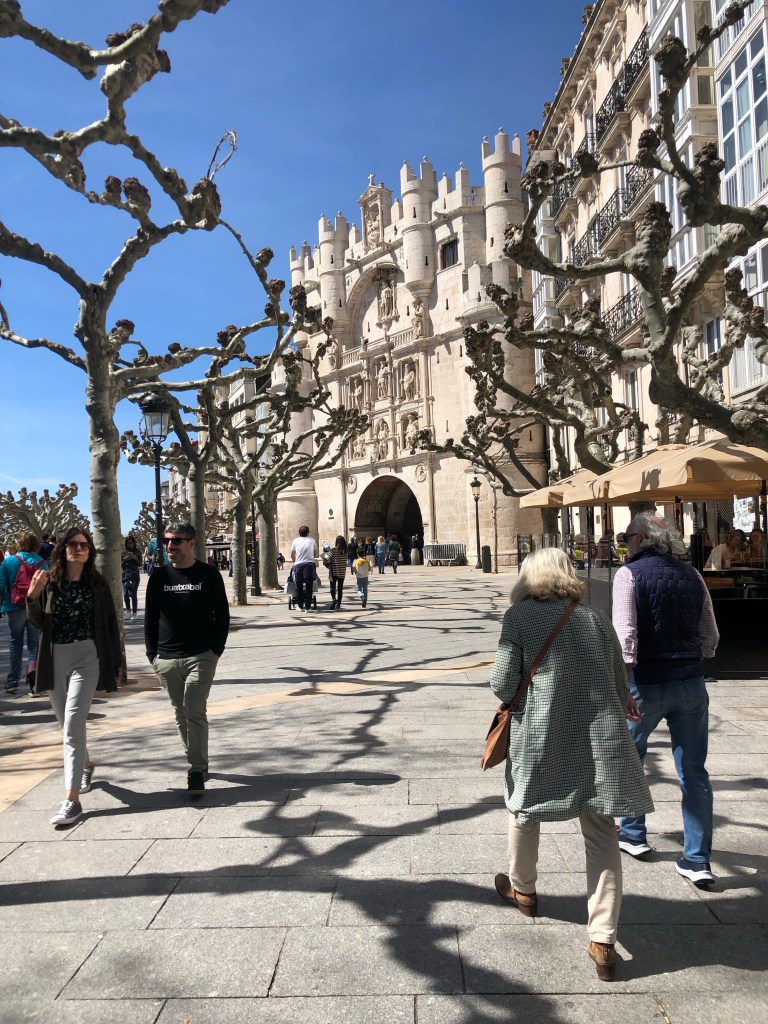

I took my leave of Fran outside Burgos’ enormous cathedral, after a brief conversation with a local (‘De dónde sois?’ : ‘Yo de Soria,’ / ‘Y yo de Inglaterra, pero con familia en La Mancha.’ / ‘Soria e Inglaterra? Menuda familia los dos.’). Fran took off to catch his BlaBlaCar home and I set out in search of my hostel.

I didn’t get much of a siesta, because the next guest to arrive was another Francisco, this time from Puebla, México. After a brief exchange over the subtle numbering of the hostel beds we ended up talking for close on two hours about a number of topics, with him asking after my thoughts on Italy, Spain and the British Empire and me asking for his wisdom on La Malinche and nahuatl. He is on a quest much like I was years ago: on his tour of Europe he has come to far-flung Burgos to seek out the village of Grijalba, from which he believes his father’s ancestors may have hailed (through the legendary explorer Juan de Grijalva).

It is always heartwarming to meet another traveler on the road, but especially so when they are on a quest – you don’t meet many of that kind these days. Perhaps it is fate that the day started in Bar El Alquimista, named for Paolo Coelho’s famous novella.

After one more conversation in Spanish which left me feeling more confident than ever before, I led the pilgrims of our group that remained down a side street in search of dinner. It couldn’t have been a better choice: six raciones and a salad split between us made a feast such as we hadn’t had yet. Morcilla, croquetas, calamares and sepia a la plancha, torreznos and zamburiñas (what more fitting food for pilgrims than scallops?)… it was far and away the best I’ve eaten on the trail.
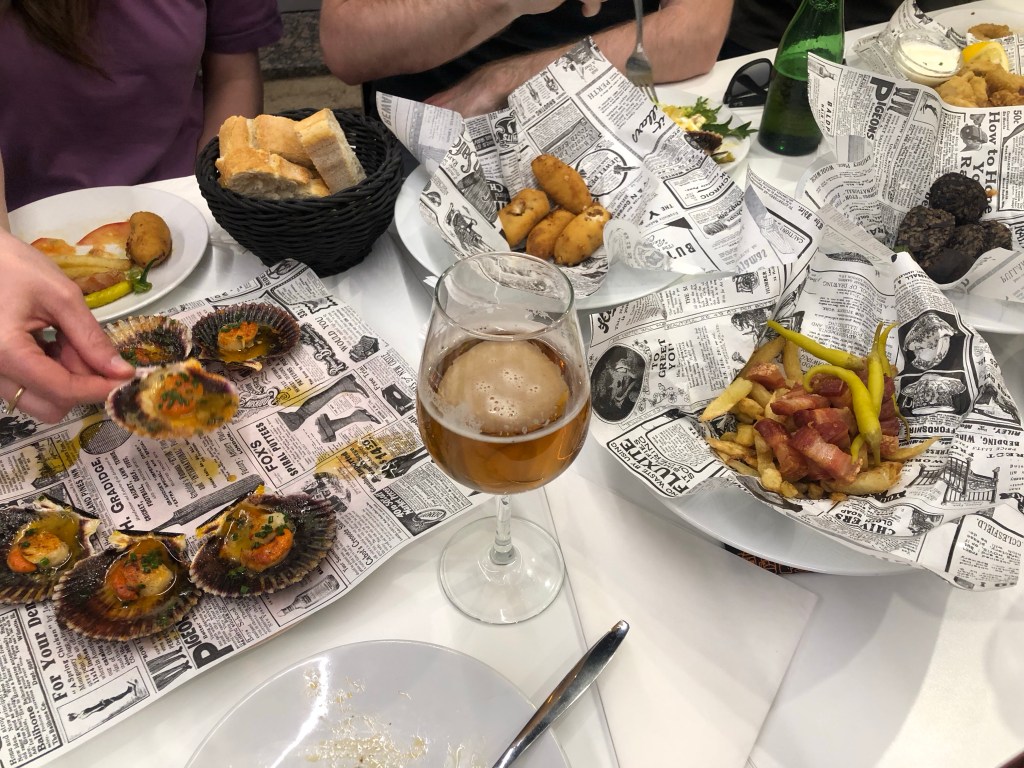

And I didn’t have to pay a cent, since the generous Dane in our number footed the bill before we twigged what he was up to. I’d done something similar a few days prior, so I guess he was paying me back, but that kind of generosity is what makes the Camino so special. For our last meal as a group, I could not have asked for more.

I’ve never bonded with other peregrinos quite so quickly, and I wish I could take the road with them to the end. But every road leads to a parting, and we part as friends.

It is not the end of the road for me, but rather a parenthesis. One day I will come back here, to the ancient city of Burgos, and pick up the Camino where I left it. Hopefully I’ll meet other pilgrims like them who will make the road an adventure with friends once again. Sophia’s charm and maturity. Mikkel’s wit and his generosity. Katie’s wisdom and Lachlan’s humour, courage and peace of mind.

Domenico the Carabiniere. Enrique the Arriero. Phil the Professor. I have met so many characters on the Camino this time. That has been the real blessing of the road this Easter. I’m glad I came. Truly. (And especially since it was a whim decision just over a couple of weeks ago).
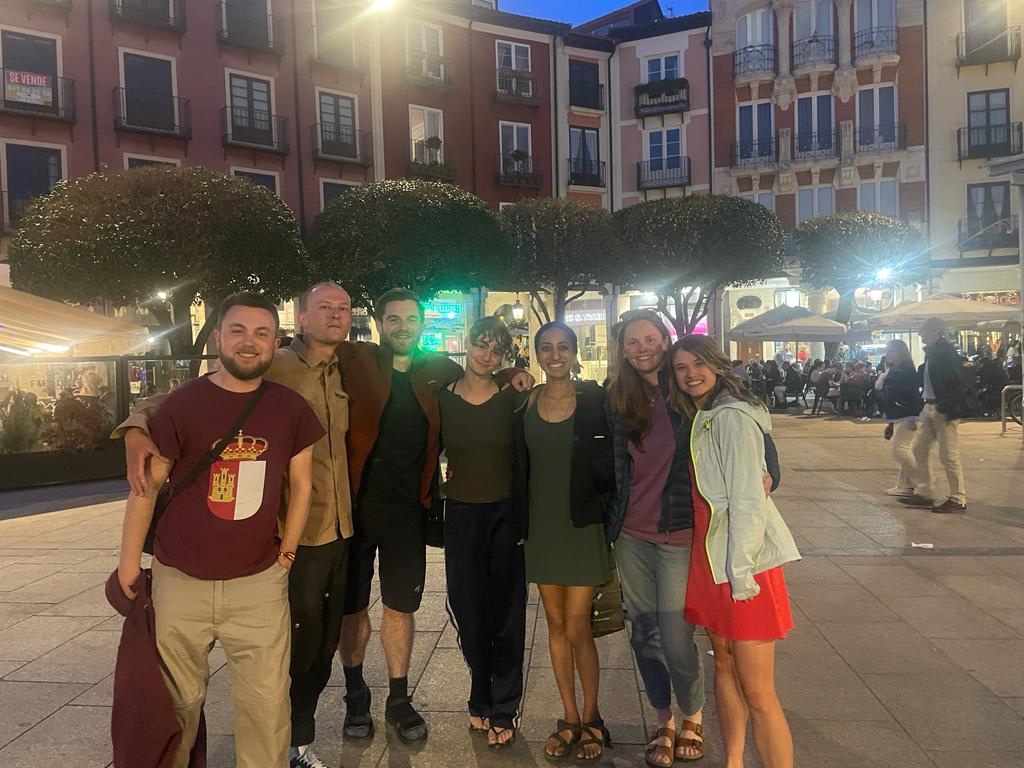

It’s now half past eight in the morning. By now they will have left Burgos and will be somewhere on the road to their next destination. All I can do now is wish the four of them all the best on their road to Santiago. And someday, sooner or later, I will take up my shell once more and follow them. BB x

Tzompantli: An Ode to Extremadura

On Monday, I kick off my new role as the middle school gifted and talented programme coordinator with a lecture on the Aztecs. It wasn’t the obvious choice, as Mexico is a country I have neither visited nor researched nearly as extensively as my grandfather’s country. As a matter of fact I made a conscious effort to steer well clear of Latin American affairs at university, cleaving to the Iberian modules even when it meant the pickings would be slim. If Durham’s only Cervantes specialist hadn’t been on maternity leave in my final year, I could have stayed quite happily in my fairy-tale world of knights and princesses and Moorish warlords and binged on ballads, and I wouldn’t have had to go anywhere near strap-on wielding Catalans and metaphysical Madrilenians. Oh Quijote, en mala hora me abandonaste!

Ordinarily, for such a school project I would have stuck to my guns and wheeled out some Moorish magic with a talk about Islamic Spain, something that is close to my heart; or El Cid, a man whose legend (and whose 1961 movie) is embedded, thorn-like, a couple of inches deeper. I even briefly considered whipping up something about pirates, but I haven’t read nearly enough to do that one justice. Not yet.

I landed upon the Aztecs for a couple of reasons. One, because the book I have chosen to read with my IB students is Laura Esquivel’s Malinche. Two, because my school – or rather, the people whose money built the house in which I now live and work – has a long history with Mexico, a connection that is plainly carved into the stone in several places.

But I think the main reason I wanted to explore the Mexica was because it ties me back, through the ruthless conquistadors, to a place that is still very dear to me: Extremadura.

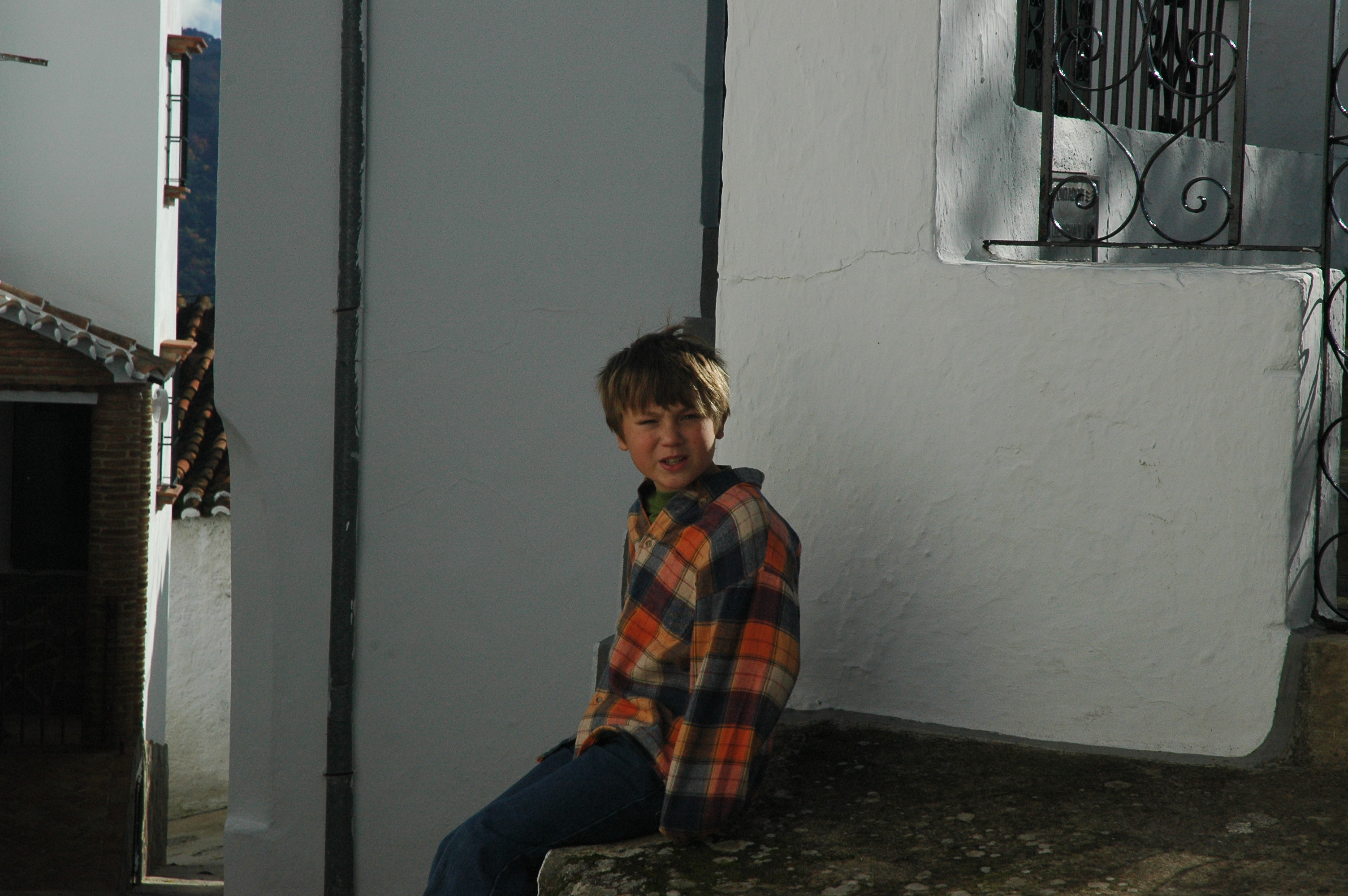
My first contact with Spain was with Andalusia, with her jagged crags and whitewashed mountain villages. If I wasn’t spellbound there and then, my mum and dad must have been, because they made the crazy decision to up sticks and move us there in 2006… right on the eve of the financial crisis that was already driving many of Spain’s expats out. It might not have been the wisest move for three out of the four of us, but after a year of weekend hikes in the surrounding sierras, gecko-hunts in the streets by night, Holy Week spectaculars and vulture-chasing in the misty heights of El Gastor, I was absolutely hooked. Andalusia was my polestar for many years to follow, and her light shone brightest on the paradise of the tierras rocieras of Doñana National Park.

(The author, blinded by the light since ’05)

Over the years I braved her jealousy and flirted with her sisters: a school trip took me from Barcelona and the magical Mediterranean town of Tossa de Mar up and into the clouded dales of Cantabria and the foothills of austere Asturias. Legends of the Cid led me to Burgos and the empty plains of Old Castile, the guiding light of my ancestry led me home to la Mancha, and in recent years I’ve swum in the crystal waters of Mallorca and Menorca. Throw in flying visits to Aragon, Alicante, La Rioja and the Basque Country and it’s getting to the stage where there’s hardly a corner of the country I haven’t explored.

But I don’t think I could ever have anticipated the rawness of my obsession with Extremadura. From the moment I set foot on her soil I was lost. It honestly felt like falling in love for the first time. Not the high school crush kind of falling in love, but that kind of mature depth of feeling, that gut-wrenching, iron-tasting jolt in your upper body that tells you something’s starting functioning inside that was only dormant before.

Oh, cut the poetry already, BB. If you’ve been reading this blog as long as I’ve been writing it, you’ll know I didn’t actually talk like that when I arrived in Villafranca de los Barros on that hot September afternoon seven years ago. But hindsight is a wonderful thing, and any corner of the Earth that could convince me to jettison my plans for taking my teaching game over to South America for a second (and very almost a third) time must have an awesome power.

When Hernan Cortes and his men entered Tenochtitlan, one of the greatest cities of the world at the time, one of the things that shocked them most of all were the dreadful tzompantli, wooden scaffolds nearly two metres in height that carried between them the many thousands of impaled skulls of the sacrificial victims of the Aztecs. They came back to Spain telling wild tales of eagle warriors and war priests with matted hair and bleeding knives, and when one reads of the savagery wielded in the name of Castile upon the Mexica, it isn’t hard to understand why it’s been so popular until recently to discount the stories of tzompantli as a myth invented by the conquistadors to justify their actions. Until 2015, the year I moved to their homeland, when the bases of the huey tzompantli were uncovered in Mexico City, complete with row upon row of human skulls, laid out like so many candy calaveras on Dia de los Muertos. The conquistadors, for all their sins, must have had stories worth telling, if only people would listen.

Extremadura is one of those places I will probably write about again and again for the rest of my life. If Andalusia was my first crush, Extremadura was the lady who captured my heart for good. Not even the knowledge I have now that ties my bloodline more closely to Valencia than la Mancha can put a stain (no pun intended) on my devotion to her. Hers is a story I would tell and tell and tell until my tongue split in two.

Tzompantli: an image which struck no small amount of awe and fear. The presence of a God or Gods unknown (and a word that first threatened to split my tongue in two, but is now so satisfying to say that I have rather awkwardly made it the title of this post).

That is my Extremadura. Unknown. Disconnected. Hard to say. Trainless. Abandoned. The conquistadors couldn’t get out fast enough. Malaria festered in her hidden valleys long after it had been extirpated everywhere else, and the Mesta virtually enslaved her very earth to their will, subjecting her people to centuries of poverty. But it is precisely because of these fascinating tales – coupled with her unparalleled natural beauty – that I do believe Extremadura to be the jewel in Spain’s crown.

And oh, look – I started writing about Mexico and here we are, back in Spain. I’m nothing if not predictable. Some of us spend our lives traveling in search of that “something” that is just beyond our reach. I count myself amongst the lucky ones who found what I was looking for and need look no further – at least, no further than the light that shines on Spain’s shores. I can only hope Doña Extremadura forgives my curiosity.

Did Rodrigo, last of the Visigoth kings, truly disappear in her mountains after the fall of Merida? Did an army of ants reduce one of her villages to rubble? Were there really hordes of dwarves in Las Hurdes who descended into the valleys by night to terrify the locals? And what made Carlos, supreme ruler of the Spains, the Americas and all the Hapsburg Empire decide to spend the last years of his life in her wooded hills?

You will only find out if you go. Don’t hold on too tightly to your heart. BB x

P.S. Thinking about sharing some more stories from this part of the world… watch this space.

Quote Unquote: THE LIFE AND ADVENTURES OF JOAQUÍN MURIETA by John Rollin Ridge

This week I’m looking into a rather different kind of novel, albeit one much more in line with my usual taste. Often considered the first novel by a Native American writer, John Rollin Ridge’s The Life and Times of Joaquín Murieta: The Celebrated Californian Bandit is a remarkable account of the life of one of America’s most infamous outlaws. I have no misgivings in making such a claim: Joaquín Murieta may not be a household name like Butch Cassidy or Billy the Kid, but as the primary inspiration for Zorro, and by proxy Batman, the Californian bandit’s legacy is alive and kicking.

As might be expected of a bandit narrative, Joaquín’s tale is a tragic one. Ridge paints a picture of a man who set out with honest intentions but turned to villainy after being wronged once too often on account of his being a Mexican in an increasingly intolerant America (a situation that still resonates painfully across the ages). Finding himself on the wrong side of the law, Joaquín sets out on a career of vengeance against the nation that would not let a man like him earn an honest living. Along the way he gathers about him a colourful cast of characters, including his sweetheart Rosita, his brother-in-law Reyes Feliz, his nemesis Captain Love, and his bloodthirsty second-in-command, the unforgettable Three-Fingered Jack. The end is never in question – millions before and after Murieta have paid the price for defying the might of the United States – but such is the degree of Joaquín’s panache and gallantry that you might be forgiven for willing him to succeed, no matter how many bloody crimes are committed in his name.

To the modern eye, Ridge’s account comes across as half-story, half-history. This is not altogether untrue: the events within the narrative have been, to a greater or lesser extent, subjected to a fair degree of fictionalisation. An overarching narration of events takes precedence over dialogue and character development, and though Joaquín is very much the star of the show, this is as much the tale of his friends and foes as it is his alone. There are elements of the story that make for some hard reading in the twenty-first century – namely, the casual racism employed towards the Chinese, who fall before Joaquín’s men like wheat in the wind. Where Mexicans and Americans stand their ground and fight to the death, all of Ridge’s “Celestials” (an outdated slur used frequently in the narrative) are cowardly weaklings who habitually grovel and flee at the first sign of danger. They feature as a nameless swarm, fodder for Three-Fingered Jack’s bloodlust and a lawless whetting stone for the sorties of Joaquín‘s gang, since their slaughter rarely if ever provokes any reaction from the Americans. Ridge is, of course, speaking with the voice of his time, but given how evergreen the anti-Mexican sentiment of the narrative remains a century and a half later, it is hard not to draw comparisons to the present. Joaquín’s vendetta is in many respects a racial one, but it is rationalised through his personal tragedy. The xenophobia of his enemies cannot be so easily waived, and the indifference of the Americans upon his slaughtering of the Chinese miners speaks volumes.

I have been passionate about bandits since university. I am not entirely sure why. There is something raw about the idea of banditry that appeals to me, as it must have appealed to the Romantics of the nineteenth century. I chose to study Spanish bandit legends for a research project in my third year at university and I have been hooked ever since. I suppose it could be summed up as follows: the further removed one is from violence, the more exciting that violence appears. Some travellers in the 1800s came to Spain with the express purpose of seeking out an encounter with the bandit chiefs they had read about, leaving bitterly disappointed when they returned home unharmed. As I sit down to write of the legend of Joaquín in the comfort of my study, with the faces of surly Andalusian highwaymen staring down at me from the framed Doré prints on the walls, I am no less afflicted than my predecessors. Joaquín Murieta joins their ranks as a fearsome commander, standing tall alongside other such legends: Serrallonga and Roque Guinart; Diego Pernales and El Barquero de Cantillana; Tragabuches, Pasos Largos and El Tempranillo.

It is easy enough to conjure up a fantasy in one’s mind of the lawless world of Gold Rush-era California, but to do so with any degree of accuracy from the niceties of the present day would be no small feat. To write convincingly about the past, one must ignore the attitudes of the present and fully espouse the zeitgeist of the era in question. Therein lies the pitfall, for where is the storyteller who writes for an audience long since dead? And where is the book that is totally free of the truths and prejudices of the day? The very act of putting work into the public domain is to subject it to the scrutiny of the present-day readership, and it is upon this anvil that a story’s success may be made or unmade. To tell Joaquín’s story with more than a kernel of truth today would be to wind the clock back beyond one hundred and fifty years of social change, to a time when it was not essential to take into account the sensibilities of every featured demographic. Ridge’s account sounds so very believable because it was written not long after the events in question occurred, but even then his account is not unbiased: the author’s sympathy for Joaquín bleeds through his writing, for Ridge, a Cherokee, had plenty of reasons of his own to hate the Americans, having lost his father at an early age at the beginning of the events which would lead to the infamous Trail of Tears. History is warped by the age in which it is scrutinised, like a kaleidoscope that twists with each passing year.

August 3rd, 2019. A lone gunman walks into a Walmart in El Paso, Texas, and shoots twenty-two people dead, supposedly in retaliation for the Hispanic invasion of Texas. Within forty-eight hours, a Mexican spokesperson calls the attack “an act of terrorism” against Mexicans living in the US. The men who assaulted the young Joaquín Murieta and raped his wife got the sticky end they richly deserved in Ridge’s account, but in reality they were merely the heads of a greater hydra; the intolerance and hatred they represent is with us to this day. The story of Joaquín Murieta is all the more important now than it ever was. Here is the legend of an ordinary Mexican who was made into a monster by the land of opportunity, but who, like countless bandit heroes before him, rose above the darkness in the hearts of his people to become something eternal: a folk hero.


Favourite Scene:

The parallels between Joaquín Murieta and his illustrious descendants, Zorro and Batman, are mostly subtle ones, drawing largely on the bandit’s sense of nobility and his fight for justice. But there is one scene in particular that is especially poignant in its cultural impact. Having met with an old acquaintance on the road, Joaquín warns him to tell nobody of his presence in the state. The traveller swears he will be true to his word and goes on his way, but upon arrival at the nearest town, he hears talk of the bandit chief and talks of his recent encounter. Unbeknownst to him, Joaquín has friends up and down the country and, hearing of this betrayal from one of his spies, takes the matter personally. He comes to town in disguise, seeks out his old friend and, before dispatching him with a single shot, removes his disguise and declares the immortal line “I am Joaquín!”. It becomes a recurring staple of the legend of Joaquín that he fearlessly reveals himself before making a kill, and it would not surprise me in the slightest if Batman passed over Zorro and got his line directly from the Ridge’s book.


Favourite Character:

Murieta is a man worthy of three legends in one lifetime, but there’s another man in his saga who towers above the rest, and that’s Manuel García, more commonly known as Three-Fingered Jack. Next to Joaquín, Jack is easily the most memorable character, serving as a gruesome foil to Joaquín’s nobility and a grim reminder of the reality of the nature of banditry. Three-Fingered Jack’s unfettered violence is truly galling whenever and wherever it occurs and casts a long shadow over the villainies of his compadres, whose handiwork seems almost gentlemanly in comparison. There seems to be nothing at all redeeming in his character, and yet there is something immensely appealing about the monster – I honestly expected more of the wolverine in his last stand than he actually got.


Favourite Quotes:

They might as well have attempted to catch the red-winged spirit of a storm.

“If you betray me, I will scatter to the winds all that you have and all that you love.”

That terrible, three-fingered hand, which had dyed itself in many a quivering heart, had torn with its ruthless talons the throats of many an agonised victim, and had shadowed itself forth upon the horrified imagination of thousands who only knew that it existed.