Camino XIX: White Magic

Albergue Rosalía, Castrojeriz. 16.44.

I’m back in Castrojeriz, a Castilian hill-fort town some twenty-one kilometres down the road from last night’s stop in Hornillos. I probably could have gone a little further today, but there’s a local festival in town and I wanted to check it out. It’s much too easy to lose track of things on the Camino over a good conversation, and in so doing miss something special.

I mean – it is a garlic festival. So it’s nothing extraordinary. But I happen to love garlic (sopa de ajo is my favourite dish in the whole world) so I feel duty-bound to check this one out.


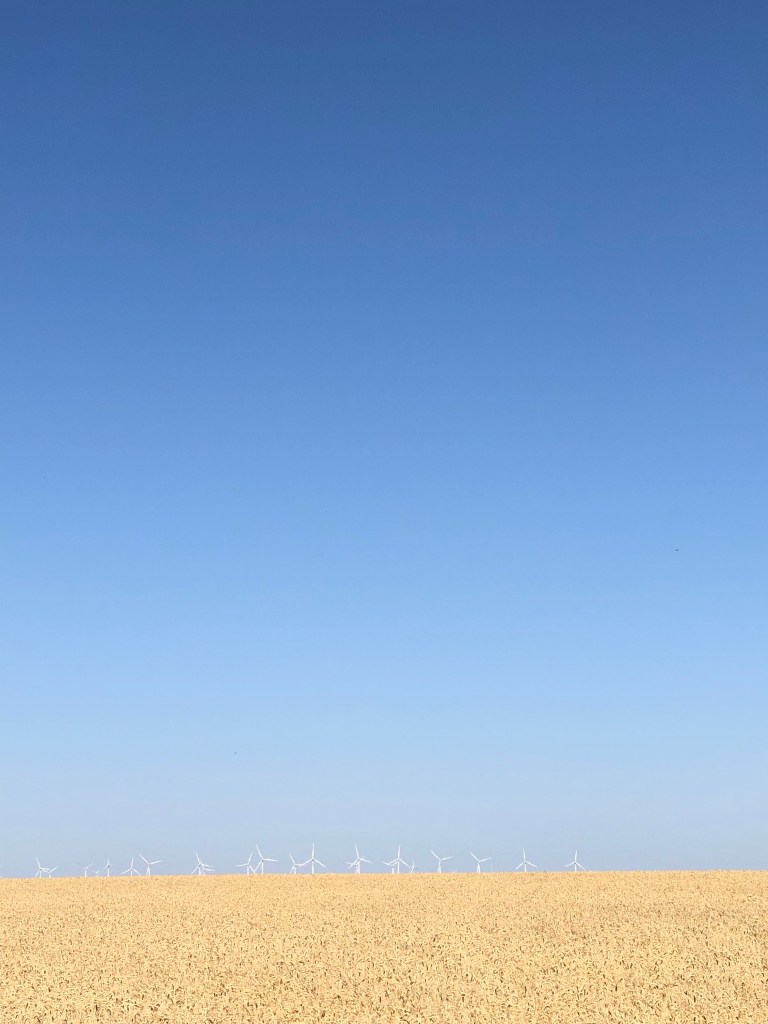
The hospitaleros at Hornillos left out a proper spread for breakfast, so we ate well today. Even so, we were up and gone by 6.20am, shortly before sunrise – which is getting noticeably later each week. The turbines on the surrounding hills continued to spin in the twilight, their red warning lights blinking like eyes along the blue horizon.
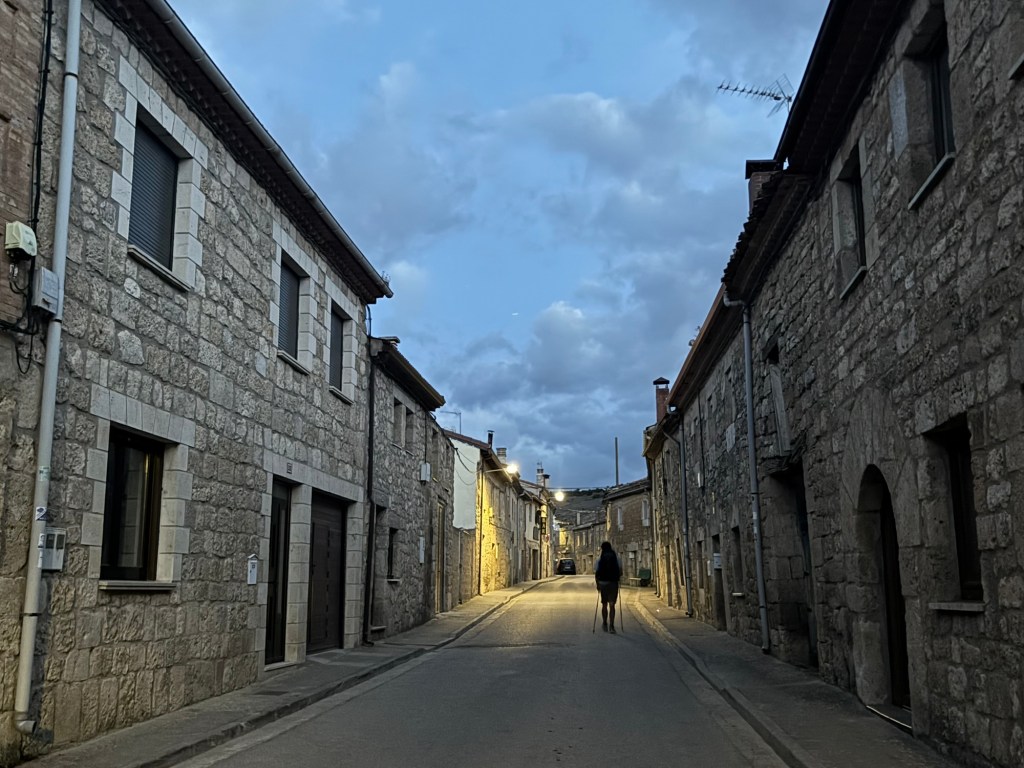

A gentle blanket of cloud shrouded our ascent up to the high meseta west of Hornillos. Apart from a few simple crosses erected along the road, the terrain was featureless, and all the shadows harrier-shaped: I counted at least seven Montagu’s harriers quartering the fields between Hornillos and Hontanas, from the agile ring-tailed youngsters to the ghostly silver shapes of the adult males. Vultures always take the top spot in my animal pantheon, but Montagu’s harriers are absolutely in my top five.

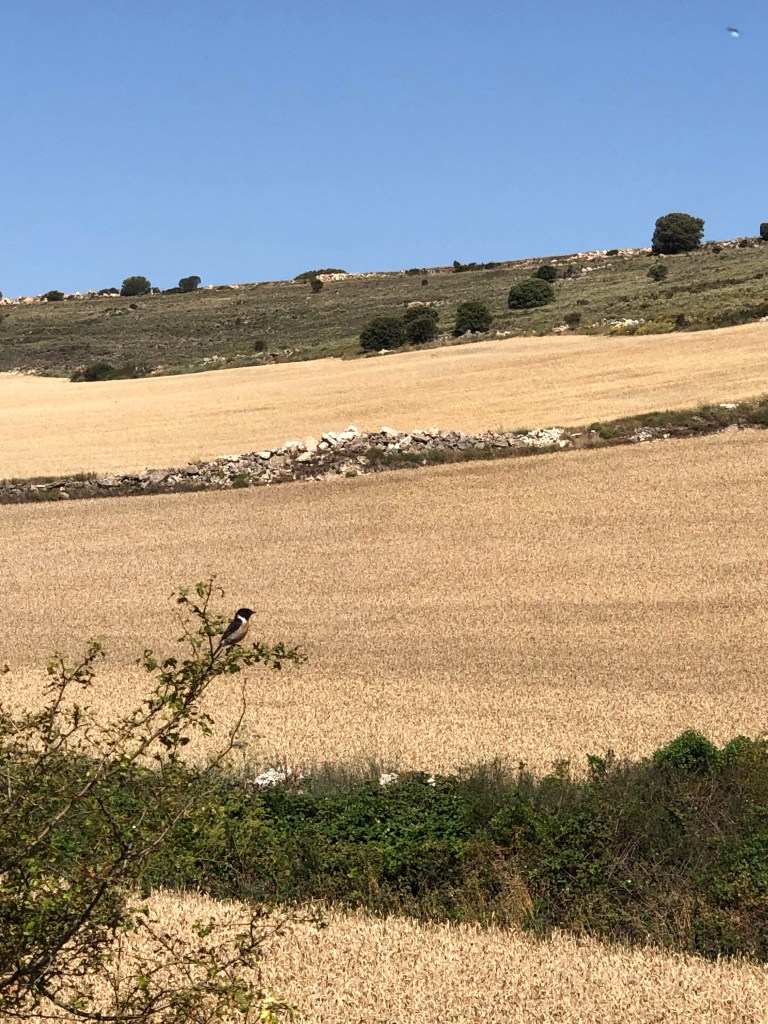
There’s not much a mobile phone can do with these elusive spirits, but you can just about make out the long-tailed shape of one in the photo below.
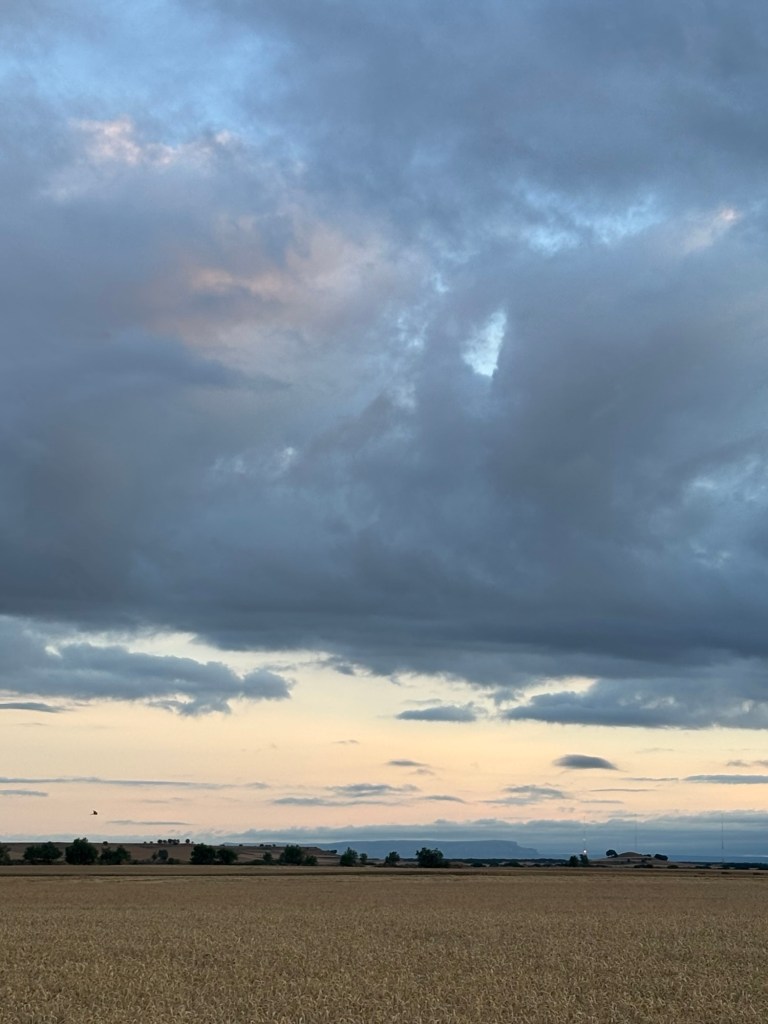

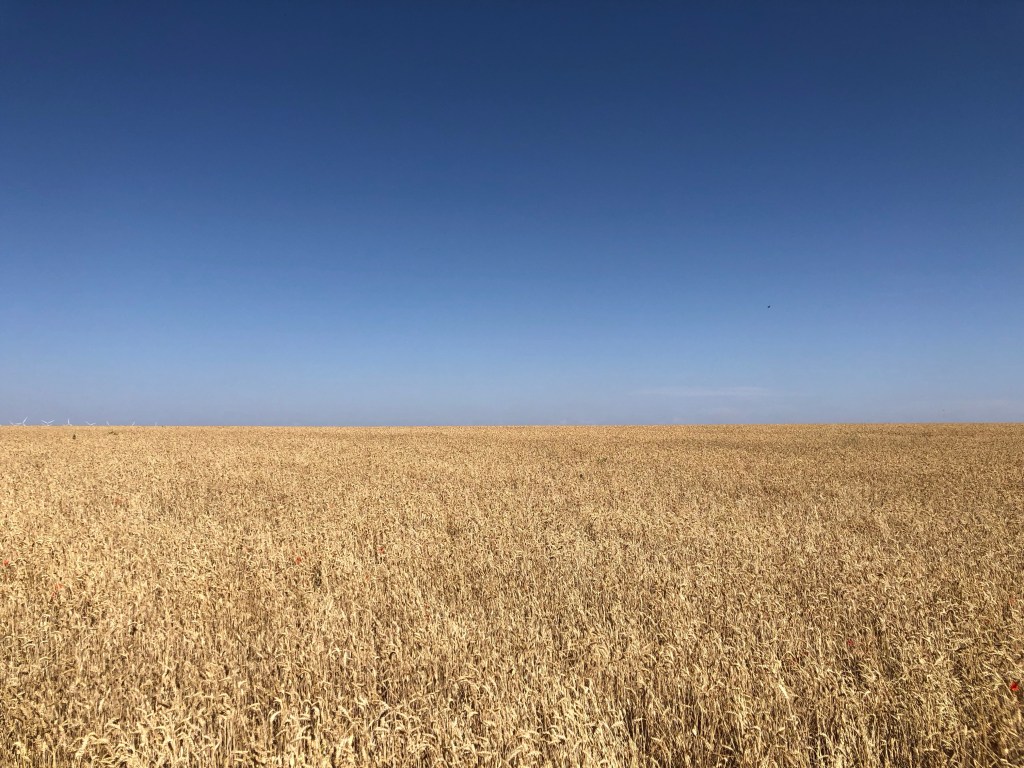
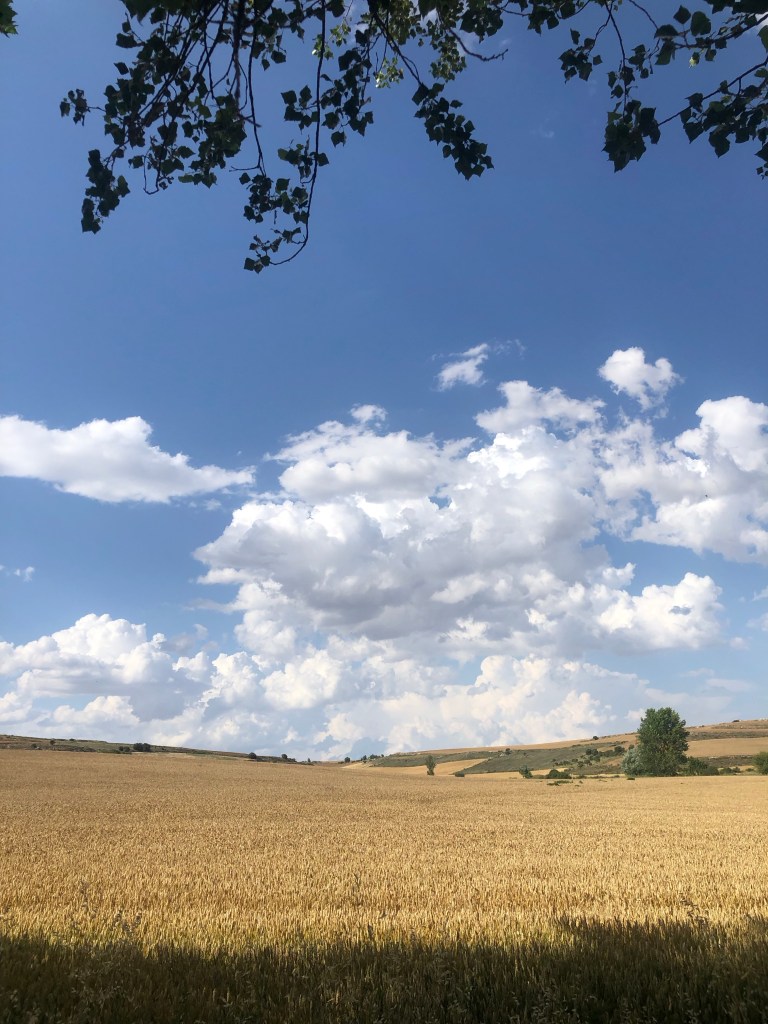
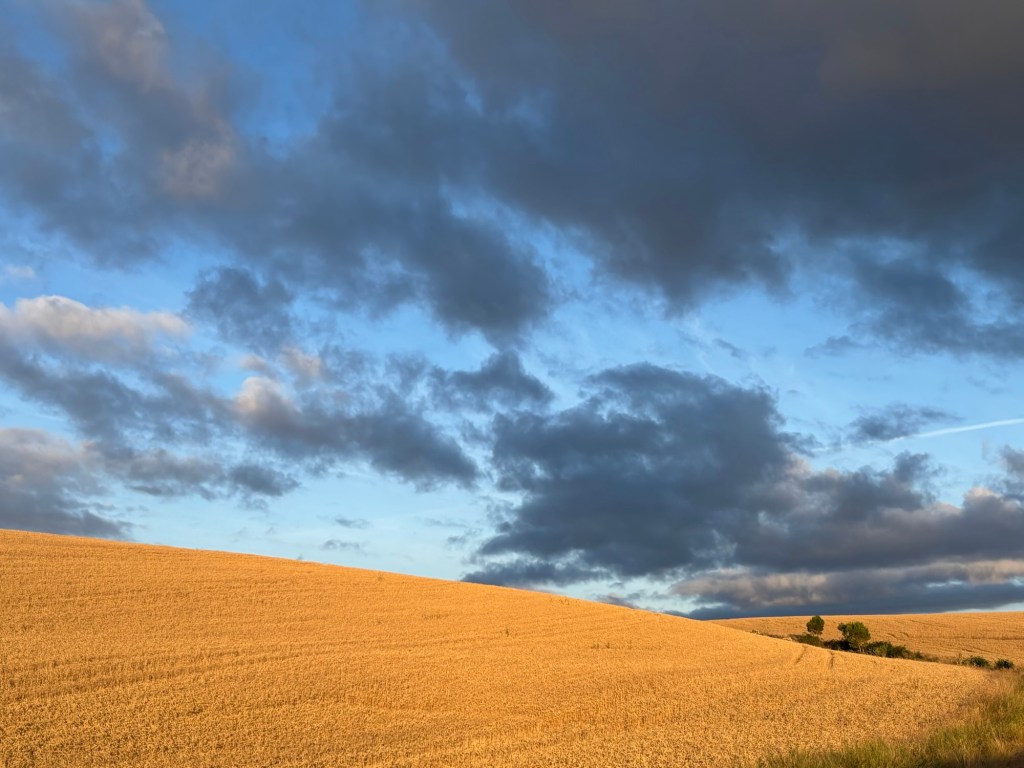
The sunrises over the meseta are peerless. It’s amazing just how many colours come out of the fields of gold, which pairs better with the sky than the grapes of La Rioja with the local jamón. I can’t imagine walking this route in winter, when the fields are stripped and bare. It must be spiritual then, too, but I would miss the warm hues of the wheat.

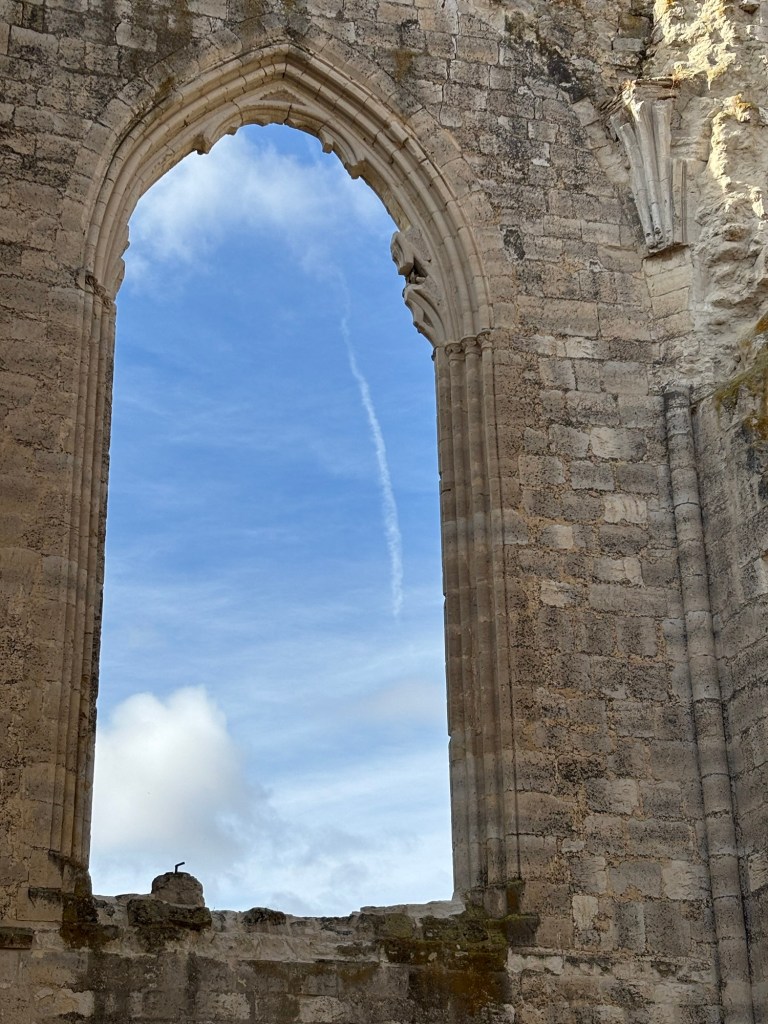
To reach Castrojeriz, you have to pass through the ruins of the Monasterio de San Antón. According to my route planner, I had intended to stay here, but it was only ten o’clock, and the day was still very young, so I pressed on – but not before snapping some photos of what is easily one of the most breathtaking buildings along the Camino Francés, with its ruined arches spanning the road to Castrojeriz.

The monks quartered here used to treat those afflicted with Saint Anthony’s Fire, a sickness we now know as ergotism. Advances in agriculture have more or less eliminated the disease, but the source is all around us in the wheat and rye that once carried the sickness. Before the causes were understood, the spasms and hallucinations that sufferers endured were believed to be a form of divine punishment or demonic possession. It’s hard to say whether the monks’ sanctified treatments truly worked, or whether the cutting-out of rye from their diet was what made the Order so effective. Either way, the monks resorted to a Christian form of white magic to keep the locals safe back in the day.

I like to imagine their ministrations might have saved the lives of at least a few pilgrims bound for Santiago over the centuries.

Gust was waylaid by a photographer for about half an hour on the road to Castrojeriz, and I was only spared the same fate by his silent warning to stay away and the timely arrival of two British university students, one of them a Durham undergrad. They stopped a little way along with their group so I couldn’t walk with them for that long, but I hope I can catch up to them again at some point before León.

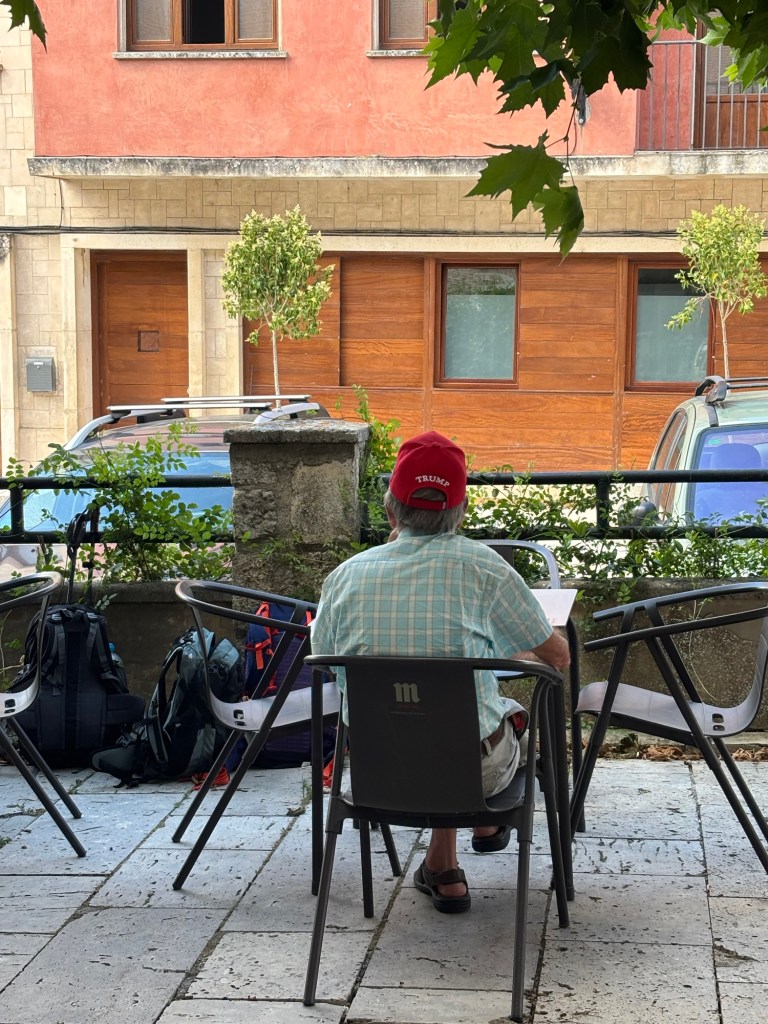
I rejoined the Americans at Castrojeriz and we grabbed a drink before lunch, partly out of curiosity to see whether Gust could extricate himself from the photographer’s grip. We were more than a little surprised to see a MAGA hat, but nobody dared to engage the man in conversation. If he was a pilgrim, he was traveling very light indeed.

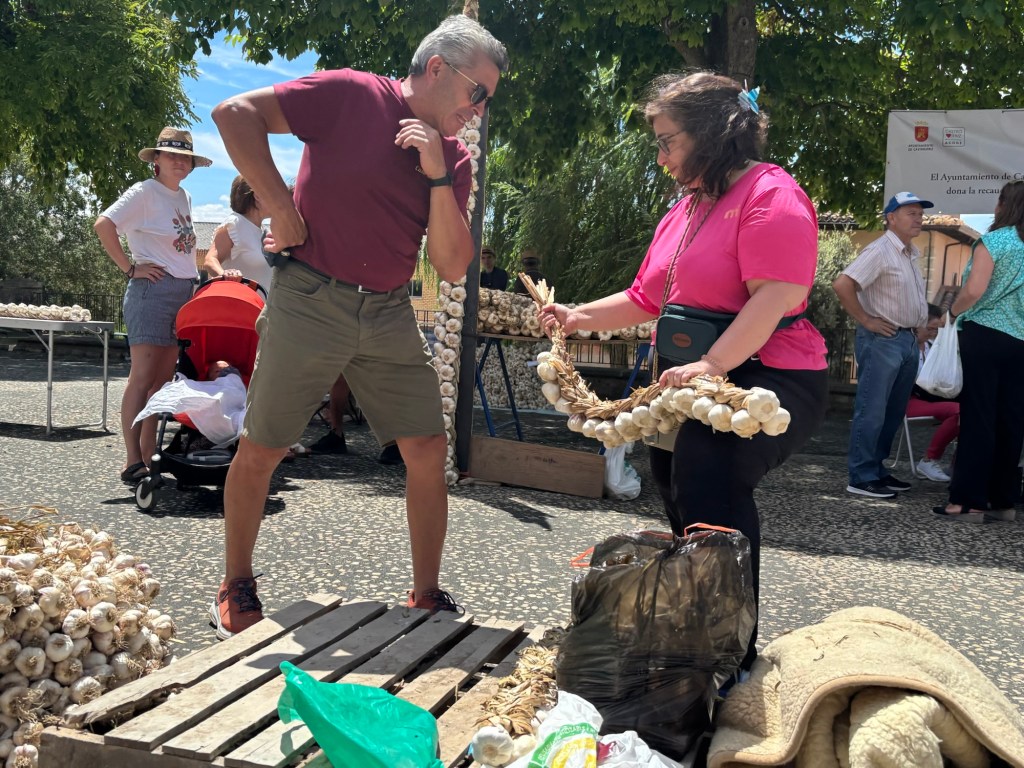
Downtown, the garlic festival was in full flow. A charanga band was marching around town, playing their oompah-like music wherever they went (just like back in Nájera), while old folks huddled around their collection of cloves and groups of kids in matching tee-shirts ran rings around the market stalls.
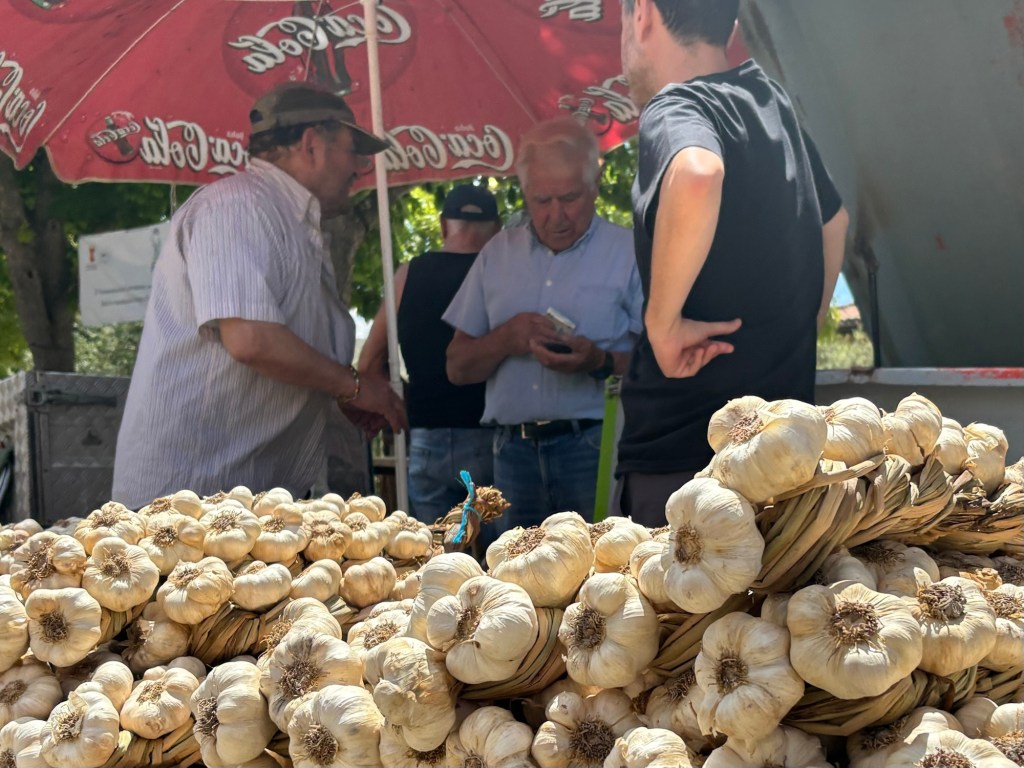

I suspect the Feria del Ajo is a relatively recent innovation (I’ve seen the number 46° floating around), but I shouldn’t wonder that this kind of harvest festival has been happening here for far longer. There’s a food-tasting event we’re going to check out later, and even a concert by the New York Youth Orchestra at 8pm tomorrow – though we’ll be long gone by then.


Garlic is famous in folklore for its protective characteristics, especially against malevolent spirits like vampires and demons. It’s also mightily medicinal, and has been fighting off disease and bacteria in humans for far longer than it has been used to ward off the undead. Given its life-giving properties, it’s easy to see how the latter superstition came about, in an age when Galen’s law of humours was widely accepted as gospel and any and all imbalances, including light and dark, required correction.

Frankly, I can’t think of any imbalances that couldn’t be corrected by a nice, hot bowl of garlic soup. It really is the very best of restoratives.

Audrey has popped out to explore the town. Alonso is watching a movie and Talia has fallen asleep. I might head out for a wander in a moment too, now that things are starting to open again after the afternoon siesta. Here’s to a little more white magic this evening! BB x

Camino XVIII: Exodus

Albergue El Alfar de Rosalía, Hornillos del Camino. 20.03.

I was up at 4am this morning, probably due to the racket put up by the Koreans snoring next door. In any event, they were up and about with headlamps on by five and, since I couldn’t get back to sleep, I figured I’d get ready for the day, too.

It was as well that I did so. I had to intervene with a frantic Spanish woman in her fifties who was weeping into her phone with frustration because she couldn’t find the emergency exit that would allow her to leave the albergue before the main doors opened at 6.30am. I calmly pointed out the stairwell and a minor outflow of five or six similarly lost pilgrims followed suit, including Gust, the young Belgian lad we encountered in Grañón, and Lur, an enigmatic Basque girl with raven-black hair who has hardly said a word but who has been a feature of the Camino since Puente La Reina.


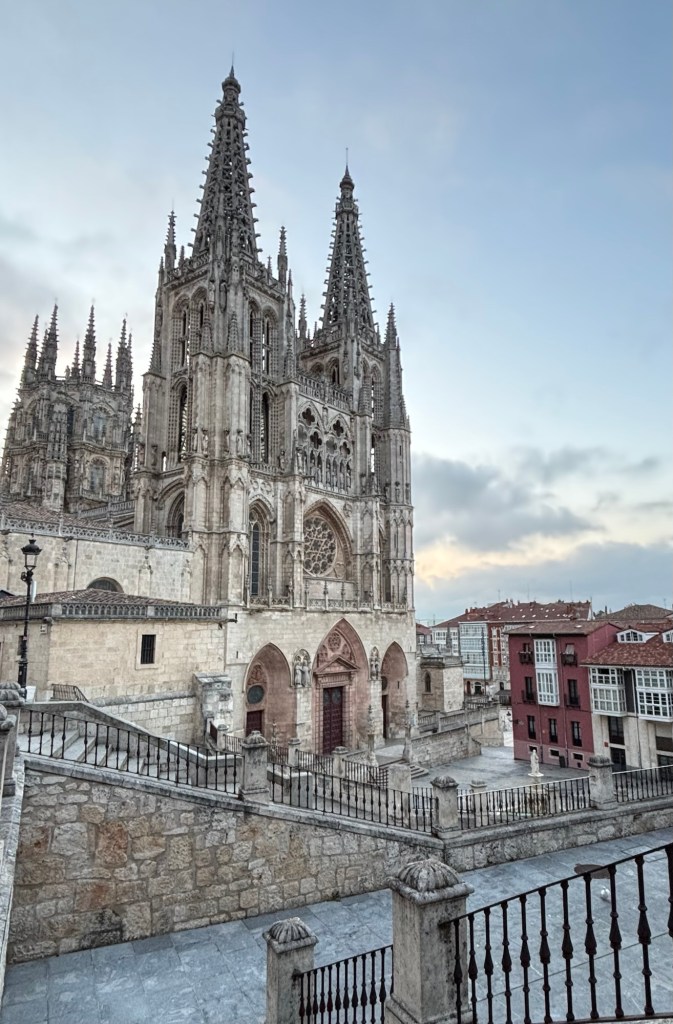
We said farewell to Alex after a last breakfast together outside the albergue and set off just after seven o’clock. Burgos’ Cathedral looked as magnificent as ever in the morning light, its twin towers visible for nearly four hours on the horizon after we left the city.


Leaving the city of Burgos is almost as laborious as entering it, but the west side of the city is a residential district and thus makes for a much more pleasant walk. An old lady redirected us near Villalbilla de Burgos, and while I don’t think it would have made an awful lot of difference if we’d kept going the way we were going, it’s nice that everyone around here id so invested in the Camino that they’re out to help.

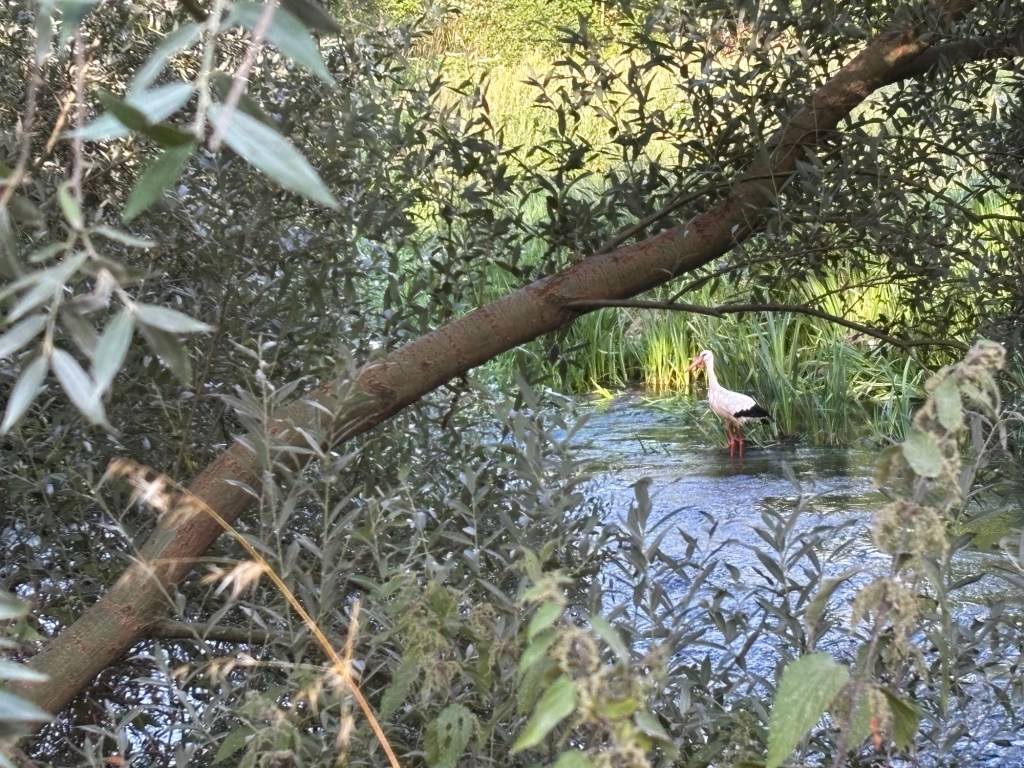
I found a couple of storks feeding in the Arlanzón river just after the crossing. They’re always so unaffected and untouchable in their nests atop the turrets and towers of Spain’s churches, so it’s not all that often that you encounter them in their “natural” habitat, where they are surprisingly wary and don’t let you get too close.


Tardajos’ church was open so I dropped in to collect the second stamp of the day, and a tip-off from pilgrims further ahead alerted us to a nun blessing pilgrims in Rabé de las Calzadas. The sister in question, a little old lady in her seventies dressed all in white from the Daughters of Charity, stood at the door of a little chapel on the edge of town, waving passing pilgrims over to approach. We went over for a blessing.

Spiritually, we’re a mixed group: a lapsed Catholic, a Reform Jew, an Agnostic and a Catholic who has found his way to God relatively recently. But for this last, this moment was one of the most magical of the entire Camino so far.

Taking us firmly by the hand, the Sister talked to us awhile about the spirit of the Camino and what it truly means to be a believer, in the least preachy way I have ever heard. Some of the would-be youth pastors I have worked with in the past would have learned much by her example. She quoted a poet who she could not remember (and I cannot locate) and asked us to go forward with the eyes of an owl, always searching, the heart of a child, always feeling, and the feet of a pilgrim, always walking.

Perhaps she was paraphrasing the Spanish poet Antonio Machado’s Olivo del camino, which has the following line:

Que en tu ramaje luzca, árbol sagrado,
bajo la luna llena,

el ojo encandilado
del buho insomne de la sabia Atena.

She gave us each a small token of the Lady of Charity, blessed us with a gentle hand on the forehead and sent us on her way. A purer soul on the Camino would be hard to find.


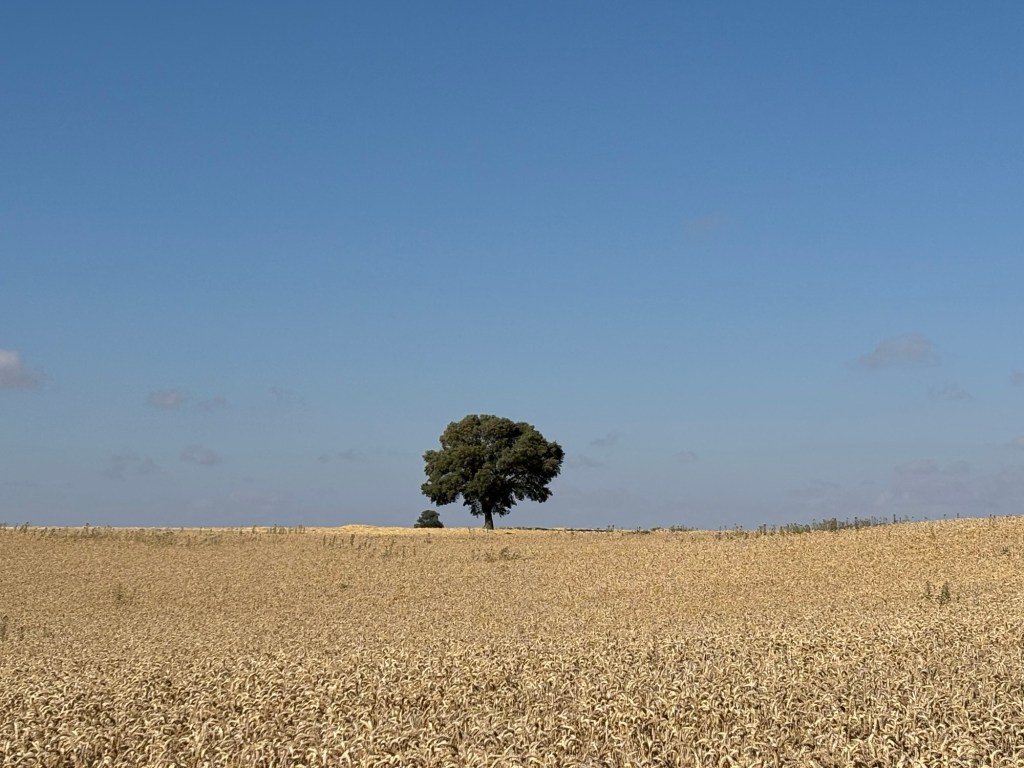
After Rabé de la Calzada, the Camino climbs up one last time and then the Meseta begins in earnest: a vast and unbroken expanse of gold beneath the immensity of the Castilian sky, pushed beyond the reach of man by a thousand generations of Castilian countryfolk.

It is hard to describe the true beauty of the Meseta when so many pilgrims describe it as the “hardest” stage. The “least interesting” stage. The “most boring” or even “the ugliest”. It is certainly true that the spectacular Pyrenean scenery of the first few days is now little more than a distant memory.

But to do so is to ignore the magic of the Meseta. The whistling wind in the golden fields. The gentle throb of the wind turbines on the hills all around. The near total absence of birdsong, interrupted only so often by the twitter of a linnet or the call of a quail. This is a road that can be walked with a companion, but is best walked alone.

For me, this is where the true Camino begins: the road inside, into your head and into your heart, with nothing between you and your thoughts but the sapphire sky.


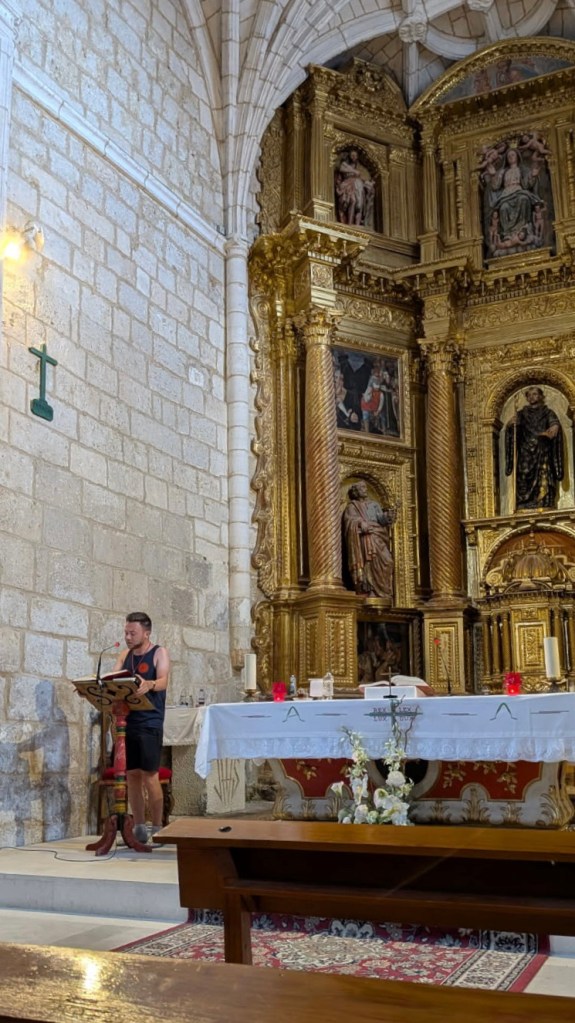
I was going to spend the afternoon writing, but I heard the church bells ringing for the afternoon Mass so I set down my things and wandered over. It wasn’t an especially large gathering, and I was the only Spanish speaker present until a small group of pilgrims from Urgell arrived, so I was called upon by the priest to do the reading. I could certainly have dressed more modestly, even though my options are limited out here, but I wasn’t expecting to be delivering the Lord’s word this afternoon, so… a sports vest, toe socks and Hawaiianas it was.

The reading was from Exodus, 11:10 to 12:14 – by far my favourite book of the Bible. For perhaps the first time in my life, I felt something in that church. It moved me. Not just the sacred words, but… something. Like a voice I could only perceive, that spoke to me without words. For a moment, I felt as though my great-grandparents and my grandfather were right there beside me. It was nearly enough to move me to tears.

When Mass was ended, the priest called us up to the altar for the pilgrim’s blessing. Everyone read the blessing in their own language. I read twice – once in English, once in Spanish. Spanish feels more natural for prayer – after all, if they prayed at all, that’s the language my ancestors would have spoken. And isn’t this all about a closer walk in their footsteps?


I have been on the road for eighteen days now. Twenty, if you count the day and night it took me to reach Oloron-Sainte-Marie and the start of the Camino. It has taken this long to find the spiritual side of the Camino for which my heart has been longing so. I feel more fortunate than ever and my heart is full of hope.

The Meseta stage can be a trial. It can deter many weary pilgrims, especially in the heat of the summer. But I remain convinced that it is where the unspoiled heart of the Camino can be found, in every sense of the word.

The way ahead is clear and my eyes are wide open. I shall follow that road, wherever it may lead, and trust in His plan, whatever that may be. BB x

Camino VIII: Lonely Oasis

I’ve heard various accounts of the pilgrim road across the Meseta. It is so often described as the most arduous stretch of the Camino, skipped by those pilgrims who find its endless expanses of featureless wheat fields uninspiring and/or dull. A dear friend and former companion on the road wrote to me yesterday, calling it “demotivating and mentally draining”. So I haven’t come out here under any illusions.

I’m only one day in, so I haven’t yet got the full flavour of the Meseta. But I’ll tell you what it has in abundance: silence. Spain isn’t a country that is known for peace and quiet – quite the opposite, in fact, being a regular contender for Europe’s loudest country – but if there is a corner of the kingdom where silence is as golden as the fields over which it presides, this is


It should be said, setting off a full hour before daybreak probably didn’t help (yes, I am definitely that pilgrim). The others in the hostel in Burgos must have found my coming-and-going at a quarter past five in the morning frustrating, though I did what I could to soften my steps. I would have thought I had learned my lesson last time, but for whatever reason I’m still working on the assumption that most places fill up quickly around midday.

Burgos was softly lit by a clouded moon as I took my leave of the Cid’s city. Beside the storks, those speechless sentinels of Spanish skies, I only saw two other living things on my way out: a street-sweeper hosing down the steps above the cathedral, and a solitary Japanese peregrino who took a wrong turn. Everyone else with half a brain – the city’s entire population and the rest of the pilgrims on the trail, for that matter – was still in bed, enjoying a few hours’ more sleep.


The sun was up by the time I reached the outskirts of Villalba de Burgos, the first stop on the road. Still no pilgrims, but the Guardian Civil made a couple of appearances as they patrolled the road in their car. Here I took my leave of the Arlanzón river, stopping only to refill my water bottle at a park fountain and to listen to the flute-song of a golden oriole concealed somewhere within the poplar trees.

The Meseta begins to unravel in earnest after the sleepy town of Tardajos, which I imagine presents a good introduction of what is to come. Half the town seems deserted, and this time that has little to nothing to do with the time of day. Squat, single-storey townhouses rub shoulders with taller, more modern homes, though in some cases it is just as much the latter that have their windows boarded up as the former.


I stopped at Rabé de las Calzadas to see if the local church were open. No luck. It looks as though the parish priest serves multiple towns, celebrating Mass first at one church and then another. You can sometimes get stamps in these spots, but it’s really candles I’m looking for – when I can, I like to say a prayer for my grandfather and great-grandparents, for whom I walk this road. They say the reason is that pilgrims would probably try to sleep in them for free and might not be as respectful of their lodging if they did. Which is understandable. So far this year, I’ve only found one I could enter. I’ll keep looking, though.

It’s a steep climb after Rabé up into the Meseta proper. The last green hills of Burgos give way to a sea of gold, unbroken at eye level but towered over by a host of wind turbines that make the place a dry parody of the North Sea: similarly featureless, though a great deal warmer.


I’m getting the feeling this is all coming across as rather maudlin. For a nature lover like me, however, this is bliss. If you can put a name to the sights and sounds around you, you’re never truly alone.

Since leaving Burgos, I’ve been accompanied most of the way by the friendly two-tone song of the stonechat. Families of three – a parent and two fledgelings – seem to pop up everywhere, unbothered by my passing in their tireless search for food. Warblers of every kind – willow, Sardinian, fan-tailed and Cetti’s – sing from the hedgerows, signalling the presence of a river long before it comes into view. Corn buntings, wagtails and jolly wheatears pop in and out of sight between the wheatsheafs. Swifts, swallows and martins fill the empty villages with sound, and hoopoes add a flash of brilliant black-and-white when disturbed in the parks and gardens along the way. In the vast Castilian skies, storks, kites, ravens and solitary griffons are a constant presence, and in the fields below, quail and turtle dove sing unseen, their purrs and whistles keeping the silence at bay. And butterflies of every colour and size are so abundant there’s a very real danger of stepping on them.

On the plateau above Hornillos, I even caught a glimpse of one of my favourite creatures of all: the slender, ghostly shape of a male Montagu’s harrier, quartering the fields like a runaway birdscarer. I haven’t seen one of those since my time in Extremadura, where they find the vast emptiness much to their liking.


I’ve come to a halt in arguably the strangest stop of the Camino so far. Falling prey to my own hubris, as I am often wont to do, I left Hornillos behind and pressed on to what several guidebooks call a “Camino favourite”, the remote Albergue de San Bol. Tucked away in a river valley just five kilometres shy of Hontanas, it is easily missed, and with so many pilgrims keen to race through the Meseta, that’s understandable. I got here at half twelve and found the place deserted, with a sign on the door saying it would be opened at two. I stuck around, taking the opportunity to wash my feet and sandals in the small pool and do some reading while I waited.

Five or six curious pilgrims came by to investigate. None of them have stayed. The first one, a German by the sound of him, asked about a place to fill up his bottle, shrugged and moved on. Another two came by, but went on their way not five minutes afterwards. A Dutchman made noises about staying on but disappeared without a trace while I was washing my clothes. Two Italians rocked up an hour later, who could easily have been my age… only, they were fresh out of school and keen to press on to Hontanas. By this point I’d already made the decision to stay, so I bid them addió and nailed my colours to the mast when at last the local hostalera showed up.

From her I learned the truth – the Camino has been quiet for a few days, but April and May were absolutely heaving this year. That’s probably due to the backlog of pilgrims like myself who haven’t been able to take the road for two years due to COVID. At this time of year, few pilgrims stop at this stage, unless they’re traveling in a group. Would I be alright if I were the only guest tonight, she asked?

Well, so much for my first “communal feel” albergue. On the plus side, it allows me one more day to really be my own boss. It isn’t often on the Camino that you get an entire dormitory to yourself, or the chance to watch the sunset in a place so idyllic as this. I’ve already paid for my bed for the night with the last of the coins I had on me (I really should have taken cash out in Burgos, as banks and ATMs are few and far between out here) so I’m going to kick back and really enjoy having this slice of paradise to myself for once.


There will be plenty of time to socialise on the Camino. But I’m in no hurry – if anything I’d like to avoid the crush in Santiago on Saint James’ day three weeks from now – so I will take my time and allow myself a few later starts from now on. And who knows? If I tarry a while, I might just find more stories in these slumbering villages than I would in the pilgrims tearing through this lonely stage.

Peace out. I’m getting some serious peace in tonight. BB x