Storm Clouds over Soho

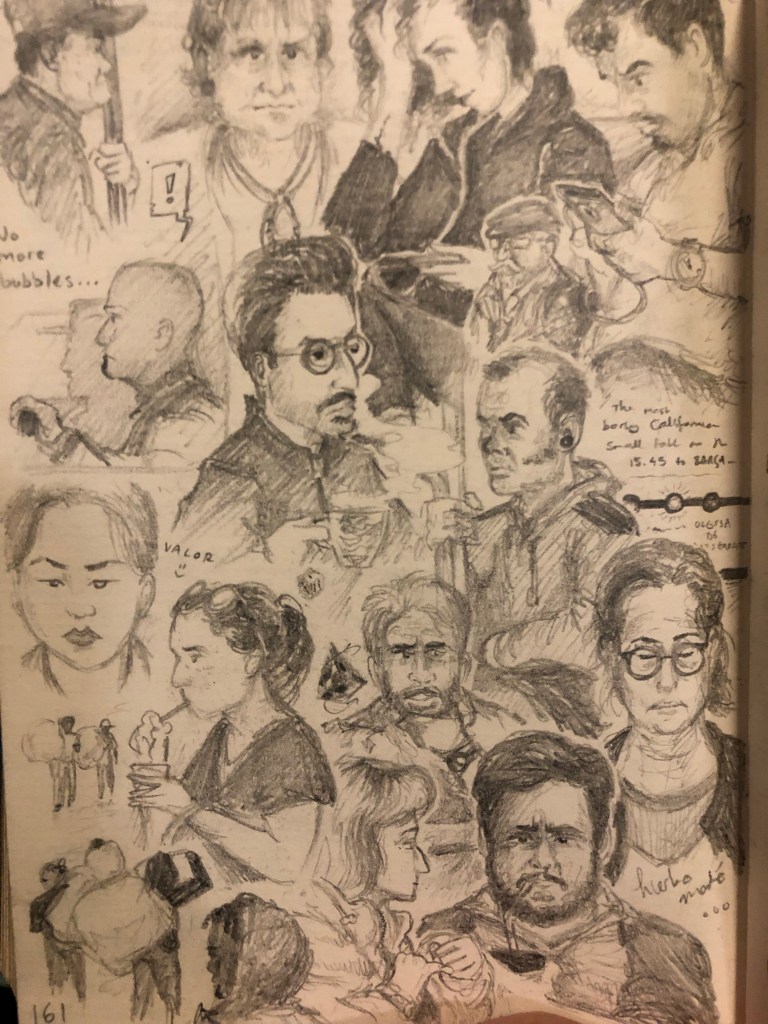
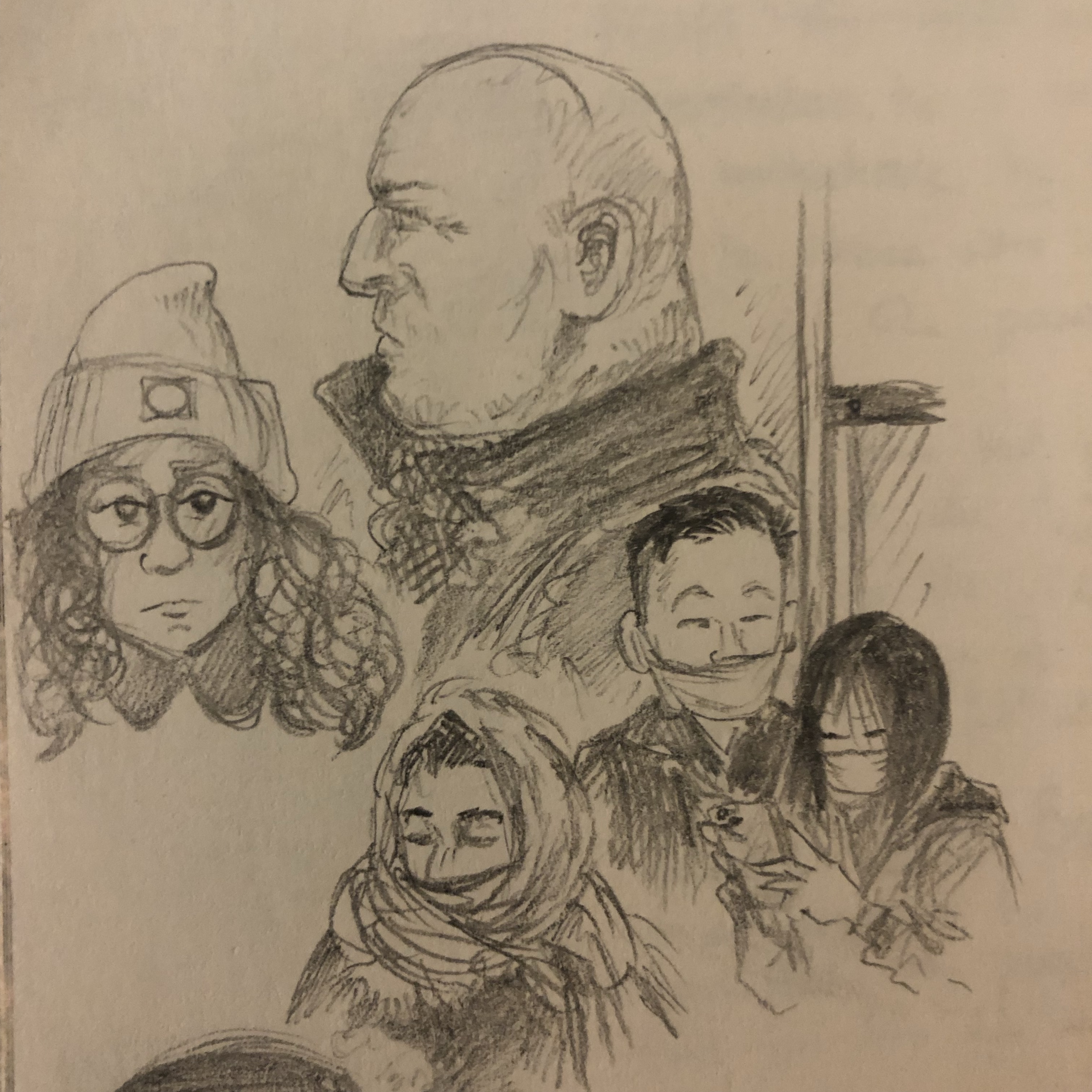
I got the train up to London today with a view to getting my hands on a decent pair of shoes, since I’m told the Italians can be a little snobbish when it comes to standards of dress. With the Northern Line under repairs, it took a little longer to get up to Bloomsbury, so I took a leisurely ride on the Circle Line from Blackfriars and indulged in a favourite pastime: sketching commuters on the Underground. There’s an art to it (no pun intended) – you’ve got to be quick, since most of them only travel a few stops before getting off. And now that face masks are a minority affair, it’s a lot more enjoyable a practice than it was.
Predictably, I got waylaid in Gower Street’s Waterstones en route to the shoe shop. Ever on the hunt for new additions to my Spanish library, I thought I’d do some digging at one of London’s finest bookstores, since it’s been quite a long time since my last visit. I managed to exercise a considerable amount of restraint this time, leaving behind two case studies on the Inquisition from the antiques section in the basement and Minder’s The Struggle for Catalonia… though I’ll be back for that one eventually. Giles Tremlett has brought out a new book on Spain which looks like it will pump out a lot of material I can use with my A Level Spanish students, which is my way of justifying that purchase. The only book I didn’t question was an account of Walter Starkie’s Camino. Starkie wrote so vividly about his journeys as a minstrel across Spain in Spanish Raggle Taggle and peppers his writing with old verses all over the place, so I had to salvage that one.

I wandered down towards Oxford Street in search of a decent pair of shoes, but I couldn’t find anything that jumped off the shelves at me, so I decided to make do what I have (a fine piece of advice at the best of times, which I wantonly ignore whenever I should be near a bookshop) and cut across town back to the river through Soho.

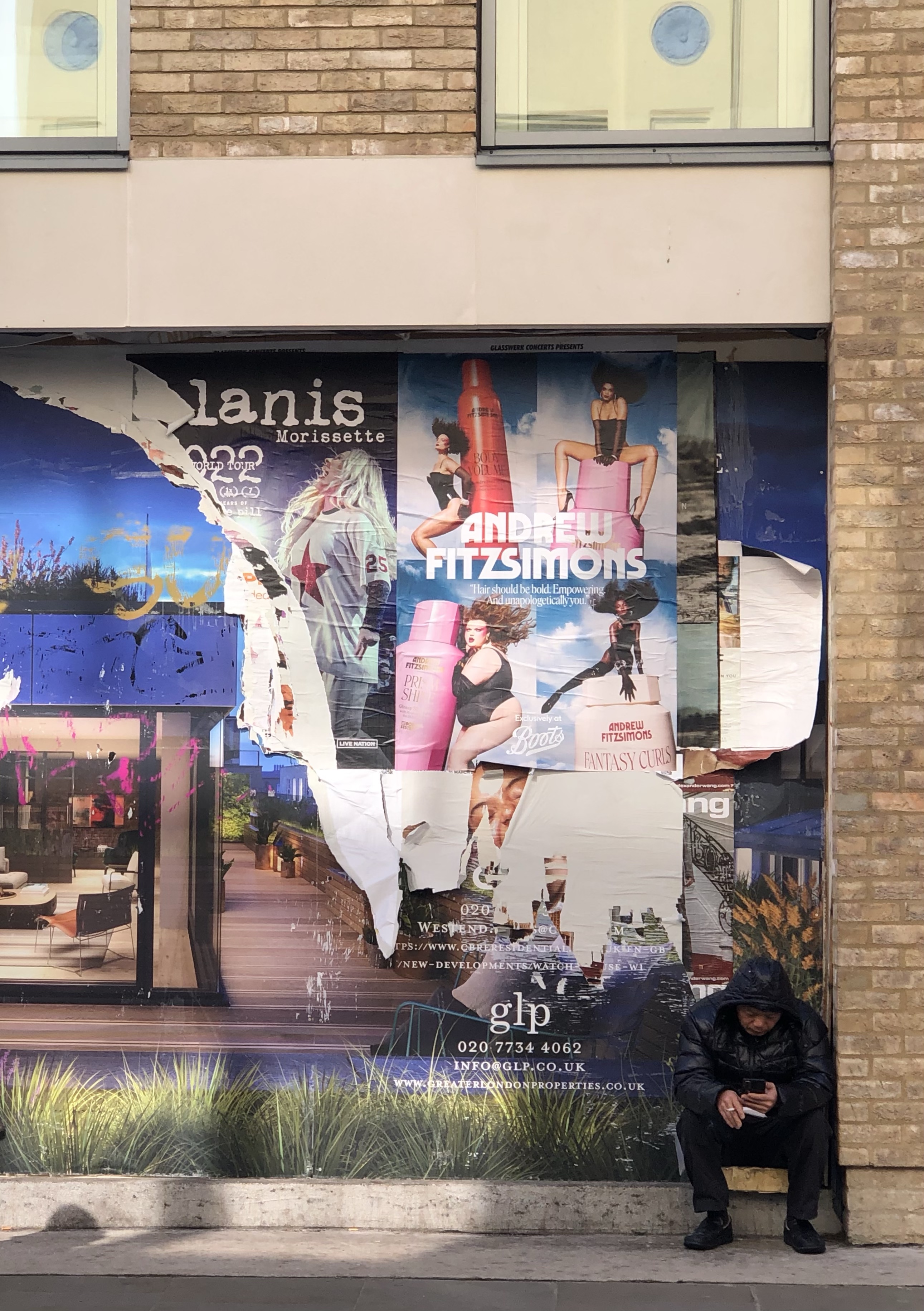
I’ve either forgotten how luridly seedy Soho is, or I haven’t properly explored the place before. What looked like a shortcut led me down a dark alleyway with shady adult stores on either side. The noise of Oxford Street seemed to die in the distance, like the record player in the Waterstones’ basement, stifled into silence by a wall of books… only now by grimy bricks and a mere sliver of sunlight through a gap between the buildings above. I almost collided with a stocky man in a big puffer jacket with a cough came lumbering out of a film store, stuffing something under the sleeve of his coat. Two Arabs stopped talking and gave me a funny look as I passed, clutching my journal in one hand and one strap of my rucksack with the other, humming the tenor line from Ola Gjeilo’s Northern Lights to myself. I guess Soho isn’t on the tourist trail.
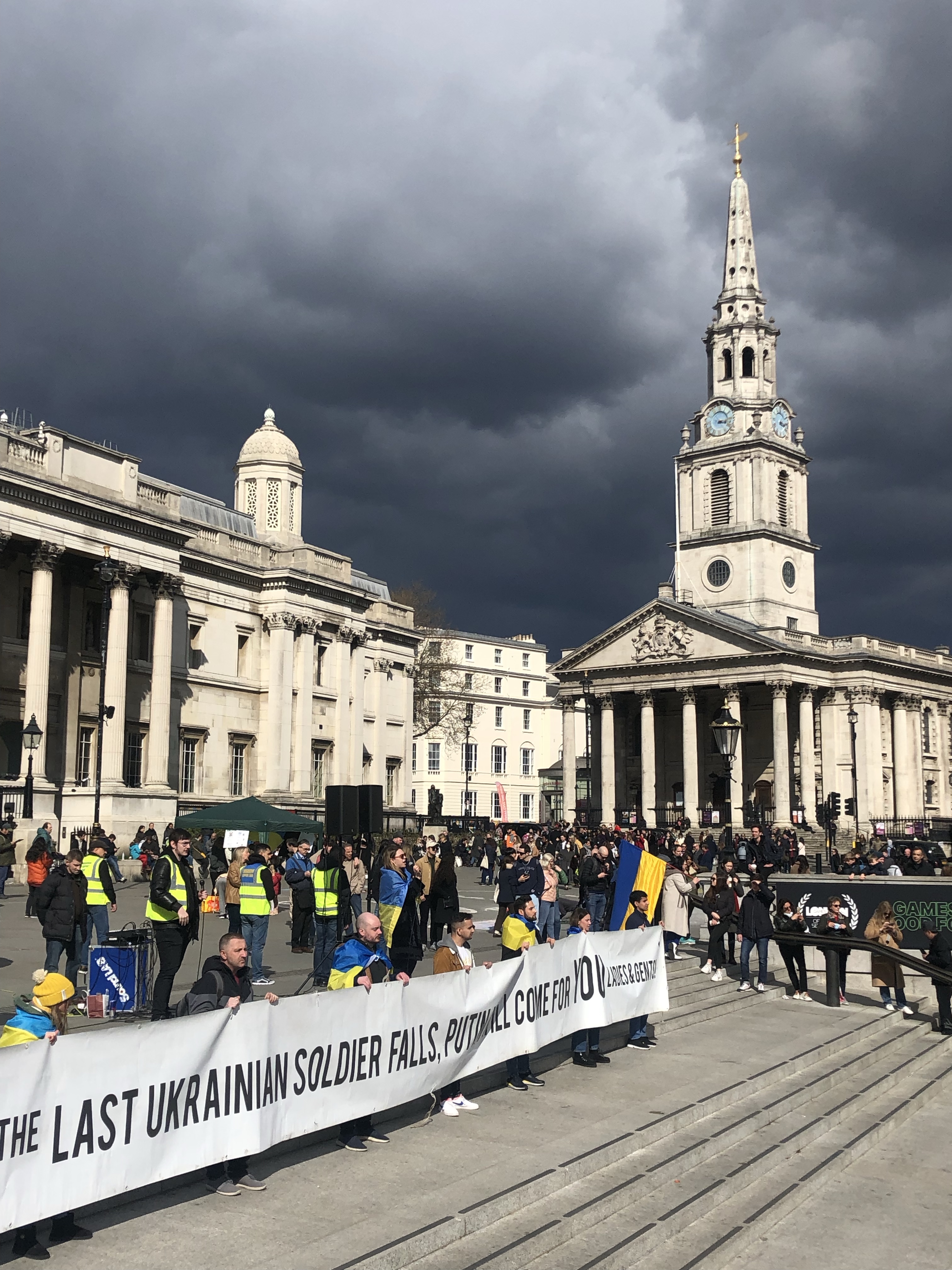
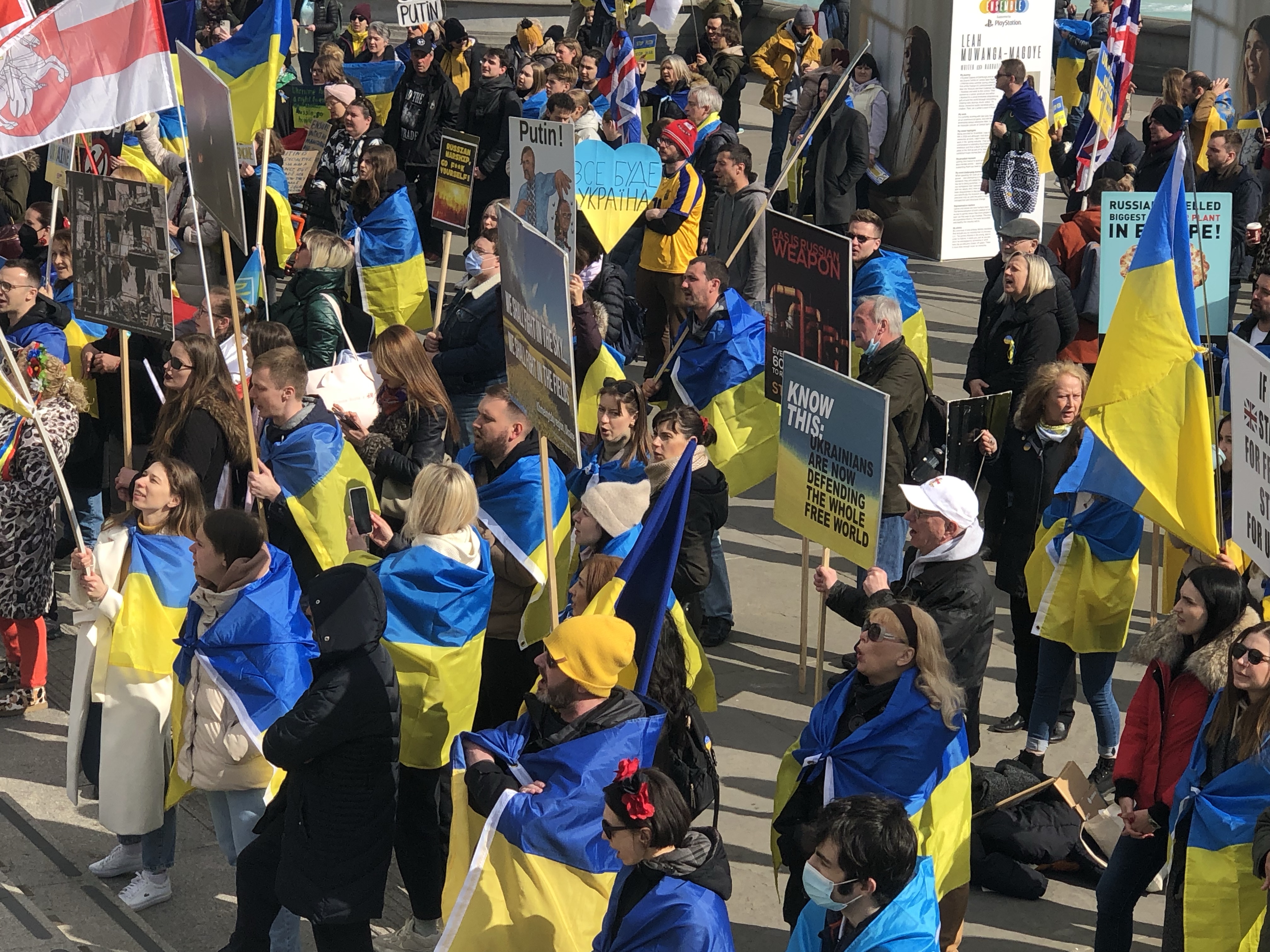
Leaving Soho behind, I wandered through the crowds in Chinatown and came out onto Trafalgar Square, where a large crowd had gathered on the steps. Unsurprisingly, it was a rally against the war in Ukraine. Blue-and-yellow flags fluttered high above the throng, joined here and there by Polish and Hungarian partisans adding their colours to the mast. One woman, the tryzub emblazoned on her cape, stood defiant at the front of the congregation, fist raised in a powerful salute for most of the half-hour I stuck around to watch.
Boycott Russia.
Arm Ukraine.
Stop Putin, stop the war.

Those were the chants, coming around and around before the crowd. The main speaker apologised for the necessity of being so blunt, before decrying the rape of Ukrainian women by Russian forces and the slaughter of its children. An Englishman spoke slightly hesitantly about the need to support Ukraine’s disabled and elderly refugees, and a Ukrainian began to sing a national lament as the sky darkened overhead and the sun faded from sight. I’ll admit I half expected there to be a police van lurked nearby, its officers on standby for any disruption, but I couldn’t find a visible copper for love nor money.
The last time I saw a demonstration like this was back in October in Madrid’s Puerta del Sol, as I walked back to my hostel with one of my cousins. “They’re always here,” he told me, “and so are they,” indicating the loitering policia who hang back just shy of the crowd, silent, hands on their truncheons, watching the Republican flags flying in the night air. The crowd was surprisingly mixed: an old man in a flat cap stood shouting his passionate support in the centre of the throng, while two girls shared an equally passionate and equally political moment on one of the bollards. The policia watched on, silently.
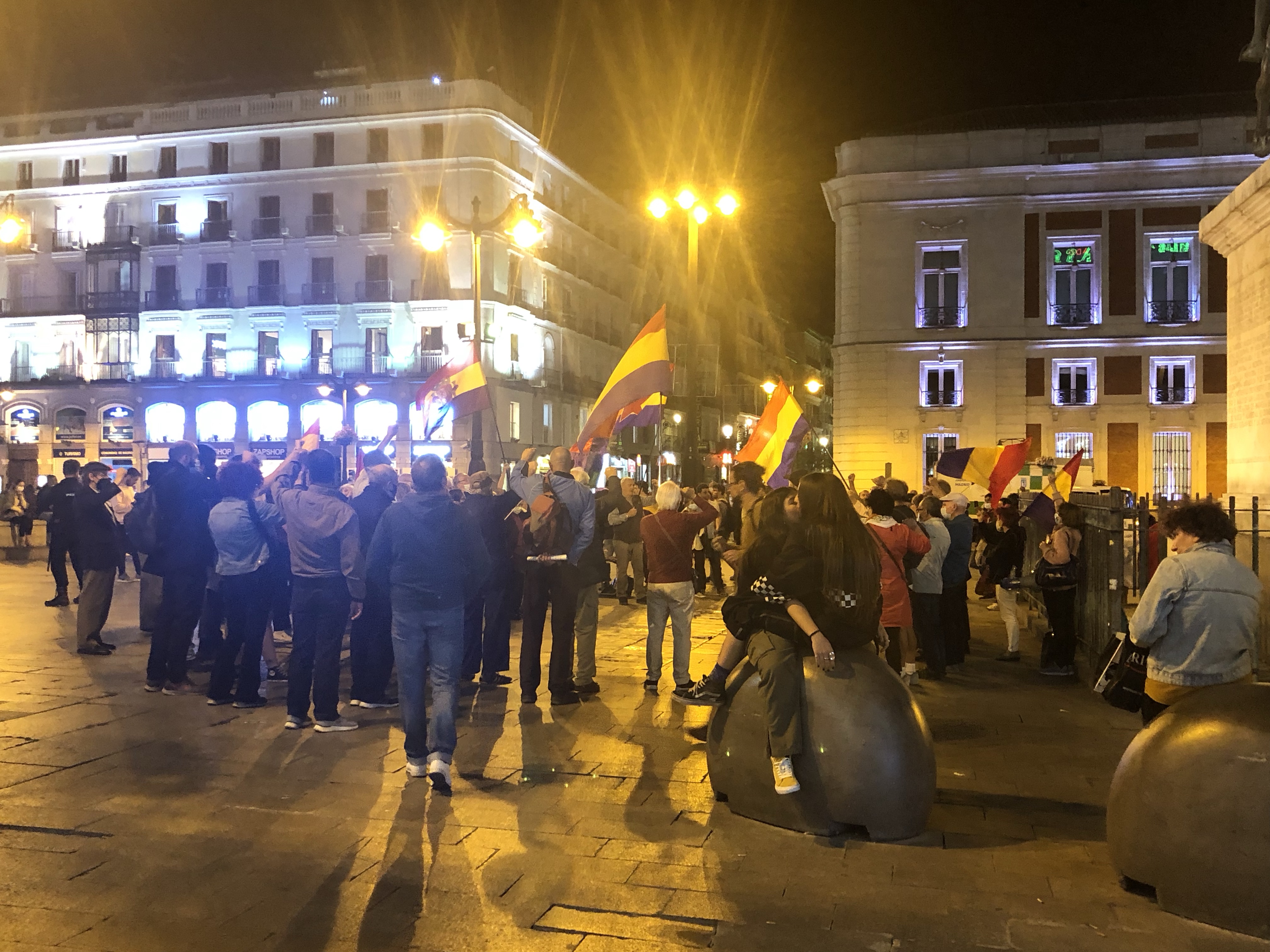
Puerta del Sol, October 2021

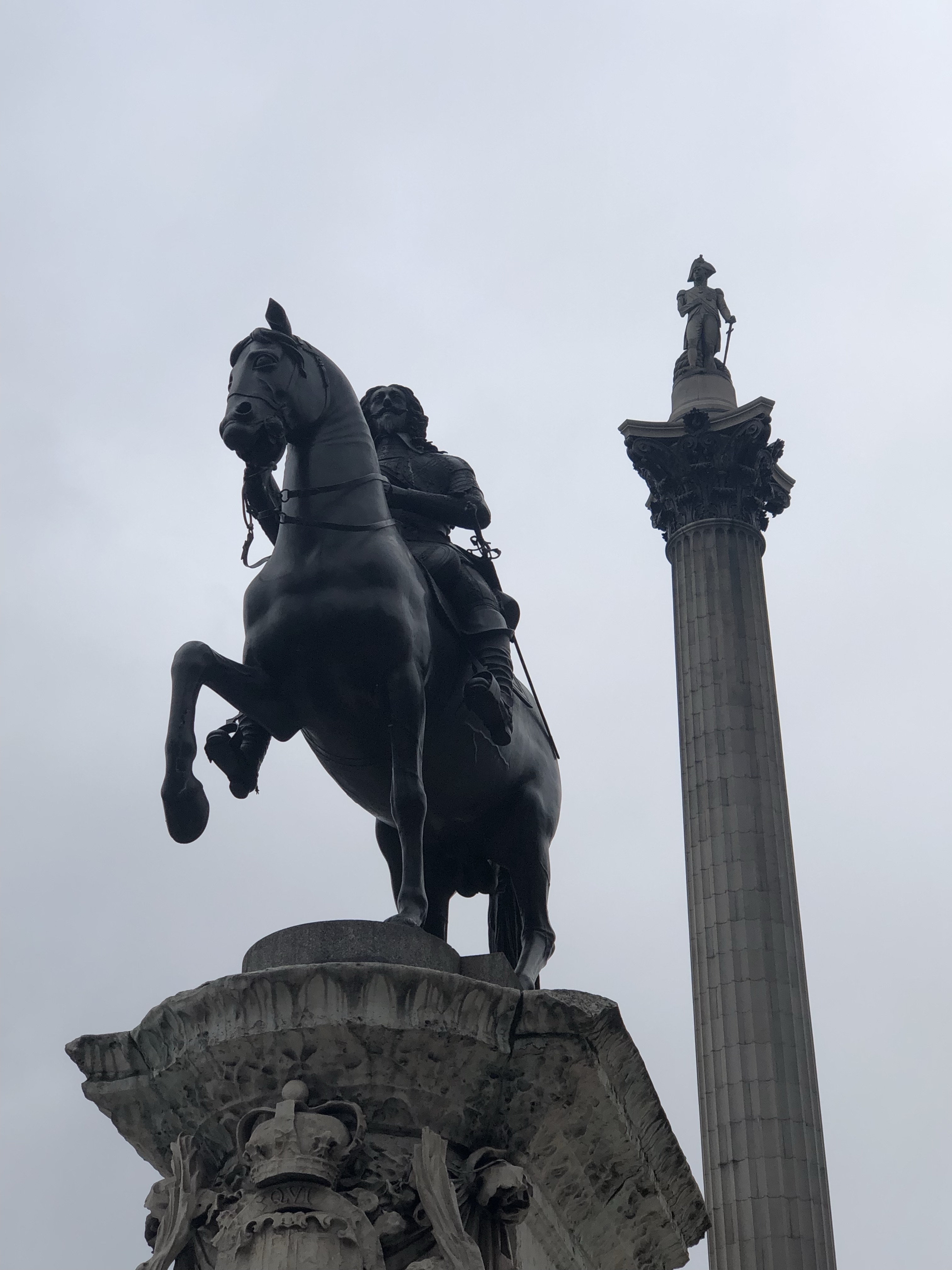
On my way back to the station, I stopped at the traffic lights and looked back to Trafalgar Square. Lord Nelson and a mounted Charles I stared southwards over my head, silhouetted against the clouded sky: two men who got personally involved in European wars and paid a physical price for their efforts. Little wonder, then, that the European powers are so reluctant to send any troops into open battle to defend the Gateway of Europe.
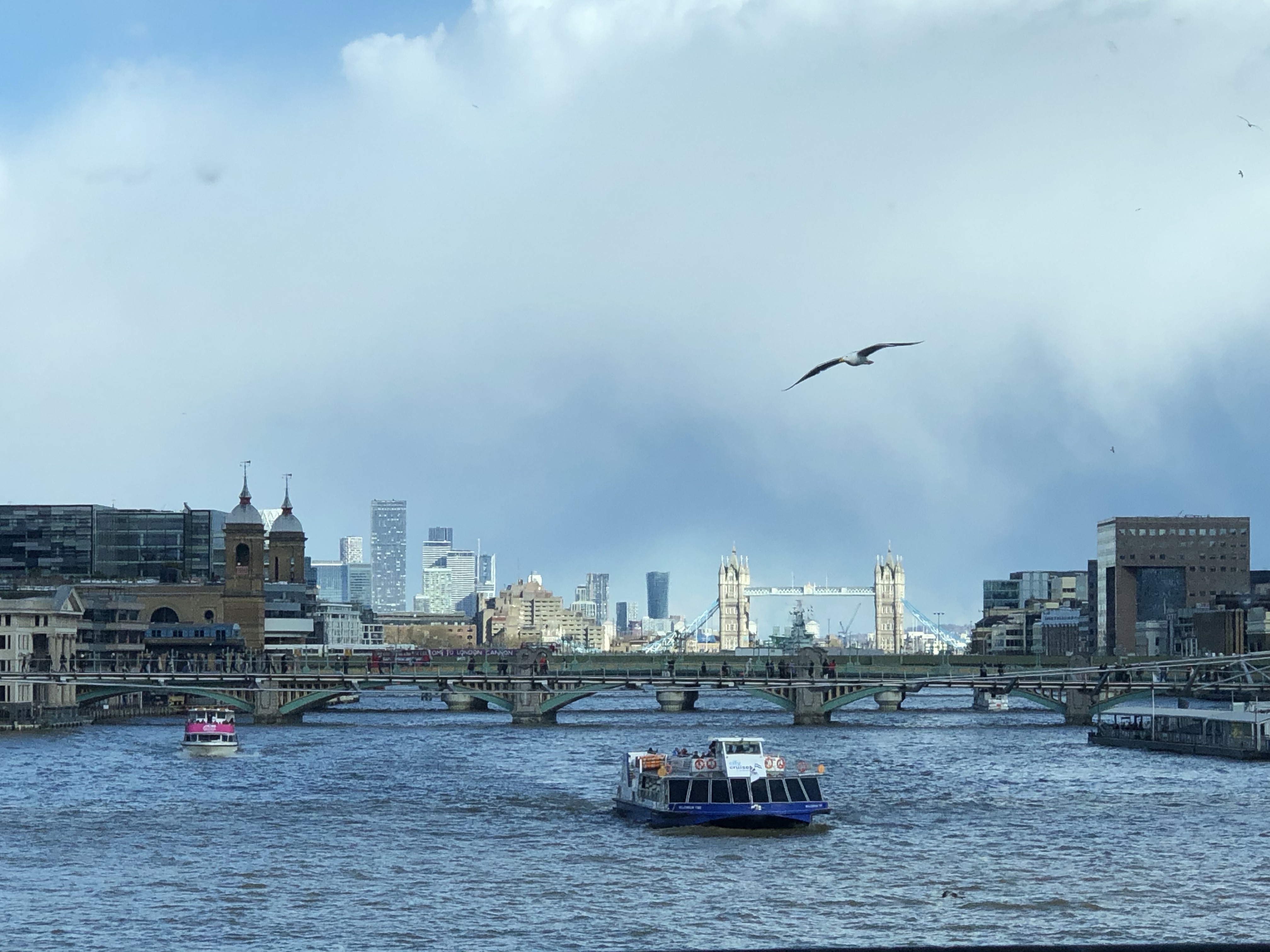
Back at Blackfriars, the rally seemed a world away. I missed the early train by a whisker and had to wait twenty minutes for the next one. A Catalan girl sat on a bench nearby, a red-and-yellow skiing jacket from Cerdanya proudly displaying her winter colours. I instinctively reached for my face, but my usual rojigualda facemask was at home: I’d opted for a less nationalistic face covering today. Away to the east, the sun broke through the clouds over the Thames, lighting up Tower Bridge against the rainclouds rolling in from the south. London seems to go on forever, whatever happens to the rest of the world, and yet it’s Rome that holds the title of the Eternal City. I’m looking forward to seeing it with my own eyes and reading such stories as I can find in its people and its streets. BB x
Pygmalion

Yesterday was International Women’s Day. If you hadn’t noticed, you probably have a much healthier relationship with your devices than I do. Being naturally cautious when it comes to writing about trending topics – and keeping a wary eye on the growing stack of marking on my desk – I wasn’t originally going to write anything on the matter. In previous years I might have jumped on the bandwagon and sang the praises of women from history who I find inspirational, but that muse didn’t find me today.

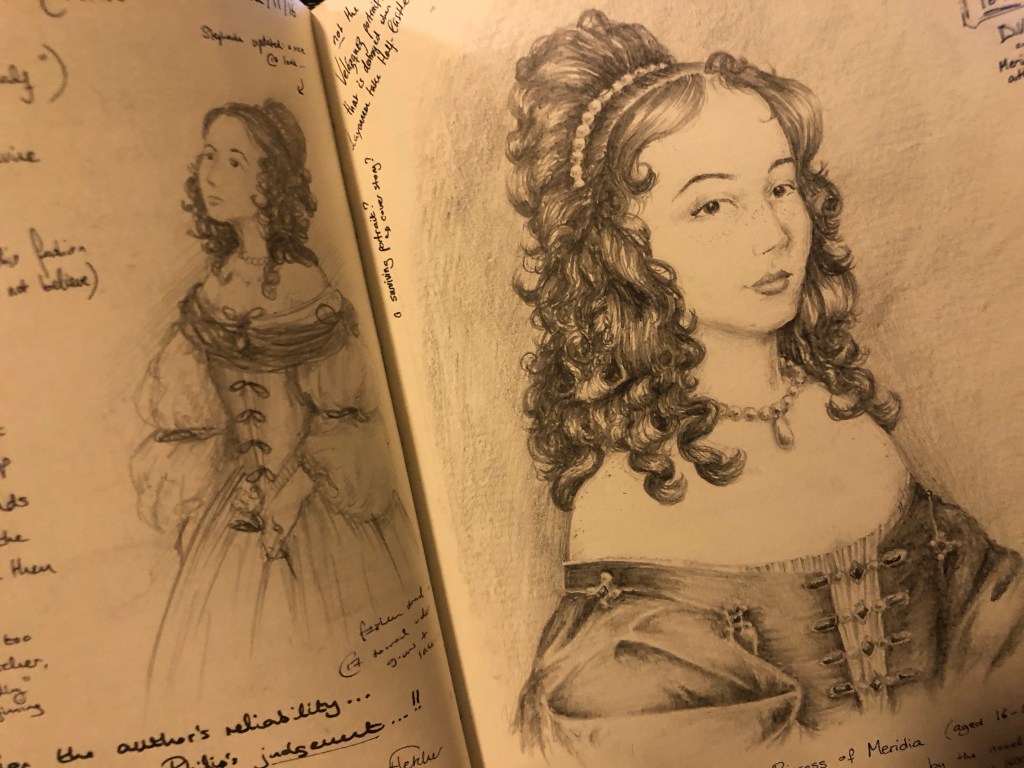
It only occurred to me after a couple of hours’ highly productive procrastination on the novel last night that there’s one woman who I’ve been writing about since I first got bit by the writing bug, now twenty years ago. A divisive woman who has been at times a distraction, at others a channel for my doubts, but always a polestar, burning bright, night after night, though the other stars around her blink in and out of the darkness.

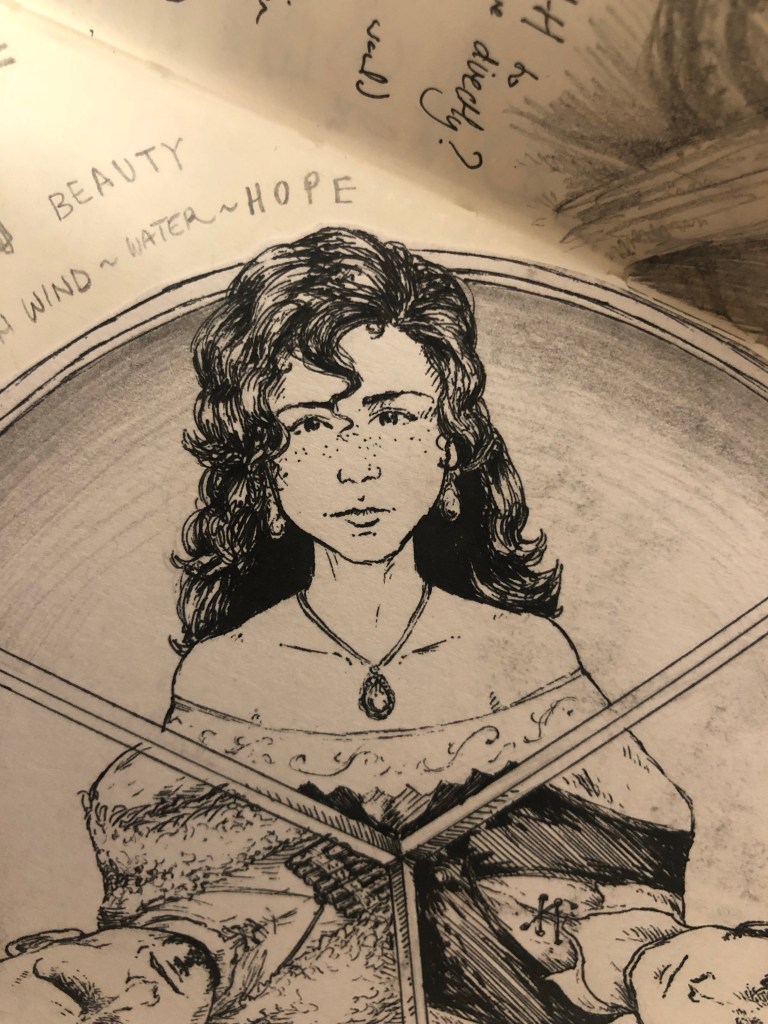
This is Leonor. And this her story.

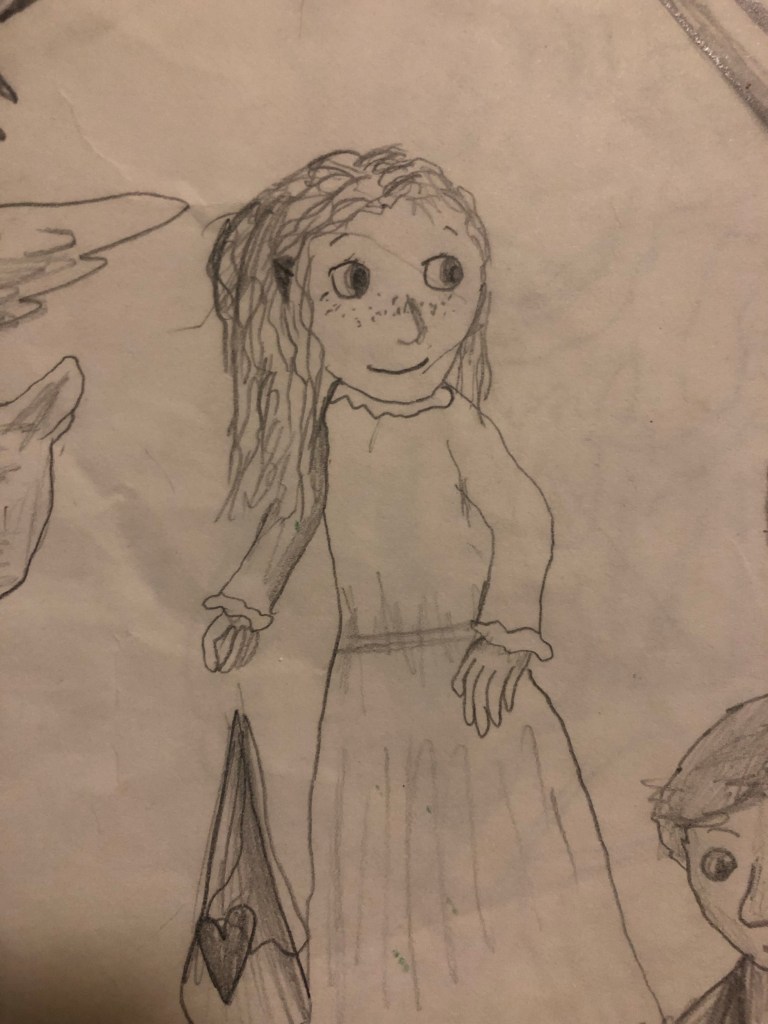
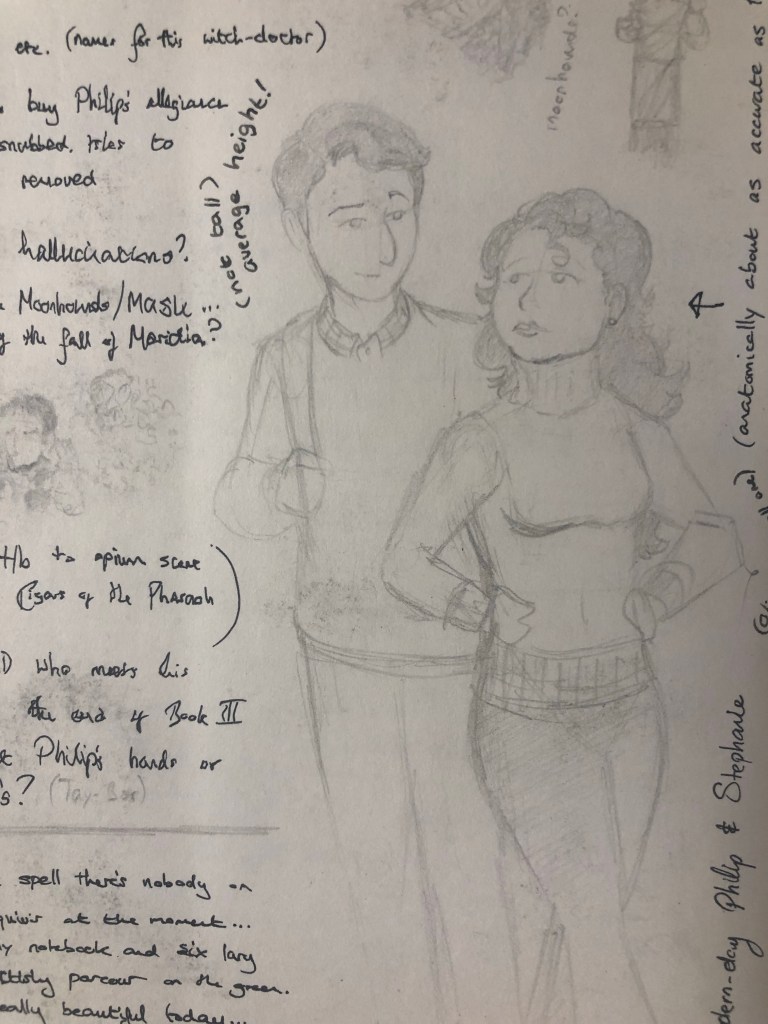
I’ll be twenty-eight this summer. For no less than twenty of those years, the red-haired princess has been living rent-free inside my head. Whether she was inspired by a childhood friend, the Little Mermaid or a double-page cartoon from an Art Attack! magazine, I don’t suppose I’ll ever be certain. Like as not, she sprung into being as a combination of the three. One thing I know for sure: of all the cast and characters of the books I’ve spent the greater part of my life writing, she’s been the one constant. The world has shifted beneath her feet several times, sometimes drastically, but she has weathered every storm, survived every crush unaltered and resisted every rewrite. When I brought the book over to Spain a few years ago, she was the final frontier, the last character to trade in her name for a nombre.

Leonor in her “Stephanie” days, back in ’04

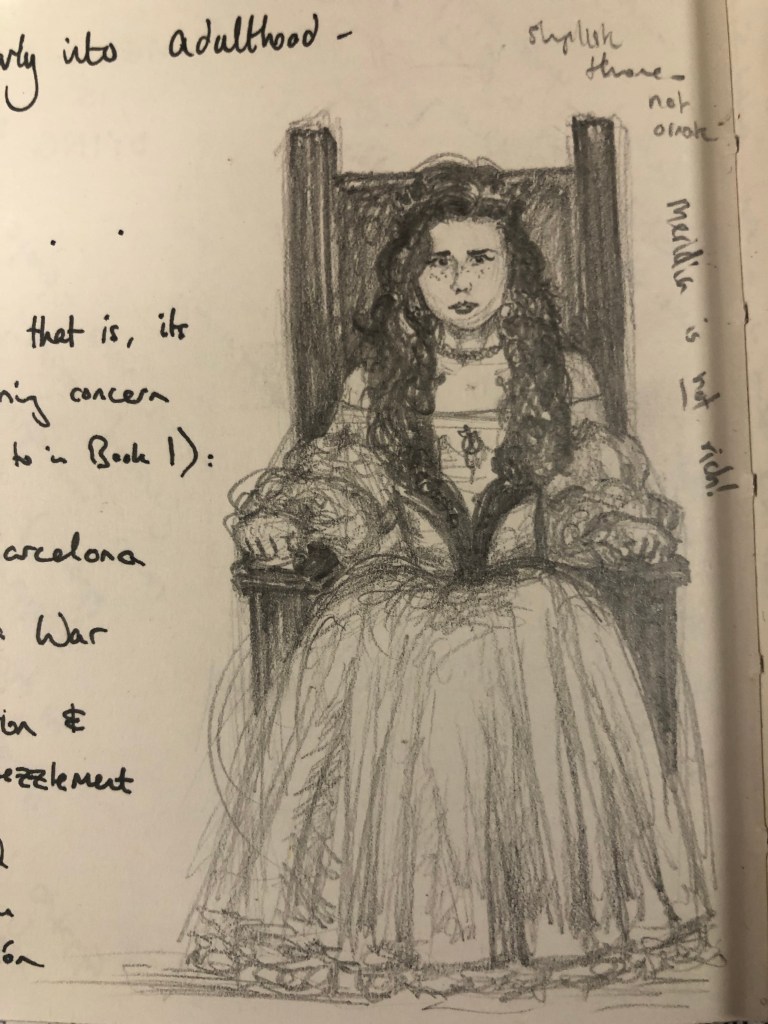
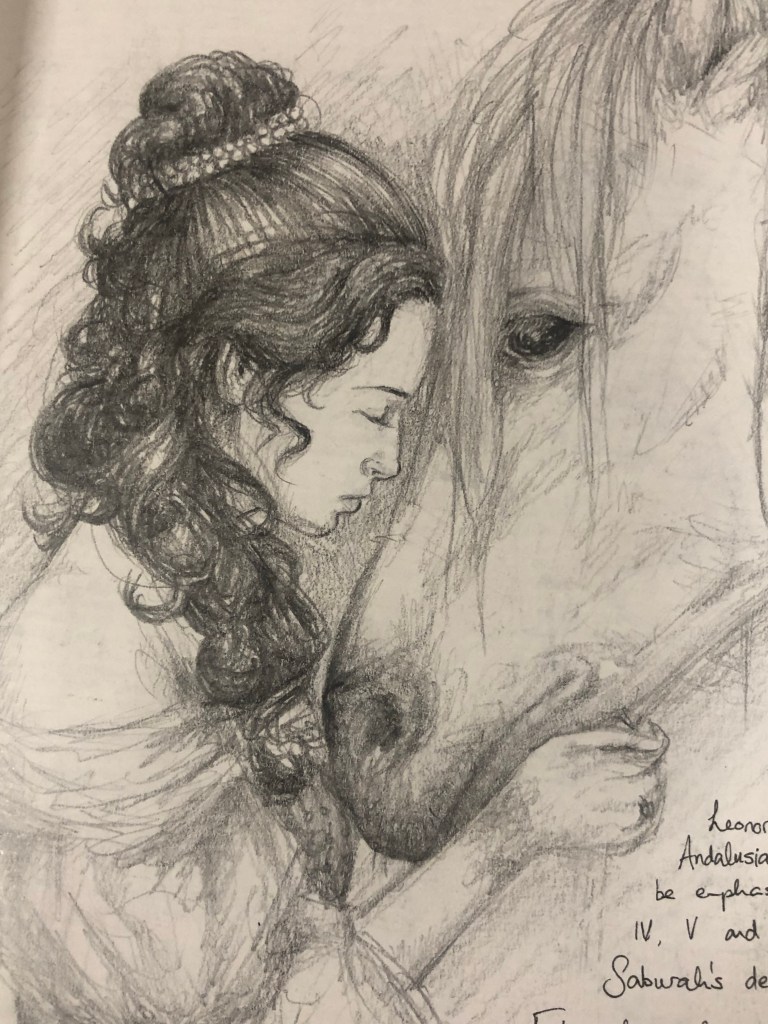
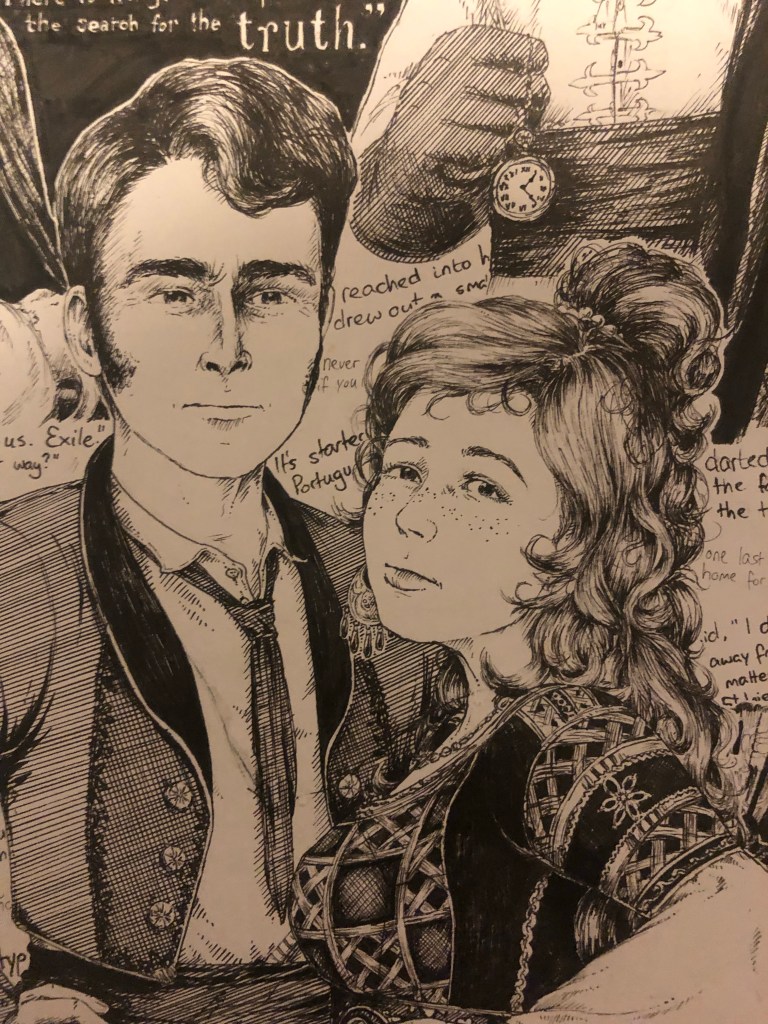
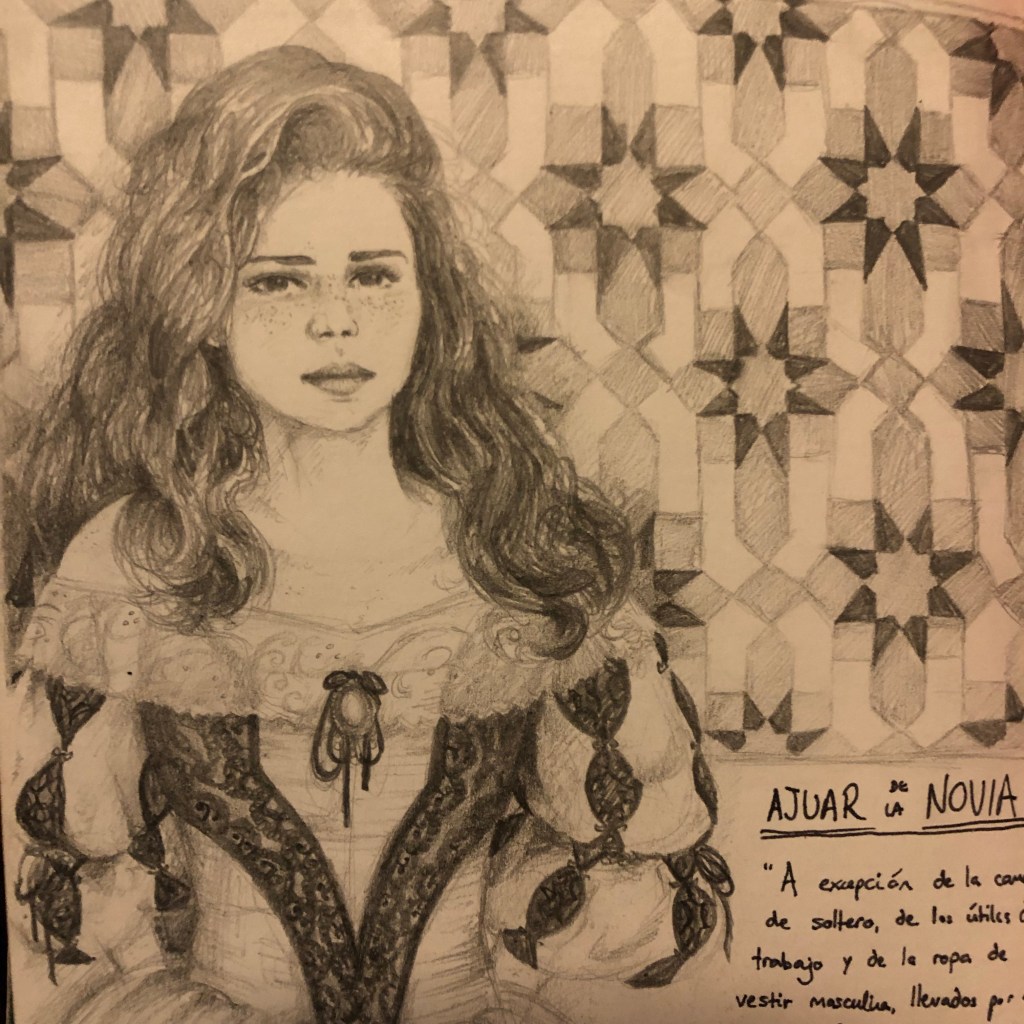
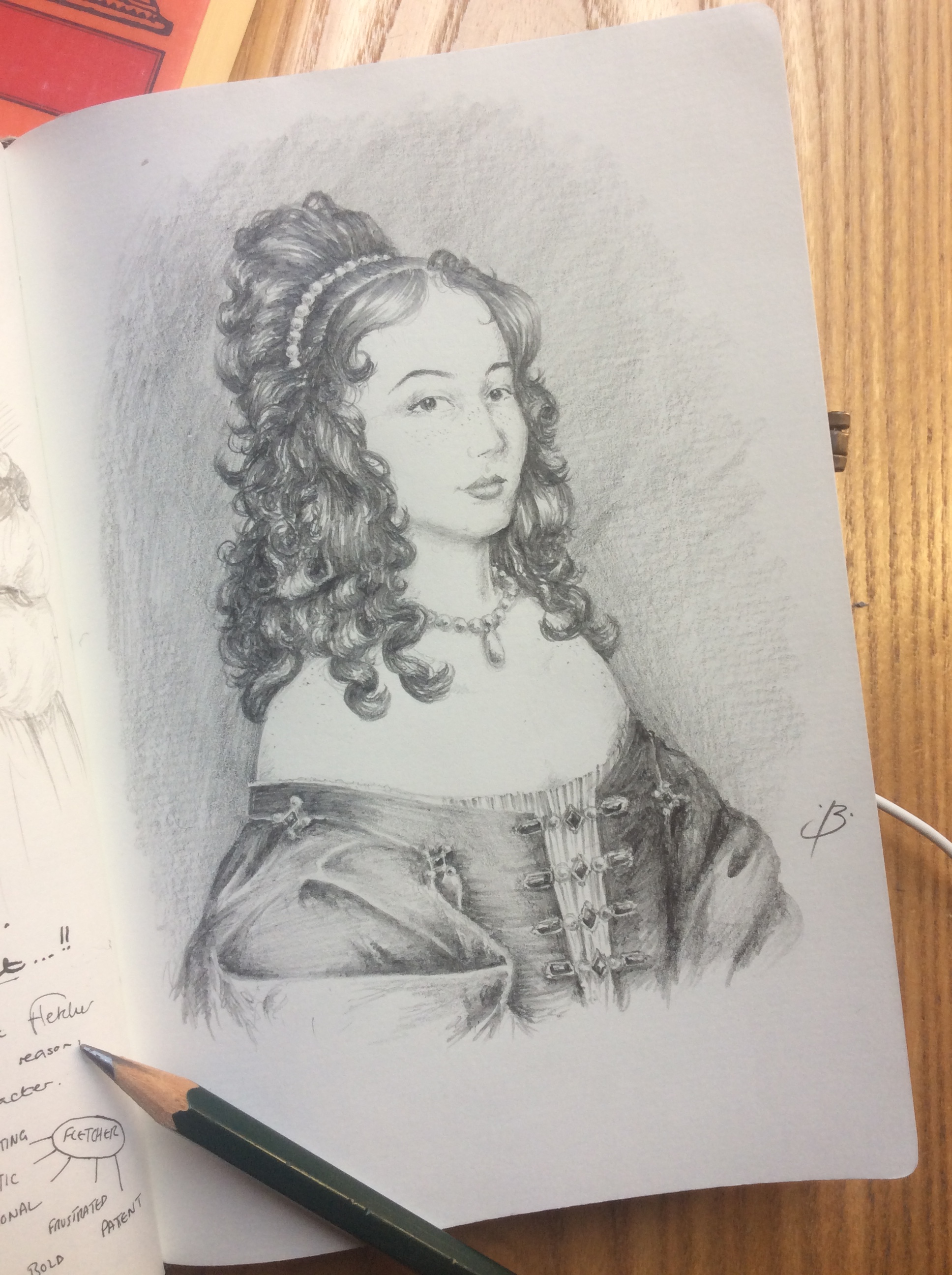
Without giving too much away, I’ll introduce you. Leonor is one of the two central characters in the story, though arguably it’s her story that’s the one being told. The princess of Meridia, she’s playful, sharp-witted and short-tempered, with a sense of duty almost equal to her stubbornness and pride. Descended from two legendary heroes from our own timeline, she is catapulted into the role of Queen by a series of tragic events and, amid the fires of war and personal tragedy, she becomes one of the greatest rulers Meridia has ever known, captaining the sinking ship of her doomed kingdom to its final hour.

She’s an avatar of hope and a rallying flag in human form for her people. And yes, I’m sure I play into the “fiery impetuous redhead” stereotype more than once.

My little princess grew up so fast…! ’18

In the saga’s early days, when the concept was still very much a fantasy/sci-fi adventure, I had her imbued with magical powers. These days her greatest power is her charisma: in a saga filled with reluctant rulers, ambitious bureaucrats and silver-tongued servants, Leonor comes into her own as a woman who stands her ground in a man’s world: adored by her subjects, respected by her contemporaries and feared by her enemies. It’s no surprise that in recent years I’ve looked to two other fierce red-headed rulers to bolster her character: Boudicca of the Iceni and Elizabeth I of England.

Now here’s the question. Am I in love with my own creation?

Of course not. For one thing, I wouldn’t dream of playing the third wheel to my hero! But you’d be surprised how much of a flashpoint it’s been in the past. Two previous girlfriends have challenged me about my attachment to her. Try to put yourself in their shoes. I suppose it’s not all that different to inviting a partner over, only for them to discover objects left behind by a former lover. As I’ve tried to explain before, if you want to get jealous about one of my characters, you might as well take it out on the rest of the cast – I have no less love for my other creations.

And yet the fact remains that, by the age of twenty-eight, I’ve had a longer and arguably closer relationship with my central characters – Leonor included – than I have with anybody I know, outside of my family. I wonder whether that’s why I’ve always been so comfortable with my own company. It’s easy to handle solitude when you’re never really on your own.

She’s not my idealised woman by any stretch of the imagination, though it’s possibly due to my long connection to her that I’ve always had a weakness for dark eyes and red hair. She’s no imaginary friend, anymore than Desalma is a shadow that haunts my dreams. I neither love the women I conjure out of the air, nor do I fear the monsters I create. She is a figment of my imagination, and though she’s found her way into journals, homework diaries, used envelopes and maths book margins over the years, if I were to disappear one day, so would she. Perhaps that’s why I’ve never stopped trying to tell her story.

Do you know what I’d like? If I should be lucky enough to have a daughter of my own one day, I’d love to tell them her story. To bring them up to tales of her courage, her unflinching hope in the face of overwhelming odds. To show them that, though she wasn’t perfect, though her pride got her into trouble, she kept on fighting for what she believed in.

She’s not my Galatea, but she is my muse, my inspiration, and her story needs to be told. That’s why I write. That’s why I’ve always written. After all, it’s hard to say no to a princess. BB x

I’m the Bad Guy: Writing Villains

Somewhere in my room there’s a programme from a school play I was in back in my prep school years. A few of the lead roles were interviewed about their respective parts, and the boy playing Cardinal Richelieu said he “liked playing the baddie because it is more of a challenge.” My reaction to that line has changed very little over the last twenty-odd years.

Bull. Shit.

If twenty years of writing stories have taught me anything, writing villainy is easy – sometimes, alarmingly easy. Ambition, greed, selfishness and ego are everywhere. Depending on the orientation of your moral compass, you might even be inclined to disregard some of these behaviours out of hand as simple human nature. If you want a challenge, try writing or playing a hero. Finding convincing dialogue and/or motivations for a hero is hard because heroes require hard work: they are what we can become if we can find the strength and the courage to rise above our own desires. Selfishness, the root of villainy, however, is in us all by default. It doesn’t take much to make a villain, just – what did Heath Ledger’s Joker say again? – “a little push”.

What’s the first image that comes into your head when you think of a villain? I imagine it’s rather different to the image in my head. If I were a betting man, I’d wager it’s probably not the moustache-twirling Dick Dastardly-type, which went out of fashion a long time ago. The movie-going public seems to have lost its taste for gleefully evil baddies (so much for Palpatine!) in favour of the tormented anti-hero with quasi-legitimate motivations (a la Thanos). Avatars of utter darkness are on the out, and they’re taking their more rational minions with them. In some cases, this has led to the near-total disappearance of the bad guy altogether (see Inside Out and Moana, or even Encanto).

As a writer, this saddens me, for much the same reasons as the destruction of statues bothered me a few years back. Doing away with the villains of our world is like smashing up a mirror; just because you can’t see them anymore, it doesn’t mean to say they’ve gone altogether. We need to be reminded of the depths of our depravity from time to time. Every villain is a warning in his or her own way of the capacity for darkness in all of our hearts, and from them we learn to avoid their mistakes.

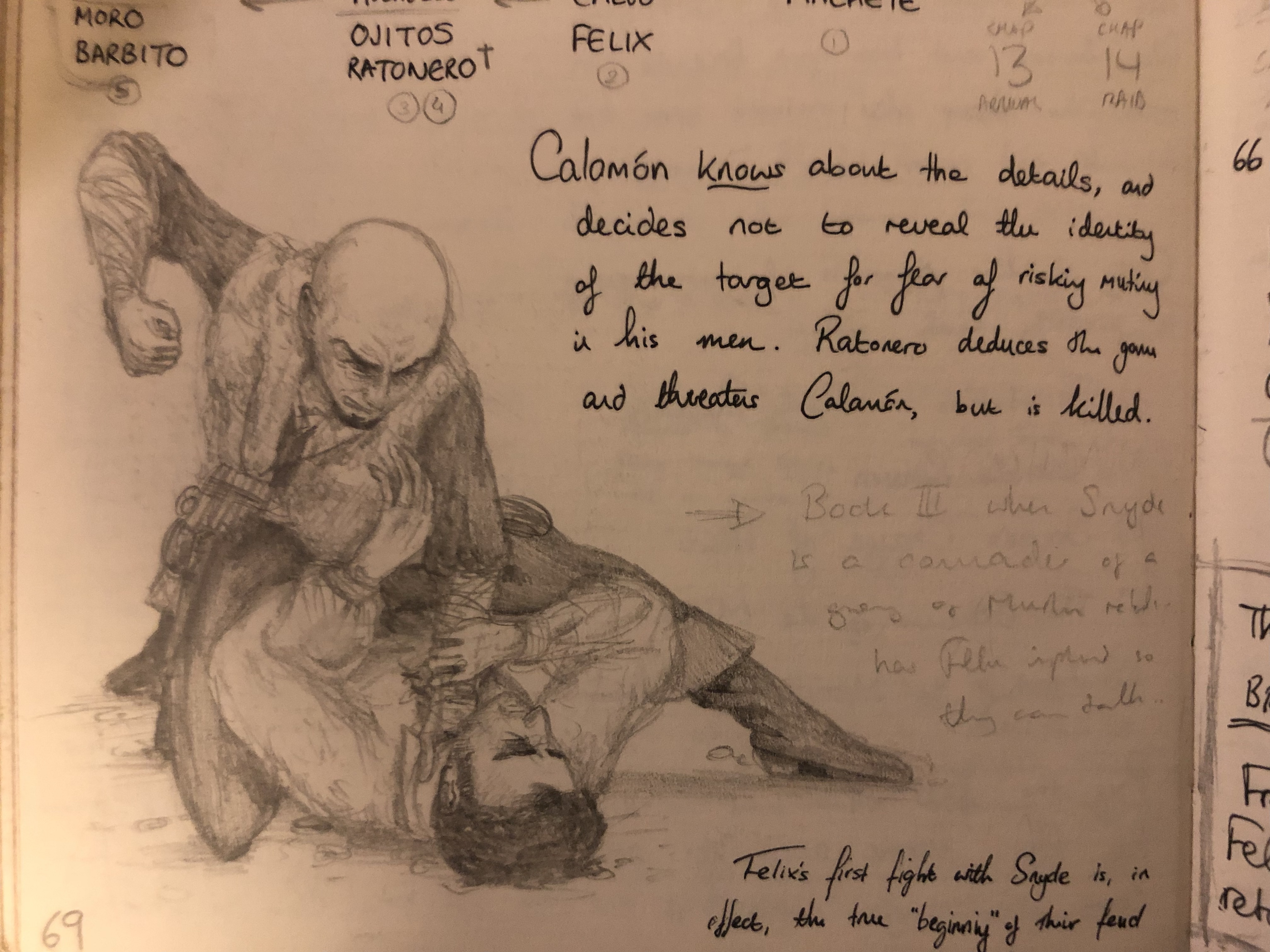
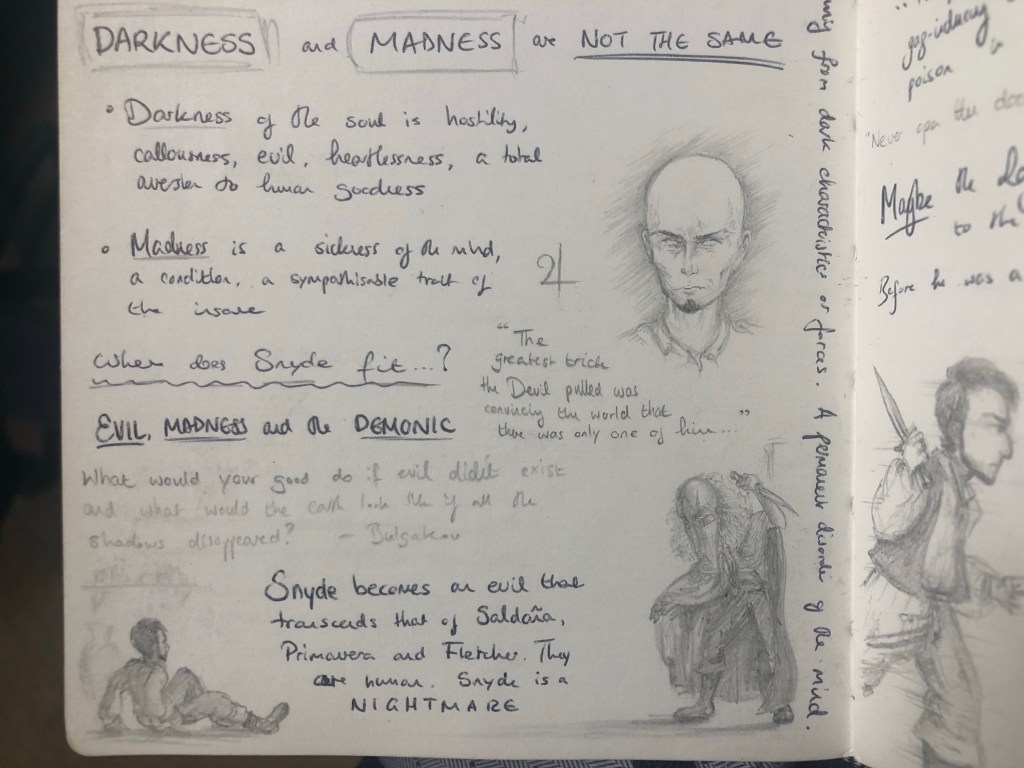
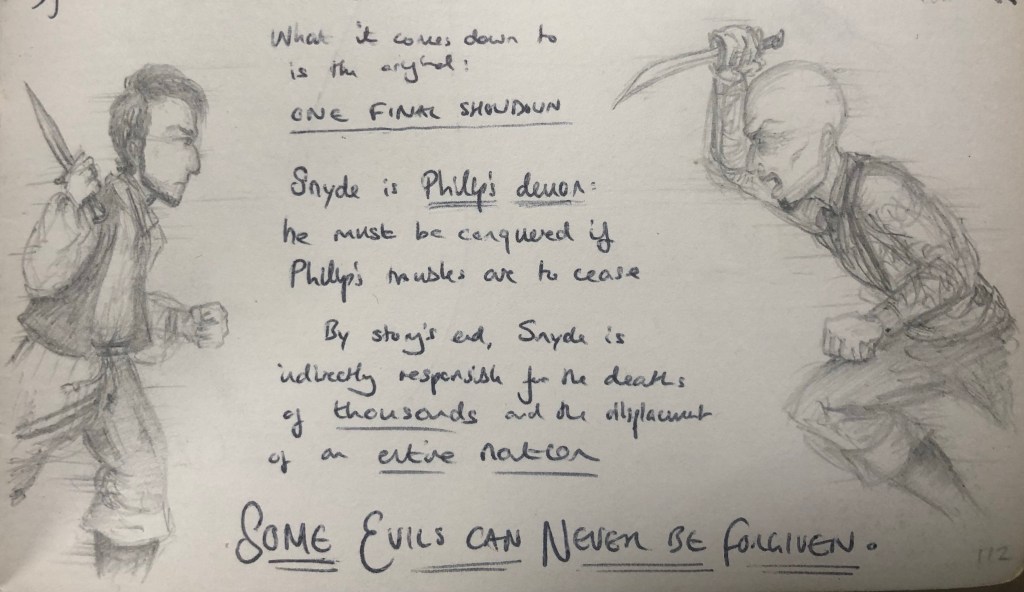
Unlike the heroes of my tales, the primary baddie has hardly changed since his inception. His wardrobe may have been updated a couple of times over the years, but his appearance has never shifted. The bald, skull-like head, the high cheekbones, the small black goatee and those piercing, eye-blue eyes… The latter have always seemed to me the most treacherous, wicked eye colour around, though that may have something to do with Daniel Craig’s early-career role as the fantastically sadistic Afrikaner Sgt Botha in The Power of One. Until very late in the Spanish rewrite he bore the name Jasper Snyde, and it was primarily the strength of his surname that held me back from Hispanicising the rest of the names in the book. It took a long time before I found a Spanish equivalent I was happy with. In the end I opted for De Salma, for the simple reason that, if elided (or spoken at the speed at which your average Spaniard speaks), it winds up sounding a lot like desalmada, meaning “soulless” – or, more literally still, “deprived of a soul”.

That’s right, middle school me. Authors do put that much thought into the names of their characters. It’s not just a trick English teachers play on you to get you thinking when it’s coursework season.

I think the thing I like best about Desalma is that he is nothing more and nothing less than a product of my own jealousy. Perhaps that’s why jealousy is one of his defining traits. Some villains you create to serve a purpose within the wider story arc, others are heroes who just weren’t good enough. Desalma is neither of these. He appeared fully-formed in a moment of weakness in my teenage years, moulded about an imagined rival for the attentions of a girl I had a thing for at the time. The crush didn’t last long, and the jealous rage that birthed him was even shorter-lived, but Desalma stayed, growing cancer-like from that first appearance into an evil that transcended all of the villains I’d written into my stories.

Like the Batman’s Joker, he wasn’t supposed to survive the story in which he first appeared, but over time his hold on me grew too strong, and for the greater part of the last decade he’s been the primary antagonist and tormentor of my hero. An avatar of desperation and despair to counterbalance’s the hero’s unyielding clutch on hope.

The other villains in the saga are, predictably, drawn from the other dark desires of my heart. One of my hero’s primary flaws was almost certainly one of my own in my younger years: that is, a magnetic hero worship of the tall, dark charismatic types who hold all the cards. The ones who have the looks, get the girls, crack the jokes and seem to have it all together. It was only too easy to morph the idols of my youth into adversaries whose intentions were not what they seemed, if only to repeat that old saying that has never lost any currency: handsome is as handsome does – or rather, looks can be deceiving.

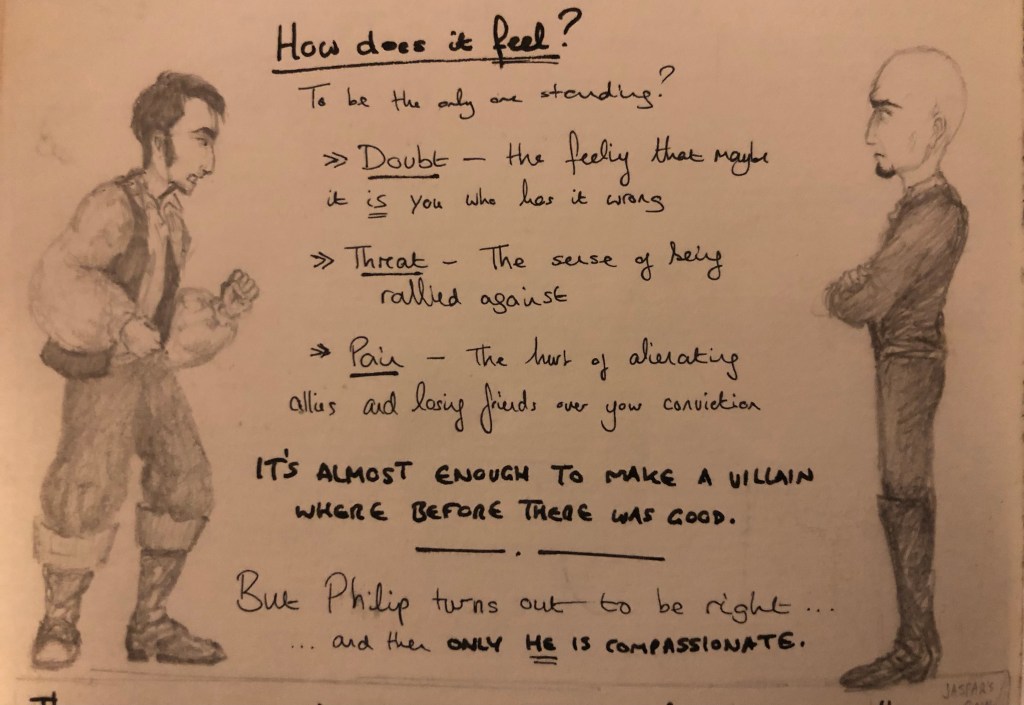
If I’m being honest, there’s been more than one occasion in my life when I’ve asked myself that question: wait – am I the bad guy here? It was especially poignant in my university years, where my tendency towards strong opinions and the sharing of said opinions got me into hot water with my fellow students. I found my views challenged so often, so vehemently, and seemingly by everybody else that, for a time, I genuinely started to doubt my own convictions. It’s so easy to start thinking you’re in the wrong when it seems like the rest of the world is against you. Israel. Free speech. Gospel music. No matter where I went, I always seemed to be on the wrong side.

Fortunately, most people aren’t walking around with a fictional universe that exists only inside their heads, and have long since learned to see the world through the mature eyes of a working professional adult. Perhaps it’s only those of us who cling to the world of good and evil, and light and dark, that insist on still making such a clear distinction between right and wrong. The grey in between is good enough for your average Joe.

I’ve been working on a new villain this week, between teaching the passé composé and marking Year 9 Spanish assessments. In recent years I’m much more inclined to letting my heroes suffer if it makes them into stronger characters at the end of it. I gave up on Ildefonso Falcones’ La mano de Fatima years ago because I lost all faith in the protagonist, but the more I read my Spanish histories, the more convinced I am that the world was a much darker place back then, just as Ildefonso Falcones painted it, and my stories need to adapt to reflect that. It takes a serious brush or two with the dark side of our hearts for us to see whether we have hero material in us or not.

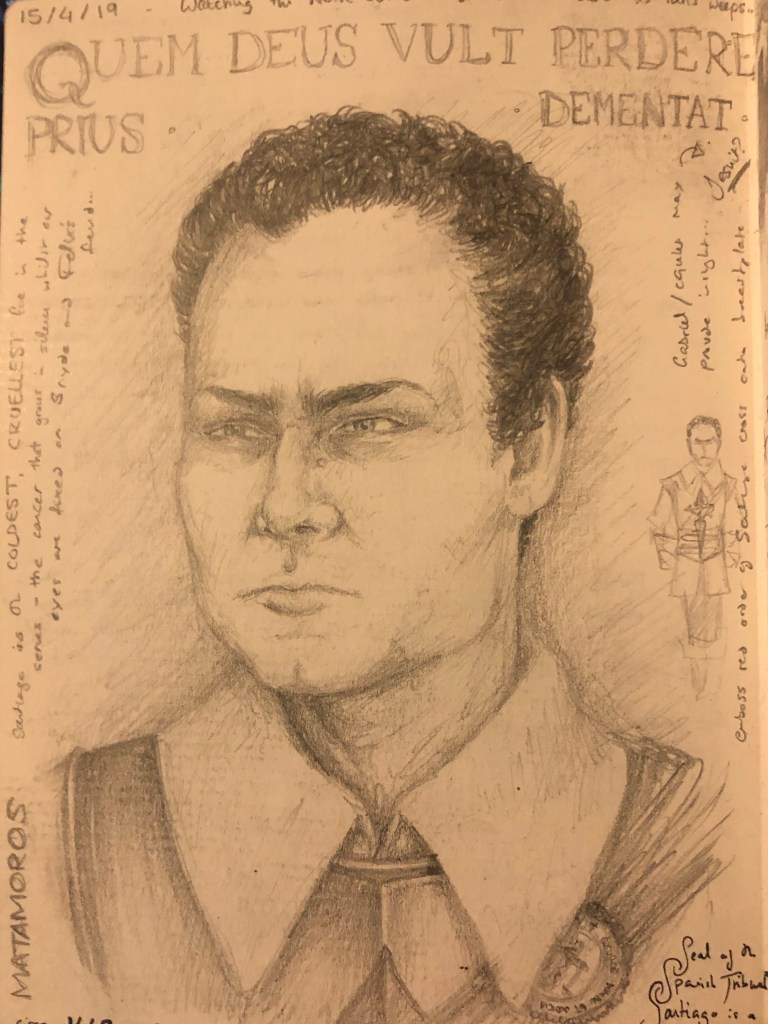
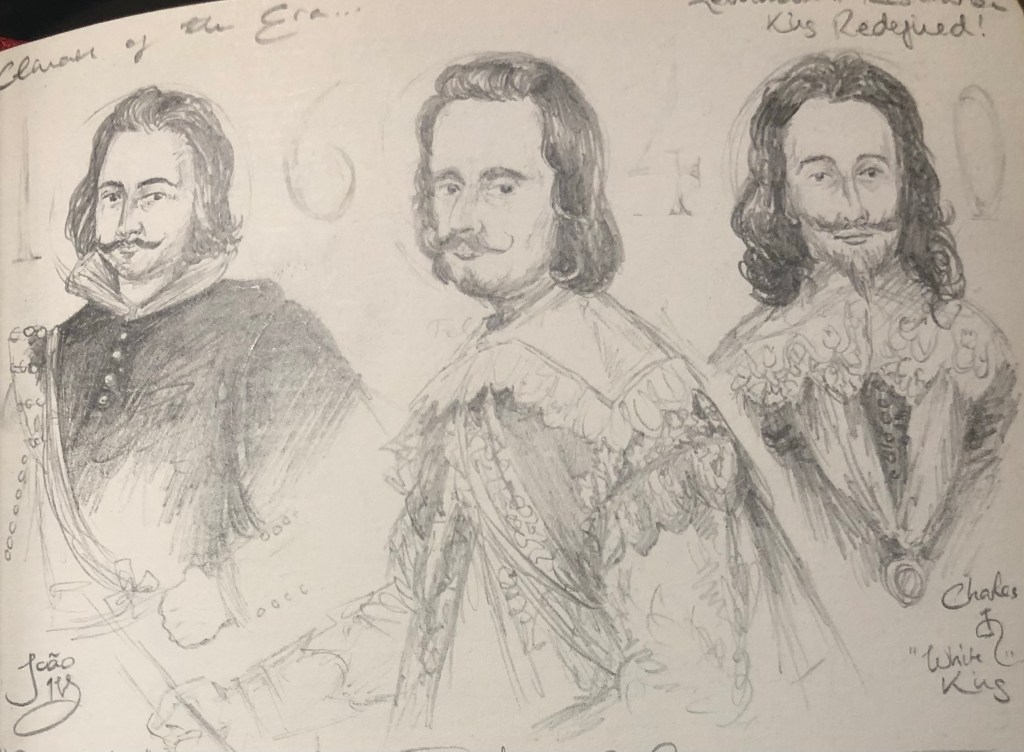
I’m leafing through Leanda de Lisle’s White King to clue up on the politics of Charles I (the Civil War era being contemporaneous with my saga), but also to glean some inspiration for a better-dressed baddie in the mould of a Buckingham or Richelieu. Desperados I have aplenty, and their motivations are easy to script: hunger will make a villain out of anyone. It’s the folks at the top I’m working towards now. Time, I think, for an exploration of power and its malicious influence.

Four years in, I think I have a much clearer idea of power. Because if you want to get a real handle on power, work in a boarding school. And that’s all I’ll say on the matter. BB x

Tooth and Claw

The 1942 Disney classic Bambi really ought to have been a PG. It might well have been by its own standards if it were released today. It’s dark, there’s more than one traumatic death (one only just off-screen) and some of the music is even more anxiety-inducing than the Jaws theme, which it may well have inspired. Man, the ever-present danger and the film’s primary antagonist, was justifiably placed at number 20 on AFI’s list of the greatest movie villains of all time, ranking higher than all but one of all the animated villains ever created – and we never even see him.

But I’m not going to talk about Man. We know our own capacity for wickedness. I’d rather muse over the one aspect of that movie that used to genuinely terrify me as a child.

I’m talking, of course, about the dogs.

From the moment the music cuts out and the barking starts, it’s a solid couple of minutes of pure terror. The artists could hardly have drawn them to be more terrifying, with shining white teeth and cruel, heartless eyes of featureless white or soulless black. The constant baying of the hunting pack stays in your head years later, drawing near like drums whenever you hear the soundtrack – and it’s not a mile away from the reality either. I remember hearing a hunting horn sound in the countryside somewhere in the south of France when I was younger and the distant thunder of a pack of dogs on the scent. It’s a sound lost to England many years ago, but one you still might come across if you travel around the quieter corners of Europe.

That chase sequence in Bambi has stuck with me for years. It’s not an outright vilification of hunting, but it is an awesome depiction of unbound savagery from a darker time in our past, before hunting regulation and wildlife protection laws were brought into force. We never see the film’s primary villain, but his capacity for monstrous carnage is more than evident in the beasts he has created, the beasts of our own making.

It’s only recently that I’ve started to take an interest in dogs. It’s possible that Bambi put me off them early on. Or the ones from the horror-show that is the 1954 animated film Animal Farm. Or the dog from Manor Farm in 1978’s Watership Down (there were some horrific portrayals of man’s best friend in 20th century children’s movies). Or maybe it’s just because I’ve spent the last twenty-eight years of my life living with cats that I’ve naturally picked the opposing team. Regardless, the tide, if not turning exactly, is beginning to even out.

El mastin español – guardian of the Tierra de Barros

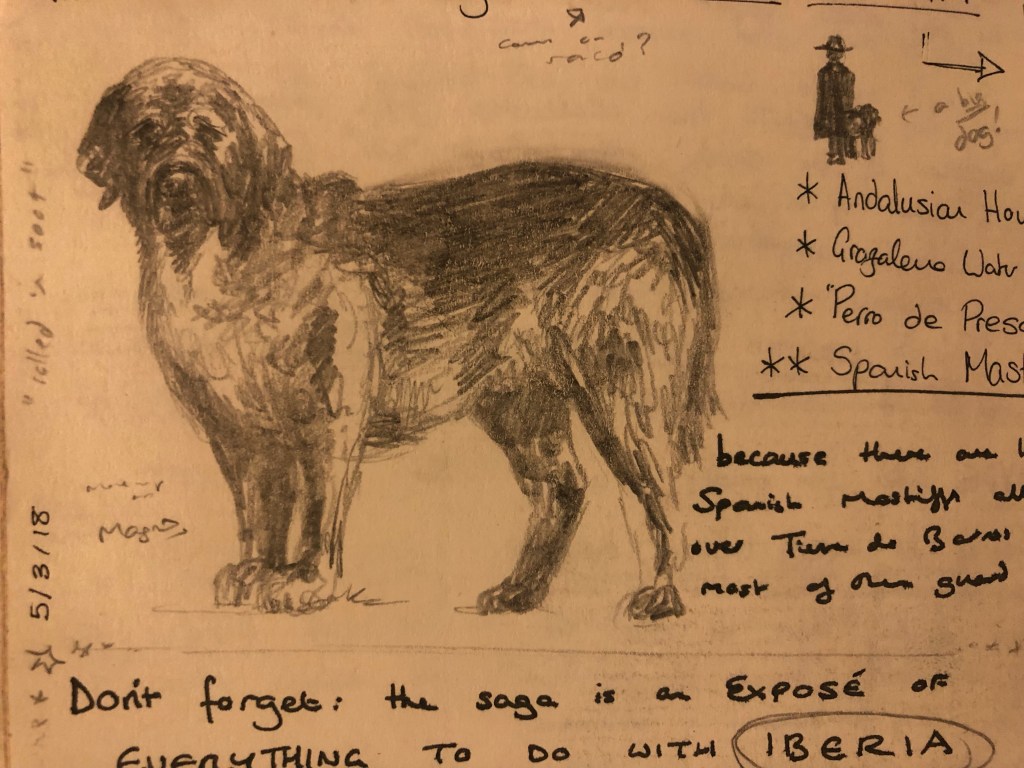
When I lived in Extremadura, I remember finding some of the largest dogs I’ve ever seen out in the countryside, lazing about in the shadows within fenced enclosures and barking at anything and anyone that came near. Not just any bark, either, but a terrible, three-throated bellow that you can hear from a great distance, the kind you might expect from Cerberus. I’m talking about the Spanish Mastiff, an impressive breed once used by the shepherds of La Mesta, Spain’s ancient “wool mafia”, as a guard dog for their valuable Merino sheep. A working dog bred for its size and strength, it’s not hard to imagine this beast in action against the wolves and bears that once roamed the forests of Iberia. They were popular combatants in bear-baiting, a sport which was just as popular in parts of Spain as it was in medieval England, to the detriment of the country’s bear population. Dog after dog would have been sent against the great beasts until they could fight no longer.

These days, of course, there are probably more mastiffs in Spain than there are wolves and bears put together, and the giant bear-killers look like old soldiers gone to seed in their enclosures under the Spanish sun. There was only one victor in their fight against the country’s predators, and it wasn’t the vanishing wolves, the ghost-like bears or even the mastiff, chained to its post in the quiet Spanish countryside. It’s quite sad, when you think about it.

It wasn’t only the wild beasts of Spain’s interior that the mastiff was trained to fight. There are plenty of stories of the use of perros de guerra in the Spanish conquest of Mexico. Given the diminutive size of the dogs native to the Americas upon the Spanish arrival (see the xolo dog for an example), it’s hardly surprising the Spanish saw fit to use their monstrous dogs as additional leverage in their fight for the American interior. Becerrillo, a war dog owned by the conquistador Juan Ponce de León, is the most famous example. Whether it was the mastiff, the alano or even the greyhound the Spanish employed, the results speak for themselves, and monstrous armoured dogs appear in a number of contemporary recollections of the conquest – there’s an especially telling (and graphic) depiction in the Coyoacan Codex. Whether you choose to believe all the details of the so-called “black legend” concerning Spain’s atrocities in the New World, there’s no denying the awesome power of these war dogs if you ever encounter one in the Spanish countryside.

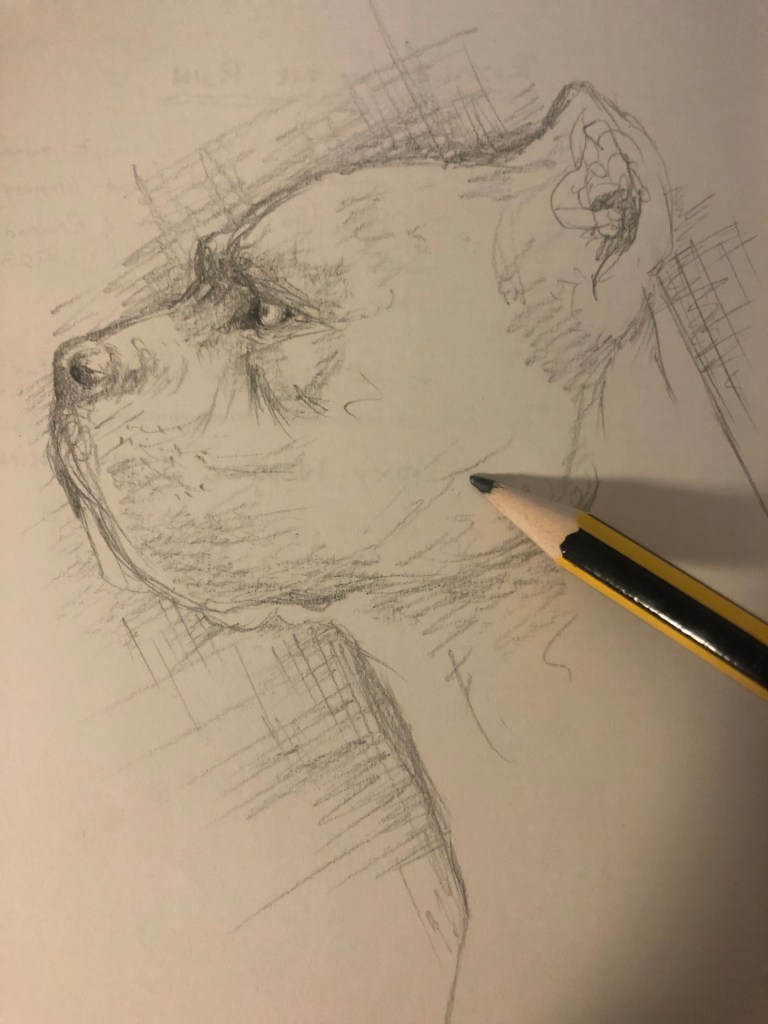
A quick sketch of a Spanish alano, scribbled into the journal between Church and tutor today

Naturally, I’ve written one into my book, as a faithful companion to my leading lady. It’s not as simple as you’d think, writing a dog breed into a book, as by its very nature, dog-breeding is an ever-changing world. Many of the dogs we know today have only been around for a few hundred years or so. The Spanish mastiff we know today is already a very different animal to the kind used at the start of the twentieth century: the original mastiff was still a sturdy, powerfully-built working dog, but not at all like the lumbering giant you see around the Spanish countryside today.

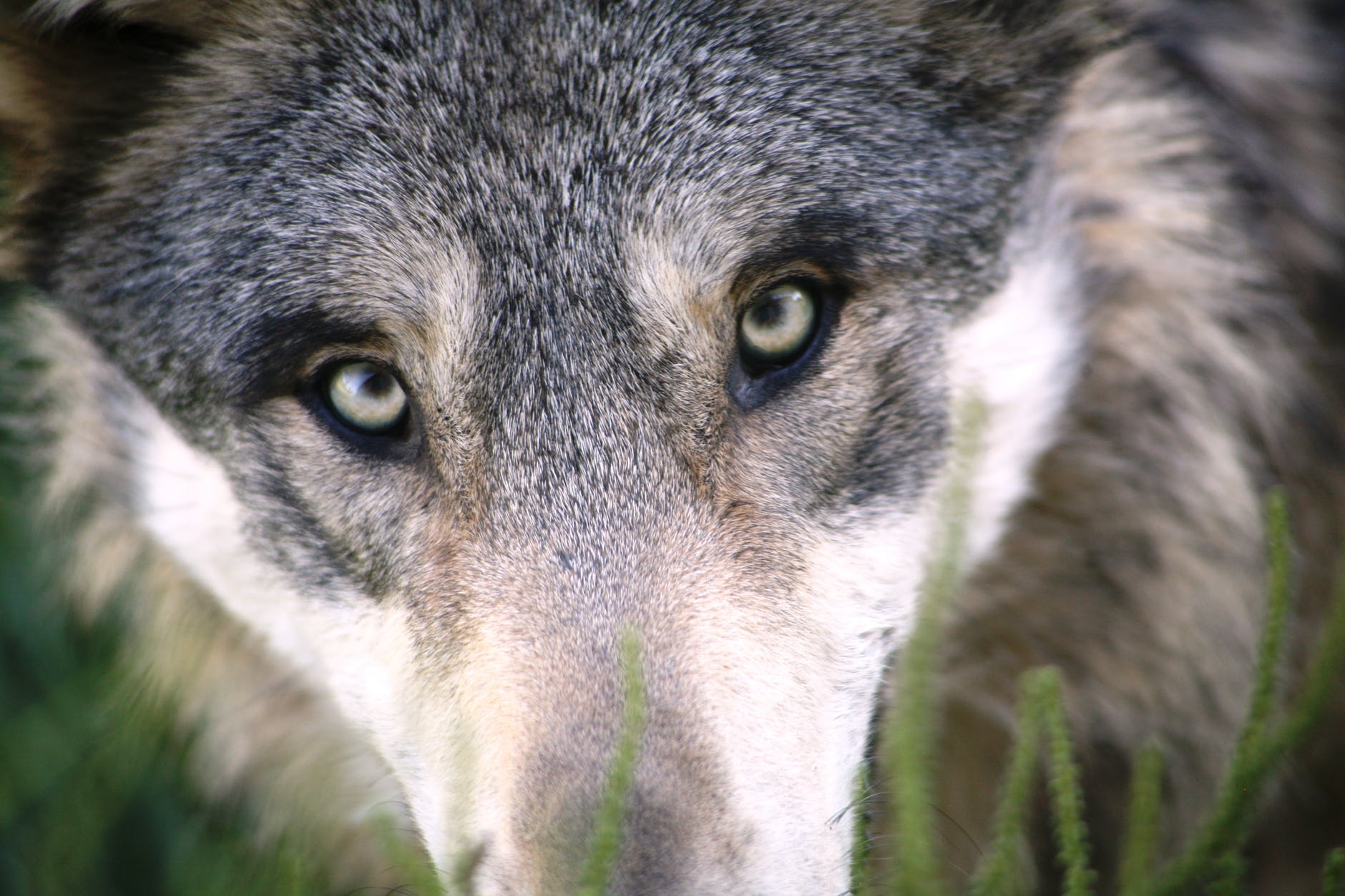
Other dogs that were more familiar to our ancestors have long since disappeared: the stocky Old English bulldogs bred for the sport of bull-baiting, long-since replaced by the squat, hyperbrachycephalic creatures we know today; the alaunt, the rache and the Talbot hound, the mainstays of medieval nobles and huntsmen; and, of course, the mighty Molossus, the ancient war dog of the Greeks and Romans. In our endless desire to bend nature to our will – bigger, smaller, stronger, more obedient, less intelligent – we have warped our old enemy, the wolf, into an absurd array of shapes and sizes. It’s a testament to man’s ingenuity that, long ago, we were able to turn our most hated rival into our best friend, but my word, did we do some terrible things to him along the way. I wonder what a wolf thinks when it crosses paths with a pug or a dachshund. Is there a flicker of recognition, do you think, or have thousands of years of man’s meddling twisted their kin into shapes they cannot begin to understand as one of their own?

Photo by Brenda Timmermans on Pexels.com

I’d really like to track wolves in the wild someday. I’ve heard that one of the better places to do that in Europe is in the wild Abruzzo region of central Italy. I don’t think I’ll manage it this time – as you might expect from one of Italy’s last refuges for the symbol of Rome, it’s not exactly a hop, skip and a jump on public transport. But if years of nature-watching has taught me anything, it’s patience, and I can wait for an experience like that. Spain’s Sierra de la Culebra is also supposed to be a good place to search for wolves, and when last I heard from the place, a pack had been seen in Extremadura, though memory fails me as to where.

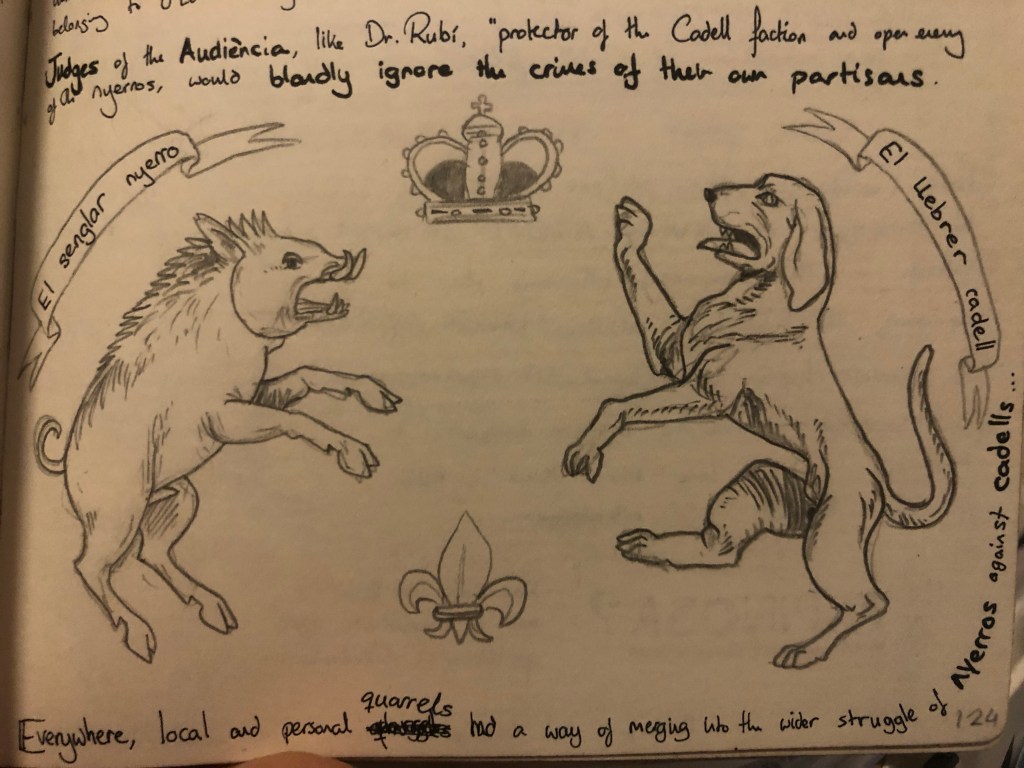
The llebrer (R), symbol of one of Catalunya’s most notorious 17th century gangs, the Cadells

In the meantime, I will read up some more on Spain’s dogs, if only for the sake of my novel. If there’s a place for the loyal mastiff, I’m sure I can find a space for something like the nightmare fuel from Bambi, too. BB x

Living out of a Book: Adventures with a Journal

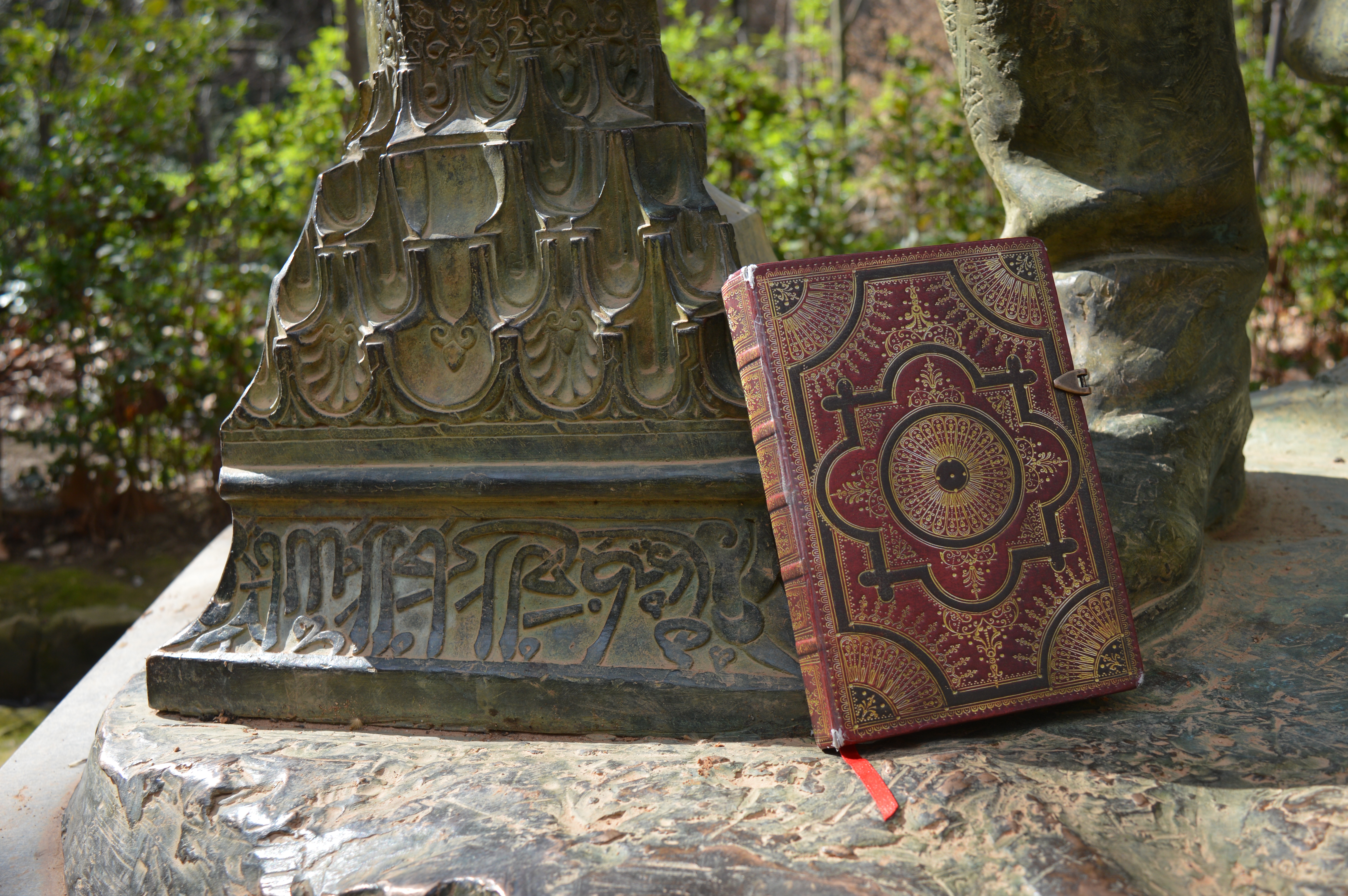
The Red Book (my first “Renaissance” journal) at the feet of Washington Irving, Granada (March 2016)

Let me tell you something for free: full-time employment is a writer’s bane. You knew that already, so neither of us lost anything in that transaction. Except me, and the ever-increasing gaps between the dates in my journal.

I spent so much of this weekend powering through marking after a week of KS3 assessments that it only occurred to me as I filed my Year 9 papers away that last weekend was the first time I’d given my novel some serious thought in a year and a half. Since you can chalk that “blip” up to the first lockdown, it’s probably safe to say the last time I made any real headway with my book was before I took up a post in a boarding school back here in the UK. That is to say, back when I was living in Extremadura, now almost four years ago. If it weren’t for the fact that I still carry a journal around with me, I’d have made no progress in that time whatsoever.

But since I’m more of a glass-half-full kind of guy, I’m going to focus less on the killing instinct of working life and more on the magic of keeping a journal. Because, as always, there’s a story behind it – and in my case, it’s a lot more personal than I ever knew.

I’ve written reasonably extensively about my journalling habit before, but in case you missed it, click here for an earlier piece on one of my favourite journals, the Red Book.

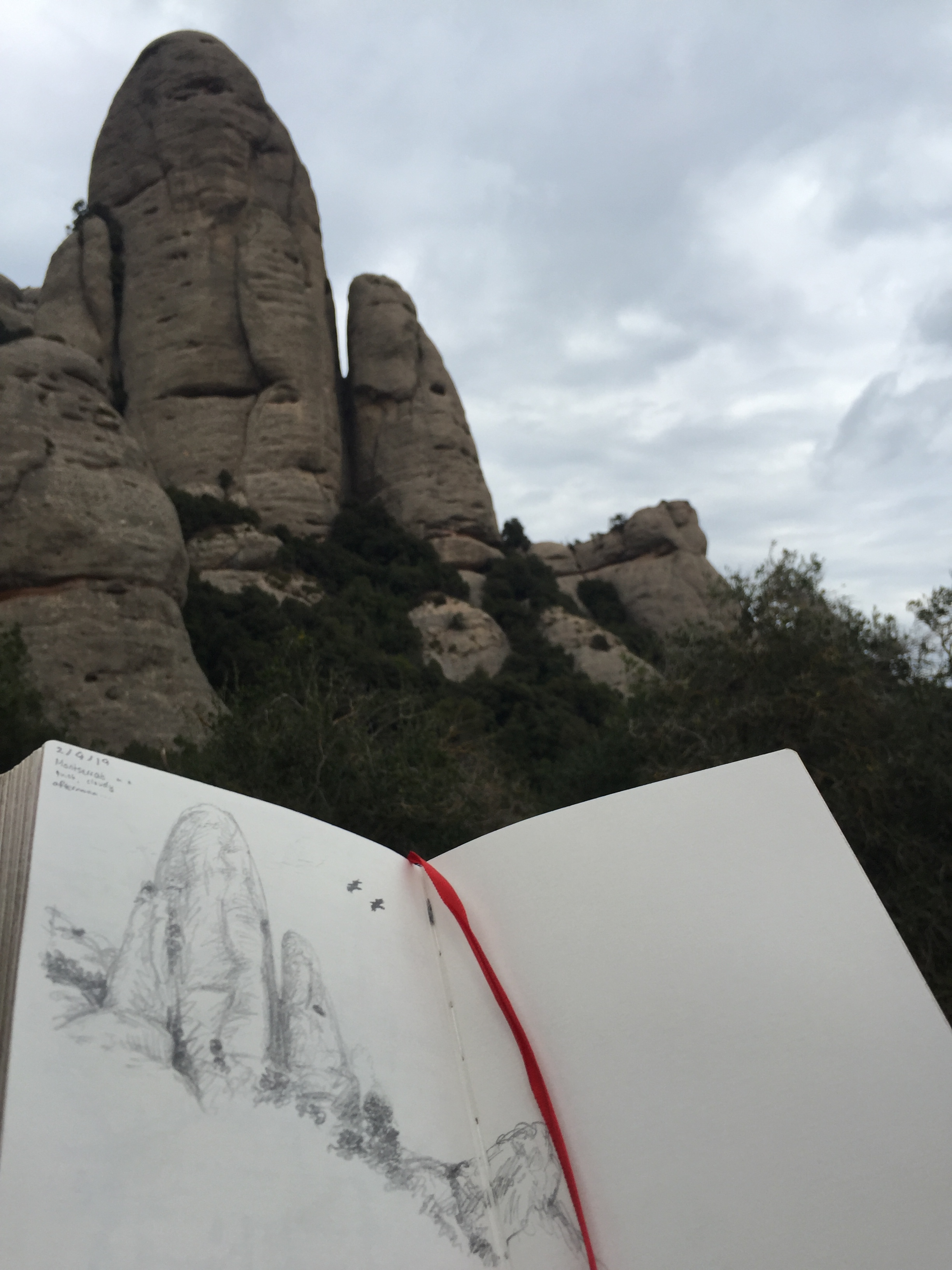
Sketching the windy peaks of Montserrat (April 2019)

I don’t think I’ve ever been without a sketchbook of sorts. Going back to my parents’ place for Christmas turned up quite a few of my oldest surviving books, dog-eared, half-filled and almost all of them featuring the same cast of characters that share a space in my head and my heart to this day. Studying Art for GCSE and A Level naturally fed the habit, though I seem to remember having separate sketchbooks for school and for myself right the way through. I suppose I should reach out to a couple of early inspirations here: to Mr Howe, for his no-holds-barred approach to sketchbook work (“unfinished pieces are often more interesting than finished pieces” has stuck with me); to my old friend Freddie, whose handwriting I secretly admired and have long since adapted into my own; and, of course, to my own mother, who must have kept several journals of her own when she was younger.

These first attempts were more art than word, though. It wasn’t until my eighteenth year that I took the craft of journalling more seriously, riding off the back of having successfully kept a diary for a little over a whole year – to date, the longest successful writing streak in my life. With many long months to go until the first day of my degree, I picked up a small flip-journal from Waterstones and penned some thoughts. At first, it was just lists: locations in my novel, possible pen names, key elements for fantasy fiction. On the second page I branched out and jotted down some facts that I found interesting, for a change of pace (my brother was quick to point out this was a considerably less interesting way to use a journal). I guess not everybody needs to know that the underside of a waterfall is called an undercutting; that Mullah Omar donned the mystical Cloak of the Prophet to drum up support in 1996; and that Dr William Bryden was the sole survivor of the Khyber Pass massacre of 1842.

Three pages in and the novel is the back in the limelight – and so it continues. Every so often, I find something in a book or on the news that I deem worthy of recording, but as a rule, the bulk of my pen-and-pencilwork concerns the fate of my cast of characters and the world in which they live, ever-growing, ever-crystallising. Sketches in pencil duck and weave through the gaps like weasels, giving over onto full page illustrations when I really found my mojo. It’s a formula I have deviated from very little for nine years now.

Gypsy Legends and Grenadine Gifts (2020)

When I was younger, and I still had these crazy notions (as the young and reckless always do) of embarking upon death-defying expeditions to Afghanistan and beyond, I remember thinking that, if something should happen to me, the world in my head that I had spent all but the first seven years of my life creating would disappear completely. That is, unless I left enough material behind for somebody to pick up the pieces. I suppose that morbid justification stuck, because there is now enough information spread across my various journals for somebody to put together the various stories I have always wanted to tell.

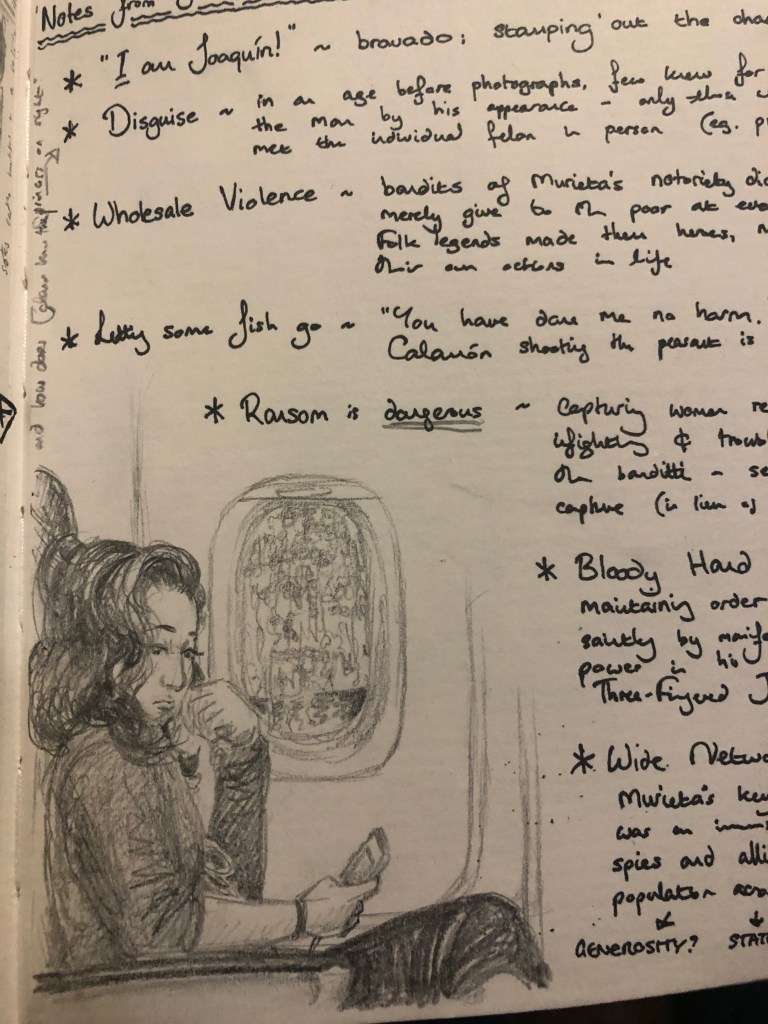
The rain in Spain on the plane (August 2019)

And perhaps there’s a logical explanation for that mindset.

My great-grandmother Mercedes was a woman ahead of her time. In a Spain teetering on the brink of Civil War, she found love with a poet and musician called Mateo. They corresponded in verse, quoting Oscar Wilde and Keats and Plato and Engels. Their handwritten letters to each other – safeguarded by my family for over fifty years – tell of a truly devoted husband and wife on an equal intellectual footing, flying in the face of the dictadura and the expectations of women outlined in the Guia de la buena esposa. Mercedes was well-known about town for her journal, which was as much a part of her character as her glass of brandy and cigars. Though her locally legendary journals themselves are lost to time, it is chiefly through her precious letters to her Mateo that I can see through a window in that past. It is a past which comes clearer into focus the more I get to know my family out there. The fatalist in me cannot help but wonder at the sequence of events that led to me arriving at my family’s door with little more than my journal in hand, unconsciously carrying the one item that would prove my connection to a great-grandmother I never had the chance to meet. Mercedes left this world the very same year I came into it.

I spent the greater part of my search for my family focused on the grandfather I never knew, but it is my bisabuela Mercedes who guides my hand these days. I’m a strong believer in upholding family traditions, and it doesn’t half lend a sense of purpose to the scribblings in my journals, even if they never lead anywhere. My ancestors left me a literal paper trail and I must follow.

Barcelona vignettes (March 2019)

Have you ever kept a journal? I’d highly recommend it. It’s less onerous than a diary and a beautiful thing to look back on. Through mine, I can read the world around me through the strokes of my pen: the euphoria of success in the a cappella semifinals; my bewilderment at Brexit; the shockwaves of the fire of Notre-Dame; and my bottomless love for the country of my ancestors. It’s all there, and since boarding school life makes it nigh-on impossible to knock out a couple of chapters a week like I used to, my journals do a thumping good job at telling the story.

And maybe, one day, that’s exactly what they’ll do, when they fall into the hands of my grandchildren. I’d like that. I think Mercedes would have liked that, too.

BB x

My Most Treasured Possession

My first dissertation extract is complete, and after three somewhat hectic days I can finally relax in the library and read whatever the hell I want for a little while. My field of research and my area of interest are closer than I could ever have imagined, but the very fact that I have to focus on them makes them a little less attractive than they were before. That’s natural, and it’s primarily why I’d never make a career out of art or music. The minute something you like becomes something you have to do, it loses a lot of the magic it once held, I find.

Perhaps the greatest roadblock to making great strides with my dissertation is the fact that, wherever I go, I carry with me a battered little red notebook chock-full of notes, sketches and observations from the last year and a half. I’m almost never apart from it. If it’s a knee-jerk reaction to years of being warned against electronic addiction, it’s a damned healthy one. And whilst it might have got in the way of focused academic research from time to time, it’s actually been responsible for guiding me to some of the most useful books for my degree this year.

notebook

Fresh from the Libreria Talia back in October ’15

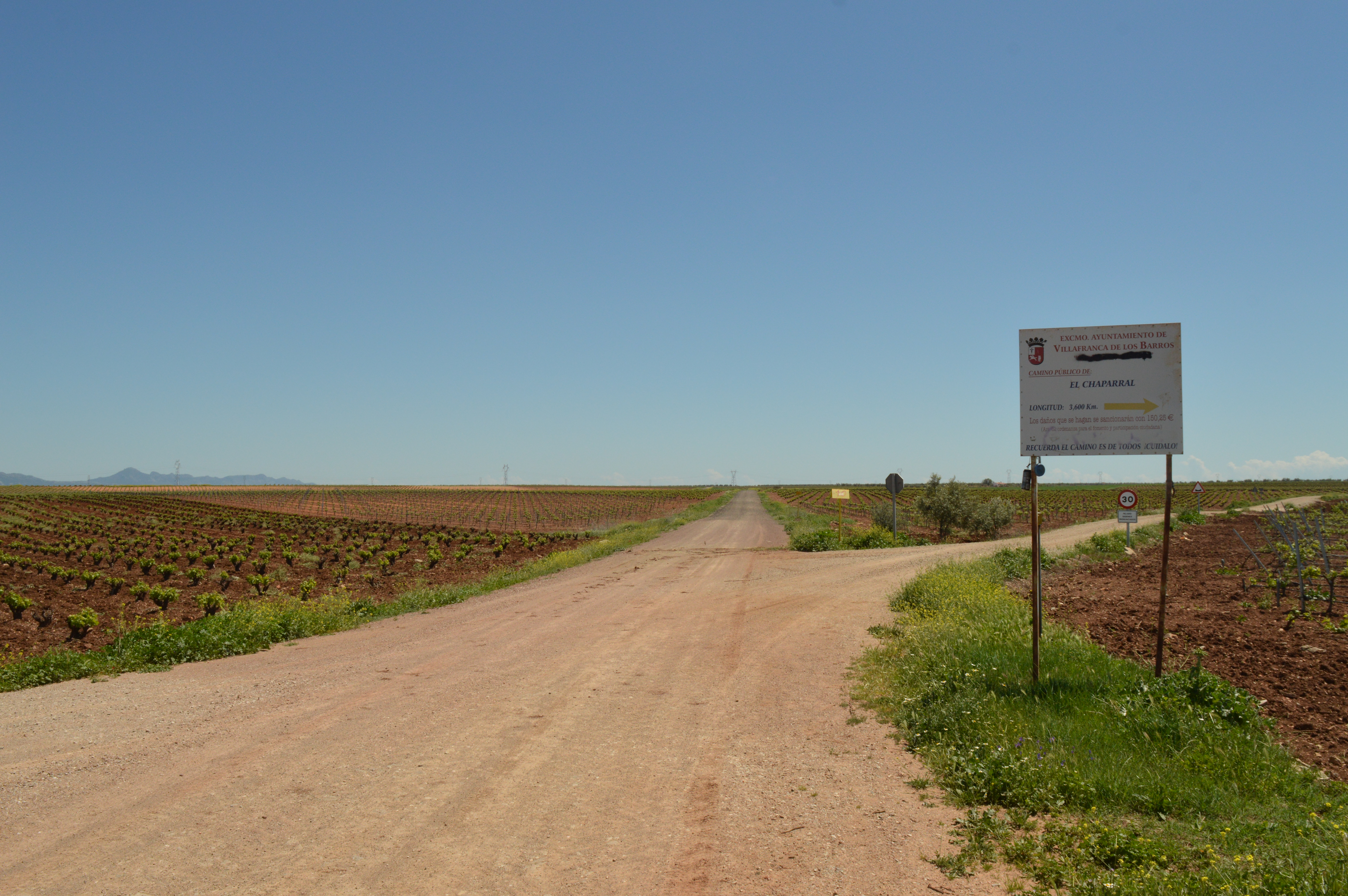
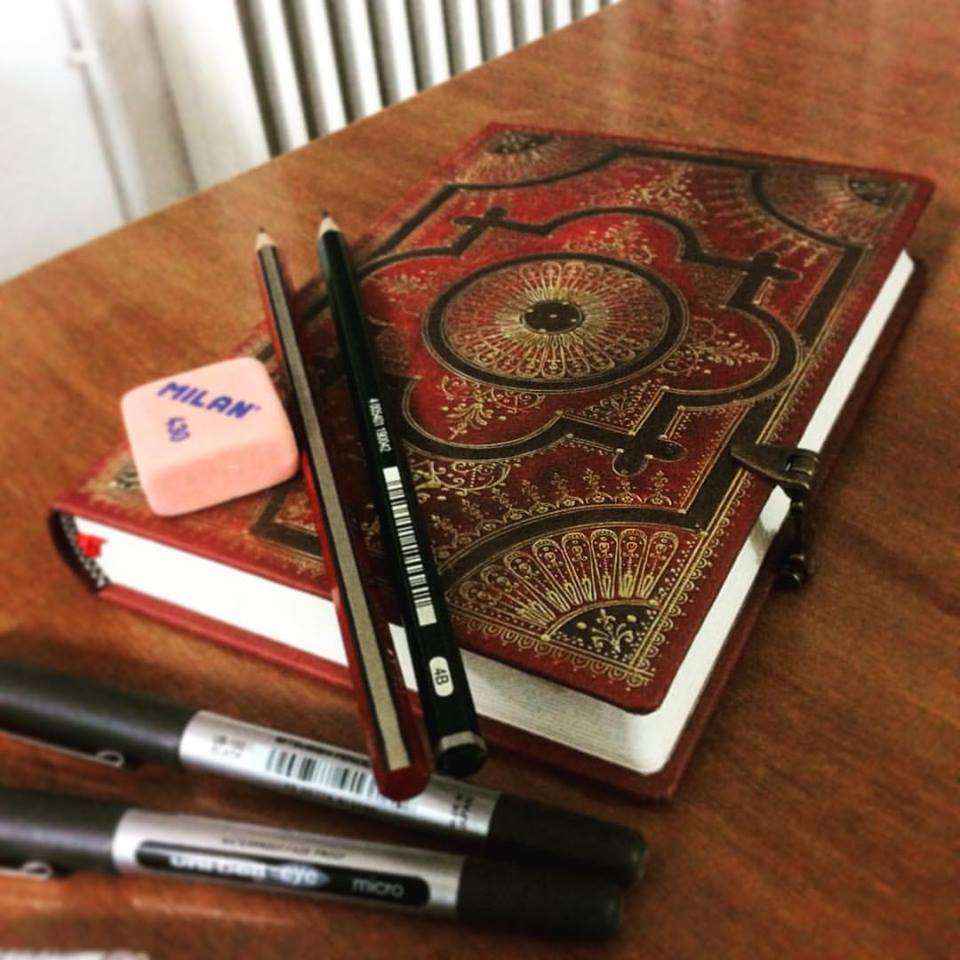
At twenty-two, a one year old notebook seems like a strange object to consider my most treasured possession. You’d never know it was that young, looking at it now. It’s battered and bruised and dog-eared on all sides, and the binding holding it together has been heavily reinforced with generous layers of sellotape. But it’s been with me almost everywhere I’ve gone since I first tracked it down in a bookshop in Villafranca last year and, to me at least, it’s more than just a notebook. Leaving for Spain without a sketchbook was one of the more stupid things I’ve ever done, but the result is this absolutely priceless little book of memories. I wouldn’t trade it for the world.

DSC_0363

The Red Book at the feet of Washington Irving, Granada

It’s been all over the place. It’s been carried over the holy ground of Moulay Abdessalam and watched the sunset over the Aegean Sea. It’s sat on the walls of the Alhambra, felt the sea breeze of the Atlantic from Cape Roca in Portugal and sampled tapas in Salamanca (with the olive oil stains to show). These days it contents itself with regular trips to and from the library, which is intellectually stimulating at the very least, but perhaps not what the Red Book was necessarily born for. I expect it’s just as hungry for another adventure as I am. The trouble is, there’s only thirty pages left until it’s all filled up, and with the rate at which I’m harvesting new ideas, Greece may have been my eternal companion’s last fling. When I stop to think about it, that’s more than a little bit saddening.

We’ve had some pretty special memories, the Red Book and I. But probably the most treasured of all was its first ever outing to the sanctuary mountain east of Cáceres where, as the sun set over the old city, I had an epiphany and decided to base my series of novels in Spain. And, suddenly, it all made sense. What had been for some fifteen years a mishmash of fantastical borrowings and cliché leapt out of the chrysalis into a vast historical saga. The moment was recorded with two simple words scrawled at the top of a heavily-smudged first page: it begins.

img_5155

Full-page sketches like this one are not helping on the page-saving front…


Of those who have commented on my faithful travelling companion, the general opinion seems to be that I could get ‘so much money if I ever sold it one day’. Sacrilege incarnate. This little book and I have been on so many adventures now that it’d be like pawning off a loyal pet. But I suppose it’s more than that, because what the Red Book is, beyond a well-travelled journal, is an extension of my very soul. My whole world, the one I don’t tend to share with anybody, is stored within its pages in scrawled notes and sketches. Most of it wouldn’t make a jolt of sense to anybody else, but to me it reads like a map. I’ve kept a working notebook on me in various formats for the last five years – since I could hold a pencil, if you count the sketchbooks as well – but the Red Book is the prince of them all.

The sister notebook is already waiting, an equally eye-catching blue-and-gold journal of identical dimensions. It’s also a Paperblanks notebook. I swear by the things. It’ll be tough, starting afresh with a new book after all this time, like starting up a new relationship. Quite literally: all the memories I’ve stored in the Red Book are ours to share. The Blue Book will need new memories of her own. One day, many years from now, I’d like to think there’ll be a whole shelf of these things, tattered, bandaged and well-thumbed, but loved, and I’ll be able to take them down to explore them with my children, taking them into the worlds I have spent so many years creating.

An ode to a notebook… Well, it was a strange post for Valentine’s Day, I’ll give you that, but with all the time, care and attention I’ve lavished on this little book over the last year and a half, perhaps today’s a fitting day for such a post after all. BB x