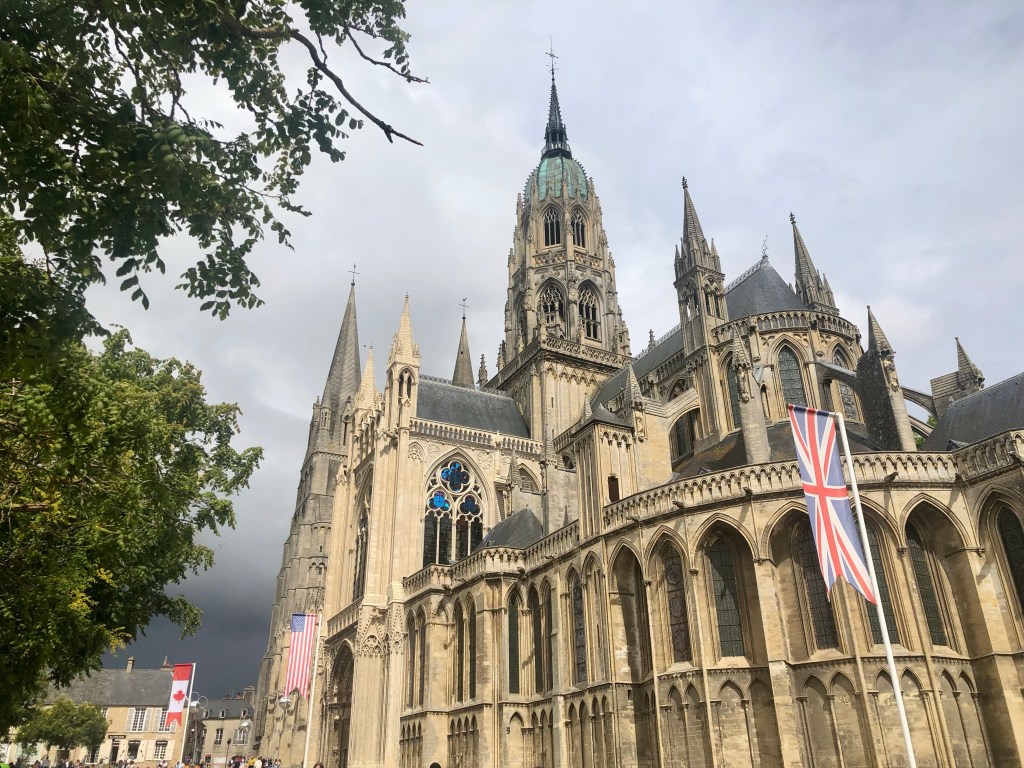
It starts with an ominous grey sky to the west. The patchwork of fluffy summer clouds that have been insulating the leftover heat from three scorching days suddenly drops into a void the colour of slate, matching the roof of Bayeux’s cathedral almost exactly. A man in a beret watches the skies; a French family whose children seem to tan faster down the years savour their two-scoop ice creams; a boy and his mother walk their five beagles.
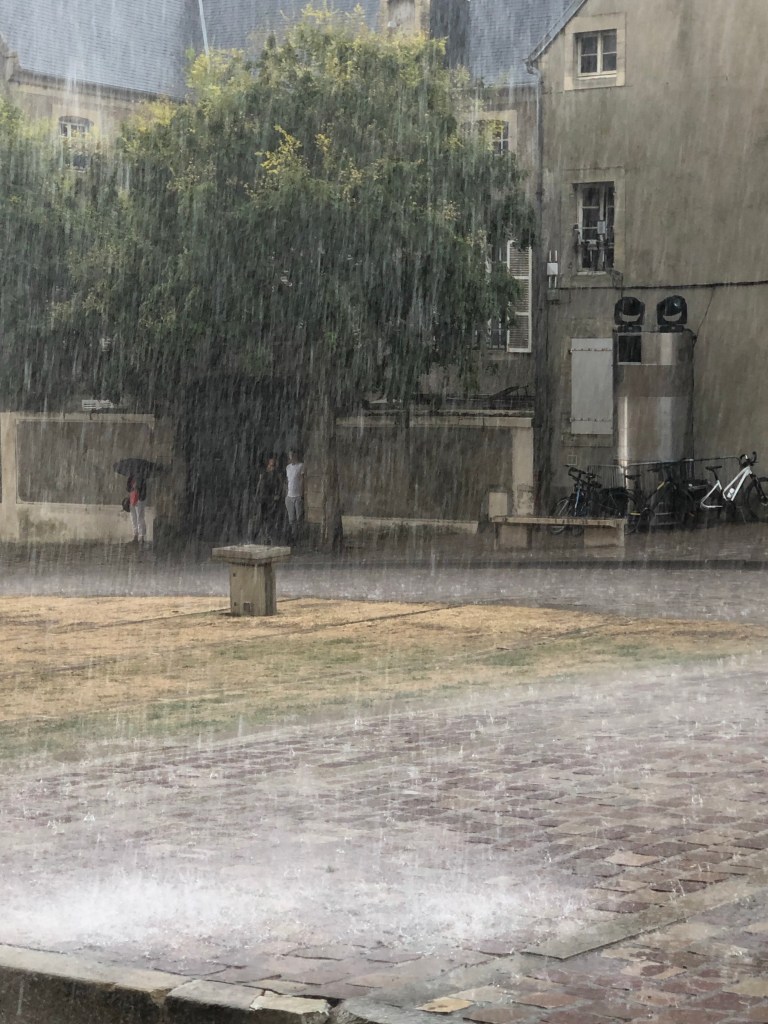
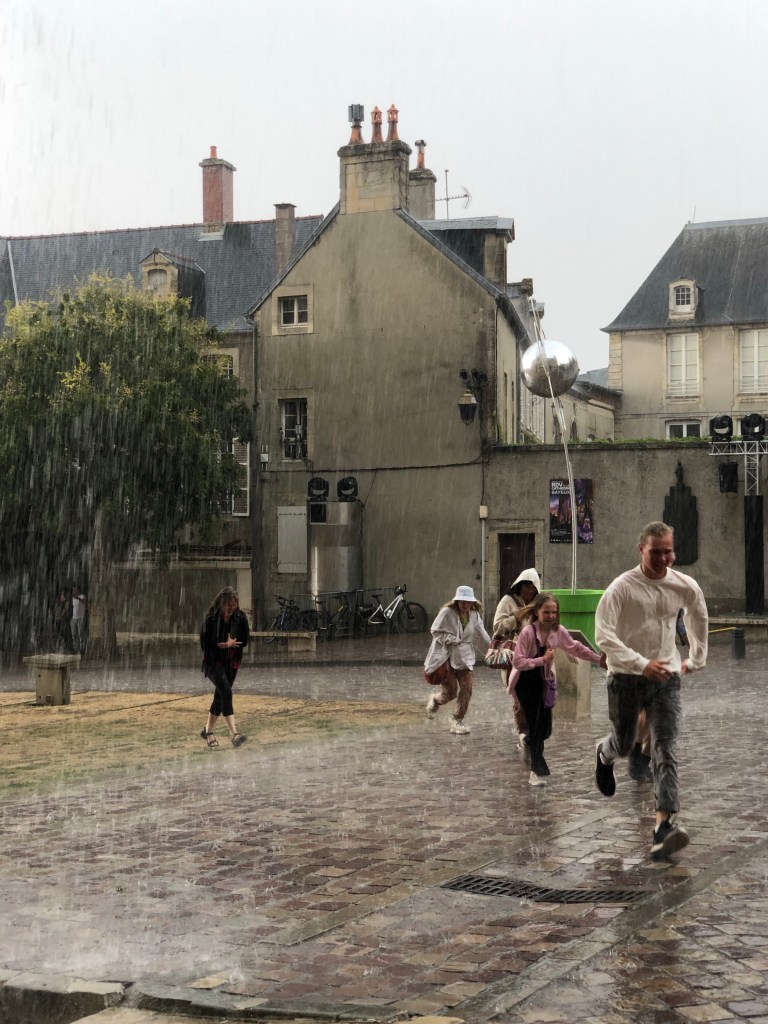
The first raindrop falls on the back of my neck like a kiss. Cool, swift, sweet. I’m sitting on a bollard, sketching. I wait for another. It lands on my arm. Almost instantly a third lands on my sketchbook, narrowly missing the moustachioed gentleman I’ve been sketching. I snap the book shut and watch the tourists scattering as the rain comes down: the French dignified beneath their umbrellas, the Dutch unflinching behind their cameras, the Americans in a mad dash. I think about taking a slow walk back to the hostel to savour the blessed rain after so many days of sun. I’m no further than a few feet around the corner of the cathedral when the heavens open.
I concede defeat to the tempest and join a small but growing crowd seeking shelter in the ancient stone doorway of Odo’s cathedral. The beagle-fanciers are here, along with a cross-section of Bayeux’s tourists. The rain comes down in sheets, hammering the cobblestones like a snare drum, and then a sudden flash and a rolling crash from the bass drum up in the sky. “On est bien dessous, hein?” remarks a Frenchwoman with short-cropped hair and round glasses. A boy with long eyelashes runs in and out of the rain in his yellow anorak, singing the chorus of the Wellerman shanty over and over.
A solitary American standing nearby stares at his phone in disbelief and growls. It sounds like he’s frustrated at a video game, but as he starts to verbalise his frustration it’s obvious he’s checking a weather app. “You’re kidding me, I’ve got to wait half an hour? God, you’ve got to be kidding me. Come on!”. He growls again. And again, louder this time. Some of the other tourists back away. “Hrrrrrnnnn!” The grunts and growls sound uncannily like a bull, giving fair warning before a charge. “END! NOW!!!” A couple of startled jumps from the crowd. By the looks on their faces, they’re weighing up whether to tell him it’s futile to attempt to command the skies, or whether it’s more futile still to reason with a man so blatantly trying to do just that. As a result, nobody intervenes, and Yankee Canute continues to defy the elements, bellowing at the clouds with increasing fury. “Hmmmmmhnnn, CAHM AAAAHN. When’s it gonna EHYAAND? GAAHD, I don’t have TAAM for this SHIIYET”.
The growling and grumbling is briefly cancelled out by another clash of thunder. “Hurry up, END, NOW! Cahm aaahhn, pleeez, end now! Why does it have to do this during the day, it should do this at night!” – (a fair point here, it was unbearably hot last night) – “Gahd, I don’t have time for this shit!”.
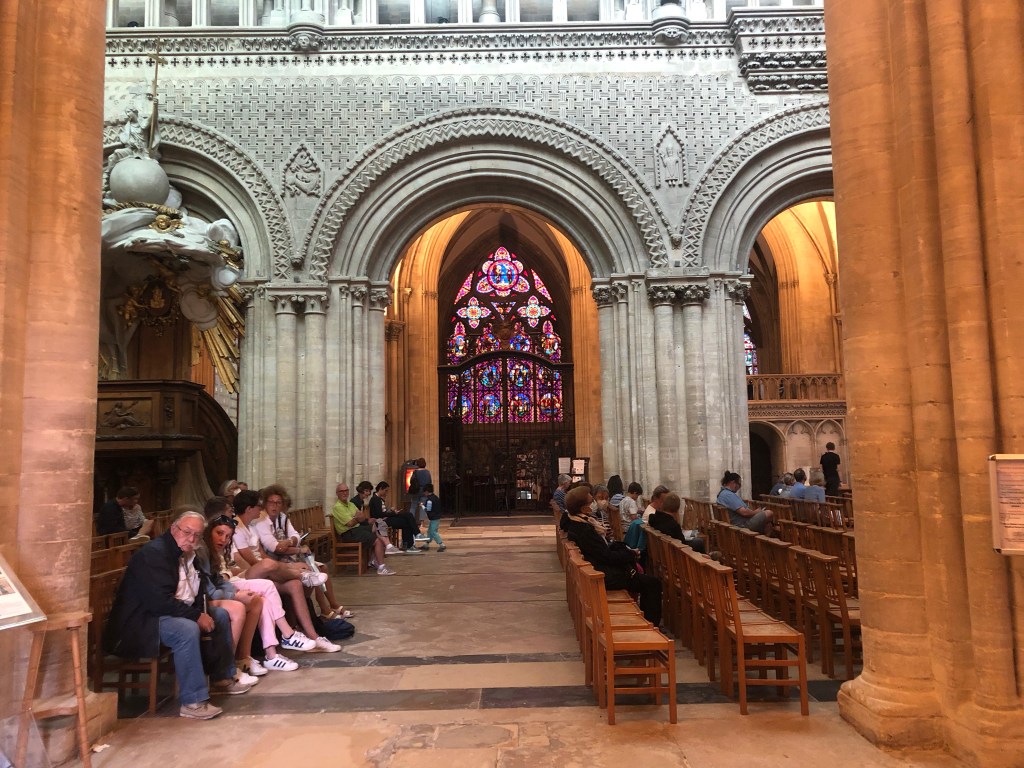
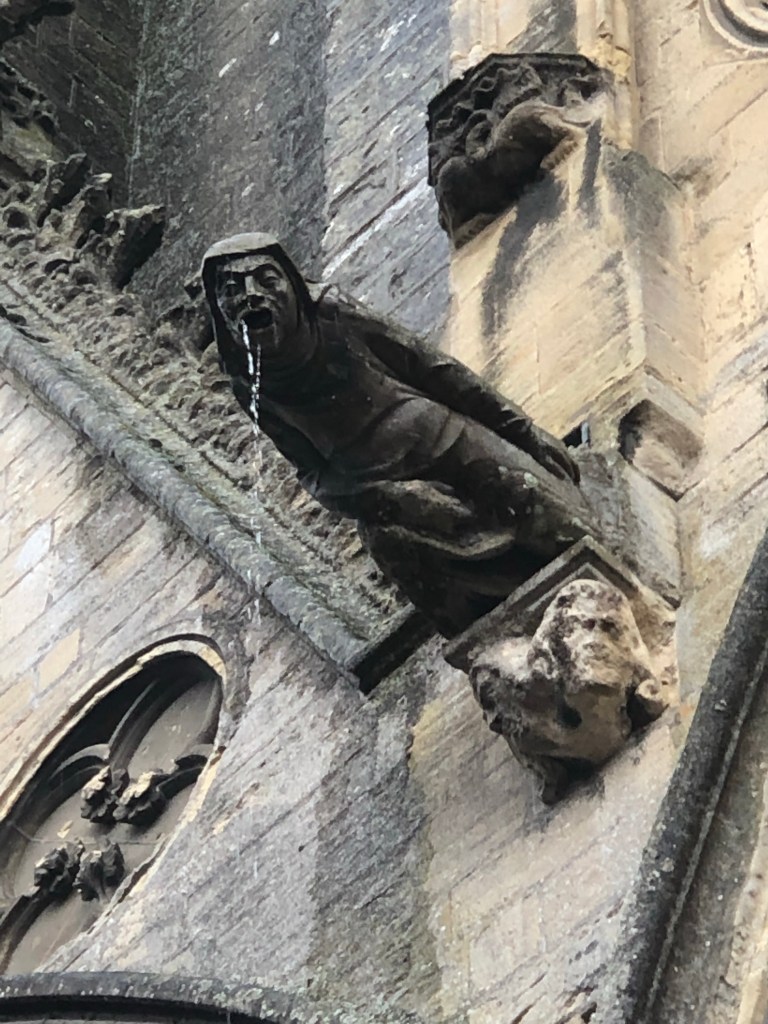
I slip inside the cathedral to escape the verbal artillery for just a moment. Bayeux’s cathedral survived intact the last time it came under fire from an American battery, so I figure it’s a safe bet. The muted thunder beyond the stone walls sounds strangely beautiful, and the grey skies filter through the stained glass in hopeful technicolour. The aisles are packed with a colourful array of tourists waiting out the storm; a phoney faithful glued to their phones, waiting to proceed on their pilgrimage to the crêperies outside – a combination of American flags and English spoken here signs were drawing in the crowds earlier. Staring down at the sightseers, a gargoyle pulls his mouth into a sneer, tongue out, deriding a thousand years of peasants, pilgrims and pensioners.
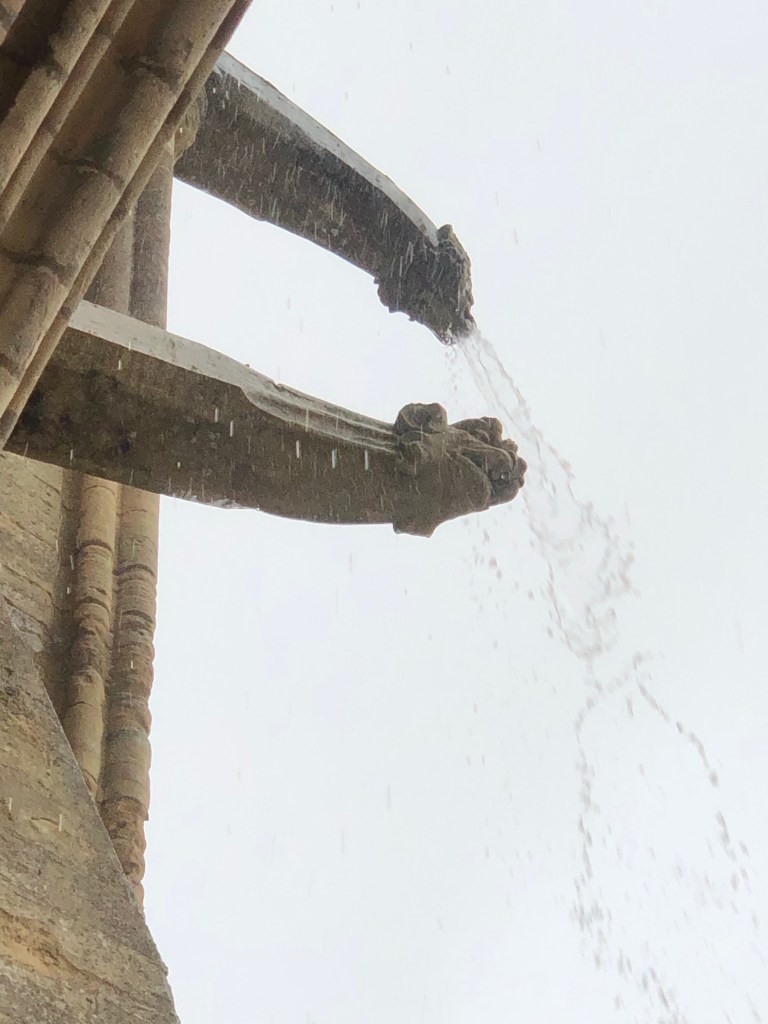
Outside, the rest of the gargoyles are doing their job, spewing rainwater from their mouths onto the streets below. For the first time they look complete, as though the gaping mouths were merely voids waiting to be turned into channels. A father points them out to his daughter, one hand gesturing, the other on her ear as our frustrated Yankee Canute swears blue murder at the sky.
The streets of Bayeux shine under the whitening sky. Umbrellas and ponchos have been magicked out of the air (and some straight out of souvenir shops). The Wednesday market is being dismantled. The fishmonger reclaims the last two skate wings and a Norman bookseller voices a quiet complaint to the heavens as he stacks his pulped collection of second-hand books: “aujourd’hui, précisement?”.
The storm has passed and the sun has returned with a milder temperament, his midsummer fury sated at last. I think I’ll take the rest of the day off. Find a park, do some reading, and clue up on the bus times for tomorrow’s expedition to the coast. A bientot! BB x
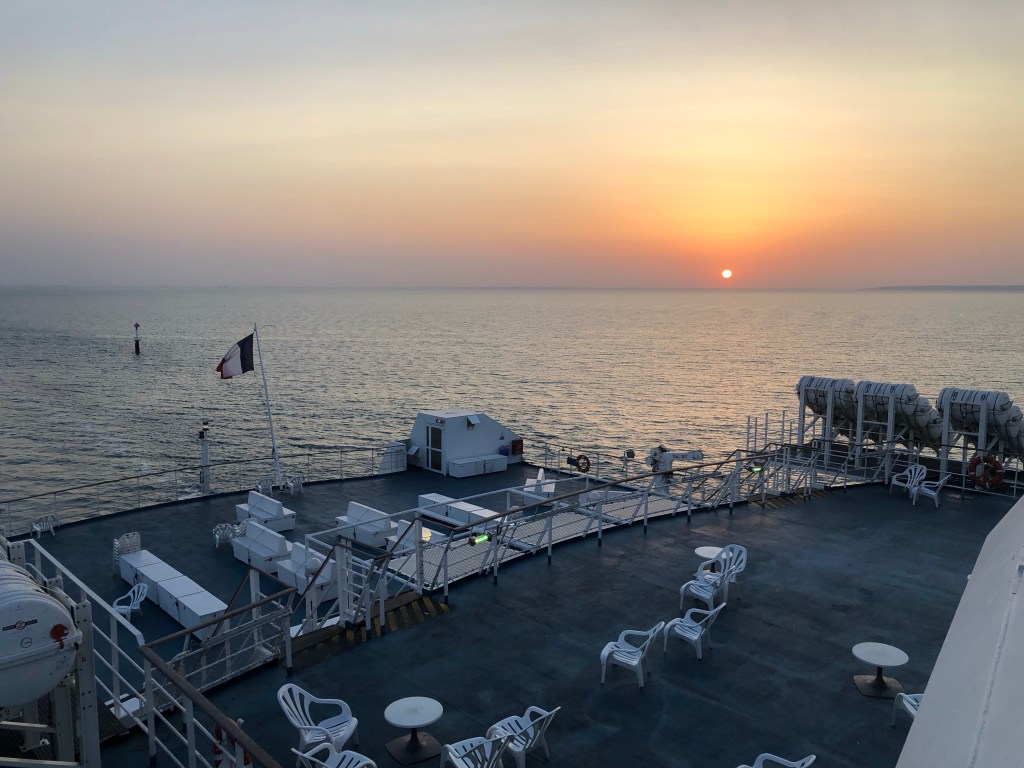
I woke up on a boat this morning. That happened. Originally I was inclined to arrive later today and save on the expense of booking a cabin on the overnight ferry, but how often do you get to sleep on a boat? I’m glad I did – the long faces on most of the other foot passengers spoke volumes of a long, sleepless night on deck. I just caught the sunrise as I went up on deck, by which point we had almost arrived. No dolphins or whales on this journey – maybe next time!
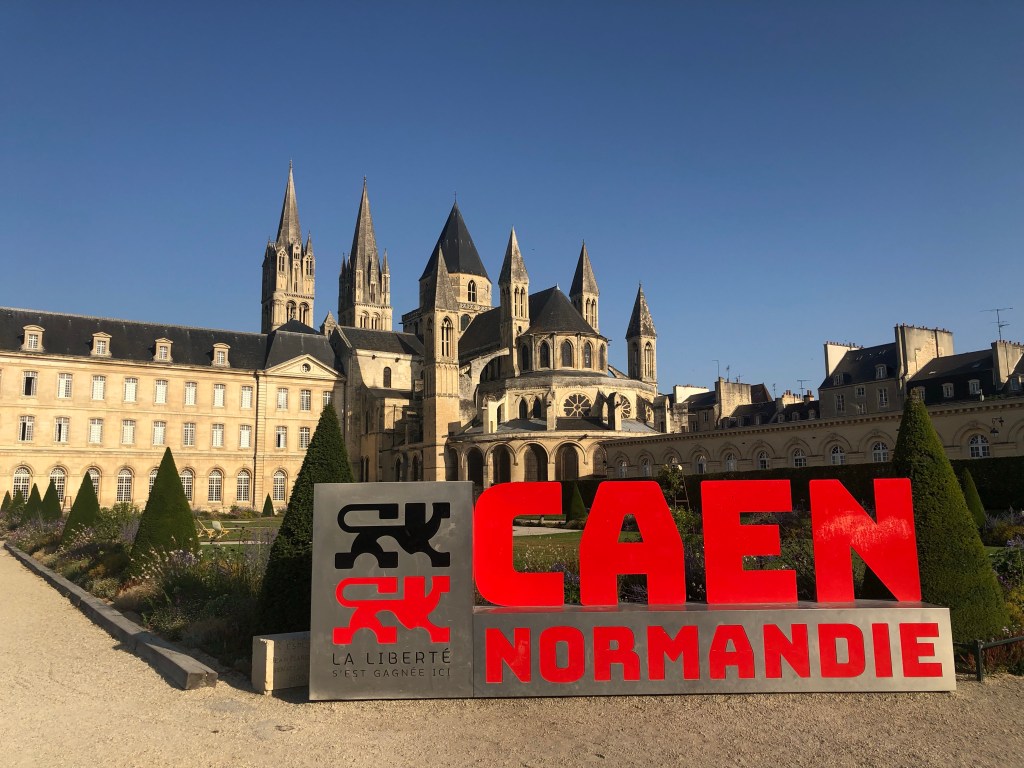
Attention, mes amis! The ferry serves Caen, but it docks in at Ouistreham, a small village some 17km north of Caen. The shuttle bus into Caen was a little deceptive, since despite saying CAEN in block capitals it only went as far as passport control. The real bus stop for Caen (Ouistreham Port) is a few minutes’ walk into Ouistreham from the port. Easy enough to find but worth knowing. The price is (at the time of writing) 1.80€ for a one-way trip. It’s also completely incompatible with the early ferry, arriving some twenty minutes after it departs, so I guess I’ll have to shell out for a taxi on Friday.
Check-in at my hostel in Bayeux wasn’t open until 4 in the afternoon, so with that early start I had quite a few hours to kill – on what was gearing up to be the hottest day, not just of the year, but in living memory. It was already pushing thirty by 10 o’clock. I took refuge in the shadow of Caen’s Abbaye aux Hommes, where William the Conqueror was laid to rest a little under nine hundred years ago. I thought I’d picked a good spot, and I pretty much had the shade to myself for the best part of an hour until a window cleaner turned up in a monstrous contraption spitting and whirring and grinding and clunking. It took him and his two companions all of five minutes to calibrate the machine into the right spot so he could start cleaning, by which point all the office workers within had long since pulled down the blinds. Why a ladder couldn’t get the job done beats me.
William wasn’t in the Abbaye itself. The 5€ entry fee through the Hotel de Ville revealed a beautiful cloister and an interesting exhibition on the Allied liberation of Caen (after nearly levelling the place first), but no William. A mini-map within showed he was in the adjacent cathedral (go figure), which is free to enter.
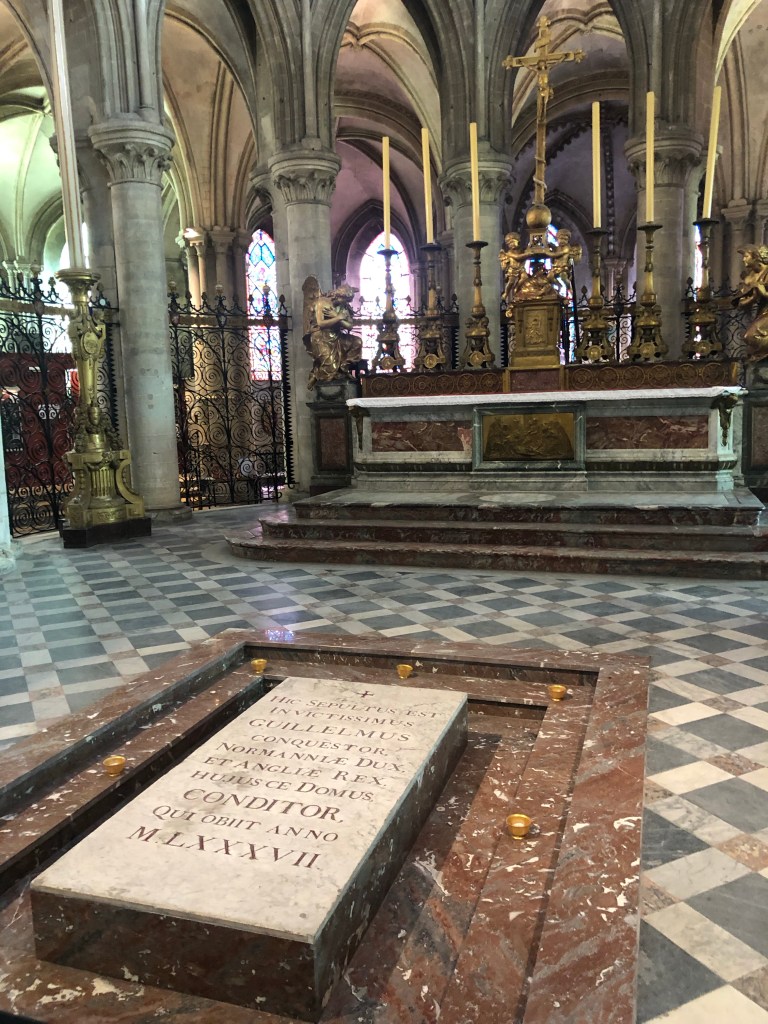
But, as it turns out, he wasn’t there either. Well – not all of him. During the French Wars of Religion in the 1560s, the abbey was sacked and William’s bones were exhumed and scattered. Only his thigh bone remains, and that in itself a miracle: less than two hundred years after his tomb was restored, it was sacked again by the unscrupulous revolutionaries. Napoleon’s generation certainly didn’t seem to hold heritage in high regard: you may have heard of Bonaparte’s foiled attempt to blow up the Pyramids, but he also ordered the demolition of various ancient wonders in Spain, including the Alhambra. Even the mighty CID’s tomb was ransacked by Napoleon’s men, and though more of his bones ultimately came home than poor William, some of them traveled a very long way. One apparently ended up in Russia, where it must have been carried as a trophy of war by a soldier with an eye for relics…!
William’s tombstone reads ‘here lies the Invincible William the Conqueror’. Somewhere under that slab is an invincible thigh bone. It’s definitely more invincible than my thighs, which are feeling very vincible in this heat… if that’s even a word.
Outside, it’s sweltering. It felt like walking into a wall of heat. By the time I reached Bayeux around midday I didn’t have the energy to anything beyond finding a shaded spot and collapsing. Fortunately Bayeux was spared the inferno enveloping most of Europe, and a nearby nature reserve afforded both shade, a cooling river and a bird-hide to lay down in relative comfort. I must have passed out several times, I think.
*Alternative* sleeping arrangements
Thank God the worst of it is over. Rain is forecast for tomorrow. It couldn’t be more welcome. BB x
For my last two days in Italy, I decided to embark on a rather esoteric quest: to see all the pines of Rome featured in the orchestral piece of the same name by Italian composer Ottorino Respighi. If you grew up with Disney’s Fantasia 2000 – like I did – you may remember it as the number with the flying humpback whales. The symphonic poem in question is divided into four movements, and though I didn’t manage to hit the correct time of day for each one, it was an enjoyable musical challenge to round out my time in Italy!
It’s also a fitting challenge since music provided me (and my mum) with our first Italian connection, and I’ve been scraping by out here on a combination of guesswork from Spanish, DuoLingo and twenty years of orchestral jargon…
So, play the music below and read along as the Chicago Symphony Orchestra takes you through the movements!
I. The Pines of the Villa Borghese (I pini di Villa Borghese, allegretto vivace)
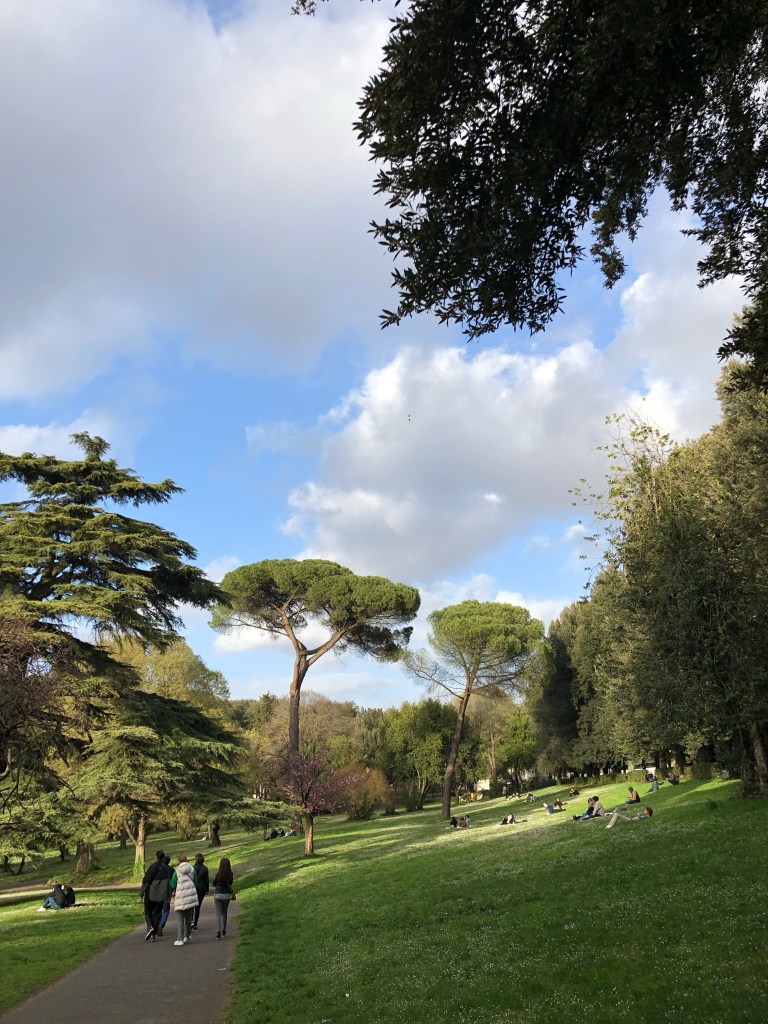
I clocked these pines last night on an evening wander towards the Spanish Steps. Respighi wasn’t wrong to write this movement as the jolliest, most playful of the four: when I was there, the Giardini della Villa Borghese were full of children playing in the evening light. A couple of fairground rides replaced the Roman ring a ring o’roses game in the original, but in all other respects it still fits perfectly. The man knew his source material!
The Borghese gardens also appear to be a favourite spot for Roman romance. As the sun starts to sink behind the trees, the long shadows cast by the stone pines stretch like rivers between the patches of sunlight, where in one corner of the gardens couples clustered like mayflies in the light. A girl in her twenties was picking daisies to fashion into a chain, four Spaniards laughed their heads off as they wheeled up and down the paths on rental bikes, while in the middle of the gardens a priest gave a homily to a small crowd in front of one of the chapels.
If I should find the One someday, I’ll take her for a walk here, too.
II. The Pines near a Catacomb (I pini presso una catacomba, lento)
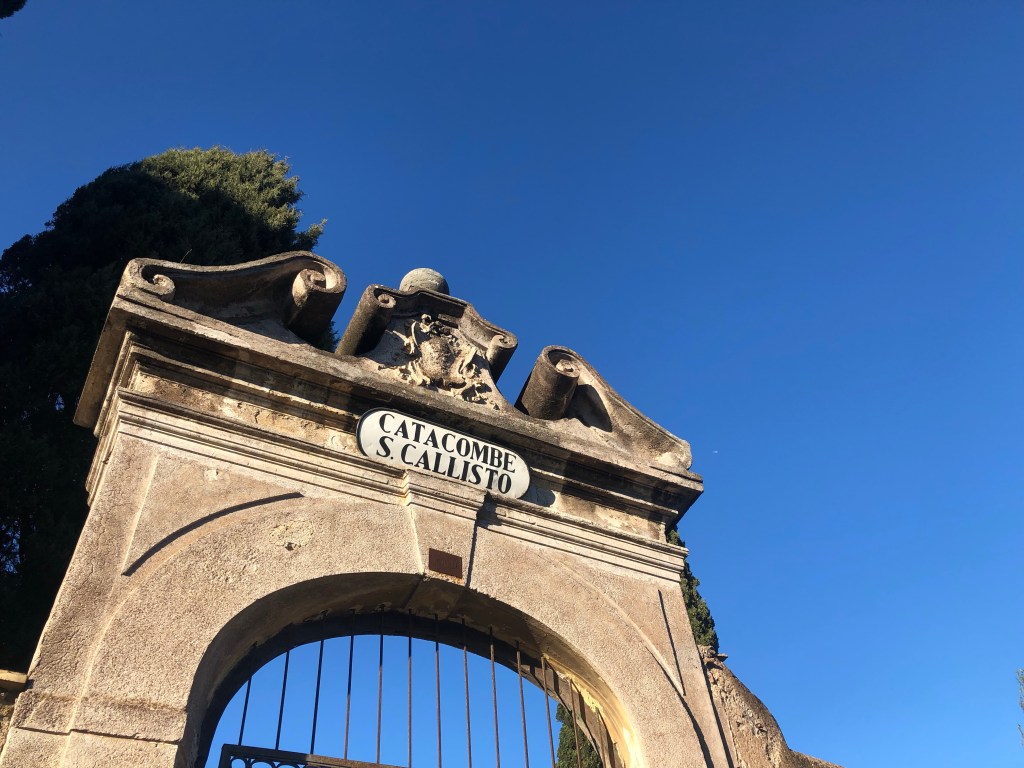
By the time I reached the catacombs, they were all shut up for the week… but that’s what you get for prioritising the Pope over a blog post. Compared to the rest of the Appian Way, the area around the catacombs was quiet and shaded… though that may have more to do with the lateness of the hour by the time I reached them. Here in Rome, as in Spain, cypress trees mark the resting places of the dead, lining the roads to the catacombs. They’ve been symbols of death since ancient times, since they cannot regenerate when cut back, and so they stand as sentinels outside tombs, cemeteries and graveyards all across the Mediterranean. The Romans’ beloved stone pines tower above them, but I think its the sad and stately rows of cypress trees that Respighi is alluding to in this movement.
III. The Pines of the Janiculum (I pini del Gianicolo, lento)
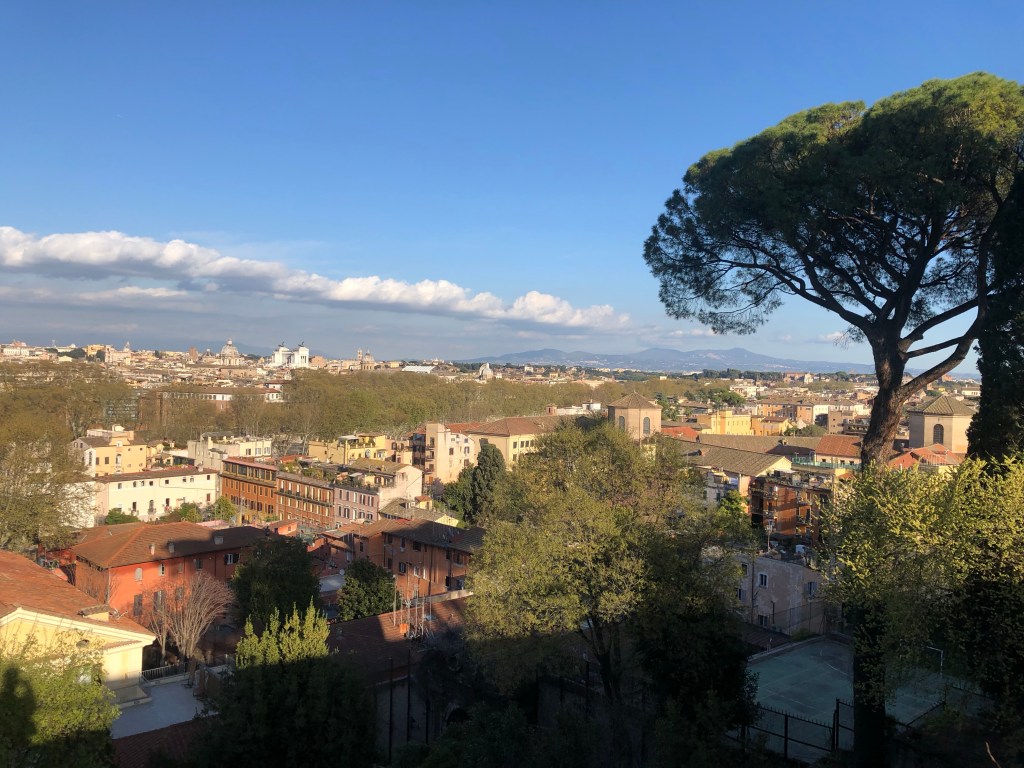
My first night in Rome was spent watching the sun set over the Eternal City. A girl I once put on pedestal told me to make the most of every sunrise and sunset. I left behind both girl and pedestal years ago, but it’s still a rule I live by when I’m on the road. Snacking on a focaccia from the hilltop, I had a sweeping view of the city, from the Vatican to the distant towns of Tivoli and Palestrina. The pines that grow here are the stone pines of Doñana, the trees of my childhood. The Romans had a special love for this tree and planted it wherever they went, especially along roads like the Via Appia.
Down in the dark branches below the viewpoint, some of the city’s monk parakeets screeched this way and that (oddly enough this South American species began to colonise Rome around the same time the Argentinian Pope Francis was elected), but my eyes were drawn to a tiny black-and-white shape moving up the trunk of the tallest stone line overlooking the city: a lesser spotted woodpecker, the first I’ve seen in many years. The rising and falling flute in Respighi’s movement pairs well with all the birds I saw here: the parakeets racing by, the pigeons wheeling over the roofs below, the tiny woodpecker climbing up and up. But I didn’t hear the nightingale that Respighi insisted on featuring at the end of this movement. Perhaps it’s too early in the year – though I suspect it’s more because it’s much too crowded here for such a self-conscious minstrel.
IV. The Pines of the Appian Way (I pini della Via Appia, tempo di marcia)
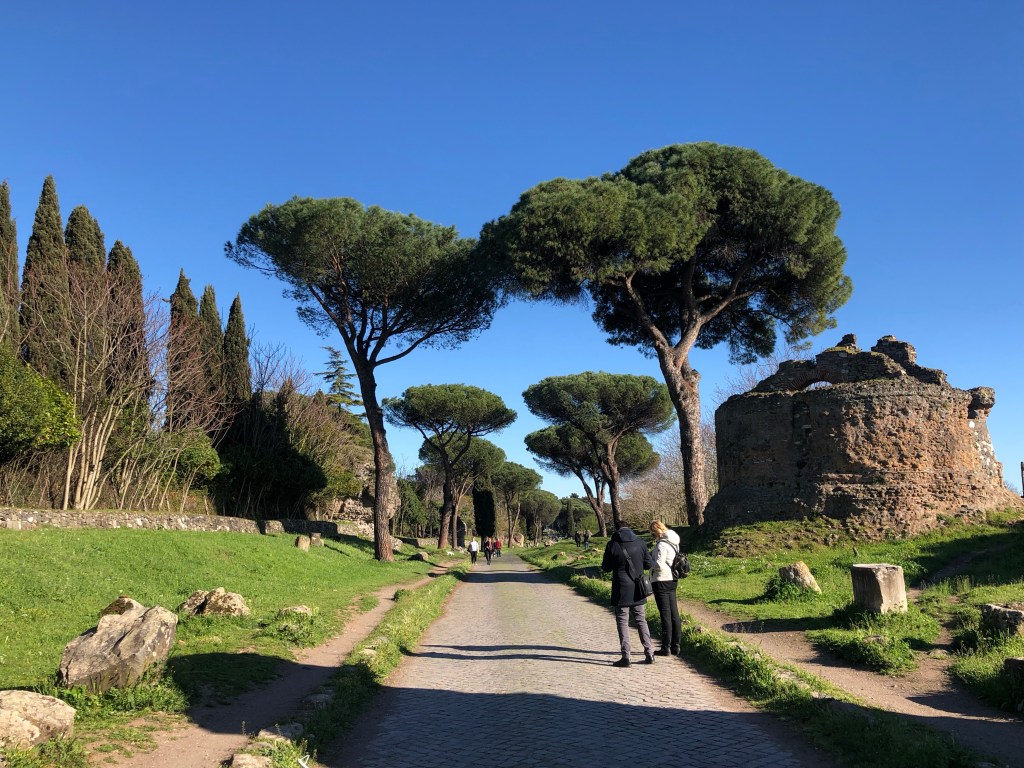
This was always my favourite movement – and what a sight! No visitor to Rome should pass up the chance to take a walk on the Via Appia, especially on a Sunday when the road is closed to traffic and the Romans descend upon the ancient highway in their droves for an afternoon passegiata. Walking the forum is one thing, but this is something else. The Via Appia is probably the oldest road still in use in the western world, and you really do get the feeling you’re walking in the footsteps of the ancient Romans as you walk this road. The things this road has seen…! This is where soldiers marched to the port and on to Egypt, where nobles lived in luxury beyond the confines of the city, and where the great orator Cicero was assassinated. I fell into the Romantic trap of many travelers before me as I passed one old Roman sitting on a marble colonnade, with skin of burnished bronze, black, sunken eyes and an aquiline nose that would have looked supreme on any Caesar; and I wondered whether he was the descendant, through many fathers, of Romans who had lived on this road two thousand years ago.
I also heard a nightingale here – he must have missed his cue in the Third Movement.
If Cannaregio was my favourite spot in Venice, the Via Appia takes the top spot in Rome. It’s breathtakingly beautiful, flanked with ancient Roman treasures along its entire length, and absolutely mustn’t be missed. And Respighi nails it with his final movement: it’s heroic, majestic and the perfect finale to both my long walk and my time in Italy.
I’ll tell you the tale of my incredible Palm Sunday experience as soon as I get my hands on a computer, as my phone photos simply don’t do it justice, but until then, arrivederci Italia!Sei bellisima e tornerò presto! And that’s a promise. BB x
Three days in and I’m already a day behind. I guess that’s a good thing, as it means I not only had a packed day yesterday, I also had a busy sociable evening swapping stories with fellow travellers. It’s travelling done right, and all I ask is your patience, dear readers – such days make for good writing.
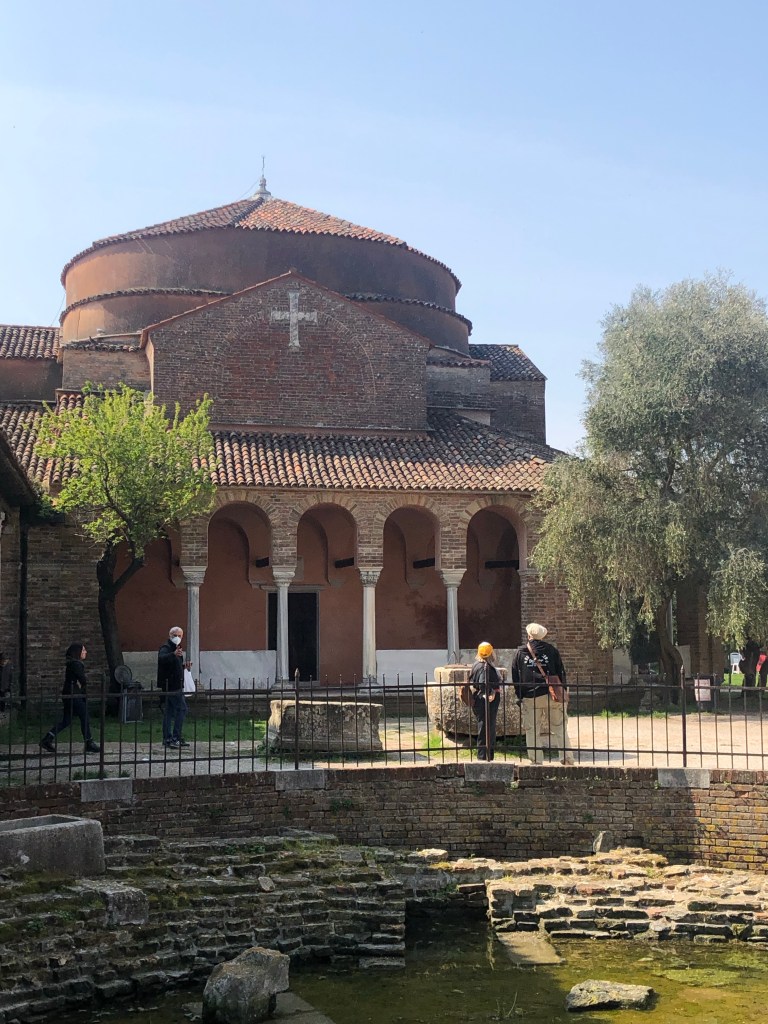
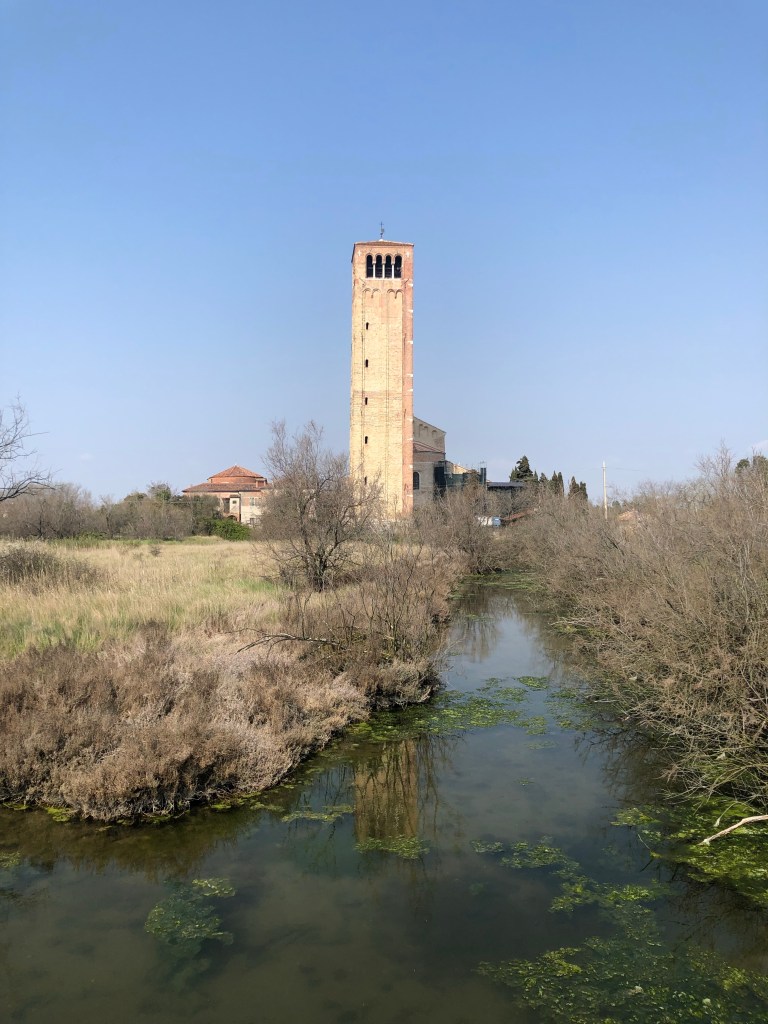
Wednesday was another make-it-up-as-you-go kind of day. I had it in mind to visit the smaller islands out in the lagoon – namely Murano and Burano – but as the vaporetto rolled up to Fondamente Nove, I suddenly decided to take a chance on mysterious Torcello, Venice’s predecessor. Most of the guidebooks pointed out it was almost deserted with very little to see other than an ancient church – the oldest in the lagoon – but if you’ve been reading for a while, you’ll know that’s one big fat tick in the box for me.
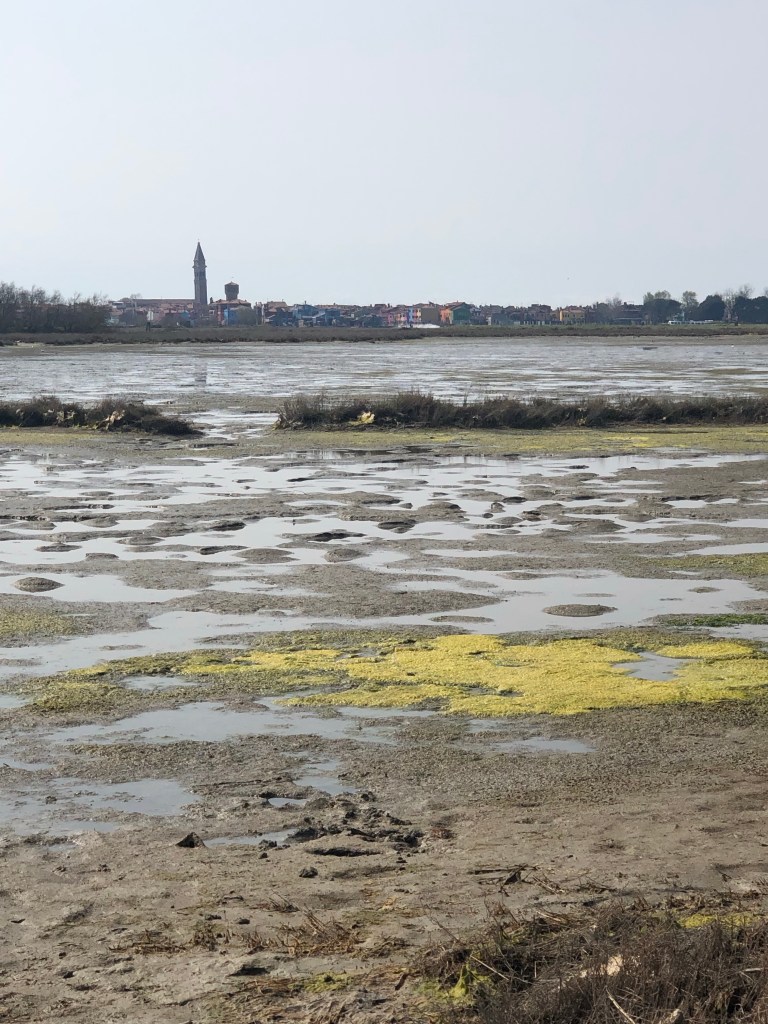
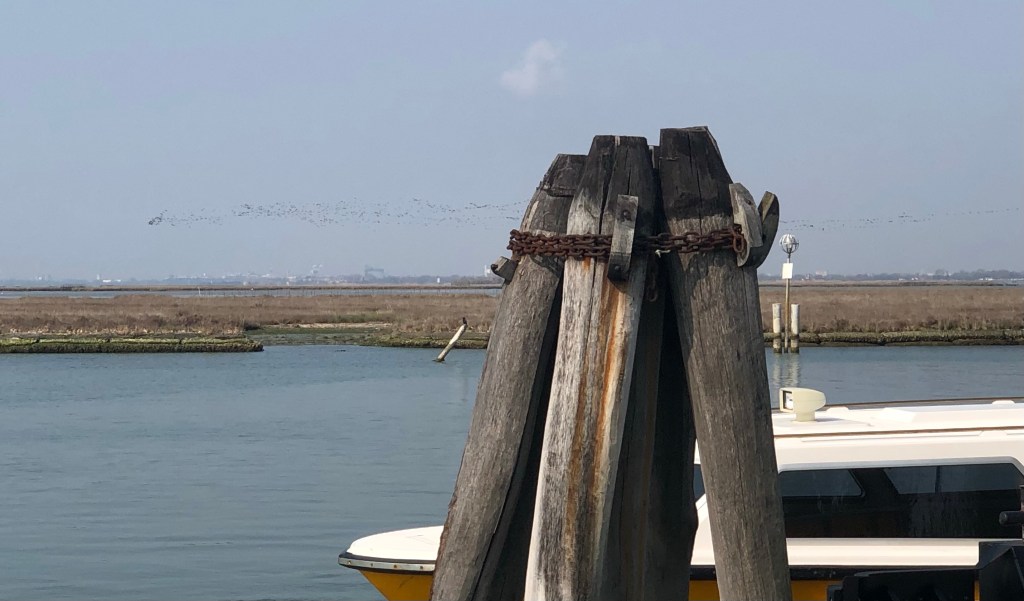
The lagoon feels truly vast once you’re out on it and Venice is behind you. Wooden struts stacked in threes mark what can only be described as water highways, giving the lagoon the appearance of a race course – until you realise it’s not mere practicality but also a safety measure for sailors, as there are multiple areas of the lagoon that are considerably shallower than they seem. Here and there, large expanses of mudflats rise out of the water, giving the lagoon’s waterbirds a place to retreat from the noise of the city.
The vaporetto chugged into Murano, city of glass, and then Burano in turn, city of lace and paintbox streets, but I spurned both of these for the diamond in the rough that is Torcello, risking a stranding for a chance to see one of the lagoon’s hidden gems. (In hindsight, I needn’t be so melodramatic – Torcello is surprisingly well serviced by the vaporetti, with a boat every fifteen minutes from neighbouring Burano).
Why come way out here? Easy. Torcello is nothing less than Venice’s ancestor, home of the first Venetians who arrived in these islands around the year 422 fleeing the forces of Attila and his Huns as the Western Roman Empire fell beneath fire and the sword. Guided by the visions of their priest, the refugees escaped into the lagoon, believing the great water would hide them from the Huns. They named their new home Torcello, meaning “Tower and Sky” – which is eerily apt today, as that’s almost all that’s left of what was once a thriving city.
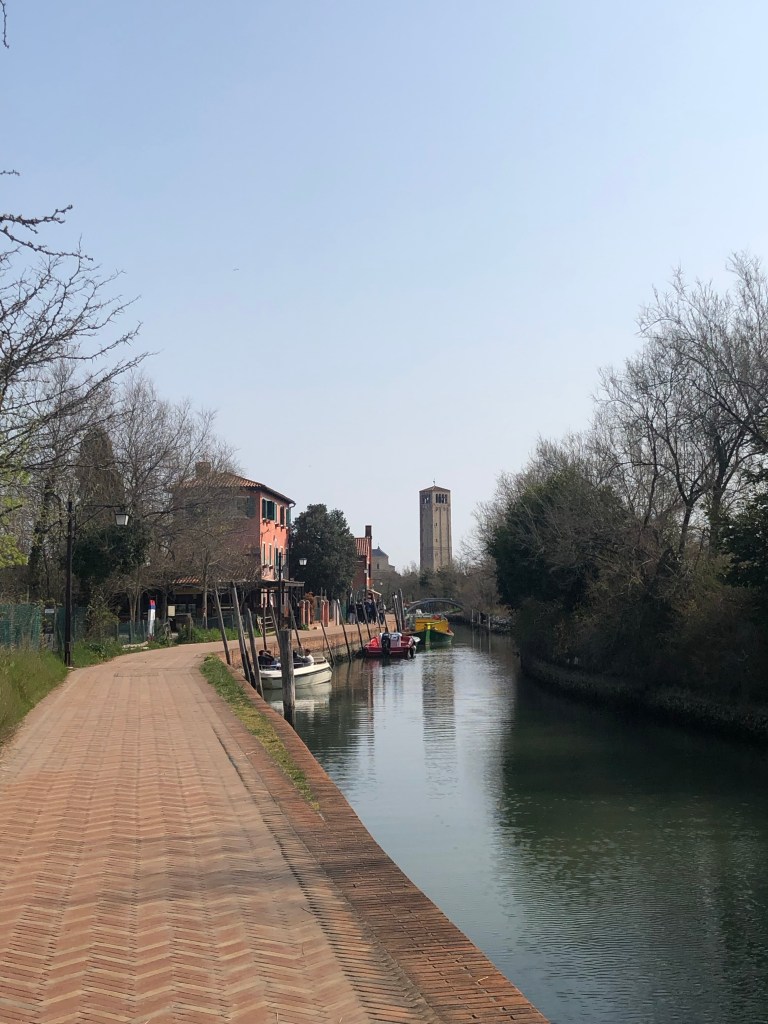
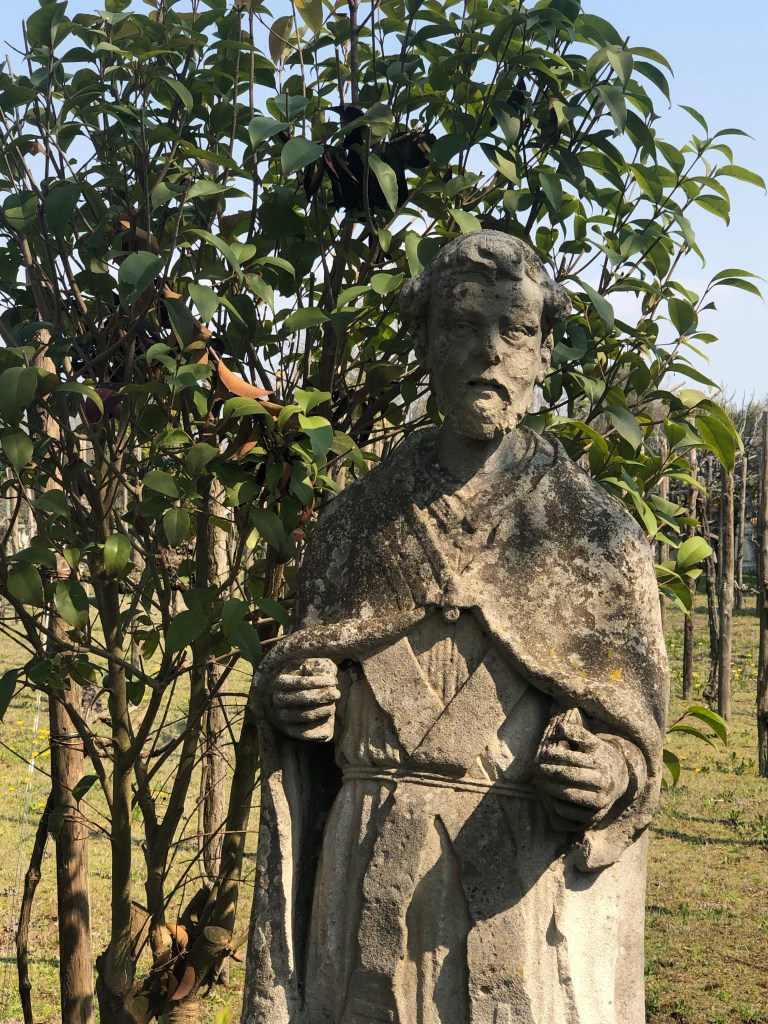
In its heyday, some twenty thousand people called this island home, and it punched well above its weight as a centre of commerce and tolerance until at least the tenth century, though you’d never guess to look at it today. All that remains are some twenty residents, a few houses, some scattered allotments, a collection of Romanesque statues abandoned to time and an old church in the Roman-Byzantine style, whose bell-tower still dominates the landscape – the “Sky Tower” that gave the town its name. On a clear day you can just about see it from Venice itself, staring jealously across the lagoon.
Several factors brought about Torcello’s decline, not least of all the lagoon itself. Just as she did during the first COVID lockdown, Nature showed how quickly she can regain control when she wants to. Over time the island began to sink back beneath the water, swallowing up the villages and turning the once prosperous salt-flats into malaria-ridden marshes. Torcello’s disciples fled in the wake of the tide, seeking refuge on the other islands.
And then, of course, there was Venice herself. What was originally an offshoot of Torcello quickly took advantage of its father’s plight, absorbing its fugitives into its own ranks. Eventually, the son far outshone the father, and as more and more citizens abandoned their former home to its fate, the glory of Torcello faded into memory. The many thousands who once called this island home simply disappeared.
I had my lunch on a jetty east of the Roman church with four ducks paddling hopefully in attendance below. Venice is quiet, but Torcello is something else. Sure, maybe not so much that afternoon, as one of the locals had his radio on full blast as he scoured his fishing boat upriver, but I can imagine this place is as silent as the desert most days.
I’ve always been attracted to the desolate corners of the world. A childhood spent exploring Dungeness, Stodmarsh, Elmley and Doñana National Park has left me with a voracious appetite for marshlands that has never really gone away. So when I look out across the mudflats and listen to the cries of the shorebirds, my heart falls into step and I feel calm and content. But marshes are lonely places. I can think of few places in the world with a lonelier atmosphere. The mournful cries of plovers and sandpipers out on the flats give the place an eerie sadness. The gulls almost sound as though they’re laughing at you for losing yourself here. Solitary herons and egrets prowl the canals like watchmen. And of course there’s the mournful curlew, whose bubbling trill is possibly one of the most haunting sounds in nature. What unholy terror drove the first Venetians to such a lonely place? Their fear of the Huns must have been great indeed to seek to build a home out here in the lonely marshes.
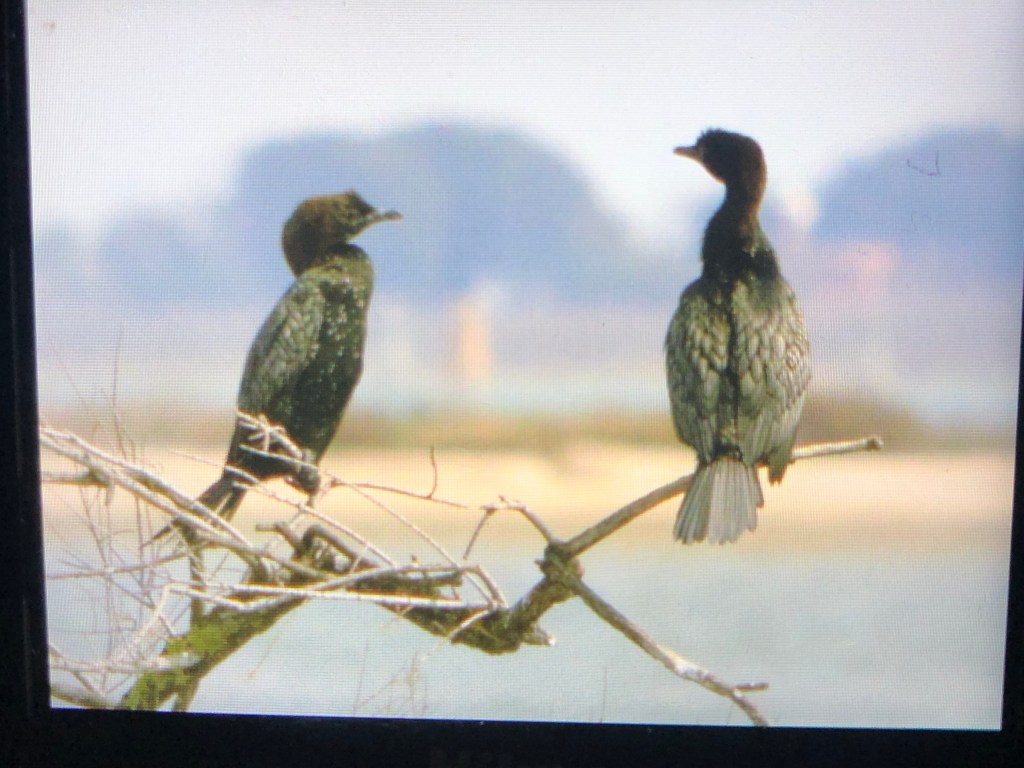
As I leave the island, a thin dark cloud appears on the horizon, moving fast toward Burano. As it draws near, I see it is no cloud at all but a raft of pygmy cormorants, thousands of them, flying in a loose formation that surely stretches for half a kilometre in length. Like oversized starlings, they sail over the marshes, moving deeper into the lagoon.
Perhaps these little sea-crows are the perfect metaphor for the Venetians themselves. A creature of the land that took to the water, making himself a master fisherman, building his nest out on the lagoon. I’m not the first to jump to that conclusion either. A sixth century Roman official wrote of the denizens of Torcello thus:
You live like sea-birds, with your homes dispersed, like the Cyclades, across the surface of the water.
Cassiodorus, 523 AD
Standing on the forgotten shore of Torcello, it’s easy to imagine that the thousands of cormorants passing by really are the spirits of those first Venetians, making the same exodus from land to lagoon every morning for generation after generation, like the denouement to a tragic Greek myth: some cruel trick of the old gods, granting the refugees an eternal escape from their would-be oppressors. That such creatures should choose to haunt Torcello, the forgotten ancestral home of the Venetians, only adds to that mythos.
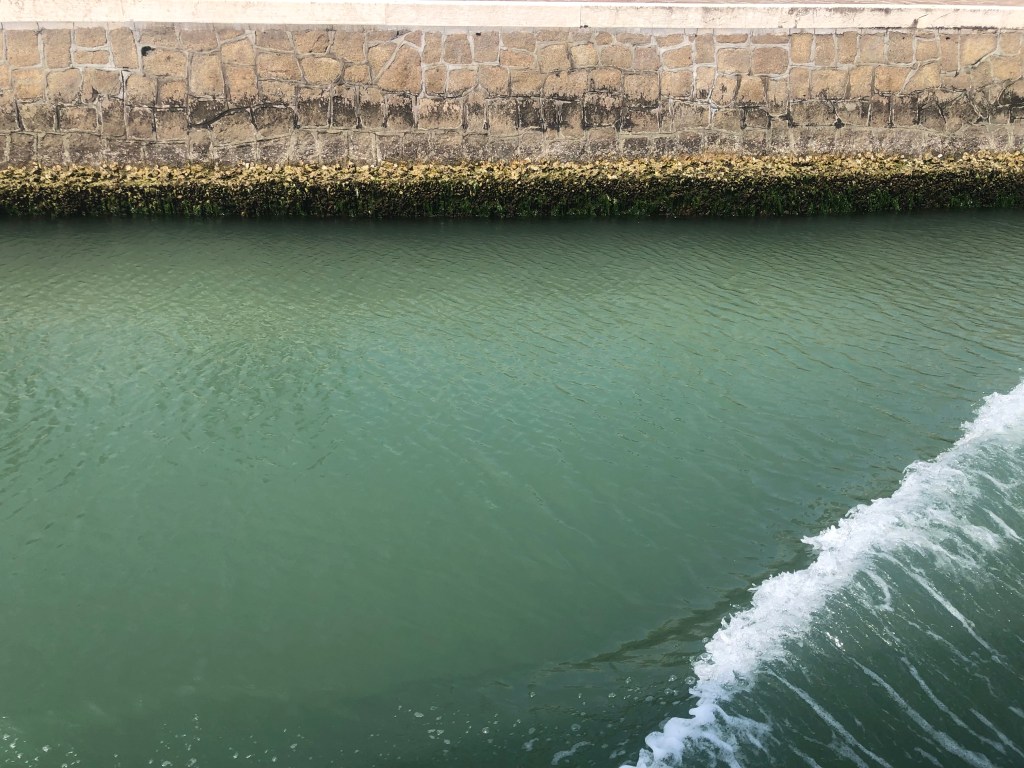
The outlying marshlands of the Venetian lagoon are full of such spirits, if you’re prepared to leave the bustle of Venice and its glass-blowing cousins behind for a couple of hours. If you truly want to see what Venice might have looked like before its canals become cloudy and green from all the water traffic, come to Torcello, whose ancient canals are clear as daylight, revealing a colourful array of sea grasses, seaweed and scuttling crabs on the silt below. And listen, just for a moment, to the ghosts out on the mudflats, knowing you’re hearing the same haunting sounds that the first Venetians defied to make their home here, over a thousand years ago. BB x
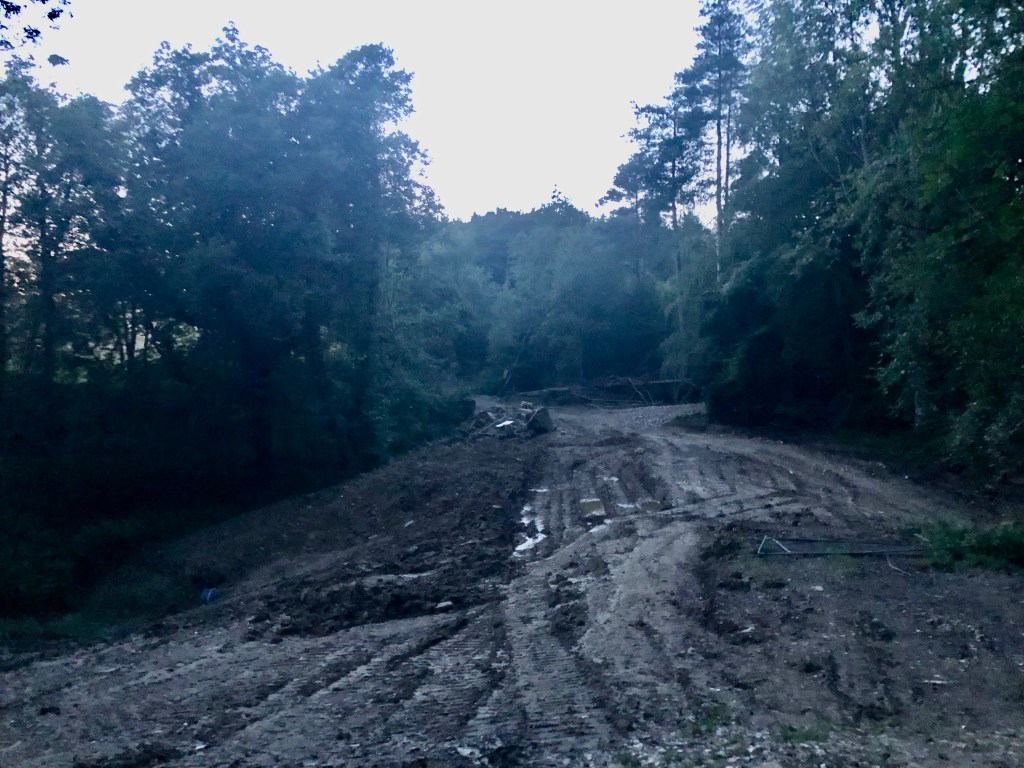
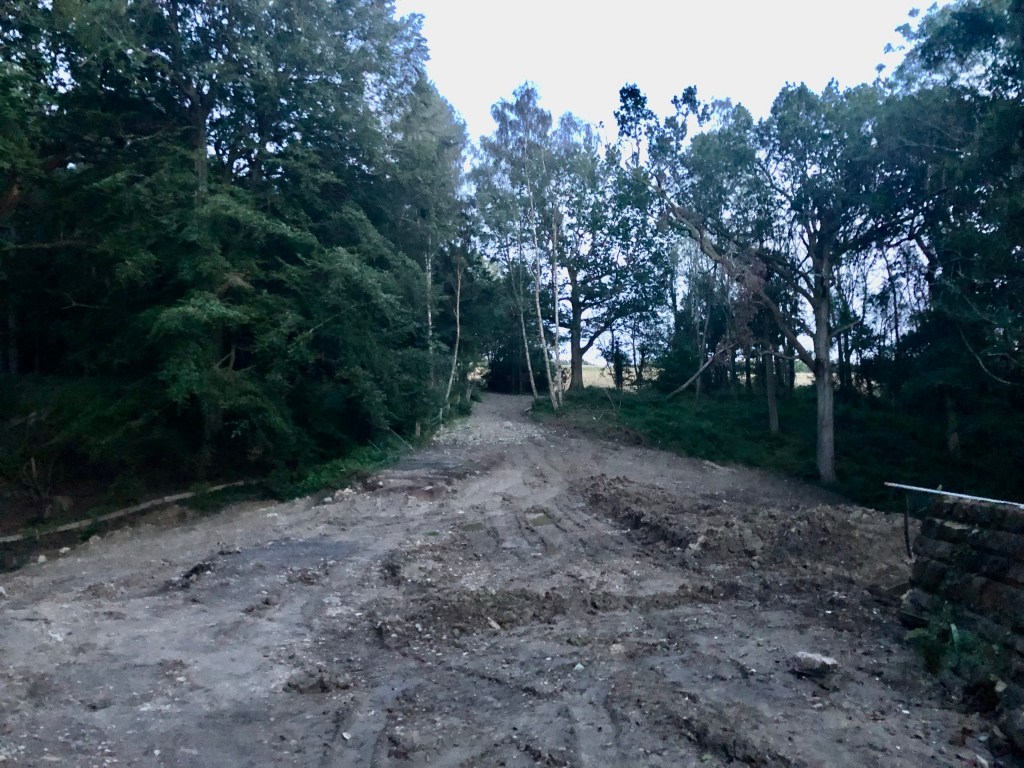
There’s a great big mound of earth down in Downside Wood where the old bridge used to stand. The stream that once ran gaily beneath its mossy arches hiccups and lurches through two black plastic pipes, swallowed at one end of the slump and regurgitated out the other. The vegetation hangs back from the mire, keeping a cautious distance, thorns and nettles recoiling as though stung by the mud. Caesar’s legions made siege ramps that looked more sightly. At either end, where the track leads up and out of the forest, smoothed slabs of brickwork poke out of the mud like the bones of the bridge that was. The rest of the rubble lies buried deep beneath the mound, I suppose, making a barrow of the dell. Do bridges have ghosts? I suspect this one might.
I sat up in the branches of a tree during a break between lessons one summer, listening to M.M. Kaye’s Trade Wind and taking in the view of the bridge as for the last time. That was the year I saw the first signs of what was coming: a waterlogged sheet of A4 paper in a plastic wallet, fastened to the masonry by a tag, bearing the stamp of the local council. The word “SAFETY” written in bold black ink is all I can remember, smudged and blued at the corners by a couple of days of dew and rain. Safety… how satisfying it must sound to the inspector, and how terrifying to the stonework of the old buildings of the world. If stone could shake, it might do so at the word.
The world cried out in despair when Palmyra and the Buddhas of Bamiyan went up in smoke, reduced to dust by religious bigotry, but when I see the Great Slump in Downside Wood, I wonder how many other beautiful works of man and God disappeared under the councilor’s red pen without a word of protest.
As I looked down upon the devastation, a nightmare from my childhood came back to me: a scene from a film that haunted me so terribly that I remember every word, every brush-stroke, every note pulled from the strings of the violins. I’m talking, of course, about the nightmare fuel that is the 1978 Watership Down:
Holly: Our warren… destroyed… Men came… filled in the burrows… couldn’t get out… There was a strange sound… hissing… the air turned bad… runs blocked with dead bodies… Couldn’t get out…. Everything turned mad. Warren, earth, roots, grass… All pushed into the air. Hazel: Men have always hated us. Holly: No… they just destroyed the warren because we were in their way. Fiver: They’ll never rest until they’ve spoiled the earth.
Richard Adams, Watership Down
I know so little of the bridge that once stood in Downside Wood. Was it only a fanciful exercise by a local mason for the lord of the manor, or did it have stories to tell? Did lovers sit upon its parapets before the ramblers and the cross country team tramped across its back? Did a poet or writer pause for thought over the archway and listen to the buzzards crying over the meadow beyond, before cigarettes were hastily stamped out into the mud as somebody saw Sir coming?
The bridge is gone. Safety and development swept it aside like so much that was beautiful. The old meadow behind St Aidan’s College, where I once saw a barn owl drifting in the evening air looking for voles, lies deep beneath a building site as the students choke the city. Like Richard Adams before me, I can only look on in dismay and add my voice to the thousands. There is a mystical beauty in the ruins of man’s work that is surely greater than any single life, if we can but look beyond our own existence for just a moment. These things around us, these rocks and trees, will be here long after we are gone, and will tell their own stories from generation to generation.
I hope that, one day, a generation will come along with mercy in its heart. It’s too late for the Downside Bridge, but not for a thousand other unsung relics scattered across this island. Not every fern is sacred, but in the grand scale of things, the world around us is worth more than a human accident. BB x
Somewhere in my room there’s a programme from a school play I was in back in my prep school years. A few of the lead roles were interviewed about their respective parts, and the boy playing Cardinal Richelieu said he “liked playing the baddie because it is more of a challenge.” My reaction to that line has changed very little over the last twenty-odd years.
Bull. Shit.
If twenty years of writing stories have taught me anything, writing villainy is easy – sometimes, alarmingly easy. Ambition, greed, selfishness and ego are everywhere. Depending on the orientation of your moral compass, you might even be inclined to disregard some of these behaviours out of hand as simple human nature. If you want a challenge, try writing or playing a hero. Finding convincing dialogue and/or motivations for a hero is hard because heroes require hard work: they are what we can become if we can find the strength and the courage to rise above our own desires. Selfishness, the root of villainy, however, is in us all by default. It doesn’t take much to make a villain, just – what did Heath Ledger’s Joker say again? – “a little push”.
What’s the first image that comes into your head when you think of a villain? I imagine it’s rather different to the image in my head. If I were a betting man, I’d wager it’s probably not the moustache-twirling Dick Dastardly-type, which went out of fashion a long time ago. The movie-going public seems to have lost its taste for gleefully evil baddies (so much for Palpatine!) in favour of the tormented anti-hero with quasi-legitimate motivations (a la Thanos). Avatars of utter darkness are on the out, and they’re taking their more rational minions with them. In some cases, this has led to the near-total disappearance of the bad guy altogether (see Inside Out and Moana, or even Encanto).
As a writer, this saddens me, for much the same reasons as the destruction of statues bothered me a few years back. Doing away with the villains of our world is like smashing up a mirror; just because you can’t see them anymore, it doesn’t mean to say they’ve gone altogether. We need to be reminded of the depths of our depravity from time to time. Every villain is a warning in his or her own way of the capacity for darkness in all of our hearts, and from them we learn to avoid their mistakes.
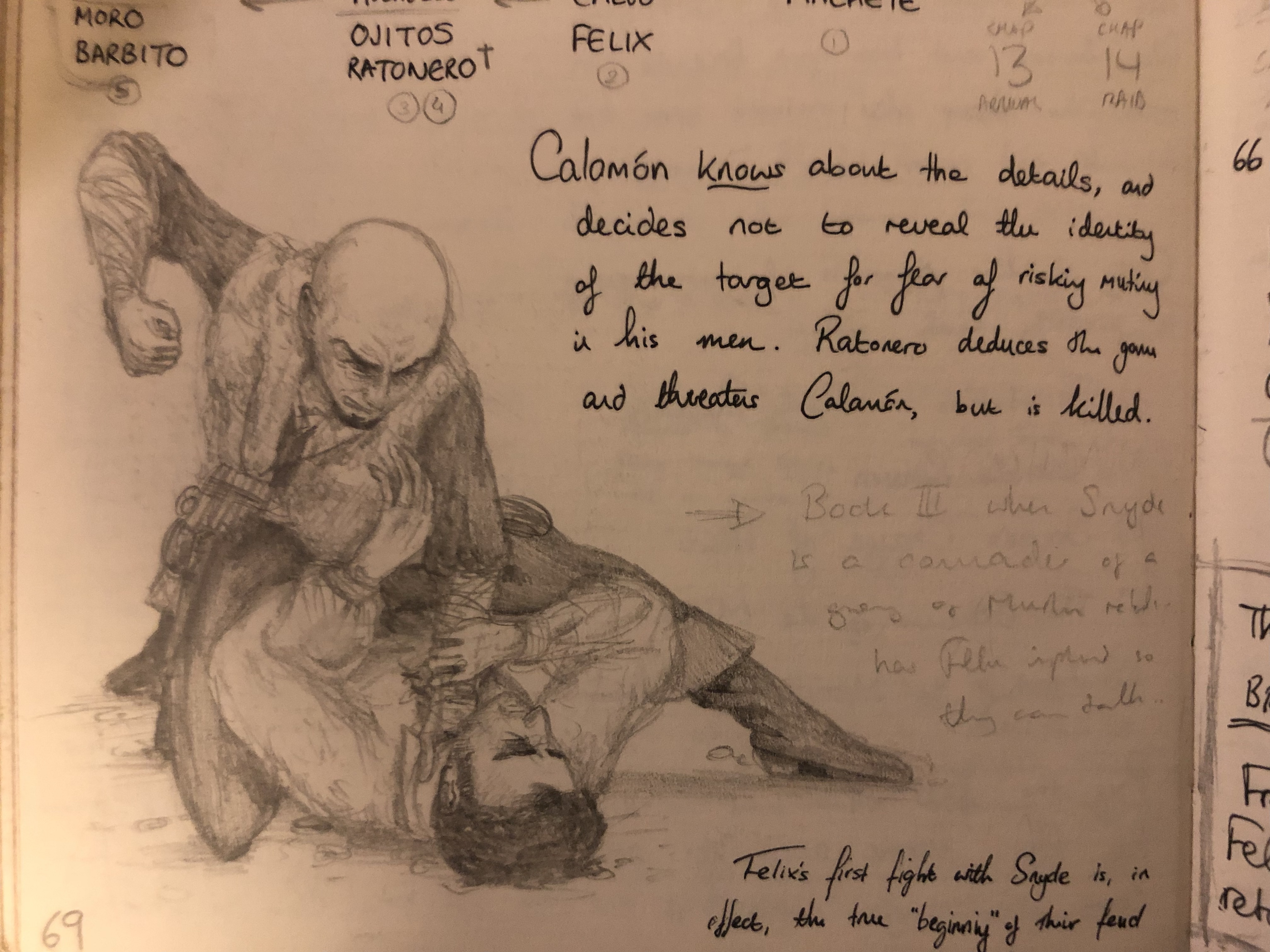
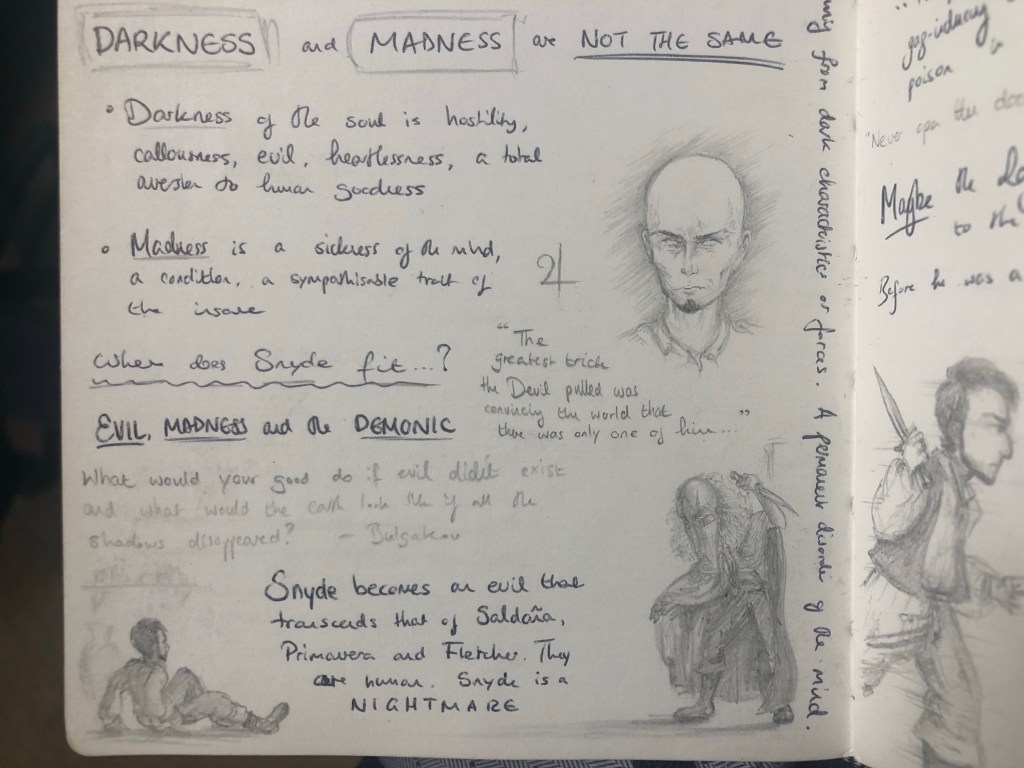
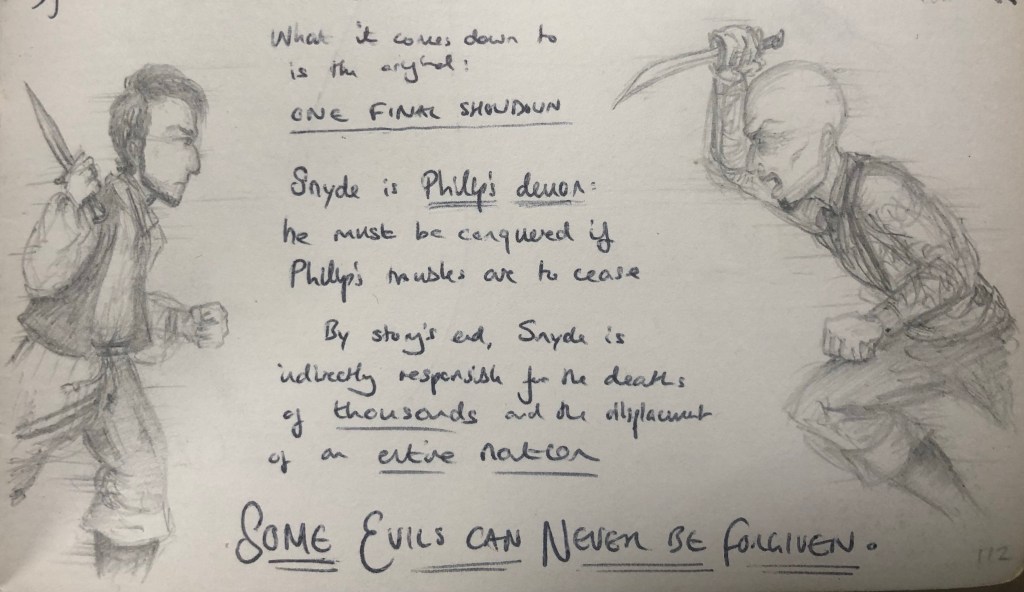
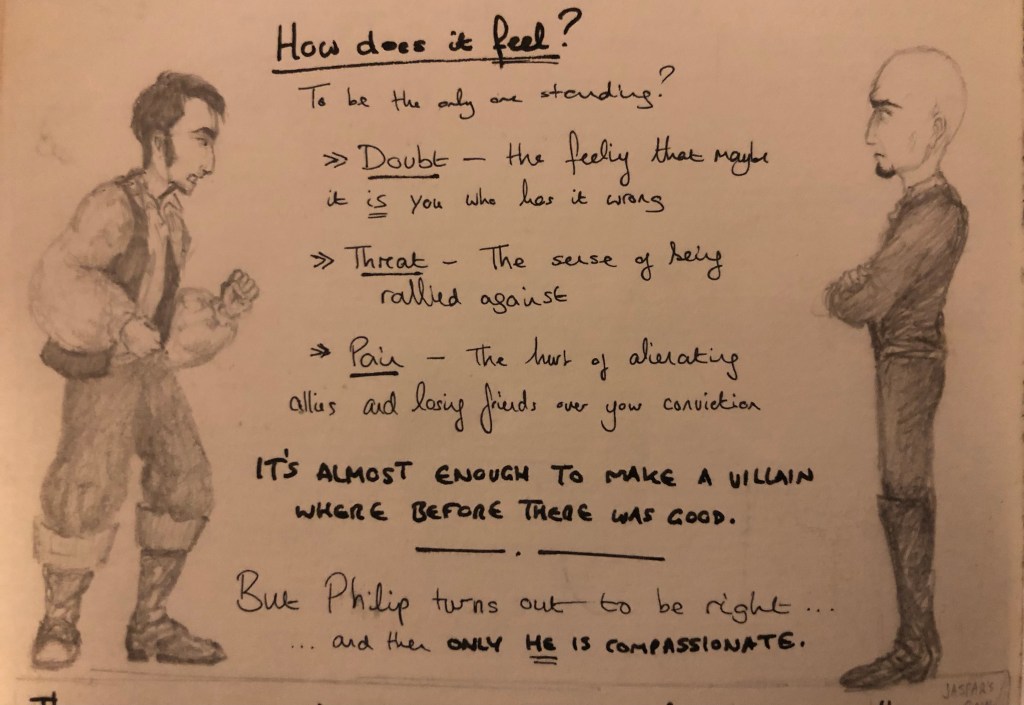
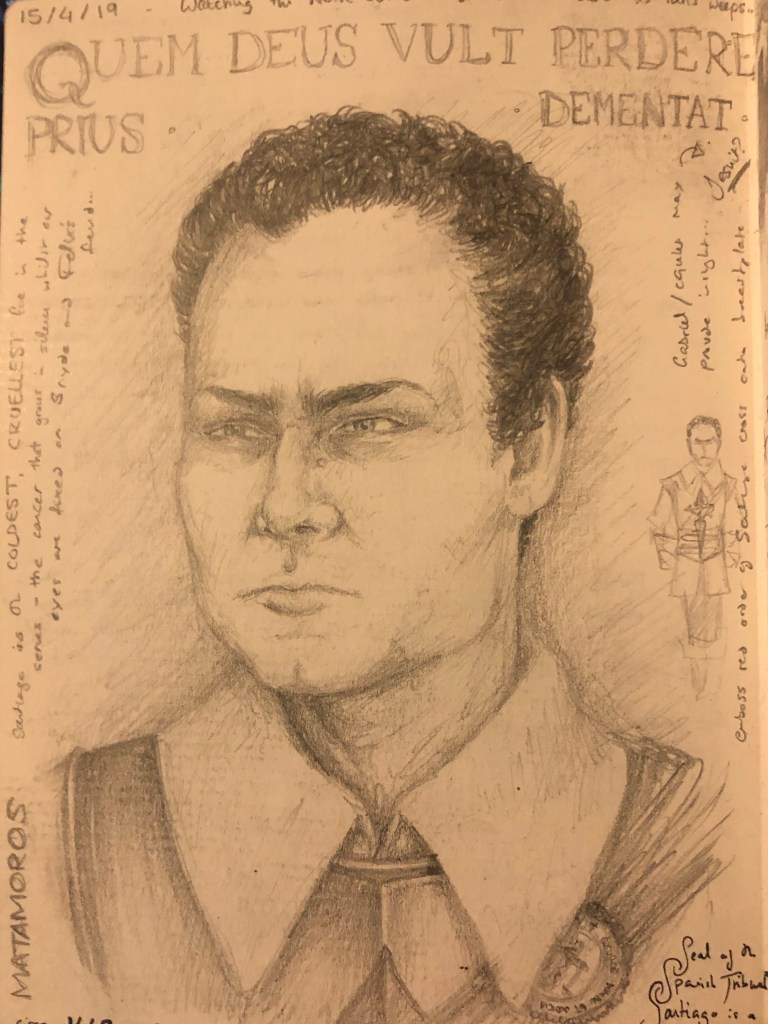
Unlike the heroes of my tales, the primary baddie has hardly changed since his inception. His wardrobe may have been updated a couple of times over the years, but his appearance has never shifted. The bald, skull-like head, the high cheekbones, the small black goatee and those piercing, eye-blue eyes… The latter have always seemed to me the most treacherous, wicked eye colour around, though that may have something to do with Daniel Craig’s early-career role as the fantastically sadistic Afrikaner Sgt Botha in The Power of One. Until very late in the Spanish rewrite he bore the name Jasper Snyde, and it was primarily the strength of his surname that held me back from Hispanicising the rest of the names in the book. It took a long time before I found a Spanish equivalent I was happy with. In the end I opted for De Salma, for the simple reason that, if elided (or spoken at the speed at which your average Spaniard speaks), it winds up sounding a lot like desalmada, meaning “soulless” – or, more literally still, “deprived of a soul”.
That’s right, middle school me. Authors do put that much thought into the names of their characters. It’s not just a trick English teachers play on you to get you thinking when it’s coursework season.
I think the thing I like best about Desalma is that he is nothing more and nothing less than a product of my own jealousy. Perhaps that’s why jealousy is one of his defining traits. Some villains you create to serve a purpose within the wider story arc, others are heroes who just weren’t good enough. Desalma is neither of these. He appeared fully-formed in a moment of weakness in my teenage years, moulded about an imagined rival for the attentions of a girl I had a thing for at the time. The crush didn’t last long, and the jealous rage that birthed him was even shorter-lived, but Desalma stayed, growing cancer-like from that first appearance into an evil that transcended all of the villains I’d written into my stories.
Like the Batman’s Joker, he wasn’t supposed to survive the story in which he first appeared, but over time his hold on me grew too strong, and for the greater part of the last decade he’s been the primary antagonist and tormentor of my hero. An avatar of desperation and despair to counterbalance’s the hero’s unyielding clutch on hope.
The other villains in the saga are, predictably, drawn from the other dark desires of my heart. One of my hero’s primary flaws was almost certainly one of my own in my younger years: that is, a magnetic hero worship of the tall, dark charismatic types who hold all the cards. The ones who have the looks, get the girls, crack the jokes and seem to have it all together. It was only too easy to morph the idols of my youth into adversaries whose intentions were not what they seemed, if only to repeat that old saying that has never lost any currency: handsome is as handsome does – or rather, looks can be deceiving.
If I’m being honest, there’s been more than one occasion in my life when I’ve asked myself that question: wait – am I the bad guy here? It was especially poignant in my university years, where my tendency towards strong opinions and the sharing of said opinions got me into hot water with my fellow students. I found my views challenged so often, so vehemently, and seemingly by everybody else that, for a time, I genuinely started to doubt my own convictions. It’s so easy to start thinking you’re in the wrong when it seems like the rest of the world is against you. Israel. Free speech. Gospel music. No matter where I went, I always seemed to be on the wrong side.
Fortunately, most people aren’t walking around with a fictional universe that exists only inside their heads, and have long since learned to see the world through the mature eyes of a working professional adult. Perhaps it’s only those of us who cling to the world of good and evil, and light and dark, that insist on still making such a clear distinction between right and wrong. The grey in between is good enough for your average Joe.
I’ve been working on a new villain this week, between teaching the passé composé and marking Year 9 Spanish assessments. In recent years I’m much more inclined to letting my heroes suffer if it makes them into stronger characters at the end of it. I gave up on Ildefonso Falcones’ La mano de Fatima years ago because I lost all faith in the protagonist, but the more I read my Spanish histories, the more convinced I am that the world was a much darker place back then, just as Ildefonso Falcones painted it, and my stories need to adapt to reflect that. It takes a serious brush or two with the dark side of our hearts for us to see whether we have hero material in us or not.
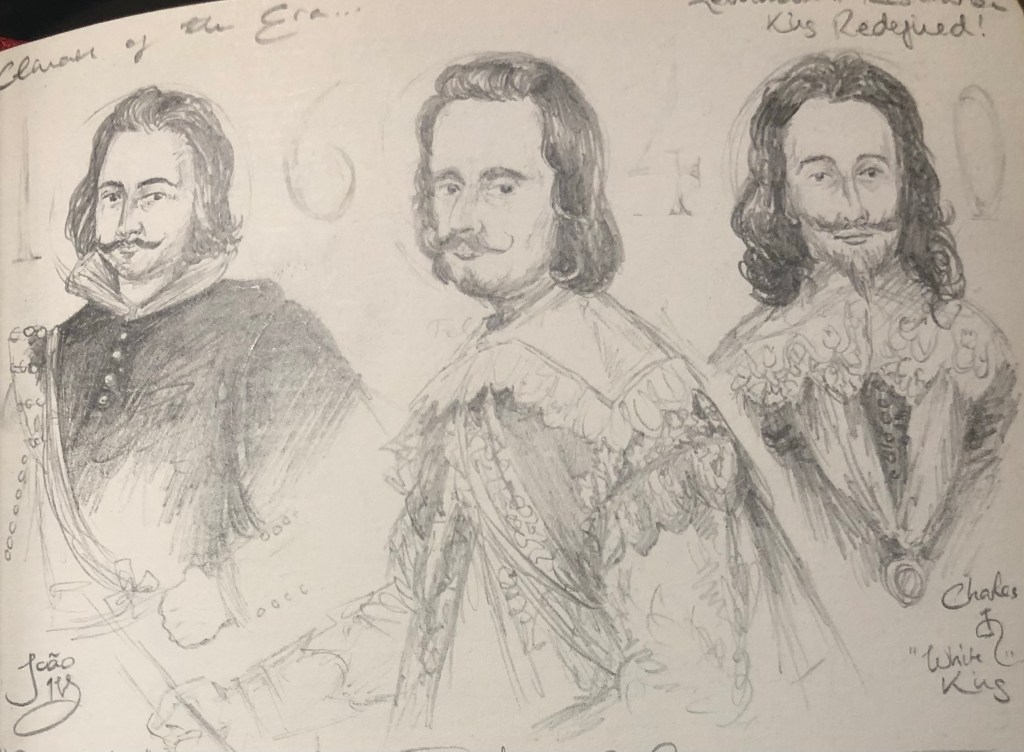
I’m leafing through Leanda de Lisle’s White King to clue up on the politics of Charles I (the Civil War era being contemporaneous with my saga), but also to glean some inspiration for a better-dressed baddie in the mould of a Buckingham or Richelieu. Desperados I have aplenty, and their motivations are easy to script: hunger will make a villain out of anyone. It’s the folks at the top I’m working towards now. Time, I think, for an exploration of power and its malicious influence.
Four years in, I think I have a much clearer idea of power. Because if you want to get a real handle on power, work in a boarding school. And that’s all I’ll say on the matter. BB x
I have a confession to make. For a wannabe author, I’ve always been rather guarded about my stories. As a teacher I make no secret about the fact that of my various hobbies I love writing best of all, above drawing, above being out and about in nature – and, yes, even above music. Why? Because writing is one of the few things in the world that you can truly call your own. You can’t compare your voice to somebody else’s any more than you can compare your ability to think. But, for all the show of carrying a journal around and self-consciously dropping into conversation now and then that I write for pleasure, I don’t really talk overmuch about my books.
There’s a couple of reasons for that. The first one is simple self-defence, the fear that somebody could steal your ideas and tell your own stories as though they were their own. Laugh if you will at that idea – what story hasn’t been told and retold a thousand times over since the dawn of time? – but an incident involving my artwork, DeviantArt and an alarming case of identity theft back in my schooldays has left me cautious about putting my work out there. In that case, I was lucky that the thief had been indiscriminate in their robbery: though some of the drawings they claimed as their own were odds and sods from the novel, more than a few were portraits of friends from school, so it wasn’t just my intellectual property on the line. Together with some friends, we kicked up a fuss and had the thief’s account taken down. To their credit, DeviantArt were pretty quick. I don’t suppose I’ll ever know who the culprit was, though reason tells me it could only have been somebody I knew. I learned a valuable lesson, though: art is easy to steal.
The second reason is the simplest one: there’s just too much to say in one sitting. I can see that on those occasions when somebody leafs through one of my journals. There’s so much going on in there and none of it in any particular order, and without a map, you’d never know where to start. Entering into a writer’s world is probably a rather daunting experience, like arriving at a house party and finding you don’t know any of the guests. You could try. You could sum up the Lord of the Rings saga by saying it’s all about a quest to destroy a magical ring, but that leaves out the silent terror of the Mines of Moria, the treachery of Gollum and the mournful autumnal kingdom of the elves; the details that make the world come to life. Story-telling is a necessarily one-sided pastime, and since my day job places such an emphasis on listening, my favourite hobby is something I try to avoid at all costs, because it feels selfishly out of sync.
Today, I’m going to break a habit. I’m going to let you into my world.
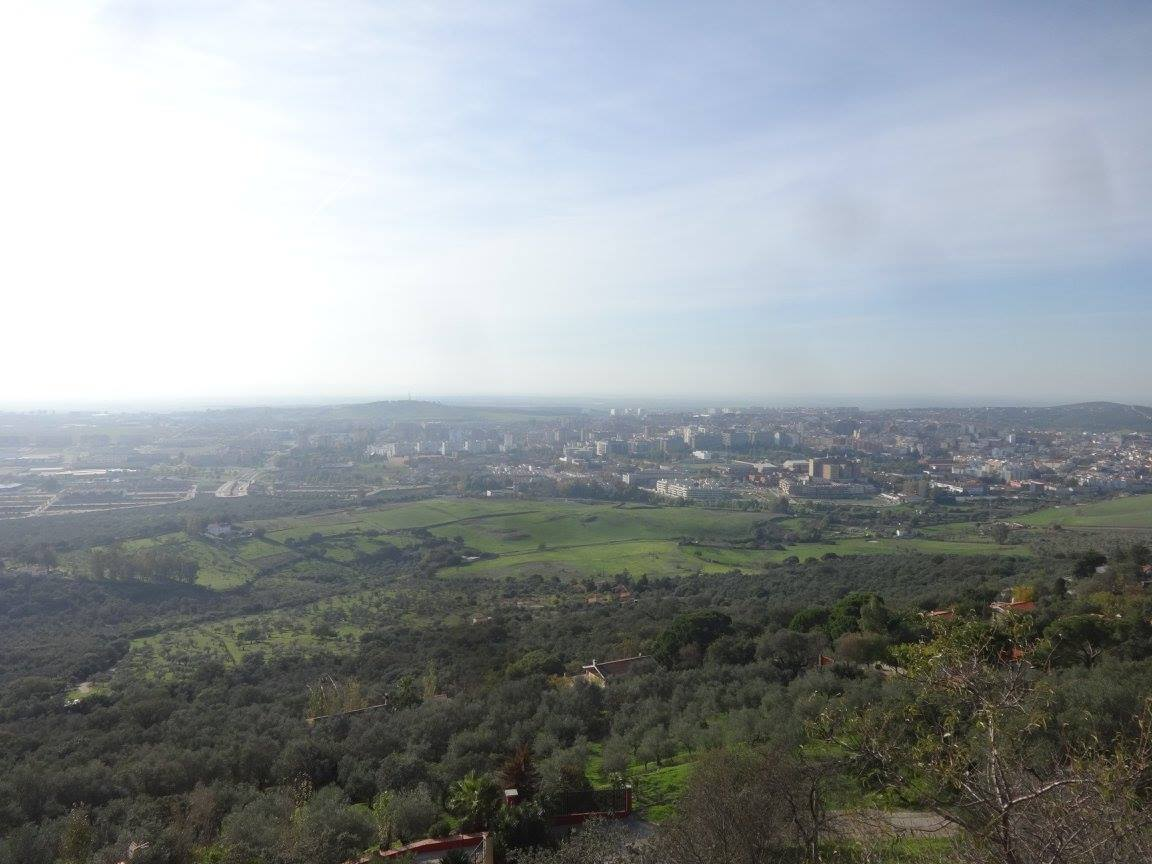
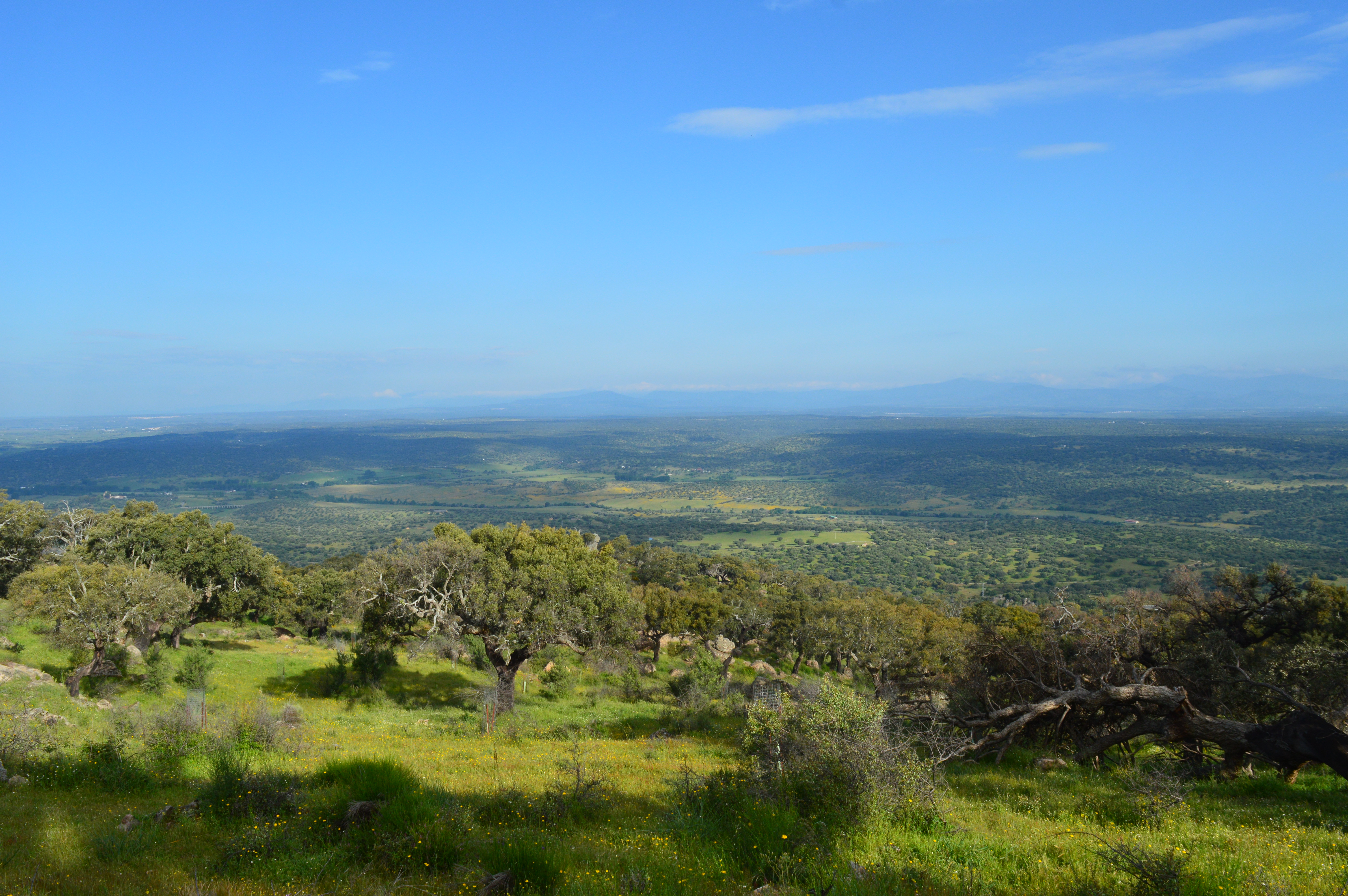
We can start where it all began. Where it all began to take shape, I mean. According to my journal, that was at 15.30 on Friday 13th November, 2015, on a rocky outcrop beside the Santuario de Nuestra Señora de la Montaña just outside the city of Cáceres. I’d been writing “the book” for about twelve years by then – I can trace the first draft back to 2003 – but it was here in Extremadura that everything suddenly fell into place. As I looked out across the plains of Cáceres and upon the city thrown into shadow by the setting sun, something magical happened. It was as though I was staring at a giant jigsaw puzzle that was suddenly arranging itself into perfect order before my eyes. I wrote myself a note in my journal – “What might this place have looked like in the 1600s?”. Sometime later I pencilled in two words above that line: “it begins!”.
And so it began. The cast of characters I had carried in my head and in my heart for over a decade moved to Spain, and the kingdom of Meridia was born.
Picture a corner of the world where the fields go on forever. A land of immense blue skies and sparsely-populated hill-towns, clustered like barnacles about the few slopes that rise out of the motionless sea of earth, where the merciless sun comes down with unfettered fury in summer, and in winter, chill winds howl unimpeded across the plains. A kingdom that has seen people come and go: Moorish forts atop the limestone crags that the vultures have not claimed for their own; Roman arches and theatres rising out of the earth like the bones of some long-dead giant; and, deep in the mountains that ring this hidden kingdom, the faded artwork of a people so ancient that they have long since faded into oblivion. And such mountains! Look to the north on a clear day and you can see them towering mightily over the fields, vast and blue like the sky above, their peaks scarred with snow well into the spring. That’s where the old forests cling on, fugitives from the axes that carved the Roman Empire from Spanish lumber many centuries ago. And where the forests give way to the water, powerful rivers bubble up from the deep, thundering through the hills and carving sheer ravines through the finger-like ridges that splay across the plains from the Sistema Central.
The best of it is that I don’t have to invent this world at all, because it actually exists, and her name is Extremadura. All I had to do was to imagine her in somebody else’s hands. My hands.
When I first set out to create Meridia – named, of course, for the city of Mérida – I initially wanted to keep the real-world location a secret, until the close of the story, at least. It didn’t take me long to realise just how impossible that was going to be from a worldbuilding perspective, particularly over a saga spanning seven books, but since “big reveals” are and always have been a majorly appealing part of story-telling, I played along for a time. I was also still reluctant to fully transition to the use of Spanish people and place names, so I had a go at creating names of my own.
Casiers. Barosse. Meroon. Looking back now, I’m cringing already at how disgustingly English they sound. But then, few tales come into being in a matter of moments. Worldbuilding takes a long time, longer by far than it takes to tell the story itself. I can only guess at how many hours Tolkien must have poured into the creation of Arda. It’s taken me all of twenty years.
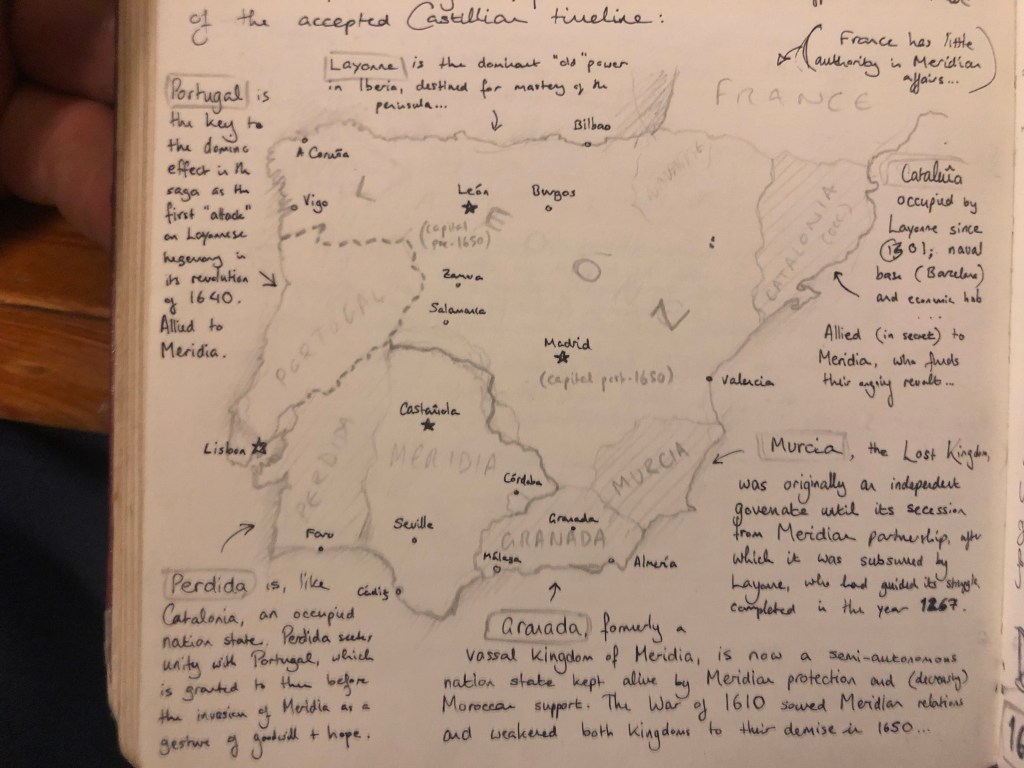
Here’s the same map, drawn about a year later. It’s the eighth of a total of ten maps of the peninsula in the same journal (when students ask me how I can draw a map of Spain from memory… this. This is how). It’s probably the most accurate, and the one I still use today when mapping out the events of the saga, the exception being the retroactive introduction of the “corredor cordobés” that cuts a swathe from Córdoba to the city of Cádiz, separating Meridia from Granada and providing a political flashpoint for the plot. Ringing the map, you can see the history I’ve had to build up around it. I tell you, writing a historical novel is one thing, but writing allohistory – that is, an alternative timeline – is a messy, time-consuming business. If I didn’t keep a journal, I doubt I’d remember all the details. Nevertheless, they’re absolutely essential to giving your world an identity of its own, just as the “Greatest Generation” and the “fight them on the beaches” speech are integral parts of our collective memory.
Creating five hundred years of history for a kingdom which never existed is quite the task. Beginning it is easy, as is the wrapping it all up at the end. It’s what you do in between that’s the trouble. How do you explain away, for example, the men who changed the world who hailed from that corner of the real world? How do you rewrite an essentially Spanish history in a timeline where Granada did not fall until the middle of the seventeenth century, where Seville was in foreign hands for the greater part of the Age of Discoveries, and – perhaps most importantly of all – where almost all of Spain’s conquistadors from Cortés and Pizarro to Francisco de Orellana and Núñez de Balboa hailed from a land that did not carry the flag of Castile?
To be honest, that’s half of the fun, trying to find radically new ways of retelling history. It’s why I wrote my dissertation on the Cronica sarracina, arguably one of the greatest works of fiction ever sold as fact in Spain (or was it fact sold as fiction?). I’m doing the same thing with Meridia: I’m telling the story of Spain through a glass darkly, holding up a devil’s mirror to the country I know best.
And once the world has taken shape in your head, it’s time to set your characters running across its empty plains, so your voice can follow them, painting their footprints with words.
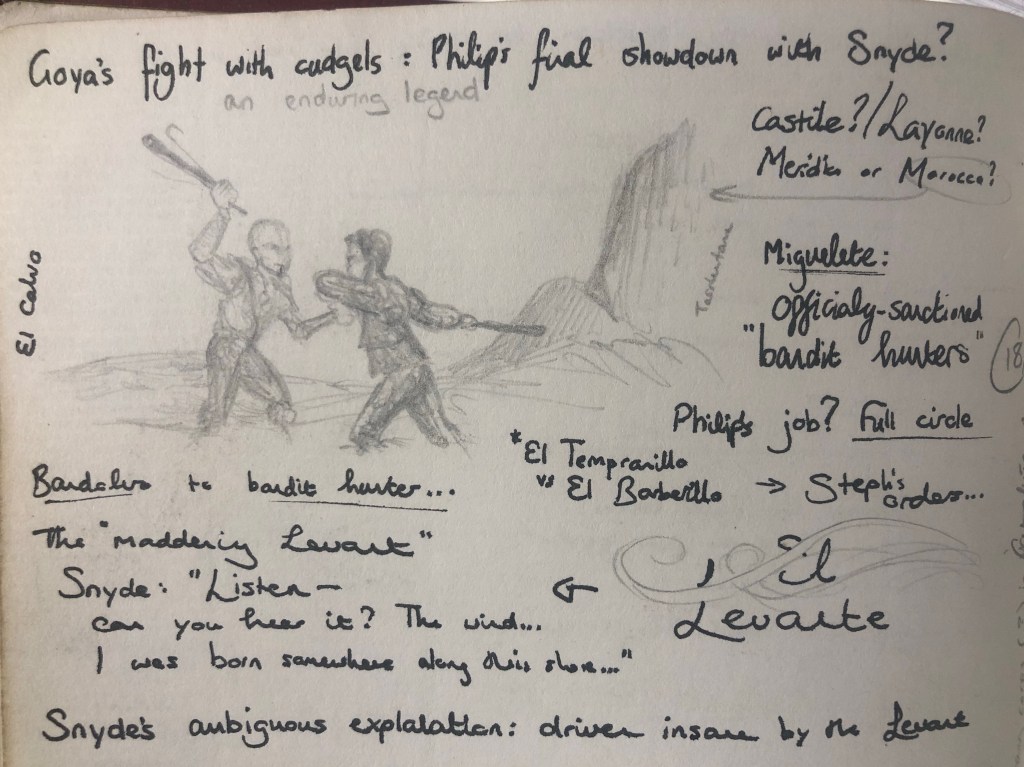
I take my inspiration from the world around me. From books, mostly, but also from photographs, legends, paintings and even conversations with strangers. More than one character has slipped between the pages of the book over the years after a brief encounter with one of those larger-than-life types. In essence, the saga is my paean to my grandfather’s country, so I try to weave as many details in as I can. The madmen of the Hurdes. The seven chairs of Mérida. Goya’s fight with cudgels. The mystery of who really got to the New World first and the Lisbon Earthquake. The odd real person makes a cameo appearance from time to time: Diego Velázquez, Michiel de Ruyter and the lost children of the sack of Baltimore. I get the same satisfaction threading their tales into the narrative as I did from peppering each and every essay I wrote at university with “ursulas” (unnecessarily farfetched sidetracks that somehow relate back to the essay question, named for the sea witch in The Little Mermaid). When you’ve been writing the same story for twenty years, you’ve got to find new ways to keep the game fresh.
And sometimes, it’s not a book or a person that finds its way into the worldbuilding effort, but the real world itself, in real time. Like this little snippet from the journal. I’ll leave you with the date (24/6/2016) and let you guess what it’s referring to.
Worldbuilding is laborious. It takes a bloody long time if you plan to do it right. It took me a matter of seconds to decide to move the fictional kingdom of my childhood into Extremadura, but it’s taken my characters all of five years to finish unpacking. The central characters of the story have only borne their new Spanish names for a little over a year. But it’s easily one of the most entertaining parts of the story-telling business, and it doesn’t half smooth out the writing process when you finally find the time to sit down at the computer and have a solid crack at the next chapter.
So… what would you like to know? Asking for somebody else’s thoughts on what is nothing more or less than the single most precious creation of one’s life is more than a little unnerving – I’m not afraid to admit I got the shivers writing that question – but the purpose of story-telling is to share, and I could do with airing the world inside my head for a change.
Alternatively, if you’re a writer too, does my experience with the worldbuilding process sound familiar? I’d love to hear your thoughts. BB x
In the vocabulary of a child, it sounds harmless, like a friendly football match. It tears away the shock and the hysteria. It tells a story of immediate information, of children monitoring the dawn of war on the screens of their smartphones. It seems almost absurd, watching a war unfold in real time.
I couldn’t answer the student because I don’t know enough about what’s going on in Ukraine to give anything like an informed opinion of my own. My meddling with Russian affairs amounted to nothing more than a short-lived attempt at after-school Russian classes in my sixth form days. The two other chaps in the class went on to study Russian at Oxbridge. I had no such intentions. I happened to be studying the Russian Civil War in A Level History, I was intrigued by the art style of the Soviet propaganda machine and felt like learning a new language. Not for the first time in my life, I felt like a foolish hobbyist amongst eager professionals. I don’t think I ever made it to the second class.
I chose to focus on Arabic instead, for equally casual reasons. I didn’t want to be a spy, or a civil servant, or an ambassador. I don’t have the cunning or the sense of national pride. All I wanted to do was to read my history books, and to draw back the curtain on al-Andalus. I had the chance to explore an entirely different world, and I took the other road. God only knows where my life might have taken me had I made it to that second Russian class.
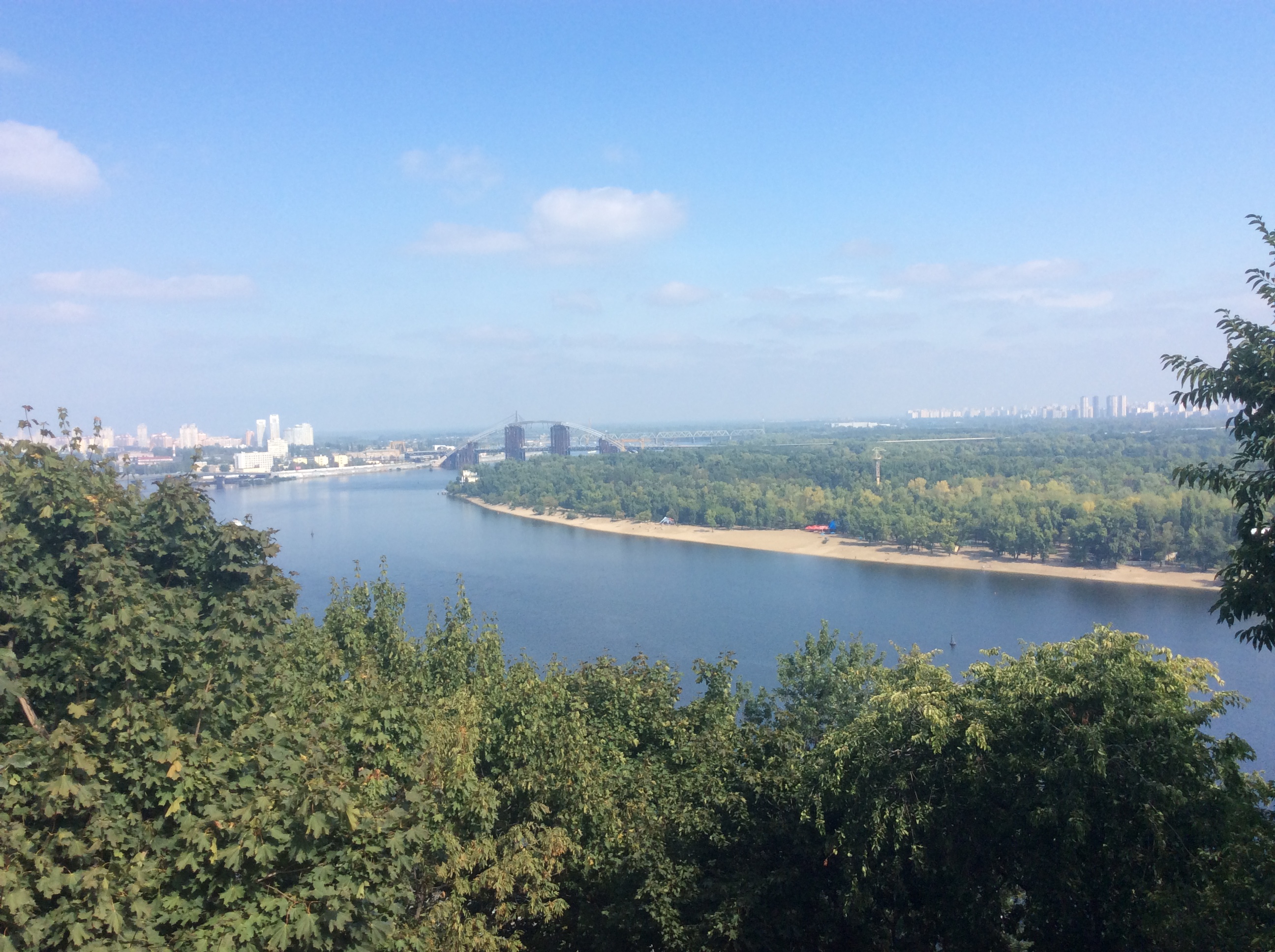
As the fighting intensifies in Kiev, I remember flashes of my brief stop in the city almost seven years ago. Bearded, sweat-scarred and looking forward to coming home, however briefly, after two trying months in Amman. The decision to take advantage of a twelve-hour layover and make a flying trip out to Kiev from Boryspil Airport was a fool’s fancy on my part, as it so often is, but it did mean that I got to see with my own eyes a city that is now in headlines around the world.
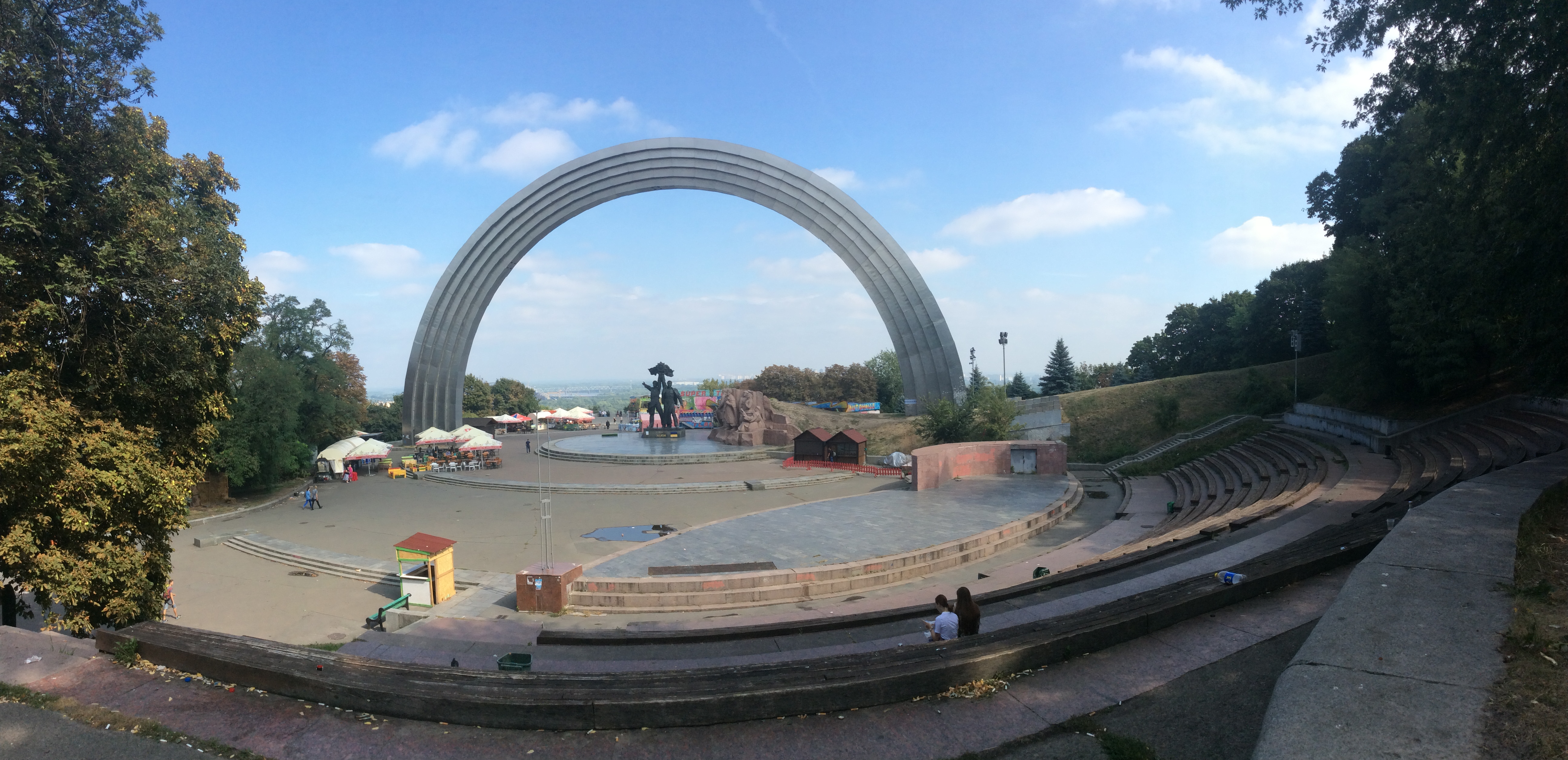
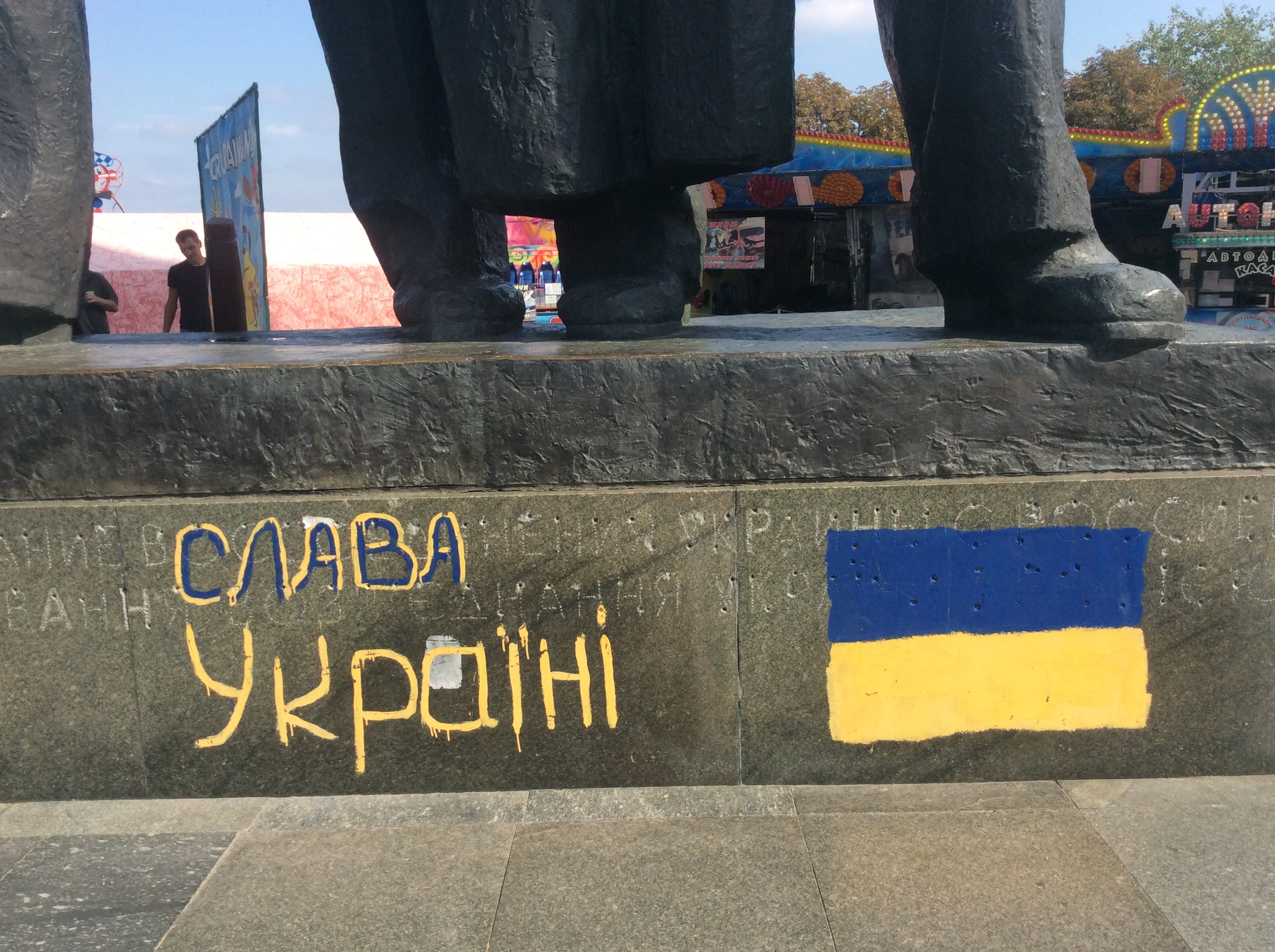
That was back in 2016, only a couple of years after the Revolution of Dignity and the subsequent annexation of the Crimea. The city was quiet, but the stress lines were there to see, if you looked closely. Beneath the People’s Friendship Arch, a monument to Russian and Ukrainian unity, a messaged daubed in Cyrillic: “Slava Ukraini” – Glory to Ukraine. The nationalist call-sign, forbidden during the years of the Soviet Union.
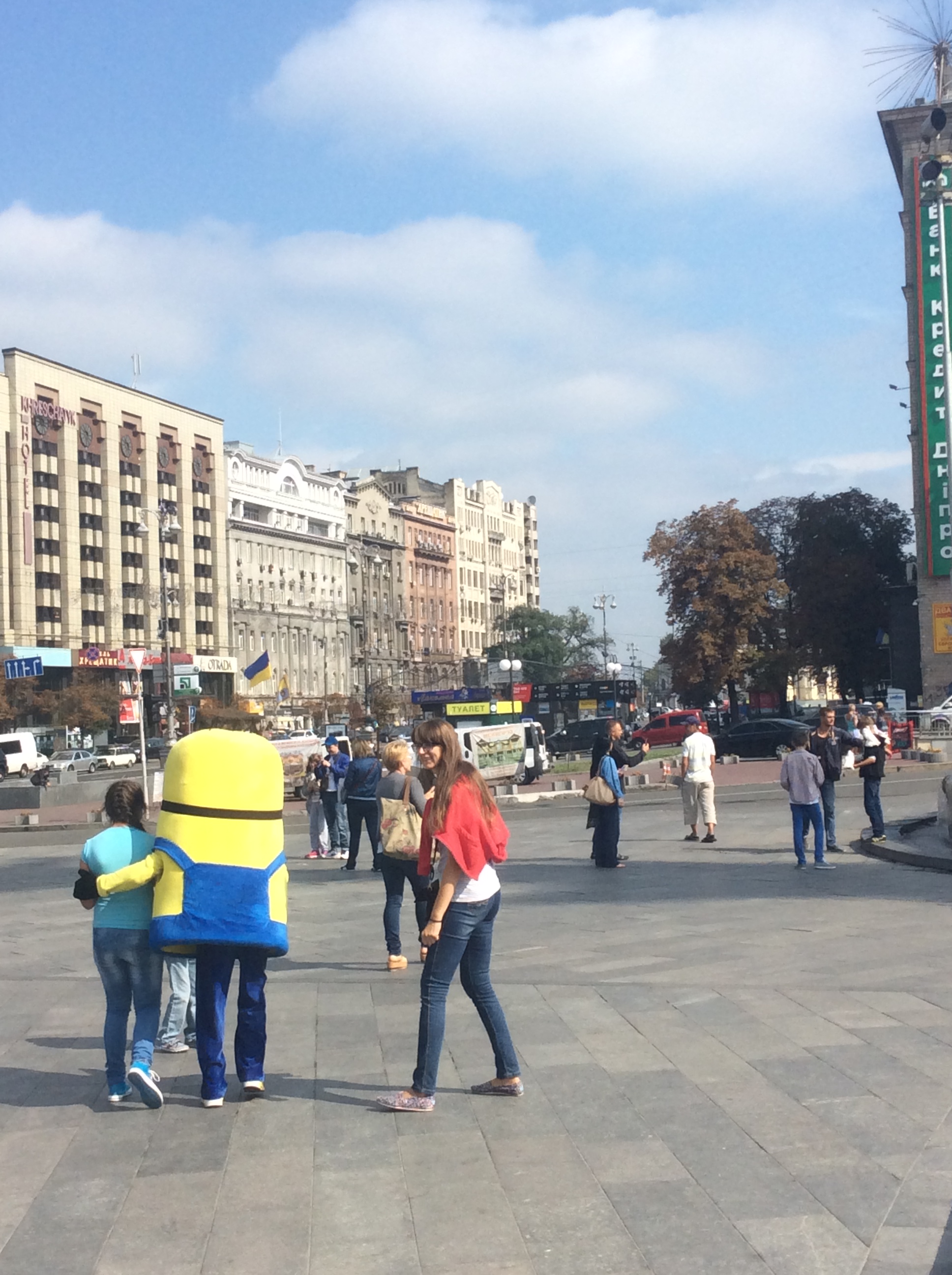
The blue and yellow of the national flag was everywhere, almost as fiercely ubiquitous as the rojigualda in the months following the 2017 Catalan rebellion. Even the street artist dressed as a minion in the Maidan Nezalezhnosti (Independence Square) seemed intentionally patriotic.
The blue and yellow from the city streets of Kiev has since fanned out across the web. Profile pictures bear its bicoloured hue. Thoughts, prayers and shares tell the story of the conflict to millions. And while part of me feels this is the way things should be, there’s something that keeps cropping up that I feel the need to talk about.
As is becoming customary in the Instagram Era, there’s just as much anger on my social media feed about the underrepresentation of conflicts happening elsewhere in the world as there is about the fighting taking place in Ukraine. For every “thoughts and prayers” post there’s a story bemoaning how much less of a fuss was made over Israel’s actions in Palestine, or the Indian occupation of Kashmir, or the assault on Yemen, as though one ought to be losing one’s head every time a gun is fired anywhere around the world. All of them immensely valid causes, no more or less than the chaos unfurling in the land of the Rus right now. Still, the phrase “pick your battles” comes to mind, and perhaps I’ve never used it more accurately. You can’t fight every war.
War. It’s not a word I’m used to using in the present tense, jaded as we are in the West by decades of relative peace. Thousands of us – maybe even millions – have never known what war means beyond what we studied at school. There’s a strong argument against the virtue-signalling “thoughts and prayers” response trending across social media, but maybe that’s just the knee-jerk reaction of a generation so far-removed from war that the word has all but lost its meaning.
Thoughts and prayers for the people of Paris after the Notre-Dame fire. Thoughts and prayers for the people of Afghanistan. Thoughts and prayers, but never enough of them, and never going to all the right places at the right time.
“There’s so much human suffering that the whole world should be wailing.”
Joy Chambers, My Zulu, Myself
Taking the colonialist argument off the table, just for a moment, I don’t know whether we’re even capable of feeling a genuine sense of outrage at every injustice there is in the world – even my generation, which does a very good line in being outraged and incensed at everything. Every injustice, though? How can you fight for every cause and still remain true to your own beliefs? That much pain would be enough to tear the soul apart. It’s bad enough being a bleeding heart about the natural world – which, when the chips are down, is the first thing people forget to care about.
Fight, by all means. Resist. Shout about the things you care about. But pick your battles, and don’t attack those who didn’t come when you called, just because the fire in their hearts was not burning so bright.
What’s my opinion, then? Bewilderment. Jaded bewilderment, like so many of my generation. Bewilderment at the aggression. Bewilderment at the inaction. Bewilderment at the comparison to the Sudetenland saga I’ve heard so many times this week.
I studied the Soviet Union for years, but I’m no nearer an answer than any other armchair expert – probably because of my innate aversion to 20th century history, having studied it to the exclusion of every other century at school. Before I speak out, though, I will do what I do best. I will read. I will research. I will inform myself, as we were so often commanded to do during the BLM movement. I will speak to those who know more than I do, when the time is right.
While the world watched the city of Kiev, five islanders returned from the Chagos Archipelago in the Indian Ocean. It was their first independent trip home since they were forcibly removed by the British authorities during the 1970s as part of a deal to secure Mauritian independence. Mauritius wants its territory back. The Chagossians just want to go home.
Just one more injustice to add to the pile. Perhaps the whole world should be wailing – but for whom? Our world is full of people who think differently, and long may that be so. I will defy my generation and risk the use of a colonial poet to conclude, because I do believe Kipling had the right of it in this verse… BB x
Oh, East is East, and West is West, and never the twain shall meet, Till Earth and Sky stand presently at God’s great judgement seat, But there is neither East nor West, Border, nor breed, nor birth, When two strong men stand face to face, though they come from the ends of the Earth!
The 1942 Disney classic Bambi really ought to have been a PG. It might well have been by its own standards if it were released today. It’s dark, there’s more than one traumatic death (one only just off-screen) and some of the music is even more anxiety-inducing than the Jaws theme, which it may well have inspired. Man, the ever-present danger and the film’s primary antagonist, was justifiably placed at number 20 on AFI’s list of the greatest movie villains of all time, ranking higher than all but one of all the animated villains ever created – and we never even see him.
But I’m not going to talk about Man. We know our own capacity for wickedness. I’d rather muse over the one aspect of that movie that used to genuinely terrify me as a child.
I’m talking, of course, about the dogs.
From the moment the music cuts out and the barking starts, it’s a solid couple of minutes of pure terror. The artists could hardly have drawn them to be more terrifying, with shining white teeth and cruel, heartless eyes of featureless white or soulless black. The constant baying of the hunting pack stays in your head years later, drawing near like drums whenever you hear the soundtrack – and it’s not a mile away from the reality either. I remember hearing a hunting horn sound in the countryside somewhere in the south of France when I was younger and the distant thunder of a pack of dogs on the scent. It’s a sound lost to England many years ago, but one you still might come across if you travel around the quieter corners of Europe.
That chase sequence in Bambi has stuck with me for years. It’s not an outright vilification of hunting, but it is an awesome depiction of unbound savagery from a darker time in our past, before hunting regulation and wildlife protection laws were brought into force. We never see the film’s primary villain, but his capacity for monstrous carnage is more than evident in the beasts he has created, the beasts of our own making.
It’s only recently that I’ve started to take an interest in dogs. It’s possible that Bambi put me off them early on. Or the ones from the horror-show that is the 1954 animated film Animal Farm. Or the dog from Manor Farm in 1978’s Watership Down (there were some horrific portrayals of man’s best friend in 20th century children’s movies). Or maybe it’s just because I’ve spent the last twenty-eight years of my life living with cats that I’ve naturally picked the opposing team. Regardless, the tide, if not turning exactly, is beginning to even out.
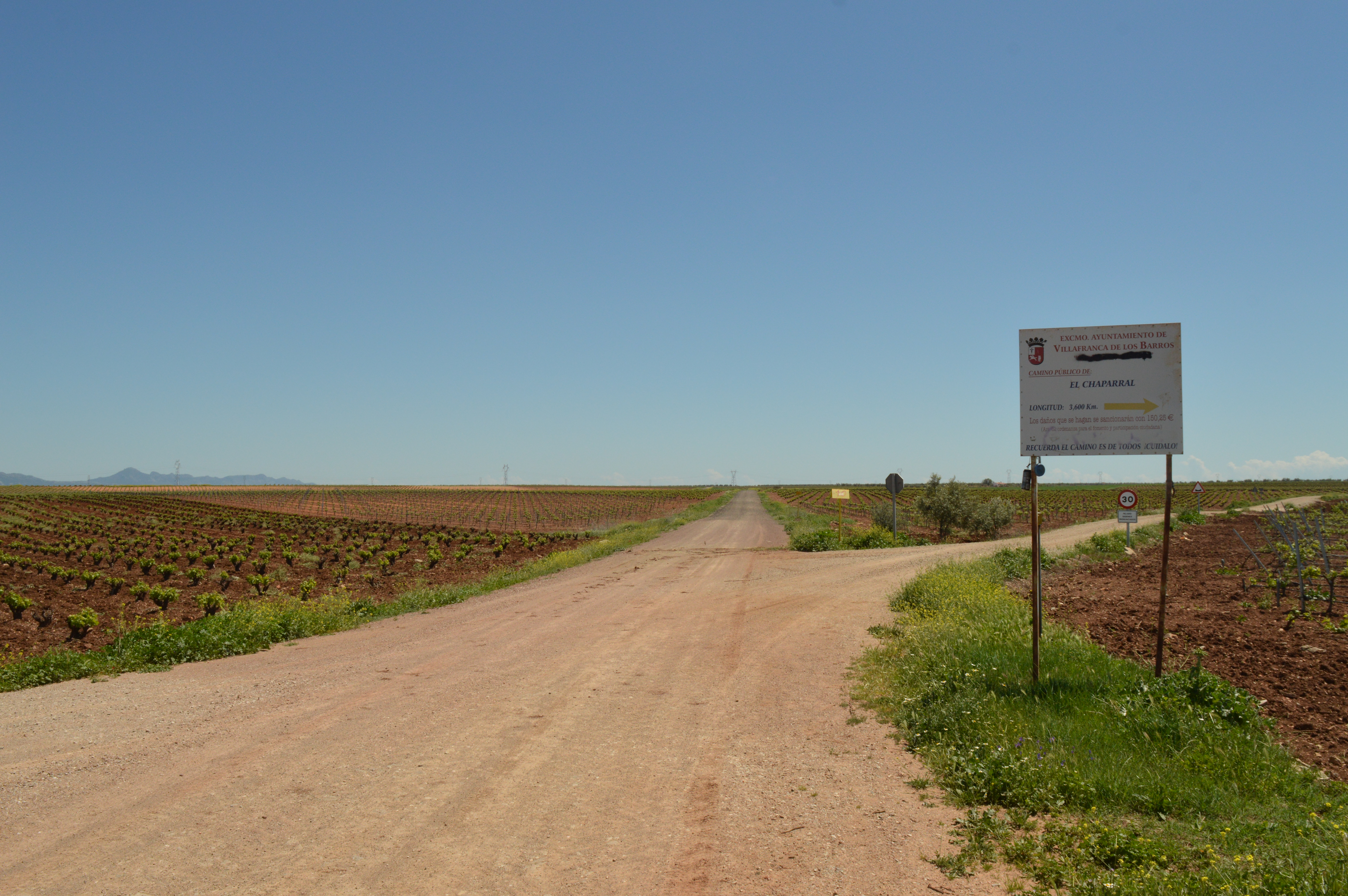
El mastin español – guardian of the Tierra de Barros
When I lived in Extremadura, I remember finding some of the largest dogs I’ve ever seen out in the countryside, lazing about in the shadows within fenced enclosures and barking at anything and anyone that came near. Not just any bark, either, but a terrible, three-throated bellow that you can hear from a great distance, the kind you might expect from Cerberus. I’m talking about the Spanish Mastiff, an impressive breed once used by the shepherds of La Mesta, Spain’s ancient “wool mafia”, as a guard dog for their valuable Merino sheep. A working dog bred for its size and strength, it’s not hard to imagine this beast in action against the wolves and bears that once roamed the forests of Iberia. They were popular combatants in bear-baiting, a sport which was just as popular in parts of Spain as it was in medieval England, to the detriment of the country’s bear population. Dog after dog would have been sent against the great beasts until they could fight no longer.
These days, of course, there are probably more mastiffs in Spain than there are wolves and bears put together, and the giant bear-killers look like old soldiers gone to seed in their enclosures under the Spanish sun. There was only one victor in their fight against the country’s predators, and it wasn’t the vanishing wolves, the ghost-like bears or even the mastiff, chained to its post in the quiet Spanish countryside. It’s quite sad, when you think about it.
It wasn’t only the wild beasts of Spain’s interior that the mastiff was trained to fight. There are plenty of stories of the use of perros de guerra in the Spanish conquest of Mexico. Given the diminutive size of the dogs native to the Americas upon the Spanish arrival (see the xolo dog for an example), it’s hardly surprising the Spanish saw fit to use their monstrous dogs as additional leverage in their fight for the American interior. Becerrillo, a war dog owned by the conquistador Juan Ponce de León, is the most famous example. Whether it was the mastiff, the alano or even the greyhound the Spanish employed, the results speak for themselves, and monstrous armoured dogs appear in a number of contemporary recollections of the conquest – there’s an especially telling (and graphic) depiction in the Coyoacan Codex. Whether you choose to believe all the details of the so-called “black legend” concerning Spain’s atrocities in the New World, there’s no denying the awesome power of these war dogs if you ever encounter one in the Spanish countryside.
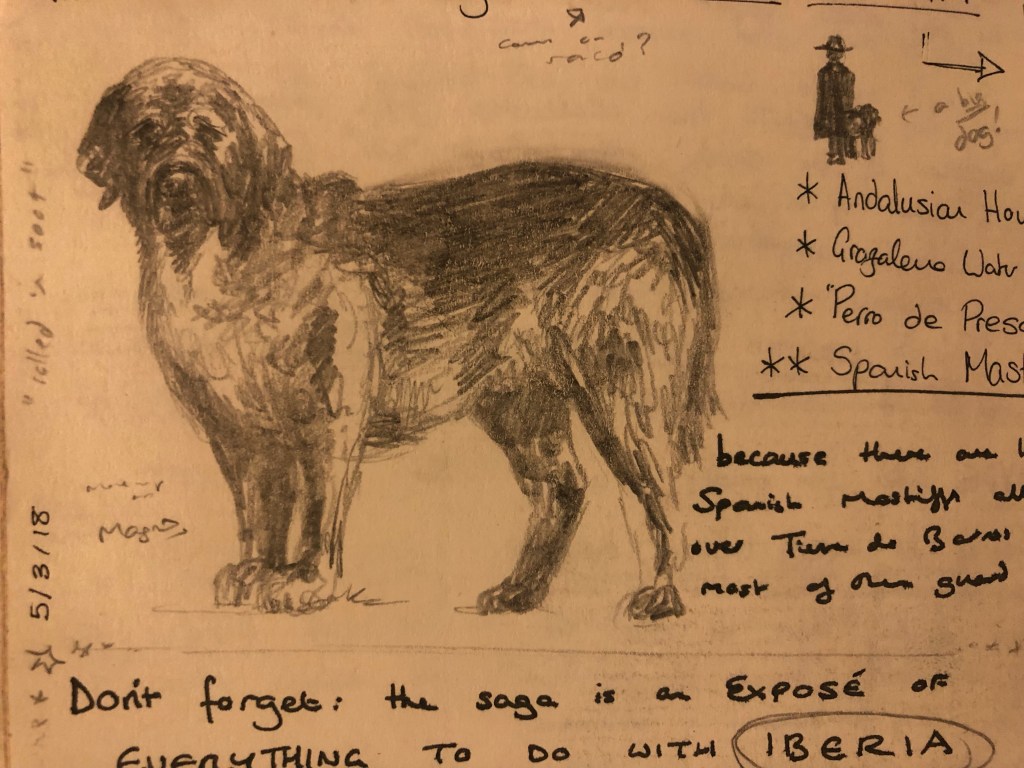
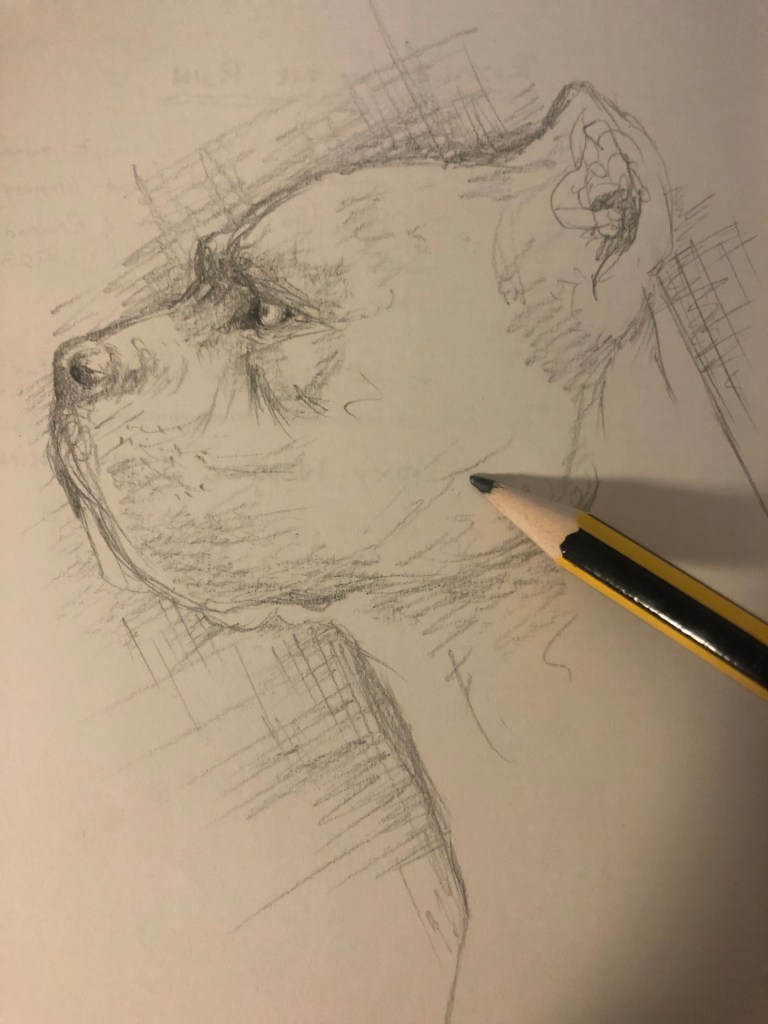
A quick sketch of a Spanish alano, scribbled into the journal between Church and tutor today
Naturally, I’ve written one into my book, as a faithful companion to my leading lady. It’s not as simple as you’d think, writing a dog breed into a book, as by its very nature, dog-breeding is an ever-changing world. Many of the dogs we know today have only been around for a few hundred years or so. The Spanish mastiff we know today is already a very different animal to the kind used at the start of the twentieth century: the original mastiff was still a sturdy, powerfully-built working dog, but not at all like the lumbering giant you see around the Spanish countryside today.
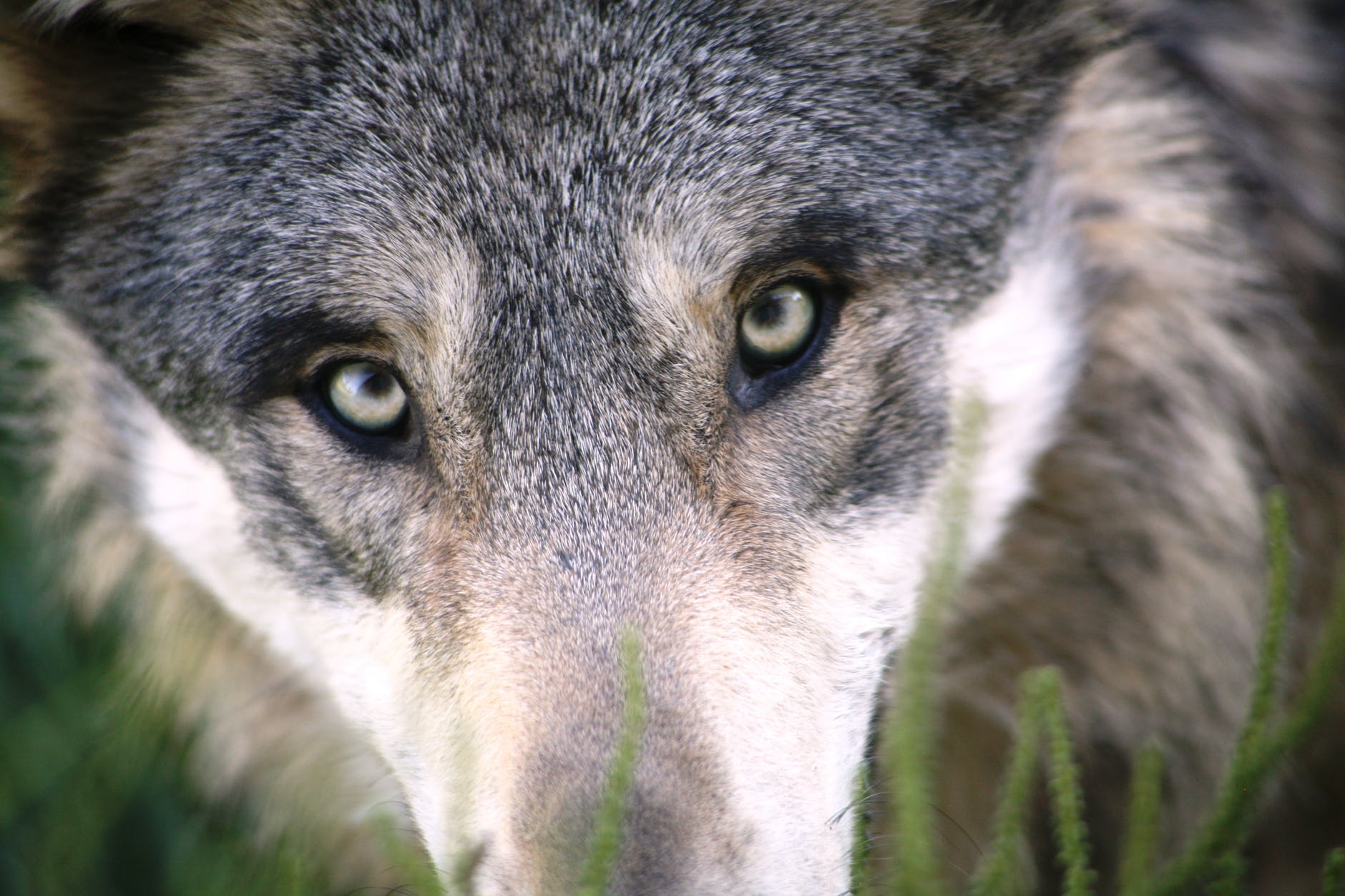
Other dogs that were more familiar to our ancestors have long since disappeared: the stocky Old English bulldogs bred for the sport of bull-baiting, long-since replaced by the squat, hyperbrachycephalic creatures we know today; the alaunt, the rache and the Talbot hound, the mainstays of medieval nobles and huntsmen; and, of course, the mighty Molossus, the ancient war dog of the Greeks and Romans. In our endless desire to bend nature to our will – bigger, smaller, stronger, more obedient, less intelligent – we have warped our old enemy, the wolf, into an absurd array of shapes and sizes. It’s a testament to man’s ingenuity that, long ago, we were able to turn our most hated rival into our best friend, but my word, did we do some terrible things to him along the way. I wonder what a wolf thinks when it crosses paths with a pug or a dachshund. Is there a flicker of recognition, do you think, or have thousands of years of man’s meddling twisted their kin into shapes they cannot begin to understand as one of their own?
I’d really like to track wolves in the wild someday. I’ve heard that one of the better places to do that in Europe is in the wild Abruzzo region of central Italy. I don’t think I’ll manage it this time – as you might expect from one of Italy’s last refuges for the symbol of Rome, it’s not exactly a hop, skip and a jump on public transport. But if years of nature-watching has taught me anything, it’s patience, and I can wait for an experience like that. Spain’s Sierra de la Culebra is also supposed to be a good place to search for wolves, and when last I heard from the place, a pack had been seen in Extremadura, though memory fails me as to where.
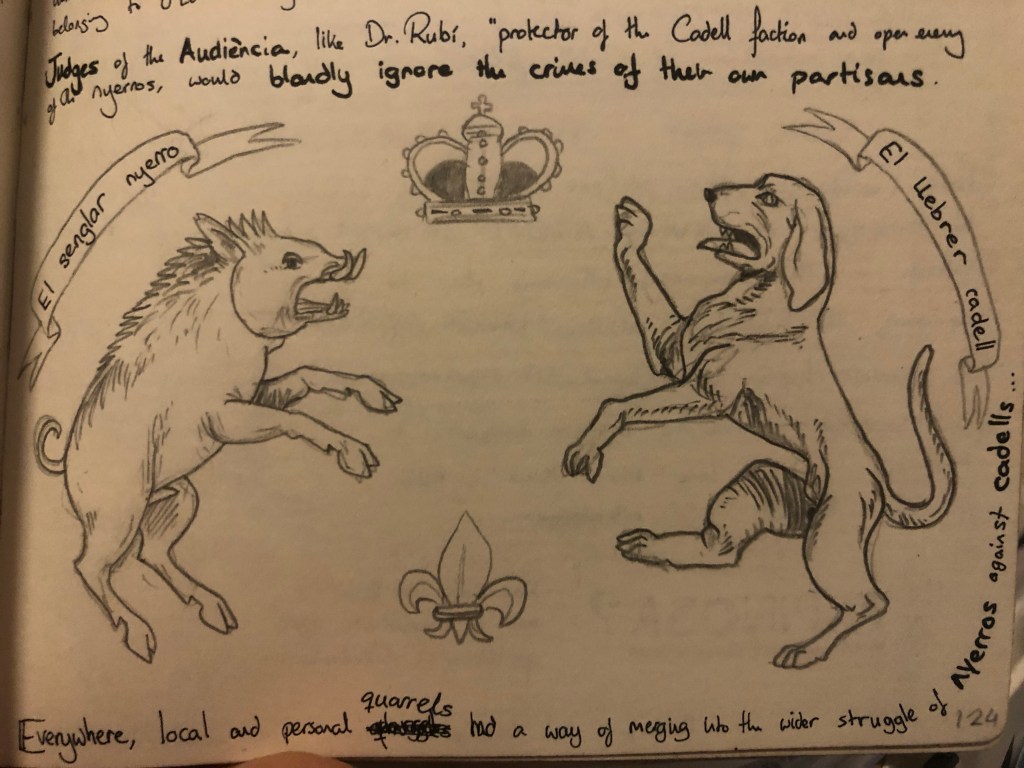
The llebrer (R), symbol of one of Catalunya’s most notorious 17th century gangs, the Cadells
In the meantime, I will read up some more on Spain’s dogs, if only for the sake of my novel. If there’s a place for the loyal mastiff, I’m sure I can find a space for something like the nightmare fuel from Bambi, too. BB x
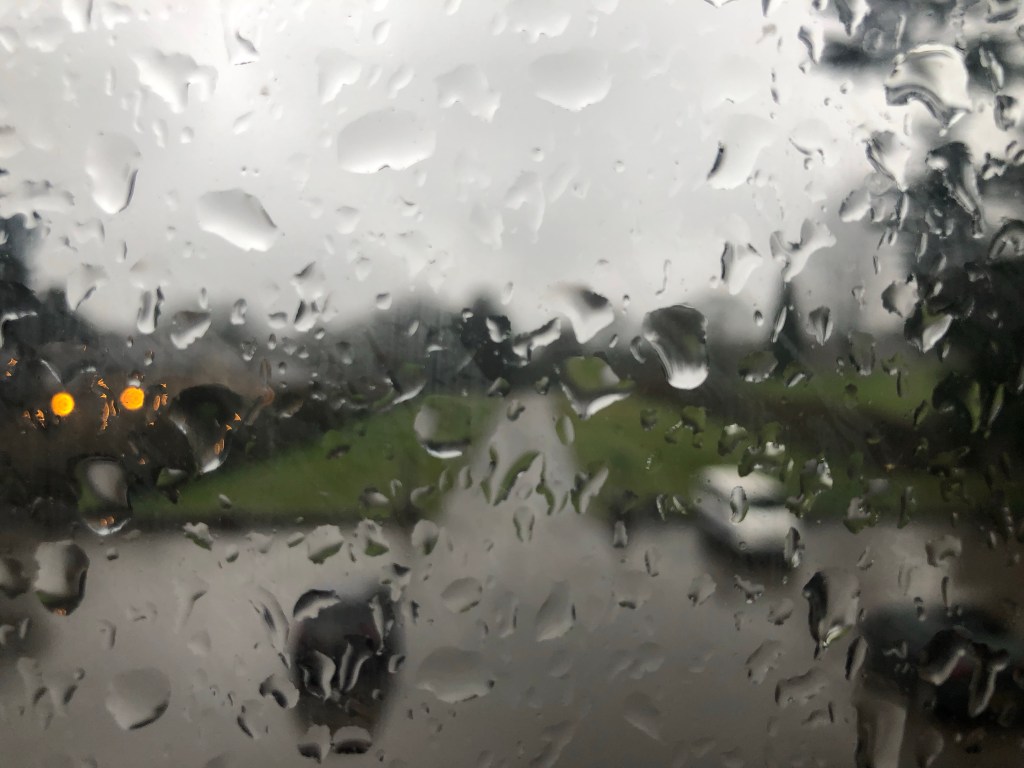
Today’s the last day of the February half term. Storm Eunice is on her way out, but she’s dragging her talons behind her. I’m cooped up with a blanket and a mug of Ovaltine in my study, looking out at the grey world beyond. Cars parked at angles. Wet tarmac mirroring the featureless sky. Winds of over fifty miles per hour howl across the grounds. One of the windows in my flat is permanently ajar due to some fault with its ancient locking mechanism, and the banshee wails moaning through the corridor sound like the Ice Cavern from Ocarina of Time (nostalgia trip here). Between the raging wind and the rattling tattoo of the flagpole two floors up, I might as well be at sea.
I came home from visiting my parents last night to find the whole site in darkness. From what I’ve seen and heard, Eunice had been busy while I was away, tearing her way along the coast like a hurricane and leaving great swathes of the south without power. It took me at least a minute or two scrolling through the UK Power Network website to find my postcode amidst the many hundreds reporting a power outage. After the fair number of power cuts we had last year, you would have thought I would have been prepared, but for the life of me I couldn’t find any of the candles I’d stockpiled over the years. I think my previous housemate used them all up for beer bottle decoration. Fortunately, some foresight – or hindsight – on my part led me to a hidden cache of hand-torches in a chest of drawers. The bulb had gone in the smaller one, but the other, though flickering as a match-flame, gave just about enough light to read by.
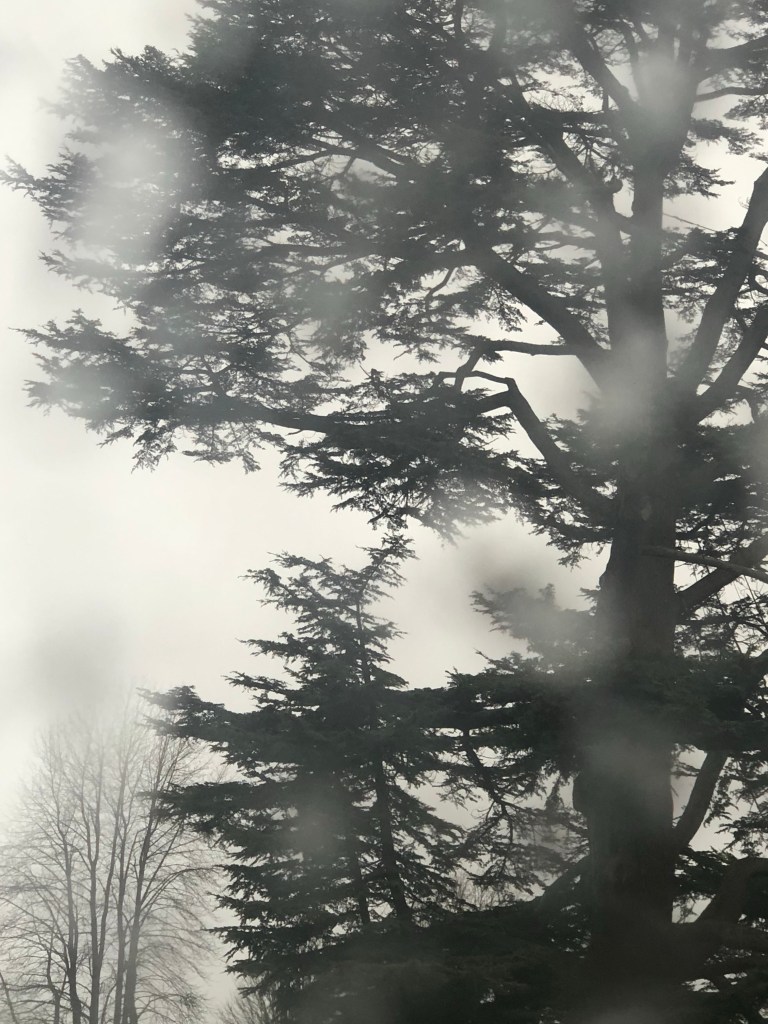
I half expected to come home to find the silhouette of the great Atlas cedar missing from the skyline, its mighty body bent and broken upon the drive like a fallen giant. Fortunately its roots go deep, like the mountains upon which its kin grow far away to the south, and there is strength in the old man still.
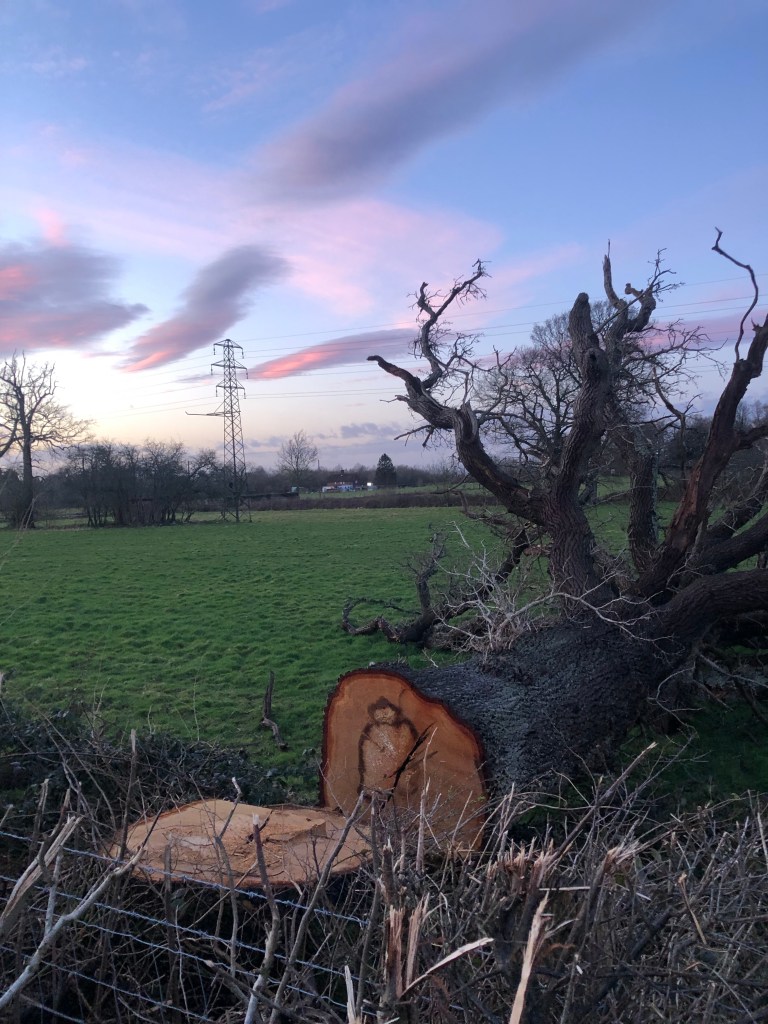
The same cannot be said of many of the free-standing trees that line the road into town. I promised myself I’d get a taxi home for the sake of my new trainers, but as usual, I went back on that promise, only this time it was not out of stinginess but a genuine curiosity to see the wreckage of the storm that I had only glimpsed from the train. Crawley wasn’t given a lashing quite like Brighton and Hove, but it had its fair share of casualties, scattered and trimmed across roads and gardens. The damage was less obvious deeper into the woods beyond. There is safety in numbers, it seems, even for trees: much of the forest was untouched by the storm. It was seriously muddy underfoot, though, and I spent a good ten minutes cleaning my trainers by torchlight once I’d made it home.
It seems unoriginal – not to mention extremely British – to go on so about the weather, but I feel as a writer there is nothing more important than taking the time to talk about the world around you every so often. It’s our duty to tell stories of the world as we see it, so that others who come after us can learn from us somehow. One of the books I actually read cover-to-cover last year, Nature’s Mutiny, pieces together the world of the Little Ice Age through diaries, sermons, letters, hymns and poems penned by those who saw it with their own eyes. Back then there was still a great fear of God tangled up in the awesome power of the weather, and a hundred years of savage winters had led a lot of Europeans to the natural conclusion that sin was to blame. Some resorted to witchcraft; some resorted to witch-burning. Others, of a more temperate nature, put their thoughts into verse:
In constant rancour we abide / and war is ruling far and wide
Envy and hatred everywhere / in all estates discord and fear
That too, is why the elements / reach out against us with their hands
Fear coming from the depth and sea / fear from the very air on high
In morning is the source of joy / the sun no longer sends bright rays
The clouds are raining like a fount / the tears too plentiful to count.
Paul Gerhard Translated by Philipp Blom (Nature’s Mutiny, 2019)
I wonder how many modern lyricists sing about the weather? Back in 2007, when the UK was plunged into its wettest summer since records began, Rihanna’s perfectly-timed Umbrella became a best-seller. There were even joking accusations on the internet that the singer was responsible for the unseasonal weather across the pond…
Now that it’s raining more than ever
Know that we’ll still have each other
You can stand under my umbrella
You can stand under my umbrella, ella, ella, eh, eh, eh
Rihanna (“Umbrella“)
Of course, Rihanna wasn’t thinking about the British summer yet to come when she wrote those lines, but four hundred years ago they might have burned her for a witch for such impeccably bad timing. Come to think of it, though, I do distinctly remember her name being on the list handed to me by the Prefect Witchfinder General at a school I worked at in Uganda, some five years later. Apparently the school’s witch-hunting guild had found a website listing known witches in the Western world? If they’d stumbled upon one of the various forums discussing the timing of Umbrella, perhaps it’s not an unprecedented conclusion. If I remember correctly, Wayne Rooney’s name was also on that list. The internet is a strange place.
Speaking of the internet, I decided to bite the bullet and give the online dating scene a whirl. Living and working in a boarding school doesn’t exactly facilitate an open line of communication with the outside world, so rather than sitting on the fence I thought I’d chase some stories for a change. After a brief browse it looks as though Bumble is the kindest of the Golden Triangle (with Hinge and Tinder), not least of all because it’s the most self-aware of the damage the online dating scene can do to the mental health of its users. It’s good to see that in an undeniably superficial meat market, some of the folks up top are aware of the dangers and offer support.
It’s almost certainly a silly idea, living as far from the city as I do, but, who’s to know? Shy bairns get nowt once again. If I had a penny for every variation of that phrase I’ve heard throughout my life, I might just have a pound. BB x






 The Book of Barnabas