AlbergueSeminario Menor, Santiago de Compostela. 22.00.
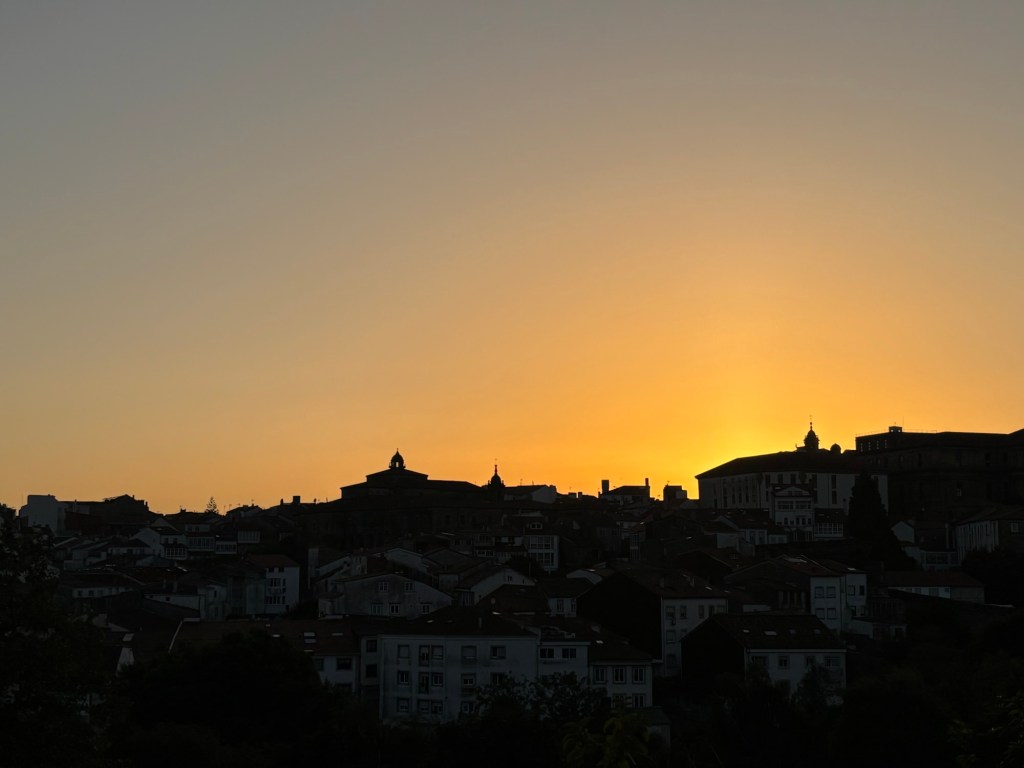
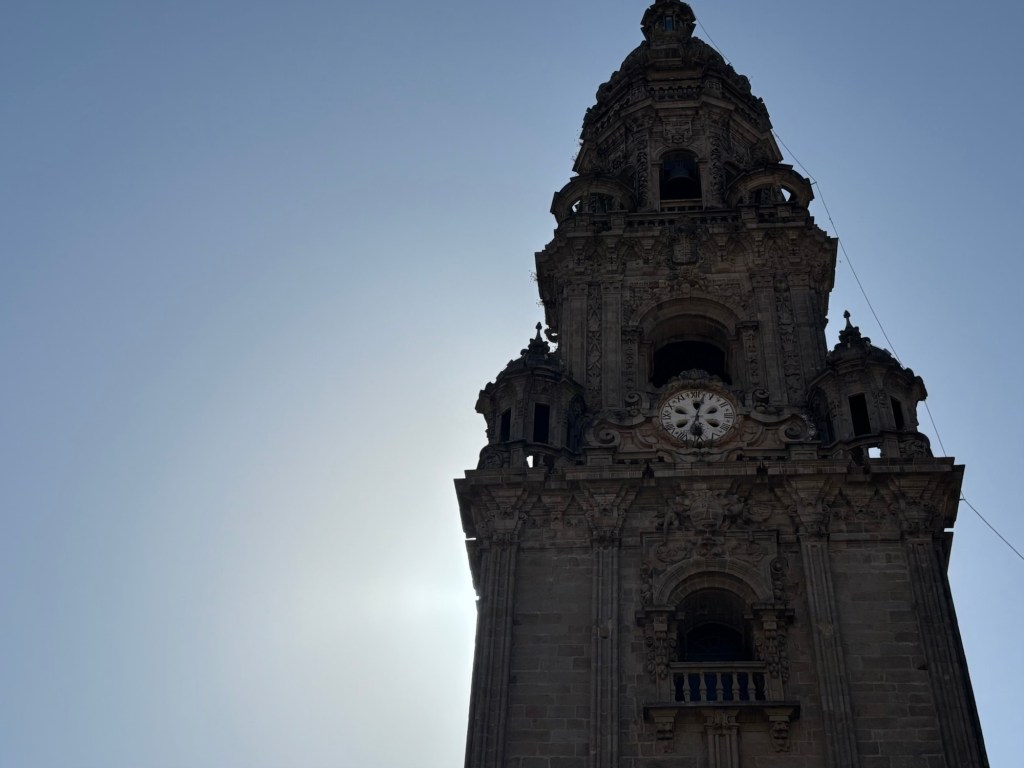
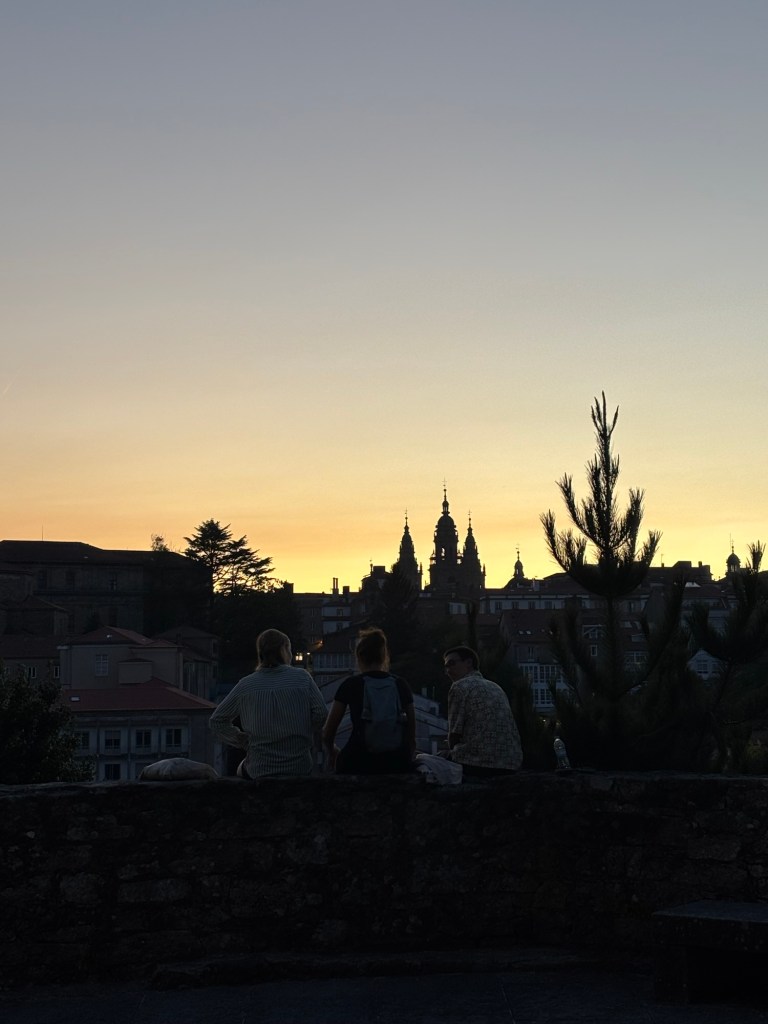
Santiago’s bells are ringing for ten o’clock. A smaller two-tone chime begins behind the echo, for just a few seconds… and then it’s gone. The city is quiet again and the world beyond is in darkness, broken by the slate-blue glow of the vanished sun and the twinkle of streetlights. It is a darkness that has become a fundamental part of my life for the last six weeks, and one that I will not know again until I set out on my next Camino, whenever and wherever that may be.
The breaking of the fellowship is nearly complete. Today I said farewell to Alonso, who sets out on the lonely road to Lisbon, walking the Camino Portugués in reverse. I suspect he was a little reluctant to leave, but to his great credit, he stuck to his plan. Gust and I accompanied him for a farewell breakfast of tortitas and huevos revueltos before parting ways in the Praza dos Obradoiros.
With Alonso gone and southward bound, Gust and I are now all that remains of a Camino family that, at its height, numbered around seven: Alex, Audrey, Talia, Alonso, Gust, Chip and myself. But for Gust and I, they have all departed the sacred city: some for home, some for the next adventure. There is always something sad about that. Gust and I are the lucky ones: with the last stragglers making it into Santiago today, we have been able to say a stoic farewell to pretty much everyone we knew.
Some small show of mercy, I think, for my decision to leave them behind for two weeks to pursue my own lonely trail over the mountains to Asturias.
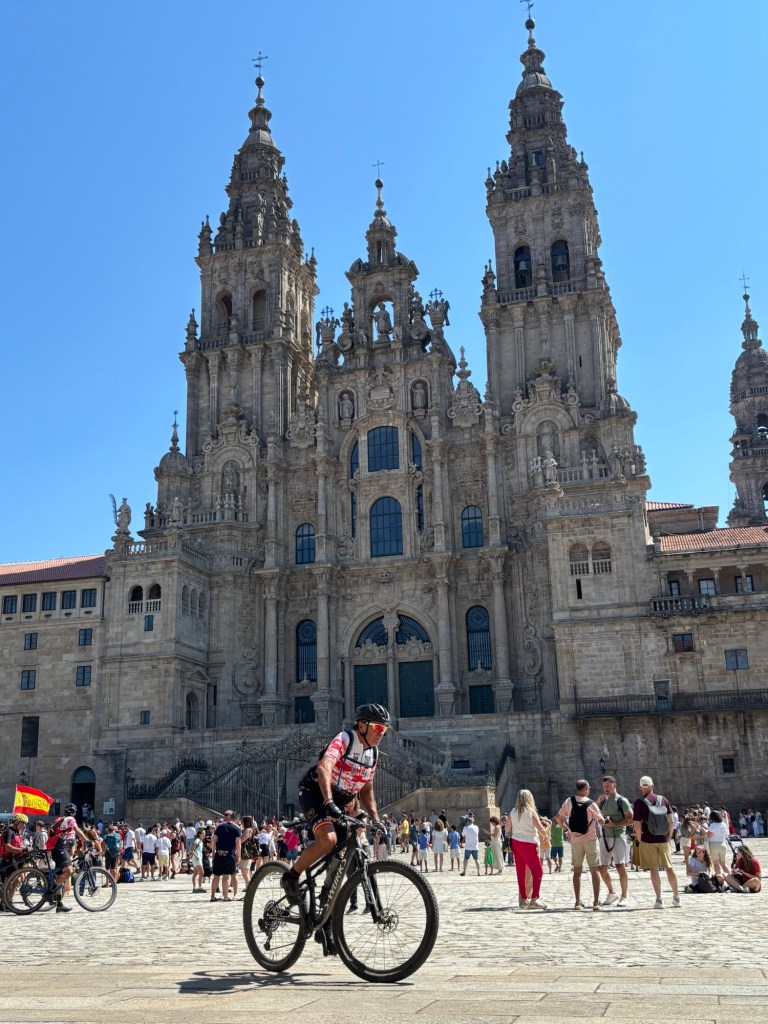
There were even more pilgrims marching into Santiago today than yesterday, their numbers swelled by several huge scout groups with their colourful scarfs and boisterous songs. Many of them had tears in their eyes as they embraced before the steps of the cathedral. It’s easy to raise an eyebrow at this overflow of emotion after a four (or, at most, five) day march when you’ve been on the road for nearly ten times that amount, but it’s easier still to forget that – in reality – walking 100km is no small feat. Well may they cry. They have earned those tears.
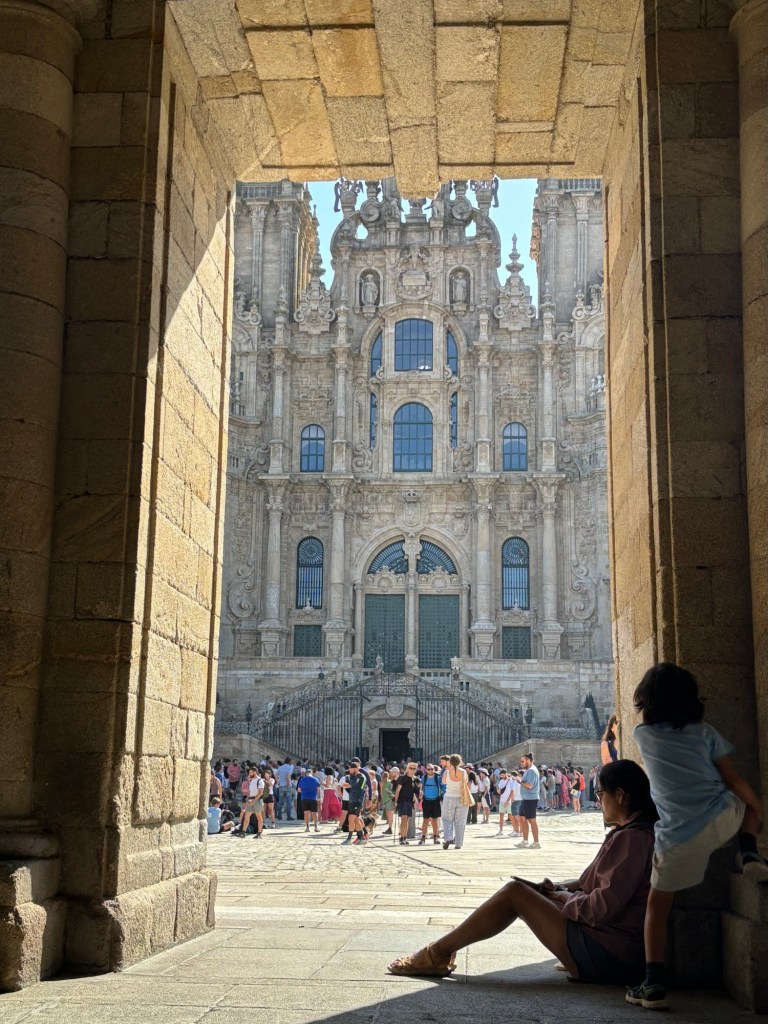
There’s a clear divide in the pilgrims from Sarria and the others in the square: the Sarria pilgrims crowd the plaza in great colourful throngs, while the more seasoned peregrinos (with the possible exception of the Italians) sit alone and in silence in the shade of the arches of the Pazo do Raxoi, eyes shut and faces drawn, contemplating the weight of their road and its inevitable end.
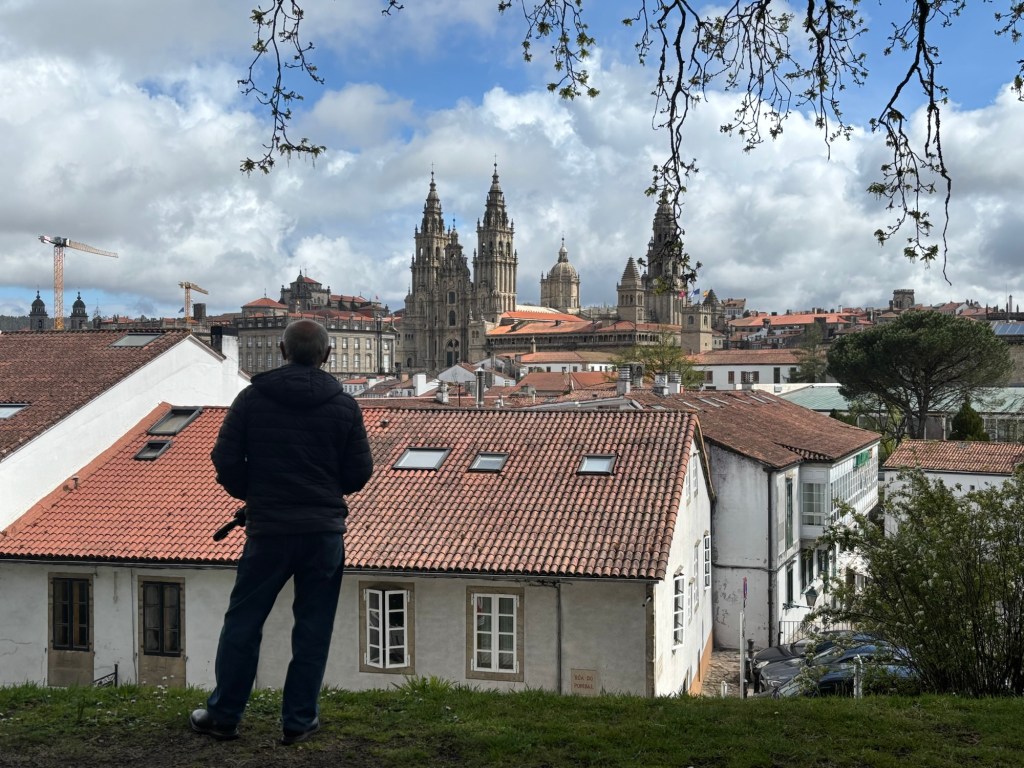
This is my third time in Santiago and yet the city is already so familiar I could navigate it in the dark. I had a look around the Faculty of Galician Studies in Santiago’s grand university building and tried to imagine myself as a Masters student here. It wasn’t easy. It wasn’t easy to imagine Santiago de Compostela as anything other than a pilgrim town, a never-ending terminus for a thousand-thousand emotional journeys. But outside the old city, there’s a modern sprawl with its own beating heart.
I had no map, as I have no more mobile data to guide me (and only just in time!), but my feet (and some scrap of memory) guided me to Casa del Libro in the new town. I only bought the one book, but I found a children’s encyclopaedia of Iberian mythological creatures and took notes in my journal. Not every book has to be possessed. To learn, sometimes, is enough.
I’m falling asleep as I write. I should turn in. This time tomorrow, I will be back in England. My grand adventure will be over. It’s a bittersweet feeling, even if I have accomplished all I set out to do. The end of an adventure always is. BB x
Albergue Seminario Menor, Santiago de Compostela. 18.11.
Two years ago, when I walked into Santiago’s Praza do Obradoiro under a cool white cloud, I could not shake the feeling that I had not quite earned the triumph that the end of the Camino usually entails. I had walked in alone, in the early hours of the morning, after setting out from Burgos some twenty-one days prior. My credencial showed that I had walked all the way, but not all at once: my circuitous route had taken me four years, starting in the summer of 2019 and continuing in the spring and summer of 2023, after COVID and a number of other factors prevented me from walking further.
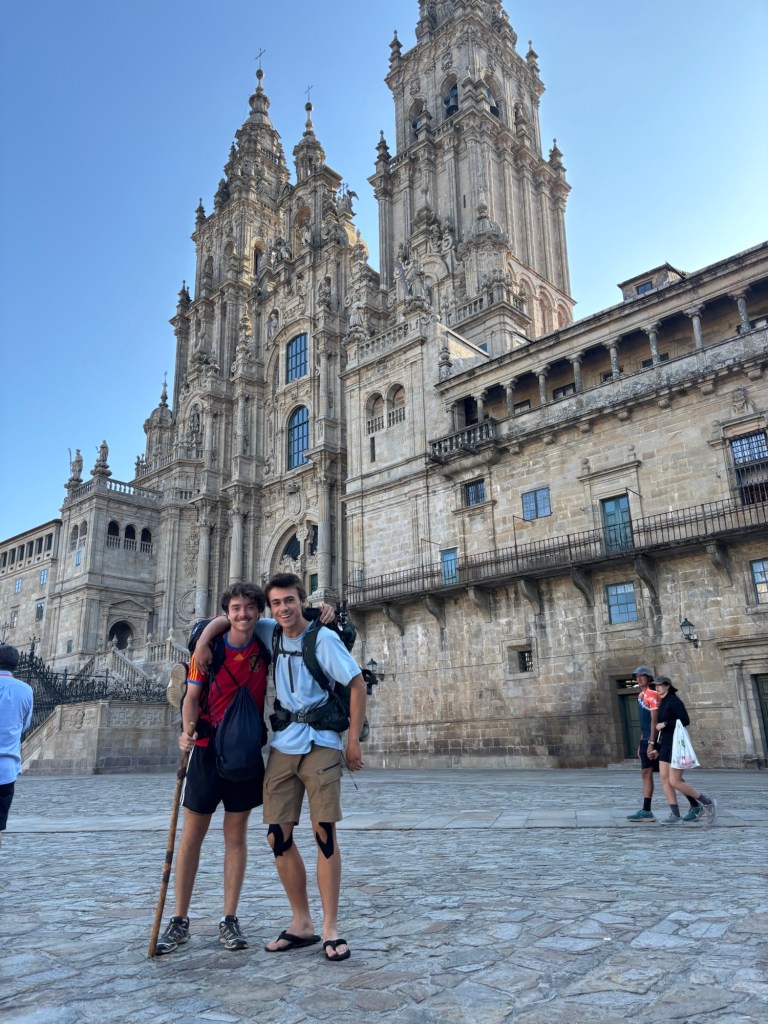
Not this time. Today felt like the finish you read about in books and in the films. Today, after walking over a thousand kilometres across France and Spain, to be welcomed like a hero by old friends in front of a crowd of thousands before a cathedral bathed in light… I was on the verge of tears this time.
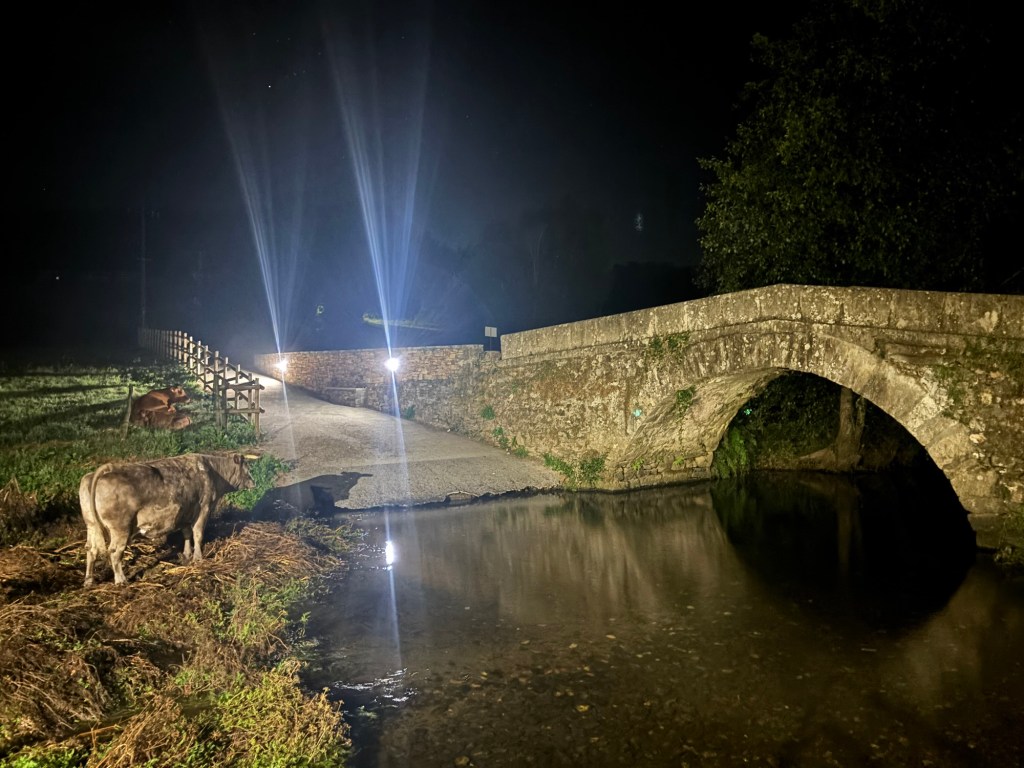
Ribadiso was silent when I left at around a quarter to five this morning – the earliest I have set out along the entire trek. A few cows had wandered down to the river for a drink by the reflected light of a few lamps along the bridge, but I could hardly make out more than their silhouettes in the gloom. My phone did a much better job than my eyes could do.
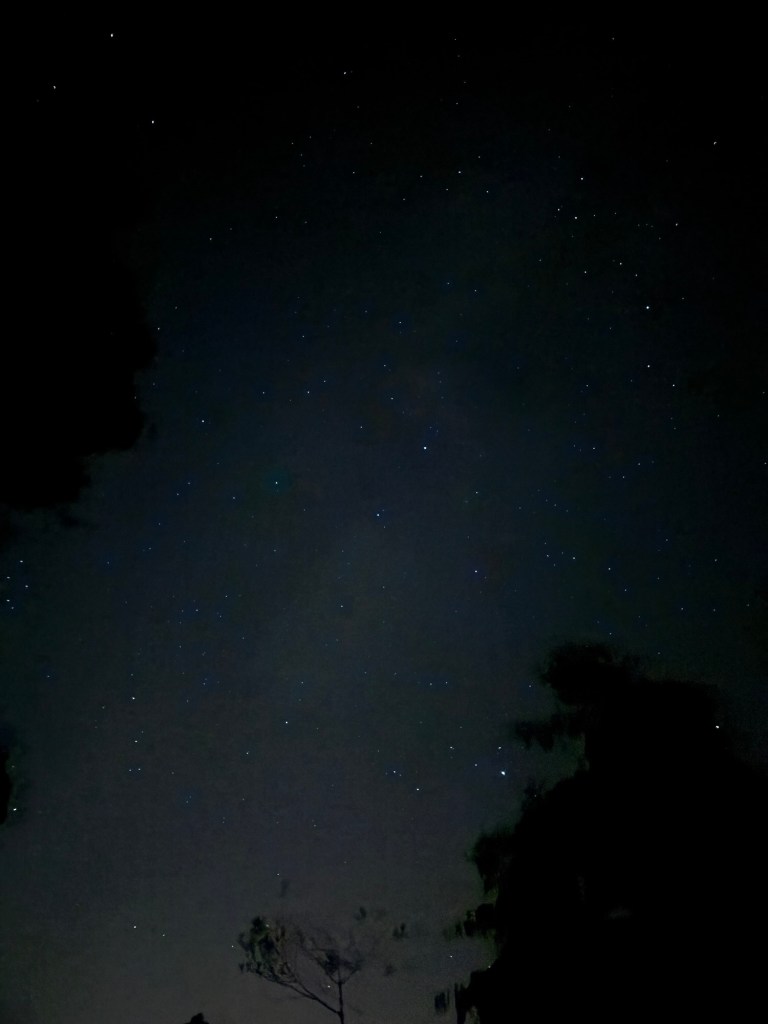
Darkness shrouded my steps until well after seven o’clock, so the first two and a half hours of my walk were made in the long shadows of night. As usual, I avoided using my phone’s torch as much as possible, navigating by starlight and the shadows of the trees against the sky, turning it on only to check I was not in any danger of leaving the trail. I passed a few pilgrims on the road who turned their glaring flashlights on me as I motored past, no doubt perplexed as to why I had decided not to light up the way in front of me.
I picked up considerable speed whenever I saw the dim moving light of a headtorch on the road ahead. I have not been a huge fan of headlamps and torches since two were trained on me like searchlights at two o’clock in the morning on a beach in Almería, during my mad trek across Spain at the age of eighteen. The fright that experience gave me has never really gone away, which may go some way to explaining my general disdain for the invasive, almost threatening white light of a handtorch. But there’s also my natural stubbornness, which I suspect has much more to do with it. You don’t really need a torch to navigate by night… not when your eyes grow accustomed to the gloom. So why bother?
I considered stopping for breakfast at a number of cafés once they started to open their doors after 7am, but every time I neared one, it looked packed to the gills, so I moved on. If I’d known that this would be the case all the way to Santiago and that I would not stop again until I reached the holy city, I might have shrugged off my pride and popped in for a tostada. But I didn’t, and when I accidentally took the forest route bypassing O Pedrouzo altogether – the usual staging post before the final push to Santiago – I decided to push on to the end on the power of a Bolycao and the last of my Nakd blueberry bars. It wasn’t much of a breakfast for a forty-three kilometre hike, I’ll admit, but it did the job.
The road got quieter before O Pedrouzo after I had overtaken all of those pilgrims who had set out from Arzúa, only to ramp up again as I hit the back of the O Pedrouzo brigade. I met a few new characters as well as the first of a few old faces from the Camino Francés: Don Decibel, a raucous Spanish soldier whose phone call to his friends ten kilometres back hardly required the use of a phone at all (though I’m not sure I’d count the repeated phrases “oyé maricones” and “viva España putamadres” as a conversation); the Shadow, a French pilgrim who seemed to catch up to me constantly despite my attempts to race on ahead; Tim & Jackie, an Australian couple who fell behind us at Carrión de los Conded when Tim’s legs started to cause him trouble; and Edoardo, the charismatic Don Juan, who had slowed down to walk with a large group of Italian pilgrims.
And then there were the school and university groups. Hundreds of them. Well over a thousand, if I’d bothered to count them all. The ticker in the Pilgrim Office in Santiago showed that 847 had already made it to the city before I arrived at around twelve o’clock, so that number is not as much of a hyperbole as you might think.
The post-Sarria rush is real. It wasn’t quite as obvious two years ago as it is now, in the middle of August, when the crush is at its highest. I’d wager that I’d have seen even more if I’d left even a little later. They were all in very high spirits and many of them were draped in the colourful flags of their home regions: Andalucía, Valencia and Asturias were the most obvious. I looked for the black bars of the Extremaduran flag, but I didn’t see one.
I wondered, if I’d carried a flag, which one I would have the right to bear. Not Andalucía, surely, as I only lived there for a little under a year as a child (though it has forever marked my accent and identity), and not Extremadura either, since I have no familial connection to that earthly paradise whatsoever. La Mancha, perhaps, as that is where my cousins reside – but when my great-grandmother was born, that part of La Mancha was part of Murcia. My grandfather and his father, on the other hand, were from the Valencian province of Alicante.
In short, I have no claim to any of the regional flags. So I would have settled for the rojigualda instead.
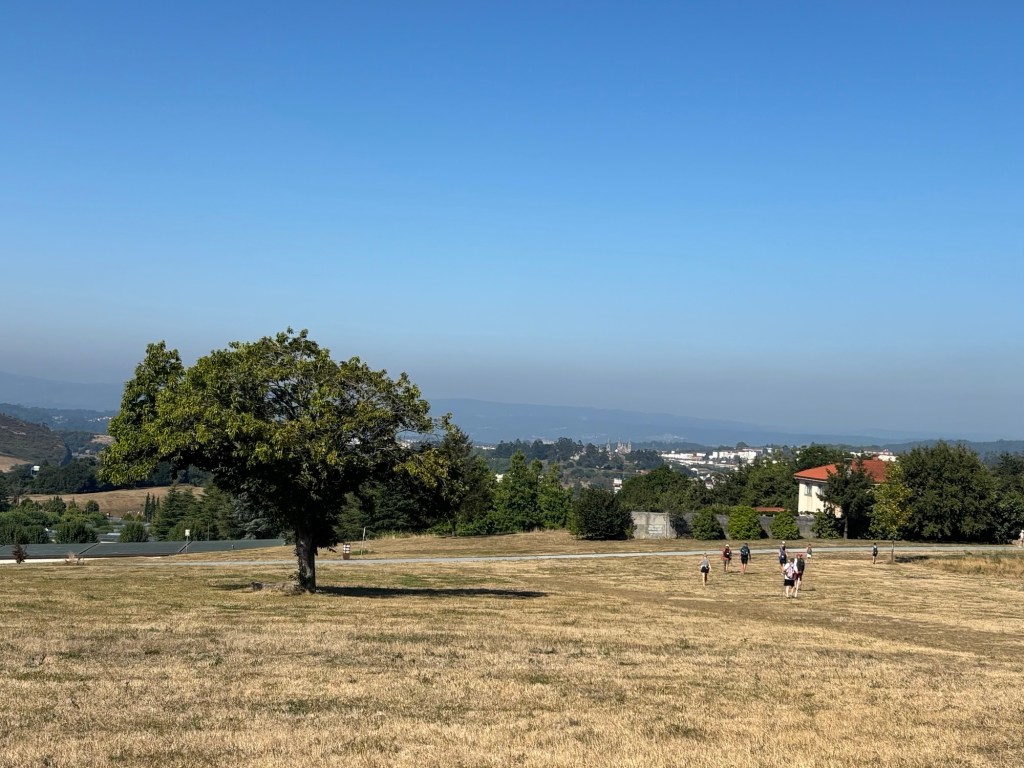
I couldn’t find the famous pilgrim statues on Monte do Gozo – I wonder if they’ve been moved to a different location? Their pedestal was where Google Maps said it would be, but I could not find them. I did, however, see my destination for the first time, and that was motivation enough to proceed: the twin turrets of Santiago’s cathedral, between the gleaming white houses and the towering eucalyptus trees.
When I left Ribadiso this morning, Google Maps thought it would take me around nine hours to reach Santiago. It took me seven. I had some powerfully uptempo music to get me through the last ten kilometres, up to and including:
Rhythm is Gonna Get You – Gloria Estefan
Higher Ground – Stevie Wonder
Voodoo Child – Rogue Traders
El Cid March – Miklos Rozsa
It’s a Big Daddy Thing – Big Daddy Kane
Qué Pasa Contigo – Alex Gaudino
Walk Right Now – The Jacksons
Deliver Us – The Prince of Egypt
The last one was the killer. I get emotional listening to that track at the best of times, but the timing was absolutely perfect, reaching the triumphant crescendo finale just as I reached the back of the square and turned to face the cathedral. There really were tears in my eyes this time.
Let’s face the facts. I walked a bloody long way.
I had hardly arrived in the main square when I was jumped by three old friends: Juha the Finn, Max the Austrian and David the American. To be honest, I was not expecting to run into any of the old guard at all: my side quest over the San Salvador and along the Primitivo put me almost a week out of sync with the crew I had walked with, and even three double days wouldn’t have been enough to catch up to them all.
However, with the exception of Chip (who left for home several days ago) and Audrey and Talia (who I missed by a matter of hours), everyone else was here, including Alonso and Gust, the last remaining members of our little band of seven. I could not have hoped for a better welcome wagon.
Alonso, Gust and I are all at the Seminario – along with a good number of familiar faces – and we had a decent lunch (if a bit pricey for what it was) and a phenomenal Gujarati supper at Camino Curry, a brave new enterprise by a family from Birmingham that was both the most delicious and the friendliest meal I have had on the entire Camino. Given that the fellows had been advertising on my Facebook posts, I’d say they earned my custom.
We said farewell to Max and Juha for the last time on this Camino and returned to the albergue for a couple of rounds of Go Fish (instead of watching the 10pm screening of the Superman movie at the local cinema and risking the nine minute dash back to the seminario before lock-up). I’m normally averse to card games but I had a great time. It reminded me of those dark internet-free nights in Uganda long ago, with Teddy and Maddy and Mina. That feels like a lifetime ago.
Well… tomorrow is another day. No more 5am starts. That’s something to look forward to! BB x
Today marks the longest walk I have ever done in my life. As of eleven o’clock this morning, I have walked 1,013km since setting out from Bordeaux nearly six weeks back on the last day of June. My feet are mildly blistered but not painful, and one of my sandals is starting to fall apart, but my head and heart are clear and Pinta and Niña are none the worse for their thousand-kilometre journey across the country.
I haven’t used my journal much, but I wouldn’t have set out upon this road without it. It’s now by far the longest-serving and most well-travelled (and most battered) of the three journals I have kept since I bought the Red Book in a librería in Villafranca de los Barros back in 2015. Now a veteran of four Caminos, it’s earned an early retirement, I think, but I’m still a good fifty pages or so from finishing it, so it may well have further to travel, I suspect.
Maybe I should just hurry up and get that bloody book written already. Lord knows I have crammed enough research into those journals.
Today ought to have been a short one, but I ended up adding an extra three kilometres to my walk after realising halfway through the dark woods out of As Seixas that I’d left my credencial behind. I have three, including a spare and the completed one in my journal, so I wouldn’t have been turned away at the next albergue, but it’s the principal, damn it – and I was only ten minutes into the walk, so I legged it back without the aid of a torch to the albergue, hoping the other pilgrims had not shut the door behind them.
Luckily, they hadn’t, and my credencial was sitting on the bunk above mine along with a sachet of Cola Cao, just where I’d left it the night before. Sometimes I’m in such a hurry to be the first out the door and on the road that I leave things behind. So far on this trip, that has cost me a pair of sunglasses and a vest – and very nearly my credencial. Muppet.
I restored my reserves with a cup of hot chocolate from the vending machine and took a shortcut back to the Camino via an improvised route to the north. The roads were deserted, so I didn’t have any issues. The three pilgrims who I had sprinted past seemed surprised to be overtaken, after they’d last seen me going back down the Camino about half an hour ago.
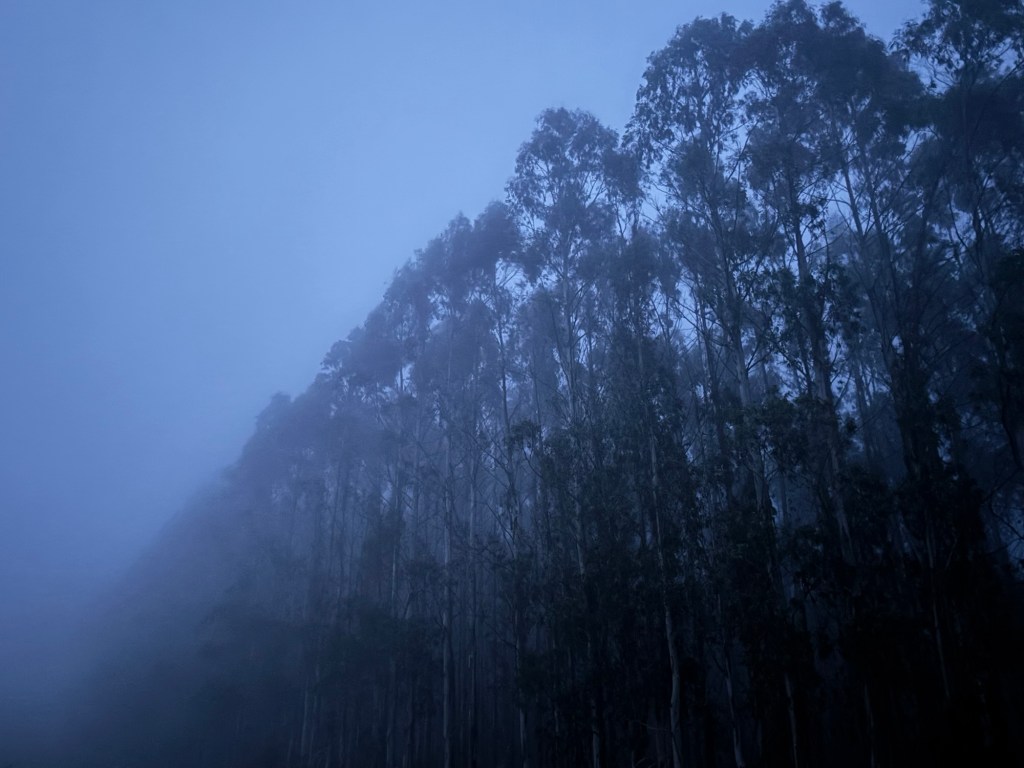
It was a very dark and misty morning. As Seixas is at the foot of a great big hill lined with wind turbines, which kept a lot of the morning mist hanging over the village and its eucalyptus stands. It was a little eerie, and I nearly jumped out of my skin when a nightjar almost clipped my head, announcing its presence merely inches from me with its frog-like grooik flight call. It may well be one of the last ones I see this summer, so I did not begrudge him the fright.
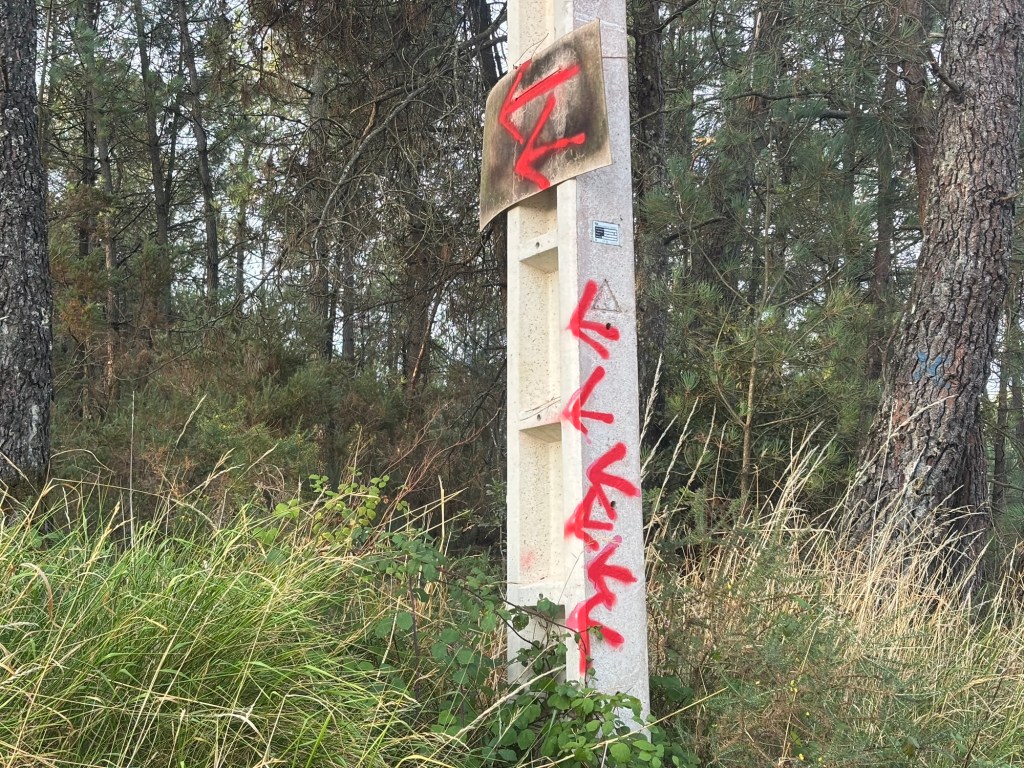
Twice today I very nearly took a wrong turn, saved by my intuition. I have followed the yellow arrows of the Camino all the way from the heights of Somport and they have not yet put me wrong. Curiously, however, a number of red arrows have sprung up, usually in large groups and always pointing off the road. They may indicate an alternative route but they are a little unreliable: in one case they put me back on track after I took the wrong road, but in another spot they pointed in completely the wrong directions and only a brief chat with a friendly labourer solved the conundrum.
If in doubt, don’t trust the red arrows. The yellow arrows always lead to Santiago. The red arrows might not. When you put it like that, it’s almost like a child’s game.
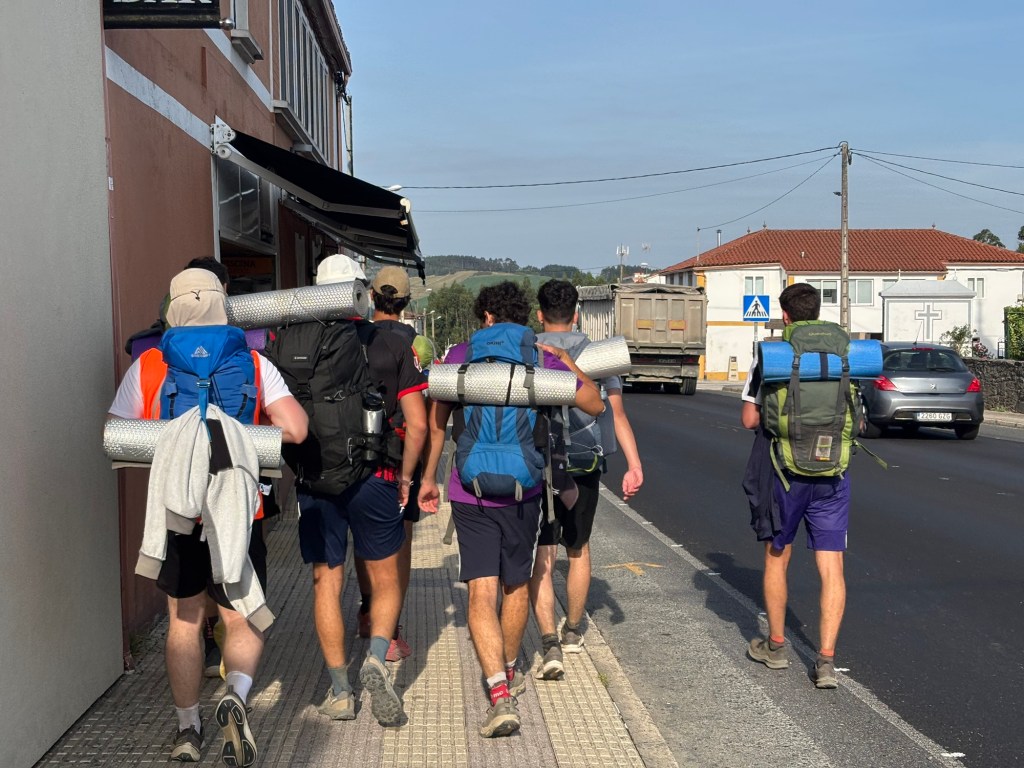
I reached Melide just before nine (ahead of schedule, despite the loss of 20 minutes) and bought a few supplies in one of the corner shops before moving on. The volunteer in the Concello de Melide warned me about the “fiesta” from here on out, and he wasn’t wrong: for the rest of the morning, the Camino was absolutely packed. Extended families and university groups, parishes and pensioners and pre-teens with their parents, and quite a lot of dog walkers, most of them carrying small backpacks and sticks they’d found at the side of the road (as opposed to the titanium pole wielding pilgrims of the Camino Francés). On average, it’s estimated around a thousand people a day walk the final 100km in August.
Hence the rush for a room.
I wonder what became of my shaman stick that was stolen in El Acebo? Who knows – perhaps it’s already done another Camino of its own.
I had a choice to make this morning: finish early and stake out the albergue municipal in Ribadiso, or roll the dice and shoot for Arzúa, only three kilometres further on. Arzúa’s municipal has fifty-seven beds to Ribadiso’s sixty, and it would lop three kilometres off tomorrow’s trek… but Arzúa is the end stage in all the guidebooks. How could I be certain that there’d be a bed left, even if I made it before half eleven? I passed at least a hundred pilgrims on the road before reaching Ribadiso, and I had set out from Melide after nine o’clock – a full four hours after the early birds.
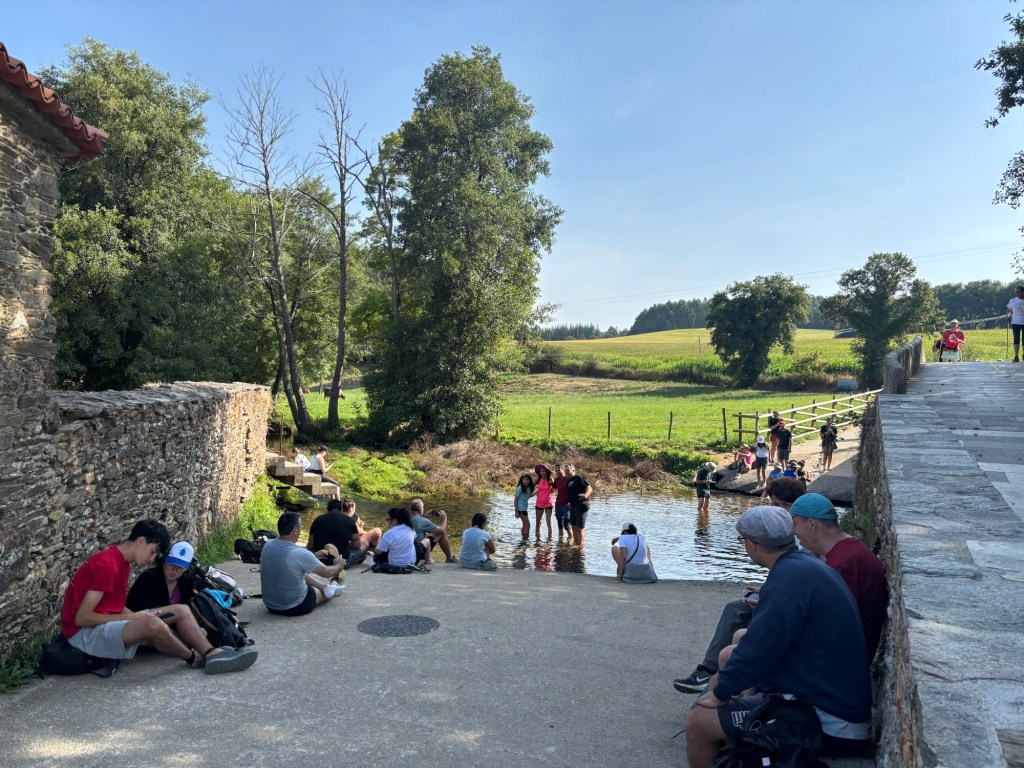
No – wisdom overcame risk today. I found a spot by the bridge in Ribadiso and sat down. It looked at first like around twenty to thirty other pilgrims had the same idea, but gradually they came and went, stopping only for a quick paddle in the river. With temperatures rising up into the mid thirties this afternoon, and so much paved road below, who can blame them?
I might go and paddle myself, once the hordes have moved on. For now, I might catch up on some sleep. I have one last challenge tomorrow and it’s a long one: over forty kilometres remain. Let’s…. Must focus and proof-read, but… Zzz… BB x
Melide and the busy pilgrim road are less than fifteen kilometres away, but you’d never know. I’ve found an oasis of quiet here in As Seixas, which doesn’t appear to be an especially popular stop, despite being the obvious final stage before the roads converge at Melide. There must be around thirty beds in this municipal albergue, but only six of them are occupied: five in the small room and me on my own in the big room. It’s funny how that worked out. Outside, it’s just the chirping of sparrows and the sound of the wind. I had better bottle it up before the explosion of noise that is the last stage of the Camino Francés.
I walked in silence for the first two hours today. I don’t rush for my music or an audiobook when I start walking. That usually comes much later. The first hours are sacred, even when they involve nothing more than a concrete walk through the city outskirts. Those crucial first six or seven kilometres or so are a golden time to clear your head. At least, that’s one of my Camino principles.
Only once the sun was well on its way beyond the white clouds of the morning did I pop my earphones in and crack on with Matthew Harffy’s Dark Frontier (a Western – a formulaic genre but one which I never get tired of). I passed quite a few pilgrims on the road, including a German gentleman (now a surprisingly rare breed on the more popular Caminos) who had started at 4.30am, but eventually their numbers thinned out and I had the road to myself again.
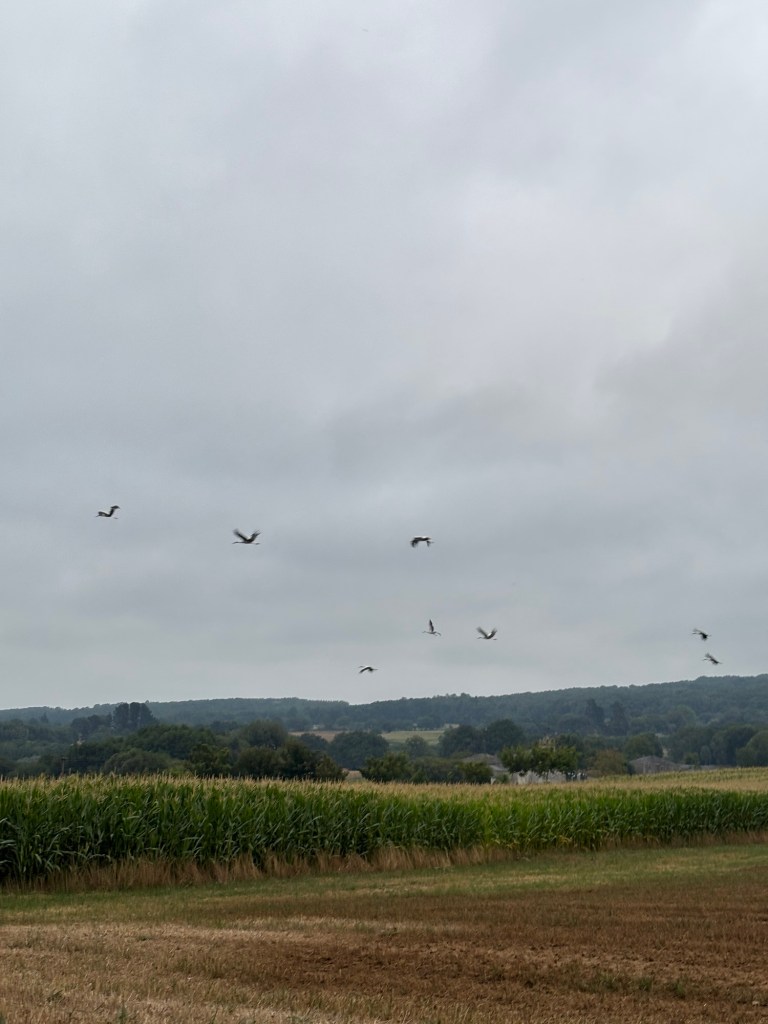
I passed a few fields with storks striding across them. I haven’t seen as many of these majestic creatures since leaving the dry plains and high towers of Castilla y León, and I shall miss them when they’re gone. They really are some of the most beautiful birds to be found in Europe, with their serene stride and their smart crimson legs.
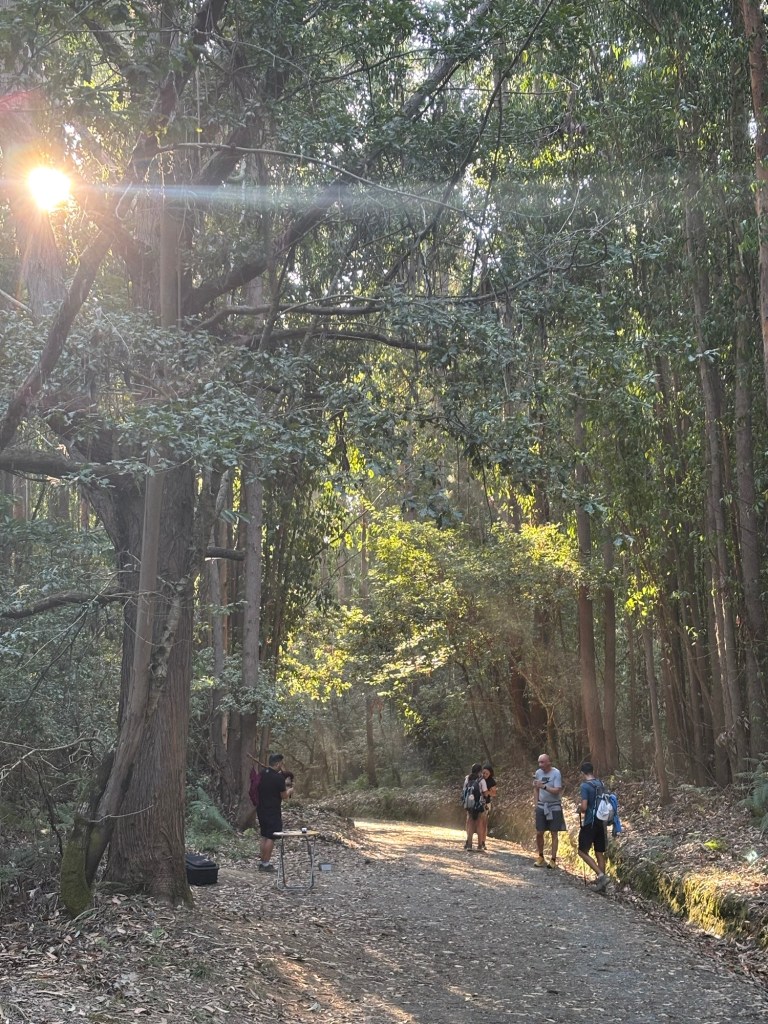
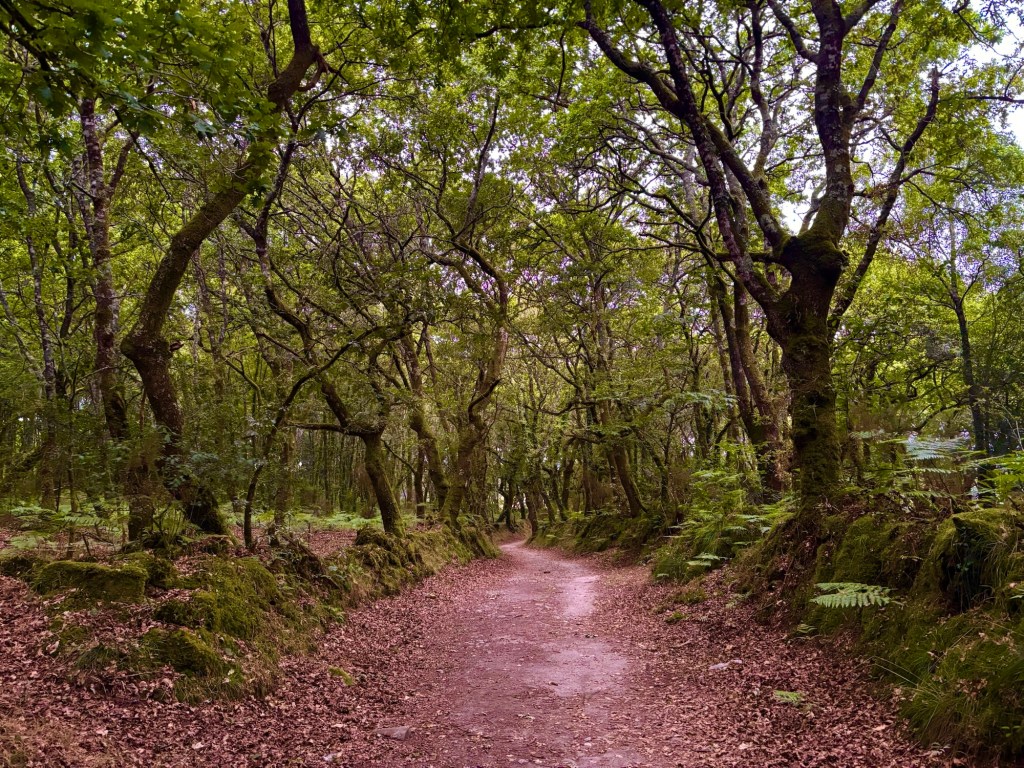
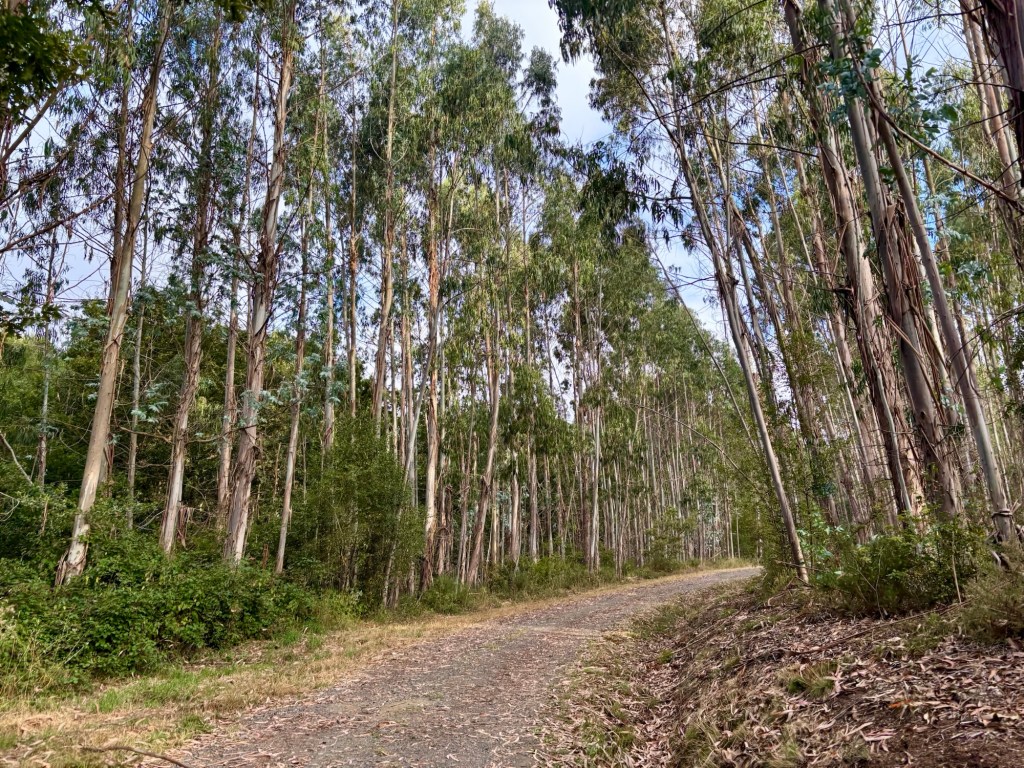
The Camino Primitivo does wind through a lot more woodland than the Camino Francés. This comes in two distinct forms in Galicia: the native ancient oak, dark and twisted, with lichen hanging from its sprawling branches; and the introduced eucalyptus, a pet project of Francisco Franco, tall, bright and peeling like a hapless tourist under the Spanish sun, its sickle-shaped leaves carpeting the road like so many paper blades.
The eucalyptus stands are eerie in their silence: where the ancient oak woods are full of the comings and goings of a thousand living things, from dunnocks and dormice to woodpeckers and woodlice, the foreign woods stand awkwardly about the path, listening but saying nothing, like a line of immigrants waiting for their papers, unsure of what to say and who to talk to. In their native Australia they have an entire ecosystem within which they are the master tree, but here in Spain they’re still a “ghetto crop” of sorts – an inescapable part of the landscape, but not yet assimilated into the world.
A lot of Spaniards aren’t happy about the eucalyptus tree – and with good reason. It’s not just because it’s an invasive species. It’s also an organic tinderbox.
Eucalyptus trees contain a large amount of volatile oils, which they use quite cannily in their homeland to outcompete other plants and trees in the vicinity – for the tree is both highly flammable and remarkably resistant to the ravaging effect of fire. The bark that peels off their trunks in strips and the sheer volume of shed leaves at their feet create natural kindling, and as the tree burns, it releases gases that fan the fire into an inferno. Many eucalyptus trees will survive these blazes, but the native trees will not. Like Australia, Spain is prone to forest fires in dry summers (we’re having a lot of them right now as I write), but unlike Australia, Spain’s forested Atlantic coast is rather crowded, putting thousands of communities right in the line of fire.
Bizkaia in the Basque Country has banned the planting of the tree, and Galicia – where the plantations are most heavily concentrated – has even set up its own de-eucalyptus brigades to attempt to mow down the fire-starter forests, especially after the infernos of 2017 that affected the port city of Vigo.
I’ve never been to Australia, so the eucalyptus has always been – strangely – a Spanish tree in my mind, like the holm oak and the stone pine, only… stranger. Always growing where it shouldn’t. Like me, perhaps, living in a country which might not have been mine, had life turned out differently.
I’ll set out a little later tomorrow, but hopefully no later than six. My intention is to aim for Ribadiso with its idyllic river and Roman bridge, rather than bustling Arzúa and its throngs of turigrinos, though let’s wait and see. My feet (or stomach) may allow me to press on. Or they may not. Either way, Ribadiso is the target, otherwise the final march will be more than a forty kilometre slog: a worthy final challenge, but again, I’d like to have the use of my feet to explore the city without too much pain the day after. Here’s hoping. BB x
Albergue Pensión Casa Cuartel, A Fonsagrada. 17.15.
My feet are seriously tired, but I’ve done it – the longest stint yet on this year’s Camino. Forty-five kilometres of hills, sierras and reservoirs, of steep descents and sunlit climbs, which puts me one day closer to Santiago and gives me the peace of mind to spend a day exploring the city the day after I get there. I sacrificed seeing a local festival in Grandas de Salime for this, but after speaking to some of the pilgrims in this hostel, I think I made the right choice. It sounds just like the set-up at Castrojeriz, which – if memory serves – left me with a little less than two hours’ sleep after the local verbena went on into the small hours.
There are two English lads in this hostel who must be fresh out of private school, talking about “going for brekkie” in that easily identifiable southern drawl and using the same slang terms like “cooked” and “rizz” that my students do. They’re sitting on the steps outside playing one of those mobile phone games that their generation seems to be absolutely hooked on. They’ve been doing so for the best part of the last two hours, talking loudly about their tactics as they do. The two men from Valencia who went the wrong way today are both fast asleep in the next bunk, which is the quietest the shorter of the two has been all afternoon – he’s a particularly merry sort.
I left Berducedo a full two hours before dawn, long before any of the other pilgrims were up. There wasn’t even the faintest glow on the horizon, so I did have to use my phone torch for some of the trek, especially the hundred metres or so that cut through a forest (where a number of large bats seemed to enjoy the light and the moths it attracted). The constellations were a sight to behold, as was the arm of the Milky Way stretching away to the west, towards Santiago. It’s not quite Perseid season – that’s still a little over a week away – but I did see one shooting star away to the south and made a wish.
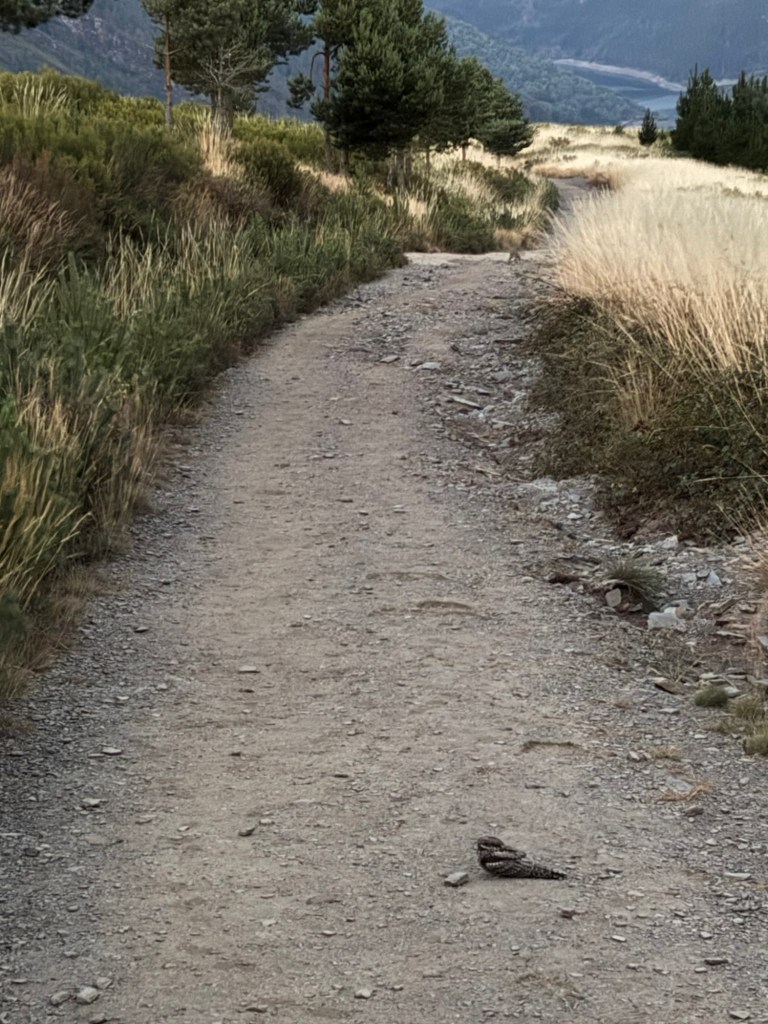
The first cold glow of dawn descended as I began my own descent into the valley before Grandas de Salime. It’s a very steep path that zigzags down the hillside, descending by 800m in a very short space of time. I was quite happily enjoying the Battle of Helm’s Deep when a nightjar almost clipped my face with its wings and one of the rocks in the path ahead suddenly grew wings of its own and took off into the morning air. There were at least three of them hawking about the track, looking for all the world like enormous feathered moths with their strange alternating flight, sometimes flappy, sometimes gliding with their wings held high.
One landed in a tree nearby and set up its eerie churring call, which is almost as iconic to the Camino as the endless tread of my own feet.
Another – the one I had mistaken for a rock – alighted on the track a little way ahead. I approached very slowly and, at least for a little while, it didn’t look like it was in any hurry to take off again. I got so close that I could see it yawn with my own eyes: their vast, gaping mouths are one of the features that gave them their Spanish name of “chotacabras”, or goatsuckers. I almost missed the hare that came bounding out of the grass behind it, appearing more clearly in the photos I took than it did in reality.
Of course, it took off before I could get too close, making its strange grooik flight call as it did so. It landed a little way back up the path but I left it alone and pressed on.
Nightjars are just one of the rewards of setting out early on the Camino. You might hear them, but you’d never see them if you set out after breakfast. I’ve been lucky enough to see quite a few on this year’s Camino, but never so close and never on camera. I haven’t wanted my SLR often on this Camino – I’m carrying enough as it is – but today I would have given a small part of my library to have had it in my hands!
I reached Grandas de Salime shortly after nine, making it a four hour walk from Berducedo (compared to the guidebooks’ suggestion of six or seven). This is usually the stage end, but as it was not even the halfway point, I allowed myself a decent breakfast of a tostada con aceite y tomate, a slice of tortilla and some fresh orange juice so that I might have the energy to push on. There were a few pilgrims having breakfast at the bar, but not that many. The townsfolk were setting up for the second night of their local festival, and I imagine a number of pilgrims had decided to stick around and have fun. I, however, had another twenty-five kilometres still to go and couldn’t stay for long.
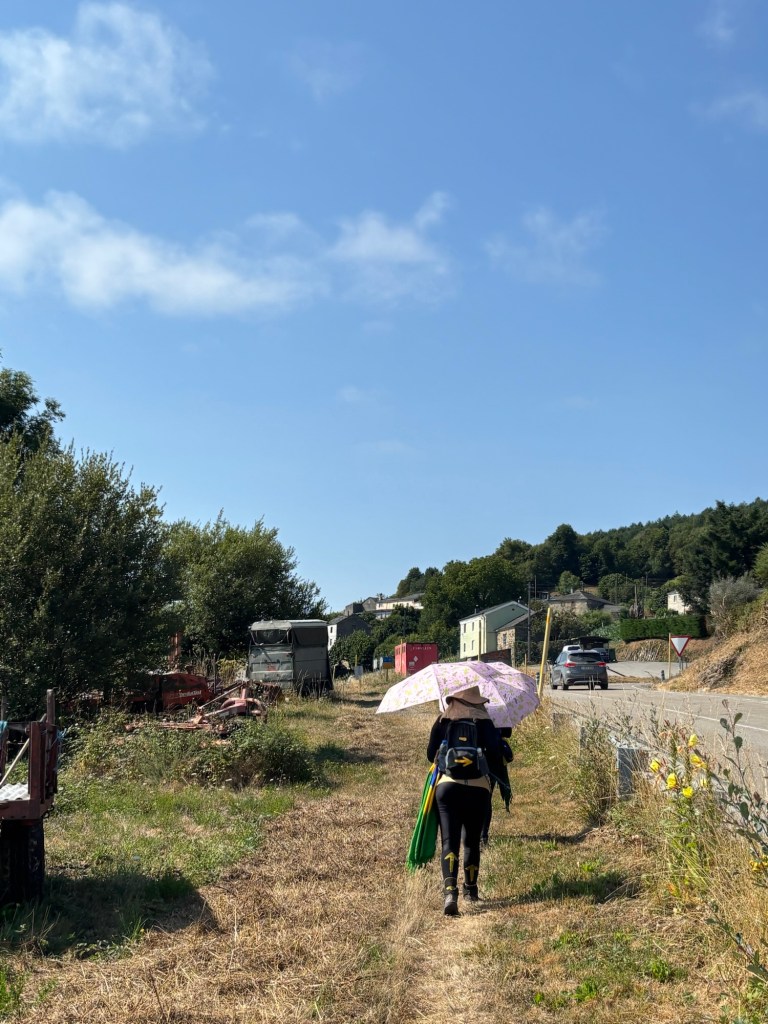
I trailed a couple of Brazilian pilgrims for a little while before Peñafuente, dressed in sporty Lycra, marching cactus-print parasols, a giant Brazilian flag and immaculate hair (something the Brazilian pilgrims seem to prioritise above all other things). I’ve become a lot less cagey about drinking from unmarked fountains along the Camino and the one at Peñafuente was absolutely incredible. The guidebooks recommended the one at Fonfría, but that wasn’t as good or as cold as the one at Peñafuente, so I drank deep and bottled deeper, as it was still a long way to A Fonsagrada. I had hardly begun the second leg, which the guidebooks suggested should take eight to nine hours, and what clouds there were in the sky did very little to block the sun. I was going to need all the water I could get. I can be a real camel on the Camino, but it’s always best to be prepared.
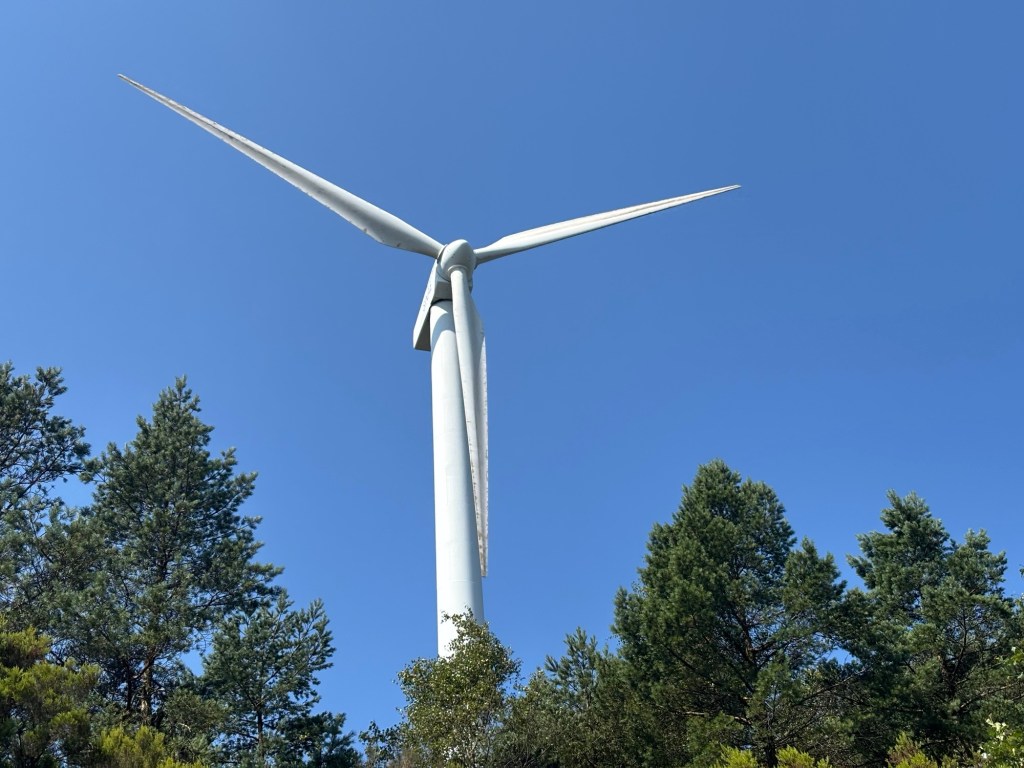
There are quite a few hills to climb between Grandas and A Fonsagrada, none of which were particularly easy under the midday sun. The Camino cuts right through one of Asturias’ many wind farms, though these ones are nowhere near as enormous as the turbines found up in the mountains on the San Salvador route. The heavy whoosh of their arms as they spin in the wind is quite something to hear up close, punctuated with the odd mechanical whirr when the head tilts one way or the other. The way the Spaniards were complaining about the wind up in the mountains yesterday, you’d think that wind was a rare occurrence in Spain – but the turbines that crown many of Spain’s hills and sierras say otherwise.
The Spanish are nothing if not practical with their high places. If there isn’t a watchtower, a sanctuary, a hermitage or a radio mast on top of this or that hill, there’s usually a row of wind turbines.
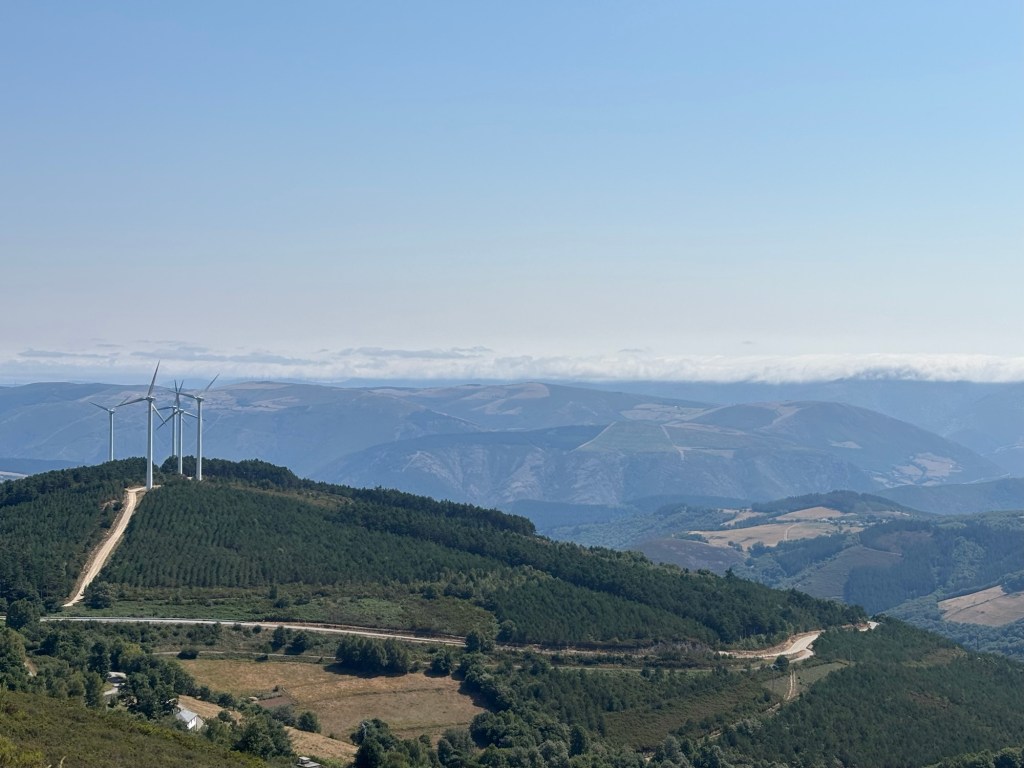
I passed the first row of turbines before sunrise this morning. You can just about see them to the right of the nearer turbines in the photo below, on the last range of hills before the wall of cloud held back by the mountains of Asturias. It’s a good indicator of just how far I walked today.
Shortly after passing the last row of turbines, I crossed the border into Galicia, the last of Spain’s regions on the Camino de Santiago. The marker wasn’t as grand as the one at O Cebreiro – just a crude line of flints and a small cement block featuring a Facebook link to a motorcycle page owned by a guy called Nando, which also happened to indicate that Asturias was on one side and Galicia on the other.
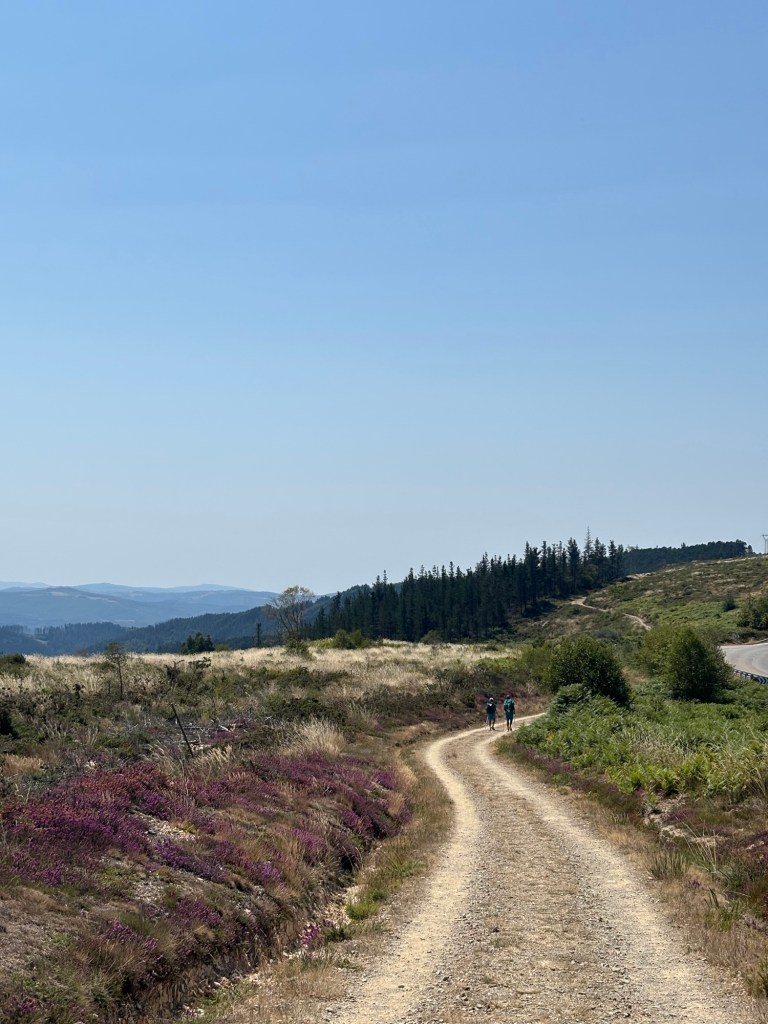
The scenery is already different. The hills are no longer quite as rugged. Instead, they’re carpeted in golden grass and purple heather. I was sorely tempted to get an ice cream at O Acebo, but decided to postpone that desire until I had reached my destination. It took another two and a half hours from the border to reach A Fonsagrada, and the last steep climb up to the hilltop town didn’t help, but I was relieved to learn that the albergue I had found was a bit of a step up from the usual, with real linen bedsheets, soap in the showers and an in-house washer-dryer complex (though I still prefer to wash my clothes by hand whenever I can).
So… forty-five kilometre days can be done, even on the Primitivo! That’s the longest I’ve done so far, and probably the longest I’ll do this year. There’s no sense in rushing to Santiago, which is a lot more expensive to stay in than the towns and villages along the way, so from here on out I intend to enjoy the Camino at a relatively leisurely pace.
Which is, of course, a white lie – because after 45km, 30km is relatively casual. Or 35. Or even 37… BB x
Aeropuerto De Santiago – Rosalía De Castro. 14.40.
I’m back at Santiago’s very small, very civilised airport. It’s another five hours until my flight, but Galician weather is highly unpredictable and I didn’t fancy making the three-hour hike to the airport under a belt of rain clouds, so I forked out a euro and caught the bus instead. On the plus side, it gives me plenty of time to read and rest – tomorrow will involve no small amount of walking, so it’s best I don’t wear out my feet just yet.
There’s a WHSmith in the departures lounge. I wonder how much longer that outpost is for this world, and others scattered in airports across the world, now that the dependable newsagents is going under, just like Woolworths before it.
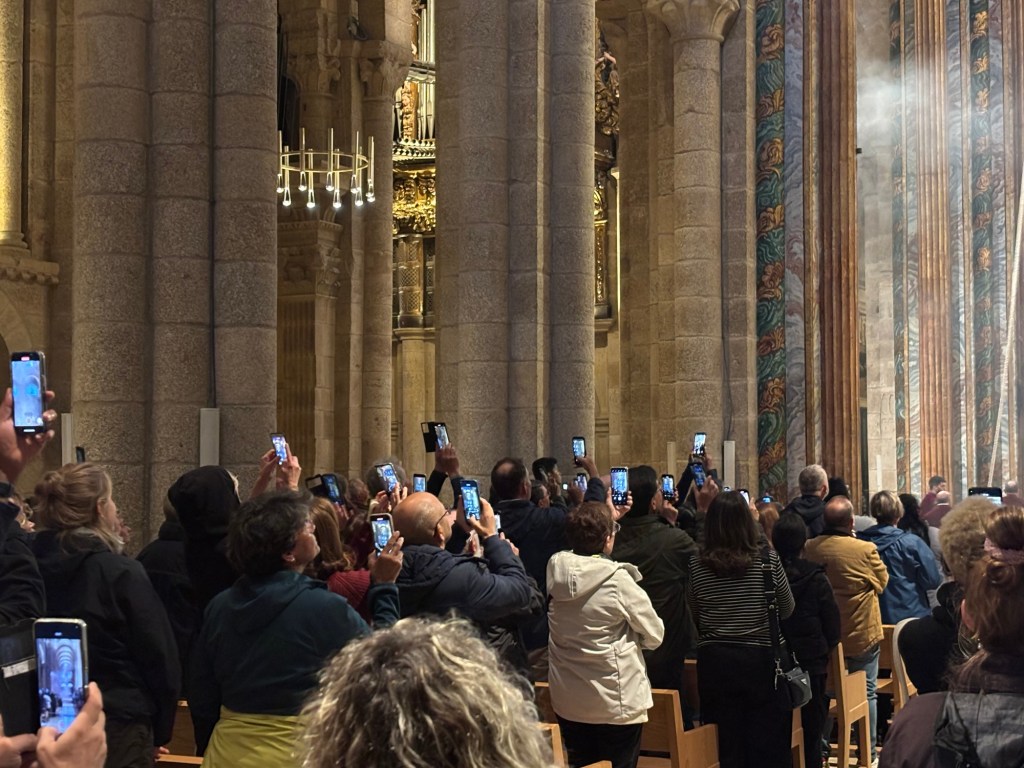
I only just made it to the 19.30 pilgrim Mass in the cathedral of Santiago last night – it took me a little longer than I anticipated to track down the books I was looking for. There was a queue outside the door, and when I was a few metres from the great doors, an attendant in a high-vis orange jacket announced that visits were now over for the day – unless, of course, we were queuing for the Mass. That thinned some of the line, but even so, it was standing room only this time… not the front row seats I enjoyed at the end of the Camino in 2023.
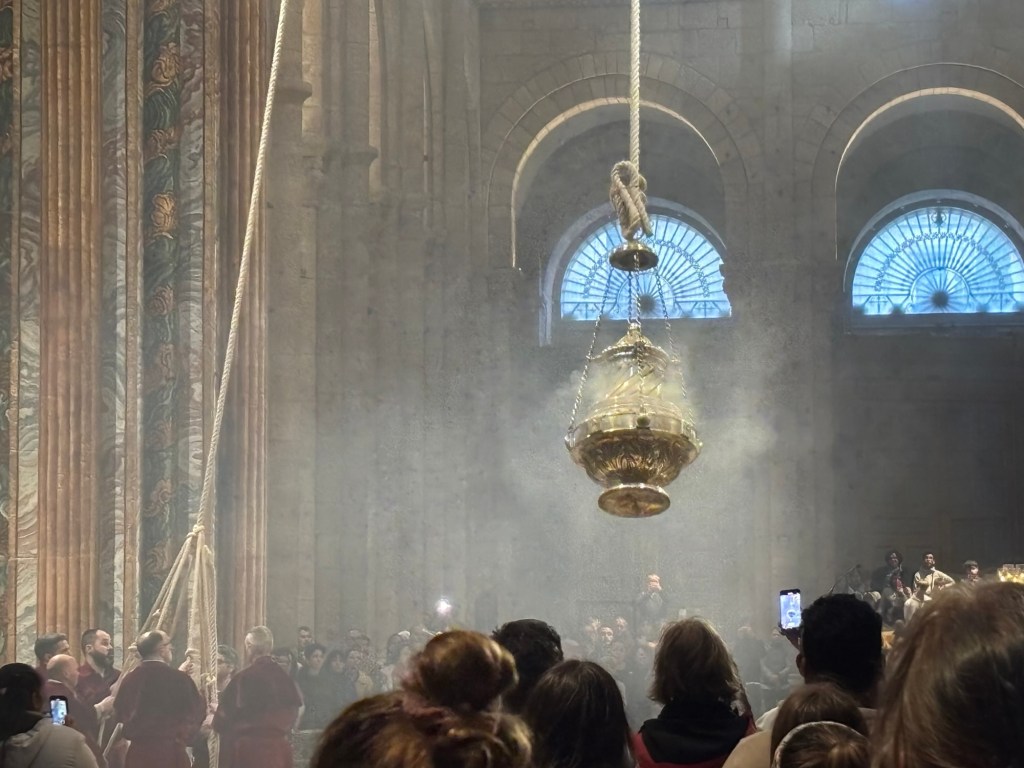
The reason for the crush became apparent in the last few minutes of the Mass, when a group of eight priests in burgundy cassocks approached the enormous knotted rope securing the botafumeiro, Santiago’s famously huge incense burner and, with one collective tug, began to hoist the thing into the air.
Weighing in at 80kg and measuring an impressive 1.93m in height, the botafumeiro of Santiago is one of the largest in the world, outsized only by the Christendom College censer in Virginia (because of course the Americans, not satisfied with an imitation, had to have a bigger one). Unlike its American cousin, however, the botafumeiro is more than just a showpiece. The reason for its size was to purify the air within the cathedral and thus cover up the smell of the pilgrims, who must have stunk to high heaven in the centuries before Jacotrans, Booking.com and Compede blister plasters.
The botafumeiro you see today has been in use since 1851. The original, a 15th century thurible of solid silver, was stolen by French troops in the Spanish War of Independence and supposedly melted down for coinage. This and other acts of vandalism marked the French occupation, which saw many monasteries and Roman bridges destroyed in the name of military strategy. A local legend holds that the Alhambra was nearly blown to pieces on Napoleon’s orders as the French lost their grip on Spain, spared only by the efforts of a single French soldier who had a change of heart and stayed behind to defuse the charges, saving the last remaining medieval Islamic palace in the world from being lost forever.
The botafumeiro swings alarmingly low over the heads of the faithful, reaching a top speed of 68km per hour, though never low enough to catch the heads of even the tallest German pilgrims. It’s quite a special sight, because its presence isn’t guaranteed: it’s usually only brought out on holy days, such as Easter Sunday or the Feast of Santiago on the 25th July. I missed it last time as I set out for the coast on the 25th, hoping to beat the crowds that would follow.
There is a small chance, however, that your visit may coincide with the whim of this or that religious order (or wealthy pilgrim), who can pay a certain amount of money to have the censer brought out especially for their arrival. This time I got lucky: a confraternity had traveled all the way from Goa to celebrate Mass in Santiago, so the botafumeiro was brought out. Lucky me!
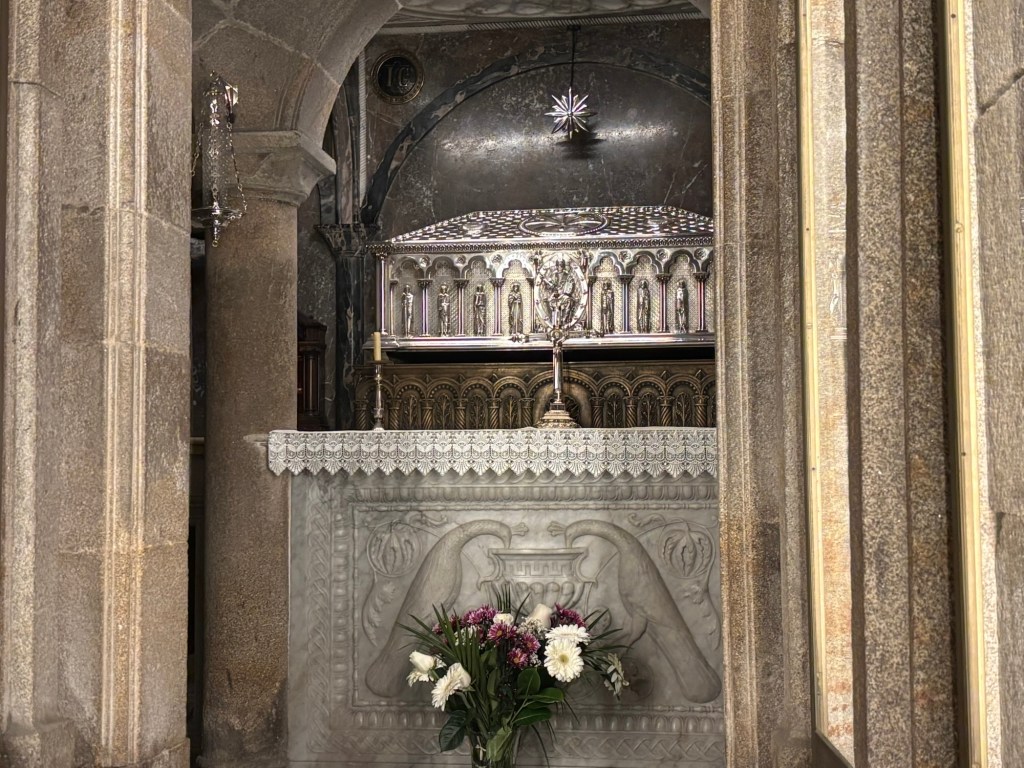
After three visits to the cathedral without paying my respects to the true purpose of the Camino, I decided to make one last trip to see the tomb of Santiago himself. The first of Christ’s apostles to be martyred for his faith, Santiago el Mayor (or Saint James the Greater, if you prefer) was beheaded on the orders of Herod Agrippa. His head was buried near the spot where he was killed (now beneath the Armenian Cathedral of Saint James in Jerusalem) but his body is believed to have been transported to the Galician coast, where his remains were discovered – as they so often are – by a hermit in the woods, who saw a great light shining upon a forgotten Roman tomb.
The veracity of the legend is irrelevant: word got around and soon the final resting place of Santiago had become the most important pilgrimage site in all of Christendom. That it just so happened to coincide with a time when the Christian kingdoms in the north were desperately seeking a rallying flag to counter the Muslim forces who had taken the Iberian peninsula by storm (and the angels believe to aid them in battle) is curious, to say the least.
Santiago’s tomb is a small silver coffin, located in a crypt beneath the central altar. The eighty-strong Portuguese school trip group that I had fallen behind weren’t all that interested in the bones of Jesus’ most faithful apostle, busying themselves repeating lines from Portuguese trap songs and stealing kisses from their girlfriends in the shadows, so I had plenty of time to stop and admire the coffin undisturbed.
I was lucky to get in when I did: by the time I left via the north door, the queue to get in stretched for nearly two hundred metres around the side of the cathedral. Pro tip: get in early, or just after Mass, when the queues are at their thinnest!
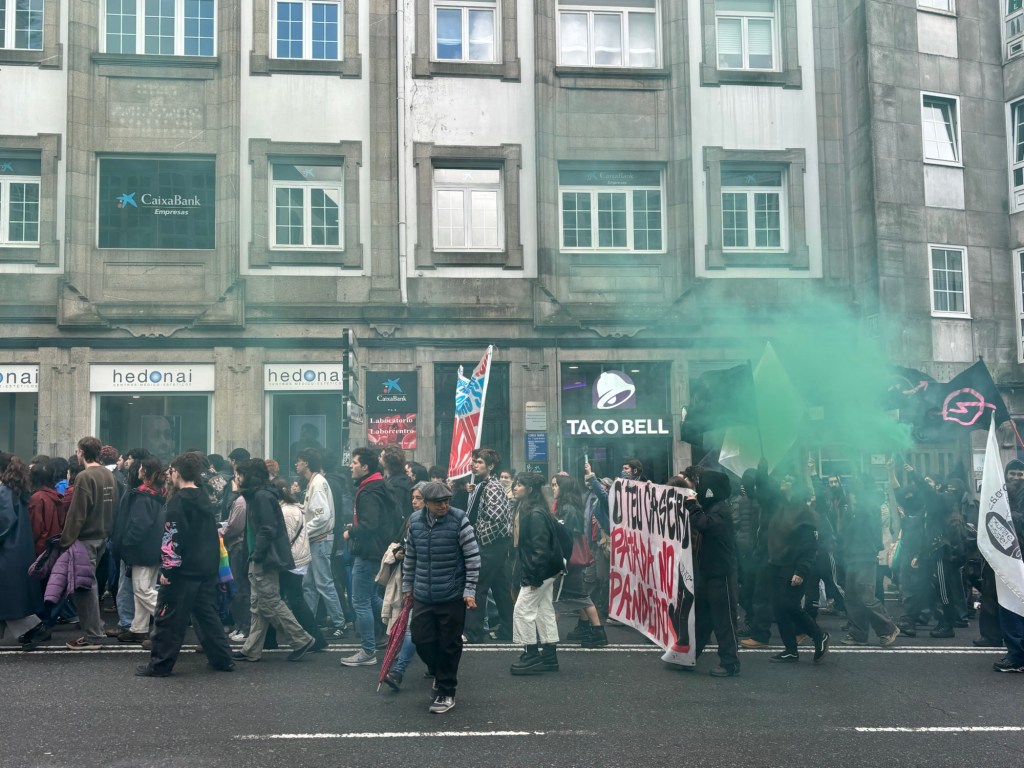
I had a quick bocadillo lunch in the old town and packed my things, thinking to spend a few sunny hours in the Parque de Alameda, but I was distracted en route by the sound of shouts and firecrackers. Doubling back, I found an advance guard of local police cordoning off the Avenida de Xoán Carlos I, and behind them, an enormous crowd of youths dressed mostly in black, carrying flags, placards and loudhalers.
I could have guessed what they were going to be protesting about, and my guess would have been on the money – after all, it’s a sore tooth Spain has been nursing for several years now: the housing crisis.
The short explanation? Spain’s housing market is a shambles. By some estimates, the cost of renting a property has gone up by 78% in the last decade, driven by rampant speculation and unrestricted vulture funds. Put simply, the average Spaniard now finds it very difficult (if not impossible) to find an affordable place to live, especially in the areas most popular with tourists. This is a country where flat-sharing websites like Idealista and Easypiso hold sway: AirBnB and its kin have made Spain a tough place to buy.
This has been most keenly felt in Barcelona and the Balearics, where many properties are vacant for large parts of the year, occupied only during the summer months by foreign investors. It’s one of a number of factors forcing Spaniards to live at home with their parents well into their twenties (or even thirties), and driving others to seek their fortune elsewhere. It’s also why I’m making a point of staying in pensiones wherever I go – a far older and more sustainable method of supporting the local economy as I travel.
There’s an even more sinister side-effect of the housing crisis in cities like Barcelona. I’m referring to the okupas, or the occupation of properties by gangs and other drug-related agencies who turn vacant holiday homes into drug dens, known here as narcopisos. The shady legal status of squatters in Spain, which makes it very hard to evict without the proper authority, doesn’t help matters at all.
Yes, A Place in the Sun and your kind – this is partly your fault. By encouraging the buying and selling (and re-selling) of property along the coast, you are driving the locals out of town faster than the local wildlife was displaced before them.
Naturally, it’s Spain’s youth who are taking the brunt of this crisis – and so, quite naturally, they’re the ones taking to the streets in large numbers to complain about it. Pedro Sánchez, Spain’s Prime Minister, has attempted to address the problem by proposing a ban or even a supertax on foreign buyers, but in the regions that depend the most on tourist dollars like Andalucía and the Costa Brava, that will be a very bitter pill to swallow. So, for now, Spain will have to muddle through these murky waters until a more universal solution can be found.
The protesters marched on up the avenue, followed closely by the police and their van, carrying their riot helmets at their hips. Some of the protesters threw petards into the road as they passed. Others lit flares. I watched them go and returned to the park.
Similar protests are taking place all across Spain today. I wonder if it will come to a head? It’s hard to say, but it is fascinating to be here on the ground while it’s all going down. It isn’t often that you get to live through history in the making, especially when it’s something you teach (manifestaciones is one of the tried-and-true A Level Spanish topics).
This. This is why I travel.
The smoking incense of Santiago’s botafumeiro was meant to cover up the stink of something rotten. Seeing the smoking flares of the protesters as the police escort them through the city, I can’t help but note the connection.
I’ll keep you posted if I hear or see anything else. I trust this isn’t the last we’ll hear of it. BB x
Rain. It started early this morning, while I was still fast asleep, but it’s coming down quite hard now. The bus has just climbed the hill north of As Escaselas and is rolling towards Sardiñeiro, its windscreen wipers working overtime. Lichen-coated hórreos, a symbol of the Galician countryside, stand shoulder to shoulder with new-build white houses with wide garages. That strange mix of ancient and modern is ubiquitous along the pilgrim road: here is a wizened fisherman in blue overalls mending his lobster creels in the shelter of an awning, above which a sign advertises (in English only) “hippie/chill-out/goa fashion”. The lady on the bus behind me talks down the phone in a Galician accent so thick it could be Portuguese, while a couple of free-spirited Germans discuss their next steps. My German is rudimentary at best, but I catch the words “Mallorca”, “Sontag” and “yogi”.
Now and then I recognise a patch of road from that summer two years ago, when Simas and I pushed on together for the Cape, in warmer days when the wind blew west and America still seemed like a land full of hope. Now, the news is full of fury as Trump’s tariffs threaten a global trade war, and the US government tells its citizens to “trust in Trump”. Americans, it should be noted, have been notably absent from the pilgrim trail over the last few days.
Three pilgrims return home on foot in coats that cover their backpacks, and one pilgrim comes back the other way, striking out for the last stage of her journey. The Camino is eternal.
Spooky by Dusty Springfield plays over my earphones as the bus pulls into the former whaling town of Cee. A crude iron sculpture on the seafront is all that remains of that heritage, besides its name, though there are honorary clues all over the place: Restaurante As Balenas, a number of whale-themed hotels, a couple of whale-shaped hobby horses in the play park and even a friendly mural on a wall near the bus station, offering a whimsical nod to that monstrous practice.
Whaling has been outlawed here since 1986. Spain was slow to adopt the ban and Galicia was one of the regions hit hardest, though by that point most of the whales had long since been driven to local extinction. Lately, however, these majestic creatures have been sighted off the coast again, after an absence of nearly forty years, including the greatest of them all, the blue whale – the largest creature ever to grace this planet.
Perhaps they’ve been driven here by the depleting of their feeding grounds further south. Or perhaps – and this is what some scientists believe – it is an ancestral memory that has brought them home, in spite of the knowledge they must have of their kind’s slaughter at the hands of man. Something stronger than fear has called them back, the same compulsion that makes the tiny swallow travel around the half world twice a year. The same compulsion, perhaps, that leads pilgrims of all stripes to seek the end of the world here, as they had done long before the legend of Santiago washed up on these shores over a thousand years ago.
There’s a small bust-up in Muros, where the bus stops for a change of drivers. The two German pilgrims get off for a smoke and return with their rucksacks. The driver tells them they’ll have to leave their bags underneath if they’re headed for Santiago, as the bus will fill up when we reach Noia. One of the two – the one who speaks Spanish – argues the toss, asking if they can keep them at their feet. This annoys the driver, who points out that other passengers will need the seats more than their bags. Keeping my rucksack on me nearly got me out of a nasty scrape when I was backpacking around Morocco, but here in Spain, there’s no need to be quite so defensive. ALSA, Spain’s largest bus company, actually gives you the option to buy up the seat next to you, which seems a bit selfish. Monbus – a smaller corporate creature by far – is a lot more democratic.
There’s an enormous queue for the bus when it reaches Santiago, almost all of them under the age of thirty. It only dawns on me then that the only young people I saw out and about in Fisterra were pilgrims, and few of them under thirty at that. Spain is much like the rest of the world in that regard: its youth abandon the towns and villages for the bright lights of the city in pursuit of opportunities in work or love, returning home only to see friends and family, or once they have a family of their own.
My digs for the night are within a stone’s throw of the cathedral – quite literally. I can hear the bells chime every half hour from my room. I made a flying visit to some of the local bookstores, but wound up returning to my old haunt in Casa del libro in search of a couple of histories on Tartessos, a current fixation of mine. So far, my specialist areas include:
Bandit legends and narratives
Spain’s founding myths (esp. Pedro del Corral’s Crónica sarracina)
El Cid & Frontier Epics
Al-Andalus & Spain’s Islamic heritage
Extremadura
17th Century Spain (Under Felipe IV)
Gypsy culture and narratives
Spanish wildlife (esp. concerning Doñana)
Once I’ve consumed these two new acquisitions, hopefully I can add Tartessos to that list!
I did make it to Mass this evening, but that’s worth a separate blog post, I think. So keep your eyes peeled! BB x
An enormous storm is moving in off the Atlantic. That’s what it says on the El País headlines on my phone. The signs were clear this morning: the wind was up and the waves were agitated, as though some supernatural force were stirring beneath the water out beyond the cape. Or maybe that’s just because I finished reading The Leviathan today and I have sea monsters on the brain.
That and the old English saying about red skies in the morning being a sailor’s warning.
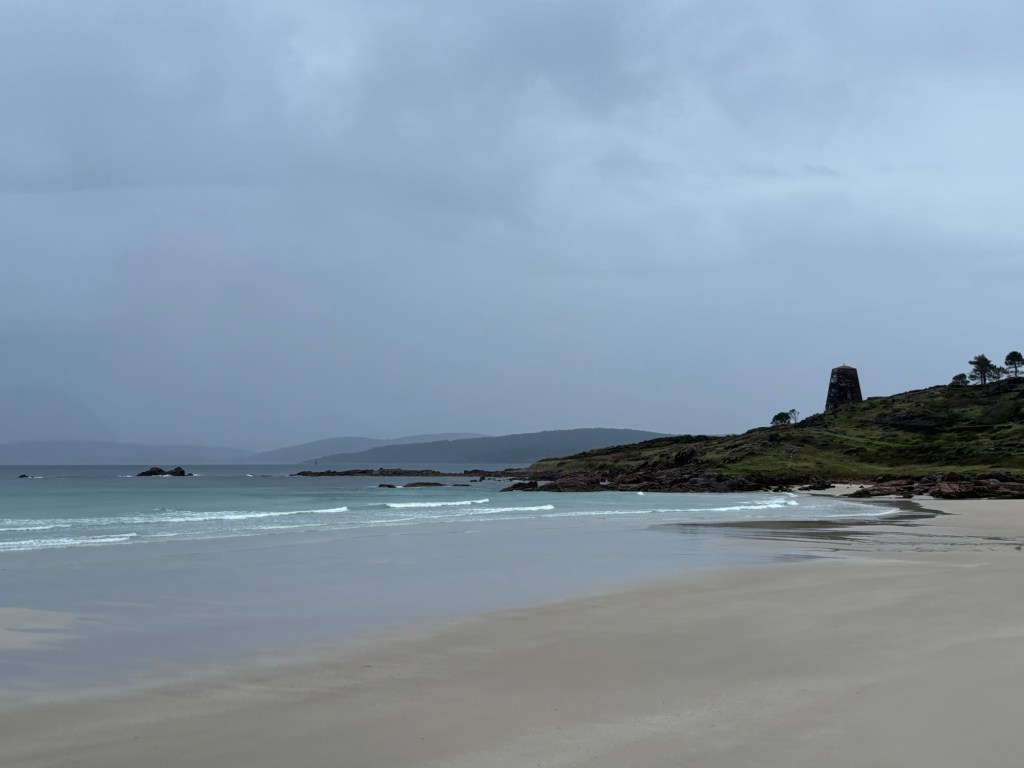
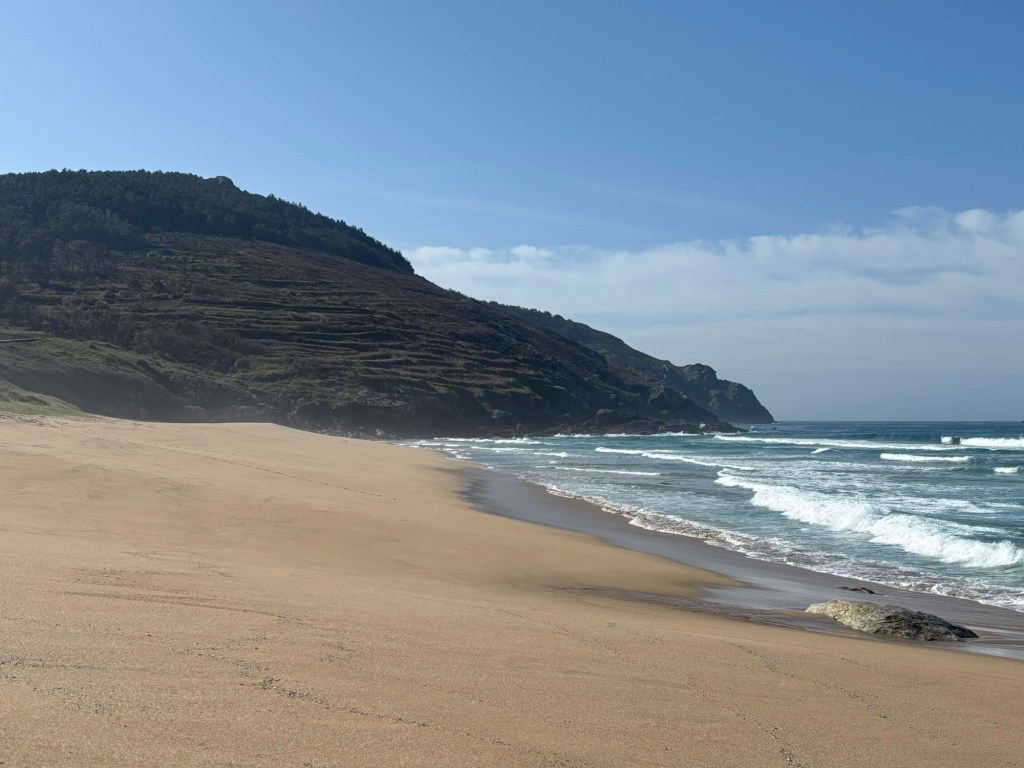
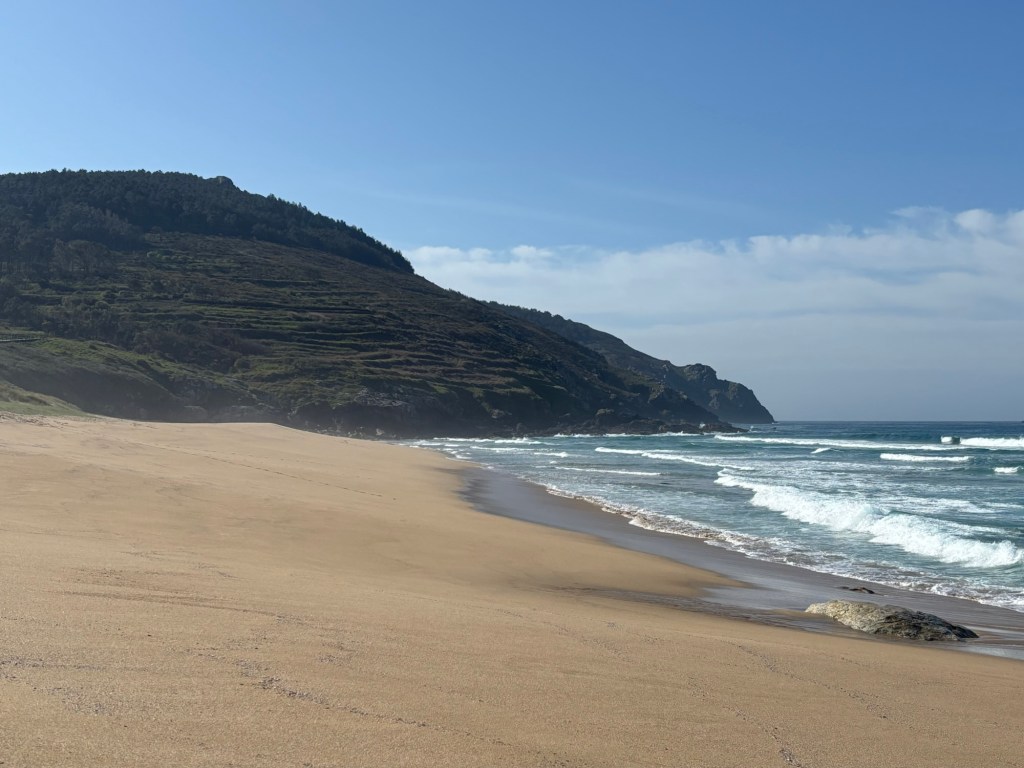
I didn’t come all the way out here to hide away from the elements, so once the worst of the morning’s rain was over, I nipped into town, grabbed an empanada and made for the Praia do Mar de Fóra on the west side of the cape. There were still a few clouds stretched across the sky, but none so ominous as those that were splashed across the news from the Canaries this morning. I sat on a boulder with my feet in a small stream and ate my lunch in peace, having the entire beach to myself for the second day in a row.
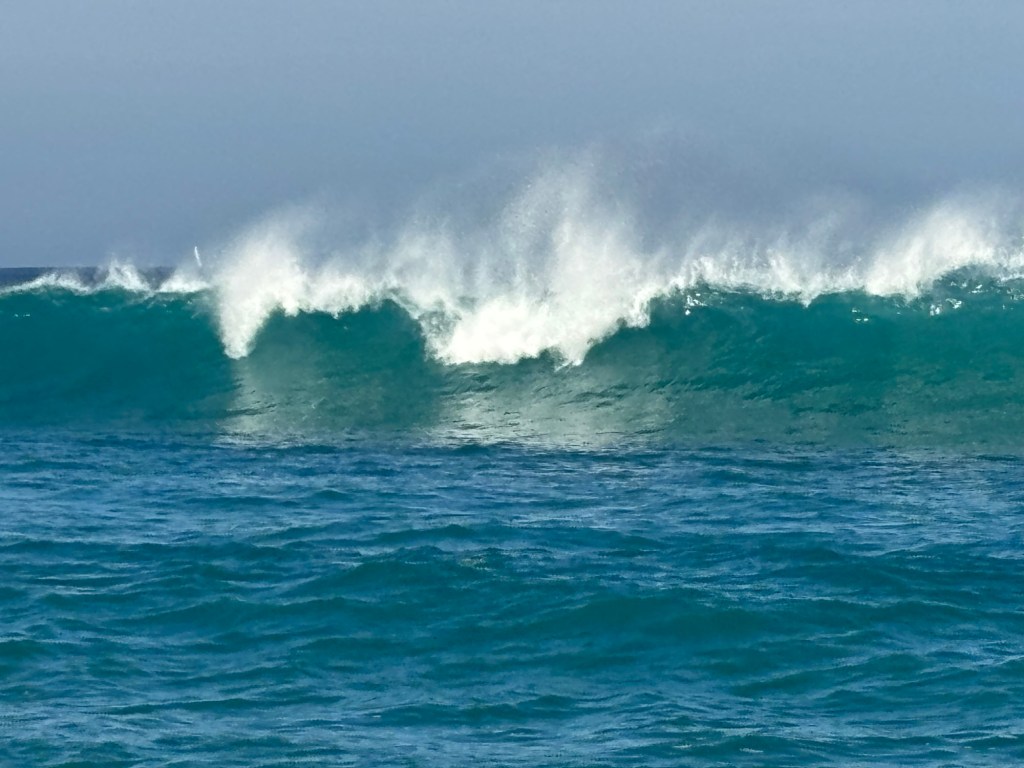
It’s easy to forget that there aren’t that many places in England where you can appreciate the full force of the Atlantic. Most of the English coastline looks out across the North and Irish Seas or the British Channel, and none of those are in the same league as the Great Western Ocean. From my post at the edge of the beach, I can see the sea mist rolling in with each crashing wave. Some of the waves collapse before they hit the shore; others swell while they’re still far off, hulking and dark and full of threatening force.
The ancients believed that Poseidon, God of the sea, was the ultimate force behind the power of the ocean. As well as the deity responsible for waves and quakes both terrestrial and marine, he was also the lord of horses, perhaps stemming from an even older association between horses and the sea. Poseidon is believed to have fashioned the first horse from the waves in an attempt to win over the people of Athens, who ultimately spurned his gift in favour of the olive tree offered by Athena, a far more practical gift for a seafaring folk for the myriad properties of its wood and fruit. And then there’s the parallel between the nature of horse and ocean, both extremely volatile – at one moment calm and beautiful, at another restless and powerful, stirred into action by some powerful emotion.
It’s thought that some of these beliefs come from seeing the shapes of horses’ heads as the foaming crests of the largest waves catch the wind before they break upon the shore. Before the unfettered force of the Atlantic bearing down on this little bay like a besieging army, it’s not hard to see the likeness to an elemental cavalry charge in the surf.
I had most of my lunch and readied to scale the cliffs. A half-beaten track snakes its way up the slope – a snake with a sadistic habit for traveling in a straight line, that is. The cliff climbs 200m in less than a kilometre, so I had plenty of opportunities to stop and take in the beauty of the bay (or, alternatively, a breather).
As I began my ascent, a couple of waxbills saw me off, a bizarre African immigrant in this Celtic corner of the world. I found the half-eaten corpse of a guillemot a little way up, the only one of its kind I saw, though they do still breed here at the westernmost corner of their range. For the rest of the climb, I was followed by a pair of red-billed choughs, an incredibly acrobatic bird which seems to delight in its ability to fly like few others. Now hanging in the wind, now plummeting into the abyss before unfolding their wings and climbing back out of their death-defying dives, they appear to perform these feats of gravitational defiance for the sheer thrill of it, since they serve no practical purpose whatsoever. The peregrine falcon employs a similar tactic to strike its prey out of the sky, but while I did spot one wheeling overhead, it wasn’t hunting today.
Far out to sea, the occasional gannet soared by, its wings just above touching the crests of the waves. They were shadowed now and then by the squat-bodied shags leaving their crude nests to fish; beautiful creatures in their own right, but ugly, misshapen imitations before the slender, powerful wings of the gannet. Down below, just metres beneath their colony, the Atlantic roiled in aquamarine anger between the cliffs.
It was a dizzying spectacle with both my feet (and my hands) firmly planted on the ground. Goodness knows how the choughs see such a sight and feel compelled to hurl themselves at it, as though defying the gods themselves. But then, I was never much fond of rollercoasters either.
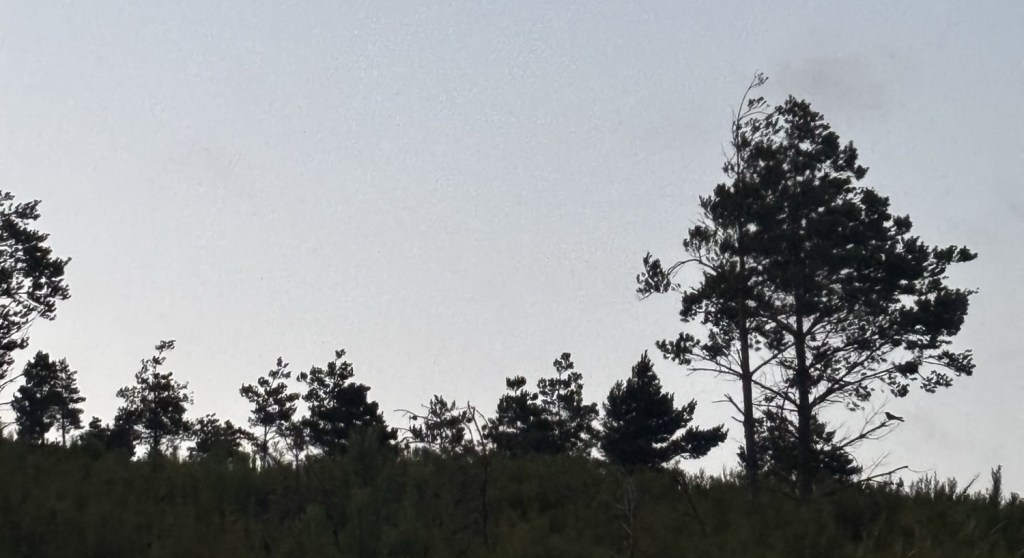
The cliff path works its way up to the watchtower of Veladoiro, where the wind howls through the bars of its iron-framed mast, before skirting the edge of a pine forest so perfectly arranged it must have been planted here as a windbreak for the villages in the valley below. The lithe shapes of lizards and at least one snake dart across the path ahead of me, and I find the snapped-off tail of a slow worm that obviously wasn’t fast enough, though by the wearing at the severance point it seems to have been there for at least a day.
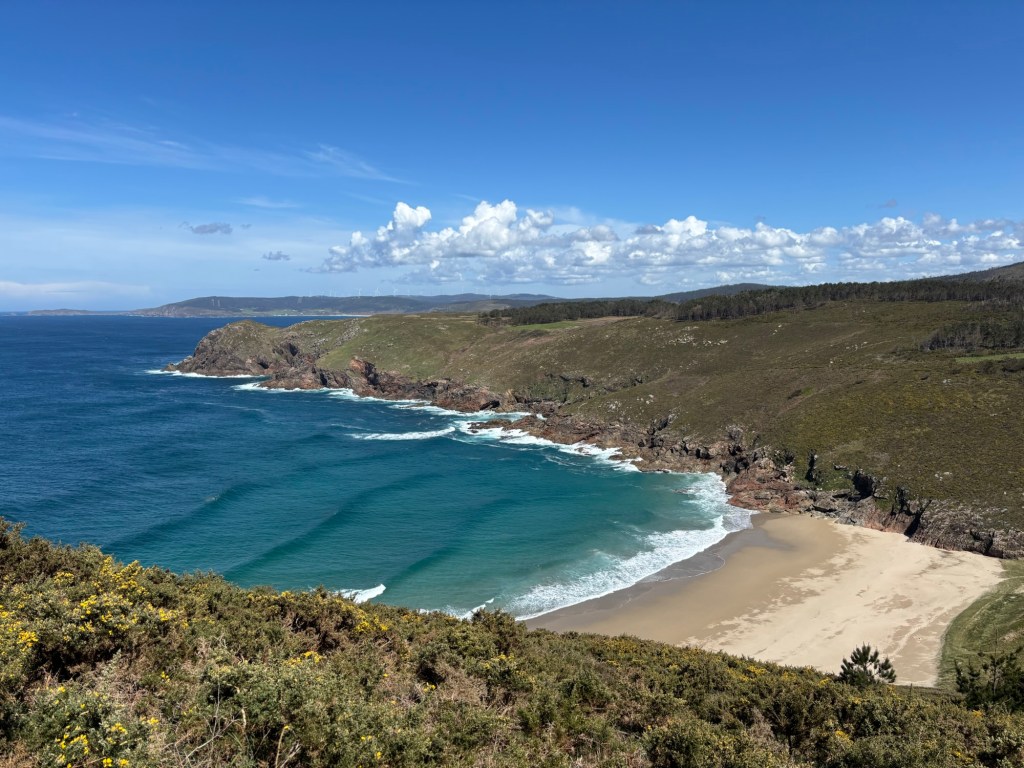
At the edge of the forest I come across a hidden bay: Praia da Arnela. It’s hard to tell from Google Maps why this pristine beach isn’t more of a magnet, but the answer is obvious to the naked eye: it can only be reached by a steep descent from an offshoot of the nearby hamlet of Vilar de Duio. I haven’t brought a towel, and I don’t think I’d fancy climbing back up the cliffs even if I had, so I content myself with watching the waves roll in from the clifftop instead.
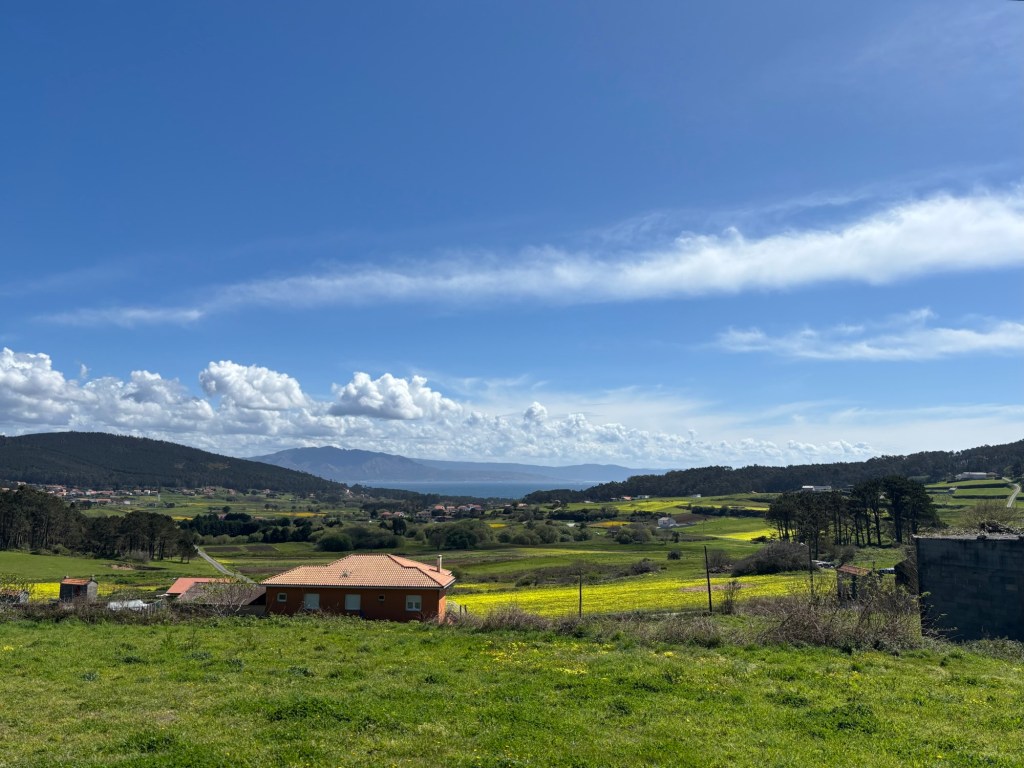
Turning my back on the sea, I start to descend into the interior. The fields of buttercups nestled between the forests on either side of the cape shine in two distinct shades of yellow: one a warm gold, the other a brighter, almost greener yellow. American and European, perhaps, though I’m not sure which way round. A single swallowtail butterfly dances into the field, its own golden wings lost in the shining petal sea.
The last time there was a great Atlantic storm, some of the mighty monarch butterflies were blown across the sea to our shores. I think that was in 2016, as I recall seeing one or two in Morocco and then, even more bizarrely, in Kent within that same summer.
Sometimes I wonder if esoteric anecdotes like these are worth recording. But perhaps it serves a greater purpose, as naturalists the world over try to understand the forces of the world around us by drawing together tiny threads such as these.
Back at Langosteira, I remove my sandals and continue along the beach barefoot. The relief as the waters rush over my tired feet is like nothing else. There are no swimmers out – it’s much too early in the year – but I’m happy to have my feet in the water again.
A single dunlin races ahead of me along the shore, a straggler from the traveling group of five that I saw from my window yesterday, perhaps. It will soon be on its way north to its breeding grounds in the Arctic circle. Much like the swallows who sing merrily from the telegraph wires in the fields here, you have to marvel at the courage and strength of these little wanderers who travel many thousands of miles each year, defying the elements to answer a call beyond their understanding: the call to come home, wherever that may be.
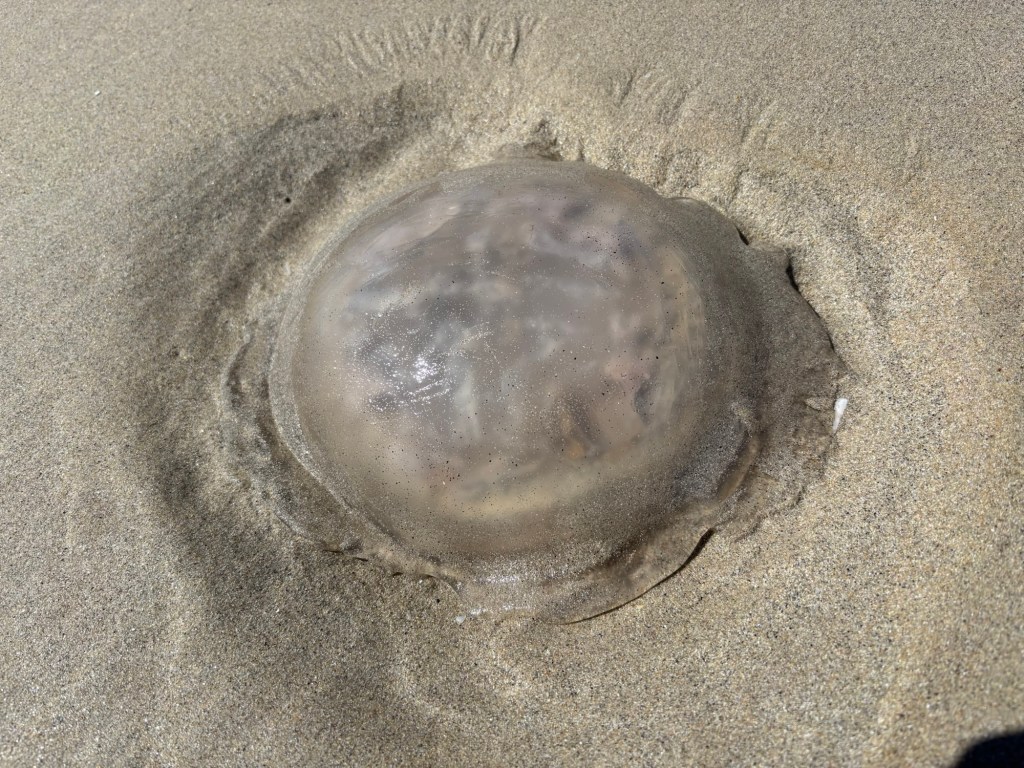
A less fortunate wanderer lies stranded in the sand, glistening in the sunlight: an enormous jellyfish. Not a false jelly like a man-o’-war, nor even a lion’s mane by the colour of it, though it’s hard to say with any degree of certainty, as some marine predator has already devoured its trailing tentacles, leaving the flabby and presumably inedible bell behind. A hollow has pooled about it where the waves have dug it a grave, after a fashion. On the off chance that it might still be alive, I carry it back to the tideline and lower it back into the water. The tide spits it back up again and it lands on its head, motionless. An ancient creature, practically unchanged since a time before life moved over the land, humbled by a force older than the world itself.
I’m back at the pensión now and taking a well-earned rest. There is Wi-Fi here, but it doesn’t reach quite as far as the last room in the corridor (which happens to be mine) so I’ve been using data to patch up the gaps. Quite a lot, by the looks of things, as it takes my app a long time to do the maths – longer than me, and that’s saying something. I’m feeling like it might be a good excuse to get an early night tonight, as I’ve got a few late ones coming up, so I’ll make the most of it while I can. BB x
First Dates is on TV. I can never find the equivalent in the UK, but in Spain it seems like it’s always on. Tonight’s couples include a pensioner from Sevilla, a rocker in his fifties and a Colombian male model whose dealbreakers in a would-be partner include the term “vergón”. Spanish TV, like Spanish music, certainly doesn’t deal in subtlety.
I woke up around six this morning to the sound of the waves breaking on the shore outside – the same gentle woosh that I can hear as I write.
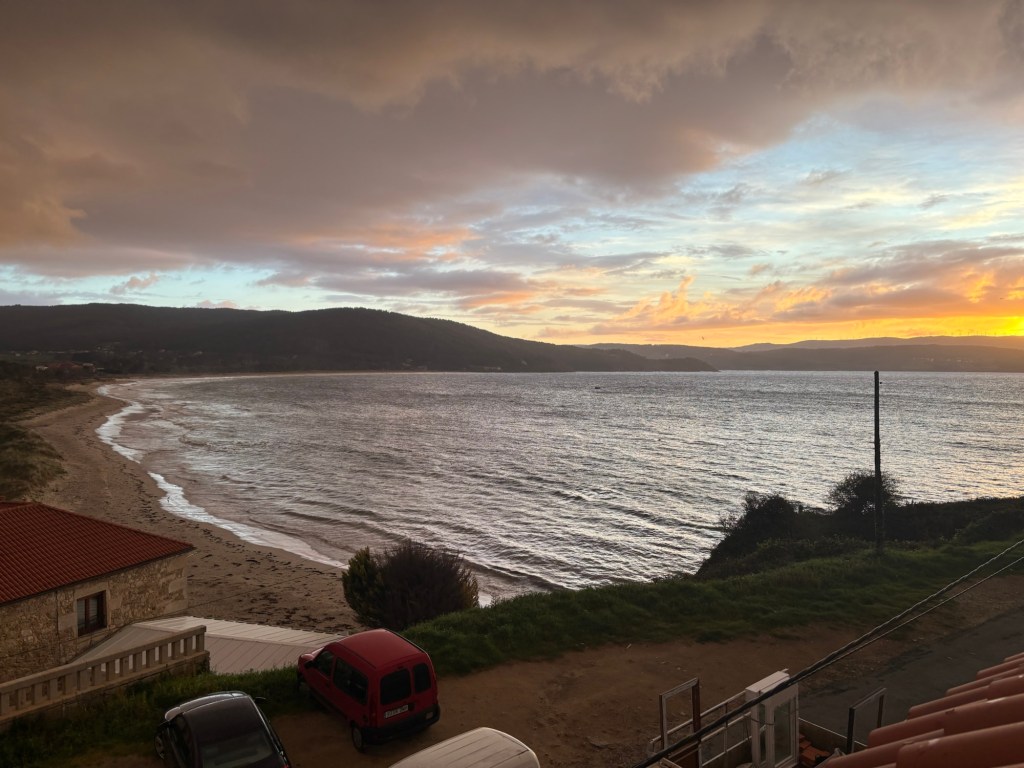
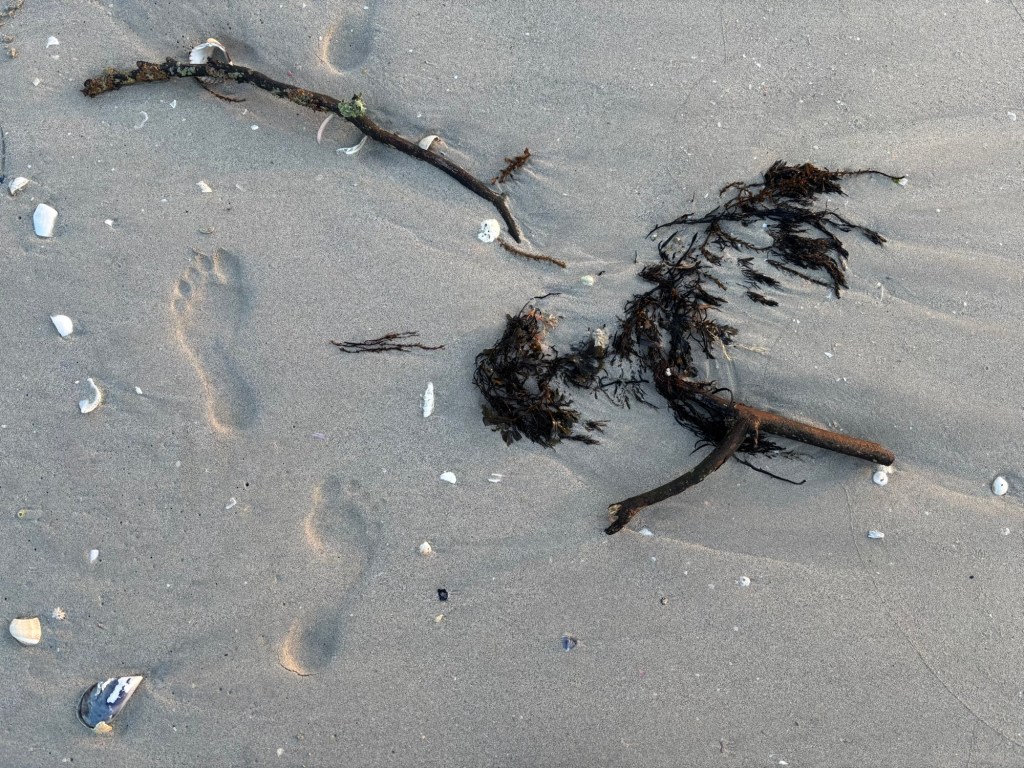
The sun crested the jagged bluff of Monte Pindo shortly after 8.15, so I slipped down to the beach to catch the light. A couple of dog walkers were out and about and a single pilgrim sat reading in the dunes, but otherwise the long curved bay of Playa Langosteira was empty. The tide had come in during the night, leaving a breadcrumb trail of seashells all along the tidal maximum. A beautiful sight, to be sure.
Or, at least, it should have been. Only, the only shells left on the beach were broken. It looked as though the sea had kept the best ones to itself and spat out the rest. As it turns out, the truth wasn’t far off.
A barefoot pilgrim stood a hundred metres or so ahead of me, turning something over in her hand. Satisfied with whatever it was, she moved further along the beach, stopped, and stooped to pick something up. Clearly, she was looking for seashells. She must have repeated the exercise about eight or nine times before I overtook her. I didn’t turn to see if she had more to find, but I did catch a glimpse of a large collection of seashells in the crook of her arm as I passed.
I’m not really one for calling people out. Anyone who knows me even in passing will know the last thing I ever want to do is to risk upsetting anyone, even when the matter seems ridiculously trivial. It’s a people-pleasing tendency of mine that I’ve never been particularly good at quashing. However, if there’s a line in the sand, it’s when I see someone doing something that threatens the natural world in some way. And this definitely constitutes a transgression in my book.
Before you think me a busybody, I feel I need to point out that this isn’t just high-handedness on my part. The law is on my side here. In 2017, faced with a surge in tourists in coastal areas (still a major problem today), the Spanish government passed the Ley de costas, which – to the official letter of the law – “forbids the extraction of any element of the public littoral domain, such as sand, shells or stones”. This makes it illegal to beach-comb in any part of the Spanish territory, from Galicia and the Costa Brava to the Balearics and the Canary Islands. Period.
If my experience of this country and its people is anything to go by, I’d be surprised if the Spanish police actually enforce this law, but the consequences of falling foul of it can be severe: the fines for collecting seashells range from 500 to 3,000 euros. The Mediterranean island of Sardinia is even stricter: taking large quantities of sand from its famous beaches can lead to a prison sentence.
There’s a very good reason for all of this. It’s easy to say that if we all took five or six shells from the beach on our holidays, soon there’d be nothing left to take. But there’s more to it than that.
Seashells are a fundamental part of the littoral ecosystem. The continual pounding of the waves eventually grinds them into fragments – the same fragments that make up the sand beneath your feet. In a way, your average beach is actually an enormous marine graveyard. Without the shells, there’d be less sand to go around, seriously threatening the thousands of creatures that make their home in the littoral zone and the birds that rely on them as a food source.
Discarded shells serve a second purpose. Nothing goes to waste in the ocean. Besides the obvious hermit crabs, who literally depend upon seashells to survive, an abandoned shell provides a much-needed shelter for smaller creatures like shrimps and fish fry, who use these temporary refuges until they are large enough to avoid some of their former predators, as well as a holdfast for barnacles, limpets and chitons. Larger shells may even harbour an octopus, a creature perfectly adapted to squeezing into the most awkward of spots to escape from predators.
Which they definitely need to do on the regular in these waters, given the Galician obsession with octopus as a delicacy.
Sorry… I got up on my pulpit there. In truth, I was mulling all of this over in my head as I read a signboard by the beach exit which detailed some of the above, while the beachcombing pilgrim stood washing every single shell she’d collected under the outdoor shower. I didn’t want to challenge her, but I couldn’t just let her take all those shells away. She laid them out in three rows along the wall as she washed them. She must have amassed around thirty in all, from scallops to periwinkles and everything in between.
When it looked like she had finished with the ablutions, I got her attention and told her politely to take one if she had to, but to leave the rest behind. She looked confused. I repeated myself in Spanish, but that didn’t seem to work either. She looked like she might have been Thai or Malay, so Spanish wouldn’t have been much use. I tried French. I pointed at the sign and tried to indicate that taking the shells was wrong – not that it would have done much good, as the sign was in Galician and Spanish and faded in places due to the ravages of sun, sand and surf, and thus presumably illegible to the average tourist. Nothing.
I even tried mimicking handcuffs and paying a fine. She just stared at me and held out one of her shells for me to take, presumably thinking I wanted one. I shook my head and said “illegal” a couple of times. She said “OK” and wandered off. I didn’t see where she went, or if she left the shells behind. She didn’t return to the beach, at any rate.
When I was a kid I got walloped for trying to stop a couple of older boys from stealing a frog. They had caught one in a bucket and were taking it away to put in their garden. In a fit of fury I still can’t explain, I snatched the bucket and legged it to the river to release the creature. I was pushed into the water for my insolence and given a couple of kicks for good measure, but I had achieved what I set out to do: the frog got away.
Was it my place to give that girl a ticking off? Probably not. But we have to stand up for the things we believe in. Without principles, we are merely waiting out our time on this earth. Our core beliefs give us grounding, a rock to stand on, which no wind or waves or wickedness can wear away.
I’ve got back onto the pulpit again. I’d better get off before I end up considering a career in the clergy. BB x
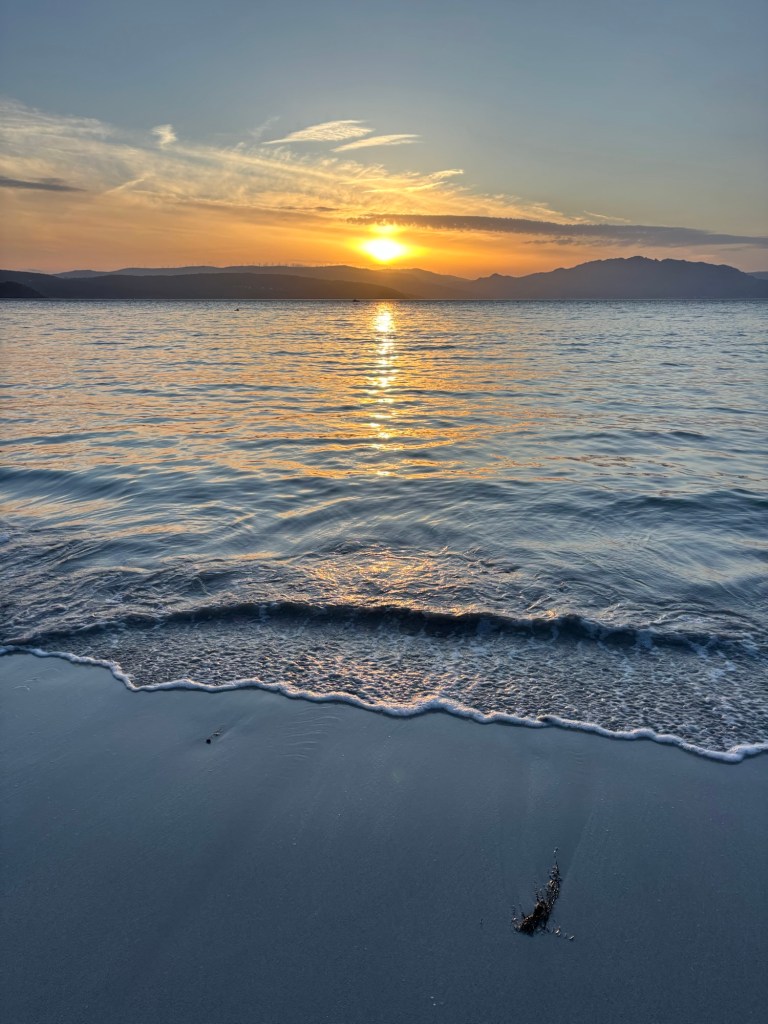
Galicia provides. Happiness writes white but the white light is brilliant, like the sands that run along the length of the bay beneath my window. Like the feathers of the gannets and terns that dance above the face of the water. Like the sparkling reflection of the sun as it sinks below the horizon along the 42nd parallel north, disappearing beyond the Atlantic, beyond Chicago, beyond the end of the world.
Madrid feels a world away. I caught the early AVLO train from Chamartín and joined a modest number of passengers on the three hour journey to Spain’s north-westernmost region. The railway line tunnels under the snowy peaks of the Guadarrama before racing across the featureless plains of Zamora and then, slowly, climbing into the wooded hills and craggy moors west of Astorga before rolling through the deep valleys of Galicia proper. Spain is one of those countries that alters radically as you travel through it, and the Madrid-A Coruña train is a very good way to prove that point.
I arrived in Santiago de Compostela with a couple of hours to kill before the bus to Fisterra, so I wandered into town and sat in the main square in front of the cathedral for a while. A few school groups posed noisily in front of the cathedral, while exhausted pilgrims sat at the feet of the pillars, soaking up the sunlight to recharge their batteries. There aren’t as many now as there were during the summer. I guess that’s to be expected. The year I made the trek, 2023, was also a delayed holy year, the first since the COVID-19 pandemic shut the Camino down, so the numbers were especially high.
I wonder how far these bold pilgrims had come this year. What friends did they make on their journey? What memories will they take away with them forever? Did somebody watching from the sidelines wonder that about me, years ago?
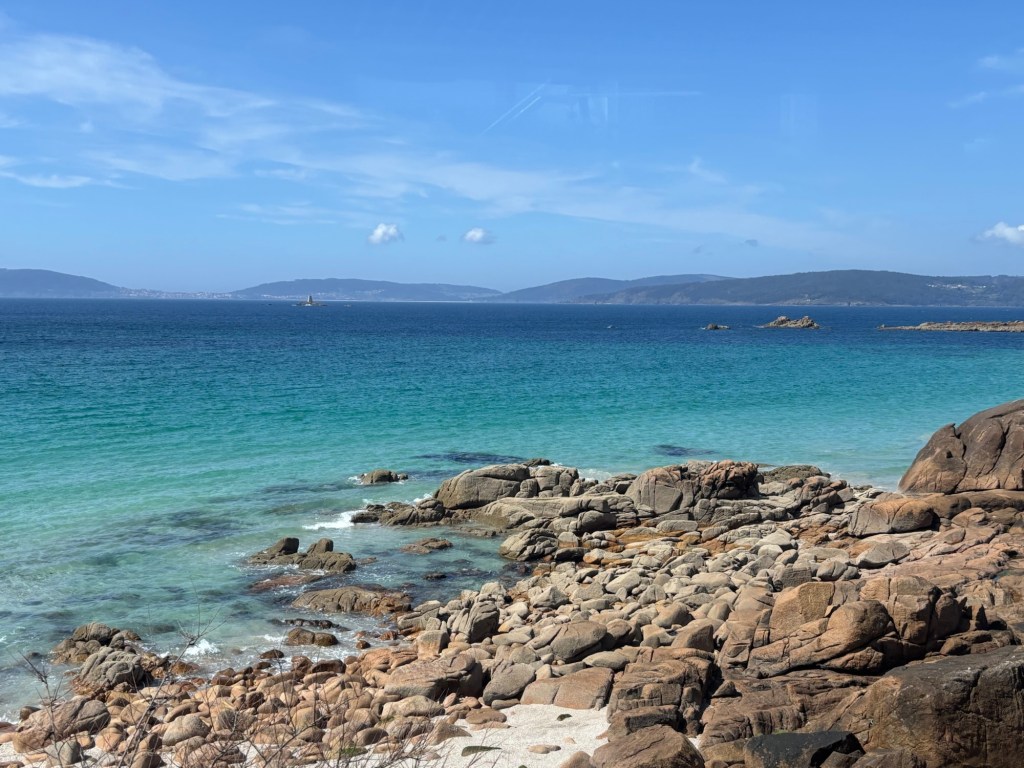
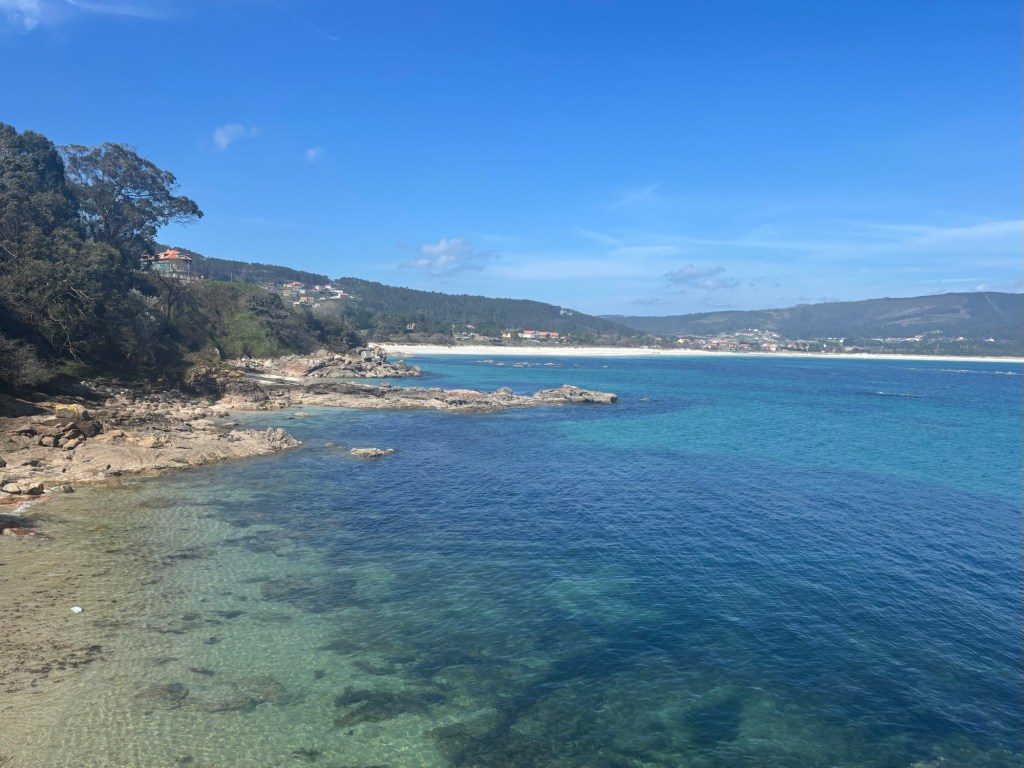
The bus from Santiago to Fisterra is almost as long as the train from Madrid, but it does travel along one of the most scenic routes in the whole country. To reach the famous cape, it first has to pass through all the towns and villages along the coast, fording the great rías that weave through the cliffs on their way to the sea. The sun came out from behind the clouds just as the cape came into sight, and the whole coast seemed to come to life: the yellow flowers of the gorse shone like gold, the sand beneath the shallows glittered like jade. My heart did a similar leap once when I saw the silhouette of Olvera, my old hometown, for the first time in seven years. It made me smile to think that this place had joined that pantheon.
I arrived early, so I went down to the beach to soak up the sea air for a while. Fisterra is so special to me because it combines the two sides of my heart: the sounds and smells of the sea from my childhood in England, and the language, cliffs and mountains of my adult love for Spain. Mountains take my breath away (especially the craggy limestone kind) and marshes hold a special kind of rapture for me, but I think I will always come back to the sea when I need to feel whole again.
As I watched, a sandwich tern flapped into the little bay and started diving for fish. It was a beautiful sight to see, for the waters are so clear here that I could see the bird’s brilliant white form beneath the water after it had dived, moving like a living arrow. After five attempts it speared a shining silver fish and took off to the south with its catch in its beak. I realised the path on Google Maps didn’t actually exist and beat a quick retreat to the hotel for check-in.
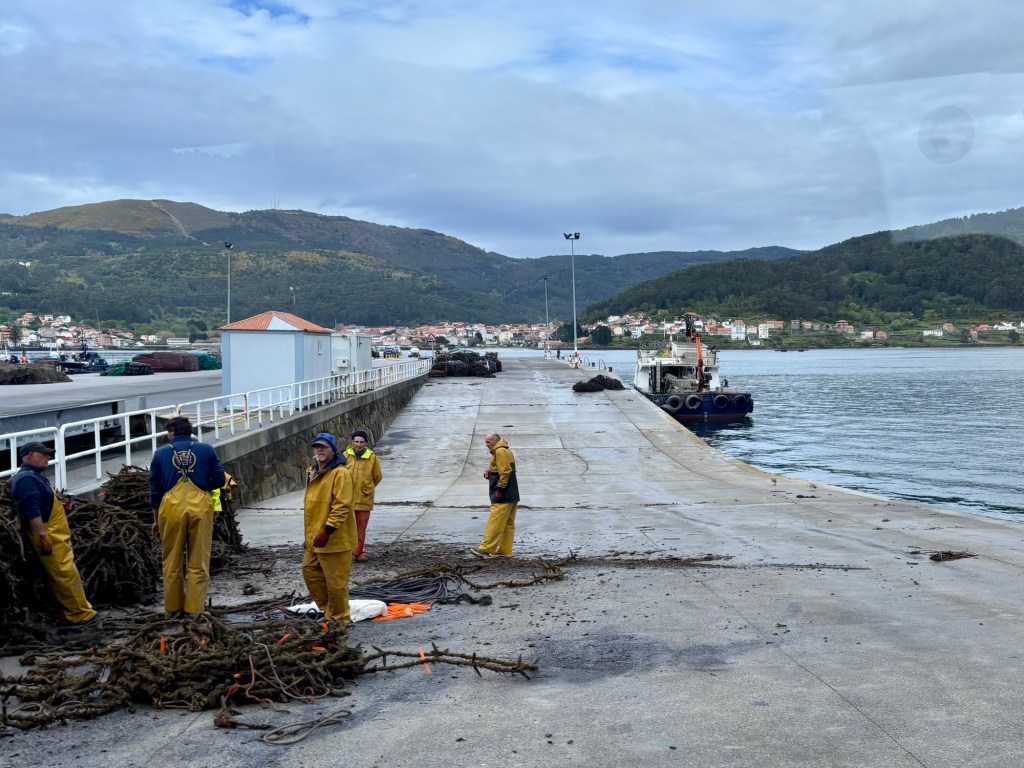
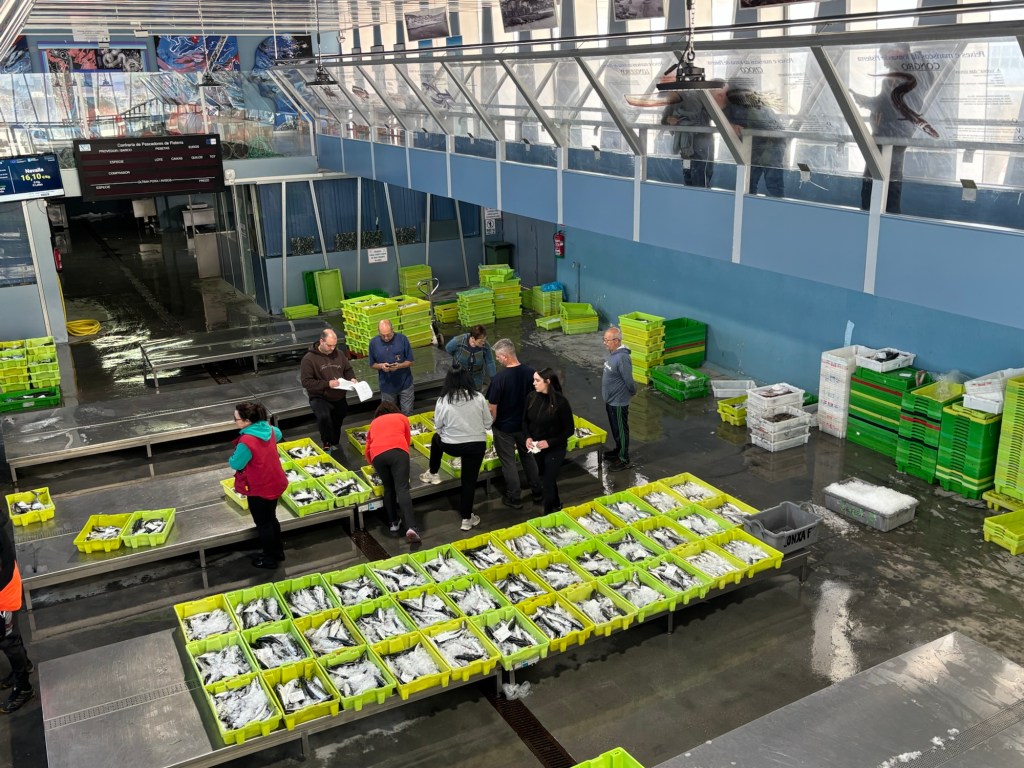
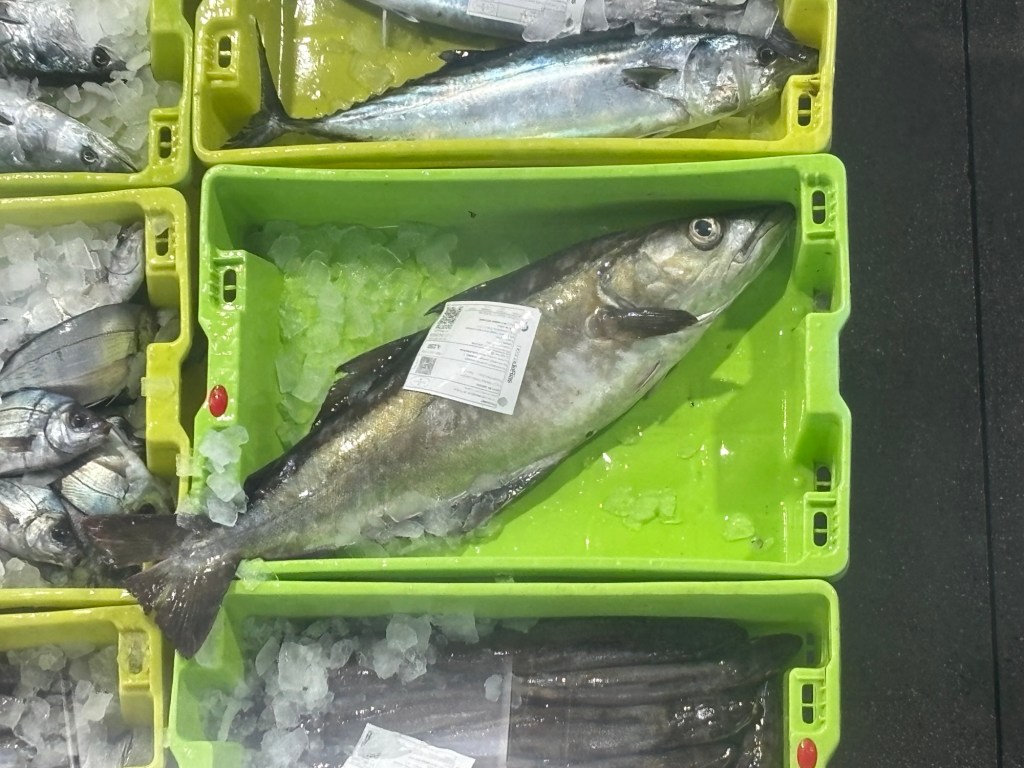
The last time I was here, I only saw the town’s fishery out of hours. I got lucky this afternoon: on my way to the cape I dropped in and caught the daily auction (or lonxa) in full flight. Crates of hake, mackerel, red gurnard and more than a dozen other species I learned to identify as a kid went to the highest bidder in one of the mildest mannered auctions I’ve ever seen (though, to be fair, I haven’t seen that many auctions). Some of the larger fish had QR codes slapped on the sides linking them to the fishermen who caught them, I suppose – my camera didn’t reach far enough to tell.
On one side of the room, crates of sea urchins were stacked fifteen high. I didn’t see any percebes (the region’s famous goose barnacles), but then, the manner by which they are collected is very different indeed, so that’s hardly surprising.
I left before the giant anglerfish went under the hammer. I’d have been curious to know how much that went for.
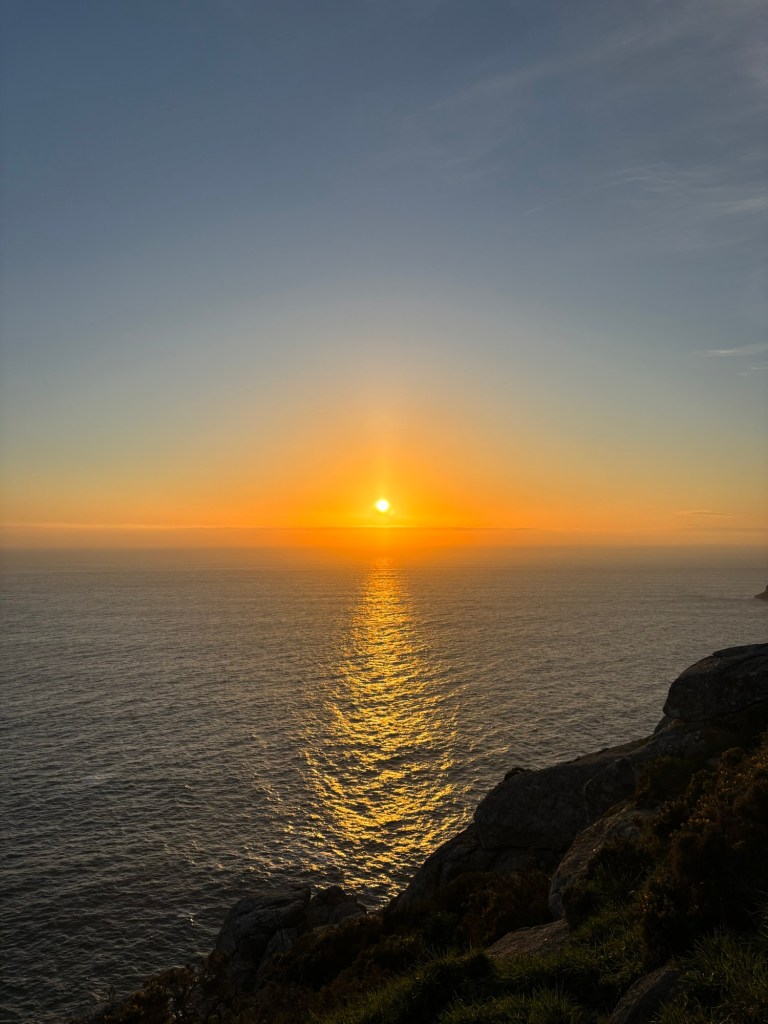
I called home from the cape and said I’d be back before sunset. It’s now fifteen minutes to sunset and I’m still here, but I’m glad I stayed. The weather here is so changeable and this might be my only chance to watch the sunset from the cape, as it was rained off the last time I was here. A small cohort of like-minded pilgrims and locals have come out here with the same idea. A couple of noisy Spaniards made a pig’s ear of taking a highly choreographed selfie nearby, much to everyone’s frustration, but they’ve gone now, and it’s been nothing but the sound of the waves for the last twenty minutes.
I’m going to stop writing now. The sun will be sinking below the horizon soon and I want to appreciate every second as it does. See you on the other side. BB x













 The Book of Barnabas