Pensión Doña Lubina, Fisterra. 21.20.
First Dates is on TV. I can never find the equivalent in the UK, but in Spain it seems like it’s always on. Tonight’s couples include a pensioner from Sevilla, a rocker in his fifties and a Colombian male model whose dealbreakers in a would-be partner include the term “vergón”. Spanish TV, like Spanish music, certainly doesn’t deal in subtlety.
I woke up around six this morning to the sound of the waves breaking on the shore outside – the same gentle woosh that I can hear as I write.
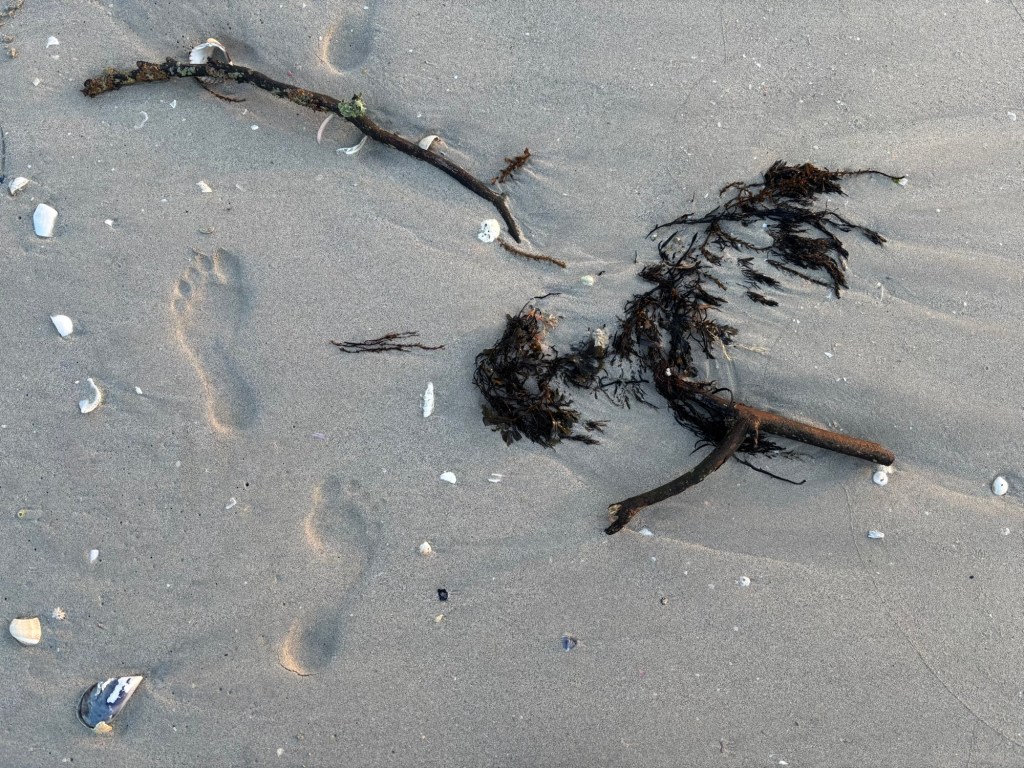
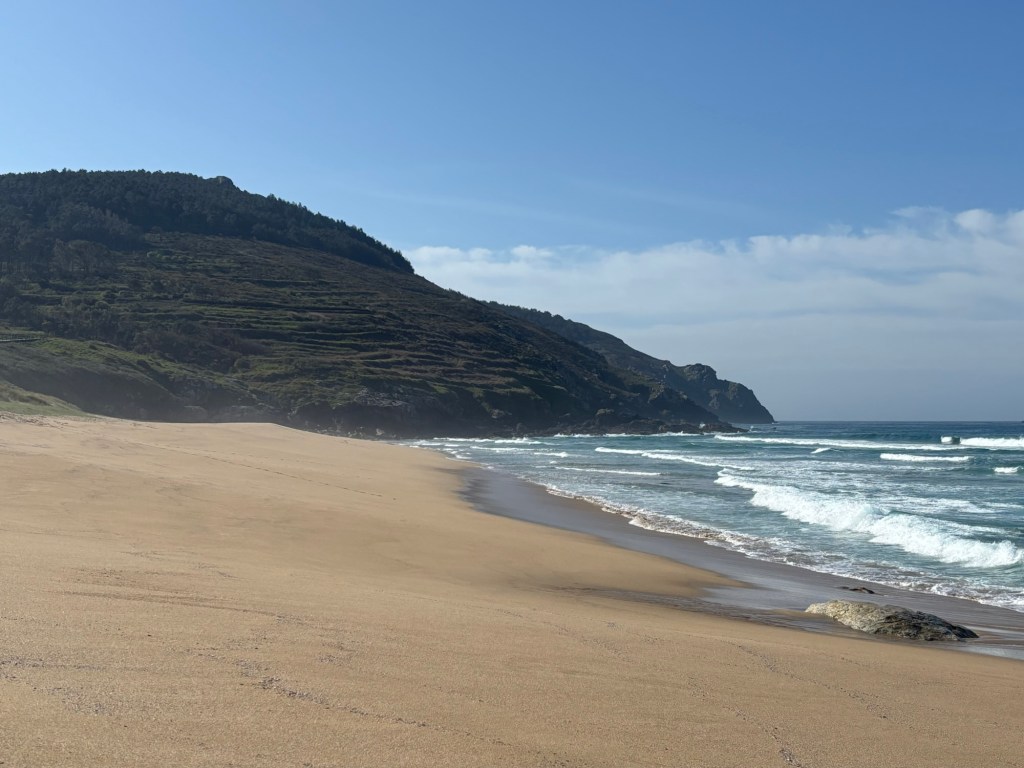
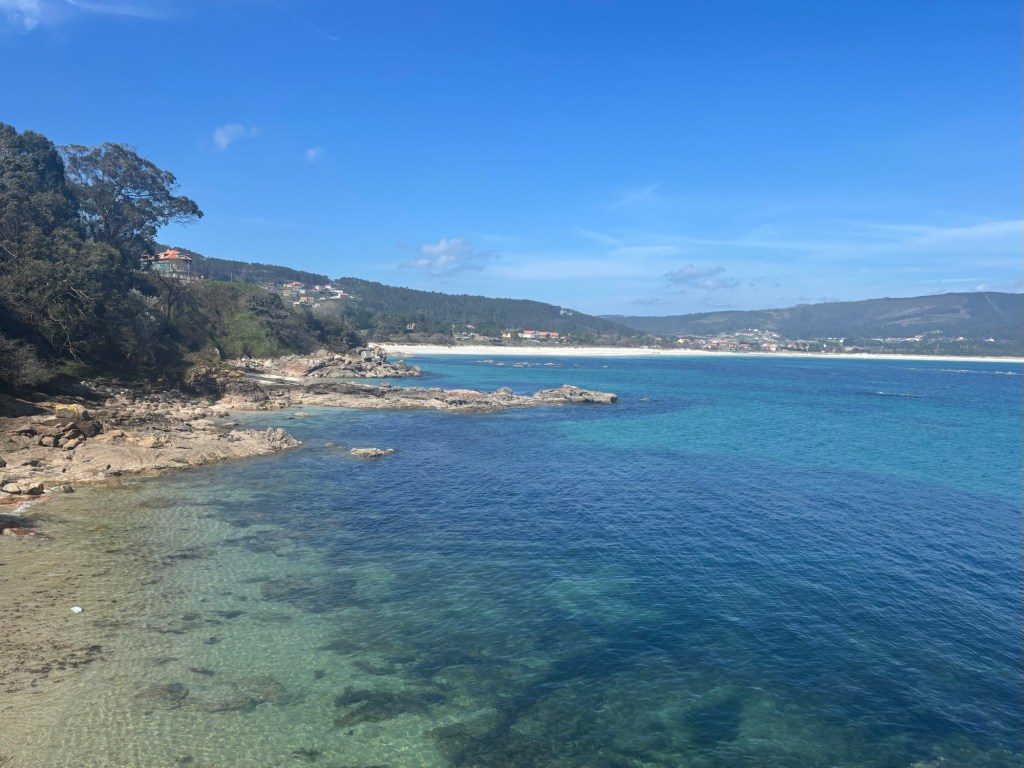
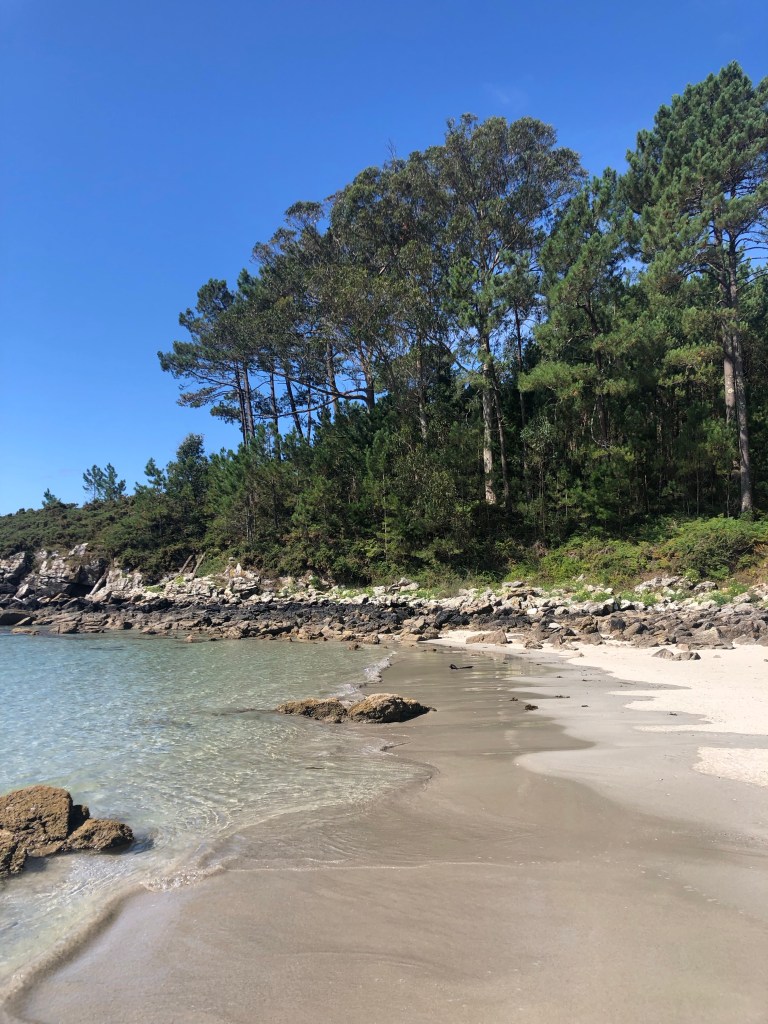
The sun crested the jagged bluff of Monte Pindo shortly after 8.15, so I slipped down to the beach to catch the light. A couple of dog walkers were out and about and a single pilgrim sat reading in the dunes, but otherwise the long curved bay of Playa Langosteira was empty. The tide had come in during the night, leaving a breadcrumb trail of seashells all along the tidal maximum. A beautiful sight, to be sure.
Or, at least, it should have been. Only, the only shells left on the beach were broken. It looked as though the sea had kept the best ones to itself and spat out the rest. As it turns out, the truth wasn’t far off.
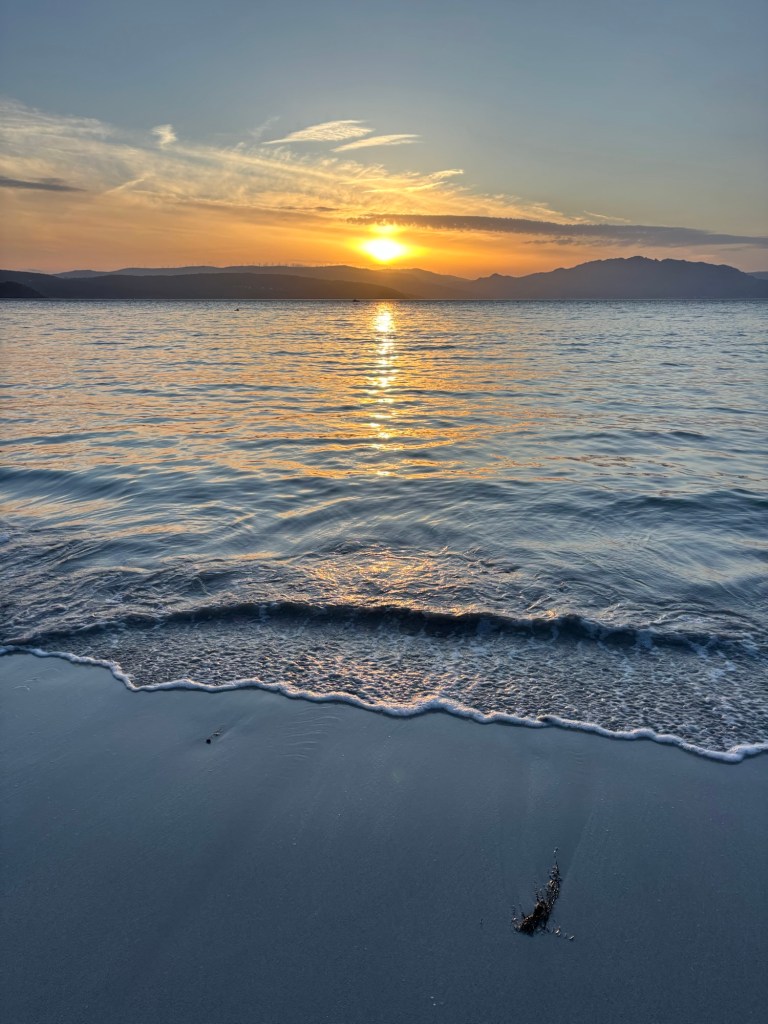
A barefoot pilgrim stood a hundred metres or so ahead of me, turning something over in her hand. Satisfied with whatever it was, she moved further along the beach, stopped, and stooped to pick something up. Clearly, she was looking for seashells. She must have repeated the exercise about eight or nine times before I overtook her. I didn’t turn to see if she had more to find, but I did catch a glimpse of a large collection of seashells in the crook of her arm as I passed.
I’m not really one for calling people out. Anyone who knows me even in passing will know the last thing I ever want to do is to risk upsetting anyone, even when the matter seems ridiculously trivial. It’s a people-pleasing tendency of mine that I’ve never been particularly good at quashing. However, if there’s a line in the sand, it’s when I see someone doing something that threatens the natural world in some way. And this definitely constitutes a transgression in my book.
Before you think me a busybody, I feel I need to point out that this isn’t just high-handedness on my part. The law is on my side here. In 2017, faced with a surge in tourists in coastal areas (still a major problem today), the Spanish government passed the Ley de costas, which – to the official letter of the law – “forbids the extraction of any element of the public littoral domain, such as sand, shells or stones”. This makes it illegal to beach-comb in any part of the Spanish territory, from Galicia and the Costa Brava to the Balearics and the Canary Islands. Period.
If my experience of this country and its people is anything to go by, I’d be surprised if the Spanish police actually enforce this law, but the consequences of falling foul of it can be severe: the fines for collecting seashells range from 500 to 3,000 euros. The Mediterranean island of Sardinia is even stricter: taking large quantities of sand from its famous beaches can lead to a prison sentence.

There’s a very good reason for all of this. It’s easy to say that if we all took five or six shells from the beach on our holidays, soon there’d be nothing left to take. But there’s more to it than that.
Seashells are a fundamental part of the littoral ecosystem. The continual pounding of the waves eventually grinds them into fragments – the same fragments that make up the sand beneath your feet. In a way, your average beach is actually an enormous marine graveyard. Without the shells, there’d be less sand to go around, seriously threatening the thousands of creatures that make their home in the littoral zone and the birds that rely on them as a food source.
Discarded shells serve a second purpose. Nothing goes to waste in the ocean. Besides the obvious hermit crabs, who literally depend upon seashells to survive, an abandoned shell provides a much-needed shelter for smaller creatures like shrimps and fish fry, who use these temporary refuges until they are large enough to avoid some of their former predators, as well as a holdfast for barnacles, limpets and chitons. Larger shells may even harbour an octopus, a creature perfectly adapted to squeezing into the most awkward of spots to escape from predators.
Which they definitely need to do on the regular in these waters, given the Galician obsession with octopus as a delicacy.

Sorry… I got up on my pulpit there. In truth, I was mulling all of this over in my head as I read a signboard by the beach exit which detailed some of the above, while the beachcombing pilgrim stood washing every single shell she’d collected under the outdoor shower. I didn’t want to challenge her, but I couldn’t just let her take all those shells away. She laid them out in three rows along the wall as she washed them. She must have amassed around thirty in all, from scallops to periwinkles and everything in between.
When it looked like she had finished with the ablutions, I got her attention and told her politely to take one if she had to, but to leave the rest behind. She looked confused. I repeated myself in Spanish, but that didn’t seem to work either. She looked like she might have been Thai or Malay, so Spanish wouldn’t have been much use. I tried French. I pointed at the sign and tried to indicate that taking the shells was wrong – not that it would have done much good, as the sign was in Galician and Spanish and faded in places due to the ravages of sun, sand and surf, and thus presumably illegible to the average tourist. Nothing.
I even tried mimicking handcuffs and paying a fine. She just stared at me and held out one of her shells for me to take, presumably thinking I wanted one. I shook my head and said “illegal” a couple of times. She said “OK” and wandered off. I didn’t see where she went, or if she left the shells behind. She didn’t return to the beach, at any rate.
When I was a kid I got walloped for trying to stop a couple of older boys from stealing a frog. They had caught one in a bucket and were taking it away to put in their garden. In a fit of fury I still can’t explain, I snatched the bucket and legged it to the river to release the creature. I was pushed into the water for my insolence and given a couple of kicks for good measure, but I had achieved what I set out to do: the frog got away.
Was it my place to give that girl a ticking off? Probably not. But we have to stand up for the things we believe in. Without principles, we are merely waiting out our time on this earth. Our core beliefs give us grounding, a rock to stand on, which no wind or waves or wickedness can wear away.
I’ve got back onto the pulpit again. I’d better get off before I end up considering a career in the clergy. BB x








 The Book of Barnabas