Albergue de Peregrinos, Lugo. 20.30.
Three days shy of Santiago and my feet are starting to get the better of me. It’s been a minor miracle that I’ve made it this far unscathed, but I suspect that murderous climb up and over the Hospitales route – coupled with several forty kilometre days back to back – have conspired to give me one final challenge in the form of two mirrored blisters, one on each of my little toes. I brought a veritable school kitbag of Compede plasters with me on this Camino, but I gave most of them away to my younger companions during the Meseta stage (as they really were suffering a great deal more than I am now), so I have had to resupply tonight.
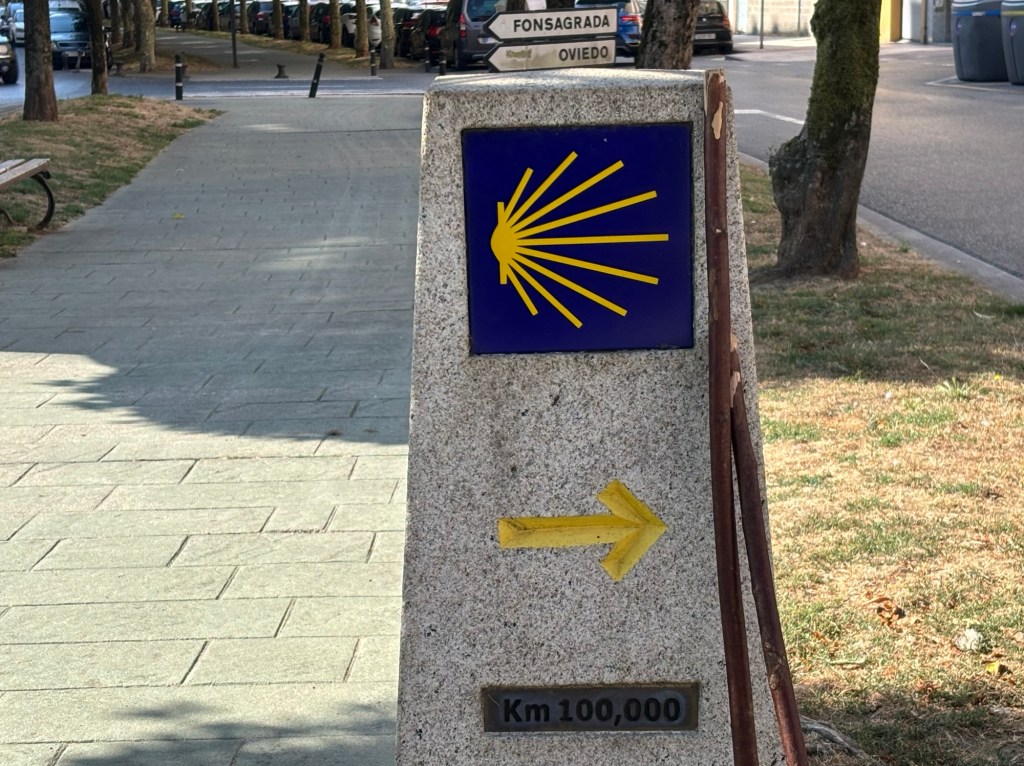
Fortunately, the end is in sight. Three rather challenging days remain, as I still have a hundred kilometres to clear (Lugo conveniently marks precisely 100km from Santiago), but I remain steadfast in my desire to see this thing through to the end. I’ve come this far.
I don’t have an awful lot to report from this morning’s walk. I took it slowly to give my feet a break, but I still didn’t see any more than the three pilgrims from the albergue in Castrojeriz who left ahead of me, and that within the first hour and a half.
I didn’t sleep very well because the rakes from the night before decided it would be a great idea to go the bathroom and laugh their heads off at some private joke sometime around midnight. I’d normally be wide awake at that time of night anyway, but on the Camino, sleep is precious, so before I knew what I was doing my teacher mode activated and I found myself opening the door to the bathroom to give them a piece of my mind. They looked dreadfully disheveled with bloodshot, unfocused eyes, and had clearly been both drinking and smoking. I tried to get back to sleep afterwards, but it must have been another hour or so before I could do so.
It’s not always easy to deactivate from teacher mode, even on holiday. I remember doing something similar on a stag do once when some of the fellows I was with decided it would be fun to kick a football into the road. This kind of thing used to come very hard to me, but I guess practice makes perfect. Or a perfect party pooper, take your pick.
I was up again at half four, but delayed leaving until around six, as Lugo was only twenty kilometres’ distance and I didn’t want to get there too early, even at a slower pace than usual. Even so, I was early enough to see a fair number of roe deer in the woods, one of them so close I could see the light in its eyes before it bolted.
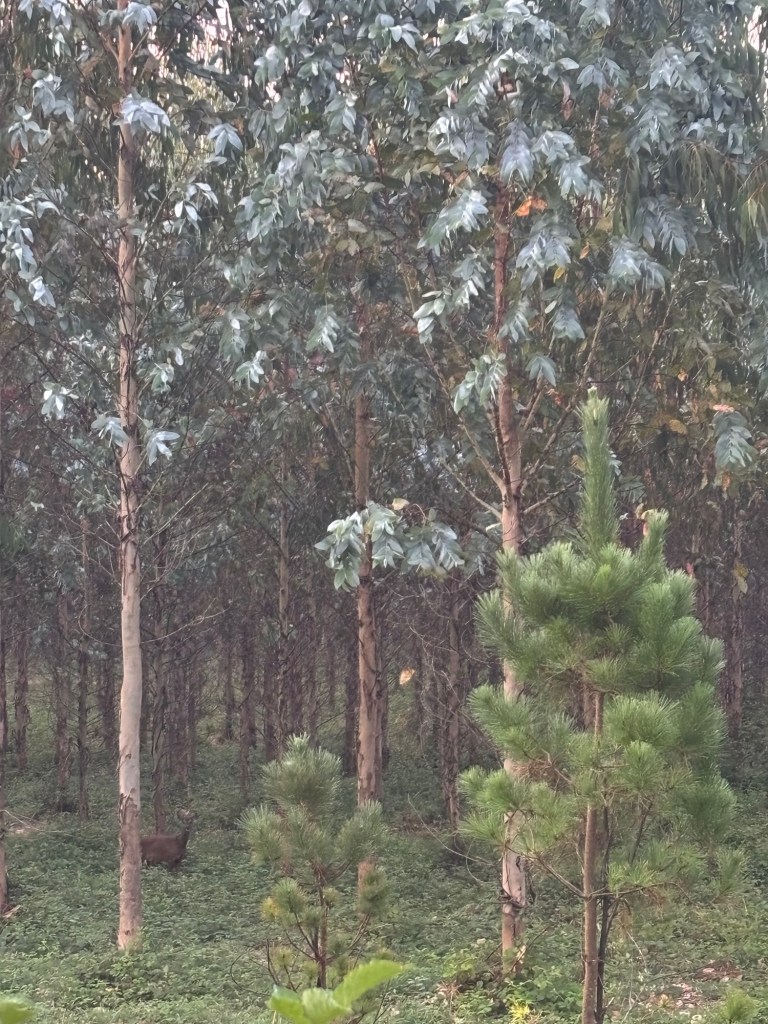
I reached Lugo shortly after eleven without any great difficulty. It was a poor morning for stamp collecting. I passed what I am sure is a famous Primitivo stop, the Oasis Primitivo, where both stamp and watermelon can be had at the right time of day, but it was not yet nine o’clock and a Monday morning and there was nobody around. So I pressed on.
Mondays can be frustrating on the Camino. On Sundays, all the shops and supermarkets close for the whole day and Monday can be little better. Twice now I’ve made landfall in a large town or city on a Monday, only to find that all its sites and museums are closed on Mondays. So it was with Lugo. At least the 100km sign was free and easy to see.
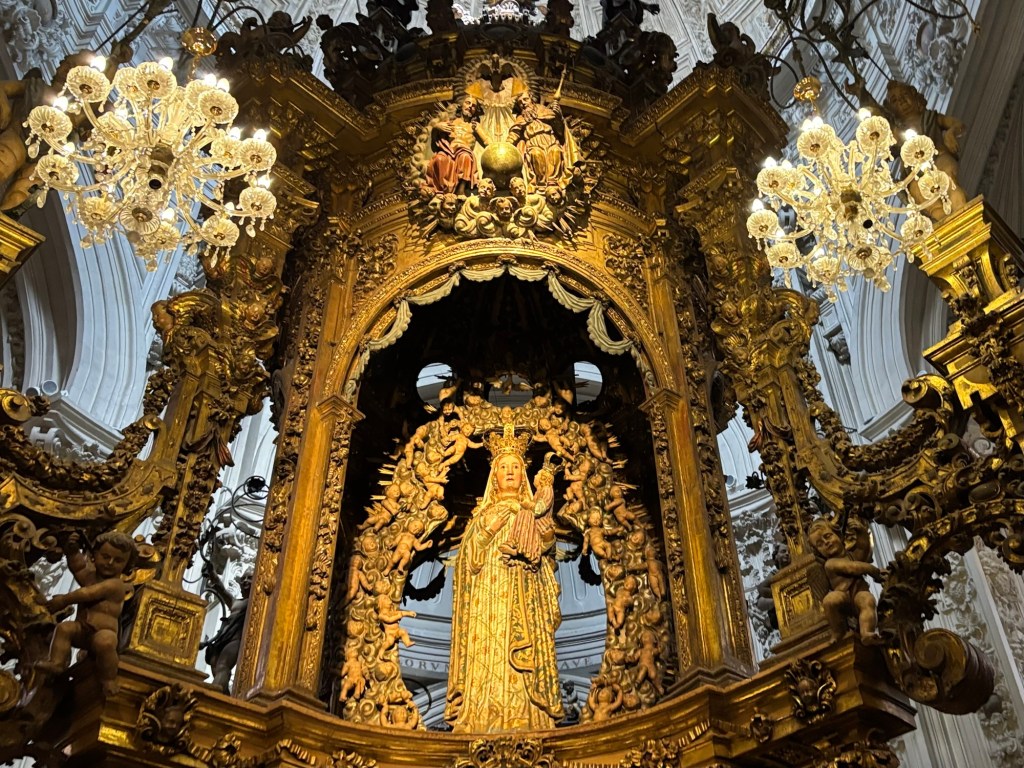
Lugo’s cathedral pays no heed to Spain’s Garfieldesque aversion to Mondays, so I had a look around. Contrary to what several folks online were saying, it’s not free, but it is a cheaper fare for pilgrims at 5€, which isn’t so bad. It’s not as spectacular as León or Burgos, though the chapel to the Lady of Lugo, la Virgen de los Ojos Grandes – the Lady of the Large Eyes – was rather impressive. Her eyes didn’t seem especially large, but maybe it’s because hers were painted brown rather than blue, as is often the way, so they seem like great pools of dark light.
The albergue was pretty busy, as I expect will be the case for the next two nights as the Primitivo rejoins the Francés in Melide, but they’ve almost all of them gone out for dinner, so I’m alone to write. The pseudo-Compede on one of my heels isn’t sticking so well, so I’m keeping one leg balanced on top of the other. In a week from now, I’ll be back in the comfort of my own bed (provided I can get my hands on my key!) and my tired feet will finally be able to rest at last. But let’s not dwell on that just yet.
Instead, I thought I’d take you through my beautiful collection of feathers that I’ve found along the pilgrim road this year. None of them are quite as rare or as beautiful as the fossil scallop – well, perhaps one of them – but I know them and I know their origin. Each one tells a story.
Stashed away in my journal, the smaller ones: a tiny goldfinch feather (rescued from a spider’s web by Audrey, one of my American companions), a feather from the wing of a great-spotted woodpecker and the plume of a large white bird, either a stork or a great bustard, found beneath the flight path of the six birds I saw on my way to Frómista.
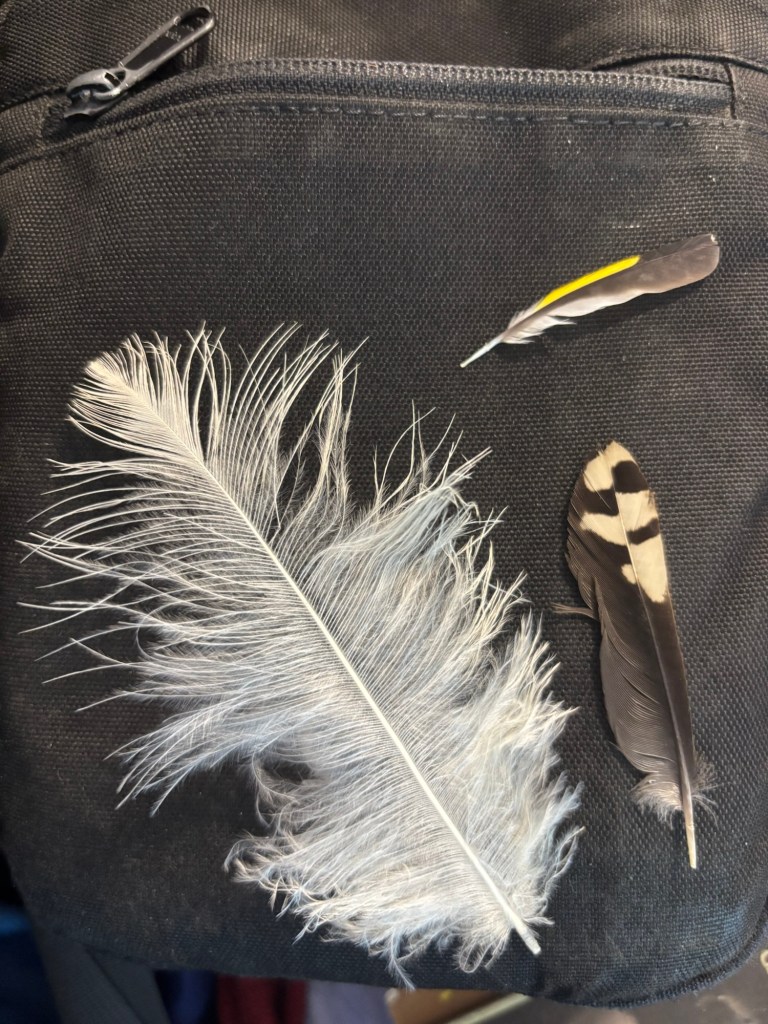
Also within the back pocketof my journal are four more finds, all from different stages of the Camino: a quail feather from the Aragonés, a kestrel’s wing from the Francés, a tawny owl’s downy flight feather from the dark forests of the Camino de San Salvador and a chest feather from the breast of a peregrine falcon, found in the cloisters of Lugo’s Cathedral on the Primitivo. It is surely this last that is the most emblematic in the collection, since the name Peregrine Falcon might literally be translated as “pilgrim” or “wanderer”. It’s a direct translation in Spanish (halcón peregrino), so to find such a thing as my journey draws to a close seems apt.
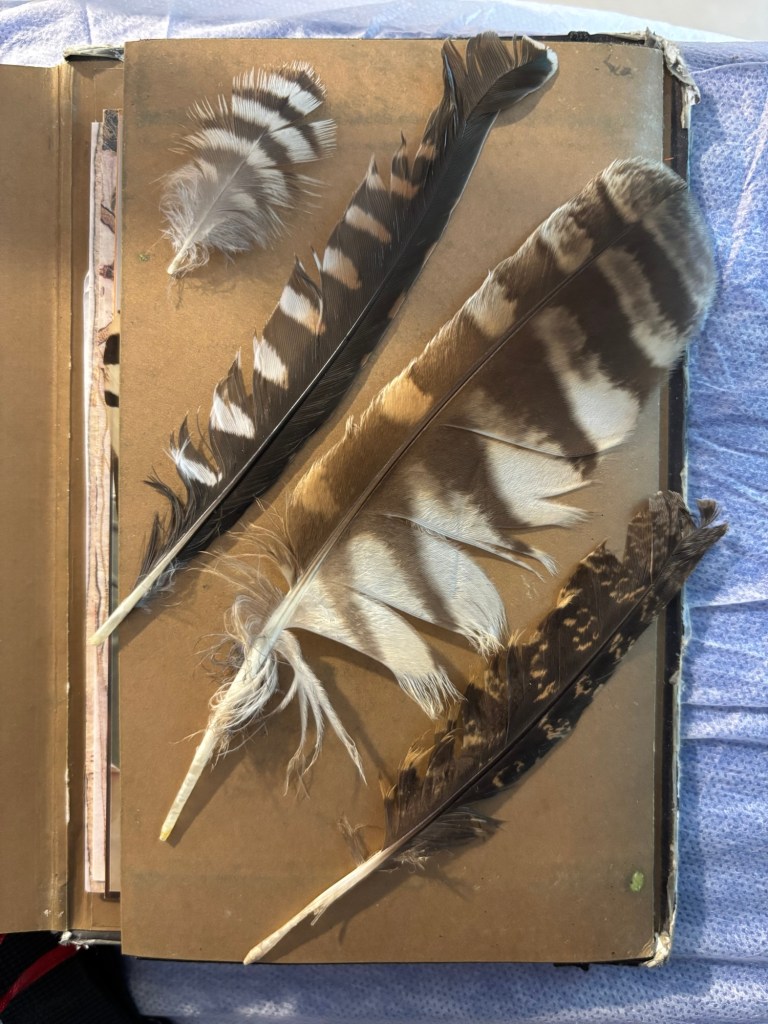
And then there’s the larger finds, the feathers that are too big to fit inside my journal, and so remain slotted into my rucksack during the day’s walk. The long and tapering black finger of a crow seems right, as this has been a familiar companion along the Primitivo, as is the small buzzard plume, and the black and white feathers of a white stork serve as a reminder of the Meseta and the town of Boadilla, where we lost our fearless German companion Theo to major foot complications. The other two have been with me since the very start of the Camino, discarded by a red kite and a griffon vulture on the rugby pitch at Bedous.

The largest of them all, the vulture, has been my totem on this trek. I found a similar one when I was a lad in the mountains of Andalusia, which I still possess to this day, but it has not been on the adventure that this one has.
I am rather attached to it. I find myself checking over my shoulder at least four or five times a day to make sure it’s still there. I sometimes feel I’d be more alarmed if it went missing rather than my watch or wallet – as though it’s been a lucky talisman of some kind.
Whatever it is, it once belonged to a proud and magnificent creature, and I have carried it with me for nearly a thousand kilometres. Through sun and rain and under the moon and stars. In the blinding light of the meseta and the towering shadows of the great cathedrals of Castile. Across sand and stone, hill and dale, moor and mountain – and, hopefully, to the end of my journey.
I don’t really believe in lucky talismans – I prefer to subscribe to the notion that the Creator has a master plan – but, like my faithful Niña and Pinta, they do provide some comfort along the road. The final hundred may yet be my greatest challenge of all, so I will need all the comfort I can get! BB x
 The Book of Barnabas